𝗣𝗔𝗥𝗧 𝟮 HOA Karen Framed Me for a $20,000 Theft—She Forgot My Truck Had a Hidden Camera
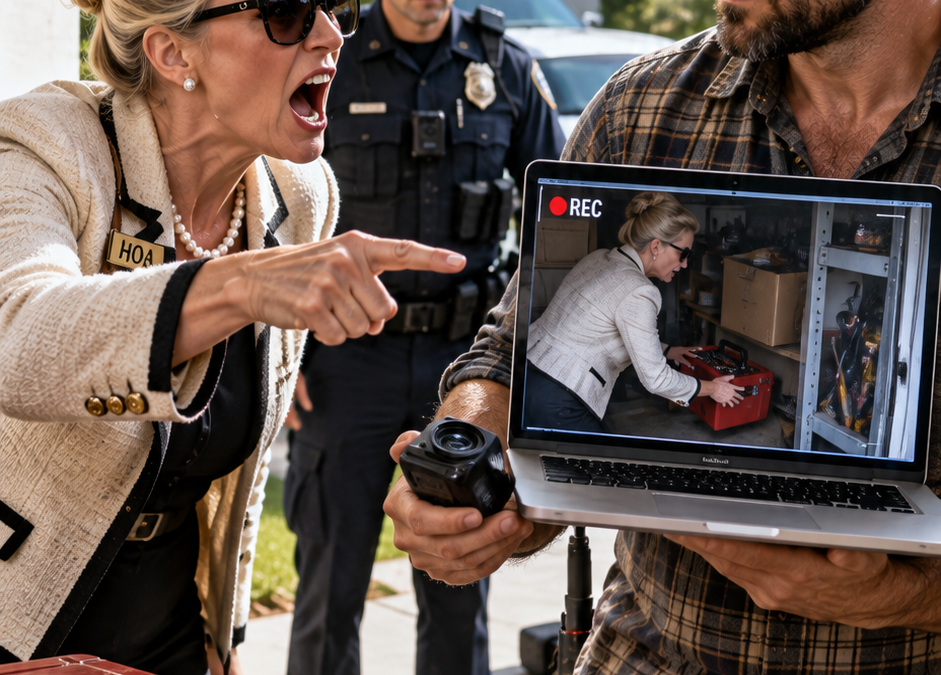
𝗣𝗔𝗥𝗧 𝟮
Blackwood Orchards had been in my family for four generations.
We grew Carrington Gold apples on the eastern slope above the lake, where cold nights and afternoon sun gave them the sharp sweetness that made our cider famous across the county.
Every October we held the Cider and Hearth Festival.
Families pressed their own juice.
Kids ate cinnamon donuts until their parents regretted buying tickets.
We sold local honey, preserves, fruit butter, and a limited reserve cider aged six months in charred oak.
The reserve was the crown jewel.
We didn’t make much.
People reserved it months ahead.
Three days before the festival, Victoria walked into our retail barn.
She ignored the line.
Ignored my wife, Natalie, who was wrapping preserved plums for Mrs. Dempsey from the elementary school.
Then she called my name across the room.
“Leo.”
I came out from the stockroom.
“Victoria.”
“The yacht club is hosting the governor’s pre-regatta gala Saturday.”
“Congratulations.”
“We’ll need one hundred crates of your reserve cider.”
I waited.
She waited.
Finally I said, “Need as in buy?”
Her expression suggested I had sneezed on royalty.
“We expect a sponsorship.”
“One hundred crates?”
“Yes.”
Each crate held twelve bottles.
Half my seasonal supply.
Retail value just over five thousand dollars.
“That’s not a sponsorship,” I said. “That’s inventory.”
“You’ll be prominently featured in the event program.”
Natalie stopped wrapping the plums.
I saw her shoulders change.
Danger.
Victoria continued.
“It would be excellent exposure.”
There are two words that cause more violence in small business than almost any others.
Excellent exposure.
I smiled.
“We’re already sold out of most of the reserve.”
“Surely you can redirect some.”
“To people who’ve already paid?”
“They’ll understand.”
“No.”
Victoria blinked.
“No?”
“I can give the yacht club fifteen percent off.”
Her smile vanished.
“That still comes to more than four thousand dollars.”
“Correct.”
“You expect us to pay?”
“Yes.”
“For cider that will be served to some of the most influential people in the county?”
“Yes.”
Natalie turned her back because she was beginning to smile.
Victoria looked around the barn.
Old beams.
Stone foundation.
Handmade shelves.
The original nineteenth-century pressing equipment displayed along one wall.
“Exposure can be dangerous, Leo.”
That got my attention.
“What?”
“A business this old.”
She glanced toward the rafters.
“So much wood.”
Her smile returned.
“Historic structures have many regulations.”
Natalie put down the ribbon she was holding.
I said, “Are you threatening my orchard over cider?”
“Of course not.”
Victoria slowly pulled on her leather gloves.
“I’m merely reminding you that businesses survive on goodwill.”
She looked at Natalie.
“Goodwill can disappear.”
Then she left.
Four days later, the first inspector arrived.
Festival morning.
Perfect timing.
Mr. Gidley from county environmental protection stepped into the yard wearing a brand-new yellow safety vest and the expression of a man apologizing internally for having accepted government employment.
“We received a complaint.”
“About what?”
“Illegal discharge.”
I stared at him.
“Discharge of what?”
“Fermenting pomace and wastewater into Lake Carrington.”
I almost laughed.
We had operated a closed-loop processing system since 1974.
Press water went into holding tanks.
Pomace went to the agricultural cooperative for composting.
Nothing entered the lake.
Mr. Gidley spent four hours testing ditches and soil.
Found nothing.
But hundreds of festival visitors saw him.
Bright yellow vest.
Clipboard.
Government truck.
Exactly the impression Victoria wanted.
Then came the fire marshal.
Anonymous complaint.
Our open packing shed needed updated extinguishers and illuminated exit signs.
Cost: twelve hundred dollars.
Then road commission.
Anonymous complaint.
Customer parking allegedly extended three inches onto county right-of-way.
Then health department.
Anonymous complaint.
They demanded a commercial three-compartment sink in a retail barn where we sold sealed products.
Every complaint small enough to appear legitimate.
Every one expensive enough to hurt.
Three hundred here.
Twelve hundred there.
Lost time.
Lost customers.
Questions.
Inspections.
Victoria wasn’t trying to destroy us quickly.
She was sanding us down.
One bureaucratic grain at a time.
Then she made the mistake of attacking my truck in public.
The yacht club held its annual membership meeting in late November.
Because my grandfather had purchased a water-access easement through the club’s predecessor in the sixties, I technically held an associate membership.
No vote.
But I could attend.
Victoria stood beneath crystal chandeliers delivering a presentation about “estate aesthetics.”
Eventually, our orchard appeared on the projection screen.
A photograph of my 1982 Ford F-350.
Cherry red.
Restored.
Historic plates.
Beautiful wood bed.
Except Victoria had cropped the photograph to hide all that.
On her slide, it looked like a rusty farm wreck.
“As many of you know,” she announced, “Blackwood Orchards continues to compromise the visual character of our northern approach.”
I stood.
“Victoria.”
Thirty-five wealthy heads turned.
She froze.
Then recovered.
“Leo. I didn’t realize you were attending.”
“I gathered.”
She smiled thinly.
“We’re simply discussing general aesthetics.”
“I heard.”
I walked down the aisle.
“And I’m glad you showed the truck.”
I opened my folder.
“That particular eyesore is a 1982 Ford F-350 with historic registration.”
“It is still unattractive.”
“That’s subjective.”
I held up a security-camera printout.
“This isn’t.”
The room quieted.
“November fourth. Eleven-thirty p.m. Heavy rain.”
I held up another image.
A silver Mercedes.
Stuck axle-deep in mud outside our gate.
“Your approach road flooded.”
Several members leaned forward.
“This Mercedes slid into the drainage ditch.”
Then another printout.
My truck pulling it out.
“Marcus and I spent forty-five minutes in freezing rain recovering that vehicle.”
I looked toward Mrs. Gable in the third row.
Her face turned red.
“We charged nothing.”
A low murmur spread.
I smiled.
“The driver promised muffins.”
Someone laughed.
“Still waiting.”
Mr. Sterling, an older contractor near the front, chuckled openly.
Victoria’s grip tightened on the podium.
“And as for limiting our transport hours,” I continued, “our 1962 easement grants unrestricted twenty-four-hour agricultural access.”
I held up the deed.
“If the club wants to challenge it, my attorney is available.”
I paused.
“He charges six hundred an hour.”
Another laugh.
“But since we’re neighbors, maybe he’ll take cider.”
Even Victoria’s allies smiled.
The transport restriction disappeared from the agenda.
Natalie and I walked home afterward.
“You enjoyed that.”
“A little.”
“You humiliated her.”
“She volunteered.”
Natalie stopped.
“Leo.”
I turned.
She looked back toward the clubhouse.
“That woman doesn’t forget humiliation.”
Neither did her husband.
Six weeks later, we lost the county contract.
Eight years supplying cider and fresh fruit to schools, county offices, and civic events.
Twenty-two percent of our annual gross revenue.
Gone.
One registered letter.
No complaint.
No rebid.
No performance issue.
Awarded to Valley Orchard Services, forty miles away.
I attended the Carrington Charity Gala that Saturday because everybody with influence in the county would be there.
Chief Harrison Vance stood near an ice sculpture shaped like a yacht.
Victoria’s husband.
Police chief.
Big man.
Broad shoulders.
Chest full of polished insignia.
He was eating oysters.
“Harrison.”
He looked at me.
“Leo.”
“I lost the county contract.”
“So I heard.”
“Why?”
He chewed slowly.
“Vendor modernization.”
“Eight years without a missed delivery.”
“Valley has greater capacity.”
“They distribute imported concentrate.”
He shrugged.
“Business changes.”
I stepped closer.
“This isn’t business.”
His eyes hardened.
“No?”
“This is Victoria.”
He smiled.
“My wife tells me you’ve had difficulty understanding community expectations.”
There it was.
He leaned closer.
“Local relationships matter.”
“Are you threatening my business?”
“No.”
He patted my shoulder.
“I’m explaining how small towns work.”
His fingers squeezed slightly.
“Inspectors get curious.”
I said nothing.
“Police notice things.”
Nothing.
“People who create public scenes sometimes discover cooperation drying up.”
“You took our contract because I embarrassed your wife.”
“Careful.”
“Or what?”
His smile vanished.
“Don’t make the county smaller than it already is.”
The next morning, a patrol car stopped Marcus fifty yards from the orchard.
Commercial inspection.
Registration.
Tires.
Lights.
Portable scales.
Forty-five-minute delay.
We missed a distributor pickup.
Lost three hundred dollars.
Next day, they stopped me.
Ninety-five-dollar citation for failing to signal early enough before turning into my own driveway.
Then a patrol car began parking across from our retail entrance.
Customers stopped coming.
Nobody enjoys shopping with a police cruiser watching.
Natalie sat at our kitchen table one night staring at the accounts.
“We’re bleeding.”
“I know.”
“We cut payroll again and Marcus loses another day.”
“I know.”
“We can’t keep doing this.”
I stared through the window toward the pressing barn.
“This is what Victoria wants.”
“The orchard?”
“The land.”
Carrington Yacht Club bordered our southern access.
Our orchard blocked their easiest expansion route toward the county road.
Push us into financial trouble.
Force a sale.
Acquire the acreage.
More parking.
More marina facilities.
Maybe waterfront condos someday.
Natalie rubbed her face.
“Can we prove any of it?”
“Not yet.”
“So what do we do?”
I looked toward the old Ford.
“We stop assuming the rules are fair.”
Three days later, I installed the hidden camera.
Not because I knew what was coming.
Because Harrison’s behavior told me something worse was coming.
The truck already had a visible dash camera.
I added a cabin camera.
Tiny fiber-optic lens hidden in the rearview mirror housing.
Night vision.
Audio.
Independent battery.
Real-time cellular upload to encrypted cloud storage.
Five hundred dollars.
Best purchase I ever made.
Three weeks later, the Commodore’s Compass disappeared.
I had seen it many times.
Nineteenth-century brass marine compass.
Mahogany gimbal stand.
Mother-of-pearl face.
Club founder’s prized artifact.
Value: over twenty thousand dollars.
Someone smashed the lobby display case on a Tuesday night.
Security camera malfunctioned.
Of course.
Wednesday morning at eight, three police cruisers drove into Blackwood Orchards.
Harrison got out first.
Winter coat.
Search warrant.
Smug expression.
“Leo Blackwood.”
“Chief.”
He held up the warrant.
“We’re searching the property.”
“For?”
“The Commodore’s Compass.”
I stared at him.
“You think I stole it?”
“Reliable witness saw your red Ford near the yacht club service entrance around two a.m.”
“In a snowstorm?”
“Apparently.”
“Excellent eyesight.”
He ignored me.
“We have probable cause to search the orchard, house, barns, and vehicles.”
Marcus stepped out behind me.
He was carrying a steel wrench.
I quietly said, “Put that down.”
He did.
Harrison pointed toward the Ford.
“Start there.”
Deputy Jimmy Miller approached.
I knew Jimmy.
Everyone did.
Twenty-six.
Local kid.
Played shortstop in high school.
Usually polite.
That morning he looked sick.
“Morning, Leo.”
“Jimmy.”
He wouldn’t meet my eyes.
He opened the passenger door.
Searched the glove compartment.
Floor.
Behind the seats.
Then his right hand moved into his patrol jacket.
My stomach went cold.
He pulled out something wrapped in black velvet.
Then slid it under the driver’s seat.
Not quickly.
Not smoothly.
He was shaking.
He pushed it deeper behind the heater duct.
Then backed out.
“Chief.”
His voice cracked.
“I found something.”
Harrison walked over.
Jimmy pointed.
“Under the seat.”
Harrison reached inside.
Pulled out the black package.
Unwrapped it.
Brass flashed in the winter sun.
The Commodore’s Compass.
Harrison smiled.
Not surprised.
Triumphant.
“Well.”
He held it up.
“Looks like we found our thief.”
Jimmy reached toward his handcuffs.
“Before you do that,” I said, “Chief, check your phone.”
Harrison stopped.
“What?”
“I sent you a link.”
His face changed slightly.
“To what?”
“The camera feed from my truck.”
Silence.
“What camera?”
“The hidden one.”
Jimmy went white.
I opened my phone.
The video was already there.
Crystal clear.
Jimmy leaning into the cabin.
Jimmy reaching into his jacket.
Jimmy pulling out the black velvet package.
Jimmy sliding it beneath the driver’s seat.
Then the audio.
A crackling voice over Jimmy’s shoulder radio.
Harrison.
“Is it in?”
Jimmy whispered, “Yes.”
“Push it deeper.”
Jimmy pushed.
“Once we find it, he’s done. Just do it and get out.”
Nobody moved.
Harrison stared at the screen.
His face seemed to collapse inward.
“You recorded us.”
“No.”
I stepped closer.
“You recorded yourselves.”
He looked at my phone.
“Delete it.”
I almost smiled.
“Can’t.”
His eyes snapped toward mine.
“Cloud upload.”
I held the phone higher.
“Copies already went to the county prosecutor, state police internal affairs, my attorney, and a reporter.”
Harrison’s mouth opened.
Nothing came out.
“Ten minutes ago.”
Jimmy dropped the handcuffs.
They landed in the gravel.
Then he started crying.
Not quietly.
He leaned against the patrol car and covered his face.
“I’m sorry.”
Harrison spun toward him.
“Shut up.”
Jimmy looked at me.
“He said he’d fire my dad.”
Harrison barked, “Miller.”
“He said he’d plant drugs on my sister.”
“Shut your mouth!”
Jimmy backed away from him.
“He told me to do it.”
Distant sirens sounded across the lake road.
State police.
Harrison looked toward the entrance.
Then back at me.
The stolen compass was still in his hand.
Twenty thousand dollars of polished brass.
A beautiful antique.
And suddenly the stupidest object in Carrington.
I said, “You should probably put that down.”
By noon, Harrison Vance was no longer chief.
State investigators removed his weapon.
Then his badge.
Then him.
The image of Harrison being walked from his own police station in handcuffs appeared on the evening news.
Deputy Jimmy Miller cooperated immediately.
He turned over texts.
Calls.
Orders.
Messages.
Months of them.
The traffic stops.
The surveillance outside my orchard.
The anonymous complaints.
Pressure on county purchasing.
Discussions with Victoria about “making Blackwood understand.”
The compass plan.
Everything.
Victoria had not been careless.
She had been arrogant.
There is a difference.
Careless people forget evidence.
Arrogant people assume nobody will ever be allowed to use it against them.
Once Jimmy cooperated, the entire structure collapsed.
Harrison was indicted.
Official misconduct.
Evidence tampering.
Conspiracy.
Falsifying records.
Abuse of authority.
The prosecutor restored our county vendor status pending a clean bid review.
We won the contract back.
Not because somebody did us a favor.
Because our eight-year record was better than Valley’s.
The yacht club panicked.
Six weeks after the arrest, Victoria resigned from its board.
The trustees sent us a formal apology.
Then offered Natalie and me lifetime honorary membership.
Natalie read the letter.
Walked to the wood stove.
Opened the door.
Dropped it inside.
I watched the gold seal curl black in the flames.
“You could’ve declined politely.”
“I did.”
“That’s your polite?”
“You married me.”
Fair point.
Harrison’s legal bills grew.
Victoria disappeared from public events.
Their peninsula house went on the market.
For the first time in months, Blackwood Orchards breathed again.
And I should have stopped there.
I didn’t.
That was my mistake.
The Vance family owned Carrington Plant Hire and Equipment.
Victoria’s brother Arthur ran it.
Tractors.
Backhoes.
Scaffolding.
Trenchers.
Chippers.
Generators.
Nearly every builder, farmer, and landscaper in the county rented something from them.
For decades, the Vances had accumulated influence because everybody needed something eventually.
Need a machine?
Call Arthur.
Need a permit problem softened?
Call Harrison.
Need yacht-club approval?
Call Victoria.
The whole family ran on dependency.
I wanted it gone.
So I started talking.
Not threatening.
Not ordering.
Talking.
I met contractors.
Farmers.
The agricultural cooperative.
Mr. Sterling.
Builders.
Electricians.
Plumbers.
People I’d known fifteen years.
We drank coffee in my pressing barn.
I laid out what the Vances had done.
“They tried to put me in prison because I wouldn’t give Victoria free cider.”
Nobody corrected me.
Because by then the evidence was public.
I looked around the room.
“If Harrison would plant a twenty-thousand-dollar artifact in my truck, what happens the day one of you disputes an invoice with Arthur?”
Quiet.
“What happens when your permit is sitting on a desk Harrison’s friends can reach?”
Quieter.
“What happens when Victoria decides your landscaping company doesn’t fit Carrington’s image?”
I never said boycott.
Didn’t need to.
Within six months, Carrington Plant Hire started bleeding customers.
The co-op moved tractor leases elsewhere.
Sterling shifted construction rentals to a competitor thirty miles away.
Local trades stopped calling Arthur.
Revenue dropped.
Machines sat.
Drivers had no routes.
Mechanics had nothing to repair.
I drove past the yard one winter morning.
Rows of yellow equipment sat under snow.
Silent.
I felt good.
That was the problem.
I enjoyed it.
They had starved my orchard.
Now their machines were starving.
Symmetry.
Justice.
Or so I told myself.
By the next harvest, Blackwood Orchards was thriving.
The county contract was restored.
Festival attendance broke records.
Marcus was back full-time.
We hired seasonal workers again.
Natalie rebuilt our reserve account.
Harrison went to prison.
Victoria became socially radioactive in the same clubs where she’d once commanded rooms.
We had won.
Completely.
Then I met Ben Moss.
I walked into the hardware store for copper fittings.
At the back, a young man was loading fifty-pound bags of concrete.
Broad shoulders.
Work boots.
Dust on his hands.
I recognized him.
Carrington Plant Hire driver.
He’d delivered equipment to farms all over the county.
“Ben?”
He looked up.
“Mr. Blackwood.”
“I didn’t know you worked here.”
“Three weeks.”
“What happened at the yard?”
He looked at me.
“You know what happened.”
His voice wasn’t rude.
That made it worse.
“Arthur laid me off.”
I shifted.
“I’m sorry.”
“Toby too.”
He lifted another bag.
“Mr. Henderson.”
I nodded slowly.
“Business got bad.”
Ben laughed.
Short.
Dry.
“The market?”
I didn’t answer.
He wiped his hands.
“We all know what it was.”
My chest tightened.
“What?”
“Your boycott.”
“It wasn’t—”
“You talked to everyone.”
“I told people what happened.”
“And they stopped renting.”
“The Vances needed consequences.”
“Harrison needed consequences.”
His eyes hardened.
“Victoria needed consequences.”
He stepped closer.
“I needed a paycheck.”
I started to answer.
He didn’t let me.
“My wife is seven months pregnant.”
That stopped me.
“This place gives me twenty-four hours a week.”
He held up his dusty hands.
“No benefits.”
He laughed again.
“Very careful about that twenty-four.”
I said nothing.
“I work deliveries at night now.”
His jaw tightened.
“My wife had a complication last month.”
“Ben—”
“Prenatal visits aren’t free.”
His eyes were bright.
Angry.
Exhausted.
“Harrison planted the compass?”
“No.”
“Victoria?”
“No.”
“Arthur?”
I hesitated.
“No.”
“Me?”
“No.”
“Toby?”
“No.”
He nodded.
“But we lost everything.”
I felt my defensive anger rise.
“They tried to destroy my family.”
“I know.”
“My orchard nearly failed.”
“I know.”
“They tried to send me to prison.”
“I know!”
His voice cracked.
People at the front of the store turned.
Ben lowered his voice again.
“We were happy when Harrison got arrested.”
He looked directly at me.
“My dad voted against every Vance-backed candidate he ever could.”
I swallowed.
“But you didn’t stop when the guilty people fell.”
That sentence stayed between us.
“You kept squeezing.”
He nodded toward himself.
“Until guys like me fell too.”
I had no answer.
Ben lifted another bag.
Then stopped.
“My kid is due in February.”
He looked at me.
“What did my baby do to you?”
He walked away.
I stood in the hardware aisle without buying the fittings.
For months, I had imagined confronting Victoria again.
Harrison.
Arthur.
I’d rehearsed speeches about power and corruption.
Ben destroyed every one of them with one question.
What did my baby do to you?
I drove back to the orchard.
Parked beside the pressing barn.
Didn’t get out.
The old Ford ticked as the engine cooled.
Through the open barn doors, I could see the oak press my grandfather Frank had rebuilt when I was a teenager.
I remembered something.
When I was sixteen, a kid at school slashed my bicycle tires.
I knew who.
I planned to smash his mailbox.
Grandpa found me in the barn looking for a baseball bat.
He sat on the steps with his pipe.
“Where you going?”
“Nowhere.”
“Take a bat everywhere you go nowhere?”
I told him.
He listened.
Then said:
“A stronger fence is useful.”
I waited.
“Hunting the dog that barked at you isn’t.”
I rolled my eyes.
Sixteen-year-old me was extremely sophisticated.
Grandpa continued.
“Vengeance is salt water.”
I remembered the sentence perfectly.
“The more you drink, the thirstier you get.”
I had forgotten it for years.
Now I sat in the Ford and finally understood.
Harrison had been arrested.
Victoria exposed.
The orchard restored.
That should have been enough.
Instead, I had needed to see the Vance name hurt.
Arthur’s company became a target because it carried that name.
Workers became acceptable collateral because I had decided any weakness in the Vance family’s world counted as justice.
Ben hadn’t framed me.
Neither had Toby.
Neither had the mechanic with four grandchildren.
I had spent months condemning Harrison for using institutional power to hurt innocent people around his enemy.
Then I’d used economic power to do a cleaner version of the same thing.
Natalie found me an hour later.
She opened the passenger door.
“You look terrible.”
“I met Ben Moss.”
“Who?”
“Driver from Arthur’s yard.”
I told her.
Everything.
When I finished, she stayed quiet.
That was Natalie.
She never rushed to make uncomfortable things comfortable.
Finally she said, “He was right.”
I looked at her.
“You could pretend otherwise.”
“Helpful.”
“You married me for honesty.”
“I was young.”
She smiled slightly.
Then looked toward the orchard.
“We can’t undo winter.”
I waited.
“But we decide what gets planted in spring.”
I turned toward her.
“Grandpa used to say something like that.”
“Good.”
She squeezed my shoulder.
“Try listening this time.”
The next morning, I drove back to the hardware store.
Ben wasn’t working.
I asked the manager where he lived.
Two hours later, I stood outside a small rental cottage near the railway.
Paint peeling.
Old porch.
Used stroller beside the door.
Ben opened it.
Gray sweatshirt.
Baby bottle in one hand.
He saw me.
Immediately stiffened.
“Mr. Blackwood.”
“I owe you an apology.”
He stared.
“I was angry.”
“I noticed.”
“I had reason.”
“Yes.”
“But I took it too far.”
He said nothing.
“I couldn’t put Harrison back in prison twice.”
Still nothing.
“So I went after the system around him.”
“Arthur’s business.”
“Yes.”
“And us.”
“Yes.”
That word hurt.
Good.
It should have.
“I told myself everyone who supported that family was part of the problem.”
“I didn’t support Harrison.”
“I know.”
“I rented tractors.”
“I know.”
“My job was driving them.”
“I know.”
His shoulders loosened slightly.
I took a breath.
“I’m opening a bakery and tasting room.”
He frowned.
“What?”
“Old pressing barn renovation.”
He still looked suspicious.
“I need a logistics manager.”
Nothing.
“Fleet scheduling. Commercial deliveries. Vendor coordination. Inventory.”
He blinked.
“Why are you telling me?”
“Because I want you to take the job.”
Silence.
“Fifty thousand a year.”
His mouth opened.
“Health insurance.”
He stared at me.
“Three weeks paid vacation.”
Nothing.
“Profit sharing after harvest.”
Finally:
“Why?”
I looked at his hands.
Concrete still embedded in the skin around his fingernails.
“Because you told me something nobody else was willing to tell me.”
He waited.
“I was becoming the thing I hated.”
His expression changed.
Slightly.
“My grandfather taught me that hands are supposed to build more than they break.”
I nodded toward his.
“You know machines.”
“You know delivery.”
“You know work.”
“And judging by what you said yesterday, you aren’t scared of telling the boss when he’s being an idiot.”
That almost got a smile.
“Useful qualification.”
He looked into the house.
“Can I talk to my wife?”
“I’d be worried if you didn’t.”
He stepped outside and closed the door behind him.
“Leo.”
“Yeah?”
“If I take it…”
He hesitated.
“I don’t want charity.”
“Good.”
“I don’t want you hiring me because you feel guilty.”
“Also good.”
“I work.”
“That’s why I’m here.”
“I’ll tell you when your routing sucks.”
“I assume that’s covered by profit sharing.”
He finally smiled.
Small.
Tired.
Real.
Then extended his hand.
I shook it.
The next February, Ben’s daughter was born.
Healthy.
Eight pounds.
He took paid leave.
Returned three weeks later and immediately redesigned our entire delivery schedule because, according to him, I had been “running logistics like a man who thinks gasoline is free.”
He was right.
Annoyingly.
The bakery opened in spring.
The tasting room followed.
Our county business grew.
Marcus became operations supervisor.
Ben took distribution.
Natalie handled retail.
I went back to the part I understood best.
Orchards.
Cider.
Machines.
And occasionally refusing ridiculous requests from wealthy people.
Carrington changed too.
Not perfectly.
Small towns rarely have redemption arcs as clean as stories do.
Harrison served his sentence.
His conviction permanently ended his law-enforcement career.
Victoria moved out of the county after their peninsula house sold.
Arthur eventually shut Carrington Plant Hire.
Some workers found jobs quickly.
Others didn’t.
I helped where I could.
Not because I could repair everything.
I couldn’t.
Some damage stays damage.
But I stopped confusing suffering with justice.
That distinction mattered.
The yacht club replaced its leadership.
The new board did something almost revolutionary.
When the gate failed the following summer, they called me.
I walked down.
Looked at the motor.
“Actuator’s gone.”
The new commodore, Mr. Sterling, nodded.
“How much?”
“About nine hundred installed.”
“Send an invoice.”
I stared at him.
“What?”
He smiled.
“I said send an invoice.”
“No speech about community?”
“No.”
“Prestige?”
“No.”
“Exposure?”
He laughed.
“Leo.”
“Yes?”
“We’re paying you.”
I almost hugged him.
Instead I repaired the gate.
Marcus did the alignment.
Ben handled the part shipment.
Then we sent the yacht club a normal invoice.
Nine hundred and twelve dollars.
They paid it in six days.
I framed that check stub too.
Not because of the money.
Because for years, Victoria had treated payment like defeat.
She wanted favors.
Obligation.
Hierarchy.
The new board treated us like a business.
Equals.
That was worth more than honorary membership.
The Commodore’s Compass eventually returned to the yacht club.
State police kept it during evidence processing.
After Harrison’s case concluded, it went back into the restored glass case.
I saw it once.
Polished brass.
Mother-of-pearl dial.
Soft spotlight.
Small plaque.
No mention that it had once spent several minutes under my Ford’s driver’s seat.
Probably wise.
I stood looking at it during a winter charity event.
Mr. Sterling joined me.
“Strange year.”
“That’s one word.”
He looked at the compass.
“I still can’t believe Harrison thought that would work.”
“He nearly made it work.”
“Except for the camera.”
“Except for the camera.”
Sterling smiled.
“Victoria always underestimated people she thought were beneath her.”
I considered that.
“So did I.”
He looked over.
“What do you mean?”
“Different story.”
I left it there.
Because by then I understood the hidden camera had only saved me from one kind of blindness.
It caught Jimmy planting evidence.
It caught Harrison’s voice.
It exposed the crime.
But no camera recorded what happened afterward when I turned my anger outward and started convincing myself everybody near the Vances deserved whatever came.
Ben had been that camera.
He showed me the part I hadn’t wanted to see.
Years later, people in Carrington still told the story as if the satisfying ending was Harrison staring at my phone while his voice played through the speakers.
And I’ll admit it.
That moment was satisfying.
Watching the grin disappear from his face?
Watching the compass suddenly become evidence against him instead of me?
Hearing state-police sirens getting closer while he stood in my gravel yard holding the object he had ordered planted?
I enjoyed every second.
But that wasn’t the part that mattered most.
The real ending happened in a small rental house near the railroad.
A tired twenty-two-year-old father stood in his doorway holding a baby bottle while I admitted I had been wrong.
No cameras.
No police.
No crowd.
No applause.
Just two men deciding whether one bad winter was going to become another.
Ben took the job.
Years later, he became a partner.
Marcus retired.
Natalie still refuses to let yacht-club members request “exposure sponsorships” without charging them ten percent extra for making her hear the word exposure.
We call it the Victoria Fee.
Officially, it does not exist.
Unofficially, it absolutely exists.
Blackwood Orchards is still there.
Same lake.
Same barn.
Same old Ford.
The hidden camera is still installed too.
I upgraded it twice.
Some lessons deserve redundancy.
And every time I drive past the yacht club gate, I think about how close Victoria and Harrison came to taking everything.
My business.
My land.
My reputation.
My freedom.
They failed because they thought control mattered more than truth.
They had the police chief.
The club.
County contacts.
Inspectors.
Money.
Influence.
A signed search warrant.
And a stolen twenty-thousand-dollar compass already hidden in my truck.
I had one tiny camera they didn’t know existed.
That was enough to expose them.
But defeating them turned out to be the easy lesson.
The harder one came later.
Winning doesn’t automatically make every choice you make afterward righteous.
Justice has a stopping point.
Revenge doesn’t.
Harrison forgot that power had limits.
Victoria forgot that neighbors weren’t servants.
And for a while, I forgot that innocent people don’t become guilty just because their paycheck comes from somebody you hate.
The hidden camera saved my freedom.
Ben Moss saved something else.
He reminded me what kind of man I wanted to be once nobody was trying to destroy me anymore.
In the end, Victoria tried to frame me for a $20,000 theft.
She lost her position.
Harrison lost his badge and his freedom.
Their entire little system of intimidation collapsed.
And I kept my farm.
But the victory I value most isn’t that I caught them.
It’s that after all of it, I finally knew when to stop.
Have you finished reading the story and want to read it again?
HOA Karen Framed Me for a $20,000 Theft—She Forgot My Truck Had a Hidden Camera
They found a stolen $20,000 compass under my driver’s seat.
The police chief already had the handcuffs out.
What he didn’t know was that my truck had recorded everything.
The trouble started with a gate.
Not a dramatic gate.
Not even a particularly attractive gate.
Just a heavy wrought-iron barrier guarding the entrance to the Carrington Yacht Club, where people with six-figure boats apparently needed protection from the terrifying possibility that an ordinary citizen might see them carrying a cooler.
Salt air from Lake Carrington constantly corroded the electronics.
The control board failed.
The motor jammed.
Sensors shorted.
And because the nearest authorized repair company was almost an hour away, the club paid ridiculous service charges every time something went wrong.
Years earlier, my grandfather had repaired the gate as a favor.
That single act of kindness became, in yacht-club mythology, a permanent maintenance contract nobody had ever bothered to tell us about.
I inherited the orchard.
Apparently I also inherited the gate.
The first time Victoria Vance came walking onto Blackwood Orchards asking for help, she was wearing white linen trousers and shoes that cost more than the transmission in my old Ford.
“Leo,” she said, as though we were lifelong friends rather than neighbors who exchanged stiff waves twice a month, “we have the regatta tomorrow and the gate is stuck open.”
“Call the service company.”
“They can’t come until Monday.”
“Then leave it open.”
She stared at me as if I had suggested releasing wolves into the marina.
“Anyone could drive in.”
“Terrifying.”
“Leo.”
I sighed.
“What happened?”
Three hours later, under a July sun hot enough to cook apples on the hood of a truck, I found the blown capacitor.
I replaced it.
I charged nothing.
Victoria patted my arm.
Actually patted it.
“You’re marvelous.”
That should have been my warning.
Eight months later, I replaced a stripped drive gear.
Again, no charge.
Peace with wealthy neighbors has its own tax code.
Then the actuator motor burned out.
Not damaged.
Burned.
The windings had melted into black plastic sludge.
Victoria stood beside her Mercedes while I explained it.
“New actuator assembly,” I said. “About six hundred for the part at my commercial discount.”
She nodded impatiently.
“Marcus will need about three hours to mount and align it.”
Marcus was my lead hand at the orchard.
Good mechanic.
Three children.
Mortgage.
A man whose labor was worth money even if Victoria’s sunglasses cost enough to distort that fact.
“So call it eight hundred total. Materials and Marcus’ wage. No markup from me.”
Victoria went still.
“An invoice?”
“Yes.”
“We’re neighbors.”
“Yes.”
“The yacht club brings considerable prestige to this waterway.”
“I’m sure the gate motor finds that comforting.”
Her mouth tightened.
“We’ve tolerated the agricultural odor from your pressing barn for years.”
I stared at her.
“Apples?”
“And your tractors use our access road.”
“My deeded access road.”
“You understand my point.”
“I really don’t.”
She leaned closer.
“I thought you were community-minded.”
“I repaired your gate twice for free.”
“And now you’re charging us.”
“Because this repair costs real money.”
Something changed in her face.
Not disappointment.
Insult.
For Victoria, payment wasn’t about dollars.
It was about hierarchy.
If I charged her, I became a contractor.
An equal party to a transaction.
She preferred favors because favors proved that other people understood their place.
“I see,” she said.
Then she got into her Mercedes.
Two weeks later, the club hired a city company.
They paid almost three thousand dollars.
Victoria would rather spend three times as much than let me prove Marcus’ labor had value.
That should have been the end of it.
Instead, she came to the orchard in October.
And asked me for five thousand dollars’ worth of cider for free.
PART2
Blackwood Orchards had been in my family for four generations.
We grew Carrington Gold apples on the eastern slope above the lake, where cold nights and afternoon sun gave them the sharp sweetness that made our cider famous across the county.
Every October we held the Cider and Hearth Festival.
Families pressed their own juice.
Kids ate cinnamon donuts until their parents regretted buying tickets.
We sold local honey, preserves, fruit butter, and a limited reserve cider aged six months in charred oak.
The reserve was the crown jewel.
We didn’t make much.
People reserved it months ahead.
Three days before the festival, Victoria walked into our retail barn.
She ignored the line.
Ignored my wife, Natalie, who was wrapping preserved plums for Mrs. Dempsey from the elementary school.
Then she called my name across the room.
“Leo.”
I came out from the stockroom.
“Victoria.”
“The yacht club is hosting the governor’s pre-regatta gala Saturday.”
“Congratulations.”
“We’ll need one hundred crates of your reserve cider.”
I waited.
She waited.
Finally I said, “Need as in buy?”
Her expression suggested I had sneezed on royalty.
“We expect a sponsorship.”
“One hundred crates?”
“Yes.”
Each crate held twelve bottles.
Half my seasonal supply.
Retail value just over five thousand dollars.
“That’s not a sponsorship,” I said. “That’s inventory.”
“You’ll be prominently featured in the event program.”
Natalie stopped wrapping the plums.
I saw her shoulders change.
Danger.
Victoria continued.
“It would be excellent exposure.”
There are two words that cause more violence in small business than almost any others.
Excellent exposure.
I smiled.
“We’re already sold out of most of the reserve.”
“Surely you can redirect some.”
“To people who’ve already paid?”
“They’ll understand.”
“No.”
Victoria blinked.
“No?”
“I can give the yacht club fifteen percent off.”
Her smile vanished.
“That still comes to more than four thousand dollars.”
“Correct.”
“You expect us to pay?”
“Yes.”
“For cider that will be served to some of the most influential people in the county?”
“Yes.”
Natalie turned her back because she was beginning to smile.
Victoria looked around the barn.
Old beams.
Stone foundation.
Handmade shelves.
The original nineteenth-century pressing equipment displayed along one wall.
“Exposure can be dangerous, Leo.”
That got my attention.
“What?”
“A business this old.”
She glanced toward the rafters.
“So much wood.”
Her smile returned.
“Historic structures have many regulations.”
Natalie put down the ribbon she was holding.
I said, “Are you threatening my orchard over cider?”
“Of course not.”
Victoria slowly pulled on her leather gloves.
“I’m merely reminding you that businesses survive on goodwill.”
She looked at Natalie.
“Goodwill can disappear.”
Then she left.
Four days later, the first inspector arrived.
Festival morning.
Perfect timing.
Mr. Gidley from county environmental protection stepped into the yard wearing a brand-new yellow safety vest and the expression of a man apologizing internally for having accepted government employment.
“We received a complaint.”
“About what?”
“Illegal discharge.”
I stared at him.
“Discharge of what?”
“Fermenting pomace and wastewater into Lake Carrington.”
I almost laughed.
We had operated a closed-loop processing system since 1974.
Press water went into holding tanks.
Pomace went to the agricultural cooperative for composting.
Nothing entered the lake.
Mr. Gidley spent four hours testing ditches and soil.
Found nothing.
But hundreds of festival visitors saw him.
Bright yellow vest.
Clipboard.
Government truck.
Exactly the impression Victoria wanted.
Then came the fire marshal.
Anonymous complaint.
Our open packing shed needed updated extinguishers and illuminated exit signs.
Cost: twelve hundred dollars.
Then road commission.
Anonymous complaint.
Customer parking allegedly extended three inches onto county right-of-way.
Then health department.
Anonymous complaint.
They demanded a commercial three-compartment sink in a retail barn where we sold sealed products.
Every complaint small enough to appear legitimate.
Every one expensive enough to hurt.
Three hundred here.
Twelve hundred there.
Lost time.
Lost customers.
Questions.
Inspections.
Victoria wasn’t trying to destroy us quickly.
She was sanding us down.
One bureaucratic grain at a time.
Then she made the mistake of attacking my truck in public.
The yacht club held its annual membership meeting in late November.
Because my grandfather had purchased a water-access easement through the club’s predecessor in the sixties, I technically held an associate membership.
No vote.
But I could attend.
Victoria stood beneath crystal chandeliers delivering a presentation about “estate aesthetics.”
Eventually, our orchard appeared on the projection screen.
A photograph of my 1982 Ford F-350.
Cherry red.
Restored.
Historic plates.
Beautiful wood bed.
Except Victoria had cropped the photograph to hide all that.
On her slide, it looked like a rusty farm wreck.
“As many of you know,” she announced, “Blackwood Orchards continues to compromise the visual character of our northern approach.”
I stood.
“Victoria.”
Thirty-five wealthy heads turned.
She froze.
Then recovered.
“Leo. I didn’t realize you were attending.”
“I gathered.”
She smiled thinly.
“We’re simply discussing general aesthetics.”
“I heard.”
I walked down the aisle.
“And I’m glad you showed the truck.”
I opened my folder.
“That particular eyesore is a 1982 Ford F-350 with historic registration.”
“It is still unattractive.”
“That’s subjective.”
I held up a security-camera printout.
“This isn’t.”
The room quieted.
“November fourth. Eleven-thirty p.m. Heavy rain.”
I held up another image.
A silver Mercedes.
Stuck axle-deep in mud outside our gate.
“Your approach road flooded.”
Several members leaned forward.
“This Mercedes slid into the drainage ditch.”
Then another printout.
My truck pulling it out.
“Marcus and I spent forty-five minutes in freezing rain recovering that vehicle.”
I looked toward Mrs. Gable in the third row.
Her face turned red.
“We charged nothing.”
A low murmur spread.
I smiled.
“The driver promised muffins.”
Someone laughed.
“Still waiting.”
Mr. Sterling, an older contractor near the front, chuckled openly.
Victoria’s grip tightened on the podium.
“And as for limiting our transport hours,” I continued, “our 1962 easement grants unrestricted twenty-four-hour agricultural access.”
I held up the deed.
“If the club wants to challenge it, my attorney is available.”
I paused.
“He charges six hundred an hour.”
Another laugh.
“But since we’re neighbors, maybe he’ll take cider.”
Even Victoria’s allies smiled.
The transport restriction disappeared from the agenda.
Natalie and I walked home afterward.
“You enjoyed that.”
“A little.”
“You humiliated her.”
“She volunteered.”
Natalie stopped.
“Leo.”
I turned.
She looked back toward the clubhouse.
“That woman doesn’t forget humiliation.”
Neither did her husband.
Six weeks later, we lost the county contract.
Eight years supplying cider and fresh fruit to schools, county offices, and civic events.
Twenty-two percent of our annual gross revenue.
Gone.
One registered letter.
No complaint.
No rebid.
No performance issue.
Awarded to Valley Orchard Services, forty miles away.
I attended the Carrington Charity Gala that Saturday because everybody with influence in the county would be there.
Chief Harrison Vance stood near an ice sculpture shaped like a yacht.
Victoria’s husband.
Police chief.
Big man.
Broad shoulders.
Chest full of polished insignia.
He was eating oysters.
“Harrison.”
He looked at me.
“Leo.”
“I lost the county contract.”
“So I heard.”
“Why?”
He chewed slowly.
“Vendor modernization.”
“Eight years without a missed delivery.”
“Valley has greater capacity.”
“They distribute imported concentrate.”
He shrugged.
“Business changes.”
I stepped closer.
“This isn’t business.”
His eyes hardened.
“No?”
“This is Victoria.”
He smiled.
“My wife tells me you’ve had difficulty understanding community expectations.”
There it was.
He leaned closer.
“Local relationships matter.”
“Are you threatening my business?”
“No.”
He patted my shoulder.
“I’m explaining how small towns work.”
His fingers squeezed slightly.
“Inspectors get curious.”
I said nothing.
“Police notice things.”
Nothing.
“People who create public scenes sometimes discover cooperation drying up.”
“You took our contract because I embarrassed your wife.”
“Careful.”
“Or what?”
His smile vanished.
“Don’t make the county smaller than it already is.”
The next morning, a patrol car stopped Marcus fifty yards from the orchard.
Commercial inspection.
Registration.
Tires.
Lights.
Portable scales.
Forty-five-minute delay.
We missed a distributor pickup.
Lost three hundred dollars.
Next day, they stopped me.
Ninety-five-dollar citation for failing to signal early enough before turning into my own driveway.
Then a patrol car began parking across from our retail entrance.
Customers stopped coming.
Nobody enjoys shopping with a police cruiser watching.
Natalie sat at our kitchen table one night staring at the accounts.
“We’re bleeding.”
“I know.”
“We cut payroll again and Marcus loses another day.”
“I know.”
“We can’t keep doing this.”
I stared through the window toward the pressing barn.
“This is what Victoria wants.”
“The orchard?”
“The land.”
Carrington Yacht Club bordered our southern access.
Our orchard blocked their easiest expansion route toward the county road.
Push us into financial trouble.
Force a sale.
Acquire the acreage.
More parking.
More marina facilities.
Maybe waterfront condos someday.
Natalie rubbed her face.
“Can we prove any of it?”
“Not yet.”
“So what do we do?”
I looked toward the old Ford.
“We stop assuming the rules are fair.”
Three days later, I installed the hidden camera.
Not because I knew what was coming.
Because Harrison’s behavior told me something worse was coming.
The truck already had a visible dash camera.
I added a cabin camera.
Tiny fiber-optic lens hidden in the rearview mirror housing.
Night vision.
Audio.
Independent battery.
Real-time cellular upload to encrypted cloud storage.
Five hundred dollars.
Best purchase I ever made.
Three weeks later, the Commodore’s Compass disappeared.
I had seen it many times.
Nineteenth-century brass marine compass.
Mahogany gimbal stand.
Mother-of-pearl face.
Club founder’s prized artifact.
Value: over twenty thousand dollars.
Someone smashed the lobby display case on a Tuesday night.
Security camera malfunctioned.
Of course.
Wednesday morning at eight, three police cruisers drove into Blackwood Orchards.
Harrison got out first.
Winter coat.
Search warrant.
Smug expression.
“Leo Blackwood.”
“Chief.”
He held up the warrant.
“We’re searching the property.”
“For?”
“The Commodore’s Compass.”
I stared at him.
“You think I stole it?”
“Reliable witness saw your red Ford near the yacht club service entrance around two a.m.”
“In a snowstorm?”
“Apparently.”
“Excellent eyesight.”
He ignored me.
“We have probable cause to search the orchard, house, barns, and vehicles.”
Marcus stepped out behind me.
He was carrying a steel wrench.
I quietly said, “Put that down.”
He did.
Harrison pointed toward the Ford.
“Start there.”
Deputy Jimmy Miller approached.
I knew Jimmy.
Everyone did.
Twenty-six.
Local kid.
Played shortstop in high school.
Usually polite.
That morning he looked sick.
“Morning, Leo.”
“Jimmy.”
He wouldn’t meet my eyes.
He opened the passenger door.
Searched the glove compartment.
Floor.
Behind the seats.
Then his right hand moved into his patrol jacket.
My stomach went cold.
He pulled out something wrapped in black velvet.
Then slid it under the driver’s seat.
Not quickly.
Not smoothly.
He was shaking.
He pushed it deeper behind the heater duct.
Then backed out.
“Chief.”
His voice cracked.
“I found something.”
Harrison walked over.
Jimmy pointed.
“Under the seat.”
Harrison reached inside.
Pulled out the black package.
Unwrapped it.
Brass flashed in the winter sun.
The Commodore’s Compass.
Harrison smiled.
Not surprised.
Triumphant.
“Well.”
He held it up.
“Looks like we found our thief.”
Jimmy reached toward his handcuffs.
“Before you do that,” I said, “Chief, check your phone.”
Harrison stopped.
“What?”
“I sent you a link.”
His face changed slightly.
“To what?”
“The camera feed from my truck.”
Silence.
“What camera?”
“The hidden one.”
Jimmy went white.
I opened my phone.
The video was already there.
Crystal clear.
Jimmy leaning into the cabin.
Jimmy reaching into his jacket.
Jimmy pulling out the black velvet package.
Jimmy sliding it beneath the driver’s seat.
Then the audio.
A crackling voice over Jimmy’s shoulder radio.
Harrison.
“Is it in?”
Jimmy whispered, “Yes.”
“Push it deeper.”
Jimmy pushed.
“Once we find it, he’s done. Just do it and get out.”
Nobody moved.
Harrison stared at the screen.
His face seemed to collapse inward.
“You recorded us.”
“No.”
I stepped closer.
“You recorded yourselves.”
He looked at my phone.
“Delete it.”
I almost smiled.
“Can’t.”
His eyes snapped toward mine.
“Cloud upload.”
I held the phone higher.
“Copies already went to the county prosecutor, state police internal affairs, my attorney, and a reporter.”
Harrison’s mouth opened.
Nothing came out.
“Ten minutes ago.”
Jimmy dropped the handcuffs.
They landed in the gravel.
Then he started crying.
Not quietly.
He leaned against the patrol car and covered his face.
“I’m sorry.”
Harrison spun toward him.
“Shut up.”
Jimmy looked at me.
“He said he’d fire my dad.”
Harrison barked, “Miller.”
“He said he’d plant drugs on my sister.”
“Shut your mouth!”
Jimmy backed away from him.
“He told me to do it.”
Distant sirens sounded across the lake road.
State police.
Harrison looked toward the entrance.
Then back at me.
The stolen compass was still in his hand.
Twenty thousand dollars of polished brass.
A beautiful antique.
And suddenly the stupidest object in Carrington.
I said, “You should probably put that down.”
By noon, Harrison Vance was no longer chief.
State investigators removed his weapon.
Then his badge.
Then him.
The image of Harrison being walked from his own police station in handcuffs appeared on the evening news.
Deputy Jimmy Miller cooperated immediately.
He turned over texts.
Calls.
Orders.
Messages.
Months of them.
The traffic stops.
The surveillance outside my orchard.
The anonymous complaints.
Pressure on county purchasing.
Discussions with Victoria about “making Blackwood understand.”
The compass plan.
Everything.
Victoria had not been careless.
She had been arrogant.
There is a difference.
Careless people forget evidence.
Arrogant people assume nobody will ever be allowed to use it against them.
Once Jimmy cooperated, the entire structure collapsed.
Harrison was indicted.
Official misconduct.
Evidence tampering.
Conspiracy.
Falsifying records.
Abuse of authority.
The prosecutor restored our county vendor status pending a clean bid review.
We won the contract back.
Not because somebody did us a favor.
Because our eight-year record was better than Valley’s.
The yacht club panicked.
Six weeks after the arrest, Victoria resigned from its board.
The trustees sent us a formal apology.
Then offered Natalie and me lifetime honorary membership.
Natalie read the letter.
Walked to the wood stove.
Opened the door.
Dropped it inside.
I watched the gold seal curl black in the flames.
“You could’ve declined politely.”
“I did.”
“That’s your polite?”
“You married me.”
Fair point.
Harrison’s legal bills grew.
Victoria disappeared from public events.
Their peninsula house went on the market.
For the first time in months, Blackwood Orchards breathed again.
And I should have stopped there.
I didn’t.
That was my mistake.
The Vance family owned Carrington Plant Hire and Equipment.
Victoria’s brother Arthur ran it.
Tractors.
Backhoes.
Scaffolding.
Trenchers.
Chippers.
Generators.
Nearly every builder, farmer, and landscaper in the county rented something from them.
For decades, the Vances had accumulated influence because everybody needed something eventually.
Need a machine?
Call Arthur.
Need a permit problem softened?
Call Harrison.
Need yacht-club approval?
Call Victoria.
The whole family ran on dependency.
I wanted it gone.
So I started talking.
Not threatening.
Not ordering.
Talking.
I met contractors.
Farmers.
The agricultural cooperative.
Mr. Sterling.
Builders.
Electricians.
Plumbers.
People I’d known fifteen years.
We drank coffee in my pressing barn.
I laid out what the Vances had done.
“They tried to put me in prison because I wouldn’t give Victoria free cider.”
Nobody corrected me.
Because by then the evidence was public.
I looked around the room.
“If Harrison would plant a twenty-thousand-dollar artifact in my truck, what happens the day one of you disputes an invoice with Arthur?”
Quiet.
“What happens when your permit is sitting on a desk Harrison’s friends can reach?”
Quieter.
“What happens when Victoria decides your landscaping company doesn’t fit Carrington’s image?”
I never said boycott.
Didn’t need to.
Within six months, Carrington Plant Hire started bleeding customers.
The co-op moved tractor leases elsewhere.
Sterling shifted construction rentals to a competitor thirty miles away.
Local trades stopped calling Arthur.
Revenue dropped.
Machines sat.
Drivers had no routes.
Mechanics had nothing to repair.
I drove past the yard one winter morning.
Rows of yellow equipment sat under snow.
Silent.
I felt good.
That was the problem.
I enjoyed it.
They had starved my orchard.
Now their machines were starving.
Symmetry.
Justice.
Or so I told myself.
By the next harvest, Blackwood Orchards was thriving.
The county contract was restored.
Festival attendance broke records.
Marcus was back full-time.
We hired seasonal workers again.
Natalie rebuilt our reserve account.
Harrison went to prison.
Victoria became socially radioactive in the same clubs where she’d once commanded rooms.
We had won.
Completely.
Then I met Ben Moss.
I walked into the hardware store for copper fittings.
At the back, a young man was loading fifty-pound bags of concrete.
Broad shoulders.
Work boots.
Dust on his hands.
I recognized him.
Carrington Plant Hire driver.
He’d delivered equipment to farms all over the county.
“Ben?”
He looked up.
“Mr. Blackwood.”
“I didn’t know you worked here.”
“Three weeks.”
“What happened at the yard?”
He looked at me.
“You know what happened.”
His voice wasn’t rude.
That made it worse.
“Arthur laid me off.”
I shifted.
“I’m sorry.”
“Toby too.”
He lifted another bag.
“Mr. Henderson.”
I nodded slowly.
“Business got bad.”
Ben laughed.
Short.
Dry.
“The market?”
I didn’t answer.
He wiped his hands.
“We all know what it was.”
My chest tightened.
“What?”
“Your boycott.”
“It wasn’t—”
“You talked to everyone.”
“I told people what happened.”
“And they stopped renting.”
“The Vances needed consequences.”
“Harrison needed consequences.”
His eyes hardened.
“Victoria needed consequences.”
He stepped closer.
“I needed a paycheck.”
I started to answer.
He didn’t let me.
“My wife is seven months pregnant.”
That stopped me.
“This place gives me twenty-four hours a week.”
He held up his dusty hands.
“No benefits.”
He laughed again.
“Very careful about that twenty-four.”
I said nothing.
“I work deliveries at night now.”
His jaw tightened.
“My wife had a complication last month.”
“Ben—”
“Prenatal visits aren’t free.”
His eyes were bright.
Angry.
Exhausted.
“Harrison planted the compass?”
“No.”
“Victoria?”
“No.”
“Arthur?”
I hesitated.
“No.”
“Me?”
“No.”
“Toby?”
“No.”
He nodded.
“But we lost everything.”
I felt my defensive anger rise.
“They tried to destroy my family.”
“I know.”
“My orchard nearly failed.”
“I know.”
“They tried to send me to prison.”
“I know!”
His voice cracked.
People at the front of the store turned.
Ben lowered his voice again.
“We were happy when Harrison got arrested.”
He looked directly at me.
“My dad voted against every Vance-backed candidate he ever could.”
I swallowed.
“But you didn’t stop when the guilty people fell.”
That sentence stayed between us.
“You kept squeezing.”
He nodded toward himself.
“Until guys like me fell too.”
I had no answer.
Ben lifted another bag.
Then stopped.
“My kid is due in February.”
He looked at me.
“What did my baby do to you?”
He walked away.
I stood in the hardware aisle without buying the fittings.
For months, I had imagined confronting Victoria again.
Harrison.
Arthur.
I’d rehearsed speeches about power and corruption.
Ben destroyed every one of them with one question.
What did my baby do to you?
I drove back to the orchard.
Parked beside the pressing barn.
Didn’t get out.
The old Ford ticked as the engine cooled.
Through the open barn doors, I could see the oak press my grandfather Frank had rebuilt when I was a teenager.
I remembered something.
When I was sixteen, a kid at school slashed my bicycle tires.
I knew who.
I planned to smash his mailbox.
Grandpa found me in the barn looking for a baseball bat.
He sat on the steps with his pipe.
“Where you going?”
“Nowhere.”
“Take a bat everywhere you go nowhere?”
I told him.
He listened.
Then said:
“A stronger fence is useful.”
I waited.
“Hunting the dog that barked at you isn’t.”
I rolled my eyes.
Sixteen-year-old me was extremely sophisticated.
Grandpa continued.
“Vengeance is salt water.”
I remembered the sentence perfectly.
“The more you drink, the thirstier you get.”
I had forgotten it for years.
Now I sat in the Ford and finally understood.
Harrison had been arrested.
Victoria exposed.
The orchard restored.
That should have been enough.
Instead, I had needed to see the Vance name hurt.
Arthur’s company became a target because it carried that name.
Workers became acceptable collateral because I had decided any weakness in the Vance family’s world counted as justice.
Ben hadn’t framed me.
Neither had Toby.
Neither had the mechanic with four grandchildren.
I had spent months condemning Harrison for using institutional power to hurt innocent people around his enemy.
Then I’d used economic power to do a cleaner version of the same thing.
Natalie found me an hour later.
She opened the passenger door.
“You look terrible.”
“I met Ben Moss.”
“Who?”
“Driver from Arthur’s yard.”
I told her.
Everything.
When I finished, she stayed quiet.
That was Natalie.
She never rushed to make uncomfortable things comfortable.
Finally she said, “He was right.”
I looked at her.
“You could pretend otherwise.”
“Helpful.”
“You married me for honesty.”
“I was young.”
She smiled slightly.
Then looked toward the orchard.
“We can’t undo winter.”
I waited.
“But we decide what gets planted in spring.”
I turned toward her.
“Grandpa used to say something like that.”
“Good.”
She squeezed my shoulder.
“Try listening this time.”
The next morning, I drove back to the hardware store.
Ben wasn’t working.
I asked the manager where he lived.
Two hours later, I stood outside a small rental cottage near the railway.
Paint peeling.
Old porch.
Used stroller beside the door.
Ben opened it.
Gray sweatshirt.
Baby bottle in one hand.
He saw me.
Immediately stiffened.
“Mr. Blackwood.”
“I owe you an apology.”
He stared.
“I was angry.”
“I noticed.”
“I had reason.”
“Yes.”
“But I took it too far.”
He said nothing.
“I couldn’t put Harrison back in prison twice.”
Still nothing.
“So I went after the system around him.”
“Arthur’s business.”
“Yes.”
“And us.”
“Yes.”
That word hurt.
Good.
It should have.
“I told myself everyone who supported that family was part of the problem.”
“I didn’t support Harrison.”
“I know.”
“I rented tractors.”
“I know.”
“My job was driving them.”
“I know.”
His shoulders loosened slightly.
I took a breath.
“I’m opening a bakery and tasting room.”
He frowned.
“What?”
“Old pressing barn renovation.”
He still looked suspicious.
“I need a logistics manager.”
Nothing.
“Fleet scheduling. Commercial deliveries. Vendor coordination. Inventory.”
He blinked.
“Why are you telling me?”
“Because I want you to take the job.”
Silence.
“Fifty thousand a year.”
His mouth opened.
“Health insurance.”
He stared at me.
“Three weeks paid vacation.”
Nothing.
“Profit sharing after harvest.”
Finally:
“Why?”
I looked at his hands.
Concrete still embedded in the skin around his fingernails.
“Because you told me something nobody else was willing to tell me.”
He waited.
“I was becoming the thing I hated.”
His expression changed.
Slightly.
“My grandfather taught me that hands are supposed to build more than they break.”
I nodded toward his.
“You know machines.”
“You know delivery.”
“You know work.”
“And judging by what you said yesterday, you aren’t scared of telling the boss when he’s being an idiot.”
That almost got a smile.
“Useful qualification.”
He looked into the house.
“Can I talk to my wife?”
“I’d be worried if you didn’t.”
He stepped outside and closed the door behind him.
“Leo.”
“Yeah?”
“If I take it…”
He hesitated.
“I don’t want charity.”
“Good.”
“I don’t want you hiring me because you feel guilty.”
“Also good.”
“I work.”
“That’s why I’m here.”
“I’ll tell you when your routing sucks.”
“I assume that’s covered by profit sharing.”
He finally smiled.
Small.
Tired.
Real.
Then extended his hand.
I shook it.
The next February, Ben’s daughter was born.
Healthy.
Eight pounds.
He took paid leave.
Returned three weeks later and immediately redesigned our entire delivery schedule because, according to him, I had been “running logistics like a man who thinks gasoline is free.”
He was right.
Annoyingly.
The bakery opened in spring.
The tasting room followed.
Our county business grew.
Marcus became operations supervisor.
Ben took distribution.
Natalie handled retail.
I went back to the part I understood best.
Orchards.
Cider.
Machines.
And occasionally refusing ridiculous requests from wealthy people.
Carrington changed too.
Not perfectly.
Small towns rarely have redemption arcs as clean as stories do.
Harrison served his sentence.
His conviction permanently ended his law-enforcement career.
Victoria moved out of the county after their peninsula house sold.
Arthur eventually shut Carrington Plant Hire.
Some workers found jobs quickly.
Others didn’t.
I helped where I could.
Not because I could repair everything.
I couldn’t.
Some damage stays damage.
But I stopped confusing suffering with justice.
That distinction mattered.
The yacht club replaced its leadership.
The new board did something almost revolutionary.
When the gate failed the following summer, they called me.
I walked down.
Looked at the motor.
“Actuator’s gone.”
The new commodore, Mr. Sterling, nodded.
“How much?”
“About nine hundred installed.”
“Send an invoice.”
I stared at him.
“What?”
He smiled.
“I said send an invoice.”
“No speech about community?”
“No.”
“Prestige?”
“No.”
“Exposure?”
He laughed.
“Leo.”
“Yes?”
“We’re paying you.”
I almost hugged him.
Instead I repaired the gate.
Marcus did the alignment.
Ben handled the part shipment.
Then we sent the yacht club a normal invoice.
Nine hundred and twelve dollars.
They paid it in six days.
I framed that check stub too.
Not because of the money.
Because for years, Victoria had treated payment like defeat.
She wanted favors.
Obligation.
Hierarchy.
The new board treated us like a business.
Equals.
That was worth more than honorary membership.
The Commodore’s Compass eventually returned to the yacht club.
State police kept it during evidence processing.
After Harrison’s case concluded, it went back into the restored glass case.
I saw it once.
Polished brass.
Mother-of-pearl dial.
Soft spotlight.
Small plaque.
No mention that it had once spent several minutes under my Ford’s driver’s seat.
Probably wise.
I stood looking at it during a winter charity event.
Mr. Sterling joined me.
“Strange year.”
“That’s one word.”
He looked at the compass.
“I still can’t believe Harrison thought that would work.”
“He nearly made it work.”
“Except for the camera.”
“Except for the camera.”
Sterling smiled.
“Victoria always underestimated people she thought were beneath her.”
I considered that.
“So did I.”
He looked over.
“What do you mean?”
“Different story.”
I left it there.
Because by then I understood the hidden camera had only saved me from one kind of blindness.
It caught Jimmy planting evidence.
It caught Harrison’s voice.
It exposed the crime.
But no camera recorded what happened afterward when I turned my anger outward and started convincing myself everybody near the Vances deserved whatever came.
Ben had been that camera.
He showed me the part I hadn’t wanted to see.
Years later, people in Carrington still told the story as if the satisfying ending was Harrison staring at my phone while his voice played through the speakers.
And I’ll admit it.
That moment was satisfying.
Watching the grin disappear from his face?
Watching the compass suddenly become evidence against him instead of me?
Hearing state-police sirens getting closer while he stood in my gravel yard holding the object he had ordered planted?
I enjoyed every second.
But that wasn’t the part that mattered most.
The real ending happened in a small rental house near the railroad.
A tired twenty-two-year-old father stood in his doorway holding a baby bottle while I admitted I had been wrong.
No cameras.
No police.
No crowd.
No applause.
Just two men deciding whether one bad winter was going to become another.
Ben took the job.
Years later, he became a partner.
Marcus retired.
Natalie still refuses to let yacht-club members request “exposure sponsorships” without charging them ten percent extra for making her hear the word exposure.
We call it the Victoria Fee.
Officially, it does not exist.
Unofficially, it absolutely exists.
Blackwood Orchards is still there.
Same lake.
Same barn.
Same old Ford.
The hidden camera is still installed too.
I upgraded it twice.
Some lessons deserve redundancy.
And every time I drive past the yacht club gate, I think about how close Victoria and Harrison came to taking everything.
My business.
My land.
My reputation.
My freedom.
They failed because they thought control mattered more than truth.
They had the police chief.
The club.
County contacts.
Inspectors.
Money.
Influence.
A signed search warrant.
And a stolen twenty-thousand-dollar compass already hidden in my truck.
I had one tiny camera they didn’t know existed.
That was enough to expose them.
But defeating them turned out to be the easy lesson.
The harder one came later.
Winning doesn’t automatically make every choice you make afterward righteous.
Justice has a stopping point.
Revenge doesn’t.
Harrison forgot that power had limits.
Victoria forgot that neighbors weren’t servants.
And for a while, I forgot that innocent people don’t become guilty just because their paycheck comes from somebody you hate.
The hidden camera saved my freedom.
Ben Moss saved something else.
He reminded me what kind of man I wanted to be once nobody was trying to destroy me anymore.
In the end, Victoria tried to frame me for a $20,000 theft.
She lost her position.
Harrison lost his badge and his freedom.
Their entire little system of intimidation collapsed.
And I kept my farm.
But the victory I value most isn’t that I caught them.
It’s that after all of it, I finally knew when to stop.








