𝗣𝗔𝗥𝗧 𝟮 HOA KAREN FORGED A WARRANT FOR MY BARN—SHE DIDN’T KNOW I WAS THE FBI FRAUD AGENT INVESTIGATING HER PAPER TRAIL
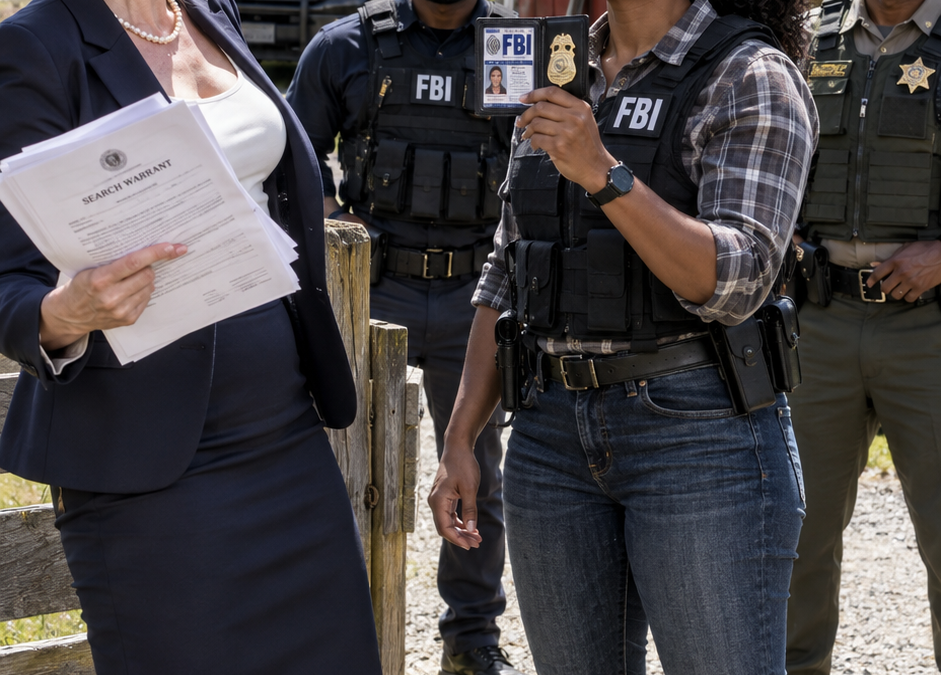
𝗣𝗔𝗥𝗧 𝟮
I had lived on that farm for eleven years.
To most people in the county, I was simply Ethan Caldwell.
Quiet.
Divorced from town gossip.
More interested in repairing irrigation equipment than attending neighborhood meetings.
My neighbors assumed I worked in insurance, logistics, or some other vague corporate field.
I encouraged that misunderstanding.
My real job was with the Federal Bureau of Investigation.
Special Agent Ethan Caldwell.
Financial crimes.
Fraud.
Shell companies.
Forged signatures.
Counterfeit filings.
Property schemes.
The kind of crimes that rarely began with masks or guns.
They began with paper.
A false lien.
A fake notice.
A copied signature.
A document formatted just convincingly enough that a frightened person signed away something real.
I had watched people lose homes because somebody understood that official-looking paper could become a weapon.
That Thursday morning, the weapon was pointed directly at me.
And the woman holding it had no idea she had delivered it to somebody who studied weapons exactly like it for a living.
Reed Halverson moved toward the barn.
I stepped into the doorway.
“No.”
He stopped.
Marjorie lifted the warrant.
“You are obstructing a lawful search.”
“Which agency issued it?”
“I already explained that.”
“No, you didn’t.”
She sighed.
“It was authorized under an emergency property compliance order.”
I almost smiled.
There was no such legal mechanism.
Not in any statute that applied to my property.
Not in any county ordinance.
Not anywhere.
“What agency?” I asked again.
“Stonegate Ridge has coordinated with the appropriate authorities.”
“That isn’t an agency.”
Reed moved one step closer.
I looked at him.
“Do you have law-enforcement credentials?”
“No.”
“Are you a deputy?”
“No.”
“Police officer?”
“No.”
“Then nobody crosses this threshold.”
Marjorie’s expression hardened.
The conflict between us had begun almost a year earlier.
Stonegate Ridge was a large gated development bordering the eastern edge of my property.
The subdivision wanted a service road connecting its rear entrance to a proposed commercial corridor.
The shortest route crossed eleven acres of my farm.
Marjorie first approached me with an easement agreement.
Permanent access.
Thirty-five feet wide.
Utility rights.
Construction rights.
Maintenance rights.
Language allowing contractors to enter almost whenever they considered it necessary.
I refused.
Not because I hated Stonegate Ridge.
Because the route cut across productive land and gave an HOA permanent access to the middle of my property.
Three months later, Marjorie announced that the association had “discovered” an easement from 1987.
Convenient.
There was one problem.
It did not exist.
I knew because the original deed, survey, title commitment, and historical property records were sitting inside a fireproof safe in my barn.
Marjorie knew the safe existed.
Six weeks earlier, during a civil discovery dispute, my attorney had identified the location of the original deed.
That information should have remained part of the legal process.
Yet here she was.
Standing twenty feet from the safe.
With a counterfeit warrant.
Ordering Reed to search my filing cabinets.
I looked at Marjorie.
“You’re looking for my deed.”
She laughed.
“We’re investigating multiple violations.”
“The deed.”
“You seem nervous.”
“No.”
“You’re blocking an authorized inspection.”
“I’m identifying your actual objective.”
Reed shifted.
One of the younger men behind him looked uncomfortable.
That interested me.
People who know they are committing crimes often behave differently from people who think they are simply doing a job.
Reed looked comfortable.
The younger man did not.
Marjorie held the warrant higher.
“You will allow access.”
“Call the sheriff.”
Her eyes narrowed.
“You want law enforcement here?”
“Yes.”
That surprised her.
Then she smiled.
“Fine.”
She took out her phone.
“Let’s see how confident you are after they arrive.”
I was comfortable with that.
While she called, I photographed every page of the warrant.
First page.
Second.
Third.
Certification page.
Then I noticed something near the bottom.
A typo.
HUDIKAL AUTHORIZATION
I stared at it.
Judicial had been misspelled.
Hudikal.
I had seen that exact error before.
Not something similar.
The exact same typo.
Three weeks earlier, my unit had received a collection of suspicious foreclosure and easement filings from three counties.
Different victims.
Different properties.
Same formatting.
Same unusual spacing.
Same typo.
Hudikal.
The investigation had been frustrating because we could see the pattern without identifying the person building the documents.
Now one of those documents was standing in my barn.
Delivered personally by Marjorie Bellamy.
I zoomed in on the typo and saved the image.
Marjorie watched me.
“You’re photographing protected material.”
“You handed it to me.”
“You’re not authorized to reproduce it.”
“That’s an interesting theory.”
She stepped closer.
“I suggest you take this seriously.”
“I am.”
More seriously than she understood.
The rain hammered the metal roof.
Reed leaned toward her.
“We can wait for deputies.”
“No.”
She pointed toward the safe.
“We’re not losing time.”
I looked at Reed.
“If you force entry before law enforcement arrives, make sure you understand whose instruction you’re following.”
He looked at Marjorie.
She snapped:
“Do your job.”
The younger compliance man spoke quietly.
“Maybe we should wait.”
Marjorie turned on him.
“Then wait outside.”
He did.
Smartest decision anyone on her side made that morning.
A sheriff’s cruiser appeared ten minutes later.
Then another.
Sheriff Bo Whitmore arrived in the first.
Two deputies followed.
Marjorie hurried across the yard before Bo closed his door.
“Sheriff, thank God. He’s obstructing a valid warrant.”
Bo looked at me.
Then at Marjorie.
“What happened?”
“This property is under active administrative investigation. Mr. Caldwell is attempting to destroy evidence and threatening our compliance officers.”
I spoke from the barn doorway.
“I haven’t threatened anyone.”
Marjorie ignored me.
“He needs to be detained while the warrant is executed.”
Bo held out his hand.
“Let me see it.”
Marjorie gave him the paper.
He read slowly.
That was one thing I liked about Bo.
He did not let volume dictate speed.
He read the case number.
Looked at the seal.
Then radioed dispatch.
“Confirm warrant.”
A minute passed.
Nothing.
Dispatch found no case.
Marjorie immediately said, “It’s sealed.”
Bo looked at her.
“A sealed warrant still exists.”
“It might not populate in your system.”
Bo called the clerk.
He gave the case number.
The address.
My name.
Then the supposed judge.
He listened.
“Nothing?”
Pause.
“Any sealed administrative matter?”
Pause.
“Understood.”
He ended the call.
“There is no warrant.”
Marjorie pointed at the signature.
“The judge signed it.”
Bo looked toward me.
“Ethan, do you know anything about this?”
That was the moment.
I reached inside my jacket.
Reed’s posture changed.
Bo watched carefully.
I pulled out my credential case.
Opened it.
Handed it over.
Bo stared at the identification.
Then back at me.
Marjorie stopped breathing for what felt like several seconds.
Reed physically stepped backward.
Bo read aloud quietly.
“Federal Bureau of Investigation.”
I nodded.
“Special Agent Ethan Caldwell.”
Marjorie’s face emptied.
I continued.
“I’m assigned to a multijurisdictional fraud investigation involving forged property filings.”
Nobody moved.
I pointed toward the document.
“That warrant contains formatting characteristics matching documents already under review.”
Marjorie found her voice.
“This is unbelievable.”
Reed said, “I was told everything was approved by counsel.”
Marjorie turned on him.
“Stop talking.”
I looked at Bo.
“The seal appears to be copied from a federal exhibit I reviewed two days ago.”
That changed Bo’s expression.
“Copied?”
“Likely.”
Marjorie stepped toward us.
“This is clearly a misunderstanding.”
I looked at her.
“Five minutes ago, you accused me of destroying evidence.”
“That was based on legal advice.”
“You ordered those men to search my safe.”
“I relied on counsel.”
“You told them to search everything.”
“This has become completely inappropriate.”
“No.”
I looked at the warrant.
“It became inappropriate before you arrived.”
Bo placed the document into an evidence sleeve.
Marjorie protested.
“That belongs to Stonegate Ridge.”
“Not anymore.”
“What does that mean?”
“It means I’m preserving it.”
Her expression changed again.
Calculation.
She was already building her next explanation.
I knew because I had watched hundreds of fraud suspects do exactly the same thing.
The best liars rarely stop when the first lie collapses.
They migrate.
Marjorie turned toward me.
“You’re using your federal position to interfere with a civil land dispute.”
“No.”
“You just admitted you’re investigating us.”
“I said I recognize characteristics in the document.”
“This is retaliation.”
That was the danger.
She had just handed me evidence potentially connected to my own federal case.
Which meant I could no longer safely touch the investigation.
Not as an agent.
I stepped away.
Then called my supervisor.
Supervisory Special Agent Lenora Briggs answered.
“Briggs.”
“It’s Caldwell.”
“What happened?”
“Potential crossover into the property-fraud case.”
Silence.
“Explain.”
I did.
She interrupted only once.
“Are you personally involved in the underlying land dispute?”
“Yes.”
“Victim?”
“Yes.”
“Then you’re out.”
I knew she was right.
“I figured.”
“Do not interview anyone.”
“I haven’t.”
“Do not access the case database from your home.”
“Understood.”
“Do not open anything you believe might contain evidence.”
“Understood.”
“Do not direct local officers.”
“Understood.”
“Photograph the scene only as the property owner if necessary. Preserve your cameras. Preserve your devices. I’m assigning another team.”
I looked at Marjorie.
She was arguing with Bo.
“What about the safe?”
“Don’t open it unless the assigned team tells you to.”
“Even though it’s mine?”
“Especially because it’s yours.”
That was Lenora.
Procedure first.
Always.
It felt strange standing on my own farm and surrendering control of an investigation that had literally entered my barn.
But she was protecting the case.
And me.
Marjorie would eventually claim I had weaponized the FBI against her.
Lenora was making sure that accusation would die under its own records.
Bo ordered Reed and his crew off my property.
Marjorie got into her SUV last.
Before closing the door, she looked at me.
“Badge or no badge, Ethan, that land belongs to Stonegate Ridge.”
I said nothing.
She drove away.
Then I looked at the evidence bag containing the forged warrant.
Near the bottom of the final page was a formatter credit.
PIKE MUNICIPAL COMPLIANCE LLC
Pike.
Stonegate Ridge’s outside attorney was Conrad Pike.
Interesting.
Very interesting.
Within forty-eight hours, I was formally removed from the investigative chain involving Stonegate Ridge.
Another squad took over.
Lenora documented me as:
Victim.
Witness.
Property owner.
Subject-matter resource only when requested.
No authority over warrants.
No arrest decisions.
No interviews.
No subpoenas.
No charging recommendations.
That separation would later become one of the most important decisions of the entire case.
The document examiners compared Marjorie’s warrant against twenty-seven suspicious filings already under review.
Same template.
Same pagination.
Same misspelling.
Same positioning of copied seals.
Same certification language.
Then the forensic examiner compared the seal itself.
Pixel-perfect match.
It had been lifted from a genuine government document.
No corrupt judge.
No rogue clerk.
No insider inside my office.
Someone had simply taken a real seal from an old case file and reused it.
That might sound less dramatic.
It was worse.
It meant the scheme was repeatable.
Anybody with access to a court exhibit and basic document software could manufacture official-looking authority.
Then investigators looked at money.
Stonegate Ridge had paid fourteen invoices to a company named:
Bellamy Property Resolution Group
The registered address was a mailbox.
The beneficial owner was Marjorie Bellamy.
The HOA president had created a company that received money from the HOA she controlled.
For what?
“Property dispute resolution.”
She was effectively paying herself to resolve conflicts her own association created.
The amounts added up quickly.
$18,400.
$27,900.
$41,600.
And many more.
More than $386,000 across roughly two years.
Another company received substantial payments.
Pike Municipal Compliance LLC.
Conrad Pike’s operation.
Then Lenora called me.
“I can give you one thing because it affects your status as a victim.”
“I’m listening.”
“The fake warrant was not built from scratch.”
“I assumed that.”
“Pike had a legitimate warrant from an old case through discovery.”
“So he kept the template.”
“Looks that way.”
“And the seal.”
“Yes.”
That explained how the document had looked so convincing.
Conrad Pike had taken legitimate government paperwork and converted it into a reusable fraud tool.
He did not need to invent authority.
He stole its appearance.
The case expanded.
A retired teacher named Janice Porter had paid $9,000 after receiving a similar property notice.
A young couple surrendered a strip of backyard because they believed a foreclosure proceeding was imminent.
Another owner paid thousands to remove a fabricated lien.
Different properties.
Same pattern.
Identify land.
Create a violation.
Send legal threats.
Introduce a suspicious lien or easement.
Deploy Reed Halverson’s “compliance officers.”
Offer a settlement.
Money moved through entities tied to Marjorie and Conrad.
That was not aggressive HOA management.
It was a business model.
Marjorie fought back publicly.
She called an emergency board meeting.
According to three residents who later gave statements, she told the room I was a rogue federal agent abusing my position because Stonegate Ridge wanted an easement.
She claimed the warrant was legitimate.
She said local authorities had refused to honor it only because I had pressured them.
Some board members believed her.
Audrey Fenwick did not.
Audrey was the HOA treasurer.
Quiet.
Methodical.
The kind of person who noticed when a number did not belong.
For months, she had questioned vague payments.
“Legal property resolution.”
“Compliance escalation.”
“Access acquisition.”
Whenever she requested invoices, Marjorie refused.
After the board meeting, Audrey went home and logged into Stonegate Ridge’s accounting system.
She exported everything.
Good decision.
Because by morning her access was gone.
Marjorie sent her an email.
SUSPENDED PENDING REVIEW OF FINANCIAL MISCONDUCT
Audrey did not call me.
She did something much smarter.
She hired an attorney.
Then took the ledger directly to the investigative team.
No connection to me.
No contamination argument.
Just financial records.
Inside them was one payment that caught everyone’s attention.
$24,750.
Three days before the barn incident.
Description:
EMERGENCY WARRANT PREPARATION
That payment destroyed the theory that the document was an accidental mistake.
Somebody had paid nearly twenty-five thousand dollars to create it.
Then subpoenas produced emails.
One subject line was devastating.
USE THE OLD FEDERAL TEMPLATE
From Conrad Pike.
To Marjorie Bellamy.
The body contained one sentence that mattered.
He will not know the difference.
Except I did.
That was their mistake.
Phone records showed Marjorie and Conrad spoke for nearly forty minutes the night before arriving at my barn.
The call began shortly after my lawyer rejected another easement offer.
Investigators reconstructed the broader system.
First came an unwanted property.
Then a fabricated violation.
Then legal pressure.
Then Reed.
Then settlement.
Stonegate Ridge’s proposed commercial expansion gave Marjorie an even larger motive.
A developer had signed a preliminary agreement worth millions.
One condition controlled everything.
Access.
Without a road through my eleven acres, the project could not move forward.
No access.
No deal.
No deal.
No developer money.
Marjorie needed my easement.
I would not give it.
So she invented one.
Then she apparently realized my original deed could destroy that claim at an upcoming hearing.
That was why the barn mattered.
Not because of tractors.
Not because of “commercial violations.”
Because my safe contained the original paper she needed gone.
The search team later found communications discussing exactly that.
One line:
ORIGINAL DEED BELIEVED STORED IN BARN.
Another:
REMOVE BEFORE HEARING.
That was no longer speculation.
It was intent.
Marjorie made another mistake with Audrey.
She called her.
Audrey, acting under legal advice, recorded the conversation lawfully.
Marjorie demanded that she “clean up” the books.
Audrey asked:
“What exactly do you want changed?”
Marjorie answered:
“Anything connected to Caldwell’s property.”
Audrey refused.
Marjorie threatened to destroy her financially.
That recording became another piece.
Reed’s compliance operation was searched later.
It operated from a converted storage unit.
Two desks.
Several uniforms.
Metal badges designed to look official without actually saying police.
And a laminated script taped beside Reed’s desk.
FINAL NOTICE BEFORE ESCALATION
COMPLIANCE IS NO LONGER OPTIONAL
NONCOOPERATION MAY RESULT IN LAW-ENFORCEMENT ACTION
Authority theater.
That was the whole business.
Sound official.
Look official.
Use words ordinary people associate with government.
Then pressure them before they have time to verify anything.
Meanwhile, Marjorie kept trying to provoke me.
One afternoon, Stonegate Ridge sent notice that it would install a fence across the disputed eleven acres.
Seventy-two hours.
I forwarded it to my civil attorney.
No confrontation.
Then, one Monday morning, I found the fence already standing there.
Wooden posts.
Fresh boards.
A sign:
PROPERTY OF STONEGATE RIDGE HOMEOWNERS ASSOCIATION
I stood looking at it.
Then laughed.
Not because it was funny.
Because by then Lenora’s team had developed probable cause for real warrants.
At 5:58 on Wednesday morning, federal agents arrived at three locations simultaneously.
Stonegate Ridge’s management office.
Conrad Pike’s law office.
Reed Halverson’s security operation.
Every warrant had been signed by an actual judge.
Every case number existed.
Every affidavit existed.
Every clerk could verify it.
I was not there.
That was deliberate.
Marjorie arrived at the clubhouse after the search had begun.
Lenora met her outside.
Marjorie demanded:
“Who authorized this?”
Lenora handed her a copy.
“A judge.”
Marjorie read it.
For once, she was holding a real warrant.
Neighbors watched agents carry boxes outside.
Computers.
Accounting records.
Easement files.
Vendor contracts.
Storage drives.
Within hours, residents began comparing stories.
One had received a strange lien.
Another a suspicious notice.
Another had surrendered land.
The pattern became visible only after people stopped examining their experiences one at a time.
Inside the seized material was a spreadsheet.
The title:
PRESSURE TARGETS
My name was number seven.
Beside it:
ORIGINAL DEED BELIEVED STORED IN BARN
Then:
REMOVE BEFORE HEARING
Another column listed projected settlements.
Across all targets:
Approximately $1.84 million.
Human beings reduced to revenue projections.
My farm had another note.
Handwritten.
PRIORITY 1 — MUST CLOSE BEFORE DEVELOPER WALKS
Investigators tied the handwriting to Marjorie.
Then came something worse.
A file labeled:
CALDWELL PHASE 2
If the forged warrant failed, they had another plan.
A fabricated lien.
Amount:
$187,000.
The idea was apparently to create a debt large enough to support foreclosure pressure.
Marjorie still tried to blame Conrad.
Conrad blamed Reed.
Reed blamed Marjorie.
Emails blamed all three.
One draft of the fake warrant contained tracked changes from Marjorie’s private account.
One comment read:
MAKE IT INTIMIDATING ENOUGH THAT CALDWELL HANDS OVER THE DEED
That was hard to explain away.
So Marjorie changed strategies.
Her attorney filed a motion arguing the entire federal investigation was retaliatory.
I was an FBI agent.
I owned the disputed land.
Therefore, according to her argument, everything after the barn was tainted.
That challenge was exactly why Lenora had removed me on day one.
The record showed:
I did not request a federal search warrant.
I did not sign an affidavit.
I did not conduct interviews.
I did not seize records.
I did not make arrest decisions.
I did not recommend charges.
I was not present during the federal searches.
My involvement after the original incident was carefully restricted.
Even the barn video helped.
It showed Marjorie arriving before she knew my occupation.
It showed her presenting the warrant.
It showed her ordering Reed into my barn.
It showed her demanding access to the file cabinets.
It showed me asking for the sheriff.
It showed me refusing to threaten anyone.
And most importantly, it showed the conspiracy existed before anyone saw my FBI credentials.
I attended the hearing as an observer.
Several rows behind the prosecution table.
Marjorie sat beside her attorneys.
Judge Helena Crossfield presided.
Her lawyer argued that a private land disagreement had been transformed into a federal prosecution because of my occupation.
Assistant United States Attorney Tessa Ridley responded by placing two warrants on a screen.
One genuine.
One Marjorie’s.
Then she compared them.
Case number.
Seal.
Formatting.
Signature.
Metadata.
Emails.
Financial transfers.
Audrey’s ledger.
Audrey’s recording.
The security footage.
The $24,750 payment for “warrant preparation.”
The email:
USE THE OLD FEDERAL TEMPLATE. HE WILL NOT KNOW THE DIFFERENCE.
Then the tracked-change comment:
MAKE IT INTIMIDATING ENOUGH THAT CALDWELL HANDS OVER THE DEED.
Marjorie stared at the table.
Tessa’s strongest point was simple.
The alleged retaliation theory required the scheme to begin after Marjorie learned I was an FBI agent.
But the forged warrant had been prepared before she came to my farm.
The Phase 2 lien existed before I showed my credentials.
The developer negotiations existed before that morning.
The payments existed before that morning.
The pressure-target spreadsheet existed before that morning.
My occupation did not create the case.
It merely made me unusually qualified to recognize what had already been happening.
Judge Crossfield denied the motion.
Before leaving the bench, she said something that stayed with me.
Using fabricated judicial authority to coerce lawful property owners was not simply paperwork misconduct.
It attacked the public’s ability to trust real legal process.
That was the danger.
If fake warrants become convincing enough, real ones become harder to trust.
Soon afterward, a grand jury returned indictments.
The case went far beyond my barn.
Multiple victims.
Multiple jurisdictions.
Multiple shell companies.
Fraud.
Conspiracy.
Forgery-related offenses.
Obstruction allegations.
Misuse of association funds.
Other state charges developed separately.
Marjorie’s control over Stonegate Ridge collapsed.
Residents who had once defended her started turning over letters.
Not because they suddenly became investigators.
Because once somebody showed them what to look for, the pattern became impossible to ignore.
Same phrasing.
Same pressure.
Same strange fees.
Same threat of escalation.
Conrad Pike began cooperating.
That left Marjorie increasingly isolated.
His records extended the timeline backward almost four years.
Apparently Stonegate Ridge had not been the beginning.
Marjorie had been involved with a smaller version of the same property-resolution scheme before she ever became HOA president.
Stonegate Ridge merely gave her access to more money.
More targets.
And a board willing to trust her.
The HOA itself was eventually placed under independent oversight.
The board structure was reorganized.
Payments to Marjorie-linked entities were frozen.
Questionable liens were reviewed.
Suspicious easements were examined.
Residents who had paid fraudulent settlements began receiving restitution where records supported it.
Audrey helped rebuild the books.
She once told me:
“I should have asked harder questions earlier.”
“Probably.”
She smiled.
“You’re terrible at comforting people.”
“I’m an investigator.”
“That is not a defense.”
She was right.
The retired teacher received confirmation that her $9,000 would be returned.
The young couple began the process of reversing the transfer of part of their backyard.
Other property claims were removed.
My own fake $187,000 lien never made it far enough to become effective.
The counterfeit easement was declared void.
The developer withdrew.
No access road meant no expansion deal.
The fence Stonegate Ridge had erected across my land came down.
The wooden sign disappeared.
My field returned to being exactly what it had always been.
Mine.
The final courtroom stage was quieter than everything that came before.
By sentencing, Marjorie looked nothing like the woman who had arrived at my barn.
No SUVs.
No compliance officers.
No folder waved in someone’s face.
No title anyone cared about.
Tessa introduced the original forged warrant again.
The same pages Marjorie had once held like proof of unquestionable authority.
Now they were evidence.
That seemed fitting.
Her attorneys tried to shift more responsibility toward Conrad.
Prosecutors answered with her own communications.
Her handwritten notes.
Her financial interests.
The pressure spreadsheet.
The Audrey call.
The tracked edits.
Every attempt to push responsibility away from herself ran into something she had written.
That is another problem with fraud.
Good fraud requires documentation.
Documentation survives people.
Marjorie lost her HOA position permanently.
Her affiliated companies collapsed.
Assets tied to the scheme entered restitution proceedings.
Association funds traced into personal expenses became part of the financial recovery process.
One luxury vehicle in particular had become almost symbolic.
The SUV Marjorie used to lead the convoy onto my property.
Months later, I was repairing a hinge on the barn when I saw a tow truck moving down the distant county highway.
On the trailer sat that SUV.
I recognized it immediately.
I watched for maybe five seconds.
Then went back to the hinge.
That was all.
No victory speech.
No celebration.
I had work to do.
Sheriff Bo Whitmore came by not long afterward.
He carried a certified order confirming that the fraudulent easement claims had been removed from the relevant property records.
We stood beside the barn.
He looked at the safe.
“All of this because she wanted what was inside there?”
“Partly.”
“A deed.”
“Yes.”
He shook his head.
“That seems like a lot of risk for paper.”
I closed the barn door.
“It wasn’t about the paper.”
“What was it about?”
“Making people believe paper gave her power.”
He considered that.
“She picked the wrong farmer.”
I smiled.
“No.”
He looked at me.
“She picked the wrong document.”
That was closer to the truth.
If Marjorie had targeted someone else, the warrant might have worked.
Not because those people were foolish.
Because it looked real.
Raised seal.
Case number.
Judge.
Dense language.
Compliance officers.
Threats of arrest.
Most people are conditioned to obey paperwork that appears judicial.
Marjorie built her scheme around that instinct.
She could not have known the man standing in front of the barn spent his professional life dissecting fraudulent documents.
She could not have known I had reviewed the genuine seal forty-eight hours earlier.
She could not have known that the typo “hudikal” was already sitting inside an active case file.
But none of those coincidences made what she did illegal.
It was illegal before I recognized it.
That distinction mattered to me.
Marjorie did not fall because she accidentally targeted an FBI agent.
She fell because she had been targeting ordinary people for years.
I was simply the first victim who recognized the machinery quickly enough to preserve it.
Audrey visited one afternoon during the receivership.
She carried refund records.
“Janice got her money back.”
“The teacher?”
“Nine thousand.”
“Good.”
“And the Carters are reversing the backyard transfer.”
“Good.”
She handed me a folder.
“Several others too.”
I flipped through it.
Victims.
Payments.
Corrections.
For the first time, the case felt like it was producing something beyond punishment.
People were getting things back.
Money.
Land.
Records.
A sense that the documents which frightened them were never legitimate in the first place.
Audrey looked toward the field.
“Do you ever think about selling now?”
“No.”
She laughed.
“I figured.”
The proposed service-road path was already disappearing beneath grass.
No bulldozers.
No HOA vehicles.
No survey stakes.
No sign.
The barn remained exactly where it had always been.
I locked the door.
Then looked toward the driveway where Marjorie’s convoy had once sat in the rain.
I remembered her first words.
Property seized for fraud.
Search authorized.
Five minutes to comply.
I remembered Reed standing behind her.
The stamped seal.
The judge’s fake signature.
Her confidence.
And the expression on her face when Bo opened my credential case.
But the badge was never my favorite part of the story.
People always assume it was.
It was not.
My favorite part was much smaller.
A typo.
Hudikal.
One meaningless-looking spelling error copied from document to document.
Marjorie had spent years building authority through appearance.
She had expensive paper.
Official fonts.
Stolen seals.
Private security uniforms.
Legal-sounding phrases.
Shell companies.
Attorneys.
Board votes.
SUVs.
Everything necessary to make an ordinary person think resistance was hopeless.
And the whole structure eventually started coming apart because somebody copied the same misspelled word one time too many.
That is fraud.
It can look enormous from the outside.
But underneath, it is usually held together by tiny assumptions.
Nobody will verify the seal.
Nobody will call the clerk.
Nobody will check the case number.
Nobody will compare signatures.
Nobody will trace the payment.
Nobody will ask why an HOA paid $24,750 to prepare an “emergency warrant.”
Nobody will recognize the typo.
Nobody will refuse.
Marjorie’s entire business depended on those nobodies.
Then she came to my barn.
At 6:14 on a rainy Thursday morning, she believed she was carrying the most powerful object on the property.
A warrant.
She believed the stamp made it real.
She believed the signature made it enforceable.
She believed four men in compliance jackets would make me afraid enough to open the safe.
What she never understood was that legal authority is not created by how official a document looks.
It survives verification.
Hers did not survive thirty seconds.
The real investigation took much longer.
Bank records.
Emails.
Subpoenas.
Forensics.
Hearings.
Victims.
Restitution.
Years of conduct could not be unwound in one dramatic morning.
But the beginning was simple.
She handed me the paper.
I read it.
And before Marjorie Bellamy ever learned what I did for a living, I already knew two things with absolute certainty.
Her warrant was fake.
And the people who created it had just made the mistake of bringing their fraud directly to the FBI agent assigned to find them.
Have you finished reading the story and want to read it again?
HOA KAREN FORGED A WARRANT FOR MY BARN—SHE DIDN’T KNOW I WAS THE FBI FRAUD AGENT INVESTIGATING HER PAPER TRAIL
The HOA president stormed into my barn with a fake warrant.
She had no idea I investigated fraud for the FBI.
Then I recognized the stolen federal seal she had used to forge it.
My name is Ethan Caldwell.
At 6:14 on a rainy Thursday morning, three black SUVs blocked my driveway.
I was inside the barn checking a breaker when I heard doors slamming outside.
Not one.
Several.
By the time I stepped through the side door, HOA President Marjorie Bellamy was already crossing my yard with four men behind her.
Their jackets read:
PROPERTY COMPLIANCE UNIT
The lettering looked official.
That was the point.
Marjorie held a stack of papers in one hand.
“Ethan Caldwell?”
“You know who I am.”
“This property is now subject to an administrative search.”
She shoved the papers toward me.
“Your barn is being searched for commercial-code violations, fraudulent land records, unregistered equipment, and obstruction of a recorded easement.”
I looked at the first page.
ADMINISTRATIVE SEARCH WARRANT
There was a case number.
A raised-looking seal.
A judge’s signature.
Language authorizing entry.
Language authorizing seizure.
And enough legal formatting to frighten almost anyone who had never spent years studying fraudulent documents.
I read the first paragraph.
Then the second.
Marjorie mistook my silence for fear.
“You have five minutes to cooperate.”
I kept reading.
The first problem was the case number.
Wrong county format.
The second was the judge’s name.
Different font.
Inserted later.
The third problem was the seal.
That one changed everything.
I had seen it forty-eight hours earlier.
Pixel for pixel.
It came from a federal case exhibit sitting inside an active fraud investigation.
A scanned seal that had no reason to appear on a homeowners association document.
I looked at Marjorie.
“Where did you get this?”
“That is none of your concern.”
“It became my concern when you brought it onto my property.”
She folded her arms.
“This is your last opportunity to cooperate voluntarily.”
I glanced toward the camera above the barn door.
Red indicator.
Recording.
Good.
Then I made a decision.
I would not tell her who I was.
Not yet.
Because if Marjorie believed she was dealing with an ordinary farmer, I wanted to know exactly how far she was willing to go.
She turned toward a broad-shouldered man beside her.
“Reed.”
He stepped forward.
“Search everything.”
Marjorie pointed past me.
“Especially the filing cabinets.”
That was the moment I knew this had never been about machinery.
They were looking for paper.
More specifically, they were looking for one document locked inside my barn.
My original deed.
And suddenly the forged warrant in my hands made perfect sense.
PART2
I had lived on that farm for eleven years.
To most people in the county, I was simply Ethan Caldwell.
Quiet.
Divorced from town gossip.
More interested in repairing irrigation equipment than attending neighborhood meetings.
My neighbors assumed I worked in insurance, logistics, or some other vague corporate field.
I encouraged that misunderstanding.
My real job was with the Federal Bureau of Investigation.
Special Agent Ethan Caldwell.
Financial crimes.
Fraud.
Shell companies.
Forged signatures.
Counterfeit filings.
Property schemes.
The kind of crimes that rarely began with masks or guns.
They began with paper.
A false lien.
A fake notice.
A copied signature.
A document formatted just convincingly enough that a frightened person signed away something real.
I had watched people lose homes because somebody understood that official-looking paper could become a weapon.
That Thursday morning, the weapon was pointed directly at me.
And the woman holding it had no idea she had delivered it to somebody who studied weapons exactly like it for a living.
Reed Halverson moved toward the barn.
I stepped into the doorway.
“No.”
He stopped.
Marjorie lifted the warrant.
“You are obstructing a lawful search.”
“Which agency issued it?”
“I already explained that.”
“No, you didn’t.”
She sighed.
“It was authorized under an emergency property compliance order.”
I almost smiled.
There was no such legal mechanism.
Not in any statute that applied to my property.
Not in any county ordinance.
Not anywhere.
“What agency?” I asked again.
“Stonegate Ridge has coordinated with the appropriate authorities.”
“That isn’t an agency.”
Reed moved one step closer.
I looked at him.
“Do you have law-enforcement credentials?”
“No.”
“Are you a deputy?”
“No.”
“Police officer?”
“No.”
“Then nobody crosses this threshold.”
Marjorie’s expression hardened.
The conflict between us had begun almost a year earlier.
Stonegate Ridge was a large gated development bordering the eastern edge of my property.
The subdivision wanted a service road connecting its rear entrance to a proposed commercial corridor.
The shortest route crossed eleven acres of my farm.
Marjorie first approached me with an easement agreement.
Permanent access.
Thirty-five feet wide.
Utility rights.
Construction rights.
Maintenance rights.
Language allowing contractors to enter almost whenever they considered it necessary.
I refused.
Not because I hated Stonegate Ridge.
Because the route cut across productive land and gave an HOA permanent access to the middle of my property.
Three months later, Marjorie announced that the association had “discovered” an easement from 1987.
Convenient.
There was one problem.
It did not exist.
I knew because the original deed, survey, title commitment, and historical property records were sitting inside a fireproof safe in my barn.
Marjorie knew the safe existed.
Six weeks earlier, during a civil discovery dispute, my attorney had identified the location of the original deed.
That information should have remained part of the legal process.
Yet here she was.
Standing twenty feet from the safe.
With a counterfeit warrant.
Ordering Reed to search my filing cabinets.
I looked at Marjorie.
“You’re looking for my deed.”
She laughed.
“We’re investigating multiple violations.”
“The deed.”
“You seem nervous.”
“No.”
“You’re blocking an authorized inspection.”
“I’m identifying your actual objective.”
Reed shifted.
One of the younger men behind him looked uncomfortable.
That interested me.
People who know they are committing crimes often behave differently from people who think they are simply doing a job.
Reed looked comfortable.
The younger man did not.
Marjorie held the warrant higher.
“You will allow access.”
“Call the sheriff.”
Her eyes narrowed.
“You want law enforcement here?”
“Yes.”
That surprised her.
Then she smiled.
“Fine.”
She took out her phone.
“Let’s see how confident you are after they arrive.”
I was comfortable with that.
While she called, I photographed every page of the warrant.
First page.
Second.
Third.
Certification page.
Then I noticed something near the bottom.
A typo.
HUDIKAL AUTHORIZATION
I stared at it.
Judicial had been misspelled.
Hudikal.
I had seen that exact error before.
Not something similar.
The exact same typo.
Three weeks earlier, my unit had received a collection of suspicious foreclosure and easement filings from three counties.
Different victims.
Different properties.
Same formatting.
Same unusual spacing.
Same typo.
Hudikal.
The investigation had been frustrating because we could see the pattern without identifying the person building the documents.
Now one of those documents was standing in my barn.
Delivered personally by Marjorie Bellamy.
I zoomed in on the typo and saved the image.
Marjorie watched me.
“You’re photographing protected material.”
“You handed it to me.”
“You’re not authorized to reproduce it.”
“That’s an interesting theory.”
She stepped closer.
“I suggest you take this seriously.”
“I am.”
More seriously than she understood.
The rain hammered the metal roof.
Reed leaned toward her.
“We can wait for deputies.”
“No.”
She pointed toward the safe.
“We’re not losing time.”
I looked at Reed.
“If you force entry before law enforcement arrives, make sure you understand whose instruction you’re following.”
He looked at Marjorie.
She snapped:
“Do your job.”
The younger compliance man spoke quietly.
“Maybe we should wait.”
Marjorie turned on him.
“Then wait outside.”
He did.
Smartest decision anyone on her side made that morning.
A sheriff’s cruiser appeared ten minutes later.
Then another.
Sheriff Bo Whitmore arrived in the first.
Two deputies followed.
Marjorie hurried across the yard before Bo closed his door.
“Sheriff, thank God. He’s obstructing a valid warrant.”
Bo looked at me.
Then at Marjorie.
“What happened?”
“This property is under active administrative investigation. Mr. Caldwell is attempting to destroy evidence and threatening our compliance officers.”
I spoke from the barn doorway.
“I haven’t threatened anyone.”
Marjorie ignored me.
“He needs to be detained while the warrant is executed.”
Bo held out his hand.
“Let me see it.”
Marjorie gave him the paper.
He read slowly.
That was one thing I liked about Bo.
He did not let volume dictate speed.
He read the case number.
Looked at the seal.
Then radioed dispatch.
“Confirm warrant.”
A minute passed.
Nothing.
Dispatch found no case.
Marjorie immediately said, “It’s sealed.”
Bo looked at her.
“A sealed warrant still exists.”
“It might not populate in your system.”
Bo called the clerk.
He gave the case number.
The address.
My name.
Then the supposed judge.
He listened.
“Nothing?”
Pause.
“Any sealed administrative matter?”
Pause.
“Understood.”
He ended the call.
“There is no warrant.”
Marjorie pointed at the signature.
“The judge signed it.”
Bo looked toward me.
“Ethan, do you know anything about this?”
That was the moment.
I reached inside my jacket.
Reed’s posture changed.
Bo watched carefully.
I pulled out my credential case.
Opened it.
Handed it over.
Bo stared at the identification.
Then back at me.
Marjorie stopped breathing for what felt like several seconds.
Reed physically stepped backward.
Bo read aloud quietly.
“Federal Bureau of Investigation.”
I nodded.
“Special Agent Ethan Caldwell.”
Marjorie’s face emptied.
I continued.
“I’m assigned to a multijurisdictional fraud investigation involving forged property filings.”
Nobody moved.
I pointed toward the document.
“That warrant contains formatting characteristics matching documents already under review.”
Marjorie found her voice.
“This is unbelievable.”
Reed said, “I was told everything was approved by counsel.”
Marjorie turned on him.
“Stop talking.”
I looked at Bo.
“The seal appears to be copied from a federal exhibit I reviewed two days ago.”
That changed Bo’s expression.
“Copied?”
“Likely.”
Marjorie stepped toward us.
“This is clearly a misunderstanding.”
I looked at her.
“Five minutes ago, you accused me of destroying evidence.”
“That was based on legal advice.”
“You ordered those men to search my safe.”
“I relied on counsel.”
“You told them to search everything.”
“This has become completely inappropriate.”
“No.”
I looked at the warrant.
“It became inappropriate before you arrived.”
Bo placed the document into an evidence sleeve.
Marjorie protested.
“That belongs to Stonegate Ridge.”
“Not anymore.”
“What does that mean?”
“It means I’m preserving it.”
Her expression changed again.
Calculation.
She was already building her next explanation.
I knew because I had watched hundreds of fraud suspects do exactly the same thing.
The best liars rarely stop when the first lie collapses.
They migrate.
Marjorie turned toward me.
“You’re using your federal position to interfere with a civil land dispute.”
“No.”
“You just admitted you’re investigating us.”
“I said I recognize characteristics in the document.”
“This is retaliation.”
That was the danger.
She had just handed me evidence potentially connected to my own federal case.
Which meant I could no longer safely touch the investigation.
Not as an agent.
I stepped away.
Then called my supervisor.
Supervisory Special Agent Lenora Briggs answered.
“Briggs.”
“It’s Caldwell.”
“What happened?”
“Potential crossover into the property-fraud case.”
Silence.
“Explain.”
I did.
She interrupted only once.
“Are you personally involved in the underlying land dispute?”
“Yes.”
“Victim?”
“Yes.”
“Then you’re out.”
I knew she was right.
“I figured.”
“Do not interview anyone.”
“I haven’t.”
“Do not access the case database from your home.”
“Understood.”
“Do not open anything you believe might contain evidence.”
“Understood.”
“Do not direct local officers.”
“Understood.”
“Photograph the scene only as the property owner if necessary. Preserve your cameras. Preserve your devices. I’m assigning another team.”
I looked at Marjorie.
She was arguing with Bo.
“What about the safe?”
“Don’t open it unless the assigned team tells you to.”
“Even though it’s mine?”
“Especially because it’s yours.”
That was Lenora.
Procedure first.
Always.
It felt strange standing on my own farm and surrendering control of an investigation that had literally entered my barn.
But she was protecting the case.
And me.
Marjorie would eventually claim I had weaponized the FBI against her.
Lenora was making sure that accusation would die under its own records.
Bo ordered Reed and his crew off my property.
Marjorie got into her SUV last.
Before closing the door, she looked at me.
“Badge or no badge, Ethan, that land belongs to Stonegate Ridge.”
I said nothing.
She drove away.
Then I looked at the evidence bag containing the forged warrant.
Near the bottom of the final page was a formatter credit.
PIKE MUNICIPAL COMPLIANCE LLC
Pike.
Stonegate Ridge’s outside attorney was Conrad Pike.
Interesting.
Very interesting.
Within forty-eight hours, I was formally removed from the investigative chain involving Stonegate Ridge.
Another squad took over.
Lenora documented me as:
Victim.
Witness.
Property owner.
Subject-matter resource only when requested.
No authority over warrants.
No arrest decisions.
No interviews.
No subpoenas.
No charging recommendations.
That separation would later become one of the most important decisions of the entire case.
The document examiners compared Marjorie’s warrant against twenty-seven suspicious filings already under review.
Same template.
Same pagination.
Same misspelling.
Same positioning of copied seals.
Same certification language.
Then the forensic examiner compared the seal itself.
Pixel-perfect match.
It had been lifted from a genuine government document.
No corrupt judge.
No rogue clerk.
No insider inside my office.
Someone had simply taken a real seal from an old case file and reused it.
That might sound less dramatic.
It was worse.
It meant the scheme was repeatable.
Anybody with access to a court exhibit and basic document software could manufacture official-looking authority.
Then investigators looked at money.
Stonegate Ridge had paid fourteen invoices to a company named:
Bellamy Property Resolution Group
The registered address was a mailbox.
The beneficial owner was Marjorie Bellamy.
The HOA president had created a company that received money from the HOA she controlled.
For what?
“Property dispute resolution.”
She was effectively paying herself to resolve conflicts her own association created.
The amounts added up quickly.
$18,400.
$27,900.
$41,600.
And many more.
More than $386,000 across roughly two years.
Another company received substantial payments.
Pike Municipal Compliance LLC.
Conrad Pike’s operation.
Then Lenora called me.
“I can give you one thing because it affects your status as a victim.”
“I’m listening.”
“The fake warrant was not built from scratch.”
“I assumed that.”
“Pike had a legitimate warrant from an old case through discovery.”
“So he kept the template.”
“Looks that way.”
“And the seal.”
“Yes.”
That explained how the document had looked so convincing.
Conrad Pike had taken legitimate government paperwork and converted it into a reusable fraud tool.
He did not need to invent authority.
He stole its appearance.
The case expanded.
A retired teacher named Janice Porter had paid $9,000 after receiving a similar property notice.
A young couple surrendered a strip of backyard because they believed a foreclosure proceeding was imminent.
Another owner paid thousands to remove a fabricated lien.
Different properties.
Same pattern.
Identify land.
Create a violation.
Send legal threats.
Introduce a suspicious lien or easement.
Deploy Reed Halverson’s “compliance officers.”
Offer a settlement.
Money moved through entities tied to Marjorie and Conrad.
That was not aggressive HOA management.
It was a business model.
Marjorie fought back publicly.
She called an emergency board meeting.
According to three residents who later gave statements, she told the room I was a rogue federal agent abusing my position because Stonegate Ridge wanted an easement.
She claimed the warrant was legitimate.
She said local authorities had refused to honor it only because I had pressured them.
Some board members believed her.
Audrey Fenwick did not.
Audrey was the HOA treasurer.
Quiet.
Methodical.
The kind of person who noticed when a number did not belong.
For months, she had questioned vague payments.
“Legal property resolution.”
“Compliance escalation.”
“Access acquisition.”
Whenever she requested invoices, Marjorie refused.
After the board meeting, Audrey went home and logged into Stonegate Ridge’s accounting system.
She exported everything.
Good decision.
Because by morning her access was gone.
Marjorie sent her an email.
SUSPENDED PENDING REVIEW OF FINANCIAL MISCONDUCT
Audrey did not call me.
She did something much smarter.
She hired an attorney.
Then took the ledger directly to the investigative team.
No connection to me.
No contamination argument.
Just financial records.
Inside them was one payment that caught everyone’s attention.
$24,750.
Three days before the barn incident.
Description:
EMERGENCY WARRANT PREPARATION
That payment destroyed the theory that the document was an accidental mistake.
Somebody had paid nearly twenty-five thousand dollars to create it.
Then subpoenas produced emails.
One subject line was devastating.
USE THE OLD FEDERAL TEMPLATE
From Conrad Pike.
To Marjorie Bellamy.
The body contained one sentence that mattered.
He will not know the difference.
Except I did.
That was their mistake.
Phone records showed Marjorie and Conrad spoke for nearly forty minutes the night before arriving at my barn.
The call began shortly after my lawyer rejected another easement offer.
Investigators reconstructed the broader system.
First came an unwanted property.
Then a fabricated violation.
Then legal pressure.
Then Reed.
Then settlement.
Stonegate Ridge’s proposed commercial expansion gave Marjorie an even larger motive.
A developer had signed a preliminary agreement worth millions.
One condition controlled everything.
Access.
Without a road through my eleven acres, the project could not move forward.
No access.
No deal.
No deal.
No developer money.
Marjorie needed my easement.
I would not give it.
So she invented one.
Then she apparently realized my original deed could destroy that claim at an upcoming hearing.
That was why the barn mattered.
Not because of tractors.
Not because of “commercial violations.”
Because my safe contained the original paper she needed gone.
The search team later found communications discussing exactly that.
One line:
ORIGINAL DEED BELIEVED STORED IN BARN.
Another:
REMOVE BEFORE HEARING.
That was no longer speculation.
It was intent.
Marjorie made another mistake with Audrey.
She called her.
Audrey, acting under legal advice, recorded the conversation lawfully.
Marjorie demanded that she “clean up” the books.
Audrey asked:
“What exactly do you want changed?”
Marjorie answered:
“Anything connected to Caldwell’s property.”
Audrey refused.
Marjorie threatened to destroy her financially.
That recording became another piece.
Reed’s compliance operation was searched later.
It operated from a converted storage unit.
Two desks.
Several uniforms.
Metal badges designed to look official without actually saying police.
And a laminated script taped beside Reed’s desk.
FINAL NOTICE BEFORE ESCALATION
COMPLIANCE IS NO LONGER OPTIONAL
NONCOOPERATION MAY RESULT IN LAW-ENFORCEMENT ACTION
Authority theater.
That was the whole business.
Sound official.
Look official.
Use words ordinary people associate with government.
Then pressure them before they have time to verify anything.
Meanwhile, Marjorie kept trying to provoke me.
One afternoon, Stonegate Ridge sent notice that it would install a fence across the disputed eleven acres.
Seventy-two hours.
I forwarded it to my civil attorney.
No confrontation.
Then, one Monday morning, I found the fence already standing there.
Wooden posts.
Fresh boards.
A sign:
PROPERTY OF STONEGATE RIDGE HOMEOWNERS ASSOCIATION
I stood looking at it.
Then laughed.
Not because it was funny.
Because by then Lenora’s team had developed probable cause for real warrants.
At 5:58 on Wednesday morning, federal agents arrived at three locations simultaneously.
Stonegate Ridge’s management office.
Conrad Pike’s law office.
Reed Halverson’s security operation.
Every warrant had been signed by an actual judge.
Every case number existed.
Every affidavit existed.
Every clerk could verify it.
I was not there.
That was deliberate.
Marjorie arrived at the clubhouse after the search had begun.
Lenora met her outside.
Marjorie demanded:
“Who authorized this?”
Lenora handed her a copy.
“A judge.”
Marjorie read it.
For once, she was holding a real warrant.
Neighbors watched agents carry boxes outside.
Computers.
Accounting records.
Easement files.
Vendor contracts.
Storage drives.
Within hours, residents began comparing stories.
One had received a strange lien.
Another a suspicious notice.
Another had surrendered land.
The pattern became visible only after people stopped examining their experiences one at a time.
Inside the seized material was a spreadsheet.
The title:
PRESSURE TARGETS
My name was number seven.
Beside it:
ORIGINAL DEED BELIEVED STORED IN BARN
Then:
REMOVE BEFORE HEARING
Another column listed projected settlements.
Across all targets:
Approximately $1.84 million.
Human beings reduced to revenue projections.
My farm had another note.
Handwritten.
PRIORITY 1 — MUST CLOSE BEFORE DEVELOPER WALKS
Investigators tied the handwriting to Marjorie.
Then came something worse.
A file labeled:
CALDWELL PHASE 2
If the forged warrant failed, they had another plan.
A fabricated lien.
Amount:
$187,000.
The idea was apparently to create a debt large enough to support foreclosure pressure.
Marjorie still tried to blame Conrad.
Conrad blamed Reed.
Reed blamed Marjorie.
Emails blamed all three.
One draft of the fake warrant contained tracked changes from Marjorie’s private account.
One comment read:
MAKE IT INTIMIDATING ENOUGH THAT CALDWELL HANDS OVER THE DEED
That was hard to explain away.
So Marjorie changed strategies.
Her attorney filed a motion arguing the entire federal investigation was retaliatory.
I was an FBI agent.
I owned the disputed land.
Therefore, according to her argument, everything after the barn was tainted.
That challenge was exactly why Lenora had removed me on day one.
The record showed:
I did not request a federal search warrant.
I did not sign an affidavit.
I did not conduct interviews.
I did not seize records.
I did not make arrest decisions.
I did not recommend charges.
I was not present during the federal searches.
My involvement after the original incident was carefully restricted.
Even the barn video helped.
It showed Marjorie arriving before she knew my occupation.
It showed her presenting the warrant.
It showed her ordering Reed into my barn.
It showed her demanding access to the file cabinets.
It showed me asking for the sheriff.
It showed me refusing to threaten anyone.
And most importantly, it showed the conspiracy existed before anyone saw my FBI credentials.
I attended the hearing as an observer.
Several rows behind the prosecution table.
Marjorie sat beside her attorneys.
Judge Helena Crossfield presided.
Her lawyer argued that a private land disagreement had been transformed into a federal prosecution because of my occupation.
Assistant United States Attorney Tessa Ridley responded by placing two warrants on a screen.
One genuine.
One Marjorie’s.
Then she compared them.
Case number.
Seal.
Formatting.
Signature.
Metadata.
Emails.
Financial transfers.
Audrey’s ledger.
Audrey’s recording.
The security footage.
The $24,750 payment for “warrant preparation.”
The email:
USE THE OLD FEDERAL TEMPLATE. HE WILL NOT KNOW THE DIFFERENCE.
Then the tracked-change comment:
MAKE IT INTIMIDATING ENOUGH THAT CALDWELL HANDS OVER THE DEED.
Marjorie stared at the table.
Tessa’s strongest point was simple.
The alleged retaliation theory required the scheme to begin after Marjorie learned I was an FBI agent.
But the forged warrant had been prepared before she came to my farm.
The Phase 2 lien existed before I showed my credentials.
The developer negotiations existed before that morning.
The payments existed before that morning.
The pressure-target spreadsheet existed before that morning.
My occupation did not create the case.
It merely made me unusually qualified to recognize what had already been happening.
Judge Crossfield denied the motion.
Before leaving the bench, she said something that stayed with me.
Using fabricated judicial authority to coerce lawful property owners was not simply paperwork misconduct.
It attacked the public’s ability to trust real legal process.
That was the danger.
If fake warrants become convincing enough, real ones become harder to trust.
Soon afterward, a grand jury returned indictments.
The case went far beyond my barn.
Multiple victims.
Multiple jurisdictions.
Multiple shell companies.
Fraud.
Conspiracy.
Forgery-related offenses.
Obstruction allegations.
Misuse of association funds.
Other state charges developed separately.
Marjorie’s control over Stonegate Ridge collapsed.
Residents who had once defended her started turning over letters.
Not because they suddenly became investigators.
Because once somebody showed them what to look for, the pattern became impossible to ignore.
Same phrasing.
Same pressure.
Same strange fees.
Same threat of escalation.
Conrad Pike began cooperating.
That left Marjorie increasingly isolated.
His records extended the timeline backward almost four years.
Apparently Stonegate Ridge had not been the beginning.
Marjorie had been involved with a smaller version of the same property-resolution scheme before she ever became HOA president.
Stonegate Ridge merely gave her access to more money.
More targets.
And a board willing to trust her.
The HOA itself was eventually placed under independent oversight.
The board structure was reorganized.
Payments to Marjorie-linked entities were frozen.
Questionable liens were reviewed.
Suspicious easements were examined.
Residents who had paid fraudulent settlements began receiving restitution where records supported it.
Audrey helped rebuild the books.
She once told me:
“I should have asked harder questions earlier.”
“Probably.”
She smiled.
“You’re terrible at comforting people.”
“I’m an investigator.”
“That is not a defense.”
She was right.
The retired teacher received confirmation that her $9,000 would be returned.
The young couple began the process of reversing the transfer of part of their backyard.
Other property claims were removed.
My own fake $187,000 lien never made it far enough to become effective.
The counterfeit easement was declared void.
The developer withdrew.
No access road meant no expansion deal.
The fence Stonegate Ridge had erected across my land came down.
The wooden sign disappeared.
My field returned to being exactly what it had always been.
Mine.
The final courtroom stage was quieter than everything that came before.
By sentencing, Marjorie looked nothing like the woman who had arrived at my barn.
No SUVs.
No compliance officers.
No folder waved in someone’s face.
No title anyone cared about.
Tessa introduced the original forged warrant again.
The same pages Marjorie had once held like proof of unquestionable authority.
Now they were evidence.
That seemed fitting.
Her attorneys tried to shift more responsibility toward Conrad.
Prosecutors answered with her own communications.
Her handwritten notes.
Her financial interests.
The pressure spreadsheet.
The Audrey call.
The tracked edits.
Every attempt to push responsibility away from herself ran into something she had written.
That is another problem with fraud.
Good fraud requires documentation.
Documentation survives people.
Marjorie lost her HOA position permanently.
Her affiliated companies collapsed.
Assets tied to the scheme entered restitution proceedings.
Association funds traced into personal expenses became part of the financial recovery process.
One luxury vehicle in particular had become almost symbolic.
The SUV Marjorie used to lead the convoy onto my property.
Months later, I was repairing a hinge on the barn when I saw a tow truck moving down the distant county highway.
On the trailer sat that SUV.
I recognized it immediately.
I watched for maybe five seconds.
Then went back to the hinge.
That was all.
No victory speech.
No celebration.
I had work to do.
Sheriff Bo Whitmore came by not long afterward.
He carried a certified order confirming that the fraudulent easement claims had been removed from the relevant property records.
We stood beside the barn.
He looked at the safe.
“All of this because she wanted what was inside there?”
“Partly.”
“A deed.”
“Yes.”
He shook his head.
“That seems like a lot of risk for paper.”
I closed the barn door.
“It wasn’t about the paper.”
“What was it about?”
“Making people believe paper gave her power.”
He considered that.
“She picked the wrong farmer.”
I smiled.
“No.”
He looked at me.
“She picked the wrong document.”
That was closer to the truth.
If Marjorie had targeted someone else, the warrant might have worked.
Not because those people were foolish.
Because it looked real.
Raised seal.
Case number.
Judge.
Dense language.
Compliance officers.
Threats of arrest.
Most people are conditioned to obey paperwork that appears judicial.
Marjorie built her scheme around that instinct.
She could not have known the man standing in front of the barn spent his professional life dissecting fraudulent documents.
She could not have known I had reviewed the genuine seal forty-eight hours earlier.
She could not have known that the typo “hudikal” was already sitting inside an active case file.
But none of those coincidences made what she did illegal.
It was illegal before I recognized it.
That distinction mattered to me.
Marjorie did not fall because she accidentally targeted an FBI agent.
She fell because she had been targeting ordinary people for years.
I was simply the first victim who recognized the machinery quickly enough to preserve it.
Audrey visited one afternoon during the receivership.
She carried refund records.
“Janice got her money back.”
“The teacher?”
“Nine thousand.”
“Good.”
“And the Carters are reversing the backyard transfer.”
“Good.”
She handed me a folder.
“Several others too.”
I flipped through it.
Victims.
Payments.
Corrections.
For the first time, the case felt like it was producing something beyond punishment.
People were getting things back.
Money.
Land.
Records.
A sense that the documents which frightened them were never legitimate in the first place.
Audrey looked toward the field.
“Do you ever think about selling now?”
“No.”
She laughed.
“I figured.”
The proposed service-road path was already disappearing beneath grass.
No bulldozers.
No HOA vehicles.
No survey stakes.
No sign.
The barn remained exactly where it had always been.
I locked the door.
Then looked toward the driveway where Marjorie’s convoy had once sat in the rain.
I remembered her first words.
Property seized for fraud.
Search authorized.
Five minutes to comply.
I remembered Reed standing behind her.
The stamped seal.
The judge’s fake signature.
Her confidence.
And the expression on her face when Bo opened my credential case.
But the badge was never my favorite part of the story.
People always assume it was.
It was not.
My favorite part was much smaller.
A typo.
Hudikal.
One meaningless-looking spelling error copied from document to document.
Marjorie had spent years building authority through appearance.
She had expensive paper.
Official fonts.
Stolen seals.
Private security uniforms.
Legal-sounding phrases.
Shell companies.
Attorneys.
Board votes.
SUVs.
Everything necessary to make an ordinary person think resistance was hopeless.
And the whole structure eventually started coming apart because somebody copied the same misspelled word one time too many.
That is fraud.
It can look enormous from the outside.
But underneath, it is usually held together by tiny assumptions.
Nobody will verify the seal.
Nobody will call the clerk.
Nobody will check the case number.
Nobody will compare signatures.
Nobody will trace the payment.
Nobody will ask why an HOA paid $24,750 to prepare an “emergency warrant.”
Nobody will recognize the typo.
Nobody will refuse.
Marjorie’s entire business depended on those nobodies.
Then she came to my barn.
At 6:14 on a rainy Thursday morning, she believed she was carrying the most powerful object on the property.
A warrant.
She believed the stamp made it real.
She believed the signature made it enforceable.
She believed four men in compliance jackets would make me afraid enough to open the safe.
What she never understood was that legal authority is not created by how official a document looks.
It survives verification.
Hers did not survive thirty seconds.
The real investigation took much longer.
Bank records.
Emails.
Subpoenas.
Forensics.
Hearings.
Victims.
Restitution.
Years of conduct could not be unwound in one dramatic morning.
But the beginning was simple.
She handed me the paper.
I read it.
And before Marjorie Bellamy ever learned what I did for a living, I already knew two things with absolute certainty.
Her warrant was fake.
And the people who created it had just made the mistake of bringing their fraud directly to the FBI agent assigned to find them.








