HOA Karen Fined Me $900 a Day for a Gravel Path on My 4,000-Acre Ranch—Then Threatened a Lien on Land Her HOA Never Owned
𝗣𝗔𝗥𝗧 𝟮
Michael sent a formal letter that afternoon to Karen, the HOA board, and their management company.
It was polite enough to frame.
It identified my parcel by legal description.
It cited the recorded declaration.
It stated that Callaway Ranch had never been annexed into Willow Ridge and was not subject to HOA architectural or aesthetic enforcement.
It demanded immediate withdrawal of the $900 assessment, suspension of further penalties, and written confirmation that no lien or collection action would be attempted.
It also instructed the association to preserve records concerning the decision to issue the notice.
Karen answered before the management company did.
Her email contained four sentences.
Mr. Grant,
The HOA’s authority is broader than your client suggests. The board’s aesthetic powers extend to conditions affecting neighboring community property values. Visibility from HOA-controlled lots creates a legitimate enforcement interest.
We intend to proceed.
Karen Holloway
Michael forwarded it to me with one line above it.
Please do not respond.
I wrote back.
Wasn’t planning to.
He replied.
You typed that too quickly.
He knew me well.
The management company responded the next morning.
That message was different.
A regional manager named Ellen Price said the company was “reviewing the matter internally” and requested a copy of Karen’s notice.
That was the first sign Karen might have acted without everyone knowing.
I sent them everything.
Twenty-four hours later, the daily fine increased.
Another red notice appeared on my gate.
$1,800 OUTSTANDING.
Karen had apparently counted the original $900 plus one additional day.
By Friday, her running total was $3,600.
She taped each updated notice over the previous one.
By Sunday, I had a stack.
Claire started calling it “Karen’s subscription service.”
Monday morning brought a new delivery.
Karen herself.
She arrived in a white SUV with two other board members.
I saw them from the barn and walked down toward the gate.
One man, probably in his sixties, looked uncomfortable before he even stepped out.
The woman beside him carried a tablet.
Karen carried the yellow folder.
Of course.
“Daniel,” she said. “We’re here to inspect the violation.”
“No.”
Her eyebrows lifted.
“The board has inspection rights.”
“Inside HOA property.”
“This condition affects our community.”
“You’re standing outside my gate.”
“Because you’re obstructing access.”
“Yes.”
She stared at me.
I smiled.
The older board member looked down.
I suspected he was trying not to laugh.
Karen stepped toward the latch.
“Do not open that gate,” I said.
My voice wasn’t loud.
It didn’t need to be.
She stopped.
“This is precisely the hostility we’ve been documenting.”
“You asked to enter private ranch property without permission. I said no.”
She turned to the woman with the tablet.
“Note refusal of inspection.”
The woman hesitated.
“Karen, are we sure this parcel is actually listed in the declaration?”
Silence.
That was the first time I realized at least one board member hadn’t been told the whole story.
Karen answered without looking at her.
“The issue has been reviewed.”
“By who?”
“Counsel.”
That interested me.
“Which counsel?”
Karen looked at me sharply.
“This is an internal board matter.”
“Then leave my gate.”
The older man finally spoke.
“Maybe we should confirm jurisdiction before doing anything further.”
Karen spun toward him.
“We already voted.”
He shook his head.
“We voted on the aesthetic guideline.”
“Exactly.”
“We did not vote to apply it to the ranch.”
Karen’s expression froze.
There it was.
A crack.
Small, but real.
She recovered quickly.
“The policy applies to all visible properties impacting the community.”
The woman with the tablet looked at me.
“Mr. Callaway, have you received anything from our attorney?”
“No.”
She turned back to Karen.
“I haven’t either.”
Karen snapped the folder shut.
“This conversation is becoming unproductive.”
I almost admired the phrasing.
Trespassing had apparently become unproductive.
She turned and marched toward her SUV.
Her left heel found the soft shoulder beside the gravel.
It sank.
Again.
Karen jerked upward.
The shoe stayed behind.
The older board member looked at the shoe.
Then at me.
Then toward the sky.
I had to bite the inside of my cheek.
Karen hopped once, retrieved the heel, climbed into the SUV, and drove away with one bare foot.
I waited until the vehicles disappeared.
Then I called Michael.
“I have new information.”
“What did you do?”
“Nothing.”
“That answer is never comforting.”
“Two board members just learned my ranch may not be in their HOA.”
There was a pause.
“That is useful.”
“Also Karen lost a shoe.”
“Not legally useful.”
“Emotionally helpful.”
“I’ll allow it.”
That afternoon, the board treasurer called me directly.
His name was Robert Ellis, the older man from the gate.
“I hope I’m not overstepping.”
“Depends what you’re calling about.”
He exhaled.
“Karen told us your parcel was subject to an older reciprocal-development agreement.”
“It’s not.”
“I know that now.”
He sounded embarrassed.
“She presented a summary at last month’s meeting. Said counsel had reviewed it.”
“Did you see counsel’s opinion?”
“No.”
“Did you see the agreement?”
“No.”
There was a long silence.
Then he said, “I’m starting to understand your concern.”
I didn’t gloat.
That would have made him defensive.
Instead I asked, “Robert, did the board vote to fine me?”
“No.”
“Did the board authorize $900 per day?”
“No.”
“Did you authorize the lien language?”
“No.”
I wrote each answer down.
Then I asked the question that mattered most.
“Did your attorney tell Karen the HOA could regulate my ranch?”
“No.”
There it was.
Karen had used the board’s new aesthetic policy as a weapon beyond its boundaries.
She had apparently told fellow board members there was some historical agreement tying my ranch to Willow Ridge.
There wasn’t.
And she had sent fines without a board vote.
When I told Michael, he stopped joking.
“Now we have a governance problem.”
“Meaning?”
“Meaning the association may want to resolve this before it becomes a lawsuit.”
That was exactly what happened.
Two days later, Willow Ridge’s attorney, Susan Patel, contacted Michael.
I wasn’t on the call, but Michael summarized it afterward.
“She was not happy.”
“With me?”
“With Karen.”
I leaned back.
“That’s encouraging.”
“The association’s legal position is that the notices were not validly authorized.”
“Good.”
“They’re withdrawing them.”
“Better.”
“They also want both sides to refrain from public statements.”
I laughed.
“What public statements have I made?”
“None.”
“Karen has been posting violation notices on my fence like campaign signs.”
“I know.”
“What about the lien threat?”
“Withdrawn.”
“Daily fines?”
“Withdrawn.”
“Written confirmation?”
“Coming.”
That should have ended the story.
It didn’t.
Because Karen had a problem more serious than the gravel path.
She couldn’t tolerate losing in private.
Three mornings later, a local television reporter called my house.
“Mr. Callaway, we’re doing a story about conflict between rural landowners and suburban community standards.”
I almost hung up.
Then she said, “Ms. Holloway suggested we contact you.”
Of course she did.
I asked what Karen had told them.
The reporter was careful.
“She says the HOA is trying to encourage modernization and that you’ve refused reasonable improvements.”
“Did she tell you I’m in the HOA?”
“She described the ranch as integrated with the Willow Ridge community.”
That phrase again.
“I’m not.”
Silence.
“You’re not?”
“No.”
I gave her Michael’s number.
Then I called him.
He answered with, “Please don’t tell me you gave an interview.”
“I gave your number.”
“I take back at least three bad things I’ve said about you.”
The reporter called him.
Then she checked county records.
Then she contacted the HOA’s attorney.
By late afternoon, the story had changed.
What Karen apparently expected to be a flattering segment about neighborhood beautification turned into a property-boundary dispute.
The station asked permission to film from the public road.
I agreed.
That evening, Claire and I watched the segment from our couch.
The reporter stood near the subdivision entrance with my ranch visible behind her.
She explained that the HOA had attempted to fine a neighboring ranch over an unpaved access path, but county property records showed the ranch was not part of Willow Ridge.
Then she showed an image of one of Karen’s red notices.
Claire looked at me.
“That’s bad.”
“For who?”
“Pink blazer.”
Karen appeared next.
She had agreed to an interview.
Her first sentence was exactly what I expected.
“Property rights don’t exist in a vacuum.”
I nearly dropped my drink.
Claire stared at the television.
“Oh, she rehearsed that.”
Karen continued.
“When conditions on adjacent land affect our homeowners’ investment, the association has a responsibility to respond.”
The reporter asked, “But does the HOA have recorded authority over Mr. Callaway’s parcel?”
Karen paused.
“That’s a legal technicality currently under review.”
I laughed out loud.
Claire didn’t.
“Daniel.”
“What?”
“She just called property ownership a technicality.”
The reporter followed with a statement from the association’s attorney saying the notices had been withdrawn and no enforceable HOA assessment existed against Callaway Ranch.
Karen’s face stayed on screen for two more seconds.
That was enough.
By the next morning, the clip had spread through the subdivision’s private social media group.
I didn’t belong to the group.
I didn’t need to.
Neighbors started sending screenshots.
Most comments weren’t about the path.
They were asking why Karen had told people the ranch was subject to HOA authority.
Others wanted to know whether fines they had received were properly authorized.
Then somebody posted a photograph of my gravel lane beside a photograph of Willow Ridge’s cracked community parking lot.
The caption read:
ONE OF THESE APPARENTLY REQUIRES EMERGENCY PAVING.
I laughed so hard Claire came into the office to see what was wrong.
The humor was temporary.
The legal issue wasn’t.
Michael had commissioned a new survey because the HOA’s entrance monument encroachment bothered him.
The surveyor arrived the following Monday.
His name was Tom Avery, and he had done enough rural boundary work to treat every fence, ditch, and old iron pin like part of a crime scene.
We walked the eastern line together.
He located the old monument.
Then the modern survey marker.
Then another.
At the subdivision entrance, he stopped.
“Well.”
“What?”
He pointed.
The Willow Ridge stone monument sat partly on my land.
So did approximately thirty-eight feet of decorative fencing.
A landscaped berm crossed the line.
And the corner of a narrow maintenance lane the HOA used to reach its irrigation equipment also clipped my parcel.
“How much?” I asked.
Tom checked his equipment.
“Enough that I’d want the association to know.”
I stared at the stone monument.
For eleven years, I had let it sit there.
Not because they had a right.
Because it didn’t bother me.
Then Karen had threatened a lien over gravel.
“Do not smile like that,” Tom said.
“I wasn’t smiling.”
“You were.”
“I was thinking.”
“That looked expensive.”
He was right.
But I wasn’t interested in tearing down the entrance.
Michael would never have allowed that without proper notice anyway.
Instead, we handled it cleanly.
Tom prepared the survey.
Michael sent the HOA a boundary notice identifying the encroachments and offering to negotiate.
The association could either relocate the improvements or enter into a written license agreement recognizing my ownership.
That offer was generous.
Karen treated it like surrender.
She showed up at the next board meeting and declared that I was “attempting to seize the community entrance.”
Robert called me afterward.
“She said you’re trying to shut down the subdivision.”
“I offered you a license.”
“I know.”
“She knows?”
“She has the letter.”
“So yes.”
He sighed.
“Daniel, I think this has stopped being about the path.”
“It was never about the path.”
The board scheduled a special meeting.
Michael and Susan negotiated before it happened.
The legal solution was straightforward.
The HOA would acknowledge my boundary.
I would grant a revocable long-term license allowing the existing monument and landscaping to remain, subject to maintenance conditions.
The association would pay a nominal annual fee, mostly to document that the use was permissive rather than hostile.
The maintenance lane would be shifted entirely onto HOA property.
Everyone saved money.
Everyone kept their landscaping.
Nobody lost access.
Karen hated it.
At the meeting, she stood and said, “Paying him anything rewards obstruction.”
Susan Patel, the HOA attorney, was sitting three seats away.
She looked at Karen.
“We are paying for the right to use someone else’s land.”
Karen threw up her hands.
“The monument has been there for years.”
“That does not make the parcel ours.”
“Then why didn’t he object before?”
Susan’s answer was immediate.
“Because he was being neighborly.”
That silenced the room.
For a moment.
Then Mrs. Stanton from Lot 84 raised her hand.
“So we’re paying him because Karen fined him for a road on his property while our sign was sitting on his property?”
Susan closed her eyes for half a second.
Robert coughed.
Someone in the back laughed.
Karen turned red.
The meeting deteriorated from there.
Homeowners wanted copies of the fine authorization.
There was none.
They wanted the legal opinion Karen claimed existed.
There was none.
They wanted minutes showing the board had voted to treat the ranch as “visually integrated.”
There were none.
Then the secretary produced the actual minutes from the aesthetic-policy meeting.
The policy applied to “lots subject to the Willow Ridge Declaration.”
My ranch was not one.
Karen had added the words “all visually adjacent properties” to the enforcement memo she circulated afterward.
She had changed the scope herself.
Robert stared at her.
“Did the board approve this language?”
Karen didn’t answer.
“Karen?”
“I interpreted the policy.”
“You rewrote it.”
“I clarified it.”
“Without a vote.”
“I acted in the community’s interest.”
There it was again.
Her favorite defense.
Intent.
As though believing you were right transformed unauthorized acts into legitimate ones.
Susan leaned forward.
“Ms. Holloway, board authority comes from the governing documents and duly adopted decisions. It does not expand because an officer believes expansion would be beneficial.”
Karen’s mouth tightened.
“This board has become afraid to lead.”
Robert answered quietly.
“No. We’ve become afraid of being sued.”
That got a laugh.
Karen didn’t appreciate it.
The board suspended her authority to issue enforcement notices that night.
She remained president temporarily because removing an elected director required a member process under their bylaws, but practically speaking, the clipboard had been taken away.
I thought that would calm her down.
It did not.
Three days later, a paving contractor drove onto my ranch.
I was repairing a hydraulic line on the loader when Claire called from the house.
“Daniel?”
“What?”
“There are orange cones on the north path.”
I straightened.
“What cones?”
“I assume the kind that indicate somebody is about to do something stupid.”
I drove over.
A white utility truck and a small asphalt crew were parked just inside the gate.
The foreman was standing beside his truck looking at paperwork.
I stopped ten yards away.
“Can I help you?”
He smiled.
“Mr. Callaway?”
“Yes.”
“We’re here to prep the lane.”
“No, you’re not.”
His smile vanished.
“We have a work authorization.”
“From who?”
He checked the page.
“Willow Ridge HOA.”
I stared at him.
He looked at the gate.
Then the ranch.
Then back at the paper.
“This isn’t Willow Ridge?”
“No.”
He muttered something under his breath.
I asked to see the work order.
It had Karen’s name on it.
President.
She had authorized preliminary grading and paving of the first visible section of my ranch path.
The foreman looked increasingly horrified as I explained.
“We haven’t started,” he said immediately.
“Good.”
“Nobody told us there was a dispute.”
“I believe you.”
“We can leave.”
“Please do.”
He handed me a copy of the work order before departing.
I called Michael.
This time, he didn’t joke.
“She sent contractors onto your land?”
“They didn’t start.”
“Doesn’t matter.”
“I know.”
“Do you have the work order?”
“Yes.”
“Photographs?”
“Yes.”
“Witness?”
“Claire.”
“Camera?”
“Gate camera.”
There was a pause.
“I’m filing.”
That was the point where the dispute moved out of meeting rooms.
Michael filed a civil action seeking declaratory and injunctive relief.
The complaint wasn’t dramatic.
It didn’t claim millions in damages.
It asked the court to declare that Callaway Ranch was not subject to the HOA’s declaration, prohibit the association and its agents from attempting to enforce its covenants against my property, and address the boundary encroachments.
We also sought recovery of fees where permitted under the relevant statutes and governing documents.
The judge issued a temporary order preventing the HOA from entering my property or attempting physical modifications while the case was pending.
Karen received the papers at a board meeting.
I wasn’t there.
Robert described it later.
“She read the first page and said, ‘This is intimidation.’”
“What did Susan say?”
“She said, ‘It’s litigation.’”
I liked Susan.
The association’s insurer became involved immediately.
That changed everything.
Insurance companies have very little interest in neighborhood pride.
They care about exposure.
The insurer-appointed counsel reviewed the declaration, Karen’s notices, the survey, the contractor authorization, and the board minutes.
Within days, the HOA’s legal strategy shifted from “defend Karen” to “resolve this immediately.”
Karen fought them.
At one meeting, according to Robert, she insisted they should countersue me for lowering property values.
Susan asked for an appraisal.
Karen had none.
She suggested nuisance.
Susan asked for documented complaints.
There were none.
She suggested adverse visual impact.
Susan asked what legal cause of action that was.
Karen changed the subject.
The settlement conference occurred six weeks after the paving crew incident.
I sat with Michael on one side of a long table.
Robert, Susan, the insurer’s lawyer, and two other directors sat opposite us.
Karen sat at the far end.
She brought the yellow folder.
It had become almost legendary.
The mediator asked everyone to summarize their goals.
I went first.
“I want written confirmation that my ranch isn’t subject to Willow Ridge. I want no future fines, inspections, or entry without permission. I want the boundary issue resolved. And I want my legal expenses addressed.”
The mediator nodded.
Then Karen spoke.
“He wants immunity from basic community responsibility.”
Michael wrote something on his legal pad.
I glanced over.
He had written:
DO NOT RESPOND.
I looked at him.
He underlined it.
The mediator asked Karen whether she had evidence that my parcel had ever been annexed.
She said, “The community has treated it as part of the neighborhood environment for years.”
“That wasn’t my question.”
“It benefits from proximity to our improvements.”
“Do you have a recorded instrument?”
Karen looked at Susan.
Susan did not rescue her.
“No,” Karen said.
“Do you have a contract signed by Mr. Callaway or a prior owner agreeing to HOA authority?”
“No.”
“Do you have a recorded covenant?”
“No.”
“Then what is the legal basis for your enforcement claim?”
Karen’s answer was quiet.
“Common sense.”
Michael stopped writing.
Even the mediator paused.
I had heard many expensive words during the dispute.
That might have been the most expensive.
By the end of the day, the settlement terms were mostly agreed.
The HOA acknowledged Callaway Ranch was outside its declaration.
All fines were permanently void.
The association agreed not to attempt enforcement over my parcel without some future valid recorded agreement voluntarily entered into by the owner.
They reimbursed a substantial portion of my legal and survey expenses.
The boundary encroachments were resolved by a written license for the entrance monument and landscaping.
The maintenance lane would be relocated at HOA expense.
The paving contractor’s invoice, including mobilization charges, was paid by the association.
And because the insurer had demanded governance reforms, enforcement notices now required management review and a specific covenant citation.
Karen sat silent as the agreement was read.
Then the mediator asked whether she understood.
“I understand exactly what happened.”
I believed her.
I wasn’t sure she understood why.
The member vote to remove her came eighteen days later.
I didn’t campaign.
I didn’t need to.
The facts were already circulating.
The unauthorized fines.
The nonexistent legal opinion.
The altered policy language.
The contractor sent onto private land.
The legal expenses.
The survey showing the HOA’s own monument sitting partly on my ranch.
Karen had wanted the path paved because she said it embarrassed Willow Ridge.
Instead, her campaign had forced the HOA to explain to every homeowner why their dues were paying lawyers to defend a fight the board never properly authorized.
Voting participation was the highest in community history.
Karen lost by more than two to one.
Robert became interim president.
His first act was to send me an email.
Subject:
NO OPINION ON YOUR GRAVEL.
The body read:
Daniel,
On behalf of the new board, I can confirm that Willow Ridge has no current position regarding the aesthetic qualities of any gravel located on Callaway Ranch.
Please keep it on your side of the line.
Robert
I printed it.
Claire found it on the kitchen counter.
“You’re framing that too, aren’t you?”
“Maybe.”
“You have a problem.”
“I have documentation.”
The gravel path remained exactly as it was.
I did not pave it.
That mattered to me.
Not because asphalt would have ruined the ranch.
I had paved areas elsewhere.
I simply refused to change lawful private property because somebody next door invented authority over it.
But I did make one change.
Remember the triangular piece of ranch land beside Willow Ridge’s entrance?
The one their landscaping partially occupied?
Beyond that triangle ran an older ranch access lane connecting my eastern pasture to the county road. It was rough, narrow, and mostly used by tractors.
I had wanted to improve it for years.
After the lawsuit, I applied for the proper county driveway permit, drainage review, and access approval.
No tricks.
No revenge construction.
No secret bulldozer.
Everything was surveyed, engineered, and permitted.
Then I built a new paved ranch access road.
Entirely on my land.
It ran near the Willow Ridge entrance for about two hundred feet before bending west into my property.
Karen saw the construction two weeks after losing office.
She stopped her car near the boundary.
I was standing with the contractor reviewing drainage.
She rolled down her window.
“You’re paving now?”
I looked at the fresh asphalt.
“Yes.”
Her face twisted.
“After everything you put this community through over refusing to pave?”
I smiled.
“No, Karen.”
She waited.
“I’m paving a road I decided to pave.”
That distinction seemed physically painful to her.
“This is spite.”
“No. It’s ranch access.”
“You could have done this months ago.”
“I could have.”
“So all that fighting was unnecessary.”
I shook my head.
“The fight wasn’t about pavement.”
“Of course it was.”
“No. It was about who gets to decide.”
She looked away.
That was the whole story in seven words.
Who gets to decide.
My new access road improved operations immediately.
Feed deliveries could enter from the east.
Heavy trailers no longer had to circle past the house.
Emergency vehicles had a second access point.
The county required proper signage and drainage, and I paid for both.
There was no magical public takeover of Karen’s yard.
No cars suddenly driving across someone else’s lawn.
That might make a satisfying story on the internet, but real property law doesn’t work that way.
The road remained mine.
The subdivision remained theirs.
The survey line remained where it had always been.
That was enough.
The humiliation for Karen came from something much simpler.
Every person entering Willow Ridge now drove past two paved lanes.
One led into the subdivision.
One led onto Callaway Ranch.
Between them stood the HOA’s stone monument—still partly on my land under the new written license.
At the bottom, the board installed a small required marker identifying the licensed boundary area.
It wasn’t dramatic.
Most people would never notice it.
Karen noticed it every single day.
So did I.
Robert called once to ask whether I minded if the HOA replaced the old landscaping around the sign.
“Go ahead.”
“Do we need written permission?”
“Yes.”
He laughed.
“I knew you’d say that.”
“I learned from experience.”
“You want a formal request?”
“I want an email.”
“Done.”
That was the difference between the new board and Karen.
They asked.
I said yes.
No conflict.
No police.
No attorneys.
No red notices.
Just neighbors respecting a boundary.
Six months after the vote, Karen put her house on the market.
I heard about it from Claire.
“Pink blazer is moving.”
“Don’t call her that.”
“You do.”
“Only internally.”
“Your internal voice is loud.”
Karen’s house sold quickly.
On her final weekend, I was repairing fence near the eastern line when her SUV stopped beside the county road.
She got out.
No folder this time.
No blazer either.
Jeans, boots, plain blue shirt.
She walked toward the fence but stayed on her side.
Progress.
“Daniel.”
“Karen.”
For a moment, neither of us said anything.
Then she looked toward the old gravel path in the distance.
“You know, I still think asphalt looks better.”
I laughed.
“I know.”
“And your new road proves it.”
“It proves asphalt is useful where I want asphalt.”
She almost smiled.
Almost.
Then she looked toward the Willow Ridge monument.
“They made me the villain.”
I rested my arms on the fence.
“No.”
Her eyes narrowed.
“You enjoyed watching me lose.”
“I enjoyed watching the fines disappear.”
“That isn’t the same thing?”
“No.”
She waited.
I chose my words carefully.
“You weren’t wrong because you cared how the community looked. You were wrong because you decided caring gave you authority you didn’t have.”
Her face tightened.
“The board was weak.”
“Maybe.”
“I got things done.”
“You also sent a paving crew onto my ranch.”
She looked away.
“That was a mistake.”
“Yes.”
“I thought if the work started, you’d see it looked better.”
I stared at her.
She finally heard how that sounded.
A short, uncomfortable laugh escaped her.
“Fine. That sounds worse out loud.”
“Much worse.”
She nodded.
We stood there in silence while cattle moved across the western pasture.
Then she said something I never expected.
“I shouldn’t have threatened the lien.”
“No.”
“Or the daily fines.”
“No.”
“Or changed the policy language.”
“Definitely no.”
She gave me an irritated look.
“You don’t make apologies easy.”
“I didn’t realize I had a role.”
That almost got another smile.
Then she extended her hand across the fence.
“I hope the ranch stays in your family.”
I shook it.
“So do I.”
She got back into her SUV and drove away.
I never saw her again.
Life on the ranch returned to normal after that.
Normal, of course, meant equipment breaking at inconvenient times, cattle finding weaknesses in fences that I swore were solid, and Claire reminding me that owning four thousand acres did not excuse leaving muddy boots in the kitchen.
The old gravel path remained between the house and the barn.
Every spring, I graded it.
Every few years, I added new stone.
At sunset, it still caught the light the same way it had when I was a boy riding beside my grandfather.
There was never anything special about it aesthetically.
That was part of why I loved it.
It belonged there.
A working path on working land.
The lawsuit never became some giant courtroom spectacle.
There was no judge pounding a gavel while Karen screamed.
No million-dollar verdict.
No miraculous government seizure.
Real legal victories are usually quieter.
The fines disappeared.
The lien threat vanished.
The association acknowledged the jurisdictional boundary.
My attorney fees were substantially reimbursed.
The physical boundary was documented.
The HOA changed its procedures.
Karen lost the position she had abused.
And everyone involved left with a clearer understanding of where their authority ended.
That was enough revenge for me.
Actually, there was one final detail.
About a year later, Robert invited Claire and me to Willow Ridge’s summer barbecue.
I nearly declined.
Claire insisted we go.
“Why?”
“Because normal people live there.”
“That sounds exhausting.”
“You’ll survive.”
When we arrived, Robert met us near the entrance.
He shook my hand and pointed toward the community parking area.
Fresh black asphalt stretched across the whole lot.
I stared at it.
He grinned.
“We finally paved something that was actually ours.”
Claire started laughing.
I did too.
Then I noticed a small gravel walking path winding through the landscaped common area behind the clubhouse.
I pointed at it.
“Robert.”
He followed my finger.
“Yes?”
“That path is unpaved.”
His face became completely serious.
“Don’t start.”
“I think it affects my property value.”
“Daniel.”
“Visual integration.”
He closed his eyes.
Claire had to walk away because she was laughing too hard.
Robert pointed toward the barbecue.
“Go eat something before I revoke your invitation.”
“You have jurisdiction?”
He stared at me.
“Now I understand Karen.”
That joke became the last word on the whole ridiculous chapter.
And maybe that was appropriate.
Because for months, Karen had tried to turn a line on a survey into a question of power.
She believed the HOA’s authority should expand as far as its members could see.
She believed a vote inside Willow Ridge could control land outside Willow Ridge.
She believed an official-looking notice could create an obligation where none existed.
She believed confidence could substitute for jurisdiction.
It couldn’t.
Property ownership is complicated.
HOA law can be complicated.
Recorded covenants, easements, annexation documents, bylaws, statutes, surveys, and enforcement procedures can fill boxes.
But the principle at the center of my fight was simple.
Authority has boundaries.
So does land.
If you want rights over someone else’s property, you need more than a complaint, more than a board vote, more than a pink blazer, and definitely more than a red notice stapled to somebody else’s fence.
You need actual legal authority.
Karen never had it.
My grandfather’s gravel path is still there today.
So is the ranch.
Four thousand acres.
Barns.
Pastures.
Cattle.
Fence lines.
The old trail winding between the house and the north barn.
And every evening when the western sky turns orange, the limestone catches the last light just enough to glow.
Nobody from Willow Ridge fines me for it.
Nobody demands asphalt.
Nobody threatens liens.
Sometimes a neighbor from the subdivision waves when I pass on the tractor.
I wave back.
That’s what being neighbors should have been all along.
Not control.
Not intimidation.
Not invented authority.
Respect.
Karen wanted to make my gravel path disappear because she thought it embarrassed her community.
Instead, that little strip of stone exposed every weakness in the authority she had built around herself.
And in the end, the path didn’t change at all.
She did.
THE STORY ENDS HERE
# HOA Karen Fined Me $900 a Day for a Gravel Path on My 4,000-Acre Ranch—Then Threatened a Lien on Land Her HOA Never Owned
She threatened to put a lien on land her HOA had never controlled.
The gravel path she called an “eyesore” had existed longer than her subdivision.
HOA Karen thought a board vote could rewrite a century of property records.
“Your unpaved path is an eyesore, and it violates every community aesthetic standard we have.”
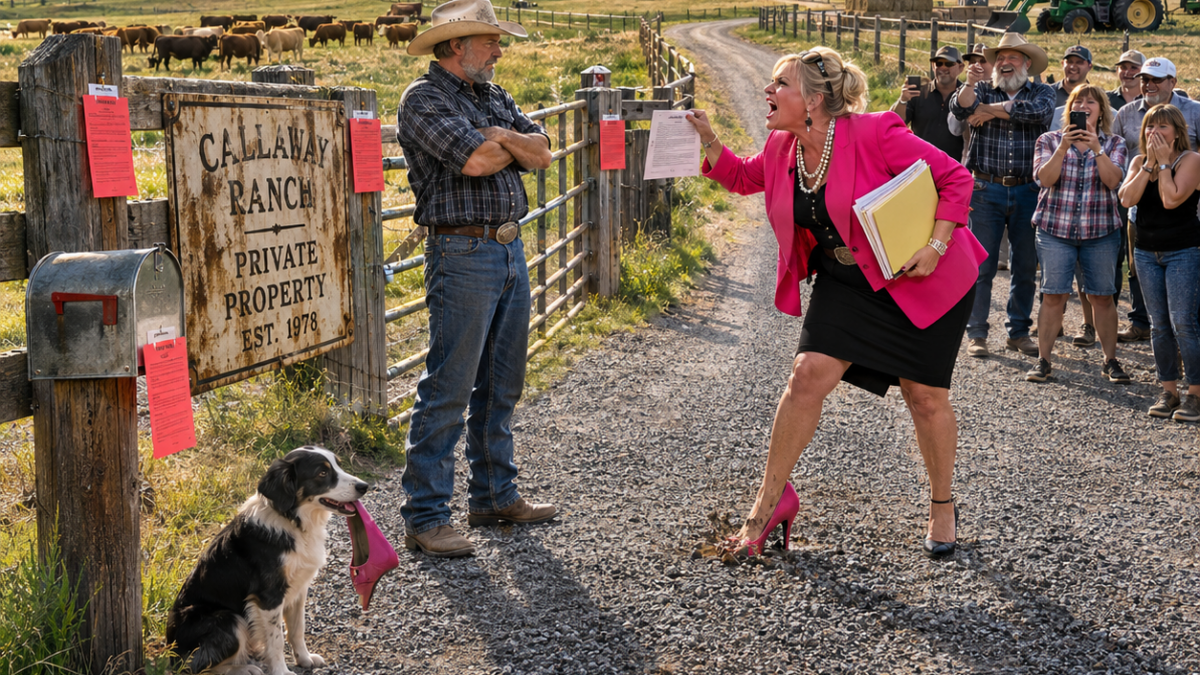
Karen Holloway said it like she was announcing a court judgment instead of standing at the edge of my ranch in a bright pink blazer, sinking half an inch into loose gravel with every angry step. The evening sun was dropping behind the western ridge, turning four thousand acres of pasture gold, but Karen wasn’t interested in scenery. She was waving a red HOA violation notice at me with one hand and clutching a yellow folder against her ribs with the other. “Nine hundred dollars,” she said. “Effective immediately. And that’s per day until you bring this road into compliance.”
I looked behind me at the “road.”
It was a twelve-foot-wide gravel ranch path running from my house to the north barn, worn smooth by three generations of pickup trucks, horses, tractors, and muddy boots. My grandfather had graded it. My father had added drainage culverts. I had spread fresh limestone over it every spring since inheriting the place. It wasn’t decorative, and it wasn’t supposed to be. It was a working path on a working cattle ranch.
“You’re fining me nine hundred dollars a day for gravel?” I asked.
Karen straightened. “For refusing to follow community standards.”
Her heels shifted again.
One sank deeper.
I glanced down.
She yanked it free and pretended nothing had happened.
Behind her, somebody had stapled three red notices to my fence posts. Another was taped to my mailbox. One had somehow ended up on the gate beside a faded metal sign my grandfather had installed in 1978: CALLAWAY RANCH — PRIVATE PROPERTY.
Karen tapped her folder. “The HOA adopted a new visual-cohesion policy last month. Any visible driveway, access lane, or pedestrian path must be paved with an approved surface. Asphalt, stamped concrete, or approved stone pavers.”
“That’s a ranch road.”
“It is visible from Willow Ridge.”
Willow Ridge was the subdivision built along my eastern boundary eleven years earlier.
“Visibility doesn’t make it yours.”
Her smile tightened.
“You ranch people always say that.”
That sentence did more to get my attention than the fine.
I had been trying to stay calm until then.
“Ranch people?”
She ignored the question and pulled another sheet from her folder. “Failure to comply may result in additional penalties, collection costs, and a lien against the property.”
I held out my hand.
“Let me see that.”
She hesitated, then gave it to me.
The notice had the HOA logo across the top, my ranch address underneath, and a section labeled PROPERTY SUBJECT TO COMMUNITY ENFORCEMENT.
That was the first thing that made me stop smiling.
Because I knew my land records.
I knew the deed.
I knew the survey.
And I knew exactly where the Willow Ridge declaration stopped.
Karen had just put in writing that her HOA claimed enforcement authority over acreage it had never been granted.
I folded the notice once and slipped it into my shirt pocket.
“What are you doing?” she asked.
“Keeping it.”
“You’re required to sign acknowledgment.”
“No.”
Her face hardened.
“Mr. Callaway, the board voted. This isn’t optional.”
I looked past her toward the orange survey monument near the fence line.
Then back at the notice in my pocket.
For the first time that evening, I realized Karen wasn’t merely bluffing about aesthetics.
She was claiming my ranch belonged under her HOA.
And if she had already started sending fines, I needed to find out how far she had gone.
**part 2**
My name is Daniel Callaway. I was fifty-four then, and Callaway Ranch had been in my family for just over a century. Four thousand acres sounds enormous until you spend your life maintaining it. Then it becomes fence lines, water tanks, feed costs, calving seasons, drainage ditches, taxes, equipment repairs, and mornings that start before sunrise whether you feel like getting up or not.
The original family acquisition dated to 1921, but I never relied on a yellowed piece of parchment as if it were magic. Old deeds don’t float above modern property law. Land changes hands, easements get recorded, parcels get subdivided, restrictions can attach if owners properly agree to them. What mattered was the complete chain of title.
Mine was clean.
Our family had never subjected the ranch parcel to the Willow Ridge declaration.
No annexation amendment had been recorded against it.
No deed restriction incorporated their covenants.
No easement granted their board control over my internal ranch roads.
The subdivision had simply been built next to us.
That distinction had apparently become inconvenient for Karen.
I walked back to the house carrying the red notice and found my wife, Claire, standing at the kitchen island slicing tomatoes.
She looked at my face.
“What happened?”
I handed her the paper.
She read the first paragraph.
Then the second.
Then she looked toward the window at the gravel lane.
“Nine hundred a day?”
“Apparently gravel has become financially dangerous.”
She kept reading.
When she reached the lien language, her expression changed.
“Can they do that?”
“No.”
“You sounded very sure.”
“I am.”
“That worries me.”
I laughed despite myself.
Claire had been married to me for twenty-eight years. She knew the difference between Daniel-annoyed, Daniel-angry, and Daniel-about-to-open-a-filing-cabinet.
“This is filing-cabinet angry, isn’t it?” she asked.
“Maybe two filing cabinets.”
She put down the knife.
“Oh, Karen made a mistake.”
I spent the next two hours in my office.
I pulled our current title policy, the last recorded deed, the professional boundary survey from three years earlier, and the plat showing Willow Ridge Phase One, Phase Two, and Phase Three.
I also logged into the county recorder’s online system and downloaded every declaration and amendment associated with the subdivision.
The HOA controlled one hundred eighty-six residential lots.
My ranch was not one of them.
The eastern edge of Willow Ridge followed a boundary established long before the subdivision existed. In several places, their decorative fencing sat only feet from my survey line.
In one place, according to my latest survey, their landscaping actually crossed it.
That caught my eye.
I zoomed in.
A narrow landscaped strip beside their community entrance—grass, shrubs, two ornamental trees, and part of a stone monument—extended onto a triangular piece of my parcel.
I remembered discussing it with the surveyor years before.
At the time, it seemed too small to fight over.
Maybe fifteen feet at its widest point.
I had tolerated it because it wasn’t hurting anything.
Karen’s notice suddenly made tolerance feel less attractive.
The following morning, I called my attorney.
His name was Michael Grant, and he had handled agricultural land transactions for my family for years.
He answered with, “What broke?”
“Nothing.”
“What did somebody build?”
“Nothing.”
“Who is suing you?”
“Nobody yet.”
There was a pause.
“That ‘yet’ is doing a lot of work.”
I emailed him Karen’s notice.
He called back six minutes later.
“Where did this come from?”
“HOA president.”
“You’re not in the HOA.”
“I know.”
“Does she know?”
“She seems emotionally opposed to that fact.”
Michael sighed.
“Do not call her.”
“I wasn’t going to.”
“Do not confront the board.”
“Wasn’t going to.”
“Do not remove their signs.”
“I already removed four.”
He paused.
“Fine. Don’t remove any more.”
“They’re stapled to my fence.”
“Take pictures first.”
“I did.”
Another pause.
“You are deeply irritating to represent when you’re prepared.”
“Thank you.”
“That wasn’t praise.”
By noon, Michael had ordered a fresh title search.
He also told me to preserve every notice and communication, photograph the location of every posting, and avoid doing anything that could look retaliatory.
That last instruction mattered.
My first emotional impulse was simple: tear down every red notice, pile them on Karen’s front porch, and dump a truckload of gravel beside her mailbox.
That would have been satisfying for ten minutes.
Then it would have become somebody’s exhibit.
Instead, I made coffee.
Documentation is less exciting than revenge.
It is also more useful.
Karen emailed me that afternoon.
The subject line read FINAL OPPORTUNITY TO COMPLY VOLUNTARILY.
I opened it.
Daniel,
As discussed, the HOA has adopted updated aesthetic regulations applicable to all properties visually integrated with Willow Ridge. Your gravel path is plainly visible from multiple community lots and negatively affects the neighborhood’s unified appearance.
The $900 initial assessment remains due. Continuing noncompliance will result in additional daily assessments.
You may avoid escalation by signing the attached compliance agreement and scheduling approved paving within seven days.
Regards,
Karen Holloway
President, Willow Ridge Homeowners Association
I read the phrase “visually integrated” three times.
Then I called Michael.
He answered, “Please tell me she didn’t write more.”
“She invented a new form of property ownership.”
“What is it?”
“Visual integration.”
He went quiet.
Then he laughed.
Not a professional chuckle.
A real laugh.
“I’ve been practicing property law for twenty-three years,” he said. “That’s a new one.”
“I figured you’d appreciate innovation.”
“Send it.”
I did.
Later that evening, Claire and I walked the gravel path together.
The sun was low, and cattle were moving toward the south pasture. Dust hung softly in the air behind them.
Claire stopped near one of the fence posts where Karen had attached a notice.
“What if this turns ugly?”
“It already is.”
“I mean expensive.”
That was a better question.
Legal disputes over land can burn money faster than almost anything because people stop thinking economically the moment dirt becomes personal.
I looked across the fence at Willow Ridge.
Neat lawns.
Matching mailboxes.
New roofs.
Small ornamental trees.
The subdivision wasn’t evil.
Most people living there were decent neighbors.
They wanted quiet streets and maintained homes.
The problem wasn’t the existence of the HOA.
The problem was Karen treating its jurisdiction like spilled paint.
Anything she could see, she believed she could cover.
“I don’t want a war,” I told Claire.
“Good.”
“I want a line.”
She looked toward the survey stake.
“We already have one.”
Exactly.
The title search came back two days later.
Michael called at 8:14 in the morning.
“Your ranch parcel is not subject to the Willow Ridge declaration.”
“I know.”
“I’m required to sound more impressive when I tell you.”
“Try again.”
He cleared his throat theatrically.
“After extensive review of the relevant recorded instruments, your four-thousand-acre ranch is not encumbered by the covenants, conditions, and restrictions governing Willow Ridge.”
“Much better.”
“Also, nothing in the subdivision amendments annexes your parcel. No consent. No joinder. No supplemental declaration affecting you.”
“And the lien threat?”
“Meaningless unless they manage to create a lawful debt against property they actually have authority over. They don’t.”
I leaned back.
“So we’re done.”
“No.”
I knew that tone.
“What?”
“I checked the county parcel map against your last survey.”
“I did too.”
“Did you notice their entrance feature?”
“Yes.”
“The stone monument and landscaping appear to cross your boundary.”
“I know.”
“You’ve tolerated it.”
“For years.”
“Tolerance isn’t the same as granting title, but we need to confirm whether there’s any easement, license, or adverse possession issue before we touch anything.”
“I’m not touching anything.”
“Good. See? You’re learning.”
Michael sent a formal letter that afternoon to Karen, the HOA board, and their management company.
It was polite enough to frame.
It identified my parcel by legal description.
It cited the recorded declaration.
It stated that Callaway Ranch had never been annexed into Willow Ridge and was not subject to HOA architectural or aesthetic enforcement.
It demanded immediate withdrawal of the $900 assessment, suspension of further penalties, and written confirmation that no lien or collection action would be attempted.
It also instructed the association to preserve records concerning the decision to issue the notice.
Karen answered before the management company did.
Her email contained four sentences.
Mr. Grant,
The HOA’s authority is broader than your client suggests. The board’s aesthetic powers extend to conditions affecting neighboring community property values. Visibility from HOA-controlled lots creates a legitimate enforcement interest.
We intend to proceed.
Karen Holloway
Michael forwarded it to me with one line above it.
Please do not respond.
I wrote back.
Wasn’t planning to.
He replied.
You typed that too quickly.
He knew me well.
The management company responded the next morning.
That message was different.
A regional manager named Ellen Price said the company was “reviewing the matter internally” and requested a copy of Karen’s notice.
That was the first sign Karen might have acted without everyone knowing.
I sent them everything.
Twenty-four hours later, the daily fine increased.
Another red notice appeared on my gate.
$1,800 OUTSTANDING.
Karen had apparently counted the original $900 plus one additional day.
By Friday, her running total was $3,600.
She taped each updated notice over the previous one.
By Sunday, I had a stack.
Claire started calling it “Karen’s subscription service.”
Monday morning brought a new delivery.
Karen herself.
She arrived in a white SUV with two other board members.
I saw them from the barn and walked down toward the gate.
One man, probably in his sixties, looked uncomfortable before he even stepped out.
The woman beside him carried a tablet.
Karen carried the yellow folder.
Of course.
“Daniel,” she said. “We’re here to inspect the violation.”
“No.”
Her eyebrows lifted.
“The board has inspection rights.”
“Inside HOA property.”
“This condition affects our community.”
“You’re standing outside my gate.”
“Because you’re obstructing access.”
“Yes.”
She stared at me.
I smiled.
The older board member looked down.
I suspected he was trying not to laugh.
Karen stepped toward the latch.
“Do not open that gate,” I said.
My voice wasn’t loud.
It didn’t need to be.
She stopped.
“This is precisely the hostility we’ve been documenting.”
“You asked to enter private ranch property without permission. I said no.”
She turned to the woman with the tablet.
“Note refusal of inspection.”
The woman hesitated.
“Karen, are we sure this parcel is actually listed in the declaration?”
Silence.
That was the first time I realized at least one board member hadn’t been told the whole story.
Karen answered without looking at her.
“The issue has been reviewed.”
“By who?”
“Counsel.”
That interested me.
“Which counsel?”
Karen looked at me sharply.
“This is an internal board matter.”
“Then leave my gate.”
The older man finally spoke.
“Maybe we should confirm jurisdiction before doing anything further.”
Karen spun toward him.
“We already voted.”
He shook his head.
“We voted on the aesthetic guideline.”
“Exactly.”
“We did not vote to apply it to the ranch.”
Karen’s expression froze.
There it was.
A crack.
Small, but real.
She recovered quickly.
“The policy applies to all visible properties impacting the community.”
The woman with the tablet looked at me.
“Mr. Callaway, have you received anything from our attorney?”
“No.”
She turned back to Karen.
“I haven’t either.”
Karen snapped the folder shut.
“This conversation is becoming unproductive.”
I almost admired the phrasing.
Trespassing had apparently become unproductive.
She turned and marched toward her SUV.
Her left heel found the soft shoulder beside the gravel.
It sank.
Again.
Karen jerked upward.
The shoe stayed behind.
The older board member looked at the shoe.
Then at me.
Then toward the sky.
I had to bite the inside of my cheek.
Karen hopped once, retrieved the heel, climbed into the SUV, and drove away with one bare foot.
I waited until the vehicles disappeared.
Then I called Michael.
“I have new information.”
“What did you do?”
“Nothing.”
“That answer is never comforting.”
“Two board members just learned my ranch may not be in their HOA.”
There was a pause.
“That is useful.”
“Also Karen lost a shoe.”
“Not legally useful.”
“Emotionally helpful.”
“I’ll allow it.”
That afternoon, the board treasurer called me directly.
His name was Robert Ellis, the older man from the gate.
“I hope I’m not overstepping.”
“Depends what you’re calling about.”
He exhaled.
“Karen told us your parcel was subject to an older reciprocal-development agreement.”
“It’s not.”
“I know that now.”
He sounded embarrassed.
“She presented a summary at last month’s meeting. Said counsel had reviewed it.”
“Did you see counsel’s opinion?”
“No.”
“Did you see the agreement?”
“No.”
There was a long silence.
Then he said, “I’m starting to understand your concern.”
I didn’t gloat.
That would have made him defensive.
Instead I asked, “Robert, did the board vote to fine me?”
“No.”
“Did the board authorize $900 per day?”
“No.”
“Did you authorize the lien language?”
“No.”
I wrote each answer down.
Then I asked the question that mattered most.
“Did your attorney tell Karen the HOA could regulate my ranch?”
“No.”
There it was.
Karen had used the board’s new aesthetic policy as a weapon beyond its boundaries.
She had apparently told fellow board members there was some historical agreement tying my ranch to Willow Ridge.
There wasn’t.
And she had sent fines without a board vote.
When I told Michael, he stopped joking.
“Now we have a governance problem.”
“Meaning?”
“Meaning the association may want to resolve this before it becomes a lawsuit.”
That was exactly what happened.
Two days later, Willow Ridge’s attorney, Susan Patel, contacted Michael.
I wasn’t on the call, but Michael summarized it afterward.
“She was not happy.”
“With me?”
“With Karen.”
I leaned back.
“That’s encouraging.”
“The association’s legal position is that the notices were not validly authorized.”
“Good.”
“They’re withdrawing them.”
“Better.”
“They also want both sides to refrain from public statements.”
I laughed.
“What public statements have I made?”
“None.”
“Karen has been posting violation notices on my fence like campaign signs.”
“I know.”
“What about the lien threat?”
“Withdrawn.”
“Daily fines?”
“Withdrawn.”
“Written confirmation?”
“Coming.”
That should have ended the story.
It didn’t.
Because Karen had a problem more serious than the gravel path.
She couldn’t tolerate losing in private.
Three mornings later, a local television reporter called my house.
“Mr. Callaway, we’re doing a story about conflict between rural landowners and suburban community standards.”
I almost hung up.
Then she said, “Ms. Holloway suggested we contact you.”
Of course she did.
I asked what Karen had told them.
The reporter was careful.
“She says the HOA is trying to encourage modernization and that you’ve refused reasonable improvements.”
“Did she tell you I’m in the HOA?”
“She described the ranch as integrated with the Willow Ridge community.”
That phrase again.
“I’m not.”
Silence.
“You’re not?”
“No.”
I gave her Michael’s number.
Then I called him.
He answered with, “Please don’t tell me you gave an interview.”
“I gave your number.”
“I take back at least three bad things I’ve said about you.”
The reporter called him.
Then she checked county records.
Then she contacted the HOA’s attorney.
By late afternoon, the story had changed.
What Karen apparently expected to be a flattering segment about neighborhood beautification turned into a property-boundary dispute.
The station asked permission to film from the public road.
I agreed.
That evening, Claire and I watched the segment from our couch.
The reporter stood near the subdivision entrance with my ranch visible behind her.
She explained that the HOA had attempted to fine a neighboring ranch over an unpaved access path, but county property records showed the ranch was not part of Willow Ridge.
Then she showed an image of one of Karen’s red notices.
Claire looked at me.
“That’s bad.”
“For who?”
“Pink blazer.”
Karen appeared next.
She had agreed to an interview.
Her first sentence was exactly what I expected.
“Property rights don’t exist in a vacuum.”
I nearly dropped my drink.
Claire stared at the television.
“Oh, she rehearsed that.”
Karen continued.
“When conditions on adjacent land affect our homeowners’ investment, the association has a responsibility to respond.”
The reporter asked, “But does the HOA have recorded authority over Mr. Callaway’s parcel?”
Karen paused.
“That’s a legal technicality currently under review.”
I laughed out loud.
Claire didn’t.
“Daniel.”
“What?”
“She just called property ownership a technicality.”
The reporter followed with a statement from the association’s attorney saying the notices had been withdrawn and no enforceable HOA assessment existed against Callaway Ranch.
Karen’s face stayed on screen for two more seconds.
That was enough.
By the next morning, the clip had spread through the subdivision’s private social media group.
I didn’t belong to the group.
I didn’t need to.
Neighbors started sending screenshots.
Most comments weren’t about the path.
They were asking why Karen had told people the ranch was subject to HOA authority.
Others wanted to know whether fines they had received were properly authorized.
Then somebody posted a photograph of my gravel lane beside a photograph of Willow Ridge’s cracked community parking lot.
The caption read:
ONE OF THESE APPARENTLY REQUIRES EMERGENCY PAVING.
I laughed so hard Claire came into the office to see what was wrong.
The humor was temporary.
The legal issue wasn’t.
Michael had commissioned a new survey because the HOA’s entrance monument encroachment bothered him.
The surveyor arrived the following Monday.
His name was Tom Avery, and he had done enough rural boundary work to treat every fence, ditch, and old iron pin like part of a crime scene.
We walked the eastern line together.
He located the old monument.
Then the modern survey marker.
Then another.
At the subdivision entrance, he stopped.
“Well.”
“What?”
He pointed.
The Willow Ridge stone monument sat partly on my land.
So did approximately thirty-eight feet of decorative fencing.
A landscaped berm crossed the line.
And the corner of a narrow maintenance lane the HOA used to reach its irrigation equipment also clipped my parcel.
“How much?” I asked.
Tom checked his equipment.
“Enough that I’d want the association to know.”
I stared at the stone monument.
For eleven years, I had let it sit there.
Not because they had a right.
Because it didn’t bother me.
Then Karen had threatened a lien over gravel.
“Do not smile like that,” Tom said.
“I wasn’t smiling.”
“You were.”
“I was thinking.”
“That looked expensive.”
He was right.
But I wasn’t interested in tearing down the entrance.
Michael would never have allowed that without proper notice anyway.
Instead, we handled it cleanly.
Tom prepared the survey.
Michael sent the HOA a boundary notice identifying the encroachments and offering to negotiate.
The association could either relocate the improvements or enter into a written license agreement recognizing my ownership.
That offer was generous.
Karen treated it like surrender.
She showed up at the next board meeting and declared that I was “attempting to seize the community entrance.”
Robert called me afterward.
“She said you’re trying to shut down the subdivision.”
“I offered you a license.”
“I know.”
“She knows?”
“She has the letter.”
“So yes.”
He sighed.
“Daniel, I think this has stopped being about the path.”
“It was never about the path.”
The board scheduled a special meeting.
Michael and Susan negotiated before it happened.
The legal solution was straightforward.
The HOA would acknowledge my boundary.
I would grant a revocable long-term license allowing the existing monument and landscaping to remain, subject to maintenance conditions.
The association would pay a nominal annual fee, mostly to document that the use was permissive rather than hostile.
The maintenance lane would be shifted entirely onto HOA property.
Everyone saved money.
Everyone kept their landscaping.
Nobody lost access.
Karen hated it.
At the meeting, she stood and said, “Paying him anything rewards obstruction.”
Susan Patel, the HOA attorney, was sitting three seats away.
She looked at Karen.
“We are paying for the right to use someone else’s land.”
Karen threw up her hands.
“The monument has been there for years.”
“That does not make the parcel ours.”
“Then why didn’t he object before?”
Susan’s answer was immediate.
“Because he was being neighborly.”
That silenced the room.
For a moment.
Then Mrs. Stanton from Lot 84 raised her hand.
“So we’re paying him because Karen fined him for a road on his property while our sign was sitting on his property?”
Susan closed her eyes for half a second.
Robert coughed.
Someone in the back laughed.
Karen turned red.
The meeting deteriorated from there.
Homeowners wanted copies of the fine authorization.
There was none.
They wanted the legal opinion Karen claimed existed.
There was none.
They wanted minutes showing the board had voted to treat the ranch as “visually integrated.”
There were none.
Then the secretary produced the actual minutes from the aesthetic-policy meeting.
The policy applied to “lots subject to the Willow Ridge Declaration.”
My ranch was not one.
Karen had added the words “all visually adjacent properties” to the enforcement memo she circulated afterward.
She had changed the scope herself.
Robert stared at her.
“Did the board approve this language?”
Karen didn’t answer.
“Karen?”
“I interpreted the policy.”
“You rewrote it.”
“I clarified it.”
“Without a vote.”
“I acted in the community’s interest.”
There it was again.
Her favorite defense.
Intent.
As though believing you were right transformed unauthorized acts into legitimate ones.
Susan leaned forward.
“Ms. Holloway, board authority comes from the governing documents and duly adopted decisions. It does not expand because an officer believes expansion would be beneficial.”
Karen’s mouth tightened.
“This board has become afraid to lead.”
Robert answered quietly.
“No. We’ve become afraid of being sued.”
That got a laugh.
Karen didn’t appreciate it.
The board suspended her authority to issue enforcement notices that night.
She remained president temporarily because removing an elected director required a member process under their bylaws, but practically speaking, the clipboard had been taken away.
I thought that would calm her down.
It did not.
Three days later, a paving contractor drove onto my ranch.
I was repairing a hydraulic line on the loader when Claire called from the house.
“Daniel?”
“What?”
“There are orange cones on the north path.”
I straightened.
“What cones?”
“I assume the kind that indicate somebody is about to do something stupid.”
I drove over.
A white utility truck and a small asphalt crew were parked just inside the gate.
The foreman was standing beside his truck looking at paperwork.
I stopped ten yards away.
“Can I help you?”
He smiled.
“Mr. Callaway?”
“Yes.”
“We’re here to prep the lane.”
“No, you’re not.”
His smile vanished.
“We have a work authorization.”
“From who?”
He checked the page.
“Willow Ridge HOA.”
I stared at him.
He looked at the gate.
Then the ranch.
Then back at the paper.
“This isn’t Willow Ridge?”
“No.”
He muttered something under his breath.
I asked to see the work order.
It had Karen’s name on it.
President.
She had authorized preliminary grading and paving of the first visible section of my ranch path.
The foreman looked increasingly horrified as I explained.
“We haven’t started,” he said immediately.
“Good.”
“Nobody told us there was a dispute.”
“I believe you.”
“We can leave.”
“Please do.”
He handed me a copy of the work order before departing.
I called Michael.
This time, he didn’t joke.
“She sent contractors onto your land?”
“They didn’t start.”
“Doesn’t matter.”
“I know.”
“Do you have the work order?”
“Yes.”
“Photographs?”
“Yes.”
“Witness?”
“Claire.”
“Camera?”
“Gate camera.”
There was a pause.
“I’m filing.”
That was the point where the dispute moved out of meeting rooms.
Michael filed a civil action seeking declaratory and injunctive relief.
The complaint wasn’t dramatic.
It didn’t claim millions in damages.
It asked the court to declare that Callaway Ranch was not subject to the HOA’s declaration, prohibit the association and its agents from attempting to enforce its covenants against my property, and address the boundary encroachments.
We also sought recovery of fees where permitted under the relevant statutes and governing documents.
The judge issued a temporary order preventing the HOA from entering my property or attempting physical modifications while the case was pending.
Karen received the papers at a board meeting.
I wasn’t there.
Robert described it later.
“She read the first page and said, ‘This is intimidation.’”
“What did Susan say?”
“She said, ‘It’s litigation.’”
I liked Susan.
The association’s insurer became involved immediately.
That changed everything.
Insurance companies have very little interest in neighborhood pride.
They care about exposure.
The insurer-appointed counsel reviewed the declaration, Karen’s notices, the survey, the contractor authorization, and the board minutes.
Within days, the HOA’s legal strategy shifted from “defend Karen” to “resolve this immediately.”
Karen fought them.
At one meeting, according to Robert, she insisted they should countersue me for lowering property values.
Susan asked for an appraisal.
Karen had none.
She suggested nuisance.
Susan asked for documented complaints.
There were none.
She suggested adverse visual impact.
Susan asked what legal cause of action that was.
Karen changed the subject.
The settlement conference occurred six weeks after the paving crew incident.
I sat with Michael on one side of a long table.
Robert, Susan, the insurer’s lawyer, and two other directors sat opposite us.
Karen sat at the far end.
She brought the yellow folder.
It had become almost legendary.
The mediator asked everyone to summarize their goals.
I went first.
“I want written confirmation that my ranch isn’t subject to Willow Ridge. I want no future fines, inspections, or entry without permission. I want the boundary issue resolved. And I want my legal expenses addressed.”
The mediator nodded.
Then Karen spoke.
“He wants immunity from basic community responsibility.”
Michael wrote something on his legal pad.
I glanced over.
He had written:
DO NOT RESPOND.
I looked at him.
He underlined it.
The mediator asked Karen whether she had evidence that my parcel had ever been annexed.
She said, “The community has treated it as part of the neighborhood environment for years.”
“That wasn’t my question.”
“It benefits from proximity to our improvements.”
“Do you have a recorded instrument?”
Karen looked at Susan.
Susan did not rescue her.
“No,” Karen said.
“Do you have a contract signed by Mr. Callaway or a prior owner agreeing to HOA authority?”
“No.”
“Do you have a recorded covenant?”
“No.”
“Then what is the legal basis for your enforcement claim?”
Karen’s answer was quiet.
“Common sense.”
Michael stopped writing.
Even the mediator paused.
I had heard many expensive words during the dispute.
That might have been the most expensive.
By the end of the day, the settlement terms were mostly agreed.
The HOA acknowledged Callaway Ranch was outside its declaration.
All fines were permanently void.
The association agreed not to attempt enforcement over my parcel without some future valid recorded agreement voluntarily entered into by the owner.
They reimbursed a substantial portion of my legal and survey expenses.
The boundary encroachments were resolved by a written license for the entrance monument and landscaping.
The maintenance lane would be relocated at HOA expense.
The paving contractor’s invoice, including mobilization charges, was paid by the association.
And because the insurer had demanded governance reforms, enforcement notices now required management review and a specific covenant citation.
Karen sat silent as the agreement was read.
Then the mediator asked whether she understood.
“I understand exactly what happened.”
I believed her.
I wasn’t sure she understood why.
The member vote to remove her came eighteen days later.
I didn’t campaign.
I didn’t need to.
The facts were already circulating.
The unauthorized fines.
The nonexistent legal opinion.
The altered policy language.
The contractor sent onto private land.
The legal expenses.
The survey showing the HOA’s own monument sitting partly on my ranch.
Karen had wanted the path paved because she said it embarrassed Willow Ridge.
Instead, her campaign had forced the HOA to explain to every homeowner why their dues were paying lawyers to defend a fight the board never properly authorized.
Voting participation was the highest in community history.
Karen lost by more than two to one.
Robert became interim president.
His first act was to send me an email.
Subject:
NO OPINION ON YOUR GRAVEL.
The body read:
Daniel,
On behalf of the new board, I can confirm that Willow Ridge has no current position regarding the aesthetic qualities of any gravel located on Callaway Ranch.
Please keep it on your side of the line.
Robert
I printed it.
Claire found it on the kitchen counter.
“You’re framing that too, aren’t you?”
“Maybe.”
“You have a problem.”
“I have documentation.”
The gravel path remained exactly as it was.
I did not pave it.
That mattered to me.
Not because asphalt would have ruined the ranch.
I had paved areas elsewhere.
I simply refused to change lawful private property because somebody next door invented authority over it.
But I did make one change.
Remember the triangular piece of ranch land beside Willow Ridge’s entrance?
The one their landscaping partially occupied?
Beyond that triangle ran an older ranch access lane connecting my eastern pasture to the county road. It was rough, narrow, and mostly used by tractors.
I had wanted to improve it for years.
After the lawsuit, I applied for the proper county driveway permit, drainage review, and access approval.
No tricks.
No revenge construction.
No secret bulldozer.
Everything was surveyed, engineered, and permitted.
Then I built a new paved ranch access road.
Entirely on my land.
It ran near the Willow Ridge entrance for about two hundred feet before bending west into my property.
Karen saw the construction two weeks after losing office.
She stopped her car near the boundary.
I was standing with the contractor reviewing drainage.
She rolled down her window.
“You’re paving now?”
I looked at the fresh asphalt.
“Yes.”
Her face twisted.
“After everything you put this community through over refusing to pave?”
I smiled.
“No, Karen.”
She waited.
“I’m paving a road I decided to pave.”
That distinction seemed physically painful to her.
“This is spite.”
“No. It’s ranch access.”
“You could have done this months ago.”
“I could have.”
“So all that fighting was unnecessary.”
I shook my head.
“The fight wasn’t about pavement.”
“Of course it was.”
“No. It was about who gets to decide.”
She looked away.
That was the whole story in seven words.
Who gets to decide.
My new access road improved operations immediately.
Feed deliveries could enter from the east.
Heavy trailers no longer had to circle past the house.
Emergency vehicles had a second access point.
The county required proper signage and drainage, and I paid for both.
There was no magical public takeover of Karen’s yard.
No cars suddenly driving across someone else’s lawn.
That might make a satisfying story on the internet, but real property law doesn’t work that way.
The road remained mine.
The subdivision remained theirs.
The survey line remained where it had always been.
That was enough.
The humiliation for Karen came from something much simpler.
Every person entering Willow Ridge now drove past two paved lanes.
One led into the subdivision.
One led onto Callaway Ranch.
Between them stood the HOA’s stone monument—still partly on my land under the new written license.
At the bottom, the board installed a small required marker identifying the licensed boundary area.
It wasn’t dramatic.
Most people would never notice it.
Karen noticed it every single day.
So did I.
Robert called once to ask whether I minded if the HOA replaced the old landscaping around the sign.
“Go ahead.”
“Do we need written permission?”
“Yes.”
He laughed.
“I knew you’d say that.”
“I learned from experience.”
“You want a formal request?”
“I want an email.”
“Done.”
That was the difference between the new board and Karen.
They asked.
I said yes.
No conflict.
No police.
No attorneys.
No red notices.
Just neighbors respecting a boundary.
Six months after the vote, Karen put her house on the market.
I heard about it from Claire.
“Pink blazer is moving.”
“Don’t call her that.”
“You do.”
“Only internally.”
“Your internal voice is loud.”
Karen’s house sold quickly.
On her final weekend, I was repairing fence near the eastern line when her SUV stopped beside the county road.
She got out.
No folder this time.
No blazer either.
Jeans, boots, plain blue shirt.
She walked toward the fence but stayed on her side.
Progress.
“Daniel.”
“Karen.”
For a moment, neither of us said anything.
Then she looked toward the old gravel path in the distance.
“You know, I still think asphalt looks better.”
I laughed.
“I know.”
“And your new road proves it.”
“It proves asphalt is useful where I want asphalt.”
She almost smiled.
Almost.
Then she looked toward the Willow Ridge monument.
“They made me the villain.”
I rested my arms on the fence.
“No.”
Her eyes narrowed.
“You enjoyed watching me lose.”
“I enjoyed watching the fines disappear.”
“That isn’t the same thing?”
“No.”
She waited.
I chose my words carefully.
“You weren’t wrong because you cared how the community looked. You were wrong because you decided caring gave you authority you didn’t have.”
Her face tightened.
“The board was weak.”
“Maybe.”
“I got things done.”
“You also sent a paving crew onto my ranch.”
She looked away.
“That was a mistake.”
“Yes.”
“I thought if the work started, you’d see it looked better.”
I stared at her.
She finally heard how that sounded.
A short, uncomfortable laugh escaped her.
“Fine. That sounds worse out loud.”
“Much worse.”
She nodded.
We stood there in silence while cattle moved across the western pasture.
Then she said something I never expected.
“I shouldn’t have threatened the lien.”
“No.”
“Or the daily fines.”
“No.”
“Or changed the policy language.”
“Definitely no.”
She gave me an irritated look.
“You don’t make apologies easy.”
“I didn’t realize I had a role.”
That almost got another smile.
Then she extended her hand across the fence.
“I hope the ranch stays in your family.”
I shook it.
“So do I.”
She got back into her SUV and drove away.
I never saw her again.
Life on the ranch returned to normal after that.
Normal, of course, meant equipment breaking at inconvenient times, cattle finding weaknesses in fences that I swore were solid, and Claire reminding me that owning four thousand acres did not excuse leaving muddy boots in the kitchen.
The old gravel path remained between the house and the barn.
Every spring, I graded it.
Every few years, I added new stone.
At sunset, it still caught the light the same way it had when I was a boy riding beside my grandfather.
There was never anything special about it aesthetically.
That was part of why I loved it.
It belonged there.
A working path on working land.
The lawsuit never became some giant courtroom spectacle.
There was no judge pounding a gavel while Karen screamed.
No million-dollar verdict.
No miraculous government seizure.
Real legal victories are usually quieter.
The fines disappeared.
The lien threat vanished.
The association acknowledged the jurisdictional boundary.
My attorney fees were substantially reimbursed.
The physical boundary was documented.
The HOA changed its procedures.
Karen lost the position she had abused.
And everyone involved left with a clearer understanding of where their authority ended.
That was enough revenge for me.
Actually, there was one final detail.
About a year later, Robert invited Claire and me to Willow Ridge’s summer barbecue.
I nearly declined.
Claire insisted we go.
“Why?”
“Because normal people live there.”
“That sounds exhausting.”
“You’ll survive.”
When we arrived, Robert met us near the entrance.
He shook my hand and pointed toward the community parking area.
Fresh black asphalt stretched across the whole lot.
I stared at it.
He grinned.
“We finally paved something that was actually ours.”
Claire started laughing.
I did too.
Then I noticed a small gravel walking path winding through the landscaped common area behind the clubhouse.
I pointed at it.
“Robert.”
He followed my finger.
“Yes?”
“That path is unpaved.”
His face became completely serious.
“Don’t start.”
“I think it affects my property value.”
“Daniel.”
“Visual integration.”
He closed his eyes.
Claire had to walk away because she was laughing too hard.
Robert pointed toward the barbecue.
“Go eat something before I revoke your invitation.”
“You have jurisdiction?”
He stared at me.
“Now I understand Karen.”
That joke became the last word on the whole ridiculous chapter.
And maybe that was appropriate.
Because for months, Karen had tried to turn a line on a survey into a question of power.
She believed the HOA’s authority should expand as far as its members could see.
She believed a vote inside Willow Ridge could control land outside Willow Ridge.
She believed an official-looking notice could create an obligation where none existed.
She believed confidence could substitute for jurisdiction.
It couldn’t.
Property ownership is complicated.
HOA law can be complicated.
Recorded covenants, easements, annexation documents, bylaws, statutes, surveys, and enforcement procedures can fill boxes.
But the principle at the center of my fight was simple.
Authority has boundaries.
So does land.
If you want rights over someone else’s property, you need more than a complaint, more than a board vote, more than a pink blazer, and definitely more than a red notice stapled to somebody else’s fence.
You need actual legal authority.
Karen never had it.
My grandfather’s gravel path is still there today.
So is the ranch.
Four thousand acres.
Barns.
Pastures.
Cattle.
Fence lines.
The old trail winding between the house and the north barn.
And every evening when the western sky turns orange, the limestone catches the last light just enough to glow.
Nobody from Willow Ridge fines me for it.
Nobody demands asphalt.
Nobody threatens liens.
Sometimes a neighbor from the subdivision waves when I pass on the tractor.
I wave back.
That’s what being neighbors should have been all along.
Not control.
Not intimidation.
Not invented authority.
Respect.
Karen wanted to make my gravel path disappear because she thought it embarrassed her community.
Instead, that little strip of stone exposed every weakness in the authority she had built around herself.
And in the end, the path didn’t change at all.
She did.








