𝗙𝗨𝗟𝗟 𝗦𝗧𝗢𝗥𝗬 HOA Karen Fined Me $420 Over My Dam—Then the River Reached Their Front Doors
𝗙𝗨𝗟𝗟 𝗦𝗧𝗢𝗥𝗬
“If I did, I’d tell you.”
He glanced toward Denise.
“But I’d start collecting every document you’ve got.”
“Already planning to.”
Her SUV backed away.
As it turned toward the county road, something rolled from beneath the passenger side and fell onto the gravel.
Denise didn’t notice.
Neither did Daniel.
I walked over.
A rolled sheet of heavy glossy paper.
Daniel raised an eyebrow.
“Looks expensive.”
I unrolled it across the hood of my truck.
Computer renderings.
Homes.
Walking trails.
Boat docks.
Landscaping.
At first, it looked like a development pitch.
Then I saw the water.
The shoreline didn’t match Brennan Lake.
Not remotely.
The blue shape on the drawing cut directly through what was currently reservoir.
The dam was gone.
In its place sat a small decorative pond.
Thirty-six rectangular residential lots surrounded the exposed lakebed.
Luxury homes.
Private marina.
Clubhouse.
Walking promenade.
I stared.
Daniel leaned closer.
“That’s not your reservoir.”
“No.”
It was a future subdivision.
One that could exist only if my reservoir disappeared.
My phone rang again.
Claire.
“I found something.”
“Me too.”
I put her on speaker.
“What?”
“I pulled the GIS layers and the future subdivision filings around Cascade Ridge.”
I looked down at the glossy map.
“How many lots?”
Pause.
“Thirty-six.”
Daniel and I looked at each other.
“Same number.”
Claire’s keyboard clicked.
“Dad, where are those lots?”
“On the lakebed.”
“No.”
Her voice sharpened.
“They’re on land that only exists if Brennan Reservoir is drained.”
I looked at the bottom-right title block.
Prepared for High Prairie Land Holdings, LLC
Development Contact: Kyle Holloway
Denise’s husband.
Daniel gave a low whistle.
Claire kept going.
“That $420 assessment may have been designed to establish a paper trail.”
“For what?”
“If you paid it voluntarily, they could argue you acknowledged some shared community interest in the reservoir.”
Daniel folded his arms.
“That seems aggressive.”
“It is,” Claire said. “But if they want to claim shared infrastructure later, one of the things they’d want is evidence Wyatt treated the HOA as having some relationship to the lake.”
I rolled the plan back up.
Denise hadn’t come to my gate because she cared about fairness.
Her husband had already commissioned drawings for homes sitting beneath my water.
They weren’t trying to share Brennan Lake.
They were planning for Brennan Lake to disappear.
Then I noticed another line.
Prepared in cooperation with Nathan Pierce Environmental Consulting
I didn’t recognize the name.
I would soon.
Three days later, Nathan Pierce introduced himself through a forty-two-page environmental complaint delivered by certified mail.
The front page showed a telephoto photograph of Brennan Dam.
Title:
EMERGENCY PETITION REGARDING AN UNLICENSED PUBLIC HAZARD
Claire stood beside me at the kitchen counter.
“Unlicensed?”
“First lie.”
Nathan’s report alleged that the dam obstructed fish migration, trapped contaminated sediment, restricted public water, and created catastrophic downstream risk.
His recommendation:
Drain Brennan Reservoir.
Remove the dam.
Restore the natural river channel.
Claire flipped to the technical appendix.
Then stopped.
“There isn’t one.”
“What?”
“No calculations.”
She turned pages faster.
“No runoff analysis. No reservoir capacity study. No structural inspection. No sediment sampling.”
“What did he inspect?”
“Nothing that I can find.”
She read the consultant methodology.
“He used aerial photographs.”
“Whose?”
Her jaw tightened.
“Kyle’s.”
That afternoon, flyers appeared around town.
Mailboxes.
Feed store.
Gas station.
Headline:
WHO OWNS OUR WATER?
Below it:
My photograph.
The text portrayed me as a rancher hoarding a public natural resource.
By evening, reporters called.
I ignored them.
Instead, Claire and I went into the old ranch office.
My father installed steel filing cabinets there after a courthouse fire destroyed portions of early county property records.
He believed in duplicates.
I used to tease him about it.
I stopped after he died.
We opened the cabinets.
Water-right certificates.
Annual dam inspection reports.
Concrete core testing.
Spillway repair invoices.
Emergency action plans.
State operating certifications.
Reservoir capacity surveys.
Claire created a digital index while I sorted originals.
At 12:03 a.m., she pulled out a faded engineering study.
“Dad.”
I looked over.
County flood-control study.
Completed twelve years before Cascade Ridge was built.
She unfolded the map.
A red boundary crossed the valley below Brennan Dam.
Inside it sat almost the entire future subdivision.
The label read:
NATURAL FLOOD RETENTION BASIN — DEVELOPMENT DEPENDENT UPON UPSTREAM STORAGE CONTROLS
Claire stared.
“They knew.”
The study contained a warning.
Removing or significantly reducing upstream storage would increase peak spring flows through the valley.
Any downstream development would require major levees or elevated foundations unless Brennan Reservoir remained operational.
Cascade Ridge had neither.
We found the original subdivision approval next.
The county approved construction only after the developer acknowledged in writing that Brennan Dam provided essential flood moderation.
The neighborhood existed where it did because my dam existed where it did.
My phone rang.
12:23 a.m.
Denise.
I let it ring twice.
“Wyatt, I’m giving you one final opportunity to cooperate before we seek emergency relief.”
“You hired a consultant who never inspected the dam.”
“Nathan Pierce is highly qualified.”
“He called the dam unlicensed.”
“His conclusions speak for themselves.”
“No, Denise.”
I looked at the flood-basin map.
“Documents speak for themselves.”
Silence.
Then:
“You’re trying to frighten people with technical language because you don’t want to lose control.”
“I haven’t said anything publicly.”
“You will.”
“I won’t need to.”
I touched the old study.
“Your subdivision approval already says everything.”
She stopped breathing for half a second.
Tiny sound.
Enough.
“You don’t understand what you’re reading.”
“I helped review this flood basin before your first foundation was poured.”
Another silence.
Then the line disconnected.
Claire looked at me.
“She knew.”
“Maybe.”
“That pause?”
“I heard it.”
The next morning, Cascade Ridge filed for an emergency hearing asking the court to declare Brennan Dam a public hazard.
Nathan Pierce’s report was Exhibit One.
The flood-retention study was not included.
I called Michael Harper.
Sixty-nine.
Forty years practicing property and water law in Wyoming.
He answered immediately.
“Tell me they didn’t finally come after your dam.”
“They did.”
He sighed.
“I’ll clear my afternoon.”
Three hours later, Michael sat at my kitchen table surrounded by deeds, permits, engineering studies, and county records.
He adjusted his glasses.
“We’re not looking for proof you own it.”
“No?”
“Ownership is obvious.”
“What are we looking for?”
“What everybody else promised before they decided they’d forgotten.”
For nearly two hours, we worked.
Claire searched digital archives.
Michael compared deeds and easements.
Then he stopped.
Took a yellowed recorded agreement from a folder.
Slid it toward me.
“Paragraph seven.”
I read.
The owner of Brennan Dam shall retain exclusive ownership, maintenance authority, operational discretion, spillway access, reservoir rights, and all associated flood-control infrastructure.
Below it:
No future subdivision, association, successor entity, or downstream development shall acquire supervisory authority over said improvements without written consent of the Brennan family.
Claire looked up.
“This predates Cascade Ridge.”
“Eighteen years,” Michael said.
Behind it sat another recorded agreement.
Signed by the original subdivision developer.
It acknowledged Brennan Dam as the valley’s primary flood-mitigation structure.
All downstream construction assumed its continued operation.
“So they knew.”
Michael tapped the signature.
“They agreed.”
Claire pulled up the county index.
“It’s recorded.”
Michael smiled.
“Then every later purchaser is legally considered to have notice.”
She kept searching.
Then froze.
“I found something else.”
“What?”
“Six months before the $420 assessment, Kyle Holloway requested certified copies of every easement affecting Brennan Ranch.”
Michael raised his eyebrows.
“He ordered these?”
“Personally.”
“He paid for certified copies?”
“Yes.”
The kitchen went quiet.
Kyle knew.
Before Denise accused me of illegally controlling public water.
Before Nathan’s report.
Before the HOA vote.
Before the court filing.
The Holloways had already obtained the documents proving the dam belonged exclusively to my family and that Cascade Ridge depended on it for flood moderation.
The dispute was no longer about misunderstanding.
Michael placed three documents side by side.
The Brennan easement.
Subdivision acknowledgment.
Flood study.
“Here’s our strategy.”
“I’m listening.”
“We don’t chase every stupid thing they’ve said.”
“What do we chase?”
“The one story they can’t survive.”
He pointed at the documents.
“They’re not protecting the community from a dangerous dam.”
Claire nodded.
“They’re attacking the infrastructure the community was built around.”
“And Kyle knew it before they started.”
“Exactly.”
My email chimed.
Emergency hearing scheduled.
Thursday.
HOA witness list:
Denise Holloway.
Kyle Holloway.
Nathan Pierce.
No structural engineer.
No hydrologist.
No state dam inspector.
Michael read it.
“They’re bringing opinions.”
“And us?”
“Records.”
He packed his briefcase.
“Usually enough.”
Then stopped near the porch.
“Wyatt.”
“Yeah?”
“Owning the truth doesn’t guarantee the judge gives it the weight we want immediately.”
I knew what he meant.
Court isn’t an engineering office.
A judge has to process what is placed before her.
The first hearing was packed.
Denise sat at the plaintiff’s table.
Navy blazer.
HOA logo pinned to the lapel.
Kyle directly behind her.
Nathan Pierce arranged glossy boards beside the witness stand.
Judge Rebecca Lawson took the bench at nine.
The HOA went first.
Their lawyer described Brennan Dam as an outdated private obstruction.
Interference with natural river flow.
Environmental hazard.
Threat to public safety.
Nathan took the stand.
He spoke confidently.
Millions of gallons artificially stored.
Disruption of natural ecology.
Sediment.
Liability.
Removal, he said, was the safest long-term solution.
Judge Lawson took notes.
Michael waited.
When Nathan finished:
“Mr. Pierce, did you personally inspect the spillway?”
“I reviewed aerial documentation.”
“That’s not what I asked.”
Pause.
“No.”
“Did you calculate peak spring runoff?”
“I evaluated available information.”
“Did you calculate it?”
“No.”
“Snowmelt simulation?”
“No.”
“Reservoir-storage data?”
“No.”
“State operating certification?”
Nathan shifted.
“I believed additional review was warranted.”
“Were you aware the dam currently holds one?”
“No.”
A murmur moved through the room.
Michael picked up the flood-retention study.
“Have you seen this?”
Nathan looked at the cover.
“No.”
“It identifies Cascade Ridge as sitting inside a natural flood-retention basin.”
“I can’t comment—”
“You can.”
Michael put it in front of him.
“You simply didn’t read it.”
Nathan said nothing.
Then I took the stand.
Name.
Ownership.
Family history.
Maintenance.
We entered inspection reports.
Operating permits.
Repair logs.
State certifications.
Then Claire displayed a hydrologic model.
Judge Lawson leaned forward.
“What are we seeing?”
Claire answered.
“Spring runoff under current reservoir operation versus removal.”
Blue water moved down the valley.
With the dam intact, Brennan Lake stored and released water gradually.
Without it, a concentrated surge entered the valley floor.
The model crossed Cascade Ridge.
“Eighty-four occupied homes fall inside the projected flow path,” Claire said.
The HOA lawyer stood.
“Objection. Speculative modeling.”
Judge Lawson looked at Claire.
“Data sources?”
“National Weather Service snowpack data, USGS stream gauges, county topographic surveys, and the flood-control study already offered.”
“Overruled.”
When my testimony ended, Judge Lawson asked:
“Can you guarantee this flooding occurs if the dam is removed?”
“No.”
A few people shifted.
I continued.
“Engineering doesn’t guarantee outcomes, Your Honor. It measures risk.”
“And the risk?”
“Rises dramatically if storage is removed during spring runoff.”
She nodded.
That gave me hope.
After lunch, she issued a preliminary decision.
Independent environmental review.
No immediate dismissal.
Michael lowered his eyes.
Outside, Denise went straight to television cameras.
“We’re confident the evidence speaks for itself.”
Then she pointed toward the ranch.
“By summer, that dam will be gone.”
The clip was everywhere by evening.
Denise posted it online under:
STOP PRIVATE CONTROL OF PUBLIC WATER
I watched once.
Turned the television off.
Called Claire.
“How’s the snowpack?”
“Bad timing.”
“Meaning?”
“Warm temperatures. Four nights above freezing. Rain system coming.”
“Runoff?”
“If the forecast holds, the river could double inside ten days.”
The independent review wasn’t finished.
But nature had already started its review.
We prepared the ranch.
Livestock moved north.
Generators and fuel drums went to higher ground.
Original files into waterproof cases.
Digital copies to separate drives.
Claire installed temporary gauges.
Night one:
River rose four inches.
Night two:
Nine.
Third morning:
Branches slammed against the dam face.
Earl Sutton arrived before noon.
Seventy-nine.
Helped my father rebuild the western abutment four decades earlier.
He stood near the spillway listening.
“You hear that?”
“The rocks?”
“The pressure.”
The river sounded deeper.
Earl looked toward the mountains.
“Last time I heard the valley sound like this, I was sixteen.”
“1963?”
He nodded.
“Your father kept the gates moving all night.”
Then:
“If he hadn’t, the old dairy farm would’ve disappeared.”
Cascade Ridge now stood where that dairy farm had been.
My phone rang.
Michael.
“I have the independent review.”
“And?”
“Dam is structurally sound.”
I waited.
“But?”
“Reviewer says eventual river restoration could be considered.”
“Eventual?”
“Late summer. Low flow. Full downstream mitigation.”
I stared at the swollen channel.
“We’re in active spring runoff.”
“I know.”
“Then there’s nothing to discuss.”
“Denise filed an emergency motion this morning.”
I closed my eyes.
“Argument?”
“She says rising water proves the dam is an imminent hazard.”
The dam was moderating the runoff exactly as designed.
And Denise was using the water it controlled as proof it should be removed.
The next hearing lasted less than an hour.
Michael argued no engineer recommended spring removal.
Claire submitted current gauge readings.
I explained that storage was already reducing peak flow.
The HOA called delay an unacceptable public risk.
Judge Lawson studied the independent report.
Then issued the order.
Controlled removal to begin within seventy-two hours.
I felt Claire grip the table.
Michael stood.
“Your Honor, we formally object. The current hydrologic conditions make immediate removal dangerous.”
“Objection preserved.”
No anger came.
Only dread.
Warm rain struck the courthouse windows.
Outside, Earl waited by my truck.
I handed him the order.
He read it.
Folded it.
“They’re making you take it apart now?”
“Yes.”
He returned the paper.
“Then write down every name.”
“I already am.”
By sunrise the next day, Michael prepared warning packets for:
Judge Lawson.
County Emergency Management.
Wyoming State Water Office.
County Commissioners.
Sheriff Daniel Brooks.
Cascade Ridge HOA.
Every packet contained:
Independent report confirming structural integrity.
Claire’s flood model.
Current river readings.
My signed statement:
I object to the timing of this court-ordered removal because reducing reservoir capacity during active spring runoff materially increases downstream flood risk.
I signed each copy.
Michael watched.
“If this goes wrong, nobody gets to say they weren’t warned.”
“That’s the point.”
At noon, the demolition contractor arrived.
Travis Cole.
White service truck.
Rolled permits.
He looked at the dam.
Then at me.
“You Wyatt Brennan?”
“Yes.”
“I’ve removed irrigation barriers.”
Pause.
“Never an operating flood-control dam during runoff season.”
“Neither has anyone else.”
Before unloading equipment, he inspected everything.
Concrete joints.
Spillway.
Control gates.
Downstream channel.
Then handed me a typed statement.
In my professional opinion, delaying removal until late summer would materially reduce downstream risk.
Michael had it notarized that afternoon.
Sheriff Brooks arrived before demolition began.
“I’ve been asked to witness compliance.”
“Stay all day.”
“Planning to.”
He wasn’t there to force me.
He was there to ensure the record couldn’t later be rewritten.
8:17 a.m.
First temporary railing removed.
Every step photographed.
Every structural element logged.
Claire recorded times.
Michael matched each action to the court order.
Daniel signed milestone sheets.
By the second afternoon, reservoir level dropped several inches.
Mud replaced shoreline.
Claire watched the downstream gauge.
Not the lake.
“Dad.”
I walked over.
“Flow’s accelerating.”
“Rain?”
“Rain plus lost storage.”
“How much?”
“Eight percent above modeled current-operation conditions.”
Michael heard her.
“Documented?”
“Already.”
Denise posted another video that evening.
She stood beside the shrinking lake.
Smiling.
“Today the river finally begins returning to nature.”
Residents behind her applauded.
A sign read:
FREE OUR WATER
Then came her next invitation.
CASCADE RIDGE FREE THE RIVER CELEBRATION
Saturday.
Former lakeshore.
Claire read it.
Folded it.
“She’s throwing another party.”
Michael looked toward the darkening mountains.
“The river hasn’t voted yet.”
Late that night, Claire and I checked the lower gauge.
She looked at the display.
Then again.
Her face changed.
“What?”
She turned the screen.
Three feet.
In less than forty minutes.
She recalibrated.
Same result.
Reservoir capacity had already been reduced under the order.
Warm rain accelerated snowmelt.
Exactly what the model warned.
I grabbed the radio.
“Call Michael.”
Claire was already dialing.
I switched frequencies.
“Carbon County Dispatch, this is Wyatt Brennan.”
“Go ahead.”
“Branch River is climbing rapidly. Recommend immediate emergency-management notification.”
“We’re seeing increases upstream.”
“Cascade Ridge needs warning now.”
“We’ll notify Sheriff Brooks.”
Ten minutes later Daniel arrived.
Claire showed him the hydrograph.
The line went almost straight upward.
“Meaning?” he asked.
“Runoff reached the valley faster than forecast.”
“And Cascade Ridge?”
“Evacuation time is shrinking.”
Daniel grabbed his radio.
“Dispatch, initiate precautionary response.”
At 2:14 that afternoon, water crossed the first county road south of the ranch.
Not a dramatic wall.
A slow brown sheet across asphalt.
But I knew what came after.
Claire zoomed into the map.
“Next low point—”
“Cascade Ridge.”
By four, emergency vehicles entered the subdivision.
Residents stood outside taking pictures.
Some filmed.
Denise livestreamed from near the clubhouse.
“The county is simply being cautious. Everything remains under control.”
Daniel watched on my kitchen screen.
“They’re wasting time.”
5:02 p.m.
His radio came alive.
“Water over Meadow Drive.”
“Basement flooding, Aspen Lane.”
“Vehicle stranded.”
“Bridge access partially blocked.”
Daniel keyed the microphone.
“Begin evacuation immediately.”
Static.
Then:
“We’re trying.”
Claire refreshed gauges.
“Still rising.”
I looked toward the mountains.
Gravity had taken over.
At 6:17 p.m., my phone rang.
Denise.
I answered.
“Wyatt?”
Barely recognizable.
“I’m here.”
“The water—”
Behind her:
Alarms.
Shouting.
A crash.
“It’s inside the house.”
“What floor are you on?”
“Second.”
“Kyle?”
“I don’t know.”
“How high downstairs?”
“Almost to the ceiling.”
Then she began crying.
“Please.”
For one second, everything came back.
The $420 fine.
Sheriff at my gate.
Environmental flyers.
Court hearings.
Television interviews.
The celebration.
The demolition order.
Then it all disappeared.
Because none of it mattered more than a person trapped in floodwater.
“Stay upstairs.”
“Wyatt—”
“The roads are gone. Stay where you are.”
“I need help.”
I looked at Daniel.
He was already unfolding rescue maps.
I ended the call.
Grabbed the radio.
“We’re past prevention.”
Daniel nodded.
I transmitted:
“All available responders, we need boats.”
I looked toward the valley.
Emergency lights reflected across brown water.
“And we need them now.”
Within twenty minutes, deputies were moving toward Cascade Ridge.
Volunteer firefighters launched flat-bottom boats.
State crews headed in.
Ranchers arrived with tractors and trailers without being asked.
Nobody cared who sued whom.
The water had made the lawsuit irrelevant.
Claire ran mapping from my barn.
“Birch Lane underwater.”
“How many homes?”
“Eighteen immediately.”
“And projected?”
She swallowed.
“All eighty-four.”
The map we’d shown in court was no longer a model.
It was an incident.
Daniel looked at me.
“I need people who know the valley.”
“You’ve got them.”
For twelve hours, I stopped being a defendant.
Denise stopped being the HOA president.
Daniel stopped being the sheriff who had once been called to my gate over $420.
We were responders.
I rode in one of the boats because I knew where old culverts lay beneath the floodwater.
Twice I redirected crews away from submerged crossings that could have flipped a boat.
We removed three elderly residents through upstairs windows.
Pulled a family of five from a garage roof.
Carried a diabetic man through chest-deep water to a tractor trailer.
Everywhere we went, people asked:
“How did this happen?”
Nobody had time to answer.
Near dawn, we reached Denise’s house.
Water had begun dropping.
The first floor was destroyed.
She sat upstairs wrapped in a Red Cross blanket.
Kyle stood near the fireplace.
Family photographs floated in muddy water downstairs.
Neither said anything.
Daniel confirmed they were safe.
We turned to leave.
Kyle called my name.
“Wyatt.”
I stopped.
“I made a mistake.”
I looked at him.
“No.”
He frowned.
“You made several.”
His shoulders dropped.
Before he could answer, two black SUVs entered the subdivision.
Not sheriff’s vehicles.
Wyoming Attorney General investigators.
The lead agent approached Daniel.
“We’re looking for Kyle Holloway.”
Kyle looked up.
“For what?”
The investigator held a folder.
“High Prairie Land Holdings.”
Claire stood nearby with her laptop.
Her eyes met mine.
The company.
The development plan.
The lakebed lots.
It had finally caught up with him.
Search warrants followed before noon.
Computers.
HOA accounting records.
Kyle’s office.
Denise’s laptop.
Financial documents.
Three days later, Michael called.
“They found the emails.”
“What emails?”
“Kyle promised Nathan Pierce a success bonus.”
“For what?”
“If the dam came down before summer.”
I sat down.
“So the environmental report—”
“Wasn’t independent.”
Michael continued.
“And Denise authorized HOA money to pay legal expenses tied to Kyle’s development company.”
“How were they recorded?”
“Environmental protection expenses.”
I closed my eyes.
No disclosure to homeowners.
No disclosure in discovery.
No disclosure to the court.
High Prairie Land Holdings assets were frozen.
Preservation orders covered financial accounts, email archives, engineering files, and HOA records.
The investigation was no longer focused on Brennan Dam.
It was focused on why the dam had been targeted in the first place.
That afternoon, I stood beside what remained of Brennan Lake.
The river was dropping.
Claire came over with coffee.
“We were right.”
I stared at the exposed reservoir bed.
“I never wanted to be.”
She handed me a cup.
“The governor’s office called.”
I looked at her.
“What do they want?”
“One question.”
She paused.
“If the state helps fund it, can Brennan Dam be rebuilt?”
I looked across the channel.
The reservoir was gone.
So were the benefits it had quietly provided for generations.
“Yes.”
Claire waited.
“But not the old way.”
Three weeks later, the county meeting hall was packed.
Cascade Ridge residents.
Commissioners.
State engineers.
Emergency managers.
Daniel stood along the back wall.
Michael sat beside Claire with four binders.
Judge Rebecca Lawson sat in the audience.
Not presiding.
Listening.
The Attorney General investigator spoke first.
Less than fifteen minutes.
High Prairie Land Holdings had been created to acquire future lakefront property after Brennan Reservoir disappeared.
Kyle concealed his ownership interest while helping direct HOA litigation.
Nathan Pierce signed a compensation agreement promising additional payment if removal created redevelopment opportunity.
Denise approved HOA expenditures related to the campaign without disclosing the conflict.
The room went silent.
Denise wasn’t there.
She had resigned five days earlier.
Kyle had already accepted responsibility for fraud-related charges tied to the concealed development scheme and agreed to restitution under a negotiated resolution.
Then Judge Lawson stood.
She didn’t have to.
“Mr. Brennan.”
I faced her.
“The court relied on evidence that was incomplete and materially affected by undisclosed financial conflicts.”
She paused.
“I cannot undo what happened.”
Nobody moved.
“But your engineering warnings deserved greater weight than they received.”
Then:
“I’m sorry.”
No applause.
No cameras flashing.
It wasn’t a victory speech.
It was an acknowledgment.
I nodded.
“Thank you, Your Honor.”
Then the governor’s representative approached the microphone.
“The State of Wyoming has approved emergency funding for construction of a new flood-control structure.”
She turned toward me.
“We would like Wyatt Brennan to lead the project.”
I stood.
“I’ll accept.”
A few people began to clap.
I raised one hand.
“On one condition.”
The room quieted.
“The new dam won’t operate the way the old one did.”
Confusion.
“My family will retain ownership of the ranch and original reservoir property.”
I looked toward the Cascade Ridge residents.
“But flood protection isn’t something this valley can afford to misunderstand again.”
Claire smiled.
“So the new structure operates through a public-private trust.”
County emergency planning.
State inspection.
Brennan Ranch property rights.
Independent engineering oversight.
Transparent downstream coordination.
No HOA jurisdiction.
No private development company influence.
Everyone would know exactly what the dam did.
And exactly who was responsible for what.
Construction began two months later.
Modern control gates.
Reinforced spillway.
Foundation anchored deeper into bedrock.
Telemetry gauges.
Automatic flow monitoring.
Emergency-release protocols shared with county responders.
But I insisted on one thing.
We recovered the original stone facing removed during demolition.
Each block was numbered.
Cleaned.
Reused.
Earl Sutton stood with me when the final stones went back.
He rested one weathered hand on the granite.
“Your father would recognize it.”
“I hope so.”
Claire completed the inspection report.
State engineers certified the structure.
Daniel drove the access road before reopening.
“This county is safer than before.”
I looked at the lake beginning to fill again.
“It finally knows why.”
Six months after the flood, Cascade Ridge HOA dissolved.
In its place, residents created the Cascade Ridge Community Association.
New leadership.
Open finances.
No authority beyond recorded property lines.
Their first resolution passed unanimously.
No future association action affecting Brennan Dam without independent engineering evidence and full financial-conflict disclosure.
That resolution meant more to me than the original $420 ever had.
Because it proved they’d learned the right lesson.
Not:
Wyatt Brennan was right.
Something larger.
Water doesn’t respond to votes.
Hydrology doesn’t care who wins a board meeting.
Gravity doesn’t respect a lawyer’s confidence.
A river doesn’t read HOA bylaws.
On opening day, families gathered beside the restored lake.
Children skipped stones.
Older residents stood along the shore.
Some of the same people who had once applauded Denise’s speeches now watched water move calmly through the new spillway.
I held no anger toward them.
Most had trusted their board.
That’s what community associations ask people to do.
Trust becomes dangerous only when nobody verifies what leaders are doing with it.
Near the end of the ceremony, several former Cascade Ridge homeowners walked toward my old ranch gate.
Same gate where the orange $420 demand had once been nailed.
One man carried a wooden sign.
He held it toward me.
THANK YOU FOR PROTECTING THIS VALLEY
I looked at it for a while.
Then smiled.
Someone asked:
“What are you going to do with the old HOA notice?”
I still had it.
Orange envelope.
Roofing-nail hole through the middle.
Filed alongside the court documents.
“I’ll probably keep it.”
“Why?”
“Because it was cheap.”
They laughed.
I shook my head.
“No. I mean the lesson was cheap.”
That $420 demand gave me enough warning to start pulling records before the real attack began.
Without it, maybe I wouldn’t have found the future-development map when I did.
Maybe we wouldn’t have found the old flood study.
Maybe Claire wouldn’t have pulled Kyle’s certified-record request.
Maybe Michael wouldn’t have assembled the agreements before the first hearing.
Karen thought she was collecting $420.
Instead she alerted the one person in the valley who had every reason to start looking backward through a hundred years of paper.
Months later, I stood with Daniel on the dam during spring inspection.
Snow still sat on the high ridges.
The reservoir was near normal pool.
Water passed through the spillway exactly where it should.
Daniel leaned against the railing.
“You ever think about paying the four hundred twenty?”
I looked at him.
“For about three seconds.”
“Might’ve been cheaper.”
“Financially?”
He smiled.
“Maybe not.”
We stood quietly.
Then he said:
“I keep thinking about the day Denise called me to your gate.”
“So do I.”
“She wanted me to make you pay.”
“Yep.”
“And you admitted right in front of her that the dam protected the subdivision.”
“Yep.”
He shook his head.
“She thought that proved her case.”
“Benefit doesn’t equal ownership.”
“I know that now.”
He grinned.
“So does everyone in the county.”
Before leaving, Daniel looked downstream.
Cascade Ridge had rebuilt.
Some homes had been gutted completely.
Others repaired.
A few residents moved away.
Most stayed.
The streets looked normal again.
But people there watched the river differently.
They understood the high ground.
The drainage corridors.
The evacuation routes.
The flood maps.
More importantly, they understood the dam.
Not as a private rancher’s obstacle.
As infrastructure.
Claire became one of the trustees overseeing the new flood-control agreement.
That pleased me more than anything.
She knew the engineering.
Knew the legal history.
Knew why documentation mattered.
One evening, we sat on the porch.
The lake reflected the sunset.
Claire asked:
“Do you think Grandpa would approve?”
“Of the new dam?”
“Of giving up some operational control.”
I considered it.
My father guarded the ranch fiercely.
So did my grandfather.
Exclusive authority had protected the structure for decades.
But exclusive knowledge had also allowed an entire subdivision to forget why it existed.
“I think he’d complain.”
Claire laughed.
“For how long?”
“Months.”
“And then?”
“He’d read the trust agreement.”
“Every page?”
“Twice.”
She smiled.
“And if it protected the ranch?”
“He’d sign.”
I looked toward the spillway.
“The old system worked because the Brennan family remembered.”
“The new one?”
“Works because nobody gets to forget.”
That was the difference.
Years ago, the dam was something people barely noticed.
It sat upstream.
Held water.
Released water.
Needed occasional repairs.
Nobody downstream thought about it until somebody promised them a better shoreline without it.
Infrastructure often gets valued only after failure.
Bridges.
Levees.
Reservoirs.
Drainage.
You don’t celebrate the thing that prevents the disaster.
You celebrate after the disaster doesn’t happen.
Which means sometimes people convince themselves the protective thing was never necessary.
Denise and Kyle looked at Brennan Lake and saw wasted real estate.
Thirty-six luxury parcels.
A marina.
A clubhouse.
Revenue.
They saw water occupying land that could have been sold.
What they didn’t see was the function inside the water.
Storage.
Delay.
Peak-flow reduction.
Time.
The dam didn’t stop every flood.
No dam does.
It bought the valley time.
That’s what good flood control often does.
Takes a wall of water and turns it into hours.
Takes a dangerous peak and spreads it across days.
The year they dismantled it, Cascade Ridge learned the monetary value of six hours.
It was measured in flooded homes.
Rescue boats.
Destroyed photographs.
Ruined floors.
And people sitting on rooftops waiting for strangers to come through brown water.
That is why, when Denise called me crying from her second floor, I helped her.
Some people later told me they wouldn’t have.
Maybe they meant it.
Maybe they didn’t.
But you don’t get to build your morality around what somebody deserves when water is rising.
You rescue the person.
You sort out blame later.
The law had time.
The river didn’t.
I never spoke privately to Denise after the flood.
She sent one letter.
Not through the HOA.
Not through a lawyer.
Handwritten.
Three pages.
I read it alone.
She apologized.
Not perfectly.
There were explanations mixed in.
Kyle’s pressure.
Nathan’s confidence.
Her belief that the lake could become a public asset.
The board’s support.
All the usual things people reach for when trying to explain how they crossed a line.
But near the end she wrote one sentence I believed.
When the water reached my stairs, I finally understood that the dam was never about your control. It was about our safety.
I kept the letter.
Didn’t answer.
Not because I wanted to punish her.
There was nothing I needed to say.
Some apologies are not conversations.
They’re records.
Like deeds.
Like flood maps.
Like engineering reports.
They establish that somebody finally saw where the line was.
Kyle’s legal case took longer.
The development company was dismantled.
Several agreements were voided.
Investors fought over losses.
Nathan lost professional contracts.
The details became less interesting to me as time passed.
That’s another thing conflict teaches.
While you’re inside it, every update feels enormous.
Later, you realize your life is healthier when you stop checking.
I returned to ranch work.
Cattle.
Fence.
Equipment.
Hay.
Dam inspections.
Ordinary problems.
Expensive problems.
Real problems.
None involving banners.
The sign the Cascade Ridge residents gave me hangs inside the machine barn now.
Not at the gate.
I didn’t want it there.
The ranch isn’t a monument to a lawsuit.
The old sign remains:
PRIVATE RANCH ROAD — NO TRESPASSING
Same one my grandfather put up.
Below it is a small new metal plate:
BRENNAN FLOOD-CONTROL ACCESS
EMERGENCY ENTRY BY AUTHORIZED COUNTY AND STATE PERSONNEL
Clear.
Recorded.
Agreed.
No confusion.
No shared-infrastructure assessment.
No HOA authority.
Just the relationship exactly as it should have been from the beginning.
One spring morning two years after the flood, another warm storm moved over the western slope.
Rain hit snow.
The river rose.
Claire called.
“Watching the gauges?”
“Since five.”
“Reservoir’s taking it.”
“I know.”
We stood later near the spillway.
Water high.
Fast.
Powerful.
But controlled.
The telemetry screen showed inflow above normal.
Outflow below the dangerous downstream peak.
Cascade Ridge residents received automated alerts.
No evacuation.
No boats.
No basements flooding.
Just water doing what water does.
Moving downhill.
The new dam doing what it was designed to do.
Slowing it.
I thought about Denise’s first sentence at my gate.
The HOA board believes your dam should be operated for everyone’s benefit.
Ironically, she had been right about one thing.
It should.
It always had been.
Where she went wrong was assuming community benefit gave the community ownership.
It didn’t.
And where I had been incomplete was assuming private ownership meant everyone else understood the benefit.
They didn’t.
Not until they lost it.
That’s why the trust works.
Ownership is clear.
Authority is clear.
Engineering is clear.
Emergency planning is shared.
Nobody gets to confuse usefulness with title.
Nobody gets to confuse title with unlimited control.
The river remains the thing none of us owns.
That’s important too.
We manage structures.
Hold rights.
Record easements.
Allocate water.
Build channels.
But the water itself obeys physics long before it obeys paperwork.
The $420 notice still sits in my study.
Same nail hole.
Same bold lettering.
Sometimes visitors ask why I’ve kept it.
I tell them because it reminds me how close large disasters can begin to something ridiculous.
Four hundred twenty dollars.
A board vote.
A woman standing at a gate convinced community consensus could override generations of property records.
Then a development map.
Then a consultant.
Then court.
Then demolition.
Then rain.
People imagine disasters arrive with warning sirens.
Sometimes they arrive on HOA letterhead.
The important thing is knowing when a small demand is attached to a much larger intention.
Karen thought she was testing whether I would pay.
What she actually tested was whether I would read.
I did.
Every deed.
Every agreement.
Every flood study.
Every inspection.
Every email.
Every engineering report.
Every court order.
Every warning.
That paper didn’t stop the flood.
But it eventually told the truth about why the flood happened.
And truth matters after the water goes down.
Because without a record, people rewrite disaster.
They call it unpredictable.
Unavoidable.
Act of God.
Nobody could have known.
We knew.
Claire knew.
Michael knew.
Travis knew.
Earl knew.
The old county engineers knew twelve years before Cascade Ridge existed.
The original developer knew.
Kyle knew.
That’s why the new system requires warnings to become part of the official record.
No more private concerns disappearing into meeting minutes.
No more consultants chosen by people with undeclared financial interests.
No more major changes without downstream modeling.
No more decisions based on who speaks most confidently at a microphone.
The first time the new gates were tested under full spring load, I stood with Earl.
He was eighty by then.
Still stubborn.
Still listening more than watching.
Water moved through the spillway.
He tilted his head.
“You hear that?”
I smiled.
“The pressure?”
He nodded.
“Sounds right.”
That’s all he said.
Coming from Earl, it was enough.
Later, I walked back toward the ranch house alone.
Passed the wooden gate.
Touched the spot where the orange envelope had once been nailed.
The hole was still there.
Tiny.
Dark.
A mark in old wood.
Everything else had changed.
The HOA was gone.
The lake had been rebuilt.
The dam stronger.
The community different.
Denise no longer president.
Kyle no longer planning lakefront homes.
Claire part of the trust.
But that nail hole stayed.
I left it.
Some repairs don’t need to erase the evidence.
At sunset, Brennan Lake was smooth again.
Cascade Ridge lights came on downstream.
Families cooked dinner.
Children rode bicycles.
People lived ordinary lives in homes that had once filled with muddy water.
Nobody could see the flood-retention agreement from their windows.
Nobody could see the hydrologic model.
Nobody could see the concrete buried deep beneath the new dam.
That’s how protection works when it’s working.
Invisible.
Quiet.
Easy to forget.
I don’t mind if they forget some of the legal fight.
I don’t mind if future families never know my name.
They don’t need to remember Wyatt Brennan.
They need to remember one thing.
Before you tear down something that has protected a valley for generations, ask why it was built.
Before you vote on water, understand where it goes.
Before you confuse benefit with ownership, read the deed.
And before you tell a river what it should do, remember that eventually the water gets a vote too.
Because water never cared who won the HOA meeting.
It never cared who gave the television interview.
It never cared that a judge signed an order or that Denise collected signatures.
Water followed the land.
It always had.
This time, everyone finally understood.
Have you finished reading the story and want to read it again?
HOA Karen Fined Me $420 Over My Dam—Then the River Reached Their Front Doors
The HOA fined me $420 for a dam my family had maintained for generations.
Then they called the sheriff and demanded I tear it down.
They understood what that dam protected only after the water started moving.
The first thing I saw that morning was an orange envelope nailed to my ranch gate.
Not taped.
Not clipped.
Nailed.
Someone had driven a roofing nail directly through the middle of it beneath the old PRIVATE RANCH ROAD — NO TRESPASSING sign my grandfather had mounted nearly seventy years earlier.
I parked my truck beside the gate and climbed out.
Morning light was just beginning to reach Brennan Lake.
Beyond the pasture, the water was almost perfectly still.
Beyond that stood the old concrete dam my family had maintained through three generations—thick abutments, a controlled spillway, and enough storage behind it to absorb the violent spring runoff that came down from the mountains every year.
I pulled the envelope loose.
Across the front:
CASCADE RIDGE HOMEOWNERS ASSOCIATION
FINAL NOTICE
I laughed once.
Not because it was funny.
Because Cascade Ridge was an eighty-four-home subdivision across the valley that hadn’t existed when my father was my age.
My ranch had been here for more than a century.
I opened the letter.
Balance Due: $420
Reason: Annual Shared Lake Infrastructure Assessment
Failure to pay, the letter warned, could result in legal enforcement and county action.
I read it twice.
Then looked toward the reservoir.
Shared?
There wasn’t a single inch of shared property between my gate and the far shoreline.
The Brennan family owned the ranch.
The Brennan family owned the reservoir.
The Brennan family held the water rights.
The Brennan family maintained the dam.
Every deed, survey, easement, permit, repair, and inspection had been documented for decades.
My phone buzzed.
My daughter Claire.
“You get something strange this morning?”
“You already know?”
“One of the Cascade Ridge homeowners sent me a picture. She felt bad.”
“About what?”
“They voted on an infrastructure assessment last week.”
I looked down at the letter.
“They’re charging me for my own lake.”
“Apparently anyone who benefits from the reservoir has to contribute.”
“The lake they don’t own?”
“That one.”
I smiled despite myself.
Claire had inherited her mother’s ability to stay calm when everybody else started losing theirs.
“I’m guessing you’re not paying.”
“I’m guessing somebody skipped property law.”
She laughed.
“I’ll come by after work.”
“Bring coffee.”
“You’ve already got coffee.”
“I’m going to need more.”
She hung up.
I folded the notice and put it in my shirt pocket.
Then I heard tires on gravel.
A black SUV turned toward the ranch entrance.
Behind it came a Carbon County Sheriff’s vehicle.
I knew the sheriff.
Daniel Brooks had been my friend for nearly twenty years.
He climbed out slowly and tipped his hat.
“Morning, Wyatt.”
“Morning.”
His expression said somebody else had made this his problem.
The SUV door opened.
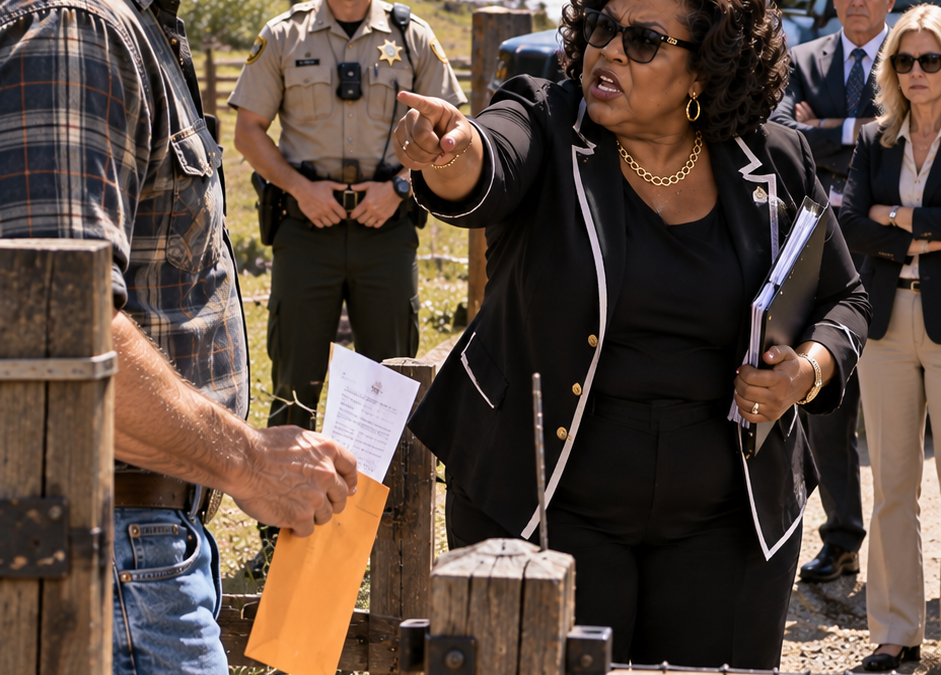
Denise Holloway stepped out.
President of the Cascade Ridge HOA.
Pressed jeans.
Expensive boots.
Western-cut jacket clean enough to prove she had never spent a morning fixing fence.
Leather binder under one arm.
She smiled before reaching the gate.
Not a friendly smile.
The smile of somebody who had already decided what the answer was going to be.
“Mr. Brennan.”
“Mrs. Holloway.”
“I assume you received our notice.”
I touched the envelope in my pocket.
“I did.”
“And?”
“I’m trying to understand why an organization I don’t belong to believes I owe it four hundred and twenty dollars.”
She opened her binder.
“Because your property benefits from shared community infrastructure.”
I actually turned and looked around.
“Did your community build my lake while I was sleeping?”
Her smile disappeared.
“This isn’t a joke.”
“No.”
I looked directly at her.
“It isn’t.”
Sheriff Brooks cleared his throat.
“Denise asked me to come because she said there might be a dispute.”
“There isn’t.”
Denise snapped her eyes toward me.
“There absolutely is.”
“No. There’s a letter demanding money for property you don’t own.”
She pulled several pages from her binder.
“Our legal advisers believe the reservoir functions as shared community infrastructure.”
“My reservoir.”
“It serves the valley.”
“Correct.”
“It protects every homeowner downstream.”
“Also correct.”
That pleased her.
“Then you acknowledge the community benefits.”
“Of course.”
“So you’ll pay.”
“No.”
Her face hardened.
“Why not?”
“Because benefiting from something doesn’t make you the owner.”
The sheriff stayed silent.
Smart man.
Denise pointed toward the lake.
“You control public water.”
“No.”
“You maintain a dam.”
“Yes.”
“Exactly.”
“No, Denise. Those are two different statements.”
She stared at the concrete spillway.
“The board believes your dam should be operated for everyone’s benefit.”
“It already is.”
“Then the community should have a role in governing it.”
“My deed says otherwise.”
“The community voted.”
I looked at her.
“The community does not vote on my land.”
For the first time, the conversation stopped.
Only the spillway could be heard.
Then Daniel spoke.
“Denise, unless you have a court order, I don’t have legal authority over Wyatt’s private property.”
She ignored him.
Raised one finger.
Pointed directly at the dam.
“That structure needs to come down.”
That was the moment the $420 stopped mattering.
Because I finally understood.
The assessment wasn’t the goal.
It was the first move.
PART2
Denise closed her binder.
“We’ll let a judge decide.”
“I’d prefer the county recorder.”
She turned toward her SUV.
Daniel remained by the gate.
“She’s serious,” he said.
“I noticed.”
“They’ve spoken to the county attorney.”
“About collecting $420?”
He shook his head.
“About the dam.”
That got my attention.
Nobody casually removes an operating dam.
Not one like ours.
You need structural engineers.
Hydrologists.
State water approval.
Environmental review.
Demolition sequencing.
Downstream mitigation.
Emergency planning.
I asked Daniel:
“You know something I don’t?”
“If I did, I’d tell you.”
He glanced toward Denise.
“But I’d start collecting every document you’ve got.”
“Already planning to.”
Her SUV backed away.
As it turned toward the county road, something rolled from beneath the passenger side and fell onto the gravel.
Denise didn’t notice.
Neither did Daniel.
I walked over.
A rolled sheet of heavy glossy paper.
Daniel raised an eyebrow.
“Looks expensive.”
I unrolled it across the hood of my truck.
Computer renderings.
Homes.
Walking trails.
Boat docks.
Landscaping.
At first, it looked like a development pitch.
Then I saw the water.
The shoreline didn’t match Brennan Lake.
Not remotely.
The blue shape on the drawing cut directly through what was currently reservoir.
The dam was gone.
In its place sat a small decorative pond.
Thirty-six rectangular residential lots surrounded the exposed lakebed.
Luxury homes.
Private marina.
Clubhouse.
Walking promenade.
I stared.
Daniel leaned closer.
“That’s not your reservoir.”
“No.”
It was a future subdivision.
One that could exist only if my reservoir disappeared.
My phone rang again.
Claire.
“I found something.”
“Me too.”
I put her on speaker.
“What?”
“I pulled the GIS layers and the future subdivision filings around Cascade Ridge.”
I looked down at the glossy map.
“How many lots?”
Pause.
“Thirty-six.”
Daniel and I looked at each other.
“Same number.”
Claire’s keyboard clicked.
“Dad, where are those lots?”
“On the lakebed.”
“No.”
Her voice sharpened.
“They’re on land that only exists if Brennan Reservoir is drained.”
I looked at the bottom-right title block.
Prepared for High Prairie Land Holdings, LLC
Development Contact: Kyle Holloway
Denise’s husband.
Daniel gave a low whistle.
Claire kept going.
“That $420 assessment may have been designed to establish a paper trail.”
“For what?”
“If you paid it voluntarily, they could argue you acknowledged some shared community interest in the reservoir.”
Daniel folded his arms.
“That seems aggressive.”
“It is,” Claire said. “But if they want to claim shared infrastructure later, one of the things they’d want is evidence Wyatt treated the HOA as having some relationship to the lake.”
I rolled the plan back up.
Denise hadn’t come to my gate because she cared about fairness.
Her husband had already commissioned drawings for homes sitting beneath my water.
They weren’t trying to share Brennan Lake.
They were planning for Brennan Lake to disappear.
Then I noticed another line.
Prepared in cooperation with Nathan Pierce Environmental Consulting
I didn’t recognize the name.
I would soon.
Three days later, Nathan Pierce introduced himself through a forty-two-page environmental complaint delivered by certified mail.
The front page showed a telephoto photograph of Brennan Dam.
Title:
EMERGENCY PETITION REGARDING AN UNLICENSED PUBLIC HAZARD
Claire stood beside me at the kitchen counter.
“Unlicensed?”
“First lie.”
Nathan’s report alleged that the dam obstructed fish migration, trapped contaminated sediment, restricted public water, and created catastrophic downstream risk.
His recommendation:
Drain Brennan Reservoir.
Remove the dam.
Restore the natural river channel.
Claire flipped to the technical appendix.
Then stopped.
“There isn’t one.”
“What?”
“No calculations.”
She turned pages faster.
“No runoff analysis. No reservoir capacity study. No structural inspection. No sediment sampling.”
“What did he inspect?”
“Nothing that I can find.”
She read the consultant methodology.
“He used aerial photographs.”
“Whose?”
Her jaw tightened.
“Kyle’s.”
That afternoon, flyers appeared around town.
Mailboxes.
Feed store.
Gas station.
Headline:
WHO OWNS OUR WATER?
Below it:
My photograph.
The text portrayed me as a rancher hoarding a public natural resource.
By evening, reporters called.
I ignored them.
Instead, Claire and I went into the old ranch office.
My father installed steel filing cabinets there after a courthouse fire destroyed portions of early county property records.
He believed in duplicates.
I used to tease him about it.
I stopped after he died.
We opened the cabinets.
Water-right certificates.
Annual dam inspection reports.
Concrete core testing.
Spillway repair invoices.
Emergency action plans.
State operating certifications.
Reservoir capacity surveys.
Claire created a digital index while I sorted originals.
At 12:03 a.m., she pulled out a faded engineering study.
“Dad.”
I looked over.
County flood-control study.
Completed twelve years before Cascade Ridge was built.
She unfolded the map.
A red boundary crossed the valley below Brennan Dam.
Inside it sat almost the entire future subdivision.
The label read:
NATURAL FLOOD RETENTION BASIN — DEVELOPMENT DEPENDENT UPON UPSTREAM STORAGE CONTROLS
Claire stared.
“They knew.”
The study contained a warning.
Removing or significantly reducing upstream storage would increase peak spring flows through the valley.
Any downstream development would require major levees or elevated foundations unless Brennan Reservoir remained operational.
Cascade Ridge had neither.
We found the original subdivision approval next.
The county approved construction only after the developer acknowledged in writing that Brennan Dam provided essential flood moderation.
The neighborhood existed where it did because my dam existed where it did.
My phone rang.
12:23 a.m.
Denise.
I let it ring twice.
“Wyatt, I’m giving you one final opportunity to cooperate before we seek emergency relief.”
“You hired a consultant who never inspected the dam.”
“Nathan Pierce is highly qualified.”
“He called the dam unlicensed.”
“His conclusions speak for themselves.”
“No, Denise.”
I looked at the flood-basin map.
“Documents speak for themselves.”
Silence.
Then:
“You’re trying to frighten people with technical language because you don’t want to lose control.”
“I haven’t said anything publicly.”
“You will.”
“I won’t need to.”
I touched the old study.
“Your subdivision approval already says everything.”
She stopped breathing for half a second.
Tiny sound.
Enough.
“You don’t understand what you’re reading.”
“I helped review this flood basin before your first foundation was poured.”
Another silence.
Then the line disconnected.
Claire looked at me.
“She knew.”
“Maybe.”
“That pause?”
“I heard it.”
The next morning, Cascade Ridge filed for an emergency hearing asking the court to declare Brennan Dam a public hazard.
Nathan Pierce’s report was Exhibit One.
The flood-retention study was not included.
I called Michael Harper.
Sixty-nine.
Forty years practicing property and water law in Wyoming.
He answered immediately.
“Tell me they didn’t finally come after your dam.”
“They did.”
He sighed.
“I’ll clear my afternoon.”
Three hours later, Michael sat at my kitchen table surrounded by deeds, permits, engineering studies, and county records.
He adjusted his glasses.
“We’re not looking for proof you own it.”
“No?”
“Ownership is obvious.”
“What are we looking for?”
“What everybody else promised before they decided they’d forgotten.”
For nearly two hours, we worked.
Claire searched digital archives.
Michael compared deeds and easements.
Then he stopped.
Took a yellowed recorded agreement from a folder.
Slid it toward me.
“Paragraph seven.”
I read.
The owner of Brennan Dam shall retain exclusive ownership, maintenance authority, operational discretion, spillway access, reservoir rights, and all associated flood-control infrastructure.
Below it:
No future subdivision, association, successor entity, or downstream development shall acquire supervisory authority over said improvements without written consent of the Brennan family.
Claire looked up.
“This predates Cascade Ridge.”
“Eighteen years,” Michael said.
Behind it sat another recorded agreement.
Signed by the original subdivision developer.
It acknowledged Brennan Dam as the valley’s primary flood-mitigation structure.
All downstream construction assumed its continued operation.
“So they knew.”
Michael tapped the signature.
“They agreed.”
Claire pulled up the county index.
“It’s recorded.”
Michael smiled.
“Then every later purchaser is legally considered to have notice.”
She kept searching.
Then froze.
“I found something else.”
“What?”
“Six months before the $420 assessment, Kyle Holloway requested certified copies of every easement affecting Brennan Ranch.”
Michael raised his eyebrows.
“He ordered these?”
“Personally.”
“He paid for certified copies?”
“Yes.”
The kitchen went quiet.
Kyle knew.
Before Denise accused me of illegally controlling public water.
Before Nathan’s report.
Before the HOA vote.
Before the court filing.
The Holloways had already obtained the documents proving the dam belonged exclusively to my family and that Cascade Ridge depended on it for flood moderation.
The dispute was no longer about misunderstanding.
Michael placed three documents side by side.
The Brennan easement.
Subdivision acknowledgment.
Flood study.
“Here’s our strategy.”
“I’m listening.”
“We don’t chase every stupid thing they’ve said.”
“What do we chase?”
“The one story they can’t survive.”
He pointed at the documents.
“They’re not protecting the community from a dangerous dam.”
Claire nodded.
“They’re attacking the infrastructure the community was built around.”
“And Kyle knew it before they started.”
“Exactly.”
My email chimed.
Emergency hearing scheduled.
Thursday.
HOA witness list:
Denise Holloway.
Kyle Holloway.
Nathan Pierce.
No structural engineer.
No hydrologist.
No state dam inspector.
Michael read it.
“They’re bringing opinions.”
“And us?”
“Records.”
He packed his briefcase.
“Usually enough.”
Then stopped near the porch.
“Wyatt.”
“Yeah?”
“Owning the truth doesn’t guarantee the judge gives it the weight we want immediately.”
I knew what he meant.
Court isn’t an engineering office.
A judge has to process what is placed before her.
The first hearing was packed.
Denise sat at the plaintiff’s table.
Navy blazer.
HOA logo pinned to the lapel.
Kyle directly behind her.
Nathan Pierce arranged glossy boards beside the witness stand.
Judge Rebecca Lawson took the bench at nine.
The HOA went first.
Their lawyer described Brennan Dam as an outdated private obstruction.
Interference with natural river flow.
Environmental hazard.
Threat to public safety.
Nathan took the stand.
He spoke confidently.
Millions of gallons artificially stored.
Disruption of natural ecology.
Sediment.
Liability.
Removal, he said, was the safest long-term solution.
Judge Lawson took notes.
Michael waited.
When Nathan finished:
“Mr. Pierce, did you personally inspect the spillway?”
“I reviewed aerial documentation.”
“That’s not what I asked.”
Pause.
“No.”
“Did you calculate peak spring runoff?”
“I evaluated available information.”
“Did you calculate it?”
“No.”
“Snowmelt simulation?”
“No.”
“Reservoir-storage data?”
“No.”
“State operating certification?”
Nathan shifted.
“I believed additional review was warranted.”
“Were you aware the dam currently holds one?”
“No.”
A murmur moved through the room.
Michael picked up the flood-retention study.
“Have you seen this?”
Nathan looked at the cover.
“No.”
“It identifies Cascade Ridge as sitting inside a natural flood-retention basin.”
“I can’t comment—”
“You can.”
Michael put it in front of him.
“You simply didn’t read it.”
Nathan said nothing.
Then I took the stand.
Name.
Ownership.
Family history.
Maintenance.
We entered inspection reports.
Operating permits.
Repair logs.
State certifications.
Then Claire displayed a hydrologic model.
Judge Lawson leaned forward.
“What are we seeing?”
Claire answered.
“Spring runoff under current reservoir operation versus removal.”
Blue water moved down the valley.
With the dam intact, Brennan Lake stored and released water gradually.
Without it, a concentrated surge entered the valley floor.
The model crossed Cascade Ridge.
“Eighty-four occupied homes fall inside the projected flow path,” Claire said.
The HOA lawyer stood.
“Objection. Speculative modeling.”
Judge Lawson looked at Claire.
“Data sources?”
“National Weather Service snowpack data, USGS stream gauges, county topographic surveys, and the flood-control study already offered.”
“Overruled.”
When my testimony ended, Judge Lawson asked:
“Can you guarantee this flooding occurs if the dam is removed?”
“No.”
A few people shifted.
I continued.
“Engineering doesn’t guarantee outcomes, Your Honor. It measures risk.”
“And the risk?”
“Rises dramatically if storage is removed during spring runoff.”
She nodded.
That gave me hope.
After lunch, she issued a preliminary decision.
Independent environmental review.
No immediate dismissal.
Michael lowered his eyes.
Outside, Denise went straight to television cameras.
“We’re confident the evidence speaks for itself.”
Then she pointed toward the ranch.
“By summer, that dam will be gone.”
The clip was everywhere by evening.
Denise posted it online under:
STOP PRIVATE CONTROL OF PUBLIC WATER
I watched once.
Turned the television off.
Called Claire.
“How’s the snowpack?”
“Bad timing.”
“Meaning?”
“Warm temperatures. Four nights above freezing. Rain system coming.”
“Runoff?”
“If the forecast holds, the river could double inside ten days.”
The independent review wasn’t finished.
But nature had already started its review.
We prepared the ranch.
Livestock moved north.
Generators and fuel drums went to higher ground.
Original files into waterproof cases.
Digital copies to separate drives.
Claire installed temporary gauges.
Night one:
River rose four inches.
Night two:
Nine.
Third morning:
Branches slammed against the dam face.
Earl Sutton arrived before noon.
Seventy-nine.
Helped my father rebuild the western abutment four decades earlier.
He stood near the spillway listening.
“You hear that?”
“The rocks?”
“The pressure.”
The river sounded deeper.
Earl looked toward the mountains.
“Last time I heard the valley sound like this, I was sixteen.”
“1963?”
He nodded.
“Your father kept the gates moving all night.”
Then:
“If he hadn’t, the old dairy farm would’ve disappeared.”
Cascade Ridge now stood where that dairy farm had been.
My phone rang.
Michael.
“I have the independent review.”
“And?”
“Dam is structurally sound.”
I waited.
“But?”
“Reviewer says eventual river restoration could be considered.”
“Eventual?”
“Late summer. Low flow. Full downstream mitigation.”
I stared at the swollen channel.
“We’re in active spring runoff.”
“I know.”
“Then there’s nothing to discuss.”
“Denise filed an emergency motion this morning.”
I closed my eyes.
“Argument?”
“She says rising water proves the dam is an imminent hazard.”
The dam was moderating the runoff exactly as designed.
And Denise was using the water it controlled as proof it should be removed.
The next hearing lasted less than an hour.
Michael argued no engineer recommended spring removal.
Claire submitted current gauge readings.
I explained that storage was already reducing peak flow.
The HOA called delay an unacceptable public risk.
Judge Lawson studied the independent report.
Then issued the order.
Controlled removal to begin within seventy-two hours.
I felt Claire grip the table.
Michael stood.
“Your Honor, we formally object. The current hydrologic conditions make immediate removal dangerous.”
“Objection preserved.”
No anger came.
Only dread.
Warm rain struck the courthouse windows.
Outside, Earl waited by my truck.
I handed him the order.
He read it.
Folded it.
“They’re making you take it apart now?”
“Yes.”
He returned the paper.
“Then write down every name.”
“I already am.”
By sunrise the next day, Michael prepared warning packets for:
Judge Lawson.
County Emergency Management.
Wyoming State Water Office.
County Commissioners.
Sheriff Daniel Brooks.
Cascade Ridge HOA.
Every packet contained:
Independent report confirming structural integrity.
Claire’s flood model.
Current river readings.
My signed statement:
I object to the timing of this court-ordered removal because reducing reservoir capacity during active spring runoff materially increases downstream flood risk.
I signed each copy.
Michael watched.
“If this goes wrong, nobody gets to say they weren’t warned.”
“That’s the point.”
At noon, the demolition contractor arrived.
Travis Cole.
White service truck.
Rolled permits.
He looked at the dam.
Then at me.
“You Wyatt Brennan?”
“Yes.”
“I’ve removed irrigation barriers.”
Pause.
“Never an operating flood-control dam during runoff season.”
“Neither has anyone else.”
Before unloading equipment, he inspected everything.
Concrete joints.
Spillway.
Control gates.
Downstream channel.
Then handed me a typed statement.
In my professional opinion, delaying removal until late summer would materially reduce downstream risk.
Michael had it notarized that afternoon.
Sheriff Brooks arrived before demolition began.
“I’ve been asked to witness compliance.”
“Stay all day.”
“Planning to.”
He wasn’t there to force me.
He was there to ensure the record couldn’t later be rewritten.
8:17 a.m.
First temporary railing removed.
Every step photographed.
Every structural element logged.
Claire recorded times.
Michael matched each action to the court order.
Daniel signed milestone sheets.
By the second afternoon, reservoir level dropped several inches.
Mud replaced shoreline.
Claire watched the downstream gauge.
Not the lake.
“Dad.”
I walked over.
“Flow’s accelerating.”
“Rain?”
“Rain plus lost storage.”
“How much?”
“Eight percent above modeled current-operation conditions.”
Michael heard her.
“Documented?”
“Already.”
Denise posted another video that evening.
She stood beside the shrinking lake.
Smiling.
“Today the river finally begins returning to nature.”
Residents behind her applauded.
A sign read:
FREE OUR WATER
Then came her next invitation.
CASCADE RIDGE FREE THE RIVER CELEBRATION
Saturday.
Former lakeshore.
Claire read it.
Folded it.
“She’s throwing another party.”
Michael looked toward the darkening mountains.
“The river hasn’t voted yet.”
Late that night, Claire and I checked the lower gauge.
She looked at the display.
Then again.
Her face changed.
“What?”
She turned the screen.
Three feet.
In less than forty minutes.
She recalibrated.
Same result.
Reservoir capacity had already been reduced under the order.
Warm rain accelerated snowmelt.
Exactly what the model warned.
I grabbed the radio.
“Call Michael.”
Claire was already dialing.
I switched frequencies.
“Carbon County Dispatch, this is Wyatt Brennan.”
“Go ahead.”
“Branch River is climbing rapidly. Recommend immediate emergency-management notification.”
“We’re seeing increases upstream.”
“Cascade Ridge needs warning now.”
“We’ll notify Sheriff Brooks.”
Ten minutes later Daniel arrived.
Claire showed him the hydrograph.
The line went almost straight upward.
“Meaning?” he asked.
“Runoff reached the valley faster than forecast.”
“And Cascade Ridge?”
“Evacuation time is shrinking.”
Daniel grabbed his radio.
“Dispatch, initiate precautionary response.”
At 2:14 that afternoon, water crossed the first county road south of the ranch.
Not a dramatic wall.
A slow brown sheet across asphalt.
But I knew what came after.
Claire zoomed into the map.
“Next low point—”
“Cascade Ridge.”
By four, emergency vehicles entered the subdivision.
Residents stood outside taking pictures.
Some filmed.
Denise livestreamed from near the clubhouse.
“The county is simply being cautious. Everything remains under control.”
Daniel watched on my kitchen screen.
“They’re wasting time.”
5:02 p.m.
His radio came alive.
“Water over Meadow Drive.”
“Basement flooding, Aspen Lane.”
“Vehicle stranded.”
“Bridge access partially blocked.”
Daniel keyed the microphone.
“Begin evacuation immediately.”
Static.
Then:
“We’re trying.”
Claire refreshed gauges.
“Still rising.”
I looked toward the mountains.
Gravity had taken over.
At 6:17 p.m., my phone rang.
Denise.
I answered.
“Wyatt?”
Barely recognizable.
“I’m here.”
“The water—”
Behind her:
Alarms.
Shouting.
A crash.
“It’s inside the house.”
“What floor are you on?”
“Second.”
“Kyle?”
“I don’t know.”
“How high downstairs?”
“Almost to the ceiling.”
Then she began crying.
“Please.”
For one second, everything came back.
The $420 fine.
Sheriff at my gate.
Environmental flyers.
Court hearings.
Television interviews.
The celebration.
The demolition order.
Then it all disappeared.
Because none of it mattered more than a person trapped in floodwater.
“Stay upstairs.”
“Wyatt—”
“The roads are gone. Stay where you are.”
“I need help.”
I looked at Daniel.
He was already unfolding rescue maps.
I ended the call.
Grabbed the radio.
“We’re past prevention.”
Daniel nodded.
I transmitted:
“All available responders, we need boats.”
I looked toward the valley.
Emergency lights reflected across brown water.
“And we need them now.”
Within twenty minutes, deputies were moving toward Cascade Ridge.
Volunteer firefighters launched flat-bottom boats.
State crews headed in.
Ranchers arrived with tractors and trailers without being asked.
Nobody cared who sued whom.
The water had made the lawsuit irrelevant.
Claire ran mapping from my barn.
“Birch Lane underwater.”
“How many homes?”
“Eighteen immediately.”
“And projected?”
She swallowed.
“All eighty-four.”
The map we’d shown in court was no longer a model.
It was an incident.
Daniel looked at me.
“I need people who know the valley.”
“You’ve got them.”
For twelve hours, I stopped being a defendant.
Denise stopped being the HOA president.
Daniel stopped being the sheriff who had once been called to my gate over $420.
We were responders.
I rode in one of the boats because I knew where old culverts lay beneath the floodwater.
Twice I redirected crews away from submerged crossings that could have flipped a boat.
We removed three elderly residents through upstairs windows.
Pulled a family of five from a garage roof.
Carried a diabetic man through chest-deep water to a tractor trailer.
Everywhere we went, people asked:
“How did this happen?”
Nobody had time to answer.
Near dawn, we reached Denise’s house.
Water had begun dropping.
The first floor was destroyed.
She sat upstairs wrapped in a Red Cross blanket.
Kyle stood near the fireplace.
Family photographs floated in muddy water downstairs.
Neither said anything.
Daniel confirmed they were safe.
We turned to leave.
Kyle called my name.
“Wyatt.”
I stopped.
“I made a mistake.”
I looked at him.
“No.”
He frowned.
“You made several.”
His shoulders dropped.
Before he could answer, two black SUVs entered the subdivision.
Not sheriff’s vehicles.
Wyoming Attorney General investigators.
The lead agent approached Daniel.
“We’re looking for Kyle Holloway.”
Kyle looked up.
“For what?”
The investigator held a folder.
“High Prairie Land Holdings.”
Claire stood nearby with her laptop.
Her eyes met mine.
The company.
The development plan.
The lakebed lots.
It had finally caught up with him.
Search warrants followed before noon.
Computers.
HOA accounting records.
Kyle’s office.
Denise’s laptop.
Financial documents.
Three days later, Michael called.
“They found the emails.”
“What emails?”
“Kyle promised Nathan Pierce a success bonus.”
“For what?”
“If the dam came down before summer.”
I sat down.
“So the environmental report—”
“Wasn’t independent.”
Michael continued.
“And Denise authorized HOA money to pay legal expenses tied to Kyle’s development company.”
“How were they recorded?”
“Environmental protection expenses.”
I closed my eyes.
No disclosure to homeowners.
No disclosure in discovery.
No disclosure to the court.
High Prairie Land Holdings assets were frozen.
Preservation orders covered financial accounts, email archives, engineering files, and HOA records.
The investigation was no longer focused on Brennan Dam.
It was focused on why the dam had been targeted in the first place.
That afternoon, I stood beside what remained of Brennan Lake.
The river was dropping.
Claire came over with coffee.
“We were right.”
I stared at the exposed reservoir bed.
“I never wanted to be.”
She handed me a cup.
“The governor’s office called.”
I looked at her.
“What do they want?”
“One question.”
She paused.
“If the state helps fund it, can Brennan Dam be rebuilt?”
I looked across the channel.
The reservoir was gone.
So were the benefits it had quietly provided for generations.
“Yes.”
Claire waited.
“But not the old way.”
Three weeks later, the county meeting hall was packed.
Cascade Ridge residents.
Commissioners.
State engineers.
Emergency managers.
Daniel stood along the back wall.
Michael sat beside Claire with four binders.
Judge Rebecca Lawson sat in the audience.
Not presiding.
Listening.
The Attorney General investigator spoke first.
Less than fifteen minutes.
High Prairie Land Holdings had been created to acquire future lakefront property after Brennan Reservoir disappeared.
Kyle concealed his ownership interest while helping direct HOA litigation.
Nathan Pierce signed a compensation agreement promising additional payment if removal created redevelopment opportunity.
Denise approved HOA expenditures related to the campaign without disclosing the conflict.
The room went silent.
Denise wasn’t there.
She had resigned five days earlier.
Kyle had already accepted responsibility for fraud-related charges tied to the concealed development scheme and agreed to restitution under a negotiated resolution.
Then Judge Lawson stood.
She didn’t have to.
“Mr. Brennan.”
I faced her.
“The court relied on evidence that was incomplete and materially affected by undisclosed financial conflicts.”
She paused.
“I cannot undo what happened.”
Nobody moved.
“But your engineering warnings deserved greater weight than they received.”
Then:
“I’m sorry.”
No applause.
No cameras flashing.
It wasn’t a victory speech.
It was an acknowledgment.
I nodded.
“Thank you, Your Honor.”
Then the governor’s representative approached the microphone.
“The State of Wyoming has approved emergency funding for construction of a new flood-control structure.”
She turned toward me.
“We would like Wyatt Brennan to lead the project.”
I stood.
“I’ll accept.”
A few people began to clap.
I raised one hand.
“On one condition.”
The room quieted.
“The new dam won’t operate the way the old one did.”
Confusion.
“My family will retain ownership of the ranch and original reservoir property.”
I looked toward the Cascade Ridge residents.
“But flood protection isn’t something this valley can afford to misunderstand again.”
Claire smiled.
“So the new structure operates through a public-private trust.”
County emergency planning.
State inspection.
Brennan Ranch property rights.
Independent engineering oversight.
Transparent downstream coordination.
No HOA jurisdiction.
No private development company influence.
Everyone would know exactly what the dam did.
And exactly who was responsible for what.
Construction began two months later.
Modern control gates.
Reinforced spillway.
Foundation anchored deeper into bedrock.
Telemetry gauges.
Automatic flow monitoring.
Emergency-release protocols shared with county responders.
But I insisted on one thing.
We recovered the original stone facing removed during demolition.
Each block was numbered.
Cleaned.
Reused.
Earl Sutton stood with me when the final stones went back.
He rested one weathered hand on the granite.
“Your father would recognize it.”
“I hope so.”
Claire completed the inspection report.
State engineers certified the structure.
Daniel drove the access road before reopening.
“This county is safer than before.”
I looked at the lake beginning to fill again.
“It finally knows why.”
Six months after the flood, Cascade Ridge HOA dissolved.
In its place, residents created the Cascade Ridge Community Association.
New leadership.
Open finances.
No authority beyond recorded property lines.
Their first resolution passed unanimously.
No future association action affecting Brennan Dam without independent engineering evidence and full financial-conflict disclosure.
That resolution meant more to me than the original $420 ever had.
Because it proved they’d learned the right lesson.
Not:
Wyatt Brennan was right.
Something larger.
Water doesn’t respond to votes.
Hydrology doesn’t care who wins a board meeting.
Gravity doesn’t respect a lawyer’s confidence.
A river doesn’t read HOA bylaws.
On opening day, families gathered beside the restored lake.
Children skipped stones.
Older residents stood along the shore.
Some of the same people who had once applauded Denise’s speeches now watched water move calmly through the new spillway.
I held no anger toward them.
Most had trusted their board.
That’s what community associations ask people to do.
Trust becomes dangerous only when nobody verifies what leaders are doing with it.
Near the end of the ceremony, several former Cascade Ridge homeowners walked toward my old ranch gate.
Same gate where the orange $420 demand had once been nailed.
One man carried a wooden sign.
He held it toward me.
THANK YOU FOR PROTECTING THIS VALLEY
I looked at it for a while.
Then smiled.
Someone asked:
“What are you going to do with the old HOA notice?”
I still had it.
Orange envelope.
Roofing-nail hole through the middle.
Filed alongside the court documents.
“I’ll probably keep it.”
“Why?”
“Because it was cheap.”
They laughed.
I shook my head.
“No. I mean the lesson was cheap.”
That $420 demand gave me enough warning to start pulling records before the real attack began.
Without it, maybe I wouldn’t have found the future-development map when I did.
Maybe we wouldn’t have found the old flood study.
Maybe Claire wouldn’t have pulled Kyle’s certified-record request.
Maybe Michael wouldn’t have assembled the agreements before the first hearing.
Karen thought she was collecting $420.
Instead she alerted the one person in the valley who had every reason to start looking backward through a hundred years of paper.
Months later, I stood with Daniel on the dam during spring inspection.
Snow still sat on the high ridges.
The reservoir was near normal pool.
Water passed through the spillway exactly where it should.
Daniel leaned against the railing.
“You ever think about paying the four hundred twenty?”
I looked at him.
“For about three seconds.”
“Might’ve been cheaper.”
“Financially?”
He smiled.
“Maybe not.”
We stood quietly.
Then he said:
“I keep thinking about the day Denise called me to your gate.”
“So do I.”
“She wanted me to make you pay.”
“Yep.”
“And you admitted right in front of her that the dam protected the subdivision.”
“Yep.”
He shook his head.
“She thought that proved her case.”
“Benefit doesn’t equal ownership.”
“I know that now.”
He grinned.
“So does everyone in the county.”
Before leaving, Daniel looked downstream.
Cascade Ridge had rebuilt.
Some homes had been gutted completely.
Others repaired.
A few residents moved away.
Most stayed.
The streets looked normal again.
But people there watched the river differently.
They understood the high ground.
The drainage corridors.
The evacuation routes.
The flood maps.
More importantly, they understood the dam.
Not as a private rancher’s obstacle.
As infrastructure.
Claire became one of the trustees overseeing the new flood-control agreement.
That pleased me more than anything.
She knew the engineering.
Knew the legal history.
Knew why documentation mattered.
One evening, we sat on the porch.
The lake reflected the sunset.
Claire asked:
“Do you think Grandpa would approve?”
“Of the new dam?”
“Of giving up some operational control.”
I considered it.
My father guarded the ranch fiercely.
So did my grandfather.
Exclusive authority had protected the structure for decades.
But exclusive knowledge had also allowed an entire subdivision to forget why it existed.
“I think he’d complain.”
Claire laughed.
“For how long?”
“Months.”
“And then?”
“He’d read the trust agreement.”
“Every page?”
“Twice.”
She smiled.
“And if it protected the ranch?”
“He’d sign.”
I looked toward the spillway.
“The old system worked because the Brennan family remembered.”
“The new one?”
“Works because nobody gets to forget.”
That was the difference.
Years ago, the dam was something people barely noticed.
It sat upstream.
Held water.
Released water.
Needed occasional repairs.
Nobody downstream thought about it until somebody promised them a better shoreline without it.
Infrastructure often gets valued only after failure.
Bridges.
Levees.
Reservoirs.
Drainage.
You don’t celebrate the thing that prevents the disaster.
You celebrate after the disaster doesn’t happen.
Which means sometimes people convince themselves the protective thing was never necessary.
Denise and Kyle looked at Brennan Lake and saw wasted real estate.
Thirty-six luxury parcels.
A marina.
A clubhouse.
Revenue.
They saw water occupying land that could have been sold.
What they didn’t see was the function inside the water.
Storage.
Delay.
Peak-flow reduction.
Time.
The dam didn’t stop every flood.
No dam does.
It bought the valley time.
That’s what good flood control often does.
Takes a wall of water and turns it into hours.
Takes a dangerous peak and spreads it across days.
The year they dismantled it, Cascade Ridge learned the monetary value of six hours.
It was measured in flooded homes.
Rescue boats.
Destroyed photographs.
Ruined floors.
And people sitting on rooftops waiting for strangers to come through brown water.
That is why, when Denise called me crying from her second floor, I helped her.
Some people later told me they wouldn’t have.
Maybe they meant it.
Maybe they didn’t.
But you don’t get to build your morality around what somebody deserves when water is rising.
You rescue the person.
You sort out blame later.
The law had time.
The river didn’t.
I never spoke privately to Denise after the flood.
She sent one letter.
Not through the HOA.
Not through a lawyer.
Handwritten.
Three pages.
I read it alone.
She apologized.
Not perfectly.
There were explanations mixed in.
Kyle’s pressure.
Nathan’s confidence.
Her belief that the lake could become a public asset.
The board’s support.
All the usual things people reach for when trying to explain how they crossed a line.
But near the end she wrote one sentence I believed.
When the water reached my stairs, I finally understood that the dam was never about your control. It was about our safety.
I kept the letter.
Didn’t answer.
Not because I wanted to punish her.
There was nothing I needed to say.
Some apologies are not conversations.
They’re records.
Like deeds.
Like flood maps.
Like engineering reports.
They establish that somebody finally saw where the line was.
Kyle’s legal case took longer.
The development company was dismantled.
Several agreements were voided.
Investors fought over losses.
Nathan lost professional contracts.
The details became less interesting to me as time passed.
That’s another thing conflict teaches.
While you’re inside it, every update feels enormous.
Later, you realize your life is healthier when you stop checking.
I returned to ranch work.
Cattle.
Fence.
Equipment.
Hay.
Dam inspections.
Ordinary problems.
Expensive problems.
Real problems.
None involving banners.
The sign the Cascade Ridge residents gave me hangs inside the machine barn now.
Not at the gate.
I didn’t want it there.
The ranch isn’t a monument to a lawsuit.
The old sign remains:
PRIVATE RANCH ROAD — NO TRESPASSING
Same one my grandfather put up.
Below it is a small new metal plate:
BRENNAN FLOOD-CONTROL ACCESS
EMERGENCY ENTRY BY AUTHORIZED COUNTY AND STATE PERSONNEL
Clear.
Recorded.
Agreed.
No confusion.
No shared-infrastructure assessment.
No HOA authority.
Just the relationship exactly as it should have been from the beginning.
One spring morning two years after the flood, another warm storm moved over the western slope.
Rain hit snow.
The river rose.
Claire called.
“Watching the gauges?”
“Since five.”
“Reservoir’s taking it.”
“I know.”
We stood later near the spillway.
Water high.
Fast.
Powerful.
But controlled.
The telemetry screen showed inflow above normal.
Outflow below the dangerous downstream peak.
Cascade Ridge residents received automated alerts.
No evacuation.
No boats.
No basements flooding.
Just water doing what water does.
Moving downhill.
The new dam doing what it was designed to do.
Slowing it.
I thought about Denise’s first sentence at my gate.
The HOA board believes your dam should be operated for everyone’s benefit.
Ironically, she had been right about one thing.
It should.
It always had been.
Where she went wrong was assuming community benefit gave the community ownership.
It didn’t.
And where I had been incomplete was assuming private ownership meant everyone else understood the benefit.
They didn’t.
Not until they lost it.
That’s why the trust works.
Ownership is clear.
Authority is clear.
Engineering is clear.
Emergency planning is shared.
Nobody gets to confuse usefulness with title.
Nobody gets to confuse title with unlimited control.
The river remains the thing none of us owns.
That’s important too.
We manage structures.
Hold rights.
Record easements.
Allocate water.
Build channels.
But the water itself obeys physics long before it obeys paperwork.
The $420 notice still sits in my study.
Same nail hole.
Same bold lettering.
Sometimes visitors ask why I’ve kept it.
I tell them because it reminds me how close large disasters can begin to something ridiculous.
Four hundred twenty dollars.
A board vote.
A woman standing at a gate convinced community consensus could override generations of property records.
Then a development map.
Then a consultant.
Then court.
Then demolition.
Then rain.
People imagine disasters arrive with warning sirens.
Sometimes they arrive on HOA letterhead.
The important thing is knowing when a small demand is attached to a much larger intention.
Karen thought she was testing whether I would pay.
What she actually tested was whether I would read.
I did.
Every deed.
Every agreement.
Every flood study.
Every inspection.
Every email.
Every engineering report.
Every court order.
Every warning.
That paper didn’t stop the flood.
But it eventually told the truth about why the flood happened.
And truth matters after the water goes down.
Because without a record, people rewrite disaster.
They call it unpredictable.
Unavoidable.
Act of God.
Nobody could have known.
We knew.
Claire knew.
Michael knew.
Travis knew.
Earl knew.
The old county engineers knew twelve years before Cascade Ridge existed.
The original developer knew.
Kyle knew.
That’s why the new system requires warnings to become part of the official record.
No more private concerns disappearing into meeting minutes.
No more consultants chosen by people with undeclared financial interests.
No more major changes without downstream modeling.
No more decisions based on who speaks most confidently at a microphone.
The first time the new gates were tested under full spring load, I stood with Earl.
He was eighty by then.
Still stubborn.
Still listening more than watching.
Water moved through the spillway.
He tilted his head.
“You hear that?”
I smiled.
“The pressure?”
He nodded.
“Sounds right.”
That’s all he said.
Coming from Earl, it was enough.
Later, I walked back toward the ranch house alone.
Passed the wooden gate.
Touched the spot where the orange envelope had once been nailed.
The hole was still there.
Tiny.
Dark.
A mark in old wood.
Everything else had changed.
The HOA was gone.
The lake had been rebuilt.
The dam stronger.
The community different.
Denise no longer president.
Kyle no longer planning lakefront homes.
Claire part of the trust.
But that nail hole stayed.
I left it.
Some repairs don’t need to erase the evidence.
At sunset, Brennan Lake was smooth again.
Cascade Ridge lights came on downstream.
Families cooked dinner.
Children rode bicycles.
People lived ordinary lives in homes that had once filled with muddy water.
Nobody could see the flood-retention agreement from their windows.
Nobody could see the hydrologic model.
Nobody could see the concrete buried deep beneath the new dam.
That’s how protection works when it’s working.
Invisible.
Quiet.
Easy to forget.
I don’t mind if they forget some of the legal fight.
I don’t mind if future families never know my name.
They don’t need to remember Wyatt Brennan.
They need to remember one thing.
Before you tear down something that has protected a valley for generations, ask why it was built.
Before you vote on water, understand where it goes.
Before you confuse benefit with ownership, read the deed.
And before you tell a river what it should do, remember that eventually the water gets a vote too.
Because water never cared who won the HOA meeting.
It never cared who gave the television interview.
It never cared that a judge signed an order or that Denise collected signatures.
Water followed the land.
It always had.
This time, everyone finally understood.








