HOA Karen Fined Me $1,200 for an 80-Year-Old Oak on My 4,000-Acre Ranch—Then Threatened to Cut It Down Herself
**part 2**
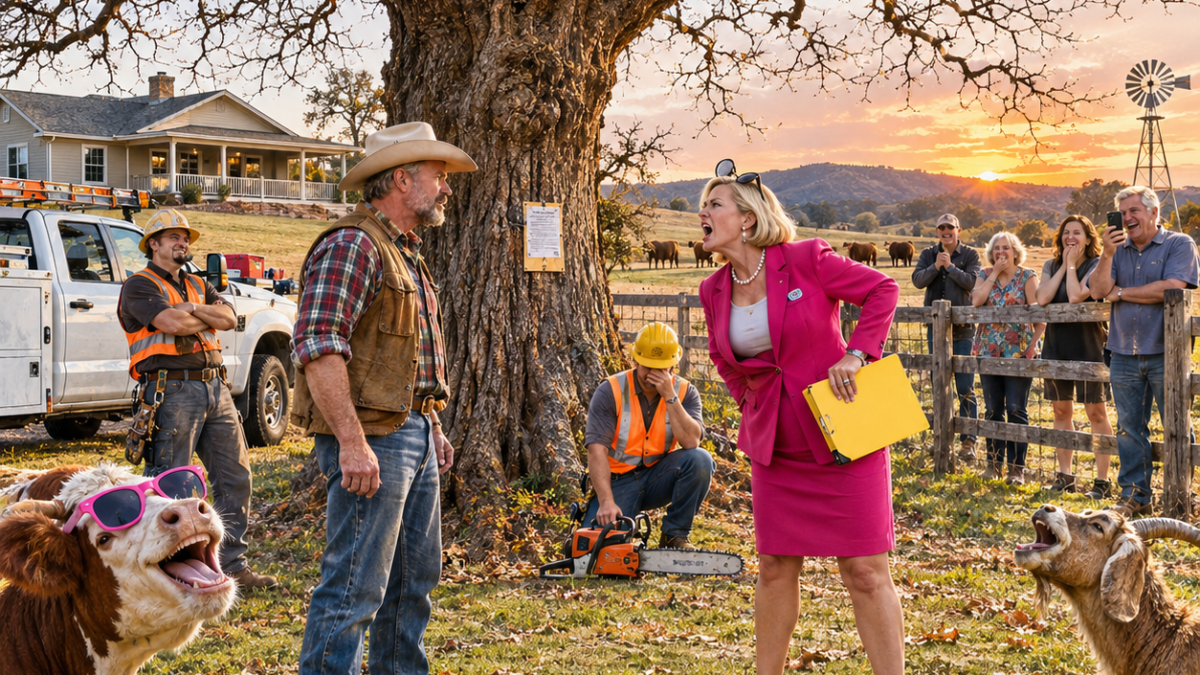
The truck rolled toward us with its amber light flashing slowly, throwing pulses of yellow across the oak’s trunk. Victoria stopped talking. The contractors stopped moving. Even the neighbors along the road became quiet. A man in a brown county jacket climbed out, tucked a folder under his arm, and looked at the collection of trucks, equipment, notices, and one furious HOA president standing in the middle of private ranchland.
“Which one of you is Mr. Mercer?”
“I am.”
He walked over and shook my hand.
“Daniel Reeves, County Planning and Land Records.”
Victoria inserted herself between us so quickly she nearly stepped into one of the orange cones.
“Wonderful. You’re exactly who we need. I’m Victoria Vale, president of the Willow Crest Homeowners Association. We’re conducting an emergency removal of a dead tree that violates community safety and appearance regulations.”
Reeves looked up at the oak.
Then he looked at her.
“Emergency?”
“Yes.”
“Has it fallen?”
“No.”
“Split?”
“No.”
“Dropped major limbs?”
“Not yet.”
“Is there an arborist report declaring it hazardous?”
Victoria’s lips pressed together.
“This is primarily an aesthetic violation.”
Reeves stared at her for two long seconds.
Then he looked at me.
“You called this afternoon?”
“My attorney did.”
That changed Victoria’s expression.
Only slightly, but I saw it.
Yesterday, when I had shown her the old land grant, she had assumed it was the sentimental paperwork of a stubborn rancher who didn’t understand how modern development worked. She had no idea that my family’s history with that land had taught us the exact opposite.
You don’t keep a ranch intact for generations by ignoring paperwork.
You learn surveys.
You learn water rights.
You learn easements.
You learn where every recorded boundary sits and which government office holds the document proving it.
Most importantly, you learn never to confuse someone’s confidence with their authority.
Reeves opened his folder.
“Mr. Mercer’s counsel requested an expedited parcel review after receiving an HOA enforcement notice.”
Victoria’s eyes moved toward me.
“Counsel?”
“Attorney,” I said.
“I know what counsel means.”
“Just checking.”
One of the contractors looked down quickly.
His shoulders moved once.
Victoria glared at him.
Reeves continued.
“The preliminary record shows this parcel predates Willow Crest by several decades. I’m here because there appears to be a discrepancy between the association’s enforcement notice and the recorded subdivision map.”
“There’s no discrepancy,” Victoria said. “His property borders our community.”
“That doesn’t make it part of your community.”
“Our residents can see the tree.”
Reeves blinked.
“Ma’am, visibility is not annexation.”
This time even the property manager looked uncomfortable.
I almost felt sorry for him.
Almost.
Victoria had spent the last twenty-four hours turning one ordinary winter oak into a constitutional crisis of suburban landscaping. She had sent me two emails, three violation notices, and one photograph of the tree with a red circle drawn around the crown as though she had discovered a dangerous fugitive.
Her second email had included a sentence I would remember for years:
“Dormancy is not an excuse for visual neglect.”
I had printed that one.
My attorney, Melissa Grant, had laughed for nearly a full minute when she read it.
Then she stopped laughing and got serious.
Melissa had handled agricultural property disputes for my family for years. She knew the ranch’s history almost as well as I did. When I showed her Victoria’s first fine, she pulled the county GIS map, the recorded Willow Crest plat, my family deed, the title report, and every covenant filed when the subdivision was created.
Twenty minutes later, she leaned back in her chair.
“They have absolutely nothing.”
“What do you mean?”
“I mean they didn’t make a weak claim. They made no legal claim. Your parcel was never subjected to their declaration.”
That should have ended it.
Melissa sent the association a cease-and-desist letter that afternoon.
Victoria responded forty-three minutes later.
“The board does not recognize private correspondence as overriding community authority.”
Melissa stared at the email.
Then she looked at me.
“I have been practicing law for eighteen years.”
“I know.”
“I have never seen anyone write that sentence.”
“She’s special.”
“So I’m beginning to understand.”
Now Reeves stood beneath the oak while Victoria tried to explain why the HOA’s vote mattered more than recorded land records.
“The board adopted the winter appearance policy under its general beautification powers,” she said.
Reeves nodded politely.
“Beautification powers over HOA property.”
“And visible neighboring parcels that impact values.”
“Show me where that authority is recorded.”
Victoria opened her yellow folder.
She flipped through pages.
Then more pages.
Her movements became faster.
The contractors watched.
The neighbors watched.
The property manager stared at the ground.
Finally, Victoria pulled out the emergency authorization she had shown me.
“Here.”
Reeves read it.
“This is your board voting to authorize itself.”
“Yes.”
“That is not what I asked for.”
“It proves the board acted.”
“It proves the board held a meeting.”
She looked offended.
“We are a legally incorporated association.”
“So is the Rotary Club,” Reeves said. “That doesn’t give them jurisdiction over Mr. Mercer’s ranch either.”
The contractor nearest me made a choking noise.
Victoria snapped her head toward him.
“Are you laughing?”
“No, ma’am.”
He was absolutely laughing.
I looked away before I joined him.
Reeves asked me for the arborist report.
I handed him the copy Melissa had prepared.
Two hours after Victoria issued the fine, I had called Dr. Samuel Hines, a certified consulting arborist who had inspected trees on the ranch after a windstorm the previous spring. He came out before sunset, examined the oak’s bark, root flare, branch structure, terminal buds, and cambium.
His conclusion was short.
Healthy mature white oak.
Seasonally dormant.
No evidence of mortality.
No immediate removal recommended.
Victoria had dismissed the report when Melissa emailed it.
She wrote back:
“Professional opinions do not override observable appearance.”
That one had made Melissa stop laughing altogether.
Reeves walked to the oak and examined several lower branches.
He found a bud, touched it, and looked back at Victoria.
“This tree is alive.”
“It has no leaves.”
“It’s November.”
“That does not mean residents should have to look at it.”
I folded my arms.
“Victoria, I have thirty thousand acres of visible horizon from different points on this ranch. Should I send the HOA a list of clouds I don’t like?”
Ben Carter laughed from the roadside.
Victoria pointed at him.
“This is not a public meeting!”
Ben called back, “You gave three interviews in his driveway.”
She ignored him.
Earlier that afternoon, before bringing the contractors, Victoria had invited a local television reporter to document what she apparently believed would be a triumphant enforcement action against an irresponsible landowner.
That reporter was now standing near the road with a cameraman.
I hadn’t noticed them arrive.
Victoria had.
Her posture changed instantly.
Her shoulders straightened.
Her voice softened.
“Mr. Reeves, perhaps we should speak privately. There are technical aspects of community governance that may not be obvious from the county’s records.”
Reeves glanced toward the camera.
“I’m comfortable speaking here.”
That was the moment her afternoon began collapsing.
He asked for the parcel number used on the HOA notice.
Victoria gave it to him.
He compared it to the county file.
“That parcel number belongs to HOA common property.”
The property manager looked up.
“What?”
Reeves showed him the page.
“The association cited its own landscaping parcel on the enforcement form.”
I stared at Victoria.
For three seconds nobody said anything.
Then Ben shouted from the road, “So are you fining yourself twelve hundred bucks?”
The contractors lost the battle.
Both laughed.
One tried to turn it into a cough.
The other didn’t bother.
Victoria’s face became the color of a stop sign.
“This is obviously a clerical error.”
Reeves nodded.
“Maybe. But even if you had used Mr. Mercer’s correct parcel number, it wouldn’t give you authority over it.”
The reporter stepped closer.
“Ms. Vale, were you aware the ranch is outside the HOA?”
Victoria turned toward the camera with the reflex of a politician who had just heard the one question she didn’t want.
“The boundaries are complicated.”
They weren’t.
There was a fence.
The fence had existed since 1938.
On one side stood my ranch.
On the other side stood Willow Crest.
The subdivision developer had even installed decorative stone markers twenty years earlier identifying the beginning of HOA property.
One of those markers was visible from where Victoria stood.
She had parked beside it.
Reeves opened another document.
“The Willow Crest declaration was recorded in 2004. Mr. Mercer’s ranch is specifically shown outside the subdivision boundary. No supplemental declaration was ever recorded adding his parcel. No covenant acceptance appears in the chain of title. No voluntary annexation. No municipal annexation. No maintenance agreement giving the HOA enforcement rights.”
He closed the folder.
“So as far as the county record is concerned, this association has no authority to fine this property owner or remove vegetation from this parcel.”
Victoria crossed her arms.
“Our legal counsel will dispute that.”
The property manager finally spoke.
“Victoria.”
Something in his tone made her turn.
He looked pale.
“Did legal counsel review the removal order?”
She hesitated.
That hesitation told everybody the answer.
“I sent them the policy.”
“That’s not what I asked.”
“They were unavailable this afternoon.”
He stared at her.
“You called the tree company anyway?”
“I exercised presidential authority.”
The property manager shut his eyes.
For one brief moment, I almost admired his restraint.
If I had been in his position, I might have walked directly into the pasture and kept going.
Reeves addressed the contractors.
“Gentlemen, if you have not received proof of ownership or lawful authorization, I strongly recommend you do not remove anything from this parcel.”
The lead contractor nodded immediately.
“We’re done.”
Victoria spun around.
“You have a contract.”
“With the HOA,” he said. “Not with him.”
“You accepted payment.”
“For authorized work.”
“You drove all the way out here.”
“We can drive back.”
She stared at him like he had betrayed the nation.
Then she pointed toward the oak.
“You told me it looked dead.”
“I said it looked like a tree in winter.”
Ben laughed again.
Victoria turned on him.
“Would you stop doing that?”
Ben raised both hands.
“I’m trying.”
He wasn’t.
The television camera was still running.
That mattered because Victoria had spent the previous three weeks presenting herself as the guardian of Willow Crest’s property values. She had introduced a series of new “appearance initiatives,” including approved mailbox colors, holiday decoration windows, driveway visibility rules, and something called “seasonal landscape continuity.”
Nobody seemed entirely sure what that last phrase meant.
Victoria did.
According to her twelve-page policy memo, yards were expected to maintain “visual life and symmetry during all four seasons.”
When Ben’s wife asked at a board meeting whether that meant deciduous trees were prohibited from losing leaves, Victoria had replied that residents were expected to “plan responsibly.”
The meeting minutes actually recorded it.
Melissa found those too.
By the time Reeves finished his inspection, the sunset had faded from orange to violet. My cattle moved slowly toward the western pasture, and cold air settled into the low ground. The oak stood above us, dark and bare, looking exactly as it had every November for eighty years.
Reeves handed Victoria a written notice.
“This is a county directive acknowledging a disputed enforcement action. You are instructed not to remove or damage vegetation on this parcel pending formal review. Based on the records I’ve seen, I expect that review to confirm the ranch is outside your jurisdiction.”
Victoria held the paper as though it smelled bad.
“What if I refuse?”
Reeves didn’t raise his voice.
“Then you may create problems larger than a landscaping dispute.”
The camera caught every word.
She looked at me.
“This isn’t over.”
I nodded.
“You’re right.”
For the first time all afternoon, she seemed uncertain whether she liked my agreement.
The contractors packed their equipment.
The property manager pulled Victoria aside near the SUV. Their conversation became sharp almost immediately. I couldn’t hear every word, but I caught pieces.
“Authority.”
“Insurance.”
“Why wasn’t counsel called?”
“Emergency.”
“Not an emergency.”
Then the property manager said something that made Victoria jerk her head toward me.
A few minutes later, she walked to her SUV.
She stopped beside the oak.
The $1,200 notice was still stapled to the trunk.
She reached toward it.
“Leave it,” I said.
Her hand froze.
“Why?”
“Evidence.”
The reporter raised her microphone.
Victoria dropped her hand.
That single gesture ended up on the evening news.
The segment ran at ten.
I hadn’t planned to watch it, but Ben called and told me I had to.
The opening shot showed Victoria standing beneath my oak in her pink blazer, declaring that Willow Crest would “take decisive action against visible neglect.”
The next shot showed Reeves saying the tree was healthy and the ranch wasn’t part of the HOA.
Then came Ben’s voice from off camera.
“So are you fining yourself twelve hundred bucks?”
The station replayed that part twice.
I laughed so hard I nearly spilled my coffee.
The next morning, I woke before sunrise as usual. Ranch work doesn’t care about HOA politics. I fed the horses, checked a water trough near the north pasture, and helped repair a gate that one of the younger steers had decided was merely a suggestion.
At 7:13 a.m., Melissa called.
“You’re famous.”
“I was hoping to avoid that.”
“You’re not famous-famous. You’re locally famous. Much less dangerous.”
“What happened?”
“Willow Crest’s attorney called me at six fifty-five.”
“That early?”
“He sounded like he hadn’t slept.”
I leaned against the fence.
“What did he say?”
“He apologized seventeen times without technically apologizing once.”
“That sounds expensive.”
“It usually is.”
She explained that the HOA’s attorney, Martin Cho, had not approved Victoria’s fine, the removal order, the contractor visit, or the claim that neighboring visible property was subject to HOA authority.
In fact, he had warned the board two months earlier about exactly this issue.
Willow Crest’s declaration covered the subdivision lots and specific common parcels.
Nothing outside those recorded boundaries.
Nothing.
Victoria apparently believed the board’s “community impact” language allowed her to enforce appearance rules against nearby land visible from subdivision roads.
It did not.
Melissa paused.
“And there’s something else.”
“What?”
“The board meeting that supposedly authorized the emergency removal?”
“Yeah.”
“Three directors are saying they never voted for it.”
That got my attention.
“Her document says unanimous.”
“I know.”
“Then what exactly did they vote on?”
“According to two directors, they authorized sending you a second compliance letter.”
I looked across the pasture.
“So how did that become permission to cut down my tree?”
“That,” Melissa said, “is rapidly becoming Victoria’s problem.”
By nine o’clock, the HOA sent me a formal email.
The $1,200 fine was suspended pending review.
Melissa replied within five minutes.
Not good enough.
She demanded complete withdrawal of every notice, written confirmation that the ranch was outside HOA jurisdiction, preservation of all board records related to my property, reimbursement for legal and arborist expenses, and a written assurance that no HOA employee, director, contractor, or agent would enter my ranch for enforcement purposes again.
She also requested copies of all communications concerning the proposed tree removal.
Victoria responded personally.
“This demand is excessive and hostile.”
Melissa forwarded it to me with one sentence.
“She keeps helping.”
I had to agree.
Most people, after discovering they had no authority, would have stopped.
Victoria seemed to believe stopping would make her look weak.
So she doubled down.
That afternoon she sent an HOA-wide email defending her actions.
She described my ranch as “a nonparticipating adjacent property receiving substantial indirect benefits from Willow Crest’s high standards.”
I read that sentence three times.
I still didn’t know what it meant.
Apparently my cattle had been freeloading off their curb appeal.
The email continued.
Victoria argued that the HOA had “a moral responsibility to preserve the visual integrity of the greater community ecosystem.”
Melissa called me ten minutes later.
“Do not respond.”
“I wasn’t going to.”
“I know. I’m saying it because I am legally required to protect you from the temptation.”
“I’m standing in a barn covered in mud.”
“Excellent. Stay there.”
I did.
But the residents responded.
Dozens of them.
Some were angry about the embarrassment.
Others were angry because Victoria’s email revealed something they hadn’t known: she had used association money to hire the tree service.
The contract deposit was $2,850.
The HOA was also responsible for a cancellation charge because the crew had been dispatched and prevented from working.
By evening, residents were asking why dues were being spent trying to cut down a tree on property the HOA didn’t own, didn’t regulate, and had no legal connection to.
The answer was simple.
Victoria wanted the tree gone.
She had decided it offended her.
Everything after that was paperwork designed to make her preference look official.
I had dealt with people like that before.
Ranching puts you in contact with inspectors, agencies, contractors, buyers, neighbors, county officials, and sometimes lawyers. Most people are reasonable. A few believe a clipboard gives them power.
Victoria had the most expensive clipboard I had ever seen.
She carried it everywhere.
Yellow leather, brass corners, custom HOA emblem.
Ben called it “the suburban sheriff badge.”
Three days after the attempted removal, Willow Crest held an emergency board meeting.
I wasn’t planning to attend.
Then Melissa told me I should.
“You won’t speak unless necessary.”
“Why go?”
“Because they’ve invited you.”
“Victoria?”
“No. The rest of the board.”
That interested me.
The meeting was held in the Willow Crest clubhouse, a stone building surrounded by perfectly trimmed hedges and ornamental pear trees.
Ironically, half those trees were bare.
Ben met me outside.
He pointed at them.
“Should we call somebody?”
“Don’t.”
“They look dead.”
“Ben.”
“I’m just concerned about visual continuity.”
I started laughing before we reached the door.
Inside, every chair was taken.
Residents lined the walls.
Victoria sat at the front table wearing a cream blazer this time. Her yellow folder sat in front of her.
Beside her were four other board members, the property manager, and Martin Cho, the HOA attorney.
Melissa sat with me in the second row.
The meeting started badly for Victoria.
The treasurer, Janet Holloway, asked why $2,850 had been paid to a contractor without full board approval.
Victoria said the expense was permitted under emergency authority.
Janet asked what the emergency was.
“The dead tree posed an escalating aesthetic hazard.”
Somebody in the back said, “An aesthetic hazard?”
Laughter moved through the room.
Victoria struck the table with her palm.
“This is serious.”
Martin Cho leaned toward his microphone.
“I want the minutes to reflect that the association’s counsel does not recognize the term ‘aesthetic hazard’ as creating emergency authority under the declaration.”
The room became very quiet.
Victoria turned toward him.
“You advised us to protect community standards.”
“Within association property.”
“The ranch directly affects association property.”
“Visually.”
“Yes.”
“That is not sufficient.”
Her mouth tightened.
The vice president, a retired accountant named Robert Mills, opened a binder.
“I want to discuss the October seventeenth meeting.”
Victoria looked annoyed.
“What about it?”
“The minutes state we approved enforcement against adjacent nonmember properties.”
“Yes.”
Robert shook his head.
“No, they don’t.”
He read the actual language aloud.
The board had voted to review whether visible exterior conditions on adjacent parcels could legally be addressed through cooperation with county authorities.
Review.
Cooperation.
County authorities.
Nothing about issuing fines.
Nothing about private enforcement.
Nothing about hiring contractors.
Victoria interrupted.
“The intent was obvious.”
Robert stared at her.
“It obviously was not.”
Then Janet asked the question that changed the room.
“Who changed the draft enforcement memo?”
Victoria didn’t answer immediately.
The property manager shifted in his seat.
Melissa leaned slightly toward me.
“Pay attention.”
Janet continued.
“The version circulated to directors said, ‘The association may request county review of nonmember properties.’ The version sent to Mr. Mercer says, ‘The association may impose corrective action on visible nonmember properties.’”
She held up both documents.
“Those are not the same sentence.”
Victoria looked toward the property manager.
He shook his head.
“I did not change it.”
All eyes returned to her.
She sat straighter.
“I clarified the language.”
“You rewrote it,” Robert said.
“I exercised editorial discretion.”
“You gave yourself authority the board never approved.”
“I interpreted the board’s intent.”
“Then you hired a tree company.”
“The tree was dead.”
From the back, Ben said, “Still November.”
The room erupted.
Even Martin Cho smiled before catching himself.
Victoria pointed toward Ben.
“Can someone remove him?”
Robert said, “No.”
“Why not?”
“He’s a homeowner.”
“So?”
Robert looked tired.
“Because disagreeing with the president is not a removal offense.”
That sentence received applause.
Victoria stared at the room like she had entered a parallel universe.
For months, maybe years, she had mistaken silence for support.
People had tolerated her mailbox notices, her driveway warnings, her landscaping lectures, and her obsession with approved paint colors because fighting over every petty rule was exhausting.
But my oak had become different.
It was so obviously outside HOA authority, so absurdly ordinary, that residents suddenly saw the pattern all at once.
If she could invent jurisdiction over my ranch because she didn’t like a bare tree, what couldn’t she invent?
A man near the back stood.
“My daughter got fined two hundred dollars because her bicycle was visible for forty minutes.”
A woman across the aisle raised her hand.
“You threatened a lien because our Christmas lights stayed up until January eighth.”
Someone else said, “You measured my grass.”
Victoria snapped, “Grass standards are clearly published.”
The man replied, “You measured it during a drought.”
Another voice called out, “She brought a ruler!”
That did it.
People started laughing.
Not polite laughter.
Not nervous laughter.
The kind that comes when everyone realizes the emperor is standing in the middle of the room holding a six-inch ruler and demanding respect.
Victoria looked furious.
“This meeting is becoming disorderly.”
Robert replied, “The meeting is becoming informative.”
Then Martin Cho presented his legal review.
He kept it professional.
He also dismantled Victoria’s position sentence by sentence.
The Mercer ranch was not subject to the Willow Crest declaration.
The HOA had no contractual enforcement rights over my property.
The $1,200 fine was invalid.
The association had no authority to enter my ranch and remove the oak.
Unauthorized removal could have exposed the HOA to significant civil liability depending on the tree’s appraised value, restoration considerations, property damage, and applicable state law.
The use of association funds for unauthorized enforcement required board review.
And the alteration of board-approved language raised governance concerns.
Victoria interrupted twice.
Both times he told her he had not finished.
I enjoyed that more than I should have.
Then he addressed me.
“Mr. Mercer, on behalf of the association, I want to state clearly that the fine and removal notice are being withdrawn in full.”
Victoria turned toward him.
“We haven’t voted.”
He looked at the board.
Robert made a motion.
Janet seconded it.
Four hands went up.
Victoria’s stayed down.
The room applauded.
The motion passed.
Then Robert made another.
“The association formally acknowledges that the Mercer ranch is outside Willow Crest HOA jurisdiction and that no HOA officer, director, employee, or contractor may enter the property for enforcement purposes absent lawful permission.”
Seconded.
Passed.
Then Janet made the third motion.
“Suspension of President Victoria Vale’s enforcement authority pending a governance investigation.”
Victoria shot to her feet.
“You cannot do that.”
Martin Cho spoke calmly.
“The bylaws permit it.”
“I am the elected president.”
“And the board may restrict delegated authority.”
“This is retaliation.”
Robert looked at her.
“No. This is supervision.”
The vote was four to one.
Victoria stood behind the table, surrounded by residents who had spent months being intimidated by her confidence.
Nobody shouted at her.
Nobody needed to.
She had built her authority out of forms, warnings, and the expectation that people would rather comply than fight.
Now the paperwork was being read back to her.
That was humiliation enough.
She gathered her folder.
Then she looked directly at me.
“This entire spectacle happened because you refused one simple landscaping request.”
I stood.
“No.”
The room went quiet.
“This happened because you walked onto land that wasn’t yours, issued a fine you had no authority to issue, ignored proof that you were wrong, hired people to cut down property you didn’t own, and then changed your own board’s language to make it look legitimate.”
Her face hardened.
“You could have trimmed the tree.”
“It’s eighty feet tall.”
“A professional could shape it.”
“It’s an oak.”
“It looks uncontrolled.”
I smiled.
“That’s because nobody elected you president of nature.”
Ben made a sound behind me that was somewhere between a cough and a medical emergency.
The room exploded with laughter.
Victoria grabbed her folder and walked out.
Her heel caught the edge of the carpet.
She stumbled half a step, recovered, and kept going without looking back.
I didn’t laugh at that.
Ben did enough laughing for both of us.
The legal part continued after the comedy ended.
Melissa insisted on documentation, not promises.
Within a week, Willow Crest provided a signed written acknowledgment confirming my property was outside the association, canceling every enforcement notice, and agreeing not to contact contractors regarding work on my land without my express authorization.
They reimbursed the arborist fee.
They also agreed to cover a portion of my legal expenses rather than fight over them.
Melissa recommended accepting.
“This isn’t about punishing every resident for Victoria’s mistake,” she said. “Their dues pay the settlement.”
That mattered to me.
Most of the people in Willow Crest hadn’t done anything wrong.
Many of them had opposed Victoria.
I didn’t want families paying higher assessments because I wanted revenge.
I wanted the boundary respected.
I wanted the tree left alone.
I wanted the association to understand that a vote inside their clubhouse did not create ownership outside it.
So we settled the dispute without filing a full civil action.
But the county completed its review anyway.
Daniel Reeves issued a written determination matching the land records.
The ranch remained a separate private parcel.
No annexation.
No covenant attachment.
No HOA jurisdiction.
The county also advised the association that future complaints involving neighboring nonmember properties had to be referred through proper channels rather than handled through self-help enforcement.
That phrase became my favorite.
Self-help enforcement.
It was the government version of saying, “Stop pretending you’re the sheriff.”
Victoria’s governance investigation lasted nearly a month.
I knew very little about it at first.
Then Willow Crest residents started telling me.
Apparently the oak incident had encouraged people to examine other decisions she had made.
Most weren’t illegal.
Some were merely ridiculous.
There was the “unauthorized decorative gourd” warning sent to a family whose pumpkins remained on their porch four days after Halloween.
There was a complaint about wind chimes producing “inconsistent auditory character.”
There was a notice demanding that a homeowner remove a blue garden hose because approved outdoor hoses were green or black.
My personal favorite involved a plastic flamingo.
Victoria had classified it as “nonconforming wildlife décor.”
Ben printed that phrase on a coffee mug.
He gave me one for Christmas.
The board investigation also found serious procedural problems.
Victoria had frequently sent notices before other directors reviewed them.
She had instructed the property manager to use phrases like “board mandated” when no formal vote had occurred.
She had treated her position as operational authority far beyond what the bylaws actually granted.
That didn’t make every notice invalid, but it made the board realize how much power they had allowed one person to accumulate simply because nobody wanted to argue with her.
The tree incident was the moment that system broke.
At the next regular election, Victoria did not run for president.
Technically, she claimed she was “withdrawing from consideration to protect her family from community hostility.”
Nobody had asked her to run.
Robert Mills became interim president.
His first act was not dramatic.
He removed the phrase “seasonal landscape continuity” from the policy manual.
His second act was even better.
He hired an outside management consultant to review enforcement procedures.
Not long afterward, the HOA adopted a rule requiring written verification of parcel jurisdiction before sending any violation notice involving boundary questions.
That rule should have been unnecessary.
But so should a rule explaining that trees lose leaves.
Winter came fully.
Snow settled across the pasture in January.
The oak stood black and enormous against the white ground.
Sometimes I would stop beside it while checking the front fence.
My father had taught me to climb that tree when I was eight.
There was a scar twenty feet up where lightning had damaged one limb in the 1970s.
My grandfather had hung a tire swing from another branch.
There was an old photograph of my grandmother sitting beneath it during a family picnic before the highway was paved.
To Victoria, the tree had been an eyesore.
To me, it was a living record.
That was what bothered me most about her behavior.
Not the money.
Not even the threat to remove it.
It was how casually she believed her preference could erase something older than her house, her subdivision, and the organization whose folder she carried.
She never asked.
She never listened.
She looked at something she didn’t control and decided the solution was to make it obey.
People like that often assume resistance comes from anger.
Mine didn’t.
Mine came from memory.
I remembered my father standing beneath that oak during a thunderstorm, watching the sky and teaching me how to tell which direction weather was moving.
I remembered my mother setting lemonade on the porch while my brothers and I threw a football across the yard.
I remembered sitting beneath those branches after my father’s funeral because the house felt too quiet.
Some things are property on paper.
Some things become part of the emotional geography of your life.
The law could protect ownership.
It couldn’t explain value.
Spring arrived late that year.
For weeks, the oak remained bare.
Ben drove by one morning in March and stopped his truck.
He rolled down the window.
“Still dead.”
I nodded.
“Very concerning.”
“Should we alert the authorities?”
“County’s busy.”
“HOA?”
I stared at him.
He grinned.
“Too soon?”
“Not remotely.”
By early April, tiny green buds appeared across the branches.
Within two weeks, the crown began filling.
By May, the oak was covered in leaves.
It cast a broad shadow across the front pasture exactly as it had the previous summer.
And the summer before that.
And decades before Willow Crest existed.
One Saturday, Robert Mills drove over.
He parked outside the fence and waited until I walked down.
“I wanted to give you something.”
He handed me an envelope.
Inside was a copy of the HOA’s final governance report.
“I’m not sure I need this.”
“You might appreciate page twelve.”
I opened it.
The section concerned jurisdiction verification.
At the bottom was a new checklist.
Before enforcement action, management had to confirm the property was subject to the association’s governing documents.
There was even a line requiring parcel-number verification.
I looked at Robert.
“You added that because Victoria fined her own common area?”
He tried not to smile.
“Yes.”
“That’s going to follow you forever, isn’t it?”
“Probably.”
He looked toward the oak.
“It looks good.”
“It usually does when it’s alive.”
He laughed.
Then his expression became more serious.
“I owe you an apology.”
“You personally?”
“As a board member. We should have noticed what she was doing sooner.”
“You stopped it.”
“After it became public.”
“Sometimes public embarrassment is educational.”
He nodded.
“We learned.”
That was enough for me.
I didn’t need Willow Crest destroyed.
I didn’t need Victoria ruined.
I needed people who had power to understand where that power stopped.
There’s a difference between justice and revenge.
Revenge wants pain.
Justice wants correction.
I won’t pretend there wasn’t a little emotional satisfaction in watching Victoria’s authority evaporate under the weight of her own paperwork.
There absolutely was.
But the best outcome wasn’t seeing her embarrassed.
It was knowing the next homeowner who received a violation notice had a better process than the people before them.
That mattered more.
Victoria stayed in Willow Crest for another five months.
I saw her occasionally driving past the ranch.
She never waved.
I did.
Not because I was trying to irritate her.
Mostly.
The last time we spoke happened in late August.
I was repairing a section of fence near the east boundary when her SUV stopped on the subdivision side.
She stepped out.
No yellow folder.
No pink blazer.
Just jeans, a white blouse, and sunglasses.
For a moment she looked like an ordinary neighbor.
She walked toward the fence.
“That tree caused me a lot of trouble,” she said.
I leaned on the post.
“No. You caused yourself a lot of trouble near that tree.”
Her mouth tightened.
“You enjoy this.”
“Some parts.”
“I was trying to protect the community.”
“I believe you believe that.”
“That sounds insulting.”
“It isn’t meant to be.”
She looked across the pasture.
“I spent six years improving Willow Crest.”
“Then you should have known where Willow Crest ended.”
She didn’t answer.
A breeze moved across the grass.
Cattle grazed beyond us.
For once, there was no audience.
No board.
No attorney.
No camera.
Just two people standing on opposite sides of a fence that had apparently needed to teach one of us a lesson.
Victoria looked toward the oak.
“It really is healthy.”
I almost smiled.
“Trees do that.”
She exhaled through her nose.
“I know trees lose leaves.”
“Your emails suggested otherwise.”
“That was phrasing.”
“That was spectacular phrasing.”
She almost smiled.
Almost.
Then she shook her head.
“You know what bothered me?”
“What?”
“That ranch looks unfinished.”
I looked behind me at four thousand acres of pasture, timber, ponds, barns, ridges, and open sky.
“Unfinished?”
“No curbs. No uniform landscaping. Fences don’t match. Trees grow wherever they want.”
“That’s generally how ranches work.”
She looked frustrated.
“Everything in Willow Crest has a plan.”
“So does this.”
“Whose?”
“Nature’s mostly.”
That answer clearly annoyed her.
I continued.
“The rest belongs to people who’ve worked the land long enough to know controlling everything isn’t the same as taking care of it.”
She looked at me for several seconds.
Then she nodded once.
“I’m moving.”
I had heard rumors.
“Where?”
“Arizona.”
“HOA?”
She gave me a look.
“Absolutely not.”
That finally made me laugh.
To my surprise, she laughed too.
Only once.
Briefly.
Then she returned to her SUV.
Before getting inside, she turned back.
“For what it’s worth, I shouldn’t have hired the contractors.”
“No.”
“I still think the tree looked terrible.”
“There she is.”
She rolled her eyes.
Then she drove away.
Her house sold two months later.
Ben found the listing online.
The description praised Willow Crest’s “mature seasonal landscaping.”
He printed that too.
I told him he needed a hobby.
He said humiliating bureaucratic language was his hobby.
The ranch settled back into its normal rhythm.
Calves were born.
Fences broke.
Rain came late.
A pump failed at the worst possible time.
The world continued to produce problems that actually mattered.
Occasionally someone from Willow Crest would stop and ask about the oak.
The story had become local folklore.
Parents told new neighbors about the year the HOA tried to fine a rancher because winter happened.
The details grew with every retelling.
According to one version, Victoria arrived with six chainsaws and a police escort.
According to another, I chased everyone off on horseback.
None of that happened.
The truth was funnier.
She brought paperwork.
I brought better paperwork.
That was all.
The tree never needed defending with force.
It needed a deed.
A survey.
An arborist.
A county official willing to read a map.
And a lawyer patient enough to let Victoria keep emailing.
Melissa framed one of those emails.
“Professional opinions do not override observable appearance.”
She hung it in her office.
I asked whether that violated attorney ethics.
She said only if she charged clients admission.
Years later, the oak is still there.
Every fall, its leaves turn gold and brown.
Every winter, the branches go bare.
Every spring, buds return.
Nothing about its cycle changed because an HOA board passed a rule.
Nothing about my ownership changed because someone stood in my yard and spoke with authority.
That was the lesson I kept.
Power has boundaries.
Sometimes they are written into constitutions.
Sometimes statutes.
Sometimes contracts.
Sometimes county plats.
And sometimes they are marked by an old fence running across a pasture while a woman in a pink blazer stands on the wrong side holding a $1,200 fine.
Confidence can sound like authority.
A letterhead can look official.
A vote can feel powerful.
But none of those things create rights that never existed.
Victoria’s biggest mistake wasn’t believing the oak was dead.
It was believing disagreement was the same as disobedience.
She saw my refusal as something to overcome.
I saw her demand as something to verify.
That difference decided everything.
The following winter, I was standing near the oak when Ben pulled up again.
He leaned out his window.
“Ethan.”
“What?”
He pointed dramatically at the branches.
“No leaves.”
I looked up.
He shook his head.
“Tragic.”
“Drive home, Ben.”
“Property values are collapsing.”
“Ben.”
“I can barely look at it.”
I picked up a handful of snow.
His truck started moving.
“That feels like retaliation!” he yelled.
I threw the snowball.
It hit the tailgate.
He drove away laughing.
I stood beneath the oak, laughing too.
Above me, the branches stretched across a pale winter sky, bare and strong.
The same tree Victoria had declared dead.
The same tree she had tried to erase with a fine, a folder, and a board vote.
It hadn’t moved an inch.
Neither had the boundary.
And in the end, that was the most satisfying part.
I never had to beat Victoria at her own game.
I only had to make her play by the rules she kept pretending to enforce.
THE STORY ENDS HERE
HOA Karen Fined Me $1,200 for an 80-Year-Old Oak on My 4,000-Acre Ranch—Then Threatened to Cut It Down Herself
She called my eighty-year-old oak “dead” because winter had taken its leaves.
Then HOA Karen gave me twenty-four hours to pay $1,200 or watch her contractors remove it.
The problem was, she had never bothered to find out whose land she was standing on.
The first chainsaw started just before five o’clock.
I heard it from the equipment shed, a hard mechanical growl rolling across the pasture as the November sun dropped behind the western ridge. At first, I assumed one of my ranch hands had started a saw near the south fence. Then my phone buzzed with a message from my neighbor, Ben Carter.
“Ethan, you better get to the front drive. That HOA woman brought a crew.”
I was moving before I finished reading.
My boots hit the porch hard enough to wake Duke, my old cattle dog, who lifted his head from beside the door and stared toward the road. Beyond the pasture, three white utility trucks were parked beside the massive oak that had stood near my front entrance since long before I was born.
And standing beneath it in a bright pink blazer was Victoria Vale.
Everybody in the subdivision called her Karen when she wasn’t around.
I understood why.
She stood in my grass with one hand planted on her hip and the other holding a yellow HOA folder like it contained federal law. Her short blond hair hadn’t moved despite the wind. Her pink skirt fluttered around her knees while two contractors unloaded ropes, orange cones, and a chainsaw from the bed of a truck.
Someone had already stapled another notice to my tree.
I crossed the yard slowly.
Victoria saw me coming and smiled.
It wasn’t a friendly smile.
It was the smile of someone who believed she had won before the other person had even been informed there was a contest.
“Mr. Mercer,” she called. “Good. You’re here.”
I stopped ten feet from her.
“What are they doing?”
She glanced toward the contractors as though I had asked why the sun was setting.
“Enforcing the board’s decision.”
One of the men pulled the starter cord again.
The chainsaw roared.
I raised my hand.
“Turn that off.”
The contractor hesitated.
Victoria snapped, “Keep working.”
He looked from her to me.
I stepped closer.
“You cut one piece off that tree, and you’re doing it after the property owner directly told you not to.”
The chainsaw went silent.
Victoria’s face tightened.
“Your tree is dead,” she announced loudly enough for three neighbors standing along the road to hear. “It violates the community’s new seasonal appearance standards. You were notified yesterday. The $1,200 fine remains unpaid. Under the HOA’s enforcement policy, we are authorized to correct the violation and charge the owner.”
I looked up at the oak.
Its enormous branches were bare against the orange sky.
Exactly as they had been every winter of my life.
Exactly as they had been in photographs taken when my father was a boy.
Exactly as oak trees tended to look after their leaves fell.
“Victoria,” I said, “it’s November.”
She blinked.
“I’m aware of the month.”
“Trees lose their leaves.”
“Healthy trees maintain an attractive appearance.”
One of the contractors coughed into his fist.
I couldn’t tell whether he was clearing his throat or hiding a laugh.
Victoria heard it too.
She turned sharply.
“This is not amusing.”
“No,” I said. “It’s getting expensive.”
Her eyes narrowed.
Yesterday, she had marched onto my ranch carrying the same yellow folder and slapped a $1,200 violation notice against the trunk. She had told me my tree was lowering property values in Willow Crest, the subdivision built along the eastern edge of my family’s land.
I had shown her photographs of the oak in full leaf the previous summer.
I had shown her photographs from three winters before that.
I had even shown her the original family land papers my grandfather had kept in a fireproof box.
She had laughed.
“Old papers don’t override modern community standards,” she had told me.
Now she had returned with men carrying saws.
I took my phone from my pocket and started recording.
Victoria noticed immediately.
“Oh, wonderful,” she said. “Document your own noncompliance.”
“I’m documenting trespass.”
Her smile flickered.
“This property is visually integrated with Willow Crest.”
“That isn’t a legal description.”
“The board voted unanimously.”
“That isn’t a deed.”
“The homeowners expect standards.”
“I’m not one of your homeowners.”
Her cheeks turned a shade darker than her blazer.
Then one of the contractors walked toward us carrying a clipboard.
“Ma’am,” he said quietly, “before we start, I need the owner’s authorization or proof that your association has legal control of the parcel.”
Victoria pointed at her folder.
“It’s all there.”
He opened it.
I watched his eyes move over the first page.
Then the second.
He looked at me.
“Mr. Mercer, is this property actually inside their HOA?”
“No.”
Victoria cut in immediately.
“He benefits from our community roads, landscaping, and property values.”
I almost laughed.
“My driveway connects to County Road 18. My cattle do not use your landscaping.”
One of the neighbors on the road actually snorted.
Victoria spun toward them.
“This is a formal enforcement action!”
That made it worse.
Somebody laughed openly.
Her jaw clenched.
Then she turned back toward the contractor.
“You were hired to remove a dangerous dead tree.”
He looked up into the branches.
“Do you have an arborist report saying it’s dead?”
Victoria went still.
For the first time since she arrived, the authority drained slightly from her voice.
“We have visual confirmation.”
The contractor stared at her.
“From who?”
She lifted her chin.
“From me.”
I looked toward the truck.
The chainsaw was still sitting on the tailgate.
Good.
Then another vehicle turned onto my driveway.
A black SUV.
Victoria smiled again.
“There,” she said. “Now perhaps we can proceed without further obstruction.”
The SUV stopped beside the utility trucks.
A man stepped out wearing a jacket with the Willow Crest HOA logo.
I recognized him as their property manager.
He carried a thick envelope.
Victoria walked toward him eagerly.
“Did you bring it?”
He handed her the envelope.
She tore it open, pulled out several pages, and turned toward me with the satisfaction of somebody unveiling a winning hand.
“Emergency board authorization,” she said. “Approved this afternoon. Removal of the dead tree, recovery of contractor costs, and an additional daily penalty beginning tomorrow.”
She held the document toward me.
“Move your vehicles and stay clear of the work area.”
I read the first page.
Then I read the address listed near the top.
And suddenly I understood something Victoria clearly did not.
The HOA hadn’t merely made a mistake.
They had just put the mistake in writing.
I folded my arms.
“Before anybody touches that tree,” I said, “you might want to call your attorney.”
Victoria laughed.
“I don’t need legal advice from a rancher.”
“No,” I said quietly. “But you’re about to need it from somebody.”
Behind her, the contractor slowly lowered the chainsaw case back into his truck.
Victoria didn’t notice.
She was too busy pointing at my oak.
“Cut it down.”
And that was when I saw the county vehicle turning onto my driveway.
**part 2**
The truck rolled toward us with its amber light flashing slowly, throwing pulses of yellow across the oak’s trunk. Victoria stopped talking. The contractors stopped moving. Even the neighbors along the road became quiet. A man in a brown county jacket climbed out, tucked a folder under his arm, and looked at the collection of trucks, equipment, notices, and one furious HOA president standing in the middle of private ranchland.
“Which one of you is Mr. Mercer?”
“I am.”
He walked over and shook my hand.
“Daniel Reeves, County Planning and Land Records.”
Victoria inserted herself between us so quickly she nearly stepped into one of the orange cones.
“Wonderful. You’re exactly who we need. I’m Victoria Vale, president of the Willow Crest Homeowners Association. We’re conducting an emergency removal of a dead tree that violates community safety and appearance regulations.”
Reeves looked up at the oak.
Then he looked at her.
“Emergency?”
“Yes.”
“Has it fallen?”
“No.”
“Split?”
“No.”
“Dropped major limbs?”
“Not yet.”
“Is there an arborist report declaring it hazardous?”
Victoria’s lips pressed together.
“This is primarily an aesthetic violation.”
Reeves stared at her for two long seconds.
Then he looked at me.
“You called this afternoon?”
“My attorney did.”
That changed Victoria’s expression.
Only slightly, but I saw it.
Yesterday, when I had shown her the old land grant, she had assumed it was the sentimental paperwork of a stubborn rancher who didn’t understand how modern development worked. She had no idea that my family’s history with that land had taught us the exact opposite.
You don’t keep a ranch intact for generations by ignoring paperwork.
You learn surveys.
You learn water rights.
You learn easements.
You learn where every recorded boundary sits and which government office holds the document proving it.
Most importantly, you learn never to confuse someone’s confidence with their authority.
Reeves opened his folder.
“Mr. Mercer’s counsel requested an expedited parcel review after receiving an HOA enforcement notice.”
Victoria’s eyes moved toward me.
“Counsel?”
“Attorney,” I said.
“I know what counsel means.”
“Just checking.”
One of the contractors looked down quickly.
His shoulders moved once.
Victoria glared at him.
Reeves continued.
“The preliminary record shows this parcel predates Willow Crest by several decades. I’m here because there appears to be a discrepancy between the association’s enforcement notice and the recorded subdivision map.”
“There’s no discrepancy,” Victoria said. “His property borders our community.”
“That doesn’t make it part of your community.”
“Our residents can see the tree.”
Reeves blinked.
“Ma’am, visibility is not annexation.”
This time even the property manager looked uncomfortable.
I almost felt sorry for him.
Almost.
Victoria had spent the last twenty-four hours turning one ordinary winter oak into a constitutional crisis of suburban landscaping. She had sent me two emails, three violation notices, and one photograph of the tree with a red circle drawn around the crown as though she had discovered a dangerous fugitive.
Her second email had included a sentence I would remember for years:
“Dormancy is not an excuse for visual neglect.”
I had printed that one.
My attorney, Melissa Grant, had laughed for nearly a full minute when she read it.
Then she stopped laughing and got serious.
Melissa had handled agricultural property disputes for my family for years. She knew the ranch’s history almost as well as I did. When I showed her Victoria’s first fine, she pulled the county GIS map, the recorded Willow Crest plat, my family deed, the title report, and every covenant filed when the subdivision was created.
Twenty minutes later, she leaned back in her chair.
“They have absolutely nothing.”
“What do you mean?”
“I mean they didn’t make a weak claim. They made no legal claim. Your parcel was never subjected to their declaration.”
That should have ended it.
Melissa sent the association a cease-and-desist letter that afternoon.
Victoria responded forty-three minutes later.
“The board does not recognize private correspondence as overriding community authority.”
Melissa stared at the email.
Then she looked at me.
“I have been practicing law for eighteen years.”
“I know.”
“I have never seen anyone write that sentence.”
“She’s special.”
“So I’m beginning to understand.”
Now Reeves stood beneath the oak while Victoria tried to explain why the HOA’s vote mattered more than recorded land records.
“The board adopted the winter appearance policy under its general beautification powers,” she said.
Reeves nodded politely.
“Beautification powers over HOA property.”
“And visible neighboring parcels that impact values.”
“Show me where that authority is recorded.”
Victoria opened her yellow folder.
She flipped through pages.
Then more pages.
Her movements became faster.
The contractors watched.
The neighbors watched.
The property manager stared at the ground.
Finally, Victoria pulled out the emergency authorization she had shown me.
“Here.”
Reeves read it.
“This is your board voting to authorize itself.”
“Yes.”
“That is not what I asked for.”
“It proves the board acted.”
“It proves the board held a meeting.”
She looked offended.
“We are a legally incorporated association.”
“So is the Rotary Club,” Reeves said. “That doesn’t give them jurisdiction over Mr. Mercer’s ranch either.”
The contractor nearest me made a choking noise.
Victoria snapped her head toward him.
“Are you laughing?”
“No, ma’am.”
He was absolutely laughing.
I looked away before I joined him.
Reeves asked me for the arborist report.
I handed him the copy Melissa had prepared.
Two hours after Victoria issued the fine, I had called Dr. Samuel Hines, a certified consulting arborist who had inspected trees on the ranch after a windstorm the previous spring. He came out before sunset, examined the oak’s bark, root flare, branch structure, terminal buds, and cambium.
His conclusion was short.
Healthy mature white oak.
Seasonally dormant.
No evidence of mortality.
No immediate removal recommended.
Victoria had dismissed the report when Melissa emailed it.
She wrote back:
“Professional opinions do not override observable appearance.”
That one had made Melissa stop laughing altogether.
Reeves walked to the oak and examined several lower branches.
He found a bud, touched it, and looked back at Victoria.
“This tree is alive.”
“It has no leaves.”
“It’s November.”
“That does not mean residents should have to look at it.”
I folded my arms.
“Victoria, I have thirty thousand acres of visible horizon from different points on this ranch. Should I send the HOA a list of clouds I don’t like?”
Ben Carter laughed from the roadside.
Victoria pointed at him.
“This is not a public meeting!”
Ben called back, “You gave three interviews in his driveway.”
She ignored him.
Earlier that afternoon, before bringing the contractors, Victoria had invited a local television reporter to document what she apparently believed would be a triumphant enforcement action against an irresponsible landowner.
That reporter was now standing near the road with a cameraman.
I hadn’t noticed them arrive.
Victoria had.
Her posture changed instantly.
Her shoulders straightened.
Her voice softened.
“Mr. Reeves, perhaps we should speak privately. There are technical aspects of community governance that may not be obvious from the county’s records.”
Reeves glanced toward the camera.
“I’m comfortable speaking here.”
That was the moment her afternoon began collapsing.
He asked for the parcel number used on the HOA notice.
Victoria gave it to him.
He compared it to the county file.
“That parcel number belongs to HOA common property.”
The property manager looked up.
“What?”
Reeves showed him the page.
“The association cited its own landscaping parcel on the enforcement form.”
I stared at Victoria.
For three seconds nobody said anything.
Then Ben shouted from the road, “So are you fining yourself twelve hundred bucks?”
The contractors lost the battle.
Both laughed.
One tried to turn it into a cough.
The other didn’t bother.
Victoria’s face became the color of a stop sign.
“This is obviously a clerical error.”
Reeves nodded.
“Maybe. But even if you had used Mr. Mercer’s correct parcel number, it wouldn’t give you authority over it.”
The reporter stepped closer.
“Ms. Vale, were you aware the ranch is outside the HOA?”
Victoria turned toward the camera with the reflex of a politician who had just heard the one question she didn’t want.
“The boundaries are complicated.”
They weren’t.
There was a fence.
The fence had existed since 1938.
On one side stood my ranch.
On the other side stood Willow Crest.
The subdivision developer had even installed decorative stone markers twenty years earlier identifying the beginning of HOA property.
One of those markers was visible from where Victoria stood.
She had parked beside it.
Reeves opened another document.
“The Willow Crest declaration was recorded in 2004. Mr. Mercer’s ranch is specifically shown outside the subdivision boundary. No supplemental declaration was ever recorded adding his parcel. No covenant acceptance appears in the chain of title. No voluntary annexation. No municipal annexation. No maintenance agreement giving the HOA enforcement rights.”
He closed the folder.
“So as far as the county record is concerned, this association has no authority to fine this property owner or remove vegetation from this parcel.”
Victoria crossed her arms.
“Our legal counsel will dispute that.”
The property manager finally spoke.
“Victoria.”
Something in his tone made her turn.
He looked pale.
“Did legal counsel review the removal order?”
She hesitated.
That hesitation told everybody the answer.
“I sent them the policy.”
“That’s not what I asked.”
“They were unavailable this afternoon.”
He stared at her.
“You called the tree company anyway?”
“I exercised presidential authority.”
The property manager shut his eyes.
For one brief moment, I almost admired his restraint.
If I had been in his position, I might have walked directly into the pasture and kept going.
Reeves addressed the contractors.
“Gentlemen, if you have not received proof of ownership or lawful authorization, I strongly recommend you do not remove anything from this parcel.”
The lead contractor nodded immediately.
“We’re done.”
Victoria spun around.
“You have a contract.”
“With the HOA,” he said. “Not with him.”
“You accepted payment.”
“For authorized work.”
“You drove all the way out here.”
“We can drive back.”
She stared at him like he had betrayed the nation.
Then she pointed toward the oak.
“You told me it looked dead.”
“I said it looked like a tree in winter.”
Ben laughed again.
Victoria turned on him.
“Would you stop doing that?”
Ben raised both hands.
“I’m trying.”
He wasn’t.
The television camera was still running.
That mattered because Victoria had spent the previous three weeks presenting herself as the guardian of Willow Crest’s property values. She had introduced a series of new “appearance initiatives,” including approved mailbox colors, holiday decoration windows, driveway visibility rules, and something called “seasonal landscape continuity.”
Nobody seemed entirely sure what that last phrase meant.
Victoria did.
According to her twelve-page policy memo, yards were expected to maintain “visual life and symmetry during all four seasons.”
When Ben’s wife asked at a board meeting whether that meant deciduous trees were prohibited from losing leaves, Victoria had replied that residents were expected to “plan responsibly.”
The meeting minutes actually recorded it.
Melissa found those too.
By the time Reeves finished his inspection, the sunset had faded from orange to violet. My cattle moved slowly toward the western pasture, and cold air settled into the low ground. The oak stood above us, dark and bare, looking exactly as it had every November for eighty years.
Reeves handed Victoria a written notice.
“This is a county directive acknowledging a disputed enforcement action. You are instructed not to remove or damage vegetation on this parcel pending formal review. Based on the records I’ve seen, I expect that review to confirm the ranch is outside your jurisdiction.”
Victoria held the paper as though it smelled bad.
“What if I refuse?”
Reeves didn’t raise his voice.
“Then you may create problems larger than a landscaping dispute.”
The camera caught every word.
She looked at me.
“This isn’t over.”
I nodded.
“You’re right.”
For the first time all afternoon, she seemed uncertain whether she liked my agreement.
The contractors packed their equipment.
The property manager pulled Victoria aside near the SUV. Their conversation became sharp almost immediately. I couldn’t hear every word, but I caught pieces.
“Authority.”
“Insurance.”
“Why wasn’t counsel called?”
“Emergency.”
“Not an emergency.”
Then the property manager said something that made Victoria jerk her head toward me.
A few minutes later, she walked to her SUV.
She stopped beside the oak.
The $1,200 notice was still stapled to the trunk.
She reached toward it.
“Leave it,” I said.
Her hand froze.
“Why?”
“Evidence.”
The reporter raised her microphone.
Victoria dropped her hand.
That single gesture ended up on the evening news.
The segment ran at ten.
I hadn’t planned to watch it, but Ben called and told me I had to.
The opening shot showed Victoria standing beneath my oak in her pink blazer, declaring that Willow Crest would “take decisive action against visible neglect.”
The next shot showed Reeves saying the tree was healthy and the ranch wasn’t part of the HOA.
Then came Ben’s voice from off camera.
“So are you fining yourself twelve hundred bucks?”
The station replayed that part twice.
I laughed so hard I nearly spilled my coffee.
The next morning, I woke before sunrise as usual. Ranch work doesn’t care about HOA politics. I fed the horses, checked a water trough near the north pasture, and helped repair a gate that one of the younger steers had decided was merely a suggestion.
At 7:13 a.m., Melissa called.
“You’re famous.”
“I was hoping to avoid that.”
“You’re not famous-famous. You’re locally famous. Much less dangerous.”
“What happened?”
“Willow Crest’s attorney called me at six fifty-five.”
“That early?”
“He sounded like he hadn’t slept.”
I leaned against the fence.
“What did he say?”
“He apologized seventeen times without technically apologizing once.”
“That sounds expensive.”
“It usually is.”
She explained that the HOA’s attorney, Martin Cho, had not approved Victoria’s fine, the removal order, the contractor visit, or the claim that neighboring visible property was subject to HOA authority.
In fact, he had warned the board two months earlier about exactly this issue.
Willow Crest’s declaration covered the subdivision lots and specific common parcels.
Nothing outside those recorded boundaries.
Nothing.
Victoria apparently believed the board’s “community impact” language allowed her to enforce appearance rules against nearby land visible from subdivision roads.
It did not.
Melissa paused.
“And there’s something else.”
“What?”
“The board meeting that supposedly authorized the emergency removal?”
“Yeah.”
“Three directors are saying they never voted for it.”
That got my attention.
“Her document says unanimous.”
“I know.”
“Then what exactly did they vote on?”
“According to two directors, they authorized sending you a second compliance letter.”
I looked across the pasture.
“So how did that become permission to cut down my tree?”
“That,” Melissa said, “is rapidly becoming Victoria’s problem.”
By nine o’clock, the HOA sent me a formal email.
The $1,200 fine was suspended pending review.
Melissa replied within five minutes.
Not good enough.
She demanded complete withdrawal of every notice, written confirmation that the ranch was outside HOA jurisdiction, preservation of all board records related to my property, reimbursement for legal and arborist expenses, and a written assurance that no HOA employee, director, contractor, or agent would enter my ranch for enforcement purposes again.
She also requested copies of all communications concerning the proposed tree removal.
Victoria responded personally.
“This demand is excessive and hostile.”
Melissa forwarded it to me with one sentence.
“She keeps helping.”
I had to agree.
Most people, after discovering they had no authority, would have stopped.
Victoria seemed to believe stopping would make her look weak.
So she doubled down.
That afternoon she sent an HOA-wide email defending her actions.
She described my ranch as “a nonparticipating adjacent property receiving substantial indirect benefits from Willow Crest’s high standards.”
I read that sentence three times.
I still didn’t know what it meant.
Apparently my cattle had been freeloading off their curb appeal.
The email continued.
Victoria argued that the HOA had “a moral responsibility to preserve the visual integrity of the greater community ecosystem.”
Melissa called me ten minutes later.
“Do not respond.”
“I wasn’t going to.”
“I know. I’m saying it because I am legally required to protect you from the temptation.”
“I’m standing in a barn covered in mud.”
“Excellent. Stay there.”
I did.
But the residents responded.
Dozens of them.
Some were angry about the embarrassment.
Others were angry because Victoria’s email revealed something they hadn’t known: she had used association money to hire the tree service.
The contract deposit was $2,850.
The HOA was also responsible for a cancellation charge because the crew had been dispatched and prevented from working.
By evening, residents were asking why dues were being spent trying to cut down a tree on property the HOA didn’t own, didn’t regulate, and had no legal connection to.
The answer was simple.
Victoria wanted the tree gone.
She had decided it offended her.
Everything after that was paperwork designed to make her preference look official.
I had dealt with people like that before.
Ranching puts you in contact with inspectors, agencies, contractors, buyers, neighbors, county officials, and sometimes lawyers. Most people are reasonable. A few believe a clipboard gives them power.
Victoria had the most expensive clipboard I had ever seen.
She carried it everywhere.
Yellow leather, brass corners, custom HOA emblem.
Ben called it “the suburban sheriff badge.”
Three days after the attempted removal, Willow Crest held an emergency board meeting.
I wasn’t planning to attend.
Then Melissa told me I should.
“You won’t speak unless necessary.”
“Why go?”
“Because they’ve invited you.”
“Victoria?”
“No. The rest of the board.”
That interested me.
The meeting was held in the Willow Crest clubhouse, a stone building surrounded by perfectly trimmed hedges and ornamental pear trees.
Ironically, half those trees were bare.
Ben met me outside.
He pointed at them.
“Should we call somebody?”
“Don’t.”
“They look dead.”
“Ben.”
“I’m just concerned about visual continuity.”
I started laughing before we reached the door.
Inside, every chair was taken.
Residents lined the walls.
Victoria sat at the front table wearing a cream blazer this time. Her yellow folder sat in front of her.
Beside her were four other board members, the property manager, and Martin Cho, the HOA attorney.
Melissa sat with me in the second row.
The meeting started badly for Victoria.
The treasurer, Janet Holloway, asked why $2,850 had been paid to a contractor without full board approval.
Victoria said the expense was permitted under emergency authority.
Janet asked what the emergency was.
“The dead tree posed an escalating aesthetic hazard.”
Somebody in the back said, “An aesthetic hazard?”
Laughter moved through the room.
Victoria struck the table with her palm.
“This is serious.”
Martin Cho leaned toward his microphone.
“I want the minutes to reflect that the association’s counsel does not recognize the term ‘aesthetic hazard’ as creating emergency authority under the declaration.”
The room became very quiet.
Victoria turned toward him.
“You advised us to protect community standards.”
“Within association property.”
“The ranch directly affects association property.”
“Visually.”
“Yes.”
“That is not sufficient.”
Her mouth tightened.
The vice president, a retired accountant named Robert Mills, opened a binder.
“I want to discuss the October seventeenth meeting.”
Victoria looked annoyed.
“What about it?”
“The minutes state we approved enforcement against adjacent nonmember properties.”
“Yes.”
Robert shook his head.
“No, they don’t.”
He read the actual language aloud.
The board had voted to review whether visible exterior conditions on adjacent parcels could legally be addressed through cooperation with county authorities.
Review.
Cooperation.
County authorities.
Nothing about issuing fines.
Nothing about private enforcement.
Nothing about hiring contractors.
Victoria interrupted.
“The intent was obvious.”
Robert stared at her.
“It obviously was not.”
Then Janet asked the question that changed the room.
“Who changed the draft enforcement memo?”
Victoria didn’t answer immediately.
The property manager shifted in his seat.
Melissa leaned slightly toward me.
“Pay attention.”
Janet continued.
“The version circulated to directors said, ‘The association may request county review of nonmember properties.’ The version sent to Mr. Mercer says, ‘The association may impose corrective action on visible nonmember properties.’”
She held up both documents.
“Those are not the same sentence.”
Victoria looked toward the property manager.
He shook his head.
“I did not change it.”
All eyes returned to her.
She sat straighter.
“I clarified the language.”
“You rewrote it,” Robert said.
“I exercised editorial discretion.”
“You gave yourself authority the board never approved.”
“I interpreted the board’s intent.”
“Then you hired a tree company.”
“The tree was dead.”
From the back, Ben said, “Still November.”
The room erupted.
Even Martin Cho smiled before catching himself.
Victoria pointed toward Ben.
“Can someone remove him?”
Robert said, “No.”
“Why not?”
“He’s a homeowner.”
“So?”
Robert looked tired.
“Because disagreeing with the president is not a removal offense.”
That sentence received applause.
Victoria stared at the room like she had entered a parallel universe.
For months, maybe years, she had mistaken silence for support.
People had tolerated her mailbox notices, her driveway warnings, her landscaping lectures, and her obsession with approved paint colors because fighting over every petty rule was exhausting.
But my oak had become different.
It was so obviously outside HOA authority, so absurdly ordinary, that residents suddenly saw the pattern all at once.
If she could invent jurisdiction over my ranch because she didn’t like a bare tree, what couldn’t she invent?
A man near the back stood.
“My daughter got fined two hundred dollars because her bicycle was visible for forty minutes.”
A woman across the aisle raised her hand.
“You threatened a lien because our Christmas lights stayed up until January eighth.”
Someone else said, “You measured my grass.”
Victoria snapped, “Grass standards are clearly published.”
The man replied, “You measured it during a drought.”
Another voice called out, “She brought a ruler!”
That did it.
People started laughing.
Not polite laughter.
Not nervous laughter.
The kind that comes when everyone realizes the emperor is standing in the middle of the room holding a six-inch ruler and demanding respect.
Victoria looked furious.
“This meeting is becoming disorderly.”
Robert replied, “The meeting is becoming informative.”
Then Martin Cho presented his legal review.
He kept it professional.
He also dismantled Victoria’s position sentence by sentence.
The Mercer ranch was not subject to the Willow Crest declaration.
The HOA had no contractual enforcement rights over my property.
The $1,200 fine was invalid.
The association had no authority to enter my ranch and remove the oak.
Unauthorized removal could have exposed the HOA to significant civil liability depending on the tree’s appraised value, restoration considerations, property damage, and applicable state law.
The use of association funds for unauthorized enforcement required board review.
And the alteration of board-approved language raised governance concerns.
Victoria interrupted twice.
Both times he told her he had not finished.
I enjoyed that more than I should have.
Then he addressed me.
“Mr. Mercer, on behalf of the association, I want to state clearly that the fine and removal notice are being withdrawn in full.”
Victoria turned toward him.
“We haven’t voted.”
He looked at the board.
Robert made a motion.
Janet seconded it.
Four hands went up.
Victoria’s stayed down.
The room applauded.
The motion passed.
Then Robert made another.
“The association formally acknowledges that the Mercer ranch is outside Willow Crest HOA jurisdiction and that no HOA officer, director, employee, or contractor may enter the property for enforcement purposes absent lawful permission.”
Seconded.
Passed.
Then Janet made the third motion.
“Suspension of President Victoria Vale’s enforcement authority pending a governance investigation.”
Victoria shot to her feet.
“You cannot do that.”
Martin Cho spoke calmly.
“The bylaws permit it.”
“I am the elected president.”
“And the board may restrict delegated authority.”
“This is retaliation.”
Robert looked at her.
“No. This is supervision.”
The vote was four to one.
Victoria stood behind the table, surrounded by residents who had spent months being intimidated by her confidence.
Nobody shouted at her.
Nobody needed to.
She had built her authority out of forms, warnings, and the expectation that people would rather comply than fight.
Now the paperwork was being read back to her.
That was humiliation enough.
She gathered her folder.
Then she looked directly at me.
“This entire spectacle happened because you refused one simple landscaping request.”
I stood.
“No.”
The room went quiet.
“This happened because you walked onto land that wasn’t yours, issued a fine you had no authority to issue, ignored proof that you were wrong, hired people to cut down property you didn’t own, and then changed your own board’s language to make it look legitimate.”
Her face hardened.
“You could have trimmed the tree.”
“It’s eighty feet tall.”
“A professional could shape it.”
“It’s an oak.”
“It looks uncontrolled.”
I smiled.
“That’s because nobody elected you president of nature.”
Ben made a sound behind me that was somewhere between a cough and a medical emergency.
The room exploded with laughter.
Victoria grabbed her folder and walked out.
Her heel caught the edge of the carpet.
She stumbled half a step, recovered, and kept going without looking back.
I didn’t laugh at that.
Ben did enough laughing for both of us.
The legal part continued after the comedy ended.
Melissa insisted on documentation, not promises.
Within a week, Willow Crest provided a signed written acknowledgment confirming my property was outside the association, canceling every enforcement notice, and agreeing not to contact contractors regarding work on my land without my express authorization.
They reimbursed the arborist fee.
They also agreed to cover a portion of my legal expenses rather than fight over them.
Melissa recommended accepting.
“This isn’t about punishing every resident for Victoria’s mistake,” she said. “Their dues pay the settlement.”
That mattered to me.
Most of the people in Willow Crest hadn’t done anything wrong.
Many of them had opposed Victoria.
I didn’t want families paying higher assessments because I wanted revenge.
I wanted the boundary respected.
I wanted the tree left alone.
I wanted the association to understand that a vote inside their clubhouse did not create ownership outside it.
So we settled the dispute without filing a full civil action.
But the county completed its review anyway.
Daniel Reeves issued a written determination matching the land records.
The ranch remained a separate private parcel.
No annexation.
No covenant attachment.
No HOA jurisdiction.
The county also advised the association that future complaints involving neighboring nonmember properties had to be referred through proper channels rather than handled through self-help enforcement.
That phrase became my favorite.
Self-help enforcement.
It was the government version of saying, “Stop pretending you’re the sheriff.”
Victoria’s governance investigation lasted nearly a month.
I knew very little about it at first.
Then Willow Crest residents started telling me.
Apparently the oak incident had encouraged people to examine other decisions she had made.
Most weren’t illegal.
Some were merely ridiculous.
There was the “unauthorized decorative gourd” warning sent to a family whose pumpkins remained on their porch four days after Halloween.
There was a complaint about wind chimes producing “inconsistent auditory character.”
There was a notice demanding that a homeowner remove a blue garden hose because approved outdoor hoses were green or black.
My personal favorite involved a plastic flamingo.
Victoria had classified it as “nonconforming wildlife décor.”
Ben printed that phrase on a coffee mug.
He gave me one for Christmas.
The board investigation also found serious procedural problems.
Victoria had frequently sent notices before other directors reviewed them.
She had instructed the property manager to use phrases like “board mandated” when no formal vote had occurred.
She had treated her position as operational authority far beyond what the bylaws actually granted.
That didn’t make every notice invalid, but it made the board realize how much power they had allowed one person to accumulate simply because nobody wanted to argue with her.
The tree incident was the moment that system broke.
At the next regular election, Victoria did not run for president.
Technically, she claimed she was “withdrawing from consideration to protect her family from community hostility.”
Nobody had asked her to run.
Robert Mills became interim president.
His first act was not dramatic.
He removed the phrase “seasonal landscape continuity” from the policy manual.
His second act was even better.
He hired an outside management consultant to review enforcement procedures.
Not long afterward, the HOA adopted a rule requiring written verification of parcel jurisdiction before sending any violation notice involving boundary questions.
That rule should have been unnecessary.
But so should a rule explaining that trees lose leaves.
Winter came fully.
Snow settled across the pasture in January.
The oak stood black and enormous against the white ground.
Sometimes I would stop beside it while checking the front fence.
My father had taught me to climb that tree when I was eight.
There was a scar twenty feet up where lightning had damaged one limb in the 1970s.
My grandfather had hung a tire swing from another branch.
There was an old photograph of my grandmother sitting beneath it during a family picnic before the highway was paved.
To Victoria, the tree had been an eyesore.
To me, it was a living record.
That was what bothered me most about her behavior.
Not the money.
Not even the threat to remove it.
It was how casually she believed her preference could erase something older than her house, her subdivision, and the organization whose folder she carried.
She never asked.
She never listened.
She looked at something she didn’t control and decided the solution was to make it obey.
People like that often assume resistance comes from anger.
Mine didn’t.
Mine came from memory.
I remembered my father standing beneath that oak during a thunderstorm, watching the sky and teaching me how to tell which direction weather was moving.
I remembered my mother setting lemonade on the porch while my brothers and I threw a football across the yard.
I remembered sitting beneath those branches after my father’s funeral because the house felt too quiet.
Some things are property on paper.
Some things become part of the emotional geography of your life.
The law could protect ownership.
It couldn’t explain value.
Spring arrived late that year.
For weeks, the oak remained bare.
Ben drove by one morning in March and stopped his truck.
He rolled down the window.
“Still dead.”
I nodded.
“Very concerning.”
“Should we alert the authorities?”
“County’s busy.”
“HOA?”
I stared at him.
He grinned.
“Too soon?”
“Not remotely.”
By early April, tiny green buds appeared across the branches.
Within two weeks, the crown began filling.
By May, the oak was covered in leaves.
It cast a broad shadow across the front pasture exactly as it had the previous summer.
And the summer before that.
And decades before Willow Crest existed.
One Saturday, Robert Mills drove over.
He parked outside the fence and waited until I walked down.
“I wanted to give you something.”
He handed me an envelope.
Inside was a copy of the HOA’s final governance report.
“I’m not sure I need this.”
“You might appreciate page twelve.”
I opened it.
The section concerned jurisdiction verification.
At the bottom was a new checklist.
Before enforcement action, management had to confirm the property was subject to the association’s governing documents.
There was even a line requiring parcel-number verification.
I looked at Robert.
“You added that because Victoria fined her own common area?”
He tried not to smile.
“Yes.”
“That’s going to follow you forever, isn’t it?”
“Probably.”
He looked toward the oak.
“It looks good.”
“It usually does when it’s alive.”
He laughed.
Then his expression became more serious.
“I owe you an apology.”
“You personally?”
“As a board member. We should have noticed what she was doing sooner.”
“You stopped it.”
“After it became public.”
“Sometimes public embarrassment is educational.”
He nodded.
“We learned.”
That was enough for me.
I didn’t need Willow Crest destroyed.
I didn’t need Victoria ruined.
I needed people who had power to understand where that power stopped.
There’s a difference between justice and revenge.
Revenge wants pain.
Justice wants correction.
I won’t pretend there wasn’t a little emotional satisfaction in watching Victoria’s authority evaporate under the weight of her own paperwork.
There absolutely was.
But the best outcome wasn’t seeing her embarrassed.
It was knowing the next homeowner who received a violation notice had a better process than the people before them.
That mattered more.
Victoria stayed in Willow Crest for another five months.
I saw her occasionally driving past the ranch.
She never waved.
I did.
Not because I was trying to irritate her.
Mostly.
The last time we spoke happened in late August.
I was repairing a section of fence near the east boundary when her SUV stopped on the subdivision side.
She stepped out.
No yellow folder.
No pink blazer.
Just jeans, a white blouse, and sunglasses.
For a moment she looked like an ordinary neighbor.
She walked toward the fence.
“That tree caused me a lot of trouble,” she said.
I leaned on the post.
“No. You caused yourself a lot of trouble near that tree.”
Her mouth tightened.
“You enjoy this.”
“Some parts.”
“I was trying to protect the community.”
“I believe you believe that.”
“That sounds insulting.”
“It isn’t meant to be.”
She looked across the pasture.
“I spent six years improving Willow Crest.”
“Then you should have known where Willow Crest ended.”
She didn’t answer.
A breeze moved across the grass.
Cattle grazed beyond us.
For once, there was no audience.
No board.
No attorney.
No camera.
Just two people standing on opposite sides of a fence that had apparently needed to teach one of us a lesson.
Victoria looked toward the oak.
“It really is healthy.”
I almost smiled.
“Trees do that.”
She exhaled through her nose.
“I know trees lose leaves.”
“Your emails suggested otherwise.”
“That was phrasing.”
“That was spectacular phrasing.”
She almost smiled.
Almost.
Then she shook her head.
“You know what bothered me?”
“What?”
“That ranch looks unfinished.”
I looked behind me at four thousand acres of pasture, timber, ponds, barns, ridges, and open sky.
“Unfinished?”
“No curbs. No uniform landscaping. Fences don’t match. Trees grow wherever they want.”
“That’s generally how ranches work.”
She looked frustrated.
“Everything in Willow Crest has a plan.”
“So does this.”
“Whose?”
“Nature’s mostly.”
That answer clearly annoyed her.
I continued.
“The rest belongs to people who’ve worked the land long enough to know controlling everything isn’t the same as taking care of it.”
She looked at me for several seconds.
Then she nodded once.
“I’m moving.”
I had heard rumors.
“Where?”
“Arizona.”
“HOA?”
She gave me a look.
“Absolutely not.”
That finally made me laugh.
To my surprise, she laughed too.
Only once.
Briefly.
Then she returned to her SUV.
Before getting inside, she turned back.
“For what it’s worth, I shouldn’t have hired the contractors.”
“No.”
“I still think the tree looked terrible.”
“There she is.”
She rolled her eyes.
Then she drove away.
Her house sold two months later.
Ben found the listing online.
The description praised Willow Crest’s “mature seasonal landscaping.”
He printed that too.
I told him he needed a hobby.
He said humiliating bureaucratic language was his hobby.
The ranch settled back into its normal rhythm.
Calves were born.
Fences broke.
Rain came late.
A pump failed at the worst possible time.
The world continued to produce problems that actually mattered.
Occasionally someone from Willow Crest would stop and ask about the oak.
The story had become local folklore.
Parents told new neighbors about the year the HOA tried to fine a rancher because winter happened.
The details grew with every retelling.
According to one version, Victoria arrived with six chainsaws and a police escort.
According to another, I chased everyone off on horseback.
None of that happened.
The truth was funnier.
She brought paperwork.
I brought better paperwork.
That was all.
The tree never needed defending with force.
It needed a deed.
A survey.
An arborist.
A county official willing to read a map.
And a lawyer patient enough to let Victoria keep emailing.
Melissa framed one of those emails.
“Professional opinions do not override observable appearance.”
She hung it in her office.
I asked whether that violated attorney ethics.
She said only if she charged clients admission.
Years later, the oak is still there.
Every fall, its leaves turn gold and brown.
Every winter, the branches go bare.
Every spring, buds return.
Nothing about its cycle changed because an HOA board passed a rule.
Nothing about my ownership changed because someone stood in my yard and spoke with authority.
That was the lesson I kept.
Power has boundaries.
Sometimes they are written into constitutions.
Sometimes statutes.
Sometimes contracts.
Sometimes county plats.
And sometimes they are marked by an old fence running across a pasture while a woman in a pink blazer stands on the wrong side holding a $1,200 fine.
Confidence can sound like authority.
A letterhead can look official.
A vote can feel powerful.
But none of those things create rights that never existed.
Victoria’s biggest mistake wasn’t believing the oak was dead.
It was believing disagreement was the same as disobedience.
She saw my refusal as something to overcome.
I saw her demand as something to verify.
That difference decided everything.
The following winter, I was standing near the oak when Ben pulled up again.
He leaned out his window.
“Ethan.”
“What?”
He pointed dramatically at the branches.
“No leaves.”
I looked up.
He shook his head.
“Tragic.”
“Drive home, Ben.”
“Property values are collapsing.”
“Ben.”
“I can barely look at it.”
I picked up a handful of snow.
His truck started moving.
“That feels like retaliation!” he yelled.
I threw the snowball.
It hit the tailgate.
He drove away laughing.
I stood beneath the oak, laughing too.
Above me, the branches stretched across a pale winter sky, bare and strong.
The same tree Victoria had declared dead.
The same tree she had tried to erase with a fine, a folder, and a board vote.
It hadn’t moved an inch.
Neither had the boundary.
And in the end, that was the most satisfying part.
I never had to beat Victoria at her own game.
I only had to make her play by the rules she kept pretending to enforce.








