𝗙𝗨𝗟𝗟 𝗦𝗧𝗢𝗥𝗬 HOA Karen Demolished My Bridge and Billed Me—She Never Checked Who Owned the Only Road to 96 Homes
𝗙𝗨𝗟𝗟 𝗦𝗧𝗢𝗥𝗬
I didn’t answer immediately.
I looked past her.
At the creek.
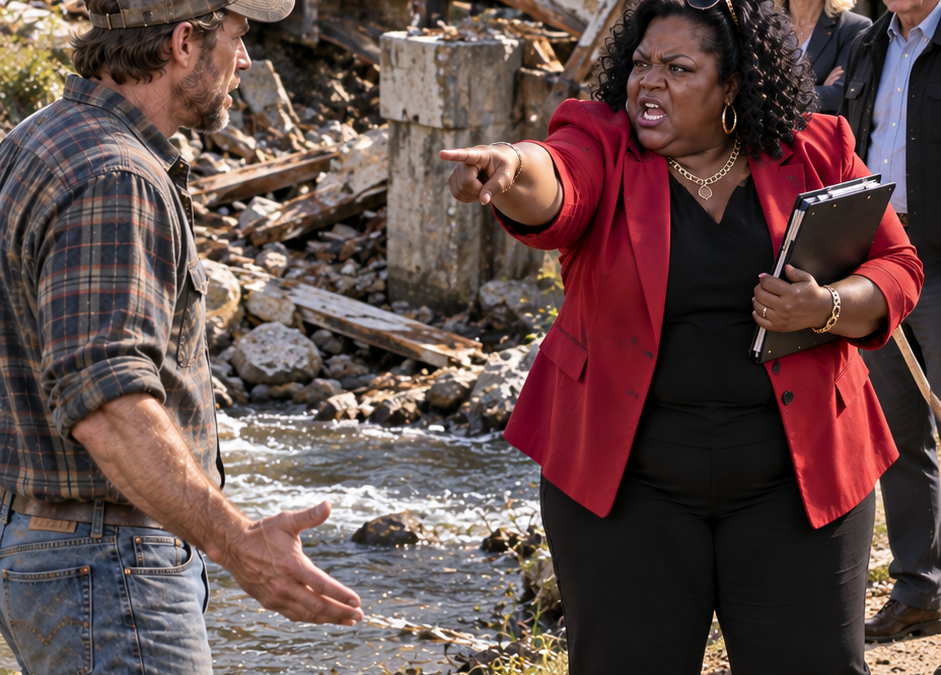
At what remained of the bridge.
I had built that bridge in the summer of 1987.
I could still remember standing in the water in rubber boots while the concrete forms shifted every time the current pressed against them.
Three consecutive Saturdays.
Pressure-treated lumber.
Steel reinforcement.
Concrete footings three feet into both banks.
I mixed some of that concrete myself.
The bridge had survived thirty-seven years.
It survived spring floods.
It survived an ice storm that cracked the north railing badly enough that I rebuilt that entire side the following March.
It survived decades of weather, children crossing it, contractors carrying equipment over it, and hundreds of quiet mornings when I walked across without thinking about who owned it because there had never been a reason to ask.
The previous Thursday, before leaving on my trip, I had crossed that bridge on the way to my truck.
Nothing was wrong with it.
Now I was looking at splinters.
Karen watched me.
She expected anger.
Probably hoped for it.
Instead I asked:
“Do you have a county demolition permit?”
Her expression shifted.
Only slightly.
A blink.
Then:
“The HOA doesn’t require a county permit to enforce community rules.”
“Do you have a court order authorizing demolition?”
“That’s not applicable.”
“Do you have a recorded vote from the full board authorizing physical destruction of private property?”
One of the board members behind her looked down.
Karen’s mouth tightened.
“The HOA has broad enforcement powers over all community structures affecting safety and aesthetics.”
“That isn’t what I asked.”
“Your bridge was noncompliant.”
“Permit number.”
She exhaled through her nose.
“The matter has been resolved administratively.”
That phrase told me plenty.
No permit.
No court order.
Probably no formal board authorization either.
I looked at the orange notice on my fence post.
There was no permit number printed anywhere.
No court case.
No county authorization.
Only Karen’s signature and four lines calling my bridge an unauthorized structure with “aesthetic and potential safety concerns.”
I took out my phone.
Pressed record.
Karen didn’t notice.
She kept talking.
That helped me later.
She pulled another document from her clipboard and walked toward my truck.
She set it on the hood.
“Cost recovery.”
I picked it up.
Demolition crew:
$4,200.
Administrative compliance fine:
$500.
Total due in thirty days.
She adjusted her sunglasses.
“If the balance isn’t paid, the association will initiate lien proceedings.”
Then she gave me a look I had seen her use on other people.
“We can do this the easy way, or we can make it complicated. That’s entirely your choice.”
She had said that sentence before.
I could hear it.
No hesitation.
No searching for words.
It was polished.
A line she’d used on homeowners standing beside the wrong mailbox, the wrong hedge, the wrong bird feeder, the wrong shade of paint.
It probably worked because most people in that neighborhood had mortgages, jobs, children, schedules, and better things to do than fight an HOA over five hundred dollars.
I read the bill.
Folded it.
Put it in the document folder I kept in my center console.
Then I said:
“Thank you.”
Karen looked almost offended.
She had expected me to shout.
Maybe expected me to demand names.
Maybe she wanted me to grab the notice off the fence and tear it in half while her board members watched.
Instead I thanked her.
The demolition crew finished loading.
The truck rolled off my gravel shoulder.
It turned onto the road through the subdivision.
Karen watched it leave.
So did I.
The truck traveled down the same asphalt road every resident used.
The only road connecting ninety-six homes to the county throughway.
Karen didn’t know it.
Neither board member behind her knew it.
The demolition crew certainly didn’t know it.
But that road wasn’t HOA property.
It wasn’t municipal property.
It wasn’t a subdivision common area.
It was mine.
Every inch of it.
The asphalt.
The shoulders.
The driveway cuts.
All 2,400 feet from the county road to the last cul-de-sac.
And somewhere inside my house was the deed proving it.
Karen believed she had demolished a bridge.
What she had actually done was remind me to look at a document nobody in that neighborhood had bothered to read in more than twenty years.
I went inside after everyone left.
Didn’t turn on the lights.
For a while I simply sat at the kitchen table.
Through the window, I could see the creek bank.
Two empty holes remained where the bridge footings had been.
I had owned that land for most of my adult life.
My family had held the road even longer.
When I first bought the original twelve-acre parcel in 1985, there wasn’t much around it.
Open farmland.
Second-growth timber.
The creek along the eastern boundary.
The road was gravel then, barely more than a private lane.
My father had controlled it as part of the family property and later passed that responsibility to me.
I built the bridge two years after buying the land.
At the time, there was no HOA.
No decorative neighborhood entrance.
No pool.
No clubhouse.
Just land.
Then, in the early 2000s, developers arrived.
They bought adjoining farmland and built what eventually became ninety-six homes in two phases.
Nice homes.
Good school district.
Quiet streets.
But there was a problem from the beginning.
Access.
The only practical route from the county road into the subdivision crossed my family’s property.
The developers should have solved that before selling the first home.
A normal developer would record a permanent access easement.
Survey it.
Describe it.
File it.
Make the right of passage part of the public title record.
Instead, my father did something people used to do much more often.
He shook hands.
Residents could use the road.
He wasn’t trying to trap anyone.
He wasn’t trying to charge tolls.
He had no objection to families driving home.
So he gave verbal permission.
Nothing formal.
Nothing recorded.
No easement.
No transfer.
No right-of-way deed.
Just permission.
Years passed.
The road became paved.
Mailboxes appeared.
Delivery trucks came and went.
School buses.
Garbage trucks.
People moved in who had never known the road before houses existed.
Eventually the road felt like neighborhood infrastructure.
And once something feels public long enough, people stop asking who owns it.
The HOA’s founding documents listed its actual common property.
Pool.
Clubhouse.
Playground.
Decorative ponds.
Walking paths.
The road wasn’t listed.
Nobody noticed.
Or if anyone did, they let the problem sit.
Twenty years later, Karen behaved as if assumption had become ownership.
I had voluntarily joined the HOA because my home sat within the neighborhood layout and I wanted peaceful coexistence.
I paid dues.
Attended annual meetings.
Sat toward the back.
Said little.
For years, that worked.
The previous president, Gerald, had been almost aggressively reasonable.
Meetings started on time.
Ended on time.
He wasn’t interested in policing every visible object on every porch.
Then Karen arrived.
Gerald stepped down after six years.
Karen ran for Director of Community Standards and Compliance.
Nobody opposed her.
That was how she gained power.
Not through a revolution.
Through an empty ballot line.
Within fourteen months, she issued forty-seven formal compliance notices.
Eleven liens followed.
Three home sales nearly collapsed because active HOA disputes appeared during closing reviews.
The violations were rarely dramatic.
Mailbox posts painted slightly wrong.
Wind chimes without architectural approval.
Basketball hoops left outside after seven.
Hedges too short.
Not too tall.
Too short.
People paid.
People corrected.
People learned.
The neighborhood became quieter.
My first violation came eight months after Karen took office.
Front porch bulb.
Wrong color temperature.
Warm white.
Approved standard apparently required cool white.
I changed the bulb.
Paid a fifteen-dollar processing fee.
Told myself it wasn’t worth a fight.
That evening after the bridge demolition, someone knocked at my door.
Mrs. Chen stood on the porch holding a casserole dish.
She was in her seventies.
Small woman.
Soft voice.
Had lived in the neighborhood for years.
“I heard.”
I stepped aside.
She came in.
We sat at my kitchen table.
For the first few minutes, she talked about the bridge.
Then she said:
“She’s done this to six families.”
“Demolished bridges?”
Mrs. Chen almost smiled.
“No. Made them afraid.”
She had received fourteen violation notices in fourteen months.
Porch-light angle.
Bird feeder model.
Window trim off-white instead of the approved white.
She had corrected every one.
Paid every fee.
She lowered her voice even though we were alone.
“You’re the first person who didn’t apologize.”
That sentence bothered me.
When she left, she put a folder on the counter.
Fourteen months of notices.
Sorted by date.
“In case it helps.”
She wouldn’t quite meet my eyes.
That was what Karen had built.
Not compliance.
Conditioning.
I carried the folder to the table.
Then went to the hall closet.
Top shelf.
Behind old tax records was a fireproof document box.
I pulled it down.
The deed was inside.
I hadn’t read it in years.
There had been no reason.
I unfolded it under the kitchen light.
Parcel description.
Family ownership.
Recorded title.
And the road.
There it was.
Not implied.
Not assumed.
Described.
Owned.
My family name.
The chain of title was clean.
I read it twice.
Then a third time.
I thought about Karen standing beside my demolished bridge, threatening to put a lien on me for refusing to pay her demolition bill.
I thought about all the years I’d sat quietly while she fined other people.
Then I closed the document box.
My patience ended that night.
Three days after the demolition, I called Martin.
Martin had handled property matters for me for nineteen years.
Land.
Deeds.
Closings.
Boundary questions.
He hated drama and avoided courtrooms whenever possible.
That was exactly why I trusted him.
I told him everything.
He didn’t interrupt.
When I finished, he asked:
“County demolition permit?”
“None on the notice.”
“Court order?”
“None.”
“Recorded board authorization?”
“Karen said it was administrative.”
I heard him tapping something.
“Administrative enforcement allows notices, hearings, fines, maybe liens if properly authorized.”
Pause.
“It does not generally allow someone to enter private property with heavy equipment and destroy a structure.”
“That’s what I thought.”
“She needed legal authority for physical demolition. Court order. Applicable permit. Something.”
“She had none.”
Another pause.
“Then stop thinking of this as a stupid HOA fight.”
I waited.
“What she did is destruction of private property.”
For the first time since seeing the debris, the problem felt precise.
Not emotional.
Not vague.
Something with edges.
I thanked him.
Then drove to the HOA office.
Karen’s “office” was the back half of her two-car garage.
Folding table.
Padded chair.
Ring light.
Framed HOA charter mounted on drywall like a diploma.
A sign taped to the table said:
COMMUNITY STANDARDS OFFICE.
Another:
COMPLIANCE INQUIRIES — PLEASE KNOCK.
She looked up when I entered.
Not surprised.
“Have a seat.”
I sat.
Placed my folder on the table.
Then slid one page toward her.
Formal records request.
Within ten business days:
Legal authority for bridge demolition.
Official board minutes authorizing physical removal.
County demolition permit.
Court authorization, if any.
She glanced down.
Didn’t touch it.
Instead she opened a tabbed binder.
Section Twelve.
“The governing documents are very clear.”
She turned it toward me.
“The board may require removal of structures creating safety or aesthetic violations.”
“Require removal.”
“Correct.”
“Does it say the HOA may enter private property and physically destroy the structure without a court order?”
“The association has broad enforcement authority.”
“Does it say what I just asked?”
She closed the binder.
“The language speaks for itself.”
In the corner sat one of the board members who had witnessed the demolition.
He clicked a pen.
Twice.
Looked at the wall.
Karen pulled out another billing statement.
Same amount.
$4,200 demolition.
$500 compliance fee.
Then a second page.
A lien notice.
Already filled out with my property address.
“If the account remains unpaid, this will be filed.”
I picked up both.
Put them in my folder.
Then asked:
“Has anyone on this board ever reviewed the county plat for the road?”
Karen stared at me.
“What road?”
“The road everybody drives to get into this neighborhood.”
“It’s common area.”
“Have you reviewed the recorded plat?”
“It’s community property. It always has been.”
I nodded.
“Thank you.”
She looked confused.
I left.
That night, I mailed a certified records demand.
Return receipt.
Copies to Martin.
Along with demolition records, I specifically demanded county-recorded evidence showing HOA ownership of the subdivision access road.
Karen replied four days later.
But she didn’t send what I requested.
Instead she escalated.
The HOA filed a formal claim asserting jurisdiction over my entire adjacent parcel—including the road—based on more than twenty years of continuous community use.
Karen wasn’t merely defending the bridge demolition anymore.
She was trying to take the road.
That was when I stopped treating any part of this as an internal HOA problem.
The county recorder’s office sat twenty minutes away in a low brick building.
I arrived the next morning.
Gave the clerk the parcel number.
Asked for the original development plat.
Twelve minutes later, he laid it flat in front of me.
There was the subdivision.
Lots.
Cul-de-sacs.
Common areas.
And the road.
All 2,400 feet.
The ownership notation was small.
Precise.
Permanent-looking.
My family name.
Recorded.
No easement.
No transfer.
No right-of-way instrument.
Nothing granting the HOA ownership.
The clerk looked at the computer.
“Whoever developed this should have filed an access easement.”
“They didn’t.”
“Apparently not.”
I ordered certified copies.
Then requested the HOA’s incorporation records.
The common-property schedule listed everything owned by the association.
Pool.
Patio.
Clubhouse.
Playground.
Two decorative ponds.
Walking paths.
No road.
Karen had looked at me in her garage office and said:
“It’s always been community property.”
Her own founding documents disagreed.
I drove home with certified copies beside me.
That evening Mrs. Chen came back.
This time Patricia was with her.
Patricia lived on the east loop.
I’d seen her at meetings.
She looked uncomfortable.
Like someone had rehearsed a sentence all day.
“Karen told her husband something a few weeks ago.”
“What?”
Patricia glanced toward Mrs. Chen.
“She said that once the HOA got the road recorded as common property, she was going to propose a road maintenance assessment.”
I stayed quiet.
“Monthly fee,” Patricia added.
“Per house?”
She nodded.
“She called it a revenue opportunity.”
Revenue opportunity.
I thought about the demolition.
The photographs.
The prewritten lien notice.
The satisfaction on Karen’s face.
Suddenly the bridge looked different.
It hadn’t been random enforcement.
It had been the opening move in a larger assertion of control over the parcel.
Within two days, four more neighbors came to my door.
One was a retired veteran.
Fixed income.
Karen had filed a lien over his mailbox being the wrong gray.
Not blue.
Not red.
Gray.
Wrong gray.
A young couple told me their home sale had nearly collapsed over an old flagstone path installed by a previous owner.
They paid a $1,200 “remediation fee” to keep the closing alive.
They could find no board minutes authorizing the charge.
Then came a family whose daughter used a wheelchair.
They had installed a front entrance ramp after submitting approval requests twice.
No response.
Karen fined them eight hundred dollars for construction without approval.
None of these people came asking me to lead anything.
They just heard I hadn’t immediately apologized.
Apparently that was enough to make my kitchen a place people finally brought papers.
Martin filed our response to Karen’s jurisdiction claim.
One page.
No insults.
No threats.
Deed record number.
Plat reference.
Ownership.
No recorded easement.
No HOA jurisdiction.
Certified mail.
Fax.
Then we waited.
I sat at my kitchen table that night.
The evidence was spread around me.
Deed.
Plat.
HOA incorporation documents.
Thirty-one years of tax records showing the road assessed to my family.
Mrs. Chen’s violations.
Five names.
Five stories.
I knew exactly what Karen had misunderstood.
She thought authority came from being obeyed.
It doesn’t.
Authority has to come from somewhere.
A deed.
A statute.
A contract.
A court.
Something.
Karen had survived for years because nobody forced her to point to the source.
Then the lawsuit arrived.
Martin called first.
Maplewood Ridge HOA versus me.
Civil division.
Claim:
Prescriptive easement.
He explained it plainly.
“Their argument is that residents used the road openly and continuously for more than twenty years. They’re saying long use became a legal right.”
“They never had permission on paper.”
“Correct.”
“So can they win?”
Martin paused.
“There’s a difference between a claim being arguable and a claim succeeding.”
“What does that mean?”
“They’ve got long use.”
“That’s obvious.”
“But prescription is complicated. Your continued ownership, maintenance, tax payments, and the historical permission matter. What Karen really gets by filing is delay.”
“Delay?”
“While title litigation is active, don’t do anything dramatic with the road.”
“I wasn’t planning to.”
“Good. No gates. No barricades. No toll booth jokes. No retaliation.”
I smiled despite myself.
“She can’t simply turn twenty years of permission into ownership.”
“No.”
“But she can make you spend months proving it.”
That was Karen’s strategy.
Maybe she couldn’t win.
But she could freeze me.
Three days later, every mailbox received an HOA newsletter.
Heavy paper.
HOA seal.
Karen’s name.
Headline:
PROTECTING YOUR ROAD ACCESS
She wrote that “a homeowner” was attempting to assert exclusive control over a community road used by ninety-six families.
No name.
Didn’t need one.
She claimed the HOA was defending every resident’s access.
She didn’t mention that she had filed the lawsuit.
Didn’t mention the bridge.
Didn’t mention the demolition bill.
Didn’t mention the missing deed.
Didn’t mention her own founding documents.
Karen was very good at omission.
Then the lawsuit began costing me in places that had nothing to do with the road.
My mortgage servicer flagged active litigation affecting adjacent title.
My refinance went on hold.
Patricia called.
Karen had contacted her.
Friendly voice.
Concerned tone.
Said she’d heard Patricia and I had been speaking.
Then suggested that homeowners associated with the wrong side of HOA disputes sometimes discovered their properties needed more thorough compliance review.
Not a threat.
Concern.
Two days after the young couple were seen leaving my house, they received a violation notice.
Improper downspout angle.
Those gutters had existed since before they bought the home.
I wrote down the date.
Added the notice to the file.
Martin filed a motion to dismiss Karen’s lawsuit.
Attachments:
My deed.
Certified plat.
HOA incorporation schedule.
County tax history.
I drove to the assessor’s office myself for the last one.
Thirty-one consecutive years.
Road parcel billed to my family.
Paid every year.
I looked at that sheet for a long time.
It wasn’t dramatic.
Plain paper.
County stamp.
Rows of numbers.
But facts don’t have to look dramatic to be devastating.
Then the annual HOA meeting notice arrived.
Item Four:
ROAD ACCESS AND COMMUNITY PROPERTY — FINAL COMMUNITY VOTE.
I understood what Karen planned.
She was going to put my road ownership to a neighborhood vote.
Not because a vote could legally transfer title.
Because she wanted sixty or more homeowners publicly aligned behind her.
She wanted a photograph.
A mandate.
A story she could take into court.
Ninety-six families versus one unreasonable property owner.
I read the agenda.
Then smiled.
Karen wanted the entire neighborhood in one room.
So did I.
The clubhouse was fuller than I’d ever seen it.
Coffee urn near the wall.
Stackable chairs.
Sixty-three homeowners by my count.
I arrived early.
Sat in the back row.
Placed my folder on the chair beside me.
Inside it was a sealed manila envelope.
Karen had prepared slides.
The first showed an aerial map of the neighborhood.
She had traced the road in blue.
Label:
HOA COMMUNITY ROAD — ESTABLISHED 2003
No deed reference.
No instrument number.
Just text placed over an aerial photograph.
Another slide said:
PROTECTED BY YOUR HOA
Karen called the meeting to order.
“Tonight we take the final step to protect our community’s road access from outside interference.”
Her regular supporters applauded.
Then more people joined because applause spreads.
Karen spoke for nearly ten minutes.
Twenty years of road use.
Snow removal.
Maintenance.
Resurfacing.
Community reliance.
Then she talked about me.
“A single homeowner has chosen to make a private claim against a shared resource instead of working constructively with his neighbors.”
I sat quietly.
Then the bridge appeared on the screen.
Before photograph.
After photograph.
“An unauthorized structure presenting documented safety liability.”
Several people nodded.
Others didn’t.
Midway through, Karen noticed me.
She smiled toward the back.
“I see our neighbor has chosen to join us.”
People turned.
“I hope that means you’re prepared to be part of a solution.”
A few people laughed.
I said:
“I’m just here to listen.”
Then:
“Please continue.”
Her smile flickered.
She returned to the slides.
Mrs. Chen raised her hand.
It took courage.
I knew because I’d seen how she held her eyes down in my kitchen.
Now she looked directly at Karen.
“Can you show us the recorded document that lists the road as HOA property?”
Karen answered immediately.
“The community has maintained and used the road for more than twenty years.”
Mrs. Chen shook her head.
“I understand your argument.”
Then:
“I’m asking for the document.”
The room changed.
Not dramatically.
Just a little.
Karen said:
“The legal specifics are being handled through appropriate channels.”
She tried to move on.
The veteran raised his hand.
“You said the HOA has always maintained the road.”
“Yes.”
“Can we see the invoices?”
Karen paused.
“Our records reflect substantial investment in community infrastructure.”
The veteran nodded.
“I called the county assessor.”
Silence.
“They told me taxes on that road have been billed to a private owner for more than thirty years.”
Murmurs.
“Not to the HOA.”
Karen’s voice hardened.
“Property-tax billing is a technical matter unrelated to community use rights.”
It didn’t land.
I watched faces.
People hadn’t suddenly joined my side.
Something more important happened.
They became uncertain.
Thirty seconds earlier, Karen owned the room.
Now the room belonged to itself.
Karen sensed it.
“Let’s proceed to the vote.”
I stood.
“Before the vote, I’d like to submit a document for the official record.”
My footsteps sounded surprisingly loud on the laminate floor.
I carried the sealed envelope to the front.
Placed it in front of Karen.
“I recommend the board review this before voting.”
She stared at it.
“What’s inside?”
“Documents directly affecting whether the resolution you’re about to vote on has any legal validity.”
Then I walked back.
The board member who had looked at the ground during my bridge demolition spoke.
Quietly.
“Maybe we should open it.”
Karen turned.
Their eyes met.
For a moment, I thought she might.
Instead she moved the envelope aside.
Unopened.
“We’re not delaying the meeting.”
She called the vote.
Thirty-one yes.
Twenty-eight no.
Passed.
Barely.
Karen smiled.
People from her inner circle shook her hand.
Someone took a photograph of the board.
She looked victorious.
I watched the envelope.
Still sealed.
Still ignored.
I wasn’t worried.
Because sixty-three homeowners could vote all night.
They could vote ninety-six to zero.
They could stand in the street holding signs.
They could chant.
Private title doesn’t transfer by popularity.
Karen had wanted a mandate.
What she created instead was a record showing she had been warned before the vote and chose not to look.
The hearing on our motion to dismiss came nine weeks after Karen filed the lawsuit.
County courthouse.
Room 4B.
Wood-paneled walls.
Fluorescent lights.
Martin sat beside me with one accordion file.
Karen sat across the aisle beside her attorney, Garrett.
Garrett had brought a large box of tabbed documents.
Karen wouldn’t look at me.
Garrett presented first.
More than twenty years of open use.
Ninety-six households dependent on the road.
Continuous access.
Maintenance.
Community reliance.
He made the argument sound as strong as it could sound.
The judge listened.
Late fifties.
Reading glasses on a chain.
Completely unhurried.
When Garrett finished, Martin stood.
He placed my deed on the bench.
Then the recorded development plat.
“Your Honor, the road at issue is privately titled property.”
He pointed to the ownership notation.
“Recorded to my client’s family.”
Then:
“No easement granting this association ownership has ever been recorded. No right-of-way transfer exists. No deed transfer exists.”
He sat.
The judge looked at Garrett.
“Did your client perform a title search before filing this action?”
Silence.
Garrett shifted.
“We relied on longstanding community use.”
“That wasn’t my question.”
Another pause.
“No formal title search before filing, Your Honor.”
Karen looked down.
The judge reviewed the documents again.
Martin added the tax history.
“Thirty-one consecutive years of property tax assessments.”
Paid by me.
Not the HOA.
Then he produced the HOA’s own incorporation records.
Common-property schedule.
Pool.
Clubhouse.
Playground.
Paths.
Ponds.
No road.
The judge turned several pages.
Then removed her glasses.
“The plaintiff’s own organizational documents do not identify the road as association property.”
Garrett tried again.
“Your Honor, our prescriptive-use theory—”
“The record before me shows continuing ownership, continuing taxation, and no conveyance.”
She paused.
“The motion to dismiss is granted.”
I didn’t move.
“With prejudice.”
That meant Karen couldn’t simply rewrite the complaint and file it again.
The case was over.
At least that part.
Garrett began returning documents to his box.
Karen stared at the tabletop.
Then the judge picked up the orange bridge notice.
She wasn’t finished.
“This dispute appears to have arisen from a demolition.”
Martin said:
“Yes, Your Honor.”
The judge examined the notice.
“No county demolition permit is referenced.”
“Correct.”
“No court order.”
“Correct.”
“No recorded authorization establishing jurisdiction over the property.”
“Correct.”
Then she picked up the transcript of my phone recording.
Karen’s own words were printed there.
Broad enforcement authority.
Administrative action.
Compliance.
The judge set both pages down.
“The court has now confirmed the association lacked jurisdiction over the privately owned property where the demolition occurred.”
Nobody moved.
She looked toward Karen.
“The physical destruction of a structure on private property without permit, court authorization, or established legal jurisdiction is not simply an HOA compliance action.”
Karen finally looked up.
The judge continued.
“The record raises concerns regarding unlawful destruction of private property.”
Then:
“I am referring the relevant materials to the county district attorney for review.”
The color left Karen’s face.
Not all at once.
It drained gradually.
Her attorney leaned close.
Whispered.
Karen didn’t respond.
For three years, she’d been the person who made other homeowners afraid of envelopes.
Now she had just watched a judge create one for her.
I walked out with Martin.
In the hallway he placed one hand on my shoulder.
Didn’t smile.
That was how I knew he was satisfied.
Calls started that evening.
The board member who had told Karen to open my envelope called an emergency session.
The annual-meeting vote was legally meaningless.
A neighborhood vote cannot seize private property.
Mrs. Chen called at seven.
Her voice sounded lighter.
“The vote is void?”
“Yes.”
“The road is still yours?”
“It always was.”
She laughed once.
Quietly.
The veteran called too.
The litigation flag affecting financing in the neighborhood was beginning to clear.
The young couple texted:
Thank you.
Over the next few days, something changed in the neighborhood.
Not loud rebellion.
Just relief.
People who had spent years monitoring themselves stopped waiting for the next violation notice.
The written court order arrived twelve days later.
Forty-three pages.
The important parts were simple.
The HOA had no jurisdiction over my private road.
No jurisdiction over my bridge.
The annual meeting vote had no legal force.
Private title cannot be transferred through community resolution.
The road remained mine.
The district attorney opened a formal review.
Martin supplied everything.
Orange notice.
Demolition bill.
Recording.
Contractor documentation.
Evidence no demolition permit existed.
The case changed categories.
For months, Karen had called what happened “compliance.”
Now the county was examining it as destruction of private property.
Karen was eventually charged personally.
Not the HOA.
Karen.
The civil side resolved weeks later.
She was held personally responsible for the cost of rebuilding the bridge and my legal expenses.
Total:
About twenty-eight thousand dollars.
Her $4,200 demolition invoice?
Returned with statutory interest.
The $500 administrative fine?
Voided.
Every compliance action Karen had placed against my property during her tenure was ordered removed from the record.
My mortgage servicer received clean-title confirmation.
The refinance that had been frozen during the lawsuit restarted.
Approved within ten days.
Then Ridgerest’s board held an emergency meeting.
Karen was removed.
Formal vote.
Same machinery she’d used for years.
Only this time it worked exactly as bylaws are supposed to work.
Three members of her bloc resigned before the end of the week.
A new board followed.
Nine members.
Mrs. Chen joined.
So did the veteran whose mailbox had apparently threatened neighborhood civilization by being the wrong shade of gray.
Their first important action wasn’t a new fine schedule.
It wasn’t an architectural amendment.
It was an apology.
One page.
HOA letterhead.
Signed by all nine.
Formal acknowledgment that enforcement actions taken against my property under Karen’s tenure had exceeded HOA authority.
Retraction of the bridge violation.
Recognition of private road ownership.
Copies mailed to all ninety-six homeowners.
Another copy posted at the clubhouse.
Martin framed one.
He gave it to me with a straight face.
“I thought you’d want this in the kitchen.”
“I don’t.”
“Study?”
“Maybe.”
It still sits on a shelf there.
Not as a trophy.
More as evidence that organizations can correct themselves once people stop confusing confidence with authority.
The neighborhood changed after Karen.
Slowly.
Mrs. Chen put her bird feeder back up.
Nobody wrote her a violation.
The veteran came by one afternoon with a six-pack.
We sat on the porch for nearly an hour.
Didn’t discuss the lawsuit for most of it.
Patricia waved whenever she drove past.
Karen’s inner circle disappeared.
Not literally.
They just stopped standing around her.
Stopped defending every decision.
Stopped appearing beside her in photographs.
It wasn’t revenge.
People simply recalculated.
Power that looks permanent from inside a room can disappear very quickly once the room realizes it was mostly voluntary.
I rebuilt the bridge the following spring.
This time, I hired professionals.
Not because I regretted building the original.
I loved that bridge.
But after everything that happened, I wanted every possible document.
County permit.
Engineered drawings.
Structural calculations.
Inspection.
Stamped approval.
The contractor drove deeper footings.
Used heavier reinforcement.
The new span was wider.
Stronger.
Built to last forty years without drama.
I visited almost every day during construction.
The foreman finally asked:
“You planning to supervise the whole project?”
“Probably.”
He laughed.
“Builder?”
“Not bridges.”
“You built the last one?”
“In 1987.”
He looked toward the old footing scars.
“Lasted a long time.”
“Longer than the woman who tore it down.”
He laughed again.
On the final day, I drove to a lumber yard.
Bought a small cedar plank.
Had two lines routed into it.
BUILT 1987
REBUILT 2024
I mounted it myself on the inside of the railing.
Nothing fancy.
No Karen reference.
No HOA joke.
The bridge deserved better than being turned into a monument to her.
Then I addressed the road.
Not by blocking it.
Not by charging residents.
Not by punishing anyone.
That was never what I wanted.
Ninety-six families had bought homes believing they had permanent access.
Their mistake wasn’t malicious.
Most had never heard the word easement.
So Martin drafted a recorded notice.
The road remains private property.
Neighborhood residents may continue using it by revocable permission.
No HOA ownership is created by such permission.
Any association enforcement action involving my separate parcel requires valid legal authority.
We recorded it with the county.
Anyone performing a future title search would see it.
No more handshake disappearing into history.
No more assumptions.
No future Karen would be able to stand on that asphalt and say:
“It’s always been ours.”
Six weeks after the court ruling, there was a knock at my door.
Saturday morning.
I looked outside.
Karen’s car sat near the road entrance.
Not in my driveway.
Not fully on the asphalt.
Parked at the edge.
She had apparently become very interested in property boundaries.
I opened the door.
She held an envelope.
Court-issued payment paperwork.
Her name on the stub.
For several seconds, neither of us spoke.
She couldn’t quite meet my eyes.
Finally she held it toward me.
I took it.
“Thank you.”
Her jaw tightened slightly.
Maybe she expected more.
Maybe she expected me to give her the speech she’d been imagining since the courthouse.
I didn’t have one.
She turned.
Walked back toward her car.
I watched from the doorway.
She crossed the same road she had tried to claim.
The same road her demolition truck used after tearing down my bridge.
The road she had told sixty-three people belonged to their HOA.
She reached her car.
Got in.
Drove away.
I closed the door.
For a long time afterward, people asked the same question.
“Why didn’t you close the road?”
Because that would have punished ninety-six families for one woman’s arrogance.
The Chen family didn’t tear down my bridge.
The veteran didn’t.
The young couple didn’t.
The wheelchair user whose family had been fined didn’t.
Most residents didn’t even know the road had a private deed until Karen turned it into a lawsuit.
My father never intended access to become a weapon.
Neither did I.
The fact that I could have made everybody’s lives difficult didn’t mean I should.
Ownership and cruelty are not the same thing.
That might be the clearest difference between Karen and me.
She treated every right she believed she possessed as permission to exercise it as harshly as possible.
I learned that sometimes having a right means deciding not to use it against people who don’t deserve the consequences.
The bridge stands outside my kitchen window now.
New lumber was almost golden when it first went up.
It’s darker already.
Rain has started turning it toward the same color the old bridge became after years near the creek.
The cedar plaque catches morning sunlight at the right angle.
Built 1987.
Rebuilt 2024.
Sometimes I drink coffee on the porch and look at it.
I remember pouring those first footings in rubber boots.
I remember my father standing on the bank giving me advice I had not asked for.
“Level’s wrong.”
“It’s not wrong.”
“You’re reading it from upstream.”
“That doesn’t change level.”
“It changes your brain.”
I remember arguing with him.
Then checking.
He was right.
The form had shifted half an inch.
He never let me forget it.
My father belonged to a generation that believed property problems were solved with fences, surveys, and handshakes.
Most of the time, he was right.
But the handshake on the road almost became our family’s biggest legal mistake.
Nobody recorded the permission.
Nobody formalized access.
Years passed.
Memory turned into assumption.
Assumption turned into Karen saying “community property.”
That’s how these things happen.
Not usually through some dramatic theft.
Through forgotten paperwork.
Through people using something long enough that they stop remembering anyone ever gave them permission.
Karen’s real mistake wasn’t failing to know the road was mine.
Almost everybody failed to know that.
Her mistake was refusing to check.
When I asked whether she had reviewed the county plat, she could have paused.
She could have made one phone call.
She could have searched the public records.
She could have opened the sealed envelope at the annual meeting.
She had opportunity after opportunity to discover she was wrong.
But every time the facts threatened her certainty, she chose certainty.
That’s what brought her down.
Not me.
Not Martin.
Not Mrs. Chen.
Not the judge.
Karen destroyed herself every time she refused to look at a document because she thought her authority made the document unnecessary.
I still have the recording from the demolition day.
I’ve listened to it only twice.
The first time was with Martin.
The second was before court.
I don’t need to hear it again.
Karen’s voice is perfectly calm.
“The matter was resolved administratively.”
Then me asking:
“Do you have a county demolition permit?”
Her pause.
That tiny pause.
At the time, I thought the sound of my bridge being destroyed was the important part of that day.
It wasn’t.
The most important sound was two seconds of silence after a simple question.
Authority hates specific questions.
Who owns it?
Where is that recorded?
What section says that?
Who signed it?
Where is the permit?
What court authorized you?
People can speak confidently for hours about “community standards” and “broad authority.”
Ask them for the instrument number and suddenly the room gets quiet.
That’s what happened with Karen.
She had laminated cards.
Binders.
Rubber stamps.
Violation forms.
Lien notices.
Newsletters.
Slides.
Votes.
An attorney.
A community seal.
I had a deed.
In the end, that was enough.
Not because paper is magical.
Because the paper represented something real.
My father had owned that ground.
I had maintained it.
Paid taxes on it.
Protected it.
Allowed people to cross it.
Permission wasn’t abandonment.
Kindness wasn’t surrender.
Silence wasn’t a conveyance.
One of my favorite things that happened afterward wasn’t the court ruling.
It wasn’t the repayment.
It wasn’t Karen leaving the board.
It happened a few months later.
I was checking a railing bolt on the rebuilt bridge when Mrs. Chen walked down.
She had a bag of birdseed.
Her approved—or probably very much unapproved—bird feeder was hanging openly from the tree beside her porch again.
She stopped near the creek.
“The new bridge is nice.”
“Stronger.”
“More expensive?”
“Much.”
She smiled.
“HOA paying?”
“Karen is.”
That made her laugh.
Then she looked at the cedar plaque.
“Built 1987. Rebuilt 2024.”
“Yep.”
She was quiet for a moment.
Then said:
“I didn’t know you owned the road.”
“Neither did half the people who should’ve known.”
“I’ve driven on it twenty years.”
“I know.”
“You’re not going to change anything?”
“No.”
She looked relieved.
Then embarrassed to look relieved.
I said:
“Mrs. Chen, people need to get home.”
She nodded.
“I’m glad.”
She started walking back.
Then stopped.
“Thank you for not becoming like her.”
I didn’t know what to say to that.
So I said:
“Your bird feeder looks good.”
She smiled.
“Wrong model.”
“I won’t tell anyone.”
She laughed all the way back up the road.
That conversation stayed with me.
Because when people finally get power after feeling powerless, there is a temptation to prove they have it.
Close the gate.
Send the bill.
Make everyone ask permission.
I understood that temptation more than I wanted to.
After everything Karen did, I could have legally made the neighborhood confront the road problem immediately.
Instead, we recorded a clear arrangement.
Residents retained access.
My ownership remained protected.
The next board couldn’t pretend otherwise.
Nobody lost their home access.
Nobody got punished for Karen’s behavior.
That felt better than any gate would have.
The criminal case took longer.
Those cases always do.
I stayed out of it as much as possible.
Sent documents when asked.
Answered questions.
Karen hired a different attorney because Garrett handled real-estate work, not criminal defense.
That made the whole situation feel strange.
Months earlier, she had stood beside a demolition crew holding a laminated HOA card as if it were legal authority.
Now her own lawyers were explaining the difference between association rules and actual law.
I never attended every proceeding.
Didn’t need to.
By then, my part had become simple.
Rebuild.
Document.
Move forward.
Martin once asked whether I regretted not fighting Karen sooner.
I thought about that.
All those violation notices.
All those homeowners.
The liens.
The wheelchair ramp.
The closing delays.
My own porch light.
Maybe I should have.
Maybe if I had opened the deed box three years earlier, Karen wouldn’t have grown so comfortable.
But hindsight makes courage look easier than it was.
Before the bridge, Karen’s behavior mostly seemed irritating.
Petty.
Expensive.
People tell themselves:
It’s only fifteen dollars.
Only paint.
Only a form.
Only another letter.
Nobody wants to spend thousands on a lawyer to win a fight over a light bulb.
That’s how systems like Karen’s grow.
Every individual abuse is small enough to endure.
Then one day the person issuing the letters forgets that there is any limit at all.
For me, that limit was the bridge.
Maybe everybody has one.
A point where inconvenience becomes something else.
When I saw those demolished footings, I knew I couldn’t write another check and tell myself it wasn’t worth the trouble.
It was worth the trouble now.
Not because the bridge was priceless.
It wasn’t.
A new bridge could be built.
The point was that someone had entered my property with heavy equipment, destroyed something that belonged to me, handed me the cost, and expected gratitude for being allowed thirty days to pay.
If I accepted that, there wouldn’t be another boundary she recognized.
The day the new bridge opened, the contractor removed his last barricade around noon.
I waited until his truck left.
Then walked across.
The creek moved below me.
Same water.
Same banks.
Different bridge.
At the far side, I turned around.
The new span looked almost too clean.
No weather.
No patched railing.
No marks from years of boots.
The original had carried thirty-seven years of life.
The new one had carried me once.
That difference bothered me for a minute.
Then I remembered something my father used to say when we repaired things together.
“You don’t rebuild history.”
He’d usually say it when I complained replacement lumber didn’t match.
“You rebuild what’s broken and then you let history start over.”
I hadn’t understood that when I was younger.
I did now.
So I walked back across.
Then crossed again.
No reason.
Just because I could.
A week later, the veteran drove past while I was at the mailbox.
He slowed.
Window down.
“Nice bridge.”
“Thanks.”
He pointed at the road.
“Nice road too.”
I laughed.
“Keep moving.”
“Yes, landlord.”
“Don’t start.”
He drove away laughing.
That was another thing Karen never understood.
People don’t resent boundaries when boundaries are fair.
They resent being controlled.
For twenty years, residents had crossed my road freely.
Nobody thought about it.
The moment Karen decided ownership was something she could manufacture through pressure, everybody became afraid of losing access.
The road hadn’t changed.
Karen had.
The new board eventually reviewed old enforcement actions.
Not just mine.
Mrs. Chen’s fourteen notices.
The wheelchair ramp.
The mailbox lien.
The young couple’s flagstone fee.
Some fines were refunded.
Others couldn’t be fully unwound because sales had closed and too much time had passed.
But at least the records were examined.
For the first time in years, board meetings included homeowners asking:
“Where does the rule say that?”
And nobody treated the question as insubordination.
That may have been the best long-term outcome.
Not my bridge.
Not Karen being removed.
A neighborhood learning to ask for the page number.
Months later, I found the laminated compliance card Karen had shown me.
Not the actual card.
A photograph of it was visible in one of my recordings.
I paused the video.
Looked at it.
HOA seal.
Title.
Her name.
It seemed almost silly now.
A piece of plastic that had once felt official because she believed in it hard enough.
I realized then how many of the things that frighten people depend on presentation.
Letterhead.
Bold red text.
Official stamp.
A person speaking without hesitation.
An envelope labeled FINAL NOTICE.
Those things aren’t meaningless.
But they aren’t authority by themselves.
That was what Karen confused.
She thought looking official was the same as being legally right.
The courthouse cured that misunderstanding.
Not with drama.
Not with shouting.
With a judge reading a deed.
Sometimes that’s all justice looks like.
Someone finally reading the document everyone else skipped.
The bridge has weathered now.
Not much.
But enough.
The boards have darkened after rain.
The rail has one small scratch where I dragged a ladder across it.
There is mud near the east footing after storms.
That makes me happy.
Perfect things don’t feel lived in.
The old bridge wasn’t valuable because it was flawless.
It was valuable because it had stood there through decades of ordinary life.
This one is beginning the same process.
I take coffee outside most mornings.
Sit on the porch.
Look through the trees.
Sometimes I can see the cedar plaque.
BUILT 1987. REBUILT 2024.
Cars pass farther up the road.
Residents leaving for work.
School bus.
Delivery vans.
Mrs. Chen heading to the grocery store.
The same road.
My road.
And almost nobody thinks about that anymore.
That’s exactly how I want it.
The road is supposed to get people home.
The bridge is supposed to get me across the creek.
Property ownership isn’t supposed to become somebody’s full-time identity.
Karen made it one because control was the thing she valued.
I don’t.
I value quiet.
I value knowing the documents are correct.
I value a bridge that stays where I put it.
Every once in a while, somebody asks what I would do if another HOA board tried the same thing.
I tell them the truth.
They won’t.
Not because future board members will necessarily be kinder.
Because now the record is clear.
The road has a recorded notice.
The bridge has a permit.
The parcel boundaries are certified.
The court order exists.
The apology is in HOA records.
The next person who wants to claim otherwise will have to step over an entire paper trail before reaching my fence.
That’s what experience changes.
My father trusted a handshake.
I still respect handshakes.
I just record them now.
One Saturday morning, about a year after everything settled, I walked down to the bridge with a wrench.
One railing bolt had loosened.
Nothing serious.
I tightened it.
Checked the others.
Then sat on the rail.
The creek was high from rain.
Water pushed around the footing and turned white against a stone.
I thought about the afternoon I came home.
Orange notice.
Dust.
Splintered lumber.
Karen photographing the destruction.
Her saying:
“We can do this the easy way or make it complicated.”
She had been right about one thing.
It became complicated.
Just not for me in the way she expected.
She believed complexity favored whoever had the most forms.
But complexity has another side.
The more documents you create, the more chances you give the truth to leave fingerprints.
Her demolition notice.
Her bill.
Her lien threat.
Her jurisdiction claim.
Her lawsuit.
Her newsletter.
Her annual-meeting vote.
Every escalation generated another record.
Eventually she buried herself under her own paperwork.
All I had to do was keep mine.
I watched the creek for a while.
Then looked toward the road.
A car was coming in from the county throughway.
It crossed the property line without slowing.
Turned toward the subdivision.
Probably somebody who had moved in after all this happened.
Maybe they had no idea the road was private.
Good.
They didn’t need to.
The documents knew.
The county knew.
The HOA knew.
I knew.
That was enough.
Karen spent years making everyone in the neighborhood notice her authority.
My goal was the opposite.
I wanted ownership so secure that nobody had to think about it at all.
That’s the difference between control and stewardship.
One demands attention.
The other makes ordinary life possible.
The car disappeared around the bend.
I stood.
Tightened the wrench in my hand.
Walked back across the bridge.
It creaked once under my weight.
New lumber settling.
Good sound.
Someday, if I’m lucky, it will be as ordinary to whoever comes after me as the old one was before Karen decided it needed to disappear.
And if there is one thing I hope they remember, it isn’t the lawsuit.
It isn’t Karen.
It isn’t the judge.
It’s this:
When somebody tells you they have the authority to take something that belongs to you, don’t start by shouting.
Ask them where it’s written.
Then go read what they hope you never will.








