𝗣𝗔𝗥𝗧 𝟮 HOA Karen Cut Through My Permitted Electric Fence — Three Days Later, a Judge Froze Every Dollar the HOA Had
𝗣𝗔𝗥𝗧 𝟮
I paused the video.
Played the sentence again.
The board authorized this.
That was important.
If Karen had acted alone, Karen had a problem.
If the board had formally voted to send her onto my property, then the HOA itself had a problem.
Every director who approved it.
Every dollar they controlled.
Every document they generated.
I opened my laptop.
It took four minutes to find the email.
Karen to the board.
Sent three days earlier.
Subject:
LOT 7 — FENCE ENFORCEMENT.
The body was short.
“Moving forward with fence removal per our enforcement authority. Motion passed 3–0. Action scheduled for Tuesday.”
Three board members had responded.
CONFIRMED.
PROCEED.
GOOD.
Tuesday was that morning.
I read the chain twice.
Then I leaned back.
Karen had not only admitted that the board authorized the destruction.
She had documented it beforehand.
I started a new folder on my computer.
The first file was the camera footage.
The second was the board email.
The third was my fence permit.
The fourth was the certified delivery receipt showing the HOA had received the permit two years earlier.
Then I made coffee.
Not because I felt calm.
Because I understood that if I wanted to win, calm was going to be useful.
I had lived in the subdivision for eight years.
During my first four, the HOA was mostly background noise.
Annual dues.
A few newsletters.
A notice one summer reminding everyone that leaf blowers were prohibited before eight in the morning.
Another about approved mulch colors.
Annoying, but ordinary.
Karen became president three years before the fence incident.
Within six months, notices started multiplying.
Residents who had lived there for a decade suddenly discovered things they had owned for years were violations.
Garden ornaments.
Garage door colors.
Parking arrangements.
Mailbox posts.
My first Karen-era citation was seventy-five dollars.
Unapproved mailbox color.
Section 6.1.
I paid it.
At the time, I told myself seventy-five dollars was not worth a fight.
That check was one of the worst decisions I made.
Because once Karen learned that my address paid without resistance, she treated compliance like a habit.
Two streets over lived Rosa.
Single mother.
Night-shift nurse.
Three children.
She received a violation for the basketball hoop in her driveway.
Then another.
Then another.
By the time the HOA threatened a lien, she owed around fourteen hundred dollars.
For a basketball hoop.
Rosa removed it.
Paid the fines.
The HOA added another two hundred dollars labeled “processing fees.”
Karen had created that category herself.
She pushed it through during a board session where only three of five directors attended.
Then there was Mr. Callaway.
Seventy-one.
Retired.
Widower.
His yard looked better than most professionally landscaped properties.
He had lived in the neighborhood longer than Karen had been on the board.
After his wife died, he started keeping every HOA letter in a folder.
“She always said you save paper when people start making rules,” he once told me.
I didn’t understand how much paper he meant until later.
There was Mr. Okafor too.
Six months before Karen cut my fence, he woke to find a handwritten poster in his front yard.
COMMUNITY VIOLATION.
REPEATED NON-COMPLIANCE.
Not an official notice.
Not a citation mailed through normal procedure.
A poster.
Black marker.
White board.
Stuck into his lawn where every neighbor walking past could see it.
Mr. Okafor had never been given a hearing.
He had not even received formal written notice before Karen publicly branded his property non-compliant.
His grandchildren were visiting that weekend.
He paid whatever the HOA demanded within forty-eight hours because he wanted the sign gone before they arrived.
He kept the sign.
On the back, in the lower corner, were Karen’s initials.
At the time, nobody knew why that mattered.
Karen’s biggest expansion of power came through something she called field enforcement authority.
I attended the meeting.
Her proposal allowed board officers to enter common areas and perform aesthetic enforcement without prior notice.
The language was vague.
Too vague.
I submitted a written objection.
I was the only homeowner who did.
The motion passed three to two.
My name appeared in the meeting minutes beside the objection.
Two years later, I installed the electric fence.
Not some improvised wire running between crooked stakes.
A permitted livestock and security installation.
The county reviewed the site.
Approved the specifications.
Inspected the work.
Stamped the permit.
As a courtesy, I sent the HOA a copy.
Two months later, Karen’s office sent me a violation notice citing Section 4.2.
I replied in writing.
Attached the permit again.
Included the relevant county code.
Their office confirmed receipt.
Then nothing happened.
For two years.
I assumed the issue had died.
What I discovered that morning was that Karen had simply waited.
Now she had brought cutters.
Destroyed the installation.
Then offered me forty-five days to appeal.
I exported all four camera feeds.
Separate cloud accounts.
Physical drive.
Three backups.
Every file labeled by timestamp and camera location.
Only after that did I call Karen.
Her assistant put me on hold.
Four minutes.
Karen answered.
“What can I do for you?”
“This morning you entered my private property without permission and destroyed a county-permitted installation.”
Silence.
“I need two things.”
“What?”
“Your HOA insurance carrier information and written documentation of the legal authority you relied upon.”
“The fence violated Section 4.2.”
“That wasn’t my question.”
“We acted within the board’s enforcement authority.”
“Did the full board vote to authorize entry onto my specific property and removal of my fence?”
A pause.
Short.
“All enforcement actions are board sanctioned.”
“That still isn’t my question.”
“You can file an appeal.”
“I’d like your answer in writing.”
“You’ll receive the standard enforcement notice.”
She hung up.
I stared at the phone.
Karen had avoided saying one important thing.
She had not said:
Yes, the full board legally voted.
I already had the email.
Three to zero.
But there were five directors.
That detail bothered me.
I put my phone in my pocket and drove to the county police station.
I took my laptop.
The duty officer was younger than me.
Calm.
Methodical.
I played the video.
He watched all thirty-eight minutes.
When it ended, he looked at me.
“She entered your property.”
“Yes.”
“That whole area is deeded to you?”
“Yes.”
“No easement?”
“None.”
“Common area?”
“No.”
He asked about the fence.
I handed him a copy of the permit.
He checked the county stamp.
Renewal.
Lot number.
Inspection.
“We can open trespass.”
He paused.
“And criminal mischief for property destruction.”
“The replacement cost?”
He looked at the permit records.
“Enough to clear the misdemeanor threshold.”
He generated a case number.
I left with the report.
From there, I drove directly to the courthouse.
I filed a civil action for trespass and destruction of permitted property.
With it, I filed a request for temporary emergency relief preventing the HOA from recording any lien against my home while the dispute was pending.
My attachments included:
The permit.
Four camera feeds.
Karen’s authorization email.
The three board confirmations.
The police case number.
The clerk stamped everything.
The request went to the duty judge.
By the time I drove home, it was a little after noon.
At 3:47 p.m., the HOA emailed me.
Official letterhead.
Board seal.
The fence, it said, had been removed under proper enforcement authority after repeated non-compliance.
The matter was considered resolved.
I had forty-five days to appeal.
No mention of the county permit.
No mention of Karen cutting through my fence.
No mention of the criminal complaint filed hours earlier.
No mention of the board email.
They genuinely believed it was finished.
I printed the notice.
Added it to the folder.
Then Karen sent one last message.
“We consider this matter closed.”
I printed that one too.
Closed.
I remember thinking that was exactly the right word.
Just not in the way she intended.
Word moved through the neighborhood before dinner.
Two people who had seen Karen cutting the fence came to my house.
Mr. Callaway was one.
The other was a woman from the next block I had seen at the mailboxes for years but barely knew.
“She did something similar to us,” the woman said.
“Different issue.”
Mr. Callaway remained quiet.
Then he said:
“I’ve been keeping records.”
“How many?”
“All of them.”
He went home.
Thirty minutes later, he returned carrying a heavy manila folder.
We sat at my kitchen table.
Twenty-three fine notices.
Eighteen months.
Some cited violation codes that did not appear anywhere in the HOA’s published bylaws.
Three separate fines had been issued for the same alleged violation before any appeal period opened.
Then I found a $3,200 charge.
Garden border encroachment.
Section 7.3.
Common-area boundary violation.
Behind it was a licensed survey.
Mr. Callaway had paid a surveyor to establish his exact property lines.
Conclusion:
The garden border was fully within his property.
No encroachment.
Not even a quarter inch.
“You gave them this?”
“Yes.”
“And they still collected the money?”
“Yes.”
“Why did you pay?”
His eyes dropped.
“I was tired.”
That answer hurt more than anger would have.
He continued.
“My wife was sick by then.”
I said nothing.
“She told me to keep the paperwork.”
He tapped the folder.
“After she passed, I kept doing it.”
I looked again at the survey.
A $3,200 fine.
For an encroachment that did not exist.
“I’m going to need copies.”
“I already made two sets.”
That was Mr. Callaway.
Careful.
Patient.
Prepared.
Rosa arrived later.
She stood on the porch a moment before knocking.
That hesitation told me she had almost turned around.
She brought bank statements.
Fourteen months.
Two withdrawals immediately stood out.
$180.
$220.
No matching violation notice.
No assessment letter.
When she questioned the charges, the HOA sent a form response describing them as “administrative assessment fees” and “standard operational recovery charges.”
Neither category existed in the bylaws.
Under state requirements, special assessments outside ordinary published dues required proper notice and member authorization.
Rosa had received neither.
They simply took the money.
“You stopped asking?”
She looked embarrassed.
“Yes.”
“Why?”
“I had three kids and night shifts.”
She shrugged.
“They sounded like they knew what they were doing.”
That sentence explained most abusive systems better than any law book could.
Mr. Okafor came after dinner.
He carried a plastic storage bin.
Inside was the handwritten sign Karen had placed in his yard.
The marker had faded.
I flipped it over.
There.
Bottom corner.
Karen’s initials.
I placed it beside Mr. Callaway’s survey and Rosa’s bank statements.
Then I pulled the HOA’s latest financial report.
Reserve fund:
$214,000.
Operating account:
$31,000.
Total:
$245,000.
I wrote the number on a blank sheet.
By nine that night, the folder contained forty-two pieces of evidence.
Six neighbors.
Fine notices.
Bank statements.
Survey.
Handwritten sign.
Board minutes.
Email chain.
Permit.
Police report.
Camera footage.
What had begun as three cut sections of fence was turning into something much larger.
Mr. Callaway’s wife had been right.
The paper mattered.
The next morning, a certified letter arrived.
Law firm letterhead.
Three paragraphs.
The first described my fence as an unauthorized dangerous installation violating Section 4.2.
The second informed me the HOA intended to record an $18,500 lien for enforcement costs, remediation fees, and safety restoration.
The third threatened a $75,000 lawsuit against me personally for endangerment, property devaluation, and willful covenant violations.
Seventy-five thousand dollars.
For a fence the county had approved.
I read the attachments.
Then I saw something more important.
The law firm retainer had been paid out of the HOA reserve account.
Karen had signed the withdrawal authorization.
Their own bylaws required full membership approval for legal expenditures above $5,000.
No vote had occurred.
Karen had taken money belonging collectively to ninety-six homeowners and used it to hire lawyers to defend her own decision to enter my property.
I added the letter to the file.
Then called the courthouse.
The clerk checked my case.
“The temporary restraining order was granted.”
“When?”
“6:52 this morning.”
Before I had even opened the lawyer’s letter.
The order prohibited the HOA from recording a lien during the case.
Then the clerk mentioned something else.
The HOA’s lien paperwork had reached the county recorder at 9:04.
The recorder received the court order at 9:41.
The lien existed in procedural limbo for thirty-seven minutes.
Then it was frozen before it could attach to my title.
I had expected them to escalate.
Karen’s pattern was obvious.
Fine.
Threat.
Lien.
Foreclosure language.
Make the homeowner believe resistance will cost more than surrender.
This time, the court order was already waiting.
At 10:15, my phone rang.
A board member.
He identified himself carefully.
“I voted against what Karen did.”
“Okay.”
“There were five of us on the board.”
“I know.”
“She notified three.”
I sat straighter.
“What about the other two?”
“We were excluded.”
“You were never told there was a vote?”
“No.”
“So when she said three-to-zero—”
“It wasn’t a properly noticed board vote.”
He sounded ashamed.
“She contacted the people she knew would agree.”
“Will you put that in writing?”
“Yes.”
Before the call ended, he sent a screenshot.
A text Karen had sent the previous night.
“We have the homeowner cornered. The lien will force a settlement.”
I read it twice.
The whole case shifted.
The board email had already established intent.
Now the quorum defect suggested there had never been a valid board authorization at all.
Karen had effectively created her own vote.
Then used it to enter private property.
Then tried to fund the defense with HOA reserves.
I called six neighbors.
“There’s a hearing tomorrow.”
Nobody hesitated.
Mr. Callaway was last.
“What time?”
“Nine.”
A pause.
Then:
“I’ve been waiting three years for someone to do something.”
That evening I organized everything.
Permit.
Video.
Email.
Police report.
Court filing.
Board member affidavit.
Karen’s text.
Blocked lien.
Law firm retainer.
Reserve withdrawal.
Neighbor records.
I did not need more evidence.
I needed clean evidence.
That afternoon, Karen announced an emergency HOA meeting for seven o’clock.
Eight hours before court.
The parking lot overflowed.
Normally, twelve people attended.
Maybe fifteen.
That night, there were more than forty.
I sat near the back.
No folder.
No papers.
I had nothing to prove in that room.
Karen stood at the front.
She had enlarged a photograph of my fence and mounted it on an easel.
“As many of you are aware,” she began, “the board took enforcement action yesterday concerning a prohibited electrified installation.”
She talked about safety.
Children.
Pets.
Visual standards.
She described my fence as a longstanding hazard.
She did not mention the permit.
She did not mention the criminal case.
She did not mention the court’s temporary order.
Then she accused me of “weaponizing the court system” against the community.
“The board will not be bullied.”
A woman raised her hand.
“Did the county approve his fence?”
Karen shifted.
“The permit status is under legal review.”
That was false.
Another homeowner asked:
“Did you have permission to enter his property?”
Karen cited field enforcement authority.
Someone else asked:
“What about my lien?”
“This is not the forum for individual grievances.”
Question after question.
Answer after non-answer.
I watched the room change.
Forty-three people.
Many had arrived curious.
They were becoming suspicious.
Rosa wrote in a notebook.
Mr. Callaway sat absolutely still.
Karen never looked at me.
Her closing statement lasted less than a minute.
“Tomorrow, we finalize this matter in court.”
She straightened.
“The board will prevail.”
Then:
“The community will be protected from homeowners who believe municipal permits override our covenant standards.”
I almost felt sorry for her.
Almost.
Because by nine the next morning, a judge was going to explain exactly what a county permit meant.
After the meeting, three homeowners approached me in the parking lot.
“If you need people in court, I’ll be there.”
“Me too.”
I thanked them.
Then went home.
I did not reopen the file.
At 8:45 the next morning, I entered Courtroom Four.
Small room.
Wood paneling.
Fluorescent lights.
Three rows behind the bar.
I placed my folder on the plaintiff’s table.
Permit first.
USB drive.
Board email.
Everything in sequence.
Karen arrived at 8:58.
Attorney.
Three board members.
She looked composed.
Mr. Callaway sat in the front row.
Rosa beside him.
Mr. Okafor.
Several others.
Eleven homeowners had come without subpoenas.
The judge entered at 9:02.
The HOA attorney began.
Professional.
Controlled.
He argued that Section 4.2 prohibited my fence.
That the HOA had field enforcement authority.
That I had received notices.
That the board’s removal was lawful.
Then he addressed the permit.
“The homeowner provided an informal courtesy copy.”
Courtesy.
I wrote the word down.
“It was never formally approved by the HOA.”
When he finished, I stood.
I placed the permit before the judge.
“Your Honor, this is not an informal permit.”
County Building Department.
Inspection certification.
Official approval stamp.
Lot number.
Renewal.
“I provided the HOA a courtesy copy when the fence was installed. After they sent a Section 4.2 notice, I submitted it again formally with my written response. Their office confirmed receipt.”
The judge looked toward counsel.
“Is there a county ordinance subordinating a valid county permit to HOA enforcement on deeded private property?”
The attorney searched his papers.
“Not specifically, Your Honor, but—”
“Then the permit is valid.”
He set it down.
“The Section 4.2 citation against this installation is void.”
That was it.
No shouting.
No speech.
Just twelve words that ended two years of manufactured ambiguity.
Karen shifted behind her attorney.
I handed the clerk the USB drive.
The courtroom monitor came alive.
6:14:03 a.m.
Karen entered my gate.
Bolt cutters in hand.
She walked directly to the fence.
No knock.
No notice.
No attempt to speak with me.
She cut the first section.
Then the second.
Then the third.
The sound of wire snapping filled the courtroom.
Then my voice.
“You’re on my property.”
Karen’s reply:
“The board authorized this. It’s already done.”
The judge watched all of it.
When the footage ended, he repeated:
“The board authorized this.”
He looked toward the attorney.
“Is that accurate?”
Counsel leaned toward Karen.
Then stood.
“The board exercised authority under Section 9.4.”
“On private deeded property?”
Silence.
“After receiving a valid county permit?”
More silence.
I submitted Karen’s email.
Motion passed 3–0.
Action scheduled Tuesday.
Three confirmations.
The judge read it.
“How many directors sit on this board?”
“Five.”
“Were all five notified?”
“No, Your Honor.”
I stood.
“I have a signed affidavit from one excluded director stating that two members were deliberately not notified.”
Karen’s attorney placed his pen down.
He never picked it up again.
One board member leaned toward Karen.
She did not respond.
The judge addressed them.
“When an association intentionally authorizes entry onto private property and destruction of a lawful permitted installation, this ceases to be an ordinary covenant dispute.”
He paused.
“This was coordinated destruction of private property.”
Nobody moved.
I presented the attempted lien.
Filed after the police case.
I presented Karen’s email declaring the matter closed.
I presented the $75,000 lawsuit threat.
Then the legal retainer paid from HOA reserves without the membership authorization required by their own bylaws.
The judge made notes.
I handed over Mr. Callaway’s records.
The $3,200 fine.
The certified survey proving the alleged encroachment never existed.
Two notices citing nonexistent violation codes.
The judge looked toward me.
“Are these isolated examples?”
“No, Your Honor.”
“How many similar records?”
“Six households represented today. Possibly more.”
“Were notice and hearing requirements followed?”
“In the materials I reviewed, several collections appear to have occurred before mandatory process was completed.”
He wrote for a long time.
Then he ruled.
First:
The attempted lien against my property was permanently dismissed.
Second:
The HOA was ordered to restore my electric fence to its original permitted specifications within ten days.
Third:
The HOA was ordered to reimburse my documented damages, permit costs, restoration costs, and filing expenses.
$22,400.
Then the judge reached the part Karen had not expected.
“Based upon the evidence presented suggesting a broader pattern of potentially defective fine and assessment collection…”
He looked toward counsel.
“The court orders the association’s reserve and operating funds placed into supervised escrow pending audit.”
Karen finally lifted her head.
Reserve fund:
$214,000.
Operating account:
$31,000.
Total:
$245,000.
Every dollar the HOA controlled.
Frozen.
Nobody could write a check.
Nobody could move funds.
Nobody could pay Karen’s lawyers without approval.
Nobody could continue using homeowner money as an enforcement weapon.
The judge continued.
The audit would review three years of fines.
Any money collected without required notice and hearing procedures would be returned to affected homeowners.
Then he referred Karen’s authorization email and related documents to the county district attorney for review concerning criminal trespass.
The gavel came down at 9:47.
Karen sat perfectly still.
Her attorney leaned toward her.
Whispered something.
She answered quietly.
Behind them, the three directors began speaking urgently.
One stood.
Another pulled out a phone.
In the gallery, Rosa covered her mouth with both hands.
Mr. Callaway exhaled.
Slow.
Complete.
The sound of a man finally setting something down.
I looked at the county permit sitting beside the judge.
It had hung on my garage wall for four years.
Karen had seen it.
Her HOA had received it.
She had simply decided her title was stronger than the document.
It wasn’t.
Three weeks later, the audit was complete.
The court-appointed auditor examined every fine, assessment, collection letter, hearing record, and payment during the previous three years.
He built a spreadsheet.
Of the $214,000 reserve fund, approximately $91,000 had come from collections that failed procedural requirements.
Fines assessed before appeal windows.
Charges using codes not found in published rules.
Collection demands mailed before hearings.
Assessments lacking required notice.
$91,000.
Returned.
Mr. Callaway’s check was $3,200.
Exactly what the HOA had taken for the imaginary garden encroachment.
He came to my door when it arrived.
He held up the envelope.
“She got her money back.”
I knew he meant his wife.
The folder had been hers first.
“She was right,” I said.
He nodded.
“It mattered.”
Then he walked home.
Rosa received $1,840.
She called me after the deposit cleared.
“You know what I bought?”
“What?”
“A basketball hoop.”
I smiled.
“Same place?”
“Exactly the same place.”
Her children helped assemble it in the driveway.
No citation arrived.
No processing fee.
No threat.
Mr. Okafor’s refund was smaller.
But the new interim board issued him something that mattered more.
A formal written retraction.
The yard sign had been improperly issued without required process.
The alleged violation was void.
No legal effect.
He framed the retraction.
Hung it in his garage.
Right beside the nail where he had once hung Karen’s handmade humiliation sign.
The HOA’s law firm withdrew ten days after the ruling.
With the accounts frozen, Karen could no longer spend neighborhood money freely.
The $75,000 lawsuit against me disappeared.
Withdrawn without condition.
No settlement.
No apology.
It simply stopped existing.
The district attorney sent certified letters to Karen and the directors involved.
The trespass matter remained under review.
I do not need to pretend every bad decision ends with handcuffs.
Life is rarely that clean.
Sometimes consequences are enough before punishment becomes final.
Those letters existed.
Karen knew they existed.
The directors knew.
The neighborhood knew.
The next board election drew sixty-one homeowners.
Normal attendance was around twelve.
Karen ran again.
Same chair.
Same posture.
Same water glass.
Same practiced expression.
The ballots were counted.
Karen received two votes.
Both belonged to members of her household.
She did not argue.
She did not make a speech.
She collected her papers.
Picked up her pen.
Carried her water glass.
Then walked out through the side door.
The door closed behind her.
Ordinary sound.
That was all.
The new board took office.
Their first vote was unanimous.
Five to zero.
Field enforcement authority was repealed.
Gone.
No board officer could enter private property without written homeowner permission or lawful public authority.
Their second action was a one-page notice sent to all ninety-six homes.
It explained that future enforcement would require proper written notice.
Hearings.
Documented authority.
Due process.
No surprise entry onto private property.
At the bottom were five names.
No oversized seal.
No threatening language.
One sentence:
“This community belongs to all of us.”
Ten days after the court ruling, a contractor came to my house.
The HOA hired him under the judge’s order.
He measured every damaged section.
Reset the posts.
Reinstalled the wire.
Reconnected the electric system.
He worked quietly.
I appreciated that.
When he finished, he handed me a receipt.
Then drove away.
Before dark, I walked the entire perimeter.
Posts straight.
Wire correct.
Everything back where it belonged.
I returned the county permit to its frame on the garage wall.
The cameras remained on.
Not because I feared another Karen.
They had always been there.
No reason to change that.
A few mornings later, I walked outside a little after six.
Almost the same time Karen had entered my property.
The light was flat.
Grass wet.
Street silent.
I stopped at the gate.
The footprints were gone.
Rain and time had erased them.
The cut wire was gone.
The coils that had lain in the grass were gone.
The damaged wood had been replaced.
I touched one of the new posts.
Then listened.
The fence gave off the low, almost inaudible electrical hum it had always made.
Legal.
Permitted.
Mine.
I thought about what Karen had believed.
She believed the board’s authority began where homeowner resistance ended.
She believed a seal at the top of a notice could turn an opinion into law.
She believed a vote did not need everyone who was entitled to participate as long as enough people agreed with her.
She believed reserve funds belonged to the board because the board controlled the bank account.
She believed neighbors would pay because they always had.
Rosa paid.
Mr. Callaway paid.
Mr. Okafor paid.
I had paid once too.
Seventy-five dollars for a mailbox.
That first payment taught Karen something about me.
The wrong thing.
She thought I did not fight.
The truth was that I did not fight over everything.
There is a difference.
Not every disagreement deserves war.
Not every bad notice deserves a lawyer.
Sometimes seventy-five dollars is cheaper than a month of your life.
But there is a line.
Karen crossed mine at 6:14 on a Tuesday morning.
Not when she disagreed with the fence.
Not when she sent the notice.
Not when she cited Section 4.2.
She crossed it when she decided that disagreement gave her the right to enter my land with bolt cutters.
After that, the argument was no longer about neighborhood aesthetics.
It was about whether authority has limits.
It does.
A title does not erase property rights.
A board vote does not repeal county law.
A homeowners association cannot transform a valid permit into contraband because one president dislikes the way it looks.
And money collected from homeowners does not become a private war chest simply because the board president can sign a withdrawal form.
Karen found that out in the hardest possible way.
The part I remember most, though, is not her losing the election.
It is not the judge freezing $245,000.
It is not even the footage playing in court.
It is Mr. Callaway standing at my door holding that refund check.
“She got her money back.”
His wife had died believing the papers mattered.
She had kept them because she understood something Karen had forgotten.
Power gets loud.
Records stay quiet.
But when somebody finally opens the folder, quiet can be enough.
Rosa’s children play basketball in that driveway now.
Mr. Okafor has a framed retraction in his garage.
Mr. Callaway no longer keeps new HOA notices in the old folder because there are not many notices anymore.
The board still exists.
It collects dues.
Maintains the common areas.
Repairs lights.
Handles the ordinary things a neighborhood association is supposed to handle.
Nobody abolished it.
That was never the point.
The point was making it ordinary again.
An HOA should not be the most powerful thing in your life.
It should be something you occasionally remember when the annual statement arrives.
That is what ours became.
Sometimes I still see Karen.
She lives here.
She drives past.
We do not speak.
I do not need her apology.
I do not need her to admit she was wrong.
A judge already did the important part.
The fence is standing.
The money went back.
The rules changed.
And nobody has entered my gate without permission since.
That is enough.
One morning, months later, I stopped beside the same section she had cut first.
Sun coming through the trees.
Wet grass.
Nothing unusual.
That was what struck me.
Nothing.
No clipboard.
No bolt cutters.
No white-knuckled anger in my chest.
Just an electric fence humming softly around my own property.
Exactly where it had every legal right to be.
Karen had walked into my yard thinking she was showing the neighborhood what happened when someone ignored the HOA.
She did show them something.
Just not what she intended.
She showed ninety-six homeowners what happened when someone finally made the HOA prove it had the power it claimed.
And once the judge looked at the proof, he did not just stop Karen.
He put every dollar she controlled behind a court order until the truth could be counted.
Dollar by dollar.
Fine by fine.
Neighbor by neighbor.
Three days earlier, Karen had stood in my wet grass with bolt cutters and told me:
“The board authorized this.”
She had meant it as the end of the conversation.
Instead, it became the sentence that opened everything.
Have you finished reading the story and want to read it again?
HOA Karen Cut Through My Permitted Electric Fence — Three Days Later, a Judge Froze Every Dollar the HOA Had
She came onto my property before sunrise with bolt cutters and started destroying my electric fence.
She thought the HOA had given her enough authority to make my objections irrelevant.
Three days later, she sat in a courtroom while a judge froze every dollar her board controlled.
At 6:14 in the morning, Karen Hargrove was already inside my gate.
I knew the exact time because my security system recorded it.
Four cameras.
Four angles.
Continuous timestamp.
By the time the motion alert finally woke me, she had already cut through two sections of my electric fence.
The wire lay coiled in the wet grass.
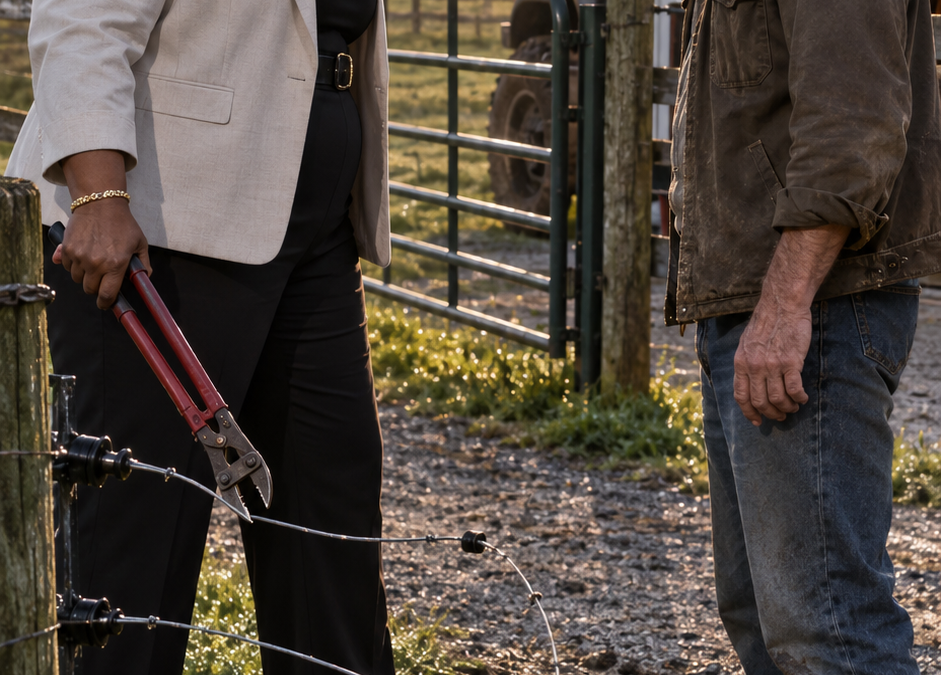
Karen stood beside the third section holding a pair of bolt cutters.
She wore a light jacket over business clothes, as though she were on her way to an ordinary meeting instead of trespassing on somebody else’s property before breakfast.
I walked outside.
“What are you doing?”
She did not stop.
“Section 4.2.”
“What?”
“Electrified perimeter installations creating a visual safety concern.”
She positioned the cutters around the wire.
“This is an enforcement action.”
“Karen, you’re on my property.”
“We’re aware.”
Snap.
The third section dropped.
I stared at her.
“That fence is permitted.”
She finally looked toward me.
“The board authorized this.”
Then she looked back down.
“It’s already done.”
There are different kinds of anger.
The loud kind is easiest.
It comes out immediately.
You shout.
You threaten.
You say something you regret because your body gets to the words before your judgment does.
What I felt that morning was different.
It became very quiet.
Because through the open side door of my garage, maybe twenty feet behind me, hung a framed county permit.
Official seal.
Building department stamp.
Site inspection approval.
Renewal from the previous spring.
The electric fence Karen was cutting had been reviewed and approved by the county.
The HOA knew that.
I had sent them a copy two years earlier.
I had the delivery confirmation.
They had even acknowledged receipt.
Yet Karen was standing inside my yard with bolt cutters as if the document did not exist.
I reached into my pocket and opened the camera application.
All four feeds were recording.
She had been inside the gate for thirty-eight minutes before I walked outside.
Everything was there.
Her arrival.
The cutters.
The first wire.
The second.
The third.
Every word.
I looked up at the camera above my garage.
Karen followed my eyes.
“Record whatever you want.”
Two neighbors had slowed on the sidewalk.
Morning dog walkers.
Karen noticed them.
Her voice became louder.
“This is what happens when homeowners ignore community standards.”
The two neighbors stopped walking.
Karen had found her audience.
“We don’t wait forever.”
I kept my voice flat.
“I want you to understand that this entire thing is being recorded.”
“The board authorized it.”
She picked up another section of wire.
“If you dispute the decision, you have forty-five days to file a written appeal.”
Forty-five days.
I almost laughed.
She had entered my deeded property without permission.
Destroyed an installation covered by a county permit.
And now she was informing me that I had forty-five days to politely ask the same organization that ordered the destruction to reconsider.
Karen packed the bolt cutters into her bag.
Then she handed me a printed notice attached to a clipboard.
“For your records.”
HOA logo.
Board seal.
Yesterday’s date.
She walked back through my gate.
She left it open.
Then she got into her car and drove away with the relaxed posture of someone who believed she had finished an unpleasant administrative task.
I stood in the yard.
Three sections of fence lay cut.
The neighbors eventually continued walking.
The street became quiet again.
I went inside.
The county permit still hung on the garage wall.
Same piece of paper it had been the day before.
But now it meant something different.
Yesterday it proved I had permission to build a fence.
That morning it proved someone had knowingly destroyed something they had no legal right to touch.
I sat at the kitchen table.
Karen’s notice was in one hand.
My phone was in the other.
I replayed the footage.
From the beginning.
6:14:03.
Karen pushed open the gate.
No knock.
No phone call.
No written request to enter.
No deputy.
No county inspector.
Just Karen Hargrove, HOA president, carrying bolt cutters.
At one point, my own voice came through the camera microphone.
“You’re on my property.”
Her answer:
“The board authorized this.”
I paused the video.
Played the sentence again.
The board authorized this.
That was important.
If Karen had acted alone, Karen had a problem.
If the board had formally voted to send her onto my property, then the HOA itself had a problem.
Every director who approved it.
Every dollar they controlled.
Every document they generated.
I opened my laptop.
It took four minutes to find the email.
Karen to the board.
Sent three days earlier.
Subject:
LOT 7 — FENCE ENFORCEMENT.
The body was short.
“Moving forward with fence removal per our enforcement authority. Motion passed 3–0. Action scheduled for Tuesday.”
Three board members had responded.
CONFIRMED.
PROCEED.
GOOD.
Tuesday was that morning.
I read the chain twice.
Then I leaned back.
Karen had not only admitted that the board authorized the destruction.
She had documented it beforehand.
I started a new folder on my computer.
The first file was the camera footage.
The second was the board email.
The third was my fence permit.
The fourth was the certified delivery receipt showing the HOA had received the permit two years earlier.
Then I made coffee.
Not because I felt calm.
Because I understood that if I wanted to win, calm was going to be useful.
I had lived in the subdivision for eight years.
During my first four, the HOA was mostly background noise.
Annual dues.
A few newsletters.
A notice one summer reminding everyone that leaf blowers were prohibited before eight in the morning.
Another about approved mulch colors.
Annoying, but ordinary.
Karen became president three years before the fence incident.
Within six months, notices started multiplying.
Residents who had lived there for a decade suddenly discovered things they had owned for years were violations.
Garden ornaments.
Garage door colors.
Parking arrangements.
Mailbox posts.
My first Karen-era citation was seventy-five dollars.
Unapproved mailbox color.
Section 6.1.
I paid it.
At the time, I told myself seventy-five dollars was not worth a fight.
That check was one of the worst decisions I made.
Because once Karen learned that my address paid without resistance, she treated compliance like a habit.
Two streets over lived Rosa.
Single mother.
Night-shift nurse.
Three children.
She received a violation for the basketball hoop in her driveway.
Then another.
Then another.
By the time the HOA threatened a lien, she owed around fourteen hundred dollars.
For a basketball hoop.
Rosa removed it.
Paid the fines.
The HOA added another two hundred dollars labeled “processing fees.”
Karen had created that category herself.
She pushed it through during a board session where only three of five directors attended.
Then there was Mr. Callaway.
Seventy-one.
Retired.
Widower.
His yard looked better than most professionally landscaped properties.
He had lived in the neighborhood longer than Karen had been on the board.
After his wife died, he started keeping every HOA letter in a folder.
“She always said you save paper when people start making rules,” he once told me.
I didn’t understand how much paper he meant until later.
There was Mr. Okafor too.
Six months before Karen cut my fence, he woke to find a handwritten poster in his front yard.
COMMUNITY VIOLATION.
REPEATED NON-COMPLIANCE.
Not an official notice.
Not a citation mailed through normal procedure.
A poster.
Black marker.
White board.
Stuck into his lawn where every neighbor walking past could see it.
Mr. Okafor had never been given a hearing.
He had not even received formal written notice before Karen publicly branded his property non-compliant.
His grandchildren were visiting that weekend.
He paid whatever the HOA demanded within forty-eight hours because he wanted the sign gone before they arrived.
He kept the sign.
On the back, in the lower corner, were Karen’s initials.
At the time, nobody knew why that mattered.
Karen’s biggest expansion of power came through something she called field enforcement authority.
I attended the meeting.
Her proposal allowed board officers to enter common areas and perform aesthetic enforcement without prior notice.
The language was vague.
Too vague.
I submitted a written objection.
I was the only homeowner who did.
The motion passed three to two.
My name appeared in the meeting minutes beside the objection.
Two years later, I installed the electric fence.
Not some improvised wire running between crooked stakes.
A permitted livestock and security installation.
The county reviewed the site.
Approved the specifications.
Inspected the work.
Stamped the permit.
As a courtesy, I sent the HOA a copy.
Two months later, Karen’s office sent me a violation notice citing Section 4.2.
I replied in writing.
Attached the permit again.
Included the relevant county code.
Their office confirmed receipt.
Then nothing happened.
For two years.
I assumed the issue had died.
What I discovered that morning was that Karen had simply waited.
Now she had brought cutters.
Destroyed the installation.
Then offered me forty-five days to appeal.
I exported all four camera feeds.
Separate cloud accounts.
Physical drive.
Three backups.
Every file labeled by timestamp and camera location.
Only after that did I call Karen.
Her assistant put me on hold.
Four minutes.
Karen answered.
“What can I do for you?”
“This morning you entered my private property without permission and destroyed a county-permitted installation.”
Silence.
“I need two things.”
“What?”
“Your HOA insurance carrier information and written documentation of the legal authority you relied upon.”
“The fence violated Section 4.2.”
“That wasn’t my question.”
“We acted within the board’s enforcement authority.”
“Did the full board vote to authorize entry onto my specific property and removal of my fence?”
A pause.
Short.
“All enforcement actions are board sanctioned.”
“That still isn’t my question.”
“You can file an appeal.”
“I’d like your answer in writing.”
“You’ll receive the standard enforcement notice.”
She hung up.
I stared at the phone.
Karen had avoided saying one important thing.
She had not said:
Yes, the full board legally voted.
I already had the email.
Three to zero.
But there were five directors.
That detail bothered me.
I put my phone in my pocket and drove to the county police station.
I took my laptop.
The duty officer was younger than me.
Calm.
Methodical.
I played the video.
He watched all thirty-eight minutes.
When it ended, he looked at me.
“She entered your property.”
“Yes.”
“That whole area is deeded to you?”
“Yes.”
“No easement?”
“None.”
“Common area?”
“No.”
He asked about the fence.
I handed him a copy of the permit.
He checked the county stamp.
Renewal.
Lot number.
Inspection.
“We can open trespass.”
He paused.
“And criminal mischief for property destruction.”
“The replacement cost?”
He looked at the permit records.
“Enough to clear the misdemeanor threshold.”
He generated a case number.
I left with the report.
From there, I drove directly to the courthouse.
I filed a civil action for trespass and destruction of permitted property.
With it, I filed a request for temporary emergency relief preventing the HOA from recording any lien against my home while the dispute was pending.
My attachments included:
The permit.
Four camera feeds.
Karen’s authorization email.
The three board confirmations.
The police case number.
The clerk stamped everything.
The request went to the duty judge.
By the time I drove home, it was a little after noon.
At 3:47 p.m., the HOA emailed me.
Official letterhead.
Board seal.
The fence, it said, had been removed under proper enforcement authority after repeated non-compliance.
The matter was considered resolved.
I had forty-five days to appeal.
No mention of the county permit.
No mention of Karen cutting through my fence.
No mention of the criminal complaint filed hours earlier.
No mention of the board email.
They genuinely believed it was finished.
I printed the notice.
Added it to the folder.
Then Karen sent one last message.
“We consider this matter closed.”
I printed that one too.
Closed.
I remember thinking that was exactly the right word.
Just not in the way she intended.
Word moved through the neighborhood before dinner.
Two people who had seen Karen cutting the fence came to my house.
Mr. Callaway was one.
The other was a woman from the next block I had seen at the mailboxes for years but barely knew.
“She did something similar to us,” the woman said.
“Different issue.”
Mr. Callaway remained quiet.
Then he said:
“I’ve been keeping records.”
“How many?”
“All of them.”
He went home.
Thirty minutes later, he returned carrying a heavy manila folder.
We sat at my kitchen table.
Twenty-three fine notices.
Eighteen months.
Some cited violation codes that did not appear anywhere in the HOA’s published bylaws.
Three separate fines had been issued for the same alleged violation before any appeal period opened.
Then I found a $3,200 charge.
Garden border encroachment.
Section 7.3.
Common-area boundary violation.
Behind it was a licensed survey.
Mr. Callaway had paid a surveyor to establish his exact property lines.
Conclusion:
The garden border was fully within his property.
No encroachment.
Not even a quarter inch.
“You gave them this?”
“Yes.”
“And they still collected the money?”
“Yes.”
“Why did you pay?”
His eyes dropped.
“I was tired.”
That answer hurt more than anger would have.
He continued.
“My wife was sick by then.”
I said nothing.
“She told me to keep the paperwork.”
He tapped the folder.
“After she passed, I kept doing it.”
I looked again at the survey.
A $3,200 fine.
For an encroachment that did not exist.
“I’m going to need copies.”
“I already made two sets.”
That was Mr. Callaway.
Careful.
Patient.
Prepared.
Rosa arrived later.
She stood on the porch a moment before knocking.
That hesitation told me she had almost turned around.
She brought bank statements.
Fourteen months.
Two withdrawals immediately stood out.
$180.
$220.
No matching violation notice.
No assessment letter.
When she questioned the charges, the HOA sent a form response describing them as “administrative assessment fees” and “standard operational recovery charges.”
Neither category existed in the bylaws.
Under state requirements, special assessments outside ordinary published dues required proper notice and member authorization.
Rosa had received neither.
They simply took the money.
“You stopped asking?”
She looked embarrassed.
“Yes.”
“Why?”
“I had three kids and night shifts.”
She shrugged.
“They sounded like they knew what they were doing.”
That sentence explained most abusive systems better than any law book could.
Mr. Okafor came after dinner.
He carried a plastic storage bin.
Inside was the handwritten sign Karen had placed in his yard.
The marker had faded.
I flipped it over.
There.
Bottom corner.
Karen’s initials.
I placed it beside Mr. Callaway’s survey and Rosa’s bank statements.
Then I pulled the HOA’s latest financial report.
Reserve fund:
$214,000.
Operating account:
$31,000.
Total:
$245,000.
I wrote the number on a blank sheet.
By nine that night, the folder contained forty-two pieces of evidence.
Six neighbors.
Fine notices.
Bank statements.
Survey.
Handwritten sign.
Board minutes.
Email chain.
Permit.
Police report.
Camera footage.
What had begun as three cut sections of fence was turning into something much larger.
Mr. Callaway’s wife had been right.
The paper mattered.
The next morning, a certified letter arrived.
Law firm letterhead.
Three paragraphs.
The first described my fence as an unauthorized dangerous installation violating Section 4.2.
The second informed me the HOA intended to record an $18,500 lien for enforcement costs, remediation fees, and safety restoration.
The third threatened a $75,000 lawsuit against me personally for endangerment, property devaluation, and willful covenant violations.
Seventy-five thousand dollars.
For a fence the county had approved.
I read the attachments.
Then I saw something more important.
The law firm retainer had been paid out of the HOA reserve account.
Karen had signed the withdrawal authorization.
Their own bylaws required full membership approval for legal expenditures above $5,000.
No vote had occurred.
Karen had taken money belonging collectively to ninety-six homeowners and used it to hire lawyers to defend her own decision to enter my property.
I added the letter to the file.
Then called the courthouse.
The clerk checked my case.
“The temporary restraining order was granted.”
“When?”
“6:52 this morning.”
Before I had even opened the lawyer’s letter.
The order prohibited the HOA from recording a lien during the case.
Then the clerk mentioned something else.
The HOA’s lien paperwork had reached the county recorder at 9:04.
The recorder received the court order at 9:41.
The lien existed in procedural limbo for thirty-seven minutes.
Then it was frozen before it could attach to my title.
I had expected them to escalate.
Karen’s pattern was obvious.
Fine.
Threat.
Lien.
Foreclosure language.
Make the homeowner believe resistance will cost more than surrender.
This time, the court order was already waiting.
At 10:15, my phone rang.
A board member.
He identified himself carefully.
“I voted against what Karen did.”
“Okay.”
“There were five of us on the board.”
“I know.”
“She notified three.”
I sat straighter.
“What about the other two?”
“We were excluded.”
“You were never told there was a vote?”
“No.”
“So when she said three-to-zero—”
“It wasn’t a properly noticed board vote.”
He sounded ashamed.
“She contacted the people she knew would agree.”
“Will you put that in writing?”
“Yes.”
Before the call ended, he sent a screenshot.
A text Karen had sent the previous night.
“We have the homeowner cornered. The lien will force a settlement.”
I read it twice.
The whole case shifted.
The board email had already established intent.
Now the quorum defect suggested there had never been a valid board authorization at all.
Karen had effectively created her own vote.
Then used it to enter private property.
Then tried to fund the defense with HOA reserves.
I called six neighbors.
“There’s a hearing tomorrow.”
Nobody hesitated.
Mr. Callaway was last.
“What time?”
“Nine.”
A pause.
Then:
“I’ve been waiting three years for someone to do something.”
That evening I organized everything.
Permit.
Video.
Email.
Police report.
Court filing.
Board member affidavit.
Karen’s text.
Blocked lien.
Law firm retainer.
Reserve withdrawal.
Neighbor records.
I did not need more evidence.
I needed clean evidence.
That afternoon, Karen announced an emergency HOA meeting for seven o’clock.
Eight hours before court.
The parking lot overflowed.
Normally, twelve people attended.
Maybe fifteen.
That night, there were more than forty.
I sat near the back.
No folder.
No papers.
I had nothing to prove in that room.
Karen stood at the front.
She had enlarged a photograph of my fence and mounted it on an easel.
“As many of you are aware,” she began, “the board took enforcement action yesterday concerning a prohibited electrified installation.”
She talked about safety.
Children.
Pets.
Visual standards.
She described my fence as a longstanding hazard.
She did not mention the permit.
She did not mention the criminal case.
She did not mention the court’s temporary order.
Then she accused me of “weaponizing the court system” against the community.
“The board will not be bullied.”
A woman raised her hand.
“Did the county approve his fence?”
Karen shifted.
“The permit status is under legal review.”
That was false.
Another homeowner asked:
“Did you have permission to enter his property?”
Karen cited field enforcement authority.
Someone else asked:
“What about my lien?”
“This is not the forum for individual grievances.”
Question after question.
Answer after non-answer.
I watched the room change.
Forty-three people.
Many had arrived curious.
They were becoming suspicious.
Rosa wrote in a notebook.
Mr. Callaway sat absolutely still.
Karen never looked at me.
Her closing statement lasted less than a minute.
“Tomorrow, we finalize this matter in court.”
She straightened.
“The board will prevail.”
Then:
“The community will be protected from homeowners who believe municipal permits override our covenant standards.”
I almost felt sorry for her.
Almost.
Because by nine the next morning, a judge was going to explain exactly what a county permit meant.
After the meeting, three homeowners approached me in the parking lot.
“If you need people in court, I’ll be there.”
“Me too.”
I thanked them.
Then went home.
I did not reopen the file.
At 8:45 the next morning, I entered Courtroom Four.
Small room.
Wood paneling.
Fluorescent lights.
Three rows behind the bar.
I placed my folder on the plaintiff’s table.
Permit first.
USB drive.
Board email.
Everything in sequence.
Karen arrived at 8:58.
Attorney.
Three board members.
She looked composed.
Mr. Callaway sat in the front row.
Rosa beside him.
Mr. Okafor.
Several others.
Eleven homeowners had come without subpoenas.
The judge entered at 9:02.
The HOA attorney began.
Professional.
Controlled.
He argued that Section 4.2 prohibited my fence.
That the HOA had field enforcement authority.
That I had received notices.
That the board’s removal was lawful.
Then he addressed the permit.
“The homeowner provided an informal courtesy copy.”
Courtesy.
I wrote the word down.
“It was never formally approved by the HOA.”
When he finished, I stood.
I placed the permit before the judge.
“Your Honor, this is not an informal permit.”
County Building Department.
Inspection certification.
Official approval stamp.
Lot number.
Renewal.
“I provided the HOA a courtesy copy when the fence was installed. After they sent a Section 4.2 notice, I submitted it again formally with my written response. Their office confirmed receipt.”
The judge looked toward counsel.
“Is there a county ordinance subordinating a valid county permit to HOA enforcement on deeded private property?”
The attorney searched his papers.
“Not specifically, Your Honor, but—”
“Then the permit is valid.”
He set it down.
“The Section 4.2 citation against this installation is void.”
That was it.
No shouting.
No speech.
Just twelve words that ended two years of manufactured ambiguity.
Karen shifted behind her attorney.
I handed the clerk the USB drive.
The courtroom monitor came alive.
6:14:03 a.m.
Karen entered my gate.
Bolt cutters in hand.
She walked directly to the fence.
No knock.
No notice.
No attempt to speak with me.
She cut the first section.
Then the second.
Then the third.
The sound of wire snapping filled the courtroom.
Then my voice.
“You’re on my property.”
Karen’s reply:
“The board authorized this. It’s already done.”
The judge watched all of it.
When the footage ended, he repeated:
“The board authorized this.”
He looked toward the attorney.
“Is that accurate?”
Counsel leaned toward Karen.
Then stood.
“The board exercised authority under Section 9.4.”
“On private deeded property?”
Silence.
“After receiving a valid county permit?”
More silence.
I submitted Karen’s email.
Motion passed 3–0.
Action scheduled Tuesday.
Three confirmations.
The judge read it.
“How many directors sit on this board?”
“Five.”
“Were all five notified?”
“No, Your Honor.”
I stood.
“I have a signed affidavit from one excluded director stating that two members were deliberately not notified.”
Karen’s attorney placed his pen down.
He never picked it up again.
One board member leaned toward Karen.
She did not respond.
The judge addressed them.
“When an association intentionally authorizes entry onto private property and destruction of a lawful permitted installation, this ceases to be an ordinary covenant dispute.”
He paused.
“This was coordinated destruction of private property.”
Nobody moved.
I presented the attempted lien.
Filed after the police case.
I presented Karen’s email declaring the matter closed.
I presented the $75,000 lawsuit threat.
Then the legal retainer paid from HOA reserves without the membership authorization required by their own bylaws.
The judge made notes.
I handed over Mr. Callaway’s records.
The $3,200 fine.
The certified survey proving the alleged encroachment never existed.
Two notices citing nonexistent violation codes.
The judge looked toward me.
“Are these isolated examples?”
“No, Your Honor.”
“How many similar records?”
“Six households represented today. Possibly more.”
“Were notice and hearing requirements followed?”
“In the materials I reviewed, several collections appear to have occurred before mandatory process was completed.”
He wrote for a long time.
Then he ruled.
First:
The attempted lien against my property was permanently dismissed.
Second:
The HOA was ordered to restore my electric fence to its original permitted specifications within ten days.
Third:
The HOA was ordered to reimburse my documented damages, permit costs, restoration costs, and filing expenses.
$22,400.
Then the judge reached the part Karen had not expected.
“Based upon the evidence presented suggesting a broader pattern of potentially defective fine and assessment collection…”
He looked toward counsel.
“The court orders the association’s reserve and operating funds placed into supervised escrow pending audit.”
Karen finally lifted her head.
Reserve fund:
$214,000.
Operating account:
$31,000.
Total:
$245,000.
Every dollar the HOA controlled.
Frozen.
Nobody could write a check.
Nobody could move funds.
Nobody could pay Karen’s lawyers without approval.
Nobody could continue using homeowner money as an enforcement weapon.
The judge continued.
The audit would review three years of fines.
Any money collected without required notice and hearing procedures would be returned to affected homeowners.
Then he referred Karen’s authorization email and related documents to the county district attorney for review concerning criminal trespass.
The gavel came down at 9:47.
Karen sat perfectly still.
Her attorney leaned toward her.
Whispered something.
She answered quietly.
Behind them, the three directors began speaking urgently.
One stood.
Another pulled out a phone.
In the gallery, Rosa covered her mouth with both hands.
Mr. Callaway exhaled.
Slow.
Complete.
The sound of a man finally setting something down.
I looked at the county permit sitting beside the judge.
It had hung on my garage wall for four years.
Karen had seen it.
Her HOA had received it.
She had simply decided her title was stronger than the document.
It wasn’t.
Three weeks later, the audit was complete.
The court-appointed auditor examined every fine, assessment, collection letter, hearing record, and payment during the previous three years.
He built a spreadsheet.
Of the $214,000 reserve fund, approximately $91,000 had come from collections that failed procedural requirements.
Fines assessed before appeal windows.
Charges using codes not found in published rules.
Collection demands mailed before hearings.
Assessments lacking required notice.
$91,000.
Returned.
Mr. Callaway’s check was $3,200.
Exactly what the HOA had taken for the imaginary garden encroachment.
He came to my door when it arrived.
He held up the envelope.
“She got her money back.”
I knew he meant his wife.
The folder had been hers first.
“She was right,” I said.
He nodded.
“It mattered.”
Then he walked home.
Rosa received $1,840.
She called me after the deposit cleared.
“You know what I bought?”
“What?”
“A basketball hoop.”
I smiled.
“Same place?”
“Exactly the same place.”
Her children helped assemble it in the driveway.
No citation arrived.
No processing fee.
No threat.
Mr. Okafor’s refund was smaller.
But the new interim board issued him something that mattered more.
A formal written retraction.
The yard sign had been improperly issued without required process.
The alleged violation was void.
No legal effect.
He framed the retraction.
Hung it in his garage.
Right beside the nail where he had once hung Karen’s handmade humiliation sign.
The HOA’s law firm withdrew ten days after the ruling.
With the accounts frozen, Karen could no longer spend neighborhood money freely.
The $75,000 lawsuit against me disappeared.
Withdrawn without condition.
No settlement.
No apology.
It simply stopped existing.
The district attorney sent certified letters to Karen and the directors involved.
The trespass matter remained under review.
I do not need to pretend every bad decision ends with handcuffs.
Life is rarely that clean.
Sometimes consequences are enough before punishment becomes final.
Those letters existed.
Karen knew they existed.
The directors knew.
The neighborhood knew.
The next board election drew sixty-one homeowners.
Normal attendance was around twelve.
Karen ran again.
Same chair.
Same posture.
Same water glass.
Same practiced expression.
The ballots were counted.
Karen received two votes.
Both belonged to members of her household.
She did not argue.
She did not make a speech.
She collected her papers.
Picked up her pen.
Carried her water glass.
Then walked out through the side door.
The door closed behind her.
Ordinary sound.
That was all.
The new board took office.
Their first vote was unanimous.
Five to zero.
Field enforcement authority was repealed.
Gone.
No board officer could enter private property without written homeowner permission or lawful public authority.
Their second action was a one-page notice sent to all ninety-six homes.
It explained that future enforcement would require proper written notice.
Hearings.
Documented authority.
Due process.
No surprise entry onto private property.
At the bottom were five names.
No oversized seal.
No threatening language.
One sentence:
“This community belongs to all of us.”
Ten days after the court ruling, a contractor came to my house.
The HOA hired him under the judge’s order.
He measured every damaged section.
Reset the posts.
Reinstalled the wire.
Reconnected the electric system.
He worked quietly.
I appreciated that.
When he finished, he handed me a receipt.
Then drove away.
Before dark, I walked the entire perimeter.
Posts straight.
Wire correct.
Everything back where it belonged.
I returned the county permit to its frame on the garage wall.
The cameras remained on.
Not because I feared another Karen.
They had always been there.
No reason to change that.
A few mornings later, I walked outside a little after six.
Almost the same time Karen had entered my property.
The light was flat.
Grass wet.
Street silent.
I stopped at the gate.
The footprints were gone.
Rain and time had erased them.
The cut wire was gone.
The coils that had lain in the grass were gone.
The damaged wood had been replaced.
I touched one of the new posts.
Then listened.
The fence gave off the low, almost inaudible electrical hum it had always made.
Legal.
Permitted.
Mine.
I thought about what Karen had believed.
She believed the board’s authority began where homeowner resistance ended.
She believed a seal at the top of a notice could turn an opinion into law.
She believed a vote did not need everyone who was entitled to participate as long as enough people agreed with her.
She believed reserve funds belonged to the board because the board controlled the bank account.
She believed neighbors would pay because they always had.
Rosa paid.
Mr. Callaway paid.
Mr. Okafor paid.
I had paid once too.
Seventy-five dollars for a mailbox.
That first payment taught Karen something about me.
The wrong thing.
She thought I did not fight.
The truth was that I did not fight over everything.
There is a difference.
Not every disagreement deserves war.
Not every bad notice deserves a lawyer.
Sometimes seventy-five dollars is cheaper than a month of your life.
But there is a line.
Karen crossed mine at 6:14 on a Tuesday morning.
Not when she disagreed with the fence.
Not when she sent the notice.
Not when she cited Section 4.2.
She crossed it when she decided that disagreement gave her the right to enter my land with bolt cutters.
After that, the argument was no longer about neighborhood aesthetics.
It was about whether authority has limits.
It does.
A title does not erase property rights.
A board vote does not repeal county law.
A homeowners association cannot transform a valid permit into contraband because one president dislikes the way it looks.
And money collected from homeowners does not become a private war chest simply because the board president can sign a withdrawal form.
Karen found that out in the hardest possible way.
The part I remember most, though, is not her losing the election.
It is not the judge freezing $245,000.
It is not even the footage playing in court.
It is Mr. Callaway standing at my door holding that refund check.
“She got her money back.”
His wife had died believing the papers mattered.
She had kept them because she understood something Karen had forgotten.
Power gets loud.
Records stay quiet.
But when somebody finally opens the folder, quiet can be enough.
Rosa’s children play basketball in that driveway now.
Mr. Okafor has a framed retraction in his garage.
Mr. Callaway no longer keeps new HOA notices in the old folder because there are not many notices anymore.
The board still exists.
It collects dues.
Maintains the common areas.
Repairs lights.
Handles the ordinary things a neighborhood association is supposed to handle.
Nobody abolished it.
That was never the point.
The point was making it ordinary again.
An HOA should not be the most powerful thing in your life.
It should be something you occasionally remember when the annual statement arrives.
That is what ours became.
Sometimes I still see Karen.
She lives here.
She drives past.
We do not speak.
I do not need her apology.
I do not need her to admit she was wrong.
A judge already did the important part.
The fence is standing.
The money went back.
The rules changed.
And nobody has entered my gate without permission since.
That is enough.
One morning, months later, I stopped beside the same section she had cut first.
Sun coming through the trees.
Wet grass.
Nothing unusual.
That was what struck me.
Nothing.
No clipboard.
No bolt cutters.
No white-knuckled anger in my chest.
Just an electric fence humming softly around my own property.
Exactly where it had every legal right to be.
Karen had walked into my yard thinking she was showing the neighborhood what happened when someone ignored the HOA.
She did show them something.
Just not what she intended.
She showed ninety-six homeowners what happened when someone finally made the HOA prove it had the power it claimed.
And once the judge looked at the proof, he did not just stop Karen.
He put every dollar she controlled behind a court order until the truth could be counted.
Dollar by dollar.
Fine by fine.
Neighbor by neighbor.
Three days earlier, Karen had stood in my wet grass with bolt cutters and told me:
“The board authorized this.”
She had meant it as the end of the conversation.
Instead, it became the sentence that opened everything.








