𝗣𝗔𝗥𝗧 𝟮 HOA Karen Cut Through My Farm Gate for a “Surprise Inspection” — She Had No Idea the Man Watching Her Was FBI
𝗣𝗔𝗥𝗧 𝟮
When the developer created Meadow Ridge, the recorded boundary had been drawn broadly.
Too broadly.
On the map, the association line wrapped around my grandfather’s fourteen acres.
But drawing a line around somebody’s property does not make it yours.
My grandfather never signed the covenants.
He knew exactly what the developer was trying to do.
He sent them a certified letter contesting the inclusion of the farm.
Typed.
Signed.
Certified mail receipt stapled to the copy.
The developer never answered.
The HOA never answered.
That letter sat in his filing cabinet for eleven years.
The previous HOA boards apparently understood the practical reality.
The subdivision managed its houses.
Walt managed his farm.
Then Denise Caldwell became president.
She had held the position for four years before I had any reason to care who she was.
The first violation letter arrived six months before she cut my gate.
Tuesday afternoon.
Heavy envelope.
HOA logo.
Three alleged violations.
OVERGROWN VEGETATION.
UNAUTHORIZED AGRICULTURAL STRUCTURES.
UNAPPROVED FENCING.
I read it twice at my kitchen table.
Then looked outside.
The “overgrown vegetation” was the hayfield.
The “unauthorized agricultural structure” was my grandfather’s barn.
The “unapproved fencing” was a wooden post fence that existed before Meadow Ridge had streets.
At first, I assumed the letter was administrative stupidity.
I wrote back.
Professional.
Calm.
The farm predates Meadow Ridge.
My grandfather never joined the association.
The existing agricultural uses predate the covenants.
I requested a meeting.
Sent it certified.
Kept the receipt.
Three weeks passed.
No answer.
Then another envelope arrived.
$350 fine.
FAILURE TO COMPLY WITH PROPERTY STANDARDS REVIEW.
No response to my letter.
No meeting.
No explanation.
I stood in the kitchen holding that fine notice and felt something change.
People make mistakes.
Bureaucracies lose mail.
But someone who receives certified correspondence and answers it with a fine is making a choice.
Denise did not want clarification.
She wanted compliance.
I opened my grandfather’s fireproof safe.
He had kept it behind an old filing cabinet.
Inside was a leather folder containing everything that mattered.
Original deed.
County survey from 1961.
Tax records.
And one document I had seen before but never properly read.
AGRICULTURAL EASEMENT.
Recorded thirty-two years earlier.
I sat at the kitchen table and read it line by line.
The parcel had specific protections for agricultural use.
Crop cultivation.
Livestock.
Agricultural structures.
Fencing.
Farm access.
The county had recorded those rights decades before Meadow Ridge existed.
Everything Denise called a violation was explicitly protected.
The barn.
Protected.
Hayfield.
Protected.
Fence.
Protected.
Then I pulled out Walt’s annexation objection.
Certified mail.
Receipt.
No response.
Two facts were now clear.
The HOA had never resolved whether it could legally bind the property.
And even if it somehow could, the county-recorded agricultural easement protected the exact uses it was citing.
I could have called Denise.
I didn’t.
Instead, I attended the next board meeting.
The community center looked exactly like every homeowners association meeting room in America.
Fluorescent lights.
Laminate table.
Folding chairs.
Burnt coffee.
Denise sat at the head.
Three board members beside her.
About fifteen residents behind me.
She went through budgets.
Landscaping.
Parking complaints.
Pool hours.
When open comments began, I stood.
“My name is Kyle Fletcher. I own the fourteen-acre farm on the south boundary.”
Denise looked at me.
“I have received two violation notices and a fine.”
“Go ahead, Mr. Fletcher.”
I placed copies of the documents on the table.
“This deed predates Meadow Ridge.”
Then the easement.
“This agricultural easement has been recorded with the county for thirty-two years.”
I pointed to the protected uses.
“Cultivation. Barn structures. Fencing.”
Then Walt’s letter.
“My grandfather contested inclusion in the HOA eleven years ago. Certified mail. The association never responded.”
One board member at the far end leaned forward.
Older man.
Reading glasses on his forehead.
Ed Brewer.
He pulled the easement closer.
Actually read it.
The other two watched Denise.
I finished.
“The farm was never lawfully subjected to your covenants.”
Under four minutes.
No accusations.
No threats.
Denise never touched the documents.
“The board has authority over all parcels inside Meadow Ridge’s recorded boundary.”
“Drawing a boundary around a property doesn’t create a covenant.”
“We will review your paperwork.”
She paused before the word.
Paperwork.
Like I had handed her a child’s drawing.
I didn’t argue.
The following morning, I mailed a formal request for written findings.
Certified.
Thirty-day response period under the HOA bylaws.
Two weeks passed.
Nothing.
Then I stopped at the neighborhood mailbox cluster.
Pinned to the bulletin board was a meeting notice.
EMERGENCY BOARD MEETING.
Five days later.
One agenda item:
GRANT PRESIDENT EMERGENCY INSPECTION AUTHORITY FOR NONCOMPLIANT PROPERTIES.
I photographed it.
Date and time visible.
No one had personally notified me.
I called the HOA office.
Voicemail.
I objected in writing.
Requested postponement.
Cited the notice provisions.
No response.
The meeting happened.
Three days later, a letter arrived informing me that the board had voted three to one to grant Denise emergency entry authority.
The only dissenting vote:
Ed Brewer.
I wrote his name down.
There is a point in every investigation where you stop asking whether the other person is mistaken and start asking whether they are lying.
Denise was approaching that line.
I filed a records request for every violation report tied to my parcel.
Ten-business-day deadline.
Nothing.
Fifteen days.
Nothing.
Twenty.
I sent another demand.
Then one evening, my phone buzzed.
Unknown number.
CHECK YOUR PORCH.
I opened the door.
A manila envelope sat on the mat.
Inside:
Twelve violation reports.
Three months.
Every one signed by Denise.
I never proved who left them.
I didn’t need to.
I suspected Ed.
I spread the pages across the table.
At first, the pattern looked ordinary.
Dates.
Violation categories.
Notes.
Then two reports jumped out.
March 14.
EXCESSIVE DEBRIS AND UNCONTAINED WASTE MATERIALS.
March 14 was a Tuesday.
I had spent that entire day at Quantico.
7:00 a.m. until after 6:00 p.m.
Sign-in logs.
Parking record.
Dozens of witnesses.
Nobody had been home.
And there had never been debris.
The second report:
April 2.
UNAUTHORIZED MODIFICATION TO BOUNDARY FENCING.
I had been in Philadelphia for three days.
I had not touched the fence.
Then I examined the attached photographs.
A chain-link fence.
Rusted sedan sitting on concrete blocks.
Gravel yard.
Metal shed.
I looked through my kitchen window.
Wooden post fence.
No chain link.
No cars.
Hay.
Timber barn.
The photograph was not my property.
Neither were the other two photo sets.
Different fences.
Different structures.
Different driveways.
Three reports containing photographs from other properties and identifying them as mine.
Two violations dated on days when the events described could not have occurred.
Twelve reports in total.
This wasn’t aggressive enforcement.
It was fabrication.
I did what training teaches you to do before emotion destroys evidence.
Document.
Photograph.
Compare.
Timestamp.
I photographed the actual fence from matching angles.
The barn.
Driveway.
Field.
Created side-by-side comparisons.
Cross-referenced dates.
Saved copies in more than one place.
Then stopped.
I didn’t expose it yet.
Because three days later, I learned Denise had already sent the reports somewhere else.
Paul Dawson caught me at the mailbox.
His family had owned the pasture before the subdivision.
“County’s asking about your place.”
“What?”
“Code enforcement.”
“Why?”
“Complaint.”
“From who?”
He gave me a look.
I already knew.
I called the county.
The inspector confirmed a formal complaint from the Meadow Ridge HOA president.
Twelve reports attached.
Photographs.
Alleged ongoing agricultural violations and unsanitary conditions.
The inspector was professional.
“We’re required to inspect.”
“When?”
“Within ten days.”
“If the reports are false?”
“Then we’ll close it.”
“And if you accept them?”
“We don’t accept anything without looking. But if violations exist, county citations may follow.”
Denise had taken falsified internal reports and handed them to a government agency.
That mattered.
A county citation would create something she did not currently have:
Independent-looking validation.
Then the HOA lien would appear more reasonable.
Her emergency-inspection authority would look justified after the fact.
I could have sent the county my evidence immediately.
But that would reveal everything I knew.
I decided to wait.
Eight days later, I left before dawn for work.
Ninety-minute drive to Washington.
At my desk by 7:30.
Normal Tuesday.
At 11:14, my phone vibrated.
FARM GATE — MOTION DETECTED.
I opened the camera app.
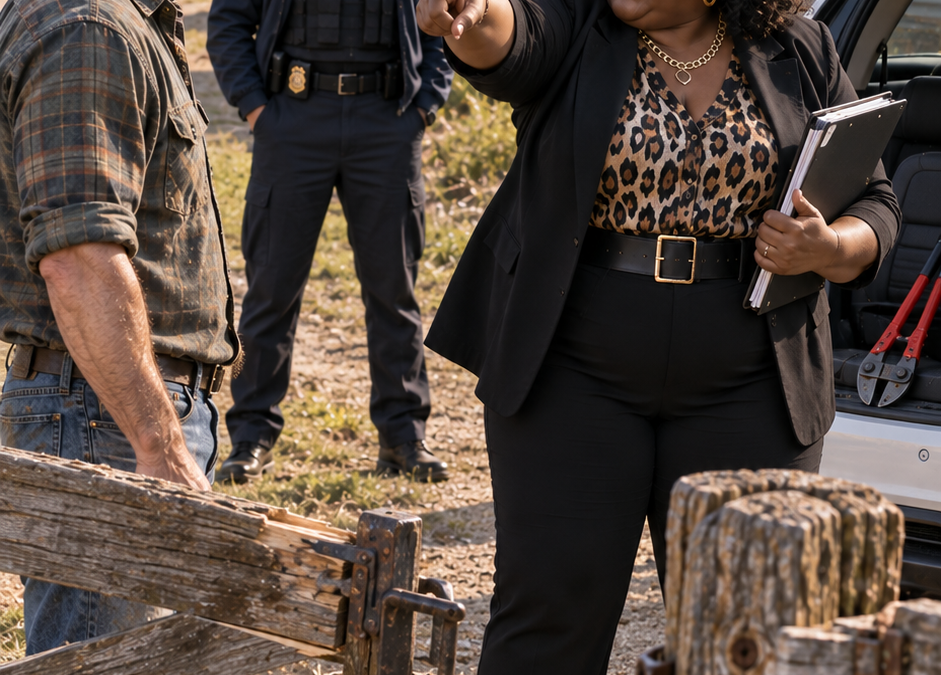
Denise Caldwell stood outside the locked gate.
Tina Marsh, the HOA office assistant, stood behind her holding a clipboard and camera.
Denise was holding bolt cutters.
I sat completely still.
On screen, she positioned the jaws around my padlock.
Squeezed.
Metal snapped.
The lock fell into the dirt.
She pulled the gate.
The iron latch bent.
Then she drove her white SUV onto my property.
I had spent sixteen years investigating people who eventually discovered they had been recorded doing something they believed nobody would ever see.
It is extraordinary how normal they look while doing it.
Denise walked through the farm for twenty-five minutes.
Photographed the barn.
Orchard.
Fence.
Hayfield.
House.
Tina wrote notes.
Neither knocked.
Neither called.
Neither tried to see whether anyone was present.
At the barn, Denise said:
“He’s not going to do anything about it.”
The microphone caught every word.
She sounded almost bored.
That sentence bothered me more than the lock.
She had decided what kind of man I was.
Quiet.
Polite.
Reluctant.
Easy to pressure.
She believed courtesy meant weakness.
They taped a failure notice to my front door.
Then left.
I stayed at my desk for another few minutes.
A colleague passed.
“You good?”
“Fine.”
He looked at me.
Kept walking.
I left two hours early.
When I reached the farm, everything matched the video.
Lock in dirt.
Latch twisted.
Tire tracks.
Failure notice on the door.
IMMEDIATE CORRECTIVE ACTION REQUIRED.
FAILED INSPECTION.
NONCOMPLIANCE WILL RESULT IN LIEN PROCEEDINGS.
I held the cut lock.
Looked at the clean bite through the shackle.
Then at the latch my grandfather had forged himself.
Bent fifteen degrees.
That was when the problem changed.
This was no longer paperwork.
Someone had deliberately destroyed property to enter land after being told in writing that her authority was disputed.
I considered calling the sheriff immediately.
Then stopped.
A local misdemeanor trespass report would take months.
Denise would wave the emergency board authorization.
Her lawyer would argue good-faith HOA enforcement.
Meanwhile, the lien process would continue.
What bothered me more was the amount of effort.
Fake reports.
Fake photographs.
County complaint.
Emergency authority.
Physical entry.
Why?
Nobody spends this much time trying to regulate a fourteen-acre hayfield unless the hayfield matters.
So I started researching Meadow Ridge’s original developer.
Crestline Development Group.
They had built the subdivision eight years earlier.
Public filings showed they had not disappeared.
There was a pending county planning application.
High-density residential.
One hundred twenty townhomes.
Proposed site:
Fourteen acres.
Parcel 14-A.
Fletcher Farm.
I read it three times.
My property.
Then I pulled Crestline’s corporate filings.
Managing partner:
Gerald Caldwell.
I sat back.
Denise Caldwell’s brother-in-law.
Everything suddenly lined up.
The farm was not a code-enforcement nuisance.
It was the missing development parcel.
Crestline wanted fourteen contiguous acres.
My grandfather’s land.
Manufacture violations.
Create fines.
Turn fines into a lien.
Use the lien to pressure the owner.
Drain him in litigation.
Make a sale look easier than fighting.
Then Gerald Caldwell’s company acquires the property and builds one hundred twenty townhomes.
I printed everything.
Corporate registrations.
Planning application.
Parcel maps.
Added them to the violation reports.
Security footage.
Easement.
My grandfather’s letter.
Then Denise sent the next notice.
EMERGENCY BOARD MEETING.
Six days.
Vote on forced compliance and property lien against parcel 14-A.
There it was.
Endgame.
A recorded lien clouds title.
Creates expenses.
Creates leverage.
Makes every future decision harder.
Six days before a three-person majority board could put one on my grandfather’s farm.
I sat on the porch at sunset.
The hayfield moved in the wind.
I had evidence.
A lot of it.
But Denise had already demonstrated what she did with paper she didn’t like.
She ignored it.
If I walked into another meeting with documents, she’d give me five minutes.
Then call a vote.
I went inside.
Opened a bedroom drawer.
Reached underneath some work papers.
Pulled out a leather credentials case.
I opened it.
Federal Bureau of Investigation.
Badge.
Photograph.
Name.
SPECIAL AGENT KYLE FLETCHER.
Sixteen years.
No one at Meadow Ridge knew.
I had never shown it to a neighbor.
Not Paul.
Not Ed.
Not anyone.
At the farm I wanted to be Kyle.
Not Agent Fletcher.
I placed the credentials beside the cut padlock.
Then called Ed Brewer.
He answered quickly.
“The emergency meeting.”
“Yes?”
“Open to the membership?”
Pause.
“Technically.”
“Will Denise try to limit attendance?”
“She usually doesn’t advertise emergency sessions.”
“She should advertise this one.”
Another pause.
Then:
“I understand.”
Thursday.
6:15 p.m.
Meadow Ridge community center.
Over forty residents showed up.
Usually there were fifteen.
Ed had made calls.
Denise noticed immediately.
Her eyes swept the room.
Found me.
Moved on.
She sat at the table.
Two allies to her right.
Ed at the far end.
“Let’s begin.”
Straight to parcel 14-A.
Denise summarized twelve violation reports.
Failed inspection.
County complaint.
Photographic evidence.
“Mr. Fletcher has repeatedly refused compliance.”
She placed papers on the table.
“The board’s recommendation is to authorize forced corrective action and file a property lien.”
She looked toward her allies.
“I’ll take a motion.”
Ed raised a hand.
“Point of order.”
Denise’s jaw tightened.
“Yes?”
“The owner is here.”
“This is not a hearing.”
“The bylaws permit an affected owner to speak before enforcement action.”
“We already heard Mr. Fletcher.”
“Not before this action.”
She stared at him.
Ed lowered his glasses.
“Unless we aren’t using the bylaws tonight.”
Silence.
One allied board member shifted.
The other shrugged.
Denise breathed out.
“Five minutes.”
I stood.
Carried one folder forward.
Set it down.
“Thank you.”
I began with jurisdiction.
County-recorded agricultural easement.
Thirty-two years old.
I held up the seal.
“This protects crop use, agricultural structures, and fencing.”
Placed it down.
Then Walt’s letter.
“My grandfather disputed HOA annexation eleven years ago.”
Certified receipt.
“No response was ever issued.”
Denise interrupted.
“The previous board reviewed and rejected it.”
“Show me the record.”
She said nothing.
“No minutes. No letter. No vote. No resolution.”
Chairs creaked behind me.
Ed watched her.
Denise straightened her papers.
“The violations remain documented.”
I nodded.
“Then let’s discuss the documentation.”
I opened the folder.
Twelve reports.
“All signed by Denise Caldwell.”
I placed March 14 on the table.
“This report claims debris was observed on my property.”
Then my Quantico records.
“I was at Quantico from seven a.m. until six.”
Next:
April 2.
“Unauthorized fence modification.”
Philadelphia documentation.
“I was out of state.”
Denise opened her mouth.
I continued.
“Now the photographs.”
Chain-link fence.
Car on blocks.
I held up a current photograph of the farm.
Wooden post fence.
Open field.
“These are not the same location.”
Second set.
Third.
“None of these photographs show parcel 14-A.”
The room was completely still.
“These reports were fabricated.”
Denise’s face tightened.
“They were submitted in good faith based on observations—”
I reached into my bag.
Removed a tablet.
Set it upright.
“May 12. Eleven fourteen a.m.”
Pressed play.
Forty people watched Denise approach my gate with bolt cutters.
The snap of the padlock came clearly through the speakers.
Somebody behind me whispered:
“Oh my God.”
On screen, Denise opened the gate.
Drove onto the farm.
Walked the property.
Then her voice played:
“He’s not going to do anything about it.”
I paused.
Denise had lost color.
“You cut a lock,” I said. “Entered private property after receiving written notice that your authority was disputed, photographed the land, and declared a failed inspection.”
She stood straighter.
“The board authorized emergency access.”
“Yes.”
Her voice strengthened.
“Exactly.”
I opened the final section of the folder.
“Then let’s discuss why you needed access so badly.”
County planning application.
Placed on the table.
“Crestline Development Group.”
Denise’s eyes moved toward it.
“Application for one hundred twenty townhomes.”
Parcel map.
“Proposed site: fourteen acres.”
Then the highlighted parcel number.
“Fourteen-A.”
Nobody moved.
“My farm.”
Corporate filing next.
“Managing partner: Gerald Caldwell.”
I looked at Denise.
“Your brother-in-law.”
The reaction was immediate.
Not dramatic.
Her face simply drained.
“This was never about grass.”
I pointed toward the violation stack.
“Not fencing.”
Then the barn.
“Not an agricultural structure.”
I touched the planning application.
“This was about controlling land Crestline needs for development.”
One allied board member pushed his chair slightly away from her.
I continued.
“Fabricate violations. Ignore the owner’s legal objections. Obtain emergency-entry authority. Submit false material to county enforcement. Create fines. Turn those fines into a lien.”
Denise stood.
“That’s enough.”
“No.”
“You have no authority to accuse—”
I reached inside my jacket.
Removed the leather case.
Opened it.
Placed it on the table.
Badge left.
Credentials right.
The room became completely silent.
Not one gasp.
Nothing.
Just the electrical buzz from the lights.
“Special Agent Kyle Fletcher.”
I let the words settle.
“Federal Bureau of Investigation.”
Denise stared at the badge.
For the first time since I met her, she did not seem to have a prepared response.
“Sixteen years.”
Her mouth opened.
Closed.
I kept my voice even.
“I did not bring these credentials here to give the FBI authority over an HOA dispute.”
That mattered.
“This is my personal property. My personal dispute.”
I pointed to the evidence.
“But you fabricated records, submitted false reports to county government, destroyed property to obtain entry, and did it while connected to a real-estate transaction benefiting your brother-in-law.”
Her hands were gripping the chair.
“Everything is documented.”
The board members beside her moved farther away.
Ed Brewer cleared his throat.
“I move that all enforcement against parcel 14-A be suspended immediately.”
The man beside Denise said:
“Second.”
“Permanent withdrawal of the lien authorization?”
Ed nodded.
“Yes.”
“All in favor?”
Four hands.
Unanimous.
Denise stared at them.
“You cannot do that.”
Ed looked at her.
“We just did.”
She grabbed her folder.
Papers slipped out.
She bent to catch them.
Stopped.
Left them.
Then walked out.
Her heels struck the tile hard.
Fast.
The door shut.
For several seconds, nobody spoke.
Ed looked at me.
Then nodded once.
I closed my credentials.
Put them away.
The next morning, I began the process properly.
Not as an FBI agent threatening an HOA.
As a property owner reporting suspected crimes.
First:
County sheriff.
Security footage.
Cut lock.
Damaged latch.
Unauthorized entry.
Second:
County code enforcement.
Fabricated reports and photographs.
Third:
My own agency.
Because any criminal conduct involving an FBI employee’s private property requires careful disclosure and conflict handling.
I documented everything.
The case expanded quickly.
Denise’s security footage was undeniable.
The violation photographs did not depict my farm.
The county complaint incorporated false reports.
Corporate filings connected Gerald Caldwell to Crestline.
Crestline’s application identified my exact parcel.
The sheriff opened a trespass and property-damage investigation.
Federal prosecutors reviewed the broader fraud allegations.
The county inspector still came out.
He spent thirty minutes walking the property.
Barn.
Fence.
Orchard.
Field.
He checked the easement.
Looked at Denise’s reports.
Then found me on the porch.
Closed his notebook.
“No violations.”
“Okay.”
“We’re closing the complaint.”
I nodded.
He hesitated.
“Mr. Fletcher, I owe you an apology.”
“You don’t.”
“We accepted documentation that appeared facially legitimate.”
“You scheduled an inspection. That’s what you’re supposed to do.”
“We should’ve scrutinized the photos more closely.”
I understood that.
He shook my hand.
Then drove away.
Watching his truck disappear down the road, I felt real quiet for the first time in months.
Within weeks, Denise faced criminal charges arising from the unauthorized entry and false government filings.
Her attorney negotiated.
The final disposition included probation, community service, restitution for property damage, and an order requiring her to remain five hundred feet from my farm.
The HOA removed her as president unanimously.
The same people who had voted to give her emergency inspection powers suddenly discovered how little they wanted to stand beside her.
Her two strongest board allies resigned within a month.
No speeches.
No explanations.
Ed Brewer became acting president.
The first resolution passed under him concerned parcel 14-A.
It stated formally that the Fletcher farm had never been validly subjected to Meadow Ridge’s covenants.
Walt Fletcher’s eleven-year-old certified objection was entered into the HOA record.
The fines disappeared.
The threatened lien disappeared.
Any claim of inspection authority disappeared.
Crestline’s project collapsed next.
Once the conflict became public, the county planning board declined the rezoning proposal.
Gerald Caldwell eventually withdrew the application.
No townhomes.
No 120-unit complex.
No leasing office.
No parking lots where the hayfield had been.
Fourteen acres remained agricultural.
Exactly as my grandfather intended.
One month after Denise was charged, I drove to the hardware store.
I stood in front of a wall of locks.
Cheap locks.
Combination locks.
Weatherproof brass.
Then I found the hardened-steel models.
Boron-alloy shackle.
Bolt-cutter resistant.
I set one on the counter.
The teenager at the register picked it up.
“Serious lock.”
“Yeah.”
He scanned it.
“Somebody getting into your stuff?”
I looked at him.
“Not anymore.”
That Saturday was cool.
Early fall.
Hay had been cut a few days earlier.
The whole property smelled dry and sweet.
I removed what remained of the old latch hardware.
Then stopped.
The iron latch my grandfather forged was still bent where Denise forced the gate.
I could have replaced it.
Probably should have.
Instead, I left it.
Not because I liked damage.
Because some scars are useful.
I threaded the new lock through.
Before clicking it shut, I ran my hand over the oak post.
Rough.
Sun-warmed.
My grandfather’s work.
Forty years standing.
I thought about the first letter Denise sent.
How politely I answered.
How she must have interpreted restraint as surrender.
Then I thought about that sentence from the security footage.
He’s not going to do anything about it.
People like Denise depend on that assumption.
Not that nobody knows they’re wrong.
That nobody wants the trouble of proving it.
The whole scheme relied on fatigue.
Send enough letters.
Create enough fines.
Ignore enough objections.
Call another meeting.
Add another deadline.
Make resistance more expensive than obedience.
Eventually, most people stop.
Sell.
Pay.
Leave.
My grandfather had known that instinctively.
That was why he saved everything.
His deed.
His survey.
His easement.
Certified-mail receipt.
He probably never imagined his grandson would one day spread those papers across the same kitchen table to keep the land.
He just knew that when somebody says they own something of yours, you keep the paper proving otherwise.
I walked the fence line.
Then through the orchard.
The apples were beginning to turn.
The barn doors needed paint.
The south roof still had one place I intended to patch before winter.
Nothing about the farm was perfect.
That had never been the point.
I reached the edge of the hayfield.
Fourteen acres stretched ahead.
Virginia clay.
Grass.
Orchard.
Barn.
Farmhouse.
No townhouses.
No HOA signs.
No violation stickers.
The wind moved through the hay.
Exactly the same way it had when Walt was alive.
I could almost see him standing beside me.
Hands in his pockets.
Looking across the field.
Probably criticizing the fence.
I had spent sixteen years carrying federal credentials.
Search warrants.
Subpoenas.
Interviews.
Fraud cases.
People sometimes imagine the badge is the most powerful thing.
It isn’t.
The badge matters because institutions stand behind it.
But in my grandfather’s kitchen, the most powerful objects had been simpler.
A thirty-two-year-old easement.
A certified-mail receipt.
Twelve fake reports that did not survive comparison.
A security camera.
A county filing.
A corporate registration.
A cut padlock.
Denise had thought authority came from a title.
PRESIDENT.
She thought because three people voted yes, she could turn trespassing into an inspection.
She thought an HOA boundary on a developer’s map could erase decades of property history.
She thought letterhead changed ownership.
It doesn’t.
And my FBI credentials did not magically make me right either.
That mattered to me.
I was right because the documents were real.
The footage was real.
The farm was mine.
The easement was recorded.
The reports were fabricated.
The development application existed.
Gerald’s name was on Crestline’s filings.
My badge only changed the moment because Denise finally understood that the man she had chosen to bully knew how evidence worked.
I went back toward the gate.
The new padlock hung from the bent latch.
For a second, I considered straightening the iron.
My grandfather had forged that latch.
A few minutes with heat and a vise would probably have fixed it.
But I left it bent.
Years from now, somebody may ask why.
Maybe I’ll tell them.
Maybe I won’t.
The story isn’t really about Denise Caldwell.
It isn’t even about the FBI.
It’s about a gate.
A simple oak gate separating a man’s property from everybody else’s.
On one side, people may believe they have authority.
They may carry clipboards.
Hold meetings.
Pass votes.
Print violations.
Hire lawyers.
Make plans for land they do not own.
But ownership is not determined by who speaks with the most confidence.
And permission does not appear because someone gets tired of asking for it.
My grandfather understood that.
That was why he made the gate.
Not to keep the world out.
Just to make one thing clear.
If you want to cross onto another man’s land, you ask.
Denise never did.
I closed the gate.
Lifted the lock.
Pressed the shackle down.
Click.
For the first time since this began, the sound felt final.
I stood there with one hand on the warm oak.
Beyond the gate, the county road curved toward Meadow Ridge.
One hundred forty houses.
Fresh sidewalks.
Matching mailboxes.
Somewhere beyond them sat a community center where Denise once believed a board vote gave her the right to decide what happened on my farm.
Behind me stood everything she had tried to take.
The barn.
The orchard.
The farmhouse.
Fourteen acres of old grass.
And a promise I had made to a dying man.
Keep the land in the family.
I turned toward the house.
The porch light had come on automatically.
The evening was cooling.
I walked up the gravel drive past the tire marks that had mostly disappeared.
Past the barn Denise photographed.
Past the field she planned to turn into townhouses.
Then I climbed the same porch steps she had stood on with a violation sticker and a clipboard.
I opened the door.
Before going inside, I looked back once.
The gate remained closed.
The new lock caught a little light.
The bent latch still showed exactly where the bolt cutters and forced entry had left their mark.
I smiled.
Not because Denise lost.
Because the farm was still there.
And that was the only outcome my grandfather had ever asked me for.
Have you finished reading the story and want to read it again?
HOA Karen Cut Through My Farm Gate for a “Surprise Inspection” — She Had No Idea the Man Watching Her Was FBI
She cut the lock on my grandfather’s farm in broad daylight.
She thought the quiet man who lived behind that gate would never fight back.
Then I walked into her HOA meeting and placed my FBI credentials beside the evidence she had fabricated.
My name is Kyle Fletcher, and the first thing I noticed when I came home that evening was the gate.
It was open.
That gate was never open unless I was driving through it.
My grandfather had built it himself from oak decades earlier, back when the county road outside the farm was still mostly gravel and people knew who owned every field for miles.
Now one side hung crooked.
The iron latch was bent.
My padlock lay in the dirt.
Cut clean through.
Fresh tire tracks crossed the hayfield and ran directly toward the barn.
A white SUV sat sideways near the house as though whoever had parked it believed the farm belonged to her.
I stopped my truck.
For a few seconds, I simply looked.
Then I saw the woman on my porch.
She was pressing a bright violation sticker onto my front door.
Clipboard tucked beneath one arm.
Blonde hair.
Expensive sunglasses.
No urgency.
No fear.
No embarrassment.
She turned when she heard my truck.
“You’re Fletcher.”
Not a question.
I got out.
My eyes moved from her to the sticker.
Then toward the SUV.
A large pair of bolt cutters was lying openly across the passenger seat.
“You cut my lock.”
She barely glanced toward the gate.
“The board authorized emergency access to noncompliant properties.”
“You broke onto private land.”
“The board authorized an inspection.”
“This is not HOA property.”
She looked at her clipboard.
“Parcel fourteen-A has failed eight compliance standards.”
I stared at her.
She continued as though she were reading a grocery list.
“Unapproved agricultural structure. Improper vegetation. Unauthorized fencing. Exterior maintenance deficiencies. Unapproved surface use.”
“The barn was here before your subdivision existed.”
“Fourteen days.”
“What?”
“You have fourteen days to correct the violations.”
She peeled another sheet from the clipboard and handed it toward me.
I did not take it.
“After that,” she said, “the association begins lien proceedings.”
“You cut a lock to get in here.”
Her expression finally changed.
Not guilt.
Annoyance.
As if I were slowing down her afternoon.
“Mr. Fletcher, the board is no longer interested in debating jurisdiction with you.”
She stepped off my porch.
Walked past me.
Opened the SUV.
Before getting in, she looked toward the fence.
“I’d start there.”
I said nothing.
“The fence is embarrassing.”
She closed the door.
Started the engine.
Then drove across my grandfather’s hayfield without looking back.
She had no idea what she had just started.
My grandfather, Walt Fletcher, worked those fourteen acres for forty-one years.
Northern Virginia hills.
A hayfield.
Small orchard.
Farmhouse.
Barn.
Nothing large enough to make a man rich.
Everything large enough to make him belong somewhere.
The farmhouse had been built mostly by his hands before I was born.
The barn was older than the paved county road.
The orchard came later.
He planted apple and pear trees with my grandmother until their backs were too old for it.
Walt wasn’t the kind of man who talked about feelings.
He said things like:
“Rain’s coming.”
“Fence needs a post.”
“Your truck sounds bad.”
But the farm said everything he never did.
When he got sick, I started driving there every weekend.
Ninety minutes from Washington when traffic behaved.
Three hours when it didn’t.
I worked for the federal government.
That was all most people knew.
It was also all they needed to know.
At the farm, I wasn’t Special Agent Kyle Fletcher.
I was Walt’s grandson.
I mowed.
Replaced fencing.
Pruned the orchard.
Changed the oil in the tractor.
Sat on the porch with him after sunset.
Toward the end, he couldn’t walk to the field anymore.
So every morning, I opened his bedroom curtains.
The hayfield was directly outside.
He would lie there watching the grass move.
The last coherent sentence he said to me was simple.
“Keep the land in the family.”
I promised.
Three years later, I still remembered exactly how his voice sounded.
After he died, the farm became mine.
I moved in permanently.
I wasn’t trying to become a commercial farmer.
I still worked full time.
But I kept the property alive.
Hay cut twice a year.
Orchard maintained.
Barn repaired.
Fence standing.
The quiet suited me.
After sixteen years working federal cases, I liked living somewhere that did not require a badge.
I installed security cameras the week I moved in.
One at the gate.
One covering the barn.
One toward the house.
Habit.
For two years, the cameras mostly recorded deer.
Delivery trucks.
Coyotes.
Once, a teenager trying to turn around at two in the morning after missing the subdivision entrance.
Nobody bothered me.
Next door sat Meadow Ridge Estates.
One hundred forty houses.
Built eight years earlier on what used to be Dawson family pasture.
Cul-de-sacs.
Decorative entrance.
Artificial pond.
Homeowners association.
When the developer created Meadow Ridge, the recorded boundary had been drawn broadly.
Too broadly.
On the map, the association line wrapped around my grandfather’s fourteen acres.
But drawing a line around somebody’s property does not make it yours.
My grandfather never signed the covenants.
He knew exactly what the developer was trying to do.
He sent them a certified letter contesting the inclusion of the farm.
Typed.
Signed.
Certified mail receipt stapled to the copy.
The developer never answered.
The HOA never answered.
That letter sat in his filing cabinet for eleven years.
The previous HOA boards apparently understood the practical reality.
The subdivision managed its houses.
Walt managed his farm.
Then Denise Caldwell became president.
She had held the position for four years before I had any reason to care who she was.
The first violation letter arrived six months before she cut my gate.
Tuesday afternoon.
Heavy envelope.
HOA logo.
Three alleged violations.
OVERGROWN VEGETATION.
UNAUTHORIZED AGRICULTURAL STRUCTURES.
UNAPPROVED FENCING.
I read it twice at my kitchen table.
Then looked outside.
The “overgrown vegetation” was the hayfield.
The “unauthorized agricultural structure” was my grandfather’s barn.
The “unapproved fencing” was a wooden post fence that existed before Meadow Ridge had streets.
At first, I assumed the letter was administrative stupidity.
I wrote back.
Professional.
Calm.
The farm predates Meadow Ridge.
My grandfather never joined the association.
The existing agricultural uses predate the covenants.
I requested a meeting.
Sent it certified.
Kept the receipt.
Three weeks passed.
No answer.
Then another envelope arrived.
$350 fine.
FAILURE TO COMPLY WITH PROPERTY STANDARDS REVIEW.
No response to my letter.
No meeting.
No explanation.
I stood in the kitchen holding that fine notice and felt something change.
People make mistakes.
Bureaucracies lose mail.
But someone who receives certified correspondence and answers it with a fine is making a choice.
Denise did not want clarification.
She wanted compliance.
I opened my grandfather’s fireproof safe.
He had kept it behind an old filing cabinet.
Inside was a leather folder containing everything that mattered.
Original deed.
County survey from 1961.
Tax records.
And one document I had seen before but never properly read.
AGRICULTURAL EASEMENT.
Recorded thirty-two years earlier.
I sat at the kitchen table and read it line by line.
The parcel had specific protections for agricultural use.
Crop cultivation.
Livestock.
Agricultural structures.
Fencing.
Farm access.
The county had recorded those rights decades before Meadow Ridge existed.
Everything Denise called a violation was explicitly protected.
The barn.
Protected.
Hayfield.
Protected.
Fence.
Protected.
Then I pulled out Walt’s annexation objection.
Certified mail.
Receipt.
No response.
Two facts were now clear.
The HOA had never resolved whether it could legally bind the property.
And even if it somehow could, the county-recorded agricultural easement protected the exact uses it was citing.
I could have called Denise.
I didn’t.
Instead, I attended the next board meeting.
The community center looked exactly like every homeowners association meeting room in America.
Fluorescent lights.
Laminate table.
Folding chairs.
Burnt coffee.
Denise sat at the head.
Three board members beside her.
About fifteen residents behind me.
She went through budgets.
Landscaping.
Parking complaints.
Pool hours.
When open comments began, I stood.
“My name is Kyle Fletcher. I own the fourteen-acre farm on the south boundary.”
Denise looked at me.
“I have received two violation notices and a fine.”
“Go ahead, Mr. Fletcher.”
I placed copies of the documents on the table.
“This deed predates Meadow Ridge.”
Then the easement.
“This agricultural easement has been recorded with the county for thirty-two years.”
I pointed to the protected uses.
“Cultivation. Barn structures. Fencing.”
Then Walt’s letter.
“My grandfather contested inclusion in the HOA eleven years ago. Certified mail. The association never responded.”
One board member at the far end leaned forward.
Older man.
Reading glasses on his forehead.
Ed Brewer.
He pulled the easement closer.
Actually read it.
The other two watched Denise.
I finished.
“The farm was never lawfully subjected to your covenants.”
Under four minutes.
No accusations.
No threats.
Denise never touched the documents.
“The board has authority over all parcels inside Meadow Ridge’s recorded boundary.”
“Drawing a boundary around a property doesn’t create a covenant.”
“We will review your paperwork.”
She paused before the word.
Paperwork.
Like I had handed her a child’s drawing.
I didn’t argue.
The following morning, I mailed a formal request for written findings.
Certified.
Thirty-day response period under the HOA bylaws.
Two weeks passed.
Nothing.
Then I stopped at the neighborhood mailbox cluster.
Pinned to the bulletin board was a meeting notice.
EMERGENCY BOARD MEETING.
Five days later.
One agenda item:
GRANT PRESIDENT EMERGENCY INSPECTION AUTHORITY FOR NONCOMPLIANT PROPERTIES.
I photographed it.
Date and time visible.
No one had personally notified me.
I called the HOA office.
Voicemail.
I objected in writing.
Requested postponement.
Cited the notice provisions.
No response.
The meeting happened.
Three days later, a letter arrived informing me that the board had voted three to one to grant Denise emergency entry authority.
The only dissenting vote:
Ed Brewer.
I wrote his name down.
There is a point in every investigation where you stop asking whether the other person is mistaken and start asking whether they are lying.
Denise was approaching that line.
I filed a records request for every violation report tied to my parcel.
Ten-business-day deadline.
Nothing.
Fifteen days.
Nothing.
Twenty.
I sent another demand.
Then one evening, my phone buzzed.
Unknown number.
CHECK YOUR PORCH.
I opened the door.
A manila envelope sat on the mat.
Inside:
Twelve violation reports.
Three months.
Every one signed by Denise.
I never proved who left them.
I didn’t need to.
I suspected Ed.
I spread the pages across the table.
At first, the pattern looked ordinary.
Dates.
Violation categories.
Notes.
Then two reports jumped out.
March 14.
EXCESSIVE DEBRIS AND UNCONTAINED WASTE MATERIALS.
March 14 was a Tuesday.
I had spent that entire day at Quantico.
7:00 a.m. until after 6:00 p.m.
Sign-in logs.
Parking record.
Dozens of witnesses.
Nobody had been home.
And there had never been debris.
The second report:
April 2.
UNAUTHORIZED MODIFICATION TO BOUNDARY FENCING.
I had been in Philadelphia for three days.
I had not touched the fence.
Then I examined the attached photographs.
A chain-link fence.
Rusted sedan sitting on concrete blocks.
Gravel yard.
Metal shed.
I looked through my kitchen window.
Wooden post fence.
No chain link.
No cars.
Hay.
Timber barn.
The photograph was not my property.
Neither were the other two photo sets.
Different fences.
Different structures.
Different driveways.
Three reports containing photographs from other properties and identifying them as mine.
Two violations dated on days when the events described could not have occurred.
Twelve reports in total.
This wasn’t aggressive enforcement.
It was fabrication.
I did what training teaches you to do before emotion destroys evidence.
Document.
Photograph.
Compare.
Timestamp.
I photographed the actual fence from matching angles.
The barn.
Driveway.
Field.
Created side-by-side comparisons.
Cross-referenced dates.
Saved copies in more than one place.
Then stopped.
I didn’t expose it yet.
Because three days later, I learned Denise had already sent the reports somewhere else.
Paul Dawson caught me at the mailbox.
His family had owned the pasture before the subdivision.
“County’s asking about your place.”
“What?”
“Code enforcement.”
“Why?”
“Complaint.”
“From who?”
He gave me a look.
I already knew.
I called the county.
The inspector confirmed a formal complaint from the Meadow Ridge HOA president.
Twelve reports attached.
Photographs.
Alleged ongoing agricultural violations and unsanitary conditions.
The inspector was professional.
“We’re required to inspect.”
“When?”
“Within ten days.”
“If the reports are false?”
“Then we’ll close it.”
“And if you accept them?”
“We don’t accept anything without looking. But if violations exist, county citations may follow.”
Denise had taken falsified internal reports and handed them to a government agency.
That mattered.
A county citation would create something she did not currently have:
Independent-looking validation.
Then the HOA lien would appear more reasonable.
Her emergency-inspection authority would look justified after the fact.
I could have sent the county my evidence immediately.
But that would reveal everything I knew.
I decided to wait.
Eight days later, I left before dawn for work.
Ninety-minute drive to Washington.
At my desk by 7:30.
Normal Tuesday.
At 11:14, my phone vibrated.
FARM GATE — MOTION DETECTED.
I opened the camera app.
Denise Caldwell stood outside the locked gate.
Tina Marsh, the HOA office assistant, stood behind her holding a clipboard and camera.
Denise was holding bolt cutters.
I sat completely still.
On screen, she positioned the jaws around my padlock.
Squeezed.
Metal snapped.
The lock fell into the dirt.
She pulled the gate.
The iron latch bent.
Then she drove her white SUV onto my property.
I had spent sixteen years investigating people who eventually discovered they had been recorded doing something they believed nobody would ever see.
It is extraordinary how normal they look while doing it.
Denise walked through the farm for twenty-five minutes.
Photographed the barn.
Orchard.
Fence.
Hayfield.
House.
Tina wrote notes.
Neither knocked.
Neither called.
Neither tried to see whether anyone was present.
At the barn, Denise said:
“He’s not going to do anything about it.”
The microphone caught every word.
She sounded almost bored.
That sentence bothered me more than the lock.
She had decided what kind of man I was.
Quiet.
Polite.
Reluctant.
Easy to pressure.
She believed courtesy meant weakness.
They taped a failure notice to my front door.
Then left.
I stayed at my desk for another few minutes.
A colleague passed.
“You good?”
“Fine.”
He looked at me.
Kept walking.
I left two hours early.
When I reached the farm, everything matched the video.
Lock in dirt.
Latch twisted.
Tire tracks.
Failure notice on the door.
IMMEDIATE CORRECTIVE ACTION REQUIRED.
FAILED INSPECTION.
NONCOMPLIANCE WILL RESULT IN LIEN PROCEEDINGS.
I held the cut lock.
Looked at the clean bite through the shackle.
Then at the latch my grandfather had forged himself.
Bent fifteen degrees.
That was when the problem changed.
This was no longer paperwork.
Someone had deliberately destroyed property to enter land after being told in writing that her authority was disputed.
I considered calling the sheriff immediately.
Then stopped.
A local misdemeanor trespass report would take months.
Denise would wave the emergency board authorization.
Her lawyer would argue good-faith HOA enforcement.
Meanwhile, the lien process would continue.
What bothered me more was the amount of effort.
Fake reports.
Fake photographs.
County complaint.
Emergency authority.
Physical entry.
Why?
Nobody spends this much time trying to regulate a fourteen-acre hayfield unless the hayfield matters.
So I started researching Meadow Ridge’s original developer.
Crestline Development Group.
They had built the subdivision eight years earlier.
Public filings showed they had not disappeared.
There was a pending county planning application.
High-density residential.
One hundred twenty townhomes.
Proposed site:
Fourteen acres.
Parcel 14-A.
Fletcher Farm.
I read it three times.
My property.
Then I pulled Crestline’s corporate filings.
Managing partner:
Gerald Caldwell.
I sat back.
Denise Caldwell’s brother-in-law.
Everything suddenly lined up.
The farm was not a code-enforcement nuisance.
It was the missing development parcel.
Crestline wanted fourteen contiguous acres.
My grandfather’s land.
Manufacture violations.
Create fines.
Turn fines into a lien.
Use the lien to pressure the owner.
Drain him in litigation.
Make a sale look easier than fighting.
Then Gerald Caldwell’s company acquires the property and builds one hundred twenty townhomes.
I printed everything.
Corporate registrations.
Planning application.
Parcel maps.
Added them to the violation reports.
Security footage.
Easement.
My grandfather’s letter.
Then Denise sent the next notice.
EMERGENCY BOARD MEETING.
Six days.
Vote on forced compliance and property lien against parcel 14-A.
There it was.
Endgame.
A recorded lien clouds title.
Creates expenses.
Creates leverage.
Makes every future decision harder.
Six days before a three-person majority board could put one on my grandfather’s farm.
I sat on the porch at sunset.
The hayfield moved in the wind.
I had evidence.
A lot of it.
But Denise had already demonstrated what she did with paper she didn’t like.
She ignored it.
If I walked into another meeting with documents, she’d give me five minutes.
Then call a vote.
I went inside.
Opened a bedroom drawer.
Reached underneath some work papers.
Pulled out a leather credentials case.
I opened it.
Federal Bureau of Investigation.
Badge.
Photograph.
Name.
SPECIAL AGENT KYLE FLETCHER.
Sixteen years.
No one at Meadow Ridge knew.
I had never shown it to a neighbor.
Not Paul.
Not Ed.
Not anyone.
At the farm I wanted to be Kyle.
Not Agent Fletcher.
I placed the credentials beside the cut padlock.
Then called Ed Brewer.
He answered quickly.
“The emergency meeting.”
“Yes?”
“Open to the membership?”
Pause.
“Technically.”
“Will Denise try to limit attendance?”
“She usually doesn’t advertise emergency sessions.”
“She should advertise this one.”
Another pause.
Then:
“I understand.”
Thursday.
6:15 p.m.
Meadow Ridge community center.
Over forty residents showed up.
Usually there were fifteen.
Ed had made calls.
Denise noticed immediately.
Her eyes swept the room.
Found me.
Moved on.
She sat at the table.
Two allies to her right.
Ed at the far end.
“Let’s begin.”
Straight to parcel 14-A.
Denise summarized twelve violation reports.
Failed inspection.
County complaint.
Photographic evidence.
“Mr. Fletcher has repeatedly refused compliance.”
She placed papers on the table.
“The board’s recommendation is to authorize forced corrective action and file a property lien.”
She looked toward her allies.
“I’ll take a motion.”
Ed raised a hand.
“Point of order.”
Denise’s jaw tightened.
“Yes?”
“The owner is here.”
“This is not a hearing.”
“The bylaws permit an affected owner to speak before enforcement action.”
“We already heard Mr. Fletcher.”
“Not before this action.”
She stared at him.
Ed lowered his glasses.
“Unless we aren’t using the bylaws tonight.”
Silence.
One allied board member shifted.
The other shrugged.
Denise breathed out.
“Five minutes.”
I stood.
Carried one folder forward.
Set it down.
“Thank you.”
I began with jurisdiction.
County-recorded agricultural easement.
Thirty-two years old.
I held up the seal.
“This protects crop use, agricultural structures, and fencing.”
Placed it down.
Then Walt’s letter.
“My grandfather disputed HOA annexation eleven years ago.”
Certified receipt.
“No response was ever issued.”
Denise interrupted.
“The previous board reviewed and rejected it.”
“Show me the record.”
She said nothing.
“No minutes. No letter. No vote. No resolution.”
Chairs creaked behind me.
Ed watched her.
Denise straightened her papers.
“The violations remain documented.”
I nodded.
“Then let’s discuss the documentation.”
I opened the folder.
Twelve reports.
“All signed by Denise Caldwell.”
I placed March 14 on the table.
“This report claims debris was observed on my property.”
Then my Quantico records.
“I was at Quantico from seven a.m. until six.”
Next:
April 2.
“Unauthorized fence modification.”
Philadelphia documentation.
“I was out of state.”
Denise opened her mouth.
I continued.
“Now the photographs.”
Chain-link fence.
Car on blocks.
I held up a current photograph of the farm.
Wooden post fence.
Open field.
“These are not the same location.”
Second set.
Third.
“None of these photographs show parcel 14-A.”
The room was completely still.
“These reports were fabricated.”
Denise’s face tightened.
“They were submitted in good faith based on observations—”
I reached into my bag.
Removed a tablet.
Set it upright.
“May 12. Eleven fourteen a.m.”
Pressed play.
Forty people watched Denise approach my gate with bolt cutters.
The snap of the padlock came clearly through the speakers.
Somebody behind me whispered:
“Oh my God.”
On screen, Denise opened the gate.
Drove onto the farm.
Walked the property.
Then her voice played:
“He’s not going to do anything about it.”
I paused.
Denise had lost color.
“You cut a lock,” I said. “Entered private property after receiving written notice that your authority was disputed, photographed the land, and declared a failed inspection.”
She stood straighter.
“The board authorized emergency access.”
“Yes.”
Her voice strengthened.
“Exactly.”
I opened the final section of the folder.
“Then let’s discuss why you needed access so badly.”
County planning application.
Placed on the table.
“Crestline Development Group.”
Denise’s eyes moved toward it.
“Application for one hundred twenty townhomes.”
Parcel map.
“Proposed site: fourteen acres.”
Then the highlighted parcel number.
“Fourteen-A.”
Nobody moved.
“My farm.”
Corporate filing next.
“Managing partner: Gerald Caldwell.”
I looked at Denise.
“Your brother-in-law.”
The reaction was immediate.
Not dramatic.
Her face simply drained.
“This was never about grass.”
I pointed toward the violation stack.
“Not fencing.”
Then the barn.
“Not an agricultural structure.”
I touched the planning application.
“This was about controlling land Crestline needs for development.”
One allied board member pushed his chair slightly away from her.
I continued.
“Fabricate violations. Ignore the owner’s legal objections. Obtain emergency-entry authority. Submit false material to county enforcement. Create fines. Turn those fines into a lien.”
Denise stood.
“That’s enough.”
“No.”
“You have no authority to accuse—”
I reached inside my jacket.
Removed the leather case.
Opened it.
Placed it on the table.
Badge left.
Credentials right.
The room became completely silent.
Not one gasp.
Nothing.
Just the electrical buzz from the lights.
“Special Agent Kyle Fletcher.”
I let the words settle.
“Federal Bureau of Investigation.”
Denise stared at the badge.
For the first time since I met her, she did not seem to have a prepared response.
“Sixteen years.”
Her mouth opened.
Closed.
I kept my voice even.
“I did not bring these credentials here to give the FBI authority over an HOA dispute.”
That mattered.
“This is my personal property. My personal dispute.”
I pointed to the evidence.
“But you fabricated records, submitted false reports to county government, destroyed property to obtain entry, and did it while connected to a real-estate transaction benefiting your brother-in-law.”
Her hands were gripping the chair.
“Everything is documented.”
The board members beside her moved farther away.
Ed Brewer cleared his throat.
“I move that all enforcement against parcel 14-A be suspended immediately.”
The man beside Denise said:
“Second.”
“Permanent withdrawal of the lien authorization?”
Ed nodded.
“Yes.”
“All in favor?”
Four hands.
Unanimous.
Denise stared at them.
“You cannot do that.”
Ed looked at her.
“We just did.”
She grabbed her folder.
Papers slipped out.
She bent to catch them.
Stopped.
Left them.
Then walked out.
Her heels struck the tile hard.
Fast.
The door shut.
For several seconds, nobody spoke.
Ed looked at me.
Then nodded once.
I closed my credentials.
Put them away.
The next morning, I began the process properly.
Not as an FBI agent threatening an HOA.
As a property owner reporting suspected crimes.
First:
County sheriff.
Security footage.
Cut lock.
Damaged latch.
Unauthorized entry.
Second:
County code enforcement.
Fabricated reports and photographs.
Third:
My own agency.
Because any criminal conduct involving an FBI employee’s private property requires careful disclosure and conflict handling.
I documented everything.
The case expanded quickly.
Denise’s security footage was undeniable.
The violation photographs did not depict my farm.
The county complaint incorporated false reports.
Corporate filings connected Gerald Caldwell to Crestline.
Crestline’s application identified my exact parcel.
The sheriff opened a trespass and property-damage investigation.
Federal prosecutors reviewed the broader fraud allegations.
The county inspector still came out.
He spent thirty minutes walking the property.
Barn.
Fence.
Orchard.
Field.
He checked the easement.
Looked at Denise’s reports.
Then found me on the porch.
Closed his notebook.
“No violations.”
“Okay.”
“We’re closing the complaint.”
I nodded.
He hesitated.
“Mr. Fletcher, I owe you an apology.”
“You don’t.”
“We accepted documentation that appeared facially legitimate.”
“You scheduled an inspection. That’s what you’re supposed to do.”
“We should’ve scrutinized the photos more closely.”
I understood that.
He shook my hand.
Then drove away.
Watching his truck disappear down the road, I felt real quiet for the first time in months.
Within weeks, Denise faced criminal charges arising from the unauthorized entry and false government filings.
Her attorney negotiated.
The final disposition included probation, community service, restitution for property damage, and an order requiring her to remain five hundred feet from my farm.
The HOA removed her as president unanimously.
The same people who had voted to give her emergency inspection powers suddenly discovered how little they wanted to stand beside her.
Her two strongest board allies resigned within a month.
No speeches.
No explanations.
Ed Brewer became acting president.
The first resolution passed under him concerned parcel 14-A.
It stated formally that the Fletcher farm had never been validly subjected to Meadow Ridge’s covenants.
Walt Fletcher’s eleven-year-old certified objection was entered into the HOA record.
The fines disappeared.
The threatened lien disappeared.
Any claim of inspection authority disappeared.
Crestline’s project collapsed next.
Once the conflict became public, the county planning board declined the rezoning proposal.
Gerald Caldwell eventually withdrew the application.
No townhomes.
No 120-unit complex.
No leasing office.
No parking lots where the hayfield had been.
Fourteen acres remained agricultural.
Exactly as my grandfather intended.
One month after Denise was charged, I drove to the hardware store.
I stood in front of a wall of locks.
Cheap locks.
Combination locks.
Weatherproof brass.
Then I found the hardened-steel models.
Boron-alloy shackle.
Bolt-cutter resistant.
I set one on the counter.
The teenager at the register picked it up.
“Serious lock.”
“Yeah.”
He scanned it.
“Somebody getting into your stuff?”
I looked at him.
“Not anymore.”
That Saturday was cool.
Early fall.
Hay had been cut a few days earlier.
The whole property smelled dry and sweet.
I removed what remained of the old latch hardware.
Then stopped.
The iron latch my grandfather forged was still bent where Denise forced the gate.
I could have replaced it.
Probably should have.
Instead, I left it.
Not because I liked damage.
Because some scars are useful.
I threaded the new lock through.
Before clicking it shut, I ran my hand over the oak post.
Rough.
Sun-warmed.
My grandfather’s work.
Forty years standing.
I thought about the first letter Denise sent.
How politely I answered.
How she must have interpreted restraint as surrender.
Then I thought about that sentence from the security footage.
He’s not going to do anything about it.
People like Denise depend on that assumption.
Not that nobody knows they’re wrong.
That nobody wants the trouble of proving it.
The whole scheme relied on fatigue.
Send enough letters.
Create enough fines.
Ignore enough objections.
Call another meeting.
Add another deadline.
Make resistance more expensive than obedience.
Eventually, most people stop.
Sell.
Pay.
Leave.
My grandfather had known that instinctively.
That was why he saved everything.
His deed.
His survey.
His easement.
Certified-mail receipt.
He probably never imagined his grandson would one day spread those papers across the same kitchen table to keep the land.
He just knew that when somebody says they own something of yours, you keep the paper proving otherwise.
I walked the fence line.
Then through the orchard.
The apples were beginning to turn.
The barn doors needed paint.
The south roof still had one place I intended to patch before winter.
Nothing about the farm was perfect.
That had never been the point.
I reached the edge of the hayfield.
Fourteen acres stretched ahead.
Virginia clay.
Grass.
Orchard.
Barn.
Farmhouse.
No townhouses.
No HOA signs.
No violation stickers.
The wind moved through the hay.
Exactly the same way it had when Walt was alive.
I could almost see him standing beside me.
Hands in his pockets.
Looking across the field.
Probably criticizing the fence.
I had spent sixteen years carrying federal credentials.
Search warrants.
Subpoenas.
Interviews.
Fraud cases.
People sometimes imagine the badge is the most powerful thing.
It isn’t.
The badge matters because institutions stand behind it.
But in my grandfather’s kitchen, the most powerful objects had been simpler.
A thirty-two-year-old easement.
A certified-mail receipt.
Twelve fake reports that did not survive comparison.
A security camera.
A county filing.
A corporate registration.
A cut padlock.
Denise had thought authority came from a title.
PRESIDENT.
She thought because three people voted yes, she could turn trespassing into an inspection.
She thought an HOA boundary on a developer’s map could erase decades of property history.
She thought letterhead changed ownership.
It doesn’t.
And my FBI credentials did not magically make me right either.
That mattered to me.
I was right because the documents were real.
The footage was real.
The farm was mine.
The easement was recorded.
The reports were fabricated.
The development application existed.
Gerald’s name was on Crestline’s filings.
My badge only changed the moment because Denise finally understood that the man she had chosen to bully knew how evidence worked.
I went back toward the gate.
The new padlock hung from the bent latch.
For a second, I considered straightening the iron.
My grandfather had forged that latch.
A few minutes with heat and a vise would probably have fixed it.
But I left it bent.
Years from now, somebody may ask why.
Maybe I’ll tell them.
Maybe I won’t.
The story isn’t really about Denise Caldwell.
It isn’t even about the FBI.
It’s about a gate.
A simple oak gate separating a man’s property from everybody else’s.
On one side, people may believe they have authority.
They may carry clipboards.
Hold meetings.
Pass votes.
Print violations.
Hire lawyers.
Make plans for land they do not own.
But ownership is not determined by who speaks with the most confidence.
And permission does not appear because someone gets tired of asking for it.
My grandfather understood that.
That was why he made the gate.
Not to keep the world out.
Just to make one thing clear.
If you want to cross onto another man’s land, you ask.
Denise never did.
I closed the gate.
Lifted the lock.
Pressed the shackle down.
Click.
For the first time since this began, the sound felt final.
I stood there with one hand on the warm oak.
Beyond the gate, the county road curved toward Meadow Ridge.
One hundred forty houses.
Fresh sidewalks.
Matching mailboxes.
Somewhere beyond them sat a community center where Denise once believed a board vote gave her the right to decide what happened on my farm.
Behind me stood everything she had tried to take.
The barn.
The orchard.
The farmhouse.
Fourteen acres of old grass.
And a promise I had made to a dying man.
Keep the land in the family.
I turned toward the house.
The porch light had come on automatically.
The evening was cooling.
I walked up the gravel drive past the tire marks that had mostly disappeared.
Past the barn Denise photographed.
Past the field she planned to turn into townhouses.
Then I climbed the same porch steps she had stood on with a violation sticker and a clipboard.
I opened the door.
Before going inside, I looked back once.
The gate remained closed.
The new lock caught a little light.
The bent latch still showed exactly where the bolt cutters and forced entry had left their mark.
I smiled.
Not because Denise lost.
Because the farm was still there.
And that was the only outcome my grandfather had ever asked me for.








