𝗣𝗔𝗥𝗧 𝟮 HOA Karen Cut Open My Private Lake Gate — She Didn’t Know Every Unauthorized Trip Was Already Worth $480,000
𝗣𝗔𝗥𝗧 𝟮
My attorney pointed at it the first time we reviewed the closing documents.
“That word is doing a lot of work.”
“I know.”
“Make sure you understand exactly what you’re buying.”
I did.
The lake itself was shared.
Residents could kayak.
Fish.
Use the public shoreline on the northern side.
But the best direct pedestrian access to the southern cove ran through a strip along my western property boundary.
That strip led to a sandy shoreline and an old dock.
The water there stayed calm because of the shape of the cove.
The developer had created a recorded easement tied exclusively to my lot.
Not community access.
Not common area.
Mine.
I installed the gate myself when I moved in.
Mostly to stop strangers from assuming the path was public.
For two years, no one cared.
Then the original developer got into financial trouble.
He was building another phase nearby and needed capital.
His solution was clever.
Also illegal.
He started advertising “private lake experience packages” to outside buyers.
Weekend access.
Seasonal dock passes.
Private waterfront use.
Every package routed through my easement.
Someone had decided to monetize a property right they did not own.
I called my attorney on a Tuesday.
By Monday we had filed.
The fight lasted four months.
Eventually, everyone settled.
The settlement agreement was recorded with the county.
Public document.
Four pages.
Very clear.
It reaffirmed my exclusive access rights.
It also contained something lawyers call a liquidated-damages provision.
The concept is simple.
Instead of waiting for a future court fight to determine the dollar value of each violation, both sides agree in advance what a violation costs.
The number came from an appraisal accepted by both parties.
$480,000.
Per unauthorized use.
It sounds enormous until you understand what the original developer had intended to sell, how many commercial packages were contemplated, and what unrestricted access would have done to the value of the property right I had paid for.
The developer signed.
His attorney signed.
And most importantly, the HOA signed.
Karen’s predecessors had been involved in the original dispute.
The HOA became a party to the settlement.
Its obligations passed to successor boards.
That meant Karen inherited it.
The agreement sat in the HOA’s legal binder.
Tab 7.
A former board member had mentioned it to me once.
“Anyone who reads that section understands the lake issue in ten minutes.”
I assumed future boards would read their own legal documents.
That turned out to be optimistic.
When Karen cut my chain, I had no reason to explain any of this.
Not yet.
Three days later, the HOA app sent a notification at 7:14 in the morning.
COMMUNITY LAKE DAY
Saturday.
Families welcome.
Bring chairs.
Bring food.
Use the new community access point on the western path.
My gate.
I drank the rest of my coffee.
Saturday morning, I took a folding chair outside at nine.
Phone.
Legal pad.
Nothing else.
The first couple arrived at 9:22.
Cooler between them.
They nodded.
I nodded back.
Click.
Timestamped photograph.
One entry.
Then another family.
Then three teenagers.
Then two parents and two children.
I logged groups as they crossed the easement.
I wasn’t rude.
I didn’t confront anyone.
These were neighbors who had opened an app and been told they were welcome.
They had no idea Karen was dragging them into a property dispute.
At 11:14, the count reached thirteen.
By one, twenty.
People made return trips to cars.
Coolers.
Sunscreen.
Forgotten towels.
Each passage mattered under the wording of the agreement.
I logged each one.
At 4:47, the final family walked out.
I counted my notes.
Twenty-three documented unauthorized passages.
Monday morning, I mailed the board a letter.
Two pages.
No threats.
No dramatic language.
I cited the settlement agreement.
County filing number.
Date.
Section 4.2B.
I stated that unauthorized HOA-sponsored use of the easement had occurred.
I requested that the board immediately stop organizing access through my property.
Seven board members.
Seven certified envelopes.
Return receipt requested.
By Thursday, every green card had come back signed.
That evening, Karen called me.
No hello.
“I saw your letter.”
“Good.”
“We’ve reviewed the situation.”
“Did you review section 4.2B?”
A short pause.
“You own an easement. You do not own a moat.”
“That’s not what I asked.”
“The community has a right to the lake.”
“Through the northern access.”
“And now through this access point.”
“Karen.”
“What?”
“Did your attorney read the recorded settlement?”
“The board will not be intimidated by a homeowner trying to keep an entire community away from shared water.”
Then she hung up.
I wrote the time down.
Then wrote her language as close to verbatim as I could remember.
She had not denied receiving the letter.
Had not disputed the document.
Had not claimed the agreement was invalid.
That interested me.
Three days later, she fined me.
$3,500.
Violation:
Unauthorized obstruction of community lake access through installation and maintenance of locked gate.
I stood at the mailbox staring at it.
Then I laughed.
Only once.
Because suddenly the problem had become clean.
The HOA had received certified notice of my recorded rights.
Every board member had signed for it.
Then Karen issued an official written fine because I continued exercising those rights.
I took the notice inside.
Photographed it.
Placed it in a manila folder.
Wrote:
EXHIBIT A
Then called my attorney.
I read him the violation.
Silence.
“She fined you for the gate?”
“Yes.”
“The gate protecting the easement?”
“Yes.”
“After everyone signed for our notice?”
“Correct.”
Another pause.
“Keep that.”
“I plan to.”
“That’s written evidence of intent.”
Then he said something I remembered later.
“Don’t interrupt someone while they’re documenting your case for you.”
The following Saturday brought Community Lake Day number two.
I sat in my chair again.
Thirty-one entries.
Six people made multiple trips.
That evening, I added the first two event days.
Fifty-four.
I knew the arithmetic.
I refused to write the total.
Not yet.
I wrote:
Week three — TBD.
Then closed the legal pad.
The situation stopped being only about my property ten days later.
Eleanor Grant knocked on my door.
She was seventy-five.
Retired middle-school teacher.
Two houses down.
She stood on the porch holding a stack of HOA notices bound with a rubber band.
“I’m sorry to bother you.”
“You’re not.”
She looked toward the gate.
“I’ve been watching what’s happening.”
I waited.
“Can you help me understand something?”
She held up the notices.
“I can’t keep paying these.”
I brought her inside.
She arranged the papers on my table in chronological order.
Of course she did.
Teachers organize their suffering.
Eighteen months.
$400 because her grandson’s car supposedly left a residue mark on her driveway.
$600 because a light fixture was allegedly four watts above an HOA standard.
$800 for a second vehicle parked in her own driveway during a Sunday family dinner.
More.
Total:
Just over $3,200.
On a fixed retirement income.
I flipped through them.
“Did you appeal?”
“The light.”
“What happened?”
“I brought the product sheet.”
She pointed at the page.
“Actual output. Wattage. Their own rule.”
“And?”
“Karen let me talk about forty-five seconds.”
“What did the board decide?”
“They upheld it.”
Eleanor looked down.
“Two weeks later, I got another violation.”
“For what?”
“Trash can visible from the street.”
“Was it?”
“An inch of the handle.”
She gave me a tired smile.
“That’s how it works.”
“What?”
“You ask a question. You get another letter.”
That sentence changed how I saw Karen.
I had considered her overbearing.
Now I saw a deliberate pattern.
People weren’t merely afraid of fines.
They were afraid of drawing attention.
I photographed Eleanor’s notices.
Told her to keep every original.
Within a week, three more neighbors approached me.
Never publicly.
One texted.
One slipped a note in my mailbox.
One stopped beside the fence and spoke quietly enough that anyone ten feet away wouldn’t hear.
Same pattern.
Challenge Karen.
Then wait.
Within two weeks, another citation appears.
Tiny enough to look accidental.
Frequent enough to deliver the message.
I collected written statements from those willing to provide them.
Names.
Dates.
Sequence.
Added them to the file.
Then I drove to the county recorder’s office.
Twelve minutes later, I had the subdivision plat.
The access strip ran entirely inside the area attached to my lot.
I examined two hundred feet around the gate.
No common-area designation.
None.
I also pulled the HOA bylaws.
Two sections mattered.
Board authority applied to common areas defined on the recorded plat.
And the board had no authority to extinguish or override a recorded private easement.
Karen’s vote to “reclassify” my gate had changed nothing.
I organized the evidence.
Tab 1:
Recorded settlement.
Tab 2:
Plat.
Tab 3:
Bylaws.
Tab 4:
Certified mail receipts.
Tab 5:
Fine.
Tab 6:
Entry log.
By then, the log had reached seventy-one documented passages.
I called my attorney.
He listened.
Then said:
“You have every exit closed.”
“What do you mean?”
“Recorded settlement says the easement is exclusive. Plat says it’s not common area. Bylaws say the board can’t override the easement. And the fine shows bad faith after notice.”
He paused.
“Question is when you want to pull the trigger.”
“I’ll tell you.”
I could have filed after entry one.
I knew that.
But Karen was still organizing events.
Still fining people.
Still telling residents she had unquestioned authority.
And I had learned something watching her.
Karen’s greatest weakness was not arrogance.
It was certainty.
Arrogant people sometimes check.
Certain people don’t.
I wanted to see how far she would go before finally reading the document she should have read on day one.
Three weeks after the first lake day, the HOA announced:
SUMMER LAKE FESTIVAL
Food.
Games.
Music.
Residents and guests welcome.
Designated entrance:
Western Community Access.
My gate.
The difference mattered.
This was no longer residents mistakenly using a path.
Karen was inviting nonresidents.
A public HOA-sponsored festival through my recorded easement.
Saturday morning, I took my chair outside.
First group:
9:47.
Two families I didn’t recognize.
Coolers.
Dog.
Three children.
Then another.
By noon, the path had become a steady stream.
Someone set a portable speaker near my dock.
Kids ran past carrying fishing rods.
Adults moved folding chairs.
People laughed.
It would have been pleasant if the entire event had not been built on a property right Karen had simply decided did not exist.
I documented.
Time.
Group size.
Direction.
Repeat passage.
At approximately two, Karen’s husband arrived with another board member.
Pickup truck.
Steel post.
Two bags of concrete mix.
I stood twenty yards away.
They dug a hole inside my property line.
Mixed concrete.
Dropped in the post.
Tamped it.
Mounted a metal sign larger than the first.
COMMUNITY LAKE ACCESS POINT
PERMANENTLY DESIGNATED BY HOA BOARD
The word PERMANENTLY was larger than everything else.
I photographed every step.
2:03.
Concrete bags opened.
2:11.
Hole dug.
2:26.
Post set.
2:44.
Finished sign.
Forty photographs.
When they walked away, the empty concrete bags remained on my property.
I photographed those too.
At six, the last festival guests left.
That day’s total:
Sixty-one unauthorized passages.
Running total:
I wrote the number.
Boxed it.
The next week brought something even more aggressive.
Formal HOA letter.
The board intended to petition the city to designate my lake path as a public right-of-way.
Their stated grounds:
Historical community use.
Community benefit.
Safety concerns related to private gatekeeping of water access.
Historical use.
That almost impressed me.
Karen had created the “historical use” herself over several weeks.
Now she was trying to use her own trespass program as evidence that the public should permanently receive the route.
I called my attorney.
This time he did not wait.
Certified cease-and-desist letters went to:
Karen.
All seven board members.
HOA counsel.
City planning.
Each included the recorded settlement agreement.
Each specifically quoted Section 4.2B.
The city’s planning office put the petition on administrative hold within twenty-four hours.
A recorded agreement containing a $480,000-per-use liquidated-damages clause tends to get the attention of municipal attorneys.
Karen responded by holding an informal neighborhood meeting.
Eleanor told me afterward.
Karen called the cease-and-desist intimidation.
Said I wanted to monopolize shared water.
Claimed the HOA lawyer had reviewed everything.
Several residents applauded.
Eleanor stood in back.
She didn’t.
Karen had reached maximum confidence.
A concrete sign stood inside my property.
The city petition existed.
The trip log contained 132 passages.
She had ignored two formal legal warnings.
She had issued a fine asserting the exact opposite of the recorded easement.
And she still had not opened Tab 7.
That night, I opened a spreadsheet.
Entered:
Then:
Multiply.
The number appeared.
$63,360,000.
I stared at it.
No satisfaction.
It was too large for that.
It looked fictional.
But the math was not mine.
Neither was the clause.
The HOA had agreed to the number seven years earlier.
Karen’s board had simply supplied the multiplication.
I closed the laptop.
There was one more event I wanted documented.
The annual meeting.
Thursday evening.
Community room at the end of Birwood Court.
Sixty-three homeowners attended.
Karen had sent a message:
IMPORTANT COMMUNITY UPDATE
People came expecting news.
I sat in the back row with a manila folder.
Karen stood beside a projection screen.
“Project Open Lake.”
That was the title.
She had turned the whole summer into a presentation.
First slide:
Family walking toward the shoreline.
Second:
Children fishing from my dock.
Third:
Community Lake Day.
Fourth:
Summer Lake Festival.
Dates in the corners.
Attendance estimates.
Thirty.
Forty-five.
Eighty-plus.
I could hardly believe it.
Her own slideshow independently documented many of the entries already in my log.
She was proving the scale of the conduct in front of sixty-three witnesses.
I photographed each slide.
Quietly.
Halfway through, Dave Patterson raised his hand.
“I’ve heard there’s an old settlement agreement.”
Karen nodded.
“Yes.”
“With a financial penalty connected to that access?”
She didn’t hesitate.
“Old document.”
“Has the board reviewed it?”
“The agreement doesn’t apply to the current circumstances.”
“Has counsel said that?”
“Our attorney has reviewed everything.”
One board member looked down.
Briefly.
I noticed.
Karen ended with the right-of-way petition.
“We’re moving forward.”
That was false.
The city had already placed it on hold.
Maybe she didn’t know.
Maybe she knew and did not want to say.
Half the room applauded.
The other half didn’t.
I waited after adjournment.
Residents clustered around Karen.
Congratulations.
Questions.
Eventually the crowd thinned.
I walked forward.
Placed an envelope on the table.
“I thought you’d want to read this before tomorrow.”
She looked at it.
“What is it?”
“You’ll see.”
I turned.
Walked away.
Behind me, I heard her make a quiet joke to another board member.
A light laugh.
Dismissive.
She set the envelope down.
Did not open it.
In the parking lot, I called my attorney.
“It’s time.”
“You’re sure?”
“File it.”
The demand package went out the next morning.
Not ordinary mail.
Process server.
Karen personally accepted hers at 9:14.
Every board member received a copy.
Registered agent.
HOA counsel.
Timestamped delivery records.
The letter itself was only four pages.
The attachments were much larger.
Page one:
Recorded settlement.
County document number.
Successor-board language.
Page two:
Section 4.2B.
Fixed liquidated damages.
$480,000 per unauthorized use.
Page three:
Violation summary.
132 documented passages.
Dates.
Times.
Photographic references.
HOA-organized events.
Public festival.
Page four:
Demand.
$63,360,000.
Forty-seven pages of evidence followed.
First attachment:
Karen’s $3,500 fine against me.
Issued after every board member signed for notice of the settlement.
Second:
Her annual-meeting slideshow.
Dates.
Attendance estimates.
Photos.
Her own proof.
Third:
Recorded plat.
No common area.
Fourth:
HOA bylaws.
No board power to override the easement.
This was not me inventing a penalty after the fact.
It wasn’t revenge arithmetic.
The HOA had signed the agreement.
Karen had inherited it.
All I did was count what her board organized.
Marcus Lee called me that evening.
He was one of the board members.
The same one who looked down during Dave’s question at the annual meeting.
His voice sounded strange.
“Did you know what was going to happen?”
“What do you mean?”
“Karen called counsel.”
I waited.
Marcus told me the whole conversation.
The HOA attorney asked Karen to read the county recording number from my demand.
She did.
He placed her on hold.
Pulled the document himself.
Came back after several minutes.
The agreement was valid.
Properly executed.
Properly recorded.
Binding on successor boards.
The lawyer then asked about insurance.
Karen called the carrier.
The response came quickly.
Intentional interference with recorded property rights was excluded.
HOA reserves:
Approximately $340,000.
Demand:
$63,360,000.
According to Marcus, Karen lowered herself into a chair very slowly.
An emergency meeting was called that evening.
Karen began with one sentence.
“I didn’t know.”
No one answered.
“Nobody told me that clause existed.”
A board veteran who had served through three presidencies pulled a thick legal binder toward him.
Then slid it across the table.
“Karen.”
She looked at him.
“We transferred every legal file to you when you took office.”
He opened the binder.
Turned it around.
Tab 7.
LAKE EASEMENT SETTLEMENT.
Marcus said Karen stared at it without touching it.
Then somebody asked:
“What does sixty-three million dollars look like against three hundred forty thousand in reserves?”
Karen whispered:
“Sixty-three million.”
Not angrily.
Not defensively.
Just the number.
For two years, she had used numbers against everyone else.
$400.
$600.
$800.
$1,200.
$3,500.
Numbers designed to make ordinary people decide resistance cost too much.
Now a number was sitting across the table from her.
One she had not invented.
One her own organization had signed before she ever became president.
The HOA’s attorney contacted mine Monday.
Eleven-minute conversation.
No claim that the easement was common property.
No claim the settlement was invalid.
No accusation of intimidation.
Just:
Can we discuss resolution?
Negotiations lasted three weeks.
I never expected the HOA to write a check for $63 million.
That was not the real objective.
Enforcement was.
The final settlement reinforced my easement in a new recorded instrument.
Plain language.
No future HOA board could interfere with:
The gate.
The path.
The dock access.
The easement itself.
Not by vote.
Not by reclassification.
Not by community event.
Not by petition.
The original liquidated-damages protection remained in place for future violations.
The city right-of-way petition was withdrawn.
The planning file was closed.
The permanent sign Karen’s husband had installed inside my property was removed at HOA expense.
I watched the crew do it.
Wednesday morning.
They broke the concrete.
Pulled the post.
Loaded the sign into a pickup.
Filled the hole.
Tamped the dirt.
Within weeks, grass started growing across it again.
The $3,500 fine against me was formally rescinded.
I placed the cancellation letter behind the original notice.
On the tab I wrote:
EXHIBIT A — CLOSED
The HOA paid my legal fees.
They paid for a new reinforced gate.
New chain.
New lock.
A county-held legal-maintenance escrow was established specifically to fund future enforcement if another board attempted to interfere with the easement.
I would never again need to begin from zero.
Karen faced personal financial exposure because of her conduct.
As part of the resolution protecting her from the worst possible individual claims, she agreed to contribute personally toward the legal costs created by her decisions.
The amount remained confidential.
I did not care what it was.
The point was that she signed.
Karen resigned on a Tuesday.
7:04 a.m.
Three-sentence HOA app notification.
No explanation.
No apology.
Thank you for the opportunity to serve.
Best wishes to the board.
At 9:11, Eleanor texted me.
Did you see?
I replied:
I saw.
A minute later:
Thank you.
The interim board called a meeting two weeks later.
One agenda item changed the neighborhood more than the lawsuit ever did.
Review of fines issued under the previous administration.
Eleanor sat in the front row.
For years, she had always sat in back.
Seven of her eighteen fines had no basis in the actual bylaws.
Refund:
Just over $2,000.
When they read the amount aloud, she did not smile.
She closed her eyes.
Then folded her hands.
Other people received reversals.
Dave’s mailbox case.
The Pattersons’ landscaping violation.
Several fines issued suspiciously soon after residents questioned Karen during meetings.
Nobody needed to say retaliation.
The dates said enough.
Not everyone was happy about losing my lake access.
I understood.
The events had been pleasant.
Children fished.
Families sat beside the water.
People had spent a summer being told the gate belonged to them.
Then suddenly it didn’t.
Most had never knowingly done anything wrong.
They had followed instructions.
The interim board did something Karen never bothered doing.
They asked.
A homeowner on the northern side of the subdivision owned another possible route to the lake.
He had been open to discussing access for years.
Nobody had approached him.
Within three months, Meadow Ridge negotiated a legitimate easement.
Fair compensation.
Proper limits.
Recorded agreement.
Real signatures.
The community got the lake access it wanted.
Through a door someone had actually agreed to open.
That was the part of the story I liked best.
Because this was never about keeping children away from water.
It was about consent.
The new easement proved there had always been a lawful way to get what Karen wanted.
She simply preferred force.
The Friday after the final paperwork recorded, I drove to my property.
The replacement gate had been installed.
Stronger steel fittings.
Heavier chain.
Hardened padlock.
Not because I believed hardware alone could stop another Karen.
Paper had done that.
But I liked knowing the physical boundary finally matched the legal one again.
Saturday morning, I unlocked it.
Walked down the path alone.
The lake was still.
Early light.
No speakers.
No coolers.
No folding chairs.
Something moved through the reeds on the opposite bank.
Probably a muskrat.
I sat on my dock.
For a long time I thought about nothing.
That surprised me.
I had spent months thinking about numbers.
Four.
Twenty-three.
Fifty-four.
Seventy-one.
$480,000.
$63,360,000.
Numbers become strange when you stare at them long enough.
They stop representing things.
The $63 million was never the heart of it.
The heart was a chain lying in gravel at 2:47 one afternoon.
Karen had looked at that chain and seen an obstacle.
She believed the board had voted.
Therefore the chain no longer mattered.
My ownership no longer mattered.
The recorded easement no longer mattered.
The county plat no longer mattered.
She believed authority worked backward.
If enough people agreed she should be allowed through my gate, then somehow that agreement created the right.
It didn’t.
Rights don’t appear because a committee is impatient.
The settlement agreement existed precisely because somebody had tried the same thing years earlier.
Different people.
Same idea.
Someone else owns an access route.
We want to monetize it.
Surely we can find a way around the word exclusive.
They couldn’t.
Karen never bothered learning why.
She inherited a binder full of institutional memory and treated reading it as optional.
Then she spent an entire summer proving exactly why it existed.
I walked back up the easement.
Stopped at the place where her permanent sign had stood.
You could still see the repaired ground.
Square patch.
Grass thin at the edges.
Growing inward.
In another month, nobody would know anything had ever been there.
I reached the gate.
Closed it.
Before locking it, I looked toward Meadow Ridge.
The neighborhood seemed exactly as it had before all this.
Same roofs.
Same mailboxes.
Same people watering lawns.
The difference was subtle.
Karen was gone.
Eleanor waved more.
Dave spoke at meetings now.
The Pattersons stopped lowering their voices whenever an HOA board member walked nearby.
The new board published minutes on time.
Nothing revolutionary.
Just ordinary governance after two years of everyone being afraid of their mailbox.
I slid the chain through the gate.
My hand rested on the new padlock.
Karen had once called the gate selfish.
A barrier.
Proof that I wanted to keep an entire lake to myself.
But the lake was never mine.
I knew that.
The water belonged to everyone entitled to use it.
The northern shoreline remained open.
The new community easement was operating.
Families could still get to the lake.
The only thing that had ever been mine was the path.
And if that sounds like a small distinction, imagine someone cutting the lock on your back door because the neighborhood voted that your kitchen was the fastest route to a public park.
That’s the distinction.
Karen came with bolt cutters because she thought physical access would create legal access.
Instead, every time she sent somebody through that gate, she created another line in a violation log.
Another timestamp.
Another photograph.
Another application of a clause her own organization had agreed to.
The first four people cost her argument $1.92 million on paper.
The first community lake day pushed it far beyond that.
By the festival, the theoretical exposure had become absurd.
And Karen kept going.
Not because she was brave.
Because she never stopped long enough to ask whether she might be wrong.
That may have been her most expensive mistake.
I clicked the padlock closed.
One clean sound.
Then tested it once.
Solid.
I stood there with the lake behind me.
For months, Karen had treated that gate like the center of a war.
Now it was just a gate again.
Exactly what I wanted.
I started toward the house.
Halfway there, my phone buzzed.
Message from Eleanor.
A photograph.
She was standing near the new northern lake entrance with two grandchildren.
There was a proper sign beside the path.
No one had cut anything.
No one had taken anything.
The property owner had signed.
The HOA had paid.
The county had recorded it.
Under the photograph Eleanor had written:
This is how it should have been done the first time.
I looked back at my gate.
Then typed:
Exactly.
The grass moved along the edge of the easement.
Sunlight flashed through the trees.
Somewhere down by the water, something splashed.
And for the first time since 2:47 on that Thursday afternoon, there was nothing left to count.
Have you finished reading the story and want to read it again?
HOA Karen Cut Open My Private Lake Gate — She Didn’t Know Every Unauthorized Trip Was Already Worth $480,000
Karen thought cutting one chain would turn my private lake path into community property.
I watched her do it and didn’t stop her.
What she didn’t know was that every person she sent through that gate was adding another $480,000 to a contract her own HOA had already signed.
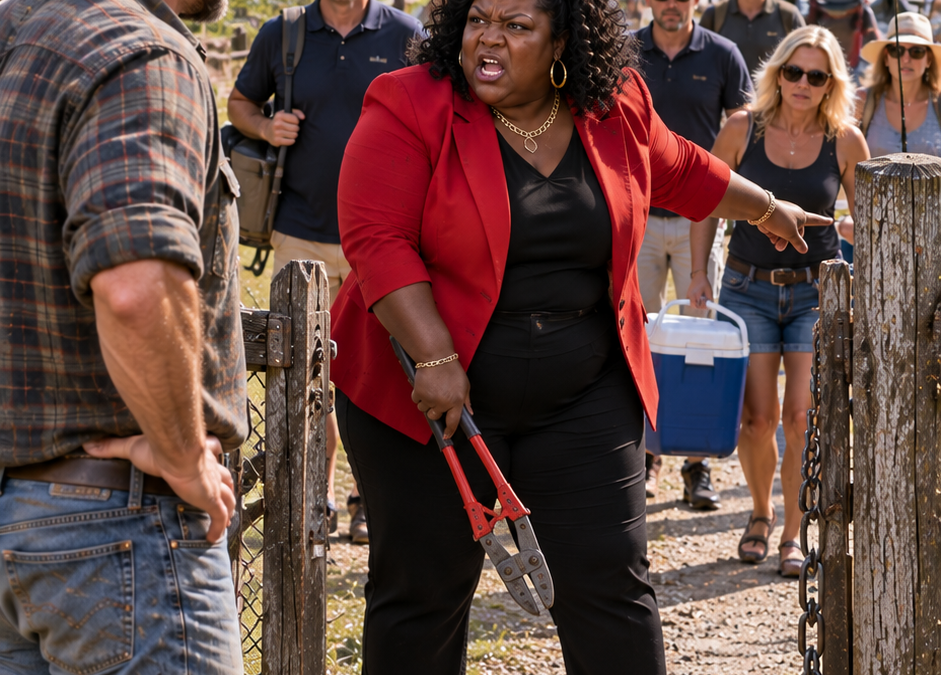
I pulled up to my property at 2:47 on a warm Thursday afternoon and found Karen Whitmore standing at my lake gate with bolt cutters.
She did not stop when she heard my truck.
She did not turn around.
She simply leaned harder into the handles until the final link snapped.
The chain fell into the gravel.
Metal against stone.
A small sound.
An expensive one.
Karen straightened, set the bolt cutters beside the gatepost, and brushed her palms together as if she’d just finished trimming a hedge.
Then she looked at me.
“You don’t own the lake.”
I shut off my truck.
“I never said I did.”
“You own a path.”
“Correct.”
“And this community is done allowing one homeowner to hoard access to shared water.”
Before I could answer, a man in a Meadow Ridge HOA polo stepped between us.
Clipboard in one hand.
Other palm raised toward me like a traffic officer.
“The board voted to reclassify this access point as a community amenity.”
His name was Daniel Pierce.
Treasurer.
The kind of man who lowered his voice when saying something unreasonable because he thought calm delivery made it legally sound.
“Any attempt to obstruct community access will result in immediate fines and possible legal action,” he continued. “Formal notice will be delivered within ten business days.”
Behind him, four residents were already walking through my gate.
One carried a folding chair.
Another had a fishing pole.
A couple farther back carried a cooler between them.
None looked at me.
I remembered that.
Not because I blamed them.
Because people behave differently when they think someone official has already decided who is right.
A second board member crouched beside the gate and drove a metal stake into the dirt.
He attached a laminated sign.
COMMUNITY LAKE ACCESS
AUTHORIZED BY HOA BOARD
Then he struck the stake with a rubber mallet.
Once.
Twice.
Three times.
The sound echoed down the gravel path.
It reminded me of somebody planting a flag.
Karen handed the bolt cutters to another resident.
Then she walked through my gate.
No hurry.
No backward glance.
She looked like somebody who had just solved a problem that had been bothering her for months.
I stood beside my truck.
Said nothing.
That silence was deliberate.
I wasn’t intimidated.
I wasn’t confused.
I’m an engineer.
My profession taught me years ago that when something starts failing, the smartest thing you can do is stop touching it long enough to understand exactly where the load is going.
Karen believed the problem was the chain.
It wasn’t.
I pulled out my phone.
Photograph one:
2:47 p.m.
The cut chain lying in the gravel.
Photograph two:
Karen walking down my easement toward the lake.
Photograph three:
The new HOA sign.
Photograph four:
Four residents spread out near the shoreline.
One unfolding his chair beside my dock.
Then I opened the notes app.
I typed:
Trip count: 4.
Time: 2:47 p.m.
And I went inside.
To understand why I did not call the sheriff, you need to understand something Karen didn’t know.
That chain was not protecting a trail.
It was protecting a contract.
A very expensive contract.
Karen had been HOA president for two years.
Before her, Meadow Ridge had been irritating in the normal way homeowners associations are irritating.
Grass-height letters.
Trash cans left out overnight.
Arguments about mailbox paint.
People complained.
Boards sent notices.
Everyone survived.
Then Karen became president.
The tone changed.
The Hendersons were fined $1,200 because their mailbox was allegedly the wrong shade of beige.
Not the wrong design.
Beige.
Apparently the approved color was “Sandstone Linen” and theirs was closer to “Desert Cream.”
The Pattersons received three lien warnings in eight months over a planter that extended approximately four inches beyond a landscaping boundary nobody had ever measured before Karen decided it mattered.
Two board members questioned her procedures during her first year.
Both were removed from leadership in closed sessions.
By the time she reached her second term, most of the sixty families in Meadow Ridge had learned the lesson she wanted them to learn.
Pay.
Don’t argue.
Keep your head down.
Karen had not merely been fining people.
She had been training them.
That Thursday, she brought that same strategy to my gate.
The difference was that I had spent nine years waiting for someone to try.
When I bought my property, I paid more than anyone else in the subdivision.
Not because the house was bigger.
It wasn’t.
Not because it had better finishes.
It didn’t.
I paid more because of one word in the deed.
Exclusive.
My attorney pointed at it the first time we reviewed the closing documents.
“That word is doing a lot of work.”
“I know.”
“Make sure you understand exactly what you’re buying.”
I did.
The lake itself was shared.
Residents could kayak.
Fish.
Use the public shoreline on the northern side.
But the best direct pedestrian access to the southern cove ran through a strip along my western property boundary.
That strip led to a sandy shoreline and an old dock.
The water there stayed calm because of the shape of the cove.
The developer had created a recorded easement tied exclusively to my lot.
Not community access.
Not common area.
Mine.
I installed the gate myself when I moved in.
Mostly to stop strangers from assuming the path was public.
For two years, no one cared.
Then the original developer got into financial trouble.
He was building another phase nearby and needed capital.
His solution was clever.
Also illegal.
He started advertising “private lake experience packages” to outside buyers.
Weekend access.
Seasonal dock passes.
Private waterfront use.
Every package routed through my easement.
Someone had decided to monetize a property right they did not own.
I called my attorney on a Tuesday.
By Monday we had filed.
The fight lasted four months.
Eventually, everyone settled.
The settlement agreement was recorded with the county.
Public document.
Four pages.
Very clear.
It reaffirmed my exclusive access rights.
It also contained something lawyers call a liquidated-damages provision.
The concept is simple.
Instead of waiting for a future court fight to determine the dollar value of each violation, both sides agree in advance what a violation costs.
The number came from an appraisal accepted by both parties.
$480,000.
Per unauthorized use.
It sounds enormous until you understand what the original developer had intended to sell, how many commercial packages were contemplated, and what unrestricted access would have done to the value of the property right I had paid for.
The developer signed.
His attorney signed.
And most importantly, the HOA signed.
Karen’s predecessors had been involved in the original dispute.
The HOA became a party to the settlement.
Its obligations passed to successor boards.
That meant Karen inherited it.
The agreement sat in the HOA’s legal binder.
Tab 7.
A former board member had mentioned it to me once.
“Anyone who reads that section understands the lake issue in ten minutes.”
I assumed future boards would read their own legal documents.
That turned out to be optimistic.
When Karen cut my chain, I had no reason to explain any of this.
Not yet.
Three days later, the HOA app sent a notification at 7:14 in the morning.
COMMUNITY LAKE DAY
Saturday.
Families welcome.
Bring chairs.
Bring food.
Use the new community access point on the western path.
My gate.
I drank the rest of my coffee.
Saturday morning, I took a folding chair outside at nine.
Phone.
Legal pad.
Nothing else.
The first couple arrived at 9:22.
Cooler between them.
They nodded.
I nodded back.
Click.
Timestamped photograph.
One entry.
Then another family.
Then three teenagers.
Then two parents and two children.
I logged groups as they crossed the easement.
I wasn’t rude.
I didn’t confront anyone.
These were neighbors who had opened an app and been told they were welcome.
They had no idea Karen was dragging them into a property dispute.
At 11:14, the count reached thirteen.
By one, twenty.
People made return trips to cars.
Coolers.
Sunscreen.
Forgotten towels.
Each passage mattered under the wording of the agreement.
I logged each one.
At 4:47, the final family walked out.
I counted my notes.
Twenty-three documented unauthorized passages.
Monday morning, I mailed the board a letter.
Two pages.
No threats.
No dramatic language.
I cited the settlement agreement.
County filing number.
Date.
Section 4.2B.
I stated that unauthorized HOA-sponsored use of the easement had occurred.
I requested that the board immediately stop organizing access through my property.
Seven board members.
Seven certified envelopes.
Return receipt requested.
By Thursday, every green card had come back signed.
That evening, Karen called me.
No hello.
“I saw your letter.”
“Good.”
“We’ve reviewed the situation.”
“Did you review section 4.2B?”
A short pause.
“You own an easement. You do not own a moat.”
“That’s not what I asked.”
“The community has a right to the lake.”
“Through the northern access.”
“And now through this access point.”
“Karen.”
“What?”
“Did your attorney read the recorded settlement?”
“The board will not be intimidated by a homeowner trying to keep an entire community away from shared water.”
Then she hung up.
I wrote the time down.
Then wrote her language as close to verbatim as I could remember.
She had not denied receiving the letter.
Had not disputed the document.
Had not claimed the agreement was invalid.
That interested me.
Three days later, she fined me.
$3,500.
Violation:
Unauthorized obstruction of community lake access through installation and maintenance of locked gate.
I stood at the mailbox staring at it.
Then I laughed.
Only once.
Because suddenly the problem had become clean.
The HOA had received certified notice of my recorded rights.
Every board member had signed for it.
Then Karen issued an official written fine because I continued exercising those rights.
I took the notice inside.
Photographed it.
Placed it in a manila folder.
Wrote:
EXHIBIT A
Then called my attorney.
I read him the violation.
Silence.
“She fined you for the gate?”
“Yes.”
“The gate protecting the easement?”
“Yes.”
“After everyone signed for our notice?”
“Correct.”
Another pause.
“Keep that.”
“I plan to.”
“That’s written evidence of intent.”
Then he said something I remembered later.
“Don’t interrupt someone while they’re documenting your case for you.”
The following Saturday brought Community Lake Day number two.
I sat in my chair again.
Thirty-one entries.
Six people made multiple trips.
That evening, I added the first two event days.
Fifty-four.
I knew the arithmetic.
I refused to write the total.
Not yet.
I wrote:
Week three — TBD.
Then closed the legal pad.
The situation stopped being only about my property ten days later.
Eleanor Grant knocked on my door.
She was seventy-five.
Retired middle-school teacher.
Two houses down.
She stood on the porch holding a stack of HOA notices bound with a rubber band.
“I’m sorry to bother you.”
“You’re not.”
She looked toward the gate.
“I’ve been watching what’s happening.”
I waited.
“Can you help me understand something?”
She held up the notices.
“I can’t keep paying these.”
I brought her inside.
She arranged the papers on my table in chronological order.
Of course she did.
Teachers organize their suffering.
Eighteen months.
$400 because her grandson’s car supposedly left a residue mark on her driveway.
$600 because a light fixture was allegedly four watts above an HOA standard.
$800 for a second vehicle parked in her own driveway during a Sunday family dinner.
More.
Total:
Just over $3,200.
On a fixed retirement income.
I flipped through them.
“Did you appeal?”
“The light.”
“What happened?”
“I brought the product sheet.”
She pointed at the page.
“Actual output. Wattage. Their own rule.”
“And?”
“Karen let me talk about forty-five seconds.”
“What did the board decide?”
“They upheld it.”
Eleanor looked down.
“Two weeks later, I got another violation.”
“For what?”
“Trash can visible from the street.”
“Was it?”
“An inch of the handle.”
She gave me a tired smile.
“That’s how it works.”
“What?”
“You ask a question. You get another letter.”
That sentence changed how I saw Karen.
I had considered her overbearing.
Now I saw a deliberate pattern.
People weren’t merely afraid of fines.
They were afraid of drawing attention.
I photographed Eleanor’s notices.
Told her to keep every original.
Within a week, three more neighbors approached me.
Never publicly.
One texted.
One slipped a note in my mailbox.
One stopped beside the fence and spoke quietly enough that anyone ten feet away wouldn’t hear.
Same pattern.
Challenge Karen.
Then wait.
Within two weeks, another citation appears.
Tiny enough to look accidental.
Frequent enough to deliver the message.
I collected written statements from those willing to provide them.
Names.
Dates.
Sequence.
Added them to the file.
Then I drove to the county recorder’s office.
Twelve minutes later, I had the subdivision plat.
The access strip ran entirely inside the area attached to my lot.
I examined two hundred feet around the gate.
No common-area designation.
None.
I also pulled the HOA bylaws.
Two sections mattered.
Board authority applied to common areas defined on the recorded plat.
And the board had no authority to extinguish or override a recorded private easement.
Karen’s vote to “reclassify” my gate had changed nothing.
I organized the evidence.
Tab 1:
Recorded settlement.
Tab 2:
Plat.
Tab 3:
Bylaws.
Tab 4:
Certified mail receipts.
Tab 5:
Fine.
Tab 6:
Entry log.
By then, the log had reached seventy-one documented passages.
I called my attorney.
He listened.
Then said:
“You have every exit closed.”
“What do you mean?”
“Recorded settlement says the easement is exclusive. Plat says it’s not common area. Bylaws say the board can’t override the easement. And the fine shows bad faith after notice.”
He paused.
“Question is when you want to pull the trigger.”
“I’ll tell you.”
I could have filed after entry one.
I knew that.
But Karen was still organizing events.
Still fining people.
Still telling residents she had unquestioned authority.
And I had learned something watching her.
Karen’s greatest weakness was not arrogance.
It was certainty.
Arrogant people sometimes check.
Certain people don’t.
I wanted to see how far she would go before finally reading the document she should have read on day one.
Three weeks after the first lake day, the HOA announced:
SUMMER LAKE FESTIVAL
Food.
Games.
Music.
Residents and guests welcome.
Designated entrance:
Western Community Access.
My gate.
The difference mattered.
This was no longer residents mistakenly using a path.
Karen was inviting nonresidents.
A public HOA-sponsored festival through my recorded easement.
Saturday morning, I took my chair outside.
First group:
9:47.
Two families I didn’t recognize.
Coolers.
Dog.
Three children.
Then another.
By noon, the path had become a steady stream.
Someone set a portable speaker near my dock.
Kids ran past carrying fishing rods.
Adults moved folding chairs.
People laughed.
It would have been pleasant if the entire event had not been built on a property right Karen had simply decided did not exist.
I documented.
Time.
Group size.
Direction.
Repeat passage.
At approximately two, Karen’s husband arrived with another board member.
Pickup truck.
Steel post.
Two bags of concrete mix.
I stood twenty yards away.
They dug a hole inside my property line.
Mixed concrete.
Dropped in the post.
Tamped it.
Mounted a metal sign larger than the first.
COMMUNITY LAKE ACCESS POINT
PERMANENTLY DESIGNATED BY HOA BOARD
The word PERMANENTLY was larger than everything else.
I photographed every step.
2:03.
Concrete bags opened.
2:11.
Hole dug.
2:26.
Post set.
2:44.
Finished sign.
Forty photographs.
When they walked away, the empty concrete bags remained on my property.
I photographed those too.
At six, the last festival guests left.
That day’s total:
Sixty-one unauthorized passages.
Running total:
I wrote the number.
Boxed it.
The next week brought something even more aggressive.
Formal HOA letter.
The board intended to petition the city to designate my lake path as a public right-of-way.
Their stated grounds:
Historical community use.
Community benefit.
Safety concerns related to private gatekeeping of water access.
Historical use.
That almost impressed me.
Karen had created the “historical use” herself over several weeks.
Now she was trying to use her own trespass program as evidence that the public should permanently receive the route.
I called my attorney.
This time he did not wait.
Certified cease-and-desist letters went to:
Karen.
All seven board members.
HOA counsel.
City planning.
Each included the recorded settlement agreement.
Each specifically quoted Section 4.2B.
The city’s planning office put the petition on administrative hold within twenty-four hours.
A recorded agreement containing a $480,000-per-use liquidated-damages clause tends to get the attention of municipal attorneys.
Karen responded by holding an informal neighborhood meeting.
Eleanor told me afterward.
Karen called the cease-and-desist intimidation.
Said I wanted to monopolize shared water.
Claimed the HOA lawyer had reviewed everything.
Several residents applauded.
Eleanor stood in back.
She didn’t.
Karen had reached maximum confidence.
A concrete sign stood inside my property.
The city petition existed.
The trip log contained 132 passages.
She had ignored two formal legal warnings.
She had issued a fine asserting the exact opposite of the recorded easement.
And she still had not opened Tab 7.
That night, I opened a spreadsheet.
Entered:
Then:
Multiply.
The number appeared.
$63,360,000.
I stared at it.
No satisfaction.
It was too large for that.
It looked fictional.
But the math was not mine.
Neither was the clause.
The HOA had agreed to the number seven years earlier.
Karen’s board had simply supplied the multiplication.
I closed the laptop.
There was one more event I wanted documented.
The annual meeting.
Thursday evening.
Community room at the end of Birwood Court.
Sixty-three homeowners attended.
Karen had sent a message:
IMPORTANT COMMUNITY UPDATE
People came expecting news.
I sat in the back row with a manila folder.
Karen stood beside a projection screen.
“Project Open Lake.”
That was the title.
She had turned the whole summer into a presentation.
First slide:
Family walking toward the shoreline.
Second:
Children fishing from my dock.
Third:
Community Lake Day.
Fourth:
Summer Lake Festival.
Dates in the corners.
Attendance estimates.
Thirty.
Forty-five.
Eighty-plus.
I could hardly believe it.
Her own slideshow independently documented many of the entries already in my log.
She was proving the scale of the conduct in front of sixty-three witnesses.
I photographed each slide.
Quietly.
Halfway through, Dave Patterson raised his hand.
“I’ve heard there’s an old settlement agreement.”
Karen nodded.
“Yes.”
“With a financial penalty connected to that access?”
She didn’t hesitate.
“Old document.”
“Has the board reviewed it?”
“The agreement doesn’t apply to the current circumstances.”
“Has counsel said that?”
“Our attorney has reviewed everything.”
One board member looked down.
Briefly.
I noticed.
Karen ended with the right-of-way petition.
“We’re moving forward.”
That was false.
The city had already placed it on hold.
Maybe she didn’t know.
Maybe she knew and did not want to say.
Half the room applauded.
The other half didn’t.
I waited after adjournment.
Residents clustered around Karen.
Congratulations.
Questions.
Eventually the crowd thinned.
I walked forward.
Placed an envelope on the table.
“I thought you’d want to read this before tomorrow.”
She looked at it.
“What is it?”
“You’ll see.”
I turned.
Walked away.
Behind me, I heard her make a quiet joke to another board member.
A light laugh.
Dismissive.
She set the envelope down.
Did not open it.
In the parking lot, I called my attorney.
“It’s time.”
“You’re sure?”
“File it.”
The demand package went out the next morning.
Not ordinary mail.
Process server.
Karen personally accepted hers at 9:14.
Every board member received a copy.
Registered agent.
HOA counsel.
Timestamped delivery records.
The letter itself was only four pages.
The attachments were much larger.
Page one:
Recorded settlement.
County document number.
Successor-board language.
Page two:
Section 4.2B.
Fixed liquidated damages.
$480,000 per unauthorized use.
Page three:
Violation summary.
132 documented passages.
Dates.
Times.
Photographic references.
HOA-organized events.
Public festival.
Page four:
Demand.
$63,360,000.
Forty-seven pages of evidence followed.
First attachment:
Karen’s $3,500 fine against me.
Issued after every board member signed for notice of the settlement.
Second:
Her annual-meeting slideshow.
Dates.
Attendance estimates.
Photos.
Her own proof.
Third:
Recorded plat.
No common area.
Fourth:
HOA bylaws.
No board power to override the easement.
This was not me inventing a penalty after the fact.
It wasn’t revenge arithmetic.
The HOA had signed the agreement.
Karen had inherited it.
All I did was count what her board organized.
Marcus Lee called me that evening.
He was one of the board members.
The same one who looked down during Dave’s question at the annual meeting.
His voice sounded strange.
“Did you know what was going to happen?”
“What do you mean?”
“Karen called counsel.”
I waited.
Marcus told me the whole conversation.
The HOA attorney asked Karen to read the county recording number from my demand.
She did.
He placed her on hold.
Pulled the document himself.
Came back after several minutes.
The agreement was valid.
Properly executed.
Properly recorded.
Binding on successor boards.
The lawyer then asked about insurance.
Karen called the carrier.
The response came quickly.
Intentional interference with recorded property rights was excluded.
HOA reserves:
Approximately $340,000.
Demand:
$63,360,000.
According to Marcus, Karen lowered herself into a chair very slowly.
An emergency meeting was called that evening.
Karen began with one sentence.
“I didn’t know.”
No one answered.
“Nobody told me that clause existed.”
A board veteran who had served through three presidencies pulled a thick legal binder toward him.
Then slid it across the table.
“Karen.”
She looked at him.
“We transferred every legal file to you when you took office.”
He opened the binder.
Turned it around.
Tab 7.
LAKE EASEMENT SETTLEMENT.
Marcus said Karen stared at it without touching it.
Then somebody asked:
“What does sixty-three million dollars look like against three hundred forty thousand in reserves?”
Karen whispered:
“Sixty-three million.”
Not angrily.
Not defensively.
Just the number.
For two years, she had used numbers against everyone else.
$400.
$600.
$800.
$1,200.
$3,500.
Numbers designed to make ordinary people decide resistance cost too much.
Now a number was sitting across the table from her.
One she had not invented.
One her own organization had signed before she ever became president.
The HOA’s attorney contacted mine Monday.
Eleven-minute conversation.
No claim that the easement was common property.
No claim the settlement was invalid.
No accusation of intimidation.
Just:
Can we discuss resolution?
Negotiations lasted three weeks.
I never expected the HOA to write a check for $63 million.
That was not the real objective.
Enforcement was.
The final settlement reinforced my easement in a new recorded instrument.
Plain language.
No future HOA board could interfere with:
The gate.
The path.
The dock access.
The easement itself.
Not by vote.
Not by reclassification.
Not by community event.
Not by petition.
The original liquidated-damages protection remained in place for future violations.
The city right-of-way petition was withdrawn.
The planning file was closed.
The permanent sign Karen’s husband had installed inside my property was removed at HOA expense.
I watched the crew do it.
Wednesday morning.
They broke the concrete.
Pulled the post.
Loaded the sign into a pickup.
Filled the hole.
Tamped the dirt.
Within weeks, grass started growing across it again.
The $3,500 fine against me was formally rescinded.
I placed the cancellation letter behind the original notice.
On the tab I wrote:
EXHIBIT A — CLOSED
The HOA paid my legal fees.
They paid for a new reinforced gate.
New chain.
New lock.
A county-held legal-maintenance escrow was established specifically to fund future enforcement if another board attempted to interfere with the easement.
I would never again need to begin from zero.
Karen faced personal financial exposure because of her conduct.
As part of the resolution protecting her from the worst possible individual claims, she agreed to contribute personally toward the legal costs created by her decisions.
The amount remained confidential.
I did not care what it was.
The point was that she signed.
Karen resigned on a Tuesday.
7:04 a.m.
Three-sentence HOA app notification.
No explanation.
No apology.
Thank you for the opportunity to serve.
Best wishes to the board.
At 9:11, Eleanor texted me.
Did you see?
I replied:
I saw.
A minute later:
Thank you.
The interim board called a meeting two weeks later.
One agenda item changed the neighborhood more than the lawsuit ever did.
Review of fines issued under the previous administration.
Eleanor sat in the front row.
For years, she had always sat in back.
Seven of her eighteen fines had no basis in the actual bylaws.
Refund:
Just over $2,000.
When they read the amount aloud, she did not smile.
She closed her eyes.
Then folded her hands.
Other people received reversals.
Dave’s mailbox case.
The Pattersons’ landscaping violation.
Several fines issued suspiciously soon after residents questioned Karen during meetings.
Nobody needed to say retaliation.
The dates said enough.
Not everyone was happy about losing my lake access.
I understood.
The events had been pleasant.
Children fished.
Families sat beside the water.
People had spent a summer being told the gate belonged to them.
Then suddenly it didn’t.
Most had never knowingly done anything wrong.
They had followed instructions.
The interim board did something Karen never bothered doing.
They asked.
A homeowner on the northern side of the subdivision owned another possible route to the lake.
He had been open to discussing access for years.
Nobody had approached him.
Within three months, Meadow Ridge negotiated a legitimate easement.
Fair compensation.
Proper limits.
Recorded agreement.
Real signatures.
The community got the lake access it wanted.
Through a door someone had actually agreed to open.
That was the part of the story I liked best.
Because this was never about keeping children away from water.
It was about consent.
The new easement proved there had always been a lawful way to get what Karen wanted.
She simply preferred force.
The Friday after the final paperwork recorded, I drove to my property.
The replacement gate had been installed.
Stronger steel fittings.
Heavier chain.
Hardened padlock.
Not because I believed hardware alone could stop another Karen.
Paper had done that.
But I liked knowing the physical boundary finally matched the legal one again.
Saturday morning, I unlocked it.
Walked down the path alone.
The lake was still.
Early light.
No speakers.
No coolers.
No folding chairs.
Something moved through the reeds on the opposite bank.
Probably a muskrat.
I sat on my dock.
For a long time I thought about nothing.
That surprised me.
I had spent months thinking about numbers.
Four.
Twenty-three.
Fifty-four.
Seventy-one.
$480,000.
$63,360,000.
Numbers become strange when you stare at them long enough.
They stop representing things.
The $63 million was never the heart of it.
The heart was a chain lying in gravel at 2:47 one afternoon.
Karen had looked at that chain and seen an obstacle.
She believed the board had voted.
Therefore the chain no longer mattered.
My ownership no longer mattered.
The recorded easement no longer mattered.
The county plat no longer mattered.
She believed authority worked backward.
If enough people agreed she should be allowed through my gate, then somehow that agreement created the right.
It didn’t.
Rights don’t appear because a committee is impatient.
The settlement agreement existed precisely because somebody had tried the same thing years earlier.
Different people.
Same idea.
Someone else owns an access route.
We want to monetize it.
Surely we can find a way around the word exclusive.
They couldn’t.
Karen never bothered learning why.
She inherited a binder full of institutional memory and treated reading it as optional.
Then she spent an entire summer proving exactly why it existed.
I walked back up the easement.
Stopped at the place where her permanent sign had stood.
You could still see the repaired ground.
Square patch.
Grass thin at the edges.
Growing inward.
In another month, nobody would know anything had ever been there.
I reached the gate.
Closed it.
Before locking it, I looked toward Meadow Ridge.
The neighborhood seemed exactly as it had before all this.
Same roofs.
Same mailboxes.
Same people watering lawns.
The difference was subtle.
Karen was gone.
Eleanor waved more.
Dave spoke at meetings now.
The Pattersons stopped lowering their voices whenever an HOA board member walked nearby.
The new board published minutes on time.
Nothing revolutionary.
Just ordinary governance after two years of everyone being afraid of their mailbox.
I slid the chain through the gate.
My hand rested on the new padlock.
Karen had once called the gate selfish.
A barrier.
Proof that I wanted to keep an entire lake to myself.
But the lake was never mine.
I knew that.
The water belonged to everyone entitled to use it.
The northern shoreline remained open.
The new community easement was operating.
Families could still get to the lake.
The only thing that had ever been mine was the path.
And if that sounds like a small distinction, imagine someone cutting the lock on your back door because the neighborhood voted that your kitchen was the fastest route to a public park.
That’s the distinction.
Karen came with bolt cutters because she thought physical access would create legal access.
Instead, every time she sent somebody through that gate, she created another line in a violation log.
Another timestamp.
Another photograph.
Another application of a clause her own organization had agreed to.
The first four people cost her argument $1.92 million on paper.
The first community lake day pushed it far beyond that.
By the festival, the theoretical exposure had become absurd.
And Karen kept going.
Not because she was brave.
Because she never stopped long enough to ask whether she might be wrong.
That may have been her most expensive mistake.
I clicked the padlock closed.
One clean sound.
Then tested it once.
Solid.
I stood there with the lake behind me.
For months, Karen had treated that gate like the center of a war.
Now it was just a gate again.
Exactly what I wanted.
I started toward the house.
Halfway there, my phone buzzed.
Message from Eleanor.
A photograph.
She was standing near the new northern lake entrance with two grandchildren.
There was a proper sign beside the path.
No one had cut anything.
No one had taken anything.
The property owner had signed.
The HOA had paid.
The county had recorded it.
Under the photograph Eleanor had written:
This is how it should have been done the first time.
I looked back at my gate.
Then typed:
Exactly.
The grass moved along the edge of the easement.
Sunlight flashed through the trees.
Somewhere down by the water, something splashed.
And for the first time since 2:47 on that Thursday afternoon, there was nothing left to count.








