𝗙𝗨𝗟𝗟 𝗦𝗧𝗢𝗥𝗬 HOA Karen Confiscated My Mail — She Had No Idea What Was Inside the Next Box
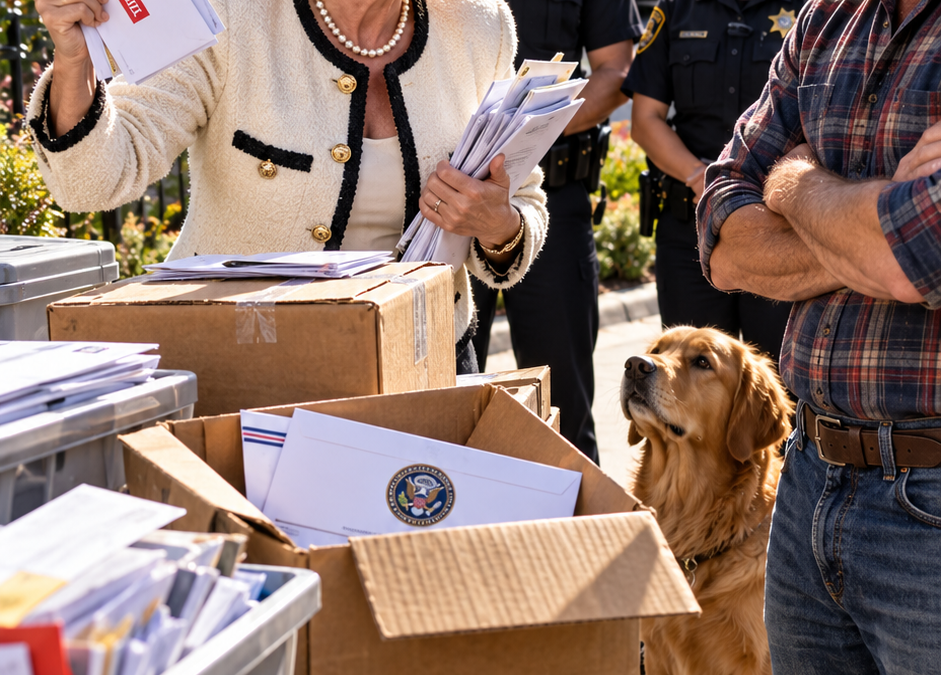
𝗙𝗨𝗟𝗟 𝗦𝗧𝗢𝗥𝗬
I drove Emily to O’Hare thirty hours early.
She spent most of the ride checking the passport.
Turning pages.
Looking at the visa.
Checking her flight documents again.
She was brilliant in laboratories.
She could explain protein signaling networks in ways that made people like me almost understand them.
But Helen had reduced her to somebody frightened that a suburban volunteer with a clipboard might somehow appear at the airport and confiscate her future.
At the terminal, Emily held my coat.
“Don’t fight her alone.”
“I’m not planning to fight her.”
“That sounds worse.”
“I’m going to deal with her.”
“Julian.”
“She is not taking our house.”
Emily looked exhausted.
“She’s done things to other people.”
“I know.”
“Liens. Fines. Lawyers.”
“I know.”
“She doesn’t stop.”
I kissed her forehead.
“Then somebody has to stop her.”
She flew to Germany.
I drove home.
It was after midnight when I pulled into my driveway.
My headlights illuminated a yellow violation notice taped directly in the middle of my front door.
UNAPPROVED VEHICLE OCCUPANCY — DRIVEWAY USE AFTER 10 P.M.
I read it twice.
The vehicle was mine.
The driveway was mine.
Apparently, my HOA had developed opinions about when I could arrive at my own house.
Fine:
One hundred dollars.
I laughed.
Not because it was funny.
Because sometimes stupidity is so committed to itself that laughter becomes the only reasonable response.
By Tuesday there were three more notices.
Thin grass near the sidewalk.
Two hundred dollars.
Improper window coverings.
Three hundred.
Excessive nighttime sound.
Five hundred.
Helen had written a note beneath the last one.
Mechanical clicking audible between 1:10 a.m. and 2:00 a.m. Keyboard use should occur with windows fully closed and sound-dampening curtains.
I sat at my kitchen table.
Stared at the notice.
Then at my laptop.
She had fined me five hundred dollars for typing.
That is when the humor disappeared.
Because ridiculous fines are only funny until somebody attaches them to property.
Oakwood could eventually file liens.
Liens create legal costs.
Legal costs create pressure.
Pressure makes ordinary people surrender simply because fighting becomes more expensive than obeying.
Helen understood that.
She had been doing it for years.
I started documenting everything.
Doorbell footage.
Violation letters.
Emails.
Dates.
Photographs.
The five hundred dollars.
Bank withdrawal.
Passport package.
I called the HOA management company.
They referred me to the board.
The board referred me to Helen.
Helen referred me to the covenants.
It was a perfect administrative circle.
So I tried law enforcement.
The county sheriff’s department lobby smelled like burned coffee and wet jackets.
Officer Higgins sat behind thick glass.
I explained the passport.
The cash demand.
The cut package.
The video.
He barely looked at my phone.
“So the HOA took a package?”
“Helen Voss took it.”
“And gave it back?”
“After I paid five hundred dollars.”
He leaned back.
“You live in an HOA.”
“Yes.”
“You signed the covenants.”
“I did not sign away my mail.”
He sighed.
“Look, Mr. Cole, these associations have fee schedules.”
“She took a passport.”
“She says she secured a package.”
“She opened it.”
“You say opened. She may say inspected.”
“She demanded cash.”
“She’ll say administrative release fee.”
“Higgins, if a stranger walked onto my porch, took my passport package, cut it open, and demanded five hundred dollars to return it, what would you call that?”
He frowned.
“Different situation.”
“Why?”
“Because she’s the HOA vice president.”
That answer told me everything I needed.
Authority, even imaginary authority, changes how people interpret behavior.
Put a clipboard in somebody’s hand and suddenly theft becomes procedure.
I left.
Sat in my car while rain moved across the windshield.
I could have hired a lawyer.
I probably would eventually.
But lawyers are slow.
Helen wasn’t.
I opened my laptop.
Started reading.
Not HOA law.
Mail law.
Federal mail-theft statutes.
Postal regulations.
Postal Inspection Service procedures.
I read until the system became clear.
Helen had been operating inside a world where every dispute could be softened into a “civil matter.”
But there was another jurisdiction sitting right above her little kingdom.
One her bylaws did not control.
The mail.
I saved everything.
Then I waited.
I didn’t have to wait long.
Friday morning, I went to buy driveway cleaner.
Mostly because I needed detergent.
Partly because I knew Helen’s brain would interpret power washing as surrender and I enjoyed giving her bad data.
When I returned, I saw our mail carrier, Sarah Jenkins, at the cluster mailbox.
Helen stood beside her.
I parked.
Got out.
As I approached, I heard Helen say:
“The association has placed an administrative hold on Lot Fourteen.”
Sarah looked miserable.
“I can’t do that.”
“You can.”
“No, ma’am. I have to place the mail in the assigned box.”
“You will place it in the association holding container.”
“I cannot.”
“I am authorizing it.”
“You are not the addressee.”
Helen’s voice hardened.
“The Cole account is delinquent.”
Sarah shifted backward.
“That does not matter to the Postal Service.”
I almost smiled.
Finally.
A sentence spoken in Oakwood Estates that Helen could not rewrite.
“Helen.”
She turned.
Her face tightened immediately.
“Julian.”
Sarah looked relieved.
“Mr. Cole, I have mail for you.”
“Thank you.”
“Do not give him anything,” Helen snapped.
Sarah froze.
Helen pointed toward me.
“He owes thirty-two hundred dollars in outstanding fines.”
“According to you.”
“The board voted to suspend access to common amenities and services.”
“My mail is not an HOA amenity.”
Helen ignored me.
Sarah held out three envelopes.
I took them.
One was from the IRS.
Helen lunged.
Her hand caught the edge.
“What are you doing?”
“This is being impounded.”
She pulled.
I did not.
The envelope tore slightly.
Sarah gasped.
“Helen.”
Helen pulled again.
I let go.
She stumbled backward half a step with the IRS envelope in her hand.
For one second, everybody froze.
Then Helen shoved it into her wagon.
“There.”
Her breathing was heavy.
“You will receive this when the account is current.”
Sarah stared at her.
“Ma’am, you can’t take somebody’s mail.”
“I am securing association property.”
“It is not association property.”
Helen snapped:
“Mind your route.”
Sarah’s face flushed.
“I have to report this.”
Helen laughed.
“To who?”
I looked at Sarah.
“Please do.”
Then I looked at Helen.
She pointed toward me.
“Three thousand two hundred dollars.”
“You are demanding money to return my mail.”
“I am enforcing debt.”
“Say it again.”
She frowned.
“What?”
“For the record.”
“I don’t need your little engineer games.”
She turned and rolled her squeaking wagon toward her Lexus.
I watched her put my torn IRS envelope in the trunk.
Then she drove away.
Sarah whispered:
“She actually took it.”
“Yes.”
“I saw her.”
“Yes.”
“I have to call my supervisor.”
“Yes.”
That was when I smiled.
Sarah noticed.
“Why are you smiling?”
“Because she finally picked the wrong system.”
I went home.
Opened the Postal Inspection Service complaint portal.
Uploaded the first doorbell video.
Helen taking Emily’s passport package.
The bank receipt.
A detailed timeline.
Then the second incident.
Sarah witnessing Helen seize my IRS correspondence.
The torn envelope.
Helen demanding thirty-two hundred dollars for release.
I included Helen’s violation notices.
Not because keyboard fines mattered federally.
Because they showed motive and escalation.
Then I submitted everything.
Four days later, my phone rang.
“Julian Cole?”
“Yes.”
“This is Inspector Daniel Vance with the United States Postal Inspection Service.”
His voice sounded like a man who never wasted nouns.
“I’m calling regarding your complaint involving Helen Voss.”
“Thank you.”
“I reviewed your submissions.”
I waited.
“The first video is clear.”
“Good.”
“The bank withdrawal is useful.”
“Good.”
“The route carrier filed an independent incident report.”
Even better.
“She confirmed Ms. Voss physically took mail addressed to you after being told she lacked authorization.”
“Yes.”
“Mr. Cole, does Ms. Voss still have that correspondence?”
“As far as I know.”
“Has she demanded money to release it?”
“Thirty-two hundred dollars.”
Silence.
Then:
“I want to be clear. An HOA board does not gain authority over federally delivered mail merely because a resident owes association fees.”
“I assumed.”
“Good assumption.”
He asked about prior incidents.
I told him about Emily’s passport.
The package-opening claim.
The five hundred dollars.
Then something interesting happened.
Vance said:
“We have prior correspondence involving Oakwood Estates.”
“What kind?”
“Attempts to establish an association-controlled mail holding process.”
I sat straighter.
“Helen?”
“I’m not discussing unrelated investigative material.”
That meant yes.
“What happens now?”
“We need to distinguish provable intent from claimed misunderstanding.”
“She stole two pieces of mail.”
“I understand.”
“She demanded money.”
“I understand.”
“So?”
“So people under investigation often develop imaginative explanations once lawyers become involved.”
Fair.
“We prefer evidence that closes doors.”
“What do you need?”
“A controlled delivery.”
I went silent.
“A package?”
“Yes.”
“You want her to steal another one.”
“I want to see whether she voluntarily repeats the conduct under documented conditions.”
I leaned back.
“What would be inside?”
“Nothing dangerous.”
“That wasn’t my concern.”
For the first time, Vance sounded almost amused.
“We’ll handle the contents.”
Two hours later, I met him outside an abandoned retail center.
He arrived in an unmarked sedan.
Two other inspectors waited nearby.
Vance looked exactly like his voice.
Mid-forties.
Gray suit.
White shirt.
No wasted movement.
He opened the trunk.
Inside was a USPS Priority Mail box.
My name.
My address.
Active tracking label.
“This gets delivered Thursday.”
“What’s inside?”
He opened it.
A black equipment case sat in foam.
“Tracking equipment.”
He indicated a concealed device.
“If the package moves outside the delivery zone, we get location data.”
Then a nearly invisible opening in the cardboard.
“Motion-activated internal camera.”
“You’ll see whoever opens it.”
“Yes.”
“And hear them?”
“Yes.”
He pointed to the inside seam.
There was a faint oily residue.
“What’s that?”
“Fluorescent transfer powder.”
I looked at him.
“Seriously?”
“Extremely.”
“It glows?”
“Under ultraviolet light.”
“Does it wash off?”
“Not easily.”
I stared at the box.
This felt less like real life and more like the kind of police show Emily watched while criticizing laboratory inaccuracies.
Vance closed it.
“Your job is simple.”
“Do nothing?”
“Exactly.”
“I’m good at that when motivated.”
“Do not confront her.”
“Fine.”
“Do not encourage her.”
“Fine.”
“Do not mention us.”
“Obviously.”
“Package arrives. You remain inside.”
“And if she leaves it alone?”
“Then she leaves it alone.”
I thought about Helen.
“She won’t.”
Vance looked at me.
“Confidence?”
“Experience.”
Thursday morning came gray and damp.
At 9:45, Sarah’s postal truck turned onto Whispering Pines Lane.
I watched through my doorbell camera.
She carried the box up my steps.
Set it directly on the mat.
Then walked away.
My phone buzzed.
VANCE: DELIVERY CONFIRMED. HOLD POSITION.
I poured coffee.
Waited.
Five minutes.
Nothing.
Eight.
Nothing.
At ten minutes, I began wondering whether Helen had finally developed survival instinct.
Then I heard it.
Squeak.
Squeak.
Squeak.
The green wagon.
I moved closer to the monitor.
Helen appeared at the edge of the camera frame.
Clipboard.
Visor.
Walking shoes.
She stopped at my lawn.
Saw the box.
Looked left.
Then right.
The street was empty.
She stepped onto my property.
Walked up the porch.
Picked up the package.
No hesitation.
No note.
No attempt to contact me.
She dropped it into the wagon beside a ceramic garden gnome.
Then she rolled away.
My phone buzzed.
PACKAGE MOVING.
A tracking map opened.
The dot moved three houses.
Then stopped.
Helen’s home.
A minute passed.
Then Vance called.
“Stay where you are.”
“I am.”
“Package is inside the residence.”
“Understood.”
My laptop displayed a secure feed they had patched through.
Dark.
Muffled sounds.
Then:
Scratch.
Tape tearing.
Light flooded the tiny internal camera.
Helen’s face filled the screen.
She was sitting at her glass dining table.
Her sunglasses were pushed onto her head.
She opened the box fully.
Reached inside.
Both hands rubbed directly along the treated cardboard seam.
“What is this?”
Her voice came clearly through the microphone.
She pulled at the black case.
Then rubbed her fingers together.
She seemed annoyed by the texture.
Her hand went to her forehead.
She scratched her temple.
Vance’s voice came through the secure audio link.
“Clear visual.”
Another inspector said:
“Both hands transferred.”
Vance:
“Face transfer as well.”
Helen leaned toward the box.
Her eyes narrowed.
“Is that a camera?”
Vance said:
“That’s enough.”
The feed ended.
I stood in my kitchen.
For several seconds, I felt nothing.
Then relief.
Not satisfaction.
Not yet.
Relief.
Because for weeks, Helen had operated in ambiguity.
She always had a phrase.
Inspection.
Impoundment.
Procedure.
Administrative hold.
Community security.
Now there was a tracked federal package sitting open on her dining table.
No HOA vocabulary could change the physical sequence.
At 10:15, two dark SUVs entered Oakwood Estates.
No sirens.
No flashing lights.
They didn’t need them.
Neighbors began looking through windows immediately.
The vehicles stopped outside Helen’s house.
Vance got out with four postal inspectors.
Dark tactical vests.
Badges.
One carried a case.
Another had paperwork.
I walked to the edge of my driveway.
So did half the block.
Vance knocked.
Helen opened the door.
I could hear her from three houses away.
“What is the meaning of this?”
Vance spoke calmly.
“Helen Voss?”
“Yes.”
“I’m Inspector Daniel Vance with the United States Postal Inspection Service.”
Her posture changed.
Not enough.
“This is private property.”
“We have a federal search warrant for the premises and an arrest warrant.”
Her mouth opened.
“For what?”
“Mail theft and related conduct.”
Helen actually laughed.
“This is an HOA matter.”
“No.”
“I am vice president of the association.”
“That has no relevance to the warrant.”
“I have authority under our covenants to secure abandoned items.”
Vance did not argue.
That seemed to irritate her more than disagreement would have.
“We will discuss your statements through the appropriate process.”
“I haven’t stolen anything.”
“Please hold out your hands.”
She folded her arms.
“I will do no such thing.”
One inspector gently took her wrists.
Vance removed a UV light.
He switched it on.
Helen’s hands lit up.
Bright fluorescent green.
Palms.
Fingers.
Under the nails.
Then Vance moved the light upward.
Her right temple glowed too.
A woman across the street gasped.
Helen looked down.
“What is that?”
Vance angled the light toward her open doorway.
On the dining table, the bait box glowed along its inner edges.
The case sat beside it.
Helen stared.
“What did you put on me?”
Vance’s expression did not change.
“Evidence marker.”
Her face collapsed.
Not dramatically.
Just all at once.
The certainty left.
The posture.
The condescension.
The assumption that one more rule could rescue her.
Vance read the arrest warning.
An inspector turned Helen around.
Handcuffs closed around her wrists.
The squeaking green wagon sat near the porch.
For the first time since I had lived in Oakwood Estates, it looked ridiculous instead of threatening.
Then the search began.
That changed everything.
Twenty minutes later, inspectors came out carrying evidence tubs.
Not one.
Three.
Inside were envelopes.
Packages.
Certified letters.
Bank correspondence.
Greeting cards.
Mail addressed to other Oakwood residents.
A lot of it.
Some unopened.
Some sliced along the edges.
Some marked with yellow HOA notes.
One neighbor beside me whispered:
“That’s mine.”
He pointed.
A white envelope with his surname visible through a clear evidence sleeve.
Another woman stepped closer.
“Oh my God.”
The inspectors kept carrying material out.
Later we learned Helen had been collecting resident mail for nearly two years.
She kept it in a locked cabinet.
Sometimes she used it as leverage over fines.
Sometimes she claimed it had been “secured.”
Some documents had apparently been opened.
Financial notices.
Bank statements.
Tax correspondence.
Even greeting cards.
One card reportedly still contained cash.
The entire Aesthetic Harmony Committee suddenly looked less like an overzealous HOA department and more like cover for Helen’s private surveillance system.
She had been reading the neighborhood.
Literally.
As they placed her in the SUV, Helen saw me.
Her hands were cuffed.
The fluorescent powder still streaked her temple.
She tried to recover something resembling authority.
“You did this.”
I shook my head.
“No.”
“You set me up.”
“No.”
“That package was a trap.”
“Yes.”
“You admit it.”
“I didn’t take it.”
Her face twisted.
“You knew I would.”
“That’s not the defense you think it is.”
Vance opened the rear door.
Helen looked toward the neighbors.
People she had fined.
People she had threatened.
People whose mail was now sitting in federal evidence bins.
Nobody defended her.
The door closed.
Dark glass replaced her face.
The SUVs left.
Sarah’s regular postal truck came through later that afternoon.
She delivered mail.
Directly.
Nobody interfered.
That simple act felt revolutionary.
Emily called that evening from Munich.
I answered on the porch.
“Why do you look like that?”
“Like what?”
“Like you haven’t slept in three days.”
“Probably because I haven’t slept in three days.”
“What happened?”
“They arrested Helen.”
Silence.
“What?”
“Postal inspectors.”
Another silence.
Then:
“Julian.”
“Yes?”
“What did you do?”
“Technically? Almost nothing.”
“That answer terrifies me.”
I told her.
Passport video.
IRS envelope.
Postal complaint.
Bait package.
Fluorescent powder.
Hidden mail.
Emily covered her mouth.
“She had other people’s mail?”
“A lot.”
“Oh my God.”
“Yeah.”
“Is she in jail?”
“For now.”
Emily sat back.
Behind her, I could see part of her small Munich apartment.
White wall.
Tall window.
A bicycle leaned near the door.
“So it’s over?”
“Her part is.”
“That is not what I asked.”
I understood.
The HOA still existed.
The fines.
The board.
The structure that had let Helen convince herself she could seize federal mail as if it were a lawn ornament.
“No,” I said. “Not yet.”
The emergency HOA meeting happened Tuesday.
It was the first Oakwood Estates meeting I ever attended where people seemed more angry than afraid.
The president, Ronald Pike, sat at the front looking twenty years older.
Helen’s chair was empty.
The green wagon had vanished.
Good.
Ronald cleared his throat.
“I want to begin by saying the board was unaware of Mrs. Voss’s conduct.”
A man behind me laughed.
Not humorously.
Ronald continued.
“We believed certain package policies were administrative safeguards.”
I raised my hand.
He visibly wished I had not.
“Julian.”
“Did the board vote to confiscate resident mail?”
“No.”
“Did the board approve Amendment Forty-Two?”
“Yes.”
“Did Amendment Forty-Two authorize mail seizure?”
“It allowed temporary removal of unattended porch items.”
“Mail?”
“It did not specifically—”
“Passport packages?”
“No.”
“IRS correspondence?”
“No.”
“Cash release fees?”
Ronald looked down.
“No.”
A woman stood.
“You let her do whatever she wanted.”
Another resident:
“She opened my bank mail.”
Another:
“She had my daughter’s Christmas card.”
The room exploded.
For years, residents had complained individually.
That was Helen’s advantage.
One person’s mulch dispute looked petty.
One resident’s package problem sounded weird.
One unexplained fine could be dismissed.
Now everybody was in one room.
Patterns become visible when victims compare notes.
The board suspended every active fine initiated by Helen pending review.
Then residents demanded more.
The Aesthetic Harmony Committee was dissolved.
Amendment Forty-Two repealed.
Lawn patrol suspended.
Package confiscation policy formally prohibited.
Any future inspection had to involve written notice and two-person review.
No individual board member could impose fines unilaterally.
Records-access rules were expanded.
And most satisfying to Harold across the street, nobody would ever again be authorized to measure grass with digital calipers.
He had received seven lawn violations in three years.
When that motion passed, he leaned toward me.
“I’m letting it go to three and a quarter.”
“Revolutionary.”
“I may hit three and a half.”
“Careful.”
He smiled.
The federal case moved fast because Helen had created excellent evidence against herself.
Doorbell footage.
Sarah’s statement.
The bait-box video.
GPS records.
Fluorescent transfer.
Recovered mail.
Bank withdrawal.
Her own demand notices.
Her own notes.
Her attorney apparently advised her not to test the government’s patience at trial.
She accepted a plea agreement.
Mail-theft counts.
Extortion-related conduct.
Restitution.
The exact legal outcome mattered less to me than the practical one.
She lost the HOA position immediately.
She paid a substantial fine.
She received probation and extensive community-service requirements.
Residents recovered losses.
Some pursued separate civil claims.
Her legal bills forced her to sell the beige-brick house she had spent years treating like the administrative center of a tiny empire.
The sale listing was unintentionally hilarious.
Beautiful home in peaceful, well-managed community.
Emily sent me a screenshot from Germany.
Peaceful?
I replied:
New management.
One afternoon several months later, I drove past a county roadside cleanup crew.
Orange vests.
Trash bags.
I saw Helen.
For one second I wasn’t sure.
No Lexus.
No sunglasses.
No clipboard.
Just an orange safety vest and a metal litter grabber.
She saw me too.
Our eyes met.
I did not wave.
She didn’t either.
I kept driving.
That was enough.
The strangest part was what happened to Oakwood afterward.
Children came outside.
I hadn’t realized how rare that had become.
Sidewalk chalk appeared.
A basketball hoop stayed visible in someone’s driveway.
Harold let his grass grow past three inches.
Margaret across the street painted her front door dark blue.
Nobody died.
Property values did not collapse.
Western civilization survived.
A family on Elm Court put out a bird feeder that was technically two inches taller than the old rule allowed.
Cardinals arrived.
No emergency meeting occurred.
Residents began talking over fences.
Not reporting.
Talking.
The neighborhood started looking less perfect.
And more alive.
Emily stayed in Munich for the fellowship.
She thrived.
Her first few weeks were hard.
New language.
New lab.
Different systems.
But every time we video-called, she looked more like herself again.
One evening, she called from a cobblestone street.
“You know what’s strange?”
“What?”
“There are bicycles locked everywhere.”
“That’s Europe.”
“No, I mean badly.”
“What?”
“Crooked. Random. Different colors.”
I laughed.
“And?”
“I love it.”
She turned the camera.
“Look at that balcony.”
There were plants spilling over the railing.
Half of them didn’t match.
“Violation,” I said.
“Minimum five hundred euros.”
“Aesthetic hazard.”
“Impound immediately.”
She laughed.
It was the first time we had joked about Helen without bitterness.
That mattered.
Back home, I disputed every remaining fine.
Most were voided.
The HOA refunded the five hundred dollars I had paid to recover Emily’s passport package.
The board originally offered to credit it toward future dues.
I declined.
“I want a check.”
Ronald looked surprised.
“Why?”
“Because I did not voluntarily pay dues.”
Fair.
They mailed the check.
It arrived unopened.
I framed the envelope.
Not the check.
The envelope.
Emily thought that was ridiculous.
She was right.
I still did it.
Sarah became a minor hero in Oakwood.
Residents left thank-you cards for her.
Normal cards.
Delivered legally.
She hated the attention.
“I just did my job.”
“That is what everybody says right before somebody else realizes they should have done theirs.”
She laughed.
“Are you still getting mail?”
“Every day.”
“Any problems?”
“None.”
“Good.”
Then she looked toward the old corner where Helen’s Lexus used to idle.
“Honestly, delivery is less stressful without her.”
“I believe you.”
The federal investigators eventually returned items to residents.
That took time.
Documentation.
Evidence processing.
But slowly, letters came back.
Cards.
Financial correspondence.
Old notices.
Some items were useless by then.
Others caused real problems.
One resident had missed an insurance letter.
Another had missed a bank notification.
One woman discovered Helen had intercepted a card containing two hundred dollars from her mother.
That was the part that made people understand the damage.
Helen had always framed herself as protecting Oakwood’s appearance.
But power rarely stays where it started.
First it was mulch.
Then trash cans.
Then packages.
Then mail.
Then private financial information.
A person who gets comfortable violating little boundaries eventually stops seeing boundaries at all.
That was Helen.
She did not wake up one morning and decide to become someone who opened federal correspondence.
She spent years learning that nobody stopped her.
A dandelion fine succeeded.
Then a porch-chair fine.
Then a confiscated yard decoration.
Then a package.
Each time, resistance cost more than compliance.
Eventually she stopped distinguishing what she was allowed to do from what people were too tired to prevent her from doing.
That is how petty authority becomes dangerous.
Not because the authority is large.
Because the resistance becomes small.
I changed too.
Before Helen, I believed systems corrected themselves if you pointed out errors.
Engineer thinking.
Find bug.
Patch bug.
Move on.
Real life is messier.
Bad systems often protect the people exploiting them.
Officer Higgins had seen theft and called it a neighborhood spat because “HOA” made it sound civil.
The board had seen Helen’s aggression and called it enforcement because challenging her would have meant work.
Residents had paid ridiculous fines because lawyers were expensive.
Everybody followed the path requiring the least immediate effort.
Helen built power out of everybody else’s exhaustion.
The Postal Inspection Service changed that because they did not care about Oakwood’s internal vocabulary.
They did not ask whether Helen called the package an aesthetic hazard.
They asked:
Was it addressed to you?
Yes.
Did she have authorization?
No.
Did she take it?
Yes.
Did she open it?
Yes.
Did she demand money connected to its return?
Yes.
Simple inputs.
Simple output.
For a systems engineer, it was almost beautiful.
Months later, Ronald asked me to join the HOA board.
I laughed.
He looked offended.
“I’m serious.”
“So am I.”
“We could use someone who understands procedures.”
“You need someone who hates procedures less than I do.”
“You spent weeks reading federal regulations.”
“To avoid HOA procedures.”
He smiled.
“Fair.”
I did agree to help build a digital records portal.
Public minutes.
Fine histories.
Rule-change archives.
Conflict disclosures.
Appeal tracking.
Nothing secret.
Nothing controlled by one individual.
My condition was simple.
“If residents can’t see how a decision happened, the system is broken.”
Ronald agreed.
Oakwood’s new board adopted it.
That did more good than I expected.
Not because technology solves human arrogance.
It doesn’t.
But sunlight makes certain kinds of arrogance less convenient.
A committee member once tried to introduce a new rule restricting visible holiday decorations to a narrow color palette.
The proposal was posted publicly.
Within twenty-four hours, sixty-three residents commented.
It died.
No drama.
No screaming.
No federal agents.
Just public scrutiny.
Much cheaper.
Emily came home the following summer for six weeks.
I picked her up at O’Hare.
When we reached Oakwood Estates, she stared through the windshield.
“What?”
“The Connors have a red door.”
“They do.”
“Actual red?”
“Crimson.”
“How are they still alive?”
“Medical science cannot explain it.”
She laughed.
Then we reached our house.
There was a package on the porch.
Emily stopped.
Looked at me.
I looked at her.
Neither of us moved for a second.
Then she laughed again.
“Are we allowed to have that?”
“I believe federal law remains on our side.”
We walked up together.
The box had been sitting there eleven minutes.
Nobody confiscated it.
Inside were books from Germany.
A framed photograph from Emily’s lab.
Chocolate.
And a small brass plaque from her colleagues.
It read:
DR. EMILY COLE — VISITING FELLOW
She ran her thumb over the engraving.
Then looked toward the street.
“No wagon.”
“No wagon.”
“Still feels strange.”
“I know.”
We put the plaque in her office.
Later that evening, we sat on the porch.
My grass was noticeably taller than two and a half inches.
Emily looked down.
“This is chaos.”
“I’ve lost control.”
“Three inches?”
“Almost three and a quarter.”
She shook her head.
“Animals.”
We drank coffee.
The sun went down.
Neighbors walked dogs.
Kids rode bikes.
Someone two houses away had wind chimes.
Old Oakwood would probably have classified them as unauthorized acoustic ornamentation.
New Oakwood classified them as wind chimes.
Progress.
I still think about the morning Helen took Emily’s passport.
Not because it was the worst thing she did.
It wasn’t.
The hidden cabinet full of other people’s correspondence was worse.
But the passport was the moment everything became personal enough that I stopped treating Helen as an annoyance.
She looked at Emily crying.
She knew the package represented ten years of work.
She knew the flight was imminent.
And instead of showing mercy, she raised the price.
That told me something fundamental.
Helen did not care about rules.
Rules were props.
What she cared about was submission.
The passport mattered because we needed it.
Our need made her powerful.
That was why paying the five hundred dollars felt so terrible.
Not the money.
The surrender.
For weeks afterward, I replayed her counting those bills.
One.
Two.
Three.
Four.
Five.
Then saying:
“The board always wins.”
She was right about one thing.
Systems usually beat individuals.
She simply misunderstood which system she had challenged.
Oakwood Estates had bylaws.
The United States Postal Service had federal law, inspectors, warrants, tracking equipment, and a box full of fluorescent powder.
That was not a fair contest.
I never felt bad about that.
The bait package did exactly what it was meant to do.
Helen could have ignored it.
She could have walked past.
She could have called me.
She could have notified the board.
She could have done almost anything except what she actually did.
Instead, she saw a Priority Mail box on my porch and behaved exactly as she had trained herself to behave.
She took it.
Walked it home.
Opened it.
Touched everything inside.
Then scratched her own face with the evidence.
There is a point where arrogance becomes self-documenting.
Helen crossed it beautifully.
Years later, when people ask me what was inside the box, they usually expect some dramatic answer.
Cash.
Secret documents.
Something valuable.
The truth is better.
It contained nothing Helen wanted.
A tracker.
A camera.
Evidence.
The value was entirely in what she did after touching it.
That was the lesson she never understood.
The first package had contained Emily’s future.
Helen thought that made it valuable enough to steal.
The second package contained Helen’s own choices.
Those turned out to be far more expensive.
Oakwood Estates is still standing.
The houses remain mostly beige.
Some traditions are apparently immortal.
But the neighborhood no longer has an Aesthetic Harmony Committee.
Nobody measures grass.
Nobody confiscates decorations.
Residents receive their own packages.
Board members serve limited terms.
Fines require documentation and review.
And every new board orientation includes a section explaining that United States mail is not HOA property.
Apparently, that needed to be written down.
I saved one final artifact from the case.
Not the glowing-hand photograph.
Not the arrest footage.
Not even Helen’s plea agreement.
I saved the original green utility wagon.
Not physically.
The federal government did not seize it, and I had no interest in keeping Helen’s suburban chariot.
But one neighbor took a photograph the morning after her arrest.
The wagon sat beside her driveway.
Empty.
Rainwater had collected in the bottom.
No warning slips.
No flamingos.
No packages.
Just a cheap green plastic wagon with one squeaky wheel.
I printed the photo and put it in a drawer.
Whenever I find myself overcomplicating authority, I look at it.
Power can appear impressive when everybody agrees to be afraid of it.
Then one day the right person says no.
Or the right agency arrives.
Or somebody checks the actual rule.
And suddenly the grand symbol of control turns back into what it always was.
A plastic wagon.
Emily eventually returned to Munich for another collaboration.
This time her visa documents arrived weeks in advance.
When the courier dropped the envelope at our door, I happened to be home.
I picked it up immediately.
Not because I was worried.
Habit.
Emily watched through the kitchen window.
“You know nobody’s taking it.”
“I know.”
“Then why are you hovering?”
“I’m appreciating federal logistics.”
She laughed.
“You need hobbies.”
“I had one.”
“What?”
“Defeating Helen.”
“That hobby was unhealthy.”
“Fair.”
The envelope stayed sealed until Emily opened it herself.
That was the ending I preferred.
No inspectors.
No warrants.
No glowing powder.
No handcuffs.
Just a woman opening her own mail in her own house.
Ordinary.
Private.
Boring.
Exactly the way it should have been from the beginning.
Helen Voss spent years convincing Oakwood Estates that nothing belonged entirely to the individual.
Your grass belonged to community aesthetics.
Your driveway belonged to collective standards.
Your decorations belonged to committee approval.
Eventually, she decided your mail belonged to her too.
That was the boundary she finally crossed in front of people who did not care about her title.
And when the next Priority Mail box arrived on my porch, she dragged it away in that squeaking little wagon with the confidence of someone who had never learned the difference between getting away with something and having the right to do it.
Fifteen minutes later, both her hands were glowing green.
By the end of the morning, they were in handcuffs.
And for the first time since we moved into Oakwood Estates, every package on every porch belonged to exactly the person whose name was printed on it.
Have you finished reading the story and want to read it again?
HOA Karen Confiscated My Mail — She Had No Idea What Was Inside the Next Box
She stole my wife’s passport package.
Then she demanded cash to give it back.
So when the next box arrived, I made absolutely sure she took that one too.
My name is Julian Cole, and before all of this happened, I believed there were limits to how ridiculous a homeowners association could become.
I was wrong.
Oakwood Estates had turned pettiness into infrastructure.
We had rules about lawn height, approved mulch colors, trash-can retrieval times, visible garden hoses, seasonal wreath dimensions, porch furniture, exterior lighting temperature, and enough other microscopic details to make you wonder whether the people writing the covenants had ever experienced a genuine emergency.
Our Kentucky bluegrass was supposed to remain between two and a half and three inches tall.
Not approximately.
Precisely.
A committee of retired men occasionally walked the neighborhood carrying digital measuring tools.
The first time I saw one of them kneel beside my yard to measure a blade of grass, I assumed he had dropped a contact lens.
He had not.
He was conducting an inspection.
My wife, Emily, and I used to laugh about it.
We had moved into Oakwood because the house was close to my work, the schools were good, and the neighborhood was quiet.
Emily was a molecular biologist.
I was a systems engineer.
Neither of us cared much about whether somebody’s mulch was black, brown, or the color of crushed cinnamon.
Then we met Helen Voss.
Helen was vice president of the HOA and chair of something called the Aesthetic Harmony Committee, a title so grand that the first time Emily heard it, she asked whether the United Nations knew Oakwood Estates had its own ministry of exterior decoration.
Helen took the job seriously.
She patrolled the streets in a beige Lexus.
Behind her she often pulled a little green plastic wagon.
Inside it she collected what she called “temporary confiscations.”
A pink plastic flamingo.
An unapproved planter.
A child’s chalk bucket once.
Three bags of black mulch because Oakwood required “dark natural brown.”
The wagon squeaked.
Everybody recognized that squeak.
It sounded like bureaucracy dragging a shopping cart.
The morning our trouble started, Emily’s passport and visa arrived.
She had spent ten years working toward a research fellowship at the Max Planck Institute in Munich.
Years of graduate work.
Postdoctoral research.
Grant applications.
Rejected grants.
Rewritten grants.
Weekend lab shifts.
Christmases interrupted by experiments.
Her flight from Chicago to Frankfurt left in thirty-six hours.
The package contained the documents that made all of that possible.
The courier placed it on our front porch.
Ten minutes later, Helen Voss took it.
I saw her wagon at the corner.
Emily saw the envelope inside.
“Helen.”
Helen stopped.
I walked toward her.
“You have our mail.”
She smiled at me through oversized tortoiseshell sunglasses.
“Good morning, Julian.”
“The envelope.”
She looked down as though she had just remembered it existed.
“Oh. This.”
The cardboard seam had been sliced.
My stomach tightened.
“That was on my porch.”
“Yes.”
“It contains Emily’s passport.”
Helen sighed.
“I secured it.”
“You took it.”
“Your package was left unattended.”
“For ten minutes.”
“Eight.”
I stared at her.
“What?”
“I timed it.”
Of course she had.
Helen lifted the envelope.
“Under Amendment Forty-Two, unattended packages visible from the street may be treated as temporary aesthetic hazards.”
I thought she was joking.
Emily didn’t.
Her face had gone pale.
“My flight is tomorrow night.”
Helen smiled sympathetically.
“I understand.”
“Please give it to me.”
“The impoundment charge is one hundred fifty dollars.”
Emily stared.
“What?”
Helen continued.
“However, your account also has unresolved aesthetic warnings.”
“For a compost bin,” I said.
“And driveway staining.”
“Helen.”
“So the administrative release amount is five hundred dollars.”
I stepped closer.
“You are holding my wife’s passport for an HOA fine.”
“I am holding an improperly stored parcel.”
“You opened it.”
“I inspected it.”
“You cut the seal.”
“I needed to identify the owner.”
“My address is printed on the front.”
Her smile disappeared.
“The board always encounters resistance from residents who think rules apply only when convenient.”
Emily’s voice cracked.
“Helen, I will lose the fellowship.”
For a moment I thought that might reach her.
Instead, Helen seemed to straighten.
Desperation gave her leverage.
She liked leverage.
“Monday morning,” she said. “Bring a cashier’s check.”
“My flight is Saturday.”
“Then you may use expedited release.”
“How much?”
“Seven hundred fifty.”
I stared at her.
She stared back.
Something inside me went cold.
Not explosive.
Precise.
I spend my professional life diagnosing systems.
A complex network fails for reasons.
Sometimes the reason is one damaged component.
Sometimes the system has been built to reward failure.
Helen was both.
Emily grabbed my arm.
“Julian.”
I understood.
This was not the morning to make a principle out of five hundred dollars.
Not with ten years of her life sitting in Helen’s wagon.
I went to the bank.
Withdrew five hundred dollars.
Handed it to Helen.
She counted every bill.
Slowly.
Then she gave us the package.
No receipt.
No apology.
Just one sentence.
“Let this be a lesson.”
I remember that sentence more clearly than I remember the money.
Because lessons work both ways.
PART2
I drove Emily to O’Hare thirty hours early.
She spent most of the ride checking the passport.
Turning pages.
Looking at the visa.
Checking her flight documents again.
She was brilliant in laboratories.
She could explain protein signaling networks in ways that made people like me almost understand them.
But Helen had reduced her to somebody frightened that a suburban volunteer with a clipboard might somehow appear at the airport and confiscate her future.
At the terminal, Emily held my coat.
“Don’t fight her alone.”
“I’m not planning to fight her.”
“That sounds worse.”
“I’m going to deal with her.”
“Julian.”
“She is not taking our house.”
Emily looked exhausted.
“She’s done things to other people.”
“I know.”
“Liens. Fines. Lawyers.”
“I know.”
“She doesn’t stop.”
I kissed her forehead.
“Then somebody has to stop her.”
She flew to Germany.
I drove home.
It was after midnight when I pulled into my driveway.
My headlights illuminated a yellow violation notice taped directly in the middle of my front door.
UNAPPROVED VEHICLE OCCUPANCY — DRIVEWAY USE AFTER 10 P.M.
I read it twice.
The vehicle was mine.
The driveway was mine.
Apparently, my HOA had developed opinions about when I could arrive at my own house.
Fine:
One hundred dollars.
I laughed.
Not because it was funny.
Because sometimes stupidity is so committed to itself that laughter becomes the only reasonable response.
By Tuesday there were three more notices.
Thin grass near the sidewalk.
Two hundred dollars.
Improper window coverings.
Three hundred.
Excessive nighttime sound.
Five hundred.
Helen had written a note beneath the last one.
Mechanical clicking audible between 1:10 a.m. and 2:00 a.m. Keyboard use should occur with windows fully closed and sound-dampening curtains.
I sat at my kitchen table.
Stared at the notice.
Then at my laptop.
She had fined me five hundred dollars for typing.
That is when the humor disappeared.
Because ridiculous fines are only funny until somebody attaches them to property.
Oakwood could eventually file liens.
Liens create legal costs.
Legal costs create pressure.
Pressure makes ordinary people surrender simply because fighting becomes more expensive than obeying.
Helen understood that.
She had been doing it for years.
I started documenting everything.
Doorbell footage.
Violation letters.
Emails.
Dates.
Photographs.
The five hundred dollars.
Bank withdrawal.
Passport package.
I called the HOA management company.
They referred me to the board.
The board referred me to Helen.
Helen referred me to the covenants.
It was a perfect administrative circle.
So I tried law enforcement.
The county sheriff’s department lobby smelled like burned coffee and wet jackets.
Officer Higgins sat behind thick glass.
I explained the passport.
The cash demand.
The cut package.
The video.
He barely looked at my phone.
“So the HOA took a package?”
“Helen Voss took it.”
“And gave it back?”
“After I paid five hundred dollars.”
He leaned back.
“You live in an HOA.”
“Yes.”
“You signed the covenants.”
“I did not sign away my mail.”
He sighed.
“Look, Mr. Cole, these associations have fee schedules.”
“She took a passport.”
“She says she secured a package.”
“She opened it.”
“You say opened. She may say inspected.”
“She demanded cash.”
“She’ll say administrative release fee.”
“Higgins, if a stranger walked onto my porch, took my passport package, cut it open, and demanded five hundred dollars to return it, what would you call that?”
He frowned.
“Different situation.”
“Why?”
“Because she’s the HOA vice president.”
That answer told me everything I needed.
Authority, even imaginary authority, changes how people interpret behavior.
Put a clipboard in somebody’s hand and suddenly theft becomes procedure.
I left.
Sat in my car while rain moved across the windshield.
I could have hired a lawyer.
I probably would eventually.
But lawyers are slow.
Helen wasn’t.
I opened my laptop.
Started reading.
Not HOA law.
Mail law.
Federal mail-theft statutes.
Postal regulations.
Postal Inspection Service procedures.
I read until the system became clear.
Helen had been operating inside a world where every dispute could be softened into a “civil matter.”
But there was another jurisdiction sitting right above her little kingdom.
One her bylaws did not control.
The mail.
I saved everything.
Then I waited.
I didn’t have to wait long.
Friday morning, I went to buy driveway cleaner.
Mostly because I needed detergent.
Partly because I knew Helen’s brain would interpret power washing as surrender and I enjoyed giving her bad data.
When I returned, I saw our mail carrier, Sarah Jenkins, at the cluster mailbox.
Helen stood beside her.
I parked.
Got out.
As I approached, I heard Helen say:
“The association has placed an administrative hold on Lot Fourteen.”
Sarah looked miserable.
“I can’t do that.”
“You can.”
“No, ma’am. I have to place the mail in the assigned box.”
“You will place it in the association holding container.”
“I cannot.”
“I am authorizing it.”
“You are not the addressee.”
Helen’s voice hardened.
“The Cole account is delinquent.”
Sarah shifted backward.
“That does not matter to the Postal Service.”
I almost smiled.
Finally.
A sentence spoken in Oakwood Estates that Helen could not rewrite.
“Helen.”
She turned.
Her face tightened immediately.
“Julian.”
Sarah looked relieved.
“Mr. Cole, I have mail for you.”
“Thank you.”
“Do not give him anything,” Helen snapped.
Sarah froze.
Helen pointed toward me.
“He owes thirty-two hundred dollars in outstanding fines.”
“According to you.”
“The board voted to suspend access to common amenities and services.”
“My mail is not an HOA amenity.”
Helen ignored me.
Sarah held out three envelopes.
I took them.
One was from the IRS.
Helen lunged.
Her hand caught the edge.
“What are you doing?”
“This is being impounded.”
She pulled.
I did not.
The envelope tore slightly.
Sarah gasped.
“Helen.”
Helen pulled again.
I let go.
She stumbled backward half a step with the IRS envelope in her hand.
For one second, everybody froze.
Then Helen shoved it into her wagon.
“There.”
Her breathing was heavy.
“You will receive this when the account is current.”
Sarah stared at her.
“Ma’am, you can’t take somebody’s mail.”
“I am securing association property.”
“It is not association property.”
Helen snapped:
“Mind your route.”
Sarah’s face flushed.
“I have to report this.”
Helen laughed.
“To who?”
I looked at Sarah.
“Please do.”
Then I looked at Helen.
She pointed toward me.
“Three thousand two hundred dollars.”
“You are demanding money to return my mail.”
“I am enforcing debt.”
“Say it again.”
She frowned.
“What?”
“For the record.”
“I don’t need your little engineer games.”
She turned and rolled her squeaking wagon toward her Lexus.
I watched her put my torn IRS envelope in the trunk.
Then she drove away.
Sarah whispered:
“She actually took it.”
“Yes.”
“I saw her.”
“Yes.”
“I have to call my supervisor.”
“Yes.”
That was when I smiled.
Sarah noticed.
“Why are you smiling?”
“Because she finally picked the wrong system.”
I went home.
Opened the Postal Inspection Service complaint portal.
Uploaded the first doorbell video.
Helen taking Emily’s passport package.
The bank receipt.
A detailed timeline.
Then the second incident.
Sarah witnessing Helen seize my IRS correspondence.
The torn envelope.
Helen demanding thirty-two hundred dollars for release.
I included Helen’s violation notices.
Not because keyboard fines mattered federally.
Because they showed motive and escalation.
Then I submitted everything.
Four days later, my phone rang.
“Julian Cole?”
“Yes.”
“This is Inspector Daniel Vance with the United States Postal Inspection Service.”
His voice sounded like a man who never wasted nouns.
“I’m calling regarding your complaint involving Helen Voss.”
“Thank you.”
“I reviewed your submissions.”
I waited.
“The first video is clear.”
“Good.”
“The bank withdrawal is useful.”
“Good.”
“The route carrier filed an independent incident report.”
Even better.
“She confirmed Ms. Voss physically took mail addressed to you after being told she lacked authorization.”
“Yes.”
“Mr. Cole, does Ms. Voss still have that correspondence?”
“As far as I know.”
“Has she demanded money to release it?”
“Thirty-two hundred dollars.”
Silence.
Then:
“I want to be clear. An HOA board does not gain authority over federally delivered mail merely because a resident owes association fees.”
“I assumed.”
“Good assumption.”
He asked about prior incidents.
I told him about Emily’s passport.
The package-opening claim.
The five hundred dollars.
Then something interesting happened.
Vance said:
“We have prior correspondence involving Oakwood Estates.”
“What kind?”
“Attempts to establish an association-controlled mail holding process.”
I sat straighter.
“Helen?”
“I’m not discussing unrelated investigative material.”
That meant yes.
“What happens now?”
“We need to distinguish provable intent from claimed misunderstanding.”
“She stole two pieces of mail.”
“I understand.”
“She demanded money.”
“I understand.”
“So?”
“So people under investigation often develop imaginative explanations once lawyers become involved.”
Fair.
“We prefer evidence that closes doors.”
“What do you need?”
“A controlled delivery.”
I went silent.
“A package?”
“Yes.”
“You want her to steal another one.”
“I want to see whether she voluntarily repeats the conduct under documented conditions.”
I leaned back.
“What would be inside?”
“Nothing dangerous.”
“That wasn’t my concern.”
For the first time, Vance sounded almost amused.
“We’ll handle the contents.”
Two hours later, I met him outside an abandoned retail center.
He arrived in an unmarked sedan.
Two other inspectors waited nearby.
Vance looked exactly like his voice.
Mid-forties.
Gray suit.
White shirt.
No wasted movement.
He opened the trunk.
Inside was a USPS Priority Mail box.
My name.
My address.
Active tracking label.
“This gets delivered Thursday.”
“What’s inside?”
He opened it.
A black equipment case sat in foam.
“Tracking equipment.”
He indicated a concealed device.
“If the package moves outside the delivery zone, we get location data.”
Then a nearly invisible opening in the cardboard.
“Motion-activated internal camera.”
“You’ll see whoever opens it.”
“Yes.”
“And hear them?”
“Yes.”
He pointed to the inside seam.
There was a faint oily residue.
“What’s that?”
“Fluorescent transfer powder.”
I looked at him.
“Seriously?”
“Extremely.”
“It glows?”
“Under ultraviolet light.”
“Does it wash off?”
“Not easily.”
I stared at the box.
This felt less like real life and more like the kind of police show Emily watched while criticizing laboratory inaccuracies.
Vance closed it.
“Your job is simple.”
“Do nothing?”
“Exactly.”
“I’m good at that when motivated.”
“Do not confront her.”
“Fine.”
“Do not encourage her.”
“Fine.”
“Do not mention us.”
“Obviously.”
“Package arrives. You remain inside.”
“And if she leaves it alone?”
“Then she leaves it alone.”
I thought about Helen.
“She won’t.”
Vance looked at me.
“Confidence?”
“Experience.”
Thursday morning came gray and damp.
At 9:45, Sarah’s postal truck turned onto Whispering Pines Lane.
I watched through my doorbell camera.
She carried the box up my steps.
Set it directly on the mat.
Then walked away.
My phone buzzed.
VANCE: DELIVERY CONFIRMED. HOLD POSITION.
I poured coffee.
Waited.
Five minutes.
Nothing.
Eight.
Nothing.
At ten minutes, I began wondering whether Helen had finally developed survival instinct.
Then I heard it.
Squeak.
Squeak.
Squeak.
The green wagon.
I moved closer to the monitor.
Helen appeared at the edge of the camera frame.
Clipboard.
Visor.
Walking shoes.
She stopped at my lawn.
Saw the box.
Looked left.
Then right.
The street was empty.
She stepped onto my property.
Walked up the porch.
Picked up the package.
No hesitation.
No note.
No attempt to contact me.
She dropped it into the wagon beside a ceramic garden gnome.
Then she rolled away.
My phone buzzed.
PACKAGE MOVING.
A tracking map opened.
The dot moved three houses.
Then stopped.
Helen’s home.
A minute passed.
Then Vance called.
“Stay where you are.”
“I am.”
“Package is inside the residence.”
“Understood.”
My laptop displayed a secure feed they had patched through.
Dark.
Muffled sounds.
Then:
Scratch.
Tape tearing.
Light flooded the tiny internal camera.
Helen’s face filled the screen.
She was sitting at her glass dining table.
Her sunglasses were pushed onto her head.
She opened the box fully.
Reached inside.
Both hands rubbed directly along the treated cardboard seam.
“What is this?”
Her voice came clearly through the microphone.
She pulled at the black case.
Then rubbed her fingers together.
She seemed annoyed by the texture.
Her hand went to her forehead.
She scratched her temple.
Vance’s voice came through the secure audio link.
“Clear visual.”
Another inspector said:
“Both hands transferred.”
Vance:
“Face transfer as well.”
Helen leaned toward the box.
Her eyes narrowed.
“Is that a camera?”
Vance said:
“That’s enough.”
The feed ended.
I stood in my kitchen.
For several seconds, I felt nothing.
Then relief.
Not satisfaction.
Not yet.
Relief.
Because for weeks, Helen had operated in ambiguity.
She always had a phrase.
Inspection.
Impoundment.
Procedure.
Administrative hold.
Community security.
Now there was a tracked federal package sitting open on her dining table.
No HOA vocabulary could change the physical sequence.
At 10:15, two dark SUVs entered Oakwood Estates.
No sirens.
No flashing lights.
They didn’t need them.
Neighbors began looking through windows immediately.
The vehicles stopped outside Helen’s house.
Vance got out with four postal inspectors.
Dark tactical vests.
Badges.
One carried a case.
Another had paperwork.
I walked to the edge of my driveway.
So did half the block.
Vance knocked.
Helen opened the door.
I could hear her from three houses away.
“What is the meaning of this?”
Vance spoke calmly.
“Helen Voss?”
“Yes.”
“I’m Inspector Daniel Vance with the United States Postal Inspection Service.”
Her posture changed.
Not enough.
“This is private property.”
“We have a federal search warrant for the premises and an arrest warrant.”
Her mouth opened.
“For what?”
“Mail theft and related conduct.”
Helen actually laughed.
“This is an HOA matter.”
“No.”
“I am vice president of the association.”
“That has no relevance to the warrant.”
“I have authority under our covenants to secure abandoned items.”
Vance did not argue.
That seemed to irritate her more than disagreement would have.
“We will discuss your statements through the appropriate process.”
“I haven’t stolen anything.”
“Please hold out your hands.”
She folded her arms.
“I will do no such thing.”
One inspector gently took her wrists.
Vance removed a UV light.
He switched it on.
Helen’s hands lit up.
Bright fluorescent green.
Palms.
Fingers.
Under the nails.
Then Vance moved the light upward.
Her right temple glowed too.
A woman across the street gasped.
Helen looked down.
“What is that?”
Vance angled the light toward her open doorway.
On the dining table, the bait box glowed along its inner edges.
The case sat beside it.
Helen stared.
“What did you put on me?”
Vance’s expression did not change.
“Evidence marker.”
Her face collapsed.
Not dramatically.
Just all at once.
The certainty left.
The posture.
The condescension.
The assumption that one more rule could rescue her.
Vance read the arrest warning.
An inspector turned Helen around.
Handcuffs closed around her wrists.
The squeaking green wagon sat near the porch.
For the first time since I had lived in Oakwood Estates, it looked ridiculous instead of threatening.
Then the search began.
That changed everything.
Twenty minutes later, inspectors came out carrying evidence tubs.
Not one.
Three.
Inside were envelopes.
Packages.
Certified letters.
Bank correspondence.
Greeting cards.
Mail addressed to other Oakwood residents.
A lot of it.
Some unopened.
Some sliced along the edges.
Some marked with yellow HOA notes.
One neighbor beside me whispered:
“That’s mine.”
He pointed.
A white envelope with his surname visible through a clear evidence sleeve.
Another woman stepped closer.
“Oh my God.”
The inspectors kept carrying material out.
Later we learned Helen had been collecting resident mail for nearly two years.
She kept it in a locked cabinet.
Sometimes she used it as leverage over fines.
Sometimes she claimed it had been “secured.”
Some documents had apparently been opened.
Financial notices.
Bank statements.
Tax correspondence.
Even greeting cards.
One card reportedly still contained cash.
The entire Aesthetic Harmony Committee suddenly looked less like an overzealous HOA department and more like cover for Helen’s private surveillance system.
She had been reading the neighborhood.
Literally.
As they placed her in the SUV, Helen saw me.
Her hands were cuffed.
The fluorescent powder still streaked her temple.
She tried to recover something resembling authority.
“You did this.”
I shook my head.
“No.”
“You set me up.”
“No.”
“That package was a trap.”
“Yes.”
“You admit it.”
“I didn’t take it.”
Her face twisted.
“You knew I would.”
“That’s not the defense you think it is.”
Vance opened the rear door.
Helen looked toward the neighbors.
People she had fined.
People she had threatened.
People whose mail was now sitting in federal evidence bins.
Nobody defended her.
The door closed.
Dark glass replaced her face.
The SUVs left.
Sarah’s regular postal truck came through later that afternoon.
She delivered mail.
Directly.
Nobody interfered.
That simple act felt revolutionary.
Emily called that evening from Munich.
I answered on the porch.
“Why do you look like that?”
“Like what?”
“Like you haven’t slept in three days.”
“Probably because I haven’t slept in three days.”
“What happened?”
“They arrested Helen.”
Silence.
“What?”
“Postal inspectors.”
Another silence.
Then:
“Julian.”
“Yes?”
“What did you do?”
“Technically? Almost nothing.”
“That answer terrifies me.”
I told her.
Passport video.
IRS envelope.
Postal complaint.
Bait package.
Fluorescent powder.
Hidden mail.
Emily covered her mouth.
“She had other people’s mail?”
“A lot.”
“Oh my God.”
“Yeah.”
“Is she in jail?”
“For now.”
Emily sat back.
Behind her, I could see part of her small Munich apartment.
White wall.
Tall window.
A bicycle leaned near the door.
“So it’s over?”
“Her part is.”
“That is not what I asked.”
I understood.
The HOA still existed.
The fines.
The board.
The structure that had let Helen convince herself she could seize federal mail as if it were a lawn ornament.
“No,” I said. “Not yet.”
The emergency HOA meeting happened Tuesday.
It was the first Oakwood Estates meeting I ever attended where people seemed more angry than afraid.
The president, Ronald Pike, sat at the front looking twenty years older.
Helen’s chair was empty.
The green wagon had vanished.
Good.
Ronald cleared his throat.
“I want to begin by saying the board was unaware of Mrs. Voss’s conduct.”
A man behind me laughed.
Not humorously.
Ronald continued.
“We believed certain package policies were administrative safeguards.”
I raised my hand.
He visibly wished I had not.
“Julian.”
“Did the board vote to confiscate resident mail?”
“No.”
“Did the board approve Amendment Forty-Two?”
“Yes.”
“Did Amendment Forty-Two authorize mail seizure?”
“It allowed temporary removal of unattended porch items.”
“Mail?”
“It did not specifically—”
“Passport packages?”
“No.”
“IRS correspondence?”
“No.”
“Cash release fees?”
Ronald looked down.
“No.”
A woman stood.
“You let her do whatever she wanted.”
Another resident:
“She opened my bank mail.”
Another:
“She had my daughter’s Christmas card.”
The room exploded.
For years, residents had complained individually.
That was Helen’s advantage.
One person’s mulch dispute looked petty.
One resident’s package problem sounded weird.
One unexplained fine could be dismissed.
Now everybody was in one room.
Patterns become visible when victims compare notes.
The board suspended every active fine initiated by Helen pending review.
Then residents demanded more.
The Aesthetic Harmony Committee was dissolved.
Amendment Forty-Two repealed.
Lawn patrol suspended.
Package confiscation policy formally prohibited.
Any future inspection had to involve written notice and two-person review.
No individual board member could impose fines unilaterally.
Records-access rules were expanded.
And most satisfying to Harold across the street, nobody would ever again be authorized to measure grass with digital calipers.
He had received seven lawn violations in three years.
When that motion passed, he leaned toward me.
“I’m letting it go to three and a quarter.”
“Revolutionary.”
“I may hit three and a half.”
“Careful.”
He smiled.
The federal case moved fast because Helen had created excellent evidence against herself.
Doorbell footage.
Sarah’s statement.
The bait-box video.
GPS records.
Fluorescent transfer.
Recovered mail.
Bank withdrawal.
Her own demand notices.
Her own notes.
Her attorney apparently advised her not to test the government’s patience at trial.
She accepted a plea agreement.
Mail-theft counts.
Extortion-related conduct.
Restitution.
The exact legal outcome mattered less to me than the practical one.
She lost the HOA position immediately.
She paid a substantial fine.
She received probation and extensive community-service requirements.
Residents recovered losses.
Some pursued separate civil claims.
Her legal bills forced her to sell the beige-brick house she had spent years treating like the administrative center of a tiny empire.
The sale listing was unintentionally hilarious.
Beautiful home in peaceful, well-managed community.
Emily sent me a screenshot from Germany.
Peaceful?
I replied:
New management.
One afternoon several months later, I drove past a county roadside cleanup crew.
Orange vests.
Trash bags.
I saw Helen.
For one second I wasn’t sure.
No Lexus.
No sunglasses.
No clipboard.
Just an orange safety vest and a metal litter grabber.
She saw me too.
Our eyes met.
I did not wave.
She didn’t either.
I kept driving.
That was enough.
The strangest part was what happened to Oakwood afterward.
Children came outside.
I hadn’t realized how rare that had become.
Sidewalk chalk appeared.
A basketball hoop stayed visible in someone’s driveway.
Harold let his grass grow past three inches.
Margaret across the street painted her front door dark blue.
Nobody died.
Property values did not collapse.
Western civilization survived.
A family on Elm Court put out a bird feeder that was technically two inches taller than the old rule allowed.
Cardinals arrived.
No emergency meeting occurred.
Residents began talking over fences.
Not reporting.
Talking.
The neighborhood started looking less perfect.
And more alive.
Emily stayed in Munich for the fellowship.
She thrived.
Her first few weeks were hard.
New language.
New lab.
Different systems.
But every time we video-called, she looked more like herself again.
One evening, she called from a cobblestone street.
“You know what’s strange?”
“What?”
“There are bicycles locked everywhere.”
“That’s Europe.”
“No, I mean badly.”
“What?”
“Crooked. Random. Different colors.”
I laughed.
“And?”
“I love it.”
She turned the camera.
“Look at that balcony.”
There were plants spilling over the railing.
Half of them didn’t match.
“Violation,” I said.
“Minimum five hundred euros.”
“Aesthetic hazard.”
“Impound immediately.”
She laughed.
It was the first time we had joked about Helen without bitterness.
That mattered.
Back home, I disputed every remaining fine.
Most were voided.
The HOA refunded the five hundred dollars I had paid to recover Emily’s passport package.
The board originally offered to credit it toward future dues.
I declined.
“I want a check.”
Ronald looked surprised.
“Why?”
“Because I did not voluntarily pay dues.”
Fair.
They mailed the check.
It arrived unopened.
I framed the envelope.
Not the check.
The envelope.
Emily thought that was ridiculous.
She was right.
I still did it.
Sarah became a minor hero in Oakwood.
Residents left thank-you cards for her.
Normal cards.
Delivered legally.
She hated the attention.
“I just did my job.”
“That is what everybody says right before somebody else realizes they should have done theirs.”
She laughed.
“Are you still getting mail?”
“Every day.”
“Any problems?”
“None.”
“Good.”
Then she looked toward the old corner where Helen’s Lexus used to idle.
“Honestly, delivery is less stressful without her.”
“I believe you.”
The federal investigators eventually returned items to residents.
That took time.
Documentation.
Evidence processing.
But slowly, letters came back.
Cards.
Financial correspondence.
Old notices.
Some items were useless by then.
Others caused real problems.
One resident had missed an insurance letter.
Another had missed a bank notification.
One woman discovered Helen had intercepted a card containing two hundred dollars from her mother.
That was the part that made people understand the damage.
Helen had always framed herself as protecting Oakwood’s appearance.
But power rarely stays where it started.
First it was mulch.
Then trash cans.
Then packages.
Then mail.
Then private financial information.
A person who gets comfortable violating little boundaries eventually stops seeing boundaries at all.
That was Helen.
She did not wake up one morning and decide to become someone who opened federal correspondence.
She spent years learning that nobody stopped her.
A dandelion fine succeeded.
Then a porch-chair fine.
Then a confiscated yard decoration.
Then a package.
Each time, resistance cost more than compliance.
Eventually she stopped distinguishing what she was allowed to do from what people were too tired to prevent her from doing.
That is how petty authority becomes dangerous.
Not because the authority is large.
Because the resistance becomes small.
I changed too.
Before Helen, I believed systems corrected themselves if you pointed out errors.
Engineer thinking.
Find bug.
Patch bug.
Move on.
Real life is messier.
Bad systems often protect the people exploiting them.
Officer Higgins had seen theft and called it a neighborhood spat because “HOA” made it sound civil.
The board had seen Helen’s aggression and called it enforcement because challenging her would have meant work.
Residents had paid ridiculous fines because lawyers were expensive.
Everybody followed the path requiring the least immediate effort.
Helen built power out of everybody else’s exhaustion.
The Postal Inspection Service changed that because they did not care about Oakwood’s internal vocabulary.
They did not ask whether Helen called the package an aesthetic hazard.
They asked:
Was it addressed to you?
Yes.
Did she have authorization?
No.
Did she take it?
Yes.
Did she open it?
Yes.
Did she demand money connected to its return?
Yes.
Simple inputs.
Simple output.
For a systems engineer, it was almost beautiful.
Months later, Ronald asked me to join the HOA board.
I laughed.
He looked offended.
“I’m serious.”
“So am I.”
“We could use someone who understands procedures.”
“You need someone who hates procedures less than I do.”
“You spent weeks reading federal regulations.”
“To avoid HOA procedures.”
He smiled.
“Fair.”
I did agree to help build a digital records portal.
Public minutes.
Fine histories.
Rule-change archives.
Conflict disclosures.
Appeal tracking.
Nothing secret.
Nothing controlled by one individual.
My condition was simple.
“If residents can’t see how a decision happened, the system is broken.”
Ronald agreed.
Oakwood’s new board adopted it.
That did more good than I expected.
Not because technology solves human arrogance.
It doesn’t.
But sunlight makes certain kinds of arrogance less convenient.
A committee member once tried to introduce a new rule restricting visible holiday decorations to a narrow color palette.
The proposal was posted publicly.
Within twenty-four hours, sixty-three residents commented.
It died.
No drama.
No screaming.
No federal agents.
Just public scrutiny.
Much cheaper.
Emily came home the following summer for six weeks.
I picked her up at O’Hare.
When we reached Oakwood Estates, she stared through the windshield.
“What?”
“The Connors have a red door.”
“They do.”
“Actual red?”
“Crimson.”
“How are they still alive?”
“Medical science cannot explain it.”
She laughed.
Then we reached our house.
There was a package on the porch.
Emily stopped.
Looked at me.
I looked at her.
Neither of us moved for a second.
Then she laughed again.
“Are we allowed to have that?”
“I believe federal law remains on our side.”
We walked up together.
The box had been sitting there eleven minutes.
Nobody confiscated it.
Inside were books from Germany.
A framed photograph from Emily’s lab.
Chocolate.
And a small brass plaque from her colleagues.
It read:
DR. EMILY COLE — VISITING FELLOW
She ran her thumb over the engraving.
Then looked toward the street.
“No wagon.”
“No wagon.”
“Still feels strange.”
“I know.”
We put the plaque in her office.
Later that evening, we sat on the porch.
My grass was noticeably taller than two and a half inches.
Emily looked down.
“This is chaos.”
“I’ve lost control.”
“Three inches?”
“Almost three and a quarter.”
She shook her head.
“Animals.”
We drank coffee.
The sun went down.
Neighbors walked dogs.
Kids rode bikes.
Someone two houses away had wind chimes.
Old Oakwood would probably have classified them as unauthorized acoustic ornamentation.
New Oakwood classified them as wind chimes.
Progress.
I still think about the morning Helen took Emily’s passport.
Not because it was the worst thing she did.
It wasn’t.
The hidden cabinet full of other people’s correspondence was worse.
But the passport was the moment everything became personal enough that I stopped treating Helen as an annoyance.
She looked at Emily crying.
She knew the package represented ten years of work.
She knew the flight was imminent.
And instead of showing mercy, she raised the price.
That told me something fundamental.
Helen did not care about rules.
Rules were props.
What she cared about was submission.
The passport mattered because we needed it.
Our need made her powerful.
That was why paying the five hundred dollars felt so terrible.
Not the money.
The surrender.
For weeks afterward, I replayed her counting those bills.
One.
Two.
Three.
Four.
Five.
Then saying:
“The board always wins.”
She was right about one thing.
Systems usually beat individuals.
She simply misunderstood which system she had challenged.
Oakwood Estates had bylaws.
The United States Postal Service had federal law, inspectors, warrants, tracking equipment, and a box full of fluorescent powder.
That was not a fair contest.
I never felt bad about that.
The bait package did exactly what it was meant to do.
Helen could have ignored it.
She could have walked past.
She could have called me.
She could have notified the board.
She could have done almost anything except what she actually did.
Instead, she saw a Priority Mail box on my porch and behaved exactly as she had trained herself to behave.
She took it.
Walked it home.
Opened it.
Touched everything inside.
Then scratched her own face with the evidence.
There is a point where arrogance becomes self-documenting.
Helen crossed it beautifully.
Years later, when people ask me what was inside the box, they usually expect some dramatic answer.
Cash.
Secret documents.
Something valuable.
The truth is better.
It contained nothing Helen wanted.
A tracker.
A camera.
Evidence.
The value was entirely in what she did after touching it.
That was the lesson she never understood.
The first package had contained Emily’s future.
Helen thought that made it valuable enough to steal.
The second package contained Helen’s own choices.
Those turned out to be far more expensive.
Oakwood Estates is still standing.
The houses remain mostly beige.
Some traditions are apparently immortal.
But the neighborhood no longer has an Aesthetic Harmony Committee.
Nobody measures grass.
Nobody confiscates decorations.
Residents receive their own packages.
Board members serve limited terms.
Fines require documentation and review.
And every new board orientation includes a section explaining that United States mail is not HOA property.
Apparently, that needed to be written down.
I saved one final artifact from the case.
Not the glowing-hand photograph.
Not the arrest footage.
Not even Helen’s plea agreement.
I saved the original green utility wagon.
Not physically.
The federal government did not seize it, and I had no interest in keeping Helen’s suburban chariot.
But one neighbor took a photograph the morning after her arrest.
The wagon sat beside her driveway.
Empty.
Rainwater had collected in the bottom.
No warning slips.
No flamingos.
No packages.
Just a cheap green plastic wagon with one squeaky wheel.
I printed the photo and put it in a drawer.
Whenever I find myself overcomplicating authority, I look at it.
Power can appear impressive when everybody agrees to be afraid of it.
Then one day the right person says no.
Or the right agency arrives.
Or somebody checks the actual rule.
And suddenly the grand symbol of control turns back into what it always was.
A plastic wagon.
Emily eventually returned to Munich for another collaboration.
This time her visa documents arrived weeks in advance.
When the courier dropped the envelope at our door, I happened to be home.
I picked it up immediately.
Not because I was worried.
Habit.
Emily watched through the kitchen window.
“You know nobody’s taking it.”
“I know.”
“Then why are you hovering?”
“I’m appreciating federal logistics.”
She laughed.
“You need hobbies.”
“I had one.”
“What?”
“Defeating Helen.”
“That hobby was unhealthy.”
“Fair.”
The envelope stayed sealed until Emily opened it herself.
That was the ending I preferred.
No inspectors.
No warrants.
No glowing powder.
No handcuffs.
Just a woman opening her own mail in her own house.
Ordinary.
Private.
Boring.
Exactly the way it should have been from the beginning.
Helen Voss spent years convincing Oakwood Estates that nothing belonged entirely to the individual.
Your grass belonged to community aesthetics.
Your driveway belonged to collective standards.
Your decorations belonged to committee approval.
Eventually, she decided your mail belonged to her too.
That was the boundary she finally crossed in front of people who did not care about her title.
And when the next Priority Mail box arrived on my porch, she dragged it away in that squeaking little wagon with the confidence of someone who had never learned the difference between getting away with something and having the right to do it.
Fifteen minutes later, both her hands were glowing green.
By the end of the morning, they were in handcuffs.
And for the first time since we moved into Oakwood Estates, every package on every porch belonged to exactly the person whose name was printed on it.








