HOA Karen Claimed My Farmhouse Was Hers to Control—Then She Sent Fake Security to Drag Me Off My Own Porch
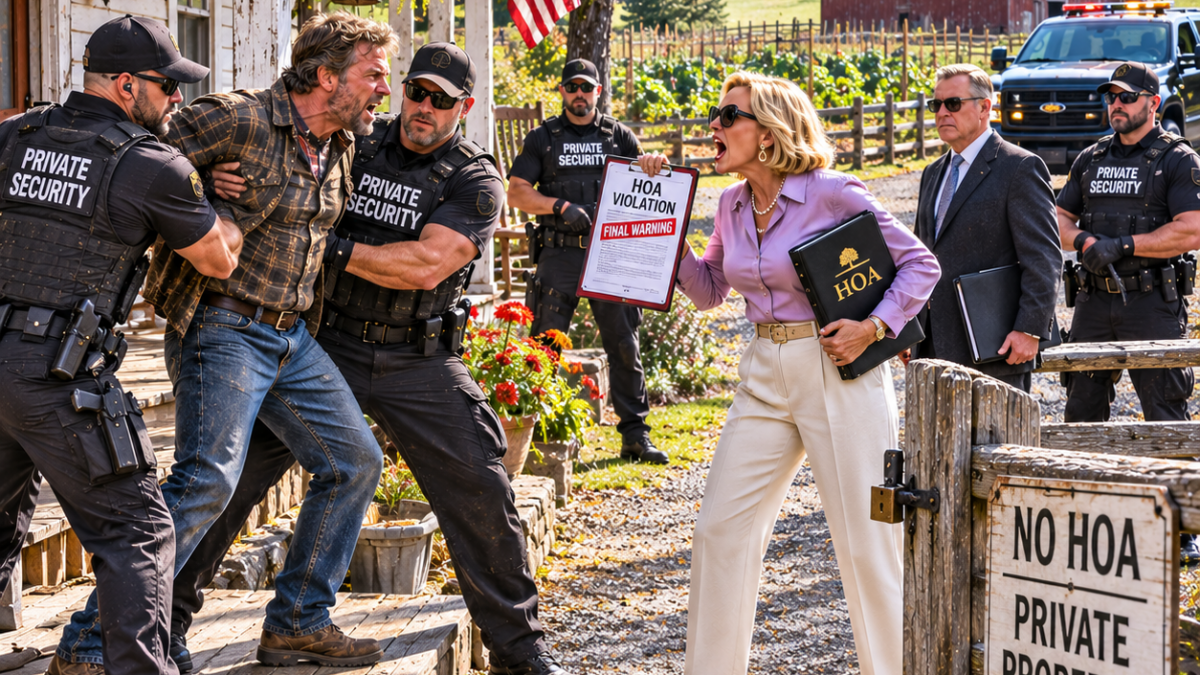
part 2
The next morning, I called Margaret.
She answered on the second ring.
“Mr. Carter, I was just preparing to contact you.”
“About the people measuring my driveway at two thirty this morning?”
Silence.
Then sweetness.
“I have no idea what you’re referring to.”
“I have video.”
Another silence.
“Three people. Flashlights. Measuring wheel. Your board member Ray Finn is visible in two angles.”
Her voice changed.
“You need to be very careful about making accusations.”
“I’m not making one. I’m describing video.”
“Your noncompliance has forced us to consider stronger measures.”
I leaned against the kitchen counter.
“Margaret, the only stronger measure you need is a stronger understanding of where your HOA ends.”
“If you escalate this, you’ll regret it.”
I laughed.
“The only thing I regret is not buying a bigger no-trespassing sign.”
She hung up.
Two mornings later, I found out what she meant by stronger measures.
A dark SUV came slowly up my driveway.
Two men got out.
Black tactical-style uniforms.
Badges clipped at the belt.
Earpieces.
Vests labeled HOA SECURITY ENFORCEMENT.
The taller man walked toward my porch.
“James Carter?”
I took a sip of coffee.
“Who wants to know?”
“You’re in direct violation of multiple HOA regulations. You’ve ignored notices and failed to attend mandatory compliance proceedings.”
“I was never invited to a legitimate proceeding.”
“We’ve been authorized to detain you until you agree to attend.”
That got my attention.
I set down the mug.
“Detain me?”
The second man shifted.
“If you refuse to cooperate, we’ll escalate to law enforcement.”
I walked down one step.
“Which department are you with?”
They glanced at each other.
The second man answered.
“We’re contracted security.”
“So you’re not police.”
“We operate under HOA enforcement authority.”
“Which means you’re not police.”
The taller man’s jaw tightened.
“You are legally required—”
“No.”
He stopped.
“I’m not in Maple Grove. I’m not governed by Maple Grove. You’re standing on private property, and you just told me you’re going to detain me.”
“We have authorization.”
“From whom?”
“The HOA.”
I pulled my phone from my pocket.
“Then let’s call the sheriff and see how much arrest authority Margaret’s board can issue from the clubhouse.”
Both men changed immediately.
The thinner one stepped back.
“That’s not necessary.”
“Sure it is.”
I tapped the sheriff’s office number.
“You offered.”
The dispatcher answered.
I put the call on speaker.
“My name is James Carter. I have two private security guards on my property wearing tactical vests and badges. They’re claiming authority to detain me over an HOA dispute. I am not a member of that HOA.”
The taller man looked toward the SUV.
I continued.
“I’d like a deputy here before this goes any further.”
The dispatcher confirmed my address.
Unit en route.
Then we waited.
I leaned against the porch rail.
The two guards stood in the driveway trying to look like men who had not suddenly become nervous.
A patrol cruiser arrived a few minutes later.
Deputy Harris stepped out.
I knew him by sight.
Broad shoulders.
Weathered face.
About as impressed with nonsense as a fence post.
He looked at the guards.
Then their vests.
“What the hell is this?”
The taller man straightened.
“We’re private security retained by Maple Grove HOA. We’re here to detain Mr. Carter pending a compliance hearing.”
Harris held up a hand.
“Stop.”
The guard stopped.
“You can’t detain him.”
“We’ve been given authority.”
“No, you haven’t.”
“Sir—”
“You’re private security.”
Harris looked at me.
“James, you’re not in Maple Grove, right?”
“Not one inch.”
I handed him a folder.
Deed.
County parcel map.
Copies of notices.
Still images from the nighttime trespass.
Harris skimmed the deed.
Then the map.
Then one of Margaret’s letters.
He closed the folder.
“All right.”
He looked at the guards.
“Here’s where we’re at. You’re on private property. This homeowner isn’t subject to the HOA you’re working for. You have no authority to detain him, arrest him, transport him, or force him to attend anything.”
The taller guard swallowed.
“We were following orders.”
“Bad orders don’t become legal because someone prints them on letterhead.”
Then another SUV arrived.
Silver.
Spotless.
Margaret Whitmore stepped out wearing a pressed blouse and that same look of controlled superiority.
She walked directly toward Harris.
“Deputy, I’m glad you’re here.”
He looked at her.
She continued.
“We’ve been dealing with a very difficult resident who refuses to follow community standards.”
“He’s not one of your residents.”
“His property was incorporated.”
“No, it wasn’t.”
Margaret’s jaw tightened.
“The HOA board approved the boundary expansion.”
Harris almost smiled.
“Your board can’t vote somebody else’s land into your association.”
She pointed toward my house.
“This man has been hostile from the beginning.”
“That doesn’t change ownership.”
“He’s threatened board members.”
I spoke for the first time.
“Show him the threat.”
She turned toward me.
Harris cut in.
“Enough.”
Margaret looked offended.
“I’ve seen his deed. I’ve seen the county map. I’ve seen footage of your people on his land at night. Now you’ve sent private security wearing badges to claim they can detain him.”
Her face lost color.
“That’s not what happened.”
I looked at the two men.
The thinner one stared at the gravel.
Harris continued.
“You do not have police authority.”
Margaret tried a different approach.
“My security team believed—”
“Your security team needs to explain that downtown.”
The second deputy who had arrived moved toward the guards.
The taller one protested.
The thinner one didn’t.
Cuffs clicked.
Margaret stepped forward.
“You can’t arrest them.”
“They’re being detained while we sort out whether they committed criminal offenses.”
“They were doing their jobs.”
Harris looked at her.
“If you hire somebody to do something illegal, ‘their job’ isn’t a magic phrase.”
She stopped.
I leaned against the porch post.
“Margaret.”
Her eyes snapped toward me.
“You picked the wrong fight.”
“This isn’t over.”
I smiled.
“I know.”
I pointed toward the folder in Harris’s hand.
“Because now I’m taking everything to court.”
That was the first time she looked worried.
A week later, Maple Grove sued me.
Of course they did.
The complaint arrived in a thick envelope stamped URGENT.
Public nuisance.
Community safety violation.
Willful refusal to comply with HOA regulations.
And my favorite:
A request asking the court to recognize Maple Grove’s expanded jurisdiction over my property.
Margaret had spent weeks acting as though her board vote already changed reality.
Now she wanted a judge to make it real afterward.
I called Richard Harland.
Most people called him Rich.
A few lawyers called him Bulldog, never to his face.
He specialized in land-use disputes, easements, title conflicts, and associations that forgot where their authority ended.
He read the complaint.
Then he smiled.
“This is going to be simpler than they think.”
“That’s good.”
“I said simpler. Not cheap.”
“Less good.”
We built the case.
Original deed.
Title history.
County zoning map.
Parcel boundary records.
Tax history.
County letter confirming no annexation.
Every violation notice.
Video of the nighttime measuring expedition.
Video of the security guards.
Deputy Harris’s report.
Statements from neighbors.
Everything.
Rich also filed counterclaims.
Trespass.
Harassment.
Defamation connected to false allegations.
Improper interference with property rights.
Costs associated with the repeated campaign.
I told him I did not want theatrics.
“I want a written boundary they can never pretend not to understand again.”
“That’s the easy part.”
The court date arrived.
Margaret sat at the plaintiff’s table in a navy suit.
Her attorney looked expensive.
The judge looked tired.
That combination usually helps facts.
Maple Grove’s lawyer began with a speech about neighborhood integrity.
Community safety.
Uniform standards.
Responsible development.
Then the judge interrupted.
“Is Mr. Carter a member of Maple Grove HOA?”
A pause.
“His parcel falls within the association’s expanded community boundary.”
“That wasn’t my question.”
Another pause.
“No, Your Honor, he did not originally join.”
“Did he ever execute an agreement subjecting the parcel to Maple Grove covenants?”
“No.”
“Is there a recorded declaration attaching his parcel?”
The lawyer looked toward Margaret.
“No.”
The judge leaned back.
“So the answer is no.”
Margaret jumped in.
“The board voted to incorporate the property.”
The judge looked at her.
“Mrs. Whitmore, an HOA board does not acquire jurisdiction over private land by voting that it would like to.”
Silence.
Rich stood.
“If the court would like the recorded evidence.”
He handed over the deed.
County maps.
Certified property-office correspondence.
The judge reviewed them.
“Clear enough.”
Then she looked at Rich.
“Counterclaims?”
“Yes, Your Honor.”
He summarized the pattern.
Not one mistaken letter.
Multiple notices.
Repeated trespass.
Nighttime measuring.
Security deployment.
Detention threats.
False representations of authority.
He offered the videos.
The judge watched.
Three figures moving across my property in darkness.
Flashlights.
Measuring wheel.
Then the guards.
Badges.
Tactical vests.
“Authorized to detain.”
Then Harris arriving.
His voice:
You cannot detain anybody.
Then Margaret entering the scene and insisting my property had become part of her association.
When the video ended, the judge took off her glasses.
“Mrs. Whitmore.”
Margaret sat straighter.
“This is one of the more serious examples of association overreach I’ve seen.”
Margaret’s attorney whispered to her.
The judge continued.
“You cannot impose fines on property outside your covenants.”
She looked toward the screen.
“You cannot send private security to exercise police powers they do not possess.”
Then toward the deed.
“And you cannot expand the association by internal vote over a nonconsenting landowner.”
Margaret tried to speak.
The judge raised one hand.
“No.”
That one word silenced her.
The court ruled in my favor on the jurisdiction issue and dismissed Maple Grove’s claims.
My counterclaims succeeded on the documented harassment and trespass issues.
The HOA was ordered to cover my legal costs and pay fifty thousand dollars in damages.
The exact language of the order mattered more to me than the number.
My parcel was outside Maple Grove.
No HOA authority.
No fines.
No inspections.
No enforcement rights.
No unilateral expansion.
The gavel came down.
Margaret sat frozen.
Behind her, board members exchanged looks.
Not supportive ones.
I walked past her without speaking.
Outside the courthouse, Rich buttoned his coat.
“Congratulations.”
“Thanks.”
“Don’t do anything stupid with the money.”
I looked at him.
He narrowed his eyes.
“James.”
“I haven’t said anything.”
“That’s why I’m worried.”
The truth was, I had an idea.
Winning in court gave me peace.
But Margaret had spent weeks trying to turn my property into a warning.
I decided to turn the judgment into one.
There was a small commercially zoned parcel near the main entrance to Maple Grove.
Vacant.
Visible from almost every vehicle entering the subdivision.
The owner had been trying to sell for months.
I called him.
We negotiated.
Cash offer.
Quick closing.
No HOA jurisdiction over that parcel either.
I bought it.
Then I went to the planning office.
I did everything Margaret had never bothered to do.
Checked zoning.
Sign ordinance.
Height limit.
Lighting requirements.
Setback.
Permit.
Inspection.
Every rule.
Every form.
Every fee.
Then I hired a fabricator.
Twelve-foot steel sign.
Floodlit.
Simple message.
MAPLE GROVE HOA
THIS LAND IS NOT YOURS
STAY OFF IT
At the bottom:
PAID FOR BY JAMES CARTER
I considered using their logo.
Rich threatened to strangle me through the phone.
So instead I used a generic shield shape with crossed NO TRESPASSING symbols.
Legal.
Permitted.
Inspected.
Mine.
The reaction was immediate.
Calls.
Emails.
Letters.
One board member offered to discuss a compromise.
I said no.
Margaret called an emergency meeting about “public degradation of neighborhood prestige.”
Unfortunately for her, the HOA had bigger problems.
Fifty thousand dollars in damages.
My legal fees.
Their own attorney bills.
Insurance questions after the security incident.
Potential consequences from the guards’ conduct.
Residents were furious that association funds had been spent fighting over property the HOA never controlled.
Projects vanished.
Clubhouse expansion.
Second gate.
Decorative fountain.
“Community color compliance initiative.”
Gone.
Then the political collapse began.
Margaret’s president’s message disappeared from the newsletter.
Board members stopped defending her publicly.
Residents started requesting financial records.
A removal petition circulated.
The woman who had treated Maple Grove like a personal kingdom discovered something every petty ruler eventually learns.
Power borrowed from other people disappears the moment they stop lending it.
One morning, I was drinking coffee on my porch when a moving truck entered Maple Grove.
Ten minutes later, it stopped in front of Margaret’s house.
I watched boxes come out.
Furniture.
Decorations.
Perfectly trimmed potted plants.
By afternoon, the house looked strangely ordinary.
Margaret came out last.
No board members.
No clipboard.
No security.
She stood beside her SUV and looked toward the subdivision entrance.
Toward my sign.
Even from that distance, I saw her shoulders tighten.
Then she got into the SUV.
Drove past my property.
Didn’t slow down.
I raised my coffee mug.
Not dramatically.
Just enough for myself.
Margaret Whitmore was gone.
The billboard remained.
For a while, Maple Grove seemed disoriented without her.
Then something surprising happened.
It improved.
The residents elected Roger Bennett as president.
Accountant.
Mild voice.
Interested in potholes.
Budget balances.
Reserve planning.
He had no desire to annex neighboring farms or send tactical-looking contractors after anybody’s truck.
Under Roger, Maple Grove withdrew to its actual legal boundaries.
The new board formally abandoned every claim involving my land.
They reviewed enforcement policies.
Ended the security arrangement that created the confrontation.
Required legal review before making any future claim against nonmember property.
Boring changes.
Excellent changes.
The financial damage took longer.
My $50,000 judgment was only part of it.
The HOA had its own legal bills.
Insurance costs rose.
Several prestige projects stayed canceled.
One Christmas gala that Margaret used to advertise in the local newspaper became a potluck in the park.
Some residents complained.
Others brought casseroles.
Life went on.
My life became quiet again too.
No violation notices.
No strangers measuring my driveway.
No HOA security.
No threatening phone calls.
I kept the cameras.
Not because I expected Margaret to return.
Because after what happened, checking the empty road at night became reassuring.
Stillness is different after someone tries to take it from you.
The billboard became a local landmark.
People stopped occasionally to photograph it.
A few posted pictures online.
Some called me an HOA slayer.
I hated that phrase.
I had not set out to destroy an association.
Associations are not inherently evil.
People who misuse them are the problem.
Maple Grove residents needed somebody to organize road maintenance, common landscaping, storm-water work, and the clubhouse.
What they did not need was a president who believed a title converted neighboring property into her jurisdiction.
One afternoon in late autumn, a woman parked along the shoulder outside my gate.
She got out holding a grocery bag.
“Are you James?”
“Depends who’s asking.”
She smiled nervously.
“I live in Maple Grove.”
I waited.
“I wanted to say thank you.”
“For what?”
“For standing up.”
She looked toward the entrance.
“Margaret made life miserable for more people than you realized.”
I said nothing.
“Most of us paid whatever she demanded because fighting felt harder.”
She held out the bag.
Homemade bread.
Still warm.
“I don’t need anything.”
“I know.”
She smiled.
“That’s why it’s bread, not a plaque.”
I laughed.
Accepted it.
She turned to leave.
Then stopped.
“You’ve got more friends inside Maple Grove than you think.”
After she drove away, I stood by the fence for a while.
Margaret had spent months telling people I was hostile.
Difficult.
Anti-community.
A threat to property values.
But there was a difference between refusing control and hating neighbors.
I had never hated Maple Grove.
I hated being told Maple Grove owned something it did not.
That distinction matters.
Over the next year, life settled.
Roger’s board sent me one letter.
I opened it cautiously.
It contained an apology.
No legal language.
No condition.
No demand.
The board acknowledged that my parcel was independent and expressed regret for the prior administration’s conduct.
At the bottom, Roger had handwritten:
We intend to stay on our side of the line.
I laughed.
Then I wrote back.
That’s all I ever asked.
We eventually worked together on drainage near the road because runoff from one side affected the other.
No threats.
No fines.
No invented jurisdiction.
Just two property owners coordinating something practical.
That experience taught me how unnecessary the entire Margaret war had been.
She could have knocked on my door and asked.
Need drainage cooperation?
Ask.
Concerned about traffic?
Ask.
Want to discuss buying land?
Ask.
The answer might be no.
That was the part she could not tolerate.
Control-minded people often pretend negotiation exists when what they really want is compliance.
Margaret’s first letter did not ask whether I wanted to join Maple Grove.
It announced that I already had.
That single assumption contained the whole conflict.
She believed the result mattered more than consent.
Once she accepted that idea, every escalation became easier.
If the HOA could annex me without consent, it could fine me.
If it could fine me, it could inspect me.
If it could inspect me, trespassing became “evaluation.”
If I resisted evaluation, private guards became “enforcement.”
And if the guards wore badges and tactical vests, maybe I would stop asking whether the power was real.
I never stopped asking.
That was why the campaign failed.
People sometimes imagine the decisive moment was court.
It wasn’t.
The decisive moment happened long before that.
It happened when I opened the first letter and knew my deed did not match Margaret’s claim.
Knowledge gave me calm.
Without it, I might have panicked.
Paid the registration fee.
Attended the hearing.
Negotiated a reduced fine.
Every act of cooperation would have made the fiction look a little more real.
Instead, I checked.
That is the blueprint.
Not aggression.
Verification.
Someone says your land belongs to an HOA?
Check the deed.
Someone claims the boundary changed?
Call the county.
Someone threatens a lien?
Ask for the recorded authority.
Private security claims police powers?
Call actual law enforcement.
Someone says an emergency requires you to surrender rights immediately?
Slow down.
Real authority survives questions.
Fake authority becomes angry when questioned.
Margaret became angrier every time I asked for the document underneath her claim.
She had notices.
I asked for covenants.
She had a board vote.
I asked for ownership consent.
She had security.
I asked for statutory authority.
She had legal threats.
I brought the deed.
Every layer collapsed because there was nothing under it.
That is why I eventually considered taking the billboard down.
At first, I wanted it as revenge.
I admit that.
I wanted Margaret to see it every day.
I wanted board members to remember what fifty thousand dollars of arrogance looked like in steel and floodlights.
After she moved, the purpose changed.
It became less about her.
More about the boundary.
A reminder.
Titles stop.
Rules stop.
Authority stops.
Every system has a line.
Good leaders respect it.
Bad ones test whether anyone will notice.
The sign stayed.
Not forever.
Three years later, I replaced it with something smaller.
Rich was relieved.
The new sign read:
PRIVATE PROPERTY
CHECK THE DEED
Roger laughed when he saw it.
“Less aggressive.”
“I’m getting old.”
“Still twelve feet?”
“Eight.”
“Personal growth.”
We stood beside it looking toward Maple Grove.
The subdivision had changed.
Not physically.
Same stone entrance.
Same trimmed hedges.
Same neat rows of homes.
But meetings were public.
Budgets clearer.
Enforcement rules rewritten.
Complaints required actual covenant citations.
No security detentions.
No imaginary expansion.
Roger once told me the Margaret episode had cost the HOA money but saved it from something worse.
“What?”
“Becoming a place everybody hated living.”
That stayed with me.
Because power abuse does not only harm the target.
It corrodes the institution being used.
Margaret told herself she was protecting Maple Grove.
In reality, she was turning it into a weapon.
Residents paid the legal bills.
Residents lost projects.
Residents watched their insurance costs rise.
Residents spent months repairing the reputation of an organization most of them only joined because it came with their houses.
She used their name.
They paid for her ego.
That is why the board’s eventual reforms mattered more than her departure.
Removing one person solves one problem.
Changing the system makes it harder for the next person to repeat it.
The old notices stayed in my file cabinet.
I never threw them away.
Sometimes people visiting the farmhouse ask about them.
I pull out the first.
Gold logo.
Dear Homeowner.
Unapproved fence.
Bad landscaping.
Unauthorized truck.
They laugh.
Then I show the later ones.
Legal department.
Compliance hearing.
Property seizure.
Detention threat.
The laughter disappears.
Escalation looks ridiculous when you spread it across a table.
One small assumption hardening into something larger because nobody inside the organization stopped it.
I think about Ray Finn sometimes.
The tall board member who stood beside Margaret the first day.
Years later, I saw him at the hardware store.
He recognized me.
Looked uncomfortable.
“James.”
“Ray.”
He stared at a shelf of deck screws.
“I should’ve said something.”
“About what?”
“That first day.”
“You believed her?”
“I believed there had been a legal review.”
“Had there?”
He shook his head.
“No.”
“Did you ask?”
“No.”
There it was.
The entire Maple Grove problem in two words.
He did not ask.
I did not lecture him.
He already understood.
We talked about lumber prices instead.
Not every mistake requires lifelong punishment.
Sometimes the useful consequence is learning.
Margaret never seemed interested in learning.
At least not while I knew her.
Rumors said she moved out of state.
Maybe she found another association.
Maybe she never joined another board.
I have no idea.
I stopped caring.
The most important part of winning a fight is reaching the point where you no longer need to keep fighting it.
My mornings returned.
Coffee.
Porch.
Sun climbing over the tree line.
Truck exactly where I wanted it.
Wildflowers against the fence.
Vegetable garden slightly out of control.
The farmhouse looked nothing like Maple Grove standards.
That made me smile.
One day, Deputy Harris drove past and slowed at the mailbox.
I walked down.
“Everything quiet?”
“Almost disappointingly.”
He nodded toward the property.
“No tactical HOA units lately?”
“Not this week.”
He laughed.
Then looked toward Maple Grove.
“New board seems normal.”
“That’s what I’ve heard.”
He started to leave.
I called after him.
“Harris.”
He turned.
“Thanks.”
“For what?”
“The morning with the security guys.”
He shrugged.
“They made it easy.”
“How?”
“They told me they were there to detain you.”
He smiled.
“Most people committing questionable things are smart enough not to explain them immediately.”
I laughed.
He drove away.
That conversation reminded me why evidence mattered more than outrage.
Margaret’s people told the truth about what they believed they could do.
On camera.
In front of a deputy.
Their confidence preserved the case better than any trap I could have designed.
That was the pattern from beginning to end.
Margaret’s greatest weakness was certainty.
She never imagined she could be wrong.
So she documented herself.
Signed notices.
Sent emails.
Ordered inspections.
Dispatched guards.
Filed the lawsuit.
She kept creating records because she believed the records proved authority.
Instead, they proved a campaign.
The lawsuit was her last attempt to turn repetition into legitimacy.
The judge refused.
That refusal mattered far beyond the fifty thousand dollars.
It placed the boundary in language Margaret could no longer reinterpret.
No jurisdiction.
No unilateral annexation.
No fines.
No enforcement.
No detention.
No control.
Simple.
That is why the written judgment still sits beside my deed.
Not because I enjoy looking at it.
Because I like having reality in two separate documents.
The deed says what is mine.
The judgment says what Maple Grove is not allowed to pretend is theirs.
Years after everything happened, I stood at the edge of the driveway one evening while the sunset turned the oak trunks orange.
The smaller sign cast a long shadow.
PRIVATE PROPERTY
CHECK THE DEED
A Maple Grove resident walking her dog stopped across the road.
She pointed at it.
“Still necessary?”
I thought about Margaret.
The letters.
The nighttime measuring wheel.
The tactical vests.
The courtroom.
The billboard.
Then I shrugged.
“Probably not.”
She smiled.
“Then why keep it?”
I looked back at the farmhouse.
“Because ‘probably not’ is how weird stories begin.”
She laughed.
So did I.
Then she kept walking.
I went back to the porch.
The truth is, Margaret Whitmore never had the power she thought she had.
Not once.
Her letters did not create jurisdiction.
Her board vote did not change my deed.
Her security guards did not become police because she printed badges on their vests.
Her lawsuit did not transform private land into HOA property.
The power came from one possibility.
That I might believe her.
That I might get tired.
That I might panic.
That I might decide paying a fine was easier than checking the law.
That is where abusive authority grows.
In the gap between what someone claims and what everyone else is willing to verify.
I closed that gap.
That was all.
No secret trick.
No powerful connections.
No dramatic ambush.
A deed.
County records.
Security footage.
A deputy willing to say no.
A lawyer who understood boundaries.
A judge willing to enforce them.
Facts.
Margaret once told me her board had “officially” incorporated my property into Maple Grove.
She was wrong.
The land remained exactly what it had been before her letter arrived.
Mine.
Every oak.
Every fence post.
Every wildflower.
Every inch of gravel under my truck.
After everything that happened, that simple word carried more weight than any billboard ever could.
Mine.
𝗧𝗛𝗘 𝗘𝗡𝗗
HOA Karen Claimed My Farmhouse Was Hers to Control—Then She Sent Fake Security to Drag Me Off My Own Porch
The HOA Karen half a mile down the road decided my private acreage had somehow become part of her subdivision, then started fining me for my fence, my garden, and the truck parked in my own driveway.
When I refused to play along, she sent men in tactical vests to my porch claiming they had the authority to detain me until I submitted to an HOA hearing.
Margaret Whitmore believed enough letters, uniforms, and legal-sounding threats could manufacture authority where none existed, but she had made one mistake from the beginning: I kept every piece of paper she sent me.
For nearly twenty years, that land had been the closest thing I had to sanctuary. Four acres and change, framed by old oaks, a gravel driveway curling toward a farmhouse that had been standing since before half the roads around it were paved. I had replaced the roof myself, rebuilt the porch, refinished the original pine floors, repaired wiring that looked old enough to remember Eisenhower, and turned a patch of neglected ground behind the kitchen into a vegetable garden. The place was imperfect, quiet, and completely mine. No clubhouse. No design committee. No strangers carrying clipboards through my yard. I could park my truck wherever I wanted and let wildflowers grow against the fence without asking permission from somebody who thought symmetry was a moral virtue.
Then the letter arrived.
Plain white envelope.
Gold embossed logo in the corner.
MAPLE GROVE HOMEOWNERS ASSOCIATION.
At first, I assumed the mail carrier had made a mistake.
Maple Grove was the gated subdivision about half a mile down the road. Rows of stone-front houses. Trimmed hedges. Identical mailboxes. Perfect lawns that looked less grown than manufactured. I knew a few people who lived there. Nice enough folks. But I had never belonged to their association, never wanted to belong to it, and never signed a document connecting my property to it.
Curiosity won.
I opened the envelope.
“Dear Homeowner,” it began.
That should have been my first warning.
The letter claimed my property was now subject to Maple Grove community standards and listed three violations.
Unapproved fencing materials.
Failure to maintain HOA-approved landscaping.
Unauthorized vehicle parking in driveway.
I laughed.
My fence was weathered cedar installed years before Maple Grove existed.
My landscaping consisted mostly of wildflowers, tomatoes, peppers, and whatever survived the deer.
The “unauthorized vehicle” was my pickup truck parked beside my own house.
Then I reached the line that mattered.
As part of the Maple Grove HOA community…
I read it again.
I was not part of Maple Grove.
I had never been part of Maple Grove.
My deed was clean.
No covenant.
No association membership.
No annexation.
I crumpled the letter and threw it away.
Two days later, three people showed up at the end of my driveway.
Two men.
One woman.
Business casual.
Clipboards.
The woman stepped forward.
Short blonde bob.
Perfect makeup.
Expression like somebody had just handed her temporary custody of the Constitution.
“Good morning, Mr. Carter.”
“Morning.”
“I’m Margaret Whitmore, president of the Maple Grove Homeowners Association.”
“I figured.”
“We’re here for a quick property evaluation.”
“For what?”
Her smile widened.
“Now that your property is officially within HOA boundaries, we need to establish a compliance baseline.”
I stared at her.
“Officially?”
“Yes.”
“Since when?”
“The board voted last month to incorporate this section into the community.”
She said it as though a group of strangers raising their hands in a clubhouse could rewrite my deed.
I walked slowly down the porch steps.
“Let me understand this. Your board voted to take my property into your HOA?”
“To incorporate it.”
“Without asking me.”
“The community boundary was adjusted.”
“By whom?”
“The board.”
I smiled.
“That isn’t how property law works.”
The taller man cleared his throat.
“Technically, HOA jurisdiction extends to all parcels within approved community boundaries.”
I pointed toward the weathered NO TRESPASSING sign beside my gate.
“Technically, you’re standing on private property belonging to someone who never joined your HOA.”
Nobody spoke.
Margaret’s smile tightened.
“Mr. Carter, we’d prefer cooperation.”
“I’d prefer breakfast.”
“Failure to comply could result in legal action.”
“Good.”
She blinked.
“Excuse me?”
“Take legal action. I’d love to see what document gives Maple Grove authority over my land.”
Her expression changed.
Not dramatically.
Just enough.
The performance cracked for half a second.
Then she turned toward the other two.
“Let’s go.”
They walked back toward the road whispering.
I watched until they disappeared.
A cold feeling settled in my stomach.
Not fear exactly.
Recognition.
Margaret Whitmore was not embarrassed.
She was offended.
People like that do not always interpret “no” as an answer.
Sometimes they interpret it as the beginning of a campaign.
The next morning, a bright orange notice was taped to my fence.
FINAL WARNING — IMMEDIATE ACTION REQUIRED.
Same violations.
Same nonsense.
Seven days to comply.
Threat of fines and further enforcement.
Margaret’s looping signature at the bottom.
I ripped it down.
An hour later, another appeared on my gate.
COPY SENT TO LEGAL DEPARTMENT.
By the end of the week, notices showed up everywhere.
Fence.
Screen door.
Truck windshield.
Mailbox post.
Some days two at a time.
The language escalated.
Compliance hearing.
Administrative penalties.
Property enforcement.
Possible lien.
Mandatory inspection.
The threats sounded serious until you remembered one inconvenient fact.
Maple Grove had no authority over me.
So I called the county property office.
“James Carter, parcel number ending in 417.”
The clerk checked.
“No HOA declaration attached.”
“Any recent annexation?”
“No.”
“Boundary change?”
“No.”
“Any covenant amendment?”
“No.”
I thanked her.
Then I started a file.
Every notice.
Every envelope.
Every photograph.
Every date.
If Margaret wanted paper, I would give her paper.
Three nights later, at 2:30 in the morning, my phone buzzed.
Motion alert.
I opened the security feed.
Three figures moved along my fence line.
Flashlights.
Clipboards.
One carried a measuring wheel.
They crossed part of my driveway and began measuring distances between the road, the fence, and the front of my house.
Reconnaissance.
I considered walking outside.
Then I looked at the recording icon.
Red.
Active.
Cloud backup enabled.
I stayed inside.
Sometimes the smartest thing you can do is let somebody finish creating the evidence you are going to use against them.
part 2
The next morning, I called Margaret.
She answered on the second ring.
“Mr. Carter, I was just preparing to contact you.”
“About the people measuring my driveway at two thirty this morning?”
Silence.
Then sweetness.
“I have no idea what you’re referring to.”
“I have video.”
Another silence.
“Three people. Flashlights. Measuring wheel. Your board member Ray Finn is visible in two angles.”
Her voice changed.
“You need to be very careful about making accusations.”
“I’m not making one. I’m describing video.”
“Your noncompliance has forced us to consider stronger measures.”
I leaned against the kitchen counter.
“Margaret, the only stronger measure you need is a stronger understanding of where your HOA ends.”
“If you escalate this, you’ll regret it.”
I laughed.
“The only thing I regret is not buying a bigger no-trespassing sign.”
She hung up.
Two mornings later, I found out what she meant by stronger measures.
A dark SUV came slowly up my driveway.
Two men got out.
Black tactical-style uniforms.
Badges clipped at the belt.
Earpieces.
Vests labeled HOA SECURITY ENFORCEMENT.
The taller man walked toward my porch.
“James Carter?”
I took a sip of coffee.
“Who wants to know?”
“You’re in direct violation of multiple HOA regulations. You’ve ignored notices and failed to attend mandatory compliance proceedings.”
“I was never invited to a legitimate proceeding.”
“We’ve been authorized to detain you until you agree to attend.”
That got my attention.
I set down the mug.
“Detain me?”
The second man shifted.
“If you refuse to cooperate, we’ll escalate to law enforcement.”
I walked down one step.
“Which department are you with?”
They glanced at each other.
The second man answered.
“We’re contracted security.”
“So you’re not police.”
“We operate under HOA enforcement authority.”
“Which means you’re not police.”
The taller man’s jaw tightened.
“You are legally required—”
“No.”
He stopped.
“I’m not in Maple Grove. I’m not governed by Maple Grove. You’re standing on private property, and you just told me you’re going to detain me.”
“We have authorization.”
“From whom?”
“The HOA.”
I pulled my phone from my pocket.
“Then let’s call the sheriff and see how much arrest authority Margaret’s board can issue from the clubhouse.”
Both men changed immediately.
The thinner one stepped back.
“That’s not necessary.”
“Sure it is.”
I tapped the sheriff’s office number.
“You offered.”
The dispatcher answered.
I put the call on speaker.
“My name is James Carter. I have two private security guards on my property wearing tactical vests and badges. They’re claiming authority to detain me over an HOA dispute. I am not a member of that HOA.”
The taller man looked toward the SUV.
I continued.
“I’d like a deputy here before this goes any further.”
The dispatcher confirmed my address.
Unit en route.
Then we waited.
I leaned against the porch rail.
The two guards stood in the driveway trying to look like men who had not suddenly become nervous.
A patrol cruiser arrived a few minutes later.
Deputy Harris stepped out.
I knew him by sight.
Broad shoulders.
Weathered face.
About as impressed with nonsense as a fence post.
He looked at the guards.
Then their vests.
“What the hell is this?”
The taller man straightened.
“We’re private security retained by Maple Grove HOA. We’re here to detain Mr. Carter pending a compliance hearing.”
Harris held up a hand.
“Stop.”
The guard stopped.
“You can’t detain him.”
“We’ve been given authority.”
“No, you haven’t.”
“Sir—”
“You’re private security.”
Harris looked at me.
“James, you’re not in Maple Grove, right?”
“Not one inch.”
I handed him a folder.
Deed.
County parcel map.
Copies of notices.
Still images from the nighttime trespass.
Harris skimmed the deed.
Then the map.
Then one of Margaret’s letters.
He closed the folder.
“All right.”
He looked at the guards.
“Here’s where we’re at. You’re on private property. This homeowner isn’t subject to the HOA you’re working for. You have no authority to detain him, arrest him, transport him, or force him to attend anything.”
The taller guard swallowed.
“We were following orders.”
“Bad orders don’t become legal because someone prints them on letterhead.”
Then another SUV arrived.
Silver.
Spotless.
Margaret Whitmore stepped out wearing a pressed blouse and that same look of controlled superiority.
She walked directly toward Harris.
“Deputy, I’m glad you’re here.”
He looked at her.
She continued.
“We’ve been dealing with a very difficult resident who refuses to follow community standards.”
“He’s not one of your residents.”
“His property was incorporated.”
“No, it wasn’t.”
Margaret’s jaw tightened.
“The HOA board approved the boundary expansion.”
Harris almost smiled.
“Your board can’t vote somebody else’s land into your association.”
She pointed toward my house.
“This man has been hostile from the beginning.”
“That doesn’t change ownership.”
“He’s threatened board members.”
I spoke for the first time.
“Show him the threat.”
She turned toward me.
Harris cut in.
“Enough.”
Margaret looked offended.
“I’ve seen his deed. I’ve seen the county map. I’ve seen footage of your people on his land at night. Now you’ve sent private security wearing badges to claim they can detain him.”
Her face lost color.
“That’s not what happened.”
I looked at the two men.
The thinner one stared at the gravel.
Harris continued.
“You do not have police authority.”
Margaret tried a different approach.
“My security team believed—”
“Your security team needs to explain that downtown.”
The second deputy who had arrived moved toward the guards.
The taller one protested.
The thinner one didn’t.
Cuffs clicked.
Margaret stepped forward.
“You can’t arrest them.”
“They’re being detained while we sort out whether they committed criminal offenses.”
“They were doing their jobs.”
Harris looked at her.
“If you hire somebody to do something illegal, ‘their job’ isn’t a magic phrase.”
She stopped.
I leaned against the porch post.
“Margaret.”
Her eyes snapped toward me.
“You picked the wrong fight.”
“This isn’t over.”
I smiled.
“I know.”
I pointed toward the folder in Harris’s hand.
“Because now I’m taking everything to court.”
That was the first time she looked worried.
A week later, Maple Grove sued me.
Of course they did.
The complaint arrived in a thick envelope stamped URGENT.
Public nuisance.
Community safety violation.
Willful refusal to comply with HOA regulations.
And my favorite:
A request asking the court to recognize Maple Grove’s expanded jurisdiction over my property.
Margaret had spent weeks acting as though her board vote already changed reality.
Now she wanted a judge to make it real afterward.
I called Richard Harland.
Most people called him Rich.
A few lawyers called him Bulldog, never to his face.
He specialized in land-use disputes, easements, title conflicts, and associations that forgot where their authority ended.
He read the complaint.
Then he smiled.
“This is going to be simpler than they think.”
“That’s good.”
“I said simpler. Not cheap.”
“Less good.”
We built the case.
Original deed.
Title history.
County zoning map.
Parcel boundary records.
Tax history.
County letter confirming no annexation.
Every violation notice.
Video of the nighttime measuring expedition.
Video of the security guards.
Deputy Harris’s report.
Statements from neighbors.
Everything.
Rich also filed counterclaims.
Trespass.
Harassment.
Defamation connected to false allegations.
Improper interference with property rights.
Costs associated with the repeated campaign.
I told him I did not want theatrics.
“I want a written boundary they can never pretend not to understand again.”
“That’s the easy part.”
The court date arrived.
Margaret sat at the plaintiff’s table in a navy suit.
Her attorney looked expensive.
The judge looked tired.
That combination usually helps facts.
Maple Grove’s lawyer began with a speech about neighborhood integrity.
Community safety.
Uniform standards.
Responsible development.
Then the judge interrupted.
“Is Mr. Carter a member of Maple Grove HOA?”
A pause.
“His parcel falls within the association’s expanded community boundary.”
“That wasn’t my question.”
Another pause.
“No, Your Honor, he did not originally join.”
“Did he ever execute an agreement subjecting the parcel to Maple Grove covenants?”
“No.”
“Is there a recorded declaration attaching his parcel?”
The lawyer looked toward Margaret.
“No.”
The judge leaned back.
“So the answer is no.”
Margaret jumped in.
“The board voted to incorporate the property.”
The judge looked at her.
“Mrs. Whitmore, an HOA board does not acquire jurisdiction over private land by voting that it would like to.”
Silence.
Rich stood.
“If the court would like the recorded evidence.”
He handed over the deed.
County maps.
Certified property-office correspondence.
The judge reviewed them.
“Clear enough.”
Then she looked at Rich.
“Counterclaims?”
“Yes, Your Honor.”
He summarized the pattern.
Not one mistaken letter.
Multiple notices.
Repeated trespass.
Nighttime measuring.
Security deployment.
Detention threats.
False representations of authority.
He offered the videos.
The judge watched.
Three figures moving across my property in darkness.
Flashlights.
Measuring wheel.
Then the guards.
Badges.
Tactical vests.
“Authorized to detain.”
Then Harris arriving.
His voice:
You cannot detain anybody.
Then Margaret entering the scene and insisting my property had become part of her association.
When the video ended, the judge took off her glasses.
“Mrs. Whitmore.”
Margaret sat straighter.
“This is one of the more serious examples of association overreach I’ve seen.”
Margaret’s attorney whispered to her.
The judge continued.
“You cannot impose fines on property outside your covenants.”
She looked toward the screen.
“You cannot send private security to exercise police powers they do not possess.”
Then toward the deed.
“And you cannot expand the association by internal vote over a nonconsenting landowner.”
Margaret tried to speak.
The judge raised one hand.
“No.”
That one word silenced her.
The court ruled in my favor on the jurisdiction issue and dismissed Maple Grove’s claims.
My counterclaims succeeded on the documented harassment and trespass issues.
The HOA was ordered to cover my legal costs and pay fifty thousand dollars in damages.
The exact language of the order mattered more to me than the number.
My parcel was outside Maple Grove.
No HOA authority.
No fines.
No inspections.
No enforcement rights.
No unilateral expansion.
The gavel came down.
Margaret sat frozen.
Behind her, board members exchanged looks.
Not supportive ones.
I walked past her without speaking.
Outside the courthouse, Rich buttoned his coat.
“Congratulations.”
“Thanks.”
“Don’t do anything stupid with the money.”
I looked at him.
He narrowed his eyes.
“James.”
“I haven’t said anything.”
“That’s why I’m worried.”
The truth was, I had an idea.
Winning in court gave me peace.
But Margaret had spent weeks trying to turn my property into a warning.
I decided to turn the judgment into one.
There was a small commercially zoned parcel near the main entrance to Maple Grove.
Vacant.
Visible from almost every vehicle entering the subdivision.
The owner had been trying to sell for months.
I called him.
We negotiated.
Cash offer.
Quick closing.
No HOA jurisdiction over that parcel either.
I bought it.
Then I went to the planning office.
I did everything Margaret had never bothered to do.
Checked zoning.
Sign ordinance.
Height limit.
Lighting requirements.
Setback.
Permit.
Inspection.
Every rule.
Every form.
Every fee.
Then I hired a fabricator.
Twelve-foot steel sign.
Floodlit.
Simple message.
MAPLE GROVE HOA
THIS LAND IS NOT YOURS
STAY OFF IT
At the bottom:
PAID FOR BY JAMES CARTER
I considered using their logo.
Rich threatened to strangle me through the phone.
So instead I used a generic shield shape with crossed NO TRESPASSING symbols.
Legal.
Permitted.
Inspected.
Mine.
The reaction was immediate.
Calls.
Emails.
Letters.
One board member offered to discuss a compromise.
I said no.
Margaret called an emergency meeting about “public degradation of neighborhood prestige.”
Unfortunately for her, the HOA had bigger problems.
Fifty thousand dollars in damages.
My legal fees.
Their own attorney bills.
Insurance questions after the security incident.
Potential consequences from the guards’ conduct.
Residents were furious that association funds had been spent fighting over property the HOA never controlled.
Projects vanished.
Clubhouse expansion.
Second gate.
Decorative fountain.
“Community color compliance initiative.”
Gone.
Then the political collapse began.
Margaret’s president’s message disappeared from the newsletter.
Board members stopped defending her publicly.
Residents started requesting financial records.
A removal petition circulated.
The woman who had treated Maple Grove like a personal kingdom discovered something every petty ruler eventually learns.
Power borrowed from other people disappears the moment they stop lending it.
One morning, I was drinking coffee on my porch when a moving truck entered Maple Grove.
Ten minutes later, it stopped in front of Margaret’s house.
I watched boxes come out.
Furniture.
Decorations.
Perfectly trimmed potted plants.
By afternoon, the house looked strangely ordinary.
Margaret came out last.
No board members.
No clipboard.
No security.
She stood beside her SUV and looked toward the subdivision entrance.
Toward my sign.
Even from that distance, I saw her shoulders tighten.
Then she got into the SUV.
Drove past my property.
Didn’t slow down.
I raised my coffee mug.
Not dramatically.
Just enough for myself.
Margaret Whitmore was gone.
The billboard remained.
For a while, Maple Grove seemed disoriented without her.
Then something surprising happened.
It improved.
The residents elected Roger Bennett as president.
Accountant.
Mild voice.
Interested in potholes.
Budget balances.
Reserve planning.
He had no desire to annex neighboring farms or send tactical-looking contractors after anybody’s truck.
Under Roger, Maple Grove withdrew to its actual legal boundaries.
The new board formally abandoned every claim involving my land.
They reviewed enforcement policies.
Ended the security arrangement that created the confrontation.
Required legal review before making any future claim against nonmember property.
Boring changes.
Excellent changes.
The financial damage took longer.
My $50,000 judgment was only part of it.
The HOA had its own legal bills.
Insurance costs rose.
Several prestige projects stayed canceled.
One Christmas gala that Margaret used to advertise in the local newspaper became a potluck in the park.
Some residents complained.
Others brought casseroles.
Life went on.
My life became quiet again too.
No violation notices.
No strangers measuring my driveway.
No HOA security.
No threatening phone calls.
I kept the cameras.
Not because I expected Margaret to return.
Because after what happened, checking the empty road at night became reassuring.
Stillness is different after someone tries to take it from you.
The billboard became a local landmark.
People stopped occasionally to photograph it.
A few posted pictures online.
Some called me an HOA slayer.
I hated that phrase.
I had not set out to destroy an association.
Associations are not inherently evil.
People who misuse them are the problem.
Maple Grove residents needed somebody to organize road maintenance, common landscaping, storm-water work, and the clubhouse.
What they did not need was a president who believed a title converted neighboring property into her jurisdiction.
One afternoon in late autumn, a woman parked along the shoulder outside my gate.
She got out holding a grocery bag.
“Are you James?”
“Depends who’s asking.”
She smiled nervously.
“I live in Maple Grove.”
I waited.
“I wanted to say thank you.”
“For what?”
“For standing up.”
She looked toward the entrance.
“Margaret made life miserable for more people than you realized.”
I said nothing.
“Most of us paid whatever she demanded because fighting felt harder.”
She held out the bag.
Homemade bread.
Still warm.
“I don’t need anything.”
“I know.”
She smiled.
“That’s why it’s bread, not a plaque.”
I laughed.
Accepted it.
She turned to leave.
Then stopped.
“You’ve got more friends inside Maple Grove than you think.”
After she drove away, I stood by the fence for a while.
Margaret had spent months telling people I was hostile.
Difficult.
Anti-community.
A threat to property values.
But there was a difference between refusing control and hating neighbors.
I had never hated Maple Grove.
I hated being told Maple Grove owned something it did not.
That distinction matters.
Over the next year, life settled.
Roger’s board sent me one letter.
I opened it cautiously.
It contained an apology.
No legal language.
No condition.
No demand.
The board acknowledged that my parcel was independent and expressed regret for the prior administration’s conduct.
At the bottom, Roger had handwritten:
We intend to stay on our side of the line.
I laughed.
Then I wrote back.
That’s all I ever asked.
We eventually worked together on drainage near the road because runoff from one side affected the other.
No threats.
No fines.
No invented jurisdiction.
Just two property owners coordinating something practical.
That experience taught me how unnecessary the entire Margaret war had been.
She could have knocked on my door and asked.
Need drainage cooperation?
Ask.
Concerned about traffic?
Ask.
Want to discuss buying land?
Ask.
The answer might be no.
That was the part she could not tolerate.
Control-minded people often pretend negotiation exists when what they really want is compliance.
Margaret’s first letter did not ask whether I wanted to join Maple Grove.
It announced that I already had.
That single assumption contained the whole conflict.
She believed the result mattered more than consent.
Once she accepted that idea, every escalation became easier.
If the HOA could annex me without consent, it could fine me.
If it could fine me, it could inspect me.
If it could inspect me, trespassing became “evaluation.”
If I resisted evaluation, private guards became “enforcement.”
And if the guards wore badges and tactical vests, maybe I would stop asking whether the power was real.
I never stopped asking.
That was why the campaign failed.
People sometimes imagine the decisive moment was court.
It wasn’t.
The decisive moment happened long before that.
It happened when I opened the first letter and knew my deed did not match Margaret’s claim.
Knowledge gave me calm.
Without it, I might have panicked.
Paid the registration fee.
Attended the hearing.
Negotiated a reduced fine.
Every act of cooperation would have made the fiction look a little more real.
Instead, I checked.
That is the blueprint.
Not aggression.
Verification.
Someone says your land belongs to an HOA?
Check the deed.
Someone claims the boundary changed?
Call the county.
Someone threatens a lien?
Ask for the recorded authority.
Private security claims police powers?
Call actual law enforcement.
Someone says an emergency requires you to surrender rights immediately?
Slow down.
Real authority survives questions.
Fake authority becomes angry when questioned.
Margaret became angrier every time I asked for the document underneath her claim.
She had notices.
I asked for covenants.
She had a board vote.
I asked for ownership consent.
She had security.
I asked for statutory authority.
She had legal threats.
I brought the deed.
Every layer collapsed because there was nothing under it.
That is why I eventually considered taking the billboard down.
At first, I wanted it as revenge.
I admit that.
I wanted Margaret to see it every day.
I wanted board members to remember what fifty thousand dollars of arrogance looked like in steel and floodlights.
After she moved, the purpose changed.
It became less about her.
More about the boundary.
A reminder.
Titles stop.
Rules stop.
Authority stops.
Every system has a line.
Good leaders respect it.
Bad ones test whether anyone will notice.
The sign stayed.
Not forever.
Three years later, I replaced it with something smaller.
Rich was relieved.
The new sign read:
PRIVATE PROPERTY
CHECK THE DEED
Roger laughed when he saw it.
“Less aggressive.”
“I’m getting old.”
“Still twelve feet?”
“Eight.”
“Personal growth.”
We stood beside it looking toward Maple Grove.
The subdivision had changed.
Not physically.
Same stone entrance.
Same trimmed hedges.
Same neat rows of homes.
But meetings were public.
Budgets clearer.
Enforcement rules rewritten.
Complaints required actual covenant citations.
No security detentions.
No imaginary expansion.
Roger once told me the Margaret episode had cost the HOA money but saved it from something worse.
“What?”
“Becoming a place everybody hated living.”
That stayed with me.
Because power abuse does not only harm the target.
It corrodes the institution being used.
Margaret told herself she was protecting Maple Grove.
In reality, she was turning it into a weapon.
Residents paid the legal bills.
Residents lost projects.
Residents watched their insurance costs rise.
Residents spent months repairing the reputation of an organization most of them only joined because it came with their houses.
She used their name.
They paid for her ego.
That is why the board’s eventual reforms mattered more than her departure.
Removing one person solves one problem.
Changing the system makes it harder for the next person to repeat it.
The old notices stayed in my file cabinet.
I never threw them away.
Sometimes people visiting the farmhouse ask about them.
I pull out the first.
Gold logo.
Dear Homeowner.
Unapproved fence.
Bad landscaping.
Unauthorized truck.
They laugh.
Then I show the later ones.
Legal department.
Compliance hearing.
Property seizure.
Detention threat.
The laughter disappears.
Escalation looks ridiculous when you spread it across a table.
One small assumption hardening into something larger because nobody inside the organization stopped it.
I think about Ray Finn sometimes.
The tall board member who stood beside Margaret the first day.
Years later, I saw him at the hardware store.
He recognized me.
Looked uncomfortable.
“James.”
“Ray.”
He stared at a shelf of deck screws.
“I should’ve said something.”
“About what?”
“That first day.”
“You believed her?”
“I believed there had been a legal review.”
“Had there?”
He shook his head.
“No.”
“Did you ask?”
“No.”
There it was.
The entire Maple Grove problem in two words.
He did not ask.
I did not lecture him.
He already understood.
We talked about lumber prices instead.
Not every mistake requires lifelong punishment.
Sometimes the useful consequence is learning.
Margaret never seemed interested in learning.
At least not while I knew her.
Rumors said she moved out of state.
Maybe she found another association.
Maybe she never joined another board.
I have no idea.
I stopped caring.
The most important part of winning a fight is reaching the point where you no longer need to keep fighting it.
My mornings returned.
Coffee.
Porch.
Sun climbing over the tree line.
Truck exactly where I wanted it.
Wildflowers against the fence.
Vegetable garden slightly out of control.
The farmhouse looked nothing like Maple Grove standards.
That made me smile.
One day, Deputy Harris drove past and slowed at the mailbox.
I walked down.
“Everything quiet?”
“Almost disappointingly.”
He nodded toward the property.
“No tactical HOA units lately?”
“Not this week.”
He laughed.
Then looked toward Maple Grove.
“New board seems normal.”
“That’s what I’ve heard.”
He started to leave.
I called after him.
“Harris.”
He turned.
“Thanks.”
“For what?”
“The morning with the security guys.”
He shrugged.
“They made it easy.”
“How?”
“They told me they were there to detain you.”
He smiled.
“Most people committing questionable things are smart enough not to explain them immediately.”
I laughed.
He drove away.
That conversation reminded me why evidence mattered more than outrage.
Margaret’s people told the truth about what they believed they could do.
On camera.
In front of a deputy.
Their confidence preserved the case better than any trap I could have designed.
That was the pattern from beginning to end.
Margaret’s greatest weakness was certainty.
She never imagined she could be wrong.
So she documented herself.
Signed notices.
Sent emails.
Ordered inspections.
Dispatched guards.
Filed the lawsuit.
She kept creating records because she believed the records proved authority.
Instead, they proved a campaign.
The lawsuit was her last attempt to turn repetition into legitimacy.
The judge refused.
That refusal mattered far beyond the fifty thousand dollars.
It placed the boundary in language Margaret could no longer reinterpret.
No jurisdiction.
No unilateral annexation.
No fines.
No enforcement.
No detention.
No control.
Simple.
That is why the written judgment still sits beside my deed.
Not because I enjoy looking at it.
Because I like having reality in two separate documents.
The deed says what is mine.
The judgment says what Maple Grove is not allowed to pretend is theirs.
Years after everything happened, I stood at the edge of the driveway one evening while the sunset turned the oak trunks orange.
The smaller sign cast a long shadow.
PRIVATE PROPERTY
CHECK THE DEED
A Maple Grove resident walking her dog stopped across the road.
She pointed at it.
“Still necessary?”
I thought about Margaret.
The letters.
The nighttime measuring wheel.
The tactical vests.
The courtroom.
The billboard.
Then I shrugged.
“Probably not.”
She smiled.
“Then why keep it?”
I looked back at the farmhouse.
“Because ‘probably not’ is how weird stories begin.”
She laughed.
So did I.
Then she kept walking.
I went back to the porch.
The truth is, Margaret Whitmore never had the power she thought she had.
Not once.
Her letters did not create jurisdiction.
Her board vote did not change my deed.
Her security guards did not become police because she printed badges on their vests.
Her lawsuit did not transform private land into HOA property.
The power came from one possibility.
That I might believe her.
That I might get tired.
That I might panic.
That I might decide paying a fine was easier than checking the law.
That is where abusive authority grows.
In the gap between what someone claims and what everyone else is willing to verify.
I closed that gap.
That was all.
No secret trick.
No powerful connections.
No dramatic ambush.
A deed.
County records.
Security footage.
A deputy willing to say no.
A lawyer who understood boundaries.
A judge willing to enforce them.
Facts.
Margaret once told me her board had “officially” incorporated my property into Maple Grove.
She was wrong.
The land remained exactly what it had been before her letter arrived.
Mine.
Every oak.
Every fence post.
Every wildflower.
Every inch of gravel under my truck.
After everything that happened, that simple word carried more weight than any billboard ever could.
Mine.








