𝗣𝗔𝗥𝗧 𝟮 HOA Karen Charged Me $300 to Use the Road I Built — Then One County Plat Blew Up Her Entire Scheme
𝗣𝗔𝗥𝗧 𝟮
The section listed specific sidewalks and walking paths built during original development.
They had been paid for with community funds.
Designated as common property on the subdivision plat.
My road wasn’t mentioned.
My parcel wasn’t mentioned.
Nothing in Section 4.2 gave the HOA authority to charge me for a private improvement.
I read it again.
Same answer.
A third time.
Still nothing.
Karen had cited a section that said almost the opposite of what she claimed.
That told me something important.
Either she had never read it.
Or she had read it and didn’t care.
Neither possibility was good.
The next morning, I went to my filing cabinet.
Bottom drawer.
Manila folder.
Three years untouched.
Inside:
County building permit.
Contractor agreement.
Invoice.
Two payment receipts.
Survey.
Certified plat.
I spread everything across my kitchen table.
The original property survey showed the entire road inside my lot boundary.
Entrance.
Middle.
Rear loop.
Every inch.
The county permit described it as a private residential improvement.
No HOA review required.
No HOA signature.
Nothing.
Karen Chen had picked a fight with a stack of documents she didn’t know existed.
That was her mistake.
But it wasn’t yet her worst one.
To understand why I didn’t simply send her the plat and end it, you need to understand Maplewood Ridge.
Ninety-four homes.
Mature trees.
Two-car garages.
Good school district.
The kind of suburb where most people work all day, come home tired, make dinner, help children with homework, and don’t want to spend their evenings reading governing documents.
Karen understood that better than anybody.
She had been HOA president eleven years.
Nobody else had challenged her for the position after she first took over.
The prior president, Hal Dorsey, retired to Arizona.
Karen ran unopposed.
Then she stayed.
The board had three seats.
Dennis Pratt was one.
Greg Toiver was the other.
Both had been recruited by Karen after previous members resigned.
Dennis rarely disagreed with her.
Greg rarely spoke.
There was no meaningful counterweight.
Karen’s method was simple.
Issue the charge first.
Cite a section number.
Don’t quote it.
Set a deadline.
Mention a lien.
Then wait for the homeowner to calculate what resistance would cost.
It had worked for years.
The Garcias lived four houses away from me.
Or they had.
Young family.
Two children.
Friendly dog that constantly tried to squeeze beneath the fence.
They installed a cedar side fence.
It looked fine.
Karen cited them three times in eight months for height violations.
Each measurement on Karen’s notices somehow came out different.
The Garcias considered fighting.
Then realized a real-estate attorney would cost more than paying the fines.
Fourteen months after the first notice, they sold.
Moved thirty minutes south.
I watched their moving truck leave one October morning.
The house stayed empty three months.
Nobody at an HOA meeting ever said:
Karen pushed a family out.
The official version was cleaner.
They had been noncompliant.
The matter was resolved.
That was how Karen’s system survived.
Nothing dramatic enough to make people unite.
Just one homeowner at a time.
One fine.
One threat.
One exhausted calculation.
I had lived there four years.
For my first year, the rear third of my 1.8-acre lot was a mess to access.
An old dirt track curved behind the house.
Winter turned it into mud.
Spring runoff made it worse.
The second year, I decided to fix it properly.
Three bids.
County permit.
Licensed contractor.
Five days of work.
Two inches of compacted gravel.
Asphalt.
Drainage.
Nineteen thousand dollars.
I had the contractor confirm the survey stakes before excavation.
I walked the boundary myself.
There was never any question whose road it was.
Karen’s theory apparently came from one fact.
The entrance to my road sat near an HOA-maintained walking path.
Near.
Not connected.
Not shared.
Not intersecting.
Near.
Karen converted proximity into jurisdiction.
In her mind, if my road existed close enough to HOA infrastructure, she could call it community-related.
Then charge me.
That is not how property rights work.
But Karen had survived eleven years without needing to learn that.
Three days after she handed me the orange notice, I sent a certified letter.
Return receipt requested.
Two paragraphs.
First:
I formally disputed the $300 assessment.
Second:
Please provide the exact CC&R language, quoted word for word, authorizing the HOA to levy an access or maintenance fee against a privately funded road located entirely on a privately owned parcel.
No insults.
No threats.
No attorney.
Just one request.
Show me the words.
I made a copy.
Placed it behind the original notice.
Then waited.
Ten days later, Karen replied.
Single page.
HOA letterhead.
Board vote:
3–0.
My road had been declared subject to HOA jurisdiction under Section 4.2.
Assessment upheld.
Thirty-day payment deadline remained.
The letter ended:
We look forward to your prompt compliance.
I read it twice.
No quotation.
Again.
No actual language.
Only the number.
Three people had unanimously voted that a section said something it did not say.
A unanimous vote sounds powerful.
It creates the shape of due process.
Motion.
Second.
Vote.
Result.
But three people agreeing on a nonexistent authority does not create authority.
It creates three signatures on the same mistake.
I filed the letter.
Four days later, Karen called.
Her tone had changed.
“We’ve been lenient.”
“Have you?”
“The thirty-day period remains open.”
“I know.”
“Pay the three hundred dollars or the lien process begins.”
I waited.
Silence bothered her.
She kept talking.
“The fee will recur annually.”
“You mentioned that.”
“Road maintenance costs increase.”
“You don’t maintain my road.”
“That’s not the issue.”
“What is the issue?”
“The road falls under community jurisdiction.”
“Please send me the language.”
“We already addressed this.”
“You cited Section 4.2.”
“Yes.”
“You didn’t quote it.”
“The citation is sufficient.”
“I would like the exact words.”
“Request a copy of the CC&Rs through management.”
“I have them.”
Pause.
“I’ve read Section 4.2.”
Longer pause.
Then:
“The board’s decision stands.”
I smiled.
Not because it was funny.
Because that sentence answered my question.
Karen didn’t care what the section said.
She cared what the board said it said.
“Thank you for calling.”
She hung up before I finished.
Two days later, Dennis found me in the community parking lot.
He waited until I was alone.
“Look.”
Arms crossed.
Voice lowered.
“You really want to fight the entire board over three hundred dollars?”
I didn’t answer.
“That’s not smart.”
“Why?”
“Legal fees alone—”
“I haven’t hired anybody.”
“Karen isn’t going to back down.”
That was the most useful thing he said.
“She just doesn’t operate that way.”
I looked at him.
“Appreciate the advice.”
Then got into my car.
Dennis had meant to intimidate me.
Instead, he confirmed something.
This wasn’t a mistake Karen intended to correct.
It was policy.
And if I paid, the real consequence would not be losing $300.
It would be validating the principle.
A private road near HOA property could be taxed by the HOA.
Next year maybe $400.
Then $500.
Then a new fee category for someone’s side path.
Driveway extension.
Patio.
Gate.
Anything close enough to common property for Karen to describe as connected infrastructure.
One invented fee becomes precedent if enough people pay it.
That evening, I pulled my manila folder out again.
Permit.
Invoice.
Receipts.
Plat.
I traced my property line with my finger.
Entire road inside.
Then requested an official current copy of the CC&Rs directly from the management company.
I already had them.
I wanted their version.
Three days later:
Thirty-one pages.
Identical.
Section 4.2.
Identical.
Common-area paths.
Specific listed facilities.
Nothing about my road.
Nothing Karen could reasonably stretch far enough to reach it.
I wrote two words on a legal pad.
NOT HERE.
Underlined once.
Then called a real-estate attorney I knew professionally.
The call lasted eleven minutes.
He asked three questions.
“Recorded HOA easement?”
“No.”
“HOA funding?”
“No.”
“Road designated common area on the recorded plat?”
“No.”
He paused.
“Then they have nothing.”
That simple.
“Can they file a lien anyway?”
“People can file bad documents. Doesn’t make them valid.”
“What happens if they do?”
“Then they create liability.”
I wrote that word down.
Liability.
He continued.
“Your certified plat ends the argument.”
I thanked him.
Then waited.
Word spread.
Neighbors noticed I hadn’t paid.
People always notice resistance in places where compliance has become normal.
Eleanor Park stopped me at the mailbox.
Mid-seventies.
Three houses down.
She looked around before speaking.
“Is it true you’re fighting a fee?”
“I’m disputing one.”
She hesitated.
“I have one too.”
Her fee was $150.
Pathway maintenance.
Her own gravel side path.
Six years earlier, she had paid someone to install a narrow walkway from her side gate to her back garden.
Private property.
Private money.
She maintained it herself.
For two years, Karen had charged her $150 annually.
Eleanor assumed it was legitimate.
She never checked.
“Do you have the notices?”
“Yes.”
“Keep them.”
She nodded.
“Don’t throw anything away.”
She looked embarrassed.
“I already paid.”
“That doesn’t mean it was owed.”
She went home.
Later, I spoke with the Torres family.
They had paid $400 because Karen claimed their fence color violated the CC&Rs.
After paying, they actually read the color list.
Their paint was approved.
Exactly.
They never asked for the money back.
Why?
Because $400 was less than the cost of fighting.
Karen understood that.
Her fees lived in the sweet spot below legal resistance.
Too expensive to feel fair.
Too cheap to justify an attorney.
That was the architecture.
And now she was trying to create a permanent road-fee category.
I was almost ready to challenge it formally.
Then she gave me something better.
I came home Thursday afternoon and found a truck leaving my property.
HOA management company logo on the door.
Two men inside.
I barely got the engine shut off before I saw what they had done.
At the entrance to my road stood a metal post.
Fresh concrete around the base.
Attached to it:
HOA MANAGED ACCESS
PERMIT REQUIRED
I sat in my truck.
Just looked.
The sign was inside my property line.
Not beside it.
On it.
Karen had physically installed a regulatory-style sign on land she did not own.
No call.
No notice.
No permission.
I photographed everything.
Front.
Back.
Concrete.
Post.
Placement.
Timestamp.
Then called the county building department.
“Any permit issued today for a sign or post installation on my parcel?”
They checked.
“No.”
“Any application?”
“No.”
I called the attorney.
He listened.
Then said:
“That’s trespass.”
“I know.”
“Unpermitted installation on private property.”
“Yes.”
“Don’t touch it.”
“I haven’t.”
“Good.”
Then:
“Every move they make now is evidence.”
That sentence changed how I saw the entire fight.
Karen wasn’t just overreaching.
She was documenting the overreach herself.
Orange notice.
Board vote.
Phone call.
Lien threat.
Unauthorized sign.
Every action created another exhibit.
Three days later, Karen held a board meeting.
Almost nobody received proper notice.
The bylaws required forty-eight hours written notice to residents.
Karen sent text messages to Dennis and Greg.
That was it.
I only learned what happened afterward.
Through the minutes.
Karen proposed a new designation:
Auxiliary Common Infrastructure.
I had never seen the phrase before.
Because it did not exist.
Not in the CC&Rs.
Not in the bylaws.
Not in the plat.
Not anywhere.
Karen invented the category during a meeting she had improperly convened.
Then used it to retroactively classify my road as HOA infrastructure.
Dennis seconded.
Greg voted yes.
Three to zero.
Done.
Five days later, the county sent me a lien notice.
Amount:
$450.
$300 road fee.
$150 administrative charge.
Filed against my property by Maplewood Ridge HOA.
Signed by Karen Chen.
I stood at the mailbox reading it.
A fine is annoying.
A lien is different.
A lien attaches to title.
It appears in public property records.
It follows you into refinancing.
Selling.
Transfers.
Even a wrongful lien creates work to remove.
Time.
Money.
Stress.
Karen knew that.
The amount was small.
The pressure was not.
That evening, I made three moves.
First:
Formal county complaint regarding the unauthorized sign.
Trespass.
No permit.
Photographs attached.
Building department confirmation attached.
Second:
Written demand for the official minutes from Karen’s secret board meeting.
Third:
Formal request for a hearing before the county HOA oversight office.
That was the mechanism for disputes involving fees, assessments, and liens without legal basis.
I attached everything.
Certified plat.
Deed.
County permit.
Contractor invoice.
CC&Rs.
Original orange notice.
Board response.
Sign photographs.
Lien.
Certified-mail receipts.
I filed the packet in person.
Got a stamped receipt.
Put it in the folder.
Karen had filed a lien based on authority she didn’t have.
To enforce a fee she invented.
Against a road she never funded.
Using a category she created at a meeting she held without proper notice.
She thought the lien was the pressure point.
It became the last thing she would ever file against me.
She just didn’t know it yet.
The following Monday, an email went to all ninety-four homes.
COMMUNITY MEETING — ROAD AND PATH INFRASTRUCTURE POLICY UPDATE
Tuesday.
7:00 p.m.
Karen wanted an audience.
Forty people came.
I sat in the back row.
Manila folder on my lap.
Closed.
Karen stood at the front beside a projector.
Dennis on her left.
Greg on her right.
On the screen:
A colored map.
Yellow common areas.
Walking paths.
Park.
Maintenance lane.
My road in the lower corner.
Karen pointed.
“Here.”
She explained how my road supposedly interfaced with HOA common infrastructure.
If you didn’t look closely, the yellow color near my road made the claim seem plausible.
But the map was not a survey.
It was the developer’s marketing illustration.
Pretty.
Colored.
Compass rose.
No surveyor stamp.
No recording information.
No measurements.
A sales brochure.
Karen was using it as legal evidence.
She announced the $300 access fee was now formal HOA policy.
Applicable to all “auxiliary access roads interfacing with community infrastructure.”
Again, a category she had invented.
She said I had refused compliance.
She said a lien had been filed to protect the association’s interests.
People listened.
A woman in the fourth row raised her hand.
“Could this apply to private driveways later?”
Karen smiled patiently.
“No.”
“But if the driveway sits beside a common path?”
“This is a very specific policy.”
“What makes something auxiliary?”
“The board determines the classification.”
There it was.
Not the deed.
Not the plat.
The board.
She moved on.
Another homeowner asked:
“Has anyone looked at his actual deed?”
Karen barely paused.
“Our management company has reviewed all relevant documentation.”
“What about the county plat?”
“The policy has been thoroughly researched.”
She made a small checkmark on her notes.
Question closed.
At one point, she looked toward the back.
Saw me.
Folder on my lap.
Silent.
Our eyes met.
Two seconds.
Maybe three.
Then she smiled slightly.
She thought I was finished.
The meeting ended with Karen reminding everyone that enforcement authority rested with the board.
People filed out quietly.
Eleanor stopped beside me.
Touched my arm.
“I hope you know what you’re doing.”
“I do.”
She squeezed once.
Left.
I waited until almost everybody was gone.
Karen was stacking her maps.
Dennis folding the projector screen.
Greg had already disappeared.
I stood.
Walked home.
Put the folder in the filing cabinet.
Made coffee.
The hearing was one week later.
Tuesday.
9:00 a.m.
County Administrative Building.
Room 312.
Six chairs.
Rectangular table.
One window facing the parking garage.
Hearing officer:
Patricia Walsh.
She had the calm, document-first demeanor of someone who had listened to hundreds of people arrive with strong feelings and weak evidence.
I arrived at 8:45.
Set my folder in front of me.
Karen entered at 8:58.
Dennis.
Greg.
And an HOA attorney I hadn’t seen before.
David Kesler.
Dark suit.
Leather briefcase.
The expression of a man who charged by the hour and had been told this was routine.
Technically, every homeowner in Maplewood Ridge was paying him.
Karen’s mistake.
Community expense.
Walsh began at nine exactly.
“Maplewood Ridge may present first.”
Kesler stood.
“Section 4.2 authorizes common-infrastructure maintenance assessments.”
I watched him.
“The board subsequently classified the disputed road as auxiliary common infrastructure because it interfaces with a community pathway.”
Walsh asked:
“Show me the recorded plat.”
Kesler opened his briefcase.
Pulled out Karen’s colored marketing map.
The developer brochure.
He placed it on the table.
Walsh looked at it.
Three seconds.
Then moved it aside.
No comment.
That was the first moment I saw uncertainty enter Kesler’s face.
Walsh looked at me.
“Your response?”
I opened the folder.
Took out the certified county plat.
Original survey.
Recorder stamp.
Surveyor seal.
Measurements.
Property lines.
I placed it flat.
No speech.
Walsh pulled it toward her.
For about forty-five seconds, she traced the boundaries with a pen hovering above the paper.
She looked at the road.
The property line.
The walking path.
The common area.
Then slid the plat toward Kesler.
He read it.
Longer than he had looked at the marketing map.
The room changed.
Silence feels different once a lawyer discovers his client gave him the wrong document.
Kesler leaned toward Karen.
Whispered something.
I couldn’t hear him.
Didn’t need to.
I watched Karen.
Her face tightened.
Eyes moved back to the plat.
For eleven years, she had controlled every room she entered.
Her clubhouse.
Her board.
Her agenda.
Her rules.
Now a county-certified survey sat between her and the hearing officer.
She could not vote it away.
I took out the original orange notice.
Read Karen’s statement.
“Any road connecting to HOA common infrastructure falls under community management and is subject to access fees.”
Then placed the notice beside the plat.
I touched the road entrance.
“This is the beginning.”
Traced the road.
“This is the full length.”
Then the rear.
“This is the end.”
I looked at Walsh.
“The entire road lies inside my recorded boundary.”
Walsh studied the map.
“It does not touch the common path.”
“No.”
“Does it cross HOA property anywhere?”
“No.”
“Any recorded HOA easement?”
I pulled out the deed.
“No.”
She read.
Made a note.
I placed the county permit next.
“Private residential improvement.”
Stamped.
Approved.
No HOA signature.
“No HOA involvement?”
“None.”
Next:
Contractor invoice.
$19,000.
Paid in full.
“Any HOA contribution?”
“Zero dollars.”
Dennis uncrossed his arms.
Then crossed them the other way.
I noticed.
I opened the CC&Rs.
Page fourteen.
Section 4.2.
Then read the entire thing aloud.
Not a summary.
Not my interpretation.
The actual words.
Common-area pathways.
Specific sidewalks.
Specific maintenance obligations.
Community-funded construction.
Recorded common-property designations.
Nothing about privately funded roads.
Nothing about proximity.
Nothing about auxiliary infrastructure.
When I finished, I put the document down.
Walsh looked at Kesler.
Kesler looked at the table.
He had nothing.
I continued.
“These are photographs of the sign the HOA installed on my property.”
Four prints.
Timestamped.
Fresh concrete.
HOA MANAGED ACCESS — PERMIT REQUIRED
Then a county building department statement.
No permit applied for.
No permit issued.
“No notice to you?”
“None.”
“No consent?”
“None.”
I said one word.
“Trespass.”
Karen’s attorney slowly set his pen down.
No rebuttal.
No competing plat.
No easement.
No funding agreement.
No recorded designation.
Nothing.
Greg looked out the window.
Dennis glanced toward the door.
Walsh reviewed the documents for eleven minutes.
No one spoke.
Then she delivered the ruling.
“The lien is vacated effective immediately.”
Karen froze.
“The assessment lacked legal authority.”
Walsh looked at the certified plat.
“The disputed road is located wholly within the homeowner’s private parcel.”
She looked at the CC&Rs.
“Section 4.2 does not authorize the assessment.”
Next:
“The classification ‘auxiliary common infrastructure’ is not contained in the recorded governing documents and cannot be created retroactively to impose financial obligations on a private parcel.”
Karen’s mouth tightened.
Walsh continued.
“The HOA is directed to remove the sign installed on private property within five business days.”
Another note.
“Filing fees reimbursed in full.”
Then:
“A formal administrative finding will be entered into the association’s oversight record.”
That mattered.
Karen’s mistake was no longer just my story.
It was official.
Recorded.
Karen did not speak.
Kesler closed his briefcase.
The zipper sounded unusually loud.
Dennis stood first.
Left without looking at me.
Greg followed fifteen seconds later.
Karen stayed seated.
She looked at the developer map.
The colorful brochure.
The fake authority she had carried into a room with a real survey.
Then folded it.
Put it away.
Stood.
Walked out.
No words.
Walsh gathered her papers.
“Written ruling within three business days.”
“Thank you.”
I placed everything back into the folder.
Plat.
Deed.
Permit.
Invoice.
CC&Rs.
Photographs.
Original orange notice.
Same order.
I stepped into the hallway.
Fluorescent lights humming.
Someone opened a door down the corridor.
Closed it.
I thought about the morning that road was built.
Cold Tuesday.
Coffee.
Grader.
Asphalt.
Nineteen thousand dollars.
At the time, I never imagined the most important part of the project would be the paper proving where it sat.
But property disputes rarely turn on who speaks loudest.
They turn on what was recorded before anybody got angry.
The written ruling arrived exactly three business days later.
Four pages.
County letterhead.
The lien:
Vacated.
$300 road fee:
Void.
$150 administrative fee:
Void.
No past obligation.
No current obligation.
No future obligation.
HOA authority:
Not established.
Filing fees reimbursed.
I read it once.
Then made coffee.
That afternoon, I drove to the recorder’s office.
Confirmed the lien release was reflected in the public record.
The clerk handed me a stamped confirmation.
No ceremony.
Just paper.
But paper mattered.
My title was clean.
The HOA sign disappeared even faster.
I came home the morning after the hearing.
Gone.
Post removed.
Hole filled.
Fresh dirt tamped flat.
Someone had apparently come before sunrise.
No note.
No apology.
No explanation.
The sign simply vanished.
If you didn’t know where it had stood, you might never notice.
That was fitting.
Karen had spent years creating things through paper.
Fees.
Categories.
Obligations.
Authority.
When those things stopped working, she wanted the physical evidence gone too.
I sent Eleanor Park a copy of the ruling.
Three sentences.
The county had found the HOA lacked authority to charge maintenance fees against private improvements on private parcels.
Her pathway assessment appeared to have been issued under the same theory.
She should request reimbursement.
She called that evening.
For several seconds, neither of us spoke.
Then:
“Thank you.”
Simple.
Quiet.
She didn’t sound victorious.
She sounded relieved.
The interim board eventually refunded two years of payments.
$300.
Exactly what Karen had collected.
The amount was small.
What it represented wasn’t.
For two years, Eleanor had opened an envelope, seen an official-looking notice, and paid because she assumed someone had the right to ask.
Now someone had finally told her they never did.
Karen resigned eleven days after my ruling.
Not at a meeting.
Not publicly.
Sunday.
11:00 p.m.
Email.
Subject:
Resignation Effective Immediately
Two sentences.
No apology.
No explanation.
Nothing about the hearing.
Nothing about Section 4.2.
Nothing about the unauthorized sign.
Just:
Thank you for the opportunity.
Effective immediately.
Dennis stopped attending meetings within a month.
Greg disappeared the month after.
The oversight committee called an emergency election.
This time, every household received proper forty-eight-hour notice.
Forty-one homeowners attended.
Highest turnout in HOA history.
Open nominations.
Secret ballot.
Three new board members.
Before the meeting ended, residents were already asking for prior fines to be reviewed.
A fence.
A side path.
Paint color.
Parking.
Eleven years does not unwind in one evening.
But it can start unwinding in one.
That mattered.
Two weeks after the hearing, the man who had asked Karen whether anyone had checked my deed caught me in the driveway.
He walked over.
Stopped beside my truck.
“Glad somebody finally did it.”
“Did what?”
“Read the paperwork.”
We shook hands.
That was all.
Three weeks after the hearing, I drove the full length of my road on a cold Tuesday morning.
Clear sky.
Breath visible.
No HOA sign.
No orange notice.
No invoice.
No threats.
Just tires on gravel and asphalt.
The slight drainage pitch I had paid extra to get right.
I drove to the back of the lot.
Stopped.
Left the engine running.
From there, I could see almost the full 1.8 acres.
The house.
Trees.
The road curving toward the front.
My road.
I thought about the Garcias.
How Karen’s system had worked exactly as intended on them.
Three fines.
Pressure.
Exhaustion.
Sale.
Gone.
I hoped the house they bought south of us was quiet.
I thought about Eleanor getting her $300 back.
That mattered to me more than my own fee ever had.
Then I drove home.
I opened the filing cabinet.
Pulled out the folder.
The original orange notice was near the front.
Karen had pushed it through my truck window smiling.
$300.
Thirty days.
Section 4.2.
Lien threat.
I clipped it to the county ruling.
Notice on top.
Ruling beneath it.
The paper that started the fight.
And the paper that ended it.
Then I filed them behind the certified plat.
Exactly where they belonged.
Karen had spent eleven years teaching people that a section number was the same thing as authority.
She counted on homeowners seeing official letterhead and assuming somebody else had already checked.
She counted on the cost of resistance.
She counted on fatigue.
She counted on fear.
What she never counted on was someone opening the document.
Section 4.2 had always been there.
The county plat had always been there.
My deed had always been there.
The road had always been mine.
Nothing changed legally during those four weeks.
Not the property line.
Not the road.
Not the HOA’s powers.
The only thing that changed was that somebody finally asked Karen to prove what she had been saying.
She couldn’t.
That was the whole explosion.
No courtroom speech.
No shouting match.
No dramatic confrontation in the street.
Just documents.
A permit.
A receipt.
A surveyor’s stamp.
A section of the CC&Rs read from beginning to end.
And once those things were laid out on one table, Karen’s eleven years of confidence could not make them say something they did not say.
I pushed the filing drawer closed.
It latched with a quiet click.
Outside, the road was exactly where I built it.
Exactly where the county said it was.
And for the first time in eleven years, Maplewood Ridge had a board that understood one very simple rule:
You cannot charge someone for property you do not own just because nobody stopped you the last time.
Have you finished reading the story and want to read it again?
HOA Karen Charged Me $300 to Use the Road I Built — Then One County Plat Blew Up Her Entire Scheme
Karen charged me $300 to use a road I had paid to build myself.
When I refused, she threatened to put a lien on my home.
Then one certified county plat exposed the system she had been running for eleven years.
They were already standing on my road when I pulled up.
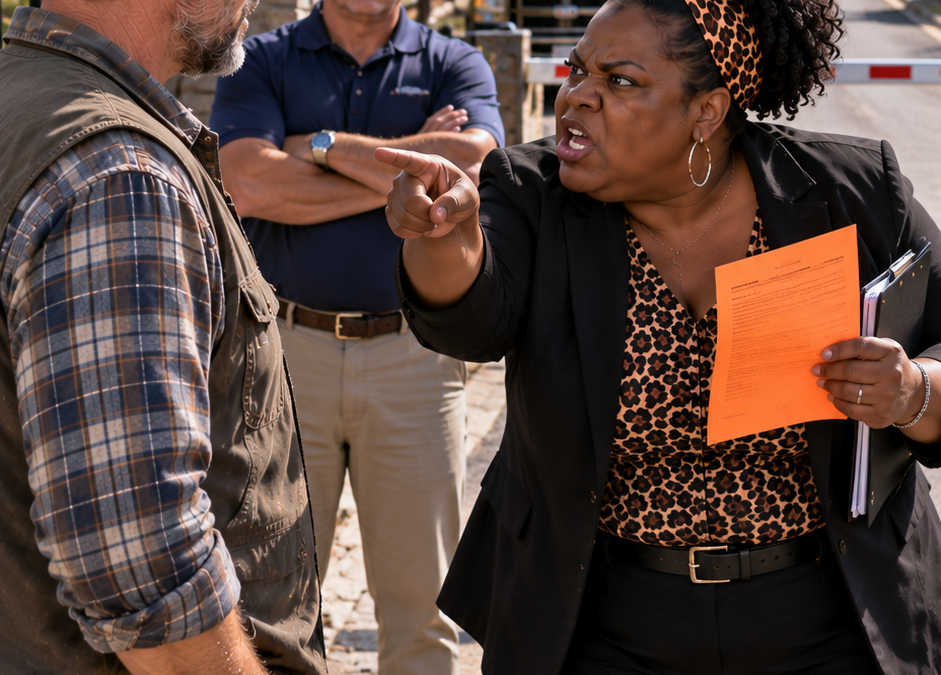
Karen Chen was at the entrance holding an orange sheet of paper in one hand.
She raised the other and motioned for me to stop.
Not like a neighbor.
Not even like an HOA president greeting a homeowner.
Like I was a contractor arriving at a worksite she controlled.
I rolled down my window.
She stepped close enough to push the orange paper through.
“Road access maintenance fee.”
No greeting.
No explanation.
“Three hundred dollars. Due within thirty days.”
I looked at the notice.
Then at her.
“If you don’t pay, we proceed with lien enforcement.”
Behind her stood Dennis Pratt, HOA vice president.
Arms crossed.
Jaw set.
He was doing his best impression of official authority.
It might have worked better if the road under his shoes had not been built entirely with my money.
I folded the notice once.
“Which section of the CC&Rs authorizes this?”
Karen answered immediately.
“Section 4.2.”
She didn’t hesitate.
“Any road connected to HOA common infrastructure falls under community management and may be assessed access and maintenance fees.”
She said it smoothly.
Memorized.
As though she’d read the section that morning.
But there was something she didn’t do.
She didn’t quote it.
People who actually have the language on their side usually use it.
They show you the sentence.
They underline it.
They make sure you read the exact words that authorize whatever they’re demanding.
Karen gave me a number.
Section 4.2.
Nothing more.
I looked past her.
The road was fourteen feet wide.
Gravel base.
Asphalt surface.
Slight pitch toward a drainage ditch at the rear corner.
Three years earlier, I had hired a licensed contractor to build the entire thing from scratch.
I had pulled the county permit.
Paid for grading.
Paid for compacted base.
Paid for paving.
Paid for drainage.
Total cost:
$19,000.
Every inch sat inside my 1.8-acre parcel.
Not one foot crossed onto HOA property.
Not one dollar had come from HOA funds.
No board vote.
No community assessment.
No HOA contractor.
Nothing.
Karen’s contribution to the road was exactly zero.
Now she wanted $300 a year for me to use it.
And she wasn’t finished.
“This is annual.”
I looked back at her.
“What is?”
“The maintenance fee.”
“Annual?”
“Starting this year.”
She nodded.
“Three hundred for now. The board will revisit the amount each year depending on maintenance costs.”
“What maintenance costs?”
“Roads require upkeep.”
“Whose road?”
She gave me a flat look.
“Mr. Hale, we’ve already reviewed this.”
That was my first warning.
Not that Karen was wrong.
People are wrong every day.
The problem was how certain she was before I had even responded.
Dennis nodded beside her.
Karen continued.
“Thirty days.”
I slid the notice into my shirt pocket.
She watched me.
A small smile stayed on her face.
She had been HOA president for eleven years.
Long enough to recognize the usual reactions.
Anger.
Threats.
Complaints.
Then payment.
Or silence.
Then payment.
She interpreted my quiet the way she had learned to interpret everyone else’s.
Submission.
She was wrong.
But I had no reason to correct her yet.
“Thirty days,” she repeated.
Then she turned.
Dennis followed.
Neither looked back.
I sat in the truck after they left.
The road was silent.
Same road it had been that morning.
Same road it had been for three years.
I remembered standing there on a freezing Tuesday while the crew laid the base material.
Coffee cooling in my hand.
Watching the grader make pass after pass until the pitch was right.
Nineteen thousand dollars.
My permit.
My contractor.
My property.
I pulled the orange notice back out.
This time I read every line.
Reference number.
Assessment amount.
Due date.
Lien language.
Boilerplate.
At the bottom:
Authority: Section 4.2, Maplewood Ridge Declaration of Covenants, Conditions & Restrictions.
No quoted sentence.
No excerpt.
Just the number.
That bothered me more than the fee.
If Section 4.2 really said what Karen claimed, why not print it?
The answer was obvious.
She expected me not to read it.
I drove down the road.
That evening, I opened the community portal.
Downloaded the CC&Rs.
Thirty-one pages.
Section 4.2 was on page fourteen.
It took four minutes to find.
Then less than one minute to understand.
The heading read:
Common Area Path Maintenance Cost Sharing.
Not private roads.
Not privately funded improvements.
Not access roads near community property.
Common-area paths.
The section listed specific sidewalks and walking paths built during original development.
They had been paid for with community funds.
Designated as common property on the subdivision plat.
My road wasn’t mentioned.
My parcel wasn’t mentioned.
Nothing in Section 4.2 gave the HOA authority to charge me for a private improvement.
I read it again.
Same answer.
A third time.
Still nothing.
Karen had cited a section that said almost the opposite of what she claimed.
That told me something important.
Either she had never read it.
Or she had read it and didn’t care.
Neither possibility was good.
The next morning, I went to my filing cabinet.
Bottom drawer.
Manila folder.
Three years untouched.
Inside:
County building permit.
Contractor agreement.
Invoice.
Two payment receipts.
Survey.
Certified plat.
I spread everything across my kitchen table.
The original property survey showed the entire road inside my lot boundary.
Entrance.
Middle.
Rear loop.
Every inch.
The county permit described it as a private residential improvement.
No HOA review required.
No HOA signature.
Nothing.
Karen Chen had picked a fight with a stack of documents she didn’t know existed.
That was her mistake.
But it wasn’t yet her worst one.
To understand why I didn’t simply send her the plat and end it, you need to understand Maplewood Ridge.
Ninety-four homes.
Mature trees.
Two-car garages.
Good school district.
The kind of suburb where most people work all day, come home tired, make dinner, help children with homework, and don’t want to spend their evenings reading governing documents.
Karen understood that better than anybody.
She had been HOA president eleven years.
Nobody else had challenged her for the position after she first took over.
The prior president, Hal Dorsey, retired to Arizona.
Karen ran unopposed.
Then she stayed.
The board had three seats.
Dennis Pratt was one.
Greg Toiver was the other.
Both had been recruited by Karen after previous members resigned.
Dennis rarely disagreed with her.
Greg rarely spoke.
There was no meaningful counterweight.
Karen’s method was simple.
Issue the charge first.
Cite a section number.
Don’t quote it.
Set a deadline.
Mention a lien.
Then wait for the homeowner to calculate what resistance would cost.
It had worked for years.
The Garcias lived four houses away from me.
Or they had.
Young family.
Two children.
Friendly dog that constantly tried to squeeze beneath the fence.
They installed a cedar side fence.
It looked fine.
Karen cited them three times in eight months for height violations.
Each measurement on Karen’s notices somehow came out different.
The Garcias considered fighting.
Then realized a real-estate attorney would cost more than paying the fines.
Fourteen months after the first notice, they sold.
Moved thirty minutes south.
I watched their moving truck leave one October morning.
The house stayed empty three months.
Nobody at an HOA meeting ever said:
Karen pushed a family out.
The official version was cleaner.
They had been noncompliant.
The matter was resolved.
That was how Karen’s system survived.
Nothing dramatic enough to make people unite.
Just one homeowner at a time.
One fine.
One threat.
One exhausted calculation.
I had lived there four years.
For my first year, the rear third of my 1.8-acre lot was a mess to access.
An old dirt track curved behind the house.
Winter turned it into mud.
Spring runoff made it worse.
The second year, I decided to fix it properly.
Three bids.
County permit.
Licensed contractor.
Five days of work.
Two inches of compacted gravel.
Asphalt.
Drainage.
Nineteen thousand dollars.
I had the contractor confirm the survey stakes before excavation.
I walked the boundary myself.
There was never any question whose road it was.
Karen’s theory apparently came from one fact.
The entrance to my road sat near an HOA-maintained walking path.
Near.
Not connected.
Not shared.
Not intersecting.
Near.
Karen converted proximity into jurisdiction.
In her mind, if my road existed close enough to HOA infrastructure, she could call it community-related.
Then charge me.
That is not how property rights work.
But Karen had survived eleven years without needing to learn that.
Three days after she handed me the orange notice, I sent a certified letter.
Return receipt requested.
Two paragraphs.
First:
I formally disputed the $300 assessment.
Second:
Please provide the exact CC&R language, quoted word for word, authorizing the HOA to levy an access or maintenance fee against a privately funded road located entirely on a privately owned parcel.
No insults.
No threats.
No attorney.
Just one request.
Show me the words.
I made a copy.
Placed it behind the original notice.
Then waited.
Ten days later, Karen replied.
Single page.
HOA letterhead.
Board vote:
3–0.
My road had been declared subject to HOA jurisdiction under Section 4.2.
Assessment upheld.
Thirty-day payment deadline remained.
The letter ended:
We look forward to your prompt compliance.
I read it twice.
No quotation.
Again.
No actual language.
Only the number.
Three people had unanimously voted that a section said something it did not say.
A unanimous vote sounds powerful.
It creates the shape of due process.
Motion.
Second.
Vote.
Result.
But three people agreeing on a nonexistent authority does not create authority.
It creates three signatures on the same mistake.
I filed the letter.
Four days later, Karen called.
Her tone had changed.
“We’ve been lenient.”
“Have you?”
“The thirty-day period remains open.”
“I know.”
“Pay the three hundred dollars or the lien process begins.”
I waited.
Silence bothered her.
She kept talking.
“The fee will recur annually.”
“You mentioned that.”
“Road maintenance costs increase.”
“You don’t maintain my road.”
“That’s not the issue.”
“What is the issue?”
“The road falls under community jurisdiction.”
“Please send me the language.”
“We already addressed this.”
“You cited Section 4.2.”
“Yes.”
“You didn’t quote it.”
“The citation is sufficient.”
“I would like the exact words.”
“Request a copy of the CC&Rs through management.”
“I have them.”
Pause.
“I’ve read Section 4.2.”
Longer pause.
Then:
“The board’s decision stands.”
I smiled.
Not because it was funny.
Because that sentence answered my question.
Karen didn’t care what the section said.
She cared what the board said it said.
“Thank you for calling.”
She hung up before I finished.
Two days later, Dennis found me in the community parking lot.
He waited until I was alone.
“Look.”
Arms crossed.
Voice lowered.
“You really want to fight the entire board over three hundred dollars?”
I didn’t answer.
“That’s not smart.”
“Why?”
“Legal fees alone—”
“I haven’t hired anybody.”
“Karen isn’t going to back down.”
That was the most useful thing he said.
“She just doesn’t operate that way.”
I looked at him.
“Appreciate the advice.”
Then got into my car.
Dennis had meant to intimidate me.
Instead, he confirmed something.
This wasn’t a mistake Karen intended to correct.
It was policy.
And if I paid, the real consequence would not be losing $300.
It would be validating the principle.
A private road near HOA property could be taxed by the HOA.
Next year maybe $400.
Then $500.
Then a new fee category for someone’s side path.
Driveway extension.
Patio.
Gate.
Anything close enough to common property for Karen to describe as connected infrastructure.
One invented fee becomes precedent if enough people pay it.
That evening, I pulled my manila folder out again.
Permit.
Invoice.
Receipts.
Plat.
I traced my property line with my finger.
Entire road inside.
Then requested an official current copy of the CC&Rs directly from the management company.
I already had them.
I wanted their version.
Three days later:
Thirty-one pages.
Identical.
Section 4.2.
Identical.
Common-area paths.
Specific listed facilities.
Nothing about my road.
Nothing Karen could reasonably stretch far enough to reach it.
I wrote two words on a legal pad.
NOT HERE.
Underlined once.
Then called a real-estate attorney I knew professionally.
The call lasted eleven minutes.
He asked three questions.
“Recorded HOA easement?”
“No.”
“HOA funding?”
“No.”
“Road designated common area on the recorded plat?”
“No.”
He paused.
“Then they have nothing.”
That simple.
“Can they file a lien anyway?”
“People can file bad documents. Doesn’t make them valid.”
“What happens if they do?”
“Then they create liability.”
I wrote that word down.
Liability.
He continued.
“Your certified plat ends the argument.”
I thanked him.
Then waited.
Word spread.
Neighbors noticed I hadn’t paid.
People always notice resistance in places where compliance has become normal.
Eleanor Park stopped me at the mailbox.
Mid-seventies.
Three houses down.
She looked around before speaking.
“Is it true you’re fighting a fee?”
“I’m disputing one.”
She hesitated.
“I have one too.”
Her fee was $150.
Pathway maintenance.
Her own gravel side path.
Six years earlier, she had paid someone to install a narrow walkway from her side gate to her back garden.
Private property.
Private money.
She maintained it herself.
For two years, Karen had charged her $150 annually.
Eleanor assumed it was legitimate.
She never checked.
“Do you have the notices?”
“Yes.”
“Keep them.”
She nodded.
“Don’t throw anything away.”
She looked embarrassed.
“I already paid.”
“That doesn’t mean it was owed.”
She went home.
Later, I spoke with the Torres family.
They had paid $400 because Karen claimed their fence color violated the CC&Rs.
After paying, they actually read the color list.
Their paint was approved.
Exactly.
They never asked for the money back.
Why?
Because $400 was less than the cost of fighting.
Karen understood that.
Her fees lived in the sweet spot below legal resistance.
Too expensive to feel fair.
Too cheap to justify an attorney.
That was the architecture.
And now she was trying to create a permanent road-fee category.
I was almost ready to challenge it formally.
Then she gave me something better.
I came home Thursday afternoon and found a truck leaving my property.
HOA management company logo on the door.
Two men inside.
I barely got the engine shut off before I saw what they had done.
At the entrance to my road stood a metal post.
Fresh concrete around the base.
Attached to it:
HOA MANAGED ACCESS
PERMIT REQUIRED
I sat in my truck.
Just looked.
The sign was inside my property line.
Not beside it.
On it.
Karen had physically installed a regulatory-style sign on land she did not own.
No call.
No notice.
No permission.
I photographed everything.
Front.
Back.
Concrete.
Post.
Placement.
Timestamp.
Then called the county building department.
“Any permit issued today for a sign or post installation on my parcel?”
They checked.
“No.”
“Any application?”
“No.”
I called the attorney.
He listened.
Then said:
“That’s trespass.”
“I know.”
“Unpermitted installation on private property.”
“Yes.”
“Don’t touch it.”
“I haven’t.”
“Good.”
Then:
“Every move they make now is evidence.”
That sentence changed how I saw the entire fight.
Karen wasn’t just overreaching.
She was documenting the overreach herself.
Orange notice.
Board vote.
Phone call.
Lien threat.
Unauthorized sign.
Every action created another exhibit.
Three days later, Karen held a board meeting.
Almost nobody received proper notice.
The bylaws required forty-eight hours written notice to residents.
Karen sent text messages to Dennis and Greg.
That was it.
I only learned what happened afterward.
Through the minutes.
Karen proposed a new designation:
Auxiliary Common Infrastructure.
I had never seen the phrase before.
Because it did not exist.
Not in the CC&Rs.
Not in the bylaws.
Not in the plat.
Not anywhere.
Karen invented the category during a meeting she had improperly convened.
Then used it to retroactively classify my road as HOA infrastructure.
Dennis seconded.
Greg voted yes.
Three to zero.
Done.
Five days later, the county sent me a lien notice.
Amount:
$450.
$300 road fee.
$150 administrative charge.
Filed against my property by Maplewood Ridge HOA.
Signed by Karen Chen.
I stood at the mailbox reading it.
A fine is annoying.
A lien is different.
A lien attaches to title.
It appears in public property records.
It follows you into refinancing.
Selling.
Transfers.
Even a wrongful lien creates work to remove.
Time.
Money.
Stress.
Karen knew that.
The amount was small.
The pressure was not.
That evening, I made three moves.
First:
Formal county complaint regarding the unauthorized sign.
Trespass.
No permit.
Photographs attached.
Building department confirmation attached.
Second:
Written demand for the official minutes from Karen’s secret board meeting.
Third:
Formal request for a hearing before the county HOA oversight office.
That was the mechanism for disputes involving fees, assessments, and liens without legal basis.
I attached everything.
Certified plat.
Deed.
County permit.
Contractor invoice.
CC&Rs.
Original orange notice.
Board response.
Sign photographs.
Lien.
Certified-mail receipts.
I filed the packet in person.
Got a stamped receipt.
Put it in the folder.
Karen had filed a lien based on authority she didn’t have.
To enforce a fee she invented.
Against a road she never funded.
Using a category she created at a meeting she held without proper notice.
She thought the lien was the pressure point.
It became the last thing she would ever file against me.
She just didn’t know it yet.
The following Monday, an email went to all ninety-four homes.
COMMUNITY MEETING — ROAD AND PATH INFRASTRUCTURE POLICY UPDATE
Tuesday.
7:00 p.m.
Karen wanted an audience.
Forty people came.
I sat in the back row.
Manila folder on my lap.
Closed.
Karen stood at the front beside a projector.
Dennis on her left.
Greg on her right.
On the screen:
A colored map.
Yellow common areas.
Walking paths.
Park.
Maintenance lane.
My road in the lower corner.
Karen pointed.
“Here.”
She explained how my road supposedly interfaced with HOA common infrastructure.
If you didn’t look closely, the yellow color near my road made the claim seem plausible.
But the map was not a survey.
It was the developer’s marketing illustration.
Pretty.
Colored.
Compass rose.
No surveyor stamp.
No recording information.
No measurements.
A sales brochure.
Karen was using it as legal evidence.
She announced the $300 access fee was now formal HOA policy.
Applicable to all “auxiliary access roads interfacing with community infrastructure.”
Again, a category she had invented.
She said I had refused compliance.
She said a lien had been filed to protect the association’s interests.
People listened.
A woman in the fourth row raised her hand.
“Could this apply to private driveways later?”
Karen smiled patiently.
“No.”
“But if the driveway sits beside a common path?”
“This is a very specific policy.”
“What makes something auxiliary?”
“The board determines the classification.”
There it was.
Not the deed.
Not the plat.
The board.
She moved on.
Another homeowner asked:
“Has anyone looked at his actual deed?”
Karen barely paused.
“Our management company has reviewed all relevant documentation.”
“What about the county plat?”
“The policy has been thoroughly researched.”
She made a small checkmark on her notes.
Question closed.
At one point, she looked toward the back.
Saw me.
Folder on my lap.
Silent.
Our eyes met.
Two seconds.
Maybe three.
Then she smiled slightly.
She thought I was finished.
The meeting ended with Karen reminding everyone that enforcement authority rested with the board.
People filed out quietly.
Eleanor stopped beside me.
Touched my arm.
“I hope you know what you’re doing.”
“I do.”
She squeezed once.
Left.
I waited until almost everybody was gone.
Karen was stacking her maps.
Dennis folding the projector screen.
Greg had already disappeared.
I stood.
Walked home.
Put the folder in the filing cabinet.
Made coffee.
The hearing was one week later.
Tuesday.
9:00 a.m.
County Administrative Building.
Room 312.
Six chairs.
Rectangular table.
One window facing the parking garage.
Hearing officer:
Patricia Walsh.
She had the calm, document-first demeanor of someone who had listened to hundreds of people arrive with strong feelings and weak evidence.
I arrived at 8:45.
Set my folder in front of me.
Karen entered at 8:58.
Dennis.
Greg.
And an HOA attorney I hadn’t seen before.
David Kesler.
Dark suit.
Leather briefcase.
The expression of a man who charged by the hour and had been told this was routine.
Technically, every homeowner in Maplewood Ridge was paying him.
Karen’s mistake.
Community expense.
Walsh began at nine exactly.
“Maplewood Ridge may present first.”
Kesler stood.
“Section 4.2 authorizes common-infrastructure maintenance assessments.”
I watched him.
“The board subsequently classified the disputed road as auxiliary common infrastructure because it interfaces with a community pathway.”
Walsh asked:
“Show me the recorded plat.”
Kesler opened his briefcase.
Pulled out Karen’s colored marketing map.
The developer brochure.
He placed it on the table.
Walsh looked at it.
Three seconds.
Then moved it aside.
No comment.
That was the first moment I saw uncertainty enter Kesler’s face.
Walsh looked at me.
“Your response?”
I opened the folder.
Took out the certified county plat.
Original survey.
Recorder stamp.
Surveyor seal.
Measurements.
Property lines.
I placed it flat.
No speech.
Walsh pulled it toward her.
For about forty-five seconds, she traced the boundaries with a pen hovering above the paper.
She looked at the road.
The property line.
The walking path.
The common area.
Then slid the plat toward Kesler.
He read it.
Longer than he had looked at the marketing map.
The room changed.
Silence feels different once a lawyer discovers his client gave him the wrong document.
Kesler leaned toward Karen.
Whispered something.
I couldn’t hear him.
Didn’t need to.
I watched Karen.
Her face tightened.
Eyes moved back to the plat.
For eleven years, she had controlled every room she entered.
Her clubhouse.
Her board.
Her agenda.
Her rules.
Now a county-certified survey sat between her and the hearing officer.
She could not vote it away.
I took out the original orange notice.
Read Karen’s statement.
“Any road connecting to HOA common infrastructure falls under community management and is subject to access fees.”
Then placed the notice beside the plat.
I touched the road entrance.
“This is the beginning.”
Traced the road.
“This is the full length.”
Then the rear.
“This is the end.”
I looked at Walsh.
“The entire road lies inside my recorded boundary.”
Walsh studied the map.
“It does not touch the common path.”
“No.”
“Does it cross HOA property anywhere?”
“No.”
“Any recorded HOA easement?”
I pulled out the deed.
“No.”
She read.
Made a note.
I placed the county permit next.
“Private residential improvement.”
Stamped.
Approved.
No HOA signature.
“No HOA involvement?”
“None.”
Next:
Contractor invoice.
$19,000.
Paid in full.
“Any HOA contribution?”
“Zero dollars.”
Dennis uncrossed his arms.
Then crossed them the other way.
I noticed.
I opened the CC&Rs.
Page fourteen.
Section 4.2.
Then read the entire thing aloud.
Not a summary.
Not my interpretation.
The actual words.
Common-area pathways.
Specific sidewalks.
Specific maintenance obligations.
Community-funded construction.
Recorded common-property designations.
Nothing about privately funded roads.
Nothing about proximity.
Nothing about auxiliary infrastructure.
When I finished, I put the document down.
Walsh looked at Kesler.
Kesler looked at the table.
He had nothing.
I continued.
“These are photographs of the sign the HOA installed on my property.”
Four prints.
Timestamped.
Fresh concrete.
HOA MANAGED ACCESS — PERMIT REQUIRED
Then a county building department statement.
No permit applied for.
No permit issued.
“No notice to you?”
“None.”
“No consent?”
“None.”
I said one word.
“Trespass.”
Karen’s attorney slowly set his pen down.
No rebuttal.
No competing plat.
No easement.
No funding agreement.
No recorded designation.
Nothing.
Greg looked out the window.
Dennis glanced toward the door.
Walsh reviewed the documents for eleven minutes.
No one spoke.
Then she delivered the ruling.
“The lien is vacated effective immediately.”
Karen froze.
“The assessment lacked legal authority.”
Walsh looked at the certified plat.
“The disputed road is located wholly within the homeowner’s private parcel.”
She looked at the CC&Rs.
“Section 4.2 does not authorize the assessment.”
Next:
“The classification ‘auxiliary common infrastructure’ is not contained in the recorded governing documents and cannot be created retroactively to impose financial obligations on a private parcel.”
Karen’s mouth tightened.
Walsh continued.
“The HOA is directed to remove the sign installed on private property within five business days.”
Another note.
“Filing fees reimbursed in full.”
Then:
“A formal administrative finding will be entered into the association’s oversight record.”
That mattered.
Karen’s mistake was no longer just my story.
It was official.
Recorded.
Karen did not speak.
Kesler closed his briefcase.
The zipper sounded unusually loud.
Dennis stood first.
Left without looking at me.
Greg followed fifteen seconds later.
Karen stayed seated.
She looked at the developer map.
The colorful brochure.
The fake authority she had carried into a room with a real survey.
Then folded it.
Put it away.
Stood.
Walked out.
No words.
Walsh gathered her papers.
“Written ruling within three business days.”
“Thank you.”
I placed everything back into the folder.
Plat.
Deed.
Permit.
Invoice.
CC&Rs.
Photographs.
Original orange notice.
Same order.
I stepped into the hallway.
Fluorescent lights humming.
Someone opened a door down the corridor.
Closed it.
I thought about the morning that road was built.
Cold Tuesday.
Coffee.
Grader.
Asphalt.
Nineteen thousand dollars.
At the time, I never imagined the most important part of the project would be the paper proving where it sat.
But property disputes rarely turn on who speaks loudest.
They turn on what was recorded before anybody got angry.
The written ruling arrived exactly three business days later.
Four pages.
County letterhead.
The lien:
Vacated.
$300 road fee:
Void.
$150 administrative fee:
Void.
No past obligation.
No current obligation.
No future obligation.
HOA authority:
Not established.
Filing fees reimbursed.
I read it once.
Then made coffee.
That afternoon, I drove to the recorder’s office.
Confirmed the lien release was reflected in the public record.
The clerk handed me a stamped confirmation.
No ceremony.
Just paper.
But paper mattered.
My title was clean.
The HOA sign disappeared even faster.
I came home the morning after the hearing.
Gone.
Post removed.
Hole filled.
Fresh dirt tamped flat.
Someone had apparently come before sunrise.
No note.
No apology.
No explanation.
The sign simply vanished.
If you didn’t know where it had stood, you might never notice.
That was fitting.
Karen had spent years creating things through paper.
Fees.
Categories.
Obligations.
Authority.
When those things stopped working, she wanted the physical evidence gone too.
I sent Eleanor Park a copy of the ruling.
Three sentences.
The county had found the HOA lacked authority to charge maintenance fees against private improvements on private parcels.
Her pathway assessment appeared to have been issued under the same theory.
She should request reimbursement.
She called that evening.
For several seconds, neither of us spoke.
Then:
“Thank you.”
Simple.
Quiet.
She didn’t sound victorious.
She sounded relieved.
The interim board eventually refunded two years of payments.
$300.
Exactly what Karen had collected.
The amount was small.
What it represented wasn’t.
For two years, Eleanor had opened an envelope, seen an official-looking notice, and paid because she assumed someone had the right to ask.
Now someone had finally told her they never did.
Karen resigned eleven days after my ruling.
Not at a meeting.
Not publicly.
Sunday.
11:00 p.m.
Email.
Subject:
Resignation Effective Immediately
Two sentences.
No apology.
No explanation.
Nothing about the hearing.
Nothing about Section 4.2.
Nothing about the unauthorized sign.
Just:
Thank you for the opportunity.
Effective immediately.
Dennis stopped attending meetings within a month.
Greg disappeared the month after.
The oversight committee called an emergency election.
This time, every household received proper forty-eight-hour notice.
Forty-one homeowners attended.
Highest turnout in HOA history.
Open nominations.
Secret ballot.
Three new board members.
Before the meeting ended, residents were already asking for prior fines to be reviewed.
A fence.
A side path.
Paint color.
Parking.
Eleven years does not unwind in one evening.
But it can start unwinding in one.
That mattered.
Two weeks after the hearing, the man who had asked Karen whether anyone had checked my deed caught me in the driveway.
He walked over.
Stopped beside my truck.
“Glad somebody finally did it.”
“Did what?”
“Read the paperwork.”
We shook hands.
That was all.
Three weeks after the hearing, I drove the full length of my road on a cold Tuesday morning.
Clear sky.
Breath visible.
No HOA sign.
No orange notice.
No invoice.
No threats.
Just tires on gravel and asphalt.
The slight drainage pitch I had paid extra to get right.
I drove to the back of the lot.
Stopped.
Left the engine running.
From there, I could see almost the full 1.8 acres.
The house.
Trees.
The road curving toward the front.
My road.
I thought about the Garcias.
How Karen’s system had worked exactly as intended on them.
Three fines.
Pressure.
Exhaustion.
Sale.
Gone.
I hoped the house they bought south of us was quiet.
I thought about Eleanor getting her $300 back.
That mattered to me more than my own fee ever had.
Then I drove home.
I opened the filing cabinet.
Pulled out the folder.
The original orange notice was near the front.
Karen had pushed it through my truck window smiling.
$300.
Thirty days.
Section 4.2.
Lien threat.
I clipped it to the county ruling.
Notice on top.
Ruling beneath it.
The paper that started the fight.
And the paper that ended it.
Then I filed them behind the certified plat.
Exactly where they belonged.
Karen had spent eleven years teaching people that a section number was the same thing as authority.
She counted on homeowners seeing official letterhead and assuming somebody else had already checked.
She counted on the cost of resistance.
She counted on fatigue.
She counted on fear.
What she never counted on was someone opening the document.
Section 4.2 had always been there.
The county plat had always been there.
My deed had always been there.
The road had always been mine.
Nothing changed legally during those four weeks.
Not the property line.
Not the road.
Not the HOA’s powers.
The only thing that changed was that somebody finally asked Karen to prove what she had been saying.
She couldn’t.
That was the whole explosion.
No courtroom speech.
No shouting match.
No dramatic confrontation in the street.
Just documents.
A permit.
A receipt.
A surveyor’s stamp.
A section of the CC&Rs read from beginning to end.
And once those things were laid out on one table, Karen’s eleven years of confidence could not make them say something they did not say.
I pushed the filing drawer closed.
It latched with a quiet click.
Outside, the road was exactly where I built it.
Exactly where the county said it was.
And for the first time in eleven years, Maplewood Ridge had a board that understood one very simple rule:
You cannot charge someone for property you do not own just because nobody stopped you the last time.








