HOA Karen Chained My Wife to Our Own Gate—Then Her Fake Elite Security Team Had to Prove Who They Really Were
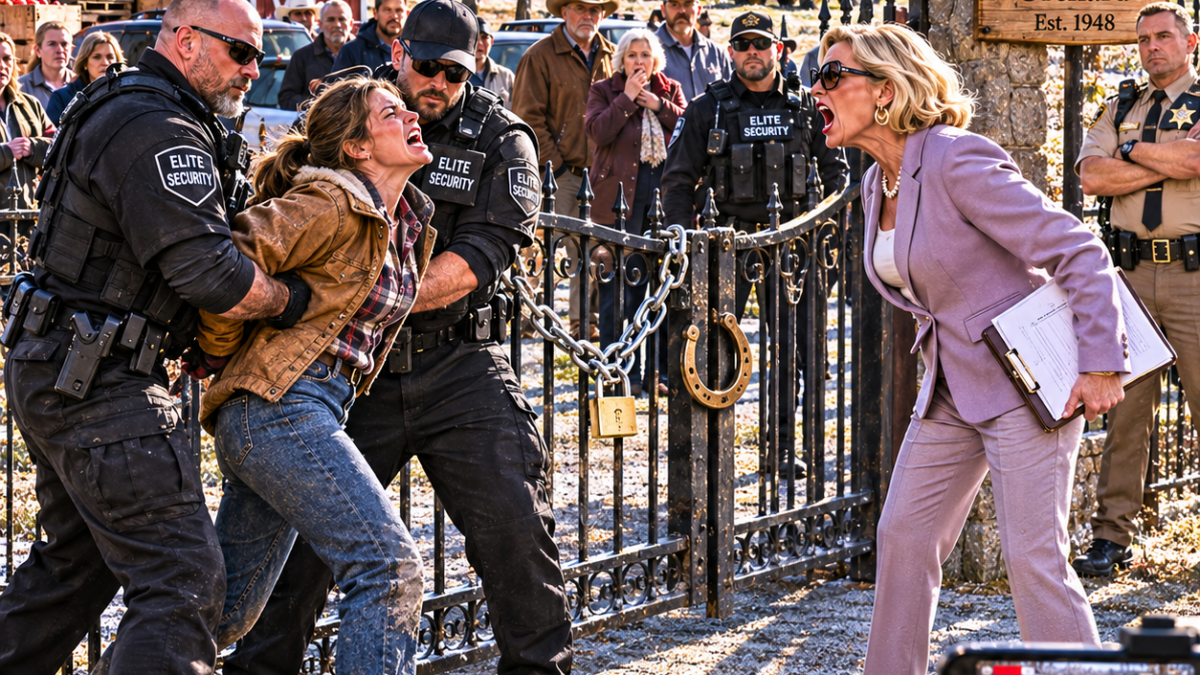
PART 2
Westbrook Orchard is thirty-four acres of apple and pear trees on the west side of Drummond County. My grandfather Lemuel planted the first eleven rows. My father planted most of what followed. We run a small cider mill inside the old dairy barn and, during the season, nine delivery routes leave the property carrying fruit, pressed cider, and wholesale orders to buyers around the county.
Tamson had run the place day-to-day since 2019.
Better than I ever did.
I was gone five to seven months a year because of my work. That arrangement existed before we married. It was difficult sometimes, but it worked because we trusted each other with different pieces of the same life.
The orchard was hers when I was gone.
Not legally alone.
Practically.
She knew the buyers.
The packing schedules.
The weather.
Which Honeycrisp blocks would turn early.
Which pump would fail first in cold weather.
Which delivery driver needed three reminders and which one needed none.
Nobody who knew us ever described Tamson as somebody waiting for her husband to come home and solve things.
That mattered.
Because Karen treated her exactly that way.
In 2019, Cavendish Ridge Estates went up on the ridge north of us.
Phase One.
Phase Two.
One hundred forty-eight houses.
Decorative lamps.
Stone entry monument.
Sidewalks.
A clubhouse.
All of it built on pasture that had never been part of our orchard.
We shared a fence line.
Nothing more.
Our parcel number was 24-062.
Their office file apparently described it as:
T. WESTBROOK — OCCUPANCY UNVERIFIED.
I found that later.
At the time, we hardly thought about the subdivision.
Then Karen Devo became board president.
Second term.
Controlled the agenda.
Controlled what packets homeowners received before meetings.
Controlled which attachments were included.
Controlled the first version of almost every dispute because most residents only knew what she told them.
I want to be precise about that.
The one hundred forty-eight households did not vote to hurt my wife.
Most of them had no idea what was happening.
Karen decided what they knew.
It started August 14.
Tamson called me over a bad connection and read a letter from the HOA.
Cavendish Ridge had designated our gate and the forty-foot lane behind it as “Emergency Access Point B” under instrument number 2019-03084.
The HOA demanded keys and access codes within ten days.
“Read the parcel number.”
She did.
Ours.
“They can’t just designate our gate.”
“That’s what I said.”
“Did you call title?”
“Already did.”
Larkin Abstract and Title told her what we believed.
Our parcel had never been annexed into Cavendish Ridge.
Not in the plat.
Not in the declaration.
No signed HOA agreement.
But full title work would take weeks.
Karen didn’t want weeks.
On August 22, a truck with amber lights appeared at the end of our lane.
Two men wearing black uniforms set up beside the gate.
TRIDENT LINE PROTECTIVE GROUP.
Their shoulder patches read:
SPECIAL OPERATIONS TRAINED.
Karen introduced them in the HOA newsletter.
Tamson sent me a photo of the paragraph.
I read one sentence four times.
These professionals are federally trained and authorized to physically secure emergency access points when necessary.
Federally trained.
Authorized to put hands on people.
That was what Karen wanted one hundred forty-eight households to believe.
Tamson responded the way she always handled pressure.
Paper.
September 2.
Certified letter.
The gate is private property.
No HOA agent has permission to enter.
No HOA agent is authorized to touch the gate.
No guard is authorized to restrain or interfere with her.
The green card came back September 4.
Signed:
K. DEVO.
That date became the center of everything.
September 5, Trident stopped one of our cider trucks at the lane.
Forty-minute delay.
In September, forty minutes isn’t theoretical.
Fruit sits.
Packing schedules collapse.
Buyers move you down.
Tamson called the sheriff.
A deputy came.
Listened.
Looked at the HOA papers.
Looked at our deed copy.
Then said:
“Civil dispute.”
And left.
That moment mattered more than he probably understood.
Four men had just watched law enforcement come to our gate and drive away.
They learned something.
Nobody was coming.
September 8, Karen ordered the gate chained each night from eight in the evening until seven in the morning.
Not Cavendish Ridge’s gate.
Ours.
The morning Tamson was hurt, she texted me before walking outside.
They put a chain on Grandpa’s gate.
I saw it four minutes too late.
I have done that math more times than I should.
By the time I landed at Drummond Regional Airport on September 11, Tamson had a brace on her right wrist.
Two hairline fractures.
Bruised ribs.
She hugged me with one arm.
“Don’t.”
“Don’t what?”
“Go quiet.”
I went quiet.
I had watched the eleven-minute recording four times.
Once live.
Three times later, searching for some point where I could have changed what happened.
There wasn’t one.
That is the cruelty of footage.
It does not negotiate.
On the drive home, I made a rule.
Paper.
Every step.
No screaming.
No shoving.
No threats.
No moment Karen could turn into another story.
Because the second I put my hand on one of those men, the chain stopped being the story.
I became the story.
She would have loved that.
At seven the next morning, I walked to the guard post.
Two Trident men stood by the truck.
Coffee.
Engine running for heat.
I stopped eight feet away.
Hands visible.
“Morning.”
The supervisor came around the hood.
Amler Joerger.
Forties.
Heavy forearms.
Trident patch.
And above it, a trident emblem that looked deliberately military.
“I’d like to see the post order.”
“Proprietary.”
“It authorizes your men to stand on private property. I’d like to read it.”
“You’d like a lot of things.”
No anger.
That bothered me more.
He spoke like somebody managing an inconvenience.
I looked once at the patch on his shoulder.
Then away.
“Have a good one.”
I walked back.
That’s all.
I want that clear.
Because later Karen accused me of intimidating her security detail.
At nine, Tamson and I were at the county recorder’s office.
By eleven, we had the deed.
1948-00614.
Lemuel Westbrook.
Thirty-four acres.
Metes and bounds.
Same year he built the gate.
The recorded plat showed all forty feet of our lane and the gate posts inside parcel 24-062.
Cavendish Ridge stopped two hundred ten feet north.
Tamson held the warm copy with her good hand.
“They’re just wrong.”
“Looks like it.”
“Then it’s over.”
“Maybe.”
I didn’t say what I was thinking.
Being right and being finished are not the same thing.
We sent the deed and plat by certified mail to the HOA board and Kingsmere Community Management.
Attached the green card Karen signed September 4.
Demand:
Remove guards within five days.
Then Tamson went to the sheriff’s office and filed a formal complaint about September 9.
She described a man forcing her face into the gate.
I stared at a bulletin board about boat registration because I could not watch her describe it.
We gave them the video.
The file reached Assistant District Attorney Bram Locksley.
He said they would review it.
Then came the September 15 HOA meeting.
About forty homeowners.
Folding chairs.
Karen at a long table.
Gavel.
Tamson stood during public comment with three pages.
She said the gate belonged to us.
Read the deed number aloud.
Said two contractors hired by the HOA had put her face into iron on property outside the subdivision.
Karen struck the gavel once.
“Public comment is limited to homeowners in this community. You are not a homeowner here. Sit down.”
The room murmured.
Tamson sat.
I stayed standing for one second.
Then I sat too.
And that sentence stayed in my head.
You are not a homeowner here.
Exactly.
If we were not homeowners there, our land wasn’t HOA land either.
Karen had stated the contradiction into a microphone with a secretary recording minutes.
The secretary was Olivia Sandringham.
Sixties.
Cardigan.
Pen moving the whole time.
She wrote Karen’s sentence down.
When the meeting ended, Olivia looked at me for a second longer than strangers normally do.
I didn’t know why yet.
The HOA answered our five-day demand the next morning.
The security detail doubled.
Two guards became four.
Orange cones went across our lane.
Kingsmere began issuing $500-per-day citations for “obstruction of designated emergency access.”
They towed Tamson’s flatbed from the shoulder of our own road.
The packing house in Merrow dropped two routes.
Twenty tons of Honeycrisp still on the trees.
Harvest doesn’t care about paperwork.
That Friday, I went down to the post again.
Joerger handed me a folded sheet.
“You wanted the order.”
I read it standing in the gravel.
GATE CONTROL DETAIL — WESTBROOK ACCESS.
At the bottom, handwritten in the margin:
HANDS ON IF SHE TRIES THE GATE. SHE’S NOT ON THE LIST.
Initials:
KD.
Date:
September 8.
I thanked him.
Walked back.
Tamson met me on the porch.
“What does it say?”
I didn’t answer until we sat at the kitchen table.
Then I read the sentence.
She turned the paper slightly with two fingers.
“The eighth.”
“Yes.”
“The night before.”
“Yes.”
“She wrote it down.”
I nodded.
Karen had signed for our certified warning on September 4.
Four days later, she wrote a hands-on instruction.
That removed something from the argument.
Confusion.
I scanned the order and sent it to Bram Locksley.
He called Monday.
“It helps.”
“What does that mean?”
“It helps.”
Then his voice changed.
“I need to be straight with you. Both guards say Tamson came toward the chain with thirty-inch bolt cutters and swung them toward the post while one of them had his hand on it.”
“She was cutting a chain off her own gate.”
“I know.”
“You saw the video.”
“Yes.”
“But?”
“The angle isn’t perfect at the start. Their body cameras all supposedly malfunctioned.”
“All of them?”
“Four.”
I laughed once.
No humor.
“Defense tells twelve jurors she came at a man with bolt cutters.”
“She has two fractures.”
“I know.”
“She was on our property.”
“I know.”
He paused.
“Get me more.”
So we got more.
Tamson returned to the recorder’s office alone because I had fruit to move.
She pulled all fourteen pages of instrument 2019-03084.
Then called from the parking lot.
“Exhibit B.”
“What?”
“Owner consent.”
“What about it?”
“It’s blank.”
I stopped moving.
“No signature?”
“Nothing.”
“No notary?”
“Nothing.”
“No name?”
“Blank line.”
Fourteen pages of recorded legal language designating our gate as somebody else’s emergency access.
The one page where the owner was supposed to consent had never been completed.
Recorded anyway.
Stamped.
Filed.
Sitting in the county books since 2019.
I understood immediately why it was dangerous.
A bad recorded document can still control behavior.
Banks see the instrument number.
Deputies see the stamp.
Management companies see the title.
Insurance sees “recorded access.”
Nobody turns to page eleven.
A blank consent page didn’t instantly remove the chain.
It only made us right again.
That wasn’t enough.
I wanted to know why Karen needed the gate so badly.
I went to county planning.
File:
PA26-114.
Cavendish Ridge Estates Phase Three.
Eighty-six additional lots.
Preliminary approval.
One condition.
Final plat required a certified second emergency access point before September 30.
No second access?
No final plat.
No final plat?
Approval expired.
Financing and developer schedules moved elsewhere.
The only usable route within reach was ours.
I stood in a county hallway reading that condition three times.
Everything changed.
Karen was not defending an old emergency lane.
She was racing a deadline.
Our gate was the difference between eighty-six lots and a dead Phase Three.
Then I pulled HOA expenditure filings.
One contract:
$58,000.
Community access coordination.
Vendor:
Devo Consulting.
Registered agent:
Granville Devo.
Same home address as Karen.
I sat in my truck with the door open and one boot on the pavement.
Now the pressure had a number.
And a family connection.
Then I looked at Trident.
The security contract had been awarded without competitive bidding.
State license files were public.
Both the HOA bid materials and Trident’s state licensing packet contained the same sentence.
Principals and field supervisors are Naval Special Warfare SEAL-qualified operators.
Owner:
Delano Shackleford.
Claimed twelve years Naval Special Warfare.
Lead field supervisor:
Amler Joerger.
I had spent my adult life around that community.
I knew what the word qualified meant.
Not “worked near.”
Not “supported.”
Not “trained with.”
Qualified.
That is a claim you can verify.
So I did.
Two requests.
No accusations.
No speeches.
Names.
Dates.
Service verification.
Then I said nothing.
Not to Locksley.
Not the sheriff.
Not Tamson.
Partly because I didn’t have an answer yet.
Partly because if it came back the way I suspected, I wanted the paper in my hand before anyone heard the theory.
The September 30 deadline was eleven days away.
Every day meant another $500 HOA citation.
Another blocked truck.
Another part of harvest lost.
Then Olivia called me at ten at night.
“Can you meet me?”
“Where?”
“Church parking lot on Ballinger.”
“Why there?”
“Not your house. Not mine.”
She was waiting under the only working parking-lot light.
She passed a manila envelope through my truck window.
Two documents.
The first was a legal opinion from the HOA’s own attorney, Bartholomew Kratic.
Dated August 6.
Before the guards.
Before Tamson’s injury.
Before the chain.
The key sentence was underlined.
The association holds no recorded right in the Westbrook gate and its agents must not restrain or otherwise put hands upon any person at that location.
I read it twice.
Then the second document.
Board minutes.
August 12.
Motion to withhold Kratic’s opinion from the member packet pending further review.
Moved by:
K. DEVO.
Passed:
4–2.
Olivia stared at her steering wheel.
“She read the opinion aloud.”
I said nothing.
“She knew.”
I looked at her.
“I voted no.”
She swallowed.
“And then I went home.”
Before I could respond, she put the car in reverse.
“I’m sorry.”
She left.
I sat there with the envelope on my knee.
Blank consent page.
Attorney warning.
Handwritten hands-on order.
Three pieces.
Still no guarantee anybody would remove the guards.
Then Bram Locksley called with the decision I had been dreading.
No charges.
Not yet.
The video angle.
Conflicting guard statements.
Missing body-camera footage.
Bolt cutters in Tamson’s hand.
He did not think he could prove the case beyond a reasonable doubt to a jury.
Tamson sat in the truck when I told her.
Hands in her lap.
Brace on her wrist.
No tears.
No anger.
Just silence.
I said her name once.
“Give me a minute.”
I did.
That was the bottom.
The next morning, Karen went around us.
She filed an emergency petition with County Fire Marshal Adelbert Ozanne.
On September 19, Ozanne issued an interim directive requiring Emergency Access Point B to be kept open or a gate code supplied pending final determination.
Compliance demonstration:
6:00 a.m.
September 30.
Same sunrise as Karen’s Phase Three deadline.
Now the guards weren’t standing there only on a questionable recorded instrument.
Karen had put the county fire marshal’s authority behind them.
Then she filed a complaint against me through my chain of command.
That part was almost elegant.
She alleged I had used my military status to intimidate private security contractors and interfere with a civil administrative dispute.
Command Master Chief Ivo Panel called me in.
He read the complaint.
“Did you touch anyone?”
“No.”
“Did you tell these people what you do?”
“No.”
“Did you threaten anybody?”
“No.”
“How many times did you approach the post?”
“Twice.”
“What happened?”
“I asked for paperwork.”
He watched me for a moment.
“This will close.”
I waited.
“But not today.”
Then came the order.
No contact.
Ten days.
Do not approach HOA agents.
Do not stand at the gate while guards are present.
Do not communicate with the board.
The restriction ended after September 30.
Karen had taken the sheriff out of the story.
Then the district attorney.
Then used the fire marshal to get an interim order.
Then reached into my command and took me off the gate.
Four moves.
By the time I drove home, I understood how deliberate it was.
The practical damage kept stacking.
Our insurance claim related to Tamson’s injury was held for review because the location was subject to a disputed access claim.
The packing house cut us from five routes to four.
Then to zero.
Fruit remained on trees.
The bank froze our seasonal line.
$86,000 already drawn against a crop we could no longer guarantee we could move.
The loan officer used the phrase:
Recorded encumbrance affecting access.
She was not wrong.
The bad instrument was recorded.
That was the power of paper.
Even invalid paper can hurt you before somebody formally removes it.
Tamson drove to Kratic’s office.
Waited more than an hour.
Brace on her wrist.
When he finally came out, she asked one question.
“You wrote the memo. How long do they stand there?”
He tried privilege.
Non-member status.
Association representation.
Tamson said:
“Thank you.”
Then left.
Two days later, Kratic withdrew from representing the HOA.
No public explanation.
Didn’t need one.
The lawyer who wrote the warning was no longer willing to stand beside the people ignoring it.
That night, I spread everything across the porch table.
Every strategy looked dead.
Criminal case stalled.
County directive active.
HOA fines accumulating.
Command restriction in place.
Harvest collapsing.
Then I realized I had been attacking the wrong thing.
I kept trying to destroy Karen’s claimed authority.
But her authority, real or invented, was a network.
Board.
Management company.
Recorded instrument.
County process.
Lawyer.
One hundred forty-eight households.
It absorbed pressure.
So I stopped attacking the HOA.
I looked at what physically kept men in our lane.
Trident Line.
State private-security license.
Insurance coverage.
Credential representations.
Those four men could stand there because the state believed their company met licensing requirements and an insurance carrier believed the personnel qualifications described in the policy application.
Both rested on the same statement.
SEAL-qualified.
I could verify that.
Nobody had ordered me not to contact the state licensing board.
So at one in the morning, with Tamson asleep upstairs and her wrist brace hitting the nightstand every time she moved, I filed the most boring complaint I have ever written.
Credential verification request.
No adjectives.
No mention of what happened to my wife.
No accusation of stolen valor.
I attached Trident’s licensing application.
The HOA bid packet.
Highlighted one sentence.
Please verify this representation.
That was all.
The same afternoon, I sent the documents to Trident’s liability carrier, Charter House Mutual.
If personnel qualifications were false, the underwriting basis might be false.
An adjuster named Vesta Crockett opened a file within twenty-four hours.
She asked twice whether I had counsel.
That told me enough.
Tamson filed separately with the county recorder to challenge instrument 2019-03084 for lack of owner consent.
Blank Exhibit B attached.
Affidavit attached.
Her signature.
Her property too.
The state licensing board responded September 24.
On-site credential audit scheduled.
Date:
September 30.
Time:
6:00 a.m.
Location:
Westbrook gate.
Exactly when the fire marshal’s compliance demonstration would occur.
I told nobody.
A scheduled audit proves nothing.
It is a person with a clipboard.
Then the verification letter arrived.
September 25.
Naval Special Warfare return address.
I carried it inside without opening it.
Tamson stood beside me at the kitchen counter.
I used the little apple paring knife to cut the envelope.
I read the letter once.
Then read the relevant part aloud.
Delano Shackleford:
No record of service in Naval Special Warfare.
Amler Joerger:
No record of service in Naval Special Warfare.
No BUD/S class assignment.
No qualification.
No attrition record.
No evidence either man had ever been in the training pipeline they claimed.
Tamson put both hands flat on the counter.
“He put his hand on my head.”
“Yeah.”
“And he isn’t even—”
She stopped.
Then looked at me.
“They charged the HOA for that.”
“Yes.”
“Karen told the whole subdivision they were federally trained.”
“Yes.”
“She signed the packet.”
“As president.”
Tamson stared at the page.
“She never checked.”
“No.”
That was the first moment I knew the gate might survive September 30.
Then my command inquiry closed.
Karen destroyed her own complaint.
To prove I had intimidated her guards, she submitted the Trident file.
Inside it:
The September 8 post order.
HANDS ON IF SHE TRIES THE GATE.
And the September 4 certified green card Karen had signed.
She had handed my chain of command evidence that she ordered physical restraint four days after receiving written notice that she had no permission to touch Tamson.
Master Chief Panel called.
“Complaint closed. No findings. Go home, Chief.”
Then, almost as an afterthought:
“Stay off their people.”
I planned to.
Karen escalated.
September 27:
Four guards became six.
September 28:
Courier notice.
Cavendish Ridge had contracted Iron Hill Fence and Gate to remove our existing gate and install a compliant emergency-access gate with fire-department Knox box.
Scheduled:
6:00 a.m.
September 30.
During the fire marshal’s demonstration.
Invoice attached:
$14,200.
Charged to us.
Karen intended to cut Grandpa’s gate off its hinges and bill us for the saw.
Tamson read the notice twice.
Then looked at me.
“Ask me.”
“What?”
“You’ve been not asking me.”
I knew.
“The code.”
We could have given them the gate code.
Security would leave.
Packing routes might restart.
Bank might relax.
The harvest might partially survive.
No more physical confrontation at the gate.
Practical answer.
Tamson sat on the porch with me until almost midnight.
Then said into the dark:
“No.”
I looked at her.
“They pushed my face into that gate.”
She flexed the hand in the brace.
“I’m not handing them the key.”
“Are you sure?”
“They can cut it in front of me.”
That was the answer.
I prepared three things.
The Naval Special Warfare verification.
The property file:
Deed.
Plat.
Blank Exhibit B.
Kratic memo.
August 12 board minutes.
September 4 green card.
September 8 post order.
And my phone.
Eleven minutes.
I didn’t call the newspaper.
Didn’t post online.
Didn’t warn Karen.
Didn’t warn the fire marshal.
Didn’t warn the state investigator.
Didn’t contact Cavendish Ridge residents.
Partly because of the command restriction.
Mostly because every person who mattered was already going to be standing in our lane at the same time.
September 30.
5:20 a.m.
Amber lights came through the orchard.
They threw shadows across the first eleven rows Grandpa planted.
By 5:52, eleven people stood near our gate.
Six Trident guards.
Joerger supervising.
The two men involved in Tamson’s restraint.
Karen in a wool coat.
Folder under one arm.
Two HOA board members.
The Iron Hill installer with a cutting saw.
Fire Marshal Ozanne in fluorescent vest.
Clipboard.
And one unremarkable sedan parked beyond the mailbox.
Tamson stood ten feet in front of the gate.
Brace still on.
I stood one step behind her right shoulder.
I did not touch anyone.
Karen began as though giving a presentation.
“Marshal, this is Emergency Access Point B, designated under the recorded instrument. The occupant has refused a code for six weeks and repeatedly obstructed access.”
Ozanne looked toward Tamson.
“The owner is here?”
Karen corrected him.
“The occupant.”
Tamson said:
“I’m on the deed.”
Karen shifted her body slightly between Tamson and the fire marshal and continued talking.
That half step explained everything.
She had spent six weeks turning an owner into an obstacle.
Then she gestured toward Trident.
“For safety during the demonstration, we retained a licensed protective detail. They’re SEAL-qualified and authorized to secure this location.”
Ozanne wrote something.
Karen checked her watch.
Six.
She looked at the Iron Hill worker.
“Cut it.”
The saw started.
Joerger lifted two fingers.
The same two men who had restrained Tamson stepped away from the truck.
Toward her.
Same formation I had watched from eleven time zones away.
One reached toward her shoulder.
“Stop right there.”
The sedan door opened.
A woman crossed the gravel holding a badge case.
“Sibyl Trenholm. State Private Security Board.”
The saw stopped.
“This is a scheduled on-site credential audit of Trident Line Protective Group. Every licensed individual on this property will produce a current license card and supporting qualification certificates.”
Silence.
Karen recovered first.
“Investigator, we’re in the middle of a county compliance proceeding.”
“I’m aware.”
“The fire marshal has jurisdiction.”
“I’m not reviewing the fire order.”
Trenholm looked toward Joerger.
“You’re the site supervisor?”
“Yes.”
“License.”
He handed it over.
She compared it with her folder.
“Trident’s application identifies principals and field supervisors as Naval Special Warfare qualified. Is that your qualification, Mr. Joerger?”
“Yes, ma’am.”
“You are SEAL-qualified?”
“Yes.”
That was the first time I spoke.
I stayed where I was.
“Which BUD/S class, Mr. Joerger?”
Seven words.
He turned.
For maybe a second and a half, he had the chance to say nothing.
He chose a number.
“Two thirty-one.”
I removed the envelope from my jacket.
Handed it to Trenholm.
She read.
Forty seconds.
Wind pushed the page.
Then she read the operative language aloud.
No record of Naval Special Warfare service for Delano Shackleford.
No record for Amler Joerger.
No BUD/S class assignment.
No qualification.
No verified service history supporting the personnel claims contained in the licensing file.
Joerger’s hand moved toward the trident patch on his shoulder.
Stopped halfway.
Dropped.
That was when the morning turned.
Not when I produced the letter.
When his hand stopped before touching that patch.
One of the other guards said quietly:
“You told us.”
Joerger snapped his name.
Karen cut across everyone.
“This is irrelevant to the county directive.”
And she was partly right.
A licensing investigator could suspend security credentials.
She could not erase a fire marshal’s interim access order.
Karen knew it.
“This demonstration proceeds.”
I gave Ozanne the second file.
“Marshal. Deed and plat for parcel 24-062. Page eleven of the instrument your petition relies on.”
He took it.
Read the plat first.
Traced the boundary.
Found the gate.
Two hundred ten feet inside our property.
Then Exhibit B.
OWNER CONSENT.
Blank.
No signature.
No name.
No notary.
No date.
No stamp.
The lane became completely quiet.
Karen shifted her weight.
One of her own board members stepped away from her.
Ozanne clicked his pen.
“Ms. Devo, my interim directive was based on a petition representing an existing recorded access right.”
Karen opened her mouth.
He kept going.
“There is no valid owner consent reflected here.”
“That instrument was accepted by the county.”
“Recorded is not the same as consent.”
“We have until September thirtieth.”
Ozanne looked at her.
“It is September thirtieth.”
He wrote on the clipboard.
“Directive withdrawn. Compliance demonstration failed. Phase Three does not have a certified second emergency access point.”
Karen stared at him.
“You can’t—”
“The condition expires at midnight under PA26-114.”
Then Trenholm turned toward Trident.
“Effective immediately, Trident Line Protective Group’s state license is suspended pending formal proceedings.”
One by one, she collected the six license cards.
Small plastic rectangles dropping into a clear evidence sleeve.
Six clicks.
“Nobody on this detail is authorized to remain posted as licensed security in this state as of this moment.”
The Iron Hill worker put the saw back in his truck.
No argument.
One HOA board member looked at Karen.
“Did you check them?”
He didn’t wait for her answer.
Then Karen made the mistake that finished her.
She turned toward Joerger.
“Amler.”
He didn’t look up.
“Tell me you actually served.”
Trenholm stopped writing for half a second.
Karen had spent six weeks telling one hundred forty-eight households these men were federally trained.
She had signed the contract packet.
Written the hands-on instruction.
Used their claimed status to intimidate residents.
And now, in front of a state investigator and county fire marshal, she was asking whether any of it had been true.
Joerger stared at the gravel.
No answer.
Trenholm wrote that down.
I handed over the rest.
September 4 green card.
September 8 post order.
August 6 legal opinion.
August 12 minutes showing Karen moved to hide it.
No speech.
I didn’t need one.
Each page closed a door.
There were no more.
Tamson turned around.
Walked up the lane.
I followed.
No one touched her.
The saw remained in the truck.
Grandpa’s gate stayed on its hinges.
Still so heavy you had to lift it half an inch to swing it cleanly.
Trident’s temporary suspension became permanent on October 14.
Delano Shackleford and Amler Joerger faced state charges tied to false licensing representations and misrepresented qualifications.
Shackleford’s attorney later said his client had “operated in support of Naval Special Warfare.”
That sentence became famous locally for all the wrong reasons.
Bram Locksley called me October 16.
“I’ll file now.”
“What changed?”
“The post order.”
He paused.
“And a supervisor who lied about his own qualifications doesn’t help the defense.”
The two guards involved in Tamson’s restraint ultimately resolved misdemeanor battery cases with probation and restitution.
Neither kept a security license.
I did not celebrate.
They were not masterminds.
They were men who accepted a uniform, a patch, and a supervisor’s order.
Then still chose to put a woman’s face against iron because a list said she didn’t belong.
Charter House Mutual denied coverage.
The liability rider had been underwritten partly around personnel qualifications that did not exist.
That meant the HOA faced enormous exposure without the protection everyone assumed was behind the security company.
Cavendish Ridge homeowners received a special assessment.
$3,850 per household.
Most learned about Kratic’s August 6 memo in the same mailing.
That part bothered me.
One hundred forty-eight households had not chained our gate.
Karen did.
They had voted for a board president.
She withheld legal advice.
They had been told the guards were elite, properly credentialed professionals.
She never verified it.
They had been told our lane was an established emergency access point.
Nobody showed them the blank owner-consent page.
That was why I refused to turn the neighborhood into the villain.
Karen had controlled the packet.
Information is power long before enforcement is.
October 22.
Recall vote.
174 to 22.
Karen lost.
The Devo Consulting agreement was voided.
The $58,000 went into recovery proceedings.
Karen left the clubhouse before the final count.
Olivia called me afterward.
“I resigned too.”
“Why?”
“I should have done it in August.”
I thought about the envelope she handed me in the church parking lot.
“The memo mattered.”
She went quiet.
“I still let it happen.”
“You helped stop it.”
“That doesn’t erase the first part.”
“No.”
It didn’t.
But accountability does not require pretending people are only one thing forever.
Instrument 2019-03084 was formally struck in December.
The recorder’s margin note said:
NO OWNER CONSENT OF RECORD.
Six words.
Six words for a document that cost us a season.
Phase Three expired at midnight September 30.
Land Partners pulled out the following week.
Eighty-six proposed lots returned to being a field full of survey stakes.
By spring, cattle were grazing there.
People later credited me with killing the development.
I always corrected them.
“I didn’t touch Phase Three.”
Karen bet Phase Three on a gate she didn’t own.
Then the clock ran out.
That was different.
For us, recovery came slower.
The bank reopened the seasonal line in October.
The packing house restored some routes.
We ran late.
The cider press operated three weeks behind schedule.
Most of the Honeycrisp was gone.
Fruit doesn’t wait for justice.
Tamson’s wrist brace came off in November.
She still avoided lifting full bins with that hand.
If I asked, she said it was her ribs.
I let her say that.
She rarely talked about September 9.
What she did do was lock the gate herself every night.
Slower than before.
She checked the chain.
Checked the padlock.
Stood there for a second after the work was finished.
Then walked back toward the house.
I never asked her to stop.
In February, I carried a wire brush and black enamel paint down to the gate.
Cold morning.
Two areas needed repair.
One was where Iron Hill’s saw had rested against the top rail on September 30.
The other was lower.
Third bar from the center.
The paint had been rubbed smooth.
Not scratched.
Worn.
Where Tamson’s face had been pressed against the iron.
I sanded that section by hand.
Painted it last.
The horseshoe Grandpa welded between the center bars was still there.
Nine coats of paint by then.
Maybe ten.
Nail holes nearly invisible.
I waited for the second coat to dry.
Then swung the gate.
Lift half an inch.
Push.
It moved.
I locked it with my own key.
Stood alone in the lane.
The orchard was quiet.
Nobody at the post.
No amber lights.
No cones.
No men wearing trident patches.
No HOA notice stapled to anything.
Just our gravel.
Our gate.
Our trees.
For months, people had asked why I didn’t use my military background sooner.
That question bothered me.
What did they imagine I was supposed to do?
Walk down there and say:
Do you know who I am?
Flash my history at private security guards?
Turn training into intimidation?
That would have made Karen right about one thing she was wrong about.
That power decides ownership.
It doesn’t.
The deed decided ownership.
The blank consent page mattered because consent mattered.
The state license mattered because qualifications mattered.
The fire marshal’s order changed when the premise behind it changed.
My command investigated me because allegations deserved review.
Then cleared me because evidence mattered.
Every legitimate system in the story had a way to correct itself.
Slowly.
Painfully.
But it did.
Karen’s system had no correction because she had placed herself between the board and every piece of information that might stop her.
That was the difference.
A real institution can tell itself no.
A petty dictatorship cannot.
One evening in early spring, Tamson and I sat beside the cider barn.
The first pear buds were opening.
She had her hand wrapped around a mug of coffee.
“You ever think we should sell?”
I looked at her.
“Because of all this?”
“Because someday another subdivision comes.”
“Probably.”
“And another Karen.”
“Probably.”
She smiled.
“That isn’t an answer.”
I looked toward the gate.
“What do you want?”
She thought about it.
“I want the orchard.”
“Then we keep it.”
“What if somebody does this again?”
“We keep better copies.”
She laughed.
Then winced slightly and touched her ribs.
I hated that.
Not because it reminded me of the guards.
Because it reminded me that legal victory does not return the body to the morning before something happened.
Same as fruit.
Some things you lose.
The question is what you refuse to lose next.
We made changes.
Duplicate deeds stored off-site.
Updated boundary survey.
Digital copies.
Recorded challenge documents.
Gate cameras with better angles and full audio.
Delivery schedules tied into remote records.
New access-control system that belonged to us and only us.
Nothing dramatic.
No fortress.
Just fewer assumptions.
Cavendish Ridge changed too.
The new board sent us a formal letter.
It acknowledged that our property was not part of the association.
Acknowledged the invalid emergency-access claim.
Withdrew every $500 citation.
Canceled charges related to the gate.
Offered to meet about restitution for business losses and damage.
Our lawyer handled most of it.
I did not want a ceremonial apology.
I wanted the records corrected.
They were.
Tamson wanted one thing added to the minutes of the next HOA meeting.
The sentence Karen had used against her.
You are not a homeowner here.
The new board recorded it.
Then followed it with:
Therefore, Westbrook Orchard is not subject to Cavendish Ridge HOA control.
Simple.
Accurate.
Permanent.
That pleased her more than any apology would have.
A few Cavendish residents came to the orchard the following harvest.
Not as a group.
Not organized.
One family bought cider.
An older couple bought pears.
A man named Norville Tisdale, one of the board members who stood behind Karen on September 30, came alone.
He parked outside the gate.
Waited.
Then called.
“Can I come in?”
I almost laughed at the question.
“Yes.”
He walked up the lane.
No car.
Hands in his jacket pockets.
“I should’ve asked more.”
“Probably.”
“I believed Karen.”
“So did a lot of people.”
“I signed one of those budget approvals.”
“For Devo Consulting?”
He nodded.
“Didn’t know the relationship.”
“Now you do.”
He looked toward the rows.
“We all got assessed.”
“I heard.”
“People are angry at you.”
“That doesn’t surprise me.”
“I’m not.”
I waited.
“I’m angry at us.”
I shook my head.
“Be useful instead.”
“What does that mean?”
“Read the packet next time.”
He smiled.
Fair.
Before leaving, he bought two gallons of cider.
Paid full price.
I didn’t give him a discount.
By the next year, Cavendish had a different management company.
Security contracts required competitive bids.
Credential verification became mandatory.
Any emergency-access claim involving private land outside the HOA had to include documented owner consent before the board could spend a dollar.
Someone sent me the new policy.
Section Three included a line:
No representation of military, law-enforcement, or federal qualification may be accepted without independent verification.
I printed it.
Showed Tamson.
She read it.
“Seven years late.”
“Still useful.”
She handed it back.
“Put it in the folder.”
We had a lot of folders by then.
One for the orchard.
One for litigation.
One for the gate.
One for Trident.
One for Phase Three.
Paper became a kind of architecture.
Not visible from the road.
But stronger than the chain Karen used.
That is what I wish people understood about these fights.
They often look physical.
Gate.
Guard.
Truck.
Fence.
Saw.
But the real structure is usually paper.
Who recorded what.
Who signed.
Who didn’t.
What page is blank.
What lawyer warned whom.
Which license rests on which representation.
What deadline drives the urgency.
Karen could put six men in my lane because enough pieces of paper made it look normal.
So we didn’t beat the men.
We took away the paper beneath them.
One document at a time.
The guard company lost its license.
The fire order disappeared.
The HOA’s instrument was struck.
The development deadline expired.
Karen lost the board.
Then the men left.
In that order.
That matters.
Years later, people tell the story as if I set some perfect trap for September 30.
I didn’t.
I filed complaints.
Tamson filed a recorder challenge.
The state scheduled its own audit.
The fire marshal had already scheduled his compliance check.
Karen scheduled the gate removal.
The coincidence came from everyone following their separate process.
All I did was not warn the person whose story depended on those processes never meeting.
At 6:00 that morning, they finally met.
County authority.
State licensing.
Recorded title.
Insurance assumptions.
HOA governance.
Private security.
Owner consent.
All standing in the same lane.
Karen had survived by keeping those things separate.
The moment they touched, her story couldn’t survive.
Tamson once asked what I would have done if the credential letter had come back saying Trident really was SEAL-qualified.
I thought about it.
“Same thing.”
“What?”
“Still show the blank consent page.”
She nodded.
“And if Ozanne had kept the order?”
“Court.”
“And if the court took months?”
“We survive months.”
She looked toward the trees.
“Would’ve lost the crop.”
“Maybe.”
She became quiet.
Then said:
“I’m glad they were frauds.”
I laughed.
“That sounds terrible.”
“You know what I mean.”
I did.
Not because their fake credentials made what happened worse.
The restraint was wrong either way.
But because Karen had wrapped those men in borrowed authority.
She wanted Tamson intimidated by the uniform.
Wanted homeowners impressed by the newsletter.
Wanted the deputy uncertain.
Wanted the county to see professionalism.
Wanted me to think twice about walking down my own lane.
The patches were part of the pressure.
When the patches became evidence, the pressure reversed.
Amler Joerger touching his own shoulder and stopping halfway remains one of the clearest images in my memory.
Not because I enjoyed his humiliation.
Because it was the first honest moment I ever saw from Trident.
His hand knew before his mouth admitted anything.
The symbol had become heavier than the fabric.
Tamson never watched the September 30 footage.
We had cameras running.
She knew.
I asked once.
“No.”
“You sure?”
“I remember it.”
That was enough.
She did, however, keep the original September 8 post order.
Not framed.
Not displayed.
Inside a plastic sleeve in the safe.
HANDS ON IF SHE TRIES THE GATE.
Sometimes I think that one sentence explains Karen better than every financial record and meeting minute combined.
She could have petitioned a court.
Negotiated access.
Bought an easement.
Moved the development deadline.
Reduced Phase Three.
Found another route.
Accepted failure.
Instead, she wrote:
Hands on.
Because physical force felt faster than law.
Then she assumed nobody would ever compare the date with the certified letter she signed.
That was her mistake.
People with small power often believe records are decoration.
They use letterhead because it looks official.
Meeting minutes because they create finality.
Security reports because they support a narrative.
But records cut both directions.
If you write an order, somebody can read it.
If you sign for a warning, somebody can date it.
If you hide legal advice, minutes can show the vote.
If you certify qualifications, the qualification can be checked.
That is why I became less angry over time.
Karen didn’t lose because I became stronger.
She lost because eventually every written thing had to coexist.
Her story only worked one page at a time.
All the pages together told the truth.
The orchard recovered slowly.
We lost the Honeycrisp season.
No court or settlement returned those apples.
The packing house relationship took months to stabilize.
The bank line reopened, but lenders remember uncertainty.
Tamson’s wrist healed enough for normal work but not completely.
Some mornings in cold weather she flexed the joint before picking up a bin.
She pretended I didn’t notice.
I pretended with her.
That was our agreement.
We expanded the cider mill anyway.
Not immediately.
Two years later.
A new press.
Better cold storage.
One additional route.
Then another.
Not because of some dramatic victory.
Because businesses survive by continuing.
Cavendish Ridge Phase Three never came back in its original form.
Land Partners abandoned the eighty-six-lot plan after the access condition expired.
Another developer eventually bought some of the surrounding field years later, but the layout changed.
Smaller project.
Different road system.
No use of Westbrook Orchard.
Before the first planning meeting, their engineer called me.
“Mr. Westbrook, we want to make sure we have your boundary right.”
I nearly dropped the phone.
“Send me the map.”
They did.
It matched ours.
“No access proposed?”
“No.”
“No drainage?”
“No.”
“No emergency route?”
“No.”
“Then good luck.”
That conversation lasted four minutes.
Four minutes.
Karen spent six weeks destroying a harvest because she would not make that call.
That is the part that still amazes me.
Not the corruption.
Not fake credentials.
Not Devo Consulting.
The waste.
Most power abuses are inefficient.
They create complexity where respect would have been cheaper.
One honest call:
We need a second emergency access point for Phase Three. Would you consider selling an easement?
We might have said no.
Probably would have.
But maybe there was another route.
A lease.
A seasonal agreement.
A different design.
A smaller development.
Once Karen decided consent was optional, every other problem multiplied.
Security.
Legal fees.
Special assessments.
Criminal charges.
Insurance denial.
Failed development.
Destroyed trust.
All because asking created the possibility of hearing no.
I learned something from that.
People who cannot tolerate no should never be given control over other people’s boundaries.
The following September, exactly one year after the chain went on the gate, Tamson woke before me.
I heard the truck start.
By the time I came outside, she was at the gate.
No brace.
Same brown barn coat.
She unlocked it.
Lifted half an inch.
Swung it open.
A cider truck rolled through.
She closed it behind him.
Then stood there.
I walked down.
“You okay?”
“Fine.”
“Need help?”
“No.”
She looked at the iron.
“I hate that I think about it every time.”
“I know.”
“Do you?”
“Every time.”
She ran her fingers over the repainted third bar.
“I don’t want them to own this.”
“They don’t.”
“You know what I mean.”
I did.
Memory can become another kind of easement.
Someone trespasses once and your body gives them a permanent strip of ground.
You hear the chain.
See the truck.
Check the shoulder patch.
Feel the iron.
Even when nobody is there.
I didn’t have a solution.
So I stood beside her.
After a minute, she said:
“Lift it.”
“What?”
“The gate.”
We lifted it together.
Half an inch.
Swung it.
Closed it.
Opened it again.
Then she laughed.
“Ridiculous.”
“Very.”
We walked back up the lane.
That became our answer.
Not forgetting.
Using it.
The gate stayed a gate.
Not a monument.
Not an exhibit.
Not the place where Tamson was hurt forever.
A gate.
Trucks passed.
Neighbors visited.
Fruit left.
Family came home.
That mattered.
Every fall, I still repaint small spots.
The horseshoe remains between the center bars.
Nine or ten coats thick.
Grandpa’s superstition survived every development plan thrown at it.
Sometimes visitors ask why we never replaced the gate after everything.
I tell them:
“Because it wasn’t broken.”
The paint was.
The ownership wasn’t.
That distinction is the whole story.
Karen spent six weeks acting as though enough paperwork could transform our gate into hers.
When that failed, she tried force.
Then a county directive.
Then my own chain of command.
But none of those things created owner consent.
The one page that mattered most remained blank.
That blank line beat the entire apparatus.
Not alone.
It needed the deed.
The plat.
The lawyer memo.
The green card.
The post order.
The credential verification.
The fire marshal willing to reconsider his directive when the premise proved false.
The licensing investigator willing to ask a man wearing a patch to show what qualified him to wear it.
Institutions only work when somebody checks.
That was the lesson.
The last time I saw Karen Devo was years later.
Grocery store.
Different town.
She saw me near the produce section.
Funny place.
Apples.
She looked older.
So did I.
For half a second, I expected her to turn away.
She didn’t.
“Ganon.”
“Karen.”
No anger.
No audience.
No board.
No guards.
She looked at the apples.
“How is Tamson?”
“Working.”
“Her wrist?”
“Good enough.”
She nodded.
Then said:
“I should have checked them.”
I knew exactly who she meant.
Trident.
“The credentials?”
“Yes.”
I waited.
“And the instrument.”
I said nothing.
“The consent page.”
Still nothing.
She looked at me.
“You could say something.”
“What do you want me to say?”
“I don’t know.”
I thought about the chain.
The post order.
Tamson’s face against the gate.
The $500 fines.
The lost crop.
Then the special assessment sent to people who never knew the truth.
Finally:
“You should’ve asked.”
Karen looked down.
That was all.
No cinematic apology.
No collapse.
No confession.
Just one sentence in a grocery store.
I left.
On the drive home, I realized I had stopped needing anything from her years earlier.
The record was enough.
The orchard was ours.
Tamson was home.
The gate was still standing.
There are worse endings.
The new Cavendish board later invited Tamson to speak during a governance workshop.
She almost refused.
Then accepted.
I sat in the back.
She stood at the same microphone where Karen once told her she wasn’t a homeowner there.
“I’m not here to tell you how to run an HOA.”
She paused.
“I’m not a member.”
People laughed nervously.
She smiled.
“That’s actually the point.”
Then she held up a certified-mail green card.
“If you receive written notice that somebody owns property outside your boundary and doesn’t consent to access, stop.”
Simple.
“Don’t invent urgency.”
She looked around the room.
“Don’t let a deadline turn ownership into an inconvenience.”
Then she put the card down.
“And if somebody you hire tells you they have special authority, verify it before you give them power over another person.”
No speech about herself.
No description of the injury.
No dramatic footage.
She didn’t need it.
When she finished, people stood.
Not all.
Enough.
I waited until we were outside.
“You were good.”
“I hated every second.”
“I know.”
“Never again.”
“Deal.”
She looked toward the ridge.
“Still glad I did it.”
That was Tamson.
The orchard now has eleven more acres leased nearby.
Not bought.
Leased.
The original thirty-four remain the center.
Grandpa’s first eleven rows are old.
We replaced several trees.
Kept some.
The cider barn has new siding.
The press is larger.
Delivery routes are back.
Every truck driver knows one rule.
If anyone at the gate claims HOA authority, call us before doing anything.
Nobody has called.
The worst fights sometimes create boring procedures.
Those are the best kind.
One night last winter, freezing rain came through.
I went down to check the gate.
The horseshoe was slick with ice.
I remembered Grandpa saying bad weather respected old iron.
He was wrong about weather.
Probably wrong about horseshoes too.
But standing there, I understood why he welded it in.
People attach meaning to things they want to endure.
He wanted the gate to protect the orchard.
Not like a fortress.
Like a boundary.
A place where public road became family ground.
Karen’s mistake was thinking a boundary was an obstacle.
It isn’t.
A boundary is an agreement about where one person stops.
Without that, community becomes control.
And control becomes exactly what I watched through my phone at 5:38 in the morning.
Two men.
One woman.
Her own gate.
A chain nobody had permission to put there.
People ask me what I would tell somebody facing an HOA overreach now.
Not legal advice.
Just what I learned.
Get the deed.
Pull the recorded instrument yourself.
Read every page.
Check the signature page.
Check dates.
Request minutes.
Save certified receipts.
Ask who wrote the legal opinion.
Verify credentials.
Ask what deadline is driving the pressure.
Follow the money.
And never assume a document is valid because it has a recording stamp.
A bad document can live in county books for years.
That doesn’t make it true.
But until somebody checks, it can still hurt you.
Most importantly, do not let somebody else’s urgency become your consent.
Karen had eleven days.
Then ten.
Then eight.
Every move became more aggressive because September 30 kept getting closer.
Urgency made her reckless.
She chained the gate at night.
Ordered physical restraint.
Hid legal advice.
Hired unverified security.
Filed against me through command channels.
Tried to put a saw to a seventy-year-old gate.
Every shortcut was justified by the same silent sentence:
We’re running out of time.
That is when a person should slow down most.
By the end, September 30 did exactly what deadlines do.
It arrived.
Six o’clock came.
Then midnight.
Phase Three expired.
The world didn’t end.
Cavendish still existed.
People still had homes.
The ride to work still happened.
The clubhouse still opened.
Only Karen’s promise died.
That was the truth she refused to accept.
Losing one development phase would have been cheaper than everything she did trying to save it.
The special assessment alone taught one hundred forty-eight households that lesson.
Tamson and I learned our own version.
We became less trusting of official-looking things.
Not cynical.
Exact.
There is a difference.
When a bank sends us something, we read it.
When county paperwork arrives, we verify it.
When a contractor says “approved,” we ask by whom.
When somebody says “the board decided,” we ask for minutes.
That habit can annoy people.
I have learned to live with that.
One afternoon, a county inspector joked:
“You Westbrooks don’t take anyone’s word for anything anymore.”
Tamson answered:
“We did once.”
He stopped joking.
Fair enough.
The gate has fresh black enamel now.
The lower third bar is smooth.
If you didn’t know the story, you would never notice.
Tamson notices.
So do I.
But the mark no longer belongs to Trident.
We repainted it.
That’s another form of ownership.
Not erasing what happened.
Choosing what remains visible.
I kept the old chain.
It hangs in the equipment barn.
Not on the wall.
On a nail beside spare tow straps.
Sometimes I forget it’s there.
That’s progress.
The original post order remains in the safe.
HANDS ON IF SHE TRIES THE GATE.
I keep that one because forgetting institutions can fail is dangerous.
The line wasn’t illegal because the handwriting looked ugly.
It was dangerous because one woman believed position, urgency, and paperwork gave her the right to decide whether somebody else could touch their own property.
People think abuse of power begins with cruelty.
Sometimes it begins with certainty.
Karen was certain the development deserved access.
Certain the instrument was good enough.
Certain the guards were qualified.
Certain Tamson was an obstruction.
Certain my military status made me dangerous once I came home.
Certain the fire marshal would validate everything.
Certain the saw would end the argument.
The only people who saved us were the ones willing to verify.
The recorder clerk.
Olivia.
Kratic, even late.
Master Chief Panel.
The state investigator.
Ozanne.
Naval Special Warfare records staff.
The insurance adjuster.
Each checked one thing.
That was enough.
Years after the harvest we lost, Tamson and I sat on the porch drinking cider from that season’s first press.
She looked down the lane.
“You know what I hate?”
“What?”
“That the gate looks exactly the same.”
I smiled.
“Isn’t that the good part?”
“Yes.”
She thought.
“And no.”
I understood.
Objects survive differently than people.
The gate still swings.
Tamson’s wrist still aches in cold weather.
The iron got paint.
She got memory.
I reached for her hand.
She let me hold it.
“You want to replace the gate?”
“No.”
“Why?”
She looked toward the horseshoe.
“Because it’s ours.”
That answer was enough.
On autumn mornings now, trucks roll through before sunrise.
Headlights sweep across the first eleven rows.
The gate opens.
Closes.
Nobody asks Cavendish Ridge for permission.
No amber lights.
No patches.
No clipboard.
No chain except ours.
The orchard has learned the rhythm again.
So have we.
And sometimes, when I lift the gate half an inch before swinging it, I think about the morning Karen brought six men, a fire marshal, a cutting saw, and an entire paper structure to our lane.
She had more people.
More institutions.
More deadlines.
More money.
More apparent authority.
We had one gate.
One deed.
One blank consent line.
And enough patience to make everyone read it.
That was all.
In the end, HOA Karen didn’t lose because I was stronger than she was.
She lost because the property line never moved.
The owner never consented.
The men she hired were not who she claimed they were.
And when every document finally stood in the same place at the same time, there was nowhere left for her story to hide.
Tamson locked the gate tonight.
I watched from the porch.
She lifted it half an inch.
Swung it closed.
Checked our chain.
Turned our key.
Then stood there one extra second.
The horseshoe caught the porch light.
She touched the repaired third bar.
Then walked back toward me.
No guards followed.
No one told her she wasn’t on a list.
No one told her what the board said she owned.
She already knew.
So did I.
Thirty-four acres.
One orchard.
One gate.
And not one inch of it ever belonged to HOA Karen.








