𝗙𝗨𝗟𝗟 𝗦𝗧𝗢𝗥𝗬 HOA Karen Called Wildlife Officers to Arrest Me for Fishing My Own Lake — Then They Checked the Deed and Shook My Hand
𝗙𝗨𝗟𝗟 𝗦𝗧𝗢𝗥𝗬
The original developer knew the boundaries.
The first HOA board seemed to understand them.
Neighbors waved.
A few people asked whether they could fish the far bank.
Usually I said yes.
A father would bring his kid.
A retiree would sit under one of the cottonwoods with a folding chair.
Nobody abused it.
Nobody claimed ownership.
It worked because normal people understand a favor when they receive one.
Then Gail Prescott became HOA president.
Four years before the wildlife officers appeared at my dock, Gail won a board election.
From the beginning, she treated the HOA like a municipal government and herself like its mayor.
Every few months brought a new rule.
Trash cans visible from the street.
Wrong shade of beige on front doors.
Grass measured to absurd precision.
Holiday decorations displayed too early.
Holiday decorations left out too late.
She had a clipboard.
Letterhead.
A laminated HOA badge she wore during inspections.
And a voice that could make a request for hedge trimming sound like notice of criminal prosecution.
I ignored most of it.
Her rules did not apply to me.
I was not an HOA member.
Then one Tuesday, I came home and found an envelope tucked into my screen door.
Bright red border.
HOA logo.
The word VIOLATION printed across the top.
I opened it standing on the porch.
“Resident at 1140 Lake View Lane is in violation of HOA Bylaw 14.3. No fishing, swimming, or boating is permitted in the community lake. Cease immediately or a $250 fine will be assessed.”
I read it twice.
Then a third time.
Community lake.
I looked past the house toward the water.
I had been fishing there before Gail Prescott lived in the county.
Before the subdivision existed.
Before its roads existed.
Before its HOA existed.
I walked to Gail’s house that evening.
She answered almost immediately.
“Mr. Anderson.”
“Miss Prescott.”
I held up the notice.
“There’s been a misunderstanding.”
“I don’t think so.”
“The lake is on my property.”
Gail smiled.
Not kindly.
Patiently.
Like I was someone struggling with a basic concept.
“The lake is an HOA amenity.”
“No.”
“It’s maintained and governed by the association.”
“My grandfather owned it before this subdivision existed.”
“Things change.”
I remember those two words.
Things change.
She said them casually.
“The community has rules now,” she continued. “Fishing is prohibited.”
“I’m not in your community association.”
“You live inside the development.”
“My parcel predates your development.”
“You’re welcome to attend the next board meeting.”
“I’m not a member.”
“Then I suppose you won’t be voting.”
She started closing the door.
“The violation notice stands. If you fish again, the fine will be issued.”
The door closed.
I stood on her porch looking at the wreath hanging in front of me.
I realized Gail was not confused.
Confusion can be fixed with information.
Gail was certain.
And the dangerous thing about certainty is that people stop checking whether they are right.
I walked home.
Opened the hall closet.
On the top shelf sat an old manila folder.
My grandfather had written three words on the tab.
DEED — LAND — LAKE.
I had not opened it in years.
I carried it to the kitchen table.
The deed was on top.
Heavy paper.
Typed legal description.
June 14, 1972.
I read the parcel boundaries.
Section numbers.
Bearings.
Distances.
Then the line that mattered.
“Together with the spring-fed lake and all riparian rights thereto.”
I read it aloud.
Not because I doubted it.
Because I wanted to hear it in the room.
The lake was not implied.
Not adjacent.
Not shared.
Named.
Included.
Deeded.
Beneath the deed was the original survey.
Hand-drawn.
Surveyor stamp.
The lake sat entirely inside my parcel boundaries.
Every shoreline.
Every part of the water.
I sat for a while with my grandfather’s handwriting on the folder tab beneath my hand.
Walter Anderson kept paperwork the way some men keep tools.
Clean.
Dry.
Exactly where it belonged.
He probably never imagined his grandson would need that deed to explain to a homeowners association that water inside his property line belonged to him.
But he had kept it anyway.
The next morning I made copies.
I put the deed and survey in an envelope.
Then drove back to Gail’s house.
She answered holding a coffee mug with the HOA logo printed on it.
I held out the copies.
“My deed. 1972.”
She took them.
“The legal description specifically includes the lake and riparian rights. The survey shows the entire lake inside the parcel.”
Gail glanced at the first page.
Maybe four seconds.
She did not read the legal description.
Did not unfold the survey completely.
Did not trace the boundary.
Then she handed everything back.
“Mr. Anderson, this is from 1972.”
“Yes.”
“The developer transferred the lake to the association when the community was created.”
“Do you have that deed?”
“It’s in our records.”
“I’d like a copy.”
“The management company can send it.”
“When?”
“When they get to it.”
She stepped backward.
“In the meantime, the violation stands.”
The door closed again.
A week passed.
No transfer deed.
No email.
No phone call.
Instead, I received a second violation notice.
$250.
Unauthorized use of community amenity.
I put it beside the first one.
The following Saturday, I went fishing.
Not to provoke Gail.
Not because I wanted attention.
I went fishing because it was Saturday morning.
My dock.
My property.
My lake.
Nobody had produced a single legal document saying otherwise.
Monday brought another envelope.
This one heavier.
$500 additional fine.
Plus a warning.
Continued noncompliance would result in lien proceedings against 1140 Lake View Lane.
A lien.
That changed the temperature.
Fines were irritating.
A lien could attach a legal claim to my property.
That meant attorneys.
Title problems.
Time.
Money.
All because I was fishing in water named in my deed.
I sat at the kitchen table with the notice for nearly an hour.
Then called the HOA management company.
Getting through took twenty minutes.
Eventually, a woman named Terry answered.
“I’m calling about violation notices for 1140 Lake View Lane.”
Keyboard clicking.
“Fishing violations?”
“Yes.”
“I have them.”
“I’ve been told the developer transferred the lake to the HOA when the subdivision was built.”
“That’s my understanding.”
“Can you send me the transfer deed?”
More typing.
Silence.
Then more typing.
“Hold on.”
I waited.
Finally, Terry spoke again.
“Mr. Anderson?”
“Yes?”
“I’m looking at the complete property file.”
“Okay.”
“I don’t see a transfer deed for the lake.”
“Check the common-area documents.”
“I did.”
“Subdivision plat?”
“I’m looking at it.”
“And?”
“The lake is not listed as common area.”
I leaned back.
“Any conveyance?”
“No.”
“Any easement?”
“Not that I see.”
“Has your office ever seen a deed transferring the lake?”
Terry paused.
Her voice became careful.
“I can only tell you what’s in the file.”
“That’s fine.”
“There is no transfer deed in this file.”
Then, after another second:
“I’ve never seen one.”
I thanked her.
Hung up.
Three violation notices sat on my counter.
$750.
Lien threat.
All based on a deed Gail claimed existed.
The HOA’s own management company could not find it.
That was when I stopped asking Gail questions.
I drove to the county recorder’s office.
Forty minutes east.
Basement.
Fluorescent lights.
Metal shelves.
Old paper.
Floor wax.
A clerk behind the counter who looked like she had spent thirty years explaining deeds to people who wished land ownership worked differently.
“I need a complete chain of title.”
I gave her the parcel number.
She pulled records.
Original conveyance.
No later deed transferring the lake.
No recorded easement affecting it.
No partial conveyance.
No instrument giving an HOA ownership.
Then she pulled the official subdivision plat.
Not the marketing version.
The actual recorded plat.
She turned it toward me.
Near the bottom was a list of excluded parcels.
My parcel number was there.
Explicitly excluded from subdivision common areas.
“So the lake was never conveyed?”
She shook her head.
“Not according to anything recorded here.”
“My parcel never joined the subdivision?”
“No.”
“As far as the county is concerned?”
“The lake is private property contained within your parcel.”
“Same as 1972?”
“Same as 1972.”
She certified the copies.
Heavy red stamp.
The stamp came down against the counter with a hard mechanical sound.
I remember thinking:
That should end this.
I was wrong.
I drove home with the certified documents on the passenger seat.
All the way back, I kept hearing Gail.
Things change.
No, they do not always.
Some things sit quietly in a county basement.
Ink.
Signatures.
Recorded boundaries.
They do not care who won the HOA election.
That evening, I wrote one letter to the full board.
Five directors.
Each received their own certified copy.
I attached:
The 1972 deed.
The original survey.
The current certified chain of title.
The official subdivision plat.
The recorder’s confirmation that no lake transfer existed.
I kept the language simple.
The lake was private property.
It had never been transferred.
My parcel was excluded from the HOA’s common areas.
Therefore, the fines and lien threats had no legal basis.
I requested that all violation notices be rescinded within fourteen days.
Five letters.
Five certified envelopes.
Five return receipts.
Then I waited.
Every card came back signed.
Nobody responded.
Not Gail.
Not the vice president.
Not the secretary.
Nobody.
Then something stranger happened.
Neighbors stopped talking to me.
Dave Krueger lived three houses down.
For years, we had chatted at the mailbox.
One afternoon, he saw me approaching and suddenly became very interested in his phone.
Linda Bowman lived across the road.
For two summers, we had exchanged tomatoes and zucchini.
I waved while she unloaded groceries.
She looked past me.
I told myself I was imagining it.
Then I met Jim Haley at the Sinclair station.
Jim was the closest thing I had to a good friend in the neighborhood.
He saw me at the next pump and his expression tightened.
“Jim.”
“Cody.”
“What’s going on?”
He hesitated.
“Nothing.”
“Half this neighborhood won’t look at me.”
He put the nozzle away.
“Look, I don’t want to get in the middle.”
“The middle of what?”
“Gail held a homeowner meeting.”
“When?”
“Last week.”
“What did she say?”
Jim rubbed the back of his neck.
“She said you’re trying to privatize the lake.”
I stared at him.
“It is private.”
“I know what you mean.”
“No, Jim. It is literally on my deed.”
“She told people you’re planning to fence everyone away from the shoreline.”
“I’m not.”
“She said you threatened to sue any homeowner who came near the water.”
“I didn’t.”
He sighed.
“She had your letter.”
“The certified one?”
“Yeah.”
“She read it?”
“Parts.”
That word landed hard.
“Which parts?”
“The riparian rights section. The part about legal basis. The demand to rescind the fines.”
“What about the deed attachments?”
“She didn’t show those.”
Of course she didn’t.
Jim continued.
“She made it sound like you were claiming ownership of something the HOA had always controlled.”
“It’s my lake.”
“I’m telling you what she said.”
“How many people?”
“Maybe forty.”
“Forty?”
“She passed around a petition.”
“What petition?”
“Protect Our Lake.”
I almost laughed.
“She got signatures?”
“More than forty, I think.”
Forty people.
Neighbors.
People who had borrowed tools from me.
People whose kids had fished with my permission.
People who had brought Christmas cookies.
Now they believed I was stealing something from them.
Gail had taken the letter I sent in good faith.
Removed the certified evidence.
Read selected sentences.
Then built a story around what remained.
I had the deed.
She had the room.
And in that moment, the room was winning.
Things moved quickly after that.
Jim called one evening.
His voice was low.
“Emergency board meeting tonight.”
“Open?”
“Closed.”
“I’m not a member anyway.”
“That’s what Gail is using.”
“What do you mean?”
“She told the board you have no standing because you don’t pay dues.”
“That’s because I’m not in the HOA.”
“Exactly.”
“What are they voting on?”
There was a pause.
“To declare you a trespasser.”
I actually thought I had misheard him.
“On my lake?”
“She’s calling it HOA property.”
“I mailed all five directors certified county documents.”
“I don’t think they read them.”
“Why?”
Jim lowered his voice further.
“Gail told them the envelopes were legal threats and that the HOA attorney would handle them.”
I looked at the five green return receipts lying on the counter.
Five board members had signed for the evidence.
Apparently, Gail had convinced them not to open it.
The vote happened that night.
Two days later, a process server appeared at eight in the morning.
He handed me a certified packet.
Attorney letterhead.
HOA resolution attached.
Unanimous vote.
The board formally declared the lake HOA common property.
Declared Cody Anderson an unauthorized trespasser.
Authorized Gail Prescott to take “any and all necessary enforcement action.”
Then came the final paragraph.
I was ordered to cease all lake use.
Fishing.
Boating.
Dock access.
Everything.
Failure to comply within seven days would result in criminal trespass charges.
I sat at my kitchen table staring at the letter.
The deed was beside it.
The county plat.
The certified recorder statement.
The law was on my side.
I knew that.
But for the first time, I understood something uncomfortable.
Being right does not always make the fight cheap.
A legal case could take months.
Maybe longer.
Motions.
Hearings.
Attorneys.
Continuances.
Gail had a board.
An HOA lawyer.
A petition.
Forty neighbors.
And now a formal resolution accusing me of trespassing on my own land.
That night, I barely slept.
Around three in the morning, one question started repeating in my head.
Why?
Why was Gail pushing this far?
A normal person would have seen the county documents and backed away.
Yes, it would have been embarrassing.
She had made a mistake.
Fine.
Rescind the fines.
Issue a correction.
Move on.
Instead, Gail escalated.
She organized meetings.
Manipulated letters.
Turned neighbors against me.
Hired lawyers.
Threatened criminal charges.
That was not ordinary stubbornness.
That was someone who could not afford to admit the truth.
Why?
The next morning, I went through every HOA document I possessed.
Not the deed.
Not county records.
Their documents.
Meeting minutes.
Budget statements.
Assessments.
Annual reports.
The management company had sent me a packet when I first challenged the fines.
I had skimmed most of it.
Now I read every line.
Second page of the annual budget.
Landscaping.
Insurance.
Management fees.
Road maintenance.
Legal reserves.
Then I found it.
LAKE AMENITY ASSESSMENT — $150 PER HOUSEHOLD.
I stopped.
Eighty-two homes.
$150 each.
$12,300 per year.
Gail had been president four years.
$49,200.
I ran the calculation again.
Same answer.
$49,200.
Every year, the HOA had charged residents for lake access, lake maintenance, lake amenity services.
On property the HOA did not own.
The lake had never been conveyed.
They had no title.
No easement.
No common-area designation.
Nothing.
That was why Gail could not admit I owned it.
Because the second she did, eighty-two households would ask one question.
Why have we been paying you?
I sat at the kitchen table for a long time.
I realized I had been fighting the wrong battle.
I did not need to keep proving the lake was mine.
That was settled.
What I needed to do was ask where the money went.
For three days, I built a file.
Tab One:
1972 deed.
The lake language highlighted.
Tab Two:
Original survey.
Lake entirely within the parcel.
Tab Three:
County-certified chain of title.
No transfers.
No easements.
My parcel excluded from subdivision common areas.
Tab Four:
Four annual HOA budgets.
Lake assessment highlighted every year.
Tab Five:
My notes from the management company.
No transfer deed in the file.
No recorded ownership.
Then I made three complete copies.
I stopped communicating through Gail.
The board needed to see the evidence directly.
I called Tom Reeves first.
Board vice president.
Retired mechanical engineer.
“Tom, I need fifteen minutes.”
“About the lake?”
“Yes.”
“Gail said the attorney is handling it.”
“Did you read the certified documents I mailed you?”
Silence.
“I received the envelope.”
“Did you open it?”
“No.”
“Why?”
“Gail said it was a legal threat and we shouldn’t respond directly.”
I closed my eyes.
“Tom, you voted to declare me a trespasser without reading the county documents I sent you.”
Another long silence.
“What exactly is in the envelope?”
“Proof the HOA does not own the lake.”
“I’ve heard Gail’s position.”
“I also have four years of budget records showing the HOA collected $49,200 for access to property it doesn’t own.”
He did not answer immediately.
Then:
“When can we meet?”
“Saturday. Two.”
“I’ll be there.”
Next I called Sandra Marsh.
Board secretary.
“Did you read my packet?”
“No.”
“Why?”
“Gail told us you intended to sue every homeowner individually.”
“I never said that.”
“She said your letter threatened litigation.”
“Sandra, I’m trying to fish on my own property.”
That sentence changed something.
She agreed to come.
Saturday morning arrived clear.
I went fishing.
Six-thirty.
Same routine.
Same dock.
I refused to let Gail take that from me.
The lake was glass.
A great blue heron stood motionless along the far bank.
My line settled.
And for maybe twenty minutes, everything became normal.
There is something else you should know.
For six years, I had participated in a volunteer conservation program run through the state wildlife division.
Twice a year, I drove to the regional hatchery.
Picked up fingerlings in aerated coolers.
Bass.
Bluegill.
Channel catfish.
I stocked the lake under state supervision.
I also submitted water quality measurements.
Temperature.
pH.
Dissolved oxygen.
Visibility.
The state had six years of reports with my name attached.
During one pilot study, they even used data from my lake in a regional analysis.
I never thought of any of that as useful in a property dispute.
It was simply something I did.
My grandfather believed if you took fish from water, you had a responsibility to leave enough behind for someone else.
The state program helped me do that correctly.
At about 7:30, I heard a vehicle on the gravel road.
Then another.
Heavier.
Diesel.
I turned.
Gail’s silver SUV was parked at the top of the ramp.
Behind it stood a green-and-white state truck.
WILDLIFE DIVISION.
My stomach tightened.
Not because I thought I had broken the law.
Because I knew exactly what she had done.
The board meeting with Tom and Sandra was scheduled for two.
By midafternoon, they would know everything.
Gail had one morning left to control the story.
She had called state wildlife enforcement.
She got out of her SUV.
Pressed white blouse.
Arms crossed.
Two officers stepped out of the truck.
The first walked toward the dock.
Gail called:
“That’s him.”
I set my rod down.
“He’s been poaching from our lake for months.”
The officer kept walking.
“He knows he’s prohibited from fishing here.”
Gail followed.
“He’s not an HOA member. He’s trespassing.”
I waited.
The officer came to the dock.
Four feet from me.
He looked at my face.
Tilted his head.
Then:
“Cody?”
I blinked.
“Cody Anderson?”
“Yes, sir.”
His expression changed.
“Officer Dan Garrett.”
I knew the name.
He had signed two of my conservation reports.
Then he smiled slightly.
“You run the volunteer stocking work here, don’t you?”
Behind him, Gail stopped walking.
“Yes.”
“Six years?”
“About that.”
He looked at the water.
“Your bluegill numbers have been some of the strongest we’ve seen locally.”
“Thank you.”
“You send the quarterly water samples too?”
“Yes.”
He nodded.
“Good work.”
I could feel Gail standing behind him.
The entire confrontation she had imagined was already going wrong.
Garrett became professional again.
“Now, the reason we’re here.”
He glanced toward Gail.
“We received a report of illegal fishing on HOA property.”
“That would be Gail.”
He ignored the comment.
“Can I see your fishing license?”
I handed it over.
Valid.
Current.
Correct address.
He handed it back.
“Property ownership?”
“My property.”
“Documents?”
Since the violations began, I had kept copies in a waterproof bag inside the tackle box.
I reached down slowly.
Pulled them out.
Certified deed.
County plat.
Garrett unfolded the deed.
He read the legal description.
His finger stopped at the lake language.
“Spring-fed lake and all riparian rights thereto.”
“Yes.”
He looked at the plat.
Traced the boundaries.
Then looked around.
“This lake is entirely inside your parcel?”
“Yes.”
“Any transfer?”
“No. County confirmed none.”
Gail finally stepped forward.
“That deed is fifty years old.”
Garrett turned.
“The developer transferred the lake to the HOA.”
“Do you have the transfer?”
“It’s in our files.”
“With you?”
“No.”
“What kind of document?”
“A conveyance.”
“Recorded?”
“Of course.”
Garrett stared at her.
“Do you know the instrument number?”
Gail’s expression tightened.
“The management company has it.”
Garrett took his radio.
“Dispatch, Unit Fourteen.”
Static.
“Run parcel ownership for me.”
He read my parcel number.
“Current owner, any conveyances affecting water rights, and any HOA ownership interest.”
We waited.
The lake stayed almost perfectly still.
One bass on the stringer slapped its tail against the surface.
Thirty seconds.
Then the radio crackled.
“Unit Fourteen, parcel recorded to Anderson, Cody R. Original conveyance 1972. No subsequent conveyances. No recorded easements or transfers to any homeowners association. Parcel excluded from subdivision common-area designation.”
Garrett lowered the radio.
He looked at Gail.
“Ma’am, there is no HOA ownership interest recorded here.”
“That can’t be correct.”
“It is what the county shows.”
“The developer—”
“There is no violation.”
She stared.
Garrett continued.
“Mr. Anderson has a valid fishing license. He is fishing on private property that he owns.”
Gail’s arms unfolded.
For the first time since I had known her, she looked like she was searching for words instead of delivering them.
Garrett turned toward me.
Then extended his hand.
“Cody, keep doing what you’re doing out here.”
I shook it.
“The division appreciates the conservation work.”
The second officer came closer.
“Your water-quality reports have been useful.”
“Thank you.”
The first officer nodded toward my stringer.
“Those are healthy fish.”
I almost laughed.
Behind them stood the woman who had called the state hoping to watch me get arrested.
Instead, two wildlife officers were thanking me for maintaining the lake she claimed belonged to her HOA.
And people had noticed.
A state truck with roof lights beside the boat ramp gets attention in a quiet subdivision.
Residents had come outside.
A dozen at first.
Then more.
By the time Garrett shook my hand, maybe twenty people were close enough to understand what had happened.
Tom Reeves was one of them.
He walked down the ramp after the officers started returning to their truck.
He looked at Gail.
Then at me.
“Cody.”
“Yes?”
“I think we should have that meeting now.”
Sandra Marsh had arrived too.
Several neighbors followed us without being invited.
Nobody objected.
We went into my kitchen.
I laid the file across the table.
Nobody spoke while Tom read.
Deed.
Survey.
County record.
Subdivision exclusion.
Then the budget.
He stopped.
Put on reading glasses.
Read the line again.
“Lake amenity assessment.”
“Yes.”
“One hundred fifty dollars per household.”
“Yes.”
“For how many houses?”
“Eighty-two.”
Sandra already had her phone calculator open.
“Four years?”
“Four.”
She entered the numbers.
Then stared at the screen.
“Forty-nine thousand two hundred dollars.”
A woman standing in my kitchen doorway spoke quietly.
I recognized her.
She had signed Gail’s Protect Our Lake petition.
“We paid forty-nine thousand dollars for access to his lake?”
Nobody answered.
Tom took off his glasses.
He looked older than he had an hour earlier.
Then he said:
“I’m calling an emergency board meeting.”
Sandra nodded.
Tom looked at her.
“Until that meeting, I’m moving that Gail’s authority as president be suspended pending financial and property review.”
“Seconded.”
He looked toward me.
“Cody.”
I waited.
“I owe you an apology.”
I said nothing.
“The board owes you one.”
I closed the file.
Outside the kitchen window, the lake looked exactly the same as it had before any of this began.
That was the strange thing.
All this noise.
All these letters.
All this money.
The water did not care.
The emergency meeting took place the following Thursday.
Seventy-one homeowners attended.
The community room barely held them.
Gail was there.
But not at the board table.
She sat in the second row.
No clipboard.
No microphone.
No stack of violation notices.
Tom chaired the meeting.
He did not make a speech.
He simply presented documents.
The deed.
County plat.
Recorder confirmation.
HOA budget.
Four years.
$49,200.
Then he read the motion.
“Motion to remove Gail Prescott from the office of HOA president effective immediately based upon misrepresentation of property ownership and unauthorized assessment activity related to privately owned land.”
Sandra seconded.
The remaining board voted.
Unanimous.
Gail sat looking at the floor.
Nobody applauded.
That mattered.
It was not theater anymore.
It was accounting.
When the vote ended, Gail picked up her purse.
She walked out.
The door closed softly behind her.
The board passed three more motions.
First:
Independent audit of every dollar collected under the lake amenity assessment during Gail’s presidency.
Second:
Every violation issued against my property was rescinded.
All fines voided.
The attorney letter withdrawn.
Third:
The board issued a formal written apology acknowledging that the lake belonged to me and had never been HOA property.
Tom read the apology aloud.
I sat near the back.
I had not requested it.
Still, hearing it mattered.
For weeks, Gail had turned my neighbors against me.
She had made ownership sound like aggression.
She had taken the simple fact that I possessed a deed and treated it like an attack on the community.
Now the same room heard the truth without editing.
The neighborhood changed after that.
Slowly at first.
Dave Krueger stopped me near the mailboxes.
“Cody.”
“Dave.”
He looked embarrassed.
“I should have talked to you.”
“Yes.”
“I believed Gail.”
“I know.”
“That was wrong.”
I nodded.
He did not need to perform remorse.
Linda Bowman came across the road a few days later carrying tomatoes.
She had avoided me for nearly a month.
Now she put the bag in my hands.
“Too many this year.”
“Thank you.”
Neither of us mentioned anything else.
The tomatoes were enough.
Jim Haley came over the next Saturday carrying two folding chairs and a tackle box.
“You need company?”
“Depends.”
“On what?”
“Did you bring coffee?”
He held up a thermos.
“Then yes.”
The best change involved the kids.
Once parents understood the lake was private, several came to my door.
Awkward.
Apologetic.
Usually with some version of the same question.
“Would it be okay if my son fishes there?”
“Yes.”
“My daughter too?”
“Yes.”
“Do we need permission every time?”
“At first.”
They would look nervous.
Then I would smile.
“After I know who they are, tell them Saturday mornings.”
Within a month, my grandfather’s dock had become something different.
I still got there around six-thirty.
By seven, there might be three kids.
Sometimes six.
Small rods.
Oversized tackle boxes.
Bait spilled everywhere.
I taught clinch knots.
Casting.
How to hold bluegill without getting stabbed by the dorsal spines.
How to unhook fish without tearing mouths.
How to release what you do not need.
One boy asked why I always watched the water before casting.
“My grandfather taught me.”
“What did he say?”
“That if you’re quiet long enough, the lake tells you where the fish are.”
The boy went completely silent for almost thirty seconds.
“That long?”
I laughed.
“Longer.”
My grandfather would have liked those mornings.
I think about that often.
The audit finished weeks later.
The board issued a full accounting of the lake assessments.
Some money had been used for shoreline landscaping on HOA property adjacent to the lake.
Some went into general funds.
Some was labeled as maintenance without enough supporting documentation.
The new board refunded what could be attributed to improper lake-access charges and removed the line item permanently.
More importantly, they changed the language in every HOA publication.
The lake was no longer described as community property.
The walking paths remained HOA amenities.
The landscaping remained theirs.
The lake itself did not.
One Tuesday afternoon, a state wildlife truck came up my road again.
This time there were no emergency lights.
Dan Garrett got out carrying a clipboard.
I was replacing a loose dock board.
“Cody.”
“Dan.”
“Stocking cycle next month.”
He looked toward the water.
“Bass again?”
“Yes.”
“Bluegill?”
“Definitely.”
“You want to try crappie?”
“Maybe.”
He made a note.
Then stopped.
“One more thing.”
“What?”
“The complaint Gail filed.”
I put the hammer down.
“What about it?”
“False wildlife complaints are documented.”
I waited.
“The information she gave dispatch—poaching, HOA ownership, illegal access—was materially inaccurate.”
He closed the clipboard.
“We forwarded the file to the county attorney.”
“Will anything happen?”
“That’s their decision.”
He looked toward me.
“I just wanted you to know it exists.”
“Thank you.”
He extended his hand again.
Second time.
Then drove away.
I never asked what happened with the county attorney.
Maybe Gail received a warning.
Maybe more.
By then, it mattered less than I expected.
The important part had already happened.
Her version of reality no longer controlled everybody else’s behavior.
That was enough.
I think about my grandfather on Saturday mornings.
Usually when the lake is still.
Sometimes when kids are loud enough to scare every fish into the next county.
I wonder what he would have thought of Gail Prescott trying to turn his lake into an HOA budget item.
He would not have shouted.
Walter Anderson almost never shouted.
He probably would have read the deed.
Folded it.
Put it back in the folder.
Then gone fishing.
That was his way.
He believed ownership carried responsibility.
You do not own water by dominating it.
You own responsibility for what happens to it.
Keep fertilizer out.
Keep trash out.
Protect the bank.
Do not take more fish than the lake can replace.
Repair what breaks.
Leave something worth inheriting.
That was why I joined the conservation program.
Not for Gail.
Not for the HOA.
Not for recognition from wildlife officers.
Because my grandfather had kept the lake healthy for decades and I wanted to do the same.
The dock needs work now.
Some of the boards are getting soft.
I will replace them this fall.
Pine planks again.
Cedar posts.
I might finally finish the railing.
Or maybe I won’t.
My grandfather left it unfinished for so long that completing it almost feels like changing something that has earned the right to remain imperfect.
There is a place near the end where the wood still carries an old cut mark.
I made it when I was twelve and dropped my grandfather’s fillet knife.
He was furious for about three seconds.
Then he laughed.
That mark has survived longer than marriages, careers, board presidents, developments, and every HOA rule Gail ever wrote.
Sometimes that is what property really is.
Not investment.
Not acreage.
Not market value.
Memory with boundaries.
The deed establishes the boundary.
The life inside it gives the boundary meaning.
Gail thought the brochure gave her authority.
Then the bylaws.
Then the board vote.
Then the petition.
Then the attorney letter.
Then the wildlife officers.
Every time one tool failed, she reached for something louder.
But none of those things changed the first document.
June 14, 1972.
Walter Anderson.
Twelve acres.
Spring-fed lake.
Riparian rights.
Recorded.
The wildlife officers did not create my ownership.
The board’s apology did not create it.
The county clerk did not create it when she certified the deed.
They only confirmed what had been true the entire time.
That is why I remember the handshake so clearly.
Not because it humiliated Gail.
I did not need humiliation.
But for weeks, I had been treated like someone trying to take something from a community.
Then the very officers Gail summoned walked down my dock, checked the facts, and recognized the opposite.
I had been protecting that water.
Stocking it.
Testing it.
Maintaining it.
Long before she started collecting money for it.
The Saturday after the board removed Gail, Jim and I were on the dock before seven.
Three kids arrived soon after.
One brought a new rod he could barely cast.
Another had a tackle box containing almost everything except useful tackle.
A girl named Emma caught the first fish.
Bluegill.
Small one.
She screamed when it came out of the water.
Then screamed again when it moved.
I showed her where to place her fingers.
“Like this.”
“It’s going to stab me.”
“Not if you hold it correctly.”
“You sure?”
“No.”
She stared at me.
I laughed.
“I’m kidding.”
She carefully held the fish.
Her expression changed immediately.
Fear became wonder.
“Can I keep it?”
“You could.”
She looked at the fish.
Then the water.
“What would you do?”
“Put that one back.”
“Why?”
“Because the lake gave us one. We don’t need every one it gives us.”
She thought about that.
Then knelt.
Lowered the bluegill into the water.
For a second, the fish stayed in her hands.
Then disappeared.
Emma watched the ripples.
“Cool.”
I looked toward the far bank.
Same shoreline my grandfather had watched.
Same water.
Same dock, mostly.
And for the first time in months, nothing felt contested.
No violation letter on my counter.
No certified envelope.
No petition.
No neighbor avoiding my eyes.
Just people fishing.
That was what Gail never understood.
She believed my ownership meant excluding everyone else.
Because that was how she understood control.
If she owned authority, somebody else had to lose it.
If the HOA controlled the lake, I had to be kept off it.
If I owned the lake, she assumed I wanted everyone else gone.
But ownership does not have to mean exclusion.
It means choice.
It means the right to say yes because no one else has stolen your right to say no.
The neighborhood kids fish here because I invite them.
Not because Gail charged their parents $150.
That difference matters.
One is community.
The other is entitlement.
A few weeks later, Tom came down to the dock.
He stood awkwardly for a minute.
“I’ve been thinking about something.”
“That sounds dangerous.”
He smiled.
“The board wants to ask you about formalizing some kind of voluntary access agreement.”
I shook my head.
“No.”
He nodded immediately.
“Fair.”
“I don’t want another document people misunderstand in twenty years.”
“Also fair.”
“I’m happy to let neighbors fish when they ask.”
“That works.”
He started walking away.
“Tom.”
He turned.
“Thank you for reading the file.”
His face tightened a little.
“I should’ve read it the first time.”
“Yes.”
“I know.”
Then he left.
That was the entire conversation.
People sometimes expect forgiveness to be dramatic.
It usually is not.
Trust comes back in pieces.
A conversation.
A bag of tomatoes.
Someone asking permission instead of assuming.
A board member admitting he should have opened an envelope.
Over time, those pieces became enough.
I kept Gail’s original violation notices.
All three.
They sit inside my grandfather’s DEED — LAND — LAKE folder now.
The first one says I was prohibited from fishing.
The second contains the $250 fine.
The third threatens the lien.
Behind them are certified county records proving the exact opposite.
I do not keep them because I enjoy being right.
I keep them because they remind me how easy it is for something false to look official.
Red border.
Logo.
Bold type.
Legal language.
A board vote.
An attorney signature.
None of those things turn a bad claim into truth.
Only evidence does that.
Sometimes I see Gail.
She still lives in the development.
She no longer holds office.
If we pass in cars, neither of us waves.
That is fine.
I do not need reconciliation with everyone who harms me.
I need boundaries.
The county drew mine in 1972.
They still work.
On calm mornings, I sit where my grandfather sat.
The lake reflects the trees.
A heron sometimes stands near the reeds.
Kids show up.
Jim brings coffee.
The wildlife division still delivers fingerlings twice a year.
The bluegill population is still strong.
Dan Garrett tells me that every time he reviews the numbers.
And occasionally, usually when someone catches something good, I remember Gail standing at the top of the ramp.
White blouse.
Arms folded.
Certain.
She called wildlife officers because she wanted the state to tell me I did not belong on my own dock.
Instead, the state checked the records.
Checked my license.
Checked the lake.
Then thanked me for taking care of it.
That morning did not prove the lake was mine.
My grandfather had taken care of that fifty years earlier.
What it proved was something else.
Authority is only impressive until somebody asks it to show its paperwork.
Gail had a clipboard.
I had a deed.
She had eighty-two houses.
I had a county record.
She had a petition.
I had fifty years of title history.
She had a story people wanted to believe because it was familiar.
I had the truth.
And eventually, even a crowd has to make room for that.
Last Saturday, I went out before sunrise.
No kids yet.
No Jim.
No engines.
I brought my grandfather’s old rod instead of mine.
The handle is worn smooth now.
I cast from the same spot he taught me.
The line landed beyond the shallows.
The water closed around it.
For a while, nothing happened.
That is fishing.
Waiting without needing the moment to justify itself.
Then the line moved.
I set the hook.
Small bass.
Healthy.
Strong.
I brought it close.
Unhooked it.
Held it for a moment.
Then released it.
The fish disappeared beneath the dock.
I sat down.
Across the water, the neighborhood was waking.
Garage doors.
Dogs.
Coffee lights behind kitchen windows.
Eighty-two homes surrounding three acres of water they once believed belonged collectively to them.
Maybe that belief had not been unreasonable at first.
The brochures told them so.
The HOA told them so.
Gail told them so.
The mistake was not believing something once.
The mistake was refusing to look after the evidence appeared.
That is what separated the people who eventually apologized from Gail.
Tom looked.
Sandra looked.
Jim listened.
The neighbors who signed the petition eventually saw the deed.
Gail had been given the same chance.
She handed it back unread.
Everything after that came from the same decision.
Do not look.
Do not question.
Do not let facts interfere with authority.
In the end, she lost the board not because my deed was complicated.
She lost because it was simple.
The lake had always belonged to my family.
She had been charging people for something the HOA did not own.
And when she called officers to arrest me for touching it, she finally brought in the one audience she could not control.
They checked.
That was all.
They checked.
Sometimes that is enough to collapse years of certainty.
A few minutes later, I heard footsteps on the dock.
I turned.
Emma.
The girl who had caught the bluegill.
Her father stood near the shore holding two coffees.
She carried her rod.
“You fishing?”
“No,” I said. “I’m doing taxes.”
She frowned.
Then saw my rod.
“That’s not taxes.”
“You caught me.”
She sat beside me.
“Can I cast?”
“Your line.”
She baited the hook.
Badly.
I fixed it.
She cast.
Not bad this time.
We watched the bobber.
After a minute, she asked:
“Was this really your grandpa’s lake?”
“Yes.”
“Did he let kids fish?”
“Sometimes.”
“Did you fish here when you were a kid?”
“Every Saturday.”
She thought about that.
“So it’s always been like this?”
I looked around.
At the dock.
The shoreline.
The water.
At a neighborhood that had changed almost everything around it.
“No.”
She looked confused.
I smiled.
“But the important parts have.”
Her bobber dipped.
She grabbed the rod.
And for the next few minutes, neither of us thought about Gail Prescott again.
Have you finished reading the story and want to read it again?
HOA Karen Called Wildlife Officers to Arrest Me for Fishing My Own Lake — Then They Checked the Deed and Shook My Hand
She called state wildlife officers and told them I was poaching from the HOA’s private lake.
I was standing on the same dock where my grandfather had taught me to fish thirty years earlier.
What Gail Prescott didn’t know was that the officers already knew exactly who owned the water—and why my name was in their files.
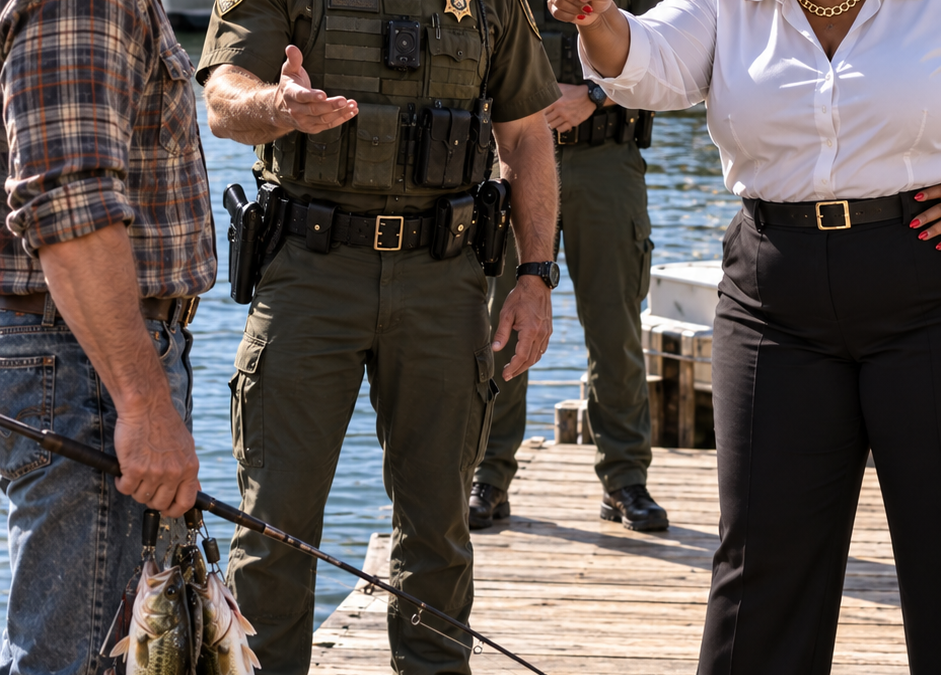
Gail Prescott stood at the top of my boat ramp with her arms folded across a pressed white blouse while two state wildlife officers walked toward me.
She looked satisfied.
Not nervous.
Not uncertain.
Satisfied.
Like the uniforms had arrived because she had ordered them and the rest was just paperwork.
I was standing at the end of my grandfather’s dock with a fishing rod in my hand.
My line was still in the water.
Three bass and a bluegill hung from a stringer beside the dock.
It was Saturday morning.
Same place.
Same routine.
Same lake I had fished since I was a child.
Gail did not wait for either officer to ask a question.
“That’s him.”
Her voice carried across the water.
“He’s been poaching from our community lake for months.”
The lead officer glanced toward her.
Gail pointed at me.
“He knows the rules. He’s been warned repeatedly. He doesn’t care.”
I said nothing.
“I want him removed from the property,” she continued, “and I want charges filed.”
The second officer stopped near the truck with a clipboard.
The first kept walking toward me.
Gail followed several steps behind.
“He isn’t even a member of the association,” she said. “He has no right to fish here. He has no right to access the lake at all.”
Then she lowered her voice slightly.
That was Gail’s favorite trick.
When she wanted to sound reasonable, she spoke softer.
“I’ve documented everything, Officer. This is trespassing and theft of HOA resources.”
The officer stepped onto the dock.
The pine boards creaked beneath his boots.
Gail added one last sentence.
“I want him in handcuffs or off this property today.”
The officer looked at my fishing rod.
Then at my tackle box.
Then at my face.
His eyebrows lifted.
And he did something Gail absolutely did not expect.
But to understand why, I need to take you back more than fifty years.
My grandfather bought the land in 1972.
Twelve acres.
Mostly timber.
A modest house.
And a spring-fed lake of roughly three acres sitting almost perfectly in the middle.
Clean water.
Cold even in July.
Clear enough that on a calm morning you could see bluegill moving through the shallows.
The lake never went dry.
Never turned brown after storms.
Never belonged to anybody except my grandfather.
His name was Walter Anderson.
He built the dock himself.
Pine decking.
Cedar posts.
A railing he never finished.
My grandmother complained about that railing for twenty years.
My grandfather always said he would finish it next Saturday.
He never did.
I caught my first bluegill from that dock.
My grandfather taught me how to tie a clinch knot there.
He taught me how to cast without whipping the line sideways and hooking somebody’s ear.
He taught me that you do not talk loudly when you are fishing because the point of fishing is not always the fish.
One summer when I was thirteen, my parents separated.
My mother sent me to stay with my grandparents for two weeks.
I barely spoke.
My grandfather did not ask me to.
One morning, he sat beside me on the dock for nearly two hours.
No questions.
No advice.
No speeches about how adults make mistakes.
He just cast his line.
Waited.
Reeled in.
Cast again.
Sometimes, when you are thirteen and your life suddenly feels like something broke without asking you, water and silence are better than answers.
That lake held a lot of my life.
When my grandfather died, he left the twelve acres to me.
I eventually moved there full-time.
Fixed the house.
Repaired the dock.
Cleared dead timber.
Kept fishing.
For a long time, that was enough.
Then the neighborhood arrived.
In 2005, a developer bought the farmland surrounding my grandfather’s parcel.
They built a planned community around us.
Eighty-two houses.
Curved streets.
Matching mailboxes.
A clubhouse.
Walking paths.
Association rules.
The whole package.
The development wrapped around my property so completely that from the air, it looked like my land was part of the subdivision.
It wasn’t.
My grandfather’s parcel existed thirty-three years before the first subdivision lot was recorded.
He never sold it.
I never sold it.
I never signed the HOA declaration.
I never agreed to the covenants.
I never became an association member.
County records treated my property exactly the way they always had:
An independent twelve-acre parcel containing one spring-fed lake.
The developer’s marketing department apparently found that inconvenient.
Their brochures used aerial photographs of my lake.
Underneath, glossy letters said things like:
PRIVATE COMMUNITY AMENITY.
LAKESIDE LIVING AT ITS FINEST.
A brochure can call a lake whatever it wants.
A brochure is not a deed.
During the development’s early years, nobody made an issue out of it.
The original developer knew the boundaries.
The first HOA board seemed to understand them.
Neighbors waved.
A few people asked whether they could fish the far bank.
Usually I said yes.
A father would bring his kid.
A retiree would sit under one of the cottonwoods with a folding chair.
Nobody abused it.
Nobody claimed ownership.
It worked because normal people understand a favor when they receive one.
Then Gail Prescott became HOA president.
Four years before the wildlife officers appeared at my dock, Gail won a board election.
From the beginning, she treated the HOA like a municipal government and herself like its mayor.
Every few months brought a new rule.
Trash cans visible from the street.
Wrong shade of beige on front doors.
Grass measured to absurd precision.
Holiday decorations displayed too early.
Holiday decorations left out too late.
She had a clipboard.
Letterhead.
A laminated HOA badge she wore during inspections.
And a voice that could make a request for hedge trimming sound like notice of criminal prosecution.
I ignored most of it.
Her rules did not apply to me.
I was not an HOA member.
Then one Tuesday, I came home and found an envelope tucked into my screen door.
Bright red border.
HOA logo.
The word VIOLATION printed across the top.
I opened it standing on the porch.
“Resident at 1140 Lake View Lane is in violation of HOA Bylaw 14.3. No fishing, swimming, or boating is permitted in the community lake. Cease immediately or a $250 fine will be assessed.”
I read it twice.
Then a third time.
Community lake.
I looked past the house toward the water.
I had been fishing there before Gail Prescott lived in the county.
Before the subdivision existed.
Before its roads existed.
Before its HOA existed.
I walked to Gail’s house that evening.
She answered almost immediately.
“Mr. Anderson.”
“Miss Prescott.”
I held up the notice.
“There’s been a misunderstanding.”
“I don’t think so.”
“The lake is on my property.”
Gail smiled.
Not kindly.
Patiently.
Like I was someone struggling with a basic concept.
“The lake is an HOA amenity.”
“No.”
“It’s maintained and governed by the association.”
“My grandfather owned it before this subdivision existed.”
“Things change.”
I remember those two words.
Things change.
She said them casually.
“The community has rules now,” she continued. “Fishing is prohibited.”
“I’m not in your community association.”
“You live inside the development.”
“My parcel predates your development.”
“You’re welcome to attend the next board meeting.”
“I’m not a member.”
“Then I suppose you won’t be voting.”
She started closing the door.
“The violation notice stands. If you fish again, the fine will be issued.”
The door closed.
I stood on her porch looking at the wreath hanging in front of me.
I realized Gail was not confused.
Confusion can be fixed with information.
Gail was certain.
And the dangerous thing about certainty is that people stop checking whether they are right.
I walked home.
Opened the hall closet.
On the top shelf sat an old manila folder.
My grandfather had written three words on the tab.
DEED — LAND — LAKE.
I had not opened it in years.
I carried it to the kitchen table.
The deed was on top.
Heavy paper.
Typed legal description.
June 14, 1972.
I read the parcel boundaries.
Section numbers.
Bearings.
Distances.
Then the line that mattered.
“Together with the spring-fed lake and all riparian rights thereto.”
I read it aloud.
Not because I doubted it.
Because I wanted to hear it in the room.
The lake was not implied.
Not adjacent.
Not shared.
Named.
Included.
Deeded.
Beneath the deed was the original survey.
Hand-drawn.
Surveyor stamp.
The lake sat entirely inside my parcel boundaries.
Every shoreline.
Every part of the water.
I sat for a while with my grandfather’s handwriting on the folder tab beneath my hand.
Walter Anderson kept paperwork the way some men keep tools.
Clean.
Dry.
Exactly where it belonged.
He probably never imagined his grandson would need that deed to explain to a homeowners association that water inside his property line belonged to him.
But he had kept it anyway.
The next morning I made copies.
I put the deed and survey in an envelope.
Then drove back to Gail’s house.
She answered holding a coffee mug with the HOA logo printed on it.
I held out the copies.
“My deed. 1972.”
She took them.
“The legal description specifically includes the lake and riparian rights. The survey shows the entire lake inside the parcel.”
Gail glanced at the first page.
Maybe four seconds.
She did not read the legal description.
Did not unfold the survey completely.
Did not trace the boundary.
Then she handed everything back.
“Mr. Anderson, this is from 1972.”
“Yes.”
“The developer transferred the lake to the association when the community was created.”
“Do you have that deed?”
“It’s in our records.”
“I’d like a copy.”
“The management company can send it.”
“When?”
“When they get to it.”
She stepped backward.
“In the meantime, the violation stands.”
The door closed again.
A week passed.
No transfer deed.
No email.
No phone call.
Instead, I received a second violation notice.
$250.
Unauthorized use of community amenity.
I put it beside the first one.
The following Saturday, I went fishing.
Not to provoke Gail.
Not because I wanted attention.
I went fishing because it was Saturday morning.
My dock.
My property.
My lake.
Nobody had produced a single legal document saying otherwise.
Monday brought another envelope.
This one heavier.
$500 additional fine.
Plus a warning.
Continued noncompliance would result in lien proceedings against 1140 Lake View Lane.
A lien.
That changed the temperature.
Fines were irritating.
A lien could attach a legal claim to my property.
That meant attorneys.
Title problems.
Time.
Money.
All because I was fishing in water named in my deed.
I sat at the kitchen table with the notice for nearly an hour.
Then called the HOA management company.
Getting through took twenty minutes.
Eventually, a woman named Terry answered.
“I’m calling about violation notices for 1140 Lake View Lane.”
Keyboard clicking.
“Fishing violations?”
“Yes.”
“I have them.”
“I’ve been told the developer transferred the lake to the HOA when the subdivision was built.”
“That’s my understanding.”
“Can you send me the transfer deed?”
More typing.
Silence.
Then more typing.
“Hold on.”
I waited.
Finally, Terry spoke again.
“Mr. Anderson?”
“Yes?”
“I’m looking at the complete property file.”
“Okay.”
“I don’t see a transfer deed for the lake.”
“Check the common-area documents.”
“I did.”
“Subdivision plat?”
“I’m looking at it.”
“And?”
“The lake is not listed as common area.”
I leaned back.
“Any conveyance?”
“No.”
“Any easement?”
“Not that I see.”
“Has your office ever seen a deed transferring the lake?”
Terry paused.
Her voice became careful.
“I can only tell you what’s in the file.”
“That’s fine.”
“There is no transfer deed in this file.”
Then, after another second:
“I’ve never seen one.”
I thanked her.
Hung up.
Three violation notices sat on my counter.
$750.
Lien threat.
All based on a deed Gail claimed existed.
The HOA’s own management company could not find it.
That was when I stopped asking Gail questions.
I drove to the county recorder’s office.
Forty minutes east.
Basement.
Fluorescent lights.
Metal shelves.
Old paper.
Floor wax.
A clerk behind the counter who looked like she had spent thirty years explaining deeds to people who wished land ownership worked differently.
“I need a complete chain of title.”
I gave her the parcel number.
She pulled records.
Original conveyance.
No later deed transferring the lake.
No recorded easement affecting it.
No partial conveyance.
No instrument giving an HOA ownership.
Then she pulled the official subdivision plat.
Not the marketing version.
The actual recorded plat.
She turned it toward me.
Near the bottom was a list of excluded parcels.
My parcel number was there.
Explicitly excluded from subdivision common areas.
“So the lake was never conveyed?”
She shook her head.
“Not according to anything recorded here.”
“My parcel never joined the subdivision?”
“No.”
“As far as the county is concerned?”
“The lake is private property contained within your parcel.”
“Same as 1972?”
“Same as 1972.”
She certified the copies.
Heavy red stamp.
The stamp came down against the counter with a hard mechanical sound.
I remember thinking:
That should end this.
I was wrong.
I drove home with the certified documents on the passenger seat.
All the way back, I kept hearing Gail.
Things change.
No, they do not always.
Some things sit quietly in a county basement.
Ink.
Signatures.
Recorded boundaries.
They do not care who won the HOA election.
That evening, I wrote one letter to the full board.
Five directors.
Each received their own certified copy.
I attached:
The 1972 deed.
The original survey.
The current certified chain of title.
The official subdivision plat.
The recorder’s confirmation that no lake transfer existed.
I kept the language simple.
The lake was private property.
It had never been transferred.
My parcel was excluded from the HOA’s common areas.
Therefore, the fines and lien threats had no legal basis.
I requested that all violation notices be rescinded within fourteen days.
Five letters.
Five certified envelopes.
Five return receipts.
Then I waited.
Every card came back signed.
Nobody responded.
Not Gail.
Not the vice president.
Not the secretary.
Nobody.
Then something stranger happened.
Neighbors stopped talking to me.
Dave Krueger lived three houses down.
For years, we had chatted at the mailbox.
One afternoon, he saw me approaching and suddenly became very interested in his phone.
Linda Bowman lived across the road.
For two summers, we had exchanged tomatoes and zucchini.
I waved while she unloaded groceries.
She looked past me.
I told myself I was imagining it.
Then I met Jim Haley at the Sinclair station.
Jim was the closest thing I had to a good friend in the neighborhood.
He saw me at the next pump and his expression tightened.
“Jim.”
“Cody.”
“What’s going on?”
He hesitated.
“Nothing.”
“Half this neighborhood won’t look at me.”
He put the nozzle away.
“Look, I don’t want to get in the middle.”
“The middle of what?”
“Gail held a homeowner meeting.”
“When?”
“Last week.”
“What did she say?”
Jim rubbed the back of his neck.
“She said you’re trying to privatize the lake.”
I stared at him.
“It is private.”
“I know what you mean.”
“No, Jim. It is literally on my deed.”
“She told people you’re planning to fence everyone away from the shoreline.”
“I’m not.”
“She said you threatened to sue any homeowner who came near the water.”
“I didn’t.”
He sighed.
“She had your letter.”
“The certified one?”
“Yeah.”
“She read it?”
“Parts.”
That word landed hard.
“Which parts?”
“The riparian rights section. The part about legal basis. The demand to rescind the fines.”
“What about the deed attachments?”
“She didn’t show those.”
Of course she didn’t.
Jim continued.
“She made it sound like you were claiming ownership of something the HOA had always controlled.”
“It’s my lake.”
“I’m telling you what she said.”
“How many people?”
“Maybe forty.”
“Forty?”
“She passed around a petition.”
“What petition?”
“Protect Our Lake.”
I almost laughed.
“She got signatures?”
“More than forty, I think.”
Forty people.
Neighbors.
People who had borrowed tools from me.
People whose kids had fished with my permission.
People who had brought Christmas cookies.
Now they believed I was stealing something from them.
Gail had taken the letter I sent in good faith.
Removed the certified evidence.
Read selected sentences.
Then built a story around what remained.
I had the deed.
She had the room.
And in that moment, the room was winning.
Things moved quickly after that.
Jim called one evening.
His voice was low.
“Emergency board meeting tonight.”
“Open?”
“Closed.”
“I’m not a member anyway.”
“That’s what Gail is using.”
“What do you mean?”
“She told the board you have no standing because you don’t pay dues.”
“That’s because I’m not in the HOA.”
“Exactly.”
“What are they voting on?”
There was a pause.
“To declare you a trespasser.”
I actually thought I had misheard him.
“On my lake?”
“She’s calling it HOA property.”
“I mailed all five directors certified county documents.”
“I don’t think they read them.”
“Why?”
Jim lowered his voice further.
“Gail told them the envelopes were legal threats and that the HOA attorney would handle them.”
I looked at the five green return receipts lying on the counter.
Five board members had signed for the evidence.
Apparently, Gail had convinced them not to open it.
The vote happened that night.
Two days later, a process server appeared at eight in the morning.
He handed me a certified packet.
Attorney letterhead.
HOA resolution attached.
Unanimous vote.
The board formally declared the lake HOA common property.
Declared Cody Anderson an unauthorized trespasser.
Authorized Gail Prescott to take “any and all necessary enforcement action.”
Then came the final paragraph.
I was ordered to cease all lake use.
Fishing.
Boating.
Dock access.
Everything.
Failure to comply within seven days would result in criminal trespass charges.
I sat at my kitchen table staring at the letter.
The deed was beside it.
The county plat.
The certified recorder statement.
The law was on my side.
I knew that.
But for the first time, I understood something uncomfortable.
Being right does not always make the fight cheap.
A legal case could take months.
Maybe longer.
Motions.
Hearings.
Attorneys.
Continuances.
Gail had a board.
An HOA lawyer.
A petition.
Forty neighbors.
And now a formal resolution accusing me of trespassing on my own land.
That night, I barely slept.
Around three in the morning, one question started repeating in my head.
Why?
Why was Gail pushing this far?
A normal person would have seen the county documents and backed away.
Yes, it would have been embarrassing.
She had made a mistake.
Fine.
Rescind the fines.
Issue a correction.
Move on.
Instead, Gail escalated.
She organized meetings.
Manipulated letters.
Turned neighbors against me.
Hired lawyers.
Threatened criminal charges.
That was not ordinary stubbornness.
That was someone who could not afford to admit the truth.
Why?
The next morning, I went through every HOA document I possessed.
Not the deed.
Not county records.
Their documents.
Meeting minutes.
Budget statements.
Assessments.
Annual reports.
The management company had sent me a packet when I first challenged the fines.
I had skimmed most of it.
Now I read every line.
Second page of the annual budget.
Landscaping.
Insurance.
Management fees.
Road maintenance.
Legal reserves.
Then I found it.
LAKE AMENITY ASSESSMENT — $150 PER HOUSEHOLD.
I stopped.
Eighty-two homes.
$150 each.
$12,300 per year.
Gail had been president four years.
$49,200.
I ran the calculation again.
Same answer.
$49,200.
Every year, the HOA had charged residents for lake access, lake maintenance, lake amenity services.
On property the HOA did not own.
The lake had never been conveyed.
They had no title.
No easement.
No common-area designation.
Nothing.
That was why Gail could not admit I owned it.
Because the second she did, eighty-two households would ask one question.
Why have we been paying you?
I sat at the kitchen table for a long time.
I realized I had been fighting the wrong battle.
I did not need to keep proving the lake was mine.
That was settled.
What I needed to do was ask where the money went.
For three days, I built a file.
Tab One:
1972 deed.
The lake language highlighted.
Tab Two:
Original survey.
Lake entirely within the parcel.
Tab Three:
County-certified chain of title.
No transfers.
No easements.
My parcel excluded from subdivision common areas.
Tab Four:
Four annual HOA budgets.
Lake assessment highlighted every year.
Tab Five:
My notes from the management company.
No transfer deed in the file.
No recorded ownership.
Then I made three complete copies.
I stopped communicating through Gail.
The board needed to see the evidence directly.
I called Tom Reeves first.
Board vice president.
Retired mechanical engineer.
“Tom, I need fifteen minutes.”
“About the lake?”
“Yes.”
“Gail said the attorney is handling it.”
“Did you read the certified documents I mailed you?”
Silence.
“I received the envelope.”
“Did you open it?”
“No.”
“Why?”
“Gail said it was a legal threat and we shouldn’t respond directly.”
I closed my eyes.
“Tom, you voted to declare me a trespasser without reading the county documents I sent you.”
Another long silence.
“What exactly is in the envelope?”
“Proof the HOA does not own the lake.”
“I’ve heard Gail’s position.”
“I also have four years of budget records showing the HOA collected $49,200 for access to property it doesn’t own.”
He did not answer immediately.
Then:
“When can we meet?”
“Saturday. Two.”
“I’ll be there.”
Next I called Sandra Marsh.
Board secretary.
“Did you read my packet?”
“No.”
“Why?”
“Gail told us you intended to sue every homeowner individually.”
“I never said that.”
“She said your letter threatened litigation.”
“Sandra, I’m trying to fish on my own property.”
That sentence changed something.
She agreed to come.
Saturday morning arrived clear.
I went fishing.
Six-thirty.
Same routine.
Same dock.
I refused to let Gail take that from me.
The lake was glass.
A great blue heron stood motionless along the far bank.
My line settled.
And for maybe twenty minutes, everything became normal.
There is something else you should know.
For six years, I had participated in a volunteer conservation program run through the state wildlife division.
Twice a year, I drove to the regional hatchery.
Picked up fingerlings in aerated coolers.
Bass.
Bluegill.
Channel catfish.
I stocked the lake under state supervision.
I also submitted water quality measurements.
Temperature.
pH.
Dissolved oxygen.
Visibility.
The state had six years of reports with my name attached.
During one pilot study, they even used data from my lake in a regional analysis.
I never thought of any of that as useful in a property dispute.
It was simply something I did.
My grandfather believed if you took fish from water, you had a responsibility to leave enough behind for someone else.
The state program helped me do that correctly.
At about 7:30, I heard a vehicle on the gravel road.
Then another.
Heavier.
Diesel.
I turned.
Gail’s silver SUV was parked at the top of the ramp.
Behind it stood a green-and-white state truck.
WILDLIFE DIVISION.
My stomach tightened.
Not because I thought I had broken the law.
Because I knew exactly what she had done.
The board meeting with Tom and Sandra was scheduled for two.
By midafternoon, they would know everything.
Gail had one morning left to control the story.
She had called state wildlife enforcement.
She got out of her SUV.
Pressed white blouse.
Arms crossed.
Two officers stepped out of the truck.
The first walked toward the dock.
Gail called:
“That’s him.”
I set my rod down.
“He’s been poaching from our lake for months.”
The officer kept walking.
“He knows he’s prohibited from fishing here.”
Gail followed.
“He’s not an HOA member. He’s trespassing.”
I waited.
The officer came to the dock.
Four feet from me.
He looked at my face.
Tilted his head.
Then:
“Cody?”
I blinked.
“Cody Anderson?”
“Yes, sir.”
His expression changed.
“Officer Dan Garrett.”
I knew the name.
He had signed two of my conservation reports.
Then he smiled slightly.
“You run the volunteer stocking work here, don’t you?”
Behind him, Gail stopped walking.
“Yes.”
“Six years?”
“About that.”
He looked at the water.
“Your bluegill numbers have been some of the strongest we’ve seen locally.”
“Thank you.”
“You send the quarterly water samples too?”
“Yes.”
He nodded.
“Good work.”
I could feel Gail standing behind him.
The entire confrontation she had imagined was already going wrong.
Garrett became professional again.
“Now, the reason we’re here.”
He glanced toward Gail.
“We received a report of illegal fishing on HOA property.”
“That would be Gail.”
He ignored the comment.
“Can I see your fishing license?”
I handed it over.
Valid.
Current.
Correct address.
He handed it back.
“Property ownership?”
“My property.”
“Documents?”
Since the violations began, I had kept copies in a waterproof bag inside the tackle box.
I reached down slowly.
Pulled them out.
Certified deed.
County plat.
Garrett unfolded the deed.
He read the legal description.
His finger stopped at the lake language.
“Spring-fed lake and all riparian rights thereto.”
“Yes.”
He looked at the plat.
Traced the boundaries.
Then looked around.
“This lake is entirely inside your parcel?”
“Yes.”
“Any transfer?”
“No. County confirmed none.”
Gail finally stepped forward.
“That deed is fifty years old.”
Garrett turned.
“The developer transferred the lake to the HOA.”
“Do you have the transfer?”
“It’s in our files.”
“With you?”
“No.”
“What kind of document?”
“A conveyance.”
“Recorded?”
“Of course.”
Garrett stared at her.
“Do you know the instrument number?”
Gail’s expression tightened.
“The management company has it.”
Garrett took his radio.
“Dispatch, Unit Fourteen.”
Static.
“Run parcel ownership for me.”
He read my parcel number.
“Current owner, any conveyances affecting water rights, and any HOA ownership interest.”
We waited.
The lake stayed almost perfectly still.
One bass on the stringer slapped its tail against the surface.
Thirty seconds.
Then the radio crackled.
“Unit Fourteen, parcel recorded to Anderson, Cody R. Original conveyance 1972. No subsequent conveyances. No recorded easements or transfers to any homeowners association. Parcel excluded from subdivision common-area designation.”
Garrett lowered the radio.
He looked at Gail.
“Ma’am, there is no HOA ownership interest recorded here.”
“That can’t be correct.”
“It is what the county shows.”
“The developer—”
“There is no violation.”
She stared.
Garrett continued.
“Mr. Anderson has a valid fishing license. He is fishing on private property that he owns.”
Gail’s arms unfolded.
For the first time since I had known her, she looked like she was searching for words instead of delivering them.
Garrett turned toward me.
Then extended his hand.
“Cody, keep doing what you’re doing out here.”
I shook it.
“The division appreciates the conservation work.”
The second officer came closer.
“Your water-quality reports have been useful.”
“Thank you.”
The first officer nodded toward my stringer.
“Those are healthy fish.”
I almost laughed.
Behind them stood the woman who had called the state hoping to watch me get arrested.
Instead, two wildlife officers were thanking me for maintaining the lake she claimed belonged to her HOA.
And people had noticed.
A state truck with roof lights beside the boat ramp gets attention in a quiet subdivision.
Residents had come outside.
A dozen at first.
Then more.
By the time Garrett shook my hand, maybe twenty people were close enough to understand what had happened.
Tom Reeves was one of them.
He walked down the ramp after the officers started returning to their truck.
He looked at Gail.
Then at me.
“Cody.”
“Yes?”
“I think we should have that meeting now.”
Sandra Marsh had arrived too.
Several neighbors followed us without being invited.
Nobody objected.
We went into my kitchen.
I laid the file across the table.
Nobody spoke while Tom read.
Deed.
Survey.
County record.
Subdivision exclusion.
Then the budget.
He stopped.
Put on reading glasses.
Read the line again.
“Lake amenity assessment.”
“Yes.”
“One hundred fifty dollars per household.”
“Yes.”
“For how many houses?”
“Eighty-two.”
Sandra already had her phone calculator open.
“Four years?”
“Four.”
She entered the numbers.
Then stared at the screen.
“Forty-nine thousand two hundred dollars.”
A woman standing in my kitchen doorway spoke quietly.
I recognized her.
She had signed Gail’s Protect Our Lake petition.
“We paid forty-nine thousand dollars for access to his lake?”
Nobody answered.
Tom took off his glasses.
He looked older than he had an hour earlier.
Then he said:
“I’m calling an emergency board meeting.”
Sandra nodded.
Tom looked at her.
“Until that meeting, I’m moving that Gail’s authority as president be suspended pending financial and property review.”
“Seconded.”
He looked toward me.
“Cody.”
I waited.
“I owe you an apology.”
I said nothing.
“The board owes you one.”
I closed the file.
Outside the kitchen window, the lake looked exactly the same as it had before any of this began.
That was the strange thing.
All this noise.
All these letters.
All this money.
The water did not care.
The emergency meeting took place the following Thursday.
Seventy-one homeowners attended.
The community room barely held them.
Gail was there.
But not at the board table.
She sat in the second row.
No clipboard.
No microphone.
No stack of violation notices.
Tom chaired the meeting.
He did not make a speech.
He simply presented documents.
The deed.
County plat.
Recorder confirmation.
HOA budget.
Four years.
$49,200.
Then he read the motion.
“Motion to remove Gail Prescott from the office of HOA president effective immediately based upon misrepresentation of property ownership and unauthorized assessment activity related to privately owned land.”
Sandra seconded.
The remaining board voted.
Unanimous.
Gail sat looking at the floor.
Nobody applauded.
That mattered.
It was not theater anymore.
It was accounting.
When the vote ended, Gail picked up her purse.
She walked out.
The door closed softly behind her.
The board passed three more motions.
First:
Independent audit of every dollar collected under the lake amenity assessment during Gail’s presidency.
Second:
Every violation issued against my property was rescinded.
All fines voided.
The attorney letter withdrawn.
Third:
The board issued a formal written apology acknowledging that the lake belonged to me and had never been HOA property.
Tom read the apology aloud.
I sat near the back.
I had not requested it.
Still, hearing it mattered.
For weeks, Gail had turned my neighbors against me.
She had made ownership sound like aggression.
She had taken the simple fact that I possessed a deed and treated it like an attack on the community.
Now the same room heard the truth without editing.
The neighborhood changed after that.
Slowly at first.
Dave Krueger stopped me near the mailboxes.
“Cody.”
“Dave.”
He looked embarrassed.
“I should have talked to you.”
“Yes.”
“I believed Gail.”
“I know.”
“That was wrong.”
I nodded.
He did not need to perform remorse.
Linda Bowman came across the road a few days later carrying tomatoes.
She had avoided me for nearly a month.
Now she put the bag in my hands.
“Too many this year.”
“Thank you.”
Neither of us mentioned anything else.
The tomatoes were enough.
Jim Haley came over the next Saturday carrying two folding chairs and a tackle box.
“You need company?”
“Depends.”
“On what?”
“Did you bring coffee?”
He held up a thermos.
“Then yes.”
The best change involved the kids.
Once parents understood the lake was private, several came to my door.
Awkward.
Apologetic.
Usually with some version of the same question.
“Would it be okay if my son fishes there?”
“Yes.”
“My daughter too?”
“Yes.”
“Do we need permission every time?”
“At first.”
They would look nervous.
Then I would smile.
“After I know who they are, tell them Saturday mornings.”
Within a month, my grandfather’s dock had become something different.
I still got there around six-thirty.
By seven, there might be three kids.
Sometimes six.
Small rods.
Oversized tackle boxes.
Bait spilled everywhere.
I taught clinch knots.
Casting.
How to hold bluegill without getting stabbed by the dorsal spines.
How to unhook fish without tearing mouths.
How to release what you do not need.
One boy asked why I always watched the water before casting.
“My grandfather taught me.”
“What did he say?”
“That if you’re quiet long enough, the lake tells you where the fish are.”
The boy went completely silent for almost thirty seconds.
“That long?”
I laughed.
“Longer.”
My grandfather would have liked those mornings.
I think about that often.
The audit finished weeks later.
The board issued a full accounting of the lake assessments.
Some money had been used for shoreline landscaping on HOA property adjacent to the lake.
Some went into general funds.
Some was labeled as maintenance without enough supporting documentation.
The new board refunded what could be attributed to improper lake-access charges and removed the line item permanently.
More importantly, they changed the language in every HOA publication.
The lake was no longer described as community property.
The walking paths remained HOA amenities.
The landscaping remained theirs.
The lake itself did not.
One Tuesday afternoon, a state wildlife truck came up my road again.
This time there were no emergency lights.
Dan Garrett got out carrying a clipboard.
I was replacing a loose dock board.
“Cody.”
“Dan.”
“Stocking cycle next month.”
He looked toward the water.
“Bass again?”
“Yes.”
“Bluegill?”
“Definitely.”
“You want to try crappie?”
“Maybe.”
He made a note.
Then stopped.
“One more thing.”
“What?”
“The complaint Gail filed.”
I put the hammer down.
“What about it?”
“False wildlife complaints are documented.”
I waited.
“The information she gave dispatch—poaching, HOA ownership, illegal access—was materially inaccurate.”
He closed the clipboard.
“We forwarded the file to the county attorney.”
“Will anything happen?”
“That’s their decision.”
He looked toward me.
“I just wanted you to know it exists.”
“Thank you.”
He extended his hand again.
Second time.
Then drove away.
I never asked what happened with the county attorney.
Maybe Gail received a warning.
Maybe more.
By then, it mattered less than I expected.
The important part had already happened.
Her version of reality no longer controlled everybody else’s behavior.
That was enough.
I think about my grandfather on Saturday mornings.
Usually when the lake is still.
Sometimes when kids are loud enough to scare every fish into the next county.
I wonder what he would have thought of Gail Prescott trying to turn his lake into an HOA budget item.
He would not have shouted.
Walter Anderson almost never shouted.
He probably would have read the deed.
Folded it.
Put it back in the folder.
Then gone fishing.
That was his way.
He believed ownership carried responsibility.
You do not own water by dominating it.
You own responsibility for what happens to it.
Keep fertilizer out.
Keep trash out.
Protect the bank.
Do not take more fish than the lake can replace.
Repair what breaks.
Leave something worth inheriting.
That was why I joined the conservation program.
Not for Gail.
Not for the HOA.
Not for recognition from wildlife officers.
Because my grandfather had kept the lake healthy for decades and I wanted to do the same.
The dock needs work now.
Some of the boards are getting soft.
I will replace them this fall.
Pine planks again.
Cedar posts.
I might finally finish the railing.
Or maybe I won’t.
My grandfather left it unfinished for so long that completing it almost feels like changing something that has earned the right to remain imperfect.
There is a place near the end where the wood still carries an old cut mark.
I made it when I was twelve and dropped my grandfather’s fillet knife.
He was furious for about three seconds.
Then he laughed.
That mark has survived longer than marriages, careers, board presidents, developments, and every HOA rule Gail ever wrote.
Sometimes that is what property really is.
Not investment.
Not acreage.
Not market value.
Memory with boundaries.
The deed establishes the boundary.
The life inside it gives the boundary meaning.
Gail thought the brochure gave her authority.
Then the bylaws.
Then the board vote.
Then the petition.
Then the attorney letter.
Then the wildlife officers.
Every time one tool failed, she reached for something louder.
But none of those things changed the first document.
June 14, 1972.
Walter Anderson.
Twelve acres.
Spring-fed lake.
Riparian rights.
Recorded.
The wildlife officers did not create my ownership.
The board’s apology did not create it.
The county clerk did not create it when she certified the deed.
They only confirmed what had been true the entire time.
That is why I remember the handshake so clearly.
Not because it humiliated Gail.
I did not need humiliation.
But for weeks, I had been treated like someone trying to take something from a community.
Then the very officers Gail summoned walked down my dock, checked the facts, and recognized the opposite.
I had been protecting that water.
Stocking it.
Testing it.
Maintaining it.
Long before she started collecting money for it.
The Saturday after the board removed Gail, Jim and I were on the dock before seven.
Three kids arrived soon after.
One brought a new rod he could barely cast.
Another had a tackle box containing almost everything except useful tackle.
A girl named Emma caught the first fish.
Bluegill.
Small one.
She screamed when it came out of the water.
Then screamed again when it moved.
I showed her where to place her fingers.
“Like this.”
“It’s going to stab me.”
“Not if you hold it correctly.”
“You sure?”
“No.”
She stared at me.
I laughed.
“I’m kidding.”
She carefully held the fish.
Her expression changed immediately.
Fear became wonder.
“Can I keep it?”
“You could.”
She looked at the fish.
Then the water.
“What would you do?”
“Put that one back.”
“Why?”
“Because the lake gave us one. We don’t need every one it gives us.”
She thought about that.
Then knelt.
Lowered the bluegill into the water.
For a second, the fish stayed in her hands.
Then disappeared.
Emma watched the ripples.
“Cool.”
I looked toward the far bank.
Same shoreline my grandfather had watched.
Same water.
Same dock, mostly.
And for the first time in months, nothing felt contested.
No violation letter on my counter.
No certified envelope.
No petition.
No neighbor avoiding my eyes.
Just people fishing.
That was what Gail never understood.
She believed my ownership meant excluding everyone else.
Because that was how she understood control.
If she owned authority, somebody else had to lose it.
If the HOA controlled the lake, I had to be kept off it.
If I owned the lake, she assumed I wanted everyone else gone.
But ownership does not have to mean exclusion.
It means choice.
It means the right to say yes because no one else has stolen your right to say no.
The neighborhood kids fish here because I invite them.
Not because Gail charged their parents $150.
That difference matters.
One is community.
The other is entitlement.
A few weeks later, Tom came down to the dock.
He stood awkwardly for a minute.
“I’ve been thinking about something.”
“That sounds dangerous.”
He smiled.
“The board wants to ask you about formalizing some kind of voluntary access agreement.”
I shook my head.
“No.”
He nodded immediately.
“Fair.”
“I don’t want another document people misunderstand in twenty years.”
“Also fair.”
“I’m happy to let neighbors fish when they ask.”
“That works.”
He started walking away.
“Tom.”
He turned.
“Thank you for reading the file.”
His face tightened a little.
“I should’ve read it the first time.”
“Yes.”
“I know.”
Then he left.
That was the entire conversation.
People sometimes expect forgiveness to be dramatic.
It usually is not.
Trust comes back in pieces.
A conversation.
A bag of tomatoes.
Someone asking permission instead of assuming.
A board member admitting he should have opened an envelope.
Over time, those pieces became enough.
I kept Gail’s original violation notices.
All three.
They sit inside my grandfather’s DEED — LAND — LAKE folder now.
The first one says I was prohibited from fishing.
The second contains the $250 fine.
The third threatens the lien.
Behind them are certified county records proving the exact opposite.
I do not keep them because I enjoy being right.
I keep them because they remind me how easy it is for something false to look official.
Red border.
Logo.
Bold type.
Legal language.
A board vote.
An attorney signature.
None of those things turn a bad claim into truth.
Only evidence does that.
Sometimes I see Gail.
She still lives in the development.
She no longer holds office.
If we pass in cars, neither of us waves.
That is fine.
I do not need reconciliation with everyone who harms me.
I need boundaries.
The county drew mine in 1972.
They still work.
On calm mornings, I sit where my grandfather sat.
The lake reflects the trees.
A heron sometimes stands near the reeds.
Kids show up.
Jim brings coffee.
The wildlife division still delivers fingerlings twice a year.
The bluegill population is still strong.
Dan Garrett tells me that every time he reviews the numbers.
And occasionally, usually when someone catches something good, I remember Gail standing at the top of the ramp.
White blouse.
Arms folded.
Certain.
She called wildlife officers because she wanted the state to tell me I did not belong on my own dock.
Instead, the state checked the records.
Checked my license.
Checked the lake.
Then thanked me for taking care of it.
That morning did not prove the lake was mine.
My grandfather had taken care of that fifty years earlier.
What it proved was something else.
Authority is only impressive until somebody asks it to show its paperwork.
Gail had a clipboard.
I had a deed.
She had eighty-two houses.
I had a county record.
She had a petition.
I had fifty years of title history.
She had a story people wanted to believe because it was familiar.
I had the truth.
And eventually, even a crowd has to make room for that.
Last Saturday, I went out before sunrise.
No kids yet.
No Jim.
No engines.
I brought my grandfather’s old rod instead of mine.
The handle is worn smooth now.
I cast from the same spot he taught me.
The line landed beyond the shallows.
The water closed around it.
For a while, nothing happened.
That is fishing.
Waiting without needing the moment to justify itself.
Then the line moved.
I set the hook.
Small bass.
Healthy.
Strong.
I brought it close.
Unhooked it.
Held it for a moment.
Then released it.
The fish disappeared beneath the dock.
I sat down.
Across the water, the neighborhood was waking.
Garage doors.
Dogs.
Coffee lights behind kitchen windows.
Eighty-two homes surrounding three acres of water they once believed belonged collectively to them.
Maybe that belief had not been unreasonable at first.
The brochures told them so.
The HOA told them so.
Gail told them so.
The mistake was not believing something once.
The mistake was refusing to look after the evidence appeared.
That is what separated the people who eventually apologized from Gail.
Tom looked.
Sandra looked.
Jim listened.
The neighbors who signed the petition eventually saw the deed.
Gail had been given the same chance.
She handed it back unread.
Everything after that came from the same decision.
Do not look.
Do not question.
Do not let facts interfere with authority.
In the end, she lost the board not because my deed was complicated.
She lost because it was simple.
The lake had always belonged to my family.
She had been charging people for something the HOA did not own.
And when she called officers to arrest me for touching it, she finally brought in the one audience she could not control.
They checked.
That was all.
They checked.
Sometimes that is enough to collapse years of certainty.
A few minutes later, I heard footsteps on the dock.
I turned.
Emma.
The girl who had caught the bluegill.
Her father stood near the shore holding two coffees.
She carried her rod.
“You fishing?”
“No,” I said. “I’m doing taxes.”
She frowned.
Then saw my rod.
“That’s not taxes.”
“You caught me.”
She sat beside me.
“Can I cast?”
“Your line.”
She baited the hook.
Badly.
I fixed it.
She cast.
Not bad this time.
We watched the bobber.
After a minute, she asked:
“Was this really your grandpa’s lake?”
“Yes.”
“Did he let kids fish?”
“Sometimes.”
“Did you fish here when you were a kid?”
“Every Saturday.”
She thought about that.
“So it’s always been like this?”
I looked around.
At the dock.
The shoreline.
The water.
At a neighborhood that had changed almost everything around it.
“No.”
She looked confused.
I smiled.
“But the important parts have.”
Her bobber dipped.
She grabbed the rod.
And for the next few minutes, neither of us thought about Gail Prescott again.








