𝗣𝗔𝗥𝗧 𝟮 HOA Karen Called the Cops Over My “Private Property” Sign—Then the Officer Asked Why She Was Standing Six Feet Inside My Lot
PART2
To understand why I planted that sign, you need to understand what Maplewood Ridge had become.
When I moved there seven years earlier, I loved the neighborhood.
Ninety-six houses.
Wide sidewalks.
Mature maple trees arching over quiet streets.
Children riding bicycles in circles until dinner.
People leaving vegetables on porches because their gardens produced too much zucchini.
Neighbors waved.
Dogs knew which houses gave treats.
Nothing about the place felt particularly controlled.
There was an HOA, sure.
But in the beginning it did what an HOA was supposed to do.
Maintained common landscaping.
Managed the small community building.
Handled the entrance sign.
Settled the occasional argument about fencing or overnight parking.
Then Margaret Hollis ran for president.
She ran unopposed.
People later asked how someone like Margaret ended up with so much authority.
The answer was embarrassingly simple.
Nobody else wanted the job.
HOA meetings were boring.
Budgets.
Tree trimming.
Irrigation repairs.
Arguments over whether a fence was five inches too tall.
Margaret wanted the position more than anybody else wanted to prevent her from having it.
She campaigned anyway.
Door to door.
Printed flyers.
Emails about “declining standards.”
She spoke about “community preservation” as if Maplewood Ridge were collapsing into chaos.
It wasn’t.
The most controversial thing that summer had been somebody parking a camper in a driveway for four days.
Margaret won with eleven votes.
Eleven.
Out of ninety-six households.
Within three months, she proposed revised enforcement procedures.
The changes gave the HOA president unilateral authority to issue violations and assess certain fines without requiring approval from another director.
The meeting where it passed had seven residents in attendance.
Margaret.
Two board members she trusted.
Four homeowners who later admitted they barely understood what changed.
That was how she got the clipboard.
What followed happened slowly.
That was important.
If Margaret had tried everything at once, people would have resisted.
Instead, she moved an inch at a time.
Trash cans visible after noon on collection day.
Fifty dollars.
Unapproved flowers.
Seventy-five.
A basketball hoop left in a driveway Sunday evening.
Violation.
A decorative welcome mat Margaret decided did not match “community aesthetic standards.”
Violation.
It became normal to hear neighbors ask each other whether something was “allowed” before doing things no reasonable adult would previously have considered anyone else’s business.
The Hendersons got fined over a wind chime.
A small copper one.
Ruth Henderson brought it home from New Mexico after visiting her daughter.
When the afternoon breeze moved through, it made a soft sound.
Nothing loud.
Nothing disruptive.
Margaret’s violation notice described it as:
“Unsanctioned exterior ornamentation generating a noise disturbance in common-area-adjacent space.”
One hundred fifty dollars.
The Hendersons paid.
They were both in their late sixties.
Margaret informed them that filing an appeal required a fifty-dollar processing fee and that successful appeals were uncommon.
That was how the system worked.
The fines stayed just low enough that fighting looked more expensive than surrendering.
People calculated.
One hundred fifty dollars now?
Or spend time, money, and stress arguing with the HOA?
Most people paid.
Margaret understood human fatigue better than she understood property law.
My trouble started roughly eight months before I installed the sign.
The back corner of my lot bordered a landscaped HOA strip.
One day, I noticed the association’s landscaping crew mowing farther onto my property than usual.
It was a narrow area.
Maybe six feet.
At first I assumed I had misunderstood the lot line.
Subdivision boundaries can become visually meaningless after twenty years.
Grass blends.
Trees grow.
Mowers follow old habits.
I let it go.
Then I noticed Margaret cutting across that same strip.
Not once.
Regularly.
She used it like a shortcut.
From the common landscaping area, across my back corner, toward the house behind mine.
I stopped her one afternoon.
“Margaret?”
She turned.
“I think you’re cutting across my lot.”
She glanced down at the grass.
“This is community transition space.”
That phrase again.
“I’m pretty sure my lot extends farther than that.”
“You’re welcome to review the covenants.”
“I’m asking about the property line.”
“It has been maintained by the association for years.”
“That doesn’t answer the question.”
She walked away.
Six weeks later, I tried again.
Same thing.
“Bring it to a meeting,” she said without stopping.
So I did something better.
I hired a surveyor.
His name was Peter Walsh.
Thirty years in the business.
He spent an afternoon locating monuments, comparing recorded plats, and shooting measurements.
Two days later, he called.
“You were right.”
“How far?”
“Depends where you measure. Roughly six feet.”
“The HOA strip?”
“Your land.”
“All of it?”
“All of it.”
I stood in my kitchen looking out the window.
Margaret had been crossing six feet into my lot for months.
The landscapers had been mowing it.
She had once driven an HOA marker into it.
Not near the boundary.
Inside mine.
I paid Peter.
Picked up the stamped survey.
Then I went further.
County recorder.
My deed.
Assessor.
Written inquiry.
Was there any easement, shared-use agreement, HOA access right, servitude, or recorded restriction allowing Maplewood Ridge to use that strip?
The answer came back.
No.
Nothing.
My title was clean.
I started a folder.
Deed.
Survey.
Assessor letter.
Photographs of landscaping crews crossing the line.
Board minutes.
Copies of violation policies Margaret had changed.
Then I bought the sign.
PRIVATE PROPERTY.
NO TRESPASSING.
I drove it into my lawn just inside the surveyed boundary.
That was all.
I didn’t put Margaret’s name on it.
Didn’t mention the HOA.
Didn’t threaten anyone.
The sign stated two facts.
The land was private.
Unauthorized entry was not permitted.
Margaret reacted as though I had declared war.
Two days after her first visit, a certified letter arrived.
Official HOA violation.
One hundred fifty dollars.
Section 4.2.2.
Unapproved signage.
I photographed the envelope.
Postmark.
Notice.
Signature.
Then filed it.
I did not pay.
The sign stayed.
Two mornings later, I looked through my front window and saw Margaret back on the property.
This time she brought someone.
A compact man in a polo shirt carrying a long measuring tape.
I later learned he was the HOA’s property manager.
Neither knocked.
They walked onto my lawn and started measuring.
Sign to curb.
Sign to house.
Sign to the imaginary line Margaret apparently believed was real.
I turned on my phone camera before opening the door.
Margaret saw me and continued writing.
“The fine doubles to three hundred dollars per week if the sign remains after the cure period.”
I stepped onto the porch.
“You’re standing on my property again.”
She ignored that.
“If your outstanding balance reaches one thousand dollars, lien proceedings may begin.”
“Show me the covenant.”
That got her attention.
“What?”
“The provision giving the HOA authority over this part of my lot.”
“I already told you.”
“No. You gave me a phrase.”
Her property manager stopped measuring.
I continued.
“Give me a section number.”
“Section 4.2.”
“That section governs exterior appearance.”
“It includes community-facing areas.”
“Where?”
She stared at me.
I had read it by then.
Every word.
There was no “community transition space.”
No special six-foot zone.
No provision permitting Margaret to physically enter privately deeded land.
“I’m not providing you a legal tutorial on your porch,” she said.
“I’m not asking for a tutorial.”
I raised my phone slightly.
“I’m asking you to identify the rule you’re enforcing.”
Her property manager suddenly became deeply interested in his clipboard.
Margaret tucked her pen away.
“Seventy-two hours.”
Then she turned.
Before leaving, she stopped at the edge of the porch.
“Three families on this block alone have sold and moved after enforcement proceedings became serious.”
I looked at her.
“What does that have to do with me?”
She gave a small shrug.
“I would think carefully about what you want the next few months of your life to look like.”
Then she walked away.
That sentence mattered more than she knew.
Three families had left.
Margaret intended it as intimidation.
I wrote it down as evidence.
Date.
Time.
Exact words.
The sign remained.
That evening, the older man who had watched Margaret call police days earlier walked up my driveway.
“Name’s Henderson.”
“Daniel.”
“I know.”
He glanced toward my sign.
“You’re keeping it?”
“Yes.”
He nodded slowly.
“Good.”
We talked.
He told me about the wind chime.
Then more.
Eighteen months of notices.
Small fines.
Warnings.
Threats of escalation.
Things they didn’t know were violations until the violation arrived.
“Eight hundred dollars total,” he said.
“For what?”
He laughed once.
No humor.
“I’ve forgotten half of it.”
He looked toward his house where Ruth stood near the front window.
“We stopped fighting because she made it feel like fighting cost more.”
“Would you put that in writing?”
He studied me.
“Why?”
“I’m documenting a pattern.”
His hands returned to his pockets.
“Yes.”
The following morning, Miguel and Elena Garcia came over.
Their mother used a wheelchair.
They had installed a small concrete accessibility ramp along their front steps.
Professional job.
Clean.
Margaret cited them for an “unapproved structural modification.”
Two hundred dollars.
Thirty days to remove it.
They hired a lawyer.
One letter referencing disability accommodation requirements ended the enforcement immediately.
Margaret never apologized.
Never formally admitted the notice was wrong.
She simply stopped pursuing that violation and later found something else to complain about.
Miguel handed me a sealed envelope.
“Our statement.”
I added it to the folder.
That night, I read the covenants again.
Sixty-one pages.
Section 4.2.2 said what I already knew.
Sign restrictions.
Exterior appearance.
Landscaping within defined areas.
Nothing about giving the HOA possession of my yard.
Nothing about a “transition space.”
I searched the PDF.
No results.
Margaret had invented the phrase.
She had repeated it so often that people treated it like legal terminology.
That was one of her greatest skills.
She could turn confidence into apparent authority.
The second certified letter arrived the following Tuesday.
Balance due:
$1,200.
The escalation language had changed.
LIEN PROCESS INITIATED.
If the balance eventually reached $2,500, the file could be referred to HOA counsel for additional collection or foreclosure-related proceedings.
Foreclosure.
Over a private-property sign.
On my own land.
I photographed everything.
Filed it.
Made coffee.
And waited.
By then, I had installed a security camera.
Wide-angle.
Motion activated.
It covered the porch, sign, survey stake, and most of the front lawn.
I installed it not because of the fines.
Because Margaret had demonstrated that she did not consider my property line meaningful.
Two days after the lien letter, my phone buzzed at 7:15 in the morning.
Motion detected.
I opened the app.
Margaret.
Alone.
Light jacket.
No clipboard.
She crossed the property line.
Walked directly toward the sign.
Reached down.
Grabbed the metal post.
Pulled.
Nothing.
Pulled again.
Still nothing.
The third time, she leaned backward and yanked hard.
The stake came free.
Margaret stood there holding the sign.
For one second, she looked toward my house.
Then she laid it face down in the grass.
She did not take it.
Did not knock.
Did not leave a written notice.
She simply removed the sign from the ground and walked away.
I watched the video three times.
Then went outside.
Drove the sign back in.
Deeper.
At a slight angle.
The following morning, I found twelve little orange landscaping flags.
They ran in a straight line through my lawn.
Six feet inside the actual property boundary.
Margaret had apparently decided she could create a legal line by decorating the wrong one.
I photographed them.
Then called municipal code enforcement.
I asked one question.
“Can an HOA physically remove an otherwise lawful private-property sign from inside a homeowner’s recorded lot?”
The code officer checked the dimensions and local ordinance.
“No.”
“Can they require removal?”
“Not under city code based on what you’re describing.”
“What if their covenants regulate signs?”
“That would depend on the covenant and enforceability, but physically entering private property and removing it is a separate issue.”
I asked for written confirmation regarding the city’s sign requirements.
He sent it.
Folder.
Another page.
By then, Margaret’s system had become obvious.
The first fine wasn’t the weapon.
The lien was.
A lien clouds title.
It complicates refinancing.
Selling.
Borrowing.
People see one hundred fifty dollars and think the fight is about money.
It isn’t.
It’s about creating pressure until surrender becomes cheaper.
Suddenly Margaret’s comment about three families leaving made sense.
They had not necessarily left because they hated Maplewood Ridge.
Maybe they got tired.
Maybe the paperwork frightened them.
Maybe they couldn’t afford attorneys.
Maybe moving looked easier than living under permanent threat.
I decided I would not leave.
I also decided not to rush.
Margaret had a pattern.
Notice.
Fine.
Escalation.
Lien.
Meeting.
Police.
She would eventually ask somebody with real authority to validate her invented authority.
When she did, I wanted the documents ready.
Three days later, I received notice of an emergency HOA meeting.
LOT 14 ENFORCEMENT ACTION.
Saturday.
10:00 a.m.
Attendance strongly encouraged.
My lot.
I printed it.
Added it to the folder.
The community room was nearly full when I arrived.
Forty-three residents.
That was unheard of.
Margaret sat in the center of the front table.
Garrett on one side.
Diane on the other.
Garrett rarely finished a thought Margaret did not start.
Diane smiled through uncomfortable moments as though smiling could make them disappear.
There were handouts on every chair.
Margaret called the meeting to order.
“Please review the documents provided.”
I turned mine over.
The first page was an enforcement timeline against my house.
Original violation.
Fines.
Lien.
Current balance:
$1,600.
The second page was a map.
Not a survey.
Not a plat.
A hand-drawn map printed on HOA letterhead.
The dotted line representing my property boundary ran about six feet inside my actual lot.
Beneath it:
ESTABLISHED COMMUNITY BOUNDARY CONFIRMED BY HISTORICAL USE AND COMMUNITY PRECEDENT.
No surveyor.
No county stamp.
No recording number.
Just Margaret’s line.
She spoke for fifteen minutes.
Standards.
Compliance.
Preserving order.
Hostile signage.
Community safety.
Then came the ultimatum.
“Within forty-eight hours, Lot 14 must remove the unauthorized sign, pay the outstanding balance, and execute written acknowledgment of HOA jurisdiction over the disputed transition area.”
She looked directly at me.
“Failure to comply will result in referral to counsel.”
The room stayed quiet.
She asked if I wanted to respond.
“Yes.”
“How long?”
“Two minutes.”
Margaret gave a gracious little nod.
“Proceed.”
I stood.
Opened my folder.
Removed one document.
Not the survey.
Not the footage.
Not the neighbor statements.
My deed.
I read the property description.
Every bearing.
Every distance.
Every monument reference.
The legal language nobody in that room normally cared about.
When I finished, I sat down.
Margaret waited two seconds.
Then said, “Lot descriptions remain subject to community-use agreements. HOA bylaws supersede technical property descriptions where community precedent has been established.”
I wrote the sentence down.
Verbatim.
She had just told forty-three witnesses that her bylaws overrode a county-recorded deed.
Behind me, I heard Henderson whisper to Ruth.
Near the front, Miguel Garcia met my eyes.
Nobody challenged Margaret.
Not yet.
Fear does not disappear because one person proves something.
It takes time for people to realize they are allowed to speak.
I left.
On the drive home, I kept thinking about her forty-eight-hour deadline.
I had a different deadline in mind.
When would she call police?
It happened thirty-six hours later.
A knock on my front door.
Two officers.
The lead introduced himself as Officer Reyes.
“Mr. Mercer?”
“Yes.”
“We received a complaint regarding signage and a property dispute.”
I glanced over his shoulder.
Margaret was standing in my yard.
Twelve feet inside the line.
Clipboard.
Hand-drawn map.
Waiting.
“Sure,” I said. “Come with me.”
I picked up the folder from the hall table.
Outside, I walked Officer Reyes toward the orange survey marker.
“That stake marks the recorded property boundary.”
I handed him the stamped survey.
He looked at the county seal.
Then the measurements.
Then the actual stake.
His partner looked too.
“This is current?” Reyes asked.
“Nine days before the sign went up.”
“And this is your deed?”
I handed him that next.
“Yes.”
He studied both.
Then looked at Margaret.
Then back at the stake.
Then at Margaret’s shoes.
I watched the moment geometry became law enforcement’s problem.
Reyes turned toward her.
“Ma’am, what authority are you asserting over the sign?”
Margaret immediately stepped forward.
Violation notice.
Covenants.
Map.
She laid the papers across her clipboard.
“Section 4.2.2, community-facing exterior restrictions. This area is recognized as transition space based on historic HOA maintenance and precedent.”
Reyes read the highlighted section.
Then again.
“This talks about exterior appearance and signage.”
“Yes.”
“I’m not seeing anything authorizing the HOA to physically enter the interior portion of a privately deeded lot.”
Margaret stiffened.
“The community boundary is not identical to the technical deed boundary.”
Reyes looked up.
“What does that mean?”
“Our bylaws recognize historic community use.”
“Where?”
Margaret pointed toward the map.
“That boundary has been treated as association-managed space for years.”
He studied the paper.
“Who prepared this?”
“The association.”
“A surveyor?”
“The HOA.”
“Is this recorded?”
“It reflects historical precedent.”
Officer Reyes handed it back.
“Ma’am, community custom doesn’t relocate a recorded property line.”
Margaret opened her mouth.
“Our bylaws—”
“No, ma’am.”
He didn’t raise his voice.
He didn’t sound irritated.
That made it more final.
“This survey is stamped. The deed corresponds with it. Unless you have a recorded easement, another legal instrument, or a court order, the property line appears to be right here.”
He pointed at the orange stake.
Margaret stared down.
Then Reyes looked at where she was standing.
“Ma’am.”
She looked up.
“Are you aware you are currently standing inside Mr. Mercer’s property?”
Silence.
Margaret looked at the stake.
Then down at her shoes.
Then behind her.
For the first time since I had known her, she looked genuinely uncertain.
She took half a step.
Stopped.
“This is the transition area.”
Officer Reyes shook his head.
“Based on what you’ve shown me, there is no legally identified ‘transition area.’”
I reached into the folder.
“There’s more.”
I gave him the assessor’s confirmation.
No easement.
No shared-access agreement.
No recorded servitude.
Then the municipal code letter confirming the sign complied with applicable requirements.
Then I pulled out my phone.
“I also have video.”
Margaret’s face changed.
“What video?”
I opened the security footage.
7:15 a.m.
Timestamp visible.
Margaret crossing onto my lawn.
Walking directly to the sign.
Pulling it out.
Laying it face down.
Leaving.
Officer Reyes watched the entire clip.
His partner leaned closer.
When it finished, Reyes gave me the phone.
“Any other entries?”
“At least four documented.”
Margaret spoke quickly.
“I was acting in my capacity as HOA president.”
Reyes looked at her.
“That does not automatically authorize entry onto private property.”
“This is an HOA matter.”
“Then it can be handled through lawful HOA procedures.”
He pointed toward the survey stake.
“But I need you to step back over that line now.”
Margaret did not move immediately.
“Ma’am.”
She stepped back.
One foot.
Then the other.
Across the boundary.
The officer she had summoned to remove my sign had just ordered her off my land.
I became aware of people watching.
Henderson.
Ruth.
Miguel.
Two other neighbors.
Nobody said anything.
They didn’t need to.
Margaret held her clipboard against her chest.
The hand-drawn map sat on top.
Her imaginary property line was still visible.
Officer Reyes turned to me.
“Do you want to make a formal trespass complaint?”
I thought about it.
The footage.
The fines.
The threat.
The lien.
Everything.
“Not today.”
Margaret looked at me.
I continued.
“I want her to stop entering the property.”
Reyes nodded.
Then addressed Margaret.
“You’ve now been put on notice by the property owner. Do not enter this lot without permission or lawful authority.”
She said nothing.
“I also strongly suggest the association have counsel review any lien or enforcement action connected to this boundary before proceeding.”
His partner photographed the survey.
Reyes noted the recorder information from my deed.
Then they left.
Margaret walked toward her car.
No goodbye.
No apology.
She did not look at the neighbors.
Henderson remained on the sidewalk.
When her car turned the corner, he looked at the sign.
Then at me.
“Well,” he said.
I laughed.
First time in weeks.
“Yeah.”
Three days later, the police incident report arrived.
Four paragraphs.
Dry.
Precise.
The responding officers had been dispatched regarding HOA enforcement.
The homeowner produced a recorded deed and county-stamped survey establishing ownership of the disputed strip.
The complaining party was present within the privately owned area without documented permission.
No criminal complaint was pursued at the homeowner’s request.
I printed two copies.
One went into the folder.
The other stayed on my desk.
I never heard directly from Margaret about it.
Five days later, I received a message from a neighbor two streets over.
Apparently Maplewood Ridge’s attorney had reviewed everything.
Deed.
Survey.
Police report.
His advice was immediate.
Stop enforcement.
Cancel the fines.
Release the lien.
Do not enter the strip again.
I didn’t celebrate.
Not yet.
I wanted paper.
Five business days later, paper arrived.
Certified mail.
Same carrier.
Same porch.
Different message.
LIEN WITHDRAWN.
All fines canceled.
Balance:
$0.
I read the letter twice.
Then once more.
The HOA would absorb its own legal expenses from the failed enforcement action.
That meant every homeowner would eventually see the cost reflected in the association budget.
Margaret had launched the campaign alone.
The neighborhood would pay for cleaning it up.
For me, that could have been the end.
My title was clear.
My sign stayed.
Margaret had been formally warned off the property.
But three weeks later, there was another regular HOA meeting.
I almost stayed home.
Then something about Henderson’s face that day kept bothering me.
The man had spent eighteen months paying fines because resistance seemed pointless.
I wanted to know if anything had changed.
The room was fuller than usual.
Not forty-three.
But close.
Margaret sat at the center table.
Same seat.
Same binder.
Same posture.
Yet something felt different.
People were looking directly at her.
That sounds small.
It wasn’t.
Before, residents looked at paperwork.
Floor.
Walls.
Their own hands.
Anywhere except the person issuing fines.
This time, when Margaret opened community comment, Henderson stood first.
He carried a manila envelope.
He walked to the front.
Placed it on the table.
“Eighteen months of violation notices,” he said. “Every letter. Every payment. We’re requesting a review.”
Margaret opened her mouth.
Henderson continued.
“And we want the appeal fee eliminated while that review happens.”
Then he sat.
A woman from the east side stood next.
Then Miguel Garcia.
He brought the accessibility-ramp documents.
The lawyer’s letter.
The original violation.
Another resident brought photographs.
Another brought correspondence.
Five people.
Five envelopes.
Five households that had previously dealt with Margaret alone now put their evidence on the same table.
Garrett stared at his hands.
Diane’s automatic smile vanished.
Margaret remained composed.
But she no longer looked inevitable.
That mattered.
The board went into closed discussion.
When they returned, two policy changes were announced.
First:
Any fine above seventy-five dollars would require written approval from at least two directors.
Margaret could no longer issue significant fines by herself.
Second:
The HOA would establish a no-cost appeals process.
Every appeal would receive a written decision within thirty days.
At least one non-board resident would sit on the review panel.
Margaret was not removed that night.
I hadn’t expected her to be.
Institutions rarely repair themselves dramatically.
They move by inches.
But her unilateral authority was gone.
More important, something had changed in the residents.
They had seen the police officer tell her no.
They had seen the lien disappear.
They had watched the impossible thing happen.
Someone challenged Margaret.
And the sky did not fall.
I drove home after the meeting.
My private-property sign stood where I had planted it.
The orange survey stake beside it was fading slightly from weather.
I walked across the yard.
Crouched.
Tied a small piece of orange ribbon around the stake.
Same color as Margaret’s original violation notice.
Then I stood.
That strip of grass looked completely ordinary.
Six feet.
Nothing dramatic.
No fence.
No wall.
Just lawn.
But for eight months, Margaret had treated those six feet as proof that saying something confidently could make it true.
Community transition space.
Historical use.
Established precedent.
Fundamental principle.
Every phrase sounded official.
None changed the deed.
None moved the boundary.
None created an easement.
The line had been there the entire time.
Long before Margaret.
Long before the fines.
Long before the clipboard.
All I eventually did was find it.
People sometimes ask why I didn’t sue her immediately.
Why I didn’t press trespass charges.
Why I didn’t hire a lawyer and try to destroy the HOA.
The answer is that destruction wasn’t what I wanted.
I wanted my land left alone.
I wanted the lien gone.
I wanted the fines canceled.
And I wanted people in that neighborhood to understand that rules and authority are not the same thing.
A document can contain rules.
Authority comes from somewhere.
A deed.
A covenant.
A statute.
A recorded easement.
A valid vote.
Some actual legal source.
Margaret’s power had survived for years because almost nobody asked that second question.
Not:
What rule are you quoting?
But:
What gives you the right to apply it here?
Once somebody asked that, her system became surprisingly fragile.
Her “community transition space” did not survive a search function.
Her hand-drawn boundary did not survive a survey.
Her lien did not survive an attorney reading the police report.
Her certainty did not survive one officer asking why she was standing on somebody else’s lawn.
The Hendersons eventually hung their wind chime again.
Ruth told me first.
She caught me at the mailbox one afternoon.
“You hear it?”
The wind was moving lightly through the maples.
I listened.
A soft metallic note.
Then another.
Ruth smiled.
“I found the receipt from New Mexico.”
I smiled back.
“Good.”
The Garcias kept their ramp.
Nobody bothered them about it again.
The landscaping crew stopped mowing my six-foot strip.
For the first few weeks, they left an awkward uneven line because nobody wanted to get too close to the survey marker.
Eventually, I told them they could mow right up to the boundary.
Just not across it.
The crew supervisor laughed.
“Believe me, sir. We know where it is now.”
Margaret remained president until the following annual election.
She ran again.
This time, she did not run unopposed.
Three people filed.
More than sixty households voted.
She lost.
I did not run.
I had no interest in replacing one person obsessed with authority with another.
Henderson did not run either.
Miguel joined the architectural committee.
A retired accountant named Janice Porter became president.
Her first email to the neighborhood was six sentences long.
The final one said:
“If the association cannot identify the specific authority supporting an enforcement action, no enforcement action will be taken.”
I printed it.
Not because I needed it.
Because I appreciated the sentence.
My folder eventually became thick enough that I bought a larger one.
I kept everything.
Not out of paranoia.
Out of respect for how quickly memory changes once a conflict ends.
People forget exact wording.
Dates blur.
Someone says, “That isn’t what I meant.”
Someone else says, “I don’t remember saying that.”
Paper remembers.
Video remembers.
County records remember.
That was another thing Margaret accidentally taught me.
The first morning she stood on my lawn, she believed the clipboard mattered more than the mallet in my hand.
She believed a prefilled fine mattered more than a survey stake.
She believed calling the police would turn her claim into fact.
Instead, the opposite happened.
She invited an outside authority onto the property.
Someone who did not care who was HOA president.
Someone who had no history with Maplewood Ridge.
Someone who looked at the documents and asked the simplest question in the entire dispute.
Where is the property line?
Once that was answered, almost everything else became easy.
There is still one part of that morning I remember more clearly than the rest.
Not Margaret’s expression.
Not Officer Reyes reading the survey.
Not the neighbors gathering.
It was the three seconds after he asked her:
“Are you aware you’re standing on this gentleman’s private property without permission?”
Three seconds.
Maybe less.
Margaret looked down.
For two years, she had taught people in Maplewood Ridge that the ground beneath their feet was whatever the HOA said it was.
That their doors, yards, porches, flower beds, ramps, wind chimes, and signs existed under a cloud of permission she personally controlled.
Then, for one tiny moment, she had to look down at her own shoes and realize that permission worked both ways.
She had crossed a line.
A real one.
Recorded.
Measured.
Marked.
And for once, somebody else was telling her to step back.
The private-property sign stayed in place for nearly three years.
Eventually, the lettering faded.
The orange became pale.
The metal stake started rusting near the bottom.
One Saturday morning, I decided to replace it.
I pulled the old sign out.
For a moment, I stood there holding it.
I considered throwing it away.
Instead, I cleaned the dirt from the stake and put it in my garage.
Not as a trophy.
Not exactly.
More like a reminder.
The new sign went into the same hole.
PRIVATE PROPERTY.
NO TRESPASSING.
Simple.
No names.
No threats.
No reference to the HOA.
The survey marker still sits a few inches away.
The orange ribbon I tied around it eventually faded almost white.
I have never replaced that ribbon.
I like it that way.
Every so often someone asks what happened with “that crazy HOA fight.”
I usually tell them it wasn’t really a fight.
Not in the way people imagine.
There was no dramatic courtroom.
No screaming match.
No expensive legal team.
I never punched a table.
Never threatened Margaret.
Never removed her flags while she was watching.
Never had to.
I had a deed.
A survey.
A camera.
A folder.
And enough patience to let Margaret keep talking until the distance between what she said and what the records said became impossible to ignore.
That was the real advantage.
She thought silence meant fear.
Sometimes it did.
With the Hendersons.
With other families.
With me, silence meant I was documenting.
When she sent a fine, I filed it.
When she crossed the property line, I recorded it.
When she invented a phrase, I searched for it.
When she claimed a rule, I read the rule.
When she threatened a lien, I pulled the title.
And when she called the police, I handed them the paperwork.
Margaret had spent two years building power out of people’s reluctance to challenge her.
I didn’t beat that power by being louder.
I made her prove it.
She couldn’t.
That is what finally changed Maplewood Ridge.
Not the sign.
Not even the police.
The moment people realized authority could be asked for identification.
The day after Margaret lost the election, I saw her walking on the sidewalk near my house.
She did not cut through my lawn.
She walked all the way around.
When she reached the corner, she glanced toward the survey marker.
Then toward me.
I was washing my truck.
Neither of us said anything.
She continued walking.
I watched until she disappeared behind the maples.
Then I looked at the six-foot strip she had once called community transition space.
Nothing about it had changed.
Same grass.
Same soil.
Same boundary.
That was the strange part.
For almost a year, it had felt like the center of a war.
Once the argument ended, it became six feet of lawn again.
That may be the clearest lesson I took from the whole thing.
People can create enormous conflicts around facts that were never uncertain.
The uncertainty comes from repetition.
From paperwork.
From confidence.
From someone saying, “This is how it works,” so many times that eventually everyone stops asking whether it actually does.
Margaret never moved my property line.
She convinced people the line didn’t matter.
Until the morning she called the police.
Then a man in uniform looked at a county survey.
Looked at the orange stake.
Looked at her.
And told her to move.
Everything after that was paperwork catching up to reality.
The lien disappeared.
The fines disappeared.
Her unilateral enforcement power disappeared.
Eventually, her presidency disappeared too.
But the boundary remained exactly where it had always been.
That is why, years later, I still keep the original sign in my garage.
The paint is scratched.
One corner is bent slightly from the morning Margaret pulled it out of the ground.
There’s dried soil packed into the bottom of the metal stake.
Sometimes when I reach past it for a shovel or rake, I remember standing on the porch with a mallet in my hand while she held out that first orange violation notice.
One hundred fifty dollars.
Seventy-two hours.
Then a lien.
She spoke as if the future had already been decided.
Maybe that was why she looked so shocked when Officer Reyes told her to step back across the line.
For once, somebody else had read the documents.
And the ground beneath her feet belonged to me.
I never posted that sign because I wanted a confrontation.
I posted it because the words were true.
Private property.
No trespassing.
Margaret spent weeks trying to make those words disappear.
In the end, she was the one forced to obey them.
Have you finished reading the story and want to read it again?
HOA Karen Called the Cops Over My “Private Property” Sign—Then the Officer Asked Why She Was Standing Six Feet Inside My Lot
Karen threatened to put a lien on my house over a sign planted on land she didn’t own.
Then she called the police because I refused to remove it.
What she didn’t realize was that when the officer arrived, she was standing six feet inside the very property line she claimed didn’t exist.
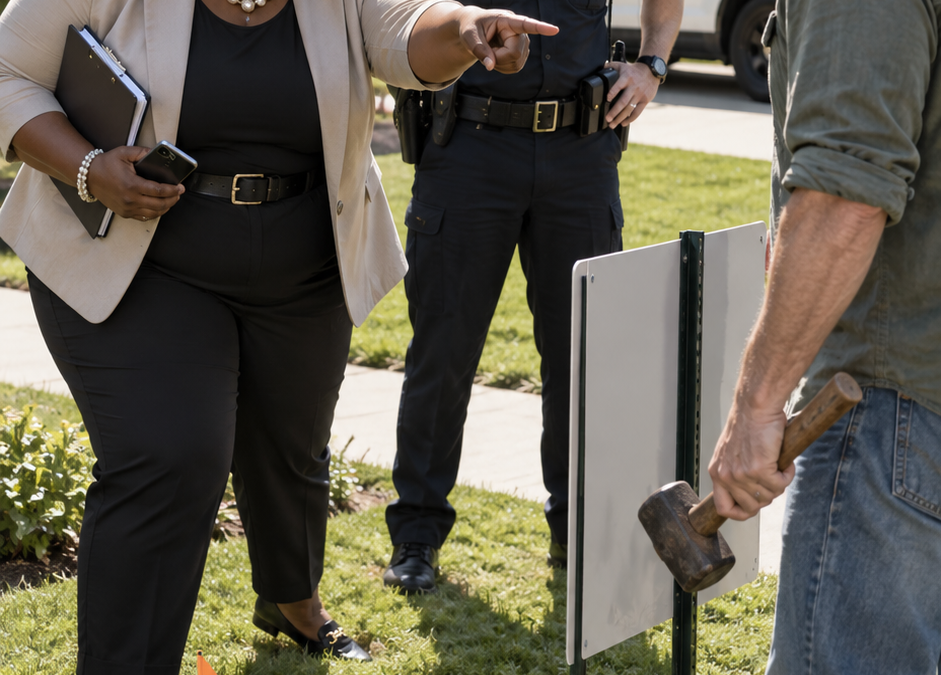
My name is Daniel Mercer, and the morning this finally came apart, Margaret Hollis was already standing on my lawn before I had finished driving the sign into the ground.
I still had the mallet in my hand.
The orange-and-black sign swung slightly from the metal stake.
PRIVATE PROPERTY
NO TRESPASSING
Margaret—who everyone in Maplewood Ridge privately called Karen even though that wasn’t her name—came across the grass without knocking, asking permission, or even slowing down.
Clipboard under one arm.
Phone raised in the other.
She began photographing my front yard.
The sign.
My porch.
The narrow strip of grass along the edge of my property.
Me.
“That comes down today,” she said.
I rested the mallet against my leg.
“Good morning to you, too.”
She ignored that.
“You’re in violation of the Maplewood Ridge community covenants.”
She took another photograph.
“Remove it now or I’m calling 911.”
I looked down.
Not at the sign.
At her shoes.
Her left foot was sitting maybe eight inches from a small orange survey stake.
The stake had been placed there nine days earlier by a licensed surveyor.
Everything on my side of it belonged to me.
Margaret was nearly six feet inside that line.
In other words, the president of the Maplewood Ridge Homeowners Association was standing on my private property, threatening to call police because I had posted a private-property sign on my private property.
I almost laughed.
Instead, I set the mallet on the porch.
Margaret reached into her clipboard and pulled out a folded orange notice.
It was already filled out.
Not blank.
Not partially prepared.
Completely finished.
My address.
The alleged violation.
The dollar amount.
One hundred fifty dollars.
She had written the ticket before leaving her house.
“Unapproved signage on a community-facing lot,” she said. “Section 4.2.2.”
She held it toward me.
I didn’t take it.
“You filled that out before coming here?”
Her mouth tightened slightly.
“The violation existed before I arrived.”
“You hadn’t seen the sign yet.”
“I had received a report.”
“From who?”
“That’s not relevant.”
She placed the notice on my porch railing.
“You have seventy-two hours. After that, the fine doubles weekly.”
She tapped the paper.
“If the outstanding balance reaches one thousand dollars, I can begin lien proceedings against the property.”
There it was.
Lien.
She said the word casually.
Almost pleasantly.
Like she was explaining trash collection.
Then she swept her hand over the strip of lawn between us.
“This is community transition space. Maplewood Ridge has jurisdiction here.”
I stared at her.
“Community what?”
“Transition space.”
“Where is that defined?”
“In the governing documents.”
“Which one?”
She didn’t answer.
I thought about the folder in my desk.
The county-stamped survey.
My recorded deed.
The assessor’s written confirmation.
No easement.
No access agreement.
No HOA servitude.
No community ownership.
Nothing.
Not one document in the county records gave Maplewood Ridge any right to that six-foot strip of grass.
I pulled out my phone.
Pressed record.
Margaret noticed.
Something changed in her expression.
Only for a second.
“What are you doing?”
“Documenting.”
“You don’t have permission to record me.”
“You’re standing outside on my property.”
Another pause.
Then I nodded toward her phone.
“You said you were calling the police.”
Her face settled again.
“Fine.”
She dialed.
I stayed quiet.
For the next four minutes, Margaret Hollis stood on my land and told a dispatcher that a homeowner was creating a hostile environment, refusing authorized HOA directives, and posting threatening signage that compromised community safety.
Hostile.
Noncompliant.
Safety concern.
She delivered those words smoothly.
Practiced.
Across the street, an older couple had stopped walking.
The man stood with both hands buried in his jacket pockets.
He watched Margaret with an expression I didn’t yet understand.
Not surprise.
Recognition.
The look of someone who had seen this performance before.
Margaret ended the call.
She slipped her phone into her pocket and gave me the calm, satisfied look of a person who believed the adult supervision she had requested was now on its way.
She was still standing six feet inside my property line.
And she still had no idea that the call she had just made would eventually destroy the entire argument she had spent two years teaching the neighborhood to fear.
PART2
To understand why I planted that sign, you need to understand what Maplewood Ridge had become.
When I moved there seven years earlier, I loved the neighborhood.
Ninety-six houses.
Wide sidewalks.
Mature maple trees arching over quiet streets.
Children riding bicycles in circles until dinner.
People leaving vegetables on porches because their gardens produced too much zucchini.
Neighbors waved.
Dogs knew which houses gave treats.
Nothing about the place felt particularly controlled.
There was an HOA, sure.
But in the beginning it did what an HOA was supposed to do.
Maintained common landscaping.
Managed the small community building.
Handled the entrance sign.
Settled the occasional argument about fencing or overnight parking.
Then Margaret Hollis ran for president.
She ran unopposed.
People later asked how someone like Margaret ended up with so much authority.
The answer was embarrassingly simple.
Nobody else wanted the job.
HOA meetings were boring.
Budgets.
Tree trimming.
Irrigation repairs.
Arguments over whether a fence was five inches too tall.
Margaret wanted the position more than anybody else wanted to prevent her from having it.
She campaigned anyway.
Door to door.
Printed flyers.
Emails about “declining standards.”
She spoke about “community preservation” as if Maplewood Ridge were collapsing into chaos.
It wasn’t.
The most controversial thing that summer had been somebody parking a camper in a driveway for four days.
Margaret won with eleven votes.
Eleven.
Out of ninety-six households.
Within three months, she proposed revised enforcement procedures.
The changes gave the HOA president unilateral authority to issue violations and assess certain fines without requiring approval from another director.
The meeting where it passed had seven residents in attendance.
Margaret.
Two board members she trusted.
Four homeowners who later admitted they barely understood what changed.
That was how she got the clipboard.
What followed happened slowly.
That was important.
If Margaret had tried everything at once, people would have resisted.
Instead, she moved an inch at a time.
Trash cans visible after noon on collection day.
Fifty dollars.
Unapproved flowers.
Seventy-five.
A basketball hoop left in a driveway Sunday evening.
Violation.
A decorative welcome mat Margaret decided did not match “community aesthetic standards.”
Violation.
It became normal to hear neighbors ask each other whether something was “allowed” before doing things no reasonable adult would previously have considered anyone else’s business.
The Hendersons got fined over a wind chime.
A small copper one.
Ruth Henderson brought it home from New Mexico after visiting her daughter.
When the afternoon breeze moved through, it made a soft sound.
Nothing loud.
Nothing disruptive.
Margaret’s violation notice described it as:
“Unsanctioned exterior ornamentation generating a noise disturbance in common-area-adjacent space.”
One hundred fifty dollars.
The Hendersons paid.
They were both in their late sixties.
Margaret informed them that filing an appeal required a fifty-dollar processing fee and that successful appeals were uncommon.
That was how the system worked.
The fines stayed just low enough that fighting looked more expensive than surrendering.
People calculated.
One hundred fifty dollars now?
Or spend time, money, and stress arguing with the HOA?
Most people paid.
Margaret understood human fatigue better than she understood property law.
My trouble started roughly eight months before I installed the sign.
The back corner of my lot bordered a landscaped HOA strip.
One day, I noticed the association’s landscaping crew mowing farther onto my property than usual.
It was a narrow area.
Maybe six feet.
At first I assumed I had misunderstood the lot line.
Subdivision boundaries can become visually meaningless after twenty years.
Grass blends.
Trees grow.
Mowers follow old habits.
I let it go.
Then I noticed Margaret cutting across that same strip.
Not once.
Regularly.
She used it like a shortcut.
From the common landscaping area, across my back corner, toward the house behind mine.
I stopped her one afternoon.
“Margaret?”
She turned.
“I think you’re cutting across my lot.”
She glanced down at the grass.
“This is community transition space.”
That phrase again.
“I’m pretty sure my lot extends farther than that.”
“You’re welcome to review the covenants.”
“I’m asking about the property line.”
“It has been maintained by the association for years.”
“That doesn’t answer the question.”
She walked away.
Six weeks later, I tried again.
Same thing.
“Bring it to a meeting,” she said without stopping.
So I did something better.
I hired a surveyor.
His name was Peter Walsh.
Thirty years in the business.
He spent an afternoon locating monuments, comparing recorded plats, and shooting measurements.
Two days later, he called.
“You were right.”
“How far?”
“Depends where you measure. Roughly six feet.”
“The HOA strip?”
“Your land.”
“All of it?”
“All of it.”
I stood in my kitchen looking out the window.
Margaret had been crossing six feet into my lot for months.
The landscapers had been mowing it.
She had once driven an HOA marker into it.
Not near the boundary.
Inside mine.
I paid Peter.
Picked up the stamped survey.
Then I went further.
County recorder.
My deed.
Assessor.
Written inquiry.
Was there any easement, shared-use agreement, HOA access right, servitude, or recorded restriction allowing Maplewood Ridge to use that strip?
The answer came back.
No.
Nothing.
My title was clean.
I started a folder.
Deed.
Survey.
Assessor letter.
Photographs of landscaping crews crossing the line.
Board minutes.
Copies of violation policies Margaret had changed.
Then I bought the sign.
PRIVATE PROPERTY.
NO TRESPASSING.
I drove it into my lawn just inside the surveyed boundary.
That was all.
I didn’t put Margaret’s name on it.
Didn’t mention the HOA.
Didn’t threaten anyone.
The sign stated two facts.
The land was private.
Unauthorized entry was not permitted.
Margaret reacted as though I had declared war.
Two days after her first visit, a certified letter arrived.
Official HOA violation.
One hundred fifty dollars.
Section 4.2.2.
Unapproved signage.
I photographed the envelope.
Postmark.
Notice.
Signature.
Then filed it.
I did not pay.
The sign stayed.
Two mornings later, I looked through my front window and saw Margaret back on the property.
This time she brought someone.
A compact man in a polo shirt carrying a long measuring tape.
I later learned he was the HOA’s property manager.
Neither knocked.
They walked onto my lawn and started measuring.
Sign to curb.
Sign to house.
Sign to the imaginary line Margaret apparently believed was real.
I turned on my phone camera before opening the door.
Margaret saw me and continued writing.
“The fine doubles to three hundred dollars per week if the sign remains after the cure period.”
I stepped onto the porch.
“You’re standing on my property again.”
She ignored that.
“If your outstanding balance reaches one thousand dollars, lien proceedings may begin.”
“Show me the covenant.”
That got her attention.
“What?”
“The provision giving the HOA authority over this part of my lot.”
“I already told you.”
“No. You gave me a phrase.”
Her property manager stopped measuring.
I continued.
“Give me a section number.”
“Section 4.2.”
“That section governs exterior appearance.”
“It includes community-facing areas.”
“Where?”
She stared at me.
I had read it by then.
Every word.
There was no “community transition space.”
No special six-foot zone.
No provision permitting Margaret to physically enter privately deeded land.
“I’m not providing you a legal tutorial on your porch,” she said.
“I’m not asking for a tutorial.”
I raised my phone slightly.
“I’m asking you to identify the rule you’re enforcing.”
Her property manager suddenly became deeply interested in his clipboard.
Margaret tucked her pen away.
“Seventy-two hours.”
Then she turned.
Before leaving, she stopped at the edge of the porch.
“Three families on this block alone have sold and moved after enforcement proceedings became serious.”
I looked at her.
“What does that have to do with me?”
She gave a small shrug.
“I would think carefully about what you want the next few months of your life to look like.”
Then she walked away.
That sentence mattered more than she knew.
Three families had left.
Margaret intended it as intimidation.
I wrote it down as evidence.
Date.
Time.
Exact words.
The sign remained.
That evening, the older man who had watched Margaret call police days earlier walked up my driveway.
“Name’s Henderson.”
“Daniel.”
“I know.”
He glanced toward my sign.
“You’re keeping it?”
“Yes.”
He nodded slowly.
“Good.”
We talked.
He told me about the wind chime.
Then more.
Eighteen months of notices.
Small fines.
Warnings.
Threats of escalation.
Things they didn’t know were violations until the violation arrived.
“Eight hundred dollars total,” he said.
“For what?”
He laughed once.
No humor.
“I’ve forgotten half of it.”
He looked toward his house where Ruth stood near the front window.
“We stopped fighting because she made it feel like fighting cost more.”
“Would you put that in writing?”
He studied me.
“Why?”
“I’m documenting a pattern.”
His hands returned to his pockets.
“Yes.”
The following morning, Miguel and Elena Garcia came over.
Their mother used a wheelchair.
They had installed a small concrete accessibility ramp along their front steps.
Professional job.
Clean.
Margaret cited them for an “unapproved structural modification.”
Two hundred dollars.
Thirty days to remove it.
They hired a lawyer.
One letter referencing disability accommodation requirements ended the enforcement immediately.
Margaret never apologized.
Never formally admitted the notice was wrong.
She simply stopped pursuing that violation and later found something else to complain about.
Miguel handed me a sealed envelope.
“Our statement.”
I added it to the folder.
That night, I read the covenants again.
Sixty-one pages.
Section 4.2.2 said what I already knew.
Sign restrictions.
Exterior appearance.
Landscaping within defined areas.
Nothing about giving the HOA possession of my yard.
Nothing about a “transition space.”
I searched the PDF.
No results.
Margaret had invented the phrase.
She had repeated it so often that people treated it like legal terminology.
That was one of her greatest skills.
She could turn confidence into apparent authority.
The second certified letter arrived the following Tuesday.
Balance due:
$1,200.
The escalation language had changed.
LIEN PROCESS INITIATED.
If the balance eventually reached $2,500, the file could be referred to HOA counsel for additional collection or foreclosure-related proceedings.
Foreclosure.
Over a private-property sign.
On my own land.
I photographed everything.
Filed it.
Made coffee.
And waited.
By then, I had installed a security camera.
Wide-angle.
Motion activated.
It covered the porch, sign, survey stake, and most of the front lawn.
I installed it not because of the fines.
Because Margaret had demonstrated that she did not consider my property line meaningful.
Two days after the lien letter, my phone buzzed at 7:15 in the morning.
Motion detected.
I opened the app.
Margaret.
Alone.
Light jacket.
No clipboard.
She crossed the property line.
Walked directly toward the sign.
Reached down.
Grabbed the metal post.
Pulled.
Nothing.
Pulled again.
Still nothing.
The third time, she leaned backward and yanked hard.
The stake came free.
Margaret stood there holding the sign.
For one second, she looked toward my house.
Then she laid it face down in the grass.
She did not take it.
Did not knock.
Did not leave a written notice.
She simply removed the sign from the ground and walked away.
I watched the video three times.
Then went outside.
Drove the sign back in.
Deeper.
At a slight angle.
The following morning, I found twelve little orange landscaping flags.
They ran in a straight line through my lawn.
Six feet inside the actual property boundary.
Margaret had apparently decided she could create a legal line by decorating the wrong one.
I photographed them.
Then called municipal code enforcement.
I asked one question.
“Can an HOA physically remove an otherwise lawful private-property sign from inside a homeowner’s recorded lot?”
The code officer checked the dimensions and local ordinance.
“No.”
“Can they require removal?”
“Not under city code based on what you’re describing.”
“What if their covenants regulate signs?”
“That would depend on the covenant and enforceability, but physically entering private property and removing it is a separate issue.”
I asked for written confirmation regarding the city’s sign requirements.
He sent it.
Folder.
Another page.
By then, Margaret’s system had become obvious.
The first fine wasn’t the weapon.
The lien was.
A lien clouds title.
It complicates refinancing.
Selling.
Borrowing.
People see one hundred fifty dollars and think the fight is about money.
It isn’t.
It’s about creating pressure until surrender becomes cheaper.
Suddenly Margaret’s comment about three families leaving made sense.
They had not necessarily left because they hated Maplewood Ridge.
Maybe they got tired.
Maybe the paperwork frightened them.
Maybe they couldn’t afford attorneys.
Maybe moving looked easier than living under permanent threat.
I decided I would not leave.
I also decided not to rush.
Margaret had a pattern.
Notice.
Fine.
Escalation.
Lien.
Meeting.
Police.
She would eventually ask somebody with real authority to validate her invented authority.
When she did, I wanted the documents ready.
Three days later, I received notice of an emergency HOA meeting.
LOT 14 ENFORCEMENT ACTION.
Saturday.
10:00 a.m.
Attendance strongly encouraged.
My lot.
I printed it.
Added it to the folder.
The community room was nearly full when I arrived.
Forty-three residents.
That was unheard of.
Margaret sat in the center of the front table.
Garrett on one side.
Diane on the other.
Garrett rarely finished a thought Margaret did not start.
Diane smiled through uncomfortable moments as though smiling could make them disappear.
There were handouts on every chair.
Margaret called the meeting to order.
“Please review the documents provided.”
I turned mine over.
The first page was an enforcement timeline against my house.
Original violation.
Fines.
Lien.
Current balance:
$1,600.
The second page was a map.
Not a survey.
Not a plat.
A hand-drawn map printed on HOA letterhead.
The dotted line representing my property boundary ran about six feet inside my actual lot.
Beneath it:
ESTABLISHED COMMUNITY BOUNDARY CONFIRMED BY HISTORICAL USE AND COMMUNITY PRECEDENT.
No surveyor.
No county stamp.
No recording number.
Just Margaret’s line.
She spoke for fifteen minutes.
Standards.
Compliance.
Preserving order.
Hostile signage.
Community safety.
Then came the ultimatum.
“Within forty-eight hours, Lot 14 must remove the unauthorized sign, pay the outstanding balance, and execute written acknowledgment of HOA jurisdiction over the disputed transition area.”
She looked directly at me.
“Failure to comply will result in referral to counsel.”
The room stayed quiet.
She asked if I wanted to respond.
“Yes.”
“How long?”
“Two minutes.”
Margaret gave a gracious little nod.
“Proceed.”
I stood.
Opened my folder.
Removed one document.
Not the survey.
Not the footage.
Not the neighbor statements.
My deed.
I read the property description.
Every bearing.
Every distance.
Every monument reference.
The legal language nobody in that room normally cared about.
When I finished, I sat down.
Margaret waited two seconds.
Then said, “Lot descriptions remain subject to community-use agreements. HOA bylaws supersede technical property descriptions where community precedent has been established.”
I wrote the sentence down.
Verbatim.
She had just told forty-three witnesses that her bylaws overrode a county-recorded deed.
Behind me, I heard Henderson whisper to Ruth.
Near the front, Miguel Garcia met my eyes.
Nobody challenged Margaret.
Not yet.
Fear does not disappear because one person proves something.
It takes time for people to realize they are allowed to speak.
I left.
On the drive home, I kept thinking about her forty-eight-hour deadline.
I had a different deadline in mind.
When would she call police?
It happened thirty-six hours later.
A knock on my front door.
Two officers.
The lead introduced himself as Officer Reyes.
“Mr. Mercer?”
“Yes.”
“We received a complaint regarding signage and a property dispute.”
I glanced over his shoulder.
Margaret was standing in my yard.
Twelve feet inside the line.
Clipboard.
Hand-drawn map.
Waiting.
“Sure,” I said. “Come with me.”
I picked up the folder from the hall table.
Outside, I walked Officer Reyes toward the orange survey marker.
“That stake marks the recorded property boundary.”
I handed him the stamped survey.
He looked at the county seal.
Then the measurements.
Then the actual stake.
His partner looked too.
“This is current?” Reyes asked.
“Nine days before the sign went up.”
“And this is your deed?”
I handed him that next.
“Yes.”
He studied both.
Then looked at Margaret.
Then back at the stake.
Then at Margaret’s shoes.
I watched the moment geometry became law enforcement’s problem.
Reyes turned toward her.
“Ma’am, what authority are you asserting over the sign?”
Margaret immediately stepped forward.
Violation notice.
Covenants.
Map.
She laid the papers across her clipboard.
“Section 4.2.2, community-facing exterior restrictions. This area is recognized as transition space based on historic HOA maintenance and precedent.”
Reyes read the highlighted section.
Then again.
“This talks about exterior appearance and signage.”
“Yes.”
“I’m not seeing anything authorizing the HOA to physically enter the interior portion of a privately deeded lot.”
Margaret stiffened.
“The community boundary is not identical to the technical deed boundary.”
Reyes looked up.
“What does that mean?”
“Our bylaws recognize historic community use.”
“Where?”
Margaret pointed toward the map.
“That boundary has been treated as association-managed space for years.”
He studied the paper.
“Who prepared this?”
“The association.”
“A surveyor?”
“The HOA.”
“Is this recorded?”
“It reflects historical precedent.”
Officer Reyes handed it back.
“Ma’am, community custom doesn’t relocate a recorded property line.”
Margaret opened her mouth.
“Our bylaws—”
“No, ma’am.”
He didn’t raise his voice.
He didn’t sound irritated.
That made it more final.
“This survey is stamped. The deed corresponds with it. Unless you have a recorded easement, another legal instrument, or a court order, the property line appears to be right here.”
He pointed at the orange stake.
Margaret stared down.
Then Reyes looked at where she was standing.
“Ma’am.”
She looked up.
“Are you aware you are currently standing inside Mr. Mercer’s property?”
Silence.
Margaret looked at the stake.
Then down at her shoes.
Then behind her.
For the first time since I had known her, she looked genuinely uncertain.
She took half a step.
Stopped.
“This is the transition area.”
Officer Reyes shook his head.
“Based on what you’ve shown me, there is no legally identified ‘transition area.’”
I reached into the folder.
“There’s more.”
I gave him the assessor’s confirmation.
No easement.
No shared-access agreement.
No recorded servitude.
Then the municipal code letter confirming the sign complied with applicable requirements.
Then I pulled out my phone.
“I also have video.”
Margaret’s face changed.
“What video?”
I opened the security footage.
7:15 a.m.
Timestamp visible.
Margaret crossing onto my lawn.
Walking directly to the sign.
Pulling it out.
Laying it face down.
Leaving.
Officer Reyes watched the entire clip.
His partner leaned closer.
When it finished, Reyes gave me the phone.
“Any other entries?”
“At least four documented.”
Margaret spoke quickly.
“I was acting in my capacity as HOA president.”
Reyes looked at her.
“That does not automatically authorize entry onto private property.”
“This is an HOA matter.”
“Then it can be handled through lawful HOA procedures.”
He pointed toward the survey stake.
“But I need you to step back over that line now.”
Margaret did not move immediately.
“Ma’am.”
She stepped back.
One foot.
Then the other.
Across the boundary.
The officer she had summoned to remove my sign had just ordered her off my land.
I became aware of people watching.
Henderson.
Ruth.
Miguel.
Two other neighbors.
Nobody said anything.
They didn’t need to.
Margaret held her clipboard against her chest.
The hand-drawn map sat on top.
Her imaginary property line was still visible.
Officer Reyes turned to me.
“Do you want to make a formal trespass complaint?”
I thought about it.
The footage.
The fines.
The threat.
The lien.
Everything.
“Not today.”
Margaret looked at me.
I continued.
“I want her to stop entering the property.”
Reyes nodded.
Then addressed Margaret.
“You’ve now been put on notice by the property owner. Do not enter this lot without permission or lawful authority.”
She said nothing.
“I also strongly suggest the association have counsel review any lien or enforcement action connected to this boundary before proceeding.”
His partner photographed the survey.
Reyes noted the recorder information from my deed.
Then they left.
Margaret walked toward her car.
No goodbye.
No apology.
She did not look at the neighbors.
Henderson remained on the sidewalk.
When her car turned the corner, he looked at the sign.
Then at me.
“Well,” he said.
I laughed.
First time in weeks.
“Yeah.”
Three days later, the police incident report arrived.
Four paragraphs.
Dry.
Precise.
The responding officers had been dispatched regarding HOA enforcement.
The homeowner produced a recorded deed and county-stamped survey establishing ownership of the disputed strip.
The complaining party was present within the privately owned area without documented permission.
No criminal complaint was pursued at the homeowner’s request.
I printed two copies.
One went into the folder.
The other stayed on my desk.
I never heard directly from Margaret about it.
Five days later, I received a message from a neighbor two streets over.
Apparently Maplewood Ridge’s attorney had reviewed everything.
Deed.
Survey.
Police report.
His advice was immediate.
Stop enforcement.
Cancel the fines.
Release the lien.
Do not enter the strip again.
I didn’t celebrate.
Not yet.
I wanted paper.
Five business days later, paper arrived.
Certified mail.
Same carrier.
Same porch.
Different message.
LIEN WITHDRAWN.
All fines canceled.
Balance:
$0.
I read the letter twice.
Then once more.
The HOA would absorb its own legal expenses from the failed enforcement action.
That meant every homeowner would eventually see the cost reflected in the association budget.
Margaret had launched the campaign alone.
The neighborhood would pay for cleaning it up.
For me, that could have been the end.
My title was clear.
My sign stayed.
Margaret had been formally warned off the property.
But three weeks later, there was another regular HOA meeting.
I almost stayed home.
Then something about Henderson’s face that day kept bothering me.
The man had spent eighteen months paying fines because resistance seemed pointless.
I wanted to know if anything had changed.
The room was fuller than usual.
Not forty-three.
But close.
Margaret sat at the center table.
Same seat.
Same binder.
Same posture.
Yet something felt different.
People were looking directly at her.
That sounds small.
It wasn’t.
Before, residents looked at paperwork.
Floor.
Walls.
Their own hands.
Anywhere except the person issuing fines.
This time, when Margaret opened community comment, Henderson stood first.
He carried a manila envelope.
He walked to the front.
Placed it on the table.
“Eighteen months of violation notices,” he said. “Every letter. Every payment. We’re requesting a review.”
Margaret opened her mouth.
Henderson continued.
“And we want the appeal fee eliminated while that review happens.”
Then he sat.
A woman from the east side stood next.
Then Miguel Garcia.
He brought the accessibility-ramp documents.
The lawyer’s letter.
The original violation.
Another resident brought photographs.
Another brought correspondence.
Five people.
Five envelopes.
Five households that had previously dealt with Margaret alone now put their evidence on the same table.
Garrett stared at his hands.
Diane’s automatic smile vanished.
Margaret remained composed.
But she no longer looked inevitable.
That mattered.
The board went into closed discussion.
When they returned, two policy changes were announced.
First:
Any fine above seventy-five dollars would require written approval from at least two directors.
Margaret could no longer issue significant fines by herself.
Second:
The HOA would establish a no-cost appeals process.
Every appeal would receive a written decision within thirty days.
At least one non-board resident would sit on the review panel.
Margaret was not removed that night.
I hadn’t expected her to be.
Institutions rarely repair themselves dramatically.
They move by inches.
But her unilateral authority was gone.
More important, something had changed in the residents.
They had seen the police officer tell her no.
They had seen the lien disappear.
They had watched the impossible thing happen.
Someone challenged Margaret.
And the sky did not fall.
I drove home after the meeting.
My private-property sign stood where I had planted it.
The orange survey stake beside it was fading slightly from weather.
I walked across the yard.
Crouched.
Tied a small piece of orange ribbon around the stake.
Same color as Margaret’s original violation notice.
Then I stood.
That strip of grass looked completely ordinary.
Six feet.
Nothing dramatic.
No fence.
No wall.
Just lawn.
But for eight months, Margaret had treated those six feet as proof that saying something confidently could make it true.
Community transition space.
Historical use.
Established precedent.
Fundamental principle.
Every phrase sounded official.
None changed the deed.
None moved the boundary.
None created an easement.
The line had been there the entire time.
Long before Margaret.
Long before the fines.
Long before the clipboard.
All I eventually did was find it.
People sometimes ask why I didn’t sue her immediately.
Why I didn’t press trespass charges.
Why I didn’t hire a lawyer and try to destroy the HOA.
The answer is that destruction wasn’t what I wanted.
I wanted my land left alone.
I wanted the lien gone.
I wanted the fines canceled.
And I wanted people in that neighborhood to understand that rules and authority are not the same thing.
A document can contain rules.
Authority comes from somewhere.
A deed.
A covenant.
A statute.
A recorded easement.
A valid vote.
Some actual legal source.
Margaret’s power had survived for years because almost nobody asked that second question.
Not:
What rule are you quoting?
But:
What gives you the right to apply it here?
Once somebody asked that, her system became surprisingly fragile.
Her “community transition space” did not survive a search function.
Her hand-drawn boundary did not survive a survey.
Her lien did not survive an attorney reading the police report.
Her certainty did not survive one officer asking why she was standing on somebody else’s lawn.
The Hendersons eventually hung their wind chime again.
Ruth told me first.
She caught me at the mailbox one afternoon.
“You hear it?”
The wind was moving lightly through the maples.
I listened.
A soft metallic note.
Then another.
Ruth smiled.
“I found the receipt from New Mexico.”
I smiled back.
“Good.”
The Garcias kept their ramp.
Nobody bothered them about it again.
The landscaping crew stopped mowing my six-foot strip.
For the first few weeks, they left an awkward uneven line because nobody wanted to get too close to the survey marker.
Eventually, I told them they could mow right up to the boundary.
Just not across it.
The crew supervisor laughed.
“Believe me, sir. We know where it is now.”
Margaret remained president until the following annual election.
She ran again.
This time, she did not run unopposed.
Three people filed.
More than sixty households voted.
She lost.
I did not run.
I had no interest in replacing one person obsessed with authority with another.
Henderson did not run either.
Miguel joined the architectural committee.
A retired accountant named Janice Porter became president.
Her first email to the neighborhood was six sentences long.
The final one said:
“If the association cannot identify the specific authority supporting an enforcement action, no enforcement action will be taken.”
I printed it.
Not because I needed it.
Because I appreciated the sentence.
My folder eventually became thick enough that I bought a larger one.
I kept everything.
Not out of paranoia.
Out of respect for how quickly memory changes once a conflict ends.
People forget exact wording.
Dates blur.
Someone says, “That isn’t what I meant.”
Someone else says, “I don’t remember saying that.”
Paper remembers.
Video remembers.
County records remember.
That was another thing Margaret accidentally taught me.
The first morning she stood on my lawn, she believed the clipboard mattered more than the mallet in my hand.
She believed a prefilled fine mattered more than a survey stake.
She believed calling the police would turn her claim into fact.
Instead, the opposite happened.
She invited an outside authority onto the property.
Someone who did not care who was HOA president.
Someone who had no history with Maplewood Ridge.
Someone who looked at the documents and asked the simplest question in the entire dispute.
Where is the property line?
Once that was answered, almost everything else became easy.
There is still one part of that morning I remember more clearly than the rest.
Not Margaret’s expression.
Not Officer Reyes reading the survey.
Not the neighbors gathering.
It was the three seconds after he asked her:
“Are you aware you’re standing on this gentleman’s private property without permission?”
Three seconds.
Maybe less.
Margaret looked down.
For two years, she had taught people in Maplewood Ridge that the ground beneath their feet was whatever the HOA said it was.
That their doors, yards, porches, flower beds, ramps, wind chimes, and signs existed under a cloud of permission she personally controlled.
Then, for one tiny moment, she had to look down at her own shoes and realize that permission worked both ways.
She had crossed a line.
A real one.
Recorded.
Measured.
Marked.
And for once, somebody else was telling her to step back.
The private-property sign stayed in place for nearly three years.
Eventually, the lettering faded.
The orange became pale.
The metal stake started rusting near the bottom.
One Saturday morning, I decided to replace it.
I pulled the old sign out.
For a moment, I stood there holding it.
I considered throwing it away.
Instead, I cleaned the dirt from the stake and put it in my garage.
Not as a trophy.
Not exactly.
More like a reminder.
The new sign went into the same hole.
PRIVATE PROPERTY.
NO TRESPASSING.
Simple.
No names.
No threats.
No reference to the HOA.
The survey marker still sits a few inches away.
The orange ribbon I tied around it eventually faded almost white.
I have never replaced that ribbon.
I like it that way.
Every so often someone asks what happened with “that crazy HOA fight.”
I usually tell them it wasn’t really a fight.
Not in the way people imagine.
There was no dramatic courtroom.
No screaming match.
No expensive legal team.
I never punched a table.
Never threatened Margaret.
Never removed her flags while she was watching.
Never had to.
I had a deed.
A survey.
A camera.
A folder.
And enough patience to let Margaret keep talking until the distance between what she said and what the records said became impossible to ignore.
That was the real advantage.
She thought silence meant fear.
Sometimes it did.
With the Hendersons.
With other families.
With me, silence meant I was documenting.
When she sent a fine, I filed it.
When she crossed the property line, I recorded it.
When she invented a phrase, I searched for it.
When she claimed a rule, I read the rule.
When she threatened a lien, I pulled the title.
And when she called the police, I handed them the paperwork.
Margaret had spent two years building power out of people’s reluctance to challenge her.
I didn’t beat that power by being louder.
I made her prove it.
She couldn’t.
That is what finally changed Maplewood Ridge.
Not the sign.
Not even the police.
The moment people realized authority could be asked for identification.
The day after Margaret lost the election, I saw her walking on the sidewalk near my house.
She did not cut through my lawn.
She walked all the way around.
When she reached the corner, she glanced toward the survey marker.
Then toward me.
I was washing my truck.
Neither of us said anything.
She continued walking.
I watched until she disappeared behind the maples.
Then I looked at the six-foot strip she had once called community transition space.
Nothing about it had changed.
Same grass.
Same soil.
Same boundary.
That was the strange part.
For almost a year, it had felt like the center of a war.
Once the argument ended, it became six feet of lawn again.
That may be the clearest lesson I took from the whole thing.
People can create enormous conflicts around facts that were never uncertain.
The uncertainty comes from repetition.
From paperwork.
From confidence.
From someone saying, “This is how it works,” so many times that eventually everyone stops asking whether it actually does.
Margaret never moved my property line.
She convinced people the line didn’t matter.
Until the morning she called the police.
Then a man in uniform looked at a county survey.
Looked at the orange stake.
Looked at her.
And told her to move.
Everything after that was paperwork catching up to reality.
The lien disappeared.
The fines disappeared.
Her unilateral enforcement power disappeared.
Eventually, her presidency disappeared too.
But the boundary remained exactly where it had always been.
That is why, years later, I still keep the original sign in my garage.
The paint is scratched.
One corner is bent slightly from the morning Margaret pulled it out of the ground.
There’s dried soil packed into the bottom of the metal stake.
Sometimes when I reach past it for a shovel or rake, I remember standing on the porch with a mallet in my hand while she held out that first orange violation notice.
One hundred fifty dollars.
Seventy-two hours.
Then a lien.
She spoke as if the future had already been decided.
Maybe that was why she looked so shocked when Officer Reyes told her to step back across the line.
For once, somebody else had read the documents.
And the ground beneath her feet belonged to me.
I never posted that sign because I wanted a confrontation.
I posted it because the words were true.
Private property.
No trespassing.
Margaret spent weeks trying to make those words disappear.
In the end, she was the one forced to obey them.








