𝗣𝗔𝗥𝗧 𝟮 HOA Karen Called the Cops on My Cabin—Then the Sheriff Saw the Deed She Never Bothered to Check
𝗣𝗔𝗥𝗧 𝟮
I set down my mug.
But to understand why that worn envelope mattered so much, you need to understand what Sandra never did.
I bought the land in the spring of 1993.
A little over two acres.
Back then, the area was open farmland mixed with second-growth pine.
No subdivision.
No streetlights.
No decorative entrance walls.
No HOA.
There wasn’t even a proper road to my lot.
Just a rough track and a survey stake marking one corner.
I paid cash.
Recorded the deed that afternoon.
Then paid for a formal boundary survey and had that recorded too.
The following fall, I poured the cabin footings.
I framed the walls the next spring.
Got the roof on before winter.
Finished the interior during weekends and vacations.
No contractor.
No construction loan.
No rush.
I was young enough to believe that if something belonged to you, time was one of the luxuries ownership gave you.
I built that cabin slowly.
And because I built it myself, I knew every crooked stud hidden behind the drywall.
Every board that took three tries before I liked the fit.
Every place the floor squeaked.
I knew which porch post had a knot in exactly the wrong place and which window had to be lifted slightly before the latch caught.
From the moment I recorded the land, I paid taxes directly to the county.
Every year.
Thirty-one years.
No gaps.
No HOA assessments.
No community fees.
No subdivision dues.
Just a county parcel number that never changed.
The surrounding development came later.
Around 2006, a developer bought most of the neighboring acreage.
Trees disappeared.
Roads appeared.
Then utilities.
Then curbs.
Then houses.
By 2007, ninety-four homes formed Ridgeline Hills.
The developer recorded the subdivision plat and HOA governing documents.
My parcel sat outside it.
Not barely.
Not ambiguously.
The recorded subdivision boundary stopped roughly two hundred feet before my property line.
My two acres remained exactly what they had always been.
Independent land.
For years, nobody cared.
I waved to the new neighbors.
Some waved back.
A few called my cabin “the old place in the trees,” even though it wasn’t that old.
The HOA concerned itself with lawns, mailboxes, fences, and paint colors on land that actually belonged to its members.
My cabin existed beyond their edge.
Then Sandra Kowalsski became board president.
She campaigned on “elevating community standards.”
That sounded harmless enough.
In practice, it meant enforcement.
Lawn height.
Trash cans.
Parking.
Holiday decorations.
Exterior modifications.
Architectural approvals.
She approached rules the way some people approach collections.
Every violation became an item to catalogue.
She built spreadsheets.
Maintained photographs.
Tracked deadlines.
Sent reminders.
And over three years, nobody successfully challenged her.
Not once.
She also had a map.
That map was the beginning of my problem.
The developer had produced a community overview in 2007 for sales presentations.
It showed houses.
Common areas.
Green space.
Walking paths.
The entry monument.
But at the back edge of the development where my property sat, there was simply blank space.
No parcel number.
No cabin.
No ownership notation.
Nothing.
To a surveyor, blank space on a marketing illustration means nothing.
To Sandra, it apparently meant:
Unmanaged HOA land.
The first letter arrived on a Tuesday.
Addressed to OCCUPANT.
COMMUNITY AESTHETIC REVIEW REQUEST.
The board wanted plans for my existing cabin submitted for retroactive architectural approval.
I read it twice.
Then set it on the kitchen table.
It cited sections of the CC&Rs.
Sandra’s signature appeared at the bottom.
I knew I wasn’t subject to any of it.
So I did nothing.
Maybe that was my first mistake.
Not legally.
Strategically.
Because Sandra interpreted silence the same way people like her often interpret silence.
Submission.
Three weeks later, she came personally.
I heard tires on gravel before I saw the white sedan.
Ridgeline HOA logo printed on the door.
She climbed out holding a clipboard.
Board-president identification hanging from a lanyard.
Manila folder in one hand.
She walked toward the porch like she’d done it dozens of times.
“Mr. Callaway?”
“Yes.”
“This is a formal violation notice.”
She handed it to me.
SECTION 4.3 — UNAUTHORIZED STRUCTURE.
Fine:
$500.
Compliance period:
Thirty days.
Then:
NONCOMPLIANCE WILL RESULT IN WEEKLY ESCALATING FINES AND MAY RESULT IN LIEN ACTION AGAINST THE PROPERTY.
Sandra had a practiced rhythm.
Deliver.
Explain.
Deadline.
Leave.
I read everything.
Then asked one question.
“Can you show me where my county parcel number appears in the CC&Rs?”
She paused.
Only slightly.
“The community overview establishes jurisdiction.”
“That wasn’t my question.”
“The association’s founding charter grants blanket authority within the mapped boundary.”
“What parcel number does that include?”
“The boundary is controlling.”
“Then it should be easy to show me.”
Her smile tightened.
“I’m not here to debate the documents on your porch.”
“I’m not asking you to.”
I handed nothing back.
Signed nothing.
Asked for no payment instructions.
Sandra closed her pen.
“You have thirty days.”
Then came the line she had probably used on dozens of homeowners.
“After that, we can file a lien against the property. A lien follows title. It can prevent sale, refinancing, or transfer.”
She gave me a moment to absorb it.
“We’ve done it before.”
Then she walked away.
That evening, I opened the bottom drawer of my filing cabinet.
The deed was exactly where it had been since 1993.
I also gathered the documents Sandra had included.
CC&Rs.
Charter.
Exhibits.
I searched for my parcel number.
Nothing.
I checked again.
Still nothing.
I searched every legal description.
Every map.
Every parcel list.
My land did not exist anywhere in Ridgeline’s governing instruments.
Then I pulled thirty-one years of tax statements.
Same parcel.
County assessment.
County tax.
Never one HOA charge.
I sat at my kitchen table for maybe an hour.
Then I wrote Sandra a response.
No accusations.
No anger.
Just two questions.
Please identify:
- The exact assessor parcel number in the governing documents that corresponds to my property.
- The exact CC&R provision establishing HOA jurisdiction over that parcel.
Thirty days to respond.
Certified mail.
Return receipt.
I started a log.
Date sent.
Date received.
Tracking number.
That probably sounds excessive.
At the time, I didn’t know what it would become.
I simply believed that if Sandra was going to bury me in paper, the least I could do was keep mine organized.
I called the recorder’s office.
The clerk pulled Ridgeline’s plat while I waited.
Then asked for my parcel number.
I read it.
A pause.
“Sir?”
“Yes?”
“That parcel isn’t listed in this subdivision.”
“I know.”
“Not anywhere.”
The following morning, I went there myself.
The recorder’s office occupied the second floor of the county building.
Low ceiling.
Fluorescent lights.
Rows of terminals.
I explained what I needed.
The clerk pulled the official subdivision plat.
Turned the monitor.
“There.”
A heavy recorded boundary line marked Ridgeline Hills.
My parcel sat outside it.
About two hundred feet outside.
Not close.
Not a disputed corner.
Not two surveyors disagreeing over inches.
Separate land.
“Can I get a certified copy?”
“Three dollars.”
I described Sandra’s laminated map.
The clerk knew immediately what I meant.
“That’s the sales map.”
“Is it recorded?”
“No.”
“Legal effect?”
“None.”
She said it without drama.
Like she was explaining that a restaurant menu isn’t a property deed.
I left with certified copies of:
My deed.
Ridgeline’s recorded plat.
My parcel records.
All of them went into the same manila envelope.
That should have ended the matter.
It didn’t.
Before going home, I stopped at Gerald and Ruth Alderman’s house.
They lived two doors from my access path.
Older couple.
Quiet.
I had noticed something odd over the previous year.
Whenever Sandra’s HOA car passed, they often disappeared inside.
I knocked.
They invited me into the kitchen.
We talked for almost an hour.
Sandra had fined them repeatedly.
Two hundred dollars for a ceramic garden gnome Ruth’s daughter had given her.
Three hundred fifty dollars for a wind chime.
Eight hundred fifty dollars because a guest car at their granddaughter’s birthday party had been parked about a foot beyond the approved zone.
Other smaller fines.
Three years total:
Around $2,400.
Gerald told me they were on a fixed income.
Ruth admitted they had stopped decorating outside.
“Christmas too?”
She looked embarrassed.
“I didn’t want another letter.”
That bothered me more than the money.
They were afraid of putting Christmas decorations in their own yard.
Then I visited a young family on the corner.
Three kids.
Bicycles everywhere.
They had paid $350 over a basketball hoop left near the driveway after a cookout.
They missed an appeal window they hadn’t known existed.
Nobody had explained it.
So they paid.
That afternoon, sitting back at my kitchen table, I realized Sandra’s real advantage wasn’t the bylaws.
It was uncertainty.
Most people don’t know exactly what an HOA can do.
Most don’t know how to read recorded plats.
Most don’t know where to find county property records.
So when somebody arrives wearing a board badge, holding an official-looking document, threatening liens and legal costs, people assume the authority must exist somewhere.
Sandra had spent three years teaching everybody not to question that assumption.
My certified letter deadline came and went.
No answer.
Thirty days.
Nothing.
No lawyer letter.
No parcel number.
No governing provision.
I noted:
NO RESPONSE RECEIVED.
Fourteen days later, Sandra escalated.
NOTICE OF ENCROACHMENT AND UNAUTHORIZED USE.
Four pages.
Signed by Sandra and two board members.
This time, the HOA claimed my access road belonged to them.
The gravel road I built.
Across land I owned.
According to the letter, continued use constituted trespass on HOA common property.
I read that claim twice.
Then a third time.
Because this was different.
If they could establish control over my only access route, I could own a cabin I had no legal way to reach.
That wasn’t enforcement.
It was siege.
Attached was a professional survey commissioned by the HOA.
Licensed surveyor.
Formal report.
My entire parcel had been redrawn inside Ridgeline’s boundary.
At first glance, it was impressive.
Measurements.
Coordinates.
Seals.
Signature.
Then I checked the baseline.
That survey started from a metal post placed by the developer in 2007.
HOA placard attached.
It was not a county survey monument.
Not a state benchmark.
Not recorded as a controlling point.
The actual county benchmark sat 207 feet away.
That explained everything.
If you start 207 feet wrong, every beautifully precise measurement afterward can still be wrong.
I called the county surveyor.
Requested a certified boundary survey.
$340.
Two-week turnaround.
Then Sandra escalated again.
Three days later, I returned home to find an orange notice stapled directly into my cabin door frame.
CONDEMNATION / NONCONFORMING STRUCTURE NOTICE.
HOA letterhead.
Sandra’s signature.
DEMOLITION PROCEEDINGS MAY BEGIN AFTER 60 DAYS IF STRUCTURE IS NOT VOLUNTARILY REMOVED.
I stood on the porch staring at the staple.
Then went inside.
Got my camera.
Came back out.
Photographed everything.
Wide shots.
Close shots.
Timestamp.
Cabin visible.
Notice readable.
I left the paper exactly where it was.
Sandra was creating my evidence faster than I ever could.
That’s something I learned.
When someone believes they control the rules, they usually put their decisions in writing because they believe the paper protects them.
Sometimes it does the opposite.
The county survey arrived on Thursday.
I opened it beside the HOA survey.
Different starting point.
Different boundary.
Different result.
The county survey used the official monument.
Sandra’s survey used the developer post.
My cabin was outside Ridgeline.
My access road was outside Ridgeline.
Every inch.
Then came the community meeting notice.
Special Meeting.
Mandatory Agenda Item:
UNAUTHORIZED STRUCTURE / HOA PROPERTY ENCROACHMENT.
Tuesday.
7:00 p.m.
Seventy-two homeowners attended.
Three-quarters of the entire development.
Fear is an excellent attendance strategy.
Sandra had prepared everything.
Projection screen.
Copies of the agenda on every chair.
At the front stood a professionally printed twenty-four-by-thirty-six-inch version of the private survey.
Red boundary.
HOA seal.
Her name at the bottom.
It looked like courtroom evidence.
I entered five minutes early.
Sat four rows from the back.
The manila envelope rested on the empty chair beside me.
Sandra opened precisely at seven.
She described me as an individual occupying association-managed land without authorization.
She listed violation notices.
Failure to comply.
Encroachment.
Proposed demolition.
Then pointed toward the survey.
“The association retained a licensed professional surveyor who confirmed that the disputed parcel falls fully within Ridgeline Hills jurisdiction.”
Several homeowners nodded.
“We have documentation. We have legal counsel. And we have the authority to act.”
Applause.
Not everyone.
Gerald and Ruth sat near the back.
No clapping.
The young family sat together.
The father kept his arms crossed.
A homeowner in a gray sweater raised his hand.
“Can the HOA actually demolish a structure it doesn’t own without a court order?”
Sandra was ready.
She quoted Section 7.4.
Mentioned counsel’s opinion.
Referenced the survey.
She sounded convincing because the most dangerous wrong answers usually contain several correct-looking pieces.
Two more questions.
Two confident answers.
Then I raised my hand.
Sandra saw me.
Something tiny changed.
She called on me.
“One question.”
The room quieted.
“That survey you’re presenting tonight—is it a county-certified document filed with the recorder’s office?”
Sandra paused.
“It was conducted by a fully licensed professional.”
“That wasn’t my question.”
Her eyes tightened.
“The surveyor has all appropriate credentials.”
“County certified and recorded?”
She didn’t answer directly.
I nodded.
“Thank you.”
Then I reached down.
Picked up the manila envelope.
Set it on the narrow desk surface in front of me.
Didn’t open it.
Sandra continued.
But something in the room had shifted.
Gerald looked at the envelope.
Then Ruth.
The young father leaned forward.
People began noticing the one object Sandra hadn’t explained.
Twenty minutes later, she closed with:
“If the structure is not vacated within seventy-two hours, the board will request assistance from the county sheriff’s department.”
The front rows applauded.
The back didn’t.
I went home.
Put the envelope back beside my coffee.
And waited.
Three days later, I heard the patrol cruiser.
That brings us back to the porch.
Two deputies.
Sandra.
Laminated map.
Clipboard.
My coffee.
And the envelope.
The lead deputy repeated his question.
“Do you have documentation establishing your ownership?”
“Yes.”
I opened the envelope.
Sandra stepped closer.
I removed the first document.
“This is the deed.”
I handed it to the deputy.
“Recorded in 1993.”
He read the first page.
Parcel number.
Legal description.
County stamp.
Recording date.
His eyes paused on the year.
Then he looked toward Sandra.
“Ma’am, this deed predates the subdivision.”
Sandra answered immediately.
“A deed doesn’t override HOA jurisdiction. The association boundary includes the parcel.”
I unfolded the next document across the porch railing.
“This is Ridgeline Hills’ official subdivision plat.”
The deputy leaned over.
“Recorded in 2007.”
I pointed.
“This line is the recorded HOA boundary.”
Then moved my finger.
“This is my parcel.”
He studied the gap.
About two hundred feet.
Sandra stepped forward.
“Our professional survey supersedes that interpretation.”
I placed her survey beside the county plat.
Then added the new county survey.
“Her survey starts from this point.”
I indicated the developer post.
“An HOA marker installed in 2007.”
Sandra started.
“Our surveyor is licensed.”
“He is.”
That seemed to surprise her.
I continued.
“The issue isn’t his license. It’s the baseline he was given.”
I pointed to the certified document.
“The official county benchmark sits 207 feet from the marker he used.”
The second deputy put his notebook down.
Now both men studied the surveys.
“The county survey uses the official monument,” I said. “Different starting point. Different boundary.”
Sandra’s voice tightened.
“The HOA has legal counsel.”
I pulled out the tax records.
“Thirty-one years.”
The lead deputy flipped through them.
“Same parcel number every year?”
“Yes.”
“No HOA assessment?”
“Never.”
“No reassignment?”
“No.”
“No annexation?”
“None.”
He set them down.
Then turned toward Sandra.
“Do you have a county-recorded instrument showing this parcel was incorporated into the subdivision?”
She raised her laminated map.
He looked at it.
Then the recorded plat.
Then back at her.
“Is that filed with the county?”
Sandra hesitated.
“It was prepared by the original developer.”
“That’s not what I asked.”
She finally lowered it.
The deputy waited.
“No.”
The porch became very quiet.
I removed one final packet.
Certified letter.
Return receipt.
My two questions.
Response deadline.
Log entry:
NO RESPONSE RECEIVED.
“I asked the HOA thirty-four days ago to identify my parcel in its governing documents and cite the provision giving it jurisdiction.”
I handed the deputy the letter.
“They signed for it.”
He looked at the green receipt.
“No answer?”
“No.”
The second deputy finally spoke.
“Ms. Kowalsski.”
Sandra looked toward him.
His tone was calm.
Not accusatory.
Which somehow made what he said hit harder.
“Based on the recorded deed, subdivision plat, county survey, and assessment history, this property does not appear to fall within the HOA’s legal boundary.”
Sandra stared at him.
“Our attorney—”
“Your attorney can pursue whatever civil remedy counsel believes appropriate.”
He gestured toward the documents.
“But we are not removing this gentleman from property that county records show he owns.”
She opened her mouth.
Nothing came out immediately.
The deputy continued.
“And I would recommend the association review any lien, demolition notice, or enforcement filing issued against this parcel.”
He paused.
“If an association knowingly records claims against land outside its authority, there can be consequences.”
Sandra looked at me.
Not angry.
Not yet.
More like someone trying to find the missing stair beneath her foot.
The lead deputy handed back my deed.
“You’re all set, sir.”
“Thank you.”
The deputies walked down the path.
Sandra remained.
Clipboard at her side.
Laminated map hanging from one hand.
For months, that map had been raised like a badge.
Now it looked exactly like what it was.
Plastic covering a sales brochure.
I said nothing.
I didn’t need to.
She turned.
Walked to her car.
The tires moved slowly over the gravel.
Slower leaving than they’d arrived.
I sat back down.
Picked up my coffee.
It had gone cold.
I drank it anyway.
Six days later, I received a letter from the county recorder.
Formal.
Two pages.
County letterhead.
It confirmed my parcel was not contained within Ridgeline Hills’ recorded subdivision plat.
It confirmed the land had been independently recorded since 1993.
It confirmed no county record reflected annexation into the association.
A copy went to Ridgeline’s counsel.
Within forty-eight hours, the demolition action was withdrawn.
The encroachment claim disappeared next.
Then came the lien question.
Sandra had prepared one but had not completed the final recording before the sheriff visit.
The county recorder flagged the filing when it arrived.
Ridgeline’s attorney withdrew it.
My title remained clean.
I ordered a fresh title report anyway.
Clear.
Unencumbered.
Just as it had been before Sandra ever drove down my path.
Then I did something petty.
Maybe appropriately petty.
I sent Ridgeline a demand for reimbursement.
County survey:
$340.
Certified records:
$60.
Total:
$400.
Nothing emotional.
Just an invoice.
The new board eventually paid it.
More important things happened after that.
The county surveyor’s office reviewed the conflicting private survey.
Their concern wasn’t that two professionals disagreed.
Surveyors disagree.
The problem was the baseline.
The HOA survey had relied on an unrecorded decorative development marker as though it were a controlling monument.
The county referred the matter to the state professional licensing board.
I didn’t request that.
Didn’t file a complaint.
The review happened automatically.
Sometimes systems actually do notice things.
Sandra resigned fourteen days after the deputies left my cabin.
Her resignation letter cited “personal reasons.”
Three sentences.
No apology.
No reference to me.
No admission that she had tried to remove a man from land he had owned before her subdivision existed.
The acting board scheduled a community vote anyway.
Sixty-seven homeowners voted for formal removal.
Five voted to retain her.
I didn’t attend.
My involvement with Ridgeline ended at the property line.
But the homeowners weren’t finished.
The new board ordered an audit of every enforcement action Sandra had issued during her three years as president.
Forty-seven fines.
Every one cross-referenced against the CC&Rs.
Every parcel checked.
Every violation matched against actual governing language.
Twenty-three fines were voided.
Some because no applicable covenant supported them.
Others because appeal procedures hadn’t been followed.
Some because Sandra’s board had stretched language far beyond what the recorded rules actually said.
Refund checks went out.
Gerald and Ruth Alderman received $2,400.
Ruth called me.
I answered from the porch.
“Thomas?”
“Ruth.”
“We got a check.”
“How much?”
“All of it.”
I smiled.
“Good.”
She was quiet for a moment.
Then:
“We’re putting the gnome back.”
I laughed.
“Where?”
“Same flower bed.”
“Good.”
“And Gerald’s putting up the wind chime.”
“Even better.”
“I think we might do lights at Christmas.”
Her voice changed slightly on the last sentence.
That was the one that mattered.
Not the money.
The permission they finally gave themselves to live in their own home again.
The young family on the corner got $350 back.
The new board also sent a written apology explaining that the appeal window had not been properly communicated.
The father came to my cabin one Saturday.
His youngest kid stood beside him staring at the trees.
He held out his hand.
“Wanted to say thanks.”
“You didn’t owe me anything.”
“I know.”
We shook.
That was all.
A month later, the man in the gray sweater started a homeowner group.
He called it:
CHECK THE COUNTY RECORDS FIRST.
I laughed when Gerald told me.
Their first meeting drew twenty-two residents.
They taught people how to find plats.
How to read their CC&Rs.
How to request association records.
How to identify appeal deadlines.
Nothing revolutionary.
Just information that Sandra had benefited from everybody not having.
I replaced two porch boards that summer.
Structurally, they were fine.
But they were the boards Sandra had stapled the orange demolition notice into.
I wanted fresh wood there.
No deeper reason.
Maybe that’s not true.
I cut cedar.
Measured twice.
Set the boards.
Drove galvanized nails.
The new wood looked too bright against the weathered porch.
It would darken.
Rain would get to it.
Sun.
Winter.
Eventually it would look like it had always belonged.
That afternoon, I sat outside with coffee.
No HOA vehicle.
No sheriff cruiser.
No clipboard.
Just birds moving through the pines.
For thirty-one years, that had been normal.
It took three months of Sandra to teach me how valuable normal was.
The following Sunday, I framed the original deed.
Simple black frame.
Nothing decorative.
I cleaned the glass.
Centered the paper.
Hung it beside the front door.
County recorder stamp in the upper corner.
My name.
Parcel number.
Spring 1993.
First thing you see when you walk inside.
People occasionally ask about it now.
The story traveled through Ridgeline the way stories travel anywhere ninety-four houses sit close together.
Someone hears part.
Someone else fills in another part.
Eventually everybody knows enough to ask.
“Is that the deed?”
I point at it.
“That’s it.”
Sometimes they expect a speech.
I don’t give one.
There isn’t much left to say.
A deed isn’t powerful because it is old.
It is powerful because somebody recorded it properly.
A plat isn’t authoritative because it looks impressive.
It is authoritative because it was filed according to law.
A survey isn’t right because the person who signed it has credentials.
The measurements still have to start from the correct point.
And a laminated map does not become a legal boundary because the person holding it speaks confidently.
That’s what Sandra never understood.
Or maybe she understood the opposite too well.
Most people don’t ask what kind of paper they’re looking at.
Official-looking is usually enough.
A logo.
A seal.
A bold heading.
A threat.
A deadline.
And because most people have jobs and children and mortgages and aging parents and everything else that fills a life, they don’t spend Tuesday afternoons searching recorder databases.
They assume somebody issuing a fine has already checked.
Sandra built three years of authority on that assumption.
She had never lost a challenge because almost nobody challenged her properly.
Then she reached a parcel that had been sitting outside her authority longer than her authority had existed.
My land didn’t change.
That is the part I think about most.
Nothing moved.
The cabin didn’t jump outside Ridgeline when I produced the deed.
The boundary didn’t change because the county surveyor corrected Sandra.
The road didn’t suddenly become mine when the deputy read the documents.
All those things had always been true.
The only thing that changed was who had bothered to look.
One morning late that summer, I saw Gerald and Ruth in their yard.
The gnome was back.
Ceramic.
Red hat.
Ugly as sin.
Perfect.
Gerald saw me looking.
Raised both arms like he’d won something.
I gave him a thumbs-up.
Ruth came outside behind him.
Wind chime hanging from the porch.
She laughed.
That sound traveled farther than Sandra’s car ever had.
I thought about the first letter addressed to OCCUPANT.
That still bothers me sometimes.
Occupant.
As though thirty-one years of ownership could be erased because someone didn’t know my name.
I built that cabin with my hands.
Paid the tax bill every year.
Repaired the roof.
Cleared storm damage.
Buried two dogs beneath the pines behind it.
Spent Christmas mornings there.
Sat beside my father on that porch before he died.
And Sandra’s system reduced me to occupant because her database didn’t contain a field for land existing outside her map.
That’s a dangerous habit.
Not just for HOAs.
For anyone who confuses the limits of their records with the limits of reality.
The new Ridgeline board eventually replaced the old community overview map.
Not because they had to.
Because enough residents demanded it.
The replacement map showed my parcel clearly.
A white block outside the HOA boundary.
PRIVATE PARCEL — NOT HOA PROPERTY.
Gerald brought me a copy.
“You like that?”
I looked at it.
“Better.”
“You going to laminate it?”
“No.”
He laughed.
“Probably wise.”
I kept one copy in a drawer.
But I don’t need it.
The real map is still at the county.
That’s where it always mattered.
The old developer post Sandra’s surveyor used eventually came out too.
Not because of me.
The county survey review concluded it could confuse future boundary work.
A crew removed it.
Put an official reference marker nearby.
Gerald called me that afternoon.
“They’re taking Sandra’s pole out.”
“It wasn’t Sandra’s.”
“You know what I mean.”
I did.
I drove past once afterward.
There was a small disturbed patch of dirt where the decorative marker had stood.
Nothing dramatic.
No ceremony.
No crowd.
Just a hole filled back in.
That felt appropriate.
Bad authority often disappears exactly that way.
Quietly.
Once everyone stops pretending it means something.
Sandra stayed in the neighborhood.
That surprised some people.
Not me.
She owned her house.
Losing an HOA office doesn’t make somebody disappear.
I’d occasionally see her sedan at the grocery store.
Once at the pharmacy.
We never spoke.
I didn’t need an apology.
I don’t mean that nobly.
There were days when I would’ve enjoyed one.
But apologies matter most when they change something.
My title was clean.
My cabin remained standing.
The Aldermans had their money.
The young family got theirs.
Residents understood their records.
Sandra no longer had enforcement authority.
There wasn’t much left I needed from her.
The sheriff’s deputies came back once.
Not on a complaint.
The lead deputy was nearby on another call and stopped.
I was splitting wood.
He walked down the path alone.
“Mr. Callaway.”
“Deputy.”
“Just wanted to check something.”
I leaned the ax against the stump.
“What?”
He smiled.
“Cabin still here?”
I looked behind me.
“Appears to be.”
“Good.”
He glanced toward the framed deed visible through the open front door.
“Lot of trouble over two acres.”
“Two acres to her.”
He nodded.
“To you?”
“Home.”
He stood there a moment.
Then said, “That usually makes the difference.”
He left.
I went back to splitting wood.
The cabin turned thirty-two under my ownership the following spring.
I didn’t celebrate.
Buildings don’t care about anniversaries.
I replaced a gutter.
Cleaned the chimney.
Resealed the porch.
Same kind of work I had always done.
On a cool morning in April, I sat in my chair with coffee.
The deed hung inside.
The envelope was back in the filing cabinet.
I didn’t need it beside me anymore.
Down in Ridgeline, a lawn mower started.
Somebody’s dog barked.
Then the sound of a basketball hitting pavement.
Repeated.
Bounce.
Bounce.
Bounce.
I smiled.
Probably the corner family.
The hoop was still there.
The Aldermans’ wind chime moved in the breeze.
If the air was right, I could barely hear it from my porch.
Sandra once believed community standards required controlling all of those things.
The funny part is, the neighborhood seemed more peaceful once people stopped being terrified of violating them.
Maybe community isn’t everyone doing the same thing.
Maybe it’s knowing where your authority ends.
I don’t know.
I’m not an HOA expert.
I’m a man who owns two acres and a cabin.
But I know where my boundary is.
And I know how I proved it.
Not by shouting.
Not by threatening.
Not by making a bigger map.
I went to the county.
Asked what was recorded.
Paid three dollars for the plat.
Three hundred forty for a proper survey.
Sent certified letters.
Kept receipts.
Wrote down dates.
Then when Sandra called law enforcement, I didn’t need to convince anyone of my version.
I just opened the envelope.
That mattered to me.
Because for most of those months, Sandra’s biggest advantage was that she sounded certain.
Certainty is persuasive.
Especially when it arrives wearing a logo and quoting section numbers.
But certainty isn’t evidence.
Confidence isn’t title.
A board vote isn’t ownership.
And ninety-four houses do not get to absorb two acres next door simply because somebody forgot to draw them correctly on a brochure.
The final document I received came from the new Ridgeline board.
One page.
Plain language.
No threat.
No fine.
No legal performance.
It stated:
The Ridgeline Hills Homeowners Association acknowledges that the Callaway parcel is an independently owned property lying outside the recorded subdivision boundary and is not subject to the association’s CC&Rs, assessments, architectural controls, liens, or enforcement jurisdiction.
Signed by all three new board members.
I placed it behind the deed in the frame.
You can’t see it unless you take the frame down.
That’s intentional.
The deed belongs in front.
It came first.
One Sunday, Gerald visited.
He noticed the frame.
“That the famous piece of paper?”
“No.”
He frowned.
“That’s your deed.”
“Exactly.”
“I thought that was the famous piece.”
“It shouldn’t be.”
He understood after a second.
“Because it was always there.”
I nodded.
“Exactly.”
The remarkable part wasn’t that I had proof.
The remarkable part was that nobody on Sandra’s side bothered to look for it until two deputies were standing on my porch.
That was the whole disaster.
Three years of enforcement culture.
A law firm.
A board.
A licensed surveyor.
Violation notices.
Demolition threats.
A sheriff call.
And the answer had been sitting in a public database the entire time.
Parcel number.
Boundary.
Recording date.
Thirty-one years.
Sometimes I wonder how far Sandra would have gone if I’d been somebody who didn’t keep records.
What if I’d lost the deed?
What if I was eighty years old and frightened by lien language?
What if English wasn’t my first language?
What if I couldn’t afford the $340 survey?
What if I saw two deputies at the bottom of my path and assumed that meant the argument was already over?
That’s why Gerald and Ruth matter to me.
That’s why the young family matters.
It wasn’t just that Sandra was wrong about my property.
She had spent years teaching people that questioning her cost more than surrendering.
By the time she came for my cabin, she expected the same result.
A notice.
A deadline.
A threat.
Compliance.
Instead, she got a parcel number.
That sounds almost ridiculous.
But sometimes that is all truth looks like.
Numbers on paper.
A line on a plat.
A stamp.
A date.
Nothing dramatic.
Until somebody needs it.
The pines behind the cabin are taller now than they were when I bought the property.
Some were barely over my head in 1993.
Now they throw shade across the roof by late afternoon.
The subdivision behind them has grown older too.
Trees planted when the first homes went in are finally large enough to look natural.
Paint has faded.
Roofs have been replaced.
Children have grown up.
Even Ridgeline no longer looks new.
Time does that.
It takes things people once considered permanent and reminds them they weren’t first.
The cabin wasn’t first either.
The land was.
I just happen to be its current name in the record.
Maybe someday I’ll sell.
Maybe someone younger will take it.
If that happens, the deed will change.
The parcel won’t.
The county line won’t.
The Ridgeline boundary won’t.
And whoever comes after me won’t need Sandra’s permission to fix the porch.
That thought gives me more satisfaction than any confrontation ever did.
Because I didn’t beat the HOA.
I didn’t conquer anybody.
I simply prevented somebody else’s mistake from becoming my reality.
There’s a difference.
The coffee tasted better after that.
Maybe that’s sentimental too.
But the first quiet morning after everything ended, I sat on the porch in the same chair.
Same mug.
Same table.
No manila envelope.
No deputies.
No Sandra.
I looked down my gravel path.
Morning light came through the trees.
Nothing moved except leaves.
Then somewhere beyond the boundary, a basketball hit pavement.
A wind chime answered.
And an ugly ceramic gnome stood in a flower bed where it belonged.
I finished my coffee.
Then went inside beneath the deed Sandra should have checked in the first place.
Thirty-one years on record.
Two acres outside her line.
And my cabin exactly where it had always been.
Have you finished reading the story and want to read it again?
HOA Karen Called the Cops on My Cabin—Then the Sheriff Saw the Deed She Never Bothered to Check
She brought two deputies to remove me from a cabin I had owned for thirty-one years.
Her entire case rested on a laminated map that had never been filed with the county.
Then I opened the worn manila envelope sitting beside my coffee, and the conversation changed.
“This land belongs to the community.”
Sandra Kowalsski said it with the confidence of somebody explaining gravity.
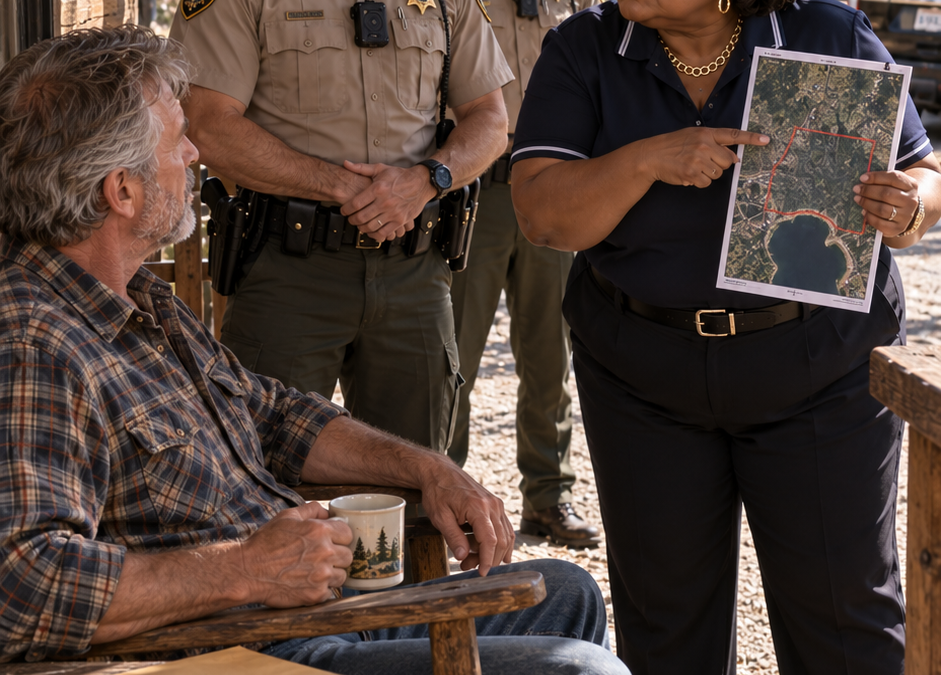
She stood at the bottom of my gravel path in a navy polo embroidered with the Ridgeline Hills HOA logo, a clipboard tucked against one hip and a laminated color map held toward two county sheriff’s deputies.
I was sitting on my porch.
Coffee on the little wooden table beside me.
Next to the mug sat a thick manila envelope worn soft at the corners.
A county recorder’s stamp was visible through a tear in the flap.
I didn’t stand.
Sandra pointed directly at my cabin.
“That’s the structure I reported. It was built on HOA-managed common land without architectural approval. He’s ignored every violation notice we’ve sent. The board has exhausted its options.”
The lead deputy climbed the first porch step.
Professional.
Calm.
Not hostile.
“Sir, we received a complaint alleging this structure is located on land you don’t legally own. Can you tell me what your claim to the property is?”
There’s no clean word for what it feels like to be asked to prove you belong in your own home while two uniformed officers stand in front of you and the person who summoned them waits twenty feet away expecting to watch you lose.
Humiliating comes close.
So does rage.
Neither is quite right.
My name is Thomas Callaway.
I had owned that parcel since 1993.
Long before Ridgeline Hills existed.
Long before Sandra knew the road had a name.
Long before a developer bulldozed the surrounding pines, poured sidewalks, or sold the first house.
My deed had been sitting in the county records for thirty-one years.
Sandra’s subdivision wouldn’t exist for another fourteen.
She didn’t know that yet.
Or maybe the better way to say it is this:
She had never bothered to find out.
I looked at the laminated map in her hand.
Then at my coffee.
“I have documentation,” I told the deputy. “I’ll show you.”
I still didn’t touch the envelope.
Sandra moved closer.
“Our community property map clearly identifies the entire parcel as HOA-designated green space.”
She lifted it higher.
It was an impressive-looking thing.
Full color.
Scale bar.
Compass rose.
Legend.
Professional plastic sleeve.
If you didn’t know what you were looking at, you could easily mistake it for something filed at the courthouse.
It wasn’t.
It was a marketing map.
The kind a developer puts beside floor plans and countertop samples in a model home.
But Sandra spoke as though it were scripture.
“Under the founding charter, the association has jurisdiction over all land inside the community boundary,” she continued. “Mr. Callaway constructed this structure without board approval, without architectural review, and without contacting the association. He has received four written notices. He has responded to none of our enforcement efforts.”
That last part wasn’t true.
I had responded.
In writing.
Certified mail.
Two very simple questions.
She had never answered them.
“The board has retained counsel,” Sandra said, “and we are prepared to proceed with demolition if necessary.”
She delivered that final sentence looking directly at the deputies.
Not me.
The way you do when you believe the person standing beside you represents the authority that finally ends an argument.
The second deputy had been quiet.
He looked around slowly.
Cabin.
Tree line.
Gravel path.
Then his eyes landed briefly on the manila envelope beside my coffee.
He said nothing.
The lead deputy turned back toward Sandra.
“This map you’re relying on—was it recorded with the county recorder’s office?”
Sandra raised her chin.
“It was prepared by the development company when the community was established.”
That wasn’t an answer.
The deputy seemed to notice.
So did I.
I lifted my coffee.
Took a slow sip.
There’s a kind of calm that comes from knowing exactly what’s inside the envelope beside you.
Not arrogance.
Not smugness.
I wasn’t trying to embarrass Sandra.
By that point, I no longer needed to.
I had learned something during the previous three months.
When somebody has built their entire position out of confidence, procedure, polished letterhead, and documents that merely look official, sometimes the most effective thing you can do is let them finish.
Let every claim stand.
Let every threat be spoken.
Let every piece of paper be held up in front of witnesses.
Then place one real record beside it.
And wait.
“Whenever you’re ready, sir,” the deputy said.
“Of course.”
I set down my mug.
But to understand why that worn envelope mattered so much, you need to understand what Sandra never did.
I bought the land in the spring of 1993.
A little over two acres.
Back then, the area was open farmland mixed with second-growth pine.
No subdivision.
No streetlights.
No decorative entrance walls.
No HOA.
There wasn’t even a proper road to my lot.
Just a rough track and a survey stake marking one corner.
I paid cash.
Recorded the deed that afternoon.
Then paid for a formal boundary survey and had that recorded too.
The following fall, I poured the cabin footings.
I framed the walls the next spring.
Got the roof on before winter.
Finished the interior during weekends and vacations.
No contractor.
No construction loan.
No rush.
I was young enough to believe that if something belonged to you, time was one of the luxuries ownership gave you.
I built that cabin slowly.
And because I built it myself, I knew every crooked stud hidden behind the drywall.
Every board that took three tries before I liked the fit.
Every place the floor squeaked.
I knew which porch post had a knot in exactly the wrong place and which window had to be lifted slightly before the latch caught.
From the moment I recorded the land, I paid taxes directly to the county.
Every year.
Thirty-one years.
No gaps.
No HOA assessments.
No community fees.
No subdivision dues.
Just a county parcel number that never changed.
The surrounding development came later.
Around 2006, a developer bought most of the neighboring acreage.
Trees disappeared.
Roads appeared.
Then utilities.
Then curbs.
Then houses.
By 2007, ninety-four homes formed Ridgeline Hills.
The developer recorded the subdivision plat and HOA governing documents.
My parcel sat outside it.
Not barely.
Not ambiguously.
The recorded subdivision boundary stopped roughly two hundred feet before my property line.
My two acres remained exactly what they had always been.
Independent land.
For years, nobody cared.
I waved to the new neighbors.
Some waved back.
A few called my cabin “the old place in the trees,” even though it wasn’t that old.
The HOA concerned itself with lawns, mailboxes, fences, and paint colors on land that actually belonged to its members.
My cabin existed beyond their edge.
Then Sandra Kowalsski became board president.
She campaigned on “elevating community standards.”
That sounded harmless enough.
In practice, it meant enforcement.
Lawn height.
Trash cans.
Parking.
Holiday decorations.
Exterior modifications.
Architectural approvals.
She approached rules the way some people approach collections.
Every violation became an item to catalogue.
She built spreadsheets.
Maintained photographs.
Tracked deadlines.
Sent reminders.
And over three years, nobody successfully challenged her.
Not once.
She also had a map.
That map was the beginning of my problem.
The developer had produced a community overview in 2007 for sales presentations.
It showed houses.
Common areas.
Green space.
Walking paths.
The entry monument.
But at the back edge of the development where my property sat, there was simply blank space.
No parcel number.
No cabin.
No ownership notation.
Nothing.
To a surveyor, blank space on a marketing illustration means nothing.
To Sandra, it apparently meant:
Unmanaged HOA land.
The first letter arrived on a Tuesday.
Addressed to OCCUPANT.
COMMUNITY AESTHETIC REVIEW REQUEST.
The board wanted plans for my existing cabin submitted for retroactive architectural approval.
I read it twice.
Then set it on the kitchen table.
It cited sections of the CC&Rs.
Sandra’s signature appeared at the bottom.
I knew I wasn’t subject to any of it.
So I did nothing.
Maybe that was my first mistake.
Not legally.
Strategically.
Because Sandra interpreted silence the same way people like her often interpret silence.
Submission.
Three weeks later, she came personally.
I heard tires on gravel before I saw the white sedan.
Ridgeline HOA logo printed on the door.
She climbed out holding a clipboard.
Board-president identification hanging from a lanyard.
Manila folder in one hand.
She walked toward the porch like she’d done it dozens of times.
“Mr. Callaway?”
“Yes.”
“This is a formal violation notice.”
She handed it to me.
SECTION 4.3 — UNAUTHORIZED STRUCTURE.
Fine:
$500.
Compliance period:
Thirty days.
Then:
NONCOMPLIANCE WILL RESULT IN WEEKLY ESCALATING FINES AND MAY RESULT IN LIEN ACTION AGAINST THE PROPERTY.
Sandra had a practiced rhythm.
Deliver.
Explain.
Deadline.
Leave.
I read everything.
Then asked one question.
“Can you show me where my county parcel number appears in the CC&Rs?”
She paused.
Only slightly.
“The community overview establishes jurisdiction.”
“That wasn’t my question.”
“The association’s founding charter grants blanket authority within the mapped boundary.”
“What parcel number does that include?”
“The boundary is controlling.”
“Then it should be easy to show me.”
Her smile tightened.
“I’m not here to debate the documents on your porch.”
“I’m not asking you to.”
I handed nothing back.
Signed nothing.
Asked for no payment instructions.
Sandra closed her pen.
“You have thirty days.”
Then came the line she had probably used on dozens of homeowners.
“After that, we can file a lien against the property. A lien follows title. It can prevent sale, refinancing, or transfer.”
She gave me a moment to absorb it.
“We’ve done it before.”
Then she walked away.
That evening, I opened the bottom drawer of my filing cabinet.
The deed was exactly where it had been since 1993.
I also gathered the documents Sandra had included.
CC&Rs.
Charter.
Exhibits.
I searched for my parcel number.
Nothing.
I checked again.
Still nothing.
I searched every legal description.
Every map.
Every parcel list.
My land did not exist anywhere in Ridgeline’s governing instruments.
Then I pulled thirty-one years of tax statements.
Same parcel.
County assessment.
County tax.
Never one HOA charge.
I sat at my kitchen table for maybe an hour.
Then I wrote Sandra a response.
No accusations.
No anger.
Just two questions.
Please identify:
- The exact assessor parcel number in the governing documents that corresponds to my property.
- The exact CC&R provision establishing HOA jurisdiction over that parcel.
Thirty days to respond.
Certified mail.
Return receipt.
I started a log.
Date sent.
Date received.
Tracking number.
That probably sounds excessive.
At the time, I didn’t know what it would become.
I simply believed that if Sandra was going to bury me in paper, the least I could do was keep mine organized.
I called the recorder’s office.
The clerk pulled Ridgeline’s plat while I waited.
Then asked for my parcel number.
I read it.
A pause.
“Sir?”
“Yes?”
“That parcel isn’t listed in this subdivision.”
“I know.”
“Not anywhere.”
The following morning, I went there myself.
The recorder’s office occupied the second floor of the county building.
Low ceiling.
Fluorescent lights.
Rows of terminals.
I explained what I needed.
The clerk pulled the official subdivision plat.
Turned the monitor.
“There.”
A heavy recorded boundary line marked Ridgeline Hills.
My parcel sat outside it.
About two hundred feet outside.
Not close.
Not a disputed corner.
Not two surveyors disagreeing over inches.
Separate land.
“Can I get a certified copy?”
“Three dollars.”
I described Sandra’s laminated map.
The clerk knew immediately what I meant.
“That’s the sales map.”
“Is it recorded?”
“No.”
“Legal effect?”
“None.”
She said it without drama.
Like she was explaining that a restaurant menu isn’t a property deed.
I left with certified copies of:
My deed.
Ridgeline’s recorded plat.
My parcel records.
All of them went into the same manila envelope.
That should have ended the matter.
It didn’t.
Before going home, I stopped at Gerald and Ruth Alderman’s house.
They lived two doors from my access path.
Older couple.
Quiet.
I had noticed something odd over the previous year.
Whenever Sandra’s HOA car passed, they often disappeared inside.
I knocked.
They invited me into the kitchen.
We talked for almost an hour.
Sandra had fined them repeatedly.
Two hundred dollars for a ceramic garden gnome Ruth’s daughter had given her.
Three hundred fifty dollars for a wind chime.
Eight hundred fifty dollars because a guest car at their granddaughter’s birthday party had been parked about a foot beyond the approved zone.
Other smaller fines.
Three years total:
Around $2,400.
Gerald told me they were on a fixed income.
Ruth admitted they had stopped decorating outside.
“Christmas too?”
She looked embarrassed.
“I didn’t want another letter.”
That bothered me more than the money.
They were afraid of putting Christmas decorations in their own yard.
Then I visited a young family on the corner.
Three kids.
Bicycles everywhere.
They had paid $350 over a basketball hoop left near the driveway after a cookout.
They missed an appeal window they hadn’t known existed.
Nobody had explained it.
So they paid.
That afternoon, sitting back at my kitchen table, I realized Sandra’s real advantage wasn’t the bylaws.
It was uncertainty.
Most people don’t know exactly what an HOA can do.
Most don’t know how to read recorded plats.
Most don’t know where to find county property records.
So when somebody arrives wearing a board badge, holding an official-looking document, threatening liens and legal costs, people assume the authority must exist somewhere.
Sandra had spent three years teaching everybody not to question that assumption.
My certified letter deadline came and went.
No answer.
Thirty days.
Nothing.
No lawyer letter.
No parcel number.
No governing provision.
I noted:
NO RESPONSE RECEIVED.
Fourteen days later, Sandra escalated.
NOTICE OF ENCROACHMENT AND UNAUTHORIZED USE.
Four pages.
Signed by Sandra and two board members.
This time, the HOA claimed my access road belonged to them.
The gravel road I built.
Across land I owned.
According to the letter, continued use constituted trespass on HOA common property.
I read that claim twice.
Then a third time.
Because this was different.
If they could establish control over my only access route, I could own a cabin I had no legal way to reach.
That wasn’t enforcement.
It was siege.
Attached was a professional survey commissioned by the HOA.
Licensed surveyor.
Formal report.
My entire parcel had been redrawn inside Ridgeline’s boundary.
At first glance, it was impressive.
Measurements.
Coordinates.
Seals.
Signature.
Then I checked the baseline.
That survey started from a metal post placed by the developer in 2007.
HOA placard attached.
It was not a county survey monument.
Not a state benchmark.
Not recorded as a controlling point.
The actual county benchmark sat 207 feet away.
That explained everything.
If you start 207 feet wrong, every beautifully precise measurement afterward can still be wrong.
I called the county surveyor.
Requested a certified boundary survey.
$340.
Two-week turnaround.
Then Sandra escalated again.
Three days later, I returned home to find an orange notice stapled directly into my cabin door frame.
CONDEMNATION / NONCONFORMING STRUCTURE NOTICE.
HOA letterhead.
Sandra’s signature.
DEMOLITION PROCEEDINGS MAY BEGIN AFTER 60 DAYS IF STRUCTURE IS NOT VOLUNTARILY REMOVED.
I stood on the porch staring at the staple.
Then went inside.
Got my camera.
Came back out.
Photographed everything.
Wide shots.
Close shots.
Timestamp.
Cabin visible.
Notice readable.
I left the paper exactly where it was.
Sandra was creating my evidence faster than I ever could.
That’s something I learned.
When someone believes they control the rules, they usually put their decisions in writing because they believe the paper protects them.
Sometimes it does the opposite.
The county survey arrived on Thursday.
I opened it beside the HOA survey.
Different starting point.
Different boundary.
Different result.
The county survey used the official monument.
Sandra’s survey used the developer post.
My cabin was outside Ridgeline.
My access road was outside Ridgeline.
Every inch.
Then came the community meeting notice.
Special Meeting.
Mandatory Agenda Item:
UNAUTHORIZED STRUCTURE / HOA PROPERTY ENCROACHMENT.
Tuesday.
7:00 p.m.
Seventy-two homeowners attended.
Three-quarters of the entire development.
Fear is an excellent attendance strategy.
Sandra had prepared everything.
Projection screen.
Copies of the agenda on every chair.
At the front stood a professionally printed twenty-four-by-thirty-six-inch version of the private survey.
Red boundary.
HOA seal.
Her name at the bottom.
It looked like courtroom evidence.
I entered five minutes early.
Sat four rows from the back.
The manila envelope rested on the empty chair beside me.
Sandra opened precisely at seven.
She described me as an individual occupying association-managed land without authorization.
She listed violation notices.
Failure to comply.
Encroachment.
Proposed demolition.
Then pointed toward the survey.
“The association retained a licensed professional surveyor who confirmed that the disputed parcel falls fully within Ridgeline Hills jurisdiction.”
Several homeowners nodded.
“We have documentation. We have legal counsel. And we have the authority to act.”
Applause.
Not everyone.
Gerald and Ruth sat near the back.
No clapping.
The young family sat together.
The father kept his arms crossed.
A homeowner in a gray sweater raised his hand.
“Can the HOA actually demolish a structure it doesn’t own without a court order?”
Sandra was ready.
She quoted Section 7.4.
Mentioned counsel’s opinion.
Referenced the survey.
She sounded convincing because the most dangerous wrong answers usually contain several correct-looking pieces.
Two more questions.
Two confident answers.
Then I raised my hand.
Sandra saw me.
Something tiny changed.
She called on me.
“One question.”
The room quieted.
“That survey you’re presenting tonight—is it a county-certified document filed with the recorder’s office?”
Sandra paused.
“It was conducted by a fully licensed professional.”
“That wasn’t my question.”
Her eyes tightened.
“The surveyor has all appropriate credentials.”
“County certified and recorded?”
She didn’t answer directly.
I nodded.
“Thank you.”
Then I reached down.
Picked up the manila envelope.
Set it on the narrow desk surface in front of me.
Didn’t open it.
Sandra continued.
But something in the room had shifted.
Gerald looked at the envelope.
Then Ruth.
The young father leaned forward.
People began noticing the one object Sandra hadn’t explained.
Twenty minutes later, she closed with:
“If the structure is not vacated within seventy-two hours, the board will request assistance from the county sheriff’s department.”
The front rows applauded.
The back didn’t.
I went home.
Put the envelope back beside my coffee.
And waited.
Three days later, I heard the patrol cruiser.
That brings us back to the porch.
Two deputies.
Sandra.
Laminated map.
Clipboard.
My coffee.
And the envelope.
The lead deputy repeated his question.
“Do you have documentation establishing your ownership?”
“Yes.”
I opened the envelope.
Sandra stepped closer.
I removed the first document.
“This is the deed.”
I handed it to the deputy.
“Recorded in 1993.”
He read the first page.
Parcel number.
Legal description.
County stamp.
Recording date.
His eyes paused on the year.
Then he looked toward Sandra.
“Ma’am, this deed predates the subdivision.”
Sandra answered immediately.
“A deed doesn’t override HOA jurisdiction. The association boundary includes the parcel.”
I unfolded the next document across the porch railing.
“This is Ridgeline Hills’ official subdivision plat.”
The deputy leaned over.
“Recorded in 2007.”
I pointed.
“This line is the recorded HOA boundary.”
Then moved my finger.
“This is my parcel.”
He studied the gap.
About two hundred feet.
Sandra stepped forward.
“Our professional survey supersedes that interpretation.”
I placed her survey beside the county plat.
Then added the new county survey.
“Her survey starts from this point.”
I indicated the developer post.
“An HOA marker installed in 2007.”
Sandra started.
“Our surveyor is licensed.”
“He is.”
That seemed to surprise her.
I continued.
“The issue isn’t his license. It’s the baseline he was given.”
I pointed to the certified document.
“The official county benchmark sits 207 feet from the marker he used.”
The second deputy put his notebook down.
Now both men studied the surveys.
“The county survey uses the official monument,” I said. “Different starting point. Different boundary.”
Sandra’s voice tightened.
“The HOA has legal counsel.”
I pulled out the tax records.
“Thirty-one years.”
The lead deputy flipped through them.
“Same parcel number every year?”
“Yes.”
“No HOA assessment?”
“Never.”
“No reassignment?”
“No.”
“No annexation?”
“None.”
He set them down.
Then turned toward Sandra.
“Do you have a county-recorded instrument showing this parcel was incorporated into the subdivision?”
She raised her laminated map.
He looked at it.
Then the recorded plat.
Then back at her.
“Is that filed with the county?”
Sandra hesitated.
“It was prepared by the original developer.”
“That’s not what I asked.”
She finally lowered it.
The deputy waited.
“No.”
The porch became very quiet.
I removed one final packet.
Certified letter.
Return receipt.
My two questions.
Response deadline.
Log entry:
NO RESPONSE RECEIVED.
“I asked the HOA thirty-four days ago to identify my parcel in its governing documents and cite the provision giving it jurisdiction.”
I handed the deputy the letter.
“They signed for it.”
He looked at the green receipt.
“No answer?”
“No.”
The second deputy finally spoke.
“Ms. Kowalsski.”
Sandra looked toward him.
His tone was calm.
Not accusatory.
Which somehow made what he said hit harder.
“Based on the recorded deed, subdivision plat, county survey, and assessment history, this property does not appear to fall within the HOA’s legal boundary.”
Sandra stared at him.
“Our attorney—”
“Your attorney can pursue whatever civil remedy counsel believes appropriate.”
He gestured toward the documents.
“But we are not removing this gentleman from property that county records show he owns.”
She opened her mouth.
Nothing came out immediately.
The deputy continued.
“And I would recommend the association review any lien, demolition notice, or enforcement filing issued against this parcel.”
He paused.
“If an association knowingly records claims against land outside its authority, there can be consequences.”
Sandra looked at me.
Not angry.
Not yet.
More like someone trying to find the missing stair beneath her foot.
The lead deputy handed back my deed.
“You’re all set, sir.”
“Thank you.”
The deputies walked down the path.
Sandra remained.
Clipboard at her side.
Laminated map hanging from one hand.
For months, that map had been raised like a badge.
Now it looked exactly like what it was.
Plastic covering a sales brochure.
I said nothing.
I didn’t need to.
She turned.
Walked to her car.
The tires moved slowly over the gravel.
Slower leaving than they’d arrived.
I sat back down.
Picked up my coffee.
It had gone cold.
I drank it anyway.
Six days later, I received a letter from the county recorder.
Formal.
Two pages.
County letterhead.
It confirmed my parcel was not contained within Ridgeline Hills’ recorded subdivision plat.
It confirmed the land had been independently recorded since 1993.
It confirmed no county record reflected annexation into the association.
A copy went to Ridgeline’s counsel.
Within forty-eight hours, the demolition action was withdrawn.
The encroachment claim disappeared next.
Then came the lien question.
Sandra had prepared one but had not completed the final recording before the sheriff visit.
The county recorder flagged the filing when it arrived.
Ridgeline’s attorney withdrew it.
My title remained clean.
I ordered a fresh title report anyway.
Clear.
Unencumbered.
Just as it had been before Sandra ever drove down my path.
Then I did something petty.
Maybe appropriately petty.
I sent Ridgeline a demand for reimbursement.
County survey:
$340.
Certified records:
$60.
Total:
$400.
Nothing emotional.
Just an invoice.
The new board eventually paid it.
More important things happened after that.
The county surveyor’s office reviewed the conflicting private survey.
Their concern wasn’t that two professionals disagreed.
Surveyors disagree.
The problem was the baseline.
The HOA survey had relied on an unrecorded decorative development marker as though it were a controlling monument.
The county referred the matter to the state professional licensing board.
I didn’t request that.
Didn’t file a complaint.
The review happened automatically.
Sometimes systems actually do notice things.
Sandra resigned fourteen days after the deputies left my cabin.
Her resignation letter cited “personal reasons.”
Three sentences.
No apology.
No reference to me.
No admission that she had tried to remove a man from land he had owned before her subdivision existed.
The acting board scheduled a community vote anyway.
Sixty-seven homeowners voted for formal removal.
Five voted to retain her.
I didn’t attend.
My involvement with Ridgeline ended at the property line.
But the homeowners weren’t finished.
The new board ordered an audit of every enforcement action Sandra had issued during her three years as president.
Forty-seven fines.
Every one cross-referenced against the CC&Rs.
Every parcel checked.
Every violation matched against actual governing language.
Twenty-three fines were voided.
Some because no applicable covenant supported them.
Others because appeal procedures hadn’t been followed.
Some because Sandra’s board had stretched language far beyond what the recorded rules actually said.
Refund checks went out.
Gerald and Ruth Alderman received $2,400.
Ruth called me.
I answered from the porch.
“Thomas?”
“Ruth.”
“We got a check.”
“How much?”
“All of it.”
I smiled.
“Good.”
She was quiet for a moment.
Then:
“We’re putting the gnome back.”
I laughed.
“Where?”
“Same flower bed.”
“Good.”
“And Gerald’s putting up the wind chime.”
“Even better.”
“I think we might do lights at Christmas.”
Her voice changed slightly on the last sentence.
That was the one that mattered.
Not the money.
The permission they finally gave themselves to live in their own home again.
The young family on the corner got $350 back.
The new board also sent a written apology explaining that the appeal window had not been properly communicated.
The father came to my cabin one Saturday.
His youngest kid stood beside him staring at the trees.
He held out his hand.
“Wanted to say thanks.”
“You didn’t owe me anything.”
“I know.”
We shook.
That was all.
A month later, the man in the gray sweater started a homeowner group.
He called it:
CHECK THE COUNTY RECORDS FIRST.
I laughed when Gerald told me.
Their first meeting drew twenty-two residents.
They taught people how to find plats.
How to read their CC&Rs.
How to request association records.
How to identify appeal deadlines.
Nothing revolutionary.
Just information that Sandra had benefited from everybody not having.
I replaced two porch boards that summer.
Structurally, they were fine.
But they were the boards Sandra had stapled the orange demolition notice into.
I wanted fresh wood there.
No deeper reason.
Maybe that’s not true.
I cut cedar.
Measured twice.
Set the boards.
Drove galvanized nails.
The new wood looked too bright against the weathered porch.
It would darken.
Rain would get to it.
Sun.
Winter.
Eventually it would look like it had always belonged.
That afternoon, I sat outside with coffee.
No HOA vehicle.
No sheriff cruiser.
No clipboard.
Just birds moving through the pines.
For thirty-one years, that had been normal.
It took three months of Sandra to teach me how valuable normal was.
The following Sunday, I framed the original deed.
Simple black frame.
Nothing decorative.
I cleaned the glass.
Centered the paper.
Hung it beside the front door.
County recorder stamp in the upper corner.
My name.
Parcel number.
Spring 1993.
First thing you see when you walk inside.
People occasionally ask about it now.
The story traveled through Ridgeline the way stories travel anywhere ninety-four houses sit close together.
Someone hears part.
Someone else fills in another part.
Eventually everybody knows enough to ask.
“Is that the deed?”
I point at it.
“That’s it.”
Sometimes they expect a speech.
I don’t give one.
There isn’t much left to say.
A deed isn’t powerful because it is old.
It is powerful because somebody recorded it properly.
A plat isn’t authoritative because it looks impressive.
It is authoritative because it was filed according to law.
A survey isn’t right because the person who signed it has credentials.
The measurements still have to start from the correct point.
And a laminated map does not become a legal boundary because the person holding it speaks confidently.
That’s what Sandra never understood.
Or maybe she understood the opposite too well.
Most people don’t ask what kind of paper they’re looking at.
Official-looking is usually enough.
A logo.
A seal.
A bold heading.
A threat.
A deadline.
And because most people have jobs and children and mortgages and aging parents and everything else that fills a life, they don’t spend Tuesday afternoons searching recorder databases.
They assume somebody issuing a fine has already checked.
Sandra built three years of authority on that assumption.
She had never lost a challenge because almost nobody challenged her properly.
Then she reached a parcel that had been sitting outside her authority longer than her authority had existed.
My land didn’t change.
That is the part I think about most.
Nothing moved.
The cabin didn’t jump outside Ridgeline when I produced the deed.
The boundary didn’t change because the county surveyor corrected Sandra.
The road didn’t suddenly become mine when the deputy read the documents.
All those things had always been true.
The only thing that changed was who had bothered to look.
One morning late that summer, I saw Gerald and Ruth in their yard.
The gnome was back.
Ceramic.
Red hat.
Ugly as sin.
Perfect.
Gerald saw me looking.
Raised both arms like he’d won something.
I gave him a thumbs-up.
Ruth came outside behind him.
Wind chime hanging from the porch.
She laughed.
That sound traveled farther than Sandra’s car ever had.
I thought about the first letter addressed to OCCUPANT.
That still bothers me sometimes.
Occupant.
As though thirty-one years of ownership could be erased because someone didn’t know my name.
I built that cabin with my hands.
Paid the tax bill every year.
Repaired the roof.
Cleared storm damage.
Buried two dogs beneath the pines behind it.
Spent Christmas mornings there.
Sat beside my father on that porch before he died.
And Sandra’s system reduced me to occupant because her database didn’t contain a field for land existing outside her map.
That’s a dangerous habit.
Not just for HOAs.
For anyone who confuses the limits of their records with the limits of reality.
The new Ridgeline board eventually replaced the old community overview map.
Not because they had to.
Because enough residents demanded it.
The replacement map showed my parcel clearly.
A white block outside the HOA boundary.
PRIVATE PARCEL — NOT HOA PROPERTY.
Gerald brought me a copy.
“You like that?”
I looked at it.
“Better.”
“You going to laminate it?”
“No.”
He laughed.
“Probably wise.”
I kept one copy in a drawer.
But I don’t need it.
The real map is still at the county.
That’s where it always mattered.
The old developer post Sandra’s surveyor used eventually came out too.
Not because of me.
The county survey review concluded it could confuse future boundary work.
A crew removed it.
Put an official reference marker nearby.
Gerald called me that afternoon.
“They’re taking Sandra’s pole out.”
“It wasn’t Sandra’s.”
“You know what I mean.”
I did.
I drove past once afterward.
There was a small disturbed patch of dirt where the decorative marker had stood.
Nothing dramatic.
No ceremony.
No crowd.
Just a hole filled back in.
That felt appropriate.
Bad authority often disappears exactly that way.
Quietly.
Once everyone stops pretending it means something.
Sandra stayed in the neighborhood.
That surprised some people.
Not me.
She owned her house.
Losing an HOA office doesn’t make somebody disappear.
I’d occasionally see her sedan at the grocery store.
Once at the pharmacy.
We never spoke.
I didn’t need an apology.
I don’t mean that nobly.
There were days when I would’ve enjoyed one.
But apologies matter most when they change something.
My title was clean.
My cabin remained standing.
The Aldermans had their money.
The young family got theirs.
Residents understood their records.
Sandra no longer had enforcement authority.
There wasn’t much left I needed from her.
The sheriff’s deputies came back once.
Not on a complaint.
The lead deputy was nearby on another call and stopped.
I was splitting wood.
He walked down the path alone.
“Mr. Callaway.”
“Deputy.”
“Just wanted to check something.”
I leaned the ax against the stump.
“What?”
He smiled.
“Cabin still here?”
I looked behind me.
“Appears to be.”
“Good.”
He glanced toward the framed deed visible through the open front door.
“Lot of trouble over two acres.”
“Two acres to her.”
He nodded.
“To you?”
“Home.”
He stood there a moment.
Then said, “That usually makes the difference.”
He left.
I went back to splitting wood.
The cabin turned thirty-two under my ownership the following spring.
I didn’t celebrate.
Buildings don’t care about anniversaries.
I replaced a gutter.
Cleaned the chimney.
Resealed the porch.
Same kind of work I had always done.
On a cool morning in April, I sat in my chair with coffee.
The deed hung inside.
The envelope was back in the filing cabinet.
I didn’t need it beside me anymore.
Down in Ridgeline, a lawn mower started.
Somebody’s dog barked.
Then the sound of a basketball hitting pavement.
Repeated.
Bounce.
Bounce.
Bounce.
I smiled.
Probably the corner family.
The hoop was still there.
The Aldermans’ wind chime moved in the breeze.
If the air was right, I could barely hear it from my porch.
Sandra once believed community standards required controlling all of those things.
The funny part is, the neighborhood seemed more peaceful once people stopped being terrified of violating them.
Maybe community isn’t everyone doing the same thing.
Maybe it’s knowing where your authority ends.
I don’t know.
I’m not an HOA expert.
I’m a man who owns two acres and a cabin.
But I know where my boundary is.
And I know how I proved it.
Not by shouting.
Not by threatening.
Not by making a bigger map.
I went to the county.
Asked what was recorded.
Paid three dollars for the plat.
Three hundred forty for a proper survey.
Sent certified letters.
Kept receipts.
Wrote down dates.
Then when Sandra called law enforcement, I didn’t need to convince anyone of my version.
I just opened the envelope.
That mattered to me.
Because for most of those months, Sandra’s biggest advantage was that she sounded certain.
Certainty is persuasive.
Especially when it arrives wearing a logo and quoting section numbers.
But certainty isn’t evidence.
Confidence isn’t title.
A board vote isn’t ownership.
And ninety-four houses do not get to absorb two acres next door simply because somebody forgot to draw them correctly on a brochure.
The final document I received came from the new Ridgeline board.
One page.
Plain language.
No threat.
No fine.
No legal performance.
It stated:
The Ridgeline Hills Homeowners Association acknowledges that the Callaway parcel is an independently owned property lying outside the recorded subdivision boundary and is not subject to the association’s CC&Rs, assessments, architectural controls, liens, or enforcement jurisdiction.
Signed by all three new board members.
I placed it behind the deed in the frame.
You can’t see it unless you take the frame down.
That’s intentional.
The deed belongs in front.
It came first.
One Sunday, Gerald visited.
He noticed the frame.
“That the famous piece of paper?”
“No.”
He frowned.
“That’s your deed.”
“Exactly.”
“I thought that was the famous piece.”
“It shouldn’t be.”
He understood after a second.
“Because it was always there.”
I nodded.
“Exactly.”
The remarkable part wasn’t that I had proof.
The remarkable part was that nobody on Sandra’s side bothered to look for it until two deputies were standing on my porch.
That was the whole disaster.
Three years of enforcement culture.
A law firm.
A board.
A licensed surveyor.
Violation notices.
Demolition threats.
A sheriff call.
And the answer had been sitting in a public database the entire time.
Parcel number.
Boundary.
Recording date.
Thirty-one years.
Sometimes I wonder how far Sandra would have gone if I’d been somebody who didn’t keep records.
What if I’d lost the deed?
What if I was eighty years old and frightened by lien language?
What if English wasn’t my first language?
What if I couldn’t afford the $340 survey?
What if I saw two deputies at the bottom of my path and assumed that meant the argument was already over?
That’s why Gerald and Ruth matter to me.
That’s why the young family matters.
It wasn’t just that Sandra was wrong about my property.
She had spent years teaching people that questioning her cost more than surrendering.
By the time she came for my cabin, she expected the same result.
A notice.
A deadline.
A threat.
Compliance.
Instead, she got a parcel number.
That sounds almost ridiculous.
But sometimes that is all truth looks like.
Numbers on paper.
A line on a plat.
A stamp.
A date.
Nothing dramatic.
Until somebody needs it.
The pines behind the cabin are taller now than they were when I bought the property.
Some were barely over my head in 1993.
Now they throw shade across the roof by late afternoon.
The subdivision behind them has grown older too.
Trees planted when the first homes went in are finally large enough to look natural.
Paint has faded.
Roofs have been replaced.
Children have grown up.
Even Ridgeline no longer looks new.
Time does that.
It takes things people once considered permanent and reminds them they weren’t first.
The cabin wasn’t first either.
The land was.
I just happen to be its current name in the record.
Maybe someday I’ll sell.
Maybe someone younger will take it.
If that happens, the deed will change.
The parcel won’t.
The county line won’t.
The Ridgeline boundary won’t.
And whoever comes after me won’t need Sandra’s permission to fix the porch.
That thought gives me more satisfaction than any confrontation ever did.
Because I didn’t beat the HOA.
I didn’t conquer anybody.
I simply prevented somebody else’s mistake from becoming my reality.
There’s a difference.
The coffee tasted better after that.
Maybe that’s sentimental too.
But the first quiet morning after everything ended, I sat on the porch in the same chair.
Same mug.
Same table.
No manila envelope.
No deputies.
No Sandra.
I looked down my gravel path.
Morning light came through the trees.
Nothing moved except leaves.
Then somewhere beyond the boundary, a basketball hit pavement.
A wind chime answered.
And an ugly ceramic gnome stood in a flower bed where it belonged.
I finished my coffee.
Then went inside beneath the deed Sandra should have checked in the first place.
Thirty-one years on record.
Two acres outside her line.
And my cabin exactly where it had always been.








