𝗙𝗨𝗟𝗟 𝗦𝗧𝗢𝗥𝗬 HOA Karen Called the Cops on My Birthday—Then 30 Navy SEALs Stood Up
𝗙𝗨𝗟𝗟 𝗦𝗧𝗢𝗥𝗬
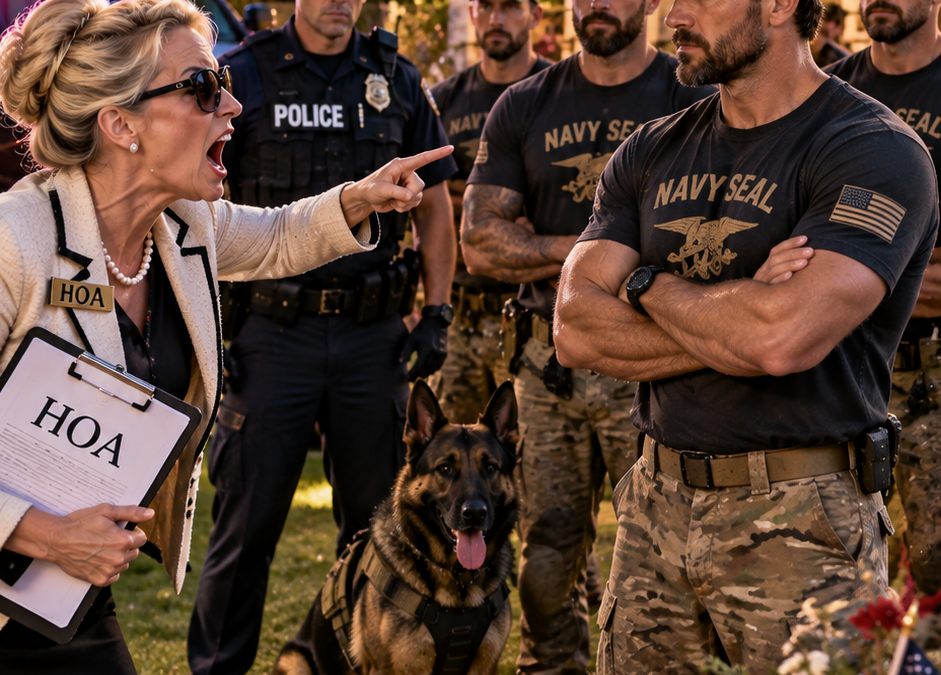
Brenda lifted the clipboard.
“You are in violation of multiple community and municipal regulations.”
“This isn’t part of your community.”
“Your property affects ours.”
“That doesn’t make it yours.”
She stepped closer.
“The smoke alone constitutes an environmental nuisance. You have more than ten non-resident guests. Several commercial diesel vehicles are visible from our access corridor. Your music is audible from neighboring property.”
I looked toward the radio.
We could barely hear it ourselves.
“You walked down here to hear it.”
“That is irrelevant.”
“No, that’s geography.”
Her eyes narrowed.
“Our phase-two buyers are arriving tomorrow morning.”
I finally understood.
That was what this was really about.
Prospective buyers.
Brenda wanted Whispering Cove to look pristine.
Controlled.
Wealthy.
Predictable.
And thirty muddy trucks beside an old cedar cabin interfered with the fantasy.
She pointed toward my friends.
“I will not have prospective residents seeing unemployed ruffians drinking beside a bonfire.”
That was when Deputy Miller, one of the off-duty officers behind her, suddenly became fascinated by his boots.
He had spotted the trident tattoo on one man’s forearm.
Then another.
Then the military-style dog tags hanging beneath somebody else’s shirt.
He knew.
Brenda didn’t.
I stood.
“Those men are my guests.”
“That does not excuse the disturbance.”
“They’re on private property.”
“Adjacent properties remain subject to shared aesthetic-impact provisions.”
I almost admired that phrase.
Shared aesthetic impact.
It was the kind of language invented by people who wanted authority without having to call it authority.
Then she delivered the number.
“Ten thousand dollars.”
Several heads turned.
I looked at her.
“What?”
“The special administrative penalty.”
She smiled.
“Ten thousand dollars, effective immediately.”
“For a birthday party?”
“For severe environmental and aesthetic noncompliance.”
One of my friends coughed suspiciously into his beer.
Brenda continued.
“It doubles every twenty-four hours.”
I folded my arms.
“And if I don’t pay?”
“We place a lien against the property.”
There it was.
She had wanted this land for years.
Now she was testing whether administrative pressure could do what purchase offers had failed to accomplish.
She leaned closer.
“We can make ownership extremely uncomfortable for you, Logan.”
Behind her, Deputy Miller shifted his weight.
I could almost hear him begging her silently to stop.
She didn’t.
People like Brenda mistake silence for weakness.
She looked at the two security officers.
“If these men are not gone in fifteen minutes, coordinate with the sheriff.”
Then she looked at me.
“I’ll have every one of them removed.”
“Removed how?”
“Arrested if necessary.”
The yard became very still.
Thirty men.
No shouting.
No posturing.
Just silence.
I had been around enough dangerous people to know that the absence of movement sometimes meant more than movement itself.
Brenda felt none of it.
She saw work boots.
Beards.
Old trucks.
Cheap clothes.
And decided she understood the men wearing them.
I looked at her clipboard.
“Ten thousand?”
“Yes.”
“That’s specific.”
“Board-authorized.”
I nodded slowly.
“Maybe we should put this in writing.”
Her expression changed immediately.
She liked that.
Paper was territory she understood.
“I insist.”
“My cousin drafted something yesterday.”
I walked toward the picnic table where my laptop sat.
My cousin Marcus was sitting nearby in shorts and a blue shirt.
To Brenda, he looked like another relaxed guest.
In reality, Marcus was a Navy JAG officer and one of the most irritatingly precise lawyers I had ever known.
He glanced at me.
I gave him the smallest nod.
He returned it.
The document was already prepared.
Not because we had planned some elaborate revenge.
Because Brenda had been threatening fines all week, and Marcus had told me I was an idiot if I didn’t document every interaction.
The title sounded deliberately boring:
AESTHETIC COMPLIANCE AND SHARED SHORELINE OPERATIONS AGREEMENT.
I turned the laptop toward her.
“I’ll move the trucks completely off the shared approach.”
Brenda nodded.
“And?”
“My guests keep the music within county limits.”
“Obviously.”
“You rescind the ten-thousand-dollar citation.”
“If you comply.”
“Permanent rescission.”
She considered it.
“Fine.”
“And you acknowledge they’re lawful guests on private property.”
Her eyes flicked toward the men.
“Provided they remain orderly.”
“Put it in writing.”
She stepped closer.
Marcus had included language confirming that some guests were active-duty military personnel on authorized leave and that the HOA was acting solely under its own claimed jurisdiction.
It also documented that any further law-enforcement request would need to be based on genuine criminal conduct rather than HOA aesthetic enforcement.
Nothing magical.
Nothing that gave us immunity from law.
Just language forcing Brenda to distinguish between an actual emergency and her personal dislike of muddy trucks.
She barely read it.
That was her first mistake.
Her second was signing immediately.
Digital signature.
HOA credentials.
Timestamp.
She clicked submit.
“There.”
She looked almost radiant.
“Now move those vehicles.”
I turned toward three teammates.
“Guys?”
They didn’t argue.
Three trucks rolled down the private portion of my land toward the beach, completely beyond the shared approach.
Brenda smiled like she’d just negotiated the surrender of a hostile nation.
“Much better.”
Then she pointed at me.
“Do not make me come back.”
I smiled.
“Enjoy your evening.”
As she walked uphill, Deputy Miller looked back.
Our eyes met.
He slowly shook his head.
Not at me.
At her.
When they disappeared, someone behind me said:
“Well, Lieutenant, I think you’ve disappointed her.”
Laughter spread around the fire.
Then a deeper voice came from the grill.
“More importantly, these ribs are going to disappoint me if someone doesn’t bring more hickory.”
My uncle Richard stood behind the smoker wearing cargo shorts, an old green T-shirt, and an apron.
Silver hair.
Weathered face.
Beer in one hand.
Tongs in the other.
To Brenda, he had probably looked like somebody’s retired fishing buddy.
Which, technically, he was.
He was also Vice Admiral Richard Vance.
And that evening, the senior officer commanding a substantial portion of Naval Special Warfare was worrying primarily about barbecue.
I carried him more wood.
“You heard her?”
“Every word.”
“What do you think?”
He turned a rack of ribs.
“I’ve met dictators with better emotional regulation.”
Marcus laughed.
“She signed the agreement.”
Richard raised an eyebrow.
“Read it?”
“No.”
“Of course not.”
I handed him a beer.
“She’ll probably go home now.”
All three of them looked at me.
Marcus said, “You don’t believe that.”
“No.”
Richard smiled.
“Neither do I.”
He was right.
From her house on the bluff, Brenda could still see our fire.
She could still hear laughter.
Most importantly, she could see that nobody had left.
The trucks had moved.
The noise remained low.
The fire remained controlled.
We had complied with everything we had agreed to.
Which apparently was not enough.
Because Brenda had never wanted compliance.
She wanted submission.
She called the sheriff’s office.
We learned later exactly what she said because the emergency recording became part of the investigation.
She described an “armed outlaw gathering.”
She claimed men were threatening residents.
She said drunken individuals were preparing to enter Whispering Cove.
She described multiple weapons.
A riot.
A security emergency.
None of it was true.
Then she called Naval Base Kitsap.
Her husband’s contracting contacts gave her the name of a base administrator, Lieutenant Commander Henderson.
To him, she described me as an out-of-control junior officer holding an unauthorized gathering that had already required civilian law enforcement intervention.
She requested immediate military assistance.
She told both agencies enough truth to sound credible.
There were thirty men.
Some owned firearms.
Some trucks were diesel.
I was active duty.
Then she wrapped those facts in lies.
That was enough.
Just after dark, red and blue lights appeared between the trees.
Four sheriff’s cruisers.
Behind them, a dark Navy security vehicle.
The party went silent.
Doors opened.
County deputies came out wearing tactical vests.
Two Navy security personnel followed.
Then Henderson emerged carrying a leather folder.
Brenda marched behind them.
She looked delighted.
“There!”
She pointed toward us.
“That’s them.”
Chief Deputy Thomas stepped forward.
“Everyone remain where you are.”
Nobody moved.
Brenda’s voice rose.
“Arrest them.”
Thomas looked back at her.
“Ma’am—”
“They’re armed. They’re intoxicated. They’re trespassing against the shared shoreline agreement.”
I almost laughed.
On my own property.
Henderson came toward me.
“Lieutenant Vance.”
“Commander.”
“You are ordered to step forward.”
“For what?”
“Conduct unbecoming. Creating a public hazard. Failure to cooperate with civil authorities.”
I looked around.
My men were sitting around a fire eating ribs.
One was holding a paper plate.
Another had fallen asleep in a lawn chair.
Dangerous stuff.
“Commander, who told you this was an illegal gathering?”
“That’s not relevant.”
“It feels extremely relevant.”
“You will comply.”
“No, sir.”
That got his attention.
I kept my voice respectful.
“This is private property.”
“You are still subject to military authority.”
“Absolutely.”
I nodded.
“But I’m on authorized leave.”
“Your leave does not permit criminal conduct.”
“What criminal conduct?”
He looked toward Brenda.
That answered the question.
She stepped forward.
“They have weapons.”
Several men laughed.
Quietly.
Henderson snapped:
“This is not funny.”
Then Chief Deputy Thomas pulled out handcuffs.
“All right. Everybody stand.”
Nobody did.
One of the younger deputies looked extremely uncomfortable.
Miller was among them.
He was staring toward the grill.
Specifically at my uncle.
Then Richard put down the tongs.
He wiped his hands on his apron.
And stood.
Henderson looked toward him.
Richard walked into the headlights.
Olive-drab shirt.
Shorts.
Barbecue sauce on one sleeve.
Beer bottle in his left hand.
For three seconds, Henderson looked confused.
Then recognition hit.
His face emptied.
He straightened so violently I thought something in his spine might break.
“Admiral.”
Every Navy person in the yard turned.
Chief Deputy Thomas looked between them.
“What?”
Henderson saluted.
Hard.
“Sir.”
Richard took a sip of beer.
“Commander Henderson.”
His voice wasn’t loud.
It didn’t need to be.
“Would you mind explaining why Naval Security is standing on my family’s property ordering active-duty personnel on authorized leave into custody?”
Henderson’s face went pale.
“Sir, we received a report.”
“From?”
He hesitated.
Brenda answered for him.
“From me.”
Richard turned his head.
She seemed to realize too late that speaking had been optional.
Henderson continued.
“We were told there was a violent civilian disturbance involving Lieutenant Vance.”
Richard looked around.
“At the ribs?”
Nobody said anything.
He pointed with the tongs.
“Is the brisket armed?”
A few of the men laughed.
Henderson looked like he wanted the ground to open.
Richard’s humor vanished.
“How did you verify the report?”
“Sir?”
“Before bringing military police onto private property.”
Henderson swallowed.
“We coordinated with local law enforcement.”
Chief Deputy Thomas suddenly looked very interested in distancing himself from that phrase.
Richard looked toward him.
“And your basis?”
Thomas cleared his throat.
“Reported armed disturbance.”
“Did your officers observe one?”
“No, Admiral.”
“Any threats?”
“No.”
“Any unlawful entry onto HOA property?”
“No.”
“Any probable cause for arrest?”
Thomas looked toward Brenda.
“No.”
The entire tactical posture dissolved in real time.
Hands moved away from belts.
Handcuffs went back into pouches.
Then Richard looked around at my guests.
Thirty men slowly stood.
Not because he ordered them.
Because everybody understood what came next.
Some shirts shifted.
Dog tags appeared.
One man had the SEAL trident tattooed high on his arm.
Another had spent fifteen years in Naval Special Warfare.
Another had returned from deployment two days earlier.
Brenda stared.
Her face changed.
“These are…”
Richard looked at her.
“My nephew’s friends.”
She swallowed.
“All Navy?”
“Mostly.”
Her eyes moved from man to man.
Then she made the mistake of trying to rescue herself.
“Well, they don’t look like military personnel.”
Nobody spoke.
“They’re wearing dirty clothes.”
Richard stared at her.
“I’m sorry?”
She gestured desperately.
“The tattoos. The trucks. I was told—”
“You were told what?”
“That they looked dangerous.”
“By whom?”
Silence.
Richard stepped closer.
“Mrs. Sterling, did you tell law enforcement there was an armed riot occurring on this property?”
She stiffened.
“I reported what I observed.”
Chief Deputy Thomas interrupted.
“Our dispatch audio says you reported men threatening to enter Whispering Cove.”
“I believed they might.”
“Did anyone threaten that?”
Brenda hesitated.
“No.”
“Did you observe a fight?”
“No.”
“Did you see anyone brandish a weapon?”
“No.”
Thomas’ jaw tightened.
“You told dispatch you did.”
Brenda looked toward Harold.
He had moved several steps away.
Cowardice is sometimes remarkably efficient.
Then Marcus approached carrying a printed copy of the agreement.
“Since we’re all documenting things.”
Brenda looked at him.
“Who are you?”
“Captain Marcus Vance. Navy JAG.”
Her face dropped another shade.
He held up the document.
“You signed this roughly two hours ago.”
“I know what I signed.”
“Excellent.”
Marcus pointed toward the relevant language.
“It records that these guests are lawfully present and that further enforcement requests concerning this gathering must be based on actual violations, not HOA aesthetic objections.”
Brenda’s eyes narrowed.
“I was reporting criminal behavior.”
“What criminal behavior?”
She couldn’t answer.
Marcus continued.
“Your signed agreement also documents that you knew active-duty personnel were present.”
“I didn’t know they were SEALs.”
That sentence landed hard.
Marcus looked at her.
“That distinction does not help you.”
Silence.
“You don’t receive a lesser obligation to tell the truth because you think the service members involved have unimpressive trucks.”
Even Chief Deputy Thomas looked uncomfortable for her.
Then Miller approached him.
“Chief.”
Thomas turned.
Miller spoke quietly.
“I told Ms. Sterling earlier there wasn’t a law-enforcement issue.”
Brenda spun around.
“You work security for the HOA.”
“Off duty.”
“You were hired to enforce—”
“Our contract doesn’t authorize false arrests.”
Thomas looked at her.
“Mrs. Sterling, did Deputy Miller tell you no crime had occurred?”
She said nothing.
“Ma’am?”
“Yes.”
There it was.
Her own witness.
Thomas exhaled slowly.
“Then why did you tell dispatch an armed group was threatening residents?”
“They were intimidating.”
“By doing what?”
“By being there!”
Nobody laughed this time.
Even Brenda seemed to hear herself.
Richard set his beer on the table.
“That’s enough.”
He looked toward Henderson.
“Commander.”
“Sir.”
“You will return to base.”
“Yes, sir.”
“You’ll provide a written report explaining your decision-making process before noon tomorrow.”
“Yes, Admiral.”
“And until that review is complete, you will make no further contact with Lieutenant Vance regarding this incident unless directed through his chain of command.”
“Yes, sir.”
No dramatic threat.
No exile to Alaska.
No screaming.
Richard didn’t need theatrics.
That was the difference between authority and insecurity.
Then he turned toward Thomas.
“I assume your department will handle the false emergency report appropriately.”
Thomas nodded.
“We will.”
Brenda’s face tightened.
“This is absurd.”
Thomas looked at her.
“Mrs. Sterling.”
“You’re taking their side because they’re military.”
“No.”
He sounded tired.
“I’m responding to what my officers found when they arrived.”
“There was no riot.”
“No.”
“No trespassing.”
“No.”
“No threat.”
“No.”
Thomas looked toward Miller.
“And one of my deputies warned you before the call.”
Brenda’s shoulders fell slightly.
Thomas continued.
“We’re going to need a formal statement.”
“What does that mean?”
“It means you’re coming with us while we sort out why eight deputies were dispatched based on information that appears to have been false.”
Her mouth dropped open.
“You are not putting me in a police car.”
“We can do this calmly.”
“I am the president of Whispering Cove.”
Nobody moved.
She looked around as if waiting for someone to respect the title.
Nobody did.
“I know the sheriff.”
Thomas sighed.
“So do I.”
Miller stepped forward.
Brenda’s gold clipboard slipped from her hand and hit the gravel.
She wasn’t dragged away.
Nobody spun her dramatically into handcuffs.
The real thing was quieter.
More humiliating.
She was escorted toward the cruiser while arguing about influence that had suddenly stopped functioning.
Harold disappeared before anyone could ask him anything.
Henderson left with Naval Security.
The red and blue lights vanished between the trees.
Darkness returned.
For maybe ten seconds, nobody spoke.
Then Senior Chief Mason walked to the smoker.
He opened the lid.
Looked inside.
Then turned toward me.
“Lieutenant.”
“Yeah?”
“Brenda nearly ruined the ribs.”
The yard exploded in laughter.
My uncle picked up his tongs again.
“Everybody sit down.”
Someone turned the music back on.
I stood beside the fire looking toward the empty driveway.
Richard handed me a beer.
“Happy birthday.”
“That was embarrassing.”
“For Brenda?”
“For everybody.”
He smiled.
“That is why professionals verify information before acting.”
Marcus raised his bottle.
“To verification.”
Thirty men raised theirs.
Then someone shouted:
“To Logan getting old.”
I was twenty-six.
I told him to shut up.
The party continued.
And for the first time all night, it actually felt like my birthday again.
The consequences did not arrive overnight.
Despite what people like to imagine, bureaucratic disasters usually end with paperwork, interviews, recordings, lawyers, and very long email chains.
The sheriff’s office reviewed Brenda’s emergency call.
Her claims did not match what officers found.
Miller’s statement hurt her further because he documented that he’d already told her the party did not justify law-enforcement intervention.
The HOA board suddenly became very interested in distancing itself from her.
They held an emergency meeting.
I did not attend.
Marcus did.
He returned laughing.
“How bad?”
“Eleven to one.”
“For what?”
“Removing her as president.”
“Who voted for her?”
“Brenda.”
Fair.
The board rescinded my fine.
Then every pending citation against my property.
Then they hired outside counsel to review whether their so-called shared aesthetic covenants had any authority over my parcel at all.
They didn’t.
My deed and shoreline rights predated the development.
Their rules stopped at their boundary.
A concept I had attempted to explain repeatedly using words of one syllable.
Apparently outside counsel charging six hundred dollars an hour made the same sentence easier to understand.
Brenda faced charges related to the false report.
The final disposition was far less cinematic than the rumors around town.
No federal prison.
No asset seizure.
No dramatic military prosecution.
She entered an agreement resolving the state-level complaint, paid restitution associated with the unnecessary response, and performed community service.
More importantly to Brenda, Whispering Cove removed her.
Completely.
No board position.
No committee chair.
No enforcement authority.
She went from controlling landscaping policy for hundreds of residents to needing permission before speaking during the public-comment section of meetings.
That might have been the harsher punishment.
Her husband Richard also lost several contracting opportunities after his company became entangled in the public scrutiny surrounding the incident.
Not because my uncle made calls.
He didn’t.
Because organizations become nervous around contractors connected to scandals involving military authorities.
Whispering Cove’s board survived.
Barely.
Residents refused to dissolve it entirely because they still wanted common-road maintenance and shared waterfront services.
But the bylaws were rewritten.
Private security could no longer initiate police requests solely for aesthetic violations.
Neighboring parcels outside the development were explicitly excluded from HOA enforcement.
Emergency calls required actual emergency facts.
That one felt unnecessarily obvious.
Then something happened I didn’t expect.
The development stopped bothering me.
No letters.
No citations.
No complaints about driftwood.
Nobody measured my grass.
Nobody photographed my truck.
I almost missed them.
Almost.
A few months later, I was repairing the dock when a woman from Whispering Cove walked down the shoreline.
Her name was Ellen Parker.
I recognized her vaguely.
She stopped near the property marker.
“Logan?”
“Yeah?”
“Can I ask you something?”
“Sure.”
“Was Brenda really going to have everyone arrested?”
“She tried.”
Ellen shook her head.
“She told the board there was a motorcycle gang.”
I laughed.
“That’s generous.”
“What are they actually?”
I considered the question.
“Friends.”
She smiled.
“I heard some of them were Navy SEALs.”
“Some.”
“How many?”
“Enough.”
Her eyes widened.
Then she looked embarrassed.
“I’m sorry.”
“For what?”
“We voted for her.”
“That sounds like your problem.”
She laughed.
“Fair.”
Then she grew serious.
“She made people afraid.”
“Of me?”
“Of everything.”
That surprised me.
Ellen looked toward the development.
“Property values.”
“Crime.”
“Noise.”
“Outsiders.”
“She made every little thing sound like the first crack in a dam.”
I leaned against the dock post.
“Fear is useful if you’re selling control.”
She looked at me.
“You sound like your uncle.”
“That is deeply offensive.”
She laughed again.
Before leaving, she said:
“For what it’s worth, the neighborhood is quieter now.”
I looked uphill.
“So is mine.”
That was enough.
My uncle returned to base.
My teammates scattered.
Some deployed again.
Some went to training.
Others took leave with their own families.
The thirty muddy trucks disappeared.
The fire pit cooled.
Life returned to normal.
As normal as my life ever became.
What stayed with me wasn’t Brenda being removed.
It wasn’t Henderson’s face when my uncle stepped into the headlights.
It wasn’t even the moment thirty men stood up and Brenda finally realized she’d misjudged every person in the yard.
It was something smaller.
Something my uncle said the next morning.
We were drinking coffee on the dock.
Fog covered Puget Sound.
Richard looked toward Whispering Cove.
“You enjoyed it.”
“What?”
“Watching her realize.”
I didn’t answer.
He smiled.
“That’s fine.”
“You would have.”
“I did.”
I laughed.
Then he turned serious.
“But remember why she failed.”
“Because she lied.”
“Partly.”
“She called police over nothing.”
“Partly.”
“She underestimated everyone.”
“Closer.”
He took a sip.
“She decided what people were worth before knowing who they were.”
I looked at him.
“The trucks.”
“The clothes.”
“The tattoos.”
“The cabin.”
He nodded.
“She thought status was visible.”
He looked toward my old dock.
“She assumed people who looked ordinary possessed less authority, less discipline, less value.”
I understood.
“And then she discovered an admiral cooking ribs.”
“Exactly.”
He smiled.
“Never confuse presentation with capability.”
That stayed with me.
Because Brenda had not suddenly become wrong once she realized my friends were SEALs.
She had been wrong before that.
If my guests had been fishermen, mechanics, carpenters, teachers, construction workers, or thirty unemployed men drinking beer responsibly on private property, she still would not have had the right to invent a violent riot because she disliked how they looked.
Their military service didn’t create their right to be treated fairly.
It merely made the absurdity of her assumptions impossible to hide.
That distinction mattered.
The next year, I celebrated my twenty-seventh birthday in exactly the same place.
Same fire pit.
Same cabin.
Same ribs.
Fewer guests.
Richard still insisted on running the smoker.
Marcus brought a cake that looked like it had survived a vehicle rollover.
Miller stopped by off duty.
This time wearing jeans.
He stood near the driveway looking uncomfortable.
“You know you’re allowed inside.”
“I wasn’t sure.”
“Why?”
“Last birthday didn’t go great.”
I handed him a beer.
“Not your fault.”
He took it.
“For the record, I tried.”
“I know.”
He looked toward Richard at the grill.
“Your uncle still scares me.”
“Me too.”
Richard heard us.
“Good.”
Miller nearly dropped his beer.
Some things never change.
Around sunset, music floated across the yard.
Not loud.
Just enough.
A few people from Whispering Cove walked by on the public path.
Nobody complained.
One waved.
Another stopped to ask where the barbecue smell was coming from.
Richard gave her a rib.
Civilization survived.
No tactical response.
No citations.
No gold clipboard.
I stood near the water watching the Olympic Mountains darken against the sky.
For years, Brenda had looked from her manicured bluff at my property and seen something unfinished.
Too wild.
Too old.
Too uncontrolled.
She never understood that those were the qualities I valued most.
My cabin didn’t need to look like Whispering Cove.
My shoreline didn’t need to behave like landscaping.
My friends didn’t need matching polos to be respectable.
And I didn’t need an HOA’s approval to belong on land my family had protected for generations.
The strangest part was how quickly Brenda’s power disappeared once people stopped pretending it was larger than it actually was.
One afternoon she had a clipboard, private security, sympathetic county contacts, a board presidency, and a ten-thousand-dollar fine.
By midnight, she had none of the things that mattered.
Because she had mistaken access for authority.
Influence for law.
Appearance for character.
And silence for submission.
I still have the original compliance agreement.
Marcus printed the final signed copy and framed it for my birthday the following year.
Beneath Brenda’s digital signature, he added a small brass plaque:
PLEASE READ BEFORE SIGNING.
It hangs inside the cabin.
Richard thinks that’s childish.
Marcus thinks it’s legally educational.
I think they’re both right.
Whenever I pass it, I remember the headlights pouring across the yard.
The deputies.
Henderson.
Brenda pointing that ridiculous gold clipboard at thirty men who had done absolutely nothing except show up for a friend’s birthday.
Then my uncle walking out from behind the barbecue grill.
Still holding the tongs.
That will probably remain one of my favorite images until I die.
Not because Brenda was humiliated.
Although I’d be lying if I said that part wasn’t satisfying.
Because she had demanded authority recognize her version of reality.
And when authority actually arrived, it asked a simple question she had never prepared to answer.
What happened?
Not what did you dislike?
Not what looked ugly?
Not what made you uncomfortable?
What actually happened?
The answer was devastatingly ordinary.
Thirty friends came to my birthday party.
They ate ribs.
They drank responsibly.
They parked on private land.
They listened to music.
They laughed.
That was it.
Brenda turned it into an emergency because she needed the world to validate her sense of control.
Instead, the world finally checked her work.
And failed the audit.
These days, the waterfront is quiet again.
The Douglas firs still lean over the cove.
The old dock still groans with the tide.
Driftwood still collects wherever it wants.
Whispering Cove’s houses still shine above the bluff.
Their lawns remain suspiciously perfect.
But nobody sends me fines.
Nobody threatens my guests.
Nobody tries to regulate my shoreline.
And once a year, on my birthday, muddy trucks still come down the gravel drive.
Men in faded jeans still gather around the fire.
Some are Navy SEALs.
Some aren’t anymore.
Some have retired.
Some bring wives.
Some bring kids.
The barbecue smoke still rises through the trees.
And every time I hear laughter rolling across the water, I remember Brenda Sterling standing under flashing police lights ordering everyone arrested.
She thought she had called the cops on a group of nobodies.
What she actually did was expose exactly how little she knew about the people standing in front of her.
That was her mistake.
Not that she picked a fight with Navy SEALs.
It was that she believed people had to look powerful before they deserved respect.
Have you finished reading the story and want to read it again?
HOA Karen Called the Cops on My Birthday—Then 30 Navy SEALs Stood Up
She called the cops on my birthday party.
Then she ordered them to arrest every man in my yard.
She should have asked who my friends were first.
My name is Logan Vance, and for most of my adult life, I had learned that real authority rarely needed to announce itself.
The loudest person in the room was usually the one trying hardest to prove they belonged there.
The dangerous ones were quieter.
That Saturday evening, I was home on three days of leave after six months away, celebrating my twenty-sixth birthday on ten acres of waterfront land my family had owned for generations along Puget Sound.
Nothing about the place looked expensive.
That was exactly how I liked it.
The main cabin was built from rough cedar and local stone. Douglas firs towered over the shoreline. Driftwood collected along the beach wherever the tide left it. The dock was old, gray, and solid enough to survive storms that had torn newer construction to pieces.
Our land predated the development next door by more than a century.
Whispering Cove Estates did not appreciate that fact.
The development had arrived with glass houses, heated driveways, synthetic-looking lawns, private security, and a homeowners association that treated every uncontrolled blade of grass as the opening act of civilization’s collapse.
Its president was Brenda Sterling.
Brenda had spent most of her professional life in corporate auditing, which apparently convinced her that the natural world could also be corrected with enough forms.
She hated my property.
My trees were too wild.
My shoreline was too natural.
My cabin was too rustic.
My gravel drive was apparently an affront to modern wealth.
She had tried three times to convince me to sell.
I ignored all three offers.
That afternoon, none of that mattered.
I had thirty friends scattered across my yard.
They wore jeans, flannels, boots, baseball caps, and old T-shirts. Some were bearded. Some had tattoos. Several had arrived in muddy Ford and Ram diesel pickups.
If you didn’t know better, you might have assumed I had invited half the mechanics and commercial fishermen in western Washington.
That suited us fine.
A stone fire pit was smoking beside the water.
Ribs were cooking.
Cold beer sat packed in ice.
Classic rock played softly from an old field radio.
For the first time in months, nobody was carrying a rifle, checking a radio frequency, studying a briefing map, or wondering whether the darkness beyond a ridge concealed somebody who wanted us dead.
We were home.
That was all I wanted for my birthday.
Then Brenda Sterling marched through my gate carrying a gold clipboard.
Behind her came Harold, the HOA vice president, and two private security guards who also happened to be off-duty county deputies.
Thirty conversations stopped almost at once.
Brenda didn’t notice the change.
She was too busy staring at the trucks.
Then the tattoos.
Then my friends.
Her face tightened with disgust.
“Lieutenant Vance.”
I remained seated beside the fire.
“Mrs. Sterling.”
She looked around.
“What exactly is this?”
“My birthday.”
“This is not a campground.”
“Good thing. I didn’t bring a tent.”
A couple of men near the cooler looked down to hide smiles.
Brenda’s mouth hardened.
“You have fifteen minutes to disperse this gathering.”
I took another sip of beer.
“No.”
That was when she made the decision that would end her presidency.
PART2
Brenda lifted the clipboard.
“You are in violation of multiple community and municipal regulations.”
“This isn’t part of your community.”
“Your property affects ours.”
“That doesn’t make it yours.”
She stepped closer.
“The smoke alone constitutes an environmental nuisance. You have more than ten non-resident guests. Several commercial diesel vehicles are visible from our access corridor. Your music is audible from neighboring property.”
I looked toward the radio.
We could barely hear it ourselves.
“You walked down here to hear it.”
“That is irrelevant.”
“No, that’s geography.”
Her eyes narrowed.
“Our phase-two buyers are arriving tomorrow morning.”
I finally understood.
That was what this was really about.
Prospective buyers.
Brenda wanted Whispering Cove to look pristine.
Controlled.
Wealthy.
Predictable.
And thirty muddy trucks beside an old cedar cabin interfered with the fantasy.
She pointed toward my friends.
“I will not have prospective residents seeing unemployed ruffians drinking beside a bonfire.”
That was when Deputy Miller, one of the off-duty officers behind her, suddenly became fascinated by his boots.
He had spotted the trident tattoo on one man’s forearm.
Then another.
Then the military-style dog tags hanging beneath somebody else’s shirt.
He knew.
Brenda didn’t.
I stood.
“Those men are my guests.”
“That does not excuse the disturbance.”
“They’re on private property.”
“Adjacent properties remain subject to shared aesthetic-impact provisions.”
I almost admired that phrase.
Shared aesthetic impact.
It was the kind of language invented by people who wanted authority without having to call it authority.
Then she delivered the number.
“Ten thousand dollars.”
Several heads turned.
I looked at her.
“What?”
“The special administrative penalty.”
She smiled.
“Ten thousand dollars, effective immediately.”
“For a birthday party?”
“For severe environmental and aesthetic noncompliance.”
One of my friends coughed suspiciously into his beer.
Brenda continued.
“It doubles every twenty-four hours.”
I folded my arms.
“And if I don’t pay?”
“We place a lien against the property.”
There it was.
She had wanted this land for years.
Now she was testing whether administrative pressure could do what purchase offers had failed to accomplish.
She leaned closer.
“We can make ownership extremely uncomfortable for you, Logan.”
Behind her, Deputy Miller shifted his weight.
I could almost hear him begging her silently to stop.
She didn’t.
People like Brenda mistake silence for weakness.
She looked at the two security officers.
“If these men are not gone in fifteen minutes, coordinate with the sheriff.”
Then she looked at me.
“I’ll have every one of them removed.”
“Removed how?”
“Arrested if necessary.”
The yard became very still.
Thirty men.
No shouting.
No posturing.
Just silence.
I had been around enough dangerous people to know that the absence of movement sometimes meant more than movement itself.
Brenda felt none of it.
She saw work boots.
Beards.
Old trucks.
Cheap clothes.
And decided she understood the men wearing them.
I looked at her clipboard.
“Ten thousand?”
“Yes.”
“That’s specific.”
“Board-authorized.”
I nodded slowly.
“Maybe we should put this in writing.”
Her expression changed immediately.
She liked that.
Paper was territory she understood.
“I insist.”
“My cousin drafted something yesterday.”
I walked toward the picnic table where my laptop sat.
My cousin Marcus was sitting nearby in shorts and a blue shirt.
To Brenda, he looked like another relaxed guest.
In reality, Marcus was a Navy JAG officer and one of the most irritatingly precise lawyers I had ever known.
He glanced at me.
I gave him the smallest nod.
He returned it.
The document was already prepared.
Not because we had planned some elaborate revenge.
Because Brenda had been threatening fines all week, and Marcus had told me I was an idiot if I didn’t document every interaction.
The title sounded deliberately boring:
AESTHETIC COMPLIANCE AND SHARED SHORELINE OPERATIONS AGREEMENT.
I turned the laptop toward her.
“I’ll move the trucks completely off the shared approach.”
Brenda nodded.
“And?”
“My guests keep the music within county limits.”
“Obviously.”
“You rescind the ten-thousand-dollar citation.”
“If you comply.”
“Permanent rescission.”
She considered it.
“Fine.”
“And you acknowledge they’re lawful guests on private property.”
Her eyes flicked toward the men.
“Provided they remain orderly.”
“Put it in writing.”
She stepped closer.
Marcus had included language confirming that some guests were active-duty military personnel on authorized leave and that the HOA was acting solely under its own claimed jurisdiction.
It also documented that any further law-enforcement request would need to be based on genuine criminal conduct rather than HOA aesthetic enforcement.
Nothing magical.
Nothing that gave us immunity from law.
Just language forcing Brenda to distinguish between an actual emergency and her personal dislike of muddy trucks.
She barely read it.
That was her first mistake.
Her second was signing immediately.
Digital signature.
HOA credentials.
Timestamp.
She clicked submit.
“There.”
She looked almost radiant.
“Now move those vehicles.”
I turned toward three teammates.
“Guys?”
They didn’t argue.
Three trucks rolled down the private portion of my land toward the beach, completely beyond the shared approach.
Brenda smiled like she’d just negotiated the surrender of a hostile nation.
“Much better.”
Then she pointed at me.
“Do not make me come back.”
I smiled.
“Enjoy your evening.”
As she walked uphill, Deputy Miller looked back.
Our eyes met.
He slowly shook his head.
Not at me.
At her.
When they disappeared, someone behind me said:
“Well, Lieutenant, I think you’ve disappointed her.”
Laughter spread around the fire.
Then a deeper voice came from the grill.
“More importantly, these ribs are going to disappoint me if someone doesn’t bring more hickory.”
My uncle Richard stood behind the smoker wearing cargo shorts, an old green T-shirt, and an apron.
Silver hair.
Weathered face.
Beer in one hand.
Tongs in the other.
To Brenda, he had probably looked like somebody’s retired fishing buddy.
Which, technically, he was.
He was also Vice Admiral Richard Vance.
And that evening, the senior officer commanding a substantial portion of Naval Special Warfare was worrying primarily about barbecue.
I carried him more wood.
“You heard her?”
“Every word.”
“What do you think?”
He turned a rack of ribs.
“I’ve met dictators with better emotional regulation.”
Marcus laughed.
“She signed the agreement.”
Richard raised an eyebrow.
“Read it?”
“No.”
“Of course not.”
I handed him a beer.
“She’ll probably go home now.”
All three of them looked at me.
Marcus said, “You don’t believe that.”
“No.”
Richard smiled.
“Neither do I.”
He was right.
From her house on the bluff, Brenda could still see our fire.
She could still hear laughter.
Most importantly, she could see that nobody had left.
The trucks had moved.
The noise remained low.
The fire remained controlled.
We had complied with everything we had agreed to.
Which apparently was not enough.
Because Brenda had never wanted compliance.
She wanted submission.
She called the sheriff’s office.
We learned later exactly what she said because the emergency recording became part of the investigation.
She described an “armed outlaw gathering.”
She claimed men were threatening residents.
She said drunken individuals were preparing to enter Whispering Cove.
She described multiple weapons.
A riot.
A security emergency.
None of it was true.
Then she called Naval Base Kitsap.
Her husband’s contracting contacts gave her the name of a base administrator, Lieutenant Commander Henderson.
To him, she described me as an out-of-control junior officer holding an unauthorized gathering that had already required civilian law enforcement intervention.
She requested immediate military assistance.
She told both agencies enough truth to sound credible.
There were thirty men.
Some owned firearms.
Some trucks were diesel.
I was active duty.
Then she wrapped those facts in lies.
That was enough.
Just after dark, red and blue lights appeared between the trees.
Four sheriff’s cruisers.
Behind them, a dark Navy security vehicle.
The party went silent.
Doors opened.
County deputies came out wearing tactical vests.
Two Navy security personnel followed.
Then Henderson emerged carrying a leather folder.
Brenda marched behind them.
She looked delighted.
“There!”
She pointed toward us.
“That’s them.”
Chief Deputy Thomas stepped forward.
“Everyone remain where you are.”
Nobody moved.
Brenda’s voice rose.
“Arrest them.”
Thomas looked back at her.
“Ma’am—”
“They’re armed. They’re intoxicated. They’re trespassing against the shared shoreline agreement.”
I almost laughed.
On my own property.
Henderson came toward me.
“Lieutenant Vance.”
“Commander.”
“You are ordered to step forward.”
“For what?”
“Conduct unbecoming. Creating a public hazard. Failure to cooperate with civil authorities.”
I looked around.
My men were sitting around a fire eating ribs.
One was holding a paper plate.
Another had fallen asleep in a lawn chair.
Dangerous stuff.
“Commander, who told you this was an illegal gathering?”
“That’s not relevant.”
“It feels extremely relevant.”
“You will comply.”
“No, sir.”
That got his attention.
I kept my voice respectful.
“This is private property.”
“You are still subject to military authority.”
“Absolutely.”
I nodded.
“But I’m on authorized leave.”
“Your leave does not permit criminal conduct.”
“What criminal conduct?”
He looked toward Brenda.
That answered the question.
She stepped forward.
“They have weapons.”
Several men laughed.
Quietly.
Henderson snapped:
“This is not funny.”
Then Chief Deputy Thomas pulled out handcuffs.
“All right. Everybody stand.”
Nobody did.
One of the younger deputies looked extremely uncomfortable.
Miller was among them.
He was staring toward the grill.
Specifically at my uncle.
Then Richard put down the tongs.
He wiped his hands on his apron.
And stood.
Henderson looked toward him.
Richard walked into the headlights.
Olive-drab shirt.
Shorts.
Barbecue sauce on one sleeve.
Beer bottle in his left hand.
For three seconds, Henderson looked confused.
Then recognition hit.
His face emptied.
He straightened so violently I thought something in his spine might break.
“Admiral.”
Every Navy person in the yard turned.
Chief Deputy Thomas looked between them.
“What?”
Henderson saluted.
Hard.
“Sir.”
Richard took a sip of beer.
“Commander Henderson.”
His voice wasn’t loud.
It didn’t need to be.
“Would you mind explaining why Naval Security is standing on my family’s property ordering active-duty personnel on authorized leave into custody?”
Henderson’s face went pale.
“Sir, we received a report.”
“From?”
He hesitated.
Brenda answered for him.
“From me.”
Richard turned his head.
She seemed to realize too late that speaking had been optional.
Henderson continued.
“We were told there was a violent civilian disturbance involving Lieutenant Vance.”
Richard looked around.
“At the ribs?”
Nobody said anything.
He pointed with the tongs.
“Is the brisket armed?”
A few of the men laughed.
Henderson looked like he wanted the ground to open.
Richard’s humor vanished.
“How did you verify the report?”
“Sir?”
“Before bringing military police onto private property.”
Henderson swallowed.
“We coordinated with local law enforcement.”
Chief Deputy Thomas suddenly looked very interested in distancing himself from that phrase.
Richard looked toward him.
“And your basis?”
Thomas cleared his throat.
“Reported armed disturbance.”
“Did your officers observe one?”
“No, Admiral.”
“Any threats?”
“No.”
“Any unlawful entry onto HOA property?”
“No.”
“Any probable cause for arrest?”
Thomas looked toward Brenda.
“No.”
The entire tactical posture dissolved in real time.
Hands moved away from belts.
Handcuffs went back into pouches.
Then Richard looked around at my guests.
Thirty men slowly stood.
Not because he ordered them.
Because everybody understood what came next.
Some shirts shifted.
Dog tags appeared.
One man had the SEAL trident tattooed high on his arm.
Another had spent fifteen years in Naval Special Warfare.
Another had returned from deployment two days earlier.
Brenda stared.
Her face changed.
“These are…”
Richard looked at her.
“My nephew’s friends.”
She swallowed.
“All Navy?”
“Mostly.”
Her eyes moved from man to man.
Then she made the mistake of trying to rescue herself.
“Well, they don’t look like military personnel.”
Nobody spoke.
“They’re wearing dirty clothes.”
Richard stared at her.
“I’m sorry?”
She gestured desperately.
“The tattoos. The trucks. I was told—”
“You were told what?”
“That they looked dangerous.”
“By whom?”
Silence.
Richard stepped closer.
“Mrs. Sterling, did you tell law enforcement there was an armed riot occurring on this property?”
She stiffened.
“I reported what I observed.”
Chief Deputy Thomas interrupted.
“Our dispatch audio says you reported men threatening to enter Whispering Cove.”
“I believed they might.”
“Did anyone threaten that?”
Brenda hesitated.
“No.”
“Did you observe a fight?”
“No.”
“Did you see anyone brandish a weapon?”
“No.”
Thomas’ jaw tightened.
“You told dispatch you did.”
Brenda looked toward Harold.
He had moved several steps away.
Cowardice is sometimes remarkably efficient.
Then Marcus approached carrying a printed copy of the agreement.
“Since we’re all documenting things.”
Brenda looked at him.
“Who are you?”
“Captain Marcus Vance. Navy JAG.”
Her face dropped another shade.
He held up the document.
“You signed this roughly two hours ago.”
“I know what I signed.”
“Excellent.”
Marcus pointed toward the relevant language.
“It records that these guests are lawfully present and that further enforcement requests concerning this gathering must be based on actual violations, not HOA aesthetic objections.”
Brenda’s eyes narrowed.
“I was reporting criminal behavior.”
“What criminal behavior?”
She couldn’t answer.
Marcus continued.
“Your signed agreement also documents that you knew active-duty personnel were present.”
“I didn’t know they were SEALs.”
That sentence landed hard.
Marcus looked at her.
“That distinction does not help you.”
Silence.
“You don’t receive a lesser obligation to tell the truth because you think the service members involved have unimpressive trucks.”
Even Chief Deputy Thomas looked uncomfortable for her.
Then Miller approached him.
“Chief.”
Thomas turned.
Miller spoke quietly.
“I told Ms. Sterling earlier there wasn’t a law-enforcement issue.”
Brenda spun around.
“You work security for the HOA.”
“Off duty.”
“You were hired to enforce—”
“Our contract doesn’t authorize false arrests.”
Thomas looked at her.
“Mrs. Sterling, did Deputy Miller tell you no crime had occurred?”
She said nothing.
“Ma’am?”
“Yes.”
There it was.
Her own witness.
Thomas exhaled slowly.
“Then why did you tell dispatch an armed group was threatening residents?”
“They were intimidating.”
“By doing what?”
“By being there!”
Nobody laughed this time.
Even Brenda seemed to hear herself.
Richard set his beer on the table.
“That’s enough.”
He looked toward Henderson.
“Commander.”
“Sir.”
“You will return to base.”
“Yes, sir.”
“You’ll provide a written report explaining your decision-making process before noon tomorrow.”
“Yes, Admiral.”
“And until that review is complete, you will make no further contact with Lieutenant Vance regarding this incident unless directed through his chain of command.”
“Yes, sir.”
No dramatic threat.
No exile to Alaska.
No screaming.
Richard didn’t need theatrics.
That was the difference between authority and insecurity.
Then he turned toward Thomas.
“I assume your department will handle the false emergency report appropriately.”
Thomas nodded.
“We will.”
Brenda’s face tightened.
“This is absurd.”
Thomas looked at her.
“Mrs. Sterling.”
“You’re taking their side because they’re military.”
“No.”
He sounded tired.
“I’m responding to what my officers found when they arrived.”
“There was no riot.”
“No.”
“No trespassing.”
“No.”
“No threat.”
“No.”
Thomas looked toward Miller.
“And one of my deputies warned you before the call.”
Brenda’s shoulders fell slightly.
Thomas continued.
“We’re going to need a formal statement.”
“What does that mean?”
“It means you’re coming with us while we sort out why eight deputies were dispatched based on information that appears to have been false.”
Her mouth dropped open.
“You are not putting me in a police car.”
“We can do this calmly.”
“I am the president of Whispering Cove.”
Nobody moved.
She looked around as if waiting for someone to respect the title.
Nobody did.
“I know the sheriff.”
Thomas sighed.
“So do I.”
Miller stepped forward.
Brenda’s gold clipboard slipped from her hand and hit the gravel.
She wasn’t dragged away.
Nobody spun her dramatically into handcuffs.
The real thing was quieter.
More humiliating.
She was escorted toward the cruiser while arguing about influence that had suddenly stopped functioning.
Harold disappeared before anyone could ask him anything.
Henderson left with Naval Security.
The red and blue lights vanished between the trees.
Darkness returned.
For maybe ten seconds, nobody spoke.
Then Senior Chief Mason walked to the smoker.
He opened the lid.
Looked inside.
Then turned toward me.
“Lieutenant.”
“Yeah?”
“Brenda nearly ruined the ribs.”
The yard exploded in laughter.
My uncle picked up his tongs again.
“Everybody sit down.”
Someone turned the music back on.
I stood beside the fire looking toward the empty driveway.
Richard handed me a beer.
“Happy birthday.”
“That was embarrassing.”
“For Brenda?”
“For everybody.”
He smiled.
“That is why professionals verify information before acting.”
Marcus raised his bottle.
“To verification.”
Thirty men raised theirs.
Then someone shouted:
“To Logan getting old.”
I was twenty-six.
I told him to shut up.
The party continued.
And for the first time all night, it actually felt like my birthday again.
The consequences did not arrive overnight.
Despite what people like to imagine, bureaucratic disasters usually end with paperwork, interviews, recordings, lawyers, and very long email chains.
The sheriff’s office reviewed Brenda’s emergency call.
Her claims did not match what officers found.
Miller’s statement hurt her further because he documented that he’d already told her the party did not justify law-enforcement intervention.
The HOA board suddenly became very interested in distancing itself from her.
They held an emergency meeting.
I did not attend.
Marcus did.
He returned laughing.
“How bad?”
“Eleven to one.”
“For what?”
“Removing her as president.”
“Who voted for her?”
“Brenda.”
Fair.
The board rescinded my fine.
Then every pending citation against my property.
Then they hired outside counsel to review whether their so-called shared aesthetic covenants had any authority over my parcel at all.
They didn’t.
My deed and shoreline rights predated the development.
Their rules stopped at their boundary.
A concept I had attempted to explain repeatedly using words of one syllable.
Apparently outside counsel charging six hundred dollars an hour made the same sentence easier to understand.
Brenda faced charges related to the false report.
The final disposition was far less cinematic than the rumors around town.
No federal prison.
No asset seizure.
No dramatic military prosecution.
She entered an agreement resolving the state-level complaint, paid restitution associated with the unnecessary response, and performed community service.
More importantly to Brenda, Whispering Cove removed her.
Completely.
No board position.
No committee chair.
No enforcement authority.
She went from controlling landscaping policy for hundreds of residents to needing permission before speaking during the public-comment section of meetings.
That might have been the harsher punishment.
Her husband Richard also lost several contracting opportunities after his company became entangled in the public scrutiny surrounding the incident.
Not because my uncle made calls.
He didn’t.
Because organizations become nervous around contractors connected to scandals involving military authorities.
Whispering Cove’s board survived.
Barely.
Residents refused to dissolve it entirely because they still wanted common-road maintenance and shared waterfront services.
But the bylaws were rewritten.
Private security could no longer initiate police requests solely for aesthetic violations.
Neighboring parcels outside the development were explicitly excluded from HOA enforcement.
Emergency calls required actual emergency facts.
That one felt unnecessarily obvious.
Then something happened I didn’t expect.
The development stopped bothering me.
No letters.
No citations.
No complaints about driftwood.
Nobody measured my grass.
Nobody photographed my truck.
I almost missed them.
Almost.
A few months later, I was repairing the dock when a woman from Whispering Cove walked down the shoreline.
Her name was Ellen Parker.
I recognized her vaguely.
She stopped near the property marker.
“Logan?”
“Yeah?”
“Can I ask you something?”
“Sure.”
“Was Brenda really going to have everyone arrested?”
“She tried.”
Ellen shook her head.
“She told the board there was a motorcycle gang.”
I laughed.
“That’s generous.”
“What are they actually?”
I considered the question.
“Friends.”
She smiled.
“I heard some of them were Navy SEALs.”
“Some.”
“How many?”
“Enough.”
Her eyes widened.
Then she looked embarrassed.
“I’m sorry.”
“For what?”
“We voted for her.”
“That sounds like your problem.”
She laughed.
“Fair.”
Then she grew serious.
“She made people afraid.”
“Of me?”
“Of everything.”
That surprised me.
Ellen looked toward the development.
“Property values.”
“Crime.”
“Noise.”
“Outsiders.”
“She made every little thing sound like the first crack in a dam.”
I leaned against the dock post.
“Fear is useful if you’re selling control.”
She looked at me.
“You sound like your uncle.”
“That is deeply offensive.”
She laughed again.
Before leaving, she said:
“For what it’s worth, the neighborhood is quieter now.”
I looked uphill.
“So is mine.”
That was enough.
My uncle returned to base.
My teammates scattered.
Some deployed again.
Some went to training.
Others took leave with their own families.
The thirty muddy trucks disappeared.
The fire pit cooled.
Life returned to normal.
As normal as my life ever became.
What stayed with me wasn’t Brenda being removed.
It wasn’t Henderson’s face when my uncle stepped into the headlights.
It wasn’t even the moment thirty men stood up and Brenda finally realized she’d misjudged every person in the yard.
It was something smaller.
Something my uncle said the next morning.
We were drinking coffee on the dock.
Fog covered Puget Sound.
Richard looked toward Whispering Cove.
“You enjoyed it.”
“What?”
“Watching her realize.”
I didn’t answer.
He smiled.
“That’s fine.”
“You would have.”
“I did.”
I laughed.
Then he turned serious.
“But remember why she failed.”
“Because she lied.”
“Partly.”
“She called police over nothing.”
“Partly.”
“She underestimated everyone.”
“Closer.”
He took a sip.
“She decided what people were worth before knowing who they were.”
I looked at him.
“The trucks.”
“The clothes.”
“The tattoos.”
“The cabin.”
He nodded.
“She thought status was visible.”
He looked toward my old dock.
“She assumed people who looked ordinary possessed less authority, less discipline, less value.”
I understood.
“And then she discovered an admiral cooking ribs.”
“Exactly.”
He smiled.
“Never confuse presentation with capability.”
That stayed with me.
Because Brenda had not suddenly become wrong once she realized my friends were SEALs.
She had been wrong before that.
If my guests had been fishermen, mechanics, carpenters, teachers, construction workers, or thirty unemployed men drinking beer responsibly on private property, she still would not have had the right to invent a violent riot because she disliked how they looked.
Their military service didn’t create their right to be treated fairly.
It merely made the absurdity of her assumptions impossible to hide.
That distinction mattered.
The next year, I celebrated my twenty-seventh birthday in exactly the same place.
Same fire pit.
Same cabin.
Same ribs.
Fewer guests.
Richard still insisted on running the smoker.
Marcus brought a cake that looked like it had survived a vehicle rollover.
Miller stopped by off duty.
This time wearing jeans.
He stood near the driveway looking uncomfortable.
“You know you’re allowed inside.”
“I wasn’t sure.”
“Why?”
“Last birthday didn’t go great.”
I handed him a beer.
“Not your fault.”
He took it.
“For the record, I tried.”
“I know.”
He looked toward Richard at the grill.
“Your uncle still scares me.”
“Me too.”
Richard heard us.
“Good.”
Miller nearly dropped his beer.
Some things never change.
Around sunset, music floated across the yard.
Not loud.
Just enough.
A few people from Whispering Cove walked by on the public path.
Nobody complained.
One waved.
Another stopped to ask where the barbecue smell was coming from.
Richard gave her a rib.
Civilization survived.
No tactical response.
No citations.
No gold clipboard.
I stood near the water watching the Olympic Mountains darken against the sky.
For years, Brenda had looked from her manicured bluff at my property and seen something unfinished.
Too wild.
Too old.
Too uncontrolled.
She never understood that those were the qualities I valued most.
My cabin didn’t need to look like Whispering Cove.
My shoreline didn’t need to behave like landscaping.
My friends didn’t need matching polos to be respectable.
And I didn’t need an HOA’s approval to belong on land my family had protected for generations.
The strangest part was how quickly Brenda’s power disappeared once people stopped pretending it was larger than it actually was.
One afternoon she had a clipboard, private security, sympathetic county contacts, a board presidency, and a ten-thousand-dollar fine.
By midnight, she had none of the things that mattered.
Because she had mistaken access for authority.
Influence for law.
Appearance for character.
And silence for submission.
I still have the original compliance agreement.
Marcus printed the final signed copy and framed it for my birthday the following year.
Beneath Brenda’s digital signature, he added a small brass plaque:
PLEASE READ BEFORE SIGNING.
It hangs inside the cabin.
Richard thinks that’s childish.
Marcus thinks it’s legally educational.
I think they’re both right.
Whenever I pass it, I remember the headlights pouring across the yard.
The deputies.
Henderson.
Brenda pointing that ridiculous gold clipboard at thirty men who had done absolutely nothing except show up for a friend’s birthday.
Then my uncle walking out from behind the barbecue grill.
Still holding the tongs.
That will probably remain one of my favorite images until I die.
Not because Brenda was humiliated.
Although I’d be lying if I said that part wasn’t satisfying.
Because she had demanded authority recognize her version of reality.
And when authority actually arrived, it asked a simple question she had never prepared to answer.
What happened?
Not what did you dislike?
Not what looked ugly?
Not what made you uncomfortable?
What actually happened?
The answer was devastatingly ordinary.
Thirty friends came to my birthday party.
They ate ribs.
They drank responsibly.
They parked on private land.
They listened to music.
They laughed.
That was it.
Brenda turned it into an emergency because she needed the world to validate her sense of control.
Instead, the world finally checked her work.
And failed the audit.
These days, the waterfront is quiet again.
The Douglas firs still lean over the cove.
The old dock still groans with the tide.
Driftwood still collects wherever it wants.
Whispering Cove’s houses still shine above the bluff.
Their lawns remain suspiciously perfect.
But nobody sends me fines.
Nobody threatens my guests.
Nobody tries to regulate my shoreline.
And once a year, on my birthday, muddy trucks still come down the gravel drive.
Men in faded jeans still gather around the fire.
Some are Navy SEALs.
Some aren’t anymore.
Some have retired.
Some bring wives.
Some bring kids.
The barbecue smoke still rises through the trees.
And every time I hear laughter rolling across the water, I remember Brenda Sterling standing under flashing police lights ordering everyone arrested.
She thought she had called the cops on a group of nobodies.
What she actually did was expose exactly how little she knew about the people standing in front of her.
That was her mistake.
Not that she picked a fight with Navy SEALs.
It was that she believed people had to look powerful before they deserved respect.








