𝗣𝗔𝗥𝗧 𝟮 HOA Karen Called Police on My Horses—She Had No Idea the Sheriff Was My Son-in-Law
𝗣𝗔𝗥𝗧 𝟮
She climbed into the SUV and slammed the door.
Gravel snapped beneath the tires as she pulled away.
I watched until she disappeared around the bend.
Then I turned toward the house.
What Diane did not know was that Tom Briggs, the county sheriff she planned to use against me, was my son-in-law.
He had married my daughter eight years earlier.
Two nights before Diane’s visit, he had been sitting at my kitchen table eating Elizabeth’s pot roast and complaining that our daughter put too many pillows on their bed.
Tom had been sheriff for six years.
Before that, he had spent nine years as a deputy.
He grew up in the county.
He knew these roads.
He knew my land.
He knew exactly where my property lines ran because he had hunted deer here, repaired fence with me, and helped my daughter move into the house at the top of the rise when they were first married.
But more importantly, Tom respected the law enough that being family would not help me if I were wrong.
That mattered.
Because I did not want a sheriff who would protect me because he married my daughter.
I wanted a sheriff who would look at the facts and say what the law required.
I went into the house.
Elizabeth was in the kitchen.
“She came again?” she asked.
“Yes.”
“The HOA woman?”
“Yes.”
“What now?”
“She says the horses are a public-health emergency.”
Elizabeth looked out the window.
One of the mares was standing almost motionless near the tank.
“That emergency appears to be eating clover.”
“She’s calling Tom.”
That got her attention.
“My Tom?”
“How many sheriffs named Tom do you think we have?”
Elizabeth smiled despite herself.
“Does she know?”
“No.”
“Are you going to tell her?”
“No.”
“Why?”
“Because it doesn’t matter.”
Elizabeth studied me for a moment.
Then nodded.
She understood.
The land had been in my family since 1959.
My grandfather, Solomon Garrett, bought the original 160 acres with money earned working nights at the rail yard and weekends driving tractors for other farmers.
He was not a man with capital.
He was a man who saved.
He cleared timber himself.
Pulled stumps with mules.
Dug drainage.
Built the first fences with his father and two brothers over one long summer.
The cedar posts along the eastern pasture came from trees cut on the property.
Some were still standing.
You could see Solomon’s chisel marks where he shaped the old mortises by hand.
My father inherited Garrett Meadows in 1974.
He improved the irrigation.
Added drainage along the eastern edge.
Replaced failing fence.
Kept cattle.
Then I inherited the property in 1998, the same year I married Elizabeth.
We built our house on the rise overlooking the creek.
The deed went into a fireproof lockbox in my office.
Beside it were the original survey.
Water-right documents.
Tax records.
And every easement I had signed.
I knew exactly what I owned.
That was not pride.
It was maintenance.
Property is not just acreage.
It is boundaries.
Access rights.
Recorded instruments.
Obligations.
Restrictions.
You either know them or eventually somebody else tells you what they think they are.
Stonebridge Estates was built much later.
Five years earlier, a developer had bought the old Callaway farm roughly two miles south.
One hundred fourteen homes.
Swimming pool.
Tennis courts.
Clubhouse built to look like a barn despite the fact that no cow had ever stood inside it.
Seven-member HOA board.
Diane Pritchard was president.
She apparently took the title with great seriousness.
When she first came to my property, she told me my horses hurt Stonebridge property values.
I had looked toward the nearest Stonebridge rooftops, which were barely visible through trees.
“I’m impressed their eyes are that good.”
She had not appreciated the remark.
After the second visit, I stopped treating the situation as mildly irritating.
I called the county clerk.
Marjorie had worked there thirty years.
Her family knew mine.
When I told her what I needed, she said:
“Give me until morning.”
The next day I picked up certified copies of every relevant document.
My deed.
Stonebridge’s recorded plat.
Its covenants.
Road easements.
Drainage documents.
No document connected Stonebridge to my property.
None.
Then I noticed something else.
Along County Road 12 was a thirty-foot access corridor I had granted to the county in 1987.
The easement existed for public road maintenance and utility access.
Stonebridge had been using part of that corridor as a secondary route to its community center.
For years, I had paid no attention.
The traffic was minimal.
Nobody had caused trouble.
So I had let it be.
But the easement did not transfer ownership.
It certainly did not give Stonebridge control.
And when Diane parked there and behaved as though it belonged to her HOA, she was standing on a legal arrangement I understood better than she did.
After her third visit, I made coffee.
Then I called Tom.
He answered on the second ring.
“Hey, Daniel.”
“Morning.”
“What did I break?”
“Nothing yet.”
“That’s encouraging.”
“Did you get a complaint this morning about horses?”
Silence.
Then:
“County Road 12?”
“Yes.”
He exhaled.
“That’s you?”
“I was afraid so.”
Tom explained that Diane had already called dispatch.
Livestock noise.
Unsanitary conditions.
Public-health concern.
She had requested a sheriff’s response and animal-control involvement.
“I told dispatch to log it,” Tom said. “I hadn’t looked closely at the address yet.”
“What happens now?”
“I’m required to follow up.”
“Good.”
“You want me personally to do it?”
“If that’s normal.”
“It isn’t necessarily normal. But because I know you, I’d rather document everything cleanly. No one can say later we ignored the complaint.”
“That’s what I want.”
“I’ll come tomorrow.”
He paused.
“Daniel?”
“Yes?”
“You want me to explain to this woman that I’m married to your daughter?”
“No.”
I heard him laugh.
“Why not?”
“Because I don’t want her thinking family is the reason she’s wrong.”
Tom became quiet.
Then said:
“That’s probably the right answer.”
The following morning, I drove to the county surveyor’s office.
Carl Hendricks had surveyed Garrett Meadows twice before.
Once when my father expanded irrigation.
Once when Elizabeth and I built the house.
Carl knew the monuments.
He told me he could run the boundary again in three days.
I paid him.
Then I went to the county attorney’s office and reviewed the 1987 road easement.
It was clearer than I remembered.
Thirty-foot corridor.
County maintenance.
Utility access.
Limited public purposes.
And one clause I had forgotten:
Private organizational or commercial use required written consent of the landowner.
Stonebridge had no such consent.
I made copies.
Three days later, Carl handed me the survey.
It was precise.
Diane’s “eyesore” fence stood twenty-two feet inside my property line.
The gravel turnaround stood forty feet inside.
The county access corridor remained exactly as documented.
And Stonebridge’s use of it as a private secondary entrance exceeded the purpose stated in the easement.
That afternoon, Tom drove out.
Alone.
Personal truck.
Not patrol vehicle.
No drama.
He walked the fence.
Checked the horses.
Looked at the stock tank.
Stepped inside the barn.
Took photographs.
Made notes.
One mare walked over and tried to chew his shirt sleeve.
Tom pushed her nose away.
“She looks vicious.”
“Terrifying.”
“Any complaints from neighbors besides Stonebridge?”
“None.”
“Any loose horses?”
“No.”
“Noise?”
“They occasionally make horse noises.”
“I’ll put that in the report.”
He stood near the fence where Diane had delivered her ultimatum.
“There’s no violation.”
“None?”
“No health issue. No sanitation issue. No noise issue. Animals are contained. Water is clean. Pasture’s maintained.”
“Animal control?”
“No reason.”
“And Diane?”
“I’ll send the report.”
He paused.
Then:
“She’s not going to like it.”
“I didn’t build the place for her.”
Tom smiled.
Then became serious again.
“You know she may keep pushing.”
“I know.”
“What are you going to do?”
“Make the boundary clear.”
“You need help?”
“Not from law enforcement.”
“That wasn’t what I meant.”
“I know.”
That evening I drafted a letter.
Short.
Clear.
I identified myself as sole legal owner of Garrett Meadows.
Attached Carl’s survey.
Attached the 1987 easement.
Attached title records.
Stated that no portion of my property fell within Stonebridge Estates.
Stated that the HOA possessed no authority to impose covenants, fines, livestock restrictions, aesthetic standards, or any other private regulations on my land.
Then I addressed the access corridor.
Stonebridge’s use of the county easement as private organizational access was unauthorized.
Any continued use would be referred to the county.
I ended with one sentence:
Any further assertion of HOA enforcement authority over this property will be referred to legal counsel.
Diane signed for the certified letter two days later.
Eight days passed.
Nothing.
On day nine, a new letter arrived.
Heavy cream paper.
Embossed law-firm name.
Mitchell Carver.
Counsel for Stonebridge Estates Homeowners Association.
Three pages.
Professional.
Polished.
Wrong.
Carver accused me of maintaining conditions harmful to neighboring property values.
He cited three county ordinances.
He threatened injunctive relief.
He demanded written compliance within ten business days.
The last line said failure to respond would be treated as an admission of liability.
I read that twice.
Then Elizabeth came into the kitchen.
“They hired someone?”
“Yes.”
“Are the ordinances real?”
“I’m about to find out.”
They were real.
They just did not apply.
One regulated high-density commercial livestock operations.
I had three horses.
The second dealt with industrial machinery noise.
The third concerned health conditions associated with animal waste in dense residential zones.
Garrett Meadows was agricultural land.
The letter looked authoritative because it used real ordinance numbers in the wrong context.
That is a particular kind of bluff.
It counts on the reader stopping at the citation instead of reading the law.
I called Raymond Hail.
Raymond had practiced property law for forty years.
He had handled my father’s estate.
He had reviewed my 1987 easement.
His office occupied the second floor above a hardware store in town.
Old wood floors.
Tin ceiling.
No reception area designed to impress anyone.
I trusted him because he had never told me a comfortable lie.
I brought everything.
He read for almost an hour.
When he finished:
“They don’t have a case.”
“Not even nuisance?”
“No.”
“County ordinances?”
“Wrong categories.”
“HOA standards?”
“Your deed isn’t subject to them.”
“Visual impact?”
“No view easement. No scenic restriction. No recorded covenant.”
“Police?”
“The sheriff already inspected and found nothing.”
Raymond tapped Carver’s letter.
“This is pressure, not authority.”
“What do you recommend?”
“I can answer.”
“Will that end it?”
“Maybe.”
“And if it doesn’t?”
“Then they file.”
“What happens if they file?”
“They lose more expensively.”
I leaned back.
“What about the easement?”
Raymond’s eyes changed.
“That may be more interesting than the horses.”
He read the 1987 document again.
“They’ve been using this entrance how long?”
“About five years.”
“Consent?”
“Never.”
“Any written permission?”
“No.”
He nodded.
“I’m including it.”
His response was four pages.
He dismantled Carver’s ordinance citations one by one.
Confirmed agricultural zoning.
Referenced Tom’s inspection report.
Explained why Stonebridge’s CC&Rs had no application outside its recorded plat.
Then he addressed the access easement.
Continued unauthorized private HOA use would be reported to the county attorney.
Finally:
Any further action based upon these unsupported claims will be met with appropriate motions for sanctions and recovery of attorney fees and costs.
Carver signed for it six days later.
Two weeks passed.
Then the phone rang.
Linda Yates.
Vice president of Stonebridge’s board.
Her voice was controlled.
Careful.
She told me there had been “confusion.”
Apparently the board had reviewed the property records.
Apparently certain assumptions had been made.
Apparently Diane Pritchard was no longer board president.
That part interested me.
Linda said enforcement was suspended.
“We hope we can move forward cooperatively.”
“I appreciate the call.”
“I’m glad.”
“I need that in writing.”
Silence.
“In writing?”
“On Stonebridge letterhead. Signed by the board. Withdrawal of all claims against Garrett Meadows. Acknowledgment that my property is not subject to HOA jurisdiction.”
“That may require a board vote.”
“Then vote.”
Three days later the letter arrived.
Five signatures.
Stonebridge withdrew all violation claims.
Acknowledged Garrett Meadows lay outside its jurisdiction.
Agreed no further HOA enforcement would be pursued.
I copied it.
One to Raymond.
One to Tom.
Original into the lockbox.
Then the county road supervisor called.
Ed Milhouse.
He had reviewed the easement.
Stonebridge’s secondary entrance was unauthorized.
“Do you want us to enforce the terms?”
“Yes.”
Two weeks later the county installed a metal gate.
Simple.
Green.
County lock.
Stonebridge lost the shortcut.
For six months, I thought the matter was over.
Diane disappeared from the board.
Her house later went up for sale.
The white SUV never returned.
The horses grazed.
The mail got boring again.
That should have been the ending.
It was not.
Late the following April, a man named Derek Moss called me.
New Stonebridge president.
New board.
Same problem.
“We’ve received complaints concerning livestock odor, machinery noise, and visual impacts from agricultural structures.”
“Those were resolved.”
“We’re taking a fresh look at enforcement priorities.”
“There is no enforcement authority.”
“We believe there may be.”
“You have a signed board letter saying otherwise.”
“That decision was made by a prior board.”
“Property law doesn’t reset at elections.”
He ignored that.
“We’d like to meet.”
“No.”
“Mr. Garrett, we’re trying to be reasonable.”
“So am I.”
“If you refuse cooperation, formal action may be necessary.”
“Send it in writing.”
Four days later, they did.
New lawyer.
Jennifer Callaway.
Different firm.
Different stationery.
Same weakness.
Thirty-day demand.
Relocate the horses.
Screen agricultural buildings.
Restrict machinery to weekday daylight hours.
Two ordinance citations.
One applied only to livestock operations exceeding fifty animals.
The other regulated industrial machinery.
I called Raymond Hail.
“They’re back.”
He sighed.
“Same theory?”
“New wording.”
“Same land?”
“Yes.”
“Then yes. Same theory.”
I asked him a different question.
“How do we make this permanent?”
There was silence.
Then:
“Declaratory judgment.”
He explained.
Instead of answering each new board every few years, we could ask a court to declare the rights of the parties conclusively.
Garrett Meadows was not subject to Stonebridge covenants.
Agricultural use was lawful.
Stonebridge had no enforcement jurisdiction.
Future attempts based on the same theory could then be barred.
“It costs more,” Raymond said.
“How much?”
He told me.
It was not small.
“How long?”
“Four to six months if it’s straightforward.”
“And if they fight?”
“Longer.”
I looked toward the eastern pasture.
Solomon’s fence.
My father’s irrigation line.
The barn.
Three horses grazing where cattle had grazed sixty years earlier.
“What would you do?”
Raymond hesitated.
“I’m your lawyer.”
“I know.”
“You want advice or philosophy?”
“Both.”
“Advice: you can answer this letter and probably win again.”
“And philosophy?”
“If you’re tired of proving the same thing to every new board president, get a judge to write it down once.”
That decided it.
“File.”
Garrett v. Stonebridge Estates Homeowners Association, Inc.
County District Court.
The complaint attached everything.
Deed.
Survey.
Stonebridge plat.
Zoning records.
Sheriff’s inspection.
Prior board withdrawal.
Easement documents.
Correspondence.
We requested declaratory relief.
Permanent injunction.
Attorney fees.
Stonebridge answered.
They denied lack of jurisdiction.
Claimed my agricultural use damaged nearby property.
Argued the previous withdrawal had been made without sufficient information.
Raymond filed for summary judgment.
There were no disputed material facts, he argued.
The documents answered the case.
Stonebridge opposed.
They claimed questions existed regarding community impacts and the meaning of their governing documents.
The hearing was scheduled for September.
The courthouse was the same building where my father’s will had been filed.
Same place my deed had been recorded.
Same place I signed the 1987 easement.
Wood-paneled courtroom.
High windows.
Morning light cutting across worn benches.
Elizabeth came with me.
Tom did not.
That was intentional.
He had already submitted the sheriff’s report.
He was not part of my civil case except as the official who inspected the complaint.
Derek Moss sat beside Jennifer Callaway at the other table.
No Diane.
No white SUV.
No clipboard.
Judge Elena Ruiz entered.
She had been on the bench twelve years.
Raymond had warned me she disliked wasted time.
He was right.
Jennifer argued first.
Stonebridge’s guidelines, she said, defined an area of concern beyond its immediate lots.
The board had obligations to protect residents.
Property values were affected by nearby agricultural activity.
Judge Ruiz interrupted.
“Where is that geographic area recorded?”
Jennifer referred to the community guidelines.
“Recorded where?”
“They were adopted by the association.”
“That wasn’t my question.”
Silence.
“Are they recorded against Mr. Garrett’s deed?”
“No, Your Honor.”
“Is his property within the Stonebridge plat?”
“No.”
“Has he signed an annexation agreement?”
“No.”
“Any recorded covenant?”
“No.”
“Any easement granting Stonebridge regulatory authority?”
“No.”
Judge Ruiz looked over her glasses.
“Then explain the source of jurisdiction.”
Jennifer shifted to inherent association interests.
Community impacts.
Nuisance law.
Property values.
Judge Ruiz listened for less than two minutes.
Then said:
“Counsel, those may describe concerns. They do not establish jurisdiction.”
Raymond stood.
He placed the Stonebridge plat before the court.
Then my deed.
Then Carl’s survey.
Then county zoning.
The presentation took less than fifteen minutes.
“Mr. Garrett’s parcel has never been part of Stonebridge Estates,” he said.
“No declaration touches it.”
“No annexation occurred.”
“No restrictions were accepted.”
“The land is agricultural.”
“The county investigated the livestock complaint and found no violation.”
“The association previously acknowledged in writing that it lacked authority, withdrew all claims, then reasserted materially identical claims after board leadership changed.”
He looked toward Judge Ruiz.
“A private board’s membership may change. Recorded title does not.”
That sentence stayed with me.
Judge Ruiz asked Jennifer one final question.
“Do you have any recorded instrument establishing Stonebridge authority over this parcel?”
“No, Your Honor.”
“Then the legal issue appears resolved.”
She granted summary judgment.
Right there.
No trial.
No months of testimony.
No experts debating whether someone in Stonebridge disliked the view of my barn.
The written order came twelve days later.
Four pages.
Single-spaced.
Signed.
Filed.
Garrett Meadows was declared outside Stonebridge HOA jurisdiction.
My agricultural use was lawful.
The association was permanently barred from imposing HOA rules, fines, architectural requirements, livestock restrictions, or aesthetic standards on my land.
Attorney fees: $4,200.
Court costs: $385.
Stonebridge paid within two weeks.
That was the permanent ending I had wanted.
Afterward, Tom came for Sunday dinner.
We ate on the back porch.
The horses were visible beyond the lower pasture.
Elizabeth carried out dessert.
Tom looked toward them.
“You know the funny version of this story is going to survive longer than the court case.”
“What funny version?”
“That the HOA lady called the sheriff on your horses and discovered the sheriff was family.”
“That isn’t why she lost.”
“I know.”
“But people will tell it that way.”
“Yes.”
I took a drink of coffee.
“What would you have done if I had actually been violating an ordinance?”
Tom looked at me like the question insulted him.
“Written you up.”
Elizabeth pointed at him.
“You would not.”
“Yes, ma’am.”
“You married my daughter.”
“That doesn’t repeal county law.”
She shook her head.
“You Briggs men are impossible.”
“He isn’t a Briggs man to you,” I reminded her.
“I know what I said.”
Tom smiled.
Then turned serious.
“You handled it right.”
“How?”
“You didn’t use me.”
“I used your inspection report.”
“You know what I mean.”
I did.
It would have been easy to tell Diane, during that first confrontation, that she should be careful because the sheriff was married to my daughter.
It might even have frightened her into leaving.
But then the dispute would have been about influence.
Who knew whom.
Who carried more local weight.
That was never the issue.
The issue was whether Stonebridge possessed authority.
It did not.
Tom’s family relationship changed nothing.
The survey did not care who he married.
The deed did not care.
The court did not care.
That was exactly why the outcome mattered.
The following spring, I walked the eastern fence.
Several rails needed replacing.
The old cedar posts remained solid.
Solomon had cut them in 1962.
More than sixty years later, you could still see tool marks in the wood.
I ran one hand along the grain.
Behind me, one mare moved toward the stock tank.
Another rolled in the grass.
A third stood under the shade tree near the barn.
Nothing about them looked like a legal controversy.
They were horses.
That was all they had ever been.
Stonebridge had turned them into a dispute because Diane Pritchard saw something outside her control and assumed proximity gave her a right to control it.
That assumption survived one board president.
Then another.
Different letters.
Different lawyers.
Different wording.
Same fundamental error.
The HOA believed concern created authority.
It does not.
A homeowner may dislike what sits beyond his subdivision.
An association may worry about views.
A board may discuss property values.
Those concerns may be real.
But legal authority has to come from somewhere.
A deed.
Covenant.
Easement.
Statute.
Recorded agreement.
Something more durable than preference.
My grandfather understood that in 1959.
He saved for years.
Bought the land.
Had it surveyed.
Recorded the deed.
My father understood it when he installed irrigation.
He documented rights.
Recorded easements.
Preserved boundaries.
I understood it when the county needed access in 1987.
I granted exactly what was necessary and no more.
Thirty feet.
Specific use.
Specific rights.
Written down.
Signed.
Recorded.
That is how authority should work.
Defined.
Limited.
Traceable.
Diane operated the other way.
She started with the result she wanted.
Horses gone.
Fence changed.
Farm screened.
Then she searched for something that might justify the result.
When the community standards failed, she invoked county ordinances.
When those failed, she called law enforcement.
When law enforcement found nothing, the HOA hired a lawyer.
When that lawyer failed, the board withdrew.
When leadership changed, the next president tried again.
That was when I finally understood that answering letters was not enough.
The record had to become impossible to reinterpret.
So we asked the court.
And Judge Ruiz put into four pages what the deed had said for decades.
Stonebridge stopped at Stonebridge.
Garrett Meadows belonged to Garrett Meadows.
Some months later, Derek Moss apparently stepped down as board president.
I heard it from a neighbor.
I never asked why.
It no longer mattered.
A third president could come.
A tenth.
A fiftieth.
The judgment would still be in the county record.
That was the point.
The county gate remained across the unauthorized Stonebridge shortcut.
People sometimes asked whether I felt guilty about that.
I did not.
Stonebridge had enjoyed access for years because I had never objected.
Then its board tried to use proximity and convenience as evidence that it controlled my land.
Once that happened, informal tolerance became dangerous.
Access rights need clarity too.
The county easement existed for specific purposes.
Stonebridge’s private community-center traffic was not one of them.
So the gate stayed.
One afternoon, Elizabeth and I walked down County Road 12.
She stopped beside it.
“You know, before Diane showed up, nobody cared about this entrance.”
“I didn’t.”
“Do you think she realizes she got her own community’s shortcut closed?”
“I doubt she thinks of it that way.”
Elizabeth smiled.
“Would you ever let them use it again?”
“Maybe.”
“Really?”
“With a proper agreement.”
“Written?”
“Obviously.”
“Recorded?”
“Absolutely.”
She laughed.
“You’ve become predictable.”
“No.”
I looked toward the gate.
“I’ve become documented.”
Years earlier, my grandfather once told my father something I did not fully understand as a boy.
“Land remembers what people forget.”
I used to think he meant physical things.
Old fence lines.
Ruts.
Drainage ditches.
Tree rows where fields used to meet.
Now I think he meant records too.
People forget agreements.
Companies reorganize.
Boards change.
Neighbors move.
Someone new arrives and assumes things were always arranged the way they appear today.
Then an old survey emerges.
An easement is read.
A deed is pulled.
The land’s history returns.
That was what happened at Garrett Meadows.
Diane saw a fence beside a road.
She assumed the fence was the boundary.
It was not.
She saw a road corridor Stonebridge used.
She assumed the HOA possessed access rights.
It did not.
She saw agricultural land visible from a residential development.
She assumed the HOA could regulate it.
It could not.
She saw three horses.
She assumed law enforcement would remove them because she labeled them a nuisance.
The sheriff investigated.
They were lawful.
And yes, the sheriff happened to be my son-in-law.
That made for a good story around town.
But it was never the important part.
One evening, several months after the final judgment, Tom and my daughter came for dinner again.
The sun was dropping behind the pasture.
After we ate, Tom and I walked toward the stock tank.
One mare approached him.
He rubbed her forehead.
“This the criminal?”
“That’s her.”
“Looks unrepentant.”
“She has refused to comply.”
“Should I arrest her?”
“You’d need probable cause.”
“I have witnesses.”
“To what?”
“Excessive grazing.”
“Dismissed.”
Tom laughed.
Then he looked toward Stonebridge.
“You ever think about selling?”
“No.”
“Never?”
I looked across the pasture.
The irrigation line my father installed.
Fence posts Solomon set.
House Elizabeth and I built.
Creek.
Barn.
Horses.
“Not while I can still maintain it.”
Tom nodded.
“Your daughter will probably keep it.”
“She better.”
“She will.”
“How do you know?”
“She married a county sheriff. Clearly she values bad decisions.”
I laughed.
Then we stood quietly.
Light moved across the native grass.
The mares grazed.
The same kind of evening my grandfather had watched decades earlier.
Four generations had worked that ground.
None of us had been perfect.
But we had done one thing consistently.
We knew what belonged to us.
We documented it.
We preserved it.
That is why the fight with Stonebridge never felt like a battle over horses.
The horses were merely what Diane could see.
The real question was whether ownership could be diluted by somebody else’s confidence.
Whether a board could vote itself power over land whose owner never agreed.
Whether a lawyer could create jurisdiction through embossed stationery.
Whether repetition could eventually turn an unsupported claim into a right.
It could not.
Not on my land.
The court order now sits in the fireproof lockbox.
Beside the deed.
Beside the survey.
Beside the 1987 easement.
I keep a digital copy too.
Elizabeth insisted.
Every once in a while, I open that box when I need another document and see Judge Ruiz’s order lying there.
I do not think about Diane.
I think about Solomon.
Night shifts.
Rail yard.
Tractor work on weekends.
Saving enough money to buy a farm.
Driving cedar posts into Tennessee soil because he believed his children would still need a boundary after he was gone.
He was right.
The fence still stands.
Some rails are newer.
The posts age.
Grass grows around them.
But the legal line underneath all of it has never changed.
Neither has the principle.
When someone claims authority over your property, ask where that authority comes from.
Not how important they sound.
Not how many people voted.
Not what their title is.
Not whether their attorney uses heavy cream paper.
Ask for the legal foundation.
Show me the deed.
Show me the covenant.
Show me the easement.
Show me the ordinance.
Show me the recorded instrument.
If it exists, respect it.
If it does not, confidence cannot create it.
Diane Pritchard stood at my fence and believed calling the sheriff would end the argument.
In a way, it helped.
The sheriff investigated and found no violation.
But the real ending came much later, in a quiet courtroom, when Judge Elena Ruiz asked Stonebridge’s lawyer one simple question:
“What recorded instrument gives your association authority over this parcel?”
There was none.
That answer had been true before Diane arrived.
It was true when she called the police.
It was true when the first lawyer threatened me.
It was true when the next board tried again.
And it remained true after the judge signed the order that made sure no future Stonebridge president could pretend otherwise.
The fence still stands.
The horses still graze.
Garrett Meadows is still 160 acres.
And the line between my property and Stonebridge Estates remains exactly where it has always been—not where an HOA president wanted it to be, but where the deed, the survey, and the law say it is.
Have you finished reading the story and want to read it again?
HOA Karen Called Police on My Horses—She Had No Idea the Sheriff Was My Son-in-Law
The HOA president stood against my cedar fence, called my three horses a public-health hazard, and promised that the sheriff would have them removed within forty-eight hours if I refused to obey rules that had never applied to my land.
She did not know that the fence she was leaning on stood well inside my 160-acre property, that the road beneath her SUV crossed an easement I had personally granted decades earlier, or that the sheriff she was threatening to summon had eaten dinner at my kitchen table two nights before because he was married to my daughter.
But what finally ended the fight was not the family connection, the horses, or even the police report—it was a stack of recorded documents that proved the HOA had never possessed a single inch of the authority it had been pretending to exercise.
My name is Daniel Garrett.
The morning Diane Pritchard threatened to call the sheriff on me, the pasture behind her was shining with dew.
Forty acres of native grass and white clover stretched toward a stock tank near the lower fence.
My three Quarter Horse mares were grazing there.
Healthy.
Registered.
Well-fed.
Their hooves trimmed every eight weeks by the same farrier who had been working on horses in our family longer than some of Diane’s neighbors had been alive.
They were nearly a quarter mile from the county road.
You could barely see them through the morning haze.
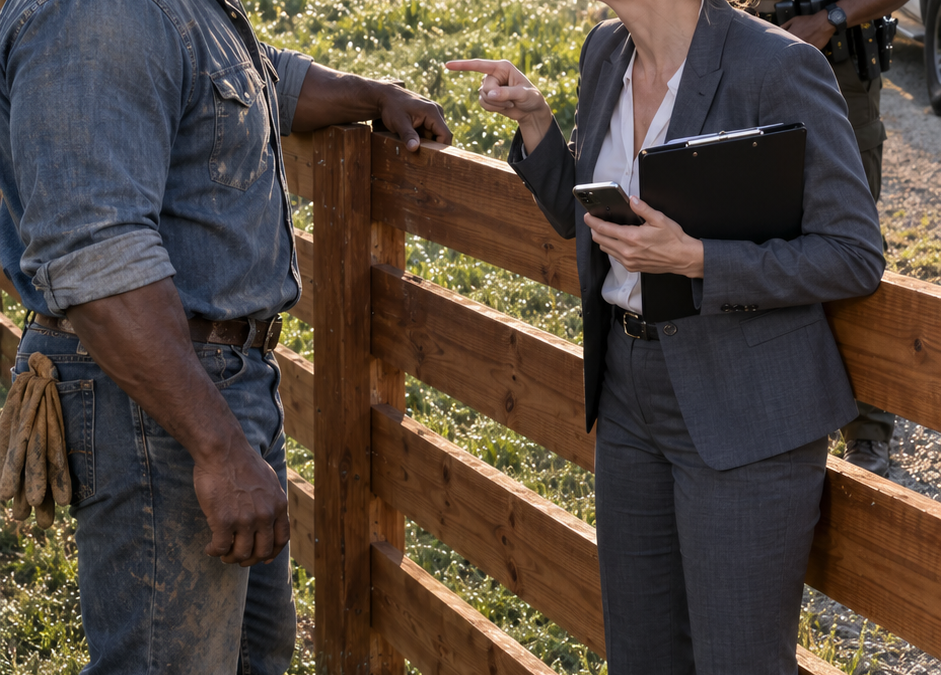
Diane nevertheless stood at my fence with a clipboard in one hand and her phone in the other and declared:
“Those horses are a public nuisance and a health hazard.”
I looked past her.
One mare lifted her head.
Then went back to eating.
Diane continued.
“You are in violation of county ordinances and Stonebridge Estates community standards. I am contacting the sheriff’s department and animal control. If you do not remove the horses within forty-eight hours, we will pursue legal action.”
She delivered every word as though she had practiced it.
Maybe she had.
Her white SUV was parked with one wheel on the shoulder of County Road 12.
The engine was running.
Driver’s door open.
She had apparently expected to make a quick official visit, deliver an order, and leave me frightened enough to obey it.
Instead, I rested my arms on the top rail of the fence.
“Which county ordinance?”
Her expression changed slightly.
“What?”
“You said I’m violating county ordinances. Which one?”
“They’re clearly a nuisance.”
“That isn’t an ordinance number.”
“We have received complaints.”
“From whom?”
“Stonebridge residents.”
“How many?”
“That isn’t relevant.”
“It seems relevant.”
She raised the clipboard.
“Mr. Garrett, I’m not here to debate.”
“I’m not debating.”
I pointed toward the ground beneath her hand.
“I’m asking what authority you believe lets Stonebridge Estates regulate this property.”
“Our community standards apply to all properties affecting the visual character and environmental quality of the development.”
“Recorded where?”
She stared at me.
“In our governing documents.”
“Recorded against my deed?”
Silence.
I waited.
Diane had visited twice before.
The first time she told me my fence was an eyesore.
The second time she brought an HOA compliance officer with a camera and tape measure.
They photographed my gate.
Measured my gravel turnaround.
Took pictures of the barn from the county road.
Then, four days later, I received a certified violation letter claiming my property had fourteen days to comply with Stonebridge rules or I would face fines of one hundred dollars per day.
The letter cited Section 4.7 of their community guidelines.
I had read Section 4.7.
It regulated approved exterior paint colors for houses inside Stonebridge.
My barn was cedar.
Unpainted.
And more than two hundred yards from the nearest Stonebridge lot.
I already knew Diane was bluffing.
What interested me was how far she intended to take it.
“I’m calling the sheriff,” she said again.
“All right.”
That answer confused her.
“You understand what I’m saying?”
“Yes.”
“And you’re refusing?”
“I’m saying you can call whoever you believe you need to call.”
Her mouth tightened.
“You’re making this more difficult than it needs to be.”
“No.”
I looked toward my horses.
“I’m trying to make it precise.”
She climbed into the SUV and slammed the door.
Gravel snapped beneath the tires as she pulled away.
I watched until she disappeared around the bend.
Then I turned toward the house.
What Diane did not know was that Tom Briggs, the county sheriff she planned to use against me, was my son-in-law.
He had married my daughter eight years earlier.
Two nights before Diane’s visit, he had been sitting at my kitchen table eating Elizabeth’s pot roast and complaining that our daughter put too many pillows on their bed.
Tom had been sheriff for six years.
Before that, he had spent nine years as a deputy.
He grew up in the county.
He knew these roads.
He knew my land.
He knew exactly where my property lines ran because he had hunted deer here, repaired fence with me, and helped my daughter move into the house at the top of the rise when they were first married.
But more importantly, Tom respected the law enough that being family would not help me if I were wrong.
That mattered.
Because I did not want a sheriff who would protect me because he married my daughter.
I wanted a sheriff who would look at the facts and say what the law required.
I went into the house.
Elizabeth was in the kitchen.
“She came again?” she asked.
“Yes.”
“The HOA woman?”
“Yes.”
“What now?”
“She says the horses are a public-health emergency.”
Elizabeth looked out the window.
One of the mares was standing almost motionless near the tank.
“That emergency appears to be eating clover.”
“She’s calling Tom.”
That got her attention.
“My Tom?”
“How many sheriffs named Tom do you think we have?”
Elizabeth smiled despite herself.
“Does she know?”
“No.”
“Are you going to tell her?”
“No.”
“Why?”
“Because it doesn’t matter.”
Elizabeth studied me for a moment.
Then nodded.
She understood.
The land had been in my family since 1959.
My grandfather, Solomon Garrett, bought the original 160 acres with money earned working nights at the rail yard and weekends driving tractors for other farmers.
He was not a man with capital.
He was a man who saved.
He cleared timber himself.
Pulled stumps with mules.
Dug drainage.
Built the first fences with his father and two brothers over one long summer.
The cedar posts along the eastern pasture came from trees cut on the property.
Some were still standing.
You could see Solomon’s chisel marks where he shaped the old mortises by hand.
My father inherited Garrett Meadows in 1974.
He improved the irrigation.
Added drainage along the eastern edge.
Replaced failing fence.
Kept cattle.
Then I inherited the property in 1998, the same year I married Elizabeth.
We built our house on the rise overlooking the creek.
The deed went into a fireproof lockbox in my office.
Beside it were the original survey.
Water-right documents.
Tax records.
And every easement I had signed.
I knew exactly what I owned.
That was not pride.
It was maintenance.
Property is not just acreage.
It is boundaries.
Access rights.
Recorded instruments.
Obligations.
Restrictions.
You either know them or eventually somebody else tells you what they think they are.
Stonebridge Estates was built much later.
Five years earlier, a developer had bought the old Callaway farm roughly two miles south.
One hundred fourteen homes.
Swimming pool.
Tennis courts.
Clubhouse built to look like a barn despite the fact that no cow had ever stood inside it.
Seven-member HOA board.
Diane Pritchard was president.
She apparently took the title with great seriousness.
When she first came to my property, she told me my horses hurt Stonebridge property values.
I had looked toward the nearest Stonebridge rooftops, which were barely visible through trees.
“I’m impressed their eyes are that good.”
She had not appreciated the remark.
After the second visit, I stopped treating the situation as mildly irritating.
I called the county clerk.
Marjorie had worked there thirty years.
Her family knew mine.
When I told her what I needed, she said:
“Give me until morning.”
The next day I picked up certified copies of every relevant document.
My deed.
Stonebridge’s recorded plat.
Its covenants.
Road easements.
Drainage documents.
No document connected Stonebridge to my property.
None.
Then I noticed something else.
Along County Road 12 was a thirty-foot access corridor I had granted to the county in 1987.
The easement existed for public road maintenance and utility access.
Stonebridge had been using part of that corridor as a secondary route to its community center.
For years, I had paid no attention.
The traffic was minimal.
Nobody had caused trouble.
So I had let it be.
But the easement did not transfer ownership.
It certainly did not give Stonebridge control.
And when Diane parked there and behaved as though it belonged to her HOA, she was standing on a legal arrangement I understood better than she did.
After her third visit, I made coffee.
Then I called Tom.
He answered on the second ring.
“Hey, Daniel.”
“Morning.”
“What did I break?”
“Nothing yet.”
“That’s encouraging.”
“Did you get a complaint this morning about horses?”
Silence.
Then:
“County Road 12?”
“Yes.”
He exhaled.
“That’s you?”
“I was afraid so.”
Tom explained that Diane had already called dispatch.
Livestock noise.
Unsanitary conditions.
Public-health concern.
She had requested a sheriff’s response and animal-control involvement.
“I told dispatch to log it,” Tom said. “I hadn’t looked closely at the address yet.”
“What happens now?”
“I’m required to follow up.”
“Good.”
“You want me personally to do it?”
“If that’s normal.”
“It isn’t necessarily normal. But because I know you, I’d rather document everything cleanly. No one can say later we ignored the complaint.”
“That’s what I want.”
“I’ll come tomorrow.”
He paused.
“Daniel?”
“Yes?”
“You want me to explain to this woman that I’m married to your daughter?”
“No.”
I heard him laugh.
“Why not?”
“Because I don’t want her thinking family is the reason she’s wrong.”
Tom became quiet.
Then said:
“That’s probably the right answer.”
The following morning, I drove to the county surveyor’s office.
Carl Hendricks had surveyed Garrett Meadows twice before.
Once when my father expanded irrigation.
Once when Elizabeth and I built the house.
Carl knew the monuments.
He told me he could run the boundary again in three days.
I paid him.
Then I went to the county attorney’s office and reviewed the 1987 road easement.
It was clearer than I remembered.
Thirty-foot corridor.
County maintenance.
Utility access.
Limited public purposes.
And one clause I had forgotten:
Private organizational or commercial use required written consent of the landowner.
Stonebridge had no such consent.
I made copies.
Three days later, Carl handed me the survey.
It was precise.
Diane’s “eyesore” fence stood twenty-two feet inside my property line.
The gravel turnaround stood forty feet inside.
The county access corridor remained exactly as documented.
And Stonebridge’s use of it as a private secondary entrance exceeded the purpose stated in the easement.
That afternoon, Tom drove out.
Alone.
Personal truck.
Not patrol vehicle.
No drama.
He walked the fence.
Checked the horses.
Looked at the stock tank.
Stepped inside the barn.
Took photographs.
Made notes.
One mare walked over and tried to chew his shirt sleeve.
Tom pushed her nose away.
“She looks vicious.”
“Terrifying.”
“Any complaints from neighbors besides Stonebridge?”
“None.”
“Any loose horses?”
“No.”
“Noise?”
“They occasionally make horse noises.”
“I’ll put that in the report.”
He stood near the fence where Diane had delivered her ultimatum.
“There’s no violation.”
“None?”
“No health issue. No sanitation issue. No noise issue. Animals are contained. Water is clean. Pasture’s maintained.”
“Animal control?”
“No reason.”
“And Diane?”
“I’ll send the report.”
He paused.
Then:
“She’s not going to like it.”
“I didn’t build the place for her.”
Tom smiled.
Then became serious again.
“You know she may keep pushing.”
“I know.”
“What are you going to do?”
“Make the boundary clear.”
“You need help?”
“Not from law enforcement.”
“That wasn’t what I meant.”
“I know.”
That evening I drafted a letter.
Short.
Clear.
I identified myself as sole legal owner of Garrett Meadows.
Attached Carl’s survey.
Attached the 1987 easement.
Attached title records.
Stated that no portion of my property fell within Stonebridge Estates.
Stated that the HOA possessed no authority to impose covenants, fines, livestock restrictions, aesthetic standards, or any other private regulations on my land.
Then I addressed the access corridor.
Stonebridge’s use of the county easement as private organizational access was unauthorized.
Any continued use would be referred to the county.
I ended with one sentence:
Any further assertion of HOA enforcement authority over this property will be referred to legal counsel.
Diane signed for the certified letter two days later.
Eight days passed.
Nothing.
On day nine, a new letter arrived.
Heavy cream paper.
Embossed law-firm name.
Mitchell Carver.
Counsel for Stonebridge Estates Homeowners Association.
Three pages.
Professional.
Polished.
Wrong.
Carver accused me of maintaining conditions harmful to neighboring property values.
He cited three county ordinances.
He threatened injunctive relief.
He demanded written compliance within ten business days.
The last line said failure to respond would be treated as an admission of liability.
I read that twice.
Then Elizabeth came into the kitchen.
“They hired someone?”
“Yes.”
“Are the ordinances real?”
“I’m about to find out.”
They were real.
They just did not apply.
One regulated high-density commercial livestock operations.
I had three horses.
The second dealt with industrial machinery noise.
The third concerned health conditions associated with animal waste in dense residential zones.
Garrett Meadows was agricultural land.
The letter looked authoritative because it used real ordinance numbers in the wrong context.
That is a particular kind of bluff.
It counts on the reader stopping at the citation instead of reading the law.
I called Raymond Hail.
Raymond had practiced property law for forty years.
He had handled my father’s estate.
He had reviewed my 1987 easement.
His office occupied the second floor above a hardware store in town.
Old wood floors.
Tin ceiling.
No reception area designed to impress anyone.
I trusted him because he had never told me a comfortable lie.
I brought everything.
He read for almost an hour.
When he finished:
“They don’t have a case.”
“Not even nuisance?”
“No.”
“County ordinances?”
“Wrong categories.”
“HOA standards?”
“Your deed isn’t subject to them.”
“Visual impact?”
“No view easement. No scenic restriction. No recorded covenant.”
“Police?”
“The sheriff already inspected and found nothing.”
Raymond tapped Carver’s letter.
“This is pressure, not authority.”
“What do you recommend?”
“I can answer.”
“Will that end it?”
“Maybe.”
“And if it doesn’t?”
“Then they file.”
“What happens if they file?”
“They lose more expensively.”
I leaned back.
“What about the easement?”
Raymond’s eyes changed.
“That may be more interesting than the horses.”
He read the 1987 document again.
“They’ve been using this entrance how long?”
“About five years.”
“Consent?”
“Never.”
“Any written permission?”
“No.”
He nodded.
“I’m including it.”
His response was four pages.
He dismantled Carver’s ordinance citations one by one.
Confirmed agricultural zoning.
Referenced Tom’s inspection report.
Explained why Stonebridge’s CC&Rs had no application outside its recorded plat.
Then he addressed the access easement.
Continued unauthorized private HOA use would be reported to the county attorney.
Finally:
Any further action based upon these unsupported claims will be met with appropriate motions for sanctions and recovery of attorney fees and costs.
Carver signed for it six days later.
Two weeks passed.
Then the phone rang.
Linda Yates.
Vice president of Stonebridge’s board.
Her voice was controlled.
Careful.
She told me there had been “confusion.”
Apparently the board had reviewed the property records.
Apparently certain assumptions had been made.
Apparently Diane Pritchard was no longer board president.
That part interested me.
Linda said enforcement was suspended.
“We hope we can move forward cooperatively.”
“I appreciate the call.”
“I’m glad.”
“I need that in writing.”
Silence.
“In writing?”
“On Stonebridge letterhead. Signed by the board. Withdrawal of all claims against Garrett Meadows. Acknowledgment that my property is not subject to HOA jurisdiction.”
“That may require a board vote.”
“Then vote.”
Three days later the letter arrived.
Five signatures.
Stonebridge withdrew all violation claims.
Acknowledged Garrett Meadows lay outside its jurisdiction.
Agreed no further HOA enforcement would be pursued.
I copied it.
One to Raymond.
One to Tom.
Original into the lockbox.
Then the county road supervisor called.
Ed Milhouse.
He had reviewed the easement.
Stonebridge’s secondary entrance was unauthorized.
“Do you want us to enforce the terms?”
“Yes.”
Two weeks later the county installed a metal gate.
Simple.
Green.
County lock.
Stonebridge lost the shortcut.
For six months, I thought the matter was over.
Diane disappeared from the board.
Her house later went up for sale.
The white SUV never returned.
The horses grazed.
The mail got boring again.
That should have been the ending.
It was not.
Late the following April, a man named Derek Moss called me.
New Stonebridge president.
New board.
Same problem.
“We’ve received complaints concerning livestock odor, machinery noise, and visual impacts from agricultural structures.”
“Those were resolved.”
“We’re taking a fresh look at enforcement priorities.”
“There is no enforcement authority.”
“We believe there may be.”
“You have a signed board letter saying otherwise.”
“That decision was made by a prior board.”
“Property law doesn’t reset at elections.”
He ignored that.
“We’d like to meet.”
“No.”
“Mr. Garrett, we’re trying to be reasonable.”
“So am I.”
“If you refuse cooperation, formal action may be necessary.”
“Send it in writing.”
Four days later, they did.
New lawyer.
Jennifer Callaway.
Different firm.
Different stationery.
Same weakness.
Thirty-day demand.
Relocate the horses.
Screen agricultural buildings.
Restrict machinery to weekday daylight hours.
Two ordinance citations.
One applied only to livestock operations exceeding fifty animals.
The other regulated industrial machinery.
I called Raymond Hail.
“They’re back.”
He sighed.
“Same theory?”
“New wording.”
“Same land?”
“Yes.”
“Then yes. Same theory.”
I asked him a different question.
“How do we make this permanent?”
There was silence.
Then:
“Declaratory judgment.”
He explained.
Instead of answering each new board every few years, we could ask a court to declare the rights of the parties conclusively.
Garrett Meadows was not subject to Stonebridge covenants.
Agricultural use was lawful.
Stonebridge had no enforcement jurisdiction.
Future attempts based on the same theory could then be barred.
“It costs more,” Raymond said.
“How much?”
He told me.
It was not small.
“How long?”
“Four to six months if it’s straightforward.”
“And if they fight?”
“Longer.”
I looked toward the eastern pasture.
Solomon’s fence.
My father’s irrigation line.
The barn.
Three horses grazing where cattle had grazed sixty years earlier.
“What would you do?”
Raymond hesitated.
“I’m your lawyer.”
“I know.”
“You want advice or philosophy?”
“Both.”
“Advice: you can answer this letter and probably win again.”
“And philosophy?”
“If you’re tired of proving the same thing to every new board president, get a judge to write it down once.”
That decided it.
“File.”
Garrett v. Stonebridge Estates Homeowners Association, Inc.
County District Court.
The complaint attached everything.
Deed.
Survey.
Stonebridge plat.
Zoning records.
Sheriff’s inspection.
Prior board withdrawal.
Easement documents.
Correspondence.
We requested declaratory relief.
Permanent injunction.
Attorney fees.
Stonebridge answered.
They denied lack of jurisdiction.
Claimed my agricultural use damaged nearby property.
Argued the previous withdrawal had been made without sufficient information.
Raymond filed for summary judgment.
There were no disputed material facts, he argued.
The documents answered the case.
Stonebridge opposed.
They claimed questions existed regarding community impacts and the meaning of their governing documents.
The hearing was scheduled for September.
The courthouse was the same building where my father’s will had been filed.
Same place my deed had been recorded.
Same place I signed the 1987 easement.
Wood-paneled courtroom.
High windows.
Morning light cutting across worn benches.
Elizabeth came with me.
Tom did not.
That was intentional.
He had already submitted the sheriff’s report.
He was not part of my civil case except as the official who inspected the complaint.
Derek Moss sat beside Jennifer Callaway at the other table.
No Diane.
No white SUV.
No clipboard.
Judge Elena Ruiz entered.
She had been on the bench twelve years.
Raymond had warned me she disliked wasted time.
He was right.
Jennifer argued first.
Stonebridge’s guidelines, she said, defined an area of concern beyond its immediate lots.
The board had obligations to protect residents.
Property values were affected by nearby agricultural activity.
Judge Ruiz interrupted.
“Where is that geographic area recorded?”
Jennifer referred to the community guidelines.
“Recorded where?”
“They were adopted by the association.”
“That wasn’t my question.”
Silence.
“Are they recorded against Mr. Garrett’s deed?”
“No, Your Honor.”
“Is his property within the Stonebridge plat?”
“No.”
“Has he signed an annexation agreement?”
“No.”
“Any recorded covenant?”
“No.”
“Any easement granting Stonebridge regulatory authority?”
“No.”
Judge Ruiz looked over her glasses.
“Then explain the source of jurisdiction.”
Jennifer shifted to inherent association interests.
Community impacts.
Nuisance law.
Property values.
Judge Ruiz listened for less than two minutes.
Then said:
“Counsel, those may describe concerns. They do not establish jurisdiction.”
Raymond stood.
He placed the Stonebridge plat before the court.
Then my deed.
Then Carl’s survey.
Then county zoning.
The presentation took less than fifteen minutes.
“Mr. Garrett’s parcel has never been part of Stonebridge Estates,” he said.
“No declaration touches it.”
“No annexation occurred.”
“No restrictions were accepted.”
“The land is agricultural.”
“The county investigated the livestock complaint and found no violation.”
“The association previously acknowledged in writing that it lacked authority, withdrew all claims, then reasserted materially identical claims after board leadership changed.”
He looked toward Judge Ruiz.
“A private board’s membership may change. Recorded title does not.”
That sentence stayed with me.
Judge Ruiz asked Jennifer one final question.
“Do you have any recorded instrument establishing Stonebridge authority over this parcel?”
“No, Your Honor.”
“Then the legal issue appears resolved.”
She granted summary judgment.
Right there.
No trial.
No months of testimony.
No experts debating whether someone in Stonebridge disliked the view of my barn.
The written order came twelve days later.
Four pages.
Single-spaced.
Signed.
Filed.
Garrett Meadows was declared outside Stonebridge HOA jurisdiction.
My agricultural use was lawful.
The association was permanently barred from imposing HOA rules, fines, architectural requirements, livestock restrictions, or aesthetic standards on my land.
Attorney fees: $4,200.
Court costs: $385.
Stonebridge paid within two weeks.
That was the permanent ending I had wanted.
Afterward, Tom came for Sunday dinner.
We ate on the back porch.
The horses were visible beyond the lower pasture.
Elizabeth carried out dessert.
Tom looked toward them.
“You know the funny version of this story is going to survive longer than the court case.”
“What funny version?”
“That the HOA lady called the sheriff on your horses and discovered the sheriff was family.”
“That isn’t why she lost.”
“I know.”
“But people will tell it that way.”
“Yes.”
I took a drink of coffee.
“What would you have done if I had actually been violating an ordinance?”
Tom looked at me like the question insulted him.
“Written you up.”
Elizabeth pointed at him.
“You would not.”
“Yes, ma’am.”
“You married my daughter.”
“That doesn’t repeal county law.”
She shook her head.
“You Briggs men are impossible.”
“He isn’t a Briggs man to you,” I reminded her.
“I know what I said.”
Tom smiled.
Then turned serious.
“You handled it right.”
“How?”
“You didn’t use me.”
“I used your inspection report.”
“You know what I mean.”
I did.
It would have been easy to tell Diane, during that first confrontation, that she should be careful because the sheriff was married to my daughter.
It might even have frightened her into leaving.
But then the dispute would have been about influence.
Who knew whom.
Who carried more local weight.
That was never the issue.
The issue was whether Stonebridge possessed authority.
It did not.
Tom’s family relationship changed nothing.
The survey did not care who he married.
The deed did not care.
The court did not care.
That was exactly why the outcome mattered.
The following spring, I walked the eastern fence.
Several rails needed replacing.
The old cedar posts remained solid.
Solomon had cut them in 1962.
More than sixty years later, you could still see tool marks in the wood.
I ran one hand along the grain.
Behind me, one mare moved toward the stock tank.
Another rolled in the grass.
A third stood under the shade tree near the barn.
Nothing about them looked like a legal controversy.
They were horses.
That was all they had ever been.
Stonebridge had turned them into a dispute because Diane Pritchard saw something outside her control and assumed proximity gave her a right to control it.
That assumption survived one board president.
Then another.
Different letters.
Different lawyers.
Different wording.
Same fundamental error.
The HOA believed concern created authority.
It does not.
A homeowner may dislike what sits beyond his subdivision.
An association may worry about views.
A board may discuss property values.
Those concerns may be real.
But legal authority has to come from somewhere.
A deed.
Covenant.
Easement.
Statute.
Recorded agreement.
Something more durable than preference.
My grandfather understood that in 1959.
He saved for years.
Bought the land.
Had it surveyed.
Recorded the deed.
My father understood it when he installed irrigation.
He documented rights.
Recorded easements.
Preserved boundaries.
I understood it when the county needed access in 1987.
I granted exactly what was necessary and no more.
Thirty feet.
Specific use.
Specific rights.
Written down.
Signed.
Recorded.
That is how authority should work.
Defined.
Limited.
Traceable.
Diane operated the other way.
She started with the result she wanted.
Horses gone.
Fence changed.
Farm screened.
Then she searched for something that might justify the result.
When the community standards failed, she invoked county ordinances.
When those failed, she called law enforcement.
When law enforcement found nothing, the HOA hired a lawyer.
When that lawyer failed, the board withdrew.
When leadership changed, the next president tried again.
That was when I finally understood that answering letters was not enough.
The record had to become impossible to reinterpret.
So we asked the court.
And Judge Ruiz put into four pages what the deed had said for decades.
Stonebridge stopped at Stonebridge.
Garrett Meadows belonged to Garrett Meadows.
Some months later, Derek Moss apparently stepped down as board president.
I heard it from a neighbor.
I never asked why.
It no longer mattered.
A third president could come.
A tenth.
A fiftieth.
The judgment would still be in the county record.
That was the point.
The county gate remained across the unauthorized Stonebridge shortcut.
People sometimes asked whether I felt guilty about that.
I did not.
Stonebridge had enjoyed access for years because I had never objected.
Then its board tried to use proximity and convenience as evidence that it controlled my land.
Once that happened, informal tolerance became dangerous.
Access rights need clarity too.
The county easement existed for specific purposes.
Stonebridge’s private community-center traffic was not one of them.
So the gate stayed.
One afternoon, Elizabeth and I walked down County Road 12.
She stopped beside it.
“You know, before Diane showed up, nobody cared about this entrance.”
“I didn’t.”
“Do you think she realizes she got her own community’s shortcut closed?”
“I doubt she thinks of it that way.”
Elizabeth smiled.
“Would you ever let them use it again?”
“Maybe.”
“Really?”
“With a proper agreement.”
“Written?”
“Obviously.”
“Recorded?”
“Absolutely.”
She laughed.
“You’ve become predictable.”
“No.”
I looked toward the gate.
“I’ve become documented.”
Years earlier, my grandfather once told my father something I did not fully understand as a boy.
“Land remembers what people forget.”
I used to think he meant physical things.
Old fence lines.
Ruts.
Drainage ditches.
Tree rows where fields used to meet.
Now I think he meant records too.
People forget agreements.
Companies reorganize.
Boards change.
Neighbors move.
Someone new arrives and assumes things were always arranged the way they appear today.
Then an old survey emerges.
An easement is read.
A deed is pulled.
The land’s history returns.
That was what happened at Garrett Meadows.
Diane saw a fence beside a road.
She assumed the fence was the boundary.
It was not.
She saw a road corridor Stonebridge used.
She assumed the HOA possessed access rights.
It did not.
She saw agricultural land visible from a residential development.
She assumed the HOA could regulate it.
It could not.
She saw three horses.
She assumed law enforcement would remove them because she labeled them a nuisance.
The sheriff investigated.
They were lawful.
And yes, the sheriff happened to be my son-in-law.
That made for a good story around town.
But it was never the important part.
One evening, several months after the final judgment, Tom and my daughter came for dinner again.
The sun was dropping behind the pasture.
After we ate, Tom and I walked toward the stock tank.
One mare approached him.
He rubbed her forehead.
“This the criminal?”
“That’s her.”
“Looks unrepentant.”
“She has refused to comply.”
“Should I arrest her?”
“You’d need probable cause.”
“I have witnesses.”
“To what?”
“Excessive grazing.”
“Dismissed.”
Tom laughed.
Then he looked toward Stonebridge.
“You ever think about selling?”
“No.”
“Never?”
I looked across the pasture.
The irrigation line my father installed.
Fence posts Solomon set.
House Elizabeth and I built.
Creek.
Barn.
Horses.
“Not while I can still maintain it.”
Tom nodded.
“Your daughter will probably keep it.”
“She better.”
“She will.”
“How do you know?”
“She married a county sheriff. Clearly she values bad decisions.”
I laughed.
Then we stood quietly.
Light moved across the native grass.
The mares grazed.
The same kind of evening my grandfather had watched decades earlier.
Four generations had worked that ground.
None of us had been perfect.
But we had done one thing consistently.
We knew what belonged to us.
We documented it.
We preserved it.
That is why the fight with Stonebridge never felt like a battle over horses.
The horses were merely what Diane could see.
The real question was whether ownership could be diluted by somebody else’s confidence.
Whether a board could vote itself power over land whose owner never agreed.
Whether a lawyer could create jurisdiction through embossed stationery.
Whether repetition could eventually turn an unsupported claim into a right.
It could not.
Not on my land.
The court order now sits in the fireproof lockbox.
Beside the deed.
Beside the survey.
Beside the 1987 easement.
I keep a digital copy too.
Elizabeth insisted.
Every once in a while, I open that box when I need another document and see Judge Ruiz’s order lying there.
I do not think about Diane.
I think about Solomon.
Night shifts.
Rail yard.
Tractor work on weekends.
Saving enough money to buy a farm.
Driving cedar posts into Tennessee soil because he believed his children would still need a boundary after he was gone.
He was right.
The fence still stands.
Some rails are newer.
The posts age.
Grass grows around them.
But the legal line underneath all of it has never changed.
Neither has the principle.
When someone claims authority over your property, ask where that authority comes from.
Not how important they sound.
Not how many people voted.
Not what their title is.
Not whether their attorney uses heavy cream paper.
Ask for the legal foundation.
Show me the deed.
Show me the covenant.
Show me the easement.
Show me the ordinance.
Show me the recorded instrument.
If it exists, respect it.
If it does not, confidence cannot create it.
Diane Pritchard stood at my fence and believed calling the sheriff would end the argument.
In a way, it helped.
The sheriff investigated and found no violation.
But the real ending came much later, in a quiet courtroom, when Judge Elena Ruiz asked Stonebridge’s lawyer one simple question:
“What recorded instrument gives your association authority over this parcel?”
There was none.
That answer had been true before Diane arrived.
It was true when she called the police.
It was true when the first lawyer threatened me.
It was true when the next board tried again.
And it remained true after the judge signed the order that made sure no future Stonebridge president could pretend otherwise.
The fence still stands.
The horses still graze.
Garrett Meadows is still 160 acres.
And the line between my property and Stonebridge Estates remains exactly where it has always been—not where an HOA president wanted it to be, but where the deed, the survey, and the law say it is.








