𝗣𝗔𝗥𝗧 𝟮 HOA Karen Called Police on My Goats—Then the Chief Looked at Her and Said, “That’s My Nephew’s Land”
𝗣𝗔𝗥𝗧 𝟮
The deed transferring the full property to me was recorded in 2004 under instrument number 2004-CR-0881.
Clear title.
No HOA declaration.
No residential covenants.
No restrictions prohibiting livestock.
The property had been agricultural for generations.
That had never changed.
The goats came much later.
My daughter was twelve when she decided she wanted Nubians.
Not horses.
Not a puppy.
Goats.
She had spent a summer helping at a farm outside Kerrville and came home talking about milk fat, breeding lines, hoof trimming, and the personalities of individual animals as if she had joined a secret society.
I told her goats were work.
She said she knew.
I told her fences that would hold cattle would not necessarily hold goats.
She said she knew that too.
So we built the pen together.
Treated posts.
Welded wire.
Concrete corners.
A proper shelter with ventilation.
A separate feeding area.
Drainage graded away from the bedding.
The pen stood roughly sixty yards inside my eastern property line.
Not sixty yards from Ridgecrest’s houses.
Sixty yards inside my own boundary.
The goats were healthy.
The enclosure was clean.
The land was zoned agricultural.
County regulations explicitly allowed livestock on qualifying acreage.
I owned 212 acres.
Whatever problem Diane had, it was not a livestock-law problem.
It was an HOA problem.
More accurately, it was an HOA boundary problem.
Ridgecrest Estates had been built beginning in 2009.
Hargrove Properties purchased about sixty acres east of me and developed 214 houses around curving roads, a clubhouse, swimming pool, ornamental ponds, and enough landscaping rules to make a cedar tree nervous.
The HOA incorporated in 2010.
Its declaration of covenants ran forty-seven pages.
I knew because I eventually downloaded and read the whole thing.
Its geographic definition was clear.
The association governed the lots and common areas shown on the Ridgecrest Estates recorded plat.
My land was not on that plat.
Never had been.
Never could have been confused with it by anyone who looked at the county record for more than ten minutes.
My eastern fence did not even sit on the legal boundary.
My grandfather and father had deliberately placed sections of fencing inside the property because the old county road right-of-way made maintenance easier that way.
In some places, the fence was more than twenty feet inside.
The Ridgecrest parcel lay on the other side of the road corridor.
Diane’s theory apparently was that because Ridgecrest residents could see my goats, Ridgecrest could regulate them.
That was not property law.
That was wishful thinking wearing a blazer.
The first certified letter arrived the following Tuesday.
I opened it at the same kitchen table where my grandfather once counted installment receipts.
Three alleged violations.
Unauthorized livestock.
Failure to maintain compatible aesthetic conditions.
Creation of a nuisance affecting neighboring residential properties.
Fine: $400.
Due in fourteen days.
I looked for legal authority.
No county ordinance.
No deed restriction.
No easement.
No recorded covenant touching my parcel.
Nothing.
I read it again.
Then I got a folder from the filing cabinet.
On the tab I wrote:
RIDGECREST ESTATES HOA — 2024.
I put Diane’s letter inside.
That habit came from my father.
He believed confusion was expensive.
“If something matters enough to argue about,” he used to tell me, “it matters enough to file correctly.”
Then I called Gerald Pruitt.
Gerald owned the farm north of mine.
Seventy-one.
Forty years on the same ground.
He possessed that particular rural talent for knowing everyone’s business while rarely appearing interested in anyone’s business.
When I told him about Diane’s letter, he was silent for several seconds.
Then he said, “She’s been talking about your goats since Christmas.”
“Where?”
“Board meetings.”
“You attend Ridgecrest board meetings now?”
“My wife reads their Facebook page.”
“That sounds dangerous.”
“It is.”
He told me Diane had posted a photograph of my eastern fence.
The caption called it an “eyesore” and promised residents the board was working toward a resolution before summer.
“Do you still have the post?”
“Printed it.”
I should have known.
Gerald still kept paper copies of online receipts.
“Why?”
“Figured you might need it.”
“You figured correctly.”
Three weeks later, the second certified letter arrived.
The fine had doubled to $800.
They added another violation.
Failure to respond to official HOA correspondence.
That was impressive.
Apparently ignoring a demand from an organization with no authority had become a separate offense under that same nonexistent authority.
Then I reached the paragraph that mattered.
Ridgecrest Estates HOA reserves the right to enforce community standards on all properties within or adjacent to the Ridgecrest Estates planned community, including properties whose owners have not formally acknowledged HOA jurisdiction.
I read it once.
Then twice.
Then twice more.
Adjacent.
The entire claim rested on one word.
I sat at the table for several minutes thinking about what Diane was actually asserting.
If her theory were correct, any private association could regulate land simply because it was nearby.
A golf-course HOA could regulate the farm next door.
A subdivision could fine a church across the road.
One neighborhood could control landscaping on property that had never joined it.
Ownership would become geographic contagion.
Move near an HOA and eventually its rules infected you.
I picked up the phone.
Patricia Wren answered after two rings.
I had met her years earlier during an agricultural zoning matter.
She had impressed me because she never wasted a question.
I described the letters.
She asked three things.
“What is your acreage?”
“Two hundred twelve.”
“Current zoning?”
“Agricultural.”
“Is your deed subject to any Ridgecrest declaration?”
“No.”
“Bring me the deed anyway.”
We met Thursday.
Patricia read both letters.
Slowly.
Mechanical pencil in hand.
She underlined adjacent.
Then she reviewed my deed.
Then the Ridgecrest declaration I had downloaded from the county portal.
Finally she unfolded the plat.
“Here,” she said.
Her pencil touched the Ridgecrest boundary.
Then she moved it west.
“And here is your parcel.”
“Yes.”
“Separate tract.”
“Yes.”
“County road corridor in between.”
“Yes.”
She removed her glasses.
“Their jurisdiction ends at their plat boundary.”
“I know.”
“I’m stating it because I want us both using the same language from this point forward.”
“All right.”
“Your property has never been annexed?”
“No.”
“You signed nothing?”
“No.”
“Your father?”
“No.”
“Grandfather?”
“Ridgecrest didn’t exist.”
Patricia nodded.
“Good.”
Then she tapped Diane’s letter.
“This has no legal effect on your property.”
She turned her legal pad toward herself and wrote one word.
TRESPASS.
I noticed it.
She noticed me noticing it.
“Not yet,” she said.
“Meaning?”
“Meaning we document before we accuse.”
I liked her more immediately.
Patricia gave me four tasks.
Current survey.
Certified deed chain back to 1947.
Certified Ridgecrest plat.
Witness statement from anyone with direct knowledge of the historic fence line.
“Build the record,” she said.
So I did.
Dale Hutchins handled the survey.
His father had surveyed half the county before him.
Dale arrived while fog still covered the creek and spent two days walking my property.
I joined him along the eastern side.
He found old monuments.
Checked bearings.
Shot lines.
Verified corners.
At one point, he stopped beside a cedar fence post.
“This your fence?”
“My grandfather’s originally.”
He checked his equipment again.
“Boundary’s fourteen feet east.”
“So the fence is fourteen feet inside my land.”
“At this point.”
Farther south, the distance increased.
Twenty-two feet.
Twenty-seven.
Thirty-one.
Not one section of fence crossed the property line.
More importantly, Ridgecrest’s recorded plat did not cross the county road corridor.
Dale filed the survey.
I obtained a certified copy.
Into the folder.
Next came the deed chain.
I spent two afternoons at the courthouse with Loretta from the register’s office.
She had worked there almost thirty years.
She found instruments faster than I could write reference numbers.
Amos’s 1947 deed.
My father’s later acquisitions.
Transfers after deaths.
My 2004 deed.
Every link.
Recorded.
Witnessed.
Continuous.
Loretta placed the final certified copy on the counter.
“That’s clean.”
“No restrictions?”
“None I can see beyond recorded utility matters.”
“No HOA?”
She gave me a look.
“Your grandfather bought that before anybody around here knew what HOA stood for.”
Fair enough.
Next came the certified Ridgecrest plat.
Its boundary was exactly where Patricia said.
Separate from mine.
Then Gerald arrived at my house carrying a manila envelope.
Inside was a notarized statement describing four decades of familiarity with my fence line and the neighboring land.
He also included the printed social media post.
Diane’s photograph.
My fence.
Her words:
Working to resolve this eyesore for our community.
Gerald had written the date on the back.
“You notarized all this?”
“Yes.”
“Why?”
He shrugged.
“Paper beats memory.”
My grandfather would have liked him.
Patricia reviewed the completed file the following week.
She was quiet for almost half an hour.
Then she leaned back.
“They have nothing.”
“Nothing?”
“No colorable property claim. No covenant. No easement. No annexation. No agreement. Their declaration expressly limits authority to Ridgecrest’s recorded plat.”
“And livestock?”
“County agricultural zoning permits it.”
“Animal nuisance?”
“Any documented nuisance?”
“No.”
“Animal-control citations?”
“None.”
“Health violations?”
“None.”
“Then they have a preference.”
She tapped the folder.
“You have property rights.”
Patricia drafted the response.
It was four pages.
No insults.
No threats beyond those legally necessary.
It identified my parcel.
Instrument 2004-CR-0881.
Survey.
Deed chain.
Zoning classification.
Ridgecrest plat.
Then it stated plainly that the HOA possessed no legal authority over my property.
All fines were rejected.
All violation notices disputed.
Any unauthorized entry onto my land would be treated as trespass.
Any attempt to interfere with lawful agricultural activity would be met through appropriate legal process.
The letter was sent certified to Diane and Ridgecrest’s registered agent.
Nine days later the return receipt came back.
Signed.
For almost two weeks, nothing happened.
Then Diane called the police.
It was a Thursday morning.
I was replacing bedding in the goat shelter when two patrol vehicles turned onto my drive.
Behind them came Diane’s white SUV.
I straightened slowly.
One officer stepped out.
Then another.
Diane got out immediately and walked toward them as if she had been waiting to direct traffic.
I recognized the older officer.
Sergeant Luis Ortega.
We were not friends, but we knew each other.
Small counties work that way.
He approached the fence.
“Morning, Ellis.”
“Luis.”
He looked at the goats.
Then at Diane.
Then back at me.
“We got a complaint concerning livestock.”
“I figured.”
Diane stepped closer.
“These animals have been under an active removal order for weeks.”
Ortega looked at her.
“Removal order issued by who?”
“The Ridgecrest Estates HOA.”
He blinked.
“Ma’am, I mean a county or court order.”
“The HOA has issued formal violations.”
“That’s not what I asked.”
I almost felt sorry for her.
Almost.
Diane opened the clipboard.
She had copies of her letters.
“Our community standards prohibit livestock.”
Ortega looked toward the road.
“Is this property inside Ridgecrest?”
“It is adjacent and materially impacts—”
“Is it inside Ridgecrest?”
“No, but—”
Ortega turned toward me.
“Ellis, any animal-control complaints?”
“No.”
“Zoning agricultural?”
“Yes.”
“Any escaped animals today?”
“No.”
“Any animals threatening Ridgecrest residents?”
“No.”
Diane interrupted.
“The smell constitutes a nuisance.”
Ortega inhaled.
The wind was blowing toward us from the creek.
If anything, the strongest odor nearby was wet cedar.
“I don’t smell anything unusual.”
“That isn’t the point.”
“What exactly are you asking us to do?”
“Enforce removal.”
Ortega stared at her.
“We don’t enforce HOA rules.”
Diane’s face colored.
“I was told law enforcement could assist when a property owner refuses compliance.”
“Compliance with what law?”
Before she could answer, a third vehicle came up the drive.
Unmarked.
Dark blue.
I recognized it immediately.
So did Ortega.
He looked at me.
“You call Ray?”
“No.”
Apparently dispatch had.
Diane watched the vehicle stop.
The driver’s door opened.
Chief Raymond Callaway stepped out.
My uncle was sixty-four then.
Gray at the temples.
Tall.
Uniform pressed sharp enough to cut paper.
He walked toward us slowly.
Not smiling.
Ray never smiled when he thought someone had wasted police resources.
“Sergeant.”
“Chief.”
“What’ve we got?”
Ortega nodded toward Diane.
“HOA complaint. Wants livestock removed from Mr. Callaway’s property.”
Ray looked at the goats.
One of them sneezed.
Then he looked at me.
“Morning, Ellis.”
Diane turned sharply.
“You know him?”
Ray looked at her.
“He’s my nephew.”
There it was.
The moment from which the story later got its most entertaining version.
According to Gerald, by the following afternoon half the county believed Diane had summoned the police to seize my goats only to discover every officer involved was related to me.
That was nonsense.
Only Ray was family.
And his next sentence mattered more than the first.
“But that has absolutely nothing to do with what happens here.”
Diane’s relief lasted about half a second.
Ray turned to Ortega.
“Any county violation?”
“None found.”
“Animals loose?”
“No.”
“Cruelty?”
“No.”
“Unsafe enclosure?”
“Looks sound.”
“Zoning?”
“Agricultural.”
Ray nodded.
Then he faced Diane.
“Ma’am, what criminal offense are you reporting?”
“This is an enforcement matter.”
“For your association.”
“Yes.”
“Then your association needs civil counsel.”
“We have counsel.”
“Good.”
Ray gestured toward the goats.
“My department does not remove lawful livestock from private agricultural property because a homeowners association dislikes seeing them.”
Diane stiffened.
“Chief Callaway, with respect, this property directly affects the quality and value of homes in our community.”
Ray’s voice stayed even.
“That may be something you discuss with your attorney.”
“Our CC&Rs—”
“Apply where?”
She stopped.
Ray waited.
She finally said, “The surrounding community.”
“That isn’t a legal description.”
I had heard that sentence before.
Maybe our family did share something beyond blood.
Diane looked from Ray to me.
“So this is how this county operates?”
Ray’s expression hardened.
“No, ma’am.”
His voice dropped slightly.
“This county operates by written law and recorded authority. If Ellis were violating a county livestock ordinance, I’d cite him if he were my nephew, my brother, or my own son.”
He looked toward me.
“He knows that.”
I nodded.
Unfortunately, I did.
Ray continued.
“But you called officers asking them to enforce a private rule against property that, based on everything Sergeant Ortega has checked, is not within your development.”
“I was advised we had enforcement rights.”
“Then take that advice to court.”
Diane looked furious.
But there was nowhere useful for that anger to go.
Ray turned to Ortega.
“We done?”
“Yes, Chief.”
Ray looked at me.
“Keep the goats fenced.”
“They are.”
“Good.”
Then, because he was my uncle and incapable of leaving without irritating me at least once, he pointed toward the rear corner of the pen.
“That hinge is sagging.”
“It is not.”
“It is.”
“You drove out here for an HOA complaint and inspected my hinges?”
“I notice things.”
Ortega laughed.
Diane did not.
The officers left.
Ray stayed only long enough to tell me to call my lawyer and document everything.
“I already have.”
“Good.”
“Patricia Wren.”
He nodded approvingly.
“She’s better than you deserve.”
“Family trait, apparently.”
He ignored that.
As Ray walked toward his vehicle, Diane was still standing beside hers.
Her clipboard hung at her side now.
She looked smaller somehow.
Not physically.
Institutionally.
The thing she had expected to happen had not happened.
She had believed that saying enforcement often enough would eventually produce an enforcer.
Instead, the police had asked the same question I had asked from the beginning.
Under what law?
She left without speaking to me.
I called Patricia before the dust settled.
When I finished explaining, she was quiet.
Then she asked:
“Your uncle made clear the relationship had no bearing?”
“Immediately.”
“Good.”
“The officers refused enforcement because there was no county violation.”
“Better.”
“I assume there’ll be a report.”
“I want it.”
We obtained the incident report two days later.
It documented that officers found no criminal violation, no livestock ordinance violation, no animal-control issue, and no legal basis for removal.
It also recorded Diane’s request that police enforce Ridgecrest HOA standards.
Patricia added it to the file.
Then she said something I had expected.
“We’re done waiting.”
The HOA’s attorney responded to her earlier notice a week later.
His name was Martin Strickland.
Austin firm.
Property and community-association practice.
Instead of withdrawing Ridgecrest’s claims, he argued that the HOA possessed “implied authority” to enforce standards against neighboring uses that materially affected community character.
Patricia read the letter to me over the phone.
When she finished, I asked:
“Is that a real thing?”
“Not the way he’s using it.”
“What does that mean?”
“It means he found three cases involving parties already connected through recorded covenants and is trying to stretch them across a county road onto property with no shared instrument.”
“Can he?”
“He can type it.”
“That wasn’t my question.”
“I know.”
She filed for declaratory judgment.
The petition asked the district court to settle one issue permanently.
Did Ridgecrest Estates HOA possess any legal authority over parcel 2004-CR-0881?
Patricia requested a declaration that it did not.
She also sought a permanent injunction preventing future fines, enforcement notices, or interference with my lawful agricultural use.
And she requested attorney fees.
The evidence file was almost boring.
That was its strength.
1947 deed.
Later acquisitions.
2004 transfer.
Current survey.
Ridgecrest plat.
Agricultural zoning.
Gerald’s statement.
Diane’s letters.
The social media post.
The police incident report.
No theatrics.
Just sequence.
Then we learned Diane had been searching for another angle.
She had contacted the tax assessor.
A title company.
A private title-search firm.
She was apparently looking for any old easement, restriction, forgotten agreement, or defect that could connect my land to Ridgecrest.
Patricia told me this after receiving discovery responses.
“Did she find anything?”
“No.”
“Should I be worried she was looking?”
“No.”
“Why?”
“Because a person who already has legal authority doesn’t normally need to search retroactively for where that authority came from.”
That made sense.
Diane was not verifying a right.
She was hunting for one.
There was a difference.
The hearing was scheduled for the second Tuesday in June.
By then the goats had become local celebrities.
I did not encourage it.
Gerald did.
He brought them carrots and called Molly “Exhibit A.”
My daughter thought that was hilarious.
I did not.
At least not where Gerald could see me.
The courthouse stood three stories high on the town square.
Limestone exterior.
Old wood inside.
My father used to take me there when I was a boy.
Not for legal trouble.
He liked watching court.
He believed every citizen should occasionally sit in a courtroom and remember that law was supposed to be something more durable than whoever happened to be angry that day.
I wore his dark wool blazer.
It was too warm for June.
I did not care.
Patricia and I arrived at 8:30.
Diane was already there with Strickland.
Clipboard on the table.
Of course.
Strickland argued first.
He was good.
I want to be fair about that.
A lawyer can only work with the material available.
He spoke about planned-community expectations.
Property values.
Compatibility.
Protection of residents.
Adverse external impacts.
And the word adjacent.
He used adjacent so many times that by the end it seemed less like a geographic description and more like a prayer.
Then Patricia stood.
She carried three documents to the projector.
First, the Ridgecrest declaration.
She highlighted the jurisdiction clause.
All lots and common areas within the Ridgecrest Estates planned community as recorded in Plat Book 44, Pages 112–118.
Then the plat itself.
Ridgecrest ended on one side of the county right-of-way.
My parcel began beyond it.
Then Dale’s survey.
My fence stood inside my property.
Fourteen feet at the closest documented point.
Thirty-one at the farthest section measured.
The goat pen stood another sixty yards beyond that.
Patricia looked toward Judge Clara Fitch.
“The association’s own declaration defines its jurisdiction.”
She pointed to the plat.
“The recorded plat defines the geographic limits of that jurisdiction.”
She pointed to my survey.
“Mr. Callaway’s property is not within those limits.”
Then she turned slightly toward Strickland.
“Respondent has cited theories of implied authority arising from proximity and community impact.”
She paused.
“No deed connects these properties.”
Another pause.
“No covenant.”
“No easement.”
“No annexation.”
“No agreement.”
She let each word stand alone.
“There is no shared recorded instrument whatsoever.”
Judge Fitch looked toward Strickland.
“Counsel.”
“Yes, Your Honor.”
“Identify the recorded instrument granting Ridgecrest authority over Mr. Callaway’s property.”
Strickland began:
“Your Honor, our position is that authority arises from—”
“I understand your theory.”
She looked directly at him.
“I am asking for the instrument.”
Silence.
He adjusted a page.
“There is no instrument specifically recorded against Mr. Callaway’s parcel.”
That was the entire case.
Everything after that felt like explanation.
Judge Fitch asked about county zoning.
Agricultural.
Asked whether livestock were prohibited.
No.
Asked whether animal control had cited me.
No.
Asked whether police identified any offense during Diane’s complaint.
No.
Patricia entered the incident report.
Strickland objected only to portions relating to statements by third parties.
The judge admitted the relevant sections.
Then Diane testified.
Patricia asked the questions.
“Ms. Coulter, when you sent your first fine notice, had you reviewed Mr. Callaway’s deed?”
“No.”
“His survey?”
“No.”
“The recorded Ridgecrest plat?”
“I was familiar with it.”
“That was not my question.”
Diane looked toward Strickland.
He said nothing.
“No.”
“Had an attorney told you Ridgecrest possessed jurisdiction over parcel 2004-CR-0881?”
“Our management company had advised that we had authority over adjacent nuisance conditions.”
“Had an attorney told you that?”
“Not at that time.”
Patricia nodded.
“You then sent a second fine?”
“Yes.”
“Doubling the assessment?”
“Yes.”
“And stated that Ridgecrest could enforce standards on adjacent properties even if those owners had not acknowledged HOA jurisdiction?”
“Yes.”
“What recorded document supported that statement?”
Diane’s voice became quieter.
“I relied on our community standards.”
“Internal standards?”
“Yes.”
“Recorded against Mr. Callaway’s deed?”
“No.”
“After receiving notice from my office that the property was outside Ridgecrest, you contacted law enforcement?”
“Yes.”
“What did you ask them to do?”
“Assist with enforcement.”
“Removal of the goats?”
“I asked them to address the violation.”
“That is not my question.”
Diane’s jaw tightened.
“Yes. Removal if necessary.”
“And the police declined?”
“Yes.”
“Because?”
Strickland stood.
“Objection. Calls for speculation regarding officers’ legal conclusions.”
Judge Fitch considered.
“Sustained as phrased.”
Patricia nodded.
“Did officers remove any animal?”
“No.”
“Cite Mr. Callaway?”
“No.”
“Order him to change anything?”
“No.”
“No further questions.”
Judge Fitch recessed before lunch.
When she returned, she had a written outline in front of her.
Her ruling was not dramatic.
Real rulings rarely are.
She declared that Ridgecrest Estates HOA possessed no legal authority over my parcel.
Recorded or implied.
The fines—$1,200 total—were void.
The violation notices were unenforceable.
The HOA was permanently enjoined from asserting compliance jurisdiction, issuing assessments, directing removal of lawful livestock, or otherwise interfering with my property based on Ridgecrest’s private standards.
Then she awarded attorney fees.
$11,400.
Paid by the HOA.
Strickland stood.
“Your Honor—”
Judge Fitch raised one hand.
“I have addressed counsel’s arguments.”
He sat.
Then she said the sentence I remembered afterward.
“The record is clear. It has always been clear.”
That was it.
No cheering.
No applause.
No dramatic collapse at counsel table.
Patricia began returning documents to the banker’s box.
I helped her.
Deed.
Survey.
Plat.
Letters.
Police report.
One piece at a time.
When I looked up, Diane was still seated.
The clipboard lay in front of her.
She was not touching it.
For months, that clipboard had represented something to her.
Authority.
Position.
Control.
Now it was just a clipboard.
Outside, the June sun hit the courthouse steps hard enough that I immediately regretted wearing my father’s wool blazer.
Patricia shook my hand.
“Keep the judgment with your deed.”
“I intend to.”
“If they violate the injunction, call me before you respond.”
“I will.”
She started toward her car.
Then turned.
“And Ellis?”
“Yes?”
“Your uncle handled that police call correctly.”
“I know.”
“He did you a favor by refusing to do you a favor.”
I smiled.
“That sounds exactly like Ray.”
I drove home by the eastern road.
Ridgecrest’s entrance appeared on my right.
Stone pillars.
Landscaped beds.
Sign.
Everything neat.
Everything inside its proper boundary.
That was all I had ever wanted.
Their rules there.
My rights here.
The goats were in the pen when I arrived.
Molly came to the gate.
I scratched between her horns.
“You cost me eleven thousand dollars in attorney fees.”
She chewed.
“Apparently they’re paying.”
She continued chewing.
“You have no appreciation for the legal system.”
Nothing.
Gerald’s truck rolled in ten minutes later.
He climbed out holding a bag of carrots.
“What happened?”
“We won.”
“How much?”
“Everything we asked for.”
He nodded.
“Goats staying?”
“Yes.”
He opened the carrot bag.
“Then that’s everything that matters.”
Ray came by Sunday.
Family dinner.
My daughter was there.
So was my mother.
For the first fifteen minutes, everyone behaved.
Then my mother looked at Ray.
“You told that woman Ellis was your nephew?”
Ray kept eating.
“She asked if I knew him.”
“You couldn’t just say yes?”
“I answered accurately.”
“You embarrassed her.”
“She called police to remove goats from lawful agricultural land.”
“That doesn’t mean you had to announce the family tree.”
I leaned back.
“This from the woman who refused to speak to him because he gave me a speeding ticket.”
Mother pointed her fork at Ray.
“He was seventeen.”
“He was speeding,” Ray said.
“You could have warned him.”
“I did.”
“When?”
“After I wrote the ticket.”
My daughter laughed so hard she nearly spilled her tea.
Ray looked at me.
“You keeping that hinge fixed?”
“It was never broken.”
“It was sagging.”
“It was level.”
“You want me to bring one?”
“A level?”
“Yes.”
“I own levels.”
“Apparently not accurate ones.”
That was my uncle.
Nothing had changed.
And that mattered.
Because the story people told afterward was simpler than the truth.
They said an HOA president called the cops on my goats and discovered the police chief was my uncle.
That happened.
But that was not why I won.
If Ray had never arrived that morning, the officers still had no law to enforce.
If Ray had been a stranger, the deed would have said the same thing.
The survey would not have moved.
The Ridgecrest plat would not have expanded.
The goats would still have been lawful livestock on agricultural land.
Family connection made the moment memorable.
The record made the outcome inevitable.
That distinction matters.
Months later, I received notice that Ridgecrest had amended its enforcement procedures.
Before issuing violations involving property near the development boundary, management now had to verify that the parcel actually appeared within the recorded HOA declaration.
I read that sentence twice.
Then called Gerald.
“They changed their procedure.”
“How?”
“They check whether property belongs to the HOA before fining the owner.”
Gerald was silent.
Finally:
“Government move fast down there.”
“It’s not government.”
“Even slower, then.”
Diane remained HOA president until the following election.
She did not run again.
I never asked why.
I did not need to.
Her social media post disappeared.
The photograph of my fence vanished with it.
But Gerald’s printed copy remained in my file.
So did every letter.
Patricia’s notice.
Dale’s survey.
Certified deed chain.
Police report.
Court judgment.
Attorney-fee order.
The folder eventually became too thick for the original tabbed binder, so I moved it into one of my father’s old document boxes.
I labeled the front.
RIDGECREST ESTATES — FINAL.
Then I placed it in the filing cabinet.
Behind it were my father’s files.
Behind those, my grandfather’s receipts.
One evening late that summer, I took the old tin box outside.
The sun was dropping toward the limestone ridge.
Goats grazed in the lower field.
The sound of their bells came softly through the grass.
I sat on the porch and opened the box.
Amos’s first payment receipt was near the top.
The paper was thin enough that I could almost see sunlight through it.
I thought about him arriving there after watching his own family lose land during drought.
He knew what ownership meant because he had known what losing it meant.
That was why he saved receipts.
Not because he expected Diane Coulter.
Not because he imagined homeowners associations.
Because institutions change.
People change.
Memories change.
Records do not change in quite the same way.
A recorded deed does not become less recorded because somebody speaks confidently.
A survey monument does not move because a board votes.
A county plat does not expand because someone writes the word adjacent into a certified letter.
And a goat does not become illegal livestock because people in a neighboring subdivision would prefer not to look at it.
I returned the receipt to the box.
Then I walked toward the ridge.
The climb took longer than it had twenty years earlier.
At fifty-four, I had begun noticing which slopes were actually steep and which ones I had merely believed were easy because I was younger.
At the top, I stood where my grandfather used to stand.
The valley opened below.
My fields.
Creek.
Barn.
Goat pen.
Eastern fence.
Beyond the county road, the roofs of Ridgecrest Estates.
From that distance, both properties looked close enough to touch.
That was the illusion Diane had mistaken for law.
Close is not the same as connected.
A property line can be invisible and still absolute.
A covenant can bind one lot and stop entirely at the next.
Authority has edges.
Good institutions understand those edges.
Bad ones discover them in court.
The last sunlight caught the limestone.
I understood why Amos had stood there silently.
There are things you do not improve by talking about them.
Land is one.
The ridge had existed long before Amos.
It would exist long after me.
My job was temporary.
Maintain it.
Know it.
Keep the documents.
Pass them forward intact.
When my daughter eventually inherits that land, she will inherit the goats if there are still goats.
The barn.
The creek.
The fencing.
The trouble that comes with owning acreage.
And the filing cabinet.
I have already shown her where everything is.
“Start here,” I told her once, opening the drawer.
She looked at the folders.
“That’s a lot of paper.”
“It’s less paper than a lawsuit.”
She smiled.
“You had a lawsuit.”
“Because somebody else didn’t read the paper.”
She could not argue with that.
The following spring, Molly gave birth to twins.
My daughter drove out to help.
Dawn had barely broken when the second kid finally stood.
Tiny legs.
Unsteady knees.
Determined.
We watched the mother clean it.
My daughter leaned against the fence.
“You realize Ridgecrest can see two more goats now.”
“I’ve considered that.”
“Think they’ll complain?”
“I hope not.”
“Why?”
“I’m retired. I need hobbies.”
She laughed.
I looked toward the development.
Nothing moved.
No white SUV.
No clipboard.
No inspection.
Just houses waking in the distance.
Exactly as it should be.
Ridgecrest residents deserved their homes and their rules inside their community.
I deserved my farm and my rules inside the law governing mine.
Neither right required destroying the other.
It only required knowing where one stopped and the next began.
That was what Diane never understood until Judge Fitch said it from the bench.
The record is clear.
It has always been clear.
Those words stayed with me because they applied to more than the court case.
The record began in 1947.
Amos buying cut-over ground nobody wanted.
Installment by installment.
Receipt by receipt.
My father adding parcels.
Recording deeds.
Maintaining boundaries.
Me inheriting the property.
Instrument number 2004-CR-0881.
Two hundred twelve acres.
Agricultural.
Unencumbered by Ridgecrest Estates.
The HOA arrived sixty-two years after Amos.
Its authority began where its plat began.
And it ended where its plat ended.
No amount of confidence could move that line.
Not Diane.
Not her board.
Not a management company.
Not even the police chief who happened to be my uncle.
That may be the part people misunderstand when they hear this story.
They hear that Raymond was family and assume that was my advantage.
It was not.
My advantage was that the facts were boring.
Boring facts are powerful.
A deed number.
A plat book.
A survey bearing.
A zoning classification.
A dated photograph.
A certified receipt.
A police report saying no violation was found.
No drama in any one of them.
Stack them together, though, and confidence has nowhere left to hide.
Diane arrived at my fence with a fourteen-day deadline.
Months later, the judge gave Ridgecrest sixty days to pay my legal fees.
Diane threatened to call the police.
She did.
They left the goats where they were.
She claimed my property affected community character.
The court ruled community character did not create jurisdiction.
She said being adjacent was enough.
The plat said otherwise.
And the plat had been there the entire time.
That was the irony.
Nothing I used to defeat Ridgecrest had been secret.
The deed was public.
The zoning was public.
The plat was public.
The county road right-of-way was public.
Diane could have found all of it before she mailed the first letter.
Instead, she started with authority and searched for justification afterward.
That is almost always the more expensive order.
I still keep goats.
I still repair the eastern fence.
Some of Amos’s original cedar posts remain.
Most have been replaced.
Wood does not last forever.
Neither do people.
Records, if kept correctly, can last much longer.
Every once in a while, I walk past the filing cabinet and think about moving everything into a modern safe.
Climate controlled.
Fire rated.
Digital backups.
I probably should.
But I will never throw away Amos’s tin box.
There is something useful about holding the physical receipt that started it.
A man’s payment.
A date.
A signature.
Proof.
Not confidence.
Not assumption.
Proof.
The last time Uncle Ray visited, we walked down to the goat pen.
He stopped at the corner.
Looked at the gate.
Then the hinge.
I waited.
He nodded once.
“Better.”
I stared at him.
“I never changed it.”
“Yes, you did.”
“No.”
“You did.”
“I have security footage.”
He looked at me.
“You kept security footage of a goat hinge?”
“No.”
“Then you can’t prove it.”
I shook my head.
“You’ve been in law enforcement too long.”
He smiled.
“Thirty-two years.”
Then he looked toward Ridgecrest.
“They bother you anymore?”
“No.”
“Good.”
For a moment, neither of us spoke.
Then Ray said something quieter.
“Your granddad would’ve enjoyed that case.”
“Why?”
“He hated being told what to do.”
“That’s hereditary.”
“No.”
Ray looked at me.
“He hated being told what to do by people who hadn’t earned the right.”
That sounded more accurate.
The goats moved through the grass.
The creek ran below us.
Late-afternoon light touched the ridge.
Nothing about the land looked victorious.
Land never does.
It simply remains.
And maybe that was the lesson Amos understood before any of us.
Owning property is not a performance.
Neither is authority.
One is established by title.
The other by law.
Everything else is just somebody standing at a fence with a clipboard, hoping confidence will be enough.
For Diane Coulter, it almost was.
Until she called the police.
Until the police asked for an actual law.
Until the chief happened to know the land personally—and, more importantly, knew that being my uncle did not give him the right to change what the record already said.
And until a judge finally reduced the entire argument to the only thing that had mattered from the beginning.
My land was mine.
Their HOA was theirs.
The boundary between those two facts had never moved an inch.
Have you finished reading the story and want to read it again?
HOA Karen Called Police on My Goats—Then the Chief Looked at Her and Said, “That’s My Nephew’s Land”
The HOA president gave me fourteen days to remove eight goats from land my family had owned since 1947, then promised she would call the police when I refused to recognize rules that had never legally applied to me.
What she did not know was that my 212 acres were agricultural land with a clean deed, a surveyed boundary, and seventy-seven years of records proving her subdivision stopped well before my fence.
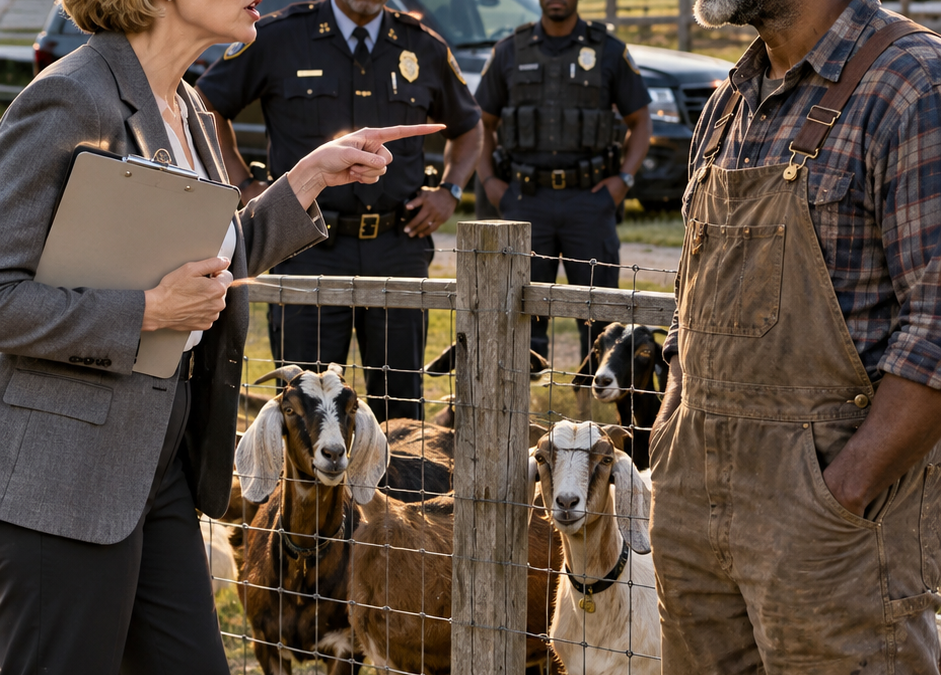
But when she finally arrived with two officers beside her and demanded that they “enforce the removal,” one unexpected sentence from their chief changed the expression on her face before the real fight had even begun.
My name is Ellis Callaway.
I was fifty-four years old when Diane Coulter first stood outside my goat pen wearing a slate-gray blazer that looked as though it had never encountered mud.
It was early March, just after sunrise.
Fog was still lying low over the creek bottom, and the eastern pasture smelled of wet cedar, damp grass, and that faint sweet musk goats carry after sleeping close together through a cold night.
Behind me, eight Nubian does and one wether moved quietly around the pen.
One of the does, Molly, pushed her nose through the welded wire because she thought Diane might be carrying feed.
Diane was not carrying feed.
She was carrying a clipboard.
There are people who carry clipboards because their work requires information.
And then there are people who carry clipboards because they believe a piece of pressed fiberboard can turn an opinion into authority.
Diane belonged to the second group.
“Your animals are in violation of Ridgecrest Estates community standards,” she said. “You have fourteen days to remove them from the premises, or we will contact animal control and pursue enforcement action.”
I rested one hand on the fence post.
“Remove them from what premises?”
She glanced toward the goats.
“This property.”
“My property?”
“The property adjacent to Ridgecrest Estates.”
“That wasn’t what I asked.”
Her eyes narrowed slightly.
I had the feeling people usually did one of two things when Diane spoke that way.
They apologized.
Or they argued.
I did neither.
I simply waited.
Finally she said, “Ridgecrest has standards regarding livestock visible from community roads.”
“That sounds like a rule for Ridgecrest.”
“It protects community character.”
“I’m sure it does.”
“You’re adjacent to Ridgecrest.”
“I’m also adjacent to a county road.”
She stared at me.
“That doesn’t make me part of the highway department.”
The goats moved behind me.
A bell hanging from one doe’s collar gave a soft metal knock.
Diane’s grip tightened around the clipboard.
“This doesn’t need to become difficult, Mr. Callaway.”
“I agree.”
“You have fourteen days.”
“To do what?”
“Remove the goats.”
“Under what legal authority?”
She drew a breath.
“Ridgecrest Estates community standards.”
“Those are recorded against my deed?”
“They apply to properties affecting the community.”
“That wasn’t my question.”
For the first time, Diane looked uncertain.
Only for a second.
Then the expression disappeared.
“If you refuse compliance, we have other enforcement options.”
“Such as?”
“Animal control. Law enforcement if necessary.”
That almost made me smile.
Not because police involvement frightened me.
And not because I expected special treatment.
Quite the opposite.
The man currently running county law enforcement was my mother’s younger brother, Raymond Callaway.
Uncle Ray.
Thirty-one years in uniform.
Nine years as chief.
A man who had spent more Sunday afternoons at my grandmother’s table than I could count.
He knew those 212 acres because he had hunted rabbits there as a boy.
He had helped my father repair that eastern fence after a storm in 1986.
He had carried me back to the farmhouse when I broke my ankle on the limestone ridge at age eleven.
But if Diane expected that relationship to make him bend a rule in my favor, she would have been disappointed.
Ray was the most irritatingly precise man in the family whenever law was involved.
When I was seventeen, he wrote me a speeding ticket.
My mother refused to speak to him for three days.
He still made me pay it.
So I did not mention him.
I looked at Diane and said, “I appreciate you letting me know.”
Then I turned toward the barn.
“Mr. Callaway.”
I stopped.
“I expect cooperation.”
I looked back.
“You should expect documentation.”
Then I went inside and pulled the deed from the filing cabinet.
My grandfather, Amos Callaway, bought the first eighty acres of that land in 1947.
The timber company that sold it considered the property nearly worthless.
They had cut most of the marketable trees.
The creek bottom flooded twice a year.
The ridge was limestone-heavy.
There was no proper house.
No power line.
No paved road.
Amos saw something else.
He saw ground.
Ground he could own.
That distinction mattered to a man whose family had lost almost everything during a drought a decade earlier.
He bought the property on installments.
Every payment was recorded.
Every receipt kept.
He stored those receipts in a tin box beside the coffee can in his kitchen.
I still had that box.
The paper had gone yellow.
The ink had faded.
But the numbers were readable.
So were the signatures.
Amos cleared the first forty acres with mules.
He built a house.
Dug drainage.
Fenced pasture.
Raised cattle.
Then he began buying neighboring parcels whenever they became available.
My father continued after him.
Forty additional acres in 1963.
Thirty-two more in 1971.
Other smaller pieces followed.
By the time the property came to me in 2004, the Callaway land totaled 212 acres.
Creek bottom.
Open pasture.
Second-growth hardwood.
Cedar.
And a limestone ridge on the western side that caught the last sunlight almost every evening.
My father used to tell me Amos would stand on that ridge after work.
No coffee.
No cigarette.
No talking.
He would simply watch the shadow cross the valley.
Like a man taking inventory.
When Amos died in 1979, my father found a note inside the deed.
Seven words.
Do not sell what cannot be replaced.
My father kept it.
So did I.
The deed transferring the full property to me was recorded in 2004 under instrument number 2004-CR-0881.
Clear title.
No HOA declaration.
No residential covenants.
No restrictions prohibiting livestock.
The property had been agricultural for generations.
That had never changed.
The goats came much later.
My daughter was twelve when she decided she wanted Nubians.
Not horses.
Not a puppy.
Goats.
She had spent a summer helping at a farm outside Kerrville and came home talking about milk fat, breeding lines, hoof trimming, and the personalities of individual animals as if she had joined a secret society.
I told her goats were work.
She said she knew.
I told her fences that would hold cattle would not necessarily hold goats.
She said she knew that too.
So we built the pen together.
Treated posts.
Welded wire.
Concrete corners.
A proper shelter with ventilation.
A separate feeding area.
Drainage graded away from the bedding.
The pen stood roughly sixty yards inside my eastern property line.
Not sixty yards from Ridgecrest’s houses.
Sixty yards inside my own boundary.
The goats were healthy.
The enclosure was clean.
The land was zoned agricultural.
County regulations explicitly allowed livestock on qualifying acreage.
I owned 212 acres.
Whatever problem Diane had, it was not a livestock-law problem.
It was an HOA problem.
More accurately, it was an HOA boundary problem.
Ridgecrest Estates had been built beginning in 2009.
Hargrove Properties purchased about sixty acres east of me and developed 214 houses around curving roads, a clubhouse, swimming pool, ornamental ponds, and enough landscaping rules to make a cedar tree nervous.
The HOA incorporated in 2010.
Its declaration of covenants ran forty-seven pages.
I knew because I eventually downloaded and read the whole thing.
Its geographic definition was clear.
The association governed the lots and common areas shown on the Ridgecrest Estates recorded plat.
My land was not on that plat.
Never had been.
Never could have been confused with it by anyone who looked at the county record for more than ten minutes.
My eastern fence did not even sit on the legal boundary.
My grandfather and father had deliberately placed sections of fencing inside the property because the old county road right-of-way made maintenance easier that way.
In some places, the fence was more than twenty feet inside.
The Ridgecrest parcel lay on the other side of the road corridor.
Diane’s theory apparently was that because Ridgecrest residents could see my goats, Ridgecrest could regulate them.
That was not property law.
That was wishful thinking wearing a blazer.
The first certified letter arrived the following Tuesday.
I opened it at the same kitchen table where my grandfather once counted installment receipts.
Three alleged violations.
Unauthorized livestock.
Failure to maintain compatible aesthetic conditions.
Creation of a nuisance affecting neighboring residential properties.
Fine: $400.
Due in fourteen days.
I looked for legal authority.
No county ordinance.
No deed restriction.
No easement.
No recorded covenant touching my parcel.
Nothing.
I read it again.
Then I got a folder from the filing cabinet.
On the tab I wrote:
RIDGECREST ESTATES HOA — 2024.
I put Diane’s letter inside.
That habit came from my father.
He believed confusion was expensive.
“If something matters enough to argue about,” he used to tell me, “it matters enough to file correctly.”
Then I called Gerald Pruitt.
Gerald owned the farm north of mine.
Seventy-one.
Forty years on the same ground.
He possessed that particular rural talent for knowing everyone’s business while rarely appearing interested in anyone’s business.
When I told him about Diane’s letter, he was silent for several seconds.
Then he said, “She’s been talking about your goats since Christmas.”
“Where?”
“Board meetings.”
“You attend Ridgecrest board meetings now?”
“My wife reads their Facebook page.”
“That sounds dangerous.”
“It is.”
He told me Diane had posted a photograph of my eastern fence.
The caption called it an “eyesore” and promised residents the board was working toward a resolution before summer.
“Do you still have the post?”
“Printed it.”
I should have known.
Gerald still kept paper copies of online receipts.
“Why?”
“Figured you might need it.”
“You figured correctly.”
Three weeks later, the second certified letter arrived.
The fine had doubled to $800.
They added another violation.
Failure to respond to official HOA correspondence.
That was impressive.
Apparently ignoring a demand from an organization with no authority had become a separate offense under that same nonexistent authority.
Then I reached the paragraph that mattered.
Ridgecrest Estates HOA reserves the right to enforce community standards on all properties within or adjacent to the Ridgecrest Estates planned community, including properties whose owners have not formally acknowledged HOA jurisdiction.
I read it once.
Then twice.
Then twice more.
Adjacent.
The entire claim rested on one word.
I sat at the table for several minutes thinking about what Diane was actually asserting.
If her theory were correct, any private association could regulate land simply because it was nearby.
A golf-course HOA could regulate the farm next door.
A subdivision could fine a church across the road.
One neighborhood could control landscaping on property that had never joined it.
Ownership would become geographic contagion.
Move near an HOA and eventually its rules infected you.
I picked up the phone.
Patricia Wren answered after two rings.
I had met her years earlier during an agricultural zoning matter.
She had impressed me because she never wasted a question.
I described the letters.
She asked three things.
“What is your acreage?”
“Two hundred twelve.”
“Current zoning?”
“Agricultural.”
“Is your deed subject to any Ridgecrest declaration?”
“No.”
“Bring me the deed anyway.”
We met Thursday.
Patricia read both letters.
Slowly.
Mechanical pencil in hand.
She underlined adjacent.
Then she reviewed my deed.
Then the Ridgecrest declaration I had downloaded from the county portal.
Finally she unfolded the plat.
“Here,” she said.
Her pencil touched the Ridgecrest boundary.
Then she moved it west.
“And here is your parcel.”
“Yes.”
“Separate tract.”
“Yes.”
“County road corridor in between.”
“Yes.”
She removed her glasses.
“Their jurisdiction ends at their plat boundary.”
“I know.”
“I’m stating it because I want us both using the same language from this point forward.”
“All right.”
“Your property has never been annexed?”
“No.”
“You signed nothing?”
“No.”
“Your father?”
“No.”
“Grandfather?”
“Ridgecrest didn’t exist.”
Patricia nodded.
“Good.”
Then she tapped Diane’s letter.
“This has no legal effect on your property.”
She turned her legal pad toward herself and wrote one word.
TRESPASS.
I noticed it.
She noticed me noticing it.
“Not yet,” she said.
“Meaning?”
“Meaning we document before we accuse.”
I liked her more immediately.
Patricia gave me four tasks.
Current survey.
Certified deed chain back to 1947.
Certified Ridgecrest plat.
Witness statement from anyone with direct knowledge of the historic fence line.
“Build the record,” she said.
So I did.
Dale Hutchins handled the survey.
His father had surveyed half the county before him.
Dale arrived while fog still covered the creek and spent two days walking my property.
I joined him along the eastern side.
He found old monuments.
Checked bearings.
Shot lines.
Verified corners.
At one point, he stopped beside a cedar fence post.
“This your fence?”
“My grandfather’s originally.”
He checked his equipment again.
“Boundary’s fourteen feet east.”
“So the fence is fourteen feet inside my land.”
“At this point.”
Farther south, the distance increased.
Twenty-two feet.
Twenty-seven.
Thirty-one.
Not one section of fence crossed the property line.
More importantly, Ridgecrest’s recorded plat did not cross the county road corridor.
Dale filed the survey.
I obtained a certified copy.
Into the folder.
Next came the deed chain.
I spent two afternoons at the courthouse with Loretta from the register’s office.
She had worked there almost thirty years.
She found instruments faster than I could write reference numbers.
Amos’s 1947 deed.
My father’s later acquisitions.
Transfers after deaths.
My 2004 deed.
Every link.
Recorded.
Witnessed.
Continuous.
Loretta placed the final certified copy on the counter.
“That’s clean.”
“No restrictions?”
“None I can see beyond recorded utility matters.”
“No HOA?”
She gave me a look.
“Your grandfather bought that before anybody around here knew what HOA stood for.”
Fair enough.
Next came the certified Ridgecrest plat.
Its boundary was exactly where Patricia said.
Separate from mine.
Then Gerald arrived at my house carrying a manila envelope.
Inside was a notarized statement describing four decades of familiarity with my fence line and the neighboring land.
He also included the printed social media post.
Diane’s photograph.
My fence.
Her words:
Working to resolve this eyesore for our community.
Gerald had written the date on the back.
“You notarized all this?”
“Yes.”
“Why?”
He shrugged.
“Paper beats memory.”
My grandfather would have liked him.
Patricia reviewed the completed file the following week.
She was quiet for almost half an hour.
Then she leaned back.
“They have nothing.”
“Nothing?”
“No colorable property claim. No covenant. No easement. No annexation. No agreement. Their declaration expressly limits authority to Ridgecrest’s recorded plat.”
“And livestock?”
“County agricultural zoning permits it.”
“Animal nuisance?”
“Any documented nuisance?”
“No.”
“Animal-control citations?”
“None.”
“Health violations?”
“None.”
“Then they have a preference.”
She tapped the folder.
“You have property rights.”
Patricia drafted the response.
It was four pages.
No insults.
No threats beyond those legally necessary.
It identified my parcel.
Instrument 2004-CR-0881.
Survey.
Deed chain.
Zoning classification.
Ridgecrest plat.
Then it stated plainly that the HOA possessed no legal authority over my property.
All fines were rejected.
All violation notices disputed.
Any unauthorized entry onto my land would be treated as trespass.
Any attempt to interfere with lawful agricultural activity would be met through appropriate legal process.
The letter was sent certified to Diane and Ridgecrest’s registered agent.
Nine days later the return receipt came back.
Signed.
For almost two weeks, nothing happened.
Then Diane called the police.
It was a Thursday morning.
I was replacing bedding in the goat shelter when two patrol vehicles turned onto my drive.
Behind them came Diane’s white SUV.
I straightened slowly.
One officer stepped out.
Then another.
Diane got out immediately and walked toward them as if she had been waiting to direct traffic.
I recognized the older officer.
Sergeant Luis Ortega.
We were not friends, but we knew each other.
Small counties work that way.
He approached the fence.
“Morning, Ellis.”
“Luis.”
He looked at the goats.
Then at Diane.
Then back at me.
“We got a complaint concerning livestock.”
“I figured.”
Diane stepped closer.
“These animals have been under an active removal order for weeks.”
Ortega looked at her.
“Removal order issued by who?”
“The Ridgecrest Estates HOA.”
He blinked.
“Ma’am, I mean a county or court order.”
“The HOA has issued formal violations.”
“That’s not what I asked.”
I almost felt sorry for her.
Almost.
Diane opened the clipboard.
She had copies of her letters.
“Our community standards prohibit livestock.”
Ortega looked toward the road.
“Is this property inside Ridgecrest?”
“It is adjacent and materially impacts—”
“Is it inside Ridgecrest?”
“No, but—”
Ortega turned toward me.
“Ellis, any animal-control complaints?”
“No.”
“Zoning agricultural?”
“Yes.”
“Any escaped animals today?”
“No.”
“Any animals threatening Ridgecrest residents?”
“No.”
Diane interrupted.
“The smell constitutes a nuisance.”
Ortega inhaled.
The wind was blowing toward us from the creek.
If anything, the strongest odor nearby was wet cedar.
“I don’t smell anything unusual.”
“That isn’t the point.”
“What exactly are you asking us to do?”
“Enforce removal.”
Ortega stared at her.
“We don’t enforce HOA rules.”
Diane’s face colored.
“I was told law enforcement could assist when a property owner refuses compliance.”
“Compliance with what law?”
Before she could answer, a third vehicle came up the drive.
Unmarked.
Dark blue.
I recognized it immediately.
So did Ortega.
He looked at me.
“You call Ray?”
“No.”
Apparently dispatch had.
Diane watched the vehicle stop.
The driver’s door opened.
Chief Raymond Callaway stepped out.
My uncle was sixty-four then.
Gray at the temples.
Tall.
Uniform pressed sharp enough to cut paper.
He walked toward us slowly.
Not smiling.
Ray never smiled when he thought someone had wasted police resources.
“Sergeant.”
“Chief.”
“What’ve we got?”
Ortega nodded toward Diane.
“HOA complaint. Wants livestock removed from Mr. Callaway’s property.”
Ray looked at the goats.
One of them sneezed.
Then he looked at me.
“Morning, Ellis.”
Diane turned sharply.
“You know him?”
Ray looked at her.
“He’s my nephew.”
There it was.
The moment from which the story later got its most entertaining version.
According to Gerald, by the following afternoon half the county believed Diane had summoned the police to seize my goats only to discover every officer involved was related to me.
That was nonsense.
Only Ray was family.
And his next sentence mattered more than the first.
“But that has absolutely nothing to do with what happens here.”
Diane’s relief lasted about half a second.
Ray turned to Ortega.
“Any county violation?”
“None found.”
“Animals loose?”
“No.”
“Cruelty?”
“No.”
“Unsafe enclosure?”
“Looks sound.”
“Zoning?”
“Agricultural.”
Ray nodded.
Then he faced Diane.
“Ma’am, what criminal offense are you reporting?”
“This is an enforcement matter.”
“For your association.”
“Yes.”
“Then your association needs civil counsel.”
“We have counsel.”
“Good.”
Ray gestured toward the goats.
“My department does not remove lawful livestock from private agricultural property because a homeowners association dislikes seeing them.”
Diane stiffened.
“Chief Callaway, with respect, this property directly affects the quality and value of homes in our community.”
Ray’s voice stayed even.
“That may be something you discuss with your attorney.”
“Our CC&Rs—”
“Apply where?”
She stopped.
Ray waited.
She finally said, “The surrounding community.”
“That isn’t a legal description.”
I had heard that sentence before.
Maybe our family did share something beyond blood.
Diane looked from Ray to me.
“So this is how this county operates?”
Ray’s expression hardened.
“No, ma’am.”
His voice dropped slightly.
“This county operates by written law and recorded authority. If Ellis were violating a county livestock ordinance, I’d cite him if he were my nephew, my brother, or my own son.”
He looked toward me.
“He knows that.”
I nodded.
Unfortunately, I did.
Ray continued.
“But you called officers asking them to enforce a private rule against property that, based on everything Sergeant Ortega has checked, is not within your development.”
“I was advised we had enforcement rights.”
“Then take that advice to court.”
Diane looked furious.
But there was nowhere useful for that anger to go.
Ray turned to Ortega.
“We done?”
“Yes, Chief.”
Ray looked at me.
“Keep the goats fenced.”
“They are.”
“Good.”
Then, because he was my uncle and incapable of leaving without irritating me at least once, he pointed toward the rear corner of the pen.
“That hinge is sagging.”
“It is not.”
“It is.”
“You drove out here for an HOA complaint and inspected my hinges?”
“I notice things.”
Ortega laughed.
Diane did not.
The officers left.
Ray stayed only long enough to tell me to call my lawyer and document everything.
“I already have.”
“Good.”
“Patricia Wren.”
He nodded approvingly.
“She’s better than you deserve.”
“Family trait, apparently.”
He ignored that.
As Ray walked toward his vehicle, Diane was still standing beside hers.
Her clipboard hung at her side now.
She looked smaller somehow.
Not physically.
Institutionally.
The thing she had expected to happen had not happened.
She had believed that saying enforcement often enough would eventually produce an enforcer.
Instead, the police had asked the same question I had asked from the beginning.
Under what law?
She left without speaking to me.
I called Patricia before the dust settled.
When I finished explaining, she was quiet.
Then she asked:
“Your uncle made clear the relationship had no bearing?”
“Immediately.”
“Good.”
“The officers refused enforcement because there was no county violation.”
“Better.”
“I assume there’ll be a report.”
“I want it.”
We obtained the incident report two days later.
It documented that officers found no criminal violation, no livestock ordinance violation, no animal-control issue, and no legal basis for removal.
It also recorded Diane’s request that police enforce Ridgecrest HOA standards.
Patricia added it to the file.
Then she said something I had expected.
“We’re done waiting.”
The HOA’s attorney responded to her earlier notice a week later.
His name was Martin Strickland.
Austin firm.
Property and community-association practice.
Instead of withdrawing Ridgecrest’s claims, he argued that the HOA possessed “implied authority” to enforce standards against neighboring uses that materially affected community character.
Patricia read the letter to me over the phone.
When she finished, I asked:
“Is that a real thing?”
“Not the way he’s using it.”
“What does that mean?”
“It means he found three cases involving parties already connected through recorded covenants and is trying to stretch them across a county road onto property with no shared instrument.”
“Can he?”
“He can type it.”
“That wasn’t my question.”
“I know.”
She filed for declaratory judgment.
The petition asked the district court to settle one issue permanently.
Did Ridgecrest Estates HOA possess any legal authority over parcel 2004-CR-0881?
Patricia requested a declaration that it did not.
She also sought a permanent injunction preventing future fines, enforcement notices, or interference with my lawful agricultural use.
And she requested attorney fees.
The evidence file was almost boring.
That was its strength.
1947 deed.
Later acquisitions.
2004 transfer.
Current survey.
Ridgecrest plat.
Agricultural zoning.
Gerald’s statement.
Diane’s letters.
The social media post.
The police incident report.
No theatrics.
Just sequence.
Then we learned Diane had been searching for another angle.
She had contacted the tax assessor.
A title company.
A private title-search firm.
She was apparently looking for any old easement, restriction, forgotten agreement, or defect that could connect my land to Ridgecrest.
Patricia told me this after receiving discovery responses.
“Did she find anything?”
“No.”
“Should I be worried she was looking?”
“No.”
“Why?”
“Because a person who already has legal authority doesn’t normally need to search retroactively for where that authority came from.”
That made sense.
Diane was not verifying a right.
She was hunting for one.
There was a difference.
The hearing was scheduled for the second Tuesday in June.
By then the goats had become local celebrities.
I did not encourage it.
Gerald did.
He brought them carrots and called Molly “Exhibit A.”
My daughter thought that was hilarious.
I did not.
At least not where Gerald could see me.
The courthouse stood three stories high on the town square.
Limestone exterior.
Old wood inside.
My father used to take me there when I was a boy.
Not for legal trouble.
He liked watching court.
He believed every citizen should occasionally sit in a courtroom and remember that law was supposed to be something more durable than whoever happened to be angry that day.
I wore his dark wool blazer.
It was too warm for June.
I did not care.
Patricia and I arrived at 8:30.
Diane was already there with Strickland.
Clipboard on the table.
Of course.
Strickland argued first.
He was good.
I want to be fair about that.
A lawyer can only work with the material available.
He spoke about planned-community expectations.
Property values.
Compatibility.
Protection of residents.
Adverse external impacts.
And the word adjacent.
He used adjacent so many times that by the end it seemed less like a geographic description and more like a prayer.
Then Patricia stood.
She carried three documents to the projector.
First, the Ridgecrest declaration.
She highlighted the jurisdiction clause.
All lots and common areas within the Ridgecrest Estates planned community as recorded in Plat Book 44, Pages 112–118.
Then the plat itself.
Ridgecrest ended on one side of the county right-of-way.
My parcel began beyond it.
Then Dale’s survey.
My fence stood inside my property.
Fourteen feet at the closest documented point.
Thirty-one at the farthest section measured.
The goat pen stood another sixty yards beyond that.
Patricia looked toward Judge Clara Fitch.
“The association’s own declaration defines its jurisdiction.”
She pointed to the plat.
“The recorded plat defines the geographic limits of that jurisdiction.”
She pointed to my survey.
“Mr. Callaway’s property is not within those limits.”
Then she turned slightly toward Strickland.
“Respondent has cited theories of implied authority arising from proximity and community impact.”
She paused.
“No deed connects these properties.”
Another pause.
“No covenant.”
“No easement.”
“No annexation.”
“No agreement.”
She let each word stand alone.
“There is no shared recorded instrument whatsoever.”
Judge Fitch looked toward Strickland.
“Counsel.”
“Yes, Your Honor.”
“Identify the recorded instrument granting Ridgecrest authority over Mr. Callaway’s property.”
Strickland began:
“Your Honor, our position is that authority arises from—”
“I understand your theory.”
She looked directly at him.
“I am asking for the instrument.”
Silence.
He adjusted a page.
“There is no instrument specifically recorded against Mr. Callaway’s parcel.”
That was the entire case.
Everything after that felt like explanation.
Judge Fitch asked about county zoning.
Agricultural.
Asked whether livestock were prohibited.
No.
Asked whether animal control had cited me.
No.
Asked whether police identified any offense during Diane’s complaint.
No.
Patricia entered the incident report.
Strickland objected only to portions relating to statements by third parties.
The judge admitted the relevant sections.
Then Diane testified.
Patricia asked the questions.
“Ms. Coulter, when you sent your first fine notice, had you reviewed Mr. Callaway’s deed?”
“No.”
“His survey?”
“No.”
“The recorded Ridgecrest plat?”
“I was familiar with it.”
“That was not my question.”
Diane looked toward Strickland.
He said nothing.
“No.”
“Had an attorney told you Ridgecrest possessed jurisdiction over parcel 2004-CR-0881?”
“Our management company had advised that we had authority over adjacent nuisance conditions.”
“Had an attorney told you that?”
“Not at that time.”
Patricia nodded.
“You then sent a second fine?”
“Yes.”
“Doubling the assessment?”
“Yes.”
“And stated that Ridgecrest could enforce standards on adjacent properties even if those owners had not acknowledged HOA jurisdiction?”
“Yes.”
“What recorded document supported that statement?”
Diane’s voice became quieter.
“I relied on our community standards.”
“Internal standards?”
“Yes.”
“Recorded against Mr. Callaway’s deed?”
“No.”
“After receiving notice from my office that the property was outside Ridgecrest, you contacted law enforcement?”
“Yes.”
“What did you ask them to do?”
“Assist with enforcement.”
“Removal of the goats?”
“I asked them to address the violation.”
“That is not my question.”
Diane’s jaw tightened.
“Yes. Removal if necessary.”
“And the police declined?”
“Yes.”
“Because?”
Strickland stood.
“Objection. Calls for speculation regarding officers’ legal conclusions.”
Judge Fitch considered.
“Sustained as phrased.”
Patricia nodded.
“Did officers remove any animal?”
“No.”
“Cite Mr. Callaway?”
“No.”
“Order him to change anything?”
“No.”
“No further questions.”
Judge Fitch recessed before lunch.
When she returned, she had a written outline in front of her.
Her ruling was not dramatic.
Real rulings rarely are.
She declared that Ridgecrest Estates HOA possessed no legal authority over my parcel.
Recorded or implied.
The fines—$1,200 total—were void.
The violation notices were unenforceable.
The HOA was permanently enjoined from asserting compliance jurisdiction, issuing assessments, directing removal of lawful livestock, or otherwise interfering with my property based on Ridgecrest’s private standards.
Then she awarded attorney fees.
$11,400.
Paid by the HOA.
Strickland stood.
“Your Honor—”
Judge Fitch raised one hand.
“I have addressed counsel’s arguments.”
He sat.
Then she said the sentence I remembered afterward.
“The record is clear. It has always been clear.”
That was it.
No cheering.
No applause.
No dramatic collapse at counsel table.
Patricia began returning documents to the banker’s box.
I helped her.
Deed.
Survey.
Plat.
Letters.
Police report.
One piece at a time.
When I looked up, Diane was still seated.
The clipboard lay in front of her.
She was not touching it.
For months, that clipboard had represented something to her.
Authority.
Position.
Control.
Now it was just a clipboard.
Outside, the June sun hit the courthouse steps hard enough that I immediately regretted wearing my father’s wool blazer.
Patricia shook my hand.
“Keep the judgment with your deed.”
“I intend to.”
“If they violate the injunction, call me before you respond.”
“I will.”
She started toward her car.
Then turned.
“And Ellis?”
“Yes?”
“Your uncle handled that police call correctly.”
“I know.”
“He did you a favor by refusing to do you a favor.”
I smiled.
“That sounds exactly like Ray.”
I drove home by the eastern road.
Ridgecrest’s entrance appeared on my right.
Stone pillars.
Landscaped beds.
Sign.
Everything neat.
Everything inside its proper boundary.
That was all I had ever wanted.
Their rules there.
My rights here.
The goats were in the pen when I arrived.
Molly came to the gate.
I scratched between her horns.
“You cost me eleven thousand dollars in attorney fees.”
She chewed.
“Apparently they’re paying.”
She continued chewing.
“You have no appreciation for the legal system.”
Nothing.
Gerald’s truck rolled in ten minutes later.
He climbed out holding a bag of carrots.
“What happened?”
“We won.”
“How much?”
“Everything we asked for.”
He nodded.
“Goats staying?”
“Yes.”
He opened the carrot bag.
“Then that’s everything that matters.”
Ray came by Sunday.
Family dinner.
My daughter was there.
So was my mother.
For the first fifteen minutes, everyone behaved.
Then my mother looked at Ray.
“You told that woman Ellis was your nephew?”
Ray kept eating.
“She asked if I knew him.”
“You couldn’t just say yes?”
“I answered accurately.”
“You embarrassed her.”
“She called police to remove goats from lawful agricultural land.”
“That doesn’t mean you had to announce the family tree.”
I leaned back.
“This from the woman who refused to speak to him because he gave me a speeding ticket.”
Mother pointed her fork at Ray.
“He was seventeen.”
“He was speeding,” Ray said.
“You could have warned him.”
“I did.”
“When?”
“After I wrote the ticket.”
My daughter laughed so hard she nearly spilled her tea.
Ray looked at me.
“You keeping that hinge fixed?”
“It was never broken.”
“It was sagging.”
“It was level.”
“You want me to bring one?”
“A level?”
“Yes.”
“I own levels.”
“Apparently not accurate ones.”
That was my uncle.
Nothing had changed.
And that mattered.
Because the story people told afterward was simpler than the truth.
They said an HOA president called the cops on my goats and discovered the police chief was my uncle.
That happened.
But that was not why I won.
If Ray had never arrived that morning, the officers still had no law to enforce.
If Ray had been a stranger, the deed would have said the same thing.
The survey would not have moved.
The Ridgecrest plat would not have expanded.
The goats would still have been lawful livestock on agricultural land.
Family connection made the moment memorable.
The record made the outcome inevitable.
That distinction matters.
Months later, I received notice that Ridgecrest had amended its enforcement procedures.
Before issuing violations involving property near the development boundary, management now had to verify that the parcel actually appeared within the recorded HOA declaration.
I read that sentence twice.
Then called Gerald.
“They changed their procedure.”
“How?”
“They check whether property belongs to the HOA before fining the owner.”
Gerald was silent.
Finally:
“Government move fast down there.”
“It’s not government.”
“Even slower, then.”
Diane remained HOA president until the following election.
She did not run again.
I never asked why.
I did not need to.
Her social media post disappeared.
The photograph of my fence vanished with it.
But Gerald’s printed copy remained in my file.
So did every letter.
Patricia’s notice.
Dale’s survey.
Certified deed chain.
Police report.
Court judgment.
Attorney-fee order.
The folder eventually became too thick for the original tabbed binder, so I moved it into one of my father’s old document boxes.
I labeled the front.
RIDGECREST ESTATES — FINAL.
Then I placed it in the filing cabinet.
Behind it were my father’s files.
Behind those, my grandfather’s receipts.
One evening late that summer, I took the old tin box outside.
The sun was dropping toward the limestone ridge.
Goats grazed in the lower field.
The sound of their bells came softly through the grass.
I sat on the porch and opened the box.
Amos’s first payment receipt was near the top.
The paper was thin enough that I could almost see sunlight through it.
I thought about him arriving there after watching his own family lose land during drought.
He knew what ownership meant because he had known what losing it meant.
That was why he saved receipts.
Not because he expected Diane Coulter.
Not because he imagined homeowners associations.
Because institutions change.
People change.
Memories change.
Records do not change in quite the same way.
A recorded deed does not become less recorded because somebody speaks confidently.
A survey monument does not move because a board votes.
A county plat does not expand because someone writes the word adjacent into a certified letter.
And a goat does not become illegal livestock because people in a neighboring subdivision would prefer not to look at it.
I returned the receipt to the box.
Then I walked toward the ridge.
The climb took longer than it had twenty years earlier.
At fifty-four, I had begun noticing which slopes were actually steep and which ones I had merely believed were easy because I was younger.
At the top, I stood where my grandfather used to stand.
The valley opened below.
My fields.
Creek.
Barn.
Goat pen.
Eastern fence.
Beyond the county road, the roofs of Ridgecrest Estates.
From that distance, both properties looked close enough to touch.
That was the illusion Diane had mistaken for law.
Close is not the same as connected.
A property line can be invisible and still absolute.
A covenant can bind one lot and stop entirely at the next.
Authority has edges.
Good institutions understand those edges.
Bad ones discover them in court.
The last sunlight caught the limestone.
I understood why Amos had stood there silently.
There are things you do not improve by talking about them.
Land is one.
The ridge had existed long before Amos.
It would exist long after me.
My job was temporary.
Maintain it.
Know it.
Keep the documents.
Pass them forward intact.
When my daughter eventually inherits that land, she will inherit the goats if there are still goats.
The barn.
The creek.
The fencing.
The trouble that comes with owning acreage.
And the filing cabinet.
I have already shown her where everything is.
“Start here,” I told her once, opening the drawer.
She looked at the folders.
“That’s a lot of paper.”
“It’s less paper than a lawsuit.”
She smiled.
“You had a lawsuit.”
“Because somebody else didn’t read the paper.”
She could not argue with that.
The following spring, Molly gave birth to twins.
My daughter drove out to help.
Dawn had barely broken when the second kid finally stood.
Tiny legs.
Unsteady knees.
Determined.
We watched the mother clean it.
My daughter leaned against the fence.
“You realize Ridgecrest can see two more goats now.”
“I’ve considered that.”
“Think they’ll complain?”
“I hope not.”
“Why?”
“I’m retired. I need hobbies.”
She laughed.
I looked toward the development.
Nothing moved.
No white SUV.
No clipboard.
No inspection.
Just houses waking in the distance.
Exactly as it should be.
Ridgecrest residents deserved their homes and their rules inside their community.
I deserved my farm and my rules inside the law governing mine.
Neither right required destroying the other.
It only required knowing where one stopped and the next began.
That was what Diane never understood until Judge Fitch said it from the bench.
The record is clear.
It has always been clear.
Those words stayed with me because they applied to more than the court case.
The record began in 1947.
Amos buying cut-over ground nobody wanted.
Installment by installment.
Receipt by receipt.
My father adding parcels.
Recording deeds.
Maintaining boundaries.
Me inheriting the property.
Instrument number 2004-CR-0881.
Two hundred twelve acres.
Agricultural.
Unencumbered by Ridgecrest Estates.
The HOA arrived sixty-two years after Amos.
Its authority began where its plat began.
And it ended where its plat ended.
No amount of confidence could move that line.
Not Diane.
Not her board.
Not a management company.
Not even the police chief who happened to be my uncle.
That may be the part people misunderstand when they hear this story.
They hear that Raymond was family and assume that was my advantage.
It was not.
My advantage was that the facts were boring.
Boring facts are powerful.
A deed number.
A plat book.
A survey bearing.
A zoning classification.
A dated photograph.
A certified receipt.
A police report saying no violation was found.
No drama in any one of them.
Stack them together, though, and confidence has nowhere left to hide.
Diane arrived at my fence with a fourteen-day deadline.
Months later, the judge gave Ridgecrest sixty days to pay my legal fees.
Diane threatened to call the police.
She did.
They left the goats where they were.
She claimed my property affected community character.
The court ruled community character did not create jurisdiction.
She said being adjacent was enough.
The plat said otherwise.
And the plat had been there the entire time.
That was the irony.
Nothing I used to defeat Ridgecrest had been secret.
The deed was public.
The zoning was public.
The plat was public.
The county road right-of-way was public.
Diane could have found all of it before she mailed the first letter.
Instead, she started with authority and searched for justification afterward.
That is almost always the more expensive order.
I still keep goats.
I still repair the eastern fence.
Some of Amos’s original cedar posts remain.
Most have been replaced.
Wood does not last forever.
Neither do people.
Records, if kept correctly, can last much longer.
Every once in a while, I walk past the filing cabinet and think about moving everything into a modern safe.
Climate controlled.
Fire rated.
Digital backups.
I probably should.
But I will never throw away Amos’s tin box.
There is something useful about holding the physical receipt that started it.
A man’s payment.
A date.
A signature.
Proof.
Not confidence.
Not assumption.
Proof.
The last time Uncle Ray visited, we walked down to the goat pen.
He stopped at the corner.
Looked at the gate.
Then the hinge.
I waited.
He nodded once.
“Better.”
I stared at him.
“I never changed it.”
“Yes, you did.”
“No.”
“You did.”
“I have security footage.”
He looked at me.
“You kept security footage of a goat hinge?”
“No.”
“Then you can’t prove it.”
I shook my head.
“You’ve been in law enforcement too long.”
He smiled.
“Thirty-two years.”
Then he looked toward Ridgecrest.
“They bother you anymore?”
“No.”
“Good.”
For a moment, neither of us spoke.
Then Ray said something quieter.
“Your granddad would’ve enjoyed that case.”
“Why?”
“He hated being told what to do.”
“That’s hereditary.”
“No.”
Ray looked at me.
“He hated being told what to do by people who hadn’t earned the right.”
That sounded more accurate.
The goats moved through the grass.
The creek ran below us.
Late-afternoon light touched the ridge.
Nothing about the land looked victorious.
Land never does.
It simply remains.
And maybe that was the lesson Amos understood before any of us.
Owning property is not a performance.
Neither is authority.
One is established by title.
The other by law.
Everything else is just somebody standing at a fence with a clipboard, hoping confidence will be enough.
For Diane Coulter, it almost was.
Until she called the police.
Until the police asked for an actual law.
Until the chief happened to know the land personally—and, more importantly, knew that being my uncle did not give him the right to change what the record already said.
And until a judge finally reduced the entire argument to the only thing that had mattered from the beginning.
My land was mine.
Their HOA was theirs.
The boundary between those two facts had never moved an inch.








