𝗙𝗨𝗟𝗟 𝗦𝗧𝗢𝗥𝗬 HOA Karen Called Police on My Goats—She Had No Idea the Chief Was My Uncle
𝗣𝗔𝗥𝗧 𝟮
Clubhouse.
Decorative entrance.
Private management company.
Forty-seven pages of covenants, conditions, and restrictions.
The kind of place where every mailbox matched.
Diane Coulter became HOA president in 2018.
I knew who she was before she appeared at my fence.
People in the county knew.
She took the job seriously.
Perhaps too seriously.
The first official letter arrived by certified mail that same March.
It listed three violations.
Unauthorized livestock.
Failure to maintain aesthetic standards.
Creation of a nuisance affecting neighboring property.
Fine:
$400.
Payment due:
Fourteen days.
What it did not contain was more interesting.
No county ordinance.
No deed restriction.
No easement.
No recorded covenant affecting my land.
No explanation for how Ridgecrest Estates believed its authority crossed its own platted boundary.
I read the letter twice at the kitchen table.
Outside the window, two of the goats were standing on an overturned feeder as if conducting their own board meeting.
I set the letter down.
I was not angry.
I felt something closer to recognition.
Somebody had made an assumption.
And instead of checking it, they had printed the assumption on letterhead.
I started a file.
RIDGECREST ESTATES HOA.
MARCH.
Diane’s letter went inside.
Then I called my neighbor Gerald Pruitt.
Gerald had farmed north of me for four decades.
At seventy-one, he possessed the particular kind of local knowledge produced by staying in one place long enough to see everybody else arrive.
“You finally heard from Diane?” he asked.
That told me plenty.
“What do you know?”
“She’s been talking about your goats for months.”
“How?”
“HOA meetings.”
I leaned back.
“She’s discussed my goats at board meetings?”
“Twice that I know about.”
Gerald paused.
“She calls your side the deterioration of the western boundary.”
I looked out my kitchen window.
“Of course she does.”
“There’s more.”
He told me Diane had posted a photograph of my fence on the Ridgecrest Estates community page.
The caption read:
Working to resolve this eyesore for our community.
“My fence?”
“Your fence.”
“On my property?”
“That one.”
“You save the post?”
Gerald gave a short laugh.
“Ellis, who do you think you’re talking to?”
The next afternoon, he brought me a printed copy.
The date was handwritten on the back.
He had also captured the page showing Diane as the poster.
I filed it behind the violation letter.
Three weeks later, a second certified envelope arrived.
Fine increased:
$800.
New violation:
Failure to respond to official HOA correspondence.
Then I reached the paragraph that changed my interest into concern.
Ridgecrest Estates HOA reserves the right to enforce community standards on all properties within or adjacent to the Ridgecrest Estates planned community, including properties whose owners have not formally acknowledged HOA jurisdiction.
I read one word four times.
Adjacent.
That was their theory.
Not deed restriction.
Not contract.
Not easement.
Not annexation.
Proximity.
Apparently, living near an HOA meant they believed you could become subject to it without ever joining it.
I sat quietly for several minutes.
Then I called Patricia Wren.
Patricia had practiced property law in Millhaven County for twenty-two years.
I remembered her from a county agricultural zoning hearing because she asked sharper questions than anybody else in the room and never once raised her voice.
“Bring me everything,” she said.
“The letters?”
“Letters. Deed. Survey if you have one. Plat if you can get it.”
“I have enough paper to fill your office.”
“Start with the deed.”
I met her Thursday.
Patricia wore reading glasses on a thin chain and used a mechanical pencil to underline important language.
She read both HOA letters.
Then my deed.
Then the subdivision plat I had downloaded from the county portal.
Finally, she pulled up Ridgecrest Estates’ CC&Rs.
Section One.
Paragraph Two.
She underlined the geographic definition.
All lots and common areas within the Ridgecrest Estates planned community as recorded in Plat Book 44, Pages 112 through 118, Millhaven County Register of Deeds.
She looked at me.
“Their jurisdiction stops at their plat.”
“That’s my reading.”
“It’s everybody’s reading.”
She tapped the second letter.
“This sentence about adjacent property has no legal force. They cannot expand recorded covenant authority by writing themselves a letter.”
Then she wrote one word on her legal pad.
Trespass.
I saw it upside down.
Patricia did not sue immediately.
Instead, she gave me a checklist.
Current survey.
Certified chain of title.
Certified Ridgecrest plat.
Sworn statement from a neighbor with direct boundary knowledge.
“Build the record first,” she said.
That sounded exactly like my father.
So I did.
I hired Dale Hutchins.
Thirty years as a licensed surveyor.
His father had surveyed Millhaven County before him.
Dale spent two days walking my property.
The first morning, fog lay low across the creek.
I followed him along the eastern line.
At three points, he stopped and showed me where my existing fence stood relative to the true boundary.
Fourteen feet inside at the nearest point.
Thirty-one feet inside at the farthest.
In other words, Diane was not merely claiming authority over land near the HOA.
My fence itself stood entirely on my land, with additional land between the fence and the actual boundary.
The goat enclosure sat another sixty yards beyond that.
Dale filed the certified survey.
I placed it in the folder.
Next came the title chain.
Two afternoons at the courthouse.
Loretta at the Register of Deeds helped me retrieve everything.
Amos Callaway’s original purchase.
Instrument 1947-AC-0214.
1963 addition.
1971 addition.
Transfer after my father’s death.
Transfer to me in 2004.
Every conveyance recorded.
Every signature proper.
No missing deed.
No conflicting ownership.
No Ridgecrest restriction.
Loretta stacked the certified copies.
“That’s a clean title.”
I smiled.
“My grandfather would’ve liked hearing you say that.”
Then I obtained the certified Ridgecrest plat.
Plat Book 44.
Pages 112 through 118.
There was the subdivision.
Every lot.
Every street.
Clubhouse.
Pool.
Common areas.
Outer boundary.
Between the subdivision and my property sat a county road right-of-way dating to 1938.
At no location did the Ridgecrest plat overlap my land.
Not an inch.
Gerald gave me the final piece.
A notarized statement describing forty years of knowledge of the boundary.
Attached was the printout of Diane’s social-media post.
Patricia reviewed everything in silence.
Survey.
Title chain.
Plat.
Zoning ordinance.
Gerald’s affidavit.
Diane’s letters.
When she finished, she removed her glasses.
“They have no colorable claim.”
She pointed toward my deed.
“No covenant.”
Survey.
“No encroachment.”
Plat.
“No jurisdiction.”
Zoning code.
“No livestock violation.”
Then the letters.
“And they are demanding money anyway.”
“What happens now?”
“Now we tell them formally.”
Her legal notice went out certified.
It cited every instrument.
Every book.
Every page.
Every survey reference.
Every zoning provision.
The conclusion was simple.
Ridgecrest Estates had no authority over Parcel 2004-CR-0881.
The fines were invalid.
Any continued attempt to enforce HOA restrictions against my land would be treated as interference with my property rights.
Nine days later, the return receipt came back.
Signed.
For several weeks, nothing happened.
Then one morning, I was repairing a water line near the goat shed when a county patrol vehicle rolled slowly up my driveway.
I stood.
The goats looked up too.
Deputy Marcus Bell stepped out.
I knew Marcus.
Not well.
Small county.
People know one another.
“Morning, Ellis.”
“Marcus.”
He glanced toward the goats.
“I got a complaint.”
There it was.
“Let me guess.”
He gave me a tired look.
“Ridgecrest Estates.”
“Of course.”
He pulled a small notebook from his pocket.
“Complaint says livestock are being maintained in violation of residential restrictions, creating a nuisance, possibly neglected, and that the owner refused to comply with community enforcement.”
I stared at him.
“Neglected?”
“I’m telling you what was called in.”
He looked at the animals.
Clean water.
Shelter.
Feed.
Fence.
Healthy coats.
One goat was attempting to chew a strap hanging from the side of my tool bag.
Marcus almost smiled.
“Those are the neglected animals?”
“Terribly oppressed.”
He walked the pen.
Checked the water.
Looked at the fencing.
Asked whether I had documentation of agricultural zoning.
I walked inside and brought him a copy of the county classification.
He read it.
“Two hundred twelve acres.”
“Yes.”
“Agricultural.”
“Yes.”
He closed his notebook.
“I figured.”
“You figured?”
Marcus hesitated.
Then he said, “Chief saw the address when dispatch entered the complaint.”
I knew immediately.
“Raymond?”
“He asked me to handle it.”
That was exactly what my uncle would do.
Not come himself.
Not turn family into an official matter.
Send another officer.
Document everything cleanly.
“No offense here that I can see,” Marcus said.
“Animal control?”
“They got the same complaint. I talked to them before coming out. Unless conditions are different from what I’m looking at, they don’t have a case either.”
He put the notebook away.
Then looked toward the subdivision.
“Whoever called seemed very insistent that the HOA wanted police assistance.”
I leaned against the fence.
“Did she happen to tell dispatch who she wanted to speak with?”
Marcus smiled now.
“She asked for the chief.”
I closed my eyes for half a second.
“And nobody told her?”
“Not until he took the call.”
I looked at him.
Marcus laughed.
“Apparently she explained at length that an uncooperative neighboring property owner was refusing to remove prohibited livestock. Chief Callaway listened. Then he asked for the address.”
I could picture my uncle perfectly.
“Then?”
“Then she gave him your address.”
I waited.
Marcus shook his head.
“He told her the department would respond to any legitimate complaint, but HOA rules are not criminal law, and being adjacent to a subdivision does not put private agricultural property under HOA jurisdiction.”
“That sounds like Raymond.”
“He also said he was related to the property owner and would therefore have another deputy conduct any official check.”
That sounded even more like Raymond.
“What did Diane say?”
Marcus raised both eyebrows.
“She became considerably less talkative.”
I laughed for the first time since the whole thing began.
But Raymond did not make the problem disappear.
Nor would I have wanted him to.
Family connection might have made Diane uncomfortable, but it did not prove my title.
Records did.
Law did.
The patrol visit simply produced another piece of neutral documentation.
No criminal violation.
No animal-welfare issue.
No county livestock violation.
Marcus gave me the incident number.
I sent it to Patricia.
Her reply contained six words:
Put it in the file.
So I did.
Diane did not call me.
Instead, she hired lawyers.
An Austin firm representing the HOA responded to Patricia’s notice.
Their attorney was a man named Strickland.
He did not defend the livestock allegation directly.
That would have been difficult after the county inspection.
Instead, he invented a broader theory.
The HOA, he argued, possessed “implied authority” to regulate adjacent properties whose use materially affected the character and reasonable expectations of Ridgecrest Estates.
I read that sentence twice.
Then called Patricia.
“Can they really argue that?”
“They can argue almost anything.”
“That wasn’t what I asked.”
“No.”
She paused.
“It is not a strong argument.”
Strickland cited three cases.
Patricia read all three.
None involved an HOA regulating completely separate land outside its recorded boundaries.
Each involved parties already connected by a recorded declaration or covenant.
We had no such shared instrument.
“They’re trying to turn community preference into property rights,” Patricia said.
“And?”
“That is not how title works.”
She filed for declaratory judgment.
The petition asked the court to declare that Ridgecrest Estates had no authority over my 212 acres.
It asked the court to void the $1,200 in accumulated fines.
It requested a permanent injunction preventing further HOA enforcement against my property.
And it sought attorney’s fees.
The hearing was set for the second Tuesday in June.
By then, this had gone on for months.
Spring had turned warm.
The goats had shed their heavier winter coats.
Grass covered the lower pasture.
And the old cedar fence looked exactly the way it always had.
The night before the hearing, Uncle Raymond called.
We had deliberately spoken little about the case.
He knew that was cleaner.
“Court tomorrow?”
“Yes.”
“Patricia ready?”
“She’s always ready.”
He chuckled.
Then he became serious.
“You know I stayed out of it because of family.”
“I know.”
“I told Diane that too.”
“You did the right thing.”
There was a pause.
“Your grandfather would’ve hated all this.”
“He would’ve loved the paperwork.”
Raymond laughed.
“That he would.”
The next morning, I put on a dark wool blazer that had belonged to my father.
The courthouse stood three stories tall on the square.
Limestone walls.
Wide steps.
A hundred years of property fights inside them.
Patricia met me in the hallway.
I carried a banker’s box.
Inside:
Original deed.
Certified title chain.
Dale Hutchins’s survey.
Ridgecrest plat.
Gerald’s affidavit.
HOA letters.
County zoning records.
Deputy Bell’s incident report.
Animal-control notes.
Patricia looked inside.
“You brought everything.”
“My family has a paperwork problem.”
“That problem is about to become useful.”
Diane was already seated inside the courtroom with Strickland.
She wore another dark blazer.
Her familiar clipboard sat beside her.
When I walked past, she looked at me.
I nodded.
She did not return it.
Judge Clara Fitch entered at nine.
Fourteen years on the county bench.
Patricia had described her as a judge who disliked arguments designed to make simple records seem complicated.
Strickland spoke first.
He argued community character.
Reasonable homeowner expectations.
Property values.
The need for planned communities to protect residents from external nuisances.
And repeatedly:
Adjacent property.
Adjacent use.
Adjacent impacts.
He said “adjacent” so many times that eventually the word seemed to lose meaning.
Then he cited his three cases.
Judge Fitch listened.
When he finished, she asked:
“Counsel, is Mr. Callaway’s property contained within the Ridgecrest Estates recorded plat?”
“No, Your Honor.”
“Is it subject to the recorded declaration?”
“Our position is that the declaration’s protective purpose—”
“That was not my question.”
Silence.
“No.”
“Is there an easement?”
“No recorded easement, Your Honor.”
“Restrictive covenant?”
“No.”
“Annexation document?”
“No.”
“Contract between the parties?”
“No.”
Judge Fitch wrote something on her pad.
Patricia stood.
She did not make a speech.
She turned on the projector.
First image:
Ridgecrest plat.
“Plat Book Forty-Four, Pages One Hundred Twelve through One Hundred Eighteen.”
She pointed to the outer boundary.
“This is where Ridgecrest Estates ends.”
Next image:
My certified survey.
“This is Mr. Callaway’s parcel.”
The two did not overlap.
She highlighted the county road right-of-way between them.
Then my fence.
Fourteen to thirty-one feet inside my property.
Then the goat enclosure.
Farther inside again.
Patricia read the jurisdiction clause from Ridgecrest’s own governing documents.
All lots and common areas within Ridgecrest Estates.
She paused.
“The instrument defines its territory.”
Another pause.
“Mr. Callaway’s land is not within it.”
She displayed the agricultural zoning ordinance.
“Livestock is expressly permitted.”
Then Deputy Bell’s report.
“No law-enforcement violation.”
Animal-control record.
“No animal-welfare violation.”
Finally, Diane’s letters appeared on the screen.
$400.
Then $800.
Demand for removal.
Assertion of jurisdiction over “adjacent” property.
Patricia faced the judge.
“The HOA has attempted to manufacture authority through repetition. First by letter. Then by fines. Then by a law-enforcement complaint. Now through litigation.”
Diane shifted behind her attorney.
Patricia continued.
“But saying a thing repeatedly does not record it against title.”
Judge Fitch looked toward Strickland.
“Counsel, identify for me one recorded instrument granting Ridgecrest Estates authority over this parcel.”
Strickland returned to implied authority.
Community character.
Reasonable expectations.
Judge Fitch listened.
Then she asked:
“If a homeowners association may impose its covenants upon any nearby land merely because the association dislikes that land’s lawful agricultural use, where does the authority stop?”
Strickland started answering.
“One parcel away?”
He stopped.
“Two?”
Silence.
“One mile?”
No answer.
Judge Fitch leaned back.
“That is the problem with your theory.”
The courtroom went quiet.
She took a short recess.
When she returned that afternoon, she ruled from the bench.
Ridgecrest Estates possessed no legal authority over my property.
None.
The $1,200 in fines were void.
The HOA was permanently prohibited from issuing further violation notices or assessments against my parcel based on its community covenants.
The court declared that my agricultural use, including the goats, remained governed by county law rather than Ridgecrest rules.
And because the HOA had pursued a legal claim without a colorable recorded basis after receiving documents establishing the boundary, the court awarded attorney’s fees.
$11,400.
Judge Fitch looked briefly at both tables.
Then she said:
“The record is clear.”
She paused.
“It has always been clear.”
That was it.
No dramatic gavel.
No shouting.
No humiliation speech.
Just the record.
Patricia and I packed the banker’s box.
Outside, June heat had settled over the courthouse square.
“You think they’ll pay?” I asked.
“They have sixty days.”
“And if they don’t?”
“We come back.”
I smiled.
“I assume you already have the paperwork.”
Patricia gave me a look.
“Ellis.”
“Right.”
Of course she did.
I drove home by the county road.
Past Ridgecrest Estates.
Past the pool.
Past the clubhouse.
Past rows of carefully maintained houses.
Then the road bent toward my place.
Cedar fence.
Pasture.
Oak.
Creek.
The goats were waiting near their pen.
One doe lifted her head as my truck stopped.
Then she decided I was not carrying feed and lost interest.
I stood beside the enclosure.
For months, strangers had debated whether those animals belonged there.
The goats had never cared.
They had eaten.
Slept.
Climbed things they were not supposed to climb.
Chewed things they were definitely not supposed to chew.
And waited for humans to finish arguing about an issue the deed had settled long before any of them were born.
Later that afternoon, Uncle Raymond pulled into the driveway.
No uniform.
No patrol car.
Just his old pickup.
He walked over to the pen.
“So these are the criminals?”
“The entire gang.”
He scratched one doe behind the ear.
“She looks dangerous.”
“Repeat offender.”
We stood quietly for a moment.
Then Raymond said, “I heard the ruling.”
“County travels fast.”
“You know Gerald Pruitt.”
“That explains everything.”
He smiled.
Then looked toward the eastern fence.
“I remember helping your dad string wire over there.”
“I know.”
“Eighty-six.”
“After the storm.”
He nodded.
“Tree came down over thirty feet of it.”
I remembered.
I had been a teenager.
Raymond had still been a young deputy.
Dad made us reset three posts because the first alignment was crooked.
Raymond looked back at the goats.
“Diane really didn’t know this was family land?”
“She didn’t know much of anything about it.”
“She knew what she wanted.”
“That’s different.”
Raymond nodded.
“Usually is.”
That evening, I opened the filing cabinet.
The Ridgecrest folder was thick now.
Diane’s original notice.
Second fine.
Her social-media post.
Survey.
Title chain.
Plat.
Patricia’s notice.
Sheriff’s incident report.
Animal-control record.
Court filings.
Final judgment.
I put the judgment at the back.
Then I closed the folder.
Below it sat my grandfather’s tin box.
I pulled it out.
Inside were the old receipts.
Paper thin with age.
Payment after payment.
A man protecting ownership with ink because he understood how quickly memory disappears.
I found one receipt near the bottom.
Twenty-five dollars.
Signed.
Dated.
Almost eighty years earlier.
Amos had saved it because ownership was never something he took for granted.
That was the real inheritance he left us.
Not just dirt.
Not just acreage.
Proof.
The next morning, fog settled low over the creek.
I walked the eastern fence before breakfast.
The same cedar line Diane had photographed.
The same pasture she called an eyesore.
Water droplets hung from the wire.
A goat followed me halfway before becoming distracted by a blackberry vine.
When I reached the ridge, I stopped.
From there I could see Ridgecrest Estates beyond the road.
Rooflines.
Clubhouse.
Landscaped entrance.
A perfectly respectable subdivision.
There was nothing wrong with those people having rules for their own property.
If homeowners voluntarily bought land subject to restrictions, those restrictions were part of what they purchased.
But the important words were their own property.
That was the boundary Diane refused to understand.
Authority has edges.
An HOA covenant ends.
A deed ends.
A police department’s jurisdiction has limits.
A fence has a line.
Problems begin when people start believing that because they possess authority somewhere, they possess it everywhere.
Diane had a board.
A management company.
A clipboard.
A law firm.
She even tried calling the police.
What she did not have was the one thing that mattered.
A legal right over my land.
And my uncle being the chief was never what defeated her.
Raymond had actually done the opposite of what somebody expecting favoritism might imagine.
He stepped away.
He sent another deputy.
He allowed the facts to be documented independently.
That made the result stronger, not weaker.
No one could later say my family connection fixed anything.
The deed was not my uncle’s opinion.
The survey was not my uncle’s opinion.
The county zoning ordinance was not my uncle’s opinion.
Judge Fitch’s order was not my uncle’s opinion.
They were records.
And records do not care who your relatives are.
That afternoon, I found my daughter near the goat enclosure.
She was grown by then.
The twelve-year-old who had once begged me for Nubians had a life and family of her own, but she still came by and treated those goats as if they were descendants of royalty.
She scratched one under the chin.
“So they get to stay?”
“They were always staying.”
“You know what I mean.”
I smiled.
“Yes.”
She looked east.
“Was all of this really because Diane didn’t like looking at them?”
“I think it started that way.”
“And then?”
“Then she decided disliking something gave her authority over it.”
My daughter thought about that.
“That seems expensive.”
“Eleven thousand four hundred dollars in attorney’s fees expensive.”
She laughed.
Granddad Amos would have appreciated that laugh.
Before sunset, I walked alone to the limestone ridge.
The valley below turned gold.
My grandfather used to stand there after work.
Dad told me he rarely spoke while watching the light leave the fields.
He simply stood.
Taking inventory.
Not of value.
Of continuity.
The creek still moved where it always had.
The cedar fence still followed the pasture.
The goats were settling near their shelter.
And beyond the eastern road, Ridgecrest Estates remained exactly where its recorded plat said it belonged.
No farther.
I thought about Diane’s first sentence.
“You have fourteen days to remove them.”
There had been something almost impressive about her certainty.
Not because it was justified.
Because it survived so long without being tested.
But confidence has never moved a survey pin.
A laminated badge has never expanded a deed.
And a homeowners association cannot acquire somebody else’s farm simply by printing the word adjacent on official letterhead.
My grandfather knew that without ever meeting an HOA president.
My father knew it without needing a lawyer to explain it.
And after one police complaint, two invalid fines, a complete title review, a certified survey, and a court order, Diane Coulter knew it too.
The goats stayed.
The fence stayed.
The land stayed exactly where it had been since 1947.
And so did the line Diane should never have crossed.
Have you finished reading the story and want to read it again?
HOA Karen Called Police on My Goats—She Had No Idea the Chief Was My Uncle
Diane Coulter stood at my fence with a clipboard and told me I had fourteen days to remove eight goats from land my family had owned since 1947, or she would bring in animal control and law enforcement herself.
What she did not understand was that Ridgecrest Estates ended hundreds of feet from my goat pen, its covenants had no authority over a single acre I owned, and every deed, survey, zoning ordinance, and county plat needed to prove it was already sitting in public records with my family’s name attached.
But when Diane finally made good on her threat and called the police, she discovered something she had never bothered to ask before starting her campaign against me—the man running the department knew my property better than she did, because Chief Raymond Callaway was my uncle.
“Your animals are in violation of Ridgecrest Estates community standards. You have fourteen days to remove them from the premises, or we will contact animal control and pursue enforcement action.”
Diane said it with the practiced certainty of somebody accustomed to people obeying before asking whether she had the authority to give the order.
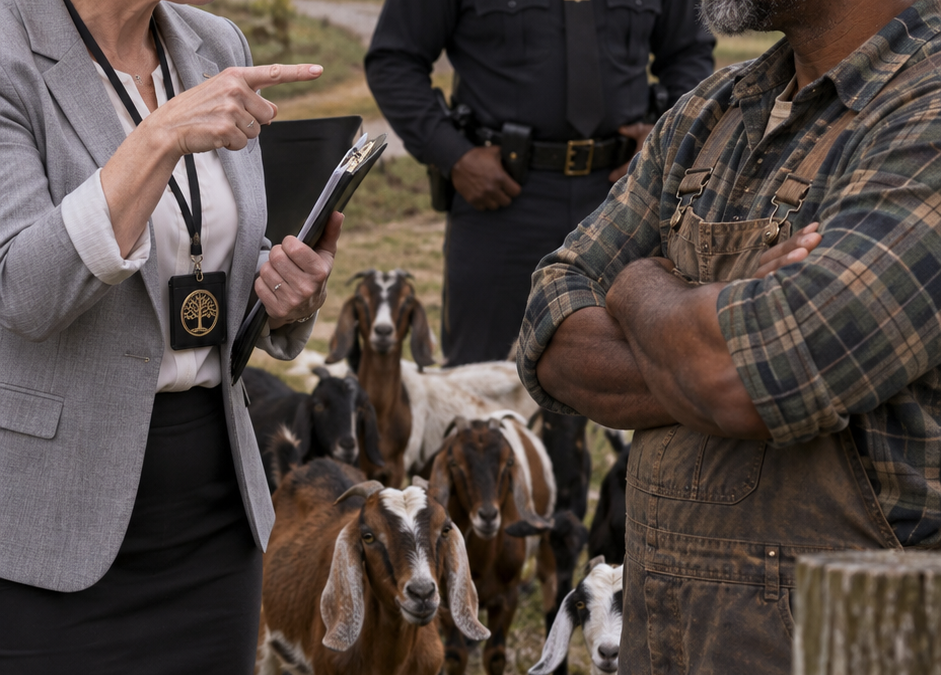
She stood just inside my fence line on a damp March morning, wearing a gray blazer that looked as though it had never encountered mud.
Fog drifted up from the creek.
The cedar posts were dark with moisture.
Behind me, eight Nubian does and one wether moved lazily through the grass, occasionally bumping shoulders as they searched for the freshest shoots along the lower part of the pen.
Diane held a clipboard against her chest.
A laminated Ridgecrest Estates badge hung from her neck.
Her white SUV sat beside the subdivision road fifty yards away, clean enough to reflect the pale morning sky.
I looked at her.
Then I looked at the goats.
Then back at her.
“You’re saying my goats violate your HOA rules?”
“They violate community livestock restrictions and nuisance standards.”
“On this property?”
“Yes.”
“You’ve checked that?”
Something changed slightly in her expression.
Not uncertainty.
Annoyance.
“The association has reviewed the matter.”
That was not what I asked.
But I did not argue.
I had spent fifty-four years learning that when somebody makes a legal claim about land, letting them talk is often more useful than interrupting them.
“What happens after fourteen days?” I asked.
“We escalate.”
“To whom?”
“Animal control. Law enforcement if necessary.”
That almost made me smile.
Almost.
Because the man she was talking about calling was Raymond Callaway.
My uncle.
Thirty-one years in county law enforcement.
Nine of them running the department.
He had eaten Sunday dinner at my grandmother’s table.
He had helped my father repair storm damage to the north pasture fence in 1986.
He had walked this property before Ridgecrest Estates existed, before its clubhouse existed, before Diane Coulter had ever heard the words “community standards.”
But I did not tell her any of that.
There was no need.
Not yet.
“I appreciate you letting me know,” I said.
Diane stared at me as if she had expected resistance and was disappointed not to get it.
“Fourteen days, Mr. Callaway.”
“I heard you.”
She turned and walked back toward her SUV.
I watched until she disappeared around the bend.
Then I went inside.
In the back bedroom stood an old steel filing cabinet that had belonged first to my grandfather, then my father, and now me.
I opened the second drawer.
The deed was exactly where it had always been.
Instrument 2004-CR-0881.
Two hundred twelve acres.
Clear title.
My name.
I laid it on the table.
And that was when I understood that Diane Coulter had not brought me a problem.
She had brought me a claim.
Claims can be tested.
My name is Ellis Callaway.
I have lived on this property for most of my life.
Before me, my father lived here.
Before him, my grandfather Amos Callaway built his life here.
Amos arrived in Millhaven County in 1947.
He did not come with inherited money.
He came with a history of losing land.
His family had been broken financially by drought years earlier, and he had grown up watching adults around him discover that when the land goes, nearly everything else goes with it.
So when he managed to buy eighty acres from a timber company that had cut most of the valuable trees and considered the ground worthless, he treated ownership almost like a sacred obligation.
He paid in installments.
Every payment went into a tin box.
Receipt.
Date.
Signature.
Amount.
Nothing thrown away.
Nothing assumed.
The old timber company had left behind rough pasture, second-growth cedar, limestone, and creek bottom.
Amos saw a future.
He cleared the first forty acres with a mule team.
He planted grass.
Rebuilt fences.
Cut cedar posts.
Raised cattle.
Eventually, he built the small farmhouse whose expanded version I still live in.
When he died in 1979, my father found a handwritten note tucked inside the deed.
It said:
Do not sell what cannot be replaced.
Dad obeyed.
He added land when neighbors sold.
Forty acres in 1963.
Thirty-two more in 1971.
Other small adjustments followed.
By the time the property eventually came to me in 2004, it totaled 212 acres.
Creek bottom.
Pasture.
Second-growth timber.
A limestone ridge along the western side that catches the last sunlight every evening.
The title was clean.
No HOA covenant.
No subdivision restriction.
No recorded easement benefiting Ridgecrest Estates.
Nothing.
The goats came much later.
My daughter wanted them when she was twelve.
At first I resisted.
Then she found a farm outside Kerrville that was selling several healthy Nubians.
We came home with eight does and one wether.
I built the enclosure myself.
Treated lumber.
Welded wire.
Concrete-set corner posts.
A gate that hung straight.
A shed for bad weather.
Water trough.
Mineral feeder.
Enough pasture that the goats could browse without destroying the ground.
The pen sat around sixty yards inside my eastern fence.
Not sixty yards from the legal boundary.
Sixty yards inside my own fence, which itself stood well inside the surveyed property line.
The goats were legal under county zoning.
Millhaven County classified my parcel as agricultural.
Livestock was expressly permitted on tracts larger than five acres.
I owned 212.
There was no gray area.
Ridgecrest Estates came later.
Hargrove Properties purchased roughly sixty acres east of me in 2009.
By 2010, the pasture had become a planned subdivision.
Two hundred fourteen houses.
Pool.
Clubhouse.
Decorative entrance.
Private management company.
Forty-seven pages of covenants, conditions, and restrictions.
The kind of place where every mailbox matched.
Diane Coulter became HOA president in 2018.
I knew who she was before she appeared at my fence.
People in the county knew.
She took the job seriously.
Perhaps too seriously.
The first official letter arrived by certified mail that same March.
It listed three violations.
Unauthorized livestock.
Failure to maintain aesthetic standards.
Creation of a nuisance affecting neighboring property.
Fine:
$400.
Payment due:
Fourteen days.
What it did not contain was more interesting.
No county ordinance.
No deed restriction.
No easement.
No recorded covenant affecting my land.
No explanation for how Ridgecrest Estates believed its authority crossed its own platted boundary.
I read the letter twice at the kitchen table.
Outside the window, two of the goats were standing on an overturned feeder as if conducting their own board meeting.
I set the letter down.
I was not angry.
I felt something closer to recognition.
Somebody had made an assumption.
And instead of checking it, they had printed the assumption on letterhead.
I started a file.
RIDGECREST ESTATES HOA.
MARCH.
Diane’s letter went inside.
Then I called my neighbor Gerald Pruitt.
Gerald had farmed north of me for four decades.
At seventy-one, he possessed the particular kind of local knowledge produced by staying in one place long enough to see everybody else arrive.
“You finally heard from Diane?” he asked.
That told me plenty.
“What do you know?”
“She’s been talking about your goats for months.”
“How?”
“HOA meetings.”
I leaned back.
“She’s discussed my goats at board meetings?”
“Twice that I know about.”
Gerald paused.
“She calls your side the deterioration of the western boundary.”
I looked out my kitchen window.
“Of course she does.”
“There’s more.”
He told me Diane had posted a photograph of my fence on the Ridgecrest Estates community page.
The caption read:
Working to resolve this eyesore for our community.
“My fence?”
“Your fence.”
“On my property?”
“That one.”
“You save the post?”
Gerald gave a short laugh.
“Ellis, who do you think you’re talking to?”
The next afternoon, he brought me a printed copy.
The date was handwritten on the back.
He had also captured the page showing Diane as the poster.
I filed it behind the violation letter.
Three weeks later, a second certified envelope arrived.
Fine increased:
$800.
New violation:
Failure to respond to official HOA correspondence.
Then I reached the paragraph that changed my interest into concern.
Ridgecrest Estates HOA reserves the right to enforce community standards on all properties within or adjacent to the Ridgecrest Estates planned community, including properties whose owners have not formally acknowledged HOA jurisdiction.
I read one word four times.
Adjacent.
That was their theory.
Not deed restriction.
Not contract.
Not easement.
Not annexation.
Proximity.
Apparently, living near an HOA meant they believed you could become subject to it without ever joining it.
I sat quietly for several minutes.
Then I called Patricia Wren.
Patricia had practiced property law in Millhaven County for twenty-two years.
I remembered her from a county agricultural zoning hearing because she asked sharper questions than anybody else in the room and never once raised her voice.
“Bring me everything,” she said.
“The letters?”
“Letters. Deed. Survey if you have one. Plat if you can get it.”
“I have enough paper to fill your office.”
“Start with the deed.”
I met her Thursday.
Patricia wore reading glasses on a thin chain and used a mechanical pencil to underline important language.
She read both HOA letters.
Then my deed.
Then the subdivision plat I had downloaded from the county portal.
Finally, she pulled up Ridgecrest Estates’ CC&Rs.
Section One.
Paragraph Two.
She underlined the geographic definition.
All lots and common areas within the Ridgecrest Estates planned community as recorded in Plat Book 44, Pages 112 through 118, Millhaven County Register of Deeds.
She looked at me.
“Their jurisdiction stops at their plat.”
“That’s my reading.”
“It’s everybody’s reading.”
She tapped the second letter.
“This sentence about adjacent property has no legal force. They cannot expand recorded covenant authority by writing themselves a letter.”
Then she wrote one word on her legal pad.
Trespass.
I saw it upside down.
Patricia did not sue immediately.
Instead, she gave me a checklist.
Current survey.
Certified chain of title.
Certified Ridgecrest plat.
Sworn statement from a neighbor with direct boundary knowledge.
“Build the record first,” she said.
That sounded exactly like my father.
So I did.
I hired Dale Hutchins.
Thirty years as a licensed surveyor.
His father had surveyed Millhaven County before him.
Dale spent two days walking my property.
The first morning, fog lay low across the creek.
I followed him along the eastern line.
At three points, he stopped and showed me where my existing fence stood relative to the true boundary.
Fourteen feet inside at the nearest point.
Thirty-one feet inside at the farthest.
In other words, Diane was not merely claiming authority over land near the HOA.
My fence itself stood entirely on my land, with additional land between the fence and the actual boundary.
The goat enclosure sat another sixty yards beyond that.
Dale filed the certified survey.
I placed it in the folder.
Next came the title chain.
Two afternoons at the courthouse.
Loretta at the Register of Deeds helped me retrieve everything.
Amos Callaway’s original purchase.
Instrument 1947-AC-0214.
1963 addition.
1971 addition.
Transfer after my father’s death.
Transfer to me in 2004.
Every conveyance recorded.
Every signature proper.
No missing deed.
No conflicting ownership.
No Ridgecrest restriction.
Loretta stacked the certified copies.
“That’s a clean title.”
I smiled.
“My grandfather would’ve liked hearing you say that.”
Then I obtained the certified Ridgecrest plat.
Plat Book 44.
Pages 112 through 118.
There was the subdivision.
Every lot.
Every street.
Clubhouse.
Pool.
Common areas.
Outer boundary.
Between the subdivision and my property sat a county road right-of-way dating to 1938.
At no location did the Ridgecrest plat overlap my land.
Not an inch.
Gerald gave me the final piece.
A notarized statement describing forty years of knowledge of the boundary.
Attached was the printout of Diane’s social-media post.
Patricia reviewed everything in silence.
Survey.
Title chain.
Plat.
Zoning ordinance.
Gerald’s affidavit.
Diane’s letters.
When she finished, she removed her glasses.
“They have no colorable claim.”
She pointed toward my deed.
“No covenant.”
Survey.
“No encroachment.”
Plat.
“No jurisdiction.”
Zoning code.
“No livestock violation.”
Then the letters.
“And they are demanding money anyway.”
“What happens now?”
“Now we tell them formally.”
Her legal notice went out certified.
It cited every instrument.
Every book.
Every page.
Every survey reference.
Every zoning provision.
The conclusion was simple.
Ridgecrest Estates had no authority over Parcel 2004-CR-0881.
The fines were invalid.
Any continued attempt to enforce HOA restrictions against my land would be treated as interference with my property rights.
Nine days later, the return receipt came back.
Signed.
For several weeks, nothing happened.
Then one morning, I was repairing a water line near the goat shed when a county patrol vehicle rolled slowly up my driveway.
I stood.
The goats looked up too.
Deputy Marcus Bell stepped out.
I knew Marcus.
Not well.
Small county.
People know one another.
“Morning, Ellis.”
“Marcus.”
He glanced toward the goats.
“I got a complaint.”
There it was.
“Let me guess.”
He gave me a tired look.
“Ridgecrest Estates.”
“Of course.”
He pulled a small notebook from his pocket.
“Complaint says livestock are being maintained in violation of residential restrictions, creating a nuisance, possibly neglected, and that the owner refused to comply with community enforcement.”
I stared at him.
“Neglected?”
“I’m telling you what was called in.”
He looked at the animals.
Clean water.
Shelter.
Feed.
Fence.
Healthy coats.
One goat was attempting to chew a strap hanging from the side of my tool bag.
Marcus almost smiled.
“Those are the neglected animals?”
“Terribly oppressed.”
He walked the pen.
Checked the water.
Looked at the fencing.
Asked whether I had documentation of agricultural zoning.
I walked inside and brought him a copy of the county classification.
He read it.
“Two hundred twelve acres.”
“Yes.”
“Agricultural.”
“Yes.”
He closed his notebook.
“I figured.”
“You figured?”
Marcus hesitated.
Then he said, “Chief saw the address when dispatch entered the complaint.”
I knew immediately.
“Raymond?”
“He asked me to handle it.”
That was exactly what my uncle would do.
Not come himself.
Not turn family into an official matter.
Send another officer.
Document everything cleanly.
“No offense here that I can see,” Marcus said.
“Animal control?”
“They got the same complaint. I talked to them before coming out. Unless conditions are different from what I’m looking at, they don’t have a case either.”
He put the notebook away.
Then looked toward the subdivision.
“Whoever called seemed very insistent that the HOA wanted police assistance.”
I leaned against the fence.
“Did she happen to tell dispatch who she wanted to speak with?”
Marcus smiled now.
“She asked for the chief.”
I closed my eyes for half a second.
“And nobody told her?”
“Not until he took the call.”
I looked at him.
Marcus laughed.
“Apparently she explained at length that an uncooperative neighboring property owner was refusing to remove prohibited livestock. Chief Callaway listened. Then he asked for the address.”
I could picture my uncle perfectly.
“Then?”
“Then she gave him your address.”
I waited.
Marcus shook his head.
“He told her the department would respond to any legitimate complaint, but HOA rules are not criminal law, and being adjacent to a subdivision does not put private agricultural property under HOA jurisdiction.”
“That sounds like Raymond.”
“He also said he was related to the property owner and would therefore have another deputy conduct any official check.”
That sounded even more like Raymond.
“What did Diane say?”
Marcus raised both eyebrows.
“She became considerably less talkative.”
I laughed for the first time since the whole thing began.
But Raymond did not make the problem disappear.
Nor would I have wanted him to.
Family connection might have made Diane uncomfortable, but it did not prove my title.
Records did.
Law did.
The patrol visit simply produced another piece of neutral documentation.
No criminal violation.
No animal-welfare issue.
No county livestock violation.
Marcus gave me the incident number.
I sent it to Patricia.
Her reply contained six words:
Put it in the file.
So I did.
Diane did not call me.
Instead, she hired lawyers.
An Austin firm representing the HOA responded to Patricia’s notice.
Their attorney was a man named Strickland.
He did not defend the livestock allegation directly.
That would have been difficult after the county inspection.
Instead, he invented a broader theory.
The HOA, he argued, possessed “implied authority” to regulate adjacent properties whose use materially affected the character and reasonable expectations of Ridgecrest Estates.
I read that sentence twice.
Then called Patricia.
“Can they really argue that?”
“They can argue almost anything.”
“That wasn’t what I asked.”
“No.”
She paused.
“It is not a strong argument.”
Strickland cited three cases.
Patricia read all three.
None involved an HOA regulating completely separate land outside its recorded boundaries.
Each involved parties already connected by a recorded declaration or covenant.
We had no such shared instrument.
“They’re trying to turn community preference into property rights,” Patricia said.
“And?”
“That is not how title works.”
She filed for declaratory judgment.
The petition asked the court to declare that Ridgecrest Estates had no authority over my 212 acres.
It asked the court to void the $1,200 in accumulated fines.
It requested a permanent injunction preventing further HOA enforcement against my property.
And it sought attorney’s fees.
The hearing was set for the second Tuesday in June.
By then, this had gone on for months.
Spring had turned warm.
The goats had shed their heavier winter coats.
Grass covered the lower pasture.
And the old cedar fence looked exactly the way it always had.
The night before the hearing, Uncle Raymond called.
We had deliberately spoken little about the case.
He knew that was cleaner.
“Court tomorrow?”
“Yes.”
“Patricia ready?”
“She’s always ready.”
He chuckled.
Then he became serious.
“You know I stayed out of it because of family.”
“I know.”
“I told Diane that too.”
“You did the right thing.”
There was a pause.
“Your grandfather would’ve hated all this.”
“He would’ve loved the paperwork.”
Raymond laughed.
“That he would.”
The next morning, I put on a dark wool blazer that had belonged to my father.
The courthouse stood three stories tall on the square.
Limestone walls.
Wide steps.
A hundred years of property fights inside them.
Patricia met me in the hallway.
I carried a banker’s box.
Inside:
Original deed.
Certified title chain.
Dale Hutchins’s survey.
Ridgecrest plat.
Gerald’s affidavit.
HOA letters.
County zoning records.
Deputy Bell’s incident report.
Animal-control notes.
Patricia looked inside.
“You brought everything.”
“My family has a paperwork problem.”
“That problem is about to become useful.”
Diane was already seated inside the courtroom with Strickland.
She wore another dark blazer.
Her familiar clipboard sat beside her.
When I walked past, she looked at me.
I nodded.
She did not return it.
Judge Clara Fitch entered at nine.
Fourteen years on the county bench.
Patricia had described her as a judge who disliked arguments designed to make simple records seem complicated.
Strickland spoke first.
He argued community character.
Reasonable homeowner expectations.
Property values.
The need for planned communities to protect residents from external nuisances.
And repeatedly:
Adjacent property.
Adjacent use.
Adjacent impacts.
He said “adjacent” so many times that eventually the word seemed to lose meaning.
Then he cited his three cases.
Judge Fitch listened.
When he finished, she asked:
“Counsel, is Mr. Callaway’s property contained within the Ridgecrest Estates recorded plat?”
“No, Your Honor.”
“Is it subject to the recorded declaration?”
“Our position is that the declaration’s protective purpose—”
“That was not my question.”
Silence.
“No.”
“Is there an easement?”
“No recorded easement, Your Honor.”
“Restrictive covenant?”
“No.”
“Annexation document?”
“No.”
“Contract between the parties?”
“No.”
Judge Fitch wrote something on her pad.
Patricia stood.
She did not make a speech.
She turned on the projector.
First image:
Ridgecrest plat.
“Plat Book Forty-Four, Pages One Hundred Twelve through One Hundred Eighteen.”
She pointed to the outer boundary.
“This is where Ridgecrest Estates ends.”
Next image:
My certified survey.
“This is Mr. Callaway’s parcel.”
The two did not overlap.
She highlighted the county road right-of-way between them.
Then my fence.
Fourteen to thirty-one feet inside my property.
Then the goat enclosure.
Farther inside again.
Patricia read the jurisdiction clause from Ridgecrest’s own governing documents.
All lots and common areas within Ridgecrest Estates.
She paused.
“The instrument defines its territory.”
Another pause.
“Mr. Callaway’s land is not within it.”
She displayed the agricultural zoning ordinance.
“Livestock is expressly permitted.”
Then Deputy Bell’s report.
“No law-enforcement violation.”
Animal-control record.
“No animal-welfare violation.”
Finally, Diane’s letters appeared on the screen.
$400.
Then $800.
Demand for removal.
Assertion of jurisdiction over “adjacent” property.
Patricia faced the judge.
“The HOA has attempted to manufacture authority through repetition. First by letter. Then by fines. Then by a law-enforcement complaint. Now through litigation.”
Diane shifted behind her attorney.
Patricia continued.
“But saying a thing repeatedly does not record it against title.”
Judge Fitch looked toward Strickland.
“Counsel, identify for me one recorded instrument granting Ridgecrest Estates authority over this parcel.”
Strickland returned to implied authority.
Community character.
Reasonable expectations.
Judge Fitch listened.
Then she asked:
“If a homeowners association may impose its covenants upon any nearby land merely because the association dislikes that land’s lawful agricultural use, where does the authority stop?”
Strickland started answering.
“One parcel away?”
He stopped.
“Two?”
Silence.
“One mile?”
No answer.
Judge Fitch leaned back.
“That is the problem with your theory.”
The courtroom went quiet.
She took a short recess.
When she returned that afternoon, she ruled from the bench.
Ridgecrest Estates possessed no legal authority over my property.
None.
The $1,200 in fines were void.
The HOA was permanently prohibited from issuing further violation notices or assessments against my parcel based on its community covenants.
The court declared that my agricultural use, including the goats, remained governed by county law rather than Ridgecrest rules.
And because the HOA had pursued a legal claim without a colorable recorded basis after receiving documents establishing the boundary, the court awarded attorney’s fees.
$11,400.
Judge Fitch looked briefly at both tables.
Then she said:
“The record is clear.”
She paused.
“It has always been clear.”
That was it.
No dramatic gavel.
No shouting.
No humiliation speech.
Just the record.
Patricia and I packed the banker’s box.
Outside, June heat had settled over the courthouse square.
“You think they’ll pay?” I asked.
“They have sixty days.”
“And if they don’t?”
“We come back.”
I smiled.
“I assume you already have the paperwork.”
Patricia gave me a look.
“Ellis.”
“Right.”
Of course she did.
I drove home by the county road.
Past Ridgecrest Estates.
Past the pool.
Past the clubhouse.
Past rows of carefully maintained houses.
Then the road bent toward my place.
Cedar fence.
Pasture.
Oak.
Creek.
The goats were waiting near their pen.
One doe lifted her head as my truck stopped.
Then she decided I was not carrying feed and lost interest.
I stood beside the enclosure.
For months, strangers had debated whether those animals belonged there.
The goats had never cared.
They had eaten.
Slept.
Climbed things they were not supposed to climb.
Chewed things they were definitely not supposed to chew.
And waited for humans to finish arguing about an issue the deed had settled long before any of them were born.
Later that afternoon, Uncle Raymond pulled into the driveway.
No uniform.
No patrol car.
Just his old pickup.
He walked over to the pen.
“So these are the criminals?”
“The entire gang.”
He scratched one doe behind the ear.
“She looks dangerous.”
“Repeat offender.”
We stood quietly for a moment.
Then Raymond said, “I heard the ruling.”
“County travels fast.”
“You know Gerald Pruitt.”
“That explains everything.”
He smiled.
Then looked toward the eastern fence.
“I remember helping your dad string wire over there.”
“I know.”
“Eighty-six.”
“After the storm.”
He nodded.
“Tree came down over thirty feet of it.”
I remembered.
I had been a teenager.
Raymond had still been a young deputy.
Dad made us reset three posts because the first alignment was crooked.
Raymond looked back at the goats.
“Diane really didn’t know this was family land?”
“She didn’t know much of anything about it.”
“She knew what she wanted.”
“That’s different.”
Raymond nodded.
“Usually is.”
That evening, I opened the filing cabinet.
The Ridgecrest folder was thick now.
Diane’s original notice.
Second fine.
Her social-media post.
Survey.
Title chain.
Plat.
Patricia’s notice.
Sheriff’s incident report.
Animal-control record.
Court filings.
Final judgment.
I put the judgment at the back.
Then I closed the folder.
Below it sat my grandfather’s tin box.
I pulled it out.
Inside were the old receipts.
Paper thin with age.
Payment after payment.
A man protecting ownership with ink because he understood how quickly memory disappears.
I found one receipt near the bottom.
Twenty-five dollars.
Signed.
Dated.
Almost eighty years earlier.
Amos had saved it because ownership was never something he took for granted.
That was the real inheritance he left us.
Not just dirt.
Not just acreage.
Proof.
The next morning, fog settled low over the creek.
I walked the eastern fence before breakfast.
The same cedar line Diane had photographed.
The same pasture she called an eyesore.
Water droplets hung from the wire.
A goat followed me halfway before becoming distracted by a blackberry vine.
When I reached the ridge, I stopped.
From there I could see Ridgecrest Estates beyond the road.
Rooflines.
Clubhouse.
Landscaped entrance.
A perfectly respectable subdivision.
There was nothing wrong with those people having rules for their own property.
If homeowners voluntarily bought land subject to restrictions, those restrictions were part of what they purchased.
But the important words were their own property.
That was the boundary Diane refused to understand.
Authority has edges.
An HOA covenant ends.
A deed ends.
A police department’s jurisdiction has limits.
A fence has a line.
Problems begin when people start believing that because they possess authority somewhere, they possess it everywhere.
Diane had a board.
A management company.
A clipboard.
A law firm.
She even tried calling the police.
What she did not have was the one thing that mattered.
A legal right over my land.
And my uncle being the chief was never what defeated her.
Raymond had actually done the opposite of what somebody expecting favoritism might imagine.
He stepped away.
He sent another deputy.
He allowed the facts to be documented independently.
That made the result stronger, not weaker.
No one could later say my family connection fixed anything.
The deed was not my uncle’s opinion.
The survey was not my uncle’s opinion.
The county zoning ordinance was not my uncle’s opinion.
Judge Fitch’s order was not my uncle’s opinion.
They were records.
And records do not care who your relatives are.
That afternoon, I found my daughter near the goat enclosure.
She was grown by then.
The twelve-year-old who had once begged me for Nubians had a life and family of her own, but she still came by and treated those goats as if they were descendants of royalty.
She scratched one under the chin.
“So they get to stay?”
“They were always staying.”
“You know what I mean.”
I smiled.
“Yes.”
She looked east.
“Was all of this really because Diane didn’t like looking at them?”
“I think it started that way.”
“And then?”
“Then she decided disliking something gave her authority over it.”
My daughter thought about that.
“That seems expensive.”
“Eleven thousand four hundred dollars in attorney’s fees expensive.”
She laughed.
Granddad Amos would have appreciated that laugh.
Before sunset, I walked alone to the limestone ridge.
The valley below turned gold.
My grandfather used to stand there after work.
Dad told me he rarely spoke while watching the light leave the fields.
He simply stood.
Taking inventory.
Not of value.
Of continuity.
The creek still moved where it always had.
The cedar fence still followed the pasture.
The goats were settling near their shelter.
And beyond the eastern road, Ridgecrest Estates remained exactly where its recorded plat said it belonged.
No farther.
I thought about Diane’s first sentence.
“You have fourteen days to remove them.”
There had been something almost impressive about her certainty.
Not because it was justified.
Because it survived so long without being tested.
But confidence has never moved a survey pin.
A laminated badge has never expanded a deed.
And a homeowners association cannot acquire somebody else’s farm simply by printing the word adjacent on official letterhead.
My grandfather knew that without ever meeting an HOA president.
My father knew it without needing a lawyer to explain it.
And after one police complaint, two invalid fines, a complete title review, a certified survey, and a court order, Diane Coulter knew it too.
The goats stayed.
The fence stayed.
The land stayed exactly where it had been since 1947.
And so did the line Diane should never have crossed.








