𝗙𝗨𝗟𝗟 𝗦𝗧𝗢𝗥𝗬 HOA Karen Called My Land Worthless and Offered Me $5,500 — Then a Geologist Found What She Had Been Trying to Steal
𝗣𝗔𝗥𝗧 𝟮
The first letter arrived in March.
It informed me the board had adopted an annexation resolution incorporating my parcel into the Copper Hollow Estates Homeowners Association.
I read it twice.
I had signed nothing.
Nobody had requested my permission.
Apparently, several people had sat in a room without me, voted that my land belonged under their authority, mailed me the result, and considered the matter finished.
The fines began almost immediately.
Unmaintained vegetation.
Forty dollars.
Unpermitted structure.
Sixty dollars.
The “structure” was Walt’s windmill, which had existed before Copper Hollow Estates existed.
Then came visual nonconformity.
I never learned precisely what that meant.
Apparently nine acres of natural scrubland did not resemble manicured quarter-acre lawns.
Eventually, the fines became daily.
That was Sylvia’s real weapon.
A hundred-dollar fine is an argument.
A hundred dollars every day is a clock.
By July, the documents beside my toaster contained five figures’ worth of penalties.
I wrote the board twice.
Both letters were simple.
Please identify the recorded instrument placing the Bowen parcel under the authority of the Copper Hollow Estates Homeowners Association.
I received a generic response to the first.
Nothing to the second.
Then, during the second week of August, Sylvia sent something different.
It was not a fine.
It was an internal letter addressed to the HOA board with a copy sent to me.
In it, Sylvia described my property using three phrases I eventually memorized.
“Unbuildable, unsellable, of no meaningful value to the association or its owner.”
Signed:
Sylvia Hargrove, President.
I placed that letter in the box.
Nine days later, Sylvia sat in my kitchen offering $5,500 for the same property she had formally declared worthless.
I did not notice the significance that morning.
I noticed it that night.
When I placed the purchase agreement in the box, it landed directly on top of Sylvia’s letter.
I saw the two dates.
Nine days apart.
I stood there staring.
Worthless.
Then: Sell it to me.
I took a pen and circled both dates.
A strange feeling settled into my stomach.
Not certainty.
Not even suspicion yet.
It felt more like reading an invoice whose math added correctly while everything else about it felt wrong.
Why would a woman formally place the lack of value on record immediately before purchasing the thing she had devalued?
People insult property during negotiation.
That was normal.
But Sylvia had written it to her own board first.
That meant she wanted “worthless” documented.
The question was why.
I sent her another certified letter.
One page.
No accusations.
Please provide a copy of the recorded instrument that placed the Bowen parcel under the authority of the Copper Hollow Estates Homeowners Association.
Six days later, an envelope arrived.
Inside was their annexation resolution.
Board minutes.
Vote tally.
Sylvia’s signature.
That was not what I had asked for.
A board resolution saying it had authority was not proof that authority existed.
It was Sylvia writing down that Sylvia was right, then mailing me Sylvia’s handwriting as evidence.
I added it to the box.
Then I drove to the county register of deeds.
The office occupied one room inside an old government building that smelled faintly of dust and copier toner.
A woman named Marjorie worked the counter.
Marjorie had the unnerving ability to understand what someone needed before they had finished explaining it.
She pulled my grandfather’s deed in less than two minutes.
Walter J. Bowen.
9.2 acres.
The legal description used old measurements, rods and bearings beginning at an iron pin near the section corner.
I read every line.
Nothing mentioned Copper Hollow Estates.
Nothing referenced a subdivision plat.
Nothing made the property subject to an association.
I made a copy.
I was not celebrating.
I am not an attorney.
All I knew was that a document I expected to contain something did not contain it.
My job had taught me that when important words are missing from important paper, somebody is often counting on nobody noticing.
I brought the deed to the September board meeting.
There were perhaps ten homeowners there.
Folding chairs faced a long table.
Coffee sat in a steel urn at the back.
Sylvia sat in the center with a binder and a wooden gavel she did not need.
I waited through landscaping updates, irrigation complaints, and a discussion about mailbox paint.
During public comment, I raised my hand.
“I have my deed.”
Sylvia’s face did not change.
“It doesn’t reference your association. It doesn’t reference your subdivision. I would like the board to explain what legal authority these fines are being issued under.”
I held up the copy.
Sylvia did not look at it.
That detail stayed with me.
She did not ask to see it.
She did not glance toward the legal description.
She did not even pretend curiosity.
“You’re out of order.”
“I’m in the public comment period.”
“You’re out of order,” she repeated.
Then she looked down.
“Item nine. Vegetation abatement on the Bowen parcel.”
That was when I understood something important.
I had brought a document into a fight that was not really about documents.
Two board members stared at the table.
A woman in the third row looked toward me, then deliberately looked away.
Sylvia read a motion authorizing the association to enter my property, clear vegetation, correct drainage, and bill me for the work.
“All in favor?”
Four hands went up.
“That is private property,” I said.
I kept my voice level.
I remember that because everything inside me wanted to shout.
Sylvia rested both hands on her binder.
“It’s association property.”
“No, it isn’t.”
She smiled.
“You just don’t have the paperwork to know it yet.”
Then she moved to item ten.
I sat in my truck afterward for nearly ten minutes.
I kept calculating.
What does a lawyer cost?
How much money do I spend defending nine acres everyone agrees is worthless?
What happens if the answer is more than the property?
The crew did not come Monday.
They came Thursday.
At six in the morning.
I woke to diesel engines.
By the time I had boots on, a skid steer was already crossing my fire line.
An excavator was unloading from a trailer.
A man wearing a reflective vest walked across the field spraying orange marks into the sand.
I ran outside.
“You can’t be here.”
He kept walking.
“We’re contracted through the association, ma’am.”
“This is my property.”
“You’ll want to speak to the association.”
I have heard variations of that sentence many times since.
It always means the same thing.
Someone has decided you are no longer a person entitled to say no, and the person doing the work has been paid not to care.
They scraped the rise.
They tore out scrub oak along the western edge, trees my grandfather had preserved because they slowed the wind.
Then the excavator dug a trench across the low side.
Thirty feet long.
Deep.
Far deeper than any drainage correction seemed to require.
“There’s no drainage problem,” I said.
The crew supervisor shrugged.
“Plans say drainage.”
There was almost no water on that rise.
That was why nothing grew there.
I stopped arguing.
Instead, I documented.
Truck logos.
License plates.
Equipment numbers.
The trench.
Depth measurements.
Time the machines entered.
Time they left.
The company name.
Delling Excavating.
When they were gone, I drove directly to the sheriff’s office and filed a trespass complaint.
The deputy took my statement.
Then he sighed.
“You understand we probably aren’t arresting contractors over an HOA property dispute.”
“I understand.”
“Then what are you hoping happens?”
“Nothing today.”
He waited.
“I just want it on the record with a date.”
The deputy looked at me differently after that.
Finally he nodded.
“That isn’t the worst instinct.”
Nine days later, Sylvia filed a lien.
$18,600 in fines.
$3,200 for abatement.
Administrative and legal fees.
Total:
$21,800.
Attached to 9.2 acres she claimed had no meaningful value.
Marjorie called me personally.
“A lien has been recorded against your parcel.”
She did not offer commentary.
She simply waited after saying it.
The silence did the commentary for her.
That evening, I walked out to the trench.
The sun was low.
Everything had taken on that flat orange color late summer gives dry ground.
The western side of the rise had been ripped open.
I stood at the trench’s edge.
Something looked strange.
The soil near the surface was normal enough.
Below it, the trench wall changed.
Pale.
Almost white.
Not chalk exactly.
More like raw sugar.
And the color kept going down.
No darker clay.
No bands.
No change.
Just that pale material farther down than the excavator bucket had reached.
I did not know what it was.
At that moment, all I could think about was Sylvia’s lien.
Lawyers.
Foreclosure threats.
The damage.
Still, habit took over.
I climbed into the trench.
I pressed my palm flat against the wall for scale.
Then I photographed it.
One photograph.
I climbed out.
Later I left my phone on the kitchen counter beside the document box.
Within days, I forgot the photograph existed.
The lien became real when the title company called.
Months earlier, I had started refinancing my house.
The house sat on a different parcel.
The woman who called sounded apologetic.
“We’re seeing a lien connected to adjacent property in your name.”
“It’s an HOA dispute.”
“I understand.”
“They have no authority over that land.”
“I understand.”
“So it shouldn’t affect my refinance.”
There was a pause.
“It’s recorded.”
That was the whole problem.
It was recorded.
Nobody at the title company had to believe Sylvia.
She had placed paper inside an official system.
Now the system believed the paper for her.
My rate lock expired.
The replacement rate raised my monthly payment by roughly $400.
Suddenly, Sylvia was no longer irritating me.
She was taking money from me.
Every month.
I spent three nights thinking.
Then I chose a strategy.
It was the wrong strategy, but I did not know that yet.
I would prove the land was buildable.
Sylvia’s entire narrative depended upon my property being useless.
Unbuildable.
Unsellable.
A liability.
If an expert evaluated the soil and certified a house could be constructed there, I could destroy that narrative.
Maybe the board would retreat.
Maybe the lien would collapse.
Maybe somebody would finally be embarrassed enough to admit what they were doing.
I called the county land conservation office.
A man gave me two names.
Then he paused.
“If it’s sand, call Rhodes.”
“Who’s Rhodes?”
“He’ll actually walk it.”
Dr. Emmett Rhodes had spent thirty-one years with the State Geological Survey.
He was sixty-six and retired.
Apparently retirement meant driving around in a mud-covered pickup and charging less than he probably should have to look at dirt.
He arrived the following week.
His truck was brown with dried mud halfway up the doors.
He shook my hand.
“Show me the ground.”
Walking toward the rise, I gave him my entire explanation.
The fines.
The claim that nothing could be built there.
The letter.
The soil evaluation I needed.
Rhodes listened.
He did not interrupt.
When I finished, he gave me no immediate answer.
He stopped beneath the windmill.
“Who poured this pad?”
“My grandfather. Sixties.”
Rhodes crouched.
He ran his thumb along the concrete.
Then around the base plate on one steel leg.
He stood and studied the entire frame.
“All four legs?”
“Yes.”
“No repair?”
“Not that I know of.”
“No settlement?”
“None.”
He looked at me.
“Sixty years?”
“About that.”
“That’s unusual.”
“Why?”
He did not answer.
Then he saw the trench.
He walked toward it quickly.
Not running.
But different.
He climbed down.
Placed his palm flat against the pale wall.
Exactly where I had.
And stood there.
“How long has this been open?”
“Since August.”
“Nobody filled it?”
“No.”
He climbed out.
Returned to his truck.
Came back carrying a hand auger.
He drove it into the ground eight feet from the trench.
Turn.
Squeak.
Pull.
He emptied material onto a tarp.
Again.
Again.
Again.
Four samples.
Each time he pinched the sand between his fingers.
Rolled it.
Dropped it.
Then stared toward the road as if listening to something.
Finally, Rhodes wiped his palms against his jeans.
“I want to bring a rig.”
“A drilling rig?”
“Small one.”
“Why?”
“Three holes. As deep as she’ll reasonably go.”
“I thought you were evaluating soil for a house.”
“I am evaluating the soil.”
“What are you looking for?”
He closed his tailgate.
“I want to know how deep this goes.”
The rig would cost $4,800.
That mattered.
My refinance had already collapsed.
I was paying $400 more each month than planned.
I had a $21,800 lien.
An attorney had quoted me $3,000 just to begin working.
Now a retired geologist who refused to explain his curiosity wanted nearly five thousand dollars to drill holes in what everybody kept calling worthless sand.
I sat at my kitchen table that evening.
Checkbook open.
The HOA document box sat beside me.
Outside my window stood Walt’s windmill.
There was no wind.
The frame did not move.
The ground holds it better than good soil would.
I wrote the check.
Sylvia sent another letter the following week.
More fines.
Then a threat.
Pay within sixty days or the association would begin foreclosure proceedings.
Foreclosure.
Against land Sylvia herself had called worthless.
I read that letter four times.
Then I returned to the county records office.
This time, I asked for everything.
Not merely my deed.
Everything the county maintained on that section.
Tax records.
Plat approvals.
Old permits.
Requests.
Maps.
Marjorie placed a thick folder and a printout in front of me.
Near the back was a records-request log.
Most entries were ordinary.
Surveyors.
Title companies.
Utilities.
Then one entry stopped me.
Someone had requested official state geology mapping for my township and section the previous fall.
Almost a year before Sylvia tried buying my land.
The requester’s name had been redacted.
A black rectangle covered it.
“Marjorie.”
She came over.
“Can I get this without the redaction?”
She studied the page.
“You can file a public-record request. Counsel reviews it.”
“How long?”
She looked at me.
“Longer than you want.”
I filed it that afternoon.
The drilling rig arrived Thursday.
Rhodes took three cores.
He labeled every segment carefully.
Depth.
Hole number.
Position.
He lined sample bags across his tailgate in exact order.
Rain fell steadily while I stood under an umbrella watching a retired geologist handle sand like criminal evidence.
When he finished, I asked, “What do you think?”
“I’ll call.”
He drove away.
He did not call for eight days.
On the eighth night, my phone rang.
“Kate.”
“Dr. Rhodes?”
“It’s not that your land is bad.”
I sat down.
“You’ve been asking the wrong question.”
My fingers tightened around the phone.
“What question should I be asking?”
“Are you home tomorrow morning?”
He arrived at eight.
He carried the cores inside.
I offered coffee.
He refused.
He pushed aside everything on the kitchen table, spread newspaper across the surface, and laid the core sections from left to right like a timeline.
The first few inches looked like ordinary dirt.
Everything beneath it was pale.
Segment after segment.
Nearly identical.
Raw-sugar color.
Uniform enough to look artificial.
Rhodes tapped the final segment.
“Thirty-two feet.”
“That’s how deep it is?”
“That’s where I stopped.”
I looked at him.
“What exactly is it?”
“Silica sand.”
I waited.
“High purity. Low iron. Well sorted. Well rounded.”
He touched the core.
“Glass grade.”
I stared.
“I asked whether I can build on it.”
“I know.”
For the first time since meeting him, Rhodes almost smiled.
“You’ve been trying to prove your land is like everyone else’s.”
He shook his head.
“It isn’t.”
Then he explained.
Thousands of years ago, after the glaciers withdrew, wind had transported and sorted sand across the region.
Over time, lighter contaminants and irregular material blew elsewhere.
What remained beneath my rise was a remarkably clean quartz-rich deposit.
That explained almost everything.
Why water disappeared through it.
Why crops struggled.
Why conventional septic design was difficult.
Why the windmill pad had barely shifted.
The characteristics everyone had treated as flaws were precisely the characteristics industry valued.
“The thing making the property bad residential ground,” Rhodes said, “is what makes it valuable mineral ground.”
“How valuable?”
He reached into his jacket.
Pulled out a folded sheet.
He had calculated acreage.
Depth.
Setbacks.
Recovery loss.
Regional royalty rates.
Then he turned the page around.
My eyes went directly to the number at the bottom.
$2.4 million.
Estimated royalty over the productive life of a lease.
I did not speak.
I read it again.
Then I thought about the number Sylvia had put on my kitchen table.
$5,500.
Against $2.4 million.
I opened the calculator on my phone because I did not trust my head.
Roughly two-tenths of one percent.
Sylvia Hargrove had sat four feet from where those cores now lay.
She had offered me roughly two-tenths of one percent of the potential royalty value.
Then she had called it generosity.
I laughed.
One short, shocked sound.
Rhodes did not laugh.
He was still holding the chair.
“What?”
“There’s a problem.”
Of course there was.
“How do you get it out?”
“What?”
“Sand doesn’t leave through a pipeline.”
He pointed toward the window.
“You excavate it. Then you haul it.”
My excitement cooled.
“Trucks?”
“Lots of trucks. For years.”
He continued.
“Before a serious operator spends much time on the geology, they study access.”
I already knew.
I looked toward the road.
Copper Hollow Loop.
The private road encircling my property.
The only practical entrance to the parcel.
My grandfather had sold the road strip to the developer in 1994.
No county frontage remained.
No alternate route.
No rear entrance.
Nine acres of potentially valuable silica surrounded by a private road controlled by Copper Hollow Estates.
Controlled, in practical terms, by Sylvia Hargrove.
“Nobody leases sand they can’t remove,” Rhodes said.
“So it might be worth millions.”
“Yes.”
“And I can’t get any of it out.”
“Not unless you have legal access suitable for hauling.”
I looked through the kitchen window.
Two hundred feet away sat an ordinary piece of asphalt.
Mailboxes.
Curbs.
Driveways.
It suddenly looked like a prison wall.
That afternoon, I called an aggregate company Rhodes recommended.
A land manager answered.
I explained I had acreage containing possible high-purity silica.
He sounded interested.
Very interested.
Then he asked for the township and section.
I gave them.
Silence.
Not long.
But noticeable.
“Ma’am, I’ll need to check whether we have a conflict involving that ground.”
“A conflict?”
“I’ll have somebody contact you.”
Nobody did.
That silence bothered me more than anything he could have said.
So I stopped calling companies.
Instead, I began searching county land records for nearby parcels.
Grantor.
Grantee.
Section by section.
It consumed most of Saturday.
By late afternoon, a name started repeating.
Ridgeline Aggregate Partners.
Parcel east of mine.
Optioned.
Parcel west.
Purchased.
Another farther along the rise.
Option agreement.
Four parcels in fourteen months.
None publicly advertised.
None apparently distressed.
Quiet acquisitions.
One at a time.
Exactly how you buy property when advertising what you are doing might increase everybody else’s asking price.
Ridgeline had been assembling land along my ridge for more than a year.
I drove home after dark.
The radio stayed off.
Somewhere during that drive, my understanding changed completely.
For months, I had been trying to prove Sylvia wrong when she called the land unbuildable.
That no longer mattered.
Maybe she was right.
Maybe nobody should ever put a house on it.
The issue was not whether my land was useful.
The issue was whether Copper Hollow had any legal authority over it.
If the annexation was legitimate, Sylvia could continue using HOA control to prevent development or access.
If it was illegitimate, everything changed.
The fines.
The abatement.
The lien.
The trespass.
I reached home at nine and left my coat on.
I pulled Walt’s deed from the document box.
This time, I did not read it looking for subdivision language.
I read the legal description itself.
Every bearing.
Every rod.
Every boundary.
Two-thirds through, a clause stopped me.
I read it again.
Then again.
At 9:40 p.m., I called Marjorie’s office and left a voicemail.
“Please pull the original Copper Hollow Estates subdivision plat for me first thing tomorrow.”
When I arrived after eight, the plat was already spread across the counter.
Recorded 1994.
Forty-two lots.
Loop road.
Drainage parcels.
Common areas.
And exactly in the middle, outlined separately, was my grandfather’s land.
Four words were printed across it.
EXCEPTED. NOT PART HEREOF.
I touched the words.
For several seconds, I could not speak.
Marjorie did.
“It’s not part of the subdivision, Kate.”
“No.”
“It never was.”
I spent three days in that records room.
Every document involving the property from 1962 forward.
Transfers.
Mortgages.
Easements.
Releases.
Tax instruments.
Anything that might have lawfully annexed the property afterward.
Nothing did.
There was no annexation.
There had never been one.
Sylvia and the board had passed a resolution inside their own meeting claiming property they did not own and had no authority to govern.
Then they had begun fining me.
I hired Emily Ward.
The $3,000 retainer hurt.
I wrote the check anyway.
Emily read every page in my box.
It took almost two hours.
Then she placed the lien beside the deed and aligned their edges.
“They recorded an encumbrance against real estate in which the association has no property interest.”
She looked at me.
“This isn’t merely an HOA disagreement anymore.”
“What is it?”
“A defect in the public record.”
She tapped the lien.
“And courts tend to take those seriously.”
We filed a petition challenging both liens, all fines, and the abatement charges.
A hearing was scheduled ten days later.
Then I did something Emily advised against.
I mailed Sylvia one final certified letter.
It contained no threats.
Only the subdivision plat reference.
Book.
Page.
Recording date.
And four words.
EXCEPTED. NOT PART HEREOF.
I wanted proof of when Sylvia received it.
Four days later, the green card returned.
Sylvia Hargrove’s signature was written across it in blue ink.
The following night, she called an emergency board meeting.
The woman from the third row—the one who had looked away when I challenged Sylvia—called me at 10:30.
She sounded nervous.
“The board adopted a road-use covenant.”
“What kind?”
“No commercial hauling. No extraction vehicles. No industrial trucks on Copper Hollow Loop.”
“When?”
“Tonight.”
“Who proposed it?”
She hesitated.
“Kate, Sylvia already had it printed before the meeting began.”
I closed my eyes.
There it was.
Sylvia had received proof that my property was not within her HOA.
So she changed strategies.
If she could not control the land, she would control the road.
Win the hearing.
Lose access.
Millions of dollars beneath my grandfather’s field.
No legal way to transport one truckload out.
Two days later, Sylvia filed a second lien.
Another $6,400 for “abatement and legal expenses.”
I carried it directly to Emily.
She read it.
Her expression changed.
“This road covenant is smarter.”
My stomach tightened.
“She can do that?”
“A private road owner can usually regulate use of its own road, subject to existing rights.”
“What about my property?”
“If your parcel has no independent easement, you may be a nonmember whose only physical access crosses association property.”
She set the document down.
“You can beat the HOA on jurisdiction and still have no commercial route.”
“What would change that?”
“The original road easement.”
“My grandfather sold them that strip.”
“Exactly.”
She leaned forward.
“The question is whether he reserved anything when he did.”
That night Rhodes called.
He wanted to discuss lab results.
He heard my voice and stopped.
“What happened?”
I told him about the covenant.
He was silent.
Then he asked one question.
“Who owned the strip before the road?”
“My grandfather.”
“Kate.”
The tone in his voice changed.
“A man does not sell a developer his access strip and keep a landlocked parcel behind it without reserving something.”
“How do you know?”
“I’ve been around developers for thirty years.”
He paused.
“Go find what Walt kept.”
I searched for two days.
Nothing in the document box.
Nothing obvious at the county under the references I had copied.
Then I remembered the steel lockbox beneath the windmill.
My grandfather kept tools there.
Fence pliers.
Wire.
A chain.
Once, when I was sixteen, a bottle my grandmother apparently was not supposed to know existed.
The metal box was bolted to the concrete pad.
Its hinge had almost rusted closed.
I went outside at dusk carrying penetrating oil and a hammer.
For twenty minutes, I worked the lid.
Finally, it broke free.
The sound rang through the steel frame.
Inside were old tools.
Wire.
And a manila envelope sealed inside a freezer bag.
The paper was stained.
Across the front, Walt had written:
RECORDED COPY — 1994.
My hands began shaking before I had finished opening it.
Grant of Easement.
Walter J. Bowen to Copper Hollow Development Company.
The instrument granting the developer rights over the road strip.
Page two contained a reservation clause.
I read it once.
Then again.
Then sat on the concrete pad because my knees suddenly felt unreliable.
My grandfather had reserved for the Bowen parcel a general access easement across the entire length of the future road.
All purposes.
No restriction as to use.
No restriction as to vehicle class.
Appurtenant to the Bowen parcel.
Running with the land.
In perpetuity.
My property was specifically named as the benefited parcel.
I sat underneath the windmill in the dark with that water-stained document resting across my knees.
Then I started laughing.
Not because anything was funny.
Because in 1994, my grandfather had anticipated a problem thirty years before I needed the answer.
Sylvia could regulate her association.
She could regulate HOA members.
But she could not erase a recorded property right older than the HOA itself.
Two days before the hearing, Marjorie called.
“The records request cleared.”
I drove straight there.
The unredacted log sat on the counter.
Marjorie turned it toward me.
She placed one finger beside the line, then removed it.
State surficial geology mapping.
My township.
My range.
My section.
Requested in person.
Eleven months before Sylvia sent her letter declaring my property worthless.
Requester:
S. HARGROVE.
For a moment, I did not breathe.
Before the fines.
Before the annexation resolution.
Before the contractors.
Before the lien.
Before the $5,500 offer.
Sylvia had gone to the county and asked for geology maps covering my grandfather’s field.
She had known there might be something beneath it before I knew.
“Do you want a certified copy?” Marjorie asked.
“I want four.”
I did not call Emily from the parking lot.
I went to a print shop.
Every document I had was copied, organized, and tabbed.
I did not tell Sylvia what I had found.
I did not tell the board.
The hearing took place Thursday morning.
The room had fluorescent lights and plastic chairs.
The hearing officer, Gail Prescott, had a stack of files and the expression of someone who disliked wasting time.
Sylvia arrived with an attorney.
Two board members sat behind her.
She wore a dark blazer.
She smiled at people.
She looked comfortable.
I knew why.
She believed the hearing was about HOA fines.
At worst, she probably expected to lose some money.
Her attorney spoke first.
He said the association had acted in good faith based upon a reasonable interpretation of governing documents.
Any mistakes had been procedural.
Then he described Sylvia’s purchase offer.
His exact words were “a generous private offer designed to help a neighbor resolve an unmanageable financial situation.”
I watched Sylvia.
She did not look at me.
Emily stood.
She placed three documents before Prescott.
My 1962 deed.
The 1994 subdivision plat.
The section showing my grandfather’s property.
“Ms. Bowen’s parcel was expressly excluded from the Copper Hollow subdivision at the time the subdivision was recorded.”
Prescott read the plat.
Emily continued.
“There is no later recorded instrument annexing the parcel.”
Prescott looked toward Sylvia’s attorney.
“Counsel, do you have a recorded annexation instrument?”
He began explaining the board vote.
Prescott interrupted.
“That is not what I asked.”
Silence.
He shuffled paper.
“No.”
Something changed in the room.
One of the board members behind Sylvia leaned forward.
“The association therefore had no assessment authority,” Emily said, “no enforcement authority, no jurisdiction to impose these fines, and no legal basis to enter the property or record either lien.”
Sylvia whispered to her attorney.
He immediately shifted arguments.
“Even if that interpretation is accepted, the petitioner lacks independent commercial access. The association adopted a lawful road-use covenant restricting industrial traffic. Therefore, any discussion regarding alleged economic damage or mineral value is effectively academic.”
Academic.
I remember the word because Sylvia finally looked at me.
Her expression said:
You can win this point.
I still own the road.
Emily reached into her file.
Then she placed my grandfather’s manila envelope on the table.
“Recorded grant of easement, 1994.”
She handed Prescott a certified copy.
“Page two contains Walter Bowen’s reservation.”
Emily read aloud.
“General access for all purposes, without restriction as to use or vehicle class, appurtenant to the Bowen parcel and running with the land in perpetuity.”
Prescott read the language herself.
Emily continued.
“The Bowen parcel is expressly identified as the benefited estate.”
She looked toward opposing counsel.
“The association may regulate its members. It may not retroactively covenant away a recorded easement that predates the association’s restrictions.”
Sylvia’s attorney requested a recess.
“No,” Sylvia said.
She said it aloud.
Her attorney turned toward her.
She ignored him.
That was the moment everything began collapsing.
If Sylvia had walked into the hallway with counsel, perhaps he could have convinced her to stop talking.
But Sylvia had spent years believing she could control rooms by refusing to surrender them.
“I would like to make a statement.”
Prescott allowed it.
Sylvia talked about serving the community.
Volunteer hours.
Property values.
The difficulty of HOA leadership.
How nobody appreciated what board presidents sacrificed.
Then she looked directly at me.
“I had no idea what was beneath that property.”
Emily remained motionless for perhaps two seconds.
Then she took out another document.
“Memorandum of option,” she said.
Recorded in March.
Hollow Creek Holdings LLC.
Sole member: Sylvia Hargrove.
Exclusive option granted to Ridgeline Aggregate Partners.
Property subject to option upon acquisition:
The Bowen parcel.
Contingent upon Sylvia first acquiring it.
Nobody gasped.
The room simply became silent.
There is a particular silence people make when every person performs the same arithmetic simultaneously.
Emily continued.
“This option was recorded months before Ms. Hargrove authored a letter characterizing the Bowen parcel as unsellable and having no meaningful value.”
Sylvia’s lawyer lowered his head.
“And nine days after that letter,” Emily said, “Ms. Hargrove offered the petitioner $5,500 for the property.”
Sylvia shifted.
“I never saw a geological survey.”
That was her last exit.
And she chose it.
Emily opened another tab.
County records-request log.
Unredacted.
One line.
One date.
One signature.
“State surficial geology mapping for the Bowen section requested in person eleven months before the purchase offer.”
Emily placed the certified copy before Prescott.
“Requester: S. Hargrove.”
Prescott read it.
Then she looked directly at Sylvia.
“Is this your signature?”
Sylvia’s attorney placed one hand on the table.
A silent instruction.
Do not answer.
Sylvia answered.
“I request maps all the time. I’m president of an association.”
“Were,” someone behind us said.
Not loudly.
But everyone heard it.
Emily produced Rhodes’s certified geological log and assay.
Rhodes sat in the second row wearing a jacket I had never seen before.
He did not once look at Sylvia.
Emily summarized the findings.
Thirty-two feet of confirmed high-purity silica in the tested cores.
Glass-grade characteristics.
Estimated royalty potential over a long-term lease:
Approximately $2.4 million.
“The offer was $5,500,” Emily said.
“That represents approximately two-tenths of one percent of the estimated royalty value.”
Sylvia shook her head.
“Sand is everywhere.”
Her voice had changed.
Slightly higher.
Quicker.
“Half this county is sand.”
Nobody answered.
Emily took out Sylvia’s own letter.
Then she read Sylvia’s words back into the record.
“Unbuildable, unsellable, of no meaningful value to the association or its owner.”
Signed:
Sylvia Hargrove, President.
Prescott placed every document into one stack.
Squared the edges.
Then ruled.
Both liens were void.
Every fine was vacated.
Every abatement charge was cancelled.
The road-use covenant could not interfere with the recorded easement benefiting my property.
The unauthorized entry and excavation were outside the HOA’s jurisdiction.
Then Prescott looked toward the clerk.
“I am also referring the recorded lien documents to the district attorney for review under applicable fraudulent-recording statutes.”
Sylvia’s lawyer stopped writing.
A man stood in the back row.
“My name is Dale Ferris. I’m a land manager for Ridgeline Aggregate Partners.”
Prescott allowed him to speak.
“Ms. Hargrove approached us in February regarding the Bowen parcel.”
Sylvia turned around.
“We did not solicit that parcel from her.”
Her attorney stopped arguing entirely.
He began taking notes.
One of the board members sitting behind Sylvia stood.
He walked across the aisle.
Sat on the opposite side.
A moment later, the second board member followed him.
Sylvia turned toward the chairs where they had been.
Both seats were empty.
Then she faced forward again.
That image stayed with me more than the rulings.
More than the documents.
More than the numbers.
Sylvia had spent years controlling rooms.
And suddenly, when she turned for support, there was nobody there.
Prescott called the next case.
That surprised me.
For months, Sylvia had occupied enormous space in my life.
Then, within seconds, the county moved on.
A clerk stamped paper.
People walked into the hallway.
Somebody opened another folder.
Sylvia sat motionless with her binder in front of her.
Eventually, she gathered it.
Then she left.
Nobody followed.
I encountered her outside.
I had not planned to speak.
But as she passed me, I said one thing.
“You were right about something.”
She stopped.
“Somebody was going to make money from that land.”
She walked away.
Eleven days later, the Copper Hollow board removed her as president.
The same members who had voted to send machines onto my property voted to remove her.
Two called afterward.
Both explained that they had never really felt comfortable with what happened.
I let them talk.
There was nothing useful in telling them what I thought.
Comfort had never been the issue.
The district attorney accepted Prescott’s referral.
The investigation moved slowly.
The following summer, Sylvia pleaded guilty to a felony count connected to filing a fraudulent lien.
She received probation.
Restitution.
And a permanent prohibition against serving on any HOA board in the state.
According to Emily, that last part bothered Sylvia more than the money.
We also filed a civil case involving trespass, abuse of process, damages related to the liens, and associated misconduct.
The case settled for $210,000.
The settlement covered the fines.
Abatement damages.
Legal fees.
The additional refinancing costs.
The extra $400 a month.
And the months of my life spent defending ownership of property I had inherited lawfully.
Ridgeline terminated its option arrangement with Sylvia within a week of the hearing.
Dale Ferris later told me their agreements included representations requiring sellers to disclose conflicts and ownership problems.
They had not been told the person attempting to acquire my property was also the HOA president generating fines against it.
Sylvia had also purchased or optioned three other parcels along the ridge.
She had borrowed money.
Now the company working the silica deposit wanted nothing to do with her.
She sold her house the following spring.
I did not stand at the road watching the moving truck.
I did not need to.
Copper Hollow is the sort of place where everyone knows when somebody’s house goes on the market before the sign reaches the yard.
The HOA formally rescinded its annexation resolution.
It repealed the road restriction as applied to my parcel.
A state association regulator reviewed the matter.
The result was a new requirement concerning future annexations: the owner’s consent had to be reflected in a recorded instrument.
Emily told me that change mattered more than the settlement.
“Money disappears,” she said.
“Recorded rules last.”
I signed the silica lease the following October.
Ridgeline came to my kitchen.
We used the same table where Sylvia had once slid her $5,500 purchase agreement toward me.
Twenty-year royalty lease.
Detailed accounting requirements.
Environmental monitoring.
And a reclamation clause I worked on personally with Emily.
When excavation ended, the contour would be restored.
The site would be capped appropriately.
Native vegetation would be replanted.
I did not want my grandfather’s field becoming an abandoned hole after everyone had taken what they wanted.
There was another provision.
The windmill stayed.
No excavation within the protected setback.
No relocation.
No dismantling.
Not during the lease.
Not afterward.
Ridgeline agreed without argument.
The following spring, Rhodes drove out to see the first active cut.
He refused payment.
He walked beside the exposed face for twenty minutes with both hands in his jacket pockets.
Then he stopped.
“Cleanest column I logged in thirty-one years.”
He looked almost offended by how perfect it was.
“I’m glad I came back.”
Before leaving, Rhodes asked something.
“Do you still have that photograph?”
“What photograph?”
“The trench. Your hand against the sand.”
I remembered.
The photograph I had taken on the evening Sylvia recorded the first lien.
The photograph I almost forgot existed.
I found it on my phone.
There I was.
Standing inside the cut those contractors had dug without permission.
One hand against a pale wall.
No idea what I was touching.
Rhodes studied the picture.
“That’s something.”
“What?”
“You photographed the evidence before you knew there was evidence.”
I laughed.
“That sounds like my entire job.”
That evening, after the trucks stopped, I walked out to the windmill.
The northern end of the rise had become a working site.
But around Walt’s pad, everything was quiet.
The sunset flattened the world into orange and gray.
Wind came through the steel frame.
A low vibration traveled through it.
The same sound I had heard as a child.
I rested one hand against the leg.
More than sixty years.
No visible settlement.
The ground holds it better than good soil would.
For decades, I had thought my grandfather was defending a bad piece of land because he was stubborn.
Maybe he never understood the geology.
Probably not.
He was not a geologist.
He would not have used words like silica content, grain morphology, or industrial-grade quartz.
But he knew something.
Everybody around him had looked at that rise and seen poor farmland.
Walt saw land worth keeping.
He sold enough ground for the subdivision road.
Then he protected his access in writing.
He preserved the windmill.
He preserved the parcel.
Then he handed it to me.
I sometimes wonder what would have happened if Sylvia had simply approached me honestly.
Suppose she had knocked.
Suppose she had said, “Kate, there may be commercially valuable silica beneath your property. I’ve been speaking with a company. Would you consider a partnership?”
Maybe we would have talked.
Maybe we would have negotiated.
Maybe she could have made money.
Instead, she needed all of it.
She needed me frightened.
She needed the public record to say my property was worthless.
She needed escalating fines.
She needed a lien.
She needed a foreclosure threat.
She needed me to believe $5,500 was rescue.
She nearly succeeded because the scheme did not depend upon one dramatic crime.
It depended upon paper.
One resolution.
One fine.
One letter.
One lien.
One road covenant.
Each document looked ordinary by itself.
Together, they were a machine.
And the only reason the machine stopped was because I had kept every page.
Today, Sylvia’s letter hangs framed in my hallway.
The original stays stored safely.
The frame contains a copy.
Three sentences on association letterhead.
“Unbuildable, unsellable, of no meaningful value to the association or its owner.”
Sylvia Hargrove’s signature appears beneath them.
Beside the letter is the stub from my first royalty check.
I did not put them together because I enjoy revenge.
At least, that is not the main reason.
I framed them because I spent months being told that official-looking paper meant authority.
That a board vote meant ownership.
That a lien meant guilt.
That somebody else could define what my grandfather had left me merely because they possessed a printer, a title, and enough confidence to make everybody else stop asking questions.
The two papers in that frame remind me of something different.
A document is only as true as the facts behind it.
A title does not make someone honest.
And value does not disappear because a powerful person writes “worthless” beside your name.
Sometimes the thing everybody mocks is exactly the thing they are trying hardest to take.
Nobody who visits my house asks why those papers are framed.
The people who need to understand them already do.
Have you finished reading the story and want to read it again?
HOA Karen Called My Land Worthless and Offered Me $5,500 — Then a Geologist Found What She Had Been Trying to Steal
She called my grandfather’s land worthless while trying to buy it from me for pennies.
A month later, I learned there were millions of dollars buried beneath the sand.
But the discovery that destroyed Sylvia Hargrove wasn’t what was under my land—it was the paper trail proving she had known before I did.
Sylvia Hargrove walked into my kitchen without knocking.
She did not knock once and enter before I answered.
She simply opened my back door, crossed the kitchen like she belonged there, pulled out one of my chairs, and pointed at it.
“Sit down, Kate.”
I stayed standing.
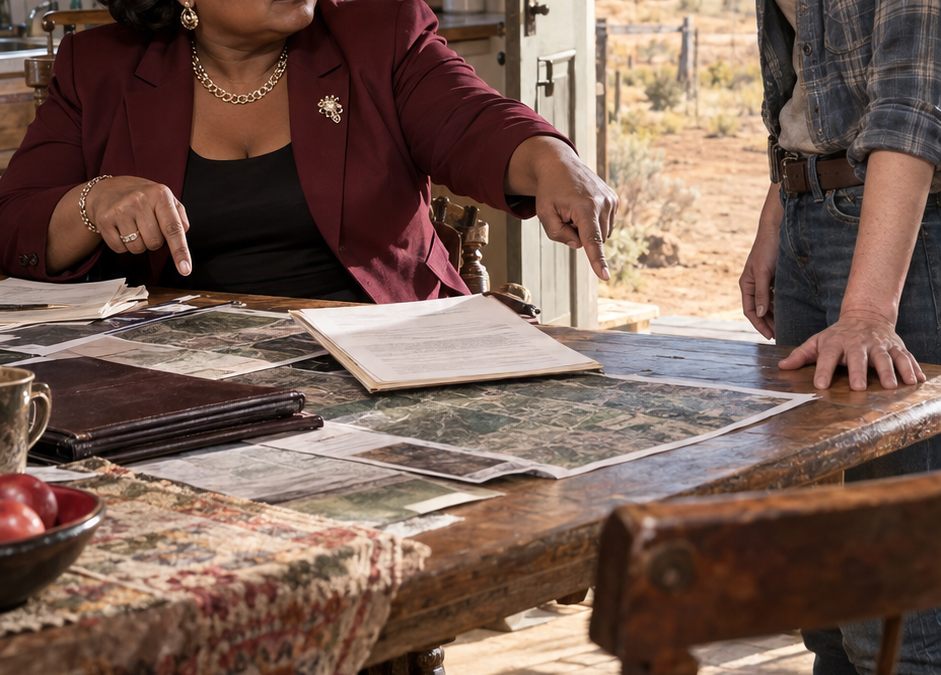
Sylvia placed a thick folder on my kitchen table.
BOWEN PARCEL had been typed across the front in block letters.
The way she had labeled it bothered me immediately.
Not Kate Bowen.
Not Walter Bowen Estate.
Not even the address.
Just Bowen Parcel, as if my family’s land had already become an administrative problem waiting for somebody more competent to dispose of it.
Sylvia opened the folder.
“Eighteen thousand six hundred dollars,” she said. “That’s what you owe as of this morning.”
I stared at her.
She continued as if reading the weather.
“And it increases every day that field remains out of compliance.”
“My field.”
Her mouth tightened slightly.
“That property is embarrassing this neighborhood.”
Then she slid a document across the table.
It was a purchase agreement.
Most of it had already been completed.
Parcel description.
Acreage.
Buyer.
Purchase price.
Her signature was already on the buyer’s line.
All it needed was mine.
I looked at the number.
$5,500.
For 9.2 acres.
“Sign it,” Sylvia said, “and the fines disappear.”
I looked up.
“And if I don’t?”
“Then I file a lien by Friday.”
She leaned back in my grandfather’s chair.
“Kate, look at the number and be realistic.”
I did.
Then I looked at her.
“That ground is worthless.”
She said it calmly.
Not cruelly.
That almost made it worse.
Cruel people sometimes know they are being cruel.
Sylvia spoke the way someone corrects a child who has misunderstood a simple arithmetic problem.
“Your grandfather bought sand in 1962. It won’t hold a septic system properly. You can’t develop it. You can’t farm it. Nobody wants it.”
She tapped the purchase agreement.
“You can’t sell it.”
Then she smiled.
Not warmly.
Possessively.
“I’m the only offer you are ever going to get, honey.”
I hated when she called me honey.
“And I’m being generous.”
I did not touch the pen.
I did not argue about the fines.
I did not explain what the land meant to me.
I asked one question.
“Then why do you want it?”
Sylvia stopped.
The refrigerator hummed behind me.
Outside the window, my grandfather’s windmill stood motionless against a pale August sky.
For several seconds, Sylvia said nothing.
Then she closed the folder.
“The crew will be out Monday.”
“What crew?”
“You’ll see.”
She pushed the chair back, stood, and walked out of my kitchen.
She did not answer my question.
At the time, I thought that silence was the first mistake Sylvia Hargrove made.
It wasn’t.
The first mistake had happened long before she walked into my house.
I just hadn’t found it yet.
My name is Kate Bowen.
I coordinate facilities for a rural school district.
Boilers.
Roof warranties.
Bus contracts.
Fire inspections.
Permit renewals.
The glamorous machinery that keeps children warm, roofs from leaking, and taxpayers from discovering a $60,000 problem after it has become a $600,000 problem.
My job trained me to do one thing very well.
Read paper.
When a contractor tells me a repair was completed in April, I do not argue.
I find the invoice.
Then I find the inspection signoff.
Then I compare dates.
Most of the time, they match.
Sometimes they do not.
When they do not, that is usually where the real story begins.
So when the Copper Hollow Estates Homeowners Association began sending me letters, I did not throw them away.
I put them in a cardboard document box beside my toaster.
I had no strategy.
Just a habit.
The land had belonged to my grandfather, Walter Bowen.
Walt bought the 9.2 acres in 1962, when the area was mostly gravel road, pasture, and scrub.
It was a low sandy rise surrounded by oak.
Nothing grew particularly well there.
My grandfather once tried corn.
He later said he harvested enough to make six broom handles and one disappointing casserole.
What the property did have was a windmill.
Walt built it himself.
Four steel legs bolted to a concrete pad he poured sometime in the 1960s.
It never pumped much water.
The ground beneath it was too dry.
But that windmill never moved.
Storms came.
Winters came.
Trees fell.
The frame stayed straight.
When I was nine, I asked him why.
He rested one hand against the steel leg.
“The ground holds it better than good soil would.”
At nine years old, I assumed that was my grandfather’s way of making a bad field sound respectable.
He died in 2011.
He left the land to me.
I paid the taxes.
Twice each summer, I cut a fire break around the edges.
I never built there.
Partly because I could not afford it.
Partly because I could still hear Walt saying, “You don’t put a house on sand.”
Then Copper Hollow Estates arrived.
In the 1990s, a developer bought the surrounding acreage and built a private subdivision around my grandfather’s property.
Not beside it.
Around it.
Forty-two homes eventually sat on a loop road with Walt’s 9.2 acres in the center like a hole in a donut.
My grandfather sold the developer the strip of ground needed for the road.
He kept everything else.
He never joined the homeowners association.
When the property became mine, neither did I.
For nearly thirty years, nobody suggested otherwise.
Then Sylvia Hargrove became HOA president.
Sylvia served six years.
During those six years, she ran Copper Hollow Estates like a courthouse where she had appointed herself judge, jury, clerk, and sheriff.
I attended two HOA meetings before my trouble started.
At both, I watched homeowners stand to raise concerns.
At both, Sylvia cut them off mid-sentence.
“Next item.”
And somehow, they sat down.
The first letter arrived in March.
It informed me the board had adopted an annexation resolution incorporating my parcel into the Copper Hollow Estates Homeowners Association.
I read it twice.
I had signed nothing.
Nobody had requested my permission.
Apparently, several people had sat in a room without me, voted that my land belonged under their authority, mailed me the result, and considered the matter finished.
The fines began almost immediately.
Unmaintained vegetation.
Forty dollars.
Unpermitted structure.
Sixty dollars.
The “structure” was Walt’s windmill, which had existed before Copper Hollow Estates existed.
Then came visual nonconformity.
I never learned precisely what that meant.
Apparently nine acres of natural scrubland did not resemble manicured quarter-acre lawns.
Eventually, the fines became daily.
That was Sylvia’s real weapon.
A hundred-dollar fine is an argument.
A hundred dollars every day is a clock.
By July, the documents beside my toaster contained five figures’ worth of penalties.
I wrote the board twice.
Both letters were simple.
Please identify the recorded instrument placing the Bowen parcel under the authority of the Copper Hollow Estates Homeowners Association.
I received a generic response to the first.
Nothing to the second.
Then, during the second week of August, Sylvia sent something different.
It was not a fine.
It was an internal letter addressed to the HOA board with a copy sent to me.
In it, Sylvia described my property using three phrases I eventually memorized.
“Unbuildable, unsellable, of no meaningful value to the association or its owner.”
Signed:
Sylvia Hargrove, President.
I placed that letter in the box.
Nine days later, Sylvia sat in my kitchen offering $5,500 for the same property she had formally declared worthless.
I did not notice the significance that morning.
I noticed it that night.
When I placed the purchase agreement in the box, it landed directly on top of Sylvia’s letter.
I saw the two dates.
Nine days apart.
I stood there staring.
Worthless.
Then: Sell it to me.
I took a pen and circled both dates.
A strange feeling settled into my stomach.
Not certainty.
Not even suspicion yet.
It felt more like reading an invoice whose math added correctly while everything else about it felt wrong.
Why would a woman formally place the lack of value on record immediately before purchasing the thing she had devalued?
People insult property during negotiation.
That was normal.
But Sylvia had written it to her own board first.
That meant she wanted “worthless” documented.
The question was why.
I sent her another certified letter.
One page.
No accusations.
Please provide a copy of the recorded instrument that placed the Bowen parcel under the authority of the Copper Hollow Estates Homeowners Association.
Six days later, an envelope arrived.
Inside was their annexation resolution.
Board minutes.
Vote tally.
Sylvia’s signature.
That was not what I had asked for.
A board resolution saying it had authority was not proof that authority existed.
It was Sylvia writing down that Sylvia was right, then mailing me Sylvia’s handwriting as evidence.
I added it to the box.
Then I drove to the county register of deeds.
The office occupied one room inside an old government building that smelled faintly of dust and copier toner.
A woman named Marjorie worked the counter.
Marjorie had the unnerving ability to understand what someone needed before they had finished explaining it.
She pulled my grandfather’s deed in less than two minutes.
Walter J. Bowen.
9.2 acres.
The legal description used old measurements, rods and bearings beginning at an iron pin near the section corner.
I read every line.
Nothing mentioned Copper Hollow Estates.
Nothing referenced a subdivision plat.
Nothing made the property subject to an association.
I made a copy.
I was not celebrating.
I am not an attorney.
All I knew was that a document I expected to contain something did not contain it.
My job had taught me that when important words are missing from important paper, somebody is often counting on nobody noticing.
I brought the deed to the September board meeting.
There were perhaps ten homeowners there.
Folding chairs faced a long table.
Coffee sat in a steel urn at the back.
Sylvia sat in the center with a binder and a wooden gavel she did not need.
I waited through landscaping updates, irrigation complaints, and a discussion about mailbox paint.
During public comment, I raised my hand.
“I have my deed.”
Sylvia’s face did not change.
“It doesn’t reference your association. It doesn’t reference your subdivision. I would like the board to explain what legal authority these fines are being issued under.”
I held up the copy.
Sylvia did not look at it.
That detail stayed with me.
She did not ask to see it.
She did not glance toward the legal description.
She did not even pretend curiosity.
“You’re out of order.”
“I’m in the public comment period.”
“You’re out of order,” she repeated.
Then she looked down.
“Item nine. Vegetation abatement on the Bowen parcel.”
That was when I understood something important.
I had brought a document into a fight that was not really about documents.
Two board members stared at the table.
A woman in the third row looked toward me, then deliberately looked away.
Sylvia read a motion authorizing the association to enter my property, clear vegetation, correct drainage, and bill me for the work.
“All in favor?”
Four hands went up.
“That is private property,” I said.
I kept my voice level.
I remember that because everything inside me wanted to shout.
Sylvia rested both hands on her binder.
“It’s association property.”
“No, it isn’t.”
She smiled.
“You just don’t have the paperwork to know it yet.”
Then she moved to item ten.
I sat in my truck afterward for nearly ten minutes.
I kept calculating.
What does a lawyer cost?
How much money do I spend defending nine acres everyone agrees is worthless?
What happens if the answer is more than the property?
The crew did not come Monday.
They came Thursday.
At six in the morning.
I woke to diesel engines.
By the time I had boots on, a skid steer was already crossing my fire line.
An excavator was unloading from a trailer.
A man wearing a reflective vest walked across the field spraying orange marks into the sand.
I ran outside.
“You can’t be here.”
He kept walking.
“We’re contracted through the association, ma’am.”
“This is my property.”
“You’ll want to speak to the association.”
I have heard variations of that sentence many times since.
It always means the same thing.
Someone has decided you are no longer a person entitled to say no, and the person doing the work has been paid not to care.
They scraped the rise.
They tore out scrub oak along the western edge, trees my grandfather had preserved because they slowed the wind.
Then the excavator dug a trench across the low side.
Thirty feet long.
Deep.
Far deeper than any drainage correction seemed to require.
“There’s no drainage problem,” I said.
The crew supervisor shrugged.
“Plans say drainage.”
There was almost no water on that rise.
That was why nothing grew there.
I stopped arguing.
Instead, I documented.
Truck logos.
License plates.
Equipment numbers.
The trench.
Depth measurements.
Time the machines entered.
Time they left.
The company name.
Delling Excavating.
When they were gone, I drove directly to the sheriff’s office and filed a trespass complaint.
The deputy took my statement.
Then he sighed.
“You understand we probably aren’t arresting contractors over an HOA property dispute.”
“I understand.”
“Then what are you hoping happens?”
“Nothing today.”
He waited.
“I just want it on the record with a date.”
The deputy looked at me differently after that.
Finally he nodded.
“That isn’t the worst instinct.”
Nine days later, Sylvia filed a lien.
$18,600 in fines.
$3,200 for abatement.
Administrative and legal fees.
Total:
$21,800.
Attached to 9.2 acres she claimed had no meaningful value.
Marjorie called me personally.
“A lien has been recorded against your parcel.”
She did not offer commentary.
She simply waited after saying it.
The silence did the commentary for her.
That evening, I walked out to the trench.
The sun was low.
Everything had taken on that flat orange color late summer gives dry ground.
The western side of the rise had been ripped open.
I stood at the trench’s edge.
Something looked strange.
The soil near the surface was normal enough.
Below it, the trench wall changed.
Pale.
Almost white.
Not chalk exactly.
More like raw sugar.
And the color kept going down.
No darker clay.
No bands.
No change.
Just that pale material farther down than the excavator bucket had reached.
I did not know what it was.
At that moment, all I could think about was Sylvia’s lien.
Lawyers.
Foreclosure threats.
The damage.
Still, habit took over.
I climbed into the trench.
I pressed my palm flat against the wall for scale.
Then I photographed it.
One photograph.
I climbed out.
Later I left my phone on the kitchen counter beside the document box.
Within days, I forgot the photograph existed.
The lien became real when the title company called.
Months earlier, I had started refinancing my house.
The house sat on a different parcel.
The woman who called sounded apologetic.
“We’re seeing a lien connected to adjacent property in your name.”
“It’s an HOA dispute.”
“I understand.”
“They have no authority over that land.”
“I understand.”
“So it shouldn’t affect my refinance.”
There was a pause.
“It’s recorded.”
That was the whole problem.
It was recorded.
Nobody at the title company had to believe Sylvia.
She had placed paper inside an official system.
Now the system believed the paper for her.
My rate lock expired.
The replacement rate raised my monthly payment by roughly $400.
Suddenly, Sylvia was no longer irritating me.
She was taking money from me.
Every month.
I spent three nights thinking.
Then I chose a strategy.
It was the wrong strategy, but I did not know that yet.
I would prove the land was buildable.
Sylvia’s entire narrative depended upon my property being useless.
Unbuildable.
Unsellable.
A liability.
If an expert evaluated the soil and certified a house could be constructed there, I could destroy that narrative.
Maybe the board would retreat.
Maybe the lien would collapse.
Maybe somebody would finally be embarrassed enough to admit what they were doing.
I called the county land conservation office.
A man gave me two names.
Then he paused.
“If it’s sand, call Rhodes.”
“Who’s Rhodes?”
“He’ll actually walk it.”
Dr. Emmett Rhodes had spent thirty-one years with the State Geological Survey.
He was sixty-six and retired.
Apparently retirement meant driving around in a mud-covered pickup and charging less than he probably should have to look at dirt.
He arrived the following week.
His truck was brown with dried mud halfway up the doors.
He shook my hand.
“Show me the ground.”
Walking toward the rise, I gave him my entire explanation.
The fines.
The claim that nothing could be built there.
The letter.
The soil evaluation I needed.
Rhodes listened.
He did not interrupt.
When I finished, he gave me no immediate answer.
He stopped beneath the windmill.
“Who poured this pad?”
“My grandfather. Sixties.”
Rhodes crouched.
He ran his thumb along the concrete.
Then around the base plate on one steel leg.
He stood and studied the entire frame.
“All four legs?”
“Yes.”
“No repair?”
“Not that I know of.”
“No settlement?”
“None.”
He looked at me.
“Sixty years?”
“About that.”
“That’s unusual.”
“Why?”
He did not answer.
Then he saw the trench.
He walked toward it quickly.
Not running.
But different.
He climbed down.
Placed his palm flat against the pale wall.
Exactly where I had.
And stood there.
“How long has this been open?”
“Since August.”
“Nobody filled it?”
“No.”
He climbed out.
Returned to his truck.
Came back carrying a hand auger.
He drove it into the ground eight feet from the trench.
Turn.
Squeak.
Pull.
He emptied material onto a tarp.
Again.
Again.
Again.
Four samples.
Each time he pinched the sand between his fingers.
Rolled it.
Dropped it.
Then stared toward the road as if listening to something.
Finally, Rhodes wiped his palms against his jeans.
“I want to bring a rig.”
“A drilling rig?”
“Small one.”
“Why?”
“Three holes. As deep as she’ll reasonably go.”
“I thought you were evaluating soil for a house.”
“I am evaluating the soil.”
“What are you looking for?”
He closed his tailgate.
“I want to know how deep this goes.”
The rig would cost $4,800.
That mattered.
My refinance had already collapsed.
I was paying $400 more each month than planned.
I had a $21,800 lien.
An attorney had quoted me $3,000 just to begin working.
Now a retired geologist who refused to explain his curiosity wanted nearly five thousand dollars to drill holes in what everybody kept calling worthless sand.
I sat at my kitchen table that evening.
Checkbook open.
The HOA document box sat beside me.
Outside my window stood Walt’s windmill.
There was no wind.
The frame did not move.
The ground holds it better than good soil would.
I wrote the check.
Sylvia sent another letter the following week.
More fines.
Then a threat.
Pay within sixty days or the association would begin foreclosure proceedings.
Foreclosure.
Against land Sylvia herself had called worthless.
I read that letter four times.
Then I returned to the county records office.
This time, I asked for everything.
Not merely my deed.
Everything the county maintained on that section.
Tax records.
Plat approvals.
Old permits.
Requests.
Maps.
Marjorie placed a thick folder and a printout in front of me.
Near the back was a records-request log.
Most entries were ordinary.
Surveyors.
Title companies.
Utilities.
Then one entry stopped me.
Someone had requested official state geology mapping for my township and section the previous fall.
Almost a year before Sylvia tried buying my land.
The requester’s name had been redacted.
A black rectangle covered it.
“Marjorie.”
She came over.
“Can I get this without the redaction?”
She studied the page.
“You can file a public-record request. Counsel reviews it.”
“How long?”
She looked at me.
“Longer than you want.”
I filed it that afternoon.
The drilling rig arrived Thursday.
Rhodes took three cores.
He labeled every segment carefully.
Depth.
Hole number.
Position.
He lined sample bags across his tailgate in exact order.
Rain fell steadily while I stood under an umbrella watching a retired geologist handle sand like criminal evidence.
When he finished, I asked, “What do you think?”
“I’ll call.”
He drove away.
He did not call for eight days.
On the eighth night, my phone rang.
“Kate.”
“Dr. Rhodes?”
“It’s not that your land is bad.”
I sat down.
“You’ve been asking the wrong question.”
My fingers tightened around the phone.
“What question should I be asking?”
“Are you home tomorrow morning?”
He arrived at eight.
He carried the cores inside.
I offered coffee.
He refused.
He pushed aside everything on the kitchen table, spread newspaper across the surface, and laid the core sections from left to right like a timeline.
The first few inches looked like ordinary dirt.
Everything beneath it was pale.
Segment after segment.
Nearly identical.
Raw-sugar color.
Uniform enough to look artificial.
Rhodes tapped the final segment.
“Thirty-two feet.”
“That’s how deep it is?”
“That’s where I stopped.”
I looked at him.
“What exactly is it?”
“Silica sand.”
I waited.
“High purity. Low iron. Well sorted. Well rounded.”
He touched the core.
“Glass grade.”
I stared.
“I asked whether I can build on it.”
“I know.”
For the first time since meeting him, Rhodes almost smiled.
“You’ve been trying to prove your land is like everyone else’s.”
He shook his head.
“It isn’t.”
Then he explained.
Thousands of years ago, after the glaciers withdrew, wind had transported and sorted sand across the region.
Over time, lighter contaminants and irregular material blew elsewhere.
What remained beneath my rise was a remarkably clean quartz-rich deposit.
That explained almost everything.
Why water disappeared through it.
Why crops struggled.
Why conventional septic design was difficult.
Why the windmill pad had barely shifted.
The characteristics everyone had treated as flaws were precisely the characteristics industry valued.
“The thing making the property bad residential ground,” Rhodes said, “is what makes it valuable mineral ground.”
“How valuable?”
He reached into his jacket.
Pulled out a folded sheet.
He had calculated acreage.
Depth.
Setbacks.
Recovery loss.
Regional royalty rates.
Then he turned the page around.
My eyes went directly to the number at the bottom.
$2.4 million.
Estimated royalty over the productive life of a lease.
I did not speak.
I read it again.
Then I thought about the number Sylvia had put on my kitchen table.
$5,500.
Against $2.4 million.
I opened the calculator on my phone because I did not trust my head.
Roughly two-tenths of one percent.
Sylvia Hargrove had sat four feet from where those cores now lay.
She had offered me roughly two-tenths of one percent of the potential royalty value.
Then she had called it generosity.
I laughed.
One short, shocked sound.
Rhodes did not laugh.
He was still holding the chair.
“What?”
“There’s a problem.”
Of course there was.
“How do you get it out?”
“What?”
“Sand doesn’t leave through a pipeline.”
He pointed toward the window.
“You excavate it. Then you haul it.”
My excitement cooled.
“Trucks?”
“Lots of trucks. For years.”
He continued.
“Before a serious operator spends much time on the geology, they study access.”
I already knew.
I looked toward the road.
Copper Hollow Loop.
The private road encircling my property.
The only practical entrance to the parcel.
My grandfather had sold the road strip to the developer in 1994.
No county frontage remained.
No alternate route.
No rear entrance.
Nine acres of potentially valuable silica surrounded by a private road controlled by Copper Hollow Estates.
Controlled, in practical terms, by Sylvia Hargrove.
“Nobody leases sand they can’t remove,” Rhodes said.
“So it might be worth millions.”
“Yes.”
“And I can’t get any of it out.”
“Not unless you have legal access suitable for hauling.”
I looked through the kitchen window.
Two hundred feet away sat an ordinary piece of asphalt.
Mailboxes.
Curbs.
Driveways.
It suddenly looked like a prison wall.
That afternoon, I called an aggregate company Rhodes recommended.
A land manager answered.
I explained I had acreage containing possible high-purity silica.
He sounded interested.
Very interested.
Then he asked for the township and section.
I gave them.
Silence.
Not long.
But noticeable.
“Ma’am, I’ll need to check whether we have a conflict involving that ground.”
“A conflict?”
“I’ll have somebody contact you.”
Nobody did.
That silence bothered me more than anything he could have said.
So I stopped calling companies.
Instead, I began searching county land records for nearby parcels.
Grantor.
Grantee.
Section by section.
It consumed most of Saturday.
By late afternoon, a name started repeating.
Ridgeline Aggregate Partners.
Parcel east of mine.
Optioned.
Parcel west.
Purchased.
Another farther along the rise.
Option agreement.
Four parcels in fourteen months.
None publicly advertised.
None apparently distressed.
Quiet acquisitions.
One at a time.
Exactly how you buy property when advertising what you are doing might increase everybody else’s asking price.
Ridgeline had been assembling land along my ridge for more than a year.
I drove home after dark.
The radio stayed off.
Somewhere during that drive, my understanding changed completely.
For months, I had been trying to prove Sylvia wrong when she called the land unbuildable.
That no longer mattered.
Maybe she was right.
Maybe nobody should ever put a house on it.
The issue was not whether my land was useful.
The issue was whether Copper Hollow had any legal authority over it.
If the annexation was legitimate, Sylvia could continue using HOA control to prevent development or access.
If it was illegitimate, everything changed.
The fines.
The abatement.
The lien.
The trespass.
I reached home at nine and left my coat on.
I pulled Walt’s deed from the document box.
This time, I did not read it looking for subdivision language.
I read the legal description itself.
Every bearing.
Every rod.
Every boundary.
Two-thirds through, a clause stopped me.
I read it again.
Then again.
At 9:40 p.m., I called Marjorie’s office and left a voicemail.
“Please pull the original Copper Hollow Estates subdivision plat for me first thing tomorrow.”
When I arrived after eight, the plat was already spread across the counter.
Recorded 1994.
Forty-two lots.
Loop road.
Drainage parcels.
Common areas.
And exactly in the middle, outlined separately, was my grandfather’s land.
Four words were printed across it.
EXCEPTED. NOT PART HEREOF.
I touched the words.
For several seconds, I could not speak.
Marjorie did.
“It’s not part of the subdivision, Kate.”
“No.”
“It never was.”
I spent three days in that records room.
Every document involving the property from 1962 forward.
Transfers.
Mortgages.
Easements.
Releases.
Tax instruments.
Anything that might have lawfully annexed the property afterward.
Nothing did.
There was no annexation.
There had never been one.
Sylvia and the board had passed a resolution inside their own meeting claiming property they did not own and had no authority to govern.
Then they had begun fining me.
I hired Emily Ward.
The $3,000 retainer hurt.
I wrote the check anyway.
Emily read every page in my box.
It took almost two hours.
Then she placed the lien beside the deed and aligned their edges.
“They recorded an encumbrance against real estate in which the association has no property interest.”
She looked at me.
“This isn’t merely an HOA disagreement anymore.”
“What is it?”
“A defect in the public record.”
She tapped the lien.
“And courts tend to take those seriously.”
We filed a petition challenging both liens, all fines, and the abatement charges.
A hearing was scheduled ten days later.
Then I did something Emily advised against.
I mailed Sylvia one final certified letter.
It contained no threats.
Only the subdivision plat reference.
Book.
Page.
Recording date.
And four words.
EXCEPTED. NOT PART HEREOF.
I wanted proof of when Sylvia received it.
Four days later, the green card returned.
Sylvia Hargrove’s signature was written across it in blue ink.
The following night, she called an emergency board meeting.
The woman from the third row—the one who had looked away when I challenged Sylvia—called me at 10:30.
She sounded nervous.
“The board adopted a road-use covenant.”
“What kind?”
“No commercial hauling. No extraction vehicles. No industrial trucks on Copper Hollow Loop.”
“When?”
“Tonight.”
“Who proposed it?”
She hesitated.
“Kate, Sylvia already had it printed before the meeting began.”
I closed my eyes.
There it was.
Sylvia had received proof that my property was not within her HOA.
So she changed strategies.
If she could not control the land, she would control the road.
Win the hearing.
Lose access.
Millions of dollars beneath my grandfather’s field.
No legal way to transport one truckload out.
Two days later, Sylvia filed a second lien.
Another $6,400 for “abatement and legal expenses.”
I carried it directly to Emily.
She read it.
Her expression changed.
“This road covenant is smarter.”
My stomach tightened.
“She can do that?”
“A private road owner can usually regulate use of its own road, subject to existing rights.”
“What about my property?”
“If your parcel has no independent easement, you may be a nonmember whose only physical access crosses association property.”
She set the document down.
“You can beat the HOA on jurisdiction and still have no commercial route.”
“What would change that?”
“The original road easement.”
“My grandfather sold them that strip.”
“Exactly.”
She leaned forward.
“The question is whether he reserved anything when he did.”
That night Rhodes called.
He wanted to discuss lab results.
He heard my voice and stopped.
“What happened?”
I told him about the covenant.
He was silent.
Then he asked one question.
“Who owned the strip before the road?”
“My grandfather.”
“Kate.”
The tone in his voice changed.
“A man does not sell a developer his access strip and keep a landlocked parcel behind it without reserving something.”
“How do you know?”
“I’ve been around developers for thirty years.”
He paused.
“Go find what Walt kept.”
I searched for two days.
Nothing in the document box.
Nothing obvious at the county under the references I had copied.
Then I remembered the steel lockbox beneath the windmill.
My grandfather kept tools there.
Fence pliers.
Wire.
A chain.
Once, when I was sixteen, a bottle my grandmother apparently was not supposed to know existed.
The metal box was bolted to the concrete pad.
Its hinge had almost rusted closed.
I went outside at dusk carrying penetrating oil and a hammer.
For twenty minutes, I worked the lid.
Finally, it broke free.
The sound rang through the steel frame.
Inside were old tools.
Wire.
And a manila envelope sealed inside a freezer bag.
The paper was stained.
Across the front, Walt had written:
RECORDED COPY — 1994.
My hands began shaking before I had finished opening it.
Grant of Easement.
Walter J. Bowen to Copper Hollow Development Company.
The instrument granting the developer rights over the road strip.
Page two contained a reservation clause.
I read it once.
Then again.
Then sat on the concrete pad because my knees suddenly felt unreliable.
My grandfather had reserved for the Bowen parcel a general access easement across the entire length of the future road.
All purposes.
No restriction as to use.
No restriction as to vehicle class.
Appurtenant to the Bowen parcel.
Running with the land.
In perpetuity.
My property was specifically named as the benefited parcel.
I sat underneath the windmill in the dark with that water-stained document resting across my knees.
Then I started laughing.
Not because anything was funny.
Because in 1994, my grandfather had anticipated a problem thirty years before I needed the answer.
Sylvia could regulate her association.
She could regulate HOA members.
But she could not erase a recorded property right older than the HOA itself.
Two days before the hearing, Marjorie called.
“The records request cleared.”
I drove straight there.
The unredacted log sat on the counter.
Marjorie turned it toward me.
She placed one finger beside the line, then removed it.
State surficial geology mapping.
My township.
My range.
My section.
Requested in person.
Eleven months before Sylvia sent her letter declaring my property worthless.
Requester:
S. HARGROVE.
For a moment, I did not breathe.
Before the fines.
Before the annexation resolution.
Before the contractors.
Before the lien.
Before the $5,500 offer.
Sylvia had gone to the county and asked for geology maps covering my grandfather’s field.
She had known there might be something beneath it before I knew.
“Do you want a certified copy?” Marjorie asked.
“I want four.”
I did not call Emily from the parking lot.
I went to a print shop.
Every document I had was copied, organized, and tabbed.
I did not tell Sylvia what I had found.
I did not tell the board.
The hearing took place Thursday morning.
The room had fluorescent lights and plastic chairs.
The hearing officer, Gail Prescott, had a stack of files and the expression of someone who disliked wasting time.
Sylvia arrived with an attorney.
Two board members sat behind her.
She wore a dark blazer.
She smiled at people.
She looked comfortable.
I knew why.
She believed the hearing was about HOA fines.
At worst, she probably expected to lose some money.
Her attorney spoke first.
He said the association had acted in good faith based upon a reasonable interpretation of governing documents.
Any mistakes had been procedural.
Then he described Sylvia’s purchase offer.
His exact words were “a generous private offer designed to help a neighbor resolve an unmanageable financial situation.”
I watched Sylvia.
She did not look at me.
Emily stood.
She placed three documents before Prescott.
My 1962 deed.
The 1994 subdivision plat.
The section showing my grandfather’s property.
“Ms. Bowen’s parcel was expressly excluded from the Copper Hollow subdivision at the time the subdivision was recorded.”
Prescott read the plat.
Emily continued.
“There is no later recorded instrument annexing the parcel.”
Prescott looked toward Sylvia’s attorney.
“Counsel, do you have a recorded annexation instrument?”
He began explaining the board vote.
Prescott interrupted.
“That is not what I asked.”
Silence.
He shuffled paper.
“No.”
Something changed in the room.
One of the board members behind Sylvia leaned forward.
“The association therefore had no assessment authority,” Emily said, “no enforcement authority, no jurisdiction to impose these fines, and no legal basis to enter the property or record either lien.”
Sylvia whispered to her attorney.
He immediately shifted arguments.
“Even if that interpretation is accepted, the petitioner lacks independent commercial access. The association adopted a lawful road-use covenant restricting industrial traffic. Therefore, any discussion regarding alleged economic damage or mineral value is effectively academic.”
Academic.
I remember the word because Sylvia finally looked at me.
Her expression said:
You can win this point.
I still own the road.
Emily reached into her file.
Then she placed my grandfather’s manila envelope on the table.
“Recorded grant of easement, 1994.”
She handed Prescott a certified copy.
“Page two contains Walter Bowen’s reservation.”
Emily read aloud.
“General access for all purposes, without restriction as to use or vehicle class, appurtenant to the Bowen parcel and running with the land in perpetuity.”
Prescott read the language herself.
Emily continued.
“The Bowen parcel is expressly identified as the benefited estate.”
She looked toward opposing counsel.
“The association may regulate its members. It may not retroactively covenant away a recorded easement that predates the association’s restrictions.”
Sylvia’s attorney requested a recess.
“No,” Sylvia said.
She said it aloud.
Her attorney turned toward her.
She ignored him.
That was the moment everything began collapsing.
If Sylvia had walked into the hallway with counsel, perhaps he could have convinced her to stop talking.
But Sylvia had spent years believing she could control rooms by refusing to surrender them.
“I would like to make a statement.”
Prescott allowed it.
Sylvia talked about serving the community.
Volunteer hours.
Property values.
The difficulty of HOA leadership.
How nobody appreciated what board presidents sacrificed.
Then she looked directly at me.
“I had no idea what was beneath that property.”
Emily remained motionless for perhaps two seconds.
Then she took out another document.
“Memorandum of option,” she said.
Recorded in March.
Hollow Creek Holdings LLC.
Sole member: Sylvia Hargrove.
Exclusive option granted to Ridgeline Aggregate Partners.
Property subject to option upon acquisition:
The Bowen parcel.
Contingent upon Sylvia first acquiring it.
Nobody gasped.
The room simply became silent.
There is a particular silence people make when every person performs the same arithmetic simultaneously.
Emily continued.
“This option was recorded months before Ms. Hargrove authored a letter characterizing the Bowen parcel as unsellable and having no meaningful value.”
Sylvia’s lawyer lowered his head.
“And nine days after that letter,” Emily said, “Ms. Hargrove offered the petitioner $5,500 for the property.”
Sylvia shifted.
“I never saw a geological survey.”
That was her last exit.
And she chose it.
Emily opened another tab.
County records-request log.
Unredacted.
One line.
One date.
One signature.
“State surficial geology mapping for the Bowen section requested in person eleven months before the purchase offer.”
Emily placed the certified copy before Prescott.
“Requester: S. Hargrove.”
Prescott read it.
Then she looked directly at Sylvia.
“Is this your signature?”
Sylvia’s attorney placed one hand on the table.
A silent instruction.
Do not answer.
Sylvia answered.
“I request maps all the time. I’m president of an association.”
“Were,” someone behind us said.
Not loudly.
But everyone heard it.
Emily produced Rhodes’s certified geological log and assay.
Rhodes sat in the second row wearing a jacket I had never seen before.
He did not once look at Sylvia.
Emily summarized the findings.
Thirty-two feet of confirmed high-purity silica in the tested cores.
Glass-grade characteristics.
Estimated royalty potential over a long-term lease:
Approximately $2.4 million.
“The offer was $5,500,” Emily said.
“That represents approximately two-tenths of one percent of the estimated royalty value.”
Sylvia shook her head.
“Sand is everywhere.”
Her voice had changed.
Slightly higher.
Quicker.
“Half this county is sand.”
Nobody answered.
Emily took out Sylvia’s own letter.
Then she read Sylvia’s words back into the record.
“Unbuildable, unsellable, of no meaningful value to the association or its owner.”
Signed:
Sylvia Hargrove, President.
Prescott placed every document into one stack.
Squared the edges.
Then ruled.
Both liens were void.
Every fine was vacated.
Every abatement charge was cancelled.
The road-use covenant could not interfere with the recorded easement benefiting my property.
The unauthorized entry and excavation were outside the HOA’s jurisdiction.
Then Prescott looked toward the clerk.
“I am also referring the recorded lien documents to the district attorney for review under applicable fraudulent-recording statutes.”
Sylvia’s lawyer stopped writing.
A man stood in the back row.
“My name is Dale Ferris. I’m a land manager for Ridgeline Aggregate Partners.”
Prescott allowed him to speak.
“Ms. Hargrove approached us in February regarding the Bowen parcel.”
Sylvia turned around.
“We did not solicit that parcel from her.”
Her attorney stopped arguing entirely.
He began taking notes.
One of the board members sitting behind Sylvia stood.
He walked across the aisle.
Sat on the opposite side.
A moment later, the second board member followed him.
Sylvia turned toward the chairs where they had been.
Both seats were empty.
Then she faced forward again.
That image stayed with me more than the rulings.
More than the documents.
More than the numbers.
Sylvia had spent years controlling rooms.
And suddenly, when she turned for support, there was nobody there.
Prescott called the next case.
That surprised me.
For months, Sylvia had occupied enormous space in my life.
Then, within seconds, the county moved on.
A clerk stamped paper.
People walked into the hallway.
Somebody opened another folder.
Sylvia sat motionless with her binder in front of her.
Eventually, she gathered it.
Then she left.
Nobody followed.
I encountered her outside.
I had not planned to speak.
But as she passed me, I said one thing.
“You were right about something.”
She stopped.
“Somebody was going to make money from that land.”
She walked away.
Eleven days later, the Copper Hollow board removed her as president.
The same members who had voted to send machines onto my property voted to remove her.
Two called afterward.
Both explained that they had never really felt comfortable with what happened.
I let them talk.
There was nothing useful in telling them what I thought.
Comfort had never been the issue.
The district attorney accepted Prescott’s referral.
The investigation moved slowly.
The following summer, Sylvia pleaded guilty to a felony count connected to filing a fraudulent lien.
She received probation.
Restitution.
And a permanent prohibition against serving on any HOA board in the state.
According to Emily, that last part bothered Sylvia more than the money.
We also filed a civil case involving trespass, abuse of process, damages related to the liens, and associated misconduct.
The case settled for $210,000.
The settlement covered the fines.
Abatement damages.
Legal fees.
The additional refinancing costs.
The extra $400 a month.
And the months of my life spent defending ownership of property I had inherited lawfully.
Ridgeline terminated its option arrangement with Sylvia within a week of the hearing.
Dale Ferris later told me their agreements included representations requiring sellers to disclose conflicts and ownership problems.
They had not been told the person attempting to acquire my property was also the HOA president generating fines against it.
Sylvia had also purchased or optioned three other parcels along the ridge.
She had borrowed money.
Now the company working the silica deposit wanted nothing to do with her.
She sold her house the following spring.
I did not stand at the road watching the moving truck.
I did not need to.
Copper Hollow is the sort of place where everyone knows when somebody’s house goes on the market before the sign reaches the yard.
The HOA formally rescinded its annexation resolution.
It repealed the road restriction as applied to my parcel.
A state association regulator reviewed the matter.
The result was a new requirement concerning future annexations: the owner’s consent had to be reflected in a recorded instrument.
Emily told me that change mattered more than the settlement.
“Money disappears,” she said.
“Recorded rules last.”
I signed the silica lease the following October.
Ridgeline came to my kitchen.
We used the same table where Sylvia had once slid her $5,500 purchase agreement toward me.
Twenty-year royalty lease.
Detailed accounting requirements.
Environmental monitoring.
And a reclamation clause I worked on personally with Emily.
When excavation ended, the contour would be restored.
The site would be capped appropriately.
Native vegetation would be replanted.
I did not want my grandfather’s field becoming an abandoned hole after everyone had taken what they wanted.
There was another provision.
The windmill stayed.
No excavation within the protected setback.
No relocation.
No dismantling.
Not during the lease.
Not afterward.
Ridgeline agreed without argument.
The following spring, Rhodes drove out to see the first active cut.
He refused payment.
He walked beside the exposed face for twenty minutes with both hands in his jacket pockets.
Then he stopped.
“Cleanest column I logged in thirty-one years.”
He looked almost offended by how perfect it was.
“I’m glad I came back.”
Before leaving, Rhodes asked something.
“Do you still have that photograph?”
“What photograph?”
“The trench. Your hand against the sand.”
I remembered.
The photograph I had taken on the evening Sylvia recorded the first lien.
The photograph I almost forgot existed.
I found it on my phone.
There I was.
Standing inside the cut those contractors had dug without permission.
One hand against a pale wall.
No idea what I was touching.
Rhodes studied the picture.
“That’s something.”
“What?”
“You photographed the evidence before you knew there was evidence.”
I laughed.
“That sounds like my entire job.”
That evening, after the trucks stopped, I walked out to the windmill.
The northern end of the rise had become a working site.
But around Walt’s pad, everything was quiet.
The sunset flattened the world into orange and gray.
Wind came through the steel frame.
A low vibration traveled through it.
The same sound I had heard as a child.
I rested one hand against the leg.
More than sixty years.
No visible settlement.
The ground holds it better than good soil would.
For decades, I had thought my grandfather was defending a bad piece of land because he was stubborn.
Maybe he never understood the geology.
Probably not.
He was not a geologist.
He would not have used words like silica content, grain morphology, or industrial-grade quartz.
But he knew something.
Everybody around him had looked at that rise and seen poor farmland.
Walt saw land worth keeping.
He sold enough ground for the subdivision road.
Then he protected his access in writing.
He preserved the windmill.
He preserved the parcel.
Then he handed it to me.
I sometimes wonder what would have happened if Sylvia had simply approached me honestly.
Suppose she had knocked.
Suppose she had said, “Kate, there may be commercially valuable silica beneath your property. I’ve been speaking with a company. Would you consider a partnership?”
Maybe we would have talked.
Maybe we would have negotiated.
Maybe she could have made money.
Instead, she needed all of it.
She needed me frightened.
She needed the public record to say my property was worthless.
She needed escalating fines.
She needed a lien.
She needed a foreclosure threat.
She needed me to believe $5,500 was rescue.
She nearly succeeded because the scheme did not depend upon one dramatic crime.
It depended upon paper.
One resolution.
One fine.
One letter.
One lien.
One road covenant.
Each document looked ordinary by itself.
Together, they were a machine.
And the only reason the machine stopped was because I had kept every page.
Today, Sylvia’s letter hangs framed in my hallway.
The original stays stored safely.
The frame contains a copy.
Three sentences on association letterhead.
“Unbuildable, unsellable, of no meaningful value to the association or its owner.”
Sylvia Hargrove’s signature appears beneath them.
Beside the letter is the stub from my first royalty check.
I did not put them together because I enjoy revenge.
At least, that is not the main reason.
I framed them because I spent months being told that official-looking paper meant authority.
That a board vote meant ownership.
That a lien meant guilt.
That somebody else could define what my grandfather had left me merely because they possessed a printer, a title, and enough confidence to make everybody else stop asking questions.
The two papers in that frame remind me of something different.
A document is only as true as the facts behind it.
A title does not make someone honest.
And value does not disappear because a powerful person writes “worthless” beside your name.
Sometimes the thing everybody mocks is exactly the thing they are trying hardest to take.
Nobody who visits my house asks why those papers are framed.
The people who need to understand them already do.








