HOA Karen Called Emergency Services Over My Legal Bonfire—Then Threatened $900-a-Day Fines on a Ranch Her HOA Didn’t Control
HOA Karen Called Emergency Services Over My Legal Bonfire—Then Threatened $900-a-Day Fines on a Ranch Her HOA Didn’t Control
She called my legal family bonfire an emergency and demanded officers shut it down.
The fire pit had county clearance, proper setbacks, and had been there long before her subdivision existed.
HOA Karen thought smoke crossing a fence gave her power over 4,000 acres of private ranch land.
“Put it out now, or I’m calling emergency services again.”
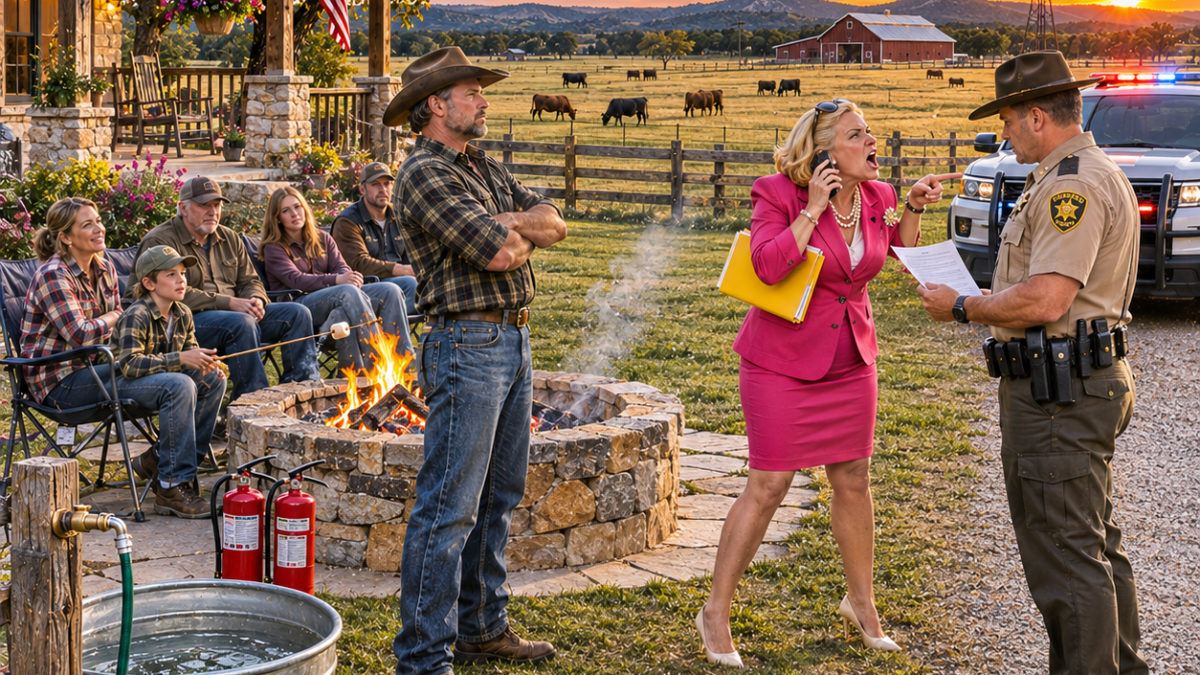
Karen Holloway screamed that from the edge of my fence line while pointing at a controlled bonfire barely four feet across. She stood in a bright pink blazer with her yellow HOA folder under one arm, her phone pressed to her ear, and the golden sunset behind her turning the whole scene absurdly dramatic.
Behind me, my family sat in lawn chairs around a stone-lined fire pit. My wife, Claire, was helping our grandson toast a marshmallow. My daughter was passing around cider. A steel water trough sat full beside the pit, two extinguishers rested against the fence post, and the grass had been cleared well beyond the required safety radius.
Nothing was out of control.
Nothing was illegal.
Nothing had even changed from the dozens of family fires we had held on Callaway Ranch over the years.
Karen didn’t care.
“This is a violation of Willow Ridge fire policy,” she snapped. “Open flames are prohibited.”
“This isn’t Willow Ridge.”
“Smoke doesn’t respect property lines.”
I looked at the thin ribbon of smoke rising almost straight into the evening sky.
“No, but deeds do.”
Her face tightened.
She pulled out a red violation notice and held it toward me.
“Nine hundred dollars per day until the fire activity stops.”
I took the paper.
At the top was the Willow Ridge HOA logo.
Below it, someone had typed my ranch address.
The words IMMEDIATE FIRE HAZARD ENFORCEMENT were printed in bold.
I almost laughed.
My ranch covered roughly 4,000 acres. Willow Ridge occupied a few hundred acres along my eastern boundary. The subdivision had been developed decades after my family acquired the ranch. We had never joined their association, never signed their declaration, and never granted them authority over our land.
Karen knew that.
Or at least she should have.
“You’re fining me for having a permitted recreational fire on property your HOA doesn’t govern?”
“I’m protecting the community.”
“That wasn’t my question.”
She ignored me and raised her phone.
“Dispatch? Yes, I’m calling again. The property owner refuses to extinguish the fire.”
Claire looked at me.
I didn’t move.
I had already spoken to the county fire office that morning because conditions had been dry the previous week. Recreational fires were permitted that evening. I had the confirmation email saved on my phone, and the pit met every setback and containment requirement.
So I waited.
Ten minutes later, a county patrol SUV rolled down the gravel lane with its emergency lights off.
Deputy Aaron Mills stepped out.
He looked at the fire.
Then at Karen.
Then at me.
“Jack?”
Karen froze.
Mills walked closer, expression serious now.
“We received a report of an uncontrolled fire threatening structures.”
He turned toward Karen.
“Ma’am, before we do anything else, I need you to tell me exactly what you reported.”
The evening went silent.
part 2
Karen lifted her chin.
“I reported an illegal fire creating a danger to Willow Ridge.”
Mills glanced toward the fire pit.
“Did you report that the fire was uncontrolled?”
“It could become uncontrolled.”
“That’s different.”
Karen’s mouth tightened.
“It is producing smoke.”
Mills looked at the smoke.
Then he looked at the sky.
Then back at Karen.
“Ma’am, I need facts, not predictions.”
I stayed quiet.
That mattered.
One of the easiest mistakes people make when they know an officer personally is trying to take over the call. I didn’t want that. I wanted him to investigate what he had been told, look at what was actually happening, and write down the difference.
Mills walked toward me.
“Jack, do you have clearance for this?”
“Yes.”
I handed him my phone.
He read the county email.
The fire office had confirmed that recreational fires were allowed that evening provided standard containment rules were followed.
Mills walked the perimeter.
He checked the cleared area around the pit.
He looked at the water trough.
The extinguishers.
The hose line connected to the hydrant on my side of the ranch.
Then he looked at the nearest structure.
My barn sat more than a hundred feet away.
Willow Ridge’s nearest home was much farther.
He nodded.
“Looks controlled.”
Karen stepped forward.
“The HOA has stricter standards.”
Mills turned.
“Does the HOA govern this parcel?”
Karen hesitated.
“The ranch directly affects the community.”
“That wasn’t my question.”
I had heard that sentence twice in ten minutes.
Karen clearly didn’t enjoy it the second time either.
She opened her yellow folder.
“Willow Ridge prohibits open flames during elevated fire-risk periods.”
Mills took the page.
He read it.
Then handed it back.
“This applies to HOA common areas and lots subject to the declaration.”
Karen crossed her arms.
“The danger doesn’t stop at a legal boundary.”
“No,” he said, “but HOA authority does.”
Claire lowered her head.
I knew that look.
She was trying not to smile.
Karen wasn’t finished.
“This man has ignored repeated notices.”
Mills looked at me.
“Have you received prior fire notices?”
“No.”
Karen interrupted.
“I sent two emails.”
“That’s not what he asked,” Claire said.
Karen glared at her.
I touched Claire’s elbow.
Not because she was wrong.
Because I wanted the record clean.
Mills continued.
“Were any prior calls made to the county fire department?”
Karen said, “I contacted the non-emergency line.”
“Was any violation found?”
She didn’t answer.
He asked again.
“Was any violation found?”
“No.”
The word came out sharp.
That should have ended it.
Instead Karen pointed toward the fire pit.
“You don’t understand what I’ve been dealing with. There are children here. There are flames. There is smoke drifting toward our subdivision.”
My grandson, who had been listening from his chair, held up a blackened marshmallow.
“Mine’s more dangerous than the fire.”
Everyone laughed.
Karen did not.
Claire covered her mouth.
Mills looked away for half a second.
Then he returned to business.
“Ma’am, this is not an uncontrolled burn. I’m not seeing a criminal violation or an immediate public safety hazard.”
Karen’s face turned red.
“You’re refusing to act?”
“I’m telling you what I found.”
“That’s not good enough.”
“It is what I can lawfully do.”
Those words mattered.
Lawfully do.
Karen’s entire problem came from believing authority worked like a volume knob.
If she cared strongly enough about something, she assumed her power increased to match her concern.
It didn’t.
Authority comes from law, documents, jurisdiction, and procedure.
Not outrage.
Mills handed me my phone.
“You’re good to continue the fire as long as conditions stay the same.”
“Understood.”
He turned toward Karen.
“If conditions change, call the fire department or emergency services based on what you actually observe. Don’t describe a controlled recreational fire as an uncontrolled structure threat unless that’s what’s happening.”
Karen’s shoulders stiffened.
“I was acting out of caution.”
“Then report cautiously.”
That sentence landed harder than anything else he said.
He walked back toward his SUV.
Before he left, Claire called out.
“Aaron.”
He turned.
She held up a plate.
“S’more?”
He laughed.
“I’m working.”
“Take one for later.”
He looked at the plate.
Then toward me.
“Chief’s orders?”
I shook my head.
“I’m not your chief.”
“Exactly.”
He took one wrapped s’more.
Karen stared at us like she was witnessing official corruption through melted chocolate.
“This is unbelievable.”
Mills stopped.
“No, ma’am. This is dessert.”
Then he got into the SUV and drove away.
That was when my brother, Caleb, lost control.
He laughed so hard he had to sit down.
Karen snapped the yellow folder shut.
“You think this is funny?”
Caleb wiped his eyes.
“A little.”
“You won’t when the fines begin accruing.”
I held up the red notice.
“Your HOA cannot fine me.”
“We’ll see.”
“No, Karen. We already know.”
Her heels clicked against the gravel as she turned.
One caught between two stones.
She stumbled.
The folder flew open.
Papers scattered across the shoulder.
Nobody laughed this time.
At least not immediately.
Then one page slid under Caleb’s boot.
He picked it up.
“Outdoor Holiday Decoration Compliance?”
Karen snatched it.
Another sheet blew toward the cattle fence.
Claire grabbed it.
“Mailbox Finish Guidelines.”
Karen took that too.
My daughter caught a third.
“Approved Patio Umbrella Colors.”
She looked at Karen.
“Seriously?”
Karen gathered the last papers into a crooked stack.
“This community has standards.”
My grandson held up his burned marshmallow.
“So do we.”
Even I laughed at that.
Karen marched back toward Willow Ridge with the sunset behind her and the folder clamped shut against her chest.
The fire kept crackling.
For about twenty minutes, everything returned to normal.
Then I noticed something unusual near the subdivision entrance.
A flash of orange.
Not from my fire.
From behind their new community pavilion.
I stood.
Claire followed my gaze.
“What is that?”
“I don’t know.”
The pavilion had been built three months earlier beside Willow Ridge’s common lawn. It was a handsome structure from a distance—wood beams, a shingled roof, string lights, stone columns.
The problem was that according to my last boundary survey, one corner of the pavilion complex sat suspiciously close to my ranch line.
I had never bothered to challenge it.
Until that night.
A few minutes later, sirens sounded from the county road.
This time they weren’t coming for me.
A fire engine turned into Willow Ridge.
I extinguished our bonfire anyway.
Not because I had to.
Because if fire crews were responding nearby, I wanted zero ambiguity.
Claire helped me drown the coals.
Caleb turned off the grill.
Then we walked toward the fence line.
We stayed on our side.
A cluster of residents had gathered around the pavilion.
There was no major blaze.
That detail matters.
The building wasn’t burning down.
A small section of decorative mulch beside the structure had smoldered after someone apparently dumped fireplace ash or cigarette debris near the landscaping.
Firefighters had already controlled it.
But the response created a problem Karen never expected.
The county fire marshal arrived.
And unlike the HOA, his authority actually extended to the pavilion.
His name was Victor Hayes.
I knew him professionally.
He walked the structure with a clipboard, flashlight, and one of the captains.
Then I saw him stop.
He looked at a support post.
Then at an electrical box.
Then up toward the roof.
Then back at the building plans someone had handed him.
He called another inspector.
Karen appeared five minutes later.
The pink blazer was still on.
The yellow folder had returned.
She walked straight toward Hayes.
“What happened?”
He ignored the question at first.
Instead he asked, “Who pulled the permit for this pavilion?”
Karen blinked.
“The HOA.”
“Who specifically?”
“The board approved it.”
“That isn’t what I asked.”
For the third time that evening, somebody had asked Karen a direct question she didn’t want to answer.
Hayes looked toward the building.
“Where is the posted certificate?”
Karen glanced around.
“What certificate?”
“Final fire inspection.”
Silence.
I looked at Claire.
She looked back at me.
Then Hayes asked for the building permit number.
Karen gave him one.
He entered it on his tablet.
Waited.
Frowned.
“That’s a landscaping permit.”
Karen’s face changed.
“It covers the project.”
“No, ma’am.”
He tapped again.
“This permit covers grading and irrigation improvements.”
“The pavilion was part of the landscaping plan.”
“No.”
Hayes turned his tablet so she could see it.
“The structure requires separate review.”
I almost felt sorry for her.
Almost.
Karen had spent an hour threatening me over a permitted fire.
Now the actual fire marshal was standing beside a community structure asking why nobody could produce a valid fire inspection.
Residents started murmuring.
Karen raised her voice.
“This is not the time for bureaucratic technicalities.”
Hayes looked up slowly.
If Karen had known him better, she would have recognized the danger in that look.
“Ma’am,” he said, “fire code is not a technicality.”
The irony was so clean it almost felt written.
I didn’t say a word.
Neither did Claire.
Hayes began a formal inspection.
What he found had nothing to do with my bonfire.
And that was important.
No magical ember had exposed corruption.
No flame crossed my fence and conveniently destroyed evidence.
Reality was simpler.
The small mulch incident brought inspectors to a structure that apparently had never received the inspections it should have had.
That was enough.
They found unapproved electrical work supplying the pavilion lights.
The barbecue station lacked the documented clearances specified in the preliminary plans.
A decorative wall had been added after the landscaping permit.
And the structure itself had never received final review.
Hayes ordered the pavilion closed pending inspection.
He placed a bright red notice on one of the posts.
Karen stared at it.
Claire leaned toward me.
“I think she recognizes the color.”
I nearly choked.
By then several residents had their phones out.
Nobody needed a news crew.
Willow Ridge had its own broadcasting network.
Within an hour, photographs of the closure notice were circulating through the neighborhood.
One image showed Karen standing beside the red tag while wearing the exact pink blazer she had worn when she gave me mine.
The caption was brutal.
OFFICIAL NOTICE.
This one apparently counts.
I didn’t share it.
I didn’t need to.
The next morning, I received an email from Willow Ridge.
Subject:
SECOND NOTICE — FIRE HAZARD VIOLATION.
The amount had increased to $1,800.
I laughed out loud.
Claire looked over her coffee.
“What?”
“She doubled it.”
“After last night?”
“Apparently.”
She stared at me.
“Is she committed or delusional?”
“Those are not mutually exclusive.”
I called my attorney, Michael Grant.
He had represented my family in land matters for years.
He answered with his usual greeting.
“What broke?”
“Nothing.”
“Who built something where they shouldn’t?”
“Possibly the HOA.”
There was a pause.
“I’m listening.”
I sent him Karen’s notices, the county fire clearance, my deed, the current survey, and photographs of the pavilion.
He called back forty minutes later.
“Your fire is the easy part.”
“I know.”
“The HOA has zero enforcement authority over your parcel based on what you sent me.”
“I know.”
“The pavilion is more interesting.”
“How interesting?”
“Potentially expensive.”
The survey showed the ranch boundary running along the western edge of Willow Ridge’s common lawn.
According to the coordinates, the pavilion sat mostly on HOA land.
Mostly.
One corner of the roof overhang extended across the line.
A portion of the stone patio appeared to cross onto my parcel by several feet.
That alone wasn’t a catastrophe.
Boundary encroachments can be solved.
Licenses.
Easements.
Adjustment agreements.
Relocation.
What mattered was whether anyone knew.
Michael ordered a fresh survey.
Then he told me something I needed to hear.
“Do not treat this as revenge.”
“I’m not.”
“Yes, you are.”
I said nothing.
He continued.
“You are angry. Understandably. But if we find an encroachment, we resolve it legally. You do not block access, remove structures, threaten residents, or turn it into theater.”
“I know.”
“I need to hear you say it.”
“Fine. No theater.”
“Good.”
“Can I enjoy the irony privately?”
“Yes.”
That seemed fair.
The new surveyor arrived three days later.
Tom Avery had been surveying rural land for thirty years.
He spent nearly five hours along the boundary.
By late afternoon, he called me over.
“You’re going to want your lawyer.”
“How bad?”
He pointed.
The pavilion roof overhang crossed my boundary by roughly three feet at one corner.
Part of the patio crossed by almost six feet.
A drainage trench serving the pavilion ran onto my ranch.
And the HOA had installed two landscape lights on my side of the line.
I stared at the little black fixtures.
“This whole fight started because she said my fire threatened their pavilion.”
Tom nodded.
“And part of their pavilion is on your land.”
“Yes.”
He looked at me.
“Don’t smile like that.”
“I’m not smiling.”
“You absolutely are.”
Michael sent the board a letter the next day.
It addressed two issues separately.
First, the fire fines were void because my ranch was not subject to Willow Ridge’s declaration.
Second, the pavilion improvements encroached onto my property and required resolution.
The letter offered practical options.
The HOA could relocate the encroaching portions.
Or we could negotiate a written license allowing them to remain.
I wasn’t trying to make families lose their pavilion.
I wanted boundaries respected.
The board scheduled an emergency meeting.
Karen called me before it.
I almost didn’t answer.
Then I did.
“Jack.”
“Karen.”
“You’ve escalated this beyond reason.”
I looked at my kitchen wall.
“You fined me eighteen hundred dollars for a legal fire.”
“You involved attorneys.”
“You threatened collection.”
“You’re attacking a community amenity.”
“I offered a license.”
“You’re extorting us.”
That word changed my tone.
“Be careful.”
She went silent.
I continued.
“I haven’t demanded money. I haven’t threatened demolition. I asked your board to resolve a documented encroachment.”
“You know exactly what you’re doing.”
“Yes.”
“What?”
“Protecting my property.”
She hung up.
The meeting was standing-room only.
I attended with Michael.
Karen sat at the front.
The fire marshal’s closure notice had apparently energized the neighborhood.
People wanted answers.
Board treasurer Robert Ellis opened the meeting.
“The first item concerns the Callaway Ranch notices.”
Karen immediately spoke.
“Those notices remain valid.”
Robert looked at her.
“Our attorney disagrees.”
Karen turned toward the association attorney.
Susan Patel was seated beside the secretary.
Susan opened a folder.
“Callaway Ranch is not subject to the Willow Ridge declaration.”
Karen’s jaw tightened.
“The fire affected Willow Ridge.”
“That does not create covenant jurisdiction.”
“The smoke crossed the property line.”
Susan nodded.
“If smoke creates an actionable nuisance under applicable law, there are lawful remedies. An HOA fine against a non-member is not one of them.”
The room became very quiet.
Karen shifted.
“But he had an open flame during elevated fire conditions.”
The county fire marshal was sitting in the back.
Hayes raised a hand.
Robert recognized him.
Hayes said, “The county permitted recreational fires that evening. We inspected Mr. Callaway’s setup after receiving the report. We documented no violation.”
Karen turned.
“You inspected it?”
“Yes.”
“When?”
“After the second call.”
She looked toward me.
I hadn’t known that.
Hayes continued.
“The pit met required clearances. Suppression equipment was present. Conditions were controlled.”
Karen’s shoulders dropped half an inch.
Robert asked Susan, “So the fine has no legal basis?”
“Correct.”
Karen interrupted.
“The board can still issue a community hazard assessment.”
Susan shook her head.
“Not to property outside the association.”
“What if he refuses to cooperate?”
“With what?”
Karen stared at her.
It was astonishing how quickly her arguments collapsed whenever somebody asked for the missing noun.
Cooperate with what?
Comply with what?
Authority based on what?
Robert made a motion to withdraw the fines.
It passed five to one.
Karen was the one.
Then came the pavilion.
Susan presented Tom’s survey.
The image appeared on a projector.
The boundary line cut through one corner of the structure.
Residents murmured.
Robert looked at Karen.
“You chaired the pavilion committee.”
“Yes.”
“Did you know the improvement crossed onto Jack’s ranch?”
“No.”
“Did the contractor have a boundary survey?”
“The architect had plans.”
“That wasn’t my question.”
She stiffened.
“No.”
Susan spoke.
“The more significant issue is permitting.”
Karen turned toward her.
Susan continued.
“The county has found no building permit covering the pavilion structure itself.”
“The landscaping permit covered the site.”
“No.”
“The contractor said it was sufficient.”
“Do you have that in writing?”
Silence.
Robert looked exhausted.
“How much did this pavilion cost?”
The treasurer opened a file.
“One hundred eighty-seven thousand dollars.”
The room erupted.
Someone in the back said, “For an unpermitted gazebo?”
Karen snapped, “It is not a gazebo.”
That made everyone laugh harder.
She raised her voice.
“This was a community investment.”
Mrs. Hargrove, who lived near the entrance, called out, “So was my roof, but I still needed a permit.”
More laughter.
Robert hit the table lightly.
“Please.”
Then he looked toward Karen.
“Did the board authorize construction before permits were confirmed?”
“The board authorized the project.”
“Did the board know final permits had not been issued?”
Karen didn’t answer.
Robert repeated it.
“No.”
That was worse than anything I expected.
The pavilion project hadn’t been a secret.
But the permit problem apparently had been.
Karen had pushed construction forward before final approvals were complete.
The contractor had treated preliminary site approval like permission to build.
Nobody stopped long enough to verify.
The small mulch fire didn’t expose some dramatic hidden conspiracy.
It exposed something more believable.
Sloppy governance.
The kind that happens when one confident person says, “It’s handled,” and everybody else assumes somebody checked.
Hayes explained what had to happen next.
The structure would remain closed.
The HOA needed a full permit review.
Electrical work required inspection.
The barbecue station had to be evaluated.
Plans had to be brought into compliance.
The boundary encroachment had to be resolved.
Nobody was going to prison.
Nobody was being dragged away.
But the corrective costs would be significant.
Karen looked toward me.
I could see what she was thinking.
She wanted all of it to be my fault.
My fire.
My attorney.
My survey.
My refusal.
But none of those things had built the pavilion.
None had skipped the permit.
None had crossed my boundary.
I simply stopped letting her tell me where my rights ended.
The board suspended Karen’s authority over compliance matters that night.
She remained president pending a formal member vote.
Her yellow folder disappeared.
For the first time in years, she left a meeting without carrying it.
The following week, Willow Ridge’s insurer and counsel began reviewing the pavilion project.
The contractor produced invoices.
The architect produced preliminary drawings.
The management company produced emails.
Those emails were devastating.
One came from the contractor six months earlier.
We recommend waiting for final structural review before beginning pavilion framing.
Karen had replied:
The board has approved the project and we cannot delay for bureaucratic processing. Proceed with site work and framing while documentation catches up.
Robert called me after reading it.
“Jack.”
“Yeah?”
“I owe you an apology.”
“You didn’t send the fine.”
“I voted for the pavilion.”
“Did you know the permit wasn’t complete?”
“No.”
“Then learn from it.”
He sighed.
“You make forgiveness sound like homework.”
“It usually is.”
Two days later, Karen issued a community email defending herself.
She claimed the project had faced “technical permitting delays” and accused unnamed people of exploiting them for political reasons.
That email was her final mistake.
Because homeowners had seen the documents.
They had seen the red fire marshal notice.
They had seen my canceled fine.
They had seen the survey.
And now they had seen Karen turn missing permits into somebody else’s conspiracy.
The recall petition started the next morning.
Under the association bylaws, homeowners could call a special meeting to remove a director.
They collected enough signatures in two days.
Karen spent the week knocking on doors.
I know because several residents called me afterward.
She told them I was trying to seize the pavilion.
I wasn’t.
She told them I wanted the structure demolished.
I didn’t.
She told them I planned to charge the HOA thousands per month for the encroachment.
I hadn’t.
My written proposal offered them a long-term license for a nominal annual fee plus surveying and legal costs.
I wanted the ownership line documented.
That was it.
When the special meeting arrived, nearly eighty percent of the community voted.
Karen wore navy.
No pink blazer.
No yellow folder.
She sat beside the stage with a stack of notes.
Robert opened the meeting.
Then residents spoke.
The first was Mrs. Hargrove.
She held up a photograph of the closed pavilion.
“I supported this project,” she said. “I still do. What I don’t support is being told permits don’t matter while we fine homeowners for paint colors.”
Applause.
Then Tom Bennett stood.
“I got a warning last year because my shed roof was two inches above the approved height. We made him cut it down. Fine. Those are our rules. But then we built a $187,000 structure without final approval?”
More applause.
Karen shifted.
Then Elena from management spoke.
She was careful.
“Management repeatedly advised the committee that construction documents were incomplete.”
That sentence hurt.
Not because it was dramatic.
Because it was documented.
Then the association attorney spoke.
“The Callaway Ranch fine was unauthorized and unenforceable. The pavilion permitting deficiencies are being corrected. The board has negotiated a boundary license with Mr. Callaway that allows the existing encroachment to remain if county approvals are obtained.”
Someone asked how much I was charging.
Susan answered.
“One dollar per year.”
The room went quiet.
Karen looked at me.
That was the first time she learned the amount.
I hadn’t wanted money.
I wanted a paper trail.
I wanted the HOA to acknowledge that the land remained mine.
Nothing destroys a narrative faster than generosity when someone has been accusing you of extortion.
Karen stood abruptly.
“So we’re paying him forever?”
Susan looked at her.
“One dollar annually.”
Karen opened her mouth.
Closed it.
Someone in the back called out, “We’ll pass a hat.”
The room exploded with laughter.
Even Robert smiled.
Karen sat down.
The vote followed.
Seventy-six percent supported removal.
Karen lost her board seat.
No dramatic arrest.
No screaming escort.
No police.
She simply lost the authority she had treated as personal property.
She gathered her notes and walked toward the exit.
At the doorway, she stopped beside the refreshments table.
There was a tray of s’mores brownies.
She stared at them.
Then at me.
Caleb leaned over.
“Think she’ll call the fire marshal?”
I elbowed him.
“Enough.”
Karen heard.
To my surprise, she smiled once.
Barely.
Then left.
The pavilion took almost four months to reopen.
The county required revised drawings.
Electrical work was corrected.
The cooking area was modified.
Certain clearances changed.
The drainage trench was relocated entirely onto HOA land.
The patio section crossing my boundary remained under the written license.
The HOA paid the permit fees, contractor corrections, legal costs, and survey expenses.
It was expensive.
But not catastrophic.
More importantly, the board changed its procedures.
No major construction could begin without management confirming permit status in writing.
No HOA enforcement notice could be sent to a property unless management verified the parcel was actually subject to the declaration.
Every monetary assessment required a specific rule citation and documented authorization.
Those changes were not glamorous.
They were better than revenge.
They made it harder for the next Karen to do the same thing.
My own legal costs were reimbursed as part of the settlement.
The $900-per-day fire fines vanished permanently.
The HOA gave me written confirmation that Callaway Ranch was outside its enforcement jurisdiction.
I framed the letter.
Claire objected.
“You cannot keep framing HOA paperwork.”
“Why?”
“Because we have photographs of our children.”
“We have wall space.”
“Jack.”
“Office?”
She sighed.
“Office.”
I considered that a win.
The family bonfires continued.
I kept following county rules.
I still checked fire conditions.
I still kept water nearby.
I still cleared the ground.
Not because Karen had taught me anything about fire safety.
Because fire deserves respect.
That was something she never understood.
Real safety isn’t theatrical.
It isn’t calling emergency services because you want leverage.
It isn’t putting the word FIRE in bold red letters on a notice.
It is doing boring things correctly.
Checking weather.
Clearing vegetation.
Having water ready.
Following permits.
Respecting closures.
Stopping when conditions change.
That is safety.
Fear is something else.
Control is something else.
Karen confused all three.
About six months after she lost the board seat, I saw her walking near the ranch boundary.
She stopped at the fence.
I was repairing a gate.
“Jack.”
“Karen.”
She looked toward the fire pit.
“No fire tonight?”
“Too windy.”
She seemed surprised.
“You canceled it?”
“Of course.”
“Even though the county didn’t ban fires?”
“I don’t need a ban to use judgment.”
She looked down.
That was a better lesson than anything I could have said.
After a moment, she asked, “Did you ever actually hate the pavilion?”
“No.”
“You fought it.”
“I fought the encroachment and the permitting problem.”
“You could have forced us to move it.”
“I could have asked.”
“But you didn’t.”
“No.”
“Why?”
I rested my arms on the gate.
“Because families use it.”
She looked toward Willow Ridge.
Children were playing near the common lawn.
The pavilion had reopened recently.
Fresh inspection stickers were visible on the electrical panel.
“What did you get out of the license?” she asked.
“Recognition of the boundary.”
“That’s it?”
“And one dollar.”
She gave me a look.
“Robert sends you that?”
“Certified check.”
“You’re joking.”
“No.”
“Certified?”
“Apparently he enjoys the ceremony.”
Karen laughed.
A real laugh.
Then she shook her head.
“I thought you wanted to humiliate me.”
“I wanted you off my property.”
“That too.”
“No. Mostly that.”
She nodded.
The sunset was turning the pasture gold again.
For once, she wasn’t dressed like she was attending an HOA emergency summit.
Jeans.
Sweater.
Walking shoes.
No pink blazer.
No folder.
“I was wrong about the fire,” she said.
I waited.
“I was also wrong about the pavilion.”
I said nothing.
She looked at me.
“You’re supposed to make this easier.”
“You’re doing fine.”
She sighed.
“I shouldn’t have told dispatch it was uncontrolled.”
“No.”
“I thought if I said it was just smoke, nobody would come.”
There it was.
The real problem.
“You wanted a stronger response.”
“Yes.”
“So you made the situation sound more dangerous.”
Her face tightened.
“When you put it that way—”
“That is what happened.”
She nodded slowly.
“Yes.”
I leaned against the post.
“Karen, emergency services respond to information. You don’t get to improve the story until they react the way you want.”
“I know that now.”
“Good.”
She looked at the ranch.
“I did care about safety.”
“I believe you.”
That surprised her.
“You do?”
“Yes.”
“Then why were we always fighting?”
“Because caring about something doesn’t give you authority over everything connected to it.”
She was quiet.
That was probably the hardest truth for her.
Karen had always assumed motives were the main issue.
If she meant well, the process was secondary.
But process is what protects everyone from people who mean well and still go too far.
She finally said, “You really are impossible.”
“That’s what Claire says.”
“I believe her.”
Then she walked home.
Karen sold her house the following spring.
Her daughter lived two states away, and Karen wanted to be closer to her grandchildren.
Before moving, she came to one last HOA picnic.
Yes, the HOA invited me.
Robert claimed the one-dollar lease made me an “economic partner.”
I told him never to say that again.
The pavilion looked good.
Better, actually.
The corrected electrical fixtures were cleaner.
The new grill station had proper separation.
A small plaque on one column said:
FINAL INSPECTION APPROVED.
Caleb took a picture.
“Frame this one too?”
“No.”
“You’ve changed.”
“Get food.”
Karen arrived carrying a casserole.
Robert saw her and called out, “Any permits?”
She stopped.
Everyone went quiet.
Then Karen held up the dish.
“County approved.”
The place erupted.
Even I laughed.
Later that evening, I stood near the pavilion watching families eat beneath the lights.
Karen came beside me.
“Looks nice.”
“It does.”
“You know I chose the original design.”
“I know.”
“You hated everything I did.”
“No.”
She looked at me.
“I hated that you thought choosing the design meant you could skip the rules.”
She nodded.
“Fair.”
Then she glanced toward my ranch.
Far in the distance, beyond the fence, our stone fire pit sat dark.
“Having a fire tomorrow?”
“If the wind stays down.”
She smiled.
“Try not to endanger civilization.”
“I’ll do my best.”
“And Jack?”
“Yeah?”
“Your s’mores are overrated.”
I looked at her.
“You ate four.”
“Quality control.”
That was the last conversation we had before she moved.
A few weeks later, Robert mailed me the annual one-dollar license payment.
Inside the envelope was a handwritten note.
PAVILION STILL ON YOUR LAND. PLEASE DO NOT PANIC.
I wrote back:
FIRE PIT STILL ON MINE. PLEASE DO NOT CALL 911.
He framed that one.
Or so he claims.
Years have passed since then.
The ranch is still ours.
Four thousand acres of pasture, creeks, barns, fence lines, cattle, and dirt roads under the same enormous western sky.
The fire pit still sits behind the house.
Some nights we use it.
Some nights conditions aren’t right.
When we do light it, we follow the same rules we always did.
We check restrictions.
We clear the area.
We keep suppression equipment ready.
We stay until the last ember is cold.
The subdivision still sits beyond the eastern fence.
Most of the people there are good neighbors.
They wave.
We wave back.
Sometimes they invite us to community events.
Sometimes we invite them to the ranch.
Nobody pretends that friendliness changes property ownership.
That was the lesson buried under all the ridiculousness.
A subdivision can have rules.
A county can have fire codes.
A ranch owner can have property rights.
All three can exist at the same time.
The problems begin when somebody decides their authority has no edge.
Karen thought smoke crossing a fence allowed her HOA rules to cross with it.
It didn’t.
She thought fear of fire allowed her to exaggerate what she reported.
It didn’t.
She thought a board president could push construction forward while permits “caught up.”
She couldn’t.
And she thought calling something a safety emergency would make people afraid to question her.
For a while, it worked.
Then actual authorities arrived.
The deputy checked the fire.
The fire marshal checked the pavilion.
The surveyor checked the boundary.
The attorneys checked the declarations.
The board checked the emails.
Every person looked at evidence instead of volume.
That was what defeated Karen.
Not me.
Not luck.
Not some cinematic twist where stray embers magically burned down her project.
Evidence.
Her own paperwork.
Her own emails.
Her own overreach.
She had stood at my fence line demanding a legal fire be extinguished.
By the end, the only thing that truly got extinguished was her belief that being president made her the highest authority in sight.
My bonfire remained legal.
My ranch remained private.
The pavilion remained standing after being properly corrected and permitted.
And the boundary remained exactly where it had always been.
The next time we had a family bonfire, my grandson was older and better at marshmallows.
Barely.
He sat beside me watching the flames.
“Grandpa?”
“Yeah?”
“Was this the fire that got the HOA lady fired?”
I looked at him.
“No.”
He frowned.
“But everybody says—”
“The fire didn’t do anything.”
“What did?”
I thought about that.
Then I pointed toward the fence.
“She forgot there was a line.”
He looked at the boundary.
“That line?”
“That one.”
He seemed disappointed.
“That’s not very exciting.”
I smiled.
“Property law usually isn’t.”
He turned his marshmallow.
Then it caught fire.
He panicked.
I blew it out.
From the chair beside me, Claire started laughing.
“Maybe don’t lecture him about fire safety while his dessert is burning.”
I stared at the black marshmallow.
My grandson grinned.
“I think Grandma has jurisdiction.”
Claire lifted her mug.
“Always.”
The fire cracked softly.
Above us, the sunset faded from orange to purple.
Across the fence, the Willow Ridge pavilion lights came on.
Inspected.
Permitted.
Safe.
Exactly where everyone knew the boundary stood.
And that was the ending Karen could never understand at the beginning.
Rules were never the enemy.
Boundaries were never the enemy.
Authority was never the enemy.
The danger came from pretending yours extended farther than it actually did.
THE STORY ENDS HERE
HOA Karen Called Emergency Services Over My Legal Bonfire—Then Threatened $900-a-Day Fines on a Ranch Her HOA Didn’t Control
She called my legal family bonfire an emergency and demanded officers shut it down.
The fire pit had county clearance, proper setbacks, and had been there long before her subdivision existed.
HOA Karen thought smoke crossing a fence gave her power over 4,000 acres of private ranch land.
“Put it out now, or I’m calling emergency services again.”
Karen Holloway screamed that from the edge of my fence line while pointing at a controlled bonfire barely four feet across. She stood in a bright pink blazer with her yellow HOA folder under one arm, her phone pressed to her ear, and the golden sunset behind her turning the whole scene absurdly dramatic.
Behind me, my family sat in lawn chairs around a stone-lined fire pit. My wife, Claire, was helping our grandson toast a marshmallow. My daughter was passing around cider. A steel water trough sat full beside the pit, two extinguishers rested against the fence post, and the grass had been cleared well beyond the required safety radius.
Nothing was out of control.
Nothing was illegal.
Nothing had even changed from the dozens of family fires we had held on Callaway Ranch over the years.
Karen didn’t care.
“This is a violation of Willow Ridge fire policy,” she snapped. “Open flames are prohibited.”
“This isn’t Willow Ridge.”
“Smoke doesn’t respect property lines.”
I looked at the thin ribbon of smoke rising almost straight into the evening sky.
“No, but deeds do.”
Her face tightened.
She pulled out a red violation notice and held it toward me.
“Nine hundred dollars per day until the fire activity stops.”
I took the paper.
At the top was the Willow Ridge HOA logo.
Below it, someone had typed my ranch address.
The words IMMEDIATE FIRE HAZARD ENFORCEMENT were printed in bold.
I almost laughed.
My ranch covered roughly 4,000 acres. Willow Ridge occupied a few hundred acres along my eastern boundary. The subdivision had been developed decades after my family acquired the ranch. We had never joined their association, never signed their declaration, and never granted them authority over our land.
Karen knew that.
Or at least she should have.
“You’re fining me for having a permitted recreational fire on property your HOA doesn’t govern?”
“I’m protecting the community.”
“That wasn’t my question.”
She ignored me and raised her phone.
“Dispatch? Yes, I’m calling again. The property owner refuses to extinguish the fire.”
Claire looked at me.
I didn’t move.
I had already spoken to the county fire office that morning because conditions had been dry the previous week. Recreational fires were permitted that evening. I had the confirmation email saved on my phone, and the pit met every setback and containment requirement.
So I waited.
Ten minutes later, a county patrol SUV rolled down the gravel lane with its emergency lights off.
Deputy Aaron Mills stepped out.
He looked at the fire.
Then at Karen.
Then at me.
“Jack?”
Karen froze.
Mills walked closer, expression serious now.
“We received a report of an uncontrolled fire threatening structures.”
He turned toward Karen.
“Ma’am, before we do anything else, I need you to tell me exactly what you reported.”
The evening went silent.
part 2
Karen lifted her chin.
“I reported an illegal fire creating a danger to Willow Ridge.”
Mills glanced toward the fire pit.
“Did you report that the fire was uncontrolled?”
“It could become uncontrolled.”
“That’s different.”
Karen’s mouth tightened.
“It is producing smoke.”
Mills looked at the smoke.
Then he looked at the sky.
Then back at Karen.
“Ma’am, I need facts, not predictions.”
I stayed quiet.
That mattered.
One of the easiest mistakes people make when they know an officer personally is trying to take over the call. I didn’t want that. I wanted him to investigate what he had been told, look at what was actually happening, and write down the difference.
Mills walked toward me.
“Jack, do you have clearance for this?”
“Yes.”
I handed him my phone.
He read the county email.
The fire office had confirmed that recreational fires were allowed that evening provided standard containment rules were followed.
Mills walked the perimeter.
He checked the cleared area around the pit.
He looked at the water trough.
The extinguishers.
The hose line connected to the hydrant on my side of the ranch.
Then he looked at the nearest structure.
My barn sat more than a hundred feet away.
Willow Ridge’s nearest home was much farther.
He nodded.
“Looks controlled.”
Karen stepped forward.
“The HOA has stricter standards.”
Mills turned.
“Does the HOA govern this parcel?”
Karen hesitated.
“The ranch directly affects the community.”
“That wasn’t my question.”
I had heard that sentence twice in ten minutes.
Karen clearly didn’t enjoy it the second time either.
She opened her yellow folder.
“Willow Ridge prohibits open flames during elevated fire-risk periods.”
Mills took the page.
He read it.
Then handed it back.
“This applies to HOA common areas and lots subject to the declaration.”
Karen crossed her arms.
“The danger doesn’t stop at a legal boundary.”
“No,” he said, “but HOA authority does.”
Claire lowered her head.
I knew that look.
She was trying not to smile.
Karen wasn’t finished.
“This man has ignored repeated notices.”
Mills looked at me.
“Have you received prior fire notices?”
“No.”
Karen interrupted.
“I sent two emails.”
“That’s not what he asked,” Claire said.
Karen glared at her.
I touched Claire’s elbow.
Not because she was wrong.
Because I wanted the record clean.
Mills continued.
“Were any prior calls made to the county fire department?”
Karen said, “I contacted the non-emergency line.”
“Was any violation found?”
She didn’t answer.
He asked again.
“Was any violation found?”
“No.”
The word came out sharp.
That should have ended it.
Instead Karen pointed toward the fire pit.
“You don’t understand what I’ve been dealing with. There are children here. There are flames. There is smoke drifting toward our subdivision.”
My grandson, who had been listening from his chair, held up a blackened marshmallow.
“Mine’s more dangerous than the fire.”
Everyone laughed.
Karen did not.
Claire covered her mouth.
Mills looked away for half a second.
Then he returned to business.
“Ma’am, this is not an uncontrolled burn. I’m not seeing a criminal violation or an immediate public safety hazard.”
Karen’s face turned red.
“You’re refusing to act?”
“I’m telling you what I found.”
“That’s not good enough.”
“It is what I can lawfully do.”
Those words mattered.
Lawfully do.
Karen’s entire problem came from believing authority worked like a volume knob.
If she cared strongly enough about something, she assumed her power increased to match her concern.
It didn’t.
Authority comes from law, documents, jurisdiction, and procedure.
Not outrage.
Mills handed me my phone.
“You’re good to continue the fire as long as conditions stay the same.”
“Understood.”
He turned toward Karen.
“If conditions change, call the fire department or emergency services based on what you actually observe. Don’t describe a controlled recreational fire as an uncontrolled structure threat unless that’s what’s happening.”
Karen’s shoulders stiffened.
“I was acting out of caution.”
“Then report cautiously.”
That sentence landed harder than anything else he said.
He walked back toward his SUV.
Before he left, Claire called out.
“Aaron.”
He turned.
She held up a plate.
“S’more?”
He laughed.
“I’m working.”
“Take one for later.”
He looked at the plate.
Then toward me.
“Chief’s orders?”
I shook my head.
“I’m not your chief.”
“Exactly.”
He took one wrapped s’more.
Karen stared at us like she was witnessing official corruption through melted chocolate.
“This is unbelievable.”
Mills stopped.
“No, ma’am. This is dessert.”
Then he got into the SUV and drove away.
That was when my brother, Caleb, lost control.
He laughed so hard he had to sit down.
Karen snapped the yellow folder shut.
“You think this is funny?”
Caleb wiped his eyes.
“A little.”
“You won’t when the fines begin accruing.”
I held up the red notice.
“Your HOA cannot fine me.”
“We’ll see.”
“No, Karen. We already know.”
Her heels clicked against the gravel as she turned.
One caught between two stones.
She stumbled.
The folder flew open.
Papers scattered across the shoulder.
Nobody laughed this time.
At least not immediately.
Then one page slid under Caleb’s boot.
He picked it up.
“Outdoor Holiday Decoration Compliance?”
Karen snatched it.
Another sheet blew toward the cattle fence.
Claire grabbed it.
“Mailbox Finish Guidelines.”
Karen took that too.
My daughter caught a third.
“Approved Patio Umbrella Colors.”
She looked at Karen.
“Seriously?”
Karen gathered the last papers into a crooked stack.
“This community has standards.”
My grandson held up his burned marshmallow.
“So do we.”
Even I laughed at that.
Karen marched back toward Willow Ridge with the sunset behind her and the folder clamped shut against her chest.
The fire kept crackling.
For about twenty minutes, everything returned to normal.
Then I noticed something unusual near the subdivision entrance.
A flash of orange.
Not from my fire.
From behind their new community pavilion.
I stood.
Claire followed my gaze.
“What is that?”
“I don’t know.”
The pavilion had been built three months earlier beside Willow Ridge’s common lawn. It was a handsome structure from a distance—wood beams, a shingled roof, string lights, stone columns.
The problem was that according to my last boundary survey, one corner of the pavilion complex sat suspiciously close to my ranch line.
I had never bothered to challenge it.
Until that night.
A few minutes later, sirens sounded from the county road.
This time they weren’t coming for me.
A fire engine turned into Willow Ridge.
I extinguished our bonfire anyway.
Not because I had to.
Because if fire crews were responding nearby, I wanted zero ambiguity.
Claire helped me drown the coals.
Caleb turned off the grill.
Then we walked toward the fence line.
We stayed on our side.
A cluster of residents had gathered around the pavilion.
There was no major blaze.
That detail matters.
The building wasn’t burning down.
A small section of decorative mulch beside the structure had smoldered after someone apparently dumped fireplace ash or cigarette debris near the landscaping.
Firefighters had already controlled it.
But the response created a problem Karen never expected.
The county fire marshal arrived.
And unlike the HOA, his authority actually extended to the pavilion.
His name was Victor Hayes.
I knew him professionally.
He walked the structure with a clipboard, flashlight, and one of the captains.
Then I saw him stop.
He looked at a support post.
Then at an electrical box.
Then up toward the roof.
Then back at the building plans someone had handed him.
He called another inspector.
Karen appeared five minutes later.
The pink blazer was still on.
The yellow folder had returned.
She walked straight toward Hayes.
“What happened?”
He ignored the question at first.
Instead he asked, “Who pulled the permit for this pavilion?”
Karen blinked.
“The HOA.”
“Who specifically?”
“The board approved it.”
“That isn’t what I asked.”
For the third time that evening, somebody had asked Karen a direct question she didn’t want to answer.
Hayes looked toward the building.
“Where is the posted certificate?”
Karen glanced around.
“What certificate?”
“Final fire inspection.”
Silence.
I looked at Claire.
She looked back at me.
Then Hayes asked for the building permit number.
Karen gave him one.
He entered it on his tablet.
Waited.
Frowned.
“That’s a landscaping permit.”
Karen’s face changed.
“It covers the project.”
“No, ma’am.”
He tapped again.
“This permit covers grading and irrigation improvements.”
“The pavilion was part of the landscaping plan.”
“No.”
Hayes turned his tablet so she could see it.
“The structure requires separate review.”
I almost felt sorry for her.
Almost.
Karen had spent an hour threatening me over a permitted fire.
Now the actual fire marshal was standing beside a community structure asking why nobody could produce a valid fire inspection.
Residents started murmuring.
Karen raised her voice.
“This is not the time for bureaucratic technicalities.”
Hayes looked up slowly.
If Karen had known him better, she would have recognized the danger in that look.
“Ma’am,” he said, “fire code is not a technicality.”
The irony was so clean it almost felt written.
I didn’t say a word.
Neither did Claire.
Hayes began a formal inspection.
What he found had nothing to do with my bonfire.
And that was important.
No magical ember had exposed corruption.
No flame crossed my fence and conveniently destroyed evidence.
Reality was simpler.
The small mulch incident brought inspectors to a structure that apparently had never received the inspections it should have had.
That was enough.
They found unapproved electrical work supplying the pavilion lights.
The barbecue station lacked the documented clearances specified in the preliminary plans.
A decorative wall had been added after the landscaping permit.
And the structure itself had never received final review.
Hayes ordered the pavilion closed pending inspection.
He placed a bright red notice on one of the posts.
Karen stared at it.
Claire leaned toward me.
“I think she recognizes the color.”
I nearly choked.
By then several residents had their phones out.
Nobody needed a news crew.
Willow Ridge had its own broadcasting network.
Within an hour, photographs of the closure notice were circulating through the neighborhood.
One image showed Karen standing beside the red tag while wearing the exact pink blazer she had worn when she gave me mine.
The caption was brutal.
OFFICIAL NOTICE.
This one apparently counts.
I didn’t share it.
I didn’t need to.
The next morning, I received an email from Willow Ridge.
Subject:
SECOND NOTICE — FIRE HAZARD VIOLATION.
The amount had increased to $1,800.
I laughed out loud.
Claire looked over her coffee.
“What?”
“She doubled it.”
“After last night?”
“Apparently.”
She stared at me.
“Is she committed or delusional?”
“Those are not mutually exclusive.”
I called my attorney, Michael Grant.
He had represented my family in land matters for years.
He answered with his usual greeting.
“What broke?”
“Nothing.”
“Who built something where they shouldn’t?”
“Possibly the HOA.”
There was a pause.
“I’m listening.”
I sent him Karen’s notices, the county fire clearance, my deed, the current survey, and photographs of the pavilion.
He called back forty minutes later.
“Your fire is the easy part.”
“I know.”
“The HOA has zero enforcement authority over your parcel based on what you sent me.”
“I know.”
“The pavilion is more interesting.”
“How interesting?”
“Potentially expensive.”
The survey showed the ranch boundary running along the western edge of Willow Ridge’s common lawn.
According to the coordinates, the pavilion sat mostly on HOA land.
Mostly.
One corner of the roof overhang extended across the line.
A portion of the stone patio appeared to cross onto my parcel by several feet.
That alone wasn’t a catastrophe.
Boundary encroachments can be solved.
Licenses.
Easements.
Adjustment agreements.
Relocation.
What mattered was whether anyone knew.
Michael ordered a fresh survey.
Then he told me something I needed to hear.
“Do not treat this as revenge.”
“I’m not.”
“Yes, you are.”
I said nothing.
He continued.
“You are angry. Understandably. But if we find an encroachment, we resolve it legally. You do not block access, remove structures, threaten residents, or turn it into theater.”
“I know.”
“I need to hear you say it.”
“Fine. No theater.”
“Good.”
“Can I enjoy the irony privately?”
“Yes.”
That seemed fair.
The new surveyor arrived three days later.
Tom Avery had been surveying rural land for thirty years.
He spent nearly five hours along the boundary.
By late afternoon, he called me over.
“You’re going to want your lawyer.”
“How bad?”
He pointed.
The pavilion roof overhang crossed my boundary by roughly three feet at one corner.
Part of the patio crossed by almost six feet.
A drainage trench serving the pavilion ran onto my ranch.
And the HOA had installed two landscape lights on my side of the line.
I stared at the little black fixtures.
“This whole fight started because she said my fire threatened their pavilion.”
Tom nodded.
“And part of their pavilion is on your land.”
“Yes.”
He looked at me.
“Don’t smile like that.”
“I’m not smiling.”
“You absolutely are.”
Michael sent the board a letter the next day.
It addressed two issues separately.
First, the fire fines were void because my ranch was not subject to Willow Ridge’s declaration.
Second, the pavilion improvements encroached onto my property and required resolution.
The letter offered practical options.
The HOA could relocate the encroaching portions.
Or we could negotiate a written license allowing them to remain.
I wasn’t trying to make families lose their pavilion.
I wanted boundaries respected.
The board scheduled an emergency meeting.
Karen called me before it.
I almost didn’t answer.
Then I did.
“Jack.”
“Karen.”
“You’ve escalated this beyond reason.”
I looked at my kitchen wall.
“You fined me eighteen hundred dollars for a legal fire.”
“You involved attorneys.”
“You threatened collection.”
“You’re attacking a community amenity.”
“I offered a license.”
“You’re extorting us.”
That word changed my tone.
“Be careful.”
She went silent.
I continued.
“I haven’t demanded money. I haven’t threatened demolition. I asked your board to resolve a documented encroachment.”
“You know exactly what you’re doing.”
“Yes.”
“What?”
“Protecting my property.”
She hung up.
The meeting was standing-room only.
I attended with Michael.
Karen sat at the front.
The fire marshal’s closure notice had apparently energized the neighborhood.
People wanted answers.
Board treasurer Robert Ellis opened the meeting.
“The first item concerns the Callaway Ranch notices.”
Karen immediately spoke.
“Those notices remain valid.”
Robert looked at her.
“Our attorney disagrees.”
Karen turned toward the association attorney.
Susan Patel was seated beside the secretary.
Susan opened a folder.
“Callaway Ranch is not subject to the Willow Ridge declaration.”
Karen’s jaw tightened.
“The fire affected Willow Ridge.”
“That does not create covenant jurisdiction.”
“The smoke crossed the property line.”
Susan nodded.
“If smoke creates an actionable nuisance under applicable law, there are lawful remedies. An HOA fine against a non-member is not one of them.”
The room became very quiet.
Karen shifted.
“But he had an open flame during elevated fire conditions.”
The county fire marshal was sitting in the back.
Hayes raised a hand.
Robert recognized him.
Hayes said, “The county permitted recreational fires that evening. We inspected Mr. Callaway’s setup after receiving the report. We documented no violation.”
Karen turned.
“You inspected it?”
“Yes.”
“When?”
“After the second call.”
She looked toward me.
I hadn’t known that.
Hayes continued.
“The pit met required clearances. Suppression equipment was present. Conditions were controlled.”
Karen’s shoulders dropped half an inch.
Robert asked Susan, “So the fine has no legal basis?”
“Correct.”
Karen interrupted.
“The board can still issue a community hazard assessment.”
Susan shook her head.
“Not to property outside the association.”
“What if he refuses to cooperate?”
“With what?”
Karen stared at her.
It was astonishing how quickly her arguments collapsed whenever somebody asked for the missing noun.
Cooperate with what?
Comply with what?
Authority based on what?
Robert made a motion to withdraw the fines.
It passed five to one.
Karen was the one.
Then came the pavilion.
Susan presented Tom’s survey.
The image appeared on a projector.
The boundary line cut through one corner of the structure.
Residents murmured.
Robert looked at Karen.
“You chaired the pavilion committee.”
“Yes.”
“Did you know the improvement crossed onto Jack’s ranch?”
“No.”
“Did the contractor have a boundary survey?”
“The architect had plans.”
“That wasn’t my question.”
She stiffened.
“No.”
Susan spoke.
“The more significant issue is permitting.”
Karen turned toward her.
Susan continued.
“The county has found no building permit covering the pavilion structure itself.”
“The landscaping permit covered the site.”
“No.”
“The contractor said it was sufficient.”
“Do you have that in writing?”
Silence.
Robert looked exhausted.
“How much did this pavilion cost?”
The treasurer opened a file.
“One hundred eighty-seven thousand dollars.”
The room erupted.
Someone in the back said, “For an unpermitted gazebo?”
Karen snapped, “It is not a gazebo.”
That made everyone laugh harder.
She raised her voice.
“This was a community investment.”
Mrs. Hargrove, who lived near the entrance, called out, “So was my roof, but I still needed a permit.”
More laughter.
Robert hit the table lightly.
“Please.”
Then he looked toward Karen.
“Did the board authorize construction before permits were confirmed?”
“The board authorized the project.”
“Did the board know final permits had not been issued?”
Karen didn’t answer.
Robert repeated it.
“No.”
That was worse than anything I expected.
The pavilion project hadn’t been a secret.
But the permit problem apparently had been.
Karen had pushed construction forward before final approvals were complete.
The contractor had treated preliminary site approval like permission to build.
Nobody stopped long enough to verify.
The small mulch fire didn’t expose some dramatic hidden conspiracy.
It exposed something more believable.
Sloppy governance.
The kind that happens when one confident person says, “It’s handled,” and everybody else assumes somebody checked.
Hayes explained what had to happen next.
The structure would remain closed.
The HOA needed a full permit review.
Electrical work required inspection.
The barbecue station had to be evaluated.
Plans had to be brought into compliance.
The boundary encroachment had to be resolved.
Nobody was going to prison.
Nobody was being dragged away.
But the corrective costs would be significant.
Karen looked toward me.
I could see what she was thinking.
She wanted all of it to be my fault.
My fire.
My attorney.
My survey.
My refusal.
But none of those things had built the pavilion.
None had skipped the permit.
None had crossed my boundary.
I simply stopped letting her tell me where my rights ended.
The board suspended Karen’s authority over compliance matters that night.
She remained president pending a formal member vote.
Her yellow folder disappeared.
For the first time in years, she left a meeting without carrying it.
The following week, Willow Ridge’s insurer and counsel began reviewing the pavilion project.
The contractor produced invoices.
The architect produced preliminary drawings.
The management company produced emails.
Those emails were devastating.
One came from the contractor six months earlier.
We recommend waiting for final structural review before beginning pavilion framing.
Karen had replied:
The board has approved the project and we cannot delay for bureaucratic processing. Proceed with site work and framing while documentation catches up.
Robert called me after reading it.
“Jack.”
“Yeah?”
“I owe you an apology.”
“You didn’t send the fine.”
“I voted for the pavilion.”
“Did you know the permit wasn’t complete?”
“No.”
“Then learn from it.”
He sighed.
“You make forgiveness sound like homework.”
“It usually is.”
Two days later, Karen issued a community email defending herself.
She claimed the project had faced “technical permitting delays” and accused unnamed people of exploiting them for political reasons.
That email was her final mistake.
Because homeowners had seen the documents.
They had seen the red fire marshal notice.
They had seen my canceled fine.
They had seen the survey.
And now they had seen Karen turn missing permits into somebody else’s conspiracy.
The recall petition started the next morning.
Under the association bylaws, homeowners could call a special meeting to remove a director.
They collected enough signatures in two days.
Karen spent the week knocking on doors.
I know because several residents called me afterward.
She told them I was trying to seize the pavilion.
I wasn’t.
She told them I wanted the structure demolished.
I didn’t.
She told them I planned to charge the HOA thousands per month for the encroachment.
I hadn’t.
My written proposal offered them a long-term license for a nominal annual fee plus surveying and legal costs.
I wanted the ownership line documented.
That was it.
When the special meeting arrived, nearly eighty percent of the community voted.
Karen wore navy.
No pink blazer.
No yellow folder.
She sat beside the stage with a stack of notes.
Robert opened the meeting.
Then residents spoke.
The first was Mrs. Hargrove.
She held up a photograph of the closed pavilion.
“I supported this project,” she said. “I still do. What I don’t support is being told permits don’t matter while we fine homeowners for paint colors.”
Applause.
Then Tom Bennett stood.
“I got a warning last year because my shed roof was two inches above the approved height. We made him cut it down. Fine. Those are our rules. But then we built a $187,000 structure without final approval?”
More applause.
Karen shifted.
Then Elena from management spoke.
She was careful.
“Management repeatedly advised the committee that construction documents were incomplete.”
That sentence hurt.
Not because it was dramatic.
Because it was documented.
Then the association attorney spoke.
“The Callaway Ranch fine was unauthorized and unenforceable. The pavilion permitting deficiencies are being corrected. The board has negotiated a boundary license with Mr. Callaway that allows the existing encroachment to remain if county approvals are obtained.”
Someone asked how much I was charging.
Susan answered.
“One dollar per year.”
The room went quiet.
Karen looked at me.
That was the first time she learned the amount.
I hadn’t wanted money.
I wanted a paper trail.
I wanted the HOA to acknowledge that the land remained mine.
Nothing destroys a narrative faster than generosity when someone has been accusing you of extortion.
Karen stood abruptly.
“So we’re paying him forever?”
Susan looked at her.
“One dollar annually.”
Karen opened her mouth.
Closed it.
Someone in the back called out, “We’ll pass a hat.”
The room exploded with laughter.
Even Robert smiled.
Karen sat down.
The vote followed.
Seventy-six percent supported removal.
Karen lost her board seat.
No dramatic arrest.
No screaming escort.
No police.
She simply lost the authority she had treated as personal property.
She gathered her notes and walked toward the exit.
At the doorway, she stopped beside the refreshments table.
There was a tray of s’mores brownies.
She stared at them.
Then at me.
Caleb leaned over.
“Think she’ll call the fire marshal?”
I elbowed him.
“Enough.”
Karen heard.
To my surprise, she smiled once.
Barely.
Then left.
The pavilion took almost four months to reopen.
The county required revised drawings.
Electrical work was corrected.
The cooking area was modified.
Certain clearances changed.
The drainage trench was relocated entirely onto HOA land.
The patio section crossing my boundary remained under the written license.
The HOA paid the permit fees, contractor corrections, legal costs, and survey expenses.
It was expensive.
But not catastrophic.
More importantly, the board changed its procedures.
No major construction could begin without management confirming permit status in writing.
No HOA enforcement notice could be sent to a property unless management verified the parcel was actually subject to the declaration.
Every monetary assessment required a specific rule citation and documented authorization.
Those changes were not glamorous.
They were better than revenge.
They made it harder for the next Karen to do the same thing.
My own legal costs were reimbursed as part of the settlement.
The $900-per-day fire fines vanished permanently.
The HOA gave me written confirmation that Callaway Ranch was outside its enforcement jurisdiction.
I framed the letter.
Claire objected.
“You cannot keep framing HOA paperwork.”
“Why?”
“Because we have photographs of our children.”
“We have wall space.”
“Jack.”
“Office?”
She sighed.
“Office.”
I considered that a win.
The family bonfires continued.
I kept following county rules.
I still checked fire conditions.
I still kept water nearby.
I still cleared the ground.
Not because Karen had taught me anything about fire safety.
Because fire deserves respect.
That was something she never understood.
Real safety isn’t theatrical.
It isn’t calling emergency services because you want leverage.
It isn’t putting the word FIRE in bold red letters on a notice.
It is doing boring things correctly.
Checking weather.
Clearing vegetation.
Having water ready.
Following permits.
Respecting closures.
Stopping when conditions change.
That is safety.
Fear is something else.
Control is something else.
Karen confused all three.
About six months after she lost the board seat, I saw her walking near the ranch boundary.
She stopped at the fence.
I was repairing a gate.
“Jack.”
“Karen.”
She looked toward the fire pit.
“No fire tonight?”
“Too windy.”
She seemed surprised.
“You canceled it?”
“Of course.”
“Even though the county didn’t ban fires?”
“I don’t need a ban to use judgment.”
She looked down.
That was a better lesson than anything I could have said.
After a moment, she asked, “Did you ever actually hate the pavilion?”
“No.”
“You fought it.”
“I fought the encroachment and the permitting problem.”
“You could have forced us to move it.”
“I could have asked.”
“But you didn’t.”
“No.”
“Why?”
I rested my arms on the gate.
“Because families use it.”
She looked toward Willow Ridge.
Children were playing near the common lawn.
The pavilion had reopened recently.
Fresh inspection stickers were visible on the electrical panel.
“What did you get out of the license?” she asked.
“Recognition of the boundary.”
“That’s it?”
“And one dollar.”
She gave me a look.
“Robert sends you that?”
“Certified check.”
“You’re joking.”
“No.”
“Certified?”
“Apparently he enjoys the ceremony.”
Karen laughed.
A real laugh.
Then she shook her head.
“I thought you wanted to humiliate me.”
“I wanted you off my property.”
“That too.”
“No. Mostly that.”
She nodded.
The sunset was turning the pasture gold again.
For once, she wasn’t dressed like she was attending an HOA emergency summit.
Jeans.
Sweater.
Walking shoes.
No pink blazer.
No folder.
“I was wrong about the fire,” she said.
I waited.
“I was also wrong about the pavilion.”
I said nothing.
She looked at me.
“You’re supposed to make this easier.”
“You’re doing fine.”
She sighed.
“I shouldn’t have told dispatch it was uncontrolled.”
“No.”
“I thought if I said it was just smoke, nobody would come.”
There it was.
The real problem.
“You wanted a stronger response.”
“Yes.”
“So you made the situation sound more dangerous.”
Her face tightened.
“When you put it that way—”
“That is what happened.”
She nodded slowly.
“Yes.”
I leaned against the post.
“Karen, emergency services respond to information. You don’t get to improve the story until they react the way you want.”
“I know that now.”
“Good.”
She looked at the ranch.
“I did care about safety.”
“I believe you.”
That surprised her.
“You do?”
“Yes.”
“Then why were we always fighting?”
“Because caring about something doesn’t give you authority over everything connected to it.”
She was quiet.
That was probably the hardest truth for her.
Karen had always assumed motives were the main issue.
If she meant well, the process was secondary.
But process is what protects everyone from people who mean well and still go too far.
She finally said, “You really are impossible.”
“That’s what Claire says.”
“I believe her.”
Then she walked home.
Karen sold her house the following spring.
Her daughter lived two states away, and Karen wanted to be closer to her grandchildren.
Before moving, she came to one last HOA picnic.
Yes, the HOA invited me.
Robert claimed the one-dollar lease made me an “economic partner.”
I told him never to say that again.
The pavilion looked good.
Better, actually.
The corrected electrical fixtures were cleaner.
The new grill station had proper separation.
A small plaque on one column said:
FINAL INSPECTION APPROVED.
Caleb took a picture.
“Frame this one too?”
“No.”
“You’ve changed.”
“Get food.”
Karen arrived carrying a casserole.
Robert saw her and called out, “Any permits?”
She stopped.
Everyone went quiet.
Then Karen held up the dish.
“County approved.”
The place erupted.
Even I laughed.
Later that evening, I stood near the pavilion watching families eat beneath the lights.
Karen came beside me.
“Looks nice.”
“It does.”
“You know I chose the original design.”
“I know.”
“You hated everything I did.”
“No.”
She looked at me.
“I hated that you thought choosing the design meant you could skip the rules.”
She nodded.
“Fair.”
Then she glanced toward my ranch.
Far in the distance, beyond the fence, our stone fire pit sat dark.
“Having a fire tomorrow?”
“If the wind stays down.”
She smiled.
“Try not to endanger civilization.”
“I’ll do my best.”
“And Jack?”
“Yeah?”
“Your s’mores are overrated.”
I looked at her.
“You ate four.”
“Quality control.”
That was the last conversation we had before she moved.
A few weeks later, Robert mailed me the annual one-dollar license payment.
Inside the envelope was a handwritten note.
PAVILION STILL ON YOUR LAND. PLEASE DO NOT PANIC.
I wrote back:
FIRE PIT STILL ON MINE. PLEASE DO NOT CALL 911.
He framed that one.
Or so he claims.
Years have passed since then.
The ranch is still ours.
Four thousand acres of pasture, creeks, barns, fence lines, cattle, and dirt roads under the same enormous western sky.
The fire pit still sits behind the house.
Some nights we use it.
Some nights conditions aren’t right.
When we do light it, we follow the same rules we always did.
We check restrictions.
We clear the area.
We keep suppression equipment ready.
We stay until the last ember is cold.
The subdivision still sits beyond the eastern fence.
Most of the people there are good neighbors.
They wave.
We wave back.
Sometimes they invite us to community events.
Sometimes we invite them to the ranch.
Nobody pretends that friendliness changes property ownership.
That was the lesson buried under all the ridiculousness.
A subdivision can have rules.
A county can have fire codes.
A ranch owner can have property rights.
All three can exist at the same time.
The problems begin when somebody decides their authority has no edge.
Karen thought smoke crossing a fence allowed her HOA rules to cross with it.
It didn’t.
She thought fear of fire allowed her to exaggerate what she reported.
It didn’t.
She thought a board president could push construction forward while permits “caught up.”
She couldn’t.
And she thought calling something a safety emergency would make people afraid to question her.
For a while, it worked.
Then actual authorities arrived.
The deputy checked the fire.
The fire marshal checked the pavilion.
The surveyor checked the boundary.
The attorneys checked the declarations.
The board checked the emails.
Every person looked at evidence instead of volume.
That was what defeated Karen.
Not me.
Not luck.
Not some cinematic twist where stray embers magically burned down her project.
Evidence.
Her own paperwork.
Her own emails.
Her own overreach.
She had stood at my fence line demanding a legal fire be extinguished.
By the end, the only thing that truly got extinguished was her belief that being president made her the highest authority in sight.
My bonfire remained legal.
My ranch remained private.
The pavilion remained standing after being properly corrected and permitted.
And the boundary remained exactly where it had always been.
The next time we had a family bonfire, my grandson was older and better at marshmallows.
Barely.
He sat beside me watching the flames.
“Grandpa?”
“Yeah?”
“Was this the fire that got the HOA lady fired?”
I looked at him.
“No.”
He frowned.
“But everybody says—”
“The fire didn’t do anything.”
“What did?”
I thought about that.
Then I pointed toward the fence.
“She forgot there was a line.”
He looked at the boundary.
“That line?”
“That one.”
He seemed disappointed.
“That’s not very exciting.”
I smiled.
“Property law usually isn’t.”
He turned his marshmallow.
Then it caught fire.
He panicked.
I blew it out.
From the chair beside me, Claire started laughing.
“Maybe don’t lecture him about fire safety while his dessert is burning.”
I stared at the black marshmallow.
My grandson grinned.
“I think Grandma has jurisdiction.”
Claire lifted her mug.
“Always.”
The fire cracked softly.
Above us, the sunset faded from orange to purple.
Across the fence, the Willow Ridge pavilion lights came on.
Inspected.
Permitted.
Safe.
Exactly where everyone knew the boundary stood.
And that was the ending Karen could never understand at the beginning.
Rules were never the enemy.
Boundaries were never the enemy.
Authority was never the enemy.
The danger came from pretending yours extended farther than it actually did.








