HOA Karen Called 911 Over a Hunting Rifle at My Garage Party—Then Demanded Police Shut Down My Own Property
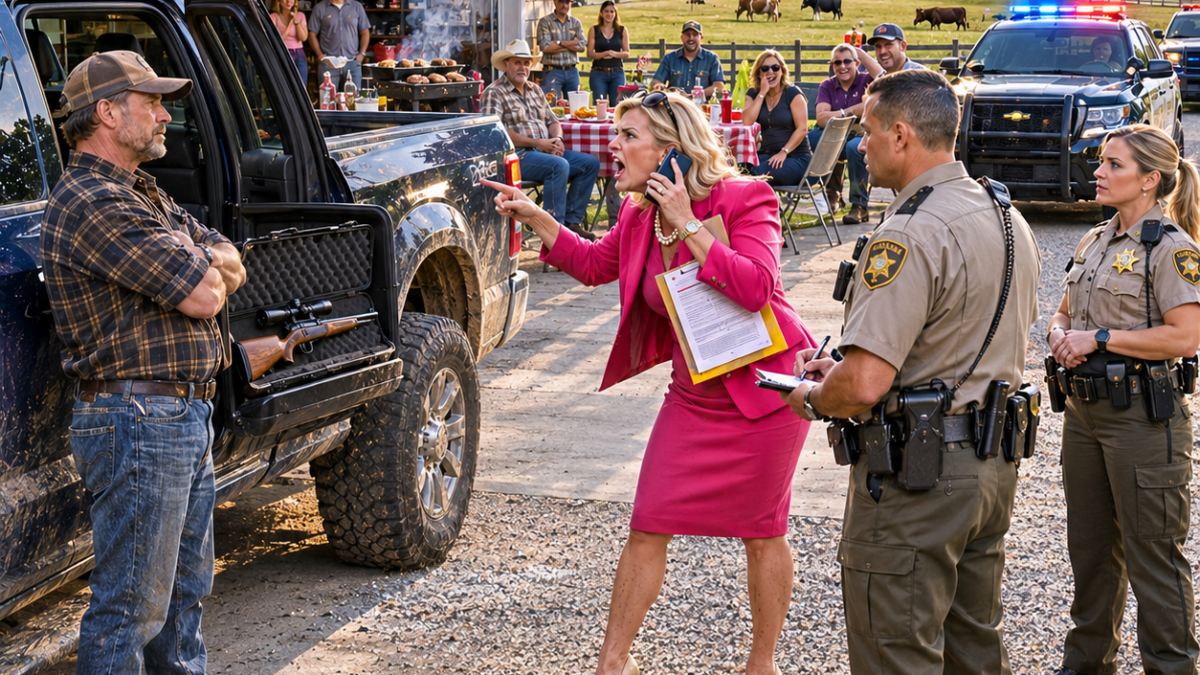
HOA Karen Called 911 Over a Hunting Rifle at My Garage Party—Then Demanded Police Shut Down My Own Property
She called 911 and claimed there were dangerous g*ns at my family barbecue.
The “weapon emergency” was a secured hunting rifle inside my own truck.
HOA Karen expected the police to clear my property—she never expected them to recognize whose driveway she was standing in.
“Your garage party has g*ns, and it violates every community safety rule. I’m calling 911 right now to shut this down.”
Karen Holloway shouted those words from the edge of my driveway with enough confidence to make a stranger think she was reading an evacuation order. Her bright pink blazer glowed against the orange sunset, one hand gripping her phone and the other waving an HOA violation notice toward my open garage.
Behind me, burgers hissed on the grill. My wife, Claire, was carrying a bowl of potato salad toward the folding tables. A dozen friends and relatives sat in lawn chairs talking about work, football, and whose kid had cheated during a backyard cornhole game.
Nobody was threatening anybody.
Nobody was waving a firearm.
Nobody was even arguing until Karen arrived.
The “g*n” she kept yelling about was my hunting rifle, unloaded and secured in a locked case behind the rear seat of my truck after an early-morning trip to the range. Someone walking past had apparently seen the case while I unloaded targets from the truck.
That was enough for Karen.
She marched across the edge of my property with her yellow HOA folder tucked under her arm and announced that Willow Creek Estates prohibited firearms at “community events.”
“This isn’t a community event,” I told her. “It’s my garage.”
“It is visible from the neighborhood.”
“That doesn’t make it HOA property.”
“The board has authority over activities that create safety risks.”
I looked down at the violation notice.
It demanded immediate termination of the gathering and threatened a $1,500 emergency assessment.
I almost laughed.
Instead, I asked, “Which covenant?”
Karen pointed at me.
“Don’t try to intimidate me with technicalities.”
That was the moment I knew the evening was about to become interesting.
My name is Jack Mercer. I was fifty-one years old, owner of twenty-eight acres bordering Willow Creek, and police chief of the small town five miles west of us. I had spent twenty-six years in law enforcement.
Which meant I knew exactly what Karen had just done when she told the emergency dispatcher there was an armed disturbance at my address.
I also knew enough not to touch my truck, not to argue with responding officers, and not to use my job title as a shortcut.
When the patrol SUV finally rolled onto the gravel, its emergency lights were off.
Deputy Aaron Delgado stepped out.
He looked toward the garage.
Then toward Karen.
Then at me.
His eyebrows rose.
“Chief Mercer?”
Karen froze.
Delgado didn’t laugh.
He didn’t dismiss her.
He switched on his body camera and said, “Sir, we received a report involving weapons and a disturbance. I need everybody to stay where they are while I figure out what happened.”
I nodded.
“Absolutely.”
Karen stepped forward.
“Officer, I’m the HOA president. I can explain everything.”
Delgado turned toward her.
“I’ll speak with you separately in a moment.”
Her face tightened.
Then he looked back at me.
“Chief, before we go any further, I need to ask you one question.”
The garage went silent.
“What exactly is in that truck?”
part 2
“An unloaded hunting rifle in a locked case,” I said. “Rear seat. Vehicle is locked. I haven’t touched it since the party started.”
Delgado nodded.
“Anybody else here carrying or handling firearms?”
“Not that I’m aware of.”
“Any threats?”
“No.”
“Any argument before the complaint?”
I looked toward Karen.
“Only the one you’re looking at.”
She made an offended sound.
Delgado held up one hand.
“I’ll get to you.”
That bothered her more than almost anything he could have said.
Karen was used to being the person who controlled the order of conversation.
She chaired meetings like a traffic cop at a six-car collision. She interrupted people, redirected questions, and used phrases like “I’m ruling you out of order” in places where there was no parliamentary procedure to begin with.
Now a real deputy was asking her to wait.
I could practically hear the gears grinding.
Delgado called for another unit, not because he thought there was a dangerous situation but because a firearm allegation required him to handle the call carefully. A second deputy, Melissa Brooks, arrived eight minutes later.
I knew both of them professionally.
Neither worked for me.
That mattered.
Our property sat in county jurisdiction, outside my town’s municipal limits, so the sheriff’s office handled calls there. I was glad for that. The last thing I wanted was one of my own officers placed in the position of investigating a complaint at their chief’s home.
Brooks spoke to Karen while Delgado spoke to me.
Claire quietly guided the kids inside the house.
The adults stayed where they were.
My brother-in-law, Sam, whispered, “Should I turn off the grill?”
“Why?”
“I don’t know. It suddenly feels illegal.”
I almost smiled.
“Keep cooking.”
“Copy that, Chief.”
“Don’t call me Chief right now.”
“Yes, Barbecue Civilian.”
That got a few nervous laughs.
Delgado asked whether I would consent to showing him the secured case.
I did.
He had me unlock the truck while standing back, and we handled the verification calmly and by the book. He never treated me like a suspect, but he also didn’t take shortcuts because he knew me.
That was exactly how it should have been.
He confirmed that the rifle was secured and not being handled at the gathering.
Then he looked around the property.
Music was playing from a small speaker at conversational volume.
Cars were parked along my driveway and on my own grass.
Nobody blocked the county road.
No one was intoxicated and causing trouble.
No one had complained about noise except Karen.
Brooks finished speaking with her and walked over.
“She says the HOA has a rule prohibiting firearms during neighborhood gatherings.”
Delgado looked at me.
“Are you in Willow Creek?”
“No.”
Karen heard me from twenty feet away.
“Yes, he is functionally part of the community.”
I turned toward her.
“Functionally?”
She walked closer.
“Your property borders Willow Creek on three sides. You use the same access road. Your activities affect our property values. You cannot pretend you exist in isolation.”
Deputy Brooks looked down at her notebook.
“Ma’am, is his parcel subject to your HOA declaration?”
Karen paused.
“The board has regulatory authority over community-adjacent properties.”
Brooks repeated the question.
“Is his parcel in your HOA?”
Karen’s lips tightened.
“Not technically.”
Sam whispered behind me, “There’s that word again.”
I looked over.
“What?”
“Technically. People only use technically when reality is annoying them.”
He wasn’t wrong.
Deputy Delgado asked Karen to show him the regulation she claimed I had violated.
That was when the yellow folder opened.
I had seen that folder at least six times in the previous year.
Karen treated it like a portable courthouse.
Inside were printed emails, meeting minutes, rule drafts, photographs of trash cans, photographs of boats, photographs of basketball hoops, and apparently enough paper to rebuild the tree population she claimed to care about.
She produced a page titled COMMUNITY SAFETY AND WEAPONS POLICY.
Delgado read it.
Then he handed it to Brooks.
She read it.
Then she looked toward me.
“Chief, have you seen this?”
“No.”
Karen said, “It was adopted four months ago.”
Brooks pointed to the first paragraph.
“This says, ‘Within association-owned common areas and association-sponsored functions.’”
Karen crossed her arms.
“Yes.”
“This is neither.”
“It is a gathering affecting the association.”
Brooks looked around at my garage.
“Is the HOA sponsoring the barbecue?”
“No.”
“Does the HOA own this property?”
“No.”
“Then this policy doesn’t appear to apply here.”
Karen’s eyes widened.
“You’re not interpreting it correctly.”
Deputy Brooks had been a sheriff’s deputy for eleven years.
She had the patience of a woman who had argued with people at two in the morning beside overturned trash cans.
She simply said, “Ma’am, I’m reading the words on the page you handed me.”
Karen turned to Delgado.
“What about the firearm?”
He answered evenly.
“Having a lawfully possessed hunting firearm secured inside a private vehicle is not, by itself, evidence of a disturbance.”
“But there are children here.”
“The firearm is secured.”
“But I saw it.”
“You saw a case.”
Karen faltered.
“Well, someone told me what was inside.”
Delgado looked up.
“You told dispatch you personally observed an armed gathering.”
The air changed.
I looked at him.
Then at Karen.
She stared back.
“I observed evidence of a firearm.”
“That isn’t what I asked.”
Karen clutched her folder.
“I was concerned for public safety.”
“That may be,” Delgado said. “But when dispatch asks what you personally saw, you need to answer accurately.”
I felt my jaw tighten.
That was the first time I understood how serious her wording had been.
An “armed gathering” creates a very different response than “I saw what I believe was a rifle case inside a parked truck.”
Dispatchers and responding officers make decisions based on what callers report.
Bad information can create unnecessary danger.
I didn’t say that.
Delgado did.
“Ma’am, exaggerating the nature of a weapon complaint can put everybody involved in a difficult position. If you’re reporting something, report what you actually see.”
Karen’s face turned red.
“I did not exaggerate.”
Brooks glanced at her notes.
“You stated several people were displaying firearms.”
Nobody moved.
Even Karen seemed to understand she had just run out of room.
“I believed they might be.”
“That’s different.”
Claire had come back outside by then.
She stood beside me with her arms folded.
“Karen,” she said quietly, “why didn’t you just ask us?”
Karen looked at her.
“I did.”
“No. You came over with a fine already printed.”
That was true.
The notice had been generated before she confronted me.
Meaning the firearm complaint was not the beginning of the dispute.
It was escalation.
Delgado finished the call without drama.
No citations.
No arrests.
No shutdown.
He documented the complaint, confirmed no immediate threat, and told us we could continue the gathering.
Before leaving, he gave me a look I understood.
We would talk professionally later.
Not about Karen’s personality.
About the dispatch information.
Brooks handed the HOA paper back to Karen.
“Ma’am, this appears to be a private property dispute. The sheriff’s office is not enforcing your association rules.”
Karen took the page.
“You’re just going to leave?”
“Yes.”
“With a gun here?”
“A secured firearm.”
“There are families.”
“Yes.”
“That’s reckless.”
Delgado stopped before getting into his SUV.
“Ma’am, there is no law enforcement action for us to take based on what we found.”
Karen pointed at me.
“He’s a police chief. Of course you’re protecting him.”
That was the worst thing she could have said.
Delgado’s expression changed.
Not angry.
Professional.
Firm.
“No, ma’am. I’m documenting the facts. His employment does not change them.”
Then he looked directly at me.
“Chief, you understand this call will be documented like any other.”
“Good.”
Karen stared.
I think she had expected me to object.
I didn’t.
Transparency protected me too.
The deputies left.
For about thirty seconds, nobody at the party knew what to do.
Then Sam walked to the grill, lifted the lid, and announced, “Good news. The ribs survived the investigation.”
Everyone laughed.
The tension broke.
Karen did not.
She marched back toward Willow Creek with the yellow folder tucked against her side.
Halfway down my gravel drive, one of her heels slipped between two stones.
She lurched sideways.
The folder opened.
Pages exploded across the driveway.
For one terrible second, twenty adults stood frozen while HOA violation notices skittered through dust like oversized confetti.
Sam bent down and caught one.
He read the heading.
“Trash Can Visibility Violation.”
Karen snatched it from him.
“Do not touch association documents.”
He held up both hands.
“Ma’am, your association attacked me first.”
I turned away because I knew laughing would make everything worse.
Claire failed completely.
By the time Karen collected the last sheet, her pink blazer was dusty, her hair had lost its perfect shape, and whatever authority she thought she carried onto my property had scattered farther than her paperwork.
She left without another word.
I thought that was the end of it.
I should have known better.
At 7:18 the next morning, my phone buzzed.
EMAIL FROM WILLOW CREEK HOA.
Subject:
EMERGENCY SAFETY VIOLATION — FINAL DEMAND.
I opened it.
The HOA was assessing me $1,500 for maintaining a firearm at a prohibited gathering, $500 for excessive noise, and $250 for “hostile refusal of lawful inspection.”
Total due:
$2,250.
Failure to pay within ten days could result in collection activity, legal fees, and “all remedies available under the declaration.”
I read the email twice.
Then I walked into the kitchen.
Claire was pouring coffee.
She took one look at me.
“Folder face?”
“Worse.”
“Lawyer face?”
“Not yet.”
I handed her the phone.
She read the notice.
Then she looked at me.
“Hostile refusal of inspection?”
“I told her she couldn’t walk into the garage.”
“You said, ‘Karen, please stay outside the garage.’”
“I was terrifying.”
Claire handed me the phone.
“What now?”
“Now I find out whether the HOA actually issued this.”
I called Willow Creek’s management company at eight.
The receptionist transferred me to a community manager named Elena Morris.
I gave her the notice number.
Keyboard clicking.
Silence.
Then more clicking.
“Mr. Mercer?”
“Yes.”
“I don’t have an account under your address.”
“I know.”
“Are you a Willow Creek homeowner?”
“No.”
Another silence.
“Then why did you receive an enforcement notice?”
“That is what I’m calling to ask.”
I forwarded the email.
Five minutes later, Elena called back.
Her tone had changed.
“Mr. Mercer, do not send payment.”
“I wasn’t planning to.”
“I need to review this with our board and counsel.”
“Did your office create the notice?”
“No.”
“Did your system generate the number?”
“No.”
“Did your office authorize Karen Holloway to send it?”
“I cannot answer that until I speak with the board.”
That was careful language.
I respected it.
“Fair enough.”
I ended the call and opened the county recorder’s website.
I already knew my parcel was outside Willow Creek, but knowing something and proving it are different things.
My property had been purchased by my father in the late 1980s.
At that time, the land around us was mostly pasture.
Willow Creek wasn’t developed until almost twenty years later.
The subdivision declaration attached to 212 residential lots and several common areas.
My twenty-eight acres were not included.
No amendment annexed them.
No deed subjected them to HOA restrictions.
We shared a county-maintained access road for several hundred feet, but sharing asphalt did not create HOA membership.
By nine thirty, I had downloaded the relevant recorded documents.
At ten, I called an attorney.
Her name was Rebecca Sloan.
She represented municipalities and private landowners and had the rare ability to make complicated disputes sound boring.
Boring was exactly what I wanted.
I sent her everything.
The notice.
The HOA policy.
The recorded declaration.
The sheriff incident number.
The county parcel record.
She called me twenty minutes later.
“Chief, first question: do you want to handle this as a homeowner or as a law enforcement official?”
“Homeowner.”
“Good answer.”
“My badge has nothing to do with my property rights.”
“Exactly.”
She paused.
“Second question: has the HOA ever assessed you before?”
“No.”
“Have you ever paid dues?”
“No.”
“Signed anything?”
“No.”
“Used their private amenities under a membership agreement?”
“No.”
“Then we begin with jurisdiction.”
She sent a letter that afternoon.
It was seven paragraphs.
No threats.
No dramatic language.
It identified my parcel and explained that it was not subject to the Willow Creek declaration.
It demanded withdrawal of every assessment, written confirmation that the HOA would not attempt a lien or collection action, and preservation of communications relating to the 911 call and violation notices.
It also asked the board to identify the authority supporting its claimed right to inspect my garage.
Karen responded herself.
She copied every board member.
Chief Mercer’s insistence that his property is somehow exempt from community safety expectations demonstrates precisely why HOA oversight is necessary.
I stared at the sentence.
Then called Rebecca.
“She said I’m ‘somehow exempt.’”
“You aren’t exempt.”
“I know.”
“You’re outside.”
“I know.”
“Words matter.”
“Apparently not to Karen.”
Rebecca sighed.
“Do not reply.”
I didn’t.
That evening, a Willow Creek resident named Tom Bennett came by.
He was a firefighter.
We had worked scenes together over the years.
He looked uncomfortable.
“Jack, can I ask you something?”
“Sure.”
“Did you threaten Karen?”
“No.”
“Didn’t think so.”
“Why?”
“She told people you used your position as chief to intimidate the deputies.”
I stared at him.
“Both deputies were county.”
“I know.”
“And their body cameras were running.”
“I know.”
“And Karen was standing there when Delgado told me the call would be documented.”
“I know.”
Tom rubbed the back of his neck.
“That’s why I’m here.”
He showed me a screenshot from the neighborhood social-media group.
Karen had posted:
Yesterday evening I attempted to address a serious weapons-related safety concern adjacent to our neighborhood. Certain individuals used professional connections to prevent appropriate enforcement. The board will not be intimidated.
I read it twice.
“Professional connections?”
Tom nodded.
“People are asking questions.”
“So am I.”
More neighbors started contacting me over the next few days.
Not because they cared about my party.
Because Karen had been using “emergency safety” language for almost everything.
A resident received a threat of a $750 fine because his teenage son’s pickup had a locked hunting bow case visible through the rear window.
Another was warned over archery equipment stored inside a garage while the door was open.
A third had been accused of creating a “hazardous environment” because he cleaned fishing gear on his driveway and Karen thought one of the long cases contained a firearm.
No one had been arrested.
No crimes had occurred.
But Karen had discovered that words like “weapon,” “emergency,” and “safety” made people stop arguing.
That bothered me.
Using safety language responsibly saves lives.
Using it as a neighborhood political weapon erodes trust.
The board scheduled a special meeting the following Thursday.
I attended as a property owner affected by their actions.
Not in uniform.
No badge visible.
No department vehicle.
Just jeans, boots, and a gray shirt.
Rebecca came with me.
The clubhouse was packed.
Karen sat at the front wearing a red blazer instead of pink.
Apparently pink had been retired after the paperwork avalanche.
She opened the meeting by reading a prepared statement.
“Our community is facing an unprecedented challenge to its ability to maintain safety.”
I looked around.
Nobody else seemed aware of the unprecedented challenge.
A toddler was eating crackers in the second row.
Karen continued.
“Recent events have demonstrated that external properties can create risks affecting our residents even when those properties resist direct HOA oversight.”
Rebecca leaned toward me.
“She just admitted you’re external.”
I whispered, “Progress.”
Karen spoke for nine minutes.
She described my barbecue as a “weapons-involved gathering.”
She described the deputies’ response as “inconclusive.”
That was interesting.
No violation had apparently become inconclusive.
Then she said she had acted under emergency authority.
The board treasurer, Mark Hill, interrupted.
“What emergency authority?”
Karen looked at him.
“The president has discretion to act when immediate safety is involved.”
“Where?”
“The bylaws.”
Mark opened a binder.
“Which section?”
Karen paused.
“The board has always recognized presidential discretion.”
Another director, Susan Bell, spoke.
“I haven’t.”
Neither had Mark.
Neither had the secretary.
Karen looked annoyed.
“This is exactly the procedural paralysis I have been warning about.”
Rebecca wrote something on her notepad and slid it toward me.
TRANSLATION: THEY DID NOT AUTHORIZE HER.
I kept a straight face.
Then Elena, the community manager, stood.
“Before we continue, management needs to clarify something.”
The room went quiet.
“Our office did not issue the assessment sent to Mr. Mercer.”
Karen turned toward her.
“The president has independent enforcement authority.”
Elena answered carefully.
“Management has not found that authority in the governing documents.”
Karen’s face changed.
“We have done this before.”
“That does not mean it was authorized.”
The board attorney joined by video conference.
His name was Martin Cho.
He appeared on a large screen behind the table.
“Ms. Holloway,” he said, “I have reviewed the declaration and bylaws. Mr. Mercer’s parcel is not subject to Willow Creek’s covenants.”
Karen crossed her arms.
“The danger originated on adjacent property.”
“That does not extend the declaration.”
“What if someone runs an illegal firing range next door?”
“Then you report actual unlawful conduct to the proper governmental authority.”
“That is exactly what I did.”
Cho paused.
“The sheriff found no unlawful conduct.”
Karen’s mouth tightened.
“The sheriff knew him.”
“So?”
Karen looked around.
“He’s a police chief.”
Cho’s voice became firmer.
“That is irrelevant to whether this association has jurisdiction over his property.”
I watched some of the board members look at one another.
That was when I realized something.
Karen hadn’t just overreached.
She had done it without bringing the board along.
She had assumed they would support her afterward because backing down would embarrass them.
Classic institutional pressure.
Create the situation first.
Force everyone else to defend it later.
That strategy works until somebody refuses.
Mark asked Elena, “How many violation notices has Karen issued directly in the last year?”
Elena looked uncomfortable.
“We’re reviewing that.”
“How many?”
“At least thirty-two that did not originate through management.”
The room erupted in murmurs.
Karen immediately spoke over them.
“Those were courtesy enforcement communications.”
Elena held up a copy of mine.
“This one demands $2,250.”
“Because the violation was severe.”
“You cannot call it a courtesy notice if it demands payment.”
Someone in the audience laughed.
Karen glared toward the sound.
Then Rebecca stood.
She didn’t raise her voice.
“My client has one request tonight. Please confirm in writing that Willow Creek has no authority over his property and that the assessments issued against him are void.”
Karen said, “Absolutely not.”
Mark looked at her.
“You’re not the board.”
The room fell silent.
I almost felt the air leave Karen’s lungs.
For years, I suspect nobody had said that sentence to her directly.
You’re not the board.
Four words.
That was all it took.
The directors voted.
Five in favor.
Karen against.
The assessments were declared void.
The board directed management to send written confirmation that my property was not subject to Willow Creek enforcement.
Then Mark made another motion.
All enforcement communications would require management review pending a full audit.
Passed.
Again, Karen voted no.
The meeting could have ended there.
Then Tom Bennett stood.
He held up his phone.
“I’d like the board to address something else.”
Karen looked irritated.
“What?”
Tom read her social-media post aloud.
The part about professional connections.
Then he looked at me.
“Chief, did you ask those deputies for special treatment?”
“No.”
“Did you identify yourself as chief before they recognized you?”
“No.”
“Did you contact the sheriff afterward and ask for the report to be changed?”
“No.”
Tom turned toward Karen.
“Do you have evidence that he did?”
Karen leaned toward the microphone.
“I said professional relationships influenced the situation.”
“That isn’t what I asked.”
For a moment, I thought I was watching Deputy Delgado all over again.
Karen had a habit of making broad claims until somebody required specifics.
Then the entire structure collapsed.
She said, “It’s obvious that law enforcement personnel treat one another differently.”
Tom shook his head.
“So no evidence.”
Karen slapped her folder shut.
“This meeting is becoming a personal attack.”
Mrs. Dalton, an eighty-year-old widow in the front row, raised her hand.
Mark recognized her.
She looked at Karen.
“You called the sheriff on my grandson last summer.”
Karen blinked.
“That matter is unrelated.”
“He was changing a tire.”
“His vehicle had been parked for an extended period.”
“Forty minutes.”
“It obstructed visual access.”
“To what?”
Karen didn’t answer.
Mrs. Dalton smiled.
“That’s what I thought.”
The room laughed.
The audit took two weeks.
Its findings were ugly.
Karen had issued twenty-three notices without management review.
Seven demanded money.
Four referenced emergency authority that did not exist in the bylaws.
Three threatened police involvement over matters that were purely HOA disputes.
The association refunded two homeowners who had paid unauthorized assessments.
The board issued a community-wide correction.
Karen called it a witch hunt.
Then the sheriff’s office released the incident report from my barbecue in response to my request.
It documented exactly what happened.
Caller reported multiple firearms displayed.
Deputies found one secured hunting rifle in a locked vehicle.
No firearm handling observed.
No threats.
No disturbance.
No criminal violation.
That report mattered.
Not because it made Karen look foolish.
Because it established a factual record.
Rebecca sent Karen and the HOA a preservation letter regarding her public statements that I had used professional influence.
I didn’t file a defamation lawsuit.
Rebecca advised against rushing into one.
Litigation is expensive, and not every ugly statement deserves a courthouse.
Instead, we demanded a correction.
The HOA’s attorney agreed.
Karen refused.
The board overruled her.
A community-wide email went out Friday afternoon.
It stated:
The Board has reviewed the sheriff’s report concerning the gathering at the Mercer property. Law enforcement found no criminal violation and no improper conduct by Mr. Mercer. The property is not subject to Willow Creek HOA restrictions. Prior statements implying otherwise were not authorized by the Board.
Claire read it at dinner.
“That is the most polite public spanking I’ve ever seen.”
I nearly choked on my drink.
“Claire.”
“What?”
“You said it.”
“I stand by it.”
Karen stopped attending meetings for three weeks.
Then she returned with a new strategy.
She proposed a “Community Perimeter Safety Ordinance.”
Not policy.
Ordinance.
I was not there when she presented it, but Mark called me afterward.
“You’re going to enjoy this.”
“I don’t want to enjoy anything involving her anymore.”
“She drafted a rule claiming Willow Creek can regulate dangerous activity within five hundred feet of the subdivision.”
I stared at my phone.
“HOAs cannot pass ordinances.”
“I know.”
“That’s a municipal term.”
“I know.”
“She wants jurisdiction over land she doesn’t own.”
“I know.”
“Did anyone tell her?”
“Everyone.”
Apparently the board attorney had explained that the HOA could create rules for its members and property within the scope of its governing documents but could not legislate surrounding land.
Karen argued that safety required innovation.
The proposal died without a second.
That should have been humiliating enough.
It wasn’t the end.
Two months after my garage party, Willow Creek held its annual election.
Karen ran for reelection as president.
Technically, homeowners elected directors and the board selected officers, but everyone understood what the vote represented.
Karen campaigned aggressively.
Her flyers promised:
STRONG LEADERSHIP.
SAFE STREETS.
ACCOUNTABILITY.
One resident taped a handwritten note beneath one in the clubhouse.
ACCOUNTABILITY SOUNDS GOOD.
Management removed it within an hour.
Not before half the neighborhood photographed it.
I stayed out of the election.
It wasn’t my HOA.
That was the point.
But several residents asked me to attend the annual meeting to answer questions about the incident.
Rebecca told me I could, as long as I stuck to facts.
The clubhouse was standing-room only.
Karen sat in the front row.
Mark chaired the meeting.
He opened the floor for member questions.
The first question came from Tom.
“How much did the association spend on counsel reviewing the Mercer dispute?”
Mark looked at the treasurer.
“Approximately eleven thousand dollars, including the governance review.”
A low murmur spread through the room.
Karen stood.
“That expense was caused by Mr. Mercer’s refusal to cooperate.”
Mark looked at her.
“No, Karen.”
She froze.
“The association spent that money because enforcement action was initiated against a parcel outside our jurisdiction.”
Applause started.
Mark stopped it.
“This isn’t a rally.”
The second question came from Mrs. Dalton.
“How much money was refunded for unauthorized fines?”
“Three thousand four hundred dollars.”
Karen stood again.
“Those homeowners were violating legitimate community expectations.”
Mark’s patience was thinning.
“Please wait to be recognized.”
She sat.
Barely.
Then a man near the back raised his hand.
“Why was 911 called about a locked hunting rifle?”
Karen turned.
“I acted because children were present.”
The man replied, “My children were present.”
I recognized him.
His name was Eric.
He had been at my barbecue.
He continued.
“I never saw anybody touch a firearm.”
Karen said, “You cannot know what I observed.”
Eric nodded.
“That’s why I read the sheriff report.”
Laughter.
Karen’s face reddened.
Then he said something that ended her campaign more effectively than any speech I could have made.
“Safety isn’t making things sound scarier than they are.”
The room went silent.
He sat down.
When voting ended, Karen lost her board seat by seventy-one votes.
For Willow Creek, that was enormous.
She remained seated after the result was announced.
Nobody cheered.
I was glad.
There was something uncomfortable about watching a person realize the authority that had defined them was gone.
Karen looked down at the yellow folder on her lap.
For the first time, it looked small.
Then Sam, who had somehow gotten invited as Tom’s guest, whispered from behind me, “Do you think the folder gets a retirement party?”
I elbowed him.
“Stop.”
“I brought cake.”
“You did not.”
“I absolutely did.”
I turned.
He was holding a bakery box.
I stared at him.
“What does it say?”
He grinned.
“Nothing inappropriate.”
“That doesn’t answer my question.”
He opened the lid two inches.
Pink frosting.
Three words.
NO JURISDICTION HERE.
I closed the box.
“We are not serving that.”
“Coward.”
“We are adults.”
“Debatable.”
The cake stayed in his truck.
Mostly.
The legal part of my dispute ended soon afterward.
The HOA signed a formal settlement agreement.
It acknowledged that my parcel was outside its declaration.
All assessments were permanently withdrawn.
The association agreed that its directors, officers, committees, and agents would not enter my property for HOA enforcement without permission.
It reimbursed my reasonable attorney costs associated with forcing the correction.
The board also adopted a new enforcement policy.
Every violation notice required the specific covenant section.
Every monetary assessment required documented authorization.
Emergency services could still be called when somebody genuinely believed there was an emergency, obviously, but HOA officials were explicitly instructed not to use law enforcement as leverage in covenant disputes.
That last part mattered most to me.
Police exist to handle public safety.
Not settle arguments over garage doors, landscaping, or who offended the HOA president.
A few weeks later, Sheriff Alvarez invited me to lunch.
We had known each other for years.
After we ordered, he said, “You know Delgado thought he was walking into the strangest call of his month.”
“I apologized.”
“You didn’t call.”
“I know.”
“He said you behaved.”
“High praise.”
“He also said your brother-in-law offered him ribs.”
“That was after the scene was cleared.”
“I know.”
“He declined.”
“I know.”
“He regrets that.”
I laughed.
Then Alvarez became serious.
“Jack, I’m glad your people weren’t the ones responding.”
“So am I.”
“It kept everything clean.”
“Exactly.”
He nodded.
“Karen made a complaint to internal affairs, by the way.”
I stared at him.
“Against me?”
“Against Delgado and Brooks.”
“For what?”
“Favoritism.”
My appetite disappeared.
“What happened?”
“We reviewed body camera video and dispatch audio.”
“And?”
“No policy violation.”
I exhaled.
Alvarez continued.
“She alleged they laughed at her.”
“Did they?”
“No.”
I thought about the original story Karen was probably telling now.
The police arrived.
They recognized the chief.
They laughed at the HOA lady.
Everyone humiliated her.
Reality was less cinematic.
And more damning.
The deputies had been professional.
They verified facts.
They documented the call.
They refused to manufacture authority where none existed.
Karen didn’t lose because officers mocked her.
She lost because neutral procedures kept producing answers she didn’t like.
That distinction mattered.
Six months passed.
The garage stayed exactly what it had always been.
A garage.
Workbench against one wall.
Old refrigerator beside the tool cabinet.
A television above the shelf.
Folding tables when we had company.
No HOA permission slip required.
I did make one change.
I moved my hunting equipment into a locked interior storage room after range days instead of leaving cases in the truck.
Not because Karen had been right.
Because avoiding unnecessary misunderstandings is sensible.
Claire noticed the first time.
“Karen changed your behavior.”
“Don’t say that.”
“She did.”
“I changed a storage routine.”
“Because of Karen.”
“Because I enjoy peace.”
She smiled.
“I’m telling her.”
“You are absolutely not.”
We still saw Karen around.
She lived near the subdivision entrance.
Without her board position, she seemed unsure what to do with herself.
For years, she had spent nearly every evening answering emails, inspecting lawns, organizing committees, and patrolling meetings.
Now Willow Creek had a management company doing the job it was paid to do.
The new board met once a month.
Meetings lasted forty-five minutes instead of three hours.
Violations dropped.
Or, more accurately, the number of things being called violations dropped.
One Saturday in October, I saw Karen near my mailbox.
I was repairing a section of fence.
She stopped on the public shoulder.
Importantly, she did not enter my property.
“Jack.”
“Karen.”
She glanced toward the garage.
“Having another party?”
“Next weekend.”
She nodded.
Then she said, “I suppose you’re going to invite half the county.”
“Probably twelve people.”
“That qualifies as half the county where you work.”
I laughed.
She almost smiled.
Then she became serious.
“I didn’t know the rifle was locked.”
“You could have asked.”
“I thought I saw someone carrying it.”
“You told dispatch several people were displaying firearms.”
Her face tightened.
“I was afraid.”
That stopped me.
It was the first thing she had said in months that didn’t sound like a defense.
“You were afraid?”
“Yes.”
“Then why didn’t you leave?”
She blinked.
“What?”
“If you truly believed several people were walking around armed and dangerous, why did you stand in my driveway arguing about HOA rules?”
She opened her mouth.
Then closed it.
That question had apparently never occurred to her.
I leaned on the fence post.
“Karen, you weren’t reacting to danger.”
She looked away.
“You were reacting to me telling you no.”
Her cheeks flushed.
“That isn’t fair.”
“I think it is.”
“You don’t understand what it’s like being responsible for a neighborhood.”
“I understand responsibility.”
She looked at me.
I continued.
“Responsibility means knowing when your authority stops.”
That landed.
For once, she didn’t fire back.
Cars moved along the county road behind us.
A hawk circled over the pasture.
Finally, Karen said, “I should not have described the call the way I did.”
“No.”
“I thought they’d take it more seriously.”
“I know.”
Her eyes came back to mine.
“That was wrong.”
“Yes.”
She exhaled.
“You’re really going to make me say all of it, aren’t you?”
“I didn’t ask you to come over.”
That almost made her laugh.
She shook her head.
“I was wrong to send the fine.”
“Yes.”
“I was wrong about your property being in the HOA.”
“Yes.”
“I was wrong about the officers.”
“Yes.”
“Do you have another word?”
“No.”
She laughed then.
Actually laughed.
It surprised both of us.
Then she looked toward my garage.
“What kind of party next weekend?”
“Birthday.”
“Whose?”
“Claire’s.”
Karen nodded.
“Tell her happy birthday.”
“I will.”
She started walking away.
Then turned.
“And Jack?”
“Yeah?”
“If Sam brings that cake again, I’m calling somebody.”
I stared at her.
“You knew about the cake?”
“Everyone knew about the cake.”
I laughed.
“So who are you calling?”
She thought about it.
“The bakery.”
That was the first genuinely funny thing I ever heard Karen say.
Claire’s birthday party happened the following Saturday.
No patrol cars.
No violation notices.
No yellow folders.
Sam brought barbecue ribs.
I inspected the cake personally.
It said:
HAPPY BIRTHDAY, CLAIRE.
Nothing else.
I was proud of him.
Around sunset, Tom and several Willow Creek neighbors walked over.
We had music playing.
Kids tossed a football across the grass.
My garage doors were open.
The grill smoked.
Normal life.
At one point, a sheriff’s SUV slowed on the county road.
Everyone looked.
Sam raised both hands.
“Oh no.”
The SUV turned into my driveway.
Deputy Delgado stepped out.
Claire looked at me.
“Did somebody call?”
“No.”
Delgado walked toward the garage.
“Evening.”
Sam whispered, “Hide the ribs.”
Delgado smiled.
“Last time I came here, somebody promised me a plate.”
Sam pointed at me.
“He outranks me.”
“Not here he doesn’t.”
I handed Delgado a plate.
He was on his meal break.
He stayed twelve minutes.
No official business.
Just food.
Before leaving, he looked around.
“Much quieter call this time.”
Claire said, “Nobody invited Karen.”
From the edge of the driveway came a voice.
“I heard that.”
Everyone turned.
Karen stood beside the mailbox.
No blazer.
No folder.
She was holding a covered casserole dish.
Claire stared at me.
I stared at Karen.
Karen lifted the dish.
“I was told this was a birthday party.”
Claire walked toward her.
“Did Jack invite you?”
Karen looked at me.
I shrugged.
“I told her happy birthday.”
“That is not an invitation.”
Karen’s expression fell.
For half a second, the old tension returned.
Then Claire smiled.
“Well, you’re here now.”
She opened the gate.
“Come in.”
Karen hesitated.
“Are you sure?”
“Yes.”
Sam called from the grill.
“Any paperwork?”
Karen shouted back, “Only a casserole.”
“Is it approved?”
“No.”
Sam clutched his chest.
“Outlaw food.”
Everyone laughed.
Karen did too.
That evening didn’t magically erase everything.
We did not become best friends.
She never joined my Christmas card list.
I never joined Willow Creek.
The HOA never gained authority over my acreage.
But Karen sat at our table.
She talked to Claire.
She ate Sam’s ribs.
She stayed away from the subject of guns.
Mostly.
At one point, Delgado walked past her carrying lemonade.
Karen looked at him.
“Deputy.”
“Ms. Holloway.”
“I assume everything checks out?”
He looked toward me.
Then the grill.
Then Sam.
“I remain deeply concerned about the ribs.”
Sam pointed his tongs.
“Defamation.”
Karen laughed so hard she nearly spilled her drink.
That was the moment the whole fight finally felt over.
Not when the board voided the fine.
Not when the attorney wrote the letter.
Not when Karen lost the election.
Not when the sheriff cleared the deputies.
Those things mattered.
They were the justice part.
They protected boundaries.
They corrected the record.
They ensured nobody could attach a fake debt to my property.
But the emotional ending came later.
It came when Karen finally learned that backing down did not destroy her.
For years, she had treated every disagreement like a threat to her authority.
If someone questioned her, she pushed harder.
If a rule didn’t cover something, she stretched it.
If she couldn’t persuade someone, she threatened fines.
If a private property owner told her no, she reached for emergency services.
Every escalation made retreat harder.
That was how she ended up standing in my driveway telling a 911 dispatcher that a peaceful garage barbecue was an armed disturbance.
She wasn’t stupid.
That would have been easier.
She was convinced.
Convinced that safety justified control.
Convinced that good intentions created authority.
Convinced that if she sounded official enough, somebody else would eventually make her right.
Nobody did.
The deputies followed the facts.
The management company followed the documents.
The attorney followed the declaration.
The board followed the bylaws.
The sheriff followed the body-camera evidence.
And every trail led to the same conclusion.
Karen had authority inside the boundaries granted to her.
Outside them, she was just another neighbor with an opinion.
A loud opinion.
A very organized opinion.
An opinion with an alarmingly well-stocked yellow folder.
But still an opinion.
I remained police chief for another four years.
During that time, I used the incident once in leadership training.
I never used Karen’s name.
I described a hypothetical call where an official title, a weapon allegation, and personal relationships could easily tempt responders to either overreact or underreact.
The lesson was simple.
Verify.
Document.
Stay inside your authority.
It applied to police officers.
It applied to HOA presidents.
It applied to me.
Especially to me.
Power becomes dangerous when the person holding it starts believing good intentions exempt them from procedure.
Karen learned that publicly.
I learned something privately too.
Humiliating someone can feel good for an afternoon.
Correcting a system lasts longer.
Willow Creek changed after Karen left office.
The board created an online violation portal.
Every notice showed the exact covenant section.
Residents received hearing instructions.
Committee members could report concerns but could not independently assess money.
The management company handled official enforcement.
911 was never mentioned in an HOA letter again.
Tom eventually joined the board.
His first meeting lasted thirty-eight minutes.
He called me afterward.
“We’re doing something wrong.”
“Why?”
“Nobody yelled.”
“Give it time.”
“Karen attended.”
“As a resident?”
“Yes.”
“Did she bring the yellow folder?”
“No.”
“That is progress.”
A year after my garage-party incident, Willow Creek held its annual summer picnic.
Tom invited Claire and me.
I told him I didn’t belong to the HOA.
He said, “It’s a social event, Jack. We’re capable of inviting people without annexing them.”
That was too good to refuse.
We went.
Karen was there.
She was running the dessert table.
Apparently she still needed a clipboard.
This one contained pie names.
I walked over.
She looked at me.
“Don’t.”
“I haven’t said anything.”
“You were about to.”
“I was going to ask whether the brownies had been legally adopted.”
She pointed toward the parking lot.
“Leave.”
Claire laughed.
Karen handed me a brownie.
The old yellow enforcement folder was gone.
I never saw it again.
According to Tom, Karen eventually volunteered for the landscaping committee.
Under strict supervision.
She turned out to be excellent at flowers.
Apparently hydrangeas benefited from authoritarian leadership more than homeowners did.
That became the neighborhood joke.
Even Karen used it.
Two years later, she sold her house and moved closer to her daughter.
Before leaving, she stopped at our place one last time.
Claire and I were sitting outside the garage.
The sun was dropping behind the trees.
The same orange-purple sky from the night the deputies came.
Karen stood where she had once waved the red violation notice.
No pink blazer.
No phone in the air.
No accusations.
She looked toward the garage.
“I made quite an idiot of myself here.”
Claire answered before I could.
“Yes.”
I looked at my wife.
Karen stared at her.
Then all three of us laughed.
Karen shook her head.
“I was hoping for something kinder.”
Claire smiled.
“You came to the wrong house.”
Karen looked at me.
“I still don’t like guns.”
“You don’t have to.”
“I still think neighborhoods need strong rules.”
“So do I.”
“And I still think your brother-in-law is annoying.”
“Finally, something we agree on.”
She smiled.
Then her expression softened.
“I am sorry, Jack.”
This time there were no qualifications.
No procedural language.
No “mistakes were made.”
No “I was only trying to protect people.”
Just an apology.
I nodded.
“Thank you.”
She looked toward the road.
Then back at me.
“You know what bothered me most?”
“What?”
“When that deputy asked me what I had actually seen.”
I remembered.
“You didn’t have an answer.”
“I had an answer in my head. I just realized it wasn’t what happened.”
That might have been the most honest thing she ever said to me.
She left a few minutes later.
Six months after that, Tom sent me a photograph from Karen’s new neighborhood.
Someone had installed an enormous inflatable flamingo on a lawn across from her house.
Bright pink.
At least twelve feet tall.
His message read:
DO YOU THINK SHE’LL CALL 911?
I replied:
Only if it’s armed.
He sent back three laughing emojis.
I looked at the picture for a long time.
Then I walked outside.
My garage door was open.
Claire was watering flowers.
Sam had left a cooler beside the workbench after our last barbecue.
Nothing about the property looked remarkable.
That was what Karen had misunderstood from the beginning.
Freedom on private property is not the absence of law.
It is the presence of boundaries.
I followed county law.
I followed firearm law.
I cooperated with responding deputies.
I respected legitimate authority.
What I refused to do was accept invented authority.
There is a difference.
Karen threatened me with $2,250 in fines.
She implied a lien.
She told neighbors I had manipulated law enforcement.
She called a secured hunting rifle an armed gathering.
She tried to stretch an HOA rule across a property line because she believed safety made jurisdiction optional.
In the end, none of those claims survived contact with documentation.
The fine disappeared.
The lien threat disappeared.
The accusation of police favoritism disappeared.
Her emergency powers disappeared.
Eventually, her board seat disappeared too.
My garage stayed.
My property stayed.
My rifle stayed legally secured.
My barbecue stayed exactly what it had always been.
Friends.
Family.
Food.
Kids running through the yard.
Neighbors arguing about football instead of bylaws.
Sunset dropping over the trees.
No sirens.
No panic.
No yellow folder.
And if there was a victory in all of that, it wasn’t that I was police chief and Karen picked the wrong driveway.
That would have been a cheap ending.
The real victory was that my title didn’t matter.
It didn’t need to.
The evidence was enough.
The law was enough.
The property records were enough.
The sheriff’s report was enough.
The HOA’s own documents were enough.
Karen thought authority meant being the loudest person in the driveway.
I had spent most of my adult life learning the opposite.
Real authority knows where it ends.
And that evening, standing beside my garage while the sunset turned the gravel orange, Karen finally learned where hers ended too.
THE STORY ENDS HERE
HOA Karen Called 911 Over a Hunting Rifle at My Garage Party—Then Demanded Police Shut Down My Own Property
She called 911 and claimed there were dangerous g*ns at my family barbecue.
The “weapon emergency” was a secured hunting rifle inside my own truck.
HOA Karen expected the police to clear my property—she never expected them to recognize whose driveway she was standing in.
“Your garage party has g*ns, and it violates every community safety rule. I’m calling 911 right now to shut this down.”
Karen Holloway shouted those words from the edge of my driveway with enough confidence to make a stranger think she was reading an evacuation order. Her bright pink blazer glowed against the orange sunset, one hand gripping her phone and the other waving an HOA violation notice toward my open garage.
Behind me, burgers hissed on the grill. My wife, Claire, was carrying a bowl of potato salad toward the folding tables. A dozen friends and relatives sat in lawn chairs talking about work, football, and whose kid had cheated during a backyard cornhole game.
Nobody was threatening anybody.
Nobody was waving a firearm.
Nobody was even arguing until Karen arrived.
The “g*n” she kept yelling about was my hunting rifle, unloaded and secured in a locked case behind the rear seat of my truck after an early-morning trip to the range. Someone walking past had apparently seen the case while I unloaded targets from the truck.
That was enough for Karen.
She marched across the edge of my property with her yellow HOA folder tucked under her arm and announced that Willow Creek Estates prohibited firearms at “community events.”
“This isn’t a community event,” I told her. “It’s my garage.”
“It is visible from the neighborhood.”
“That doesn’t make it HOA property.”
“The board has authority over activities that create safety risks.”
I looked down at the violation notice.
It demanded immediate termination of the gathering and threatened a $1,500 emergency assessment.
I almost laughed.
Instead, I asked, “Which covenant?”
Karen pointed at me.
“Don’t try to intimidate me with technicalities.”
That was the moment I knew the evening was about to become interesting.
My name is Jack Mercer. I was fifty-one years old, owner of twenty-eight acres bordering Willow Creek, and police chief of the small town five miles west of us. I had spent twenty-six years in law enforcement.
Which meant I knew exactly what Karen had just done when she told the emergency dispatcher there was an armed disturbance at my address.
I also knew enough not to touch my truck, not to argue with responding officers, and not to use my job title as a shortcut.
When the patrol SUV finally rolled onto the gravel, its emergency lights were off.
Deputy Aaron Delgado stepped out.
He looked toward the garage.
Then toward Karen.
Then at me.
His eyebrows rose.
“Chief Mercer?”
Karen froze.
Delgado didn’t laugh.
He didn’t dismiss her.
He switched on his body camera and said, “Sir, we received a report involving weapons and a disturbance. I need everybody to stay where they are while I figure out what happened.”
I nodded.
“Absolutely.”
Karen stepped forward.
“Officer, I’m the HOA president. I can explain everything.”
Delgado turned toward her.
“I’ll speak with you separately in a moment.”
Her face tightened.
Then he looked back at me.
“Chief, before we go any further, I need to ask you one question.”
The garage went silent.
“What exactly is in that truck?”
part 2
“An unloaded hunting rifle in a locked case,” I said. “Rear seat. Vehicle is locked. I haven’t touched it since the party started.”
Delgado nodded.
“Anybody else here carrying or handling firearms?”
“Not that I’m aware of.”
“Any threats?”
“No.”
“Any argument before the complaint?”
I looked toward Karen.
“Only the one you’re looking at.”
She made an offended sound.
Delgado held up one hand.
“I’ll get to you.”
That bothered her more than almost anything he could have said.
Karen was used to being the person who controlled the order of conversation.
She chaired meetings like a traffic cop at a six-car collision. She interrupted people, redirected questions, and used phrases like “I’m ruling you out of order” in places where there was no parliamentary procedure to begin with.
Now a real deputy was asking her to wait.
I could practically hear the gears grinding.
Delgado called for another unit, not because he thought there was a dangerous situation but because a firearm allegation required him to handle the call carefully. A second deputy, Melissa Brooks, arrived eight minutes later.
I knew both of them professionally.
Neither worked for me.
That mattered.
Our property sat in county jurisdiction, outside my town’s municipal limits, so the sheriff’s office handled calls there. I was glad for that. The last thing I wanted was one of my own officers placed in the position of investigating a complaint at their chief’s home.
Brooks spoke to Karen while Delgado spoke to me.
Claire quietly guided the kids inside the house.
The adults stayed where they were.
My brother-in-law, Sam, whispered, “Should I turn off the grill?”
“Why?”
“I don’t know. It suddenly feels illegal.”
I almost smiled.
“Keep cooking.”
“Copy that, Chief.”
“Don’t call me Chief right now.”
“Yes, Barbecue Civilian.”
That got a few nervous laughs.
Delgado asked whether I would consent to showing him the secured case.
I did.
He had me unlock the truck while standing back, and we handled the verification calmly and by the book. He never treated me like a suspect, but he also didn’t take shortcuts because he knew me.
That was exactly how it should have been.
He confirmed that the rifle was secured and not being handled at the gathering.
Then he looked around the property.
Music was playing from a small speaker at conversational volume.
Cars were parked along my driveway and on my own grass.
Nobody blocked the county road.
No one was intoxicated and causing trouble.
No one had complained about noise except Karen.
Brooks finished speaking with her and walked over.
“She says the HOA has a rule prohibiting firearms during neighborhood gatherings.”
Delgado looked at me.
“Are you in Willow Creek?”
“No.”
Karen heard me from twenty feet away.
“Yes, he is functionally part of the community.”
I turned toward her.
“Functionally?”
She walked closer.
“Your property borders Willow Creek on three sides. You use the same access road. Your activities affect our property values. You cannot pretend you exist in isolation.”
Deputy Brooks looked down at her notebook.
“Ma’am, is his parcel subject to your HOA declaration?”
Karen paused.
“The board has regulatory authority over community-adjacent properties.”
Brooks repeated the question.
“Is his parcel in your HOA?”
Karen’s lips tightened.
“Not technically.”
Sam whispered behind me, “There’s that word again.”
I looked over.
“What?”
“Technically. People only use technically when reality is annoying them.”
He wasn’t wrong.
Deputy Delgado asked Karen to show him the regulation she claimed I had violated.
That was when the yellow folder opened.
I had seen that folder at least six times in the previous year.
Karen treated it like a portable courthouse.
Inside were printed emails, meeting minutes, rule drafts, photographs of trash cans, photographs of boats, photographs of basketball hoops, and apparently enough paper to rebuild the tree population she claimed to care about.
She produced a page titled COMMUNITY SAFETY AND WEAPONS POLICY.
Delgado read it.
Then he handed it to Brooks.
She read it.
Then she looked toward me.
“Chief, have you seen this?”
“No.”
Karen said, “It was adopted four months ago.”
Brooks pointed to the first paragraph.
“This says, ‘Within association-owned common areas and association-sponsored functions.’”
Karen crossed her arms.
“Yes.”
“This is neither.”
“It is a gathering affecting the association.”
Brooks looked around at my garage.
“Is the HOA sponsoring the barbecue?”
“No.”
“Does the HOA own this property?”
“No.”
“Then this policy doesn’t appear to apply here.”
Karen’s eyes widened.
“You’re not interpreting it correctly.”
Deputy Brooks had been a sheriff’s deputy for eleven years.
She had the patience of a woman who had argued with people at two in the morning beside overturned trash cans.
She simply said, “Ma’am, I’m reading the words on the page you handed me.”
Karen turned to Delgado.
“What about the firearm?”
He answered evenly.
“Having a lawfully possessed hunting firearm secured inside a private vehicle is not, by itself, evidence of a disturbance.”
“But there are children here.”
“The firearm is secured.”
“But I saw it.”
“You saw a case.”
Karen faltered.
“Well, someone told me what was inside.”
Delgado looked up.
“You told dispatch you personally observed an armed gathering.”
The air changed.
I looked at him.
Then at Karen.
She stared back.
“I observed evidence of a firearm.”
“That isn’t what I asked.”
Karen clutched her folder.
“I was concerned for public safety.”
“That may be,” Delgado said. “But when dispatch asks what you personally saw, you need to answer accurately.”
I felt my jaw tighten.
That was the first time I understood how serious her wording had been.
An “armed gathering” creates a very different response than “I saw what I believe was a rifle case inside a parked truck.”
Dispatchers and responding officers make decisions based on what callers report.
Bad information can create unnecessary danger.
I didn’t say that.
Delgado did.
“Ma’am, exaggerating the nature of a weapon complaint can put everybody involved in a difficult position. If you’re reporting something, report what you actually see.”
Karen’s face turned red.
“I did not exaggerate.”
Brooks glanced at her notes.
“You stated several people were displaying firearms.”
Nobody moved.
Even Karen seemed to understand she had just run out of room.
“I believed they might be.”
“That’s different.”
Claire had come back outside by then.
She stood beside me with her arms folded.
“Karen,” she said quietly, “why didn’t you just ask us?”
Karen looked at her.
“I did.”
“No. You came over with a fine already printed.”
That was true.
The notice had been generated before she confronted me.
Meaning the firearm complaint was not the beginning of the dispute.
It was escalation.
Delgado finished the call without drama.
No citations.
No arrests.
No shutdown.
He documented the complaint, confirmed no immediate threat, and told us we could continue the gathering.
Before leaving, he gave me a look I understood.
We would talk professionally later.
Not about Karen’s personality.
About the dispatch information.
Brooks handed the HOA paper back to Karen.
“Ma’am, this appears to be a private property dispute. The sheriff’s office is not enforcing your association rules.”
Karen took the page.
“You’re just going to leave?”
“Yes.”
“With a gun here?”
“A secured firearm.”
“There are families.”
“Yes.”
“That’s reckless.”
Delgado stopped before getting into his SUV.
“Ma’am, there is no law enforcement action for us to take based on what we found.”
Karen pointed at me.
“He’s a police chief. Of course you’re protecting him.”
That was the worst thing she could have said.
Delgado’s expression changed.
Not angry.
Professional.
Firm.
“No, ma’am. I’m documenting the facts. His employment does not change them.”
Then he looked directly at me.
“Chief, you understand this call will be documented like any other.”
“Good.”
Karen stared.
I think she had expected me to object.
I didn’t.
Transparency protected me too.
The deputies left.
For about thirty seconds, nobody at the party knew what to do.
Then Sam walked to the grill, lifted the lid, and announced, “Good news. The ribs survived the investigation.”
Everyone laughed.
The tension broke.
Karen did not.
She marched back toward Willow Creek with the yellow folder tucked against her side.
Halfway down my gravel drive, one of her heels slipped between two stones.
She lurched sideways.
The folder opened.
Pages exploded across the driveway.
For one terrible second, twenty adults stood frozen while HOA violation notices skittered through dust like oversized confetti.
Sam bent down and caught one.
He read the heading.
“Trash Can Visibility Violation.”
Karen snatched it from him.
“Do not touch association documents.”
He held up both hands.
“Ma’am, your association attacked me first.”
I turned away because I knew laughing would make everything worse.
Claire failed completely.
By the time Karen collected the last sheet, her pink blazer was dusty, her hair had lost its perfect shape, and whatever authority she thought she carried onto my property had scattered farther than her paperwork.
She left without another word.
I thought that was the end of it.
I should have known better.
At 7:18 the next morning, my phone buzzed.
EMAIL FROM WILLOW CREEK HOA.
Subject:
EMERGENCY SAFETY VIOLATION — FINAL DEMAND.
I opened it.
The HOA was assessing me $1,500 for maintaining a firearm at a prohibited gathering, $500 for excessive noise, and $250 for “hostile refusal of lawful inspection.”
Total due:
$2,250.
Failure to pay within ten days could result in collection activity, legal fees, and “all remedies available under the declaration.”
I read the email twice.
Then I walked into the kitchen.
Claire was pouring coffee.
She took one look at me.
“Folder face?”
“Worse.”
“Lawyer face?”
“Not yet.”
I handed her the phone.
She read the notice.
Then she looked at me.
“Hostile refusal of inspection?”
“I told her she couldn’t walk into the garage.”
“You said, ‘Karen, please stay outside the garage.’”
“I was terrifying.”
Claire handed me the phone.
“What now?”
“Now I find out whether the HOA actually issued this.”
I called Willow Creek’s management company at eight.
The receptionist transferred me to a community manager named Elena Morris.
I gave her the notice number.
Keyboard clicking.
Silence.
Then more clicking.
“Mr. Mercer?”
“Yes.”
“I don’t have an account under your address.”
“I know.”
“Are you a Willow Creek homeowner?”
“No.”
Another silence.
“Then why did you receive an enforcement notice?”
“That is what I’m calling to ask.”
I forwarded the email.
Five minutes later, Elena called back.
Her tone had changed.
“Mr. Mercer, do not send payment.”
“I wasn’t planning to.”
“I need to review this with our board and counsel.”
“Did your office create the notice?”
“No.”
“Did your system generate the number?”
“No.”
“Did your office authorize Karen Holloway to send it?”
“I cannot answer that until I speak with the board.”
That was careful language.
I respected it.
“Fair enough.”
I ended the call and opened the county recorder’s website.
I already knew my parcel was outside Willow Creek, but knowing something and proving it are different things.
My property had been purchased by my father in the late 1980s.
At that time, the land around us was mostly pasture.
Willow Creek wasn’t developed until almost twenty years later.
The subdivision declaration attached to 212 residential lots and several common areas.
My twenty-eight acres were not included.
No amendment annexed them.
No deed subjected them to HOA restrictions.
We shared a county-maintained access road for several hundred feet, but sharing asphalt did not create HOA membership.
By nine thirty, I had downloaded the relevant recorded documents.
At ten, I called an attorney.
Her name was Rebecca Sloan.
She represented municipalities and private landowners and had the rare ability to make complicated disputes sound boring.
Boring was exactly what I wanted.
I sent her everything.
The notice.
The HOA policy.
The recorded declaration.
The sheriff incident number.
The county parcel record.
She called me twenty minutes later.
“Chief, first question: do you want to handle this as a homeowner or as a law enforcement official?”
“Homeowner.”
“Good answer.”
“My badge has nothing to do with my property rights.”
“Exactly.”
She paused.
“Second question: has the HOA ever assessed you before?”
“No.”
“Have you ever paid dues?”
“No.”
“Signed anything?”
“No.”
“Used their private amenities under a membership agreement?”
“No.”
“Then we begin with jurisdiction.”
She sent a letter that afternoon.
It was seven paragraphs.
No threats.
No dramatic language.
It identified my parcel and explained that it was not subject to the Willow Creek declaration.
It demanded withdrawal of every assessment, written confirmation that the HOA would not attempt a lien or collection action, and preservation of communications relating to the 911 call and violation notices.
It also asked the board to identify the authority supporting its claimed right to inspect my garage.
Karen responded herself.
She copied every board member.
Chief Mercer’s insistence that his property is somehow exempt from community safety expectations demonstrates precisely why HOA oversight is necessary.
I stared at the sentence.
Then called Rebecca.
“She said I’m ‘somehow exempt.’”
“You aren’t exempt.”
“I know.”
“You’re outside.”
“I know.”
“Words matter.”
“Apparently not to Karen.”
Rebecca sighed.
“Do not reply.”
I didn’t.
That evening, a Willow Creek resident named Tom Bennett came by.
He was a firefighter.
We had worked scenes together over the years.
He looked uncomfortable.
“Jack, can I ask you something?”
“Sure.”
“Did you threaten Karen?”
“No.”
“Didn’t think so.”
“Why?”
“She told people you used your position as chief to intimidate the deputies.”
I stared at him.
“Both deputies were county.”
“I know.”
“And their body cameras were running.”
“I know.”
“And Karen was standing there when Delgado told me the call would be documented.”
“I know.”
Tom rubbed the back of his neck.
“That’s why I’m here.”
He showed me a screenshot from the neighborhood social-media group.
Karen had posted:
Yesterday evening I attempted to address a serious weapons-related safety concern adjacent to our neighborhood. Certain individuals used professional connections to prevent appropriate enforcement. The board will not be intimidated.
I read it twice.
“Professional connections?”
Tom nodded.
“People are asking questions.”
“So am I.”
More neighbors started contacting me over the next few days.
Not because they cared about my party.
Because Karen had been using “emergency safety” language for almost everything.
A resident received a threat of a $750 fine because his teenage son’s pickup had a locked hunting bow case visible through the rear window.
Another was warned over archery equipment stored inside a garage while the door was open.
A third had been accused of creating a “hazardous environment” because he cleaned fishing gear on his driveway and Karen thought one of the long cases contained a firearm.
No one had been arrested.
No crimes had occurred.
But Karen had discovered that words like “weapon,” “emergency,” and “safety” made people stop arguing.
That bothered me.
Using safety language responsibly saves lives.
Using it as a neighborhood political weapon erodes trust.
The board scheduled a special meeting the following Thursday.
I attended as a property owner affected by their actions.
Not in uniform.
No badge visible.
No department vehicle.
Just jeans, boots, and a gray shirt.
Rebecca came with me.
The clubhouse was packed.
Karen sat at the front wearing a red blazer instead of pink.
Apparently pink had been retired after the paperwork avalanche.
She opened the meeting by reading a prepared statement.
“Our community is facing an unprecedented challenge to its ability to maintain safety.”
I looked around.
Nobody else seemed aware of the unprecedented challenge.
A toddler was eating crackers in the second row.
Karen continued.
“Recent events have demonstrated that external properties can create risks affecting our residents even when those properties resist direct HOA oversight.”
Rebecca leaned toward me.
“She just admitted you’re external.”
I whispered, “Progress.”
Karen spoke for nine minutes.
She described my barbecue as a “weapons-involved gathering.”
She described the deputies’ response as “inconclusive.”
That was interesting.
No violation had apparently become inconclusive.
Then she said she had acted under emergency authority.
The board treasurer, Mark Hill, interrupted.
“What emergency authority?”
Karen looked at him.
“The president has discretion to act when immediate safety is involved.”
“Where?”
“The bylaws.”
Mark opened a binder.
“Which section?”
Karen paused.
“The board has always recognized presidential discretion.”
Another director, Susan Bell, spoke.
“I haven’t.”
Neither had Mark.
Neither had the secretary.
Karen looked annoyed.
“This is exactly the procedural paralysis I have been warning about.”
Rebecca wrote something on her notepad and slid it toward me.
TRANSLATION: THEY DID NOT AUTHORIZE HER.
I kept a straight face.
Then Elena, the community manager, stood.
“Before we continue, management needs to clarify something.”
The room went quiet.
“Our office did not issue the assessment sent to Mr. Mercer.”
Karen turned toward her.
“The president has independent enforcement authority.”
Elena answered carefully.
“Management has not found that authority in the governing documents.”
Karen’s face changed.
“We have done this before.”
“That does not mean it was authorized.”
The board attorney joined by video conference.
His name was Martin Cho.
He appeared on a large screen behind the table.
“Ms. Holloway,” he said, “I have reviewed the declaration and bylaws. Mr. Mercer’s parcel is not subject to Willow Creek’s covenants.”
Karen crossed her arms.
“The danger originated on adjacent property.”
“That does not extend the declaration.”
“What if someone runs an illegal firing range next door?”
“Then you report actual unlawful conduct to the proper governmental authority.”
“That is exactly what I did.”
Cho paused.
“The sheriff found no unlawful conduct.”
Karen’s mouth tightened.
“The sheriff knew him.”
“So?”
Karen looked around.
“He’s a police chief.”
Cho’s voice became firmer.
“That is irrelevant to whether this association has jurisdiction over his property.”
I watched some of the board members look at one another.
That was when I realized something.
Karen hadn’t just overreached.
She had done it without bringing the board along.
She had assumed they would support her afterward because backing down would embarrass them.
Classic institutional pressure.
Create the situation first.
Force everyone else to defend it later.
That strategy works until somebody refuses.
Mark asked Elena, “How many violation notices has Karen issued directly in the last year?”
Elena looked uncomfortable.
“We’re reviewing that.”
“How many?”
“At least thirty-two that did not originate through management.”
The room erupted in murmurs.
Karen immediately spoke over them.
“Those were courtesy enforcement communications.”
Elena held up a copy of mine.
“This one demands $2,250.”
“Because the violation was severe.”
“You cannot call it a courtesy notice if it demands payment.”
Someone in the audience laughed.
Karen glared toward the sound.
Then Rebecca stood.
She didn’t raise her voice.
“My client has one request tonight. Please confirm in writing that Willow Creek has no authority over his property and that the assessments issued against him are void.”
Karen said, “Absolutely not.”
Mark looked at her.
“You’re not the board.”
The room fell silent.
I almost felt the air leave Karen’s lungs.
For years, I suspect nobody had said that sentence to her directly.
You’re not the board.
Four words.
That was all it took.
The directors voted.
Five in favor.
Karen against.
The assessments were declared void.
The board directed management to send written confirmation that my property was not subject to Willow Creek enforcement.
Then Mark made another motion.
All enforcement communications would require management review pending a full audit.
Passed.
Again, Karen voted no.
The meeting could have ended there.
Then Tom Bennett stood.
He held up his phone.
“I’d like the board to address something else.”
Karen looked irritated.
“What?”
Tom read her social-media post aloud.
The part about professional connections.
Then he looked at me.
“Chief, did you ask those deputies for special treatment?”
“No.”
“Did you identify yourself as chief before they recognized you?”
“No.”
“Did you contact the sheriff afterward and ask for the report to be changed?”
“No.”
Tom turned toward Karen.
“Do you have evidence that he did?”
Karen leaned toward the microphone.
“I said professional relationships influenced the situation.”
“That isn’t what I asked.”
For a moment, I thought I was watching Deputy Delgado all over again.
Karen had a habit of making broad claims until somebody required specifics.
Then the entire structure collapsed.
She said, “It’s obvious that law enforcement personnel treat one another differently.”
Tom shook his head.
“So no evidence.”
Karen slapped her folder shut.
“This meeting is becoming a personal attack.”
Mrs. Dalton, an eighty-year-old widow in the front row, raised her hand.
Mark recognized her.
She looked at Karen.
“You called the sheriff on my grandson last summer.”
Karen blinked.
“That matter is unrelated.”
“He was changing a tire.”
“His vehicle had been parked for an extended period.”
“Forty minutes.”
“It obstructed visual access.”
“To what?”
Karen didn’t answer.
Mrs. Dalton smiled.
“That’s what I thought.”
The room laughed.
The audit took two weeks.
Its findings were ugly.
Karen had issued twenty-three notices without management review.
Seven demanded money.
Four referenced emergency authority that did not exist in the bylaws.
Three threatened police involvement over matters that were purely HOA disputes.
The association refunded two homeowners who had paid unauthorized assessments.
The board issued a community-wide correction.
Karen called it a witch hunt.
Then the sheriff’s office released the incident report from my barbecue in response to my request.
It documented exactly what happened.
Caller reported multiple firearms displayed.
Deputies found one secured hunting rifle in a locked vehicle.
No firearm handling observed.
No threats.
No disturbance.
No criminal violation.
That report mattered.
Not because it made Karen look foolish.
Because it established a factual record.
Rebecca sent Karen and the HOA a preservation letter regarding her public statements that I had used professional influence.
I didn’t file a defamation lawsuit.
Rebecca advised against rushing into one.
Litigation is expensive, and not every ugly statement deserves a courthouse.
Instead, we demanded a correction.
The HOA’s attorney agreed.
Karen refused.
The board overruled her.
A community-wide email went out Friday afternoon.
It stated:
The Board has reviewed the sheriff’s report concerning the gathering at the Mercer property. Law enforcement found no criminal violation and no improper conduct by Mr. Mercer. The property is not subject to Willow Creek HOA restrictions. Prior statements implying otherwise were not authorized by the Board.
Claire read it at dinner.
“That is the most polite public spanking I’ve ever seen.”
I nearly choked on my drink.
“Claire.”
“What?”
“You said it.”
“I stand by it.”
Karen stopped attending meetings for three weeks.
Then she returned with a new strategy.
She proposed a “Community Perimeter Safety Ordinance.”
Not policy.
Ordinance.
I was not there when she presented it, but Mark called me afterward.
“You’re going to enjoy this.”
“I don’t want to enjoy anything involving her anymore.”
“She drafted a rule claiming Willow Creek can regulate dangerous activity within five hundred feet of the subdivision.”
I stared at my phone.
“HOAs cannot pass ordinances.”
“I know.”
“That’s a municipal term.”
“I know.”
“She wants jurisdiction over land she doesn’t own.”
“I know.”
“Did anyone tell her?”
“Everyone.”
Apparently the board attorney had explained that the HOA could create rules for its members and property within the scope of its governing documents but could not legislate surrounding land.
Karen argued that safety required innovation.
The proposal died without a second.
That should have been humiliating enough.
It wasn’t the end.
Two months after my garage party, Willow Creek held its annual election.
Karen ran for reelection as president.
Technically, homeowners elected directors and the board selected officers, but everyone understood what the vote represented.
Karen campaigned aggressively.
Her flyers promised:
STRONG LEADERSHIP.
SAFE STREETS.
ACCOUNTABILITY.
One resident taped a handwritten note beneath one in the clubhouse.
ACCOUNTABILITY SOUNDS GOOD.
Management removed it within an hour.
Not before half the neighborhood photographed it.
I stayed out of the election.
It wasn’t my HOA.
That was the point.
But several residents asked me to attend the annual meeting to answer questions about the incident.
Rebecca told me I could, as long as I stuck to facts.
The clubhouse was standing-room only.
Karen sat in the front row.
Mark chaired the meeting.
He opened the floor for member questions.
The first question came from Tom.
“How much did the association spend on counsel reviewing the Mercer dispute?”
Mark looked at the treasurer.
“Approximately eleven thousand dollars, including the governance review.”
A low murmur spread through the room.
Karen stood.
“That expense was caused by Mr. Mercer’s refusal to cooperate.”
Mark looked at her.
“No, Karen.”
She froze.
“The association spent that money because enforcement action was initiated against a parcel outside our jurisdiction.”
Applause started.
Mark stopped it.
“This isn’t a rally.”
The second question came from Mrs. Dalton.
“How much money was refunded for unauthorized fines?”
“Three thousand four hundred dollars.”
Karen stood again.
“Those homeowners were violating legitimate community expectations.”
Mark’s patience was thinning.
“Please wait to be recognized.”
She sat.
Barely.
Then a man near the back raised his hand.
“Why was 911 called about a locked hunting rifle?”
Karen turned.
“I acted because children were present.”
The man replied, “My children were present.”
I recognized him.
His name was Eric.
He had been at my barbecue.
He continued.
“I never saw anybody touch a firearm.”
Karen said, “You cannot know what I observed.”
Eric nodded.
“That’s why I read the sheriff report.”
Laughter.
Karen’s face reddened.
Then he said something that ended her campaign more effectively than any speech I could have made.
“Safety isn’t making things sound scarier than they are.”
The room went silent.
He sat down.
When voting ended, Karen lost her board seat by seventy-one votes.
For Willow Creek, that was enormous.
She remained seated after the result was announced.
Nobody cheered.
I was glad.
There was something uncomfortable about watching a person realize the authority that had defined them was gone.
Karen looked down at the yellow folder on her lap.
For the first time, it looked small.
Then Sam, who had somehow gotten invited as Tom’s guest, whispered from behind me, “Do you think the folder gets a retirement party?”
I elbowed him.
“Stop.”
“I brought cake.”
“You did not.”
“I absolutely did.”
I turned.
He was holding a bakery box.
I stared at him.
“What does it say?”
He grinned.
“Nothing inappropriate.”
“That doesn’t answer my question.”
He opened the lid two inches.
Pink frosting.
Three words.
NO JURISDICTION HERE.
I closed the box.
“We are not serving that.”
“Coward.”
“We are adults.”
“Debatable.”
The cake stayed in his truck.
Mostly.
The legal part of my dispute ended soon afterward.
The HOA signed a formal settlement agreement.
It acknowledged that my parcel was outside its declaration.
All assessments were permanently withdrawn.
The association agreed that its directors, officers, committees, and agents would not enter my property for HOA enforcement without permission.
It reimbursed my reasonable attorney costs associated with forcing the correction.
The board also adopted a new enforcement policy.
Every violation notice required the specific covenant section.
Every monetary assessment required documented authorization.
Emergency services could still be called when somebody genuinely believed there was an emergency, obviously, but HOA officials were explicitly instructed not to use law enforcement as leverage in covenant disputes.
That last part mattered most to me.
Police exist to handle public safety.
Not settle arguments over garage doors, landscaping, or who offended the HOA president.
A few weeks later, Sheriff Alvarez invited me to lunch.
We had known each other for years.
After we ordered, he said, “You know Delgado thought he was walking into the strangest call of his month.”
“I apologized.”
“You didn’t call.”
“I know.”
“He said you behaved.”
“High praise.”
“He also said your brother-in-law offered him ribs.”
“That was after the scene was cleared.”
“I know.”
“He declined.”
“I know.”
“He regrets that.”
I laughed.
Then Alvarez became serious.
“Jack, I’m glad your people weren’t the ones responding.”
“So am I.”
“It kept everything clean.”
“Exactly.”
He nodded.
“Karen made a complaint to internal affairs, by the way.”
I stared at him.
“Against me?”
“Against Delgado and Brooks.”
“For what?”
“Favoritism.”
My appetite disappeared.
“What happened?”
“We reviewed body camera video and dispatch audio.”
“And?”
“No policy violation.”
I exhaled.
Alvarez continued.
“She alleged they laughed at her.”
“Did they?”
“No.”
I thought about the original story Karen was probably telling now.
The police arrived.
They recognized the chief.
They laughed at the HOA lady.
Everyone humiliated her.
Reality was less cinematic.
And more damning.
The deputies had been professional.
They verified facts.
They documented the call.
They refused to manufacture authority where none existed.
Karen didn’t lose because officers mocked her.
She lost because neutral procedures kept producing answers she didn’t like.
That distinction mattered.
Six months passed.
The garage stayed exactly what it had always been.
A garage.
Workbench against one wall.
Old refrigerator beside the tool cabinet.
A television above the shelf.
Folding tables when we had company.
No HOA permission slip required.
I did make one change.
I moved my hunting equipment into a locked interior storage room after range days instead of leaving cases in the truck.
Not because Karen had been right.
Because avoiding unnecessary misunderstandings is sensible.
Claire noticed the first time.
“Karen changed your behavior.”
“Don’t say that.”
“She did.”
“I changed a storage routine.”
“Because of Karen.”
“Because I enjoy peace.”
She smiled.
“I’m telling her.”
“You are absolutely not.”
We still saw Karen around.
She lived near the subdivision entrance.
Without her board position, she seemed unsure what to do with herself.
For years, she had spent nearly every evening answering emails, inspecting lawns, organizing committees, and patrolling meetings.
Now Willow Creek had a management company doing the job it was paid to do.
The new board met once a month.
Meetings lasted forty-five minutes instead of three hours.
Violations dropped.
Or, more accurately, the number of things being called violations dropped.
One Saturday in October, I saw Karen near my mailbox.
I was repairing a section of fence.
She stopped on the public shoulder.
Importantly, she did not enter my property.
“Jack.”
“Karen.”
She glanced toward the garage.
“Having another party?”
“Next weekend.”
She nodded.
Then she said, “I suppose you’re going to invite half the county.”
“Probably twelve people.”
“That qualifies as half the county where you work.”
I laughed.
She almost smiled.
Then she became serious.
“I didn’t know the rifle was locked.”
“You could have asked.”
“I thought I saw someone carrying it.”
“You told dispatch several people were displaying firearms.”
Her face tightened.
“I was afraid.”
That stopped me.
It was the first thing she had said in months that didn’t sound like a defense.
“You were afraid?”
“Yes.”
“Then why didn’t you leave?”
She blinked.
“What?”
“If you truly believed several people were walking around armed and dangerous, why did you stand in my driveway arguing about HOA rules?”
She opened her mouth.
Then closed it.
That question had apparently never occurred to her.
I leaned on the fence post.
“Karen, you weren’t reacting to danger.”
She looked away.
“You were reacting to me telling you no.”
Her cheeks flushed.
“That isn’t fair.”
“I think it is.”
“You don’t understand what it’s like being responsible for a neighborhood.”
“I understand responsibility.”
She looked at me.
I continued.
“Responsibility means knowing when your authority stops.”
That landed.
For once, she didn’t fire back.
Cars moved along the county road behind us.
A hawk circled over the pasture.
Finally, Karen said, “I should not have described the call the way I did.”
“No.”
“I thought they’d take it more seriously.”
“I know.”
Her eyes came back to mine.
“That was wrong.”
“Yes.”
She exhaled.
“You’re really going to make me say all of it, aren’t you?”
“I didn’t ask you to come over.”
That almost made her laugh.
She shook her head.
“I was wrong to send the fine.”
“Yes.”
“I was wrong about your property being in the HOA.”
“Yes.”
“I was wrong about the officers.”
“Yes.”
“Do you have another word?”
“No.”
She laughed then.
Actually laughed.
It surprised both of us.
Then she looked toward my garage.
“What kind of party next weekend?”
“Birthday.”
“Whose?”
“Claire’s.”
Karen nodded.
“Tell her happy birthday.”
“I will.”
She started walking away.
Then turned.
“And Jack?”
“Yeah?”
“If Sam brings that cake again, I’m calling somebody.”
I stared at her.
“You knew about the cake?”
“Everyone knew about the cake.”
I laughed.
“So who are you calling?”
She thought about it.
“The bakery.”
That was the first genuinely funny thing I ever heard Karen say.
Claire’s birthday party happened the following Saturday.
No patrol cars.
No violation notices.
No yellow folders.
Sam brought barbecue ribs.
I inspected the cake personally.
It said:
HAPPY BIRTHDAY, CLAIRE.
Nothing else.
I was proud of him.
Around sunset, Tom and several Willow Creek neighbors walked over.
We had music playing.
Kids tossed a football across the grass.
My garage doors were open.
The grill smoked.
Normal life.
At one point, a sheriff’s SUV slowed on the county road.
Everyone looked.
Sam raised both hands.
“Oh no.”
The SUV turned into my driveway.
Deputy Delgado stepped out.
Claire looked at me.
“Did somebody call?”
“No.”
Delgado walked toward the garage.
“Evening.”
Sam whispered, “Hide the ribs.”
Delgado smiled.
“Last time I came here, somebody promised me a plate.”
Sam pointed at me.
“He outranks me.”
“Not here he doesn’t.”
I handed Delgado a plate.
He was on his meal break.
He stayed twelve minutes.
No official business.
Just food.
Before leaving, he looked around.
“Much quieter call this time.”
Claire said, “Nobody invited Karen.”
From the edge of the driveway came a voice.
“I heard that.”
Everyone turned.
Karen stood beside the mailbox.
No blazer.
No folder.
She was holding a covered casserole dish.
Claire stared at me.
I stared at Karen.
Karen lifted the dish.
“I was told this was a birthday party.”
Claire walked toward her.
“Did Jack invite you?”
Karen looked at me.
I shrugged.
“I told her happy birthday.”
“That is not an invitation.”
Karen’s expression fell.
For half a second, the old tension returned.
Then Claire smiled.
“Well, you’re here now.”
She opened the gate.
“Come in.”
Karen hesitated.
“Are you sure?”
“Yes.”
Sam called from the grill.
“Any paperwork?”
Karen shouted back, “Only a casserole.”
“Is it approved?”
“No.”
Sam clutched his chest.
“Outlaw food.”
Everyone laughed.
Karen did too.
That evening didn’t magically erase everything.
We did not become best friends.
She never joined my Christmas card list.
I never joined Willow Creek.
The HOA never gained authority over my acreage.
But Karen sat at our table.
She talked to Claire.
She ate Sam’s ribs.
She stayed away from the subject of guns.
Mostly.
At one point, Delgado walked past her carrying lemonade.
Karen looked at him.
“Deputy.”
“Ms. Holloway.”
“I assume everything checks out?”
He looked toward me.
Then the grill.
Then Sam.
“I remain deeply concerned about the ribs.”
Sam pointed his tongs.
“Defamation.”
Karen laughed so hard she nearly spilled her drink.
That was the moment the whole fight finally felt over.
Not when the board voided the fine.
Not when the attorney wrote the letter.
Not when Karen lost the election.
Not when the sheriff cleared the deputies.
Those things mattered.
They were the justice part.
They protected boundaries.
They corrected the record.
They ensured nobody could attach a fake debt to my property.
But the emotional ending came later.
It came when Karen finally learned that backing down did not destroy her.
For years, she had treated every disagreement like a threat to her authority.
If someone questioned her, she pushed harder.
If a rule didn’t cover something, she stretched it.
If she couldn’t persuade someone, she threatened fines.
If a private property owner told her no, she reached for emergency services.
Every escalation made retreat harder.
That was how she ended up standing in my driveway telling a 911 dispatcher that a peaceful garage barbecue was an armed disturbance.
She wasn’t stupid.
That would have been easier.
She was convinced.
Convinced that safety justified control.
Convinced that good intentions created authority.
Convinced that if she sounded official enough, somebody else would eventually make her right.
Nobody did.
The deputies followed the facts.
The management company followed the documents.
The attorney followed the declaration.
The board followed the bylaws.
The sheriff followed the body-camera evidence.
And every trail led to the same conclusion.
Karen had authority inside the boundaries granted to her.
Outside them, she was just another neighbor with an opinion.
A loud opinion.
A very organized opinion.
An opinion with an alarmingly well-stocked yellow folder.
But still an opinion.
I remained police chief for another four years.
During that time, I used the incident once in leadership training.
I never used Karen’s name.
I described a hypothetical call where an official title, a weapon allegation, and personal relationships could easily tempt responders to either overreact or underreact.
The lesson was simple.
Verify.
Document.
Stay inside your authority.
It applied to police officers.
It applied to HOA presidents.
It applied to me.
Especially to me.
Power becomes dangerous when the person holding it starts believing good intentions exempt them from procedure.
Karen learned that publicly.
I learned something privately too.
Humiliating someone can feel good for an afternoon.
Correcting a system lasts longer.
Willow Creek changed after Karen left office.
The board created an online violation portal.
Every notice showed the exact covenant section.
Residents received hearing instructions.
Committee members could report concerns but could not independently assess money.
The management company handled official enforcement.
911 was never mentioned in an HOA letter again.
Tom eventually joined the board.
His first meeting lasted thirty-eight minutes.
He called me afterward.
“We’re doing something wrong.”
“Why?”
“Nobody yelled.”
“Give it time.”
“Karen attended.”
“As a resident?”
“Yes.”
“Did she bring the yellow folder?”
“No.”
“That is progress.”
A year after my garage-party incident, Willow Creek held its annual summer picnic.
Tom invited Claire and me.
I told him I didn’t belong to the HOA.
He said, “It’s a social event, Jack. We’re capable of inviting people without annexing them.”
That was too good to refuse.
We went.
Karen was there.
She was running the dessert table.
Apparently she still needed a clipboard.
This one contained pie names.
I walked over.
She looked at me.
“Don’t.”
“I haven’t said anything.”
“You were about to.”
“I was going to ask whether the brownies had been legally adopted.”
She pointed toward the parking lot.
“Leave.”
Claire laughed.
Karen handed me a brownie.
The old yellow enforcement folder was gone.
I never saw it again.
According to Tom, Karen eventually volunteered for the landscaping committee.
Under strict supervision.
She turned out to be excellent at flowers.
Apparently hydrangeas benefited from authoritarian leadership more than homeowners did.
That became the neighborhood joke.
Even Karen used it.
Two years later, she sold her house and moved closer to her daughter.
Before leaving, she stopped at our place one last time.
Claire and I were sitting outside the garage.
The sun was dropping behind the trees.
The same orange-purple sky from the night the deputies came.
Karen stood where she had once waved the red violation notice.
No pink blazer.
No phone in the air.
No accusations.
She looked toward the garage.
“I made quite an idiot of myself here.”
Claire answered before I could.
“Yes.”
I looked at my wife.
Karen stared at her.
Then all three of us laughed.
Karen shook her head.
“I was hoping for something kinder.”
Claire smiled.
“You came to the wrong house.”
Karen looked at me.
“I still don’t like guns.”
“You don’t have to.”
“I still think neighborhoods need strong rules.”
“So do I.”
“And I still think your brother-in-law is annoying.”
“Finally, something we agree on.”
She smiled.
Then her expression softened.
“I am sorry, Jack.”
This time there were no qualifications.
No procedural language.
No “mistakes were made.”
No “I was only trying to protect people.”
Just an apology.
I nodded.
“Thank you.”
She looked toward the road.
Then back at me.
“You know what bothered me most?”
“What?”
“When that deputy asked me what I had actually seen.”
I remembered.
“You didn’t have an answer.”
“I had an answer in my head. I just realized it wasn’t what happened.”
That might have been the most honest thing she ever said to me.
She left a few minutes later.
Six months after that, Tom sent me a photograph from Karen’s new neighborhood.
Someone had installed an enormous inflatable flamingo on a lawn across from her house.
Bright pink.
At least twelve feet tall.
His message read:
DO YOU THINK SHE’LL CALL 911?
I replied:
Only if it’s armed.
He sent back three laughing emojis.
I looked at the picture for a long time.
Then I walked outside.
My garage door was open.
Claire was watering flowers.
Sam had left a cooler beside the workbench after our last barbecue.
Nothing about the property looked remarkable.
That was what Karen had misunderstood from the beginning.
Freedom on private property is not the absence of law.
It is the presence of boundaries.
I followed county law.
I followed firearm law.
I cooperated with responding deputies.
I respected legitimate authority.
What I refused to do was accept invented authority.
There is a difference.
Karen threatened me with $2,250 in fines.
She implied a lien.
She told neighbors I had manipulated law enforcement.
She called a secured hunting rifle an armed gathering.
She tried to stretch an HOA rule across a property line because she believed safety made jurisdiction optional.
In the end, none of those claims survived contact with documentation.
The fine disappeared.
The lien threat disappeared.
The accusation of police favoritism disappeared.
Her emergency powers disappeared.
Eventually, her board seat disappeared too.
My garage stayed.
My property stayed.
My rifle stayed legally secured.
My barbecue stayed exactly what it had always been.
Friends.
Family.
Food.
Kids running through the yard.
Neighbors arguing about football instead of bylaws.
Sunset dropping over the trees.
No sirens.
No panic.
No yellow folder.
And if there was a victory in all of that, it wasn’t that I was police chief and Karen picked the wrong driveway.
That would have been a cheap ending.
The real victory was that my title didn’t matter.
It didn’t need to.
The evidence was enough.
The law was enough.
The property records were enough.
The sheriff’s report was enough.
The HOA’s own documents were enough.
Karen thought authority meant being the loudest person in the driveway.
I had spent most of my adult life learning the opposite.
Real authority knows where it ends.
And that evening, standing beside my garage while the sunset turned the gravel orange, Karen finally learned where hers ended too.








