𝗙𝗨𝗟𝗟 𝗦𝗧𝗢𝗥𝗬 HOA Karen Bused 200 People Onto My Private Land—Then Her Own Party Became Evidence Against Her
𝗣𝗔𝗥𝗧 𝟮
To understand how Karen reached the point where chartering five buses onto somebody else’s property seemed reasonable, you need to understand Creekside Estates.
Ninety-six homes.
Two cul-de-sacs.
One swimming pool.
Tennis courts that hadn’t seen much use since 2019.
The HOA had been formed fifteen years earlier when the developer sold the final house, handed over the governing documents, and effectively disappeared.
Karen had been president for seven of those years.
She ran unopposed every election.
Not because she was especially admired.
Because homeowners had learned what happened to people who challenged her.
It usually started with paper.
An HOA envelope.
A violation notice.
Specific bylaw quoted.
Dollar amount printed near the bottom.
Deadline near the top.
Then a second notice.
Then a fine.
Then Karen’s favorite weapon.
A lien threat.
The word alone frightened people.
A lien could interfere with a sale.
A refinance.
A home-equity loan.
Most homeowners had jobs, children, aging parents, mortgages, and no appetite for litigation over a garden decoration.
Karen understood that.
She calculated her penalties accordingly.
Large enough to hurt.
Small enough that hiring a lawyer seemed irrational.
Eleanor lived three streets over.
Seventy-one.
Widow.
Her husband had hung wind chimes on their back porch twenty years earlier.
Karen sent a violation notice.
Eleanor called and explained that the wind chimes had been there long before Karen joined the board.
Karen sent a $350 fine.
Then threatened a lien after fourteen days.
Eleanor paid.
A retired Army veteran on the corner had a flagpole six inches outside Karen’s approved placement zone.
He filed a written response.
Quoted federal flag guidance.
Didn’t matter.
Fine.
He paid.
That was Creekside under Karen.
People didn’t necessarily believe she was right.
They believed resisting her would cost more than surrendering.
Three years before the buses, Karen introduced something called the Community Improvement Fee.
Four hundred dollars per household.
No community vote.
No clear board authorization.
No amendment in the governing documents.
It simply appeared on annual statements.
Sixty-two of ninety-six homeowners paid without asking.
I didn’t.
I sent Karen a letter.
Polite.
“Please provide the governing document or properly adopted board resolution authorizing this fee.”
She responded with a generic paragraph about neighborhood maintenance obligations.
I wrote again.
“Please provide the specific section or vote.”
No response.
The following year, the $400 line vanished from my bill.
No explanation.
No acknowledgment.
Just gone.
That was when I started understanding Karen.
She was strongest when nobody asked for the document.
Parcel 7B sat along the eastern edge of Creekside.
Two-point-three acres.
I bought it before the subdivision existed.
Back then, it was the trailing edge of an old agricultural property.
Open ground.
Fence.
Storage shed.
Later, I added a small workshop.
When developers bought surrounding acreage and built Creekside Estates, my parcel remained separate.
Private.
Outside their common property.
I kept paying taxes.
Thirty years.
Every year.
No interruption.
For the first thirteen years of the HOA, nobody disputed that.
Then, about two years before the bus incident, Karen started sending letters.
The first was almost polite.
According to her, Parcel 7B had been “identified” as HOA common area under the original development agreements.
She gave me sixty days to remove my workshop and storage shed.
I replied by certified mail.
Included a copy of my deed.
Included my latest county tax statement.
Asked her to direct any further questions to the recorder’s office.
She wrote again.
More aggressive.
I wrote back.
Same documents.
This continued for months.
Karen’s language escalated.
“Unauthorized occupation.”
“Adverse use.”
“Failure to surrender common property.”
“Potential legal remedies.”
But one thing never appeared.
Evidence.
She never produced the original agreement she kept referencing.
Never quoted a clause.
Never attached a plat.
Never gave me a page number.
I had spent enough years around county property records to know something simple.
People who have paper show you the paper.
People without it substitute volume.
Karen had volume.
Then, three weeks before the buses, she escalated again.
Formal HOA notice.
Thirty days to remove the shed and workshop.
Failure to comply:
$500 per day.
Authority cited:
Original Subdivision Agreement.
Again, no copy attached.
I pulled my file.
Original deed.
Purchase agreement.
Thirty years of tax statements.
Everything matched.
I mailed certified copies.
My letter said:
Please identify the exact page and clause designating Parcel 7B as common area.
Please attach the instrument.
Any fine, lien, or encumbrance issued without supporting recorded documentation will be preserved as evidence of bad-faith harassment.
Two paragraphs.
No insult.
No threat.
Just record.
Four days later, Marcus came over.
He lived two houses down.
Quiet man.
I’d known him eleven years.
He told me Karen had knocked on his door.
Friendly tone.
Just wanted him to know it might be “wise” to keep his distance from me while the land dispute continued.
Wouldn’t want his own HOA account becoming complicated.
Marcus quoted her carefully.
I wrote it down.
Then came Karen’s emergency board meeting.
I wasn’t invited.
I learned about it later.
Karen described my workshop and shed as an “unauthorized commercial occupation of HOA land.”
Commercial.
I didn’t rent them.
Didn’t operate a business from them.
Didn’t charge anyone.
But commercial sounded worse.
The board consisted of five seats.
Karen.
Her husband, vice president.
Her closest friend, secretary.
Two others.
The bylaws required four members present for any disciplinary fine vote.
Only three showed up.
Karen.
Her husband.
One other member.
They voted two to one to impose $500-per-day penalties.
Legally, that vote should never have existed.
Three members wasn’t a quorum.
I didn’t know that yet.
Nine days later, the fine notice arrived.
$500 per day.
Effective immediately.
I called the county recorder.
A clerk I’d worked with on other matters pulled Parcel 7B in two minutes.
Clean deed.
Sole ownership.
No recorded lien.
No encumbrance.
No HOA interest.
“Need certified copies?”
“Three.”
I created a separate folder.
Not general correspondence.
A case file.
Every letter.
Every fine.
Every certified-mail receipt.
Return receipt.
Envelope.
Date.
I have an old rule.
If you can’t prove it happened, sooner or later someone will say it didn’t.
Then I called an attorney friend.
Not retained yet.
Just advice.
He listened.
“Your title’s clean?”
“Completely.”
“Thirty years of taxes?”
“Yes.”
“Then adverse possession is going to be a very difficult argument for them.”
“I figured.”
He paused.
Then his tone changed.
“But listen carefully.”
I did.
“If she physically enters that parcel after being told she has no right to, or intentionally brings people onto it, you’re no longer dealing only with paper.”
“What are you saying?”
“Criminal trespass becomes possible. Especially if the entry is deliberate and documented.”
I looked toward the window.
“Document everything.”
“I will.”
“Every person. Every date. Every word.”
He paused.
“People like Karen get away with things because nobody keeps score.”
Three days later, another certified envelope arrived.
This one changed the nature of the fight.
Karen had filed a lien notice.
Not against Parcel 7B.
Against my home.
The house where I had lived twenty-two years.
Fourteen thousand dollars.
I sat at the kitchen table staring at it.
Then called the attorney again.
“I think I need you now.”
“Tell me.”
I read the notice.
Silence.
Then:
“She just escalated into something she may not be able to walk back.”
That was when I stopped thinking of Karen as an irritating HOA president.
She had reached beyond disputed land and attempted to encumber my residence using fines produced by a meeting that may never have had legal authority in the first place.
Then Marcus arrived one evening with a three-ring binder.
He set it on my kitchen table.
“I’ve been keeping this for two years.”
Inside:
Fine notices from twelve households.
Meeting minutes.
Emails.
Lien threats.
Board actions with too few signatures.
Policy changes.
Marcus had been documenting Karen quietly.
He hadn’t known what to do with it.
Now he did.
Two more neighbors came over.
Diane first.
Widow.
Karen had fined her $200 for an “unapproved landscaping element.”
Diane paid.
But the lien connected to the fine remained on her property record for six months after payment.
Late fees continued accumulating.
She had receipts.
She had a letter showing Karen still called the account delinquent three weeks after the balance had been cleared.
Then the Parkers.
Young couple.
Their daughter had a retractable basketball hoop.
Stored beside the garage when not used.
Karen fined them under a rule governing permanent sports structures.
Marcus had the meeting minutes from the amendment that created that rule.
No homeowner vote.
No valid quorum.
The pattern became clear.
Karen wasn’t just enforcing rules aggressively.
She had been creating procedures around herself and assuming nobody would inspect how they were adopted.
Then Marcus showed me the quorum provision.
Four of five board members required for disciplinary action.
Karen’s emergency Parcel 7B meeting had three.
Everything produced at that meeting was void.
I wrote it down.
Then I drove to the recorder’s office.
I asked for the original Creekside Estates subdivision plat.
Filed before the first lot sold.
The clerk brought out a large-format document.
I unfolded it on the counter.
Found Parcel 7B immediately.
It was outlined separately.
Not shaded as common property.
Not included in the HOA parcel index.
And beneath the parcel, in small but perfectly legible print, was a footnote.
I leaned closer.
Read it once.
Then again.
PARCEL 7B IS HEREBY EXCLUDED FROM HOA JURISDICTION AND COMMON AREA DESIGNATION IN PERPETUITY. PRIVATE OWNERSHIP ONLY PER ORIGINAL DEED.
In perpetuity.
Not subject to later association control.
Not future common land.
Not ambiguous.
Excluded.
Before the HOA existed.
I stood there under fluorescent lights with my finger on that line.
All of Karen’s letters disappeared in my mind.
Every claim.
Every threat.
Every fine.
She had been arguing over land the original development documents explicitly said the association could never claim.
I ordered three certified copies.
Then sent Karen one final letter.
Attached the plat.
Enlarged the footnote.
Circled it.
Explained that the fine vote lacked quorum.
Demanded withdrawal of the fines and lien within ten days.
Polite.
Specific.
Gave her an exit.
Nothing.
Three days.
Four.
On the fourth, a neighbor called.
She had driven past a commercial strip on Route 9.
Karen’s car was parked outside a charter bus company.
The next time I saw Karen, she was standing at my gate with a copied key.
Saturday.
2:17 p.m.
And five buses behind her.
I made the non-emergency call while the party unfolded.
Then I waited.
Coolers.
Music.
Catering.
Chairs.
String lights attached to my fence.
Two hundred people.
Some of them probably had no idea they were trespassing.
They had received an invitation from their HOA.
They trusted Karen.
That distinction mattered to me.
My anger was not with the families unloading picnic bags.
They believed this was a neighborhood event on neighborhood land.
Karen was the one who knew there was a dispute.
Karen had my letters.
Karen had the deed copies.
Karen had the certified-mail receipts.
Karen had the plat before the buses arrived.
She had chosen to proceed anyway.
I watched her speak into the microphone.
“To our land.”
Applause.
She had no idea how useful those words were going to become.
The following morning, I walked Parcel 7B carrying a trash bag.
The buses were gone.
The people were gone.
The evidence remained.
Plastic cups.
Food wrappers.
Folded chairs someone forgot.
String lights.
A cooler.
Fence hardware.
The banner lay partly rolled near the fence.
I picked it up.
HOA SUMMER CELEBRATION
PARCEL 7B COMMUNITY GROUNDS
I folded it carefully.
Did not throw it away.
Then I spent an hour cleaning what two hundred people left behind.
When I finished, I stood near the workshop.
The same building Karen had ordered removed.
Same ground.
Same fence.
Thirty years.
I called my attorney.
“I need you formally retained today.”
“I figured.”
“Camera footage. Lien. Plat. Everything.”
“Send it.”
By five that afternoon, he had the file.
Eight days later, Karen filed a quiet-title lawsuit.
She wanted a judge to declare Parcel 7B belonged to the HOA.
Theory:
Adverse possession.
Her claim was that Creekside had used the parcel openly, continuously, and as its own for long enough that legal title should shift.
And the centerpiece of her evidence?
The party.
Photographs.
Sign-in sheet.
More than two hundred names.
The banner.
She used the very event she had staged after receiving proof of my ownership as evidence that the HOA had always owned the land.
My lawyer read the complaint.
Then looked at me.
“She’s relying heavily on the buses.”
“Apparently.”
He leaned back.
“That’s a problem for her.”
“Why?”
“Because her best evidence of possession may also be the best documented criminal trespass event in this county.”
He turned the page.
“Two hundred witnesses.”
I asked the question that mattered.
“Can she win the land?”
“Not with that plat restriction.”
He tapped the certified document.
“This is brutal for her.”
“Then we’re done?”
“No.”
He slid another document across.
Temporary restraining order.
Karen had filed ex parte.
Without giving us advance notice.
A judge had temporarily ordered me not to interfere with HOA activity on Parcel 7B pending the ownership hearing.
I stared at it.
“I can’t go on my own land.”
“Not without risking contempt.”
I read the order again.
Thirty years of taxes.
Recorded ownership.
A plat explicitly excluding the HOA.
And because Karen reached the courthouse first with a one-sided filing, I was temporarily barred from interfering.
That’s law sometimes.
Procedural protection comes before full truth.
Being right does not always mean being immediately free to act like you’re right.
I hated that.
But I obeyed it.
I drove past Parcel 7B that evening.
Didn’t stop.
Didn’t cross the gate.
Karen held an HOA meeting that same night.
Marcus attended.
More than sixty residents.
Karen told them the association had taken legal action to reclaim community land.
Said a court had already protected HOA access.
Technically true.
Misleading in every way that mattered.
She said the coming hearing would confirm what Creekside had “always known.”
People applauded.
Marcus stayed quiet.
Afterward he called me.
“She sounds certain.”
“Good.”
“Good?”
“I’d rather she keep talking.”
A few hours later, my attorney called.
“I subpoenaed the charter contracts.”
“And?”
“Karen signed them personally.”
I sat up.
“Not the HOA?”
“Her name. Her personal credit card. Her phone number.”
“Board vote?”
“None.”
“HOA expenditure approval?”
“None.”
He paused.
“That event wasn’t officially authorized by the board.”
That mattered.
Karen wanted the party to prove continuous community use.
But the evidence showed a private individual had personally hired buses, personally organized the event, personally entered disputed property, and personally announced ownership without board authorization.
Not an institutional act.
A Karen act.
The hearing was scheduled three weeks later.
The courthouse was smaller than people imagine when they picture life-changing decisions.
Beige walls.
Fluorescent lights.
Two counsel tables.
Raised bench.
No dramatic columns.
No jury.
Just paper.
Karen arrived five minutes before nine.
Attorney beside her.
Her husband.
Board secretary.
One additional board member.
She sat across from me.
Straightened her jacket.
Then nodded pleasantly.
I nodded back.
Her attorney opened.
And he was good.
That’s important.
Bad arguments don’t always come from bad lawyers.
Sometimes good lawyers are given bad facts and make the strongest possible structure from them.
He walked the judge through seven years of supposed HOA use.
Two landscaping invoices.
Maintenance along the Parcel 7B boundary.
Real invoices.
Real work.
I remembered the mowing.
At the time, I assumed county or utility crews had done it.
Then the party.
Two hundred attendees.
Sign-in sheet.
Photos.
Banner.
He called it open community use.
Longstanding stewardship.
Evidence of ownership behavior.
The judge took notes.
Karen testified.
Calm.
Organized.
She told the story as though Parcel 7B had always been part of Creekside life.
She described the summer celebration warmly.
Community.
Families.
Tradition.
Shared land.
She remembered dates and expenditures.
She was persuasive.
Once she glanced toward me.
Almost smiled.
My attorney cross-examined.
First:
Thirty years of property taxes.
Every year.
Same private owner.
Me.
Those tax records went into evidence.
He argued they contradicted any claim that I had abandoned the parcel or allowed the HOA to treat it as its own.
Karen’s attorney pushed back.
Tax payments alone, he argued, do not automatically defeat every adverse possession theory.
Legally, he had a point.
The judge wrote something down.
Then she asked Karen’s lawyer:
“What is the HOA’s original legal basis for asserting this parcel was designated common property?”
He talked about development intent.
Peripheral land.
Community planning.
The judge looked over her glasses.
“Intent is not designation.”
Three words.
Karen’s attorney kept going.
I watched my lawyer.
He wrote one word.
Good.
At 10:43, the judge called a fifteen-minute recess.
Karen immediately leaned toward her attorney.
They whispered.
Then I heard her say to her husband:
“We’ve got this.”
Loud enough to carry.
“He has nothing that overrides seven years of use.”
I stood.
Stretched.
Walked toward the back wall with my coffee.
The judge’s clerk approached.
Young woman.
Clipboard.
“Mr. Bennett?”
“Yes.”
“The judge wants to know whether you have documentary evidence regarding the original subdivision designation of Parcel 7B.”
I looked at her.
“Specifically a recorded plat or deed restriction?”
“Yes.”
“I have a certified copy of the 1987 plat.”
She made a note.
“Please have your attorney prepare to offer it after recess.”
Then she walked away.
Across the courtroom, Karen was still talking.
Still confident.
She didn’t know the judge had just requested the one document that settled the question Karen had avoided for two years.
At eleven sharp, everyone returned.
My attorney stood.
“Your Honor, pursuant to the court’s inquiry, we offer a certified copy of the original Creekside Estates subdivision plat recorded in 1987.”
The clerk took it.
Carried it to the bench.
The judge unfolded it.
She read carefully.
Her finger moved along the parcel index.
Then stopped.
Parcel 7B.
She read the footnote.
Once.
Again.
Then looked toward Karen’s attorney.
“Counsel, where was this document obtained?”
“County recorder’s office, Your Honor. Certified copy.”
“And this is part of the original subdivision filing?”
“Yes.”
The judge looked back at the plat.
Then:
“Are you familiar with this restriction?”
Karen’s lawyer stood.
“Your Honor, if I could review—”
The judge raised the plat.
“I’ll read it into the record.”
Silence.
Then, clearly:
“Parcel 7B is hereby excluded from HOA jurisdiction and common area designation in perpetuity. Private ownership only per original deed.”
Nobody moved.
The judge placed the plat down.
“Counsel, this restriction predates the HOA’s present governance structure.”
Karen’s lawyer said nothing.
“Your adverse-possession theory assumes the association had a legally cognizable basis to claim this parcel. This document expressly excludes the parcel from HOA jurisdiction.”
She paused.
“Explain how your client acquires through association use a parcel the recorded subdivision documents expressly prohibited the association from claiming.”
Karen’s lawyer requested recess.
Denied.
He tried a distinction.
The notation, he argued, was merely a developer statement.
Not controlling.
The judge asked for statutory authority.
He cited a case.
She knew it.
“It’s not analogous.”
He sat.
Four seconds of silence.
Longer than people think.
I looked at Karen.
Hands flat on the table.
Still.
For the first time in seven years of running Creekside, she looked like somebody waiting for another person to decide what happened next.
My attorney stood.
“Additional exhibits.”
Thirty years of tax history.
Accepted.
Then:
“Charter bus rental contracts from the August event.”
Karen’s lawyer looked up.
My attorney continued.
“These contracts were signed by Ms. Winslow personally.”
The clerk took them.
“Her personal payment card.”
Another page.
“Her personal phone number.”
Another.
“No HOA account.”
Pause.
“No recorded board authorization.”
The third board member shifted.
My attorney looked toward the judge.
“The plaintiff’s central evidence of supposed community use—the August event—was not an authorized association action. It was organized and funded by one individual who had already received certified proof that the parcel was privately owned.”
That landed.
The third board member raised one hand.
“I wasn’t part of planning that.”
The judge looked over.
“Duly noted.”
Karen didn’t turn.
My attorney continued.
“Security footage shows Ms. Winslow entering the locked parcel with a copied key, opening the gate, directing five charter buses inside, and publicly referring to the property as HOA land.”
He didn’t play the footage yet.
Didn’t need to.
Karen’s own filing already acknowledged the event.
Her own photos proved the crowd.
Her own contracts proved the buses.
Her own banner identified the parcel.
Her own lawsuit had assembled the outline.
We supplied the boundary.
The judge reviewed everything.
Then delivered her finding.
“Based on the recorded 1987 restriction, the court concludes that Parcel 7B was expressly excluded from HOA jurisdiction.”
Karen stared forward.
“The HOA therefore lacks standing to claim title based on association use inconsistent with that recorded exclusion.”
The judge turned a page.
“The quiet-title action is dismissed with prejudice.”
With prejudice.
Permanent.
“The temporary restraining order is dissolved effective immediately.”
My attorney exhaled once.
I looked down at my hands.
I had expected satisfaction.
Instead I felt relief.
Not joy.
Just the weight coming off.
Then the judge continued.
“This court is also concerned by evidence surrounding the August event.”
Karen’s attorney looked up.
“The plaintiff’s own exhibits depict a large organized entry onto privately titled land after the owner had repeatedly disputed HOA authority.”
She glanced at the bus contracts.
“The event appears to have been organized personally by Ms. Winslow without board authorization.”
Then the security-camera stills.
“And the property owner did not consent.”
She looked at Karen.
“Accordingly, the court is referring the matter to the district attorney for review of potential criminal trespass and related offenses.”
Karen’s face changed.
Only slightly.
But it changed.
The judge continued.
“The lien placed against the defendant’s primary residence also warrants review given this court’s finding that the underlying Parcel 7B enforcement actions lacked a valid legal basis.”
Fraudulent encumbrance.
The words weren’t yet a charge.
But they were now in the room.
Karen’s attorney closed his folder.
Her husband whispered to her.
The secretary gathered papers without looking toward Karen.
The third board member stood early.
Marcus sat behind me.
When I looked toward him, he nodded once.
That was enough.
The criminal charges came later.
Thursday morning.
My lawyer called at eight.
“The DA’s moving forward.”
“On what?”
“Criminal trespass tied to the organized entry. They’re also reviewing the false property claims and lien activity.”
I thanked him.
Then sat at my kitchen table with coffee.
No celebration.
I had spent months wanting the system to recognize what the records already showed.
Now it had.
The $14,000 lien on my home was vacated seven days after the hearing.
Not reduced.
Not marked paid.
Vacated.
Then expunged.
The $500-per-day fines disappeared.
The written ruling confirmed the quorum issue Marcus had identified.
Four members required.
Three present.
No lawful disciplinary vote.
Every notice produced by that emergency meeting was void from the moment it was issued.
My legal fees were submitted under the state’s frivolous-property-litigation provisions.
Karen’s lawyer didn’t contest them.
Then came the HOA finances.
The unauthorized $400 annual “community improvement fee.”
Three years.
No proper vote.
No governing authority anyone could identify.
Independent audit.
Diane’s late fees were refunded.
The Parkers’ basketball-hoop fine was withdrawn.
A formal apology followed.
Other homeowners started coming forward.
One.
Then another.
Then ten.
People had paperwork.
Some had receipts.
Some had threatening emails.
Some simply had years of quietly wondering whether anyone else had experienced the same thing.
Once one homeowner wins, silence changes direction.
The community petition arrived in September.
Eighty-seven of ninety-six households signed.
Special HOA meeting.
Karen did not attend.
Her attorney advised against it while criminal charges were pending.
Her husband resigned as vice president beforehand.
Two-sentence email.
Her friend, the secretary, resigned the same day.
The third board member cooperated with the DA and abstained from most transition votes.
Marcus joined the interim board.
So did Diane.
A younger homeowner from the far end of the subdivision took another seat.
I didn’t go to the meeting.
It wasn’t my board.
It wasn’t my job to replace Karen with myself.
Marcus sent me one text afterward.
Done.
The morning after the criminal filing, I drove back to Parcel 7B.
Legally, I had been allowed back since the judge dissolved the restraining order.
Emotionally, I needed longer.
I unlocked the gate.
My own key.
Drove in.
Parked near the workshop.
Then walked.
All 2.3 acres.
Fence line first.
Storage shed.
Workshop.
Center field.
Grass had grown uneven while I was kept away.
Near the far fence, I found one plastic cup the cleanup missed.
Picked it up.
Put it in my pocket.
Then stood in the middle of the property.
No buses.
No microphone.
No banner across the fence.
No applause.
Just wind.
Grass.
The old shed.
My workshop.
Land.
Exactly what it had always been before Karen needed it to become something else.
Near the gate was the banner.
I had folded it and placed it there after the event, then hadn’t returned because of the restraining order.
I opened it one more time.
HOA SUMMER CELEBRATION
PARCEL 7B COMMUNITY GROUNDS
I laughed once.
Quietly.
Then folded it again.
Square edges.
Put it in the truck.
Marcus came by a few days later.
We sat on the porch.
He told me the new board’s first agenda included a full legal review of every active lien.
Diane came another day carrying a small plant from her garden.
Handed it to me.
Didn’t make a speech.
“Thank you.”
I nodded.
The Parkers waved when I passed.
Eleanor rehung the wind chimes.
That one got me.
I drove by one evening with the windows down.
Heard them.
Soft metal.
Wind.
Twenty years on her porch.
Karen had turned them into a violation.
Now they were just wind chimes again.
That’s what recovery looked like.
Not court orders.
Ordinary things becoming ordinary again.
People asked whether I felt vindicated.
I suppose I did.
But vindication isn’t the word I’d choose.
The most important thing wasn’t Karen facing charges.
It wasn’t her losing the quiet-title case.
It wasn’t the lien disappearing.
It was that the records finally mattered more than her confidence.
Karen’s entire system depended on one assumption.
Nobody would make her prove anything.
For seven years, she was mostly right.
Eleanor paid.
The veteran paid.
The Parkers paid.
Sixty-two families paid the improvement fee.
Homeowners learned that challenging her cost more energy than surrender.
I happened to keep records.
That was the difference.
A deed.
Thirty years of tax statements.
Certified mail.
Meeting minutes.
Security footage.
Bus contracts.
The original plat.
One sentence in tiny print from 1987.
Parcel 7B is hereby excluded from HOA jurisdiction in perpetuity.
Karen had lanyards.
Meetings.
Letters.
A husband on the board.
A friend serving as secretary.
Fines.
Lien forms.
A microphone.
Five buses.
Two hundred witnesses.
I had a deed and a county archive.
In the end, that was enough.
Months later, the criminal case was still moving.
Slowly.
As criminal cases do.
I didn’t follow every hearing.
Didn’t attend every appearance.
I had no interest in making Karen the center of my life after spending months getting her off my land.
The DA had the footage.
Contracts.
Plat.
Letters.
That was their matter now.
My matter was Parcel 7B.
I repaired two fence posts damaged during the event.
One string-light staple had been driven into the wood deeply enough that I had to replace part of a board.
I cleaned the workshop.
Cut the grass.
Reorganized storage.
Normal work.
The copied key bothered me for a while.
I never learned exactly how Karen obtained it.
Maybe somebody copied an old spare.
Maybe a contractor had access.
Maybe she had simply hired someone to duplicate the lock cylinder.
Eventually I replaced the entire padlock assembly.
New lock.
New chain.
New keys.
I kept the old padlock.
Evidence first.
Then memory.
One Saturday, Marcus walked Parcel 7B with me.
He stopped near the gate.
“Funny.”
“What?”
“She brought two hundred people here thinking numbers made her right.”
I looked across the acreage.
“People confuse consensus with title.”
“You think she believed it?”
“Absolutely.”
He looked surprised.
“You really think she thought this was HOA land?”
“By the end? Yes.”
“Even after your letters?”
“That’s the dangerous part.”
People think deliberate lies are always more dangerous than sincere certainty.
They’re not.
Liars sometimes check the facts because they know facts can expose them.
Someone who believes their own story stops checking.
Karen had spent seven years watching people obey.
Eventually obedience became proof in her mind.
Homeowners paid, therefore she had authority.
Board allies voted yes, therefore procedure didn’t matter.
She sent letters, therefore the statements inside them became fact.
When I kept answering with deeds, she didn’t think:
Maybe I’m wrong.
She thought:
He’s refusing to cooperate.
That’s how power distorts people.
Resistance stops looking like information.
It becomes misconduct.
I saw the same pattern in her quiet-title filing.
She used the party event as evidence because she could not imagine the judge viewing it through any lens except hers.
To Karen:
Two hundred people on Parcel 7B meant community possession.
To a judge:
Two hundred people might mean two hundred unauthorized entrants.
Same fact.
Different legal reality.
The charter contracts made it worse.
Personally funded.
No board vote.
No association authorization.
She wanted the party to look institutional.
Her own paperwork made it personal.
That still strikes me as almost perfect.
Karen spent years turning personal decisions into HOA acts.
The one time she desperately needed an HOA act, the paperwork said it was hers alone.
The new board eliminated the $400 improvement fee.
Refunds took longer.
There wasn’t enough cash to immediately repay three years of collections.
They developed a schedule.
Some homeowners received account credits.
Others got checks.
The audit identified expenses Karen had approved without proper votes.
Not all were illegal.
Some were merely sloppy.
That’s an important distinction.
People wanted everything she’d ever touched declared corrupt.
Reality wasn’t that simple.
Some contracts were valid.
Some landscaping was legitimate.
Some violations were properly issued.
Karen wasn’t wrong every time.
She was wrong often enough, and confident enough, that nobody knew which decisions deserved trust.
That’s what destroys governance faster than any single bad fine.
Once people stop believing procedure matters, every decision looks personal.
Marcus understood that.
At one of the new board’s first meetings, he read the quorum requirement aloud before any vote.
Every single vote.
Someone joked after the fourth time:
“We know, Marcus.”
He answered:
“Good. We’ll keep knowing.”
I liked that.
Eventually they asked whether I’d serve on a property committee.
I declined.
Again.
“You started this,” Marcus said.
“No. Karen started it.”
“You finished it.”
“The county finished it.”
He frowned.
“You’re difficult.”
“So I’ve been told.”
Parcel 7B returned to being boring.
That may be the best outcome I’ve ever gotten from a legal dispute.
Boring land.
Grass.
Shed.
Workshop.
Fence.
Occasional maintenance.
No banners.
No party buses.
Once, the new board asked whether Creekside could hold a small volunteer cleanup day along the public path adjacent to the parcel.
They sent a formal request.
Included a map.
Specified no one would enter Parcel 7B.
I called Marcus.
“You know you don’t need my permission to clean the public path.”
“I know.”
“Then why ask?”
“Trauma.”
I laughed.
“Approved.”
A few families volunteered.
I watched from a distance.
Nobody crossed the fence.
Nobody needed to.
That’s respect.
Not fear.
Simple knowledge of where one person’s rights end and another’s begin.
The criminal case against Karen eventually became something I discussed less and less.
Neighbors asked for updates.
I told them I wasn’t the prosecutor.
Some expected me to know everything.
I didn’t.
Didn’t want to.
Criminal charges are serious.
They’re not entertainment.
Whatever consequence Karen received would belong to the evidence and the law, not my anger.
That mattered to me.
People sometimes asked whether I wanted her in jail.
No.
I wanted her stopped.
There’s a difference.
If a court determined incarceration was appropriate, that wasn’t my decision.
If a court chose fines, probation, restitution, or something else, also not mine.
My victory had already happened.
The deed remained mine.
The lien was gone.
The restraining order was dissolved.
The HOA no longer claimed Parcel 7B.
Everything after that was accountability, not revenge.
One morning, I found Eleanor by her mailbox.
Wind chimes audible behind the house.
She smiled.
“I put them back.”
“I heard.”
“Think they’re too loud?”
“Terrible.”
She laughed.
Then got serious.
“I should have fought her.”
“You were seventy-one and she threatened your home.”
“I still should’ve.”
I shook my head.
“No.”
She looked at me.
“You shouldn’t need to risk your house to prove a wind chime is harmless.”
Her eyes got wet.
She looked away.
“Thank you.”
I didn’t know what to do with that.
So I asked how her roses were doing.
Better topic.
The veteran moved his flagpole six inches back to its original location.
Karen had made him shift it years earlier.
When he reset it, he invited me.
Not a ceremony.
Just two old men, a level, concrete, and a flag.
He showed me the original HOA letter.
Still had it.
“Keeping this?”
“Forever.”
I smiled.
“Good.”
Paperwork had become a neighborhood hobby.
Maybe that was healthy.
At least for a while.
One night, I pulled the security footage again.
I don’t know why.
Maybe curiosity.
Karen at the gate.
Key in lock.
Bus one.
Bus two.
Bus three.
Bus four.
Bus five.
Then the banner.
Then Karen with the microphone.
“Welcome to our land.”
The crowd applauds.
I paused the video.
Looked at the frame.
Five buses lined against my fence.
Hundreds of people.
Karen center.
If you knew nothing else, it looked like power.
That is one of the strange things about authority.
From the outside, false authority and legitimate authority often look identical.
Both can have banners.
Badges.
Meetings.
Lawyers.
Crowds.
Paper.
The difference is underneath.
Source.
Jurisdiction.
Procedure.
Title.
Karen had spent years perfecting appearance.
She never inspected the foundation.
The deed did.
The plat did.
The quorum rule did.
The bus contracts did.
Once those were placed beside her claims, the performance couldn’t hold.
I closed the video.
Haven’t watched it since.
The banner is still in storage.
Marcus calls it Exhibit A.
Technically it was never labeled that by the court.
But the nickname stuck.
He once suggested hanging it in the clubhouse.
I told him absolutely not.
“Why?”
“Because the clubhouse deserves better decorations.”
He laughed.
The first legitimate HOA election after Karen drew nearly ninety households.
People who hadn’t attended a meeting in years showed up.
Some stood along the walls.
There were more candidates than board seats.
Imagine that.
For years Karen ran unopposed.
Now people competed to do the job.
That tells you something.
People aren’t always apathetic.
Sometimes they have simply been taught participation doesn’t matter.
Show them it matters once, and they return.
Creekside didn’t become perfect.
No neighborhood does.
The new board argued over landscaping.
Pool hours.
Budget.
One meeting ran two hours because six people had opinions about mailbox replacements.
That’s normal.
I prefer normal conflict.
Normal conflict doesn’t threaten liens over wind chimes.
Normal conflict doesn’t bus two hundred people onto somebody else’s property.
Normal conflict is annoying.
Not frightening.
A year after the hearing, I replaced the old fence along the eastern side of Parcel 7B.
Not because Karen damaged all of it.
Age.
Thirty years will do that.
Marcus helped one Saturday.
We pulled old posts.
Set new ones.
Around noon, he sat on a cooler and looked toward Creekside.
“You know what she wanted this land for?”
“Control.”
“No. I mean practically.”
I shrugged.
He said he’d found old board planning emails during the audit.
Karen had proposed turning Parcel 7B into a permanent event ground.
Parking area.
Gazebo.
Storage.
Potential rental income for the HOA.
I stopped working.
“When?”
“About a year before the first letter to you.”
That explained something.
“Was there a board vote?”
“No.”
“Of course.”
He smiled.
“Would’ve been nice.”
I drove another post into the ground.
Suddenly Karen’s obsession made more sense.
She wasn’t just mistaken about an old parcel designation.
She had a plan for it.
Revenue.
Events.
Expansion.
And my deed was in the way.
That didn’t change the court outcome.
Didn’t change the criminal matter.
But it clarified motive.
I was glad I learned it later.
If I’d known earlier, I might have been angrier.
Anger makes people rush.
Paper rewards patience.
By evening, the fence was straight.
Marcus stepped back.
“Looks good.”
“It’ll keep charter buses out.”
He laughed.
“Too soon?”
“Never.”
The replacement gate has a heavier lock now.
Not theatrical.
Just good hardware.
I keep one key.
A second in a safe.
No neighborhood board has a copy.
No one needs one.
The parcel has also been formally marked at the county with updated boundary signage.
Private property.
No HOA jurisdiction.
Not because the 1987 plat was insufficient.
Because I learned something.
People ignore documents they don’t see.
So now the record exists in more than one place.
On paper.
Online.
At the gate.
Not threatening.
Just clear.
A small metal sign reads:
PARCEL 7B — PRIVATE PROPERTY
NOT HOA COMMON AREA
Marcus hated the wording.
“Too boring.”
“Perfect.”
“Needs something like ‘Five buses tried.'”
“No.”
“Could put a bus icon with a slash through it.”
“No.”
“You’re no fun.”
Exactly.
Property records shouldn’t be fun.
They should be obvious.
The last time Karen’s name came up at an HOA meeting, I wasn’t there.
Marcus told me later.
A homeowner asked whether they should formally erase old references to Parcel 7B from community event maps.
Marcus said yes.
The board voted unanimously.
Correct quorum.
Recorded minutes.
Updated maps.
Done.
That may have been the cleanest ending possible.
No speech.
No drama.
One wrong label removed.
Correct boundary restored.
I still pay taxes on Parcel 7B.
Every year.
When the bill comes, I look at the parcel number.
Then I pay it.
Thirty-plus years now.
A few months ago, a new family moved into Creekside.
The father stopped me near the entrance.
“You’re the Parcel 7B guy?”
I laughed.
“I have a name.”
“Sorry.”
“No problem.”
He looked embarrassed.
“We heard some story about buses.”
“Neighborhood history.”
“Is it true?”
“Most of it.”
“Five buses?”
“Five.”
“That’s insane.”
“Yes.”
He looked toward the eastern edge.
“Which land is yours?”
I pointed.
He nodded.
“Got it.”
Then he walked away.
That interaction lasted twenty seconds.
That’s how boundaries should work.
Ask.
Point.
Understand.
No lawyer.
No lien.
No microphone.
No court.
No party bus.
Just information.
Sometimes I think about what would have happened if Karen had simply responded to my first certified letter.
She could have gone to the county recorder.
Pulled the plat.
Read the footnote.
Then written:
“We apologize. Our information was incorrect.”
That would’ve been the end.
Five minutes.
Maybe ten.
No criminal charges.
No resignations.
No audit.
No lawsuit.
No legal fees.
No public humiliation.
No five buses.
But that would’ve required Karen to consider that someone else might be right.
That was the one thing her system didn’t allow.
Every disagreement had to become defiance.
Every question became disrespect.
Every document that contradicted her became obstruction.
Eventually, reality became the most disobedient homeowner in Creekside.
And reality had better records.
On the anniversary of the party, Marcus texted me.
Hosting anything on Parcel 7B today?
I replied:
One lawn mower. Attendance: 1.
He sent:
Need buses?
I ignored him.
I spent the afternoon cutting grass.
At the far end, I stopped the mower near the gate.
Same gate.
Different lock.
I looked at the ground where those buses had turned.
No visible tracks anymore.
Grass repaired itself.
Soil settled.
Time erased most of the physical evidence.
That’s another reason documents matter.
Land heals.
Memories blur.
People retell stories until details shift.
Records don’t.
2:17 p.m.
Five buses.
Karen at gate.
Copied key.
Banner.
Microphone.
“Welcome to our land.”
Everything preserved.
Not because I enjoyed keeping it.
Because accuracy protects you when confidence is weaponized against you.
I shut off the mower.
Walked to the gate.
Pulled the chain through.
Clicked the padlock closed.
A clean metallic sound.
Then I slipped the key into my pocket.
The only key Karen never had.
Behind me sat 2.3 acres that had been mine before Creekside Estates existed, while Karen ran the HOA, during the lawsuit, after the charges, and every day in between.
She brought two hundred people onto it to prove it belonged to her.
All she proved was that it never did.
Have you finished reading the story and want to read it again?
HOA Karen Bused 200 People Onto My Private Land—Then Her Own Party Became Evidence Against Her
Karen cut herself a key to my gate.
Then she sent five party buses carrying more than two hundred people onto my land.
By the time the last bus left, she had created the evidence that would put criminal charges on her doorstep.
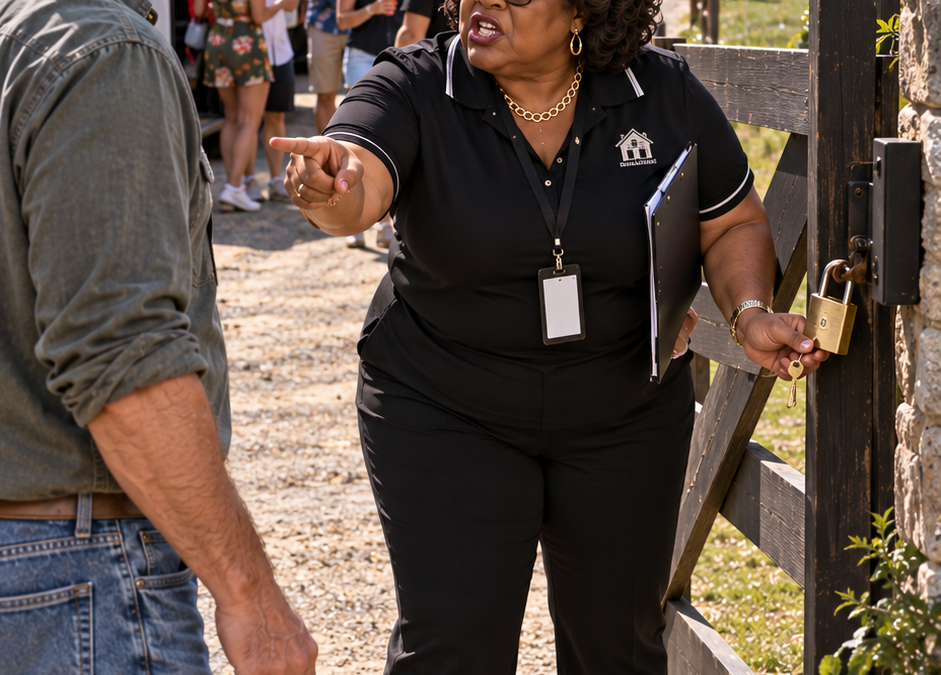
I was standing at my kitchen window with a cup of coffee when I saw her at the gate.
Karen Winslow.
President of the Creekside Estates HOA.
Lanyard around her neck.
Clipboard tucked beneath one arm.
And in her right hand was a brass key I had never given her.
She pushed it into my padlock.
Turned it.
The lock opened.
For a second, I just watched.
Not because I didn’t understand what I was seeing.
Because I understood it perfectly.
That lock belonged to me.
The gate belonged to me.
The 2.3 acres behind it—Parcel 7B—had belonged to me for three decades.
Nobody from Creekside Estates had permission to enter.
Karen knew that because I had told her repeatedly in writing.
Certified mail.
Copies of my deed.
Tax records.
County parcel references.
Yet there she was, opening my gate with a key that had apparently been copied without my knowledge.
Then I heard the diesel engine.
A full-size charter bus turned off the county road.
Karen raised one arm.
Waved it forward.
I put my coffee down.
By the time I reached the driveway, the first bus had crossed onto my land.
Karen turned toward me.
She didn’t look embarrassed.
Didn’t look surprised.
She looked annoyed that I had interrupted.
“This is a scheduled HOA community event on shared grounds,” she said.
“Shared grounds?”
“Step back and allow us to proceed.”
The second bus appeared behind the first.
“If you interfere,” she continued, “I’ll have you removed and file an injunction before Monday morning.”
I looked at the bus.
Then at Karen.
Then at the open gate.
“Whose land do you think you’re standing on?”
She didn’t blink.
“Parcel 7B has been HOA common area since this subdivision was established.”
“It hasn’t.”
“It’s documented in the original agreements.”
“Show me.”
She gave me the faint smile of somebody who had been challenged by homeowners before and had learned that confidence usually ended the conversation.
“If you interfere with this event, we’ll have you removed from the community.”
Then she turned away.
Bus three rolled through.
Then four.
Then five.
Five charter buses.
One after another.
Their tires crossed ground I had paid taxes on every year for thirty years.
Karen stood beside the gate directing them.
Arm extended.
Clipboard against her chest.
When the fifth bus cleared, she closed my gate and latched it behind the vehicle like she lived there.
I didn’t argue.
Didn’t try to stop the buses.
Didn’t touch Karen.
I went back inside.
Because everything I needed was already recording.
Five security cameras covered the property.
Three captured Karen clearly.
Timestamp:
2:17 p.m.
Saturday.
Audio active.
I opened the camera system on my laptop.
Started making notes.
Time.
Bus count.
Karen’s exact words.
Then I looked through the window again.
Coolers came off first.
Then folding chairs.
A portable speaker.
Catering tables.
String lights.
People kept stepping off the buses.
I counted past two hundred before I stopped.
Then four residents unrolled a white vinyl banner across my fence.
Three feet tall.
Dark-blue letters.
HOA SUMMER CELEBRATION
PARCEL 7B COMMUNITY GROUNDS
Karen walked to the middle of the crowd.
Handheld microphone.
Straightened her lanyard.
Waited for everyone to settle.
“Welcome,” she said.
Her voice carried across my property.
“To our land.”
Two hundred people applauded.
I sat inside and watched.
Not angry.
Not yet.
What I felt was something colder.
Clarity.
She had chartered buses.
Copied my gate key.
Printed a banner identifying my parcel as HOA property.
Brought more than two hundred witnesses onto the land.
And was now announcing into a microphone that the ground belonged to her association.
She thought she was demonstrating possession.
What she was actually doing was creating a timestamped record of intentional entry onto property she had repeatedly been told was privately owned.
And every second was being saved on a hard drive eight feet from where I sat.
PART2
To understand how Karen reached the point where chartering five buses onto somebody else’s property seemed reasonable, you need to understand Creekside Estates.
Ninety-six homes.
Two cul-de-sacs.
One swimming pool.
Tennis courts that hadn’t seen much use since 2019.
The HOA had been formed fifteen years earlier when the developer sold the final house, handed over the governing documents, and effectively disappeared.
Karen had been president for seven of those years.
She ran unopposed every election.
Not because she was especially admired.
Because homeowners had learned what happened to people who challenged her.
It usually started with paper.
An HOA envelope.
A violation notice.
Specific bylaw quoted.
Dollar amount printed near the bottom.
Deadline near the top.
Then a second notice.
Then a fine.
Then Karen’s favorite weapon.
A lien threat.
The word alone frightened people.
A lien could interfere with a sale.
A refinance.
A home-equity loan.
Most homeowners had jobs, children, aging parents, mortgages, and no appetite for litigation over a garden decoration.
Karen understood that.
She calculated her penalties accordingly.
Large enough to hurt.
Small enough that hiring a lawyer seemed irrational.
Eleanor lived three streets over.
Seventy-one.
Widow.
Her husband had hung wind chimes on their back porch twenty years earlier.
Karen sent a violation notice.
Eleanor called and explained that the wind chimes had been there long before Karen joined the board.
Karen sent a $350 fine.
Then threatened a lien after fourteen days.
Eleanor paid.
A retired Army veteran on the corner had a flagpole six inches outside Karen’s approved placement zone.
He filed a written response.
Quoted federal flag guidance.
Didn’t matter.
Fine.
He paid.
That was Creekside under Karen.
People didn’t necessarily believe she was right.
They believed resisting her would cost more than surrendering.
Three years before the buses, Karen introduced something called the Community Improvement Fee.
Four hundred dollars per household.
No community vote.
No clear board authorization.
No amendment in the governing documents.
It simply appeared on annual statements.
Sixty-two of ninety-six homeowners paid without asking.
I didn’t.
I sent Karen a letter.
Polite.
“Please provide the governing document or properly adopted board resolution authorizing this fee.”
She responded with a generic paragraph about neighborhood maintenance obligations.
I wrote again.
“Please provide the specific section or vote.”
No response.
The following year, the $400 line vanished from my bill.
No explanation.
No acknowledgment.
Just gone.
That was when I started understanding Karen.
She was strongest when nobody asked for the document.
Parcel 7B sat along the eastern edge of Creekside.
Two-point-three acres.
I bought it before the subdivision existed.
Back then, it was the trailing edge of an old agricultural property.
Open ground.
Fence.
Storage shed.
Later, I added a small workshop.
When developers bought surrounding acreage and built Creekside Estates, my parcel remained separate.
Private.
Outside their common property.
I kept paying taxes.
Thirty years.
Every year.
No interruption.
For the first thirteen years of the HOA, nobody disputed that.
Then, about two years before the bus incident, Karen started sending letters.
The first was almost polite.
According to her, Parcel 7B had been “identified” as HOA common area under the original development agreements.
She gave me sixty days to remove my workshop and storage shed.
I replied by certified mail.
Included a copy of my deed.
Included my latest county tax statement.
Asked her to direct any further questions to the recorder’s office.
She wrote again.
More aggressive.
I wrote back.
Same documents.
This continued for months.
Karen’s language escalated.
“Unauthorized occupation.”
“Adverse use.”
“Failure to surrender common property.”
“Potential legal remedies.”
But one thing never appeared.
Evidence.
She never produced the original agreement she kept referencing.
Never quoted a clause.
Never attached a plat.
Never gave me a page number.
I had spent enough years around county property records to know something simple.
People who have paper show you the paper.
People without it substitute volume.
Karen had volume.
Then, three weeks before the buses, she escalated again.
Formal HOA notice.
Thirty days to remove the shed and workshop.
Failure to comply:
$500 per day.
Authority cited:
Original Subdivision Agreement.
Again, no copy attached.
I pulled my file.
Original deed.
Purchase agreement.
Thirty years of tax statements.
Everything matched.
I mailed certified copies.
My letter said:
Please identify the exact page and clause designating Parcel 7B as common area.
Please attach the instrument.
Any fine, lien, or encumbrance issued without supporting recorded documentation will be preserved as evidence of bad-faith harassment.
Two paragraphs.
No insult.
No threat.
Just record.
Four days later, Marcus came over.
He lived two houses down.
Quiet man.
I’d known him eleven years.
He told me Karen had knocked on his door.
Friendly tone.
Just wanted him to know it might be “wise” to keep his distance from me while the land dispute continued.
Wouldn’t want his own HOA account becoming complicated.
Marcus quoted her carefully.
I wrote it down.
Then came Karen’s emergency board meeting.
I wasn’t invited.
I learned about it later.
Karen described my workshop and shed as an “unauthorized commercial occupation of HOA land.”
Commercial.
I didn’t rent them.
Didn’t operate a business from them.
Didn’t charge anyone.
But commercial sounded worse.
The board consisted of five seats.
Karen.
Her husband, vice president.
Her closest friend, secretary.
Two others.
The bylaws required four members present for any disciplinary fine vote.
Only three showed up.
Karen.
Her husband.
One other member.
They voted two to one to impose $500-per-day penalties.
Legally, that vote should never have existed.
Three members wasn’t a quorum.
I didn’t know that yet.
Nine days later, the fine notice arrived.
$500 per day.
Effective immediately.
I called the county recorder.
A clerk I’d worked with on other matters pulled Parcel 7B in two minutes.
Clean deed.
Sole ownership.
No recorded lien.
No encumbrance.
No HOA interest.
“Need certified copies?”
“Three.”
I created a separate folder.
Not general correspondence.
A case file.
Every letter.
Every fine.
Every certified-mail receipt.
Return receipt.
Envelope.
Date.
I have an old rule.
If you can’t prove it happened, sooner or later someone will say it didn’t.
Then I called an attorney friend.
Not retained yet.
Just advice.
He listened.
“Your title’s clean?”
“Completely.”
“Thirty years of taxes?”
“Yes.”
“Then adverse possession is going to be a very difficult argument for them.”
“I figured.”
He paused.
Then his tone changed.
“But listen carefully.”
I did.
“If she physically enters that parcel after being told she has no right to, or intentionally brings people onto it, you’re no longer dealing only with paper.”
“What are you saying?”
“Criminal trespass becomes possible. Especially if the entry is deliberate and documented.”
I looked toward the window.
“Document everything.”
“I will.”
“Every person. Every date. Every word.”
He paused.
“People like Karen get away with things because nobody keeps score.”
Three days later, another certified envelope arrived.
This one changed the nature of the fight.
Karen had filed a lien notice.
Not against Parcel 7B.
Against my home.
The house where I had lived twenty-two years.
Fourteen thousand dollars.
I sat at the kitchen table staring at it.
Then called the attorney again.
“I think I need you now.”
“Tell me.”
I read the notice.
Silence.
Then:
“She just escalated into something she may not be able to walk back.”
That was when I stopped thinking of Karen as an irritating HOA president.
She had reached beyond disputed land and attempted to encumber my residence using fines produced by a meeting that may never have had legal authority in the first place.
Then Marcus arrived one evening with a three-ring binder.
He set it on my kitchen table.
“I’ve been keeping this for two years.”
Inside:
Fine notices from twelve households.
Meeting minutes.
Emails.
Lien threats.
Board actions with too few signatures.
Policy changes.
Marcus had been documenting Karen quietly.
He hadn’t known what to do with it.
Now he did.
Two more neighbors came over.
Diane first.
Widow.
Karen had fined her $200 for an “unapproved landscaping element.”
Diane paid.
But the lien connected to the fine remained on her property record for six months after payment.
Late fees continued accumulating.
She had receipts.
She had a letter showing Karen still called the account delinquent three weeks after the balance had been cleared.
Then the Parkers.
Young couple.
Their daughter had a retractable basketball hoop.
Stored beside the garage when not used.
Karen fined them under a rule governing permanent sports structures.
Marcus had the meeting minutes from the amendment that created that rule.
No homeowner vote.
No valid quorum.
The pattern became clear.
Karen wasn’t just enforcing rules aggressively.
She had been creating procedures around herself and assuming nobody would inspect how they were adopted.
Then Marcus showed me the quorum provision.
Four of five board members required for disciplinary action.
Karen’s emergency Parcel 7B meeting had three.
Everything produced at that meeting was void.
I wrote it down.
Then I drove to the recorder’s office.
I asked for the original Creekside Estates subdivision plat.
Filed before the first lot sold.
The clerk brought out a large-format document.
I unfolded it on the counter.
Found Parcel 7B immediately.
It was outlined separately.
Not shaded as common property.
Not included in the HOA parcel index.
And beneath the parcel, in small but perfectly legible print, was a footnote.
I leaned closer.
Read it once.
Then again.
PARCEL 7B IS HEREBY EXCLUDED FROM HOA JURISDICTION AND COMMON AREA DESIGNATION IN PERPETUITY. PRIVATE OWNERSHIP ONLY PER ORIGINAL DEED.
In perpetuity.
Not subject to later association control.
Not future common land.
Not ambiguous.
Excluded.
Before the HOA existed.
I stood there under fluorescent lights with my finger on that line.
All of Karen’s letters disappeared in my mind.
Every claim.
Every threat.
Every fine.
She had been arguing over land the original development documents explicitly said the association could never claim.
I ordered three certified copies.
Then sent Karen one final letter.
Attached the plat.
Enlarged the footnote.
Circled it.
Explained that the fine vote lacked quorum.
Demanded withdrawal of the fines and lien within ten days.
Polite.
Specific.
Gave her an exit.
Nothing.
Three days.
Four.
On the fourth, a neighbor called.
She had driven past a commercial strip on Route 9.
Karen’s car was parked outside a charter bus company.
The next time I saw Karen, she was standing at my gate with a copied key.
Saturday.
2:17 p.m.
And five buses behind her.
I made the non-emergency call while the party unfolded.
Then I waited.
Coolers.
Music.
Catering.
Chairs.
String lights attached to my fence.
Two hundred people.
Some of them probably had no idea they were trespassing.
They had received an invitation from their HOA.
They trusted Karen.
That distinction mattered to me.
My anger was not with the families unloading picnic bags.
They believed this was a neighborhood event on neighborhood land.
Karen was the one who knew there was a dispute.
Karen had my letters.
Karen had the deed copies.
Karen had the certified-mail receipts.
Karen had the plat before the buses arrived.
She had chosen to proceed anyway.
I watched her speak into the microphone.
“To our land.”
Applause.
She had no idea how useful those words were going to become.
The following morning, I walked Parcel 7B carrying a trash bag.
The buses were gone.
The people were gone.
The evidence remained.
Plastic cups.
Food wrappers.
Folded chairs someone forgot.
String lights.
A cooler.
Fence hardware.
The banner lay partly rolled near the fence.
I picked it up.
HOA SUMMER CELEBRATION
PARCEL 7B COMMUNITY GROUNDS
I folded it carefully.
Did not throw it away.
Then I spent an hour cleaning what two hundred people left behind.
When I finished, I stood near the workshop.
The same building Karen had ordered removed.
Same ground.
Same fence.
Thirty years.
I called my attorney.
“I need you formally retained today.”
“I figured.”
“Camera footage. Lien. Plat. Everything.”
“Send it.”
By five that afternoon, he had the file.
Eight days later, Karen filed a quiet-title lawsuit.
She wanted a judge to declare Parcel 7B belonged to the HOA.
Theory:
Adverse possession.
Her claim was that Creekside had used the parcel openly, continuously, and as its own for long enough that legal title should shift.
And the centerpiece of her evidence?
The party.
Photographs.
Sign-in sheet.
More than two hundred names.
The banner.
She used the very event she had staged after receiving proof of my ownership as evidence that the HOA had always owned the land.
My lawyer read the complaint.
Then looked at me.
“She’s relying heavily on the buses.”
“Apparently.”
He leaned back.
“That’s a problem for her.”
“Why?”
“Because her best evidence of possession may also be the best documented criminal trespass event in this county.”
He turned the page.
“Two hundred witnesses.”
I asked the question that mattered.
“Can she win the land?”
“Not with that plat restriction.”
He tapped the certified document.
“This is brutal for her.”
“Then we’re done?”
“No.”
He slid another document across.
Temporary restraining order.
Karen had filed ex parte.
Without giving us advance notice.
A judge had temporarily ordered me not to interfere with HOA activity on Parcel 7B pending the ownership hearing.
I stared at it.
“I can’t go on my own land.”
“Not without risking contempt.”
I read the order again.
Thirty years of taxes.
Recorded ownership.
A plat explicitly excluding the HOA.
And because Karen reached the courthouse first with a one-sided filing, I was temporarily barred from interfering.
That’s law sometimes.
Procedural protection comes before full truth.
Being right does not always mean being immediately free to act like you’re right.
I hated that.
But I obeyed it.
I drove past Parcel 7B that evening.
Didn’t stop.
Didn’t cross the gate.
Karen held an HOA meeting that same night.
Marcus attended.
More than sixty residents.
Karen told them the association had taken legal action to reclaim community land.
Said a court had already protected HOA access.
Technically true.
Misleading in every way that mattered.
She said the coming hearing would confirm what Creekside had “always known.”
People applauded.
Marcus stayed quiet.
Afterward he called me.
“She sounds certain.”
“Good.”
“Good?”
“I’d rather she keep talking.”
A few hours later, my attorney called.
“I subpoenaed the charter contracts.”
“And?”
“Karen signed them personally.”
I sat up.
“Not the HOA?”
“Her name. Her personal credit card. Her phone number.”
“Board vote?”
“None.”
“HOA expenditure approval?”
“None.”
He paused.
“That event wasn’t officially authorized by the board.”
That mattered.
Karen wanted the party to prove continuous community use.
But the evidence showed a private individual had personally hired buses, personally organized the event, personally entered disputed property, and personally announced ownership without board authorization.
Not an institutional act.
A Karen act.
The hearing was scheduled three weeks later.
The courthouse was smaller than people imagine when they picture life-changing decisions.
Beige walls.
Fluorescent lights.
Two counsel tables.
Raised bench.
No dramatic columns.
No jury.
Just paper.
Karen arrived five minutes before nine.
Attorney beside her.
Her husband.
Board secretary.
One additional board member.
She sat across from me.
Straightened her jacket.
Then nodded pleasantly.
I nodded back.
Her attorney opened.
And he was good.
That’s important.
Bad arguments don’t always come from bad lawyers.
Sometimes good lawyers are given bad facts and make the strongest possible structure from them.
He walked the judge through seven years of supposed HOA use.
Two landscaping invoices.
Maintenance along the Parcel 7B boundary.
Real invoices.
Real work.
I remembered the mowing.
At the time, I assumed county or utility crews had done it.
Then the party.
Two hundred attendees.
Sign-in sheet.
Photos.
Banner.
He called it open community use.
Longstanding stewardship.
Evidence of ownership behavior.
The judge took notes.
Karen testified.
Calm.
Organized.
She told the story as though Parcel 7B had always been part of Creekside life.
She described the summer celebration warmly.
Community.
Families.
Tradition.
Shared land.
She remembered dates and expenditures.
She was persuasive.
Once she glanced toward me.
Almost smiled.
My attorney cross-examined.
First:
Thirty years of property taxes.
Every year.
Same private owner.
Me.
Those tax records went into evidence.
He argued they contradicted any claim that I had abandoned the parcel or allowed the HOA to treat it as its own.
Karen’s attorney pushed back.
Tax payments alone, he argued, do not automatically defeat every adverse possession theory.
Legally, he had a point.
The judge wrote something down.
Then she asked Karen’s lawyer:
“What is the HOA’s original legal basis for asserting this parcel was designated common property?”
He talked about development intent.
Peripheral land.
Community planning.
The judge looked over her glasses.
“Intent is not designation.”
Three words.
Karen’s attorney kept going.
I watched my lawyer.
He wrote one word.
Good.
At 10:43, the judge called a fifteen-minute recess.
Karen immediately leaned toward her attorney.
They whispered.
Then I heard her say to her husband:
“We’ve got this.”
Loud enough to carry.
“He has nothing that overrides seven years of use.”
I stood.
Stretched.
Walked toward the back wall with my coffee.
The judge’s clerk approached.
Young woman.
Clipboard.
“Mr. Bennett?”
“Yes.”
“The judge wants to know whether you have documentary evidence regarding the original subdivision designation of Parcel 7B.”
I looked at her.
“Specifically a recorded plat or deed restriction?”
“Yes.”
“I have a certified copy of the 1987 plat.”
She made a note.
“Please have your attorney prepare to offer it after recess.”
Then she walked away.
Across the courtroom, Karen was still talking.
Still confident.
She didn’t know the judge had just requested the one document that settled the question Karen had avoided for two years.
At eleven sharp, everyone returned.
My attorney stood.
“Your Honor, pursuant to the court’s inquiry, we offer a certified copy of the original Creekside Estates subdivision plat recorded in 1987.”
The clerk took it.
Carried it to the bench.
The judge unfolded it.
She read carefully.
Her finger moved along the parcel index.
Then stopped.
Parcel 7B.
She read the footnote.
Once.
Again.
Then looked toward Karen’s attorney.
“Counsel, where was this document obtained?”
“County recorder’s office, Your Honor. Certified copy.”
“And this is part of the original subdivision filing?”
“Yes.”
The judge looked back at the plat.
Then:
“Are you familiar with this restriction?”
Karen’s lawyer stood.
“Your Honor, if I could review—”
The judge raised the plat.
“I’ll read it into the record.”
Silence.
Then, clearly:
“Parcel 7B is hereby excluded from HOA jurisdiction and common area designation in perpetuity. Private ownership only per original deed.”
Nobody moved.
The judge placed the plat down.
“Counsel, this restriction predates the HOA’s present governance structure.”
Karen’s lawyer said nothing.
“Your adverse-possession theory assumes the association had a legally cognizable basis to claim this parcel. This document expressly excludes the parcel from HOA jurisdiction.”
She paused.
“Explain how your client acquires through association use a parcel the recorded subdivision documents expressly prohibited the association from claiming.”
Karen’s lawyer requested recess.
Denied.
He tried a distinction.
The notation, he argued, was merely a developer statement.
Not controlling.
The judge asked for statutory authority.
He cited a case.
She knew it.
“It’s not analogous.”
He sat.
Four seconds of silence.
Longer than people think.
I looked at Karen.
Hands flat on the table.
Still.
For the first time in seven years of running Creekside, she looked like somebody waiting for another person to decide what happened next.
My attorney stood.
“Additional exhibits.”
Thirty years of tax history.
Accepted.
Then:
“Charter bus rental contracts from the August event.”
Karen’s lawyer looked up.
My attorney continued.
“These contracts were signed by Ms. Winslow personally.”
The clerk took them.
“Her personal payment card.”
Another page.
“Her personal phone number.”
Another.
“No HOA account.”
Pause.
“No recorded board authorization.”
The third board member shifted.
My attorney looked toward the judge.
“The plaintiff’s central evidence of supposed community use—the August event—was not an authorized association action. It was organized and funded by one individual who had already received certified proof that the parcel was privately owned.”
That landed.
The third board member raised one hand.
“I wasn’t part of planning that.”
The judge looked over.
“Duly noted.”
Karen didn’t turn.
My attorney continued.
“Security footage shows Ms. Winslow entering the locked parcel with a copied key, opening the gate, directing five charter buses inside, and publicly referring to the property as HOA land.”
He didn’t play the footage yet.
Didn’t need to.
Karen’s own filing already acknowledged the event.
Her own photos proved the crowd.
Her own contracts proved the buses.
Her own banner identified the parcel.
Her own lawsuit had assembled the outline.
We supplied the boundary.
The judge reviewed everything.
Then delivered her finding.
“Based on the recorded 1987 restriction, the court concludes that Parcel 7B was expressly excluded from HOA jurisdiction.”
Karen stared forward.
“The HOA therefore lacks standing to claim title based on association use inconsistent with that recorded exclusion.”
The judge turned a page.
“The quiet-title action is dismissed with prejudice.”
With prejudice.
Permanent.
“The temporary restraining order is dissolved effective immediately.”
My attorney exhaled once.
I looked down at my hands.
I had expected satisfaction.
Instead I felt relief.
Not joy.
Just the weight coming off.
Then the judge continued.
“This court is also concerned by evidence surrounding the August event.”
Karen’s attorney looked up.
“The plaintiff’s own exhibits depict a large organized entry onto privately titled land after the owner had repeatedly disputed HOA authority.”
She glanced at the bus contracts.
“The event appears to have been organized personally by Ms. Winslow without board authorization.”
Then the security-camera stills.
“And the property owner did not consent.”
She looked at Karen.
“Accordingly, the court is referring the matter to the district attorney for review of potential criminal trespass and related offenses.”
Karen’s face changed.
Only slightly.
But it changed.
The judge continued.
“The lien placed against the defendant’s primary residence also warrants review given this court’s finding that the underlying Parcel 7B enforcement actions lacked a valid legal basis.”
Fraudulent encumbrance.
The words weren’t yet a charge.
But they were now in the room.
Karen’s attorney closed his folder.
Her husband whispered to her.
The secretary gathered papers without looking toward Karen.
The third board member stood early.
Marcus sat behind me.
When I looked toward him, he nodded once.
That was enough.
The criminal charges came later.
Thursday morning.
My lawyer called at eight.
“The DA’s moving forward.”
“On what?”
“Criminal trespass tied to the organized entry. They’re also reviewing the false property claims and lien activity.”
I thanked him.
Then sat at my kitchen table with coffee.
No celebration.
I had spent months wanting the system to recognize what the records already showed.
Now it had.
The $14,000 lien on my home was vacated seven days after the hearing.
Not reduced.
Not marked paid.
Vacated.
Then expunged.
The $500-per-day fines disappeared.
The written ruling confirmed the quorum issue Marcus had identified.
Four members required.
Three present.
No lawful disciplinary vote.
Every notice produced by that emergency meeting was void from the moment it was issued.
My legal fees were submitted under the state’s frivolous-property-litigation provisions.
Karen’s lawyer didn’t contest them.
Then came the HOA finances.
The unauthorized $400 annual “community improvement fee.”
Three years.
No proper vote.
No governing authority anyone could identify.
Independent audit.
Diane’s late fees were refunded.
The Parkers’ basketball-hoop fine was withdrawn.
A formal apology followed.
Other homeowners started coming forward.
One.
Then another.
Then ten.
People had paperwork.
Some had receipts.
Some had threatening emails.
Some simply had years of quietly wondering whether anyone else had experienced the same thing.
Once one homeowner wins, silence changes direction.
The community petition arrived in September.
Eighty-seven of ninety-six households signed.
Special HOA meeting.
Karen did not attend.
Her attorney advised against it while criminal charges were pending.
Her husband resigned as vice president beforehand.
Two-sentence email.
Her friend, the secretary, resigned the same day.
The third board member cooperated with the DA and abstained from most transition votes.
Marcus joined the interim board.
So did Diane.
A younger homeowner from the far end of the subdivision took another seat.
I didn’t go to the meeting.
It wasn’t my board.
It wasn’t my job to replace Karen with myself.
Marcus sent me one text afterward.
Done.
The morning after the criminal filing, I drove back to Parcel 7B.
Legally, I had been allowed back since the judge dissolved the restraining order.
Emotionally, I needed longer.
I unlocked the gate.
My own key.
Drove in.
Parked near the workshop.
Then walked.
All 2.3 acres.
Fence line first.
Storage shed.
Workshop.
Center field.
Grass had grown uneven while I was kept away.
Near the far fence, I found one plastic cup the cleanup missed.
Picked it up.
Put it in my pocket.
Then stood in the middle of the property.
No buses.
No microphone.
No banner across the fence.
No applause.
Just wind.
Grass.
The old shed.
My workshop.
Land.
Exactly what it had always been before Karen needed it to become something else.
Near the gate was the banner.
I had folded it and placed it there after the event, then hadn’t returned because of the restraining order.
I opened it one more time.
HOA SUMMER CELEBRATION
PARCEL 7B COMMUNITY GROUNDS
I laughed once.
Quietly.
Then folded it again.
Square edges.
Put it in the truck.
Marcus came by a few days later.
We sat on the porch.
He told me the new board’s first agenda included a full legal review of every active lien.
Diane came another day carrying a small plant from her garden.
Handed it to me.
Didn’t make a speech.
“Thank you.”
I nodded.
The Parkers waved when I passed.
Eleanor rehung the wind chimes.
That one got me.
I drove by one evening with the windows down.
Heard them.
Soft metal.
Wind.
Twenty years on her porch.
Karen had turned them into a violation.
Now they were just wind chimes again.
That’s what recovery looked like.
Not court orders.
Ordinary things becoming ordinary again.
People asked whether I felt vindicated.
I suppose I did.
But vindication isn’t the word I’d choose.
The most important thing wasn’t Karen facing charges.
It wasn’t her losing the quiet-title case.
It wasn’t the lien disappearing.
It was that the records finally mattered more than her confidence.
Karen’s entire system depended on one assumption.
Nobody would make her prove anything.
For seven years, she was mostly right.
Eleanor paid.
The veteran paid.
The Parkers paid.
Sixty-two families paid the improvement fee.
Homeowners learned that challenging her cost more energy than surrender.
I happened to keep records.
That was the difference.
A deed.
Thirty years of tax statements.
Certified mail.
Meeting minutes.
Security footage.
Bus contracts.
The original plat.
One sentence in tiny print from 1987.
Parcel 7B is hereby excluded from HOA jurisdiction in perpetuity.
Karen had lanyards.
Meetings.
Letters.
A husband on the board.
A friend serving as secretary.
Fines.
Lien forms.
A microphone.
Five buses.
Two hundred witnesses.
I had a deed and a county archive.
In the end, that was enough.
Months later, the criminal case was still moving.
Slowly.
As criminal cases do.
I didn’t follow every hearing.
Didn’t attend every appearance.
I had no interest in making Karen the center of my life after spending months getting her off my land.
The DA had the footage.
Contracts.
Plat.
Letters.
That was their matter now.
My matter was Parcel 7B.
I repaired two fence posts damaged during the event.
One string-light staple had been driven into the wood deeply enough that I had to replace part of a board.
I cleaned the workshop.
Cut the grass.
Reorganized storage.
Normal work.
The copied key bothered me for a while.
I never learned exactly how Karen obtained it.
Maybe somebody copied an old spare.
Maybe a contractor had access.
Maybe she had simply hired someone to duplicate the lock cylinder.
Eventually I replaced the entire padlock assembly.
New lock.
New chain.
New keys.
I kept the old padlock.
Evidence first.
Then memory.
One Saturday, Marcus walked Parcel 7B with me.
He stopped near the gate.
“Funny.”
“What?”
“She brought two hundred people here thinking numbers made her right.”
I looked across the acreage.
“People confuse consensus with title.”
“You think she believed it?”
“Absolutely.”
He looked surprised.
“You really think she thought this was HOA land?”
“By the end? Yes.”
“Even after your letters?”
“That’s the dangerous part.”
People think deliberate lies are always more dangerous than sincere certainty.
They’re not.
Liars sometimes check the facts because they know facts can expose them.
Someone who believes their own story stops checking.
Karen had spent seven years watching people obey.
Eventually obedience became proof in her mind.
Homeowners paid, therefore she had authority.
Board allies voted yes, therefore procedure didn’t matter.
She sent letters, therefore the statements inside them became fact.
When I kept answering with deeds, she didn’t think:
Maybe I’m wrong.
She thought:
He’s refusing to cooperate.
That’s how power distorts people.
Resistance stops looking like information.
It becomes misconduct.
I saw the same pattern in her quiet-title filing.
She used the party event as evidence because she could not imagine the judge viewing it through any lens except hers.
To Karen:
Two hundred people on Parcel 7B meant community possession.
To a judge:
Two hundred people might mean two hundred unauthorized entrants.
Same fact.
Different legal reality.
The charter contracts made it worse.
Personally funded.
No board vote.
No association authorization.
She wanted the party to look institutional.
Her own paperwork made it personal.
That still strikes me as almost perfect.
Karen spent years turning personal decisions into HOA acts.
The one time she desperately needed an HOA act, the paperwork said it was hers alone.
The new board eliminated the $400 improvement fee.
Refunds took longer.
There wasn’t enough cash to immediately repay three years of collections.
They developed a schedule.
Some homeowners received account credits.
Others got checks.
The audit identified expenses Karen had approved without proper votes.
Not all were illegal.
Some were merely sloppy.
That’s an important distinction.
People wanted everything she’d ever touched declared corrupt.
Reality wasn’t that simple.
Some contracts were valid.
Some landscaping was legitimate.
Some violations were properly issued.
Karen wasn’t wrong every time.
She was wrong often enough, and confident enough, that nobody knew which decisions deserved trust.
That’s what destroys governance faster than any single bad fine.
Once people stop believing procedure matters, every decision looks personal.
Marcus understood that.
At one of the new board’s first meetings, he read the quorum requirement aloud before any vote.
Every single vote.
Someone joked after the fourth time:
“We know, Marcus.”
He answered:
“Good. We’ll keep knowing.”
I liked that.
Eventually they asked whether I’d serve on a property committee.
I declined.
Again.
“You started this,” Marcus said.
“No. Karen started it.”
“You finished it.”
“The county finished it.”
He frowned.
“You’re difficult.”
“So I’ve been told.”
Parcel 7B returned to being boring.
That may be the best outcome I’ve ever gotten from a legal dispute.
Boring land.
Grass.
Shed.
Workshop.
Fence.
Occasional maintenance.
No banners.
No party buses.
Once, the new board asked whether Creekside could hold a small volunteer cleanup day along the public path adjacent to the parcel.
They sent a formal request.
Included a map.
Specified no one would enter Parcel 7B.
I called Marcus.
“You know you don’t need my permission to clean the public path.”
“I know.”
“Then why ask?”
“Trauma.”
I laughed.
“Approved.”
A few families volunteered.
I watched from a distance.
Nobody crossed the fence.
Nobody needed to.
That’s respect.
Not fear.
Simple knowledge of where one person’s rights end and another’s begin.
The criminal case against Karen eventually became something I discussed less and less.
Neighbors asked for updates.
I told them I wasn’t the prosecutor.
Some expected me to know everything.
I didn’t.
Didn’t want to.
Criminal charges are serious.
They’re not entertainment.
Whatever consequence Karen received would belong to the evidence and the law, not my anger.
That mattered to me.
People sometimes asked whether I wanted her in jail.
No.
I wanted her stopped.
There’s a difference.
If a court determined incarceration was appropriate, that wasn’t my decision.
If a court chose fines, probation, restitution, or something else, also not mine.
My victory had already happened.
The deed remained mine.
The lien was gone.
The restraining order was dissolved.
The HOA no longer claimed Parcel 7B.
Everything after that was accountability, not revenge.
One morning, I found Eleanor by her mailbox.
Wind chimes audible behind the house.
She smiled.
“I put them back.”
“I heard.”
“Think they’re too loud?”
“Terrible.”
She laughed.
Then got serious.
“I should have fought her.”
“You were seventy-one and she threatened your home.”
“I still should’ve.”
I shook my head.
“No.”
She looked at me.
“You shouldn’t need to risk your house to prove a wind chime is harmless.”
Her eyes got wet.
She looked away.
“Thank you.”
I didn’t know what to do with that.
So I asked how her roses were doing.
Better topic.
The veteran moved his flagpole six inches back to its original location.
Karen had made him shift it years earlier.
When he reset it, he invited me.
Not a ceremony.
Just two old men, a level, concrete, and a flag.
He showed me the original HOA letter.
Still had it.
“Keeping this?”
“Forever.”
I smiled.
“Good.”
Paperwork had become a neighborhood hobby.
Maybe that was healthy.
At least for a while.
One night, I pulled the security footage again.
I don’t know why.
Maybe curiosity.
Karen at the gate.
Key in lock.
Bus one.
Bus two.
Bus three.
Bus four.
Bus five.
Then the banner.
Then Karen with the microphone.
“Welcome to our land.”
The crowd applauds.
I paused the video.
Looked at the frame.
Five buses lined against my fence.
Hundreds of people.
Karen center.
If you knew nothing else, it looked like power.
That is one of the strange things about authority.
From the outside, false authority and legitimate authority often look identical.
Both can have banners.
Badges.
Meetings.
Lawyers.
Crowds.
Paper.
The difference is underneath.
Source.
Jurisdiction.
Procedure.
Title.
Karen had spent years perfecting appearance.
She never inspected the foundation.
The deed did.
The plat did.
The quorum rule did.
The bus contracts did.
Once those were placed beside her claims, the performance couldn’t hold.
I closed the video.
Haven’t watched it since.
The banner is still in storage.
Marcus calls it Exhibit A.
Technically it was never labeled that by the court.
But the nickname stuck.
He once suggested hanging it in the clubhouse.
I told him absolutely not.
“Why?”
“Because the clubhouse deserves better decorations.”
He laughed.
The first legitimate HOA election after Karen drew nearly ninety households.
People who hadn’t attended a meeting in years showed up.
Some stood along the walls.
There were more candidates than board seats.
Imagine that.
For years Karen ran unopposed.
Now people competed to do the job.
That tells you something.
People aren’t always apathetic.
Sometimes they have simply been taught participation doesn’t matter.
Show them it matters once, and they return.
Creekside didn’t become perfect.
No neighborhood does.
The new board argued over landscaping.
Pool hours.
Budget.
One meeting ran two hours because six people had opinions about mailbox replacements.
That’s normal.
I prefer normal conflict.
Normal conflict doesn’t threaten liens over wind chimes.
Normal conflict doesn’t bus two hundred people onto somebody else’s property.
Normal conflict is annoying.
Not frightening.
A year after the hearing, I replaced the old fence along the eastern side of Parcel 7B.
Not because Karen damaged all of it.
Age.
Thirty years will do that.
Marcus helped one Saturday.
We pulled old posts.
Set new ones.
Around noon, he sat on a cooler and looked toward Creekside.
“You know what she wanted this land for?”
“Control.”
“No. I mean practically.”
I shrugged.
He said he’d found old board planning emails during the audit.
Karen had proposed turning Parcel 7B into a permanent event ground.
Parking area.
Gazebo.
Storage.
Potential rental income for the HOA.
I stopped working.
“When?”
“About a year before the first letter to you.”
That explained something.
“Was there a board vote?”
“No.”
“Of course.”
He smiled.
“Would’ve been nice.”
I drove another post into the ground.
Suddenly Karen’s obsession made more sense.
She wasn’t just mistaken about an old parcel designation.
She had a plan for it.
Revenue.
Events.
Expansion.
And my deed was in the way.
That didn’t change the court outcome.
Didn’t change the criminal matter.
But it clarified motive.
I was glad I learned it later.
If I’d known earlier, I might have been angrier.
Anger makes people rush.
Paper rewards patience.
By evening, the fence was straight.
Marcus stepped back.
“Looks good.”
“It’ll keep charter buses out.”
He laughed.
“Too soon?”
“Never.”
The replacement gate has a heavier lock now.
Not theatrical.
Just good hardware.
I keep one key.
A second in a safe.
No neighborhood board has a copy.
No one needs one.
The parcel has also been formally marked at the county with updated boundary signage.
Private property.
No HOA jurisdiction.
Not because the 1987 plat was insufficient.
Because I learned something.
People ignore documents they don’t see.
So now the record exists in more than one place.
On paper.
Online.
At the gate.
Not threatening.
Just clear.
A small metal sign reads:
PARCEL 7B — PRIVATE PROPERTY
NOT HOA COMMON AREA
Marcus hated the wording.
“Too boring.”
“Perfect.”
“Needs something like ‘Five buses tried.'”
“No.”
“Could put a bus icon with a slash through it.”
“No.”
“You’re no fun.”
Exactly.
Property records shouldn’t be fun.
They should be obvious.
The last time Karen’s name came up at an HOA meeting, I wasn’t there.
Marcus told me later.
A homeowner asked whether they should formally erase old references to Parcel 7B from community event maps.
Marcus said yes.
The board voted unanimously.
Correct quorum.
Recorded minutes.
Updated maps.
Done.
That may have been the cleanest ending possible.
No speech.
No drama.
One wrong label removed.
Correct boundary restored.
I still pay taxes on Parcel 7B.
Every year.
When the bill comes, I look at the parcel number.
Then I pay it.
Thirty-plus years now.
A few months ago, a new family moved into Creekside.
The father stopped me near the entrance.
“You’re the Parcel 7B guy?”
I laughed.
“I have a name.”
“Sorry.”
“No problem.”
He looked embarrassed.
“We heard some story about buses.”
“Neighborhood history.”
“Is it true?”
“Most of it.”
“Five buses?”
“Five.”
“That’s insane.”
“Yes.”
He looked toward the eastern edge.
“Which land is yours?”
I pointed.
He nodded.
“Got it.”
Then he walked away.
That interaction lasted twenty seconds.
That’s how boundaries should work.
Ask.
Point.
Understand.
No lawyer.
No lien.
No microphone.
No court.
No party bus.
Just information.
Sometimes I think about what would have happened if Karen had simply responded to my first certified letter.
She could have gone to the county recorder.
Pulled the plat.
Read the footnote.
Then written:
“We apologize. Our information was incorrect.”
That would’ve been the end.
Five minutes.
Maybe ten.
No criminal charges.
No resignations.
No audit.
No lawsuit.
No legal fees.
No public humiliation.
No five buses.
But that would’ve required Karen to consider that someone else might be right.
That was the one thing her system didn’t allow.
Every disagreement had to become defiance.
Every question became disrespect.
Every document that contradicted her became obstruction.
Eventually, reality became the most disobedient homeowner in Creekside.
And reality had better records.
On the anniversary of the party, Marcus texted me.
Hosting anything on Parcel 7B today?
I replied:
One lawn mower. Attendance: 1.
He sent:
Need buses?
I ignored him.
I spent the afternoon cutting grass.
At the far end, I stopped the mower near the gate.
Same gate.
Different lock.
I looked at the ground where those buses had turned.
No visible tracks anymore.
Grass repaired itself.
Soil settled.
Time erased most of the physical evidence.
That’s another reason documents matter.
Land heals.
Memories blur.
People retell stories until details shift.
Records don’t.
2:17 p.m.
Five buses.
Karen at gate.
Copied key.
Banner.
Microphone.
“Welcome to our land.”
Everything preserved.
Not because I enjoyed keeping it.
Because accuracy protects you when confidence is weaponized against you.
I shut off the mower.
Walked to the gate.
Pulled the chain through.
Clicked the padlock closed.
A clean metallic sound.
Then I slipped the key into my pocket.
The only key Karen never had.
Behind me sat 2.3 acres that had been mine before Creekside Estates existed, while Karen ran the HOA, during the lawsuit, after the charges, and every day in between.
She brought two hundred people onto it to prove it belonged to her.
All she proved was that it never did.








