HOA Karen Brought an Eviction Crew to My Farmhouse and Ordered It Demolished—She Thought a Board Vote Could Take My Home
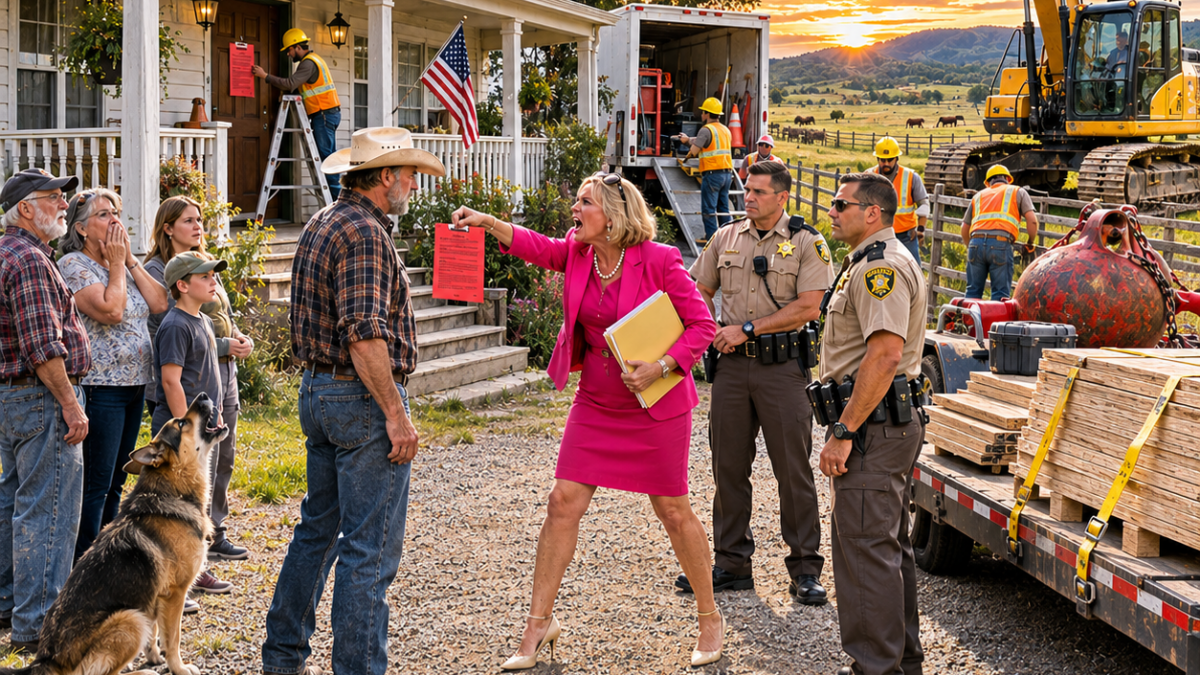
HOA Karen Brought an Eviction Crew to My Farmhouse and Ordered It Demolished—She Thought a Board Vote Could Take My Home
She showed up with red eviction notices, a demolition crew, and two deputies because she was certain I would be gone before sunset.
HOA Karen called my farmhouse an “unauthorized structure” even though my family had owned the land since 1921.
The moment she ordered the crew toward my front porch, I realized this wasn’t another HOA argument—it was an attempt to take my home.
“This house is an unauthorized structure, and your refusal to comply ends today.”
Karen Whitmore practically shouted the words across my front yard while the evening sun turned her bright pink blazer the color of a warning flare.
Two sheriff’s deputies stood near the driveway, both looking considerably less enthusiastic than she did. Behind them sat a white box truck belonging to a property-removal company and a flatbed trailer carrying barriers, plywood, ladders, and enough equipment to make my stomach tighten.
A man in a reflective vest was taping a red notice to my front door.
I walked down the porch steps slowly.
“Take that off my house.”
The worker stopped.
Karen snapped open her yellow HOA folder.
“He is acting under association authority.”
One deputy looked at her.
“Ma’am, we’re here for a civil standby. We still need to see lawful authority for anybody entering the residence.”
Karen ignored him.
That should have warned everybody.
Instead, she pointed at my farmhouse like she had personally discovered a condemned building.
“The structure violates community safety and architectural standards. The board approved immediate removal last month.”
My house wasn’t impressive.
White siding.
Dark green roof.
Wide porch.
Two bedrooms upstairs and three downstairs after my wife, Laura, and I remodeled it years ago.
But those walls had held my entire adult life.
I had come home after two overseas deployments with more duffel bags than plans. My grandfather Henry had handed me the ranch keys and said, “You already served one country. Now take care of your own ground.”
I raised my family there.
Buried my grandfather beneath the cottonwoods.
Sat on that porch through thunderstorms, funerals, birthdays, and quiet evenings when the sky turned orange above four thousand acres of grassland.
Karen had moved into the subdivision beside us eleven weeks earlier.
Now she was trying to remove me from my own front steps.
She held up a paper.
“Final eviction notice. Failure to vacate authorizes immediate possession procedures.”
I took one look at it.
Willow Crest HOA letterhead.
No court seal.
No judge.
No case number.
No writ.
I looked at the deputy.
He noticed the same thing.
Karen didn’t.
“The crew starts now,” she announced.
The foreman hesitated.
“Starts what?”
“Securing the house for demolition.”
That finally made me angry.
Not loud.
Cold.
I stepped between the crew and my porch.
“Before one person crosses this line,” I said, “somebody better show me a court order.”
Karen laughed.
“Old property technicalities aren’t going to save you.”
I stared at her.
Then I looked toward the orange survey marker ten feet from her heel.
She had no idea that the ground beneath her argument had already been measured, recorded, and preserved long before her subdivision existed.
And when the deputy asked her one simple question, Karen’s entire performance began to come apart.
“Ms. Whitmore,” he said, “where exactly is the judge’s signature?”
**part 2**
Karen’s expression changed for less than a second.
It was quick enough that someone who didn’t know her might have missed it.
I didn’t.
She had expected resistance from me. She had probably rehearsed for it. What she had not expected was resistance from the deputy she had summoned to make the whole scene look official.
She pulled another page from the folder.
“The HOA board approved the action unanimously.”
The deputy, whose nameplate read MARTINEZ, looked at the document.
“That wasn’t my question.”
“The board possesses enforcement authority.”
“Do you have a writ of possession?”
Karen drew herself taller.
“This is not a tenant eviction.”
“Then what kind of eviction is it?”
“A community enforcement removal.”
Deputy Martinez stared at her.
So did I.
The second deputy, younger and trying very hard not to react, glanced toward the farmhouse and then toward the crew.
The foreman removed his gloves.
“I was told there was a legal removal order.”
“There is,” Karen said.
Martinez looked at him.
“Have you seen it?”
The foreman pointed at Karen.
“She sent our office a work authorization.”
“That’s not a court order.”
Karen stepped between them.
“You’re getting distracted by terminology. Mr. Dawson has ignored multiple notices. The board voted. The property is now subject to corrective action.”
My name is Jack Dawson.
I had learned years earlier that when someone keeps avoiding a simple question, the simple question is usually dangerous.
I folded my arms.
“Show him the court order, Karen.”
She turned on me.
“You know perfectly well this is an HOA matter.”
“No, I know perfectly well this is my house.”
“You forfeited your right to object when you refused compliance.”
Martinez raised one hand.
“Ma’am, nobody forfeits possession of a house because an HOA says so. If there’s a court order, show it. If there isn’t, nobody is forcing entry while we’re standing here.”
That sentence changed the temperature of the entire yard.
Laura had come outside by then.
She stood on the porch with my father’s old German shepherd, Duke, beside her. Duke was thirteen and mostly interested in naps, but he still understood tension. His ears were forward.
Laura looked at the red notice on our door.
“What did she put on the house?”
“An HOA eviction notice.”
Laura stared at me.
Then at Karen.
Then back at me.
“An HOA eviction notice?”
Karen answered before I could.
“Mrs. Dawson, your husband has had ample opportunity to cooperate.”
Laura descended two porch steps.
“No. I want to understand this. You think your homeowners association can evict us from a ranch outside your subdivision?”
“The property affects our community.”
“That wasn’t my question.”
I almost smiled.
Apparently that sentence was contagious.
Karen’s jaw tightened.
“The farmhouse is plainly visible from the northern entrance. Residents have complained about its age, inconsistent exterior finishes, livestock activity, utility vehicles, and apparent lack of architectural approval.”
Laura looked at the house.
“Our house is seventy years older than your HOA.”
“Age does not create exemption.”
“No,” I said. “Ownership does.”
Karen ignored me and pulled out another sheet.
“This property accumulated more than thirty-two thousand dollars in unpaid violation penalties.”
Laura nearly laughed.
“Thirty-two thousand?”
“Correct.”
“For what?”
Karen began reading.
Exterior color.
Unapproved fencing.
Visible equipment.
Nonconforming porch rail.
Livestock accessory structures.
Commercial agricultural activity.
Outdoor storage.
Flagpole height.
I interrupted.
“You fined me for the American flag?”
“The pole exceeds community design limits.”
Deputy Martinez looked away.
I couldn’t tell whether he was checking the driveway or hiding a smile.
Laura did not bother hiding hers.
Karen saw it.
“This is not amusing.”
“No,” Laura said. “The part where you brought an eviction crew because our flagpole offended your design standards is surprisingly hard to take seriously.”
Karen snapped the folder shut.
“I have been patient with this family.”
That did it.
I stepped closer to the porch railing.
“No. You moved here eleven weeks ago.”
Her mouth opened.
I continued.
“My grandfather lived on this property before you were born. My father worked this land. I came home from service and rebuilt this house. You bought a house beside my ranch and immediately started sending me rules from an association I never joined.”
“That is your interpretation.”
“It’s the county recorder’s interpretation too.”
For the first time, the HOA manager standing beside Karen looked uncomfortable.
I had barely noticed him before.
His name was Scott Brenner. I had met him once when Karen dragged him to my eastern fence to complain about an equipment shed.
Now he cleared his throat.
“Karen, maybe we should wait for counsel.”
Her head snapped toward him.
“We already discussed this.”
“We discussed enforcement.”
“Yes.”
“We did not discuss physical removal today.”
That got everyone’s attention.
Karen lowered her voice.
“The board authorized decisive action.”
Scott looked toward the deputies.
“I don’t remember a demolition authorization.”
The foreman took two steps backward.
“I definitely need clarification now.”
Karen’s whole operation was unraveling in real time.
And she hated it.
People like Karen can handle disagreement better than uncertainty because disagreement still lets them perform authority. Uncertainty forces everyone to look at the paperwork.
I walked toward my truck.
She immediately shouted, “Where are you going?”
“To get something.”
“You are not permitted to remove property from the premises.”
I stopped and turned around.
“You’re telling me I’m not permitted to walk to my own truck?”
“The property is under enforcement.”
Martinez spoke before I could.
“Mr. Dawson can move freely on his property unless you show us a lawful order saying otherwise.”
Karen looked at him like he had betrayed the Constitution.
I opened the truck cab and removed a leather document case I kept behind the seat.
Inside were copies, not originals.
Current deed.
Professional survey.
Agricultural-use certification.
County tax map.
A photocopy of the 1921 grant that began my family’s recorded chain of ownership.
I handed Martinez the current deed first.
He looked at the legal description.
Then the survey.
Then the subdivision boundary shown on the county map.
The HOA manager walked closer.
“So the ranch line is here?”
I pointed.
“Willow Crest begins east of County Road Nine. My eastern boundary stops here. The farmhouse is more than half a mile inside my property.”
Scott looked at Karen.
“This isn’t what the map in your packet showed.”
“What map?” I asked.
Karen answered immediately.
“An association planning map.”
“Recorded where?”
“It’s an internal planning document.”
I looked at Martinez.
He looked back at me.
We both understood.
Internal planning documents do not move deed lines.
Karen tried a different strategy.
“The original development contemplated eventual integration of adjoining parcels.”
“Contemplated by whom?” I asked.
“The developer.”
“My grandfather never signed anything.”
“That does not eliminate community necessity.”
There it was again.
Community necessity.
Karen had a phrase for everything except legal authority.
Laura came down the rest of the stairs.
“Jack, call Mark.”
I already had my phone out.
Mark Ellison had been our family attorney for years. He knew the ranch title history better than anyone outside the recorder’s office.
I called.
He answered with, “If this is about Duke stealing another delivery driver’s sandwich, I’m representing Duke.”
“HOA brought an eviction crew.”
Silence.
Then his voice changed.
“Say that again.”
I explained quickly.
“Are deputies there?”
“Yes.”
“Do they have a court writ?”
“No.”
“Do not sign anything. Do not permit entry. Put me on speaker if the deputy is willing.”
Martinez agreed.
Mark identified himself and asked what paperwork Karen had provided.
Martinez described it.
HOA notices.
Board resolution.
Work authorization.
No court order.
No writ.
No recorded lien documents shown.
Mark’s response was immediate.
“Then this is not a lawful eviction of my client’s residence. I’m sending you the recorded deed and title report by email now.”
Karen interrupted loudly enough for the phone to pick up.
“Your client is obstructing authorized HOA enforcement.”
Mark paused.
Then said, “Is that Ms. Whitmore?”
“Yes,” I said.
“Wonderful.”
Karen frowned.
“What is wonderful?”
“Please keep talking.”
That might have been the first time anyone invited Karen to continue making her own situation worse.
She did.
“The board has determined the house presents an aesthetic and safety incompatibility with the adjoining residential community.”
Mark said, “Does your declaration encumber Mr. Dawson’s parcel?”
“The association’s authority extends to adverse external conditions.”
“That wasn’t my question.”
I nearly laughed again.
Apparently it was becoming the official sentence of the evening.
“Does the declaration encumber his parcel?”
Karen did not answer.
Mark continued.
“Has Mr. Dawson ever executed an annexation agreement?”
“No.”
“Has any prior owner?”
“I don’t know.”
“Has the HOA recorded a covenant against this parcel?”
“We have enforcement records.”
“That’s not what I asked.”
Her face was turning red.
Mark continued calmly.
“Do you possess a court judgment granting the HOA possession?”
“The board does not require—”
“Do you possess a writ authorizing removal of the occupants?”
“No.”
“Do you have a demolition permit for the farmhouse?”
Silence.
The foreman looked sharply at Karen.
Mark asked again.
“Do you have a county demolition permit?”
Karen said, “We intended to coordinate that once the property was secured.”
The foreman muttered something under his breath.
It sounded like, “Absolutely not.”
Martinez handed the papers back to me.
“Nobody is entering the house.”
Karen’s eyes widened.
“You were called to assist enforcement.”
“We were called for a civil standby because you reported a potentially contentious property turnover. There is no court turnover happening here.”
She pointed toward my door.
“The notices are already posted.”
Martinez looked at the red HOA sheet.
“That does not make it a sheriff’s eviction notice.”
Karen tried one final command.
“Then remain while the contractor secures the exterior.”
The foreman shook his head.
“No.”
She turned on him.
“You signed a contract.”
“For authorized property work.”
“It is authorized.”
“Not enough for me.”
“You will be paid.”
“I’m worried about something more expensive than not getting paid.”
I liked him immediately.
His name was Raymond Cole.
He later told me Karen had described the job as removal of an abandoned, noncompliant structure acquired through association enforcement.
Abandoned.
I had eaten breakfast in the kitchen that morning.
Karen had somehow converted my occupied home into an abandoned structure because the truth did not fit her plan.
Raymond began loading the few tools his workers had carried toward the porch back into the truck.
Karen followed him.
“You cannot leave.”
“I absolutely can.”
“You are breaching contract.”
“Send it to my lawyer.”
That sentence finished the crew.
Within minutes, the flatbed was backing away.
The deputies removed themselves from the dispute after documenting that no court writ had been presented.
Martinez advised Karen that any future attempt to enter the residence without lawful authority could become a separate matter.
He also told me to call immediately if anyone returned and attempted forced entry.
Then the deputies left.
Karen remained.
Of course she did.
The red HOA notice still hung on my door.
The sunset had dropped lower.
Pink light reflected off her blazer.
She looked like the defeated general of an army that had discovered halfway through the invasion that nobody had issued ammunition.
Scott Brenner stood beside her.
He looked exhausted.
Karen pointed at me.
“This is temporary.”
I peeled the red notice off my door.
“No. This is over.”
“You are mistaken.”
“Then bring me a judge.”
She stared at me.
“You think old papers protect you from modern enforcement.”
I held up the current deed.
“This one was printed last year.”
Laura laughed.
Karen turned sharply.
“You people think this is a joke.”
Laura stepped onto the porch.
“No. We think you are.”
That one hurt.
Karen left without another word.
The next morning Mark arrived before eight.
He brought coffee and a portable scanner.
I had slept maybe three hours.
Not because I believed Karen could legally evict me.
Because I had watched strangers approach my home carrying plywood and tools after somebody told them they had authority to take possession.
Legal nonsense becomes emotionally real when it reaches your front steps.
Laura had barely slept either.
She kept checking the driveway camera.
At two in the morning, I found her sitting at the kitchen table looking at the red HOA notice I had removed.
“You okay?”
She shook her head.
“I know they couldn’t do it.”
“But?”
“They were here.”
I sat down.
She looked toward the hallway where family photographs covered one wall.
“Our kids grew up here.”
“I know.”
“Your grandfather died in that upstairs room.”
“I know.”
“You came home here.”
Her voice broke slightly.
That was the part Karen would never understand.
To her, the house was an exterior elevation.
A roofline.
A visual condition.
To us, it was memory made physical.
After my second deployment, I had spent weeks waking at strange hours because silence felt unfamiliar. My grandfather would sit with me on the porch before dawn and never ask questions I didn’t want to answer.
He would pour coffee.
Point toward the pasture.
Talk about weather.
Fence repair.
Cattle prices.
Anything ordinary.
That house had taught me how to become ordinary again.
Karen had put an eviction notice on its front door.
By eight thirty, Mark had transformed my anger into paperwork.
He scanned every HOA notice.
Downloaded county records.
Ordered certified copies of the deed and survey.
Requested the sheriff’s incident report from the previous evening.
Sent a preservation notice to Willow Crest instructing the board and management company to retain emails, meeting minutes, contractor communications, invoices, legal advice, and documents related to the attempted eviction.
Then he drafted the cease-and-desist.
It was twelve pages.
Polite.
Precise.
Terrifying.
The letter demanded immediate withdrawal of all purported fines, notices, eviction claims, possession demands, and demolition plans.
It prohibited further entry onto my property.
It demanded written confirmation that no lien had been recorded.
It identified potential claims arising from trespass, interference with property rights, misrepresentation to contractors, and any attempt to cloud my title.
Most importantly, it attached the boring things Karen had ignored.
The current deed.
The title report.
The professional survey.
County parcel maps.
Agricultural zoning records.
The 1921 grant was included only as historical support for the chain of title.
Mark was very clear about that.
“The current deed controls the present ownership,” he told me. “The old grant tells the history. We are not walking into court waving parchment like pirates.”
“I was hoping for parchment.”
“You can bring it for emotional effect.”
“Good.”
Laura poured him coffee.
“What happens next?”
“We verify everything independently. County planning. Recorder. Tax assessor. We confirm whether they attempted any filing against title. Then, depending on what we find, we seek emergency relief if necessary.”
“Can the HOA actually file a lien?”
Mark nodded.
“Anyone can sometimes submit paperwork. The question is whether it’s legally valid. A wrongful filing can create serious problems, which is why we’re checking immediately.”
That answer scared Laura more than a simple no would have.
But it was honest.
By noon, the recorder’s office confirmed no HOA lien had been recorded against my parcel.
Good.
The county confirmed no demolition permit existed.
Better.
The planning department confirmed the farmhouse was a lawful preexisting residence within agricultural zoning and had documented permits for later renovations.
Even better.
Then Mark found something interesting.
Karen had filed a complaint with county code enforcement claiming the farmhouse was an “unsafe unpermitted residential structure adjacent to a planned residential community.”
The complaint had been made nine days earlier.
The county had not yet completed its review.
Karen had acted as though filing a complaint was the same thing as receiving a ruling.
It wasn’t.
We requested an expedited inspection.
County inspector Daniel Ortega arrived two days later.
Channel Eight arrived ten minutes after him.
I didn’t call them.
Karen did.
That woman never learned.
She had apparently invited media to document the county “confirming dangerous conditions at a legacy property.”
Daniel stepped out of his county truck carrying a tablet.
He saw the cameras.
Then looked at me.
“Did you order entertainment?”
“No.”
Karen emerged from a white SUV wearing the same pink blazer she had worn during the attempted eviction.
I respected the confidence.
Or the lack of pattern recognition.
She approached the reporter first.
“Our residents deserve safe surroundings. This house has existed for decades without modern community oversight.”
The reporter asked, “Is it inside your HOA?”
Karen said, “It directly affects HOA homes.”
The reporter glanced at me.
By then, everyone knew that answer meant no.
Daniel began with the house.
Foundation.
Electrical permits from our renovation.
Septic approval.
Roof permit.
Addition records.
Smoke and carbon monoxide compliance.
Exterior condition.
Nothing dramatic.
Nothing condemned.
He then reviewed the parcel map.
We walked the eastern boundary.
Bright orange survey markers remained visible near the fence.
Daniel compared them with coordinates on his tablet.
Karen followed us.
“The issue includes aesthetics.”
Daniel kept walking.
“The porch is inconsistent with neighborhood design.”
He kept walking.
“The siding color is not on the approved palette.”
He stopped.
“Which neighborhood?”
Karen blinked.
“Willow Crest.”
Daniel looked toward the subdivision half a mile away.
“This house isn’t in Willow Crest.”
“It impacts Willow Crest.”
“That doesn’t make it part of Willow Crest.”
“The board voted otherwise.”
Daniel actually looked confused.
“Your board voted to move a property line?”
The cameraman lowered his camera slightly.
I could see his shoulders moving.
Karen noticed.
“We voted to exercise enforcement authority over an external nuisance condition.”
Daniel looked at Mark.
Mark looked at me.
I looked at Laura.
Laura turned away.
Sometimes comedy arrives naturally.
Daniel continued toward the orange stake.
“This survey was recorded three years ago?”
“Yes,” I said.
“Any boundary dispute since then?”
“No.”
“Any annexation?”
“No.”
Mark handed him the title report.
Daniel reviewed it.
Then Karen produced her HOA planning map.
He compared the two.
“This isn’t a recorded survey.”
“It’s the association’s community-impact map.”
“That’s not a legal boundary instrument.”
“It reflects the area affected by our standards.”
Daniel handed it back.
“Your standards don’t change ownership.”
Karen’s face tightened.
She pointed at my farmhouse.
“Then explain why residents can see that building from the road.”
Daniel looked toward the house.
Then toward her.
“Eyesight does not create jurisdiction.”
Even Mark laughed at that.
The reporter immediately wrote something down.
Daniel finished his inspection around noon.
Then he gathered everyone near the driveway.
“The farmhouse is a lawful residence on privately owned agricultural property. I have found no county basis for condemnation, eviction, or demolition. The parcel is outside the recorded Willow Crest subdivision according to the records reviewed today. Any HOA covenant dispute is a private legal matter, but I see no county document granting the association demolition authority here.”
Karen held her folder tighter.
“But the house is outdated.”
Daniel shrugged.
“So is the courthouse.”
The reporter laughed.
Karen didn’t.
Then Daniel addressed the county complaint she had filed.
“I’m closing the unsafe-structure complaint as unsubstantiated based on today’s inspection.”
That was the moment her smile disappeared completely.
The camera caught it.
She tried to recover.
“The HOA still has independent authority.”
Mark stepped forward.
“Great. Please identify it.”
Karen looked at him.
“In the governing documents.”
“Which section?”
“The architectural provisions.”
“Which apply to which recorded lots?”
Silence.
Mark held up the subdivision declaration.
“I’ll save time. Lots one through two hundred fourteen, plus designated common areas. My client’s ranch is not listed.”
“The association has always understood—”
“No. Your management company’s own email says otherwise.”
Karen froze.
That was new.
Mark had received documents that morning from Scott Brenner after the HOA attorney became involved.
One email, sent six weeks before the attempted eviction, had warned Karen that the ranch appeared outside HOA jurisdiction and recommended that no enforcement action be taken without a title review.
Karen had replied:
“Proceed with pressure anyway. Owners often comply before legal escalation becomes necessary.”
Laura read that email later and said only one word.
“Wow.”
Mark had printed it.
Now he handed a copy to Karen.
Her face changed as she recognized her own words.
The reporter asked, “Did you know there were questions about jurisdiction before the eviction attempt?”
Karen stared at Mark.
“That communication was internal.”
“That doesn’t answer the question,” the reporter said.
Karen looked toward the camera.
“I acted in the best interests of the community.”
Mark replied calmly.
“You ordered pressure against a homeowner after being warned you might have no authority.”
“I did not order an unlawful eviction.”
“You sent a removal contractor to an occupied residence.”
“The property was under enforcement.”
“By whom?”
“The board.”
“Not a court.”
“The board has powers.”
“Not possession powers over land it doesn’t control.”
Karen’s hands were trembling now.
Not dramatically.
Just enough to move the pages inside the folder.
Daniel had finished his official work.
Before leaving, he handed me a preliminary field finding stating that no demolition or condemnation action was authorized by his office.
That document mattered.
Not because it ended the HOA dispute by itself.
Because it removed the county from Karen’s story.
She had told contractors, deputies, residents, and reporters that the house was a safety problem requiring immediate removal.
The actual county inspector had just said otherwise.
By the following morning, Willow Crest was in crisis.
The board attorney demanded an emergency meeting.
The insurance carrier requested preservation of all records.
The management company refused to execute any further action involving my property.
Raymond Cole, the contractor, sent Mark a sworn statement explaining what Karen had told his company.
According to Raymond, Karen represented that the HOA had completed its enforcement process, that possession had been authorized, and that law enforcement would be present to ensure turnover.
That was not what happened.
Deputy Martinez’s incident report said the deputies had been dispatched for a civil standby based on information suggesting a lawful property turnover might occur.
Once they arrived and saw no writ, they declined to assist any removal.
The difference was enormous.
Karen had built her authority by letting each participant assume somebody else had verified it.
The contractor assumed the HOA had legal authority.
The deputies assumed there might be valid civil paperwork to review.
The board assumed counsel supported enforcement.
Residents assumed county complaints meant county violations existed.
Nobody had the whole picture.
Except Karen.
And even she didn’t have authority.
She had confidence.
The emergency meeting took place Friday evening.
I expected maybe twenty residents.
More than a hundred showed up.
The attempted eviction had become the most discussed event Willow Crest had seen since a resident accidentally drove a golf cart into the decorative fountain.
I sat near the back with Laura.
Mark sat beside us.
My adult son Ben came too.
He had driven three hours after hearing what happened.
He leaned toward me.
“You were seriously going to wait until after this meeting to tell me?”
“I had it handled.”
“Mom called me.”
“Your mother has a different communications policy.”
Laura smiled.
“She has a functioning one.”
At the front, Karen sat beside four board members.
No pink blazer.
She wore dark blue.
Perhaps counsel had advised her that bright pink had become visually associated with catastrophic decision-making.
Board vice president Robert Hale opened the meeting.
His voice was strained.
“We are here to address enforcement actions involving the Dawson ranch property and the attempted possession event earlier this week.”
Someone shouted from the back.
“You mean the fake eviction?”
Robert winced.
“Our attorney has advised us to use precise terminology.”
“Try illegal circus.”
Laughter filled the room.
Karen reached for the microphone.
Robert stopped her.
“I’m chairing tonight.”
That expression returned.
The one she got whenever someone else discovered authority.
The HOA attorney, Martin Voss, stood.
He began with the recorded facts.
Willow Crest’s declaration applied only to listed lots and common property.
The Dawson ranch was not included.
No annexation instrument had been located.
No covenant signed by a Dawson owner had been found.
No court order granted the association possession.
No valid HOA lien had been recorded.
No county demolition order existed.
No county condemnation existed.
The farmhouse remained lawful private property outside the association.
The room went silent.
Then a resident asked the question everyone wanted answered.
“So why did we send an eviction crew?”
Martin paused.
“That decision was not made on my advice.”
Everyone looked at Karen.
She leaned toward the microphone.
“I acted under the board’s enforcement mandate.”
Robert turned to her.
“We approved legal review.”
“You approved corrective action.”
“We approved investigation and escalation through counsel.”
Karen’s voice sharpened.
“That is not how the motion was understood.”
The board secretary opened her laptop.
“I have the minutes.”
Karen looked at her.
The secretary read aloud.
“Motion: authorize counsel and management to evaluate available remedies concerning external property conditions affecting Willow Crest, with no physical enforcement action until jurisdiction is confirmed.”
The room erupted.
Karen slapped one hand on the table.
“The minutes do not capture the full discussion.”
The secretary looked offended.
“You approved these minutes.”
More laughter.
Karen realized too late what she had done.
Then Martin produced the email.
The one warning that my property appeared outside Willow Crest.
He read part of his own recommendation.
The board should not attempt fines, liens, possession measures, or property alteration without confirming recorded covenant authority.
Robert looked at Karen.
“Did you receive this?”
“Yes.”
“Did you send it to us?”
“I summarized it.”
“How?”
“I explained counsel had concerns.”
The treasurer interrupted.
“You told us counsel believed the association had broad nuisance powers.”
“We do.”
Martin spoke carefully.
“Not the powers exercised here.”
That ended the legal debate.
Then came the money.
The treasurer had prepared an expense summary.
Contractor deposit.
Private document service.
Management time.
Legal consultation.
Media consultant.
Temporary signage.
Administrative enforcement costs.
Karen had spent association money preparing to remove me from property the association didn’t control.
Residents were furious.
One man stood.
“I bought here because the ranch was next door.”
Karen looked at him.
“What?”
“The sales brochure called it protected rural character.”
Another woman raised her hand.
“Mine said ‘historic ranch views.’”
Someone else said, “The realtor charged us a premium for western exposure.”
Ben leaned toward me.
“You’re kidding.”
“I wish.”
A resident pulled out an old sales brochure.
On the cover was my farmhouse and barn at sunset.
Not centered.
But visible.
Under the photograph:
TIMELESS COUNTRY VIEWS. MODERN COMMUNITY LIVING.
Laura stared at it.
“They tried to demolish the marketing feature.”
Mark whispered, “Please let me keep that.”
Karen was finished.
She just didn’t know it yet.
She leaned toward the microphone.
“The original developer’s marketing language has nothing to do with current community standards.”
A resident answered, “It has something to do with why I bought my house.”
Another said, “We knew the farm was here.”
A third shouted, “You can’t move next to a ranch and evict the ranch.”
That sentence received the loudest applause of the night.
Robert called for order.
Then he asked Martin one final question.
“What exposure has this created?”
Martin chose his words carefully.
“The association should resolve this promptly. The attempted action against Mr. Dawson’s residence exceeded any authority I have identified. Continued enforcement after notice of the title problem would substantially increase risk. I recommend immediate withdrawal of all notices, written confirmation that the association claims no jurisdiction over the Dawson parcel, reimbursement of reasonable documented expenses subject to settlement, and adoption of procedures preventing recurrence.”
Robert looked down the table.
Then at Karen.
“Why did you proceed?”
For the first time, she didn’t have a polished answer.
“The house was hurting the neighborhood.”
“That isn’t authority.”
“Residents complained.”
“That isn’t authority.”
“The board needed leadership.”
Robert shook his head.
“No. We needed judgment.”
That line hurt more than anything shouted that evening.
He made the motion.
Remove Karen Whitmore as HOA president effective immediately.
Four votes yes.
One no.
Karen cast the no.
I almost admired the consistency.
She remained her own most reliable constituent.
The applause that followed embarrassed me a little.
Not because she didn’t deserve consequences.
Because I didn’t want the whole thing reduced to entertainment.
That was my house.
My family.
My title.
For three days, Laura had been afraid someone might return with another truck.
Ben had called twice a day.
My daughter Emily, who lived out of state, cried on the phone after seeing a news clip.
Karen’s humiliation was funny in places.
The threat itself wasn’t.
The board next passed a resolution withdrawing all notices against my property.
It instructed counsel to provide written confirmation that Willow Crest claimed no covenant jurisdiction over the ranch.
It prohibited any contractor engagement involving non-HOA property without counsel’s written approval.
It required any future lien recommendation to include documented proof that the parcel was actually subject to the declaration.
Basic rules.
Embarrassingly basic rules.
After the meeting, Karen approached me near the clubhouse door.
Laura stayed beside me.
Mark was only a few feet away.
Karen looked tired.
Not defeated exactly.
More like somebody who had spent years believing certainty was a substitute for credibility and had suddenly learned they were different currencies.
“You got what you wanted.”
I stared at her.
“What do you think I wanted?”
“To embarrass me.”
“You came to my house with cameras, deputies, contractors, and eviction signs.”
“I was enforcing standards.”
“You were trying to remove my family from our home.”
“You were never actually removed.”
That sentence stunned me.
Laura stepped forward.
“No. Because people stopped you.”
Karen looked at her.
“You’re being dramatic.”
Laura’s voice went quiet.
“That house is where my children took their first steps. It is where Jack recovered after coming home. It is where we cared for his grandfather. You taped an eviction notice to the front door and brought people to secure it. Don’t tell me how dramatic I’m allowed to feel.”
Karen looked away.
I had seen Laura angry many times.
This was different.
She wasn’t loud.
She didn’t need to be.
Karen turned back to me.
“You could have avoided this by cooperating.”
“With what?”
“Updating the property.”
“The siding?”
“The overall appearance.”
“You tried to evict me because you didn’t like the siding.”
“It was more complex than that.”
“You fined my flagpole.”
“That was one component.”
I laughed despite myself.
Karen hated that.
“This is exactly why nothing gets accomplished with people like you.”
“People like me?”
“Legacy owners who believe history exempts them from progress.”
I looked at her.
“My history doesn’t exempt me from law.”
I pointed back toward the meeting room.
“It protects me from people inventing law.”
She had no answer.
The legal resolution took several weeks.
Real legal disputes do not end with a dramatic inspector pointing at a survey stake and awarding victory.
Mark insisted we do everything properly.
The HOA’s insurer became involved.
Documents were exchanged.
My actual expenses were calculated.
Lost work time.
Attorney fees.
Survey confirmation.
Security-camera upgrades Laura insisted on installing after the attempted eviction.
The contractor deposit issue was resolved directly between Willow Crest and Raymond’s company.
The final settlement was not sensational.
It was useful.
Willow Crest confirmed in writing that my ranch and residence were not subject to its recorded declaration.
It withdrew every claimed fine.
It agreed not to file any lien based on those notices.
It reimbursed our reasonable documented legal and related costs.
It agreed that no board member, management employee, or contractor would enter the ranch for enforcement purposes without permission or lawful authority.
Most importantly, the agreement contained no language suggesting that I had ever violated HOA rules.
Because I had not been subject to them in the first place.
Karen resigned from the board entirely eighteen days after being removed as president.
Apparently she still attended one meeting as a director.
According to Robert, she spent most of it arguing that the new legal-review policy was “bureaucratic paralysis.”
Nobody agreed.
Her resignation email blamed hostile leadership, media distortion, and resistance to modernization.
It did not mention the missing court order.
It did not mention the county inspection.
It did not mention counsel’s warning.
It definitely did not mention that she had tried to evict a man from land her HOA had no authority over.
Six months later, her house went up for sale.
The real-estate listing was spectacular.
Granite counters.
Private patio.
Three-car garage.
Community pool.
Sunset views.
And then Laura found the sentence.
“Enjoy peaceful western views across the historic Dawson ranch.”
She called me into the kitchen.
“Jack.”
“What?”
“You need to see this.”
I read it.
Then again.
Then I sat down because I was laughing too hard to stand.
The historic ranch.
The property Karen had called an unauthorized eyesore was now helping sell her house.
Laura folded her arms.
“You are not doing anything.”
“I haven’t said anything.”
“I know that face.”
“What face?”
“The face you had before you put a Santa hat on the taxidermy elk at my sister’s Christmas party.”
“That was festive.”
“You are not putting up a sign.”
“I wasn’t planning a sign.”
“You were absolutely planning a sign.”
I had been planning a sign.
Something tasteful.
HISTORIC VIEW — NO HOA JURISDICTION.
Laura vetoed it.
Marriage is about compromise.
Karen moved out by spring.
The new owners were a retired school principal named Daniel and his wife, Beth.
They introduced themselves before the moving truck was even gone.
More importantly, they stopped at the ranch gate.
They did not walk through it.
Daniel waved.
“Mr. Dawson?”
“Jack.”
“We’re the new neighbors.”
“My condolences.”
He laughed.
Beth pointed toward Duke, who was lying in the shade.
“Can we say hello?”
That question told me almost everything I needed to know about them.
“Sure.”
Duke wandered over and accepted their attention like a celebrity receiving tribute.
Daniel looked toward the farmhouse.
“Beautiful place.”
I raised an eyebrow.
“Careful. That opinion caused trouble around here.”
He smiled.
“We heard.”
Of course they had.
Everybody heard eventually.
The first year after Karen left was uneventful.
That was wonderful.
The cattle escaped once.
A storm tore metal off a shed.
My old tractor developed an electrical problem that three mechanics described using three different swear words.
Normal ranch problems.
The new Willow Crest board elected Elena Morales president.
Her first official contact with me came through a phone call.
“Jack, we need to inspect the fence line.”
I went quiet.
Then she added immediately, “Our side. We want to replace some landscaping near the common trail. I’m asking if you’ll walk the boundary with us so we don’t accidentally cross onto your property.”
I laughed.
“You scared me for a second.”
“I realized how that sounded halfway through.”
We met the next Saturday.
She brought the recorded plat.
I brought my survey.
We walked the line.
At one point we found that an irrigation contractor had placed two valve boxes several inches onto my side.
Elena photographed them.
“I’ll have them moved.”
No debate.
No theory about external visual impact.
No declaration that my ground had become functionally common property.
Just a mistake.
Corrected.
That was the difference between leadership and ego.
Elena sometimes called about legitimate neighbor concerns.
One family objected to early tractor noise during harvest.
I explained why the schedule mattered.
Another resident complained about a security light near our equipment shed.
That complaint was fair.
The light had been adjusted badly and was shining directly toward three bedroom windows.
I fixed it.
No lawyers.
No cameras.
No pink blazer.
Community worked much better when nobody confused cooperation with surrender.
A year after the eviction attempt, I was sitting on the front porch with Laura when she noticed something.
“You don’t check the driveway camera every night anymore.”
I hadn’t realized I ever did.
After Karen’s stunt, I had developed a habit.
Before bed, I would open the security app.
Driveway.
Gate.
Side yard.
Front porch.
Nothing there.
Close it.
I never told Laura.
Apparently I didn’t need to.
“I guess I stopped.”
She leaned against me.
“That’s good.”
We sat quietly for a while.
The sun was dropping behind the western ridge.
Duke slept near my boots.
He was older now.
Gray around the muzzle.
Laura looked at the porch railing.
“Do you remember when we painted this?”
“Which time?”
“The first time.”
“No.”
“You were still wearing your old military haircut.”
“That narrows it down.”
“You hated the color.”
“I still hate the color.”
She elbowed me.
The railing was dark green.
Perfectly ordinary.
Apparently prohibited under Willow Crest’s exterior palette.
I had developed great affection for it.
There were things about my service years I rarely discussed.
Not because they were secrets.
Because some memories are too complicated to turn into dinner conversation.
When I returned after my second deployment, people kept asking whether I was happy to be home.
Of course I was.
But “home” felt strange at first.
Everything was familiar, yet I wasn’t.
My grandfather understood before I did.
He never forced conversation.
He gave me work.
Fence posts.
Hay.
Water pumps.
Repairing porch boards.
One task after another.
Things with beginnings and endings.
Things I could finish.
One morning he handed me a hammer and pointed at the porch steps.
“Loose.”
That was all.
I repaired them.
Those same steps were still there the evening Karen arrived with her eviction crew.
That was why her action felt so personal.
She looked at a building and saw something unattractive.
I looked at it and saw the place that taught me how to come home.
No HOA checklist can measure that.
Months later, Ben visited with his wife and two children.
My grandson Mason was seven and believed every machine on the ranch existed for his personal entertainment.
I let him sit in the old tractor while it was parked.
He grabbed the steering wheel.
“Grandpa, is this the tractor the HOA lady didn’t like?”
Ben laughed.
“Who told you about that?”
“Dad.”
Ben looked guilty.
I looked at him.
“What exactly did you tell him?”
“Age-appropriate history.”
Mason turned toward me.
“Did she really try to take your house?”
I considered how to answer.
“She thought her organization had more authority than it did.”
He stared at me.
That explanation clearly failed the seven-year-old test.
“So she was wrong?”
“Yes.”
“What happened?”
“We showed the right people the paperwork.”
He frowned.
“That’s boring.”
Ben nearly fell off the tire laughing.
I nodded.
“You know what? It was.”
Mason thought for another second.
“Did you win?”
“I kept the house.”
“That means you won.”
There are worse legal summaries.
My granddaughter Sophie, who was five, had been listening from the tractor step.
“Where did the mean lady go?”
“She moved.”
“Good.”
Laura called from the porch.
“Do not teach the children revenge.”
Sophie shouted back, “I already know revenge!”
Ben looked at me.
“She gets that from her mother.”
His wife shouted from the garden.
“I heard that!”
Normal family life.
That was the victory.
Not Karen selling her house.
Not the board vote.
Not the news clip.
The victory was that after all her noise, nothing important changed.
The house remained full of people.
Duke still slept beside the porch.
Grandchildren still climbed into tractors.
Laura still complained when I wore muddy boots through the kitchen.
I still drank coffee where my grandfather had.
Life continued.
Two years after the incident, Willow Crest held a neighborhood heritage event.
Elena asked whether I would speak briefly about the history of the ranch.
I laughed.
“You know your last president tried to erase that history.”
“That’s why I’m asking.”
Fair point.
I agreed.
The event took place near the subdivision clubhouse.
They displayed old photographs of the area before development.
One showed the Dawson farmhouse in 1948.
Another showed the barn after a snowstorm in 1962.
There was even a photograph of my grandfather standing beside a cattle truck.
Residents gathered around.
Several told me they had no idea how old the ranch was.
I explained that the original family land grant dated to 1921, but the modern ranch boundaries came through later purchases and recorded deeds.
Mark would have been proud.
No pirate parchment claims.
Just accurate title history.
At the end of the display was a recent photograph of my farmhouse at sunset.
The same house Karen had called visual pollution.
A little card beneath it read:
DAWSON RANCH — PRIVATE AGRICULTURAL PROPERTY, ESTABLISHED 1921.
I stared at that for a while.
Elena walked beside me.
“Okay?”
“Yeah.”
“You look emotional.”
“I’m old.”
“You’re fifty-six.”
“That’s old enough.”
She smiled.
“We thought it was important to identify the property correctly.”
“It is.”
Boundaries are funny things.
Most of the time, people think of them as lines meant to keep others out.
But good boundaries also make relationships possible.
You know what is yours.
I know what is mine.
Then we can decide what to share.
A road.
A fence repair.
A view.
A favor.
A conversation.
Karen’s mistake was believing community meant eliminating boundaries.
It didn’t.
Community meant respecting them first.
The farmhouse is still standing today.
White siding.
Green roof.
Same porch.
I finally replaced three boards near the east corner because Laura had been telling me for five years that they were warped.
I did not submit the repair to Willow Crest.
I considered mailing Karen a paint sample.
Laura said no.
The red eviction notice is gone.
I kept one copy.
It sits in the same fireproof cabinet as the ranch documents.
Not because it has legal value.
It doesn’t.
I keep it because someday one of my grandchildren may inherit this place, open that cabinet, and wonder why a fake HOA eviction notice is sitting beside real deeds.
Maybe I’ll still be around to explain it.
Maybe I won’t.
Either way, I want them to understand the difference.
One document had a logo, bold lettering, threatening language, and absolute confidence.
The others had legal descriptions, recording information, signatures, surveys, and an actual chain of title.
The loudest paper in the cabinet was the least powerful.
That is a useful lesson.
Karen believed authority came from declaring something official.
She called my house unauthorized.
It wasn’t.
She called my occupancy noncompliant.
It wasn’t.
She told contractors they could secure my residence.
They couldn’t.
She expected deputies to enforce an HOA board vote.
They didn’t.
She told television cameras she was protecting neighborhood safety.
The county inspector found no unsafe condition.
She acted as though history was an obstacle.
The recorded history was exactly what exposed her.
I never needed to destroy Karen.
I didn’t have to threaten her.
I didn’t have to scream louder.
I needed her to put her claims in writing.
Then I needed the right people to read them.
That was enough.
The last time I saw her in person was shortly before she moved.
I was repairing a fence near County Road Nine.
Her SUV slowed.
For a moment, I thought she might keep going.
Instead, she stopped.
The window lowered.
“Jack.”
I rested my arms on the fence post.
“Karen.”
She looked toward the farmhouse in the distance.
“You never changed the exterior.”
“No.”
“The porch still needs work.”
I looked toward it.
“Probably.”
She almost smiled.
“You’re impossible.”
“I’ve been called worse.”
There was a long silence.
Then she said, “I really did think I was protecting the neighborhood.”
I believed her.
That might surprise people.
But I did.
The most dangerous kind of overreach often comes from people who have convinced themselves that their purpose makes their methods righteous.
“I know,” I said.
She looked at me.
“That doesn’t make what happened okay.”
“No.”
“You understand why I did it.”
“I understand why you told yourself you were doing it.”
She looked away.
That answer hurt.
But it was true.
“You could have come to my door,” I said. “You could have asked questions. You could have checked the deed. You could have listened to your lawyer.”
“I made mistakes.”
“You brought people to my home to remove me.”
Her expression tightened.
“I know.”
It was the first time I heard her say anything close to acknowledging it.
I nodded.
“I hope you don’t do it again.”
She rolled up the window.
The SUV drove away.
I never saw her again.
I went back to the fence.
That evening, Laura and I sat on the porch.
The western sky turned orange, then purple.
Cattle moved across the pasture.
The same view my grandfather had watched.
The same view Karen had declared incompatible with progress.
Laura handed me coffee.
“Who were you talking to?”
“Karen.”
She nearly dropped her mug.
“What did she want?”
“Not sure.”
“Did she apologize?”
“Karen-style.”
“That means no.”
“Approximately no.”
Laura laughed.
Then she looked at the house.
“You know, we should repaint next summer.”
I turned toward her.
“What color?”
“Pink.”
I stared.
She kept a perfectly straight face for three seconds.
Then both of us started laughing.
“No.”
“Community aesthetic standards.”
“Absolutely not.”
“Bright pink.”
“I’ll evict myself.”
“Good. I’ll keep the ranch.”
Duke lifted his head as if the conversation had become too stupid even for him.
The sun disappeared behind the hills.
Porch light came on.
Nothing dramatic happened.
Nobody arrived with notices.
Nobody measured the railing.
Nobody tried to remove us.
That silence felt better than victory.
Karen had arrived believing my farmhouse was just an old structure standing in the way of the neighborhood she wanted.
She left having learned that a home can be old without being obsolete, private without being hostile, and visible without becoming public property.
She thought a board vote could replace a deed.
She thought confidence could replace jurisdiction.
She thought red paper taped to a door could replace a judge’s order.
She was wrong every time.
The ranch stayed mine.
All four thousand acres.
The farmhouse stayed ours.
Every wall.
Every scar in the floorboards.
Every photograph in the hallway.
Every sunrise from the kitchen window.
Every sunset from the porch.
Karen lost her presidency because she crossed a boundary she had been warned not to cross.
I kept my home because, when the noise finally stopped, the records were clear.
And for all the authority Karen tried to manufacture that evening, she never had the one thing she actually needed.
The legal right to take a single step through my front door.








