HOA Karen Brought a Wrecking Ball to Demolish My Veteran’s Home—She Claimed a Board Vote Made It Legal
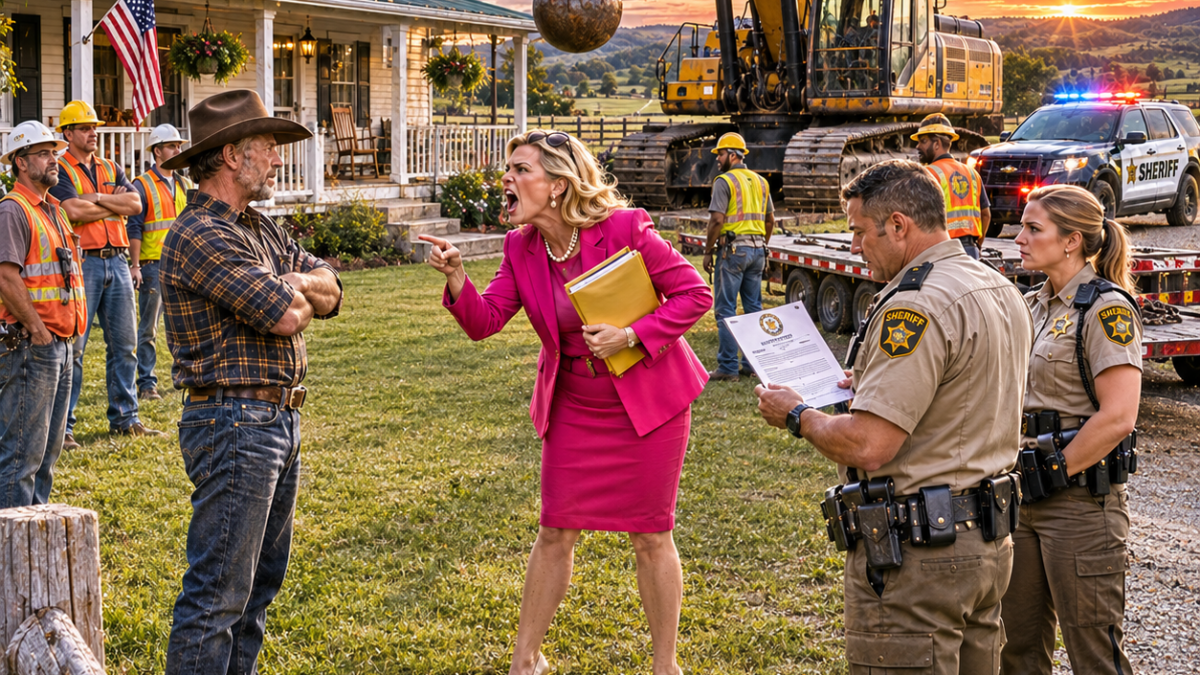
HOA Karen Brought a Wrecking Ball to Demolish My Veteran’s Home—She Claimed a Board Vote Made It Legal
She brought police officers and a demolition crew to my front yard and told me my own house had already been condemned by her HOA.
The wrecking ball was hanging twenty feet from the porch where my grandfather used to drink his morning coffee.
What HOA Karen did not know was that one sheet inside her yellow folder was about to turn her “community cleanup” into something much bigger.
“Your house is officially scheduled for demolition. The board voted last month, and there is nothing you can do about it.”
Victoria Mercer screamed those words from the middle of my front yard while a tracked demolition machine idled behind her, its steel wrecking ball swaying slowly against a burning orange sunset.
I stood near my porch in an olive flannel shirt, faded jeans, work boots, and the same old cowboy hat I wore whenever I checked fence lines. Two sheriff’s deputies were parked near my gate. Three demolition workers stood beside a flatbed truck. Victoria wore a bright pink blazer, matching skirt, pearl earrings, and a yellow HOA folder clutched against her chest like she had personally arrived to deliver the Constitution.
My house sat behind me.
Small. White siding. Green metal roof. Wide front porch. Nothing luxurious.
It had belonged to my grandfather before it belonged to me. I came home to it after two overseas tours when I was thirty-two, carrying more silence than luggage. I raised my family beneath that roof. I buried my grandfather from that house. I learned how to sleep through the night again in the back bedroom with the windows open to the sound of wind moving across four thousand acres of inherited ranchland.
Victoria looked at it and saw an eyesore.
“You received notices,” she said.
“I received HOA letters.”
“Which you ignored.”
“I’m not in your HOA.”
“That distinction no longer applies.”
One of the deputies looked at her.
I did too.
Victoria opened her folder and pulled out several documents. “The house violates Green Briar’s updated safety and appearance requirements. Deteriorated siding. Nonconforming porch structure. Agricultural clutter. Unapproved exterior materials. The board classified it as a visual and safety hazard.”
“My house passed county inspection when I rewired it three years ago.”
“The HOA has stricter standards.”
“For HOA homes.”
“We voted to include adjacent nuisance properties.”
I almost smiled.
Behind her, the wrecking ball swung another foot in the wind.
“You voted to demolish my house?”
“Unanimously.”
“Who owns it?”
She sighed dramatically. “Daniel, we are past that conversation.”
That sentence changed something in me.
I walked to my pickup and removed a leather document case containing my recorded deed, survey, tax records, and the original family land grant from 1921.
Victoria laughed when she saw the yellowed paper.
“Old documents don’t stop modern community progress.”
I handed the current deed to the nearest deputy instead.
He studied the parcel number.
Then he looked at Victoria’s paperwork.
His expression tightened.
I stepped closer.
That was when I noticed the county seal printed at the top of the supposed demolition authorization in her folder.
And underneath it, one line that told the attorney in me this was no longer just an HOA overreach.
Someone had created something they were never supposed to create.
part 2
I did not say what I had noticed.
Not yet.
I had spent enough years practicing law after leaving active service to know that the fastest way to ruin good evidence is to announce exactly what you understand before the other side finishes talking. So I folded my arms and let Victoria keep going.
Deputy Marcus Hale held my recorded deed in one hand and the photocopied “demolition authorization” Victoria had given him in the other.
“Mrs. Mercer,” he said, “where did you get this?”
“From the HOA compliance file.”
“That isn’t what I asked.”
She gave him a look usually reserved for waiters who had brought the wrong sparkling water.
“Our compliance office prepared the packet after the board vote.”
Marcus looked at the second deputy, Elena Ruiz.
Ruiz stepped closer and examined the document.
At the top was a county seal.
Below that were the words EMERGENCY STRUCTURE ABATEMENT AUTHORIZATION.
Then came my parcel number, my address, and language claiming the house had been declared unsafe and authorized for immediate removal.
It looked official from six feet away.
That was the problem.
I knew enough county paperwork to know it was wrong.
The font was wrong.
The case number format was wrong.
And the name printed beneath the signature line belonged to an inspector I had dealt with years earlier.
He had retired.
“Daniel,” Marcus said, “did the county ever inspect this property for condemnation?”
“No.”
“Any unsafe-structure hearing?”
“No.”
“Any notice from planning or code enforcement?”
“None.”
Victoria snapped her folder shut. “The HOA coordinated that process.”
I looked at her.
“With who?”
“Our compliance consultant.”
“Name?”
She hesitated.
“Community Development Solutions.”
I had never heard of it.
Marcus asked the demolition foreman to step over.
He was a broad-shouldered man named Luis Herrera who had spent the previous ten minutes looking less comfortable with every sentence.
“Who hired your company?”
“Green Briar Estates.”
“Did they provide this authorization?”
Luis nodded. “We received a packet electronically. Demolition order, property access authorization, payment approval, and a statement that law enforcement would be present for civil standby.”
Marcus’s jaw tightened.
“Who told you this house was legally condemned?”
“The HOA president and their project coordinator.”
Victoria pointed toward me.
“Because it is.”
I looked at Luis.
“Did anyone from the county contact you directly?”
“No, sir.”
“Did you verify the order?”
“Our office verified the permit number through the documents provided.”
“That isn’t verification.”
Luis looked miserable.
“I understand that now.”
Victoria spun toward him.
“Do not let him intimidate you. The board authorized this project.”
Luis gave her a long look.
“Ma’am, boards don’t issue county demolition permits.”
For the first time that afternoon, the crew laughed.
Not loudly.
Just one short sound from a young operator leaning against the flatbed.
Victoria turned.
“Is something funny?”
The operator looked at the wrecking ball, then at my intact house.
“Not anymore.”
Marcus told the crew to shut everything down until the document could be verified.
Victoria exploded.
“You cannot interfere with lawful HOA enforcement!”
Marcus remained calm.
“I’m not interfering with HOA enforcement. I’m preventing a structure from being demolished while we verify whether the paperwork authorizing it is genuine.”
“It is genuine.”
“Then verification should help you.”
She opened her mouth.
Closed it.
That tiny pause told me she knew more than she wanted us to know.
The machine engine shut down.
The sudden silence felt enormous.
For nearly an hour, I had listened to diesel engines, backup alarms, hydraulic whine, and Victoria’s voice.
Now I could hear cattle in the south pasture.
I could hear cicadas in the cottonwoods.
I could hear the old porch swing tapping lightly against the railing.
The house was still standing.
But the damage to my sense of safety had already been done.
I walked onto the porch and looked at the front door.
Victoria had taped six notices across it.
FINAL COMPLIANCE WARNING.
MANDATORY VACATE ORDER.
DEMOLITION COST ASSESSMENT.
One of them claimed I owed $18,400 in accumulated HOA penalties.
Another demanded reimbursement for “community hazard administration.”
I pulled none of them down.
Evidence.
My grandfather taught me to save paperwork.
The Army taught me to document things before people started remembering them differently.
Law school taught me that both men had been right.
I photographed every notice exactly where Victoria had placed it.
Then I photographed the machinery.
License plates.
Company logos.
Crew vehicles.
The trailer carrying demolition attachments.
The tracks pressed into my front pasture.
The white paint marks someone had sprayed across the grass to identify the supposed demolition perimeter.
Victoria watched me.
“You’re being dramatic.”
I looked at the wrecking ball hanging outside the house where I slept.
“I’ll try to recover.”
Deputy Ruiz nearly smiled.
Victoria did not.
She pointed to the county-looking order.
“That document is valid. The house was evaluated as a nuisance structure.”
“By whom?”
“Our consultant.”
“Is your consultant a county inspector?”
“They work with municipal agencies.”
“That’s not an answer.”
“You’re doing that lawyer thing.”
“I am a lawyer.”
“I know.”
The way she said it made my profession sound like a landscaping violation.
I had met Victoria Mercer seven months earlier, shortly after Green Briar Estates elected her HOA president.
The subdivision sat along the eastern edge of my ranch.
It had been built twelve years after my grandfather died, on land my family never owned and never wanted.
For the first decade, Green Briar and I coexisted peacefully.
Their residents drove past my fence.
My cattle occasionally stared at their golf carts.
Nobody declared war.
Then Victoria became president.
Within six weeks, I received a letter informing me that my western-style mailbox was “visually incompatible with the residential corridor.”
I called the HOA manager.
“I’m not a member.”
She apologized and said the letter had been sent in error.
Two weeks later, another arrived concerning my barn roof.
Then my cattle trailer.
Then firewood.
Then the color of my shed.
Then the house.
Each letter became more aggressive.
Each one used language suggesting Green Briar had authority over “adjacent visual-impact properties.”
That phrase did not exist in any deed, declaration, statute, ordinance, or recorded easement I could find.
It existed because Victoria typed it.
I replied formally.
My ranch was not subject to Green Briar’s covenants.
No portion had been annexed.
No restrictive covenant burdened the property.
No reciprocal maintenance agreement existed.
No enforcement easement existed.
No shared development agreement existed.
I attached a survey.
The letters continued.
Eventually, Green Briar started sending invoices.
Five hundred dollars.
Nine hundred dollars.
Then $2,400.
Then “administrative legal review fees.”
I never paid.
But I saved everything.
Victoria apparently interpreted silence as weakness.
That afternoon, after the deputies stopped the demolition, she stood near her SUV making furious phone calls while Luis and his crew secured equipment.
At one point, she shouted loud enough for half the ranch to hear.
“I don’t care what his deed says. We already paid the deposit.”
That sentence would become important later.
So would another.
“You told me the county paperwork would hold up.”
She said it into her phone.
Then she saw me looking at her.
She turned away.
I did not chase her.
I simply wrote the time in my notebook.
6:42 p.m.
Statement regarding county paperwork.
Rachel Mendoza arrived at my house at 8:15 that night.
Rachel had been my law partner for eight years before I reduced my practice to part-time work and moved more permanently onto the ranch.
She was five-foot-four, wore black glasses, and possessed the unnerving ability to make people confess things simply because silence around her felt expensive.
She stepped out of her car, looked at the demolition machine, and stopped.
“You weren’t exaggerating.”
“I rarely do.”
“There’s a wrecking ball in your yard.”
“I noticed.”
She stared at it.
“Pink blazer?”
“Gone.”
“Disappointing.”
I handed her the document packet.
She read the supposed demolition authorization first.
Thirty seconds later, she looked up.
“Oh.”
“You see it.”
“I see several things.”
We sat at my kitchen table.
The house was quiet.
That mattered to me more than I expected.
I poured coffee while Rachel spread documents beneath the old pendant light.
The original 1921 family land grant sat in a protective sleeve beside the current deed and survey.
My great-grandfather had acquired the property when this part of the county was mostly ranches, dirt roads, and windmills.
The document was not magical.
It did not defeat modern law because it was old.
What mattered was the chain of title.
The ranch had passed legally from one generation to the next.
Every conveyance was recorded.
Every boundary could be traced.
My current deed was what mattered operationally.
The old grant mattered emotionally.
Victoria had laughed at the wrong piece of paper for the wrong reason.
Rachel tapped the alleged county order.
“This signature is printed.”
“Yes.”
“No certification number.”
“Yes.”
“Wrong case format.”
“Yes.”
“And Carl Denton retired four years ago.”
“Exactly.”
She leaned back.
“Do you know where Victoria got this?”
“She says a consultant.”
“Do you know the consultant?”
“No.”
Rachel opened her laptop.
A few minutes later, she found Community Development Solutions LLC.
The company had been created nine months earlier.
Its registered address was a commercial mailbox two counties away.
Its website consisted of one page promising “community compliance, property optimization, dispute mitigation, and municipal coordination.”
Rachel read that aloud.
“Property optimization.”
“Sounds expensive.”
“Sounds fictional.”
She searched state business records.
The registered organizer was a man named Trevor Mercer.
I stared at the screen.
“Mercer.”
Rachel looked at me.
“Victoria’s husband?”
“Her brother.”
That changed the room.
Rachel sat back.
“Okay.”
I knew that tone.
It meant the story had just stopped being annoying.
“What?”
“The HOA president pushes a demolition project against a nonmember. The HOA hires a consultant owned by her brother. The consultant produces paperwork presented as governmental authority. The HOA pays a demolition contractor. And apparently law enforcement is told there’s a legitimate county order.”
She tapped the paper.
“That can become several different problems very quickly.”
“Criminal?”
“Potentially. I’m not making accusations until we know who created what. But this is no longer a normal covenant dispute.”
I nodded.
“I already suspected that.”
“You filed anything previously?”
That was where Victoria’s real mistake began.
Three months earlier, after Green Briar sent me its first “mandatory structural compliance assessment,” I had filed a complaint with the state attorney general’s consumer protection division.
Not because I expected immediate intervention.
Because the HOA had begun sending similar demands to other nonmembers.
My neighbor Carl Jennings had received a threat involving his detached workshop.
A widow named Eleanor Price received invoices for failing to replace a fence on land outside Green Briar.
Another rancher was told to pay a “community road impact fee” despite having no access through the subdivision.
I had started collecting their letters.
The patterns were too similar to ignore.
I sent the attorney general copies.
I also submitted information to the county attorney.
Then, when one nonmember received a document bearing what looked like a county seal, I sent that too.
Nobody had contacted me yet.
I assumed the complaint was sitting in a queue.
Rachel looked at me.
“You never mentioned that.”
“You told me last month to stop becoming everybody’s unpaid lawyer.”
“I meant stop drafting fence letters.”
“I expanded.”
She closed her eyes.
“Of course you did.”
The next morning, Rachel filed an emergency civil action seeking temporary injunctive relief against Green Briar, Victoria, and anyone acting on their behalf.
We did not wait for the demolition machine to return.
We attached my deed.
Survey.
Photographs.
HOA notices.
Invoices.
The purported demolition order.
Contractor documents.
And affidavits from me and two neighbors describing similar conduct.
We also sent immediate preservation demands.
No deleted emails.
No shredded records.
No altered meeting minutes.
No disappearing invoices.
At 9:17 a.m., Rachel emailed the packet to Green Briar’s attorney.
At 9:41, he called her.
His name was Thomas Avery.
I knew of him.
Competent.
Conservative.
Not the kind of lawyer who enjoyed surprises.
Rachel put the call on speaker.
“Rachel, I’ve seen the filing.”
“Good.”
“Did your client actually receive a county demolition order?”
“He received what your client represented as one.”
Silence.
“I need to review that.”
“You should.”
“Was demolition underway?”
“Equipment was positioned in his front yard.”
Another silence.
“Was anybody hurt?”
“No.”
“Was the structure damaged?”
“Not physically.”
I looked around my kitchen.
Rachel continued.
“But your clients entered the property, placed notices, brought demolition equipment, represented the home as condemned, and created a substantial threat of immediate destruction.”
“I understand.”
“No, Thomas. You’re beginning to.”
He did not argue.
That told me he had not known.
The judge scheduled an emergency hearing for the next morning.
Before that happened, the county arrived.
Not one inspector.
Three officials.
Aaron Schultz from planning and development.
A code enforcement supervisor.
And a county attorney’s investigator.
Victoria arrived ten minutes later.
She wore pink again.
I never understood why.
Maybe it was armor.
Maybe she believed consistency looked like confidence.
A local television van followed her through the gate because she had apparently invited media to cover what she called “a community safety dispute.”
That decision would age badly.
Aaron walked the property first.
He examined the survey stakes.
Measured the house location.
Checked parcel data on his tablet.
Reviewed the county database.
Then he inspected the alleged demolition authorization.
The television reporter filmed from the road.
Victoria stood nearby with her folder.
I stayed beside Rachel.
Aaron finally turned toward us.
“This property is entirely outside Green Briar Estates.”
Victoria immediately interrupted.
“We know it’s technically outside the recorded subdivision.”
Technically.
Rachel wrote that word down.
Aaron continued.
“There is no annexation record. No county unsafe-structure finding. No active code case. No demolition permit. No condemnation proceeding. No county authorization allowing anybody to remove this house.”
Victoria lifted her chin.
“The HOA conducted its own safety review.”
“That doesn’t create county authority.”
“The board declared it hazardous.”
“The board does not have jurisdiction over this parcel.”
“The house affects Green Briar property values.”
“That is not a demolition power.”
The reporter moved closer.
Victoria noticed the camera and became louder.
“This is exactly the problem with outdated county systems. Communities need the ability to protect themselves.”
Aaron looked at the wrecking machine.
“From his house?”
“The structure is visually degrading.”
I looked at my home.
Fresh paint.
New roof.
Straight porch.
Trim repaired the previous spring.
Aaron looked too.
“Ma’am, I’m not seeing an emergency hazard.”
“It’s incompatible.”
“That is not the same word.”
She opened her folder.
“The community voted.”
Aaron shook his head.
“HOA votes don’t override property ownership or county permitting.”
Victoria pointed toward the orange survey markers.
“Those markers were placed by his surveyor.”
“Yes.”
“So they are private markers.”
Aaron blinked.
“They identify the professionally surveyed boundary.”
“Exactly. Private.”
Rachel lowered her face to hide a smile.
I failed completely.
Victoria noticed.
“What?”
“Nothing.”
“You’re laughing.”
“I’m experiencing private amusement.”
The reporter turned away.
Even Aaron’s mouth moved.
Then he became serious.
He held up the supposed demolition authorization.
“This document is not issued by my department.”
Victoria’s expression changed.
“Your office provided the form.”
“No.”
“The consultant coordinated with someone.”
“Not us.”
“The seal is right there.”
“That is part of the problem.”
Silence spread through the yard.
Aaron looked toward the county investigator.
The investigator stepped forward.
“Mrs. Mercer, we’re going to need a copy of the original digital file and the name of the person who provided it.”
Victoria’s face went pale beneath her makeup.
“I don’t have the original.”
“Who does?”
“My consultant.”
“Community Development Solutions?”
She turned toward me.
The anger in her face was immediate.
“You’ve been digging into private HOA records.”
“I searched a public corporate filing.”
“That’s intimidation.”
“No. It’s a website.”
Rachel touched my elbow.
Stop.
I stopped.
The investigator asked Victoria whether the county seal had been placed on the document by her, Green Briar, or the consultant.
She said she did not know.
Whether she had represented the document as a county demolition order.
She said she had relied on professional advice.
Whether she had sent it to the demolition company.
She said the property manager handled contractors.
Whether she had told deputies the county had condemned my home.
“I said the structure was approved for removal.”
“By whom?”
“The board.”
The investigator wrote something down.
By noon, the demolition machine was gone.
Not legally seized.
Not dramatically hauled away by government agents.
The contractor removed it voluntarily after receiving written confirmation that no valid demolition authorization existed.
Luis came to my porch before leaving.
“Mr. Cole, I’m sorry.”
“You were given bad information.”
“We should have verified directly.”
“Yes.”
He nodded.
“No excuse.”
That mattered to me.
People make mistakes.
The difference between Luis and Victoria was what they did after reality arrived.
Luis accepted his part.
Victoria declared war on reality.
The emergency hearing happened the following morning.
Green Briar agreed before arguments even began to a temporary order prohibiting entry, demolition, alteration, enforcement, fines, towing, liens, contractor access, or any other action against my property without lawful authority.
The judge still asked questions.
One was simple.
“Counsel, is there any recorded document placing Mr. Cole’s property under the Green Briar declaration?”
Thomas Avery answered.
“No, Your Honor.”
Victoria shifted behind him.
The judge continued.
“Any recorded easement granting demolition rights?”
“No.”
“Any county condemnation order?”
“No.”
“Any municipal unsafe-structure proceeding?”
“No.”
“Then why was demolition equipment brought to this home?”
Thomas paused.
“We are investigating that internally.”
The judge looked toward Victoria.
“So is someone else, apparently.”
That afternoon, Green Briar held an emergency board meeting.
I did not attend.
I did not need to.
Half the subdivision did, and several residents recorded it.
Victoria stood at the front of the clubhouse meeting room in a white suit and insisted the entire situation had been a “procedural misunderstanding.”
Susan Pike, the board treasurer, asked the first question.
“Did we authorize demolition of Daniel Cole’s house?”
Victoria replied, “We authorized nuisance abatement.”
“That’s not what I asked.”
“We authorized decisive enforcement.”
“Did we vote to destroy his house?”
“You voted to resolve the violation.”
Susan held up a copy of the minutes.
“The minutes say legal counsel must confirm authority before physical enforcement.”
Victoria pointed toward Thomas Avery.
“Our consultant handled coordination.”
Susan stared at her.
“Our consultant is your brother.”
The room changed.
People started talking.
Victoria struck the table with her palm.
“Order.”
Nobody stopped.
“You never told us Trevor owned the company,” Susan said.
“It was disclosed.”
“Where?”
“In administrative materials.”
“Show me.”
Victoria opened her yellow folder.
For the first time in months, the folder failed her.
She shuffled papers.
Nothing.
Someone in the back shouted, “How much did we pay him?”
Susan answered.
“Forty-six thousand dollars so far.”
The room erupted.
That number was only the beginning.
Over the next two weeks, the board’s independent review uncovered more.
Community Development Solutions had received consulting payments.
A separate vendor had received “field compliance” fees.
Another invoice billed for municipal coordination.
Several charges related to nonmember properties.
My property.
Carl’s workshop.
Eleanor’s fence.
Two ranch entrances.
A privately owned pond.
And one vacant tract the HOA had discussed converting into overflow parking despite not owning it.
Victoria had constructed an entire theory of authority from repetition.
If she called property “adjacent-impact land” enough times, she treated it like a legal category.
If she invoiced someone enough times, she treated them like a member.
If she called a consultant’s letter “county coordination,” she treated it like government approval.
And if a board voted after receiving incomplete information, she treated the vote like title.
The system worked until somebody asked for original documents.
Then it collapsed.
Green Briar removed Victoria as president six days after the hearing.
Not suspended.
Removed.
The vote was unanimous.
Victoria was allowed to speak before the vote.
She blamed me.
Of course she did.
“This entire crisis exists because one man refuses to cooperate with the community surrounding him.”
Susan looked at her.
“He doesn’t live in our community.”
“He benefits from our property values.”
“He owns a ranch.”
“He uses our roads.”
“He uses the county road.”
“He sees our landscaping.”
That produced laughter.
Victoria became furious.
“This is serious.”
Carl, who had been invited by one resident, raised his hand from the back.
Susan made the mistake of calling on him.
Carl stood.
“I’d like to apologize.”
Victoria looked almost hopeful.
“For what?”
“For visually benefiting from your landscaping without paying dues.”
The meeting dissolved.
Susan buried her face in her hands.
Thomas Avery stared at the ceiling.
Victoria shouted that nonmembers had no right to participate.
Carl sat down looking satisfied.
I watched the recording later in my kitchen.
Rachel sat beside me.
“You encourage him.”
“I wasn’t there.”
“You encourage him spiritually.”
“That’s not actionable.”
“Yet.”
The state attorney general contacted me three days later.
The investigator assigned to my earlier complaint asked for the complete file.
I sent everything.
The demolition notice changed the seriousness of their review.
So did the apparent county seal.
So did the relationship between Victoria and the paid consultant.
The attorney general’s office began examining whether Green Briar’s communications to nonmembers involved deceptive collection practices, misrepresentations of legal authority, or other violations of state law.
The county attorney separately investigated the false government-looking documents.
Then came the part Victoria never expected.
Federal agents did eventually arrive.
Not the next morning.
Not because I was a veteran.
Not because the FBI exists to settle HOA disputes.
They arrived weeks later because the document trail had expanded beyond one HOA fight.
Community Development Solutions had transmitted invoices, official-looking notices, payment demands, and document packets electronically across multiple jurisdictions.
Investigators had also identified evidence suggesting altered government forms had been used in connection with attempts to obtain money and contractor action.
That created questions involving potential wire fraud and misuse of government identifiers serious enough to interest federal investigators.
The first two agents met Rachel and me at her office.
They were polite.
Quiet.
Almost disappointingly normal.
One opened a notebook.
“We understand you received several documents from Green Briar Estates or its consultant representing that governmental authority existed over your property.”
“Yes.”
“Did you believe them?”
“No.”
“Why not?”
“I’m an attorney.”
The agent smiled slightly.
“Anything else?”
“The county did not send them.”
“That helps.”
We spent three hours reviewing emails, notices, invoices, metadata, and dates.
I handed over copies of everything.
No drama.
No handcuffs.
No agents storming the subdivision.
Real investigations are patient.
They gather records.
They compare versions.
They ask who knew what and when.
They trace money.
They let people commit themselves to stories.
Victoria was very good at committing herself to stories.
Her deposition in my civil case became one of the strangest afternoons of my legal career.
Rachel questioned her.
I sat beside our counsel table.
Victoria wore navy instead of pink.
It did not improve her answers.
“Mrs. Mercer, did Mr. Cole ever sign Green Briar’s declaration?”
“No.”
“Did he sign an annexation agreement?”
“No.”
“Did he grant the HOA an easement?”
“No.”
“Did the HOA own his house?”
“No.”
“Did the HOA own the land beneath his house?”
“No.”
“Did the HOA possess a county demolition order?”
“We possessed a demolition authorization.”
Rachel slid the document across the table.
“I’m asking about a county order.”
Victoria hesitated.
“No.”
“Did you know that when you brought the demolition crew?”
“I believed the document had county validity.”
“Who told you that?”
“My consultant.”
“Your brother?”
“His company.”
“Did you disclose that relationship to the board before recommending his company?”
“I don’t recall.”
“Did you vote on payments to his company?”
“I participated in board decisions.”
“That means yes?”
“My vote was one of several.”
“Did your brother tell you the county had approved demolition?”
“He said the process was handled.”
“Those words?”
“Approximately.”
“Did you ask to see an original county order?”
“I saw the document.”
“The document with the false seal?”
Her lawyer objected.
Rachel rephrased.
“The document the county later denied issuing.”
“Yes.”
“Did you call the county?”
“No.”
“Did you verify the permit number?”
“No.”
“Did you speak with a county inspector?”
“No.”
“Did you speak with a judge?”
“No.”
“Did you speak with a code enforcement officer?”
“No.”
Rachel leaned back.
“Then what exactly did you verify before bringing a wrecking ball to his home?”
Victoria stared at her.
“The board had voted.”
That answer destroyed the room.
Even her attorney looked down.
Rachel let the silence remain for several seconds.
Then she said quietly, “Thank you.”
The civil case settled months later.
I insisted on three things.
First, the HOA had to formally acknowledge in a recorded instrument that my ranch was not part of Green Briar and that it claimed no enforcement authority over my land.
Second, every fake assessment, fee, violation, and demolition cost had to be withdrawn.
Third, Green Briar had to reimburse the documented expenses caused by the intrusion and attempted demolition, including legal fees where recoverable, security upgrades, professional surveying, and damage to my yard from the heavy equipment.
There had been no physical destruction of the house because the deputies and crew stopped before the wrecking ball moved.
That fact mattered.
I was grateful for it every day.
But the yard looked like an armored division had held a reunion there.
Tracks carved through grass.
A decorative stone path was cracked.
One irrigation line was crushed.
Two fence posts had been pulled to widen machine access.
The HOA paid to restore all of it.
I made them restore the grass too.
Not sod.
The same pasture mix.
Rachel called that petty.
I called it agricultural consistency.
She said, “You’ve been spending too much time with Carl.”
Green Briar also adopted new policies.
No enforcement against nonmembers without a recorded legal basis.
No use of outside consultants related to board members without written conflict disclosure and independent approval.
No physical enforcement without counsel review.
No contractor action based solely on internal board resolutions.
No use of governmental logos or document formatting in HOA communications.
That last one should never have required a written rule.
But neither should “do not demolish houses you do not own.”
The criminal and regulatory investigations took longer.
I did not control those outcomes.
That was important to understand.
A victim can report.
A witness can cooperate.
An attorney can preserve evidence.
But prosecutors decide charges.
Agencies decide enforcement.
Courts decide guilt and penalties.
I refused to turn legal reality into revenge fantasy simply because Victoria had made my blood boil.
The state attorney general ultimately announced enforcement action tied to deceptive practices affecting several nonmember property owners.
Green Briar entered an agreement requiring restitution to affected parties, compliance changes, and independent review.
The association’s insurer covered some losses and disputed others.
Residents faced a special assessment because bad governance is rarely free.
That upset me.
Most homeowners had never voted to attack my house.
Some had no idea what Victoria was doing.
But they had elected a board that failed to supervise her.
Eventually, communities pay for what leadership does in their name.
The federal investigation focused more narrowly on the consultant operation and document transmissions.
I was not present for every development.
I did not pretend to know facts investigators had not shared.
What became public was enough.
Trevor Mercer’s company had created or circulated documents designed to resemble official government materials in multiple property disputes.
Several communications contained representations investigators alleged were materially false.
Financial transfers between vendors were examined.
A federal grand jury later returned charges involving fraud-related conduct.
Victoria herself faced separate state-level consequences connected to the HOA matter and false representations.
I will not romanticize it.
There was no cinematic moment when twenty agents surrounded her at the mailbox.
There was no speech.
No dramatic confession.
Just paperwork.
Hearings.
Lawyers.
Orders.
Public records.
Exactly the kind of boring machinery she had spent years pretending she could replace with a board vote.
That was more satisfying.
Green Briar held new elections.
Susan became president.
Her campaign slogan was unofficial.
“Check the deed first.”
Carl printed yard signs.
Susan made him remove them.
He moved one into his workshop.
The first time Susan visited my ranch after becoming president, she stopped at the gate and called me.
“I’m outside.”
“I can see you.”
“I’m asking permission to enter.”
I smiled.
“Come in.”
She drove to the house and stood in the same yard where the demolition machine had once idled.
“I’m sorry,” she said.
“You didn’t bring it here.”
“I voted for some of those compliance programs.”
“That matters.”
“I should have asked better questions.”
“That matters too.”
She nodded.
Then she looked at my house.
“For the record, I like the porch.”
“That’s dangerous. I may invoice you for unauthorized aesthetic approval.”
She laughed.
“I deserve that.”
I appreciated Susan because she understood something Victoria never did.
Accountability is not humiliation.
It is accuracy.
You identify what you did.
You repair what you can.
You stop pretending intent erases consequences.
The house needed little restoration.
The yard needed more.
I replaced the damaged irrigation.
Rebuilt the stone path.
Reset the fence posts.
Reseeded the ruts.
Then I did something I had been postponing for years.
I restored the porch.
Not because Victoria called it nonconforming.
Because my grandfather built it in 1978 and several boards had started to rot.
I removed them one at a time.
Beneath one section, I found an old carpenter’s pencil.
Probably his.
I sat on the porch steps holding it for a long time.
My grandfather had not been a complicated man.
He worked cattle.
Fixed machinery.
Read the newspaper every morning.
Distrusted people who used unnecessary words.
When I came home from my second tour, I stayed with him for what I told myself would be three months.
He never asked why I sometimes woke before sunrise and walked the property.
He never asked why I hated crowded rooms for a while.
He just left coffee on the stove.
One morning he said, “You can stay as long as you need.”
I stayed.
Eventually, the ranch became mine.
The house became home.
Years later, when Victoria called it visually polluting, that was what she failed to understand.
She saw siding.
I saw the place where somebody gave me room to become myself again.
She saw an old porch.
I saw my grandfather’s boots beside the door.
She saw agricultural clutter.
I saw the saddle my daughter learned to ride in.
She saw a house that did not match Green Briar.
I saw the reason I had never needed it to.
The emotional anger lasted longer than the legal fight.
I hated that.
I had spent years learning not to let other people control my internal weather.
Victoria managed it with one afternoon.
For months after the attempted demolition, every heavy truck on the county road made me look toward the gate.
Every unknown vehicle bothered me.
I upgraded the security cameras.
Installed a keypad on the main entrance.
Added motion sensors near the house.
Practical choices.
Still, I resented needing them.
Rachel noticed.
“You’re checking the driveway again.”
We were sitting on the porch one evening.
“I heard a truck.”
“It’s Carl.”
Sure enough, his old Ford appeared around the bend.
“That proves nothing.”
“It proves you need a hobby.”
“I have cattle.”
“Cattle are work.”
“I have legal cases.”
“That is worse.”
Carl parked and stepped out holding something wrapped in newspaper.
“I brought a housewarming gift.”
“I’ve lived here twenty years.”
“Post-demolition housewarming.”
“There was no demolition.”
“Attempted-demolition housewarming.”
He handed me the package.
Inside was a tiny plastic wrecking ball mounted on a wooden base.
A brass plate read:
HOA APPROVED PORCH DECORATION
I looked at him.
“You paid money for this?”
“Custom order.”
Rachel laughed so hard she spilled coffee.
I kept the thing.
It still sits on my bookshelf.
Humor gave me back something anger could not.
Proportion.
Victoria had come terrifyingly close to causing irreversible damage.
That was serious.
But she did not get to turn every memory afterward into fear.
Sometimes the best revenge against an authoritarian personality is becoming difficult to emotionally govern.
A year later, Green Briar hosted an open meeting about revised governance policies.
Susan invited surrounding landowners.
I attended because several reforms affected how the HOA interacted with neighboring property.
The meeting room was full.
The famous yellow folders were gone.
Susan had replaced them with plain black binders.
Carl noticed immediately.
“Rebranding.”
“Behave.”
“I am.”
“No, you aren’t.”
The first agenda item concerned external complaints.
Susan read the new rule.
“Green Briar may communicate a concern to a neighboring nonmember property owner when there is a legitimate health, safety, drainage, access, or legal issue. Such communication must clearly state that the association is not asserting covenant authority unless recorded documents establish otherwise.”
Carl raised his hand.
Susan sighed.
“Yes, Mr. Jennings?”
“Can you still complain about porch color?”
“No.”
“Tractor color?”
“No.”
“Cattle aesthetics?”
“No.”
“Visual pollution from cowboy hats?”
“Please sit down.”
He sat.
The room laughed.
That laughter told me Green Briar was recovering too.
Victoria had made governance theatrical.
Every disagreement became enforcement.
Every preference became a rule.
Every rule became a threat.
Susan made it boring again.
That was a compliment.
The final time I saw Victoria was outside the county courthouse almost eighteen months after the wrecking-ball afternoon.
She was leaving with her attorney.
I was there for an unrelated property case.
She saw me.
Stopped.
For a moment, I considered walking past.
Then she said my name.
“Daniel.”
I turned.
She looked different.
Not physically.
The same blonde hair.
Same expensive clothes.
But no folder.
No entourage.
No board title.
No assumption that people would move because she entered the room.
“I hope you’re happy,” she said.
I had heard that sentence before from people facing consequences.
It usually means, I wish you felt guilty for not protecting me from what I did.
“I’m peaceful,” I said.
“That’s not what I asked.”
“It’s the answer.”
She looked away.
“My life was destroyed over one decision.”
“No.”
Her eyes snapped back.
“You don’t get to tell me—”
“It wasn’t one decision.”
I kept my voice calm.
“It was letters. Invoices. Fake authority. Threats. Contractor payments. Conflicts you didn’t disclose. Government-looking documents nobody verified. Then you brought a wrecking ball to my house.”
“I never touched your house.”
“Because people stopped you.”
“The crew would have followed safety procedures.”
I almost laughed.
That was Victoria.
Always trying to argue three inches to the left of the point.
“You still think the problem was procedure.”
“The problem was everyone panicked.”
“No.”
“The board abandoned me.”
“The board learned what you had done.”
“They approved the program.”
“They approved what you told them.”
She folded her arms.
“You think you’re morally superior because you had paperwork.”
“No.”
“Because you were military?”
“No.”
“Because you’re a lawyer?”
“No.”
I stepped closer.
“I think my house was mine.”
That stopped her.
Nothing else needed to be said.
All the legal theories.
All the HOA language.
All the consultant phrases.
All the community-benefit arguments.
Reduced to five words.
My house was mine.
She looked toward the courthouse entrance.
Then she said something surprisingly honest.
“I thought you’d leave.”
“What?”
“When we brought the crew. I thought you’d be intimidated and leave.”
I stared at her.
There it was.
Not law.
Not safety.
Not aesthetics.
Power.
She had expected fear to do what documents could not.
“You miscalculated.”
“I know.”
For the first time since I had met Victoria, she sounded tired rather than angry.
She walked away.
I watched for several seconds.
Then I went inside.
I never saw her again.
Green Briar eventually sold Victoria’s house after she moved out of state.
I heard that from Susan.
Carl wanted to know whether the new owner was warned.
“About what?”
“The visual pollution risk.”
“Stop.”
“What if they buy beige siding?”
“Carl.”
“Community emergency.”
I hung up.
He called back.
I blocked him for forty-three minutes.
Today the ranch looks almost exactly the way it did before Victoria arrived.
That is the part I value most.
The repaired yard blended back into pasture.
The fence posts weathered.
The porch boards turned slightly gray under the Texas sun.
The house remains modest.
Still white.
Still green roof.
Still visible from the county road if you know where to look.
I never changed its appearance to prove anything.
Defiance for its own sake can become another form of control.
I simply maintained it.
Repainted when needed.
Repaired what aged.
Replaced what broke.
Ordinary ownership.
One summer, Susan called.
“Can I ask something strange?”
“After Victoria, the scale is generous.”
“The new board wants to photograph neighboring historic properties for a community history display.”
I was silent.
“You can say no.”
“What would the caption say?”
“Cole Ranch House. Family-owned property predating Green Briar Estates.”
“No HOA logo?”
She laughed.
“No.”
“No aesthetic rating?”
“No.”
“No demolition schedule?”
“Daniel.”
“Fine.”
A photographer came out.
He stood near the gate.
Asked permission.
Took one picture at sunset.
Months later, Susan sent me the display.
My grandfather’s house appeared beside photographs of old barns, windmills, ranch roads, and the original landscape before subdivision development.
The caption said the house dated from an earlier agricultural era of the county.
I stared at that photograph for a long time.
Victoria had once called the house visual pollution.
The community that replaced her called it history.
Same building.
Different humility.
That was enough.
The federal case involving Trevor’s company moved through court slowly.
Some allegations were resolved through plea agreements.
Some charges were narrowed.
I avoided repeating rumors.
I had learned long ago that justice becomes less trustworthy when people decorate it.
The public record eventually showed convictions tied to fraudulent representations and document use.
Victoria’s own legal problems resolved separately under state law and civil agreements.
She paid a heavy financial price.
So did Green Briar.
The exact totals were spread across restitution, settlement payments, legal fees, insurance adjustments, vendor claims, compliance monitoring, and the internal forensic review.
It was expensive.
But the number was never the real punishment.
The real punishment was simpler.
Victoria had built her identity around being the person everybody had to obey.
Then, in public record after public record, people examined her authority and found it missing.
She could not command a deed.
She could not vote herself jurisdiction.
She could not manufacture a county order.
She could not intimidate land into changing ownership.
And she could not make a wrecking ball lawful by standing beside it confidently.
One evening, years after everything ended, I sat on my grandfather’s porch while the sun dropped behind the western pasture.
The sky turned gold.
Then orange.
Then violet.
The same colors it had worn the afternoon Victoria brought the demolition crew.
For a long time, sunsets reminded me of that day.
Then they stopped.
That pleased me.
Memory should not allow one arrogant person to permanently occupy beautiful things.
My daughter came by with her husband and their little boy.
He ran across the porch carrying a toy tractor.
He stopped beside the tiny wrecking-ball trophy Carl had made and picked it up.
“What’s this?”
I looked at my daughter.
She smiled.
“Grandpa had an argument.”
“With who?”
“A lady who didn’t understand property lines.”
He considered that.
Then asked the most intelligent question anybody had asked about the entire case.
“Did she have a map?”
I laughed.
“Yes.”
“Then why didn’t she look?”
My daughter laughed too.
I could have told him about HOAs.
Fraud.
County records.
Board votes.
False authority.
Lawyers.
Investigators.
But his question was better.
Why didn’t she look?
Victoria had access to the truth.
That was what made everything she did so unnecessary.
The deed was public.
The survey existed.
The county database existed.
One phone call could have verified the permit.
One legal review could have stopped the demolition plan.
One honest conversation with the board could have prevented hundreds of thousands of dollars in damage.
But truth was inconvenient.
She wanted the result first.
Authority later.
That is how dangerous arrogance works.
It treats verification as obstruction.
Procedure as weakness.
Ownership as negotiation.
Disagreement as defiance.
Victoria did not lose because I was a veteran.
She did not lose because I was an attorney.
She did not lose because I had better connections.
She lost because facts survive confidence.
The deed remained recorded whether she believed it or not.
The county records remained unchanged whether she liked them or not.
Her brother’s company remained connected to her whether she disclosed it or not.
The emails remained timestamped.
The invoices remained traceable.
The demolition order remained fake.
The cameras remained recording.
Reality waited.
Then it collected everything.
Sometimes people ask what I would have done if the deputies had not paused the demolition.
The answer is simple.
Everything legally available.
Emergency injunction.
Sheriff.
County.
Court.
Contractor notice.
Insurance.
Recorded evidence.
I would have stood between bad authority and my home using every lawful tool I had.
But I am grateful I never had to stand in front of the machine itself.
Courage is not refusing to move when steel starts swinging.
Courage is often knowing which system to activate before anybody gets hurt.
That distinction matters.
Especially to me.
I spent enough of my younger life in places where force answered force.
I had no interest in bringing that logic home.
Victoria arrived expecting confrontation.
She got documentation.
She expected yelling.
She got questions.
She expected fear.
She got a deed.
She expected the police to validate her authority.
They asked her for proof.
She expected the contractor to obey.
He stopped.
She expected the board to defend her.
They removed her.
She expected paperwork to intimidate me.
Her paperwork became evidence.
That was the revenge.
Not cruelty.
Not retaliation.
Not destroying her house because she tried to destroy mine.
Watching every weapon of bureaucracy she misused turn around and become part of the record against her.
Carl still calls that poetic justice.
I call it discovery.
The old yellow HOA notices are stored in a box in my office.
I kept one.
The largest.
MANDATORY DEMOLITION COMPLIANCE.
Every now and then, when I clean the file cabinet, I see it.
The language still sounds confident.
“Failure to vacate may result in immediate community enforcement action.”
No statute.
No court order.
No jurisdiction.
No lawful authority.
Just confident formatting.
Next to it I keep the final recorded acknowledgment from Green Briar stating that my ranch is outside the association and not subject to its enforcement powers.
The difference between those two papers is the difference between pretending and law.
One screamed.
The other controlled.
My grandfather would have appreciated that.
He did not trust flashy things.
He trusted records.
He once told me, “A loud man can tell you he owns a cow all day. The brand still matters.”
Different century.
Same principle.
Victoria could stand in my yard under a golden sunset with police cruisers, contractors, a wrecking ball, board resolutions, and a folder full of official-looking paper.
She could call my house ugly.
Unsafe.
Nonconforming.
Obsolete.
A threat to property values.
She could call my refusal selfish.
She could call my deed outdated.
She could call the ranch community-impact land.
She could call demolition progress.
She could call coercion cooperation.
None of it changed ownership.
None of it changed the boundary.
None of it changed the truth.
The house still stands.
The porch still faces west.
The same cottonwoods bend in the wind.
My grandfather’s coffee hook is still screwed beneath the porch rail.
The ranch still stretches far beyond Green Briar’s rooftops.
And every evening, when the sunset burns orange across those four thousand acres, the last light hits the white siding of the modest little house Victoria once decided did not deserve to exist.
She brought a wrecking ball because she believed power meant being able to destroy what she disliked.
She left me with a better understanding.
Real power is being able to stop destruction without becoming destructive yourself.
That house was mine before Victoria arrived.
It was mine while she shouted in my yard.
It was mine while the machine engine roared.
It was mine while the forged-looking papers sat in her folder.
It was mine when the county shut her down.
It was mine when the board removed her.
And it is still mine now.
Not because an HOA approved it.
Because they never had the right to take it in the first place.
THE STORY ENDS HERE
HOA Karen Brought a Wrecking Ball to Demolish My Veteran’s Home—She Claimed a Board Vote Made It Legal
She brought police officers and a demolition crew to my front yard and told me my own house had already been condemned by her HOA.
The wrecking ball was hanging twenty feet from the porch where my grandfather used to drink his morning coffee.
What HOA Karen did not know was that one sheet inside her yellow folder was about to turn her “community cleanup” into something much bigger.
“Your house is officially scheduled for demolition. The board voted last month, and there is nothing you can do about it.”
Victoria Mercer screamed those words from the middle of my front yard while a tracked demolition machine idled behind her, its steel wrecking ball swaying slowly against a burning orange sunset.
I stood near my porch in an olive flannel shirt, faded jeans, work boots, and the same old cowboy hat I wore whenever I checked fence lines. Two sheriff’s deputies were parked near my gate. Three demolition workers stood beside a flatbed truck. Victoria wore a bright pink blazer, matching skirt, pearl earrings, and a yellow HOA folder clutched against her chest like she had personally arrived to deliver the Constitution.
My house sat behind me.
Small. White siding. Green metal roof. Wide front porch. Nothing luxurious.
It had belonged to my grandfather before it belonged to me. I came home to it after two overseas tours when I was thirty-two, carrying more silence than luggage. I raised my family beneath that roof. I buried my grandfather from that house. I learned how to sleep through the night again in the back bedroom with the windows open to the sound of wind moving across four thousand acres of inherited ranchland.
Victoria looked at it and saw an eyesore.
“You received notices,” she said.
“I received HOA letters.”
“Which you ignored.”
“I’m not in your HOA.”
“That distinction no longer applies.”
One of the deputies looked at her.
I did too.
Victoria opened her folder and pulled out several documents. “The house violates Green Briar’s updated safety and appearance requirements. Deteriorated siding. Nonconforming porch structure. Agricultural clutter. Unapproved exterior materials. The board classified it as a visual and safety hazard.”
“My house passed county inspection when I rewired it three years ago.”
“The HOA has stricter standards.”
“For HOA homes.”
“We voted to include adjacent nuisance properties.”
I almost smiled.
Behind her, the wrecking ball swung another foot in the wind.
“You voted to demolish my house?”
“Unanimously.”
“Who owns it?”
She sighed dramatically. “Daniel, we are past that conversation.”
That sentence changed something in me.
I walked to my pickup and removed a leather document case containing my recorded deed, survey, tax records, and the original family land grant from 1921.
Victoria laughed when she saw the yellowed paper.
“Old documents don’t stop modern community progress.”
I handed the current deed to the nearest deputy instead.
He studied the parcel number.
Then he looked at Victoria’s paperwork.
His expression tightened.
I stepped closer.
That was when I noticed the county seal printed at the top of the supposed demolition authorization in her folder.
And underneath it, one line that told the attorney in me this was no longer just an HOA overreach.
Someone had created something they were never supposed to create.
part 2
I did not say what I had noticed.
Not yet.
I had spent enough years practicing law after leaving active service to know that the fastest way to ruin good evidence is to announce exactly what you understand before the other side finishes talking. So I folded my arms and let Victoria keep going.
Deputy Marcus Hale held my recorded deed in one hand and the photocopied “demolition authorization” Victoria had given him in the other.
“Mrs. Mercer,” he said, “where did you get this?”
“From the HOA compliance file.”
“That isn’t what I asked.”
She gave him a look usually reserved for waiters who had brought the wrong sparkling water.
“Our compliance office prepared the packet after the board vote.”
Marcus looked at the second deputy, Elena Ruiz.
Ruiz stepped closer and examined the document.
At the top was a county seal.
Below that were the words EMERGENCY STRUCTURE ABATEMENT AUTHORIZATION.
Then came my parcel number, my address, and language claiming the house had been declared unsafe and authorized for immediate removal.
It looked official from six feet away.
That was the problem.
I knew enough county paperwork to know it was wrong.
The font was wrong.
The case number format was wrong.
And the name printed beneath the signature line belonged to an inspector I had dealt with years earlier.
He had retired.
“Daniel,” Marcus said, “did the county ever inspect this property for condemnation?”
“No.”
“Any unsafe-structure hearing?”
“No.”
“Any notice from planning or code enforcement?”
“None.”
Victoria snapped her folder shut. “The HOA coordinated that process.”
I looked at her.
“With who?”
“Our compliance consultant.”
“Name?”
She hesitated.
“Community Development Solutions.”
I had never heard of it.
Marcus asked the demolition foreman to step over.
He was a broad-shouldered man named Luis Herrera who had spent the previous ten minutes looking less comfortable with every sentence.
“Who hired your company?”
“Green Briar Estates.”
“Did they provide this authorization?”
Luis nodded. “We received a packet electronically. Demolition order, property access authorization, payment approval, and a statement that law enforcement would be present for civil standby.”
Marcus’s jaw tightened.
“Who told you this house was legally condemned?”
“The HOA president and their project coordinator.”
Victoria pointed toward me.
“Because it is.”
I looked at Luis.
“Did anyone from the county contact you directly?”
“No, sir.”
“Did you verify the order?”
“Our office verified the permit number through the documents provided.”
“That isn’t verification.”
Luis looked miserable.
“I understand that now.”
Victoria spun toward him.
“Do not let him intimidate you. The board authorized this project.”
Luis gave her a long look.
“Ma’am, boards don’t issue county demolition permits.”
For the first time that afternoon, the crew laughed.
Not loudly.
Just one short sound from a young operator leaning against the flatbed.
Victoria turned.
“Is something funny?”
The operator looked at the wrecking ball, then at my intact house.
“Not anymore.”
Marcus told the crew to shut everything down until the document could be verified.
Victoria exploded.
“You cannot interfere with lawful HOA enforcement!”
Marcus remained calm.
“I’m not interfering with HOA enforcement. I’m preventing a structure from being demolished while we verify whether the paperwork authorizing it is genuine.”
“It is genuine.”
“Then verification should help you.”
She opened her mouth.
Closed it.
That tiny pause told me she knew more than she wanted us to know.
The machine engine shut down.
The sudden silence felt enormous.
For nearly an hour, I had listened to diesel engines, backup alarms, hydraulic whine, and Victoria’s voice.
Now I could hear cattle in the south pasture.
I could hear cicadas in the cottonwoods.
I could hear the old porch swing tapping lightly against the railing.
The house was still standing.
But the damage to my sense of safety had already been done.
I walked onto the porch and looked at the front door.
Victoria had taped six notices across it.
FINAL COMPLIANCE WARNING.
MANDATORY VACATE ORDER.
DEMOLITION COST ASSESSMENT.
One of them claimed I owed $18,400 in accumulated HOA penalties.
Another demanded reimbursement for “community hazard administration.”
I pulled none of them down.
Evidence.
My grandfather taught me to save paperwork.
The Army taught me to document things before people started remembering them differently.
Law school taught me that both men had been right.
I photographed every notice exactly where Victoria had placed it.
Then I photographed the machinery.
License plates.
Company logos.
Crew vehicles.
The trailer carrying demolition attachments.
The tracks pressed into my front pasture.
The white paint marks someone had sprayed across the grass to identify the supposed demolition perimeter.
Victoria watched me.
“You’re being dramatic.”
I looked at the wrecking ball hanging outside the house where I slept.
“I’ll try to recover.”
Deputy Ruiz nearly smiled.
Victoria did not.
She pointed to the county-looking order.
“That document is valid. The house was evaluated as a nuisance structure.”
“By whom?”
“Our consultant.”
“Is your consultant a county inspector?”
“They work with municipal agencies.”
“That’s not an answer.”
“You’re doing that lawyer thing.”
“I am a lawyer.”
“I know.”
The way she said it made my profession sound like a landscaping violation.
I had met Victoria Mercer seven months earlier, shortly after Green Briar Estates elected her HOA president.
The subdivision sat along the eastern edge of my ranch.
It had been built twelve years after my grandfather died, on land my family never owned and never wanted.
For the first decade, Green Briar and I coexisted peacefully.
Their residents drove past my fence.
My cattle occasionally stared at their golf carts.
Nobody declared war.
Then Victoria became president.
Within six weeks, I received a letter informing me that my western-style mailbox was “visually incompatible with the residential corridor.”
I called the HOA manager.
“I’m not a member.”
She apologized and said the letter had been sent in error.
Two weeks later, another arrived concerning my barn roof.
Then my cattle trailer.
Then firewood.
Then the color of my shed.
Then the house.
Each letter became more aggressive.
Each one used language suggesting Green Briar had authority over “adjacent visual-impact properties.”
That phrase did not exist in any deed, declaration, statute, ordinance, or recorded easement I could find.
It existed because Victoria typed it.
I replied formally.
My ranch was not subject to Green Briar’s covenants.
No portion had been annexed.
No restrictive covenant burdened the property.
No reciprocal maintenance agreement existed.
No enforcement easement existed.
No shared development agreement existed.
I attached a survey.
The letters continued.
Eventually, Green Briar started sending invoices.
Five hundred dollars.
Nine hundred dollars.
Then $2,400.
Then “administrative legal review fees.”
I never paid.
But I saved everything.
Victoria apparently interpreted silence as weakness.
That afternoon, after the deputies stopped the demolition, she stood near her SUV making furious phone calls while Luis and his crew secured equipment.
At one point, she shouted loud enough for half the ranch to hear.
“I don’t care what his deed says. We already paid the deposit.”
That sentence would become important later.
So would another.
“You told me the county paperwork would hold up.”
She said it into her phone.
Then she saw me looking at her.
She turned away.
I did not chase her.
I simply wrote the time in my notebook.
6:42 p.m.
Statement regarding county paperwork.
Rachel Mendoza arrived at my house at 8:15 that night.
Rachel had been my law partner for eight years before I reduced my practice to part-time work and moved more permanently onto the ranch.
She was five-foot-four, wore black glasses, and possessed the unnerving ability to make people confess things simply because silence around her felt expensive.
She stepped out of her car, looked at the demolition machine, and stopped.
“You weren’t exaggerating.”
“I rarely do.”
“There’s a wrecking ball in your yard.”
“I noticed.”
She stared at it.
“Pink blazer?”
“Gone.”
“Disappointing.”
I handed her the document packet.
She read the supposed demolition authorization first.
Thirty seconds later, she looked up.
“Oh.”
“You see it.”
“I see several things.”
We sat at my kitchen table.
The house was quiet.
That mattered to me more than I expected.
I poured coffee while Rachel spread documents beneath the old pendant light.
The original 1921 family land grant sat in a protective sleeve beside the current deed and survey.
My great-grandfather had acquired the property when this part of the county was mostly ranches, dirt roads, and windmills.
The document was not magical.
It did not defeat modern law because it was old.
What mattered was the chain of title.
The ranch had passed legally from one generation to the next.
Every conveyance was recorded.
Every boundary could be traced.
My current deed was what mattered operationally.
The old grant mattered emotionally.
Victoria had laughed at the wrong piece of paper for the wrong reason.
Rachel tapped the alleged county order.
“This signature is printed.”
“Yes.”
“No certification number.”
“Yes.”
“Wrong case format.”
“Yes.”
“And Carl Denton retired four years ago.”
“Exactly.”
She leaned back.
“Do you know where Victoria got this?”
“She says a consultant.”
“Do you know the consultant?”
“No.”
Rachel opened her laptop.
A few minutes later, she found Community Development Solutions LLC.
The company had been created nine months earlier.
Its registered address was a commercial mailbox two counties away.
Its website consisted of one page promising “community compliance, property optimization, dispute mitigation, and municipal coordination.”
Rachel read that aloud.
“Property optimization.”
“Sounds expensive.”
“Sounds fictional.”
She searched state business records.
The registered organizer was a man named Trevor Mercer.
I stared at the screen.
“Mercer.”
Rachel looked at me.
“Victoria’s husband?”
“Her brother.”
That changed the room.
Rachel sat back.
“Okay.”
I knew that tone.
It meant the story had just stopped being annoying.
“What?”
“The HOA president pushes a demolition project against a nonmember. The HOA hires a consultant owned by her brother. The consultant produces paperwork presented as governmental authority. The HOA pays a demolition contractor. And apparently law enforcement is told there’s a legitimate county order.”
She tapped the paper.
“That can become several different problems very quickly.”
“Criminal?”
“Potentially. I’m not making accusations until we know who created what. But this is no longer a normal covenant dispute.”
I nodded.
“I already suspected that.”
“You filed anything previously?”
That was where Victoria’s real mistake began.
Three months earlier, after Green Briar sent me its first “mandatory structural compliance assessment,” I had filed a complaint with the state attorney general’s consumer protection division.
Not because I expected immediate intervention.
Because the HOA had begun sending similar demands to other nonmembers.
My neighbor Carl Jennings had received a threat involving his detached workshop.
A widow named Eleanor Price received invoices for failing to replace a fence on land outside Green Briar.
Another rancher was told to pay a “community road impact fee” despite having no access through the subdivision.
I had started collecting their letters.
The patterns were too similar to ignore.
I sent the attorney general copies.
I also submitted information to the county attorney.
Then, when one nonmember received a document bearing what looked like a county seal, I sent that too.
Nobody had contacted me yet.
I assumed the complaint was sitting in a queue.
Rachel looked at me.
“You never mentioned that.”
“You told me last month to stop becoming everybody’s unpaid lawyer.”
“I meant stop drafting fence letters.”
“I expanded.”
She closed her eyes.
“Of course you did.”
The next morning, Rachel filed an emergency civil action seeking temporary injunctive relief against Green Briar, Victoria, and anyone acting on their behalf.
We did not wait for the demolition machine to return.
We attached my deed.
Survey.
Photographs.
HOA notices.
Invoices.
The purported demolition order.
Contractor documents.
And affidavits from me and two neighbors describing similar conduct.
We also sent immediate preservation demands.
No deleted emails.
No shredded records.
No altered meeting minutes.
No disappearing invoices.
At 9:17 a.m., Rachel emailed the packet to Green Briar’s attorney.
At 9:41, he called her.
His name was Thomas Avery.
I knew of him.
Competent.
Conservative.
Not the kind of lawyer who enjoyed surprises.
Rachel put the call on speaker.
“Rachel, I’ve seen the filing.”
“Good.”
“Did your client actually receive a county demolition order?”
“He received what your client represented as one.”
Silence.
“I need to review that.”
“You should.”
“Was demolition underway?”
“Equipment was positioned in his front yard.”
Another silence.
“Was anybody hurt?”
“No.”
“Was the structure damaged?”
“Not physically.”
I looked around my kitchen.
Rachel continued.
“But your clients entered the property, placed notices, brought demolition equipment, represented the home as condemned, and created a substantial threat of immediate destruction.”
“I understand.”
“No, Thomas. You’re beginning to.”
He did not argue.
That told me he had not known.
The judge scheduled an emergency hearing for the next morning.
Before that happened, the county arrived.
Not one inspector.
Three officials.
Aaron Schultz from planning and development.
A code enforcement supervisor.
And a county attorney’s investigator.
Victoria arrived ten minutes later.
She wore pink again.
I never understood why.
Maybe it was armor.
Maybe she believed consistency looked like confidence.
A local television van followed her through the gate because she had apparently invited media to cover what she called “a community safety dispute.”
That decision would age badly.
Aaron walked the property first.
He examined the survey stakes.
Measured the house location.
Checked parcel data on his tablet.
Reviewed the county database.
Then he inspected the alleged demolition authorization.
The television reporter filmed from the road.
Victoria stood nearby with her folder.
I stayed beside Rachel.
Aaron finally turned toward us.
“This property is entirely outside Green Briar Estates.”
Victoria immediately interrupted.
“We know it’s technically outside the recorded subdivision.”
Technically.
Rachel wrote that word down.
Aaron continued.
“There is no annexation record. No county unsafe-structure finding. No active code case. No demolition permit. No condemnation proceeding. No county authorization allowing anybody to remove this house.”
Victoria lifted her chin.
“The HOA conducted its own safety review.”
“That doesn’t create county authority.”
“The board declared it hazardous.”
“The board does not have jurisdiction over this parcel.”
“The house affects Green Briar property values.”
“That is not a demolition power.”
The reporter moved closer.
Victoria noticed the camera and became louder.
“This is exactly the problem with outdated county systems. Communities need the ability to protect themselves.”
Aaron looked at the wrecking machine.
“From his house?”
“The structure is visually degrading.”
I looked at my home.
Fresh paint.
New roof.
Straight porch.
Trim repaired the previous spring.
Aaron looked too.
“Ma’am, I’m not seeing an emergency hazard.”
“It’s incompatible.”
“That is not the same word.”
She opened her folder.
“The community voted.”
Aaron shook his head.
“HOA votes don’t override property ownership or county permitting.”
Victoria pointed toward the orange survey markers.
“Those markers were placed by his surveyor.”
“Yes.”
“So they are private markers.”
Aaron blinked.
“They identify the professionally surveyed boundary.”
“Exactly. Private.”
Rachel lowered her face to hide a smile.
I failed completely.
Victoria noticed.
“What?”
“Nothing.”
“You’re laughing.”
“I’m experiencing private amusement.”
The reporter turned away.
Even Aaron’s mouth moved.
Then he became serious.
He held up the supposed demolition authorization.
“This document is not issued by my department.”
Victoria’s expression changed.
“Your office provided the form.”
“No.”
“The consultant coordinated with someone.”
“Not us.”
“The seal is right there.”
“That is part of the problem.”
Silence spread through the yard.
Aaron looked toward the county investigator.
The investigator stepped forward.
“Mrs. Mercer, we’re going to need a copy of the original digital file and the name of the person who provided it.”
Victoria’s face went pale beneath her makeup.
“I don’t have the original.”
“Who does?”
“My consultant.”
“Community Development Solutions?”
She turned toward me.
The anger in her face was immediate.
“You’ve been digging into private HOA records.”
“I searched a public corporate filing.”
“That’s intimidation.”
“No. It’s a website.”
Rachel touched my elbow.
Stop.
I stopped.
The investigator asked Victoria whether the county seal had been placed on the document by her, Green Briar, or the consultant.
She said she did not know.
Whether she had represented the document as a county demolition order.
She said she had relied on professional advice.
Whether she had sent it to the demolition company.
She said the property manager handled contractors.
Whether she had told deputies the county had condemned my home.
“I said the structure was approved for removal.”
“By whom?”
“The board.”
The investigator wrote something down.
By noon, the demolition machine was gone.
Not legally seized.
Not dramatically hauled away by government agents.
The contractor removed it voluntarily after receiving written confirmation that no valid demolition authorization existed.
Luis came to my porch before leaving.
“Mr. Cole, I’m sorry.”
“You were given bad information.”
“We should have verified directly.”
“Yes.”
He nodded.
“No excuse.”
That mattered to me.
People make mistakes.
The difference between Luis and Victoria was what they did after reality arrived.
Luis accepted his part.
Victoria declared war on reality.
The emergency hearing happened the following morning.
Green Briar agreed before arguments even began to a temporary order prohibiting entry, demolition, alteration, enforcement, fines, towing, liens, contractor access, or any other action against my property without lawful authority.
The judge still asked questions.
One was simple.
“Counsel, is there any recorded document placing Mr. Cole’s property under the Green Briar declaration?”
Thomas Avery answered.
“No, Your Honor.”
Victoria shifted behind him.
The judge continued.
“Any recorded easement granting demolition rights?”
“No.”
“Any county condemnation order?”
“No.”
“Any municipal unsafe-structure proceeding?”
“No.”
“Then why was demolition equipment brought to this home?”
Thomas paused.
“We are investigating that internally.”
The judge looked toward Victoria.
“So is someone else, apparently.”
That afternoon, Green Briar held an emergency board meeting.
I did not attend.
I did not need to.
Half the subdivision did, and several residents recorded it.
Victoria stood at the front of the clubhouse meeting room in a white suit and insisted the entire situation had been a “procedural misunderstanding.”
Susan Pike, the board treasurer, asked the first question.
“Did we authorize demolition of Daniel Cole’s house?”
Victoria replied, “We authorized nuisance abatement.”
“That’s not what I asked.”
“We authorized decisive enforcement.”
“Did we vote to destroy his house?”
“You voted to resolve the violation.”
Susan held up a copy of the minutes.
“The minutes say legal counsel must confirm authority before physical enforcement.”
Victoria pointed toward Thomas Avery.
“Our consultant handled coordination.”
Susan stared at her.
“Our consultant is your brother.”
The room changed.
People started talking.
Victoria struck the table with her palm.
“Order.”
Nobody stopped.
“You never told us Trevor owned the company,” Susan said.
“It was disclosed.”
“Where?”
“In administrative materials.”
“Show me.”
Victoria opened her yellow folder.
For the first time in months, the folder failed her.
She shuffled papers.
Nothing.
Someone in the back shouted, “How much did we pay him?”
Susan answered.
“Forty-six thousand dollars so far.”
The room erupted.
That number was only the beginning.
Over the next two weeks, the board’s independent review uncovered more.
Community Development Solutions had received consulting payments.
A separate vendor had received “field compliance” fees.
Another invoice billed for municipal coordination.
Several charges related to nonmember properties.
My property.
Carl’s workshop.
Eleanor’s fence.
Two ranch entrances.
A privately owned pond.
And one vacant tract the HOA had discussed converting into overflow parking despite not owning it.
Victoria had constructed an entire theory of authority from repetition.
If she called property “adjacent-impact land” enough times, she treated it like a legal category.
If she invoiced someone enough times, she treated them like a member.
If she called a consultant’s letter “county coordination,” she treated it like government approval.
And if a board voted after receiving incomplete information, she treated the vote like title.
The system worked until somebody asked for original documents.
Then it collapsed.
Green Briar removed Victoria as president six days after the hearing.
Not suspended.
Removed.
The vote was unanimous.
Victoria was allowed to speak before the vote.
She blamed me.
Of course she did.
“This entire crisis exists because one man refuses to cooperate with the community surrounding him.”
Susan looked at her.
“He doesn’t live in our community.”
“He benefits from our property values.”
“He owns a ranch.”
“He uses our roads.”
“He uses the county road.”
“He sees our landscaping.”
That produced laughter.
Victoria became furious.
“This is serious.”
Carl, who had been invited by one resident, raised his hand from the back.
Susan made the mistake of calling on him.
Carl stood.
“I’d like to apologize.”
Victoria looked almost hopeful.
“For what?”
“For visually benefiting from your landscaping without paying dues.”
The meeting dissolved.
Susan buried her face in her hands.
Thomas Avery stared at the ceiling.
Victoria shouted that nonmembers had no right to participate.
Carl sat down looking satisfied.
I watched the recording later in my kitchen.
Rachel sat beside me.
“You encourage him.”
“I wasn’t there.”
“You encourage him spiritually.”
“That’s not actionable.”
“Yet.”
The state attorney general contacted me three days later.
The investigator assigned to my earlier complaint asked for the complete file.
I sent everything.
The demolition notice changed the seriousness of their review.
So did the apparent county seal.
So did the relationship between Victoria and the paid consultant.
The attorney general’s office began examining whether Green Briar’s communications to nonmembers involved deceptive collection practices, misrepresentations of legal authority, or other violations of state law.
The county attorney separately investigated the false government-looking documents.
Then came the part Victoria never expected.
Federal agents did eventually arrive.
Not the next morning.
Not because I was a veteran.
Not because the FBI exists to settle HOA disputes.
They arrived weeks later because the document trail had expanded beyond one HOA fight.
Community Development Solutions had transmitted invoices, official-looking notices, payment demands, and document packets electronically across multiple jurisdictions.
Investigators had also identified evidence suggesting altered government forms had been used in connection with attempts to obtain money and contractor action.
That created questions involving potential wire fraud and misuse of government identifiers serious enough to interest federal investigators.
The first two agents met Rachel and me at her office.
They were polite.
Quiet.
Almost disappointingly normal.
One opened a notebook.
“We understand you received several documents from Green Briar Estates or its consultant representing that governmental authority existed over your property.”
“Yes.”
“Did you believe them?”
“No.”
“Why not?”
“I’m an attorney.”
The agent smiled slightly.
“Anything else?”
“The county did not send them.”
“That helps.”
We spent three hours reviewing emails, notices, invoices, metadata, and dates.
I handed over copies of everything.
No drama.
No handcuffs.
No agents storming the subdivision.
Real investigations are patient.
They gather records.
They compare versions.
They ask who knew what and when.
They trace money.
They let people commit themselves to stories.
Victoria was very good at committing herself to stories.
Her deposition in my civil case became one of the strangest afternoons of my legal career.
Rachel questioned her.
I sat beside our counsel table.
Victoria wore navy instead of pink.
It did not improve her answers.
“Mrs. Mercer, did Mr. Cole ever sign Green Briar’s declaration?”
“No.”
“Did he sign an annexation agreement?”
“No.”
“Did he grant the HOA an easement?”
“No.”
“Did the HOA own his house?”
“No.”
“Did the HOA own the land beneath his house?”
“No.”
“Did the HOA possess a county demolition order?”
“We possessed a demolition authorization.”
Rachel slid the document across the table.
“I’m asking about a county order.”
Victoria hesitated.
“No.”
“Did you know that when you brought the demolition crew?”
“I believed the document had county validity.”
“Who told you that?”
“My consultant.”
“Your brother?”
“His company.”
“Did you disclose that relationship to the board before recommending his company?”
“I don’t recall.”
“Did you vote on payments to his company?”
“I participated in board decisions.”
“That means yes?”
“My vote was one of several.”
“Did your brother tell you the county had approved demolition?”
“He said the process was handled.”
“Those words?”
“Approximately.”
“Did you ask to see an original county order?”
“I saw the document.”
“The document with the false seal?”
Her lawyer objected.
Rachel rephrased.
“The document the county later denied issuing.”
“Yes.”
“Did you call the county?”
“No.”
“Did you verify the permit number?”
“No.”
“Did you speak with a county inspector?”
“No.”
“Did you speak with a judge?”
“No.”
“Did you speak with a code enforcement officer?”
“No.”
Rachel leaned back.
“Then what exactly did you verify before bringing a wrecking ball to his home?”
Victoria stared at her.
“The board had voted.”
That answer destroyed the room.
Even her attorney looked down.
Rachel let the silence remain for several seconds.
Then she said quietly, “Thank you.”
The civil case settled months later.
I insisted on three things.
First, the HOA had to formally acknowledge in a recorded instrument that my ranch was not part of Green Briar and that it claimed no enforcement authority over my land.
Second, every fake assessment, fee, violation, and demolition cost had to be withdrawn.
Third, Green Briar had to reimburse the documented expenses caused by the intrusion and attempted demolition, including legal fees where recoverable, security upgrades, professional surveying, and damage to my yard from the heavy equipment.
There had been no physical destruction of the house because the deputies and crew stopped before the wrecking ball moved.
That fact mattered.
I was grateful for it every day.
But the yard looked like an armored division had held a reunion there.
Tracks carved through grass.
A decorative stone path was cracked.
One irrigation line was crushed.
Two fence posts had been pulled to widen machine access.
The HOA paid to restore all of it.
I made them restore the grass too.
Not sod.
The same pasture mix.
Rachel called that petty.
I called it agricultural consistency.
She said, “You’ve been spending too much time with Carl.”
Green Briar also adopted new policies.
No enforcement against nonmembers without a recorded legal basis.
No use of outside consultants related to board members without written conflict disclosure and independent approval.
No physical enforcement without counsel review.
No contractor action based solely on internal board resolutions.
No use of governmental logos or document formatting in HOA communications.
That last one should never have required a written rule.
But neither should “do not demolish houses you do not own.”
The criminal and regulatory investigations took longer.
I did not control those outcomes.
That was important to understand.
A victim can report.
A witness can cooperate.
An attorney can preserve evidence.
But prosecutors decide charges.
Agencies decide enforcement.
Courts decide guilt and penalties.
I refused to turn legal reality into revenge fantasy simply because Victoria had made my blood boil.
The state attorney general ultimately announced enforcement action tied to deceptive practices affecting several nonmember property owners.
Green Briar entered an agreement requiring restitution to affected parties, compliance changes, and independent review.
The association’s insurer covered some losses and disputed others.
Residents faced a special assessment because bad governance is rarely free.
That upset me.
Most homeowners had never voted to attack my house.
Some had no idea what Victoria was doing.
But they had elected a board that failed to supervise her.
Eventually, communities pay for what leadership does in their name.
The federal investigation focused more narrowly on the consultant operation and document transmissions.
I was not present for every development.
I did not pretend to know facts investigators had not shared.
What became public was enough.
Trevor Mercer’s company had created or circulated documents designed to resemble official government materials in multiple property disputes.
Several communications contained representations investigators alleged were materially false.
Financial transfers between vendors were examined.
A federal grand jury later returned charges involving fraud-related conduct.
Victoria herself faced separate state-level consequences connected to the HOA matter and false representations.
I will not romanticize it.
There was no cinematic moment when twenty agents surrounded her at the mailbox.
There was no speech.
No dramatic confession.
Just paperwork.
Hearings.
Lawyers.
Orders.
Public records.
Exactly the kind of boring machinery she had spent years pretending she could replace with a board vote.
That was more satisfying.
Green Briar held new elections.
Susan became president.
Her campaign slogan was unofficial.
“Check the deed first.”
Carl printed yard signs.
Susan made him remove them.
He moved one into his workshop.
The first time Susan visited my ranch after becoming president, she stopped at the gate and called me.
“I’m outside.”
“I can see you.”
“I’m asking permission to enter.”
I smiled.
“Come in.”
She drove to the house and stood in the same yard where the demolition machine had once idled.
“I’m sorry,” she said.
“You didn’t bring it here.”
“I voted for some of those compliance programs.”
“That matters.”
“I should have asked better questions.”
“That matters too.”
She nodded.
Then she looked at my house.
“For the record, I like the porch.”
“That’s dangerous. I may invoice you for unauthorized aesthetic approval.”
She laughed.
“I deserve that.”
I appreciated Susan because she understood something Victoria never did.
Accountability is not humiliation.
It is accuracy.
You identify what you did.
You repair what you can.
You stop pretending intent erases consequences.
The house needed little restoration.
The yard needed more.
I replaced the damaged irrigation.
Rebuilt the stone path.
Reset the fence posts.
Reseeded the ruts.
Then I did something I had been postponing for years.
I restored the porch.
Not because Victoria called it nonconforming.
Because my grandfather built it in 1978 and several boards had started to rot.
I removed them one at a time.
Beneath one section, I found an old carpenter’s pencil.
Probably his.
I sat on the porch steps holding it for a long time.
My grandfather had not been a complicated man.
He worked cattle.
Fixed machinery.
Read the newspaper every morning.
Distrusted people who used unnecessary words.
When I came home from my second tour, I stayed with him for what I told myself would be three months.
He never asked why I sometimes woke before sunrise and walked the property.
He never asked why I hated crowded rooms for a while.
He just left coffee on the stove.
One morning he said, “You can stay as long as you need.”
I stayed.
Eventually, the ranch became mine.
The house became home.
Years later, when Victoria called it visually polluting, that was what she failed to understand.
She saw siding.
I saw the place where somebody gave me room to become myself again.
She saw an old porch.
I saw my grandfather’s boots beside the door.
She saw agricultural clutter.
I saw the saddle my daughter learned to ride in.
She saw a house that did not match Green Briar.
I saw the reason I had never needed it to.
The emotional anger lasted longer than the legal fight.
I hated that.
I had spent years learning not to let other people control my internal weather.
Victoria managed it with one afternoon.
For months after the attempted demolition, every heavy truck on the county road made me look toward the gate.
Every unknown vehicle bothered me.
I upgraded the security cameras.
Installed a keypad on the main entrance.
Added motion sensors near the house.
Practical choices.
Still, I resented needing them.
Rachel noticed.
“You’re checking the driveway again.”
We were sitting on the porch one evening.
“I heard a truck.”
“It’s Carl.”
Sure enough, his old Ford appeared around the bend.
“That proves nothing.”
“It proves you need a hobby.”
“I have cattle.”
“Cattle are work.”
“I have legal cases.”
“That is worse.”
Carl parked and stepped out holding something wrapped in newspaper.
“I brought a housewarming gift.”
“I’ve lived here twenty years.”
“Post-demolition housewarming.”
“There was no demolition.”
“Attempted-demolition housewarming.”
He handed me the package.
Inside was a tiny plastic wrecking ball mounted on a wooden base.
A brass plate read:
HOA APPROVED PORCH DECORATION
I looked at him.
“You paid money for this?”
“Custom order.”
Rachel laughed so hard she spilled coffee.
I kept the thing.
It still sits on my bookshelf.
Humor gave me back something anger could not.
Proportion.
Victoria had come terrifyingly close to causing irreversible damage.
That was serious.
But she did not get to turn every memory afterward into fear.
Sometimes the best revenge against an authoritarian personality is becoming difficult to emotionally govern.
A year later, Green Briar hosted an open meeting about revised governance policies.
Susan invited surrounding landowners.
I attended because several reforms affected how the HOA interacted with neighboring property.
The meeting room was full.
The famous yellow folders were gone.
Susan had replaced them with plain black binders.
Carl noticed immediately.
“Rebranding.”
“Behave.”
“I am.”
“No, you aren’t.”
The first agenda item concerned external complaints.
Susan read the new rule.
“Green Briar may communicate a concern to a neighboring nonmember property owner when there is a legitimate health, safety, drainage, access, or legal issue. Such communication must clearly state that the association is not asserting covenant authority unless recorded documents establish otherwise.”
Carl raised his hand.
Susan sighed.
“Yes, Mr. Jennings?”
“Can you still complain about porch color?”
“No.”
“Tractor color?”
“No.”
“Cattle aesthetics?”
“No.”
“Visual pollution from cowboy hats?”
“Please sit down.”
He sat.
The room laughed.
That laughter told me Green Briar was recovering too.
Victoria had made governance theatrical.
Every disagreement became enforcement.
Every preference became a rule.
Every rule became a threat.
Susan made it boring again.
That was a compliment.
The final time I saw Victoria was outside the county courthouse almost eighteen months after the wrecking-ball afternoon.
She was leaving with her attorney.
I was there for an unrelated property case.
She saw me.
Stopped.
For a moment, I considered walking past.
Then she said my name.
“Daniel.”
I turned.
She looked different.
Not physically.
The same blonde hair.
Same expensive clothes.
But no folder.
No entourage.
No board title.
No assumption that people would move because she entered the room.
“I hope you’re happy,” she said.
I had heard that sentence before from people facing consequences.
It usually means, I wish you felt guilty for not protecting me from what I did.
“I’m peaceful,” I said.
“That’s not what I asked.”
“It’s the answer.”
She looked away.
“My life was destroyed over one decision.”
“No.”
Her eyes snapped back.
“You don’t get to tell me—”
“It wasn’t one decision.”
I kept my voice calm.
“It was letters. Invoices. Fake authority. Threats. Contractor payments. Conflicts you didn’t disclose. Government-looking documents nobody verified. Then you brought a wrecking ball to my house.”
“I never touched your house.”
“Because people stopped you.”
“The crew would have followed safety procedures.”
I almost laughed.
That was Victoria.
Always trying to argue three inches to the left of the point.
“You still think the problem was procedure.”
“The problem was everyone panicked.”
“No.”
“The board abandoned me.”
“The board learned what you had done.”
“They approved the program.”
“They approved what you told them.”
She folded her arms.
“You think you’re morally superior because you had paperwork.”
“No.”
“Because you were military?”
“No.”
“Because you’re a lawyer?”
“No.”
I stepped closer.
“I think my house was mine.”
That stopped her.
Nothing else needed to be said.
All the legal theories.
All the HOA language.
All the consultant phrases.
All the community-benefit arguments.
Reduced to five words.
My house was mine.
She looked toward the courthouse entrance.
Then she said something surprisingly honest.
“I thought you’d leave.”
“What?”
“When we brought the crew. I thought you’d be intimidated and leave.”
I stared at her.
There it was.
Not law.
Not safety.
Not aesthetics.
Power.
She had expected fear to do what documents could not.
“You miscalculated.”
“I know.”
For the first time since I had met Victoria, she sounded tired rather than angry.
She walked away.
I watched for several seconds.
Then I went inside.
I never saw her again.
Green Briar eventually sold Victoria’s house after she moved out of state.
I heard that from Susan.
Carl wanted to know whether the new owner was warned.
“About what?”
“The visual pollution risk.”
“Stop.”
“What if they buy beige siding?”
“Carl.”
“Community emergency.”
I hung up.
He called back.
I blocked him for forty-three minutes.
Today the ranch looks almost exactly the way it did before Victoria arrived.
That is the part I value most.
The repaired yard blended back into pasture.
The fence posts weathered.
The porch boards turned slightly gray under the Texas sun.
The house remains modest.
Still white.
Still green roof.
Still visible from the county road if you know where to look.
I never changed its appearance to prove anything.
Defiance for its own sake can become another form of control.
I simply maintained it.
Repainted when needed.
Repaired what aged.
Replaced what broke.
Ordinary ownership.
One summer, Susan called.
“Can I ask something strange?”
“After Victoria, the scale is generous.”
“The new board wants to photograph neighboring historic properties for a community history display.”
I was silent.
“You can say no.”
“What would the caption say?”
“Cole Ranch House. Family-owned property predating Green Briar Estates.”
“No HOA logo?”
She laughed.
“No.”
“No aesthetic rating?”
“No.”
“No demolition schedule?”
“Daniel.”
“Fine.”
A photographer came out.
He stood near the gate.
Asked permission.
Took one picture at sunset.
Months later, Susan sent me the display.
My grandfather’s house appeared beside photographs of old barns, windmills, ranch roads, and the original landscape before subdivision development.
The caption said the house dated from an earlier agricultural era of the county.
I stared at that photograph for a long time.
Victoria had once called the house visual pollution.
The community that replaced her called it history.
Same building.
Different humility.
That was enough.
The federal case involving Trevor’s company moved through court slowly.
Some allegations were resolved through plea agreements.
Some charges were narrowed.
I avoided repeating rumors.
I had learned long ago that justice becomes less trustworthy when people decorate it.
The public record eventually showed convictions tied to fraudulent representations and document use.
Victoria’s own legal problems resolved separately under state law and civil agreements.
She paid a heavy financial price.
So did Green Briar.
The exact totals were spread across restitution, settlement payments, legal fees, insurance adjustments, vendor claims, compliance monitoring, and the internal forensic review.
It was expensive.
But the number was never the real punishment.
The real punishment was simpler.
Victoria had built her identity around being the person everybody had to obey.
Then, in public record after public record, people examined her authority and found it missing.
She could not command a deed.
She could not vote herself jurisdiction.
She could not manufacture a county order.
She could not intimidate land into changing ownership.
And she could not make a wrecking ball lawful by standing beside it confidently.
One evening, years after everything ended, I sat on my grandfather’s porch while the sun dropped behind the western pasture.
The sky turned gold.
Then orange.
Then violet.
The same colors it had worn the afternoon Victoria brought the demolition crew.
For a long time, sunsets reminded me of that day.
Then they stopped.
That pleased me.
Memory should not allow one arrogant person to permanently occupy beautiful things.
My daughter came by with her husband and their little boy.
He ran across the porch carrying a toy tractor.
He stopped beside the tiny wrecking-ball trophy Carl had made and picked it up.
“What’s this?”
I looked at my daughter.
She smiled.
“Grandpa had an argument.”
“With who?”
“A lady who didn’t understand property lines.”
He considered that.
Then asked the most intelligent question anybody had asked about the entire case.
“Did she have a map?”
I laughed.
“Yes.”
“Then why didn’t she look?”
My daughter laughed too.
I could have told him about HOAs.
Fraud.
County records.
Board votes.
False authority.
Lawyers.
Investigators.
But his question was better.
Why didn’t she look?
Victoria had access to the truth.
That was what made everything she did so unnecessary.
The deed was public.
The survey existed.
The county database existed.
One phone call could have verified the permit.
One legal review could have stopped the demolition plan.
One honest conversation with the board could have prevented hundreds of thousands of dollars in damage.
But truth was inconvenient.
She wanted the result first.
Authority later.
That is how dangerous arrogance works.
It treats verification as obstruction.
Procedure as weakness.
Ownership as negotiation.
Disagreement as defiance.
Victoria did not lose because I was a veteran.
She did not lose because I was an attorney.
She did not lose because I had better connections.
She lost because facts survive confidence.
The deed remained recorded whether she believed it or not.
The county records remained unchanged whether she liked them or not.
Her brother’s company remained connected to her whether she disclosed it or not.
The emails remained timestamped.
The invoices remained traceable.
The demolition order remained fake.
The cameras remained recording.
Reality waited.
Then it collected everything.
Sometimes people ask what I would have done if the deputies had not paused the demolition.
The answer is simple.
Everything legally available.
Emergency injunction.
Sheriff.
County.
Court.
Contractor notice.
Insurance.
Recorded evidence.
I would have stood between bad authority and my home using every lawful tool I had.
But I am grateful I never had to stand in front of the machine itself.
Courage is not refusing to move when steel starts swinging.
Courage is often knowing which system to activate before anybody gets hurt.
That distinction matters.
Especially to me.
I spent enough of my younger life in places where force answered force.
I had no interest in bringing that logic home.
Victoria arrived expecting confrontation.
She got documentation.
She expected yelling.
She got questions.
She expected fear.
She got a deed.
She expected the police to validate her authority.
They asked her for proof.
She expected the contractor to obey.
He stopped.
She expected the board to defend her.
They removed her.
She expected paperwork to intimidate me.
Her paperwork became evidence.
That was the revenge.
Not cruelty.
Not retaliation.
Not destroying her house because she tried to destroy mine.
Watching every weapon of bureaucracy she misused turn around and become part of the record against her.
Carl still calls that poetic justice.
I call it discovery.
The old yellow HOA notices are stored in a box in my office.
I kept one.
The largest.
MANDATORY DEMOLITION COMPLIANCE.
Every now and then, when I clean the file cabinet, I see it.
The language still sounds confident.
“Failure to vacate may result in immediate community enforcement action.”
No statute.
No court order.
No jurisdiction.
No lawful authority.
Just confident formatting.
Next to it I keep the final recorded acknowledgment from Green Briar stating that my ranch is outside the association and not subject to its enforcement powers.
The difference between those two papers is the difference between pretending and law.
One screamed.
The other controlled.
My grandfather would have appreciated that.
He did not trust flashy things.
He trusted records.
He once told me, “A loud man can tell you he owns a cow all day. The brand still matters.”
Different century.
Same principle.
Victoria could stand in my yard under a golden sunset with police cruisers, contractors, a wrecking ball, board resolutions, and a folder full of official-looking paper.
She could call my house ugly.
Unsafe.
Nonconforming.
Obsolete.
A threat to property values.
She could call my refusal selfish.
She could call my deed outdated.
She could call the ranch community-impact land.
She could call demolition progress.
She could call coercion cooperation.
None of it changed ownership.
None of it changed the boundary.
None of it changed the truth.
The house still stands.
The porch still faces west.
The same cottonwoods bend in the wind.
My grandfather’s coffee hook is still screwed beneath the porch rail.
The ranch still stretches far beyond Green Briar’s rooftops.
And every evening, when the sunset burns orange across those four thousand acres, the last light hits the white siding of the modest little house Victoria once decided did not deserve to exist.
She brought a wrecking ball because she believed power meant being able to destroy what she disliked.
She left me with a better understanding.
Real power is being able to stop destruction without becoming destructive yourself.
That house was mine before Victoria arrived.
It was mine while she shouted in my yard.
It was mine while the machine engine roared.
It was mine while the forged-looking papers sat in her folder.
It was mine when the county shut her down.
It was mine when the board removed her.
And it is still mine now.
Not because an HOA approved it.
Because they never had the right to take it in the first place.








