𝗙𝗨𝗟𝗟 𝗦𝗧𝗢𝗥𝗬 HOA Karen Broke Into My Root Cellar at 2:41 A.M.—Then the Sheriff Asked Why She Brought Bolt Cutters
𝗙𝗨𝗟𝗟 𝗦𝗧𝗢𝗥𝗬
Six months earlier, my life was quiet.
Not easy.
Quiet.
There is a difference.
My name is Ethan Cole.
I was fifty-eight when Marilyn Voss decided she needed part of my ranch badly enough to destroy herself trying to take it.
The Cole ranch covered 214 acres outside a small Wyoming county town.
My grandfather bought the original tract in the 1950s.
My father expanded it.
I came home after the Army and eventually took over.
Cattle.
Hay.
A spring-fed pond.
Low timber.
A limestone ridge on the western side.
Nothing glamorous.
But it was ours.
The root cellar sat beneath that ridge.
From the outside, it looked like almost nothing.
Heavy steel door.
Weathered timber surround.
Vent pipes disappearing into stone.
Rachel loved that cellar.
My wife believed food should be stored the same way her grandmother stored it.
Labeled by hand.
Dates written in black marker.
Jars arranged by season.
She built shelves.
Designed the ventilation.
Kept a gardening journal in a steel cabinet at the rear wall.
When a spring flood damaged part of the old structure, Rachel and I rebuilt it together.
I still remembered her kneeling beside the door with primer smeared across one cheek.
She caught me staring.
“What?”
“You missed a spot.”
“Where?”
I tapped my own cheek.
She wiped at hers.
Spread the paint worse.
Then laughed.
Three years later, cancer took her.
I kept the cellar exactly as she left it.
Maybe that wasn’t healthy.
Maybe it was.
People grieve in strange ways.
Some sell the house.
Some move.
Some throw everything out because the memories hurt too much.
I stayed.
And every time I opened that steel door, Rachel’s handwriting was still waiting.
GREEN BEANS — AUGUST 12
TOMATOES — SEPTEMBER 3
PEACH PRESERVES — JULY 28
Human handwriting survives people in a way printed labels don’t.
Rachel used to say that.
“If we’re gone someday, somebody should know another person touched this jar.”
I thought it was sentimental when she said it.
After she died, it became sacred.
Cedar Ridge Estates came later.
The subdivision sat beyond my eastern boundary.
Expensive houses.
Artificial lake.
Landscaped entrance.
Decorative trees where grazing fields used to be.
HOA.
The county plat clearly excluded my 214 acres.
Cedar Ridge residents paid dues.
I paid county taxes.
Their rules stopped at my fence.
For years, that arrangement worked perfectly.
Then Marilyn Voss drove through my gate.
Tuesday afternoon.
White luxury SUV.
She parked near the barn and stepped out carrying a leather portfolio.
No hello.
No small talk.
“You must be Ethan Cole.”
“That depends who’s asking.”
“Marilyn Voss. President of Cedar Ridge Estates.”
I already knew the name.
People in town did too.
Marilyn had a reputation for treating the HOA presidency like elected office with a security detail.
She looked past me.
Her eyes landed immediately on the ridge.
Not the cattle.
Not the house.
Not the barn.
The ridge.
Then the cellar door.
“I’ve been hoping we’d meet.”
“Why?”
She opened the portfolio.
Handed me a sheet.
COMMUNITY SAFETY VIOLATION NOTICE.
I read the heading.
Then looked at her.
“You have the wrong property.”
“No.”
“My ranch isn’t in Cedar Ridge.”
“We know.”
“Then your violation notice is worth whatever the paper cost.”
Her smile remained in place.
“The underground structure creates safety concerns for our residents.”
“It sits behind my fence.”
“Children could wander onto the property.”
“They’d have to cross two gates and ignore posted signs.”
“That does not eliminate liability.”
“Whose liability?”
She changed direction.
“The board believes removal of the structure would improve the safety and property values of Cedar Ridge.”
I almost laughed.
“The board doesn’t own this ridge.”
She held my gaze.
“No.”
Then:
“Not yet.”
That got my attention.
She reached into the folder again.
Purchase agreement.
Offer:
$480,000.
Thirty acres.
Not the whole ranch.
The ridge.
Pond.
Narrow strip connecting them to the Cedar Ridge boundary.
I studied the attached map.
The shape of the proposed purchase was too precise.
It wrapped around the limestone shelf.
Included the root cellar exactly.
“You’ve done some homework.”
“We believe it’s a generous offer.”
“You’re not buying grazing land.”
“We’re buying opportunity.”
“For who?”
“For everyone.”
“Which usually means someone specific.”
Her smile disappeared for half a second.
I handed back the contract.
“Not for sale.”
“You should think carefully.”
“I already did.”
“The area is changing.”
“My deed isn’t.”
That hit something.
Her jaw tightened.
“You’ll hear from the association.”
Then she left.
The next morning, an orange notice was stapled to my ranch gate.
UNSAFE AGRICULTURAL STRUCTURE.
Ten days to cure.
Daily penalties after that.
I photographed it.
Filed it.
Three days later:
CATTLE ODOR IMPACTING RESIDENTIAL PROPERTY VALUES.
Then:
NONCOMPLIANT FENCING.
Then:
POTENTIAL AGRICULTURAL RUNOFF INTO RESIDENTIAL WATERSHED.
By the end of the month, an HOA I had never joined claimed I owed more than twelve hundred dollars.
I answered every notice.
Same packet.
Deed.
County tax map.
Agricultural exemption.
Certified statement from the county confirming Cedar Ridge had no authority over my ranch.
Marilyn never addressed those documents.
She just generated new complaints.
Then county inspectors started arriving.
First was Paul Danner from Environmental Compliance.
Anonymous complaint.
Livestock waste allegedly contaminating residential drainage.
I walked him to my pond.
Clear water.
Spring-fed.
Cattle trough downhill.
Nearest Cedar Ridge house nearly half a mile away.
Paul studied the site.
Then his tablet.
“This description doesn’t match what I’m looking at.”
“Who filed it?”
“Anonymous.”
“Of course.”
He closed the complaint before leaving.
A week later, building inspection.
Root cellar.
I met the inspector with the original county permit.
Reinforcement plans.
Photographs predating Cedar Ridge.
He checked the ventilation.
Steel supports.
Door frame.
Drainage.
Finally he shook his head.
“This thing is safer than half the storm shelters I inspect.”
“Why were you sent?”
He hesitated.
“The request came through a priority channel.”
“What does that mean?”
“It means somebody wanted it seen quickly.”
That sentence stayed with me.
Then Marilyn attacked something harder to defend than a building.
Reputation.
At the feed store, conversations stopped when I walked in.
At church, a woman asked whether I was “doing okay alone.”
Then Henry Walsh called.
Henry lived in Cedar Ridge.
Quiet man.
HOA treasurer.
At the time, I didn’t know how important he would become.
His voice was low.
“Ethan, Marilyn’s been telling people you’ve become unstable.”
“Because?”
“Rachel.”
My hand tightened around the phone.
“What exactly?”
“That her death changed you.”
“True.”
“That you’re isolated.”
“Also true.”
“That you’re angry and obsessed with an underground bunker.”
“The cellar.”
“I know.”
“What else?”
“She’s mentioned your Army injuries.”
I became very still.
“In what way?”
“That you might react unpredictably if the HOA has to enforce community safety.”
“They have nothing to enforce.”
“I know.”
“Does the board?”
A long silence.
“Some know.”
“And?”
“Some don’t want to challenge her.”
That was Marilyn’s strategy.
If she couldn’t establish authority over my land, she would make people afraid of the owner.
The next morning, I bought cameras.
Weatherproof document box.
Digital recorder.
Everything became evidence.
Notice arrives?
Photograph.
Inspector visits?
Log.
Conversation with Marilyn?
Record when lawful.
I had spent years as an Army engineer.
Bad structures rarely fail without warning.
Hairline crack first.
Pressure.
Movement.
Then collapse.
Marilyn was creating pressure.
County complaints.
HOA paperwork.
Neighborhood rumors.
But pressure creates patterns.
And patterns can be documented.
I laid three anonymous complaints side by side.
Different departments.
Different alleged violations.
Same phrase in each:
Immediate action recommended due to community safety concerns.
Word for word.
Coincidence stops being coincidence eventually.
I stopped asking:
How do I defend every accusation?
And started asking:
Who benefits if I sell that ridge?
The answer arrived with Luis Ramirez.
Luis had surveyed ranches, roads, utility corridors, and subdivision boundaries for thirty-four years.
Retired.
Still the man attorneys called when property lines became fights.
He came carrying a leather map tube.
“I hear Marilyn Voss is trying to rewrite geography.”
“Apparently.”
“Geography is stubborn.”
We spread three maps over the hood of my pickup.
Grandfather’s original deed.
County survey from Cedar Ridge approval.
Marilyn’s glossy purchase-offer map.
Luis placed a straightedge across all three.
“Took me five minutes.”
“What?”
He tapped Marilyn’s map.
“This line.”
Then the county survey.
“That line.”
At first I missed it.
Then I saw.
The boundary had moved.
“How far?”
“Forty-two feet.”
Forty-two feet was enough to move the root cellar into a shaded area labeled:
PROPOSED HOA UTILITY / EMERGENCY ACCESS CORRIDOR.
“That corridor exists?”
“No.”
“But it’s drawn here.”
“On her map.”
He emphasized:
“Her map.”
“So somebody changed the boundary.”
“Yes.”
“Error?”
Luis looked at me.
“Forty-two feet in exactly the direction required to capture the only usable passage through this ridge?”
He shook his head.
“I’ve made mistakes. That isn’t one.”
Then he traced a second line.
If a road cut across my ridge, it would connect Cedar Ridge directly to another county road.
Second entrance.
Emergency access.
Development potential.
Luis looked at the limestone.
“Developers pay serious money for this kind of access.”
Now the purchase offer made sense.
I called Claire Bennett.
Property attorney.
Sharp.
Quiet.
Not impressed by intimidation.
By sunset, Claire sat at my kitchen table.
She studied every document.
“The HOA has no authority on your ranch.”
“I know.”
“They know too.”
“You’re sure?”
She tapped Marilyn’s altered map.
“This isn’t a misunderstanding.”
Then she pulled a county planning application from her briefcase.
Applicant:
WHITMORE HOLDINGS, LLC.
Project:
CEDAR RIDGE ESTATES — PHASE II.
Forty-eight new homes.
Private recreation lake.
New clubhouse.
Secondary emergency-access road.
My stomach tightened.
The road crossed my ridge.
Directly through the root cellar.
“Whitmore.”
“Marilyn’s company.”
“So she isn’t acting only as HOA president.”
“No.”
“She has a private development interest.”
“Yes.”
“If they don’t get the corridor?”
Claire pointed at a planning note.
“Phase II does not meet secondary-access requirements.”
“The expansion dies.”
“Correct.”
I leaned back.
That was why thirty acres were worth $480,000.
That was why Marilyn cared about a cellar that had existed decades before Cedar Ridge.
That was why anonymous inspections kept appearing.
She wasn’t enforcing HOA rules.
She was building justification to remove the only physical obstacle between her development and county approval.
“File suit?”
“Not yet.”
“Why?”
“Because she keeps giving us evidence.”
“I don’t like waiting.”
“Neither do I.”
Claire closed the folder.
“But people who believe they’re untouchable get careless.”
She was right.
Marilyn stopped making purchase offers.
Instead, she went after my credibility.
At Cedar Ridge’s summer barbecue, people stared when I arrived.
Luis had convinced me to attend.
“If you stay home,” he said, “she tells your story for you.”
So I showed up.
Old truck.
Work boots.
No performance.
Marilyn stood near the grill talking with homeowners.
She saw me.
Raised her voice.
“I’m worried about him.”
Conversation slowed.
“Living alone can change someone.”
Another resident said:
“I heard he refuses inspections.”
Marilyn sighed.
“When somebody becomes obsessed with an underground bunker, you have to wonder what they’re hiding.”
I kept walking.
Coffee table.
Luis joined me.
“Don’t bite.”
“I know.”
Marilyn approached.
“Ethan. I’m glad you came.”
“I wasn’t invited.”
“This is a community event.”
“I’m not in the community.”
“You could be.”
“I already belong somewhere.”
Her eyes flicked toward my ranch.
“That property must be lonely.”
“Peaceful.”
Someone nearby laughed.
Marilyn didn’t.
“I still think we can reach an agreement.”
“I read your agreement.”
“No.”
She smiled.
“You read the first one.”
Before I could ask what she meant, Luis stepped forward.
“I read something too.”
Marilyn turned.
“What?”
“Phase II.”
No reaction.
“Whitmore Holdings.”
Tiny movement in her jaw.
“Forty-eight homes.”
People nearby started listening.
“Private lake.”
More faces turned.
“And a secondary road across Ethan’s ridge.”
Now everything stopped.
Marilyn’s eyes sharpened.
“I have no idea what you’re talking about.”
Luis unfolded the public development map.
“Then you won’t mind explaining why your company submitted this.”
People moved closer.
A homeowner pointed.
“That road crosses Ethan’s ranch.”
“It can’t,” someone else said. “He isn’t in the HOA.”
Luis nodded.
“Exactly.”
Marilyn stepped toward him.
“These are preliminary concepts.”
“So they are yours.”
“They are private business matters.”
“They became public when you filed them.”
For the first time, Marilyn had no script.
She gathered her papers.
“This discussion is over.”
Then walked into the clubhouse.
Nobody followed.
They stayed around the map.
The question had changed.
Not:
What is Ethan hiding?
But:
Why does Marilyn want Ethan’s land?
The next morning, all four tires on my pickup were cut.
Not punctured.
Sliced.
Same angle.
Slow leak.
The kind that might fail miles down the road.
Luis crouched beside one.
“Knife.”
“You sure?”
“Look at the cut.”
I did.
Clean.
Intentional.
“No camera?”
“Not on this side.”
He stood.
“She’s escalating.”
I looked toward the ridge.
“No.”
“What?”
“She’s running out of time.”
Two nights later, Henry Walsh called from a blocked number.
“Meet me behind Callaghan Feed.”
“When?”
“Before sunrise.”
His voice shook.
At 5:40, I arrived in a borrowed truck.
Henry stood beside the loading dock holding a gray records box.
“I should have done this sooner.”
He opened it.
Bank statements.
Board minutes.
Invoices.
Development agreements.
The money was worse than I expected.
First payment to Grant Mercer and his investment group:
$300,000.
Then engineering.
Drainage study.
Preliminary road work.
Consultants.
All paid from Cedar Ridge’s HOA reserve fund.
“Homeowners approved this?”
Henry shook his head.
“What did Marilyn call it?”
“Confidential Land Acquisition.”
He pulled out a Phase II contract.
Highlighted clause.
Whitmore Holdings had sixty days to deliver clear legal access for the proposed road.
Failure triggered:
Return of investor advances.
Contractual penalties.
Personal guarantees.
“How much is she personally exposed for?”
Henry swallowed.
“More than two million.”
Everything clicked into place.
Marilyn had promised a road she didn’t own.
And every day I refused to sell pushed her closer to financial disaster.
“Why are you giving me this?”
Henry looked down.
“Because she asked me to backdate a board vote.”
He handed me an unsigned resolution.
Emergency acquisition authority.
Printed date:
Three months earlier.
Before residents knew Phase II existed.
“I kept telling myself she knew what she was doing.”
“And now?”
“Now she wants my signature on a lie.”
I called Claire.
She arrived before noon.
“This changes everything.”
“Motive?”
“Motive. Misuse of association funds. Possible fraud.”
Henry sat at my table looking miserable.
Claire asked:
“Will you testify?”
He stared at her.
“She’ll destroy me.”
Claire said:
“If the money disappears, who do you think she blames?”
Henry closed his eyes.
Then nodded.
“I’ll testify.”
Someone inside Cedar Ridge had finally crossed the line.
Marilyn was already moving faster.
That night, my camera caught her SUV passing the ranch at 11:17.
Again at 11:43.
Third pass:
She stopped.
Headlights off.
Walked toward the boundary.
Didn’t cross.
She photographed the root cellar.
Hinges.
Lock.
Distance to road.
Then counted her steps along the fence.
Claire watched the footage the next morning.
“She’s planning access.”
“We arrest her now?”
“For standing outside your boundary?”
“No.”
“Then more cameras.”
Two nights later, Marilyn came back.
She walked right to the fence.
Still didn’t cross.
She aimed a flashlight at the cellar.
Tested the view from the road.
Then left.
I filed certified copies of my deed, original survey, and agricultural-use records with county planning.
Claire wanted the public record clean before Marilyn tried another boundary stunt.
At the courthouse, I heard her voice through a partially closed conference-room door.
“You said the drainage approval was enough.”
A man answered.
“It was enough when you guaranteed clear access.”
Grant Mercer.
I stopped by the water fountain.
Through the gap, I saw them.
Marilyn sat across from Grant.
He wore a dark suit.
No patience left.
“Twelve days.”
“I know.”
“Then solve it.”
“The inspections are creating pressure.”
“Pressure isn’t title.”
“The county has flagged Cole as a safety concern.”
“Not officially.”
Marilyn paused.
“That can be fixed.”
I started recording.
Grant leaned forward.
“Be specific.”
“We have draft findings.”
“What findings?”
“Structural instability. Drainage concerns. Potential collapse.”
“Draft.”
“They become actionable if there’s an incident.”
Silence.
“What kind of incident?”
Marilyn answered:
“Emergency failure.”
My grip tightened around the phone.
“Compromised entrance.”
Grant said nothing.
“Ground movement after rain.”
Still nothing.
“Something that requires immediate demolition before Cole’s attorney gets an injunction.”
Grant’s chair moved.
“You’re describing criminal exposure.”
“I’m describing a safety response.”
“You’re describing destroying private property.”
“I’m describing removing the last obstacle between your money and forty-eight finished lots.”
I felt cold.
Then Marilyn said:
“Once the cellar is gone, they can cut the ridge.”
Pause.
“Once the ridge is cut, no judge puts it back.”
There it was.
She did not need to win title.
She needed to change the physical reality first.
Destroy the obstacle.
Fight about legality afterward.
Grant stood.
“I want no written connection to that.”
“You already signed the agreement.”
“For access. Not sabotage.”
“Then stop asking how I deliver it.”
Footsteps approached.
I slipped into a records room before the door opened.
Grant left first.
Marilyn followed.
Rolled map beneath her arm.
She never saw me.
Claire listened to the recording twice.
“This is serious.”
“Then file.”
“Not yet.”
I stared at her.
“She just discussed destroying the cellar.”
“She discussed possibilities.”
“Claire.”
“I need her stopped in a way she cannot convert into a claim that you provoked her.”
“She has to cross the fence.”
“Yes.”
I hated that answer.
She leaned forward.
“From now on, you do nothing aggressive.”
“I understand.”
“No threats.”
“Yes.”
“No confrontation.”
“Yes.”
“No approaching her vehicle.”
“Yes.”
“If she crosses onto your property?”
“Record. Call law enforcement.”
“Immediately.”
I looked toward the ridge.
“The next move belongs to her.”
“Yes.”
Claire paused.
“But you can decide what evidence her move creates.”
Luis came the following morning with camera cases and a reinforced locking assembly.
Claire came too.
We upgraded the cellar security.
Exterior camera:
Approach.
Hidden interior camera:
Door.
Another:
Rear shelves and work table.
Forced-entry sensor.
Off-site video backup.
The lock system had two internal steel bolts.
If the outer door was forced without an access code, the inner security system engaged automatically.
Claire looked directly at me.
“Can Ethan lock it manually?”
Luis shook his head.
“Not from the house. Only the system engages on forced entry.”
“Good.”
She looked at me.
“You do not trap her.”
“I know.”
“If she breaks in and the system secures the cellar, call law enforcement immediately.”
“I understand.”
“No waiting to teach her a lesson.”
“I said I understand.”
She softened.
“I know what that place means to you.”
That was precisely why she was being careful.
We replaced the visible chain.
Ordinary.
Nothing intimidating.
If someone cut it, damage would be obvious.
Inside, I removed Rachel’s journal.
Original deeds.
Anything irreplaceable.
Everything went into a secure bank box.
Then I left one envelope in the empty steel cabinet.
Certified copy of the original survey.
Across the top, Luis wrote:
ORIGINAL COUNTY BOUNDARY — NO EASEMENT.
That was all.
No message.
No provocation.
Just the record.
Three days passed.
Nothing.
Then Marilyn came to my ranch gate in daylight.
Another violation notice.
“Final opportunity to cooperate.”
“With what?”
“Emergency geological assessment.”
“Of land your association doesn’t own.”
“The ridge impacts Cedar Ridge drainage.”
“The county map says otherwise.”
“You seem very confident in your paperwork.”
“My grandfather kept good records.”
“Records can be misunderstood.”
“Not the originals.”
That stopped her.
I glanced toward the ridge.
“Some have been stored underground since before I was born.”
Her eyes moved instantly to the cellar.
“Underground where?”
I didn’t answer.
She adjusted her handbag.
“You should be careful storing valuable records in an unsafe structure.”
“It has survived seventy years.”
“Everything fails eventually.”
She turned.
Before reaching the SUV, she looked back at the cellar.
Not casual.
Calculating.
That night:
Motion alert.
11:46 p.m.
Marilyn.
She stood beyond the fence for five minutes.
Watching the cellar.
Left.
The next night:
Returned.
Bolt cutters visible on the passenger seat.
Still didn’t cross.
Then came the storm.
Hard rain.
Wind.
Midnight.
At 2:41, my phone vibrated.
MOTION DETECTED — SOUTH RIDGE.
I opened the feed.
Marilyn parked under the cottonwoods where the house couldn’t see her vehicle clearly.
Dark raincoat.
Gloves.
Bolt cutters.
Rolled map.
She climbed the fence.
Camera One captured everything.
Camera Two:
Pasture.
Camera Three:
Cellar door.
She cut the chain.
Forced open the outer gate.
Entered.
FORCED ENTRY CONFIRMED.
The system engaged.
I called Claire.
“She’s inside.”
“Stay in the house.”
“I am.”
“Call the sheriff now.”
Interior footage showed Marilyn sweeping her flashlight over the shelves.
She ignored food.
Water.
Emergency supplies.
Went directly to the cabinet.
Opened drawers.
Threw empty folders onto the floor.
“The deeds have to be here.”
Her own voice.
Recorded.
She unrolled the development map over Rachel’s old work table.
Red road line.
Straight through the ridge.
Then Marilyn said:
“If Cole proves the boundary, the whole expansion dies.”
I saved the clip separately.
She found the envelope.
Opened it.
Saw the certified survey.
Her face changed.
Fury.
She shoved it into her bag.
Turned toward the exit.
Pushed the steel door.
It didn’t open.
Again.
Harder.
The reinforced bolts held.
She screamed my name.
I was already talking to dispatch.
“This is Ethan Cole.”
“What’s the emergency?”
“Someone broke into my root cellar.”
“Are they still inside?”
“Yes.”
“Are they armed?”
“Bolt cutters. I don’t know what else.”
“Did you lock them in?”
“No. Forced-entry security system engaged automatically.”
“Are you near the structure?”
“No. I’m inside my house.”
“Do not approach.”
“I won’t.”
Then Marilyn made her own 911 call.
Her story reached deputies before they arrived.
I had lured her underground.
I deliberately imprisoned her.
I had threatened her over an HOA dispute.
At 3:08, cruisers came through my gate.
And that brings us back to Sheriff Brooks asking why an HOA president was inside a cellar on property her HOA never owned.
After he watched the exterior footage, we crossed the pasture together.
Rain soaked our jackets.
Mud pulled at our boots.
Marilyn heard us.
Started pounding.
“Sheriff! Arrest him!”
Daniel stopped outside the door.
He did not open it.
“Mrs. Voss?”
“Thank God! Get me out!”
“We will.”
“Now!”
“I need to review something first.”
He watched the interior footage on my phone.
Marilyn entering.
Cabinet.
Map.
Search.
Her statement:
If Cole proves the boundary, the whole expansion dies.
He watched again.
Then looked at the bolt cutters visible beside the stairs.
Finally he stepped close to the door.
“Mrs. Voss?”
“Yes?”
“You said there was an emergency.”
“There is! I’m trapped!”
“No. Before you entered.”
Silence.
“You told dispatch you entered because you believed there was a safety emergency.”
“Yes.”
Daniel’s voice remained level.
“Then why did you bring bolt cutters and a private development map?”
Everything stopped.
No pounding.
No shouting.
Only rain ticking against steel.
That silence said more than any accusation I could have made.
Daniel looked at Noah.
“Open it.”
Noah entered the emergency code I had given him.
Steel bolts retracted.
Door opened.
Marilyn climbed the stairs.
Wet.
Dust on her knees.
Rolled map clutched against her chest.
She pointed directly at me.
“That’s him.”
Nobody moved.
“He locked me in!”
Daniel held out his hand.
“The map.”
“This is private business.”
“So was the cellar.”
She hesitated.
Daniel took the map.
Noah bagged the bolt cutters.
Daniel looked at Marilyn.
“Did Mr. Cole invite you onto this ranch?”
“No.”
“Did he authorize you to cross the fence?”
“I had authority to inspect.”
“From whom?”
“The HOA—”
“Does the HOA own this land?”
Marilyn stopped.
“Does it?”
“No.”
“Did Mr. Cole authorize you to cut the chain?”
“I had probable cause—”
“You’re not law enforcement.”
“I was protecting residents.”
“From what?”
“The structure.”
“What condition inside this structure required emergency entry at 2:41 a.m.?”
She looked at me.
“He’s hiding records.”
I answered:
“They were filed with the county yesterday.”
Marilyn’s face changed.
“You knew?”
“I knew what?”
“That I—”
She stopped herself.
Too late.
Claire’s headlights appeared across the pasture.
She had brought certified copies.
Deed.
Original county survey.
Boundary records.
Daniel unfolded Marilyn’s map beside the county survey.
The difference was visible.
“Where’s this corridor on the county document?”
Claire answered.
“It isn’t.”
“Never approved?”
“Never.”
“Ownership interest?”
“None.”
Noah lifted the bag containing the bolt cutters.
“So we have entry across a marked boundary, a cut lock, forced entry into a private structure, and a search.”
Claire nodded.
“And a development map tied to a private project.”
Marilyn snapped:
“I was protecting Cedar Ridge.”
Daniel looked at the shelves.
“From canned tomatoes?”
Even Noah looked away to hide a reaction.
Marilyn pointed toward me.
“He’s obstructing infrastructure.”
“What infrastructure?”
“The access corridor.”
Claire laid the original map beside Marilyn’s.
“There is no legal corridor.”
Daniel studied both.
Then:
“Mrs. Voss, you are being detained while we investigate trespass, criminal mischief, and possession of burglary tools in connection with unlawful entry.”
Her face went pale.
“You cannot do this.”
Daniel looked at her.
“I just did.”
By sunrise, Claire had filed for emergency relief.
The judge froze all Cedar Ridge Phase II activity pending review.
Grant Mercer withdrew his financing days later.
Without legal road access across my ridge, the project could not satisfy county secondary-access requirements.
Phase II collapsed before foundation work began.
Three weeks later, the courtroom was full.
Cedar Ridge homeowners took one side.
County officials sat on the other.
Marilyn sat beside counsel.
No HOA blazer.
No clipboard.
Luis testified first.
He placed the original survey and Marilyn’s modified version on a display.
“Difference?”
Claire asked.
“Forty-two feet.”
“Could that be normal survey variation?”
“No.”
“Why?”
“Because the movement is not random. The altered line captures a specific ridge corridor and structure necessary for the proposed access route.”
“Was any county amendment recorded?”
“No.”
“Any easement?”
“No.”
“Any boundary adjustment?”
“No.”
“What is your conclusion?”
Luis took his time.
“The map used by Whitmore Holdings does not reflect the legally recorded boundary.”
Henry testified next.
His hands shook.
He described reserve funds.
Three hundred thousand dollars.
Engineering payments.
Planning costs.
Payments homeowners never authorized.
Then the request to backdate a board resolution.
Claire showed him the document.
“Did you sign this?”
“No.”
“Why?”
“Because the date was false.”
“When was it prepared?”
“Months after the date printed at the top.”
“What was Marilyn trying to authorize?”
“Emergency acquisition of the Cole ridge.”
A murmur moved through the homeowners.
Judge Rebecca Lawson silenced the room.
Then Claire played the courthouse recording.
Marilyn’s voice:
Once the cellar is gone, they can cut the ridge.
Then the cellar footage:
If Cole proves the boundary, the whole expansion dies.
Nobody shifted.
Nobody coughed.
Judge Lawson removed her glasses.
Looked directly at Marilyn.
“Mrs. Voss.”
Marilyn raised her head.
“On the night you entered Mr. Cole’s root cellar, did Cedar Ridge Estates HOA possess any recorded ownership interest in his ridge?”
“No.”
“The pond?”
“No.”
“The cellar?”
“No.”
“The road?”
“No.”
“Any recorded easement?”
“No.”
“Any county authorization permitting entry?”
Silence.
“No.”
The ruling came quickly after that.
The purported corridor was invalid.
My recorded boundary controlled.
Cedar Ridge Phase II could not proceed across my land.
The HOA and associated development entities were prohibited from asserting ownership or access rights unsupported by recorded title.
Marilyn was held liable in the civil action for trespass and property damage.
The financial conduct involving HOA reserves and development expenditures was referred for separate investigation.
Other criminal questions moved through their own process.
I stopped following every detail.
I had what I needed.
My ridge.
My cellar.
My boundary.
Protected.
The part people expected me to enjoy most was Marilyn losing.
I didn’t.
By then, I was tired.
Six months of living like every white SUV might be another accusation will do that.
The people I cared about were the homeowners who discovered their reserve fund had been used to finance a private development deal without proper approval.
Some were retired.
Some had saved for years.
Some believed the reserve existed for roads, drainage, roofs, storm repairs.
Instead, hundreds of thousands had moved toward a project tied to Marilyn’s private company.
They elected a new board.
Henry helped with the transition.
He hated being thanked.
“I waited too long.”
“You came forward.”
“I waited too long.”
“Both can be true.”
He looked at me.
“I should’ve stopped her earlier.”
“Maybe.”
I wasn’t going to lie to make him feel better.
“But you stopped helping her when it mattered.”
That was enough.
The new board’s first formal resolution stated that Cedar Ridge would not pursue expansion requiring acquisition of private neighboring land without transparent homeowner approval and verified title rights.
Simple.
Embarrassingly obvious.
Necessary.
Luis and I replaced the root-cellar chain.
The broken one went into my workshop.
Not displayed.
Just kept.
Maybe because Rachel would have kept it.
She hated throwing away useful metal.
A few weeks after everything settled, I carried her gardening journal back underground.
The security system was still there.
Cameras too.
But the cellar felt like itself again.
I placed the journal in the steel cabinet.
Same shelf.
Ran my fingers over her handwriting.
PLANT PEAS AFTER LAST HARD FREEZE.
ROTATE TOMATO BEDS.
CHECK SOUTH SHELF HUMIDITY.
Ordinary notes.
Worth more to me than Phase II ever could have been worth to Marilyn.
Outside, evening sun reflected off the pond.
Cattle grazed beyond the fence.
The ridge had not moved.
That’s what stayed with me.
Marilyn spent six months trying to manufacture movement.
Move the boundary forty-two feet.
Move public opinion.
Move county inspectors.
Move HOA funds.
Move the legal record.
Move me.
But the actual land never went anywhere.
Neither did the recorded line.
Neither did Rachel’s cellar.
Truth can be inconvenient that way.
It is often much less flexible than ambition.
People sometimes ask whether I deliberately trapped Marilyn.
No.
That’s important.
I upgraded the cellar after a recorded threat.
The security system was designed to secure a breached structure.
Forced entry triggered the bolts.
That was the whole purpose.
I did not manually lock her underground.
I did not lure her onto my property.
I did not tell her the deed was waiting for her.
I told her my grandfather kept good records.
True.
I told her records had been stored underground.
Also true.
What Marilyn did with that information belonged to her.
She chose the hour.
The dark clothes.
The gloves.
The bolt cutters.
The route over the fence.
The search.
The theft of the survey copy.
Then, when the consequences arrived, she called 911 and tried to turn the trespass victim into the criminal.
If there had been no cameras, maybe it would have worked for a while.
That possibility bothers me.
Because at 3:08 a.m., deputies arrived expecting one story.
Woman trapped underground.
Property owner accused of locking her in.
Without footage, first impressions matter.
Marilyn understood that.
She had been using first impressions for months.
Dangerous rancher.
Unsafe cellar.
Unstable widower.
Community threat.
Priority inspection.
Emergency corridor.
Every label was designed to arrive before the underlying record.
But cameras do not care about labels.
They recorded:
2:41 a.m.
Fence crossing.
Bolt cutters.
Broken chain.
Map.
Search.
Her own voice.
The order of events became impossible to rewrite.
That’s why Noah’s question mattered.
Why are you inside a cellar on land your HOA doesn’t own?
Everything Marilyn had built depended on never answering that.
Because once you asked, every layer beneath it appeared.
Why did she want the cellar?
Because she wanted the ridge.
Why the ridge?
Road.
Why the road?
Phase II.
Why Phase II?
Money.
Why the false map?
Without forty-two stolen feet on paper, the road didn’t fit.
Why the inspections?
Pressure.
Why the rumors?
Make me easier to discredit.
Why the HOA reserve money?
Private project needed funding.
Why the backdated resolution?
Because homeowners had never authorized what she had already spent.
Why the midnight entry?
Time was running out.
One question.
Whole structure.
Hairline crack.
Pressure.
Collapse.
Army engineering taught me that.
Bad systems fail the same way bad bridges do.
Not because somebody screams at them.
Because eventually one connection stops carrying the load.
For Marilyn, that connection was the assumption nobody would ask why she was there.
The sheriff asked.
She had no answer.
Months later, I ran into Daniel Brooks at the feed store.
He was buying dog food.
I was looking for mineral blocks.
He came up beside me.
“Cellar still secure?”
“Still underground.”
“Good place for one.”
“Usually.”
He smiled.
Then asked:
“You know what I thought when we got that call?”
“What?”
“That we’d find some domestic dispute gone strange.”
“I live alone.”
“We didn’t know that yet.”
“Fair.”
He shook his head.
“Then Noah showed me the first video.”
“The fence?”
“The bolt cutters.”
He laughed once.
“Changes the mood.”
I thanked him.
“For what?”
“Asking the right question.”
Daniel looked at me for a moment.
“Wasn’t complicated.”
“No.”
He picked up his dog food.
“Usually the good questions aren’t.”
Then walked away.
Henry stayed in Cedar Ridge.
Eventually he joined the new finance committee.
Not treasurer.
He said he’d had enough titles.
Margaret Ellis, a retired accountant who had challenged Marilyn at several meetings, became president.
First community-wide message she sent:
All board contracts and reserve-fund expenditures over $25,000 will be published for homeowner review.
No secrecy.
No “confidential acquisition.”
People started attending meetings.
Not because they were afraid.
Because they finally believed attendance mattered.
Luis kept working despite insisting he was retired.
Every time I called, he said:
“I thought I quit.”
Then showed up anyway.
Claire sent me the final civil order in a plain envelope.
No victory note.
Just:
For your records.
That was Claire.
I filed it beside the original survey.
The altered map went into a separate evidence box.
Sometimes I look at the two.
Forty-two feet.
On paper, not much.
On the ground:
Everything.
Forty-two feet was the difference between:
My cellar.
And their corridor.
Private ranch.
And Phase II.
Recorded truth.
And a two-million-dollar promise.
Marilyn nearly built an empire on forty-two feet that didn’t belong to her.
The ridge still has scars from weather.
Limestone cracks.
Roots.
Old drainage channels.
But none from bulldozers.
I consider that the real outcome.
Not the courtroom order.
Not Marilyn’s fall.
Not the HOA investigation.
A ridge that remained intact.
One spring morning, I opened the root-cellar door just after sunrise.
Rachel’s shelves were dusty.
I cleaned them.
Moved old jars.
Checked seals.
Threw out a few things that had gone bad.
At the back, I found a jar of peach preserves with Rachel’s handwriting.
Date from years ago.
Long expired.
I sat there holding it.
For a minute, I couldn’t move.
Then I laughed.
Rachel would have thrown it away without hesitation.
“Sentimental idiot,” she’d have called me.
So I opened it.
Smelled wrong.
Threw it out.
Washed the jar.
Kept the label.
Maybe grief changes too.
You spend years protecting every object because losing anything feels like losing the person again.
Then one day you realize memory isn’t stored in peaches.
It’s stored in the hands that packed them.
I put the clean jar back on the shelf.
Walked outside.
Locked the door.
New chain.
Same ridge.
I kept the cameras.
People ask whether that means I’m still afraid.
No.
It means I learned something.
Trust the fence.
Keep the deed.
Document the pressure.
And don’t assume someone’s title gives them authority they cannot prove.
Marilyn had the title.
HOA President.
Whitmore Holdings owner.
Development partner.
She had the SUV.
The board.
The attorney letters.
The planning application.
The money.
I had an old ranch, a root cellar, a survey, and patience.
In the end, only one side’s map matched the ground.
That matters.
The cattle don’t know any of this.
They still graze the same pasture.
The pond still freezes every winter.
Cottonwoods still drop leaves against the cellar entrance.
The root cellar still smells like limestone, metal shelves, and whatever Rachel stored last.
Life returned to quiet.
Not easy.
Quiet.
The good kind.
One evening, Henry came by with a six-pack.
We sat on the porch.
He looked toward the ridge.
“You ever think about selling now?”
“No.”
“Not even the thirty acres?”
“No.”
“Could probably get more than four eighty.”
“I know.”
He smiled.
“Had to ask.”
We sat.
After a while, he said:
“You know what Marilyn told me after you rejected the offer?”
“What?”
“That everybody has a price.”
I looked toward the ridge.
“She was right.”
Henry turned.
“What is yours?”
“Mine wasn’t money.”
He waited.
I thought about Rachel.
Grandfather’s fence.
My father’s cattle.
The survey.
All the years of people trying to convert land into opportunity.
“Peace.”
Henry nodded.
“That expensive?”
“Apparently.”
He laughed.
The sun disappeared behind the ridge.
No development lights.
No construction equipment.
No emergency-access road.
Just limestone turning dark.
That’s how I wanted it.
There is one photograph I kept from the sheriff’s file.
Not Marilyn.
Not the bolt cutters.
The broken chain.
It lies on wet ground outside the cellar.
One clean cut through steel.
Rainwater collecting around it.
I keep it because it reminds me how close arrogance comes to looking like certainty.
Someone carried a tool onto my ranch convinced that cutting one chain would remove the last barrier between her and millions of dollars.
But the chain was never the real barrier.
The deed was.
The survey was.
The county record was.
The cameras were.
Henry’s conscience was.
Luis’s ruler was.
Claire’s patience was.
And eventually, one deputy’s question was.
Why were you inside a cellar on land you didn’t own?
That was all.
Marilyn spent six months building a story in which I was dangerous, unreasonable, unstable, and standing in the way of progress.
At 3:08 one rainy morning, she climbed out of my root cellar with bolt cutters in an evidence bag and her private development map in the sheriff’s hand.
No story survives that image for long.
People like to say justice happened in the courtroom.
Some of it did.
But the real turning point happened outside that steel door in the rain.
Sheriff Brooks could have accepted Marilyn’s framing.
Woman trapped underground.
Angry landowner.
HOA conflict.
Instead, he looked at what was actually there.
Broken chain.
Private property.
Development map.
Tools.
Security footage.
Then he asked the question.
Everything afterward was only paperwork catching up with the answer.
The ridge belonged to me.
Always had.
The cellar belonged to me.
Always had.
And Marilyn Voss had no lawful reason to be inside either one.
That truth had been recorded long before she ever learned my name.
All I had to do was make sure nobody buried it before sunrise.
Have you finished reading the story and want to read it again?
HOA Karen Broke Into My Root Cellar at 2:41 A.M.—Then the Sheriff Asked Why She Brought Bolt Cutters
She called 911 from inside my root cellar and told deputies I had trapped her underground.
The security footage showed her crossing my fence at 2:41 a.m. with bolt cutters and a development map.
Then the sheriff asked one question she had spent six months making sure nobody would ever ask.
At 3:08 in the morning, red and blue lights washed across the fence my grandfather had built nearly seventy years earlier.
I woke to the color before I heard the engines.
For one confused second, I thought there was a wildfire along the south ridge.
Then tires crunched across the gravel road leading to my house.
More than one vehicle.
I pulled on jeans, boots, and the canvas jacket hanging behind my bedroom door, then stepped onto the porch.
Three sheriff’s cruisers sat outside the ranch gate.
Emergency lights flashed across the pasture.
The cattle barely looked up.
Beyond them, the limestone ridge rose black against the Wyoming sky.
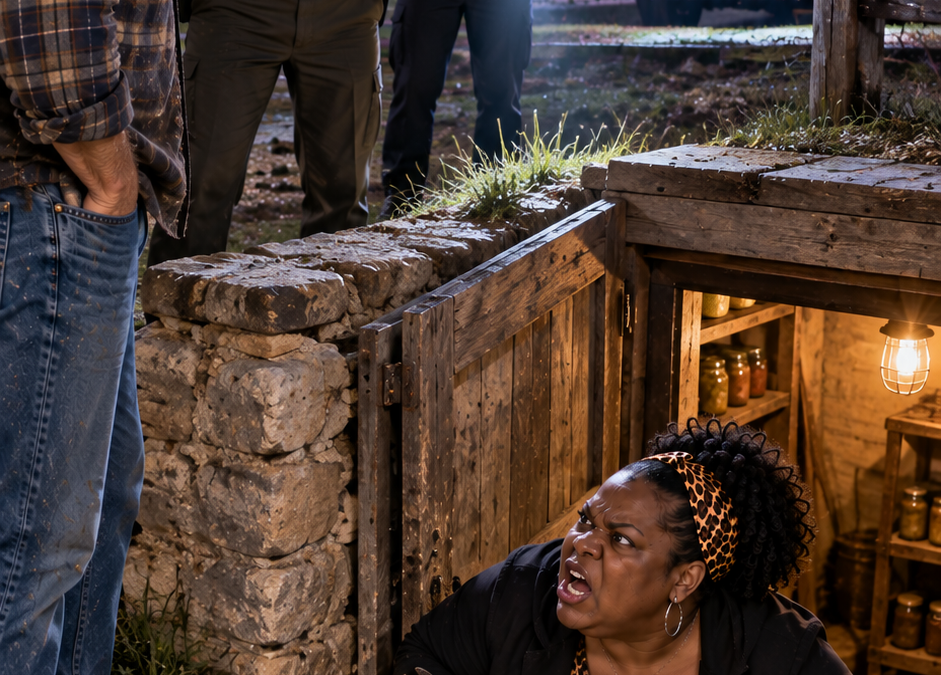
Somewhere underneath it, inside the root cellar my wife and I had rebuilt with our own hands, Marilyn Voss was screaming into a phone that I had locked her underground.
Sheriff Daniel Brooks climbed from the lead cruiser.
Deputy Noah Grant followed.
Neither man had his hand on a weapon.
Neither looked relaxed either.
“Ethan.”
“Sheriff.”
“We got a 911 call.”
“I figured.”
Noah frowned.
“You figured?”
I nodded toward the ridge.
“The call came from my root cellar.”
The two men exchanged a glance.
“You already know who’s inside?” Daniel asked.
“Yes.”
A woman’s voice carried faintly across the pasture.
“Get me out of here!”
Even at two hundred yards, I recognized it.
Marilyn Voss.
President of Cedar Ridge Estates HOA.
The woman who had spent six months telling half the county I was unstable, dangerous, unreasonable, and unfit to manage my own ranch.
Now she was underground on that ranch calling the sheriff to save her.
Noah turned toward the ridge.
“She says you trapped her.”
“I heard.”
“She says you locked the door while she was inside.”
“I didn’t.”
“She says she’s being held against her will.”
I pulled out my phone.
The screen was already open to the security system.
“Watch.”
The first video began at 2:41 a.m.
Infrared.
Rain.
Marilyn’s white SUV stopped along the county road just beyond the cottonwoods.
She got out wearing dark clothing, boots, gloves, and a baseball cap pulled low.
She did not come through the ranch gate.
She climbed the fence.
Noah’s face changed slightly.
The next camera caught her crossing the pasture.
Purposeful.
No hesitation.
Straight toward the ridge.
The third angle showed the root-cellar entrance.
Marilyn stopped.
Looked behind her twice.
Then opened a canvas bag.
Bolt cutters.
The steel jaws closed around my chain.
Snap.
She removed the broken lock.
Forced open the outer gate.
Then disappeared into the hillside carrying a flashlight and a rolled survey map.
The video ended.
Noah lowered the phone.
“She cut your chain.”
“Yes.”
“You invited her?”
“No.”
“You were out there at any point?”
“No.”
Daniel looked toward my house.
“You’ve been inside all night?”
“Since ten-thirty.”
Another shout came from beneath the ridge.
“He trapped me! I need help!”
Daniel rubbed his jaw.
“Any danger in that cellar?”
“Ventilation. Emergency lighting. Water. Food.”
“How much food?”
“Enough that Marilyn could outlast most natural disasters.”
Noah almost smiled.
Then he looked back at the ridge.
“If the HOA doesn’t own this property…”
He stopped.
Looked at me again.
Then asked the question that would eventually unravel the entire thing.
“Mr. Cole, why was the president of an HOA inside a root cellar on land her association doesn’t own?”
The wind moved through the sagebrush.
Nobody spoke for several seconds.
Because that was the right question.
Not:
Why is the door locked?
Not:
Why did Marilyn call 911?
Not even:
Who owns the cellar?
The real question was why the president of a suburban homeowners association had crossed a posted ranch boundary in the middle of the night with burglary tools and a private development map.
I looked toward the limestone ridge.
“This started six months ago.”
Daniel folded his arms.
“With what?”
“A purchase offer.”
“How much?”
“Four hundred eighty thousand dollars.”
“For the ranch?”
“No.”
I looked at him.
“For thirty acres.”
Noah glanced toward the ridge.
“Those thirty acres?”
“Exactly.”
That was when I knew we were finally going to talk about what Marilyn had really wanted from the beginning.
Not the cellar.
Not HOA compliance.
Not community safety.
Land.
And buried underneath all the threats, inspections, rumors, and false maps was a road worth millions.
PART2
Six months earlier, my life was quiet.
Not easy.
Quiet.
There is a difference.
My name is Ethan Cole.
I was fifty-eight when Marilyn Voss decided she needed part of my ranch badly enough to destroy herself trying to take it.
The Cole ranch covered 214 acres outside a small Wyoming county town.
My grandfather bought the original tract in the 1950s.
My father expanded it.
I came home after the Army and eventually took over.
Cattle.
Hay.
A spring-fed pond.
Low timber.
A limestone ridge on the western side.
Nothing glamorous.
But it was ours.
The root cellar sat beneath that ridge.
From the outside, it looked like almost nothing.
Heavy steel door.
Weathered timber surround.
Vent pipes disappearing into stone.
Rachel loved that cellar.
My wife believed food should be stored the same way her grandmother stored it.
Labeled by hand.
Dates written in black marker.
Jars arranged by season.
She built shelves.
Designed the ventilation.
Kept a gardening journal in a steel cabinet at the rear wall.
When a spring flood damaged part of the old structure, Rachel and I rebuilt it together.
I still remembered her kneeling beside the door with primer smeared across one cheek.
She caught me staring.
“What?”
“You missed a spot.”
“Where?”
I tapped my own cheek.
She wiped at hers.
Spread the paint worse.
Then laughed.
Three years later, cancer took her.
I kept the cellar exactly as she left it.
Maybe that wasn’t healthy.
Maybe it was.
People grieve in strange ways.
Some sell the house.
Some move.
Some throw everything out because the memories hurt too much.
I stayed.
And every time I opened that steel door, Rachel’s handwriting was still waiting.
GREEN BEANS — AUGUST 12
TOMATOES — SEPTEMBER 3
PEACH PRESERVES — JULY 28
Human handwriting survives people in a way printed labels don’t.
Rachel used to say that.
“If we’re gone someday, somebody should know another person touched this jar.”
I thought it was sentimental when she said it.
After she died, it became sacred.
Cedar Ridge Estates came later.
The subdivision sat beyond my eastern boundary.
Expensive houses.
Artificial lake.
Landscaped entrance.
Decorative trees where grazing fields used to be.
HOA.
The county plat clearly excluded my 214 acres.
Cedar Ridge residents paid dues.
I paid county taxes.
Their rules stopped at my fence.
For years, that arrangement worked perfectly.
Then Marilyn Voss drove through my gate.
Tuesday afternoon.
White luxury SUV.
She parked near the barn and stepped out carrying a leather portfolio.
No hello.
No small talk.
“You must be Ethan Cole.”
“That depends who’s asking.”
“Marilyn Voss. President of Cedar Ridge Estates.”
I already knew the name.
People in town did too.
Marilyn had a reputation for treating the HOA presidency like elected office with a security detail.
She looked past me.
Her eyes landed immediately on the ridge.
Not the cattle.
Not the house.
Not the barn.
The ridge.
Then the cellar door.
“I’ve been hoping we’d meet.”
“Why?”
She opened the portfolio.
Handed me a sheet.
COMMUNITY SAFETY VIOLATION NOTICE.
I read the heading.
Then looked at her.
“You have the wrong property.”
“No.”
“My ranch isn’t in Cedar Ridge.”
“We know.”
“Then your violation notice is worth whatever the paper cost.”
Her smile remained in place.
“The underground structure creates safety concerns for our residents.”
“It sits behind my fence.”
“Children could wander onto the property.”
“They’d have to cross two gates and ignore posted signs.”
“That does not eliminate liability.”
“Whose liability?”
She changed direction.
“The board believes removal of the structure would improve the safety and property values of Cedar Ridge.”
I almost laughed.
“The board doesn’t own this ridge.”
She held my gaze.
“No.”
Then:
“Not yet.”
That got my attention.
She reached into the folder again.
Purchase agreement.
Offer:
$480,000.
Thirty acres.
Not the whole ranch.
The ridge.
Pond.
Narrow strip connecting them to the Cedar Ridge boundary.
I studied the attached map.
The shape of the proposed purchase was too precise.
It wrapped around the limestone shelf.
Included the root cellar exactly.
“You’ve done some homework.”
“We believe it’s a generous offer.”
“You’re not buying grazing land.”
“We’re buying opportunity.”
“For who?”
“For everyone.”
“Which usually means someone specific.”
Her smile disappeared for half a second.
I handed back the contract.
“Not for sale.”
“You should think carefully.”
“I already did.”
“The area is changing.”
“My deed isn’t.”
That hit something.
Her jaw tightened.
“You’ll hear from the association.”
Then she left.
The next morning, an orange notice was stapled to my ranch gate.
UNSAFE AGRICULTURAL STRUCTURE.
Ten days to cure.
Daily penalties after that.
I photographed it.
Filed it.
Three days later:
CATTLE ODOR IMPACTING RESIDENTIAL PROPERTY VALUES.
Then:
NONCOMPLIANT FENCING.
Then:
POTENTIAL AGRICULTURAL RUNOFF INTO RESIDENTIAL WATERSHED.
By the end of the month, an HOA I had never joined claimed I owed more than twelve hundred dollars.
I answered every notice.
Same packet.
Deed.
County tax map.
Agricultural exemption.
Certified statement from the county confirming Cedar Ridge had no authority over my ranch.
Marilyn never addressed those documents.
She just generated new complaints.
Then county inspectors started arriving.
First was Paul Danner from Environmental Compliance.
Anonymous complaint.
Livestock waste allegedly contaminating residential drainage.
I walked him to my pond.
Clear water.
Spring-fed.
Cattle trough downhill.
Nearest Cedar Ridge house nearly half a mile away.
Paul studied the site.
Then his tablet.
“This description doesn’t match what I’m looking at.”
“Who filed it?”
“Anonymous.”
“Of course.”
He closed the complaint before leaving.
A week later, building inspection.
Root cellar.
I met the inspector with the original county permit.
Reinforcement plans.
Photographs predating Cedar Ridge.
He checked the ventilation.
Steel supports.
Door frame.
Drainage.
Finally he shook his head.
“This thing is safer than half the storm shelters I inspect.”
“Why were you sent?”
He hesitated.
“The request came through a priority channel.”
“What does that mean?”
“It means somebody wanted it seen quickly.”
That sentence stayed with me.
Then Marilyn attacked something harder to defend than a building.
Reputation.
At the feed store, conversations stopped when I walked in.
At church, a woman asked whether I was “doing okay alone.”
Then Henry Walsh called.
Henry lived in Cedar Ridge.
Quiet man.
HOA treasurer.
At the time, I didn’t know how important he would become.
His voice was low.
“Ethan, Marilyn’s been telling people you’ve become unstable.”
“Because?”
“Rachel.”
My hand tightened around the phone.
“What exactly?”
“That her death changed you.”
“True.”
“That you’re isolated.”
“Also true.”
“That you’re angry and obsessed with an underground bunker.”
“The cellar.”
“I know.”
“What else?”
“She’s mentioned your Army injuries.”
I became very still.
“In what way?”
“That you might react unpredictably if the HOA has to enforce community safety.”
“They have nothing to enforce.”
“I know.”
“Does the board?”
A long silence.
“Some know.”
“And?”
“Some don’t want to challenge her.”
That was Marilyn’s strategy.
If she couldn’t establish authority over my land, she would make people afraid of the owner.
The next morning, I bought cameras.
Weatherproof document box.
Digital recorder.
Everything became evidence.
Notice arrives?
Photograph.
Inspector visits?
Log.
Conversation with Marilyn?
Record when lawful.
I had spent years as an Army engineer.
Bad structures rarely fail without warning.
Hairline crack first.
Pressure.
Movement.
Then collapse.
Marilyn was creating pressure.
County complaints.
HOA paperwork.
Neighborhood rumors.
But pressure creates patterns.
And patterns can be documented.
I laid three anonymous complaints side by side.
Different departments.
Different alleged violations.
Same phrase in each:
Immediate action recommended due to community safety concerns.
Word for word.
Coincidence stops being coincidence eventually.
I stopped asking:
How do I defend every accusation?
And started asking:
Who benefits if I sell that ridge?
The answer arrived with Luis Ramirez.
Luis had surveyed ranches, roads, utility corridors, and subdivision boundaries for thirty-four years.
Retired.
Still the man attorneys called when property lines became fights.
He came carrying a leather map tube.
“I hear Marilyn Voss is trying to rewrite geography.”
“Apparently.”
“Geography is stubborn.”
We spread three maps over the hood of my pickup.
Grandfather’s original deed.
County survey from Cedar Ridge approval.
Marilyn’s glossy purchase-offer map.
Luis placed a straightedge across all three.
“Took me five minutes.”
“What?”
He tapped Marilyn’s map.
“This line.”
Then the county survey.
“That line.”
At first I missed it.
Then I saw.
The boundary had moved.
“How far?”
“Forty-two feet.”
Forty-two feet was enough to move the root cellar into a shaded area labeled:
PROPOSED HOA UTILITY / EMERGENCY ACCESS CORRIDOR.
“That corridor exists?”
“No.”
“But it’s drawn here.”
“On her map.”
He emphasized:
“Her map.”
“So somebody changed the boundary.”
“Yes.”
“Error?”
Luis looked at me.
“Forty-two feet in exactly the direction required to capture the only usable passage through this ridge?”
He shook his head.
“I’ve made mistakes. That isn’t one.”
Then he traced a second line.
If a road cut across my ridge, it would connect Cedar Ridge directly to another county road.
Second entrance.
Emergency access.
Development potential.
Luis looked at the limestone.
“Developers pay serious money for this kind of access.”
Now the purchase offer made sense.
I called Claire Bennett.
Property attorney.
Sharp.
Quiet.
Not impressed by intimidation.
By sunset, Claire sat at my kitchen table.
She studied every document.
“The HOA has no authority on your ranch.”
“I know.”
“They know too.”
“You’re sure?”
She tapped Marilyn’s altered map.
“This isn’t a misunderstanding.”
Then she pulled a county planning application from her briefcase.
Applicant:
WHITMORE HOLDINGS, LLC.
Project:
CEDAR RIDGE ESTATES — PHASE II.
Forty-eight new homes.
Private recreation lake.
New clubhouse.
Secondary emergency-access road.
My stomach tightened.
The road crossed my ridge.
Directly through the root cellar.
“Whitmore.”
“Marilyn’s company.”
“So she isn’t acting only as HOA president.”
“No.”
“She has a private development interest.”
“Yes.”
“If they don’t get the corridor?”
Claire pointed at a planning note.
“Phase II does not meet secondary-access requirements.”
“The expansion dies.”
“Correct.”
I leaned back.
That was why thirty acres were worth $480,000.
That was why Marilyn cared about a cellar that had existed decades before Cedar Ridge.
That was why anonymous inspections kept appearing.
She wasn’t enforcing HOA rules.
She was building justification to remove the only physical obstacle between her development and county approval.
“File suit?”
“Not yet.”
“Why?”
“Because she keeps giving us evidence.”
“I don’t like waiting.”
“Neither do I.”
Claire closed the folder.
“But people who believe they’re untouchable get careless.”
She was right.
Marilyn stopped making purchase offers.
Instead, she went after my credibility.
At Cedar Ridge’s summer barbecue, people stared when I arrived.
Luis had convinced me to attend.
“If you stay home,” he said, “she tells your story for you.”
So I showed up.
Old truck.
Work boots.
No performance.
Marilyn stood near the grill talking with homeowners.
She saw me.
Raised her voice.
“I’m worried about him.”
Conversation slowed.
“Living alone can change someone.”
Another resident said:
“I heard he refuses inspections.”
Marilyn sighed.
“When somebody becomes obsessed with an underground bunker, you have to wonder what they’re hiding.”
I kept walking.
Coffee table.
Luis joined me.
“Don’t bite.”
“I know.”
Marilyn approached.
“Ethan. I’m glad you came.”
“I wasn’t invited.”
“This is a community event.”
“I’m not in the community.”
“You could be.”
“I already belong somewhere.”
Her eyes flicked toward my ranch.
“That property must be lonely.”
“Peaceful.”
Someone nearby laughed.
Marilyn didn’t.
“I still think we can reach an agreement.”
“I read your agreement.”
“No.”
She smiled.
“You read the first one.”
Before I could ask what she meant, Luis stepped forward.
“I read something too.”
Marilyn turned.
“What?”
“Phase II.”
No reaction.
“Whitmore Holdings.”
Tiny movement in her jaw.
“Forty-eight homes.”
People nearby started listening.
“Private lake.”
More faces turned.
“And a secondary road across Ethan’s ridge.”
Now everything stopped.
Marilyn’s eyes sharpened.
“I have no idea what you’re talking about.”
Luis unfolded the public development map.
“Then you won’t mind explaining why your company submitted this.”
People moved closer.
A homeowner pointed.
“That road crosses Ethan’s ranch.”
“It can’t,” someone else said. “He isn’t in the HOA.”
Luis nodded.
“Exactly.”
Marilyn stepped toward him.
“These are preliminary concepts.”
“So they are yours.”
“They are private business matters.”
“They became public when you filed them.”
For the first time, Marilyn had no script.
She gathered her papers.
“This discussion is over.”
Then walked into the clubhouse.
Nobody followed.
They stayed around the map.
The question had changed.
Not:
What is Ethan hiding?
But:
Why does Marilyn want Ethan’s land?
The next morning, all four tires on my pickup were cut.
Not punctured.
Sliced.
Same angle.
Slow leak.
The kind that might fail miles down the road.
Luis crouched beside one.
“Knife.”
“You sure?”
“Look at the cut.”
I did.
Clean.
Intentional.
“No camera?”
“Not on this side.”
He stood.
“She’s escalating.”
I looked toward the ridge.
“No.”
“What?”
“She’s running out of time.”
Two nights later, Henry Walsh called from a blocked number.
“Meet me behind Callaghan Feed.”
“When?”
“Before sunrise.”
His voice shook.
At 5:40, I arrived in a borrowed truck.
Henry stood beside the loading dock holding a gray records box.
“I should have done this sooner.”
He opened it.
Bank statements.
Board minutes.
Invoices.
Development agreements.
The money was worse than I expected.
First payment to Grant Mercer and his investment group:
$300,000.
Then engineering.
Drainage study.
Preliminary road work.
Consultants.
All paid from Cedar Ridge’s HOA reserve fund.
“Homeowners approved this?”
Henry shook his head.
“What did Marilyn call it?”
“Confidential Land Acquisition.”
He pulled out a Phase II contract.
Highlighted clause.
Whitmore Holdings had sixty days to deliver clear legal access for the proposed road.
Failure triggered:
Return of investor advances.
Contractual penalties.
Personal guarantees.
“How much is she personally exposed for?”
Henry swallowed.
“More than two million.”
Everything clicked into place.
Marilyn had promised a road she didn’t own.
And every day I refused to sell pushed her closer to financial disaster.
“Why are you giving me this?”
Henry looked down.
“Because she asked me to backdate a board vote.”
He handed me an unsigned resolution.
Emergency acquisition authority.
Printed date:
Three months earlier.
Before residents knew Phase II existed.
“I kept telling myself she knew what she was doing.”
“And now?”
“Now she wants my signature on a lie.”
I called Claire.
She arrived before noon.
“This changes everything.”
“Motive?”
“Motive. Misuse of association funds. Possible fraud.”
Henry sat at my table looking miserable.
Claire asked:
“Will you testify?”
He stared at her.
“She’ll destroy me.”
Claire said:
“If the money disappears, who do you think she blames?”
Henry closed his eyes.
Then nodded.
“I’ll testify.”
Someone inside Cedar Ridge had finally crossed the line.
Marilyn was already moving faster.
That night, my camera caught her SUV passing the ranch at 11:17.
Again at 11:43.
Third pass:
She stopped.
Headlights off.
Walked toward the boundary.
Didn’t cross.
She photographed the root cellar.
Hinges.
Lock.
Distance to road.
Then counted her steps along the fence.
Claire watched the footage the next morning.
“She’s planning access.”
“We arrest her now?”
“For standing outside your boundary?”
“No.”
“Then more cameras.”
Two nights later, Marilyn came back.
She walked right to the fence.
Still didn’t cross.
She aimed a flashlight at the cellar.
Tested the view from the road.
Then left.
I filed certified copies of my deed, original survey, and agricultural-use records with county planning.
Claire wanted the public record clean before Marilyn tried another boundary stunt.
At the courthouse, I heard her voice through a partially closed conference-room door.
“You said the drainage approval was enough.”
A man answered.
“It was enough when you guaranteed clear access.”
Grant Mercer.
I stopped by the water fountain.
Through the gap, I saw them.
Marilyn sat across from Grant.
He wore a dark suit.
No patience left.
“Twelve days.”
“I know.”
“Then solve it.”
“The inspections are creating pressure.”
“Pressure isn’t title.”
“The county has flagged Cole as a safety concern.”
“Not officially.”
Marilyn paused.
“That can be fixed.”
I started recording.
Grant leaned forward.
“Be specific.”
“We have draft findings.”
“What findings?”
“Structural instability. Drainage concerns. Potential collapse.”
“Draft.”
“They become actionable if there’s an incident.”
Silence.
“What kind of incident?”
Marilyn answered:
“Emergency failure.”
My grip tightened around the phone.
“Compromised entrance.”
Grant said nothing.
“Ground movement after rain.”
Still nothing.
“Something that requires immediate demolition before Cole’s attorney gets an injunction.”
Grant’s chair moved.
“You’re describing criminal exposure.”
“I’m describing a safety response.”
“You’re describing destroying private property.”
“I’m describing removing the last obstacle between your money and forty-eight finished lots.”
I felt cold.
Then Marilyn said:
“Once the cellar is gone, they can cut the ridge.”
Pause.
“Once the ridge is cut, no judge puts it back.”
There it was.
She did not need to win title.
She needed to change the physical reality first.
Destroy the obstacle.
Fight about legality afterward.
Grant stood.
“I want no written connection to that.”
“You already signed the agreement.”
“For access. Not sabotage.”
“Then stop asking how I deliver it.”
Footsteps approached.
I slipped into a records room before the door opened.
Grant left first.
Marilyn followed.
Rolled map beneath her arm.
She never saw me.
Claire listened to the recording twice.
“This is serious.”
“Then file.”
“Not yet.”
I stared at her.
“She just discussed destroying the cellar.”
“She discussed possibilities.”
“Claire.”
“I need her stopped in a way she cannot convert into a claim that you provoked her.”
“She has to cross the fence.”
“Yes.”
I hated that answer.
She leaned forward.
“From now on, you do nothing aggressive.”
“I understand.”
“No threats.”
“Yes.”
“No confrontation.”
“Yes.”
“No approaching her vehicle.”
“Yes.”
“If she crosses onto your property?”
“Record. Call law enforcement.”
“Immediately.”
I looked toward the ridge.
“The next move belongs to her.”
“Yes.”
Claire paused.
“But you can decide what evidence her move creates.”
Luis came the following morning with camera cases and a reinforced locking assembly.
Claire came too.
We upgraded the cellar security.
Exterior camera:
Approach.
Hidden interior camera:
Door.
Another:
Rear shelves and work table.
Forced-entry sensor.
Off-site video backup.
The lock system had two internal steel bolts.
If the outer door was forced without an access code, the inner security system engaged automatically.
Claire looked directly at me.
“Can Ethan lock it manually?”
Luis shook his head.
“Not from the house. Only the system engages on forced entry.”
“Good.”
She looked at me.
“You do not trap her.”
“I know.”
“If she breaks in and the system secures the cellar, call law enforcement immediately.”
“I understand.”
“No waiting to teach her a lesson.”
“I said I understand.”
She softened.
“I know what that place means to you.”
That was precisely why she was being careful.
We replaced the visible chain.
Ordinary.
Nothing intimidating.
If someone cut it, damage would be obvious.
Inside, I removed Rachel’s journal.
Original deeds.
Anything irreplaceable.
Everything went into a secure bank box.
Then I left one envelope in the empty steel cabinet.
Certified copy of the original survey.
Across the top, Luis wrote:
ORIGINAL COUNTY BOUNDARY — NO EASEMENT.
That was all.
No message.
No provocation.
Just the record.
Three days passed.
Nothing.
Then Marilyn came to my ranch gate in daylight.
Another violation notice.
“Final opportunity to cooperate.”
“With what?”
“Emergency geological assessment.”
“Of land your association doesn’t own.”
“The ridge impacts Cedar Ridge drainage.”
“The county map says otherwise.”
“You seem very confident in your paperwork.”
“My grandfather kept good records.”
“Records can be misunderstood.”
“Not the originals.”
That stopped her.
I glanced toward the ridge.
“Some have been stored underground since before I was born.”
Her eyes moved instantly to the cellar.
“Underground where?”
I didn’t answer.
She adjusted her handbag.
“You should be careful storing valuable records in an unsafe structure.”
“It has survived seventy years.”
“Everything fails eventually.”
She turned.
Before reaching the SUV, she looked back at the cellar.
Not casual.
Calculating.
That night:
Motion alert.
11:46 p.m.
Marilyn.
She stood beyond the fence for five minutes.
Watching the cellar.
Left.
The next night:
Returned.
Bolt cutters visible on the passenger seat.
Still didn’t cross.
Then came the storm.
Hard rain.
Wind.
Midnight.
At 2:41, my phone vibrated.
MOTION DETECTED — SOUTH RIDGE.
I opened the feed.
Marilyn parked under the cottonwoods where the house couldn’t see her vehicle clearly.
Dark raincoat.
Gloves.
Bolt cutters.
Rolled map.
She climbed the fence.
Camera One captured everything.
Camera Two:
Pasture.
Camera Three:
Cellar door.
She cut the chain.
Forced open the outer gate.
Entered.
FORCED ENTRY CONFIRMED.
The system engaged.
I called Claire.
“She’s inside.”
“Stay in the house.”
“I am.”
“Call the sheriff now.”
Interior footage showed Marilyn sweeping her flashlight over the shelves.
She ignored food.
Water.
Emergency supplies.
Went directly to the cabinet.
Opened drawers.
Threw empty folders onto the floor.
“The deeds have to be here.”
Her own voice.
Recorded.
She unrolled the development map over Rachel’s old work table.
Red road line.
Straight through the ridge.
Then Marilyn said:
“If Cole proves the boundary, the whole expansion dies.”
I saved the clip separately.
She found the envelope.
Opened it.
Saw the certified survey.
Her face changed.
Fury.
She shoved it into her bag.
Turned toward the exit.
Pushed the steel door.
It didn’t open.
Again.
Harder.
The reinforced bolts held.
She screamed my name.
I was already talking to dispatch.
“This is Ethan Cole.”
“What’s the emergency?”
“Someone broke into my root cellar.”
“Are they still inside?”
“Yes.”
“Are they armed?”
“Bolt cutters. I don’t know what else.”
“Did you lock them in?”
“No. Forced-entry security system engaged automatically.”
“Are you near the structure?”
“No. I’m inside my house.”
“Do not approach.”
“I won’t.”
Then Marilyn made her own 911 call.
Her story reached deputies before they arrived.
I had lured her underground.
I deliberately imprisoned her.
I had threatened her over an HOA dispute.
At 3:08, cruisers came through my gate.
And that brings us back to Sheriff Brooks asking why an HOA president was inside a cellar on property her HOA never owned.
After he watched the exterior footage, we crossed the pasture together.
Rain soaked our jackets.
Mud pulled at our boots.
Marilyn heard us.
Started pounding.
“Sheriff! Arrest him!”
Daniel stopped outside the door.
He did not open it.
“Mrs. Voss?”
“Thank God! Get me out!”
“We will.”
“Now!”
“I need to review something first.”
He watched the interior footage on my phone.
Marilyn entering.
Cabinet.
Map.
Search.
Her statement:
If Cole proves the boundary, the whole expansion dies.
He watched again.
Then looked at the bolt cutters visible beside the stairs.
Finally he stepped close to the door.
“Mrs. Voss?”
“Yes?”
“You said there was an emergency.”
“There is! I’m trapped!”
“No. Before you entered.”
Silence.
“You told dispatch you entered because you believed there was a safety emergency.”
“Yes.”
Daniel’s voice remained level.
“Then why did you bring bolt cutters and a private development map?”
Everything stopped.
No pounding.
No shouting.
Only rain ticking against steel.
That silence said more than any accusation I could have made.
Daniel looked at Noah.
“Open it.”
Noah entered the emergency code I had given him.
Steel bolts retracted.
Door opened.
Marilyn climbed the stairs.
Wet.
Dust on her knees.
Rolled map clutched against her chest.
She pointed directly at me.
“That’s him.”
Nobody moved.
“He locked me in!”
Daniel held out his hand.
“The map.”
“This is private business.”
“So was the cellar.”
She hesitated.
Daniel took the map.
Noah bagged the bolt cutters.
Daniel looked at Marilyn.
“Did Mr. Cole invite you onto this ranch?”
“No.”
“Did he authorize you to cross the fence?”
“I had authority to inspect.”
“From whom?”
“The HOA—”
“Does the HOA own this land?”
Marilyn stopped.
“Does it?”
“No.”
“Did Mr. Cole authorize you to cut the chain?”
“I had probable cause—”
“You’re not law enforcement.”
“I was protecting residents.”
“From what?”
“The structure.”
“What condition inside this structure required emergency entry at 2:41 a.m.?”
She looked at me.
“He’s hiding records.”
I answered:
“They were filed with the county yesterday.”
Marilyn’s face changed.
“You knew?”
“I knew what?”
“That I—”
She stopped herself.
Too late.
Claire’s headlights appeared across the pasture.
She had brought certified copies.
Deed.
Original county survey.
Boundary records.
Daniel unfolded Marilyn’s map beside the county survey.
The difference was visible.
“Where’s this corridor on the county document?”
Claire answered.
“It isn’t.”
“Never approved?”
“Never.”
“Ownership interest?”
“None.”
Noah lifted the bag containing the bolt cutters.
“So we have entry across a marked boundary, a cut lock, forced entry into a private structure, and a search.”
Claire nodded.
“And a development map tied to a private project.”
Marilyn snapped:
“I was protecting Cedar Ridge.”
Daniel looked at the shelves.
“From canned tomatoes?”
Even Noah looked away to hide a reaction.
Marilyn pointed toward me.
“He’s obstructing infrastructure.”
“What infrastructure?”
“The access corridor.”
Claire laid the original map beside Marilyn’s.
“There is no legal corridor.”
Daniel studied both.
Then:
“Mrs. Voss, you are being detained while we investigate trespass, criminal mischief, and possession of burglary tools in connection with unlawful entry.”
Her face went pale.
“You cannot do this.”
Daniel looked at her.
“I just did.”
By sunrise, Claire had filed for emergency relief.
The judge froze all Cedar Ridge Phase II activity pending review.
Grant Mercer withdrew his financing days later.
Without legal road access across my ridge, the project could not satisfy county secondary-access requirements.
Phase II collapsed before foundation work began.
Three weeks later, the courtroom was full.
Cedar Ridge homeowners took one side.
County officials sat on the other.
Marilyn sat beside counsel.
No HOA blazer.
No clipboard.
Luis testified first.
He placed the original survey and Marilyn’s modified version on a display.
“Difference?”
Claire asked.
“Forty-two feet.”
“Could that be normal survey variation?”
“No.”
“Why?”
“Because the movement is not random. The altered line captures a specific ridge corridor and structure necessary for the proposed access route.”
“Was any county amendment recorded?”
“No.”
“Any easement?”
“No.”
“Any boundary adjustment?”
“No.”
“What is your conclusion?”
Luis took his time.
“The map used by Whitmore Holdings does not reflect the legally recorded boundary.”
Henry testified next.
His hands shook.
He described reserve funds.
Three hundred thousand dollars.
Engineering payments.
Planning costs.
Payments homeowners never authorized.
Then the request to backdate a board resolution.
Claire showed him the document.
“Did you sign this?”
“No.”
“Why?”
“Because the date was false.”
“When was it prepared?”
“Months after the date printed at the top.”
“What was Marilyn trying to authorize?”
“Emergency acquisition of the Cole ridge.”
A murmur moved through the homeowners.
Judge Rebecca Lawson silenced the room.
Then Claire played the courthouse recording.
Marilyn’s voice:
Once the cellar is gone, they can cut the ridge.
Then the cellar footage:
If Cole proves the boundary, the whole expansion dies.
Nobody shifted.
Nobody coughed.
Judge Lawson removed her glasses.
Looked directly at Marilyn.
“Mrs. Voss.”
Marilyn raised her head.
“On the night you entered Mr. Cole’s root cellar, did Cedar Ridge Estates HOA possess any recorded ownership interest in his ridge?”
“No.”
“The pond?”
“No.”
“The cellar?”
“No.”
“The road?”
“No.”
“Any recorded easement?”
“No.”
“Any county authorization permitting entry?”
Silence.
“No.”
The ruling came quickly after that.
The purported corridor was invalid.
My recorded boundary controlled.
Cedar Ridge Phase II could not proceed across my land.
The HOA and associated development entities were prohibited from asserting ownership or access rights unsupported by recorded title.
Marilyn was held liable in the civil action for trespass and property damage.
The financial conduct involving HOA reserves and development expenditures was referred for separate investigation.
Other criminal questions moved through their own process.
I stopped following every detail.
I had what I needed.
My ridge.
My cellar.
My boundary.
Protected.
The part people expected me to enjoy most was Marilyn losing.
I didn’t.
By then, I was tired.
Six months of living like every white SUV might be another accusation will do that.
The people I cared about were the homeowners who discovered their reserve fund had been used to finance a private development deal without proper approval.
Some were retired.
Some had saved for years.
Some believed the reserve existed for roads, drainage, roofs, storm repairs.
Instead, hundreds of thousands had moved toward a project tied to Marilyn’s private company.
They elected a new board.
Henry helped with the transition.
He hated being thanked.
“I waited too long.”
“You came forward.”
“I waited too long.”
“Both can be true.”
He looked at me.
“I should’ve stopped her earlier.”
“Maybe.”
I wasn’t going to lie to make him feel better.
“But you stopped helping her when it mattered.”
That was enough.
The new board’s first formal resolution stated that Cedar Ridge would not pursue expansion requiring acquisition of private neighboring land without transparent homeowner approval and verified title rights.
Simple.
Embarrassingly obvious.
Necessary.
Luis and I replaced the root-cellar chain.
The broken one went into my workshop.
Not displayed.
Just kept.
Maybe because Rachel would have kept it.
She hated throwing away useful metal.
A few weeks after everything settled, I carried her gardening journal back underground.
The security system was still there.
Cameras too.
But the cellar felt like itself again.
I placed the journal in the steel cabinet.
Same shelf.
Ran my fingers over her handwriting.
PLANT PEAS AFTER LAST HARD FREEZE.
ROTATE TOMATO BEDS.
CHECK SOUTH SHELF HUMIDITY.
Ordinary notes.
Worth more to me than Phase II ever could have been worth to Marilyn.
Outside, evening sun reflected off the pond.
Cattle grazed beyond the fence.
The ridge had not moved.
That’s what stayed with me.
Marilyn spent six months trying to manufacture movement.
Move the boundary forty-two feet.
Move public opinion.
Move county inspectors.
Move HOA funds.
Move the legal record.
Move me.
But the actual land never went anywhere.
Neither did the recorded line.
Neither did Rachel’s cellar.
Truth can be inconvenient that way.
It is often much less flexible than ambition.
People sometimes ask whether I deliberately trapped Marilyn.
No.
That’s important.
I upgraded the cellar after a recorded threat.
The security system was designed to secure a breached structure.
Forced entry triggered the bolts.
That was the whole purpose.
I did not manually lock her underground.
I did not lure her onto my property.
I did not tell her the deed was waiting for her.
I told her my grandfather kept good records.
True.
I told her records had been stored underground.
Also true.
What Marilyn did with that information belonged to her.
She chose the hour.
The dark clothes.
The gloves.
The bolt cutters.
The route over the fence.
The search.
The theft of the survey copy.
Then, when the consequences arrived, she called 911 and tried to turn the trespass victim into the criminal.
If there had been no cameras, maybe it would have worked for a while.
That possibility bothers me.
Because at 3:08 a.m., deputies arrived expecting one story.
Woman trapped underground.
Property owner accused of locking her in.
Without footage, first impressions matter.
Marilyn understood that.
She had been using first impressions for months.
Dangerous rancher.
Unsafe cellar.
Unstable widower.
Community threat.
Priority inspection.
Emergency corridor.
Every label was designed to arrive before the underlying record.
But cameras do not care about labels.
They recorded:
2:41 a.m.
Fence crossing.
Bolt cutters.
Broken chain.
Map.
Search.
Her own voice.
The order of events became impossible to rewrite.
That’s why Noah’s question mattered.
Why are you inside a cellar on land your HOA doesn’t own?
Everything Marilyn had built depended on never answering that.
Because once you asked, every layer beneath it appeared.
Why did she want the cellar?
Because she wanted the ridge.
Why the ridge?
Road.
Why the road?
Phase II.
Why Phase II?
Money.
Why the false map?
Without forty-two stolen feet on paper, the road didn’t fit.
Why the inspections?
Pressure.
Why the rumors?
Make me easier to discredit.
Why the HOA reserve money?
Private project needed funding.
Why the backdated resolution?
Because homeowners had never authorized what she had already spent.
Why the midnight entry?
Time was running out.
One question.
Whole structure.
Hairline crack.
Pressure.
Collapse.
Army engineering taught me that.
Bad systems fail the same way bad bridges do.
Not because somebody screams at them.
Because eventually one connection stops carrying the load.
For Marilyn, that connection was the assumption nobody would ask why she was there.
The sheriff asked.
She had no answer.
Months later, I ran into Daniel Brooks at the feed store.
He was buying dog food.
I was looking for mineral blocks.
He came up beside me.
“Cellar still secure?”
“Still underground.”
“Good place for one.”
“Usually.”
He smiled.
Then asked:
“You know what I thought when we got that call?”
“What?”
“That we’d find some domestic dispute gone strange.”
“I live alone.”
“We didn’t know that yet.”
“Fair.”
He shook his head.
“Then Noah showed me the first video.”
“The fence?”
“The bolt cutters.”
He laughed once.
“Changes the mood.”
I thanked him.
“For what?”
“Asking the right question.”
Daniel looked at me for a moment.
“Wasn’t complicated.”
“No.”
He picked up his dog food.
“Usually the good questions aren’t.”
Then walked away.
Henry stayed in Cedar Ridge.
Eventually he joined the new finance committee.
Not treasurer.
He said he’d had enough titles.
Margaret Ellis, a retired accountant who had challenged Marilyn at several meetings, became president.
First community-wide message she sent:
All board contracts and reserve-fund expenditures over $25,000 will be published for homeowner review.
No secrecy.
No “confidential acquisition.”
People started attending meetings.
Not because they were afraid.
Because they finally believed attendance mattered.
Luis kept working despite insisting he was retired.
Every time I called, he said:
“I thought I quit.”
Then showed up anyway.
Claire sent me the final civil order in a plain envelope.
No victory note.
Just:
For your records.
That was Claire.
I filed it beside the original survey.
The altered map went into a separate evidence box.
Sometimes I look at the two.
Forty-two feet.
On paper, not much.
On the ground:
Everything.
Forty-two feet was the difference between:
My cellar.
And their corridor.
Private ranch.
And Phase II.
Recorded truth.
And a two-million-dollar promise.
Marilyn nearly built an empire on forty-two feet that didn’t belong to her.
The ridge still has scars from weather.
Limestone cracks.
Roots.
Old drainage channels.
But none from bulldozers.
I consider that the real outcome.
Not the courtroom order.
Not Marilyn’s fall.
Not the HOA investigation.
A ridge that remained intact.
One spring morning, I opened the root-cellar door just after sunrise.
Rachel’s shelves were dusty.
I cleaned them.
Moved old jars.
Checked seals.
Threw out a few things that had gone bad.
At the back, I found a jar of peach preserves with Rachel’s handwriting.
Date from years ago.
Long expired.
I sat there holding it.
For a minute, I couldn’t move.
Then I laughed.
Rachel would have thrown it away without hesitation.
“Sentimental idiot,” she’d have called me.
So I opened it.
Smelled wrong.
Threw it out.
Washed the jar.
Kept the label.
Maybe grief changes too.
You spend years protecting every object because losing anything feels like losing the person again.
Then one day you realize memory isn’t stored in peaches.
It’s stored in the hands that packed them.
I put the clean jar back on the shelf.
Walked outside.
Locked the door.
New chain.
Same ridge.
I kept the cameras.
People ask whether that means I’m still afraid.
No.
It means I learned something.
Trust the fence.
Keep the deed.
Document the pressure.
And don’t assume someone’s title gives them authority they cannot prove.
Marilyn had the title.
HOA President.
Whitmore Holdings owner.
Development partner.
She had the SUV.
The board.
The attorney letters.
The planning application.
The money.
I had an old ranch, a root cellar, a survey, and patience.
In the end, only one side’s map matched the ground.
That matters.
The cattle don’t know any of this.
They still graze the same pasture.
The pond still freezes every winter.
Cottonwoods still drop leaves against the cellar entrance.
The root cellar still smells like limestone, metal shelves, and whatever Rachel stored last.
Life returned to quiet.
Not easy.
Quiet.
The good kind.
One evening, Henry came by with a six-pack.
We sat on the porch.
He looked toward the ridge.
“You ever think about selling now?”
“No.”
“Not even the thirty acres?”
“No.”
“Could probably get more than four eighty.”
“I know.”
He smiled.
“Had to ask.”
We sat.
After a while, he said:
“You know what Marilyn told me after you rejected the offer?”
“What?”
“That everybody has a price.”
I looked toward the ridge.
“She was right.”
Henry turned.
“What is yours?”
“Mine wasn’t money.”
He waited.
I thought about Rachel.
Grandfather’s fence.
My father’s cattle.
The survey.
All the years of people trying to convert land into opportunity.
“Peace.”
Henry nodded.
“That expensive?”
“Apparently.”
He laughed.
The sun disappeared behind the ridge.
No development lights.
No construction equipment.
No emergency-access road.
Just limestone turning dark.
That’s how I wanted it.
There is one photograph I kept from the sheriff’s file.
Not Marilyn.
Not the bolt cutters.
The broken chain.
It lies on wet ground outside the cellar.
One clean cut through steel.
Rainwater collecting around it.
I keep it because it reminds me how close arrogance comes to looking like certainty.
Someone carried a tool onto my ranch convinced that cutting one chain would remove the last barrier between her and millions of dollars.
But the chain was never the real barrier.
The deed was.
The survey was.
The county record was.
The cameras were.
Henry’s conscience was.
Luis’s ruler was.
Claire’s patience was.
And eventually, one deputy’s question was.
Why were you inside a cellar on land you didn’t own?
That was all.
Marilyn spent six months building a story in which I was dangerous, unreasonable, unstable, and standing in the way of progress.
At 3:08 one rainy morning, she climbed out of my root cellar with bolt cutters in an evidence bag and her private development map in the sheriff’s hand.
No story survives that image for long.
People like to say justice happened in the courtroom.
Some of it did.
But the real turning point happened outside that steel door in the rain.
Sheriff Brooks could have accepted Marilyn’s framing.
Woman trapped underground.
Angry landowner.
HOA conflict.
Instead, he looked at what was actually there.
Broken chain.
Private property.
Development map.
Tools.
Security footage.
Then he asked the question.
Everything afterward was only paperwork catching up with the answer.
The ridge belonged to me.
Always had.
The cellar belonged to me.
Always had.
And Marilyn Voss had no lawful reason to be inside either one.
That truth had been recorded long before she ever learned my name.
All I had to do was make sure nobody buried it before sunrise.








