HOA Karen Banned Neighborhood Kids From Fishing on My Private Lake—and Started Fining Me $700 a Day
𝗣𝗔𝗥𝗧 𝟮
My family had owned Mercer Lake and the surrounding land for more than a hundred years. The original conveyance dated to 1921, when my great-grandfather, William Mercer, bought roughly 1,700 acres of cattle ground, timber, and water from a regional land company. The family expanded over the decades. By the time I inherited the property from my father, the ranch covered just over four thousand acres.
The lake sat near the eastern boundary.
For most of my childhood, there had been nothing beyond it except woods.
Then Cedar Ridge arrived.
The developer bought adjoining acreage fourteen years earlier and built a gated subdivision along the ridge above the eastern shoreline.
At first, relations were fine.
Residents occasionally asked whether they could walk near the water.
I usually said yes.
Parents asked whether their kids could fish from my dock.
Usually yes.
An elderly couple asked if they could photograph birds from the bank every Sunday morning.
Definitely yes.
That was how neighbors behaved.
They asked.
Victoria Vale did not ask.
She arrived at Cedar Ridge in early spring after purchasing one of the largest homes overlooking the lake. Within three weeks, she had joined the architectural committee. Within two months, she was chairing enforcement meetings. By month four, she had somehow become the most influential person on the board without technically holding the president’s title.
That title belonged to a man named Preston Hale.
Preston was a real estate broker with perfect teeth, expensive loafers, and the habit of agreeing with Victoria immediately after she finished speaking.
People around Cedar Ridge joked that Preston was president and Victoria was government.
The fishing dispute started with noise.
Not much noise.
Kids laughing.
A tackle box closing.
Someone calling across the water after catching a bass.
Victoria complained that the sound carried toward her patio.
I told her I would remind everyone to be respectful.
That should have ended it.
Instead, she sent an email the next day proposing “lake-use standards.”
I replied that the HOA had no authority over my lake.
She wrote back that the matter was “under jurisdictional review.”
That phrase told me I needed a lawyer.
Rachel Coleman had represented my family for years.
She was forty-four, sharp, calm, and almost offensively patient with people who deserved less patience.
When I called her after Victoria’s first notice, she asked me to send every document.
Twenty minutes later, she called back.
“Dan, are you an HOA member?”
“No.”
“Has Mercer Ranch ever been annexed into Cedar Ridge?”
“No.”
“Does the HOA have a recorded easement over the lake or shoreline?”
“No.”
“Any covenant agreement?”
“No.”
“Any shared maintenance arrangement?”
“No.”
There was a pause.
“Then why are they sending you violation notices?”
“Because Victoria owns a printer.”
Rachel sighed.
“I was afraid you’d say something like that.”
She ordered a title review and recommended a new survey before we responded formally.
That was why the orange markers appeared.
I wanted certainty.
Not family legend.
Not an old map hanging in the ranch office.
Recorded certainty.
The surveyor, Ben Thompson, spent two days walking the eastern boundary.
His conclusion was simple.
The entire lake sat within Mercer property.
The shoreline sat within Mercer property.
The dock sat within Mercer property.
The nearest Cedar Ridge parcel ended between thirty-eight and seventy-four feet from the water depending on location.
There was no shared shoreline.
No access strip.
No association parcel touching the lake.
Nothing.
Rachel sent a written notice to the HOA instructing them to stop claiming authority and stop entering my land.
Victoria responded by posting more signs.
That was when the dispute stopped being annoying.
It became deliberate.
At nine-thirty that morning, I drove to the county planning and land-records office carrying a folder thick enough to make the clerk raise an eyebrow.
“You building an airport?” she asked.
“Worse.”
“HOA?”
I looked at her.
She smiled.
“Third one this month.”
Her name was Janice Powell. She had worked in county records longer than Cedar Ridge had existed.
I showed her the original chain of title, the modern deed, the survey, and the HOA notices.
Janice read the first page.
Then the second.
Then looked up.
“Seven hundred a day?”
“That’s what they say.”
“Are you in the association?”
“No.”
She looked back down.
“This should be interesting.”
She pulled the parcel records.
Every document matched what Rachel had already confirmed.
Mercer Lake was private property.
Cedar Ridge had no recorded interest.
No annexation.
No lake easement.
No recreational-rights agreement.
No shoreline maintenance authority.
Nothing.
I filed a formal complaint regarding the HOA signs installed on my parcel and asked for written confirmation of the property status.
Then I walked downstairs to the planning office.
A county land-use inspector named Robert Haines reviewed the same packet.
Robert had inspected one of my barns several years earlier.
He remembered me.
More importantly, he remembered the development.
“Cedar Ridge touches the eastern parcel boundary,” he said.
“Correct.”
“But not the lake.”
“Correct.”
He looked at Victoria’s sign photograph.
“Who put this up?”
“HOA contractors.”
“After you told them not to?”
“Yes.”
He leaned back.
“That’s not smart.”
“No.”
“Are you asking us to enforce the deed?”
“No. I know ownership disputes are civil. I’m asking you to confirm whether there’s any county approval, recorded plat, or land-use basis for their claim.”
“That I can do.”
He scheduled a site inspection for two days later.
Victoria somehow found out.
I suspected Preston.
By that afternoon, she had transformed the inspection into a public event.
A local community reporter named Lisa Brennan called me.
“Mr. Mercer, Cedar Ridge HOA says the county is reviewing dangerous recreational activity on Mercer Lake.”
I closed my eyes.
“Is that what they told you?”
“Yes.”
“They invited you?”
“Yes.”
“Did they mention I own the lake?”
A pause.
“No.”
“Then you may want to bring a notebook.”
Lisa laughed.
“I usually do.”
The inspection was scheduled for Thursday at four.
By three-forty-five, Victoria had created a stage.
She stood beside one of her NO FISHING signs wearing a pink skirt suit, pearl earrings, oversized sunglasses, and enough confidence to power the county.
Preston stood beside her.
Two other board members lingered behind them.
A local cameraman filmed the shoreline.
Three parents from Cedar Ridge watched from the road.
The kids were there too, although I had asked them to remain near the ranch side until the county finished.
Victoria saw me approaching.
She smiled for the camera.
“Dan, glad you came.”
“I live here.”
She ignored that.
Lisa Brennan stepped toward us with a microphone.
“Ms. Vale says the HOA enacted the restriction because of safety concerns.”
I looked at Victoria.
“What safety concerns?”
She answered before Lisa could.
“Hooks. Water hazards. Unsupervised activity. Noise. Litter. Visual clutter. Liability.”
I nodded slowly.
“That’s quite a list.”
“It’s responsible governance.”
“Whose water are you governing?”
She smiled.
“The community’s.”
I pointed toward the lake.
“That one?”
“Yes.”
“Interesting.”
Preston stepped forward.
“Dan, this doesn’t need to become confrontational.”
“It already became confrontational when your association fined me $700 a day.”
“That was enforcement.”
“Of rules that don’t apply to me.”
“That’s your interpretation.”
Rachel had warned me not to debate legal conclusions on camera.
So I didn’t.
Instead, I asked one question.
“Preston, can you show me the document giving Cedar Ridge authority over this lake?”
He glanced at Victoria.
She answered.
“The board’s legal position is not something we need to litigate in front of the media.”
Lisa raised her eyebrows.
That was when Robert Haines arrived.
He stepped out of his county truck carrying a tablet and a rolled map.
Victoria greeted him like a politician receiving a foreign ambassador.
“Inspector Haines. Thank you for coming. We’re very concerned about ongoing unauthorized activity.”
Robert looked at me.
“Afternoon, Dan.”
Victoria’s smile twitched.
Robert walked the boundary.
He checked the orange survey markers.
He compared coordinates.
He reviewed the subdivision plat.
He checked the county’s parcel layer.
Then he examined the location of every HOA sign.
Three were clearly inside my parcel.
One sat almost twenty feet inside.
He photographed them.
Victoria followed him closely.
“Those signs were placed to protect residents.”
Robert nodded without looking at her.
“Who authorized installation on this parcel?”
“The HOA.”
“That wasn’t what I asked.”
Preston stepped closer.
“We believed this shoreline was subject to association oversight.”
Robert looked at him.
“Based on what?”
Preston opened his mouth.
Then closed it.
Victoria answered.
“The community has used the lake for years.”
I corrected her.
“Residents have used it with permission.”
“That is not how residents understood it.”
I looked toward Mrs. Bell, Tommy’s mother.
She called from the road, “Yes, it is.”
Victoria turned.
Mrs. Bell shrugged.
“Dan always told us to ask.”
Another parent nodded.
“So did we.”
Victoria’s expression tightened.
Robert returned to his tablet.
“Inspector,” she said, “whether or not there’s a technical boundary issue, the HOA still regulates behavior affecting community welfare.”
“On HOA property.”
“And adjacent areas.”
“Under what recorded authority?”
Victoria’s cheeks reddened.
“You’re focusing too narrowly.”
Robert finally looked up.
“I’m a land-use inspector. Narrow boundaries are pretty much the job.”
Lisa Brennan covered a smile.
Robert asked me for the title packet.
I handed him certified copies.
He read the legal description.
Checked the survey.
Then looked at the subdivision map again.
Several minutes passed.
Nobody spoke.
The lake lapped softly against the dock.
A kid’s bobber drifted near the reeds.
Finally Robert walked back toward the cameras.
“This parcel is not part of Cedar Ridge.”
Victoria interrupted.
“That’s not the issue.”
He continued.
“The lake is contained within the Mercer parcel. The visible shoreline is also within that parcel. County records show no HOA ownership interest, recorded annexation, or association easement granting recreational-control authority here.”
Victoria’s smile disappeared.
“The board voted.”
Robert nodded.
“That does not change the parcel map.”
“The community has safety concerns.”
“Then the HOA can regulate HOA property.”
“The kids are residents.”
“Some are.”
“So we can regulate them.”
“Maybe under valid association rules when they’re subject to those rules. That still doesn’t give you ownership of Mr. Mercer’s land.”
Victoria clutched her folder tighter.
“You’re saying he can allow anything?”
“No. State law and county rules still apply. But fishing itself is lawful here subject to ordinary licensing and safety requirements. I see no county basis for your posted ban.”
She pointed at the signs.
“These are HOA notices.”
“Three are installed on property your HOA does not own.”
Her face changed.
Robert continued.
“I recommend you remove them.”
“Recommend?”
He looked at the sign closest to him.
“If Mr. Mercer files the property complaint he discussed with our office, you may also face enforcement consequences for unauthorized signage depending on the applicable code provisions. Your attorney should review that.”
Victoria’s folder trembled slightly.
It was the first physical sign that she understood the situation had changed.
Preston stepped closer to her.
“You told us the shoreline was common-adjacent property.”
“It is.”
Robert shook his head.
“No.”
Two letters.
That was all it took.
Victoria’s certainty cracked.
Preston looked at the orange markers.
Then at me.
Then at the lake.
“How long has this survey been recorded?”
“Two weeks,” I said.
“You knew?”
“Yes.”
“And you didn’t tell us?”
“I sent your association a certified letter.”
One board member behind him spoke.
“I never saw that.”
Victoria turned sharply.
“It was an enforcement matter.”
The board member frowned.
“Addressed to whom?”
“The association.”
“So why didn’t the board get it?”
Victoria’s answer came too quickly.
“Because I handled it.”
There it was.
The first real fracture.
Lisa Brennan raised her microphone.
“Ms. Vale, did you personally decide to continue enforcement after receiving a survey indicating the lake was private?”
Victoria glared at her.
“I did not say that.”
I reached into my folder.
I had the certified-mail receipt.
Rachel had taught me something important years earlier.
Never rely on someone remembering that you warned them.
Make it impossible for them to forget on paper.
I handed the receipt to Robert.
He glanced at it.
“Delivered three weeks ago.”
Preston looked at Victoria.
“You told us Mercer refused to provide documentation.”
“He refused to cooperate.”
“That’s not the same thing.”
She stepped toward him.
“Preston, now is not the time.”
He stared at her.
“No. I think it is.”
The cameras kept rolling.
Victoria noticed.
Her entire demeanor changed.
She turned toward Lisa and smiled mechanically.
“This is simply a misunderstanding that the board will review internally.”
Mrs. Bell called from behind the camera, “You fined him nineteen thousand six hundred dollars.”
Everyone looked at her.
I did the math.
She was right.
Twenty-eight days at $700.
Victoria’s face reddened.
Mrs. Bell folded her arms.
“That’s a pretty expensive misunderstanding.”
I liked Mrs. Bell.
Always had.
Robert finished his inspection.
Before leaving, he told the HOA in front of everyone that there was no county record supporting its claimed authority over the lake.
He instructed Victoria to remove the signs from my parcel and advised both parties to communicate through counsel regarding the remaining civil issues.
That was enough.
The story aired that night.
Not statewide.
Not nationally.
Just on the county news website and local evening broadcast.
But Cedar Ridge residents watched it.
The headline was simple:
PROPERTY DISPUTE QUESTIONS HOA’S AUTHORITY OVER PRIVATE LAKE.
The video clip that mattered most wasn’t Robert’s explanation.
It was Victoria saying, “The board voted,” followed immediately by Robert answering, “That does not change the parcel map.”
By morning, somebody had turned the exchange into a meme in the Cedar Ridge residents’ group.
A picture of a thunderstorm.
THE BOARD VOTED FOR SUNSHINE.
A picture of a speed-limit sign.
THE BOARD VOTED FOR 90 MPH.
A picture of a cow.
THE BOARD VOTED THAT THIS IS A HORSE.
Claire showed me that last one while drinking coffee.
“I like your neighbors.”
“They’re not technically my neighbors.”
“Apparently that depends on whether the board votes.”
I laughed so hard I spilled coffee on the table.
The humor lasted until Rachel called.
“Dan, the HOA attorney contacted me.”
“What does he want?”
“To resolve this before it gets worse.”
“Has he seen the notices?”
“Yes.”
“And?”
“He was not aware of them.”
I leaned against the kitchen counter.
“Not aware of the $700 fines?”
“No.”
“Not aware of the fishing ban?”
“No.”
“Not aware they were claiming the lake?”
“No.”
I closed my eyes.
Rachel continued.
“He also says he never gave the legal opinion Victoria referenced in at least two board communications.”
There it was again.
The same pattern.
Confidence presented as authority.
Authority presented as law.
“Who authorized the fines?” I asked.
“That’s what the board is now trying to determine.”
“Preston?”
“Maybe formally. But according to the documents counsel has seen, Victoria drafted the enforcement language.”
“Of course she did.”
“There’s more.”
I waited.
“She appears to have instructed the management company to place your account into their violation system even though you don’t have an HOA lot number.”
“How?”
“They created a temporary record.”
I stared at Claire.
She knew from my face that the conversation had become serious.
Rachel said, “Dan, somebody intentionally created an enforcement account for a nonmember.”
“Can they even do that?”
“They can type anything into software. That doesn’t make it enforceable.”
“What happens now?”
“I’m sending a cease-and-desist demand. We’ll require withdrawal of every fine, written recognition of the property boundary, removal of signs, reimbursement of reasonable survey and legal costs, and preservation of records.”
“Preservation?”
“Yes.”
“For litigation?”
“For the possibility.”
I was quiet.
I didn’t want a lawsuit.
People assume property owners enjoy legal fights when they win them.
We don’t.
Lawyers cost money.
Time costs money.
Stress costs sleep.
I wanted kids to fish and Victoria to stay on her side of the line.
That was it.
But I also understood something my father taught me.
If somebody mistakes kindness for permission, clarity becomes a responsibility.
Rachel sent the letter that afternoon.
The HOA had forty-eight hours to respond.
Victoria lasted four.
At five-twenty that evening, a landscaping truck arrived beside the lake.
Three workers got out carrying tools.
I walked down to the dock.
“What are you doing?”
The foreman held up a work order.
“Removing unauthorized recreational structures.”
I stared at him.
“What structures?”
He pointed toward the rod holders bolted to my dock rail.
I almost admired the audacity.
“Who issued that?”
“Cedar Ridge HOA.”
“Name?”
He looked at the paper.
“Victoria Vale.”
I took out my phone.
“Before you touch anything, call the number on that survey notice.”
The foreman looked toward the orange marker.
Then at me.
“This your property?”
“Yes.”
“They told us this dock was under community control.”
“It isn’t.”
He sighed.
“I knew today was going too well.”
He called his office.
Ten minutes later, the crew packed up.
Nobody touched the dock.
I took a photograph of the work order.
Rachel received it five minutes later.
The HOA attorney received it ten minutes after that.
At six-fifteen, Preston Hale called me.
He sounded like a man discovering his office was on fire one email at a time.
“Dan, I need to ask whether the contractor removed anything.”
“No.”
“Damaged anything?”
“No.”
“Entered the dock?”
“No.”
“Thank God.”
“Preston.”
“Yes?”
“You need to control your board.”
He was silent.
Then he said something I never expected.
“I know.”
The next forty-eight hours changed Cedar Ridge.
An emergency meeting was called.
The board’s attorney attended.
Management provided records.
Emails were reviewed.
Invoices were reviewed.
Violation logs were reviewed.
And because one bad decision rarely travels alone, the fishing issue opened doors nobody had intended to unlock.
Residents began comparing experiences.
Mrs. Bell had been fined over a bird feeder positioned four inches outside an approved zone.
A retired Marine named Chuck Lawson had received three warnings because his American flagpole was supposedly twenty inches too tall.
A widow named Helen Ortiz had been told that her late husband’s wooden bench violated aesthetic standards because the stain had faded.
One family received notices because their basketball hoop remained visible overnight.
Another had been threatened over chalk drawings on a driveway.
None of those disputes proved illegality by themselves.
HOAs can enforce valid covenants.
But residents began asking a different question.
Had the board actually approved everything Victoria claimed it approved?
That was more dangerous.
The answer, apparently, was no.
Victoria had been operating through committees, informal approvals, delegated management instructions, and Preston’s habit of signing whatever appeared organized enough to look official.
She had built authority through momentum.
People obeyed because everyone assumed somebody else had verified it.
The lake dispute broke that spell.
At the emergency meeting, Victoria reportedly arrived with three folders, twenty-seven pages of printed rules, and the same pink blazer she wore during the county inspection.
Mrs. Bell later told me the room went silent when she walked in.
Not respectful silence.
The other kind.
Victoria opened by declaring that she had acted “in the best interests of community safety.”
The HOA attorney asked one question.
“Where is the recorded instrument giving the association authority over Mercer Lake?”
Victoria said the authority was implied.
He asked again.
She cited community impact.
He asked again.
She cited precedent.
He asked again.
Finally she snapped, “Why are you defending him?”
The attorney answered, “I’m defending this association from making representations it cannot support.”
That sentence ended her momentum.
Preston asked whether counsel had ever approved the fishing ban.
“No.”
The fines?
“No.”
The claim of lake authority?
“No.”
The contractor removal order?
“Absolutely not.”
According to Malcolm Reed, who served as treasurer, Victoria then pointed at Preston.
“He approved everything.”
Preston looked stunned.
“I approved enforcement based on your statement that counsel confirmed jurisdiction.”
“I never said that.”
Malcolm raised his hand.
“I have the minutes.”
Victoria turned toward him.
“You recorded them incorrectly.”
“I recorded your exact words.”
The room erupted.
Residents began shouting questions.
Preston demanded copies.
The attorney asked everyone to stop talking at once.
Mrs. Bell shouted louder than everybody and somehow achieved order.
That alone may have been the most effective governance Cedar Ridge had experienced all year.
The board recessed for thirty minutes.
When they returned, Preston announced that all Mercer-related enforcement was suspended immediately.
Every fine was voided pending formal written withdrawal.
No HOA employee or contractor could enter Mercer property.
No director or committee member could issue further instructions involving the lake without written legal review.
Victoria tried to speak.
Preston cut her off.
“We’re voting.”
She looked genuinely shocked.
“On what?”
“Your removal from enforcement authority.”
“You can’t.”
The attorney quietly said, “They can.”
The vote passed.
Four to one.
Victoria voted no.
Apparently she also objected to the wording of her own removal.
I learned all of this later.
At the time, Claire and I were sitting on the dock with the kids.
Tommy had caught nothing for two hours but remained convinced the next cast would produce a record bass.
Emma caught three bluegill and reminded him of this every eleven minutes.
The evening was warm.
The water was glassy.
Nobody shouted.
Nobody waved a folder.
For the first time in weeks, the lake felt like itself again.
Around eight-thirty, headlights appeared on the ridge road.
Mrs. Bell walked down toward us.
She carried a plastic grocery bag.
“What’s that?” I asked.
“Celebration supplies.”
She pulled out marshmallows.
Claire laughed.
“Did the meeting end?”
“Sort of.”
“What does sort of mean?”
“We removed Victoria from every committee position.”
Tommy looked up.
“Can we fish?”
Mrs. Bell smiled.
“You never had to stop.”
That sentence hit me harder than expected.
Because it was exactly the truth.
The kids had been dragged into an adult power struggle they never created.
They had done nothing wrong.
Fishing was not the problem.
Laughter was not the problem.
Rods leaning against a dock were not the problem.
The problem was that one person wanted control badly enough to manufacture authority where none existed.
The following morning, the official settlement proposal arrived.
The HOA would rescind all fines.
It would remove the signs at its expense.
It would reimburse my survey fees and a portion of my attorney costs.
It would issue a written acknowledgment that Mercer Ranch, Mercer Lake, the dock, and shoreline were not subject to Cedar Ridge covenants.
The management company would permanently delete the fake enforcement account created under my name.
The board would adopt a policy requiring attorney review before asserting jurisdiction over nonmember property.
I accepted most of it.
Rachel negotiated the rest.
The final amount reimbursed to me was $8,500.
Not a windfall.
Not revenge money.
It covered the survey, legal review, filings, document preparation, and other expenses I never would have incurred if Victoria had simply accepted the word no.
That mattered.
Consequences should repair what they can.
Humiliation is temporary.
Receipts are better.
The signs came down on Saturday.
The HOA sent two workers.
The same foreman from the landscaping crew arrived to supervise.
He walked toward me holding the first NO FISHING sign.
“Want it?”
“What would I do with it?”
“Frame it?”
Claire called from the porch, “Garage.”
I looked at her.
“Absolutely not.”
She ignored me.
The sign now hangs in my equipment barn.
Below it, Claire later added a smaller homemade plaque:
THE BOARD VOTED.
I protested.
Not very strongly.
The kids resumed fishing immediately.
Not ceremonially.
Not dramatically.
Tommy simply carried his tackle box down the dock one afternoon and asked whether the bass were still stupid.
“They remember you,” I told him.
“That bad?”
“Terrified.”
Emma shoved him lightly with her shoulder and took the better spot.
Life returned.
Victoria did not.
At least not quietly.
Two days after the settlement, she arrived at the lake in a white SUV.
She parked outside my property line.
That was an improvement.
She wore cream trousers, a pale blouse, sunglasses, and no pink blazer.
Also an improvement.
I was cleaning algae from the dock ladder when she called my name.
“Dan.”
I walked toward the fence.
“Victoria.”
She stood with both hands at her sides.
No folder.
I almost didn’t recognize her.
“You got what you wanted.”
“I got what I already owned.”
“You know what I mean.”
“I’m not sure I do.”
“My position is gone.”
“I didn’t appoint you.”
“You turned everyone against me.”
“No.”
“The news story embarrassed me.”
“I didn’t invite the cameras.”
“You knew they were coming.”
“You invited them.”
She looked away.
That was true, and she hated it.
“You could have handled this privately.”
“I tried.”
“You sent a lawyer.”
“After you sent me $700-a-day fines.”
“You never intended to pay.”
“Correct.”
“Then they didn’t hurt you.”
I stared at her.
That sentence revealed more than anything else she had said.
She thought a threat was harmless if the target could resist it.
“What if I couldn’t afford a lawyer?” I asked.
She said nothing.
“What if I was eighty years old and afraid of losing my house?”
“This wasn’t your house.”
“What if I believed those notices because they looked official?”
“You didn’t.”
“That isn’t the point.”
She folded her arms.
“What is the point, Dan?”
I looked toward the lake.
Tommy and Emma were fishing near the far end of the dock.
Their voices carried softly over the water.
“The point is that you were willing to scare people to get obedience.”
Her face hardened.
“I was enforcing standards.”
“On land you didn’t control.”
“For the community.”
“The community didn’t ask you to own my lake.”
“They wanted quiet.”
“Some did.”
“They wanted safety.”
“Some probably did.”
“They wanted property values protected.”
“Maybe.”
She looked almost triumphant.
“Then I was doing my job.”
“No.”
I stepped closer to the fence.
“You were doing what you wanted and calling it your job.”
Her expression changed.
For once, no immediate answer came.
I continued.
“Good leadership starts with knowing where your authority ends.”
“You think I’m some kind of dictator.”
“I think you got comfortable hearing yes.”
She laughed bitterly.
“You have no idea what it’s like running that community.”
“You’re right.”
“Everyone complains. Everyone wants exceptions. Everyone thinks their situation is special.”
“That sounds difficult.”
“It is.”
“But it still didn’t make the lake yours.”
She stared at me.
Then Tommy shouted from the dock.
“Mr. Mercer! Big one!”
I turned.
His rod bent hard toward the water.
Emma was laughing.
I called back, “Keep your line tight!”
Victoria watched them.
For a moment, she looked less angry.
Just tired.
“He’s loud,” she said.
“He’s twelve.”
“Still loud.”
“He’ll grow up.”
She almost smiled.
“Hopefully.”
Tommy finally pulled a bass toward the dock.
Not huge.
But big enough for him to yell like he had landed a shark.
Victoria winced.
I looked at her.
She looked at me.
Then, against all expectations, she laughed.
Only once.
Short.
Unwilling.
But real.
I laughed too.
That could have been the end.
It wasn’t.
Because Victoria’s removal from enforcement authority triggered a broader board review.
Not a criminal investigation.
Not some dramatic raid.
Just the slow, painful process organizations go through when people finally begin reading what they previously signed.
The board found several unauthorized expenditures tied to enforcement campaigns.
Nothing enormous.
Printing.
Contractor visits.
Consulting fees.
Signage.
Administrative charges.
Legal letters initiated without proper board approval.
They also discovered that Preston had signed some documents without reading supporting material.
That cost him.
He resigned as president two weeks later.
He didn’t lose his real estate career.
He didn’t go to jail.
Real life is usually less theatrical than internet stories.
But he did lose his board position, and his reputation inside Cedar Ridge took a serious hit.
Gary Timmons became interim president.
His first speech to residents lasted four minutes.
According to Mrs. Bell, the best line was:
“Our goal for the next year is to become extremely boring.”
The room applauded.
I approved.
Boring HOAs rarely end up on my property.
Victoria remained a homeowner for several months.
Without committee authority, she became something she had never expected to become.
A resident.
Just one vote.
One voice.
One person among many.
Apparently she hated it.
Mrs. Bell told me Victoria began attending meetings and raising her hand.
At first, the irony was so strong that people laughed.
Eventually they stopped.
Then something strange happened.
Victoria started asking questions instead of issuing instructions.
Not always.
Not gracefully.
But sometimes.
Gary required every proposal to cite the specific covenant or rule authorizing it.
No citation, no discussion.
Victoria once proposed restrictions on backyard wind chimes.
Gary asked for the applicable covenant.
She searched her binder for three minutes.
Couldn’t find one.
Then sat down.
Mrs. Bell texted Claire:
HISTORIC EVENT. VICTORIA LOST AN ARGUMENT TO A BINDER.
Claire showed me.
I laughed until my ribs hurt.
By late summer, Mercer Lake had become busier than before.
Not crowded.
Just alive.
Parents brought folding chairs.
Kids learned knots.
A few teenagers started helping younger ones bait hooks.
One father built a small line-recycling container so discarded fishing line wouldn’t end up near the water.
Another brought a trash barrel.
I added a simple sign at the dock.
MERCER LAKE.
PRIVATE PROPERTY.
FISHING BY PERMISSION.
PLEASE RESPECT THE WATER.
That was all.
No seven-page rulebook.
No architectural committee.
No $700 fines.
People followed it.
Mostly because respect works better when it moves in both directions.
One September evening, Claire and I sat near the dock watching a group of kids fish under a sky turning deep orange over the western hills.
She leaned against my shoulder.
“You realize Victoria accidentally improved the lake.”
“How?”
“Everybody appreciates it more now.”
I looked around.
She was right.
People cleaned up more carefully.
Parents checked before bringing guests.
Kids thanked us.
Even the older residents who never fished walked down sometimes just to watch the sunset.
Something that had always felt ordinary suddenly felt worth protecting.
“Don’t tell Victoria,” I said.
“She’d form a committee.”
“Exactly.”
We sat quietly.
A dragonfly skimmed the surface.
A bobber dipped.
Someone whispered excitedly.
That was the lake I remembered.
Not silent.
Peaceful.
There’s a difference.
Peace isn’t the absence of sound.
Sometimes peace sounds like kids arguing over who stole whose worms.
A few weeks later, I received an envelope in the mail.
No HOA letterhead.
Just my name.
Inside was a handwritten note from Preston Hale.
Dan,
I owe you an apology.
I trusted statements I should have verified. I signed documents I should have read more carefully. Being busy is not an excuse.
The board should never have claimed authority over your property.
I’m sorry.
—Preston
I read it twice.
Then placed it with Malcolm’s earlier note in my desk.
Claire asked why I kept them.
“Because apologies are evidence too.”
“Of what?”
“People can learn.”
She smiled.
“Even Preston?”
“Let’s not get carried away.”
Victoria never apologized.
Not formally.
That didn’t surprise me.
Six months after the lake dispute, a moving truck appeared at her house.
Word spread through Cedar Ridge before lunch.
Victoria had sold.
The buyers were a retired couple from Tennessee.
Their first weekend, the husband walked down toward my fence.
He stopped at the property line.
“Mr. Mercer?”
“Yes?”
“I’m Frank Dawson. We bought the Vale place.”
“Welcome.”
He pointed toward the water.
“My granddaughter is visiting next month. She loves fishing.”
I smiled.
“Bring her down.”
“You sure?”
“Ask first. Clean up. Follow state fishing rules.”
“That’s it?”
“That’s it.”
He looked toward the former Vale house.
Then back at me.
“I was warned you were difficult.”
“By who?”
He grinned.
“Seller.”
I laughed.
“Then you’ve already learned an important lesson about real estate disclosures.”
Frank’s granddaughter came in October.
She caught her first fish from my dock.
A small bluegill.
She held it with both hands for a photograph before releasing it.
Frank sent me the picture later.
That image meant more to me than every legal letter in the file.
Because the fight had never really been about winning against Victoria.
It was about preserving something simple.
A place where a kid could sit beside a lake and learn patience.
A place where neighbors could share something without pretending they owned it.
A place where permission still meant something.
The following spring, I replaced several boards on the dock.
Tommy, now thirteen and convinced he understood carpentry, helped.
He hammered one nail sideways, split a board, and told me it was “structural.”
I told him he had a future in HOA management.
He laughed.
“Is Ms. Vale ever coming back?”
“Probably not.”
“Good.”
“Why?”
“She scared Emma.”
That stopped me.
Kids notice more than adults think.
“What scared her?”
“The fines. Emma thought you might close the lake because it was too much trouble.”
I set down my hammer.
That bothered me more than anything Victoria had done to me.
Not because Emma had been in danger.
She hadn’t.
But because some official-looking letters had made a kid believe a good place might disappear.
“Tell her something for me.”
“What?”
“Nobody gets to take something just because they print a notice saying they can.”
Tommy thought about that.
“Unless it’s taxes?”
I stared at him.
“Your father has been talking to you.”
“Yep.”
“Keep hammering.”
Years from now, those kids probably won’t remember the exact dispute.
They won’t remember survey markers.
They won’t remember legal descriptions.
They won’t remember Victoria’s pink blazer.
Maybe they’ll remember the signs.
Maybe the ridiculous fine.
Maybe the moment a county inspector told an HOA board that a vote could not move a property line.
But I hope what they remember most is fishing.
Sunlight on water.
A bobber disappearing.
The smell of grass.
Parents laughing behind them.
The thrill of feeling something tug at the other end of a line.
That is what places become when we protect them properly.
Memories.
My great-grandfather could not have imagined Cedar Ridge when he signed the 1921 land papers.
He couldn’t have imagined homeowners associations, digital parcel maps, drones, property-management software, online neighborhood groups, or a woman in a pink blazer trying to regulate fishing from a dock that had not yet been built.
But he understood boundaries.
His generation marked them with stone, fence, and creek.
Ours marks them with GPS coordinates and recorded surveys.
The principle is the same.
Your rights end where someone else’s begin.
Victoria believed boundaries were obstacles to efficient management.
I believed they were the reason neighbors could remain neighbors.
Without them, every disagreement becomes a contest of power.
With them, the rules become simple.
Ask.
Listen.
Respect the answer.
One summer evening almost a year after the dispute, I stood at the same spot where Victoria had first shouted her ban.
The sunset was nearly identical.
Orange over the hills.
Purple near the horizon.
The lake reflecting both.
Kids lined the dock.
Claire sat in a chair beside Mrs. Bell.
Frank Dawson was trying to untangle fishing line from his granddaughter’s reel.
Gary Timmons had come down from Cedar Ridge carrying a cooler.
He stopped at the fence.
“Permission to enter?”
I looked at him.
“You’ve been trained.”
“Very expensive training.”
I opened the gate.
He walked through.
A few minutes later, he stood beside me watching the kids fish.
“You know,” he said, “the board actually discussed lake access again last week.”
I turned slowly.
He laughed.
“Relax. We discussed whether to ask if residents could continue fishing by permission.”
“That’s different.”
“Exactly.”
“And?”
“We voted to ask.”
I smiled.
“Progress.”
“So?”
“So what?”
“Can residents continue fishing?”
I looked at the dock.
At the kids.
At the parents.
At the lake.
“Yes.”
Gary nodded.
“I’ll put that in the minutes.”
“No need.”
“Why?”
“Because my permission isn’t an HOA policy.”
He considered that.
“Fair.”
We stood there quietly.
Then a splash erupted near the dock.
Tommy yelled.
Emma yelled louder.
Frank dropped his cooler.
Mrs. Bell started laughing.
Gary watched the chaos.
“This is what Victoria called an aesthetic problem?”
“Apparently.”
He shook his head.
“I kind of like it.”
“So do I.”
That evening, after everyone left, Claire and I walked along the shoreline.
The orange survey markers were gone.
I had removed them after the settlement.
They had done their job.
The property line remained exactly where it had always been, even without bright plastic flags proving it.
That felt appropriate.
Rights shouldn’t need to be defended every day.
But sometimes they do need to be defended once.
Clearly.
Documented.
Calmly.
Victoria had expected shouting.
She expected anger.
She expected me to either surrender or create a scene she could use against me.
Instead, I gave her paperwork.
A deed.
A survey.
A county record.
A certified receipt.
An attorney.
And enough patience to let her continue talking until everyone around her realized how little authority she actually had.
That was the part she never understood.
Power doesn’t always collapse when someone attacks it.
Sometimes it collapses when somebody asks one simple question.
Show me where it says you can do that.
Victoria never had an answer.
She had opinions.
She had board votes.
She had notices.
She had folders.
She had signs.
She had a president willing to trust her.
She had employees willing to follow instructions.
She had enough confidence to convince people for months that confidence itself was authority.
But when the survey map came out, none of that mattered.
The lake was still mine.
The dock was still mine.
The shoreline was still mine.
The children were still allowed to fish because I allowed them to fish.
Not because the HOA graciously permitted it.
That distinction mattered.
It still does.
Claire stopped beside the water.
“You ever regret letting Cedar Ridge residents use the lake?”
“No.”
“Even after all that?”
“No.”
“Why?”
I watched a small ripple spread across the surface.
“Because Victoria was wrong about one thing more than anything else.”
“What?”
“She thought sharing something made it community property.”
Claire nodded.
“And?”
“Sharing doesn’t erase ownership.”
She smiled.
“That sounds like something your father would say.”
“He’d use more profanity.”
“Probably.”
We kept walking.
Behind us, the dock lights came on automatically.
The water darkened.
Frogs started calling from the reeds.
Somewhere across the lake, a screen door closed at Frank’s house.
Nothing dramatic happened.
Nobody arrived with notices.
Nobody challenged the boundary.
Nobody held a meeting.
It was boring.
Perfectly boring.
Exactly the way Gary promised.
And every time I see a kid sitting on that dock now, legs swinging above the water, rod angled toward the fading sunlight, I remember Victoria standing in that same place declaring that she was banning fishing immediately.
She thought the loudest voice made the rules.
She thought official letterhead could turn fiction into law.
She thought a community vote could claim land the community had never owned.
She thought $700-a-day fines would frighten me into submission.
She thought being questioned was disrespect.
She thought saying “safety” often enough would make nobody ask whether she had jurisdiction.
She was wrong about all of it.
The only thing she ever correctly understood was that I was not going to cooperate.
Not with intimidation.
Not with invented authority.
Not with a rule created to punish children for laughing beside a lake.
Today, the old NO FISHING sign still hangs in my equipment barn.
Claire refuses to let me throw it away.
Underneath it hangs her little wooden plaque.
THE BOARD VOTED.
Every once in a while, a visitor asks what it means.
I tell them the short version.
An HOA tried to ban fishing on a private lake.
They fined the owner.
They claimed authority they didn’t have.
Then somebody finally checked the deed.
Most people laugh.
Some shake their heads.
A few ask what happened to the woman responsible.
I tell them the truth.
She lost her authority.
She lost the argument.
She eventually sold her house and moved.
Not because I destroyed her.
Not because I ruined her life.
Because actions have consequences, and communities eventually stop following people who mistake control for leadership.
That ending matters to me.
Revenge would have been watching Victoria suffer.
Justice was watching the lake remain open.
Justice was seeing the fines erased.
Justice was having my costs reimbursed.
Justice was watching the board change its procedures.
Justice was seeing residents question unsupported authority.
Justice was hearing a kid ask permission to fish instead of asking whether the HOA would punish him.
And maybe the funniest justice of all was knowing that after everything Victoria did to make the lake quieter, her campaign achieved the exact opposite.
More families came.
More kids learned to fish.
More neighbors spent evenings by the water.
More laughter carried across the shoreline.
The lake became more alive than ever.
Every sunset belonged to nobody and everybody at once.
The land beneath it belonged to my family.
The distinction was simple.
Victoria just needed an $8,500 lesson, a county inspector, a recorded survey, an angry neighborhood, and one very public board meeting to understand it.
THE STORY ENDS HERE
# HOA Karen Banned Neighborhood Kids From Fishing on My Private Lake—and Started Fining Me $700 a Day
She planted “NO FISHING” signs on a lake my family had owned since 1921 and demanded I obey her HOA.
Then she started charging me $700 a day because neighborhood kids refused to stop casting from my dock.
HOA Karen thought a board vote could erase a century-old property line, and she was about to discover how expensive that assumption could become.
“No kids are allowed to fish on this lake. It violates community rules, and I’m banning it immediately.”
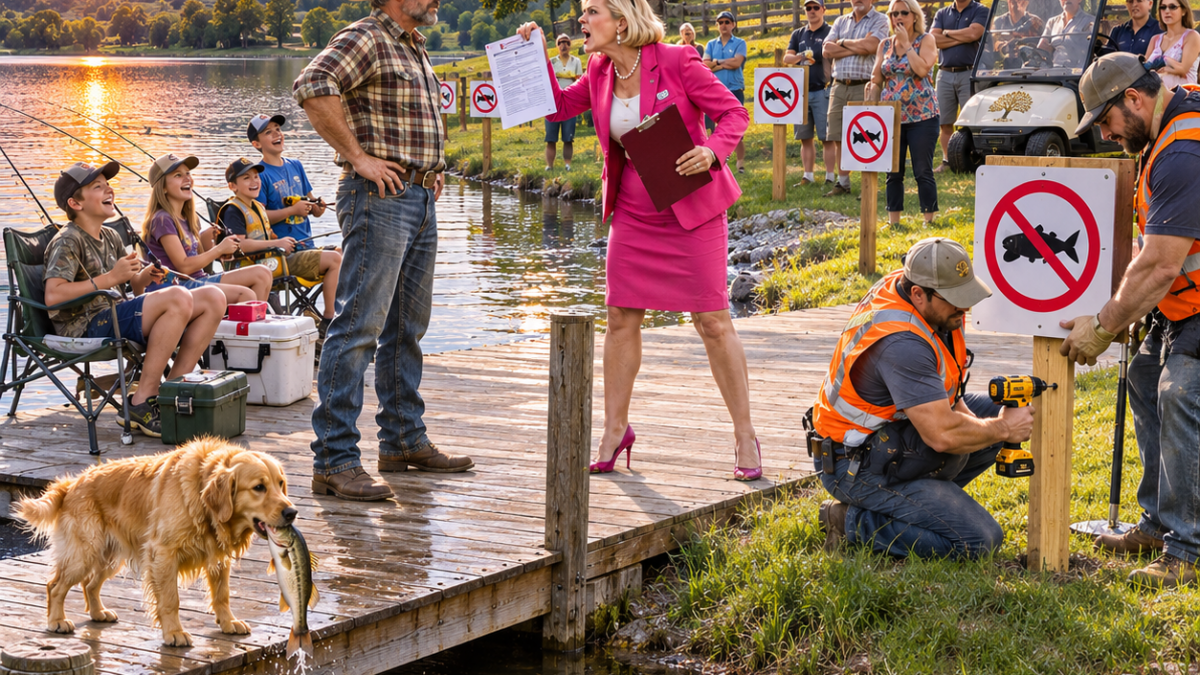
Victoria Vale shouted those words from the end of my private dock as though she had just been appointed governor of the water. Her bright pink blazer glowed in the evening sun, her blonde bob barely moving in the breeze, and one hand gripped a burgundy HOA folder while the other pointed accusingly toward six fishing rods lined along the rail.
The kids stared at her.
So did I.
Behind us, Mercer Lake reflected a sky turning orange and purple above the western hills. The water was calm except for a few ripples spreading from where twelve-year-old Tommy Bell had just dropped his bobber near the reeds. His sister Emma sat on a tackle box beside him, trying very hard not to laugh at Victoria.
I stood ten feet away in a tan flannel shirt, faded jeans, leather boots, and my old cowboy hat.
“Victoria,” I said, “you’re standing on my dock.”
She turned toward me without lowering her voice.
“Your dock is within the Cedar Ridge community environment.”
“That isn’t a legal description.”
“It doesn’t need to be. The board voted last month.”
She slapped a paper against my chest.
The notice said I was in violation of Cedar Ridge HOA safety and aesthetic standards because I had “permitted organized juvenile fishing activity” on a water feature visible from association property.
The fine was $700 per day.
I read it twice because the first time I assumed I had misunderstood something.
“You’re fining me because kids are fishing?”
“I’m fining you because you refuse to control a nuisance.”
Behind Victoria, Tommy slowly reeled in his line.
Victoria spun around.
“Stop fishing.”
Tommy froze.
I stepped forward.
“Keep fishing, Tom.”
Victoria’s head snapped back toward me.
“I said stop.”
“And I said he can fish.”
“This is exactly the kind of defiance the board is trying to eliminate.”
I looked toward the shoreline.
Three new white signs had appeared that morning.
NO FISHING.
HOA SAFETY RULE.
AUTHORIZED RESIDENTS ONLY.
Victoria had driven the posts into soil that had been in my family since 1921.
That bothered me more than the fine.
“You put those signs there?”
“The association did.”
“On my land.”
“On community-adjacent shoreline.”
“That phrase doesn’t mean anything either.”
Her jaw tightened.
“The board has jurisdiction over activities that affect neighborhood safety, noise, property values, and appearance.”
“Not here.”
“We disagree.”
“I don’t.”
She opened her folder and pulled out another sheet.
“This is your final notice. If fishing continues after sunset today, daily fines will accumulate automatically. We will also authorize removal of fishing equipment and restrict access to the shoreline.”
For the first time, the kids stopped smiling.
Emma looked at me.
“Mr. Mercer, should we leave?”
That question settled something inside me.
These kids had fished here for years. Their parents had brought them when they were little. My own children had learned to tie knots on the same dock. Nobody charged admission. Nobody needed a membership card. The only rules were simple: clean up after yourself, respect the water, and don’t scare away everybody else’s fish.
Now a woman who had lived beside the lake for four months was telling them they were no longer welcome.
I looked at Emma.
“No.”
Then I looked at Victoria.
“You have until tomorrow morning to remove every sign you planted on my land.”
She laughed.
“You don’t give the HOA deadlines.”
“I just did.”
Her smile disappeared.
“You really want to challenge us?”
I glanced past her toward the eastern shoreline, where several bright orange survey markers were still visible from work I’d commissioned two weeks earlier.
Then I looked back at the folder in her hands.
“Victoria,” I said quietly, “you should call your attorney before tomorrow.”
Her expression sharpened.
“Is that a threat?”
“No.”
I folded the $700-a-day notice and put it in my pocket.
“It’s the nicest warning you’re going to get.”
**part 2**
Victoria didn’t remove the signs.
Of course she didn’t.
At six-thirty the next morning, I found two more installed along the northern shoreline and a laminated notice zip-tied to the dock gate declaring that all fishing activity had been “suspended by order of the Cedar Ridge HOA Board pending safety review.”
The wording was impressive.
The authority behind it was imaginary.
My wife, Claire, stood beside me holding two mugs of coffee while we read it.
“She laminated it,” she said.
“That’s how you know it’s legally binding.”
Claire gave me a sideways look.
“You’re enjoying this too much.”
“Not yet.”
I cut the zip tie with my pocketknife, removed the notice, and carried it inside with the others.
By eight o’clock, I had eighteen pieces of paper spread across the dining-room table.
Violation notices.
Meeting summaries.
Threats of fines.
Photographs Victoria had apparently taken of children fishing.
A demand that I stop “hosting unsanctioned recreational gatherings.”
And my personal favorite, a letter accusing a twelve-foot aluminum johnboat of creating “visual instability on the water.”
Claire read that one twice.
“What does visual instability mean?”
“I think the boat was moving.”
“Terrifying.”
I smiled, but beneath the humor I was angry.
Not explosive angry.
The colder kind.
The kind that makes you organize documents.
My family had owned Mercer Lake and the surrounding land for more than a hundred years. The original conveyance dated to 1921, when my great-grandfather, William Mercer, bought roughly 1,700 acres of cattle ground, timber, and water from a regional land company. The family expanded over the decades. By the time I inherited the property from my father, the ranch covered just over four thousand acres.
The lake sat near the eastern boundary.
For most of my childhood, there had been nothing beyond it except woods.
Then Cedar Ridge arrived.
The developer bought adjoining acreage fourteen years earlier and built a gated subdivision along the ridge above the eastern shoreline.
At first, relations were fine.
Residents occasionally asked whether they could walk near the water.
I usually said yes.
Parents asked whether their kids could fish from my dock.
Usually yes.
An elderly couple asked if they could photograph birds from the bank every Sunday morning.
Definitely yes.
That was how neighbors behaved.
They asked.
Victoria Vale did not ask.
She arrived at Cedar Ridge in early spring after purchasing one of the largest homes overlooking the lake. Within three weeks, she had joined the architectural committee. Within two months, she was chairing enforcement meetings. By month four, she had somehow become the most influential person on the board without technically holding the president’s title.
That title belonged to a man named Preston Hale.
Preston was a real estate broker with perfect teeth, expensive loafers, and the habit of agreeing with Victoria immediately after she finished speaking.
People around Cedar Ridge joked that Preston was president and Victoria was government.
The fishing dispute started with noise.
Not much noise.
Kids laughing.
A tackle box closing.
Someone calling across the water after catching a bass.
Victoria complained that the sound carried toward her patio.
I told her I would remind everyone to be respectful.
That should have ended it.
Instead, she sent an email the next day proposing “lake-use standards.”
I replied that the HOA had no authority over my lake.
She wrote back that the matter was “under jurisdictional review.”
That phrase told me I needed a lawyer.
Rachel Coleman had represented my family for years.
She was forty-four, sharp, calm, and almost offensively patient with people who deserved less patience.
When I called her after Victoria’s first notice, she asked me to send every document.
Twenty minutes later, she called back.
“Dan, are you an HOA member?”
“No.”
“Has Mercer Ranch ever been annexed into Cedar Ridge?”
“No.”
“Does the HOA have a recorded easement over the lake or shoreline?”
“No.”
“Any covenant agreement?”
“No.”
“Any shared maintenance arrangement?”
“No.”
There was a pause.
“Then why are they sending you violation notices?”
“Because Victoria owns a printer.”
Rachel sighed.
“I was afraid you’d say something like that.”
She ordered a title review and recommended a new survey before we responded formally.
That was why the orange markers appeared.
I wanted certainty.
Not family legend.
Not an old map hanging in the ranch office.
Recorded certainty.
The surveyor, Ben Thompson, spent two days walking the eastern boundary.
His conclusion was simple.
The entire lake sat within Mercer property.
The shoreline sat within Mercer property.
The dock sat within Mercer property.
The nearest Cedar Ridge parcel ended between thirty-eight and seventy-four feet from the water depending on location.
There was no shared shoreline.
No access strip.
No association parcel touching the lake.
Nothing.
Rachel sent a written notice to the HOA instructing them to stop claiming authority and stop entering my land.
Victoria responded by posting more signs.
That was when the dispute stopped being annoying.
It became deliberate.
At nine-thirty that morning, I drove to the county planning and land-records office carrying a folder thick enough to make the clerk raise an eyebrow.
“You building an airport?” she asked.
“Worse.”
“HOA?”
I looked at her.
She smiled.
“Third one this month.”
Her name was Janice Powell. She had worked in county records longer than Cedar Ridge had existed.
I showed her the original chain of title, the modern deed, the survey, and the HOA notices.
Janice read the first page.
Then the second.
Then looked up.
“Seven hundred a day?”
“That’s what they say.”
“Are you in the association?”
“No.”
She looked back down.
“This should be interesting.”
She pulled the parcel records.
Every document matched what Rachel had already confirmed.
Mercer Lake was private property.
Cedar Ridge had no recorded interest.
No annexation.
No lake easement.
No recreational-rights agreement.
No shoreline maintenance authority.
Nothing.
I filed a formal complaint regarding the HOA signs installed on my parcel and asked for written confirmation of the property status.
Then I walked downstairs to the planning office.
A county land-use inspector named Robert Haines reviewed the same packet.
Robert had inspected one of my barns several years earlier.
He remembered me.
More importantly, he remembered the development.
“Cedar Ridge touches the eastern parcel boundary,” he said.
“Correct.”
“But not the lake.”
“Correct.”
He looked at Victoria’s sign photograph.
“Who put this up?”
“HOA contractors.”
“After you told them not to?”
“Yes.”
He leaned back.
“That’s not smart.”
“No.”
“Are you asking us to enforce the deed?”
“No. I know ownership disputes are civil. I’m asking you to confirm whether there’s any county approval, recorded plat, or land-use basis for their claim.”
“That I can do.”
He scheduled a site inspection for two days later.
Victoria somehow found out.
I suspected Preston.
By that afternoon, she had transformed the inspection into a public event.
A local community reporter named Lisa Brennan called me.
“Mr. Mercer, Cedar Ridge HOA says the county is reviewing dangerous recreational activity on Mercer Lake.”
I closed my eyes.
“Is that what they told you?”
“Yes.”
“They invited you?”
“Yes.”
“Did they mention I own the lake?”
A pause.
“No.”
“Then you may want to bring a notebook.”
Lisa laughed.
“I usually do.”
The inspection was scheduled for Thursday at four.
By three-forty-five, Victoria had created a stage.
She stood beside one of her NO FISHING signs wearing a pink skirt suit, pearl earrings, oversized sunglasses, and enough confidence to power the county.
Preston stood beside her.
Two other board members lingered behind them.
A local cameraman filmed the shoreline.
Three parents from Cedar Ridge watched from the road.
The kids were there too, although I had asked them to remain near the ranch side until the county finished.
Victoria saw me approaching.
She smiled for the camera.
“Dan, glad you came.”
“I live here.”
She ignored that.
Lisa Brennan stepped toward us with a microphone.
“Ms. Vale says the HOA enacted the restriction because of safety concerns.”
I looked at Victoria.
“What safety concerns?”
She answered before Lisa could.
“Hooks. Water hazards. Unsupervised activity. Noise. Litter. Visual clutter. Liability.”
I nodded slowly.
“That’s quite a list.”
“It’s responsible governance.”
“Whose water are you governing?”
She smiled.
“The community’s.”
I pointed toward the lake.
“That one?”
“Yes.”
“Interesting.”
Preston stepped forward.
“Dan, this doesn’t need to become confrontational.”
“It already became confrontational when your association fined me $700 a day.”
“That was enforcement.”
“Of rules that don’t apply to me.”
“That’s your interpretation.”
Rachel had warned me not to debate legal conclusions on camera.
So I didn’t.
Instead, I asked one question.
“Preston, can you show me the document giving Cedar Ridge authority over this lake?”
He glanced at Victoria.
She answered.
“The board’s legal position is not something we need to litigate in front of the media.”
Lisa raised her eyebrows.
That was when Robert Haines arrived.
He stepped out of his county truck carrying a tablet and a rolled map.
Victoria greeted him like a politician receiving a foreign ambassador.
“Inspector Haines. Thank you for coming. We’re very concerned about ongoing unauthorized activity.”
Robert looked at me.
“Afternoon, Dan.”
Victoria’s smile twitched.
Robert walked the boundary.
He checked the orange survey markers.
He compared coordinates.
He reviewed the subdivision plat.
He checked the county’s parcel layer.
Then he examined the location of every HOA sign.
Three were clearly inside my parcel.
One sat almost twenty feet inside.
He photographed them.
Victoria followed him closely.
“Those signs were placed to protect residents.”
Robert nodded without looking at her.
“Who authorized installation on this parcel?”
“The HOA.”
“That wasn’t what I asked.”
Preston stepped closer.
“We believed this shoreline was subject to association oversight.”
Robert looked at him.
“Based on what?”
Preston opened his mouth.
Then closed it.
Victoria answered.
“The community has used the lake for years.”
I corrected her.
“Residents have used it with permission.”
“That is not how residents understood it.”
I looked toward Mrs. Bell, Tommy’s mother.
She called from the road, “Yes, it is.”
Victoria turned.
Mrs. Bell shrugged.
“Dan always told us to ask.”
Another parent nodded.
“So did we.”
Victoria’s expression tightened.
Robert returned to his tablet.
“Inspector,” she said, “whether or not there’s a technical boundary issue, the HOA still regulates behavior affecting community welfare.”
“On HOA property.”
“And adjacent areas.”
“Under what recorded authority?”
Victoria’s cheeks reddened.
“You’re focusing too narrowly.”
Robert finally looked up.
“I’m a land-use inspector. Narrow boundaries are pretty much the job.”
Lisa Brennan covered a smile.
Robert asked me for the title packet.
I handed him certified copies.
He read the legal description.
Checked the survey.
Then looked at the subdivision map again.
Several minutes passed.
Nobody spoke.
The lake lapped softly against the dock.
A kid’s bobber drifted near the reeds.
Finally Robert walked back toward the cameras.
“This parcel is not part of Cedar Ridge.”
Victoria interrupted.
“That’s not the issue.”
He continued.
“The lake is contained within the Mercer parcel. The visible shoreline is also within that parcel. County records show no HOA ownership interest, recorded annexation, or association easement granting recreational-control authority here.”
Victoria’s smile disappeared.
“The board voted.”
Robert nodded.
“That does not change the parcel map.”
“The community has safety concerns.”
“Then the HOA can regulate HOA property.”
“The kids are residents.”
“Some are.”
“So we can regulate them.”
“Maybe under valid association rules when they’re subject to those rules. That still doesn’t give you ownership of Mr. Mercer’s land.”
Victoria clutched her folder tighter.
“You’re saying he can allow anything?”
“No. State law and county rules still apply. But fishing itself is lawful here subject to ordinary licensing and safety requirements. I see no county basis for your posted ban.”
She pointed at the signs.
“These are HOA notices.”
“Three are installed on property your HOA does not own.”
Her face changed.
Robert continued.
“I recommend you remove them.”
“Recommend?”
He looked at the sign closest to him.
“If Mr. Mercer files the property complaint he discussed with our office, you may also face enforcement consequences for unauthorized signage depending on the applicable code provisions. Your attorney should review that.”
Victoria’s folder trembled slightly.
It was the first physical sign that she understood the situation had changed.
Preston stepped closer to her.
“You told us the shoreline was common-adjacent property.”
“It is.”
Robert shook his head.
“No.”
Two letters.
That was all it took.
Victoria’s certainty cracked.
Preston looked at the orange markers.
Then at me.
Then at the lake.
“How long has this survey been recorded?”
“Two weeks,” I said.
“You knew?”
“Yes.”
“And you didn’t tell us?”
“I sent your association a certified letter.”
One board member behind him spoke.
“I never saw that.”
Victoria turned sharply.
“It was an enforcement matter.”
The board member frowned.
“Addressed to whom?”
“The association.”
“So why didn’t the board get it?”
Victoria’s answer came too quickly.
“Because I handled it.”
There it was.
The first real fracture.
Lisa Brennan raised her microphone.
“Ms. Vale, did you personally decide to continue enforcement after receiving a survey indicating the lake was private?”
Victoria glared at her.
“I did not say that.”
I reached into my folder.
I had the certified-mail receipt.
Rachel had taught me something important years earlier.
Never rely on someone remembering that you warned them.
Make it impossible for them to forget on paper.
I handed the receipt to Robert.
He glanced at it.
“Delivered three weeks ago.”
Preston looked at Victoria.
“You told us Mercer refused to provide documentation.”
“He refused to cooperate.”
“That’s not the same thing.”
She stepped toward him.
“Preston, now is not the time.”
He stared at her.
“No. I think it is.”
The cameras kept rolling.
Victoria noticed.
Her entire demeanor changed.
She turned toward Lisa and smiled mechanically.
“This is simply a misunderstanding that the board will review internally.”
Mrs. Bell called from behind the camera, “You fined him nineteen thousand six hundred dollars.”
Everyone looked at her.
I did the math.
She was right.
Twenty-eight days at $700.
Victoria’s face reddened.
Mrs. Bell folded her arms.
“That’s a pretty expensive misunderstanding.”
I liked Mrs. Bell.
Always had.
Robert finished his inspection.
Before leaving, he told the HOA in front of everyone that there was no county record supporting its claimed authority over the lake.
He instructed Victoria to remove the signs from my parcel and advised both parties to communicate through counsel regarding the remaining civil issues.
That was enough.
The story aired that night.
Not statewide.
Not nationally.
Just on the county news website and local evening broadcast.
But Cedar Ridge residents watched it.
The headline was simple:
PROPERTY DISPUTE QUESTIONS HOA’S AUTHORITY OVER PRIVATE LAKE.
The video clip that mattered most wasn’t Robert’s explanation.
It was Victoria saying, “The board voted,” followed immediately by Robert answering, “That does not change the parcel map.”
By morning, somebody had turned the exchange into a meme in the Cedar Ridge residents’ group.
A picture of a thunderstorm.
THE BOARD VOTED FOR SUNSHINE.
A picture of a speed-limit sign.
THE BOARD VOTED FOR 90 MPH.
A picture of a cow.
THE BOARD VOTED THAT THIS IS A HORSE.
Claire showed me that last one while drinking coffee.
“I like your neighbors.”
“They’re not technically my neighbors.”
“Apparently that depends on whether the board votes.”
I laughed so hard I spilled coffee on the table.
The humor lasted until Rachel called.
“Dan, the HOA attorney contacted me.”
“What does he want?”
“To resolve this before it gets worse.”
“Has he seen the notices?”
“Yes.”
“And?”
“He was not aware of them.”
I leaned against the kitchen counter.
“Not aware of the $700 fines?”
“No.”
“Not aware of the fishing ban?”
“No.”
“Not aware they were claiming the lake?”
“No.”
I closed my eyes.
Rachel continued.
“He also says he never gave the legal opinion Victoria referenced in at least two board communications.”
There it was again.
The same pattern.
Confidence presented as authority.
Authority presented as law.
“Who authorized the fines?” I asked.
“That’s what the board is now trying to determine.”
“Preston?”
“Maybe formally. But according to the documents counsel has seen, Victoria drafted the enforcement language.”
“Of course she did.”
“There’s more.”
I waited.
“She appears to have instructed the management company to place your account into their violation system even though you don’t have an HOA lot number.”
“How?”
“They created a temporary record.”
I stared at Claire.
She knew from my face that the conversation had become serious.
Rachel said, “Dan, somebody intentionally created an enforcement account for a nonmember.”
“Can they even do that?”
“They can type anything into software. That doesn’t make it enforceable.”
“What happens now?”
“I’m sending a cease-and-desist demand. We’ll require withdrawal of every fine, written recognition of the property boundary, removal of signs, reimbursement of reasonable survey and legal costs, and preservation of records.”
“Preservation?”
“Yes.”
“For litigation?”
“For the possibility.”
I was quiet.
I didn’t want a lawsuit.
People assume property owners enjoy legal fights when they win them.
We don’t.
Lawyers cost money.
Time costs money.
Stress costs sleep.
I wanted kids to fish and Victoria to stay on her side of the line.
That was it.
But I also understood something my father taught me.
If somebody mistakes kindness for permission, clarity becomes a responsibility.
Rachel sent the letter that afternoon.
The HOA had forty-eight hours to respond.
Victoria lasted four.
At five-twenty that evening, a landscaping truck arrived beside the lake.
Three workers got out carrying tools.
I walked down to the dock.
“What are you doing?”
The foreman held up a work order.
“Removing unauthorized recreational structures.”
I stared at him.
“What structures?”
He pointed toward the rod holders bolted to my dock rail.
I almost admired the audacity.
“Who issued that?”
“Cedar Ridge HOA.”
“Name?”
He looked at the paper.
“Victoria Vale.”
I took out my phone.
“Before you touch anything, call the number on that survey notice.”
The foreman looked toward the orange marker.
Then at me.
“This your property?”
“Yes.”
“They told us this dock was under community control.”
“It isn’t.”
He sighed.
“I knew today was going too well.”
He called his office.
Ten minutes later, the crew packed up.
Nobody touched the dock.
I took a photograph of the work order.
Rachel received it five minutes later.
The HOA attorney received it ten minutes after that.
At six-fifteen, Preston Hale called me.
He sounded like a man discovering his office was on fire one email at a time.
“Dan, I need to ask whether the contractor removed anything.”
“No.”
“Damaged anything?”
“No.”
“Entered the dock?”
“No.”
“Thank God.”
“Preston.”
“Yes?”
“You need to control your board.”
He was silent.
Then he said something I never expected.
“I know.”
The next forty-eight hours changed Cedar Ridge.
An emergency meeting was called.
The board’s attorney attended.
Management provided records.
Emails were reviewed.
Invoices were reviewed.
Violation logs were reviewed.
And because one bad decision rarely travels alone, the fishing issue opened doors nobody had intended to unlock.
Residents began comparing experiences.
Mrs. Bell had been fined over a bird feeder positioned four inches outside an approved zone.
A retired Marine named Chuck Lawson had received three warnings because his American flagpole was supposedly twenty inches too tall.
A widow named Helen Ortiz had been told that her late husband’s wooden bench violated aesthetic standards because the stain had faded.
One family received notices because their basketball hoop remained visible overnight.
Another had been threatened over chalk drawings on a driveway.
None of those disputes proved illegality by themselves.
HOAs can enforce valid covenants.
But residents began asking a different question.
Had the board actually approved everything Victoria claimed it approved?
That was more dangerous.
The answer, apparently, was no.
Victoria had been operating through committees, informal approvals, delegated management instructions, and Preston’s habit of signing whatever appeared organized enough to look official.
She had built authority through momentum.
People obeyed because everyone assumed somebody else had verified it.
The lake dispute broke that spell.
At the emergency meeting, Victoria reportedly arrived with three folders, twenty-seven pages of printed rules, and the same pink blazer she wore during the county inspection.
Mrs. Bell later told me the room went silent when she walked in.
Not respectful silence.
The other kind.
Victoria opened by declaring that she had acted “in the best interests of community safety.”
The HOA attorney asked one question.
“Where is the recorded instrument giving the association authority over Mercer Lake?”
Victoria said the authority was implied.
He asked again.
She cited community impact.
He asked again.
She cited precedent.
He asked again.
Finally she snapped, “Why are you defending him?”
The attorney answered, “I’m defending this association from making representations it cannot support.”
That sentence ended her momentum.
Preston asked whether counsel had ever approved the fishing ban.
“No.”
The fines?
“No.”
The claim of lake authority?
“No.”
The contractor removal order?
“Absolutely not.”
According to Malcolm Reed, who served as treasurer, Victoria then pointed at Preston.
“He approved everything.”
Preston looked stunned.
“I approved enforcement based on your statement that counsel confirmed jurisdiction.”
“I never said that.”
Malcolm raised his hand.
“I have the minutes.”
Victoria turned toward him.
“You recorded them incorrectly.”
“I recorded your exact words.”
The room erupted.
Residents began shouting questions.
Preston demanded copies.
The attorney asked everyone to stop talking at once.
Mrs. Bell shouted louder than everybody and somehow achieved order.
That alone may have been the most effective governance Cedar Ridge had experienced all year.
The board recessed for thirty minutes.
When they returned, Preston announced that all Mercer-related enforcement was suspended immediately.
Every fine was voided pending formal written withdrawal.
No HOA employee or contractor could enter Mercer property.
No director or committee member could issue further instructions involving the lake without written legal review.
Victoria tried to speak.
Preston cut her off.
“We’re voting.”
She looked genuinely shocked.
“On what?”
“Your removal from enforcement authority.”
“You can’t.”
The attorney quietly said, “They can.”
The vote passed.
Four to one.
Victoria voted no.
Apparently she also objected to the wording of her own removal.
I learned all of this later.
At the time, Claire and I were sitting on the dock with the kids.
Tommy had caught nothing for two hours but remained convinced the next cast would produce a record bass.
Emma caught three bluegill and reminded him of this every eleven minutes.
The evening was warm.
The water was glassy.
Nobody shouted.
Nobody waved a folder.
For the first time in weeks, the lake felt like itself again.
Around eight-thirty, headlights appeared on the ridge road.
Mrs. Bell walked down toward us.
She carried a plastic grocery bag.
“What’s that?” I asked.
“Celebration supplies.”
She pulled out marshmallows.
Claire laughed.
“Did the meeting end?”
“Sort of.”
“What does sort of mean?”
“We removed Victoria from every committee position.”
Tommy looked up.
“Can we fish?”
Mrs. Bell smiled.
“You never had to stop.”
That sentence hit me harder than expected.
Because it was exactly the truth.
The kids had been dragged into an adult power struggle they never created.
They had done nothing wrong.
Fishing was not the problem.
Laughter was not the problem.
Rods leaning against a dock were not the problem.
The problem was that one person wanted control badly enough to manufacture authority where none existed.
The following morning, the official settlement proposal arrived.
The HOA would rescind all fines.
It would remove the signs at its expense.
It would reimburse my survey fees and a portion of my attorney costs.
It would issue a written acknowledgment that Mercer Ranch, Mercer Lake, the dock, and shoreline were not subject to Cedar Ridge covenants.
The management company would permanently delete the fake enforcement account created under my name.
The board would adopt a policy requiring attorney review before asserting jurisdiction over nonmember property.
I accepted most of it.
Rachel negotiated the rest.
The final amount reimbursed to me was $8,500.
Not a windfall.
Not revenge money.
It covered the survey, legal review, filings, document preparation, and other expenses I never would have incurred if Victoria had simply accepted the word no.
That mattered.
Consequences should repair what they can.
Humiliation is temporary.
Receipts are better.
The signs came down on Saturday.
The HOA sent two workers.
The same foreman from the landscaping crew arrived to supervise.
He walked toward me holding the first NO FISHING sign.
“Want it?”
“What would I do with it?”
“Frame it?”
Claire called from the porch, “Garage.”
I looked at her.
“Absolutely not.”
She ignored me.
The sign now hangs in my equipment barn.
Below it, Claire later added a smaller homemade plaque:
THE BOARD VOTED.
I protested.
Not very strongly.
The kids resumed fishing immediately.
Not ceremonially.
Not dramatically.
Tommy simply carried his tackle box down the dock one afternoon and asked whether the bass were still stupid.
“They remember you,” I told him.
“That bad?”
“Terrified.”
Emma shoved him lightly with her shoulder and took the better spot.
Life returned.
Victoria did not.
At least not quietly.
Two days after the settlement, she arrived at the lake in a white SUV.
She parked outside my property line.
That was an improvement.
She wore cream trousers, a pale blouse, sunglasses, and no pink blazer.
Also an improvement.
I was cleaning algae from the dock ladder when she called my name.
“Dan.”
I walked toward the fence.
“Victoria.”
She stood with both hands at her sides.
No folder.
I almost didn’t recognize her.
“You got what you wanted.”
“I got what I already owned.”
“You know what I mean.”
“I’m not sure I do.”
“My position is gone.”
“I didn’t appoint you.”
“You turned everyone against me.”
“No.”
“The news story embarrassed me.”
“I didn’t invite the cameras.”
“You knew they were coming.”
“You invited them.”
She looked away.
That was true, and she hated it.
“You could have handled this privately.”
“I tried.”
“You sent a lawyer.”
“After you sent me $700-a-day fines.”
“You never intended to pay.”
“Correct.”
“Then they didn’t hurt you.”
I stared at her.
That sentence revealed more than anything else she had said.
She thought a threat was harmless if the target could resist it.
“What if I couldn’t afford a lawyer?” I asked.
She said nothing.
“What if I was eighty years old and afraid of losing my house?”
“This wasn’t your house.”
“What if I believed those notices because they looked official?”
“You didn’t.”
“That isn’t the point.”
She folded her arms.
“What is the point, Dan?”
I looked toward the lake.
Tommy and Emma were fishing near the far end of the dock.
Their voices carried softly over the water.
“The point is that you were willing to scare people to get obedience.”
Her face hardened.
“I was enforcing standards.”
“On land you didn’t control.”
“For the community.”
“The community didn’t ask you to own my lake.”
“They wanted quiet.”
“Some did.”
“They wanted safety.”
“Some probably did.”
“They wanted property values protected.”
“Maybe.”
She looked almost triumphant.
“Then I was doing my job.”
“No.”
I stepped closer to the fence.
“You were doing what you wanted and calling it your job.”
Her expression changed.
For once, no immediate answer came.
I continued.
“Good leadership starts with knowing where your authority ends.”
“You think I’m some kind of dictator.”
“I think you got comfortable hearing yes.”
She laughed bitterly.
“You have no idea what it’s like running that community.”
“You’re right.”
“Everyone complains. Everyone wants exceptions. Everyone thinks their situation is special.”
“That sounds difficult.”
“It is.”
“But it still didn’t make the lake yours.”
She stared at me.
Then Tommy shouted from the dock.
“Mr. Mercer! Big one!”
I turned.
His rod bent hard toward the water.
Emma was laughing.
I called back, “Keep your line tight!”
Victoria watched them.
For a moment, she looked less angry.
Just tired.
“He’s loud,” she said.
“He’s twelve.”
“Still loud.”
“He’ll grow up.”
She almost smiled.
“Hopefully.”
Tommy finally pulled a bass toward the dock.
Not huge.
But big enough for him to yell like he had landed a shark.
Victoria winced.
I looked at her.
She looked at me.
Then, against all expectations, she laughed.
Only once.
Short.
Unwilling.
But real.
I laughed too.
That could have been the end.
It wasn’t.
Because Victoria’s removal from enforcement authority triggered a broader board review.
Not a criminal investigation.
Not some dramatic raid.
Just the slow, painful process organizations go through when people finally begin reading what they previously signed.
The board found several unauthorized expenditures tied to enforcement campaigns.
Nothing enormous.
Printing.
Contractor visits.
Consulting fees.
Signage.
Administrative charges.
Legal letters initiated without proper board approval.
They also discovered that Preston had signed some documents without reading supporting material.
That cost him.
He resigned as president two weeks later.
He didn’t lose his real estate career.
He didn’t go to jail.
Real life is usually less theatrical than internet stories.
But he did lose his board position, and his reputation inside Cedar Ridge took a serious hit.
Gary Timmons became interim president.
His first speech to residents lasted four minutes.
According to Mrs. Bell, the best line was:
“Our goal for the next year is to become extremely boring.”
The room applauded.
I approved.
Boring HOAs rarely end up on my property.
Victoria remained a homeowner for several months.
Without committee authority, she became something she had never expected to become.
A resident.
Just one vote.
One voice.
One person among many.
Apparently she hated it.
Mrs. Bell told me Victoria began attending meetings and raising her hand.
At first, the irony was so strong that people laughed.
Eventually they stopped.
Then something strange happened.
Victoria started asking questions instead of issuing instructions.
Not always.
Not gracefully.
But sometimes.
Gary required every proposal to cite the specific covenant or rule authorizing it.
No citation, no discussion.
Victoria once proposed restrictions on backyard wind chimes.
Gary asked for the applicable covenant.
She searched her binder for three minutes.
Couldn’t find one.
Then sat down.
Mrs. Bell texted Claire:
HISTORIC EVENT. VICTORIA LOST AN ARGUMENT TO A BINDER.
Claire showed me.
I laughed until my ribs hurt.
By late summer, Mercer Lake had become busier than before.
Not crowded.
Just alive.
Parents brought folding chairs.
Kids learned knots.
A few teenagers started helping younger ones bait hooks.
One father built a small line-recycling container so discarded fishing line wouldn’t end up near the water.
Another brought a trash barrel.
I added a simple sign at the dock.
MERCER LAKE.
PRIVATE PROPERTY.
FISHING BY PERMISSION.
PLEASE RESPECT THE WATER.
That was all.
No seven-page rulebook.
No architectural committee.
No $700 fines.
People followed it.
Mostly because respect works better when it moves in both directions.
One September evening, Claire and I sat near the dock watching a group of kids fish under a sky turning deep orange over the western hills.
She leaned against my shoulder.
“You realize Victoria accidentally improved the lake.”
“How?”
“Everybody appreciates it more now.”
I looked around.
She was right.
People cleaned up more carefully.
Parents checked before bringing guests.
Kids thanked us.
Even the older residents who never fished walked down sometimes just to watch the sunset.
Something that had always felt ordinary suddenly felt worth protecting.
“Don’t tell Victoria,” I said.
“She’d form a committee.”
“Exactly.”
We sat quietly.
A dragonfly skimmed the surface.
A bobber dipped.
Someone whispered excitedly.
That was the lake I remembered.
Not silent.
Peaceful.
There’s a difference.
Peace isn’t the absence of sound.
Sometimes peace sounds like kids arguing over who stole whose worms.
A few weeks later, I received an envelope in the mail.
No HOA letterhead.
Just my name.
Inside was a handwritten note from Preston Hale.
Dan,
I owe you an apology.
I trusted statements I should have verified. I signed documents I should have read more carefully. Being busy is not an excuse.
The board should never have claimed authority over your property.
I’m sorry.
—Preston
I read it twice.
Then placed it with Malcolm’s earlier note in my desk.
Claire asked why I kept them.
“Because apologies are evidence too.”
“Of what?”
“People can learn.”
She smiled.
“Even Preston?”
“Let’s not get carried away.”
Victoria never apologized.
Not formally.
That didn’t surprise me.
Six months after the lake dispute, a moving truck appeared at her house.
Word spread through Cedar Ridge before lunch.
Victoria had sold.
The buyers were a retired couple from Tennessee.
Their first weekend, the husband walked down toward my fence.
He stopped at the property line.
“Mr. Mercer?”
“Yes?”
“I’m Frank Dawson. We bought the Vale place.”
“Welcome.”
He pointed toward the water.
“My granddaughter is visiting next month. She loves fishing.”
I smiled.
“Bring her down.”
“You sure?”
“Ask first. Clean up. Follow state fishing rules.”
“That’s it?”
“That’s it.”
He looked toward the former Vale house.
Then back at me.
“I was warned you were difficult.”
“By who?”
He grinned.
“Seller.”
I laughed.
“Then you’ve already learned an important lesson about real estate disclosures.”
Frank’s granddaughter came in October.
She caught her first fish from my dock.
A small bluegill.
She held it with both hands for a photograph before releasing it.
Frank sent me the picture later.
That image meant more to me than every legal letter in the file.
Because the fight had never really been about winning against Victoria.
It was about preserving something simple.
A place where a kid could sit beside a lake and learn patience.
A place where neighbors could share something without pretending they owned it.
A place where permission still meant something.
The following spring, I replaced several boards on the dock.
Tommy, now thirteen and convinced he understood carpentry, helped.
He hammered one nail sideways, split a board, and told me it was “structural.”
I told him he had a future in HOA management.
He laughed.
“Is Ms. Vale ever coming back?”
“Probably not.”
“Good.”
“Why?”
“She scared Emma.”
That stopped me.
Kids notice more than adults think.
“What scared her?”
“The fines. Emma thought you might close the lake because it was too much trouble.”
I set down my hammer.
That bothered me more than anything Victoria had done to me.
Not because Emma had been in danger.
She hadn’t.
But because some official-looking letters had made a kid believe a good place might disappear.
“Tell her something for me.”
“What?”
“Nobody gets to take something just because they print a notice saying they can.”
Tommy thought about that.
“Unless it’s taxes?”
I stared at him.
“Your father has been talking to you.”
“Yep.”
“Keep hammering.”
Years from now, those kids probably won’t remember the exact dispute.
They won’t remember survey markers.
They won’t remember legal descriptions.
They won’t remember Victoria’s pink blazer.
Maybe they’ll remember the signs.
Maybe the ridiculous fine.
Maybe the moment a county inspector told an HOA board that a vote could not move a property line.
But I hope what they remember most is fishing.
Sunlight on water.
A bobber disappearing.
The smell of grass.
Parents laughing behind them.
The thrill of feeling something tug at the other end of a line.
That is what places become when we protect them properly.
Memories.
My great-grandfather could not have imagined Cedar Ridge when he signed the 1921 land papers.
He couldn’t have imagined homeowners associations, digital parcel maps, drones, property-management software, online neighborhood groups, or a woman in a pink blazer trying to regulate fishing from a dock that had not yet been built.
But he understood boundaries.
His generation marked them with stone, fence, and creek.
Ours marks them with GPS coordinates and recorded surveys.
The principle is the same.
Your rights end where someone else’s begin.
Victoria believed boundaries were obstacles to efficient management.
I believed they were the reason neighbors could remain neighbors.
Without them, every disagreement becomes a contest of power.
With them, the rules become simple.
Ask.
Listen.
Respect the answer.
One summer evening almost a year after the dispute, I stood at the same spot where Victoria had first shouted her ban.
The sunset was nearly identical.
Orange over the hills.
Purple near the horizon.
The lake reflecting both.
Kids lined the dock.
Claire sat in a chair beside Mrs. Bell.
Frank Dawson was trying to untangle fishing line from his granddaughter’s reel.
Gary Timmons had come down from Cedar Ridge carrying a cooler.
He stopped at the fence.
“Permission to enter?”
I looked at him.
“You’ve been trained.”
“Very expensive training.”
I opened the gate.
He walked through.
A few minutes later, he stood beside me watching the kids fish.
“You know,” he said, “the board actually discussed lake access again last week.”
I turned slowly.
He laughed.
“Relax. We discussed whether to ask if residents could continue fishing by permission.”
“That’s different.”
“Exactly.”
“And?”
“We voted to ask.”
I smiled.
“Progress.”
“So?”
“So what?”
“Can residents continue fishing?”
I looked at the dock.
At the kids.
At the parents.
At the lake.
“Yes.”
Gary nodded.
“I’ll put that in the minutes.”
“No need.”
“Why?”
“Because my permission isn’t an HOA policy.”
He considered that.
“Fair.”
We stood there quietly.
Then a splash erupted near the dock.
Tommy yelled.
Emma yelled louder.
Frank dropped his cooler.
Mrs. Bell started laughing.
Gary watched the chaos.
“This is what Victoria called an aesthetic problem?”
“Apparently.”
He shook his head.
“I kind of like it.”
“So do I.”
That evening, after everyone left, Claire and I walked along the shoreline.
The orange survey markers were gone.
I had removed them after the settlement.
They had done their job.
The property line remained exactly where it had always been, even without bright plastic flags proving it.
That felt appropriate.
Rights shouldn’t need to be defended every day.
But sometimes they do need to be defended once.
Clearly.
Documented.
Calmly.
Victoria had expected shouting.
She expected anger.
She expected me to either surrender or create a scene she could use against me.
Instead, I gave her paperwork.
A deed.
A survey.
A county record.
A certified receipt.
An attorney.
And enough patience to let her continue talking until everyone around her realized how little authority she actually had.
That was the part she never understood.
Power doesn’t always collapse when someone attacks it.
Sometimes it collapses when somebody asks one simple question.
Show me where it says you can do that.
Victoria never had an answer.
She had opinions.
She had board votes.
She had notices.
She had folders.
She had signs.
She had a president willing to trust her.
She had employees willing to follow instructions.
She had enough confidence to convince people for months that confidence itself was authority.
But when the survey map came out, none of that mattered.
The lake was still mine.
The dock was still mine.
The shoreline was still mine.
The children were still allowed to fish because I allowed them to fish.
Not because the HOA graciously permitted it.
That distinction mattered.
It still does.
Claire stopped beside the water.
“You ever regret letting Cedar Ridge residents use the lake?”
“No.”
“Even after all that?”
“No.”
“Why?”
I watched a small ripple spread across the surface.
“Because Victoria was wrong about one thing more than anything else.”
“What?”
“She thought sharing something made it community property.”
Claire nodded.
“And?”
“Sharing doesn’t erase ownership.”
She smiled.
“That sounds like something your father would say.”
“He’d use more profanity.”
“Probably.”
We kept walking.
Behind us, the dock lights came on automatically.
The water darkened.
Frogs started calling from the reeds.
Somewhere across the lake, a screen door closed at Frank’s house.
Nothing dramatic happened.
Nobody arrived with notices.
Nobody challenged the boundary.
Nobody held a meeting.
It was boring.
Perfectly boring.
Exactly the way Gary promised.
And every time I see a kid sitting on that dock now, legs swinging above the water, rod angled toward the fading sunlight, I remember Victoria standing in that same place declaring that she was banning fishing immediately.
She thought the loudest voice made the rules.
She thought official letterhead could turn fiction into law.
She thought a community vote could claim land the community had never owned.
She thought $700-a-day fines would frighten me into submission.
She thought being questioned was disrespect.
She thought saying “safety” often enough would make nobody ask whether she had jurisdiction.
She was wrong about all of it.
The only thing she ever correctly understood was that I was not going to cooperate.
Not with intimidation.
Not with invented authority.
Not with a rule created to punish children for laughing beside a lake.
Today, the old NO FISHING sign still hangs in my equipment barn.
Claire refuses to let me throw it away.
Underneath it hangs her little wooden plaque.
THE BOARD VOTED.
Every once in a while, a visitor asks what it means.
I tell them the short version.
An HOA tried to ban fishing on a private lake.
They fined the owner.
They claimed authority they didn’t have.
Then somebody finally checked the deed.
Most people laugh.
Some shake their heads.
A few ask what happened to the woman responsible.
I tell them the truth.
She lost her authority.
She lost the argument.
She eventually sold her house and moved.
Not because I destroyed her.
Not because I ruined her life.
Because actions have consequences, and communities eventually stop following people who mistake control for leadership.
That ending matters to me.
Revenge would have been watching Victoria suffer.
Justice was watching the lake remain open.
Justice was seeing the fines erased.
Justice was having my costs reimbursed.
Justice was watching the board change its procedures.
Justice was seeing residents question unsupported authority.
Justice was hearing a kid ask permission to fish instead of asking whether the HOA would punish him.
And maybe the funniest justice of all was knowing that after everything Victoria did to make the lake quieter, her campaign achieved the exact opposite.
More families came.
More kids learned to fish.
More neighbors spent evenings by the water.
More laughter carried across the shoreline.
The lake became more alive than ever.
Every sunset belonged to nobody and everybody at once.
The land beneath it belonged to my family.
The distinction was simple.
Victoria just needed an $8,500 lesson, a county inspector, a recorded survey, an angry neighborhood, and one very public board meeting to understand it.








