Nobody Believed My 11-Year-Old Son—Then 300 Bikers Rode Into Town With the Proof
Nobody Believed My 11-Year-Old Son—Then 300 Bikers Rode Into Town With the Proof
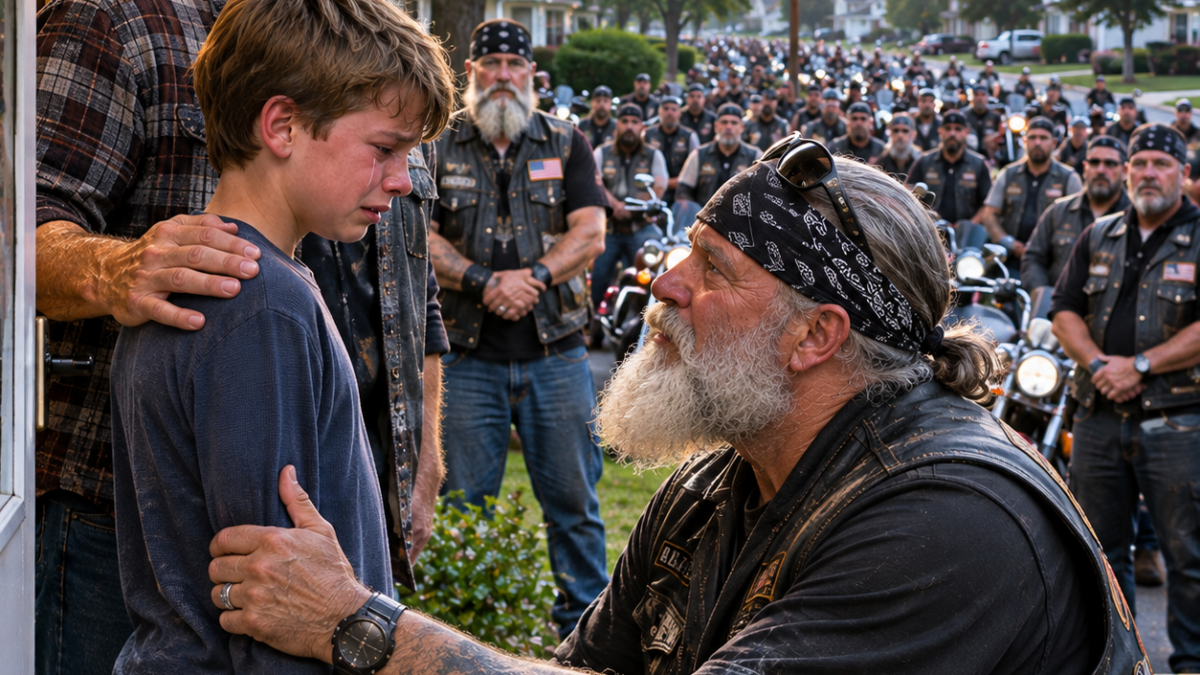
**At six in the morning, a gray-bearded biker pounded on my front door while almost three hundred motorcycles filled our street from curb to curb.**
**For two months, my eleven-year-old son had insisted he saw a man attack a woman behind an abandoned gas station, and for two months the police, his teacher, his classmates—and eventually even I—had treated his story like something a frightened child had invented.**
**Then the biker handed me photographs, a license plate, and dashcam footage and said, “Frank, your boy told the truth—but there’s one part he was too terrified to tell anybody.”**
My name is Frank Delgado.
I was forty-three years old when I learned how badly an adult can fail a child while still believing he’s doing the reasonable thing.
I worked a forklift at Dalton Lumber outside town.
Ten-hour shifts most days.
Sometimes twelve when shipments backed up.
My wife, Melissa, left when our son Eli was six.
There wasn’t one dramatic reason.
No secret second family.
No police at the door.
She simply decided motherhood and marriage were not the life she wanted anymore.
She moved to Arizona.
For the first year, she called regularly.
Then less.
By the time Eli was eleven, birthday cards arrived more reliably than phone calls.
So mostly it was us.
Me and Eli.
I wasn’t a perfect father.
I burned pancakes.
Forgot school picture day twice.
Once washed an entire red sock with his white baseball uniform.
But I showed up.
That was the promise I made when Melissa left.
Whatever happened, the kid would know one parent stayed.
Eli was quiet.
Not shy exactly.
Watchful.
He noticed things.
If Mrs. Kelley three houses down changed the flowers on her porch, Eli knew.
If somebody bought a new car, he remembered the old one.
If a dog appeared behind a fence where there had never been a dog before, he asked who moved in.
He could tell whether my truck had been moved six inches in the driveway.
Once he noticed the grocery store had replaced two ceiling tiles.
I hadn’t even noticed the ceiling existed.
His teacher used to call it “exceptional observational awareness.”
Later, that same attention would be treated like imagination.
It happened in April.
Rainy Thursday.
I was working late because a truck from Knoxville arrived four hours behind schedule.
Eli had gone to his friend Mateo’s house after school.
Mateo lived about twenty minutes away on foot.
Usually I picked Eli up.
That afternoon he texted that Mateo’s older sister could drive him.
Then around seven, she called.
Eli had decided to walk.
I was annoyed.
Not terrified.
Eleven-year-olds make dumb decisions.
I finished unloading the truck and drove home.
Eli was already there.
Standing inside the kitchen.
Wet.
Not damp.
Soaked.
His hoodie clung to his shoulders.
Water dripped from his hair onto the floor.
His backpack lay beside the refrigerator.
I remember being angry first.
“You walked all the way in this?”
He didn’t answer.
“Eli?”
His face was gray.
Not pale.
Gray.
“Dad.”
Something in his voice changed me instantly.
“What?”
“I saw a man hurt a lady.”
I put down my keys.
“What do you mean?”
“Behind the old gas station.”
Route 9 had an abandoned Shell station that had been closed maybe four years.
The building was boarded up.
People occasionally parked there to sell used cars.
Teenagers probably drank behind it.
Eli sometimes used the dirt path behind the property when walking from Mateo’s neighborhood.
“What did you see?”
He hugged himself.
“There was yelling.”
“Who was yelling?”
“A woman.”
“Did you know her?”
“No.”
“Then what?”
“He had her by the arm.”
“Who?”
“The man.”
“What man?”
He was shaking.
I pulled out a chair.
“Sit down.”
He did.
I grabbed a towel and put it around his shoulders.
“Start from the beginning.”
He had reached the fence behind the old Shell station when he heard somebody shouting.
He thought people were arguing.
Then he saw a silver pickup parked near the dumpsters.
A woman was on the ground.
A man stood over her.
Eli said the man grabbed her.
She fought him.
He shoved her back down.
Then she stopped moving.
That sentence has never left me.
“She stopped moving.”
“What did he do?”
“I don’t know.”
“You didn’t see?”
“I ran.”
“Did he see you?”
Eli nodded.
My stomach dropped.
“You’re sure?”
“He looked right at me.”
“What happened?”
“I ran.”
“How far?”
“All the way home.”
That explained why he was soaked.
The rain had started after six.
He must have run almost two miles.
“Did you see the truck?”
He nodded.
“Silver.”
“Anything else?”
“One light was broken.”
“Which one?”
“Back left.”
He pointed.
“Red tape over it.”
Then he held up his hand.
Blue ink had smeared across his palm.
“I wrote the number.”
“What number?”
“The plate.”
Rain had washed almost everything away.
Two characters remained.
T.
R.
Maybe a partial number after that.
We called police.
An officer named Warren came to the house.
He was polite.
That matters.
He wasn’t cruel to Eli.
He listened.
Wrote things down.
Asked the same questions I had.
Then he drove us to the old gas station.
Nothing.
No silver truck.
No woman.
No obvious blood.
No purse.
No phone.
No sign anybody had been there.
Rain had been heavy enough to wash away tracks.
The dumpsters sat exactly where Eli described.
Officer Warren walked around with a flashlight.
Then came back.
“I’ll file the report.”
Eli stared at him.
“Are you going to find her?”
“We’ll check.”
“She’s hurt.”
“We don’t know that yet.”
Eli looked at me.
I remember putting my arm around him.
The next day I checked the local news.
Nothing.
Missing-person pages.
Nothing.
Saturday.
Nothing.
Monday.
No woman reported missing from our county.
I called the department.
They had no new information.
Officer Warren had driven past a few times.
Nobody matched the description.
No vehicle.
No witness.
Nothing.
And slowly, doubt entered.
Not all at once.
That’s important.
People imagine disbelief as some dramatic decision.
It rarely is.
Usually it grows from small questions.
Maybe Eli had seen a couple arguing.
Maybe the woman tripped.
Maybe the man was helping her.
Maybe the rain distorted what he saw.
Maybe she had simply gotten into the truck afterward.
Maybe there was no crime.
All reasonable possibilities.
Then Eli told classmates.
That was when everything got worse.
One kid called him “Murder Witness Eli.”
Another called him “Eli the Liar.”
Kids started making fake screaming noises when he passed.
A boy named Trent apparently lay on the cafeteria floor and yelled:
“Help! Eli saw me get murdered!”
The lunchroom laughed.
Eli shoved him.
Not hard.
Enough to get sent to the office.
His teacher, Ms. Harmon, called me in.
She taught language arts.
Early forties.
Organized.
Always calm.
I had liked her before this.
She sat across from me with a folder.
“Frank, I’m concerned about Eli.”
“Because he pushed Trent?”
“That’s part of it.”
She folded her hands.
“He continues telling this story about witnessing a violent incident.”
“He told police the same thing.”
“I understand.”
“Then why call it a story?”
She looked uncomfortable.
“I’m not saying he’s deliberately lying.”
That phrase always means somebody thinks you’re lying.
“What are you saying?”
“Sometimes children misinterpret things.”
I said nothing.
“He may also be using the attention around this event to process something else emotionally.”
“What does that mean?”
“His mother leaving. Stress. Changes at home.”
I felt anger rise.
“His mother left five years ago.”
“Children process abandonment differently as they grow.”
Then she recommended counseling.
Nothing wrong with counseling.
Eli would later benefit from it tremendously.
But that day, it sounded like:
Your kid made this up because his mother abandoned him.
I came home tired.
Embarrassed.
Angry.
Eli was sitting at the kitchen table.
“What did she say?”
I took off my work boots.
“She thinks you should talk to somebody.”
“About the lady?”
“About everything.”
His face tightened.
“Dad, I saw it.”
“I know that’s what you think.”
The second those words left me, I wanted them back.
That’s what you think.
Not:
I believe you.
Not:
We’re going to figure it out.
He stared at me.
“I’m not lying.”
“I didn’t say you’re lying.”
“You think I am.”
“No.”
“You do.”
I was exhausted.
Work had been miserable.
The school was calling.
Police had nothing.
People were talking.
And I made the worst parenting decision of my life because I wanted the problem to stop.
“Eli, enough.”
He went still.
“Whatever you saw, it’s over.”
His eyes filled.
“Dad—”
“Stop telling kids about it. Stop fighting over it. Police checked. There’s no missing woman. There’s no truck. Please.”
That last please made me feel reasonable.
I wasn’t.
I had just told my son that keeping adults comfortable mattered more than what he believed he witnessed.
He looked at me like I’d slapped him.
Then stood.
Walked to his room.
Closed the door.
Not slammed.
Closed.
That was worse.
After that, Eli stopped telling the story.
But he also stopped telling me almost everything else.
Dinner became quiet.
“How was school?”
“Fine.”
“Homework?”
“Done.”
“Want to watch a movie?”
“No.”
He stopped asking questions.
Stopped correcting me about random facts.
Stopped pointing out cars.
Stopped noticing neighbors.
Or maybe he still noticed everything.
He just stopped telling me.
His appetite disappeared.
I’d pack lunch.
Half came home.
Pizza night used to be sacred.
He ate one slice.
Sometimes less.
He lost almost seven pounds in two months.
At night, I’d hear him walking through the hallway.
Checking windows.
Once I found him at two in the morning staring toward Route 9.
“What are you doing?”
“Nothing.”
“You okay?”
“Yeah.”
He wasn’t.
I knew that.
And still I did not know what to do.
What I didn’t know was that one person had listened.
Not a teacher.
Not a police officer.
Not even his father.
A biker.
His name was Dale Mercer.
Sixty-one.
Welder.
Three grandchildren.
Member of a motorcycle club called the Iron Saints.
Their clubhouse was mostly a converted garage two towns away.
People in town had opinions about them.
Some fair.
Some ridiculous.
They rode loud motorcycles.
Wore leather.
Held charity runs.
Got into bar fights occasionally when they were younger.
By the time this happened, most of them were more likely to argue about cholesterol medication than territory.
But people still crossed the street when a dozen Iron Saints parked outside a diner.
Dale was eating breakfast at Murphy’s Diner one Saturday morning.
Eli sat outside on the curb waiting for me.
I had picked up an extra half shift.
My sister was supposed to collect him.
She was late.
Eli thought nobody was watching.
He started crying.
Dale saw him through the window.
He did not go outside.
Didn’t approach some stranger’s kid.
Didn’t ask invasive questions.
He simply watched.
Then another boy walking past said:
“Still crying about your imaginary dead lady?”
Eli wiped his face.
“She’s real.”
The boy laughed.
“Sure.”
Then left.
Dale remembered those words.
Apparently he asked the waitress who the kid was.
She knew us.
Small town.
“Frank Delgado’s boy.”
“What happened?”
She told him the version everybody knew.
Kid claimed he saw an attack.
Police found nothing.
School thought he was imagining things.
Dale finished breakfast.
Went to the Iron Saints clubhouse.
That afternoon, he told Cole.
Cole Ramirez was the club president.
Fifty-nine.
Gray beard.
Arms like bridge cables.
Spent fifteen years driving long haul before a back injury put him in the garage full-time.
Dale told him about Eli.
Then told him why he cared.
Twenty years earlier, Dale’s daughter Sarah had come home crying after something happened with an older boy.
Adults doubted parts of her story.
Including Dale.
By the time the truth came out, the damage was much worse.
Sarah was thirty-eight now.
Married.
Two children.
Close with her father again.
But Dale carried that old guilt.
“I watched another kid getting crushed by the same thing,” he told Cole.
“He says he saw something.”
“Police check?”
“Yes.”
“Anything?”
“No.”
“What do you want us to do?”
Dale said:
“Listen.”
Cole sat quietly.
Then said:
“Then we’ll do the listening.”
They did not confront anyone.
That matters.
They did not interrogate suspects.
Did not trespass.
Did not threaten.
They took the three details Eli had repeated consistently.
Silver pickup.
Cracked left taillight repaired with red tape.
Partial plate:
T.
R.
Then they spread the word.
Iron Saints chapters.
Riding clubs they knew.
Truck drivers.
Mechanics.
Tow yards.
Hardware stores.
Gas stations.
People who spent more time looking at vehicles than most police departments could.
Cole told everyone:
Do not approach.
Do not follow recklessly.
Do not play detective.
See it?
Photograph it.
Get the plate.
Call.
For five weeks, nothing.
Then Marcus found the truck.
He was a prospect with the Iron Saints.
Twenty-eight.
Worked in roofing.
He stopped at a hardware store in the next county.
Silver pickup.
Left taillight cracked.
Red tape.
Marcus did not approach.
He walked past.
Took three photographs.
One of the rear.
Full license plate.
T-R followed by numbers.
He called Cole.
Cole contacted a friend who worked legally with vehicle records and, more importantly, passed the plate information to a detective in another county through proper channels.
The truck was registered to Raymond Haskell.
Forty-six.
Address forty minutes away.
Then came the part that changed everything.
Haskell had worked as a substitute teacher.
Three school districts over several years.
Including Eli’s school.
Not full time.
A few weeks here.
A few days there.
But enough.
Then Dale found an online photograph.
School fundraiser.
Haskell standing with staff members.
Cole showed it to Eli only after coordinating with a detective.
My son recognized him immediately.
He started shaking.
“I know him.”
“From the gas station?”
Eli nodded.
Then:
“And school.”
That was the part he had never told anybody.
Not police.
Not me.
Not Ms. Harmon.
Because accusing an unknown man was one thing.
Accusing a teacher?
He thought nobody would believe him.
He had already watched adults doubt everything else.
Then investigators found the woman.
Not physically.
Not yet.
Her name was Rachel Morgan.
Haskell’s former girlfriend.
Her family believed she had moved away after the relationship ended.
That’s what Haskell told people.
Rachel had not contacted her sister for nearly two months.
That was unusual.
Very unusual.
A missing-person report had been made in another county but had not been connected to Eli’s report.
Different jurisdiction.
Different names.
Different descriptions.
Now there was a bridge.
Silver truck.
Broken taillight.
Route 9.
Former girlfriend.
No contact.
Substitute teacher.
Child witness.
Cole and Dale gathered what they had.
Photos.
Timeline.
Full plate.
Public employment history.
Eli’s original statement.
They took it to Detective Laura Chen two counties over.
Not because they believed every local officer was corrupt.
They wanted fresh eyes.
Detective Chen did what adults should have done from the beginning.
She listened.
Then checked.
She reopened the connection with our county.
Started pulling records.
Haskell’s phone data.
Vehicle movement.
Employment schedules.
Rachel’s disappearance.
The abandoned station.
Then a rider named Tony happened to have dashcam footage from Route 9.
Not from the night Eli witnessed the attack.
Later.
But the footage captured Haskell’s truck on the road.
Clear plate.
Clear damaged taillight.
Red tape exactly where Eli had described it.
That was the dashcam Cole carried to my house.
By then, word had traveled through three states.
The boy nobody believed had been right about the truck.
Right about the light.
Right about the location.
Right about the man.
Nearly three hundred riders decided they wanted him to know something.
Not that they were going to punish anybody.
Not that they were taking over the investigation.
Just:
We believe you.
So at six on a Saturday morning, somebody pounded on my door.
I woke up angry.
Then heard engines.
Not one.
Hundreds.
The sound came through the walls.
I pulled on jeans and opened the curtains.
Motorcycles filled the street.
My entire block.
Both sides.
More turning the corner.
Neighbors standing on porches in bathrobes.
People filming.
Then somebody knocked again.
I opened the door.
Cole stood there.
Gray beard.
Leather vest.
Behind him:
Almost three hundred bikes.
“What the hell is this?”
“Frank Delgado?”
“Yes.”
“My name is Cole Ramirez.”
He held out a folder.
“Can we talk?”
I almost closed the door.
Then two riders stepped forward.
One held a laptop.
Another carried a dashcam wrapped in an old club jacket.
Cole looked directly at me.
“Your boy didn’t make it up.”
I froze.
“What?”
“He told the truth.”
My chest tightened.
“What are you talking about?”
“The truck.”
He opened the folder.
Photograph.
Silver pickup.
Cracked left taillight.
Red tape.
License plate.
T-R.
My knees weakened.
Cole kept talking.
“We found it in the next county.”
“Who owns it?”
He hesitated.
Then:
“Frank, there’s something your son didn’t tell you.”
“What?”
“The man he saw…”
He looked toward the hallway behind me.
“…was somebody he recognized.”
I could hear movement upstairs.
“What do you mean?”
Cole’s voice lowered.
“He was a substitute teacher at your son’s school.”
The words hit me physically.
Teacher.
Not stranger.
Teacher.
I sat down on the porch step.
“No.”
Cole handed me another page.
School photograph.
Raymond Haskell.
I recognized him.
Not personally.
I had seen him at pickup.
School events.
Once holding a door for parents.
Normal face.
That’s the problem with people.
Danger rarely arrives labeled.
Behind me, a floorboard creaked.
I turned.
Eli stood in the doorway.
Pajamas.
Bare feet.
Hair sticking up.
He looked past me.
At motorcycles filling the street.
Hundreds of men and women in leather.
Then at Cole.
His face changed when he saw Haskell’s photograph in my hand.
I stood.
“Eli.”
His eyes filled instantly.
“Is that him?”
He nodded.
I swallowed.
“You knew he worked at school?”
Another nod.
“Why didn’t you tell me?”
He looked down.
“Because nobody believed the other part.”
That sentence destroyed me.
Not because other people had failed him.
Because I had.
I was his father.
The person who was supposed to be the last safe place when everyone else turned away.
And I had told him:
Enough.
Cole walked toward him slowly.
This enormous biker.
Gray beard.
Leather.
Hands scarred from decades of work.
He crouched so he and Eli were eye level.
“You told the truth.”
Eli stared at him.
Cole continued.
“You told it when you were scared.”
Eli’s chin trembled.
“You told it when kids laughed at you.”
Tears started.
“When grown-ups didn’t listen.”
I looked away.
I could not stop my own.
“And you never changed the story,” Cole said. “Because it was true.”
Eli whispered:
“You believe me?”
Cole looked back toward the street.
Then at him.
“Every one of us.”
He stood.
Raised one fist.
Almost three hundred engines came alive.
Not every single one at precisely the same second.
But close enough.
The sound hit my chest like thunder.
Windows rattled.
Dogs barked.
Porch lights came on.
People stepped into yards.
The same neighbors who had heard rumors about Eli.
Kids who called him a liar.
Parents who probably told their children not to repeat his “story.”
Everybody saw it.
Not bikers threatening someone.
Not a mob.
A wall of strangers who had ridden hours to tell one eleven-year-old boy:
You were heard.
Eli started crying.
Not the small crying I had watched for two months.
Not silent tears he tried to hide.
His whole body shook.
He buried his face against my side.
I held him.
“I’m sorry.”
He cried harder.
“I’m sorry I doubted you.”
I crouched.
Made him look at me.
“I failed you.”
He shook his head.
“No.”
“Yes.”
I had to say it.
Children deserve adults who can admit when adults are wrong.
“I should have listened.”
His face crumpled.
“I thought maybe I was crazy.”
That sentence nearly killed me.
“You weren’t.”
“Everybody said—”
“They were wrong.”
“You too.”
I closed my eyes.
“Yes.”
Then I said the only thing I could promise.
“I will never make you stand alone like that again.”
Cole put one hand on my shoulder.
Not forgiving me.
Just reminding me to keep holding my son.
The bikers stayed less than an hour.
That’s another thing people later got wrong.
They did not occupy town.
Did not surround the police station.
Did not ride to Haskell’s house.
Cole had rules.
“No one goes near the suspect.”
“No social-media addresses.”
“No threats.”
“No vigilante garbage.”
The investigation belonged to police.
The morning belonged to Eli.
Before leaving, Dale walked toward us.
I recognized him only because Cole introduced him.
“This is the man who heard Eli outside the diner.”
Dale looked at my son.
Then at me.
“My daughter wasn’t believed.”
His voice cracked.
“I wasn’t going to watch it happen again.”
Eli hugged him.
No warning.
Just wrapped his arms around that old biker.
Dale froze.
Then hugged him back.
Three days later, Raymond Haskell was arrested.
Detectives had gathered enough evidence.
The exact details were not shared publicly at first.
They found connections between him and the abandoned gas station.
His truck.
Rachel.
Phone records.
Other evidence investigators had developed after the case reopened.
Rachel’s family finally received answers.
Not the answers they wanted.
There are no good answers when someone you love disappears.
Only truth.
And sometimes truth is devastating.
Police later explained that Eli’s statement became important because it placed Haskell and the truck at the location during the relevant period.
But Eli did not “solve” the case.
Neither did the bikers.
Evidence did.
Investigators did.
What the bikers accomplished was something different.
They refused to let a child’s statement disappear because adults found it inconvenient.
The town’s response changed fast.
Too fast, sometimes.
People who mocked Eli suddenly wanted to tell him how brave he was.
Classmates who called him a liar claimed they had never really meant it.
Parents appeared at my door.
One woman brought cookies.
Another flowers.
I became protective.
“He doesn’t need everybody coming here.”
Cole agreed.
“Fame’s just another kind of pressure.”
So we closed the curtains.
Turned phones off.
Let Eli breathe.
Ms. Harmon called.
I almost didn’t answer.
She asked whether she could speak with him.
“No.”
Silence.
“I understand.”
“Do you?”
“I was wrong.”
I said nothing.
She began crying.
“I thought encouraging the story was making things worse.”
“Instead you made him think he was broken.”
“I know.”
“Do you?”
That came out harsher than I intended.
Then I remembered how easily adults protect themselves by turning every mistake into somebody else’s permanent identity.
Ms. Harmon had failed.
So had I.
If I wanted mercy for myself, I had to admit other people might deserve a chance to do better.
“You can write him a letter.”
She did.
Three pages.
No excuses.
No:
I’m sorry if you felt.
No:
I was only trying to help.
She wrote:
I did not believe you when I should have listened. I was wrong. Adults are supposed to make children feel safer telling the truth, and I made you feel less safe. I am sorry.
Eli read it.
Folded it.
Put it in a drawer.
He never told me whether he forgave her.
That belonged to him.
School became difficult.
For a while, he refused to return.
I didn’t force him.
The district offered home instruction temporarily.
Then counseling.
This time, when somebody recommended counseling, I did not hear accusation.
I heard support.
His therapist, Dr. Morgan Lee, specialized in childhood trauma.
The first session, Eli sat with his hood up and said nothing.
Dr. Lee did not push.
She showed him a shelf of model cars.
Asked whether he liked trucks.
Bad choice.
He flinched.
She noticed.
Changed subjects.
No judgment.
Week two, they played chess.
Week three, he told her about the rain.
Week four, the old gas station.
It took months before he told the whole story without shaking.
Recovery was slow.
His appetite returned first.
I will never forget the night he asked for seconds.
Spaghetti.
Nothing special.
He finished the first bowl.
Looked at the pot.
“Can I have more?”
I almost cried directly into the sauce.
“Yeah.”
“You okay?”
“Hot pepper.”
“There isn’t any pepper.”
“Eat your spaghetti.”
He rolled his eyes.
That eye roll felt like a miracle.
Then came talking.
Questions again.
He noticed a neighbor had bought new tires.
Pointed out a cardinal nesting in our gutter.
Corrected a documentary about sharks.
The boy who noticed everything was returning.
Dale became part of our life.
Not because anybody decided Eli needed a biker father figure.
He had a father.
A flawed one who was trying very hard to become better.
Dale simply showed up.
Ice cream.
Fishing.
Garage projects.
He taught Eli how to change oil in my old Ford.
The first time I saw my eleven-year-old under the truck with Dale, I nearly had a heart attack.
“Jack stands.”
Dale pointed.
“Two.”
“Wheel chocks?”
“Both sides.”
Eli slid out.
“Dad, calm down.”
The irony was not lost on me.
The boy who once couldn’t get adults to worry now had two old men worrying about everything.
Dale eventually told him about Sarah.
Not details.
Only enough.
“My daughter told me something bad happened once.”
“What’d you do?”
“I didn’t listen well enough.”
Eli looked at him.
“You too?”
Dale nodded.
“Me too.”
That mattered.
Children often imagine adults fall into two groups.
Good ones who never fail.
Bad ones who always fail.
Life is harder.
Good people can fail catastrophically.
Then the question becomes what they do afterward.
Dale spent twenty years wishing he had listened.
When he saw Eli, he chose differently.
I had failed for two months.
Now I had the rest of my life to choose differently.
The Iron Saints did too.
The story spread online.
Nobody knows exactly how.
Probably one of the neighbors filmed the motorcycles.
A local reporter picked it up.
“NOBODY BELIEVED BOY UNTIL 300 BIKERS SHOWED UP.”
The headline embarrassed Cole.
“They make us sound like Batman.”
Dale laughed.
“With your knees?”
“Shut up.”
People started sending messages.
Children who had been bullied.
Parents whose kids made accusations nobody took seriously.
Adults sharing things that happened decades earlier.
The club received thousands.
Cole became worried.
“We are not investigators.”
He repeated that constantly.
And he was right.
Listening is not the same as assuming every accusation is automatically proven.
Believing a child deserves serious attention does not mean skipping evidence.
That distinction became part of everything the club did afterward.
If someone contacted them with a serious allegation, they referred the family to proper authorities and advocacy organizations.
Sometimes they provided rides.
Sometimes money.
Sometimes twenty bikers sat outside a courthouse quietly because a family was scared.
But never confrontation.
Never punishment.
Never acting like motorcycles made them law enforcement.
“That’s how stupid people ruin good intentions,” Cole said.
The case against Haskell moved forward.
Slowly.
The way real cases do.
There were hearings.
Evidence questions.
Forensic work.
Witness interviews.
Rachel’s family had to relive everything.
Eli had to speak again.
A child advocate stayed with him.
I sat outside one interview feeling useless.
Dale sat beside me.
“You good?”
“No.”
“Me neither.”
“I should be in there.”
“No.”
“He’s my son.”
“Which is why you shouldn’t be in there.”
I hated when he was reasonable.
Afterward, Eli came out.
He looked exhausted.
I stood.
“How’d it go?”
“I told them.”
“Everything?”
He nodded.
I hugged him.
He whispered:
“They believed me.”
That was all he needed to say.
Eventually Haskell entered a plea.
I won’t pretend the outcome repaired anything.
It didn’t.
A sentence does not rewind an eleven-year-old boy’s life.
It does not restore a woman to her family.
It does not erase two months of being mocked.
But accountability mattered.
So did the official record.
Eli had told the truth.
Nobody could call it imagination anymore.
What haunted me most was not Haskell.
It was myself.
The night I told Eli:
Enough with the story.
I replayed it constantly.
My tired voice.
His face.
The way he closed his bedroom door.
Dr. Lee eventually told me:
“You need to stop making your guilt his job.”
“What does that mean?”
“If you spend every day proving how terrible you feel, Eli will start comforting you.”
I hated hearing that.
Because she was right.
“So what do I do?”
“Apologize. Change. Be consistent.”
“I already apologized.”
“Then do the harder part.”
“What?”
“Live differently.”
That became my rule.
When Eli said he didn’t want to go somewhere, I asked why.
When he said something felt wrong, I listened before correcting.
When facts disagreed with him, I explained them without humiliating him.
Listening did not mean surrendering judgment.
It meant giving his words enough respect to examine them.
On Eli’s twelfth birthday, twelve Iron Saints came to our house.
Not three hundred.
Thank God.
Our neighbors had only recently forgiven us for the first morning.
Cole carried a paper bag.
Dale carried a cake.
The cake leaned dangerously to one side because apparently Dale could weld an oil pipeline but couldn’t transport frosting.
Eli opened the bag.
Inside was a small leather vest.
Kid-sized.
Nothing aggressive.
No club colors.
One patch on the back.
HONORARY IRON SAINT
HE TOLD THE TRUTH
Eli stared.
Then looked at Cole.
“Am I really in the club?”
“No.”
Everyone laughed.
Cole crouched.
“You’re better.”
“What does that mean?”
“It means you don’t have to attend meetings.”
Rooster—another rider everyone called Rooster despite his actual name being Paul—said:
“Lucky kid.”
Cole continued.
“It means we wanted you to remember something.”
He touched the patch.
“You told the truth when standing alone cost you something.”
Eli ran his fingers over the stitching.
Then:
“Can I wear it to school?”
I nearly choked.
Dale said:
“Ask your father.”
Everybody turned toward me.
“Traitors.”
Eli wore it the following Monday.
The school had changed too.
Not magically.
But visibly.
The district reviewed how staff handled serious student reports.
Teachers received training.
Anonymous reporting system.
Clearer procedures.
Students were told something I wish Eli had heard earlier:
If you tell one adult and they do not listen, tell another.
And another.
And another.
Until somebody listens.
Ms. Harmon remained at the school.
Some parents wanted her fired.
I understood why.
But after the investigation, the district concluded she had mishandled Eli’s situation rather than deliberately covering anything up.
She received additional training and oversight.
Months later, Eli asked whether he could speak to her.
I was nervous.
Dr. Lee thought it might be useful if Eli wanted it.
Not if adults wanted closure.
So we arranged it.
Ms. Harmon cried before Eli did.
“I am sorry.”
Eli sat quietly.
Then said:
“You made everybody think I was lying.”
“I know.”
“You told my dad I needed help.”
“Yes.”
“I did need help.”
She looked up.
“But not because I made it up.”
“No.”
He nodded.
That was it.
He didn’t hug her.
Didn’t say I forgive you.
He got up.
Walked out.
In the parking lot he said:
“I think she meant it.”
“Probably.”
“I’m still mad.”
“You can be.”
He seemed relieved by that.
Healing did not require pretending every wound had disappeared.
By fourteen, Eli had become taller than his mother and only a few inches shorter than me.
The nervous little boy who once folded himself into silence had changed.
Not because three hundred motorcycles magically fixed him.
They didn’t.
Counseling helped.
Time helped.
Good teachers helped.
Dale helped.
I hope I helped.
But that morning gave him something important.
Proof that being disbelieved once did not mean being disbelieved forever.
Then last fall, the school called me.
I immediately panicked.
Old reflex.
The assistant principal said Eli had gotten involved in an argument.
“What happened?”
“A younger student was being confronted by several older boys.”
“Did Eli fight?”
“No.”
“What did he do?”
“He stepped between them.”
My stomach tightened.
“Then what?”
The younger boy kept insisting somebody had stolen money from his backpack.
The older kids were calling him a liar.
Apparently Eli said:
“I’ll listen. Tell me what happened.”
Those exact words.
Not:
I believe everything.
Not:
Let’s beat them up.
I’ll listen.
Tell me what happened.
The school found the money later in another student’s locker.
The younger kid had been telling the truth.
When Eli came home, I tried not to make too big a deal about it.
Parents have a way of turning a child’s good moment into a speech so quickly the kid wishes he’d done something bad.
I said:
“Heard you helped somebody.”
“Yeah.”
“Good.”
He opened the refrigerator.
Then:
“Dad?”
“What?”
“Dale says people usually don’t need you to solve everything.”
“Dale has clearly become wiser with age.”
“He says sometimes they just need one person not to laugh.”
I looked at him.
“That’s true.”
He grabbed orange juice.
Drank straight from the container.
“Use a glass.”
He rolled his eyes.
Some things remained normal.
The Iron Saints still ride.
Dale’s beard is almost completely white.
Cole had knee surgery and complains about physical therapy like it is a conspiracy against freedom.
Marcus eventually earned his full patch.
He tells everybody finding that silver pickup was his greatest investigative accomplishment.
Cole reminds him he found it because he was buying deck screws.
Once a year, the club does a fundraiser for our county child advocacy center.
They call it the Listen First Ride.
I suggested the name.
Cole said it sounded too gentle.
Dale told him to shut up.
The first year, seventy bikes.
Second year, one hundred forty.
Last year, almost four hundred.
No speeches about revenge.
No names of accused people.
No pretending bikers can replace police, counselors, advocates, teachers, or courts.
Money goes toward counseling.
Forensic interview programs.
Emergency lodging.
Transportation.
Things families actually need.
Eli rides with Dale sometimes now.
Short routes.
Helmet.
Full protective gear.
I follow behind because I still don’t completely trust Dale despite the fact he has probably ridden more miles than I’ve driven.
“Your father worries too much,” Dale tells him.
Eli says:
“He learned.”
He isn’t wrong.
Sometimes people ask me if I regret not believing Eli immediately.
Yes.
Every day.
But regret is strange.
Used correctly, it can become direction.
Used badly, it becomes another way to stare at yourself.
I cannot go backward and sit at the kitchen table differently.
Cannot take back:
Enough with the story.
Cannot erase those two months.
I can only be the father he has now.
The one who listens.
The one who asks questions.
The one who knows that children sometimes tell the truth badly because they are children.
They forget details.
Mix up time.
Leave out the most frightening part.
Eli never told us the man was his substitute teacher.
That omission made his original story incomplete.
It did not make it false.
He hid the identity because it was the part he believed adults would reject most strongly.
He was right to fear that.
We had already rejected easier parts.
That’s something I think about whenever people say:
“Why didn’t they say that earlier?”
Maybe because saying the smaller thing went badly.
Maybe they were testing whether anyone was safe enough to hear the larger thing.
Maybe they were eleven.
Dale once told me:
“Truth don’t always come out wearing a suit.”
I laughed at him.
“That’s terrible grammar.”
“You understood it.”
I did.
A few months ago, Eli asked why three hundred bikers came that morning.
Not why Cole came.
Why all of them.
I gave the answer I thought was obvious.
“Because they believed you.”
He shook his head.
“No. Why did they care?”
I thought about it.
Many had never met him.
Some rode six hours.
One came from another state.
People used vacation days.
Spent gas money.
Got up before dawn.
Why?
Cole answered better when I asked him later.
“Because everybody in that line knew what it felt like to be decided before being known.”
Bikers.
People saw leather.
Patches.
Beards.
Motorcycles.
And assumptions arrived before introductions.
Dangerous.
Criminal.
Trouble.
Sometimes deserved.
Often not.
Eli was just a child.
But something similar happened.
Adults decided what kind of story he was telling before we had proved what happened.
Imaginary.
Attention-seeking.
Traumatized.
Confused.
Dramatic.
Liar.
Once that label settled, every new detail was judged through it.
The riders understood that.
Maybe that’s why they came.
Not because every misunderstood person is innocent.
Not because appearance never tells you anything.
Because everyone deserves the chance to be heard before the verdict gets written.
Last month, I drove past Murphy’s Diner with Eli.
Dale’s motorcycle was outside.
We stopped.
He was sitting in the same booth where he first saw Eli crying years earlier.
Coffee.
Eggs.
Newspaper.
“Look what the wind dragged in.”
Eli slid into the booth.
I sat opposite them.
Dale looked at him.
“School?”
“Good.”
“Girls?”
Eli looked horrified.
“None of your business.”
“That’s a yes.”
“Dale.”
I laughed.
Then Eli became quiet.
“You remember seeing me outside?”
Dale’s expression changed.
“Yeah.”
“What if you hadn’t?”
Dale thought.
“Somebody else might have.”
“What if nobody did?”
Long silence.
Then Dale said:
“That’s why you pay attention now.”
Eli nodded.
No dramatic speech.
No grand answer.
Just responsibility.
We cannot promise every frightened child that three hundred motorcycles will appear.
Most won’t.
We cannot promise every truth will be proven quickly.
Some won’t.
We cannot promise adults will always listen the first time.
We should.
But we won’t.
What we can do is become the next person.
The teacher after the first teacher.
The officer after the first officer.
The neighbor.
The grandparent.
The father who gets a second chance.
The biker in a diner.
Someone willing to say:
Tell me what happened.
I’ll listen.
Eli is fourteen now.
He eats too much cereal.
Leaves wet towels on the bathroom floor.
Claims homework has been completed when the online grade portal suggests otherwise.
He is not some permanently solemn symbol of childhood courage.
He’s a teenager.
Thank God.
He laughs.
Gets irritated.
Lies occasionally about whether he cleaned his room.
The fact that he can be ordinary again feels sacred to me.
His leather vest hangs on the wall.
Too small now.
HONORARY IRON SAINT — HE TOLD THE TRUTH.
I asked if he wanted a larger one.
He said no.
“Why?”
“That one’s from when I needed it.”
I understood.
The small vest belongs to the eleven-year-old who stood in our doorway and saw motorcycles filling the street.
The boy who had spent two months being told his own eyes were wrong.
The boy who stopped eating.
Stopped talking.
Stopped trusting.
Then Cole knelt in front of him.
And said:
You told the truth.
We believe you.
Sometimes I remember that morning differently than everyone else.
People remember the engines.
Three hundred motorcycles roaring.
Neighbors on lawns.
Leather filling the street.
I remember my son’s face.
The exact second he understood that hundreds of strangers had traveled there because his words mattered.
Then I remember what came immediately afterward.
He turned toward me.
His father.
The man who should never have needed three hundred bikers to teach him the same lesson.
And I said:
I’m sorry.
I doubted you.
I will regret that for the rest of my life.
But I will also spend the rest of my life trying to deserve what Eli did next.
He hugged me.
Not because I deserved instant forgiveness.
Children sometimes love us before we earn it.
That’s one of the reasons adults owe them better.
Three days later, police arrested the man Eli saw.
Months later, the truth became undeniable.
Years later, the part I carry is simpler.
An eleven-year-old boy came home soaking wet and terrified.
He told adults what he saw.
We looked for perfect evidence before we gave him basic trust.
Eventually the evidence came.
A silver truck.
A broken taillight.
Red tape.
A license plate.
A missing woman.
A face he recognized.
And nearly three hundred bikers riding into our small town at sunrise.
But the most important proof was there from the beginning.
My son had never changed his story.
We were the ones who kept changing what we were willing to believe.
Now, whenever Eli sees somebody getting dismissed, mocked, or talked over, I hear him use the same words.
“I’ll listen.”
Four simple words.
Maybe that’s what three hundred motorcycles really brought to our house that morning.
Not revenge.
Not justice.
Not even proof.
Permission for a frightened boy to trust his own voice again.
And sometimes that is where everything starts.








