𝗣𝗔𝗥𝗧 𝟮 HOA Hijacked My Private Road for a $340,000 Supercar Race—So I Shut Down Access to Their $80M Resort
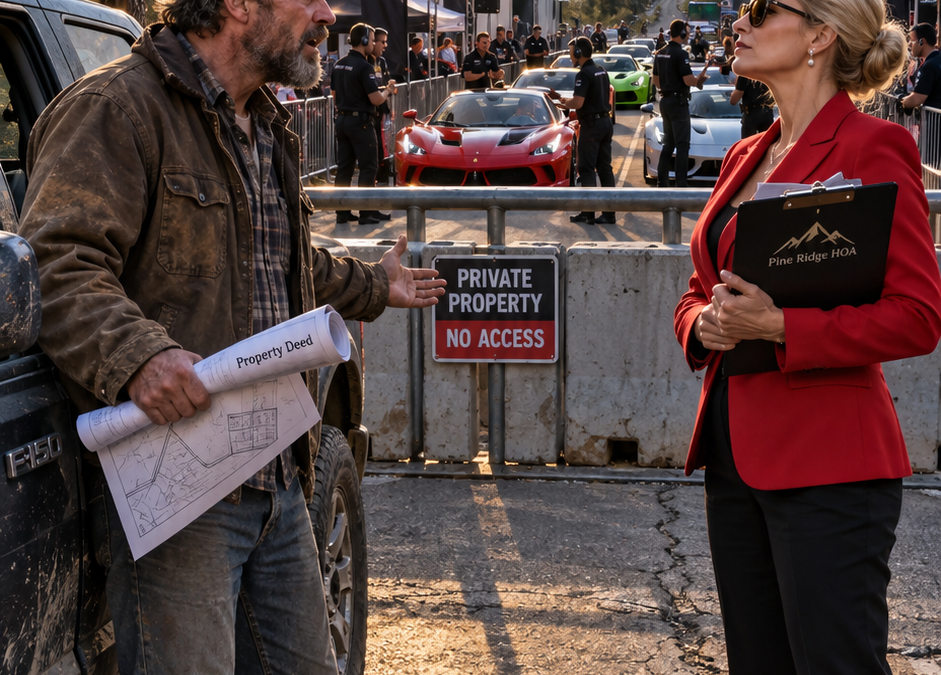
𝗣𝗔𝗥𝗧 𝟮
My name is Scott Fletcher.
I’m a civil engineer.
Road design, grading, storm drainage, slope stabilization, culverts—the invisible infrastructure nobody thinks about until a road washes out or a subdivision floods.
My father, Robert Fletcher, had been an engineer too.
He spent most of his career with the state Department of Transportation before buying forty acres in the mountains in the early 1990s.
When he bought the property, access was terrible.
A logging trail climbed through the valley from the county highway, but “trail” was a generous description.
Every spring runoff carved new channels through it.
Every winter turned parts of it into frozen ruts.
Dad could have complained.
Instead, he surveyed a road.
That was who he was.
Some men rebuilt engines in their garages.
My father designed drainage profiles.
He drew Fletcher Road by hand at a drafting table in our basement.
I still have the original blueprint.
One point three miles.
Two lanes.
Engineered base.
Compacted subgrade.
Crowned asphalt surface.
Ditches shaped to carry mountain runoff without eating the shoulders.
Culverts at the natural drainage crossings.
Turnouts where snow equipment could work safely.
He hired a small contractor, supervised construction personally, and somehow managed to annoy everybody by checking compaction density more often than the crew thought necessary.
The road lasted thirty years.
So I suppose he had earned the right.
For almost two decades, Fletcher Road served one purpose.
Getting our family from the county highway to our property.
Then Ridgewater arrived.
A development company bought approximately three hundred acres on the ridge above us and announced plans for a luxury resort.
Two hundred rooms.
Golf course.
Spa.
Conference facilities.
Restaurants.
Glass walls.
Stone fireplaces.
Infinity pool.
The architectural renderings looked like a Swiss bank had decided to become a mountain lodge.
The completed project cost roughly eighty million dollars.
There was just one inconvenient detail.
The ridge had no practical paved access.
Except Fletcher Road.
The developer approached my father.
They needed an easement.
Dad did not object in principle.
He believed roads were supposed to be useful.
The resort offered an annual access payment and agreed to share maintenance costs.
Dad hired an attorney.
That was also who he was.
He trusted people.
He trusted agreements more.
A recorded easement was drafted and filed with the county.
The resort received limited rights to use Fletcher Road for normal ingress and egress.
Guests.
Employees.
Deliveries.
Ordinary resort traffic.
My family retained title to the road itself.
For years, the arrangement worked.
Every January, the resort check arrived.
Every year, maintenance costs were divided according to the agreement.
Guests drove past our land.
Nobody behaved like access rights meant ownership.
Then Dad died.
I was forty-six.
Cancer took him faster than any of us expected.
I inherited the house, the forty acres, the road, the easement agreement, and every file cabinet he had labeled with the neat block handwriting engineers seem genetically required to develop.
I moved back permanently.
For a while, nothing changed.
Then Diane Caldwell became president of Ridgewater Estates HOA.
Ridgewater Estates was the residential community surrounding the resort.
For years, its HOA had behaved like a normal HOA.
Landscaping.
Pool maintenance.
Holiday decorations.
Architectural approvals.
Rules about garbage cans.
The usual suburban government of extremely small things.
Diane apparently considered that lack of ambition a failure.
Within months of becoming president, she began treating every road, trail, shoulder, sign, drainage ditch, and mailbox within sight of Ridgewater as association property.
Six months into her term, I received my first letter.
Official letterhead.
Heavy paper.
Embossed logo.
The board had “determined” that management of Fletcher Road should be absorbed by the HOA for the benefit of the community.
Absorbed.
That was the word.
As if private property were a spill on a countertop.
I attended the next board meeting carrying my deed.
When my turn came, I placed it in front of Diane.
“Fletcher Road is private property.”
She gave me the diplomatic smile of someone discovering that an obstacle could speak.
“We are reviewing the road’s status.”
“There’s nothing to review.”
“The association has responsibilities to the community.”
“And I have a recorded deed.”
Several homeowners watched us.
Diane glanced toward them.
“I’ll have counsel look into it.”
“Good.”
For several months, she left me alone.
I assumed somebody’s lawyer had explained the difference between jurisdiction and enthusiasm.
I was wrong.
Three weeks before I found the barriers, another letter arrived.
This one was titled:
EMERGENCY ROAD UTILIZATION ORDER.
According to the letter, Ridgewater Estates HOA had temporarily requisitioned Fletcher Road for a sanctioned community motorsport event.
Invitation only.
Private exotic-car time trial.
The phrase “requisitioned” was particularly ambitious.
I read the letter three times.
There had been no phone call.
No negotiation.
No request.
No offer to compensate me.
The HOA had simply announced that it had taken control of my road for a race.
What bothered me most, however, was the authorization section.
Several names appeared beneath the declaration.
Supposedly board members.
I recognized almost none of them.
I had attended enough Ridgewater meetings to know the actual board.
Those names did not match.
I filed the detail away.
At the time, I assumed Diane had created some temporary committee.
Then came the Saturday morning barricades.
The guard.
The supercars.
The fire trail.
The sentence that stayed with me most was Diane’s:
“You aren’t on the access list.”
That evening, after bouncing my truck down the south trail to reach my own house, I went into my office and opened Dad’s files.
Three inches of correspondence.
Invoices.
Maintenance records.
Annual payments.
Engineering exhibits.
Survey sheets.
Letters between the resort developer and Dad’s lawyer.
I spread everything across the dining table.
The deed came first.
Parcel 14-227.
County recording stamp.
Legal description.
Survey.
Fletcher Road sat entirely within our property.
Not partially.
Not approximately.
Entirely.
The easement did not transfer title.
It granted access.
I knew that already.
But I needed something stronger than ownership.
Diane had already demonstrated that ownership documents did not bother her.
The next morning, I returned to the barricades carrying the deed.
A different guard was working.
He radioed Diane.
She arrived eleven minutes later in a golf cart.
I remember the golf cart because there was something beautifully ridiculous about it.
She was using my road to drive over and tell me why I could not use my road.
“I thought we resolved this yesterday,” she said.
“We didn’t resolve anything.”
I unfolded the deed across the hood of my truck.
“Parcel 14-227.”
She barely looked.
“County-recorded ownership. Fletcher Road is inside my property.”
“The HOA has authority to utilize community-adjacent infrastructure.”
“That’s not a legal category.”
“It is part of our community access system.”
“No. It’s part of my land.”
She sighed.
Not an uncertain sigh.
A disappointed-teacher sigh.
“This was approved by the board.”
“Show me the vote.”
“I can have documentation sent.”
“Show me the meeting minutes.”
“They’ll be provided.”
“Show me anything establishing that your board can close private property without the owner’s permission.”
Her face tightened.
“You’re being unnecessarily confrontational.”
“You barricaded my road.”
“The event proceeds as scheduled.”
I tapped the deed.
“I’m giving you twenty-four hours to remove every barrier.”
She looked at the paper.
Then at me.
“You cannot override a board action with a piece of paper.”
A piece of paper.
My deed.
Recorded with the county.
She turned the golf cart around and drove away.
I called the sheriff.
A deputy arrived that afternoon.
He was polite.
Professional.
He examined the deed.
Walked the barricades.
Spoke to event staff.
Listened to my explanation.
Then he said the sentence every property owner hates.
“This looks like a civil matter, sir.”
I stared at him.
“They’re physically blocking property I own.”
“I understand.”
“They have no deed.”
“I understand.”
“They have no court order.”
“I understand.”
“They’re holding a race.”
“There is an easement involved.”
“For resort access.”
“And they’re claiming authority through that access.”
“So anybody can claim anything and you leave the barriers up?”
He looked uncomfortable.
“I’m not saying they’re right. I’m saying I can’t adjudicate an easement dispute roadside.”
I knew what he meant.
I even understood the legal caution.
That did not make watching him drive away any easier.
My deed had now been dismissed twice.
Once by an HOA president.
Once by a deputy who admitted the deed appeared legitimate but would not act without a court order.
Two days later, Diane retaliated.
Three violation notices arrived.
The first accused me of unauthorized obstruction of community access because I had temporarily stopped my truck near the barricade.
The second accused me of failing to maintain Fletcher Road to HOA standards.
That one was almost funny.
My father had designed the road to state engineering principles.
Ridgewater’s board president, whose transportation qualifications appeared to consist mainly of owning a golf cart, had cited me for inadequate road maintenance.
The third notice contained the fine.
$2,500 per day.
Effective immediately.
Until I corrected the violations.
I did the arithmetic.
$17,500 in a week.
$35,000 in two.
Then another envelope arrived.
Lien notice.
The HOA claimed I owed community road-maintenance assessments.
Assessments I had never been billed.
Assessments for a road it did not own.
That was when I finally understood Diane’s strategy.
She didn’t need to prove she was right quickly.
She only needed to make resistance expensive.
Fine me.
Lien me.
Force me to hire counsel.
Make me spend months responding to paperwork she could generate in an afternoon.
It was bureaucratic warfare conducted by somebody who believed the person with the larger printer eventually won.
So I changed tactics.
I called Lynn Torres.
Lynn had spent twenty years practicing land-use and easement law in the county.
She listened without interrupting while I explained the barricades, the race, the fines, the lien, and the sheriff’s response.
Then she pulled the deed online.
Four minutes later she said, “Ownership is clean.”
“I know.”
“No, Scott. I mean clean. There’s no legitimate title question here. The road is yours.”
“Then stop them.”
There was a pause.
“That part is harder.”
She explained the practical problem.
Challenging the fines and lien could take months.
Discovery.
Motions.
Hearings.
Scheduling.
The race was ten days away.
By the time a judge ruled, supercars could have raced up and down Fletcher Road, gone home, been sold twice, and become somebody else’s depreciation problem.
“What about the easement?” she asked.
“I have Dad’s copy.”
“I want the recorded version.”
We drove to the county clerk’s office.
Third floor.
Land records.
A clerk brought out an old file.
FLETCHER ROAD EASEMENT — RIDGEWATER DEVELOPMENT.
Dad’s handwriting was still on the tab.
Seeing it hit me harder than I expected.
For a moment, I wasn’t looking at a legal document.
I was looking at his hand.
Lynn read quietly.
Page one.
Page two.
Standard access language.
Payment schedule.
Maintenance obligations.
Insurance.
Indemnification.
Page seven.
She stopped.
Read something again.
Then looked up.
“Scott.”
“What?”
“Your father’s lawyer was paranoid.”
I smiled faintly.
“Dad considered that a compliment.”
She turned the document toward me.
Section Nine.
Material Misuse.
The clause stated that if the easement holder—or any party acting under its authority—used Fletcher Road materially beyond normal ingress and egress, including commercial events, staging, organized gatherings, or other activities unrelated to ordinary access, the property owner could revoke the easement after thirty days’ written notice.
I read it twice.
Commercial events.
Organized gatherings.
Staging.
An invitation-only exotic-car time trial checked every box.
My father had given the resort access.
His lawyer had installed an emergency brake.
Thirty years later, Diane Caldwell had stepped on it for me.
I looked at Lynn.
“So I revoke.”
“Yes.”
“Today.”
“Yes.”
“And the resort loses access?”
Her expression became more careful.
“In thirty days.”
There it was.
The problem.
The race was in ten.
The clause required thirty days’ written notice.
We sent the notice anyway.
Certified mail.
HOA.
Resort management.
Then Lynn filed a petition seeking a temporary restraining order to stop the event before it occurred.
Diane responded by moving the race.
Five days earlier.
Official HOA email:
Due to logistical optimization, the Ridgewater Motorsports Invitational has been rescheduled.
Logistical optimization.
I read the phrase three times.
“She knows we’re filing,” I told Lynn.
“She knows you’re pushing back. She may not know why.”
The hearing took place two days before the revised event.
Lynn argued that Fletcher Road was private, that the easement was limited, that the scheduled race was precisely the kind of activity Section Nine prohibited, and that allowing the event to proceed could cause irreparable damage.
Diane’s attorney called the race a “community-sanctioned cultural event.”
I nearly admired that one too.
Apparently putting racing numbers on a McLaren transformed it into culture.
He argued the underlying easement dispute required full adjudication and that emergency injunctive relief would effectively decide the case before discovery.
The judge recessed for thirty minutes.
When she returned, she denied the temporary order.
Not because she declared Diane correct.
Because she would not resolve the larger property dispute through expedited emergency relief.
“The event may proceed while the underlying claims remain pending.”
May proceed.
Two words.
Diane immediately turned them into propaganda.
That evening, every homeowner received an HOA newsletter.
COMMUNITY EVENT UPHELD BY COURT.
The court had done no such thing.
The judge had refused an emergency injunction.
But nuance has never survived long in newsletters written by people celebrating themselves.
I sat alone at the kitchen table reading Diane’s message while equipment trucks moved along Fletcher Road outside.
My father’s road.
Work lights glowed through the trees.
Timing crews were setting up the event that night.
The revocation clock still had nearly two weeks left.
The race was forty-eight hours away.
The lien remained.
The fines remained.
Diane had physical control.
Legal delay.
A victory headline.
For the first time, I wondered whether being right was going to matter soon enough.
Lynn called around nine.
“We stop treating this as only an easement case.”
“What do you mean?”
“Why is Diane doing this?”
“Because she’s Diane.”
“No.”
Lynn paused.
“HOA presidents don’t risk this much legal exposure because they like cars. Follow the event.”
So I did.
The original seizure letter contained small print near the bottom.
EVENT MANAGEMENT PARTNER:
APEX RALLY EVENTS LLC.
I searched the state’s corporate database.
Apex Rally Events had been created six months earlier.
No meaningful history.
No public portfolio.
No previous major events.
Registered agent:
Greg Pollson.
The name meant nothing.
I searched him with Ridgewater.
Nothing.
With motorsports.
Almost nothing.
Then with Diane Caldwell.
A county property record connected the addresses.
Greg Pollson was Diane’s brother-in-law.
Her husband’s brother.
Six months earlier, he had registered Apex Rally Events.
Around the same time Diane had renewed her effort to “absorb” Fletcher Road.
That was interesting.
But family connection wasn’t proof of wrongdoing.
Money was.
Lynn requested documents from resort management.
What came back changed everything.
Ridgewater Resort had contracted Apex Rally Events to organize the private time trial.
Contract value:
$340,000.
A newly formed company owned by Diane Caldwell’s brother-in-law was receiving $340,000 to run a race on my private road.
Then we found the insurance waiver.
HOA policy required a substantial event insurance bond.
Diane had personally waived the requirement for Apex Rally.
Her signature appeared at the bottom.
That waiver saved her brother-in-law’s company tens of thousands of dollars.
I spread the documents across the same dining table where Dad had once reviewed road-maintenance invoices.
Corporate filing.
Event contract.
Insurance waiver.
Property deed.
Easement.
Diane’s seizure letter.
For weeks, she had presented the conflict as a question of community authority.
It wasn’t.
It was a business transaction.
Lynn looked across the table.
“This is no longer just an easement misuse problem.”
“What is it?”
“A potential conflict-of-interest and fraud problem.”
The race was thirty-six hours away.
So I called the other HOA board members.
Not Diane.
Everyone else.
Phil Barnes answered first.
Retired dentist.
Six years on the board.
“Phil, did you vote to seize Fletcher Road for the race?”
Silence.
Then:
“We voted to what?”
“Authorize use of Fletcher Road.”
“I never voted on that.”
“Did the board approve a closure?”
“No.”
“Did you vote to authorize Apex Rally?”
“No.”
Carol Hadley said the same thing.
Diane had mentioned an event.
There had been discussion.
No formal vote.
No authorization to seize my road.
The third member, Ruth Jennings, took longer.
When she finally called, she sounded uneasy.
“Diane had me sign something.”
“What?”
“She said it was for road maintenance.”
“Fletcher Road?”
“Yes. Pothole work. Budget authorization.”
“Do you have a copy?”
She found it.
Emailed it.
The document was titled:
ROAD UTILIZATION AUTHORIZATION — FLETCHER ROAD.
The first paragraph contained generic infrastructure language.
The second authorized the HOA president to direct temporary closures of Fletcher Road for association events.
I called Ruth back.
“Did you understand this authorized event closures?”
“No.”
“Did Diane explain it?”
“No.”
Her voice changed.
“She stood in my kitchen and told me this was a maintenance resolution.”
Ruth reread the document while we spoke.
Then she became furious.
“I would never have signed this if she’d told me.”
“Will you put that in writing?”
“Yes.”
She sent the statement the next morning.
Now we had the structure.
No legitimate board vote.
A misleading signature.
A $340,000 contract benefiting the president’s relative.
A waived insurance requirement.
A false assertion of control over a road the HOA did not own.
And a pending easement revocation.
Lynn drafted a fourteen-page demand letter.
Every board member received it.
So did the association’s registered agent.
We demanded an emergency meeting before the race.
Diane replied through counsel.
Cease and desist.
Apparently calling HOA board members to ask whether they had actually voted was “harassment.”
Then came the eminent-domain threat.
Lynn called me at seven the next morning.
“Diane’s attorney says that if you revoke the easement, the HOA will pursue condemnation of Fletcher Road as a public necessity.”
I sat down.
“They’re threatening to take it.”
“They’re threatening to try.”
“Can they?”
“Not the way she’s pretending.”
Lynn explained the process.
County involvement.
Public hearings.
Valuation.
Necessity analysis.
Months or years.
Political scrutiny.
No guarantee whatsoever.
“It’s pressure,” she said. “Same as the fines. Same as the lien.”
Make resistance hurt.
That had been Diane’s strategy from the beginning.
I looked at Dad’s blueprint on the office wall.
Thirty years earlier, he had drawn every curve in Fletcher Road with a pencil.
Now somebody who had never owned a square inch of it was threatening condemnation because I would not let her brother-in-law make hundreds of thousands of dollars racing cars across it.
I stopped being intimidated.
Not because the threat was harmless.
Because the pattern had finally become obvious.
Diane had mistaken escalation for strength.
Every time she encountered resistance, she created another document.
Another threat.
Another penalty.
Another claim.
But documents worked both ways.
And hers were beginning to form a very useful trail.
We filed complaints with county planning and code enforcement.
Possible unpermitted commercial event.
Possible unauthorized road closure.
Commercial use of private property without owner consent.
Then I wrote directly to Ridgewater Resort’s parent company in Denver.
Not through Diane.
Not through the HOA.
I explained that Fletcher Road was privately owned.
I attached the deed.
The easement.
Section Nine.
The revocation notice.
I informed them that the motorsports event itself was the misuse triggering termination rights.
Four hours later, the resort’s general counsel called Lynn.
“They had no idea,” she told me afterward.
“No idea about what?”
“That the road was yours.”
I laughed once.
Not because it was funny.
Because it was almost too stupid to process.
“What did Diane tell them?”
Lynn paused.
“She told them the HOA owned Fletcher Road.”
“In writing?”
“In writing.”
That was the mistake.
Not arrogance.
Not threats.
Not the barriers.
Not even the fake authority.
The written representation.
Diane had signed her name to a statement telling an eighty-million-dollar resort that her HOA owned my private road.
The resort relied on it.
The resort signed a $340,000 contract based on it.
The resort planned an event based on it.
Now the resort’s lawyers understood that the property owner was preparing to revoke the only practical paved access to their facility.
Concern arrived very quickly after that.
The emergency HOA board meeting was scheduled for Saturday at eight in the morning.
The race was supposed to start at ten.
Friday night, I sat at my dining table organizing documents.
Dad would have approved.
He loved tabs.
Deed.
Tab one.
Recorded easement.
Tab two.
Section Nine highlighted.
Revocation notice.
Tab three.
Corporate registration for Apex Rally Events.
Tab four.
Event contract.
Tab five.
Insurance waiver signed by Diane.
Tab six.
Board statements.
Tab seven.
Ruth’s declaration.
Tab eight.
Resort emails.
Tab nine.
HOA fines.
Tab ten.
Lien notice.
Tab eleven.
Court order denying emergency relief.
Tab twelve.
Diane’s newsletter falsely implying the court had approved the event.
Tab thirteen.
Through the window, I could see portable work lights glowing along Fletcher Road.
They were setting up.
Timing gates.
Banners.
Tire barriers.
Registration equipment.
Everything looked professional.
Expensive.
Certain.
There is a particular confidence people develop when they believe the cost of turning around has become too high.
Diane had built an entire event on that confidence.
By sunrise, I intended to test it.
I drove past the staging area at six-thirty Saturday morning.
A field near Fletcher Road had been converted into a paddock.
Enclosed trailers.
Mechanics.
Fuel equipment.
Teams in matching shirts.
Apex Rally banners.
Ferraris under covers.
Porsches warming engines.
Someone had erected a hospitality tent.
Three hundred forty thousand dollars worth of event infrastructure was sitting beside a road they did not own.
I kept driving.
The Ridgewater Estates community center was already crowded when I arrived.
Twenty-six homeowners sat in folding chairs.
All five HOA board seats were occupied.
Diane sat in the middle.
Clipboard.
Lanyard.
Perfect posture.
Lynn sat beside me.
County planning had sent an enforcement officer named Maria Martinez.
Next to her sat Keith Alderman, a regional operations director from Ridgewater Resort’s parent company.
Keith wore a charcoal suit and the expression of a man who had spent the previous twenty-four hours discovering that somebody else’s confidence had become his legal problem.
Diane opened the meeting.
“This emergency session has been requested to address concerns raised by one property owner regarding the Ridgewater Motorsports Invitational.”
One property owner.
I almost smiled.
She had barricaded a privately owned road, filed fines, placed a lien, threatened condemnation, and now I had been reduced to one property owner with concerns.
“I want to assure residents,” she continued, “that the event was properly sanctioned and that prior legal challenges were reviewed by the court.”
Lynn stood.
“The board’s permission, we’d like to present several documents.”
Phil Barnes nodded.
“So would I.”
Diane’s eyes moved toward him.
Something changed in her face.
Small.
But noticeable.
Lynn distributed the deed.
“Parcel 14-227. County recorded. Fletcher Road lies entirely within the privately owned Fletcher property.”
Phil read it.
Carol read it.
Ruth stared at her copy.
Diane did not touch hers.
Lynn continued.
“The HOA does not own Fletcher Road. It holds no recorded property interest in the road.”
Diane folded her hands.
“The association has management authority over community-adjacent infrastructure.”
Lynn did not even look at her.
“Next document.”
The easement.
Page seven.
Section Nine.
“Ridgewater Resort holds a limited easement for ordinary ingress and egress. The agreement expressly prohibits material misuse, including organized gatherings and commercial events. Misuse permits revocation after thirty days’ written notice.”
She placed the certified-mail receipt beside it.
“Notice was sent eighteen days ago.”
Murmurs moved through the room.
Diane spoke.
“This issue is already in litigation. The court declined to halt the event.”
“The court declined emergency injunctive relief,” Lynn said. “It did not rule that the HOA owns the road.”
A homeowner in the back said, “That’s not what your newsletter said.”
Diane ignored him.
“The board authorized the event.”
That was when Lynn reached tab seven.
“Did it?”
Phil Barnes looked up.
“I didn’t.”
Diane turned toward him.
“Phil—”
“No.”
His voice was calm.
“I never voted to seize Fletcher Road.”
Carol raised her hand slightly.
“Neither did I.”
Diane’s posture stiffened.
“There was administrative authorization.”
Lynn placed Ruth’s document on the table.
“This is the authorization Ms. Caldwell relied upon.”
Ruth looked at Diane.
“You told me it was for pothole repairs.”
The room became very still.
Diane answered carefully.
“The resolution included broader infrastructure provisions.”
“You stood in my kitchen.”
Ruth’s voice trembled.
Not with fear.
With anger.
“You told me you needed one signature for a maintenance budget line.”
Diane looked toward her attorney.
He began writing.
Lynn placed Ruth’s written statement beside the document.
“There was no valid board vote authorizing the closure.”
Diane raised her chin.
“As president, I retain administrative discretion—”
“There’s more,” Lynn said.
Apex Rally’s corporate record landed on the table.
Registered agent:
Greg Pollson.
“Mr. Pollson is Ms. Caldwell’s brother-in-law.”
The murmuring became louder.
Diane’s attorney stopped writing.
Lynn placed the contract beside the filing.
“Ridgewater Resort contracted Apex Rally Events for approximately $340,000 to organize this event.”
Keith Alderman’s eyes stayed on Diane.
Lynn placed down the insurance waiver.
“The HOA’s standard event-insurance requirement was personally waived by Ms. Caldwell.”
Phil looked at the signature.
“Diane?”
“This is being deliberately mischaracterized.”
“How?”
“The insurance requirement was unnecessary because the organizer carried separate coverage.”
“Where is it?” Phil asked.
Diane didn’t answer.
Lynn placed the final resort correspondence on the table.
“Ridgewater Resort has also confirmed that Ms. Caldwell represented in writing that the HOA owned Fletcher Road and had full authority to authorize commercial use of it.”
Silence.
No murmurs this time.
Just silence.
Keith Alderman leaned forward.
“Ms. Caldwell.”
His voice was controlled.
“The resort management company relied upon your written representation when entering the Apex Rally contract.”
Diane looked at him.
“The road has always served Ridgewater.”
“That isn’t what you wrote.”
“The HOA manages community access.”
“You wrote that the HOA owned it.”
She hesitated.
Keith continued.
“We have reviewed the county deed. That representation appears false.”
For the first time since I had known Diane Caldwell, she looked cornered.
Not embarrassed.
Not apologetic.
Cornered.
So she reached for fear.
“If Mr. Fletcher revokes the easement, this resort loses practical access.”
She turned toward the homeowners.
“Do you understand what that means for property values? For local employment? For everyone in this room?”
There it was.
The emergency button.
She had lied.
But if everyone focused on the consequences of exposing the lie, perhaps they would become angry at me instead.
I stood.
“I never asked to close the resort.”
She pointed toward me.
“You served a revocation notice.”
“After you barricaded my property for your brother-in-law’s race.”
“I acted for the community.”
“You fined me $2,500 a day for interfering with access to a road I own.”
“You were obstructing—”
“You filed a lien.”
Her jaw tightened.
“You threatened eminent domain.”
“That was counsel’s position.”
“You told the resort you owned my road.”
“I described the association’s operational authority.”
“No.”
Keith Alderman’s voice cut through the room.
“You said owned.”
Diane stopped.
Maria Martinez from county planning finally spoke.
“I need to address the event itself.”
Everyone turned.
She opened her file.
“There is no county commercial-event permit on record for this race.”
Diane’s lawyer leaned toward her.
“There may be a misunderstanding—”
“No.”
Martinez continued.
“There is no road-closure permit. Fletcher Road is privately owned. Commercial activity requires authorization from the property owner and applicable county permitting.”
She looked directly at Diane.
“We have neither.”
The lawyer began:
“This meeting isn’t the proper forum—”
“This isn’t an adjudicative hearing,” Martinez replied. “I’m informing you that the necessary permits do not exist.”
She closed the file.
“The event cannot proceed.”
Diane’s face went pale.
Phil Barnes leaned forward.
“I move that Diane Caldwell be suspended as president pending investigation into the Fletcher Road authorization, Apex Rally relationship, insurance waiver, and representations made to Ridgewater Resort.”
Carol seconded.
Diane turned.
“You cannot be serious.”
Phil looked at her.
“I am.”
The vote was four to one.
Diane voted for herself.
I wish I could tell you there was some dramatic speech.
There wasn’t.
Real defeat is usually quieter.
Diane stared at the table.
Then removed the lanyard from around her neck.
Placed it beside the clipboard.
Gathered nothing else.
And walked out.
Nobody stopped her.
At ten o’clock—the exact hour the first supercar was supposed to launch down Fletcher Road—the event was being dismantled.
Timing equipment came down.
Banners were rolled.
Mechanics loaded cars.
Tire walls went back onto trailers.
At noon, a crew removed the Jersey barriers.
I stood beside the road watching a loader lift the last concrete block.
The worker in the yellow vest from the first morning was there.
He recognized me.
This time he did not touch my hood.
“Guess you did own it,” he said.
“Every inch.”
He nodded.
“Hell of a mess.”
“Not anymore.”
At three that afternoon, I met a fencing contractor at the north entrance.
By four-thirty, two steel posts had been set beside Fletcher Road.
A heavy gate spanned the entrance.
I installed the padlock myself.
Then I hung a simple sign.
FLETCHER ROAD
PRIVATE PROPERTY
ACCESS BY OWNER AUTHORIZATION ONLY
Behind me stretched one point three miles of asphalt.
Beyond that road sat Ridgewater Resort.
Eighty million dollars worth of glass, stone, restaurants, guest rooms, meeting spaces, spa facilities, and golf operations.
And suddenly no guaranteed paved access.
The thirty-day revocation period matured.
I enforced it.
The gate stayed closed.
For twenty-two days.
The resort did not literally shut down.
Employees remained.
Utilities operated.
Security stayed onsite.
But guests could not use Fletcher Road.
The only alternative was a rough fire trail requiring a long detour.
It was unsuitable for normal resort operations.
Reservations were canceled.
Conferences moved.
Wedding parties relocated.
Delivery schedules became a nightmare.
According to figures later disclosed during negotiations, the resort estimated roughly $2.3 million in lost business and associated disruption.
All because Diane Caldwell had decided asking permission was beneath her.
The parent company sued.
Not me.
Diane.
And Apex Rally Events.
Fraud.
Misrepresentation.
Contract damages.
The resort argued that it had entered the $340,000 event agreement relying on Diane’s written assurance that the HOA controlled Fletcher Road.
Apex Rally collapsed almost immediately.
The company had virtually no history beyond the Ridgewater event.
Within weeks, it was dissolved.
Funds associated with the contract became part of the civil dispute.
Ridgewater Estates HOA held another meeting ten days after Diane’s suspension.
This time nobody used the phrase “community-adjacent infrastructure.”
Diane was removed as president permanently.
Unanimous vote.
The board rescinded every fine issued against me.
All $2,500-per-day penalties vanished.
The road-maintenance assessments disappeared.
The lien against my property was withdrawn.
The HOA paid the filing costs necessary to clear the record.
Then it issued a written apology.
Phil Barnes delivered it personally.
He showed up at my house on a Saturday morning carrying an envelope.
No clipboard.
No lanyard.
Just Phil.
“I should have asked more questions sooner,” he said.
“You weren’t the one barricading roads.”
“I was on the board.”
“That still doesn’t make the road yours.”
He laughed.
Then became serious.
“Your father would have handled this the same way.”
I looked at him.
“How?”
“Quietly. Thoroughly. Every document in order.”
That nearly got me.
Dad had been gone two years.
Sometimes grief sneaks past you through the smallest opening.
Not birthdays.
Not anniversaries.
A sentence about paperwork.
I nodded.
“Yeah.”
Phil shook my hand with both of his.
“I’m sorry, Scott.”
“Thank you.”
Three weeks later, the county district attorney’s office confirmed it had opened an investigation into documents used to authorize the road closure and representations connected to the event.
The investigation focused on the disputed authorization paperwork and related financial representations.
Diane retained counsel.
From that point forward, whatever happened in the criminal process belonged to prosecutors, investigators, attorneys, and eventually the courts.
I had what I wanted.
My road.
My title.
My record cleared.
And an HOA board that had finally learned the difference between access rights and ownership.
The eminent-domain threat vanished almost instantly after Diane’s removal.
Nobody on the replacement board wanted anything to do with it.
The county showed no interest in condemning Fletcher Road.
Why would it?
The resort had functioned for years under a private easement.
The problem had never been access.
The problem had been misuse.
Six weeks after I installed the gate, Ridgewater Resort’s general counsel asked to meet.
We sat at a conference table downtown.
Me.
Lynn.
The resort’s attorney.
Keith Alderman.
No HOA representatives.
That was my first condition.
The new easement negotiations were surprisingly easy.
Everyone had acquired perspective.
The resort still needed Fletcher Road.
I was willing to provide access.
But this time, nothing would be assumed.
The annual payment increased substantially.
Maintenance contributions were recalculated based on actual traffic.
The easement applied only to ordinary resort guests, staff, service vehicles, and deliveries.
No racing.
No festivals.
No staging.
No private events.
No organized gatherings using Fletcher Road itself.
And then I added my clause.
Any organized event activity on Fletcher Road required my prior written permission.
Unauthorized commercial or event use would constitute immediate grounds for termination.
No thirty-day cure period.
The resort’s attorney read it.
Then looked across the table.
“Fair.”
Keith nodded.
“Very fair.”
They signed.
The next morning, I unlocked the gate.
Resort traffic resumed.
Quietly.
Normally.
Exactly as my father had intended.
I never removed the gate posts.
They remain on either side of Fletcher Road.
The gate itself stays open most days.
Above it is a permanent iron sign.
FLETCHER ROAD
PRIVATE
No slogans.
No threats.
No HOA language.
It doesn’t need any.
I still drive that road every day.
Sometimes early in the morning when fog settles into the valley.
Sometimes late at night when the resort lights glow on the ridge.
I pass the spot where the Jersey barriers stood.
The shoulder where Lamborghinis lined up.
The place where a man in a yellow vest once put his hand on the hood of my truck and told me I wasn’t on the access list.
The chalk timing marks disappeared during the first heavy rain.
The banners are gone.
Tire barriers gone.
Temporary fencing gone.
Apex Rally gone.
Diane Caldwell’s name disappeared from HOA letterhead not long after.
Fletcher Road remained.
One point three miles of asphalt through a mountain valley.
Built by a road engineer who believed drainage mattered, grades mattered, contracts mattered, and details mattered.
Dad’s original blueprint still hangs in my office.
For years, I had looked at the alignment, culverts, contour lines, and elevation notes.
A few weeks after everything ended, I took it down to clean the frame.
That was when I noticed a pencil note in the margin near one of his drainage calculations.
The handwriting was faint.
Small enough that I had missed it for years.
Fourteen words.
Build it right, and it’ll take care of itself.
I stood there holding the drawing for a long time.
Dad had been talking about roads.
Probably.
But thirty years later, his road had survived spring runoff, winter ice, resort traffic, an ambitious HOA president, a $340,000 race, a fake authorization, a lien, a courtroom, and twenty-two days behind a locked gate.
Diane had arrived believing authority came from a title, a lanyard, and enough official-looking paper.
My father had known better.
Authority over land comes from ownership.
Authority over an easement comes from the agreement.
And when somebody ignores both, sometimes the most satisfying response isn’t yelling.
It’s reading all the way to page seven.
Because Diane Caldwell wanted my road for one weekend.
In the end, she lost the race.
She lost the presidency.
Her brother-in-law lost the event company.
The fines disappeared.
The lien disappeared.
The HOA disappeared from every future agreement involving Fletcher Road.
And I ended up with a stronger easement, higher annual compensation, explicit control over every future event, and a steel gate waiting beside the road in case anyone ever forgot whose asphalt they were driving on.
Nobody has forgotten since.
Have you finished reading the story and want to read it again?
HOA Hijacked My Private Road for a $340,000 Supercar Race—So I Shut Down Access to Their $80M Resort
They barricaded the road my father built.
Then they told me I wasn’t on the access list.
They should have read page seven before starting the engines.
I pulled onto Fletcher Road just after eight on a cool Saturday morning and found a stranger in a yellow safety vest standing in front of my truck with his palm pressed against my hood.
“Back up,” he said. “Road’s closed.”
For a second, I honestly thought I had taken the wrong turn.
That would have been difficult.
Fletcher Road had been the road to my house for most of my life.
My father had surveyed it.
My father had designed it.
My father had stood beside the paving crew thirty years earlier while asphalt rolled through a mountain valley that, until then, had been served by little more than a logging trail and optimism.
Now concrete Jersey barriers blocked both lanes.
Temporary fencing lined the shoulders.
Black-and-yellow timing cables crossed the pavement.
Someone had chalked starting marks directly onto asphalt my father had paid to pour.
Beyond the barriers sat a lineup that looked like somebody had emptied a luxury-car showroom onto my property.
Lamborghinis.
Porsches.
A bright orange McLaren wearing racing numbers.
A Ferrari sat on a trailer while three men in matching shirts checked tire pressures.
I lowered my window.
“This is Fletcher Road.”
The guard nodded like I had correctly identified a tree.
“Correct.”
“I own it.”
He stared at me.
Then he laughed.
Actually laughed.
Not a nervous chuckle.
A full, amused laugh.
He lifted the radio clipped to his vest.
“Control, I’ve got a guy here saying he owns the road.”
A burst of static answered.
I sat there with both hands on the steering wheel, wondering how many bad decisions had to line up in sequence before a stranger could stand on a private road, touch the owner’s truck, and report him to “control.”
The answer arrived two minutes later in a white electric golf cart.
Diane Caldwell.
President of the Ridgewater Estates Homeowners Association.
She wore a navy skirt, a white blouse, a lanyard, and the expression of somebody arriving to resolve an inconvenience caused by a person who had failed to understand the importance of her clipboard.
“Mr. Fletcher.”
“Diane.”
“The road is closed for a sanctioned motorsport event.”
“My road?”
“The HOA has jurisdiction over this access route for the weekend.”
I looked past her at the supercars.
Then back at her.
“Jurisdiction.”
“Yes.”
“That’s an interesting word.”
She glanced toward the guard.
“You aren’t on the event access list.”
I almost admired the sentence.
It took confidence to tell a man he wasn’t on the access list to a road carrying his own last name.
“My house is up there.”
“If you need access to your property, you can take the south fire trail.”
“The dirt trail?”
“It is passable.”
“It turns into soup when it rains.”
“The forecast is clear.”
That was Diane’s solution.
I could drive through mud, rocks, switchbacks, and drainage ruts to reach my home because her HOA wanted Lamborghinis racing on a road it did not own.
Then she turned away.
Not because we had finished talking.
Because she had decided we had.
A flatbed loaded with tire barriers was approaching from the opposite side.
She waved it through.
I watched the truck roll past me onto Fletcher Road.
The road my father built.
The road I owned.
The road Diane Caldwell had apparently seized with a clipboard and a vocabulary word.
I backed up.
Not because she was right.
Because my father had taught me something far more useful than shouting.
When people become confident enough to misuse paperwork, the best response is usually better paperwork.
And somewhere in the file cabinet inside my house was thirty years’ worth of it.
PART2
My name is Scott Fletcher.
I’m a civil engineer.
Road design, grading, storm drainage, slope stabilization, culverts—the invisible infrastructure nobody thinks about until a road washes out or a subdivision floods.
My father, Robert Fletcher, had been an engineer too.
He spent most of his career with the state Department of Transportation before buying forty acres in the mountains in the early 1990s.
When he bought the property, access was terrible.
A logging trail climbed through the valley from the county highway, but “trail” was a generous description.
Every spring runoff carved new channels through it.
Every winter turned parts of it into frozen ruts.
Dad could have complained.
Instead, he surveyed a road.
That was who he was.
Some men rebuilt engines in their garages.
My father designed drainage profiles.
He drew Fletcher Road by hand at a drafting table in our basement.
I still have the original blueprint.
One point three miles.
Two lanes.
Engineered base.
Compacted subgrade.
Crowned asphalt surface.
Ditches shaped to carry mountain runoff without eating the shoulders.
Culverts at the natural drainage crossings.
Turnouts where snow equipment could work safely.
He hired a small contractor, supervised construction personally, and somehow managed to annoy everybody by checking compaction density more often than the crew thought necessary.
The road lasted thirty years.
So I suppose he had earned the right.
For almost two decades, Fletcher Road served one purpose.
Getting our family from the county highway to our property.
Then Ridgewater arrived.
A development company bought approximately three hundred acres on the ridge above us and announced plans for a luxury resort.
Two hundred rooms.
Golf course.
Spa.
Conference facilities.
Restaurants.
Glass walls.
Stone fireplaces.
Infinity pool.
The architectural renderings looked like a Swiss bank had decided to become a mountain lodge.
The completed project cost roughly eighty million dollars.
There was just one inconvenient detail.
The ridge had no practical paved access.
Except Fletcher Road.
The developer approached my father.
They needed an easement.
Dad did not object in principle.
He believed roads were supposed to be useful.
The resort offered an annual access payment and agreed to share maintenance costs.
Dad hired an attorney.
That was also who he was.
He trusted people.
He trusted agreements more.
A recorded easement was drafted and filed with the county.
The resort received limited rights to use Fletcher Road for normal ingress and egress.
Guests.
Employees.
Deliveries.
Ordinary resort traffic.
My family retained title to the road itself.
For years, the arrangement worked.
Every January, the resort check arrived.
Every year, maintenance costs were divided according to the agreement.
Guests drove past our land.
Nobody behaved like access rights meant ownership.
Then Dad died.
I was forty-six.
Cancer took him faster than any of us expected.
I inherited the house, the forty acres, the road, the easement agreement, and every file cabinet he had labeled with the neat block handwriting engineers seem genetically required to develop.
I moved back permanently.
For a while, nothing changed.
Then Diane Caldwell became president of Ridgewater Estates HOA.
Ridgewater Estates was the residential community surrounding the resort.
For years, its HOA had behaved like a normal HOA.
Landscaping.
Pool maintenance.
Holiday decorations.
Architectural approvals.
Rules about garbage cans.
The usual suburban government of extremely small things.
Diane apparently considered that lack of ambition a failure.
Within months of becoming president, she began treating every road, trail, shoulder, sign, drainage ditch, and mailbox within sight of Ridgewater as association property.
Six months into her term, I received my first letter.
Official letterhead.
Heavy paper.
Embossed logo.
The board had “determined” that management of Fletcher Road should be absorbed by the HOA for the benefit of the community.
Absorbed.
That was the word.
As if private property were a spill on a countertop.
I attended the next board meeting carrying my deed.
When my turn came, I placed it in front of Diane.
“Fletcher Road is private property.”
She gave me the diplomatic smile of someone discovering that an obstacle could speak.
“We are reviewing the road’s status.”
“There’s nothing to review.”
“The association has responsibilities to the community.”
“And I have a recorded deed.”
Several homeowners watched us.
Diane glanced toward them.
“I’ll have counsel look into it.”
“Good.”
For several months, she left me alone.
I assumed somebody’s lawyer had explained the difference between jurisdiction and enthusiasm.
I was wrong.
Three weeks before I found the barriers, another letter arrived.
This one was titled:
EMERGENCY ROAD UTILIZATION ORDER.
According to the letter, Ridgewater Estates HOA had temporarily requisitioned Fletcher Road for a sanctioned community motorsport event.
Invitation only.
Private exotic-car time trial.
The phrase “requisitioned” was particularly ambitious.
I read the letter three times.
There had been no phone call.
No negotiation.
No request.
No offer to compensate me.
The HOA had simply announced that it had taken control of my road for a race.
What bothered me most, however, was the authorization section.
Several names appeared beneath the declaration.
Supposedly board members.
I recognized almost none of them.
I had attended enough Ridgewater meetings to know the actual board.
Those names did not match.
I filed the detail away.
At the time, I assumed Diane had created some temporary committee.
Then came the Saturday morning barricades.
The guard.
The supercars.
The fire trail.
The sentence that stayed with me most was Diane’s:
“You aren’t on the access list.”
That evening, after bouncing my truck down the south trail to reach my own house, I went into my office and opened Dad’s files.
Three inches of correspondence.
Invoices.
Maintenance records.
Annual payments.
Engineering exhibits.
Survey sheets.
Letters between the resort developer and Dad’s lawyer.
I spread everything across the dining table.
The deed came first.
Parcel 14-227.
County recording stamp.
Legal description.
Survey.
Fletcher Road sat entirely within our property.
Not partially.
Not approximately.
Entirely.
The easement did not transfer title.
It granted access.
I knew that already.
But I needed something stronger than ownership.
Diane had already demonstrated that ownership documents did not bother her.
The next morning, I returned to the barricades carrying the deed.
A different guard was working.
He radioed Diane.
She arrived eleven minutes later in a golf cart.
I remember the golf cart because there was something beautifully ridiculous about it.
She was using my road to drive over and tell me why I could not use my road.
“I thought we resolved this yesterday,” she said.
“We didn’t resolve anything.”
I unfolded the deed across the hood of my truck.
“Parcel 14-227.”
She barely looked.
“County-recorded ownership. Fletcher Road is inside my property.”
“The HOA has authority to utilize community-adjacent infrastructure.”
“That’s not a legal category.”
“It is part of our community access system.”
“No. It’s part of my land.”
She sighed.
Not an uncertain sigh.
A disappointed-teacher sigh.
“This was approved by the board.”
“Show me the vote.”
“I can have documentation sent.”
“Show me the meeting minutes.”
“They’ll be provided.”
“Show me anything establishing that your board can close private property without the owner’s permission.”
Her face tightened.
“You’re being unnecessarily confrontational.”
“You barricaded my road.”
“The event proceeds as scheduled.”
I tapped the deed.
“I’m giving you twenty-four hours to remove every barrier.”
She looked at the paper.
Then at me.
“You cannot override a board action with a piece of paper.”
A piece of paper.
My deed.
Recorded with the county.
She turned the golf cart around and drove away.
I called the sheriff.
A deputy arrived that afternoon.
He was polite.
Professional.
He examined the deed.
Walked the barricades.
Spoke to event staff.
Listened to my explanation.
Then he said the sentence every property owner hates.
“This looks like a civil matter, sir.”
I stared at him.
“They’re physically blocking property I own.”
“I understand.”
“They have no deed.”
“I understand.”
“They have no court order.”
“I understand.”
“They’re holding a race.”
“There is an easement involved.”
“For resort access.”
“And they’re claiming authority through that access.”
“So anybody can claim anything and you leave the barriers up?”
He looked uncomfortable.
“I’m not saying they’re right. I’m saying I can’t adjudicate an easement dispute roadside.”
I knew what he meant.
I even understood the legal caution.
That did not make watching him drive away any easier.
My deed had now been dismissed twice.
Once by an HOA president.
Once by a deputy who admitted the deed appeared legitimate but would not act without a court order.
Two days later, Diane retaliated.
Three violation notices arrived.
The first accused me of unauthorized obstruction of community access because I had temporarily stopped my truck near the barricade.
The second accused me of failing to maintain Fletcher Road to HOA standards.
That one was almost funny.
My father had designed the road to state engineering principles.
Ridgewater’s board president, whose transportation qualifications appeared to consist mainly of owning a golf cart, had cited me for inadequate road maintenance.
The third notice contained the fine.
$2,500 per day.
Effective immediately.
Until I corrected the violations.
I did the arithmetic.
$17,500 in a week.
$35,000 in two.
Then another envelope arrived.
Lien notice.
The HOA claimed I owed community road-maintenance assessments.
Assessments I had never been billed.
Assessments for a road it did not own.
That was when I finally understood Diane’s strategy.
She didn’t need to prove she was right quickly.
She only needed to make resistance expensive.
Fine me.
Lien me.
Force me to hire counsel.
Make me spend months responding to paperwork she could generate in an afternoon.
It was bureaucratic warfare conducted by somebody who believed the person with the larger printer eventually won.
So I changed tactics.
I called Lynn Torres.
Lynn had spent twenty years practicing land-use and easement law in the county.
She listened without interrupting while I explained the barricades, the race, the fines, the lien, and the sheriff’s response.
Then she pulled the deed online.
Four minutes later she said, “Ownership is clean.”
“I know.”
“No, Scott. I mean clean. There’s no legitimate title question here. The road is yours.”
“Then stop them.”
There was a pause.
“That part is harder.”
She explained the practical problem.
Challenging the fines and lien could take months.
Discovery.
Motions.
Hearings.
Scheduling.
The race was ten days away.
By the time a judge ruled, supercars could have raced up and down Fletcher Road, gone home, been sold twice, and become somebody else’s depreciation problem.
“What about the easement?” she asked.
“I have Dad’s copy.”
“I want the recorded version.”
We drove to the county clerk’s office.
Third floor.
Land records.
A clerk brought out an old file.
FLETCHER ROAD EASEMENT — RIDGEWATER DEVELOPMENT.
Dad’s handwriting was still on the tab.
Seeing it hit me harder than I expected.
For a moment, I wasn’t looking at a legal document.
I was looking at his hand.
Lynn read quietly.
Page one.
Page two.
Standard access language.
Payment schedule.
Maintenance obligations.
Insurance.
Indemnification.
Page seven.
She stopped.
Read something again.
Then looked up.
“Scott.”
“What?”
“Your father’s lawyer was paranoid.”
I smiled faintly.
“Dad considered that a compliment.”
She turned the document toward me.
Section Nine.
Material Misuse.
The clause stated that if the easement holder—or any party acting under its authority—used Fletcher Road materially beyond normal ingress and egress, including commercial events, staging, organized gatherings, or other activities unrelated to ordinary access, the property owner could revoke the easement after thirty days’ written notice.
I read it twice.
Commercial events.
Organized gatherings.
Staging.
An invitation-only exotic-car time trial checked every box.
My father had given the resort access.
His lawyer had installed an emergency brake.
Thirty years later, Diane Caldwell had stepped on it for me.
I looked at Lynn.
“So I revoke.”
“Yes.”
“Today.”
“Yes.”
“And the resort loses access?”
Her expression became more careful.
“In thirty days.”
There it was.
The problem.
The race was in ten.
The clause required thirty days’ written notice.
We sent the notice anyway.
Certified mail.
HOA.
Resort management.
Then Lynn filed a petition seeking a temporary restraining order to stop the event before it occurred.
Diane responded by moving the race.
Five days earlier.
Official HOA email:
Due to logistical optimization, the Ridgewater Motorsports Invitational has been rescheduled.
Logistical optimization.
I read the phrase three times.
“She knows we’re filing,” I told Lynn.
“She knows you’re pushing back. She may not know why.”
The hearing took place two days before the revised event.
Lynn argued that Fletcher Road was private, that the easement was limited, that the scheduled race was precisely the kind of activity Section Nine prohibited, and that allowing the event to proceed could cause irreparable damage.
Diane’s attorney called the race a “community-sanctioned cultural event.”
I nearly admired that one too.
Apparently putting racing numbers on a McLaren transformed it into culture.
He argued the underlying easement dispute required full adjudication and that emergency injunctive relief would effectively decide the case before discovery.
The judge recessed for thirty minutes.
When she returned, she denied the temporary order.
Not because she declared Diane correct.
Because she would not resolve the larger property dispute through expedited emergency relief.
“The event may proceed while the underlying claims remain pending.”
May proceed.
Two words.
Diane immediately turned them into propaganda.
That evening, every homeowner received an HOA newsletter.
COMMUNITY EVENT UPHELD BY COURT.
The court had done no such thing.
The judge had refused an emergency injunction.
But nuance has never survived long in newsletters written by people celebrating themselves.
I sat alone at the kitchen table reading Diane’s message while equipment trucks moved along Fletcher Road outside.
My father’s road.
Work lights glowed through the trees.
Timing crews were setting up the event that night.
The revocation clock still had nearly two weeks left.
The race was forty-eight hours away.
The lien remained.
The fines remained.
Diane had physical control.
Legal delay.
A victory headline.
For the first time, I wondered whether being right was going to matter soon enough.
Lynn called around nine.
“We stop treating this as only an easement case.”
“What do you mean?”
“Why is Diane doing this?”
“Because she’s Diane.”
“No.”
Lynn paused.
“HOA presidents don’t risk this much legal exposure because they like cars. Follow the event.”
So I did.
The original seizure letter contained small print near the bottom.
EVENT MANAGEMENT PARTNER:
APEX RALLY EVENTS LLC.
I searched the state’s corporate database.
Apex Rally Events had been created six months earlier.
No meaningful history.
No public portfolio.
No previous major events.
Registered agent:
Greg Pollson.
The name meant nothing.
I searched him with Ridgewater.
Nothing.
With motorsports.
Almost nothing.
Then with Diane Caldwell.
A county property record connected the addresses.
Greg Pollson was Diane’s brother-in-law.
Her husband’s brother.
Six months earlier, he had registered Apex Rally Events.
Around the same time Diane had renewed her effort to “absorb” Fletcher Road.
That was interesting.
But family connection wasn’t proof of wrongdoing.
Money was.
Lynn requested documents from resort management.
What came back changed everything.
Ridgewater Resort had contracted Apex Rally Events to organize the private time trial.
Contract value:
$340,000.
A newly formed company owned by Diane Caldwell’s brother-in-law was receiving $340,000 to run a race on my private road.
Then we found the insurance waiver.
HOA policy required a substantial event insurance bond.
Diane had personally waived the requirement for Apex Rally.
Her signature appeared at the bottom.
That waiver saved her brother-in-law’s company tens of thousands of dollars.
I spread the documents across the same dining table where Dad had once reviewed road-maintenance invoices.
Corporate filing.
Event contract.
Insurance waiver.
Property deed.
Easement.
Diane’s seizure letter.
For weeks, she had presented the conflict as a question of community authority.
It wasn’t.
It was a business transaction.
Lynn looked across the table.
“This is no longer just an easement misuse problem.”
“What is it?”
“A potential conflict-of-interest and fraud problem.”
The race was thirty-six hours away.
So I called the other HOA board members.
Not Diane.
Everyone else.
Phil Barnes answered first.
Retired dentist.
Six years on the board.
“Phil, did you vote to seize Fletcher Road for the race?”
Silence.
Then:
“We voted to what?”
“Authorize use of Fletcher Road.”
“I never voted on that.”
“Did the board approve a closure?”
“No.”
“Did you vote to authorize Apex Rally?”
“No.”
Carol Hadley said the same thing.
Diane had mentioned an event.
There had been discussion.
No formal vote.
No authorization to seize my road.
The third member, Ruth Jennings, took longer.
When she finally called, she sounded uneasy.
“Diane had me sign something.”
“What?”
“She said it was for road maintenance.”
“Fletcher Road?”
“Yes. Pothole work. Budget authorization.”
“Do you have a copy?”
She found it.
Emailed it.
The document was titled:
ROAD UTILIZATION AUTHORIZATION — FLETCHER ROAD.
The first paragraph contained generic infrastructure language.
The second authorized the HOA president to direct temporary closures of Fletcher Road for association events.
I called Ruth back.
“Did you understand this authorized event closures?”
“No.”
“Did Diane explain it?”
“No.”
Her voice changed.
“She stood in my kitchen and told me this was a maintenance resolution.”
Ruth reread the document while we spoke.
Then she became furious.
“I would never have signed this if she’d told me.”
“Will you put that in writing?”
“Yes.”
She sent the statement the next morning.
Now we had the structure.
No legitimate board vote.
A misleading signature.
A $340,000 contract benefiting the president’s relative.
A waived insurance requirement.
A false assertion of control over a road the HOA did not own.
And a pending easement revocation.
Lynn drafted a fourteen-page demand letter.
Every board member received it.
So did the association’s registered agent.
We demanded an emergency meeting before the race.
Diane replied through counsel.
Cease and desist.
Apparently calling HOA board members to ask whether they had actually voted was “harassment.”
Then came the eminent-domain threat.
Lynn called me at seven the next morning.
“Diane’s attorney says that if you revoke the easement, the HOA will pursue condemnation of Fletcher Road as a public necessity.”
I sat down.
“They’re threatening to take it.”
“They’re threatening to try.”
“Can they?”
“Not the way she’s pretending.”
Lynn explained the process.
County involvement.
Public hearings.
Valuation.
Necessity analysis.
Months or years.
Political scrutiny.
No guarantee whatsoever.
“It’s pressure,” she said. “Same as the fines. Same as the lien.”
Make resistance hurt.
That had been Diane’s strategy from the beginning.
I looked at Dad’s blueprint on the office wall.
Thirty years earlier, he had drawn every curve in Fletcher Road with a pencil.
Now somebody who had never owned a square inch of it was threatening condemnation because I would not let her brother-in-law make hundreds of thousands of dollars racing cars across it.
I stopped being intimidated.
Not because the threat was harmless.
Because the pattern had finally become obvious.
Diane had mistaken escalation for strength.
Every time she encountered resistance, she created another document.
Another threat.
Another penalty.
Another claim.
But documents worked both ways.
And hers were beginning to form a very useful trail.
We filed complaints with county planning and code enforcement.
Possible unpermitted commercial event.
Possible unauthorized road closure.
Commercial use of private property without owner consent.
Then I wrote directly to Ridgewater Resort’s parent company in Denver.
Not through Diane.
Not through the HOA.
I explained that Fletcher Road was privately owned.
I attached the deed.
The easement.
Section Nine.
The revocation notice.
I informed them that the motorsports event itself was the misuse triggering termination rights.
Four hours later, the resort’s general counsel called Lynn.
“They had no idea,” she told me afterward.
“No idea about what?”
“That the road was yours.”
I laughed once.
Not because it was funny.
Because it was almost too stupid to process.
“What did Diane tell them?”
Lynn paused.
“She told them the HOA owned Fletcher Road.”
“In writing?”
“In writing.”
That was the mistake.
Not arrogance.
Not threats.
Not the barriers.
Not even the fake authority.
The written representation.
Diane had signed her name to a statement telling an eighty-million-dollar resort that her HOA owned my private road.
The resort relied on it.
The resort signed a $340,000 contract based on it.
The resort planned an event based on it.
Now the resort’s lawyers understood that the property owner was preparing to revoke the only practical paved access to their facility.
Concern arrived very quickly after that.
The emergency HOA board meeting was scheduled for Saturday at eight in the morning.
The race was supposed to start at ten.
Friday night, I sat at my dining table organizing documents.
Dad would have approved.
He loved tabs.
Deed.
Tab one.
Recorded easement.
Tab two.
Section Nine highlighted.
Revocation notice.
Tab three.
Corporate registration for Apex Rally Events.
Tab four.
Event contract.
Tab five.
Insurance waiver signed by Diane.
Tab six.
Board statements.
Tab seven.
Ruth’s declaration.
Tab eight.
Resort emails.
Tab nine.
HOA fines.
Tab ten.
Lien notice.
Tab eleven.
Court order denying emergency relief.
Tab twelve.
Diane’s newsletter falsely implying the court had approved the event.
Tab thirteen.
Through the window, I could see portable work lights glowing along Fletcher Road.
They were setting up.
Timing gates.
Banners.
Tire barriers.
Registration equipment.
Everything looked professional.
Expensive.
Certain.
There is a particular confidence people develop when they believe the cost of turning around has become too high.
Diane had built an entire event on that confidence.
By sunrise, I intended to test it.
I drove past the staging area at six-thirty Saturday morning.
A field near Fletcher Road had been converted into a paddock.
Enclosed trailers.
Mechanics.
Fuel equipment.
Teams in matching shirts.
Apex Rally banners.
Ferraris under covers.
Porsches warming engines.
Someone had erected a hospitality tent.
Three hundred forty thousand dollars worth of event infrastructure was sitting beside a road they did not own.
I kept driving.
The Ridgewater Estates community center was already crowded when I arrived.
Twenty-six homeowners sat in folding chairs.
All five HOA board seats were occupied.
Diane sat in the middle.
Clipboard.
Lanyard.
Perfect posture.
Lynn sat beside me.
County planning had sent an enforcement officer named Maria Martinez.
Next to her sat Keith Alderman, a regional operations director from Ridgewater Resort’s parent company.
Keith wore a charcoal suit and the expression of a man who had spent the previous twenty-four hours discovering that somebody else’s confidence had become his legal problem.
Diane opened the meeting.
“This emergency session has been requested to address concerns raised by one property owner regarding the Ridgewater Motorsports Invitational.”
One property owner.
I almost smiled.
She had barricaded a privately owned road, filed fines, placed a lien, threatened condemnation, and now I had been reduced to one property owner with concerns.
“I want to assure residents,” she continued, “that the event was properly sanctioned and that prior legal challenges were reviewed by the court.”
Lynn stood.
“The board’s permission, we’d like to present several documents.”
Phil Barnes nodded.
“So would I.”
Diane’s eyes moved toward him.
Something changed in her face.
Small.
But noticeable.
Lynn distributed the deed.
“Parcel 14-227. County recorded. Fletcher Road lies entirely within the privately owned Fletcher property.”
Phil read it.
Carol read it.
Ruth stared at her copy.
Diane did not touch hers.
Lynn continued.
“The HOA does not own Fletcher Road. It holds no recorded property interest in the road.”
Diane folded her hands.
“The association has management authority over community-adjacent infrastructure.”
Lynn did not even look at her.
“Next document.”
The easement.
Page seven.
Section Nine.
“Ridgewater Resort holds a limited easement for ordinary ingress and egress. The agreement expressly prohibits material misuse, including organized gatherings and commercial events. Misuse permits revocation after thirty days’ written notice.”
She placed the certified-mail receipt beside it.
“Notice was sent eighteen days ago.”
Murmurs moved through the room.
Diane spoke.
“This issue is already in litigation. The court declined to halt the event.”
“The court declined emergency injunctive relief,” Lynn said. “It did not rule that the HOA owns the road.”
A homeowner in the back said, “That’s not what your newsletter said.”
Diane ignored him.
“The board authorized the event.”
That was when Lynn reached tab seven.
“Did it?”
Phil Barnes looked up.
“I didn’t.”
Diane turned toward him.
“Phil—”
“No.”
His voice was calm.
“I never voted to seize Fletcher Road.”
Carol raised her hand slightly.
“Neither did I.”
Diane’s posture stiffened.
“There was administrative authorization.”
Lynn placed Ruth’s document on the table.
“This is the authorization Ms. Caldwell relied upon.”
Ruth looked at Diane.
“You told me it was for pothole repairs.”
The room became very still.
Diane answered carefully.
“The resolution included broader infrastructure provisions.”
“You stood in my kitchen.”
Ruth’s voice trembled.
Not with fear.
With anger.
“You told me you needed one signature for a maintenance budget line.”
Diane looked toward her attorney.
He began writing.
Lynn placed Ruth’s written statement beside the document.
“There was no valid board vote authorizing the closure.”
Diane raised her chin.
“As president, I retain administrative discretion—”
“There’s more,” Lynn said.
Apex Rally’s corporate record landed on the table.
Registered agent:
Greg Pollson.
“Mr. Pollson is Ms. Caldwell’s brother-in-law.”
The murmuring became louder.
Diane’s attorney stopped writing.
Lynn placed the contract beside the filing.
“Ridgewater Resort contracted Apex Rally Events for approximately $340,000 to organize this event.”
Keith Alderman’s eyes stayed on Diane.
Lynn placed down the insurance waiver.
“The HOA’s standard event-insurance requirement was personally waived by Ms. Caldwell.”
Phil looked at the signature.
“Diane?”
“This is being deliberately mischaracterized.”
“How?”
“The insurance requirement was unnecessary because the organizer carried separate coverage.”
“Where is it?” Phil asked.
Diane didn’t answer.
Lynn placed the final resort correspondence on the table.
“Ridgewater Resort has also confirmed that Ms. Caldwell represented in writing that the HOA owned Fletcher Road and had full authority to authorize commercial use of it.”
Silence.
No murmurs this time.
Just silence.
Keith Alderman leaned forward.
“Ms. Caldwell.”
His voice was controlled.
“The resort management company relied upon your written representation when entering the Apex Rally contract.”
Diane looked at him.
“The road has always served Ridgewater.”
“That isn’t what you wrote.”
“The HOA manages community access.”
“You wrote that the HOA owned it.”
She hesitated.
Keith continued.
“We have reviewed the county deed. That representation appears false.”
For the first time since I had known Diane Caldwell, she looked cornered.
Not embarrassed.
Not apologetic.
Cornered.
So she reached for fear.
“If Mr. Fletcher revokes the easement, this resort loses practical access.”
She turned toward the homeowners.
“Do you understand what that means for property values? For local employment? For everyone in this room?”
There it was.
The emergency button.
She had lied.
But if everyone focused on the consequences of exposing the lie, perhaps they would become angry at me instead.
I stood.
“I never asked to close the resort.”
She pointed toward me.
“You served a revocation notice.”
“After you barricaded my property for your brother-in-law’s race.”
“I acted for the community.”
“You fined me $2,500 a day for interfering with access to a road I own.”
“You were obstructing—”
“You filed a lien.”
Her jaw tightened.
“You threatened eminent domain.”
“That was counsel’s position.”
“You told the resort you owned my road.”
“I described the association’s operational authority.”
“No.”
Keith Alderman’s voice cut through the room.
“You said owned.”
Diane stopped.
Maria Martinez from county planning finally spoke.
“I need to address the event itself.”
Everyone turned.
She opened her file.
“There is no county commercial-event permit on record for this race.”
Diane’s lawyer leaned toward her.
“There may be a misunderstanding—”
“No.”
Martinez continued.
“There is no road-closure permit. Fletcher Road is privately owned. Commercial activity requires authorization from the property owner and applicable county permitting.”
She looked directly at Diane.
“We have neither.”
The lawyer began:
“This meeting isn’t the proper forum—”
“This isn’t an adjudicative hearing,” Martinez replied. “I’m informing you that the necessary permits do not exist.”
She closed the file.
“The event cannot proceed.”
Diane’s face went pale.
Phil Barnes leaned forward.
“I move that Diane Caldwell be suspended as president pending investigation into the Fletcher Road authorization, Apex Rally relationship, insurance waiver, and representations made to Ridgewater Resort.”
Carol seconded.
Diane turned.
“You cannot be serious.”
Phil looked at her.
“I am.”
The vote was four to one.
Diane voted for herself.
I wish I could tell you there was some dramatic speech.
There wasn’t.
Real defeat is usually quieter.
Diane stared at the table.
Then removed the lanyard from around her neck.
Placed it beside the clipboard.
Gathered nothing else.
And walked out.
Nobody stopped her.
At ten o’clock—the exact hour the first supercar was supposed to launch down Fletcher Road—the event was being dismantled.
Timing equipment came down.
Banners were rolled.
Mechanics loaded cars.
Tire walls went back onto trailers.
At noon, a crew removed the Jersey barriers.
I stood beside the road watching a loader lift the last concrete block.
The worker in the yellow vest from the first morning was there.
He recognized me.
This time he did not touch my hood.
“Guess you did own it,” he said.
“Every inch.”
He nodded.
“Hell of a mess.”
“Not anymore.”
At three that afternoon, I met a fencing contractor at the north entrance.
By four-thirty, two steel posts had been set beside Fletcher Road.
A heavy gate spanned the entrance.
I installed the padlock myself.
Then I hung a simple sign.
FLETCHER ROAD
PRIVATE PROPERTY
ACCESS BY OWNER AUTHORIZATION ONLY
Behind me stretched one point three miles of asphalt.
Beyond that road sat Ridgewater Resort.
Eighty million dollars worth of glass, stone, restaurants, guest rooms, meeting spaces, spa facilities, and golf operations.
And suddenly no guaranteed paved access.
The thirty-day revocation period matured.
I enforced it.
The gate stayed closed.
For twenty-two days.
The resort did not literally shut down.
Employees remained.
Utilities operated.
Security stayed onsite.
But guests could not use Fletcher Road.
The only alternative was a rough fire trail requiring a long detour.
It was unsuitable for normal resort operations.
Reservations were canceled.
Conferences moved.
Wedding parties relocated.
Delivery schedules became a nightmare.
According to figures later disclosed during negotiations, the resort estimated roughly $2.3 million in lost business and associated disruption.
All because Diane Caldwell had decided asking permission was beneath her.
The parent company sued.
Not me.
Diane.
And Apex Rally Events.
Fraud.
Misrepresentation.
Contract damages.
The resort argued that it had entered the $340,000 event agreement relying on Diane’s written assurance that the HOA controlled Fletcher Road.
Apex Rally collapsed almost immediately.
The company had virtually no history beyond the Ridgewater event.
Within weeks, it was dissolved.
Funds associated with the contract became part of the civil dispute.
Ridgewater Estates HOA held another meeting ten days after Diane’s suspension.
This time nobody used the phrase “community-adjacent infrastructure.”
Diane was removed as president permanently.
Unanimous vote.
The board rescinded every fine issued against me.
All $2,500-per-day penalties vanished.
The road-maintenance assessments disappeared.
The lien against my property was withdrawn.
The HOA paid the filing costs necessary to clear the record.
Then it issued a written apology.
Phil Barnes delivered it personally.
He showed up at my house on a Saturday morning carrying an envelope.
No clipboard.
No lanyard.
Just Phil.
“I should have asked more questions sooner,” he said.
“You weren’t the one barricading roads.”
“I was on the board.”
“That still doesn’t make the road yours.”
He laughed.
Then became serious.
“Your father would have handled this the same way.”
I looked at him.
“How?”
“Quietly. Thoroughly. Every document in order.”
That nearly got me.
Dad had been gone two years.
Sometimes grief sneaks past you through the smallest opening.
Not birthdays.
Not anniversaries.
A sentence about paperwork.
I nodded.
“Yeah.”
Phil shook my hand with both of his.
“I’m sorry, Scott.”
“Thank you.”
Three weeks later, the county district attorney’s office confirmed it had opened an investigation into documents used to authorize the road closure and representations connected to the event.
The investigation focused on the disputed authorization paperwork and related financial representations.
Diane retained counsel.
From that point forward, whatever happened in the criminal process belonged to prosecutors, investigators, attorneys, and eventually the courts.
I had what I wanted.
My road.
My title.
My record cleared.
And an HOA board that had finally learned the difference between access rights and ownership.
The eminent-domain threat vanished almost instantly after Diane’s removal.
Nobody on the replacement board wanted anything to do with it.
The county showed no interest in condemning Fletcher Road.
Why would it?
The resort had functioned for years under a private easement.
The problem had never been access.
The problem had been misuse.
Six weeks after I installed the gate, Ridgewater Resort’s general counsel asked to meet.
We sat at a conference table downtown.
Me.
Lynn.
The resort’s attorney.
Keith Alderman.
No HOA representatives.
That was my first condition.
The new easement negotiations were surprisingly easy.
Everyone had acquired perspective.
The resort still needed Fletcher Road.
I was willing to provide access.
But this time, nothing would be assumed.
The annual payment increased substantially.
Maintenance contributions were recalculated based on actual traffic.
The easement applied only to ordinary resort guests, staff, service vehicles, and deliveries.
No racing.
No festivals.
No staging.
No private events.
No organized gatherings using Fletcher Road itself.
And then I added my clause.
Any organized event activity on Fletcher Road required my prior written permission.
Unauthorized commercial or event use would constitute immediate grounds for termination.
No thirty-day cure period.
The resort’s attorney read it.
Then looked across the table.
“Fair.”
Keith nodded.
“Very fair.”
They signed.
The next morning, I unlocked the gate.
Resort traffic resumed.
Quietly.
Normally.
Exactly as my father had intended.
I never removed the gate posts.
They remain on either side of Fletcher Road.
The gate itself stays open most days.
Above it is a permanent iron sign.
FLETCHER ROAD
PRIVATE
No slogans.
No threats.
No HOA language.
It doesn’t need any.
I still drive that road every day.
Sometimes early in the morning when fog settles into the valley.
Sometimes late at night when the resort lights glow on the ridge.
I pass the spot where the Jersey barriers stood.
The shoulder where Lamborghinis lined up.
The place where a man in a yellow vest once put his hand on the hood of my truck and told me I wasn’t on the access list.
The chalk timing marks disappeared during the first heavy rain.
The banners are gone.
Tire barriers gone.
Temporary fencing gone.
Apex Rally gone.
Diane Caldwell’s name disappeared from HOA letterhead not long after.
Fletcher Road remained.
One point three miles of asphalt through a mountain valley.
Built by a road engineer who believed drainage mattered, grades mattered, contracts mattered, and details mattered.
Dad’s original blueprint still hangs in my office.
For years, I had looked at the alignment, culverts, contour lines, and elevation notes.
A few weeks after everything ended, I took it down to clean the frame.
That was when I noticed a pencil note in the margin near one of his drainage calculations.
The handwriting was faint.
Small enough that I had missed it for years.
Fourteen words.
Build it right, and it’ll take care of itself.
I stood there holding the drawing for a long time.
Dad had been talking about roads.
Probably.
But thirty years later, his road had survived spring runoff, winter ice, resort traffic, an ambitious HOA president, a $340,000 race, a fake authorization, a lien, a courtroom, and twenty-two days behind a locked gate.
Diane had arrived believing authority came from a title, a lanyard, and enough official-looking paper.
My father had known better.
Authority over land comes from ownership.
Authority over an easement comes from the agreement.
And when somebody ignores both, sometimes the most satisfying response isn’t yelling.
It’s reading all the way to page seven.
Because Diane Caldwell wanted my road for one weekend.
In the end, she lost the race.
She lost the presidency.
Her brother-in-law lost the event company.
The fines disappeared.
The lien disappeared.
The HOA disappeared from every future agreement involving Fletcher Road.
And I ended up with a stronger easement, higher annual compensation, explicit control over every future event, and a steel gate waiting beside the road in case anyone ever forgot whose asphalt they were driving on.
Nobody has forgotten since.








