𝗙𝗨𝗟𝗟 𝗦𝗧𝗢𝗥𝗬 HOA Guards Zip-Tied My Ranch Crew on My Own Land — They Didn’t Know I Was Driving Back With a Federal Arrest Warrant
𝗣𝗔𝗥𝗧 𝟮
He nailed it to a post near the crossing.
That sign was still there when everything with Marlene began.
The reason Wes and my crew were working in the creek was simple.
Two heavy floods had eaten almost thirty feet out of the north bank.
The federal agency inspected the damage.
A restoration plan was approved.
Regrade the bank.
Key stone into the toe.
Stabilize the channel.
Plant willow.
Restore the corridor.
And finish before dark on the thirtieth.
That date mattered.
It was written into the contract.
Miss it, and I could fall into default.
That meant penalties.
Potential repayment obligations.
Potentially money my father had already put back into the ranch fifteen years earlier.
So I hired Wes Tanner.
Wes had worked for my family eleven years.
He knew the creek nearly as well as I did.
I hired four more men.
We rented an excavator.
We scheduled the rock.
We counted working days.
Then Marlene Hargrove drove up my driveway.
To understand why that mattered, you have to understand Stonewater Bluff.
In 2006, my father sold roughly ninety acres along our eastern boundary to a developer.
They built around two hundred homes.
Private streets.
A clubhouse.
A pool.
A gatehouse.
Landscaped entrances.
They named it Stonewater Bluff.
They formed a homeowners association.
My father did not join it.
That had been one of his conditions from the beginning.
He hated the idea of selling development ground only to end up asking a committee whether he was allowed to run cattle on the land he kept.
For years, nobody disputed that.
The subdivision existed.
The ranch existed.
We shared a boundary.
That was all.
Then Marlene became president of the Stonewater Bluff HOA.
She held that position for six years.
The first time she came to see me, she arrived in a white Lexus wearing white shoes.
White shoes.
On a cattle ranch.
She climbed out holding a folder against her chest.
“Garrett.”
“Marlene.”
She smiled.
“I hate that nobody informed you sooner.”
That sentence alone should have warned me.
She handed me the folder.
The paper was still warm from the copier.
“What is this?”
“An annexation amendment.”
I looked at her.
“For what?”
“Your ranch.”
I laughed.
I genuinely thought she was joking.
“My ranch isn’t in your HOA.”
“It is now.”
“No.”
“Garrett, it has been recorded.”
She spoke slowly, the way people speak when they think resistance is caused by misunderstanding.
“So going forward, you’ll need to submit any work involving heavy equipment to the architectural committee.”
I laughed again.
“My father sold your subdivision that ground specifically so he would never have to deal with an HOA.”
“Your father signed the amendment.”
I stopped laughing.
Marlene opened the folder.
On the last page was a county recording stamp.
Book.
Page.
Filing date.
And above the stamp was a signature.
Emmett Alden.
My father’s name.
Below it was another page.
An invoice.
Back assessments.
Late fees.
Interest.
$92,400.
“You can establish a payment plan,” she said. “Most people prefer that.”
I barely heard her.
I was still staring at my father’s name.
Something about the signature bothered me.
But it looked enough like his writing that I could not immediately say why.
I finally looked up.
“Why now?”
She tilted her head.
“Why what?”
“Why has nobody billed this ranch for twenty years?”
“The board recently completed a compliance review.”
“That doesn’t answer me.”
“We simply want every property under association jurisdiction brought into compliance.”
She said it with a smile.
But there was nothing underneath the smile.
Then she climbed into the Lexus and left.
Three days later, Stonewater Bluff installed a gate.
Ranch Road begins as a county-numbered road.
Then, before reaching my eastern boundary, it crosses a stretch of pavement maintained by the HOA.
That road had always been the easiest equipment route to the creek.
Not because pickups needed it.
Because excavators did.
A lowboy carrying a machine that size is heavy.
You don’t improvise with forty tons.
Stonewater installed steel posts.
A rolling gate.
Electronic access.
The metal was so new the hinges still squealed.
Residents passed through.
Landscapers passed through.
Pool contractors passed through.
My equipment did not.
I found Wes sitting behind the wheel of the lowboy with the excavator chained behind him.
A guard stood on the other side.
“They say we aren’t approved,” Wes told me.
“Approved by who?”
“The association.”
I looked at the new gate.
Wes looked toward me.
“Garrett.”
“Yeah?”
“If we can’t get this machine to the creek, what happens on the thirtieth?”
I didn’t answer.
Because I didn’t know.
That night, I read the annexation amendment line by line.
My father’s name was printed beneath the signature line.
EMMETT ALDEN.
Above it was the signature.
Hard.
Slanted.
Close to his.
I had seen his handwriting since I was old enough to recognize my own name.
But something felt wrong.
I stared at that signature so long my eyes hurt.
Still, I missed the most obvious thing on the page.
The next morning, I was waiting when the county recorder’s office opened.
A clerk brought out Stonewater Bluff’s original 2006 declaration.
The book was enormous.
I went directly to the exhibits.
Exhibit B listed every parcel governed by the association.
Two hundred lots.
I read each description.
Then read them again.
My ranch was not listed.
Above the exhibit was language stating that no additional real property could become subject to the declaration without written consent of its owner.
There it was.
Their own governing document.
They could not simply vote my land into their HOA.
I ordered certified copies.
Not ordinary copies.
Raised seal.
Clerk’s certification.
The type you can hand to a judge.
I took the original declaration.
The later annexation amendment.
And my father’s federal conservation easement.
At the next Tuesday meeting, I sat in the back of the Stonewater Bluff clubhouse.
Thirty people.
Folding chairs.
Cheap coffee.
A board table at the front.
Marlene ran the meeting without raising her voice once.
Landscaping.
Pool repairs.
Basketball hoops.
Then:
“Agenda item nine. Enforcement action involving Alden parcel.”
I stood.
“I’d like to address that.”
Marlene smiled.
“Go ahead.”
I carried the certified declaration to the front.
Then I read Exhibit B.
Lot after lot.
People started shifting.
Finally, I stopped.
“My ranch is not listed.”
Nobody spoke.
“Your own declaration says you cannot bring other property into this association without written owner consent.”
I set the certified copy in front of Marlene.
“So show me the consent.”
For three seconds, the room changed.
A man in a fleece vest turned toward somebody behind him.
A woman stopped bouncing her toddler.
Someone near the coffee muttered, “Huh.”
Marlene never looked at the document.
Not once.
“Amendments supersede exhibits.”
“That is not how property ownership works.”
“Your father signed it.”
“My question is simple. Where is the valid consent?”
She looked straight at me.
“It’s recorded. That’s the answer.”
“No. That’s a location.”
Her smile tightened.
“It is the answer you are going to get, Garrett.”
Then she called a vote.
Not on whether the annexation was valid.
She skipped that entirely.
Instead, she proposed a fine for unauthorized commercial equipment on association-controlled property.
Two hundred fifty dollars per day.
Retroactive to the first claimed violation.
She also instructed the association attorney to prepare a lien for unpaid assessments and fines.
“All in favor?”
Hands rose.
Not enough at first.
Marlene waited.
She knew how to use silence.
One by one, more hands went up.
The man in the fleece vest voted yes.
He wouldn’t look at me.
I did the arithmetic while they were voting.
$250 a day.
$7,500 a month.
In less than a year, the fines could exceed what I cleared from cattle.
“Motion carries,” Marlene said.
Then she looked down.
“Item ten. Pool furniture.”
I picked my certified document back up.
Nobody stopped me.
That meeting taught me something important.
Marlene did not need to prove she was right.
She only needed to make being right expensive.
The next morning, the gate had a new lock.
Twenty feet inside sat a white pickup with a light bar.
CARDINAL POINT SECURITY.
A guard in sunglasses watched us from behind the windshield.
By afternoon, I had pulled Stonewater’s budget from the homeowner portal.
A new quarterly expense appeared.
Contract Security Services.
$18,000 per month.
Eighteen thousand dollars every month to keep a ranch excavator away from a creek.
Nobody spends that kind of money to enforce landscaping rules.
People spend it to protect something.
I went home.
I placed the annexation amendment beneath the kitchen light.
This time I ignored the signature.
I looked at the date.
May 12, 2020.
I read it again.
May 12, 2020.
My father died March 9, 2019.
For a while, I simply stood there.
Fourteen months.
The document said my father had signed it fourteen months after I buried him.
I wish I could say I felt victorious.
I felt sick.
Someone had taken my father’s name and used it after his death.
A signature is a strange thing.
It looks like ink.
But after somebody dies, it can become one of the last ways they still act in the world.
His signature transferred land.
Signed cattle notes.
Signed the conservation agreement.
Paid taxes.
Authorized feed accounts.
Somebody had taken that little piece of him and turned it into a weapon against his own ranch.
I went into my father’s office.
His cedar desk still smelled faintly like the shop.
Bottom drawer.
Left side.
That was where he kept documents that mattered.
Military discharge papers.
My mother’s rings.
The original federal conservation easement.
And a folder containing certified copies of his death certificate.
I pulled one out.
Then I placed it beside the HOA amendment.
Death:
March 9, 2019.
Signature date:
May 12, 2020.
I scanned both.
At eleven that night, I emailed them to attorney Ruth Callahan.
She called nine minutes later.
Ruth almost never sounded surprised.
That night she did.
“Garrett.”
“Yeah.”
“Do not call Marlene.”
“I wasn’t planning to.”
“Do not post this.”
“I don’t post anything.”
“Do not confront anyone at that board. Let me file.”
For the first time in weeks, I slept six hours without waking.
Then, three days later, a federal envelope appeared in my mailbox.
I knew immediately it was not from court.
Wrong size.
Heavier paper.
It came from the federal agency holding the conservation easement.
The letter was signed by Diane Halloway.
She thanked me for my cooperation.
I read that first sentence twice.
Then came the rest.
The agency appreciated my willingness to relocate the conservation corridor in order to accommodate adjacent development.
My consent package had been received.
Final review was pending.
I stood beside the mailbox.
I had never spoken to Diane Halloway.
I had never agreed to relocate anything.
Behind the letter was a courtesy copy of the submitted consent.
My name.
My address.
My telephone number.
Then my signature.
Not my father’s.
Mine.
And this forgery was better.
It had the loop I make on the G.
It had the way I connect the A into the L because I write too quickly.
It was my signature if someone had taken my handwriting and cleaned it up.
For the first time, I understood the scale of what was happening.
The forged annexation amendment at the county wasn’t the real play.
That was a distraction.
While I had been standing in HOA meetings arguing over Exhibit B, someone had submitted federal documents trying to move the protected creek corridor.
Relocating that easement would free sixty-two acres.
Sixty-two acres that could become development property.
The next morning, I called Diane.
I explained who I was.
“I received your letter.”
“Yes, Mr. Alden.”
“I never signed that consent.”
Silence.
“I never authorized relocation.”
More silence.
“I have never spoken with anybody at your agency about moving the easement.”
The line stayed quiet so long I looked at my screen.
Then Diane said carefully, “Mr. Alden, would you be willing to speak with someone else regarding this matter?”
“Yes.”
“Someone will contact you.”
Then she added something I remember word for word.
“Do not discuss this with anyone affiliated with the association.”
That sentence changed the temperature in the room.
The call ended.
And I understood two things.
I was no longer the only person who believed something was wrong.
And whatever had happened was now bigger than an HOA dispute.
Ruth requested association records.
I began reading meeting minutes.
Months earlier, buried inside executive-session notes, was one line.
Motion to pursue acquisition of Creek Corridor in support of Phase Three.
Phase Three.
I went to the county planning department.
There it was.
STONEWATER BLUFF — PHASE III.
Eighty-eight proposed lots.
Cul-de-sacs.
Building pads.
Utilities.
Most of them drawn directly across the protected creek corridor.
The developer was Hallstead Development.
The land manager listed on the plans was Bryce Lundren.
I knew Bryce.
Everybody around Stonewater did.
He had attended community functions.
He had sat with Marlene at Christmas events.
He was also married to Marlene’s sister.
Suddenly, sixty-two acres made sense.
So did $18,000 a month in guards.
So did forged signatures.
Eighty-eight houses.
That was the real value of my father’s creek.
Ruth filed suit.
First, an emergency order seeking removal of the gate and restoration of ranch access.
Second, a quiet-title action to void the annexation amendment permanently.
I sat in the second row of a state courtroom with my father’s death certificate in my lap.
I thought the judge would look at the dates and end it.
He didn’t.
The judge was not cruel.
He was procedural.
A document recorded in official county records, he explained, carries a presumption of validity.
That presumption could be rebutted.
But it had to be rebutted through evidence and process.
Ruth argued the deadline.
She explained the federal conservation contract.
She explained that I had less than four weeks.
The judge listened.
Then denied emergency relief.
The quiet-title matter was placed behind a ninety-day stay.
Ninety days.
My federal deadline arrived in less than thirty.
I stood in the courthouse hallway beside a drinking fountain and did the arithmetic repeatedly.
The court would hear my evidence nearly two months after my federal deadline had passed.
Nine days later, the HOA lien was recorded.
Then came notice that the association intended to foreclose.
Now two clocks were running.
One threatened the federal conservation contract.
The other threatened my ranch.
Then I received a call from a number with no caller identification.
A meeting was arranged forty miles from town.
I drove to a roadside diner beside the state highway.
Two people waited in a vinyl booth.
Special Agent Ellis Ward from the Office of Inspector General at the U.S. Department of Agriculture.
Beside him sat Assistant United States Attorney Norah Sheffield.
Ward had gray hair, a quiet voice, and a notebook he never opened.
Sheffield got directly to the point.
The forged federal consent package had been flagged almost immediately.
A specialist inside Halloway’s office noticed inconsistencies.
The application had been frozen before approval.
The conservation easement had not moved.
Nothing had been released.
Nothing had changed.
I put both hands on the table.
For several seconds, I did nothing but breathe.
My father’s corridor was still protected.
Then Sheffield said, “Mr. Alden, we need something from you.”
“What?”
“You’re not going to like it.”
That turned out to be true.
She wanted silence.
No confronting Marlene.
No public accusations.
No board meeting.
No social media.
No letter from Ruth announcing the federal forgery.
Nothing that might alert anybody inside Stonewater Bluff that federal investigators were watching.
I stared at her.
“You want me to sit on the only evidence I have that scares her.”
“Yes.”
“For how long?”
“I can’t tell you.”
“I’ve got a gate blocking my equipment.”
“I know.”
“I’ve got a lien.”
“I know.”
“My completion date is the thirtieth.”
Ward finally spoke.
“Right now, we have one forged package and one signature.”
He leaned forward.
“If we confront her today, she can blame a contractor. She can claim somebody prepared documents incorrectly. She can say she never reviewed the final submission.”
“She signed things.”
“We still build cases.”
He paused.
“If she stops today, it may stay limited.”
Then he said the sentence I would remember throughout everything that followed.
“She thinks this is working.”
I said nothing.
“So let her keep working.”
I looked toward the parking lot.
Ward continued.
“Every step she takes now becomes another decision she has to explain.”
“You’re asking me to do nothing.”
“No.”
He shook his head.
“I’m asking you to say nothing.”
That distinction mattered.
The next morning, I bought six small clip-on cameras.
I gave one to Wes.
One to Silas.
One to each crewman.
“If anyone from Stonewater or security comes toward you, turn these on.”
Wes rolled the camera between his fingers.
“And?”
“Keep phones open in your pockets.”
“Anything else?”
“Log every delay.”
He stared at me.
“Every hour. Every truck turned away. Every name. Every conversation.”
“What are we building?”
I could not tell him.
“A record.”
“Of what?”
“Them.”
Wes had worked for my family eleven years.
He nodded.
That was all.
Then I went quiet.
I stopped attending HOA meetings.
Stopped responding emotionally.
Stopped calling Marlene.
For two weeks, I became the easiest man in the county to ignore.
Marlene interpreted silence as weakness.
She called Ruth with an offer.
If I signed over the creek corridor to the association, Stonewater would forgive the $92,400 and release the lien.
She called that generous.
Ruth declined in one sentence.
No explanation.
No counteroffer.
Six days before my federal deadline, I stopped trying to get through the HOA gate.
There was another route.
An old ford west of the ranch.
My grandfather used it long before Stonewater existed.
The route came from a county section road, crossed about eighty feet of shallow river, then climbed directly onto Alden property.
It was slow.
Rough.
Completely impractical when water was high.
But the water was low.
I spent a day and a half cutting brush.
We laid rock.
Packed soft sections.
Wes brought the lowboy down carefully.
I stood on the opposite bank watching forty tons of equipment crawl through the water.
The trailer tires pushed white wakes around themselves.
Then the excavator rolled onto Alden ground.
Wes climbed from the cab.
He was smiling.
“They’re going to love this.”
They did not.
Within a day, Cardinal Point increased patrols.
One security pickup became several.
Guards started driving our east boundary.
Some were visibly armed.
Their supervisor was Dale Corbin.
Big man.
Flat voice.
He moved like somebody who had spent enough time in uniforms to believe the uniform itself should end conversations.
One Tuesday, he approached the creek.
He remained on the far side of our line.
Wes stood inside my property.
“The association considers this corridor closed pending resolution,” Corbin said.
Wes pointed toward the boundary.
“You’re standing there. I’m standing here.”
“I have my instructions.”
“Then your instructions stop at that line.”
Corbin repeated himself.
“I’ve got my instructions.”
That word mattered.
Instructions.
Later, investigators would obtain those instructions.
Marlene had written them by hand on HOA letterhead.
NO EQUIPMENT REACHES THE CREEK BEFORE THE 30TH.
Below that, she claimed to give Cardinal Point “board-delegated enforcement authority.”
Those words had no real legal meaning.
She simply invented authority by writing it down.
At the same time, Marlene sent a bulletin to every Stonewater household.
It announced that federal approval had been obtained to relocate the conservation easement.
It claimed acquisition of the creek corridor was complete.
It announced that Phase Three construction would begin in spring.
Two hundred families were now inside the lie.
Some believed I was intentionally delaying development and harming their property values.
Marlene had made retreat difficult for herself.
Too many people had been promised too much.
Then Ruth obtained the notary journal.
The annexation amendment carrying my dead father’s signature had supposedly been notarized.
Notaries maintain journals.
Date.
Document.
Person appearing.
Identification.
Signature.
The journal showed who personally appeared when the fraudulent amendment was notarized.
Marlene Hargrove.
Her identification.
Her signature.
Her handwriting.
Whatever room had produced that document, she had been standing in it.
Two days later, someone knocked on my door.
He was young.
Twenty-three.
Owen Brady.
He worked the Cardinal Point gatehouse.
Or had.
“I quit this morning,” he said.
He kept both hands shoved into his jacket.
“What happened?”
“They’re telling us we can arrest people.”
I stayed quiet.
“I signed up to check stickers and call residents. I didn’t sign up for that.”
He pulled out a printed dispatch log.
Cardinal Point maintained digital instructions sent to field guards.
The sheet included Marlene’s order to Corbin.
No equipment reaches the creek before the thirtieth.
But the dispatch version contained an additional sentence.
AUTHORIZE PHYSICAL DETENTION IF NECESSARY.
I read it three times.
“Owen.”
“Yeah?”
“Would you tell somebody else where you got this?”
He finally looked at me.
“Am I going to get in trouble?”
“I think you may be keeping yourself out of it.”
Corbin discovered there had been a leak.
Two days later, Cardinal Point’s gatehouse server was wiped.
Dispatch logs.
Archived orders.
Everything.
Deleted.
I called Agent Ward.
When I told him, the line went quiet.
Then he said something I had never heard from him before.
Almost satisfaction.
“That adds another problem for them.”
Two days before the deadline, rain began upstream.
You cannot always see upstream rain from my ranch.
You see its effect.
By evening, the water had risen four inches.
By the following morning, the western ford was brown and fast.
Wes walked out several feet.
Then came back.
“No way.”
The old crossing was gone.
Forty tons could not safely pass.
That left one practical route to the creek.
Ranch Road.
Through Stonewater.
Through Marlene’s gate.
On the night of the twenty-ninth, Assistant U.S. Attorney Sheffield appeared before a federal magistrate.
I knew because I was sitting in the courthouse hallway.
The manila envelope lay across my knees.
Hours passed.
The lights eventually dimmed.
A security guard asked twice whether I was waiting for somebody.
Nobody told me what was happening.
Nobody promised anything.
At 5:50 the next morning, Wes called.
“Water’s still high.”
I looked at the courthouse doors.
“We’re going in through the front.”
I knew what he meant.
Through Stonewater.
I looked at the time.
Less than a day remained.
Half a day of physical work.
Maybe less if nothing went wrong.
Everything had already gone wrong.
“Wes.”
“Yeah?”
“Put your phone in your shirt pocket.”
“Why?”
“Leave the call open.”
He paused.
“Okay.”
“Don’t hang up.”
They reached the creek shortly after six.
About forty feet of bank remained.
Last stone.
Final willow.
Finish by early afternoon and we could still complete inspection paperwork before dark.
At 6:38, two Cardinal Point pickups drove into the corridor.
I heard them over Wes’s phone.
Doors opened.
Corbin spoke.
“Shut the machine down.”
Wes answered.
“We’re inside Alden property.”
“This corridor is closed.”
“We have federal work scheduled.”
“Hands on the machine.”
Wes tried to reason with him.
I will always remember that.
“This work is under a federal conservation contract. We have a deadline tonight.”
“I have instructions.”
“This land has belonged to Garrett’s family since 1946.”
“Turn around.”
“Call a sheriff.”
“You are under arrest.”
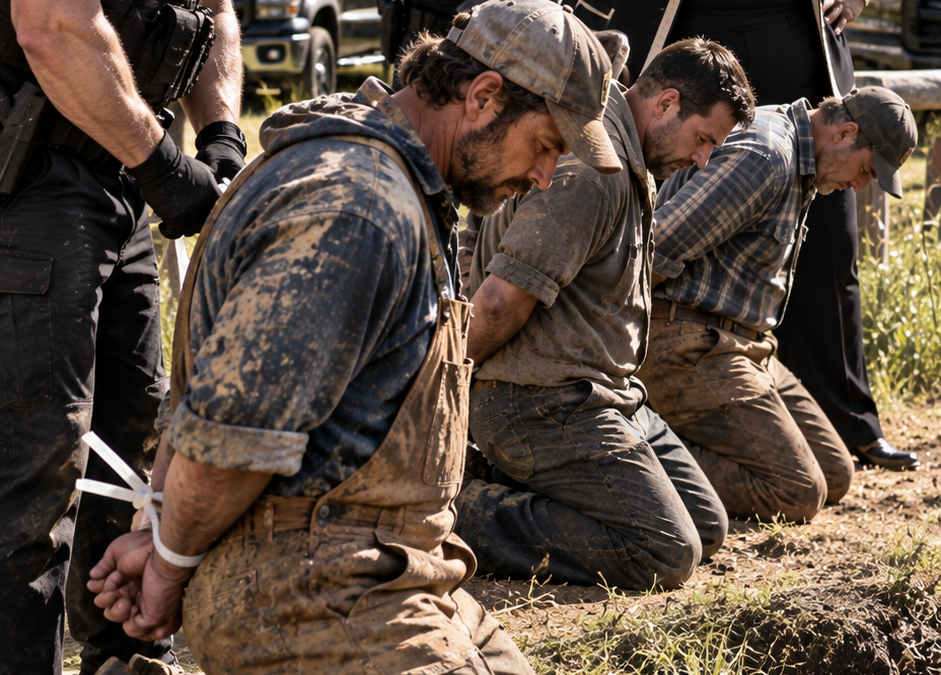
Then the zip ties.
Plastic clicking tight around wrists.
One worker after another.
Phones taken.
Tools dropped.
The crew was marched roughly a quarter mile toward the gatehouse.
They were seated on a curb.
Nobody called law enforcement.
Because if an actual deputy had arrived, the absurdity would have ended.
Marlene arrived around 7:05.
I heard her car.
Then heels against pavement.
“Are they secured?”
Corbin answered.
“Yes.”
“Good.”
Then she addressed my men.
“You have been trespassing on association property for three weeks.”
Wes said, “We’re not on your property.”
Marlene ignored him.
“I have been extraordinarily patient.”
Then she issued the order that would destroy her defense.
“Hold them until the deadline passes.”
Nobody spoke.
“He can take it up at the next meeting.”
She said it slowly.
Clearly.
Standing beside security guards wearing body cameras.
With Wes’s phone transmitting every word.
People later asked why I did not drive straight there.
Because that was the hardest decision I made during the entire ordeal.
Not finding the forgery.
Not facing foreclosure.
Not losing sleep.
That.
Sitting forty miles away while people working for me had their hands restrained.
Everything in me wanted to go.
I could have been halfway there before anybody stopped me.
Instead, I walked inside the courthouse.
I sat down.
Ninety-six minutes passed.
Ninety-six minutes of knowing what was happening.
At 8:02, a woman appeared.
“Mr. Alden?”
I stood.
At 8:12, the magistrate signed.
One search warrant covered the Stonewater Bluff HOA business office and gatehouse.
Another authorized seizure of Cardinal Point dispatch systems and backups.
And another document authorized the arrest of Marlene Anne Hargrove on federal charges.
Nobody handed me anything ceremonially.
Nobody smiled.
Agent Ward came downstairs while putting his phone into his pocket.
“We’re moving.”
I followed him.
“Stay behind us.”
I drove home behind three government vehicles.
At the speed limit.
That required more restraint than I knew I possessed.
We reached Stonewater after nine.
The gate that had blocked me for weeks stood open.
Nobody inside the gatehouse knew whether they had authority to close it against federal vehicles.
My crew was still sitting on the curb.
More than two hours.
Hands restrained behind them.
On a road my family had used before Stonewater existed.
I parked.
Marlene stood near the gatehouse entrance holding a clipboard.
She saw me.
And she smiled.
I still think about that.
She believed she had won.
“Garrett,” she called.
She looked toward the sun.
“Deadline’s at dark, isn’t it?”
Ward walked past me carrying paperwork.
Marlene’s smile faded slightly.
Still, she used that same board-president voice.
“He has no standing here.”
Ward kept walking.
“That easement has been released,” she said. “The federal government approved relocation.”
Ward stopped.
“No, ma’am.”
The entire gate area became quiet.
“The package was flagged the morning it arrived.”
Marlene stared at him.
“It was never approved.”
“That’s not—”
“No agency official authorized relocation.”
He continued.
“And the signature submitted under Mr. Alden’s name is not his.”
Her mouth opened.
Nothing came.
Ward added:
“The county annexation amendment is also under investigation. The notary journal identifies you as the individual who personally appeared in connection with that instrument.”
For maybe two seconds, Marlene’s face changed repeatedly.
Shock.
Calculation.
Anger.
Then she found a defense.
“My security contractor acted independently.”
Corbin stood four feet away.
He turned toward her.
That look mattered.
Not the files.
Not the warrants.
That look.
Marlene continued.
“Whatever happened here this morning occurred without my authorization.”
Ward did not react.
“Cardinal Point dispatch record, 6:20 a.m. Authorize physical detention if necessary.”
“That is forged.”
“We have additional records.”
She shook her head.
Then I finally spoke.
“Marlene.”
She looked at me.
I held up my phone.
The call timer was still running.
Two hours.
Forty-one minutes.
“My foreman never hung up.”
Everything seemed to leave her body.
Her shoulders dropped.
Her jaw loosened.
The clipboard slipped from her fingers.
It struck the pavement.
Ward read the warrant aloud.
Wind kept lifting one corner of the paper.
By then, homeowners had started coming outside.
Driveways filled.
Phones appeared.
For nine weeks, Marlene had exercised authority by writing things down.
That morning, somebody else had paper.
They put handcuffs on her twenty feet from the men she had ordered restrained.
Real handcuffs.
A deputy cut the plastic ties from my crew.
Five sharp snips.
I felt every one.
Silas rubbed his wrists.
Then looked at me.
“Boss.”
“Yeah?”
“Are we done today?”
I looked at the sun.
It was around ten.
We still had hours.
“No.”
I pointed toward the creek.
“Get the machine.”
At eleven, the excavator started inside Alden Creek.
Behind us, federal agents were searching the gatehouse.
The gate remained wide open.
The machine worked.
Rock went into the bank.
Willow went into the soil.
Wes directed the final grade.
Nobody talked much.
Five men who had spent the morning restrained were now finishing the job they had been prevented from doing.
The afternoon stretched.
Five o’clock.
Six.
The light began dropping.
At 6:40, Wes pushed the final willow whip into place with his boot.
We were finished.
Nobody cheered.
That is not how I remember it.
The five men stood inside the creek.
Water moved around their boots.
Behind them was nearly one hundred yards of repaired bank.
Silas looked toward me.
“Does it count?”
“What?”
“We lost the whole morning.”
I looked west.
There was still daylight on the water.
“The contract says completed before dark on the thirtieth.”
He nodded.
“It’s the thirtieth.”
“And there’s light.”
I signed the completion form on my truck’s tailgate.
Diane Halloway’s office received it before sunset.
We met the deadline.
Barely.
Four months later, Marlene pleaded guilty in federal court.
The charges included false statements to a federal agency, wire fraud, and conspiracy to defraud the United States.
She received thirty-three months in federal prison.
Restitution totaled approximately $612,000.
She was also permanently barred from serving on a homeowners association board.
At sentencing, she gave a statement.
She said everything she had done came from wanting the best for her community.
The judge listened.
Then he said that she had used a dead man’s name and forged a living man’s signature.
Whatever she had done, he said, had very little to do with community service.
Dale Corbin entered a state plea involving unlawful restraint and obstruction.
Cardinal Point Security eventually lost its state license.
The $18,000 monthly security contract ended almost immediately.
Owen Brady testified.
He moved away later.
He became a utility lineman two counties over.
He still sends me a Christmas card.
The fraudulent amendment was voided.
The county record was corrected.
Ruth handed me the final quiet-title order herself.
The $92,400 lien disappeared.
The foreclosure threat disappeared.
The ranch was legally what it had always been.
Mine.
Eleven days after Marlene’s arrest, Stonewater’s new board voted to remove the gate.
I watched contractors cut the posts from the concrete.
Sparks flew.
Steel fell.
I expected to feel triumph.
Instead, I mostly felt tired.
The road became quiet again.
There were also civil claims over my detained workers.
Stonewater’s insurer ultimately paid roughly $850,000 relating to false imprisonment and associated damages.
I want to be precise about that money.
I was not the man sitting on the curb in zip ties.
They were.
The settlement was divided among the five workers who had been restrained.
Wes used his share toward his first house.
Silas paid off his mother’s truck and put money aside for his daughter.
Ruth once told me I was foolish for not personally pursuing every homeowner who had supported Marlene.
Maybe she was right legally.
But I never did.
Most of those people had been lied to.
Marlene had sent them official bulletins.
She had spoken from the board president’s chair.
She told them federal approval existed.
She told them the association owned rights it did not own.
Some should have asked more questions.
Some should have looked harder.
But Marlene was the person entrusted to tell them the truth.
The homeowners removed the remaining board members at a special meeting.
A retired electrician named Frank became the new president.
He had lived in Stonewater since the beginning.
One evening, he came to my house carrying a casserole.
My first instinct was suspicion.
He stood on the porch awkwardly.
“My wife said nobody apologizes properly without food.”
I almost laughed.
Then he said, “We should have asked questions.”
I said nothing.
“We voted on things we didn’t understand.”
“That’s true.”
“I’m sorry.”
I looked at him for a moment.
Then took the casserole.
“You didn’t know me, Frank.”
“No.”
“You still voted on my ranch.”
He nodded.
That was enough.
Hallstead Development abandoned Phase Three.
All eighty-eight proposed lots disappeared from the planning file.
Bryce Lundren stopped working in the county.
As far as I know, those houses will never exist.
The creek will.
The following spring, the federal agency re-recorded and updated its conservation file.
They requested the original 2011 executed easement.
I drove it there myself.
The paper had yellowed slightly.
My father’s signature still sat across the bottom.
Hard.
Slanted.
Real.
The woman at the counter handled it carefully.
That affected me more than I expected.
After everything, watching somebody treat his signature as something valuable felt almost like giving part of him back.
Then the willows took root.
That first summer, they reached my knees.
The second year, many were shoulder-high.
Eventually, the repaired section of bank disappeared beneath vegetation.
That is what successful restoration looks like.
You stop seeing the work.
The creek looks as though nobody ever touched it.
That fall, Wes came into my father’s old shop.
The cedar sign had started rotting near the bottom.
ALDEN CREEK — KEEP IT RUNNING.
Wes found another cedar slab.
He used my father’s wood-burning iron.
He traced the lettering carefully.
Even the crooked underline beneath one letter.
When he was done, we carried the new sign to the crossing.
Wes drove the nails.
Then he packed his tools.
“You good?”
I looked at the creek.
“Yeah.”
He drove away.
I stayed.
Water moved over the same stones it had moved over when my grandfather first bought the place.
Long before Stonewater.
Long before Marlene.
Long before anybody imagined cul-de-sacs there.
For nine weeks, one woman had tried to convince me none of it belonged to me.
She had a board.
Lawyers.
Private guards.
A recorded amendment.
A lien.
A locked gate.
She forged my father’s signature.
Then she forged mine.
For a while, paper made her look powerful.
But sitting beside that creek, I understood what she never had.
Ownership was not the only thing my father passed down.
He left obligations.
He left records.
He left the conservation contract.
He left a ranch with a history older than every house behind that gate.
Most of all, he left me something worth standing still for when every part of me wanted to swing back.
I thought about that morning outside the courthouse.
Wes and the others were restrained.
Marlene was counting on the federal deadline passing.
I could have raced home.
I could have screamed.
Threatened.
Started a fight on the roadside.
Maybe that was what she expected.
Instead, I stayed in the hallway.
Ninety-six minutes.
The longest ninety-six minutes of my life.
And during every one of them, Marlene kept making decisions.
She could have stopped.
She could have released the men.
She could have called a deputy.
She could have withdrawn her instruction.
She could have admitted the association had gone too far.
Instead, she ordered them held until the clock ran out.
She thought time belonged to her.
That was her final mistake.
I reached up and rested my hand against the new cedar sign.
ALDEN CREEK — KEEP IT RUNNING.
My father never wrote anything beneath it.
He didn’t need to.
Keep the creek alive.
Keep your word.
Keep records.
Keep going.
Some signatures can be copied.
Some names can be forged.
But the thing behind them—the life that gave them meaning—cannot.
Marlene copied my father’s signature.
She copied mine.
She nearly took the land those signatures protected.
But she could never copy what made either one worth something.
The creek kept running.
And in the end, so did we.
Have you finished reading the story and want to read it again?
HOA Guards Zip-Tied My Ranch Crew on My Own Land — They Didn’t Know I Was Driving Back With a Federal Arrest Warrant
They arrested my ranch crew on land my family had owned since 1946.
I listened from forty miles away while the HOA president ordered her guards to keep them tied up until my federal deadline expired.
What she didn’t know was that I was sitting outside a courthouse waiting for a judge to sign something with her name on it.
At 6:40 that morning, I was parked outside the federal courthouse with my engine off and a manila envelope lying on the passenger seat.
My foreman, Wes Tanner, had his phone hidden inside his shirt pocket.
He never hung up.
So I heard everything.
Boots grinding gravel.
Truck doors slamming.
Creek water moving over stone.
Then a man’s voice, rehearsed and hard.
“Hands on the machine.”
Wes answered immediately.
“We’re working under a federal conservation contract.”
“I said hands on the machine.”
“This is private ranch property.”
“You’re under arrest.”
I closed my eyes.
Then came the sound I would remember longer than the words.
Plastic ratcheting.
Five or six hard clicks.
Silence.
Then again.
Zip ties.
They bound Wes first.
Then four more men.
Five people I had hired to restore a creek the federal government was paying us to protect.
One of the guards began collecting phones.
Wes kept his hidden beneath the buttoned flap of his shirt pocket.
“This is federal work,” he said again. “Garrett owns this creek.”
A radio crackled.
Then I heard Marlene Hargrove.
Calm.
Almost bored.
“He owns nothing.”
Another guard said, “Ma’am, these guys are just labor.”
“They’re trespassing.”
“Marlene—”
“Cuff them and sit them down.”
I gripped the steering wheel.
Then she added the sentence that changed everything.
“Hold them until the deadline passes. He can take it up at the next meeting.”
For nine weeks, Marlene had tried to convince me she controlled my ranch.
Now five men were sitting in restraints because she wanted a clock to run out.
Every instinct I had told me to start the truck.
Forty miles.
Maybe thirty-five minutes if I drove like an idiot.
I could picture Wes.
Wet boots.
Mud to his knees.
Hands behind him.
I could picture Silas and the others looking toward the road, expecting my truck.
Instead, I picked up the manila envelope.
I opened the courthouse door.
And I walked inside.
Marlene Hargrove had ninety-six minutes to stop what she was doing.
She used every one of them.
My name is Garrett Alden.
My grandfather started assembling Alden Creek Ranch in 1946.
The first parcel was 120 acres.
By the time the land passed to me, it had grown to roughly 180 acres of cattle pasture, hay ground, and low country east of town.
My father, Emmett Alden, ran it before me.
He died in the spring of 2019.
One morning he was repairing a fence line.
That afternoon he came home muddy, ate half a sandwich in the kitchen, and died with his boots still on.
The ranch became mine.
But the creek was always the heart of it.
Six miles of water cut through our land.
Without that creek, Alden Ranch was dirt with cattle standing on it.
In 2011, my father entered sixty-two acres along the creek into a federal conservation easement.
The government compensated him for permanently protecting that corridor.
In return, the land stayed open.
No subdivisions.
No grading it into house pads.
No selling pieces off for development.
No destroying the riparian corridor.
And our family remained responsible for maintaining the banks.
People sometimes hear the word conservation and imagine charity.
It wasn’t.
It was a contract.
The government paid money.
My father accepted obligations.
Those obligations ran with the land.
They did not disappear because he died.
The day he signed the easement, he walked the creek boundary alone.
Afterward, he went into the shop, found a piece of cedar, and burned six words into it with an old wood iron.
ALDEN CREEK — KEEP IT RUNNING.
He nailed it to a post near the crossing.
That sign was still there when everything with Marlene began.
The reason Wes and my crew were working in the creek was simple.
Two heavy floods had eaten almost thirty feet out of the north bank.
The federal agency inspected the damage.
A restoration plan was approved.
Regrade the bank.
Key stone into the toe.
Stabilize the channel.
Plant willow.
Restore the corridor.
And finish before dark on the thirtieth.
That date mattered.
It was written into the contract.
Miss it, and I could fall into default.
That meant penalties.
Potential repayment obligations.
Potentially money my father had already put back into the ranch fifteen years earlier.
So I hired Wes Tanner.
Wes had worked for my family eleven years.
He knew the creek nearly as well as I did.
I hired four more men.
We rented an excavator.
We scheduled the rock.
We counted working days.
Then Marlene Hargrove drove up my driveway.
To understand why that mattered, you have to understand Stonewater Bluff.
In 2006, my father sold roughly ninety acres along our eastern boundary to a developer.
They built around two hundred homes.
Private streets.
A clubhouse.
A pool.
A gatehouse.
Landscaped entrances.
They named it Stonewater Bluff.
They formed a homeowners association.
My father did not join it.
That had been one of his conditions from the beginning.
He hated the idea of selling development ground only to end up asking a committee whether he was allowed to run cattle on the land he kept.
For years, nobody disputed that.
The subdivision existed.
The ranch existed.
We shared a boundary.
That was all.
Then Marlene became president of the Stonewater Bluff HOA.
She held that position for six years.
The first time she came to see me, she arrived in a white Lexus wearing white shoes.
White shoes.
On a cattle ranch.
She climbed out holding a folder against her chest.
“Garrett.”
“Marlene.”
She smiled.
“I hate that nobody informed you sooner.”
That sentence alone should have warned me.
She handed me the folder.
The paper was still warm from the copier.
“What is this?”
“An annexation amendment.”
I looked at her.
“For what?”
“Your ranch.”
I laughed.
I genuinely thought she was joking.
“My ranch isn’t in your HOA.”
“It is now.”
“No.”
“Garrett, it has been recorded.”
She spoke slowly, the way people speak when they think resistance is caused by misunderstanding.
“So going forward, you’ll need to submit any work involving heavy equipment to the architectural committee.”
I laughed again.
“My father sold your subdivision that ground specifically so he would never have to deal with an HOA.”
“Your father signed the amendment.”
I stopped laughing.
Marlene opened the folder.
On the last page was a county recording stamp.
Book.
Page.
Filing date.
And above the stamp was a signature.
Emmett Alden.
My father’s name.
Below it was another page.
An invoice.
Back assessments.
Late fees.
Interest.
$92,400.
“You can establish a payment plan,” she said. “Most people prefer that.”
I barely heard her.
I was still staring at my father’s name.
Something about the signature bothered me.
But it looked enough like his writing that I could not immediately say why.
I finally looked up.
“Why now?”
She tilted her head.
“Why what?”
“Why has nobody billed this ranch for twenty years?”
“The board recently completed a compliance review.”
“That doesn’t answer me.”
“We simply want every property under association jurisdiction brought into compliance.”
She said it with a smile.
But there was nothing underneath the smile.
Then she climbed into the Lexus and left.
Three days later, Stonewater Bluff installed a gate.
Ranch Road begins as a county-numbered road.
Then, before reaching my eastern boundary, it crosses a stretch of pavement maintained by the HOA.
That road had always been the easiest equipment route to the creek.
Not because pickups needed it.
Because excavators did.
A lowboy carrying a machine that size is heavy.
You don’t improvise with forty tons.
Stonewater installed steel posts.
A rolling gate.
Electronic access.
The metal was so new the hinges still squealed.
Residents passed through.
Landscapers passed through.
Pool contractors passed through.
My equipment did not.
I found Wes sitting behind the wheel of the lowboy with the excavator chained behind him.
A guard stood on the other side.
“They say we aren’t approved,” Wes told me.
“Approved by who?”
“The association.”
I looked at the new gate.
Wes looked toward me.
“Garrett.”
“Yeah?”
“If we can’t get this machine to the creek, what happens on the thirtieth?”
I didn’t answer.
Because I didn’t know.
That night, I read the annexation amendment line by line.
My father’s name was printed beneath the signature line.
EMMETT ALDEN.
Above it was the signature.
Hard.
Slanted.
Close to his.
I had seen his handwriting since I was old enough to recognize my own name.
But something felt wrong.
I stared at that signature so long my eyes hurt.
Still, I missed the most obvious thing on the page.
The next morning, I was waiting when the county recorder’s office opened.
A clerk brought out Stonewater Bluff’s original 2006 declaration.
The book was enormous.
I went directly to the exhibits.
Exhibit B listed every parcel governed by the association.
Two hundred lots.
I read each description.
Then read them again.
My ranch was not listed.
Above the exhibit was language stating that no additional real property could become subject to the declaration without written consent of its owner.
There it was.
Their own governing document.
They could not simply vote my land into their HOA.
I ordered certified copies.
Not ordinary copies.
Raised seal.
Clerk’s certification.
The type you can hand to a judge.
I took the original declaration.
The later annexation amendment.
And my father’s federal conservation easement.
At the next Tuesday meeting, I sat in the back of the Stonewater Bluff clubhouse.
Thirty people.
Folding chairs.
Cheap coffee.
A board table at the front.
Marlene ran the meeting without raising her voice once.
Landscaping.
Pool repairs.
Basketball hoops.
Then:
“Agenda item nine. Enforcement action involving Alden parcel.”
I stood.
“I’d like to address that.”
Marlene smiled.
“Go ahead.”
I carried the certified declaration to the front.
Then I read Exhibit B.
Lot after lot.
People started shifting.
Finally, I stopped.
“My ranch is not listed.”
Nobody spoke.
“Your own declaration says you cannot bring other property into this association without written owner consent.”
I set the certified copy in front of Marlene.
“So show me the consent.”
For three seconds, the room changed.
A man in a fleece vest turned toward somebody behind him.
A woman stopped bouncing her toddler.
Someone near the coffee muttered, “Huh.”
Marlene never looked at the document.
Not once.
“Amendments supersede exhibits.”
“That is not how property ownership works.”
“Your father signed it.”
“My question is simple. Where is the valid consent?”
She looked straight at me.
“It’s recorded. That’s the answer.”
“No. That’s a location.”
Her smile tightened.
“It is the answer you are going to get, Garrett.”
Then she called a vote.
Not on whether the annexation was valid.
She skipped that entirely.
Instead, she proposed a fine for unauthorized commercial equipment on association-controlled property.
Two hundred fifty dollars per day.
Retroactive to the first claimed violation.
She also instructed the association attorney to prepare a lien for unpaid assessments and fines.
“All in favor?”
Hands rose.
Not enough at first.
Marlene waited.
She knew how to use silence.
One by one, more hands went up.
The man in the fleece vest voted yes.
He wouldn’t look at me.
I did the arithmetic while they were voting.
$250 a day.
$7,500 a month.
In less than a year, the fines could exceed what I cleared from cattle.
“Motion carries,” Marlene said.
Then she looked down.
“Item ten. Pool furniture.”
I picked my certified document back up.
Nobody stopped me.
That meeting taught me something important.
Marlene did not need to prove she was right.
She only needed to make being right expensive.
The next morning, the gate had a new lock.
Twenty feet inside sat a white pickup with a light bar.
CARDINAL POINT SECURITY.
A guard in sunglasses watched us from behind the windshield.
By afternoon, I had pulled Stonewater’s budget from the homeowner portal.
A new quarterly expense appeared.
Contract Security Services.
$18,000 per month.
Eighteen thousand dollars every month to keep a ranch excavator away from a creek.
Nobody spends that kind of money to enforce landscaping rules.
People spend it to protect something.
I went home.
I placed the annexation amendment beneath the kitchen light.
This time I ignored the signature.
I looked at the date.
May 12, 2020.
I read it again.
May 12, 2020.
My father died March 9, 2019.
For a while, I simply stood there.
Fourteen months.
The document said my father had signed it fourteen months after I buried him.
I wish I could say I felt victorious.
I felt sick.
Someone had taken my father’s name and used it after his death.
A signature is a strange thing.
It looks like ink.
But after somebody dies, it can become one of the last ways they still act in the world.
His signature transferred land.
Signed cattle notes.
Signed the conservation agreement.
Paid taxes.
Authorized feed accounts.
Somebody had taken that little piece of him and turned it into a weapon against his own ranch.
I went into my father’s office.
His cedar desk still smelled faintly like the shop.
Bottom drawer.
Left side.
That was where he kept documents that mattered.
Military discharge papers.
My mother’s rings.
The original federal conservation easement.
And a folder containing certified copies of his death certificate.
I pulled one out.
Then I placed it beside the HOA amendment.
Death:
March 9, 2019.
Signature date:
May 12, 2020.
I scanned both.
At eleven that night, I emailed them to attorney Ruth Callahan.
She called nine minutes later.
Ruth almost never sounded surprised.
That night she did.
“Garrett.”
“Yeah.”
“Do not call Marlene.”
“I wasn’t planning to.”
“Do not post this.”
“I don’t post anything.”
“Do not confront anyone at that board. Let me file.”
For the first time in weeks, I slept six hours without waking.
Then, three days later, a federal envelope appeared in my mailbox.
I knew immediately it was not from court.
Wrong size.
Heavier paper.
It came from the federal agency holding the conservation easement.
The letter was signed by Diane Halloway.
She thanked me for my cooperation.
I read that first sentence twice.
Then came the rest.
The agency appreciated my willingness to relocate the conservation corridor in order to accommodate adjacent development.
My consent package had been received.
Final review was pending.
I stood beside the mailbox.
I had never spoken to Diane Halloway.
I had never agreed to relocate anything.
Behind the letter was a courtesy copy of the submitted consent.
My name.
My address.
My telephone number.
Then my signature.
Not my father’s.
Mine.
And this forgery was better.
It had the loop I make on the G.
It had the way I connect the A into the L because I write too quickly.
It was my signature if someone had taken my handwriting and cleaned it up.
For the first time, I understood the scale of what was happening.
The forged annexation amendment at the county wasn’t the real play.
That was a distraction.
While I had been standing in HOA meetings arguing over Exhibit B, someone had submitted federal documents trying to move the protected creek corridor.
Relocating that easement would free sixty-two acres.
Sixty-two acres that could become development property.
The next morning, I called Diane.
I explained who I was.
“I received your letter.”
“Yes, Mr. Alden.”
“I never signed that consent.”
Silence.
“I never authorized relocation.”
More silence.
“I have never spoken with anybody at your agency about moving the easement.”
The line stayed quiet so long I looked at my screen.
Then Diane said carefully, “Mr. Alden, would you be willing to speak with someone else regarding this matter?”
“Yes.”
“Someone will contact you.”
Then she added something I remember word for word.
“Do not discuss this with anyone affiliated with the association.”
That sentence changed the temperature in the room.
The call ended.
And I understood two things.
I was no longer the only person who believed something was wrong.
And whatever had happened was now bigger than an HOA dispute.
Ruth requested association records.
I began reading meeting minutes.
Months earlier, buried inside executive-session notes, was one line.
Motion to pursue acquisition of Creek Corridor in support of Phase Three.
Phase Three.
I went to the county planning department.
There it was.
STONEWATER BLUFF — PHASE III.
Eighty-eight proposed lots.
Cul-de-sacs.
Building pads.
Utilities.
Most of them drawn directly across the protected creek corridor.
The developer was Hallstead Development.
The land manager listed on the plans was Bryce Lundren.
I knew Bryce.
Everybody around Stonewater did.
He had attended community functions.
He had sat with Marlene at Christmas events.
He was also married to Marlene’s sister.
Suddenly, sixty-two acres made sense.
So did $18,000 a month in guards.
So did forged signatures.
Eighty-eight houses.
That was the real value of my father’s creek.
Ruth filed suit.
First, an emergency order seeking removal of the gate and restoration of ranch access.
Second, a quiet-title action to void the annexation amendment permanently.
I sat in the second row of a state courtroom with my father’s death certificate in my lap.
I thought the judge would look at the dates and end it.
He didn’t.
The judge was not cruel.
He was procedural.
A document recorded in official county records, he explained, carries a presumption of validity.
That presumption could be rebutted.
But it had to be rebutted through evidence and process.
Ruth argued the deadline.
She explained the federal conservation contract.
She explained that I had less than four weeks.
The judge listened.
Then denied emergency relief.
The quiet-title matter was placed behind a ninety-day stay.
Ninety days.
My federal deadline arrived in less than thirty.
I stood in the courthouse hallway beside a drinking fountain and did the arithmetic repeatedly.
The court would hear my evidence nearly two months after my federal deadline had passed.
Nine days later, the HOA lien was recorded.
Then came notice that the association intended to foreclose.
Now two clocks were running.
One threatened the federal conservation contract.
The other threatened my ranch.
Then I received a call from a number with no caller identification.
A meeting was arranged forty miles from town.
I drove to a roadside diner beside the state highway.
Two people waited in a vinyl booth.
Special Agent Ellis Ward from the Office of Inspector General at the U.S. Department of Agriculture.
Beside him sat Assistant United States Attorney Norah Sheffield.
Ward had gray hair, a quiet voice, and a notebook he never opened.
Sheffield got directly to the point.
The forged federal consent package had been flagged almost immediately.
A specialist inside Halloway’s office noticed inconsistencies.
The application had been frozen before approval.
The conservation easement had not moved.
Nothing had been released.
Nothing had changed.
I put both hands on the table.
For several seconds, I did nothing but breathe.
My father’s corridor was still protected.
Then Sheffield said, “Mr. Alden, we need something from you.”
“What?”
“You’re not going to like it.”
That turned out to be true.
She wanted silence.
No confronting Marlene.
No public accusations.
No board meeting.
No social media.
No letter from Ruth announcing the federal forgery.
Nothing that might alert anybody inside Stonewater Bluff that federal investigators were watching.
I stared at her.
“You want me to sit on the only evidence I have that scares her.”
“Yes.”
“For how long?”
“I can’t tell you.”
“I’ve got a gate blocking my equipment.”
“I know.”
“I’ve got a lien.”
“I know.”
“My completion date is the thirtieth.”
Ward finally spoke.
“Right now, we have one forged package and one signature.”
He leaned forward.
“If we confront her today, she can blame a contractor. She can claim somebody prepared documents incorrectly. She can say she never reviewed the final submission.”
“She signed things.”
“We still build cases.”
He paused.
“If she stops today, it may stay limited.”
Then he said the sentence I would remember throughout everything that followed.
“She thinks this is working.”
I said nothing.
“So let her keep working.”
I looked toward the parking lot.
Ward continued.
“Every step she takes now becomes another decision she has to explain.”
“You’re asking me to do nothing.”
“No.”
He shook his head.
“I’m asking you to say nothing.”
That distinction mattered.
The next morning, I bought six small clip-on cameras.
I gave one to Wes.
One to Silas.
One to each crewman.
“If anyone from Stonewater or security comes toward you, turn these on.”
Wes rolled the camera between his fingers.
“And?”
“Keep phones open in your pockets.”
“Anything else?”
“Log every delay.”
He stared at me.
“Every hour. Every truck turned away. Every name. Every conversation.”
“What are we building?”
I could not tell him.
“A record.”
“Of what?”
“Them.”
Wes had worked for my family eleven years.
He nodded.
That was all.
Then I went quiet.
I stopped attending HOA meetings.
Stopped responding emotionally.
Stopped calling Marlene.
For two weeks, I became the easiest man in the county to ignore.
Marlene interpreted silence as weakness.
She called Ruth with an offer.
If I signed over the creek corridor to the association, Stonewater would forgive the $92,400 and release the lien.
She called that generous.
Ruth declined in one sentence.
No explanation.
No counteroffer.
Six days before my federal deadline, I stopped trying to get through the HOA gate.
There was another route.
An old ford west of the ranch.
My grandfather used it long before Stonewater existed.
The route came from a county section road, crossed about eighty feet of shallow river, then climbed directly onto Alden property.
It was slow.
Rough.
Completely impractical when water was high.
But the water was low.
I spent a day and a half cutting brush.
We laid rock.
Packed soft sections.
Wes brought the lowboy down carefully.
I stood on the opposite bank watching forty tons of equipment crawl through the water.
The trailer tires pushed white wakes around themselves.
Then the excavator rolled onto Alden ground.
Wes climbed from the cab.
He was smiling.
“They’re going to love this.”
They did not.
Within a day, Cardinal Point increased patrols.
One security pickup became several.
Guards started driving our east boundary.
Some were visibly armed.
Their supervisor was Dale Corbin.
Big man.
Flat voice.
He moved like somebody who had spent enough time in uniforms to believe the uniform itself should end conversations.
One Tuesday, he approached the creek.
He remained on the far side of our line.
Wes stood inside my property.
“The association considers this corridor closed pending resolution,” Corbin said.
Wes pointed toward the boundary.
“You’re standing there. I’m standing here.”
“I have my instructions.”
“Then your instructions stop at that line.”
Corbin repeated himself.
“I’ve got my instructions.”
That word mattered.
Instructions.
Later, investigators would obtain those instructions.
Marlene had written them by hand on HOA letterhead.
NO EQUIPMENT REACHES THE CREEK BEFORE THE 30TH.
Below that, she claimed to give Cardinal Point “board-delegated enforcement authority.”
Those words had no real legal meaning.
She simply invented authority by writing it down.
At the same time, Marlene sent a bulletin to every Stonewater household.
It announced that federal approval had been obtained to relocate the conservation easement.
It claimed acquisition of the creek corridor was complete.
It announced that Phase Three construction would begin in spring.
Two hundred families were now inside the lie.
Some believed I was intentionally delaying development and harming their property values.
Marlene had made retreat difficult for herself.
Too many people had been promised too much.
Then Ruth obtained the notary journal.
The annexation amendment carrying my dead father’s signature had supposedly been notarized.
Notaries maintain journals.
Date.
Document.
Person appearing.
Identification.
Signature.
The journal showed who personally appeared when the fraudulent amendment was notarized.
Marlene Hargrove.
Her identification.
Her signature.
Her handwriting.
Whatever room had produced that document, she had been standing in it.
Two days later, someone knocked on my door.
He was young.
Twenty-three.
Owen Brady.
He worked the Cardinal Point gatehouse.
Or had.
“I quit this morning,” he said.
He kept both hands shoved into his jacket.
“What happened?”
“They’re telling us we can arrest people.”
I stayed quiet.
“I signed up to check stickers and call residents. I didn’t sign up for that.”
He pulled out a printed dispatch log.
Cardinal Point maintained digital instructions sent to field guards.
The sheet included Marlene’s order to Corbin.
No equipment reaches the creek before the thirtieth.
But the dispatch version contained an additional sentence.
AUTHORIZE PHYSICAL DETENTION IF NECESSARY.
I read it three times.
“Owen.”
“Yeah?”
“Would you tell somebody else where you got this?”
He finally looked at me.
“Am I going to get in trouble?”
“I think you may be keeping yourself out of it.”
Corbin discovered there had been a leak.
Two days later, Cardinal Point’s gatehouse server was wiped.
Dispatch logs.
Archived orders.
Everything.
Deleted.
I called Agent Ward.
When I told him, the line went quiet.
Then he said something I had never heard from him before.
Almost satisfaction.
“That adds another problem for them.”
Two days before the deadline, rain began upstream.
You cannot always see upstream rain from my ranch.
You see its effect.
By evening, the water had risen four inches.
By the following morning, the western ford was brown and fast.
Wes walked out several feet.
Then came back.
“No way.”
The old crossing was gone.
Forty tons could not safely pass.
That left one practical route to the creek.
Ranch Road.
Through Stonewater.
Through Marlene’s gate.
On the night of the twenty-ninth, Assistant U.S. Attorney Sheffield appeared before a federal magistrate.
I knew because I was sitting in the courthouse hallway.
The manila envelope lay across my knees.
Hours passed.
The lights eventually dimmed.
A security guard asked twice whether I was waiting for somebody.
Nobody told me what was happening.
Nobody promised anything.
At 5:50 the next morning, Wes called.
“Water’s still high.”
I looked at the courthouse doors.
“We’re going in through the front.”
I knew what he meant.
Through Stonewater.
I looked at the time.
Less than a day remained.
Half a day of physical work.
Maybe less if nothing went wrong.
Everything had already gone wrong.
“Wes.”
“Yeah?”
“Put your phone in your shirt pocket.”
“Why?”
“Leave the call open.”
He paused.
“Okay.”
“Don’t hang up.”
They reached the creek shortly after six.
About forty feet of bank remained.
Last stone.
Final willow.
Finish by early afternoon and we could still complete inspection paperwork before dark.
At 6:38, two Cardinal Point pickups drove into the corridor.
I heard them over Wes’s phone.
Doors opened.
Corbin spoke.
“Shut the machine down.”
Wes answered.
“We’re inside Alden property.”
“This corridor is closed.”
“We have federal work scheduled.”
“Hands on the machine.”
Wes tried to reason with him.
I will always remember that.
“This work is under a federal conservation contract. We have a deadline tonight.”
“I have instructions.”
“This land has belonged to Garrett’s family since 1946.”
“Turn around.”
“Call a sheriff.”
“You are under arrest.”
Then the zip ties.
Plastic clicking tight around wrists.
One worker after another.
Phones taken.
Tools dropped.
The crew was marched roughly a quarter mile toward the gatehouse.
They were seated on a curb.
Nobody called law enforcement.
Because if an actual deputy had arrived, the absurdity would have ended.
Marlene arrived around 7:05.
I heard her car.
Then heels against pavement.
“Are they secured?”
Corbin answered.
“Yes.”
“Good.”
Then she addressed my men.
“You have been trespassing on association property for three weeks.”
Wes said, “We’re not on your property.”
Marlene ignored him.
“I have been extraordinarily patient.”
Then she issued the order that would destroy her defense.
“Hold them until the deadline passes.”
Nobody spoke.
“He can take it up at the next meeting.”
She said it slowly.
Clearly.
Standing beside security guards wearing body cameras.
With Wes’s phone transmitting every word.
People later asked why I did not drive straight there.
Because that was the hardest decision I made during the entire ordeal.
Not finding the forgery.
Not facing foreclosure.
Not losing sleep.
That.
Sitting forty miles away while people working for me had their hands restrained.
Everything in me wanted to go.
I could have been halfway there before anybody stopped me.
Instead, I walked inside the courthouse.
I sat down.
Ninety-six minutes passed.
Ninety-six minutes of knowing what was happening.
At 8:02, a woman appeared.
“Mr. Alden?”
I stood.
At 8:12, the magistrate signed.
One search warrant covered the Stonewater Bluff HOA business office and gatehouse.
Another authorized seizure of Cardinal Point dispatch systems and backups.
And another document authorized the arrest of Marlene Anne Hargrove on federal charges.
Nobody handed me anything ceremonially.
Nobody smiled.
Agent Ward came downstairs while putting his phone into his pocket.
“We’re moving.”
I followed him.
“Stay behind us.”
I drove home behind three government vehicles.
At the speed limit.
That required more restraint than I knew I possessed.
We reached Stonewater after nine.
The gate that had blocked me for weeks stood open.
Nobody inside the gatehouse knew whether they had authority to close it against federal vehicles.
My crew was still sitting on the curb.
More than two hours.
Hands restrained behind them.
On a road my family had used before Stonewater existed.
I parked.
Marlene stood near the gatehouse entrance holding a clipboard.
She saw me.
And she smiled.
I still think about that.
She believed she had won.
“Garrett,” she called.
She looked toward the sun.
“Deadline’s at dark, isn’t it?”
Ward walked past me carrying paperwork.
Marlene’s smile faded slightly.
Still, she used that same board-president voice.
“He has no standing here.”
Ward kept walking.
“That easement has been released,” she said. “The federal government approved relocation.”
Ward stopped.
“No, ma’am.”
The entire gate area became quiet.
“The package was flagged the morning it arrived.”
Marlene stared at him.
“It was never approved.”
“That’s not—”
“No agency official authorized relocation.”
He continued.
“And the signature submitted under Mr. Alden’s name is not his.”
Her mouth opened.
Nothing came.
Ward added:
“The county annexation amendment is also under investigation. The notary journal identifies you as the individual who personally appeared in connection with that instrument.”
For maybe two seconds, Marlene’s face changed repeatedly.
Shock.
Calculation.
Anger.
Then she found a defense.
“My security contractor acted independently.”
Corbin stood four feet away.
He turned toward her.
That look mattered.
Not the files.
Not the warrants.
That look.
Marlene continued.
“Whatever happened here this morning occurred without my authorization.”
Ward did not react.
“Cardinal Point dispatch record, 6:20 a.m. Authorize physical detention if necessary.”
“That is forged.”
“We have additional records.”
She shook her head.
Then I finally spoke.
“Marlene.”
She looked at me.
I held up my phone.
The call timer was still running.
Two hours.
Forty-one minutes.
“My foreman never hung up.”
Everything seemed to leave her body.
Her shoulders dropped.
Her jaw loosened.
The clipboard slipped from her fingers.
It struck the pavement.
Ward read the warrant aloud.
Wind kept lifting one corner of the paper.
By then, homeowners had started coming outside.
Driveways filled.
Phones appeared.
For nine weeks, Marlene had exercised authority by writing things down.
That morning, somebody else had paper.
They put handcuffs on her twenty feet from the men she had ordered restrained.
Real handcuffs.
A deputy cut the plastic ties from my crew.
Five sharp snips.
I felt every one.
Silas rubbed his wrists.
Then looked at me.
“Boss.”
“Yeah?”
“Are we done today?”
I looked at the sun.
It was around ten.
We still had hours.
“No.”
I pointed toward the creek.
“Get the machine.”
At eleven, the excavator started inside Alden Creek.
Behind us, federal agents were searching the gatehouse.
The gate remained wide open.
The machine worked.
Rock went into the bank.
Willow went into the soil.
Wes directed the final grade.
Nobody talked much.
Five men who had spent the morning restrained were now finishing the job they had been prevented from doing.
The afternoon stretched.
Five o’clock.
Six.
The light began dropping.
At 6:40, Wes pushed the final willow whip into place with his boot.
We were finished.
Nobody cheered.
That is not how I remember it.
The five men stood inside the creek.
Water moved around their boots.
Behind them was nearly one hundred yards of repaired bank.
Silas looked toward me.
“Does it count?”
“What?”
“We lost the whole morning.”
I looked west.
There was still daylight on the water.
“The contract says completed before dark on the thirtieth.”
He nodded.
“It’s the thirtieth.”
“And there’s light.”
I signed the completion form on my truck’s tailgate.
Diane Halloway’s office received it before sunset.
We met the deadline.
Barely.
Four months later, Marlene pleaded guilty in federal court.
The charges included false statements to a federal agency, wire fraud, and conspiracy to defraud the United States.
She received thirty-three months in federal prison.
Restitution totaled approximately $612,000.
She was also permanently barred from serving on a homeowners association board.
At sentencing, she gave a statement.
She said everything she had done came from wanting the best for her community.
The judge listened.
Then he said that she had used a dead man’s name and forged a living man’s signature.
Whatever she had done, he said, had very little to do with community service.
Dale Corbin entered a state plea involving unlawful restraint and obstruction.
Cardinal Point Security eventually lost its state license.
The $18,000 monthly security contract ended almost immediately.
Owen Brady testified.
He moved away later.
He became a utility lineman two counties over.
He still sends me a Christmas card.
The fraudulent amendment was voided.
The county record was corrected.
Ruth handed me the final quiet-title order herself.
The $92,400 lien disappeared.
The foreclosure threat disappeared.
The ranch was legally what it had always been.
Mine.
Eleven days after Marlene’s arrest, Stonewater’s new board voted to remove the gate.
I watched contractors cut the posts from the concrete.
Sparks flew.
Steel fell.
I expected to feel triumph.
Instead, I mostly felt tired.
The road became quiet again.
There were also civil claims over my detained workers.
Stonewater’s insurer ultimately paid roughly $850,000 relating to false imprisonment and associated damages.
I want to be precise about that money.
I was not the man sitting on the curb in zip ties.
They were.
The settlement was divided among the five workers who had been restrained.
Wes used his share toward his first house.
Silas paid off his mother’s truck and put money aside for his daughter.
Ruth once told me I was foolish for not personally pursuing every homeowner who had supported Marlene.
Maybe she was right legally.
But I never did.
Most of those people had been lied to.
Marlene had sent them official bulletins.
She had spoken from the board president’s chair.
She told them federal approval existed.
She told them the association owned rights it did not own.
Some should have asked more questions.
Some should have looked harder.
But Marlene was the person entrusted to tell them the truth.
The homeowners removed the remaining board members at a special meeting.
A retired electrician named Frank became the new president.
He had lived in Stonewater since the beginning.
One evening, he came to my house carrying a casserole.
My first instinct was suspicion.
He stood on the porch awkwardly.
“My wife said nobody apologizes properly without food.”
I almost laughed.
Then he said, “We should have asked questions.”
I said nothing.
“We voted on things we didn’t understand.”
“That’s true.”
“I’m sorry.”
I looked at him for a moment.
Then took the casserole.
“You didn’t know me, Frank.”
“No.”
“You still voted on my ranch.”
He nodded.
That was enough.
Hallstead Development abandoned Phase Three.
All eighty-eight proposed lots disappeared from the planning file.
Bryce Lundren stopped working in the county.
As far as I know, those houses will never exist.
The creek will.
The following spring, the federal agency re-recorded and updated its conservation file.
They requested the original 2011 executed easement.
I drove it there myself.
The paper had yellowed slightly.
My father’s signature still sat across the bottom.
Hard.
Slanted.
Real.
The woman at the counter handled it carefully.
That affected me more than I expected.
After everything, watching somebody treat his signature as something valuable felt almost like giving part of him back.
Then the willows took root.
That first summer, they reached my knees.
The second year, many were shoulder-high.
Eventually, the repaired section of bank disappeared beneath vegetation.
That is what successful restoration looks like.
You stop seeing the work.
The creek looks as though nobody ever touched it.
That fall, Wes came into my father’s old shop.
The cedar sign had started rotting near the bottom.
ALDEN CREEK — KEEP IT RUNNING.
Wes found another cedar slab.
He used my father’s wood-burning iron.
He traced the lettering carefully.
Even the crooked underline beneath one letter.
When he was done, we carried the new sign to the crossing.
Wes drove the nails.
Then he packed his tools.
“You good?”
I looked at the creek.
“Yeah.”
He drove away.
I stayed.
Water moved over the same stones it had moved over when my grandfather first bought the place.
Long before Stonewater.
Long before Marlene.
Long before anybody imagined cul-de-sacs there.
For nine weeks, one woman had tried to convince me none of it belonged to me.
She had a board.
Lawyers.
Private guards.
A recorded amendment.
A lien.
A locked gate.
She forged my father’s signature.
Then she forged mine.
For a while, paper made her look powerful.
But sitting beside that creek, I understood what she never had.
Ownership was not the only thing my father passed down.
He left obligations.
He left records.
He left the conservation contract.
He left a ranch with a history older than every house behind that gate.
Most of all, he left me something worth standing still for when every part of me wanted to swing back.
I thought about that morning outside the courthouse.
Wes and the others were restrained.
Marlene was counting on the federal deadline passing.
I could have raced home.
I could have screamed.
Threatened.
Started a fight on the roadside.
Maybe that was what she expected.
Instead, I stayed in the hallway.
Ninety-six minutes.
The longest ninety-six minutes of my life.
And during every one of them, Marlene kept making decisions.
She could have stopped.
She could have released the men.
She could have called a deputy.
She could have withdrawn her instruction.
She could have admitted the association had gone too far.
Instead, she ordered them held until the clock ran out.
She thought time belonged to her.
That was her final mistake.
I reached up and rested my hand against the new cedar sign.
ALDEN CREEK — KEEP IT RUNNING.
My father never wrote anything beneath it.
He didn’t need to.
Keep the creek alive.
Keep your word.
Keep records.
Keep going.
Some signatures can be copied.
Some names can be forged.
But the thing behind them—the life that gave them meaning—cannot.
Marlene copied my father’s signature.
She copied mine.
She nearly took the land those signatures protected.
But she could never copy what made either one worth something.
The creek kept running.
And in the end, so did we.








