𝗣𝗔𝗥𝗧 𝟮 HOA GUARDS PINNED US DOWN ON OUR FARM—THEY DIDN’T KNOW I WAS FBI AND MY WIFE SAT ON THE FEDERAL BENCH
𝗣𝗔𝗥𝗧 𝟮
I photographed the vehicles.
All six.
License plates.
Company markings.
Bulldozer.
Time.
Location.
I did not approach them.
I did not flash credentials.
I did not call my field office.
At that point, I was a landowner looking at private vehicles parked outside my property.
Nothing more.
That distinction mattered to me.
Working for the FBI does not grant you some magical personal jurisdiction over every problem in your private life.
If my neighbor’s dog runs through my garden, I don’t open a federal case.
If a contractor damages my fence, I don’t call a tactical team.
And if an HOA sends threatening letters, I respond the same way any property owner should.
Documents.
Lawyer.
Court.
Evidence.
That evening, Evelyn met me on the porch.
“You saw them?”
“Yes.”
“Security?”
“Yes.”
“The bulldozer too?”
“Yes.”
She looked toward the tree line.
“This isn’t about the barn anymore.”
“No.”
“What do you think it is?”
“I don’t know yet.”
She folded her arms.
“People don’t bring heavy equipment to a disagreement they’re expecting to lose.”
I nodded.
That was exactly what bothered me.
Monday morning started quietly.
I was checking the pump system.
Evelyn was finishing coffee before leaving for court.
Then came the sound.
Metal snapping.
Sharp.
Close.
I looked toward the front gate.
Six men in dark tactical vests were entering through the broken chain.
One held bolt cutters.
Another carried a document folder.
A third walked beside Dwayne Hollis, the owner of the private security company whose logo I had photographed two days earlier.
Behind them came Mara Whitcomb.
Leather portfolio.
Dark coat.
Perfectly calm.
And behind all of them, the bulldozer rolled through our gate.
I walked toward the driveway.
“Stop.”
Dwayne kept moving.
“You need to leave.”
Mara answered for him.
“No, Grant. You need to leave.”
I looked at her.
“What?”
She opened her folder.
“As of this morning, Brier Glen has emergency possession of the disputed parcel.”
Evelyn came out behind me.
“Through what court?”
Mara smiled.
“You’ll have a copy.”
She handed over a document.
Evelyn read maybe six lines.
Then looked up.
“This is not a court order.”
Mara’s smile tightened.
“You haven’t had time to read it.”
“I don’t need more time.”
“You’re an attorney. Not a judge.”
Evelyn looked at her.
“I know enough to recognize a nonexistent case number.”
Mara’s face shifted slightly.
Evelyn continued.
“No judge signed this.”
“There is administrative authorization.”
“No clerk certification.”
“Our counsel reviewed it.”
“No valid court seal.”
“Ms. Mercer—”
“And this court designation doesn’t exist.”
Silence.
Mara closed the folder.
“You can challenge it later.”
“No,” Evelyn said. “You can leave now.”
One of the guards laughed quietly.
Mara looked toward Dwayne.
“Proceed.”
I took out my phone.
Dwayne stepped toward me.
“Sir, put that away.”
“No.”
“This is an enforcement operation.”
“No, it isn’t.”
He reached.
“Do not touch me.”
He grabbed the phone.
It happened quickly.
Not violently at first.
He simply snatched it.
I took one step toward him.
Three guards moved closer.
I saw firearms.
Holstered.
But visible.
At that moment, I had choices.
None of the smart ones involved turning my front yard into a gunfight.
So I stopped.
I had spent years around investigations, raids, negotiations, arrests, and people under stress.
The first lesson is simple.
When weapons are present, ego becomes dangerous.
I let him take the phone.
Then I started observing.
Badge numbers.
Uniform names.
Dwayne Hollis.
Two guards wearing body cameras.
SUV dash cameras.
License plates.
Relative positions.
Bulldozer operator.
Mara’s exact words.
The lawyer standing near the lead SUV.
Preston Vale.
I recognized his name from HOA correspondence.
Evelyn stepped toward the house.
A guard blocked her.
“Move.”
“No.”
“This is my home.”
“Ma’am, stay where you are.”
She looked at him.
“Don’t put your hands on me.”
I said:
“You heard her.”
Dwayne smiled.
“Out here, you’re not giving orders.”
That sentence lasted maybe two seconds.
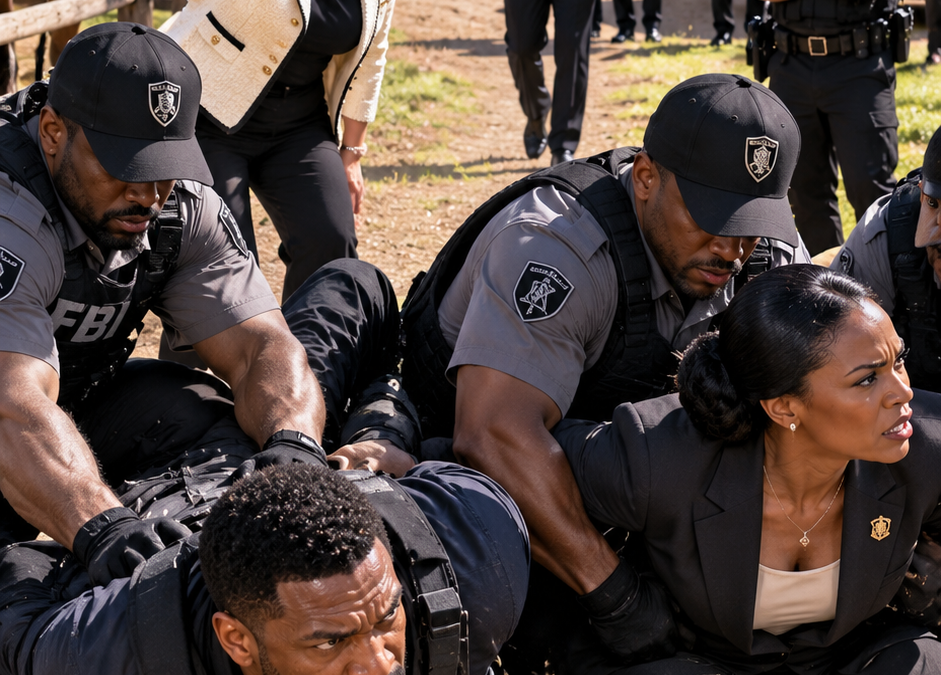
Then one guard grabbed my right arm.
Another took the left.
They forced me toward the ground.
My knee hit first.
Then shoulder.
Wet grass.
Mud.
Pressure between my shoulder blades.
Beside me, Evelyn shouted.
I turned my head enough to see another guard push her down.
One wrist trapped under his hand.
Another knee beside her hip.
“Get off her.”
The guard holding me pressed harder.
“Stop resisting.”
“I am not resisting.”
That was important.
I kept my voice steady.
“Do not hurt my wife.”
Mara walked closer.
She looked down at us.
For someone whose supposedly lawful authority had required bolt cutters, private guns, and a bulldozer, she seemed remarkably pleased with herself.
“Demolish the barn.”
Evelyn lifted her head.
“You touch that structure and every person here may be personally liable.”
Mara laughed.
“The barn is on association property.”
“No.”
“The bank recognizes the filing.”
That sentence caught me.
I stopped thinking about the knee in my shoulder.
“What bank?”
She looked at me.
“The financing institution supporting the expansion.”
“What financing?”
“The project is funded.”
Preston shifted near the SUV.
Very small movement.
But I saw it.
Evelyn heard it too.
“What project?” she asked.
Mara realized she had said too much.
She recovered quickly.
“That doesn’t concern you.”
I asked:
“Your bank accepted these ownership documents?”
She gave me a contemptuous look.
“The county processed them. Financing closed. This land is already part of the expansion whether you like it or not.”
Bank.
Filed land records.
Financing.
False documents.
That was the moment the situation changed in my head.
I still had no authority to conduct my own investigation.
I was the victim.
But I knew enough to recognize the shape of something larger.
If forged land documents had been transmitted to a financial institution and used to support a major loan, this could extend far beyond trespass.
The bulldozer started moving.
Its diesel engine rose.
The blade lowered.
Evelyn shouted:
“Stop the machine.”
Mara pointed.
“Continue.”
The blade approached the barn.
Then the guard beside me noticed something.
My jacket had twisted during the struggle.
A leather credential case had slipped partly free.
He pulled it out.
Opened it.
His entire face changed.
He looked at me.
Then at the case.
Then at Dwayne.
“Sir.”
Dwayne glanced over.
“What?”
The guard handed it to him.
Dwayne opened it.
Federal Bureau of Investigation.
My photograph.
My name.
Credentials.
He stared at me.
“You’re FBI?”
“Yes.”
“Why the hell didn’t you say anything?”
I looked up from the mud.
“I told you to leave.”
He stood.
“Get him up.”
Mara snapped:
“No.”
Dwayne turned.
“What?”
“Verify it first.”
He stared at her.
“Mara.”
“That badge could be fake.”
I almost admired the commitment.
The same woman holding a fake possession order was suddenly deeply concerned about document authenticity.
Dwayne looked at my credentials again.
He knew enough to be worried.
Then another guard called out.
“Boss.”
He had picked up Evelyn’s bag.
Her identification had fallen free.
He held the card.
Dwayne walked over.
Read it.
His face lost more color.
Mara grabbed it from him.
She stared.
UNITED STATES DISTRICT COURT
Then:
THE HONORABLE EVELYN MERCER
For several seconds, nobody spoke.
Evelyn was still on the ground.
Her coat muddy.
Hair loose.
Wrist red where the guard had held her.
Mara looked from the identification to Evelyn.
“You’re a federal judge?”
Evelyn answered calmly.
“Yes.”
Preston Vale closed his eyes.
That reaction told me he understood the problem better than Mara did.
Not because Evelyn could suddenly rule against them.
She couldn’t.
She would never touch any case arising from this incident as a judge.
She was a victim.
A witness.
Automatically conflicted.
But Mara had just waved a fabricated legal order in front of someone who spent her professional life reading real ones.
Evelyn looked directly at her.
“For clarity, I will have no judicial involvement in anything connected to what happened here.”
Mara stared.
Evelyn continued.
“But I will be a witness.”
That landed.
Preston took one step backward.
Mara suddenly lunged toward the fake possession order lying near the grass.
“Leave it,” I said.
She froze.
“Do not destroy or alter anything.”
Her eyes narrowed.
“Is that a threat?”
“No.”
I looked toward the cameras.
“It’s good advice.”
Dwayne spoke to his men.
“Everybody release them.”
The guard moved off me.
Another helped Evelyn stand.
She brushed mud from her sleeve.
The bulldozer stopped.
Mara looked toward Preston.
He was staring at the ground.
“Tell them to continue.”
Preston finally spoke.
“No.”
She turned.
“What?”
“No.”
“You approved this.”
“I reviewed what you provided.”
“You approved it.”
“I did not authorize physical detention.”
Dwayne looked at him.
“Then what exactly did you authorize?”
Preston didn’t answer.
That was the point where the alliance began cracking.
Mara ordered the bulldozer back.
Then told everyone to leave.
I did not try to stop them.
I did not arrest anyone.
I did not display a weapon.
I did not use my FBI position to seize phones or detain people.
I stood in my own yard, covered in mud, and watched every vehicle leave through the gate they had cut open.
Before Dwayne got into his SUV, he looked back.
“I’m sorry.”
I said nothing.
Not yet.
The property emptied.
Evelyn and I stood beside the driveway.
The barn was still standing.
Barely untouched.
The bulldozer blade had stopped only yards away.
She looked at me.
“You okay?”
“Yes.”
“You’re bleeding.”
I touched my cheek.
Small cut.
“You?”
“My wrist hurts.”
We looked toward the broken gate.
Then toward the house.
I pulled out my backup phone.
First call:
My supervisor.
Special Agent in Charge Celia Hartwell.
I explained everything.
Chronological.
No editorializing.
Private dispute.
Fake possession paperwork.
Forced entry.
Physical restraint.
Possible forged land documents.
Possible use in bank financing.
My credentials discovered only after the detention.
Then I said the most important thing.
“I am a victim in this matter.”
“I understand.”
“I want no operational role in whatever happens next.”
“Granted.”
“No access beyond what any reporting victim would receive.”
“Yes.”
“No internal case work.”
“Yes.”
“I want an independent team.”
“You’ll get one.”
That decision protected everyone.
Me.
The Bureau.
The investigation.
Even Mara, in a way.
There could be no credible argument later that I had personally turned federal power against a private adversary.
Evelyn made her own calls.
Her chief judge.
Ethics counsel.
Court administration.
She documented that she would recuse from any proceeding connected directly or indirectly to the dispute.
No rulings.
No warrants.
No orders.
No chambers involvement.
Nothing.
That evening, we sat at the kitchen table.
Still tired.
Still angry.
Evelyn had ice around her wrist.
I had changed out of muddy clothes.
We each had a legal pad.
She looked at me.
“Memory first.”
I nodded.
We wrote everything.
Exact time.
Guard names.
Mara’s words.
Dwayne’s words.
Preston’s silence.
Positions.
Vehicles.
Bulldozer.
Fake order.
Bank statement.
Credentials discovery.
Retreat.
We compared notes only after each of us finished independently.
That was another habit from our professional lives.
Contemporaneous memory.
Separate accounts.
No accidental contamination.
It was tedious.
It was also exactly what mattered later.
The county recorder’s office responded quickly.
The supposed seventy-one-acre annexation had never existed.
No valid merger.
No recorded transfer.
No legitimate HOA expansion onto Mercer Ridge Farm.
Several documents claiming to be historical had actually been electronically filed only eight months earlier.
Someone had dressed new files to look old.
The alleged easement contained Henry Mercer’s signature.
Henry had been dead two years before its stated execution.
A document examiner later concluded the signature had been reproduced from an older legitimate record.
Carefully.
But not carefully enough.
I supplied what any victim would.
Camera footage.
Letters.
Emails.
Photos.
Damage estimates.
Medical documentation.
My statement.
Evelyn’s statement.
Then I went back to work.
On unrelated cases.
That distance was strange.
I knew something large was unfolding around our farm.
But professionally, it no longer belonged to me.
Celia’s team handled it.
One barn camera had captured Mara speaking quietly with Preston before the confrontation.
Audio enhancement recovered enough.
Mara:
“Once the bank closes, none of this can be unwound.”
That sentence became important.
Very important.
Investigators learned Brier Glen was preparing a major expansion.
Rough value:
$42 million.
Ninety-six new homes.
Road infrastructure.
Water access.
Utility connections.
And three assets the project needed were on our land.
Eastern road.
Water line.
Reservoir access.
Without those rights, county infrastructure requirements could not be satisfied.
According to financing representations, however, the HOA already controlled them.
The bank had approved financing based on that claim.
Now the entire case looked different.
Mara wasn’t merely trying to bully us into accepting HOA rules.
The forged papers may have been supporting collateral and development representations tied to tens of millions of dollars.
That explained the urgency.
The expansion scheme predated the first letter we received.
We had not stumbled into the beginning.
We had stumbled into the cleanup.
Mara’s next move was predictable.
She went public.
Brier Glen residents received an association bulletin.
According to Mara:
I had used federal status to intimidate private security.
Evelyn had invoked judicial authority.
We had obstructed lawful survey activity.
We had threatened the HOA.
A short edited video began circulating.
It showed the moment my credentials were discovered.
Nothing before it.
No bolt cutters.
No restraint.
No mud.
No fake order.
No bulldozer.
Just a muddy man standing up while private guards reacted to an FBI badge.
Clever.
Incomplete.
Also useless.
Because I had already recused myself from the investigation.
And Evelyn had already formally removed herself from any judicial involvement.
Mara had created a defense against misconduct that had never occurred.
Then Russell Keane entered the story.
Former HOA treasurer.
Resigned six months earlier.
He contacted independent counsel.
He had records.
A lot of them.
Emails.
Budgets.
Meeting minutes.
Invoices.
Bank statements.
Vendor agreements.
He had kept copies because the numbers stopped making sense before he left.
One email from Mara to Preston read:
Once Mercer’s acreage exists inside our boundary on paper, the rest will eventually catch up.
Another discussed paying a survey consultant to “correct” property coordinates.
The word correct did a heroic amount of work in that sentence.
Another chain showed Preston questioning whether one easement could survive title review.
Mara answered:
File it first. Questions come later.
Electronic transmission records showed Preston sent property documents to the lender across state lines.
Again, I didn’t work that angle.
I didn’t need to.
The records existed.
Celia’s team followed them.
Russell’s files were organized with almost painful precision.
Dates.
Cross-references.
Invoices matched to checks.
Board minutes matched to email instructions.
He had been a treasurer.
It showed.
Investigators later told us his disclosure saved months.
One financial trail led to:
Whitcomb Development Consulting
Sounds generic.
It wasn’t.
The beneficial owner was Mara.
The company had received hundreds of thousands of dollars tied to contractors involved with the expansion.
Another money trail led to Hollis Protective Services.
Dwayne’s company.
Invoices described payments as:
LAND COMPLIANCE ENFORCEMENT
That phrase looked different once you had seen land compliance performed with a knee in your shoulder.
Dwayne hired his own lawyer.
Smart.
Preston stopped answering Mara’s calls.
Also smart.
Mara did something less smart.
At an emergency HOA meeting, she instructed staff to delete what she called “old drafts.”
Emails.
Map files.
Preliminary documents.
The problem with deleting modern records is that modern records tend to have relatives.
Cloud backup.
Vendor servers.
Email providers.
Third-party storage.
Lender archives.
Survey consultant systems.
Copies already preserved elsewhere.
Her cleanup attempt accomplished very little except create another issue.
One afternoon, I was fixing fence near the eastern pasture.
Evelyn walked out from the house.
“Grant.”
“What?”
She pointed toward the county road.
Government vehicles.
Several.
No lights.
No sirens.
Heading toward Brier Glen.
I watched them pass.
“This one’s not for us.”
“No,” Evelyn said.
“It belongs to someone else.”
Celia Hartwell entered the Brier Glen clubhouse that afternoon with a search warrant signed by a judge who had no connection to Evelyn.
That detail mattered.
Every approval in the investigation had been routed away from any conceivable conflict.
Computers were secured.
Phones collected within warrant scope.
Expansion files preserved.
Multiple versions of the property map were found.
One real.
One showing the seventy-one acres inside Brier Glen.
One customized for the lender.
One simplified for residents.
Same land.
Four realities.
Only one legal.
Inside a locked office safe, investigators found plans for a later expansion phase.
Transportation routes ran almost entirely through our farm.
Without our land, the future phase was nearly worthless.
Dwayne began cooperating.
He told investigators Mara had described us as “farmers with money” who would fold once security put enough pressure on us.
He produced text instructions.
One said:
Take their phones before demo starts.
Another:
Do not let them call anyone until the barn is down.
That destroyed the claim that the restraint had been spontaneous.
Preston began blaming Mara.
Mara blamed Preston.
It was almost predictable.
Conspiracies look unified while everyone believes they are winning.
Once consequences arrive, solidarity develops cracks.
The lender froze remaining disbursements.
Contractors stopped work.
Insurance opened an investigation.
Brier Glen’s expansion stalled.
Residents panicked.
Some had purchased homes based on promises of new amenities and future phases.
Now glossy renderings hung inside a clubhouse financing a project that might never exist.
Mara proposed a special assessment to fund legal costs.
Residents rejected it.
Overwhelmingly.
One longtime homeowner stood during the meeting.
He said:
“The association stopped representing us when it decided someone else’s farm was ours to take.”
According to Russell, the room became completely silent.
Mara walked out alone.
The civil title case moved separately.
A state court judge with no connection to Evelyn handled the matter.
Evelyn participated as a party.
Not as a judge.
She sat beside me.
No robe.
No elevated bench.
No special treatment.
Just a landowner whose wrist had once been pinned in the mud.
Mara’s lawyer tried to argue historical ambiguity.
The county surveyor ended that quickly.
Original plats.
Tax parcels.
Chain of title.
Recorded boundaries.
No seventy-one-acre transfer.
No valid annexation.
No permanent easement.
Evelyn testified about the fake possession paper.
Opposing counsel asked:
“How could you determine so quickly it was not genuine?”
She answered calmly.
“Because real court orders have identifiable origins.”
Then she walked through it.
Invalid case number.
Wrong formatting.
Missing clerk certification.
Incorrect court designation.
No judge.
No jurisdictional language.
Improper seal.
Dates inconsistent with public records.
No matching docket.
Nothing.
The official court system confirmed no such case existed.
I testified too.
One lawyer asked:
“You could have identified yourself as an FBI agent immediately, correct?”
“Yes.”
“You chose not to.”
“Yes.”
“Why?”
“Because I was standing on my farm in a private property dispute.”
“You didn’t believe your badge gave you special authority?”
“No.”
“You could have attempted to detain the guards?”
“I could have created a dangerous confrontation.”
“That wasn’t my question.”
I looked at him.
“My law-enforcement position did not make me the investigating officer in a dispute where I was the victim.”
That answer mattered.
Because Mara had spent months trying to build the story of an FBI agent and federal judge abusing government power.
The record showed the opposite.
We had both stepped away.
The county registrar testified.
The document examiner testified.
Bank representatives testified.
The lender produced the documents it had relied upon.
The differences were obvious.
Preston claimed good faith.
Then one email surfaced.
He had written:
The easement source is weak. If title pulls originals, we may have a problem.
Mara replied:
Proceed. By the time anyone challenges it, the project will be funded.
Preston had answered:
Understood.
That did not look like innocent reliance.
The court’s civil ruling was direct.
Mercer Ridge Farm had never belonged to Brier Glen Estates.
The seventy-one acres had never been transferred.
The easement was invalid.
The HOA had no authority to enter.
No authority to regulate.
No authority to seize.
No authority to demolish.
All fraudulent claims against our property were void.
That resolved ownership.
The criminal case was separate.
And it was built by people who were not me.
Not Evelyn.
Independent investigators.
Independent prosecutors.
Independent judges.
Documents.
Bank records.
Emails.
Witnesses.
Vendor data.
Security footage.
Dwayne’s messages.
Russell’s files.
Then came obstruction allegations tied to attempted deletion of records.
Federal financial allegations tied to the lender.
State-level allegations tied to entry onto our farm, restraint, and damage.
Mara was eventually taken into custody through the ordinary legal process.
No dramatic confrontation.
No revenge scene.
No me standing over her.
Celia Hartwell handled it.
That was exactly how it should have happened.
Preston faced his own consequences.
Criminal exposure.
Bar investigation.
His professional career collapsed under the weight of the same documents he had helped push through.
Dwayne cooperated.
That reduced his exposure.
It did not save his business.
Hollis Protective Services lost major contracts.
Licensing authorities reviewed the operation.
He later admitted during an interview that he had never seriously asked why an HOA needed six armed guards and a bulldozer to resolve a boundary dispute.
That question should have come earlier.
Brier Glen removed Mara as president.
By then, the vote was almost symbolic.
Her authority had already disappeared.
Financial audits followed.
Insurance refused to shield intentional wrongdoing beyond applicable coverage.
Residents learned how much association money had been spent on:
Legal strategy.
Security.
Consultants.
Development work.
Boundary manipulation.
Vendor relationships.
The $42 million expansion died.
The later phase died with it.
Some land intended for future development had to be sold as the association and affiliated parties dealt with mounting financial obligations.
We asked for very little compared with what we could have demanded emotionally.
Repair the gate.
Restore damaged fencing.
Cover property damage.
Compensate legitimate losses.
Remove every fraudulent filing.
Permanent injunction against unauthorized HOA entry.
That was it.
I didn’t want Brier Glen destroyed.
Evelyn didn’t either.
Most residents had done nothing to us.
They had trusted the wrong people.
Trust can be expensive.
But it should not automatically make every homeowner an enemy.
Months later, I rebuilt the gate.
Simple steel.
Heavy chain.
New padlock.
Evelyn came down carrying a metal sign.
MERCER RIDGE FARM
PRIVATE PROPERTY
I held it against the post.
“Level?”
She tilted her head.
“Left side up.”
I adjusted.
“Now?”
“Too far.”
“You want to do this?”
“No.”
“Then cooperate.”
She laughed.
I tightened the bolts.
We were standing close to the exact spot where the guards had forced us down.
She looked toward the eastern fence.
“Think they understand the boundary now?”
I followed her eyes.
In the distance, workers were taking down an old Brier Glen development sign.
PHASE FOUR — COMING SOON
I nodded.
“They understand.”
“You sure?”
“Very.”
For the first time in months, the farm felt like a farm again.
No private SUVs.
No bulldozer.
No fake notices.
No survey crew.
No HOA letters.
Just wind.
Fence wire.
Cattle.
Water.
Evelyn returned to her courtroom.
I returned to my field office.
Neither of us told the story often.
Not professionally.
At work, I was not the FBI agent who defeated his HOA.
I hadn’t.
I was an agent who happened to be victimized in a private land-fraud scheme and properly stepped away from the investigation.
That distinction mattered.
Evelyn did the same.
Her colleagues asked questions.
She gave factual answers.
Nothing more.
She never became the judge in Mara’s case.
She never signed a warrant against her.
Never issued an order.
Never touched anything connected to the prosecution.
That restraint became one of the reasons Mara’s abuse-of-power narrative failed completely.
There was no abuse to point toward.
One evening, months later, Evelyn found the fake possession order in my study drawer.
“You kept this?”
“Yes.”
“Why?”
“Reminder.”
“Of what?”
I looked at the paper.
The fake seal.
The fake case number.
The fake authority.
“How close confidence can stand to fraud.”
She sat on the edge of the desk.
“She really believed we’d fold.”
“No.”
“You don’t think so?”
“I think she believed everyone else would.”
Evelyn considered that.
“That sounds more accurate.”
Mara’s real power had never come from law.
It came from expectation.
She expected residents not to check.
Expected board members not to ask.
Expected the lender not to pull originals.
Expected us to panic.
Expected security guards to follow instructions.
Expected Preston to keep filing.
Expected the county recorder’s system to be too boring for anyone to examine closely.
For a while, she was right.
Then she came to a farm owned by two people whose entire professional lives were built around reading things carefully.
That was bad luck for her.
But luck only explains discovery.
Not the scheme itself.
She still created the documents.
Still used them.
Still ignored warnings.
Still entered the farm.
Still ordered physical restraint.
Still sent a bulldozer toward a structure she did not own.
Those were choices.
The most satisfying part of the ending was not seeing her arrested.
It was watching the story become boring.
Legal boring.
Document boring.
Exhibit numbers.
Title chains.
Bank transfers.
Emails.
Metadata.
Recorded deeds.
Because fraud loves drama.
Truth often survives through paperwork.
Brier Glen eventually elected a new board.
The first year, they reportedly spent more time reviewing contracts than planning expansion.
Good.
They hired independent counsel for major land matters.
Required outside title verification.
Created conflict disclosures.
Banned any board officer from approving significant development contracts alone.
The neighborhood became less ambitious.
Also less criminal.
A fair trade.
One afternoon, Russell Keane came by the farm.
I had never met him in person.
He parked outside the gate.
Waited.
I walked down.
“Russell?”
“Yes.”
He looked uncomfortable.
“I wanted to apologize.”
“You weren’t there.”
“No.”
“But I helped earlier.”
“How?”
“I stayed quiet.”
That was harder to answer.
He continued.
“I knew some things were wrong.”
“Did you know about our farm?”
“Not everything.”
“Did you know documents were being manipulated?”
“I suspected.”
“Why didn’t you say something?”
He looked at the road.
“Because leaving was easier.”
Honest answer.
I appreciated that.
“You came forward eventually.”
“Too late.”
“Later than ideal.”
He almost smiled.
“That’s diplomatic.”
“My wife is the judge.”
That got a real laugh.
Then I said:
“But you came forward.”
He nodded.
“Does that make it okay?”
“No.”
He looked at me.
“It makes it useful.”
That seemed to be enough.
He left.
Evelyn asked later what he wanted.
“Forgiveness.”
“Did you give it?”
“No.”
“Good.”
I looked at her.
“That sounded judicial.”
“I’m off duty.”
Over the next year, the farm recovered every practical scar.
Fence repaired.
Gate replaced.
Mud gone.
Barn untouched except for a scrape where debris from the bulldozer’s approach had hit siding.
I considered replacing that board.
Never did.
It reminded me how close the blade had come.
Not as a trophy.
As perspective.
There had been a moment while I was face-down in the grass when I could hear the bulldozer moving.
I couldn’t see it clearly.
I could hear Evelyn breathing beside me.
I could feel the guard’s knee.
I remember thinking:
Stay still.
Observe.
Don’t make this worse.
That was not heroic.
It was training.
And fear.
Anyone who tells you they feel no fear with armed strangers on their property is either lying or dangerous.
I was afraid.
Mostly for Evelyn.
Mostly that some guard would panic.
Mostly that Mara would give an order nobody could take back.
The badge didn’t erase that.
Her judicial title didn’t erase it.
Titles don’t stop bullets.
Judgment does.
Restraint does.
Sometimes luck does.
The guard who discovered my credentials might have reacted differently.
The armed men might have been less professional.
The bulldozer operator might have ignored Dwayne’s later retreat order.
A lot could have gone wrong.
That is why, when people later told the story as though Mara got the surprise of her life by accidentally attacking “an FBI agent and a federal judge,” I corrected them.
The surprising part was not who we were.
The problem was what she did.
It would have been wrong if I sold tractors.
Wrong if Evelyn taught third grade.
Wrong if we were retired.
Wrong if we were nobody anyone recognized.
Private security cannot manufacture ownership.
An HOA cannot forge jurisdiction.
A fake court order does not become real because armed people carry it.
Our jobs made the evidence more ironic.
They did not make our rights more important.
That distinction became the lesson I kept.
Years later, new families moved into Brier Glen who had never met Mara.
They knew the expansion project only as an empty strip of land sold off after “some legal problem.”
Fine.
Neighborhoods deserve to move on.
Mercer Ridge stayed the same.
Two hundred sixty acres.
Same reservoir.
Same private eastern road.
Same barn.
Same fence.
The HOA never sent us another rule.
Never asked about our grass.
Never complained about agricultural vehicles.
No one suggested our barn violated architectural standards.
Remarkable progress.
One spring morning, I was repairing irrigation near the reservoir when Evelyn walked down carrying coffee.
She handed me a cup.
“You know what I was thinking?”
“Dangerous beginning.”
She ignored me.
“If Mara had just accepted your first letter, none of this happens.”
“No.”
“One letter.”
“Three sentences.”
“She could have stopped.”
“Yes.”
“Instead she forged seventy-one acres.”
“Apparently three sentences were provocative.”
Evelyn smiled.
“Maybe you sounded hostile.”
“My punctuation was professional.”
“That period after ‘never had’ was aggressive.”
“Federal judge humor is terrible.”
“Still married.”
“Unfortunately.”
She leaned against the fence.
Beyond us, the reservoir reflected the morning sky.
The same water Mara’s expansion wanted.
I looked across the eastern boundary.
Nothing moved.
Perfect.
The final civil restrictions eventually became permanent.
No Brier Glen representative could enter without permission except under ordinary lawful circumstances applicable to anyone else.
Fraudulent filings removed.
Title restored cleanly.
Everything where it belonged.
Mara’s personal future was no longer something I followed closely.
Court proceedings are not entertainment when you’ve been part of the underlying harm.
I knew enough.
Charges.
Financial consequences.
Loss of position.
Loss of business relationships.
Preston’s professional discipline.
Dwayne’s company collapsing.
Brier Glen’s abandoned expansion.
That was sufficient.
I did not need every punishment.
I needed finality.
The last time I saw Mara was outside a courthouse.
I was leaving with Evelyn.
Mara stood with her lawyer.
She looked tired.
Older somehow.
She watched us pass.
Then said:
“You knew exactly what would happen once they found out who you were.”
I stopped.
“No.”
She looked at me.
“You let us walk into it.”
“No.”
“You could have shown your badge.”
“Yes.”
“And you didn’t.”
“Correct.”
“Why?”
I looked at her.
“Because you didn’t need to know my job to know you couldn’t pin me down on my own farm.”
She said nothing.
I continued.
“You had the deed issue.”
Silence.
“You had the real survey.”
Nothing.
“You had our letters.”
Her lawyer touched her arm.
“You had every chance to stop.”
She looked away.
I said one more thing.
“My badge wasn’t the line you crossed.”
Then Evelyn and I walked out.
That was the truth.
Mara’s mistake was never failing to recognize an FBI agent.
It wasn’t failing to recognize a federal judge.
Those facts made the story dramatic.
But the real line was simpler.
She entered property she did not own.
Used documents that were not real.
Ordered people restrained.
Tried to destroy a structure during a disputed title claim.
And built a multi-million-dollar expansion around land she had no lawful right to control.
Everything after that was evidence.
My badge did not bury her.
Her emails did.
Evelyn’s title did not destroy the project.
The real county records did.
Our careers did not bring down the financing.
The forged collateral did.
We were simply the two people standing there when her scheme finally ran out of room.
The farm is quiet now.
That is my favorite ending.
Not sirens.
Not agents.
Not handcuffs.
Quiet.
Sometimes after sunset, I walk the eastern fence alone.
The Brier Glen lights are visible beyond the trees.
Our barn sits behind me.
Reservoir ahead.
Grass moving in the wind.
No bulldozer.
No guards.
No Mara.
Just the place we bought years before either Evelyn or I had titles anyone might find impressive.
Mercer Ridge Farm.
Two hundred sixty acres.
Private property.
Always was.
And in the end, after forged surveys, fake court orders, bank financing, armed security, edited videos, federal warrants, civil hearings, and millions of dollars in collapsed development plans—
that simple fact was the one thing Mara Whitcomb could never successfully rewrite.
Have you finished reading the story and want to read it again?
HOA GUARDS PINNED US DOWN ON OUR FARM—THEY DIDN’T KNOW I WAS FBI AND MY WIFE SAT ON THE FEDERAL BENCH
They pinned us face-down in the mud.
They had no idea who we were.
Then one guard opened my jacket and everything changed.
My name is Grant Mercer.
My wife, Evelyn, and I own Mercer Ridge Farm, two hundred sixty acres of rolling pasture, timber, creek bottom, and old agricultural roads bordering a gated subdivision called Brier Glen Estates.
We bought the farm years before either of us held the jobs that later came to define our weekdays.
That mattered to us.
Mercer Ridge was never some trophy property we purchased after becoming successful.
It was ours before the titles.
Before the federal credentials.
Before Evelyn had chambers.
Before I had spent enough years with the Bureau to become tired of airports, conference rooms, search warrants, and people who believed lying confidently made facts disappear.
The farm was where we stopped being our jobs.
Almost nobody around Brier Glen knew what I did.
They knew I traveled.
They knew I sometimes left before sunrise and returned days later.
Most assumed I worked in some bland federal contracting role.
Fine with me.
Evelyn kept an even lower profile.
People around the neighborhood knew she was an attorney.
That was all.
On weekdays, she sat as a United States district judge.
On Saturdays, she pulled weeds from the vegetable beds in old jeans and complained about groundhogs.
That was the life we wanted.
Quiet.
Private.
Ordinary.
Then Mara Whitcomb became president of the Brier Glen Homeowners Association.
Her first letter was almost polite.
Brier Glen wanted us to remove our eastern fence.
Open a private farm road for resident access.
Allow use of our irrigation reservoir.
And close an equipment barn because, according to the letter, its appearance did not meet “community architectural standards.”
I read the letter twice.
Then wrote back:
Mercer Ridge Farm is not part of Brier Glen Estates. The HOA has no authority over this property. Please do not contact us again regarding covenant enforcement.
Three sentences.
I expected that to end it.
A week later, Mara sent something much more interesting.
According to her second packet, seventy-one acres of our farm had somehow been annexed into Brier Glen more than a decade earlier.
There was a survey.
A supposed agreement.
A notarized signature.
A recorder’s stamp.
Evelyn sat at our kitchen table reading the pages.
Then she stopped.
“What?”
She pointed toward the case reference.
“This isn’t a real filing format.”
“You’re sure?”
“Yes.”
She flipped another page.
“And that seal hasn’t been used by this county in years.”
Then she looked at the signature.
Her expression changed.
“Grant.”
“What?”
“Who owned the eastern tract before us?”
“Henry Mercer.”
“When did he die?”
I told her.
She tapped the date beside his supposed signature.
“This says he signed it two years later.”
For a moment, neither of us spoke.
Then Evelyn said quietly:
“This is fake.”
I started to answer.
She looked at me.
“No. Worse.”
I understood.
A bad boundary claim is one thing.
A fabricated land document is another.
I gathered the pages.
“Don’t accuse them yet.”
Evelyn looked at me.
“Why?”
“Because right now Mara thinks these papers are helping her.”
“And?”
“I want her to keep writing.”
That decision would matter later.
For the next several weeks, we saved everything.
Letters.
Emails.
Voicemails.
Maps.
Notices.
Threats.
Mara mistook silence for weakness.
Then one morning, while I was repairing a water line near the eastern fence, I saw six black SUVs parked beyond our gate.
Private security markings.
Engines running.
And behind them—
a bulldozer.
That was when I realized Mara Whitcomb was no longer sending letters because she believed paperwork alone would win.
She was preparing to make the argument with machinery.
PART2
I photographed the vehicles.
All six.
License plates.
Company markings.
Bulldozer.
Time.
Location.
I did not approach them.
I did not flash credentials.
I did not call my field office.
At that point, I was a landowner looking at private vehicles parked outside my property.
Nothing more.
That distinction mattered to me.
Working for the FBI does not grant you some magical personal jurisdiction over every problem in your private life.
If my neighbor’s dog runs through my garden, I don’t open a federal case.
If a contractor damages my fence, I don’t call a tactical team.
And if an HOA sends threatening letters, I respond the same way any property owner should.
Documents.
Lawyer.
Court.
Evidence.
That evening, Evelyn met me on the porch.
“You saw them?”
“Yes.”
“Security?”
“Yes.”
“The bulldozer too?”
“Yes.”
She looked toward the tree line.
“This isn’t about the barn anymore.”
“No.”
“What do you think it is?”
“I don’t know yet.”
She folded her arms.
“People don’t bring heavy equipment to a disagreement they’re expecting to lose.”
I nodded.
That was exactly what bothered me.
Monday morning started quietly.
I was checking the pump system.
Evelyn was finishing coffee before leaving for court.
Then came the sound.
Metal snapping.
Sharp.
Close.
I looked toward the front gate.
Six men in dark tactical vests were entering through the broken chain.
One held bolt cutters.
Another carried a document folder.
A third walked beside Dwayne Hollis, the owner of the private security company whose logo I had photographed two days earlier.
Behind them came Mara Whitcomb.
Leather portfolio.
Dark coat.
Perfectly calm.
And behind all of them, the bulldozer rolled through our gate.
I walked toward the driveway.
“Stop.”
Dwayne kept moving.
“You need to leave.”
Mara answered for him.
“No, Grant. You need to leave.”
I looked at her.
“What?”
She opened her folder.
“As of this morning, Brier Glen has emergency possession of the disputed parcel.”
Evelyn came out behind me.
“Through what court?”
Mara smiled.
“You’ll have a copy.”
She handed over a document.
Evelyn read maybe six lines.
Then looked up.
“This is not a court order.”
Mara’s smile tightened.
“You haven’t had time to read it.”
“I don’t need more time.”
“You’re an attorney. Not a judge.”
Evelyn looked at her.
“I know enough to recognize a nonexistent case number.”
Mara’s face shifted slightly.
Evelyn continued.
“No judge signed this.”
“There is administrative authorization.”
“No clerk certification.”
“Our counsel reviewed it.”
“No valid court seal.”
“Ms. Mercer—”
“And this court designation doesn’t exist.”
Silence.
Mara closed the folder.
“You can challenge it later.”
“No,” Evelyn said. “You can leave now.”
One of the guards laughed quietly.
Mara looked toward Dwayne.
“Proceed.”
I took out my phone.
Dwayne stepped toward me.
“Sir, put that away.”
“No.”
“This is an enforcement operation.”
“No, it isn’t.”
He reached.
“Do not touch me.”
He grabbed the phone.
It happened quickly.
Not violently at first.
He simply snatched it.
I took one step toward him.
Three guards moved closer.
I saw firearms.
Holstered.
But visible.
At that moment, I had choices.
None of the smart ones involved turning my front yard into a gunfight.
So I stopped.
I had spent years around investigations, raids, negotiations, arrests, and people under stress.
The first lesson is simple.
When weapons are present, ego becomes dangerous.
I let him take the phone.
Then I started observing.
Badge numbers.
Uniform names.
Dwayne Hollis.
Two guards wearing body cameras.
SUV dash cameras.
License plates.
Relative positions.
Bulldozer operator.
Mara’s exact words.
The lawyer standing near the lead SUV.
Preston Vale.
I recognized his name from HOA correspondence.
Evelyn stepped toward the house.
A guard blocked her.
“Move.”
“No.”
“This is my home.”
“Ma’am, stay where you are.”
She looked at him.
“Don’t put your hands on me.”
I said:
“You heard her.”
Dwayne smiled.
“Out here, you’re not giving orders.”
That sentence lasted maybe two seconds.
Then one guard grabbed my right arm.
Another took the left.
They forced me toward the ground.
My knee hit first.
Then shoulder.
Wet grass.
Mud.
Pressure between my shoulder blades.
Beside me, Evelyn shouted.
I turned my head enough to see another guard push her down.
One wrist trapped under his hand.
Another knee beside her hip.
“Get off her.”
The guard holding me pressed harder.
“Stop resisting.”
“I am not resisting.”
That was important.
I kept my voice steady.
“Do not hurt my wife.”
Mara walked closer.
She looked down at us.
For someone whose supposedly lawful authority had required bolt cutters, private guns, and a bulldozer, she seemed remarkably pleased with herself.
“Demolish the barn.”
Evelyn lifted her head.
“You touch that structure and every person here may be personally liable.”
Mara laughed.
“The barn is on association property.”
“No.”
“The bank recognizes the filing.”
That sentence caught me.
I stopped thinking about the knee in my shoulder.
“What bank?”
She looked at me.
“The financing institution supporting the expansion.”
“What financing?”
“The project is funded.”
Preston shifted near the SUV.
Very small movement.
But I saw it.
Evelyn heard it too.
“What project?” she asked.
Mara realized she had said too much.
She recovered quickly.
“That doesn’t concern you.”
I asked:
“Your bank accepted these ownership documents?”
She gave me a contemptuous look.
“The county processed them. Financing closed. This land is already part of the expansion whether you like it or not.”
Bank.
Filed land records.
Financing.
False documents.
That was the moment the situation changed in my head.
I still had no authority to conduct my own investigation.
I was the victim.
But I knew enough to recognize the shape of something larger.
If forged land documents had been transmitted to a financial institution and used to support a major loan, this could extend far beyond trespass.
The bulldozer started moving.
Its diesel engine rose.
The blade lowered.
Evelyn shouted:
“Stop the machine.”
Mara pointed.
“Continue.”
The blade approached the barn.
Then the guard beside me noticed something.
My jacket had twisted during the struggle.
A leather credential case had slipped partly free.
He pulled it out.
Opened it.
His entire face changed.
He looked at me.
Then at the case.
Then at Dwayne.
“Sir.”
Dwayne glanced over.
“What?”
The guard handed it to him.
Dwayne opened it.
Federal Bureau of Investigation.
My photograph.
My name.
Credentials.
He stared at me.
“You’re FBI?”
“Yes.”
“Why the hell didn’t you say anything?”
I looked up from the mud.
“I told you to leave.”
He stood.
“Get him up.”
Mara snapped:
“No.”
Dwayne turned.
“What?”
“Verify it first.”
He stared at her.
“Mara.”
“That badge could be fake.”
I almost admired the commitment.
The same woman holding a fake possession order was suddenly deeply concerned about document authenticity.
Dwayne looked at my credentials again.
He knew enough to be worried.
Then another guard called out.
“Boss.”
He had picked up Evelyn’s bag.
Her identification had fallen free.
He held the card.
Dwayne walked over.
Read it.
His face lost more color.
Mara grabbed it from him.
She stared.
UNITED STATES DISTRICT COURT
Then:
THE HONORABLE EVELYN MERCER
For several seconds, nobody spoke.
Evelyn was still on the ground.
Her coat muddy.
Hair loose.
Wrist red where the guard had held her.
Mara looked from the identification to Evelyn.
“You’re a federal judge?”
Evelyn answered calmly.
“Yes.”
Preston Vale closed his eyes.
That reaction told me he understood the problem better than Mara did.
Not because Evelyn could suddenly rule against them.
She couldn’t.
She would never touch any case arising from this incident as a judge.
She was a victim.
A witness.
Automatically conflicted.
But Mara had just waved a fabricated legal order in front of someone who spent her professional life reading real ones.
Evelyn looked directly at her.
“For clarity, I will have no judicial involvement in anything connected to what happened here.”
Mara stared.
Evelyn continued.
“But I will be a witness.”
That landed.
Preston took one step backward.
Mara suddenly lunged toward the fake possession order lying near the grass.
“Leave it,” I said.
She froze.
“Do not destroy or alter anything.”
Her eyes narrowed.
“Is that a threat?”
“No.”
I looked toward the cameras.
“It’s good advice.”
Dwayne spoke to his men.
“Everybody release them.”
The guard moved off me.
Another helped Evelyn stand.
She brushed mud from her sleeve.
The bulldozer stopped.
Mara looked toward Preston.
He was staring at the ground.
“Tell them to continue.”
Preston finally spoke.
“No.”
She turned.
“What?”
“No.”
“You approved this.”
“I reviewed what you provided.”
“You approved it.”
“I did not authorize physical detention.”
Dwayne looked at him.
“Then what exactly did you authorize?”
Preston didn’t answer.
That was the point where the alliance began cracking.
Mara ordered the bulldozer back.
Then told everyone to leave.
I did not try to stop them.
I did not arrest anyone.
I did not display a weapon.
I did not use my FBI position to seize phones or detain people.
I stood in my own yard, covered in mud, and watched every vehicle leave through the gate they had cut open.
Before Dwayne got into his SUV, he looked back.
“I’m sorry.”
I said nothing.
Not yet.
The property emptied.
Evelyn and I stood beside the driveway.
The barn was still standing.
Barely untouched.
The bulldozer blade had stopped only yards away.
She looked at me.
“You okay?”
“Yes.”
“You’re bleeding.”
I touched my cheek.
Small cut.
“You?”
“My wrist hurts.”
We looked toward the broken gate.
Then toward the house.
I pulled out my backup phone.
First call:
My supervisor.
Special Agent in Charge Celia Hartwell.
I explained everything.
Chronological.
No editorializing.
Private dispute.
Fake possession paperwork.
Forced entry.
Physical restraint.
Possible forged land documents.
Possible use in bank financing.
My credentials discovered only after the detention.
Then I said the most important thing.
“I am a victim in this matter.”
“I understand.”
“I want no operational role in whatever happens next.”
“Granted.”
“No access beyond what any reporting victim would receive.”
“Yes.”
“No internal case work.”
“Yes.”
“I want an independent team.”
“You’ll get one.”
That decision protected everyone.
Me.
The Bureau.
The investigation.
Even Mara, in a way.
There could be no credible argument later that I had personally turned federal power against a private adversary.
Evelyn made her own calls.
Her chief judge.
Ethics counsel.
Court administration.
She documented that she would recuse from any proceeding connected directly or indirectly to the dispute.
No rulings.
No warrants.
No orders.
No chambers involvement.
Nothing.
That evening, we sat at the kitchen table.
Still tired.
Still angry.
Evelyn had ice around her wrist.
I had changed out of muddy clothes.
We each had a legal pad.
She looked at me.
“Memory first.”
I nodded.
We wrote everything.
Exact time.
Guard names.
Mara’s words.
Dwayne’s words.
Preston’s silence.
Positions.
Vehicles.
Bulldozer.
Fake order.
Bank statement.
Credentials discovery.
Retreat.
We compared notes only after each of us finished independently.
That was another habit from our professional lives.
Contemporaneous memory.
Separate accounts.
No accidental contamination.
It was tedious.
It was also exactly what mattered later.
The county recorder’s office responded quickly.
The supposed seventy-one-acre annexation had never existed.
No valid merger.
No recorded transfer.
No legitimate HOA expansion onto Mercer Ridge Farm.
Several documents claiming to be historical had actually been electronically filed only eight months earlier.
Someone had dressed new files to look old.
The alleged easement contained Henry Mercer’s signature.
Henry had been dead two years before its stated execution.
A document examiner later concluded the signature had been reproduced from an older legitimate record.
Carefully.
But not carefully enough.
I supplied what any victim would.
Camera footage.
Letters.
Emails.
Photos.
Damage estimates.
Medical documentation.
My statement.
Evelyn’s statement.
Then I went back to work.
On unrelated cases.
That distance was strange.
I knew something large was unfolding around our farm.
But professionally, it no longer belonged to me.
Celia’s team handled it.
One barn camera had captured Mara speaking quietly with Preston before the confrontation.
Audio enhancement recovered enough.
Mara:
“Once the bank closes, none of this can be unwound.”
That sentence became important.
Very important.
Investigators learned Brier Glen was preparing a major expansion.
Rough value:
$42 million.
Ninety-six new homes.
Road infrastructure.
Water access.
Utility connections.
And three assets the project needed were on our land.
Eastern road.
Water line.
Reservoir access.
Without those rights, county infrastructure requirements could not be satisfied.
According to financing representations, however, the HOA already controlled them.
The bank had approved financing based on that claim.
Now the entire case looked different.
Mara wasn’t merely trying to bully us into accepting HOA rules.
The forged papers may have been supporting collateral and development representations tied to tens of millions of dollars.
That explained the urgency.
The expansion scheme predated the first letter we received.
We had not stumbled into the beginning.
We had stumbled into the cleanup.
Mara’s next move was predictable.
She went public.
Brier Glen residents received an association bulletin.
According to Mara:
I had used federal status to intimidate private security.
Evelyn had invoked judicial authority.
We had obstructed lawful survey activity.
We had threatened the HOA.
A short edited video began circulating.
It showed the moment my credentials were discovered.
Nothing before it.
No bolt cutters.
No restraint.
No mud.
No fake order.
No bulldozer.
Just a muddy man standing up while private guards reacted to an FBI badge.
Clever.
Incomplete.
Also useless.
Because I had already recused myself from the investigation.
And Evelyn had already formally removed herself from any judicial involvement.
Mara had created a defense against misconduct that had never occurred.
Then Russell Keane entered the story.
Former HOA treasurer.
Resigned six months earlier.
He contacted independent counsel.
He had records.
A lot of them.
Emails.
Budgets.
Meeting minutes.
Invoices.
Bank statements.
Vendor agreements.
He had kept copies because the numbers stopped making sense before he left.
One email from Mara to Preston read:
Once Mercer’s acreage exists inside our boundary on paper, the rest will eventually catch up.
Another discussed paying a survey consultant to “correct” property coordinates.
The word correct did a heroic amount of work in that sentence.
Another chain showed Preston questioning whether one easement could survive title review.
Mara answered:
File it first. Questions come later.
Electronic transmission records showed Preston sent property documents to the lender across state lines.
Again, I didn’t work that angle.
I didn’t need to.
The records existed.
Celia’s team followed them.
Russell’s files were organized with almost painful precision.
Dates.
Cross-references.
Invoices matched to checks.
Board minutes matched to email instructions.
He had been a treasurer.
It showed.
Investigators later told us his disclosure saved months.
One financial trail led to:
Whitcomb Development Consulting
Sounds generic.
It wasn’t.
The beneficial owner was Mara.
The company had received hundreds of thousands of dollars tied to contractors involved with the expansion.
Another money trail led to Hollis Protective Services.
Dwayne’s company.
Invoices described payments as:
LAND COMPLIANCE ENFORCEMENT
That phrase looked different once you had seen land compliance performed with a knee in your shoulder.
Dwayne hired his own lawyer.
Smart.
Preston stopped answering Mara’s calls.
Also smart.
Mara did something less smart.
At an emergency HOA meeting, she instructed staff to delete what she called “old drafts.”
Emails.
Map files.
Preliminary documents.
The problem with deleting modern records is that modern records tend to have relatives.
Cloud backup.
Vendor servers.
Email providers.
Third-party storage.
Lender archives.
Survey consultant systems.
Copies already preserved elsewhere.
Her cleanup attempt accomplished very little except create another issue.
One afternoon, I was fixing fence near the eastern pasture.
Evelyn walked out from the house.
“Grant.”
“What?”
She pointed toward the county road.
Government vehicles.
Several.
No lights.
No sirens.
Heading toward Brier Glen.
I watched them pass.
“This one’s not for us.”
“No,” Evelyn said.
“It belongs to someone else.”
Celia Hartwell entered the Brier Glen clubhouse that afternoon with a search warrant signed by a judge who had no connection to Evelyn.
That detail mattered.
Every approval in the investigation had been routed away from any conceivable conflict.
Computers were secured.
Phones collected within warrant scope.
Expansion files preserved.
Multiple versions of the property map were found.
One real.
One showing the seventy-one acres inside Brier Glen.
One customized for the lender.
One simplified for residents.
Same land.
Four realities.
Only one legal.
Inside a locked office safe, investigators found plans for a later expansion phase.
Transportation routes ran almost entirely through our farm.
Without our land, the future phase was nearly worthless.
Dwayne began cooperating.
He told investigators Mara had described us as “farmers with money” who would fold once security put enough pressure on us.
He produced text instructions.
One said:
Take their phones before demo starts.
Another:
Do not let them call anyone until the barn is down.
That destroyed the claim that the restraint had been spontaneous.
Preston began blaming Mara.
Mara blamed Preston.
It was almost predictable.
Conspiracies look unified while everyone believes they are winning.
Once consequences arrive, solidarity develops cracks.
The lender froze remaining disbursements.
Contractors stopped work.
Insurance opened an investigation.
Brier Glen’s expansion stalled.
Residents panicked.
Some had purchased homes based on promises of new amenities and future phases.
Now glossy renderings hung inside a clubhouse financing a project that might never exist.
Mara proposed a special assessment to fund legal costs.
Residents rejected it.
Overwhelmingly.
One longtime homeowner stood during the meeting.
He said:
“The association stopped representing us when it decided someone else’s farm was ours to take.”
According to Russell, the room became completely silent.
Mara walked out alone.
The civil title case moved separately.
A state court judge with no connection to Evelyn handled the matter.
Evelyn participated as a party.
Not as a judge.
She sat beside me.
No robe.
No elevated bench.
No special treatment.
Just a landowner whose wrist had once been pinned in the mud.
Mara’s lawyer tried to argue historical ambiguity.
The county surveyor ended that quickly.
Original plats.
Tax parcels.
Chain of title.
Recorded boundaries.
No seventy-one-acre transfer.
No valid annexation.
No permanent easement.
Evelyn testified about the fake possession paper.
Opposing counsel asked:
“How could you determine so quickly it was not genuine?”
She answered calmly.
“Because real court orders have identifiable origins.”
Then she walked through it.
Invalid case number.
Wrong formatting.
Missing clerk certification.
Incorrect court designation.
No judge.
No jurisdictional language.
Improper seal.
Dates inconsistent with public records.
No matching docket.
Nothing.
The official court system confirmed no such case existed.
I testified too.
One lawyer asked:
“You could have identified yourself as an FBI agent immediately, correct?”
“Yes.”
“You chose not to.”
“Yes.”
“Why?”
“Because I was standing on my farm in a private property dispute.”
“You didn’t believe your badge gave you special authority?”
“No.”
“You could have attempted to detain the guards?”
“I could have created a dangerous confrontation.”
“That wasn’t my question.”
I looked at him.
“My law-enforcement position did not make me the investigating officer in a dispute where I was the victim.”
That answer mattered.
Because Mara had spent months trying to build the story of an FBI agent and federal judge abusing government power.
The record showed the opposite.
We had both stepped away.
The county registrar testified.
The document examiner testified.
Bank representatives testified.
The lender produced the documents it had relied upon.
The differences were obvious.
Preston claimed good faith.
Then one email surfaced.
He had written:
The easement source is weak. If title pulls originals, we may have a problem.
Mara replied:
Proceed. By the time anyone challenges it, the project will be funded.
Preston had answered:
Understood.
That did not look like innocent reliance.
The court’s civil ruling was direct.
Mercer Ridge Farm had never belonged to Brier Glen Estates.
The seventy-one acres had never been transferred.
The easement was invalid.
The HOA had no authority to enter.
No authority to regulate.
No authority to seize.
No authority to demolish.
All fraudulent claims against our property were void.
That resolved ownership.
The criminal case was separate.
And it was built by people who were not me.
Not Evelyn.
Independent investigators.
Independent prosecutors.
Independent judges.
Documents.
Bank records.
Emails.
Witnesses.
Vendor data.
Security footage.
Dwayne’s messages.
Russell’s files.
Then came obstruction allegations tied to attempted deletion of records.
Federal financial allegations tied to the lender.
State-level allegations tied to entry onto our farm, restraint, and damage.
Mara was eventually taken into custody through the ordinary legal process.
No dramatic confrontation.
No revenge scene.
No me standing over her.
Celia Hartwell handled it.
That was exactly how it should have happened.
Preston faced his own consequences.
Criminal exposure.
Bar investigation.
His professional career collapsed under the weight of the same documents he had helped push through.
Dwayne cooperated.
That reduced his exposure.
It did not save his business.
Hollis Protective Services lost major contracts.
Licensing authorities reviewed the operation.
He later admitted during an interview that he had never seriously asked why an HOA needed six armed guards and a bulldozer to resolve a boundary dispute.
That question should have come earlier.
Brier Glen removed Mara as president.
By then, the vote was almost symbolic.
Her authority had already disappeared.
Financial audits followed.
Insurance refused to shield intentional wrongdoing beyond applicable coverage.
Residents learned how much association money had been spent on:
Legal strategy.
Security.
Consultants.
Development work.
Boundary manipulation.
Vendor relationships.
The $42 million expansion died.
The later phase died with it.
Some land intended for future development had to be sold as the association and affiliated parties dealt with mounting financial obligations.
We asked for very little compared with what we could have demanded emotionally.
Repair the gate.
Restore damaged fencing.
Cover property damage.
Compensate legitimate losses.
Remove every fraudulent filing.
Permanent injunction against unauthorized HOA entry.
That was it.
I didn’t want Brier Glen destroyed.
Evelyn didn’t either.
Most residents had done nothing to us.
They had trusted the wrong people.
Trust can be expensive.
But it should not automatically make every homeowner an enemy.
Months later, I rebuilt the gate.
Simple steel.
Heavy chain.
New padlock.
Evelyn came down carrying a metal sign.
MERCER RIDGE FARM
PRIVATE PROPERTY
I held it against the post.
“Level?”
She tilted her head.
“Left side up.”
I adjusted.
“Now?”
“Too far.”
“You want to do this?”
“No.”
“Then cooperate.”
She laughed.
I tightened the bolts.
We were standing close to the exact spot where the guards had forced us down.
She looked toward the eastern fence.
“Think they understand the boundary now?”
I followed her eyes.
In the distance, workers were taking down an old Brier Glen development sign.
PHASE FOUR — COMING SOON
I nodded.
“They understand.”
“You sure?”
“Very.”
For the first time in months, the farm felt like a farm again.
No private SUVs.
No bulldozer.
No fake notices.
No survey crew.
No HOA letters.
Just wind.
Fence wire.
Cattle.
Water.
Evelyn returned to her courtroom.
I returned to my field office.
Neither of us told the story often.
Not professionally.
At work, I was not the FBI agent who defeated his HOA.
I hadn’t.
I was an agent who happened to be victimized in a private land-fraud scheme and properly stepped away from the investigation.
That distinction mattered.
Evelyn did the same.
Her colleagues asked questions.
She gave factual answers.
Nothing more.
She never became the judge in Mara’s case.
She never signed a warrant against her.
Never issued an order.
Never touched anything connected to the prosecution.
That restraint became one of the reasons Mara’s abuse-of-power narrative failed completely.
There was no abuse to point toward.
One evening, months later, Evelyn found the fake possession order in my study drawer.
“You kept this?”
“Yes.”
“Why?”
“Reminder.”
“Of what?”
I looked at the paper.
The fake seal.
The fake case number.
The fake authority.
“How close confidence can stand to fraud.”
She sat on the edge of the desk.
“She really believed we’d fold.”
“No.”
“You don’t think so?”
“I think she believed everyone else would.”
Evelyn considered that.
“That sounds more accurate.”
Mara’s real power had never come from law.
It came from expectation.
She expected residents not to check.
Expected board members not to ask.
Expected the lender not to pull originals.
Expected us to panic.
Expected security guards to follow instructions.
Expected Preston to keep filing.
Expected the county recorder’s system to be too boring for anyone to examine closely.
For a while, she was right.
Then she came to a farm owned by two people whose entire professional lives were built around reading things carefully.
That was bad luck for her.
But luck only explains discovery.
Not the scheme itself.
She still created the documents.
Still used them.
Still ignored warnings.
Still entered the farm.
Still ordered physical restraint.
Still sent a bulldozer toward a structure she did not own.
Those were choices.
The most satisfying part of the ending was not seeing her arrested.
It was watching the story become boring.
Legal boring.
Document boring.
Exhibit numbers.
Title chains.
Bank transfers.
Emails.
Metadata.
Recorded deeds.
Because fraud loves drama.
Truth often survives through paperwork.
Brier Glen eventually elected a new board.
The first year, they reportedly spent more time reviewing contracts than planning expansion.
Good.
They hired independent counsel for major land matters.
Required outside title verification.
Created conflict disclosures.
Banned any board officer from approving significant development contracts alone.
The neighborhood became less ambitious.
Also less criminal.
A fair trade.
One afternoon, Russell Keane came by the farm.
I had never met him in person.
He parked outside the gate.
Waited.
I walked down.
“Russell?”
“Yes.”
He looked uncomfortable.
“I wanted to apologize.”
“You weren’t there.”
“No.”
“But I helped earlier.”
“How?”
“I stayed quiet.”
That was harder to answer.
He continued.
“I knew some things were wrong.”
“Did you know about our farm?”
“Not everything.”
“Did you know documents were being manipulated?”
“I suspected.”
“Why didn’t you say something?”
He looked at the road.
“Because leaving was easier.”
Honest answer.
I appreciated that.
“You came forward eventually.”
“Too late.”
“Later than ideal.”
He almost smiled.
“That’s diplomatic.”
“My wife is the judge.”
That got a real laugh.
Then I said:
“But you came forward.”
He nodded.
“Does that make it okay?”
“No.”
He looked at me.
“It makes it useful.”
That seemed to be enough.
He left.
Evelyn asked later what he wanted.
“Forgiveness.”
“Did you give it?”
“No.”
“Good.”
I looked at her.
“That sounded judicial.”
“I’m off duty.”
Over the next year, the farm recovered every practical scar.
Fence repaired.
Gate replaced.
Mud gone.
Barn untouched except for a scrape where debris from the bulldozer’s approach had hit siding.
I considered replacing that board.
Never did.
It reminded me how close the blade had come.
Not as a trophy.
As perspective.
There had been a moment while I was face-down in the grass when I could hear the bulldozer moving.
I couldn’t see it clearly.
I could hear Evelyn breathing beside me.
I could feel the guard’s knee.
I remember thinking:
Stay still.
Observe.
Don’t make this worse.
That was not heroic.
It was training.
And fear.
Anyone who tells you they feel no fear with armed strangers on their property is either lying or dangerous.
I was afraid.
Mostly for Evelyn.
Mostly that some guard would panic.
Mostly that Mara would give an order nobody could take back.
The badge didn’t erase that.
Her judicial title didn’t erase it.
Titles don’t stop bullets.
Judgment does.
Restraint does.
Sometimes luck does.
The guard who discovered my credentials might have reacted differently.
The armed men might have been less professional.
The bulldozer operator might have ignored Dwayne’s later retreat order.
A lot could have gone wrong.
That is why, when people later told the story as though Mara got the surprise of her life by accidentally attacking “an FBI agent and a federal judge,” I corrected them.
The surprising part was not who we were.
The problem was what she did.
It would have been wrong if I sold tractors.
Wrong if Evelyn taught third grade.
Wrong if we were retired.
Wrong if we were nobody anyone recognized.
Private security cannot manufacture ownership.
An HOA cannot forge jurisdiction.
A fake court order does not become real because armed people carry it.
Our jobs made the evidence more ironic.
They did not make our rights more important.
That distinction became the lesson I kept.
Years later, new families moved into Brier Glen who had never met Mara.
They knew the expansion project only as an empty strip of land sold off after “some legal problem.”
Fine.
Neighborhoods deserve to move on.
Mercer Ridge stayed the same.
Two hundred sixty acres.
Same reservoir.
Same private eastern road.
Same barn.
Same fence.
The HOA never sent us another rule.
Never asked about our grass.
Never complained about agricultural vehicles.
No one suggested our barn violated architectural standards.
Remarkable progress.
One spring morning, I was repairing irrigation near the reservoir when Evelyn walked down carrying coffee.
She handed me a cup.
“You know what I was thinking?”
“Dangerous beginning.”
She ignored me.
“If Mara had just accepted your first letter, none of this happens.”
“No.”
“One letter.”
“Three sentences.”
“She could have stopped.”
“Yes.”
“Instead she forged seventy-one acres.”
“Apparently three sentences were provocative.”
Evelyn smiled.
“Maybe you sounded hostile.”
“My punctuation was professional.”
“That period after ‘never had’ was aggressive.”
“Federal judge humor is terrible.”
“Still married.”
“Unfortunately.”
She leaned against the fence.
Beyond us, the reservoir reflected the morning sky.
The same water Mara’s expansion wanted.
I looked across the eastern boundary.
Nothing moved.
Perfect.
The final civil restrictions eventually became permanent.
No Brier Glen representative could enter without permission except under ordinary lawful circumstances applicable to anyone else.
Fraudulent filings removed.
Title restored cleanly.
Everything where it belonged.
Mara’s personal future was no longer something I followed closely.
Court proceedings are not entertainment when you’ve been part of the underlying harm.
I knew enough.
Charges.
Financial consequences.
Loss of position.
Loss of business relationships.
Preston’s professional discipline.
Dwayne’s company collapsing.
Brier Glen’s abandoned expansion.
That was sufficient.
I did not need every punishment.
I needed finality.
The last time I saw Mara was outside a courthouse.
I was leaving with Evelyn.
Mara stood with her lawyer.
She looked tired.
Older somehow.
She watched us pass.
Then said:
“You knew exactly what would happen once they found out who you were.”
I stopped.
“No.”
She looked at me.
“You let us walk into it.”
“No.”
“You could have shown your badge.”
“Yes.”
“And you didn’t.”
“Correct.”
“Why?”
I looked at her.
“Because you didn’t need to know my job to know you couldn’t pin me down on my own farm.”
She said nothing.
I continued.
“You had the deed issue.”
Silence.
“You had the real survey.”
Nothing.
“You had our letters.”
Her lawyer touched her arm.
“You had every chance to stop.”
She looked away.
I said one more thing.
“My badge wasn’t the line you crossed.”
Then Evelyn and I walked out.
That was the truth.
Mara’s mistake was never failing to recognize an FBI agent.
It wasn’t failing to recognize a federal judge.
Those facts made the story dramatic.
But the real line was simpler.
She entered property she did not own.
Used documents that were not real.
Ordered people restrained.
Tried to destroy a structure during a disputed title claim.
And built a multi-million-dollar expansion around land she had no lawful right to control.
Everything after that was evidence.
My badge did not bury her.
Her emails did.
Evelyn’s title did not destroy the project.
The real county records did.
Our careers did not bring down the financing.
The forged collateral did.
We were simply the two people standing there when her scheme finally ran out of room.
The farm is quiet now.
That is my favorite ending.
Not sirens.
Not agents.
Not handcuffs.
Quiet.
Sometimes after sunset, I walk the eastern fence alone.
The Brier Glen lights are visible beyond the trees.
Our barn sits behind me.
Reservoir ahead.
Grass moving in the wind.
No bulldozer.
No guards.
No Mara.
Just the place we bought years before either Evelyn or I had titles anyone might find impressive.
Mercer Ridge Farm.
Two hundred sixty acres.
Private property.
Always was.
And in the end, after forged surveys, fake court orders, bank financing, armed security, edited videos, federal warrants, civil hearings, and millions of dollars in collapsed development plans—
that simple fact was the one thing Mara Whitcomb could never successfully rewrite.








