𝗙𝗨𝗟𝗟 𝗦𝗧𝗢𝗥𝗬 HOA Gave Me 14 Days to Sell My Stallions—Then Their Own Emails Exposed What the Board Already Knew
𝗣𝗔𝗥𝗧 𝟮
That evening, I unfolded Diane’s notice on my kitchen table.
I read it again.
The HOA cited Section 4.2 of its Community Standards Manual.
Livestock and large-animal restrictions.
According to the notice, uncastrated male horses were prohibited within what Diane called the community’s “defined area of influence.”
That phrase bothered me immediately.
Defined area of influence.
Defined where?
By whom?
Recorded how?
A legal boundary can be odd.
An easement can be narrow.
A covenant can be restrictive.
But all of them have to come from somewhere.
“Area of influence” sounded like language designed to feel official without answering the question.
So I opened my laptop.
Within an hour, I had downloaded Ridgeline Estates’ recorded CC&Rs.
Forty-two pages.
Section 4.2 was real.
It restricted livestock.
What Diane had left out was Article 1, Section 1.1.
That section defined the property subject to the declaration.
All lots and common areas within the Ridgeline Estates Planned Unit Development as shown in Teton County Plat Book 14, pages 88 through 91.
I pulled the plat.
Three hundred forty acres.
Eighty-seven residential lots.
Two common areas.
A clear perimeter.
My horse facility was nowhere inside it.
Not near it.
Not touching it.
Not subject to it.
I sat back.
Then I opened the fireproof box.
My deed.
The 1987 survey.
Tax records.
Transfer records.
Everything matched what I already knew.
Cutter Flats surrounded the subdivision along part of its boundary, but surrounding something did not make you part of it.
The next morning, I carried a three-hundred-foot tape into the pasture.
It was crude compared with professional equipment, but it gave me a useful reference.
By my measurement, the closest point of the stallion paddock was approximately 1,187 feet from the Ridgeline Estates plat line.
More than three football fields.
Diane wanted me to remove three stallions because an HOA whose boundary sat that far away considered them within its “area of influence.”
I went back to the house.
I did not call her.
I did not call Gerald.
I started a list.
Certified deed.
Certified HOA plat.
Full title chain on the 340-acre parcel.
Certified 1987 survey.
Current survey.
CC&Rs.
Every letter.
Every envelope.
Dates.
Times.
Names.
If this went further, I wanted one version of the truth.
The documented one.
The first person I called was Frank Aldridge.
Frank owned land west of mine.
Seventy-three years old.
Rancher.
Widower.
A man who could remember who owned a forty-acre tract in 1976 but occasionally forgot where he had parked his reading glasses.
Years earlier, Frank had been dragged through an ugly boundary dispute.
He won.
After that, he developed a religious devotion to recorded documents.
“They sent you a notice,” he said when I explained.
“One page.”
“How much?”
“Seven hundred fifty.”
He was silent.
Then:
“Kellermans got one.”
“What?”
“Two years ago.”
The Kellerman place sat outside Ridgeline’s southern boundary.
“What happened?”
“They paid.”
“Why?”
“Thought they had to.”
That interested me.
“For what?”
“Equipment storage, I think. HOA said it affected community appearance.”
“Did anybody check whether their land was subject to the CC&Rs?”
“Apparently not.”
I wrote it down.
Not because the Kellerman situation proved anything about mine.
It did not.
But it told me Diane’s visit might not be an isolated mistake.
“Frank,” I said, “how long have they been doing this?”
“I don’t know.”
“Anybody ever challenged them?”
“Not that I heard.”
I thanked him.
Before we hung up, Frank said, “James.”
“Yeah?”
“Keep every envelope.”
“I already am.”
“Figured.”
Four days after Diane’s visit, certified mail arrived.
This time the letter was signed by Gerald Phelps.
The board, he wrote, had voted during a special session to authorize enforcement if my stallions were not removed or “rendered compliant” within the original fourteen-day period.
That phrase made me stop.
Rendered compliant.
There were only so many ways to render a stallion compliant with a rule against stallions.
Sell him.
Move him.
Or castrate him.
I read the letter again.
At the bottom, Gerald cited Wyoming Statute 34-36-101.
Just the number.
No subsection.
No quotation.
I pulled the cited material and reviewed it.
Nothing I found created an obvious right for a homeowners association to enforce covenants outside property governed by its declaration.
The citation seemed designed to add weight rather than answer the jurisdictional question.
I printed everything I reviewed.
I highlighted relevant language.
Then I opened a manila folder.
Diane’s notice went first.
Gerald’s letter behind it.
The statute printout behind that.
Within days, the folder became an accordion file.
On the cover I wrote:
RIDGELINE — 2013
I had no idea how thick it would become.
On day six, I drove to the Teton County Courthouse.
The county clerk’s office had the particular smell older public buildings acquire from paper, carpet, heating systems, and decades of people waiting for answers.
Rosalind worked behind the records counter.
I had known her by sight for years.
She had been there when my deed was recorded.
I spent nearly two hours at the public terminal.
I pulled the full title chain on Ridgeline’s 340-acre parcel.
The 1998 conveyance.
Later subdivision documents.
The recorded plat.
The CC&Rs.
Subsequent amendments.
Then I ordered certified copies of the documents that mattered.
My 2012 deed.
The 1987 Cutter Flats survey.
Plat Book 14, pages 88 through 91.
When Rosalind brought the stack to the counter, I asked one more question.
“Can you check whether there’s anything recorded that extends Ridgeline covenants onto Cutter Flats?”
“What kind of thing?”
“Easement. Annexation. Restrictive covenant. Declaration amendment. Anything.”
She turned back toward her screen.
Typed.
Paused.
Typed again.
Then she checked another index.
Finally, she looked over her reading glasses.
“Nothing recorded.”
“Nothing?”
“Nothing I can find.”
I took out my notebook.
“Mind if I write that down?”
She shrugged.
“It’s your notebook.”
I wrote:
Nothing recorded.
Date.
Time.
Then I paid the certification fees and carried the documents home.
Two days later, I called Patricia Akefor.
Patricia was a land-use attorney in Jackson.
I had hired her three years earlier over a water-rights question.
She had impressed me by refusing to tell me what I wanted to hear until she had reviewed the instruments herself.
That is rarer than people think.
I explained Diane’s visit.
The notice.
Gerald’s letter.
The CC&Rs.
The plat.
The courthouse search.
Patricia did not interrupt.
When I finished, she asked:
“They have no recorded instrument extending their declaration beyond their plat?”
“None I can find.”
“And the horse facility is approximately how far away?”
“My tape says 1,187 feet.”
“Send me everything.”
“I want a new survey first.”
“Good.”
There was a small pause.
Then she said, “Send what you already have. We’ll add the survey.”
I did.
The surveying company my father had hired in 1987 was still operating.
The founder had retired.
His son now ran the firm.
Their crew arrived on the eleventh day after Diane’s notice.
I watched them unload GPS equipment, tripods, stakes, and old records.
Then I stayed out of their way.
They spent six hours checking monuments around the ranch boundary, focusing particular attention on the portion adjacent to Ridgeline Estates.
Every monument they located was intact.
Every line matched the old survey within expected tolerances.
The formal report arrived on day thirteen.
My tape measurement had been slightly wrong.
The nearest point of the stallion paddock was not 1,187 feet from the HOA boundary.
It was 1,191.
Four feet farther away.
I forwarded the report to Patricia.
She replied fifteen minutes later.
Good. I have what I need.
The fourteen-day deadline arrived the following evening.
I walked to the breeding pasture near sunset.
The three stallions were moving slowly along the fence.
Buckskin first.
Bay behind him.
Sorrel last.
Their coats caught the horizontal light.
The temperature was dropping fast enough that I could see breath when one stopped and snorted.
I leaned against the gate.
For fourteen days, people I had never authorized had been counting down toward a deadline they believed could force me to remove those animals.
Nothing happened when the deadline expired.
The fence remained.
The horses remained.
The deed remained.
The boundary remained.
I went inside and ate dinner.
Patricia mailed her response two days later.
Four pages.
Certified.
Every factual statement tied to an instrument.
She cited my deed.
The Ridgeline plat.
Article 1, Section 1.1.
The updated survey.
Then she stated the conclusion plainly.
The HOA possessed no recorded authority over Cutter Flats.
Its violation notice had no legal foundation.
She demanded three things.
Withdraw the violation.
Stop enforcement communications directed at land beyond the Ridgeline plat.
Confirm both in writing within ten business days.
I read the draft before she mailed it.
Near the end, Patricia had written a sentence I liked because it contained no adjectives.
No outrage.
No accusation.
Just the limit.
Ridgeline Estates may enforce its recorded covenants within the property lawfully subject to those covenants. Cutter Flats is not such property.
That was the entire dispute in two sentences.
The certified receipt returned signed.
Then nothing.
Ten business days passed.
Still nothing.
Frank called during the second week.
“Heard they had a meeting.”
“About me?”
“About your letter.”
“How do you know?”
“I know people.”
That was Frank’s standard answer.
He said Gerald had spent most of one afternoon talking to someone in Jackson.
Diane had reportedly missed the next board meeting.
I wrote both facts in my notebook but did not assume either meant anything.
Then, on the twenty-third day after Patricia’s letter, another envelope arrived.
Attorney letterhead.
Douglas Farwell.
Cheyenne.
Community association law.
I read his response at the same kitchen table where the whole thing had started.
Farwell did not produce a deed restriction.
He did not produce an annexation.
He did not produce an easement.
He did not produce an amendment to the Ridgeline declaration.
Instead, he changed theories.
Ridgeline Estates, he wrote, possessed a legitimate interest in land uses affecting community character.
The stallions, he suggested, might constitute a nuisance.
His letter cited an older Wyoming case involving a feedlot operation.
I read the case summary.
Municipality.
Commercial feedlot.
Different factual setting.
Different scale.
Different land-use context.
Different everything.
My three stallions occupied agricultural land more than a thousand feet from Ridgeline’s boundary.
The nuisance theory looked less like an argument than an escape route from the failed covenant theory.
I emailed the letter to Patricia.
She called that afternoon.
“He’s moved away from direct covenant enforcement,” she said.
“I noticed.”
“He had to.”
“Why?”
“Because he cannot show your property is subject to the declaration.”
“So now my horses are a nuisance.”
“Apparently.”
“Three stallions on 5,500 acres.”
“Yes.”
I could hear papers moving on her desk.
Then she said, “I think we should file.”
“For what?”
“Declaratory judgment.”
Patricia wanted the District Court to answer a clean question.
Did Ridgeline’s recorded CC&Rs apply to Cutter Flats?
If not, could the HOA enforce them against me?
“The documents answer both,” she said.
“Then file.”
The complaint was seven pages.
The exhibits were forty-three.
My deed.
The Ridgeline plat.
The CC&Rs.
The survey.
Diane’s notice.
Gerald’s certified letter.
Patricia’s demand.
Farwell’s response.
County record materials.
The action was filed in Teton County District Court on a Tuesday.
The filing fee was $420.
The clerk assigned a case number.
I wrote it inside the accordion file.
Then I went home and worked horses.
Legal disputes feel enormous because paperwork arrives with deadlines printed in bold.
Ranch work does not care.
A water line broke.
A mare lost a shoe.
The west fence needed two replacement posts.
Feed had to be delivered.
The stallions had to be handled.
Every morning, work started before the legal offices opened.
Every evening, it continued after they closed.
That rhythm helped.
Farwell filed an answer.
The nuisance theory remained.
Then a new argument appeared.
According to the HOA, the 1998 sale to Harlan Voss carried an implied covenant requiring adjacent land uses to remain compatible with Ridgeline’s residential character.
I read that section three times.
Implied.
Not recorded.
Not written into my deed.
Not written into Ridgeline’s deed.
Not attached to the plat.
Implied.
I called Patricia.
“Can a covenant appear twenty-five years after a sale because somebody wishes it had been there?”
“That is not the formal legal test,” she said.
“But?”
“But no.”
For the first time, I heard amusement in her voice.
She filed for summary judgment six weeks later.
Her brief was twenty-two pages.
The central argument was simple enough to fit on one.
Ridgeline Estates had recorded covenants.
Those covenants defined the land they governed.
Cutter Flats was not inside that land.
No separate instrument extended them.
Therefore, there was no factual dispute requiring a trial about whether the HOA could enforce those covenants against my ranch.
Patricia also addressed the statute Gerald had cited months earlier.
This time, the provisions were quoted and analyzed rather than dropped into a footnote like decoration.
Whatever the HOA believed that citation accomplished, it did not create a recorded covenant over Cutter Flats.
I remember reading Patricia’s brief late at night.
My father’s old plat lay beside me.
The fireproof box sat on the shelf.
I thought about how many times this dispute had changed shape.
Livestock violation.
Area of influence.
State statute.
Community welfare.
Nuisance.
Implied covenant.
Every time one argument failed, another appeared.
But the central defect never changed.
There was no recorded connection between their governing documents and my land.
You can change vocabulary without changing the absence of a document.
Then discovery began.
If the lawsuit had ended before discovery, I would probably have remembered the whole thing as an overreach built on ignorance.
Discovery changed that.
We produced what the HOA requested.
Deeds.
Horse records.
Surveys.
Correspondence.
Patricia organized everything.
The HOA produced meeting minutes, internal messages, CC&Rs, and board correspondence.
The production was surprisingly thin.
I read it anyway.
Every page.
Every email.
Every attachment.
Then I reached an exchange between Diane Forsyth and Gerald Phelps.
The date was roughly eight weeks before Diane came to my gate.
I read Diane’s message once.
Then again.
She had written:
I pulled the plat. The Cutter operation is technically outside our boundary. Do we still have a basis?
I stopped.
The kitchen was silent.
I could hear the refrigerator motor.
Outside, wind moved against the eaves.
I read Gerald’s response.
Our CC&Rs say community character. That’s broad enough. Send the notice.
I did not move for several seconds.
There are moments in a dispute when a fact changes not the legal answer, but the meaning of everything that came before it.
This was one.
Diane had checked.
She knew.
Gerald knew.
Before she opened my gate.
Before the $750 fine.
Before the fourteen-day deadline.
Before Gerald cited a Wyoming statute.
Before Farwell argued nuisance.
Before anyone suggested an implied covenant.
The board president had been told that Cutter Flats was outside Ridgeline’s boundary.
And his response had been:
Send the notice.
I forwarded the Bates number to Patricia.
She called almost immediately.
“You saw it.”
“Yes.”
“That is useful.”
“That’s one word for it.”
“James.”
“I know.”
She knew what I was thinking.
For months, I had refused to call the dispute malicious.
I had assumed someone had misunderstood their jurisdiction.
Patricia did not need me emotional now.
Neither did the case.
“What matters,” she said, “is that this shows prior knowledge of the boundary issue.”
“I understand.”
“Do not contact Phelps.”
“I wasn’t planning to.”
“Do not contact Forsyth.”
“I wasn’t planning to do that either.”
“Good.”
I printed the email.
Placed it behind a new divider in the accordion file.
DISCOVERY
Then I closed it.
My father had been right.
Paper remembered.
The summary judgment hearing was scheduled for a Thursday in late autumn.
I arrived twenty minutes early.
The courthouse was the same building where Rosalind had handed me certified copies months before.
The hall smelled like old wood, coffee, and heating-system dust.
Patricia was already inside.
Her file sat open on the table.
Yellow legal pad.
Black pen.
Nothing unnecessary.
Gerald Phelps sat beside Douglas Farwell.
Dark jacket.
White shirt.
A face arranged into neutrality.
Diane was absent.
I did not know why.
I did not care.
Judge Katherine Marsh took the bench.
She had served in District Court for fourteen years.
It became obvious almost immediately that she had read everything.
That matters.
A judge who has read the record asks different questions from someone hearing a story for the first time.
Farwell began with the HOA’s broader interest in preserving residential character.
Judge Marsh listened.
Then she asked, “Counsel, where is the instrument that makes Mr. Cutter’s parcel subject to your client’s declaration?”
Farwell responded that the association’s rights could not necessarily be understood solely through plat boundaries.
The judge glanced at a document.
“Article 1, Section 1.1 appears to define the property subject to the declaration.”
“Yes, Your Honor.”
“And Cutter Flats is not included.”
“No, Your Honor.”
“Was it ever annexed?”
“No.”
“Was an amendment recorded?”
“Not that I am aware.”
“Is there a restrictive covenant in Mr. Cutter’s chain of title?”
“No.”
“Then your argument is that an unrecorded implied restriction permits the association to enforce recorded community standards against land the declaration itself excludes?”
Farwell paused.
He was a competent attorney.
That did not make the question easier.
He moved back to nuisance.
Judge Marsh asked whether the HOA owned property sufficiently affected to support the precise claim asserted and whether the facts involving three properly maintained stallions on agricultural land more than a thousand feet from the subdivision fit the authorities he cited.
His answer was careful.
It was not persuasive.
Patricia stood when it was her turn.
She did not begin with Diane’s email.
She began with the documents.
That was deliberate.
The deed.
The plat.
The CC&Rs.
The survey.
No annexation.
No recorded restriction.
No instrument.
Only then did she mention discovery.
“Your Honor, this is not even a case where the association reasonably misunderstood where the boundary lay.”
She handed up the exhibit.
“Eight weeks before the violation notice was issued, the association’s Community Standards Director informed its board president in writing that the Cutter operation was outside the Ridgeline boundary.”
Farwell stood.
“Your Honor—”
Judge Marsh raised a hand.
“I have the email.”
She read silently.
The courtroom became very still.
Then she looked toward Gerald Phelps.
Not dramatically.
Not angrily.
Just long enough that he lowered his eyes to the table.
Patricia continued.
“The board president instructed her to issue the notice anyway.”
That was all she needed to say about it.
No speech.
No accusation.
The words were already printed.
The hearing lasted forty-seven minutes.
Judge Marsh took the matter under advisement.
Then we left.
Eleven days later, the ruling arrived.
Twelve pages.
I carried it to the kitchen table.
The same place I had first unfolded Diane’s one-page notice.
The accordion file sat beside me.
I read every page.
Summary judgment for me.
The court found that Ridgeline Estates’ CC&Rs applied to property within the recorded subdivision boundaries.
Cutter Flats was not within those boundaries.
No recorded instrument extended the HOA’s enforcement authority to my ranch.
The violation notice and subsequent enforcement communications had no adequate legal foundation.
The court also awarded attorney’s fees and costs under the applicable authority Patricia had invoked.
$14,640.
I reached the final page.
Judge Marsh’s signature.
Date.
Case number.
I sat there for a while.
No music.
No victory speech.
No one standing beside me.
Only paper.
First a one-page notice telling me I had fourteen days to remove my horses.
Now a twelve-page court ruling explaining why the people who sent it had no authority to do so.
The difference between the two documents was not tone.
Diane’s notice had sounded more aggressive than Judge Marsh’s ruling.
The difference was foundation.
One had it.
One did not.
Patricia called the next morning.
“The judgment is entered.”
“I saw.”
“The appeal period is running.”
“You expect one?”
“No.”
“Why?”
“Because they would need a viable appellate issue. Judge Marsh’s ruling is based heavily on recorded instruments and undisputed facts.”
“Meaning?”
“Meaning their problem on appeal would be the same problem they had downstairs.”
“No document.”
“Exactly.”
We were quiet for a second.
Then I said, “Patricia?”
“Yes?”
“Thank you.”
“You kept excellent records.”
“My father did.”
“You continued.”
That mattered to me more than she probably knew.
Ridgeline paid.
Thirty-one days after the ruling, a check for $14,640 reached Patricia’s office.
She emailed me a scanned copy.
Her entire message said:
Received.
I printed it.
Folded it once.
Placed it behind the judgment.
Then I tried to close the accordion file.
It barely fit.
Months earlier, the file had contained one piece of paper.
A violation notice.
Now it held deeds.
Certified plats.
Surveys.
Statutes.
Letters.
Court filings.
Discovery.
The email.
The ruling.
The check.
I set it on the shelf beside the fireproof box.
One dispute.
Two containers.
Three generations of recordkeeping behind both.
Frank came by the following Tuesday.
Late afternoon.
Low sun.
Sage carrying that dry resinous smell it gets before winter.
We leaned against the same gate where Diane had delivered her notice.
The stallions were in the distance.
Frank watched them for a while.
Then he said, “You kept the paper.”
“My father kept it first.”
He nodded.
There was something about the way he did it that made me think of Raymond.
Frank did not need details.
He already understood.
After a while, he said, “Kellermans heard.”
“About the ruling?”
“Yep.”
“What are they doing?”
“Talked to a lawyer.”
I looked toward the subdivision.
“They’ll have to decide what their documents say.”
“Same as you.”
“Same as anybody.”
I did not want to become the man who fought Ridgeline Estates on behalf of everyone who had ever received a questionable letter.
Rights carry responsibilities, but they are still personal.
The Kellermans would have to pull their own deed.
Their own plat.
Their own records.
Maybe their facts were like mine.
Maybe they were not.
The point was not that every HOA notice was wrong.
The point was that every claim should be tested against the authority supporting it.
Three weeks after the fee award was paid, Ridgeline held a special board meeting.
Frank heard about that too.
Gerald Phelps resigned as president.
Personal reasons.
That was the phrase used.
Diane Forsyth had already stepped down as Community Standards Director roughly two weeks earlier.
Quietly.
No formal announcement.
No letter to me.
I did not need one.
I had no interest in humiliating either of them.
By then the only thing I wanted was for the boundary to remain boring.
A good boundary is boring.
Nobody argues about it.
Nobody crosses it.
Nobody invents phrases like “defined area of influence” to pretend it extends farther than the monuments say it does.
The board selected an interim president.
I never bothered learning the person’s name.
What mattered was that Judge Marsh’s ruling now existed in the county record.
Any future attorney advising Ridgeline would be able to find it.
Any future board that decided Cutter Flats belonged inside its regulatory reach would inherit a very different file from the one Gerald had possessed when he wrote:
Send the notice.
That was enough protection for me.
The first hard frost came in early November.
One morning I walked the south boundary.
Not because Patricia asked.
Not because another survey was required.
I simply wanted to.
Frost silvered the grass.
The creek ran clear over limestone.
Mallards moved through a bend upstream.
The cedar posts along the western fence were newer than my grandfather’s, but they stood approximately where his had stood.
I had replaced many myself.
Fence posts rot.
Wire breaks.
Snow drifts bend things that looked permanent in August.
That is why my father had made the distinction.
A fence is physical.
A deed is legal.
You maintain one with tools.
You defend the other with records.
At the southwest corner, I stopped beside the monument the survey crew had confirmed months earlier.
Nothing impressive.
A marker in the ground.
A point defined by measurements and description.
Yet that small point was part of the reason three stallions were still grazing where they belonged.
I touched the top of the fence post.
My hands were cold.
I thought about Elias.
Then Raymond.
Neither had ever met Diane Forsyth.
Neither knew Gerald Phelps.
Neither could have imagined email discovery or electronic county records.
But they had done the thing that mattered before any of those people existed.
They had recorded ownership properly.
They had kept the documents.
They had respected the line.
The horses sounded from the paddock behind me.
Hooves against hard ground.
I turned.
From that distance, they were dark shapes moving through pale grass.
Still there.
Exactly where they had been before an HOA gave me fourteen days to remove them.
That winter, I bred two of the stallions again.
The bay went to one of my best mares.
The sorrel to another.
Normal work resumed.
Spring came late.
Snow lingered in shaded draws.
Then, almost all at once, the flats changed.
Water moved.
Grass pushed green through brown.
Mares began foaling.
One morning before dawn, I went to the barn and found a new colt trying to stand beside his mother.
Long legs.
Wet coat.
No understanding whatsoever of gravity.
He rose.
Collapsed.
Tried again.
The mare turned and touched his back with her nose.
I watched from outside the stall.
Months earlier, an HOA notice had ordered me to dismantle part of the breeding program that produced him.
Now that notice sat dead in a file.
The colt stood.
That mattered more.
Legal victories are abstractions until you understand what would have been lost without them.
For me, it was not merely the ability to say I had beaten an HOA.
I had no interest in that identity.
It was continuity.
Animals bred according to decisions made years earlier.
Fences repaired where generations had maintained them.
Water flowing under rights my father had protected.
A ranch remaining whole enough that I could hand something meaningful to whoever came after me.
That was what the fourteen-day notice had collided with.
Not pride.
Continuity.
There is one document from the case I still think about more than the judgment.
Gerald’s email.
Our CC&Rs say community character, that’s broad enough. Send the notice.
Broad enough.
Those two words contain the whole failure.
Gerald saw language that expressed a goal.
Community character.
Then treated that goal as though it could erase a boundary.
It could not.
Most authority is narrower than the people exercising it wish it were.
That is not a flaw.
It is protection.
A survey tells a landowner where he must stop.
A deed tells a neighbor what he cannot claim.
An easement grants a right and defines its dimensions.
A covenant imposes restrictions and defines what property carries them.
Even government power is supposed to have jurisdiction.
Boundaries are not inconveniences to authority.
They are part of what makes authority legitimate.
Ridgeline was perfectly entitled to regulate property lawfully subject to its recorded declaration.
If a resident had bought Lot 41 and violated a valid restriction applying to Lot 41, that was between the resident and the association.
My ranch was different.
Cutter Flats did not become Lot 88 because somebody believed three stallions affected neighborhood character.
The property could not be annexed by adjective.
It could not be regulated through atmosphere.
It could not be captured by a phrase like “area of influence.”
If Ridgeline wanted authority over Cutter Flats, there had to be a lawful instrument creating it.
There was none.
Everything after that was noise.
The clipboard.
The $750 fine.
The fourteen-day deadline.
The statute citation.
The nuisance theory.
The implied covenant.
Twenty-two pages of briefing.
Forty-three pages of exhibits.
Months of legal fees.
All because no one at the beginning was willing to accept the answer printed on four pages of a county plat.
I still keep Diane’s violation notice.
It is in the accordion file.
Sometimes I open that file looking for something else and see it.
The paper has begun to curve where I folded it on the morning she handed it to me.
Fourteen days.
Remove the stallions.
Comply.
There is something almost fragile about it now.
The words have not changed.
Their power has.
That difference matters.
Language sounds authoritative only until it is tested.
My father’s deed is older.
My grandfather’s documents are older still.
They are stained.
Faded.
Less polished.
No logos.
No bold warnings.
No “NOTICE OF VIOLATION” across the top.
Yet when all of those papers were placed in the same courthouse, the older documents carried the weight because they represented actual rights.
My father knew that.
He never called it legal strategy.
He called it keeping paper.
When I was twelve, I thought the fireproof box was one of his odd habits.
Now it sits on my shelf beside an accordion file containing the most expensive proof I have ever received that he was right.
Anybody can cut a fence.
Anybody can write a letter.
Anybody can print a fine.
Anybody can put a title under their name and arrive at your gate in a clean SUV.
But none of those things move a recorded line.
A year after the case ended, I was repairing a gate near the south pasture when one of the stallions walked over.
The buckskin.
He stood on the other side of the fence watching me tighten a hinge.
I looked at him.
“You caused a surprising amount of paperwork.”
He flicked an ear.
“You know that?”
Nothing.
I tightened the last bolt.
He lowered his head and started eating.
That was a horse’s opinion of human bureaucracy.
Probably the correct one.
I closed the toolbox and leaned on the gate.
Ridgeline Estates sat far enough away that I could not see the houses from there.
Only the top of one ridge.
Somewhere beyond it, people were mowing lawns, paying assessments, arguing about whatever homeowners associations argue about when they are operating inside their own boundaries.
I wished them well.
Truly.
A community can have rules.
People voluntarily buy homes subject to restrictions every day.
The problem had never been the existence of Ridgeline Estates.
The problem was the moment its board forgot where Ridgeline Estates ended.
That mistake cost them $14,640 in my attorney’s fees and costs alone.
It cost Gerald his presidency.
It cost Diane her position.
More importantly, it created a permanent judicial record confirming the limits of their authority.
For future boards, that record was probably worth more than the money.
They would not need to guess.
They would not need to invent an “area of influence.”
They would not need to argue an implied covenant.
They could pull the case.
Read Judge Marsh’s ruling.
Look at Plat Book 14.
And stop at the line.
I walked back toward the house as evening settled across Cutter Flats.
The air had gone cool.
Sage carried on the wind.
The creek reflected the last light.
I passed the breeding barn I had built with my own hands.
Three stalls.
Covered run.
Two-acre paddock.
The same facility Diane had ordered me to empty.
The bay stallion stood near the far fence.
The sorrel was drinking.
The buckskin followed several yards behind me before losing interest.
Inside the house, beyond the study door, two containers sat on the shelf.
My father’s fireproof box.
My accordion file.
The first held the documents that had protected Cutter Flats before I ever owned it.
The second held the documents proving they had protected it again.
I opened the study door.
For a moment, I considered pulling the files out.
I did not.
There was nothing left to check.
The deed was still recorded.
The plat was still recorded.
The judgment was still entered.
The monuments were still in the ground.
And the horses were still outside.
So I shut off the light.
The land did not need another argument.
It never had.
It only needed someone willing to read the record and trust the line.
Have you finished reading the story and want to read it again?
HOA Gave Me 14 Days to Sell My Stallions—Then Their Own Emails Exposed What the Board Already Knew
The HOA gave me fourteen days to remove three breeding stallions from a 5,500-acre Wyoming ranch my family had owned for three generations, and they attached a $750 fine as though the land beneath those horses somehow belonged to them.
Their Community Standards Director stood at my gate quoting rules from a subdivision more than a thousand feet away from my breeding facility, never once producing a deed, covenant, easement, or recorded document connecting those rules to my property.
I thought the boundary survey would end the argument—but months later, one email buried inside the HOA’s own files showed me that someone on that board had understood the truth before the first violation notice ever reached my hands.
“Your stallions are in violation of Ridgeline Estates community standards.”
The woman said it with practiced certainty.
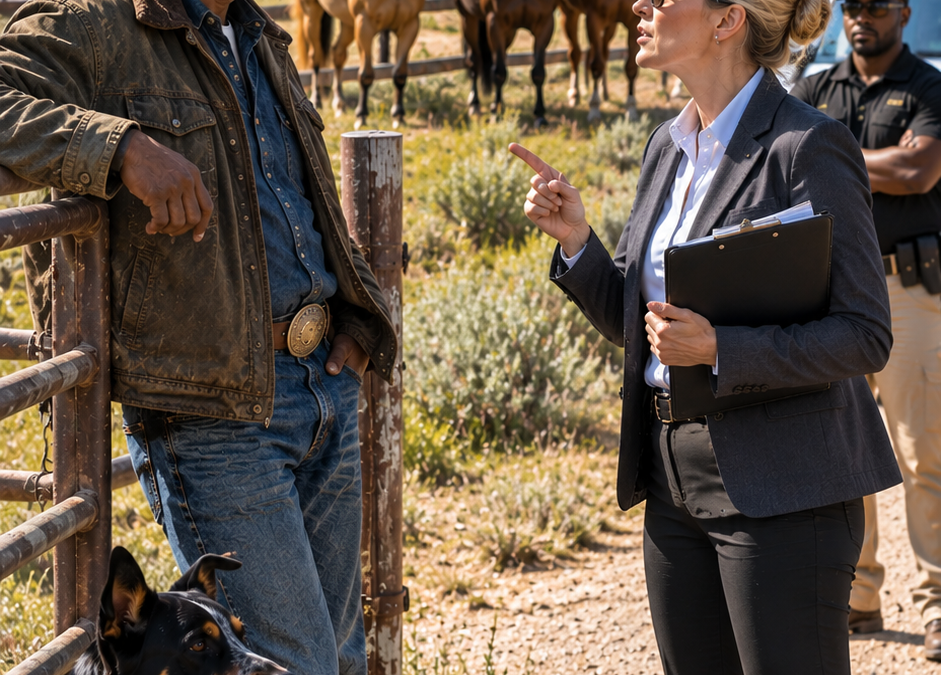
Her name was Diane Forsyth, although she did not introduce herself until after she had already opened my gate and stepped several feet onto Cutter Flats.
She wore a slate-colored blazer that looked absurdly clean for a Wyoming ranch road and held a clipboard against her chest.
Behind her, a white SUV sat on the gravel with its engine running.
“You have fourteen days to remove them from the property,” she continued, “or the association will pursue enforcement action.”
I looked past her toward the south pasture.
Three stallions stood behind the second fence line.
Buckskin, bay, and sorrel.
Working-bred quarter horses.
Registered.
Vaccinated.
Documented with the Wyoming Livestock Board.
They were housed in a purpose-built breeding facility with a covered run, three separate stalls, and a two-acre turnout paddock I had constructed myself.
The nearest Ridgeline Estates residential lot was more than a thousand feet away.
The stallions could not be seen from a public road.
Yet Diane stood at my gate as if I had tied them to somebody’s suburban mailbox.
She extended a sheet of paper.
I took it.
At the top was the Ridgeline Estates HOA logo.
Below that:
NOTICE OF VIOLATION
I read the first paragraph.
Then the second.
Then I folded the paper once along its center crease and slid it into the breast pocket of my canvas jacket.
Diane seemed to expect an argument.
She did not get one.
What she could not have known—or had not bothered to learn—was that the gravel road beneath her SUV, the gate she had opened without permission, the fence line stretching north and south behind her, and every acre visible beyond it were part of Cutter Flats.
Five thousand five hundred acres.
Owned by me.
Before me, by my father.
Before him, by my grandfather.
My family’s ownership had been recorded continuously for generations.
There was a deed.
There were surveys.
There were tax receipts.
There were boundary monuments.
And somewhere inside my study was a fireproof box my father had once pointed to when I was twelve years old and told me something I had never forgotten.
“Anybody can cut a fence, James.”
Then he tapped the metal lid.
“You can’t cut a recorded deed.”
Diane waited.
Finally, I said, “Thank you for coming.”
She blinked.
“Mr. Cutter, this is a formal notice.”
“I understand.”
“The fourteen-day period begins today.”
“All right.”
She seemed almost annoyed by the absence of resistance.
Then she returned to the SUV.
I watched her drive back toward Ridgeline Estates until the dust settled.
Only then did I turn toward the house.
I already knew I was not selling my stallions.
The only question was how much paper it would take to explain why.
My grandfather, Elias Cutter, called the property Cutter Flats.
The name was not marketing.
There were no mountains dramatically rising out of the center of it, no cinematic river dividing the ranch in two, no lodge with antler chandeliers waiting for tourists.
It was Wyoming grassland.
Sage.
Creek bottom.
Cold wind.
Hard winters.
Dry summers.
Distance.
Elias filed his original claim in 1941.
He was not rich.
He was not particularly educated.
What he understood was land.
He knew where water moved in spring.
He knew where cattle could winter.
He knew which draws collected snow and which flats burned bare when August stayed dry too long.
Most importantly, he understood boundaries.
My father, Raymond Cutter, inherited that habit.
Raymond ran cattle on the eastern half of Cutter Flats and dryland wheat across part of the northern quarter for thirty-one years.
He was not sentimental.
When equipment broke, he fixed it.
When livestock died, he buried it.
When drought came, he reduced his herd.
When something needed to be said, he said it once.
But paperwork was different.
Every important document went into the same fireproof box.
Deeds.
Survey plats.
Water-right filings.
Grazing permits.
Tax receipts.
Fence agreements.
My grandfather had started that box.
My father continued it.
Eventually I inherited both the ranch and the habit.
The earliest tax receipts dated back to the 1940s.
Some were yellow enough to look almost brown.
The edges had become brittle.
Dad stored them by year in envelopes with handwritten labels.
When I was twelve, I asked him why he kept receipts older than he was.
He was repairing a fence charger at the time.
He stopped.
Looked at me.
Then said, “Because memory dies.”
I must have looked confused.
He pointed toward the boundary fence.
“That fence tells people where we think the line is.”
Then he pointed toward the house.
“The paper tells them where the line actually is.”
Years later, when a neighboring owner challenged a narrow strip along our eastern creek bed, Dad ordered a professional boundary survey.
That was 1987.
The survey settled the issue.
The neighbor had been wrong.
The recorded monuments had been right.
Dad never gloated.
He simply rolled the survey, placed it beside the fireproof box, and went back to work.
I inherited Cutter Flats after he died in 2012.
There was no complicated trust.
No contested probate.
No strange conditions.
My father left the ranch to me.
The deed transferred cleanly.
I recorded it immediately.
Then I put the original in the same fireproof box.
I had been on the property for eleven years when Diane Forsyth showed up.
For nine of those years, my primary operation had been horses.
Working quarter horses.
Not show horses.
Not pasture ornaments.
Animals bred for cattle work, ranch versatility, and the kind of intelligence that matters when horse and rider have to read livestock together.
I kept fourteen mares and three stallions.
The stallions had separate facilities because anyone who breeds horses responsibly understands what an intact male can do if fences, gates, or handling procedures are careless.
My breeding barn stood in the southwest portion of Cutter Flats.
I built it myself.
Three stalls.
Covered run.
Two-acre paddock.
Heavy fencing.
Double gates.
Good drainage.
The nearest Ridgeline Estates home was roughly twelve hundred feet away.
That fact mattered because Ridgeline Estates was the source of my problem.
The subdivision had been created from a 340-acre parcel separated from the northeastern portion of the larger Cutter property.
The transaction dated back to 1998.
My father sold the parcel to developer Harlan Voss.
The sale was documented.
The parcel was surveyed.
New boundaries were monumented.
Six years later, Ridgeline Estates was well underway.
Its HOA was formed in 2001.
Eventually the community contained eighty-seven residential lots and two common areas.
From the outside, it looked like any other upscale rural subdivision.
Large homes.
Split-rail fencing.
Decorative entrance monument.
People who wanted open space without necessarily wanting to run an agricultural operation.
I had no issue with them.
They had their property.
I had mine.
For years, that arrangement worked.
Then Diane Forsyth became Community Standards Director.
She introduced the title in full.
I remember that because she seemed to place emphasis on every word.
Community.
Standards.
Director.
As though three nouns could expand a boundary line.
The HOA president was Gerald Phelps.
I had spoken to Gerald once before about replacing several fence posts along our shared boundary.
That conversation had been ordinary.
He had seemed reasonable.
Later, I would learn that ordinary conversations are sometimes poor evidence of what a man will do when he sits behind a board table.
That evening, I unfolded Diane’s notice on my kitchen table.
I read it again.
The HOA cited Section 4.2 of its Community Standards Manual.
Livestock and large-animal restrictions.
According to the notice, uncastrated male horses were prohibited within what Diane called the community’s “defined area of influence.”
That phrase bothered me immediately.
Defined area of influence.
Defined where?
By whom?
Recorded how?
A legal boundary can be odd.
An easement can be narrow.
A covenant can be restrictive.
But all of them have to come from somewhere.
“Area of influence” sounded like language designed to feel official without answering the question.
So I opened my laptop.
Within an hour, I had downloaded Ridgeline Estates’ recorded CC&Rs.
Forty-two pages.
Section 4.2 was real.
It restricted livestock.
What Diane had left out was Article 1, Section 1.1.
That section defined the property subject to the declaration.
All lots and common areas within the Ridgeline Estates Planned Unit Development as shown in Teton County Plat Book 14, pages 88 through 91.
I pulled the plat.
Three hundred forty acres.
Eighty-seven residential lots.
Two common areas.
A clear perimeter.
My horse facility was nowhere inside it.
Not near it.
Not touching it.
Not subject to it.
I sat back.
Then I opened the fireproof box.
My deed.
The 1987 survey.
Tax records.
Transfer records.
Everything matched what I already knew.
Cutter Flats surrounded the subdivision along part of its boundary, but surrounding something did not make you part of it.
The next morning, I carried a three-hundred-foot tape into the pasture.
It was crude compared with professional equipment, but it gave me a useful reference.
By my measurement, the closest point of the stallion paddock was approximately 1,187 feet from the Ridgeline Estates plat line.
More than three football fields.
Diane wanted me to remove three stallions because an HOA whose boundary sat that far away considered them within its “area of influence.”
I went back to the house.
I did not call her.
I did not call Gerald.
I started a list.
Certified deed.
Certified HOA plat.
Full title chain on the 340-acre parcel.
Certified 1987 survey.
Current survey.
CC&Rs.
Every letter.
Every envelope.
Dates.
Times.
Names.
If this went further, I wanted one version of the truth.
The documented one.
The first person I called was Frank Aldridge.
Frank owned land west of mine.
Seventy-three years old.
Rancher.
Widower.
A man who could remember who owned a forty-acre tract in 1976 but occasionally forgot where he had parked his reading glasses.
Years earlier, Frank had been dragged through an ugly boundary dispute.
He won.
After that, he developed a religious devotion to recorded documents.
“They sent you a notice,” he said when I explained.
“One page.”
“How much?”
“Seven hundred fifty.”
He was silent.
Then:
“Kellermans got one.”
“What?”
“Two years ago.”
The Kellerman place sat outside Ridgeline’s southern boundary.
“What happened?”
“They paid.”
“Why?”
“Thought they had to.”
That interested me.
“For what?”
“Equipment storage, I think. HOA said it affected community appearance.”
“Did anybody check whether their land was subject to the CC&Rs?”
“Apparently not.”
I wrote it down.
Not because the Kellerman situation proved anything about mine.
It did not.
But it told me Diane’s visit might not be an isolated mistake.
“Frank,” I said, “how long have they been doing this?”
“I don’t know.”
“Anybody ever challenged them?”
“Not that I heard.”
I thanked him.
Before we hung up, Frank said, “James.”
“Yeah?”
“Keep every envelope.”
“I already am.”
“Figured.”
Four days after Diane’s visit, certified mail arrived.
This time the letter was signed by Gerald Phelps.
The board, he wrote, had voted during a special session to authorize enforcement if my stallions were not removed or “rendered compliant” within the original fourteen-day period.
That phrase made me stop.
Rendered compliant.
There were only so many ways to render a stallion compliant with a rule against stallions.
Sell him.
Move him.
Or castrate him.
I read the letter again.
At the bottom, Gerald cited Wyoming Statute 34-36-101.
Just the number.
No subsection.
No quotation.
I pulled the cited material and reviewed it.
Nothing I found created an obvious right for a homeowners association to enforce covenants outside property governed by its declaration.
The citation seemed designed to add weight rather than answer the jurisdictional question.
I printed everything I reviewed.
I highlighted relevant language.
Then I opened a manila folder.
Diane’s notice went first.
Gerald’s letter behind it.
The statute printout behind that.
Within days, the folder became an accordion file.
On the cover I wrote:
RIDGELINE — 2013
I had no idea how thick it would become.
On day six, I drove to the Teton County Courthouse.
The county clerk’s office had the particular smell older public buildings acquire from paper, carpet, heating systems, and decades of people waiting for answers.
Rosalind worked behind the records counter.
I had known her by sight for years.
She had been there when my deed was recorded.
I spent nearly two hours at the public terminal.
I pulled the full title chain on Ridgeline’s 340-acre parcel.
The 1998 conveyance.
Later subdivision documents.
The recorded plat.
The CC&Rs.
Subsequent amendments.
Then I ordered certified copies of the documents that mattered.
My 2012 deed.
The 1987 Cutter Flats survey.
Plat Book 14, pages 88 through 91.
When Rosalind brought the stack to the counter, I asked one more question.
“Can you check whether there’s anything recorded that extends Ridgeline covenants onto Cutter Flats?”
“What kind of thing?”
“Easement. Annexation. Restrictive covenant. Declaration amendment. Anything.”
She turned back toward her screen.
Typed.
Paused.
Typed again.
Then she checked another index.
Finally, she looked over her reading glasses.
“Nothing recorded.”
“Nothing?”
“Nothing I can find.”
I took out my notebook.
“Mind if I write that down?”
She shrugged.
“It’s your notebook.”
I wrote:
Nothing recorded.
Date.
Time.
Then I paid the certification fees and carried the documents home.
Two days later, I called Patricia Akefor.
Patricia was a land-use attorney in Jackson.
I had hired her three years earlier over a water-rights question.
She had impressed me by refusing to tell me what I wanted to hear until she had reviewed the instruments herself.
That is rarer than people think.
I explained Diane’s visit.
The notice.
Gerald’s letter.
The CC&Rs.
The plat.
The courthouse search.
Patricia did not interrupt.
When I finished, she asked:
“They have no recorded instrument extending their declaration beyond their plat?”
“None I can find.”
“And the horse facility is approximately how far away?”
“My tape says 1,187 feet.”
“Send me everything.”
“I want a new survey first.”
“Good.”
There was a small pause.
Then she said, “Send what you already have. We’ll add the survey.”
I did.
The surveying company my father had hired in 1987 was still operating.
The founder had retired.
His son now ran the firm.
Their crew arrived on the eleventh day after Diane’s notice.
I watched them unload GPS equipment, tripods, stakes, and old records.
Then I stayed out of their way.
They spent six hours checking monuments around the ranch boundary, focusing particular attention on the portion adjacent to Ridgeline Estates.
Every monument they located was intact.
Every line matched the old survey within expected tolerances.
The formal report arrived on day thirteen.
My tape measurement had been slightly wrong.
The nearest point of the stallion paddock was not 1,187 feet from the HOA boundary.
It was 1,191.
Four feet farther away.
I forwarded the report to Patricia.
She replied fifteen minutes later.
Good. I have what I need.
The fourteen-day deadline arrived the following evening.
I walked to the breeding pasture near sunset.
The three stallions were moving slowly along the fence.
Buckskin first.
Bay behind him.
Sorrel last.
Their coats caught the horizontal light.
The temperature was dropping fast enough that I could see breath when one stopped and snorted.
I leaned against the gate.
For fourteen days, people I had never authorized had been counting down toward a deadline they believed could force me to remove those animals.
Nothing happened when the deadline expired.
The fence remained.
The horses remained.
The deed remained.
The boundary remained.
I went inside and ate dinner.
Patricia mailed her response two days later.
Four pages.
Certified.
Every factual statement tied to an instrument.
She cited my deed.
The Ridgeline plat.
Article 1, Section 1.1.
The updated survey.
Then she stated the conclusion plainly.
The HOA possessed no recorded authority over Cutter Flats.
Its violation notice had no legal foundation.
She demanded three things.
Withdraw the violation.
Stop enforcement communications directed at land beyond the Ridgeline plat.
Confirm both in writing within ten business days.
I read the draft before she mailed it.
Near the end, Patricia had written a sentence I liked because it contained no adjectives.
No outrage.
No accusation.
Just the limit.
Ridgeline Estates may enforce its recorded covenants within the property lawfully subject to those covenants. Cutter Flats is not such property.
That was the entire dispute in two sentences.
The certified receipt returned signed.
Then nothing.
Ten business days passed.
Still nothing.
Frank called during the second week.
“Heard they had a meeting.”
“About me?”
“About your letter.”
“How do you know?”
“I know people.”
That was Frank’s standard answer.
He said Gerald had spent most of one afternoon talking to someone in Jackson.
Diane had reportedly missed the next board meeting.
I wrote both facts in my notebook but did not assume either meant anything.
Then, on the twenty-third day after Patricia’s letter, another envelope arrived.
Attorney letterhead.
Douglas Farwell.
Cheyenne.
Community association law.
I read his response at the same kitchen table where the whole thing had started.
Farwell did not produce a deed restriction.
He did not produce an annexation.
He did not produce an easement.
He did not produce an amendment to the Ridgeline declaration.
Instead, he changed theories.
Ridgeline Estates, he wrote, possessed a legitimate interest in land uses affecting community character.
The stallions, he suggested, might constitute a nuisance.
His letter cited an older Wyoming case involving a feedlot operation.
I read the case summary.
Municipality.
Commercial feedlot.
Different factual setting.
Different scale.
Different land-use context.
Different everything.
My three stallions occupied agricultural land more than a thousand feet from Ridgeline’s boundary.
The nuisance theory looked less like an argument than an escape route from the failed covenant theory.
I emailed the letter to Patricia.
She called that afternoon.
“He’s moved away from direct covenant enforcement,” she said.
“I noticed.”
“He had to.”
“Why?”
“Because he cannot show your property is subject to the declaration.”
“So now my horses are a nuisance.”
“Apparently.”
“Three stallions on 5,500 acres.”
“Yes.”
I could hear papers moving on her desk.
Then she said, “I think we should file.”
“For what?”
“Declaratory judgment.”
Patricia wanted the District Court to answer a clean question.
Did Ridgeline’s recorded CC&Rs apply to Cutter Flats?
If not, could the HOA enforce them against me?
“The documents answer both,” she said.
“Then file.”
The complaint was seven pages.
The exhibits were forty-three.
My deed.
The Ridgeline plat.
The CC&Rs.
The survey.
Diane’s notice.
Gerald’s certified letter.
Patricia’s demand.
Farwell’s response.
County record materials.
The action was filed in Teton County District Court on a Tuesday.
The filing fee was $420.
The clerk assigned a case number.
I wrote it inside the accordion file.
Then I went home and worked horses.
Legal disputes feel enormous because paperwork arrives with deadlines printed in bold.
Ranch work does not care.
A water line broke.
A mare lost a shoe.
The west fence needed two replacement posts.
Feed had to be delivered.
The stallions had to be handled.
Every morning, work started before the legal offices opened.
Every evening, it continued after they closed.
That rhythm helped.
Farwell filed an answer.
The nuisance theory remained.
Then a new argument appeared.
According to the HOA, the 1998 sale to Harlan Voss carried an implied covenant requiring adjacent land uses to remain compatible with Ridgeline’s residential character.
I read that section three times.
Implied.
Not recorded.
Not written into my deed.
Not written into Ridgeline’s deed.
Not attached to the plat.
Implied.
I called Patricia.
“Can a covenant appear twenty-five years after a sale because somebody wishes it had been there?”
“That is not the formal legal test,” she said.
“But?”
“But no.”
For the first time, I heard amusement in her voice.
She filed for summary judgment six weeks later.
Her brief was twenty-two pages.
The central argument was simple enough to fit on one.
Ridgeline Estates had recorded covenants.
Those covenants defined the land they governed.
Cutter Flats was not inside that land.
No separate instrument extended them.
Therefore, there was no factual dispute requiring a trial about whether the HOA could enforce those covenants against my ranch.
Patricia also addressed the statute Gerald had cited months earlier.
This time, the provisions were quoted and analyzed rather than dropped into a footnote like decoration.
Whatever the HOA believed that citation accomplished, it did not create a recorded covenant over Cutter Flats.
I remember reading Patricia’s brief late at night.
My father’s old plat lay beside me.
The fireproof box sat on the shelf.
I thought about how many times this dispute had changed shape.
Livestock violation.
Area of influence.
State statute.
Community welfare.
Nuisance.
Implied covenant.
Every time one argument failed, another appeared.
But the central defect never changed.
There was no recorded connection between their governing documents and my land.
You can change vocabulary without changing the absence of a document.
Then discovery began.
If the lawsuit had ended before discovery, I would probably have remembered the whole thing as an overreach built on ignorance.
Discovery changed that.
We produced what the HOA requested.
Deeds.
Horse records.
Surveys.
Correspondence.
Patricia organized everything.
The HOA produced meeting minutes, internal messages, CC&Rs, and board correspondence.
The production was surprisingly thin.
I read it anyway.
Every page.
Every email.
Every attachment.
Then I reached an exchange between Diane Forsyth and Gerald Phelps.
The date was roughly eight weeks before Diane came to my gate.
I read Diane’s message once.
Then again.
She had written:
I pulled the plat. The Cutter operation is technically outside our boundary. Do we still have a basis?
I stopped.
The kitchen was silent.
I could hear the refrigerator motor.
Outside, wind moved against the eaves.
I read Gerald’s response.
Our CC&Rs say community character. That’s broad enough. Send the notice.
I did not move for several seconds.
There are moments in a dispute when a fact changes not the legal answer, but the meaning of everything that came before it.
This was one.
Diane had checked.
She knew.
Gerald knew.
Before she opened my gate.
Before the $750 fine.
Before the fourteen-day deadline.
Before Gerald cited a Wyoming statute.
Before Farwell argued nuisance.
Before anyone suggested an implied covenant.
The board president had been told that Cutter Flats was outside Ridgeline’s boundary.
And his response had been:
Send the notice.
I forwarded the Bates number to Patricia.
She called almost immediately.
“You saw it.”
“Yes.”
“That is useful.”
“That’s one word for it.”
“James.”
“I know.”
She knew what I was thinking.
For months, I had refused to call the dispute malicious.
I had assumed someone had misunderstood their jurisdiction.
Patricia did not need me emotional now.
Neither did the case.
“What matters,” she said, “is that this shows prior knowledge of the boundary issue.”
“I understand.”
“Do not contact Phelps.”
“I wasn’t planning to.”
“Do not contact Forsyth.”
“I wasn’t planning to do that either.”
“Good.”
I printed the email.
Placed it behind a new divider in the accordion file.
DISCOVERY
Then I closed it.
My father had been right.
Paper remembered.
The summary judgment hearing was scheduled for a Thursday in late autumn.
I arrived twenty minutes early.
The courthouse was the same building where Rosalind had handed me certified copies months before.
The hall smelled like old wood, coffee, and heating-system dust.
Patricia was already inside.
Her file sat open on the table.
Yellow legal pad.
Black pen.
Nothing unnecessary.
Gerald Phelps sat beside Douglas Farwell.
Dark jacket.
White shirt.
A face arranged into neutrality.
Diane was absent.
I did not know why.
I did not care.
Judge Katherine Marsh took the bench.
She had served in District Court for fourteen years.
It became obvious almost immediately that she had read everything.
That matters.
A judge who has read the record asks different questions from someone hearing a story for the first time.
Farwell began with the HOA’s broader interest in preserving residential character.
Judge Marsh listened.
Then she asked, “Counsel, where is the instrument that makes Mr. Cutter’s parcel subject to your client’s declaration?”
Farwell responded that the association’s rights could not necessarily be understood solely through plat boundaries.
The judge glanced at a document.
“Article 1, Section 1.1 appears to define the property subject to the declaration.”
“Yes, Your Honor.”
“And Cutter Flats is not included.”
“No, Your Honor.”
“Was it ever annexed?”
“No.”
“Was an amendment recorded?”
“Not that I am aware.”
“Is there a restrictive covenant in Mr. Cutter’s chain of title?”
“No.”
“Then your argument is that an unrecorded implied restriction permits the association to enforce recorded community standards against land the declaration itself excludes?”
Farwell paused.
He was a competent attorney.
That did not make the question easier.
He moved back to nuisance.
Judge Marsh asked whether the HOA owned property sufficiently affected to support the precise claim asserted and whether the facts involving three properly maintained stallions on agricultural land more than a thousand feet from the subdivision fit the authorities he cited.
His answer was careful.
It was not persuasive.
Patricia stood when it was her turn.
She did not begin with Diane’s email.
She began with the documents.
That was deliberate.
The deed.
The plat.
The CC&Rs.
The survey.
No annexation.
No recorded restriction.
No instrument.
Only then did she mention discovery.
“Your Honor, this is not even a case where the association reasonably misunderstood where the boundary lay.”
She handed up the exhibit.
“Eight weeks before the violation notice was issued, the association’s Community Standards Director informed its board president in writing that the Cutter operation was outside the Ridgeline boundary.”
Farwell stood.
“Your Honor—”
Judge Marsh raised a hand.
“I have the email.”
She read silently.
The courtroom became very still.
Then she looked toward Gerald Phelps.
Not dramatically.
Not angrily.
Just long enough that he lowered his eyes to the table.
Patricia continued.
“The board president instructed her to issue the notice anyway.”
That was all she needed to say about it.
No speech.
No accusation.
The words were already printed.
The hearing lasted forty-seven minutes.
Judge Marsh took the matter under advisement.
Then we left.
Eleven days later, the ruling arrived.
Twelve pages.
I carried it to the kitchen table.
The same place I had first unfolded Diane’s one-page notice.
The accordion file sat beside me.
I read every page.
Summary judgment for me.
The court found that Ridgeline Estates’ CC&Rs applied to property within the recorded subdivision boundaries.
Cutter Flats was not within those boundaries.
No recorded instrument extended the HOA’s enforcement authority to my ranch.
The violation notice and subsequent enforcement communications had no adequate legal foundation.
The court also awarded attorney’s fees and costs under the applicable authority Patricia had invoked.
$14,640.
I reached the final page.
Judge Marsh’s signature.
Date.
Case number.
I sat there for a while.
No music.
No victory speech.
No one standing beside me.
Only paper.
First a one-page notice telling me I had fourteen days to remove my horses.
Now a twelve-page court ruling explaining why the people who sent it had no authority to do so.
The difference between the two documents was not tone.
Diane’s notice had sounded more aggressive than Judge Marsh’s ruling.
The difference was foundation.
One had it.
One did not.
Patricia called the next morning.
“The judgment is entered.”
“I saw.”
“The appeal period is running.”
“You expect one?”
“No.”
“Why?”
“Because they would need a viable appellate issue. Judge Marsh’s ruling is based heavily on recorded instruments and undisputed facts.”
“Meaning?”
“Meaning their problem on appeal would be the same problem they had downstairs.”
“No document.”
“Exactly.”
We were quiet for a second.
Then I said, “Patricia?”
“Yes?”
“Thank you.”
“You kept excellent records.”
“My father did.”
“You continued.”
That mattered to me more than she probably knew.
Ridgeline paid.
Thirty-one days after the ruling, a check for $14,640 reached Patricia’s office.
She emailed me a scanned copy.
Her entire message said:
Received.
I printed it.
Folded it once.
Placed it behind the judgment.
Then I tried to close the accordion file.
It barely fit.
Months earlier, the file had contained one piece of paper.
A violation notice.
Now it held deeds.
Certified plats.
Surveys.
Statutes.
Letters.
Court filings.
Discovery.
The email.
The ruling.
The check.
I set it on the shelf beside the fireproof box.
One dispute.
Two containers.
Three generations of recordkeeping behind both.
Frank came by the following Tuesday.
Late afternoon.
Low sun.
Sage carrying that dry resinous smell it gets before winter.
We leaned against the same gate where Diane had delivered her notice.
The stallions were in the distance.
Frank watched them for a while.
Then he said, “You kept the paper.”
“My father kept it first.”
He nodded.
There was something about the way he did it that made me think of Raymond.
Frank did not need details.
He already understood.
After a while, he said, “Kellermans heard.”
“About the ruling?”
“Yep.”
“What are they doing?”
“Talked to a lawyer.”
I looked toward the subdivision.
“They’ll have to decide what their documents say.”
“Same as you.”
“Same as anybody.”
I did not want to become the man who fought Ridgeline Estates on behalf of everyone who had ever received a questionable letter.
Rights carry responsibilities, but they are still personal.
The Kellermans would have to pull their own deed.
Their own plat.
Their own records.
Maybe their facts were like mine.
Maybe they were not.
The point was not that every HOA notice was wrong.
The point was that every claim should be tested against the authority supporting it.
Three weeks after the fee award was paid, Ridgeline held a special board meeting.
Frank heard about that too.
Gerald Phelps resigned as president.
Personal reasons.
That was the phrase used.
Diane Forsyth had already stepped down as Community Standards Director roughly two weeks earlier.
Quietly.
No formal announcement.
No letter to me.
I did not need one.
I had no interest in humiliating either of them.
By then the only thing I wanted was for the boundary to remain boring.
A good boundary is boring.
Nobody argues about it.
Nobody crosses it.
Nobody invents phrases like “defined area of influence” to pretend it extends farther than the monuments say it does.
The board selected an interim president.
I never bothered learning the person’s name.
What mattered was that Judge Marsh’s ruling now existed in the county record.
Any future attorney advising Ridgeline would be able to find it.
Any future board that decided Cutter Flats belonged inside its regulatory reach would inherit a very different file from the one Gerald had possessed when he wrote:
Send the notice.
That was enough protection for me.
The first hard frost came in early November.
One morning I walked the south boundary.
Not because Patricia asked.
Not because another survey was required.
I simply wanted to.
Frost silvered the grass.
The creek ran clear over limestone.
Mallards moved through a bend upstream.
The cedar posts along the western fence were newer than my grandfather’s, but they stood approximately where his had stood.
I had replaced many myself.
Fence posts rot.
Wire breaks.
Snow drifts bend things that looked permanent in August.
That is why my father had made the distinction.
A fence is physical.
A deed is legal.
You maintain one with tools.
You defend the other with records.
At the southwest corner, I stopped beside the monument the survey crew had confirmed months earlier.
Nothing impressive.
A marker in the ground.
A point defined by measurements and description.
Yet that small point was part of the reason three stallions were still grazing where they belonged.
I touched the top of the fence post.
My hands were cold.
I thought about Elias.
Then Raymond.
Neither had ever met Diane Forsyth.
Neither knew Gerald Phelps.
Neither could have imagined email discovery or electronic county records.
But they had done the thing that mattered before any of those people existed.
They had recorded ownership properly.
They had kept the documents.
They had respected the line.
The horses sounded from the paddock behind me.
Hooves against hard ground.
I turned.
From that distance, they were dark shapes moving through pale grass.
Still there.
Exactly where they had been before an HOA gave me fourteen days to remove them.
That winter, I bred two of the stallions again.
The bay went to one of my best mares.
The sorrel to another.
Normal work resumed.
Spring came late.
Snow lingered in shaded draws.
Then, almost all at once, the flats changed.
Water moved.
Grass pushed green through brown.
Mares began foaling.
One morning before dawn, I went to the barn and found a new colt trying to stand beside his mother.
Long legs.
Wet coat.
No understanding whatsoever of gravity.
He rose.
Collapsed.
Tried again.
The mare turned and touched his back with her nose.
I watched from outside the stall.
Months earlier, an HOA notice had ordered me to dismantle part of the breeding program that produced him.
Now that notice sat dead in a file.
The colt stood.
That mattered more.
Legal victories are abstractions until you understand what would have been lost without them.
For me, it was not merely the ability to say I had beaten an HOA.
I had no interest in that identity.
It was continuity.
Animals bred according to decisions made years earlier.
Fences repaired where generations had maintained them.
Water flowing under rights my father had protected.
A ranch remaining whole enough that I could hand something meaningful to whoever came after me.
That was what the fourteen-day notice had collided with.
Not pride.
Continuity.
There is one document from the case I still think about more than the judgment.
Gerald’s email.
Our CC&Rs say community character, that’s broad enough. Send the notice.
Broad enough.
Those two words contain the whole failure.
Gerald saw language that expressed a goal.
Community character.
Then treated that goal as though it could erase a boundary.
It could not.
Most authority is narrower than the people exercising it wish it were.
That is not a flaw.
It is protection.
A survey tells a landowner where he must stop.
A deed tells a neighbor what he cannot claim.
An easement grants a right and defines its dimensions.
A covenant imposes restrictions and defines what property carries them.
Even government power is supposed to have jurisdiction.
Boundaries are not inconveniences to authority.
They are part of what makes authority legitimate.
Ridgeline was perfectly entitled to regulate property lawfully subject to its recorded declaration.
If a resident had bought Lot 41 and violated a valid restriction applying to Lot 41, that was between the resident and the association.
My ranch was different.
Cutter Flats did not become Lot 88 because somebody believed three stallions affected neighborhood character.
The property could not be annexed by adjective.
It could not be regulated through atmosphere.
It could not be captured by a phrase like “area of influence.”
If Ridgeline wanted authority over Cutter Flats, there had to be a lawful instrument creating it.
There was none.
Everything after that was noise.
The clipboard.
The $750 fine.
The fourteen-day deadline.
The statute citation.
The nuisance theory.
The implied covenant.
Twenty-two pages of briefing.
Forty-three pages of exhibits.
Months of legal fees.
All because no one at the beginning was willing to accept the answer printed on four pages of a county plat.
I still keep Diane’s violation notice.
It is in the accordion file.
Sometimes I open that file looking for something else and see it.
The paper has begun to curve where I folded it on the morning she handed it to me.
Fourteen days.
Remove the stallions.
Comply.
There is something almost fragile about it now.
The words have not changed.
Their power has.
That difference matters.
Language sounds authoritative only until it is tested.
My father’s deed is older.
My grandfather’s documents are older still.
They are stained.
Faded.
Less polished.
No logos.
No bold warnings.
No “NOTICE OF VIOLATION” across the top.
Yet when all of those papers were placed in the same courthouse, the older documents carried the weight because they represented actual rights.
My father knew that.
He never called it legal strategy.
He called it keeping paper.
When I was twelve, I thought the fireproof box was one of his odd habits.
Now it sits on my shelf beside an accordion file containing the most expensive proof I have ever received that he was right.
Anybody can cut a fence.
Anybody can write a letter.
Anybody can print a fine.
Anybody can put a title under their name and arrive at your gate in a clean SUV.
But none of those things move a recorded line.
A year after the case ended, I was repairing a gate near the south pasture when one of the stallions walked over.
The buckskin.
He stood on the other side of the fence watching me tighten a hinge.
I looked at him.
“You caused a surprising amount of paperwork.”
He flicked an ear.
“You know that?”
Nothing.
I tightened the last bolt.
He lowered his head and started eating.
That was a horse’s opinion of human bureaucracy.
Probably the correct one.
I closed the toolbox and leaned on the gate.
Ridgeline Estates sat far enough away that I could not see the houses from there.
Only the top of one ridge.
Somewhere beyond it, people were mowing lawns, paying assessments, arguing about whatever homeowners associations argue about when they are operating inside their own boundaries.
I wished them well.
Truly.
A community can have rules.
People voluntarily buy homes subject to restrictions every day.
The problem had never been the existence of Ridgeline Estates.
The problem was the moment its board forgot where Ridgeline Estates ended.
That mistake cost them $14,640 in my attorney’s fees and costs alone.
It cost Gerald his presidency.
It cost Diane her position.
More importantly, it created a permanent judicial record confirming the limits of their authority.
For future boards, that record was probably worth more than the money.
They would not need to guess.
They would not need to invent an “area of influence.”
They would not need to argue an implied covenant.
They could pull the case.
Read Judge Marsh’s ruling.
Look at Plat Book 14.
And stop at the line.
I walked back toward the house as evening settled across Cutter Flats.
The air had gone cool.
Sage carried on the wind.
The creek reflected the last light.
I passed the breeding barn I had built with my own hands.
Three stalls.
Covered run.
Two-acre paddock.
The same facility Diane had ordered me to empty.
The bay stallion stood near the far fence.
The sorrel was drinking.
The buckskin followed several yards behind me before losing interest.
Inside the house, beyond the study door, two containers sat on the shelf.
My father’s fireproof box.
My accordion file.
The first held the documents that had protected Cutter Flats before I ever owned it.
The second held the documents proving they had protected it again.
I opened the study door.
For a moment, I considered pulling the files out.
I did not.
There was nothing left to check.
The deed was still recorded.
The plat was still recorded.
The judgment was still entered.
The monuments were still in the ground.
And the horses were still outside.
So I shut off the light.
The land did not need another argument.
It never had.
It only needed someone willing to read the record and trust the line.








