𝗣𝗔𝗥𝗧 𝟮 HOA Gave Me 10 Days to Auction My Breeding Mares—Then the Survey Revealed Who Was Really Trespassing
𝗣𝗔𝗥𝗧 𝟮
My grandfather was Elias Cutter.
He came to West Texas in 1931 carrying a used saddle, forty dollars in cash, and a surveyor’s plat he had earned by trading three months of fence work.
The country he found was not romantic.
People who have never worked West Texas land tend to imagine sunsets first.
Elias saw water.
Or the lack of it.
The original tract was hard range broken by limestone draws, cedar brush, and caliche flats.
In spring, water could tear through a dry draw hard enough to move fence posts.
By August, the ground could crack and grass could become something you remembered rather than something you saw.
Several men had tried cattle there before Elias.
Most left.
He stayed.
He and a neighbor named Doc Hensley drilled two wells by hand.
I have tried to picture that work.
Two men turning steel into the earth through consecutive summers, alternating shifts under a sun that made metal too hot to touch barehanded.
No diesel rig.
No hydraulic system.
Just tools, persistence, and the knowledge that without water the land meant nothing.
Then came the fences.
Cedar posts cut from the draws.
Holes dug by hand.
Wire stretched mile after mile.
The original deed was filed in Presidio County in the spring of 1932.
Four thousand two hundred acres of unimproved rangeland.
Thirty-eight cents an acre.
One typed page.
One hand-drawn boundary sketch.
My father, Thomas Cutter, expanded the ranch twice.
In 1961, he bought fourteen hundred acres from the Hensley family.
In 1978, he added another twelve hundred acres from an estate to the north.
That brought us to roughly 6,800 acres.
Every purchase was recorded.
Every tax was paid.
Every transfer documented.
My father kept the evidence in a green metal box beneath the workbench in the equipment barn.
Tax receipts.
Deeds.
Well records.
Lease agreements.
Survey notes.
The earliest papers had turned the yellow-brown color of old straw.
Some were so brittle you had to lift them with both hands.
When I inherited the ranch, I inherited the box.
I kept adding to it.
My name is James Cutter.
I came back to the ranch after spending nearly ten years working as a civil engineer in Midland.
Engineering paid well.
The ranch offered something different.
I had spent my childhood wanting to leave it and much of my adulthood trying to return.
By the time my father died, the choice no longer felt difficult.
For thirty-one years, I bred and trained quarter horses.
Mostly cutting horses.
Working animals.
The kind expected to think under pressure rather than merely tolerate it.
At the time Renata Voss came to my gate, I had forty-seven horses.
Eleven were registered breeding mares.
Three carried active foal contracts for the coming season.
Those mares were not decorations in a field.
They represented bloodlines I had spent decades developing.
One came from a line my father had started.
Another had produced a gelding that went on to compete successfully on working ranch circuits.
Silver was older by then but remained one of my most dependable broodmares.
Auctioning them in ten days would not have been like selling excess equipment.
It would have dismantled twenty years of breeding decisions.
That distinction apparently meant nothing to Renata.
But the larger problem with her notice was not what it demanded.
It was who she believed had authority to demand it.
Presidio Highlands Equestrian Community sat on 340 acres in the northeastern part of my ranch.
The land had never been sold.
My father had leased it.
In 2001, Meridian Land Partners approached him about building a residential equestrian development.
Dad was in his late seventies.
The equipment barn needed a roof.
Two wells needed modernization.
Several miles of fence required replacement.
Meridian offered a ninety-nine-year ground lease.
Dad considered it.
He hired a real-estate lawyer.
And eventually he signed.
The lease allowed Meridian to develop and occupy a defined 340-acre parcel.
The land underneath remained Cutter land.
Meridian later created the HOA.
By 2008, Presidio Highlands contained sixty-two homes, a riding arena, an administrative office, internal roads, and a community barn.
Quarterly lease payments came directly into the ranch trust.
For about fifteen years, the arrangement worked exactly as it should have.
They stayed inside their parcel.
I stayed outside it.
They governed their residents.
I governed my ranch.
Then Renata Voss became board president.
Two weeks before she appeared at my gate, my neighbor Clifford Pruitt had called me.
Clifford ran cattle along my eastern boundary.
He knew almost everyone between our ranch and the next county.
“James,” he said, “you hearing anything about the new president over at Presidio Highlands?”
“Not much.”
“You might want to.”
“Why?”
“She’s been talking about expanding the association’s governance footprint.”
I leaned against the kitchen counter.
“What exactly is a governance footprint?”
“That was about my reaction.”
Clifford said Renata had been telling homeowners that neighboring properties needed to be brought into alignment with community standards.
Livestock.
Fencing.
Commercial operations.
Property appearance.
“She seems to think anything visible from the subdivision is her business,” Clifford said.
“She can think that.”
“I figured you’d say something like that.”
“What she thinks and what she owns are different questions.”
That conversation returned to me as I carried Renata’s three-page violation notice into the house.
I put it beside my coffee.
Page one cited Article 9, Section 4, Subsection B of the Presidio Highlands covenants.
Page two identified my alleged violations.
Too many breeding mares.
Commercial breeding activity without board approval.
Foaling activity visible from common areas.
Page three contained the demand.
Reduce the breeding herd to three mares within ten days.
Cease commercial breeding operations.
Submit a compliance plan.
Failure would result in fines and possible animal-control involvement.
I read the notice twice.
Then once more.
My engineering background had trained me to examine problems by looking first for the missing load path.
If a structure claimed to transfer force from one point to another, there had to be something carrying that force.
A beam.
A column.
A connection.
A foundation.
Authority works similarly.
The HOA had rules.
That part was real.
What I could not find was the connection transferring those rules from their 340-acre leased community to the other 6,460 acres of my ranch.
I left the notice on the table.
My coffee went cold.
Then I walked outside and fed my horses.
There was no reason to panic.
The answer, whatever it was, would be written somewhere.
That afternoon I opened the fireproof drawer in my study.
The deed sat in back.
The lease was behind it in a manila folder.
Twenty-two pages.
Drafted in 2001.
I had read it before, but never with an HOA threatening to auction my horses.
I started at page one.
Rent.
Escalation clauses.
Maintenance.
Utilities.
Development rights.
Renewal.
Termination.
Then I reached Section 11.
Paragraph 2.
I read it.
Then I read it again.
The language was not subtle.
The lessee’s rights were strictly limited to the 340-acre leased premises described in Exhibit A.
Neither Meridian nor any board, association, or other governing entity created through the development held authority or interest over any portion of the lessor’s property outside those premises.
Any purported exercise of such authority was void.
I sat back.
There it was.
Not an interpretation.
Not an implication.
A direct prohibition.
I made a photocopy.
Then I called Patricia Odum.
Patricia practiced real-estate and property law from a small office in Marfa.
Years earlier, she had represented me when a utility company tried to widen a pipeline easement beyond the recorded width.
She resolved that dispute by doing essentially one thing.
She found the easement.
She read it.
She refused to pretend it said anything else.
“Patricia,” I said when she answered, “I think I have another boundary problem.”
“What kind?”
“HOA.”
There was a pause.
“That is not a unit of measurement, James.”
Despite myself, I smiled.
I explained everything.
When I finished, she did not tell me I was right.
That was another reason I trusted her.
“Send me the notice,” she said. “And send me the lease.”
“Section eleven, paragraph two.”
“I’ll read all of it.”
I overnighted both.
She called the following afternoon.
“This is straightforward,” she said. “But I want it documented in a way no one can misunderstand.”
“What do you need?”
“The recorded Presidio Highlands plat. Their declaration. Chain of title from Meridian. And a current boundary survey.”
“The ranch was surveyed.”
“When?”
“Several times.”
“I want current measurements.”
I understood.
“Anything else?”
“Yes.”
“What?”
“Do not answer Renata Voss yourself.”
“All right.”
“Do not attend an HOA meeting.”
“That one will not be difficult.”
“And under no circumstances auction, relocate, or otherwise dispose of your mares.”
I looked through the window toward the south pasture.
“Patricia, that was never under consideration.”
“I assumed not.”
Then she said something I remembered for years afterward.
“The interesting part here isn’t whether their legal theory works. It doesn’t. The interesting part is how long they continue using it after they’re shown the lease.”
We were about to find out.
The survey crew arrived on Thursday.
Gus Alderman and his son Tuck.
Gus had been surveying West Texas land long enough that his truck looked almost the same age as some of the fences he measured.
He had a certified copy of Elias Cutter’s 1932 plat rolled behind the seat.
When I saw it, I felt something tighten in my chest.
I had seen copies throughout my life.
But watching a modern surveyor carry my grandfather’s work back onto the same ground almost a century later felt different.
Gus studied the document.
“I know this corner,” he said.
“You do?”
“I surveyed the Highlands parcel for Meridian when they started developing.”
That interested me.
“Then you already know most of what you’re looking for.”
He glanced toward the northeast.
“I know what we marked twenty years ago.”
“And now?”
“Now I find what’s there.”
They worked for three days.
I tried not to hover.
There was always something to do anyway.
Water troughs.
Feed.
Training.
A young gelding needed work on the flag.
A mare had rubbed a patch of hair off her shoulder against a gate.
Horses are useful during legal disputes because they remain gloriously unimpressed by legal disputes.
On the second afternoon, Tuck found me in the round pen.
“Dad wants you up north.”
“Problem?”
Tuck thought about that.
“Depends whose problem you mean.”
I put the gelding away.
We walked across the range.
The light was dropping toward the Chinati Mountains.
When we reached Gus, he was standing near an old cedar post leaning slightly from vertical.
I knew that post.
My grandfather and Doc Hensley had set it around 1932.
It had weathered nearly white.
Gus had driven a flagged stake eight feet east of it.
He pointed at the stake.
“Recorded corner is here.”
I looked from the stake to the old post.
“Eight feet?”
“Approximately.”
“Granddad missed it?”
“His fence post did. The survey description didn’t.”
That distinction mattered.
Fence lines and deed lines are not always the same thing.
Gus turned toward the Presidio Highlands development.
“The lease description follows the recorded boundary.”
“All right.”
He took off his cap and rubbed the top of his head.
“James, part of their development crosses it.”
I said nothing.
“The community barn?”
“Eastern foundation is roughly four feet across.”
“And the parking area?”
“Also over.”
“How much?”
“I need final calculations, but enough to matter.”
The wind moved through the dry grass.
I looked toward the pale roof of the HOA’s community barn.
For weeks Renata had been worried that my mares were standing on land she considered too close to her jurisdiction.
Meanwhile, her own community barn was physically standing on mine.
I did not laugh.
I did not celebrate.
It felt too precise for that.
It was the same feeling I remembered from engineering work when a set of calculations produced an unexpected result and you checked them twice, hoping perhaps you had made a mistake, only to discover the arithmetic was perfectly sound.
“How sure are you?”
Gus looked at me.
“Sure enough that I’m going to write my name under it.”
That was enough.
“Then write exactly what you found.”
“I always do.”
Nine days later, Patricia called.
“I have the report.”
“And?”
“The encroachment is confirmed.”
She explained the measurements.
A portion of the community barn’s eastern foundation crossed the lease boundary.
A section of paved parking also occupied deeded Cutter property outside the 340-acre premises.
“So,” I said, “they’re threatening me over animals on my property while their building is on my property.”
“In simplified terms.”
“I like simplified terms.”
Patricia ignored that.
“This helps us for two reasons. First, the encroachment itself needs to be addressed. Second, it eliminates any possibility that the boundary is merely theoretical. We can put the deed, lease, and physical improvements on the same survey.”
“What next?”
“I send a letter.”
She did.
Four pages.
Certified mail.
Return receipt.
She quoted Section 11, Paragraph 2.
She attached Gus Alderman’s survey.
She identified the encroachment.
Then she asked the HOA to produce, within thirty days, any recorded instrument giving it authority over my ranch outside its leased parcel.
Not a policy.
Not a resolution.
Not a board vote.
A recorded legal instrument.
If it existed, we wanted to see it.
Clifford called shortly after the letter reached the HOA.
“My daughter-in-law was at their meeting.”
“And?”
“Renata read some of Patricia’s letter.”
“I’m sure that went well.”
“She called you a hostile neighboring landowner.”
I looked out the window.
“Neighboring?”
“That’s what she said.”
“They lease my land.”
“I’m aware.”
“Apparently she isn’t.”
Clifford laughed.
Then his voice became serious.
“She told everyone their attorney was reviewing it.”
“Good.”
“You don’t sound worried.”
“I’d like their attorney to read the lease.”
Another week passed.
Then Apex Community Services, the HOA’s management company, mailed me another notice.
According to them, my ten-day deadline had expired.
I was now accruing $150-per-day fines.
If I failed to comply within seven additional days, they reserved the right to contact county animal control.
I photographed both sides.
Logged the date.
Sent a copy to Patricia.
Then I put it in the folder.
The folder was getting thick.
I found that reassuring.
Three weeks later, the HOA’s attorney finally responded.
His name was Dale Whitfield.
He practiced out of Odessa.
Patricia forwarded his letter to me.
I read it twice.
There was plenty of language.
There was very little answer.
Whitfield cited Presidio Highlands’ livestock rules.
He cited nuisance concepts.
He referred to the HOA’s obligation to preserve community character.
He argued that activities on nearby land could affect HOA residents.
What he did not produce was a recorded instrument granting Presidio Highlands jurisdiction over my ranch.
He did not address Section 11.
He did not answer the survey.
And he did not mention the fact that the community barn was partially sitting outside the leased parcel.
I called Patricia.
“He didn’t answer you.”
“No.”
“Does that mean he doesn’t have anything?”
“It means he didn’t give me anything.”
“That sounded lawyerly.”
“It was intended to.”
I waited.
Then she continued.
“But when counsel is asked to produce a specific instrument and responds with general principles instead, I begin preparing to litigate.”
“What do you recommend?”
“Declaratory judgment.”
On the first question, we would ask the court to declare whether Presidio Highlands had any authority to impose its covenants or fines on land beyond its 340-acre lease.
On the second, we would seek a legal determination concerning the encroachment.
Patricia would also ask for an injunction preventing additional fines or animal-control action while the case was pending.
“File it,” I said.
She did.
Twenty-two pages.
Seven exhibits.
My deed.
The 1932 plat.
The ground lease.
Gus’s survey.
The original livestock violation.
The management company’s fine notice.
Whitfield’s response.
The court granted temporary relief the following week.
The HOA was prohibited from taking further enforcement action against me while the case was pending.
No new fines.
No animal-control referral.
No forced compliance.
The order was served through formal channels.
Clifford called again that night.
“Emergency board meeting.”
“I suspected.”
“People are asking questions.”
“They should.”
“Harold Prudham asked Renata whether anyone had actually verified jurisdiction before she sent the horse notice.”
I knew Harold by reputation.
He had lived in Presidio Highlands since near the beginning.
“What did she say?”
“Members should trust the process.”
I looked at the stack of documents on my kitchen table.
“That is usually what people say when they would prefer no one inspect the process.”
The hearing came six weeks after we filed.
Patricia and I drove toward Marfa before sunrise.
The desert was cold.
People who think West Texas is always hot have never driven it before daylight in late fall.
The horizon brightened slowly behind us.
The Chinatis sat pale in the distance.
Patricia reviewed almost nothing during the drive.
Everything she needed was already organized.
The courtroom was modest.
Wood benches.
Fluorescent lights.
A judge’s bench that had probably seen every variety of ranch dispute a county could produce.
Renata sat beside Dale Whitfield.
Slate blazer.
Hands folded.
No clipboard.
That detail stayed with me.
Judge Clara Mendes entered.
She had been on the bench for fourteen years.
She had clearly read Patricia’s filing.
There was no long recitation of background.
She looked directly at Whitfield.
“Counsel, identify the recorded instrument giving the association authority over property outside the 340-acre leased premises.”
Whitfield stood.
“Your Honor, the Presidio Highlands declaration contains livestock and nuisance provisions intended to protect the equestrian character of the community—”
“I have read those provisions.”
He stopped.
Judge Mendes continued.
“My question concerns jurisdiction. What instrument subjects Mr. Cutter’s ranch outside the leased premises to your client’s covenants?”
Whitfield shifted slightly.
“The association has historically exercised governance regarding activities affecting community property values.”
“History is not an instrument.”
Silence.
She tried again.
“Is there a recorded deed restriction against Mr. Cutter’s exterior acreage?”
“Not that I am presently aware of.”
“Annexation agreement?”
“No, Your Honor.”
“Declaration executed by the Cutter family?”
“No.”
“Amendment to the ground lease?”
“No.”
“Any recorded covenant running with the Cutter ranch outside the 340 acres?”
Whitfield hesitated.
“Not that has been located.”
Judge Mendes looked at him over her glasses.
“How long ago did plaintiff’s counsel request such an instrument?”
Patricia stood.
“Approximately fourteen weeks ago, Your Honor, counting the pre-suit demand.”
The judge turned back to Whitfield.
“Fourteen weeks?”
“Yes, Your Honor.”
“And none has been located?”
“That is correct.”
Judge Mendes nodded.
Then she turned to Patricia.
Patricia rose.
She did not give a speech.
“The record contains the answer, Your Honor.”
She opened the lease.
“Section 11, Paragraph 2.”
Then she read the relevant language.
The lessee’s authority stopped at the leased premises.
No association or governing body created through the development acquired any authority or interest in exterior Cutter property.
Any purported exercise beyond that boundary was void.
Patricia closed the lease.
“That is our position.”
She sat.
For several seconds, no one spoke.
I looked toward Renata.
Her face remained still.
But for the first time since she had appeared at my gate, she looked less like someone issuing a verdict and more like someone waiting for one.
Judge Mendes ruled from the bench.
The Presidio Highlands Equestrian Community had no legal authority to impose its covenants, fines, livestock standards, citations, or compliance demands on the Cutter Ranch outside the 340-acre leased parcel.
Every fine assessed against me was vacated.
The HOA was permanently enjoined from future enforcement action against my exterior ranch acreage.
Costs were assessed against the association.
The boundary encroachment would proceed separately to mediation under the court’s continuing jurisdiction.
That was it.
Eleven mares.
Ten days.
Hundreds of dollars in threatened daily fines.
Animal control.
Forced compliance.
All of it disappeared because no one on the HOA’s side could answer one question.
Where was the document that gave them authority?
There was none.
Renata did not look at me.
Whitfield gathered his papers.
His younger associate closed her laptop.
Patricia simply put the lease back into her file.
I had expected that moment to feel triumphant.
It did not.
It felt quieter.
Something had been crooked.
Now it was straight.
That was enough.
When we drove back toward the ranch, I finally asked Patricia, “What happens with the barn?”
“Not your barn.”
“Their community barn.”
“Partly your barn, apparently.”
I laughed.
That might have been the first time she smiled all morning.
Then she returned to business.
“The encroachment is different. We need a practical remedy.”
“What are the options?”
“Boundary adjustment. Easement. Lease amendment. Or physical correction.”
“I don’t want to sell them land.”
“I assumed.”
“I don’t want a permanent easement either.”
“Then they move what crosses the line.”
“Fine.”
“It may be expensive.”
“For them.”
“Yes.”
That mattered.
Not because I wanted to punish the homeowners.
Most of them had done nothing to me.
But an organization should not be allowed to create its own mistake on someone else’s land and then shift the correction cost onto the owner.
A few miles from the ranch, Patricia said, “Whitfield may not handle the mediation.”
“You think they’ll replace him?”
“I would.”
She dropped me near the south gate.
I stood there after her car disappeared.
Six weeks earlier, Renata’s SUV had been parked almost exactly where I was standing.
The mares were in the same pasture.
All eleven.
Silver was near the water trough.
I opened the gate and walked toward them.
She came first.
She always did.
I ran a hand down her neck.
“You survived the auction,” I told her.
Silver looked unimpressed.
The other mares clustered loosely behind her.
Their lives had never changed.
That struck me harder than the courtroom ruling.
From their perspective, nothing had happened.
They had grazed.
Foaled.
Been fed.
Moved from pasture to pasture.
The crisis had existed entirely on paper.
And it had been defeated by better paper.
The encroachment mediation concluded the following spring.
By then Presidio Highlands had hired a different attorney, a woman from Alpine.
Patricia liked her.
That usually meant the woman read documents before forming opinions.
The final agreement acknowledged the encroachment formally.
A portion of the community barn foundation and paved parking area occupied Cutter property outside the leased premises.
The HOA agreed to modify the eastern portion of the building and reduce the parking area so both sat entirely within the 340-acre boundary.
The association paid all construction and remediation costs.
More importantly, the settlement included a formal written acknowledgment from Presidio Highlands.
The HOA possessed no authority over any Cutter Ranch property outside the leased parcel.
No livestock citation.
No compliance notice.
No fine.
No demand.
No enforcement action.
Unless some future recorded instrument signed by the property owner changed that relationship, the boundary remained exactly what the lease said it was.
The acknowledgment was filed in the Presidio County records.
Patricia emailed me a copy.
Her message contained one sentence.
“For the green metal box.”
I printed it.
Then I walked to the equipment barn.
The box still sat where my father had kept it.
Its green paint was scratched down to steel along one corner.
I opened the lid.
There were his tax receipts.
My grandfather’s copies.
Deeds.
Well records.
Lease papers.
Four generations of Cutter history reduced to folded documents and faded ink.
I added the court order.
Then the recorded acknowledgment.
The new white paper looked almost absurdly clean beside Elias’s old receipts.
I closed the box.
For reasons I did not entirely understand, I rested my hand on the lid for several seconds.
My grandfather had paid thirty-eight cents an acre.
My father had spent a lifetime keeping receipts.
I had spent mine thinking those habits were simply part of being careful.
That year, I understood they were part of keeping land.
Not fences alone.
Not guns.
Not arguments.
Records.
Renata resigned as HOA president roughly six weeks after the court ruling.
Clifford called with the news.
“Special meeting,” he said.
“What happened?”
“Harold Prudham happened.”
I could hear the amusement in his voice.
Apparently Harold and several long-term homeowners wanted an explanation for the legal expenses.
“How much?”
“Little over nineteen thousand.”
I whistled softly.
“Reserve fund?”
“That’s what I’m told.”
“And Renata?”
“Resigned afterward.”
I looked through the kitchen window toward the northeastern section.
“I hope they learn something.”
Clifford snorted.
“That’s generous.”
“No. Practical.”
The people who lived there were still tenants on land connected to my ranch for another seventy-some years.
I had no interest in spending that time fighting them.
The quarterly lease payments continued arriving.
Their residents continued riding horses.
I continued breeding mine.
That was how the relationship should have worked from the beginning.
A lease does not create enemies.
A boundary does not create enemies.
Ignoring either one sometimes does.
Later that spring, I walked to the northeastern corner of the ranch.
The air still carried the cold of the previous night.
Morning light lay gold across the flats.
Caliche reflected it almost white.
Dry grass turned copper.
I passed the concrete trough my father had installed in 1974.
Then the equipment barn.
Then the old cedar post.
Elias’s post leaned slightly east.
Ninety years of weather had turned the wood gray and deeply checked.
Eight feet away was the actual surveyed corner.
Eight feet.
On 6,800 acres, eight feet sounds insignificant.
You could cross it in three steps.
A horse could cross it without noticing.
A vehicle would cross it before the driver registered movement.
But ownership is not measured by whether a distance feels significant.
The line was where the record put it.
That morning, I had brought a new cedar post.
I had cut it from the same draw where my grandfather had taken fence material generations before.
I set the clamshell digger into the earth.
The first few feet were manageable.
Then I hit hard caliche.
The steel bar rang each time it struck.
I worked slowly.
Dig.
Break.
Clear.
Measure.
Again.
By midmorning, my shoulders ached.
At sixty-three, there are some jobs you know you can still do and others your body reminds you would be easier with a twenty-year-old helping.
I did this one alone.
Not because I had to.
Because I wanted to.
When the hole was deep enough, I set the cedar.
Checked plumb.
Backfilled.
Tamped.
Checked again.
Three stages, the way my father taught me.
When I finished, the new post stood straight.
Fresh cedar smelled sharp in the cool air.
Eight feet west stood the old one.
Gray.
Leaning.
Still there.
For a while, I looked at both.
One represented where my grandfather had put his fence.
The other represented where his survey said the property actually began.
The difference between them had waited almost a century before becoming important.
That is the strange thing about land records.
They can sleep for decades.
Then one morning someone arrives with a clipboard, makes a claim, and a line drawn by a surveyor before anyone involved was born suddenly becomes the most important thing in the county.
I rested both hands on the new post.
From where I stood, I could see part of Presidio Highlands.
Their roofs.
Their arena.
Their community barn.
Workers had already begun correcting the encroachment.
I did not feel satisfaction watching them.
I felt finality.
The building would move back inside its legal footprint.
Their authority would remain inside its legal footprint.
My ranch would remain outside it.
Everything would occupy the place assigned to it by the record.
That was enough.
Months later, Silver foaled a bay colt.
I found them before sunrise.
The colt was still damp, legs folded awkwardly beneath him.
Silver stood nearby watching me with the wary patience mares have after delivery.
I crouched several yards away.
The colt tried to stand.
Failed.
Tried again.
His legs seemed impossibly long.
On the third attempt he got upright, swayed, nearly folded, then found his balance.
Silver touched his neck with her nose.
I watched the two of them in the dim blue light before sunrise.
That colt existed because I had not auctioned his mother when someone with no legal authority ordered me to.
There was no dramatic music.
No courtroom.
No lawyer.
No HOA notice.
Just a mare and her newborn standing on grass that smelled wet from night moisture.
That was when the whole dispute became simple to me again.
Renata had seen livestock density.
I had seen Silver.
She had seen a commercial breeding operation.
I had seen decades of selection, training, births, injuries, losses, successes, and bloodlines.
She had seen an adjacent property subject to management.
I had seen the place where my grandfather dug wells by hand.
Those differences in perspective would not have mattered legally if she had possessed jurisdiction.
But she did not.
And that is the part people sometimes miss.
A person can be completely sincere and completely wrong at the same time.
Renata may genuinely have believed that protecting Presidio Highlands justified regulating anything affecting the community.
Perhaps she thought the ranch was merely undeveloped land surrounding a modern subdivision.
Perhaps she saw the HOA as the center and everything outside it as peripheral.
The deed saw things differently.
Presidio Highlands occupied 340 leased acres inside a 6,800-acre property whose chain of title reached back to Elias Cutter.
The association existed because my father had signed a lease.
Its roads existed because that lease allowed roads.
Its community barn existed because that lease allowed equestrian facilities.
Its authority ended because that same lease said where it ended.
Section 11, Paragraph 2.
Twenty-two pages of legal language, and that was the paragraph that mattered.
There is something reassuring about that.
Authority should have edges.
It should be possible to identify where someone’s power starts and where it stops.
A government has statutes.
An easement has a width.
A lease has premises.
A deed has boundaries.
A homeowners association has recorded covenants.
The trouble begins when people start treating confidence as a substitute for those limits.
Renata came to my gate with everything that makes authority look convincing.
A formal notice.
Official letterhead.
A deadline.
A fine schedule.
A threat of government enforcement.
A clipboard.
A title.
A board vote somewhere behind her.
What she did not bring was the one thing she actually needed.
A legal instrument connecting her authority to my land.
Without that, everything else was theater.
Expensive theater, as it turned out.
The association spent more than nineteen thousand dollars learning something that could have been discovered by reading the lease they already had.
They spent more correcting an encroachment a survey could have identified.
Their president resigned.
Their fines were erased.
Their community barn had to be altered.
Their parking lot had to be pulled back.
And the county record now contained a permanent acknowledgment ensuring that no future board president could easily make the same argument again.
The horses never moved.
The breeding program never stopped.
The quarterly ground-lease payment never stopped either.
Life continued.
That was the best outcome available.
Not destruction.
Not revenge.
Order.
I still have Renata’s original notice.
It sits in the green metal box.
Ten days.
Auction or remove all breeding mares.
Sometimes I take it out when I am searching for some other document.
The paper has begun to curl slightly at the edges.
Her signature is still sharp.
So is the language.
I never threw it away.
Not because I remain angry.
I do not.
I keep it because it belongs to the ranch’s history now.
Near it is Elias’s 1932 deed.
One page.
Thin paper.
Faded type.
Thirty-eight cents an acre.
That contrast says almost everything.
The HOA notice looked more modern.
More official.
More polished.
It had logos, article numbers, subsections, deadlines, and enforcement language.
My grandfather’s deed looked fragile enough to tear if handled carelessly.
Yet when those two pieces of paper came into conflict, only one of them described an actual interest in the land.
That is what I mean when I say the answer is in the record.
Not because records are magical.
Because lawful authority has to come from somewhere.
When someone tells you they control your land, ask what gives them that control.
A deed?
A covenant?
An easement?
A lease?
An annexation?
A court order?
Find it.
Read it.
Read the definitions.
Read the exhibits.
Read the legal description.
Read the paragraph nobody expects you to read.
And if the document does not say what the person standing at your gate says it says, do not allow their confidence to rewrite it.
My grandfather understood that before I did.
He could barely afford the land he bought.
But he spent three months of labor to obtain a proper survey.
My father understood it.
He kept tax receipts for four decades.
I understand it now.
Land does not remember speeches.
It remembers filings.
It remembers boundaries.
It remembers signatures.
It remembers what was granted and what was not.
The south pasture is still one of my favorite places on the ranch.
Especially after rain.
Bluestem smells sweeter.
The ground darkens.
Every hoof leaves a temporary print in the damp soil.
Some mornings I stand at the same gate where Renata delivered her notice.
The white SUV is long gone.
No violation letter waits in the latch.
Silver is older now.
She moves slower than the younger mares.
But she still comes over when she sees me.
Beyond her, the land rises gently and disappears into distance.
Six thousand eight hundred acres are too much to see from any one place.
That does not mean you forget they belong together.
Somewhere far to the northeast sits Presidio Highlands.
Three hundred forty acres.
Their homes.
Their arena.
Their roads.
Their corrected parking lot.
Their corrected community barn.
All precisely where the lease allows them to be.
And near the old northern corner stand two cedar posts.
One old.
One new.
Eight feet apart.
The older one was placed by a man working with hand tools in a country with almost no infrastructure.
The newer one was placed by his grandson after satellites, GPS equipment, lawyers, computers, an HOA, and a district court all became involved in determining where the same invisible line had been since 1932.
That line did not move.
Neither did the ranch.
Neither did the mares.
And when Silver lowers her head into the bluestem on a cold West Texas morning, she has no idea that anyone once gave me ten days to auction her.
That is probably the best ending I could have asked for.
Have you finished reading the story and want to read it again?
HOA Gave Me 10 Days to Auction My Breeding Mares—Then the Survey Revealed Who Was Really Trespassing
The HOA president stood at my pasture gate and gave me ten days to auction eleven breeding mares from a ranch my family had owned since before her neighborhood existed.
She threatened daily fines, county animal control, and forced compliance without realizing that the 340-acre equestrian community she governed was itself sitting on land my family had leased to its developer.
But when an old 1932 survey was laid over the boundary she was so certain she controlled, eight feet of West Texas dirt turned her livestock ultimatum into a problem no board meeting could vote away.
“Your horses are in violation of community livestock standards.”
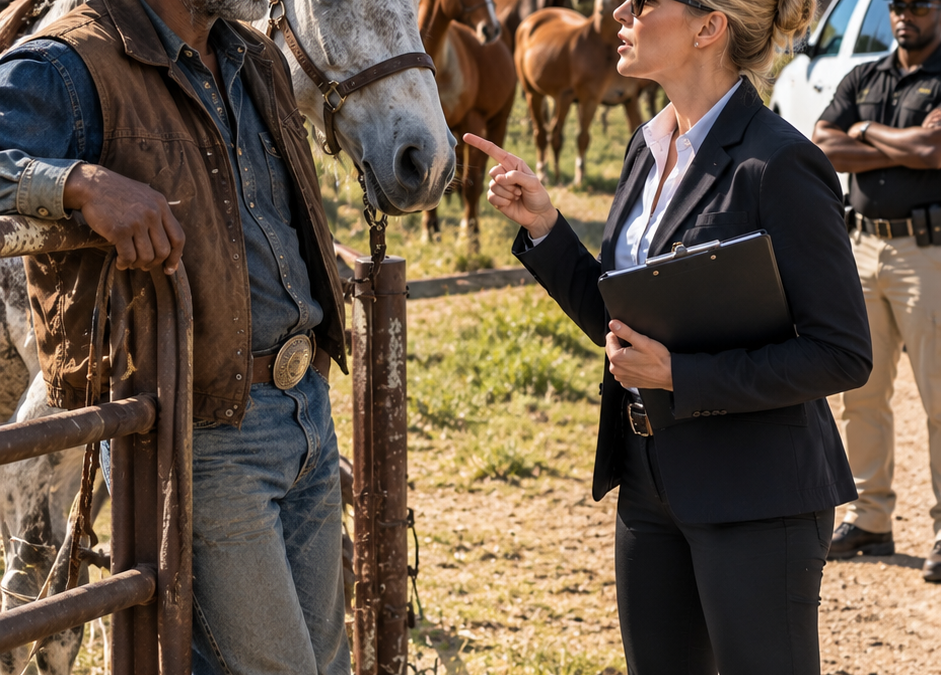
Renata Voss delivered the words as if she were reading a sentence already handed down by a judge.
She stood outside my south pasture on a cool October morning with a clipboard pressed against her slate-colored blazer and a white SUV idling behind her on the caliche road.
“You have ten days to auction or remove all breeding mares from the property,” she continued. “If you fail to comply, the board will pursue forced compliance through county animal control.”
I looked at her.
Then I looked past her.
The sun was still low enough to throw long shadows across the bluestem. Rain had come two nights before, and the ground carried that rare West Texas smell I have always loved—wet caliche, grass, cedar, and warm horse.
Eleven mares grazed behind me.
Chestnuts.
Bays.
And one pale gray named Silver.
My daughter had named her years earlier, when she was young enough to think every gray horse ought to have a name that sounded magical.
Silver lifted her head, regarded Renata for perhaps two seconds, and returned to the grass.
The other mares did not bother looking up.
They had more sense than either of us to understand that a clipboard did not change ownership.
Renata waited for my response.
I let the silence stretch.
At sixty-three, I had learned that silence is useful when someone has arrived prepared for an argument.
It makes them explain more than they intended.
Renata finally shifted her weight.
“Mr. Cutter, this is a formal violation notice.”
“I heard you.”
“The board expects compliance.”
“I heard that too.”
Her expression tightened slightly.
She was accustomed to people arguing over HOA rules.
Fence colors.
Trailer parking.
Arena hours.
Livestock density.
She was not accustomed to a man simply standing at his own gate while she threatened to confiscate the economic foundation of his ranch.
What she did not know was that every visible acre beyond that gate belonged to me.
Not metaphorically.
Not traditionally.
Legally.
Recorded.
Taxed.
Surveyed.
All 6,800 acres.
And somewhere behind me, in a fireproof drawer inside my study, was a ground lease containing one paragraph that Renata Voss should have read before she ever drove down my road.
I did not mention it.
Instead, I said, “I’ll look into the matter.”
Renata folded the top edge of her notice and wedged it into the gate latch.
“Ten days,” she reminded me.
Then she climbed into the white SUV and drove away.
A ribbon of pale dust followed her down the road.
I stayed at the fence.
Silver moved closer and pushed her nose against my shoulder.
I rubbed the hollow above her eye.
“Apparently,” I told her, “you’re a community problem.”
She breathed against my jacket.
Behind us, ten other mares continued grazing on land my grandfather had begun assembling in 1931.
That was the first morning I understood that Presidio Highlands had forgotten something fundamental.
They were not my government.
They were not even my neighbor in the ordinary sense.
They were my tenant.
And they were about to discover what their own lease actually said.
My grandfather was Elias Cutter.
He came to West Texas in 1931 carrying a used saddle, forty dollars in cash, and a surveyor’s plat he had earned by trading three months of fence work.
The country he found was not romantic.
People who have never worked West Texas land tend to imagine sunsets first.
Elias saw water.
Or the lack of it.
The original tract was hard range broken by limestone draws, cedar brush, and caliche flats.
In spring, water could tear through a dry draw hard enough to move fence posts.
By August, the ground could crack and grass could become something you remembered rather than something you saw.
Several men had tried cattle there before Elias.
Most left.
He stayed.
He and a neighbor named Doc Hensley drilled two wells by hand.
I have tried to picture that work.
Two men turning steel into the earth through consecutive summers, alternating shifts under a sun that made metal too hot to touch barehanded.
No diesel rig.
No hydraulic system.
Just tools, persistence, and the knowledge that without water the land meant nothing.
Then came the fences.
Cedar posts cut from the draws.
Holes dug by hand.
Wire stretched mile after mile.
The original deed was filed in Presidio County in the spring of 1932.
Four thousand two hundred acres of unimproved rangeland.
Thirty-eight cents an acre.
One typed page.
One hand-drawn boundary sketch.
My father, Thomas Cutter, expanded the ranch twice.
In 1961, he bought fourteen hundred acres from the Hensley family.
In 1978, he added another twelve hundred acres from an estate to the north.
That brought us to roughly 6,800 acres.
Every purchase was recorded.
Every tax was paid.
Every transfer documented.
My father kept the evidence in a green metal box beneath the workbench in the equipment barn.
Tax receipts.
Deeds.
Well records.
Lease agreements.
Survey notes.
The earliest papers had turned the yellow-brown color of old straw.
Some were so brittle you had to lift them with both hands.
When I inherited the ranch, I inherited the box.
I kept adding to it.
My name is James Cutter.
I came back to the ranch after spending nearly ten years working as a civil engineer in Midland.
Engineering paid well.
The ranch offered something different.
I had spent my childhood wanting to leave it and much of my adulthood trying to return.
By the time my father died, the choice no longer felt difficult.
For thirty-one years, I bred and trained quarter horses.
Mostly cutting horses.
Working animals.
The kind expected to think under pressure rather than merely tolerate it.
At the time Renata Voss came to my gate, I had forty-seven horses.
Eleven were registered breeding mares.
Three carried active foal contracts for the coming season.
Those mares were not decorations in a field.
They represented bloodlines I had spent decades developing.
One came from a line my father had started.
Another had produced a gelding that went on to compete successfully on working ranch circuits.
Silver was older by then but remained one of my most dependable broodmares.
Auctioning them in ten days would not have been like selling excess equipment.
It would have dismantled twenty years of breeding decisions.
That distinction apparently meant nothing to Renata.
But the larger problem with her notice was not what it demanded.
It was who she believed had authority to demand it.
Presidio Highlands Equestrian Community sat on 340 acres in the northeastern part of my ranch.
The land had never been sold.
My father had leased it.
In 2001, Meridian Land Partners approached him about building a residential equestrian development.
Dad was in his late seventies.
The equipment barn needed a roof.
Two wells needed modernization.
Several miles of fence required replacement.
Meridian offered a ninety-nine-year ground lease.
Dad considered it.
He hired a real-estate lawyer.
And eventually he signed.
The lease allowed Meridian to develop and occupy a defined 340-acre parcel.
The land underneath remained Cutter land.
Meridian later created the HOA.
By 2008, Presidio Highlands contained sixty-two homes, a riding arena, an administrative office, internal roads, and a community barn.
Quarterly lease payments came directly into the ranch trust.
For about fifteen years, the arrangement worked exactly as it should have.
They stayed inside their parcel.
I stayed outside it.
They governed their residents.
I governed my ranch.
Then Renata Voss became board president.
Two weeks before she appeared at my gate, my neighbor Clifford Pruitt had called me.
Clifford ran cattle along my eastern boundary.
He knew almost everyone between our ranch and the next county.
“James,” he said, “you hearing anything about the new president over at Presidio Highlands?”
“Not much.”
“You might want to.”
“Why?”
“She’s been talking about expanding the association’s governance footprint.”
I leaned against the kitchen counter.
“What exactly is a governance footprint?”
“That was about my reaction.”
Clifford said Renata had been telling homeowners that neighboring properties needed to be brought into alignment with community standards.
Livestock.
Fencing.
Commercial operations.
Property appearance.
“She seems to think anything visible from the subdivision is her business,” Clifford said.
“She can think that.”
“I figured you’d say something like that.”
“What she thinks and what she owns are different questions.”
That conversation returned to me as I carried Renata’s three-page violation notice into the house.
I put it beside my coffee.
Page one cited Article 9, Section 4, Subsection B of the Presidio Highlands covenants.
Page two identified my alleged violations.
Too many breeding mares.
Commercial breeding activity without board approval.
Foaling activity visible from common areas.
Page three contained the demand.
Reduce the breeding herd to three mares within ten days.
Cease commercial breeding operations.
Submit a compliance plan.
Failure would result in fines and possible animal-control involvement.
I read the notice twice.
Then once more.
My engineering background had trained me to examine problems by looking first for the missing load path.
If a structure claimed to transfer force from one point to another, there had to be something carrying that force.
A beam.
A column.
A connection.
A foundation.
Authority works similarly.
The HOA had rules.
That part was real.
What I could not find was the connection transferring those rules from their 340-acre leased community to the other 6,460 acres of my ranch.
I left the notice on the table.
My coffee went cold.
Then I walked outside and fed my horses.
There was no reason to panic.
The answer, whatever it was, would be written somewhere.
That afternoon I opened the fireproof drawer in my study.
The deed sat in back.
The lease was behind it in a manila folder.
Twenty-two pages.
Drafted in 2001.
I had read it before, but never with an HOA threatening to auction my horses.
I started at page one.
Rent.
Escalation clauses.
Maintenance.
Utilities.
Development rights.
Renewal.
Termination.
Then I reached Section 11.
Paragraph 2.
I read it.
Then I read it again.
The language was not subtle.
The lessee’s rights were strictly limited to the 340-acre leased premises described in Exhibit A.
Neither Meridian nor any board, association, or other governing entity created through the development held authority or interest over any portion of the lessor’s property outside those premises.
Any purported exercise of such authority was void.
I sat back.
There it was.
Not an interpretation.
Not an implication.
A direct prohibition.
I made a photocopy.
Then I called Patricia Odum.
Patricia practiced real-estate and property law from a small office in Marfa.
Years earlier, she had represented me when a utility company tried to widen a pipeline easement beyond the recorded width.
She resolved that dispute by doing essentially one thing.
She found the easement.
She read it.
She refused to pretend it said anything else.
“Patricia,” I said when she answered, “I think I have another boundary problem.”
“What kind?”
“HOA.”
There was a pause.
“That is not a unit of measurement, James.”
Despite myself, I smiled.
I explained everything.
When I finished, she did not tell me I was right.
That was another reason I trusted her.
“Send me the notice,” she said. “And send me the lease.”
“Section eleven, paragraph two.”
“I’ll read all of it.”
I overnighted both.
She called the following afternoon.
“This is straightforward,” she said. “But I want it documented in a way no one can misunderstand.”
“What do you need?”
“The recorded Presidio Highlands plat. Their declaration. Chain of title from Meridian. And a current boundary survey.”
“The ranch was surveyed.”
“When?”
“Several times.”
“I want current measurements.”
I understood.
“Anything else?”
“Yes.”
“What?”
“Do not answer Renata Voss yourself.”
“All right.”
“Do not attend an HOA meeting.”
“That one will not be difficult.”
“And under no circumstances auction, relocate, or otherwise dispose of your mares.”
I looked through the window toward the south pasture.
“Patricia, that was never under consideration.”
“I assumed not.”
Then she said something I remembered for years afterward.
“The interesting part here isn’t whether their legal theory works. It doesn’t. The interesting part is how long they continue using it after they’re shown the lease.”
We were about to find out.
The survey crew arrived on Thursday.
Gus Alderman and his son Tuck.
Gus had been surveying West Texas land long enough that his truck looked almost the same age as some of the fences he measured.
He had a certified copy of Elias Cutter’s 1932 plat rolled behind the seat.
When I saw it, I felt something tighten in my chest.
I had seen copies throughout my life.
But watching a modern surveyor carry my grandfather’s work back onto the same ground almost a century later felt different.
Gus studied the document.
“I know this corner,” he said.
“You do?”
“I surveyed the Highlands parcel for Meridian when they started developing.”
That interested me.
“Then you already know most of what you’re looking for.”
He glanced toward the northeast.
“I know what we marked twenty years ago.”
“And now?”
“Now I find what’s there.”
They worked for three days.
I tried not to hover.
There was always something to do anyway.
Water troughs.
Feed.
Training.
A young gelding needed work on the flag.
A mare had rubbed a patch of hair off her shoulder against a gate.
Horses are useful during legal disputes because they remain gloriously unimpressed by legal disputes.
On the second afternoon, Tuck found me in the round pen.
“Dad wants you up north.”
“Problem?”
Tuck thought about that.
“Depends whose problem you mean.”
I put the gelding away.
We walked across the range.
The light was dropping toward the Chinati Mountains.
When we reached Gus, he was standing near an old cedar post leaning slightly from vertical.
I knew that post.
My grandfather and Doc Hensley had set it around 1932.
It had weathered nearly white.
Gus had driven a flagged stake eight feet east of it.
He pointed at the stake.
“Recorded corner is here.”
I looked from the stake to the old post.
“Eight feet?”
“Approximately.”
“Granddad missed it?”
“His fence post did. The survey description didn’t.”
That distinction mattered.
Fence lines and deed lines are not always the same thing.
Gus turned toward the Presidio Highlands development.
“The lease description follows the recorded boundary.”
“All right.”
He took off his cap and rubbed the top of his head.
“James, part of their development crosses it.”
I said nothing.
“The community barn?”
“Eastern foundation is roughly four feet across.”
“And the parking area?”
“Also over.”
“How much?”
“I need final calculations, but enough to matter.”
The wind moved through the dry grass.
I looked toward the pale roof of the HOA’s community barn.
For weeks Renata had been worried that my mares were standing on land she considered too close to her jurisdiction.
Meanwhile, her own community barn was physically standing on mine.
I did not laugh.
I did not celebrate.
It felt too precise for that.
It was the same feeling I remembered from engineering work when a set of calculations produced an unexpected result and you checked them twice, hoping perhaps you had made a mistake, only to discover the arithmetic was perfectly sound.
“How sure are you?”
Gus looked at me.
“Sure enough that I’m going to write my name under it.”
That was enough.
“Then write exactly what you found.”
“I always do.”
Nine days later, Patricia called.
“I have the report.”
“And?”
“The encroachment is confirmed.”
She explained the measurements.
A portion of the community barn’s eastern foundation crossed the lease boundary.
A section of paved parking also occupied deeded Cutter property outside the 340-acre premises.
“So,” I said, “they’re threatening me over animals on my property while their building is on my property.”
“In simplified terms.”
“I like simplified terms.”
Patricia ignored that.
“This helps us for two reasons. First, the encroachment itself needs to be addressed. Second, it eliminates any possibility that the boundary is merely theoretical. We can put the deed, lease, and physical improvements on the same survey.”
“What next?”
“I send a letter.”
She did.
Four pages.
Certified mail.
Return receipt.
She quoted Section 11, Paragraph 2.
She attached Gus Alderman’s survey.
She identified the encroachment.
Then she asked the HOA to produce, within thirty days, any recorded instrument giving it authority over my ranch outside its leased parcel.
Not a policy.
Not a resolution.
Not a board vote.
A recorded legal instrument.
If it existed, we wanted to see it.
Clifford called shortly after the letter reached the HOA.
“My daughter-in-law was at their meeting.”
“And?”
“Renata read some of Patricia’s letter.”
“I’m sure that went well.”
“She called you a hostile neighboring landowner.”
I looked out the window.
“Neighboring?”
“That’s what she said.”
“They lease my land.”
“I’m aware.”
“Apparently she isn’t.”
Clifford laughed.
Then his voice became serious.
“She told everyone their attorney was reviewing it.”
“Good.”
“You don’t sound worried.”
“I’d like their attorney to read the lease.”
Another week passed.
Then Apex Community Services, the HOA’s management company, mailed me another notice.
According to them, my ten-day deadline had expired.
I was now accruing $150-per-day fines.
If I failed to comply within seven additional days, they reserved the right to contact county animal control.
I photographed both sides.
Logged the date.
Sent a copy to Patricia.
Then I put it in the folder.
The folder was getting thick.
I found that reassuring.
Three weeks later, the HOA’s attorney finally responded.
His name was Dale Whitfield.
He practiced out of Odessa.
Patricia forwarded his letter to me.
I read it twice.
There was plenty of language.
There was very little answer.
Whitfield cited Presidio Highlands’ livestock rules.
He cited nuisance concepts.
He referred to the HOA’s obligation to preserve community character.
He argued that activities on nearby land could affect HOA residents.
What he did not produce was a recorded instrument granting Presidio Highlands jurisdiction over my ranch.
He did not address Section 11.
He did not answer the survey.
And he did not mention the fact that the community barn was partially sitting outside the leased parcel.
I called Patricia.
“He didn’t answer you.”
“No.”
“Does that mean he doesn’t have anything?”
“It means he didn’t give me anything.”
“That sounded lawyerly.”
“It was intended to.”
I waited.
Then she continued.
“But when counsel is asked to produce a specific instrument and responds with general principles instead, I begin preparing to litigate.”
“What do you recommend?”
“Declaratory judgment.”
On the first question, we would ask the court to declare whether Presidio Highlands had any authority to impose its covenants or fines on land beyond its 340-acre lease.
On the second, we would seek a legal determination concerning the encroachment.
Patricia would also ask for an injunction preventing additional fines or animal-control action while the case was pending.
“File it,” I said.
She did.
Twenty-two pages.
Seven exhibits.
My deed.
The 1932 plat.
The ground lease.
Gus’s survey.
The original livestock violation.
The management company’s fine notice.
Whitfield’s response.
The court granted temporary relief the following week.
The HOA was prohibited from taking further enforcement action against me while the case was pending.
No new fines.
No animal-control referral.
No forced compliance.
The order was served through formal channels.
Clifford called again that night.
“Emergency board meeting.”
“I suspected.”
“People are asking questions.”
“They should.”
“Harold Prudham asked Renata whether anyone had actually verified jurisdiction before she sent the horse notice.”
I knew Harold by reputation.
He had lived in Presidio Highlands since near the beginning.
“What did she say?”
“Members should trust the process.”
I looked at the stack of documents on my kitchen table.
“That is usually what people say when they would prefer no one inspect the process.”
The hearing came six weeks after we filed.
Patricia and I drove toward Marfa before sunrise.
The desert was cold.
People who think West Texas is always hot have never driven it before daylight in late fall.
The horizon brightened slowly behind us.
The Chinatis sat pale in the distance.
Patricia reviewed almost nothing during the drive.
Everything she needed was already organized.
The courtroom was modest.
Wood benches.
Fluorescent lights.
A judge’s bench that had probably seen every variety of ranch dispute a county could produce.
Renata sat beside Dale Whitfield.
Slate blazer.
Hands folded.
No clipboard.
That detail stayed with me.
Judge Clara Mendes entered.
She had been on the bench for fourteen years.
She had clearly read Patricia’s filing.
There was no long recitation of background.
She looked directly at Whitfield.
“Counsel, identify the recorded instrument giving the association authority over property outside the 340-acre leased premises.”
Whitfield stood.
“Your Honor, the Presidio Highlands declaration contains livestock and nuisance provisions intended to protect the equestrian character of the community—”
“I have read those provisions.”
He stopped.
Judge Mendes continued.
“My question concerns jurisdiction. What instrument subjects Mr. Cutter’s ranch outside the leased premises to your client’s covenants?”
Whitfield shifted slightly.
“The association has historically exercised governance regarding activities affecting community property values.”
“History is not an instrument.”
Silence.
She tried again.
“Is there a recorded deed restriction against Mr. Cutter’s exterior acreage?”
“Not that I am presently aware of.”
“Annexation agreement?”
“No, Your Honor.”
“Declaration executed by the Cutter family?”
“No.”
“Amendment to the ground lease?”
“No.”
“Any recorded covenant running with the Cutter ranch outside the 340 acres?”
Whitfield hesitated.
“Not that has been located.”
Judge Mendes looked at him over her glasses.
“How long ago did plaintiff’s counsel request such an instrument?”
Patricia stood.
“Approximately fourteen weeks ago, Your Honor, counting the pre-suit demand.”
The judge turned back to Whitfield.
“Fourteen weeks?”
“Yes, Your Honor.”
“And none has been located?”
“That is correct.”
Judge Mendes nodded.
Then she turned to Patricia.
Patricia rose.
She did not give a speech.
“The record contains the answer, Your Honor.”
She opened the lease.
“Section 11, Paragraph 2.”
Then she read the relevant language.
The lessee’s authority stopped at the leased premises.
No association or governing body created through the development acquired any authority or interest in exterior Cutter property.
Any purported exercise beyond that boundary was void.
Patricia closed the lease.
“That is our position.”
She sat.
For several seconds, no one spoke.
I looked toward Renata.
Her face remained still.
But for the first time since she had appeared at my gate, she looked less like someone issuing a verdict and more like someone waiting for one.
Judge Mendes ruled from the bench.
The Presidio Highlands Equestrian Community had no legal authority to impose its covenants, fines, livestock standards, citations, or compliance demands on the Cutter Ranch outside the 340-acre leased parcel.
Every fine assessed against me was vacated.
The HOA was permanently enjoined from future enforcement action against my exterior ranch acreage.
Costs were assessed against the association.
The boundary encroachment would proceed separately to mediation under the court’s continuing jurisdiction.
That was it.
Eleven mares.
Ten days.
Hundreds of dollars in threatened daily fines.
Animal control.
Forced compliance.
All of it disappeared because no one on the HOA’s side could answer one question.
Where was the document that gave them authority?
There was none.
Renata did not look at me.
Whitfield gathered his papers.
His younger associate closed her laptop.
Patricia simply put the lease back into her file.
I had expected that moment to feel triumphant.
It did not.
It felt quieter.
Something had been crooked.
Now it was straight.
That was enough.
When we drove back toward the ranch, I finally asked Patricia, “What happens with the barn?”
“Not your barn.”
“Their community barn.”
“Partly your barn, apparently.”
I laughed.
That might have been the first time she smiled all morning.
Then she returned to business.
“The encroachment is different. We need a practical remedy.”
“What are the options?”
“Boundary adjustment. Easement. Lease amendment. Or physical correction.”
“I don’t want to sell them land.”
“I assumed.”
“I don’t want a permanent easement either.”
“Then they move what crosses the line.”
“Fine.”
“It may be expensive.”
“For them.”
“Yes.”
That mattered.
Not because I wanted to punish the homeowners.
Most of them had done nothing to me.
But an organization should not be allowed to create its own mistake on someone else’s land and then shift the correction cost onto the owner.
A few miles from the ranch, Patricia said, “Whitfield may not handle the mediation.”
“You think they’ll replace him?”
“I would.”
She dropped me near the south gate.
I stood there after her car disappeared.
Six weeks earlier, Renata’s SUV had been parked almost exactly where I was standing.
The mares were in the same pasture.
All eleven.
Silver was near the water trough.
I opened the gate and walked toward them.
She came first.
She always did.
I ran a hand down her neck.
“You survived the auction,” I told her.
Silver looked unimpressed.
The other mares clustered loosely behind her.
Their lives had never changed.
That struck me harder than the courtroom ruling.
From their perspective, nothing had happened.
They had grazed.
Foaled.
Been fed.
Moved from pasture to pasture.
The crisis had existed entirely on paper.
And it had been defeated by better paper.
The encroachment mediation concluded the following spring.
By then Presidio Highlands had hired a different attorney, a woman from Alpine.
Patricia liked her.
That usually meant the woman read documents before forming opinions.
The final agreement acknowledged the encroachment formally.
A portion of the community barn foundation and paved parking area occupied Cutter property outside the leased premises.
The HOA agreed to modify the eastern portion of the building and reduce the parking area so both sat entirely within the 340-acre boundary.
The association paid all construction and remediation costs.
More importantly, the settlement included a formal written acknowledgment from Presidio Highlands.
The HOA possessed no authority over any Cutter Ranch property outside the leased parcel.
No livestock citation.
No compliance notice.
No fine.
No demand.
No enforcement action.
Unless some future recorded instrument signed by the property owner changed that relationship, the boundary remained exactly what the lease said it was.
The acknowledgment was filed in the Presidio County records.
Patricia emailed me a copy.
Her message contained one sentence.
“For the green metal box.”
I printed it.
Then I walked to the equipment barn.
The box still sat where my father had kept it.
Its green paint was scratched down to steel along one corner.
I opened the lid.
There were his tax receipts.
My grandfather’s copies.
Deeds.
Well records.
Lease papers.
Four generations of Cutter history reduced to folded documents and faded ink.
I added the court order.
Then the recorded acknowledgment.
The new white paper looked almost absurdly clean beside Elias’s old receipts.
I closed the box.
For reasons I did not entirely understand, I rested my hand on the lid for several seconds.
My grandfather had paid thirty-eight cents an acre.
My father had spent a lifetime keeping receipts.
I had spent mine thinking those habits were simply part of being careful.
That year, I understood they were part of keeping land.
Not fences alone.
Not guns.
Not arguments.
Records.
Renata resigned as HOA president roughly six weeks after the court ruling.
Clifford called with the news.
“Special meeting,” he said.
“What happened?”
“Harold Prudham happened.”
I could hear the amusement in his voice.
Apparently Harold and several long-term homeowners wanted an explanation for the legal expenses.
“How much?”
“Little over nineteen thousand.”
I whistled softly.
“Reserve fund?”
“That’s what I’m told.”
“And Renata?”
“Resigned afterward.”
I looked through the kitchen window toward the northeastern section.
“I hope they learn something.”
Clifford snorted.
“That’s generous.”
“No. Practical.”
The people who lived there were still tenants on land connected to my ranch for another seventy-some years.
I had no interest in spending that time fighting them.
The quarterly lease payments continued arriving.
Their residents continued riding horses.
I continued breeding mine.
That was how the relationship should have worked from the beginning.
A lease does not create enemies.
A boundary does not create enemies.
Ignoring either one sometimes does.
Later that spring, I walked to the northeastern corner of the ranch.
The air still carried the cold of the previous night.
Morning light lay gold across the flats.
Caliche reflected it almost white.
Dry grass turned copper.
I passed the concrete trough my father had installed in 1974.
Then the equipment barn.
Then the old cedar post.
Elias’s post leaned slightly east.
Ninety years of weather had turned the wood gray and deeply checked.
Eight feet away was the actual surveyed corner.
Eight feet.
On 6,800 acres, eight feet sounds insignificant.
You could cross it in three steps.
A horse could cross it without noticing.
A vehicle would cross it before the driver registered movement.
But ownership is not measured by whether a distance feels significant.
The line was where the record put it.
That morning, I had brought a new cedar post.
I had cut it from the same draw where my grandfather had taken fence material generations before.
I set the clamshell digger into the earth.
The first few feet were manageable.
Then I hit hard caliche.
The steel bar rang each time it struck.
I worked slowly.
Dig.
Break.
Clear.
Measure.
Again.
By midmorning, my shoulders ached.
At sixty-three, there are some jobs you know you can still do and others your body reminds you would be easier with a twenty-year-old helping.
I did this one alone.
Not because I had to.
Because I wanted to.
When the hole was deep enough, I set the cedar.
Checked plumb.
Backfilled.
Tamped.
Checked again.
Three stages, the way my father taught me.
When I finished, the new post stood straight.
Fresh cedar smelled sharp in the cool air.
Eight feet west stood the old one.
Gray.
Leaning.
Still there.
For a while, I looked at both.
One represented where my grandfather had put his fence.
The other represented where his survey said the property actually began.
The difference between them had waited almost a century before becoming important.
That is the strange thing about land records.
They can sleep for decades.
Then one morning someone arrives with a clipboard, makes a claim, and a line drawn by a surveyor before anyone involved was born suddenly becomes the most important thing in the county.
I rested both hands on the new post.
From where I stood, I could see part of Presidio Highlands.
Their roofs.
Their arena.
Their community barn.
Workers had already begun correcting the encroachment.
I did not feel satisfaction watching them.
I felt finality.
The building would move back inside its legal footprint.
Their authority would remain inside its legal footprint.
My ranch would remain outside it.
Everything would occupy the place assigned to it by the record.
That was enough.
Months later, Silver foaled a bay colt.
I found them before sunrise.
The colt was still damp, legs folded awkwardly beneath him.
Silver stood nearby watching me with the wary patience mares have after delivery.
I crouched several yards away.
The colt tried to stand.
Failed.
Tried again.
His legs seemed impossibly long.
On the third attempt he got upright, swayed, nearly folded, then found his balance.
Silver touched his neck with her nose.
I watched the two of them in the dim blue light before sunrise.
That colt existed because I had not auctioned his mother when someone with no legal authority ordered me to.
There was no dramatic music.
No courtroom.
No lawyer.
No HOA notice.
Just a mare and her newborn standing on grass that smelled wet from night moisture.
That was when the whole dispute became simple to me again.
Renata had seen livestock density.
I had seen Silver.
She had seen a commercial breeding operation.
I had seen decades of selection, training, births, injuries, losses, successes, and bloodlines.
She had seen an adjacent property subject to management.
I had seen the place where my grandfather dug wells by hand.
Those differences in perspective would not have mattered legally if she had possessed jurisdiction.
But she did not.
And that is the part people sometimes miss.
A person can be completely sincere and completely wrong at the same time.
Renata may genuinely have believed that protecting Presidio Highlands justified regulating anything affecting the community.
Perhaps she thought the ranch was merely undeveloped land surrounding a modern subdivision.
Perhaps she saw the HOA as the center and everything outside it as peripheral.
The deed saw things differently.
Presidio Highlands occupied 340 leased acres inside a 6,800-acre property whose chain of title reached back to Elias Cutter.
The association existed because my father had signed a lease.
Its roads existed because that lease allowed roads.
Its community barn existed because that lease allowed equestrian facilities.
Its authority ended because that same lease said where it ended.
Section 11, Paragraph 2.
Twenty-two pages of legal language, and that was the paragraph that mattered.
There is something reassuring about that.
Authority should have edges.
It should be possible to identify where someone’s power starts and where it stops.
A government has statutes.
An easement has a width.
A lease has premises.
A deed has boundaries.
A homeowners association has recorded covenants.
The trouble begins when people start treating confidence as a substitute for those limits.
Renata came to my gate with everything that makes authority look convincing.
A formal notice.
Official letterhead.
A deadline.
A fine schedule.
A threat of government enforcement.
A clipboard.
A title.
A board vote somewhere behind her.
What she did not bring was the one thing she actually needed.
A legal instrument connecting her authority to my land.
Without that, everything else was theater.
Expensive theater, as it turned out.
The association spent more than nineteen thousand dollars learning something that could have been discovered by reading the lease they already had.
They spent more correcting an encroachment a survey could have identified.
Their president resigned.
Their fines were erased.
Their community barn had to be altered.
Their parking lot had to be pulled back.
And the county record now contained a permanent acknowledgment ensuring that no future board president could easily make the same argument again.
The horses never moved.
The breeding program never stopped.
The quarterly ground-lease payment never stopped either.
Life continued.
That was the best outcome available.
Not destruction.
Not revenge.
Order.
I still have Renata’s original notice.
It sits in the green metal box.
Ten days.
Auction or remove all breeding mares.
Sometimes I take it out when I am searching for some other document.
The paper has begun to curl slightly at the edges.
Her signature is still sharp.
So is the language.
I never threw it away.
Not because I remain angry.
I do not.
I keep it because it belongs to the ranch’s history now.
Near it is Elias’s 1932 deed.
One page.
Thin paper.
Faded type.
Thirty-eight cents an acre.
That contrast says almost everything.
The HOA notice looked more modern.
More official.
More polished.
It had logos, article numbers, subsections, deadlines, and enforcement language.
My grandfather’s deed looked fragile enough to tear if handled carelessly.
Yet when those two pieces of paper came into conflict, only one of them described an actual interest in the land.
That is what I mean when I say the answer is in the record.
Not because records are magical.
Because lawful authority has to come from somewhere.
When someone tells you they control your land, ask what gives them that control.
A deed?
A covenant?
An easement?
A lease?
An annexation?
A court order?
Find it.
Read it.
Read the definitions.
Read the exhibits.
Read the legal description.
Read the paragraph nobody expects you to read.
And if the document does not say what the person standing at your gate says it says, do not allow their confidence to rewrite it.
My grandfather understood that before I did.
He could barely afford the land he bought.
But he spent three months of labor to obtain a proper survey.
My father understood it.
He kept tax receipts for four decades.
I understand it now.
Land does not remember speeches.
It remembers filings.
It remembers boundaries.
It remembers signatures.
It remembers what was granted and what was not.
The south pasture is still one of my favorite places on the ranch.
Especially after rain.
Bluestem smells sweeter.
The ground darkens.
Every hoof leaves a temporary print in the damp soil.
Some mornings I stand at the same gate where Renata delivered her notice.
The white SUV is long gone.
No violation letter waits in the latch.
Silver is older now.
She moves slower than the younger mares.
But she still comes over when she sees me.
Beyond her, the land rises gently and disappears into distance.
Six thousand eight hundred acres are too much to see from any one place.
That does not mean you forget they belong together.
Somewhere far to the northeast sits Presidio Highlands.
Three hundred forty acres.
Their homes.
Their arena.
Their roads.
Their corrected parking lot.
Their corrected community barn.
All precisely where the lease allows them to be.
And near the old northern corner stand two cedar posts.
One old.
One new.
Eight feet apart.
The older one was placed by a man working with hand tools in a country with almost no infrastructure.
The newer one was placed by his grandson after satellites, GPS equipment, lawyers, computers, an HOA, and a district court all became involved in determining where the same invisible line had been since 1932.
That line did not move.
Neither did the ranch.
Neither did the mares.
And when Silver lowers her head into the bluestem on a cold West Texas morning, she has no idea that anyone once gave me ten days to auction her.
That is probably the best ending I could have asked for.








