𝗣𝗔𝗥𝗧 𝟮 HOA Forged My Deed and Had Me Cuffed on My Own Farm—Then My Wife Pulled Into the Driveway
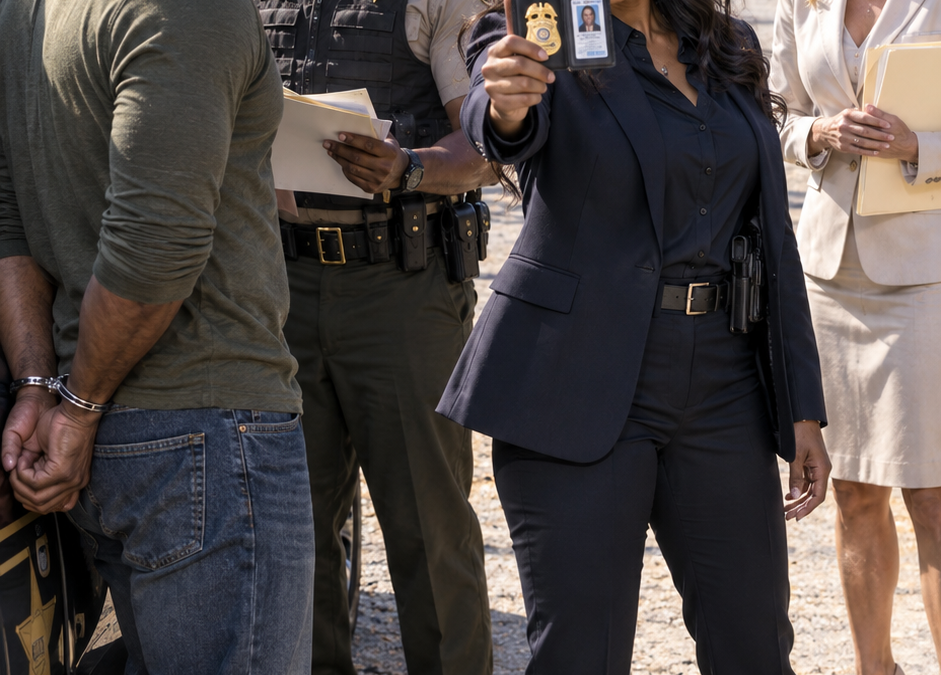
𝗣𝗔𝗥𝗧 𝟮
The private guards walked me toward their truck.
I did not resist.
That part mattered.
It would have been easy to turn the whole morning into a shouting match.
I was angry enough.
Watching a machine tear apart a fence my father had helped me install had already pushed me close to a place I did not like.
But anger was not evidence.
So I kept my hands still inside the cuffs.
Kept my phone recording.
Kept my mouth under control.
Jocelyn did not.
She called emergency dispatch herself.
I could hear half the conversation.
“Yes, this is Jocelyn Voss, president of West Haven Ridge.”
Pause.
“We have a hostile former landowner interfering with legal development.”
Former landowner.
That phrase stuck with me.
Not confused owner.
Not disputed owner.
Former.
Like she had rehearsed it.
“He is refusing to leave HOA property.”
She looked at me while she said it.
“Private security has detained him.”
Another pause.
“No, he has not assaulted anyone, but he is obstructing work.”
She hung up.
Then she handed one of the surveyors a modified parcel map.
“Continue.”
I watched the excavator pull another post.
Then another.
My cattle stood farther up the pasture staring toward the noise.
I had spent twenty-three years building this place into something stable.
In less than half an hour, a woman with a folder was attempting to erase that history by replacing it with a database entry.
The cruelest part was how ordinary everyone else seemed to think it was.
The surveyor checked coordinates.
The machine operator followed stakes.
The guards stood beside me.
Everybody had paperwork.
Therefore everybody assumed reality had already been settled.
Sheriff Garrett Sloan arrived about fifteen minutes later with two deputies.
Garrett knew me by sight.
Not well.
Small county.
We had spoken at livestock events and once after somebody dumped construction debris near my south fence.
He got out of the cruiser and looked at me in handcuffs.
Then at Jocelyn.
Then at the excavator.
“What happened?”
Jocelyn reached him first.
“This man is trespassing and interfering with association property.”
Garrett looked at me.
“Preston?”
“She has a forged deed.”
Jocelyn immediately held it out.
“It is recorded.”
Garrett took it.
He read the document.
Then walked back to his cruiser.
One deputy opened the laptop mounted inside.
They pulled county records.
I watched Garrett’s face.
That was when I became worried.
Because the database matched Jocelyn’s paper.
West Haven Ridge Homeowners Association.
Recorded owner.
Seventeen-point-something acres.
Status:
Valid.
Transfer date:
Eleven months earlier.
Garrett came back slowly.
“Preston, the county system shows the transfer.”
“I know what it shows.”
“Do you have anything proving it’s wrong?”
“My original deed is in my office.”
Jocelyn laughed.
“An older deed doesn’t invalidate a newer deed.”
I looked at Garrett.
“She’s right about that much.”
He frowned.
“Did you ever sign anything involving the association?”
“Not a deed.”
“Easement?”
“No.”
“Purchase option?”
“No.”
“Development agreement?”
“No.”
Jocelyn interrupted.
“This is wasting time. The property transfer is recorded. I want him formally trespassed.”
Garrett gave her a look.
“I’ll decide what happens next.”
She did not like that.
One of his deputies examined the private guards.
“Who authorized the cuffs?”
Jocelyn answered.
“I did.”
The guard quickly added, “We detained him at the property owner’s request.”
“Which property owner?” I asked.
Nobody answered.
Garrett rubbed his jaw.
He was stuck.
I understood that.
A sheriff cannot simply ignore a county land record because somebody says it is false.
If police started deciding property ownership based on whoever sounded angriest, half the county would change hands before lunch.
He finally looked at the guard.
“Take the cuffs off. This is looking civil until we verify—”
A dark sedan turned into the driveway.
I recognized it immediately.
Audrey.
My wife.
She parked behind Garrett’s cruiser.
Got out wearing jeans, boots, and a plain gray jacket.
Nothing about her appearance looked unusual.
That was also normal.
Audrey had spent most of her career looking deliberately forgettable.
Jocelyn marched toward her.
“This property is closed. You need to leave.”
Audrey did not even look at her.
She walked toward Garrett.
“Who authorized the detention?”
Garrett turned.
“Ma’am?”
“Who authorized my husband being handcuffed?”
Jocelyn laughed sharply.
“Your husband is trespassing.”
Audrey finally looked at her.
Only for a second.
Then back at Garrett.
“My name is Audrey Mercer.”
“I gathered.”
“He’s my husband.”
“I understand.”
Jocelyn crossed her arms.
“You can drive him home when we’re finished.”
Audrey reached inside her jacket.
One of Garrett’s deputies stiffened.
She moved slowly.
Then pulled out a small leather credential wallet.
Opened it.
Garrett looked down.
His expression changed.
He looked at Audrey.
Then at me.
Then at the credentials again.
Jocelyn noticed.
“What?”
Garrett ignored her.
Audrey closed the wallet.
“I’m not here in an official capacity.”
Garrett nodded slowly.
“All right.”
“I’m not asking you to believe Preston because I’m federal law enforcement.”
Jocelyn’s eyes widened.
That was satisfying.
Briefly.
Audrey continued.
“I’m asking you to preserve that deed.”
Garrett looked toward the paper in his hand.
“Why?”
“Because if my husband says he didn’t sign it, it may be evidence.”
Jocelyn scoffed.
“This is absurd. What is she supposed to be?”
Audrey looked at her.
“Special Agent Audrey Mercer. FBI.”
Silence.
One of the private guards took a small step backward.
I almost smiled.
Jocelyn recovered quickly.
“So what?”
Audrey nodded.
“Exactly.”
That answer confused her.
Audrey turned back to Garrett.
“My badge does not decide property ownership.”
Then she looked at the deed.
“May I see it?”
Garrett handed it over.
She read quietly.
I knew that expression.
Audrey did not scan documents the way most people did.
She slowed down when something bothered her.
Her eyes stopped near the notary block.
“What day does this say I signed it?” I asked.
She looked at me.
“Thursday, June 13.”
“What time?”
“Three forty p.m.”
Audrey stared at the page.
Then at me.
I remembered before she spoke.
Montana.
We had been in Montana.
Her younger brother had gotten married outside Bozeman.
We had flown in two days earlier and driven a rental SUV south after the ceremony.
Audrey said, “We were in Montana.”
Jocelyn rolled her eyes.
“That proves nothing.”
Audrey ignored her.
“We have hotel records.”
I nodded.
“Rental car.”
“GPS.”
“Fuel receipt outside Livingston.”
She looked back at the deed.
“And photographs.”
Garrett leaned closer.
“Could he have signed electronically?”
Audrey pointed at the notary block.
“This says he personally appeared before the notary at the county courthouse.”
Garrett’s expression tightened.
Jocelyn cut in.
“Then perhaps the date was entered incorrectly.”
Audrey turned a page.
“It’s a warranty deed transferring seventeen acres for ten dollars.”
“What is your point?”
“My point is that material errors in execution matter.”
Then Audrey pointed at the recording number.
“This was electronically submitted.”
Garrett looked.
“How can you tell?”
“Format.”
She paused.
“I’m not saying that proves fraud. I’m saying preserve the submission trail.”
Jocelyn laughed again, but the laugh was thinner.
“This is becoming ridiculous.”
Audrey looked at Garrett.
“Does the county filing portal keep account login records?”
“Yes.”
“IP logs?”
“I think so.”
“Submission timestamps?”
“Yes.”
“Then whoever filed this left a trail.”
That was the question that changed everything.
Garrett looked toward the private guards.
“Remove the cuffs.”
Jocelyn stepped forward.
“No.”
Everyone looked at her.
She realized too late how that sounded.
“I mean—this man is still on association property.”
Garrett’s voice hardened.
“Right now, I am no longer certain whose property we are standing on.”
“He is trespassing.”
“And until this deed is verified, nobody is being arrested for it.”
He looked toward the survey crew.
“Stop work.”
Jocelyn stared at him.
“You do not have authority to stop lawful construction on property we own.”
“Then consider this a temporary scene-preservation measure while ownership is verified.”
“You’re exceeding your authority.”
Garrett pointed toward the excavator.
“If that machine removes another fence post after I told it to stop, we’ll have a different conversation.”
The engine shut down.
That was the first time all morning I heard silence.
The guard unlocked my cuffs.
I rubbed my wrists.
Audrey walked to me.
“You okay?”
“Yes.”
She looked toward the torn fence.
“You’re not okay.”
“I will be.”
She lowered her voice.
“Do not touch anything.”
“I know.”
“I mean anything.”
“I know who I married.”
That earned the smallest smile.
Then she stepped away and made a phone call.
I heard only pieces.
“Conflict.”
“My husband.”
“Potential property-record fraud.”
“Yes.”
“No, I will recuse.”
That mattered more than Jocelyn understood.
Audrey was not taking over the investigation.
She was getting out of it.
Her supervisor assigned another agent within the hour.
Special Agent Everett Shaw.
The first thing Everett asked when Garrett briefed him was not who owned the pasture.
It was:
“Has this parcel been used to secure financing?”
Jocelyn hesitated.
For the first time all morning.
Her attorney, Celeste Ror, had arrived while Audrey was making the call.
Celeste turned toward Jocelyn.
“What financing?”
Jocelyn answered too quickly.
“Nothing relevant.”
Everett was still on speaker.
“That usually means yes.”
Garrett looked toward Celeste.
“Do you have the development contracts?”
Celeste opened the folder she had brought.
“I have summary documents.”
She pulled out the first page.
Everyone saw the heading.
WEST HAVEN RIDGE EXPANSION
$6,800,000 CREDIT FACILITY
I looked at Audrey.
She looked at me.
The collateral section listed several association assets.
Then:
MERCER CORRIDOR PARCEL – 17.34 ACRES.
My land.
The forged deed was not merely being used to steal acreage.
It had been pledged as collateral.
Everett’s voice came through the phone.
“Sheriff, preserve every document.”
Jocelyn said, “This is private association financing.”
“No,” Everett answered. “If a potentially fraudulent property instrument was used in connection with lending, this may be something else.”
Celeste looked at Jocelyn.
“You told me the parcel was purchased.”
“It was.”
“From whom?”
“An intermediary.”
“Name them.”
Jocelyn’s mouth tightened.
She did not answer.
I finally understood why seventeen acres mattered so much.
West Haven Ridge was building a fourth phase.
New clubhouse.
Artificial lake.
Secondary entrance.
Commercial amenity center.
The development needed direct road access.
Without my strip, the project dead-ended.
Literally.
Jocelyn had offered me $260,000 the first time.
Then $310,000.
I declined both.
The gate and pasture were part of my farm.
I did not need the money enough to let somebody put a road through cattle ground.
Three months later, according to county records, I had suddenly sold for ten dollars.
Convenient.
Garrett called County Recorder Miriam Talbot.
She pulled the electronic filing.
Then the submission audit.
Her voice changed on speaker.
“This was uploaded at 2:17 a.m.”
Garrett frowned.
“County office closed?”
“Since five.”
“Whose account?”
Pause.
“Employee account.”
Jocelyn looked away.
“Which employee?” Audrey asked.
Miriam answered.
“I’m not saying until I verify access records.”
Everett came back on.
“Good. Freeze the audit logs.”
Jocelyn crossed her arms.
“This has nothing to do with me.”
Nobody answered.
That was new for her.
Audrey and I spent that evening at our kitchen table.
The farm was quiet again.
Temporary injunction tape marked the disturbed section.
Sheriff deputies had documented the stakes.
No construction crews remained.
I kept looking at a photocopy of the forged deed.
“My signature really does look real.”
Audrey sat opposite me.
“Because it probably is.”
I looked up.
“What?”
“Not your signature on that document.”
“What do you mean?”
“Someone may have copied a genuine signature.”
I thought back through old transactions.
Mortgage paperwork.
Equipment loans.
Insurance.
Farm leases.
Then I remembered a refinance three years earlier.
We had refinanced the farm after rates dropped.
The title company requested everything.
Driver’s license.
Signature specimen.
Legal description.
Title report.
Tax parcel information.
Audrey pulled the closing file from our digital records.
Document preparation:
REEVE TITLE SOLUTIONS.
Representative:
DUNCAN REEVE.
I stared at the name.
“I know him.”
“Personally?”
“No.”
Then I remembered.
A photograph.
West Haven Ridge had mailed expansion material months earlier.
Ceremonial groundbreaking.
Jocelyn standing beside local contractors.
One man holding the ribbon with her.
Duncan Reeve.
I found the newsletter online.
Printed the photograph.
Placed it beside the refinance file.
Audrey studied both.
“Photograph proves nothing.”
“I know.”
“He could have legitimate business with the HOA.”
“I know.”
“But.”
“But?”
She tapped the refinance paperwork.
“He had your signature samples.”
“And my title.”
“And legal description.”
“And ID.”
“And he knows Jocelyn.”
I leaned back.
“You think he made the deed.”
“I think Everett needs this.”
We sent everything.
Then we stopped.
That was Audrey’s rule.
Evidence goes to the assigned investigators.
We did not start following Duncan.
We did not call him.
We did not bait him.
We did not play detective.
Audrey especially refused.
“This cannot become my case.”
“He forged my land.”
“Maybe.”
“He probably forged my land.”
“That sentence is why I’m not handling it.”
Everett moved fast.
Preservation requests went out to:
Reeve Title Solutions.
West Haven Ridge servers.
Cloud accounts.
County recording vendor.
The lender.
HOA management company.
Meanwhile, Garrett opened a separate local inquiry into my detention.
The body-camera evidence was unpleasant for Jocelyn.
My phone had captured her order clearly.
“Remove the trespasser.”
The security footage from my farm recorded the guards approaching.
Their own report stated they acted under Jocelyn’s direction.
Later, when investigators questioned her, Jocelyn claimed she had never instructed anyone to handcuff me.
That lie survived less than a day.
Her response to pressure was not retreat.
It was escalation.
She sent a communitywide message.
According to her version, a “disgruntled former property owner” and his “federally connected spouse” were attempting to intimidate West Haven Ridge.
I read the email twice.
Then Audrey asked:
“Why are you smiling?”
“She called me a former property owner again.”
“That’s funny?”
“She keeps documenting intent.”
The next certified letter was even better.
Jocelyn billed me:
$18,600 – unauthorized occupancy.
$7,400 – demolition and site delay costs.
$4,200 – administrative penalties.
Total:
$30,200.
I laughed so hard Audrey came in from the other room.
“What?”
I showed her.
She read it.
Then looked at me.
“She billed you for occupying your own farm.”
“And signed it.”
She smiled.
“That is helpful.”
The notary named on the deed was Bethany Crowell.
Everett located her.
She was retired.
Her notary commission had expired fourteen months before the supposed signing date.
She had never met me.
Never notarized a document for me.
And her physical seal had been stolen years earlier during an office burglary.
That was already bad.
Then Everett asked who processed the insurance paperwork after the theft.
Reeve Title Solutions.
The pattern tightened.
Miriam conducted a deeper audit of the county portal.
The employee account used to submit my deed had logged in from a fixed IP address.
Not some foreign server.
Not an anonymous VPN.
Not even somebody’s home.
The IP belonged to an office building less than three miles from the courthouse.
The building housed West Haven Ridge Community Management.
When Garrett told me, I stopped talking for a few seconds.
Audrey said quietly:
“That’s not enough to identify the user.”
“I know.”
“But it matters.”
Then Miriam found something worse.
My deed was not the only suspicious filing.
There were eleven.
Eleven property records over roughly three years.
Different owners.
Different parcels.
Different instruments.
But the pattern repeated.
West Haven Ridge or an affiliated development entity wanted access.
Owner refused.
Then a corrective deed appeared.
Or a quitclaim.
Or an easement.
Or drainage rights.
Or parking rights.
Small enough changes that most people never noticed.
One retired couple thought the county had simply corrected an old survey.
A business owner assumed his landlord had changed a parking agreement.
Another farmer believed a utility easement had been amended automatically.
None had looked deeper.
Jocelyn’s strategy was not to create a perfect forgery that survived forever.
She only needed it to survive long enough.
Long enough for a building permit.
Long enough for a loan.
Long enough for excavation.
Long enough for somebody to say:
Well, the road is already built.
Now fixing the fraud will cost too much.
Settle.
That was the system.
It depended on exhaustion.
My case threatened it because the excavator had been stopped before the road existed.
Once Everett saw eleven similar filings, the investigation expanded.
People were interviewed.
Records compared.
Signature sources traced.
Jocelyn called an emergency closed board meeting.
Celeste attended as association counsel.
According to records later produced, Jocelyn suggested they “clean historical drafts” from shared servers.
Celeste asked:
“Do you mean delete files?”
Jocelyn claimed she meant removing outdated material.
Celeste refused.
Then preserved her own email archive.
Good lawyers become extremely careful when a client starts asking about deleting things after receiving preservation notices.
Jocelyn had another motive too.
The fourth phase was not merely a development project.
It was her legacy.
For years, she had promised West Haven Ridge residents that expansion would transform the association.
Assets exceeding $24 million.
New commercial amenities.
Regional prestige.
She was positioning herself for a seat on a larger development council.
The project had become personal.
My refusal to sell was not merely a land problem to her.
I was the man standing between Jocelyn Voss and the future she had already announced.
That made what happened next less surprising.
Despite Garrett’s stop order, construction crews returned at 5:40 one morning.
I heard diesel engines from the house.
Walked outside.
Excavator.
Grader.
Survey crew.
Again.
I approached the foreman.
“You were told this site is shut down.”
He held up a work order.
“New authorization.”
Signed:
JOCELYN VOSS.
Proceed regardless of pending ownership dispute.
I photographed it.
Then called Garrett.
He arrived twenty minutes later.
This time, he was not patient.
“Shut everything down.”
The foreman obeyed.
Jocelyn arrived in her SUV.
She marched toward us.
“You cannot freeze a six-million-dollar project because one man changed his mind about selling!”
I looked at her.
“I never sold.”
“Yes, you did.”
“Show me where I took the money.”
“The transaction was structured through—”
“Through who?”
Silence.
“Ten dollars, Jocelyn.”
She looked away.
“You’re saying I sold seventeen acres for ten dollars?”
“It was legal consideration.”
“Then show me the ten.”
She did not.
A sedan pulled in.
Celeste Ror stepped out.
She carried a sealed envelope.
Jocelyn’s expression changed.
“Celeste.”
The attorney ignored her.
She walked directly to Garrett.
“My client has not told you everything.”
Jocelyn stepped forward.
“Attorney-client privilege.”
Celeste looked at her.
“What I am providing is not privileged.”
Inside the envelope were public records, third-party records, and communications involving actions Jocelyn had taken after receiving explicit warnings from counsel.
One email stood out.
From:
Duncan Reeve.
Subject:
MERCER CORRIDOR COMPLETED.
Message:
Recording is live. County map should update within seventy-two hours.
Three minutes later, Jocelyn replied:
Send revised ownership package to lender immediately.
I read it twice.
Audrey was standing beside me.
I whispered:
“That’s it.”
She shook her head slightly.
“It’s strong.”
“You always ruin the moment.”
“It’s what you married.”
Everett obtained a search warrant for Reeve Title Solutions.
Audrey stayed home.
Deliberately.
I asked whether she wanted to be there.
“No.”
“Why?”
“Because Everett is doing his job.”
“You’re FBI.”
“And I’m your wife.”
“That doesn’t disappear.”
“It matters enough that I stay away.”
That distinction became one of the most important parts of the whole ordeal.
Audrey had real authority.
She limited herself.
Jocelyn had none.
She kept inventing more.
Inside Reeve Title Solutions, agents found a folder:
WR ACQUISITION FILES.
It contained:
Signature samples.
Scanned deeds.
Notary templates.
Property descriptions.
County login credentials.
Copies of IDs.
Financial valuations.
A spreadsheet.
Target names ran down the left side.
Columns included:
Parcel.
Project value.
Owner resistance.
Instrument method.
Funding trigger.
My row:
PRESTON MERCER.
Resistance:
HIGH.
Method:
DIRECT TRANSFER.
I stared at the copy Everett later showed me.
“They rated me.”
Audrey looked over my shoulder.
“High.”
“I’m proud.”
“You shouldn’t be.”
“I am a little.”
Duncan hired an attorney.
Then began cooperating.
His first version minimized his role.
Jocelyn had supposedly asked him to fix “technical errors.”
Then easements.
Then corrective filings.
Then things that were clearly not corrections.
He claimed he resisted.
She threatened to terminate West Haven Ridge’s lucrative title and document contract.
Eventually, he complied.
That did not absolve him.
But cooperation changed the investigation.
Duncan said Jocelyn kept the master spreadsheet.
She chose targets.
She chose methods.
She decided which owners could be pressured.
He handled technical execution.
Then Jocelyn produced what she thought would save her.
A purchase authorization.
My signature appeared at the bottom.
This one stopped me.
Because I recognized it.
Not merely the shape.
I knew I had signed that exact signature.
Jocelyn saw my face.
“There.”
Her confidence returned.
“You signed.”
I stared at the page.
Audrey stood beside me.
She looked at the signature.
Then at the date.
Then back at the signature.
“Yes,” she said.
Jocelyn smiled.
Even Celeste looked concerned.
Audrey continued.
“That’s Preston’s real signature.”
I looked at her.
“What?”
Jocelyn almost laughed.
“Finally.”
Audrey leaned closer.
“Just not on this document.”
The room went quiet.
Everett asked:
“What are you seeing?”
Audrey pointed.
“Loop at the base of the P.”
Tiny ink skip.
I could barely see it.
“Preston signed another document years ago where the pen skipped in that exact spot.”
Jocelyn scoffed.
“So?”
Audrey looked at her.
“A human signature changes every time.”
Everett nodded.
“Identical defect suggests duplication.”
Forensic examination confirmed it.
The signature came from an environmental access consent I had signed three years earlier.
I had allowed West Haven Ridge consultants onto one corner of my land for one afternoon to inspect drainage.
That harmless permission had become their source material.
Side-by-side enlargement showed the signatures were pixel-for-pixel identical.
Same imperfection.
Same stroke pressure.
Same skipped ink.
Impossible as two independently written signatures.
Then came metadata.
The purchase authorization claimed to be almost two years old.
File creation date:
Six weeks earlier.
Author:
JVS.
Jocelyn Voss.
Her response:
Someone must have used her laptop.
Everett already had cloud backups.
An earlier file existed.
Name:
MERCER SIGNATURE CLEAN.PNG.
Created under Jocelyn’s account.
That was when even her new legal team stopped sounding confident.
I filed for emergency declaratory relief.
The hearing did not need to decide every crime.
The judge had one immediate question:
Could West Haven Ridge continue developing seventeen acres while serious evidence showed its deed was fraudulent?
Miriam Talbot testified.
Unauthorized county account access.
Irregular submission time.
Suspicious audit trail.
Bethany Crowell testified.
Expired commission.
Never met me.
Never notarized the deed.
Forensic examiner testified.
Copied signature.
Manipulated document.
Bank records showed the deed had been included in collateral documentation for the $6.8 million credit facility.
The judge issued the order that afternoon.
West Haven Ridge’s ownership claim was suspended.
Construction frozen.
No transfer.
No mortgage.
No additional encumbrance.
All electronic records preserved.
Jocelyn sat rigidly through the ruling.
As she walked past me outside, she muttered:
“An injunction doesn’t make you the owner.”
I looked at her.
“Neither does Photoshop.”
She kept walking.
Celeste withdrew as association counsel within the week.
Her letter cited an irreconcilable conflict between professional obligations and client conduct.
That was lawyer language for:
I am getting away from this before someone asks why I stayed.
Then Garrett came to see Jocelyn.
Not about the deed.
About my handcuffs.
The local and federal cases separated.
Local investigators reviewed:
Unlawful detention.
False statements to officers.
Security guards acting under Jocelyn’s direction.
Trespass.
Property damage.
Federal investigators focused on:
Electronic fraud.
Bank financing.
Compromised county credentials.
Fraudulent property instruments.
Interstate communications.
Conspiracy.
Obstruction questions.
I asked Audrey once:
“Are you disappointed you’re not working it?”
“No.”
“Really?”
“Yes.”
“That easy?”
She looked at me.
“Preston, if I use my badge to push harder because you’re my husband, then I become a smaller version of Jocelyn.”
That ended the conversation.
Weeks later, unmarked federal vehicles drove past our farmhouse toward the West Haven Ridge offices.
I stood on the porch with Audrey.
“You’re not going?”
“No.”
“Because of me.”
“Because it isn’t my case.”
I smiled.
“You say that like you rehearsed it.”
“I married a man who asks the same question repeatedly.”
The search warrant at West Haven Ridge uncovered more.
Financial records showed the $6.8 million credit facility contained a fraud clause.
If collateral documentation proved materially fraudulent, the lender could accelerate the debt.
Potentially demanding immediate repayment.
Jocelyn had not only endangered my property.
She had placed the entire association’s finances under a loaded trap.
The board learned that in an emergency meeting.
Residents had approved expansion.
They had not approved forged land transfers.
Jocelyn attempted to argue everyone shared responsibility.
One board member, Russell Hale, answered:
“We approved buying property.”
He paused.
“Not stealing it.”
The vote to remove her was unanimous.
President.
Gone.
Signing authority.
Gone.
Committee control.
Gone.
Access to association systems.
Suspended.
She tried to leave with her laptop.
Garrett blocked the doorway.
Everett stood beside him.
“Leave the computer.”
“That is my personal property.”
Everett said, “It is listed in the warrant.”
“You cannot—”
“Leave it.”
She looked around the room.
Nobody defended her.
Not the board.
Not management.
Not security.
Not counsel.
For years, Jocelyn had made rooms move when she spoke.
Now everyone stayed exactly where they were.
Agents escorted her outside.
I was across the parking lot.
She saw me.
“You destroyed this community!”
I shook my head.
“No.”
She kept shouting.
“You wanted revenge!”
“I wanted my land.”
She stopped.
I looked at her.
“I didn’t destroy anything.”
Then I said the only sentence I had wanted to say since the first morning.
“I kept my deed.”
Months passed.
The federal case continued.
Duncan faced consequences of his own.
Other property owners were notified.
County records were audited.
Eleven suspicious filings were reviewed individually.
Some were voided.
Some required litigation.
Some had already produced construction projects complicated enough that unwinding them took months.
The scheme did not disappear because Jocelyn lost her title.
Fraud leaves administrative wreckage.
But at least people finally knew what they were looking at.
The final ownership ruling on my seventeen acres came later.
The warranty deed transferring my land to West Haven Ridge was declared void from inception.
Not void from the day we discovered the fraud.
Not void after litigation.
Void from the beginning.
Legally, the association had never owned it.
County records were corrected.
My name returned.
Every improper construction lien connected to the failed expansion was removed.
West Haven Ridge was ordered to:
Remove survey stakes.
Restore fencing.
Repair excavated pasture.
Cover damages tied to unlawful entry.
Pay restoration costs.
The lender froze remaining expansion funds.
Phase Four stopped.
The artificial lake never happened.
The commercial amenity center stalled.
The second entrance road died at the edge of my fence.
A road that existed on glossy brochures never touched my land.
The new board hired outside compliance counsel.
Every property transaction from Jocelyn’s tenure was reviewed.
Every affected owner was contacted.
Some residents were furious.
Some embarrassed.
Some left.
I did not blame all of them.
Most had never seen the documents.
They had trusted leadership.
That was their mistake.
But trust is not the same as fraud.
The board sent written apologies to the eleven affected owners.
Where possible, West Haven Ridge paid restoration or legal costs.
It was slow.
Expensive.
Humiliating.
Probably necessary.
Garrett drove out one afternoon after the final ruling.
No deputies.
No emergency lights.
Just him.
I met him near the rebuilt eastern fence.
He looked at the new posts.
“Looks better.”
“Cost enough.”
He nodded.
Then he became serious.
“I owe you an apology.”
“For what?”
“The first morning.”
“You stopped.”
“Not immediately.”
“You had a county record saying I sold.”
“I almost treated the database like the truth.”
I looked toward the pasture.
“What else were you supposed to use?”
“My judgment.”
“You used it.”
“Eventually.”
I smiled.
“Garrett, if you had ignored the county record because you knew me personally, I’d have been more worried.”
He considered that.
“Still bothers me.”
“Good.”
“Good?”
“Means you’ll remember it.”
He laughed quietly.
“I already changed our property-dispute procedure.”
“How?”
“Recent deed transfers get verified before we make trespass decisions when ownership is challenged.”
“Because of me?”
“Because of Jocelyn.”
“Fair.”
He looked toward the repaired fence.
“Two of the other landowners called.”
“What did they say?”
“Thanks.”
We stood quietly for a while.
Then he said:
“People see an official stamp and stop asking questions.”
I nodded.
“Ink works until somebody asks where it came from.”
That evening, Audrey and I walked the eastern boundary.
We had done that before all this.
Now every post seemed more important.
Not because the land had changed.
Because somebody had tried to erase it from us without moving a single physical marker.
I said:
“When you showed Garrett your badge, I thought it was over.”
Audrey laughed.
“Why?”
“Because FBI.”
“That is not how property law works.”
“I was handcuffed. My legal analysis was emotional.”
“My badge proved nothing about the deed.”
“It changed the room.”
“Yes.”
“Same thing.”
“No.”
She stopped walking.
“It mattered because Garrett realized there might be something worth preserving.”
“Okay.”
“The hotel receipt mattered.”
“Yes.”
“GPS mattered.”
“Yes.”
“Notary records mattered.”
“Yes.”
“Metadata mattered.”
I sighed.
“You’re going to make a speech.”
“I’m married to you. I’ve earned one.”
I smiled.
She continued.
“The badge got attention. Evidence got your land back.”
That distinction stayed with me.
Jocelyn believed authority created truth.
Audrey knew authority only meant responsibility to verify truth.
Those are opposite philosophies.
One forged deeds.
The other recused herself.
Months later, a certified envelope arrived from County Recorder Miriam Talbot.
Corrected title record.
I opened it at the kitchen table.
No West Haven Ridge.
No forged transfer.
No ten-dollar consideration.
No copied signature.
No fraudulent notary.
Just:
PRESTON MERCER.
Owner.
I closed the folder.
Walked outside.
Stopped on the same section of driveway where the guards had cuffed me.
The memory came back with uncomfortable clarity.
Cold metal around my wrists.
Jocelyn’s folder.
Excavator pulling posts.
Survey stakes.
Her voice calling me a former landowner.
I looked down at the ground.
Same dirt.
Same gravel.
Same farm.
I said quietly:
“You had guards.”
Audrey was on the porch behind me.
“What?”
I turned.
“Nothing.”
She walked closer.
“What were you saying?”
I looked toward West Haven Ridge.
“She had guards. Lawyers. County records. A six-point-eight-million-dollar loan.”
“And?”
“Even my signature.”
Audrey nodded.
I smiled.
“She never had the land.”
The following spring, grass covered the damaged section.
I rebuilt the fence myself.
Not because the settlement required me to.
West Haven Ridge paid contractors for most of the restoration.
But I installed the last twelve posts.
My father had taught me years earlier that fence corners deserve more attention than straight runs.
“If your corners hold,” he used to say, “the rest usually behaves.”
I had not thought about that sentence in decades.
Now I understood it differently.
Boundaries matter most where pressure concentrates.
The new West Haven Ridge board eventually redesigned Phase Four.
Smaller.
Less ambitious.
Entirely within land they actually owned.
That last part seemed like progress.
No second entrance crossed my pasture.
No lake runoff touched my drainage.
No amenity center sat where my cattle grazed.
The association survived.
Barely.
Its reputation took years to recover.
The loan restructure cost them.
Insurance became more expensive.
Legal fees were ugly.
Residents replaced management staff.
Jocelyn never held office there again.
Duncan never returned to title work in our county.
The compromised recording credentials were permanently disabled.
The county added new authentication requirements.
Bethany Crowell received a formal letter clearing her of involvement after investigators confirmed her stolen seal had been misused.
The other landowners got corrected records.
Some received money.
Some land.
Some apologies.
Not everything was perfectly restored.
Life rarely offers that.
But the machinery stopped.
That mattered.
One evening, about a year later, Audrey and I were walking the pasture when we reached the exact place where Jocelyn’s excavator had been sitting.
Nothing marked it anymore.
No orange stakes.
No temporary fence.
No sign.
Cattle grazed where the machine had idled.
Audrey said:
“You still think about it?”
“Sometimes.”
“The cuffs?”
“Not really.”
“The deed?”
“More.”
“Why?”
I looked across the field.
“Because it worked.”
“For a while.”
“That’s the part.”
A fake document entered a county database.
Then contractors relied on it.
Surveyors relied on it.
Security relied on it.
A sheriff nearly relied on it.
A bank relied on it.
One false record had created a whole chain of real-world consequences.
“That scares me more than Jocelyn,” I said.
Audrey nodded.
“Systems trust inputs.”
“That sounds like something an agent says.”
“It’s something anyone should understand.”
“What stops it?”
“Checks.”
She counted them off.
“Independent verification. Audit logs. Human skepticism. Good records.”
“Annoying wives.”
“Especially those.”
I laughed.
We kept walking.
A few weeks later, West Haven Ridge sent me a letter.
The new president wanted to meet.
I almost threw it away.
Audrey made me read it.
The board wanted to formally acknowledge our boundary and discuss rebuilding neighbor relations.
No land request.
No easement.
No expansion proposal.
Just boundaries.
I agreed.
The meeting lasted forty minutes.
Nobody raised their voice.
Nobody brought security.
Nobody tried to buy seventeen acres for ten dollars.
At the end, the new president said:
“We owe you an apology.”
I answered:
“You owe eleven people apologies.”
“We’re doing that too.”
“Good.”
He hesitated.
“Was there anything we could do for you?”
I thought about it.
“Yes.”
“What?”
“Stay off my pasture.”
He nodded.
“Fair.”
That was the entire negotiation.
Beautiful.
Years later, people who heard the story usually focused on Audrey.
They would say:
“You’re lucky your wife was FBI.”
And I was.
For many reasons.
But the story was never as simple as:
My wife showed a badge and won.
If anything, Audrey was the person most determined not to let the badge decide anything.
She called her supervisor.
She stepped out.
Everett took over.
Independent agents executed warrants.
Forensic examiners analyzed documents.
Miriam audited the filing system.
Garrett handled the detention inquiry.
A judge ruled on ownership.
The lender reviewed collateral.
The case worked because no single person got to invent the answer.
That was the opposite of Jocelyn’s entire approach.
She believed control meant deciding reality.
She wanted the parcel.
So she created a deed.
She wanted the deed believed.
So someone used county credentials.
She wanted financing.
So the fake title went into the loan package.
She wanted construction moving.
So she sent crews before anyone could challenge it.
She wanted me removed.
So she ordered guards to cuff me.
Every step assumed speed would beat scrutiny.
For ten cases, apparently it had.
I was number eleven.
The difference was not that I was smarter.
It was not that I was richer.
It was not even that I was married to an FBI agent.
The difference was timing.
The fraud got challenged before the road was finished.
Before enough concrete was poured.
Before enough money moved.
Before everyone became invested in pretending the false record was easier to accept than to reverse.
That was Jocelyn’s real business model.
Make the lie expensive to undo.
She nearly succeeded.
The last time I saw her was outside the courthouse months after the final property ruling.
She was with her attorney.
I was leaving with Audrey.
Jocelyn stopped.
“You think you’re a hero?”
I looked at her.
“No.”
“You destroyed years of planning.”
“You planned on my land.”
“You cost hundreds of homeowners money.”
“You used their association as collateral for fraud.”
Her lawyer touched her arm.
She ignored him.
“You could have sold.”
“Yes.”
“You had offers.”
“Yes.”
“It was seventeen acres.”
“To you.”
She laughed bitterly.
“You would rather destroy a community than compromise.”
I shook my head.
“That’s still the story you tell yourself?”
“What story?”
“That my refusal caused this.”
“It did.”
“No.”
I stepped closer.
Not threatening.
Just close enough that she could hear without me raising my voice.
“I said no to selling land.”
She stared at me.
“You forged the yes.”
That ended it.
Her attorney guided her away.
Audrey waited until they were gone.
Then said:
“That was dramatic.”
“I earned one.”
“You absolutely did not.”
I smiled.
“Still worth it.”
Back home, life became boring again.
Boring is underrated.
Fence repairs.
Calving season.
Fuel bills.
Rain.
Dry spells.
Equipment maintenance.
Cattle getting through places cattle should not fit through.
Normal problems.
No survey trucks.
No private guards.
No forged deeds.
No one calling me a trespasser.
Every so often, I opened the fireproof cabinet in my office and saw the corrected deed.
I kept the forged one too.
Evidence copy.
Two pieces of paper.
Same parcel.
Same name.
Same-looking signature.
One true.
One false.
At first glance, nearly impossible to distinguish.
That was the lesson I never forgot.
Official-looking is not the same as official.
Recorded is not the same as legitimate.
Stamped is not the same as true.
Jocelyn Voss built her entire scheme around people forgetting those distinctions.
She assumed nobody would look beneath the county stamp.
She assumed property owners would panic.
She assumed banks would trust title reports.
She assumed contractors would follow permits.
She assumed police would trust database records.
She assumed momentum would protect the lie.
For years, it did.
Then she forged the wrong deed.
Not because I had some hidden power.
Because she finally pushed far enough that too many systems started looking at the same time.
The sheriff.
County recorder.
Federal investigators.
Bank.
Court.
Forensic examiners.
Her own lawyer.
Her own board.
Once everyone looked, the story she had built could not survive.
The irony was that the first person to warn her was me.
Standing in handcuffs.
“You better be absolutely certain that deed is real.”
She told me the county already was.
She was wrong.
The county had recorded it.
That was all.
Truth took longer.
But truth arrived.
The following spring, I replaced the old metal sign at the east fence.
The previous one had been bent during construction.
The new one was simple.
MERCER FARM
PRIVATE PROPERTY
Nothing else.
No threat.
No legal citation.
No warning about West Haven Ridge.
No mention of Jocelyn.
I did not need one.
The fence stood on the real boundary.
The county record matched it.
The deed matched it.
The survey matched it.
The court order matched it.
That was enough.
One evening, Audrey joined me while I checked the posts.
Sunset had turned the pasture gold.
She stopped beside the rebuilt corner.
“This is where they cuffed you?”
“About twenty feet back.”
“You never told me exactly where.”
“Didn’t seem important.”
She looked toward the house.
“I was very angry that day.”
“You hid it well.”
“I’m trained.”
“I noticed.”
She smiled.
“You were angry too.”
“I’m not trained.”
“I noticed.”
We walked farther.
A calf trotted after its mother.
Wind moved through the grass.
The subdivision roofs were visible beyond the ridge.
Still there.
My farm still here.
Both could exist.
That was the part Jocelyn never understood.
My land did not need to become hers for West Haven Ridge to survive.
Her expansion plan did not need to happen exactly as she imagined.
No one had forced her to choose fraud.
She chose it because “no” offended her.
That was all.
One landowner said no.
So she built an entire machinery of forged records to turn no into yes.
And in doing so, she destroyed the very expansion she was trying to save.
Phase Four shrank.
The $6.8 million facility was frozen and restructured.
The association paid damages.
Leadership changed.
Eleven property files were reopened.
Duncan cooperated against her.
Celeste withdrew.
The board removed her.
County security tightened.
Everything Jocelyn wanted became harder because she refused to accept one boundary.
Mine.
If there was satisfaction in the ending, it was not watching her lose authority.
Though I will admit that part did not hurt.
It was watching the land return to silence.
No machines.
No orange stakes.
No temporary fencing.
Just pasture.
That was what she had tried to take.
Not some abstract parcel number.
Not seventeen acres on a financing spreadsheet.
Pasture.
Fence.
Soil.
A route my cattle used.
A place my father had worked.
Jocelyn saw collateral.
I saw home.
The law eventually saw what the deed had always said.
Mine.
And that was enough.
She had my signature.
She had a notary seal.
She had a county recording number.
She had private guards.
She had survey crews.
She had lawyers.
She had a $6.8 million development loan waiting behind the lie.
For a few hours, she even had me in handcuffs.
But she never had the one thing every document claimed she did.
My land.
Have you finished reading the story and want to read it again?
HOA Forged My Deed and Had Me Cuffed on My Own Farm—Then My Wife Pulled Into the Driveway
They cuffed me on my own farm.
The HOA president waved a deed carrying my forged signature.
Then my wife pulled into the driveway, and the sheriff suddenly stopped talking.
My name is Preston Mercer, and I had owned the same sixty-three acres for twenty-three years before anyone ever tried to tell me I was trespassing on them.
My grandfather had cleared part of that ground by hand.
My father helped me rebuild the south fence after a tornado tore through when I was thirty-two.
I had buried dogs there, raised cattle there, repaired tractors beneath the old machine shed, and watched enough sunsets from the back pasture to know every ridge and drainage ditch by sight.
West Haven Ridge came later.
Much later.
The subdivision went up east of my property almost ten years after I bought the farm. I never joined its homeowners association, never signed its covenants, never paid dues, and never had a reason to care which shade of beige they considered appropriate for garage doors.
As far as I was concerned, we had an ideal relationship.
They stayed over there.
I stayed over here.
Then, on an ordinary Monday morning, I walked toward my eastern fence and found fourteen bright orange survey stakes planted straight through my cattle pasture.
For a few seconds, I simply stared.
A temporary construction fence had already been pushed nearly three hundred feet onto my side.
Two survey trucks idled nearby.
An excavator sat at the edge of the field with its engine running.
And beside the tree line stood a large new sign.
WEST HAVEN RIDGE
PRIVATE COMMUNITY PROPERTY
I walked toward the crew.
“Stop.”
The nearest surveyor looked up.
“We have authorization.”
“From whom?”
“West Haven Ridge.”
“This is Mercer property.”
He looked uncomfortable.
“I’m just working from the documents I was given.”
“Then stop until somebody verifies them.”
He radioed someone.
Less than ten minutes later, a black SUV came down the access road.
Jocelyn Voss stepped out.
President of the West Haven Ridge HOA.
Two private security guards followed her.
Jocelyn did not ask why I was upset.
She walked straight toward me carrying a blue folder and held out a recorded warranty deed.
“Mr. Mercer, this should clear things up.”
I read the first line.
Then the second.
Then my stomach turned cold.
According to the document, I had transferred a little more than seventeen acres to the West Haven Ridge Homeowners Association eleven months earlier.
Purchase price:
Ten dollars.
The parcel number was correct.
My full legal name was correct.
The county recording number looked valid.
There was a notary block.
A county electronic filing stamp.
And at the bottom—
my signature.
It looked real.
Not similar.
Real.
I stared at it long enough that Jocelyn smiled.
“You remember now?”
“No.”
Her smile faded slightly.
“I never signed this.”
“The county says otherwise.”
“That signature was copied.”
“Perhaps you should be more careful about what you sign.”
I looked past her.
The excavator began moving.
A bucket lowered against one of my fence posts.
“Tell them to stop.”
“This is association property.”
“No. It isn’t.”
“You transferred it.”
“I did not.”
Jocelyn folded her arms.
“You are currently interfering with lawful work on property you no longer own.”
I pulled out my phone and began recording.
She watched me do it.
Then turned toward the guards.
“Remove the trespasser.”
One of them reached for handcuffs.
I looked directly at Jocelyn.
“You better be absolutely certain that deed is real.”
She did not blink.
“The county already is.”
The cuffs closed around my wrists.
Behind her, the excavator ripped the first fence post out of the soil.
I said only one thing.
“Keep every camera running.”
Jocelyn laughed.
She thought I was bluffing.
She had no idea who was about to drive through my gate.
PART2
The private guards walked me toward their truck.
I did not resist.
That part mattered.
It would have been easy to turn the whole morning into a shouting match.
I was angry enough.
Watching a machine tear apart a fence my father had helped me install had already pushed me close to a place I did not like.
But anger was not evidence.
So I kept my hands still inside the cuffs.
Kept my phone recording.
Kept my mouth under control.
Jocelyn did not.
She called emergency dispatch herself.
I could hear half the conversation.
“Yes, this is Jocelyn Voss, president of West Haven Ridge.”
Pause.
“We have a hostile former landowner interfering with legal development.”
Former landowner.
That phrase stuck with me.
Not confused owner.
Not disputed owner.
Former.
Like she had rehearsed it.
“He is refusing to leave HOA property.”
She looked at me while she said it.
“Private security has detained him.”
Another pause.
“No, he has not assaulted anyone, but he is obstructing work.”
She hung up.
Then she handed one of the surveyors a modified parcel map.
“Continue.”
I watched the excavator pull another post.
Then another.
My cattle stood farther up the pasture staring toward the noise.
I had spent twenty-three years building this place into something stable.
In less than half an hour, a woman with a folder was attempting to erase that history by replacing it with a database entry.
The cruelest part was how ordinary everyone else seemed to think it was.
The surveyor checked coordinates.
The machine operator followed stakes.
The guards stood beside me.
Everybody had paperwork.
Therefore everybody assumed reality had already been settled.
Sheriff Garrett Sloan arrived about fifteen minutes later with two deputies.
Garrett knew me by sight.
Not well.
Small county.
We had spoken at livestock events and once after somebody dumped construction debris near my south fence.
He got out of the cruiser and looked at me in handcuffs.
Then at Jocelyn.
Then at the excavator.
“What happened?”
Jocelyn reached him first.
“This man is trespassing and interfering with association property.”
Garrett looked at me.
“Preston?”
“She has a forged deed.”
Jocelyn immediately held it out.
“It is recorded.”
Garrett took it.
He read the document.
Then walked back to his cruiser.
One deputy opened the laptop mounted inside.
They pulled county records.
I watched Garrett’s face.
That was when I became worried.
Because the database matched Jocelyn’s paper.
West Haven Ridge Homeowners Association.
Recorded owner.
Seventeen-point-something acres.
Status:
Valid.
Transfer date:
Eleven months earlier.
Garrett came back slowly.
“Preston, the county system shows the transfer.”
“I know what it shows.”
“Do you have anything proving it’s wrong?”
“My original deed is in my office.”
Jocelyn laughed.
“An older deed doesn’t invalidate a newer deed.”
I looked at Garrett.
“She’s right about that much.”
He frowned.
“Did you ever sign anything involving the association?”
“Not a deed.”
“Easement?”
“No.”
“Purchase option?”
“No.”
“Development agreement?”
“No.”
Jocelyn interrupted.
“This is wasting time. The property transfer is recorded. I want him formally trespassed.”
Garrett gave her a look.
“I’ll decide what happens next.”
She did not like that.
One of his deputies examined the private guards.
“Who authorized the cuffs?”
Jocelyn answered.
“I did.”
The guard quickly added, “We detained him at the property owner’s request.”
“Which property owner?” I asked.
Nobody answered.
Garrett rubbed his jaw.
He was stuck.
I understood that.
A sheriff cannot simply ignore a county land record because somebody says it is false.
If police started deciding property ownership based on whoever sounded angriest, half the county would change hands before lunch.
He finally looked at the guard.
“Take the cuffs off. This is looking civil until we verify—”
A dark sedan turned into the driveway.
I recognized it immediately.
Audrey.
My wife.
She parked behind Garrett’s cruiser.
Got out wearing jeans, boots, and a plain gray jacket.
Nothing about her appearance looked unusual.
That was also normal.
Audrey had spent most of her career looking deliberately forgettable.
Jocelyn marched toward her.
“This property is closed. You need to leave.”
Audrey did not even look at her.
She walked toward Garrett.
“Who authorized the detention?”
Garrett turned.
“Ma’am?”
“Who authorized my husband being handcuffed?”
Jocelyn laughed sharply.
“Your husband is trespassing.”
Audrey finally looked at her.
Only for a second.
Then back at Garrett.
“My name is Audrey Mercer.”
“I gathered.”
“He’s my husband.”
“I understand.”
Jocelyn crossed her arms.
“You can drive him home when we’re finished.”
Audrey reached inside her jacket.
One of Garrett’s deputies stiffened.
She moved slowly.
Then pulled out a small leather credential wallet.
Opened it.
Garrett looked down.
His expression changed.
He looked at Audrey.
Then at me.
Then at the credentials again.
Jocelyn noticed.
“What?”
Garrett ignored her.
Audrey closed the wallet.
“I’m not here in an official capacity.”
Garrett nodded slowly.
“All right.”
“I’m not asking you to believe Preston because I’m federal law enforcement.”
Jocelyn’s eyes widened.
That was satisfying.
Briefly.
Audrey continued.
“I’m asking you to preserve that deed.”
Garrett looked toward the paper in his hand.
“Why?”
“Because if my husband says he didn’t sign it, it may be evidence.”
Jocelyn scoffed.
“This is absurd. What is she supposed to be?”
Audrey looked at her.
“Special Agent Audrey Mercer. FBI.”
Silence.
One of the private guards took a small step backward.
I almost smiled.
Jocelyn recovered quickly.
“So what?”
Audrey nodded.
“Exactly.”
That answer confused her.
Audrey turned back to Garrett.
“My badge does not decide property ownership.”
Then she looked at the deed.
“May I see it?”
Garrett handed it over.
She read quietly.
I knew that expression.
Audrey did not scan documents the way most people did.
She slowed down when something bothered her.
Her eyes stopped near the notary block.
“What day does this say I signed it?” I asked.
She looked at me.
“Thursday, June 13.”
“What time?”
“Three forty p.m.”
Audrey stared at the page.
Then at me.
I remembered before she spoke.
Montana.
We had been in Montana.
Her younger brother had gotten married outside Bozeman.
We had flown in two days earlier and driven a rental SUV south after the ceremony.
Audrey said, “We were in Montana.”
Jocelyn rolled her eyes.
“That proves nothing.”
Audrey ignored her.
“We have hotel records.”
I nodded.
“Rental car.”
“GPS.”
“Fuel receipt outside Livingston.”
She looked back at the deed.
“And photographs.”
Garrett leaned closer.
“Could he have signed electronically?”
Audrey pointed at the notary block.
“This says he personally appeared before the notary at the county courthouse.”
Garrett’s expression tightened.
Jocelyn cut in.
“Then perhaps the date was entered incorrectly.”
Audrey turned a page.
“It’s a warranty deed transferring seventeen acres for ten dollars.”
“What is your point?”
“My point is that material errors in execution matter.”
Then Audrey pointed at the recording number.
“This was electronically submitted.”
Garrett looked.
“How can you tell?”
“Format.”
She paused.
“I’m not saying that proves fraud. I’m saying preserve the submission trail.”
Jocelyn laughed again, but the laugh was thinner.
“This is becoming ridiculous.”
Audrey looked at Garrett.
“Does the county filing portal keep account login records?”
“Yes.”
“IP logs?”
“I think so.”
“Submission timestamps?”
“Yes.”
“Then whoever filed this left a trail.”
That was the question that changed everything.
Garrett looked toward the private guards.
“Remove the cuffs.”
Jocelyn stepped forward.
“No.”
Everyone looked at her.
She realized too late how that sounded.
“I mean—this man is still on association property.”
Garrett’s voice hardened.
“Right now, I am no longer certain whose property we are standing on.”
“He is trespassing.”
“And until this deed is verified, nobody is being arrested for it.”
He looked toward the survey crew.
“Stop work.”
Jocelyn stared at him.
“You do not have authority to stop lawful construction on property we own.”
“Then consider this a temporary scene-preservation measure while ownership is verified.”
“You’re exceeding your authority.”
Garrett pointed toward the excavator.
“If that machine removes another fence post after I told it to stop, we’ll have a different conversation.”
The engine shut down.
That was the first time all morning I heard silence.
The guard unlocked my cuffs.
I rubbed my wrists.
Audrey walked to me.
“You okay?”
“Yes.”
She looked toward the torn fence.
“You’re not okay.”
“I will be.”
She lowered her voice.
“Do not touch anything.”
“I know.”
“I mean anything.”
“I know who I married.”
That earned the smallest smile.
Then she stepped away and made a phone call.
I heard only pieces.
“Conflict.”
“My husband.”
“Potential property-record fraud.”
“Yes.”
“No, I will recuse.”
That mattered more than Jocelyn understood.
Audrey was not taking over the investigation.
She was getting out of it.
Her supervisor assigned another agent within the hour.
Special Agent Everett Shaw.
The first thing Everett asked when Garrett briefed him was not who owned the pasture.
It was:
“Has this parcel been used to secure financing?”
Jocelyn hesitated.
For the first time all morning.
Her attorney, Celeste Ror, had arrived while Audrey was making the call.
Celeste turned toward Jocelyn.
“What financing?”
Jocelyn answered too quickly.
“Nothing relevant.”
Everett was still on speaker.
“That usually means yes.”
Garrett looked toward Celeste.
“Do you have the development contracts?”
Celeste opened the folder she had brought.
“I have summary documents.”
She pulled out the first page.
Everyone saw the heading.
WEST HAVEN RIDGE EXPANSION
$6,800,000 CREDIT FACILITY
I looked at Audrey.
She looked at me.
The collateral section listed several association assets.
Then:
MERCER CORRIDOR PARCEL – 17.34 ACRES.
My land.
The forged deed was not merely being used to steal acreage.
It had been pledged as collateral.
Everett’s voice came through the phone.
“Sheriff, preserve every document.”
Jocelyn said, “This is private association financing.”
“No,” Everett answered. “If a potentially fraudulent property instrument was used in connection with lending, this may be something else.”
Celeste looked at Jocelyn.
“You told me the parcel was purchased.”
“It was.”
“From whom?”
“An intermediary.”
“Name them.”
Jocelyn’s mouth tightened.
She did not answer.
I finally understood why seventeen acres mattered so much.
West Haven Ridge was building a fourth phase.
New clubhouse.
Artificial lake.
Secondary entrance.
Commercial amenity center.
The development needed direct road access.
Without my strip, the project dead-ended.
Literally.
Jocelyn had offered me $260,000 the first time.
Then $310,000.
I declined both.
The gate and pasture were part of my farm.
I did not need the money enough to let somebody put a road through cattle ground.
Three months later, according to county records, I had suddenly sold for ten dollars.
Convenient.
Garrett called County Recorder Miriam Talbot.
She pulled the electronic filing.
Then the submission audit.
Her voice changed on speaker.
“This was uploaded at 2:17 a.m.”
Garrett frowned.
“County office closed?”
“Since five.”
“Whose account?”
Pause.
“Employee account.”
Jocelyn looked away.
“Which employee?” Audrey asked.
Miriam answered.
“I’m not saying until I verify access records.”
Everett came back on.
“Good. Freeze the audit logs.”
Jocelyn crossed her arms.
“This has nothing to do with me.”
Nobody answered.
That was new for her.
Audrey and I spent that evening at our kitchen table.
The farm was quiet again.
Temporary injunction tape marked the disturbed section.
Sheriff deputies had documented the stakes.
No construction crews remained.
I kept looking at a photocopy of the forged deed.
“My signature really does look real.”
Audrey sat opposite me.
“Because it probably is.”
I looked up.
“What?”
“Not your signature on that document.”
“What do you mean?”
“Someone may have copied a genuine signature.”
I thought back through old transactions.
Mortgage paperwork.
Equipment loans.
Insurance.
Farm leases.
Then I remembered a refinance three years earlier.
We had refinanced the farm after rates dropped.
The title company requested everything.
Driver’s license.
Signature specimen.
Legal description.
Title report.
Tax parcel information.
Audrey pulled the closing file from our digital records.
Document preparation:
REEVE TITLE SOLUTIONS.
Representative:
DUNCAN REEVE.
I stared at the name.
“I know him.”
“Personally?”
“No.”
Then I remembered.
A photograph.
West Haven Ridge had mailed expansion material months earlier.
Ceremonial groundbreaking.
Jocelyn standing beside local contractors.
One man holding the ribbon with her.
Duncan Reeve.
I found the newsletter online.
Printed the photograph.
Placed it beside the refinance file.
Audrey studied both.
“Photograph proves nothing.”
“I know.”
“He could have legitimate business with the HOA.”
“I know.”
“But.”
“But?”
She tapped the refinance paperwork.
“He had your signature samples.”
“And my title.”
“And legal description.”
“And ID.”
“And he knows Jocelyn.”
I leaned back.
“You think he made the deed.”
“I think Everett needs this.”
We sent everything.
Then we stopped.
That was Audrey’s rule.
Evidence goes to the assigned investigators.
We did not start following Duncan.
We did not call him.
We did not bait him.
We did not play detective.
Audrey especially refused.
“This cannot become my case.”
“He forged my land.”
“Maybe.”
“He probably forged my land.”
“That sentence is why I’m not handling it.”
Everett moved fast.
Preservation requests went out to:
Reeve Title Solutions.
West Haven Ridge servers.
Cloud accounts.
County recording vendor.
The lender.
HOA management company.
Meanwhile, Garrett opened a separate local inquiry into my detention.
The body-camera evidence was unpleasant for Jocelyn.
My phone had captured her order clearly.
“Remove the trespasser.”
The security footage from my farm recorded the guards approaching.
Their own report stated they acted under Jocelyn’s direction.
Later, when investigators questioned her, Jocelyn claimed she had never instructed anyone to handcuff me.
That lie survived less than a day.
Her response to pressure was not retreat.
It was escalation.
She sent a communitywide message.
According to her version, a “disgruntled former property owner” and his “federally connected spouse” were attempting to intimidate West Haven Ridge.
I read the email twice.
Then Audrey asked:
“Why are you smiling?”
“She called me a former property owner again.”
“That’s funny?”
“She keeps documenting intent.”
The next certified letter was even better.
Jocelyn billed me:
$18,600 – unauthorized occupancy.
$7,400 – demolition and site delay costs.
$4,200 – administrative penalties.
Total:
$30,200.
I laughed so hard Audrey came in from the other room.
“What?”
I showed her.
She read it.
Then looked at me.
“She billed you for occupying your own farm.”
“And signed it.”
She smiled.
“That is helpful.”
The notary named on the deed was Bethany Crowell.
Everett located her.
She was retired.
Her notary commission had expired fourteen months before the supposed signing date.
She had never met me.
Never notarized a document for me.
And her physical seal had been stolen years earlier during an office burglary.
That was already bad.
Then Everett asked who processed the insurance paperwork after the theft.
Reeve Title Solutions.
The pattern tightened.
Miriam conducted a deeper audit of the county portal.
The employee account used to submit my deed had logged in from a fixed IP address.
Not some foreign server.
Not an anonymous VPN.
Not even somebody’s home.
The IP belonged to an office building less than three miles from the courthouse.
The building housed West Haven Ridge Community Management.
When Garrett told me, I stopped talking for a few seconds.
Audrey said quietly:
“That’s not enough to identify the user.”
“I know.”
“But it matters.”
Then Miriam found something worse.
My deed was not the only suspicious filing.
There were eleven.
Eleven property records over roughly three years.
Different owners.
Different parcels.
Different instruments.
But the pattern repeated.
West Haven Ridge or an affiliated development entity wanted access.
Owner refused.
Then a corrective deed appeared.
Or a quitclaim.
Or an easement.
Or drainage rights.
Or parking rights.
Small enough changes that most people never noticed.
One retired couple thought the county had simply corrected an old survey.
A business owner assumed his landlord had changed a parking agreement.
Another farmer believed a utility easement had been amended automatically.
None had looked deeper.
Jocelyn’s strategy was not to create a perfect forgery that survived forever.
She only needed it to survive long enough.
Long enough for a building permit.
Long enough for a loan.
Long enough for excavation.
Long enough for somebody to say:
Well, the road is already built.
Now fixing the fraud will cost too much.
Settle.
That was the system.
It depended on exhaustion.
My case threatened it because the excavator had been stopped before the road existed.
Once Everett saw eleven similar filings, the investigation expanded.
People were interviewed.
Records compared.
Signature sources traced.
Jocelyn called an emergency closed board meeting.
Celeste attended as association counsel.
According to records later produced, Jocelyn suggested they “clean historical drafts” from shared servers.
Celeste asked:
“Do you mean delete files?”
Jocelyn claimed she meant removing outdated material.
Celeste refused.
Then preserved her own email archive.
Good lawyers become extremely careful when a client starts asking about deleting things after receiving preservation notices.
Jocelyn had another motive too.
The fourth phase was not merely a development project.
It was her legacy.
For years, she had promised West Haven Ridge residents that expansion would transform the association.
Assets exceeding $24 million.
New commercial amenities.
Regional prestige.
She was positioning herself for a seat on a larger development council.
The project had become personal.
My refusal to sell was not merely a land problem to her.
I was the man standing between Jocelyn Voss and the future she had already announced.
That made what happened next less surprising.
Despite Garrett’s stop order, construction crews returned at 5:40 one morning.
I heard diesel engines from the house.
Walked outside.
Excavator.
Grader.
Survey crew.
Again.
I approached the foreman.
“You were told this site is shut down.”
He held up a work order.
“New authorization.”
Signed:
JOCELYN VOSS.
Proceed regardless of pending ownership dispute.
I photographed it.
Then called Garrett.
He arrived twenty minutes later.
This time, he was not patient.
“Shut everything down.”
The foreman obeyed.
Jocelyn arrived in her SUV.
She marched toward us.
“You cannot freeze a six-million-dollar project because one man changed his mind about selling!”
I looked at her.
“I never sold.”
“Yes, you did.”
“Show me where I took the money.”
“The transaction was structured through—”
“Through who?”
Silence.
“Ten dollars, Jocelyn.”
She looked away.
“You’re saying I sold seventeen acres for ten dollars?”
“It was legal consideration.”
“Then show me the ten.”
She did not.
A sedan pulled in.
Celeste Ror stepped out.
She carried a sealed envelope.
Jocelyn’s expression changed.
“Celeste.”
The attorney ignored her.
She walked directly to Garrett.
“My client has not told you everything.”
Jocelyn stepped forward.
“Attorney-client privilege.”
Celeste looked at her.
“What I am providing is not privileged.”
Inside the envelope were public records, third-party records, and communications involving actions Jocelyn had taken after receiving explicit warnings from counsel.
One email stood out.
From:
Duncan Reeve.
Subject:
MERCER CORRIDOR COMPLETED.
Message:
Recording is live. County map should update within seventy-two hours.
Three minutes later, Jocelyn replied:
Send revised ownership package to lender immediately.
I read it twice.
Audrey was standing beside me.
I whispered:
“That’s it.”
She shook her head slightly.
“It’s strong.”
“You always ruin the moment.”
“It’s what you married.”
Everett obtained a search warrant for Reeve Title Solutions.
Audrey stayed home.
Deliberately.
I asked whether she wanted to be there.
“No.”
“Why?”
“Because Everett is doing his job.”
“You’re FBI.”
“And I’m your wife.”
“That doesn’t disappear.”
“It matters enough that I stay away.”
That distinction became one of the most important parts of the whole ordeal.
Audrey had real authority.
She limited herself.
Jocelyn had none.
She kept inventing more.
Inside Reeve Title Solutions, agents found a folder:
WR ACQUISITION FILES.
It contained:
Signature samples.
Scanned deeds.
Notary templates.
Property descriptions.
County login credentials.
Copies of IDs.
Financial valuations.
A spreadsheet.
Target names ran down the left side.
Columns included:
Parcel.
Project value.
Owner resistance.
Instrument method.
Funding trigger.
My row:
PRESTON MERCER.
Resistance:
HIGH.
Method:
DIRECT TRANSFER.
I stared at the copy Everett later showed me.
“They rated me.”
Audrey looked over my shoulder.
“High.”
“I’m proud.”
“You shouldn’t be.”
“I am a little.”
Duncan hired an attorney.
Then began cooperating.
His first version minimized his role.
Jocelyn had supposedly asked him to fix “technical errors.”
Then easements.
Then corrective filings.
Then things that were clearly not corrections.
He claimed he resisted.
She threatened to terminate West Haven Ridge’s lucrative title and document contract.
Eventually, he complied.
That did not absolve him.
But cooperation changed the investigation.
Duncan said Jocelyn kept the master spreadsheet.
She chose targets.
She chose methods.
She decided which owners could be pressured.
He handled technical execution.
Then Jocelyn produced what she thought would save her.
A purchase authorization.
My signature appeared at the bottom.
This one stopped me.
Because I recognized it.
Not merely the shape.
I knew I had signed that exact signature.
Jocelyn saw my face.
“There.”
Her confidence returned.
“You signed.”
I stared at the page.
Audrey stood beside me.
She looked at the signature.
Then at the date.
Then back at the signature.
“Yes,” she said.
Jocelyn smiled.
Even Celeste looked concerned.
Audrey continued.
“That’s Preston’s real signature.”
I looked at her.
“What?”
Jocelyn almost laughed.
“Finally.”
Audrey leaned closer.
“Just not on this document.”
The room went quiet.
Everett asked:
“What are you seeing?”
Audrey pointed.
“Loop at the base of the P.”
Tiny ink skip.
I could barely see it.
“Preston signed another document years ago where the pen skipped in that exact spot.”
Jocelyn scoffed.
“So?”
Audrey looked at her.
“A human signature changes every time.”
Everett nodded.
“Identical defect suggests duplication.”
Forensic examination confirmed it.
The signature came from an environmental access consent I had signed three years earlier.
I had allowed West Haven Ridge consultants onto one corner of my land for one afternoon to inspect drainage.
That harmless permission had become their source material.
Side-by-side enlargement showed the signatures were pixel-for-pixel identical.
Same imperfection.
Same stroke pressure.
Same skipped ink.
Impossible as two independently written signatures.
Then came metadata.
The purchase authorization claimed to be almost two years old.
File creation date:
Six weeks earlier.
Author:
JVS.
Jocelyn Voss.
Her response:
Someone must have used her laptop.
Everett already had cloud backups.
An earlier file existed.
Name:
MERCER SIGNATURE CLEAN.PNG.
Created under Jocelyn’s account.
That was when even her new legal team stopped sounding confident.
I filed for emergency declaratory relief.
The hearing did not need to decide every crime.
The judge had one immediate question:
Could West Haven Ridge continue developing seventeen acres while serious evidence showed its deed was fraudulent?
Miriam Talbot testified.
Unauthorized county account access.
Irregular submission time.
Suspicious audit trail.
Bethany Crowell testified.
Expired commission.
Never met me.
Never notarized the deed.
Forensic examiner testified.
Copied signature.
Manipulated document.
Bank records showed the deed had been included in collateral documentation for the $6.8 million credit facility.
The judge issued the order that afternoon.
West Haven Ridge’s ownership claim was suspended.
Construction frozen.
No transfer.
No mortgage.
No additional encumbrance.
All electronic records preserved.
Jocelyn sat rigidly through the ruling.
As she walked past me outside, she muttered:
“An injunction doesn’t make you the owner.”
I looked at her.
“Neither does Photoshop.”
She kept walking.
Celeste withdrew as association counsel within the week.
Her letter cited an irreconcilable conflict between professional obligations and client conduct.
That was lawyer language for:
I am getting away from this before someone asks why I stayed.
Then Garrett came to see Jocelyn.
Not about the deed.
About my handcuffs.
The local and federal cases separated.
Local investigators reviewed:
Unlawful detention.
False statements to officers.
Security guards acting under Jocelyn’s direction.
Trespass.
Property damage.
Federal investigators focused on:
Electronic fraud.
Bank financing.
Compromised county credentials.
Fraudulent property instruments.
Interstate communications.
Conspiracy.
Obstruction questions.
I asked Audrey once:
“Are you disappointed you’re not working it?”
“No.”
“Really?”
“Yes.”
“That easy?”
She looked at me.
“Preston, if I use my badge to push harder because you’re my husband, then I become a smaller version of Jocelyn.”
That ended the conversation.
Weeks later, unmarked federal vehicles drove past our farmhouse toward the West Haven Ridge offices.
I stood on the porch with Audrey.
“You’re not going?”
“No.”
“Because of me.”
“Because it isn’t my case.”
I smiled.
“You say that like you rehearsed it.”
“I married a man who asks the same question repeatedly.”
The search warrant at West Haven Ridge uncovered more.
Financial records showed the $6.8 million credit facility contained a fraud clause.
If collateral documentation proved materially fraudulent, the lender could accelerate the debt.
Potentially demanding immediate repayment.
Jocelyn had not only endangered my property.
She had placed the entire association’s finances under a loaded trap.
The board learned that in an emergency meeting.
Residents had approved expansion.
They had not approved forged land transfers.
Jocelyn attempted to argue everyone shared responsibility.
One board member, Russell Hale, answered:
“We approved buying property.”
He paused.
“Not stealing it.”
The vote to remove her was unanimous.
President.
Gone.
Signing authority.
Gone.
Committee control.
Gone.
Access to association systems.
Suspended.
She tried to leave with her laptop.
Garrett blocked the doorway.
Everett stood beside him.
“Leave the computer.”
“That is my personal property.”
Everett said, “It is listed in the warrant.”
“You cannot—”
“Leave it.”
She looked around the room.
Nobody defended her.
Not the board.
Not management.
Not security.
Not counsel.
For years, Jocelyn had made rooms move when she spoke.
Now everyone stayed exactly where they were.
Agents escorted her outside.
I was across the parking lot.
She saw me.
“You destroyed this community!”
I shook my head.
“No.”
She kept shouting.
“You wanted revenge!”
“I wanted my land.”
She stopped.
I looked at her.
“I didn’t destroy anything.”
Then I said the only sentence I had wanted to say since the first morning.
“I kept my deed.”
Months passed.
The federal case continued.
Duncan faced consequences of his own.
Other property owners were notified.
County records were audited.
Eleven suspicious filings were reviewed individually.
Some were voided.
Some required litigation.
Some had already produced construction projects complicated enough that unwinding them took months.
The scheme did not disappear because Jocelyn lost her title.
Fraud leaves administrative wreckage.
But at least people finally knew what they were looking at.
The final ownership ruling on my seventeen acres came later.
The warranty deed transferring my land to West Haven Ridge was declared void from inception.
Not void from the day we discovered the fraud.
Not void after litigation.
Void from the beginning.
Legally, the association had never owned it.
County records were corrected.
My name returned.
Every improper construction lien connected to the failed expansion was removed.
West Haven Ridge was ordered to:
Remove survey stakes.
Restore fencing.
Repair excavated pasture.
Cover damages tied to unlawful entry.
Pay restoration costs.
The lender froze remaining expansion funds.
Phase Four stopped.
The artificial lake never happened.
The commercial amenity center stalled.
The second entrance road died at the edge of my fence.
A road that existed on glossy brochures never touched my land.
The new board hired outside compliance counsel.
Every property transaction from Jocelyn’s tenure was reviewed.
Every affected owner was contacted.
Some residents were furious.
Some embarrassed.
Some left.
I did not blame all of them.
Most had never seen the documents.
They had trusted leadership.
That was their mistake.
But trust is not the same as fraud.
The board sent written apologies to the eleven affected owners.
Where possible, West Haven Ridge paid restoration or legal costs.
It was slow.
Expensive.
Humiliating.
Probably necessary.
Garrett drove out one afternoon after the final ruling.
No deputies.
No emergency lights.
Just him.
I met him near the rebuilt eastern fence.
He looked at the new posts.
“Looks better.”
“Cost enough.”
He nodded.
Then he became serious.
“I owe you an apology.”
“For what?”
“The first morning.”
“You stopped.”
“Not immediately.”
“You had a county record saying I sold.”
“I almost treated the database like the truth.”
I looked toward the pasture.
“What else were you supposed to use?”
“My judgment.”
“You used it.”
“Eventually.”
I smiled.
“Garrett, if you had ignored the county record because you knew me personally, I’d have been more worried.”
He considered that.
“Still bothers me.”
“Good.”
“Good?”
“Means you’ll remember it.”
He laughed quietly.
“I already changed our property-dispute procedure.”
“How?”
“Recent deed transfers get verified before we make trespass decisions when ownership is challenged.”
“Because of me?”
“Because of Jocelyn.”
“Fair.”
He looked toward the repaired fence.
“Two of the other landowners called.”
“What did they say?”
“Thanks.”
We stood quietly for a while.
Then he said:
“People see an official stamp and stop asking questions.”
I nodded.
“Ink works until somebody asks where it came from.”
That evening, Audrey and I walked the eastern boundary.
We had done that before all this.
Now every post seemed more important.
Not because the land had changed.
Because somebody had tried to erase it from us without moving a single physical marker.
I said:
“When you showed Garrett your badge, I thought it was over.”
Audrey laughed.
“Why?”
“Because FBI.”
“That is not how property law works.”
“I was handcuffed. My legal analysis was emotional.”
“My badge proved nothing about the deed.”
“It changed the room.”
“Yes.”
“Same thing.”
“No.”
She stopped walking.
“It mattered because Garrett realized there might be something worth preserving.”
“Okay.”
“The hotel receipt mattered.”
“Yes.”
“GPS mattered.”
“Yes.”
“Notary records mattered.”
“Yes.”
“Metadata mattered.”
I sighed.
“You’re going to make a speech.”
“I’m married to you. I’ve earned one.”
I smiled.
She continued.
“The badge got attention. Evidence got your land back.”
That distinction stayed with me.
Jocelyn believed authority created truth.
Audrey knew authority only meant responsibility to verify truth.
Those are opposite philosophies.
One forged deeds.
The other recused herself.
Months later, a certified envelope arrived from County Recorder Miriam Talbot.
Corrected title record.
I opened it at the kitchen table.
No West Haven Ridge.
No forged transfer.
No ten-dollar consideration.
No copied signature.
No fraudulent notary.
Just:
PRESTON MERCER.
Owner.
I closed the folder.
Walked outside.
Stopped on the same section of driveway where the guards had cuffed me.
The memory came back with uncomfortable clarity.
Cold metal around my wrists.
Jocelyn’s folder.
Excavator pulling posts.
Survey stakes.
Her voice calling me a former landowner.
I looked down at the ground.
Same dirt.
Same gravel.
Same farm.
I said quietly:
“You had guards.”
Audrey was on the porch behind me.
“What?”
I turned.
“Nothing.”
She walked closer.
“What were you saying?”
I looked toward West Haven Ridge.
“She had guards. Lawyers. County records. A six-point-eight-million-dollar loan.”
“And?”
“Even my signature.”
Audrey nodded.
I smiled.
“She never had the land.”
The following spring, grass covered the damaged section.
I rebuilt the fence myself.
Not because the settlement required me to.
West Haven Ridge paid contractors for most of the restoration.
But I installed the last twelve posts.
My father had taught me years earlier that fence corners deserve more attention than straight runs.
“If your corners hold,” he used to say, “the rest usually behaves.”
I had not thought about that sentence in decades.
Now I understood it differently.
Boundaries matter most where pressure concentrates.
The new West Haven Ridge board eventually redesigned Phase Four.
Smaller.
Less ambitious.
Entirely within land they actually owned.
That last part seemed like progress.
No second entrance crossed my pasture.
No lake runoff touched my drainage.
No amenity center sat where my cattle grazed.
The association survived.
Barely.
Its reputation took years to recover.
The loan restructure cost them.
Insurance became more expensive.
Legal fees were ugly.
Residents replaced management staff.
Jocelyn never held office there again.
Duncan never returned to title work in our county.
The compromised recording credentials were permanently disabled.
The county added new authentication requirements.
Bethany Crowell received a formal letter clearing her of involvement after investigators confirmed her stolen seal had been misused.
The other landowners got corrected records.
Some received money.
Some land.
Some apologies.
Not everything was perfectly restored.
Life rarely offers that.
But the machinery stopped.
That mattered.
One evening, about a year later, Audrey and I were walking the pasture when we reached the exact place where Jocelyn’s excavator had been sitting.
Nothing marked it anymore.
No orange stakes.
No temporary fence.
No sign.
Cattle grazed where the machine had idled.
Audrey said:
“You still think about it?”
“Sometimes.”
“The cuffs?”
“Not really.”
“The deed?”
“More.”
“Why?”
I looked across the field.
“Because it worked.”
“For a while.”
“That’s the part.”
A fake document entered a county database.
Then contractors relied on it.
Surveyors relied on it.
Security relied on it.
A sheriff nearly relied on it.
A bank relied on it.
One false record had created a whole chain of real-world consequences.
“That scares me more than Jocelyn,” I said.
Audrey nodded.
“Systems trust inputs.”
“That sounds like something an agent says.”
“It’s something anyone should understand.”
“What stops it?”
“Checks.”
She counted them off.
“Independent verification. Audit logs. Human skepticism. Good records.”
“Annoying wives.”
“Especially those.”
I laughed.
We kept walking.
A few weeks later, West Haven Ridge sent me a letter.
The new president wanted to meet.
I almost threw it away.
Audrey made me read it.
The board wanted to formally acknowledge our boundary and discuss rebuilding neighbor relations.
No land request.
No easement.
No expansion proposal.
Just boundaries.
I agreed.
The meeting lasted forty minutes.
Nobody raised their voice.
Nobody brought security.
Nobody tried to buy seventeen acres for ten dollars.
At the end, the new president said:
“We owe you an apology.”
I answered:
“You owe eleven people apologies.”
“We’re doing that too.”
“Good.”
He hesitated.
“Was there anything we could do for you?”
I thought about it.
“Yes.”
“What?”
“Stay off my pasture.”
He nodded.
“Fair.”
That was the entire negotiation.
Beautiful.
Years later, people who heard the story usually focused on Audrey.
They would say:
“You’re lucky your wife was FBI.”
And I was.
For many reasons.
But the story was never as simple as:
My wife showed a badge and won.
If anything, Audrey was the person most determined not to let the badge decide anything.
She called her supervisor.
She stepped out.
Everett took over.
Independent agents executed warrants.
Forensic examiners analyzed documents.
Miriam audited the filing system.
Garrett handled the detention inquiry.
A judge ruled on ownership.
The lender reviewed collateral.
The case worked because no single person got to invent the answer.
That was the opposite of Jocelyn’s entire approach.
She believed control meant deciding reality.
She wanted the parcel.
So she created a deed.
She wanted the deed believed.
So someone used county credentials.
She wanted financing.
So the fake title went into the loan package.
She wanted construction moving.
So she sent crews before anyone could challenge it.
She wanted me removed.
So she ordered guards to cuff me.
Every step assumed speed would beat scrutiny.
For ten cases, apparently it had.
I was number eleven.
The difference was not that I was smarter.
It was not that I was richer.
It was not even that I was married to an FBI agent.
The difference was timing.
The fraud got challenged before the road was finished.
Before enough concrete was poured.
Before enough money moved.
Before everyone became invested in pretending the false record was easier to accept than to reverse.
That was Jocelyn’s real business model.
Make the lie expensive to undo.
She nearly succeeded.
The last time I saw her was outside the courthouse months after the final property ruling.
She was with her attorney.
I was leaving with Audrey.
Jocelyn stopped.
“You think you’re a hero?”
I looked at her.
“No.”
“You destroyed years of planning.”
“You planned on my land.”
“You cost hundreds of homeowners money.”
“You used their association as collateral for fraud.”
Her lawyer touched her arm.
She ignored him.
“You could have sold.”
“Yes.”
“You had offers.”
“Yes.”
“It was seventeen acres.”
“To you.”
She laughed bitterly.
“You would rather destroy a community than compromise.”
I shook my head.
“That’s still the story you tell yourself?”
“What story?”
“That my refusal caused this.”
“It did.”
“No.”
I stepped closer.
Not threatening.
Just close enough that she could hear without me raising my voice.
“I said no to selling land.”
She stared at me.
“You forged the yes.”
That ended it.
Her attorney guided her away.
Audrey waited until they were gone.
Then said:
“That was dramatic.”
“I earned one.”
“You absolutely did not.”
I smiled.
“Still worth it.”
Back home, life became boring again.
Boring is underrated.
Fence repairs.
Calving season.
Fuel bills.
Rain.
Dry spells.
Equipment maintenance.
Cattle getting through places cattle should not fit through.
Normal problems.
No survey trucks.
No private guards.
No forged deeds.
No one calling me a trespasser.
Every so often, I opened the fireproof cabinet in my office and saw the corrected deed.
I kept the forged one too.
Evidence copy.
Two pieces of paper.
Same parcel.
Same name.
Same-looking signature.
One true.
One false.
At first glance, nearly impossible to distinguish.
That was the lesson I never forgot.
Official-looking is not the same as official.
Recorded is not the same as legitimate.
Stamped is not the same as true.
Jocelyn Voss built her entire scheme around people forgetting those distinctions.
She assumed nobody would look beneath the county stamp.
She assumed property owners would panic.
She assumed banks would trust title reports.
She assumed contractors would follow permits.
She assumed police would trust database records.
She assumed momentum would protect the lie.
For years, it did.
Then she forged the wrong deed.
Not because I had some hidden power.
Because she finally pushed far enough that too many systems started looking at the same time.
The sheriff.
County recorder.
Federal investigators.
Bank.
Court.
Forensic examiners.
Her own lawyer.
Her own board.
Once everyone looked, the story she had built could not survive.
The irony was that the first person to warn her was me.
Standing in handcuffs.
“You better be absolutely certain that deed is real.”
She told me the county already was.
She was wrong.
The county had recorded it.
That was all.
Truth took longer.
But truth arrived.
The following spring, I replaced the old metal sign at the east fence.
The previous one had been bent during construction.
The new one was simple.
MERCER FARM
PRIVATE PROPERTY
Nothing else.
No threat.
No legal citation.
No warning about West Haven Ridge.
No mention of Jocelyn.
I did not need one.
The fence stood on the real boundary.
The county record matched it.
The deed matched it.
The survey matched it.
The court order matched it.
That was enough.
One evening, Audrey joined me while I checked the posts.
Sunset had turned the pasture gold.
She stopped beside the rebuilt corner.
“This is where they cuffed you?”
“About twenty feet back.”
“You never told me exactly where.”
“Didn’t seem important.”
She looked toward the house.
“I was very angry that day.”
“You hid it well.”
“I’m trained.”
“I noticed.”
She smiled.
“You were angry too.”
“I’m not trained.”
“I noticed.”
We walked farther.
A calf trotted after its mother.
Wind moved through the grass.
The subdivision roofs were visible beyond the ridge.
Still there.
My farm still here.
Both could exist.
That was the part Jocelyn never understood.
My land did not need to become hers for West Haven Ridge to survive.
Her expansion plan did not need to happen exactly as she imagined.
No one had forced her to choose fraud.
She chose it because “no” offended her.
That was all.
One landowner said no.
So she built an entire machinery of forged records to turn no into yes.
And in doing so, she destroyed the very expansion she was trying to save.
Phase Four shrank.
The $6.8 million facility was frozen and restructured.
The association paid damages.
Leadership changed.
Eleven property files were reopened.
Duncan cooperated against her.
Celeste withdrew.
The board removed her.
County security tightened.
Everything Jocelyn wanted became harder because she refused to accept one boundary.
Mine.
If there was satisfaction in the ending, it was not watching her lose authority.
Though I will admit that part did not hurt.
It was watching the land return to silence.
No machines.
No orange stakes.
No temporary fencing.
Just pasture.
That was what she had tried to take.
Not some abstract parcel number.
Not seventeen acres on a financing spreadsheet.
Pasture.
Fence.
Soil.
A route my cattle used.
A place my father had worked.
Jocelyn saw collateral.
I saw home.
The law eventually saw what the deed had always said.
Mine.
And that was enough.
She had my signature.
She had a notary seal.
She had a county recording number.
She had private guards.
She had survey crews.
She had lawyers.
She had a $6.8 million development loan waiting behind the lie.
For a few hours, she even had me in handcuffs.
But she never had the one thing every document claimed she did.
My land.








