𝗣𝗔𝗥𝗧 𝟮 HOA Flooded My Yard 11 Times—Then I Followed the County Plat They Never Bothered to Read
PART2
Maplewood Commons wasn’t always like that.
The subdivision went in during 1987.
Ninety-six homes.
Mature trees by the time I arrived.
Brick ranch houses.
Quiet streets.
A retention pond near the rear common area.
Clubhouse in the center.
For most of its existence, the HOA did what most homeowners actually want an HOA to do.
Almost nothing.
The old president, Frank Alderman, was a retired schoolteacher.
People described him the same way.
Reasonable.
He sent reminders before fines.
Asked questions before assuming the worst.
If a homeowner had a dead tree or cracked sidewalk, he’d usually call before sending paper.
Then Frank moved closer to his grandchildren in 2019.
Diane Voss became president before the year ended.
Five years later, the association looked different.
Monthly dues had climbed roughly forty percent.
Fine revenue had quadrupled.
The reserve fund had been “reallocated,” to use Diane’s language, to renovate the clubhouse.
New flooring.
New kitchen appliances.
New lighting.
Pergola.
Decorative landscaping.
No full homeowner vote.
No independent audit.
When Tom Breer requested a line-item breakdown of reserve spending during a 2022 meeting, Diane cited financial confidentiality and tabled the discussion.
Tom moved six months later.
Then came the fines.
Basketball hoop visible from the street.
Seventy-five dollars.
Wind chimes deemed “audibly intrusive.”
Fifty.
Vegetable garden classified as an unauthorized landscape modification.
One hundred fifty.
One family paid a hundred dollars because an Amazon package sat on the front porch for two hours before they got home from work.
The fines didn’t need to be large individually.
That wasn’t how the system worked.
The power came from frequency.
Paper.
Deadlines.
Escalation.
Legal language.
And the threat of liens.
Most people paid because fighting a hundred-dollar fine could cost thousands.
Diane understood that arithmetic perfectly.
Eleanor and Harold Briggs lived four houses from me.
Mid-seventies.
Nineteen years in Maplewood Commons.
Fixed income.
Over two years, they quietly paid roughly four thousand dollars in HOA penalties.
A cracked driveway edge.
A Christmas wreath left on the door three days too long.
Harold’s pickup parked at what Diane called an “unauthorized angle” in his own driveway.
When Eleanor told me about it, she looked down at her hands.
“Diane said if we kept disputing things, they’d put a lien on the house.”
She swallowed.
“Harold has a heart condition.”
I didn’t know what to say.
“So we paid.”
Then there was the pump.
That was different.
Because fines are paper.
Water can destroy a house.
In 2019, the county required Maplewood Commons to improve its stormwater overflow system.
The retention pond’s passive outlet couldn’t adequately manage heavier rainfall.
The original subdivision plat already contained a drainage easement.
The legal flow path was clear.
Water left the retention area, traveled through a perimeter corridor, crossed Lot 14 as a pass-through, and ultimately discharged onto HOA-owned common property beside the clubhouse.
The clubhouse parcel was the terminus.
Not my yard.
The county expected the HOA to modernize the drainage system without changing that recorded route.
Instead, Diane’s board hired the cheapest contractor they could find.
No licensed civil engineer designed the installation.
The county permit listed a two-inch residential sump-style pump.
What got installed was a commercial four-inch unit.
Much larger.
Much higher flow.
And the discharge line pointed toward the lowest neighboring residential lot.
Mine.
Diane’s board claimed Section 7.4 of the 1987 CC&Rs allowed it.
The section said:
The association may conduct necessary drainage maintenance on or adjacent to common areas.
Diane had apparently decided that “adjacent to” meant the HOA could dump water wherever it wanted.
No attorney had tested that interpretation.
No engineer had signed off.
Nobody had challenged it.
And for three years, it worked.
Not because it was right.
Because everyone assumed it must be.
I knew about the recorded drainage easement before buying the house.
That was partly professional habit.
I had spent my career around drainage plans, plats, grades, and easements.
But I hadn’t yet told anyone in Maplewood Commons exactly what I did for a living.
I preferred it that way.
When I bought Lot 14, I reviewed the 1987 plat.
The drainage route didn’t end at my property.
My lot was a corridor.
Water was meant to continue through.
Back to association land.
Back toward the clubhouse.
I filed the plat with my closing documents and forgot about it.
Then my yard flooded eleven times.
Eleanor came over that afternoon.
“Don’t fight her.”
She said it gently.
Not because she thought Diane was right.
Because she was afraid for me.
“The last person who really fought the board spent twelve thousand dollars on lawyers and moved.”
“I appreciate the warning.”
“I mean it.”
“I know.”
What I didn’t tell Eleanor was that I wasn’t planning to fight Diane the same way.
I had no interest in shouting at board meetings.
No interest in threatening lawsuits before I had evidence.
The next morning, I started building the record.
First, I bought twelve sandbags.
Filled them myself.
Stacked them around my raised garden beds.
Photographed everything.
The sandbags couldn’t stop thousands of gallons.
That wasn’t why I put them there.
I wanted to see whether the HOA considered protecting my property a violation.
Second, I installed another camera.
Wide angle.
Backyard.
Pump station.
Fence line.
Cloud backup.
Timestamps.
Third, I sent the board a certified letter.
Three paragraphs.
I documented eleven flooding incidents over three years.
Requested the recorded easement or county permit authorizing discharge onto Lot 14.
Asked them to stop until they could provide the legal basis.
Polite.
Specific.
Certified.
They signed for it.
Four business days later, I received their answer.
Not the easement.
Not the permit.
A fine.
$500.
UNAUTHORIZED MODIFICATION OF HOA DRAINAGE INFRASTRUCTURE.
The modification?
My sandbags.
On my property.
Around my vegetables.
I read the notice.
Opened the folder.
EXHIBIT B.
Diane was helping me.
She just didn’t know it.
Eleven days after my certified letter, she confronted me near the community mailboxes.
Four neighbors were close enough to hear.
“Those sandbags need to be gone by Friday.”
I stopped.
“Five hundred dollars a day starting Saturday.”
She stepped closer.
“And if you continue sending harassing correspondence to this board, every letter will go directly to our attorney. We’ll charge you his time.”
The neighbors went quiet.
Two physically stepped away.
Not because they disliked me.
Because they had learned conflict with Diane was contagious.
I asked:
“Can you show me the recorded easement authorizing the HOA to discharge onto Lot 14?”
“I don’t need to show you anything.”
“The county record should be easy to produce.”
“The CC&Rs are the governing authority.”
“So no easement?”
“This isn’t a negotiation.”
I nodded.
“Understood. Thank you.”
Then I walked home.
That evening, two people knocked separately.
Paul lived across the street.
Diane had fined his family three times.
“I’d fight,” he told me, “if I knew how.”
The second was a woman named Sandra.
“Just remove the sandbags.”
“Why?”
“Because it’s not worth it.”
She looked embarrassed.
“Diane fined somebody last spring for sunflowers.”
I wrote both conversations in a notebook.
Date.
Name.
Summary.
Not because I planned to drag neighbors into court.
Because patterns matter.
Then I scheduled an official survey of Lot 14.
Cost:
$800.
Worth every dollar.
I pulled the original 1987 subdivision plat.
Copied all twelve pages.
Sent the drainage-easement page to a civil engineer I’d worked with for years.
One sentence:
Tell me what you see.
The Friday deadline came.
I removed the sandbags.
Not because Diane won.
Because the experiment was over.
She had confirmed in writing that the HOA considered any obstruction to its discharge a punishable offense.
Monday brought another fine.
Then another.
Six notices in four days.
I kept them all.
Two weeks later, the county surveyor arrived.
He spent three hours locating monuments and walking the parcel.
I left him alone.
Brought coffee once.
At the end, he gave me the preliminary result.
“Pump pad is inside your line.”
“How far?”
“Four feet, two inches.”
I already knew.
But hearing it from him mattered.
A homeowner saying something is one thing.
A licensed surveyor stamping it is another.
The certified report would follow.
That night, Eleanor appeared with oatmeal cookies.
She looked at the folder on my table.
“You’re really doing this.”
“Yes.”
She sat down.
Then told me something new.
When the pump was installed, Eleanor and Harold had asked Diane why the discharge pointed toward the houses.
Diane’s answer:
County requirement.
“She told us the county engineer designed it that way,” Eleanor said.
“Those exact words?”
“Yes.”
“Would you write that down?”
She looked at me.
“For what?”
“Just a dated account. What she said. What you remember.”
Eleanor pulled a sheet of paper toward herself.
“Give me a pen.”
Two paragraphs.
Careful handwriting.
Signature.
Date.
I signed as witness.
Into the folder.
A few days later, Marcus Tell stopped in my driveway.
Sixty-eight.
Retired general contractor.
Forty years in residential work.
He looked toward the orange pump station.
“I should’ve said something three years ago.”
“About what?”
“I watched them install that.”
He explained.
In 2019, he had asked the site supervisor why the discharge pointed toward the homes instead of HOA common property.
The supervisor told him Diane approved the layout.
Marcus asked whether there was an engineer of record.
No.
Direct-hire job.
Marcus had assumed somebody at the HOA had reviewed it.
“I should’ve called the county.”
“Would you write down what you remember?”
“Yes.”
No hesitation.
Block handwriting.
Signed.
Dated.
Another exhibit.
Then I visited the county stormwater office.
In person.
You can learn more watching someone’s face than submitting a web form.
I requested the 2019 Maplewood Commons pump permit.
The clerk found it quickly.
Permitted equipment:
Two-inch residential sump pump.
I gave her the model number from the orange unit beside my yard.
She entered it into the county database.
Stopped.
Looked again.
Then at me.
“This is a four-inch commercial pump.”
“Yes.”
“We don’t have an amended permit.”
“I know.”
“No engineer change order either.”
She made a note.
“I’ll flag this for compliance.”
That was the first moment I knew Diane’s problem was becoming bigger than my backyard.
That evening, I spread a large-format copy of the 1987 subdivision plat across my kitchen table.
I traced the recorded drainage arrows.
Retention pond.
Perimeter corridor.
Lot 14.
Continue.
Continue.
Then:
HOA COMMON PROPERTY — CLUBHOUSE PARCEL.
Terminus.
I opened my notebook.
Wrote one sentence:
THE CLUBHOUSE IS THE LEGAL TERMINUS.
My engineer emailed the following morning.
The flow arrows are unambiguous.
The drainage easement forms a continuous loop.
Lot 14 is a pass-through corridor.
Recorded discharge terminus is HOA common property at the clubhouse parcel.
Current pump configuration reverses the intended drainage path.
Printed.
Filed.
Then the pump ran for eleven hours straight.
On a dry November day.
No rain for six days.
Retention pond at normal level.
My camera captured everything.
From just after midnight until nearly noon.
Water pushed toward the rear foundation of my house.
By then, I had the certified survey.
Raised seal.
Four feet, two inches.
Pump station on my property.
No recorded license.
No easement authorizing the pad.
No agreement.
Then I found the crack.
Rear foundation wall.
Hairline at first.
Eighteen inches.
I photographed it.
Measured it.
Marked both ends with pencil.
Dated the marks.
A week later, the crack had grown.
I called David Reyes.
Licensed structural engineer.
He spent ninety minutes inspecting the foundation.
Moisture readings at twelve locations.
Rear wall.
Sides.
Front.
Afterward, he sat at my kitchen table.
“Hydrostatic pressure.”
I knew the term.
I wanted his explanation anyway.
“Water saturates the soil around the foundation. When it can’t drain, pressure builds against the wall.”
“Storm damage?”
He shook his head.
“Not like this.”
He looked back toward the rear wall.
“This is chronic.”
“How long?”
“Two years. Maybe three.”
“Source?”
“The saturation pattern comes from one direction.”
“Fence line.”
“Yes.”
Then he said the sentence that became one of the most important in the entire case.
“This is not natural.”
“Put that in the report.”
He did.
Repairs:
$22,000.
Excavate.
Waterproof.
Regrade.
Repair cracking.
But he also warned me:
“If the water source stays, anything we fix will fail again.”
I filed an insurance claim.
Denied.
Politely.
Correctly.
My policy covered sudden accidental damage.
This was chronic.
Recurring.
Known source.
The adjuster told me if the discharge was unauthorized, the responsible party would have to pay.
I wrote one word in my notebook.
UNPERMITTED.
Then I sent my fourth certified letter to the HOA.
This time, the structural report was attached.
Twenty-two thousand dollars in damage.
Request:
Immediately suspend pump operation pending engineering review.
Confirm whether the HOA intended to remediate the damage.
Fourteen days.
They answered in nine.
Signed by Diane.
Countersigned by their attorney.
The key sentence:
The HOA has no obligation to remediate private property damage resulting from common area maintenance operations conducted under the association’s governance authority.
I read it several times.
They weren’t denying the flooding.
Not disputing the crack.
Not challenging Reyes.
They were saying:
Even if we damaged your house, we don’t owe you.
I labeled it:
EXHIBIT J.
The folder barely closed.
Two weeks later, I attended the monthly HOA meeting.
Front row.
Folder on my lap.
Diane used the meeting to attack me without saying my name.
“A resident,” she said, “has engaged in a pattern of harassing legal correspondence regarding lawful HOA infrastructure operations.”
Several people looked at me.
She continued.
“The board is evaluating all legal remedies, including claims against any homeowner who interferes with common maintenance responsibilities.”
Then she said:
“This board has managed Maplewood Commons for five years. We know the law. We know our rights. And we will protect this association from anyone who tries to use the legal system to bully us.”
I wrote it down.
Word for word.
That evening, I called my engineer friend.
“If we restore the recorded 1987 drainage easement exactly as designed, using the original gradient, where does the water go?”
He answered immediately.
“Clubhouse parking lot.”
“And after that?”
“Depends on grading.”
“Worst case?”
“Crawl space under the clubhouse.”
I was quiet.
“How long to engineer a restoration?”
“Two or three weeks.”
“County-submittable?”
“Yes.”
“Stamped?”
“Yes.”
“Do it.”
Pause.
Then:
“You’ve thought this through.”
“Since flood number two.”
Monday morning, I made two calls.
First:
Robert Callahan.
Civil attorney.
I sent him the entire folder.
He called that night.
“Where did you get all this?”
“I kept records.”
“You have a survey, structural report, permit discrepancy, recorded plat, video, certified notices, admissions from the board, witness statements…”
“Yes.”
“I can work with this.”
Second call:
County code enforcement.
I reported the unpermitted commercial pump.
Permit number.
Actual model number.
Location.
The officer pulled the file while we spoke.
“We’ll issue a notice.”
“When?”
“Probably end of the month.”
Conveniently, the next HOA meeting was three weeks away.
I attended that one too.
Callahan sat two chairs to my left.
Gray blazer.
No tie.
He carried a small notebook.
When someone asked who he was, I said:
“A friend.”
Diane noticed him the moment she entered.
Meeting started.
Budget.
Landscaping.
Holiday lights.
Then Diane introduced a proposed amendment to Section 7.4.
The drainage clause.
Her new language would authorize:
Discharge onto adjacent residential properties during periods of elevated retention pond volume as determined at the board’s discretion.
She was rewriting the rule.
Not because the old one clearly allowed what she had done.
Because it didn’t.
I raised my hand.
Her expression changed.
“Yes?”
“One question.”
She waited.
“Is this amendment intended to apply retroactively to existing property-damage claims?”
Silence.
Her attorney started writing.
“That isn’t the purpose of tonight’s discussion.”
“Understood. I’m asking whether the board intends retroactive application.”
“This meeting is not the venue for individual grievances.”
“Noted.”
I wrote that down.
The board passed the amendment four to zero.
Then fifteen minutes before adjournment, the meeting room door opened.
County jacket.
County employee.
He walked directly to the board table.
Handed Diane a sealed envelope.
Then said loudly enough for everyone to hear:
“Notice of violation. Maplewood Commons Homeowners Association. Unpermitted stormwater infrastructure installation. A compliance officer will contact the association within thirty days.”
He left.
Nobody spoke.
Diane held the envelope.
Glenn stared at the table.
Forty homeowners looked between them.
Callahan and I walked out together afterward.
“Excellent timing,” he said.
“Coincidence.”
He smiled.
The civil complaint was filed the next morning.
Trespass.
The pump station sat on my private property without easement or license.
Private nuisance.
Three years of repeated flooding interfering with my use of Lot 14.
Property damage.
Twenty-two thousand dollars.
The exhibits went with it.
Certified survey.
Structural report.
1987 plat.
Permit records.
Camera footage.
Certified mail receipts.
Diane’s letters.
Everything.
Their attorney called Callahan the following day.
“They want to discuss settlement.”
“No.”
“You sure?”
“I want a ruling.”
Callahan paused.
“All right.”
Four days later, the county approved my drainage-restoration plans.
Licensed PE stamp.
County stormwater approval.
Restore the easement to its recorded 1987 flow path.
Work entirely on my property.
No HOA permission required.
The approval specifically noted that restoration would help resolve the unpermitted discharge problem.
I hired a grading contractor.
Start date:
Monday.
That weekend, I walked down to Eleanor and Harold’s house.
Showed them the plans.
Eleanor read slowly.
“Are you sure this is legal?”
I pointed at the approval stamp.
“County-approved.”
Harold studied the easement diagram.
Then looked at me.
“Son, what exactly do you do for a living?”
I smiled.
“I’ll tell you later.”
Monday morning at seven, the crew arrived.
Compact excavator.
Grading equipment.
Four men.
I handed the foreman the approved plans.
Showed him the stakes.
By 7:15, machinery was running.
Neighbors came outside.
Paul watched from his porch.
Sandra held a coffee mug.
Marcus leaned against his fence.
When the foreman placed the grade stake along the original drainage corridor, Marcus nodded.
The crew worked for six hours.
They restored the slope.
Reopened the recorded drainage route.
Removed a compacted berm that had been blocking the legal channel and forcing water toward my foundation.
I had photographed that berm before work began.
Another exhibit.
Around mid-afternoon, rain started.
Not heavy.
Half an inch over two hours.
Enough.
I stood on the porch.
Chester beside me.
Water began leaving the retention area.
Entered the restored corridor.
Then something happened I hadn’t seen in three years.
It kept moving.
Not toward my house.
Past the garden.
Along the recorded grade.
Past the property stake.
Continuing exactly where the 1987 plat said it should.
Chester stepped off the porch.
No hesitation.
The water crossed the far edge of Lot 14.
Then entered HOA common property.
Toward the clubhouse.
Diane called four times.
I didn’t answer.
At 5:40, a cease-and-desist email arrived.
Forwarded to Callahan.
At 6:15, Diane knocked on my front door.
No clipboard.
First time I’d ever seen her without one.
“You flooded the clubhouse.”
I held up the laminated engineering plans.
“The drainage easement was restored.”
“You deliberately redirected water.”
“No.”
I opened to page three.
“This is the recorded route.”
She stared at the diagram.
“The clubhouse is flooded.”
“The clubhouse parcel is the legal terminus.”
“You’ll be in court.”
“I already am.”
Her face tightened.
“I’ll see you there.”
“I expect so.”
I closed the door.
Three weeks later, I sat beside Callahan in county court.
Diane sat across from us with her attorney, Garrett.
He called my drainage restoration sabotage.
Twice.
Argued the HOA had broad authority under Section 7.4.
Claimed I had unilaterally modified subdivision infrastructure.
Callahan stood.
“Your Honor, may we begin with the recorded plat?”
Exhibit One.
1987 subdivision plat.
Drainage arrows.
Lot 14.
Pass-through corridor.
Recorded terminus:
HOA COMMON PROPERTY — CLUBHOUSE PARCEL.
The judge looked at Garrett.
“Counsel, what language in Section 7.4 modifies this recorded easement?”
Garrett reread the section.
“Your Honor, the language grants broad drainage-maintenance authority.”
“That’s not what I asked.”
Silence.
The judge wrote something.
Exhibit Two.
County-approved restoration plans.
PE stamp.
County approval.
Conforming to recorded plat.
Garrett objected that the HOA had not consented.
Callahan answered:
“All work occurred on plaintiff’s private property, restoring a recorded easement. HOA consent was not legally required.”
Exhibit Three.
Certified boundary survey.
Orange pump station:
Four feet, two inches inside Lot 14.
No license.
No recorded easement.
Trespass.
Callahan asked Garrett:
“Can the association produce any recorded document authorizing occupation of this portion of plaintiff’s property?”
Garrett searched his file.
“No recorded document, Your Honor.”
Exhibit Four.
County permit.
Permitted:
Two-inch residential pump.
Installed:
Four-inch commercial unit.
No amended permit.
No engineer of record.
Existing county violation.
Exhibit Five.
The HOA’s own letter.
Callahan read:
“The HOA has no obligation to remediate private property damage resulting from common area maintenance operations conducted under the association’s governance authority.”
He put it down.
“They were notified of damage.”
Garrett stood.
“That letter was part of negotiations.”
Callahan shook his head.
“There were no negotiations. There were certified notices requesting the HOA stop damaging the property.”
The judge looked toward Garrett.
“Was the engineering report attached before this letter was sent?”
Garrett hesitated.
“Yes.”
“So the board knew there was a claim of foundation damage?”
“Yes.”
Exhibit Six.
David Reyes.
Licensed structural engineer.
Hydrostatic pressure.
Chronic saturation.
Two to three years.
Estimated remediation:
$22,000.
Then Callahan read the line:
“This is not natural.”
Exhibit Seven.
Camera footage.
Pump operating for eleven hours during dry conditions.
Weather records.
No significant rainfall.
Retention pond at normal level.
Then he took out Diane’s first morning letter.
Routine stormwater management operations.
He read the word routine slowly.
The judge looked toward Diane.
For the first time, she stopped taking notes.
Exhibit Eight.
Marcus’s signed statement.
Pump discharge installed in opposite direction from expected common-property route.
No engineer of record.
Site supervisor said HOA president approved layout.
Eleanor’s statement.
Diane told residents the county required the discharge direction.
County records showed otherwise.
Garrett requested a recess.
They went into the consultation room.
Through the wall, I could hear Diane’s voice.
Not words.
Just pitch.
The sound of someone trying to explain something that no longer had enough room to be explained.
When they returned, Garrett changed direction.
He looked at me.
“Your Honor, before relying on plaintiff’s interpretation of these technical documents, I think his qualifications are relevant.”
The judge nodded.
Callahan looked at me.
“Please state your occupation and professional background.”
I answered.
“Licensed civil engineer.”
Diane looked up.
“Twenty-two years.”
The courtroom went quiet.
“From 2003 through 2014, I also worked as a county stormwater infrastructure inspector.”
Diane turned fully toward me.
I continued.
“My responsibilities included reviewing subdivision drainage plans, easements, stormwater systems, and field compliance.”
Garrett stopped writing.
The judge asked:
“You personally worked in this county?”
“Yes, Your Honor.”
“Reviewing systems similar to this?”
“Yes.”
“Did you rely solely on your own professional interpretation before performing the restoration?”
“No. I hired an independent engineer, obtained county approval, and used a separate licensed surveyor.”
Callahan sat down.
Nothing more needed saying.
Diane looked at me as though she had finally understood something that had been standing directly in front of her for months.
I never told her what I did.
She never asked.
She had assumed I was simply another homeowner who would eventually pay.
The judge ruled from the bench.
My drainage restoration was lawful.
It followed the recorded 1987 easement.
It had been reviewed and approved by the county.
The HOA pump station was trespassing on my property.
Maplewood Commons had thirty days to remove it.
At its own expense.
The HOA was liable for $22,000 in foundation damage.
Payment due within sixty days.
The unpermitted pump installation remained subject to county enforcement.
Their request to force me to reverse the restored drainage route was denied.
The judge closed his file.
Callahan began gathering papers.
I picked up the 1987 plat.
Looked at the drainage arrows.
Then slid it across the table toward Diane.
“It’s been in the county records the whole time.”
I didn’t say it loudly.
“Anyone could’ve looked.”
Then I left.
Outside, the sky was clear.
That particular washed-clean blue that comes after days of rain.
The pump station disappeared three weeks later.
A contractor arrived Wednesday morning.
Small excavator.
Two workers.
They broke up the concrete pad.
Removed the orange control box.
Capped the old discharge line.
Backfilled with clean gravel.
Four hours.
I watched from the kitchen with coffee.
When they finished, the foreman knocked.
Handed me a completion certificate.
I signed the acknowledgment.
“Thanks.”
He seemed uncomfortable.
Probably didn’t know the whole story.
He didn’t need to.
He had done his job properly.
After the truck left, I walked to the back corner of the yard.
Level ground.
Clean fence line.
No humming.
Chester followed.
He sniffed the new gravel.
Then wandered toward the garden.
Dogs are better than people at knowing when something is over.
I stayed longer.
Three years.
Eleven floods.
One cracked foundation.
Ten major exhibits.
A file nearly three inches thick.
And now there was just dirt.
The HOA paid the $22,000 judgment.
Not happily.
But on time.
David Reyes’s crew excavated the rear foundation wall.
Waterproofed it.
Repaired the crack.
Regraded the surrounding soil.
When the work was finished, Reyes came back with his moisture meter.
Front.
Sides.
Rear.
He looked at the readings.
“Normal.”
For the first time in three years, the foundation was dry.
Maplewood Commons had other bills.
The county imposed a $14,000 penalty over the unpermitted pump installation.
Then required the HOA to hire a licensed engineer to redesign the larger drainage system to match the recorded plat.
Engineering fee:
$31,000.
Add the judgment.
Their legal expenses.
Pump removal.
Corrective work.
The total cost climbed north of sixty thousand dollars.
Most of it came from the reserve fund Diane had spent years protecting while using part of it to renovate the clubhouse.
I didn’t celebrate.
I kept track.
Those are different things.
The annual meeting came the following spring.
I didn’t attend.
Whatever happened next belonged to the residents.
Eleanor called that evening.
Her voice sounded younger.
“We did it.”
“What?”
“Voted Diane out.”
I leaned against the kitchen counter.
“Glenn?”
“Him too.”
“How close?”
“Not close.”
Then she hesitated.
“They asked me to chair the new board.”
I smiled.
“You said yes.”
“How did you know?”
“Because you’re calling me.”
She laughed.
That was the first time I ever heard Eleanor laugh when talking about the HOA.
The new board reviewed every active fine.
Twenty-three were outstanding.
All twenty-three were canceled.
Paul recovered money on two fines.
Eleanor and Harold couldn’t simply receive a reimbursement for every historic payment because of the association’s accounting rules, so the board issued future dues credits equal to the four thousand dollars they’d paid.
It wasn’t perfect.
It was something.
Then Eleanor called me again.
“We need help.”
“With what?”
“Drainage.”
I sighed.
She laughed.
“Just temporarily.”
The board asked me to serve as volunteer infrastructure adviser while they rewrote their drainage policy.
My condition:
Six weeks.
No permanent role.
No board seat.
No clipboard.
They agreed.
I attended four meetings.
Reviewed two drafts.
Made sure every line matched the recorded easement and county-approved plan.
Then stepped away.
That was enough HOA service for one lifetime.
Around the third month after court, someone mentioned Diane’s house had gone on the market.
A few weeks later, someone else mentioned a moving truck.
I never checked.
I didn’t need to know where she went.
The only property of hers I had ever cared about was the clubhouse.
And not because I wanted to flood it.
That distinction mattered to me.
People retold the story afterward as though I had engineered some revenge scheme.
HOA floods man’s yard.
Man redirects water into HOA clubhouse.
Funny.
Satisfying.
Simple.
That’s not what happened.
I didn’t invent a route.
Didn’t build a ditch aimed at their building.
Didn’t sabotage anything.
The route already existed.
Recorded in 1987.
County-filed.
Public.
Lot 14 was always a pass-through.
The clubhouse parcel was always the terminus.
Somebody before me had blocked that route.
Then installed a larger unpermitted pump pointing toward my house.
I restored what had been recorded for decades.
The water did the rest.
Gravity doesn’t know revenge.
It just follows elevation.
I had the large-format subdivision plat framed.
Simple black frame.
No matting.
Hung it in the hallway between my kitchen and back door.
At the bottom, beneath the drainage diagram, I added one small label:
RECORDED EASEMENT TERMINUS — HOA COMMON PROPERTY.
That’s all.
The raised-bed garden took most of spring to rebuild.
Fresh soil.
Compost.
Tomatoes.
Peppers.
Late-season kale.
Chester resumed his self-appointed inspection rounds.
Every morning he’d walk between the beds, sniff everything, then look at me like the whole operation was under control.
Late that summer, Eleanor came by.
The garden was full.
She stood at the fence.
“Harold wants tomatoes.”
“Tell Harold he can come ask himself.”
“He sent me.”
“Coward.”
She laughed and started picking.
After a minute, she said:
“Someone told me what Diane said at her last board meeting.”
“What?”
Eleanor didn’t look up.
“She said, ‘I don’t understand how this happened.’”
I thought about that.
The pump.
The letters.
The fines.
The structural damage.
The permit.
The survey.
The plat.
Everything.
Then I said:
“She handed me the document that ended it.”
Eleanor turned.
“What document?”
“That first letter.”
The one I had labeled Exhibit A.
Routine stormwater management operations.
Signed.
Dated.
Admitting exactly what they were doing.
I looked toward the back corner where the pump used to sit.
“I just waited for her to put it in writing.”
Eleanor went back to the tomatoes.
For a while, neither of us spoke.
The yard was dry.
Foundation repaired.
Garden growing.
Chester moving between the beds.
Somewhere down the street, a lawn mower ran.
Harold eventually came over carrying an empty grocery bag.
“I hear you’re giving away my tomatoes.”
“To Eleanor.”
“She works for me.”
“She said you were afraid to ask.”
He looked offended.
“I’ve been married fifty-one years. Of course I’m afraid to ask.”
We filled the bag.
That was the neighborhood I thought Maplewood Commons was supposed to be.
Not silent because everyone was afraid of receiving an envelope.
Quiet because people were simply living.
There was one more thing I did.
I kept the exhibit folder.
Not on the kitchen table.
Back in the filing cabinet.
The original HOA notice is still inside.
Exhibit A.
The sandbag fine.
Survey.
County permit.
Eleanor’s statement.
Marcus’s statement.
Structural report.
Letters.
Court order.
Everything.
I don’t open it often.
I don’t need to.
But sometimes a neighbor asks how I knew what to do.
They expect a clever legal trick.
I tell them there wasn’t one.
I documented.
I asked for authority in writing.
I checked the recorded plat.
I hired independent professionals.
I used certified mail.
I photographed conditions before changing anything.
And before I redirected one drop of water, I got the restoration engineered, stamped, and approved by the county.
That last part matters.
Because anger wanted me to grab a shovel after flood number two.
Anger wanted me to block the discharge after flood number five.
Anger wanted me to tear that pump out after flood number eleven.
If I had done any of those things, Diane might have won.
Instead, every time she escalated, I slowed down.
Paper before action.
Survey before accusation.
Engineer before repair.
Approval before excavation.
Boring.
Painfully boring.
That is usually what lawful looks like while you’re doing it.
The dramatic part comes afterward.
When the rain falls.
And water finally goes where the county record always said it belonged.
The clubhouse was repaired too.
I heard they had water in part of the parking lot and crawl space after that first restored flow.
Nothing catastrophic.
No building collapsed.
Nobody was hurt.
The new engineering design improved the entire system afterward.
Proper capacity.
Correct permits.
Legal route.
Everybody’s property better protected.
Including the clubhouse.
That’s the part that sometimes gets lost.
The final solution was better for all ninety-six homes.
Even the association itself.
It just required the people in charge to admit the original installation had been wrong.
Diane could have done that after my first certified letter.
Cost:
Almost nothing.
Send an engineer.
Check the plat.
Move the pump.
Repair my yard.
Done.
Instead, she fined my sandbags.
Threatened attorney fees.
Ignored the easement question.
Allowed the damage to continue.
Tried to rewrite the bylaws.
And handed me signed documents confirming every step.
That’s how a correctable mistake became a sixty-thousand-dollar problem.
Not because I was clever.
Because she couldn’t tolerate being challenged.
There is a difference between authority and certainty.
Diane had certainty.
She spoke like every decision had already been reviewed by someone smarter than the person questioning it.
County requirement.
HOA authority.
Drainage protocol.
Legal counsel.
Maintenance operations.
The words sounded official.
Eleanor and Harold believed them.
So did most neighbors.
I almost did too, until the water reached my foundation.
Then I checked.
That was all.
Checked.
The county permit didn’t match.
The survey didn’t match.
The drainage route didn’t match.
The pump location didn’t match.
Diane’s story only worked as long as nobody compared it to the records.
I still drink coffee on the back porch most mornings.
Chester’s older now.
Moves slower.
He still checks the garden.
When rain starts, I sometimes catch myself watching the back corner where the orange pump once stood.
Old habit.
The first real storm after the repairs came in hard.
Thunder around midnight.
Two inches by dawn.
I woke before six.
Went to the back window.
For half a second, my body expected brown water.
Instead, the yard was wet.
Just wet.
Normal wet.
No standing pool.
No drowned plants.
No current running toward the foundation.
I opened the back door.
Chester walked straight down the steps.
Didn’t hesitate.
I followed.
Rainwater moved through the restored channel.
Past my property.
Toward the recorded outlet.
Quietly.
Exactly the way it had been designed nearly forty years earlier.
I stood there barefoot.
Coffee in hand.
No phone.
No recording.
No Diane.
No clipboard.
Just rain.
I hadn’t realized until then how long it had been since rain felt like weather instead of evidence.
That morning, I walked back inside and stopped in front of the framed plat.
Thin black lines.
Arrows.
Lot numbers.
A drainage route nobody on Diane’s board had bothered to read closely.
At the end:
HOA common property.
Clubhouse parcel.
People occasionally ask whether I felt bad watching their clubhouse take water that first afternoon.
The truthful answer is no.
But I didn’t feel good either.
What I felt was relief.
Not because their building got wet.
Because my house didn’t.
For three years, somebody had decided my property was the convenient place for the subdivision’s problem to stop.
My garden.
My soil.
My foundation.
My responsibility.
Then they put that decision on letterhead and called it routine.
The recorded plat said otherwise.
The county said otherwise.
The survey said otherwise.
The structural engineer said otherwise.
The judge said otherwise.
I didn’t redirect their water out of spite.
I restored the legal path.
The fact that the legal path ended at the clubhouse was not something I created.
It had been true since 1987.
Diane simply never bothered to look.
The garden is better now.
The foundation stays dry.
Eleanor chairs the HOA differently than Diane ever did.
Meetings are boring.
That’s good.
People ask questions.
Minutes get posted.
Financial records get shared.
Nobody gets fined for wind chimes.
Harold still parks his truck crooked.
Sometimes almost impressively crooked.
Nobody cares.
Paul planted sunflowers last year.
A whole row.
When they bloomed, he took a photograph and sent it to me with no message.
He didn’t need one.
I printed the picture.
It’s tucked inside the exhibit folder.
Not evidence.
Just something I wanted to keep.
Maybe that’s the real ending.
Not the courtroom.
Not Diane losing her board seat.
Not the sixty thousand dollars.
Not even the clubhouse.
It’s a dry yard.
A repaired wall.
Tomatoes growing where muddy water used to stand.
An old couple no longer afraid of their mailbox.
A dog willing to walk off the porch when it rains.
And a neighborhood association finally understanding something that should have been simple from the beginning:
Common property does not mean other people’s property.
Authority is not permission to cause damage.
And water, unlike a board president, does not care how confident you sound.
It follows the grade.
It follows the easement.
It follows gravity.
All I did was put the path back where it had always belonged.
Have you finished reading the story and want to read it again?
HOA Flooded My Yard 11 Times—Then I Followed the County Plat They Never Bothered to Read
They flooded my backyard eleven times and called it “routine maintenance.”
Then they fined me for trying to protect my own garden.
What they never checked was where the water was legally supposed to go.
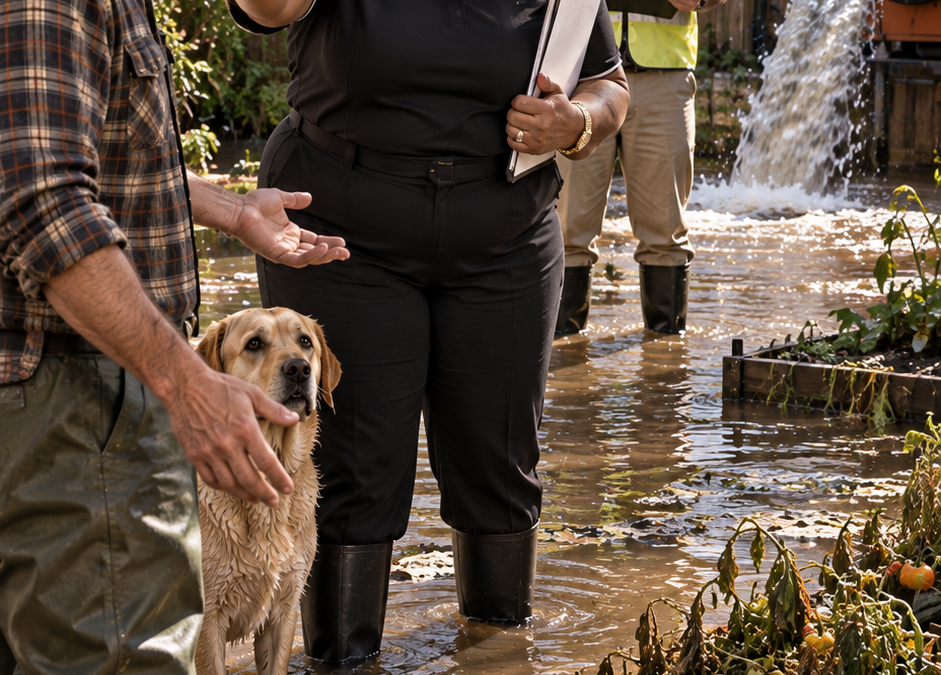
The water was already ankle-deep when I stepped outside at six in the morning.
I remember the light more than anything.
October sun just beginning to come through the trees, turning the surface of my flooded backyard silver.
If you ignored the drowned tomato plants, the floating mulch, and the raised garden beds disappearing beneath brown water, it almost looked peaceful.
Almost.
It hadn’t rained in two days.
The last rain had been barely half an inch.
This wasn’t weather.
I knew that before my second foot touched the ground.
This was mechanical.
At the rear fence line, an orange pump-control box sat on a concrete pad humming steadily.
Four-inch discharge pipe.
Constant flow.
Straight into my property.
Lot 14.
My lot.
The Maplewood Commons HOA had installed that stormwater overflow pump three years earlier to manage the subdivision retention pond.
And for the eleventh time, it was pumping water into my backyard.
My seven-year-old Labrador, Chester, stood on the back porch behind me.
He wouldn’t step down.
He’d learned what standing water meant.
I hadn’t.
Not soon enough.
I set my coffee on the railing and walked into the yard.
Cold water climbed past my ankles.
The tomatoes were gone.
The peppers too.
Late-season kale lay flat under muddy water.
Three years of compost.
Three years of hauling soil.
Three years of Saturday mornings building those beds one board at a time.
Gone again.
I didn’t shout.
Didn’t kick anything.
I pulled out my phone.
Started recording.
Pump.
Fence.
Standing water.
Garden.
Foundation.
Timestamp.
That’s when I heard footsteps coming around the side of my house.
Diane Voss didn’t knock.
She never knocked.
She came through my side yard in pressed slacks at six in the morning with a clipboard tucked under one arm and a sealed HOA envelope held between two fingers.
Behind her walked Glenn Marsh, another board member.
His phone was already raised.
Recording.
Not my damage.
Not my drowned plants.
He slowly panned from the water toward the pump.
Diane glanced at him.
“Make sure you get the pump in frame.”
Glenn adjusted the angle.
“We need proof the drainage is working.”
I stood there in six inches of water and let that sentence settle.
Working.
Diane held out the envelope.
I took it.
Inside was one sheet of Maplewood Commons letterhead signed by all four board members.
The key sentence read:
Routine stormwater management operations are being conducted in accordance with HOA drainage maintenance protocols.
Homeowner is advised not to interfere with HOA infrastructure.
Routine.
Not emergency pumping.
Not storm overflow.
Not unforeseen conditions.
Routine.
Intentional.
Diane folded her arms.
“If you tamper with that pump, we’ll fine you five hundred dollars a day.”
I looked at her.
“And if you send this board any more certified letters,” she continued, “we’ll forward them to our attorney and bill his review time back to you.”
Glenn finished filming.
Then he turned the screen toward Diane.
She watched the video.
Nodded once.
Looked at my flooded yard.
Then at me.
“Good.”
One word.
Like someone inspecting completed work.
I looked toward the orange pump station.
Three weeks earlier, on a quiet Sunday, I had measured its location against the boundary pins.
Four feet, two inches.
Inside my property.
I hadn’t told Diane.
Not yet.
“I’ll look into it,” I said.
Her expression softened into something close to satisfaction.
She thought that meant I was backing down.
At the gate, she stopped.
A neighbor was standing on the sidewalk.
Diane raised her voice just enough.
“He’s learning.”
Then she walked away.
I stood in the water another minute.
Went inside.
Dried my feet.
Sat at the kitchen table.
Chester lay beside me.
I read the notice again.
Routine stormwater management operations.
I opened my filing cabinet.
Took out a new manila folder.
On the front, in black marker, I wrote:
EXHIBITS.
Then I placed Diane’s letter inside.
Exhibit A.
At the time, I had no idea that folder would eventually sit open in front of a county judge.
But I knew one thing.
Diane Voss had just put in writing exactly what I needed her to admit.
The flooding wasn’t an accident.
The HOA knew it was happening.
And they intended to keep doing it.
PART2
Maplewood Commons wasn’t always like that.
The subdivision went in during 1987.
Ninety-six homes.
Mature trees by the time I arrived.
Brick ranch houses.
Quiet streets.
A retention pond near the rear common area.
Clubhouse in the center.
For most of its existence, the HOA did what most homeowners actually want an HOA to do.
Almost nothing.
The old president, Frank Alderman, was a retired schoolteacher.
People described him the same way.
Reasonable.
He sent reminders before fines.
Asked questions before assuming the worst.
If a homeowner had a dead tree or cracked sidewalk, he’d usually call before sending paper.
Then Frank moved closer to his grandchildren in 2019.
Diane Voss became president before the year ended.
Five years later, the association looked different.
Monthly dues had climbed roughly forty percent.
Fine revenue had quadrupled.
The reserve fund had been “reallocated,” to use Diane’s language, to renovate the clubhouse.
New flooring.
New kitchen appliances.
New lighting.
Pergola.
Decorative landscaping.
No full homeowner vote.
No independent audit.
When Tom Breer requested a line-item breakdown of reserve spending during a 2022 meeting, Diane cited financial confidentiality and tabled the discussion.
Tom moved six months later.
Then came the fines.
Basketball hoop visible from the street.
Seventy-five dollars.
Wind chimes deemed “audibly intrusive.”
Fifty.
Vegetable garden classified as an unauthorized landscape modification.
One hundred fifty.
One family paid a hundred dollars because an Amazon package sat on the front porch for two hours before they got home from work.
The fines didn’t need to be large individually.
That wasn’t how the system worked.
The power came from frequency.
Paper.
Deadlines.
Escalation.
Legal language.
And the threat of liens.
Most people paid because fighting a hundred-dollar fine could cost thousands.
Diane understood that arithmetic perfectly.
Eleanor and Harold Briggs lived four houses from me.
Mid-seventies.
Nineteen years in Maplewood Commons.
Fixed income.
Over two years, they quietly paid roughly four thousand dollars in HOA penalties.
A cracked driveway edge.
A Christmas wreath left on the door three days too long.
Harold’s pickup parked at what Diane called an “unauthorized angle” in his own driveway.
When Eleanor told me about it, she looked down at her hands.
“Diane said if we kept disputing things, they’d put a lien on the house.”
She swallowed.
“Harold has a heart condition.”
I didn’t know what to say.
“So we paid.”
Then there was the pump.
That was different.
Because fines are paper.
Water can destroy a house.
In 2019, the county required Maplewood Commons to improve its stormwater overflow system.
The retention pond’s passive outlet couldn’t adequately manage heavier rainfall.
The original subdivision plat already contained a drainage easement.
The legal flow path was clear.
Water left the retention area, traveled through a perimeter corridor, crossed Lot 14 as a pass-through, and ultimately discharged onto HOA-owned common property beside the clubhouse.
The clubhouse parcel was the terminus.
Not my yard.
The county expected the HOA to modernize the drainage system without changing that recorded route.
Instead, Diane’s board hired the cheapest contractor they could find.
No licensed civil engineer designed the installation.
The county permit listed a two-inch residential sump-style pump.
What got installed was a commercial four-inch unit.
Much larger.
Much higher flow.
And the discharge line pointed toward the lowest neighboring residential lot.
Mine.
Diane’s board claimed Section 7.4 of the 1987 CC&Rs allowed it.
The section said:
The association may conduct necessary drainage maintenance on or adjacent to common areas.
Diane had apparently decided that “adjacent to” meant the HOA could dump water wherever it wanted.
No attorney had tested that interpretation.
No engineer had signed off.
Nobody had challenged it.
And for three years, it worked.
Not because it was right.
Because everyone assumed it must be.
I knew about the recorded drainage easement before buying the house.
That was partly professional habit.
I had spent my career around drainage plans, plats, grades, and easements.
But I hadn’t yet told anyone in Maplewood Commons exactly what I did for a living.
I preferred it that way.
When I bought Lot 14, I reviewed the 1987 plat.
The drainage route didn’t end at my property.
My lot was a corridor.
Water was meant to continue through.
Back to association land.
Back toward the clubhouse.
I filed the plat with my closing documents and forgot about it.
Then my yard flooded eleven times.
Eleanor came over that afternoon.
“Don’t fight her.”
She said it gently.
Not because she thought Diane was right.
Because she was afraid for me.
“The last person who really fought the board spent twelve thousand dollars on lawyers and moved.”
“I appreciate the warning.”
“I mean it.”
“I know.”
What I didn’t tell Eleanor was that I wasn’t planning to fight Diane the same way.
I had no interest in shouting at board meetings.
No interest in threatening lawsuits before I had evidence.
The next morning, I started building the record.
First, I bought twelve sandbags.
Filled them myself.
Stacked them around my raised garden beds.
Photographed everything.
The sandbags couldn’t stop thousands of gallons.
That wasn’t why I put them there.
I wanted to see whether the HOA considered protecting my property a violation.
Second, I installed another camera.
Wide angle.
Backyard.
Pump station.
Fence line.
Cloud backup.
Timestamps.
Third, I sent the board a certified letter.
Three paragraphs.
I documented eleven flooding incidents over three years.
Requested the recorded easement or county permit authorizing discharge onto Lot 14.
Asked them to stop until they could provide the legal basis.
Polite.
Specific.
Certified.
They signed for it.
Four business days later, I received their answer.
Not the easement.
Not the permit.
A fine.
$500.
UNAUTHORIZED MODIFICATION OF HOA DRAINAGE INFRASTRUCTURE.
The modification?
My sandbags.
On my property.
Around my vegetables.
I read the notice.
Opened the folder.
EXHIBIT B.
Diane was helping me.
She just didn’t know it.
Eleven days after my certified letter, she confronted me near the community mailboxes.
Four neighbors were close enough to hear.
“Those sandbags need to be gone by Friday.”
I stopped.
“Five hundred dollars a day starting Saturday.”
She stepped closer.
“And if you continue sending harassing correspondence to this board, every letter will go directly to our attorney. We’ll charge you his time.”
The neighbors went quiet.
Two physically stepped away.
Not because they disliked me.
Because they had learned conflict with Diane was contagious.
I asked:
“Can you show me the recorded easement authorizing the HOA to discharge onto Lot 14?”
“I don’t need to show you anything.”
“The county record should be easy to produce.”
“The CC&Rs are the governing authority.”
“So no easement?”
“This isn’t a negotiation.”
I nodded.
“Understood. Thank you.”
Then I walked home.
That evening, two people knocked separately.
Paul lived across the street.
Diane had fined his family three times.
“I’d fight,” he told me, “if I knew how.”
The second was a woman named Sandra.
“Just remove the sandbags.”
“Why?”
“Because it’s not worth it.”
She looked embarrassed.
“Diane fined somebody last spring for sunflowers.”
I wrote both conversations in a notebook.
Date.
Name.
Summary.
Not because I planned to drag neighbors into court.
Because patterns matter.
Then I scheduled an official survey of Lot 14.
Cost:
$800.
Worth every dollar.
I pulled the original 1987 subdivision plat.
Copied all twelve pages.
Sent the drainage-easement page to a civil engineer I’d worked with for years.
One sentence:
Tell me what you see.
The Friday deadline came.
I removed the sandbags.
Not because Diane won.
Because the experiment was over.
She had confirmed in writing that the HOA considered any obstruction to its discharge a punishable offense.
Monday brought another fine.
Then another.
Six notices in four days.
I kept them all.
Two weeks later, the county surveyor arrived.
He spent three hours locating monuments and walking the parcel.
I left him alone.
Brought coffee once.
At the end, he gave me the preliminary result.
“Pump pad is inside your line.”
“How far?”
“Four feet, two inches.”
I already knew.
But hearing it from him mattered.
A homeowner saying something is one thing.
A licensed surveyor stamping it is another.
The certified report would follow.
That night, Eleanor appeared with oatmeal cookies.
She looked at the folder on my table.
“You’re really doing this.”
“Yes.”
She sat down.
Then told me something new.
When the pump was installed, Eleanor and Harold had asked Diane why the discharge pointed toward the houses.
Diane’s answer:
County requirement.
“She told us the county engineer designed it that way,” Eleanor said.
“Those exact words?”
“Yes.”
“Would you write that down?”
She looked at me.
“For what?”
“Just a dated account. What she said. What you remember.”
Eleanor pulled a sheet of paper toward herself.
“Give me a pen.”
Two paragraphs.
Careful handwriting.
Signature.
Date.
I signed as witness.
Into the folder.
A few days later, Marcus Tell stopped in my driveway.
Sixty-eight.
Retired general contractor.
Forty years in residential work.
He looked toward the orange pump station.
“I should’ve said something three years ago.”
“About what?”
“I watched them install that.”
He explained.
In 2019, he had asked the site supervisor why the discharge pointed toward the homes instead of HOA common property.
The supervisor told him Diane approved the layout.
Marcus asked whether there was an engineer of record.
No.
Direct-hire job.
Marcus had assumed somebody at the HOA had reviewed it.
“I should’ve called the county.”
“Would you write down what you remember?”
“Yes.”
No hesitation.
Block handwriting.
Signed.
Dated.
Another exhibit.
Then I visited the county stormwater office.
In person.
You can learn more watching someone’s face than submitting a web form.
I requested the 2019 Maplewood Commons pump permit.
The clerk found it quickly.
Permitted equipment:
Two-inch residential sump pump.
I gave her the model number from the orange unit beside my yard.
She entered it into the county database.
Stopped.
Looked again.
Then at me.
“This is a four-inch commercial pump.”
“Yes.”
“We don’t have an amended permit.”
“I know.”
“No engineer change order either.”
She made a note.
“I’ll flag this for compliance.”
That was the first moment I knew Diane’s problem was becoming bigger than my backyard.
That evening, I spread a large-format copy of the 1987 subdivision plat across my kitchen table.
I traced the recorded drainage arrows.
Retention pond.
Perimeter corridor.
Lot 14.
Continue.
Continue.
Then:
HOA COMMON PROPERTY — CLUBHOUSE PARCEL.
Terminus.
I opened my notebook.
Wrote one sentence:
THE CLUBHOUSE IS THE LEGAL TERMINUS.
My engineer emailed the following morning.
The flow arrows are unambiguous.
The drainage easement forms a continuous loop.
Lot 14 is a pass-through corridor.
Recorded discharge terminus is HOA common property at the clubhouse parcel.
Current pump configuration reverses the intended drainage path.
Printed.
Filed.
Then the pump ran for eleven hours straight.
On a dry November day.
No rain for six days.
Retention pond at normal level.
My camera captured everything.
From just after midnight until nearly noon.
Water pushed toward the rear foundation of my house.
By then, I had the certified survey.
Raised seal.
Four feet, two inches.
Pump station on my property.
No recorded license.
No easement authorizing the pad.
No agreement.
Then I found the crack.
Rear foundation wall.
Hairline at first.
Eighteen inches.
I photographed it.
Measured it.
Marked both ends with pencil.
Dated the marks.
A week later, the crack had grown.
I called David Reyes.
Licensed structural engineer.
He spent ninety minutes inspecting the foundation.
Moisture readings at twelve locations.
Rear wall.
Sides.
Front.
Afterward, he sat at my kitchen table.
“Hydrostatic pressure.”
I knew the term.
I wanted his explanation anyway.
“Water saturates the soil around the foundation. When it can’t drain, pressure builds against the wall.”
“Storm damage?”
He shook his head.
“Not like this.”
He looked back toward the rear wall.
“This is chronic.”
“How long?”
“Two years. Maybe three.”
“Source?”
“The saturation pattern comes from one direction.”
“Fence line.”
“Yes.”
Then he said the sentence that became one of the most important in the entire case.
“This is not natural.”
“Put that in the report.”
He did.
Repairs:
$22,000.
Excavate.
Waterproof.
Regrade.
Repair cracking.
But he also warned me:
“If the water source stays, anything we fix will fail again.”
I filed an insurance claim.
Denied.
Politely.
Correctly.
My policy covered sudden accidental damage.
This was chronic.
Recurring.
Known source.
The adjuster told me if the discharge was unauthorized, the responsible party would have to pay.
I wrote one word in my notebook.
UNPERMITTED.
Then I sent my fourth certified letter to the HOA.
This time, the structural report was attached.
Twenty-two thousand dollars in damage.
Request:
Immediately suspend pump operation pending engineering review.
Confirm whether the HOA intended to remediate the damage.
Fourteen days.
They answered in nine.
Signed by Diane.
Countersigned by their attorney.
The key sentence:
The HOA has no obligation to remediate private property damage resulting from common area maintenance operations conducted under the association’s governance authority.
I read it several times.
They weren’t denying the flooding.
Not disputing the crack.
Not challenging Reyes.
They were saying:
Even if we damaged your house, we don’t owe you.
I labeled it:
EXHIBIT J.
The folder barely closed.
Two weeks later, I attended the monthly HOA meeting.
Front row.
Folder on my lap.
Diane used the meeting to attack me without saying my name.
“A resident,” she said, “has engaged in a pattern of harassing legal correspondence regarding lawful HOA infrastructure operations.”
Several people looked at me.
She continued.
“The board is evaluating all legal remedies, including claims against any homeowner who interferes with common maintenance responsibilities.”
Then she said:
“This board has managed Maplewood Commons for five years. We know the law. We know our rights. And we will protect this association from anyone who tries to use the legal system to bully us.”
I wrote it down.
Word for word.
That evening, I called my engineer friend.
“If we restore the recorded 1987 drainage easement exactly as designed, using the original gradient, where does the water go?”
He answered immediately.
“Clubhouse parking lot.”
“And after that?”
“Depends on grading.”
“Worst case?”
“Crawl space under the clubhouse.”
I was quiet.
“How long to engineer a restoration?”
“Two or three weeks.”
“County-submittable?”
“Yes.”
“Stamped?”
“Yes.”
“Do it.”
Pause.
Then:
“You’ve thought this through.”
“Since flood number two.”
Monday morning, I made two calls.
First:
Robert Callahan.
Civil attorney.
I sent him the entire folder.
He called that night.
“Where did you get all this?”
“I kept records.”
“You have a survey, structural report, permit discrepancy, recorded plat, video, certified notices, admissions from the board, witness statements…”
“Yes.”
“I can work with this.”
Second call:
County code enforcement.
I reported the unpermitted commercial pump.
Permit number.
Actual model number.
Location.
The officer pulled the file while we spoke.
“We’ll issue a notice.”
“When?”
“Probably end of the month.”
Conveniently, the next HOA meeting was three weeks away.
I attended that one too.
Callahan sat two chairs to my left.
Gray blazer.
No tie.
He carried a small notebook.
When someone asked who he was, I said:
“A friend.”
Diane noticed him the moment she entered.
Meeting started.
Budget.
Landscaping.
Holiday lights.
Then Diane introduced a proposed amendment to Section 7.4.
The drainage clause.
Her new language would authorize:
Discharge onto adjacent residential properties during periods of elevated retention pond volume as determined at the board’s discretion.
She was rewriting the rule.
Not because the old one clearly allowed what she had done.
Because it didn’t.
I raised my hand.
Her expression changed.
“Yes?”
“One question.”
She waited.
“Is this amendment intended to apply retroactively to existing property-damage claims?”
Silence.
Her attorney started writing.
“That isn’t the purpose of tonight’s discussion.”
“Understood. I’m asking whether the board intends retroactive application.”
“This meeting is not the venue for individual grievances.”
“Noted.”
I wrote that down.
The board passed the amendment four to zero.
Then fifteen minutes before adjournment, the meeting room door opened.
County jacket.
County employee.
He walked directly to the board table.
Handed Diane a sealed envelope.
Then said loudly enough for everyone to hear:
“Notice of violation. Maplewood Commons Homeowners Association. Unpermitted stormwater infrastructure installation. A compliance officer will contact the association within thirty days.”
He left.
Nobody spoke.
Diane held the envelope.
Glenn stared at the table.
Forty homeowners looked between them.
Callahan and I walked out together afterward.
“Excellent timing,” he said.
“Coincidence.”
He smiled.
The civil complaint was filed the next morning.
Trespass.
The pump station sat on my private property without easement or license.
Private nuisance.
Three years of repeated flooding interfering with my use of Lot 14.
Property damage.
Twenty-two thousand dollars.
The exhibits went with it.
Certified survey.
Structural report.
1987 plat.
Permit records.
Camera footage.
Certified mail receipts.
Diane’s letters.
Everything.
Their attorney called Callahan the following day.
“They want to discuss settlement.”
“No.”
“You sure?”
“I want a ruling.”
Callahan paused.
“All right.”
Four days later, the county approved my drainage-restoration plans.
Licensed PE stamp.
County stormwater approval.
Restore the easement to its recorded 1987 flow path.
Work entirely on my property.
No HOA permission required.
The approval specifically noted that restoration would help resolve the unpermitted discharge problem.
I hired a grading contractor.
Start date:
Monday.
That weekend, I walked down to Eleanor and Harold’s house.
Showed them the plans.
Eleanor read slowly.
“Are you sure this is legal?”
I pointed at the approval stamp.
“County-approved.”
Harold studied the easement diagram.
Then looked at me.
“Son, what exactly do you do for a living?”
I smiled.
“I’ll tell you later.”
Monday morning at seven, the crew arrived.
Compact excavator.
Grading equipment.
Four men.
I handed the foreman the approved plans.
Showed him the stakes.
By 7:15, machinery was running.
Neighbors came outside.
Paul watched from his porch.
Sandra held a coffee mug.
Marcus leaned against his fence.
When the foreman placed the grade stake along the original drainage corridor, Marcus nodded.
The crew worked for six hours.
They restored the slope.
Reopened the recorded drainage route.
Removed a compacted berm that had been blocking the legal channel and forcing water toward my foundation.
I had photographed that berm before work began.
Another exhibit.
Around mid-afternoon, rain started.
Not heavy.
Half an inch over two hours.
Enough.
I stood on the porch.
Chester beside me.
Water began leaving the retention area.
Entered the restored corridor.
Then something happened I hadn’t seen in three years.
It kept moving.
Not toward my house.
Past the garden.
Along the recorded grade.
Past the property stake.
Continuing exactly where the 1987 plat said it should.
Chester stepped off the porch.
No hesitation.
The water crossed the far edge of Lot 14.
Then entered HOA common property.
Toward the clubhouse.
Diane called four times.
I didn’t answer.
At 5:40, a cease-and-desist email arrived.
Forwarded to Callahan.
At 6:15, Diane knocked on my front door.
No clipboard.
First time I’d ever seen her without one.
“You flooded the clubhouse.”
I held up the laminated engineering plans.
“The drainage easement was restored.”
“You deliberately redirected water.”
“No.”
I opened to page three.
“This is the recorded route.”
She stared at the diagram.
“The clubhouse is flooded.”
“The clubhouse parcel is the legal terminus.”
“You’ll be in court.”
“I already am.”
Her face tightened.
“I’ll see you there.”
“I expect so.”
I closed the door.
Three weeks later, I sat beside Callahan in county court.
Diane sat across from us with her attorney, Garrett.
He called my drainage restoration sabotage.
Twice.
Argued the HOA had broad authority under Section 7.4.
Claimed I had unilaterally modified subdivision infrastructure.
Callahan stood.
“Your Honor, may we begin with the recorded plat?”
Exhibit One.
1987 subdivision plat.
Drainage arrows.
Lot 14.
Pass-through corridor.
Recorded terminus:
HOA COMMON PROPERTY — CLUBHOUSE PARCEL.
The judge looked at Garrett.
“Counsel, what language in Section 7.4 modifies this recorded easement?”
Garrett reread the section.
“Your Honor, the language grants broad drainage-maintenance authority.”
“That’s not what I asked.”
Silence.
The judge wrote something.
Exhibit Two.
County-approved restoration plans.
PE stamp.
County approval.
Conforming to recorded plat.
Garrett objected that the HOA had not consented.
Callahan answered:
“All work occurred on plaintiff’s private property, restoring a recorded easement. HOA consent was not legally required.”
Exhibit Three.
Certified boundary survey.
Orange pump station:
Four feet, two inches inside Lot 14.
No license.
No recorded easement.
Trespass.
Callahan asked Garrett:
“Can the association produce any recorded document authorizing occupation of this portion of plaintiff’s property?”
Garrett searched his file.
“No recorded document, Your Honor.”
Exhibit Four.
County permit.
Permitted:
Two-inch residential pump.
Installed:
Four-inch commercial unit.
No amended permit.
No engineer of record.
Existing county violation.
Exhibit Five.
The HOA’s own letter.
Callahan read:
“The HOA has no obligation to remediate private property damage resulting from common area maintenance operations conducted under the association’s governance authority.”
He put it down.
“They were notified of damage.”
Garrett stood.
“That letter was part of negotiations.”
Callahan shook his head.
“There were no negotiations. There were certified notices requesting the HOA stop damaging the property.”
The judge looked toward Garrett.
“Was the engineering report attached before this letter was sent?”
Garrett hesitated.
“Yes.”
“So the board knew there was a claim of foundation damage?”
“Yes.”
Exhibit Six.
David Reyes.
Licensed structural engineer.
Hydrostatic pressure.
Chronic saturation.
Two to three years.
Estimated remediation:
$22,000.
Then Callahan read the line:
“This is not natural.”
Exhibit Seven.
Camera footage.
Pump operating for eleven hours during dry conditions.
Weather records.
No significant rainfall.
Retention pond at normal level.
Then he took out Diane’s first morning letter.
Routine stormwater management operations.
He read the word routine slowly.
The judge looked toward Diane.
For the first time, she stopped taking notes.
Exhibit Eight.
Marcus’s signed statement.
Pump discharge installed in opposite direction from expected common-property route.
No engineer of record.
Site supervisor said HOA president approved layout.
Eleanor’s statement.
Diane told residents the county required the discharge direction.
County records showed otherwise.
Garrett requested a recess.
They went into the consultation room.
Through the wall, I could hear Diane’s voice.
Not words.
Just pitch.
The sound of someone trying to explain something that no longer had enough room to be explained.
When they returned, Garrett changed direction.
He looked at me.
“Your Honor, before relying on plaintiff’s interpretation of these technical documents, I think his qualifications are relevant.”
The judge nodded.
Callahan looked at me.
“Please state your occupation and professional background.”
I answered.
“Licensed civil engineer.”
Diane looked up.
“Twenty-two years.”
The courtroom went quiet.
“From 2003 through 2014, I also worked as a county stormwater infrastructure inspector.”
Diane turned fully toward me.
I continued.
“My responsibilities included reviewing subdivision drainage plans, easements, stormwater systems, and field compliance.”
Garrett stopped writing.
The judge asked:
“You personally worked in this county?”
“Yes, Your Honor.”
“Reviewing systems similar to this?”
“Yes.”
“Did you rely solely on your own professional interpretation before performing the restoration?”
“No. I hired an independent engineer, obtained county approval, and used a separate licensed surveyor.”
Callahan sat down.
Nothing more needed saying.
Diane looked at me as though she had finally understood something that had been standing directly in front of her for months.
I never told her what I did.
She never asked.
She had assumed I was simply another homeowner who would eventually pay.
The judge ruled from the bench.
My drainage restoration was lawful.
It followed the recorded 1987 easement.
It had been reviewed and approved by the county.
The HOA pump station was trespassing on my property.
Maplewood Commons had thirty days to remove it.
At its own expense.
The HOA was liable for $22,000 in foundation damage.
Payment due within sixty days.
The unpermitted pump installation remained subject to county enforcement.
Their request to force me to reverse the restored drainage route was denied.
The judge closed his file.
Callahan began gathering papers.
I picked up the 1987 plat.
Looked at the drainage arrows.
Then slid it across the table toward Diane.
“It’s been in the county records the whole time.”
I didn’t say it loudly.
“Anyone could’ve looked.”
Then I left.
Outside, the sky was clear.
That particular washed-clean blue that comes after days of rain.
The pump station disappeared three weeks later.
A contractor arrived Wednesday morning.
Small excavator.
Two workers.
They broke up the concrete pad.
Removed the orange control box.
Capped the old discharge line.
Backfilled with clean gravel.
Four hours.
I watched from the kitchen with coffee.
When they finished, the foreman knocked.
Handed me a completion certificate.
I signed the acknowledgment.
“Thanks.”
He seemed uncomfortable.
Probably didn’t know the whole story.
He didn’t need to.
He had done his job properly.
After the truck left, I walked to the back corner of the yard.
Level ground.
Clean fence line.
No humming.
Chester followed.
He sniffed the new gravel.
Then wandered toward the garden.
Dogs are better than people at knowing when something is over.
I stayed longer.
Three years.
Eleven floods.
One cracked foundation.
Ten major exhibits.
A file nearly three inches thick.
And now there was just dirt.
The HOA paid the $22,000 judgment.
Not happily.
But on time.
David Reyes’s crew excavated the rear foundation wall.
Waterproofed it.
Repaired the crack.
Regraded the surrounding soil.
When the work was finished, Reyes came back with his moisture meter.
Front.
Sides.
Rear.
He looked at the readings.
“Normal.”
For the first time in three years, the foundation was dry.
Maplewood Commons had other bills.
The county imposed a $14,000 penalty over the unpermitted pump installation.
Then required the HOA to hire a licensed engineer to redesign the larger drainage system to match the recorded plat.
Engineering fee:
$31,000.
Add the judgment.
Their legal expenses.
Pump removal.
Corrective work.
The total cost climbed north of sixty thousand dollars.
Most of it came from the reserve fund Diane had spent years protecting while using part of it to renovate the clubhouse.
I didn’t celebrate.
I kept track.
Those are different things.
The annual meeting came the following spring.
I didn’t attend.
Whatever happened next belonged to the residents.
Eleanor called that evening.
Her voice sounded younger.
“We did it.”
“What?”
“Voted Diane out.”
I leaned against the kitchen counter.
“Glenn?”
“Him too.”
“How close?”
“Not close.”
Then she hesitated.
“They asked me to chair the new board.”
I smiled.
“You said yes.”
“How did you know?”
“Because you’re calling me.”
She laughed.
That was the first time I ever heard Eleanor laugh when talking about the HOA.
The new board reviewed every active fine.
Twenty-three were outstanding.
All twenty-three were canceled.
Paul recovered money on two fines.
Eleanor and Harold couldn’t simply receive a reimbursement for every historic payment because of the association’s accounting rules, so the board issued future dues credits equal to the four thousand dollars they’d paid.
It wasn’t perfect.
It was something.
Then Eleanor called me again.
“We need help.”
“With what?”
“Drainage.”
I sighed.
She laughed.
“Just temporarily.”
The board asked me to serve as volunteer infrastructure adviser while they rewrote their drainage policy.
My condition:
Six weeks.
No permanent role.
No board seat.
No clipboard.
They agreed.
I attended four meetings.
Reviewed two drafts.
Made sure every line matched the recorded easement and county-approved plan.
Then stepped away.
That was enough HOA service for one lifetime.
Around the third month after court, someone mentioned Diane’s house had gone on the market.
A few weeks later, someone else mentioned a moving truck.
I never checked.
I didn’t need to know where she went.
The only property of hers I had ever cared about was the clubhouse.
And not because I wanted to flood it.
That distinction mattered to me.
People retold the story afterward as though I had engineered some revenge scheme.
HOA floods man’s yard.
Man redirects water into HOA clubhouse.
Funny.
Satisfying.
Simple.
That’s not what happened.
I didn’t invent a route.
Didn’t build a ditch aimed at their building.
Didn’t sabotage anything.
The route already existed.
Recorded in 1987.
County-filed.
Public.
Lot 14 was always a pass-through.
The clubhouse parcel was always the terminus.
Somebody before me had blocked that route.
Then installed a larger unpermitted pump pointing toward my house.
I restored what had been recorded for decades.
The water did the rest.
Gravity doesn’t know revenge.
It just follows elevation.
I had the large-format subdivision plat framed.
Simple black frame.
No matting.
Hung it in the hallway between my kitchen and back door.
At the bottom, beneath the drainage diagram, I added one small label:
RECORDED EASEMENT TERMINUS — HOA COMMON PROPERTY.
That’s all.
The raised-bed garden took most of spring to rebuild.
Fresh soil.
Compost.
Tomatoes.
Peppers.
Late-season kale.
Chester resumed his self-appointed inspection rounds.
Every morning he’d walk between the beds, sniff everything, then look at me like the whole operation was under control.
Late that summer, Eleanor came by.
The garden was full.
She stood at the fence.
“Harold wants tomatoes.”
“Tell Harold he can come ask himself.”
“He sent me.”
“Coward.”
She laughed and started picking.
After a minute, she said:
“Someone told me what Diane said at her last board meeting.”
“What?”
Eleanor didn’t look up.
“She said, ‘I don’t understand how this happened.’”
I thought about that.
The pump.
The letters.
The fines.
The structural damage.
The permit.
The survey.
The plat.
Everything.
Then I said:
“She handed me the document that ended it.”
Eleanor turned.
“What document?”
“That first letter.”
The one I had labeled Exhibit A.
Routine stormwater management operations.
Signed.
Dated.
Admitting exactly what they were doing.
I looked toward the back corner where the pump used to sit.
“I just waited for her to put it in writing.”
Eleanor went back to the tomatoes.
For a while, neither of us spoke.
The yard was dry.
Foundation repaired.
Garden growing.
Chester moving between the beds.
Somewhere down the street, a lawn mower ran.
Harold eventually came over carrying an empty grocery bag.
“I hear you’re giving away my tomatoes.”
“To Eleanor.”
“She works for me.”
“She said you were afraid to ask.”
He looked offended.
“I’ve been married fifty-one years. Of course I’m afraid to ask.”
We filled the bag.
That was the neighborhood I thought Maplewood Commons was supposed to be.
Not silent because everyone was afraid of receiving an envelope.
Quiet because people were simply living.
There was one more thing I did.
I kept the exhibit folder.
Not on the kitchen table.
Back in the filing cabinet.
The original HOA notice is still inside.
Exhibit A.
The sandbag fine.
Survey.
County permit.
Eleanor’s statement.
Marcus’s statement.
Structural report.
Letters.
Court order.
Everything.
I don’t open it often.
I don’t need to.
But sometimes a neighbor asks how I knew what to do.
They expect a clever legal trick.
I tell them there wasn’t one.
I documented.
I asked for authority in writing.
I checked the recorded plat.
I hired independent professionals.
I used certified mail.
I photographed conditions before changing anything.
And before I redirected one drop of water, I got the restoration engineered, stamped, and approved by the county.
That last part matters.
Because anger wanted me to grab a shovel after flood number two.
Anger wanted me to block the discharge after flood number five.
Anger wanted me to tear that pump out after flood number eleven.
If I had done any of those things, Diane might have won.
Instead, every time she escalated, I slowed down.
Paper before action.
Survey before accusation.
Engineer before repair.
Approval before excavation.
Boring.
Painfully boring.
That is usually what lawful looks like while you’re doing it.
The dramatic part comes afterward.
When the rain falls.
And water finally goes where the county record always said it belonged.
The clubhouse was repaired too.
I heard they had water in part of the parking lot and crawl space after that first restored flow.
Nothing catastrophic.
No building collapsed.
Nobody was hurt.
The new engineering design improved the entire system afterward.
Proper capacity.
Correct permits.
Legal route.
Everybody’s property better protected.
Including the clubhouse.
That’s the part that sometimes gets lost.
The final solution was better for all ninety-six homes.
Even the association itself.
It just required the people in charge to admit the original installation had been wrong.
Diane could have done that after my first certified letter.
Cost:
Almost nothing.
Send an engineer.
Check the plat.
Move the pump.
Repair my yard.
Done.
Instead, she fined my sandbags.
Threatened attorney fees.
Ignored the easement question.
Allowed the damage to continue.
Tried to rewrite the bylaws.
And handed me signed documents confirming every step.
That’s how a correctable mistake became a sixty-thousand-dollar problem.
Not because I was clever.
Because she couldn’t tolerate being challenged.
There is a difference between authority and certainty.
Diane had certainty.
She spoke like every decision had already been reviewed by someone smarter than the person questioning it.
County requirement.
HOA authority.
Drainage protocol.
Legal counsel.
Maintenance operations.
The words sounded official.
Eleanor and Harold believed them.
So did most neighbors.
I almost did too, until the water reached my foundation.
Then I checked.
That was all.
Checked.
The county permit didn’t match.
The survey didn’t match.
The drainage route didn’t match.
The pump location didn’t match.
Diane’s story only worked as long as nobody compared it to the records.
I still drink coffee on the back porch most mornings.
Chester’s older now.
Moves slower.
He still checks the garden.
When rain starts, I sometimes catch myself watching the back corner where the orange pump once stood.
Old habit.
The first real storm after the repairs came in hard.
Thunder around midnight.
Two inches by dawn.
I woke before six.
Went to the back window.
For half a second, my body expected brown water.
Instead, the yard was wet.
Just wet.
Normal wet.
No standing pool.
No drowned plants.
No current running toward the foundation.
I opened the back door.
Chester walked straight down the steps.
Didn’t hesitate.
I followed.
Rainwater moved through the restored channel.
Past my property.
Toward the recorded outlet.
Quietly.
Exactly the way it had been designed nearly forty years earlier.
I stood there barefoot.
Coffee in hand.
No phone.
No recording.
No Diane.
No clipboard.
Just rain.
I hadn’t realized until then how long it had been since rain felt like weather instead of evidence.
That morning, I walked back inside and stopped in front of the framed plat.
Thin black lines.
Arrows.
Lot numbers.
A drainage route nobody on Diane’s board had bothered to read closely.
At the end:
HOA common property.
Clubhouse parcel.
People occasionally ask whether I felt bad watching their clubhouse take water that first afternoon.
The truthful answer is no.
But I didn’t feel good either.
What I felt was relief.
Not because their building got wet.
Because my house didn’t.
For three years, somebody had decided my property was the convenient place for the subdivision’s problem to stop.
My garden.
My soil.
My foundation.
My responsibility.
Then they put that decision on letterhead and called it routine.
The recorded plat said otherwise.
The county said otherwise.
The survey said otherwise.
The structural engineer said otherwise.
The judge said otherwise.
I didn’t redirect their water out of spite.
I restored the legal path.
The fact that the legal path ended at the clubhouse was not something I created.
It had been true since 1987.
Diane simply never bothered to look.
The garden is better now.
The foundation stays dry.
Eleanor chairs the HOA differently than Diane ever did.
Meetings are boring.
That’s good.
People ask questions.
Minutes get posted.
Financial records get shared.
Nobody gets fined for wind chimes.
Harold still parks his truck crooked.
Sometimes almost impressively crooked.
Nobody cares.
Paul planted sunflowers last year.
A whole row.
When they bloomed, he took a photograph and sent it to me with no message.
He didn’t need one.
I printed the picture.
It’s tucked inside the exhibit folder.
Not evidence.
Just something I wanted to keep.
Maybe that’s the real ending.
Not the courtroom.
Not Diane losing her board seat.
Not the sixty thousand dollars.
Not even the clubhouse.
It’s a dry yard.
A repaired wall.
Tomatoes growing where muddy water used to stand.
An old couple no longer afraid of their mailbox.
A dog willing to walk off the porch when it rains.
And a neighborhood association finally understanding something that should have been simple from the beginning:
Common property does not mean other people’s property.
Authority is not permission to cause damage.
And water, unlike a board president, does not care how confident you sound.
It follows the grade.
It follows the easement.
It follows gravity.
All I did was put the path back where it had always belonged.








