𝗙𝗨𝗟𝗟 𝗦𝗧𝗢𝗥𝗬 HOA Fined Me for Plowing Their Road—So I Parked My Truck and Let the Mountain Take Over
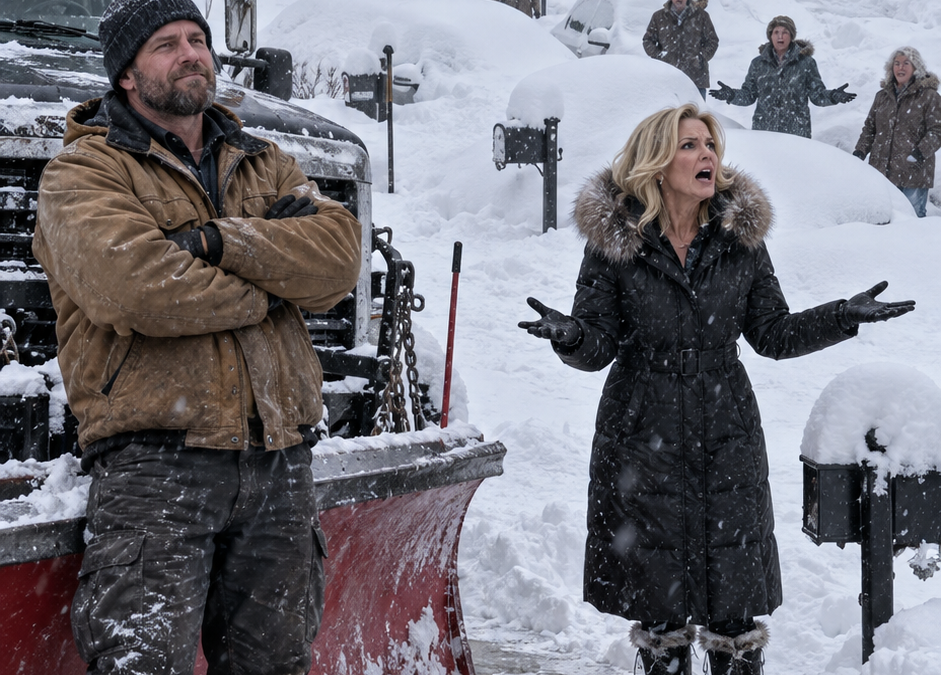
𝗙𝗨𝗟𝗟 𝗦𝗧𝗢𝗥𝗬
Two days later, I encountered Beatatrice in our local hardware store.
She found me in the plumbing aisle holding a brass fitting.
“Mr. Mitchell.”
“Mrs. Thorne.”
“I assume you received the association’s notice.”
“I did.”
She smiled.
“I hope there are no hard feelings.”
“There usually aren’t. Snow takes care of those.”
She ignored that.
Beatatrice had moved to Grand Heights from Phoenix three years earlier after a successful career in luxury real estate.
That explained a lot.
She understood staged entrances, curb appeal, premium branding, and how to make a twelve-million-dollar development sound like civilization’s final achievement.
What she did not understand was winter above seven thousand feet.
To her, snow was decorative.
Something that belonged on evergreen branches and glossy brochures.
She had never spent six hours digging frozen chains from beneath an axle at ten below zero.
She had never watched rain turn to ice halfway up a mountain road.
She had never seen a propane truck slide backward through a hairpin because the driver lost traction.
But confidence often arrives before experience.
“Our residents are very excited about the new snow service,” she said. “EcoClear Solutions uses modern equipment.”
“So do I.”
“They use Mercedes Unimogs.”
“Fine trucks.”
“Rubber-edged plows.”
“That will protect your seal coat.”
“Exactly.”
“And possibly leave ice.”
She gave me the patient smile people reserve for elderly relatives who refuse to stop using flip phones.
“They also use an organic beet-based deicer.”
I stared at her.
“Beet juice.”
“It’s environmentally responsible.”
“Compared with what?”
“Salt.”
“On that grade?”
“Yes.”
“At ten degrees?”
“The company says it works extremely well.”
I nodded slowly.
“What company?”
“EcoClear Solutions.”
“From Denver?”
“Yes.”
“Have they serviced Grand Heights before?”
“No, but they have excellent credentials.”
“Have they worked that road?”
“Their mapping software has.”
I almost smiled.
“Of course it has.”
Beatatrice’s expression sharpened.
“Mr. Mitchell, this attitude is exactly why the board acted.”
“What attitude?”
“The idea that only you understand the mountain.”
“No.”
I put the fitting back on the shelf.
“The mountain understands itself. I just pay attention.”
She sighed.
“We’re trying to modernize.”
“And I’m trying to buy a pipe fitting.”
“Then perhaps we can settle the fine and move on.”
There it was.
Five hundred dollars.
I took out my checkbook.
Her eyebrows lifted.
I wrote the check.
$500.00
Then I pulled a carbon-copy receipt from my coat.
At the bottom was a sentence I had typed that morning after speaking with my attorney.
It said that by accepting payment of the fine, the association acknowledged my immediate compliance with its November 1 directive requiring me to cease all plowing, sanding, road treatment, snow removal, and maintenance activity on Grand Heights Boulevard.
Beatatrice barely glanced at it.
She saw “receipt.”
Saw the amount.
Saw a signature line.
Then signed with a purple gel pen.
“Thank you,” she said.
“Thank you.”
“I’m glad we handled this like civilized neighbors.”
“So am I.”
She handed the receipt back.
I folded it.
Put it in my pocket.
Then walked outside.
The sky had turned the color of a rifle barrel.
The temperature had dropped six degrees while we were inside.
I stopped on the sidewalk and looked west.
The first wind came down the street.
Cold.
Dry.
Sharp enough to make my eyes water.
The mountain was preparing an answer.
I drove home.
The next forty-eight hours were quiet.
I did not touch Grand Heights Boulevard.
I did not inspect it.
I did not sand the corners.
I did not prepare the Leviathan for service.
Quite the opposite.
I winterized it for storage.
Heavy batteries came out and went onto chargers inside the workshop.
Air tanks were drained.
Plow components received rust protection.
Fuel valves closed.
I locked the Kenworth inside my barn.
Then I prepared my ranch.
Wood.
Diesel.
Generator.
Food.
Water.
Medical supplies.
Chains for my smaller ranch truck.
The sort of things mountain families prepare every winter because electricity is a convenience and weather is not.
At the bottom of Grand Heights Boulevard stood an old steel gate installed by my father decades earlier.
It had remained open for so long most residents probably thought it was decorative.
It wasn’t.
The 1996 easement allowed residential passage across my ranch.
It did not automatically grant unlimited commercial staging rights.
For years I had ignored that distinction.
Propane trucks.
Contractors.
Delivery vans.
Snow companies.
Why make life difficult?
Beatatrice had answered that question for me.
I oiled the hinges.
Closed the gate.
Locked it.
Then attached a sign:
PRIVATE PROPERTY
RESIDENTIAL EASEMENT ACCESS ONLY
COMMERCIAL VEHICLES REQUIRE OWNER AUTHORIZATION
I photographed it.
Timestamped everything.
Then went home.
The first snow fell that evening.
Small.
Dry.
Hard crystals that bounced from the porch railing rather than melting.
By eight, six inches covered the ranch.
At midnight, the temperature had fallen into single digits.
Up on Grand Heights Ridge, EcoClear Solutions arrived.
I know what happened because their vehicle cameras, insurance records, and later depositions documented most of it.
Two Mercedes Unimogs came from Denver.
Modern.
Compact.
Sophisticated.
Each carried a rubber-edged plow and beet-based road-treatment equipment.
Under ordinary conditions, they would probably have done fine.
Grand Heights was not experiencing ordinary conditions.
The first major problem was temperature.
The road surface had fallen well below the range where their treatment strategy remained reliable.
Moisture froze hard.
Snow compacted.
Their rubber-edged blades protected the asphalt beautifully.
They also struggled to cut through the hard bonded layer beneath the fresh accumulation.
At the first hairpin, the lead truck began losing traction.
The driver reduced speed.
Then touched his brakes.
The rear end rotated.
Slowly.
Then faster.
The Unimog slid sideways until its back wheels dropped over the downhill edge.
It stopped at an angle against trees.
The driver survived.
The road did not.
Truck number two attempted to reach it.
That vehicle slipped against the inside rock wall, damaging its front end and hydraulic system.
By four in the morning, Grand Heights Boulevard was blocked.
Twelve inches of snow became eighteen.
Then twenty-four.
Then three feet.
Wind piled drifts deeper.
Power lines on the ridge came down under ice and wind.
Grand Heights lost electricity.
The cellular tower switched to backup.
Then failed.
At five in the morning, somebody began pounding on my porch door.
I opened it.
A young man stood outside wearing a soaked premium jacket and the expression of somebody who had recently discovered that advertising copy is not a traction device.
“Are you Mitchell?”
“Yes.”
“I’m Tyler. EcoClear.”
Of course.
“What happened?”
“Our trucks are stuck.”
“I heard.”
His eyes widened.
“You heard?”
“Mountains carry sound.”
“One slid off the road.”
“That’s unfortunate.”
“The other is blocking the lane.”
“Also unfortunate.”
He looked beyond me toward the barn.
“You’ve got the Kenworth.”
“I do.”
“We need it.”
“No.”
He stared.
“What?”
“I’m not operating on Grand Heights Boulevard.”
“We’ll pay you.”
“I’ve been ordered to stop.”
“This is an emergency.”
“I agree.”
“Then help!”
I walked back inside and returned with Beatatrice’s letter.
Held it up.
“Unauthorized industrial snow-removal vehicle.”
Tyler stared.
“I don’t care what that says.”
“I do.”
“There are families up there!”
“Yes.”
“Elderly residents.”
“Yes.”
“Kids!”
“Yes.”
He took a step closer.
“We’ll pay five thousand dollars.”
“That doesn’t change the order.”
“I’m the contractor!”
“You are not the landowner.”
“Your truck could clear that road.”
“Probably.”
“Then why won’t you?”
I looked at him.
“Because your client fined me for doing it.”
His jaw tightened.
“This is petty.”
“No.”
I folded the letter.
“Petty was charging me five hundred dollars after I plowed their road for free.”
The wind blew snow across the porch.
Tyler shivered.
I continued.
“This is compliance.”
He looked toward the road.
“We need a tow truck.”
“My gate is closed to unauthorized commercial traffic.”
His face went pale.
“What?”
“The easement is residential.”
“You can’t do that.”
“I can.”
“How are we supposed to recover our trucks?”
“Your company should probably discuss that with the HOA.”
“I am discussing it with you!”
“No.”
“You’re enjoying this.”
I thought about that.
“A little.”
His mouth fell open.
“But mostly I’m warm.”
He hated that answer.
By noon, the ridge was isolated.
I did not know the full severity until later.
Grand Heights homes were built beautifully but depended heavily on electricity.
Radiant heating.
Smart thermostats.
Electric circulation pumps.
Some had propane backup, but not enough for extended outages.
The main power failure stretched beyond twelve hours.
Then eighteen.
Indoor temperatures dropped.
Pipes began freezing.
Backup generators ran low on propane.
Delivery trucks could not reach the development.
The county refused to send heavy equipment up the private road while their own crews were overwhelmed clearing public highways.
For decades, Grand Heights residents had assumed that when the mountain closed, I would open it.
That assumption was gone.
On the second afternoon, I saw a man walking down the buried road.
Slowly.
Badly.
Snow reached his thighs in several places.
I put on snowshoes and headed toward the gate.
It was Robert Sterling, the HOA vice president and resident attorney.
He reached the gate and leaned against it.
His beard was frozen.
His lips were nearly blue.
“Vance.”
“You look terrible, Robert.”
“We need help.”
I poured coffee from my thermos and passed it through the gate.
He drank.
Hands shaking.
“Our pipes are freezing.”
“I figured.”
“Two residents need medication.”
That changed my mood.
“Who?”
He gave me the names.
I knew one.
Seventy-eight.
Heart condition.
“How long do they have?”
“Maybe until tomorrow.”
I looked up the ridge.
“Why didn’t they evacuate before the storm?”
“We thought EcoClear could handle it.”
There are moments when sarcasm becomes inappropriate.
That was one.
Robert took another drink.
“Beatatrice wants to talk.”
“I don’t.”
“Vance.”
“I was very clear.”
“She was wrong.”
That was interesting.
“Say that again.”
He closed his eyes.
“She was wrong.”
“About?”
“The truck.”
“And?”
“The road.”
“And?”
“The easement.”
I smiled slightly.
“Now we’re making progress.”
He looked exhausted.
“What do you want?”
“Not money.”
“We’ll pay.”
“I’ve plowed for free for thirty years.”
“Then what?”
I pulled a document from my coat.
My lawyer and I had drafted it after the HOA’s cease-and-desist letter.
Not because I planned to hold anyone hostage.
Because after thirty years of informal arrangements, I was done relying on goodwill.
“This is an easement and winter-maintenance agreement.”
Robert read.
The first provision recognized that my ranch and equipment were outside HOA architectural and aesthetic authority.
Second, the association rescinded the five-hundred-dollar fine and issued written acknowledgment that my historical snow clearing had been voluntary and beneficial.
Third, future winter road maintenance would operate under a paid contract instead of assumptions.
Fourth, Grand Heights would indemnify my operation for ordinary plowing risks when performed according to agreed safety procedures.
Fifth, the HOA could not again prohibit emergency maintenance and then demand it without written reinstatement.
Robert looked up.
“What about Beatatrice?”
“Board governance is your problem.”
“She won’t sign.”
“Then the board can decide whether her pride outranks forty-two houses.”
He stared at the document.
“You prepared this before the storm.”
“Yes.”
“You expected this.”
“I expected winter.”
“That’s not what I mean.”
“I didn’t create the storm.”
“You knew EcoClear would fail.”
“I knew they were untested on this road.”
He looked up the ridge.
“Can you clear it?”
“Yes.”
“How long?”
“If the commercial trucks blocking the corners can be stabilized enough for safe passage, first emergency lane in about an hour.”
His eyes closed.
Relief.
Then:
“I can authorize this.”
“You?”
“The board gave me emergency authority before I came down.”
“Get the signatures.”
“Some board members are three miles uphill.”
“You have an emergency-resolution procedure.”
He stared.
“You know our bylaws?”
“Beatatrice has mailed enough of them to my house.”
He almost laughed.
Almost.
Robert signed.
Then radio communication through a surviving battery unit allowed the remaining board members to authorize the emergency agreement.
I had my neighbor Frank Nelson, a retired notary and former Army mechanic, witness the signatures.
Only then did I open the barn.
The Leviathan waited inside.
Yellow paint.
Steel.
Grease.
Old scars.
No decorative dignity whatsoever.
Beautiful.
Frank helped me reinstall the batteries.
We warmed the Detroit diesel.
Checked hydraulics.
Air pressure.
Chains.
Lights.
I climbed into the cab.
Turned the key.
The starter rotated.
Once.
Twice.
Then the engine came alive.
The sound shook snow from the barn roof.
Twin exhaust stacks threw dark smoke into the white air.
Frank grinned.
“Still obnoxious.”
“That’s why it works.”
I lowered the V-plow.
Opened the gate.
And went to work.
The first impact of the steel cutting edge against the frozen road traveled through the steering wheel into my shoulders.
The blade bit beneath the packed layer.
Snow rolled outward.
Not delicately.
The Leviathan threw it.
Twenty feet.
Thirty.
Sometimes more.
The road behind me turned black.
Ugly.
Safe.
I added sand where needed.
Used chains.
Took the hairpins slowly.
At the first disabled Unimog, I stopped.
The road was partially blocked.
The vehicle sat with its rear off the embankment.
I did not smash it down the mountain.
Tempting fiction.
Terrible recovery practice.
Instead, we cleared enough snow around it for a professional wrecker to stabilize it later.
At the second truck, we opened a narrow lane around the damaged vehicle.
It took additional time.
Nobody complained.
Residents began emerging from houses as I reached the upper road.
Blankets.
Winter coats.
Some crying.
Some waving.
One man actually hugged the side of the Kenworth.
I told him not to.
The metal was filthy.
Then Beatatrice appeared.
Three coats.
Knitted hat.
No makeup.
No purple stationery.
She stood on her front steps while the Detroit diesel idled.
I lowered the window.
“Morning.”
She stared at me.
“You came.”
“Robert handled the paperwork.”
Her face tightened.
“You forced us to sign.”
“No.”
“You refused to help until—”
“You ordered me to stop.”
“That fine was administrative.”
“You deposited the check.”
“This was an emergency!”
“Yes.”
“And you used it.”
I looked at her.
“Beatatrice, for thirty years my family performed a service you never had to think about.”
She said nothing.
“You decided that service was ugly.”
Still nothing.
“You replaced it.”
Silence.
“The replacement failed.”
Her jaw tightened.
“And now you want the old arrangement back without acknowledging why it disappeared.”
A resident stood nearby listening.
Then another.
I continued.
“That’s not how this works anymore.”
She looked at the cleared black road.
The towering dirty snowbanks.
The chain marks.
The sand.
Everything she had called aesthetic degradation.
“What happens now?”
“Emergency access is open.”
“And after the storm?”
“You read the agreement.”
Her expression said she had.
“That contract is outrageous.”
“Then hire EcoClear again.”
I put the truck in gear.
Before rolling away, I said:
“Seasonal visual harmony looks different from inside a frozen house, doesn’t it?”
For once, Beatatrice had no answer.
The winter damage was expensive.
Several homes suffered burst pipes.
Garages flooded.
Landscaping froze.
The EcoClear trucks required recovery and major repairs.
The HOA blamed the contractor.
The contractor blamed weather.
Then everybody started looking for somebody with money.
By spring, that somebody became me.
A lawsuit arrived in April.
Grand Heights HOA and EcoClear accused me of interference with their contract, unlawful restriction of commercial access, and coercion relating to the emergency maintenance agreement.
They also argued that the agreement had been signed under duress.
My attorney, Ellen Reyes, called after reading it.
“They’re actually doing this.”
“Apparently.”
“Do you still have Beatatrice’s November letter?”
“Yes.”
“The payment receipt?”
“Yes.”
“Her signature?”
“Yes.”
“Photographs of the truck in storage?”
“Yes.”
“Gate?”
“Yes.”
“Original easement?”
“Yes.”
Long pause.
“You’re disturbingly prepared.”
“Mountain habit.”
Then discovery began.
That was Beatatrice’s second major mistake.
The first was ordering me to stop plowing.
The second was suing me.
Lawsuits require documents.
Documents are difficult things.
They don’t respect reputations.
They don’t care who has the better haircut.
During discovery, Ellen requested:
Board minutes.
Snow-service procurement records.
Payments.
Conflict disclosures.
Contractor ownership.
Reserve-account transfers.
Insurance communications.
Then she called me one afternoon.
“You sitting down?”
“Yes.”
“EcoClear is owned through a holding company.”
“Okay.”
“Managing member is Tyler Thorne.”
I stopped.
“The Tyler who came to my house?”
“Yes.”
“Relation?”
“Beatatrice’s nephew.”
There it was.
“How much was the contract?”
“Eighty-five thousand for the season.”
I nearly dropped the phone.
“For that road?”
“Yes.”
“That’s absurd.”
“Comparable bids we found were under thirty.”
“Competitive bidding?”
“None.”
“Board approval?”
“Technically.”
“What does technically mean?”
“Beatatrice told the board EcoClear was the recommended specialist contractor. She did not disclose her family connection in the minutes we have.”
I leaned back.
“Where did the money come from?”
“That is my favorite part.”
“Go ahead.”
“Emergency infrastructure reserve.”
I stared at the workshop wall.
“That fund was for retaining structures and drainage.”
“Correct.”
“She used emergency money to hire her nephew to replace free snowplowing.”
“Correct.”
“Then fined me five hundred dollars.”
“Yes.”
I smiled.
“Visual harmony is expensive.”
The hearing was held in county district court.
Beatatrice arrived wearing a dark wool suit.
Her attorney was polished, young, and confident.
He described me as a mountain landowner who had exploited an emergency.
My attorney let him finish.
Then we started with November 1.
The cease-and-desist letter went into evidence.
The judge read the relevant paragraph.
“Mrs. Thorne ordered Mr. Mitchell to cease snow-removal operations?”
Her attorney said:
“The association was exercising ordinary regulatory authority.”
“Did it fine him?”
“Yes.”
“Did it cash his check?”
“Yes.”
Then my signed receipt.
The judge read my compliance acknowledgment.
“When was this signed?”
“November third.”
“Storm date?”
“Began November sixth.”
The judge looked toward Beatatrice.
“So this was signed before any emergency existed.”
Her attorney shifted.
“The receipt was not intended as a negotiated contract.”
My lawyer stood.
“It is not being offered as the emergency contract, Your Honor. It establishes that my client formally complied with an HOA directive before the storm.”
Exactly.
Then photographs showed the Leviathan in storage.
Batteries removed.
Air system drained.
Blades coated.
Barn locked.
I testified.
“Why did you deactivate the truck?”
“Because Grand Heights ordered me to stop operating it on their road.”
“Could you have simply kept it ready?”
“Yes.”
“Why didn’t you?”
“Because I was told my operation was unauthorized.”
“Were you attempting to create an emergency?”
“No.”
“Did you control the weather?”
That earned an objection.
Also a laugh from the gallery.
Sustained.
But worth it.
The original 1996 easement came next.
Residential passage.
No county maintenance obligation.
Commercial access was not as broad as the HOA had assumed.
Years of informal cooperation had allowed contractors through my gate.
But informal cooperation was not ownership.
Then came the emergency agreement.
The judge asked Robert Sterling to testify.
That changed everything.
Robert had been HOA vice president during the storm.
He looked deeply uncomfortable.
“Mr. Sterling, did Mr. Mitchell threaten you physically?”
“No.”
“Did he cause the storm?”
“No.”
“Did he prevent residents from leaving on foot?”
“No.”
“Did he block residential passage?”
“The gate was locked to vehicles at that point, but residents retained passage rights.”
“Why did you sign the emergency amendment?”
Robert looked toward Beatatrice.
Then the judge.
“Because we needed a qualified plow operator.”
“Were alternatives available?”
“Not practical ones.”
“Who drafted the emergency agreement?”
Robert hesitated.
“I participated.”
Beatatrice’s attorney turned sharply.
“You drafted it?”
“I revised it.”
That was useful.
Very useful.
Then discovery records came out.
EcoClear Solutions.
Eighty-five thousand dollars.
No competitive bids.
Tyler Thorne.
The judge looked at Beatatrice.
“Your nephew?”
Beatatrice’s attorney stood.
“Your Honor, this financial matter exceeds the scope—”
My lawyer responded:
“It goes directly to motive, procurement history, and the plaintiff’s assertion that my client maliciously interfered with an independent contractor relationship.”
The judge allowed it.
The reserve-account transfer appeared.
Eighty-five thousand dollars removed from emergency infrastructure funds.
A board email followed.
Beatatrice had described EcoClear as a “premium strategic partner.”
No disclosure that Tyler was family.
Another email from Tyler to Beatatrice read:
Aunt B—thanks for pushing this through. Once people see the road clean without that dinosaur truck, they’ll never want Mitchell involved again.
The courtroom went silent.
Beatatrice stared straight ahead.
My lawyer asked:
“Mrs. Thorne, did you disclose your relationship to Mr. Thorne before recommending the contract?”
“I believed everyone knew.”
“Is that a yes?”
“No.”
“Did you solicit competitive bids?”
“No.”
“Why not?”
“Timing.”
“The contract was executed in September.”
“We wanted certainty.”
“Why was the emergency reserve used?”
“Road safety is infrastructure.”
“Then why did you fine Mr. Mitchell for performing road-safety work?”
Beatatrice looked at me.
Not the lawyer.
Me.
That was when I knew she had lost.
The judge dismissed the core claims against me.
She upheld the emergency maintenance agreement’s principal provisions concerning access, maintenance authority, and payment, while leaving certain damages provisions subject to separate review.
More importantly, she referred the procurement and reserve-fund records to appropriate state authorities for investigation.
Outside the courtroom, Beatatrice approached me.
“You ruined Grand Heights.”
I looked at her.
“No.”
“The road is destroyed.”
“Winter damaged it.”
“The association is bankrupt.”
“You spent eighty-five thousand dollars on your nephew.”
Her face tightened.
“You turned everyone against me.”
“I wasn’t in the boardroom when you approved the contract.”
“You knew this would happen.”
“I knew snow would happen.”
“You wanted me humiliated.”
I considered that.
“After the five-hundred-dollar fine?”
She waited.
“A little.”
Her eyes flashed.
“But mostly I wanted to be left alone.”
She walked away.
The HOA did not survive another year in its original form.
Residents recalled Beatatrice.
An independent financial review uncovered enough irregularities to keep attorneys busy for months.
The emergency reserve was nearly gone.
Road repairs were extensive.
Homeowners faced assessments they had not expected.
Eventually Grand Heights reorganized its community structure and stripped most of the old HOA’s aesthetic enforcement powers.
Beatatrice sold her house.
The first asking price was optimistic.
Then it dropped.
Again.
Again.
Apparently “exclusive alpine estate dependent on disputed private access road” lacks some of the romance of “mountain paradise.”
She moved back to Arizona.
I heard Phoenix welcomed her warmly.
Probably because snow is less argumentative there.
Grand Heights Boulevard changed too.
Residents restored its original historical name:
Mitchell Pass.
They replaced the oversized decorative entrance structure with a simple wooden sign.
No dramatic logo.
No luxury branding.
Just the name.
The winter contract stayed.
Not at the absurd amount originally contemplated during the emergency, but at a fair rate agreed in advance.
The residents paid.
I plowed.
I carried insurance.
The association maintained sand stockpiles.
Everyone understood responsibilities.
Amazing what happens when neighbors use contracts instead of assumptions.
The Leviathan remained ugly.
Still loud.
Still smoky on cold starts.
Still left dirty snowbanks.
Still scratched pavement when chains were necessary.
Nobody fined it.
One winter morning, a new resident stopped me beside the lower gate.
He pointed at the Kenworth.
“That thing really thirty years old?”
“Older.”
“Doesn’t look environmentally friendly.”
“It isn’t friendly to anything.”
He laughed.
“Why not replace it?”
“Because it starts.”
He nodded toward the road.
“People say the HOA once fined you for plowing.”
“Correct.”
“Why?”
“Aesthetics.”
He looked at the snow falling around us.
Then at the road.
“Seriously?”
“Five hundred dollars.”
“What did you do?”
“Paid it.”
“That’s it?”
“And stopped.”
He laughed.
“No.”
“Yes.”
“You really just parked the truck?”
“Exactly what they ordered.”
“What happened?”
I looked up toward the ridge.
Snow was beginning to thicken.
“Winter reviewed the decision.”
That story has become more dramatic over the years.
People say I deliberately trapped Grand Heights.
I didn’t.
They say I knew the exact storm would come.
I didn’t.
They say I refused medical help during the blizzard.
Absolutely not.
Once I learned residents faced genuine medical risk and proper authorization was available, I opened the road.
I was angry.
I wasn’t homicidal.
What I did refuse was the old arrangement where my labor was treated as invisible until somebody disliked the appearance of the machine providing it.
That ended.
For decades, my father and I had plowed because it was the neighborly thing to do.
Then Beatatrice turned generosity into a violation.
Once that happened, everything needed paper.
Responsibility.
Authority.
Insurance.
Payment.
Access.
People sometimes complain that contracts destroy community.
Usually those people benefited from arrangements nobody had bothered writing down.
The mountain taught Grand Heights something else that winter.
Luxury does not eliminate dependency.
A three-million-dollar home can still become dangerously cold.
A Mercedes can still lose traction.
A smartphone can still lose signal.
A private contractor can still fail.
A beautiful road can still disappear under four feet of snow.
And an ugly old truck operated by somebody who knows every hairpin on the mountain may be worth more at four in the morning than every architectural standard in the HOA handbook.
Years later, Robert Sterling remained on the ridge.
He became one of the people I liked.
Funny how disaster rearranges relationships.
One spring afternoon, he drove down in an old Ford pickup carrying propane tanks.
The polished Audi was gone.
He stopped beside my gate.
“You know Beatatrice hated this truck.”
“My Kenworth?”
“No. Mine.”
I looked at his Ford.
Rust over the wheel wells.
Dented tailgate.
“Why?”
“It violates at least seven old appearance rules.”
“Only seven?”
“I removed the bumper sticker.”
“Coward.”
He laughed.
Then looked toward Mitchell Pass.
“You were right.”
“About what?”
“That first day.”
“I’ve been right about many things.”
“Don’t ruin the moment.”
“Sorry.”
“The road.”
He leaned against his pickup.
“We all thought we were paying for a lifestyle.”
“You were.”
“No.”
He shook his head.
“We thought paying enough money meant inconvenience was somebody else’s problem.”
“That is a lifestyle.”
He laughed again.
Then became serious.
“Beatatrice believed it more than anyone.”
“She sold it for twenty years.”
“Exactly.”
I looked toward the mountains.
“What did you believe?”
“That contracts beat weather.”
“And now?”
“Contracts determine who pays after weather wins.”
That was good.
I told him so.
The Leviathan still sits in my barn.
I maintain it every autumn.
Hydraulics.
Cutting edge.
Tires.
Chains.
Air lines.
Fuel.
The same ritual.
Sometimes I unfold the original purple HOA letter.
Yes, I kept a copy.
The actual paper never went into my stove the way local legend claims.
Lawyers hate it when clients burn evidence.
Across the top:
NOTICE OF VIOLATION
Below it:
SEASONAL VISUAL HARMONY
Five hundred dollars.
I framed the receipt beneath it.
Beatatrice’s signature is still visible in purple ink.
That little signature may be my favorite decoration in the workshop.
Not because I hate her.
Time sanded most of that away.
I keep it because it reminds me of the difference between being useful and being valued.
For thirty years, Grand Heights found my plowing useful.
Beatatrice’s letter proved she did not value it.
The blizzard corrected that distinction.
Afterward, the new road agreement contained one sentence I insisted on keeping:
Snow-removal methods shall prioritize safe passage, emergency access, and operational effectiveness over cosmetic road appearance during active winter-weather conditions.
Robert called it the “ugly truck clause.”
Correct.
The winter after the lawsuit, we got another major storm.
Not as severe.
Twenty-eight inches.
Heavy wind.
I started the Kenworth at 3:45 a.m.
At four, I opened the gate.
By five-thirty, Mitchell Pass was clear.
Nobody complained about the noise.
Nobody photographed the dirty snowbanks.
Nobody sent me a fine.
At the second hairpin, an elderly resident stood outside with a thermos.
I stopped.
She climbed onto the running board and handed it up.
“Coffee.”
“Thank you.”
“Real coffee. Not your weird chicory stuff.”
“I like chicory.”
“You’re wrong.”
“I can live with that.”
She looked at the plow.
“My grandson loves this truck.”
“Your grandson has excellent judgment.”
“He says it’s a monster.”
“Also correct.”
She climbed down.
Then tapped the door.
“Thanks, Vance.”
Those two words mattered more than thirty years of assumed gratitude.
I drove on.
Snow rolled off the blade.
Dirty.
Gray.
Mixed with sand.
Completely lacking seasonal visual harmony.
Perfect.
Beatatrice had wanted an untouched winter landscape.
I understand the appeal.
Fresh snow is beautiful.
It softens everything.
Covers cracks.
Rounds edges.
Makes power lines disappear.
Makes ugly ground look pristine.
But that beauty depends on nobody needing to go anywhere.
A mountain road isn’t a photograph.
It is infrastructure.
People depend on it.
Ambulances.
Fuel trucks.
Families.
Medicine.
Workers.
Firefighters.
The minute human lives depend on a road, aesthetics become secondary.
Beatatrice learned that at twenty-two degrees inside her luxury house.
Tyler learned it beside two disabled trucks.
Robert learned it walking three miles through waist-deep snow.
I learned something too.
Never continue providing a critical service under an informal arrangement once somebody has officially declared your service a violation.
Get it in writing.
Define responsibility.
Then do the job properly.
Today the lower gate remains open most of the year.
The heavy lock hangs nearby.
I rarely use it.
I don’t need to.
The current residents understand what an easement means.
They understand whose land it crosses.
Commercial contractors call before entering.
During winter, the agreement gives authorized snow and emergency vehicles access.
Simple.
Clear.
Respectful.
Amazing how easy life becomes when everybody stops pretending courtesy is ownership.
Sometimes I sit on my porch after a storm and look at the ridge.
Grand Heights still exists.
The houses are still expensive.
Sunlight still shines beautifully through their glass walls.
But the community is different.
Less polished.
More practical.
Several residents installed wood stoves.
Backup propane storage increased.
Emergency radio procedures exist.
Snow chains became normal.
The road carries visible sand through winter.
Nobody calls it ugly.
Not anymore.
The mountain did not destroy Grand Heights.
It simply stripped away their assumptions.
Snow has a talent for that.
Cover everything long enough and eventually only useful things remain visible.
Firewood.
Food.
Shelter.
Medicine.
A reliable neighbor.
And one enormous yellow Kenworth that an HOA once fined five hundred dollars for ruining the view.
Beatatrice wanted me to park it.
So I did.
For three days, Grand Heights finally got exactly what it had asked for.
A perfectly untouched mountain road.
No diesel smoke.
No chain marks.
No dirty snowbanks.
No roaring steel blade.
Just smooth, silent, pristine white snow.
Four feet of it.
And by the time they begged me to ruin that beautiful road again, nobody on the mountain cared about visual harmony.
They just wanted to see black asphalt.
Have you finished reading the story and want to read it again?
HOA Fined Me for Plowing Their Road—So I Parked My Truck and Let the Mountain Take Over
They fined me for keeping their mountain road open.
So I parked my plow exactly as they ordered.
Three days later, the snow started collecting its own fine.
The letter arrived on November 3 in a lilac-purple envelope.
That color told me almost everything I needed to know before I opened it.
Nobody on a Colorado mountain chooses lilac stationery because they are about to discuss traction chains, black ice, or emergency access.
Lilac means committee.
My name is Vance Mitchell.
I was sixty-one years old, owned four hundred acres beneath the Grand Heights development, and had spent most of my life learning a simple truth about the Rockies:
The mountain does not negotiate.
Grand Heights had apparently missed that lesson.
The letter came from Beatatrice Thorne, president of the Grand Heights Luxury Estates Homeowners Association.
It informed me that my 1974 Kenworth snowplow—known locally as the Leviathan—had caused “severe degradation of seasonal visual harmony.”
I read that sentence twice.
My truck had spent nearly thirty winters clearing the only steep access road connecting forty-two expensive homes to the state highway.
I had plowed it at four in the morning.
During blizzards.
During power outages.
During medical emergencies.
For free.
My father had done the same thing before me.
Apparently none of that mattered because the Leviathan occasionally left black tire marks and piles of dirty snow along a road that Beatatrice believed should look like a Christmas card.
The fine was five hundred dollars.
Then came the important paragraph.
I was ordered to cease all unauthorized snow-removal operations immediately.
Grand Heights had hired a professional “eco-friendly” snow company from Denver.
My services were no longer wanted.
I walked to the workshop window and looked down toward Grand Heights Boulevard.
The name was misleading.
It wasn’t a boulevard.
It was a narrow mountain road climbing nine hundred feet in roughly three miles through four sharp hairpins, granite walls, steep drops, and grades approaching fifteen percent.
The road crossed my ranch under a private easement signed in 1996 when developers built the subdivision.
The county did not maintain it.
The state did not maintain it.
Grand Heights did.
At least on paper.
In reality, when serious snow arrived, the only machine that reliably cleared it was my Kenworth.
The Leviathan was ugly.
There was no point pretending otherwise.
Twin-turbo Detroit diesel.
Twelve-foot custom V-plow.
Heavy steel ballast.
Tire chains thick enough to anchor a small ship.
When the engine started at four in the morning, people three valleys away probably assumed Colorado had resumed open-pit mining.
But ugly machinery has one major advantage.
It tends to work.
I folded Beatatrice’s letter and placed it beside my coffee.
Outside, the western sky had turned iron gray.
I checked the barometer.
Falling.
Then I checked the weather models.
Arctic air.
Deep Pacific moisture.
Rapid intensification.
A major winter storm was developing.
Possibly a historic one.
I looked back at the letter.
CEASE AND DESIST.
Fine.
I had spent thirty years helping people who apparently believed a clear road was a naturally occurring amenity.
For once, I decided to give the HOA exactly what it had demanded.
Nothing.
PART2
Two days later, I encountered Beatatrice in our local hardware store.
She found me in the plumbing aisle holding a brass fitting.
“Mr. Mitchell.”
“Mrs. Thorne.”
“I assume you received the association’s notice.”
“I did.”
She smiled.
“I hope there are no hard feelings.”
“There usually aren’t. Snow takes care of those.”
She ignored that.
Beatatrice had moved to Grand Heights from Phoenix three years earlier after a successful career in luxury real estate.
That explained a lot.
She understood staged entrances, curb appeal, premium branding, and how to make a twelve-million-dollar development sound like civilization’s final achievement.
What she did not understand was winter above seven thousand feet.
To her, snow was decorative.
Something that belonged on evergreen branches and glossy brochures.
She had never spent six hours digging frozen chains from beneath an axle at ten below zero.
She had never watched rain turn to ice halfway up a mountain road.
She had never seen a propane truck slide backward through a hairpin because the driver lost traction.
But confidence often arrives before experience.
“Our residents are very excited about the new snow service,” she said. “EcoClear Solutions uses modern equipment.”
“So do I.”
“They use Mercedes Unimogs.”
“Fine trucks.”
“Rubber-edged plows.”
“That will protect your seal coat.”
“Exactly.”
“And possibly leave ice.”
She gave me the patient smile people reserve for elderly relatives who refuse to stop using flip phones.
“They also use an organic beet-based deicer.”
I stared at her.
“Beet juice.”
“It’s environmentally responsible.”
“Compared with what?”
“Salt.”
“On that grade?”
“Yes.”
“At ten degrees?”
“The company says it works extremely well.”
I nodded slowly.
“What company?”
“EcoClear Solutions.”
“From Denver?”
“Yes.”
“Have they serviced Grand Heights before?”
“No, but they have excellent credentials.”
“Have they worked that road?”
“Their mapping software has.”
I almost smiled.
“Of course it has.”
Beatatrice’s expression sharpened.
“Mr. Mitchell, this attitude is exactly why the board acted.”
“What attitude?”
“The idea that only you understand the mountain.”
“No.”
I put the fitting back on the shelf.
“The mountain understands itself. I just pay attention.”
She sighed.
“We’re trying to modernize.”
“And I’m trying to buy a pipe fitting.”
“Then perhaps we can settle the fine and move on.”
There it was.
Five hundred dollars.
I took out my checkbook.
Her eyebrows lifted.
I wrote the check.
$500.00
Then I pulled a carbon-copy receipt from my coat.
At the bottom was a sentence I had typed that morning after speaking with my attorney.
It said that by accepting payment of the fine, the association acknowledged my immediate compliance with its November 1 directive requiring me to cease all plowing, sanding, road treatment, snow removal, and maintenance activity on Grand Heights Boulevard.
Beatatrice barely glanced at it.
She saw “receipt.”
Saw the amount.
Saw a signature line.
Then signed with a purple gel pen.
“Thank you,” she said.
“Thank you.”
“I’m glad we handled this like civilized neighbors.”
“So am I.”
She handed the receipt back.
I folded it.
Put it in my pocket.
Then walked outside.
The sky had turned the color of a rifle barrel.
The temperature had dropped six degrees while we were inside.
I stopped on the sidewalk and looked west.
The first wind came down the street.
Cold.
Dry.
Sharp enough to make my eyes water.
The mountain was preparing an answer.
I drove home.
The next forty-eight hours were quiet.
I did not touch Grand Heights Boulevard.
I did not inspect it.
I did not sand the corners.
I did not prepare the Leviathan for service.
Quite the opposite.
I winterized it for storage.
Heavy batteries came out and went onto chargers inside the workshop.
Air tanks were drained.
Plow components received rust protection.
Fuel valves closed.
I locked the Kenworth inside my barn.
Then I prepared my ranch.
Wood.
Diesel.
Generator.
Food.
Water.
Medical supplies.
Chains for my smaller ranch truck.
The sort of things mountain families prepare every winter because electricity is a convenience and weather is not.
At the bottom of Grand Heights Boulevard stood an old steel gate installed by my father decades earlier.
It had remained open for so long most residents probably thought it was decorative.
It wasn’t.
The 1996 easement allowed residential passage across my ranch.
It did not automatically grant unlimited commercial staging rights.
For years I had ignored that distinction.
Propane trucks.
Contractors.
Delivery vans.
Snow companies.
Why make life difficult?
Beatatrice had answered that question for me.
I oiled the hinges.
Closed the gate.
Locked it.
Then attached a sign:
PRIVATE PROPERTY
RESIDENTIAL EASEMENT ACCESS ONLY
COMMERCIAL VEHICLES REQUIRE OWNER AUTHORIZATION
I photographed it.
Timestamped everything.
Then went home.
The first snow fell that evening.
Small.
Dry.
Hard crystals that bounced from the porch railing rather than melting.
By eight, six inches covered the ranch.
At midnight, the temperature had fallen into single digits.
Up on Grand Heights Ridge, EcoClear Solutions arrived.
I know what happened because their vehicle cameras, insurance records, and later depositions documented most of it.
Two Mercedes Unimogs came from Denver.
Modern.
Compact.
Sophisticated.
Each carried a rubber-edged plow and beet-based road-treatment equipment.
Under ordinary conditions, they would probably have done fine.
Grand Heights was not experiencing ordinary conditions.
The first major problem was temperature.
The road surface had fallen well below the range where their treatment strategy remained reliable.
Moisture froze hard.
Snow compacted.
Their rubber-edged blades protected the asphalt beautifully.
They also struggled to cut through the hard bonded layer beneath the fresh accumulation.
At the first hairpin, the lead truck began losing traction.
The driver reduced speed.
Then touched his brakes.
The rear end rotated.
Slowly.
Then faster.
The Unimog slid sideways until its back wheels dropped over the downhill edge.
It stopped at an angle against trees.
The driver survived.
The road did not.
Truck number two attempted to reach it.
That vehicle slipped against the inside rock wall, damaging its front end and hydraulic system.
By four in the morning, Grand Heights Boulevard was blocked.
Twelve inches of snow became eighteen.
Then twenty-four.
Then three feet.
Wind piled drifts deeper.
Power lines on the ridge came down under ice and wind.
Grand Heights lost electricity.
The cellular tower switched to backup.
Then failed.
At five in the morning, somebody began pounding on my porch door.
I opened it.
A young man stood outside wearing a soaked premium jacket and the expression of somebody who had recently discovered that advertising copy is not a traction device.
“Are you Mitchell?”
“Yes.”
“I’m Tyler. EcoClear.”
Of course.
“What happened?”
“Our trucks are stuck.”
“I heard.”
His eyes widened.
“You heard?”
“Mountains carry sound.”
“One slid off the road.”
“That’s unfortunate.”
“The other is blocking the lane.”
“Also unfortunate.”
He looked beyond me toward the barn.
“You’ve got the Kenworth.”
“I do.”
“We need it.”
“No.”
He stared.
“What?”
“I’m not operating on Grand Heights Boulevard.”
“We’ll pay you.”
“I’ve been ordered to stop.”
“This is an emergency.”
“I agree.”
“Then help!”
I walked back inside and returned with Beatatrice’s letter.
Held it up.
“Unauthorized industrial snow-removal vehicle.”
Tyler stared.
“I don’t care what that says.”
“I do.”
“There are families up there!”
“Yes.”
“Elderly residents.”
“Yes.”
“Kids!”
“Yes.”
He took a step closer.
“We’ll pay five thousand dollars.”
“That doesn’t change the order.”
“I’m the contractor!”
“You are not the landowner.”
“Your truck could clear that road.”
“Probably.”
“Then why won’t you?”
I looked at him.
“Because your client fined me for doing it.”
His jaw tightened.
“This is petty.”
“No.”
I folded the letter.
“Petty was charging me five hundred dollars after I plowed their road for free.”
The wind blew snow across the porch.
Tyler shivered.
I continued.
“This is compliance.”
He looked toward the road.
“We need a tow truck.”
“My gate is closed to unauthorized commercial traffic.”
His face went pale.
“What?”
“The easement is residential.”
“You can’t do that.”
“I can.”
“How are we supposed to recover our trucks?”
“Your company should probably discuss that with the HOA.”
“I am discussing it with you!”
“No.”
“You’re enjoying this.”
I thought about that.
“A little.”
His mouth fell open.
“But mostly I’m warm.”
He hated that answer.
By noon, the ridge was isolated.
I did not know the full severity until later.
Grand Heights homes were built beautifully but depended heavily on electricity.
Radiant heating.
Smart thermostats.
Electric circulation pumps.
Some had propane backup, but not enough for extended outages.
The main power failure stretched beyond twelve hours.
Then eighteen.
Indoor temperatures dropped.
Pipes began freezing.
Backup generators ran low on propane.
Delivery trucks could not reach the development.
The county refused to send heavy equipment up the private road while their own crews were overwhelmed clearing public highways.
For decades, Grand Heights residents had assumed that when the mountain closed, I would open it.
That assumption was gone.
On the second afternoon, I saw a man walking down the buried road.
Slowly.
Badly.
Snow reached his thighs in several places.
I put on snowshoes and headed toward the gate.
It was Robert Sterling, the HOA vice president and resident attorney.
He reached the gate and leaned against it.
His beard was frozen.
His lips were nearly blue.
“Vance.”
“You look terrible, Robert.”
“We need help.”
I poured coffee from my thermos and passed it through the gate.
He drank.
Hands shaking.
“Our pipes are freezing.”
“I figured.”
“Two residents need medication.”
That changed my mood.
“Who?”
He gave me the names.
I knew one.
Seventy-eight.
Heart condition.
“How long do they have?”
“Maybe until tomorrow.”
I looked up the ridge.
“Why didn’t they evacuate before the storm?”
“We thought EcoClear could handle it.”
There are moments when sarcasm becomes inappropriate.
That was one.
Robert took another drink.
“Beatatrice wants to talk.”
“I don’t.”
“Vance.”
“I was very clear.”
“She was wrong.”
That was interesting.
“Say that again.”
He closed his eyes.
“She was wrong.”
“About?”
“The truck.”
“And?”
“The road.”
“And?”
“The easement.”
I smiled slightly.
“Now we’re making progress.”
He looked exhausted.
“What do you want?”
“Not money.”
“We’ll pay.”
“I’ve plowed for free for thirty years.”
“Then what?”
I pulled a document from my coat.
My lawyer and I had drafted it after the HOA’s cease-and-desist letter.
Not because I planned to hold anyone hostage.
Because after thirty years of informal arrangements, I was done relying on goodwill.
“This is an easement and winter-maintenance agreement.”
Robert read.
The first provision recognized that my ranch and equipment were outside HOA architectural and aesthetic authority.
Second, the association rescinded the five-hundred-dollar fine and issued written acknowledgment that my historical snow clearing had been voluntary and beneficial.
Third, future winter road maintenance would operate under a paid contract instead of assumptions.
Fourth, Grand Heights would indemnify my operation for ordinary plowing risks when performed according to agreed safety procedures.
Fifth, the HOA could not again prohibit emergency maintenance and then demand it without written reinstatement.
Robert looked up.
“What about Beatatrice?”
“Board governance is your problem.”
“She won’t sign.”
“Then the board can decide whether her pride outranks forty-two houses.”
He stared at the document.
“You prepared this before the storm.”
“Yes.”
“You expected this.”
“I expected winter.”
“That’s not what I mean.”
“I didn’t create the storm.”
“You knew EcoClear would fail.”
“I knew they were untested on this road.”
He looked up the ridge.
“Can you clear it?”
“Yes.”
“How long?”
“If the commercial trucks blocking the corners can be stabilized enough for safe passage, first emergency lane in about an hour.”
His eyes closed.
Relief.
Then:
“I can authorize this.”
“You?”
“The board gave me emergency authority before I came down.”
“Get the signatures.”
“Some board members are three miles uphill.”
“You have an emergency-resolution procedure.”
He stared.
“You know our bylaws?”
“Beatatrice has mailed enough of them to my house.”
He almost laughed.
Almost.
Robert signed.
Then radio communication through a surviving battery unit allowed the remaining board members to authorize the emergency agreement.
I had my neighbor Frank Nelson, a retired notary and former Army mechanic, witness the signatures.
Only then did I open the barn.
The Leviathan waited inside.
Yellow paint.
Steel.
Grease.
Old scars.
No decorative dignity whatsoever.
Beautiful.
Frank helped me reinstall the batteries.
We warmed the Detroit diesel.
Checked hydraulics.
Air pressure.
Chains.
Lights.
I climbed into the cab.
Turned the key.
The starter rotated.
Once.
Twice.
Then the engine came alive.
The sound shook snow from the barn roof.
Twin exhaust stacks threw dark smoke into the white air.
Frank grinned.
“Still obnoxious.”
“That’s why it works.”
I lowered the V-plow.
Opened the gate.
And went to work.
The first impact of the steel cutting edge against the frozen road traveled through the steering wheel into my shoulders.
The blade bit beneath the packed layer.
Snow rolled outward.
Not delicately.
The Leviathan threw it.
Twenty feet.
Thirty.
Sometimes more.
The road behind me turned black.
Ugly.
Safe.
I added sand where needed.
Used chains.
Took the hairpins slowly.
At the first disabled Unimog, I stopped.
The road was partially blocked.
The vehicle sat with its rear off the embankment.
I did not smash it down the mountain.
Tempting fiction.
Terrible recovery practice.
Instead, we cleared enough snow around it for a professional wrecker to stabilize it later.
At the second truck, we opened a narrow lane around the damaged vehicle.
It took additional time.
Nobody complained.
Residents began emerging from houses as I reached the upper road.
Blankets.
Winter coats.
Some crying.
Some waving.
One man actually hugged the side of the Kenworth.
I told him not to.
The metal was filthy.
Then Beatatrice appeared.
Three coats.
Knitted hat.
No makeup.
No purple stationery.
She stood on her front steps while the Detroit diesel idled.
I lowered the window.
“Morning.”
She stared at me.
“You came.”
“Robert handled the paperwork.”
Her face tightened.
“You forced us to sign.”
“No.”
“You refused to help until—”
“You ordered me to stop.”
“That fine was administrative.”
“You deposited the check.”
“This was an emergency!”
“Yes.”
“And you used it.”
I looked at her.
“Beatatrice, for thirty years my family performed a service you never had to think about.”
She said nothing.
“You decided that service was ugly.”
Still nothing.
“You replaced it.”
Silence.
“The replacement failed.”
Her jaw tightened.
“And now you want the old arrangement back without acknowledging why it disappeared.”
A resident stood nearby listening.
Then another.
I continued.
“That’s not how this works anymore.”
She looked at the cleared black road.
The towering dirty snowbanks.
The chain marks.
The sand.
Everything she had called aesthetic degradation.
“What happens now?”
“Emergency access is open.”
“And after the storm?”
“You read the agreement.”
Her expression said she had.
“That contract is outrageous.”
“Then hire EcoClear again.”
I put the truck in gear.
Before rolling away, I said:
“Seasonal visual harmony looks different from inside a frozen house, doesn’t it?”
For once, Beatatrice had no answer.
The winter damage was expensive.
Several homes suffered burst pipes.
Garages flooded.
Landscaping froze.
The EcoClear trucks required recovery and major repairs.
The HOA blamed the contractor.
The contractor blamed weather.
Then everybody started looking for somebody with money.
By spring, that somebody became me.
A lawsuit arrived in April.
Grand Heights HOA and EcoClear accused me of interference with their contract, unlawful restriction of commercial access, and coercion relating to the emergency maintenance agreement.
They also argued that the agreement had been signed under duress.
My attorney, Ellen Reyes, called after reading it.
“They’re actually doing this.”
“Apparently.”
“Do you still have Beatatrice’s November letter?”
“Yes.”
“The payment receipt?”
“Yes.”
“Her signature?”
“Yes.”
“Photographs of the truck in storage?”
“Yes.”
“Gate?”
“Yes.”
“Original easement?”
“Yes.”
Long pause.
“You’re disturbingly prepared.”
“Mountain habit.”
Then discovery began.
That was Beatatrice’s second major mistake.
The first was ordering me to stop plowing.
The second was suing me.
Lawsuits require documents.
Documents are difficult things.
They don’t respect reputations.
They don’t care who has the better haircut.
During discovery, Ellen requested:
Board minutes.
Snow-service procurement records.
Payments.
Conflict disclosures.
Contractor ownership.
Reserve-account transfers.
Insurance communications.
Then she called me one afternoon.
“You sitting down?”
“Yes.”
“EcoClear is owned through a holding company.”
“Okay.”
“Managing member is Tyler Thorne.”
I stopped.
“The Tyler who came to my house?”
“Yes.”
“Relation?”
“Beatatrice’s nephew.”
There it was.
“How much was the contract?”
“Eighty-five thousand for the season.”
I nearly dropped the phone.
“For that road?”
“Yes.”
“That’s absurd.”
“Comparable bids we found were under thirty.”
“Competitive bidding?”
“None.”
“Board approval?”
“Technically.”
“What does technically mean?”
“Beatatrice told the board EcoClear was the recommended specialist contractor. She did not disclose her family connection in the minutes we have.”
I leaned back.
“Where did the money come from?”
“That is my favorite part.”
“Go ahead.”
“Emergency infrastructure reserve.”
I stared at the workshop wall.
“That fund was for retaining structures and drainage.”
“Correct.”
“She used emergency money to hire her nephew to replace free snowplowing.”
“Correct.”
“Then fined me five hundred dollars.”
“Yes.”
I smiled.
“Visual harmony is expensive.”
The hearing was held in county district court.
Beatatrice arrived wearing a dark wool suit.
Her attorney was polished, young, and confident.
He described me as a mountain landowner who had exploited an emergency.
My attorney let him finish.
Then we started with November 1.
The cease-and-desist letter went into evidence.
The judge read the relevant paragraph.
“Mrs. Thorne ordered Mr. Mitchell to cease snow-removal operations?”
Her attorney said:
“The association was exercising ordinary regulatory authority.”
“Did it fine him?”
“Yes.”
“Did it cash his check?”
“Yes.”
Then my signed receipt.
The judge read my compliance acknowledgment.
“When was this signed?”
“November third.”
“Storm date?”
“Began November sixth.”
The judge looked toward Beatatrice.
“So this was signed before any emergency existed.”
Her attorney shifted.
“The receipt was not intended as a negotiated contract.”
My lawyer stood.
“It is not being offered as the emergency contract, Your Honor. It establishes that my client formally complied with an HOA directive before the storm.”
Exactly.
Then photographs showed the Leviathan in storage.
Batteries removed.
Air system drained.
Blades coated.
Barn locked.
I testified.
“Why did you deactivate the truck?”
“Because Grand Heights ordered me to stop operating it on their road.”
“Could you have simply kept it ready?”
“Yes.”
“Why didn’t you?”
“Because I was told my operation was unauthorized.”
“Were you attempting to create an emergency?”
“No.”
“Did you control the weather?”
That earned an objection.
Also a laugh from the gallery.
Sustained.
But worth it.
The original 1996 easement came next.
Residential passage.
No county maintenance obligation.
Commercial access was not as broad as the HOA had assumed.
Years of informal cooperation had allowed contractors through my gate.
But informal cooperation was not ownership.
Then came the emergency agreement.
The judge asked Robert Sterling to testify.
That changed everything.
Robert had been HOA vice president during the storm.
He looked deeply uncomfortable.
“Mr. Sterling, did Mr. Mitchell threaten you physically?”
“No.”
“Did he cause the storm?”
“No.”
“Did he prevent residents from leaving on foot?”
“No.”
“Did he block residential passage?”
“The gate was locked to vehicles at that point, but residents retained passage rights.”
“Why did you sign the emergency amendment?”
Robert looked toward Beatatrice.
Then the judge.
“Because we needed a qualified plow operator.”
“Were alternatives available?”
“Not practical ones.”
“Who drafted the emergency agreement?”
Robert hesitated.
“I participated.”
Beatatrice’s attorney turned sharply.
“You drafted it?”
“I revised it.”
That was useful.
Very useful.
Then discovery records came out.
EcoClear Solutions.
Eighty-five thousand dollars.
No competitive bids.
Tyler Thorne.
The judge looked at Beatatrice.
“Your nephew?”
Beatatrice’s attorney stood.
“Your Honor, this financial matter exceeds the scope—”
My lawyer responded:
“It goes directly to motive, procurement history, and the plaintiff’s assertion that my client maliciously interfered with an independent contractor relationship.”
The judge allowed it.
The reserve-account transfer appeared.
Eighty-five thousand dollars removed from emergency infrastructure funds.
A board email followed.
Beatatrice had described EcoClear as a “premium strategic partner.”
No disclosure that Tyler was family.
Another email from Tyler to Beatatrice read:
Aunt B—thanks for pushing this through. Once people see the road clean without that dinosaur truck, they’ll never want Mitchell involved again.
The courtroom went silent.
Beatatrice stared straight ahead.
My lawyer asked:
“Mrs. Thorne, did you disclose your relationship to Mr. Thorne before recommending the contract?”
“I believed everyone knew.”
“Is that a yes?”
“No.”
“Did you solicit competitive bids?”
“No.”
“Why not?”
“Timing.”
“The contract was executed in September.”
“We wanted certainty.”
“Why was the emergency reserve used?”
“Road safety is infrastructure.”
“Then why did you fine Mr. Mitchell for performing road-safety work?”
Beatatrice looked at me.
Not the lawyer.
Me.
That was when I knew she had lost.
The judge dismissed the core claims against me.
She upheld the emergency maintenance agreement’s principal provisions concerning access, maintenance authority, and payment, while leaving certain damages provisions subject to separate review.
More importantly, she referred the procurement and reserve-fund records to appropriate state authorities for investigation.
Outside the courtroom, Beatatrice approached me.
“You ruined Grand Heights.”
I looked at her.
“No.”
“The road is destroyed.”
“Winter damaged it.”
“The association is bankrupt.”
“You spent eighty-five thousand dollars on your nephew.”
Her face tightened.
“You turned everyone against me.”
“I wasn’t in the boardroom when you approved the contract.”
“You knew this would happen.”
“I knew snow would happen.”
“You wanted me humiliated.”
I considered that.
“After the five-hundred-dollar fine?”
She waited.
“A little.”
Her eyes flashed.
“But mostly I wanted to be left alone.”
She walked away.
The HOA did not survive another year in its original form.
Residents recalled Beatatrice.
An independent financial review uncovered enough irregularities to keep attorneys busy for months.
The emergency reserve was nearly gone.
Road repairs were extensive.
Homeowners faced assessments they had not expected.
Eventually Grand Heights reorganized its community structure and stripped most of the old HOA’s aesthetic enforcement powers.
Beatatrice sold her house.
The first asking price was optimistic.
Then it dropped.
Again.
Again.
Apparently “exclusive alpine estate dependent on disputed private access road” lacks some of the romance of “mountain paradise.”
She moved back to Arizona.
I heard Phoenix welcomed her warmly.
Probably because snow is less argumentative there.
Grand Heights Boulevard changed too.
Residents restored its original historical name:
Mitchell Pass.
They replaced the oversized decorative entrance structure with a simple wooden sign.
No dramatic logo.
No luxury branding.
Just the name.
The winter contract stayed.
Not at the absurd amount originally contemplated during the emergency, but at a fair rate agreed in advance.
The residents paid.
I plowed.
I carried insurance.
The association maintained sand stockpiles.
Everyone understood responsibilities.
Amazing what happens when neighbors use contracts instead of assumptions.
The Leviathan remained ugly.
Still loud.
Still smoky on cold starts.
Still left dirty snowbanks.
Still scratched pavement when chains were necessary.
Nobody fined it.
One winter morning, a new resident stopped me beside the lower gate.
He pointed at the Kenworth.
“That thing really thirty years old?”
“Older.”
“Doesn’t look environmentally friendly.”
“It isn’t friendly to anything.”
He laughed.
“Why not replace it?”
“Because it starts.”
He nodded toward the road.
“People say the HOA once fined you for plowing.”
“Correct.”
“Why?”
“Aesthetics.”
He looked at the snow falling around us.
Then at the road.
“Seriously?”
“Five hundred dollars.”
“What did you do?”
“Paid it.”
“That’s it?”
“And stopped.”
He laughed.
“No.”
“Yes.”
“You really just parked the truck?”
“Exactly what they ordered.”
“What happened?”
I looked up toward the ridge.
Snow was beginning to thicken.
“Winter reviewed the decision.”
That story has become more dramatic over the years.
People say I deliberately trapped Grand Heights.
I didn’t.
They say I knew the exact storm would come.
I didn’t.
They say I refused medical help during the blizzard.
Absolutely not.
Once I learned residents faced genuine medical risk and proper authorization was available, I opened the road.
I was angry.
I wasn’t homicidal.
What I did refuse was the old arrangement where my labor was treated as invisible until somebody disliked the appearance of the machine providing it.
That ended.
For decades, my father and I had plowed because it was the neighborly thing to do.
Then Beatatrice turned generosity into a violation.
Once that happened, everything needed paper.
Responsibility.
Authority.
Insurance.
Payment.
Access.
People sometimes complain that contracts destroy community.
Usually those people benefited from arrangements nobody had bothered writing down.
The mountain taught Grand Heights something else that winter.
Luxury does not eliminate dependency.
A three-million-dollar home can still become dangerously cold.
A Mercedes can still lose traction.
A smartphone can still lose signal.
A private contractor can still fail.
A beautiful road can still disappear under four feet of snow.
And an ugly old truck operated by somebody who knows every hairpin on the mountain may be worth more at four in the morning than every architectural standard in the HOA handbook.
Years later, Robert Sterling remained on the ridge.
He became one of the people I liked.
Funny how disaster rearranges relationships.
One spring afternoon, he drove down in an old Ford pickup carrying propane tanks.
The polished Audi was gone.
He stopped beside my gate.
“You know Beatatrice hated this truck.”
“My Kenworth?”
“No. Mine.”
I looked at his Ford.
Rust over the wheel wells.
Dented tailgate.
“Why?”
“It violates at least seven old appearance rules.”
“Only seven?”
“I removed the bumper sticker.”
“Coward.”
He laughed.
Then looked toward Mitchell Pass.
“You were right.”
“About what?”
“That first day.”
“I’ve been right about many things.”
“Don’t ruin the moment.”
“Sorry.”
“The road.”
He leaned against his pickup.
“We all thought we were paying for a lifestyle.”
“You were.”
“No.”
He shook his head.
“We thought paying enough money meant inconvenience was somebody else’s problem.”
“That is a lifestyle.”
He laughed again.
Then became serious.
“Beatatrice believed it more than anyone.”
“She sold it for twenty years.”
“Exactly.”
I looked toward the mountains.
“What did you believe?”
“That contracts beat weather.”
“And now?”
“Contracts determine who pays after weather wins.”
That was good.
I told him so.
The Leviathan still sits in my barn.
I maintain it every autumn.
Hydraulics.
Cutting edge.
Tires.
Chains.
Air lines.
Fuel.
The same ritual.
Sometimes I unfold the original purple HOA letter.
Yes, I kept a copy.
The actual paper never went into my stove the way local legend claims.
Lawyers hate it when clients burn evidence.
Across the top:
NOTICE OF VIOLATION
Below it:
SEASONAL VISUAL HARMONY
Five hundred dollars.
I framed the receipt beneath it.
Beatatrice’s signature is still visible in purple ink.
That little signature may be my favorite decoration in the workshop.
Not because I hate her.
Time sanded most of that away.
I keep it because it reminds me of the difference between being useful and being valued.
For thirty years, Grand Heights found my plowing useful.
Beatatrice’s letter proved she did not value it.
The blizzard corrected that distinction.
Afterward, the new road agreement contained one sentence I insisted on keeping:
Snow-removal methods shall prioritize safe passage, emergency access, and operational effectiveness over cosmetic road appearance during active winter-weather conditions.
Robert called it the “ugly truck clause.”
Correct.
The winter after the lawsuit, we got another major storm.
Not as severe.
Twenty-eight inches.
Heavy wind.
I started the Kenworth at 3:45 a.m.
At four, I opened the gate.
By five-thirty, Mitchell Pass was clear.
Nobody complained about the noise.
Nobody photographed the dirty snowbanks.
Nobody sent me a fine.
At the second hairpin, an elderly resident stood outside with a thermos.
I stopped.
She climbed onto the running board and handed it up.
“Coffee.”
“Thank you.”
“Real coffee. Not your weird chicory stuff.”
“I like chicory.”
“You’re wrong.”
“I can live with that.”
She looked at the plow.
“My grandson loves this truck.”
“Your grandson has excellent judgment.”
“He says it’s a monster.”
“Also correct.”
She climbed down.
Then tapped the door.
“Thanks, Vance.”
Those two words mattered more than thirty years of assumed gratitude.
I drove on.
Snow rolled off the blade.
Dirty.
Gray.
Mixed with sand.
Completely lacking seasonal visual harmony.
Perfect.
Beatatrice had wanted an untouched winter landscape.
I understand the appeal.
Fresh snow is beautiful.
It softens everything.
Covers cracks.
Rounds edges.
Makes power lines disappear.
Makes ugly ground look pristine.
But that beauty depends on nobody needing to go anywhere.
A mountain road isn’t a photograph.
It is infrastructure.
People depend on it.
Ambulances.
Fuel trucks.
Families.
Medicine.
Workers.
Firefighters.
The minute human lives depend on a road, aesthetics become secondary.
Beatatrice learned that at twenty-two degrees inside her luxury house.
Tyler learned it beside two disabled trucks.
Robert learned it walking three miles through waist-deep snow.
I learned something too.
Never continue providing a critical service under an informal arrangement once somebody has officially declared your service a violation.
Get it in writing.
Define responsibility.
Then do the job properly.
Today the lower gate remains open most of the year.
The heavy lock hangs nearby.
I rarely use it.
I don’t need to.
The current residents understand what an easement means.
They understand whose land it crosses.
Commercial contractors call before entering.
During winter, the agreement gives authorized snow and emergency vehicles access.
Simple.
Clear.
Respectful.
Amazing how easy life becomes when everybody stops pretending courtesy is ownership.
Sometimes I sit on my porch after a storm and look at the ridge.
Grand Heights still exists.
The houses are still expensive.
Sunlight still shines beautifully through their glass walls.
But the community is different.
Less polished.
More practical.
Several residents installed wood stoves.
Backup propane storage increased.
Emergency radio procedures exist.
Snow chains became normal.
The road carries visible sand through winter.
Nobody calls it ugly.
Not anymore.
The mountain did not destroy Grand Heights.
It simply stripped away their assumptions.
Snow has a talent for that.
Cover everything long enough and eventually only useful things remain visible.
Firewood.
Food.
Shelter.
Medicine.
A reliable neighbor.
And one enormous yellow Kenworth that an HOA once fined five hundred dollars for ruining the view.
Beatatrice wanted me to park it.
So I did.
For three days, Grand Heights finally got exactly what it had asked for.
A perfectly untouched mountain road.
No diesel smoke.
No chain marks.
No dirty snowbanks.
No roaring steel blade.
Just smooth, silent, pristine white snow.
Four feet of it.
And by the time they begged me to ruin that beautiful road again, nobody on the mountain cared about visual harmony.
They just wanted to see black asphalt.sssssssssssssssssssssssssssssssssssssssssssssssssssssssssssssssssssssssssssssssssssssssssssssssssssssssssssssss








