𝗣𝗔𝗥𝗧 𝟮 HOA Fined Me $87 Over a Trash Can—Then I Found Out Their Rules Didn’t Even Exist
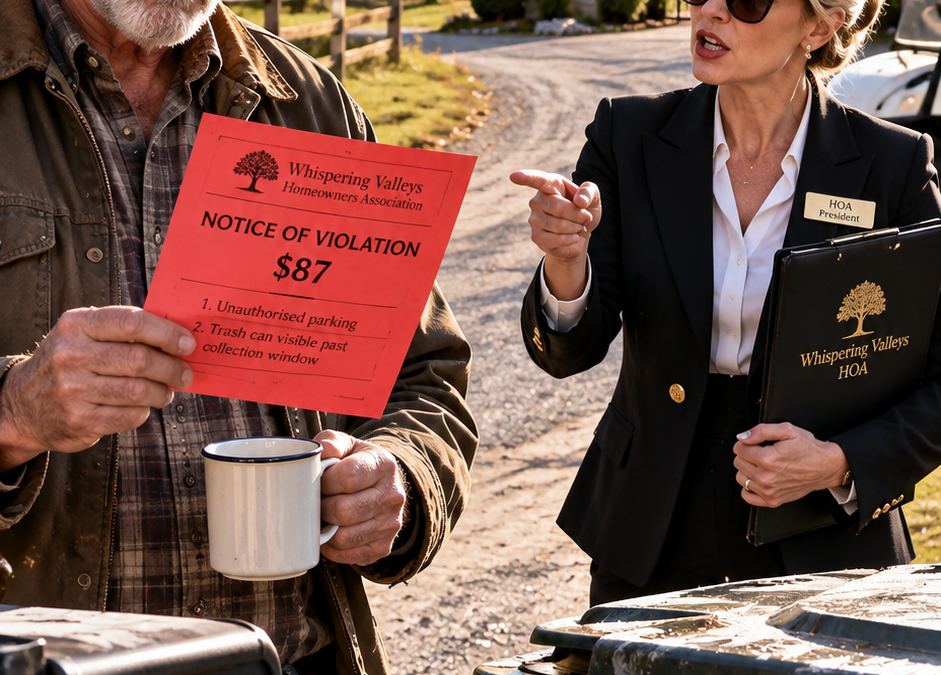
𝗣𝗔𝗥𝗧 𝟮
Inside went the red notice.
Then a photocopy of my deed.
Then my handwritten notes from the first phone call I’d made to the HOA office asking why an association I did not belong to believed it could fine me.
The receptionist’s name was Stacy.
She had been pleasant.
Also completely useless.
“Your property appears in our enforcement map,” she’d told me.
“Maps aren’t deeds.”
“I understand.”
“No, I don’t think you do.”
“I can have compliance review it.”
“Who handles compliance?”
“Ms. Thorne.”
Naturally.
“Can you send me the covenant provision you believe binds my parcel?”
“I don’t have that in front of me.”
“Then send it later.”
“We’ll review your request.”
They never sent it.
That was discrepancy number one.
The notices kept coming.
If you have ever signed up for an unwanted email newsletter, imagine the same enthusiasm but each message costs money.
Friday afternoon became Olivia’s favorite delivery window.
I suspected that was intentional.
Send the violation after businesses close.
Let the homeowner spend Saturday imagining liens, lawyers, and foreclosure.
No one available to answer questions until Monday.
Petty bureaucracy has rhythms.
Once you recognize them, you see the strategy.
The next citation accused me of having an improperly angled mailbox post.
Fine: $125.
I brought out a carpenter’s level.
The post was plumb.
Photographed it.
Measured it.
Dated the photograph.
Folder.
The week after that, I received a notice about my tractor.
It was a 1968 Ford that had belonged to my father.
I kept it inside an equipment shed.
Apparently, because it could be seen through one window from a section of Whispering Valleys walking path, it constituted “visible mechanical storage.”
Fine: $250.
I photographed the tractor.
The shed.
The sightline.
The window.
Folder.
Then came the fence.
My eastern fence supposedly exceeded community height limits by four inches.
Interesting claim.
Especially since the fence had been standing there since before Olivia Thorne bought her first clipboard.
I measured it.
Folder.
By the end of ninety days, the HOA claimed I owed $4,800.
Four thousand eight hundred dollars.
My original offense had been a trash can.
Either waste management had become extremely profitable, or somebody was manufacturing debt.
The newest letter included the words PROPERTY LIEN in bold.
The next referenced possible foreclosure.
That’s when most people panic.
I didn’t.
Foreclosure threats aren’t magic spells.
Someone still has to establish authority.
Someone still has to prove a valid obligation.
Someone still has to explain to a court why a six-acre farm with a 1954 deed suddenly became subject to HOA rules written half a century later.
I was becoming curious how Olivia planned to accomplish that.
Most afternoons, her golf cart slowed near my gate.
White body.
Tan seats.
HOA logo on the side.
Olivia at the wheel.
Clipboard in her lap.
She would look toward the barn, the shed, the truck, the pasture.
Counting.
I recognized the technique.
Corporate managers sometimes did the same thing when they wanted an employee gone.
Every small mistake documented.
Every late arrival recorded.
Every procedural irregularity elevated.
The goal wasn’t usually discipline.
It was pressure.
Make staying so unpleasant that leaving begins to feel rational.
Private security started appearing too.
Two guards.
Navy uniforms.
No police authority.
No municipal badges.
Just private contractors with radios and matching shirts.
They would park near the boundary and take photographs.
One afternoon, I walked to the porch rail with coffee.
One of them aimed his phone toward my barn.
I raised my mug.
“Get my good side.”
He lowered the phone.
“We’re conducting a compliance inspection.”
“On whose property?”
“Association perimeter.”
“That wasn’t my question.”
He stared at me.
His partner started the engine.
They drove away.
I wrote down the time.
License plate.
Vehicle number.
Weather.
Duration.
That may sound excessive.
It isn’t.
A pattern is simply repetition with records.
Without records, people call it a misunderstanding.
With records, they call their lawyer.
I changed nothing about my routine.
Pasture mowed on Thursdays.
Fence repairs in the morning.
Coffee on the porch after dinner.
I wasn’t going to let Olivia turn my own property into a stage where I performed anxiety for her benefit.
Then Ray Holloway came to see me.
Ray was seventy-two.
Retired history teacher.
Thin gray hair.
Careful voice.
He had lived inside Whispering Valleys longer than almost anyone.
He arrived carrying an accordion folder held together with two thick rubber bands.
The folder looked ready to explode.
“Lucas?”
“Ray.”
“I think you need to see something.”
We sat at my kitchen table.
He opened the folder.
Notices.
Invoices.
Towing receipts.
Attorney letters.
I counted them.
Forty-three violation notices.
Fifteen towing receipts.
Three foreclosure threats.
“How long?”
“Almost three years.”
“How much have you paid?”
“Just over four thousand.”
I looked at him.
“Why?”
His laugh held no humor.
“Because I’m seventy-two years old and don’t have twenty thousand dollars for a lawyer.”
Fair.
“What’s the worst violation?”
He thought.
“They towed my car once because it was parked eleven inches too far left.”
“Left of what?”
“Still trying to find out.”
I spread the notices out chronologically.
Section numbers appeared in each.
I pulled up the current HOA handbook on my laptop.
Section 6.14.
Didn’t exist.
Article 9(c)(4).
Article 9 ended at subsection B.
Exterior Harmonization Rule 12.
No such rule anywhere.
I checked amendments.
Nothing.
“Ray.”
“Yeah?”
“These citations aren’t real.”
His face tightened.
“They look real.”
“The paper is real.”
I tapped one.
“The rule isn’t.”
He stared at the notice like it had just changed language.
“They fined me under rules that don’t exist?”
“At least some of them.”
“How can they do that?”
“Because you paid.”
He flinched.
I regretted how that sounded.
“I’m not blaming you.”
“I know.”
“But that’s the mechanism. They send official-looking paper. Most people assume somebody checked.”
Ray nodded slowly.
“Olivia always says the attorney approved everything.”
“Lawyers can type too.”
That almost made him smile.
“Does this happen to other people?”
Ray looked toward my window.
“She picks one or two every year.”
“Who?”
“Usually older residents. Widows. People living alone.”
“Why?”
“Easy targets.”
There it was.
“Do they fight?”
“Some try.”
“And?”
“Then Gregory Pierce sends letters.”
Gregory Pierce.
HOA counsel.
Young attorney.
Aggressive reputation.
Paid from HOA funds.
“He’ll send five pages of legal citations over a hundred-dollar fine,” Ray continued. “People see lawyer letterhead and figure fighting will cost more than paying.”
Classic.
“Any foreclosures?”
“Threats. One family sold.”
“Because of fines?”
“They’d never say that’s why. But yes.”
I photographed every document in Ray’s folder.
High resolution.
Front and back.
Then I started a spreadsheet.
Date.
Resident.
Violation language.
Cited rule.
Actual rule.
Fine.
Late fee.
Attorney involvement.
Outcome.
I spent the next three days talking quietly with neighbors.
Not campaigning.
Not accusing.
Listening.
Lillian Marsh lived four streets over.
Widow.
Seventy.
She had paid $1,180 in fines over a garden gnome.
I thought I’d misheard.
“A gnome?”
“My husband gave it to me.”
She led me outside.
Ceramic figure.
Blue hat.
Faded beard.
About eighteen inches tall.
The HOA called it an unauthorized freestanding ornament.
“What rule?”
She handed me the notice.
I checked later.
Invented.
Again.
A young couple named Evan and Claire Mercer paid nearly $1,500 after their car was towed from their own driveway.
“What happened?”
Claire held their infant daughter while explaining.
“I went into labor.”
I looked at Evan.
He nodded.
“We left the other car slightly across the paver line.”
“Inside your driveway?”
“Yes.”
“The tow truck came before we got home.”
“While she was delivering the baby?”
“Pretty much.”
I stared at him.
“That’s almost impressively heartless.”
He laughed despite himself.
“It gets better. They charged a release fee because the HOA classified it as emergency access obstruction.”
“Did it obstruct anything?”
“No.”
I photographed the paperwork.
Same pattern.
Invented or distorted provision.
Official language.
Fine.
Threat.
Payment.
Olivia’s power was not legal.
It was psychological.
Everyone believed challenging her would cost more than obeying.
I’ve investigated companies built on the same model.
Extract amounts small enough that victims won’t hire counsel.
Spread enforcement across many people so nobody immediately sees a pattern.
Use professional language.
Use signatures.
Use deadlines.
Use fear.
People assume fraud must involve millions.
Sometimes fraud is a thousand dollars taken repeatedly from people too tired to ask whether the rule exists.
I didn’t tell the neighbors what I had done professionally.
It wasn’t important yet.
I just listened.
Built the spreadsheet.
Added documents.
Then I moved to the physical boundary.
If Olivia’s claim depended on authority over my property, I wanted the line established beyond argument.
I called Tom Willis.
Tom was a licensed surveyor who had mapped land in the county for almost thirty years.
He arrived Thursday with GPS equipment, a total station, old cadastral maps, and the emotional enthusiasm of a man invited to spend two days arguing with geometry.
“You expecting trouble?” he asked.
“I already have trouble.”
“What kind?”
“Clipboard.”
He nodded solemnly.
“Worst kind.”
Tom worked for two full days.
Original deed.
Recorded markers.
Control points.
Modern GPS coordinates.
Steel stakes capped in bright orange.
Olivia passed twice in her golf cart.
The first time, she slowed.
The second, she stopped.
“Mr. Vance.”
“Ms. Thorne.”
“What are you doing?”
“Standing.”
She looked toward Tom.
“I mean them.”
“Surveying.”
“Why?”
“To determine where my property is.”
“We already have boundary maps.”
“I’ve seen your maps.”
She heard the sentence beneath the sentence.
Her eyes narrowed.
“Association boundaries have been recognized for years.”
“Wonderful. Then this should be boring.”
She drove away.
Tom never looked up.
That evening, he approached my porch holding his tablet.
He had the particular expression professionals get when they’ve found something technically unpleasant and personally entertaining.
“You’ve got clean title.”
“Expected.”
“You’ve also got an encroachment.”
That I had not expected.
“How much?”
“Depends how annoyed you want to be.”
“Measurements first.”
He showed me the diagram.
Whispering Valleys’ concrete walking trail crossed onto my property.
Not inches.
Nearly eight feet.
For roughly three hundred feet.
I stared.
“You’re sure?”
“I’ve checked three ways.”
He zoomed in.
“And these.”
Two decorative street lights.
Both inside my parcel.
The HOA had installed them the previous spring.
“How long has the path been there?”
“Based on records? About five years.”
I walked down to the boundary with him.
The trail looked expensive because it was expensive.
Steel-reinforced concrete.
Decorative aggregate finish.
Custom lights.
The HOA’s brochures called it the Ridgeview Promenade.
Apparently “Lucas Vance’s Trespass Corridor” had tested poorly with buyers.
Tom kicked lightly at the edge.
“They’ll hate removing this.”
“How expensive?”
“Concrete alone? Enough to make someone develop respect for surveying.”
The irony was almost too perfect.
For months, Olivia had accused me of violating HOA property standards.
Meanwhile, her HOA had installed a public amenity on my land.
Every jogger.
Every patrol cart.
Every resident walking a dog along those three hundred feet.
Trespassing.
I did not block the path.
Not yet.
Tom finalized the sealed survey.
Professional stamp.
Legal description.
Coordinates.
He filed it with the county recorder.
Now the encroachment was not merely my opinion.
It was public record.
I sent the HOA a formal notice.
Certified mail.
Copy to counsel.
Thirty days to remove the encroaching concrete path and street lights at HOA expense.
Gregory Pierce responded.
His letter was dismissive.
According to him, the HOA boundary was established by “historical use and community reliance.”
An interesting theory.
Unfortunately, people walking on your land for five years does not automatically create whichever ownership arrangement their attorney finds convenient.
His letter threatened legal action if I restricted residents’ access.
I read it twice.
Then placed it in the folder.
ACTIVE LITIGATION PREPARATION.
I did not respond.
There was no reason to argue with an attorney who hadn’t bothered to read the deed references.
Instead, I requested the money.
Not personally.
The records.
Whispering Valleys operated as a planned-community association subject to state financial disclosure requirements.
I submitted a formal demand for three years of:
Bank statements.
Reserve ledgers.
Vendor invoices.
Board approvals.
Annual audits.
Compliance revenue.
Legal expenses.
Capital-project contracts.
Olivia stalled.
First she claimed the request was overly broad.
Then burdensome.
Then potentially confidential.
I responded with the exact statutory language.
The documents arrived two weeks later.
One cardboard box.
Thin.
Much too thin.
That was my first clue.
Two hundred luxury homes.
Capital projects.
Security.
Landscape crews.
Road maintenance.
Legal fees.
Reserve account.
Three years should have produced more paper than that.
The box looked like somebody had cleaned a desk drawer twenty minutes before delivery.
I sat at my kitchen table under the reading lamp.
Yellow highlighter.
Calculator.
Laptop.
Coffee.
And for the first time since retirement, I felt fully awake.
Invoices without itemization.
Checks with vague descriptions.
“Consulting.”
“Administrative support.”
“Compliance optimization.”
That phrase almost deserved an award.
Then I found a recurring payment.
$3,400.
Every month.
Reserve fund.
Vendor:
THORNE SOLUTIONS LLC.
I stopped.
Thorne.
Could be coincidence.
Forensic auditors do not accuse based on surnames.
We verify.
Corporate registration search.
Delaware entity.
Principal officer:
Nathan Thorne.
Olivia’s brother.
I leaned back.
“Oh, Olivia.”
Four years of payments.
Roughly $160,000.
No consulting reports.
No deliverables.
No documented scope I could find.
No board minutes explaining why a reserve fund supposedly dedicated to infrastructure was paying Olivia’s brother every month for “compliance consulting.”
That was not proof of criminal conduct by itself.
But it was a very bright arrow saying:
KEEP LOOKING.
So I did.
The walking path.
Construction contract.
Vendor owned by the husband of board member Denise Carlisle.
Bid price nearly forty percent above comparable municipal paving rates.
Street lights?
Same vendor.
Stormwater special assessment collected from residents?
Deposited into operating account.
Then spent on “administrative costs” with missing receipts.
Fine revenue?
Higher every year.
Reserve balance?
Declining.
It was elegant only in the sense that nobody had examined it.
HOA collected fines.
Those funds plugged gaps.
Reserve money paid connected vendors.
Residents were told rising expenses required tougher enforcement.
Tougher enforcement generated more fines.
A small circular economy of irritation.
And Olivia’s signature appeared again.
And again.
And again.
Approvals.
Transfers.
Contracts.
Authorizations.
I’ve met people who imagine forensic accounting involves dramatic moments where somebody discovers one check labeled BRIBE.
It rarely works that way.
Fraud usually hides in boring repetition.
Same vendor.
Same approval.
Same vague description.
Same lack of supporting paperwork.
Month after month.
Eventually the pattern becomes louder than any confession.
I spent the weekend building a report.
Fifty pages.
Executive summary.
Timeline.
Vendor relationships.
Bank transfers.
Contract comparisons.
Missing documentation.
Invented enforcement provisions.
Resident fine histories.
Property encroachment.
I cross-referenced everything.
Bank statements.
Corporate filings.
County deeds.
Board minutes.
I did not call it fraud in the report.
Words matter.
I called them unresolved financial discrepancies and apparent related-party transactions requiring independent review.
Much less exciting.
Much harder to sue over.
Three backups.
Cloud.
External drive.
Attorney.
Then Olivia emailed me.
11:47 Thursday night.
Personal account.
Not HOA counsel.
Not official office.
That was mistake number whatever we were on.
Her email accused me of harassment.
Claimed I was interfering with lawful association business.
Threatened immediate foreclosure.
Then came this sentence:
An aging wooden farmhouse located adjacent to dry open land presents obvious fire-safety concerns that may require community intervention.
I stared at it.
My house.
Fire hazard.
After months of threats.
After survey findings.
After my records request.
She had finally stopped hiding behind generic policy language.
I saved the message as PDF.
Printed it.
Saved the original email file.
Forwarded it to my lawyer, Daniel Ross.
Then I went to bed.
People assume threats create power.
Written threats create evidence.
The town hall was scheduled for the first Thursday in November.
By six-thirty, the community center parking lot was full.
By seven, people stood along the walls.
Rumors had spread.
Residents knew I had requested financial records.
They knew about the survey.
They knew the walking path might be on private land.
What they did not know was what the numbers showed.
Olivia sat at the front with four board members.
Cream blazer.
Hair perfect.
Leather binder.
Gregory Pierce sat beside them.
She opened with a presentation called:
HERITAGE PRESERVATION AND COMMUNITY STANDARDS.
I nearly admired the nerve.
Slides showed manicured lawns.
Matching shutters.
Clean sidewalks.
Olivia spoke about property values.
Collective responsibility.
Pride.
Standards.
Then my farmhouse appeared on the screen.
Weathered red barn.
Old gate.
Truck.
My home reduced to a PowerPoint problem.
Olivia clicked to the next slide.
OUTSTANDING NONCOMPLIANCE BALANCE: $4,800
“We have attempted repeatedly to resolve this matter amicably,” she said.
I almost laughed.
Apparently threatening foreclosure qualified as community outreach.
“The board has now voted unanimously to initiate foreclosure proceedings to recover unpaid assessments and protect neighborhood standards.”
Several people gasped.
Olivia continued.
“No resident is above the rules we collectively agreed to maintain.”
I stood.
Third row.
No drama.
Laptop under one arm.
Gray USB drive in my hand.
“One question.”
Olivia looked at me.
“Mr. Vance, you’ll have an opportunity during public comment.”
“This concerns your foreclosure slide.”
Gregory Pierce leaned toward the microphone.
“Mr. Vance—”
I looked at him.
“Gregory, if you’re planning to foreclose on my property tonight, I assume five minutes won’t damage the schedule.”
The room laughed.
He did not.
Olivia said, “Make it brief.”
“I will.”
I connected the laptop to the projector.
First slide.
My 1954 deed.
Legal description highlighted.
Second slide.
Tom’s certified survey.
The walking path outlined.
Eight feet inside my property.
Three hundred feet long.
Two lights marked in red.
I turned toward the room.
“For five years, Whispering Valleys HOA has been trespassing on private land.”
Murmurs.
Olivia stiffened.
“The trail residents use every morning sits partly on my farm.”
I pointed.
“These two decorative street lights also sit on my land.”
Someone said, “What?”
“According to the construction invoices, the association spent approximately twenty-two thousand dollars installing those lights.”
Now people were whispering everywhere.
Olivia leaned toward her microphone.
“This boundary issue is currently disputed.”
“No.”
I held up the survey.
“The boundary is recorded.”
“Historical use—”
“Doesn’t move a deed line because you prefer the scenery.”
More laughter.
Olivia’s cheeks colored.
Gregory said, “I would advise you not to make legal conclusions.”
“Then let’s discuss numbers.”
I clicked.
Next slide.
HOA RESERVE FUND — THORNE SOLUTIONS LLC
Rows of payments.
Month.
Amount.
Approval.
Total.
$160,000.
Silence.
“Whispering Valleys has paid approximately one hundred sixty thousand dollars from reserve accounts to Thorne Solutions over four years.”
Olivia’s face changed.
Not much.
Enough.
“Thorne Solutions is owned by Nathan Thorne.”
I clicked.
Corporate filing.
“Ms. Thorne’s brother.”
The room erupted.
Olivia hit her microphone.
“Those services were legitimate.”
“Excellent.”
I looked at her.
“Then I’m sure you can explain what the company delivered.”
“It provided compliance consulting.”
“What?”
“Operational support.”
“What deliverables?”
She glared.
“Lucas—”
“Reports?”
Nothing.
“Written recommendations?”
Silence.
“Inspection protocols?”
Nothing.
“Staff training?”
No answer.
“Any document at all worth one hundred sixty thousand dollars?”
Olivia looked toward Gregory.
He whispered something.
I continued.
“Perhaps those records were accidentally omitted from the financial disclosure box.”
Next slide.
Walking-path contract.
Vendor:
Carlisle Construction.
Owner:
Michael Carlisle.
Spouse of board member Denise Carlisle.
Denise’s head dropped.
“Contract amount was approximately forty percent above comparable paving rates I reviewed.”
Denise looked up.
“That’s not fair. Different contractors charge different amounts.”
“Correct.”
I nodded.
“Which is why normal boards document competitive bids.”
Next slide.
“No competing bids provided.”
Somebody near the back shouted, “Did we pay for this?”
“Yes,” I said.
Olivia snapped.
“This is an ambush.”
“No.”
I held up my original records request.
“This is an audit.”
Her eyes widened slightly.
I think that was the exact moment she understood what my old career had been.
“I spent more than thirty years as a federal forensic auditor.”
The room went quiet again.
Ray smiled from the second row.
I’d never told him.
Olivia stared at me.
“What?”
“I traced financial fraud for the federal government.”
I gestured toward the screen.
“Which is why when you sent me an eighty-seven-dollar fine over a trash can, I read the rule.”
A few laughs.
“And discovered it didn’t exist.”
I clicked.
Fine notice.
Cited provision.
Then HOA handbook.
No provision.
“Then I checked Ray Holloway’s citations.”
Next slide.
Forty-three notices.
Red highlights.
“Fifteen referenced rules that don’t exist.”
Ray stood.
His voice shook.
“You took four thousand dollars from me.”
Olivia said, “Mr. Holloway, your account was reviewed—”
“Under what rule?”
She stopped.
Lillian Marsh stood.
“What about my garden gnome?”
For one second, the entire room froze.
Then people laughed.
Not because Lillian’s loss was funny.
Because after months of fear, the absurdity had finally become visible.
Olivia looked furious.
“This meeting is becoming disorderly.”
Lillian held up her notice.
“You charged me twelve hundred dollars over something my dead husband gave me.”
The laughter died.
“I paid because your lawyer told me you’d put a lien on my house.”
Gregory suddenly became fascinated by his papers.
Evan Mercer stood.
“You towed our car while my wife was in labor.”
More voices.
“My hedge.”
“My mailbox.”
“My roof.”
“My trailer.”
“My flower beds.”
Years of quiet anger rose at once.
Olivia slammed the gavel.
“Order!”
Nobody listened.
She hit it again.
“ORDER!”
I raised one hand.
Not loudly.
The room gradually settled.
“I have one more document.”
Olivia looked at me.
I could see fear now.
Not annoyance.
Fear.
I clicked.
Her email.
Three feet tall on the wall.
Timestamp visible.
11:47 p.m.
The paragraph about my farmhouse being a fire hazard.
I read it aloud.
Nobody moved.
Then I turned.
“You sent this after receiving my survey notice and financial-records demand.”
Olivia’s voice was low.
“That email has been taken out of context.”
“Here’s the whole email.”
I scrolled.
Someone laughed.
Gregory leaned toward Olivia and whispered urgently.
She shook him off.
“This man has been harassing this board for months.”
I answered quietly.
“I asked you to identify one valid covenant that applies to my property.”
Silence.
“You never did.”
“You are adjacent to our community.”
“That isn’t membership.”
“You benefit from our roads.”
“I use a county road.”
“You benefit from our security.”
“Your security guards photograph my house.”
“You benefit from property-value protection.”
“My family owned the farm before your subdivision existed.”
She had no answer.
I looked toward the residents.
“The issue here isn’t whether you like my barn.”
I pointed to the spreadsheet.
“It’s whether this association used rules that were never adopted to collect money from residents.”
Then the vendor records.
“Whether reserve funds went to related parties without transparent documentation.”
Then the survey.
“And whether the HOA spent resident money building improvements on land it does not own.”
Gregory stood.
“I advise the board to adjourn immediately.”
Olivia looked at him.
“What?”
“Adjourn.”
“Why?”
He lowered his voice.
Unfortunately for him, the microphone caught part of it.
“Because you should not answer more questions without separate counsel.”
The room exploded.
Separate counsel.
That phrase did more damage than fifty slides.
Board member Denise Carlisle stood.
“I didn’t know about Thorne Solutions.”
Olivia turned.
“Sit down.”
“No.”
Denise pushed her chair back.
“I signed expenditure approvals because you told us they were routine.”
“Denise.”
“I want independent counsel.”
Another board member, Thomas Reed, raised his hands.
“So do I.”
Olivia stared at them.
Six years of authority started collapsing in approximately forty seconds.
She looked at me.
“This is what you wanted.”
“No.”
“Don’t lie.”
“You sent me an $87 fine.”
“You could have paid it.”
There it was.
The room heard it.
Olivia heard herself too late.
I smiled slightly.
“Exactly.”
She realized what she’d admitted.
Pay because it’s easier.
That had always been the system.
The amount didn’t matter.
The rule didn’t matter.
Authority only mattered if nobody checked.
Ray spoke from behind me.
“How many of us did you do this to?”
Olivia said nothing.
Lillian asked:
“How much money did your family make?”
No answer.
Someone else:
“Where are the audits?”
Nothing.
“Why were reserves paying your brother?”
Silence.
The gavel sat untouched now.
Olivia no longer had a meeting.
She had witnesses.
Daniel Ross filed my evidence package with the county prosecutor the next morning.
Survey.
Financial analysis.
Vendor relationships.
Resident fine samples.
Olivia’s email.
The sheriff’s financial-crimes unit opened an inquiry.
I want to be precise about what happened next.
Investigations take time.
Not every suspicious transaction is automatically a crime.
Not every bad board decision is embezzlement.
But once authorities began asking for records, Olivia’s position collapsed quickly.
Three weeks after the meeting, she resigned.
Her letter cited “personal health and family considerations.”
Of course it did.
Nobody resigns from an HOA presidency by writing:
I have recently discovered that spreadsheets are extremely inconvenient.
Thorne Solutions disappeared from the vendor list.
The remaining board froze every outstanding compliance fine.
Independent review began.
Hundreds of citations were examined.
Many were voided.
Refunds were issued where unsupported charges could be documented.
Ray received money back.
Not everything.
Enough to make him sit at my kitchen table staring at the check for almost a minute.
“They actually returned it.”
“They should’ve never taken it.”
“I know.”
He smiled.
“Still feels strange.”
Lillian’s garden gnome returned to her front yard.
She placed it directly beside the walkway.
I asked whether she was trying to make a statement.
“No.”
She looked at the gnome.
Then at me.
“Yes.”
The Mercers received reimbursement for the towing incident.
Claire sent me a photograph of their daughter sitting in the driveway beside the car.
Caption:
ILLEGAL PARKING SUPERVISOR.
I framed it.
The walking trail presented a more expensive problem.
The HOA’s first proposal was an easement.
They wanted me to grant permanent access so the path could remain.
I read the offer.
“No.”
Gregory Pierce, still representing the association temporarily, called.
“Lucas, removal will cost the homeowners a significant amount.”
“I know.”
“It seems wasteful.”
“I agree.”
“Then grant the easement.”
“No.”
He sighed.
“Why?”
“Because your client threatened to foreclose on my farm.”
“Olivia is no longer president.”
“The concrete is still on my land.”
“Residents rely on that path.”
“They can build one on theirs.”
“You’re making a point.”
“I’m enforcing a boundary.”
“It’s eight feet.”
“Then removing it should be easy.”
He was quiet.
“That’s not how concrete works.”
“I know.”
Tom Willis happened to be sitting across my kitchen table drinking coffee.
He covered his mouth to keep from laughing.
The HOA removed the encroaching section.
Three hundred feet of reinforced concrete.
Two custom lights.
Heavy equipment.
Saw cutting.
Excavation.
Restoration.
They paid for everything.
I watched from my porch.
Olivia had tried to fine me over the angle of a mailbox.
Now her administration’s signature amenity was being jackhammered out of my pasture.
I am not proud of how satisfying the sound was.
Actually, that’s a lie.
I am somewhat proud.
The new board took office in January.
The president was Martin Bell, a retired civil engineer who had lived in Whispering Valleys for nine years.
He visited my farm before the first meeting.
“No clipboard?” I asked.
He looked down at his empty hands.
“I heard those are dangerous around here.”
I liked him immediately.
The new bylaws required quarterly financial review.
Public vendor disclosures.
Competitive-bid documentation above set thresholds.
Conflict-of-interest declarations.
A formal appeals process.
No fine could double merely because a resident challenged it.
No foreclosure action without independent legal review and a recorded board vote.
Most importantly, every enforceable rule had to exist in an actual adopted document accessible to residents.
Radical concept.
If you’re going to fine somebody for breaking a rule, first have a rule.
The regional newspaper eventually ran the story.
Reporter Harriet Morton spent two days reviewing county files.
Her article was not dramatic.
That made it devastating.
Timeline.
Fine records.
Boundary survey.
Vendor payments.
Board relationships.
No shouting.
No adjectives needed.
Several former board members gave variations of the same explanation.
They trusted Olivia.
They assumed counsel had checked.
They signed without reading.
I had heard that excuse my entire career.
“We trusted the CFO.”
“We assumed procurement verified it.”
“Legal must have approved.”
“I thought somebody else checked.”
Fraud thrives in the distance between responsibility and assumption.
Olivia had benefited from that distance.
Her board members were not all corrupt.
Some were simply lazy.
Others intimidated.
Others comfortable.
But if you sign something, your signature does not become innocent because reading was inconvenient.
Lillian came by in February carrying cornbread.
We sat on the porch despite the cold.
She looked toward Whispering Valleys.
“I was going to sell.”
“When?”
“This winter.”
“Because of the fines?”
She nodded.
“I couldn’t sleep.”
Her voice dropped.
“Every envelope made me sick.”
I knew that feeling from interviewing fraud victims.
Not just losing money.
Losing certainty.
Feeling like the institution has a secret rulebook and you’re always one mistake away from punishment.
“I thought maybe the neighborhood didn’t want me.”
“Lillian.”
She looked at me.
“The neighborhood wasn’t the problem.”
“I know that now.”
She smiled.
“I planted tomatoes yesterday.”
“It’s February.”
“Inside.”
“Good.”
“And the gnome is staying.”
“I would expect nothing less.”
Spring came.
Ray helped me rebuild the eastern fence.
So did Evan Mercer and Martin Bell.
Tom marked the line again.
Orange caps.
Exact.
We drove new cedar posts.
Installed split rails.
No arguments about four inches.
No HOA inspection.
No golf carts.
I reset my mailbox post.
Perfectly plumb.
Mostly because after being fined for its angle, leaving it crooked would have bothered me forever.
Then I repainted the barn.
Deep red.
Same shade my grandfather used.
Martin drove by while I was working.
He stopped.
“That’s very red.”
“Violation?”
He considered.
“Against my personal taste, maybe.”
“Fine?”
“Coffee.”
“Reasonable.”
He came up to the porch.
I poured two cups.
Across the ridge, children had left bicycles in driveways.
One house had a blue front door.
Another had flower boxes that did not appear in any approved palette.
Lillian’s gnome stood proudly near her walkway like a ceramic monument to bureaucratic defeat.
Whispering Valleys looked less perfect.
It also looked more alive.
Olivia’s biggest lie had never been a number.
It was the idea that control and community were the same thing.
They aren’t.
Community requires cooperation.
Control requires fear.
For years, people had confused the two because the letters came on official stationery.
I kept the original $87 notice.
It sits inside my father’s old desk.
Folded in half.
The red has faded.
Sometimes I take it out.
Not because I’m sentimental about trash cans.
Because it reminds me how small these things can look at first.
Eighty-seven dollars.
You could pay it.
Most people would.
That was the point.
The entire system depended on the reasonable response being surrender.
Why spend a thousand dollars fighting eighty-seven?
Why miss work over a garden gnome?
Why hire a lawyer because a car was towed?
Why risk foreclosure?
Pay.
Move on.
Stay quiet.
Olivia understood the arithmetic of fear.
She just didn’t understand forensic accounting.
I spent thirty-two years watching sophisticated people make the same error.
They assume small irregularities stay small because nobody has an incentive to investigate each one independently.
True.
But once somebody puts the irregularities in one spreadsheet, they stop being small.
Ray’s fines.
Lillian’s gnome.
The Mercers’ tow.
My trash can.
Thorne Solutions.
Carlisle Construction.
The pathway.
The lights.
Reserve transfers.
One line.
One line.
One line.
Until the spreadsheet becomes the story.
Olivia wanted me to see eighty-seven dollars.
I saw a transaction.
Then I asked what system produced it.
That’s why she lost.
Not because I shouted louder.
I rarely shouted at all.
Not because I had more power.
I didn’t.
Not because I spent more money.
I spent less than she probably expected.
She lost because eventually she had to defend her paperwork in front of people who had finally learned to read it together.
One Saturday morning, months after everything ended, I walked the property line.
Cold air.
Pine smell.
Fresh cedar fence.
The ridge looked almost exactly the way it had when I was a boy.
My father used to walk that same line with me.
Whenever we found a loose post, we’d fix it.
Whenever brush covered a marker, he’d clear it.
I once asked why he cared so much about a few inches.
He stopped beside an old stone marker and brushed away pine needles.
“Because a boundary only means something if somebody remembers where it is.”
At twelve, I thought he meant fences.
At sixty-seven, I understood he meant more.
Rules are boundaries.
Authority has boundaries.
Boards have boundaries.
Lawyers have boundaries.
Community power has boundaries.
And whenever nobody checks them, somebody eventually takes an extra eight feet.
Then another eight.
Then $87.
Then $4,800.
Then maybe your house.
My father had another saying.
“A deed doesn’t get nervous.”
I didn’t appreciate that one until Olivia.
People get nervous.
Paper doesn’t.
The 1954 deed did not care that Whispering Valleys had two hundred homes.
It did not care that Olivia had lawyers.
It did not care that residents had walked the path for five years.
It described the land.
That was all.
Tom’s survey didn’t shout.
It measured.
Bank records didn’t accuse.
They recorded transfers.
Olivia’s email didn’t need interpretation.
She typed it.
Truth is often boring that way.
No grand speech.
No cinematic confession.
Just dates.
Lines.
Signatures.
Coordinates.
Eventually enough quiet facts occupy the same room and the loudest person has nowhere left to stand.
The prosecutor’s investigation continued after Olivia resigned.
I stayed out of it beyond providing records when requested.
I had done my part.
I wasn’t interested in turning the rest of my retirement into Olivia Thorne’s biography.
The HOA repaid my survey costs.
Canceled every fine.
Issued a formal apology for “administrative discrepancies.”
I framed that phrase mentally.
Administrative discrepancies.
Apparently “we invented rules and threatened to take your house” was too long for letterhead.
Martin asked whether I wanted anything else.
“No.”
“Damages?”
“No.”
“Board seat?”
“Absolutely not.”
He laughed.
“You’d be good at it.”
“That’s what I’m afraid of.”
I hadn’t fought for a new job.
I wanted peace.
The kind I’d moved back to the ridge looking for after my wife died.
Her name was Anne.
She had loved the farm more than I did some days.
She used to sit on the porch with a blanket over her knees in the fall and watch hawks circle over the pasture.
When she became sick, we talked about moving closer to the hospital.
She refused.
“I’m not spending whatever time I have left looking at somebody else’s fence.”
So we stayed.
After she died, silence changed.
Before, it had been something we shared.
After, it became absence.
That was partly why Olivia’s harassment angered me more deeply than I admitted.
The farmhouse was not an investment.
Not a parcel.
Not a compliance zone.
It was the last place where Anne’s voice still appeared unexpectedly in my mind.
Her mug in the cabinet.
The hook where she hung her coat.
The worn spot on the porch rail where she’d rest her hand.
Olivia looked at six acres and saw noncompliance.
I saw my life.
One evening near the end of spring, I sat outside with coffee.
The barn glowed red in the low light.
The new fence threw long shadows across the grass.
No patrol trucks.
No golf cart.
No cameras.
Nothing.
Ray walked up the driveway.
He carried another accordion folder.
I pointed at it.
“Don’t you dare.”
He laughed.
“Relax. Recipes.”
“That folder has terrible associations.”
“My daughter says I need to digitize things.”
“Your daughter is correct.”
“Don’t encourage her.”
He sat down.
For a while, we said nothing.
Then he looked toward the old section where the HOA path had been.
Fresh grass had begun covering the disturbed soil.
“You ever think about just taking the money and letting them keep it?”
“The easement?”
“Yeah.”
“Once.”
“Why didn’t you?”
I considered.
“Because then they would’ve learned the wrong lesson.”
“What lesson?”
“That trespassing is fine if you budget for buying forgiveness afterward.”
Ray nodded.
“They would’ve paid a lot.”
“Probably.”
“You turned down money.”
“I already have coffee.”
He looked into my mug.
“That’s terrible coffee.”
“Still cheaper than litigation.”
We laughed.
The sun dropped behind the western ridge.
Lights came on across Whispering Valleys.
Not the two decorative lights that had once stood on my land.
Those were gone.
The darkness along my fence belonged to me again.
The neighborhood was changing.
Slowly.
Not dramatically.
Rules still existed.
Dues still existed.
People still argued about maintenance.
They should.
Communities need administration.
Roads cost money.
Shared land needs care.
The lesson was never that HOAs themselves are automatically evil.
The lesson was that unchecked authority becomes convenient for the person holding it.
And convenience is dangerous when nobody verifies the paperwork.
Martin’s board discovered that the association actually functioned better with fewer invented emergencies.
Legal expenses dropped.
Fine revenue collapsed.
Reserve balances stabilized.
Funny.
For years, Olivia claimed aggressive enforcement was necessary to preserve financial health.
Once aggressive enforcement stopped, the finances improved.
That was one of my favorite numbers in the whole audit.
People kept more of their money.
The HOA spent less on lawyers.
The neighborhood continued standing.
No apocalypse.
No collapse in property values.
Not even one recorded injury from unauthorized garden ornaments.
Lillian expanded her garden.
The Mercers painted their front door green.
Ray bought a ridiculous metal rooster and placed it beside his driveway.
I asked whether he liked it.
“No.”
“Then why?”
“Freedom.”
Fair enough.
I bought him a second rooster for Christmas.
He called me a bad influence.
The red $87 notice stayed in the desk.
One morning, almost exactly a year after it appeared, I rolled my trash can out.
Collection truck came at 7:20.
I brought the can back at 8:14.
Fourteen minutes after Olivia’s old deadline.
I noticed the time.
Stopped.
Looked toward Whispering Valleys.
Nobody came.
No golf cart.
No red slip.
No security guard.
No camera.
Just a plastic trash can beside an old farmhouse.
Exactly as insignificant as it should have been.
I laughed all the way back to the porch.
That’s what winning looked like in the end.
Not Olivia’s resignation.
Not the newspaper.
Not the investigation.
Not jackhammers tearing her walking path out of my pasture.
It was a garbage can sitting eleven minutes too long beside a driveway and nobody caring.
Ordinary life restored.
That is what bureaucratic bullies steal first.
Not always money.
Peace.
They make you check the mailbox with dread.
Make you measure your own grass.
Make you photograph your driveway.
Make you feel watched inside property you paid for.
They transform home into an inspection site.
That was why the final silence mattered.
It was mine again.
A few weeks later, Tom Willis stopped by.
He had been working nearby.
We walked the eastern boundary.
Orange survey caps still visible.
He pointed toward the grass covering the old path.
“Can’t even tell concrete was there.”
“I can.”
“Of course you can.”
“Eight feet.”
He laughed.
“You going to keep reminding everyone?”
“Until I’m dead.”
“Put it on the headstone.”
I considered.
LUCAS VANCE
HUSBAND. AUDITOR.
THE PROPERTY LINE WAS HERE.
“Anne would’ve hated that,” I said.
“Then definitely do it.”
We reached the old corner marker.
Tom checked it out of habit.
“Still good.”
“It had better be.”
We walked back.
Before leaving, he stopped near the barn.
“Glad you kept it red.”
“Beige was never seriously considered.”
“Olivia really asked?”
“Beige.”
He shook his head.
“That’s the actual crime.”
Finally, someone understood.
The following winter, the new board published the first complete annual financial report available to every homeowner online.
Vendor names.
Contract totals.
Reserve balances.
Legal spending.
Competitive bids.
Conflict disclosures.
Nothing revolutionary.
Just transparent.
Ray printed the entire thing because he didn’t trust websites.
He brought it over.
“Look.”
I flipped through.
“Looks boring.”
“Exactly.”
Boring finances are underrated.
No shell companies.
No unexplained monthly consulting payment.
No related-party contractor hiding behind vague descriptions.
Martin included a note in the report:
Residents are encouraged to ask questions.
I called him.
“That’s dangerous language.”
“I know.”
“Someone might actually do it.”
“That’s the idea.”
We both laughed.
By then, Olivia’s name had mostly disappeared from neighborhood conversation.
That’s probably the most complete defeat somebody like her can experience.
For six years, everything had revolved around her.
Her notices.
Her standards.
Her meetings.
Her threats.
Her clipboard.
Then suddenly, nobody needed to discuss her.
Life continued.
The neighborhood didn’t collapse because she was gone.
It relaxed.
People gardened.
Children left toys out.
Cars sat imperfectly in driveways.
Someone painted a mailbox purple.
I thought it was ugly.
I also thought nobody should be fined for it.
Anne would have teased me for becoming philosophical about mailboxes.
Maybe grief makes you notice strange things.
Or maybe age does.
I know this much.
I had spent decades uncovering fraud in enormous organizations.
Federal contracts.
Corporate divisions.
Budgets with more zeros than the entire Whispering Valleys subdivision was worth.
Yet the mechanism was always surprisingly similar.
Someone gains authority.
Others become comfortable.
Review becomes ceremonial.
Signatures become automatic.
Questions become socially expensive.
Then one person realizes nobody is checking.
That is the moment the system changes.
Not when the first dollar goes missing.
When the first unanswered question stops being asked.
Olivia didn’t begin with $160,000.
I doubt she woke up one morning and decided to build an extraction machine.
It probably started smaller.
A favored contractor.
A loosely justified consulting invoice.
A resident who paid an unsupported fine without challenging it.
Nothing happened.
So the next one got easier.
Then the next.
Eventually, the whole system existed because everyone had learned not to question it.
Until she taped $87 to the wrong mailbox.
Sometimes I wonder what would have happened if the first notice had been $5,000.
I might have hired a lawyer immediately.
She would have expected that.
But $87?
That was clever.
Almost.
Small enough to pay.
Too small to fight.
Except it irritated me professionally.
I wanted to know what rule generated exactly eighty-seven dollars.
Then I wanted to know why the rule didn’t exist.
Then I wanted to know how many other rules didn’t exist.
Then Ray appeared.
Then Lillian.
Then the survey.
Then the reserve account.
One question produced another.
That’s how audits work.
You don’t begin by proving fraud.
You begin with a number that doesn’t make sense.
My number was eighty-seven.
The rest was patience.
A year and a half after the town hall, Lillian hosted a small cookout.
Nothing formal.
Neighbors.
Food.
Kids running around.
Ray’s terrible metal rooster somehow ended up wearing a party hat.
Martin brought beer.
Evan and Claire’s daughter toddled across the grass.
At one point, Lillian tapped a spoon against a glass.
“I want to say something.”
Everybody groaned jokingly.
She pointed at me.
“This is Lucas’s fault.”
“What is?”
“That we’re all friends now.”
“I deny responsibility.”
She ignored me.
“Before all this, I knew maybe four people on my street.”
Ray nodded.
“Same.”
“We were all having problems,” Lillian continued. “And none of us talked.”
She looked around.
“That’s what made it possible.”
That sentence stayed with me.
Not the audit.
Not the survey.
Not the prosecutor.
Isolation made it possible.
Every target thought they were alone.
Ray thought he was bad at following rules.
Lillian thought her gnome was stupid but maybe technically prohibited.
The Mercers thought they’d parked incorrectly during an emergency.
I was supposed to believe my trash can was late.
Separate, each problem looked small.
Together, they formed evidence.
Olivia had understood one kind of accounting.
Money.
She didn’t understand another.
People comparing notes.
When enough people compare notes, power changes very quickly.
The sun set.
Lillian brought out cornbread.
Ray complained about his knees.
Children chased each other between lawn chairs.
Nothing matched.
Nothing complied with an aesthetic standard.
It looked wonderful.
I went home after dark.
The farmhouse windows glowed ahead of me.
Red barn behind it.
Six acres.
My six acres.
At the eastern boundary, the cedar fence ran straight through the darkness.
No concrete path.
No street lights.
No golf carts.
I stopped at the mailbox.
Ran my hand over the wood.
The post was still perfectly vertical.
For a moment, I thought about that original notice.
Truck two inches wrong.
Trash can ten minutes late.
Eighty-seven dollars.
Such a small number.
Such a bad choice.
I walked up to the porch and sat in Anne’s old chair beside mine.
The valley was quiet.
Not the nervous silence from the months when everyone watched Olivia’s golf cart.
Not the silence of neighbors afraid to talk.
A real silence.
Crickets.
Wind.
A dog barking somewhere far down the ridge.
Home.
I used to think truth won because it was stronger.
Age cured me of that idea.
Truth does not win automatically.
Truth can sit in a county recorder’s office for fifty years while somebody pours concrete over it.
Truth can be printed in a bylaw nobody reads.
Truth can be hidden in a bank statement everyone assumes somebody else reviewed.
It needs attention.
It needs somebody willing to read the second page.
Check the section number.
Follow the transfer.
Measure the fence.
Ask whether the rule exists.
That’s all I did.
Olivia had the board.
The attorney.
The notices.
The patrol cars.
The golf cart.
The authority everyone assumed she had.
I had a manila folder.
Then another.
Then a spreadsheet.
Then a survey.
Then fifty pages of numbers she had signed herself.
In the end, that was enough.
The red notice is still in my desk.
Maybe one day I’ll throw it away.
But not yet.
Every so often, I unfold it.
The paper has softened along the crease.
The ink is beginning to fade.
At the bottom, beneath the $87 total, there’s a sentence printed in bold:
FAILURE TO COMPLY MAY RESULT IN ESCALATING ENFORCEMENT ACTION.
They were right about one thing.
The enforcement certainly escalated.
Just not in the direction Olivia expected.
She thought the trash can was the beginning of my compliance.
It turned out to be the beginning of her audit.
And if she had simply left my garbage alone, nobody might ever have asked why an HOA was collecting fines under rules that did not exist, paying the president’s brother $160,000, overpaying connected contractors, and building a walking path eight feet inside land it never owned.
Eighty-seven dollars bought me curiosity.
Curiosity bought a survey.
The survey opened the books.
The books ended her presidency.
For someone who claimed to care so much about property values, Olivia Thorne made one remarkably poor investment.
She picked the wrong trash can.








