𝗙𝗨𝗟𝗟 𝗦𝗧𝗢𝗥𝗬 HOA Fined Me $3,600 for Plowing Their Snow—So I Parked My Truck and Let Their Mountain Freeze
𝗣𝗔𝗥𝗧 𝟮
My father, Ray Dalton, started plowing Summit Hollow in 1986.
He did it for twenty-two winters.
I took over sixteen years before Priscilla handed me that $3,600 violation.
There had never been a real contract.
That surprises people.
They assume eighty-six houses on a mountain with one steep private road must have had some elaborate winter-maintenance agreement.
They didn’t.
Summit Hollow’s entire snow-removal operation consisted of my family owning a truck and caring what happened to the people who lived there.
The HOA budget carried a line item for winter fuel reimbursement.
Nine hundred dollars a year.
That was it.
Some winters I burned more than that before Christmas.
My father never complained, so I didn’t either.
I owned a two-man diesel shop at the bottom of the mountain. I made my living fixing engines, transmissions, hydraulic systems, and anything else that leaked oil and stopped moving.
Paperwork was not my specialty.
My wife, Nora, once told me that if an important document couldn’t be tightened with a wrench, I would probably ignore it.
She wasn’t wrong.
I had never read the Summit Hollow bylaws.
Priscilla Vaughn had apparently read them recreationally.
She had served two terms as HOA president and treated the covenants like sacred scripture handed down on stone tablets, except Moses had probably spent less time complaining about trash-can placement.
She walked the loop most mornings with a clipboard tucked beneath her arm.
She cited people for faded shutters.
She fined one man because his trash can remained visible after ten in the morning.
She once sent a three-page architectural notice because someone’s new porch light produced what she called “inconsistent nighttime illumination.”
Priscilla wasn’t stupid.
That was important.
She understood exactly how much power the rules gave her.
Then she used every inch of it.
In October, she presented the board with a folder.
Photographs showed cracks in Ridge Loop, chipped pavement near the shoulder, and two deep gouges along the centerline.
Her conclusion was straightforward.
My plow had been destroying the road.
She also brought a paving estimate.
A big one.
According to the packet I later obtained, two board members accepted her explanation immediately.
Treasurer Everett Boone didn’t.
He looked at the photographs for a long time.
Then he looked out the window.
Nobody asked why.
I didn’t even know that meeting had happened.
The season’s first snow arrived November 14.
Six inches of wet, heavy stuff.
I cleared Summit Hollow exactly the way I always had.
Ridge Loop first.
Spurs.
Cul-de-sacs.
Aldridge house last.
Three hours and forty minutes.
Nobody stopped me.
Nobody called.
Nobody mentioned damaged pavement.
Four days later, Priscilla was standing in front of my truck with a $3,600 fine.
That evening Nora and I sat at the kitchen table with the notice flattened between us.
She read it twice.
“They can’t do this.”
I drank my coffee.
“Can they?”
She looked at me.
I didn’t answer.
Because I honestly didn’t know.
I was forty-eight years old.
I could rebuild a diesel injector in my sleep, but if you had asked me what enforcement authority an HOA had over a snowplow operating on a private subdivision road, I would have stared at you until one of us got uncomfortable.
Still, one phrase kept bothering me.
Caused by unauthorized snow removal equipment.
Cause.
They hadn’t written possibly caused.
They hadn’t written consistent with.
They had stated it as fact.
And facts leave marks.
At nine that night, I grabbed a flashlight, a measuring tape, and an old mechanic’s knee pad.
Nora stood by the door.
“Where are you going?”
“To look at the road.”
Ridge Loop was slick from melt and refreeze.
I parked near the culvert and walked the centerline.
It took four minutes to find the damage from Priscilla’s photographs.
I knelt beside the first gouge.
Twenty-six inches wide.
I measured it again.
Same answer.
Twenty-six.
I sat back on my heels.
My plow blade was ten feet wide.
A straight steel edge.
When it scraped pavement, it could leave a shallow line.
What it couldn’t do was carve a twenty-six-inch-wide trench with patterned ridges inside it.
I ran my fingers along the gouge.
There they were.
Small transverse marks.
Regular intervals.
Teeth.
That wasn’t a blade.
That was track damage.
Something heavy with steel tracks had pivoted on asphalt, biting into the pavement and peeling the surface as it turned.
I stood.
The culvert was forty feet away.
And suddenly I remembered July.
Renshaw Grading and Snow had replaced that culvert over three miserable summer days.
They closed the top section of Ridge Loop, which forced me to make a long detour whenever I needed parts for the shop.
I had been irritated enough to take photographs.
I document things that cost me money.
It’s a mechanic’s habit.
I sat in my truck, scrolled back four months, and found them.
There was a tracked excavator sitting across Ridge Loop.
Right near the gouges.
Bright July sunlight.
Dry pavement.
No snow anywhere.
The timestamp came from my phone.
The next morning I went to the county roads office.
“Does a culvert replacement on a private subdivision road require a permit?”
The clerk nodded.
A minute later she printed it.
July.
Summit Hollow.
Culvert replacement.
Contractor of record:
Renshaw Grading and Snow.
I almost smiled.
Not because I had won anything.
Because machines don’t lie.
On November 22, I submitted my response.
I attached the county permit.
Photographs.
Measurements.
A description of the track pattern.
And a formal request for a hearing.
I didn’t hire a lawyer.
That seems foolish now.
At the time, hiring one seemed excessive.
This was still just a disagreement with people whose driveways I’d plowed for sixteen winters.
Then I noticed something else.
Priscilla’s photographs.
The pictures she had shown the board in October.
I spread them across the kitchen table.
Dry pavement.
Dead leaves.
Gray autumn light.
No snow.
The first snow had fallen November 14.
Priscilla’s own evidence showed the damage existed before my plow had made its first pass of the season.
I leaned back.
For the first time since she’d stopped me on Ridge Loop, I felt relief.
“That’s it,” I told Nora.
She wasn’t as impressed.
“Maybe.”
“No maybe. She photographed the damage before snow.”
Nora tapped one of the pictures.
“Facts haven’t exactly slowed her down so far.”
I laughed.
That turned out to be optimistic.
Four days later, a letter arrived from Bell Haven Community Management.
My hearing request had been accepted.
The hearing would occur December 2 during the regular board meeting.
Then came the sentence that changed the way I looked at the entire dispute.
The assessment remains in effect pending hearing.
The fine wasn’t paused.
The collection clock kept running while I waited for permission to challenge it.
That was when I understood I wasn’t arguing about asphalt anymore.
Priscilla was controlling a process.
And inside that process, every delay favored her.
Two days later, I saw a white pickup parked beside the damaged section of Ridge Loop.
A man in a canvas coat was crouching over the gouges.
Curtis Renshaw.
Owner of Renshaw Grading and Snow.
The same company listed on the July culvert permit.
I pulled over.
He stood and offered his hand.
“Fletcher Dalton.”
“Curtis.”
He smiled.
Friendly.
“No hard feelings about all this.”
“About what?”
He gestured toward the road.
“Somebody has to run the route next season.”
I looked at him.
“What?”
He kept smiling.
“Nothing personal.”
I drove away.
Two miles later, those two words landed.
Next season.
Nobody had told me there was a question about next season.
Why would Curtis Renshaw assume he would be plowing Summit Hollow?
I thought about it for two days.
Then I called Everett Boone.
He went quiet.
Finally he said, “Not at my house.”
“Excuse me?”
“I’ll come to your shop.”
He arrived after dark and parked beside the bay where his car couldn’t be seen easily from the road.
A sixty-one-year-old accountant sneaking into a diesel garage like we were exchanging classified documents.
That was encouraging.
Everett put a stack of papers on my toolbox.
“August board packet.”
I looked at him.
“You should’ve seen this months ago.”
On page nineteen was a proposal.
Renshaw Grading and Snow.
Seasonal snow removal and ice control.
$68,000 per season.
Three-year term.
I read the page again.
August 12.
I laid the dates across my workbench.
August: Renshaw submits a $68,000 contract.
October: Priscilla photographs road damage.
November: she fines me for causing it.
The replacement contract existed before the alleged offense.
“Everett.”
“I know.”
“The bid came first.”
“I know.”
“Why?”
He rubbed a hand across his face.
“She brought Curtis in as a local contractor who’d expressed interest.”
“Did you solicit other bids?”
“I asked that.”
“And?”
“She reminded me that association financial records are confidential and that the treasurer serves at the pleasure of the board.”
I studied him.
“That scared you?”
His face tightened.
“My wife has been sick since spring. I’m sixty-one years old. I can’t afford to spend two years in court fighting my HOA.”
I wanted to be angry.
Instead, I looked at the proposal.
“Why was she protecting Renshaw?”
Everett stared at the concrete floor.
“Curtis is married to Priscilla’s sister.”
I didn’t speak.
The shop heater kicked on behind me.
For several seconds, that was the only sound.
Then everything fit.
You couldn’t walk into a meeting of eighty-six homeowners and say:
“We’ve been paying Fletcher Dalton roughly $900 for fuel, but now I would like you to approve a $68,000 annual contract for my brother-in-law.”
That motion would die before somebody finished choking on their coffee.
But if Fletcher Dalton’s cheap little snow operation was destroying association pavement?
Then $68,000 wasn’t waste.
It was salvation.
My $3,600 fine wasn’t the objective.
It was supporting evidence.
She wasn’t trying to punish me.
She was manufacturing a justification for replacing me.
“What are you going to do?” Everett asked.
“Bring this to the hearing.”
He looked doubtful.
I wasn’t.
I still believed facts worked automatically once enough people saw them.
Nora didn’t share my faith.
She watched me prepare three binders at our kitchen table.
County permit.
July photographs.
October photographs.
Measurements.
August bid.
Budget line showing the $900 fuel reimbursement.
Everything tabbed.
Everything chronological.
“What happens if they vote against you anyway?” she asked.
“They won’t.”
“That wasn’t my question.”
“They can’t ignore all this.”
Nora looked at me for another second.
Then she returned to her book.
Sometimes marriage is having someone ask the right question three days before you’re ready to hear it.
The December 2 board meeting was held in a church fellowship hall because the Summit Hollow clubhouse wasn’t large enough.
Thirty-eight residents showed up.
Priscilla opened the meeting by reading an email she’d sent association-wide the previous night.
It was about stewardship.
Infrastructure.
Responsible management.
Protecting Summit Hollow’s largest physical asset.
She never said my name.
She didn’t have to.
By the time she finished, the story had been arranged neatly.
She was protecting the roads.
Someone else was damaging them.
I was called fourth.
I walked to the front carrying my binder.
I started simple.
“The gouge is twenty-six inches wide.”
I showed the photograph.
“My blade is ten feet wide. A plow edge cannot create this pattern.”
I passed around a close-up showing the track ridges.
Then I placed the county permit on the table.
“This culvert project happened in July. Contractor of record was Renshaw Grading and Snow.”
People leaned forward.
Then I put Priscilla’s October photograph beside my July one.
“Look at the road.”
Silence.
“No snow.”
A woman in the second row picked up the photograph.
“You’re saying the damage was already there?”
“Yes.”
I felt the room moving.
That was my mistake.
I thought because people were listening, the process had changed.
So I put the August proposal on the table.
“There is also a $68,000-per-year snow-removal proposal from Renshaw dated August 12.”
Priscilla looked at it.
Then at me.
Her first question wasn’t whether the document was authentic.
It wasn’t whether the price was correct.
It wasn’t even whether Curtis Renshaw was her brother-in-law.
She asked:
“Where did you get that?”
I hesitated.
“It’s from a board packet.”
Her voice became colder.
“Association financial documents are confidential.”
“They’re relevant.”
“They were obtained improperly.”
She turned to the secretary.
“Documents acquired through unauthorized disclosure do not enter the record. The chair strikes that exhibit.”
The secretary began typing.
I stared at her.
“You’re not disputing it.”
“Mr. Dalton, the chair has ruled.”
“Is it false?”
“The document is not properly before this board.”
There it was.
A sentence engineered to answer nothing.
Before I could respond, Priscilla looked past me.
“Everett.”
He was sitting in the third row.
She waited.
Eventually, he stood.
“Did you provide internal association financial records to Mr. Dalton?”
Everett swallowed.
“Yes.”
“Thank you for your honesty.”
I’ve heard engines seize with more warmth.
Within five minutes, two board members moved and seconded Everett’s removal as treasurer.
He was removed at 8:12 p.m.
In front of his neighbors.
He put on his coat and left through the side door.
I had walked into that meeting with evidence and one board member willing to tell the truth.
By showing the evidence, I had gotten him fired.
And Priscilla still wasn’t finished.
She moved immediately to new business.
A winter-operations resolution.
Any unauthorized snow-removal equipment operating on association roads would constitute a continuing violation.
Fine:
$150 per day.
There was only one private plow truck operating in Summit Hollow.
Mine.
Vote:
Four to zero.
Everett’s chair sat empty.
Then Bell Haven’s management representative announced that if my $3,600 assessment remained unpaid after thirty days, the association would begin the process for a lien against my property.
Nora was sitting four rows behind me.
I could practically hear her earlier question.
What happens if they just vote anyway?
Now I knew.
They vote anyway.
Before the meeting ended, I stood.
“I want one point clarified for the minutes.”
Priscilla looked tired but satisfied.
“If I plow Ridge Loop tomorrow, I’m violating the new rule?”
“Yes.”
“I want a direct answer.”
She looked at the secretary.
Then at me.
“Correct.”
The secretary typed it.
One word.
Correct.
It would become the most expensive word Priscilla Vaughn ever said to me.
On the drive home, Nora asked what I planned to do.
For several minutes, I watched the road.
Then I said, “I’ve been asking the wrong question.”
“What question?”
“Whether I’m allowed to plow.”
“And?”
“They’ve answered it.”
She waited.
“So now I’m asking who’s legally responsible if I don’t.”
We reached home a little before ten.
I backed the International into the garage.
Lowered the ten-foot blade.
Released hydraulic pressure.
Shut off the diesel.
Then I pulled a blue tarp over the cab.
My father’s route board hung above it.
Ridge Loop.
Spurs.
Cul-de-sacs.
Aldridge last.
I switched off the light.
Three days later, I walked into the county roads office and asked a man named Harold Apprentice who was legally responsible for winter maintenance in Summit Hollow.
Harold had been there thirty-one years.
He disappeared into a back room.
When he returned, he carried a file almost an inch thick.
“Summit Hollow,” he said. “Approved 1984.”
He opened the file.
“Conditional approval.”
“What condition?”
He rotated the document toward me.
The county had approved Summit Hollow as a private-road subdivision on the condition that its homeowners association maintain those roads in perpetuity.
Including winter maintenance.
The county had no intention of sending plows nine hundred feet up a twelve-percent private grade for eighty-six homes.
Every year, the HOA had to certify compliance.
Harold pulled the current form.
“Filed September.”
He pointed to one box.
DESIGNATED WINTER MAINTENANCE PROVIDER: FLETCHER DALTON
Below it:
The VIN for my 1994 International.
My throat went dry.
“Who filled this out?”
Harold turned the page.
At the bottom was a signature.
Priscilla Vaughn, President.
I stared at it.
In September, she had certified to the county that I was Summit Hollow’s official winter-maintenance provider.
In November, she fined me for operating.
In December, she passed a resolution making my operation illegal.
Priscilla had spent weeks trying to prove I had no authority.
She had forgotten that she herself had certified my authority to the government.
I asked Harold what happened if I stopped.
He looked at me carefully.
“The association would have to designate another compliant provider.”
“And if they don’t?”
“Then they’re out of compliance with their plat conditions.”
I drove home with that sentence sitting in the passenger seat.
I didn’t confront Priscilla.
I didn’t call the board.
A threat invites negotiation.
I wasn’t interested in negotiating anymore.
On December 5, I filed a Notice of Withdrawal with the county.
One page.
I was withdrawing as Summit Hollow’s designated winter-maintenance provider because the association had formally prohibited operation of my equipment on its roads.
I copied Bell Haven.
I copied the HOA.
I copied Priscilla.
Then I mailed letters to all eighty-six homes.
I didn’t insult anyone.
I didn’t explain the whole fight.
I told them exactly what mattered.
The board had passed a rule making my plowing a violation.
Therefore, I would not plow Summit Hollow that winter.
Residents should make alternative arrangements.
I included my phone number for medical emergencies.
I sent another copy to Fire Chief Dwayne Corless.
Then I drove to Ruth Aldridge’s house.
Ruth was eighty-two.
Her late husband had suffered from heart disease, which was why my father had always plowed their driveway last.
Last meant freshest.
If an ambulance came at four in the morning, he wanted the newest possible cut leading to their house.
Ruth listened from her doorway.
Then she asked quietly, “Did you get in trouble because of us?”
That nearly broke me.
“No, ma’am.”
I showed her my four-wheeler.
Chains on every tire.
“That’ll get you down if anything happens.”
She looked at the machine.
“What about your truck?”
“Truck stays parked.”
“You don’t.”
“No, ma’am.”
The next morning Priscilla sent an association-wide email.
According to her, I was holding the community hostage.
I had abandoned a role I was never authorized to hold.
I was gambling with public safety to escape a legitimate $3,600 assessment.
It was beautifully written.
That was the maddening part.
Every sentence had the outline of truth and the inside of a lie.
By afternoon, neighbors were arguing about me online.
Someone taped a note to our mailbox.
Two words.
I pulled it down.
Nora still saw it.
She stood at the kitchen sink with her back to me and cried quietly.
That hurt more than the fine.
More than the meeting.
My father had spent twenty-two winters building the Dalton name into something people trusted.
I had spent sixteen more.
Priscilla reduced it to “hostage taker” in one email.
I didn’t answer.
Instead, I pinned my county-stamped withdrawal notice beside my father’s route board.
Then we waited for snow.
For eleven days, nothing happened.
Clear skies.
Cold nights.
Dry pavement.
Summit Hollow relaxed.
Nobody hired another contractor.
Most interestingly, Curtis Renshaw didn’t show up either.
His $68,000 proposal had never actually been approved.
Then December 16 arrived.
Nineteen inches fell over thirty hours.
Wind pushed drifts into every cut.
Then temperatures rose just enough to soften the surface.
Then they crashed.
Ridge Loop froze.
By the second afternoon, Summit Hollow was no longer a subdivision.
It was a snowbound shelf on the side of a mountain.
A man tried taking his Suburban downhill.
He made it two hundred yards before sliding sideways across the switchback.
Three cars became trapped behind him.
Garbage pickup stopped.
School buses canceled.
Delivery vehicles turned around.
Nobody could leave.
Nobody could get in.
Then, at four in the morning on December 18, my scanner woke me.
“Medical call, Summit Hollow.”
I sat up.
Address:
Aldridge residence.
I heard the ambulance reach the bottom of Ridge Loop.
Then the dispatcher asked if they could make the grade.
A pause.
“No.”
The dispatcher asked again.
Same answer.
“No access.”
My phone rang forty seconds later.
Ruth.
I was dressed before I reached the stairs.
In the garage, I turned on the light.
The International sat beneath the blue tarp.
Ten-foot blade.
Four hundred horsepower.
Full fuel tank.
Eleven hundred feet from an elderly woman waiting for paramedics.
I walked past it.
Not because I wanted to prove a point.
Because the HOA had put in writing that starting that truck on Ridge Loop would be a continuing violation.
I pulled out the four-wheeler.
Twenty minutes later, Ruth was wrapped in a blanket behind me, gripping my arm while we crawled down the mountain at eight miles an hour.
At 4:25 a.m., I handed her to the paramedics at the county road.
Then I drove home.
I parked the four-wheeler.
And I did not touch the truck.
At nine that morning, I saw Priscilla Vaughn walking up my driveway.
Walking.
Her SUV couldn’t make the hill either.
She was wearing a long wool coat and boots designed for restaurants.
No clipboard.
That was the first time I’d ever seen her without one.
She was still breathing hard when I opened the door.
“Mr. Dalton, I’m authorizing you to plow Ridge Loop immediately.”
I said nothing.
“I will also have the assessment set aside.”
“Come with me.”
I walked her to the garage.
Raised the door.
Cold light spread across the concrete.
The International sat under the tarp exactly where I’d left it.
“Get it out,” she said.
“I can’t.”
“I just authorized you.”
“You did.”
She stared at me.
I pointed toward the truck.
“Your board passed a resolution December second requiring express written board authorization. Operating that truck without it is a continuing violation.”
“I am the president.”
“You’re one person.”
Her mouth tightened.
“The resolution says board.”
“Fletcher—”
“Your rule.”
She stared at the tarp.
For once, I didn’t need to argue with her.
Her paperwork was doing it for me.
Then she said, “You’re going to let people get hurt over $3,600.”
I felt something inside me go cold.
“I’ve been awake since two o’clock. I took Ruth Aldridge down this mountain myself at 4:25 because an ambulance couldn’t reach her.”
I pointed toward the truck.
“That is the machine you outlawed.”
Her face changed.
Not remorse.
Calculation.
“Then understand this. If Summit Hollow remains impassable tomorrow, the association will hold you responsible for abandoning your maintenance obligation.”
That sentence almost made me smile.
“You’re saying I have a maintenance obligation?”
“Yes.”
“Put that in writing.”
She stopped.
Because she finally heard herself.
For weeks, Priscilla had argued I had no authority.
Now she was threatening to sue me because I supposedly had a duty.
Both could not be true at the same time.
She turned and walked back down the mountain.
The emergency meeting was scheduled for the next evening.
Forty residents attended.
They walked.
Every one of them.
Flashlights in hand.
Wet boots.
Cold faces.
They passed the Suburban still sitting sideways near the switchback.
By the time they reached the church fellowship hall, nobody needed a PowerPoint presentation explaining the importance of winter road maintenance.
Priscilla opened the meeting.
She still had the voice.
Calm.
Administrative.
Controlled.
Her defense had three points.
First, the road damage was real and the board had relied on legitimate evidence.
Second, I had voluntarily abandoned the community in the middle of winter.
Third, I had always been nothing more than a volunteer.
No contract.
No formal status.
No obligation to me.
No obligation from me.
It sounded reasonably good.
For about ninety seconds.
The acting secretary began reading my original hearing submission because it had been filed in November but never fully entered into the record.
County culvert permit.
July.
Renshaw Grading and Snow.
Tracked equipment.
Twenty-six-inch gouge.
Then Priscilla’s October photographs.
A man in the back interrupted.
“There’s no snow.”
Priscilla looked toward him.
“What?”
“In your picture.”
He pointed.
“There’s no snow.”
Another resident took the page.
“The damage existed before the season started.”
Priscilla tried to recover.
“The photographs illustrate ongoing deterioration—”
Nobody was listening anymore.
The first leg collapsed.
Then I asked the secretary to read one part of the December 2 minutes.
He found it.
My recorded question:
If I plow tomorrow morning, I’m breaking the rules?
Then Priscilla’s recorded answer.
Correct.
One word.
A little laugh escaped somewhere in the room.
Not amused.
Ugly.
Priscilla stiffened.
“The resolution was generally applicable.”
“To what?” somebody asked. “The second secret snowplow?”
More laughter.
The second leg collapsed.
Then the side door opened.
Harold Apprentice entered carrying a county folder.
He walked to the front.
Placed three documents on the folding table.
First:
Summit Hollow’s annual compliance certification.
He read the relevant box.
“Designated winter maintenance provider: Fletcher Dalton.”
Then the VIN of my International.
Then the signature.
“Priscilla Vaughn. President. Filed September.”
The room went silent.
Second:
My Notice of Withdrawal.
Stamped December 5.
Copies acknowledged by Summit Hollow, Bell Haven Community Management, and Priscilla herself.
Third:
A county Notice of Non-Maintenance.
Issued that morning.
Summit Hollow was officially out of compliance with the conditions of its subdivision approval.
The county had sent two trucks and a grader up Ridge Loop at daylight because emergency medical services had been unable to reach a resident.
Harold read the charge.
“Forty-one thousand two hundred dollars.”
Someone whispered, “Jesus.”
That bill belonged to the HOA.
Then Chief Dwayne Corless stood.
He read from the ambulance report.
“Unit dispatched 4:09 a.m. Unable to access address, 4:12. Patient transported to county road by private citizen using personal vehicle. Transfer completed 4:25.”
He lowered the paper.
That was it.
The third leg was gone.
Priscilla started speaking.
Harold cut across her with one sentence.
“You fined the man your own filing identified as your winter-maintenance provider.”
Nobody said anything.
Then Everett Boone stood from the third row.
He wasn’t treasurer anymore.
Which meant Priscilla no longer had a position to threaten him with.
He told the room everything.
The August 12 Renshaw proposal.
$68,000 per season.
Three years.
No competitive bids.
No disclosed relationship.
Then he said:
“Curtis Renshaw is Priscilla’s brother-in-law.”
Silence.
Priscilla immediately said, “That contract was never executed.”
Everett nodded.
“No.”
Then he added:
“Not yet.”
I have rarely watched forty people do arithmetic simultaneously.
$900 fuel reimbursement.
$68,000 contract.
Brother-in-law.
Road damage created before snow.
Fine against the existing snowplow operator.
I didn’t need to explain anything.
The room did it for itself.
A woman in the front row stood.
“I move to rescind the December second winter-operations resolution immediately.”
Second.
Voice vote.
Unanimous.
Then another motion.
Void my $3,600 assessment.
Passed.
Withdraw the lien referral.
Passed.
Suspend all snow-contract negotiations pending an independent audit.
Passed.
Then a man whose driveway I’d cleared for sixteen years stood from the fourth row.
“I move for a vote of no confidence in the president.”
For the first time all evening, Priscilla sat down.
I didn’t say anything.
There was nothing left to add.
Sometimes the most satisfying part of being right is knowing when to shut up and let somebody else’s paperwork finish the job.
I walked out.
Climbed the snowy hill.
At eight that night, I opened my garage.
Pulled the tarp off the International.
Turned the key.
Waited for the glow plugs.
Then cranked it.
The diesel caught on the first turn.
It always did.
I dropped the blade.
And for the first time in sixteen days, Ridge Loop heard that truck coming.
Priscilla’s formal removal vote happened December 28.
Sixty-eight votes to eleven.
She didn’t attend.
By then, lawyers were involved.
The association paid the county’s $41,200 emergency snow-removal charge.
Every household received a special assessment notice.
Nothing educates homeowners about board governance quite like an unexpected bill arriving in January.
The audit ran through March.
It confirmed what Everett had told me in the shop.
No competitive procurement process.
No conflict disclosure.
A proposed $68,000 annual contract involving Priscilla’s brother-in-law.
The association’s directors-and-officers insurer declined to cover losses connected to the undisclosed self-dealing.
Priscilla ultimately settled with the HOA.
She reimbursed $22,000.
She agreed not to hold another association board position in the state for five years.
The October photographs caused more trouble.
The new board sent them, along with Curtis Renshaw’s road assessment and the September county certification, to the county prosecutor.
Priscilla eventually pleaded to a misdemeanor count involving falsification of association records.
No prison.
Two years’ probation.
Two hundred hours of community service.
Restitution.
I mention that carefully because stories get exaggerated after enough people repeat them.
She didn’t go to prison.
She didn’t lose everything.
She did lose the position she had treated like a private kingdom.
Renshaw Grading and Snow never received the Summit Hollow contract.
The county removed the company from its approved bidder list for three years over issues tied to the culvert project.
In April, they repaired the two long gouges on Ridge Loop at their own expense.
Ironically, that was almost all the pavement repair the road needed.
The catastrophic destruction supposedly caused by sixteen years of Dalton snowplowing turned out to be two damaged sections made by somebody else’s tracked equipment.
Everett Boone was reinstated as treasurer in January.
Unanimously.
At the first meeting of the new board, they offered me a snow-removal contract.
$52,000 a season.
Three years.
Insurance included.
I turned it down.
People assumed that was pride.
It wasn’t.
I simply didn’t want another board deciding one morning that my usefulness depended on which way a political wind inside a clubhouse happened to blow.
I asked for something simpler.
One page.
Filed with the county.
Fletcher Dalton formally designated as Summit Hollow’s winter-maintenance provider.
Association liability coverage.
Fuel reimbursed on invoice.
And one clause I wrote myself:
Any resolution, rule, or amendment affecting winter road operations must be reported to the county roads office within five days of adoption.
Nobody argued.
At the meeting, Everett read that clause twice.
I appreciated that.
It meant no future board could quietly outlaw the snowplow and hope nobody outside Summit Hollow noticed until an ambulance got stuck.
Ruth Aldridge spent three days in the hospital.
When she came home, she mailed me a note.
Actual paper.
Envelope.
Four handwritten words.
I won’t repeat them.
They’re clipped beneath the metal clip on my father’s route board.
That’s where they’ll stay.
The last serious snow that winter came during the final week of February.
Nine inches.
Dry powder.
No wind.
The kind of snowfall that makes a mountain look peaceful because you can’t hear all the work hiding underneath it.
I woke at four.
Walked into the garage.
My father’s board hung above the truck.
I let the diesel glow.
Turned the key.
The engine came alive.
I backed out.
Dropped the blade.
And ran the route.
Ridge Loop first.
Because Ridge Loop was the only way anybody got out.
Then the spurs.
Then the cul-de-sacs.
Eighty-six driveways.
4.2 miles.
Exactly the order my father had written with a carpenter’s pencil in 1986.
And last—
always last—
the Aldridge house.
I made one pass.
Then backed up and widened it.
Wider than necessary.
Wide enough for an ambulance to turn around without thinking about it.
When I finished, I raised the blade and sat there with the beacon rotating over the cab.
Orange light swept across the fresh snow.
Across Ruth’s porch.
Across the old house.
Her porch light came on.
It always did.
She didn’t come outside.
I didn’t wave.
That wasn’t our routine.
I shut the truck off.
The mountain went silent.
People have asked whether watching Priscilla lose the presidency felt good.
Sure.
I’m human.
Watching a woman who tried to turn sixteen years of free labor into evidence against me get buried beneath her own documents had a certain symmetry to it.
But that wasn’t the part I remembered most.
I remembered my father’s board.
I remembered Nora crying at the kitchen sink.
I remembered Ruth’s hand gripping my arm on the four-wheeler while an ambulance waited below us.
And I remembered Priscilla standing in my garage, staring at a perfectly functional snowplow she had made illegal, demanding that I rescue her from the consequences of her own rule.
For weeks, she kept telling me I had never been authorized.
Then, the moment the mountain froze, she threatened me for refusing to fulfill an obligation she had spent weeks insisting didn’t exist.
That was the problem with Priscilla.
She believed paperwork mattered only when it was hers.
She eventually learned what my father had taught me years ago in a different way:
If you’re going to put something important in writing, you’d better be prepared for someone to read every word.
That old International still sits in my garage.
The blade is scarred.
The paint is faded.
The cab smells like diesel, coffee, wet gloves, and thirty winters.
Above it hangs my father’s wooden route board.
Beside it hangs the county designation.
And beneath the clip is Ruth’s four-word note.
Every winter, when the first real snow starts falling, I walk into that garage before dawn and switch on the light.
I don’t need a clipboard.
I don’t need a $52,000 contract.
And I definitely don’t need Priscilla Vaughn’s permission.
I know the route.
Ridge Loop first.
Aldridge last.
And the road stays open.
Have you finished reading the story and want to read it again?
HOA Fined Me $3,600 for Plowing Their Snow—So I Parked My Truck and Let Their Mountain Freeze
They fined me for keeping their only road open.
Then they made my snowplow illegal.
So I parked it.
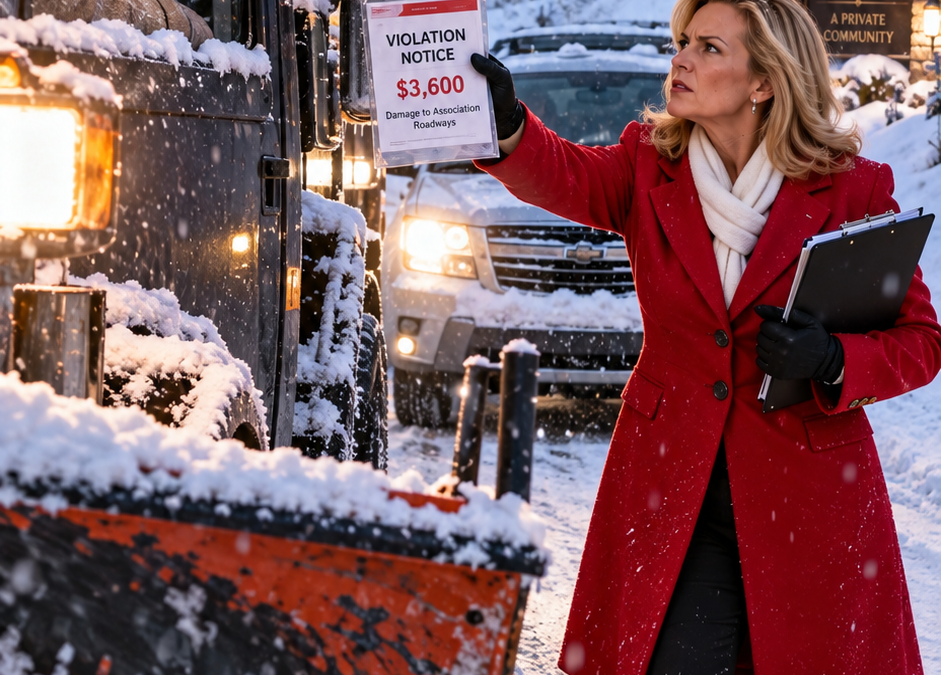
At 6:10 on the morning of November 18, snow was blowing sideways across Ridge Loop when Priscilla Vaughn parked her white SUV directly in front of my plow blade.
I had already cleared almost a mile.
Three miles of white road still climbed ahead of me.
Ridge Loop dropped twelve percent from Summit Hollow to the county highway, and it was the only way in or out for eighty-six homes perched nine hundred feet above the nearest ambulance route.
That morning, none of that seemed particularly important to Priscilla.
She stepped into my headlights wearing a long dark coat, one arm raised like she was stopping traffic.
“Kill the engine.”
I stared at her through the windshield.
The diesel rattled beneath me.
Snow swirled through the beam of the headlights.
Then I shut the truck off.
The sudden silence made the wind sound louder.
Priscilla walked up to my door carrying a clear plastic zipper bag. Inside it was a perfectly dry white envelope.
That detail told me something immediately.
She had prepared this before the storm.
She held it up.
“Violation notice.”
I rolled down the window.
“For what?”
“Unauthorized snow-removal equipment damaging association roadways.”
I took the envelope.
At the bottom of the notice was the number:
$3,600.
Twelve violations.
Three hundred dollars each.
I looked from the paper to the road behind her.
“You’re fining me for plowing?”
“For damaging association property.”
“Priscilla, I’ve been clearing this road for sixteen years.”
“You don’t get to decide what happens on our roads, Fletcher.”
She said it calmly.
Almost pleasantly.
“You never did. Somebody simply allowed you to believe you did.”
I looked past her toward the unplowed grade.
Snow was already filling the tire tracks around her SUV.
“You’re standing on the only road out of here.”
“Then finish clearing it.”
I thought I’d misunderstood.
“What?”
“Finish today. After that, keep that equipment off association pavement unless the board gives you written authorization.”
She paused.
“And if you don’t, we’ll take further action.”
Then she climbed back into her SUV, turned around, and drove downhill.
On the mile I had already plowed for her.
I sat alone in the cold cab with that violation notice in my hand.
Then I read one sentence three times.
Damage to association roadways caused by unauthorized snow removal equipment.
Caused by.
That word bothered me.
Not because I knew HOA law.
I didn’t.
Not because I had some grand legal strategy forming in my head.
I didn’t have one.
It bothered me because I knew steel.
I knew diesel.
And after sixteen winters crawling over Ridge Loop at three miles an hour with a ten-foot plow blade in front of me, I knew what my truck could do to asphalt.
And what it couldn’t.
I folded the notice, put it on the passenger seat, started the engine again, and finished clearing every road in Summit Hollow.
Ridge Loop first.
Then the spurs.
Then the cul-de-sacs.
And, exactly as my father had taught me, the Aldridge house last.
That evening I parked the truck beneath an old wooden board hanging in my garage.
My father had written our entire route on it in carpenter’s pencil in 1986.
Eighty-six driveways.
4.2 miles.
And one note beside the last name.
ALDRIDGE — LAST PASS.
My father had been dead for years.
But by the time that winter was over, a line he wrote on a scrap of pine almost forty years earlier would matter more to me than every rule Priscilla Vaughn had ever printed on association letterhead.
PART2
My father, Ray Dalton, started plowing Summit Hollow in 1986.
He did it for twenty-two winters.
I took over sixteen years before Priscilla handed me that $3,600 violation.
There had never been a real contract.
That surprises people.
They assume eighty-six houses on a mountain with one steep private road must have had some elaborate winter-maintenance agreement.
They didn’t.
Summit Hollow’s entire snow-removal operation consisted of my family owning a truck and caring what happened to the people who lived there.
The HOA budget carried a line item for winter fuel reimbursement.
Nine hundred dollars a year.
That was it.
Some winters I burned more than that before Christmas.
My father never complained, so I didn’t either.
I owned a two-man diesel shop at the bottom of the mountain. I made my living fixing engines, transmissions, hydraulic systems, and anything else that leaked oil and stopped moving.
Paperwork was not my specialty.
My wife, Nora, once told me that if an important document couldn’t be tightened with a wrench, I would probably ignore it.
She wasn’t wrong.
I had never read the Summit Hollow bylaws.
Priscilla Vaughn had apparently read them recreationally.
She had served two terms as HOA president and treated the covenants like sacred scripture handed down on stone tablets, except Moses had probably spent less time complaining about trash-can placement.
She walked the loop most mornings with a clipboard tucked beneath her arm.
She cited people for faded shutters.
She fined one man because his trash can remained visible after ten in the morning.
She once sent a three-page architectural notice because someone’s new porch light produced what she called “inconsistent nighttime illumination.”
Priscilla wasn’t stupid.
That was important.
She understood exactly how much power the rules gave her.
Then she used every inch of it.
In October, she presented the board with a folder.
Photographs showed cracks in Ridge Loop, chipped pavement near the shoulder, and two deep gouges along the centerline.
Her conclusion was straightforward.
My plow had been destroying the road.
She also brought a paving estimate.
A big one.
According to the packet I later obtained, two board members accepted her explanation immediately.
Treasurer Everett Boone didn’t.
He looked at the photographs for a long time.
Then he looked out the window.
Nobody asked why.
I didn’t even know that meeting had happened.
The season’s first snow arrived November 14.
Six inches of wet, heavy stuff.
I cleared Summit Hollow exactly the way I always had.
Ridge Loop first.
Spurs.
Cul-de-sacs.
Aldridge house last.
Three hours and forty minutes.
Nobody stopped me.
Nobody called.
Nobody mentioned damaged pavement.
Four days later, Priscilla was standing in front of my truck with a $3,600 fine.
That evening Nora and I sat at the kitchen table with the notice flattened between us.
She read it twice.
“They can’t do this.”
I drank my coffee.
“Can they?”
She looked at me.
I didn’t answer.
Because I honestly didn’t know.
I was forty-eight years old.
I could rebuild a diesel injector in my sleep, but if you had asked me what enforcement authority an HOA had over a snowplow operating on a private subdivision road, I would have stared at you until one of us got uncomfortable.
Still, one phrase kept bothering me.
Caused by unauthorized snow removal equipment.
Cause.
They hadn’t written possibly caused.
They hadn’t written consistent with.
They had stated it as fact.
And facts leave marks.
At nine that night, I grabbed a flashlight, a measuring tape, and an old mechanic’s knee pad.
Nora stood by the door.
“Where are you going?”
“To look at the road.”
Ridge Loop was slick from melt and refreeze.
I parked near the culvert and walked the centerline.
It took four minutes to find the damage from Priscilla’s photographs.
I knelt beside the first gouge.
Twenty-six inches wide.
I measured it again.
Same answer.
Twenty-six.
I sat back on my heels.
My plow blade was ten feet wide.
A straight steel edge.
When it scraped pavement, it could leave a shallow line.
What it couldn’t do was carve a twenty-six-inch-wide trench with patterned ridges inside it.
I ran my fingers along the gouge.
There they were.
Small transverse marks.
Regular intervals.
Teeth.
That wasn’t a blade.
That was track damage.
Something heavy with steel tracks had pivoted on asphalt, biting into the pavement and peeling the surface as it turned.
I stood.
The culvert was forty feet away.
And suddenly I remembered July.
Renshaw Grading and Snow had replaced that culvert over three miserable summer days.
They closed the top section of Ridge Loop, which forced me to make a long detour whenever I needed parts for the shop.
I had been irritated enough to take photographs.
I document things that cost me money.
It’s a mechanic’s habit.
I sat in my truck, scrolled back four months, and found them.
There was a tracked excavator sitting across Ridge Loop.
Right near the gouges.
Bright July sunlight.
Dry pavement.
No snow anywhere.
The timestamp came from my phone.
The next morning I went to the county roads office.
“Does a culvert replacement on a private subdivision road require a permit?”
The clerk nodded.
A minute later she printed it.
July.
Summit Hollow.
Culvert replacement.
Contractor of record:
Renshaw Grading and Snow.
I almost smiled.
Not because I had won anything.
Because machines don’t lie.
On November 22, I submitted my response.
I attached the county permit.
Photographs.
Measurements.
A description of the track pattern.
And a formal request for a hearing.
I didn’t hire a lawyer.
That seems foolish now.
At the time, hiring one seemed excessive.
This was still just a disagreement with people whose driveways I’d plowed for sixteen winters.
Then I noticed something else.
Priscilla’s photographs.
The pictures she had shown the board in October.
I spread them across the kitchen table.
Dry pavement.
Dead leaves.
Gray autumn light.
No snow.
The first snow had fallen November 14.
Priscilla’s own evidence showed the damage existed before my plow had made its first pass of the season.
I leaned back.
For the first time since she’d stopped me on Ridge Loop, I felt relief.
“That’s it,” I told Nora.
She wasn’t as impressed.
“Maybe.”
“No maybe. She photographed the damage before snow.”
Nora tapped one of the pictures.
“Facts haven’t exactly slowed her down so far.”
I laughed.
That turned out to be optimistic.
Four days later, a letter arrived from Bell Haven Community Management.
My hearing request had been accepted.
The hearing would occur December 2 during the regular board meeting.
Then came the sentence that changed the way I looked at the entire dispute.
The assessment remains in effect pending hearing.
The fine wasn’t paused.
The collection clock kept running while I waited for permission to challenge it.
That was when I understood I wasn’t arguing about asphalt anymore.
Priscilla was controlling a process.
And inside that process, every delay favored her.
Two days later, I saw a white pickup parked beside the damaged section of Ridge Loop.
A man in a canvas coat was crouching over the gouges.
Curtis Renshaw.
Owner of Renshaw Grading and Snow.
The same company listed on the July culvert permit.
I pulled over.
He stood and offered his hand.
“Fletcher Dalton.”
“Curtis.”
He smiled.
Friendly.
“No hard feelings about all this.”
“About what?”
He gestured toward the road.
“Somebody has to run the route next season.”
I looked at him.
“What?”
He kept smiling.
“Nothing personal.”
I drove away.
Two miles later, those two words landed.
Next season.
Nobody had told me there was a question about next season.
Why would Curtis Renshaw assume he would be plowing Summit Hollow?
I thought about it for two days.
Then I called Everett Boone.
He went quiet.
Finally he said, “Not at my house.”
“Excuse me?”
“I’ll come to your shop.”
He arrived after dark and parked beside the bay where his car couldn’t be seen easily from the road.
A sixty-one-year-old accountant sneaking into a diesel garage like we were exchanging classified documents.
That was encouraging.
Everett put a stack of papers on my toolbox.
“August board packet.”
I looked at him.
“You should’ve seen this months ago.”
On page nineteen was a proposal.
Renshaw Grading and Snow.
Seasonal snow removal and ice control.
$68,000 per season.
Three-year term.
I read the page again.
August 12.
I laid the dates across my workbench.
August: Renshaw submits a $68,000 contract.
October: Priscilla photographs road damage.
November: she fines me for causing it.
The replacement contract existed before the alleged offense.
“Everett.”
“I know.”
“The bid came first.”
“I know.”
“Why?”
He rubbed a hand across his face.
“She brought Curtis in as a local contractor who’d expressed interest.”
“Did you solicit other bids?”
“I asked that.”
“And?”
“She reminded me that association financial records are confidential and that the treasurer serves at the pleasure of the board.”
I studied him.
“That scared you?”
His face tightened.
“My wife has been sick since spring. I’m sixty-one years old. I can’t afford to spend two years in court fighting my HOA.”
I wanted to be angry.
Instead, I looked at the proposal.
“Why was she protecting Renshaw?”
Everett stared at the concrete floor.
“Curtis is married to Priscilla’s sister.”
I didn’t speak.
The shop heater kicked on behind me.
For several seconds, that was the only sound.
Then everything fit.
You couldn’t walk into a meeting of eighty-six homeowners and say:
“We’ve been paying Fletcher Dalton roughly $900 for fuel, but now I would like you to approve a $68,000 annual contract for my brother-in-law.”
That motion would die before somebody finished choking on their coffee.
But if Fletcher Dalton’s cheap little snow operation was destroying association pavement?
Then $68,000 wasn’t waste.
It was salvation.
My $3,600 fine wasn’t the objective.
It was supporting evidence.
She wasn’t trying to punish me.
She was manufacturing a justification for replacing me.
“What are you going to do?” Everett asked.
“Bring this to the hearing.”
He looked doubtful.
I wasn’t.
I still believed facts worked automatically once enough people saw them.
Nora didn’t share my faith.
She watched me prepare three binders at our kitchen table.
County permit.
July photographs.
October photographs.
Measurements.
August bid.
Budget line showing the $900 fuel reimbursement.
Everything tabbed.
Everything chronological.
“What happens if they vote against you anyway?” she asked.
“They won’t.”
“That wasn’t my question.”
“They can’t ignore all this.”
Nora looked at me for another second.
Then she returned to her book.
Sometimes marriage is having someone ask the right question three days before you’re ready to hear it.
The December 2 board meeting was held in a church fellowship hall because the Summit Hollow clubhouse wasn’t large enough.
Thirty-eight residents showed up.
Priscilla opened the meeting by reading an email she’d sent association-wide the previous night.
It was about stewardship.
Infrastructure.
Responsible management.
Protecting Summit Hollow’s largest physical asset.
She never said my name.
She didn’t have to.
By the time she finished, the story had been arranged neatly.
She was protecting the roads.
Someone else was damaging them.
I was called fourth.
I walked to the front carrying my binder.
I started simple.
“The gouge is twenty-six inches wide.”
I showed the photograph.
“My blade is ten feet wide. A plow edge cannot create this pattern.”
I passed around a close-up showing the track ridges.
Then I placed the county permit on the table.
“This culvert project happened in July. Contractor of record was Renshaw Grading and Snow.”
People leaned forward.
Then I put Priscilla’s October photograph beside my July one.
“Look at the road.”
Silence.
“No snow.”
A woman in the second row picked up the photograph.
“You’re saying the damage was already there?”
“Yes.”
I felt the room moving.
That was my mistake.
I thought because people were listening, the process had changed.
So I put the August proposal on the table.
“There is also a $68,000-per-year snow-removal proposal from Renshaw dated August 12.”
Priscilla looked at it.
Then at me.
Her first question wasn’t whether the document was authentic.
It wasn’t whether the price was correct.
It wasn’t even whether Curtis Renshaw was her brother-in-law.
She asked:
“Where did you get that?”
I hesitated.
“It’s from a board packet.”
Her voice became colder.
“Association financial documents are confidential.”
“They’re relevant.”
“They were obtained improperly.”
She turned to the secretary.
“Documents acquired through unauthorized disclosure do not enter the record. The chair strikes that exhibit.”
The secretary began typing.
I stared at her.
“You’re not disputing it.”
“Mr. Dalton, the chair has ruled.”
“Is it false?”
“The document is not properly before this board.”
There it was.
A sentence engineered to answer nothing.
Before I could respond, Priscilla looked past me.
“Everett.”
He was sitting in the third row.
She waited.
Eventually, he stood.
“Did you provide internal association financial records to Mr. Dalton?”
Everett swallowed.
“Yes.”
“Thank you for your honesty.”
I’ve heard engines seize with more warmth.
Within five minutes, two board members moved and seconded Everett’s removal as treasurer.
He was removed at 8:12 p.m.
In front of his neighbors.
He put on his coat and left through the side door.
I had walked into that meeting with evidence and one board member willing to tell the truth.
By showing the evidence, I had gotten him fired.
And Priscilla still wasn’t finished.
She moved immediately to new business.
A winter-operations resolution.
Any unauthorized snow-removal equipment operating on association roads would constitute a continuing violation.
Fine:
$150 per day.
There was only one private plow truck operating in Summit Hollow.
Mine.
Vote:
Four to zero.
Everett’s chair sat empty.
Then Bell Haven’s management representative announced that if my $3,600 assessment remained unpaid after thirty days, the association would begin the process for a lien against my property.
Nora was sitting four rows behind me.
I could practically hear her earlier question.
What happens if they just vote anyway?
Now I knew.
They vote anyway.
Before the meeting ended, I stood.
“I want one point clarified for the minutes.”
Priscilla looked tired but satisfied.
“If I plow Ridge Loop tomorrow, I’m violating the new rule?”
“Yes.”
“I want a direct answer.”
She looked at the secretary.
Then at me.
“Correct.”
The secretary typed it.
One word.
Correct.
It would become the most expensive word Priscilla Vaughn ever said to me.
On the drive home, Nora asked what I planned to do.
For several minutes, I watched the road.
Then I said, “I’ve been asking the wrong question.”
“What question?”
“Whether I’m allowed to plow.”
“And?”
“They’ve answered it.”
She waited.
“So now I’m asking who’s legally responsible if I don’t.”
We reached home a little before ten.
I backed the International into the garage.
Lowered the ten-foot blade.
Released hydraulic pressure.
Shut off the diesel.
Then I pulled a blue tarp over the cab.
My father’s route board hung above it.
Ridge Loop.
Spurs.
Cul-de-sacs.
Aldridge last.
I switched off the light.
Three days later, I walked into the county roads office and asked a man named Harold Apprentice who was legally responsible for winter maintenance in Summit Hollow.
Harold had been there thirty-one years.
He disappeared into a back room.
When he returned, he carried a file almost an inch thick.
“Summit Hollow,” he said. “Approved 1984.”
He opened the file.
“Conditional approval.”
“What condition?”
He rotated the document toward me.
The county had approved Summit Hollow as a private-road subdivision on the condition that its homeowners association maintain those roads in perpetuity.
Including winter maintenance.
The county had no intention of sending plows nine hundred feet up a twelve-percent private grade for eighty-six homes.
Every year, the HOA had to certify compliance.
Harold pulled the current form.
“Filed September.”
He pointed to one box.
DESIGNATED WINTER MAINTENANCE PROVIDER: FLETCHER DALTON
Below it:
The VIN for my 1994 International.
My throat went dry.
“Who filled this out?”
Harold turned the page.
At the bottom was a signature.
Priscilla Vaughn, President.
I stared at it.
In September, she had certified to the county that I was Summit Hollow’s official winter-maintenance provider.
In November, she fined me for operating.
In December, she passed a resolution making my operation illegal.
Priscilla had spent weeks trying to prove I had no authority.
She had forgotten that she herself had certified my authority to the government.
I asked Harold what happened if I stopped.
He looked at me carefully.
“The association would have to designate another compliant provider.”
“And if they don’t?”
“Then they’re out of compliance with their plat conditions.”
I drove home with that sentence sitting in the passenger seat.
I didn’t confront Priscilla.
I didn’t call the board.
A threat invites negotiation.
I wasn’t interested in negotiating anymore.
On December 5, I filed a Notice of Withdrawal with the county.
One page.
I was withdrawing as Summit Hollow’s designated winter-maintenance provider because the association had formally prohibited operation of my equipment on its roads.
I copied Bell Haven.
I copied the HOA.
I copied Priscilla.
Then I mailed letters to all eighty-six homes.
I didn’t insult anyone.
I didn’t explain the whole fight.
I told them exactly what mattered.
The board had passed a rule making my plowing a violation.
Therefore, I would not plow Summit Hollow that winter.
Residents should make alternative arrangements.
I included my phone number for medical emergencies.
I sent another copy to Fire Chief Dwayne Corless.
Then I drove to Ruth Aldridge’s house.
Ruth was eighty-two.
Her late husband had suffered from heart disease, which was why my father had always plowed their driveway last.
Last meant freshest.
If an ambulance came at four in the morning, he wanted the newest possible cut leading to their house.
Ruth listened from her doorway.
Then she asked quietly, “Did you get in trouble because of us?”
That nearly broke me.
“No, ma’am.”
I showed her my four-wheeler.
Chains on every tire.
“That’ll get you down if anything happens.”
She looked at the machine.
“What about your truck?”
“Truck stays parked.”
“You don’t.”
“No, ma’am.”
The next morning Priscilla sent an association-wide email.
According to her, I was holding the community hostage.
I had abandoned a role I was never authorized to hold.
I was gambling with public safety to escape a legitimate $3,600 assessment.
It was beautifully written.
That was the maddening part.
Every sentence had the outline of truth and the inside of a lie.
By afternoon, neighbors were arguing about me online.
Someone taped a note to our mailbox.
Two words.
I pulled it down.
Nora still saw it.
She stood at the kitchen sink with her back to me and cried quietly.
That hurt more than the fine.
More than the meeting.
My father had spent twenty-two winters building the Dalton name into something people trusted.
I had spent sixteen more.
Priscilla reduced it to “hostage taker” in one email.
I didn’t answer.
Instead, I pinned my county-stamped withdrawal notice beside my father’s route board.
Then we waited for snow.
For eleven days, nothing happened.
Clear skies.
Cold nights.
Dry pavement.
Summit Hollow relaxed.
Nobody hired another contractor.
Most interestingly, Curtis Renshaw didn’t show up either.
His $68,000 proposal had never actually been approved.
Then December 16 arrived.
Nineteen inches fell over thirty hours.
Wind pushed drifts into every cut.
Then temperatures rose just enough to soften the surface.
Then they crashed.
Ridge Loop froze.
By the second afternoon, Summit Hollow was no longer a subdivision.
It was a snowbound shelf on the side of a mountain.
A man tried taking his Suburban downhill.
He made it two hundred yards before sliding sideways across the switchback.
Three cars became trapped behind him.
Garbage pickup stopped.
School buses canceled.
Delivery vehicles turned around.
Nobody could leave.
Nobody could get in.
Then, at four in the morning on December 18, my scanner woke me.
“Medical call, Summit Hollow.”
I sat up.
Address:
Aldridge residence.
I heard the ambulance reach the bottom of Ridge Loop.
Then the dispatcher asked if they could make the grade.
A pause.
“No.”
The dispatcher asked again.
Same answer.
“No access.”
My phone rang forty seconds later.
Ruth.
I was dressed before I reached the stairs.
In the garage, I turned on the light.
The International sat beneath the blue tarp.
Ten-foot blade.
Four hundred horsepower.
Full fuel tank.
Eleven hundred feet from an elderly woman waiting for paramedics.
I walked past it.
Not because I wanted to prove a point.
Because the HOA had put in writing that starting that truck on Ridge Loop would be a continuing violation.
I pulled out the four-wheeler.
Twenty minutes later, Ruth was wrapped in a blanket behind me, gripping my arm while we crawled down the mountain at eight miles an hour.
At 4:25 a.m., I handed her to the paramedics at the county road.
Then I drove home.
I parked the four-wheeler.
And I did not touch the truck.
At nine that morning, I saw Priscilla Vaughn walking up my driveway.
Walking.
Her SUV couldn’t make the hill either.
She was wearing a long wool coat and boots designed for restaurants.
No clipboard.
That was the first time I’d ever seen her without one.
She was still breathing hard when I opened the door.
“Mr. Dalton, I’m authorizing you to plow Ridge Loop immediately.”
I said nothing.
“I will also have the assessment set aside.”
“Come with me.”
I walked her to the garage.
Raised the door.
Cold light spread across the concrete.
The International sat under the tarp exactly where I’d left it.
“Get it out,” she said.
“I can’t.”
“I just authorized you.”
“You did.”
She stared at me.
I pointed toward the truck.
“Your board passed a resolution December second requiring express written board authorization. Operating that truck without it is a continuing violation.”
“I am the president.”
“You’re one person.”
Her mouth tightened.
“The resolution says board.”
“Fletcher—”
“Your rule.”
She stared at the tarp.
For once, I didn’t need to argue with her.
Her paperwork was doing it for me.
Then she said, “You’re going to let people get hurt over $3,600.”
I felt something inside me go cold.
“I’ve been awake since two o’clock. I took Ruth Aldridge down this mountain myself at 4:25 because an ambulance couldn’t reach her.”
I pointed toward the truck.
“That is the machine you outlawed.”
Her face changed.
Not remorse.
Calculation.
“Then understand this. If Summit Hollow remains impassable tomorrow, the association will hold you responsible for abandoning your maintenance obligation.”
That sentence almost made me smile.
“You’re saying I have a maintenance obligation?”
“Yes.”
“Put that in writing.”
She stopped.
Because she finally heard herself.
For weeks, Priscilla had argued I had no authority.
Now she was threatening to sue me because I supposedly had a duty.
Both could not be true at the same time.
She turned and walked back down the mountain.
The emergency meeting was scheduled for the next evening.
Forty residents attended.
They walked.
Every one of them.
Flashlights in hand.
Wet boots.
Cold faces.
They passed the Suburban still sitting sideways near the switchback.
By the time they reached the church fellowship hall, nobody needed a PowerPoint presentation explaining the importance of winter road maintenance.
Priscilla opened the meeting.
She still had the voice.
Calm.
Administrative.
Controlled.
Her defense had three points.
First, the road damage was real and the board had relied on legitimate evidence.
Second, I had voluntarily abandoned the community in the middle of winter.
Third, I had always been nothing more than a volunteer.
No contract.
No formal status.
No obligation to me.
No obligation from me.
It sounded reasonably good.
For about ninety seconds.
The acting secretary began reading my original hearing submission because it had been filed in November but never fully entered into the record.
County culvert permit.
July.
Renshaw Grading and Snow.
Tracked equipment.
Twenty-six-inch gouge.
Then Priscilla’s October photographs.
A man in the back interrupted.
“There’s no snow.”
Priscilla looked toward him.
“What?”
“In your picture.”
He pointed.
“There’s no snow.”
Another resident took the page.
“The damage existed before the season started.”
Priscilla tried to recover.
“The photographs illustrate ongoing deterioration—”
Nobody was listening anymore.
The first leg collapsed.
Then I asked the secretary to read one part of the December 2 minutes.
He found it.
My recorded question:
If I plow tomorrow morning, I’m breaking the rules?
Then Priscilla’s recorded answer.
Correct.
One word.
A little laugh escaped somewhere in the room.
Not amused.
Ugly.
Priscilla stiffened.
“The resolution was generally applicable.”
“To what?” somebody asked. “The second secret snowplow?”
More laughter.
The second leg collapsed.
Then the side door opened.
Harold Apprentice entered carrying a county folder.
He walked to the front.
Placed three documents on the folding table.
First:
Summit Hollow’s annual compliance certification.
He read the relevant box.
“Designated winter maintenance provider: Fletcher Dalton.”
Then the VIN of my International.
Then the signature.
“Priscilla Vaughn. President. Filed September.”
The room went silent.
Second:
My Notice of Withdrawal.
Stamped December 5.
Copies acknowledged by Summit Hollow, Bell Haven Community Management, and Priscilla herself.
Third:
A county Notice of Non-Maintenance.
Issued that morning.
Summit Hollow was officially out of compliance with the conditions of its subdivision approval.
The county had sent two trucks and a grader up Ridge Loop at daylight because emergency medical services had been unable to reach a resident.
Harold read the charge.
“Forty-one thousand two hundred dollars.”
Someone whispered, “Jesus.”
That bill belonged to the HOA.
Then Chief Dwayne Corless stood.
He read from the ambulance report.
“Unit dispatched 4:09 a.m. Unable to access address, 4:12. Patient transported to county road by private citizen using personal vehicle. Transfer completed 4:25.”
He lowered the paper.
That was it.
The third leg was gone.
Priscilla started speaking.
Harold cut across her with one sentence.
“You fined the man your own filing identified as your winter-maintenance provider.”
Nobody said anything.
Then Everett Boone stood from the third row.
He wasn’t treasurer anymore.
Which meant Priscilla no longer had a position to threaten him with.
He told the room everything.
The August 12 Renshaw proposal.
$68,000 per season.
Three years.
No competitive bids.
No disclosed relationship.
Then he said:
“Curtis Renshaw is Priscilla’s brother-in-law.”
Silence.
Priscilla immediately said, “That contract was never executed.”
Everett nodded.
“No.”
Then he added:
“Not yet.”
I have rarely watched forty people do arithmetic simultaneously.
$900 fuel reimbursement.
$68,000 contract.
Brother-in-law.
Road damage created before snow.
Fine against the existing snowplow operator.
I didn’t need to explain anything.
The room did it for itself.
A woman in the front row stood.
“I move to rescind the December second winter-operations resolution immediately.”
Second.
Voice vote.
Unanimous.
Then another motion.
Void my $3,600 assessment.
Passed.
Withdraw the lien referral.
Passed.
Suspend all snow-contract negotiations pending an independent audit.
Passed.
Then a man whose driveway I’d cleared for sixteen years stood from the fourth row.
“I move for a vote of no confidence in the president.”
For the first time all evening, Priscilla sat down.
I didn’t say anything.
There was nothing left to add.
Sometimes the most satisfying part of being right is knowing when to shut up and let somebody else’s paperwork finish the job.
I walked out.
Climbed the snowy hill.
At eight that night, I opened my garage.
Pulled the tarp off the International.
Turned the key.
Waited for the glow plugs.
Then cranked it.
The diesel caught on the first turn.
It always did.
I dropped the blade.
And for the first time in sixteen days, Ridge Loop heard that truck coming.
Priscilla’s formal removal vote happened December 28.
Sixty-eight votes to eleven.
She didn’t attend.
By then, lawyers were involved.
The association paid the county’s $41,200 emergency snow-removal charge.
Every household received a special assessment notice.
Nothing educates homeowners about board governance quite like an unexpected bill arriving in January.
The audit ran through March.
It confirmed what Everett had told me in the shop.
No competitive procurement process.
No conflict disclosure.
A proposed $68,000 annual contract involving Priscilla’s brother-in-law.
The association’s directors-and-officers insurer declined to cover losses connected to the undisclosed self-dealing.
Priscilla ultimately settled with the HOA.
She reimbursed $22,000.
She agreed not to hold another association board position in the state for five years.
The October photographs caused more trouble.
The new board sent them, along with Curtis Renshaw’s road assessment and the September county certification, to the county prosecutor.
Priscilla eventually pleaded to a misdemeanor count involving falsification of association records.
No prison.
Two years’ probation.
Two hundred hours of community service.
Restitution.
I mention that carefully because stories get exaggerated after enough people repeat them.
She didn’t go to prison.
She didn’t lose everything.
She did lose the position she had treated like a private kingdom.
Renshaw Grading and Snow never received the Summit Hollow contract.
The county removed the company from its approved bidder list for three years over issues tied to the culvert project.
In April, they repaired the two long gouges on Ridge Loop at their own expense.
Ironically, that was almost all the pavement repair the road needed.
The catastrophic destruction supposedly caused by sixteen years of Dalton snowplowing turned out to be two damaged sections made by somebody else’s tracked equipment.
Everett Boone was reinstated as treasurer in January.
Unanimously.
At the first meeting of the new board, they offered me a snow-removal contract.
$52,000 a season.
Three years.
Insurance included.
I turned it down.
People assumed that was pride.
It wasn’t.
I simply didn’t want another board deciding one morning that my usefulness depended on which way a political wind inside a clubhouse happened to blow.
I asked for something simpler.
One page.
Filed with the county.
Fletcher Dalton formally designated as Summit Hollow’s winter-maintenance provider.
Association liability coverage.
Fuel reimbursed on invoice.
And one clause I wrote myself:
Any resolution, rule, or amendment affecting winter road operations must be reported to the county roads office within five days of adoption.
Nobody argued.
At the meeting, Everett read that clause twice.
I appreciated that.
It meant no future board could quietly outlaw the snowplow and hope nobody outside Summit Hollow noticed until an ambulance got stuck.
Ruth Aldridge spent three days in the hospital.
When she came home, she mailed me a note.
Actual paper.
Envelope.
Four handwritten words.
I won’t repeat them.
They’re clipped beneath the metal clip on my father’s route board.
That’s where they’ll stay.
The last serious snow that winter came during the final week of February.
Nine inches.
Dry powder.
No wind.
The kind of snowfall that makes a mountain look peaceful because you can’t hear all the work hiding underneath it.
I woke at four.
Walked into the garage.
My father’s board hung above the truck.
I let the diesel glow.
Turned the key.
The engine came alive.
I backed out.
Dropped the blade.
And ran the route.
Ridge Loop first.
Because Ridge Loop was the only way anybody got out.
Then the spurs.
Then the cul-de-sacs.
Eighty-six driveways.
4.2 miles.
Exactly the order my father had written with a carpenter’s pencil in 1986.
And last—
always last—
the Aldridge house.
I made one pass.
Then backed up and widened it.
Wider than necessary.
Wide enough for an ambulance to turn around without thinking about it.
When I finished, I raised the blade and sat there with the beacon rotating over the cab.
Orange light swept across the fresh snow.
Across Ruth’s porch.
Across the old house.
Her porch light came on.
It always did.
She didn’t come outside.
I didn’t wave.
That wasn’t our routine.
I shut the truck off.
The mountain went silent.
People have asked whether watching Priscilla lose the presidency felt good.
Sure.
I’m human.
Watching a woman who tried to turn sixteen years of free labor into evidence against me get buried beneath her own documents had a certain symmetry to it.
But that wasn’t the part I remembered most.
I remembered my father’s board.
I remembered Nora crying at the kitchen sink.
I remembered Ruth’s hand gripping my arm on the four-wheeler while an ambulance waited below us.
And I remembered Priscilla standing in my garage, staring at a perfectly functional snowplow she had made illegal, demanding that I rescue her from the consequences of her own rule.
For weeks, she kept telling me I had never been authorized.
Then, the moment the mountain froze, she threatened me for refusing to fulfill an obligation she had spent weeks insisting didn’t exist.
That was the problem with Priscilla.
She believed paperwork mattered only when it was hers.
She eventually learned what my father had taught me years ago in a different way:
If you’re going to put something important in writing, you’d better be prepared for someone to read every word.
That old International still sits in my garage.
The blade is scarred.
The paint is faded.
The cab smells like diesel, coffee, wet gloves, and thirty winters.
Above it hangs my father’s wooden route board.
Beside it hangs the county designation.
And beneath the clip is Ruth’s four-word note.
Every winter, when the first real snow starts falling, I walk into that garage before dawn and switch on the light.
I don’t need a clipboard.
I don’t need a $52,000 contract.
And I definitely don’t need Priscilla Vaughn’s permission.
I know the route.
Ridge Loop first.
Aldridge last.
And the road stays open.








