𝗣𝗔𝗥𝗧 𝟮 HOA Fined Me $1,500 for Trapping on My Own Land—Then I Learned Their Security Booth Was Sitting on Mine
𝗣𝗔𝗥𝗧 𝟮
And unless age or law said otherwise, I intended to keep doing it.
When my father died in 1987, the property passed to me.
I was thirty-four.
The deed transfer was recorded.
Taxes stayed current.
No mortgage.
No covenant.
No conservation restriction.
No HOA.
Nothing.
Then came Ridgerest Pines.
The development went in on the upland east of my property beginning in 2004.
The land had once belonged to the Mosley family.
They lost it through a county tax sale.
Hartwell Consolidated bought the tract and decided people would pay good money to live on a ridge with creek views.
They were right.
Within two years, there were roughly 140 houses.
Large lots by suburban standards.
Small lots by mine.
The marketing material leaned heavily on phrases like natural landscape, rural tranquility, preserved corridor, and mountain living.
I had no objection to any of it.
Their ridge.
Their houses.
Their money.
The subdivision plat was recorded in 2005.
I read it because I read anything filed against land adjoining mine.
The boundary line stopped at the upper edge of the eastern slope.
Below that line sat my creek bottom.
Clear.
Simple.
Recorded.
The Ridgerest Pines HOA formed through a declaration of covenants, conditions, and restrictions recorded the same year.
Those covenants applied to the 140 lots inside the subdivision.
Not my parcel.
Not Alderman Creek.
Not the Renfruit meadow.
No document said otherwise.
That should have ended the question before one ever existed.
For almost twenty years, it did.
Then Diane Coulter decided my trap line violated Section 4.7, Subsection C.
The first certified letter arrived during the second week of October.
I signed for it at the mailbox.
Went inside.
Made coffee.
Opened it at the kitchen table.
The HOA accused me of using prohibited traps, snares, and mechanical wildlife-capture equipment inside what it called the community’s jurisdiction.
A $250 warning fine was attached.
Thirty days to stop.
I read the letter twice.
Then I went to the county website and pulled the Ridgerest Pines declaration.
Section 4.7 existed.
Subsection C existed.
The rule prohibited trapping inside the subdivision.
That was fine.
The association had every right to impose lawful rules on property legally subject to its recorded covenants.
My land was not.
The letter never cited a deed restriction covering me.
Never cited an easement.
Never cited a recorded agreement.
Never identified any instrument extending HOA jurisdiction across its platted boundary.
It cited itself.
That was not enough.
I put the letter into a folder.
Three weeks later, another came.
This time the fine was $500.
The tone had sharpened.
Failure to comply could result in legal remedies.
The board had voted to escalate enforcement of the “Creek Corridor trapping issue.”
That phrase stopped me.
Creek Corridor.
Capitalized.
As though they had incorporated my land into an internal map.
I filed the second letter.
Then the third arrived.
The $1,500 fine.
Threat of injunction.
Signed by Diane Coulter.
Countersigned by board president Gerald Fitch.
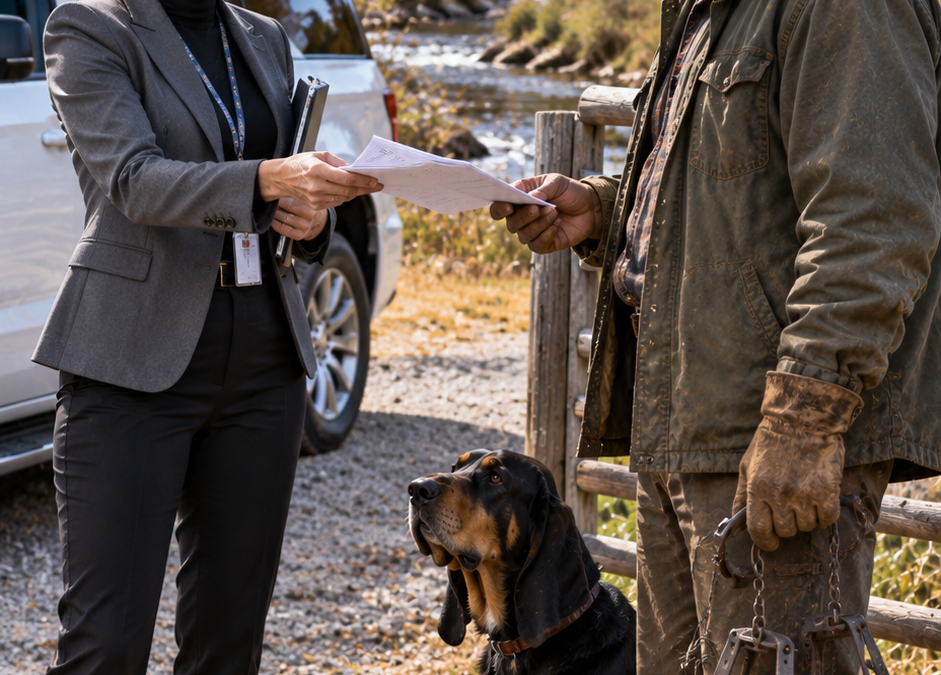
That was the document Diane brought to my driveway.
That evening, after finishing the trap line, I called Raymond Stills.
Raymond farmed north of me.
His family had been in the valley almost as long as mine.
He had the useful habit of noticing things other people considered unimportant until later.
“You heard from Ridgerest?” I asked.
A pause.
“About your creek?”
“That answers my question.”
“They’ve been asking around.”
“Who?”
“Woman in a white SUV.”
“Diane Coulter.”
“That sounds right.”
“What’s she saying?”
“That the creek is some kind of environmental protection zone.”
“Whose?”
“Theirs, apparently.”
I leaned back in the kitchen chair.
“Anything else?”
“She has a map.”
That interested me.
“What kind?”
“Not county.”
“How do you know?”
“Because the line’s wrong.”
Raymond had known our boundary since childhood.
He continued.
“She showed me where she says their protected corridor runs. It comes down the slope and crosses into your bottomland.”
“How far?”
“Couldn’t tell you from what she showed me.”
“You still have the 2005 plat copy I gave you?”
“I never throw away a map.”
“Keep it.”
He laughed.
“Planning something?”
“Reading.”
That was the beginning of what I later called the paper phase.
I wasn’t interested in confronting Diane.
I wanted documents.
Every recorded instrument.
Every plat.
Every parcel reference.
Every easement.
Every title transfer.
Arguments are easy to create.
Records take longer.
That night, I removed the 1921 deed from the fireproof box.
Laid it under the kitchen light.
The paper had become brittle.
Ink still legible.
Recording stamp still clear.
I traced the legal description with one finger.
County road.
Western fork.
South by southeast.
9,240 feet.
My father used to make me read boundary descriptions aloud.
I hated it as a boy.
Bearings.
Distances.
Monuments.
Reference points.
Now I understood why.
A person who cannot describe what he owns is easier to convince that somebody else owns part of it.
The next morning, I went to the Harland County records office.
The clerk let me use the public research terminal.
I started with the subdivision plat.
Then the declaration.
Then access documents.
Then easements.
I expected to confirm what I already knew.
I did.
Ridgerest Pines ended at its recorded boundary.
My creek corridor remained outside.
But while going through the development’s access records, I found something else.
At first, it looked like a clerical inconsistency.
The subdivision’s main entrance road crossed a narrow strip from the county road toward the ridge.
About forty feet wide.
The 2005 plat showed an access easement over that strip.
Nothing unusual there.
Except the easement referenced parcel number 14-072-B.
I searched the parcel index.
Nothing.
Tried again.
No result.
Different formatting.
Still nothing.
So I pulled the underlying chain.
That was when I stopped.
The fee title beneath that access strip had never been conveyed to Hartwell Consolidated.
The forty-foot corridor appeared historically as part of the Renfruit holdings.
I went backward.
Current title.
My father.
Grandfather.
Harmon Estate.
Still Renfruit after 1921.
No deed out.
No tax sale.
No condemnation.
No recorded conveyance.
The access easement existed on paper.
But the supposed grantor had never owned the underlying fee interest it purported to burden.
Worse, the parcel number in the instrument did not match a legally indexed parcel.
I sat at the records terminal for a long time.
Then I pulled the site plan for the Ridgerest Pines entrance.
Security booth.
Concrete pad.
Gate equipment.
All located on or immediately beside the forty-foot strip.
I printed everything.
Drove home.
Spread the documents across my kitchen table.
On the left:
HOA fine letters accusing me of violating rules on my own land.
On the right:
County records suggesting the HOA’s own security booth sat on a strip still owned by me.
I took out a yellow legal pad.
Wrote one word.
LEVERAGE.
Then underlined it.
Not revenge.
Not retaliation.
Leverage.
There is a difference.
I wasn’t interested in blocking 140 families from reaching their homes.
They had bought those houses in good faith.
Whatever Hartwell had done in 2004 was not their fault.
But if their HOA intended to claim jurisdiction over my creek, it seemed reasonable that everyone first establish exactly where the HOA’s own land rights began.
That required an attorney.
Susan Farwell had practiced property law in Harland County for thirty years.
She knew title disputes.
Boundary actions.
Easements.
Recorded instruments.
She worked from a small office near the courthouse.
No marble.
No giant conference table.
Just books, files, and an old wooden desk scarred by decades of use.
I brought her everything.
The 1921 deed.
1987 transfer.
2005 subdivision plat.
CC&Rs.
The questionable easement.
The parcel-number search.
HOA fine notices.
Diane’s injunction threat.
I arranged them chronologically.
Susan began reading.
She did not speak for nearly twenty minutes.
That is one of the reasons I liked her.
Some lawyers think silence must be filled.
Susan understood that reading was work.
Eventually, she lifted the easement.
“How long have you known about this forty-foot strip?”
“Since yesterday.”
“You never agreed to this?”
“No.”
“Your father?”
“Not according to the record.”
“Grandfather?”
“No.”
She looked again at the parcel number.
“This number doesn’t exist.”
“County index says the same.”
“And Hartwell built its access road over the strip.”
“Yes.”
“Security booth too?”
“Looks like it.”
She leaned back.
Then picked up the HOA’s $1,500 citation.
“And they’re fining you for trapping on your own creek.”
“Yes.”
Susan folded her hands.
“Mr. Renfruit, I believe these people have created a very interesting problem for themselves.”
We ordered a professional title abstract before doing anything else.
Susan wanted no assumptions.
Neither did I.
That mattered.
It would have been easy to see one suspicious record and start celebrating.
That is how bad property cases begin.
Someone becomes emotionally committed to a conclusion before completing the chain.
We waited.
Dale Pruitt performed the abstract.
He had worked county title records more than twenty years.
Two weeks later, a thick envelope arrived.
Rubber band around it.
Handwritten note clipped to the front:
ONLY CLEAN CHAIN. NO BREAKS.
I opened it at the kitchen table.
Dale had traced the forty-foot strip back through the original county plat.
The conclusion was exactly what Susan and I suspected.
The strip belonged to the Renfruit property in 1921.
It passed through inheritance.
Never severed.
Never sold.
Never condemned.
Never transferred.
No adverse possession proceeding.
No valid easement granted by us.
No instrument legally moving fee title from the Renfruit chain.
The 2005 easement was defective.
Dale’s title opinion described it in formal language:
An easement purporting to burden a parcel for which the grantor lacked fee-simple title and containing a legal description insufficient to identify a valid indexed parcel.
I read it slowly.
Then called Susan.
“I assume you have your copy.”
“I do.”
“What do you think?”
“I think Hartwell built first and checked title second.”
“That bad?”
“For them? Potentially.”
“And the HOA?”
“That depends on what they’ve done since.”
I mentioned the fines.
She already had them.
Then she said something that changed the case.
“We need to check whether they recorded anything.”
“Recorded what?”
“Lien.”
I sat straighter.
“They can’t lien my property.”
“They shouldn’t be able to.”
“Those are different sentences.”
“Yes.”
Susan ordered an updated title search on my main parcel.
The result came back two days later.
There it was.
A lien.
Ridgerest Pines HOA.
Amount reflecting unpaid compliance fines.
Recorded November 14.
Signed by Gerald Fitch.
Notarized.
Filed into the Harland County deed index against property I had owned free and clear since 1987.
I stared at the document.
That was the first moment I felt anger.
Not because of the $1,500.
A fine from an organization without jurisdiction was paper noise.
A recorded lien was different.
They had placed a cloud on title.
They had converted their assumption into a county record.
Susan watched me.
“Now we act.”
“When?”
“Immediately.”
She filed in Harland County Circuit Court.
The complaint named Ridgerest Pines HOA, Hartwell Consolidated LLC, and relevant board officers.
Twenty-two pages.
First claim:
Declaratory judgment confirming my fee-simple title to the forty-foot strip.
Second:
The 2005 easement was void because of defective legal description and lack of valid ownership by the purported grantor.
Third:
Vacatur of every HOA fine against my creek property.
Fourth:
Discharge of the recorded lien.
Fifth:
Damages and attorney’s fees under the state wrongful-lien provisions.
Then came Exhibit J.
Formal notice that the Ridgerest Pines security booth and associated entrance improvements sat on land whose fee title belonged to me.
We did not demand immediate removal.
That was intentional.
Susan said, “You don’t need drama. You need options.”
The complaint was served.
I drove past the subdivision entrance that afternoon.
A guard sat inside the booth.
Vehicle stopped.
Window slid open.
Guard checked something.
Barrier lifted.
Car passed.
Everything looked ordinary.
That struck me.
Legal uncertainty rarely changes the physical world immediately.
The booth did not know it might be standing on my property.
Concrete does not read title abstracts.
People do.
Back home, I checked my trap line before dark.
A week later, Raymond called.
“Something’s happening at Ridgerest.”
“What?”
“Suit.”
“Who?”
“Dark sedan. County plates.”
“Could be counsel.”
“Been there twice.”
“I imagine Hartwell has started reading.”
Raymond laughed.
“About time.”
The first formal response came from Hartwell’s attorney.
His name was Breck.
He worked for a larger firm in the state capital.
The letter ran twelve pages.
It did not admit the easement was valid.
It did not admit it was invalid.
Instead, it argued good-faith reliance.
Hartwell had built the road almost twenty years earlier.
Residents had relied on it.
The HOA had used it continuously.
Therefore, the letter suggested equitable estoppel should prevent me from asserting title in a way that disrupted those improvements.
At the end, Breck proposed negotiating a purchase of proper access rights.
That told me more than the first eleven pages.
I brought it to Susan.
She read silently.
Then tapped one paragraph.
“Here.”
“What?”
“They want to buy the easement.”
“So?”
“People who believe they already own a valid easement usually don’t open by asking what it costs to obtain one.”
I smiled.
“Estoppel?”
“Creative.”
“Valid?”
“Not on these facts.”
She explained.
Equitable estoppel generally requires reasonable reliance on some representation or conduct by the party now asserting a contrary right.
My family had never represented that Hartwell owned the strip.
Nobody asked us.
Nobody disclosed the easement.
Nobody requested a signature.
Hartwell simply built.
Assumption was not the same as reliance on a representation.
Susan filed a response.
Eleven pages.
Case law.
Recording statutes.
Chain of title.
Defective description.
No conveyance.
No representation.
No valid reliance.
Then she added the wrongful lien.
That changed the pressure significantly.
Because the HOA had recorded the lien after being challenged and around the same period its jurisdiction was already disputed.
Under the state wrongful-lien framework Susan cited, a lien recorded without a good-faith legal basis could expose the filer to treble damages and attorney’s fees.
The amounts themselves were small compared with the value of land.
$250.
$500.
$1,500.
But multiplied damages, fees, and title liability were something else.
More importantly, the lien gave the judge a clean question.
Did Ridgerest Pines have any lawful basis to encumber my property?
The hearing was scheduled for the third Tuesday in February.
That morning, I checked traps before court.
Susan told me later that only I would do something like that.
But court did not change the creek’s schedule.
The temperature sat below freezing.
Shelf ice edged the bank.
I checked each set.
Reset one stake.
Released one undersized animal.
Then went home.
Changed clothes.
Picked up the manila folder.
Drove to the county seat.
Susan was already in the courtroom.
Plaintiff’s table.
Documents arranged.
Across from her sat Breck with two associates and a banker’s box.
Diane Coulter was behind them.
Same storm-gray blazer.
Gerald Fitch beside her.
Yellow legal pad.
Large handwriting.
He did not look at me when I entered.
Judge Patricia Slade took the bench shortly afterward.
Fourteen years on the Harland County Circuit Court.
Susan had described her as exact.
That proved accurate immediately.
No speeches.
No theatrics.
She opened the file.
Looked at both counsel.
“Ready?”
Susan stood.
“Yes, Your Honor.”
Breck stood.
“Yes, Your Honor.”
Judge Slade turned to Susan.
“Counsel, your central position is that the 2005 access easement is void for failure to identify a valid burdened parcel and because the purported grantor lacked fee-simple title. Walk me through the chain.”
Susan began in 1921.
Elias Renfruit.
Harmon Estate.
Recorded deed.
Then inheritance to Vernon.
Then transfer to me.
She presented certified records.
Dale Pruitt’s abstract.
No breaks.
No severance.
No conveyance.
Then she placed the 2005 easement beside it.
Parcel number 14-072-B.
No corresponding parcel in the Harland County index.
Judge Slade looked at Breck.
“Counsel?”
Breck stood.
“The parcel reference appears to be a scrivener’s error, Your Honor. The intent of the parties was plainly to encumber the access corridor now serving Ridgerest Pines. The instrument should be interpreted in light of that intent and nearly two decades of reliance.”
Judge Slade looked down at the easement.
Then back at him.
“In this state, a conveyance instrument must identify the burdened property with sufficient certainty to locate it in the public record.”
“Yes, Your Honor.”
“Where, in this instrument, can I locate the burdened parcel?”
Breck began explaining surrounding documentation.
She stopped him.
“I asked where in the instrument.”
Silence.
“The listed parcel number does not exist,” she continued.
“The intended corridor can be established by extrinsic evidence.”
“Do you have controlling authority establishing that intent can cure a legal description that fails to identify any valid indexed parcel?”
Breck paused.
“We would request supplemental briefing.”
Judge Slade looked at him for a second.
“I don’t believe that will be necessary.”
I did not look behind him.
I didn’t need to.
Susan moved to the lien.
Date.
Amount.
Signature.
Recording information.
Then service date of our title complaint.
She showed the court that Ridgerest Pines had asserted a lien on property outside its recorded subdivision and that no covenant instrument bound my parcel.
Judge Slade reviewed the HOA declaration.
“Where is Mr. Renfruit’s property included?”
Breck shifted.
“The association’s theory was that the creek corridor constituted an environmentally integrated area affecting the subdivision.”
“That is not my question.”
No one moved.
“Where is the Renfruit property made subject to the declaration?”
Breck looked at the document.
“It is not expressly included as a lot.”
“Is it included by any recorded annexation?”
“No, Your Honor.”
“Any signed covenant?”
“No.”
“Any deed restriction?”
“Not that we have identified.”
Judge Slade set the document down.
I finally looked toward Diane.
She was staring at the table.
Gerald had stopped writing.
Susan cited the wrongful-lien statute.
Then asked for the lien to be vacated, fines voided, attorney’s fees awarded, and damages reserved for later calculation.
The judge reviewed the papers again.
Then ruled.
“The court finds the 2005 easement instrument void for failure to contain a legally sufficient description of the burdened parcel and for lack of demonstrated conveyance authority by the purported grantor.”
She paused.
“The court further finds no recorded covenant, declaration, annexation, or other instrument subjecting the Renfruit property to Ridgerest Pines HOA jurisdiction.”
Another pause.
“The fines assessed against plaintiff are therefore void.”
My hands remained flat on the table.
“The lien recorded against plaintiff’s property is unsupported by a legally cognizable basis and is ordered discharged.”
Then:
“The wrongful-lien damages issue and attorney’s fees will proceed to hearing.”
That was it.
No shouting.
No dramatic reaction.
No applause.
The heater hummed beneath the windows.
Susan gathered her papers.
Judge Slade moved on to scheduling.
The law had not looked dramatic.
It looked like a woman reading documents carefully and refusing to pretend they said something else.
Outside the courthouse, Susan handed me a copy of the minute order.
“You okay?”
“Yes.”
“You’re very calm.”
“What should I be?”
“Most clients enjoy this part.”
“What part?”
“Being right.”
I looked at the courthouse.
“I was right before we came in.”
Susan smiled.
“Good answer.”
The damages hearing was set for April.
Meanwhile, the title question put Hartwell in a difficult position.
Their main entrance depended on a strip they did not own and did not have a valid recorded easement over.
I had no intention of closing the road.
Susan made that clear.
Residents were not the defendants I cared about.
They had relied on Hartwell and county approvals.
I wanted a lawful instrument.
A real easement.
Proper description.
Fair compensation.
Recorded correctly.
Nothing more.
Hartwell came to the table.
The negotiations were almost surprisingly civil.
Breck called Susan.
Proposed an appraisal.
We agreed.
An independent appraiser valued the access rights.
Terms were drafted.
Maintenance responsibilities.
Width.
Drainage.
Utilities.
No expansion beyond the defined corridor without written consent.
Survey attached.
Actual parcel description.
Not a number someone had apparently invented in 2005.
For the first time in twenty years, the road’s legal status began matching its physical reality.
But the booth itself became a separate question.
It occupied part of the corridor in a position inconsistent with the newly surveyed easement configuration.
Hartwell could have negotiated to leave it.
Instead, they chose removal and relocation inside undisputed subdivision property.
That was probably cheaper.
So in May, the Ridgerest Pines security booth came down.
I drove past while a crew worked.
Roof panels removed.
Windows out.
Walls lifted.
Concrete broken.
The same booth I had passed a thousand times disappeared in less than a day.
I did not celebrate.
Didn’t stop.
Didn’t take pictures.
Just drove on.
By then, the symbol mattered less than the paperwork.
The new easement deed was recorded on a Wednesday.
Valid grantor.
Valid grantee.
Survey.
Legal description.
Consideration.
Signatures.
Notary.
County stamp.
Done correctly.
The funny thing was that I did, in one sense, end up “buying their security booth.”
Not by purchasing the little building as an object.
The outcome was better than that.
The land under it forced the developer and HOA to negotiate from reality.
The booth became part of the settlement machinery.
Its removal cost, relocation, access regularization, and compensation were all resolved through an easement transaction that existed only because they had discovered they were using land I owned.
The same HOA that tried to collect $1,500 from me for trapping on my creek wound up paying to cure its own title problem.
Then came the April damages order.
Susan called while I was at the kitchen table inventorying spring equipment.
“Got it.”
“What?”
“Order.”
I put down my pencil.
“How bad?”
“For them?”
“Yes.”
“Treble damages.”
I leaned back.
The fines totaled $2,250.
Tripled:
$6,750.
“Attorney’s fees?”
“Full amount.”
“How much?”
“Eleven thousand four hundred.”
I wrote it down.
$6,750.
$11,400.
Susan continued.
“The lien must be formally discharged from the deed index within ten days.”
“Anything else?”
“Yes.”
“What?”
“Permanent injunction.”
I stopped writing.
“Read it.”
She did.
Ridgerest Pines HOA and Hartwell Consolidated were prohibited from asserting covenant enforcement, jurisdictional claims, fines, or encumbrances against the Renfruit property or any portion of the Alderman Creek corridor lying within the 1921 deed boundary absent some future lawful basis independently established.
I wrote one word on the yellow pad.
INJUNCTION.
Then underlined it.
Same way I had underlined LEVERAGE months earlier.
The lien disappeared from my title.
The fines disappeared.
Susan got paid.
The HOA was barred from repeating the same theory.
And the access issue was resolved through a proper easement purchased from the actual title holder.
That should have been the end.
For me, it mostly was.
Not for Ridgerest Pines.
Gerald Fitch resigned from the board in March.
Raymond heard about it before I did.
“Fitch is out.”
“Resigned?”
“Yep.”
“Why?”
“You’d have to ask him.”
“I won’t.”
Diane Coulter’s compliance-director position was eliminated at an April board meeting.
I never learned whether they fired her, reorganized the role, or simply decided the association needed less aggressive enforcement.
It didn’t matter.
She had become part of the file.
Nothing more.
A signature on three letters.
A person who had believed official posture could substitute for jurisdiction.
I never spoke to her again.
Raymond told me the meeting where her position disappeared was short.
Parking lot emptied fast.
I asked whether he had been watching from the county road.
“Maybe.”
“You need a hobby.”
“This is my hobby.”
I brought him a copy of the properly recorded easement after it came back from the clerk.
He put it with his old 2005 plat.
“Keeping this?”
“Of course.”
“Why?”
He looked offended.
“You never throw away a map.”
Fair enough.
The first warm morning after the booth came down, I walked Alderman Creek from the county-road confluence to my south boundary.
Two miles.
Same route I had walked since childhood.
The cottonwoods were just beginning to leaf.
That pale spring green lasts only a short time before summer deepens it.
The creek ran high and cold from snowmelt.
Mallards moved through the cattails.
Beaver had freshened one of the bank cuts.
I checked the old cedar fence posts along the upper meadow.
My grandfather set many of them.
Gray now.
Weathered.
Still standing.
My father reran the wire twice.
I did it in 1994 after cattle pushed through one dry summer.
Those posts have survived storms, flood years, drought, livestock, children, machinery, three generations, and an HOA map that tried to pretend the creek belonged inside somebody else’s environmental zone.
The posts did not care.
Neither did the creek.
That’s one of the things land teaches if you stay around long enough.
People create urgency around ownership disputes.
Letters arrive demanding answers within fourteen days.
Fines escalate.
Lawyers use words like injunction.
Boards vote.
Everyone starts behaving as though reality will change if nobody responds quickly enough.
But recorded title does not panic.
A deed has no pulse.
It simply says what it says.
The 1921 instrument had sat inside county records for more than a hundred years waiting for someone to ask the right question.
Who owns this?
Renfruit.
Who owns the creek corridor?
Renfruit.
Who owned the forty-foot access strip when Hartwell built across it?
Renfruit.
Was the strip ever legally conveyed?
No.
Did Ridgerest Pines have a recorded covenant against my property?
No.
Was the lien legally supported?
No.
Once the questions were asked correctly, the answers were almost boring.
That is what good documentation does.
It makes dramatic disputes boring.
I reached Elias’s old cabin around midmorning.
Sat on the step.
Looked toward the creek.
I could imagine my grandfather there.
Not clearly anymore.
He died a long time ago.
Memory changes.
But I remember his hands.
Thick.
Scarred.
Fingernails always carrying some trace of soil no matter how hard he scrubbed.
He taught me trapping.
My father taught me cattle.
Both taught me records.
Elias never used phrases like chain of title or declaratory judgment.
He would have called all of that “knowing what belongs to you.”
Dad was a little more formal.
He liked maps.
Kept survey stakes in the shed.
Taught me to never move a fence without checking a description.
Their lessons had seemed excessive when I was younger.
Then Diane Coulter showed up holding a tablet.
Suddenly every old lesson became current.
I thought back to the first letter.
$250.
I could have paid it.
It would have been cheaper than hiring Susan.
At least at first.
That is how bad jurisdiction claims sometimes survive.
The amount is intentionally small enough that resistance looks irrational.
Pay $250.
Avoid trouble.
Then $500.
Then $1,500.
But payment can be mistaken for acceptance.
Silence can be misread too.
That is why my silence was never carelessness.
I was gathering.
There is a difference between ignoring something and refusing to answer before you understand it.
When Diane stood at my driveway and told me I had fourteen days, she thought the clock belonged to her.
It did not.
The only clock that mattered was the one attached to the law.
That had been running since 1921.
I went home and opened the fireproof box.
Placed the final court order beside the deed.
The folder had become thick.
HOA Letter One.
Letter Two.
Letter Three.
County plat.
CC&Rs.
Questionable 2005 easement.
Title abstract.
Wrongful lien.
Complaint.
Hartwell response.
Susan’s briefs.
Court ruling.
Damages order.
Permanent injunction.
Recorded easement.
Lien discharge.
Every document told one part.
Together they told the whole story.
I ran my finger across the label.
RIDGEREST PINES.
Then put the folder away.
For a while after the case ended, people in the county asked me about it.
Some versions became exaggerated.
Depending on who told it, I had supposedly shut down the subdivision entrance, seized the guard booth, bought the whole HOA, or forced every homeowner to pay me rent.
None of that happened.
Truth is usually less theatrical.
I discovered the fee-title problem.
Filed suit.
Won declaratory relief.
Had the wrongful lien vacated.
Recovered statutory damages and fees.
Sold a legitimate access easement.
Hartwell removed the booth and relocated it.
That was enough.
I had no interest in punishing homeowners who had nothing to do with Diane’s decision.
Some of them later apologized anyway.
One man stopped me at the feed store.
“I live up there.”
“I assumed somebody does.”
He smiled nervously.
“I wanted to say not everyone supported what they did.”
“I know.”
“Your trapping doesn’t bother me.”
“It doesn’t need to.”
He looked confused.
I explained.
“You’re allowed to dislike it.”
He nodded slowly.
“My point wasn’t that everybody had to approve. My point was that approval and authority are different things.”
That seemed to help.
Because that was always the distinction.
If residents dislike trapping, they can dislike trapping.
If they want rules against trapping on their lots, their HOA can adopt lawful rules within its authority.
If they want to advocate for county-wide wildlife restrictions, they can petition government.
What they cannot do is take a private rule applying to 140 upland lots and extend it downhill because they prefer the creek to be governed differently.
That is not how covenants work.
At least not without a lawful instrument.
Susan once put it better.
“Private law is still law by consent.”
“What do you mean?”
“Covenants bind because someone with authority placed them in the title chain and future owners took subject to them.”
She tapped my deed.
“Your grandfather did not.”
That was it.
No mystery.
The following October, one year after Diane first came to my driveway, I checked the same section of trap line.
Cold morning.
Cottonwoods yellow again.
Creek clear.
Fresh beaver sign.
Almost everything looked the same.
Except the security booth was no longer where it had been.
Farther inside Ridgerest Pines, beyond the newly surveyed easement boundary, they had installed a replacement.
Smaller.
Different design.
Properly located.
I stopped at the old site.
You could still see the discoloration in the ground where the concrete pad had been.
I stood there with my gloves in one hand.
The absurdity of it finally made me laugh.
A year earlier, Diane had threatened to punish me for placing steel on my own land.
Meanwhile, her organization had placed an entire building on mine.
Not intentionally, probably.
But intent does not alter title.
That was the part I kept coming back to.
People think wrongdoing has to involve bad motives.
It doesn’t.
Sometimes all it takes is certainty combined with failure to check.
Hartwell may have honestly believed it possessed valid access rights.
The HOA may have honestly believed the creek formed part of its protection zone.
Gerald may have honestly believed he could sign the lien.
Diane certainly seemed to believe she could fine me.
But sincerity does not repair a defective deed.
Good intentions do not create jurisdiction.
Confidence does not create ownership.
That is why records matter.
They exist outside our beliefs.
A few years after the case, Susan retired.
I went to her office one last time.
Most of the shelves were empty.
Boxes everywhere.
She handed me a small envelope.
“What’s this?”
“Your original certified plat copy.”
“I thought you had returned everything.”
“Found it behind another file.”
I opened it.
Ridgerest Pines plat.
Boundary clear.
I laughed.
“Feels like an artifact.”
“It is.”
Susan looked at me.
“You know what I remember most about your case?”
“What?”
“You never asked me how to hurt them.”
I thought about that.
“What would I have gained?”
“A lot of clients ask.”
“I wanted my land clear.”
She nodded.
“That’s why the case stayed clean.”
I kept thinking about that after she retired.
A dispute can become something larger than the original issue if ego takes control.
I could have tried to block the road.
Demand outrageous money.
Publicly humiliate the board.
Maybe some people would have applauded.
But then I would have become another person using property law as a weapon instead of a boundary.
That wasn’t what Elias taught me.
He maintained the creek crossing because his deed required it.
Even when nobody watched.
Even when it cost him.
Property ownership came with responsibility as well as rights.
So when we discovered the access strip, I wanted two things.
Recognition of title.
A proper easement.
We got both.
The residents kept access.
I kept ownership until I voluntarily granted the easement rights.
The county record became accurate.
That was resolution.
Everything else was noise.
Today I am older than Elias was when he died.
That is a strange milestone.
I still walk the creek.
Not as quickly.
The steep bank near the south meadow takes more effort.
My hands stiffen earlier in cold weather.
But I keep going.
Some traditions survive because they remain useful.
Others because stopping them would feel like losing a language.
For me, the trap line is both.
I do not expect everyone to understand it.
They don’t need to.
The law is not built on universal agreement.
It is built on boundaries.
Every fall, when I set the first line, I think about that driveway.
Diane’s blazer.
The tablet.
Her certainty.
“Fourteen days.”
She believed she was giving me a deadline.
In reality, she gave me a reason to inspect the records.
And once I did, the conflict changed entirely.
The $1,500 fine became irrelevant.
The real questions were bigger.
Who owned the creek?
Who owned the access strip?
Who had authority to place a lien?
Who had authority to enforce covenants?
The answer to every one existed before Diane ever knocked on my door.
That is the funny thing about property disputes.
The most important evidence is often the evidence created when nobody was fighting.
A deed from 1921.
A plat from 2005.
An inheritance recorded in 1952.
A transfer from 1987.
Documents made before anyone knew there would be a dispute.
Those are powerful because they were not written to win.
They were written to record.
And records outlast positions.
One evening, Raymond and I sat on my porch drinking coffee.
He looked toward Ridgerest Pines.
“You ever think what would’ve happened if you just paid that first fine?”
“Yes.”
“What?”
“They would’ve sent another.”
“Probably.”
“Then another.”
Raymond nodded.
“Think they would’ve found out about the strip eventually?”
“Maybe.”
“But not because of you.”
“No.”
He smiled.
“So Diane did you a favor.”
I looked at him.
“Don’t push it.”
He laughed.
But there was some truth there.
Without the HOA fine, I might never have examined the 2005 access easement closely enough to discover the defect.
The road might have continued operating another twenty years on an invalid instrument.
Someday, after I died, whoever inherited the land might have discovered it in a far messier context.
Instead, the title was cleaned up while I was still alive.
The easement is now real.
Described.
Recorded.
Understandable.
Future owners on both sides will not have to guess.
That may be the most useful outcome of all.
Good property law should reduce future conflict.
Not preserve it.
The new easement lies in my fireproof box beside a copy of the old defective one.
Sometimes I compare them.
The difference is obvious.
One points vaguely at something.
The other describes land.
Bearings.
Distances.
Survey reference.
Parcel.
Recording information.
Signatures from the actual title holder.
A document that can be followed on the ground.
That is what my grandfather meant when he insisted descriptions mattered.
A boundary should be capable of being walked.
A right should be capable of being found in the record.
Otherwise, you are asking future people to trust memory.
Memory is a terrible surveyor.
Last spring, I walked the forty-foot strip from the county road up to where the Ridgerest entrance begins.
The new booth sat beyond it.
Inside the subdivision.
Where it belongs.
A guard raised his hand as I passed.
I raised mine.
No tension.
No argument.
I don’t even know whether he knows the history.
Probably not.
That’s fine.
The best resolution is one future people can use without needing the story.
The road is legal.
The booth is legal.
My creek remains mine.
The HOA covenants remain theirs.
Clean lines.
That is enough.
Later that morning, I walked down to Alderman Creek.
Water ran over stone.
Sun reflected through cottonwood branches.
I stopped at one of Elias’s old trap locations.
The exact tree is gone.
Bank shifted.
Creek moved slightly.
Land changes physically even while title remains legally stable.
That contrast has always interested me.
The creek does not respect survey monuments.
Floodwater can cut ten feet of bank in one season.
Trees fall.
Meadows grow in.
But humans need lines.
So we describe them.
Record them.
Agree on them.
And when disagreement comes, we return to the description.
I knelt beside the water.
Washed mud from my glove.
Then sat on the bank.
For a while, I listened.
Nothing dramatic.
Water.
Birds.
Wind.
The sounds Diane once called a protected natural corridor.
She wasn’t wrong that the creek deserved care.
She was wrong about who had the right to control it.
Those are not the same thing.
I care deeply about Alderman Creek.
Probably more than anyone on the HOA board ever will.
Not because I am morally superior.
Because I have spent a lifetime watching what harms it.
Where erosion starts.
How beaver change flow.
Which banks collapse after heavy snowmelt.
Where cattle need to be kept back.
Stewardship comes from attention.
Rules can support that.
But rules detached from ownership and lawful authority become something else.
Control.
That was what I resisted.
Not environmental concern.
Unauthorized control.
I have kept the final court order.
The permanent injunction.
The lien discharge.
The easement.
All of it.
My children know where the fireproof box is.
I have walked them through the documents.
They did not enjoy it.
Neither did I when my father did the same.
That made me smile.
One of them said:
“Do we really need to know all this?”
“Yes.”
“Why?”
I pointed toward the creek.
“Because one day somebody may tell you what that line means.”
“And?”
“You should already know.”
That is the inheritance.
Not just land.
Understanding.
Elias bought 187 acres.
Vernon maintained it.
I defended the title.
The next generation will face something different.
Maybe water rights.
Road access.
Development pressure.
Conservation rules.
Taxes.
I cannot predict it.
But the method will stay useful.
Read first.
Verify.
Pull the record.
Do not mistake confidence for authority.
Do not mistake a letterhead for jurisdiction.
Do not mistake urgency for truth.
And never put a lien on another man’s land unless you can show exactly why the law allows it.
That last one I added myself.
I still have Diane’s $1,500 citation.
The original.
It sits near the front of the folder.
Sometimes I look at it.
RIDGEREST PINES COMMUNITY STANDARDS.
SECTION 4.7, SUBSECTION C.
FOURTEEN DAYS TO COMPLY.
$1,500.
It seemed important when she handed it to me.
Now it looks small.
Not physically.
Conceptually.
Because behind it are the documents that actually mattered.
The 1921 deed.
Title abstract.
Court order.
Permanent injunction.
A person reading the folder in order can watch asserted authority dissolve into recorded fact.
That is why I never threw the citation away.
It is part of the chain too.
Not the chain of title.
The chain of understanding.
First claim.
Then investigation.
Then proof.
Then judgment.
Then correction.
The land came out exactly where it started.
Mine.
That may disappoint people who expect every conflict to end with some dramatic transformation.
But property cases at their best do not transform ownership.
They clarify it.
They restore the record to what it should have been.
A lien removed.
An invalid easement replaced.
A boundary confirmed.
A claim stopped.
That is victory enough.
The morning after the new easement recorded, I checked the creek line at first light.
Fog hung low.
The meadow wet.
I reached the place where the creek bends near the old cabin.
A beaver had rebuilt against a fallen cottonwood.
I stopped.
Looked at the fresh work.
Then at the cabin.
I thought about Elias.
Eight hundred dollars.
No HOA.
No security booth.
No tablets.
No certified compliance letters.
But the same basic issue existed then.
Who owns what?
Who promised what?
Where does the boundary run?
The tools changed.
The question did not.
Elias answered with a deed.
A century later, the same deed answered Diane.
That is what longevity looks like in land records.
The dead can still speak if their transactions were recorded properly.
I stood there until the sun reached the creek.
Then continued.
By the time I came back toward the house, Raymond’s truck was parked near the porch.
He held two coffees.
“You’re getting predictable.”
“So are you.”
He handed me one.
We sat.
From the ridge, you could see the new Ridgerest booth in the distance.
Raymond pointed.
“Looks better there.”
“Looks more legal.”
“Same thing?”
“Sometimes.”
He drank coffee.
“You ever miss the old one?”
“No.”
“Thought you bought it.”
I looked at him.
He grinned.
That joke had spread around the county too.
Cal Renfruit bought the HOA’s security booth.
Technically, no.
But I understood why people told it that way.
It was easier than explaining fee-simple title, a defective easement, equitable estoppel, wrongful liens, declaratory judgment, and recorded access rights.
So I usually let them have the shorter version.
The HOA fined me $1,500 for trapping on my own land.
Then I discovered their booth sat on mine.
By the time the case was over, their fines were gone, their lien was gone, the booth was removed, they paid damages and fees, and the developer had to purchase a legitimate easement across the strip they should have acquired correctly in the first place.
Close enough.
But the real lesson was never the booth.
It was the paper.
The booth just made the irony visible.
The deed made the outcome possible.
That is what I would tell anyone facing the same kind of problem.
Not to copy what I did blindly.
Every parcel is different.
Every covenant is different.
Every state has different law.
But the discipline is universal.
Before you argue, identify the instrument.
Before you pay, understand the authority.
Before you assume a boundary, pull the plat.
Before you accept a lien, search the title.
And if somebody tells you their rule governs your property, ask the simplest question in land law:
Show me where I agreed to that.
Sometimes they can.
Sometimes they cannot.
Diane could not.
Gerald could not.
Hartwell could not produce a valid easement.
The court did not need personalities after that.
Only documents.
That is why I felt no need to look at Diane when Judge Slade ruled.
Her expression didn’t matter.
Mine didn’t either.
Feelings do not enter the deed index.
The record had answered.
And when the record answers clearly, the wisest thing you can do is stop talking.
I am older now.
The trap line is shorter.
The winters feel colder.
The creek still runs.
The old cabin still stands.
The fireproof box remains in the back bedroom.
Inside it is a single-page deed recorded March 14, 1921.
Below it are generations of supporting documents.
And somewhere among them sits the $1,500 HOA citation that started the whole thing.
Every now and then, I think about that morning.
Diane beside the white SUV.
Tablet pressed to her blazer.
Me holding a trap stake.
She believed the important object between us was the citation.
It wasn’t.
The important object was ninety-eight years older and sitting in a fireproof box inside my house.
That is the thing about authority.
It can arrive dressed professionally.
It can use official language.
It can cite sections and subsections.
It can give deadlines.
It can threaten enforcement.
But none of that answers the only question that matters.
Does the authority actually reach this land?
In my case, the answer was no.
And once that answer entered the courtroom, everything else followed.
The $1,500 disappeared.
The lien disappeared.
The supposed easement disappeared.
The booth disappeared.
Then a real easement appeared in the county record where an invalid one had sat before.
Clean.
Proper.
Understandable.
That is how the story ends.
Not with revenge.
With correction.
I still trap Alderman Creek.
I still check the line before sunrise.
Some mornings I pass the place where the old security booth stood.
Nothing remains except a different patch of ground and a memory most people have already forgotten.
Then I continue toward the creek.
The cottonwoods turn yellow every October.
Beaver still work the cut bank.
Mallards still settle near the south meadow.
The cedar posts remain silver and straight.
And the western fork runs cold and clear through land my family has known for more than a hundred years.
Nothing about an HOA letter changed that.
Nothing about a board vote changed that.
Nothing about a wrongful lien changed that.
The only thing that changed was that, after one hundred years, everybody finally read the same deed.
And once they did, there was nothing left to argue about.








