𝗣𝗔𝗥𝗧 𝟮 HOA Enforcers Stormed My Hunting Cabin—They Ran When I Reached for My Rifle, but the Deed Ended the Fight
𝗣𝗔𝗥𝗧 𝟮
My father did.
When he died in 2009, my brother Gerald and I inherited the property together.
Gerald lived in Nashville.
Two children.
Private-school tuition.
A job that kept him traveling.
He loved our father, but he had no interest in maintaining two hundred fourteen mountain acres.
“This place is more obligation than asset for me,” he told me.
I understood.
We had the property appraised.
I bought out his half.
Rosalyn Tate, an attorney I had known for years, handled the transfer.
The new deed was recorded in 2010.
From then forward, the property was mine in fee simple.
I paid taxes.
Maintained fences.
Graded the road.
Repaired the cabin roof.
Managed the timber.
And every October, I spent about three weeks there hunting, splitting winter wood, walking the property, and sitting on Elias’s porch after sunset.
There was no HOA.
There had never been an HOA.
I had signed nothing.
My father had never told me he had signed anything.
Elias certainly had not.
Ridgerest Hollow was roughly a mile and a half south of my eastern boundary.
The subdivision had been built on what used to be the Harmon farm.
About two hundred houses.
Clubhouse.
Landscaped entrance.
Decorative streetlights.
And, according to my neighbor Darnell Sutton, forty-seven pages of community standards.
Darnell once showed me the book.
He turned several pages in silence.
Then he looked up.
“There’s a section about approved mailbox colors.”
That was Darnell.
Seventy-one years old and capable of expressing complete philosophical opposition with one sentence.
He owned a wooded parcel near the development.
He was not in the HOA either.
The difference was that Ridgerest had not come after him.
Yet.
The first violation letter reached my Knoxville house two weeks before I arrived at the cabin.
Certified mail.
Professional letterhead.
Three violations.
Unauthorized structures.
Improper vegetation.
Improper storage of equipment visible from a community road.
Fine: $450.
Additional penalties: $150 per week.
I sat at my kitchen table and read it three times.
Not because it frightened me.
Because I was looking for something.
A deed reference.
Plat number.
Recorded covenant.
Annexation document.
Anything establishing jurisdiction.
There was nothing.
The letter simply referred to standards applying to “adjacent and affiliated properties.”
I took a notepad and wrote:
NO LEGAL FOUNDATION.
Then I called Rosalyn.
I read her the letter.
She listened without interrupting.
When I finished, there was silence.
“Send me a copy.”
“I will.”
“And Cal?”
“Yes?”
“Pull your deed.”
“It’s already on the table.”
“Good.”
My next call was to the county register of deeds.
A clerk confirmed tax parcel 047-23 was owned by me.
Two hundred fourteen acres.
No HOA declaration.
No restrictive covenant associated with Ridgerest.
The only recorded easement was a narrow utility corridor along the county road frontage dating to 1962.
Then I called Darnell.
“They sent one to the Holloways last spring,” he said.
“What happened?”
“They paid.”
“Were they actually inside Ridgerest?”
“No.”
I leaned back in my chair.
“They just paid it?”
“Four hundred dollars.”
“Why?”
Darnell paused.
“Because official-looking paper works on people.”
That sentence bothered me.
Not because the Holloways had paid.
Because Diane might have learned something from it.
If enough people paid simply because the letter looked official, then authority no longer needed legal foundation.
It only needed confidence.
I drove to the cabin the following weekend.
I carried Dale Copley’s 1974 survey with me and walked the entire eastern boundary.
I found every iron pin.
The line climbed the ridge for roughly six hundred yards.
Turned south.
Followed a dry creek.
Crossed a meadow.
Then eventually returned west.
Ridgerest was visible below.
But it was nowhere near my boundary.
At the closest point, its road still sat hundreds of feet away.
And between my eastern line and the development was state forestry land.
I photographed everything.
Pins.
Fence.
Ridge.
Road.
The relationship between my line and their rooftops.
That evening, I spread the documents across the cabin table.
1951 deed.
1974 deed.
1974 survey.
2010 transfer.
Nothing connected my land to Ridgerest.
Nothing.
Then Diane scheduled an inspection.
That inspection was the morning she arrived with the slate blazer and the clipboard.
After she left, I called Rosalyn.
“She came?”
“Personally.”
“Did she enter the property?”
“She drove all the way to the cabin.”
“Did you tell her to leave?”
“No.”
Rosalyn was quiet.
“Why not?”
“I wanted her to explain what she believed her authority was.”
“And?”
“She believes she has plenty.”
“That’s different from having it.”
“I know.”
Rosalyn sighed softly.
“We need a current survey.”
“I was thinking the same.”
“And a complete title search.”
“Already planning it.”
“Good.”
Then she said something I remembered throughout the entire case.
“Build the file, Cal. Let them build theirs.”
I hired Ben Alcott.
Ben had surveyed mountain properties around the county for twenty years.
He was slow in the best possible way.
He did not assume.
He did not speculate.
He measured.
When I explained the HOA problem, he asked for Copley’s old plat.
Two days later he started fieldwork.
He found every original iron pin.
Every one.
He checked the calls.
Distances.
Angles.
Coordinates.
He prepared a new certified survey.
The result was almost boring in its clarity.
My eastern boundary stood exactly where it had always stood.
The nearest Ridgerest platted boundary was 312 feet away.
Three hundred twelve feet.
And state forestry land filled the intervening space.
When Rosalyn saw the new survey, she called me immediately.
“This is clean.”
“How clean?”
“About as clean as property disputes get.”
I smiled.
Then she added, “Which means I’m waiting for the part that isn’t.”
Lawyers are like that.
They have learned that simple problems sometimes hide inside complicated ones.
We ordered a complete title abstract.
Meanwhile, Darnell brought me another piece of information.
He came up one afternoon carrying a mason jar of sourwood honey.
We sat on the porch.
“Diane made a presentation at the board meeting.”
“About me?”
“About ‘adjacent compliance.’”
I looked at him.
He continued.
“She had a map.”
“What kind?”
“Ridgerest in the middle. Then shaded land around it.”
“How far?”
“Far enough to include part of your property.”
I laughed once.
Not because it was funny.
Because sometimes audacity reaches a level where disbelief is the only available reaction.
“What did she call the shaded area?”
“Sphere of influence.”
I stared at him.
“You’re serious?”
Darnell took a sip of coffee.
“I’m seventy-one. I don’t have enough years left to invent phrases that stupid.”
“Was the map recorded?”
“No.”
“Approved by the county?”
“No idea.”
“Board approved?”
“Not exactly.”
He told me one board member, Russell Hall, had challenged Diane during the meeting.
Russell was a retired civil engineer.
He asked what recorded instrument established the HOA’s authority over those exterior parcels.
Diane reportedly said legal counsel was reviewing it.
That interested me.
Because she had already issued fines.
Already sent certified letters.
Already inspected my property.
Already delivered a fourteen-day ultimatum.
And only afterward was her legal counsel apparently reviewing whether she had the authority to do any of it.
That was backwards.
Rosalyn filed our formal response three weeks after the first notice.
It identified the parcel precisely.
Tax map number.
Deed book.
Page.
Current owner.
Chain of title.
It attached Ben’s certified survey.
It attached preliminary title findings.
Then it stated, politely and without drama, that Ridgerest Hollow HOA had no recorded jurisdiction over my property.
Any further claims would be preserved.
Any attempt to enter or enforce against my land would be documented.
The HOA had received its first real answer.
For about twelve days, nothing happened.
Then a letter arrived from attorney Philip Greer.
Counsel for Ridgerest Hollow Homeowners Association.
His letter was careful.
Very careful.
He did not say Diane was right.
He did not say I was subject to Ridgerest.
He did not defend the fines.
He requested thirty days to investigate.
Rosalyn read the letter and said, “Their lawyer found the deed.”
We granted the extension.
There was no reason not to.
If their lawyer needed thirty days to explain property law to his own client, I was comfortable giving him every one of them.
Then came the second visit.
It happened on a cold afternoon about a week later.
I had spent the morning up on the ridge.
Deer season was close, and I was checking an old stand.
I returned to the cabin around two.
My hunting rifle was inside, unloaded, leaning beside the gun cabinet because I had been cleaning it earlier.
I made coffee.
Then I heard tires.
Not one vehicle.
Two.
I looked through the front window.
A Ridgerest utility SUV had pulled behind Diane’s Lexus.
Four people got out.
Diane.
Her tablet-carrying colleague.
And two men wearing jackets with RIDGEREST HOLLOW PROPERTY COMPLIANCE printed across the back.
I stepped onto the porch.
“Can I help you?”
Diane walked forward.
“We’re conducting a follow-up inspection.”
“No.”
Her steps slowed.
“Excuse me?”
“Your attorney asked for thirty days to investigate whether you have jurisdiction.”
“We still have authority to document ongoing violations.”
“You may document from property you’re legally entitled to occupy.”
Her face tightened.
“We need access to the structures.”
“No, you don’t.”
One of the men walked around toward the side of the cabin.
I raised my voice.
“Stop.”
He looked at Diane.
She said something quietly.
Then he continued.
That changed the situation.
“This inspection is over,” I said.
Diane ignored me.
She began walking toward the steps.
“Mr. Apprentice, interference with an authorized compliance inspection may result in additional—”
“There is no authorized inspection.”
The second man had reached the side porch.
I heard the screen door rattle.
My back door.
For one second, I thought somebody was trying to enter.
I went inside.
The rifle was exactly where I had left it.
I picked it up.
Not because I intended to threaten anybody.
Not because I pointed it at anyone.
I did not.
I picked up an unloaded hunting rifle because strangers were rattling the door of a remote cabin after I had explicitly told them they did not have permission to enter.
When I stepped back into the main room, one of the compliance men appeared at the side doorway.
He saw me holding the rifle down alongside my leg.
His face changed instantly.
“Gun!”
Everything happened at once.
The man backed away.
The other compliance officer turned and ran down the steps.
Diane dropped her clipboard.
Her colleague nearly dropped the tablet.
I put the rifle immediately on the table.
“Stop,” I called. “Nobody is threatening you.”
They did not stop.
Four people moved toward those vehicles faster than I had seen anyone from a homeowners association move in my life.
Doors slammed.
Engines started.
Gravel sprayed from under their tires.
Within seconds, both vehicles were headed down the mountain.
I stood on my porch.
The whole encounter could not have lasted more than three minutes.
Diane’s clipboard remained beside the steps.
Papers scattered across the porch boards.
I did not touch them immediately.
I called Rosalyn.
She answered on the second ring.
“They came back.”
“Who?”
“Diane and three others.”
Rosalyn’s voice changed.
“What happened?”
I told her everything.
Every step.
The side door.
The rifle.
The reaction.
“Was the rifle loaded?”
“No.”
“Did you point it at anyone?”
“No.”
“Did you verbally threaten anyone?”
“No.”
“Were they inside?”
“One man was at the side doorway. Somebody had rattled the handle.”
“Do you have cameras?”
“One facing the drive and porch.”
“Good.”
She paused.
“Save that footage in three places.”
“I will.”
“Do not alter anything.”
“I won’t.”
“And Cal?”
“Yes?”
“They will probably try to turn this into a weapons story.”
“I figured.”
“So we get ahead of it with evidence.”
The camera footage was better than I expected.
It showed Diane arriving.
It showed the four people walking beyond the area where I had told them to stop.
It captured my words.
It showed one man moving toward the side entrance.
It showed me disappearing inside.
Then reappearing with the rifle pointed straight down.
It showed everyone running.
No raised weapon.
No threat.
No pursuit.
Rosalyn had a copy within an hour.
Then she asked me about Diane’s clipboard.
“It’s still on the porch.”
“Photograph it where it fell.”
I did.
“Now gather the loose pages without rearranging them. Put everything in an envelope.”
One page was an inspection form.
Another was a property enforcement worksheet.
At the top was my parcel number.
Near the bottom was a section marked:
ENTRY REQUIRED FOR STRUCTURAL VERIFICATION.
That phrase did not help Diane.
Neither did a handwritten notation beside it:
Owner resistant—proceed under association inspection authority.
Rosalyn stared at the scan I sent her.
Then she called me.
“Well.”
“That bad?”
“For her?”
“Yes.
“For you?”
“No.”
No criminal issue came from the rifle incident.
The footage made the sequence too clear.
But the encounter changed the tone of the dispute.
Ridgerest’s attorney sent Rosalyn a letter confirming that no association representatives would enter my property while jurisdiction remained contested.
That was probably the first sensible decision anyone at Ridgerest had made since September.
Then the certified abstract arrived.
The title search traced the parcel all the way back to an 1887 Tennessee land grant to Josiah Aldridge.
Aldridge family.
Elias’s 1951 purchase.
Wendell’s 1974 expansion.
My 2010 transfer.
No HOA declaration.
No annexation.
No Ridgerest covenant.
No hidden restriction.
Fee simple absolute.
The fullest ownership interest recognized by common-law property principles.
I put the abstract in the fireproof box.
For several days, I thought that was the end of the factual investigation.
I was wrong.
Rosalyn’s paralegal, June Sutter, decided to cross-reference my title with Ridgerest’s original 1997 declaration.
That was not strictly necessary.
But June had worked for Rosalyn for eleven years, and thorough people are dangerous to bad paperwork.
She called me on a Wednesday morning.
“Mr. Apprentice, I found your parcel.”
“In their declaration?”
“In an exhibit.”
I stopped what I was doing.
“What does it say?”
Ridgerest’s 1997 declaration contained a provision allowing the association to extend certain standards to neighboring parcels if those owners voluntarily acknowledged the arrangement in writing or entered a recorded affiliation agreement.
That alone was not a problem.
The problem was Exhibit G.
Eleven parcel numbers appeared under a heading for affiliated properties.
Mine was one of them.
Parcel 047-23.
Beside it:
Acknowledged in writing — March 14, 1997. File RC-97-044.
I read the number twice.
In 1997, my father Wendell owned the land.
“June.”
“Yes?”
“My father never told me he joined an HOA.”
“That doesn’t prove he didn’t.”
“I know.”
“Which is why we need the file.”
She was right.
Memory was not evidence.
Even family memory.
Rosalyn requested RC-97-044 from Ridgerest.
Two weeks later it arrived.
One page.
That was all.
A form letter dated March 14, 1997.
Addressed to Wendell Apprentice.
The letter welcomed him as a neighbor of the new Ridgerest Hollow community and described voluntary standards the development hoped neighboring property owners might follow.
At the bottom was an acknowledgment line.
I acknowledge receipt and applicability of the Ridgerest Hollow adjacent property standards.
Below it:
Signature: ______________________
Date: __________________________
Both lines were blank.
My father had never signed it.
There was no return acknowledgment.
No contract.
No recorded annexation.
No evidence he had agreed to anything.
Ridgerest had taken a letter it sent to my father, treated the act of mailing it as though it were his consent, and listed his parcel as affiliated property.
For twenty-six years.
When Rosalyn called me, she said it in one sentence.
“They converted outgoing mail into imaginary consent.”
I looked toward the fireproof box.
“That’s their whole foundation?”
“That appears to be it.”
“So Diane’s sphere of influence…”
“Was built on a parcel list that was wrong from the beginning.”
I sat there quietly.
The whole dispute suddenly made sense.
Diane had not invented my parcel out of nothing.
She had found it in an old HOA exhibit.
She had assumed the exhibit was legally valid.
Then she had expanded that assumption into enforcement authority.
Certified letters.
Fines.
Inspections.
Entry onto private property.
The problem was that nobody had checked the document underneath the listing.
Until June.
Rosalyn filed in circuit court.
She requested quiet title relief concerning any claimed Ridgerest interest.
She asked the court to declare the 1997 affiliated-property designation void as to parcel 047-23.
She requested cancellation of every fine.
She sought attorney fees.
And she attached everything.
The deeds.
Survey.
Abstract.
Ridgerest declaration.
Exhibit G.
File RC-97-044.
The blank signature line.
And the correspondence showing that Ridgerest had continued enforcement even after being asked to identify the legal source of its authority.
Philip Greer did not waste much time pretending the document said something it did not.
His client had a problem.
And lawyers generally prefer survivable problems over dramatic ones.
The hearing was held in February.
Judge Carol Biggs presided.
I sat beside Rosalyn at counsel table.
Across the aisle sat Philip Greer and two Ridgerest board members.
Diane was not there.
Rosalyn began with 1951.
Elias’s deed.
Then 1974.
Wendell’s purchase.
Dale Copley’s survey.
Then 2010.
My deed.
Then Ben Alcott’s current survey.
Three hundred twelve feet between my land and the Ridgerest plat.
State land between them.
Then the title abstract.
Nothing.
No Ridgerest covenant.
No annexation.
Then she held up Exhibit G.
“Your Honor, this is the document the association relied upon to classify Parcel 047-23 as an affiliated property.”
Judge Biggs read it.
Rosalyn continued.
“The underlying file identified here is RC-97-044.”
She handed the clerk another exhibit.
“This is RC-97-044.”
The judge looked down.
I watched her eyes move to the bottom.
The blank lines.
She looked at Philip Greer.
“Mr. Greer?”
He stood.
“Your Honor, the association acknowledges that its present records contain no signed acknowledgment from Mr. Wendell Apprentice.”
“No signed acknowledgment?”
“No, Your Honor.”
“No annexation agreement?”
“No.”
“No separately recorded instrument?”
“No.”
Judge Biggs looked back at the form letter.
“Then on what basis was this property listed as affiliated?”
Greer chose his words carefully.
“It appears the listing was made administratively during the original development period.”
The judge raised her eyes.
“Administratively is not an answer.”
“No, Your Honor.”
“It is either legally subject to the declaration or it is not.”
“Yes, Your Honor.”
Rosalyn did not smile.
Neither did I.
There was no reason to.
This was exactly what we had spent months preparing for.
The documents were doing the work.
Greer finally said, “The association is prepared to stipulate that Parcel 047-23 should be removed from the affiliated-property list.”
Judge Biggs turned toward Rosalyn.
“Does that resolve the case?”
“Not entirely, Your Honor.”
Of course it did not.
Ridgerest had already issued fines.
Entered my property.
Scheduled inspections.
Asserted a right to examine structures.
And continued even after being warned that its legal basis was disputed.
Rosalyn asked the court to make the ruling formal.
Not merely a voluntary correction by the association.
A judgment.
Something that would remain in the record after Diane, the board, Greer, Rosalyn, and I were all gone.
Judge Biggs agreed.
She ruled that Ridgerest had no enforceable declaration over my 214 acres.
She declared the affiliated-property designation ineffective as to my parcel.
All outstanding fines were vacated.
Ridgerest was barred from asserting HOA compliance jurisdiction absent some future valid legal agreement voluntarily entered into by the property owner.
The court also awarded $4,820 in attorney fees.
But the money was not the part I cared about.
The part I cared about came when Judge Biggs looked down at the file and said:
“The record controls.”
Three words.
That was nearly the entire case.
Not Diane’s clipboard.
Not the Lexus.
Not the forty-seven-page rule book.
Not the words “sphere of influence.”
Not the fines.
Not the four people arriving at a cabin believing an HOA badge on a jacket gave them authority to test doors.
The record.
After the hearing, Rosalyn and I walked out together.
“You know what Elias would have liked about this?” I asked.
“What?”
“Nobody had to yell.”
Rosalyn smiled.
“Good documents rarely yell.”
I drove directly to the cabin.
Winter had stripped the ridge bare.
The road was hard from freezing temperatures, and the creek below the hill moved dark between shelves of ice.
I parked near the porch.
The same porch where Diane had dropped her clipboard months earlier.
The same place four HOA representatives had run when they saw a hunting rifle and mistakenly realized for the first time that they were not standing in a suburban common area.
They were at a remote private cabin on somebody else’s land.
I walked to the east boundary.
Snow remained in shaded patches.
I found one of Ben Alcott’s markers.
New steel beside Dale Copley’s old iron pin.
Two surveys.
Nearly fifty years apart.
Same line.
I crouched and rested my hand on the marker.
Beyond the state forestry strip, the lights of Ridgerest were beginning to appear.
Small.
Orderly.
Warm.
I had never had anything against the people who lived there.
Most of them probably knew nothing about what Diane had been doing.
They bought homes.
Paid dues.
Went to work.
Raised children.
Mowed lawns.
The problem had never been the existence of their community.
The problem was the belief that a community’s rules could expand simply because somebody drew a larger shaded area on a map.
Property law does not work that way.
Ownership does not fade because somebody nearby prefers your weeds shorter.
Jurisdiction does not travel across three hundred twelve feet of land because a compliance director wants it to.
And consent does not appear because someone mailed you a form you never signed.
I stayed at the cabin that night.
Built a fire.
Made coffee.
Then I opened the fireproof box.
The old documents still smelled faintly of paper and dust.
Elias’s deed was there.
March 14, 1951.
My father’s 1974 deed.
Dale Copley’s survey.
My 2010 transfer.
Ben Alcott’s new survey.
The title abstract.
Now there was one more document.
Judge Biggs’s order.
I placed it inside.
Then I picked up Elias’s note.
Hold this land.
When I was younger, I thought those words meant never sell.
I understood them differently now.
Holding land is not merely refusing to transfer it.
It means knowing what you own.
Knowing where it begins.
Knowing where it ends.
Maintaining the record.
Paying attention.
And when someone claims a right over it, asking the simplest possible question:
Show me where that right comes from.
Sometimes they can.
There are easements.
Covenants.
Rights-of-way.
Mineral interests.
Deed restrictions.
Real legal interests that survive owners and generations.
But sometimes all they have is confidence.
And confidence looks very convincing when it arrives wearing a blazer and carrying a clipboard.
That is why I never regretted refusing to argue with Diane the first morning.
She stood on my drive and said:
“Your property is in violation.”
I could have shouted.
Instead, I asked questions.
She gave me fourteen days.
I gave Rosalyn the deed.
She gave me a fine.
I ordered a survey.
She showed her board a sphere-of-influence map.
June found the original declaration.
They said my father had acknowledged HOA authority.
We requested the acknowledgment.
And when the paper finally arrived, the signature line was empty.
That blank space was more powerful than every sentence Diane had spoken.
A signature that did not exist.
Consent that had never been given.
Authority that had never been created.
People later asked me about the rifle.
Word traveled around the hollow.
Stories became bigger each time they were repeated.
According to one version, I chased four HOA officers off my land with a loaded deer rifle.
That never happened.
I never aimed a rifle at anyone.
I never threatened anyone.
The weapon was unloaded.
I picked it up because strangers were trying the door of an isolated hunting cabin after being told to leave.
They saw it.
They ran.
And that was the end of the physical confrontation.
If there is something satisfying in this story, it should not be that four people were frightened by a gun.
The satisfying part came months later in a quiet courtroom.
The clipboard was not defeated by a rifle.
It was defeated by a blank signature line.
That matters.
Because intimidation is temporary.
Documentation lasts.
The following October, I returned for my usual three weeks.
The ridge looked exactly as it had the year before.
Leaves turning.
Cold mornings.
Mist in the creek bottom.
I split wood beside the same chopping block.
Darnell came by carrying another jar of honey.
He sat on the porch.
“You hear about Diane?”
“No.”
“Resigned.”
“When?”
“Summer.”
I nodded.
“Board changed the compliance policy too.”
“How?”
“They have to verify the parcel is actually inside the HOA before sending violations.”
I looked at him.
“That seems like an advanced legal concept.”
Darnell stared into his coffee.
“Apparently took them twenty-six years.”
We sat quietly.
Then he asked, “What did you do with her clipboard?”
“Rosalyn returned it through Greer.”
“Should’ve framed it.”
“No.”
“Why not?”
I looked at the ridge.
“Wrong document.”
Darnell nodded slowly.
He understood.
The papers worth framing were inside the fireproof box.
That evening, I walked down toward the eastern meadow.
A buck moved through the timber above me.
Not running.
Just walking.
The creek was cold enough that mist hovered over it.
I could smell leaves beginning to rot beneath the trees.
Above the hollow, the first stars appeared.
I thought about Elias arriving there before there was electricity on the ridge.
About my father improving the cabin.
About Gerald deciding the land belonged with me.
About how easy it would have been, over four generations, for a deed to disappear.
A survey to be misplaced.
A boundary to become uncertain.
A family to rely on memory instead of documentation.
But Elias had put his deed in a box.
Wendell kept it.
Then I kept it.
And when an institution finally arrived claiming authority, we did not have to remember where the boundary ought to be.
We knew.
The paper knew.
The iron pins knew.
The county record knew.
Diane’s letters stopped.
No Ridgerest vehicle ever came up my gravel drive again.
No compliance officer photographed the cabin.
No fines appeared in my mailbox.
My woodshed remained where it had stood.
The meadow grew as high as I chose to let it grow.
The timber followed the management plan I chose for it.
And every October, I continued coming back.
The cabin still faced east.
The black-locust porch posts Elias installed were still holding.
The chestnut floor still creaked near the stove.
The fireproof box remained in the back room.
One morning near the end of that October stay, I woke before sunrise.
I made coffee and carried it onto the porch.
The valley below was still dark.
Ridgerest Hollow was visible as a collection of tiny lights through the trees.
Then the eastern sky began changing.
Black to blue.
Blue to gray.
Gray to gold.
The first sunlight touched the upper ridge.
Then the trees.
Then the meadow.
Eventually it reached the porch.
I understood why Elias had built the cabin facing that direction.
Not because sunrise was dramatic.
Because it was reliable.
Every morning, light returned to the same valley.
The boundary remained where it was.
The creek followed the same hollow.
The ridge rose from the same ground.
Human claims could become confused.
Records could be misread.
Institutions could become overconfident.
But the land itself had never moved.
Neither had those 214 acres.
Ridgerest Hollow had spent months trying to convince me that my family property had somehow drifted into its jurisdiction.
It had not.
What drifted was their understanding of where their authority stopped.
And when the question finally reached a courtroom, nobody needed to guess.
The answer had been sitting in a fireproof box all along.
I finished my coffee.
Then I went inside.
Before heading out for the morning hunt, I opened the box one more time.
Elias’s note was still on top.
Three words.
Hold this land.
I folded the paper carefully.
Closed the lid.
And locked the box.
Because after seventy-five years, the Apprentice family still held the ridge.
Not because we had shouted louder than the people who challenged us.
Not because I had a rifle inside the cabin.
And not because an HOA finally decided to be reasonable.
We held it because the deed was clear, the survey was clear, the boundary was clear, and when the moment came to prove it, the record was stronger than every clipboard they could carry up that mountain.
Have you finished reading the story and want to read it again?
HOA Enforcers Stormed My Hunting Cabin—They Ran When I Reached for My Rifle, but the Deed Ended the Fight
The first time the HOA came onto my mountain property, they stood on my gravel drive and gave me fourteen days to obey rules that had never legally applied to a single foot of my land.
The second time, two of their enforcers came farther than they had any right to come, rattled the door of my hunting cabin while I was inside, and ran so fast when I reached for the rifle beside the wall that one of them left her clipboard lying on my porch.
But the thing that finally brought Ridgerest Hollow to its knees was not the rifle, the confrontation, or even the $600 in fake fines—it was one unsigned sheet of paper buried in their own files for twenty-six years.
My name is Calhoun Apprentice.
I was sixty-three years old when Diane Coulter first drove up the gravel road to my hunting cabin in eastern Tennessee and informed me that my family’s land was in violation of the Ridgerest Hollow HOA community standards.
It was early October.
The leaves had only started to turn, with red creeping into the maples and yellow catching at the tops of the hickories. The night cold still lingered in the shaded ground, and the air smelled of pine resin, damp leaves, and creek water.
I was splitting oak beside the cabin when I heard tires on gravel.
Nobody came up that road accidentally.
It ended at my place.
I set the maul against the chopping block and watched a white Lexus SUV climb through the trees.
A woman stepped out wearing a slate-colored blazer.
Another person climbed out behind her carrying a tablet.
The woman walked toward me with a clipboard pressed against her chest.
“Mr. Apprentice?”
“That’s me.”
“My name is Diane Coulter. I’m director of compliance for the Ridgerest Hollow Homeowners Association.”
I waited.
She opened the clipboard.
“Your property is in violation. You have fourteen days to comply, or we will take further enforcement action.”
She said it the way someone recites language they have practiced beforehand.
Flat.
Certain.
Official.
Her colleague tapped something into the tablet.
I looked from Diane to the gravel beneath her shoes.
That gravel belonged to me.
The cabin behind me belonged to me.
The ridge above us belonged to me.
So did the creek bottom, the hardwood stand, the eastern meadow, and every rocky acre running out toward the state forestry tract.
Two hundred fourteen acres.
Not one square foot had ever belonged to Ridgerest Hollow.
“What violation?” I asked.
Diane glanced down.
“Unauthorized structures on community-adjacent property, failure to maintain vegetation according to community standards, and improper outdoor storage.”
I looked at my woodshed.
Then at the cabin.
Then back at her.
“This cabin?”
“Among other structures.”
“My grandfather built this cabin.”
“That doesn’t affect current compliance standards.”
“What year do you think he built it?”
Her expression tightened.
“That isn’t relevant to this inspection.”
It was relevant to me.
My grandfather, Elias Apprentice, had bought the first 160 acres in 1951.
Ridgerest Hollow did not exist until the late 1990s.
Diane was threatening to regulate a building older than almost every house in her subdivision.
But I did not argue.
I had learned a long time ago that people who arrive carrying institutional confidence will often explain far more than they intended if you let them keep talking.
So I let her.
She informed me that the accumulated fine was now $600.
She told me penalties would continue.
She said the HOA reserved the right to pursue “additional remedies” if I failed to cooperate.
Her colleague kept recording.
Finally Diane closed the clipboard.
“Do you understand?”
“Yes.”
“You’ll comply?”
“I said I understand.”
There was a difference.
She apparently heard it.
Her eyes narrowed slightly.
“Fourteen days, Mr. Apprentice.”
“Thank you for coming.”
That was not the answer she had expected.
I picked up my maul.
Diane stood there another second.
Then she turned and walked back toward the Lexus.
I watched them disappear down my road.
Then I split another piece of oak.
One clean strike.
The wood opened straight through the middle.
I wish every dispute could be solved that easily.
This one would take longer.
My grandfather Elias bought that ridge from the Aldridge family on March 14, 1951.
He paid $1,200 cash.
The transaction was recorded in the county deed books.
Elias had spent most of his adult life cutting other men’s timber.
He understood trees in a way some people understand machinery.
He knew which white oaks would make flooring.
Which locust posts would survive decades in wet soil.
Which trees you left standing because taking them today cost you twice as much tomorrow.
When he finally saved enough money to own ground himself, he did not buy a house in town.
He bought a ridge.
The original parcel was 160 acres of timber, steep hollow, creek bottom, and enough level ground to build a cabin.
Elias constructed that cabin himself over two summers.
White-oak walls.
Chestnut floors.
Black-locust porch posts.
One main room.
A sleeping loft.
A porch facing east.
He built the porch that direction because he liked watching sunrise move across the valley.
Those black-locust posts were still standing sixty years later.
My father, Wendell, added the rear room in 1974.
That same year, he purchased another fifty-four acres from the remaining Aldridge estate.
Total acreage: 214.
Before he closed the purchase, he hired a licensed surveyor named Dale Copley.
Copley walked the parcel, set iron pins at the corners, prepared a survey plat, and certified the combined boundary.
My father recorded the deed on August 9, 1974.
Then he put a certified copy into a fireproof box at the cabin.
Inside that same box was Elias’s 1951 deed.
Copley’s survey.
The later utility easement along the county road frontage.
Tax records.
Timber contracts.
And a small piece of paper in Elias’s handwriting.
Three words.
Hold this land.
My father did.
When he died in 2009, my brother Gerald and I inherited the property together.
Gerald lived in Nashville.
Two children.
Private-school tuition.
A job that kept him traveling.
He loved our father, but he had no interest in maintaining two hundred fourteen mountain acres.
“This place is more obligation than asset for me,” he told me.
I understood.
We had the property appraised.
I bought out his half.
Rosalyn Tate, an attorney I had known for years, handled the transfer.
The new deed was recorded in 2010.
From then forward, the property was mine in fee simple.
I paid taxes.
Maintained fences.
Graded the road.
Repaired the cabin roof.
Managed the timber.
And every October, I spent about three weeks there hunting, splitting winter wood, walking the property, and sitting on Elias’s porch after sunset.
There was no HOA.
There had never been an HOA.
I had signed nothing.
My father had never told me he had signed anything.
Elias certainly had not.
Ridgerest Hollow was roughly a mile and a half south of my eastern boundary.
The subdivision had been built on what used to be the Harmon farm.
About two hundred houses.
Clubhouse.
Landscaped entrance.
Decorative streetlights.
And, according to my neighbor Darnell Sutton, forty-seven pages of community standards.
Darnell once showed me the book.
He turned several pages in silence.
Then he looked up.
“There’s a section about approved mailbox colors.”
That was Darnell.
Seventy-one years old and capable of expressing complete philosophical opposition with one sentence.
He owned a wooded parcel near the development.
He was not in the HOA either.
The difference was that Ridgerest had not come after him.
Yet.
The first violation letter reached my Knoxville house two weeks before I arrived at the cabin.
Certified mail.
Professional letterhead.
Three violations.
Unauthorized structures.
Improper vegetation.
Improper storage of equipment visible from a community road.
Fine: $450.
Additional penalties: $150 per week.
I sat at my kitchen table and read it three times.
Not because it frightened me.
Because I was looking for something.
A deed reference.
Plat number.
Recorded covenant.
Annexation document.
Anything establishing jurisdiction.
There was nothing.
The letter simply referred to standards applying to “adjacent and affiliated properties.”
I took a notepad and wrote:
NO LEGAL FOUNDATION.
Then I called Rosalyn.
I read her the letter.
She listened without interrupting.
When I finished, there was silence.
“Send me a copy.”
“I will.”
“And Cal?”
“Yes?”
“Pull your deed.”
“It’s already on the table.”
“Good.”
My next call was to the county register of deeds.
A clerk confirmed tax parcel 047-23 was owned by me.
Two hundred fourteen acres.
No HOA declaration.
No restrictive covenant associated with Ridgerest.
The only recorded easement was a narrow utility corridor along the county road frontage dating to 1962.
Then I called Darnell.
“They sent one to the Holloways last spring,” he said.
“What happened?”
“They paid.”
“Were they actually inside Ridgerest?”
“No.”
I leaned back in my chair.
“They just paid it?”
“Four hundred dollars.”
“Why?”
Darnell paused.
“Because official-looking paper works on people.”
That sentence bothered me.
Not because the Holloways had paid.
Because Diane might have learned something from it.
If enough people paid simply because the letter looked official, then authority no longer needed legal foundation.
It only needed confidence.
I drove to the cabin the following weekend.
I carried Dale Copley’s 1974 survey with me and walked the entire eastern boundary.
I found every iron pin.
The line climbed the ridge for roughly six hundred yards.
Turned south.
Followed a dry creek.
Crossed a meadow.
Then eventually returned west.
Ridgerest was visible below.
But it was nowhere near my boundary.
At the closest point, its road still sat hundreds of feet away.
And between my eastern line and the development was state forestry land.
I photographed everything.
Pins.
Fence.
Ridge.
Road.
The relationship between my line and their rooftops.
That evening, I spread the documents across the cabin table.
1951 deed.
1974 deed.
1974 survey.
2010 transfer.
Nothing connected my land to Ridgerest.
Nothing.
Then Diane scheduled an inspection.
That inspection was the morning she arrived with the slate blazer and the clipboard.
After she left, I called Rosalyn.
“She came?”
“Personally.”
“Did she enter the property?”
“She drove all the way to the cabin.”
“Did you tell her to leave?”
“No.”
Rosalyn was quiet.
“Why not?”
“I wanted her to explain what she believed her authority was.”
“And?”
“She believes she has plenty.”
“That’s different from having it.”
“I know.”
Rosalyn sighed softly.
“We need a current survey.”
“I was thinking the same.”
“And a complete title search.”
“Already planning it.”
“Good.”
Then she said something I remembered throughout the entire case.
“Build the file, Cal. Let them build theirs.”
I hired Ben Alcott.
Ben had surveyed mountain properties around the county for twenty years.
He was slow in the best possible way.
He did not assume.
He did not speculate.
He measured.
When I explained the HOA problem, he asked for Copley’s old plat.
Two days later he started fieldwork.
He found every original iron pin.
Every one.
He checked the calls.
Distances.
Angles.
Coordinates.
He prepared a new certified survey.
The result was almost boring in its clarity.
My eastern boundary stood exactly where it had always stood.
The nearest Ridgerest platted boundary was 312 feet away.
Three hundred twelve feet.
And state forestry land filled the intervening space.
When Rosalyn saw the new survey, she called me immediately.
“This is clean.”
“How clean?”
“About as clean as property disputes get.”
I smiled.
Then she added, “Which means I’m waiting for the part that isn’t.”
Lawyers are like that.
They have learned that simple problems sometimes hide inside complicated ones.
We ordered a complete title abstract.
Meanwhile, Darnell brought me another piece of information.
He came up one afternoon carrying a mason jar of sourwood honey.
We sat on the porch.
“Diane made a presentation at the board meeting.”
“About me?”
“About ‘adjacent compliance.’”
I looked at him.
He continued.
“She had a map.”
“What kind?”
“Ridgerest in the middle. Then shaded land around it.”
“How far?”
“Far enough to include part of your property.”
I laughed once.
Not because it was funny.
Because sometimes audacity reaches a level where disbelief is the only available reaction.
“What did she call the shaded area?”
“Sphere of influence.”
I stared at him.
“You’re serious?”
Darnell took a sip of coffee.
“I’m seventy-one. I don’t have enough years left to invent phrases that stupid.”
“Was the map recorded?”
“No.”
“Approved by the county?”
“No idea.”
“Board approved?”
“Not exactly.”
He told me one board member, Russell Hall, had challenged Diane during the meeting.
Russell was a retired civil engineer.
He asked what recorded instrument established the HOA’s authority over those exterior parcels.
Diane reportedly said legal counsel was reviewing it.
That interested me.
Because she had already issued fines.
Already sent certified letters.
Already inspected my property.
Already delivered a fourteen-day ultimatum.
And only afterward was her legal counsel apparently reviewing whether she had the authority to do any of it.
That was backwards.
Rosalyn filed our formal response three weeks after the first notice.
It identified the parcel precisely.
Tax map number.
Deed book.
Page.
Current owner.
Chain of title.
It attached Ben’s certified survey.
It attached preliminary title findings.
Then it stated, politely and without drama, that Ridgerest Hollow HOA had no recorded jurisdiction over my property.
Any further claims would be preserved.
Any attempt to enter or enforce against my land would be documented.
The HOA had received its first real answer.
For about twelve days, nothing happened.
Then a letter arrived from attorney Philip Greer.
Counsel for Ridgerest Hollow Homeowners Association.
His letter was careful.
Very careful.
He did not say Diane was right.
He did not say I was subject to Ridgerest.
He did not defend the fines.
He requested thirty days to investigate.
Rosalyn read the letter and said, “Their lawyer found the deed.”
We granted the extension.
There was no reason not to.
If their lawyer needed thirty days to explain property law to his own client, I was comfortable giving him every one of them.
Then came the second visit.
It happened on a cold afternoon about a week later.
I had spent the morning up on the ridge.
Deer season was close, and I was checking an old stand.
I returned to the cabin around two.
My hunting rifle was inside, unloaded, leaning beside the gun cabinet because I had been cleaning it earlier.
I made coffee.
Then I heard tires.
Not one vehicle.
Two.
I looked through the front window.
A Ridgerest utility SUV had pulled behind Diane’s Lexus.
Four people got out.
Diane.
Her tablet-carrying colleague.
And two men wearing jackets with RIDGEREST HOLLOW PROPERTY COMPLIANCE printed across the back.
I stepped onto the porch.
“Can I help you?”
Diane walked forward.
“We’re conducting a follow-up inspection.”
“No.”
Her steps slowed.
“Excuse me?”
“Your attorney asked for thirty days to investigate whether you have jurisdiction.”
“We still have authority to document ongoing violations.”
“You may document from property you’re legally entitled to occupy.”
Her face tightened.
“We need access to the structures.”
“No, you don’t.”
One of the men walked around toward the side of the cabin.
I raised my voice.
“Stop.”
He looked at Diane.
She said something quietly.
Then he continued.
That changed the situation.
“This inspection is over,” I said.
Diane ignored me.
She began walking toward the steps.
“Mr. Apprentice, interference with an authorized compliance inspection may result in additional—”
“There is no authorized inspection.”
The second man had reached the side porch.
I heard the screen door rattle.
My back door.
For one second, I thought somebody was trying to enter.
I went inside.
The rifle was exactly where I had left it.
I picked it up.
Not because I intended to threaten anybody.
Not because I pointed it at anyone.
I did not.
I picked up an unloaded hunting rifle because strangers were rattling the door of a remote cabin after I had explicitly told them they did not have permission to enter.
When I stepped back into the main room, one of the compliance men appeared at the side doorway.
He saw me holding the rifle down alongside my leg.
His face changed instantly.
“Gun!”
Everything happened at once.
The man backed away.
The other compliance officer turned and ran down the steps.
Diane dropped her clipboard.
Her colleague nearly dropped the tablet.
I put the rifle immediately on the table.
“Stop,” I called. “Nobody is threatening you.”
They did not stop.
Four people moved toward those vehicles faster than I had seen anyone from a homeowners association move in my life.
Doors slammed.
Engines started.
Gravel sprayed from under their tires.
Within seconds, both vehicles were headed down the mountain.
I stood on my porch.
The whole encounter could not have lasted more than three minutes.
Diane’s clipboard remained beside the steps.
Papers scattered across the porch boards.
I did not touch them immediately.
I called Rosalyn.
She answered on the second ring.
“They came back.”
“Who?”
“Diane and three others.”
Rosalyn’s voice changed.
“What happened?”
I told her everything.
Every step.
The side door.
The rifle.
The reaction.
“Was the rifle loaded?”
“No.”
“Did you point it at anyone?”
“No.”
“Did you verbally threaten anyone?”
“No.”
“Were they inside?”
“One man was at the side doorway. Somebody had rattled the handle.”
“Do you have cameras?”
“One facing the drive and porch.”
“Good.”
She paused.
“Save that footage in three places.”
“I will.”
“Do not alter anything.”
“I won’t.”
“And Cal?”
“Yes?”
“They will probably try to turn this into a weapons story.”
“I figured.”
“So we get ahead of it with evidence.”
The camera footage was better than I expected.
It showed Diane arriving.
It showed the four people walking beyond the area where I had told them to stop.
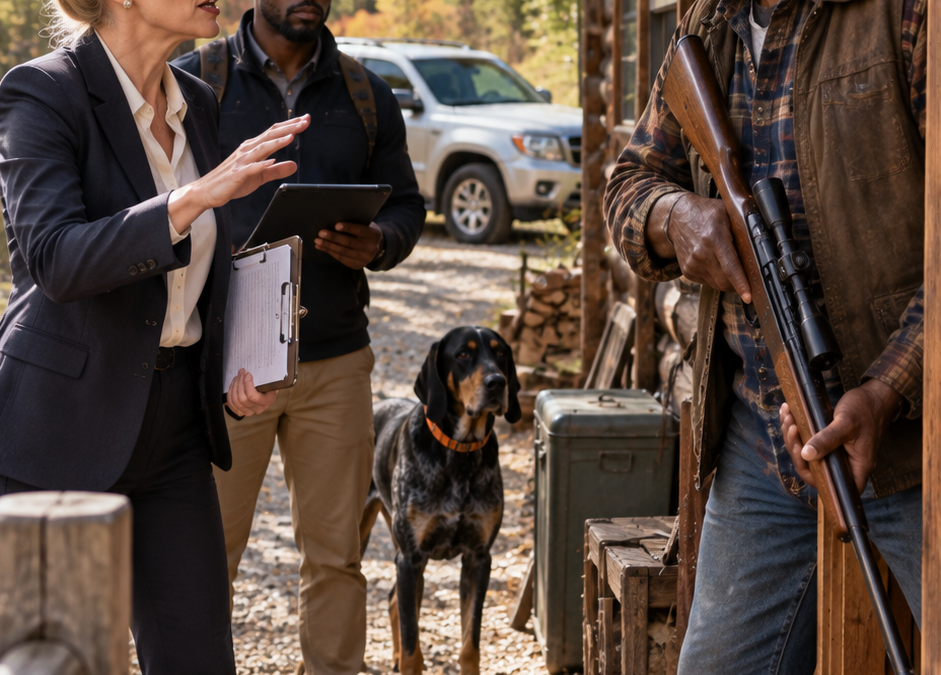
It captured my words.
It showed one man moving toward the side entrance.
It showed me disappearing inside.
Then reappearing with the rifle pointed straight down.
It showed everyone running.
No raised weapon.
No threat.
No pursuit.
Rosalyn had a copy within an hour.
Then she asked me about Diane’s clipboard.
“It’s still on the porch.”
“Photograph it where it fell.”
I did.
“Now gather the loose pages without rearranging them. Put everything in an envelope.”
One page was an inspection form.
Another was a property enforcement worksheet.
At the top was my parcel number.
Near the bottom was a section marked:
ENTRY REQUIRED FOR STRUCTURAL VERIFICATION.
That phrase did not help Diane.
Neither did a handwritten notation beside it:
Owner resistant—proceed under association inspection authority.
Rosalyn stared at the scan I sent her.
Then she called me.
“Well.”
“That bad?”
“For her?”
“Yes.
“For you?”
“No.”
No criminal issue came from the rifle incident.
The footage made the sequence too clear.
But the encounter changed the tone of the dispute.
Ridgerest’s attorney sent Rosalyn a letter confirming that no association representatives would enter my property while jurisdiction remained contested.
That was probably the first sensible decision anyone at Ridgerest had made since September.
Then the certified abstract arrived.
The title search traced the parcel all the way back to an 1887 Tennessee land grant to Josiah Aldridge.
Aldridge family.
Elias’s 1951 purchase.
Wendell’s 1974 expansion.
My 2010 transfer.
No HOA declaration.
No annexation.
No Ridgerest covenant.
No hidden restriction.
Fee simple absolute.
The fullest ownership interest recognized by common-law property principles.
I put the abstract in the fireproof box.
For several days, I thought that was the end of the factual investigation.
I was wrong.
Rosalyn’s paralegal, June Sutter, decided to cross-reference my title with Ridgerest’s original 1997 declaration.
That was not strictly necessary.
But June had worked for Rosalyn for eleven years, and thorough people are dangerous to bad paperwork.
She called me on a Wednesday morning.
“Mr. Apprentice, I found your parcel.”
“In their declaration?”
“In an exhibit.”
I stopped what I was doing.
“What does it say?”
Ridgerest’s 1997 declaration contained a provision allowing the association to extend certain standards to neighboring parcels if those owners voluntarily acknowledged the arrangement in writing or entered a recorded affiliation agreement.
That alone was not a problem.
The problem was Exhibit G.
Eleven parcel numbers appeared under a heading for affiliated properties.
Mine was one of them.
Parcel 047-23.
Beside it:
Acknowledged in writing — March 14, 1997. File RC-97-044.
I read the number twice.
In 1997, my father Wendell owned the land.
“June.”
“Yes?”
“My father never told me he joined an HOA.”
“That doesn’t prove he didn’t.”
“I know.”
“Which is why we need the file.”
She was right.
Memory was not evidence.
Even family memory.
Rosalyn requested RC-97-044 from Ridgerest.
Two weeks later it arrived.
One page.
That was all.
A form letter dated March 14, 1997.
Addressed to Wendell Apprentice.
The letter welcomed him as a neighbor of the new Ridgerest Hollow community and described voluntary standards the development hoped neighboring property owners might follow.
At the bottom was an acknowledgment line.
I acknowledge receipt and applicability of the Ridgerest Hollow adjacent property standards.
Below it:
Signature: ______________________
Date: __________________________
Both lines were blank.
My father had never signed it.
There was no return acknowledgment.
No contract.
No recorded annexation.
No evidence he had agreed to anything.
Ridgerest had taken a letter it sent to my father, treated the act of mailing it as though it were his consent, and listed his parcel as affiliated property.
For twenty-six years.
When Rosalyn called me, she said it in one sentence.
“They converted outgoing mail into imaginary consent.”
I looked toward the fireproof box.
“That’s their whole foundation?”
“That appears to be it.”
“So Diane’s sphere of influence…”
“Was built on a parcel list that was wrong from the beginning.”
I sat there quietly.
The whole dispute suddenly made sense.
Diane had not invented my parcel out of nothing.
She had found it in an old HOA exhibit.
She had assumed the exhibit was legally valid.
Then she had expanded that assumption into enforcement authority.
Certified letters.
Fines.
Inspections.
Entry onto private property.
The problem was that nobody had checked the document underneath the listing.
Until June.
Rosalyn filed in circuit court.
She requested quiet title relief concerning any claimed Ridgerest interest.
She asked the court to declare the 1997 affiliated-property designation void as to parcel 047-23.
She requested cancellation of every fine.
She sought attorney fees.
And she attached everything.
The deeds.
Survey.
Abstract.
Ridgerest declaration.
Exhibit G.
File RC-97-044.
The blank signature line.
And the correspondence showing that Ridgerest had continued enforcement even after being asked to identify the legal source of its authority.
Philip Greer did not waste much time pretending the document said something it did not.
His client had a problem.
And lawyers generally prefer survivable problems over dramatic ones.
The hearing was held in February.
Judge Carol Biggs presided.
I sat beside Rosalyn at counsel table.
Across the aisle sat Philip Greer and two Ridgerest board members.
Diane was not there.
Rosalyn began with 1951.
Elias’s deed.
Then 1974.
Wendell’s purchase.
Dale Copley’s survey.
Then 2010.
My deed.
Then Ben Alcott’s current survey.
Three hundred twelve feet between my land and the Ridgerest plat.
State land between them.
Then the title abstract.
Nothing.
No Ridgerest covenant.
No annexation.
Then she held up Exhibit G.
“Your Honor, this is the document the association relied upon to classify Parcel 047-23 as an affiliated property.”
Judge Biggs read it.
Rosalyn continued.
“The underlying file identified here is RC-97-044.”
She handed the clerk another exhibit.
“This is RC-97-044.”
The judge looked down.
I watched her eyes move to the bottom.
The blank lines.
She looked at Philip Greer.
“Mr. Greer?”
He stood.
“Your Honor, the association acknowledges that its present records contain no signed acknowledgment from Mr. Wendell Apprentice.”
“No signed acknowledgment?”
“No, Your Honor.”
“No annexation agreement?”
“No.”
“No separately recorded instrument?”
“No.”
Judge Biggs looked back at the form letter.
“Then on what basis was this property listed as affiliated?”
Greer chose his words carefully.
“It appears the listing was made administratively during the original development period.”
The judge raised her eyes.
“Administratively is not an answer.”
“No, Your Honor.”
“It is either legally subject to the declaration or it is not.”
“Yes, Your Honor.”
Rosalyn did not smile.
Neither did I.
There was no reason to.
This was exactly what we had spent months preparing for.
The documents were doing the work.
Greer finally said, “The association is prepared to stipulate that Parcel 047-23 should be removed from the affiliated-property list.”
Judge Biggs turned toward Rosalyn.
“Does that resolve the case?”
“Not entirely, Your Honor.”
Of course it did not.
Ridgerest had already issued fines.
Entered my property.
Scheduled inspections.
Asserted a right to examine structures.
And continued even after being warned that its legal basis was disputed.
Rosalyn asked the court to make the ruling formal.
Not merely a voluntary correction by the association.
A judgment.
Something that would remain in the record after Diane, the board, Greer, Rosalyn, and I were all gone.
Judge Biggs agreed.
She ruled that Ridgerest had no enforceable declaration over my 214 acres.
She declared the affiliated-property designation ineffective as to my parcel.
All outstanding fines were vacated.
Ridgerest was barred from asserting HOA compliance jurisdiction absent some future valid legal agreement voluntarily entered into by the property owner.
The court also awarded $4,820 in attorney fees.
But the money was not the part I cared about.
The part I cared about came when Judge Biggs looked down at the file and said:
“The record controls.”
Three words.
That was nearly the entire case.
Not Diane’s clipboard.
Not the Lexus.
Not the forty-seven-page rule book.
Not the words “sphere of influence.”
Not the fines.
Not the four people arriving at a cabin believing an HOA badge on a jacket gave them authority to test doors.
The record.
After the hearing, Rosalyn and I walked out together.
“You know what Elias would have liked about this?” I asked.
“What?”
“Nobody had to yell.”
Rosalyn smiled.
“Good documents rarely yell.”
I drove directly to the cabin.
Winter had stripped the ridge bare.
The road was hard from freezing temperatures, and the creek below the hill moved dark between shelves of ice.
I parked near the porch.
The same porch where Diane had dropped her clipboard months earlier.
The same place four HOA representatives had run when they saw a hunting rifle and mistakenly realized for the first time that they were not standing in a suburban common area.
They were at a remote private cabin on somebody else’s land.
I walked to the east boundary.
Snow remained in shaded patches.
I found one of Ben Alcott’s markers.
New steel beside Dale Copley’s old iron pin.
Two surveys.
Nearly fifty years apart.
Same line.
I crouched and rested my hand on the marker.
Beyond the state forestry strip, the lights of Ridgerest were beginning to appear.
Small.
Orderly.
Warm.
I had never had anything against the people who lived there.
Most of them probably knew nothing about what Diane had been doing.
They bought homes.
Paid dues.
Went to work.
Raised children.
Mowed lawns.
The problem had never been the existence of their community.
The problem was the belief that a community’s rules could expand simply because somebody drew a larger shaded area on a map.
Property law does not work that way.
Ownership does not fade because somebody nearby prefers your weeds shorter.
Jurisdiction does not travel across three hundred twelve feet of land because a compliance director wants it to.
And consent does not appear because someone mailed you a form you never signed.
I stayed at the cabin that night.
Built a fire.
Made coffee.
Then I opened the fireproof box.
The old documents still smelled faintly of paper and dust.
Elias’s deed was there.
March 14, 1951.
My father’s 1974 deed.
Dale Copley’s survey.
My 2010 transfer.
Ben Alcott’s new survey.
The title abstract.
Now there was one more document.
Judge Biggs’s order.
I placed it inside.
Then I picked up Elias’s note.
Hold this land.
When I was younger, I thought those words meant never sell.
I understood them differently now.
Holding land is not merely refusing to transfer it.
It means knowing what you own.
Knowing where it begins.
Knowing where it ends.
Maintaining the record.
Paying attention.
And when someone claims a right over it, asking the simplest possible question:
Show me where that right comes from.
Sometimes they can.
There are easements.
Covenants.
Rights-of-way.
Mineral interests.
Deed restrictions.
Real legal interests that survive owners and generations.
But sometimes all they have is confidence.
And confidence looks very convincing when it arrives wearing a blazer and carrying a clipboard.
That is why I never regretted refusing to argue with Diane the first morning.
She stood on my drive and said:
“Your property is in violation.”
I could have shouted.
Instead, I asked questions.
She gave me fourteen days.
I gave Rosalyn the deed.
She gave me a fine.
I ordered a survey.
She showed her board a sphere-of-influence map.
June found the original declaration.
They said my father had acknowledged HOA authority.
We requested the acknowledgment.
And when the paper finally arrived, the signature line was empty.
That blank space was more powerful than every sentence Diane had spoken.
A signature that did not exist.
Consent that had never been given.
Authority that had never been created.
People later asked me about the rifle.
Word traveled around the hollow.
Stories became bigger each time they were repeated.
According to one version, I chased four HOA officers off my land with a loaded deer rifle.
That never happened.
I never aimed a rifle at anyone.
I never threatened anyone.
The weapon was unloaded.
I picked it up because strangers were trying the door of an isolated hunting cabin after being told to leave.
They saw it.
They ran.
And that was the end of the physical confrontation.
If there is something satisfying in this story, it should not be that four people were frightened by a gun.
The satisfying part came months later in a quiet courtroom.
The clipboard was not defeated by a rifle.
It was defeated by a blank signature line.
That matters.
Because intimidation is temporary.
Documentation lasts.
The following October, I returned for my usual three weeks.
The ridge looked exactly as it had the year before.
Leaves turning.
Cold mornings.
Mist in the creek bottom.
I split wood beside the same chopping block.
Darnell came by carrying another jar of honey.
He sat on the porch.
“You hear about Diane?”
“No.”
“Resigned.”
“When?”
“Summer.”
I nodded.
“Board changed the compliance policy too.”
“How?”
“They have to verify the parcel is actually inside the HOA before sending violations.”
I looked at him.
“That seems like an advanced legal concept.”
Darnell stared into his coffee.
“Apparently took them twenty-six years.”
We sat quietly.
Then he asked, “What did you do with her clipboard?”
“Rosalyn returned it through Greer.”
“Should’ve framed it.”
“No.”
“Why not?”
I looked at the ridge.
“Wrong document.”
Darnell nodded slowly.
He understood.
The papers worth framing were inside the fireproof box.
That evening, I walked down toward the eastern meadow.
A buck moved through the timber above me.
Not running.
Just walking.
The creek was cold enough that mist hovered over it.
I could smell leaves beginning to rot beneath the trees.
Above the hollow, the first stars appeared.
I thought about Elias arriving there before there was electricity on the ridge.
About my father improving the cabin.
About Gerald deciding the land belonged with me.
About how easy it would have been, over four generations, for a deed to disappear.
A survey to be misplaced.
A boundary to become uncertain.
A family to rely on memory instead of documentation.
But Elias had put his deed in a box.
Wendell kept it.
Then I kept it.
And when an institution finally arrived claiming authority, we did not have to remember where the boundary ought to be.
We knew.
The paper knew.
The iron pins knew.
The county record knew.
Diane’s letters stopped.
No Ridgerest vehicle ever came up my gravel drive again.
No compliance officer photographed the cabin.
No fines appeared in my mailbox.
My woodshed remained where it had stood.
The meadow grew as high as I chose to let it grow.
The timber followed the management plan I chose for it.
And every October, I continued coming back.
The cabin still faced east.
The black-locust porch posts Elias installed were still holding.
The chestnut floor still creaked near the stove.
The fireproof box remained in the back room.
One morning near the end of that October stay, I woke before sunrise.
I made coffee and carried it onto the porch.
The valley below was still dark.
Ridgerest Hollow was visible as a collection of tiny lights through the trees.
Then the eastern sky began changing.
Black to blue.
Blue to gray.
Gray to gold.
The first sunlight touched the upper ridge.
Then the trees.
Then the meadow.
Eventually it reached the porch.
I understood why Elias had built the cabin facing that direction.
Not because sunrise was dramatic.
Because it was reliable.
Every morning, light returned to the same valley.
The boundary remained where it was.
The creek followed the same hollow.
The ridge rose from the same ground.
Human claims could become confused.
Records could be misread.
Institutions could become overconfident.
But the land itself had never moved.
Neither had those 214 acres.
Ridgerest Hollow had spent months trying to convince me that my family property had somehow drifted into its jurisdiction.
It had not.
What drifted was their understanding of where their authority stopped.
And when the question finally reached a courtroom, nobody needed to guess.
The answer had been sitting in a fireproof box all along.
I finished my coffee.
Then I went inside.
Before heading out for the morning hunt, I opened the box one more time.
Elias’s note was still on top.
Three words.
Hold this land.
I folded the paper carefully.
Closed the lid.
And locked the box.
Because after seventy-five years, the Apprentice family still held the ridge.
Not because we had shouted louder than the people who challenged us.
Not because I had a rifle inside the cabin.
And not because an HOA finally decided to be reasonable.
We held it because the deed was clear, the survey was clear, the boundary was clear, and when the moment came to prove it, the record was stronger than every clipboard they could carry up that mountain.








