𝗙𝗨𝗟𝗟 𝗦𝗧𝗢𝗥𝗬 HOA Dumped Wood Scraps on My Land for 5 Months—Then Paid Me $128,600 to Buy Them Back
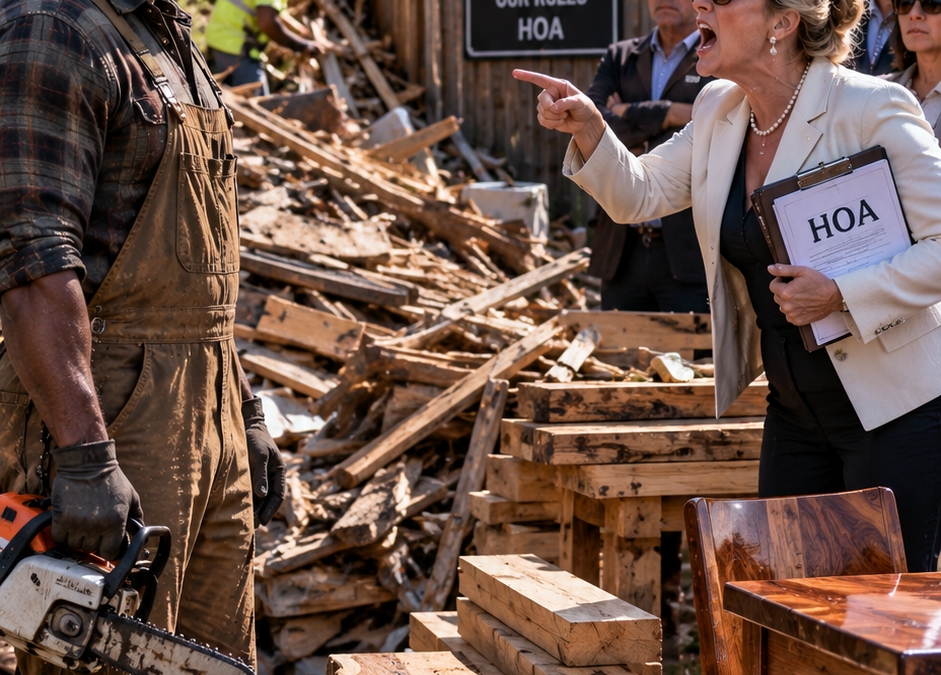
𝗙𝗨𝗟𝗟 𝗦𝗧𝗢𝗥𝗬
I spent fifteen years working professionally with wood.
Cabinet shops.
Custom millwork.
Historic restoration.
Finish carpentry.
Furniture.
My father had been better than I ever was.
Raymond Turner could look at a gray board lying behind a barn and tell you its species before cutting it.
Sometimes before touching it.
He could see through dirt.
Through paint.
Through rot on the edges.
Through years of neglect.
When I was a kid, he would drag old lumber home constantly.
My mother hated it.
“What are you going to do with this?”
Ray would shrug.
“Don’t know yet.”
“That is not an answer.”
“It’s dry.”
“That is also not an answer.”
Years later someone would need an old oak door.
Heart-pine flooring.
Clear cedar.
A mantel beam.
And suddenly the stack Mom had complained about for three years became the only material within a hundred miles that fit the job.
“Never judge a board while it’s dirty,” Dad used to say.
“Wood lies when it’s dirty.”
After he died, I stepped away from professional woodworking.
Not immediately.
I tried to keep going.
But the shop felt different.
Too quiet.
His pencil marks were still on the benches.
His sharpening stones were still arranged beside the sink.
His coffee mug sat on a shelf because I could never bring myself to throw it away.
For four years, I mostly kept the shop closed.
Then Pine Hollow dumped the first three loads behind it.
That afternoon, after the trucks left, I walked through the nearest pile.
I wasn’t looking for value.
I was documenting damage.
At least that’s what I told myself.
Then one board caught my eye.
Five feet long.
Gray.
Split at one end.
I dragged it free.
Scraped my thumbnail across the weathered face.
Under the gray surface appeared dark reddish brown.
Cedar.
Not the lightweight, pale plantation cedar sold in modern home centers.
Old western red cedar.
Narrow rings.
Straight grain.
Dense.
Beautiful.
I pulled another piece.
Oak.
Next:
Pressure-treated pine.
Worth very little.
Then:
More cedar.
Vertical-grain Douglas fir.
Redwood.
I stopped.
Looked at the pile again.
Then at the other two.
These weren’t random scraps.
Pine Hollow was demolishing structures built during the subdivision’s expensive early phase, back when developers had spent real money on material to sell the illusion of permanence.
Pergolas.
Pool structures.
Decks.
Entry features.
Clubhouse trim.
Twenty-year-old architectural lumber.
Some pieces were damaged.
Some rotten.
Some useless.
Others were excellent.
I still wanted every board removed.
Value did not change ownership.
And I had not agreed to become anybody’s disposal site.
So I emailed Brenda.
The message was simple.
The drainage easement did not authorize storage or dumping.
Pine Hollow had forty-eight hours to arrange removal.
The following morning, she replied.
Three paragraphs.
The important sentence was the last.
I still know it almost word for word.
The deposited material is no longer required for association purposes, and because the material now rests on your property, maintenance, storage, removal, and/or disposal shall be the responsibility of the property owner.
I read it twice.
Then printed it.
Then drove straight to the county recorder.
The easement was exactly as I remembered.
Twelve feet wide.
Drainage inspection.
Maintenance.
Emergency access.
Nothing about debris.
Nothing about staging.
Nothing about storage.
I sent Brenda a certified copy.
The response came from Pine Hollow’s management company.
Association position unchanged.
Fine.
At that point, I still wasn’t thinking business.
I was thinking lawsuit.
Then more trucks arrived.
Eleven additional loads in three weeks.
Some I stopped.
Others came while I was away.
Two arrived before sunrise.
I installed cameras.
The drivers were not villains.
Most looked embarrassed.
One told me:
“Mr. Turner, they’re backcharging us if we return a load.”
“Who is?”
“Pine Hollow.”
“Did your company tell them this is private property?”
“Three times.”
“And?”
He gave me a tired smile.
“You know Brenda?”
“I do.”
“Then you know.”
I did.
By the second month, the piles had become enormous.
That created the next absurdity.
Pine Hollow residents started complaining about them.
From Alder Crest Drive, they could see the tops of the lumber stacks.
Somebody posted online that I had opened a junkyard.
Another asked why the HOA allowed “industrial waste” beside a premium neighborhood.
Then Brenda sent me a violation notice.
I stood at the kitchen counter reading it.
UNSIGHTLY OUTDOOR ACCUMULATION.
I laughed.
Not because it was funny.
Because there are moments when hypocrisy becomes too perfectly engineered to produce any other reaction.
Pine Hollow dumped wood on my land.
Refused to remove it.
Declared that handling it was my responsibility.
Then fined me for having it.
I emailed photographs.
No answer.
A second violation arrived.
Then a third.
Total fines:
$1,250.
That afternoon, I stopped asking them to remove the lumber.
I walked into Dad’s old shop instead.
The room smelled like cold steel and stale sawdust.
The jointer sat beneath a cover.
Planer against the wall.
Table saw in the middle.
Wide-belt sander under canvas.
Dust-collection ducting overhead.
I had not powered the full system in years.
I went to the breaker panel.
LIGHTS.
Click.
Fluorescent tubes blinked.
DUST COLLECTOR.
Click.
The old motor groaned.
Turned once.
Twice.
Then gathered speed.
Air began moving through the silver ductwork.
I stood there listening.
For one strange second, I expected Dad to walk through the door.
Instead, there was only me.
I went outside.
Selected the cedar board from that first pile.
Carried it in.
Twenty minutes pulling nails.
Metal detector twice.
Trimmed the cracked end.
Then I ran the face across the jointer.
Gray wood disappeared.
Underneath it was red cedar so rich and straight that I stopped the machine and simply looked at it.
Dad had been right.
Wood lies when it is dirty.
For the next month, I did not build much.
I sorted.
Treated lumber separate.
Rot separate.
Short stock separate.
Cedar.
Oak.
Fir.
Redwood.
I removed nails.
Scanned every board for hidden metal.
Washed dirt.
Cut rotten ends.
Measured moisture.
Stacked usable stock on stickers under cover.
Logged dimensions.
Species.
Source when known.
Condition.
Estimated yield.
It was slow work.
Quiet work.
And something unexpected happened.
I started feeling like myself again.
My father’s death had taken more out of me than I admitted.
For years, woodworking had reminded me of what was missing.
Now these ugly piles gave me a reason to walk back into the shop without nostalgia being the only thing waiting there.
Brenda thought the problem was disappearing.
Every week, the outside piles became smaller.
She saw me moving boards under cover.
At a board meeting, someone apparently asked whether they should continue enforcement.
Brenda answered:
“He got the message.”
In a way, she was right.
I had.
The message was that Pine Hollow no longer wanted the material.
The email proved it.
The disposal manifests proved it.
Their behavior proved it.
And if I was now responsible for storage, removal, or disposal, I was going to choose a fourth option.
Recovery.
The first table was an experiment.
Eight cedar boards from the old pool enclosure.
I milled them flat and square.
Left several old nail holes visible.
Dad always said scars were part of reclaimed wood’s grammar.
The base came from oak beams.
Wedged mortise-and-tenon joints.
Heavy.
Simple.
Built to outlast whoever bought it.
For three days, I kept walking around the unfinished piece wondering whether I was making furniture or indulging grief.
Finally, I sanded it.
Oiled it.
Then carried it outside at sunset.
The cedar lit up.
Deep brown-red grain.
Old holes.
Small checks.
Nothing artificial.
I took six photographs.
Posted them online.
Description:
Reclaimed cedar and oak dining table. Architectural salvage. One of one.
Price:
$4,800.
I expected people to laugh.
The next morning, a designer from Columbus called.
Two days later she arrived with a client.
She walked around the table slowly.
Ran her fingers over the old nail holes.
Crouched to inspect the joinery.
Then asked:
“Can you make another twelve inches longer?”
“The material won’t match exactly.”
She looked at me.
“That’s why I want it.”
They bought the first table.
Paid a fifty-percent deposit on the second.
After their SUV disappeared, I stood alone inside the shop looking at the payment notification on my phone.
Then I walked outside.
The piles looked different.
Yesterday:
Problem.
Today:
Inventory.
That did not mean every board was gold.
Most people ruin salvage businesses by believing every rotten plank contains treasure.
I spent weeks calculating what I actually possessed.
Moisture.
Waste percentage.
Nails.
Rot.
Species.
Recoverable board feet.
Market pricing.
The total Pine Hollow had dumped over roughly five months approached sixty thousand board feet.
About half was realistically useful.
That still left an extraordinary amount.
Clear cedar.
Old redwood.
Oak timbers.
Fir.
At wholesale reclaimed-lumber prices, the usable stock could exceed two hundred thousand dollars.
As finished furniture and architectural millwork?
Much more.
That number scared me more than it excited me.
Unexpected inventory is not a business.
A sold table is not a business.
A viral story is not a business.
A business has insurance.
Accounts.
Processes.
Customers.
Margins.
Repeatable supply.
So I did it properly.
Registered Turner Heritage Millworks.
Opened separate banking.
Renewed liability coverage.
Met with an accountant.
Created inventory batches.
Attached Brenda’s email to the provenance file.
I documented everything.
The first major commercial job came from a downtown restaurant renovating an old brick building.
The owner wanted twelve tables and a reclaimed bar front.
No fake distressing.
No factory wood attacked with chains to imitate history.
I showed him cedar from Pine Hollow’s entrance pergola.
Contract value:
A little over $28,000.
That job bought new cutter heads.
Dust-system improvements.
And my first employee.
Marcus Bell.
Fifty-eight.
Quiet.
Strong.
Recently laid off when a commercial cabinet company moved production out of state.
Marcus had worked with Dad years before.
On his first day, he stood in the shop looking around.
“Ray would’ve liked this.”
I adjusted the table-saw fence.
“He would’ve complained about the layout.”
Marcus smiled.
“That too.”
We worked well together because neither of us believed conversation improved accuracy.
Mornings:
Lumber processing.
Afternoons:
Orders.
Three months later I hired Elena Ruiz.
Furniture restoration background.
Better eye for color than either Marcus or me.
She could look at five old cedar boards from different structures and tell you which finishing schedule would make them look related without making them look fake.
Orders grew.
Not explosively.
Thank God.
Explosive growth kills small shops.
We grew steadily.
Mantels.
Conference tables.
Cabinet fronts.
Wall paneling.
Restaurant work.
Custom benches.
A lakehouse mudroom.
Designers began calling.
Architects requested samples.
Then a small adaptive-reuse website featured us.
Out-of-state inquiries followed.
Meanwhile, Pine Hollow congratulated itself for solving the dumping problem.
At an HOA meeting, their treasurer reported that the association had saved approximately $41,000 in disposal and hauling expenses during the renovation.
Brenda apparently said:
“Good management is often simply refusing to pay unnecessary costs.”
I wish I had been there.
Eight months later, Pine Hollow began planning a new clubhouse.
Bigger.
New stone fireplace.
High ceilings.
Bar.
Built-ins.
Warm architectural wood.
Their designer wanted reclaimed cedar and oak.
Because, and I appreciate the irony here, reclaimed wood gave a new building “a sense of history.”
History is expensive when you demolish yours and dump it over a fence.
They requested bids.
One board member, Paul Hennessy, searched locally.
Then found my website.
TURNER HERITAGE MILLWORKS
According to Paul, Brenda was having breakfast when he sent the link.
She opened our portfolio.
Dining table.
Cedar paneling.
Redwood reception desk.
Oak mantel.
Then a collection labeled:
PINE HOLLOW CEDAR SERIES.
She recognized green paint inside an old mortise.
The original clubhouse pergola had been dark forest green.
By lunchtime, her SUV was in my driveway.
I was checking a packing list when she stepped out.
White blouse.
Folder.
Expression suggesting a federal crime had occurred somewhere nearby and she intended to identify it personally.
“We need to talk.”
“What can I do for you?”
She looked toward the racks.
“That wood belongs to Pine Hollow.”
I almost smiled.
“Which wood?”
“The cedar.”
She pointed.
“The oak. Redwood. Everything from our renovation.”
“Come inside.”
My office had once been storage.
Now it had samples.
Desk.
Two chairs.
On one wall hung a photograph of Dad and me beside a walnut cabinet.
Brenda remained standing.
“You were permitted to dispose of debris.”
“No.”
“You were not authorized to sell association property.”
“I asked you to remove it.”
“That did not transfer ownership.”
“You told me you didn’t want it.”
“I said the association no longer needed it for HOA purposes.”
I opened the filing cabinet.
Pulled out her email.
Highlighted sentence.
Set it in front of her.
She read her own words.
Then I placed the contractor manifest beside it.
DESTINATION: TURNER PROPERTY.
Then photographs.
Then easement.
Then a spreadsheet.
Forty-seven documented deliveries.
She looked at the stack.
“You kept all this?”
“I keep records.”
Her face changed.
Not fear yet.
Calculation.
“How much raw inventory remains?”
“Enough.”
“We will need an accounting.”
“For what?”
“To identify association assets.”
I leaned back.
“Brenda, you spent nearly a year insisting this was not your problem.”
“It was waste material.”
“Then why do you want it?”
“Because waste can retain ownership.”
“That sentence sounds expensive.”
Her eyes narrowed.
“What does that mean?”
“You’ll find out.”
She gathered the folder.
“At a minimum, stop selling Pine Hollow material until our attorney reviews this.”
“I recommend your attorney read the drainage easement first.”
Three days later, certified mail arrived.
Pine Hollow demanded a complete accounting of all salvaged wood.
Claimed continuing ownership.
Accused me of commercial conversion.
Demanded $147,000 in damages.
Threatened an injunction.
Threatened fines.
Threatened a lien.
Marcus read the letter at the shop.
“They really want to do this?”
“Apparently.”
“What are you going to do?”
I took the pages.
“Find out what storage costs.”
That evening, after everyone left, rain hit the metal roof.
I sat at Dad’s old sharpening bench.
Beside the HOA demand was an old ledger I had found months earlier.
Most pages contained boring numbers.
Deposits.
Materials.
Hours.
Blade replacement.
Customers who paid late.
Near the back, Dad had written a heading:
THINGS WORTH KEEPING
Underneath:
Good tools.
Dry wood.
People who keep their word.
Enough room to work.
A name you are not ashamed to put on the door.
I read it twice.
Pine Hollow’s demand bothered me.
Not mainly because of the $147,000.
Because their version erased everything between dump truck and finished furniture.
When Pine Hollow owned the boards, they were a liability.
They budgeted money to throw them away.
They saved $41,000 by shifting that burden to me.
Then I spent hundreds of hours sorting.
De-nailing.
Scanning.
Drying.
Cutting.
Milling.
Storing.
Insuring.
Designing.
Building.
Selling.
Now that customers valued the result, Brenda wanted to pretend the value had been sitting untouched inside the pile all along.
Dad had explained that problem once to a customer complaining about a cabinet price.
The man pointed at a walnut board.
“That board doesn’t cost that much.”
Dad answered:
“You’re looking at the board. The price is everything that happens after the board gets here.”
That was the case.
I hired Miriam Cole.
Property and small-business attorney.
Office above a pharmacy.
Old carpet.
Cracked conference table repaired with butterflies.
No polished marble lobby.
I liked her immediately.
Mostly because for the first twenty minutes she barely spoke.
She read.
Easement.
Emails.
Truck records.
Photos.
HOA fines.
Manifests.
Demand letter.
Then:
“How many deliveries?”
“Forty-seven documented.”
“Period?”
“About five months.”
“And they now claim the wood remained their property?”
“Yes.”
She folded her hands.
“That creates an unfortunate choice for Pine Hollow.”
“For them?”
“Yes.”
She tapped Brenda’s email.
“If they abandoned the material, they have no ownership claim.”
“Agreed.”
“But if they insist it remained their property…”
She paused.
“Then they used your land as a commercial storage facility for five months without permission.”
I smiled.
“There it is.”
“The easement?”
“Drainage only.”
“Then let’s price storage.”
Commercial land-use rates.
Material handling.
Sorting.
Environmental inspection.
Weather protection.
Security.
Labor.
Equipment time.
Administrative work.
Site interference.
Cleanup.
Miriam refused to inflate anything.
“Big fantasy numbers look like revenge,” she said. “Boring documented numbers look like invoices.”
The first total came to:
$186,400.
Then she added a credit.
Credit for material accepted and processed in lieu of disposal obligation: $132,000.
Balance:
$54,400 due to Caleb Turner.
I stared.
“So if it was mine, their claim fails.”
“Yes.”
“And if it was theirs—”
“They owe storage.”
“Beautiful.”
“Don’t get emotional.”
“I’m admiring structure.”
We sent the counterclaim by certified mail.
Pine Hollow called an emergency meeting.
Every chair was full.
I had lived next to that development twelve years without attending a single HOA meeting.
That Thursday, nobody questioned why I was there.
Rumors had spread.
Some thought I stole wood.
Some thought Pine Hollow dumped garbage.
Others knew only that somebody was selling their old clubhouse lumber for thousands.
Brenda sat at the front.
White blazer.
Property manager to one side.
Attorney to the other.
She opened with a long statement about community assets.
Protection of member-owned property.
Unauthorized commercial exploitation.
I waited.
Then Miriam stood.
“One question.”
Brenda’s attorney watched her.
“Did Pine Hollow authorize forty-seven deliveries of demolition material to Mr. Turner’s parcel?”
“We dispute the characterization—”
“Did Pine Hollow pay the contractor who delivered it?”
The treasurer shifted.
Brenda answered.
“The contractor performed disposal services under the renovation agreement.”
Miriam smiled.
“Disposal. Good.”
A murmur.
She displayed the drainage easement.
“Can anyone show where this authorizes debris storage?”
Silence.
Brenda tried:
“We have historically used the corridor for maintenance.”
“Access is not storage.”
Next document.
Her email.
Large on the screen.
THE DEPOSITED MATERIAL IS NO LONGER NEEDED FOR HOA PURPOSES…
Paul Hennessy raised his hand.
“Brenda, did you write that?”
“It reflected information available at the time.”
“You told Caleb it was his responsibility.”
“I told him conditions on his property were his responsibility.”
A woman spoke from the second row.
“But we created the condition.”
That was the moment the room changed.
Then someone asked:
“How much did we save by dumping it there?”
The treasurer looked down.
Miriam answered.
“Approximately forty-one thousand dollars in avoided hauling and disposal.”
People began talking.
Brenda hit the gavel.
Miriam waited.
Then continued.
“The association placed material on Mr. Turner’s land.”
Pause.
“He objected.”
Pause.
“The association refused removal.”
Another.
“The president stated in writing that the association no longer needed the material.”
Then:
“The HOA fined him for the appearance of material the HOA itself placed there.”
That produced disbelief.
Not anger yet.
Disbelief first.
People looked at one another as if hoping someone would explain the missing part that made it sensible.
There wasn’t one.
Miriam held up Pine Hollow’s new demand.
“Now that Mr. Turner has applied labor, specialized knowledge, equipment, insurance, capital, and business resources to material Pine Hollow called waste, Pine Hollow claims it never surrendered ownership.”
She picked up our invoice.
“Mr. Turner is prepared to consider that interpretation.”
Brenda’s attorney looked concerned.
Miriam smiled.
“If the lumber remained Pine Hollow property, then Pine Hollow used Mr. Turner’s land to store Pine Hollow property without authorization.”
Someone laughed in the back.
“Accordingly, we have calculated reasonable storage, handling, inspection, security, site-restoration, and administrative expenses.”
The attorney requested a recess.
Twenty minutes.
During the break, residents surrounded the treasurer.
Not me.
Why was there no storage agreement?
Why had dumping continued after I objected?
Why did they fine me?
Why was old treated material dumped beside a drainage feature?
Why had Brenda saved $41,000 without explaining where the debris went?
Brenda sat alone at the table.
When the board returned, its attorney announced:
“All enforcement action against Turner Heritage Millworks is suspended pending settlement discussions.”
Miriam leaned toward me.
“They’re done.”
Six weeks later, settlement.
Pine Hollow withdrew the $147,000 claim.
Canceled all fines.
Reimbursed my documented legal fees.
Paid compensation for land-use interference and part of my handling costs.
Recorded an acknowledgment that its drainage easement did not permit material staging.
New policy:
No HOA contractor could place materials on private property without written landowner consent.
Brenda resigned two weeks before signing.
Personal reasons.
Naturally.
I didn’t celebrate.
Not publicly.
Marcus bought cake.
That may have been me celebrating privately.
Turner Heritage kept growing.
The Pine Hollow wood gave me a beginning.
It did not become the whole business.
That mattered.
I started calling demolition contractors before projects began.
“Anything worth salvaging?”
Historic renovations called us.
Barn crews.
Churches.
Schools.
Commercial buildings.
Instead of sending old lumber into landfills, owners received salvage credits.
Contractors saved disposal costs.
We acquired documented material at fair prices.
Within two years, Turner Heritage employed seventeen people.
Marcus supervised milling.
Elena ran finishing and restoration.
James Woo managed cabinets.
Two apprentices learned joinery at benches my father built.
Mom brought lunch every Friday despite nobody asking her to feed seventeen adults.
We stopped objecting.
Pine Hollow lumber went everywhere.
Redwood became a farmhouse library.
Oak beams became mantels.
Old cedar became hotel cabinetry.
The most expensive single piece was a twelve-foot conference table from three matching oak beams.
$18,600.
Before delivery, I photographed it in Dad’s shop.
Sunlight across the top.
Old nail marks visible.
Beautiful.
Anyone else saw a table.
I saw forty-seven dump trailers.
Then came the final joke.
Pine Hollow resumed construction on its new clubhouse.
The architect still wanted reclaimed wood.
Warm cedar.
Old oak.
Material with visible history.
They requested new bids.
By then, Turner Heritage was one of the larger reclaimed-wood suppliers within two hours.
The request appeared in my inbox.
PINE HOLLOW ESTATES — COMMUNITY ROOM MILLWORK PACKAGE
Marcus saw me reading.
“You bidding?”
“Why wouldn’t we?”
He laughed.
Our scope included:
Cedar wall cladding.
Bar front.
Fireplace surrounds.
Built-ins.
Custom cabinets.
Installation.
Total bid:
$128,600.
We were not cheapest.
But we had the material their architect wanted.
Old local cedar.
Consistent grain.
Correct dimensions.
Documented provenance.
Three weeks later, new HOA president Daniel Mercer called.
“Caleb?”
“Morning.”
“The board wants to discuss your material package.”
“I figured.”
“Tuesday?”
“I’ll be there.”
The meeting was small.
Daniel.
Paul.
Treasurer.
Architect.
Two committee members.
Three suppliers’ samples rested on a table.
Mine looked different.
Tighter grain.
Darker color.
Old nail holes.
Character that cannot be manufactured because character usually requires surviving somebody’s bad decision.
Paul picked up my cedar sample.
Turned it over.
Stared at an old filled fastener mark.
Then looked at me.
“This came from our old clubhouse, didn’t it?”
Room quiet.
“Some of that batch did.”
He let out a helpless laugh.
“So we’re buying our own wood back.”
I could have enjoyed that moment loudly.
Could have mentioned Brenda.
Could have asked whether they wanted me to add the original $1,250 fine to the invoice as decorative history.
Instead, I said:
“It was yours when you called it trash.”
Nobody answered.
The architect finally cleared his throat.
“Technically, this is exactly the material the design calls for.”
Daniel looked at the samples.
Then at the price.
Then at me.
“Any discount for sentimental value?”
“No.”
He smiled.
“Had to ask.”
Pine Hollow awarded us the contract.
$128,600.
No revenge markup.
No special discount.
Normal commercial price.
Seven weeks of work.
Milling.
Color matching.
Fabrication.
Finishing.
Installation.
I personally installed the first cedar panels beside the new stone fireplace.
Boards Brenda Whitmore had once paid a demolition company to dump beside my shed.
Now Pine Hollow was paying my company to put them back inside Pine Hollow.
Only cleaner.
Straighter.
Finished.
Beautiful.
Opening night, the new clubhouse glowed.
Cedar wrapped the bar.
Oak framed the fireplaces.
Cabinets held faint traces of old fastener holes.
Residents touched the paneling.
Admired the grain.
Talked about warmth.
History.
Authenticity.
Most had no idea they had once complained those same boards made my property look like a junkyard.
Daniel found me near the entrance.
He looked around.
“You know what’s funny?”
“Several things.”
“This whole clubhouse is going to be remembered because of this wood.”
I looked at the cedar.
“Wood remembers more than people do.”
He couldn’t tell whether I was joking.
I wasn’t.
The next morning, I arrived at the shop early.
Two documents hung in frames inside my office.
The first:
Brenda Whitmore’s email.
THE MATERIAL IS NO LONGER NEEDED FOR HOA PURPOSES.
The second:
Pine Hollow’s purchase order.
$128,600.
Marcus had insisted I hang them together.
At first I resisted.
I did not want Turner Heritage to become a shrine to an HOA argument.
Then I realized those documents were not about Brenda.
They were about value.
One showed what people say when they believe something is worthless.
The other showed what happens after somebody does the work required to reveal what was there.
An apprentice was sorting a new delivery when I walked onto the shop floor.
Century-old heart pine from a school renovation.
Some boards looked terrible.
Paint.
Nails.
Cracks.
One young man lifted the ugliest piece.
“Caleb?”
“Yeah?”
“Think this one’s worth saving?”
I took it.
Brushed dirt from the edge.
Tight grain appeared.
I handed it back.
“Don’t decide while it’s dirty.”
He nodded.
Carried it toward the cleaning station.
Outside, a truck began backing toward our receiving area.
Beep.
Beep.
Beep.
Then the sound of old lumber being unloaded.
Years earlier, that noise had meant trespass.
Frustration.
Work.
Now I heard something else.
Inventory.
Wages.
Orders.
Machines running.
Apprentices learning.
Families buying tables that might outlive them.
Pine Hollow thought it saved $41,000 by making its disposal problem mine.
Instead, it supplied the raw material that reopened my father’s shop.
It helped me build a business employing seventeen people.
It gave me enough inventory to establish a name in reclaimed architectural wood.
Then, in the final insult delivered entirely by economics, it came back and paid $128,600 to buy finished versions of the same material.
Brenda had looked at those first dirty piles and seen expense.
I saw cedar beneath gray weathering.
Oak beneath paint.
Redwood beneath mud.
And eventually, a business beneath grief.
That was the real fortune.
Not simply the money.
The first table mattered because it brought me back into Dad’s shop.
The restaurant contract mattered because it gave Marcus work.
The growing company mattered because two apprentices now learned at the same benches where my father taught me.
There is a line from Dad’s ledger that I keep beside my desk.
A name you are not ashamed to put on the door.
Every morning, I drive past our sign.
TURNER HERITAGE MILLWORKS
I’m proud of that name.
Brenda tried to make me ashamed of the piles.
Then she tried to fine me for them.
Then she tried to claim them after I made them valuable.
She lost all three times.
Pine Hollow’s new board turned out to be reasonable.
The drainage easement has never been abused again.
Contractors call before entering.
Nobody dumps so much as a broken fence picket on my property without permission.
Brenda never came back.
I heard she moved across town.
Probably somewhere with newer lumber.
I wish her well.
Mostly.
But every once in a while, I attend an event at Pine Hollow’s clubhouse.
I walk past the cedar wall.
Run my hand across the finished surface.
And remember those boards falling from the first dump trailer in a cloud of dust.
Trash.
Debris.
Eyesore.
That was what they called it.
Then someone recognized the value.
That was all.
No miracle.
No secret treasure map.
No lottery ticket.
Knowledge.
Patience.
Work.
The willingness to look underneath dirt before deciding what something is worth.
And perhaps that is what Brenda never understood about me either.
She saw a quiet man with an old workshop and assumed there was nothing happening.
She mistook restraint for weakness.
Dust for abandonment.
Old machines for failure.
Weathered boards for garbage.
By the time she understood what she had been looking at, it was already too late.
The junkyard had become a lumber yard.
The lumber yard had become a mill.
The mill had become a company.
And the company had become the only supplier in the region capable of giving Pine Hollow exactly what its architect wanted.
Their own history.
Milled square.
Sanded smooth.
Finished beautifully.
And sold back to them at full price.
The funniest sentence in the entire story came from Paul during that small bid meeting.
“So we’re buying our own wood back?”
Technically, yes.
But I never thought of it that way.
They weren’t buying boards.
Those boards had been sitting beside their buildings for decades.
They were paying for everything they had never seen.
The judgment to recognize cedar beneath weathering.
The patience to remove every nail.
The machines.
The electricity.
The storage.
The drying.
The waste.
The design.
The joinery.
The finish.
The workers.
The insurance.
The risk.
The years Dad spent teaching me how to look at a dirty board and imagine what it might become.
Brenda had given me the material.
She had not given me any of that.
That belonged to us.
Today, Turner Heritage takes in salvage from all over the region.
Barns.
Schools.
Churches.
Courthouses.
Factories.
Old homes.
Every load arrives looking a little disappointing.
That is the nature of reclaimed material.
Its value usually hides.
Sometimes behind paint.
Sometimes beneath dirt.
Sometimes beneath somebody else’s certainty that it is worthless.
And whenever a new apprentice lifts an ugly board and asks whether it should go into the waste bin, I still give the same answer my father gave me.
“Clean it first.”
Because the lesson Pine Hollow paid more than a hundred thousand dollars to learn was something Raymond Turner understood his entire life.
Never let the person throwing something away tell you what it is worth.
Especially when they dump it on your property.
And if they come back later demanding it?
Keep the email.
Keep the records.
Keep the invoice.
Because sometimes the people who call your pile trash today will be standing in your office tomorrow asking how much it costs to buy it back.
Have you finished reading the story and want to read it again?
HOA Dumped Wood Scraps on My Land for 5 Months—Then Paid Me $128,600 to Buy Them Back
They dumped their construction trash on my land for five straight months.
Then they fined me because the piles looked ugly.
By the time they demanded their wood back, I had turned their garbage into a business they couldn’t afford to ignore.
The first load arrived at 8:17 on a Monday morning.
I remember the time because I was standing at my kitchen counter with coffee in one hand and my property-tax notice in the other when I heard the hydraulic whine of a dump trailer rising behind my workshop.
That sound did not belong there.
My name is Caleb Turner.
I owned twelve acres immediately west of Pine Hollow Estates, a development of expensive houses, ornamental ponds, decorative stone walls, and enough HOA regulations to govern a small nation.
My property predated the subdivision.
So did my house.
So did the drainage ditch running along the western service lane.
And so did the old woodworking shop my father, Raymond, had built behind our house thirty years earlier.
I walked outside.
Beyond the sycamores, a white demolition truck was backing toward the open ground beside my storage shed.
Its trailer lifted.
Then weathered boards came crashing down.
Cedar fence rails.
Deck planks.
Beams.
Pergola posts.
Painted trim.
Broken pickets.
Joists.
Pieces full of nails.
A brown avalanche of old lumber hit my dirt hard enough to raise a cloud.
“Hold it!”
The driver stopped the bed halfway up.
He leaned from his window.
I walked over.
“Who told you to dump that here?”
He reached for his clipboard.
“Pine Hollow Estates. Temporary debris staging.”
“This isn’t Pine Hollow property.”
He checked the sheet.
“This is the address they gave me.”
“Who signed the order?”
He turned the page toward me.
BRENDA WHITMORE.
Of course.
Brenda had been president of Pine Hollow’s HOA for six years.
That was enough time for her to develop the peculiar belief that anything visible from Pine Hollow had somehow become Pine Hollow’s business.
Mailbox paint.
Basketball hoops.
Mulch colors.
Garden sheds.
She once sent a homeowner a violation notice because his children’s bicycles remained beside the garage for three hours after sunset.
I pulled out my phone.
Took a photograph of the work order.
Then looked down the lane.
Two more dump trailers waited behind the first.
“How many loads?”
“Three today.”
“Today?”
He hesitated.
“Probably more later this week.”
I called Brenda immediately.
She answered on the fourth ring.
“Yes?”
“Brenda, this is Caleb Turner.”
Pause.
Not surprise.
That mattered.
“There are demolition trucks dumping lumber beside my workshop.”
“Yes. I’m aware.”
“Tell them to take it back.”
“Caleb, Pine Hollow has a recorded access easement along that boundary.”
“Drainage easement.”
“Access is included.”
“For drainage inspection and maintenance.”
“We’re replacing community fencing, the pool enclosure, sections of the clubhouse deck, and several common structures. The contractor needs temporary staging space.”
“Not on my property.”
She sighed.
Actually sighed.
Like I was inconveniencing her while standing beside three trucks unloading her garbage on my land.
“The material will be dealt with.”
“When?”
“There’s no reason to create a confrontation.”
“I didn’t bring dump trucks to your house.”
“Put your concern in writing.”
Then she hung up.
I stared at the phone.
The driver looked at me.
“Nothing else comes off those trailers.”
He nodded.
Twenty minutes later his dispatcher called him.
Then the second trailer raised.
That was when I took my first serious photograph.
Truck.
License plate.
Time.
Location.
Work order.
Pile.
Property line.
I photographed everything.
By noon, three long piles stretched beside my shed.
At first glance, it really did look like garbage.
Bent nails.
Cracked boards.
Peeling paint.
Mud.
Old hardware.
Broken ends.
But my father taught me something when I was twelve years old.
Never price wood while it is dirty.
That lesson was about to become worth more than Brenda Whitmore could possibly imagine.
PART2
I spent fifteen years working professionally with wood.
Cabinet shops.
Custom millwork.
Historic restoration.
Finish carpentry.
Furniture.
My father had been better than I ever was.
Raymond Turner could look at a gray board lying behind a barn and tell you its species before cutting it.
Sometimes before touching it.
He could see through dirt.
Through paint.
Through rot on the edges.
Through years of neglect.
When I was a kid, he would drag old lumber home constantly.
My mother hated it.
“What are you going to do with this?”
Ray would shrug.
“Don’t know yet.”
“That is not an answer.”
“It’s dry.”
“That is also not an answer.”
Years later someone would need an old oak door.
Heart-pine flooring.
Clear cedar.
A mantel beam.
And suddenly the stack Mom had complained about for three years became the only material within a hundred miles that fit the job.
“Never judge a board while it’s dirty,” Dad used to say.
“Wood lies when it’s dirty.”
After he died, I stepped away from professional woodworking.
Not immediately.
I tried to keep going.
But the shop felt different.
Too quiet.
His pencil marks were still on the benches.
His sharpening stones were still arranged beside the sink.
His coffee mug sat on a shelf because I could never bring myself to throw it away.
For four years, I mostly kept the shop closed.
Then Pine Hollow dumped the first three loads behind it.
That afternoon, after the trucks left, I walked through the nearest pile.
I wasn’t looking for value.
I was documenting damage.
At least that’s what I told myself.
Then one board caught my eye.
Five feet long.
Gray.
Split at one end.
I dragged it free.
Scraped my thumbnail across the weathered face.
Under the gray surface appeared dark reddish brown.
Cedar.
Not the lightweight, pale plantation cedar sold in modern home centers.
Old western red cedar.
Narrow rings.
Straight grain.
Dense.
Beautiful.
I pulled another piece.
Oak.
Next:
Pressure-treated pine.
Worth very little.
Then:
More cedar.
Vertical-grain Douglas fir.
Redwood.
I stopped.
Looked at the pile again.
Then at the other two.
These weren’t random scraps.
Pine Hollow was demolishing structures built during the subdivision’s expensive early phase, back when developers had spent real money on material to sell the illusion of permanence.
Pergolas.
Pool structures.
Decks.
Entry features.
Clubhouse trim.
Twenty-year-old architectural lumber.
Some pieces were damaged.
Some rotten.
Some useless.
Others were excellent.
I still wanted every board removed.
Value did not change ownership.
And I had not agreed to become anybody’s disposal site.
So I emailed Brenda.
The message was simple.
The drainage easement did not authorize storage or dumping.
Pine Hollow had forty-eight hours to arrange removal.
The following morning, she replied.
Three paragraphs.
The important sentence was the last.
I still know it almost word for word.
The deposited material is no longer required for association purposes, and because the material now rests on your property, maintenance, storage, removal, and/or disposal shall be the responsibility of the property owner.
I read it twice.
Then printed it.
Then drove straight to the county recorder.
The easement was exactly as I remembered.
Twelve feet wide.
Drainage inspection.
Maintenance.
Emergency access.
Nothing about debris.
Nothing about staging.
Nothing about storage.
I sent Brenda a certified copy.
The response came from Pine Hollow’s management company.
Association position unchanged.
Fine.
At that point, I still wasn’t thinking business.
I was thinking lawsuit.
Then more trucks arrived.
Eleven additional loads in three weeks.
Some I stopped.
Others came while I was away.
Two arrived before sunrise.
I installed cameras.
The drivers were not villains.
Most looked embarrassed.
One told me:
“Mr. Turner, they’re backcharging us if we return a load.”
“Who is?”
“Pine Hollow.”
“Did your company tell them this is private property?”
“Three times.”
“And?”
He gave me a tired smile.
“You know Brenda?”
“I do.”
“Then you know.”
I did.
By the second month, the piles had become enormous.
That created the next absurdity.
Pine Hollow residents started complaining about them.
From Alder Crest Drive, they could see the tops of the lumber stacks.
Somebody posted online that I had opened a junkyard.
Another asked why the HOA allowed “industrial waste” beside a premium neighborhood.
Then Brenda sent me a violation notice.
I stood at the kitchen counter reading it.
UNSIGHTLY OUTDOOR ACCUMULATION.
I laughed.
Not because it was funny.
Because there are moments when hypocrisy becomes too perfectly engineered to produce any other reaction.
Pine Hollow dumped wood on my land.
Refused to remove it.
Declared that handling it was my responsibility.
Then fined me for having it.
I emailed photographs.
No answer.
A second violation arrived.
Then a third.
Total fines:
$1,250.
That afternoon, I stopped asking them to remove the lumber.
I walked into Dad’s old shop instead.
The room smelled like cold steel and stale sawdust.
The jointer sat beneath a cover.
Planer against the wall.
Table saw in the middle.
Wide-belt sander under canvas.
Dust-collection ducting overhead.
I had not powered the full system in years.
I went to the breaker panel.
LIGHTS.
Click.
Fluorescent tubes blinked.
DUST COLLECTOR.
Click.
The old motor groaned.
Turned once.
Twice.
Then gathered speed.
Air began moving through the silver ductwork.
I stood there listening.
For one strange second, I expected Dad to walk through the door.
Instead, there was only me.
I went outside.
Selected the cedar board from that first pile.
Carried it in.
Twenty minutes pulling nails.
Metal detector twice.
Trimmed the cracked end.
Then I ran the face across the jointer.
Gray wood disappeared.
Underneath it was red cedar so rich and straight that I stopped the machine and simply looked at it.
Dad had been right.
Wood lies when it is dirty.
For the next month, I did not build much.
I sorted.
Treated lumber separate.
Rot separate.
Short stock separate.
Cedar.
Oak.
Fir.
Redwood.
I removed nails.
Scanned every board for hidden metal.
Washed dirt.
Cut rotten ends.
Measured moisture.
Stacked usable stock on stickers under cover.
Logged dimensions.
Species.
Source when known.
Condition.
Estimated yield.
It was slow work.
Quiet work.
And something unexpected happened.
I started feeling like myself again.
My father’s death had taken more out of me than I admitted.
For years, woodworking had reminded me of what was missing.
Now these ugly piles gave me a reason to walk back into the shop without nostalgia being the only thing waiting there.
Brenda thought the problem was disappearing.
Every week, the outside piles became smaller.
She saw me moving boards under cover.
At a board meeting, someone apparently asked whether they should continue enforcement.
Brenda answered:
“He got the message.”
In a way, she was right.
I had.
The message was that Pine Hollow no longer wanted the material.
The email proved it.
The disposal manifests proved it.
Their behavior proved it.
And if I was now responsible for storage, removal, or disposal, I was going to choose a fourth option.
Recovery.
The first table was an experiment.
Eight cedar boards from the old pool enclosure.
I milled them flat and square.
Left several old nail holes visible.
Dad always said scars were part of reclaimed wood’s grammar.
The base came from oak beams.
Wedged mortise-and-tenon joints.
Heavy.
Simple.
Built to outlast whoever bought it.
For three days, I kept walking around the unfinished piece wondering whether I was making furniture or indulging grief.
Finally, I sanded it.
Oiled it.
Then carried it outside at sunset.
The cedar lit up.
Deep brown-red grain.
Old holes.
Small checks.
Nothing artificial.
I took six photographs.
Posted them online.
Description:
Reclaimed cedar and oak dining table. Architectural salvage. One of one.
Price:
$4,800.
I expected people to laugh.
The next morning, a designer from Columbus called.
Two days later she arrived with a client.
She walked around the table slowly.
Ran her fingers over the old nail holes.
Crouched to inspect the joinery.
Then asked:
“Can you make another twelve inches longer?”
“The material won’t match exactly.”
She looked at me.
“That’s why I want it.”
They bought the first table.
Paid a fifty-percent deposit on the second.
After their SUV disappeared, I stood alone inside the shop looking at the payment notification on my phone.
Then I walked outside.
The piles looked different.
Yesterday:
Problem.
Today:
Inventory.
That did not mean every board was gold.
Most people ruin salvage businesses by believing every rotten plank contains treasure.
I spent weeks calculating what I actually possessed.
Moisture.
Waste percentage.
Nails.
Rot.
Species.
Recoverable board feet.
Market pricing.
The total Pine Hollow had dumped over roughly five months approached sixty thousand board feet.
About half was realistically useful.
That still left an extraordinary amount.
Clear cedar.
Old redwood.
Oak timbers.
Fir.
At wholesale reclaimed-lumber prices, the usable stock could exceed two hundred thousand dollars.
As finished furniture and architectural millwork?
Much more.
That number scared me more than it excited me.
Unexpected inventory is not a business.
A sold table is not a business.
A viral story is not a business.
A business has insurance.
Accounts.
Processes.
Customers.
Margins.
Repeatable supply.
So I did it properly.
Registered Turner Heritage Millworks.
Opened separate banking.
Renewed liability coverage.
Met with an accountant.
Created inventory batches.
Attached Brenda’s email to the provenance file.
I documented everything.
The first major commercial job came from a downtown restaurant renovating an old brick building.
The owner wanted twelve tables and a reclaimed bar front.
No fake distressing.
No factory wood attacked with chains to imitate history.
I showed him cedar from Pine Hollow’s entrance pergola.
Contract value:
A little over $28,000.
That job bought new cutter heads.
Dust-system improvements.
And my first employee.
Marcus Bell.
Fifty-eight.
Quiet.
Strong.
Recently laid off when a commercial cabinet company moved production out of state.
Marcus had worked with Dad years before.
On his first day, he stood in the shop looking around.
“Ray would’ve liked this.”
I adjusted the table-saw fence.
“He would’ve complained about the layout.”
Marcus smiled.
“That too.”
We worked well together because neither of us believed conversation improved accuracy.
Mornings:
Lumber processing.
Afternoons:
Orders.
Three months later I hired Elena Ruiz.
Furniture restoration background.
Better eye for color than either Marcus or me.
She could look at five old cedar boards from different structures and tell you which finishing schedule would make them look related without making them look fake.
Orders grew.
Not explosively.
Thank God.
Explosive growth kills small shops.
We grew steadily.
Mantels.
Conference tables.
Cabinet fronts.
Wall paneling.
Restaurant work.
Custom benches.
A lakehouse mudroom.
Designers began calling.
Architects requested samples.
Then a small adaptive-reuse website featured us.
Out-of-state inquiries followed.
Meanwhile, Pine Hollow congratulated itself for solving the dumping problem.
At an HOA meeting, their treasurer reported that the association had saved approximately $41,000 in disposal and hauling expenses during the renovation.
Brenda apparently said:
“Good management is often simply refusing to pay unnecessary costs.”
I wish I had been there.
Eight months later, Pine Hollow began planning a new clubhouse.
Bigger.
New stone fireplace.
High ceilings.
Bar.
Built-ins.
Warm architectural wood.
Their designer wanted reclaimed cedar and oak.
Because, and I appreciate the irony here, reclaimed wood gave a new building “a sense of history.”
History is expensive when you demolish yours and dump it over a fence.
They requested bids.
One board member, Paul Hennessy, searched locally.
Then found my website.
TURNER HERITAGE MILLWORKS
According to Paul, Brenda was having breakfast when he sent the link.
She opened our portfolio.
Dining table.
Cedar paneling.
Redwood reception desk.
Oak mantel.
Then a collection labeled:
PINE HOLLOW CEDAR SERIES.
She recognized green paint inside an old mortise.
The original clubhouse pergola had been dark forest green.
By lunchtime, her SUV was in my driveway.
I was checking a packing list when she stepped out.
White blouse.
Folder.
Expression suggesting a federal crime had occurred somewhere nearby and she intended to identify it personally.
“We need to talk.”
“What can I do for you?”
She looked toward the racks.
“That wood belongs to Pine Hollow.”
I almost smiled.
“Which wood?”
“The cedar.”
She pointed.
“The oak. Redwood. Everything from our renovation.”
“Come inside.”
My office had once been storage.
Now it had samples.
Desk.
Two chairs.
On one wall hung a photograph of Dad and me beside a walnut cabinet.
Brenda remained standing.
“You were permitted to dispose of debris.”
“No.”
“You were not authorized to sell association property.”
“I asked you to remove it.”
“That did not transfer ownership.”
“You told me you didn’t want it.”
“I said the association no longer needed it for HOA purposes.”
I opened the filing cabinet.
Pulled out her email.
Highlighted sentence.
Set it in front of her.
She read her own words.
Then I placed the contractor manifest beside it.
DESTINATION: TURNER PROPERTY.
Then photographs.
Then easement.
Then a spreadsheet.
Forty-seven documented deliveries.
She looked at the stack.
“You kept all this?”
“I keep records.”
Her face changed.
Not fear yet.
Calculation.
“How much raw inventory remains?”
“Enough.”
“We will need an accounting.”
“For what?”
“To identify association assets.”
I leaned back.
“Brenda, you spent nearly a year insisting this was not your problem.”
“It was waste material.”
“Then why do you want it?”
“Because waste can retain ownership.”
“That sentence sounds expensive.”
Her eyes narrowed.
“What does that mean?”
“You’ll find out.”
She gathered the folder.
“At a minimum, stop selling Pine Hollow material until our attorney reviews this.”
“I recommend your attorney read the drainage easement first.”
Three days later, certified mail arrived.
Pine Hollow demanded a complete accounting of all salvaged wood.
Claimed continuing ownership.
Accused me of commercial conversion.
Demanded $147,000 in damages.
Threatened an injunction.
Threatened fines.
Threatened a lien.
Marcus read the letter at the shop.
“They really want to do this?”
“Apparently.”
“What are you going to do?”
I took the pages.
“Find out what storage costs.”
That evening, after everyone left, rain hit the metal roof.
I sat at Dad’s old sharpening bench.
Beside the HOA demand was an old ledger I had found months earlier.
Most pages contained boring numbers.
Deposits.
Materials.
Hours.
Blade replacement.
Customers who paid late.
Near the back, Dad had written a heading:
THINGS WORTH KEEPING
Underneath:
Good tools.
Dry wood.
People who keep their word.
Enough room to work.
A name you are not ashamed to put on the door.
I read it twice.
Pine Hollow’s demand bothered me.
Not mainly because of the $147,000.
Because their version erased everything between dump truck and finished furniture.
When Pine Hollow owned the boards, they were a liability.
They budgeted money to throw them away.
They saved $41,000 by shifting that burden to me.
Then I spent hundreds of hours sorting.
De-nailing.
Scanning.
Drying.
Cutting.
Milling.
Storing.
Insuring.
Designing.
Building.
Selling.
Now that customers valued the result, Brenda wanted to pretend the value had been sitting untouched inside the pile all along.
Dad had explained that problem once to a customer complaining about a cabinet price.
The man pointed at a walnut board.
“That board doesn’t cost that much.”
Dad answered:
“You’re looking at the board. The price is everything that happens after the board gets here.”
That was the case.
I hired Miriam Cole.
Property and small-business attorney.
Office above a pharmacy.
Old carpet.
Cracked conference table repaired with butterflies.
No polished marble lobby.
I liked her immediately.
Mostly because for the first twenty minutes she barely spoke.
She read.
Easement.
Emails.
Truck records.
Photos.
HOA fines.
Manifests.
Demand letter.
Then:
“How many deliveries?”
“Forty-seven documented.”
“Period?”
“About five months.”
“And they now claim the wood remained their property?”
“Yes.”
She folded her hands.
“That creates an unfortunate choice for Pine Hollow.”
“For them?”
“Yes.”
She tapped Brenda’s email.
“If they abandoned the material, they have no ownership claim.”
“Agreed.”
“But if they insist it remained their property…”
She paused.
“Then they used your land as a commercial storage facility for five months without permission.”
I smiled.
“There it is.”
“The easement?”
“Drainage only.”
“Then let’s price storage.”
Commercial land-use rates.
Material handling.
Sorting.
Environmental inspection.
Weather protection.
Security.
Labor.
Equipment time.
Administrative work.
Site interference.
Cleanup.
Miriam refused to inflate anything.
“Big fantasy numbers look like revenge,” she said. “Boring documented numbers look like invoices.”
The first total came to:
$186,400.
Then she added a credit.
Credit for material accepted and processed in lieu of disposal obligation: $132,000.
Balance:
$54,400 due to Caleb Turner.
I stared.
“So if it was mine, their claim fails.”
“Yes.”
“And if it was theirs—”
“They owe storage.”
“Beautiful.”
“Don’t get emotional.”
“I’m admiring structure.”
We sent the counterclaim by certified mail.
Pine Hollow called an emergency meeting.
Every chair was full.
I had lived next to that development twelve years without attending a single HOA meeting.
That Thursday, nobody questioned why I was there.
Rumors had spread.
Some thought I stole wood.
Some thought Pine Hollow dumped garbage.
Others knew only that somebody was selling their old clubhouse lumber for thousands.
Brenda sat at the front.
White blazer.
Property manager to one side.
Attorney to the other.
She opened with a long statement about community assets.
Protection of member-owned property.
Unauthorized commercial exploitation.
I waited.
Then Miriam stood.
“One question.”
Brenda’s attorney watched her.
“Did Pine Hollow authorize forty-seven deliveries of demolition material to Mr. Turner’s parcel?”
“We dispute the characterization—”
“Did Pine Hollow pay the contractor who delivered it?”
The treasurer shifted.
Brenda answered.
“The contractor performed disposal services under the renovation agreement.”
Miriam smiled.
“Disposal. Good.”
A murmur.
She displayed the drainage easement.
“Can anyone show where this authorizes debris storage?”
Silence.
Brenda tried:
“We have historically used the corridor for maintenance.”
“Access is not storage.”
Next document.
Her email.
Large on the screen.
THE DEPOSITED MATERIAL IS NO LONGER NEEDED FOR HOA PURPOSES…
Paul Hennessy raised his hand.
“Brenda, did you write that?”
“It reflected information available at the time.”
“You told Caleb it was his responsibility.”
“I told him conditions on his property were his responsibility.”
A woman spoke from the second row.
“But we created the condition.”
That was the moment the room changed.
Then someone asked:
“How much did we save by dumping it there?”
The treasurer looked down.
Miriam answered.
“Approximately forty-one thousand dollars in avoided hauling and disposal.”
People began talking.
Brenda hit the gavel.
Miriam waited.
Then continued.
“The association placed material on Mr. Turner’s land.”
Pause.
“He objected.”
Pause.
“The association refused removal.”
Another.
“The president stated in writing that the association no longer needed the material.”
Then:
“The HOA fined him for the appearance of material the HOA itself placed there.”
That produced disbelief.
Not anger yet.
Disbelief first.
People looked at one another as if hoping someone would explain the missing part that made it sensible.
There wasn’t one.
Miriam held up Pine Hollow’s new demand.
“Now that Mr. Turner has applied labor, specialized knowledge, equipment, insurance, capital, and business resources to material Pine Hollow called waste, Pine Hollow claims it never surrendered ownership.”
She picked up our invoice.
“Mr. Turner is prepared to consider that interpretation.”
Brenda’s attorney looked concerned.
Miriam smiled.
“If the lumber remained Pine Hollow property, then Pine Hollow used Mr. Turner’s land to store Pine Hollow property without authorization.”
Someone laughed in the back.
“Accordingly, we have calculated reasonable storage, handling, inspection, security, site-restoration, and administrative expenses.”
The attorney requested a recess.
Twenty minutes.
During the break, residents surrounded the treasurer.
Not me.
Why was there no storage agreement?
Why had dumping continued after I objected?
Why did they fine me?
Why was old treated material dumped beside a drainage feature?
Why had Brenda saved $41,000 without explaining where the debris went?
Brenda sat alone at the table.
When the board returned, its attorney announced:
“All enforcement action against Turner Heritage Millworks is suspended pending settlement discussions.”
Miriam leaned toward me.
“They’re done.”
Six weeks later, settlement.
Pine Hollow withdrew the $147,000 claim.
Canceled all fines.
Reimbursed my documented legal fees.
Paid compensation for land-use interference and part of my handling costs.
Recorded an acknowledgment that its drainage easement did not permit material staging.
New policy:
No HOA contractor could place materials on private property without written landowner consent.
Brenda resigned two weeks before signing.
Personal reasons.
Naturally.
I didn’t celebrate.
Not publicly.
Marcus bought cake.
That may have been me celebrating privately.
Turner Heritage kept growing.
The Pine Hollow wood gave me a beginning.
It did not become the whole business.
That mattered.
I started calling demolition contractors before projects began.
“Anything worth salvaging?”
Historic renovations called us.
Barn crews.
Churches.
Schools.
Commercial buildings.
Instead of sending old lumber into landfills, owners received salvage credits.
Contractors saved disposal costs.
We acquired documented material at fair prices.
Within two years, Turner Heritage employed seventeen people.
Marcus supervised milling.
Elena ran finishing and restoration.
James Woo managed cabinets.
Two apprentices learned joinery at benches my father built.
Mom brought lunch every Friday despite nobody asking her to feed seventeen adults.
We stopped objecting.
Pine Hollow lumber went everywhere.
Redwood became a farmhouse library.
Oak beams became mantels.
Old cedar became hotel cabinetry.
The most expensive single piece was a twelve-foot conference table from three matching oak beams.
$18,600.
Before delivery, I photographed it in Dad’s shop.
Sunlight across the top.
Old nail marks visible.
Beautiful.
Anyone else saw a table.
I saw forty-seven dump trailers.
Then came the final joke.
Pine Hollow resumed construction on its new clubhouse.
The architect still wanted reclaimed wood.
Warm cedar.
Old oak.
Material with visible history.
They requested new bids.
By then, Turner Heritage was one of the larger reclaimed-wood suppliers within two hours.
The request appeared in my inbox.
PINE HOLLOW ESTATES — COMMUNITY ROOM MILLWORK PACKAGE
Marcus saw me reading.
“You bidding?”
“Why wouldn’t we?”
He laughed.
Our scope included:
Cedar wall cladding.
Bar front.
Fireplace surrounds.
Built-ins.
Custom cabinets.
Installation.
Total bid:
$128,600.
We were not cheapest.
But we had the material their architect wanted.
Old local cedar.
Consistent grain.
Correct dimensions.
Documented provenance.
Three weeks later, new HOA president Daniel Mercer called.
“Caleb?”
“Morning.”
“The board wants to discuss your material package.”
“I figured.”
“Tuesday?”
“I’ll be there.”
The meeting was small.
Daniel.
Paul.
Treasurer.
Architect.
Two committee members.
Three suppliers’ samples rested on a table.
Mine looked different.
Tighter grain.
Darker color.
Old nail holes.
Character that cannot be manufactured because character usually requires surviving somebody’s bad decision.
Paul picked up my cedar sample.
Turned it over.
Stared at an old filled fastener mark.
Then looked at me.
“This came from our old clubhouse, didn’t it?”
Room quiet.
“Some of that batch did.”
He let out a helpless laugh.
“So we’re buying our own wood back.”
I could have enjoyed that moment loudly.
Could have mentioned Brenda.
Could have asked whether they wanted me to add the original $1,250 fine to the invoice as decorative history.
Instead, I said:
“It was yours when you called it trash.”
Nobody answered.
The architect finally cleared his throat.
“Technically, this is exactly the material the design calls for.”
Daniel looked at the samples.
Then at the price.
Then at me.
“Any discount for sentimental value?”
“No.”
He smiled.
“Had to ask.”
Pine Hollow awarded us the contract.
$128,600.
No revenge markup.
No special discount.
Normal commercial price.
Seven weeks of work.
Milling.
Color matching.
Fabrication.
Finishing.
Installation.
I personally installed the first cedar panels beside the new stone fireplace.
Boards Brenda Whitmore had once paid a demolition company to dump beside my shed.
Now Pine Hollow was paying my company to put them back inside Pine Hollow.
Only cleaner.
Straighter.
Finished.
Beautiful.
Opening night, the new clubhouse glowed.
Cedar wrapped the bar.
Oak framed the fireplaces.
Cabinets held faint traces of old fastener holes.
Residents touched the paneling.
Admired the grain.
Talked about warmth.
History.
Authenticity.
Most had no idea they had once complained those same boards made my property look like a junkyard.
Daniel found me near the entrance.
He looked around.
“You know what’s funny?”
“Several things.”
“This whole clubhouse is going to be remembered because of this wood.”
I looked at the cedar.
“Wood remembers more than people do.”
He couldn’t tell whether I was joking.
I wasn’t.
The next morning, I arrived at the shop early.
Two documents hung in frames inside my office.
The first:
Brenda Whitmore’s email.
THE MATERIAL IS NO LONGER NEEDED FOR HOA PURPOSES.
The second:
Pine Hollow’s purchase order.
$128,600.
Marcus had insisted I hang them together.
At first I resisted.
I did not want Turner Heritage to become a shrine to an HOA argument.
Then I realized those documents were not about Brenda.
They were about value.
One showed what people say when they believe something is worthless.
The other showed what happens after somebody does the work required to reveal what was there.
An apprentice was sorting a new delivery when I walked onto the shop floor.
Century-old heart pine from a school renovation.
Some boards looked terrible.
Paint.
Nails.
Cracks.
One young man lifted the ugliest piece.
“Caleb?”
“Yeah?”
“Think this one’s worth saving?”
I took it.
Brushed dirt from the edge.
Tight grain appeared.
I handed it back.
“Don’t decide while it’s dirty.”
He nodded.
Carried it toward the cleaning station.
Outside, a truck began backing toward our receiving area.
Beep.
Beep.
Beep.
Then the sound of old lumber being unloaded.
Years earlier, that noise had meant trespass.
Frustration.
Work.
Now I heard something else.
Inventory.
Wages.
Orders.
Machines running.
Apprentices learning.
Families buying tables that might outlive them.
Pine Hollow thought it saved $41,000 by making its disposal problem mine.
Instead, it supplied the raw material that reopened my father’s shop.
It helped me build a business employing seventeen people.
It gave me enough inventory to establish a name in reclaimed architectural wood.
Then, in the final insult delivered entirely by economics, it came back and paid $128,600 to buy finished versions of the same material.
Brenda had looked at those first dirty piles and seen expense.
I saw cedar beneath gray weathering.
Oak beneath paint.
Redwood beneath mud.
And eventually, a business beneath grief.
That was the real fortune.
Not simply the money.
The first table mattered because it brought me back into Dad’s shop.
The restaurant contract mattered because it gave Marcus work.
The growing company mattered because two apprentices now learned at the same benches where my father taught me.
There is a line from Dad’s ledger that I keep beside my desk.
A name you are not ashamed to put on the door.
Every morning, I drive past our sign.
TURNER HERITAGE MILLWORKS
I’m proud of that name.
Brenda tried to make me ashamed of the piles.
Then she tried to fine me for them.
Then she tried to claim them after I made them valuable.
She lost all three times.
Pine Hollow’s new board turned out to be reasonable.
The drainage easement has never been abused again.
Contractors call before entering.
Nobody dumps so much as a broken fence picket on my property without permission.
Brenda never came back.
I heard she moved across town.
Probably somewhere with newer lumber.
I wish her well.
Mostly.
But every once in a while, I attend an event at Pine Hollow’s clubhouse.
I walk past the cedar wall.
Run my hand across the finished surface.
And remember those boards falling from the first dump trailer in a cloud of dust.
Trash.
Debris.
Eyesore.
That was what they called it.
Then someone recognized the value.
That was all.
No miracle.
No secret treasure map.
No lottery ticket.
Knowledge.
Patience.
Work.
The willingness to look underneath dirt before deciding what something is worth.
And perhaps that is what Brenda never understood about me either.
She saw a quiet man with an old workshop and assumed there was nothing happening.
She mistook restraint for weakness.
Dust for abandonment.
Old machines for failure.
Weathered boards for garbage.
By the time she understood what she had been looking at, it was already too late.
The junkyard had become a lumber yard.
The lumber yard had become a mill.
The mill had become a company.
And the company had become the only supplier in the region capable of giving Pine Hollow exactly what its architect wanted.
Their own history.
Milled square.
Sanded smooth.
Finished beautifully.
And sold back to them at full price.
The funniest sentence in the entire story came from Paul during that small bid meeting.
“So we’re buying our own wood back?”
Technically, yes.
But I never thought of it that way.
They weren’t buying boards.
Those boards had been sitting beside their buildings for decades.
They were paying for everything they had never seen.
The judgment to recognize cedar beneath weathering.
The patience to remove every nail.
The machines.
The electricity.
The storage.
The drying.
The waste.
The design.
The joinery.
The finish.
The workers.
The insurance.
The risk.
The years Dad spent teaching me how to look at a dirty board and imagine what it might become.
Brenda had given me the material.
She had not given me any of that.
That belonged to us.
Today, Turner Heritage takes in salvage from all over the region.
Barns.
Schools.
Churches.
Courthouses.
Factories.
Old homes.
Every load arrives looking a little disappointing.
That is the nature of reclaimed material.
Its value usually hides.
Sometimes behind paint.
Sometimes beneath dirt.
Sometimes beneath somebody else’s certainty that it is worthless.
And whenever a new apprentice lifts an ugly board and asks whether it should go into the waste bin, I still give the same answer my father gave me.
“Clean it first.”
Because the lesson Pine Hollow paid more than a hundred thousand dollars to learn was something Raymond Turner understood his entire life.
Never let the person throwing something away tell you what it is worth.
Especially when they dump it on your property.
And if they come back later demanding it?
Keep the email.
Keep the records.
Keep the invoice.
Because sometimes the people who call your pile trash today will be standing in your office tomorrow asking how much it costs to buy it back.








