𝗣𝗔𝗥𝗧 𝟮 HOA Demolished My Grandfather’s “Illegal” Lake Bridge—By Sunrise, Their $1.8 Million Resort Was Sitting Over Mud
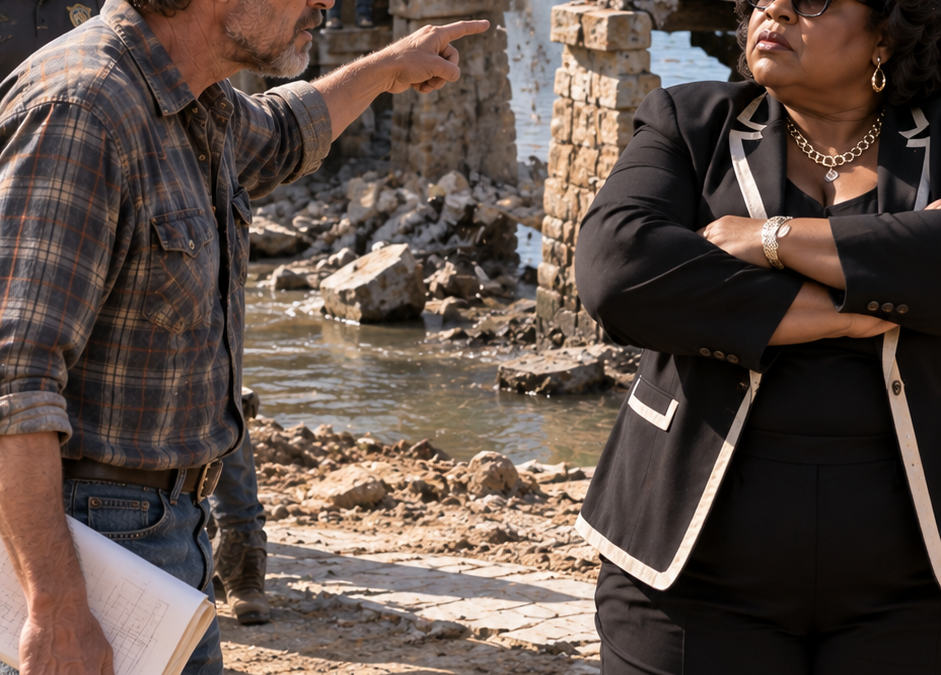
𝗣𝗔𝗥𝗧 𝟮
That’s the thing about infrastructure.
When it works long enough, people stop seeing it.
In 2002, developers bought the eastern shoreline and created Milbrook Harbor Estates.
Two hundred eight homes.
Nearly every one marketed with lake views.
My father made me read the subdivision declaration when it was recorded.
“Anything with the word community in it,” he told me, “you read twice.”
The recorded exhibit stopped at our waterline.
Milbrook Harbor did not own the lake.
Residents received lake access through a license from us.
Permission.
Not title.
That distinction mattered more than anybody understood at the time.
For seventeen years, relations were mostly peaceful.
Then came the Harbor Club.
In 2019, Milbrook Harbor built a $1.8 million clubhouse along the east shore.
Commercial kitchen.
Public restrooms.
Fourteen-slip marina.
Splash pad.
Two acres of irrigated lawn.
And a zero-edge swimming pool designed to look as if it spilled directly into the lake.
The Harbor Club needed water.
Lots of it.
The county main followed the highway, but connecting to it required easements, trenching, and larger pipe.
Projected cost:
$410,000.
So the association found a cheaper solution.
They installed a surface intake in my lake.
Concrete pad.
Pump house.
Pipe up the bank.
I watched the contractors install it from my dock.
The intake sat at elevation 806.
Six and a half feet below the normal lake level.
At the time, I remember thinking it seemed low.
Then somebody walked into my shop needing two dozen shiners and a rental boat.
I forgot about it.
For five years.
Karen Sutcliffe had signed the Harbor Club construction contract.
By the time she came into my bait shop in January, she was serving her third term as HOA president.
The clubhouse had become her monument.
There was even a plaque near the entrance with her name.
She put a folder on my counter.
“We’d like an easement.”
“For what?”
“A pedestrian trail along your north shore. We’d connect the Harbor Club to the state property.”
“No.”
She blinked.
“Can I finish?”
“You can. Answer’s still no.”
“Two hundred eight households would benefit.”
“Two hundred eight households walking through a working boat livery is two hundred eight ways for somebody to fall over a trailer tongue and sue me.”
“We can indemnify—”
“No.”
She left irritated.
She returned in February.
This time, she wanted to buy the whole camp.
Cabins.
Shop.
Dock.
Lake rights.
Everything.
The association planned to expand the marina another twenty-six slips.
She gave me a number.
It was a serious number.
I still said no.
She asked why.
As if refusing required some financial logic she could defeat.
The real reason was forty feet behind her.
A dock cleat.
Gray galvanized metal screwed into a board my father had replaced three times.
When I was six, Dad taught me to tie a cleat hitch there.
I got it wrong.
He untied it.
I did it again.
Wrong.
Again.
Again.
Until my little fingers hurt.
“Boat doesn’t care whether you’re tired,” he told me. “Tie it right.”
Truman Burnside had been dead eleven years.
I still couldn’t walk past that cleat without slowing down.
Karen would have called that sentimentality.
Maybe it was.
But some things stop being property after enough people you love leave fingerprints on them.
On March 10, her letter arrived.
NOTICE OF VIOLATION NV-2216.
It cited Article Nine of Milbrook Harbor’s declaration.
Shoreline Architectural District.
My bridge was described as an unapproved, nonconforming structure incompatible with the community aesthetic.
Fine:
$300 per day.
Deadline:
Twenty days to remove it.
I read the letter twice while a customer stood at my bait counter waiting for change.
The claim was so absurd I almost laughed.
Almost.
I attended the March board meeting.
Nine board members sat behind a table in the Harbor Club.
I brought my deed.
The subdivision plat.
The 2002 exhibit map.
When public comment opened, I stood.
“Parcel 26-084 has never been inside Milbrook Harbor Estates.”
I placed the documents on the table.
“Here is the deed. Here is your original plat. Here is your declaration exhibit. Your boundary stops at the lake. You have no jurisdiction over my bridge.”
Two board members leaned forward.
Karen didn’t.
“Mr. Burnside, we’re not relitigating the shoreline tonight.”
“There is nothing to relitigate.”
“The board has acted.”
“The board can’t act on my property.”
“The demolition is already scheduled.”
I stopped.
“What?”
She smiled.
Then called the next agenda item.
I sat down slowly.
Something didn’t fit.
Demolition requires a permit.
And county demolition permits require an owner-consent certification.
I was the owner.
Nobody had asked me anything.
The next morning, I hired Filamina Greer.
Her office was upstairs from a hardware store in Devil County.
Two chairs in the waiting room.
No fancy conference room.
No glass walls.
Greer was in her sixties.
She listened without writing until I mentioned the lake parcel.
Then she opened a drawer and pulled out a legal pad.
Half the page was already covered with notes about Milbrook Harbor.
“You’re the fourth person from that subdivision who’s sat in that chair.”
I frowned.
“That’s comforting.”
“You’re the first one who owns the water.”
“Is that good?”
She capped her pen.
“It’s everything.”
I handed her my deed.
She pushed it back.
“I don’t want yours.”
“What?”
“I want theirs.”
She explained.
An HOA’s power begins and ends with land legally subjected to its declaration.
A president cannot expand that authority by sending a violation letter.
There must be recorded documents.
Annexations.
Supplements.
Something.
We spent April 4 in the county records basement.
Original declaration.
Plat.
Nine supplemental filings.
Phase expansions.
Common areas.
Utility amendments.
Greer read every one.
Then she stopped.
“Dalton.”
“What?”
“Your parcel isn’t in any of them.”
“Meaning?”
“Meaning exactly what you thought.”
She tapped the stack.
“Not annexed. Not later released. Not disputed. Never in.”
I made her say it again.
Milbrook Harbor had as much HOA authority over my bridge as it had over the county courthouse.
For about four seconds, I felt victorious.
Then I remembered my grandfather’s keystone face down in the mud.
Being right had not stopped the excavator.
Greer sent a cease-and-desist letter.
I went to the county permitting office.
Pervis Tandy, a heavy man with reading glasses pushed into his hair, pulled the demolition file.
He opened it.
His expression changed.
“Huh.”
“That’s not a good huh, is it?”
“No.”
He turned the folder around.
“Permit is active. Issued based on applicant certification. Owner consent attached.”
“I’m the owner.”
He looked at me.
“Nobody asked you?”
“No.”
He closed the file.
“I’m suspending this pending review.”
“When?”
“Today.”
That was the first good hour I’d had in weeks.
The machinery was gone by Wednesday.
I brought in Shep Dunigan, a stonemason from Ridgely who had rebuilt old mill structures.
He waded the channel.
Checked the stones.
Measured what remained.
“Arch can be rebuilt.”
“With the original stone?”
“Most of it.”
He crouched in the water and pressed one hand against something below the surface.
“Foundation’s better than the arch was.”
That night, I slept.
It was the last easy sleep I got for months.
Karen didn’t retreat.
She changed tactics.
On April 18, the board passed a resolution imposing retroactive fines.
$300 per day.
A lien followed.
$24,600.
Then they revoked the lake-use license for guests of commercial properties.
My renters.
My cabin guests.
My boat customers.
“What does that mean?” I asked Greer.
She exhaled.
“It means, according to them, your boats can’t legally leave your cove.”
Two days later, they welded shut the gate across the only practical road between my landing and Blackberry Ford Road.
Four hundred yards of road crossed HOA common area.
I had used it for years.
Now there was a steel farm gate.
Chain.
Tack welds.
Laminated sign.
PRIVATE COMMUNITY
NO COMMERCIAL ACCESS.
At six that morning, I sat behind the wheel of my truck with a boat trailer attached.
I could see the public ramp from my property.
Maybe half a mile away.
I had to back three hundred yards down a narrow lane, turn around, and drive fourteen miles to reach it.
My employee Adeline started writing cancellation calls on a notepad beside the register.
After three days, I told her to put it somewhere I couldn’t see.
Then Doretta Snavely came into the bait shop.
She’d lived on the east shore before Milbrook Harbor existed.
She voted against Karen every year.
Bought a dozen shiners she didn’t need.
Waited until the shop emptied.
“They had a closed meeting Tuesday.”
I leaned against the counter.
“What about?”
“I didn’t hear everything.”
“What did you hear?”
Doretta lowered her voice.
“Karen came out talking to the manager about scheduling.”
“Scheduling what?”
“She called the bridge demolition Phase One.”
I looked at her.
“Phase One?”
She nodded.
“Those were her words.”
I carried the bait to Doretta’s car.
Then stood alone behind the register.
Nobody says Phase One unless there’s a Phase Two.
The permitting file arrived April 24.
Greer told me to come to her office.
Three pages were arranged on her desk.
“Sit down.”
The first was the demolition application.
Applicant:
Milbrook Harbor Estates HOA.
Signed:
K. Sutcliffe, President.
The certification read:
OWNER CONSENT ATTACHED.
Greer flipped the page.
The attachment was blank.
No owner name.
No signature.
Nothing.
Someone had inserted a blank sheet so a checklist would clear.
“That’s bad,” I said.
“It’s not why I made you sit.”
She pointed to Box Eleven.
Does proposed work affect an impoundment, weir, or other regulated water-retaining structure?
NO was checked.
I read it several times.
“She read this.”
“She signed it.”
“She knows the bridge crosses the outlet.”
Greer nodded.
“Now look at page three.”
Van Horn Demolition and Excavating.
Work order.
Signed by Karen.
Under scope:
All masonry removal to creek bed.
“That’s not the arch.”
“No.”
“The arch is already down.”
“Yes.”
My stomach went cold.
They were coming back for the abutments.
And the sill.
I called Newt Van Horn.
He owned the demolition company.
Not a villain.
Just a contractor.
“I’ve got a permit number and signed contract, Mr. Burnside.”
“The permit is suspended.”
“Then we wait until it isn’t.”
“Is there a second mobilization?”
He hesitated.
“There’s additional work below the waterline.”
“What exactly?”
“Abutments and whatever’s beneath them.”
“When?”
“End of May.”
I hung up.
Put on waders.
And walked into the channel.
For the first time since I was a boy, I ran both hands across the top of my grandfather’s stone sill.
Thirty-one feet.
Continuous masonry.
Then I brought out my survey rod.
Shot the elevation off the county benchmark.
Twice.
Top of sill:
812.5.
I already knew the Harbor Club intake.
Then I calculated what would happen if the sill disappeared.
Without that fixed crest, water wouldn’t drop twelve inches.
It would seek the old creek profile.
The lake would drain eight to nine feet.
Nearly a century of pooled water would move through the outlet in hours.
Burnside Landing would become mud.
My docks would be useless.
My boat business would be over.
Then I realized something else.
Harbor Club intake:
Predicted new water level:
About 803.5.
Their intake would be sitting roughly three feet above water.
No kitchen supply.
No restrooms.
No irrigation.
No splash pad.
No pool makeup.
A $1.8 million amenity center disconnected from its only water source.
All because in 2019 they’d saved $410,000 by not connecting to the county main.
I drove to the clubhouse the next morning.
Karen sat on the terrace with the property manager.
Sprinklers ticked rhythmically across green turf behind her.
“I need two minutes.”
She looked at her watch.
I ignored it.
“Cancel Phase Two.”
Her expression shifted.
Just enough.
I knew Doretta had been right.
“Excuse me?”
“The stone under that arch isn’t debris. It’s holding the pool elevation.”
She closed her binder.
“Mr. Burnside—”
“Top elevation 812.5. Your intake is 806. Pull the sill, lake falls to around 803. Your intake ends up dry.”
“You’re threatening me with a rock in a creek.”
“I’m trying to stop you from destroying the water source feeding your own club.”
“Convenient.”
“I’ll pay an engineer. Today. I’ll walk them into the channel myself.”
“Your property suddenly became critical infrastructure four weeks after we cited it.”
“It didn’t suddenly become anything. It has been doing the same job since 1936.”
She stood.
“Send it through counsel.”
Behind her, the sprinklers kept ticking.
Greer listened while I described the conversation.
Then she said:
“I’m ordering a complete title run on their parcel.”
“Why theirs?”
“Because people don’t usually build a million-dollar amenity dependent on somebody else’s lake without paper.”
The problem was that 2019 records were temporarily offline during a county scanning project.
Two weeks.
Maybe three.
We didn’t have that long.
Phase Two was scheduled before the end of May.
So Greer filed for an emergency injunction.
The hearing was set for May 2.
Her strongest argument wasn’t ownership.
It was dam regulation.
The old Milbrook structure had once been listed by the state Division of Dam Safety.
Inventory number:
DV-1136.
If it was a regulated impoundment, nobody could legally remove it without state approval.
I thought that would stop everything.
It didn’t.
At the hearing, HOA attorney Cormick Delahunt produced a state document.
DV-1136.
Status:
Removed from inventory, 2011.
The original listed owner had been Milbrook Milling Company.
That corporation dissolved in 1954.
During a statewide reinventory, the state couldn’t identify a responsible operator and found no obvious mechanical spillway or gate works.
So it was administratively delisted.
Delahunt spoke calmly.
“There is no regulated dam, Your Honor. There is simply remnant stonework in a creek.”
Then he produced an engineer’s letter from Caner Engineering Group.
Two paragraphs.
Based on photographs, the submerged masonry appeared consistent with old stream-bed armoring rather than a hydraulic retaining structure.
Greer stood.
“Photographs provided by whom?”
“The association.”
“Has the engineer inspected the site?”
“No.”
“Surveyed the crest?”
“No.”
“Observed the submerged sill?”
Delahunt didn’t answer immediately.
The judge removed his glasses.
I knew what was coming.
He would not issue emergency relief when one side had an engineering letter and the other had me saying, trust me, I’ve lived beside this water my entire life.
The full hearing was scheduled for June 10.
Too late.
In the hallway afterward, Delahunt approached Greer.
He wasn’t smug.
That made it worse.
“If I were advising your client, I’d prepare for the site to be cleared before the hearing.”
Karen stood near the elevators.
Phone in hand.
She told another board member:
“He’s fighting for a pile of rocks.”
The hallway carried every word.
The following week, the county red-tagged my temporary culvert crossing.
I had installed it after the bridge demolition so I could reach four north cabins.
It wasn’t permitted.
Pervis Tandy told me the truth.
“Dalton, they’re filing written complaints.”
“Their demolition was based on a fake owner consent.”
“I know.”
“And you’re citing my emergency access?”
“I also know.”
He sounded genuinely miserable.
“But unpermitted fill in a waterway is still unpermitted fill.”
$300 per day until removal.
Then my bank called.
The HOA lien appeared during my annual credit review.
Seasonal line frozen pending resolution.
That line bought bait.
Fuel.
Insurance.
Everything I needed before summer revenue arrived.
Then Adeline handed me the cancellation sheet.
Sixty-two percent of June cabin bookings were gone.
Word had spread that Milbrook Lake might disappear.
People don’t drive four hours to vacation beside mud.
Sunday night, I sat on the pile of salvaged arch stone.
My daughter Sylvia was nineteen.
She had been running the register.
Before all this, I’d told her Burnside Landing could be hers one day if she wanted it.
Sitting there in the dark, I started calculating what the business might be worth without water.
The number was small.
For the first time, I thought about selling.
Then I realized something.
The June hearing wasn’t going to save me.
No agency was moving fast enough.
Karen could remove the sill first.
Once ninety-six acres drained, jurisdiction would be an argument about what used to exist.
So I stopped trying to stop her.
That sounds strange.
But I’d finally understood my real job.
If Karen was going to remove that stone, she was going to do it after receiving a written warning describing exactly what would happen.
No confusion.
No plausible misunderstanding.
No saying later:
Nobody told us.
Greer and I drafted the letter.
Certified copies went to Karen personally.
Every board member individually.
Van Horn Demolition.
And the HOA’s insurance carrier, Truckton Mutual.
The letter didn’t mention my deed.
It didn’t argue authority.
It contained measurements.
Sill elevation:
812.5.
Harbor Club intake:
Expected water elevation after removal:
Approximately 803.5.
Estimated drawdown:
Six to ten hours.
Expected result:
THE HARBOR CLUB SURFACE INTAKE WILL BE ABOVE THE WATERLINE AND THE FACILITY WILL HAVE NO FUNCTIONAL WATER SUPPLY.
We attached photographs.
Survey notes.
Cross-section drawing.
Karen signed the certified receipt May 14.
Two days later, Doretta forwarded me Karen’s email response to the board.
One sentence.
If the pond drops, we’ll fill the pool with a hose.
I read it twice.
Then something inside me became very quiet.
She was going to do it.
On May 16, Elizabeth Caro walked into my bait shop.
She had served as the HOA recording secretary for eleven years.
Small woman.
Quiet.
Always apologizing.
She carried her purse with both hands.
“I’ve kept something.”
She put two documents on my counter.
The first was a 2019 engineering memorandum from Caner Engineering Group.
Same engineering firm whose letter had just helped Karen defeat my injunction.
Subject:
Harbor Club Water Supply — Long-Term Reliability.
I read.
The proposed surface intake would function only so long as lake elevation was maintained by the existing Milbrook structure.
The structure was privately owned.
Not controlled by the association.
Caner recommended either purchasing an enforceable property interest in the structure or connecting to the county trunk main.
Then came the sentence:
Reliance upon privately controlled masonry constitutes an unacceptable single point of failure for Harbor Club water service.
I looked at Elizabeth.
“She knew.”
Elizabeth nodded.
The second document was October 2019 board minutes.
Motion by President Karen Sutcliffe:
Receive the Caner memorandum but exclude it from materials distributed to homeowners.
Passed four to two.
“Why?”
Elizabeth swallowed.
“She said it would scare people about the Harbor Club assessment.”
Karen hadn’t learned in April that my stone maintained her water.
She had known since 2019.
In writing.
I called Caner Engineering.
The engineer who authored the recent photograph-based opinion became increasingly uncomfortable as we spoke.
“No site inspection?”
“No.”
“No survey?”
“No.”
“What photographs did the HOA send you?”
“Collapsed masonry.”
“The arch stone?”
“Yes.”
“Did they send you photographs of a submerged stone sill across the creek bed?”
Silence.
“No.”
“Did they tell you there was one?”
“No.”
Greer immediately reported the structure to the Division of Dam Safety.
A staff engineer named Adair Linquist called the next morning.
“Is it currently retaining water?”
“Yes.”
“How much?”
“Ninety-six acres.”
She paused.
“I’ll be on site May twenty-sixth.”
For about thirty hours, I thought we’d made it.
Then Karen moved Phase Two to May 23.
Three days before the state inspection.
The Harbor Club’s grand opening gala was scheduled May 24.
Two hundred forty guests.
Catering.
Tent.
Flowers.
Everything.
I drove over once more.
Karen stood in the parking lot supervising event setup.
“You received my letter.”
“Yes.”
“You have the 2019 memo.”
Her chin lifted.
That landed.
“You knew the structure maintained your water.”
“The state says there is no regulated dam.”
“That’s not the same thing as saying it doesn’t retain water.”
“No structure, no jurisdiction.”
“Karen, I’m not asking about jurisdiction anymore. I’m telling you the water is going to leave.”
She walked away.
Van Horn refused to proceed without written authorization.
To his credit, he wanted indemnity.
Property-line acknowledgement.
Clear instructions.
Karen signed everything on the hood of his truck.
She barely read it.
The day before demolition, I moved everything I could save.
Eighteen boats came out.
Floating docks unbolted.
Cabin pumps drained.
Sylvia helped me.
“Are we really doing this?”
“Yes.”
“Two days before Memorial Day?”
“Yes.”
“How far is the lake going to fall?”
“I don’t know exactly.”
That was the truth.
May 23 was gray and windless.
At two in the afternoon, the barge-mounted breaker started working on the remaining abutments.
I stood on my property recording.
By four, they reached the sill.
At 5:40, the excavator lifted the final block.
There wasn’t a crash.
That surprised me.
The sound simply changed.
Gentle lapping became a low pull.
A steady draining sound.
Like water leaving a bathtub after somebody finally pulls the plug.
The operator shut down.
One worker whistled.
I watched the current accelerate through the opening where my grandfather’s stone had been.
Then I stood there until dark.
Listening to my lake leave.
At six the next morning, I walked down to the shoreline.
Except the shoreline wasn’t where it belonged.
The lake had fallen almost nine feet.
My cove had become a basin of gray mud.
Old bottles.
Tire tracks.
A rowboat that had sunk sometime in the 1980s.
Tree stumps.
A black smell like a drained aquarium.
The former waterline ran along the rock face above my head.
Eighty-eight years of water marked by a wet gray stripe.
My grandfather had worked two summers building that pool.
It took six hours to undo it.
I stood there grieving.
There is no better word.
Then I looked toward the east shore.
And everything changed.
The Harbor Club marina hung over mud.
Gangways dropped at absurd angles.
Four boats lay tilted against their hulls in the muck.
The imported beach had become black silt.
The zero-edge pool had drained down its own infinity edge during the night until the decorative basin sat nearly empty.
Then, at about 6:10, the pump house started.
I heard the motor across the exposed lake bed.
It wound up.
Caught nothing.
Then came the screaming sound of a pump pulling air.
Fifteen seconds.
Trip.
Silence.
The intake pad stood approximately three feet above the remaining water.
Exactly where the letter said it would.
For years, the Harbor Club sprinklers had clicked across the grass every morning.
That morning there was nothing.
At 6:30, Karen arrived.
Navy dress.
Seating chart in hand.
She walked down the marina path.
Stopped.
For a long time she didn’t move.
A catering employee said something to her.
Then again.
Karen walked onto the exposed mud in high heels.
They sank with every step.
She kept walking.
At 6:40, she called the sheriff.
Deputy Isidor Krebs found me on my side of the channel.
He’d bought bait from my shop for nearly a decade.
“Dalton.”
“Morning.”
“She says you drained the lake.”
“I figured.”
“Did you open something?”
“There was nothing to open.”
I showed him the video.
The barge.
The breaker.
The final stone block being removed.
Water immediately accelerating through the gap.
Then I gave him the written release Karen had signed authorizing Van Horn’s work.
Krebs read it twice.
He looked across at the marina hanging over mud.
“Huh.”
Apparently that was the official county word for discovering the ground had moved underneath everybody.
Then Greer called.
“Dalton, the 2019 index came back online last night.”
“Okay.”
“Sit down.”
I sat on my tailgate.
“There is a recorded instrument against the association parcel. November 2019. Instrument 2019-03158.”
“What?”
“Water Intake License and Non-Interference Agreement.”
My throat tightened.
“Between who?”
“Milbrook Harbor Estates HOA and Truman Burnside.”
My father.
Nine months before he died.
I couldn’t speak.
Greer continued.
“Three operative provisions. First, the HOA expressly acknowledges that the Milbrook structure and underlying lake bed are privately owned by the Burnside family.”
I closed my eyes.
“Second, it acknowledges that the Harbor Club intake functions only at water elevations maintained by that structure.”
My hand went over my mouth.
“Third, the association covenants that it will not alter, modify, remove, damage, or interfere with the structure.”
“Who signed it?”
Greer paused.
“Karen Sutcliffe. President.”
I looked across the drained lake.
“And Dalton?”
“Yes?”
“There’s an Exhibit A.”
“What?”
“A dimensioned cross-section of the sill.”
I stopped breathing for a second.
“Elevation?”
“812.5.”
My father had known.
He had solved the problem.
He had made them sign a recorded agreement acknowledging exactly what the stone did.
Then he’d filed it and never mentioned it because that was Dad.
A signed paper meant something to him.
Once the signatures were there, the matter was settled.
Karen had signed a drawing of the exact sill she later ordered removed.
Then she had gone into court and supported the argument that the masonry was nothing more than old creek-bed stone.
At nine that morning, an emergency board meeting took place on the Harbor Club terrace.
Greer.
Delahunt.
Board members.
Deputy Krebs.
Contractors.
Caterers.
People from the gala crew stood around unsure whether to keep setting tables.
Delahunt read the recorded agreement twice on his phone.
Then asked:
“Was it indexed against the HOA parcel?”
“Yes,” Greer said.
He lowered the phone.
Karen didn’t.
“The agreement references a structure.”
“Exhibit A is a drawing of the sill,” Greer replied.
“That drawing is schematic.”
“It gives the crest elevation.”
“The state delisted the dam.”
“You certified on March twenty-fourth that no impoundment was affected.”
Karen’s jaw tightened.
“That was the county form.”
“You signed Dalton’s warning May fourteenth.”
No answer.
“It gave you the exact intake elevation.”
Karen turned toward her board.
“This man is protecting his business.”
Then Elizabeth Caro spoke from behind us.
“Karen.”
Everybody turned.
Elizabeth’s voice was almost emotionless.
“I still have the 2019 Caner memo.”
Silence.
Board member Garrick Weather sat down on the edge of a planter.
He stared at the exposed lake bed.
At 9:40, Adair Linquist arrived from Dam Safety.
The county had forwarded the breach report after the lake drained.
She brought two staff members and survey equipment.
For twenty minutes, she walked the old channel alone.
Mud up to her boots.
Folding rod.
Level.
Notes.
Then she returned.
“Who authorized removal?”
Delahunt began to answer.
Karen spoke over him.
“The association.”
“The state delisted DV-1136 in 2011,” she added.
Linquist nodded slowly.
“Delisting a dam does not repeal gravity.”
Nobody said anything.
“The 2011 action was administrative. Ownership couldn’t be confirmed. It was not a determination that the structure stopped retaining water.”
She looked toward the channel.
“You had a fixed-crest masonry impoundment retaining approximately ninety-six acres.”
She wrote something.
“Somebody removed it.”
That afternoon, Dam Safety issued an emergency restoration order.
The impounding structure had to be rebuilt to its original crest elevation under engineered design and state supervision.
Responsible party:
Milbrook Harbor Estates HOA.
And the individual authorizing removal.
Karen Sutcliffe.
By then, Truckton Mutual was involved.
Its adjuster had the certified warning.
Karen’s signature on the receipt.
The 2019 engineering memo.
The recorded non-interference agreement.
And her written demolition authorization.
The carrier reserved rights.
Then denied coverage for the intentional act.
The Harbor Club gala was still technically scheduled.
Flowers arrived.
Ice arrived.
Two hundred forty meals were already prepared.
At eleven, I saw the catering manager standing at the kitchen door.
Nine young employees in white shirts waited behind her.
Nobody was paying attention to them.
Everybody had larger problems.
I looked at the kitchen.
Then at my truck.
“I have a drilled well at the camp.”
Greer stared at me.
“You’re serious?”
“They’ve got two hundred forty meals.”
I drove home.
Loaded two hundred feet of inch-and-a-half hose.
Fittings.
Adapters.
Sylvia helped me run a temporary line across Blackberry Ford Road and up the Harbor Club bank.
We connected to an exterior bib feeding the kitchen system.
Karen watched from the terrace.
She never came down.
Two hundred forty Milbrook Harbor residents drank water supplied from the bait shop she’d spent four months trying to erase.
The gala was cancelled by noon anyway.
The tent came down before sunset.
The Harbor Club remained closed for eleven weeks.
The commercial kitchen couldn’t operate without a lawful permanent water source.
Neither could the public restrooms.
Or pool.
Or splash pad.
The cost to rebuild the impounding structure:
$486,000.
And the health department refused to approve the Harbor Club’s long-term return to the surface intake arrangement.
So Milbrook Harbor finally had to build the county-water connection.
The same connection they had avoided in 2019.
Another roughly $410,000.
Truckton Mutual didn’t pay.
Prior notice.
Intentional act.
Signed receipt.
The board levied a special assessment.
$4,300 per household.
Two hundred eight households.
Then residents finally saw the 2019 Caner memo.
They saw that their own engineer had warned the board six years earlier that relying on privately owned Burnside masonry created a single point of failure.
They saw the motion Karen had made to keep that warning out of the homeowner packet.
And they did the arithmetic.
A woman had hidden a known risk.
Then destroyed the very structure identified in that warning.
The recall meeting took place June 14.
Not at the Harbor Club.
It still had no lawful water supply.
They rented a hall.
Doretta Snavely told me about it afterward.
She came into my shop and bought another dozen shiners she didn’t need.
“How bad?”
She smiled.
“Hundred seventy-two to twenty-eight.”
Karen lost the presidency.
Lost her board seat.
The management company terminated its separate relationship with her.
The county referred the false owner-consent certification and the inaccurate permit declarations for further review.
Those proceedings moved at government speed.
I stopped following them closely.
Greer negotiated the remaining civil claims.
The HOA lien against my property was released.
The access gate was cut open by an HOA contractor using a torch in broad daylight while a board member watched.
The county resolved the temporary-crossing issue.
The association compensated Burnside Landing for the lost season.
And paid the cost of restoring the bridge.
Greer wanted me to pursue more.
Punitive theories.
Additional damages.
I told her no.
“What do you want?”
“My lake.”
“That all?”
“My lake and my road.”
She stared at me for a moment.
Then nodded.
The new sill was completed June 30.
Engineered core.
State-approved design.
My grandfather’s original dressed face stone was reset along the downstream side wherever possible.
Adair Linquist inspected some of the original masonry herself.
“Good stone,” she said.
“My grandfather cut it.”
“I can tell somebody cared.”
Then we waited for rain and creek flow.
A ninety-six-acre lake doesn’t return because a judge signs something.
It comes back inch by inch.
All through July, the water climbed.
Sylvia started marking the level on exposed rock with chalk every Sunday.
One mark.
Then another.
Then another.
By early August, the chalk disappeared beneath the surface.
The old gray bathtub ring vanished.
My docks floated again.
The cove returned.
In September, Shep Dunigan rebuilt the bridge arch.
He used the original stones where he could.
About sixty percent were still sound.
The rest came from the same quarry seam.
One afternoon, he called me over.
The keystone lay beside his tools.
It had spent five months face down in mud.
He scrubbed it with a wire brush.
Then poured water over it.
The carving appeared.
E.B.
Still sharp.
“Where do you want it?”
I looked at him.
“Where my grandfather put it.”
Shep smiled.
“Figured you’d say that.”
They set it at the center of the arch.
When the scaffolding came down, I stood alone on the road for a long time.
The bridge wasn’t exactly the same.
Nothing rebuilt ever is.
But from thirty yards away, in the evening light, you had to know what happened to notice.
Burnside Landing reopened the following spring.
Twelve cabins.
Eighteen boats.
Bait tanks bubbling beside the register.
Adeline found the old cancellation notepad in a drawer.
She dropped it into the trash without saying a word.
Sylvia laughed.
“Ceremonial?”
“Spring cleaning,” Adeline said.
I still go out before opening most mornings.
I take one of the little aluminum boats under the bridge.
Then I idle another hundred yards into the lake.
Cut the motor.
Some mornings fog sits low over the water and you can look back through the stone arch toward the landing.
From out there, the bridge looks small.
Almost decorative.
That’s what Karen saw.
Old stone.
Moss.
Something that obstructed her view.
Something inconvenient between her resort and the shoreline she wanted.
She never understood that the thing she wanted gone was carrying something she needed.
Not symbolically.
Literally.
Ninety-six acres of water.
Her marina.
Her pool.
Her kitchens.
Her landscaping.
Her $1.8 million Harbor Club.
All of it depended on thirty-one feet of stone sitting quietly three feet beneath the surface.
My grandfather understood that.
My father understood enough to make them put it in writing.
I had forgotten.
Karen chose not to care.
And that’s the part I still think about.
Some things survive for so long that people confuse durability with uselessness.
They see an old bridge.
An old wall.
An old contract.
An old man telling them not to touch something.
And because nothing terrible happened yesterday, they assume nothing terrible can happen tomorrow.
The stones don’t argue.
Water doesn’t send violation letters.
Gravity never attends board meetings.
It simply waits.
Until somebody removes the thing holding everything together.
Then, eventually, everybody understands what it was for.
They destroyed my grandfather’s bridge because Karen Sutcliffe believed it ruined her view.
Six hours later, the lake dropped nearly nine feet.
And when the sun came up, the resort she had spent years building was staring out across mud at an intake pipe hanging three feet above the water it could no longer reach.
People sometimes ask whether that morning felt like revenge.
It didn’t.
Revenge would have felt good.
That morning felt like standing beside the grave of something my grandfather had built and knowing I had warned them exactly where to stop digging.
But the water came back.
The bridge came back.
The boats came back.
And Burnside Landing is still here.
Every so often, I walk across the bridge after closing.
When I reach the center, I look down over the low stone rail.
You can’t see the sill anymore.
The water covers it.
Just the way it did when I was six.
Most people driving across never know it’s there.
That’s fine with me.
It doesn’t need attention.
It doesn’t need a plaque.
It doesn’t need somebody explaining its value every morning.
It only needs to keep doing its job.
Holding the lake where it belongs.
And after everything that happened, I understand that better than I ever did before.
Have you finished reading the story and want to read it again?
HOA Demolished My Grandfather’s “Illegal” Lake Bridge—By Sunrise, Their $1.8 Million Resort Was Sitting Over Mud
They called my grandfather’s bridge an illegal eyesore.
I warned them they had no idea what the stones beneath it were holding back.
By sunrise, their $1.8 million waterfront resort was standing beside a lake that was no longer there.
The hydraulic hammer was already swinging when I reached the channel.
It was ten minutes before seven, barely enough daylight to see without headlights, and orange construction fencing had been stretched across my private access road as if somebody had decided overnight that my land belonged to them.
I stopped my truck.
A young man in a Milbrook Harbor compliance polo stepped in front of me.
“Sir, you need to stay behind the barrier.”
I stared at him.
“The barrier is on my road.”
“Sir—”
“And that machine is on my property.”
He put one hand against my chest.
Not hard.
Just enough.
It was the kind of touch meant to tell you somebody had already decided you weren’t in charge.
I pushed his hand down.
“Don’t touch me.”
Karen Sutcliffe stood fifty yards away beside the excavator.
She didn’t turn around.
“Karen!”
Nothing.
I walked past the compliance kid.
She finally looked toward me when I was twenty feet away.
I had my deed in one hand.
“What the hell are you doing?”
Karen held up a printed notice.
“Notice of violation. Unpermitted nonconforming structure.”
“That bridge is on Parcel 26-084.”
“I know where it is.”
“Then you know it’s outside Milbrook Harbor Estates.”
She barely glanced at the deed.
“Mr. Burnside, we’ve been through this.”
“No, you sent me a violation letter. That’s not the same as owning my property.”
“The structure interferes with the community shoreline district.”
“There is no community shoreline district on my parcel.”
She smiled.
It was the same expression she’d used during every board meeting.
Patient.
Dismissive.
Certain.
“Nobody cares what a bait-shop owner thinks he owns.”
For a second, I actually forgot how to answer.
Then I held out the deed.
“My grandfather built that bridge in 1936. My family owns the land under your feet, the channel, the lake bed, and the structure you’re about to destroy.”
Karen didn’t take the deed.
“You can dispute that afterward.”
“You don’t have authority.”
“Then sue me.”
She lifted two fingers toward the excavator operator.
“The machine doesn’t stop for you.”
The hammer came down.
The sound went through my chest.
My grandfather’s bridge was sixty-two feet of cut stone laid by hand before my father was born.
The first blow cracked the upper arch.
The second sent a row of stones into the channel.
By the third, I wasn’t yelling anymore.
I was just watching.
The arch folded slowly at first, then all at once.
The keystone dropped through the opening and hit the mud face down.
I could still see the year carved into it before the water clouded.
Karen raised her phone.
Took a picture.
Typed something.
Years later, during discovery, I learned exactly what she’d written to her board.
Viewshed restored.
Then she stepped across my fence and pointed toward the broken stone.
“Have that hauled away by Friday.”
I looked at her.
“What?”
“Removal costs are yours.”
She turned and walked back toward her SUV before the dust had even settled.
She thought she had destroyed a bridge.
That was the first mistake.
The second was not asking what the stone underneath it actually did.
My name is Dalton Burnside.
I was forty-six years old that morning.
I owned Burnside Landing Camp and Boat Livery on Milbrook Lake.
Twelve cabins.
Eighteen rental boats.
A bait shop that smelled like gasoline, coffee, lake water, and nightcrawlers from April through October.
My father ran it before me.
His father built it.
I’ve never had another career.
Never wanted one.
The lake wasn’t natural.
That’s important.
People who bought houses around it liked to call it Milbrook Lake because that sounded expensive.
On old maps, it was Milbrook Creek.
Ninety-six acres of open water existed because in 1936 my grandfather, Ezra Burnside, built a stone mill dam across that creek.
He quarried most of the stone himself.
The property deed was recorded.
Parcel 26-084.
My family didn’t merely own a strip of shoreline.
We owned the dam.
The spillway channel.
And the lake bed underneath the water.
People called the structure a bridge because that was what everybody saw.
You could drive across it to reach my north cabins.
It had a broad stone arch, low rails, and moss my grandmother had planted along the shaded side.
But the visible bridge wasn’t the part that mattered.
Beneath the arch were two stone abutments.
And beneath those abutments was a continuous masonry sill built directly across the channel bed.
Three feet below the surface.
Thirty-one feet of dressed stone.
My grandfather had created a fixed crest.
That sill held Milbrook Lake at elevation 812.5.
It had done that for eighty-eight years.
Nobody talked about it.
Nobody noticed it.
Including me.
That’s the thing about infrastructure.
When it works long enough, people stop seeing it.
In 2002, developers bought the eastern shoreline and created Milbrook Harbor Estates.
Two hundred eight homes.
Nearly every one marketed with lake views.
My father made me read the subdivision declaration when it was recorded.
“Anything with the word community in it,” he told me, “you read twice.”
The recorded exhibit stopped at our waterline.
Milbrook Harbor did not own the lake.
Residents received lake access through a license from us.
Permission.
Not title.
That distinction mattered more than anybody understood at the time.
For seventeen years, relations were mostly peaceful.
Then came the Harbor Club.
In 2019, Milbrook Harbor built a $1.8 million clubhouse along the east shore.
Commercial kitchen.
Public restrooms.
Fourteen-slip marina.
Splash pad.
Two acres of irrigated lawn.
And a zero-edge swimming pool designed to look as if it spilled directly into the lake.
The Harbor Club needed water.
Lots of it.
The county main followed the highway, but connecting to it required easements, trenching, and larger pipe.
Projected cost:
$410,000.
So the association found a cheaper solution.
They installed a surface intake in my lake.
Concrete pad.
Pump house.
Pipe up the bank.
I watched the contractors install it from my dock.
The intake sat at elevation 806.
Six and a half feet below the normal lake level.
At the time, I remember thinking it seemed low.
Then somebody walked into my shop needing two dozen shiners and a rental boat.
I forgot about it.
For five years.
Karen Sutcliffe had signed the Harbor Club construction contract.
By the time she came into my bait shop in January, she was serving her third term as HOA president.
The clubhouse had become her monument.
There was even a plaque near the entrance with her name.
She put a folder on my counter.
“We’d like an easement.”
“For what?”
“A pedestrian trail along your north shore. We’d connect the Harbor Club to the state property.”
“No.”
She blinked.
“Can I finish?”
“You can. Answer’s still no.”
“Two hundred eight households would benefit.”
“Two hundred eight households walking through a working boat livery is two hundred eight ways for somebody to fall over a trailer tongue and sue me.”
“We can indemnify—”
“No.”
She left irritated.
She returned in February.
This time, she wanted to buy the whole camp.
Cabins.
Shop.
Dock.
Lake rights.
Everything.
The association planned to expand the marina another twenty-six slips.
She gave me a number.
It was a serious number.
I still said no.
She asked why.
As if refusing required some financial logic she could defeat.
The real reason was forty feet behind her.
A dock cleat.
Gray galvanized metal screwed into a board my father had replaced three times.
When I was six, Dad taught me to tie a cleat hitch there.
I got it wrong.
He untied it.
I did it again.
Wrong.
Again.
Again.
Until my little fingers hurt.
“Boat doesn’t care whether you’re tired,” he told me. “Tie it right.”
Truman Burnside had been dead eleven years.
I still couldn’t walk past that cleat without slowing down.
Karen would have called that sentimentality.
Maybe it was.
But some things stop being property after enough people you love leave fingerprints on them.
On March 10, her letter arrived.
NOTICE OF VIOLATION NV-2216.
It cited Article Nine of Milbrook Harbor’s declaration.
Shoreline Architectural District.
My bridge was described as an unapproved, nonconforming structure incompatible with the community aesthetic.
Fine:
$300 per day.
Deadline:
Twenty days to remove it.
I read the letter twice while a customer stood at my bait counter waiting for change.
The claim was so absurd I almost laughed.
Almost.
I attended the March board meeting.
Nine board members sat behind a table in the Harbor Club.
I brought my deed.
The subdivision plat.
The 2002 exhibit map.
When public comment opened, I stood.
“Parcel 26-084 has never been inside Milbrook Harbor Estates.”
I placed the documents on the table.
“Here is the deed. Here is your original plat. Here is your declaration exhibit. Your boundary stops at the lake. You have no jurisdiction over my bridge.”
Two board members leaned forward.
Karen didn’t.
“Mr. Burnside, we’re not relitigating the shoreline tonight.”
“There is nothing to relitigate.”
“The board has acted.”
“The board can’t act on my property.”
“The demolition is already scheduled.”
I stopped.
“What?”
She smiled.
Then called the next agenda item.
I sat down slowly.
Something didn’t fit.
Demolition requires a permit.
And county demolition permits require an owner-consent certification.
I was the owner.
Nobody had asked me anything.
The next morning, I hired Filamina Greer.
Her office was upstairs from a hardware store in Devil County.
Two chairs in the waiting room.
No fancy conference room.
No glass walls.
Greer was in her sixties.
She listened without writing until I mentioned the lake parcel.
Then she opened a drawer and pulled out a legal pad.
Half the page was already covered with notes about Milbrook Harbor.
“You’re the fourth person from that subdivision who’s sat in that chair.”
I frowned.
“That’s comforting.”
“You’re the first one who owns the water.”
“Is that good?”
She capped her pen.
“It’s everything.”
I handed her my deed.
She pushed it back.
“I don’t want yours.”
“What?”
“I want theirs.”
She explained.
An HOA’s power begins and ends with land legally subjected to its declaration.
A president cannot expand that authority by sending a violation letter.
There must be recorded documents.
Annexations.
Supplements.
Something.
We spent April 4 in the county records basement.
Original declaration.
Plat.
Nine supplemental filings.
Phase expansions.
Common areas.
Utility amendments.
Greer read every one.
Then she stopped.
“Dalton.”
“What?”
“Your parcel isn’t in any of them.”
“Meaning?”
“Meaning exactly what you thought.”
She tapped the stack.
“Not annexed. Not later released. Not disputed. Never in.”
I made her say it again.
Milbrook Harbor had as much HOA authority over my bridge as it had over the county courthouse.
For about four seconds, I felt victorious.
Then I remembered my grandfather’s keystone face down in the mud.
Being right had not stopped the excavator.
Greer sent a cease-and-desist letter.
I went to the county permitting office.
Pervis Tandy, a heavy man with reading glasses pushed into his hair, pulled the demolition file.
He opened it.
His expression changed.
“Huh.”
“That’s not a good huh, is it?”
“No.”
He turned the folder around.
“Permit is active. Issued based on applicant certification. Owner consent attached.”
“I’m the owner.”
He looked at me.
“Nobody asked you?”
“No.”
He closed the file.
“I’m suspending this pending review.”
“When?”
“Today.”
That was the first good hour I’d had in weeks.
The machinery was gone by Wednesday.
I brought in Shep Dunigan, a stonemason from Ridgely who had rebuilt old mill structures.
He waded the channel.
Checked the stones.
Measured what remained.
“Arch can be rebuilt.”
“With the original stone?”
“Most of it.”
He crouched in the water and pressed one hand against something below the surface.
“Foundation’s better than the arch was.”
That night, I slept.
It was the last easy sleep I got for months.
Karen didn’t retreat.
She changed tactics.
On April 18, the board passed a resolution imposing retroactive fines.
$300 per day.
A lien followed.
$24,600.
Then they revoked the lake-use license for guests of commercial properties.
My renters.
My cabin guests.
My boat customers.
“What does that mean?” I asked Greer.
She exhaled.
“It means, according to them, your boats can’t legally leave your cove.”
Two days later, they welded shut the gate across the only practical road between my landing and Blackberry Ford Road.
Four hundred yards of road crossed HOA common area.
I had used it for years.
Now there was a steel farm gate.
Chain.
Tack welds.
Laminated sign.
PRIVATE COMMUNITY
NO COMMERCIAL ACCESS.
At six that morning, I sat behind the wheel of my truck with a boat trailer attached.
I could see the public ramp from my property.
Maybe half a mile away.
I had to back three hundred yards down a narrow lane, turn around, and drive fourteen miles to reach it.
My employee Adeline started writing cancellation calls on a notepad beside the register.
After three days, I told her to put it somewhere I couldn’t see.
Then Doretta Snavely came into the bait shop.
She’d lived on the east shore before Milbrook Harbor existed.
She voted against Karen every year.
Bought a dozen shiners she didn’t need.
Waited until the shop emptied.
“They had a closed meeting Tuesday.”
I leaned against the counter.
“What about?”
“I didn’t hear everything.”
“What did you hear?”
Doretta lowered her voice.
“Karen came out talking to the manager about scheduling.”
“Scheduling what?”
“She called the bridge demolition Phase One.”
I looked at her.
“Phase One?”
She nodded.
“Those were her words.”
I carried the bait to Doretta’s car.
Then stood alone behind the register.
Nobody says Phase One unless there’s a Phase Two.
The permitting file arrived April 24.
Greer told me to come to her office.
Three pages were arranged on her desk.
“Sit down.”
The first was the demolition application.
Applicant:
Milbrook Harbor Estates HOA.
Signed:
K. Sutcliffe, President.
The certification read:
OWNER CONSENT ATTACHED.
Greer flipped the page.
The attachment was blank.
No owner name.
No signature.
Nothing.
Someone had inserted a blank sheet so a checklist would clear.
“That’s bad,” I said.
“It’s not why I made you sit.”
She pointed to Box Eleven.
Does proposed work affect an impoundment, weir, or other regulated water-retaining structure?
NO was checked.
I read it several times.
“She read this.”
“She signed it.”
“She knows the bridge crosses the outlet.”
Greer nodded.
“Now look at page three.”
Van Horn Demolition and Excavating.
Work order.
Signed by Karen.
Under scope:
All masonry removal to creek bed.
“That’s not the arch.”
“No.”
“The arch is already down.”
“Yes.”
My stomach went cold.
They were coming back for the abutments.
And the sill.
I called Newt Van Horn.
He owned the demolition company.
Not a villain.
Just a contractor.
“I’ve got a permit number and signed contract, Mr. Burnside.”
“The permit is suspended.”
“Then we wait until it isn’t.”
“Is there a second mobilization?”
He hesitated.
“There’s additional work below the waterline.”
“What exactly?”
“Abutments and whatever’s beneath them.”
“When?”
“End of May.”
I hung up.
Put on waders.
And walked into the channel.
For the first time since I was a boy, I ran both hands across the top of my grandfather’s stone sill.
Thirty-one feet.
Continuous masonry.
Then I brought out my survey rod.
Shot the elevation off the county benchmark.
Twice.
Top of sill:
812.5.
I already knew the Harbor Club intake.
Then I calculated what would happen if the sill disappeared.
Without that fixed crest, water wouldn’t drop twelve inches.
It would seek the old creek profile.
The lake would drain eight to nine feet.
Nearly a century of pooled water would move through the outlet in hours.
Burnside Landing would become mud.
My docks would be useless.
My boat business would be over.
Then I realized something else.
Harbor Club intake:
Predicted new water level:
About 803.5.
Their intake would be sitting roughly three feet above water.
No kitchen supply.
No restrooms.
No irrigation.
No splash pad.
No pool makeup.
A $1.8 million amenity center disconnected from its only water source.
All because in 2019 they’d saved $410,000 by not connecting to the county main.
I drove to the clubhouse the next morning.
Karen sat on the terrace with the property manager.
Sprinklers ticked rhythmically across green turf behind her.
“I need two minutes.”
She looked at her watch.
I ignored it.
“Cancel Phase Two.”
Her expression shifted.
Just enough.
I knew Doretta had been right.
“Excuse me?”
“The stone under that arch isn’t debris. It’s holding the pool elevation.”
She closed her binder.
“Mr. Burnside—”
“Top elevation 812.5. Your intake is 806. Pull the sill, lake falls to around 803. Your intake ends up dry.”
“You’re threatening me with a rock in a creek.”
“I’m trying to stop you from destroying the water source feeding your own club.”
“Convenient.”
“I’ll pay an engineer. Today. I’ll walk them into the channel myself.”
“Your property suddenly became critical infrastructure four weeks after we cited it.”
“It didn’t suddenly become anything. It has been doing the same job since 1936.”
She stood.
“Send it through counsel.”
Behind her, the sprinklers kept ticking.
Greer listened while I described the conversation.
Then she said:
“I’m ordering a complete title run on their parcel.”
“Why theirs?”
“Because people don’t usually build a million-dollar amenity dependent on somebody else’s lake without paper.”
The problem was that 2019 records were temporarily offline during a county scanning project.
Two weeks.
Maybe three.
We didn’t have that long.
Phase Two was scheduled before the end of May.
So Greer filed for an emergency injunction.
The hearing was set for May 2.
Her strongest argument wasn’t ownership.
It was dam regulation.
The old Milbrook structure had once been listed by the state Division of Dam Safety.
Inventory number:
DV-1136.
If it was a regulated impoundment, nobody could legally remove it without state approval.
I thought that would stop everything.
It didn’t.
At the hearing, HOA attorney Cormick Delahunt produced a state document.
DV-1136.
Status:
Removed from inventory, 2011.
The original listed owner had been Milbrook Milling Company.
That corporation dissolved in 1954.
During a statewide reinventory, the state couldn’t identify a responsible operator and found no obvious mechanical spillway or gate works.
So it was administratively delisted.
Delahunt spoke calmly.
“There is no regulated dam, Your Honor. There is simply remnant stonework in a creek.”
Then he produced an engineer’s letter from Caner Engineering Group.
Two paragraphs.
Based on photographs, the submerged masonry appeared consistent with old stream-bed armoring rather than a hydraulic retaining structure.
Greer stood.
“Photographs provided by whom?”
“The association.”
“Has the engineer inspected the site?”
“No.”
“Surveyed the crest?”
“No.”
“Observed the submerged sill?”
Delahunt didn’t answer immediately.
The judge removed his glasses.
I knew what was coming.
He would not issue emergency relief when one side had an engineering letter and the other had me saying, trust me, I’ve lived beside this water my entire life.
The full hearing was scheduled for June 10.
Too late.
In the hallway afterward, Delahunt approached Greer.
He wasn’t smug.
That made it worse.
“If I were advising your client, I’d prepare for the site to be cleared before the hearing.”
Karen stood near the elevators.
Phone in hand.
She told another board member:
“He’s fighting for a pile of rocks.”
The hallway carried every word.
The following week, the county red-tagged my temporary culvert crossing.
I had installed it after the bridge demolition so I could reach four north cabins.
It wasn’t permitted.
Pervis Tandy told me the truth.
“Dalton, they’re filing written complaints.”
“Their demolition was based on a fake owner consent.”
“I know.”
“And you’re citing my emergency access?”
“I also know.”
He sounded genuinely miserable.
“But unpermitted fill in a waterway is still unpermitted fill.”
$300 per day until removal.
Then my bank called.
The HOA lien appeared during my annual credit review.
Seasonal line frozen pending resolution.
That line bought bait.
Fuel.
Insurance.
Everything I needed before summer revenue arrived.
Then Adeline handed me the cancellation sheet.
Sixty-two percent of June cabin bookings were gone.
Word had spread that Milbrook Lake might disappear.
People don’t drive four hours to vacation beside mud.
Sunday night, I sat on the pile of salvaged arch stone.
My daughter Sylvia was nineteen.
She had been running the register.
Before all this, I’d told her Burnside Landing could be hers one day if she wanted it.
Sitting there in the dark, I started calculating what the business might be worth without water.
The number was small.
For the first time, I thought about selling.
Then I realized something.
The June hearing wasn’t going to save me.
No agency was moving fast enough.
Karen could remove the sill first.
Once ninety-six acres drained, jurisdiction would be an argument about what used to exist.
So I stopped trying to stop her.
That sounds strange.
But I’d finally understood my real job.
If Karen was going to remove that stone, she was going to do it after receiving a written warning describing exactly what would happen.
No confusion.
No plausible misunderstanding.
No saying later:
Nobody told us.
Greer and I drafted the letter.
Certified copies went to Karen personally.
Every board member individually.
Van Horn Demolition.
And the HOA’s insurance carrier, Truckton Mutual.
The letter didn’t mention my deed.
It didn’t argue authority.
It contained measurements.
Sill elevation:
812.5.
Harbor Club intake:
Expected water elevation after removal:
Approximately 803.5.
Estimated drawdown:
Six to ten hours.
Expected result:
THE HARBOR CLUB SURFACE INTAKE WILL BE ABOVE THE WATERLINE AND THE FACILITY WILL HAVE NO FUNCTIONAL WATER SUPPLY.
We attached photographs.
Survey notes.
Cross-section drawing.
Karen signed the certified receipt May 14.
Two days later, Doretta forwarded me Karen’s email response to the board.
One sentence.
If the pond drops, we’ll fill the pool with a hose.
I read it twice.
Then something inside me became very quiet.
She was going to do it.
On May 16, Elizabeth Caro walked into my bait shop.
She had served as the HOA recording secretary for eleven years.
Small woman.
Quiet.
Always apologizing.
She carried her purse with both hands.
“I’ve kept something.”
She put two documents on my counter.
The first was a 2019 engineering memorandum from Caner Engineering Group.
Same engineering firm whose letter had just helped Karen defeat my injunction.
Subject:
Harbor Club Water Supply — Long-Term Reliability.
I read.
The proposed surface intake would function only so long as lake elevation was maintained by the existing Milbrook structure.
The structure was privately owned.
Not controlled by the association.
Caner recommended either purchasing an enforceable property interest in the structure or connecting to the county trunk main.
Then came the sentence:
Reliance upon privately controlled masonry constitutes an unacceptable single point of failure for Harbor Club water service.
I looked at Elizabeth.
“She knew.”
Elizabeth nodded.
The second document was October 2019 board minutes.
Motion by President Karen Sutcliffe:
Receive the Caner memorandum but exclude it from materials distributed to homeowners.
Passed four to two.
“Why?”
Elizabeth swallowed.
“She said it would scare people about the Harbor Club assessment.”
Karen hadn’t learned in April that my stone maintained her water.
She had known since 2019.
In writing.
I called Caner Engineering.
The engineer who authored the recent photograph-based opinion became increasingly uncomfortable as we spoke.
“No site inspection?”
“No.”
“No survey?”
“No.”
“What photographs did the HOA send you?”
“Collapsed masonry.”
“The arch stone?”
“Yes.”
“Did they send you photographs of a submerged stone sill across the creek bed?”
Silence.
“No.”
“Did they tell you there was one?”
“No.”
Greer immediately reported the structure to the Division of Dam Safety.
A staff engineer named Adair Linquist called the next morning.
“Is it currently retaining water?”
“Yes.”
“How much?”
“Ninety-six acres.”
She paused.
“I’ll be on site May twenty-sixth.”
For about thirty hours, I thought we’d made it.
Then Karen moved Phase Two to May 23.
Three days before the state inspection.
The Harbor Club’s grand opening gala was scheduled May 24.
Two hundred forty guests.
Catering.
Tent.
Flowers.
Everything.
I drove over once more.
Karen stood in the parking lot supervising event setup.
“You received my letter.”
“Yes.”
“You have the 2019 memo.”
Her chin lifted.
That landed.
“You knew the structure maintained your water.”
“The state says there is no regulated dam.”
“That’s not the same thing as saying it doesn’t retain water.”
“No structure, no jurisdiction.”
“Karen, I’m not asking about jurisdiction anymore. I’m telling you the water is going to leave.”
She walked away.
Van Horn refused to proceed without written authorization.
To his credit, he wanted indemnity.
Property-line acknowledgement.
Clear instructions.
Karen signed everything on the hood of his truck.
She barely read it.
The day before demolition, I moved everything I could save.
Eighteen boats came out.
Floating docks unbolted.
Cabin pumps drained.
Sylvia helped me.
“Are we really doing this?”
“Yes.”
“Two days before Memorial Day?”
“Yes.”
“How far is the lake going to fall?”
“I don’t know exactly.”
That was the truth.
May 23 was gray and windless.
At two in the afternoon, the barge-mounted breaker started working on the remaining abutments.
I stood on my property recording.
By four, they reached the sill.
At 5:40, the excavator lifted the final block.
There wasn’t a crash.
That surprised me.
The sound simply changed.
Gentle lapping became a low pull.
A steady draining sound.
Like water leaving a bathtub after somebody finally pulls the plug.
The operator shut down.
One worker whistled.
I watched the current accelerate through the opening where my grandfather’s stone had been.
Then I stood there until dark.
Listening to my lake leave.
At six the next morning, I walked down to the shoreline.
Except the shoreline wasn’t where it belonged.
The lake had fallen almost nine feet.
My cove had become a basin of gray mud.
Old bottles.
Tire tracks.
A rowboat that had sunk sometime in the 1980s.
Tree stumps.
A black smell like a drained aquarium.
The former waterline ran along the rock face above my head.
Eighty-eight years of water marked by a wet gray stripe.
My grandfather had worked two summers building that pool.
It took six hours to undo it.
I stood there grieving.
There is no better word.
Then I looked toward the east shore.
And everything changed.
The Harbor Club marina hung over mud.
Gangways dropped at absurd angles.
Four boats lay tilted against their hulls in the muck.
The imported beach had become black silt.
The zero-edge pool had drained down its own infinity edge during the night until the decorative basin sat nearly empty.
Then, at about 6:10, the pump house started.
I heard the motor across the exposed lake bed.
It wound up.
Caught nothing.
Then came the screaming sound of a pump pulling air.
Fifteen seconds.
Trip.
Silence.
The intake pad stood approximately three feet above the remaining water.
Exactly where the letter said it would.
For years, the Harbor Club sprinklers had clicked across the grass every morning.
That morning there was nothing.
At 6:30, Karen arrived.
Navy dress.
Seating chart in hand.
She walked down the marina path.
Stopped.
For a long time she didn’t move.
A catering employee said something to her.
Then again.
Karen walked onto the exposed mud in high heels.
They sank with every step.
She kept walking.
At 6:40, she called the sheriff.
Deputy Isidor Krebs found me on my side of the channel.
He’d bought bait from my shop for nearly a decade.
“Dalton.”
“Morning.”
“She says you drained the lake.”
“I figured.”
“Did you open something?”
“There was nothing to open.”
I showed him the video.
The barge.
The breaker.
The final stone block being removed.
Water immediately accelerating through the gap.
Then I gave him the written release Karen had signed authorizing Van Horn’s work.
Krebs read it twice.
He looked across at the marina hanging over mud.
“Huh.”
Apparently that was the official county word for discovering the ground had moved underneath everybody.
Then Greer called.
“Dalton, the 2019 index came back online last night.”
“Okay.”
“Sit down.”
I sat on my tailgate.
“There is a recorded instrument against the association parcel. November 2019. Instrument 2019-03158.”
“What?”
“Water Intake License and Non-Interference Agreement.”
My throat tightened.
“Between who?”
“Milbrook Harbor Estates HOA and Truman Burnside.”
My father.
Nine months before he died.
I couldn’t speak.
Greer continued.
“Three operative provisions. First, the HOA expressly acknowledges that the Milbrook structure and underlying lake bed are privately owned by the Burnside family.”
I closed my eyes.
“Second, it acknowledges that the Harbor Club intake functions only at water elevations maintained by that structure.”
My hand went over my mouth.
“Third, the association covenants that it will not alter, modify, remove, damage, or interfere with the structure.”
“Who signed it?”
Greer paused.
“Karen Sutcliffe. President.”
I looked across the drained lake.
“And Dalton?”
“Yes?”
“There’s an Exhibit A.”
“What?”
“A dimensioned cross-section of the sill.”
I stopped breathing for a second.
“Elevation?”
“812.5.”
My father had known.
He had solved the problem.
He had made them sign a recorded agreement acknowledging exactly what the stone did.
Then he’d filed it and never mentioned it because that was Dad.
A signed paper meant something to him.
Once the signatures were there, the matter was settled.
Karen had signed a drawing of the exact sill she later ordered removed.
Then she had gone into court and supported the argument that the masonry was nothing more than old creek-bed stone.
At nine that morning, an emergency board meeting took place on the Harbor Club terrace.
Greer.
Delahunt.
Board members.
Deputy Krebs.
Contractors.
Caterers.
People from the gala crew stood around unsure whether to keep setting tables.
Delahunt read the recorded agreement twice on his phone.
Then asked:
“Was it indexed against the HOA parcel?”
“Yes,” Greer said.
He lowered the phone.
Karen didn’t.
“The agreement references a structure.”
“Exhibit A is a drawing of the sill,” Greer replied.
“That drawing is schematic.”
“It gives the crest elevation.”
“The state delisted the dam.”
“You certified on March twenty-fourth that no impoundment was affected.”
Karen’s jaw tightened.
“That was the county form.”
“You signed Dalton’s warning May fourteenth.”
No answer.
“It gave you the exact intake elevation.”
Karen turned toward her board.
“This man is protecting his business.”
Then Elizabeth Caro spoke from behind us.
“Karen.”
Everybody turned.
Elizabeth’s voice was almost emotionless.
“I still have the 2019 Caner memo.”
Silence.
Board member Garrick Weather sat down on the edge of a planter.
He stared at the exposed lake bed.
At 9:40, Adair Linquist arrived from Dam Safety.
The county had forwarded the breach report after the lake drained.
She brought two staff members and survey equipment.
For twenty minutes, she walked the old channel alone.
Mud up to her boots.
Folding rod.
Level.
Notes.
Then she returned.
“Who authorized removal?”
Delahunt began to answer.
Karen spoke over him.
“The association.”
“The state delisted DV-1136 in 2011,” she added.
Linquist nodded slowly.
“Delisting a dam does not repeal gravity.”
Nobody said anything.
“The 2011 action was administrative. Ownership couldn’t be confirmed. It was not a determination that the structure stopped retaining water.”
She looked toward the channel.
“You had a fixed-crest masonry impoundment retaining approximately ninety-six acres.”
She wrote something.
“Somebody removed it.”
That afternoon, Dam Safety issued an emergency restoration order.
The impounding structure had to be rebuilt to its original crest elevation under engineered design and state supervision.
Responsible party:
Milbrook Harbor Estates HOA.
And the individual authorizing removal.
Karen Sutcliffe.
By then, Truckton Mutual was involved.
Its adjuster had the certified warning.
Karen’s signature on the receipt.
The 2019 engineering memo.
The recorded non-interference agreement.
And her written demolition authorization.
The carrier reserved rights.
Then denied coverage for the intentional act.
The Harbor Club gala was still technically scheduled.
Flowers arrived.
Ice arrived.
Two hundred forty meals were already prepared.
At eleven, I saw the catering manager standing at the kitchen door.
Nine young employees in white shirts waited behind her.
Nobody was paying attention to them.
Everybody had larger problems.
I looked at the kitchen.
Then at my truck.
“I have a drilled well at the camp.”
Greer stared at me.
“You’re serious?”
“They’ve got two hundred forty meals.”
I drove home.
Loaded two hundred feet of inch-and-a-half hose.
Fittings.
Adapters.
Sylvia helped me run a temporary line across Blackberry Ford Road and up the Harbor Club bank.
We connected to an exterior bib feeding the kitchen system.
Karen watched from the terrace.
She never came down.
Two hundred forty Milbrook Harbor residents drank water supplied from the bait shop she’d spent four months trying to erase.
The gala was cancelled by noon anyway.
The tent came down before sunset.
The Harbor Club remained closed for eleven weeks.
The commercial kitchen couldn’t operate without a lawful permanent water source.
Neither could the public restrooms.
Or pool.
Or splash pad.
The cost to rebuild the impounding structure:
$486,000.
And the health department refused to approve the Harbor Club’s long-term return to the surface intake arrangement.
So Milbrook Harbor finally had to build the county-water connection.
The same connection they had avoided in 2019.
Another roughly $410,000.
Truckton Mutual didn’t pay.
Prior notice.
Intentional act.
Signed receipt.
The board levied a special assessment.
$4,300 per household.
Two hundred eight households.
Then residents finally saw the 2019 Caner memo.
They saw that their own engineer had warned the board six years earlier that relying on privately owned Burnside masonry created a single point of failure.
They saw the motion Karen had made to keep that warning out of the homeowner packet.
And they did the arithmetic.
A woman had hidden a known risk.
Then destroyed the very structure identified in that warning.
The recall meeting took place June 14.
Not at the Harbor Club.
It still had no lawful water supply.
They rented a hall.
Doretta Snavely told me about it afterward.
She came into my shop and bought another dozen shiners she didn’t need.
“How bad?”
She smiled.
“Hundred seventy-two to twenty-eight.”
Karen lost the presidency.
Lost her board seat.
The management company terminated its separate relationship with her.
The county referred the false owner-consent certification and the inaccurate permit declarations for further review.
Those proceedings moved at government speed.
I stopped following them closely.
Greer negotiated the remaining civil claims.
The HOA lien against my property was released.
The access gate was cut open by an HOA contractor using a torch in broad daylight while a board member watched.
The county resolved the temporary-crossing issue.
The association compensated Burnside Landing for the lost season.
And paid the cost of restoring the bridge.
Greer wanted me to pursue more.
Punitive theories.
Additional damages.
I told her no.
“What do you want?”
“My lake.”
“That all?”
“My lake and my road.”
She stared at me for a moment.
Then nodded.
The new sill was completed June 30.
Engineered core.
State-approved design.
My grandfather’s original dressed face stone was reset along the downstream side wherever possible.
Adair Linquist inspected some of the original masonry herself.
“Good stone,” she said.
“My grandfather cut it.”
“I can tell somebody cared.”
Then we waited for rain and creek flow.
A ninety-six-acre lake doesn’t return because a judge signs something.
It comes back inch by inch.
All through July, the water climbed.
Sylvia started marking the level on exposed rock with chalk every Sunday.
One mark.
Then another.
Then another.
By early August, the chalk disappeared beneath the surface.
The old gray bathtub ring vanished.
My docks floated again.
The cove returned.
In September, Shep Dunigan rebuilt the bridge arch.
He used the original stones where he could.
About sixty percent were still sound.
The rest came from the same quarry seam.
One afternoon, he called me over.
The keystone lay beside his tools.
It had spent five months face down in mud.
He scrubbed it with a wire brush.
Then poured water over it.
The carving appeared.
E.B.
Still sharp.
“Where do you want it?”
I looked at him.
“Where my grandfather put it.”
Shep smiled.
“Figured you’d say that.”
They set it at the center of the arch.
When the scaffolding came down, I stood alone on the road for a long time.
The bridge wasn’t exactly the same.
Nothing rebuilt ever is.
But from thirty yards away, in the evening light, you had to know what happened to notice.
Burnside Landing reopened the following spring.
Twelve cabins.
Eighteen boats.
Bait tanks bubbling beside the register.
Adeline found the old cancellation notepad in a drawer.
She dropped it into the trash without saying a word.
Sylvia laughed.
“Ceremonial?”
“Spring cleaning,” Adeline said.
I still go out before opening most mornings.
I take one of the little aluminum boats under the bridge.
Then I idle another hundred yards into the lake.
Cut the motor.
Some mornings fog sits low over the water and you can look back through the stone arch toward the landing.
From out there, the bridge looks small.
Almost decorative.
That’s what Karen saw.
Old stone.
Moss.
Something that obstructed her view.
Something inconvenient between her resort and the shoreline she wanted.
She never understood that the thing she wanted gone was carrying something she needed.
Not symbolically.
Literally.
Ninety-six acres of water.
Her marina.
Her pool.
Her kitchens.
Her landscaping.
Her $1.8 million Harbor Club.
All of it depended on thirty-one feet of stone sitting quietly three feet beneath the surface.
My grandfather understood that.
My father understood enough to make them put it in writing.
I had forgotten.
Karen chose not to care.
And that’s the part I still think about.
Some things survive for so long that people confuse durability with uselessness.
They see an old bridge.
An old wall.
An old contract.
An old man telling them not to touch something.
And because nothing terrible happened yesterday, they assume nothing terrible can happen tomorrow.
The stones don’t argue.
Water doesn’t send violation letters.
Gravity never attends board meetings.
It simply waits.
Until somebody removes the thing holding everything together.
Then, eventually, everybody understands what it was for.
They destroyed my grandfather’s bridge because Karen Sutcliffe believed it ruined her view.
Six hours later, the lake dropped nearly nine feet.
And when the sun came up, the resort she had spent years building was staring out across mud at an intake pipe hanging three feet above the water it could no longer reach.
People sometimes ask whether that morning felt like revenge.
It didn’t.
Revenge would have felt good.
That morning felt like standing beside the grave of something my grandfather had built and knowing I had warned them exactly where to stop digging.
But the water came back.
The bridge came back.
The boats came back.
And Burnside Landing is still here.
Every so often, I walk across the bridge after closing.
When I reach the center, I look down over the low stone rail.
You can’t see the sill anymore.
The water covers it.
Just the way it did when I was six.
Most people driving across never know it’s there.
That’s fine with me.
It doesn’t need attention.
It doesn’t need a plaque.
It doesn’t need somebody explaining its value every morning.
It only needs to keep doing its job.
Holding the lake where it belongs.
And after everything that happened, I understand that better than I ever did before.








