𝗣𝗔𝗥𝗧 𝟮 HOA Cut the Wires to My $9,412 Generator Before a Blizzard—Then Their Entire Community Froze in the Dark
PART2
Twelve years earlier, Pineridge Estates had barely deserved the word “estates.”
It was a loose collection of mountain homes along the edge of national forest land outside Cascade County, Colorado.
My family had owned twenty acres there for decades.
When I left my career in federal financial auditing and military geodetic surveying, I came back because I wanted silence.
Actual silence.
Not the expensive kind people sell as luxury.
The kind that exists at five in the morning when snow absorbs every sound and the mountains turn blue before sunrise.
Diane loved it immediately.
She planted lavender behind the cabin.
Wild daisies near the kitchen windows.
Native columbines closer to the tree line.
She said cultivated perfection was overrated.
“If every flower stands in a straight line,” she’d tell me, “somebody’s probably afraid of nature.”
That sentence became funnier after Vanessa became HOA president.
Diane and I spent nine good years there.
Then cancer took over the calendar.
Appointments.
Treatments.
Good scans.
Bad scans.
Hospital nights.
Quiet mornings.
Promises neither of us believed but both of us needed.
Three years before Vanessa attacked my generator, Diane died in our bedroom while snow fell outside.
Afterward, routine saved me.
I woke at five.
Made black coffee.
Walked the property line.
Checked fences.
Inspected survey markers.
Maintained the orchard.
Pulled weeds in Diane’s garden.
I wasn’t trying to be mysterious.
I simply didn’t have much interest in being known.
The newer residents saw a sixty-something widower in an old canvas jacket driving a muddy Ford.
Fine by me.
They didn’t need to know that I’d spent almost thirty years tracing money through shell companies, reconstructing fraudulent ledgers, and surveying federal sites where being wrong by three feet could become a multimillion-dollar legal disaster.
Records mattered to me.
Dates mattered.
Signatures mattered.
Original documents mattered.
People could argue all day.
Paper didn’t get tired.
The generator had been installed after one of the worst outages we’d ever experienced.
That storm knocked out power for sixty-one consecutive hours.
Temperature dropped below minus twenty.
Pipes froze in two houses.
An elderly couple near the ridge had to be evacuated.
Diane was already sick then.
Her medical equipment required reliable electricity.
That outage terrified me in a way I never admitted to her.
So when power returned, I solved the problem.
The generator cost $9,412.
I remember the exact number because I’m the kind of man who remembers exact numbers.
I hired Marcus Reed, a licensed electrical contractor.
We filed with the county.
A professional engineer prepared load calculations and diagrams.
The gas connection was inspected.
The transfer switch was tested.
The old HOA board reviewed the plans.
They approved the installation.
I kept the original approval letter.
Signature.
Date.
Association seal.
Permit number.
Electrical sign-off.
Gas inspection.
All of it.
People teased me about my record keeping.
Diane once said that if the house ever burned down, I’d run through the flames carrying a file cabinet.
That was partly why I bought the fireproof safe.
The original generator approval sat inside it.
Eight years later, Vanessa Holloway arrived.
At first, she seemed merely energetic.
She had worked in commercial real estate and carried herself like a woman who believed every room was waiting for her to chair it.
She joined the board.
Then became president.
Then gradually turned Pineridge into her personal administrative laboratory.
A hundred-page rulebook appeared.
New landscaping standards.
Updated architectural standards.
Expanded violation schedules.
Rules about trash bins.
Driveway stains.
Mailboxes.
Firewood storage.
Exterior lighting.
Vehicle visibility.
Flag dimensions.
Flower beds.
I once joked that Vanessa would eventually require squirrels to submit architectural applications before building nests.
Nobody laughed very hard because it sounded possible.
She launched what she called a “community-wide appearance initiative.”
Red notices began appearing everywhere.
Mrs. Patricia Lowell got fined because one of her shutters had faded.
A family two roads over got a warning because their grass reached three and a quarter inches.
A man named Jorge Martinez left his garbage cans visible forty minutes after collection and received a $150 administrative penalty.
People paid.
That was the problem.
Most were busy.
Some were elderly.
Some simply didn’t want a fight.
Vanessa learned a dangerous lesson.
If you make resistance exhausting enough, compliance starts looking like peace.
Then she discovered my cabin.
Technically, she had always known it existed.
But once she started talking about a “unified landscape corridor” along the western edge of the neighborhood, my twenty acres became inconvenient.
My property wasn’t manicured like the newer lots.
It had wildflowers.
Ponderosa pines.
A small orchard.
Weathered fencing.
A cabin older than half the neighborhood.
And behind the pines sat my generator.
The first notice arrived in November.
UNAUTHORIZED EXTERIOR MECHANICAL STRUCTURE.
Fine: $500.
Removal deadline: thirty days.
I almost laughed.
Instead, I walked into my study.
Opened the safe.
Retrieved copies of the original approval.
County permits.
Inspection records.
Then wrote a polite response.
I assumed that would end it.
That was my mistake.
Vanessa’s reply arrived four days later.
Previous board approvals are null and void under updated aesthetic standards adopted this year.
I read the sentence twice.
Then opened the official HOA bylaws.
I went to the county’s records.
Compared amendment dates.
Cross-referenced filing numbers.
And found something interesting.
The section number Vanessa cited did not exist.
Neither did the paragraph.
Neither did the supposed amendment granting retroactive cancellation of approved equipment.
I checked again.
Then again.
Nothing.
Phantom language.
That’s when the former auditor in me woke up.
One fake clause might be incompetence.
Several fake clauses used repeatedly to demand money were something else.
I didn’t accuse her.
I didn’t challenge her publicly.
I started a file.
Every letter.
Every envelope.
Postmarks.
Emails.
Screenshots.
Board notices.
Meeting packets.
Payment demands.
I made a spreadsheet.
Date.
Alleged violation.
Rule cited.
Actual rule text.
Amount demanded.
Board signatory.
Response.
Status.
Within a month, a pattern emerged.
Some citations referenced real rules inaccurately.
Others referenced rules that didn’t exist at all.
Most residents would never know.
Who sits down after dinner and compares a $200 HOA fine against county-filed governing documents?
Me.
I did.
Vanessa interpreted my silence as weakness.
That was useful.
Then came the morning of the sabotage.
I was driving into town for supplies.
As I reached the end of the driveway, I noticed a white maintenance van parked near my fence.
No company logo.
Two men stepped out.
Both wore Pineridge maintenance jackets.
One carried a heavy tool bag.
The other carried bolt cutters.
I saw them in the mirror.
I knew exactly what Vanessa had decided.
For a second, every instinct told me to reverse the truck.
Confront them.
Call the sheriff.
Stand beside the generator and refuse to move.
Then I remembered my cameras.
Four high-definition units covered the rear approach.
Two were visible.
Two weren’t.
So I kept driving.
I felt sick doing it.
But if Vanessa was willing to trespass, I needed proof that didn’t depend on my word against hers.
The cameras captured everything.
The men reached the rear gate.
One cut my lock.
They entered.
One made a phone call.
The audio wasn’t perfect, but the conversation was clear enough.
“Yeah, we’re here.”
Pause.
“Generator’s still installed.”
Pause.
“No, owner’s truck left.”
Pause.
“Okay.”
Then they walked directly to the equipment.
They didn’t remove it.
They disabled it.
Main conductor.
Control wires.
Start circuit.
Signal harness.
Cut.
Cut.
Cut.
Fifteen minutes later, my emergency generator was a very expensive metal sculpture.
Before leaving, they taped Vanessa’s notice to the door.
When I returned, I preserved everything.
Photographs.
Video.
Cut cable.
Broken lock.
Notice.
Tire prints.
Time stamps.
I placed the severed wire sections into labeled bags.
Then called Marcus.
He arrived wearing insulated coveralls and swearing before he even reached the equipment.
“What idiot did this?”
“HOA maintenance.”
He crouched.
Examined the cuts.
Then looked at me.
“Ethan, this wasn’t random.”
“I know.”
“They cut the transfer control intentionally.”
“I know.”
“They even killed the start signal.”
“I know.”
He stood.
“Do you want me to call the sheriff?”
“Later.”
Marcus stared at me.
“Later?”
“I need an estimate first.”
He looked almost offended.
“Your house could’ve been without backup heat.”
“That’s why you’re fixing it.”
He shook his head.
“You’re too calm.”
“No. I’m angry.”
“You don’t look angry.”
“That’s because I’m useful when I’m angry.”
He gave me an itemized preliminary repair estimate.
A little over $1,000.
I told him to repair everything immediately.
Then upgrade the protection.
Buried conduit.
Reinforced cage.
Locked disconnect access.
Weatherproof control routing.
“Make it better than it was.”
Marcus grinned.
“Now that sounds like anger.”
My next call was Rebecca Lawson.
Rebecca handled property rights, construction disputes, and HOA litigation.
She was sharp, fast, and allergic to nonsense.
I laid everything across her conference table.
Original approvals.
County permits.
Vanessa’s notices.
My spreadsheet.
Security footage.
Broken lock photographs.
Marcus’s estimate.
She watched the video twice.
Then leaned back.
“This has moved past petty HOA enforcement.”
“I assumed.”
“They entered your property without consent and intentionally damaged permitted electrical equipment.”
“Yes.”
“And these citations?”
“Compare them.”
She did.
Her eyebrows rose.
“These section numbers don’t match.”
“No.”
“Are you certain you’re using the current recorded version?”
I slid over certified copies.
“County clerk.”
Rebecca smiled.
Not a friendly smile.
A lawyer smile.
The kind people usually see immediately before discovering their week is about to deteriorate.
“How long have you been doing this?”
“Doing what?”
“Preparing.”
“About two years.”
She looked at the folders again.
“Ethan, normal people don’t keep evidence like this.”
“I worked federal audits.”
“That explains the pathology.”
“Occupational scar tissue.”
She tapped Vanessa’s latest threat.
“We can seek an emergency restraining order.”
“I want that available.”
“But?”
“I want the residents to see what she’s doing.”
Rebecca studied me.
“You want exposure.”
“I want documentation.”
“Same road, different vehicle.”
“Vanessa believes the board’s letterhead makes anything true.”
“And you’d like to test that.”
“I’d like the paperwork to do it for me.”
Rebecca nodded.
“Then we don’t interrupt her while she’s generating evidence.”
For the next two weeks, Vanessa became wonderfully productive.
Another fine.
Then another.
Then another.
My alleged balance climbed to $3,200.
Then came a foreclosure threat.
I received a formal notice warning that continued refusal to comply could lead to a lien against the cabin.
Vanessa called again.
“You are running out of time.”
“So the letter says.”
“You could resolve this today.”
“How?”
“Remove the generator.”
“It’s permitted.”
“We’ve been through that.”
“I know.”
“Then pay the fines.”
“For rules that don’t exist?”
Silence.
Only a second.
But I heard it.
“What did you say?”
“Nothing important.”
Her voice sharpened.
“If the board initiates collection, you will incur legal fees.”
“Document everything.”
“What?”
“Make sure you document everything.”
I hung up.
Meanwhile, Marcus finished the repair.
The generator was tested under full load.
Transfer time perfect.
Gas pressure stable.
Control system operational.
Ready.
Then Mrs. Patricia handed me the fact that turned the entire dispute into comedy.
She came by with banana bread.
People bring food in the mountains when they’re worried about you.
“Ethan,” she said, “is it true they’re fining you for that generator?”
“Apparently it offended landscaping.”
“Funny.”
“Why?”
“Vanessa has one.”
I stopped cutting the bread.
“What?”
“Big one. Behind her guest wing. She had it put in last spring.”
I stared at her.
“Are you sure?”
“I watched the crane.”
That night, I opened the county permit database.
Vanessa Holloway.
Property address.
Electrical permits.
Mechanical permits.
Generator applications.
Nothing.
I tried variations.
Nothing.
No inspection.
No gas approval.
No electrical transfer authorization.
Nothing.
I called Rebecca.
“You are going to enjoy this.”
“Those words from you scare me.”
“Vanessa has a generator.”
“So?”
“No permit.”
Silence.
Then Rebecca laughed.
Longer than I expected.
“The woman fining you for an approved generator has an unpermitted generator?”
“Correct.”
“Ethan.”
“Yes?”
“Merry Christmas.”
The weather report changed two days later.
A major winter system was coming down across Colorado.
Forecasters initially predicted twelve inches.
Then eighteen.
Then twenty-four.
By Wednesday morning, some models showed three feet in mountain areas.
Wind gusts.
Subzero temperatures.
Potential grid instability.
People started panic-buying.
Firewood vanished.
Propane sold out.
Supermarket shelves emptied.
I did what I’d always done.
Checked fuel.
Tested the generator.
Inspected furnace intake.
Cleared vents.
Verified water supply.
Charged batteries.
Put additional blankets near the fireplace.
By Thursday afternoon, snow was falling.
By evening, the valley disappeared.
Wind hit the cabin hard enough to rattle the eaves.
Snow moved sideways past the windows.
At 3:47 Friday morning, I woke to a distant boom.
Then darkness.
Everything shut off.
Furnace.
Refrigerator.
Exterior lights.
Silence.
One second.
Two.
Three.
Four.
Five.
The generator started.
A low mechanical rumble moved through the floor.
The transfer switch engaged.
Lights came back.
The furnace restarted.
Heat pushed through the vents.
I stood in my kitchen wearing wool socks and watched the storm through the window.
Then made coffee.
Across Pineridge, nothing came back.
The regional substation had failed.
The main feeder line was down.
Entire sections of the valley were dark.
By sunrise, indoor temperatures were dropping.
Phones were dying.
Electric garage doors wouldn’t open without manual release.
Several heating systems required electricity even when fueled by gas.
People who had fireplaces managed.
Others didn’t.
Vanessa’s generator started.
For approximately seven minutes.
According to what we later learned, the installation had never been properly inspected.
The system overloaded under transfer.
Control electronics failed.
Then her mansion went dark.
There is a temptation, when you’ve been wronged, to enjoy another person’s discomfort.
I won’t pretend I was above it.
But a mountain blackout in deep winter can become dangerous quickly.
So when neighbors began calling, I helped.
My generator had more capacity than I needed.
I couldn’t power houses across the road, but I could provide warmth.
Coffee.
Charging.
A safe place.
By Friday afternoon, my cabin had become an unofficial warming station.
Mrs. Patricia came.
The Martinez family came.
Two teenagers charged phones at my kitchen counter.
I ran extension power to the detached workshop so people could charge medical batteries and equipment safely.
The most serious case was Ruth Hensley.
Ruth cared for her elderly mother, who used an oxygen concentrator.
Their backup battery was running low.
Angela Ruiz, a nurse who lived nearby, helped bring them over.
I gave Ruth’s mother the bedroom closest to the study.
Marcus checked the circuit loading remotely with me by phone.
Everything remained safe.
Word spread.
Then another story spread faster.
Several residents had gone first to Vanessa’s house.
She refused them.
Angela told me herself.
“We knocked because she always talks about emergency preparedness.”
“What did she say?”
“That her generator was private infrastructure.”
I looked at her.
“Her generator isn’t running.”
“We didn’t know that yet.”
“What else?”
“She said every household is responsible for its own emergency planning.”
Ruth laughed bitterly from the table.
“The same woman who cut yours apart.”
Nobody had to add anything.
That contrast did the damage on its own.
The woman who spent years invoking “community welfare” suddenly discovered individual responsibility the moment the community needed something from her.
By Saturday, her name was being used in group chats as a verb.
“Don’t Vanessa me” apparently meant don’t cite rules you don’t follow yourself.
I found that immature.
I also found it extremely funny.
Road crews cleared the main route by Sunday afternoon.
The hearing was Monday.
Rebecca had originally requested emergency judicial relief, but the dispute was routed into a county-backed arbitration and enforcement hearing involving the association, property damage claims, and the disputed fines.
The venue was moved to the community center because too many residents wanted to attend.
More than 150 showed up.
Vanessa arrived with two attorneys.
She looked exhausted.
No makeup could hide three days without reliable heat.
Still, she walked into the room carrying herself like a monarch returning from a mildly inconvenient war.
I sat beside Rebecca.
Marcus sat behind us.
Mrs. Patricia had somehow secured a front-row seat.
Harlan Briggs, a retired civil judge serving as arbitrator, entered at nine.
Gray hair.
Reading glasses.
No patience.
I liked him immediately.
The HOA lawyer opened.
He described me as chronically noncompliant.
He described my generator as visually incompatible.
He claimed the board possessed broad enforcement authority.
He emphasized unpaid fines.
He used the phrase “community integrity” three times.
When he finally sat down, Briggs looked at Rebecca.
“Ms. Lawson?”
She stood.
“No speeches.”
That got everyone’s attention.
The HOA attorney frowned.
Rebecca continued.
“This dispute can be resolved by documents.”
She projected the first page.
My original HOA approval.
Signed.
Stamped.
Dated.
Next came the county permit.
Then the electrical inspection.
Then the gas approval.
Then Marcus’s certification.
Rebecca turned toward the arbitrator.
“The generator was authorized.”
Vanessa whispered to her attorney.
Rebecca changed slides.
Vanessa’s first violation notice appeared.
The relevant clause was highlighted.
Beside it appeared the official recorded bylaws.
No matching clause.
Second notice.
Same problem.
Third.
Same.
“Mrs. Holloway repeatedly cited rules that are absent from the recorded governing documents,” Rebecca said.
Murmurs moved through the audience.
Briggs raised a hand.
“Quiet.”
Rebecca looked toward Vanessa.
“The board may debate interpretation of real covenants. It cannot enforce sentences that do not exist.”
Vanessa’s lawyer stood.
“The association adopted supplemental standards.”
Rebecca held up a folder.
“Then please provide the properly adopted and recorded amendment.”
He looked toward Vanessa.
She leaned toward him.
He sat down.
Rebecca clicked again.
Security video.
The room watched two men approach my gate.
Bolt cutters.
Chain snapping.
Entry.
The generator.
One worker cutting the conductors.
Then the control wires.
The camera audio caught enough to establish communication with someone directing the work.
Rebecca paused the video.
“This was not removal of an obstruction.”
She pointed toward the screen.
“The equipment remained in place. They disabled it.”
Next came close-up photographs.
Clean cuts.
Cable ends.
Broken lock.
Marcus’s repair invoice.
Then his written statement identifying what had been damaged.
The audience was completely silent.
Rebecca looked toward Briggs.
“Had the regional grid failed before repairs were completed, Mr. Carol’s emergency heat system would have been inoperative.”
Vanessa shifted.
Her lawyer whispered to her.
Rebecca wasn’t finished.
Another slide.
County permit search.
Vanessa’s property address.
No generator permit.
No inspection.
No electrical approval.
Rebecca turned.
“Mrs. Holloway?”
Vanessa’s lawyer stood immediately.
“We object to relevance.”
Briggs looked over his glasses.
“Your client’s position is that unapproved generators violate association standards?”
“Yes, but—”
“And the evidence suggests your client operates one?”
He paused.
“Without county approval?”
The lawyer sat.
“Continue.”
Rebecca did.
“The same board president who claimed prior authorization on Mr. Carol’s fully permitted system was meaningless installed her own generator without documented county approval.”
The room erupted.
People shouted.
Briggs hammered his gavel.
“Sit down.”
Nobody did.
He hit it again.
“Sit down or I clear the room.”
That worked.
Vanessa looked pale.
Rebecca returned to the HOA notices.
“Now we address money.”
Spreadsheet.
Fines.
Dates.
Amounts.
Purported authority.
My original responses.
Certified mail receipts.
Rebecca moved line by line.
The $500 initial penalty.
Then escalation.
Then daily charges.
Then administrative fees.
Then the threat of a lien.
Then foreclosure language.
Every letter preserved.
Every envelope scanned.
Every date indexed.
Briggs interrupted.
“Mr. Carol, did you respond to the first violation?”
“Yes.”
“With what?”
“Copies of the original HOA approval and county permits.”
“When?”
I gave him the date.
“Certified?”
“Yes.”
“Receipt?”
Rebecca held it up.
He looked at Vanessa.
“Then the board had this before subsequent enforcement?”
Her attorney answered.
“Yes.”
Briggs removed his glasses.
That was the moment I saw the case change in his mind.
This was no longer a bureaucratic misunderstanding.
They knew.
And continued.
Vanessa asked to speak.
Her attorney tried to stop her.
She ignored him.
“Mr. Carol has consistently resisted reasonable community standards.”
Briggs looked at her.
“Mrs. Holloway, nobody asked about his personality.”
A few people laughed.
She continued anyway.
“This association must protect property values.”
“By cutting electrical wires?”
“We enforced a violation.”
“Was the generator removed?”
“No.”
“Then what exactly was enforced?”
She hesitated.
“It was rendered nonfunctional pending compliance.”
Marcus muttered behind me.
“She actually said it.”
Briggs heard him.
“Sir.”
“Sorry.”
Briggs looked back at Vanessa.
“Did the association obtain a court order authorizing entry?”
“No.”
“Owner consent?”
“He had notice.”
“That wasn’t my question.”
“No.”
“Did the recorded bylaws authorize physical destruction of approved electrical equipment?”
Vanessa looked toward her attorney.
He answered.
“Not in those terms.”
Briggs leaned back.
“Few bad answers begin better than ‘not in those terms.'”
The audience laughed again.
Vanessa’s composure finally cracked.
“We had an obligation to act.”
Rebecca stood.
“Then why did the notices rely on provisions that don’t exist?”
Vanessa turned toward her.
“They were supplemental standards.”
“Produce them.”
“Our records—”
“Produce them.”
“We don’t have every document here.”
“I requested them three weeks ago.”
“They exist.”
Rebecca held up the certified county record.
“Not where they are legally supposed to.”
Vanessa’s face tightened.
Rebecca continued.
“And while you threatened Mr. Carol with foreclosure over his approved generator, you operated an unpermitted generator at your own residence.”
“That is a county issue.”
“Convenient.”
Briggs looked at Rebecca.
“Counsel.”
She nodded.
“Withdrawn.”
But everyone had heard it.
The final piece came from the blizzard.
Rebecca didn’t dramatize it.
She didn’t need to.
She introduced weather reports.
Utility outage logs.
Grid failure times.
Then confirmation that my repaired generator restored power automatically.
She called Angela.
Angela described bringing Ruth and her mother to my cabin.
Then she described going to Vanessa’s house first.
“What did Mrs. Holloway tell you?” Rebecca asked.
Angela looked directly at Vanessa.
“That her backup system was private and every family needed to handle its own emergency.”
“Was her generator operating?”
“Not when we were there.”
“Did you later learn why?”
“Residents were told it failed.”
Rebecca nodded.
“No further questions.”
Mrs. Patricia whispered loudly enough for half the room to hear:
“Community integrity.”
Laughter rolled through the chairs.
Briggs hit the gavel once.
“Last warning.”
By noon, Vanessa’s attorneys requested a recess.
Briggs granted fifteen minutes.
I walked outside.
Snowbanks still lined the parking lot.
Rebecca stood beside me.
“You okay?”
“I’ve had worse Mondays.”
She smiled.
“They want to settle.”
“Already?”
“They don’t want Briggs issuing broad findings.”
“What do you recommend?”
“Depends what you want.”
I looked toward the mountains.
“I want the fines gone.”
“Easy.”
“Repair costs.”
“Easy.”
“Legal fees.”
“Likely.”
“No more fake rules.”
“That requires governance changes.”
“Then include them.”
“And Vanessa?”
I looked through the community center window.
She was arguing with one of her lawyers.
“That’s not my decision.”
Rebecca nodded.
“Good answer.”
The hearing resumed.
Briggs summarized the record.
My generator had been previously approved.
County permits existed.
The association had notice of those documents.
Physical entry occurred without my consent.
Wiring had been deliberately cut.
Several cited provisions could not be matched to recorded governing documents.
Collection threats continued after I disputed the charges.
Vanessa’s own generator appeared to lack county documentation.
He ordered every fine against my property vacated.
The association was required to reimburse my generator repair costs.
My legal costs associated with the enforcement dispute were covered under the settlement structure.
Additional compensation was ordered for unauthorized property damage and access.
Evidence concerning the physical entry, property destruction, and disputed enforcement documents was forwarded to appropriate county authorities for review.
Briggs was careful with his language.
So was Rebecca.
No theatrical declaration that Vanessa was automatically guilty of five crimes.
No fantasy courtroom speech.
Documents would go to investigators.
Investigators would decide what came next.
That was enough.
Then Briggs looked directly at the board members.
“This association appears to have confused private governance with unrestricted authority.”
Nobody moved.
He continued.
“Those are not the same thing.”
I had heard survey instructors say almost identical words about ownership lines.
A mark on a map didn’t give you land.
A title didn’t give you unlimited power.
A board vote didn’t erase the law.
Vanessa sat completely still.
For six years, people had reacted to her authority.
That afternoon, authority reacted to her paperwork.
Within seventy-two hours, she resigned.
She didn’t announce it at a meeting.
The management company sent an email.
Effective immediately, Vanessa Holloway has resigned as President and Director of the Pineridge Estates Homeowners Association.
The board fractured immediately afterward.
Two members resigned.
One insisted he’d never known Vanessa was using non-recorded language in enforcement letters.
Another claimed the maintenance entry had been presented as legally approved.
Nobody wanted ownership of the decision anymore.
Funny how quickly absolute authority becomes somebody else’s idea once attorneys start asking questions.
The residents demanded new elections.
They got them.
David Farrow became president.
David was a mechanical engineer.
That alone made him better suited to discuss generators.
But what I liked about him was simpler.
He hated meetings.
His first board meeting lasted forty-three minutes.
At the end he said, “If we ever reach page one hundred of an HOA rulebook again, assume something has gone terribly wrong.”
The old enforcement manual was reviewed.
Invalid language was removed.
The community adopted a much shorter set of rules.
Fines required written notice.
The exact rule had to be cited.
Residents received time to respond.
Major penalties required a hearing.
Emergency entry required a documented emergency.
Contractors could not enter private property merely because a board president said they could.
It was basic governance.
Which was apparently revolutionary.
Vanessa’s house went on the market.
She didn’t exactly flee into the snow with villagers holding torches behind her.
Reality is usually quieter.
A FOR SALE sign appeared.
Then moving boxes.
Then a truck.
She stopped attending community events.
The county required her generator installation to be brought into compliance or removed.
The irony was so complete that even I couldn’t improve it.
One afternoon, I saw a county inspection vehicle in her driveway.
Marcus happened to be at my cabin finishing a small conduit adjustment.
He saw it too.
“Should I wave?”
“No.”
“Just once?”
“Marcus.”
“Fine.”
He waited five seconds.
“Can I smile?”
“I can’t regulate your face.”
He smiled.
By March, Vanessa’s house was empty.
The community didn’t collapse without her.
Property values did not vanish.
Trash cans still disappeared from curbs eventually.
Lawns survived the occasional extra half inch.
People somehow managed to remain civilized without receiving red notices for every visual imperfection.
Spring returned slowly.
Snow receded from Diane’s garden.
The lavender survived.
Then the daisies.
I cleaned the beds the way she had taught me.
Not too aggressively.
“Leave something messy,” she used to say.
“Birds and bees don’t care about real estate brochures.”
The generator still sat behind the pines.
Marcus had enclosed the vulnerable components with a neat protective barrier.
Not ugly.
Not decorative.
Functional.
David stopped by one afternoon.
He stood beside it.
“So this is the machine that overthrew an empire.”
“No.”
I pointed toward my study.
“The filing cabinet did that.”
He laughed.
Then became serious.
“We owe you an apology.”
“You don’t.”
“The association does.”
“The association is made of people.”
“And some of those people allowed this.”
I considered that.
“Then make sure the next board can’t.”
“That’s the plan.”
Before leaving, he handed me a letter.
Formal apology.
Withdrawal of enforcement.
Acknowledgment that the generator had been approved.
Reimbursement confirmation.
New access policy.
I read it once.
Then carried it into my study.
My fireproof safe remained bolted beneath the floor.
Inside were old deeds.
Survey notes.
Diane’s will.
Property records.
The original generator approval.
I placed the new letter beside it.
Then I changed my mind.
I took both documents out.
The old approval.
The new apology.
I put them in a separate folder.
On the front I wrote:
WHY WE KEEP RECORDS.
Diane would have laughed at me.
I could almost hear her.
One evening near the end of April, I sat on the porch with coffee.
The mountains were purple in the distance.
Water ran beneath melting snow near the orchard.
Tiny shoots of lavender pushed through the garden soil.
For three years after Diane died, I had treated the cabin almost like a museum.
I maintained everything.
Protected everything.
Preserved everything.
Partly because I loved the place.
Partly because I was afraid that changing anything would make her disappear further.
Vanessa’s attack had been about a generator on paper.
But that wasn’t what made me fight.
The generator represented one of the last decisions Diane and I made together.
During the sixty-one-hour outage years earlier, she had been weak.
Her oxygen equipment depended on electricity.
The house got colder every hour.
I remember sitting beside her and pretending I wasn’t scared.
Afterward she said, “Promise me we don’t do that again.”
So I installed the system.
Years later, Vanessa looked at the same machine and saw an aesthetic violation.
That’s the danger of authority without context.
It reduces people’s lives to categories.
Approved.
Unapproved.
Compliant.
Noncompliant.
Attractive.
Unsightly.
Pay.
Remove.
Obey.
The human story disappears.
That was what Vanessa never understood.
She thought people surrendered because her authority was strong.
Mostly, they surrendered because they were tired.
There’s a difference.
Power built on exhaustion looks solid until someone decides he has enough patience to read every page.
I had patience.
I also had folders.
Lots of folders.
Mrs. Patricia still jokes that my filing system should be designated critical community infrastructure.
Ruth’s mother recovered from the storm without serious complications.
Angela became one of the loudest advocates for formal emergency planning.
By the following winter, Pineridge had a real community disaster plan.
Warming locations.
Medical-device registry for residents who voluntarily opted in.
Backup charging resources.
Contact trees for elderly homeowners.
Generator safety inspections.
Actual preparedness.
Not slogans.
David asked me to help review the plan.
I agreed on one condition.
“No board position.”
He groaned.
“You’ve told me twelve times.”
“Thirteen now.”
“Advisory committee?”
“No.”
“Temporary working group?”
“No.”
“Coffee and insults while I write it?”
“Acceptable.”
So that was how I contributed.
From my porch.
With coffee.
No title required.
The next big storm arrived the following January.
Nothing like the historic blizzard.
Maybe fourteen inches.
Power flickered twice.
At 2:13 in the morning, the grid dropped.
Five seconds later, my generator started.
I opened my eyes.
Heard the low hum.
Then went back to sleep.
By sunrise, power was restored.
No crisis.
No red notices.
No board members walking across private property with cable cutters.
Just snow.
When I got up, I poured coffee and stood at the kitchen window.
Beyond the pines, the generator was running its cooldown cycle.
Diane’s garden was buried beneath white.
The valley was quiet.
I thought about Vanessa.
Not with anger.
Not anymore.
Mostly with disbelief.
She had taken a legally approved emergency system and ordered people to cut it apart because she believed a title made her untouchable.
Then she threatened to take my home when I refused to thank her for the privilege.
She had every advantage she thought mattered.
Board authority.
Official letterhead.
Management support.
Attorneys.
Rules nobody questioned.
Neighbors conditioned to comply.
All I had were old permits, registered bylaws, security footage, certified-mail receipts, repair invoices, and enough patience to put them in chronological order.
Turns out that was plenty.
The people who abuse rules often depend on one assumption:
That nobody will read them.
Vanessa’s mistake wasn’t cutting my generator.
That was simply the act that exposed everything else.
Her real mistake was assuming a quiet widower living at the edge of the valley was quiet because he was weak.
I had spent thirty years following money through numbers designed to hide the truth.
Compared with that, an HOA president inventing rule numbers wasn’t exactly sophisticated.
She thought she was fighting an old man with a generator.
She was fighting a man who kept receipts.
And when the snow came down, the grid failed, the valley went dark, and her own unpermitted system died, all those little pieces of paper I’d stored for years finally became more powerful than every red notice she’d ever taped to a door.
That was the part I appreciated most.
Not that her house went dark.
Not that she lost the board presidency.
Not even that the fines vanished.
It was the moment the entire community saw the difference between authority and legitimacy.
One can be printed on letterhead.
The other has to survive the evidence.
Mine did.
Hers didn’t.
I finished my coffee and walked outside.
Snow creaked beneath my boots.
The generator shut down.
Silence returned.
I checked the enclosure.
Locked.
Wiring protected.
Permits current.
Everything exactly where it belonged.
Then I walked to Diane’s garden.
Even beneath snow, I knew where every row was.
Lavender here.
Daisies there.
Columbines near the stones.
Winter made the ground look empty.
It wasn’t.
Things were waiting underneath.
That had been true of my evidence too.
Vanessa never saw it because she never bothered to look beneath the surface.
She saw an old cabin.
An old truck.
An old widower.
A generator she didn’t like.
And she assumed the easiest thing in the world would be to cut a few wires and scare me into submission.
She was right about one thing.
The wires were easy to cut.
Everything that followed was considerably harder.
Have you finished reading the story and want to read it again?
HOA Cut the Wires to My $9,412 Generator Before a Blizzard—Then Their Entire Community Froze in the Dark
They thought cutting four wires would make me surrender.
They picked the worst possible winter to test that theory.
Three weeks later, the woman who ordered it was sitting in the dark while my lights stayed on.
I didn’t know any of that yet when I turned into my driveway and saw the red notice taped to the front door of my cabin.
What I noticed first was the silence.
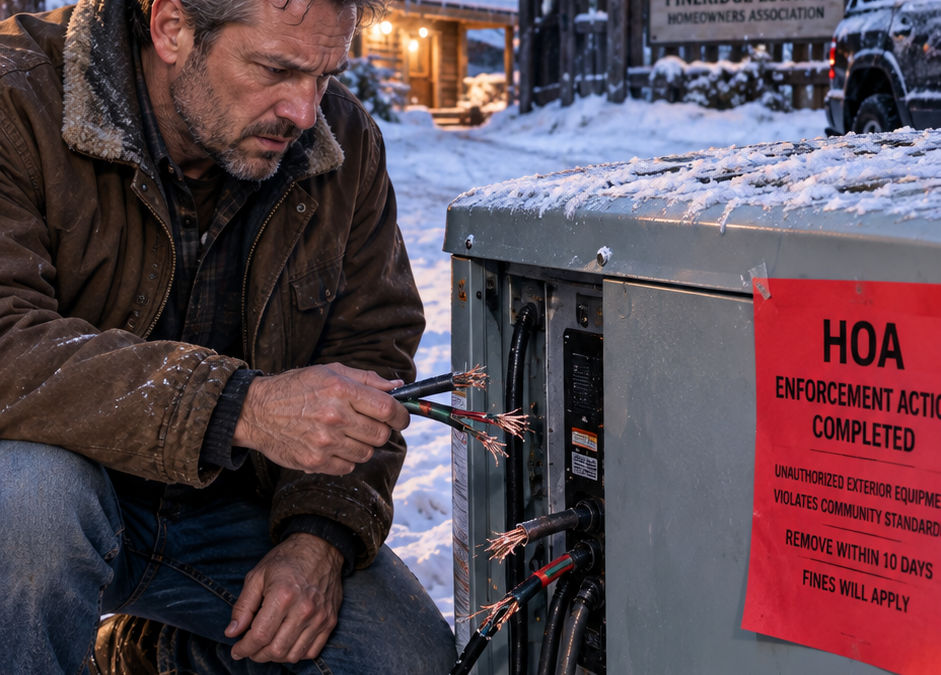
My generator sat behind a grove of ponderosa pines near the back of the property, hidden from the road and shielded by a timber enclosure I’d built years earlier. Normally, even when it wasn’t running, there was something reassuring about seeing it there—a heavy steel box connected to the house by clean conduit, gas line, and an automatic transfer system designed to wake itself the moment the power grid failed.
That afternoon, it looked dead.
I parked my old Ford F-150 beside the barn and walked across the frozen ground.
A thin layer of snow covered the grass.
My back gate was hanging open.
The chain lock I’d installed years before had been cut cleanly in half.
I stopped.
That was when the cold in my chest became different from the cold in the air.
I walked through the gate.
The generator hadn’t been removed.
That would have required effort.
Instead, somebody had disabled it.
The heavy copper transmission wires had been severed.
The low-voltage controls were cut.
The automatic start signal lines had been clipped individually.
Whoever did it hadn’t accidentally damaged anything.
They had known exactly what to cut.
The red notice taped to my front door explained why.
UNAUTHORIZED EXTERIOR EQUIPMENT—HOA ENFORCEMENT ACTION COMPLETED.
According to Pineridge Estates Homeowners Association, my backup generator violated newly adopted aesthetic and landscaping standards.
The equipment was supposedly incompatible with community appearance.
I had ten days to remove the remaining unit and pay accumulated fines.
If I refused, the association reserved the right to pursue collection action against my property.
I read the notice twice.
Then I looked back at the generator.
$9,412.
That was what I’d paid for the complete system years earlier.
County permit.
Electrical design.
Natural-gas connection.
Automatic transfer switch.
Inspection.
HOA approval.
Every page had been filed correctly.
Every signature was preserved.
And now Vanessa Holloway had apparently decided she could erase all of that with a red stamp and a pair of industrial cable cutters.
My phone rang before I could call anyone.
Her name appeared on the screen.
Of course it did.
I answered.
“Vanessa.”
“Ethan.”
Her tone was calm.
Almost cheerful.
“I assume you’ve seen the enforcement action.”
“I have.”
“Then you understand the board was forced to intervene.”
I looked at the severed wires.
“Forced?”
“You ignored repeated notices.”
“I sent you the original approval.”
“The current board does not recognize outdated authorizations that conflict with updated community standards.”
“My generator was approved.”
“Under a previous administration.”
“Which doesn’t make the approval disappear.”
She sighed.
Not because she was uncertain.
Because she thought she was explaining something to a slow child.
“Ethan, you continue to misunderstand how association governance works.”
I nearly smiled.
Thirty years auditing financial institutions had taught me that whenever someone said, you don’t understand how this works, what they often meant was, please stop asking questions.
“Explain it to me.”
“The board has authority to regulate exterior improvements.”
“You broke a lock and cut electrical wiring on private property.”
“We corrected an ongoing violation.”
“Without permission.”
“You had ample notice.”
“That’s not the same thing.”
Her voice hardened.
“If you continue refusing to cooperate, the fines will continue accumulating. If the balance remains unpaid, the association may pursue a lien and eventually foreclosure.”
There it was.
The sentence she expected to frighten me.
She continued.
“It would be unfortunate for you to lose your cabin over something this simple.”
I stared toward Diane’s garden beneath the snow.
Lavender stalks bent beneath ice.
Wild daisies were gone for the season.
The greenhouse she had designed stood quiet beyond the fence.
This wasn’t just a cabin to me.
It was the last home my wife and I had shared.
And the generator Vanessa had just ordered disabled had once kept Diane’s medical equipment operating through a sixty-one-hour winter blackout.
I lowered my voice.
“Is that a threat?”
“It’s an explanation of consequences.”
“No, Vanessa.”
I looked again at the cut lock.
“The consequence part hasn’t started yet.”
I ended the call.
Then I did what I had spent my entire professional life doing.
I began documenting.
PART2
Twelve years earlier, Pineridge Estates had barely deserved the word “estates.”
It was a loose collection of mountain homes along the edge of national forest land outside Cascade County, Colorado.
My family had owned twenty acres there for decades.
When I left my career in federal financial auditing and military geodetic surveying, I came back because I wanted silence.
Actual silence.
Not the expensive kind people sell as luxury.
The kind that exists at five in the morning when snow absorbs every sound and the mountains turn blue before sunrise.
Diane loved it immediately.
She planted lavender behind the cabin.
Wild daisies near the kitchen windows.
Native columbines closer to the tree line.
She said cultivated perfection was overrated.
“If every flower stands in a straight line,” she’d tell me, “somebody’s probably afraid of nature.”
That sentence became funnier after Vanessa became HOA president.
Diane and I spent nine good years there.
Then cancer took over the calendar.
Appointments.
Treatments.
Good scans.
Bad scans.
Hospital nights.
Quiet mornings.
Promises neither of us believed but both of us needed.
Three years before Vanessa attacked my generator, Diane died in our bedroom while snow fell outside.
Afterward, routine saved me.
I woke at five.
Made black coffee.
Walked the property line.
Checked fences.
Inspected survey markers.
Maintained the orchard.
Pulled weeds in Diane’s garden.
I wasn’t trying to be mysterious.
I simply didn’t have much interest in being known.
The newer residents saw a sixty-something widower in an old canvas jacket driving a muddy Ford.
Fine by me.
They didn’t need to know that I’d spent almost thirty years tracing money through shell companies, reconstructing fraudulent ledgers, and surveying federal sites where being wrong by three feet could become a multimillion-dollar legal disaster.
Records mattered to me.
Dates mattered.
Signatures mattered.
Original documents mattered.
People could argue all day.
Paper didn’t get tired.
The generator had been installed after one of the worst outages we’d ever experienced.
That storm knocked out power for sixty-one consecutive hours.
Temperature dropped below minus twenty.
Pipes froze in two houses.
An elderly couple near the ridge had to be evacuated.
Diane was already sick then.
Her medical equipment required reliable electricity.
That outage terrified me in a way I never admitted to her.
So when power returned, I solved the problem.
The generator cost $9,412.
I remember the exact number because I’m the kind of man who remembers exact numbers.
I hired Marcus Reed, a licensed electrical contractor.
We filed with the county.
A professional engineer prepared load calculations and diagrams.
The gas connection was inspected.
The transfer switch was tested.
The old HOA board reviewed the plans.
They approved the installation.
I kept the original approval letter.
Signature.
Date.
Association seal.
Permit number.
Electrical sign-off.
Gas inspection.
All of it.
People teased me about my record keeping.
Diane once said that if the house ever burned down, I’d run through the flames carrying a file cabinet.
That was partly why I bought the fireproof safe.
The original generator approval sat inside it.
Eight years later, Vanessa Holloway arrived.
At first, she seemed merely energetic.
She had worked in commercial real estate and carried herself like a woman who believed every room was waiting for her to chair it.
She joined the board.
Then became president.
Then gradually turned Pineridge into her personal administrative laboratory.
A hundred-page rulebook appeared.
New landscaping standards.
Updated architectural standards.
Expanded violation schedules.
Rules about trash bins.
Driveway stains.
Mailboxes.
Firewood storage.
Exterior lighting.
Vehicle visibility.
Flag dimensions.
Flower beds.
I once joked that Vanessa would eventually require squirrels to submit architectural applications before building nests.
Nobody laughed very hard because it sounded possible.
She launched what she called a “community-wide appearance initiative.”
Red notices began appearing everywhere.
Mrs. Patricia Lowell got fined because one of her shutters had faded.
A family two roads over got a warning because their grass reached three and a quarter inches.
A man named Jorge Martinez left his garbage cans visible forty minutes after collection and received a $150 administrative penalty.
People paid.
That was the problem.
Most were busy.
Some were elderly.
Some simply didn’t want a fight.
Vanessa learned a dangerous lesson.
If you make resistance exhausting enough, compliance starts looking like peace.
Then she discovered my cabin.
Technically, she had always known it existed.
But once she started talking about a “unified landscape corridor” along the western edge of the neighborhood, my twenty acres became inconvenient.
My property wasn’t manicured like the newer lots.
It had wildflowers.
Ponderosa pines.
A small orchard.
Weathered fencing.
A cabin older than half the neighborhood.
And behind the pines sat my generator.
The first notice arrived in November.
UNAUTHORIZED EXTERIOR MECHANICAL STRUCTURE.
Fine: $500.
Removal deadline: thirty days.
I almost laughed.
Instead, I walked into my study.
Opened the safe.
Retrieved copies of the original approval.
County permits.
Inspection records.
Then wrote a polite response.
I assumed that would end it.
That was my mistake.
Vanessa’s reply arrived four days later.
Previous board approvals are null and void under updated aesthetic standards adopted this year.
I read the sentence twice.
Then opened the official HOA bylaws.
I went to the county’s records.
Compared amendment dates.
Cross-referenced filing numbers.
And found something interesting.
The section number Vanessa cited did not exist.
Neither did the paragraph.
Neither did the supposed amendment granting retroactive cancellation of approved equipment.
I checked again.
Then again.
Nothing.
Phantom language.
That’s when the former auditor in me woke up.
One fake clause might be incompetence.
Several fake clauses used repeatedly to demand money were something else.
I didn’t accuse her.
I didn’t challenge her publicly.
I started a file.
Every letter.
Every envelope.
Postmarks.
Emails.
Screenshots.
Board notices.
Meeting packets.
Payment demands.
I made a spreadsheet.
Date.
Alleged violation.
Rule cited.
Actual rule text.
Amount demanded.
Board signatory.
Response.
Status.
Within a month, a pattern emerged.
Some citations referenced real rules inaccurately.
Others referenced rules that didn’t exist at all.
Most residents would never know.
Who sits down after dinner and compares a $200 HOA fine against county-filed governing documents?
Me.
I did.
Vanessa interpreted my silence as weakness.
That was useful.
Then came the morning of the sabotage.
I was driving into town for supplies.
As I reached the end of the driveway, I noticed a white maintenance van parked near my fence.
No company logo.
Two men stepped out.
Both wore Pineridge maintenance jackets.
One carried a heavy tool bag.
The other carried bolt cutters.
I saw them in the mirror.
I knew exactly what Vanessa had decided.
For a second, every instinct told me to reverse the truck.
Confront them.
Call the sheriff.
Stand beside the generator and refuse to move.
Then I remembered my cameras.
Four high-definition units covered the rear approach.
Two were visible.
Two weren’t.
So I kept driving.
I felt sick doing it.
But if Vanessa was willing to trespass, I needed proof that didn’t depend on my word against hers.
The cameras captured everything.
The men reached the rear gate.
One cut my lock.
They entered.
One made a phone call.
The audio wasn’t perfect, but the conversation was clear enough.
“Yeah, we’re here.”
Pause.
“Generator’s still installed.”
Pause.
“No, owner’s truck left.”
Pause.
“Okay.”
Then they walked directly to the equipment.
They didn’t remove it.
They disabled it.
Main conductor.
Control wires.
Start circuit.
Signal harness.
Cut.
Cut.
Cut.
Fifteen minutes later, my emergency generator was a very expensive metal sculpture.
Before leaving, they taped Vanessa’s notice to the door.
When I returned, I preserved everything.
Photographs.
Video.
Cut cable.
Broken lock.
Notice.
Tire prints.
Time stamps.
I placed the severed wire sections into labeled bags.
Then called Marcus.
He arrived wearing insulated coveralls and swearing before he even reached the equipment.
“What idiot did this?”
“HOA maintenance.”
He crouched.
Examined the cuts.
Then looked at me.
“Ethan, this wasn’t random.”
“I know.”
“They cut the transfer control intentionally.”
“I know.”
“They even killed the start signal.”
“I know.”
He stood.
“Do you want me to call the sheriff?”
“Later.”
Marcus stared at me.
“Later?”
“I need an estimate first.”
He looked almost offended.
“Your house could’ve been without backup heat.”
“That’s why you’re fixing it.”
He shook his head.
“You’re too calm.”
“No. I’m angry.”
“You don’t look angry.”
“That’s because I’m useful when I’m angry.”
He gave me an itemized preliminary repair estimate.
A little over $1,000.
I told him to repair everything immediately.
Then upgrade the protection.
Buried conduit.
Reinforced cage.
Locked disconnect access.
Weatherproof control routing.
“Make it better than it was.”
Marcus grinned.
“Now that sounds like anger.”
My next call was Rebecca Lawson.
Rebecca handled property rights, construction disputes, and HOA litigation.
She was sharp, fast, and allergic to nonsense.
I laid everything across her conference table.
Original approvals.
County permits.
Vanessa’s notices.
My spreadsheet.
Security footage.
Broken lock photographs.
Marcus’s estimate.
She watched the video twice.
Then leaned back.
“This has moved past petty HOA enforcement.”
“I assumed.”
“They entered your property without consent and intentionally damaged permitted electrical equipment.”
“Yes.”
“And these citations?”
“Compare them.”
She did.
Her eyebrows rose.
“These section numbers don’t match.”
“No.”
“Are you certain you’re using the current recorded version?”
I slid over certified copies.
“County clerk.”
Rebecca smiled.
Not a friendly smile.
A lawyer smile.
The kind people usually see immediately before discovering their week is about to deteriorate.
“How long have you been doing this?”
“Doing what?”
“Preparing.”
“About two years.”
She looked at the folders again.
“Ethan, normal people don’t keep evidence like this.”
“I worked federal audits.”
“That explains the pathology.”
“Occupational scar tissue.”
She tapped Vanessa’s latest threat.
“We can seek an emergency restraining order.”
“I want that available.”
“But?”
“I want the residents to see what she’s doing.”
Rebecca studied me.
“You want exposure.”
“I want documentation.”
“Same road, different vehicle.”
“Vanessa believes the board’s letterhead makes anything true.”
“And you’d like to test that.”
“I’d like the paperwork to do it for me.”
Rebecca nodded.
“Then we don’t interrupt her while she’s generating evidence.”
For the next two weeks, Vanessa became wonderfully productive.
Another fine.
Then another.
Then another.
My alleged balance climbed to $3,200.
Then came a foreclosure threat.
I received a formal notice warning that continued refusal to comply could lead to a lien against the cabin.
Vanessa called again.
“You are running out of time.”
“So the letter says.”
“You could resolve this today.”
“How?”
“Remove the generator.”
“It’s permitted.”
“We’ve been through that.”
“I know.”
“Then pay the fines.”
“For rules that don’t exist?”
Silence.
Only a second.
But I heard it.
“What did you say?”
“Nothing important.”
Her voice sharpened.
“If the board initiates collection, you will incur legal fees.”
“Document everything.”
“What?”
“Make sure you document everything.”
I hung up.
Meanwhile, Marcus finished the repair.
The generator was tested under full load.
Transfer time perfect.
Gas pressure stable.
Control system operational.
Ready.
Then Mrs. Patricia handed me the fact that turned the entire dispute into comedy.
She came by with banana bread.
People bring food in the mountains when they’re worried about you.
“Ethan,” she said, “is it true they’re fining you for that generator?”
“Apparently it offended landscaping.”
“Funny.”
“Why?”
“Vanessa has one.”
I stopped cutting the bread.
“What?”
“Big one. Behind her guest wing. She had it put in last spring.”
I stared at her.
“Are you sure?”
“I watched the crane.”
That night, I opened the county permit database.
Vanessa Holloway.
Property address.
Electrical permits.
Mechanical permits.
Generator applications.
Nothing.
I tried variations.
Nothing.
No inspection.
No gas approval.
No electrical transfer authorization.
Nothing.
I called Rebecca.
“You are going to enjoy this.”
“Those words from you scare me.”
“Vanessa has a generator.”
“So?”
“No permit.”
Silence.
Then Rebecca laughed.
Longer than I expected.
“The woman fining you for an approved generator has an unpermitted generator?”
“Correct.”
“Ethan.”
“Yes?”
“Merry Christmas.”
The weather report changed two days later.
A major winter system was coming down across Colorado.
Forecasters initially predicted twelve inches.
Then eighteen.
Then twenty-four.
By Wednesday morning, some models showed three feet in mountain areas.
Wind gusts.
Subzero temperatures.
Potential grid instability.
People started panic-buying.
Firewood vanished.
Propane sold out.
Supermarket shelves emptied.
I did what I’d always done.
Checked fuel.
Tested the generator.
Inspected furnace intake.
Cleared vents.
Verified water supply.
Charged batteries.
Put additional blankets near the fireplace.
By Thursday afternoon, snow was falling.
By evening, the valley disappeared.
Wind hit the cabin hard enough to rattle the eaves.
Snow moved sideways past the windows.
At 3:47 Friday morning, I woke to a distant boom.
Then darkness.
Everything shut off.
Furnace.
Refrigerator.
Exterior lights.
Silence.
One second.
Two.
Three.
Four.
Five.
The generator started.
A low mechanical rumble moved through the floor.
The transfer switch engaged.
Lights came back.
The furnace restarted.
Heat pushed through the vents.
I stood in my kitchen wearing wool socks and watched the storm through the window.
Then made coffee.
Across Pineridge, nothing came back.
The regional substation had failed.
The main feeder line was down.
Entire sections of the valley were dark.
By sunrise, indoor temperatures were dropping.
Phones were dying.
Electric garage doors wouldn’t open without manual release.
Several heating systems required electricity even when fueled by gas.
People who had fireplaces managed.
Others didn’t.
Vanessa’s generator started.
For approximately seven minutes.
According to what we later learned, the installation had never been properly inspected.
The system overloaded under transfer.
Control electronics failed.
Then her mansion went dark.
There is a temptation, when you’ve been wronged, to enjoy another person’s discomfort.
I won’t pretend I was above it.
But a mountain blackout in deep winter can become dangerous quickly.
So when neighbors began calling, I helped.
My generator had more capacity than I needed.
I couldn’t power houses across the road, but I could provide warmth.
Coffee.
Charging.
A safe place.
By Friday afternoon, my cabin had become an unofficial warming station.
Mrs. Patricia came.
The Martinez family came.
Two teenagers charged phones at my kitchen counter.
I ran extension power to the detached workshop so people could charge medical batteries and equipment safely.
The most serious case was Ruth Hensley.
Ruth cared for her elderly mother, who used an oxygen concentrator.
Their backup battery was running low.
Angela Ruiz, a nurse who lived nearby, helped bring them over.
I gave Ruth’s mother the bedroom closest to the study.
Marcus checked the circuit loading remotely with me by phone.
Everything remained safe.
Word spread.
Then another story spread faster.
Several residents had gone first to Vanessa’s house.
She refused them.
Angela told me herself.
“We knocked because she always talks about emergency preparedness.”
“What did she say?”
“That her generator was private infrastructure.”
I looked at her.
“Her generator isn’t running.”
“We didn’t know that yet.”
“What else?”
“She said every household is responsible for its own emergency planning.”
Ruth laughed bitterly from the table.
“The same woman who cut yours apart.”
Nobody had to add anything.
That contrast did the damage on its own.
The woman who spent years invoking “community welfare” suddenly discovered individual responsibility the moment the community needed something from her.
By Saturday, her name was being used in group chats as a verb.
“Don’t Vanessa me” apparently meant don’t cite rules you don’t follow yourself.
I found that immature.
I also found it extremely funny.
Road crews cleared the main route by Sunday afternoon.
The hearing was Monday.
Rebecca had originally requested emergency judicial relief, but the dispute was routed into a county-backed arbitration and enforcement hearing involving the association, property damage claims, and the disputed fines.
The venue was moved to the community center because too many residents wanted to attend.
More than 150 showed up.
Vanessa arrived with two attorneys.
She looked exhausted.
No makeup could hide three days without reliable heat.
Still, she walked into the room carrying herself like a monarch returning from a mildly inconvenient war.
I sat beside Rebecca.
Marcus sat behind us.
Mrs. Patricia had somehow secured a front-row seat.
Harlan Briggs, a retired civil judge serving as arbitrator, entered at nine.
Gray hair.
Reading glasses.
No patience.
I liked him immediately.
The HOA lawyer opened.
He described me as chronically noncompliant.
He described my generator as visually incompatible.
He claimed the board possessed broad enforcement authority.
He emphasized unpaid fines.
He used the phrase “community integrity” three times.
When he finally sat down, Briggs looked at Rebecca.
“Ms. Lawson?”
She stood.
“No speeches.”
That got everyone’s attention.
The HOA attorney frowned.
Rebecca continued.
“This dispute can be resolved by documents.”
She projected the first page.
My original HOA approval.
Signed.
Stamped.
Dated.
Next came the county permit.
Then the electrical inspection.
Then the gas approval.
Then Marcus’s certification.
Rebecca turned toward the arbitrator.
“The generator was authorized.”
Vanessa whispered to her attorney.
Rebecca changed slides.
Vanessa’s first violation notice appeared.
The relevant clause was highlighted.
Beside it appeared the official recorded bylaws.
No matching clause.
Second notice.
Same problem.
Third.
Same.
“Mrs. Holloway repeatedly cited rules that are absent from the recorded governing documents,” Rebecca said.
Murmurs moved through the audience.
Briggs raised a hand.
“Quiet.”
Rebecca looked toward Vanessa.
“The board may debate interpretation of real covenants. It cannot enforce sentences that do not exist.”
Vanessa’s lawyer stood.
“The association adopted supplemental standards.”
Rebecca held up a folder.
“Then please provide the properly adopted and recorded amendment.”
He looked toward Vanessa.
She leaned toward him.
He sat down.
Rebecca clicked again.
Security video.
The room watched two men approach my gate.
Bolt cutters.
Chain snapping.
Entry.
The generator.
One worker cutting the conductors.
Then the control wires.
The camera audio caught enough to establish communication with someone directing the work.
Rebecca paused the video.
“This was not removal of an obstruction.”
She pointed toward the screen.
“The equipment remained in place. They disabled it.”
Next came close-up photographs.
Clean cuts.
Cable ends.
Broken lock.
Marcus’s repair invoice.
Then his written statement identifying what had been damaged.
The audience was completely silent.
Rebecca looked toward Briggs.
“Had the regional grid failed before repairs were completed, Mr. Carol’s emergency heat system would have been inoperative.”
Vanessa shifted.
Her lawyer whispered to her.
Rebecca wasn’t finished.
Another slide.
County permit search.
Vanessa’s property address.
No generator permit.
No inspection.
No electrical approval.
Rebecca turned.
“Mrs. Holloway?”
Vanessa’s lawyer stood immediately.
“We object to relevance.”
Briggs looked over his glasses.
“Your client’s position is that unapproved generators violate association standards?”
“Yes, but—”
“And the evidence suggests your client operates one?”
He paused.
“Without county approval?”
The lawyer sat.
“Continue.”
Rebecca did.
“The same board president who claimed prior authorization on Mr. Carol’s fully permitted system was meaningless installed her own generator without documented county approval.”
The room erupted.
People shouted.
Briggs hammered his gavel.
“Sit down.”
Nobody did.
He hit it again.
“Sit down or I clear the room.”
That worked.
Vanessa looked pale.
Rebecca returned to the HOA notices.
“Now we address money.”
Spreadsheet.
Fines.
Dates.
Amounts.
Purported authority.
My original responses.
Certified mail receipts.
Rebecca moved line by line.
The $500 initial penalty.
Then escalation.
Then daily charges.
Then administrative fees.
Then the threat of a lien.
Then foreclosure language.
Every letter preserved.
Every envelope scanned.
Every date indexed.
Briggs interrupted.
“Mr. Carol, did you respond to the first violation?”
“Yes.”
“With what?”
“Copies of the original HOA approval and county permits.”
“When?”
I gave him the date.
“Certified?”
“Yes.”
“Receipt?”
Rebecca held it up.
He looked at Vanessa.
“Then the board had this before subsequent enforcement?”
Her attorney answered.
“Yes.”
Briggs removed his glasses.
That was the moment I saw the case change in his mind.
This was no longer a bureaucratic misunderstanding.
They knew.
And continued.
Vanessa asked to speak.
Her attorney tried to stop her.
She ignored him.
“Mr. Carol has consistently resisted reasonable community standards.”
Briggs looked at her.
“Mrs. Holloway, nobody asked about his personality.”
A few people laughed.
She continued anyway.
“This association must protect property values.”
“By cutting electrical wires?”
“We enforced a violation.”
“Was the generator removed?”
“No.”
“Then what exactly was enforced?”
She hesitated.
“It was rendered nonfunctional pending compliance.”
Marcus muttered behind me.
“She actually said it.”
Briggs heard him.
“Sir.”
“Sorry.”
Briggs looked back at Vanessa.
“Did the association obtain a court order authorizing entry?”
“No.”
“Owner consent?”
“He had notice.”
“That wasn’t my question.”
“No.”
“Did the recorded bylaws authorize physical destruction of approved electrical equipment?”
Vanessa looked toward her attorney.
He answered.
“Not in those terms.”
Briggs leaned back.
“Few bad answers begin better than ‘not in those terms.'”
The audience laughed again.
Vanessa’s composure finally cracked.
“We had an obligation to act.”
Rebecca stood.
“Then why did the notices rely on provisions that don’t exist?”
Vanessa turned toward her.
“They were supplemental standards.”
“Produce them.”
“Our records—”
“Produce them.”
“We don’t have every document here.”
“I requested them three weeks ago.”
“They exist.”
Rebecca held up the certified county record.
“Not where they are legally supposed to.”
Vanessa’s face tightened.
Rebecca continued.
“And while you threatened Mr. Carol with foreclosure over his approved generator, you operated an unpermitted generator at your own residence.”
“That is a county issue.”
“Convenient.”
Briggs looked at Rebecca.
“Counsel.”
She nodded.
“Withdrawn.”
But everyone had heard it.
The final piece came from the blizzard.
Rebecca didn’t dramatize it.
She didn’t need to.
She introduced weather reports.
Utility outage logs.
Grid failure times.
Then confirmation that my repaired generator restored power automatically.
She called Angela.
Angela described bringing Ruth and her mother to my cabin.
Then she described going to Vanessa’s house first.
“What did Mrs. Holloway tell you?” Rebecca asked.
Angela looked directly at Vanessa.
“That her backup system was private and every family needed to handle its own emergency.”
“Was her generator operating?”
“Not when we were there.”
“Did you later learn why?”
“Residents were told it failed.”
Rebecca nodded.
“No further questions.”
Mrs. Patricia whispered loudly enough for half the room to hear:
“Community integrity.”
Laughter rolled through the chairs.
Briggs hit the gavel once.
“Last warning.”
By noon, Vanessa’s attorneys requested a recess.
Briggs granted fifteen minutes.
I walked outside.
Snowbanks still lined the parking lot.
Rebecca stood beside me.
“You okay?”
“I’ve had worse Mondays.”
She smiled.
“They want to settle.”
“Already?”
“They don’t want Briggs issuing broad findings.”
“What do you recommend?”
“Depends what you want.”
I looked toward the mountains.
“I want the fines gone.”
“Easy.”
“Repair costs.”
“Easy.”
“Legal fees.”
“Likely.”
“No more fake rules.”
“That requires governance changes.”
“Then include them.”
“And Vanessa?”
I looked through the community center window.
She was arguing with one of her lawyers.
“That’s not my decision.”
Rebecca nodded.
“Good answer.”
The hearing resumed.
Briggs summarized the record.
My generator had been previously approved.
County permits existed.
The association had notice of those documents.
Physical entry occurred without my consent.
Wiring had been deliberately cut.
Several cited provisions could not be matched to recorded governing documents.
Collection threats continued after I disputed the charges.
Vanessa’s own generator appeared to lack county documentation.
He ordered every fine against my property vacated.
The association was required to reimburse my generator repair costs.
My legal costs associated with the enforcement dispute were covered under the settlement structure.
Additional compensation was ordered for unauthorized property damage and access.
Evidence concerning the physical entry, property destruction, and disputed enforcement documents was forwarded to appropriate county authorities for review.
Briggs was careful with his language.
So was Rebecca.
No theatrical declaration that Vanessa was automatically guilty of five crimes.
No fantasy courtroom speech.
Documents would go to investigators.
Investigators would decide what came next.
That was enough.
Then Briggs looked directly at the board members.
“This association appears to have confused private governance with unrestricted authority.”
Nobody moved.
He continued.
“Those are not the same thing.”
I had heard survey instructors say almost identical words about ownership lines.
A mark on a map didn’t give you land.
A title didn’t give you unlimited power.
A board vote didn’t erase the law.
Vanessa sat completely still.
For six years, people had reacted to her authority.
That afternoon, authority reacted to her paperwork.
Within seventy-two hours, she resigned.
She didn’t announce it at a meeting.
The management company sent an email.
Effective immediately, Vanessa Holloway has resigned as President and Director of the Pineridge Estates Homeowners Association.
The board fractured immediately afterward.
Two members resigned.
One insisted he’d never known Vanessa was using non-recorded language in enforcement letters.
Another claimed the maintenance entry had been presented as legally approved.
Nobody wanted ownership of the decision anymore.
Funny how quickly absolute authority becomes somebody else’s idea once attorneys start asking questions.
The residents demanded new elections.
They got them.
David Farrow became president.
David was a mechanical engineer.
That alone made him better suited to discuss generators.
But what I liked about him was simpler.
He hated meetings.
His first board meeting lasted forty-three minutes.
At the end he said, “If we ever reach page one hundred of an HOA rulebook again, assume something has gone terribly wrong.”
The old enforcement manual was reviewed.
Invalid language was removed.
The community adopted a much shorter set of rules.
Fines required written notice.
The exact rule had to be cited.
Residents received time to respond.
Major penalties required a hearing.
Emergency entry required a documented emergency.
Contractors could not enter private property merely because a board president said they could.
It was basic governance.
Which was apparently revolutionary.
Vanessa’s house went on the market.
She didn’t exactly flee into the snow with villagers holding torches behind her.
Reality is usually quieter.
A FOR SALE sign appeared.
Then moving boxes.
Then a truck.
She stopped attending community events.
The county required her generator installation to be brought into compliance or removed.
The irony was so complete that even I couldn’t improve it.
One afternoon, I saw a county inspection vehicle in her driveway.
Marcus happened to be at my cabin finishing a small conduit adjustment.
He saw it too.
“Should I wave?”
“No.”
“Just once?”
“Marcus.”
“Fine.”
He waited five seconds.
“Can I smile?”
“I can’t regulate your face.”
He smiled.
By March, Vanessa’s house was empty.
The community didn’t collapse without her.
Property values did not vanish.
Trash cans still disappeared from curbs eventually.
Lawns survived the occasional extra half inch.
People somehow managed to remain civilized without receiving red notices for every visual imperfection.
Spring returned slowly.
Snow receded from Diane’s garden.
The lavender survived.
Then the daisies.
I cleaned the beds the way she had taught me.
Not too aggressively.
“Leave something messy,” she used to say.
“Birds and bees don’t care about real estate brochures.”
The generator still sat behind the pines.
Marcus had enclosed the vulnerable components with a neat protective barrier.
Not ugly.
Not decorative.
Functional.
David stopped by one afternoon.
He stood beside it.
“So this is the machine that overthrew an empire.”
“No.”
I pointed toward my study.
“The filing cabinet did that.”
He laughed.
Then became serious.
“We owe you an apology.”
“You don’t.”
“The association does.”
“The association is made of people.”
“And some of those people allowed this.”
I considered that.
“Then make sure the next board can’t.”
“That’s the plan.”
Before leaving, he handed me a letter.
Formal apology.
Withdrawal of enforcement.
Acknowledgment that the generator had been approved.
Reimbursement confirmation.
New access policy.
I read it once.
Then carried it into my study.
My fireproof safe remained bolted beneath the floor.
Inside were old deeds.
Survey notes.
Diane’s will.
Property records.
The original generator approval.
I placed the new letter beside it.
Then I changed my mind.
I took both documents out.
The old approval.
The new apology.
I put them in a separate folder.
On the front I wrote:
WHY WE KEEP RECORDS.
Diane would have laughed at me.
I could almost hear her.
One evening near the end of April, I sat on the porch with coffee.
The mountains were purple in the distance.
Water ran beneath melting snow near the orchard.
Tiny shoots of lavender pushed through the garden soil.
For three years after Diane died, I had treated the cabin almost like a museum.
I maintained everything.
Protected everything.
Preserved everything.
Partly because I loved the place.
Partly because I was afraid that changing anything would make her disappear further.
Vanessa’s attack had been about a generator on paper.
But that wasn’t what made me fight.
The generator represented one of the last decisions Diane and I made together.
During the sixty-one-hour outage years earlier, she had been weak.
Her oxygen equipment depended on electricity.
The house got colder every hour.
I remember sitting beside her and pretending I wasn’t scared.
Afterward she said, “Promise me we don’t do that again.”
So I installed the system.
Years later, Vanessa looked at the same machine and saw an aesthetic violation.
That’s the danger of authority without context.
It reduces people’s lives to categories.
Approved.
Unapproved.
Compliant.
Noncompliant.
Attractive.
Unsightly.
Pay.
Remove.
Obey.
The human story disappears.
That was what Vanessa never understood.
She thought people surrendered because her authority was strong.
Mostly, they surrendered because they were tired.
There’s a difference.
Power built on exhaustion looks solid until someone decides he has enough patience to read every page.
I had patience.
I also had folders.
Lots of folders.
Mrs. Patricia still jokes that my filing system should be designated critical community infrastructure.
Ruth’s mother recovered from the storm without serious complications.
Angela became one of the loudest advocates for formal emergency planning.
By the following winter, Pineridge had a real community disaster plan.
Warming locations.
Medical-device registry for residents who voluntarily opted in.
Backup charging resources.
Contact trees for elderly homeowners.
Generator safety inspections.
Actual preparedness.
Not slogans.
David asked me to help review the plan.
I agreed on one condition.
“No board position.”
He groaned.
“You’ve told me twelve times.”
“Thirteen now.”
“Advisory committee?”
“No.”
“Temporary working group?”
“No.”
“Coffee and insults while I write it?”
“Acceptable.”
So that was how I contributed.
From my porch.
With coffee.
No title required.
The next big storm arrived the following January.
Nothing like the historic blizzard.
Maybe fourteen inches.
Power flickered twice.
At 2:13 in the morning, the grid dropped.
Five seconds later, my generator started.
I opened my eyes.
Heard the low hum.
Then went back to sleep.
By sunrise, power was restored.
No crisis.
No red notices.
No board members walking across private property with cable cutters.
Just snow.
When I got up, I poured coffee and stood at the kitchen window.
Beyond the pines, the generator was running its cooldown cycle.
Diane’s garden was buried beneath white.
The valley was quiet.
I thought about Vanessa.
Not with anger.
Not anymore.
Mostly with disbelief.
She had taken a legally approved emergency system and ordered people to cut it apart because she believed a title made her untouchable.
Then she threatened to take my home when I refused to thank her for the privilege.
She had every advantage she thought mattered.
Board authority.
Official letterhead.
Management support.
Attorneys.
Rules nobody questioned.
Neighbors conditioned to comply.
All I had were old permits, registered bylaws, security footage, certified-mail receipts, repair invoices, and enough patience to put them in chronological order.
Turns out that was plenty.
The people who abuse rules often depend on one assumption:
That nobody will read them.
Vanessa’s mistake wasn’t cutting my generator.
That was simply the act that exposed everything else.
Her real mistake was assuming a quiet widower living at the edge of the valley was quiet because he was weak.
I had spent thirty years following money through numbers designed to hide the truth.
Compared with that, an HOA president inventing rule numbers wasn’t exactly sophisticated.
She thought she was fighting an old man with a generator.
She was fighting a man who kept receipts.
And when the snow came down, the grid failed, the valley went dark, and her own unpermitted system died, all those little pieces of paper I’d stored for years finally became more powerful than every red notice she’d ever taped to a door.
That was the part I appreciated most.
Not that her house went dark.
Not that she lost the board presidency.
Not even that the fines vanished.
It was the moment the entire community saw the difference between authority and legitimacy.
One can be printed on letterhead.
The other has to survive the evidence.
Mine did.
Hers didn’t.
I finished my coffee and walked outside.
Snow creaked beneath my boots.
The generator shut down.
Silence returned.
I checked the enclosure.
Locked.
Wiring protected.
Permits current.
Everything exactly where it belonged.
Then I walked to Diane’s garden.
Even beneath snow, I knew where every row was.
Lavender here.
Daisies there.
Columbines near the stones.
Winter made the ground look empty.
It wasn’t.
Things were waiting underneath.
That had been true of my evidence too.
Vanessa never saw it because she never bothered to look beneath the surface.
She saw an old cabin.
An old truck.
An old widower.
A generator she didn’t like.
And she assumed the easiest thing in the world would be to cut a few wires and scare me into submission.
She was right about one thing.
The wires were easy to cut.
Everything that followed was considerably harder.








