𝗙𝗨𝗟𝗟 𝗦𝗧𝗢𝗥𝗬 HOA Cut Down My 80-Year-Old Oak While I Was Away—Then Billed Me $4,860 for Destroying It
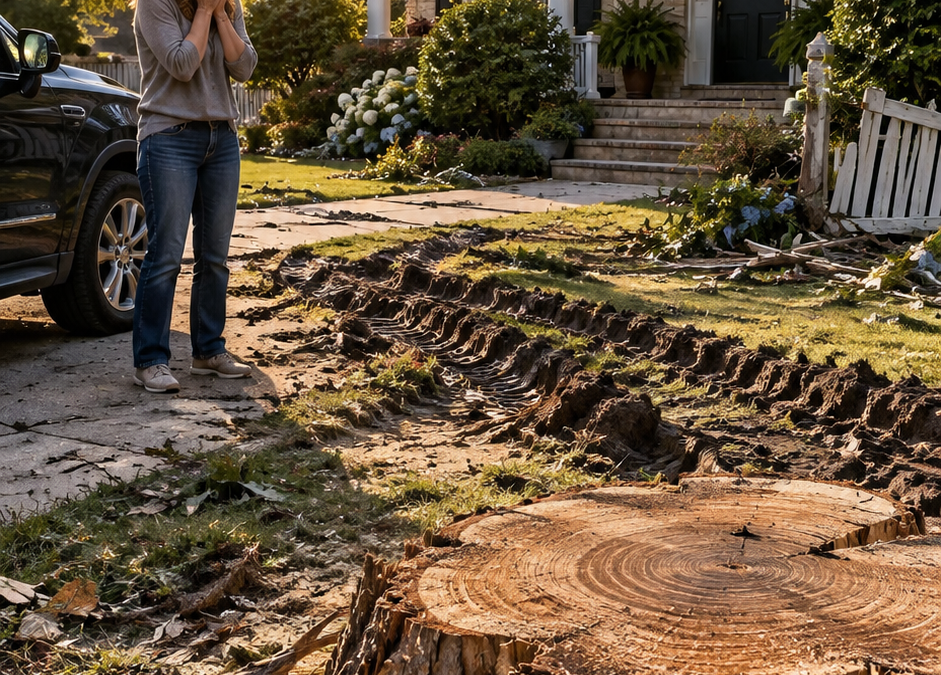
PART2
The tree had become a problem for Victoria six months earlier.
Not a safety problem.
A design problem.
Stonebridge Estates had been built around my family’s property rather than the other way around.
My great-grandfather bought the land decades before developers arrived. Over time, fields became subdivisions. County roads became landscaped entrances. Decorative ponds appeared. So did an HOA.
A previous owner of our house had voluntarily joined the association to use certain shared amenities, but the Carter frontage remained privately owned.
That distinction mattered to me.
To Victoria Sterling, distinctions were mostly obstacles placed in the path of her authority.
Victoria had been HOA president for five years.
She was polished, controlled, and always spoke as if every personal preference had been unanimously approved by civilization.
Under her leadership, Stonebridge got matching mailboxes, stricter rental restrictions, upgraded cameras, tougher parking enforcement, and landscaping standards detailed enough to make a botanical garden nervous.
She wasn’t loud most of the time.
That was part of what made her effective.
Victoria didn’t scream when she wanted something.
She said things like, “The board has determined,” or “Community standards require,” or “We need to consider the broader interest.”
It made ordinary opinions sound like Supreme Court decisions.
At a January meeting, she unveiled what she called the Stonebridge Gateway Renewal Project.
A huge rendering appeared on the clubhouse projector.
There it was.
A limestone monument.
Bronze lettering.
Garden walls.
Ornamental grasses.
Uplighting.
Decorative pillars.
Basically the sort of entrance monument built by communities terrified that passing drivers might accidentally mistake them for normal houses.
The initial price tag was $182,000.
I leaned forward.
Something looked wrong.
The wall seemed too wide for the association’s entrance parcel.
I raised my hand.
“Where’s the property line?”
Victoria barely glanced at me.
“The rendering is conceptual.”
“Okay. Where’s the oak?”
A few residents looked toward the image.
My tree wasn’t there.
Victoria folded her hands.
“Existing vegetation wasn’t included in the architectural rendering.”
“The tree is six feet across.”
“The board is aware of the tree.”
That answer bothered me.
After the meeting, Victoria caught me near the coffee table.
She smiled.
“Elijah, I’ve been meaning to speak with you about those lower limbs.”
“Which lower limbs?”
“On your oak. They affect the entrance sightline.”
“I had them evaluated.”
“They could be lifted.”
“If a certified arborist recommends pruning, I’ll consider it.”
Her smile tightened.
“Sometimes community needs have to outweigh one homeowner’s aesthetic preferences.”
I looked at her.
“It’s not an aesthetic preference.”
“What would you call it?”
“My property.”
That was the moment the smile disappeared.
A week later, I hired Daniel Ortiz.
Daniel was a certified arborist who had inspected the oak during my restoration project.
He spent nearly three hours examining it.
He checked the canopy.
The trunk.
Root flare.
Old pruning wounds.
Soil condition.
Deadwood.
He used a mallet to sound suspicious areas and probed several cavities that had formed decades earlier.
When he finished, he handed me the preliminary notes.
“Mature tree,” he said.
“I know that part.”
He grinned.
“Mature but healthy. Vigorous crown. Stable major roots. No significant structural decay.”
“Any danger?”
“Two small dead limbs.”
“Removal?”
“Pruning. Normal maintenance.”
“So not falling on schoolchildren?”
“Unless your HOA has schoolchildren standing on ladders eighteen feet in the air.”
I laughed.
Daniel didn’t.
“I’m serious. Don’t let anyone characterize age alone as hazard. Old doesn’t mean dangerous.”
His written report followed two days later.
I sent it to Victoria.
The property manager, Paige Collins.
Every board member.
For nearly two months, nothing happened.
Then orange paint appeared in my grass.
Three utility stakes had been pushed several feet inside my yard.
I photographed them.
Measured their location from known deed monuments.
Then emailed Paige.
She replied that the markings were preliminary work connected to the gateway project.
I wrote back:
No work is authorized on my private parcel. Please identify any recorded easement the association believes permits construction or access in this area.
Victoria answered instead.
She claimed the HOA held “longstanding maintenance authority over the entrance corridor.”
I asked for the recording number.
No response.
At the May HOA meeting, the gateway project price had climbed close to $200,000.
That got people’s attention.
Our clubhouse roof leaked.
Two drainage areas flooded after heavy storms.
One of the pool pumps had been making a sound like a dying lawn mower for eight months.
Yet Victoria wanted a monument impressive enough to welcome Roman emperors.
Residents questioned the cost.
I asked whether the project team had verified ownership and the proposed footprint.
Victoria adjusted her papers.
“The board’s professionals are handling due diligence.”
That sentence would become important later.
Because they weren’t.
In early June, I received a certified letter.
HAZARDOUS TREE NOTICE.
According to the letter, my oak was in advanced decline, obstructed driver visibility, and posed an immediate threat to pedestrians and vehicles.
I had ten days to remove it.
There were no photographs.
No technical measurements.
No arborist signature.
No inspection date.
Nothing.
I called Paige.
“Who declared the tree hazardous?”
“The board’s contractor.”
“Who?”
“Green Line Outdoor Services.”
“Are they certified arborists?”
“I don’t know.”
“Did anyone inspect the trunk?”
“I wasn’t present.”
“The roots?”
“I don’t know.”
“Did anybody enter my property?”
“Elijah, I’m just communicating the board’s position.”
“And I’m asking for the evidence supporting that position.”
She sighed.
“The board believes the condition is unsafe.”
“I sent you a certified arborist report three weeks ago saying the opposite.”
“I understand.”
“No, Paige. You received it. Understanding it would require this conversation to make sense.”
She ended the call soon after.
Two board members contacted me privately.
Neither remembered voting to remove my tree.
I checked the published minutes.
The only relevant language authorized general entrance maintenance and hazard mitigation.
Nothing identified my oak.
Nothing authorized entry onto my parcel.
I confronted Victoria after another neighborhood meeting.
“You don’t have a vote authorizing removal.”
She didn’t even blink.
“The board does not have to identify every individual tree in a maintenance resolution.”
“A six-foot-wide white oak isn’t shrub maintenance.”
“The entrance improvement is moving forward, Elijah.”
“There it is.”
“What?”
“This isn’t about safety.”
Her expression cooled.
“It would be easier if you stopped treating every practical decision as an attack on your family history.”
I stared at her.
“Maybe it would be easier if you stopped treating my property like spare HOA acreage.”
We stood there silently.
Then she walked away.
A week later, I traveled out of town for my cousin’s college graduation.
Before I left, I sent one final email.
It went to Victoria.
Paige.
Every board member.
The HOA’s attorney.
I attached Daniel’s report again.
I stated clearly that the tree was healthy, the dispute was unresolved, and nobody had permission to enter my property or perform tree work.
I wrote the sentence twice.
No consent is granted for entry, pruning, removal, excavation, or construction on the Carter parcel.
Nobody responded.
Friday morning, while I was two counties away, Green Line Outdoor Services arrived at my house.
By Sunday afternoon, my oak was a stump.
After hanging up on Victoria, I didn’t yell.
I didn’t post on Facebook.
I didn’t drive to her house.
I treated my yard like a civil engineer treats a failed structure.
Document first.
Feel later.
I photographed everything.
Stump.
Fence.
Tire tracks.
Remaining branches.
Sawdust.
Damage to the grass.
Saw cuts.
The exposed wood.
Distance from the road.
Distance from my known property markers.
I put temporary tape around the disturbed area and called Daniel.
He arrived before sunset.
For ten minutes, he barely spoke.
He moved between the stump and several heavy rounds that the crew had left behind my shrubs.
Finally, he crouched and ran his fingers across the cut face.
“This is sound wood.”
“Can you prove that?”
“I can document what remains and compare it to my prior inspection.”
“Would an emergency tree look like this?”
He shook his head.
“No obvious decay. No hollow center. No major rot pattern. Nothing here supports sudden emergency failure.”
“Put that in writing.”
“I will.”
My next call was to Simone Ward.
Simone was a property and construction attorney I knew from engineering work.
She came over that evening.
I handed her the HOA notice.
The arborist report.
My emails.
The invoice.
She read everything without speaking.
Then she looked at me.
“Three rules.”
“Go ahead.”
“Do not pay them.”
“Easy.”
“Do not threaten anybody.”
“Less satisfying, but fine.”
“And preserve absolutely everything.”
“Already started.”
“Good.”
The next morning, another HOA email arrived.
It formally charged my account $4,860.
Emergency tree removal.
Mobilization.
Traffic control.
Administration.
Legal review.
The email warned that unpaid balances could accumulate fees and be referred for collection.
I forwarded it to Simone.
She called me thirty seconds later.
“They charged you for cutting down your own tree?”
“Apparently destruction is now a premium service.”
She actually laughed.
“Don’t respond.”
Victoria responded for me.
She sent a community-wide email claiming that the board had removed a dangerous tree after “repeated homeowner noncompliance.”
She wrote that the action had protected children, drivers, and neighborhood visitors.
Several residents replied thanking the board for acting decisively.
I said nothing.
I knew how neighborhood arguments worked.
If I fought Victoria in a Facebook comment section, the story would become personality versus personality.
Young homeowner versus respected board president.
Angry family attachment versus community safety.
I needed documents.
That evening, Aunt Denise came over.
She had grown up in the Carter house.
She didn’t say much when she saw the stump.
She walked around it slowly.
Then touched a dark scar near the edge.
“Lightning strike,” she said.
“1978?”
She nodded.
“That mark was right above the swing.”
She’d brought an old photograph.
My grandparents were standing beneath the oak on their wedding anniversary.
Granddad wore a dark suit.
Grandma had one hand against the trunk and was laughing at something outside the frame.
Even then, the tree was wider than either of them.
Denise placed the photograph on the porch table.
“They waited until you left.”
“Yeah.”
“That matters.”
“I know.”
She looked toward the entrance.
“If they honestly thought it was falling, they’d have acted when they discovered the danger.”
“Exactly.”
“But they waited for you to leave.”
She looked back at me.
“That means they knew you’d stop them.”
That sentence stayed with me.
Before she left, she touched my shoulder.
“Your grandfather used to say people reveal themselves when they think you have no power.”
I looked toward the stump.
“What am I supposed to do with that?”
“Let them finish revealing themselves.”
So I did.
The first major piece of evidence came from Helen Brooks.
Helen lived across the road.
She was also the HOA treasurer.
Her doorbell camera faced the entrance.
When she heard what happened, she called me.
“I think I have something you need to see.”
I went over that night.
The footage began at 7:12 Friday morning.
Green Line’s trucks arrived.
The workers stayed near the curb.
They did not immediately enter my yard.
Then Victoria’s white SUV appeared.
She parked.
Walked onto my lawn.
Removed the side fence section.
And waved the truck forward.
One worker could be heard asking a question.
The first few words were difficult to make out.
Then:
“Does the homeowner know?”
Victoria’s response was partly obscured by engine noise.
But the next sentence came through clearly.
“The board has authority. We need it completed today.”
Helen paused the video.
“I was told the legal issue was settled.”
“It wasn’t.”
“I voted for entrance maintenance. I did not vote to cut down your oak.”
“Can you preserve the original file?”
Her expression changed.
“Yes.”
“Please do.”
Simone sent Green Line a formal preservation demand.
Contracts.
Texts.
Work orders.
Photos.
Emails.
Voicemails.
Everything.
A few days later, company owner Rick Danner called us.
His tone was defensive at first.
Victoria had told Green Line the tree stood on association-controlled land.
She told them I had received all required notice.
She said emergency authority permitted access.
Then Simone asked the question that mattered.
“Who determined the tree was dangerous?”
Rick hesitated.
“Our landscape supervisor observed visible deadwood.”
“Is he a certified arborist?”
“No.”
“Did he inspect the trunk?”
“From the road.”
“Root system?”
“No.”
“Did Green Line issue a written recommendation for immediate removal before the work?”
Silence.
“No.”
They did have a voicemail from Victoria.
Rick forwarded it.
Her voice came through my laptop speakers.
“Get it completed before Sunday afternoon. The homeowner has delayed this long enough, and we don’t want him interfering with the crew.”
I replayed it.
Then again.
Simone leaned back.
“Emergencies generally aren’t scheduled around the victim’s availability.”
A week later, the HOA’s attorneys produced what they called supporting documentation.
One page.
Prepared by Green Line.
It described the oak as “overmature” and mentioned visible deadwood.
It did not say the tree was diseased.
It did not say the tree was structurally unstable.
It did not recommend emergency removal.
And the date at the bottom was two days after the oak had already been cut down.
Simone tapped the paper.
“They’re building the explanation backward.”
Then utility flags appeared beside my stump.
Again.
I walked outside and found a survey crew.
“What are you laying out?”
“The Stonebridge gateway.”
“Show me.”
The technician turned his tablet.
The proposed limestone wall crossed the exact area where the oak’s root system had been.
My stomach tightened.
“Where did you get that property line?”
He zoomed out.
A dashed line on an old landscape plan had apparently been treated as the parcel boundary.
It wasn’t.
It was a maintenance area.
I hired Claire Benton.
Claire was an independent surveyor with no relationship to the HOA.
She located the original iron property monuments.
Reviewed deeds.
Subdivision plats.
Recorded documents.
Then mapped everything.
Two days later, she called.
“Your oak was eight feet four inches inside your parcel.”
“Not on the line?”
“Not close.”
“What about the monument?”
“Eleven feet over.”
I sat back.
“Eleven?”
“The proposed foundation extends eleven feet onto your property.”
She wasn’t finished.
The HOA’s irrigation line crossed my boundary.
So did one decorative light.
Neither had a recorded easement.
Worse, the HOA’s actual entrance parcel was too narrow for Victoria’s grand monument design.
If the structure were moved fully onto association land, it would run into setback and visibility restrictions.
That was why the oak mattered.
Not because it was dangerous.
Because it stood exactly where their oversized project needed private land.
The tree made the ownership problem impossible to ignore.
Remove the tree, start construction, and maybe everyone would treat the new landscaping footprint as established fact.
That theory stopped being theoretical two mornings after Claire finished her survey.
A small excavator arrived.
Then a concrete crew.
I walked outside holding the stamped survey.
The foreman pointed at orange paint.
“We’re doing foundation test digging.”
“Not here.”
He frowned.
“This is HOA work.”
“This is my property.”
He called Paige.
Paige called Victoria.
Twenty minutes later, Victoria arrived with a binder.
And a sheriff’s deputy.
Apparently I had become a hostile homeowner obstructing authorized community infrastructure.
The deputy was calm.
That irritated Victoria immediately.
I handed him my deed.
Claire’s survey.
The no-entry notice.
Photos of the proposed foundation.
Victoria held up an HOA maintenance map.
“This corridor has been maintained by the association for decades.”
The deputy compared documents.
“This doesn’t establish ownership.”
“It establishes our responsibility.”
“Responsibility for landscaping isn’t necessarily authority to pour concrete.”
Victoria’s mouth tightened.
“We have easement rights.”
I looked at her.
“Recording number?”
Silence.
“Come on, Victoria. You’ve claimed this easement for months. What’s the number?”
“The association’s counsel can provide that.”
The deputy looked at her.
“Do you have a recorded easement with you?”
“No.”
He looked at the foreman.
“Until this ownership dispute is resolved, don’t cross the surveyed line without written authorization or a court order.”
Victoria stiffened.
“This is absurd.”
The foreman didn’t care.
He wasn’t risking his company over an HOA monument.
The excavator went back onto the trailer.
As the truck pulled away, Victoria turned toward me.
“You are going to cost every family in this neighborhood money.”
I folded the survey.
“No.”
She stared.
“The person who approved a $200,000 project on land she didn’t own did that.”
A neighbor across the road recorded the exchange.
By dinner, the video had circulated through Stonebridge.
For the first time, residents understood that the dispute wasn’t merely about an old tree.
The HOA had tried to build on land its own president couldn’t prove the association controlled.
I installed small temporary boundary markers and NO ENTRY signs along Claire’s surveyed line.
Victoria fined me for unauthorized signage.
Then another notice arrived.
Mailbox paint.
Another.
Camera orientation.
Another.
Wood debris.
Another.
Grass damage.
The grass damage was caused by the truck that had come to cut down my tree.
That one was my favorite.
By the time Victoria added legal fees, my HOA account allegedly owed more than $9,000.
They sent a notice threatening a lien.
Simone answered with a letter thick enough to injure someone.
It listed the video.
Survey.
Arborist reports.
Attorney warnings.
No-entry notice.
Post-dated hazard statement.
Retaliatory fines.
She also put the HOA’s insurer on notice.
The lien never appeared.
Instead, Victoria told residents that I had escaped responsibility through a “technical legal maneuver.”
That divided the neighborhood.
Some people still supported her.
Not necessarily because they believed her.
Because they were afraid.
If I sued the HOA, they worried their dues would increase.
I understood that.
But others started comparing notes.
Parking citations.
Denied fence applications.
Lost paperwork.
Questionable vendor decisions.
Closed meetings later described as unanimous.
Residents began quietly approaching me.
One man brought a folder of letters.
A woman brought emails.
Another homeowner said Victoria had ordered his family to remove healthy shrubs.
Guess who sold and installed the approved replacements?
Green Line.
That caught my attention.
I didn’t turn my case into a neighborhood complaint festival.
Simone warned me against muddying strong evidence with unrelated grievances.
So I told residents to preserve their own records.
Speak for themselves.
Ask questions publicly.
Meanwhile, Simone requested the gateway project files.
The management company eventually produced hundreds of pages.
The evidence we found buried inside those files ended Victoria.
Early design drawings specifically instructed the architect to preserve my oak.
Another memo explained that preserving the tree required a smaller monument with a different placement.
Victoria rejected it.
Her email read:
The oak makes the entrance feel unbalanced and dated.
Dated.
An eighty-year-old living tree was apparently ruining the modern visual experience of limestone.
Then came the email that changed everything.
The architect warned Victoria that removing a mature tree from privately owned property required the owner’s consent.
Victoria responded:
If Carter won’t cooperate, identify a safety or maintenance basis for removal. Once the tree is gone, the revised concept will be easier for residents to accept.
I read the sentence twice.
Simone didn’t say anything.
She didn’t need to.
There was more.
Victoria instructed Paige to prepare enforcement language emphasizing traffic visibility and age-related decline.
The email was written before any new inspection.
The conclusion existed before the evidence.
They hadn’t discovered a dangerous tree.
They had needed a dangerous tree.
Then we discovered Green Line’s owner had a family connection to Victoria through marriage.
Green Line had received tens of thousands in HOA contracts.
Competitive bids were inconsistent or nonexistent.
The company was also positioned to receive a multi-year landscaping agreement connected to the gateway project.
Helen, the HOA treasurer, began digging into internal records herself.
One afternoon she asked me to meet her at a coffee shop outside Stonebridge.
She brought a flash drive.
And a paper folder.
“The board never approved removing your tree.”
“I suspected that.”
“No, Elijah. I mean it never happened.”
She showed me the minutes.
Then internal emails.
One board member, Thomas Bell, had specifically objected to using emergency authority.
More importantly, the association attorney had warned Victoria in writing that the HOA’s rights over the Carter frontage were uncertain.
His advice was clear.
Get my consent.
Get a court order.
Or document a genuine emergency.
Victoria forwarded that email to Paige.
She added one sentence:
We cannot let legal caution paralyze the project.
I laughed.
Helen didn’t.
“She authorized Green Line herself.”
“No vote?”
“No valid vote.”
“Payment?”
“She signed it.”
Helen leaned closer.
“She’s planning a special meeting.”
“For what?”
“Retroactive approval of the removal. Authorization to continue collection against you. And permission to spend association funds defending the claim.”
I stared at her.
“She thinks a vote now can make the earlier action legal?”
“Apparently.”
“Can it?”
Helen almost smiled.
“No.”
I leaned back.
“What are you going to do?”
“Make sure residents see the documents.”
During those weeks, Victoria began portraying me as a greedy young engineer trying to extort my neighbors over “an old tree.”
Funny thing was, I hadn’t demanded a dollar.
Not yet.
Daniel eventually prepared a formal valuation.
Seventy-six thousand dollars.
When I saw the number, I hated it.
How do you turn the tree your great-grandfather planted into a spreadsheet?
How much is the branch your father tied a swing to worth?
How much for Easter photographs?
How much for eighty summers of shade?
But insurance companies didn’t compensate people in memories.
Daniel’s valuation considered species.
Size.
Health.
Condition.
Location.
Shade value.
Landscape contribution.
Replacement limits.
A tree that size couldn’t simply be replaced by buying a bigger sapling from Home Depot.
Victoria had reduced the oak to an obstacle.
The insurance system reduced it to money.
I didn’t like either language.
But I understood both.
The special HOA meeting was the most crowded Stonebridge had ever held.
Folding chairs filled the clubhouse.
Residents lined the walls.
People stood in the doorway.
Victoria sat at the front between Paige and the association attorney.
Behind her stood a giant rendering of the gateway monument.
Still beautiful.
Still oversized.
Still partially designed around land she didn’t own.
Victoria began with a prepared speech.
She said the board had acted in good faith.
She displayed photographs of fallen leaves.
Dead twigs.
An old pruning scar.
Apparently a deciduous tree dropping leaves had become Exhibit A.
She warned residents that my legal action might cost every household thousands of dollars.
Then she pointed toward the gateway rendering.
“This project represents the future of Stonebridge.”
She paused dramatically.
“A single homeowner should not be allowed to hold an entire community hostage.”
Some people applauded.
I sat in the second row.
Simone sat beside me.
Daniel.
Claire.
Helen.
We had binders.
Victoria looked at them.
For the first time all evening, she seemed uncomfortable.
When public comment began, she tried to limit me to three minutes.
The HOA attorney leaned over and whispered something.
Her jaw tightened.
“Mr. Carter will be granted fifteen minutes.”
I walked forward.
No speech.
No shouting.
I put one photograph on the projector.
The stump.
“This is what I found when I came home.”
The room quieted.
I clicked.
Daniel’s arborist report.
“Dated three weeks before removal. Healthy crown. Stable root system. No major decay. Two minor dead limbs recommended for routine pruning.”
Click.
Green Line’s statement.
“This is what the board later produced to justify emergency removal.”
I enlarged the date.
“Written two days after the tree had already been cut down.”
A murmur spread through the room.
Victoria leaned toward her microphone.
“That is Mr. Carter’s interpretation.”
Daniel stood.
“No.”
Everyone looked at him.
“I’m Daniel Ortiz. I’m the certified arborist who inspected the living tree.”
He pointed toward the screen.
“I conducted the actual structural assessment. Green Line did not. My professional conclusion was that the tree did not require removal.”
Victoria stared at him.
I clicked again.
Helen’s doorbell video.
The footage showed Green Line waiting.
Then Victoria arriving.
Opening my fence.
Directing the truck onto my lawn.
The audio played.
“The board has authority. We need it completed today.”
People turned toward Victoria.
I played the voicemail.
“Get it completed before Sunday afternoon. The homeowner has delayed this long enough, and we don’t want him interfering with the crew.”
A man near the back raised his voice.
“Why would you schedule an emergency around him being gone?”
Victoria lifted her microphone.
“The contractor needed access.”
I looked at the audience.
“Exactly.”
Next came Claire.
She displayed the survey.
“The Carter oak stood approximately eight feet four inches inside the recorded Carter parcel.”
Victoria interrupted.
“The HOA has always maintained that corridor.”
Claire didn’t raise her voice.
“Maintenance practice does not change recorded ownership.”
She highlighted the gateway footprint.
“The proposed monument extends approximately eleven feet onto Mr. Carter’s property.”
People stopped whispering.
Now they were staring.
Claire continued.
“I found no recorded construction easement authorizing the association to use this area.”
Victoria shifted.
I put up the early project email.
The oak makes the entrance feel unbalanced and dated.
Then the architect’s warning.
Private property.
Owner consent required.
Then Victoria’s response.
If Carter won’t cooperate, identify a safety or maintenance basis for removal. Once the tree is gone, the revised concept will be easier for residents to accept.
Nobody made a sound.
That silence was stronger than shouting.
I displayed the next email.
Paige had been instructed to create enforcement language about visibility and decline before any new inspection occurred.
Then I displayed the association attorney’s warning.
Get consent.
Get court approval.
Or document an actual emergency.
Someone in the room addressed the attorney.
“Is that email real?”
He looked at Victoria.
Then the audience.
“Yes.”
“Did the board follow your advice?”
A pause.
“No.”
Victoria shoved her chair backward.
“We are losing sight of the larger issue.”
I almost smiled.
There it was.
The sentence people use when the smaller issues have completely destroyed them.
“Leadership requires decisions,” she continued. “Mr. Carter opposed every reasonable attempt to improve an entrance that serves hundreds of families.”
I turned toward her.
“You don’t serve the community by taking something that belongs to someone else.”
“That tree obstructed a public approach.”
“The county didn’t say that.”
“It was old.”
“So are most valuable things.”
“It contained dead branches.”
“Two small limbs scheduled for pruning.”
Her voice sharpened.
“You are presenting yourself as a victim while demanding seventy-six thousand dollars from your neighbors.”
That was the opening.
I had been waiting for it.
“I haven’t sent my neighbors a bill.”
I clicked.
Her invoice filled the screen.
$4,860.
“I got one.”
People leaned forward.
I read the charges aloud.
Tree removal.
Emergency mobilization.
Traffic control.
Administration.
Legal review.
A woman in the front row said quietly:
“They made him pay for it?”
I looked at Victoria.
“They tried.”
That was when the room turned.
Not when they saw the emails.
Not when they saw the survey.
Not when they heard the voicemail.
The bill did it.
Because everybody in that room understood the cruelty of the sequence.
Cut down his tree.
Use his land.
Then charge him for the labor.
Rick Danner from Green Line had entered during the meeting.
Simone asked him to speak.
He looked deeply uncomfortable.
That was fine.
Uncomfortable people sometimes tell very useful truths.
Rick confirmed that Victoria told his company the HOA controlled the land.
She told him proper notice had been given.
She told him I couldn’t interfere.
“Did you have any written report from a certified arborist declaring an emergency?” Simone asked.
“No.”
“Did Victoria tell you the homeowner disputed removal?”
A long pause.
“She said he’d delayed the project.”
“Did she ask that the work be performed while he was away?”
Another pause.
“Yes.”
The room erupted.
Victoria hit her microphone.
“This is not a courtroom.”
Helen stood.
“No.”
The room quieted.
Victoria looked at her.
Helen opened a folder.
“But it is an HOA meeting. So perhaps the membership should know that the board never voted to remove Elijah’s tree.”
Victoria’s face went rigid.
“That is false.”
“No.”
Helen turned toward the residents.
“There was no valid board authorization for the specific removal.”
Thomas Bell stood from the side wall.
“I can confirm that.”
Victoria turned on him.
“You objected to routine hazard mitigation.”
Thomas shook his head.
“I objected to using emergency authority on private property after counsel warned us not to.”
Victoria’s eyes narrowed.
“You are undermining this board.”
Helen looked directly at her.
“No, Victoria.”
She raised the folder.
“You used the board’s name to do something the board never authorized.”
The planned retroactive resolutions collapsed before anyone could vote.
Residents started shouting questions.
Someone demanded suspension of the gateway project.
Another demanded a financial audit.
Then a man asked the question Victoria clearly hadn’t expected.
“How do we remove a board president?”
Our bylaws required signatures from twenty percent of the membership to trigger a recall election.
By the time the meeting ended, volunteers had collected more than enough.
Victoria left through the side door.
She didn’t look at me.
The next month dismantled the little empire she’d spent five years building.
The insurer appointed separate counsel.
Collection against me stopped immediately.
Every fine vanished.
The $4,860 removal bill disappeared.
The retaliatory landscaping fines disappeared.
The legal fees disappeared.
The proposed lien disappeared.
The gateway project was suspended.
The management company removed Paige from the Stonebridge account.
An independent audit reviewed Green Line contracts.
It found poor bidding practices.
Weak documentation.
Unreported relationships.
Unilateral approvals.
That distinction mattered.
The audit did not prove Victoria had been stealing money.
And I never claimed it had.
I didn’t need to invent a crime.
The documented abuse of authority was bad enough.
Victoria lost the recall election.
Badly.
Two board members who had defended her resigned.
Helen became interim president.
The recall result was announced in the same clubhouse where Victoria had once unveiled her grand gateway project.
Victoria didn’t attend.
The next morning, her attorney returned the HOA laptop, storage keys, and association records.
I didn’t celebrate outside her house.
I didn’t honk when I drove past.
I didn’t send her an invoice for emotional distress printed on tree-shaped stationery.
I considered that last one.
Briefly.
But Simone had trained me well.
The new board changed quickly.
Contracts were published.
Meeting minutes became easier to access.
Monthly financial summaries went online.
Emergency contracts above a modest amount required two signatures.
Private-property access procedures were rewritten.
Helen asked me to run for the board.
I laughed.
“I’m serious.”
“So am I.”
“You’d win.”
“That’s exactly why I’m not doing it.”
She frowned.
“Explain.”
“I didn’t spend six months fighting one person with too much power so I could become the next person with too much power.”
She smiled.
“Fair.”
The settlement took longer.
Simone believed I had strong claims involving trespass, property damage, improper enforcement, and associated losses.
I had one condition.
I didn’t want ordinary Stonebridge families carrying the entire cost through increased dues.
Some residents had supported Victoria.
Some had been silent.
Neither made them responsible for cutting down my tree.
Insurers became involved.
Green Line waived its invoice and contributed toward resolution.
The company also adopted a new policy requiring proof of ownership and written authorization before removing disputed trees.
Imagine that.
Apparently “make sure you’re allowed to cut down a six-foot-wide tree” had not previously made it into the operations manual.
The HOA reimbursed my attorney fees.
Survey costs.
Arborist expenses.
Restoration expenses.
Victoria repaid certain expenses she had authorized after receiving contrary legal advice.
She also signed an acknowledgment that the oak had been removed without my consent.
Insurance funded compensation based partly on Daniel’s appraisal and the damage to my property.
The final amount was confidential.
I kept it confidential.
It was significant.
It was not enough to bring the oak back.
Nothing was.
The HOA removed the irrigation and lighting that had crossed my property line.
The giant limestone gateway was canceled.
Months later, the residents approved a smaller entrance sign.
No special assessment.
No private land.
No need to destroy anything.
It looked fine.
That was perhaps the most insulting part of Victoria’s entire crusade.
The neighborhood had spent nearly a year being told that a massive monument was essential to Stonebridge’s future.
Then we installed a smaller sign.
And somehow the republic survived.
But winning didn’t fix the part that mattered most.
Without the oak, the house changed.
The front rooms got hotter in the afternoon.
Road noise reached the porch more clearly.
The lawn looked exposed.
For weeks, I hated looking toward the stump.
I could win every argument and still lose the tree.
Then Rick called.
“Elijah, one of my guys saved something.”
“What?”
“Wood.”
I sat up.
“From the oak?”
“A few straight trunk sections. He felt uncomfortable after learning you hadn’t approved the removal.”
My throat tightened.
“What else?”
“Acorns.”
I closed my eyes.
“How many?”
“A box.”
I drove to Green Line’s yard that afternoon.
Several heavy pieces of the oak sat beneath a covered area.
Scarred.
Rough.
Magnificent.
I ran my hand along one slab.
I recognized the color.
The grain.
For months I’d thought every usable piece had gone through a chipper.
Instead, part of the tree had waited.
I hired a furniture maker named Andre Willis.
Andre studied the wood in silence.
“What do you want?”
“A porch bench.”
He nodded.
“A table for my aunt.”
“Good.”
“And some smaller keepsake boxes for the family.”
He ran his fingers over a dark scar in the grain.
“Do you want these imperfections removed?”
“No.”
He looked up.
“Good answer.”
“Why?”
“Some scars belong in the finished piece.”
Daniel took the acorns.
Most failed.
Three germinated.
Three.
One went to Aunt Denise.
One stayed with me.
The third created a debate.
The new Stonebridge board asked whether the community could plant it near the clubhouse as an acknowledgment of what happened.
I agreed on one condition.
No plaque blaming Victoria.
No plaque praising me.
The plaque would say only:
Grown from an acorn of the Carter White Oak, planted in 1944.
Then beneath it:
No association tree work on private property may proceed without documented authority, professional review, and written notice.
Helen read the proposed wording.
“That’s it?”
“That’s it.”
“No dramatic line?”
“I’m growing.”
She laughed.
Planting day was strange.
Neighbors gathered near the clubhouse.
Some apologized for believing Victoria’s original emails.
I told them I understood.
She had controlled the information.
Others didn’t apologize.
They simply grabbed shovels.
That was enough.
Daniel positioned the young oak.
Helen stood beside me.
The new entrance sign was visible in the distance.
Smaller.
Simpler.
Entirely on HOA land.
“All of this,” Helen said, “could’ve been avoided with one honest sentence.”
“What sentence?”
She looked at the seedling.
“‘The sign matters more to me than the tree.'”
I nodded.
“Yeah.”
“Instead she invented an emergency.”
“People do strange things when they think their preference deserves the force of law.”
Daniel finished securing the support ties.
That evening, I sat on the porch bench Andre had built from the old oak.
He had preserved the natural curve along one edge.
Dark scars remained visible beneath the finish.
A few feet away, the original stump still sat in the lawn.
I had decided not to grind it out.
Some people thought that was strange.
To me, it wasn’t a monument to anger.
It was evidence.
The old tree had existed.
Someone had decided authority meant ownership.
The stump reminded me that those two words were not the same.
Near it, the seedling moved in the evening wind.
Tiny.
Vulnerable.
Almost ridiculous compared to the trunk that had been there.
It would take decades to cast meaningful shade.
I might be old before its branches reached the road.
Then I thought about Isaiah Carter planting the first oak in 1944.
He hadn’t planted it for himself either.
Not really.
He planted something he hoped would outlive him.
Something for people he hadn’t met yet.
My father.
My mother.
Aunt Denise.
Me.
Maybe whoever came after me.
For the first time since the tree had been cut down, I understood the inheritance differently.
The tree wasn’t valuable only because it was old.
It was valuable because someone had once planted a future.
Stonebridge eventually adopted permanent private-property access rules.
No HOA officer.
Manager.
Landscaper.
Contractor.
Or self-important president carrying a binder could enter a private lot for non-emergency work without documented authority and written notice.
Tree emergencies required photographs and professional evaluation whenever circumstances allowed.
No more declaring mature trees dangerous because they interfered with decorative masonry.
The next annual meeting was almost boring.
Drainage.
Reserve funding.
Pool equipment.
Normal neighborhood business.
I loved every tedious minute.
Near the end, Helen asked whether I wanted to address the membership.
I stayed beside my chair.
“I have one word.”
People turned.
“Ask.”
That was it.
Ask where the property line is.
Ask who approved the contract.
Ask whether the vote actually happened.
Ask for the report.
Ask why the document was dated afterward.
Ask for the easement number.
Ask before accepting authority simply because someone says the board has decided.
Victoria’s strength had never come from being legally invincible.
It came from people assuming she was.
Years later, the oak beside my porch rose above the roofline.
The bench Andre made weathered into a softer brown.
The table at Aunt Denise’s house collected scratches from family dinners.
The keepsake boxes held photographs taken beneath the original tree.
The old oak never came back.
Nothing could make that loss fair.
But Victoria’s monument was never built.
My land stayed mine.
Her presidency ended.
Her own emails became the reason Stonebridge rewrote its rules.
And every new board member heard the same story before receiving a clubhouse key.
The story of an HOA president who wanted a prettier entrance.
The story of a healthy oak standing inconveniently in her way.
The story of how she waited until the homeowner left town, sent in a tree crew, cut down eighty years of family history, and then mailed him a bill for $4,860.
She expected me to see the invoice and surrender.
Instead, I got an arborist.
Then a surveyor.
Then an attorney.
Then video.
Then emails.
Then her own board records.
Victoria had managed to remove an eighty-year-old white oak in a single morning.
Removing the truth turned out to be much harder.
Sometimes I sit on that porch bench in late summer when the new tree moves in the evening breeze.
Its shadow is still smaller than the old oak’s.
But every year it reaches a little farther.
And whenever I look at the old stump beside it, I remember the bill Victoria sent me for destroying my own tree.
I kept that too.
It’s framed in my office.
Right beside the survey showing exactly whose land the tree stood on.
Because if somebody is arrogant enough to destroy what belongs to you and then charge you for the privilege, the least you can do is save the receipt from their downfall.
Have you finished reading the story and want to read it again?
HOA Cut Down My 80-Year-Old Oak While I Was Away—Then Billed Me $4,860 for Destroying It
They waited until I left town.
Then they cut down eighty years of my family history.
And somehow, they thought I was the one who should pay.
I knew something was wrong before I even turned into my driveway.
The light had changed.
That sounds dramatic until you’ve lived beneath the same tree your entire childhood.
For as long as I could remember, the front half of the Carter property sat beneath the enormous canopy of a white oak my great-grandfather had planted in 1944. In summer, its branches stretched so far toward the road that they created a dark green arch above the entrance to Stonebridge Estates. The tree cooled the front porch, shaded half the roof, softened the glare from passing cars, and made our pale brick house look like it had grown naturally out of the ground beside it.
That Sunday afternoon, sunlight hit my windshield so hard I lifted one hand to block it.
For several seconds, I didn’t understand why.
Then I turned into the driveway.
And stopped.
The oak was gone.
Not damaged.
Not trimmed.
Gone.
A raw stump nearly six feet across sat in the lawn where the trunk had stood.
Fresh sawdust covered the grass like dirty yellow snow.
Deep truck tires had cut muddy trenches through the yard. One section of my low side fence had been pulled loose and dumped against a hydrangea bush. Leaves and splintered bark littered the curb.
I stayed behind the wheel.
My hands were still gripping the steering wheel.
I couldn’t make myself open the door.
My great-grandfather Isaiah Carter had planted that oak when the road outside had still been bordered by fields. Stonebridge Estates didn’t exist then. There was no limestone entrance monument, no decorative lighting, no management company, and certainly no HOA sending certified letters because someone’s mailbox was the wrong shade of bronze.
There had been the Carter house.
A narrow county road.
And that tree.
My father had hung a tire swing from one of its lower limbs.
I had climbed it until my mother threatened to nail my shoes to the porch.
Every Easter, she took family photographs beneath it.
Three years earlier, when I bought the house from my aunt Denise and restored the property, I’d paid a certified arborist to create a long-term care plan for the oak.
I expected that tree to outlive me.
Instead, I finally stepped out of my truck and walked toward the stump.
The exposed wood still smelled wet.
Fresh.
Alive.
I placed my palm against the rings.
Anger came so quickly I had to close my eyes.
Then I saw the envelope taped to my front door.
White.
Official.
Stonebridge Estates Homeowners Association printed across the top.
Signed by HOA president Victoria Sterling.
The letter informed me that the association had removed a hazardous tree after I had “failed to comply with an emergency safety directive.”
Then came the part that was almost impressive in its arrogance.
The HOA had charged me for destroying it.
Tree removal: $3,900.
Emergency mobilization.
Traffic control.
Administrative processing.
Legal review.
Total amount due:
$4,860.
Payment required within thirty days.
I read the number twice.
Then I looked from the invoice to the stump.
Three weeks earlier, a certified arborist had declared that tree healthy.
Six months earlier, Victoria had unveiled a rendering of Stonebridge’s proposed new entrance monument.
And that monument had been drawn almost exactly where my oak had stood.
I pulled out my phone.
Victoria answered on the fourth ring.
“You cut down my tree.”
There was a brief pause.
Then she said calmly, “The association removed an immediate safety hazard.”
I looked at the broken fence.
The tire tracks.
The eighty-year-old stump.
“You entered my property after I told you in writing not to.”
“The board acted under its emergency authority.”
“That tree was healthy.”
“Our contractor disagreed.”
“Then send me the arborist report.”
Silence.
I smiled without humor.
“That’s what I thought.”
Her voice hardened.
“Mr. Carter, emotional attachment does not override public safety.”
I lowered my eyes to the rings beneath my hand.
“No,” I said. “But evidence overrides a lie.”
Then I hung up.
And for Victoria Sterling, that was the first bad decision of many.
PART2
The tree had become a problem for Victoria six months earlier.
Not a safety problem.
A design problem.
Stonebridge Estates had been built around my family’s property rather than the other way around.
My great-grandfather bought the land decades before developers arrived. Over time, fields became subdivisions. County roads became landscaped entrances. Decorative ponds appeared. So did an HOA.
A previous owner of our house had voluntarily joined the association to use certain shared amenities, but the Carter frontage remained privately owned.
That distinction mattered to me.
To Victoria Sterling, distinctions were mostly obstacles placed in the path of her authority.
Victoria had been HOA president for five years.
She was polished, controlled, and always spoke as if every personal preference had been unanimously approved by civilization.
Under her leadership, Stonebridge got matching mailboxes, stricter rental restrictions, upgraded cameras, tougher parking enforcement, and landscaping standards detailed enough to make a botanical garden nervous.
She wasn’t loud most of the time.
That was part of what made her effective.
Victoria didn’t scream when she wanted something.
She said things like, “The board has determined,” or “Community standards require,” or “We need to consider the broader interest.”
It made ordinary opinions sound like Supreme Court decisions.
At a January meeting, she unveiled what she called the Stonebridge Gateway Renewal Project.
A huge rendering appeared on the clubhouse projector.
There it was.
A limestone monument.
Bronze lettering.
Garden walls.
Ornamental grasses.
Uplighting.
Decorative pillars.
Basically the sort of entrance monument built by communities terrified that passing drivers might accidentally mistake them for normal houses.
The initial price tag was $182,000.
I leaned forward.
Something looked wrong.
The wall seemed too wide for the association’s entrance parcel.
I raised my hand.
“Where’s the property line?”
Victoria barely glanced at me.
“The rendering is conceptual.”
“Okay. Where’s the oak?”
A few residents looked toward the image.
My tree wasn’t there.
Victoria folded her hands.
“Existing vegetation wasn’t included in the architectural rendering.”
“The tree is six feet across.”
“The board is aware of the tree.”
That answer bothered me.
After the meeting, Victoria caught me near the coffee table.
She smiled.
“Elijah, I’ve been meaning to speak with you about those lower limbs.”
“Which lower limbs?”
“On your oak. They affect the entrance sightline.”
“I had them evaluated.”
“They could be lifted.”
“If a certified arborist recommends pruning, I’ll consider it.”
Her smile tightened.
“Sometimes community needs have to outweigh one homeowner’s aesthetic preferences.”
I looked at her.
“It’s not an aesthetic preference.”
“What would you call it?”
“My property.”
That was the moment the smile disappeared.
A week later, I hired Daniel Ortiz.
Daniel was a certified arborist who had inspected the oak during my restoration project.
He spent nearly three hours examining it.
He checked the canopy.
The trunk.
Root flare.
Old pruning wounds.
Soil condition.
Deadwood.
He used a mallet to sound suspicious areas and probed several cavities that had formed decades earlier.
When he finished, he handed me the preliminary notes.
“Mature tree,” he said.
“I know that part.”
He grinned.
“Mature but healthy. Vigorous crown. Stable major roots. No significant structural decay.”
“Any danger?”
“Two small dead limbs.”
“Removal?”
“Pruning. Normal maintenance.”
“So not falling on schoolchildren?”
“Unless your HOA has schoolchildren standing on ladders eighteen feet in the air.”
I laughed.
Daniel didn’t.
“I’m serious. Don’t let anyone characterize age alone as hazard. Old doesn’t mean dangerous.”
His written report followed two days later.
I sent it to Victoria.
The property manager, Paige Collins.
Every board member.
For nearly two months, nothing happened.
Then orange paint appeared in my grass.
Three utility stakes had been pushed several feet inside my yard.
I photographed them.
Measured their location from known deed monuments.
Then emailed Paige.
She replied that the markings were preliminary work connected to the gateway project.
I wrote back:
No work is authorized on my private parcel. Please identify any recorded easement the association believes permits construction or access in this area.
Victoria answered instead.
She claimed the HOA held “longstanding maintenance authority over the entrance corridor.”
I asked for the recording number.
No response.
At the May HOA meeting, the gateway project price had climbed close to $200,000.
That got people’s attention.
Our clubhouse roof leaked.
Two drainage areas flooded after heavy storms.
One of the pool pumps had been making a sound like a dying lawn mower for eight months.
Yet Victoria wanted a monument impressive enough to welcome Roman emperors.
Residents questioned the cost.
I asked whether the project team had verified ownership and the proposed footprint.
Victoria adjusted her papers.
“The board’s professionals are handling due diligence.”
That sentence would become important later.
Because they weren’t.
In early June, I received a certified letter.
HAZARDOUS TREE NOTICE.
According to the letter, my oak was in advanced decline, obstructed driver visibility, and posed an immediate threat to pedestrians and vehicles.
I had ten days to remove it.
There were no photographs.
No technical measurements.
No arborist signature.
No inspection date.
Nothing.
I called Paige.
“Who declared the tree hazardous?”
“The board’s contractor.”
“Who?”
“Green Line Outdoor Services.”
“Are they certified arborists?”
“I don’t know.”
“Did anyone inspect the trunk?”
“I wasn’t present.”
“The roots?”
“I don’t know.”
“Did anybody enter my property?”
“Elijah, I’m just communicating the board’s position.”
“And I’m asking for the evidence supporting that position.”
She sighed.
“The board believes the condition is unsafe.”
“I sent you a certified arborist report three weeks ago saying the opposite.”
“I understand.”
“No, Paige. You received it. Understanding it would require this conversation to make sense.”
She ended the call soon after.
Two board members contacted me privately.
Neither remembered voting to remove my tree.
I checked the published minutes.
The only relevant language authorized general entrance maintenance and hazard mitigation.
Nothing identified my oak.
Nothing authorized entry onto my parcel.
I confronted Victoria after another neighborhood meeting.
“You don’t have a vote authorizing removal.”
She didn’t even blink.
“The board does not have to identify every individual tree in a maintenance resolution.”
“A six-foot-wide white oak isn’t shrub maintenance.”
“The entrance improvement is moving forward, Elijah.”
“There it is.”
“What?”
“This isn’t about safety.”
Her expression cooled.
“It would be easier if you stopped treating every practical decision as an attack on your family history.”
I stared at her.
“Maybe it would be easier if you stopped treating my property like spare HOA acreage.”
We stood there silently.
Then she walked away.
A week later, I traveled out of town for my cousin’s college graduation.
Before I left, I sent one final email.
It went to Victoria.
Paige.
Every board member.
The HOA’s attorney.
I attached Daniel’s report again.
I stated clearly that the tree was healthy, the dispute was unresolved, and nobody had permission to enter my property or perform tree work.
I wrote the sentence twice.
No consent is granted for entry, pruning, removal, excavation, or construction on the Carter parcel.
Nobody responded.
Friday morning, while I was two counties away, Green Line Outdoor Services arrived at my house.
By Sunday afternoon, my oak was a stump.
After hanging up on Victoria, I didn’t yell.
I didn’t post on Facebook.
I didn’t drive to her house.
I treated my yard like a civil engineer treats a failed structure.
Document first.
Feel later.
I photographed everything.
Stump.
Fence.
Tire tracks.
Remaining branches.
Sawdust.
Damage to the grass.
Saw cuts.
The exposed wood.
Distance from the road.
Distance from my known property markers.
I put temporary tape around the disturbed area and called Daniel.
He arrived before sunset.
For ten minutes, he barely spoke.
He moved between the stump and several heavy rounds that the crew had left behind my shrubs.
Finally, he crouched and ran his fingers across the cut face.
“This is sound wood.”
“Can you prove that?”
“I can document what remains and compare it to my prior inspection.”
“Would an emergency tree look like this?”
He shook his head.
“No obvious decay. No hollow center. No major rot pattern. Nothing here supports sudden emergency failure.”
“Put that in writing.”
“I will.”
My next call was to Simone Ward.
Simone was a property and construction attorney I knew from engineering work.
She came over that evening.
I handed her the HOA notice.
The arborist report.
My emails.
The invoice.
She read everything without speaking.
Then she looked at me.
“Three rules.”
“Go ahead.”
“Do not pay them.”
“Easy.”
“Do not threaten anybody.”
“Less satisfying, but fine.”
“And preserve absolutely everything.”
“Already started.”
“Good.”
The next morning, another HOA email arrived.
It formally charged my account $4,860.
Emergency tree removal.
Mobilization.
Traffic control.
Administration.
Legal review.
The email warned that unpaid balances could accumulate fees and be referred for collection.
I forwarded it to Simone.
She called me thirty seconds later.
“They charged you for cutting down your own tree?”
“Apparently destruction is now a premium service.”
She actually laughed.
“Don’t respond.”
Victoria responded for me.
She sent a community-wide email claiming that the board had removed a dangerous tree after “repeated homeowner noncompliance.”
She wrote that the action had protected children, drivers, and neighborhood visitors.
Several residents replied thanking the board for acting decisively.
I said nothing.
I knew how neighborhood arguments worked.
If I fought Victoria in a Facebook comment section, the story would become personality versus personality.
Young homeowner versus respected board president.
Angry family attachment versus community safety.
I needed documents.
That evening, Aunt Denise came over.
She had grown up in the Carter house.
She didn’t say much when she saw the stump.
She walked around it slowly.
Then touched a dark scar near the edge.
“Lightning strike,” she said.
“1978?”
She nodded.
“That mark was right above the swing.”
She’d brought an old photograph.
My grandparents were standing beneath the oak on their wedding anniversary.
Granddad wore a dark suit.
Grandma had one hand against the trunk and was laughing at something outside the frame.
Even then, the tree was wider than either of them.
Denise placed the photograph on the porch table.
“They waited until you left.”
“Yeah.”
“That matters.”
“I know.”
She looked toward the entrance.
“If they honestly thought it was falling, they’d have acted when they discovered the danger.”
“Exactly.”
“But they waited for you to leave.”
She looked back at me.
“That means they knew you’d stop them.”
That sentence stayed with me.
Before she left, she touched my shoulder.
“Your grandfather used to say people reveal themselves when they think you have no power.”
I looked toward the stump.
“What am I supposed to do with that?”
“Let them finish revealing themselves.”
So I did.
The first major piece of evidence came from Helen Brooks.
Helen lived across the road.
She was also the HOA treasurer.
Her doorbell camera faced the entrance.
When she heard what happened, she called me.
“I think I have something you need to see.”
I went over that night.
The footage began at 7:12 Friday morning.
Green Line’s trucks arrived.
The workers stayed near the curb.
They did not immediately enter my yard.
Then Victoria’s white SUV appeared.
She parked.
Walked onto my lawn.
Removed the side fence section.
And waved the truck forward.
One worker could be heard asking a question.
The first few words were difficult to make out.
Then:
“Does the homeowner know?”
Victoria’s response was partly obscured by engine noise.
But the next sentence came through clearly.
“The board has authority. We need it completed today.”
Helen paused the video.
“I was told the legal issue was settled.”
“It wasn’t.”
“I voted for entrance maintenance. I did not vote to cut down your oak.”
“Can you preserve the original file?”
Her expression changed.
“Yes.”
“Please do.”
Simone sent Green Line a formal preservation demand.
Contracts.
Texts.
Work orders.
Photos.
Emails.
Voicemails.
Everything.
A few days later, company owner Rick Danner called us.
His tone was defensive at first.
Victoria had told Green Line the tree stood on association-controlled land.
She told them I had received all required notice.
She said emergency authority permitted access.
Then Simone asked the question that mattered.
“Who determined the tree was dangerous?”
Rick hesitated.
“Our landscape supervisor observed visible deadwood.”
“Is he a certified arborist?”
“No.”
“Did he inspect the trunk?”
“From the road.”
“Root system?”
“No.”
“Did Green Line issue a written recommendation for immediate removal before the work?”
Silence.
“No.”
They did have a voicemail from Victoria.
Rick forwarded it.
Her voice came through my laptop speakers.
“Get it completed before Sunday afternoon. The homeowner has delayed this long enough, and we don’t want him interfering with the crew.”
I replayed it.
Then again.
Simone leaned back.
“Emergencies generally aren’t scheduled around the victim’s availability.”
A week later, the HOA’s attorneys produced what they called supporting documentation.
One page.
Prepared by Green Line.
It described the oak as “overmature” and mentioned visible deadwood.
It did not say the tree was diseased.
It did not say the tree was structurally unstable.
It did not recommend emergency removal.
And the date at the bottom was two days after the oak had already been cut down.
Simone tapped the paper.
“They’re building the explanation backward.”
Then utility flags appeared beside my stump.
Again.
I walked outside and found a survey crew.
“What are you laying out?”
“The Stonebridge gateway.”
“Show me.”
The technician turned his tablet.
The proposed limestone wall crossed the exact area where the oak’s root system had been.
My stomach tightened.
“Where did you get that property line?”
He zoomed out.
A dashed line on an old landscape plan had apparently been treated as the parcel boundary.
It wasn’t.
It was a maintenance area.
I hired Claire Benton.
Claire was an independent surveyor with no relationship to the HOA.
She located the original iron property monuments.
Reviewed deeds.
Subdivision plats.
Recorded documents.
Then mapped everything.
Two days later, she called.
“Your oak was eight feet four inches inside your parcel.”
“Not on the line?”
“Not close.”
“What about the monument?”
“Eleven feet over.”
I sat back.
“Eleven?”
“The proposed foundation extends eleven feet onto your property.”
She wasn’t finished.
The HOA’s irrigation line crossed my boundary.
So did one decorative light.
Neither had a recorded easement.
Worse, the HOA’s actual entrance parcel was too narrow for Victoria’s grand monument design.
If the structure were moved fully onto association land, it would run into setback and visibility restrictions.
That was why the oak mattered.
Not because it was dangerous.
Because it stood exactly where their oversized project needed private land.
The tree made the ownership problem impossible to ignore.
Remove the tree, start construction, and maybe everyone would treat the new landscaping footprint as established fact.
That theory stopped being theoretical two mornings after Claire finished her survey.
A small excavator arrived.
Then a concrete crew.
I walked outside holding the stamped survey.
The foreman pointed at orange paint.
“We’re doing foundation test digging.”
“Not here.”
He frowned.
“This is HOA work.”
“This is my property.”
He called Paige.
Paige called Victoria.
Twenty minutes later, Victoria arrived with a binder.
And a sheriff’s deputy.
Apparently I had become a hostile homeowner obstructing authorized community infrastructure.
The deputy was calm.
That irritated Victoria immediately.
I handed him my deed.
Claire’s survey.
The no-entry notice.
Photos of the proposed foundation.
Victoria held up an HOA maintenance map.
“This corridor has been maintained by the association for decades.”
The deputy compared documents.
“This doesn’t establish ownership.”
“It establishes our responsibility.”
“Responsibility for landscaping isn’t necessarily authority to pour concrete.”
Victoria’s mouth tightened.
“We have easement rights.”
I looked at her.
“Recording number?”
Silence.
“Come on, Victoria. You’ve claimed this easement for months. What’s the number?”
“The association’s counsel can provide that.”
The deputy looked at her.
“Do you have a recorded easement with you?”
“No.”
He looked at the foreman.
“Until this ownership dispute is resolved, don’t cross the surveyed line without written authorization or a court order.”
Victoria stiffened.
“This is absurd.”
The foreman didn’t care.
He wasn’t risking his company over an HOA monument.
The excavator went back onto the trailer.
As the truck pulled away, Victoria turned toward me.
“You are going to cost every family in this neighborhood money.”
I folded the survey.
“No.”
She stared.
“The person who approved a $200,000 project on land she didn’t own did that.”
A neighbor across the road recorded the exchange.
By dinner, the video had circulated through Stonebridge.
For the first time, residents understood that the dispute wasn’t merely about an old tree.
The HOA had tried to build on land its own president couldn’t prove the association controlled.
I installed small temporary boundary markers and NO ENTRY signs along Claire’s surveyed line.
Victoria fined me for unauthorized signage.
Then another notice arrived.
Mailbox paint.
Another.
Camera orientation.
Another.
Wood debris.
Another.
Grass damage.
The grass damage was caused by the truck that had come to cut down my tree.
That one was my favorite.
By the time Victoria added legal fees, my HOA account allegedly owed more than $9,000.
They sent a notice threatening a lien.
Simone answered with a letter thick enough to injure someone.
It listed the video.
Survey.
Arborist reports.
Attorney warnings.
No-entry notice.
Post-dated hazard statement.
Retaliatory fines.
She also put the HOA’s insurer on notice.
The lien never appeared.
Instead, Victoria told residents that I had escaped responsibility through a “technical legal maneuver.”
That divided the neighborhood.
Some people still supported her.
Not necessarily because they believed her.
Because they were afraid.
If I sued the HOA, they worried their dues would increase.
I understood that.
But others started comparing notes.
Parking citations.
Denied fence applications.
Lost paperwork.
Questionable vendor decisions.
Closed meetings later described as unanimous.
Residents began quietly approaching me.
One man brought a folder of letters.
A woman brought emails.
Another homeowner said Victoria had ordered his family to remove healthy shrubs.
Guess who sold and installed the approved replacements?
Green Line.
That caught my attention.
I didn’t turn my case into a neighborhood complaint festival.
Simone warned me against muddying strong evidence with unrelated grievances.
So I told residents to preserve their own records.
Speak for themselves.
Ask questions publicly.
Meanwhile, Simone requested the gateway project files.
The management company eventually produced hundreds of pages.
The evidence we found buried inside those files ended Victoria.
Early design drawings specifically instructed the architect to preserve my oak.
Another memo explained that preserving the tree required a smaller monument with a different placement.
Victoria rejected it.
Her email read:
The oak makes the entrance feel unbalanced and dated.
Dated.
An eighty-year-old living tree was apparently ruining the modern visual experience of limestone.
Then came the email that changed everything.
The architect warned Victoria that removing a mature tree from privately owned property required the owner’s consent.
Victoria responded:
If Carter won’t cooperate, identify a safety or maintenance basis for removal. Once the tree is gone, the revised concept will be easier for residents to accept.
I read the sentence twice.
Simone didn’t say anything.
She didn’t need to.
There was more.
Victoria instructed Paige to prepare enforcement language emphasizing traffic visibility and age-related decline.
The email was written before any new inspection.
The conclusion existed before the evidence.
They hadn’t discovered a dangerous tree.
They had needed a dangerous tree.
Then we discovered Green Line’s owner had a family connection to Victoria through marriage.
Green Line had received tens of thousands in HOA contracts.
Competitive bids were inconsistent or nonexistent.
The company was also positioned to receive a multi-year landscaping agreement connected to the gateway project.
Helen, the HOA treasurer, began digging into internal records herself.
One afternoon she asked me to meet her at a coffee shop outside Stonebridge.
She brought a flash drive.
And a paper folder.
“The board never approved removing your tree.”
“I suspected that.”
“No, Elijah. I mean it never happened.”
She showed me the minutes.
Then internal emails.
One board member, Thomas Bell, had specifically objected to using emergency authority.
More importantly, the association attorney had warned Victoria in writing that the HOA’s rights over the Carter frontage were uncertain.
His advice was clear.
Get my consent.
Get a court order.
Or document a genuine emergency.
Victoria forwarded that email to Paige.
She added one sentence:
We cannot let legal caution paralyze the project.
I laughed.
Helen didn’t.
“She authorized Green Line herself.”
“No vote?”
“No valid vote.”
“Payment?”
“She signed it.”
Helen leaned closer.
“She’s planning a special meeting.”
“For what?”
“Retroactive approval of the removal. Authorization to continue collection against you. And permission to spend association funds defending the claim.”
I stared at her.
“She thinks a vote now can make the earlier action legal?”
“Apparently.”
“Can it?”
Helen almost smiled.
“No.”
I leaned back.
“What are you going to do?”
“Make sure residents see the documents.”
During those weeks, Victoria began portraying me as a greedy young engineer trying to extort my neighbors over “an old tree.”
Funny thing was, I hadn’t demanded a dollar.
Not yet.
Daniel eventually prepared a formal valuation.
Seventy-six thousand dollars.
When I saw the number, I hated it.
How do you turn the tree your great-grandfather planted into a spreadsheet?
How much is the branch your father tied a swing to worth?
How much for Easter photographs?
How much for eighty summers of shade?
But insurance companies didn’t compensate people in memories.
Daniel’s valuation considered species.
Size.
Health.
Condition.
Location.
Shade value.
Landscape contribution.
Replacement limits.
A tree that size couldn’t simply be replaced by buying a bigger sapling from Home Depot.
Victoria had reduced the oak to an obstacle.
The insurance system reduced it to money.
I didn’t like either language.
But I understood both.
The special HOA meeting was the most crowded Stonebridge had ever held.
Folding chairs filled the clubhouse.
Residents lined the walls.
People stood in the doorway.
Victoria sat at the front between Paige and the association attorney.
Behind her stood a giant rendering of the gateway monument.
Still beautiful.
Still oversized.
Still partially designed around land she didn’t own.
Victoria began with a prepared speech.
She said the board had acted in good faith.
She displayed photographs of fallen leaves.
Dead twigs.
An old pruning scar.
Apparently a deciduous tree dropping leaves had become Exhibit A.
She warned residents that my legal action might cost every household thousands of dollars.
Then she pointed toward the gateway rendering.
“This project represents the future of Stonebridge.”
She paused dramatically.
“A single homeowner should not be allowed to hold an entire community hostage.”
Some people applauded.
I sat in the second row.
Simone sat beside me.
Daniel.
Claire.
Helen.
We had binders.
Victoria looked at them.
For the first time all evening, she seemed uncomfortable.
When public comment began, she tried to limit me to three minutes.
The HOA attorney leaned over and whispered something.
Her jaw tightened.
“Mr. Carter will be granted fifteen minutes.”
I walked forward.
No speech.
No shouting.
I put one photograph on the projector.
The stump.
“This is what I found when I came home.”
The room quieted.
I clicked.
Daniel’s arborist report.
“Dated three weeks before removal. Healthy crown. Stable root system. No major decay. Two minor dead limbs recommended for routine pruning.”
Click.
Green Line’s statement.
“This is what the board later produced to justify emergency removal.”
I enlarged the date.
“Written two days after the tree had already been cut down.”
A murmur spread through the room.
Victoria leaned toward her microphone.
“That is Mr. Carter’s interpretation.”
Daniel stood.
“No.”
Everyone looked at him.
“I’m Daniel Ortiz. I’m the certified arborist who inspected the living tree.”
He pointed toward the screen.
“I conducted the actual structural assessment. Green Line did not. My professional conclusion was that the tree did not require removal.”
Victoria stared at him.
I clicked again.
Helen’s doorbell video.
The footage showed Green Line waiting.
Then Victoria arriving.
Opening my fence.
Directing the truck onto my lawn.
The audio played.
“The board has authority. We need it completed today.”
People turned toward Victoria.
I played the voicemail.
“Get it completed before Sunday afternoon. The homeowner has delayed this long enough, and we don’t want him interfering with the crew.”
A man near the back raised his voice.
“Why would you schedule an emergency around him being gone?”
Victoria lifted her microphone.
“The contractor needed access.”
I looked at the audience.
“Exactly.”
Next came Claire.
She displayed the survey.
“The Carter oak stood approximately eight feet four inches inside the recorded Carter parcel.”
Victoria interrupted.
“The HOA has always maintained that corridor.”
Claire didn’t raise her voice.
“Maintenance practice does not change recorded ownership.”
She highlighted the gateway footprint.
“The proposed monument extends approximately eleven feet onto Mr. Carter’s property.”
People stopped whispering.
Now they were staring.
Claire continued.
“I found no recorded construction easement authorizing the association to use this area.”
Victoria shifted.
I put up the early project email.
The oak makes the entrance feel unbalanced and dated.
Then the architect’s warning.
Private property.
Owner consent required.
Then Victoria’s response.
If Carter won’t cooperate, identify a safety or maintenance basis for removal. Once the tree is gone, the revised concept will be easier for residents to accept.
Nobody made a sound.
That silence was stronger than shouting.
I displayed the next email.
Paige had been instructed to create enforcement language about visibility and decline before any new inspection occurred.
Then I displayed the association attorney’s warning.
Get consent.
Get court approval.
Or document an actual emergency.
Someone in the room addressed the attorney.
“Is that email real?”
He looked at Victoria.
Then the audience.
“Yes.”
“Did the board follow your advice?”
A pause.
“No.”
Victoria shoved her chair backward.
“We are losing sight of the larger issue.”
I almost smiled.
There it was.
The sentence people use when the smaller issues have completely destroyed them.
“Leadership requires decisions,” she continued. “Mr. Carter opposed every reasonable attempt to improve an entrance that serves hundreds of families.”
I turned toward her.
“You don’t serve the community by taking something that belongs to someone else.”
“That tree obstructed a public approach.”
“The county didn’t say that.”
“It was old.”
“So are most valuable things.”
“It contained dead branches.”
“Two small limbs scheduled for pruning.”
Her voice sharpened.
“You are presenting yourself as a victim while demanding seventy-six thousand dollars from your neighbors.”
That was the opening.
I had been waiting for it.
“I haven’t sent my neighbors a bill.”
I clicked.
Her invoice filled the screen.
$4,860.
“I got one.”
People leaned forward.
I read the charges aloud.
Tree removal.
Emergency mobilization.
Traffic control.
Administration.
Legal review.
A woman in the front row said quietly:
“They made him pay for it?”
I looked at Victoria.
“They tried.”
That was when the room turned.
Not when they saw the emails.
Not when they saw the survey.
Not when they heard the voicemail.
The bill did it.
Because everybody in that room understood the cruelty of the sequence.
Cut down his tree.
Use his land.
Then charge him for the labor.
Rick Danner from Green Line had entered during the meeting.
Simone asked him to speak.
He looked deeply uncomfortable.
That was fine.
Uncomfortable people sometimes tell very useful truths.
Rick confirmed that Victoria told his company the HOA controlled the land.
She told him proper notice had been given.
She told him I couldn’t interfere.
“Did you have any written report from a certified arborist declaring an emergency?” Simone asked.
“No.”
“Did Victoria tell you the homeowner disputed removal?”
A long pause.
“She said he’d delayed the project.”
“Did she ask that the work be performed while he was away?”
Another pause.
“Yes.”
The room erupted.
Victoria hit her microphone.
“This is not a courtroom.”
Helen stood.
“No.”
The room quieted.
Victoria looked at her.
Helen opened a folder.
“But it is an HOA meeting. So perhaps the membership should know that the board never voted to remove Elijah’s tree.”
Victoria’s face went rigid.
“That is false.”
“No.”
Helen turned toward the residents.
“There was no valid board authorization for the specific removal.”
Thomas Bell stood from the side wall.
“I can confirm that.”
Victoria turned on him.
“You objected to routine hazard mitigation.”
Thomas shook his head.
“I objected to using emergency authority on private property after counsel warned us not to.”
Victoria’s eyes narrowed.
“You are undermining this board.”
Helen looked directly at her.
“No, Victoria.”
She raised the folder.
“You used the board’s name to do something the board never authorized.”
The planned retroactive resolutions collapsed before anyone could vote.
Residents started shouting questions.
Someone demanded suspension of the gateway project.
Another demanded a financial audit.
Then a man asked the question Victoria clearly hadn’t expected.
“How do we remove a board president?”
Our bylaws required signatures from twenty percent of the membership to trigger a recall election.
By the time the meeting ended, volunteers had collected more than enough.
Victoria left through the side door.
She didn’t look at me.
The next month dismantled the little empire she’d spent five years building.
The insurer appointed separate counsel.
Collection against me stopped immediately.
Every fine vanished.
The $4,860 removal bill disappeared.
The retaliatory landscaping fines disappeared.
The legal fees disappeared.
The proposed lien disappeared.
The gateway project was suspended.
The management company removed Paige from the Stonebridge account.
An independent audit reviewed Green Line contracts.
It found poor bidding practices.
Weak documentation.
Unreported relationships.
Unilateral approvals.
That distinction mattered.
The audit did not prove Victoria had been stealing money.
And I never claimed it had.
I didn’t need to invent a crime.
The documented abuse of authority was bad enough.
Victoria lost the recall election.
Badly.
Two board members who had defended her resigned.
Helen became interim president.
The recall result was announced in the same clubhouse where Victoria had once unveiled her grand gateway project.
Victoria didn’t attend.
The next morning, her attorney returned the HOA laptop, storage keys, and association records.
I didn’t celebrate outside her house.
I didn’t honk when I drove past.
I didn’t send her an invoice for emotional distress printed on tree-shaped stationery.
I considered that last one.
Briefly.
But Simone had trained me well.
The new board changed quickly.
Contracts were published.
Meeting minutes became easier to access.
Monthly financial summaries went online.
Emergency contracts above a modest amount required two signatures.
Private-property access procedures were rewritten.
Helen asked me to run for the board.
I laughed.
“I’m serious.”
“So am I.”
“You’d win.”
“That’s exactly why I’m not doing it.”
She frowned.
“Explain.”
“I didn’t spend six months fighting one person with too much power so I could become the next person with too much power.”
She smiled.
“Fair.”
The settlement took longer.
Simone believed I had strong claims involving trespass, property damage, improper enforcement, and associated losses.
I had one condition.
I didn’t want ordinary Stonebridge families carrying the entire cost through increased dues.
Some residents had supported Victoria.
Some had been silent.
Neither made them responsible for cutting down my tree.
Insurers became involved.
Green Line waived its invoice and contributed toward resolution.
The company also adopted a new policy requiring proof of ownership and written authorization before removing disputed trees.
Imagine that.
Apparently “make sure you’re allowed to cut down a six-foot-wide tree” had not previously made it into the operations manual.
The HOA reimbursed my attorney fees.
Survey costs.
Arborist expenses.
Restoration expenses.
Victoria repaid certain expenses she had authorized after receiving contrary legal advice.
She also signed an acknowledgment that the oak had been removed without my consent.
Insurance funded compensation based partly on Daniel’s appraisal and the damage to my property.
The final amount was confidential.
I kept it confidential.
It was significant.
It was not enough to bring the oak back.
Nothing was.
The HOA removed the irrigation and lighting that had crossed my property line.
The giant limestone gateway was canceled.
Months later, the residents approved a smaller entrance sign.
No special assessment.
No private land.
No need to destroy anything.
It looked fine.
That was perhaps the most insulting part of Victoria’s entire crusade.
The neighborhood had spent nearly a year being told that a massive monument was essential to Stonebridge’s future.
Then we installed a smaller sign.
And somehow the republic survived.
But winning didn’t fix the part that mattered most.
Without the oak, the house changed.
The front rooms got hotter in the afternoon.
Road noise reached the porch more clearly.
The lawn looked exposed.
For weeks, I hated looking toward the stump.
I could win every argument and still lose the tree.
Then Rick called.
“Elijah, one of my guys saved something.”
“What?”
“Wood.”
I sat up.
“From the oak?”
“A few straight trunk sections. He felt uncomfortable after learning you hadn’t approved the removal.”
My throat tightened.
“What else?”
“Acorns.”
I closed my eyes.
“How many?”
“A box.”
I drove to Green Line’s yard that afternoon.
Several heavy pieces of the oak sat beneath a covered area.
Scarred.
Rough.
Magnificent.
I ran my hand along one slab.
I recognized the color.
The grain.
For months I’d thought every usable piece had gone through a chipper.
Instead, part of the tree had waited.
I hired a furniture maker named Andre Willis.
Andre studied the wood in silence.
“What do you want?”
“A porch bench.”
He nodded.
“A table for my aunt.”
“Good.”
“And some smaller keepsake boxes for the family.”
He ran his fingers over a dark scar in the grain.
“Do you want these imperfections removed?”
“No.”
He looked up.
“Good answer.”
“Why?”
“Some scars belong in the finished piece.”
Daniel took the acorns.
Most failed.
Three germinated.
Three.
One went to Aunt Denise.
One stayed with me.
The third created a debate.
The new Stonebridge board asked whether the community could plant it near the clubhouse as an acknowledgment of what happened.
I agreed on one condition.
No plaque blaming Victoria.
No plaque praising me.
The plaque would say only:
Grown from an acorn of the Carter White Oak, planted in 1944.
Then beneath it:
No association tree work on private property may proceed without documented authority, professional review, and written notice.
Helen read the proposed wording.
“That’s it?”
“That’s it.”
“No dramatic line?”
“I’m growing.”
She laughed.
Planting day was strange.
Neighbors gathered near the clubhouse.
Some apologized for believing Victoria’s original emails.
I told them I understood.
She had controlled the information.
Others didn’t apologize.
They simply grabbed shovels.
That was enough.
Daniel positioned the young oak.
Helen stood beside me.
The new entrance sign was visible in the distance.
Smaller.
Simpler.
Entirely on HOA land.
“All of this,” Helen said, “could’ve been avoided with one honest sentence.”
“What sentence?”
She looked at the seedling.
“‘The sign matters more to me than the tree.'”
I nodded.
“Yeah.”
“Instead she invented an emergency.”
“People do strange things when they think their preference deserves the force of law.”
Daniel finished securing the support ties.
That evening, I sat on the porch bench Andre had built from the old oak.
He had preserved the natural curve along one edge.
Dark scars remained visible beneath the finish.
A few feet away, the original stump still sat in the lawn.
I had decided not to grind it out.
Some people thought that was strange.
To me, it wasn’t a monument to anger.
It was evidence.
The old tree had existed.
Someone had decided authority meant ownership.
The stump reminded me that those two words were not the same.
Near it, the seedling moved in the evening wind.
Tiny.
Vulnerable.
Almost ridiculous compared to the trunk that had been there.
It would take decades to cast meaningful shade.
I might be old before its branches reached the road.
Then I thought about Isaiah Carter planting the first oak in 1944.
He hadn’t planted it for himself either.
Not really.
He planted something he hoped would outlive him.
Something for people he hadn’t met yet.
My father.
My mother.
Aunt Denise.
Me.
Maybe whoever came after me.
For the first time since the tree had been cut down, I understood the inheritance differently.
The tree wasn’t valuable only because it was old.
It was valuable because someone had once planted a future.
Stonebridge eventually adopted permanent private-property access rules.
No HOA officer.
Manager.
Landscaper.
Contractor.
Or self-important president carrying a binder could enter a private lot for non-emergency work without documented authority and written notice.
Tree emergencies required photographs and professional evaluation whenever circumstances allowed.
No more declaring mature trees dangerous because they interfered with decorative masonry.
The next annual meeting was almost boring.
Drainage.
Reserve funding.
Pool equipment.
Normal neighborhood business.
I loved every tedious minute.
Near the end, Helen asked whether I wanted to address the membership.
I stayed beside my chair.
“I have one word.”
People turned.
“Ask.”
That was it.
Ask where the property line is.
Ask who approved the contract.
Ask whether the vote actually happened.
Ask for the report.
Ask why the document was dated afterward.
Ask for the easement number.
Ask before accepting authority simply because someone says the board has decided.
Victoria’s strength had never come from being legally invincible.
It came from people assuming she was.
Years later, the oak beside my porch rose above the roofline.
The bench Andre made weathered into a softer brown.
The table at Aunt Denise’s house collected scratches from family dinners.
The keepsake boxes held photographs taken beneath the original tree.
The old oak never came back.
Nothing could make that loss fair.
But Victoria’s monument was never built.
My land stayed mine.
Her presidency ended.
Her own emails became the reason Stonebridge rewrote its rules.
And every new board member heard the same story before receiving a clubhouse key.
The story of an HOA president who wanted a prettier entrance.
The story of a healthy oak standing inconveniently in her way.
The story of how she waited until the homeowner left town, sent in a tree crew, cut down eighty years of family history, and then mailed him a bill for $4,860.
She expected me to see the invoice and surrender.
Instead, I got an arborist.
Then a surveyor.
Then an attorney.
Then video.
Then emails.
Then her own board records.
Victoria had managed to remove an eighty-year-old white oak in a single morning.
Removing the truth turned out to be much harder.
Sometimes I sit on that porch bench in late summer when the new tree moves in the evening breeze.
Its shadow is still smaller than the old oak’s.
But every year it reaches a little farther.
And whenever I look at the old stump beside it, I remember the bill Victoria sent me for destroying my own tree.
I kept that too.
It’s framed in my office.
Right beside the survey showing exactly whose land the tree stood on.
Because if somebody is arrogant enough to destroy what belongs to you and then charge you for the privilege, the least you can do is save the receipt from their downfall.








