𝗣𝗔𝗥𝗧 𝟮 HOA Claimed Their Members Owned Fishing Rights to My Private Lake—Then One Old County File Destroyed Their Case
𝗣𝗔𝗥𝗧 𝟮
The former owner could not keep up with the bank.
Eben could pay.
So he did.
Cash.
My father repeated that detail throughout my childhood.
“Your grandfather paid cash.”
He said it almost like scripture.
To him, the significance was not the money.
It was independence.
If Eben paid for something, he intended to know exactly what he owned and exactly what anyone else could claim against it.
Over the next fourteen years, he expanded.
A strip of creek bottom when one neighbor moved away.
Two hundred acres of cutover timber.
A ridge parcel sold through an estate.
A pasture tract abandoned after several bad seasons.
By 1952, the property reached roughly 2,800 acres.
Contiguous.
Surveyed.
Recorded.
One body of land running across ridge and hollow country.
The deed description was eleven pages once the metes-and-bounds attachments were included.
Every corner.
Every creek crossing.
Every monument.
The lake came near the end.
Before 1949, a creek passed through the center of the land.
Eben decided the ranch needed dependable water.
So he built a dam.
He and two hired men worked most of one summer using poured concrete, native stone, steel, hand tools, and the kind of physical persistence modern people tend to romanticize only because we are not the ones doing it.
The dam held.
The valley filled.
Callaway Lake was born.
At the center, the water reached roughly forty feet.
Cold water remained deep even in July.
Eben stocked it himself.
Bass.
Bluegill.
Crappie.
Catfish brought from the river in a galvanized tank strapped into the back of his truck.
He called it Callaway Lake because Eben was not a man who wasted time inventing names.
The name eventually appeared on tax maps and county documents.
The water was private from the beginning.
So was the fishing.
My father, Thomas Callaway, took over after Eben died.
For thirty-one years, he managed cattle in the lower pastures and selective timber harvests along the upper ridges.
He protected the lake more carefully than anything else.
No hunting.
No fishing.
No access without permission.
That did not mean no one ever entered.
Dad believed in neighbors.
Old families came occasionally.
A father and son might fish one Saturday.
Someone might hunt deer along the east ridge.
But Dad recorded permission.
Every time.
Name.
Date.
Purpose.
Sometimes the length of the permission.
A small handwritten logbook sat beside the deed in the fire safe.
That habit became important decades later.
At the time, I assumed it was simply one more example of my father being my father.
My name is James Callaway.
I was fifty-nine when Renata Voss came to my gate.
I was born in the farmhouse near the center of the property.
I have never lived more than three miles from it.
For twenty years I worked as a civil engineer for a regional utility company.
That career gave me a practical respect for recorded rights.
Engineers work with physical reality.
Property law, at its best, works similarly.
A pipeline easement has a width.
A right-of-way has boundaries.
A plat has lines.
A deed has a legal description.
A document either grants an interest or it does not.
When my father died in 2009, I inherited the property.
I did not simply put the deed into a drawer and assume everything was fine.
I ordered a full title search.
Then I hired a licensed surveyor to monument the property.
Not because I expected trouble.
Because records matter most before there is trouble.
The result was clean.
Callaway Lake sat entirely within our parcel.
Harlan County Deed Book 47, page 211, later amended and re-recorded in Deed Book 109, page 84.
No public access.
No recreational easement.
No HOA covenant.
No subdivision rights.
No boat-launch agreement.
Private water surrounded by private land.
Simple.
At least it should have been.
Cedarwood Shores was built along my eastern boundary beginning in 2004.
A developer named Curtis Bright purchased approximately 340 acres belonging to another family.
That property had never been part of Callaway land.
He divided it into forty-seven residential lots.
One to three acres each.
Paved roads.
Landscaping.
Decorative signs.
Subdivision names designed to suggest a relationship with the lake.
Lakeview Drive.
Shoreline Court.
Cedar Cove Lane.
There was only one problem.
Cedarwood Shores did not touch Callaway Lake.
At the closest point, its property line stopped about 180 feet short of my shoreline.
That strip belonged to me.
One hundred eighty feet may not sound substantial.
But legally, there is no difference between 180 feet and eighteen miles if another owner stands in between.
Bright knew that.
Before construction, he approached my father.
That was 2003.
Dad told me about it.
Bright wanted some form of lake access for future residents.
Maybe a recreational easement.
Maybe fishing rights.
Maybe a boat launch.
Possibly a community dock.
He offered a one-time payment plus some maintenance arrangement.
Dad considered it.
For roughly two weeks.
Then he declined.
Politely.
In writing.
The copy of his letter stayed in the fire safe.
That should have settled everything.
Instead, something else happened.
Bright began marketing Cedarwood Shores using language about Callaway Lake.
Not ownership.
Not quite.
The wording was more careful.
Convenient proximity to Callaway Lake with recreational access pending finalization.
Pending finalization.
That phrase was elastic enough to allow buyers to hear what they wanted.
Some believed access already existed.
Others believed it had been negotiated and simply needed paperwork.
Others apparently believed it was guaranteed.
It was none of those things.
My father had said no.
No easement was signed.
Nothing was recorded.
Nothing was finalized.
Yet the expectation survived.
Then the expectation became tradition.
And eventually tradition became, in Renata Voss’s mind, ownership.
Renata became HOA president in 2018.
From everything I later learned, she inherited a board that had done very little and decided to make it efficient.
She organized committees.
Sent notices.
Updated enforcement policies.
Held meetings.
Scheduled inspections.
I do not think she began with some calculated plan to steal a lake.
I think she inherited an assumption and never asked whether it was true.
That can be more dangerous.
By the summer of 2022, I began noticing people on the water who did not belong there.
At first there were one or two small boats.
Then more.
Canoes.
Fishing kayaks.
An aluminum johnboat.
One Sunday afternoon in August, I counted seven.
Nobody had called.
Nobody had written.
Nobody appeared in the permission log.
So I walked down to the eastern shore.
Two men were tying up at an old wooden dock my father had used.
“Morning,” I said.
They greeted me pleasantly enough.
“You gentlemen live nearby?”
“Cedarwood Shores.”
“Who gave you permission to fish here?”
One of them looked puzzled.
“We have access.”
“Through whom?”
“The HOA.”
I nodded.
“Do you know where that access is recorded?”
He frowned.
“Recorded?”
“Yes.”
“We pay HOA dues.”
That explained his belief.
It did not create a right.
I did not argue.
I asked them to leave.
They did.
The following Sunday, people were back.
After the fourth weekend, I put up signs.
PRIVATE PROPERTY
NO TRESPASSING
NO PUBLIC LAKE ACCESS
I placed them along the eastern boundary, the private road, and the lake approaches.
That was what brought Renata to my gate.
Three weeks after her visit, I received certified mail.
Cedarwood Shores letterhead.
Signed by Renata and the association’s property management company, Lakeside Community Partners.
The letter cited Section 9, Subsection B of the Cedarwood Shores declaration.
It referred to “lake and waterfront amenities described in the community prospectus.”
According to the letter, my signs were interfering with established member amenities.
The HOA demanded they be removed within thirty days.
I put the letter beside my deed at the kitchen table.
Then I downloaded the Cedarwood Shores recorded CC&Rs.
The problem became obvious immediately.
Their covenants were recorded against Cedarwood Shores.
Their 340 acres.
Their forty-seven lots.
Their common property.
Not my 2,800 acres.
An HOA declaration can be entirely valid and still be irrelevant to a neighboring owner.
That was what Renata appeared not to understand.
I looked out the kitchen window.
Wind moved lightly across the lake.
A wood duck called somewhere near the opposite bank.
The problem was not complicated.
But I also knew simple property questions become expensive when someone’s expectations are financially valuable.
So the next morning, I called Patricia Feld.
Patricia had handled the title search after my father died.
Her office in Harlan smelled like old carpet, coffee, and legal pads.
When I explained the situation, she asked only a few questions.
“Did your father ever sign anything with the developer?”
“No.”
“Any easement?”
“No.”
“License agreement?”
“No.”
“Anything recorded?”
“Nothing.”
“Send me their letter. And pull every recorded instrument tied to the subdivision.”
That word mattered.
Recorded.
Patricia had taught me years before that disputes often become clearer once you separate recorded rights from stories about rights.
Claimed.
Expected.
Promised.
Discussed.
Advertised.
Those are different words from recorded.
Within days, we had the basic answer.
Cedarwood Shores had nothing recorded against Callaway land.
Not one instrument.
No fishing easement.
No access agreement.
No right-of-way.
No recreational covenant.
No shoreline interest.
Their declaration stopped at their boundary.
My deed began where their rights ended.
Patricia drafted a response.
Measured.
Polite.
Specific.
She cited the deed books.
The survey.
The title chain.
The lack of easements.
She advised the association to consult counsel before taking further action.
Certified mail.
Return receipt.
Then we waited.
Patricia told me not to expect them to surrender immediately.
“They’ve believed they had lake access for eighteen years,” she said.
“They never had it.”
“I know.”
“Then why wouldn’t the documents settle it?”
“Because James, to them this is not only a document problem.”
“What is it?”
“Forty-seven homeowners may believe lake access was part of what they purchased.”
I understood.
If Renata admitted the HOA had no fishing rights, she was not merely admitting she had sent me an incorrect letter.
She would be telling residents that something some of them believed had been included in their homes had never existed.
That would create questions.
Questions for the board.
Questions for the developer.
Questions about property values.
Questions about who knew what.
Patricia was right.
Eleven days later, another letter arrived.
The argument had changed.
No longer was the HOA relying primarily on its CC&Rs.
Now its lawyer mentioned prescriptive use.
The residents, the letter claimed, had used the lake openly and continuously for years.
That historical use, they suggested, had created an enforceable right even without a deeded easement.
I read the paragraph three times.
Then I drove to Patricia’s office.
She finished reading and placed the letter on her desk.
“Prescriptive easement.”
“That sounds more serious than the first argument.”
“It is a recognizable legal theory.”
“Do they have one?”
“That depends on evidence.”
That was the beginning of the real case.
If Cedarwood Shores wanted to claim a right through historical use, then history mattered.
Fortunately, my father had kept history.
I opened the fire safe.
His permission log began in 1978.
Thirty-one years of handwriting.
Names.
Dates.
Access.
Terms.
Sometimes only one sentence.
Howard Mullins — fishing with son — June 17.
Roy and Evelyn Mercer — east ridge deer season only.
Caleb Hart — two afternoons fishing, July.
Specific people.
Limited access.
Personal permission.
No Cedarwood Shores HOA.
No group license.
No blanket recreational right.
When I inherited the land in 2009, I continued the same system.
No Cedarwood resident appeared in my entries either.
Patricia wanted more.
So she hired Howard Sims.
Howard had researched titles in Harlan County for three decades.
He was the sort of man who trusted pencils more than tablets and seemed happiest sitting beside deed books older than everyone else in the room.
He examined both chains of title.
Mine.
Cedarwood Shores.
Every recorded instrument he could locate.
Three weeks later, he delivered forty-one pages.
I read the report slowly.
No easement.
No recreational license.
No covenant.
No plat notation.
No shoreline right.
Nothing.
Then Howard examined the 2004 Cedarwood Shores plat.
The result was just as clear.
No lake access.
No boat launch.
No fishing easement.
No pending easement.
No reference to Callaway Lake as community property.
The developer’s phrase recreational access pending finalization existed only in marketing materials.
It never made it into the legal instruments.
That was important.
But it was not the most important thing Howard found.
First, he found the road.
The gravel road Renata had used to reach my gate had been built by my grandfather.
Eben graded it to reach a hay field along the eastern part of the property.
For years, Cedarwood residents had apparently assumed it was public or somehow connected to their development.
It was neither.
County tax maps identified it as a private drive appurtenant to the Callaway parcel.
There was no public dedication.
No county-road designation.
No easement for Cedarwood Shores.
Howard wrote:
The access road in question appears to constitute a private drive associated with the Callaway parcel. No public dedication or recorded third-party access right was located.
I read that several times.
The HOA was not merely claiming a right to fish my lake.
Their members had been crossing my land on my private road to reach it.
Every step of their supposed access depended on property they did not own.
Still, Patricia cautioned me against getting excited.
“It helps,” she said.
“But?”
“But prescriptive-right cases turn heavily on facts. We keep documenting.”
So we did.
Then Howard called.
“There’s something else,” he said.
“What?”
“Planning commission file.”
He had gone beyond deed records.
While reviewing the 2004 subdivision approval history, Howard located correspondence submitted to the Harlan County Planning Commission.
One letter was from Curtis Bright.
The developer.
The same man who had advertised lake access as “pending finalization.”
I drove to Patricia’s office when the certified copy arrived.
She read it first.
Then handed it to me.
The relevant paragraph was short.
Bright had written to the county in 2004 that he had sought a recreational easement from the owner of the Callaway property.
He had been denied.
The subdivision, he wrote, would therefore proceed without lakefront access, and such access would not be represented as an amenity on the final recorded plat.
I read the sentence.
Then read it again.
“So he knew.”
Patricia folded her hands on the desk.
“Yes.”
“He knew before the subdivision was approved.”
“Yes.”
“And later marketing still said access was pending.”
“That appears to be what the materials show.”
I stared at the letter.
For months, this dispute had looked like an HOA overreach.
Now I saw the older problem beneath it.
Cedarwood homeowners had not invented the belief themselves.
Someone had planted it.
Curtis Bright had asked my father for access.
My father had refused.
Bright had informed the county that the subdivision would proceed without it.
Yet marketing language later suggested access was still being finalized.
A private refusal had somehow become a future promise.
And eighteen years later, Renata Voss was standing at my gate trying to enforce that promise against me.
Patricia tapped the letter.
“This is going to matter.”
“How much?”
“A great deal.”
“Do we accuse Bright of anything?”
“No.”
“Why not?”
“Because we don’t need adjectives when we have documents.”
That was Patricia.
And she was right.
The HOA moved forward with a declaratory judgment action seeking recognition of its alleged prescriptive access rights.
Patricia had expected it.
In some ways, we welcomed it.
Once the case was filed, belief had to become evidence.
The HOA would have to identify people.
Dates.
Routes.
Years of use.
Specific acts demonstrating the legal elements of the right it claimed.
And we could place our documents into a court record.
Our response attached Howard’s title report.
My father’s logbook.
My continuation of it.
The deeds.
The surveys.
County-road records.
The Cedarwood Shores plat.
And Exhibit D.
Curtis Bright’s 2004 letter.
Patricia did not call anyone a liar.
She did not accuse Renata of theft.
She did not describe the HOA as corrupt.
She simply arranged the paper.
That restraint made the case stronger.
I began to understand something during those months.
Anger wants conclusions quickly.
Evidence does not.
Evidence is content to wait.
Winter came.
The lake changed color.
By November, it had gone from the blue-green of late summer to a hard gray that reflected the bare hardwoods.
Ice began forming in the coves overnight.
The heron remained.
Or another heron did.
I could never tell.
One morning, I walked the eastern fence.
Some cedar posts had been standing there since my grandfather’s time.
Silver-gray.
Deeply weathered.
Still sound.
I stopped where the property line came down toward the lake.
Twenty feet below, water touched a limestone shelf.
Thin ice clung to the edges.
Nothing in that scene knew or cared about Cedarwood Shores.
The lake had existed before their roads had names.
The deed had existed before their HOA.
The boundary had existed before Renata Voss.
That did not automatically mean I would win.
Courts do not decide cases based on who arrived first emotionally.
But it reminded me that the legal record was not something Patricia and I had manufactured in response to a dispute.
It had been there the whole time.
We were merely reading it.
The hearing was scheduled for February.
Harlan County Courthouse.
Second floor.
Old wood.
Steam heat.
Tall windows full of winter light.
Patricia sat beside me with two manila folders and a yellow legal pad.
Across the aisle sat Renata and the HOA’s attorney.
The attorney looked younger than I expected.
Alert.
Professional.
Less confident than Renata.
I suspected he had read Curtis Bright’s letter.
Judge Marion Brock took the bench at 9:15.
Twenty-two years of circuit-court experience.
Patricia had described her beforehand with one sentence.
“She likes instruments.”
That was exactly what our case needed.
The HOA’s attorney went first.
He argued that Cedarwood Shores residents had used the lake openly over many years.
The community had relied on that use.
The lake had functioned in practice as an amenity.
Residents had fished.
Boated.
Used the private road.
The pattern, he argued, supported the association’s request for a prescriptive right.
He was organized.
He cited law.
He did not sound foolish.
That mattered to me because it reminded me that a weak factual case can still be argued professionally.
Then Patricia stood.
She began with my deed.
Book 47, page 211.
Then the updated record in Book 109, page 84.
She showed the survey.
The lake was entirely inside Callaway property.
Then Howard Sims’s report.
Forty-one pages.
No easement.
No access covenant.
No recorded fishing right.
No right-of-way.
Then the Cedarwood Shores plat.
Forty-seven lots.
No lake access.
Then my father’s logbook.
Thirty-one years.
No Cedarwood resident.
Then my own entries.
Same result.
Then the road.
Private.
Never dedicated.
No recorded easement.
Finally, she reached Exhibit D.
The courtroom seemed quieter before she even read it.
Perhaps that is memory improving the moment.
But that is how I remember it.
Patricia handed the certified copy to Judge Brock.
“Your Honor, this is a 2004 communication from developer Curtis Bright to the Harlan County Planning Commission during subdivision approval.”
She read the relevant sentence.
Bright had sought a recreational easement.
It had been denied.
The development would proceed without lakefront access.
The final recorded plat would not include lake access as an amenity.
Judge Brock read the letter herself.
For several seconds, no one spoke.
Then she looked at the HOA’s attorney.
“Counsel, was your client aware of this document before filing?”
He stood.
“I cannot speak to when the current board first became aware of it, Your Honor.”
“That was not my question.”
He paused.
“I do not know.”
The judge nodded.
Then she moved to the prescriptive-use evidence.
“Who are your witnesses establishing continuous use for the required period?”
The attorney referenced statements gathered from residents.
“Affidavits?”
“A limited number, Your Honor.”
“Specific dates?”
“Not for the entire period.”
“Specific routes of access?”
“Generally the private road shown in the exhibits.”
“The road respondent owns.”
“Yes.”
Judge Brock looked toward the county maps.
“And there is no recorded right to use that road?”
“No, Your Honor.”
She returned to the claimed fishing use.
“Your complaint relies primarily on generalized historical practice.”
“That is fair.”
“Not documentation of continuous use by identified parties over the complete period.”
“That is also fair.”
Renata shifted in her chair.
For the first time since I had met her, she did not look entirely certain.
Then Judge Brock looked at Patricia.
“The Callaway logbook records permission granted to individuals?”
“Yes, Your Honor.”
“But no Cedarwood Shores blanket permission?”
“None.”
“No HOA permission?”
“None.”
“No developer permission?”
“None.”
“And the original owner rejected a requested recreational easement?”
“Yes.”
“Documented?”
Patricia lifted my father’s copy of his response.
“Yes.”
That was the case.
Not rhetoric.
A sequence.
Ask.
Refuse.
Tell the county there is no access.
Market access as pending anyway.
Years of assumptions.
Then an HOA claiming the assumption had become a property right.
I had spent months waiting for someone other than me to ask the obvious question.
Where was the grant?
In that courtroom, the answer was finally unavoidable.
There was none.
Judge Brock did not rule that morning.
She took the matter under advisement.
Seventeen days later, Patricia called.
“It’s in.”
I drove to her office.
She handed me the ruling.
I read it sitting across from her.
The HOA’s requested declaratory judgment was denied.
No prescriptive easement had been established.
The record did not adequately prove continuous hostile use for the required period.
No recorded access rights existed.
No recreational easement existed.
The Cedarwood Shores plat provided no lake access.
The private road belonged to the Callaway parcel.
Unauthorized use of the road constituted trespass.
Court costs were assessed against the HOA.
I finished the last page.
Then went back to the first.
Sometimes you need to read a favorable decision twice before you believe the fight is actually over.
“They can appeal?” I asked.
“They can.”
“Will they?”
“I wouldn’t.”
“They’ve done a lot of things I wouldn’t.”
“That is also true.”
They did not appeal.
The emergency HOA meeting happened shortly afterward.
I did not attend.
I heard about it through people who knew people.
That is how information moves through small communities.
Apparently homeowners wanted answers.
Some had purchased property believing the lake was part of what made Cedarwood Shores valuable.
Others wanted to know why dues had been used on a lawsuit over an amenity the developer had told the county did not exist.
Some wanted to know who had reviewed the title before Renata threatened me.
Those were reasonable questions.
They were not mine to answer.
Renata resigned the following month.
Lakeside Community Partners ended its relationship with the association not long afterward.
Curtis Bright had died in 2017.
Whether homeowners pursued claims against his estate or anyone associated with the original development, I never followed closely.
I had no interest in becoming their enemy.
In some ways, they had been injured by the same thing that caused my problem.
A promise without a recorded right.
The difference was that they had spent years believing it.
I had spent years keeping the documents that disproved it.
The signs stayed.
They are still there.
PRIVATE PROPERTY.
NO TRESPASSING.
NO PUBLIC LAKE ACCESS.
After the ruling, the boats stopped.
The fishing stopped.
The private road became quiet again.
That quiet took some adjustment.
For months, I had become used to looking toward the eastern shore whenever I heard an engine.
Used to wondering whether somebody had crossed the gate.
Used to counting unfamiliar vehicles.
Then suddenly there was nothing to count.
One Saturday in April, I walked down to the lake.
Winter had finally released it.
The ice was gone.
Spring runoff had colored the water a clear green-brown.
Bass were moving back toward shallower water.
Mallards worked near the old dam outlet.
The heron lifted from the north cove and crossed the lake with slow wingbeats.
I walked along the eastern boundary.
The old cedar posts were still there.
Some were seventy years old.
Weather had turned them the color of bone.
My grandfather had driven them deep.
My father had replaced the wire more than once but never disturbed the surviving original posts.
I put my hand on one.
Rough.
Cold.
Solid.
That post did not prove ownership.
The deed did.
But the post reminded me what ownership meant to the people before me.
Eben had bought land.
Then marked it.
Worked it.
Improved it.
Built water.
Stocked fish.
Kept documents.
Thomas did the same.
Then I inherited both the property and the responsibility.
I walked down to the dock.
For months, strangers had tied their boats there as if it belonged to them.
Now it was empty.
I sat on the edge.
Underneath me were fish descended, in some distant biological sense, from the stock my grandfather had put there in 1949.
He had carried catfish from the river in a galvanized tank.
I had heard that story so many times as a child I stopped picturing how difficult it must have been.
Bad road.
Heavy tank.
Water sloshing.
Fish that could die before he reached home.
He did it because he wanted life in the lake he had built.
Not property value.
Not amenities.
Not a marketing brochure.
Life.
That distinction mattered to me.
Callaway Lake had existed before anyone decided proximity to it could sell houses.
The lake did not owe those houses access merely because their buyers wanted it.
Property rights are sometimes described as selfish things.
They can be.
But boundaries also prevent one person’s expectations from becoming another person’s obligations.
My father was asked.
He said no.
That answer should have been enough.
Had Curtis Bright accepted it honestly with his buyers, none of what followed would have happened.
Instead, “no” became “pending finalization.”
That phrase survived nearly two decades.
Then Renata tried to turn it into:
“You have no fishing rights. Our members do.”
That transformation was the entire story.
A declined request.
An optimistic advertisement.
A community assumption.
A board policy.
Then, finally, a legal claim.
Every step made the belief sound stronger.
None added a single line to the deed.
Weeks later, I opened the fire safe.
The old access log sat beside the deed.
My father’s handwriting filled page after page.
I ran my thumb along the edge.
At the back, my own entries continued in a different hand.
Same format.
Date.
Name.
Permission.
Purpose.
It struck me then that Dad had never created that log because he expected a lawsuit.
He created it because he believed clarity was a form of stewardship.
When you allow someone to use land, say so.
When permission ends, say so.
When a right exists, record it.
When it does not, do not pretend.
That simple discipline had become some of the strongest evidence in the case.
People sometimes think property disputes are won through dramatic discoveries.
Ours did have one.
Curtis Bright’s letter.
But the foundation was much less dramatic.
A deed.
A survey.
A logbook.
A title report.
County maps.
A refusal letter saved for nearly twenty years.
Ordinary paper.
Kept.
That was enough.
One afternoon later that spring, I saw two people standing outside the Cedarwood Shores entrance as I drove past.
A man and woman.
Probably homeowners.
They recognized my truck.
The man raised a hand.
I stopped.
He walked toward the road.
“Mr. Callaway?”
“Yes.”
He seemed uncomfortable.
“I live over there.”
He nodded toward Cedarwood.
“I figured.”
He smiled slightly.
Then the smile disappeared.
“I wanted to apologize.”
“You don’t need to.”
“I fished your lake.”
I waited.
“Three or four times,” he continued. “I honestly thought we had access.”
“I believe you.”
“Renata told everybody it was ours.”
“I know.”
“And before her, people talked like it had always been part of the development.”
“That also seems to be true.”
He looked toward the ridge.
“I bought my place partly because of that lake.”
I did not know what to say.
Because I understood what had happened to him without believing it created a right against me.
Those two things could coexist.
“I’m sorry somebody sold you that expectation,” I said.
He nodded.
“So am I.”
He held out his hand.
I shook it.
Then I drove home.
That conversation stayed with me more than any argument I ever had with Renata.
The homeowners were not all villains.
Many were simply people who believed what they had been told.
The mistake came when that belief was treated as superior to the record.
Years earlier, when I was a young engineer, an older supervisor told me something after a pipeline project encountered an easement dispute.
“Never confuse what everybody knows with what somebody can prove.”
I understood the sentence technically then.
Now I understood it differently.
Everybody in Cedarwood Shores “knew” they had lake access.
They had road names suggesting it.
Old marketing materials suggesting it.
Neighbors telling new neighbors.
People fishing for years.
An HOA president enforcing it.
But none of those things answered the question.
What can you prove?
My father could prove ownership.
I could prove title.
The county could prove the plat.
Howard could prove the absence of an easement.
Curtis Bright’s own letter could prove he had been denied access before his development was approved.
That was what survived court.
Not confidence.
Proof.
I still use Callaway Lake.
I fish less than my father did.
More than my grandfather probably would have approved of.
Some mornings, I take a small boat out before sunrise.
I do not always bring a rod.
Sometimes I simply drift near the old channel.
The water is deepest there.
When the lake is perfectly still, the ridges reflect so cleanly that the shoreline seems to divide two complete worlds.
One above.
One below.
The herons still come.
Bass still break the surface in summer.
Mallards gather at the southern shallows.
And on cold winter mornings, ice still forms first in the coves exactly where it did when I was a boy.
Nothing about the court ruling changed any of that.
That may be what I appreciate most.
The lake did not become more mine because a judge ruled in my favor.
It had always been mine.
The judgment only forced everyone else to acknowledge what the record already said.
That is different.
And it is important.
I have kept the Cedarwood file.
It sits in the same fire-safe drawer as the deed.
Renata’s first letter is inside.
So is the later prescriptive-easement demand.
Howard Sims’s report.
The planning commission letter.
The ruling.
Sometimes when I open the drawer for something else, I see that first notice.
Remove your signs.
Forty-eight hours.
Legal remedies.
At the time, it was designed to create urgency.
Now it is just paper.
That is what happens to unsupported authority once the record catches up with it.
I do not hate Renata Voss.
I never did.
She was wrong.
Confidently wrong.
And confidence made the mistake more expensive than it needed to be.
But she inherited a story that had been repeated for eighteen years.
Her failure was not simply believing it.
Her failure was trying to enforce it without checking whether it was true.
That is the part worth remembering.
Whenever someone—an HOA, a company, a neighbor, an institution—claims authority over something you own, the first question is not how confident they sound.
It is not how many people agree with them.
It is not whether their letter has a logo.
It is not whether the belief has existed for five years or fifty.
The question is:
What is the legal foundation?
Show me the deed.
Show me the easement.
Show me the plat.
Show me the covenant.
Show me the recorded right.
If the right exists, respect it.
If it does not, repetition cannot create it by itself.
The land does not care about assumptions.
Neither does a deed book.
The eastern fence still runs where Eben set it.
Some of his cedar posts remain.
The gravel road is still private.
The lake is still 114 acres.
The dam still holds.
And every spring, the water rises with runoff, then settles again as the season turns.
One evening in early October, almost exactly a year after Renata first came to my gate, I walked down to the north cove.
A heron stood in the shallows.
Maybe the same one.
Probably not.
The sky was gray at the edges and blue over the channel.
I stood quietly.
No boats.
No strangers.
No argument.
Just water.
I thought about my grandfather.
A man who paid cash.
A man who built a dam because the land needed water.
A man who planted timber after others had logged the ridge and left.
He probably never imagined that decades later people in a subdivision that did not yet exist would claim his lake because a developer had once written two careless words.
Pending finalization.
But Eben had prepared for people he would never meet.
He recorded his deed.
My father preserved it.
I preserved it after him.
That was enough.
The heron finally moved.
It opened its wings and lifted across the water.
I watched until it disappeared beyond the timber.
Then I turned toward the house.
Behind me, Callaway Lake held the evening sky exactly as it had before any of this began.
Private.
Quiet.
And exactly where the deed had always said it was.
Have you finished reading the story and want to read it again?
HOA Claimed Their Members Owned Fishing Rights to My Private Lake—Then One Old County File Destroyed Their Case
The HOA president stood at my gate and told me I had forty-eight hours to remove the NO TRESPASSING signs from a 114-acre lake my family had owned for generations—or she would take legal action against me for interfering with her members’ fishing rights.
She spoke as if the water, the shoreline, the private road her SUV had used, and even the docks her residents had been fishing from somehow belonged to a subdivision that stopped 180 feet before it ever reached the lake.
I already knew the deed was on my side, but I had no idea that one forgotten letter buried in a county planning file would eventually reveal exactly when their developer learned the truth—and what he told buyers afterward.
“You do not have the right to stop our residents from fishing that lake.”
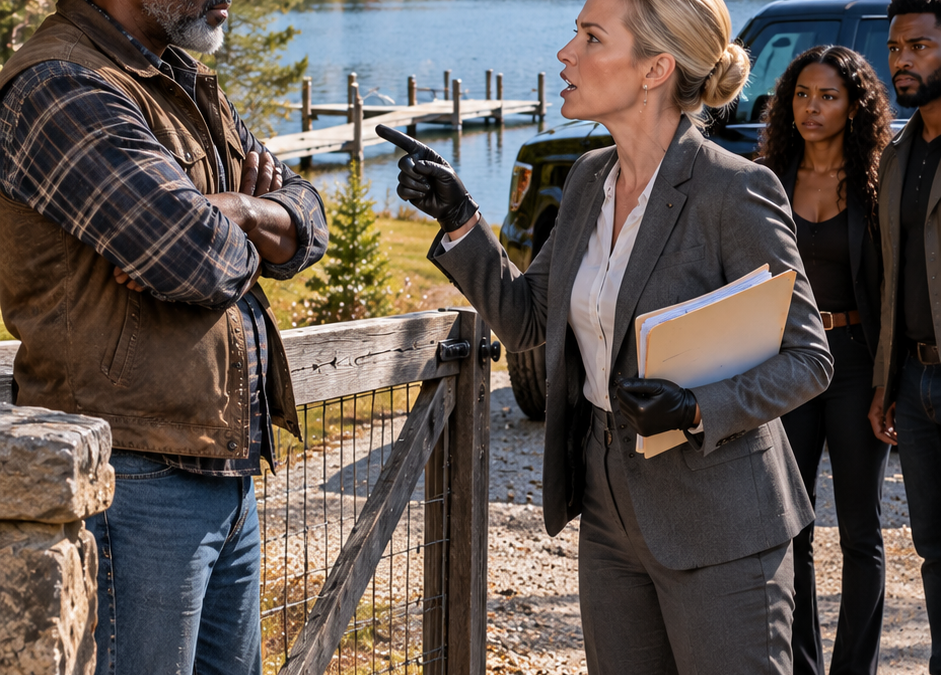
Renata Voss said it with the calm confidence of someone accustomed to being obeyed.
She stood outside my gate on an October morning wearing leather driving gloves even though the weather was mild, a manila folder tucked beneath one arm.
I remained on my side of the fence.
Behind her sat a dark SUV on the gravel road.
Behind me, beyond a line of yellowing hardwoods, Callaway Lake held the morning sky.
One hundred fourteen acres.
Gray along the shoreline.
Deep blue over the old channel.
Still enough that the reflection of the north ridge looked almost solid.
A great blue heron stood in the shallows near the cove.
It had more patience than Renata.
So did I.
“No one has fishing rights except Cedarwood Shores members,” she continued. “Your signs are interfering with an established community amenity.”
I looked at her.
Then at the folder.
“Established by what?”
She hesitated only slightly.
“The Cedarwood Shores governing documents.”
“Recorded against my property?”
“The association has maintained access for years.”
“That wasn’t my question.”
Her mouth tightened.
“You have forty-eight hours to remove the signs. If you don’t, the Cedarwood Shores Homeowners Association will pursue legal remedies.”
I let the silence sit between us.
What Renata could not see was the fire-safe drawer in my kitchen containing the recorded deed to all 2,800 acres.
Every inch of Callaway Lake.
Every foot of shoreline.
The old private road she had just driven.
The eastern ridge.
The dam.
The timber.
The pastures.
All of it.
Clean title.
No recreational easement.
No public-access right.
No covenant granting Cedarwood Shores so much as permission to put a boot on the bank.
I had inherited that deed thirteen years earlier.
But my family’s claim to the land went back much farther.
I finally said, “I’ll look into it.”
Renata seemed satisfied.
She apparently heard compliance.
What I meant was that I was going to open the fire safe.
She returned to her SUV.
Gravel cracked beneath the tires as she drove away.
I waited until the sound disappeared.
Then I turned toward the lake.
The heron had not moved.
Neither had the boundary.
My grandfather was Eben Callaway.
He was not sentimental about land.
That may sound strange because men who spend their lives building something are often remembered through sentimental stories.
Eben did not talk that way.
He believed property was something you worked, protected, documented, and passed along in better condition than you received it.
He bought the first 312 acres in Harlan County, Kentucky, in 1938.
Second-growth timber.
Rock pasture.
Steep ridges.
Creek bottom.
The former owner could not keep up with the bank.
Eben could pay.
So he did.
Cash.
My father repeated that detail throughout my childhood.
“Your grandfather paid cash.”
He said it almost like scripture.
To him, the significance was not the money.
It was independence.
If Eben paid for something, he intended to know exactly what he owned and exactly what anyone else could claim against it.
Over the next fourteen years, he expanded.
A strip of creek bottom when one neighbor moved away.
Two hundred acres of cutover timber.
A ridge parcel sold through an estate.
A pasture tract abandoned after several bad seasons.
By 1952, the property reached roughly 2,800 acres.
Contiguous.
Surveyed.
Recorded.
One body of land running across ridge and hollow country.
The deed description was eleven pages once the metes-and-bounds attachments were included.
Every corner.
Every creek crossing.
Every monument.
The lake came near the end.
Before 1949, a creek passed through the center of the land.
Eben decided the ranch needed dependable water.
So he built a dam.
He and two hired men worked most of one summer using poured concrete, native stone, steel, hand tools, and the kind of physical persistence modern people tend to romanticize only because we are not the ones doing it.
The dam held.
The valley filled.
Callaway Lake was born.
At the center, the water reached roughly forty feet.
Cold water remained deep even in July.
Eben stocked it himself.
Bass.
Bluegill.
Crappie.
Catfish brought from the river in a galvanized tank strapped into the back of his truck.
He called it Callaway Lake because Eben was not a man who wasted time inventing names.
The name eventually appeared on tax maps and county documents.
The water was private from the beginning.
So was the fishing.
My father, Thomas Callaway, took over after Eben died.
For thirty-one years, he managed cattle in the lower pastures and selective timber harvests along the upper ridges.
He protected the lake more carefully than anything else.
No hunting.
No fishing.
No access without permission.
That did not mean no one ever entered.
Dad believed in neighbors.
Old families came occasionally.
A father and son might fish one Saturday.
Someone might hunt deer along the east ridge.
But Dad recorded permission.
Every time.
Name.
Date.
Purpose.
Sometimes the length of the permission.
A small handwritten logbook sat beside the deed in the fire safe.
That habit became important decades later.
At the time, I assumed it was simply one more example of my father being my father.
My name is James Callaway.
I was fifty-nine when Renata Voss came to my gate.
I was born in the farmhouse near the center of the property.
I have never lived more than three miles from it.
For twenty years I worked as a civil engineer for a regional utility company.
That career gave me a practical respect for recorded rights.
Engineers work with physical reality.
Property law, at its best, works similarly.
A pipeline easement has a width.
A right-of-way has boundaries.
A plat has lines.
A deed has a legal description.
A document either grants an interest or it does not.
When my father died in 2009, I inherited the property.
I did not simply put the deed into a drawer and assume everything was fine.
I ordered a full title search.
Then I hired a licensed surveyor to monument the property.
Not because I expected trouble.
Because records matter most before there is trouble.
The result was clean.
Callaway Lake sat entirely within our parcel.
Harlan County Deed Book 47, page 211, later amended and re-recorded in Deed Book 109, page 84.
No public access.
No recreational easement.
No HOA covenant.
No subdivision rights.
No boat-launch agreement.
Private water surrounded by private land.
Simple.
At least it should have been.
Cedarwood Shores was built along my eastern boundary beginning in 2004.
A developer named Curtis Bright purchased approximately 340 acres belonging to another family.
That property had never been part of Callaway land.
He divided it into forty-seven residential lots.
One to three acres each.
Paved roads.
Landscaping.
Decorative signs.
Subdivision names designed to suggest a relationship with the lake.
Lakeview Drive.
Shoreline Court.
Cedar Cove Lane.
There was only one problem.
Cedarwood Shores did not touch Callaway Lake.
At the closest point, its property line stopped about 180 feet short of my shoreline.
That strip belonged to me.
One hundred eighty feet may not sound substantial.
But legally, there is no difference between 180 feet and eighteen miles if another owner stands in between.
Bright knew that.
Before construction, he approached my father.
That was 2003.
Dad told me about it.
Bright wanted some form of lake access for future residents.
Maybe a recreational easement.
Maybe fishing rights.
Maybe a boat launch.
Possibly a community dock.
He offered a one-time payment plus some maintenance arrangement.
Dad considered it.
For roughly two weeks.
Then he declined.
Politely.
In writing.
The copy of his letter stayed in the fire safe.
That should have settled everything.
Instead, something else happened.
Bright began marketing Cedarwood Shores using language about Callaway Lake.
Not ownership.
Not quite.
The wording was more careful.
Convenient proximity to Callaway Lake with recreational access pending finalization.
Pending finalization.
That phrase was elastic enough to allow buyers to hear what they wanted.
Some believed access already existed.
Others believed it had been negotiated and simply needed paperwork.
Others apparently believed it was guaranteed.
It was none of those things.
My father had said no.
No easement was signed.
Nothing was recorded.
Nothing was finalized.
Yet the expectation survived.
Then the expectation became tradition.
And eventually tradition became, in Renata Voss’s mind, ownership.
Renata became HOA president in 2018.
From everything I later learned, she inherited a board that had done very little and decided to make it efficient.
She organized committees.
Sent notices.
Updated enforcement policies.
Held meetings.
Scheduled inspections.
I do not think she began with some calculated plan to steal a lake.
I think she inherited an assumption and never asked whether it was true.
That can be more dangerous.
By the summer of 2022, I began noticing people on the water who did not belong there.
At first there were one or two small boats.
Then more.
Canoes.
Fishing kayaks.
An aluminum johnboat.
One Sunday afternoon in August, I counted seven.
Nobody had called.
Nobody had written.
Nobody appeared in the permission log.
So I walked down to the eastern shore.
Two men were tying up at an old wooden dock my father had used.
“Morning,” I said.
They greeted me pleasantly enough.
“You gentlemen live nearby?”
“Cedarwood Shores.”
“Who gave you permission to fish here?”
One of them looked puzzled.
“We have access.”
“Through whom?”
“The HOA.”
I nodded.
“Do you know where that access is recorded?”
He frowned.
“Recorded?”
“Yes.”
“We pay HOA dues.”
That explained his belief.
It did not create a right.
I did not argue.
I asked them to leave.
They did.
The following Sunday, people were back.
After the fourth weekend, I put up signs.
PRIVATE PROPERTY
NO TRESPASSING
NO PUBLIC LAKE ACCESS
I placed them along the eastern boundary, the private road, and the lake approaches.
That was what brought Renata to my gate.
Three weeks after her visit, I received certified mail.
Cedarwood Shores letterhead.
Signed by Renata and the association’s property management company, Lakeside Community Partners.
The letter cited Section 9, Subsection B of the Cedarwood Shores declaration.
It referred to “lake and waterfront amenities described in the community prospectus.”
According to the letter, my signs were interfering with established member amenities.
The HOA demanded they be removed within thirty days.
I put the letter beside my deed at the kitchen table.
Then I downloaded the Cedarwood Shores recorded CC&Rs.
The problem became obvious immediately.
Their covenants were recorded against Cedarwood Shores.
Their 340 acres.
Their forty-seven lots.
Their common property.
Not my 2,800 acres.
An HOA declaration can be entirely valid and still be irrelevant to a neighboring owner.
That was what Renata appeared not to understand.
I looked out the kitchen window.
Wind moved lightly across the lake.
A wood duck called somewhere near the opposite bank.
The problem was not complicated.
But I also knew simple property questions become expensive when someone’s expectations are financially valuable.
So the next morning, I called Patricia Feld.
Patricia had handled the title search after my father died.
Her office in Harlan smelled like old carpet, coffee, and legal pads.
When I explained the situation, she asked only a few questions.
“Did your father ever sign anything with the developer?”
“No.”
“Any easement?”
“No.”
“License agreement?”
“No.”
“Anything recorded?”
“Nothing.”
“Send me their letter. And pull every recorded instrument tied to the subdivision.”
That word mattered.
Recorded.
Patricia had taught me years before that disputes often become clearer once you separate recorded rights from stories about rights.
Claimed.
Expected.
Promised.
Discussed.
Advertised.
Those are different words from recorded.
Within days, we had the basic answer.
Cedarwood Shores had nothing recorded against Callaway land.
Not one instrument.
No fishing easement.
No access agreement.
No right-of-way.
No recreational covenant.
No shoreline interest.
Their declaration stopped at their boundary.
My deed began where their rights ended.
Patricia drafted a response.
Measured.
Polite.
Specific.
She cited the deed books.
The survey.
The title chain.
The lack of easements.
She advised the association to consult counsel before taking further action.
Certified mail.
Return receipt.
Then we waited.
Patricia told me not to expect them to surrender immediately.
“They’ve believed they had lake access for eighteen years,” she said.
“They never had it.”
“I know.”
“Then why wouldn’t the documents settle it?”
“Because James, to them this is not only a document problem.”
“What is it?”
“Forty-seven homeowners may believe lake access was part of what they purchased.”
I understood.
If Renata admitted the HOA had no fishing rights, she was not merely admitting she had sent me an incorrect letter.
She would be telling residents that something some of them believed had been included in their homes had never existed.
That would create questions.
Questions for the board.
Questions for the developer.
Questions about property values.
Questions about who knew what.
Patricia was right.
Eleven days later, another letter arrived.
The argument had changed.
No longer was the HOA relying primarily on its CC&Rs.
Now its lawyer mentioned prescriptive use.
The residents, the letter claimed, had used the lake openly and continuously for years.
That historical use, they suggested, had created an enforceable right even without a deeded easement.
I read the paragraph three times.
Then I drove to Patricia’s office.
She finished reading and placed the letter on her desk.
“Prescriptive easement.”
“That sounds more serious than the first argument.”
“It is a recognizable legal theory.”
“Do they have one?”
“That depends on evidence.”
That was the beginning of the real case.
If Cedarwood Shores wanted to claim a right through historical use, then history mattered.
Fortunately, my father had kept history.
I opened the fire safe.
His permission log began in 1978.
Thirty-one years of handwriting.
Names.
Dates.
Access.
Terms.
Sometimes only one sentence.
Howard Mullins — fishing with son — June 17.
Roy and Evelyn Mercer — east ridge deer season only.
Caleb Hart — two afternoons fishing, July.
Specific people.
Limited access.
Personal permission.
No Cedarwood Shores HOA.
No group license.
No blanket recreational right.
When I inherited the land in 2009, I continued the same system.
No Cedarwood resident appeared in my entries either.
Patricia wanted more.
So she hired Howard Sims.
Howard had researched titles in Harlan County for three decades.
He was the sort of man who trusted pencils more than tablets and seemed happiest sitting beside deed books older than everyone else in the room.
He examined both chains of title.
Mine.
Cedarwood Shores.
Every recorded instrument he could locate.
Three weeks later, he delivered forty-one pages.
I read the report slowly.
No easement.
No recreational license.
No covenant.
No plat notation.
No shoreline right.
Nothing.
Then Howard examined the 2004 Cedarwood Shores plat.
The result was just as clear.
No lake access.
No boat launch.
No fishing easement.
No pending easement.
No reference to Callaway Lake as community property.
The developer’s phrase recreational access pending finalization existed only in marketing materials.
It never made it into the legal instruments.
That was important.
But it was not the most important thing Howard found.
First, he found the road.
The gravel road Renata had used to reach my gate had been built by my grandfather.
Eben graded it to reach a hay field along the eastern part of the property.
For years, Cedarwood residents had apparently assumed it was public or somehow connected to their development.
It was neither.
County tax maps identified it as a private drive appurtenant to the Callaway parcel.
There was no public dedication.
No county-road designation.
No easement for Cedarwood Shores.
Howard wrote:
The access road in question appears to constitute a private drive associated with the Callaway parcel. No public dedication or recorded third-party access right was located.
I read that several times.
The HOA was not merely claiming a right to fish my lake.
Their members had been crossing my land on my private road to reach it.
Every step of their supposed access depended on property they did not own.
Still, Patricia cautioned me against getting excited.
“It helps,” she said.
“But?”
“But prescriptive-right cases turn heavily on facts. We keep documenting.”
So we did.
Then Howard called.
“There’s something else,” he said.
“What?”
“Planning commission file.”
He had gone beyond deed records.
While reviewing the 2004 subdivision approval history, Howard located correspondence submitted to the Harlan County Planning Commission.
One letter was from Curtis Bright.
The developer.
The same man who had advertised lake access as “pending finalization.”
I drove to Patricia’s office when the certified copy arrived.
She read it first.
Then handed it to me.
The relevant paragraph was short.
Bright had written to the county in 2004 that he had sought a recreational easement from the owner of the Callaway property.
He had been denied.
The subdivision, he wrote, would therefore proceed without lakefront access, and such access would not be represented as an amenity on the final recorded plat.
I read the sentence.
Then read it again.
“So he knew.”
Patricia folded her hands on the desk.
“Yes.”
“He knew before the subdivision was approved.”
“Yes.”
“And later marketing still said access was pending.”
“That appears to be what the materials show.”
I stared at the letter.
For months, this dispute had looked like an HOA overreach.
Now I saw the older problem beneath it.
Cedarwood homeowners had not invented the belief themselves.
Someone had planted it.
Curtis Bright had asked my father for access.
My father had refused.
Bright had informed the county that the subdivision would proceed without it.
Yet marketing language later suggested access was still being finalized.
A private refusal had somehow become a future promise.
And eighteen years later, Renata Voss was standing at my gate trying to enforce that promise against me.
Patricia tapped the letter.
“This is going to matter.”
“How much?”
“A great deal.”
“Do we accuse Bright of anything?”
“No.”
“Why not?”
“Because we don’t need adjectives when we have documents.”
That was Patricia.
And she was right.
The HOA moved forward with a declaratory judgment action seeking recognition of its alleged prescriptive access rights.
Patricia had expected it.
In some ways, we welcomed it.
Once the case was filed, belief had to become evidence.
The HOA would have to identify people.
Dates.
Routes.
Years of use.
Specific acts demonstrating the legal elements of the right it claimed.
And we could place our documents into a court record.
Our response attached Howard’s title report.
My father’s logbook.
My continuation of it.
The deeds.
The surveys.
County-road records.
The Cedarwood Shores plat.
And Exhibit D.
Curtis Bright’s 2004 letter.
Patricia did not call anyone a liar.
She did not accuse Renata of theft.
She did not describe the HOA as corrupt.
She simply arranged the paper.
That restraint made the case stronger.
I began to understand something during those months.
Anger wants conclusions quickly.
Evidence does not.
Evidence is content to wait.
Winter came.
The lake changed color.
By November, it had gone from the blue-green of late summer to a hard gray that reflected the bare hardwoods.
Ice began forming in the coves overnight.
The heron remained.
Or another heron did.
I could never tell.
One morning, I walked the eastern fence.
Some cedar posts had been standing there since my grandfather’s time.
Silver-gray.
Deeply weathered.
Still sound.
I stopped where the property line came down toward the lake.
Twenty feet below, water touched a limestone shelf.
Thin ice clung to the edges.
Nothing in that scene knew or cared about Cedarwood Shores.
The lake had existed before their roads had names.
The deed had existed before their HOA.
The boundary had existed before Renata Voss.
That did not automatically mean I would win.
Courts do not decide cases based on who arrived first emotionally.
But it reminded me that the legal record was not something Patricia and I had manufactured in response to a dispute.
It had been there the whole time.
We were merely reading it.
The hearing was scheduled for February.
Harlan County Courthouse.
Second floor.
Old wood.
Steam heat.
Tall windows full of winter light.
Patricia sat beside me with two manila folders and a yellow legal pad.
Across the aisle sat Renata and the HOA’s attorney.
The attorney looked younger than I expected.
Alert.
Professional.
Less confident than Renata.
I suspected he had read Curtis Bright’s letter.
Judge Marion Brock took the bench at 9:15.
Twenty-two years of circuit-court experience.
Patricia had described her beforehand with one sentence.
“She likes instruments.”
That was exactly what our case needed.
The HOA’s attorney went first.
He argued that Cedarwood Shores residents had used the lake openly over many years.
The community had relied on that use.
The lake had functioned in practice as an amenity.
Residents had fished.
Boated.
Used the private road.
The pattern, he argued, supported the association’s request for a prescriptive right.
He was organized.
He cited law.
He did not sound foolish.
That mattered to me because it reminded me that a weak factual case can still be argued professionally.
Then Patricia stood.
She began with my deed.
Book 47, page 211.
Then the updated record in Book 109, page 84.
She showed the survey.
The lake was entirely inside Callaway property.
Then Howard Sims’s report.
Forty-one pages.
No easement.
No access covenant.
No recorded fishing right.
No right-of-way.
Then the Cedarwood Shores plat.
Forty-seven lots.
No lake access.
Then my father’s logbook.
Thirty-one years.
No Cedarwood resident.
Then my own entries.
Same result.
Then the road.
Private.
Never dedicated.
No recorded easement.
Finally, she reached Exhibit D.
The courtroom seemed quieter before she even read it.
Perhaps that is memory improving the moment.
But that is how I remember it.
Patricia handed the certified copy to Judge Brock.
“Your Honor, this is a 2004 communication from developer Curtis Bright to the Harlan County Planning Commission during subdivision approval.”
She read the relevant sentence.
Bright had sought a recreational easement.
It had been denied.
The development would proceed without lakefront access.
The final recorded plat would not include lake access as an amenity.
Judge Brock read the letter herself.
For several seconds, no one spoke.
Then she looked at the HOA’s attorney.
“Counsel, was your client aware of this document before filing?”
He stood.
“I cannot speak to when the current board first became aware of it, Your Honor.”
“That was not my question.”
He paused.
“I do not know.”
The judge nodded.
Then she moved to the prescriptive-use evidence.
“Who are your witnesses establishing continuous use for the required period?”
The attorney referenced statements gathered from residents.
“Affidavits?”
“A limited number, Your Honor.”
“Specific dates?”
“Not for the entire period.”
“Specific routes of access?”
“Generally the private road shown in the exhibits.”
“The road respondent owns.”
“Yes.”
Judge Brock looked toward the county maps.
“And there is no recorded right to use that road?”
“No, Your Honor.”
She returned to the claimed fishing use.
“Your complaint relies primarily on generalized historical practice.”
“That is fair.”
“Not documentation of continuous use by identified parties over the complete period.”
“That is also fair.”
Renata shifted in her chair.
For the first time since I had met her, she did not look entirely certain.
Then Judge Brock looked at Patricia.
“The Callaway logbook records permission granted to individuals?”
“Yes, Your Honor.”
“But no Cedarwood Shores blanket permission?”
“None.”
“No HOA permission?”
“None.”
“No developer permission?”
“None.”
“And the original owner rejected a requested recreational easement?”
“Yes.”
“Documented?”
Patricia lifted my father’s copy of his response.
“Yes.”
That was the case.
Not rhetoric.
A sequence.
Ask.
Refuse.
Tell the county there is no access.
Market access as pending anyway.
Years of assumptions.
Then an HOA claiming the assumption had become a property right.
I had spent months waiting for someone other than me to ask the obvious question.
Where was the grant?
In that courtroom, the answer was finally unavoidable.
There was none.
Judge Brock did not rule that morning.
She took the matter under advisement.
Seventeen days later, Patricia called.
“It’s in.”
I drove to her office.
She handed me the ruling.
I read it sitting across from her.
The HOA’s requested declaratory judgment was denied.
No prescriptive easement had been established.
The record did not adequately prove continuous hostile use for the required period.
No recorded access rights existed.
No recreational easement existed.
The Cedarwood Shores plat provided no lake access.
The private road belonged to the Callaway parcel.
Unauthorized use of the road constituted trespass.
Court costs were assessed against the HOA.
I finished the last page.
Then went back to the first.
Sometimes you need to read a favorable decision twice before you believe the fight is actually over.
“They can appeal?” I asked.
“They can.”
“Will they?”
“I wouldn’t.”
“They’ve done a lot of things I wouldn’t.”
“That is also true.”
They did not appeal.
The emergency HOA meeting happened shortly afterward.
I did not attend.
I heard about it through people who knew people.
That is how information moves through small communities.
Apparently homeowners wanted answers.
Some had purchased property believing the lake was part of what made Cedarwood Shores valuable.
Others wanted to know why dues had been used on a lawsuit over an amenity the developer had told the county did not exist.
Some wanted to know who had reviewed the title before Renata threatened me.
Those were reasonable questions.
They were not mine to answer.
Renata resigned the following month.
Lakeside Community Partners ended its relationship with the association not long afterward.
Curtis Bright had died in 2017.
Whether homeowners pursued claims against his estate or anyone associated with the original development, I never followed closely.
I had no interest in becoming their enemy.
In some ways, they had been injured by the same thing that caused my problem.
A promise without a recorded right.
The difference was that they had spent years believing it.
I had spent years keeping the documents that disproved it.
The signs stayed.
They are still there.
PRIVATE PROPERTY.
NO TRESPASSING.
NO PUBLIC LAKE ACCESS.
After the ruling, the boats stopped.
The fishing stopped.
The private road became quiet again.
That quiet took some adjustment.
For months, I had become used to looking toward the eastern shore whenever I heard an engine.
Used to wondering whether somebody had crossed the gate.
Used to counting unfamiliar vehicles.
Then suddenly there was nothing to count.
One Saturday in April, I walked down to the lake.
Winter had finally released it.
The ice was gone.
Spring runoff had colored the water a clear green-brown.
Bass were moving back toward shallower water.
Mallards worked near the old dam outlet.
The heron lifted from the north cove and crossed the lake with slow wingbeats.
I walked along the eastern boundary.
The old cedar posts were still there.
Some were seventy years old.
Weather had turned them the color of bone.
My grandfather had driven them deep.
My father had replaced the wire more than once but never disturbed the surviving original posts.
I put my hand on one.
Rough.
Cold.
Solid.
That post did not prove ownership.
The deed did.
But the post reminded me what ownership meant to the people before me.
Eben had bought land.
Then marked it.
Worked it.
Improved it.
Built water.
Stocked fish.
Kept documents.
Thomas did the same.
Then I inherited both the property and the responsibility.
I walked down to the dock.
For months, strangers had tied their boats there as if it belonged to them.
Now it was empty.
I sat on the edge.
Underneath me were fish descended, in some distant biological sense, from the stock my grandfather had put there in 1949.
He had carried catfish from the river in a galvanized tank.
I had heard that story so many times as a child I stopped picturing how difficult it must have been.
Bad road.
Heavy tank.
Water sloshing.
Fish that could die before he reached home.
He did it because he wanted life in the lake he had built.
Not property value.
Not amenities.
Not a marketing brochure.
Life.
That distinction mattered to me.
Callaway Lake had existed before anyone decided proximity to it could sell houses.
The lake did not owe those houses access merely because their buyers wanted it.
Property rights are sometimes described as selfish things.
They can be.
But boundaries also prevent one person’s expectations from becoming another person’s obligations.
My father was asked.
He said no.
That answer should have been enough.
Had Curtis Bright accepted it honestly with his buyers, none of what followed would have happened.
Instead, “no” became “pending finalization.”
That phrase survived nearly two decades.
Then Renata tried to turn it into:
“You have no fishing rights. Our members do.”
That transformation was the entire story.
A declined request.
An optimistic advertisement.
A community assumption.
A board policy.
Then, finally, a legal claim.
Every step made the belief sound stronger.
None added a single line to the deed.
Weeks later, I opened the fire safe.
The old access log sat beside the deed.
My father’s handwriting filled page after page.
I ran my thumb along the edge.
At the back, my own entries continued in a different hand.
Same format.
Date.
Name.
Permission.
Purpose.
It struck me then that Dad had never created that log because he expected a lawsuit.
He created it because he believed clarity was a form of stewardship.
When you allow someone to use land, say so.
When permission ends, say so.
When a right exists, record it.
When it does not, do not pretend.
That simple discipline had become some of the strongest evidence in the case.
People sometimes think property disputes are won through dramatic discoveries.
Ours did have one.
Curtis Bright’s letter.
But the foundation was much less dramatic.
A deed.
A survey.
A logbook.
A title report.
County maps.
A refusal letter saved for nearly twenty years.
Ordinary paper.
Kept.
That was enough.
One afternoon later that spring, I saw two people standing outside the Cedarwood Shores entrance as I drove past.
A man and woman.
Probably homeowners.
They recognized my truck.
The man raised a hand.
I stopped.
He walked toward the road.
“Mr. Callaway?”
“Yes.”
He seemed uncomfortable.
“I live over there.”
He nodded toward Cedarwood.
“I figured.”
He smiled slightly.
Then the smile disappeared.
“I wanted to apologize.”
“You don’t need to.”
“I fished your lake.”
I waited.
“Three or four times,” he continued. “I honestly thought we had access.”
“I believe you.”
“Renata told everybody it was ours.”
“I know.”
“And before her, people talked like it had always been part of the development.”
“That also seems to be true.”
He looked toward the ridge.
“I bought my place partly because of that lake.”
I did not know what to say.
Because I understood what had happened to him without believing it created a right against me.
Those two things could coexist.
“I’m sorry somebody sold you that expectation,” I said.
He nodded.
“So am I.”
He held out his hand.
I shook it.
Then I drove home.
That conversation stayed with me more than any argument I ever had with Renata.
The homeowners were not all villains.
Many were simply people who believed what they had been told.
The mistake came when that belief was treated as superior to the record.
Years earlier, when I was a young engineer, an older supervisor told me something after a pipeline project encountered an easement dispute.
“Never confuse what everybody knows with what somebody can prove.”
I understood the sentence technically then.
Now I understood it differently.
Everybody in Cedarwood Shores “knew” they had lake access.
They had road names suggesting it.
Old marketing materials suggesting it.
Neighbors telling new neighbors.
People fishing for years.
An HOA president enforcing it.
But none of those things answered the question.
What can you prove?
My father could prove ownership.
I could prove title.
The county could prove the plat.
Howard could prove the absence of an easement.
Curtis Bright’s own letter could prove he had been denied access before his development was approved.
That was what survived court.
Not confidence.
Proof.
I still use Callaway Lake.
I fish less than my father did.
More than my grandfather probably would have approved of.
Some mornings, I take a small boat out before sunrise.
I do not always bring a rod.
Sometimes I simply drift near the old channel.
The water is deepest there.
When the lake is perfectly still, the ridges reflect so cleanly that the shoreline seems to divide two complete worlds.
One above.
One below.
The herons still come.
Bass still break the surface in summer.
Mallards gather at the southern shallows.
And on cold winter mornings, ice still forms first in the coves exactly where it did when I was a boy.
Nothing about the court ruling changed any of that.
That may be what I appreciate most.
The lake did not become more mine because a judge ruled in my favor.
It had always been mine.
The judgment only forced everyone else to acknowledge what the record already said.
That is different.
And it is important.
I have kept the Cedarwood file.
It sits in the same fire-safe drawer as the deed.
Renata’s first letter is inside.
So is the later prescriptive-easement demand.
Howard Sims’s report.
The planning commission letter.
The ruling.
Sometimes when I open the drawer for something else, I see that first notice.
Remove your signs.
Forty-eight hours.
Legal remedies.
At the time, it was designed to create urgency.
Now it is just paper.
That is what happens to unsupported authority once the record catches up with it.
I do not hate Renata Voss.
I never did.
She was wrong.
Confidently wrong.
And confidence made the mistake more expensive than it needed to be.
But she inherited a story that had been repeated for eighteen years.
Her failure was not simply believing it.
Her failure was trying to enforce it without checking whether it was true.
That is the part worth remembering.
Whenever someone—an HOA, a company, a neighbor, an institution—claims authority over something you own, the first question is not how confident they sound.
It is not how many people agree with them.
It is not whether their letter has a logo.
It is not whether the belief has existed for five years or fifty.
The question is:
What is the legal foundation?
Show me the deed.
Show me the easement.
Show me the plat.
Show me the covenant.
Show me the recorded right.
If the right exists, respect it.
If it does not, repetition cannot create it by itself.
The land does not care about assumptions.
Neither does a deed book.
The eastern fence still runs where Eben set it.
Some of his cedar posts remain.
The gravel road is still private.
The lake is still 114 acres.
The dam still holds.
And every spring, the water rises with runoff, then settles again as the season turns.
One evening in early October, almost exactly a year after Renata first came to my gate, I walked down to the north cove.
A heron stood in the shallows.
Maybe the same one.
Probably not.
The sky was gray at the edges and blue over the channel.
I stood quietly.
No boats.
No strangers.
No argument.
Just water.
I thought about my grandfather.
A man who paid cash.
A man who built a dam because the land needed water.
A man who planted timber after others had logged the ridge and left.
He probably never imagined that decades later people in a subdivision that did not yet exist would claim his lake because a developer had once written two careless words.
Pending finalization.
But Eben had prepared for people he would never meet.
He recorded his deed.
My father preserved it.
I preserved it after him.
That was enough.
The heron finally moved.
It opened its wings and lifted across the water.
I watched until it disappeared beyond the timber.
Then I turned toward the house.
Behind me, Callaway Lake held the evening sky exactly as it had before any of this began.
Private.
Quiet.
And exactly where the deed had always said it was.








