𝗣𝗔𝗥𝗧 𝟮 HOA Claimed My Private Bridge Was Community Property — Then the Missing 1972 Agreement Ended Their Shortcut
𝗣𝗔𝗥𝗧 𝟮
By noon, I was back in the ranch office with an old cardboard records box sitting open beside my desk.
Holloway Bridge had never been a mystery to my family.
It was infrastructure.
Work.
Maintenance.
Expense.
My grandfather had built and reinforced parts of it.
My father repaired it after a bad spring flood in the eighties.
I had replaced stringers, resurfaced sections of deck, rebuilt one approach, and poured more money into gravel than I cared to calculate.
Nobody had ever spoken about it as though it were a neighborhood feature.
But Clare had said one thing I couldn’t ignore.
Your family agreed to this.
So I started looking.
The old metal filing cabinet behind my desk held decades of ranch records.
Tax statements.
Insurance policies.
Fence receipts.
Equipment invoices.
Feed contracts.
Repair notes.
I found a faded photograph of my father standing on Holloway Bridge beside a welding rig.
One boot rested on a steel plate.
On the back, in his handwriting, were four words.
BRIDGE REPAIR—EAST SIDE SHARE.
I stopped.
Then I kept digging.
Twenty minutes later, I found a timber supplier receipt with a note stapled to it.
East Farm—40%.
Then a copy of a check from a man named Raymond Cole.
Memo:
BRIDGE MAINTENANCE SHARE.
Then a handwritten ledger entry in my father’s old book.
East Farm bridge share agreement on file.
I leaned back.
East Farm.
That name made sense.
Before Riverbend Estates existed, the land east of Cottonwood Creek had been agricultural.
Everybody around there called it East Farm.
My father knew the family who owned it.
I remembered their trucks crossing the bridge when I was young.
Feed trucks.
Seed trucks.
Pickups.
Stock trailers.
Farm equipment.
Nobody pushed strollers across it.
Nobody walked dogs.
Nobody drove golf carts.
Nobody had attached green arrows to our fence posts.
But clearly there had been some arrangement.
That meant I couldn’t simply pretend the old access never existed because I didn’t like what Riverbend was doing now.
I needed the document.
I called Dana Brooks.
Dana had handled a boundary dispute for me six years earlier after a utility contractor staked the wrong side of one of our fence lines.
She was forty-nine, practical, patient, and almost pathologically unwilling to make a dramatic conclusion before she had evidence.
I told her everything.
The sign.
Clare.
The trail markers.
The bridge.
Then the documents I had found.
“Your father actually wrote ‘agreement on file’?”
“Exactly that.”
“Any recording number?”
“No.”
“Names?”
“Raymond Cole.”
She was quiet for a second.
Then I heard papers moving.
“Don’t chain the bridge yet.”
“I didn’t.”
“Good.”
“And don’t concede access either.”
“I didn’t do that.”
“I know.”
Her voice stayed calm.
“Grant, an old agreement may create a legitimate property right. But knowing one exists doesn’t tell us the scope.”
“That’s what I’m trying to figure out.”
“Who can use it?”
“Exactly.”
“For what purpose?”
“Exactly.”
“Over what property?”
I nodded even though she couldn’t see me.
“Under what conditions? For how long? Whether it runs with the land? Whether it can terminate? Those details matter.”
I looked at the photograph of my father.
Clare had said community access as though those two words ended the discussion.
Dana was reminding me that the real question was never whether an agreement existed.
It was what the agreement actually said.
“Photograph everything you’ve found and send it to me,” she said.
“Okay.”
“And if the HOA sends you something?”
“Send it to you.”
“Not their summary.”
“I know.”
“The actual document.”
That phrase stayed with me.
The actual document.
Not a board memo.
Not a trail map.
Not an attorney’s characterization.
Not Clare’s confidence.
The words themselves.
That evening, I drove back toward Cottonwood Creek.
The community-access sign was still standing.
A couple from Riverbend crossed while I watched from twenty yards away.
They smiled.
I nodded.
They probably believed they were using an HOA amenity.
That was the dangerous thing about signs.
Once something looks official, most people stop wondering who gave permission.
I walked onto the bridge after they passed.
The timber was scarred from decades of ranch traffic.
Near the eastern end, one old steel reinforcement plate still carried initials stamped by my father.
H.H.
Harland Holloway.
He had maintained that bridge for years.
So had I.
And somewhere in a county file, according to his notes, was a document explaining why another farm had once helped pay for it.
I looked east.
Riverbend’s rooftops rose above the trees.
Sidewalks.
Streetlights.
Paved streets.
Everything about the development looked different from the East Farm I remembered.
And that was when the obvious question finally settled in my mind.
If a 1972 agreement was written for East Farm, how had Clare turned it into recreational access for hundreds of subdivision residents?
The answer did not come immediately.
What came first was more people.
For two days, the bridge saw occasional pedestrian traffic.
By the third day, Riverbend had clearly begun treating it as part of an organized route.
Three new trail arrows appeared.
One said:
RIVERBEND CREEK LOOP.
Another pointed directly onto Holloway Bridge.
By ten that morning, I counted nine walkers, two bicycles, and one golf cart.
The golf cart bothered me more than the walkers.
The bridge could handle pickups and ranch equipment.
That did not make it appropriate for recreational traffic.
I knew exactly how heavy equipment crossed.
Slow.
Centered.
One vehicle at a time.
Riverbend residents had no reason to know any of that.
Around eleven, four teenagers came across in another golf cart.
Fast.
Too fast.
The timber boards rattled.
I stepped out from the pasture road and raised my hand.
The driver stopped.
“This isn’t a recreational road.”
He looked confused.
“The HOA said it’s part of the loop.”
“I’m disputing that.”
He pointed backward.
“There’s a sign.”
“I know what the sign says.”
The kids weren’t rude.
They weren’t trespassing because they thought it would be funny.
Someone with authority had told them the route was legitimate.
They turned around.
That was important to me.
I never blamed most residents.
If an HOA installs signs, prints maps, and tells people something is approved, most homeowners are going to believe it.
By afternoon, I decided I needed my own sign.
Not PRIVATE PROPERTY.
Not NO TRESPASSING.
Those statements might imply I had already resolved the legal issue.
I hadn’t.
Instead, I mounted a temporary white board beside the ranch approach.
PRIVATE RANCH BRIDGE
ACCESS DISPUTED
PLEASE USE RIVERBEND PUBLIC STREETS
Accurate.
Neutral.
I photographed it and sent the image to Dana.
She replied:
Good. Keep it neutral.
Riverbend did not.
The next morning, an HOA maintenance cart crossed Holloway Bridge.
Two workers were carrying rakes, orange marking flags, and bags of mulch.
I stepped into the road.
The driver stopped.
“Where are you going?”
“Creek Trail maintenance.”
“On whose property?”
He pointed toward my pasture.
“Association map shows the route through there.”
“You’re not doing work west of this bridge.”
The passenger looked uncomfortable.
“We were told this was HOA access.”
“I’m telling you the access is disputed.”
They made a phone call.
Ten minutes later, they turned around.
Twenty minutes after that, Clare called me.
She didn’t say hello.
“You stopped an authorized maintenance crew.”
“I stopped HOA workers from entering my ranch.”
“They were servicing the community trail.”
“There is no community trail on my ranch.”
“There is an established access corridor.”
“Send me the agreement.”
“Our management company is preparing the documents.”
“You’ve had three days.”
“Grant, this has already been reviewed.”
“By who?”
“I’m not going to litigate property history with you over the phone.”
“Good.”
I leaned against my truck.
“Send me the property history.”
She hung up.
The cease-and-desist arrived that evening.
Dana forwarded it with one line at the top.
Do not answer this yet.
Riverbend’s management company accused me of interfering with established association access and discouraging lawful use of a recorded crossing.
It demanded that I remove my sign and stop interfering with residents, vendors, maintenance workers, and other authorized users.
One phrase caught my attention.
Recorded crossing.
Below it was a county recording citation.
Book.
Page.
Not the agreement.
But finally, a place to find it.
I sent the letter to Dana.
She called ten minutes later.
“This is useful.”
“They’re threatening me.”
“Yes.”
“You sound happy.”
“Because they finally gave us something verifiable.”
“The recording reference.”
“Exactly.”
“You think it’s the document my father mentioned?”
“We’re about to find out.”
The next morning, Riverbend sent what Clare described as its supporting packet.
Twenty-seven pages.
That sounded impressive.
It wasn’t.
Most of the packet was modern.
A neighborhood trail map.
A board resolution approving recreation improvements.
A contractor’s wayfinding proposal.
A developer title summary.
Then, near the back, was an old photocopy.
Dark edges.
Faded text.
Poor scan quality.
The heading referred to bridge use and maintenance.
But it was obviously incomplete.
The first page included in Riverbend’s packet was numbered page two.
Then page three.
Then page five.
No complete signature page.
No legal-description attachment.
No exhibit.
I called Dana.
“You’re looking at this?”
“I’m looking at it.”
“Is that supposed to be the complete agreement?”
“No.”
“How can you tell?”
“Page numbers.”
I laughed.
“That’s not subtle.”
“No.”
“Do you think they intentionally removed pages?”
“No conclusion yet.”
There she was again.
Refusing to let suspicion become evidence.
“It could be an old incomplete scan,” she said.
“Could be.”
“But I’m not relying on an incomplete scan when they’ve cited the recorded instrument.”
I zoomed in.
One sentence was readable.
Access across the bridge for access to the eastern agricultural tract.
I read it twice.
“Dana.”
“I saw it.”
“They keep calling it community access.”
“I know.”
“This says agricultural tract.”
“It does.”
“That’s important.”
“It may be.”
I hated that word.
May.
But she was right.
One phrase did not decide the whole document.
Other pages referred to shared maintenance.
That lined up with my father’s records.
One paragraph ended at the bottom of the page mid-sentence.
The next surviving page began:
SUBJECT FURTHER TO THE CONDITIONS SET FORTH BELOW—
Whatever conditions were “set forth below” were missing.
I leaned back.
Now I understood exactly why Dana had told me not to argue with summaries.
Riverbend’s title summary described the old arrangement this way:
Historic bridge access rights benefit eastern property.
That sounded broad.
The original language we could actually see referred to an agricultural tract.
Very different.
Then I looked at Riverbend’s modern trail plan.
The trail began near the clubhouse.
Followed Cottonwood Creek.
Crossed Holloway Bridge.
Continued along my pasture edge.
Then looped back into Riverbend.
The plan included benches.
Dog-waste stations.
Directional arrows.
A scenic stop.
Nothing about it resembled agricultural access.
I drove back to the bridge.
My neutral sign was lying face down in the grass.
Someone had removed it.
The screws were still attached.
Nothing was broken.
I picked it up and reinstalled it.
Then photographed everything.
The post.
The screws.
The sign.
The time.
About an hour later, Clare appeared.
Same black folder.
Dark red blazer this time.
She looked at my sign.
“You were instructed to remove that.”
“I received a demand from your management company.”
“You’re interfering with established access.”
“I’m stating the access is disputed.”
“It isn’t disputed by the documents.”
“Then why did you send me half a document?”
Her expression changed.
“It’s a title packet.”
“It’s missing pages.”
“That packet was sufficient for the board.”
“I’m not the board.”
“You don’t get to relitigate seventy years of property history because residents crossing suddenly bothers you.”
“I’m not relitigating anything.”
I held up my phone.
“I’m reading what you sent.”
Clare crossed her arms.
“You’re looking for a technicality.”
“No.”
I pointed east toward the subdivision.
“I’m looking for the recorded instrument that gives hundreds of residents, bicycles, golf carts, contractors, and maintenance crews the right to cross my bridge.”
“It’s in the recorded access rights.”
“Where?”
“In the agreement.”
“Which page?”
That stopped her.
Only briefly.
But it stopped her.
She glanced at the folder.
“I’m not your attorney.”
“I didn’t ask for legal advice.”
I pointed toward the bridge.
“I asked what page creates Riverbend Estates community access.”
Her jaw tightened.
“You’ll receive a formal response.”
“Good.”
She started walking toward her car.
“Clare.”
She turned.
“What happened to the missing pages?”
She said nothing.
Then she got into her car.
That afternoon, Dana ordered a certified copy directly from the county recorder.
Not a developer packet.
Not Riverbend’s old scan.
The recorded instrument.
With exhibits.
With attachments.
With signatures.
Everything.
Two days later, she called before nine in the morning.
“I’ve got it.”
“The whole thing?”
“The whole recorded instrument. Signature page. Legal description. Exhibit.”
I was already reaching for my jacket.
“Where are you?”
“County records.”
“I’ll be there.”
The recorder’s office was exactly the kind of place where important property disputes get decided without anyone noticing.
Fluorescent lights.
Gray counters.
Old public terminals.
Metal shelving.
No dramatic oak doors.
No judge.
No audience.
Just paperwork.
Dana sat near a window with a folder open in front of her.
I sat down.
She slid the first page toward me.
Across the top, in faded type:
BRIDGE USE AND MAINTENANCE AGREEMENT
Recorded 1972.
There it was.
The actual agreement.
The document my father had referenced.
The document Riverbend had been using as though its meaning were obvious.
“Who signed it?”
Dana pointed.
“Your grandfather, Harold Holloway.”
Then another name.
“Everett Cole. Owner of the eastern farm.”
Two private landowners.
No HOA.
No developer.
No subdivision.
No recreation committee.
No trail system.
Two neighboring farms.
One bridge.
Dana turned to the attached legal description.
“This matters.”
The eastern property was defined using old metes-and-bounds calls.
Not Riverbend Estates.
Not community lands.
Not future neighborhood amenities.
One specific agricultural tract east of Cottonwood Creek.
East Farm.
I recognized the shape immediately.
Dana placed a current aerial photograph beside it.
“Most of Riverbend was eventually developed from this tract.”
“That’s how they found the agreement.”
“Probably.”
“Probably again.”
“We still need the chain of title.”
So we built it.
The East Farm changed hands after the Cole family.
Then changed hands again.
Years later, a developer acquired it and combined it with adjoining parcels.
Subdivision plats followed.
Utility easements.
Road dedications.
Common-area transfers.
Street plans.
Every document answered something.
And every document created another question.
By late morning, Dana had four documents aligned in chronological order.
1972 bridge agreement.
Later East Farm deed.
Subdivision plat.
Public-road dedication.
She tapped each one.
“Agreement.”
Tap.
“Transfer.”
Tap.
“Development.”
Tap.
“Public road.”
I studied the road dedication.
Riverbend Drive appeared by name.
It connected the subdivision directly to County Road 18.
“So Riverbend has legal public access without my bridge.”
“Yes.”
“And has for years.”
“Yes.”
I looked back at the agreement.
“Does the agreement say anything about that?”
Dana didn’t answer.
Instead, she flipped several pages.
A paragraph near the end had been underlined in pencil.
She covered most of it with her hand.
“I don’t want you jumping to a conclusion before we finish the chain.”
I stared at her.
“You found something.”
“I found language that needs context.”
“That’s lawyer language for yes.”
“That’s lawyer language for wait.”
We kept working.
After lunch, we met a surveyor named Eli Turner.
Sixty-one.
Tall.
Lean.
Very careful with language.
Dana had sent him the old deed descriptions and the current parcel data.
His computer screen showed Cottonwood Creek.
Holloway Ranch west.
Riverbend east.
The bridge crossed almost exactly where expected.
Eli zoomed in.
“The bridge lies within the Holloway record boundary based on the current descriptions.”
“So it’s mine.”
He raised one hand.
“I’m telling you where the recorded boundary puts it.”
Dana smiled.
“That’s why I use him.”
Eli looked at me.
“I don’t decide legal ownership disputes.”
“Understood.”
Then he overlaid the old East Farm boundary over the modern subdivision.
The match was striking.
A large section of Riverbend had been carved out of the original agricultural tract.
Then he added the road network.
Riverbend Drive connected the development directly to County Road 18.
Permanent public access.
Paved.
Dedicated.
No Holloway Bridge required.
I stared at the map.
“Then why does the HOA care so much about this bridge?”
Dana laid Riverbend’s creek-loop plan beside the screen.
“Because it makes their trail work.”
That was when the motive became obvious.
Without my bridge, Riverbend’s creek trail ended at Cottonwood Creek.
With my bridge, residents could cross, walk beside my pasture, then create a longer recreational loop.
The bridge was convenient.
Beautiful, probably.
Useful.
But convenience and legal right were not the same thing.
Back at Dana’s office, she spread the complete timeline across a conference table.
1972 agreement.
Cole transfers.
Developer purchase.
Subdivision.
Road dedication.
HOA formation.
Modern trail plan.
Seen that way, Clare’s argument looked very different.
She had treated the documents as one continuous story.
They weren’t.
Different ownership.
Different land use.
Different access systems.
Different purpose.
Then Dana placed Riverbend’s incomplete photocopy beside the certified agreement.
The missing material became obvious.
The HOA packet lacked the complete legal description.
One page containing conditions.
Part of the signature section.
I looked at her.
“You still think this could just be a bad scan?”
“Yes.”
I laughed.
“Seriously?”
“Grant, I don’t need to prove they hid anything.”
She tapped the full agreement.
“I need to know what this does.”
Then she turned to the paragraph she had covered earlier.
This time, she let me read it.
Slowly.
The old language took a minute to digest.
The bridge right applied to the eastern tract.
It created access.
It addressed maintenance.
Then came the sentence that changed the dispute.
The right continued until the eastern property obtained another permanent legal means of access to a public road.
If that happened, the bridge right created under the agreement would cease.
I read it again.
Then looked at Dana.
“Am I reading that correctly?”
“Maybe.”
“Dana.”
“I want one more confirmation.”
I pointed at the road dedication.
“Riverbend Drive is permanent public access.”
“Yes.”
“And that dedication came years ago.”
“Yes.”
“Before the HOA started calling this bridge a community trail.”
“Yes.”
I tapped the termination language.
“Then the right ended.”
Dana gave me the look.
“Our reading appears to be that the condition was satisfied. But I want to finish the chain before we state it as a conclusion.”
“You already know.”
“I strongly suspect.”
“That’s as close as you get to excitement, isn’t it?”
She almost smiled.
The next morning, she called before I’d finished coffee.
“I confirmed the dedication date.”
“And?”
“Come in.”
The agreement was laid out when I arrived.
This time, Dana read it from beginning to end.
Not selected paragraphs.
Not title summaries.
The whole thing.
The original right was real.
That mattered.
My grandfather had granted East Farm a defined bridge-access right.
The agreement covered the eastern agricultural property.
Its owner.
Occupants.
Workers.
People connected with its agricultural operation.
The bridge could be used for access to and from that tract.
Maintenance costs were shared between the two properties.
That explained everything I had found.
My father’s notes.
Raymond Cole’s payment.
The old trucks I remembered.
Nobody had fabricated the history.
East Farm really had used Holloway Bridge.
Then Dana reached the limitations.
“What doesn’t this agreement say?”
I looked at Riverbend’s trail map.
“It doesn’t say public recreation.”
“No.”
“It doesn’t say HOA.”
“No.”
“It doesn’t say every future resident in a subdivision.”
“No.”
“It doesn’t say golf carts.”
“No.”
“Or bicycles.”
“No.”
“Or dog walkers.”
“No.”
“Or contractors maintaining a recreation trail.”
“No.”
She tapped the agreement.
“And it does not grant unrestricted use for whatever purpose future owners find convenient.”
I sat back.
“So Clare took agricultural access and turned it into a neighborhood amenity.”
“That appears to be what happened.”
“There’s that phrase again.”
“We’re not finished.”
She moved to the termination provision.
The agreement anticipated that the eastern farm might eventually gain another permanent legal route to a public road.
If that happened, the bridge right would cease.
Then she placed the Riverbend road dedication beside it.
The former East Farm had received permanent public road access.
Riverbend Drive.
County Road 18.
Years before the HOA had ever created the creek-loop plan.
I stared at the two documents.
“So the agreement created the right.”
“Yes.”
“And the same agreement defined when it ended.”
“That’s our reading.”
“And Riverbend’s own development triggered the condition.”
“That’s what the recorded history appears to show.”
That was the irony.
The subdivision’s existence had not expanded the old bridge right.
The development process had created the very public-road access contemplated by the agreement’s termination clause.
Clare had pointed backward to 1972 as though that year gave Riverbend everything it wanted.
The complete agreement said almost the opposite.
Dana raised one finger.
“There’s one more issue.”
“What?”
“If Riverbend has another easement, amendment, deed, or later instrument, that could change things.”
“Have they cited one?”
“No.”
“Did their packet include one?”
“No.”
“Their cease-and-desist?”
“Same 1972 document.”
“So now what?”
Dana pulled out a clean sheet of paper and wrote one sentence.
SHOW THE CURRENT INSTRUMENT.
She slid it toward me.
“That’s the dispute now.”
Not whether the 1972 agreement existed.
It did.
Not whether East Farm had used the bridge.
It had.
Not whether my family had accepted maintenance payments.
They had.
The question was much narrower.
What recorded instrument gave Riverbend Estates HOA, today, the right to direct hundreds of residents across Holloway Bridge for recreation?
If another document existed, Riverbend could produce it.
If none existed, confidence would not create one.
Dana drafted a letter that afternoon.
It acknowledged the 1972 agreement.
Acknowledged historic agricultural use.
Acknowledged shared maintenance.
Then cited the permanent-road-access clause.
Cited Riverbend’s public-road dedication.
And demanded identification of any current deed, easement, amendment, declaration, license, or other recorded instrument giving Riverbend Estates recreational or general community access across Holloway Bridge.
One sentence captured everything.
Nothing in the materials produced to date establishes a present right for recreational, pedestrian, bicycle, golf-cart, contractor, or general resident use of Holloway Bridge.
I read it again.
“That’s the whole argument.”
“Pretty much.”
I thought about Clare standing beside the creek.
Your family agreed to that decades ago.
Technically, yes.
My family had agreed to something.
That was why her claim sounded credible.
But a valid old agreement did not mean every later interpretation was valid too.
A right could be real and limited.
It could be enforceable and conditional.
It could apply to one purpose but not another.
And, most importantly, it could end if the parties had written an ending into the document.
Dana sent the letter at 4:17.
Nine minutes later, Riverbend’s attorney acknowledged receipt.
At 5:03, the green community-access sign was still standing beside my bridge.
I drove past without touching it.
For the first time, I wasn’t bothered.
The argument had moved away from signs.
Away from Clare’s confidence.
Away from HOA maps.
Now there was one question.
Could Riverbend produce a present legal right stronger than the document it had already cited?
Three days later, their attorney responded.
The tone had changed completely.
No accusation that I was unlawfully interfering.
No command to remove my sign.
No declaration of established community access.
Instead, Riverbend was “conducting an independent review of recorded instruments affecting the bridge.”
Pending that review, the HOA had suspended all representations that Holloway Bridge was part of the Riverbend trail system.
That afternoon, the first trail arrow disappeared.
The next morning, maintenance workers stopped crossing.
The big community-access sign remained, but somebody covered the wording with a temporary blank panel.
It wasn’t an admission.
But it was the first sign that Riverbend understood the problem might belong to them.
Dana called.
“They hired an outside title company.”
“Good?”
“Smart.”
“Whose side are they on?”
“They’re supposed to answer the title question.”
“That wasn’t my question.”
She laughed.
“Let them work.”
The title company requested everything.
Certified 1972 agreement.
Complete exhibits.
Chain of title.
Subdivision plat.
Public-road dedication.
Eli’s survey overlays.
Riverbend’s own packet.
Dana sent it.
Then, for almost a week, nothing happened.
That silence felt strange.
For a month, the dispute had been visible.
Signs.
Golf carts.
Trail markers.
Maintenance crews.
Emails.
Letters.
Now everything was happening behind conference-room doors.
I checked the bridge every morning.
Resident traffic nearly stopped.
A few people would walk down the Riverbend trail, see the covered sign, then turn around.
Nobody argued.
Because the HOA was no longer telling them the bridge belonged to the community.
The board meeting happened the following Thursday.
Dana came with me.
Clare was already seated.
Same controlled posture.
Same crimson blazer.
But this time, there was no bridge behind her.
No trail sign.
No residents wandering past.
Just a conference table.
Five directors.
The property manager.
Riverbend’s attorney.
Dana.
Me.
And the outside title representative on video.
Clare opened.
“This issue has created unnecessary disruption for residents, and the board needs a clear path forward.”
One director, a retired engineer named Paul Jensen, looked at Riverbend’s attorney.
“Do we have one?”
The attorney nodded.
“We have a recommendation.”
Clare’s posture stiffened slightly.
The title representative began with the history.
The association’s prior access position had relied primarily on the 1972 bridge-use-and-maintenance agreement.
Correct.
Later title summaries referenced that same agreement.
Correct.
The bridge itself sat within the Holloway record boundary based on the documents reviewed.
Also correct.
Then Paul asked the question that mattered.
“Where does the 1972 agreement give all Riverbend residents the right to use this bridge?”
The title representative answered immediately.
“It does not say that.”
Silence.
Clare leaned forward.
“But the rights follow the eastern property.”
The HOA attorney answered.
“The issue is not simply whether a historical right once benefited that property.”
Clare looked at him.
“Residents have used that crossing.”
“Recent use may be relevant factually.”
He paused.
“It does not rewrite the recorded instrument.”
Her expression tightened.
“What exactly are you recommending?”
The attorney turned toward the board.
“That the association withdraw the designation of Holloway Bridge as community access unless a separate current recorded right can be identified.”
Paul looked toward the title representative.
“Did your review find another easement?”
“No.”
“An amendment?”
“No.”
“A later deed granting trail access?”
“No.”
“License?”
“No.”
“Any recorded instrument authorizing recreational use?”
“No.”
That was it.
Not dramatic.
Not explosive.
But finished.
The board voted.
Remove Holloway Bridge from all trail materials.
Direct residents to use Riverbend’s public streets.
Remove signs.
Remove wayfinding arrows.
Stop sending contractors across.
Stop representing Holloway Bridge as an HOA amenity.
Four directors voted yes.
Clare voted no.
Afterward, she closed her folder.
“This creates a bad precedent.”
Paul looked across the table.
“For reading the document?”
Clare didn’t answer.
The board moved to the next agenda item.
By eight the following morning, a Riverbend maintenance truck arrived at Cottonwood Creek.
For the first time during the entire dispute, it stayed on their side.
Two workers removed the covered community-access sign.
Then the remaining trail arrows.
I watched from the ranch approach.
One worker looked across at me and nodded.
I nodded back.
Twenty minutes later, they were gone.
The bridge looked like itself again.
Old timber.
Steel plates.
Ranch gravel.
Cottonwood Creek.
No HOA logo.
No recreation signs.
No invented community route.
Dana called while I was still there.
“The board’s attorney sent formal notice.”
“What does it say?”
“They’re rescinding the access designation.”
I looked at the bridge.
“So that’s finished.”
“Effectively.”
“What about Clare?”
“She’s still president.”
“I meant what’s happening to her authority.”
“That’s for the board.”
Fair enough.
I had never needed Clare punished.
I needed the HOA to stop claiming something it could not prove.
And now it had.
The cleanup took another few weeks.
Riverbend removed Holloway Bridge from printed maps.
The online trail map was changed.
Residents received a notice stating that Holloway Bridge was not an HOA amenity and that the Riverbend creek trail terminated on the eastern side of Cottonwood Creek.
The remaining posts came down.
Screw holes were filled.
The worn gravel near my approach, damaged by golf-cart traffic, was regraded.
Dana also sent an itemized list of costs.
Survey work.
Title research.
Document retrieval.
Legal fees.
Minor restoration.
Riverbend did not agree to every dollar.
We didn’t expect them to.
After a couple rounds of negotiation, the HOA reimbursed a reasonable portion of the expenses.
No giant check.
No dramatic settlement.
No public apology.
But something more important changed.
The board adopted a new internal rule.
No HOA director or committee could designate private land as community access based solely on a title summary, an old map reference, a prior assumption, or incomplete historical documents.
Before signs went up or residents were told they had access, the association needed the complete recorded instrument.
That mattered to me more than embarrassing anybody.
The board also removed property-access decisions from Clare’s individual authority.
Any future land-use or access project required review by counsel or the full board before contractors, signage, maps, or notices were issued.
When Dana told me, I expected to feel victorious.
Mostly I felt tired.
Then relieved.
For weeks, Holloway Bridge had been the first thing I thought about when I woke up.
Suddenly, it wasn’t.
One Friday near sunset, I drove down to Cottonwood Creek.
The green signs were gone.
The arrows were gone.
No golf carts.
No maintenance carts.
No walkers.
Just the bridge.
I stopped before the approach.
Got out.
The chain hung from the gate post where it always had.
I stood in the same spot where Clare had told me that if I chained my bridge, the HOA would remove the obstruction.
I didn’t chain it.
Not because Riverbend had any right.
Because I didn’t need it chained that evening.
That had always been the point.
Managing Holloway Bridge was a ranch decision.
Sometimes the chain was up.
Sometimes it wasn’t.
Sometimes cattle crossed.
Sometimes feed trucks.
Sometimes nobody crossed at all.
What mattered was that a neighborhood committee no longer believed it could make those decisions for me.
I drove across slowly.
The tires made the familiar hollow sound against the timber.
Halfway over, I looked toward Riverbend.
The rooftops were still there.
Streetlights.
Sidewalks.
Paved streets.
Public road.
Their neighborhood had lost nothing it actually owned.
They had lost a shortcut.
A shortcut somebody had decided to call theirs.
I stopped near my father’s old reinforcement plate.
H.H.
I ran my hand across the initials.
That detail mattered.
Because this was never a story about pretending my family had never shared the bridge.
We had.
The record proved it.
My grandfather had signed the agreement.
East Farm had possessed a legitimate crossing right.
The Cole family had used it.
They had shared maintenance costs.
My father had honored the arrangement.
So had the generations before me.
I was proud of that.
What I refused to accept was the idea that because a right existed once, it could be stretched forever into something completely different.
A cattle-and-farm access arrangement could not simply become a recreational trail because an HOA printed a map.
A right for an agricultural tract did not automatically become a right for every future resident, dog walker, cyclist, golf cart, contractor, and trail committee.
And a document that contained its own termination condition did not remain alive just because somebody liked the old sentence that created the right better than the later sentence that ended it.
That was the lesson Riverbend had missed.
Agreements are not magic words.
They have scope.
Purpose.
Beneficiaries.
Conditions.
Limits.
Sometimes expiration points.
A document can give somebody a real legal right.
But the words define that right.
Who can use it.
For what.
For how long.
And under what circumstances it stops.
Clare had been right about one thing.
My family had signed an agreement decades earlier.
She just hadn’t read far enough.
Because the most important sentence in that 1972 document wasn’t the one that gave East Farm access across Holloway Bridge.
It was the sentence explaining exactly when that access ended.
And once that sentence came out, Riverbend’s “community bridge” disappeared almost as quickly as the signs they had planted beside it.
Have you finished reading the story and want to read it again?
HOA Claimed My Private Bridge Was Community Property — Then the Missing 1972 Agreement Ended Their Shortcut
The HOA put a community-access sign beside my private bridge.
Then their president told me my own family had given them the right to use it.
She should have read the entire 1972 agreement before saying that.
The first time Clare Maddox threatened to have my bridge opened by force, she was standing beside Cottonwood Creek in a crimson blazer that looked wildly out of place against cattle fencing, gravel, and sixty-year-old cottonwoods.
“If you chain this bridge,” she said, pointing toward the gate post, “I’ll have the HOA remove the obstruction.”
I kept my hands off the chain.
For the moment.
“You’re threatening to remove something from my ranch?”
“It’s community access.”
“No. It’s a ranch bridge.”
“Your family agreed to this decades ago.”
That was the first useful thing she said all morning.
Not because I believed her interpretation.
Because now I knew there was supposed to be a document.
And documents have a useful habit.
Eventually, somebody has to read the words.
My name is Grant Holloway. I was fifty-seven that year, and Holloway Ranch had been in my family long enough that I trusted our oldest fence corners more than I trusted some county maps.
The bridge sat near the eastern edge of our land, crossing Cottonwood Creek.
It wasn’t pretty.
One lane.
Timber deck.
Steel reinforcement underneath.
No pedestrian railings.
No benches.
No scenic overlook.
My grandfather had used it to move cattle.
My father had hauled feed across it.
I had driven pickups, fencing trailers, tractors, and livestock equipment over it for decades.
Nobody in my family had ever called it community access.
Then one of my ranch hands called me that morning and said people from Riverbend Estates were walking across it.
Riverbend was the subdivision east of the creek.
It had not existed when I was a kid.
Back then, most of that land had simply been called East Farm.
By the time I reached the bridge, two families were already crossing toward my side.
One couple had a stroller.
Another man had a dog on a leash.
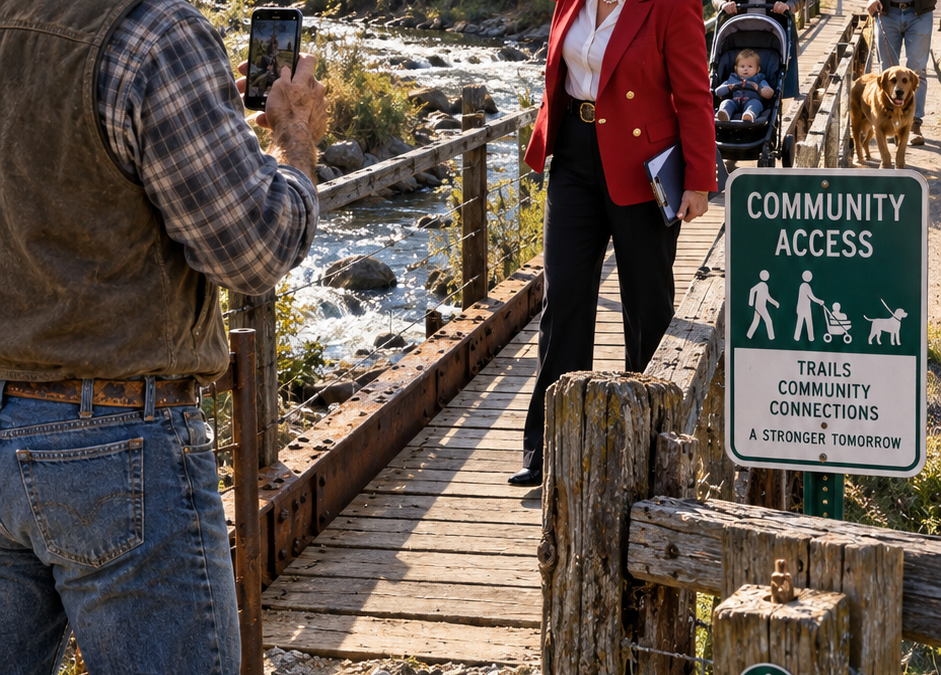
Beside the bridge approach stood a brand-new green-and-white sign.
RIVERBEND ESTATES
COMMUNITY ACCESS
Fresh trail arrows had been fastened to two of my fence posts.
The short chain I used to control ranch traffic had been lifted off its hook and placed neatly on the ground.
That detail bothered me more than if someone had broken it.
Nobody had forced their way through.
They had arrived expecting I would accept the change.
Clare stood beside the new sign holding a black property folder.
She was president of the Riverbend Estates HOA.
I had met her twice at county planning meetings.
Both times, she spoke the way certain people do when they’ve spent too long in committees—every sentence delivered like a motion that had already been seconded.
“You can’t obstruct established access,” she said.
“Established by who?”
“The property history.”
“What property history?”
She tapped her folder.
“The association has records.”
“Then show me.”
“You’ll receive whatever documentation is appropriate through management.”
I looked past her.
The new trail markers continued toward the subdivision.
A golf cart appeared in the distance.
That was new too.
“This access existed before Riverbend,” Clare said.
“That’s not what I asked.”
She folded her arms.
I took out my phone.
I photographed the sign.
The trail arrows.
The chain.
The bridge deck.
The eastern approach.
Clare watched me.
“You’re escalating this unnecessarily.”
“I’m documenting what changed.”
The golf cart reached the far side of the bridge.
I raised one hand.
The driver slowed.
Clare immediately stepped toward me.
“You do not have authority to interfere with residents using a recorded access.”
I looked at her.
“Recorded where?”
“In the agreement.”
There it was again.
Agreement.
Not tradition.
Not neighborly understanding.
Not “we’ve always done it.”
An agreement.
I let the golf cart turn around.
Then I picked up the chain and hung it back on the gate post without closing it.
Clare smiled tightly.
“Good decision.”
“No,” I said. “Temporary decision.”
I pointed at her folder.
“Send me the agreement.”
Then I walked back to my truck.
By the time I reached the cab, the dispute had changed.
I was no longer asking why an HOA wanted my bridge.
I was asking what my family had actually agreed to.
And whether Clare had bothered reading the same document she was using against me.
PART2
By noon, I was back in the ranch office with an old cardboard records box sitting open beside my desk.
Holloway Bridge had never been a mystery to my family.
It was infrastructure.
Work.
Maintenance.
Expense.
My grandfather had built and reinforced parts of it.
My father repaired it after a bad spring flood in the eighties.
I had replaced stringers, resurfaced sections of deck, rebuilt one approach, and poured more money into gravel than I cared to calculate.
Nobody had ever spoken about it as though it were a neighborhood feature.
But Clare had said one thing I couldn’t ignore.
Your family agreed to this.
So I started looking.
The old metal filing cabinet behind my desk held decades of ranch records.
Tax statements.
Insurance policies.
Fence receipts.
Equipment invoices.
Feed contracts.
Repair notes.
I found a faded photograph of my father standing on Holloway Bridge beside a welding rig.
One boot rested on a steel plate.
On the back, in his handwriting, were four words.
BRIDGE REPAIR—EAST SIDE SHARE.
I stopped.
Then I kept digging.
Twenty minutes later, I found a timber supplier receipt with a note stapled to it.
East Farm—40%.
Then a copy of a check from a man named Raymond Cole.
Memo:
BRIDGE MAINTENANCE SHARE.
Then a handwritten ledger entry in my father’s old book.
East Farm bridge share agreement on file.
I leaned back.
East Farm.
That name made sense.
Before Riverbend Estates existed, the land east of Cottonwood Creek had been agricultural.
Everybody around there called it East Farm.
My father knew the family who owned it.
I remembered their trucks crossing the bridge when I was young.
Feed trucks.
Seed trucks.
Pickups.
Stock trailers.
Farm equipment.
Nobody pushed strollers across it.
Nobody walked dogs.
Nobody drove golf carts.
Nobody had attached green arrows to our fence posts.
But clearly there had been some arrangement.
That meant I couldn’t simply pretend the old access never existed because I didn’t like what Riverbend was doing now.
I needed the document.
I called Dana Brooks.
Dana had handled a boundary dispute for me six years earlier after a utility contractor staked the wrong side of one of our fence lines.
She was forty-nine, practical, patient, and almost pathologically unwilling to make a dramatic conclusion before she had evidence.
I told her everything.
The sign.
Clare.
The trail markers.
The bridge.
Then the documents I had found.
“Your father actually wrote ‘agreement on file’?”
“Exactly that.”
“Any recording number?”
“No.”
“Names?”
“Raymond Cole.”
She was quiet for a second.
Then I heard papers moving.
“Don’t chain the bridge yet.”
“I didn’t.”
“Good.”
“And don’t concede access either.”
“I didn’t do that.”
“I know.”
Her voice stayed calm.
“Grant, an old agreement may create a legitimate property right. But knowing one exists doesn’t tell us the scope.”
“That’s what I’m trying to figure out.”
“Who can use it?”
“Exactly.”
“For what purpose?”
“Exactly.”
“Over what property?”
I nodded even though she couldn’t see me.
“Under what conditions? For how long? Whether it runs with the land? Whether it can terminate? Those details matter.”
I looked at the photograph of my father.
Clare had said community access as though those two words ended the discussion.
Dana was reminding me that the real question was never whether an agreement existed.
It was what the agreement actually said.
“Photograph everything you’ve found and send it to me,” she said.
“Okay.”
“And if the HOA sends you something?”
“Send it to you.”
“Not their summary.”
“I know.”
“The actual document.”
That phrase stayed with me.
The actual document.
Not a board memo.
Not a trail map.
Not an attorney’s characterization.
Not Clare’s confidence.
The words themselves.
That evening, I drove back toward Cottonwood Creek.
The community-access sign was still standing.
A couple from Riverbend crossed while I watched from twenty yards away.
They smiled.
I nodded.
They probably believed they were using an HOA amenity.
That was the dangerous thing about signs.
Once something looks official, most people stop wondering who gave permission.
I walked onto the bridge after they passed.
The timber was scarred from decades of ranch traffic.
Near the eastern end, one old steel reinforcement plate still carried initials stamped by my father.
H.H.
Harland Holloway.
He had maintained that bridge for years.
So had I.
And somewhere in a county file, according to his notes, was a document explaining why another farm had once helped pay for it.
I looked east.
Riverbend’s rooftops rose above the trees.
Sidewalks.
Streetlights.
Paved streets.
Everything about the development looked different from the East Farm I remembered.
And that was when the obvious question finally settled in my mind.
If a 1972 agreement was written for East Farm, how had Clare turned it into recreational access for hundreds of subdivision residents?
The answer did not come immediately.
What came first was more people.
For two days, the bridge saw occasional pedestrian traffic.
By the third day, Riverbend had clearly begun treating it as part of an organized route.
Three new trail arrows appeared.
One said:
RIVERBEND CREEK LOOP.
Another pointed directly onto Holloway Bridge.
By ten that morning, I counted nine walkers, two bicycles, and one golf cart.
The golf cart bothered me more than the walkers.
The bridge could handle pickups and ranch equipment.
That did not make it appropriate for recreational traffic.
I knew exactly how heavy equipment crossed.
Slow.
Centered.
One vehicle at a time.
Riverbend residents had no reason to know any of that.
Around eleven, four teenagers came across in another golf cart.
Fast.
Too fast.
The timber boards rattled.
I stepped out from the pasture road and raised my hand.
The driver stopped.
“This isn’t a recreational road.”
He looked confused.
“The HOA said it’s part of the loop.”
“I’m disputing that.”
He pointed backward.
“There’s a sign.”
“I know what the sign says.”
The kids weren’t rude.
They weren’t trespassing because they thought it would be funny.
Someone with authority had told them the route was legitimate.
They turned around.
That was important to me.
I never blamed most residents.
If an HOA installs signs, prints maps, and tells people something is approved, most homeowners are going to believe it.
By afternoon, I decided I needed my own sign.
Not PRIVATE PROPERTY.
Not NO TRESPASSING.
Those statements might imply I had already resolved the legal issue.
I hadn’t.
Instead, I mounted a temporary white board beside the ranch approach.
PRIVATE RANCH BRIDGE
ACCESS DISPUTED
PLEASE USE RIVERBEND PUBLIC STREETS
Accurate.
Neutral.
I photographed it and sent the image to Dana.
She replied:
Good. Keep it neutral.
Riverbend did not.
The next morning, an HOA maintenance cart crossed Holloway Bridge.
Two workers were carrying rakes, orange marking flags, and bags of mulch.
I stepped into the road.
The driver stopped.
“Where are you going?”
“Creek Trail maintenance.”
“On whose property?”
He pointed toward my pasture.
“Association map shows the route through there.”
“You’re not doing work west of this bridge.”
The passenger looked uncomfortable.
“We were told this was HOA access.”
“I’m telling you the access is disputed.”
They made a phone call.
Ten minutes later, they turned around.
Twenty minutes after that, Clare called me.
She didn’t say hello.
“You stopped an authorized maintenance crew.”
“I stopped HOA workers from entering my ranch.”
“They were servicing the community trail.”
“There is no community trail on my ranch.”
“There is an established access corridor.”
“Send me the agreement.”
“Our management company is preparing the documents.”
“You’ve had three days.”
“Grant, this has already been reviewed.”
“By who?”
“I’m not going to litigate property history with you over the phone.”
“Good.”
I leaned against my truck.
“Send me the property history.”
She hung up.
The cease-and-desist arrived that evening.
Dana forwarded it with one line at the top.
Do not answer this yet.
Riverbend’s management company accused me of interfering with established association access and discouraging lawful use of a recorded crossing.
It demanded that I remove my sign and stop interfering with residents, vendors, maintenance workers, and other authorized users.
One phrase caught my attention.
Recorded crossing.
Below it was a county recording citation.
Book.
Page.
Not the agreement.
But finally, a place to find it.
I sent the letter to Dana.
She called ten minutes later.
“This is useful.”
“They’re threatening me.”
“Yes.”
“You sound happy.”
“Because they finally gave us something verifiable.”
“The recording reference.”
“Exactly.”
“You think it’s the document my father mentioned?”
“We’re about to find out.”
The next morning, Riverbend sent what Clare described as its supporting packet.
Twenty-seven pages.
That sounded impressive.
It wasn’t.
Most of the packet was modern.
A neighborhood trail map.
A board resolution approving recreation improvements.
A contractor’s wayfinding proposal.
A developer title summary.
Then, near the back, was an old photocopy.
Dark edges.
Faded text.
Poor scan quality.
The heading referred to bridge use and maintenance.
But it was obviously incomplete.
The first page included in Riverbend’s packet was numbered page two.
Then page three.
Then page five.
No complete signature page.
No legal-description attachment.
No exhibit.
I called Dana.
“You’re looking at this?”
“I’m looking at it.”
“Is that supposed to be the complete agreement?”
“No.”
“How can you tell?”
“Page numbers.”
I laughed.
“That’s not subtle.”
“No.”
“Do you think they intentionally removed pages?”
“No conclusion yet.”
There she was again.
Refusing to let suspicion become evidence.
“It could be an old incomplete scan,” she said.
“Could be.”
“But I’m not relying on an incomplete scan when they’ve cited the recorded instrument.”
I zoomed in.
One sentence was readable.
Access across the bridge for access to the eastern agricultural tract.
I read it twice.
“Dana.”
“I saw it.”
“They keep calling it community access.”
“I know.”
“This says agricultural tract.”
“It does.”
“That’s important.”
“It may be.”
I hated that word.
May.
But she was right.
One phrase did not decide the whole document.
Other pages referred to shared maintenance.
That lined up with my father’s records.
One paragraph ended at the bottom of the page mid-sentence.
The next surviving page began:
SUBJECT FURTHER TO THE CONDITIONS SET FORTH BELOW—
Whatever conditions were “set forth below” were missing.
I leaned back.
Now I understood exactly why Dana had told me not to argue with summaries.
Riverbend’s title summary described the old arrangement this way:
Historic bridge access rights benefit eastern property.
That sounded broad.
The original language we could actually see referred to an agricultural tract.
Very different.
Then I looked at Riverbend’s modern trail plan.
The trail began near the clubhouse.
Followed Cottonwood Creek.
Crossed Holloway Bridge.
Continued along my pasture edge.
Then looped back into Riverbend.
The plan included benches.
Dog-waste stations.
Directional arrows.
A scenic stop.
Nothing about it resembled agricultural access.
I drove back to the bridge.
My neutral sign was lying face down in the grass.
Someone had removed it.
The screws were still attached.
Nothing was broken.
I picked it up and reinstalled it.
Then photographed everything.
The post.
The screws.
The sign.
The time.
About an hour later, Clare appeared.
Same black folder.
Dark red blazer this time.
She looked at my sign.
“You were instructed to remove that.”
“I received a demand from your management company.”
“You’re interfering with established access.”
“I’m stating the access is disputed.”
“It isn’t disputed by the documents.”
“Then why did you send me half a document?”
Her expression changed.
“It’s a title packet.”
“It’s missing pages.”
“That packet was sufficient for the board.”
“I’m not the board.”
“You don’t get to relitigate seventy years of property history because residents crossing suddenly bothers you.”
“I’m not relitigating anything.”
I held up my phone.
“I’m reading what you sent.”
Clare crossed her arms.
“You’re looking for a technicality.”
“No.”
I pointed east toward the subdivision.
“I’m looking for the recorded instrument that gives hundreds of residents, bicycles, golf carts, contractors, and maintenance crews the right to cross my bridge.”
“It’s in the recorded access rights.”
“Where?”
“In the agreement.”
“Which page?”
That stopped her.
Only briefly.
But it stopped her.
She glanced at the folder.
“I’m not your attorney.”
“I didn’t ask for legal advice.”
I pointed toward the bridge.
“I asked what page creates Riverbend Estates community access.”
Her jaw tightened.
“You’ll receive a formal response.”
“Good.”
She started walking toward her car.
“Clare.”
She turned.
“What happened to the missing pages?”
She said nothing.
Then she got into her car.
That afternoon, Dana ordered a certified copy directly from the county recorder.
Not a developer packet.
Not Riverbend’s old scan.
The recorded instrument.
With exhibits.
With attachments.
With signatures.
Everything.
Two days later, she called before nine in the morning.
“I’ve got it.”
“The whole thing?”
“The whole recorded instrument. Signature page. Legal description. Exhibit.”
I was already reaching for my jacket.
“Where are you?”
“County records.”
“I’ll be there.”
The recorder’s office was exactly the kind of place where important property disputes get decided without anyone noticing.
Fluorescent lights.
Gray counters.
Old public terminals.
Metal shelving.
No dramatic oak doors.
No judge.
No audience.
Just paperwork.
Dana sat near a window with a folder open in front of her.
I sat down.
She slid the first page toward me.
Across the top, in faded type:
BRIDGE USE AND MAINTENANCE AGREEMENT
Recorded 1972.
There it was.
The actual agreement.
The document my father had referenced.
The document Riverbend had been using as though its meaning were obvious.
“Who signed it?”
Dana pointed.
“Your grandfather, Harold Holloway.”
Then another name.
“Everett Cole. Owner of the eastern farm.”
Two private landowners.
No HOA.
No developer.
No subdivision.
No recreation committee.
No trail system.
Two neighboring farms.
One bridge.
Dana turned to the attached legal description.
“This matters.”
The eastern property was defined using old metes-and-bounds calls.
Not Riverbend Estates.
Not community lands.
Not future neighborhood amenities.
One specific agricultural tract east of Cottonwood Creek.
East Farm.
I recognized the shape immediately.
Dana placed a current aerial photograph beside it.
“Most of Riverbend was eventually developed from this tract.”
“That’s how they found the agreement.”
“Probably.”
“Probably again.”
“We still need the chain of title.”
So we built it.
The East Farm changed hands after the Cole family.
Then changed hands again.
Years later, a developer acquired it and combined it with adjoining parcels.
Subdivision plats followed.
Utility easements.
Road dedications.
Common-area transfers.
Street plans.
Every document answered something.
And every document created another question.
By late morning, Dana had four documents aligned in chronological order.
1972 bridge agreement.
Later East Farm deed.
Subdivision plat.
Public-road dedication.
She tapped each one.
“Agreement.”
Tap.
“Transfer.”
Tap.
“Development.”
Tap.
“Public road.”
I studied the road dedication.
Riverbend Drive appeared by name.
It connected the subdivision directly to County Road 18.
“So Riverbend has legal public access without my bridge.”
“Yes.”
“And has for years.”
“Yes.”
I looked back at the agreement.
“Does the agreement say anything about that?”
Dana didn’t answer.
Instead, she flipped several pages.
A paragraph near the end had been underlined in pencil.
She covered most of it with her hand.
“I don’t want you jumping to a conclusion before we finish the chain.”
I stared at her.
“You found something.”
“I found language that needs context.”
“That’s lawyer language for yes.”
“That’s lawyer language for wait.”
We kept working.
After lunch, we met a surveyor named Eli Turner.
Sixty-one.
Tall.
Lean.
Very careful with language.
Dana had sent him the old deed descriptions and the current parcel data.
His computer screen showed Cottonwood Creek.
Holloway Ranch west.
Riverbend east.
The bridge crossed almost exactly where expected.
Eli zoomed in.
“The bridge lies within the Holloway record boundary based on the current descriptions.”
“So it’s mine.”
He raised one hand.
“I’m telling you where the recorded boundary puts it.”
Dana smiled.
“That’s why I use him.”
Eli looked at me.
“I don’t decide legal ownership disputes.”
“Understood.”
Then he overlaid the old East Farm boundary over the modern subdivision.
The match was striking.
A large section of Riverbend had been carved out of the original agricultural tract.
Then he added the road network.
Riverbend Drive connected the development directly to County Road 18.
Permanent public access.
Paved.
Dedicated.
No Holloway Bridge required.
I stared at the map.
“Then why does the HOA care so much about this bridge?”
Dana laid Riverbend’s creek-loop plan beside the screen.
“Because it makes their trail work.”
That was when the motive became obvious.
Without my bridge, Riverbend’s creek trail ended at Cottonwood Creek.
With my bridge, residents could cross, walk beside my pasture, then create a longer recreational loop.
The bridge was convenient.
Beautiful, probably.
Useful.
But convenience and legal right were not the same thing.
Back at Dana’s office, she spread the complete timeline across a conference table.
1972 agreement.
Cole transfers.
Developer purchase.
Subdivision.
Road dedication.
HOA formation.
Modern trail plan.
Seen that way, Clare’s argument looked very different.
She had treated the documents as one continuous story.
They weren’t.
Different ownership.
Different land use.
Different access systems.
Different purpose.
Then Dana placed Riverbend’s incomplete photocopy beside the certified agreement.
The missing material became obvious.
The HOA packet lacked the complete legal description.
One page containing conditions.
Part of the signature section.
I looked at her.
“You still think this could just be a bad scan?”
“Yes.”
I laughed.
“Seriously?”
“Grant, I don’t need to prove they hid anything.”
She tapped the full agreement.
“I need to know what this does.”
Then she turned to the paragraph she had covered earlier.
This time, she let me read it.
Slowly.
The old language took a minute to digest.
The bridge right applied to the eastern tract.
It created access.
It addressed maintenance.
Then came the sentence that changed the dispute.
The right continued until the eastern property obtained another permanent legal means of access to a public road.
If that happened, the bridge right created under the agreement would cease.
I read it again.
Then looked at Dana.
“Am I reading that correctly?”
“Maybe.”
“Dana.”
“I want one more confirmation.”
I pointed at the road dedication.
“Riverbend Drive is permanent public access.”
“Yes.”
“And that dedication came years ago.”
“Yes.”
“Before the HOA started calling this bridge a community trail.”
“Yes.”
I tapped the termination language.
“Then the right ended.”
Dana gave me the look.
“Our reading appears to be that the condition was satisfied. But I want to finish the chain before we state it as a conclusion.”
“You already know.”
“I strongly suspect.”
“That’s as close as you get to excitement, isn’t it?”
She almost smiled.
The next morning, she called before I’d finished coffee.
“I confirmed the dedication date.”
“And?”
“Come in.”
The agreement was laid out when I arrived.
This time, Dana read it from beginning to end.
Not selected paragraphs.
Not title summaries.
The whole thing.
The original right was real.
That mattered.
My grandfather had granted East Farm a defined bridge-access right.
The agreement covered the eastern agricultural property.
Its owner.
Occupants.
Workers.
People connected with its agricultural operation.
The bridge could be used for access to and from that tract.
Maintenance costs were shared between the two properties.
That explained everything I had found.
My father’s notes.
Raymond Cole’s payment.
The old trucks I remembered.
Nobody had fabricated the history.
East Farm really had used Holloway Bridge.
Then Dana reached the limitations.
“What doesn’t this agreement say?”
I looked at Riverbend’s trail map.
“It doesn’t say public recreation.”
“No.”
“It doesn’t say HOA.”
“No.”
“It doesn’t say every future resident in a subdivision.”
“No.”
“It doesn’t say golf carts.”
“No.”
“Or bicycles.”
“No.”
“Or dog walkers.”
“No.”
“Or contractors maintaining a recreation trail.”
“No.”
She tapped the agreement.
“And it does not grant unrestricted use for whatever purpose future owners find convenient.”
I sat back.
“So Clare took agricultural access and turned it into a neighborhood amenity.”
“That appears to be what happened.”
“There’s that phrase again.”
“We’re not finished.”
She moved to the termination provision.
The agreement anticipated that the eastern farm might eventually gain another permanent legal route to a public road.
If that happened, the bridge right would cease.
Then she placed the Riverbend road dedication beside it.
The former East Farm had received permanent public road access.
Riverbend Drive.
County Road 18.
Years before the HOA had ever created the creek-loop plan.
I stared at the two documents.
“So the agreement created the right.”
“Yes.”
“And the same agreement defined when it ended.”
“That’s our reading.”
“And Riverbend’s own development triggered the condition.”
“That’s what the recorded history appears to show.”
That was the irony.
The subdivision’s existence had not expanded the old bridge right.
The development process had created the very public-road access contemplated by the agreement’s termination clause.
Clare had pointed backward to 1972 as though that year gave Riverbend everything it wanted.
The complete agreement said almost the opposite.
Dana raised one finger.
“There’s one more issue.”
“What?”
“If Riverbend has another easement, amendment, deed, or later instrument, that could change things.”
“Have they cited one?”
“No.”
“Did their packet include one?”
“No.”
“Their cease-and-desist?”
“Same 1972 document.”
“So now what?”
Dana pulled out a clean sheet of paper and wrote one sentence.
SHOW THE CURRENT INSTRUMENT.
She slid it toward me.
“That’s the dispute now.”
Not whether the 1972 agreement existed.
It did.
Not whether East Farm had used the bridge.
It had.
Not whether my family had accepted maintenance payments.
They had.
The question was much narrower.
What recorded instrument gave Riverbend Estates HOA, today, the right to direct hundreds of residents across Holloway Bridge for recreation?
If another document existed, Riverbend could produce it.
If none existed, confidence would not create one.
Dana drafted a letter that afternoon.
It acknowledged the 1972 agreement.
Acknowledged historic agricultural use.
Acknowledged shared maintenance.
Then cited the permanent-road-access clause.
Cited Riverbend’s public-road dedication.
And demanded identification of any current deed, easement, amendment, declaration, license, or other recorded instrument giving Riverbend Estates recreational or general community access across Holloway Bridge.
One sentence captured everything.
Nothing in the materials produced to date establishes a present right for recreational, pedestrian, bicycle, golf-cart, contractor, or general resident use of Holloway Bridge.
I read it again.
“That’s the whole argument.”
“Pretty much.”
I thought about Clare standing beside the creek.
Your family agreed to that decades ago.
Technically, yes.
My family had agreed to something.
That was why her claim sounded credible.
But a valid old agreement did not mean every later interpretation was valid too.
A right could be real and limited.
It could be enforceable and conditional.
It could apply to one purpose but not another.
And, most importantly, it could end if the parties had written an ending into the document.
Dana sent the letter at 4:17.
Nine minutes later, Riverbend’s attorney acknowledged receipt.
At 5:03, the green community-access sign was still standing beside my bridge.
I drove past without touching it.
For the first time, I wasn’t bothered.
The argument had moved away from signs.
Away from Clare’s confidence.
Away from HOA maps.
Now there was one question.
Could Riverbend produce a present legal right stronger than the document it had already cited?
Three days later, their attorney responded.
The tone had changed completely.
No accusation that I was unlawfully interfering.
No command to remove my sign.
No declaration of established community access.
Instead, Riverbend was “conducting an independent review of recorded instruments affecting the bridge.”
Pending that review, the HOA had suspended all representations that Holloway Bridge was part of the Riverbend trail system.
That afternoon, the first trail arrow disappeared.
The next morning, maintenance workers stopped crossing.
The big community-access sign remained, but somebody covered the wording with a temporary blank panel.
It wasn’t an admission.
But it was the first sign that Riverbend understood the problem might belong to them.
Dana called.
“They hired an outside title company.”
“Good?”
“Smart.”
“Whose side are they on?”
“They’re supposed to answer the title question.”
“That wasn’t my question.”
She laughed.
“Let them work.”
The title company requested everything.
Certified 1972 agreement.
Complete exhibits.
Chain of title.
Subdivision plat.
Public-road dedication.
Eli’s survey overlays.
Riverbend’s own packet.
Dana sent it.
Then, for almost a week, nothing happened.
That silence felt strange.
For a month, the dispute had been visible.
Signs.
Golf carts.
Trail markers.
Maintenance crews.
Emails.
Letters.
Now everything was happening behind conference-room doors.
I checked the bridge every morning.
Resident traffic nearly stopped.
A few people would walk down the Riverbend trail, see the covered sign, then turn around.
Nobody argued.
Because the HOA was no longer telling them the bridge belonged to the community.
The board meeting happened the following Thursday.
Dana came with me.
Clare was already seated.
Same controlled posture.
Same crimson blazer.
But this time, there was no bridge behind her.
No trail sign.
No residents wandering past.
Just a conference table.
Five directors.
The property manager.
Riverbend’s attorney.
Dana.
Me.
And the outside title representative on video.
Clare opened.
“This issue has created unnecessary disruption for residents, and the board needs a clear path forward.”
One director, a retired engineer named Paul Jensen, looked at Riverbend’s attorney.
“Do we have one?”
The attorney nodded.
“We have a recommendation.”
Clare’s posture stiffened slightly.
The title representative began with the history.
The association’s prior access position had relied primarily on the 1972 bridge-use-and-maintenance agreement.
Correct.
Later title summaries referenced that same agreement.
Correct.
The bridge itself sat within the Holloway record boundary based on the documents reviewed.
Also correct.
Then Paul asked the question that mattered.
“Where does the 1972 agreement give all Riverbend residents the right to use this bridge?”
The title representative answered immediately.
“It does not say that.”
Silence.
Clare leaned forward.
“But the rights follow the eastern property.”
The HOA attorney answered.
“The issue is not simply whether a historical right once benefited that property.”
Clare looked at him.
“Residents have used that crossing.”
“Recent use may be relevant factually.”
He paused.
“It does not rewrite the recorded instrument.”
Her expression tightened.
“What exactly are you recommending?”
The attorney turned toward the board.
“That the association withdraw the designation of Holloway Bridge as community access unless a separate current recorded right can be identified.”
Paul looked toward the title representative.
“Did your review find another easement?”
“No.”
“An amendment?”
“No.”
“A later deed granting trail access?”
“No.”
“License?”
“No.”
“Any recorded instrument authorizing recreational use?”
“No.”
That was it.
Not dramatic.
Not explosive.
But finished.
The board voted.
Remove Holloway Bridge from all trail materials.
Direct residents to use Riverbend’s public streets.
Remove signs.
Remove wayfinding arrows.
Stop sending contractors across.
Stop representing Holloway Bridge as an HOA amenity.
Four directors voted yes.
Clare voted no.
Afterward, she closed her folder.
“This creates a bad precedent.”
Paul looked across the table.
“For reading the document?”
Clare didn’t answer.
The board moved to the next agenda item.
By eight the following morning, a Riverbend maintenance truck arrived at Cottonwood Creek.
For the first time during the entire dispute, it stayed on their side.
Two workers removed the covered community-access sign.
Then the remaining trail arrows.
I watched from the ranch approach.
One worker looked across at me and nodded.
I nodded back.
Twenty minutes later, they were gone.
The bridge looked like itself again.
Old timber.
Steel plates.
Ranch gravel.
Cottonwood Creek.
No HOA logo.
No recreation signs.
No invented community route.
Dana called while I was still there.
“The board’s attorney sent formal notice.”
“What does it say?”
“They’re rescinding the access designation.”
I looked at the bridge.
“So that’s finished.”
“Effectively.”
“What about Clare?”
“She’s still president.”
“I meant what’s happening to her authority.”
“That’s for the board.”
Fair enough.
I had never needed Clare punished.
I needed the HOA to stop claiming something it could not prove.
And now it had.
The cleanup took another few weeks.
Riverbend removed Holloway Bridge from printed maps.
The online trail map was changed.
Residents received a notice stating that Holloway Bridge was not an HOA amenity and that the Riverbend creek trail terminated on the eastern side of Cottonwood Creek.
The remaining posts came down.
Screw holes were filled.
The worn gravel near my approach, damaged by golf-cart traffic, was regraded.
Dana also sent an itemized list of costs.
Survey work.
Title research.
Document retrieval.
Legal fees.
Minor restoration.
Riverbend did not agree to every dollar.
We didn’t expect them to.
After a couple rounds of negotiation, the HOA reimbursed a reasonable portion of the expenses.
No giant check.
No dramatic settlement.
No public apology.
But something more important changed.
The board adopted a new internal rule.
No HOA director or committee could designate private land as community access based solely on a title summary, an old map reference, a prior assumption, or incomplete historical documents.
Before signs went up or residents were told they had access, the association needed the complete recorded instrument.
That mattered to me more than embarrassing anybody.
The board also removed property-access decisions from Clare’s individual authority.
Any future land-use or access project required review by counsel or the full board before contractors, signage, maps, or notices were issued.
When Dana told me, I expected to feel victorious.
Mostly I felt tired.
Then relieved.
For weeks, Holloway Bridge had been the first thing I thought about when I woke up.
Suddenly, it wasn’t.
One Friday near sunset, I drove down to Cottonwood Creek.
The green signs were gone.
The arrows were gone.
No golf carts.
No maintenance carts.
No walkers.
Just the bridge.
I stopped before the approach.
Got out.
The chain hung from the gate post where it always had.
I stood in the same spot where Clare had told me that if I chained my bridge, the HOA would remove the obstruction.
I didn’t chain it.
Not because Riverbend had any right.
Because I didn’t need it chained that evening.
That had always been the point.
Managing Holloway Bridge was a ranch decision.
Sometimes the chain was up.
Sometimes it wasn’t.
Sometimes cattle crossed.
Sometimes feed trucks.
Sometimes nobody crossed at all.
What mattered was that a neighborhood committee no longer believed it could make those decisions for me.
I drove across slowly.
The tires made the familiar hollow sound against the timber.
Halfway over, I looked toward Riverbend.
The rooftops were still there.
Streetlights.
Sidewalks.
Paved streets.
Public road.
Their neighborhood had lost nothing it actually owned.
They had lost a shortcut.
A shortcut somebody had decided to call theirs.
I stopped near my father’s old reinforcement plate.
H.H.
I ran my hand across the initials.
That detail mattered.
Because this was never a story about pretending my family had never shared the bridge.
We had.
The record proved it.
My grandfather had signed the agreement.
East Farm had possessed a legitimate crossing right.
The Cole family had used it.
They had shared maintenance costs.
My father had honored the arrangement.
So had the generations before me.
I was proud of that.
What I refused to accept was the idea that because a right existed once, it could be stretched forever into something completely different.
A cattle-and-farm access arrangement could not simply become a recreational trail because an HOA printed a map.
A right for an agricultural tract did not automatically become a right for every future resident, dog walker, cyclist, golf cart, contractor, and trail committee.
And a document that contained its own termination condition did not remain alive just because somebody liked the old sentence that created the right better than the later sentence that ended it.
That was the lesson Riverbend had missed.
Agreements are not magic words.
They have scope.
Purpose.
Beneficiaries.
Conditions.
Limits.
Sometimes expiration points.
A document can give somebody a real legal right.
But the words define that right.
Who can use it.
For what.
For how long.
And under what circumstances it stops.
Clare had been right about one thing.
My family had signed an agreement decades earlier.
She just hadn’t read far enough.
Because the most important sentence in that 1972 document wasn’t the one that gave East Farm access across Holloway Bridge.
It was the sentence explaining exactly when that access ended.
And once that sentence came out, Riverbend’s “community bridge” disappeared almost as quickly as the signs they had planted beside it.








