𝗣𝗔𝗥𝗧 𝟮 HOA Claimed Hunting Rights Across My 2,200-Acre Pine Forest—So I Took Their “Greenway” Claim to Court
𝗣𝗔𝗥𝗧 𝟮
I had worked that land since I was twelve.
I knew every ridge.
Every creek crossing.
Every stand Elias had deliberately left untouched.
There were trees he refused to harvest because, as he once told me, “Some things deserve to finish growing.”
I thought that was foolish when I was sixteen.
I understand it now.
The Pruitt tract was not a recreational estate.
It was a working forest.
Timber rotations.
Wildlife management.
Hunting leases.
Road maintenance.
Controlled access.
Fire planning.
Taxes.
Records.
The land produced income, but only if managed carefully enough that it could continue producing after I was gone.
For eighteen years after my father’s death, nobody questioned any of that.
Ridgecrest Pines existed beside us.
Not inside us.
The development had begun in the late 1990s on about 340 acres southwest of my eastern timber.
The property had once been part of a failed equestrian resort.
Developer Gareth Fossie acquired it.
Forty-seven residential lots.
A few common areas.
Roads.
Utility corridors.
Then an HOA.
The Ridgecrest Pines Homeowners Association was incorporated in 2001.
Its recorded covenants covered those 340 acres.
Nothing else.
That boundary appeared in the subdivision plat.
In the CC&Rs.
In the deed restrictions attached to the individual lots.
It was not complicated.
But there was one connection between Ridgecrest Pines and the Pruitt forest.
A recreational license.
That was where the later confusion began.
In 2001, Gareth Fossie approached my father about allowing Ridgecrest Pines residents to use several existing trails across the eastern portion of our land.
Dad agreed.
Not forever.
Not as an easement.
Not as a transfer of rights.
A license.
Five years.
Roughly 180 acres of creek bottom and mixed pine were included in the mapped trail network.
The agreement required an annual payment.
Renewal required written consent from both parties.
Most importantly, Section Three said exactly what the license did not do.
It conveyed no property interest.
Created no easement.
Granted no ownership.
The privilege expired automatically if not renewed according to its terms.
Dad renewed the arrangement twice before his death.
After the property came to me, I did not renew it again.
No formal renewal request ever arrived.
No written agreement.
No payment.
No extension.
The license expired.
I did not immediately close the trails.
There was no reason to.
People had used them respectfully.
Neighbors hiked.
Some Ridgecrest residents hunted under arrangements I knew about.
I tolerated the use.
That tolerance was later transformed, in Sandra’s mind, into ownership.
But permission and ownership are not the same thing.
They never have been.
Three days after Sandra confronted me at the trailhead, the first certified letter arrived.
I signed for it.
Carried it inside.
Opened it at the kitchen table.
Article Six.
Section Four.
Recreational amenities and community access corridors.
According to the letter, my signs constituted an unauthorized restriction of access to established HOA trails.
Fine:
$375.
Administrative processing fee:
$85.
I read it twice.
Then put it beside my deed.
The contrast was almost funny.
One document had been created by people with authority over 340 acres.
The other established my ownership of 2,200.
Sandra’s letter acted as though the first document had somehow swallowed the second.
I opened a manila folder.
Wrote the date.
Put the notice inside.
Twelve days later, the second letter arrived.
Sharper language.
Threat of injunctive relief.
Then a new claim.
The trails, Sandra wrote, had been incorporated into the recorded Ridgecrest Pines plat as a:
DESIGNATED COMMUNITY GREENWAY.
Specific claims are useful.
Specific claims can be checked.
That evening, I opened the Harlan County GIS portal.
Pulled the subdivision plat.
Forty-seven lots.
Two common parcels totaling approximately twelve acres.
Stormwater easement.
Utility corridor.
Road right-of-way.
No greenway extending into my forest.
No hunting corridor.
No recreational easement.
No trail right.
The northern boundary of Ridgecrest Pines stopped exactly where the Pruitt tract began.
There was no overlap.
I printed the plat.
Put it in the folder.
Then wrote one word on the inside cover.
PROCEED.
That Monday, I called Ruth Callahan.
Ruth practiced property law in Knoxville.
Three timber operators I trusted had used her on boundary cases.
They all described her the same way.
Slow.
Until you saw what she was doing.
Then you realized she wasn’t slow at all.
She simply refused to leave holes.
I drove to her office with the folder.
Deed.
HOA letters.
Subdivision plat.
And the original 2001 recreational license agreement.
Ruth read everything.
No commentary.
No dramatic reaction.
She pulled county records on her computer while I drank coffee bad enough to qualify as punishment.
After forty minutes, she leaned back.
“They don’t have a recorded interest in your land.”
“I agree.”
“The license expired.”
“Yes.”
“Their plat doesn’t support the greenway claim.”
“That’s what I found.”
“And they have no recorded easement.”
“No.”
Ruth removed her glasses.
“The interesting question is why they think otherwise.”
I nodded.
“That’s what I want to know.”
She picked up a legal pad.
Wrote:
CHAIN OF TITLE.
Then:
QUIET TITLE.
She looked at me.
“How patient are you?”
“I manage pine.”
That produced the smallest smile.
“Good.”
Ruth ordered everything.
Full chain of title for the Pruitt tract.
Original patent.
My grandfather’s purchase.
My father’s 1969 acquisition.
1984 acquisition.
Probate transfer.
Every easement.
Every recorded encumbrance.
Then she ordered the full Ridgecrest Pines instrument history.
Original plat.
Amendments.
Common-area declarations.
Deeds.
Easements.
Dedications.
Anything filed since the development began.
The search cost $420.
It took eleven business days.
While Ruth worked the documents, I hired Denton Marsh.
Denton was a licensed surveyor I had known for twenty years.
He carried field notes in composition notebooks, just like Elias had.
Practical reason.
Those notebooks survive weather.
We spent two days walking the northern boundary.
October had deepened by then.
Pine needles drifted across the ground.
We found the 1984 iron pins.
Checked cap numbers.
Verified bearings.
Located witness trees.
Compared measurements against the recorded legal description.
Denton said little.
That was one of his better qualities.
At the northeastern corner, he crouched beside an iron monument.
Checked his notes.
Then looked down the trail.
“That trail runs on your side for almost a quarter mile before it gets anywhere near the subdivision line.”
“That’s what I thought.”
He pointed.
“No easement monument.”
“No.”
“No dedication markers.”
“No.”
He stood.
“Somebody has been using a private trail and calling it a greenway.”
“That appears to be the situation.”
Denton closed the notebook.
That was all.
His job was not to win my argument.
His job was to measure.
Measurements are most useful when they do not care who paid for them.
The title search came back Thursday.
Ruth asked me to come to Knoxville Friday morning.
She would not explain by phone.
That told me she had found something.
When I arrived, documents covered her conference table.
She started with my title.
Clean.
1941 purchase.
1969 acquisition.
1984 acquisition.
2003 probate deed.
No unexplained break.
No easement granting Ridgecrest Pines anything.
No transfer of any part of the trail corridor.
Then she pushed another document toward me.
“Now look at this.”
Plat revision.
I recognized the Ridgecrest Pines subdivision.
But the northern common-area boundary looked wrong.
Common Area Parcel B had originally been 4.2 acres.
The revision extended it northward.
Into my land.
I read the surveyor’s note.
“To the natural boundary of the existing trail corridor as established by community use.”
I stopped.
Read it again.
“Who signed this?”
“HOA president at the time. Dale Whitfield.”
“Where’s the deed?”
“There isn’t one.”
“Easement?”
“No.”
“Signature from my father?”
“No.”
“From me?”
“No.”
Ruth leaned back.
“They filed a plat revision moving their common-area line onto property they did not own.”
I kept staring at the page.
“How?”
“Someone told a surveyor where they wanted the line.”
“That doesn’t transfer title.”
“No.”
“That doesn’t create an easement.”
“No.”
“It doesn’t do anything.”
“Not to your ownership.”
The document had been sitting in the public record since 2009.
Fifteen years.
That was Sandra’s greenway.
Not an easement.
Not a deed.
A unilateral line drawn beyond the HOA’s property.
“They’ve been relying on this?”
“Almost certainly.”
“Is it valid?”
“As against your title?”
Ruth shook her head.
“No.”
She pointed at the title chain.
“A plat can describe property owned by the party filing it. It cannot convey your property to them merely by drawing a different line.”
The clarity of that moment did not produce anger.
It produced stillness.
The problem had a shape now.
Ridgecrest Pines had not discovered some forgotten right.
They had built fifteen years of belief around a document that lacked the legal instrument necessary to make the belief true.
“What do you recommend?”
“Quiet title.”
“Do it.”
Ruth nodded.
“We’ll ask the court to declare the 2009 revision void as to the Pruitt tract and confirm title to the trail corridor in you.”
She also planned to attach Denton’s survey.
The title chain.
The expired 2001 license.
Everything.
I drove home that afternoon.
Late October light came through the pines at an angle.
The eastern trail looked exactly as it had before Ruth showed me the 2009 document.
That struck me.
Paper can create enormous confusion without changing the ground at all.
The ridge remained where it had always been.
Creek still flowed downhill.
Boundary monuments remained in place.
Nobody moved a tree.
Someone simply drew a line.
Then enough years passed that people began treating the line as truth.
I walked the trail until dark.
Not because I needed more evidence.
Because the forest reminded me what the dispute was actually about.
The trees did not care about Sandra.
They did not care about the HOA.
They did not care about my frustration.
Timber management requires a much longer perspective.
The loblolly stand along that ridge would outlast the lawsuit.
Some of the older longleaf might outlast me.
That makes arguments feel smaller.
The quiet-title petition was filed November 14 in Harlan County Circuit Court.
Ruth named Ridgecrest Pines HOA as respondent.
She asked for a declaration confirming my title.
An order declaring the 2009 plat revision void as to my property.
Removal of any asserted HOA interest.
And relief under applicable property-rights law if the association continued to assert claims without legal basis.
The HOA was served through its registered agent.
Eleven days later, the green return card came back.
Then we waited.
Their first legal response came from Philip Garrett.
Attorney.
Professional letter.
Measured language.
He asserted longstanding community use.
Defended the recorded 2009 revision.
Claimed the quiet-title petition lacked merit.
Then requested sixty additional days.
Ruth gave him thirty.
“Why not sixty?” I asked.
“Because the documents already exist.”
She was right.
There was no excavation to conduct.
No missing witness from fifty years earlier.
No mystery.
Either a conveyance existed or it did not.
Either an easement existed or it did not.
Either I signed away rights or I did not.
Time would not manufacture the missing instrument.
Philip Garrett apparently discovered that himself.
Six weeks after his first letter, he called Ruth.
Requested a meeting.
No motion.
No hearing.
A meeting.
At Ruth’s office.
She agreed on the condition that I attend.
Mid-January.
Cold gray morning.
Garrett arrived alone.
Sandra was absent.
That told me enough before he sat down.
He carried a worn leather portfolio.
After handshakes, he opened it.
Three documents.
Chain of title.
Denton’s survey.
2009 plat revision.
Yellow highlighter across several passages.
He had read everything.
Garrett looked at me.
“Mr. Pruitt, I want to be straightforward.”
“Go ahead.”
“I have reviewed the complete instrument history.”
I waited.
“I don’t have a title argument.”
Ruth did not react.
Neither did I.
Garrett continued.
“There is no deed conveying the trail corridor.”
Correct.
“No easement.”
Correct.
“The 2001 license expired by its own terms.”
Correct again.
“And I have found no executed renewal.”
He folded his hands.
“My client has been operating under a belief about the property that the record does not support.”
That was the first completely accurate sentence Ridgecrest Pines had directed at me since the dispute began.
“I appreciate you saying it clearly,” I said.
He nodded.
“I’ve advised the board not to contest the quiet-title petition.”
Ruth opened her legal pad.
“What is your authority today?”
“Discuss a consent order.”
The negotiation lasted less than two hours.
The HOA would consent to judgment.
My ownership of the entire trail corridor would be confirmed.
The 2009 plat revision would be declared void as it affected the Pruitt tract.
The Register of Deeds would annotate the instrument so no future buyer, board member, lender, surveyor, or title examiner could mistake it for a valid claim against my land.
Every HOA compliance demand would be withdrawn.
Every fine canceled.
The association would acknowledge in writing that the hunting and hiking trails lay outside Ridgecrest Pines.
They would pay Ruth’s fees through entry of the order.
$4,840.
They would also pay the recording costs.
In return, I would not pursue additional statutory claims for damages arising from their assertion of a property interest.
I agreed.
Not because I feared going forward.
Because once the record was corrected, I had what I wanted.
This was never about punishing forty-seven homeowners.
Most had simply used trails they thought they were allowed to use.
My dispute was with the claim that use had become ownership.
The consent order was signed.
The court entered it January 22.
Eleven days later, the county recorded the annotation against the 2009 revision.
I went to the courthouse and obtained a certified copy.
The notation was exactly as Ruth had requested.
Judicially voided as to the Pruitt tract.
Instrument of no legal effect as to adjoining landowner.
I read that line twice.
Then put the certified copy in the fireproof box beside the deed and the expired 2001 license.
That should have been enough.
For me, it was.
For the HOA, the consequences continued.
Sandra Voss resigned the following month.
I learned that from Harlan Teague.
Harlan owned forty acres south of the county road.
Saturday mornings, he occasionally appeared at my gate with coffee and information.
Nobody had appointed him to know everything.
He simply did.
“Voss resigned.”
“When?”
“Thursday.”
“Board?”
“Yep.”
I nodded.
“Two more aren’t running again.”
“That right?”
“Management company is getting replaced too.”
“Busy month.”
Harlan drank coffee.
“New president is supposed to be Frank Amos.”
“I know the name.”
“Retired civil engineer.”
“That might help.”
“Already ordered an audit of HOA property records.”
I looked at him.
“He should start with the deed index.”
Harlan smiled.
“I imagine someone told him.”
He poured the last coffee from his cup onto the grass.
Then drove away.
I walked the northern boundary that afternoon.
The creek carried thin sheets of ice along the edges.
Pines stood dark against a pale sky.
My signs remained where I had placed them.
PRIVATE PROPERTY.
SEASONAL ACCESS RESTRICTION.
Their meaning had never changed.
Only the HOA’s willingness to recognize it had.
For a while, I considered closing the trails permanently.
I had every right to.
But anger is a poor land-management policy.
The mistake belonged primarily to leadership and old records.
Not to every family in Ridgecrest Pines.
So I kept certain trails available outside restricted hunting periods.
But I changed the rules.
Permission had to be explicit.
No more assumptions.
Ridgecrest residents wanting seasonal access could obtain a written permit.
No fee initially.
Just documentation.
Name.
Date.
Allowed trails.
Expiration.
The arrangement made some people laugh.
“Paper for hiking?”
Yes.
Because I had just spent months learning what happens when permission is left undocumented long enough for somebody to rename it ownership.
Frank Amos called me in March.
The new board president.
“Mr. Pruitt?”
“Calvin.”
“Frank Amos.”
“I know.”
“I wanted to ask whether we could meet.”
“For what?”
“Trail access.”
I almost laughed.
Not because the question was unreasonable.
Because someone had finally asked it correctly.
Frank came to the house the next week.
No clipboard.
No badge.
He brought a binder.
Inside it were the HOA documents.
Properly tabbed.
He placed them on the table.
“I’ve read the consent order.”
“Good.”
“I’ve read the 2001 license.”
“Good.”
“I’ve also read the 2009 revision.”
“That one worth reading?”
He grimaced.
“Educational.”
I poured coffee.
Frank said:
“I want to start by acknowledging something clearly. Ridgecrest Pines does not own your trails.”
That alone made him the easiest HOA officer I had dealt with.
He continued.
“We also have no easement.”
“Correct.”
“And the old license is gone.”
“Yes.”
“Would you consider a new arrangement?”
“Possibly.”
He did not say community right.
Did not say established practice.
Did not call the trails a greenway.
He asked.
That difference mattered.
We spent two hours discussing wildlife seasons.
Liability.
Trail maintenance.
Hunting safety.
Fire conditions.
Number of users.
Motor vehicles.
I explained why some trails needed closure during turkey season and certain timber operations.
Frank listened.
At one point, he said:
“I think the old board treated access as something permanent because people had forgotten there was ever an agreement.”
“They forgot the agreement because nobody bothered to renew it.”
“Yes.”
“And then the 2009 plat gave them something official-looking.”
“Yes.”
“Official-looking is expensive.”
Frank laughed.
“That lesson cost us nearly five thousand dollars.”
“Could’ve cost more.”
“I know.”
Eventually Ruth drafted a new limited recreational license.
Three years.
Renewable only in writing.
Specific trail map.
Specific seasons.
HOA responsible for informing residents that access was permissive.
No easement.
No title interest.
No ownership.
No right to modify boundaries.
No hunting access during periods I closed for wildlife management or active timber operations.
Insurance requirements.
Indemnity.
Everything the old agreement should have taught them to remember.
Frank took the draft back to his board.
They approved it unanimously.
He signed.
I signed.
Ruth kept a copy.
I put mine in the fireproof box.
That was how the relationship should have worked from the beginning.
One landowner.
One neighboring association.
A limited agreement.
Clear terms.
No confusion.
The forest did not become less private because I allowed people to enjoy part of it.
Permission is not weakness.
It becomes dangerous only when nobody remembers it is permission.
That summer, I encountered a Ridgecrest resident on one of the trails.
Older man.
Orange cap.
Binoculars.
He stopped when he saw me.
“Mr. Pruitt?”
“That depends.”
He smiled.
“I’m David Mercer. Lot Thirty-One.”
“All right.”
He pulled a folded permit from his jacket.
“Frank told us to keep these with us.”
I glanced at it.
Correct date.
Correct trail.
Everything fine.
“You’re good.”
He started to walk away.
Then turned.
“Can I ask something?”
“Sure.”
“Did the HOA really try to claim all this?”
He gestured toward the forest.
“Not all twenty-two hundred acres.”
“That’s reassuring.”
“Just enough.”
He laughed.
Then became serious.
“I’m sorry.”
“You didn’t file the plat.”
“No.”
“But I used these trails for years. Never asked.”
“You were probably told they were community trails.”
“I was.”
“Then that’s what you believed.”
He looked toward the trees.
“I guess people stop asking questions about things they’ve always done.”
“That was the whole problem.”
David nodded.
Then continued down the trail.
I watched him disappear between the pines.
There was no satisfaction in blaming him.
He had bought a house.
Received community maps.
Used amenities he thought were included.
The people who should have checked were the ones asserting the legal right.
That distinction mattered.
The following autumn, I sat with my grandfather’s old notebooks.
I had not opened them in months.
One entry from November 1947 described a harvest on the western slope.
Weather: hard frost.
Crew: Elias, Tom Kelly, Frank Moss.
Board feet.
Number of seedlings planted.
Then one sentence at the bottom.
Leave creek timber.
No dollar sign.
No explanation.
He simply knew the riparian section should remain.
Decades later, that decision had become some of the oldest timber on the property.
My grandfather had managed for people he would never meet.
That is what ownership means to me.
Not dominance.
Responsibility across time.
You receive land shaped by decisions made before you.
Then you make decisions somebody else will inherit.
The 2009 Ridgecrest plat revision was the opposite kind of decision.
Someone changed a line for immediate convenience.
No deed.
No consent.
Maybe they assumed nobody would object.
Maybe they thought continued trail use made the change harmless.
Then fifteen years passed.
The original actors moved on.
And the defective line became institutional memory.
That is how mistakes harden.
Not because anybody proves them.
Because nobody questions them.
One of the lessons I took from the case was that recorded does not automatically mean valid.
That surprised some people.
“But it was filed with the county,” Harlan Teague said one morning.
“So?”
“Doesn’t the county check it?”
“Not the way people think.”
A recorder records instruments that meet filing requirements.
The existence of a stamped document does not mean every assertion inside it has been judicially tested.
A person can file something incorrect.
The stamp proves it was filed.
Not that it magically acquired power to transfer another owner’s land.
That distinction is why title work exists.
Why surveyors exist.
Why courts exist.
Why Ruth insisted on pulling the entire chain before sending one serious response.
The chain told the story.
My ownership never broke.
Nobody conveyed the trail corridor.
The old license expressly denied creating an easement.
It expired.
A later plat drawing could not supply what a conveyance never created.
Once Garrett understood that, he did what a competent lawyer should do.
He told his client.
I respected him for that.
Some lawyers would have fought because fighting was available.
Garrett stopped because the record did not support it.
Months after the consent judgment, I saw him at the county courthouse.
He recognized me.
“Mr. Pruitt.”
“Mr. Garrett.”
We shook hands.
“How’s the forest?”
“Still there.”
He smiled.
“I assumed.”
I said, “I appreciated how you handled the case after you reviewed everything.”
He nodded.
“I wish I had reviewed it before my first letter.”
“So do I.”
He laughed.
“Fair.”
Then he said something interesting.
“Your case is being used as an example with another HOA client.”
“For what?”
“Don’t rely on internal maps to establish external property rights.”
“That seems obvious.”
“It becomes obvious after you pay another owner’s attorney.”
There it was.
Institutions learn the same way people do.
Sometimes explanation is enough.
Sometimes a bill helps.
The $4,840 was not a fortune.
It was not supposed to be.
It represented the cost of forcing somebody else to defend a title the association should have checked before threatening enforcement.
That was sufficient.
I never wanted Ridgecrest Pines bankrupted.
Never wanted homeowners assessed thousands of dollars each.
Never wanted revenge.
I wanted the county record corrected.
It was.
The 2009 revision now carries a permanent annotation.
Anyone searching it will see the court order.
Any future board president trying to revive the greenway theory will find the answer before sending a letter.
That might be the most valuable part of the judgment.
It doesn’t merely settle my dispute.
It makes the same dispute harder to recreate.
A good property resolution should do that.
Years passed.
Timber grew.
Several stands reached thinning age.
I harvested one section near the southern ridge.
Replanted loblolly.
Improved firebreaks.
Rebuilt a creek crossing.
The work continued.
Ridgecrest Pines changed too.
Homes sold.
New families arrived.
Frank eventually left the board.
The next president renewed the recreational license properly.
Written request.
Thirty days before expiration.
Exactly as required.
I signed another three-year term.
No argument.
That is what good documentation does.
It reduces drama.
One spring morning, I walked with Denton Marsh along the disputed trail.
He was doing unrelated survey work nearby.
We stopped at the old 1984 pin.
Still there.
He scraped away pine needles with his boot.
“Remember this one?”
“I remember spending two days following you around looking for these.”
“You didn’t follow. You complained.”
“I was paying you.”
“That doesn’t make it less complaining.”
I laughed.
He looked down the trail.
“What ever happened with the HOA?”
“Consent judgment.”
“Figured.”
“They paid fees.”
“Good.”
“New access agreement now.”
Denton nodded.
“Even better.”
He tapped the iron pin with his boot.
“Funny thing.”
“What?”
“This never moved.”
“No.”
“All that trouble over a line that stayed right here.”
That was the entire story in one sentence.
The line never moved.
The paper did.
Or more accurately, one document pretended the line had moved.
Then people behaved accordingly until somebody checked the monument, checked the deed, checked the title chain, and forced the record back into agreement with the ground.
Surveyors understand that instinctively.
Courts do too.
At least good ones.
The forest itself is indifferent.
Trees grow across legal boundaries unless humans stop them.
Deer cross them.
Turkeys cross them.
Creeks cross them.
Property lines exist because people need an agreed framework for deciding responsibility.
That framework only works if we respect the instruments that create those lines.
A clipboard does not.
An HOA vote does not.
Years of assumption do not.
A color-coded map does not.
A legal right requires a legal foundation.
That sounds simple.
It is simple.
The hard part is slowing down enough to find it.
When Sandra first approached me, I could have responded emotionally.
“You don’t own this.”
“Get off my land.”
“My family was here first.”
All true in different ways.
None as useful as the record.
Instead, I let her send letters.
Specific claims.
Specific references.
Designated greenway.
Recorded plat.
Those claims led us directly to the document she had misunderstood.
The 2009 revision.
Then the revision led us to the missing conveyance.
The missing conveyance led to quiet title.
A claim that became more specific became easier to disprove.
That is why I never feared her letters.
I saved them.
A bad claim in writing is often more useful than a bad claim spoken at a trailhead.
I still have the first one.
Article Six.
Section Four.
$375.
Administrative fee $85.
Thirty days.
It sits in the same folder as the court order.
Sometimes I place the two beside each other.
The first says the HOA had authority.
The second says it did not.
Only one was written after somebody checked the entire chain of title.
That difference matters.
The story also changed how I document my own arrangements.
Handshakes still matter personally.
I trust neighbors.
But land outlives handshakes.
If I let someone maintain a hunting blind for multiple seasons, I write the permission.
If a neighboring landowner uses one of my logging roads for equipment, we document that use as permissive.
If I allow trail access, the permission has a beginning and an end.
Not because I distrust everyone.
Because I respect the people who will inherit the situation.
Clear records are a kindness to people not yet in the argument.
My father understood that better than I did.
The 2001 recreational license could have been informal.
Gareth Fossie probably would have accepted a handshake.
Dad insisted on paper.
Because of that, twenty years later, Ruth could open Section Three and show exactly what everyone had agreed.
Personal privilege only.
No easement.
No property interest.
Automatic expiration absent written renewal.
Four pages written two decades before the dispute became one of the strongest pieces of evidence in the case.
The document was not aggressive.
It was clear.
Clarity aged well.
The 2009 plat did not.
There is a difference between documents that record agreement and documents that manufacture one.
Courts recognize it.
So do title examiners.
One winter afternoon, I drove into Ridgecrest Pines to meet Frank about trail maintenance.
It was the first time I had spent much time inside the subdivision.
Nice homes.
Quiet roads.
Children’s bicycles near garages.
Firewood stacked neatly.
Nothing threatening.
Nothing inherently ridiculous about an HOA managing shared roads and common spaces.
In fact, those residents needed an association for certain things.
The problem had never been that the HOA existed.
The problem was that it confused the edge of its authority.
Inside the subdivision, its CC&Rs meant something.
Outside them, they were somebody else’s contract.
That distinction seems to disappear when boards become too comfortable with enforcement.
You send enough violation letters and eventually every problem begins to look like another violation.
But a neighboring landowner is not a noncompliant member.
He is a neighbor.
Different legal relationship.
Different tools.
Different conversation.
Frank understood that.
Sandra did not.
That difference was worth more than personality.
It was institutional discipline.
We walked a portion of the licensed trail together.
Frank stopped beside one of my signs.
“You planning to leave these?”
“Yes.”
“Some residents find them unfriendly.”
“They’re not supposed to be friendly.”
He looked at me.
“They’re supposed to be clear.”
He read it again.
PRIVATE PROPERTY.
SEASONAL ACCESS BY PERMISSION.
He nodded.
“Fair.”
I added:
“Your residents can still use the trail according to the license.”
“I know.”
“The sign is for everyone else too.”
“Understood.”
No argument.
That is what happened once everyone knew where authority stopped.
The relationship became easier.
Not harder.
Boundaries make good neighbors when both sides know them.
That phrase has been repeated so often that people stop hearing what it means.
It does not mean neighbors should build walls.
It means uncertainty creates conflict.
Clarity reduces it.
My boundary was clear in 1941.
Clear in 1969.
Clear in 1984.
Clear in 2003.
Clear when Ridgecrest Pines formed.
Clear when the 2001 license was signed.
And legally, it remained clear even after somebody filed the 2009 revision.
The dispute existed because institutional memory drifted away from the title record.
Our job was simply to bring the two back together.
That took lawyers.
Surveyors.
$420 worth of title work.
Months of correspondence.
A court petition.
$4,840 in legal fees paid by the HOA.
A lot of work for something that could have been prevented by opening the right file before Sandra got into her SUV.
That is the part people should remember.
Check before enforcing.
Years later, I took my nephew through the fireproof box.
He will probably inherit some role in the forest.
Maybe not all of it.
Families change.
Lives move.
But somebody needs to understand the records.
I showed him the deed.
The old license.
The 2009 revision.
The consent order.
He picked up the revision.
“So they just drew the line here?”
“Yes.”
“And thought that made it theirs?”
“Eventually.”
“How can someone do that?”
“Drawing is easy.”
He looked at the court order.
“This fixed it?”
“No.”
He frowned.
I pointed toward the deed.
“This was already correct.”
Then I tapped the judgment.
“This made everybody acknowledge it.”
That distinction matters.
Courts do not always create rights.
Often they declare what rights already existed.
My forest did not become mine on January 22.
It was mine before the petition.
Before Sandra.
Before Ridgecrest Pines.
The judgment simply removed the false cloud.
My nephew asked:
“What if you hadn’t fought?”
I thought about it.
The answer was uncomfortable.
The 2009 revision would have remained.
The HOA might have continued treating the corridor as common property.
Future buyers might have relied on that assumption.
More documents might have repeated it.
Twenty more years could have passed.
Then somebody inheriting from me would face a much messier dispute.
Records do not correct themselves.
That is one reason I acted.
Not because Sandra’s $375 fine mattered.
Because the underlying claim could outlive both of us.
You do not ignore a bad property record simply because you know it is wrong.
You correct it while witnesses are available and documents are accessible.
That is stewardship too.
Elias managed trees for the next generation.
I had to manage title for the same reason.
This morning, I walked the eastern trail again.
October.
Almost exactly the season when Sandra first came.
Pine resin.
Cold clay.
Frost disappearing under sunlight.
Somewhere above me, a hawk moved through the trees.
I stopped at the sign.
The replacement is newer now.
The first one weathered enough that I eventually changed it.
Same message.
PRIVATE PROPERTY.
AUTHORIZED ACCESS ONLY.
Below that, a smaller placard explains:
RIDGECREST PINES RESIDENT ACCESS SUBJECT TO CURRENT LICENSE TERMS.
That is the whole relationship in two signs.
Ownership.
Permission.
Clear.
I followed the trail north.
Past the creek.
Past the old loblolly stand.
Past the 1984 monument Denton verified.
Nothing about the forest tells you where Ridgecrest Pines ends and the Pruitt tract begins.
Nature does not draw a bright line.
That is why surveys exist.
That is why deeds exist.
That is why records exist.
Humans need the line even when the trees do not.
I reached a ridge my grandfather used to take me to.
He once told me that pines hold evening light longer than the open sky.
I thought he was inventing poetry.
He was usually not a poetic man.
Then I got older.
Started noticing it.
Toward sunset, trunks and needles catch amber even when the spaces between them have already gone gray.
The forest seems to keep part of the day after everything else releases it.
I understand why Elias noticed.
A man who spends a lifetime watching trees begins measuring time differently.
Thirty years is not particularly long in timber.
Fifteen years is certainly not long enough to turn somebody else’s land into yours simply because nobody told you to stop walking across it.
That was always the flaw in Sandra’s thinking.
Time matters.
But time does not work alone.
Legal elements matter.
Documents matter.
Intent matters.
Permission matters.
A right is not created merely because an activity becomes familiar.
The residents of Ridgecrest Pines had a history of using my trails.
That history was real.
Their ownership claim was not.
Both statements can be true.
Once everyone accepted that, we could build a lawful arrangement preserving the useful part without inventing the rest.
That is how the story really ended.
Not with Ridgecrest residents banned from the forest.
Not with me fencing every trail.
Not with an HOA destroyed.
With a corrected plat record.
A quiet-title judgment.
A new written license.
Better documentation.
And one permanent county annotation warning future people that a line drawn in 2009 had no legal effect on Pruitt land.
That outcome satisfied me more than revenge ever could.
The forest kept working.
The neighbors kept walking.
My hunting restrictions remained enforceable.
The HOA stayed on its side of the boundary.
Everybody knew why.
The fireproof box is heavier now.
Elias’s notebooks are still in the cedar chest.
My father’s old license agreement still carries his signature.
Ruth’s consent order sits behind it.
Sometimes I wonder what my grandfather would think about an HOA president telling me she controlled his hunting trails.
He probably would not understand what an HOA was.
Then I would explain.
He would listen.
Probably look at the deed.
Then ask the obvious question.
“Where did you sign?”
I would say:
“I didn’t.”
He would shrug.
Conversation over.
In a way, every page of litigation was simply a longer version of that question.
Where is the instrument?
Where is the deed?
Where is the easement?
Where is the renewal?
Where is my signature?
Ridgecrest Pines had answers for everything except those.
They had maps.
Bylaws.
Community history.
Long use.
A filed plat revision.
Board votes.
Certified letters.
What they lacked was the document that mattered.
A lawful conveyance.
There wasn’t one.
So the line stayed where it had always been.
The trails stayed mine.
And the association that once gave me thirty days to remove my own signs eventually signed a court order admitting that its “community greenway” had never belonged to the community at all.
That is the thing about land.
People can rename it.
Map it incorrectly.
Use it.
Build assumptions around it.
Even record documents that appear official.
But when the claim is finally tested, the question becomes much simpler.
Who holds title?
In my case, the same family that had been holding it since Elias Pruitt put eleven years of logging wages into eight hundred acres in 1941.
The forest had not forgotten.
Neither had the deed.
We simply had to make everyone else read it.
Have you finished reading the story and want to read it again?
HOA Claimed Hunting Rights Across My 2,200-Acre Pine Forest—So I Took Their “Greenway” Claim to Court
The HOA president stood on the edge of my 2,200-acre pine forest and ordered me to remove the hunting-restriction signs from trails my family had owned for generations, insisting that her subdivision had permanent rights to land that had never appeared in a single one of its deeds.
I let her finish because I already knew the original recreational agreement had expired years earlier, and I knew the county plat showed her association stopping exactly where my property began.
What I did not know yet was that buried inside the county records was a fifteen-year-old plat revision that somebody had used to quietly move the HOA’s boundary onto my forest without a deed, without an easement, and without a single Pruitt ever signing a thing.
My name is Calvin Pruitt.
I have worked timberland for thirty-one years, and before that, I spent eight years learning the trade from my grandfather, Elias Pruitt.
By the time Sandra Voss drove her white SUV onto my property that October morning, I had been reading property lines for most of my life.
Not casually.
Professionally.
I knew how to follow a metes-and-bounds description through rough timber.
I knew how to find an old iron pin beneath twenty years of needles and clay.
I knew which bearing trees were still standing and which ones had fallen.
I knew how much error you could expect from an old survey and how much should make you stop walking and start asking questions.
More importantly, I knew the difference between land somebody used and land somebody owned.
Sandra apparently did not.
“You have no right to restrict access to those hunting corridors,” she told me.
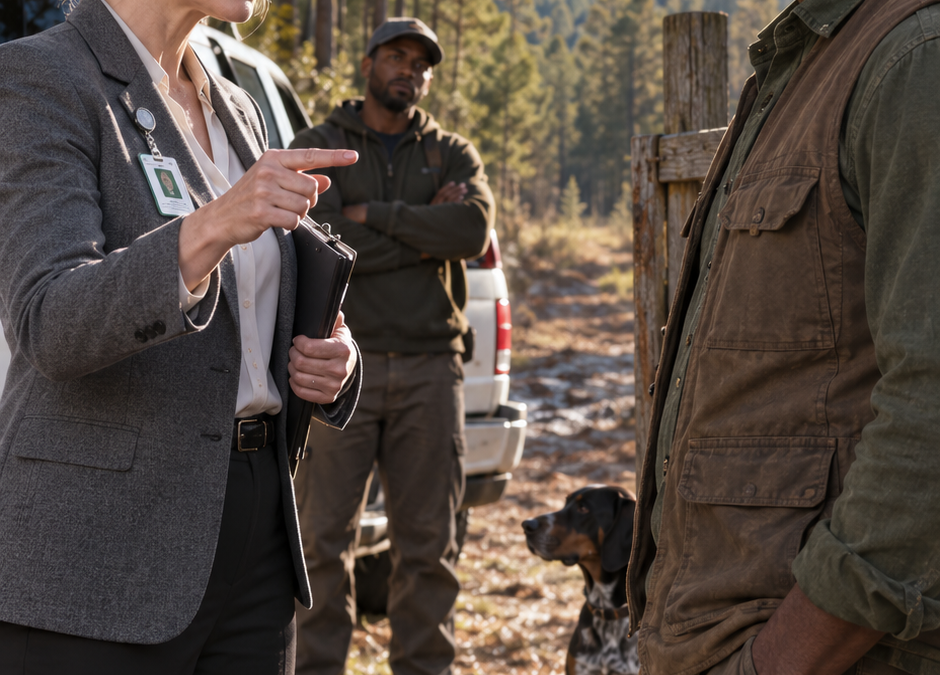
She stood beside the trailhead with a clipboard tucked under one arm.
Gray blazer.
Dark slacks.
Laminated HOA badge.
Everything about her looked organized.
Prepared.
Official.
“This is an HOA-governed community,” she continued, “and those trails fall under our jurisdiction. You have thirty days to remove the posted signs or we will pursue enforcement action.”
I looked at the signs.
PRIVATE PROPERTY
SEASONAL ACCESS RESTRICTION
NO ENTRY WITHOUT PERMISSION
I had installed them the previous spring because I was changing how hunting leases operated on the eastern section.
Nothing unusual.
Nothing dramatic.
It was timberland.
Wildlife management changed from year to year.
Some areas opened.
Some closed.
That was my decision because the ground belonged to me.
Sandra leaned slightly forward.
“Do you understand?”
“I understand what you’re saying.”
“That isn’t the same as agreeing.”
“No.”
She seemed to expect more.
I gave her nothing.
Behind us, the pine forest climbed toward a low ridge.
Longleaf in the better-drained sections.
Loblolly along some of the lower ground.
Mixed hardwood near the creek.
Old logging roads disappeared beneath brown needle duff.
The morning frost had just lifted.
Cold clay and pine resin hung in the air.
A red-tailed hawk crossed the ridge.
I looked back at Sandra.
“Anything else?”
“The board would prefer not to escalate.”
“I’m sure.”
“We’ve used these trails for decades.”
“That doesn’t answer who owns them.”
Her expression changed.
Only slightly.
“The trails are designated recreational corridors.”
“Where?”
“In the Ridgecrest Pines community plan.”
“Recorded where?”
She tightened her grip on the clipboard.
“I can send you the applicable provisions.”
“Do that.”
Sandra handed me a business card.
Sandra Voss
Board President
Ridgecrest Pines Homeowners Association
Then she returned to the SUV.
I watched it disappear down the access road.
I did not argue.
I did not call after her.
I did not photograph her license plate.
I went home.
Made coffee.
Opened the fireproof box in my study.
Then I pulled the deed.
The Pruitt tract had been assembled over three generations.
My grandfather started it.
Elias Pruitt was not a man who talked much about legacy.
He would probably have disliked the word.
He understood timber.
Money.
Weather.
Work.
Those were things he trusted.
In 1941, after eleven years of contract logging, he bought eight hundred acres from the Harlan County Timber Cooperative.
Every dollar he had saved went into the purchase.
People asked why.
Timber prices were uncertain.
The country was changing.
War overseas was already reshaping markets.
Elias answered the same way every time.
“If I own the trees, I decide when they come down.”
That was his philosophy.
Control the ground.
Do not spend your life working somebody else’s rotation.
He cut his first stand in the winter of 1943.
Two hired men.
Crosscut saws.
A mule named Cora.
The part people usually forget is that he replanted.
My grandfather believed a timberman who harvested without planning the next forest was merely a man selling trees.
He kept handwritten notebooks.
I still have them.
Composition books filled with pencil.
Dates.
Species.
Board feet.
Weather.
Crew names.
Planting rates.
Mortality estimates.
Firebreak maintenance.
Some pages carry sap stains.
Others have water marks.
They are not beautiful.
They are useful.
That was Elias.
My father, Robert, expanded the property.
In 1969, he bought six hundred acres from the Alderman family after the old patriarch died and none of his children wanted to continue farming.
Then came the transaction that eventually mattered most.
In 1984, a developer purchased eight hundred acres along our eastern ridge with plans for a recreational community.
Cabins.
Trails.
Maybe a small lodge.
The financing failed.
Quickly.
Dad bought the entire eight hundred-acre tract at a price that had more to do with the developer’s desperation than the value of the trees.
That brought the Pruitt property to 2,200 acres.
Eight hundred.
Plus six hundred.
Plus another eight hundred.
Twenty-two hundred acres of managed forest.
By the time my father died and the land passed through probate to me in 2003, the title was clean.
Fourteen months of probate.
No competing claims.
No mortgages.
No conservation restriction.
No easements affecting the trail network Sandra was now claiming.
I had worked that land since I was twelve.
I knew every ridge.
Every creek crossing.
Every stand Elias had deliberately left untouched.
There were trees he refused to harvest because, as he once told me, “Some things deserve to finish growing.”
I thought that was foolish when I was sixteen.
I understand it now.
The Pruitt tract was not a recreational estate.
It was a working forest.
Timber rotations.
Wildlife management.
Hunting leases.
Road maintenance.
Controlled access.
Fire planning.
Taxes.
Records.
The land produced income, but only if managed carefully enough that it could continue producing after I was gone.
For eighteen years after my father’s death, nobody questioned any of that.
Ridgecrest Pines existed beside us.
Not inside us.
The development had begun in the late 1990s on about 340 acres southwest of my eastern timber.
The property had once been part of a failed equestrian resort.
Developer Gareth Fossie acquired it.
Forty-seven residential lots.
A few common areas.
Roads.
Utility corridors.
Then an HOA.
The Ridgecrest Pines Homeowners Association was incorporated in 2001.
Its recorded covenants covered those 340 acres.
Nothing else.
That boundary appeared in the subdivision plat.
In the CC&Rs.
In the deed restrictions attached to the individual lots.
It was not complicated.
But there was one connection between Ridgecrest Pines and the Pruitt forest.
A recreational license.
That was where the later confusion began.
In 2001, Gareth Fossie approached my father about allowing Ridgecrest Pines residents to use several existing trails across the eastern portion of our land.
Dad agreed.
Not forever.
Not as an easement.
Not as a transfer of rights.
A license.
Five years.
Roughly 180 acres of creek bottom and mixed pine were included in the mapped trail network.
The agreement required an annual payment.
Renewal required written consent from both parties.
Most importantly, Section Three said exactly what the license did not do.
It conveyed no property interest.
Created no easement.
Granted no ownership.
The privilege expired automatically if not renewed according to its terms.
Dad renewed the arrangement twice before his death.
After the property came to me, I did not renew it again.
No formal renewal request ever arrived.
No written agreement.
No payment.
No extension.
The license expired.
I did not immediately close the trails.
There was no reason to.
People had used them respectfully.
Neighbors hiked.
Some Ridgecrest residents hunted under arrangements I knew about.
I tolerated the use.
That tolerance was later transformed, in Sandra’s mind, into ownership.
But permission and ownership are not the same thing.
They never have been.
Three days after Sandra confronted me at the trailhead, the first certified letter arrived.
I signed for it.
Carried it inside.
Opened it at the kitchen table.
Article Six.
Section Four.
Recreational amenities and community access corridors.
According to the letter, my signs constituted an unauthorized restriction of access to established HOA trails.
Fine:
$375.
Administrative processing fee:
$85.
I read it twice.
Then put it beside my deed.
The contrast was almost funny.
One document had been created by people with authority over 340 acres.
The other established my ownership of 2,200.
Sandra’s letter acted as though the first document had somehow swallowed the second.
I opened a manila folder.
Wrote the date.
Put the notice inside.
Twelve days later, the second letter arrived.
Sharper language.
Threat of injunctive relief.
Then a new claim.
The trails, Sandra wrote, had been incorporated into the recorded Ridgecrest Pines plat as a:
DESIGNATED COMMUNITY GREENWAY.
Specific claims are useful.
Specific claims can be checked.
That evening, I opened the Harlan County GIS portal.
Pulled the subdivision plat.
Forty-seven lots.
Two common parcels totaling approximately twelve acres.
Stormwater easement.
Utility corridor.
Road right-of-way.
No greenway extending into my forest.
No hunting corridor.
No recreational easement.
No trail right.
The northern boundary of Ridgecrest Pines stopped exactly where the Pruitt tract began.
There was no overlap.
I printed the plat.
Put it in the folder.
Then wrote one word on the inside cover.
PROCEED.
That Monday, I called Ruth Callahan.
Ruth practiced property law in Knoxville.
Three timber operators I trusted had used her on boundary cases.
They all described her the same way.
Slow.
Until you saw what she was doing.
Then you realized she wasn’t slow at all.
She simply refused to leave holes.
I drove to her office with the folder.
Deed.
HOA letters.
Subdivision plat.
And the original 2001 recreational license agreement.
Ruth read everything.
No commentary.
No dramatic reaction.
She pulled county records on her computer while I drank coffee bad enough to qualify as punishment.
After forty minutes, she leaned back.
“They don’t have a recorded interest in your land.”
“I agree.”
“The license expired.”
“Yes.”
“Their plat doesn’t support the greenway claim.”
“That’s what I found.”
“And they have no recorded easement.”
“No.”
Ruth removed her glasses.
“The interesting question is why they think otherwise.”
I nodded.
“That’s what I want to know.”
She picked up a legal pad.
Wrote:
CHAIN OF TITLE.
Then:
QUIET TITLE.
She looked at me.
“How patient are you?”
“I manage pine.”
That produced the smallest smile.
“Good.”
Ruth ordered everything.
Full chain of title for the Pruitt tract.
Original patent.
My grandfather’s purchase.
My father’s 1969 acquisition.
1984 acquisition.
Probate transfer.
Every easement.
Every recorded encumbrance.
Then she ordered the full Ridgecrest Pines instrument history.
Original plat.
Amendments.
Common-area declarations.
Deeds.
Easements.
Dedications.
Anything filed since the development began.
The search cost $420.
It took eleven business days.
While Ruth worked the documents, I hired Denton Marsh.
Denton was a licensed surveyor I had known for twenty years.
He carried field notes in composition notebooks, just like Elias had.
Practical reason.
Those notebooks survive weather.
We spent two days walking the northern boundary.
October had deepened by then.
Pine needles drifted across the ground.
We found the 1984 iron pins.
Checked cap numbers.
Verified bearings.
Located witness trees.
Compared measurements against the recorded legal description.
Denton said little.
That was one of his better qualities.
At the northeastern corner, he crouched beside an iron monument.
Checked his notes.
Then looked down the trail.
“That trail runs on your side for almost a quarter mile before it gets anywhere near the subdivision line.”
“That’s what I thought.”
He pointed.
“No easement monument.”
“No.”
“No dedication markers.”
“No.”
He stood.
“Somebody has been using a private trail and calling it a greenway.”
“That appears to be the situation.”
Denton closed the notebook.
That was all.
His job was not to win my argument.
His job was to measure.
Measurements are most useful when they do not care who paid for them.
The title search came back Thursday.
Ruth asked me to come to Knoxville Friday morning.
She would not explain by phone.
That told me she had found something.
When I arrived, documents covered her conference table.
She started with my title.
Clean.
1941 purchase.
1969 acquisition.
1984 acquisition.
2003 probate deed.
No unexplained break.
No easement granting Ridgecrest Pines anything.
No transfer of any part of the trail corridor.
Then she pushed another document toward me.
“Now look at this.”
Plat revision.
I recognized the Ridgecrest Pines subdivision.
But the northern common-area boundary looked wrong.
Common Area Parcel B had originally been 4.2 acres.
The revision extended it northward.
Into my land.
I read the surveyor’s note.
“To the natural boundary of the existing trail corridor as established by community use.”
I stopped.
Read it again.
“Who signed this?”
“HOA president at the time. Dale Whitfield.”
“Where’s the deed?”
“There isn’t one.”
“Easement?”
“No.”
“Signature from my father?”
“No.”
“From me?”
“No.”
Ruth leaned back.
“They filed a plat revision moving their common-area line onto property they did not own.”
I kept staring at the page.
“How?”
“Someone told a surveyor where they wanted the line.”
“That doesn’t transfer title.”
“No.”
“That doesn’t create an easement.”
“No.”
“It doesn’t do anything.”
“Not to your ownership.”
The document had been sitting in the public record since 2009.
Fifteen years.
That was Sandra’s greenway.
Not an easement.
Not a deed.
A unilateral line drawn beyond the HOA’s property.
“They’ve been relying on this?”
“Almost certainly.”
“Is it valid?”
“As against your title?”
Ruth shook her head.
“No.”
She pointed at the title chain.
“A plat can describe property owned by the party filing it. It cannot convey your property to them merely by drawing a different line.”
The clarity of that moment did not produce anger.
It produced stillness.
The problem had a shape now.
Ridgecrest Pines had not discovered some forgotten right.
They had built fifteen years of belief around a document that lacked the legal instrument necessary to make the belief true.
“What do you recommend?”
“Quiet title.”
“Do it.”
Ruth nodded.
“We’ll ask the court to declare the 2009 revision void as to the Pruitt tract and confirm title to the trail corridor in you.”
She also planned to attach Denton’s survey.
The title chain.
The expired 2001 license.
Everything.
I drove home that afternoon.
Late October light came through the pines at an angle.
The eastern trail looked exactly as it had before Ruth showed me the 2009 document.
That struck me.
Paper can create enormous confusion without changing the ground at all.
The ridge remained where it had always been.
Creek still flowed downhill.
Boundary monuments remained in place.
Nobody moved a tree.
Someone simply drew a line.
Then enough years passed that people began treating the line as truth.
I walked the trail until dark.
Not because I needed more evidence.
Because the forest reminded me what the dispute was actually about.
The trees did not care about Sandra.
They did not care about the HOA.
They did not care about my frustration.
Timber management requires a much longer perspective.
The loblolly stand along that ridge would outlast the lawsuit.
Some of the older longleaf might outlast me.
That makes arguments feel smaller.
The quiet-title petition was filed November 14 in Harlan County Circuit Court.
Ruth named Ridgecrest Pines HOA as respondent.
She asked for a declaration confirming my title.
An order declaring the 2009 plat revision void as to my property.
Removal of any asserted HOA interest.
And relief under applicable property-rights law if the association continued to assert claims without legal basis.
The HOA was served through its registered agent.
Eleven days later, the green return card came back.
Then we waited.
Their first legal response came from Philip Garrett.
Attorney.
Professional letter.
Measured language.
He asserted longstanding community use.
Defended the recorded 2009 revision.
Claimed the quiet-title petition lacked merit.
Then requested sixty additional days.
Ruth gave him thirty.
“Why not sixty?” I asked.
“Because the documents already exist.”
She was right.
There was no excavation to conduct.
No missing witness from fifty years earlier.
No mystery.
Either a conveyance existed or it did not.
Either an easement existed or it did not.
Either I signed away rights or I did not.
Time would not manufacture the missing instrument.
Philip Garrett apparently discovered that himself.
Six weeks after his first letter, he called Ruth.
Requested a meeting.
No motion.
No hearing.
A meeting.
At Ruth’s office.
She agreed on the condition that I attend.
Mid-January.
Cold gray morning.
Garrett arrived alone.
Sandra was absent.
That told me enough before he sat down.
He carried a worn leather portfolio.
After handshakes, he opened it.
Three documents.
Chain of title.
Denton’s survey.
2009 plat revision.
Yellow highlighter across several passages.
He had read everything.
Garrett looked at me.
“Mr. Pruitt, I want to be straightforward.”
“Go ahead.”
“I have reviewed the complete instrument history.”
I waited.
“I don’t have a title argument.”
Ruth did not react.
Neither did I.
Garrett continued.
“There is no deed conveying the trail corridor.”
Correct.
“No easement.”
Correct.
“The 2001 license expired by its own terms.”
Correct again.
“And I have found no executed renewal.”
He folded his hands.
“My client has been operating under a belief about the property that the record does not support.”
That was the first completely accurate sentence Ridgecrest Pines had directed at me since the dispute began.
“I appreciate you saying it clearly,” I said.
He nodded.
“I’ve advised the board not to contest the quiet-title petition.”
Ruth opened her legal pad.
“What is your authority today?”
“Discuss a consent order.”
The negotiation lasted less than two hours.
The HOA would consent to judgment.
My ownership of the entire trail corridor would be confirmed.
The 2009 plat revision would be declared void as it affected the Pruitt tract.
The Register of Deeds would annotate the instrument so no future buyer, board member, lender, surveyor, or title examiner could mistake it for a valid claim against my land.
Every HOA compliance demand would be withdrawn.
Every fine canceled.
The association would acknowledge in writing that the hunting and hiking trails lay outside Ridgecrest Pines.
They would pay Ruth’s fees through entry of the order.
$4,840.
They would also pay the recording costs.
In return, I would not pursue additional statutory claims for damages arising from their assertion of a property interest.
I agreed.
Not because I feared going forward.
Because once the record was corrected, I had what I wanted.
This was never about punishing forty-seven homeowners.
Most had simply used trails they thought they were allowed to use.
My dispute was with the claim that use had become ownership.
The consent order was signed.
The court entered it January 22.
Eleven days later, the county recorded the annotation against the 2009 revision.
I went to the courthouse and obtained a certified copy.
The notation was exactly as Ruth had requested.
Judicially voided as to the Pruitt tract.
Instrument of no legal effect as to adjoining landowner.
I read that line twice.
Then put the certified copy in the fireproof box beside the deed and the expired 2001 license.
That should have been enough.
For me, it was.
For the HOA, the consequences continued.
Sandra Voss resigned the following month.
I learned that from Harlan Teague.
Harlan owned forty acres south of the county road.
Saturday mornings, he occasionally appeared at my gate with coffee and information.
Nobody had appointed him to know everything.
He simply did.
“Voss resigned.”
“When?”
“Thursday.”
“Board?”
“Yep.”
I nodded.
“Two more aren’t running again.”
“That right?”
“Management company is getting replaced too.”
“Busy month.”
Harlan drank coffee.
“New president is supposed to be Frank Amos.”
“I know the name.”
“Retired civil engineer.”
“That might help.”
“Already ordered an audit of HOA property records.”
I looked at him.
“He should start with the deed index.”
Harlan smiled.
“I imagine someone told him.”
He poured the last coffee from his cup onto the grass.
Then drove away.
I walked the northern boundary that afternoon.
The creek carried thin sheets of ice along the edges.
Pines stood dark against a pale sky.
My signs remained where I had placed them.
PRIVATE PROPERTY.
SEASONAL ACCESS RESTRICTION.
Their meaning had never changed.
Only the HOA’s willingness to recognize it had.
For a while, I considered closing the trails permanently.
I had every right to.
But anger is a poor land-management policy.
The mistake belonged primarily to leadership and old records.
Not to every family in Ridgecrest Pines.
So I kept certain trails available outside restricted hunting periods.
But I changed the rules.
Permission had to be explicit.
No more assumptions.
Ridgecrest residents wanting seasonal access could obtain a written permit.
No fee initially.
Just documentation.
Name.
Date.
Allowed trails.
Expiration.
The arrangement made some people laugh.
“Paper for hiking?”
Yes.
Because I had just spent months learning what happens when permission is left undocumented long enough for somebody to rename it ownership.
Frank Amos called me in March.
The new board president.
“Mr. Pruitt?”
“Calvin.”
“Frank Amos.”
“I know.”
“I wanted to ask whether we could meet.”
“For what?”
“Trail access.”
I almost laughed.
Not because the question was unreasonable.
Because someone had finally asked it correctly.
Frank came to the house the next week.
No clipboard.
No badge.
He brought a binder.
Inside it were the HOA documents.
Properly tabbed.
He placed them on the table.
“I’ve read the consent order.”
“Good.”
“I’ve read the 2001 license.”
“Good.”
“I’ve also read the 2009 revision.”
“That one worth reading?”
He grimaced.
“Educational.”
I poured coffee.
Frank said:
“I want to start by acknowledging something clearly. Ridgecrest Pines does not own your trails.”
That alone made him the easiest HOA officer I had dealt with.
He continued.
“We also have no easement.”
“Correct.”
“And the old license is gone.”
“Yes.”
“Would you consider a new arrangement?”
“Possibly.”
He did not say community right.
Did not say established practice.
Did not call the trails a greenway.
He asked.
That difference mattered.
We spent two hours discussing wildlife seasons.
Liability.
Trail maintenance.
Hunting safety.
Fire conditions.
Number of users.
Motor vehicles.
I explained why some trails needed closure during turkey season and certain timber operations.
Frank listened.
At one point, he said:
“I think the old board treated access as something permanent because people had forgotten there was ever an agreement.”
“They forgot the agreement because nobody bothered to renew it.”
“Yes.”
“And then the 2009 plat gave them something official-looking.”
“Yes.”
“Official-looking is expensive.”
Frank laughed.
“That lesson cost us nearly five thousand dollars.”
“Could’ve cost more.”
“I know.”
Eventually Ruth drafted a new limited recreational license.
Three years.
Renewable only in writing.
Specific trail map.
Specific seasons.
HOA responsible for informing residents that access was permissive.
No easement.
No title interest.
No ownership.
No right to modify boundaries.
No hunting access during periods I closed for wildlife management or active timber operations.
Insurance requirements.
Indemnity.
Everything the old agreement should have taught them to remember.
Frank took the draft back to his board.
They approved it unanimously.
He signed.
I signed.
Ruth kept a copy.
I put mine in the fireproof box.
That was how the relationship should have worked from the beginning.
One landowner.
One neighboring association.
A limited agreement.
Clear terms.
No confusion.
The forest did not become less private because I allowed people to enjoy part of it.
Permission is not weakness.
It becomes dangerous only when nobody remembers it is permission.
That summer, I encountered a Ridgecrest resident on one of the trails.
Older man.
Orange cap.
Binoculars.
He stopped when he saw me.
“Mr. Pruitt?”
“That depends.”
He smiled.
“I’m David Mercer. Lot Thirty-One.”
“All right.”
He pulled a folded permit from his jacket.
“Frank told us to keep these with us.”
I glanced at it.
Correct date.
Correct trail.
Everything fine.
“You’re good.”
He started to walk away.
Then turned.
“Can I ask something?”
“Sure.”
“Did the HOA really try to claim all this?”
He gestured toward the forest.
“Not all twenty-two hundred acres.”
“That’s reassuring.”
“Just enough.”
He laughed.
Then became serious.
“I’m sorry.”
“You didn’t file the plat.”
“No.”
“But I used these trails for years. Never asked.”
“You were probably told they were community trails.”
“I was.”
“Then that’s what you believed.”
He looked toward the trees.
“I guess people stop asking questions about things they’ve always done.”
“That was the whole problem.”
David nodded.
Then continued down the trail.
I watched him disappear between the pines.
There was no satisfaction in blaming him.
He had bought a house.
Received community maps.
Used amenities he thought were included.
The people who should have checked were the ones asserting the legal right.
That distinction mattered.
The following autumn, I sat with my grandfather’s old notebooks.
I had not opened them in months.
One entry from November 1947 described a harvest on the western slope.
Weather: hard frost.
Crew: Elias, Tom Kelly, Frank Moss.
Board feet.
Number of seedlings planted.
Then one sentence at the bottom.
Leave creek timber.
No dollar sign.
No explanation.
He simply knew the riparian section should remain.
Decades later, that decision had become some of the oldest timber on the property.
My grandfather had managed for people he would never meet.
That is what ownership means to me.
Not dominance.
Responsibility across time.
You receive land shaped by decisions made before you.
Then you make decisions somebody else will inherit.
The 2009 Ridgecrest plat revision was the opposite kind of decision.
Someone changed a line for immediate convenience.
No deed.
No consent.
Maybe they assumed nobody would object.
Maybe they thought continued trail use made the change harmless.
Then fifteen years passed.
The original actors moved on.
And the defective line became institutional memory.
That is how mistakes harden.
Not because anybody proves them.
Because nobody questions them.
One of the lessons I took from the case was that recorded does not automatically mean valid.
That surprised some people.
“But it was filed with the county,” Harlan Teague said one morning.
“So?”
“Doesn’t the county check it?”
“Not the way people think.”
A recorder records instruments that meet filing requirements.
The existence of a stamped document does not mean every assertion inside it has been judicially tested.
A person can file something incorrect.
The stamp proves it was filed.
Not that it magically acquired power to transfer another owner’s land.
That distinction is why title work exists.
Why surveyors exist.
Why courts exist.
Why Ruth insisted on pulling the entire chain before sending one serious response.
The chain told the story.
My ownership never broke.
Nobody conveyed the trail corridor.
The old license expressly denied creating an easement.
It expired.
A later plat drawing could not supply what a conveyance never created.
Once Garrett understood that, he did what a competent lawyer should do.
He told his client.
I respected him for that.
Some lawyers would have fought because fighting was available.
Garrett stopped because the record did not support it.
Months after the consent judgment, I saw him at the county courthouse.
He recognized me.
“Mr. Pruitt.”
“Mr. Garrett.”
We shook hands.
“How’s the forest?”
“Still there.”
He smiled.
“I assumed.”
I said, “I appreciated how you handled the case after you reviewed everything.”
He nodded.
“I wish I had reviewed it before my first letter.”
“So do I.”
He laughed.
“Fair.”
Then he said something interesting.
“Your case is being used as an example with another HOA client.”
“For what?”
“Don’t rely on internal maps to establish external property rights.”
“That seems obvious.”
“It becomes obvious after you pay another owner’s attorney.”
There it was.
Institutions learn the same way people do.
Sometimes explanation is enough.
Sometimes a bill helps.
The $4,840 was not a fortune.
It was not supposed to be.
It represented the cost of forcing somebody else to defend a title the association should have checked before threatening enforcement.
That was sufficient.
I never wanted Ridgecrest Pines bankrupted.
Never wanted homeowners assessed thousands of dollars each.
Never wanted revenge.
I wanted the county record corrected.
It was.
The 2009 revision now carries a permanent annotation.
Anyone searching it will see the court order.
Any future board president trying to revive the greenway theory will find the answer before sending a letter.
That might be the most valuable part of the judgment.
It doesn’t merely settle my dispute.
It makes the same dispute harder to recreate.
A good property resolution should do that.
Years passed.
Timber grew.
Several stands reached thinning age.
I harvested one section near the southern ridge.
Replanted loblolly.
Improved firebreaks.
Rebuilt a creek crossing.
The work continued.
Ridgecrest Pines changed too.
Homes sold.
New families arrived.
Frank eventually left the board.
The next president renewed the recreational license properly.
Written request.
Thirty days before expiration.
Exactly as required.
I signed another three-year term.
No argument.
That is what good documentation does.
It reduces drama.
One spring morning, I walked with Denton Marsh along the disputed trail.
He was doing unrelated survey work nearby.
We stopped at the old 1984 pin.
Still there.
He scraped away pine needles with his boot.
“Remember this one?”
“I remember spending two days following you around looking for these.”
“You didn’t follow. You complained.”
“I was paying you.”
“That doesn’t make it less complaining.”
I laughed.
He looked down the trail.
“What ever happened with the HOA?”
“Consent judgment.”
“Figured.”
“They paid fees.”
“Good.”
“New access agreement now.”
Denton nodded.
“Even better.”
He tapped the iron pin with his boot.
“Funny thing.”
“What?”
“This never moved.”
“No.”
“All that trouble over a line that stayed right here.”
That was the entire story in one sentence.
The line never moved.
The paper did.
Or more accurately, one document pretended the line had moved.
Then people behaved accordingly until somebody checked the monument, checked the deed, checked the title chain, and forced the record back into agreement with the ground.
Surveyors understand that instinctively.
Courts do too.
At least good ones.
The forest itself is indifferent.
Trees grow across legal boundaries unless humans stop them.
Deer cross them.
Turkeys cross them.
Creeks cross them.
Property lines exist because people need an agreed framework for deciding responsibility.
That framework only works if we respect the instruments that create those lines.
A clipboard does not.
An HOA vote does not.
Years of assumption do not.
A color-coded map does not.
A legal right requires a legal foundation.
That sounds simple.
It is simple.
The hard part is slowing down enough to find it.
When Sandra first approached me, I could have responded emotionally.
“You don’t own this.”
“Get off my land.”
“My family was here first.”
All true in different ways.
None as useful as the record.
Instead, I let her send letters.
Specific claims.
Specific references.
Designated greenway.
Recorded plat.
Those claims led us directly to the document she had misunderstood.
The 2009 revision.
Then the revision led us to the missing conveyance.
The missing conveyance led to quiet title.
A claim that became more specific became easier to disprove.
That is why I never feared her letters.
I saved them.
A bad claim in writing is often more useful than a bad claim spoken at a trailhead.
I still have the first one.
Article Six.
Section Four.
$375.
Administrative fee $85.
Thirty days.
It sits in the same folder as the court order.
Sometimes I place the two beside each other.
The first says the HOA had authority.
The second says it did not.
Only one was written after somebody checked the entire chain of title.
That difference matters.
The story also changed how I document my own arrangements.
Handshakes still matter personally.
I trust neighbors.
But land outlives handshakes.
If I let someone maintain a hunting blind for multiple seasons, I write the permission.
If a neighboring landowner uses one of my logging roads for equipment, we document that use as permissive.
If I allow trail access, the permission has a beginning and an end.
Not because I distrust everyone.
Because I respect the people who will inherit the situation.
Clear records are a kindness to people not yet in the argument.
My father understood that better than I did.
The 2001 recreational license could have been informal.
Gareth Fossie probably would have accepted a handshake.
Dad insisted on paper.
Because of that, twenty years later, Ruth could open Section Three and show exactly what everyone had agreed.
Personal privilege only.
No easement.
No property interest.
Automatic expiration absent written renewal.
Four pages written two decades before the dispute became one of the strongest pieces of evidence in the case.
The document was not aggressive.
It was clear.
Clarity aged well.
The 2009 plat did not.
There is a difference between documents that record agreement and documents that manufacture one.
Courts recognize it.
So do title examiners.
One winter afternoon, I drove into Ridgecrest Pines to meet Frank about trail maintenance.
It was the first time I had spent much time inside the subdivision.
Nice homes.
Quiet roads.
Children’s bicycles near garages.
Firewood stacked neatly.
Nothing threatening.
Nothing inherently ridiculous about an HOA managing shared roads and common spaces.
In fact, those residents needed an association for certain things.
The problem had never been that the HOA existed.
The problem was that it confused the edge of its authority.
Inside the subdivision, its CC&Rs meant something.
Outside them, they were somebody else’s contract.
That distinction seems to disappear when boards become too comfortable with enforcement.
You send enough violation letters and eventually every problem begins to look like another violation.
But a neighboring landowner is not a noncompliant member.
He is a neighbor.
Different legal relationship.
Different tools.
Different conversation.
Frank understood that.
Sandra did not.
That difference was worth more than personality.
It was institutional discipline.
We walked a portion of the licensed trail together.
Frank stopped beside one of my signs.
“You planning to leave these?”
“Yes.”
“Some residents find them unfriendly.”
“They’re not supposed to be friendly.”
He looked at me.
“They’re supposed to be clear.”
He read it again.
PRIVATE PROPERTY.
SEASONAL ACCESS BY PERMISSION.
He nodded.
“Fair.”
I added:
“Your residents can still use the trail according to the license.”
“I know.”
“The sign is for everyone else too.”
“Understood.”
No argument.
That is what happened once everyone knew where authority stopped.
The relationship became easier.
Not harder.
Boundaries make good neighbors when both sides know them.
That phrase has been repeated so often that people stop hearing what it means.
It does not mean neighbors should build walls.
It means uncertainty creates conflict.
Clarity reduces it.
My boundary was clear in 1941.
Clear in 1969.
Clear in 1984.
Clear in 2003.
Clear when Ridgecrest Pines formed.
Clear when the 2001 license was signed.
And legally, it remained clear even after somebody filed the 2009 revision.
The dispute existed because institutional memory drifted away from the title record.
Our job was simply to bring the two back together.
That took lawyers.
Surveyors.
$420 worth of title work.
Months of correspondence.
A court petition.
$4,840 in legal fees paid by the HOA.
A lot of work for something that could have been prevented by opening the right file before Sandra got into her SUV.
That is the part people should remember.
Check before enforcing.
Years later, I took my nephew through the fireproof box.
He will probably inherit some role in the forest.
Maybe not all of it.
Families change.
Lives move.
But somebody needs to understand the records.
I showed him the deed.
The old license.
The 2009 revision.
The consent order.
He picked up the revision.
“So they just drew the line here?”
“Yes.”
“And thought that made it theirs?”
“Eventually.”
“How can someone do that?”
“Drawing is easy.”
He looked at the court order.
“This fixed it?”
“No.”
He frowned.
I pointed toward the deed.
“This was already correct.”
Then I tapped the judgment.
“This made everybody acknowledge it.”
That distinction matters.
Courts do not always create rights.
Often they declare what rights already existed.
My forest did not become mine on January 22.
It was mine before the petition.
Before Sandra.
Before Ridgecrest Pines.
The judgment simply removed the false cloud.
My nephew asked:
“What if you hadn’t fought?”
I thought about it.
The answer was uncomfortable.
The 2009 revision would have remained.
The HOA might have continued treating the corridor as common property.
Future buyers might have relied on that assumption.
More documents might have repeated it.
Twenty more years could have passed.
Then somebody inheriting from me would face a much messier dispute.
Records do not correct themselves.
That is one reason I acted.
Not because Sandra’s $375 fine mattered.
Because the underlying claim could outlive both of us.
You do not ignore a bad property record simply because you know it is wrong.
You correct it while witnesses are available and documents are accessible.
That is stewardship too.
Elias managed trees for the next generation.
I had to manage title for the same reason.
This morning, I walked the eastern trail again.
October.
Almost exactly the season when Sandra first came.
Pine resin.
Cold clay.
Frost disappearing under sunlight.
Somewhere above me, a hawk moved through the trees.
I stopped at the sign.
The replacement is newer now.
The first one weathered enough that I eventually changed it.
Same message.
PRIVATE PROPERTY.
AUTHORIZED ACCESS ONLY.
Below that, a smaller placard explains:
RIDGECREST PINES RESIDENT ACCESS SUBJECT TO CURRENT LICENSE TERMS.
That is the whole relationship in two signs.
Ownership.
Permission.
Clear.
I followed the trail north.
Past the creek.
Past the old loblolly stand.
Past the 1984 monument Denton verified.
Nothing about the forest tells you where Ridgecrest Pines ends and the Pruitt tract begins.
Nature does not draw a bright line.
That is why surveys exist.
That is why deeds exist.
That is why records exist.
Humans need the line even when the trees do not.
I reached a ridge my grandfather used to take me to.
He once told me that pines hold evening light longer than the open sky.
I thought he was inventing poetry.
He was usually not a poetic man.
Then I got older.
Started noticing it.
Toward sunset, trunks and needles catch amber even when the spaces between them have already gone gray.
The forest seems to keep part of the day after everything else releases it.
I understand why Elias noticed.
A man who spends a lifetime watching trees begins measuring time differently.
Thirty years is not particularly long in timber.
Fifteen years is certainly not long enough to turn somebody else’s land into yours simply because nobody told you to stop walking across it.
That was always the flaw in Sandra’s thinking.
Time matters.
But time does not work alone.
Legal elements matter.
Documents matter.
Intent matters.
Permission matters.
A right is not created merely because an activity becomes familiar.
The residents of Ridgecrest Pines had a history of using my trails.
That history was real.
Their ownership claim was not.
Both statements can be true.
Once everyone accepted that, we could build a lawful arrangement preserving the useful part without inventing the rest.
That is how the story really ended.
Not with Ridgecrest residents banned from the forest.
Not with me fencing every trail.
Not with an HOA destroyed.
With a corrected plat record.
A quiet-title judgment.
A new written license.
Better documentation.
And one permanent county annotation warning future people that a line drawn in 2009 had no legal effect on Pruitt land.
That outcome satisfied me more than revenge ever could.
The forest kept working.
The neighbors kept walking.
My hunting restrictions remained enforceable.
The HOA stayed on its side of the boundary.
Everybody knew why.
The fireproof box is heavier now.
Elias’s notebooks are still in the cedar chest.
My father’s old license agreement still carries his signature.
Ruth’s consent order sits behind it.
Sometimes I wonder what my grandfather would think about an HOA president telling me she controlled his hunting trails.
He probably would not understand what an HOA was.
Then I would explain.
He would listen.
Probably look at the deed.
Then ask the obvious question.
“Where did you sign?”
I would say:
“I didn’t.”
He would shrug.
Conversation over.
In a way, every page of litigation was simply a longer version of that question.
Where is the instrument?
Where is the deed?
Where is the easement?
Where is the renewal?
Where is my signature?
Ridgecrest Pines had answers for everything except those.
They had maps.
Bylaws.
Community history.
Long use.
A filed plat revision.
Board votes.
Certified letters.
What they lacked was the document that mattered.
A lawful conveyance.
There wasn’t one.
So the line stayed where it had always been.
The trails stayed mine.
And the association that once gave me thirty days to remove my own signs eventually signed a court order admitting that its “community greenway” had never belonged to the community at all.
That is the thing about land.
People can rename it.
Map it incorrectly.
Use it.
Build assumptions around it.
Even record documents that appear official.
But when the claim is finally tested, the question becomes much simpler.
Who holds title?
In my case, the same family that had been holding it since Elias Pruitt put eleven years of logging wages into eight hundred acres in 1941.
The forest had not forgotten.
Neither had the deed.
We simply had to make everyone else read it.








