𝗣𝗔𝗥𝗧 𝟮 HOA Claimed Grazing Rights Over My 3,100-Acre Oak Forest—Then Their Own Records Destroyed the Case
𝗣𝗔𝗥𝗧 𝟮
Diane’s letter became Exhibit One, though I did not know yet that I would eventually think of it that way.
Then I called Ruth Callaway.
Ruth had practiced property law in Harland County for thirty-one years.
She had handled my closing.
If an easement burdened Thornfield Hollow, Ruth should have found it during the title examination.
Her office occupied two rooms above the hardware store on Main Street.
Files filled shelves from floor to ceiling.
Blue binders.
Green binders.
Red binders.
Nothing decorative except an old county map framed behind her desk.
She read Diane’s letter without speaking.
Page one.
Page two.
Three.
Four.
Then she removed her glasses.
“There is no grazing easement in your title.”
“I know.”
“No, Caleb. I mean there is no grazing easement. Period. We ran the chain before you closed.”
She tapped Diane’s attached covenant.
“And this doesn’t create one.”
“So what is she talking about?”
“That is what I would like to know.”
Ruth wrote one word on her yellow legal pad.
BASELESS.
Then she circled it.
“We need to pull every instrument associated with Thornfield Hollow.”
“How far back?”
“As far as the chain takes us.”
“Do it.”
She looked at me.
“This could take a while.”
“The trees aren’t going anywhere.”
That finally made her smile.
The search took longer than either of us expected.
The clerk’s office had digitized modern records, but many older instruments still existed only in physical books.
Ruth brought in Gerald Fitch, a retired county surveyor and title researcher.
Gerald was seventy-one.
He moved slowly.
He spoke less than almost anybody I had ever met.
But if you gave him an old deed description, he could usually tell you which archive shelf held the predecessor instrument before a clerk finished entering the reference into a computer.
Eighteen days later, Ruth called.
“We found something.”
I drove into town.
Gerald was sitting beside her desk with a cardboard box resting near his feet.
Documents covered the desktop in chronological order.
The oldest was an 1887 land patent establishing what had originally been a 4,200-acre Thornfield grant.
Over the following century, pieces had been sold.
Timber tracts.
Farm parcels.
Road strips.
The original property slowly fragmented.
In 1993, Harland Ridge Properties LLC bought roughly eight hundred acres along the western ridge.
That land became Thornfield Ridge.
In 1994, the developer recorded the community covenant Diane had sent me.
Then Gerald handed me another document.
DECLARATION OF EASEMENT.
I read the first page.
Harland Ridge Properties had declared a community access easement supposedly benefiting Thornfield Ridge homeowners.
The text referenced access to eastern pasture areas of Thornfield Hollow.
“So this is what she found.”
Ruth nodded.
“Almost certainly.”
For the first time, Diane’s position made sense.
Not correct.
But understandable.
A recorded document existed.
The problem was that recorded did not automatically mean valid.
Ruth turned to the legal description.
“Read the parcel number.”
I did.
Then she entered that number into the county GIS database.
A parcel lit up on the screen.
I leaned closer.
It was not in Thornfield Hollow.
It was twelve acres on the western ridge.
Inside what later became Thornfield Ridge.
The land was currently HOA green space containing a walking trail.
I looked from the map to the declaration.
“That’s not even close.”
“No.”
Gerald spoke from the corner.
“Drafting error.”
Those were the first words he had said in several minutes.
“The description doesn’t match what they apparently intended.”
He lifted one shoulder.
“But intent doesn’t move boundaries.”
Ruth nodded.
“The legal description controls.”
The easement Diane relied on described the wrong property.
It had never encumbered the eastern pastures.
That alone was potentially fatal.
Then Ruth showed me the second problem.
In 1998, when Harland Ridge Properties signed the easement declaration, its remaining interest in Thornfield Hollow was subject to a preexisting deed of trust held by a regional bank.
The debt dated back four years before the supposed easement.
The bank never joined in the declaration.
Never consented.
Never subordinated its lien.
Then, in 2003, the bank foreclosed on the hollow property.
Any junior interest that did not survive that foreclosure was extinguished.
Including, according to Ruth’s analysis, the 1998 easement declaration.
She folded her hands.
“So even if the description had identified the correct property…”
“It still died in the foreclosure.”
“Correct.”
“And it wasn’t in my title.”
“No.”
“It doesn’t exist.”
Ruth looked directly at me.
“As a valid easement against your property? No.”
I sat there for several seconds.
On Ruth’s desk lay more than a century of property history.
The 1887 patent.
Old conveyances.
The subdivision acquisition.
The 1994 covenant.
The 1998 easement.
The wrong parcel number.
The foreclosure documents.
Diane had driven forty minutes to my house and threatened enforcement based on one document.
Ruth and Gerald had read the whole chain.
That was the difference.
Ruth mailed our response Monday.
Four pages.
Almost exactly the length of Diane’s demand.
The letter formally rejected Thornfield Ridge’s claim.
It identified the problems with the 1998 declaration.
Wrong parcel.
Prior lien.
Foreclosure.
No easement appearing in my current title.
Ruth attached the relevant recording references and demanded that the association acknowledge in writing that it possessed no grazing or access rights over Thornfield Hollow.
She also demanded a recorded withdrawal of the HOA’s claim.
Deadline:
Thirty days.
I expected Diane to retreat.
I underestimated her.
Her response arrived eleven days later.
Not from Diane.
From a Lexington law firm.
Three attorneys’ names across the top.
Six pages.
And this time, the argument was better.
The firm did not rely exclusively on the 1998 document.
Instead, it argued that Thornfield Ridge residents had used the pastures openly for decades and had acquired a prescriptive easement through long-term use.
That mattered.
A recorded easement depends on paper.
A prescriptive easement can arise from conduct.
If people openly and adversely use another person’s property continuously for the legally required period, they may under certain circumstances establish a right even without a valid recorded grant.
I took the letter to Ruth.
She read it twice.
“This is their real argument now.”
“Can they win with it?”
“If the facts support them.”
That answer got my attention.
“What facts do they need?”
“Continuous, open, notorious, adverse, and uninterrupted use for the statutory period. No permission. No meaningful interruption.”
“How long?”
“Fifteen years under the theory they’re asserting.”
I leaned back.
“So now it isn’t about their paperwork.”
“Not entirely. Now it’s about what actually happened on the ground.”
That changed our investigation.
We needed history.
Not abstract history.
Specific history.
Who crossed the fence?
When?
How often?
With whose permission?
Did prior owners object?
Were gates locked?
Was access interrupted?
The following morning, I called Wendell Pace.
Wendell owned the narrow parcel north of mine.
He had farmed there thirty-eight years.
His father bought it in 1961.
If people had regularly driven cattle or horses through the eastern pasture, Wendell would probably remember.
“Thornfield Ridge people?” he said after I explained.
“Yeah.”
He went quiet.
“I remember some horse traffic years ago.”
“How much?”
“Not much. Couple families sometimes.”
“When?”
“Late nineties. Maybe into 2000.”
My grip tightened on the phone.
“Then what?”
“Developer locked the north opening.”
“What developer?”
“Harland Ridge.”
“You remember when?”
“About 2000.”
“You sure?”
“Pretty sure. They had trouble with people riding through. Somebody chained that gap and put a padlock on it.”
He paused.
“After that I don’t remember anybody coming through.”
“Would you put that in writing?”
“I suppose.”
“Only what you actually remember.”
“That’s all I ever put in writing.”
That was Wendell.
A week later, his signed statement arrived.
Meanwhile, Ruth hired a licensed surveyor named Patricia Odum.
Patricia had worked Harland County boundaries for twenty-two years.
She brought two crew members to Thornfield Hollow in December.
For three days they located monuments, ran boundary lines, photographed fence conditions, compared physical markers with the recorded description, and documented every accessible point along the subdivision side.
Her certified plat confirmed that no Thornfield Ridge parcel crossed my property line.
Not by feet.
Not by inches.
More important for the prescriptive claim, her notes documented an old chain and padlock at the north corner.
The cedar post had grown partially around the metal.
Nobody had installed that chain recently.
The rust ran deep.
Patricia photographed it.
She measured it.
She described it in her survey notes.
An old locked access point was not good evidence of uninterrupted community use.
Her survey was recorded December 22.
Our file grew thicker.
Then we found Carol Sims.
Carol had represented the estate of the Thornfield family’s last surviving heir.
She had managed property records before the tract passed through the sales that eventually led to me.
Ruth scheduled her deposition in January.
The Lexington firm sent an attorney.
A court reporter recorded every word.
Carol was precise.
Almost painfully so.
Ruth asked, “Did the former owners ever grant Thornfield Ridge homeowners permission to use the eastern pastures?”
“No.”
“Were you aware of homeowners entering those pastures?”
“Yes.”
“When?”
“In the late 1990s.”
“What did the owners do?”
Carol folded her hands.
“They told the developer it was unauthorized.”
Ruth glanced at me.
“Was anything done physically to prevent access?”
“The north gap was chained and padlocked.”
“Approximately when?”
“August 2000.”
The Lexington lawyer shifted in his chair.
Then Carol said something even better.
“I brought the correspondence.”
She opened a file.
Inside was a letter dated August 2000.
Addressed to Harland Ridge Properties LLC.
The letter stated plainly that horseback and livestock access through the north fence opening was unauthorized and would no longer be permitted.
Attached was the certified-mail receipt.
Signed.
Delivered.
I looked across the conference table at Ruth.
She did not smile.
Attorneys rarely smile when a document is doing something devastating.
But I knew her well enough to recognize the slight change in her eyes.
The HOA’s prescription theory required fifteen years of continuous, adverse, uninterrupted use.
Here was written proof that the owner had expressly objected in 2000.
Then locked the access.
Whatever prescriptive clock the HOA wanted to construct had been interrupted before it could reach fifteen years.
Ruth asked Carol one final question.
“After the gate was locked, did the association challenge the restriction?”
“Not that I ever saw.”
“Did they file suit?”
“No.”
“Demand access?”
“No.”
“Send a violation notice?”
Carol almost laughed.
“No.”
The deposition ended.
Outside, January rain fell against the courthouse windows.
Ruth packed the documents.
I said quietly, “That letter just killed their argument.”
She closed her binder.
“It did serious damage.”
“That’s attorney language.”
“Yes.”
“What’s normal language?”
She looked at me.
“They have a problem.”
Two weeks later, the transcript arrived.
On February 1, Ruth filed for summary judgment in Harland County Circuit Court.
The motion itself ran forty-one pages.
The exhibits added nearly ninety more.
Ruth organized everything by color.
Blue tabs:
Recorded instruments.
Green:
Surveys.
Yellow:
Correspondence.
Red:
Depositions and sworn statements.
The 1887 patent.
The chain of title.
The 1994 covenant.
The defective 1998 declaration.
The parcel map.
Foreclosure documents.
My deed.
Patricia Odum’s certified survey.
Wendell Pace’s affidavit.
Carol Sims’s deposition.
The August 2000 objection.
Certified-mail receipt.
Each document answered a different part of the HOA’s claim.
Together, they told one story.
No valid recorded easement ever burdened my property.
And the historical use was neither uninterrupted nor unopposed long enough to create one by prescription.
When Ruth handed me my copy, the binder was heavy.
I thought about my father.
The record, Caleb.
Not what somebody remembers.
Not what somebody claims.
The record.
The Lexington firm responded three weeks later.
Twenty-two pages.
Lots of case citations.
Arguments about intent.
Arguments about historical community expectations.
Arguments that the old objection should not defeat the claimed access rights.
What they did not produce was new evidence.
No fifteen-year period of documented uninterrupted use.
No later agreement.
No valid survey showing their easement crossing my tract.
No deed.
No grant.
Nothing.
The hearing was set for March.
As the date approached, I spent more time walking the forest.
Late winter was beginning to loosen its hold.
The oaks remained bare, but sunlight stayed longer in the hollow.
Water moved beneath thin sheets of ice along shaded creek bends.
One afternoon, I drove to the northern fence corner.
I got out.
The old chain was still there.
The cedar had grown around one side of it.
I touched the lock.
Cold metal.
Deep rust.
Twenty-four years earlier, someone had closed that opening because strangers were crossing private land without permission.
Now the HOA wanted a judge to believe the crossing had never meaningfully stopped.
I stood there and wondered whether Diane had ever visited this corner.
Whether she had seen the chain.
Whether she had read the 2000 letter.
Whether she had done anything before driving to my house except open a binder and find the document that told her what she wanted to hear.
The hearing came eleven days later.
Harland County Circuit Court was smaller than people usually imagine.
No dramatic marble chamber.
No enormous jury gallery.
Old wood.
Radiator heat.
Dry air.
A courtroom that had heard generations of disputes involving fences, estates, roads, timber, water, and people convinced the ground beneath someone else’s feet partly belonged to them.
Judge Harlan Brackett presided.
He was in his early sixties.
Slow-moving.
Deliberate.
The kind of judge who made silence feel like part of the proceeding.
Ruth sat beside me.
Across the aisle were two attorneys from the Lexington firm.
Garvey, the senior partner, handled the argument.
Diane sat behind them.
Charcoal blazer.
Leather portfolio on her lap.
The same composed posture she had worn in my driveway months earlier.
Judge Brackett entered.
Everyone stood.
Then we sat.
He opened our motion.
I knew immediately that he had read it.
He did not ask Ruth to explain the case.
Instead, he looked at Garvey.
“Counsel, identify the recorded instrument establishing your client’s asserted easement over the Thornfield Hollow eastern pastures.”
Garvey stood.
“The association relies in part upon the 1998 Declaration of Easement recorded by Harland Ridge Properties.”
“In part?”
“Yes, Your Honor. We also assert rights acquired through long-standing prescriptive use.”
“We will get there.”
The judge turned several pages.
“First, the declaration.”
Garvey nodded.
Judge Brackett read the parcel reference number aloud.
“Is that the number appearing in the recorded legal description?”
“Yes.”
The judge turned to the county map.
“According to the certified GIS exhibit, this number corresponds to a twelve-acre parcel on the western ridge.”
Garvey hesitated.
“That is correct.”
“Not the eastern pasture.”
“No.”
“Not any portion of Mr. Morrow’s tract.”
“No.”
Judge Brackett looked at him.
“Then explain how this instrument burdens Mr. Morrow’s property.”
Garvey began arguing intent.
The developer intended to establish community access.
The language referencing eastern pasture use reflected that intention.
The parcel number, he said, appeared to be a drafting error.
Judge Brackett listened.
Then he said, “A drafting error does not permit this court to move a recorded legal description several hundred acres across the landscape.”
Nobody spoke.
I did not look at Diane.
I kept my eyes on the judge.
Garvey shifted to the prescriptive-easement claim.
That was where he spent most of his time.
Historical horseback use.
Community expectation.
Open access during the development’s early years.
Residents believing for decades that grazing rights existed.
Judge Brackett let him finish.
Twenty-two minutes.
Then he turned toward Ruth.
“Ms. Callaway, address continuity.”
Ruth stood.
She did not begin with argument.
She began with evidence.
“August 2000, Your Honor.”
She handed the clerk the prior owner’s certified letter.
“The Thornfield estate notified Harland Ridge Properties in writing that community access was unauthorized.”
The judge found his copy.
Ruth continued.
“The north access point was then chained and padlocked.”
She referred him to Patricia Odum’s survey photographs.
“The physical evidence remains at the site.”
Next came Wendell Pace’s statement.
Then Carol Sims’s testimony.
Ruth read only the necessary lines.
Prior owners objected.
Access closed.
No subsequent association challenge.
No litigation.
No continuous passage.
No fifteen years.
When Ruth finished, Judge Brackett looked toward Garvey.
“Do you have any sworn testimony establishing continuous and uninterrupted use after August 2000?”
Garvey stood.
“No direct testimony, Your Honor.”
“Any documentary evidence?”
“No.”
“Any access records?”
“No.”
“Any correspondence showing the owners withdrew their objection?”
“No.”
“Any evidence the padlock was removed?”
“No.”
Garvey argued that the objection itself was legally insufficient to interrupt the prescriptive period.
Judge Brackett listened.
When Garvey stopped, the judge looked at the exhibits again.
Then at him.
“If the owner sends written notice denying access, physically chains the access point, and use thereafter ceases, counsel, I am struggling to identify what more substantial interruption your theory requires.”
The room went quiet.
Garvey attempted a short response.
The judge thanked both attorneys.
He took the case under advisement.
No dramatic ruling from the bench.
No gavel.
No speech.
We walked outside into a cold March afternoon.
Diane left through another exit.
I asked Ruth, “How do you think it went?”
“You heard the same judge I did.”
“That sounds promising.”
“It sounds like we wait for the order.”
Nine days later, March 14, Ruth called.
“I have it.”
I drove to her office.
The written ruling was eleven pages.
I read every one.
On page seven came the part that mattered.
The court found the 1998 Declaration of Easement ineffective against Thornfield Hollow.
First, because its recorded legal description identified another parcel.
Second, because the evidence failed to establish a valid prescriptive right over my pastures.
The prior owner’s written objection and physical closure of the access point in August 2000 interrupted adverse use before the required period could be satisfied.
Then came the sentence I read twice.
The Thornfield Ridge Community Association holds no valid easement, recorded or prescriptive, over the Thornfield Hollow eastern pastures.
The association’s claim was dismissed with prejudice.
It could not simply repackage the same argument and bring it again.
The court also awarded recoverable costs and attorney fees.
Ruth calculated the amount attributable to the association at a little over $22,000.
More importantly, Thornfield Ridge was ordered to record a formal withdrawal of its easement claim with the Harland County Clerk within thirty days.
I set down the order.
Ruth sat across from me.
“Well,” she said.
I looked out her window.
Bare branches.
Main Street.
Pale March sunlight.
“Yes.”
She smiled.
That was enough celebration for both of us.
The formal withdrawal was recorded April 9.
I requested a certified copy.
When it arrived, I placed it in the same manila folder that held Diane’s original demand.
Her four-page letter remained at the front.
Fourteen days to open the gates.
Quarterly HOA inspections.
Enforcement through every available channel.
Behind it now sat the recorded document stating that the association possessed no such right.
I kept both.
Not because I enjoyed the dispute.
Because beginnings make more sense when you keep the ending beside them.
That afternoon, I drove into Thornfield Hollow.
Spring had reached the oaks.
The first leaves were opening.
That pale green stage before the canopy becomes dense.
Sunlight still reached the forest floor.
The creek was high and loud over the limestone ledges.
I parked near the northern corner.
Then I walked.
Past the old pasture.
Past the cedar posts.
Past the oak line.
Eventually, I reached the chain.
Still rusted.
Still embedded partly in the growing cedar.
I put my palm against the post.
My grandfather used to say cedar would outlive the man who planted it if he set it deep enough.
Standing there, I finally understood why those old lessons about boundaries had stayed with me.
This dispute had never really been about cattle.
Nobody from Thornfield Ridge desperately needed four hundred acres of pasture.
It was about the assumption that authority creates rights.
It does not.
Diane had been HOA president.
She had a title.
A covenant.
A lawyer.
A portfolio.
A deadline.
She had a board behind her.
Later, she had a Lexington law firm.
All of those things could create pressure.
None could create an easement.
Only law and fact could do that.
And law and fact required something much less dramatic.
A valid instrument.
A correct legal description.
A legal chain of title.
Or, for prescription, the actual historical elements required by law.
Their recorded instrument described the wrong land.
Their supposed right had not survived the history they claimed for it.
Their prescriptive theory collided with a certified letter, a padlock, sworn testimony, and more than two decades of interrupted use.
Nothing about that was glamorous.
It was paperwork.
Old metal.
Survey measurements.
County books.
One careful record stacked on another.
That was what defeated them.
I stood beside the fence until the afternoon light began dropping behind the ridge.
Then I walked back toward my truck.
The oak branches moved overhead.
The same sound I had heard the morning Diane arrived.
I remembered her standing in my driveway.
“Fourteen days.”
She had been so certain.
And I remembered the question I asked.
Do you have the recorded instrument?
At the time, she had treated it almost like an irrelevant technicality.
In the end, it was the only question that mattered.
I drove home.
Inside the house, the deed remained in the kitchen drawer.
My name on the front.
Three thousand one hundred acres described behind it.
Nothing had changed about the land.
The eastern pastures were still mine.
The forest was still mine.
The gates remained closed unless I chose to open them.
What changed was that the public record now contained one additional document confirming what the deed had already said.
Thornfield Ridge had no grazing rights over Thornfield Hollow.
Sometimes winning a land dispute does not look like standing at the property line shouting louder than the person across from you.
Sometimes it looks like refusing to argue until you have the records.
Then letting the records speak.
My father had taught me that.
My grandfather had lived it.
And Diane Corwell learned it the expensive way.
A covenant is only as powerful as the land it legally reaches.
An easement is only as real as the instrument that creates it.
And confidence, no matter how official it sounds from the end of a gravel driveway, cannot move a property line.
The oaks already knew that.
They had been standing in Thornfield Hollow long before Diane arrived.
And when the case was finally over, they were still standing exactly where they had always been.
Have you finished reading the story and want to read it again?
HOA Claimed Grazing Rights Over My 3,100-Acre Oak Forest—Then Their Own Records Destroyed the Case
The president of Thornfield Ridge drove forty minutes to my forest just to tell me that hundreds of acres I had bought, surveyed, and recorded in my own name were supposedly subject to grazing rights controlled by her HOA.
She gave me fourteen days to unlock my eastern pasture gates, threatened enforcement if I refused, and spoke with the calm confidence of someone who believed a leather portfolio and a covenant citation were stronger than a deed.
What Diane Corwell did not know was that one tiny detail buried in decades of county records was about to turn her demand into the most expensive legal mistake her association had made in years.
“Your grazing-rights claim is recognized under the Thornfield Ridge Community Association Covenant. Section Four, Article Nine. You have fourteen days to open those eastern pasture gates, or we will pursue enforcement through every channel available to us.”
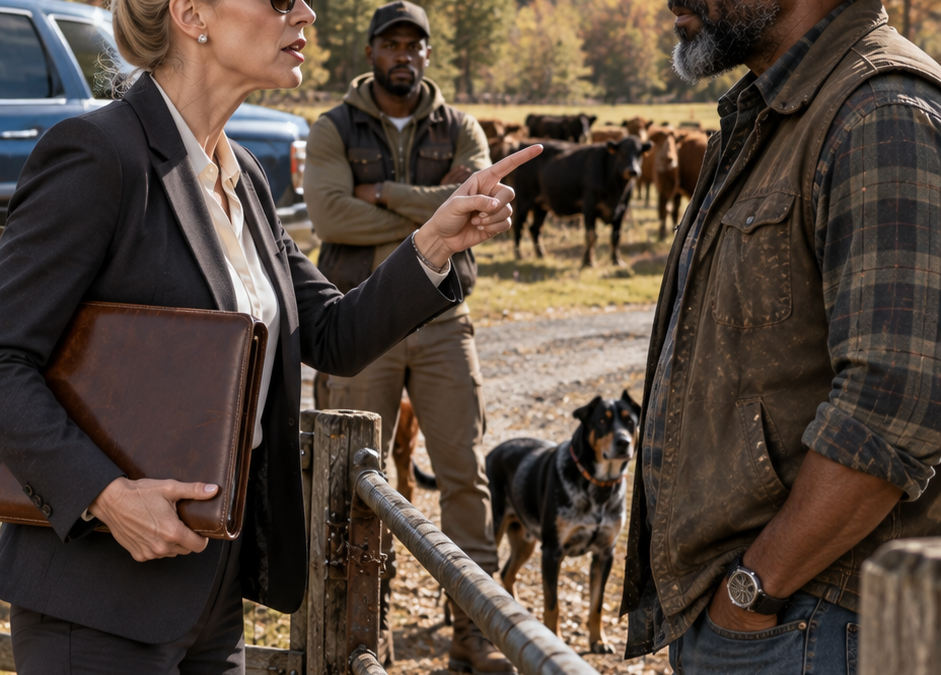
Diane Corwell delivered those words at the edge of my gravel driveway on an October morning.
Her blazer was the color of a storm cloud.
A leather portfolio was tucked beneath one arm.
Her SUV sat crooked across part of the drive as though the possibility of blocking somebody had never occurred to her.
Behind me, three thousand one hundred acres of oak forest moved in the wind.
Brown leaves scraped softly over the gravel.
The air smelled of damp bark, leaf mold, and cold stone.
It was a smell older than every house in Thornfield Ridge.
Older than its HOA.
Older than the covenant Diane had driven all that way to quote at me.
I listened until she finished.
Then I looked toward the eastern ridges.
“The eastern pasture gates?” I asked.
“Yes.”
“You’re saying your association has grazing rights there?”
“Recorded grazing rights.”
She opened her portfolio.
“Our governing documents are very clear.”
I almost smiled.
Almost.
The thing about people who work with land long enough is that words like recorded, easement, covenant, right-of-way, and boundary stop sounding impressive.
They become technical terms.
Each means something specific.
And each can be tested.
“Do you have the recorded instrument?” I asked.
Her expression tightened slightly.
“The association has reviewed its documents.”
“That wasn’t what I asked.”
She closed the portfolio.
“You’ll receive everything formally.”
Then she repeated the deadline.
Fourteen days.
I thanked her for coming.
That seemed to bother her more than an argument would have.
She climbed into her SUV, backed down the gravel road, and disappeared toward the county highway.
I stayed outside until the dust settled.
Then I walked into my house, made coffee, and opened the second drawer beside the kitchen desk.
My deed was exactly where I had left it.
My name is Caleb Morrow.
I was fifty-three years old when this happened, and by then I had spent most of my adult life working with timber and rural property.
I started as a logger’s apprentice in my early twenties.
Later, I became a licensed forester.
For eighteen years before I bought Thornfield Hollow, I worked as a private land manager, buying and managing large tracts for selective harvest, conservation, watershed protection, and long-term timber production.
I know topographic maps the way some people know city streets.
I know what a fresh survey blaze looks like.
I know how an old fence can follow a boundary more accurately than a modern road.
And I know there is a tremendous difference between someone claiming a right to your property and someone actually possessing one.
I learned much of that from my grandfather, Elias Morrow.
Elias came to Harland County in 1951 with a chainsaw, an old truck, and a stubborn belief about land.
“A man who knows his property lines,” he used to tell me, “is a man who is difficult to push.”
He bought forty acres with logging wages.
For years, he spent nearly every free weekend walking it.
He learned the creeks.
The ridges.
The hollows.
The places where limestone pushed through the soil.
The old corner stones buried beneath leaves.
Over time, forty acres became more.
By the time my father, James, was old enough to follow him through the woods, Elias owned nearly four hundred acres.
It was not glamorous property.
Mostly oak, hickory, and tulip poplar.
Steep slopes.
Cold creeks.
Rocky ground.
Good timber if you had patience.
Terrible land if you wanted quick money.
Elias loved it for exactly that reason.
My father inherited the same patience.
He added parcels carefully.
Whenever he bought land, the survey happened first.
The deed was recorded immediately.
Every easement was read.
Every legal description was checked against the map.
Dad repeated one lesson until it became part of the architecture of my mind.
“The record matters, Caleb. Not what somebody remembers. Not what somebody says over a fence. The record.”
I never inherited my grandfather’s land.
Dad eventually sold it when he retired and moved to Tennessee to be closer to my sister.
I never resented him for that.
What I inherited was more useful.
A method.
When somebody claimed an interest in land, I did not begin by arguing.
I began by asking:
What instrument?
What date?
What description?
What recording number?
And who had the legal authority to grant it?
That habit was one reason I bought the Thornfield tract.
The property had been held by one family estate for decades.
Three thousand one hundred acres of mature oak forest spread through Thornfield Hollow.
Some of those trees were old enough that two people could not reach around the trunks.
Roughly four hundred acres on the eastern side had been cleared for cattle in the 1960s.
The cattle were long gone when I bought it, but the pasture remained.
Fences.
Gates.
Old watering points.
Enough grassland that livestock could be returned if somebody wanted to invest the effort.
On the western ridge sat Thornfield Ridge subdivision.
It had been developed in the 1990s.
I knew that before closing.
In fact, I had checked it carefully because rural land beside subdivisions can create problems.
I reviewed the subdivision plat.
Then the recorded covenants.
Then the title work on the property I intended to buy.
Nothing showed Thornfield Ridge crossing into the hollow.
The subdivision ended at the western ridge.
My property began beyond it.
There was no recorded HOA restriction on my tract.
No community grazing agreement.
No access easement benefiting Thornfield Ridge.
Nothing.
I closed in March.
Purchase price: just under two million dollars.
My deed was recorded at the Harland County Clerk’s Office that afternoon.
Seven months later, Diane appeared.
Her certified letter arrived three days after her visit.
Four pages.
Thornfield Ridge Community Association letterhead.
Diane’s signature at the bottom.
The first page informed me that my property was allegedly burdened by what she called the “Thornfield Grazing Easement.”
The words were capitalized.
That gave them a grand sound.
The second and third pages contained portions of the association’s 1994 covenant.
The last page demanded that I open my eastern pasture gates within fourteen days, maintain unrestricted access for association members, and allow quarterly inspections by an HOA representative.
Failure to comply, the letter warned, could result in litigation.
I sat at my kitchen table and read every page.
Then I read them again.
There was a problem.
The covenant Diane attached contained no grazing easement.
None.
It contained architectural restrictions.
Association dues.
Procedures for resolving disputes.
Maintenance obligations.
Rules affecting lots within Thornfield Ridge.
It did not mention Thornfield Hollow.
It did not describe my parcel.
It did not mention my pastures.
And it definitely did not grant hundreds of HOA homeowners the right to bring livestock through my gates.
I laid Diane’s demand beside my deed.
Her covenant controlled property inside the subdivision.
My deed described property outside it.
Two separate worlds.
I was not angry.
Not yet.
I was interested.
People sometimes assume that property disputes begin with shouting.
The serious ones usually begin with paper.
I created a folder.
On the tab I wrote:
THORNFIELD RIDGE ASSOCIATION — CORRESPONDENCE.
Diane’s letter became Exhibit One, though I did not know yet that I would eventually think of it that way.
Then I called Ruth Callaway.
Ruth had practiced property law in Harland County for thirty-one years.
She had handled my closing.
If an easement burdened Thornfield Hollow, Ruth should have found it during the title examination.
Her office occupied two rooms above the hardware store on Main Street.
Files filled shelves from floor to ceiling.
Blue binders.
Green binders.
Red binders.
Nothing decorative except an old county map framed behind her desk.
She read Diane’s letter without speaking.
Page one.
Page two.
Three.
Four.
Then she removed her glasses.
“There is no grazing easement in your title.”
“I know.”
“No, Caleb. I mean there is no grazing easement. Period. We ran the chain before you closed.”
She tapped Diane’s attached covenant.
“And this doesn’t create one.”
“So what is she talking about?”
“That is what I would like to know.”
Ruth wrote one word on her yellow legal pad.
BASELESS.
Then she circled it.
“We need to pull every instrument associated with Thornfield Hollow.”
“How far back?”
“As far as the chain takes us.”
“Do it.”
She looked at me.
“This could take a while.”
“The trees aren’t going anywhere.”
That finally made her smile.
The search took longer than either of us expected.
The clerk’s office had digitized modern records, but many older instruments still existed only in physical books.
Ruth brought in Gerald Fitch, a retired county surveyor and title researcher.
Gerald was seventy-one.
He moved slowly.
He spoke less than almost anybody I had ever met.
But if you gave him an old deed description, he could usually tell you which archive shelf held the predecessor instrument before a clerk finished entering the reference into a computer.
Eighteen days later, Ruth called.
“We found something.”
I drove into town.
Gerald was sitting beside her desk with a cardboard box resting near his feet.
Documents covered the desktop in chronological order.
The oldest was an 1887 land patent establishing what had originally been a 4,200-acre Thornfield grant.
Over the following century, pieces had been sold.
Timber tracts.
Farm parcels.
Road strips.
The original property slowly fragmented.
In 1993, Harland Ridge Properties LLC bought roughly eight hundred acres along the western ridge.
That land became Thornfield Ridge.
In 1994, the developer recorded the community covenant Diane had sent me.
Then Gerald handed me another document.
DECLARATION OF EASEMENT.
I read the first page.
Harland Ridge Properties had declared a community access easement supposedly benefiting Thornfield Ridge homeowners.
The text referenced access to eastern pasture areas of Thornfield Hollow.
“So this is what she found.”
Ruth nodded.
“Almost certainly.”
For the first time, Diane’s position made sense.
Not correct.
But understandable.
A recorded document existed.
The problem was that recorded did not automatically mean valid.
Ruth turned to the legal description.
“Read the parcel number.”
I did.
Then she entered that number into the county GIS database.
A parcel lit up on the screen.
I leaned closer.
It was not in Thornfield Hollow.
It was twelve acres on the western ridge.
Inside what later became Thornfield Ridge.
The land was currently HOA green space containing a walking trail.
I looked from the map to the declaration.
“That’s not even close.”
“No.”
Gerald spoke from the corner.
“Drafting error.”
Those were the first words he had said in several minutes.
“The description doesn’t match what they apparently intended.”
He lifted one shoulder.
“But intent doesn’t move boundaries.”
Ruth nodded.
“The legal description controls.”
The easement Diane relied on described the wrong property.
It had never encumbered the eastern pastures.
That alone was potentially fatal.
Then Ruth showed me the second problem.
In 1998, when Harland Ridge Properties signed the easement declaration, its remaining interest in Thornfield Hollow was subject to a preexisting deed of trust held by a regional bank.
The debt dated back four years before the supposed easement.
The bank never joined in the declaration.
Never consented.
Never subordinated its lien.
Then, in 2003, the bank foreclosed on the hollow property.
Any junior interest that did not survive that foreclosure was extinguished.
Including, according to Ruth’s analysis, the 1998 easement declaration.
She folded her hands.
“So even if the description had identified the correct property…”
“It still died in the foreclosure.”
“Correct.”
“And it wasn’t in my title.”
“No.”
“It doesn’t exist.”
Ruth looked directly at me.
“As a valid easement against your property? No.”
I sat there for several seconds.
On Ruth’s desk lay more than a century of property history.
The 1887 patent.
Old conveyances.
The subdivision acquisition.
The 1994 covenant.
The 1998 easement.
The wrong parcel number.
The foreclosure documents.
Diane had driven forty minutes to my house and threatened enforcement based on one document.
Ruth and Gerald had read the whole chain.
That was the difference.
Ruth mailed our response Monday.
Four pages.
Almost exactly the length of Diane’s demand.
The letter formally rejected Thornfield Ridge’s claim.
It identified the problems with the 1998 declaration.
Wrong parcel.
Prior lien.
Foreclosure.
No easement appearing in my current title.
Ruth attached the relevant recording references and demanded that the association acknowledge in writing that it possessed no grazing or access rights over Thornfield Hollow.
She also demanded a recorded withdrawal of the HOA’s claim.
Deadline:
Thirty days.
I expected Diane to retreat.
I underestimated her.
Her response arrived eleven days later.
Not from Diane.
From a Lexington law firm.
Three attorneys’ names across the top.
Six pages.
And this time, the argument was better.
The firm did not rely exclusively on the 1998 document.
Instead, it argued that Thornfield Ridge residents had used the pastures openly for decades and had acquired a prescriptive easement through long-term use.
That mattered.
A recorded easement depends on paper.
A prescriptive easement can arise from conduct.
If people openly and adversely use another person’s property continuously for the legally required period, they may under certain circumstances establish a right even without a valid recorded grant.
I took the letter to Ruth.
She read it twice.
“This is their real argument now.”
“Can they win with it?”
“If the facts support them.”
That answer got my attention.
“What facts do they need?”
“Continuous, open, notorious, adverse, and uninterrupted use for the statutory period. No permission. No meaningful interruption.”
“How long?”
“Fifteen years under the theory they’re asserting.”
I leaned back.
“So now it isn’t about their paperwork.”
“Not entirely. Now it’s about what actually happened on the ground.”
That changed our investigation.
We needed history.
Not abstract history.
Specific history.
Who crossed the fence?
When?
How often?
With whose permission?
Did prior owners object?
Were gates locked?
Was access interrupted?
The following morning, I called Wendell Pace.
Wendell owned the narrow parcel north of mine.
He had farmed there thirty-eight years.
His father bought it in 1961.
If people had regularly driven cattle or horses through the eastern pasture, Wendell would probably remember.
“Thornfield Ridge people?” he said after I explained.
“Yeah.”
He went quiet.
“I remember some horse traffic years ago.”
“How much?”
“Not much. Couple families sometimes.”
“When?”
“Late nineties. Maybe into 2000.”
My grip tightened on the phone.
“Then what?”
“Developer locked the north opening.”
“What developer?”
“Harland Ridge.”
“You remember when?”
“About 2000.”
“You sure?”
“Pretty sure. They had trouble with people riding through. Somebody chained that gap and put a padlock on it.”
He paused.
“After that I don’t remember anybody coming through.”
“Would you put that in writing?”
“I suppose.”
“Only what you actually remember.”
“That’s all I ever put in writing.”
That was Wendell.
A week later, his signed statement arrived.
Meanwhile, Ruth hired a licensed surveyor named Patricia Odum.
Patricia had worked Harland County boundaries for twenty-two years.
She brought two crew members to Thornfield Hollow in December.
For three days they located monuments, ran boundary lines, photographed fence conditions, compared physical markers with the recorded description, and documented every accessible point along the subdivision side.
Her certified plat confirmed that no Thornfield Ridge parcel crossed my property line.
Not by feet.
Not by inches.
More important for the prescriptive claim, her notes documented an old chain and padlock at the north corner.
The cedar post had grown partially around the metal.
Nobody had installed that chain recently.
The rust ran deep.
Patricia photographed it.
She measured it.
She described it in her survey notes.
An old locked access point was not good evidence of uninterrupted community use.
Her survey was recorded December 22.
Our file grew thicker.
Then we found Carol Sims.
Carol had represented the estate of the Thornfield family’s last surviving heir.
She had managed property records before the tract passed through the sales that eventually led to me.
Ruth scheduled her deposition in January.
The Lexington firm sent an attorney.
A court reporter recorded every word.
Carol was precise.
Almost painfully so.
Ruth asked, “Did the former owners ever grant Thornfield Ridge homeowners permission to use the eastern pastures?”
“No.”
“Were you aware of homeowners entering those pastures?”
“Yes.”
“When?”
“In the late 1990s.”
“What did the owners do?”
Carol folded her hands.
“They told the developer it was unauthorized.”
Ruth glanced at me.
“Was anything done physically to prevent access?”
“The north gap was chained and padlocked.”
“Approximately when?”
“August 2000.”
The Lexington lawyer shifted in his chair.
Then Carol said something even better.
“I brought the correspondence.”
She opened a file.
Inside was a letter dated August 2000.
Addressed to Harland Ridge Properties LLC.
The letter stated plainly that horseback and livestock access through the north fence opening was unauthorized and would no longer be permitted.
Attached was the certified-mail receipt.
Signed.
Delivered.
I looked across the conference table at Ruth.
She did not smile.
Attorneys rarely smile when a document is doing something devastating.
But I knew her well enough to recognize the slight change in her eyes.
The HOA’s prescription theory required fifteen years of continuous, adverse, uninterrupted use.
Here was written proof that the owner had expressly objected in 2000.
Then locked the access.
Whatever prescriptive clock the HOA wanted to construct had been interrupted before it could reach fifteen years.
Ruth asked Carol one final question.
“After the gate was locked, did the association challenge the restriction?”
“Not that I ever saw.”
“Did they file suit?”
“No.”
“Demand access?”
“No.”
“Send a violation notice?”
Carol almost laughed.
“No.”
The deposition ended.
Outside, January rain fell against the courthouse windows.
Ruth packed the documents.
I said quietly, “That letter just killed their argument.”
She closed her binder.
“It did serious damage.”
“That’s attorney language.”
“Yes.”
“What’s normal language?”
She looked at me.
“They have a problem.”
Two weeks later, the transcript arrived.
On February 1, Ruth filed for summary judgment in Harland County Circuit Court.
The motion itself ran forty-one pages.
The exhibits added nearly ninety more.
Ruth organized everything by color.
Blue tabs:
Recorded instruments.
Green:
Surveys.
Yellow:
Correspondence.
Red:
Depositions and sworn statements.
The 1887 patent.
The chain of title.
The 1994 covenant.
The defective 1998 declaration.
The parcel map.
Foreclosure documents.
My deed.
Patricia Odum’s certified survey.
Wendell Pace’s affidavit.
Carol Sims’s deposition.
The August 2000 objection.
Certified-mail receipt.
Each document answered a different part of the HOA’s claim.
Together, they told one story.
No valid recorded easement ever burdened my property.
And the historical use was neither uninterrupted nor unopposed long enough to create one by prescription.
When Ruth handed me my copy, the binder was heavy.
I thought about my father.
The record, Caleb.
Not what somebody remembers.
Not what somebody claims.
The record.
The Lexington firm responded three weeks later.
Twenty-two pages.
Lots of case citations.
Arguments about intent.
Arguments about historical community expectations.
Arguments that the old objection should not defeat the claimed access rights.
What they did not produce was new evidence.
No fifteen-year period of documented uninterrupted use.
No later agreement.
No valid survey showing their easement crossing my tract.
No deed.
No grant.
Nothing.
The hearing was set for March.
As the date approached, I spent more time walking the forest.
Late winter was beginning to loosen its hold.
The oaks remained bare, but sunlight stayed longer in the hollow.
Water moved beneath thin sheets of ice along shaded creek bends.
One afternoon, I drove to the northern fence corner.
I got out.
The old chain was still there.
The cedar had grown around one side of it.
I touched the lock.
Cold metal.
Deep rust.
Twenty-four years earlier, someone had closed that opening because strangers were crossing private land without permission.
Now the HOA wanted a judge to believe the crossing had never meaningfully stopped.
I stood there and wondered whether Diane had ever visited this corner.
Whether she had seen the chain.
Whether she had read the 2000 letter.
Whether she had done anything before driving to my house except open a binder and find the document that told her what she wanted to hear.
The hearing came eleven days later.
Harland County Circuit Court was smaller than people usually imagine.
No dramatic marble chamber.
No enormous jury gallery.
Old wood.
Radiator heat.
Dry air.
A courtroom that had heard generations of disputes involving fences, estates, roads, timber, water, and people convinced the ground beneath someone else’s feet partly belonged to them.
Judge Harlan Brackett presided.
He was in his early sixties.
Slow-moving.
Deliberate.
The kind of judge who made silence feel like part of the proceeding.
Ruth sat beside me.
Across the aisle were two attorneys from the Lexington firm.
Garvey, the senior partner, handled the argument.
Diane sat behind them.
Charcoal blazer.
Leather portfolio on her lap.
The same composed posture she had worn in my driveway months earlier.
Judge Brackett entered.
Everyone stood.
Then we sat.
He opened our motion.
I knew immediately that he had read it.
He did not ask Ruth to explain the case.
Instead, he looked at Garvey.
“Counsel, identify the recorded instrument establishing your client’s asserted easement over the Thornfield Hollow eastern pastures.”
Garvey stood.
“The association relies in part upon the 1998 Declaration of Easement recorded by Harland Ridge Properties.”
“In part?”
“Yes, Your Honor. We also assert rights acquired through long-standing prescriptive use.”
“We will get there.”
The judge turned several pages.
“First, the declaration.”
Garvey nodded.
Judge Brackett read the parcel reference number aloud.
“Is that the number appearing in the recorded legal description?”
“Yes.”
The judge turned to the county map.
“According to the certified GIS exhibit, this number corresponds to a twelve-acre parcel on the western ridge.”
Garvey hesitated.
“That is correct.”
“Not the eastern pasture.”
“No.”
“Not any portion of Mr. Morrow’s tract.”
“No.”
Judge Brackett looked at him.
“Then explain how this instrument burdens Mr. Morrow’s property.”
Garvey began arguing intent.
The developer intended to establish community access.
The language referencing eastern pasture use reflected that intention.
The parcel number, he said, appeared to be a drafting error.
Judge Brackett listened.
Then he said, “A drafting error does not permit this court to move a recorded legal description several hundred acres across the landscape.”
Nobody spoke.
I did not look at Diane.
I kept my eyes on the judge.
Garvey shifted to the prescriptive-easement claim.
That was where he spent most of his time.
Historical horseback use.
Community expectation.
Open access during the development’s early years.
Residents believing for decades that grazing rights existed.
Judge Brackett let him finish.
Twenty-two minutes.
Then he turned toward Ruth.
“Ms. Callaway, address continuity.”
Ruth stood.
She did not begin with argument.
She began with evidence.
“August 2000, Your Honor.”
She handed the clerk the prior owner’s certified letter.
“The Thornfield estate notified Harland Ridge Properties in writing that community access was unauthorized.”
The judge found his copy.
Ruth continued.
“The north access point was then chained and padlocked.”
She referred him to Patricia Odum’s survey photographs.
“The physical evidence remains at the site.”
Next came Wendell Pace’s statement.
Then Carol Sims’s testimony.
Ruth read only the necessary lines.
Prior owners objected.
Access closed.
No subsequent association challenge.
No litigation.
No continuous passage.
No fifteen years.
When Ruth finished, Judge Brackett looked toward Garvey.
“Do you have any sworn testimony establishing continuous and uninterrupted use after August 2000?”
Garvey stood.
“No direct testimony, Your Honor.”
“Any documentary evidence?”
“No.”
“Any access records?”
“No.”
“Any correspondence showing the owners withdrew their objection?”
“No.”
“Any evidence the padlock was removed?”
“No.”
Garvey argued that the objection itself was legally insufficient to interrupt the prescriptive period.
Judge Brackett listened.
When Garvey stopped, the judge looked at the exhibits again.
Then at him.
“If the owner sends written notice denying access, physically chains the access point, and use thereafter ceases, counsel, I am struggling to identify what more substantial interruption your theory requires.”
The room went quiet.
Garvey attempted a short response.
The judge thanked both attorneys.
He took the case under advisement.
No dramatic ruling from the bench.
No gavel.
No speech.
We walked outside into a cold March afternoon.
Diane left through another exit.
I asked Ruth, “How do you think it went?”
“You heard the same judge I did.”
“That sounds promising.”
“It sounds like we wait for the order.”
Nine days later, March 14, Ruth called.
“I have it.”
I drove to her office.
The written ruling was eleven pages.
I read every one.
On page seven came the part that mattered.
The court found the 1998 Declaration of Easement ineffective against Thornfield Hollow.
First, because its recorded legal description identified another parcel.
Second, because the evidence failed to establish a valid prescriptive right over my pastures.
The prior owner’s written objection and physical closure of the access point in August 2000 interrupted adverse use before the required period could be satisfied.
Then came the sentence I read twice.
The Thornfield Ridge Community Association holds no valid easement, recorded or prescriptive, over the Thornfield Hollow eastern pastures.
The association’s claim was dismissed with prejudice.
It could not simply repackage the same argument and bring it again.
The court also awarded recoverable costs and attorney fees.
Ruth calculated the amount attributable to the association at a little over $22,000.
More importantly, Thornfield Ridge was ordered to record a formal withdrawal of its easement claim with the Harland County Clerk within thirty days.
I set down the order.
Ruth sat across from me.
“Well,” she said.
I looked out her window.
Bare branches.
Main Street.
Pale March sunlight.
“Yes.”
She smiled.
That was enough celebration for both of us.
The formal withdrawal was recorded April 9.
I requested a certified copy.
When it arrived, I placed it in the same manila folder that held Diane’s original demand.
Her four-page letter remained at the front.
Fourteen days to open the gates.
Quarterly HOA inspections.
Enforcement through every available channel.
Behind it now sat the recorded document stating that the association possessed no such right.
I kept both.
Not because I enjoyed the dispute.
Because beginnings make more sense when you keep the ending beside them.
That afternoon, I drove into Thornfield Hollow.
Spring had reached the oaks.
The first leaves were opening.
That pale green stage before the canopy becomes dense.
Sunlight still reached the forest floor.
The creek was high and loud over the limestone ledges.
I parked near the northern corner.
Then I walked.
Past the old pasture.
Past the cedar posts.
Past the oak line.
Eventually, I reached the chain.
Still rusted.
Still embedded partly in the growing cedar.
I put my palm against the post.
My grandfather used to say cedar would outlive the man who planted it if he set it deep enough.
Standing there, I finally understood why those old lessons about boundaries had stayed with me.
This dispute had never really been about cattle.
Nobody from Thornfield Ridge desperately needed four hundred acres of pasture.
It was about the assumption that authority creates rights.
It does not.
Diane had been HOA president.
She had a title.
A covenant.
A lawyer.
A portfolio.
A deadline.
She had a board behind her.
Later, she had a Lexington law firm.
All of those things could create pressure.
None could create an easement.
Only law and fact could do that.
And law and fact required something much less dramatic.
A valid instrument.
A correct legal description.
A legal chain of title.
Or, for prescription, the actual historical elements required by law.
Their recorded instrument described the wrong land.
Their supposed right had not survived the history they claimed for it.
Their prescriptive theory collided with a certified letter, a padlock, sworn testimony, and more than two decades of interrupted use.
Nothing about that was glamorous.
It was paperwork.
Old metal.
Survey measurements.
County books.
One careful record stacked on another.
That was what defeated them.
I stood beside the fence until the afternoon light began dropping behind the ridge.
Then I walked back toward my truck.
The oak branches moved overhead.
The same sound I had heard the morning Diane arrived.
I remembered her standing in my driveway.
“Fourteen days.”
She had been so certain.
And I remembered the question I asked.
Do you have the recorded instrument?
At the time, she had treated it almost like an irrelevant technicality.
In the end, it was the only question that mattered.
I drove home.
Inside the house, the deed remained in the kitchen drawer.
My name on the front.
Three thousand one hundred acres described behind it.
Nothing had changed about the land.
The eastern pastures were still mine.
The forest was still mine.
The gates remained closed unless I chose to open them.
What changed was that the public record now contained one additional document confirming what the deed had already said.
Thornfield Ridge had no grazing rights over Thornfield Hollow.
Sometimes winning a land dispute does not look like standing at the property line shouting louder than the person across from you.
Sometimes it looks like refusing to argue until you have the records.
Then letting the records speak.
My father had taught me that.
My grandfather had lived it.
And Diane Corwell learned it the expensive way.
A covenant is only as powerful as the land it legally reaches.
An easement is only as real as the instrument that creates it.
And confidence, no matter how official it sounds from the end of a gravel driveway, cannot move a property line.
The oaks already knew that.
They had been standing in Thornfield Hollow long before Diane arrived.
And when the case was finally over, they were still standing exactly where they had always been.








