𝗣𝗔𝗥𝗧 𝟮 HOA Called the Sheriff to Tow My Land Rover—Then the Deputies Saluted Me Instead
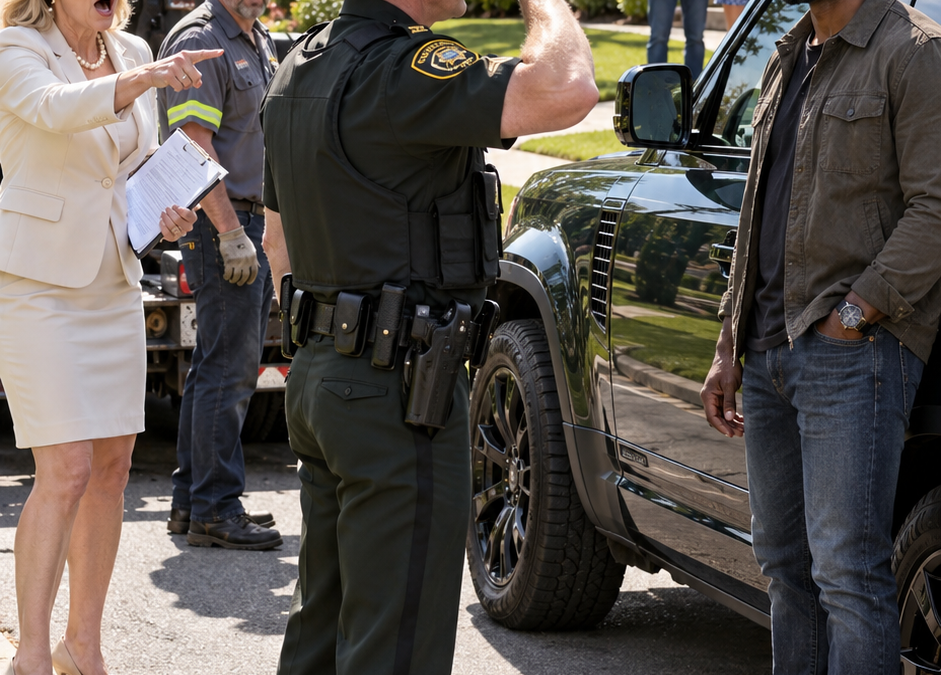
𝗣𝗔𝗥𝗧 𝟮
My name is Marcus Vance.
When Victoria Sterling arrived in Mist Bay Valley, I was sixty-four years old and finally learning how to live without conference rooms.
I had spent most of my adult life around ports, emergency planning, harbor security, maritime infrastructure, and federal funding agreements.
My work took me from Atlantic shipping terminals to hurricane-damaged coastal facilities and more Washington meetings than any human being should survive.
At various points I had dealt with admirals, governors, union chiefs, shipping executives, Coast Guard commanders, county commissioners, and men who could move three hundred thousand tons of cargo but somehow could not locate a stapler during a briefing.
Retirement sounded wonderful.
The Vance homestead sounded better.
My family had been on that land since 1867.
My great-great-grandfather, Nathaniel Vance, arrived after serving aboard Union naval vessels during the Civil War.
The property began as rough coastal acreage above Mist Bay.
Rock.
Pine.
Salt marsh.
A deep-water cove.
There was no gated community.
No zoning committee.
No approved mulch colors.
Nathaniel built a cabin.
Then a barn.
Then a stone pier.
The old deed reserved a fifty-foot access corridor running from the county road to the cove so emergency boats, supply carts, and later public-safety vehicles could reach the water.
Over time, the road system changed.
The waterfront changed.
The corridor was rarely used.
But it remained recorded.
Important old rights have a strange habit of becoming invisible until someone builds something expensive on top of them.
Victoria Sterling did exactly that.
Mist Bay Heights arrived five years before our confrontation.
The development occupied former wooded acreage east of my farm.
Large houses.
Perfect lawns.
Decorative stone walls.
A clubhouse.
Olympic-size pool.
Private fitness center.
A gatehouse designed to resemble a nineteenth-century coastal inn that had somehow never experienced weather.
Most residents were fine.
The HOA was not.
Victoria became president during the development’s second year.
She had made her money in luxury real estate.
You could hear it in every sentence.
Nothing was merely a house.
It was a residence.
Nothing was a road.
It was an arrival experience.
Nothing was grass.
It was curated landscape architecture.
And my farm?
According to Victoria, it was “an unresolved visual transition.”
I called it home.
That difference defined our relationship.
Her first purchase offer arrived by certified mail.
It offered less than half the land’s appraised value.
The letter described the transaction as a “strategic opportunity to unlock the property’s highest and best use.”
I declined.
The second offer was larger.
Still no.
Then came an in-person visit.
Victoria stood on my porch with a developer named Charles Kent.
Charles spread a rendering across my table.
My barn was gone.
My pasture was gone.
My orchard was gone.
In their place sat a four-lane entrance boulevard lined with ornamental pears.
At the bottom of the drawing, tiny people walked tiny designer dogs.
Victoria smiled.
“Beautiful, isn’t it?”
I studied the rendering.
“Where’s my house?”
Charles laughed.
He thought I was joking.
Victoria did not.
“The homestead itself could potentially be preserved as a heritage feature.”
“Potentially.”
“Yes.”
“Meaning?”
“We could relocate the structure.”
I folded the rendering.
Then slid it back.
“No.”
Charles tried negotiation.
Victoria tried flattery.
Then economics.
Then social pressure.
Then implied condemnation.
None worked.
After that, her HOA notices began.
My gravel driveway created dust.
My woodpile was visible from Mist Bay Heights.
My barn siding was weathered.
The tractor beside the shed was “industrial clutter.”
The wildflowers attracted bees near the development.
That one was my favorite.
Apparently pollination had become noncompliant.
Then she discovered my Land Rover.
The truck had started life in 1961.
By the time I found it, it was barely recognizable.
Salt air had attacked the frame.
The engine was seized.
Seats were gone.
Several body panels had dents deep enough to serve soup.
Most people would have scrapped it.
I brought it home.
Restoration gave me something federal service never had.
Silence.
No briefing slides.
No appropriations language.
No emergency conference calls.
Just tools.
Parts.
Patience.
I stripped the Land Rover to the chassis.
Repaired the frame.
Rebuilt the 2.25-liter engine.
Replaced bearings.
Overhauled the gearbox.
Rewired the electrical system.
Rebuilt the brakes.
Then refinished the body in a matte battleship-gray marine coating inspired by naval vessels I had worked around for decades.
When I finished, it was not showroom-perfect.
It was better.
It looked honest.
Victoria hated it instantly.
Her first notice called it:
AN ABANDONED COMMERCIAL UTILITY VEHICLE.
The second called it:
UNSCREENED MECHANICAL EQUIPMENT.
The third called it:
A VISUAL NUISANCE ADJACENT TO THE MIST BAY HEIGHTS SCENIC CORRIDOR.
The fourth demanded removal.
I filed every notice.
That was an old habit.
People assume retired bureaucrats hate paperwork.
Not all of us.
Some of us understand its natural predatory power.
Victoria interpreted silence as surrender.
So on that foggy Tuesday morning, she finally crossed the driveway.
By the time she called the sheriff, I had already decided I was done being patient.
While she paced outside shouting into dispatch, I went to my study.
The room still looked half like a federal office and half like an antique map shop.
Harbor charts.
Old property plats.
Commendations.
Photographs.
My grandfather’s brass compass.
The original homestead grant sat in a climate-controlled archival case.
Beside it was a certified survey prepared three months earlier.
I had ordered that survey quietly after noticing that Mist Bay’s new clubhouse seemed remarkably close to the historic maritime corridor.
Too close.
The survey confirmed it.
Twenty-two feet of permanent clubhouse structure extended across the protected access strip.
Part of the pool deck did too.
I had not acted immediately.
I wanted certainty.
That is another difference between people like Victoria and people like me.
She treated suspicion as authority.
I treated suspicion as a reason to measure twice.
The measurements were now done.
I called Sheriff Thomas Miller.
“Tom.”
“Marcus?”
“How’s retirement?”
“Was excellent until ten minutes ago.”
He laughed.
“What happened?”
“Victoria Sterling is standing in my driveway requesting that your department tow my Land Rover.”
Silence.
Then:
“She’s what?”
“She says it violates HOA aesthetics.”
“Your property isn’t in the HOA.”
“I mentioned that.”
“What does she think the basis is?”
“Scenic easement.”
Tom sighed.
“That woman has used the word easement so many times I’m starting to think she believes it means anything she can see.”
“I’d like deputies to handle it normally.”
“Of course.”
“No favors.”
“I know.”
“But pull the parcel record before they arrive.”
“I can do that.”
“And send Dave Porter from Building and Land Safety if he’s available.”
“Why?”
“Section Four, Block B.”
Tom knew the area.
“That’s the clubhouse parcel.”
“Yes.”
“What am I looking for?”
“Historic maritime corridor.”
Long pause.
“Marcus.”
“Yes?”
“You found something.”
“Dave will find something.”
Tom chuckled.
“That distinction sounds familiar.”
“I spent thirty years learning it.”
Deputies Kowalski and Chen arrived fifteen minutes later.
A county-contracted tow truck followed them.
Victoria nearly applauded.
I was back on the porch.
Coffee number two.
She turned toward her security guards.
“Document everything.”
The tow driver, Carl Benton, got out.
Carl had handled port recovery work while I was still in federal service.
He saw me and stopped.
“Commissioner Vance?”
“Morning, Carl.”
He looked toward the Land Rover.
Then Victoria.
Then back at me.
“I was told abandoned vehicle.”
“It appears abandoned to Victoria.”
He scratched his beard.
“Looks pretty actively restored to me.”
Victoria marched over.
“Driver, prepare the vehicle for removal.”
Carl folded his arms.
“I need law-enforcement authorization before removing a registered vehicle from occupied private property.”
“I am authorizing it.”
“You are not law enforcement.”
“I am HOA president.”
“That is also not law enforcement.”
I liked Carl.
Deputy Kowalski approached.
He had served in the Coast Guard before joining the county.
We had met at regional port-security exercises.
As he reached the porch, he stopped.
Straightened.
Then saluted.
“Good morning, Admiral.”
There it was.
Not Commissioner.
Not Mr. Vance.
The title from the part of my life Victoria had never bothered to ask about.
I had retired from Coast Guard Reserve service as a rear admiral before finishing my federal civilian career.
I returned the salute.
“Deputy.”
Chen recognized the gesture and followed.
Victoria went completely still.
Kowalski continued.
“Sheriff Miller asked us to ensure the property dispute remains peaceful and that no unauthorized removal occurs.”
Victoria lowered her sunglasses.
“What did you call him?”
Kowalski looked at her.
“Rear Admiral Marcus Vance, retired. Former regional maritime security commissioner.”
She stared at me.
“That’s ridiculous.”
I almost laughed.
“What part?”
“You’re a mechanic.”
“No.”
I nodded toward the Land Rover.
“I restore vehicles.”
“You live on a farm.”
“Yes.”
“You wear overalls.”
“Frequently.”
She looked genuinely betrayed by the information.
As though retirement clothing should come with government credentials embroidered across the chest.
Deputy Chen opened the parcel record.
“Mrs. Sterling, we verified the ownership.”
“This road is under HOA easement.”
“No.”
“Your own records—”
“The county utility easement sits east of this driveway.”
He pointed toward the ground.
“You are currently on private Vance property.”
She looked at the tow truck.
“Then the nuisance provision—”
“Doesn’t apply.”
“Our board passed it.”
“Your board governs your members.”
“This affects our property values.”
Chen stared.
“That does not create jurisdiction.”
Victoria turned toward me.
“This is because you know them.”
“No.”
Kowalski’s expression hardened.
“The deed record would say the same thing if we had never met Commissioner Vance.”
That mattered.
I had made Tom promise.
No special treatment.
Victoria had overreached without my résumé helping at all.
The résumé merely improved the look on her face.
Then Dave Porter arrived.
County Building and Land Safety.
White SUV.
Survey roll.
Tablet.
Hard hat.
Victoria stared at the vehicle.
“What now?”
Dave walked over.
“Marcus.”
“Dave.”
“We ran your coordinates.”
“I assumed you would.”
He unrolled the map across my Land Rover’s hood.
Victoria flinched at the idea of county maps touching the vehicle she had just labeled junk.
Dave pointed to the old corridor.
“Historic maritime access strip. Fifty feet wide.”
“Yes.”
“Recorded continuously.”
“Yes.”
“Never vacated.”
“No.”
He shifted to the modern development overlay.
Then tapped the clubhouse.
“This is the issue.”
Victoria stepped closer.
“What issue?”
Dave looked at her.
“Your clubhouse.”
“Our clubhouse has complete county approval.”
“It has a building permit.”
“Exactly.”
“A permit based on the site plan your developer submitted.”
She folded her arms.
“Our developer used licensed surveyors.”
“The survey used for permitting did not account correctly for this older recorded access corridor.”
“That is impossible.”
Dave enlarged the overlay.
The line cut directly beneath the eastern section of the clubhouse and pool terrace.
“Twenty-two feet.”
She stared.
“What?”
“Twenty-two feet of permanent construction inside the restricted corridor.”
“You’re wrong.”
“We verified against monument locations this morning.”
“You verified this this morning?”
“County records work surprisingly well before lunch.”
Kowalski looked away to hide a smile.
Victoria stepped toward the map.
“That corridor hasn’t been used in decades.”
“Use and existence are separate questions.”
“It serves no purpose.”
“That is not for the HOA to decide.”
“Our attorneys cleared this project.”
“Then they will enjoy the file.”
Dave pulled out a yellow notice.
“This is an emergency compliance and review order.”
Her face changed.
“Demolition?”
“Not yet.”
That word yet hit harder than demolition.
“We are ordering the affected area closed pending title, structural, easement, and agency review.”
“You cannot close our clubhouse.”
“I just did.”
“We have events scheduled.”
“Cancel them.”
“Our residents pay twenty thousand dollars a year in dues.”
Dave nodded.
“Then I recommend good coffee at the next board meeting.”
Victoria’s hand tightened around the gold clipboard.
“This is retaliation.”
“No.”
I finally walked down from the porch.
“This is measurement.”
She looked at me.
“You set this up.”
“I commissioned the survey before you touched my Land Rover.”
“You were waiting.”
“Yes.”
“For what?”
“For certainty.”
Her face flushed.
“And you just let us build?”
“No. The clubhouse was already substantially complete when I confirmed the issue.”
“You could have warned us.”
“I did.”
She laughed bitterly.
“When?”
“Letter dated February eighth.”
I walked to my study door and returned with a copy.
Certified delivery.
Mist Bay Heights administrative office.
Signed by Victoria Sterling.
Her eyes widened.
“That letter was about property boundaries.”
“Yes.”
“You never said our clubhouse was illegal.”
“I said your southern construction appeared to interfere with recorded Vance property and access rights and advised immediate survey verification.”
She flipped through it.
“You use vague legal language.”
“I used precise language.”
“You were trying to trap us.”
“No.”
I nodded at her clipboard.
“I was trying to get you to read.”
Carl, the tow driver, had seen enough.
He climbed back into his truck.
Victoria spun around.
“Where are you going?”
“No tow authorization.”
“I called you here!”
“County called me here.”
“I demand you stay.”
He smiled.
“That’ll be another service category.”
Then drove away.
By lunchtime, Victoria’s red citation was gone from my Land Rover.
She removed it herself.
I made sure of that.
It left adhesive on the windshield.
She complained when I handed her solvent.
That afternoon the first emergency HOA email went out.
CLUBHOUSE TEMPORARILY CLOSED DUE TO UNEXPECTED HISTORICAL RECORD DISCREPANCY.
Unexpected.
Interesting word.
The certified letter she signed apparently did not count as expectation.
Mist Bay Heights residents began asking questions.
Then more.
Why had the president been trying to tow a neighbor’s vehicle?
Why was the clubhouse built across a recorded corridor?
Why had the board ignored Marcus Vance’s survey warning?
Why had construction contracts been approved so quickly?
That last question became expensive.
Eleanor Price called me two days later.
She was a retired school principal and one of the few Mist Bay board members who had regularly opposed Victoria.
“Mr. Vance?”
“Marcus is fine.”
“Marcus, we need to talk.”
“About?”
“The clubhouse.”
“I assumed.”
“And Victoria.”
“That could take longer.”
She almost laughed.
Then her voice lowered.
“The board is reviewing financial records.”
I leaned back.
“Why?”
“Because Dave’s notice forced us to pull the original construction packet.”
“And?”
“Victoria’s brother-in-law owns Sterling Coastal Construction.”
I said nothing.
“You knew?”
“No.”
“They built the clubhouse.”
“How was the contract awarded?”
“No competitive bid.”
There it was.
“How much?”
“Two point five million.”
“Actual construction value?”
“We don’t know yet.”
“You should.”
“We’re trying.”
The rabbit hole widened quickly.
Inflated invoices.
Landscaping contracts awarded to a cousin.
Security services involving a company owned by Victoria’s former business partner.
Consulting fees.
Maintenance payments.
Nothing by itself proved criminal conduct.
Taken together, they demanded explanation.
Residents demanded one immediately.
The emergency HOA meeting happened Friday.
I did not plan to attend.
Then Eleanor called again.
“Please come.”
“Why?”
“Because Victoria is blaming you.”
“Of course.”
“She says you are using federal influence to seize the clubhouse.”
“That isn’t happening.”
“I know.”
“Then correct her.”
“We have.”
“Then why do you need me?”
Long pause.
“Because people need to hear it from you.”
I went.
The clubhouse itself was closed, so they met in the development’s tennis pavilion.
Nearly every homeowner attended.
Victoria sat at the center table.
Gold clipboard.
Perfect hair.
No sunglasses indoors.
Progress.
The moment I entered, conversations stopped.
Victoria leaned toward the microphone.
“There he is.”
Eleanor closed her eyes.
Victoria continued.
“The man responsible for this entire manufactured crisis.”
I found a seat.
“I thought the clubhouse was responsible for the clubhouse crisis.”
Several residents laughed.
She hated that.
“This is not funny.”
“I agree.”
“You used your government connections to have county enforcement attack our community.”
Dave Porter stood near the back.
He raised one hand.
“For clarity, Commissioner Vance did not direct my determination.”
Victoria glared.
“He called you.”
“Yes.”
“He initiated it.”
“He requested record review.”
“Exactly.”
Dave continued.
“The records then showed a problem.”
That distinction did not help her.
Victoria changed targets.
“The easement is obsolete.”
An attorney retained by the HOA answered.
“Obsolete is not a legal property status.”
More laughter.
Victoria slammed one hand onto the table.
“This community is being bullied.”
Eleanor finally took the microphone.
“No.”
The room quieted.
“We are here because the board received written notice of a boundary concern months ago and did not obtain the recommended independent survey.”
Victoria turned.
“You approved the budget.”
“I approved a budget based on your representation that title clearance was complete.”
“It was.”
The HOA attorney said:
“No.”
One word.
Beautiful.
The lawyer opened the original file.
“Our firm advised that the older Vance corridor required additional title research.”
Victoria’s face lost color.
“That is not what you told me.”
“It is in the memorandum dated January twenty-seventh.”
The document appeared on the screen.
Residents read it.
There is a wonderful silence that occurs when a person’s confidence collides with a PDF.
Victoria tried another angle.
“The corridor serves no present maritime function.”
I raised my hand.
Eleanor nodded.
I stood.
“My ancestor established that access because the bay was once the safest emergency route in and out of this property.”
Victoria rolled her eyes.
“It’s 2026.”
“Yes.”
“And now the county road exists.”
“Yes.”
“So your corridor is pointless.”
I looked at her.
“Three years ago, during the hurricane evacuation, where did the county marine rescue boats stage?”
Silence.
A resident answered.
“The old pier.”
“Correct.”
I continued.
“That corridor supported emergency coastal access during the storm.”
Several people turned toward Victoria.
She looked irritated.
Not ashamed.
I had learned that shame required a level of self-doubt she did not naturally possess.
Then the treasurer began discussing finances.
The clubhouse construction contract.
Two point five million dollars.
No competitive bid.
Related party.
Security contracts.
Landscape contracts.
Reserve depletion.
A resident in the front stood.
“Victoria, did you disclose that the contractor was your brother-in-law?”
“It was common knowledge.”
“No,” Eleanor said.
Victoria turned.
“It was.”
The secretary opened meeting minutes.
“No disclosure appears.”
Victoria’s mouth tightened.
“That does not mean people didn’t know.”
The resident asked:
“Did you vote?”
“Yes.”
The room changed.
That was the beginning of the end.
The recall motion came twenty minutes later.
Victoria objected on procedural grounds.
The secretary read the procedure.
Ironically, Victoria had written most of it herself during an earlier campaign against a board member she disliked.
She had designed an efficient recall system.
That night it worked beautifully.
She was removed as president.
Three other board members resigned.
Eleanor became interim president.
When the vote finished, Victoria gathered her papers.
Then looked at me.
“This is what you wanted.”
“No.”
“Don’t lie.”
“I wanted you off my driveway.”
“You destroyed my reputation.”
I shook my head.
“I didn’t award your contracts.”
“You started the investigation.”
“You slapped a tow notice on my windshield.”
She stared.
“You think this is justice?”
“No.”
I looked around at the angry residents.
“This is accounting.”
She walked out.
The next problem was the clubhouse.
Legally, the HOA was in trouble.
Practically, demolition would punish dozens of families who had not caused the encroachment.
I had no interest in that.
Eleanor came to my farm Sunday afternoon.
No security.
No clipboard.
She carried one folder.
“Marcus.”
“Coffee?”
“Please.”
We sat on the porch.
The Land Rover stood near the workshop.
Its gray paint looked almost blue in the coastal afternoon light.
Eleanor looked toward it.
“That’s the truck?”
“The criminal vehicle.”
She laughed.
“Victoria made it sound like a rusted bulldozer.”
“She has imagination.”
“I owe you an apology.”
“You personally don’t.”
“The association does.”
“Yes.”
She took that without argument.
Good sign.
“If the county orders demolition, our reserve fund won’t survive.”
“I know.”
“Some residents are terrified.”
“I know.”
“What do you want?”
I looked toward the bay.
“Three things.”
She opened the folder.
“First, a permanent recorded boundary agreement acknowledging that the Vance homestead is outside HOA authority.”
She nodded.
“Easy.”
“Second, no HOA employee, board member, contractor, or security officer enters my property without permission except genuine emergency circumstances.”
“Also easy.”
“And the clubhouse?”
“I’ll support a waiver allowing the portion within the corridor to remain.”
Her head lifted.
“You would?”
“Yes.”
Relief flooded her face.
“Thank you.”
“I’m not finished.”
She straightened.
“Of course.”
“The northern wing becomes community maritime space.”
She blinked.
“What does that mean?”
“County youth program.”
“For how much?”
“One dollar per year.”
She stared.
“I want boat restoration benches. Water-safety classes. Navigation. Coastal ecology. Emergency-preparedness training. Free to local kids.”
“You want us to give up part of our luxury clubhouse.”
“Correct.”
She smiled slowly.
“I love it.”
That surprised me.
“You do?”
“My grandchildren would live there.”
“Good.”
I poured more coffee.
“One more condition.”
She laughed.
“You said three.”
“This one is personal.”
“What?”
“Victoria removes the red adhesive from my windshield.”
Eleanor laughed so hard she nearly spilled her coffee.
“That may be impossible.”
“It’s industrial adhesive.”
“I meant Victoria agreeing.”
“She put it on.”
Fairness is important.
In the end, Eleanor negotiated that part away.
Probably wise.
I removed the residue myself.
The formal boundary agreement was recorded the following month.
The clubhouse remained.
The maritime corridor remained legally protected.
Emergency access markings were installed.
Permanent structures could not be expanded farther into it.
My farm received new fencing and a wrought-iron entrance gate paid for by the HOA as part of the settlement.
And the northern clubhouse wing became the Mist Bay Youth Maritime Center.
That became the part I cared about most.
Leather sofas came out.
Workbenches went in.
The private bar became tool storage.
Navigation charts covered one wall.
Historic photographs covered another.
County deputies volunteered for water-safety sessions.
Retired sailors taught knots.
A Coast Guard auxiliary crew demonstrated rescue equipment.
I taught boat restoration.
Our first project was a twelve-foot wooden rowboat rescued from the same boathouse where I found the Land Rover.
The kids sanded it.
Replaced rotten ribs.
Learned copper riveting.
Learned how wood moves.
Learned why measurements matter.
Learned that old things deserve patience before judgment.
That lesson was not entirely about boats.
Victoria’s financial problems continued.
Once residents began reviewing contracts, they found enough irregularities to justify professional forensic accounting.
Investigators later identified undisclosed conflicts of interest and improper use of association funds.
Some matters became civil.
Others were referred to prosecutors.
I stayed out of it.
I had what I wanted.
My land.
My boundary.
My truck.
Peace.
Victoria eventually sold her house.
The last time I saw her, a dark sedan came down the hill while I was standing beside the Land Rover.
The vehicle slowed.
For one moment, Victoria looked toward me through the window.
No clipboard.
No oversized sunglasses.
Just tired eyes.
Then the car continued.
I did not wave.
I also did not smile.
There is a point where victory stops being satisfying and becomes merely final.
The community changed after she left.
Not overnight.
People who spent years solving problems with violation notices do not suddenly become neighbors because one president disappears.
But Eleanor tried.
The HOA reduced automatic fines.
Created warning periods.
Required actual hearings.
Security officers stopped pretending they were police.
Contractors received boundary maps.
Homeowners began talking directly before filing complaints.
Revolutionary concepts.
One Saturday morning, I drove the Land Rover into Mist Bay Heights.
Not to prove anything.
The youth program needed life jackets transported to the clubhouse.
The old 2.25-liter engine hummed.
People waved.
A man washing his Mercedes gave me a thumbs-up.
Two children chased the truck on bicycles shouting:
“Admiral!”
I hated that nickname.
The kids loved it.
At the clubhouse, one boy named Jordan ran toward the Land Rover.
“Can I drive it?”
“No.”
“I’m fourteen.”
“Exactly.”
“When can I?”
“When you’re eighty.”
“That’s not fair.”
“Life at sea is difficult.”
He rolled his eyes.
Then touched the front fender.
“This thing is older than my grandpa.”
“Be respectful.”
“To the car?”
“To your grandfather.”
He laughed.
The Land Rover eventually became the unofficial support vehicle for the program.
Life jackets in the back.
Boat parts.
Rope.
Toolboxes.
Picnic supplies.
Sometimes three muddy children who had somehow forgotten that vehicle interiors are not workshops.
The battleship-gray paint survived everything.
Which was appropriate.
Victoria had called it trash.
Children called it the coolest vehicle in the county.
I trusted their judgment more.
One afternoon, Sheriff Miller visited.
He was retiring.
Again.
This time for real.
We sat on my porch.
He pointed toward the Land Rover.
“You know Kowalski saluting you caused half the county to think you secretly control my department.”
“I don’t?”
“No.”
“Disappointing.”
He laughed.
“You also do not personally fund us.”
“I know.”
“People keep saying you signed our entire budget.”
“Regional grant authorization.”
“Try explaining the difference online.”
“No.”
“Exactly.”
We sat quietly for a while.
Then he said:
“Victoria really thought we were going to tow it.”
“She was confident.”
“She called dispatch four times.”
“Did she?”
“Demanded a supervisor.”
“Of course.”
“She told them she had ‘executive municipal authority.’”
I looked at him.
“What is that?”
“No idea.”
We laughed.
That was the truth behind the salute too.
Kowalski had not saluted because I controlled his paycheck.
He saluted because of our shared service tradition and because he recognized me.
The law would have protected my Land Rover without the salute.
The deed would have protected my farm without the résumé.
That mattered.
I never wanted the story to become:
Powerful federal official humiliates ordinary HOA president.
That was not what happened.
What happened was simpler.
A woman tried to enforce private neighborhood rules on land she did not control.
Then she discovered the owner understood boundaries better than she did.
My career made the moment theatrical.
Her paperwork made it inevitable.
Years later, I still have the red citation.
Not on the windshield.
In a frame.
Victoria’s handwriting appears across the bottom:
FINAL WARNING — SUBJECT TO IMMEDIATE REMOVAL
Below it I mounted a photograph taken fifteen minutes later.
Kowalski saluting.
Chen beside him.
Victoria in the background holding her gold clipboard.
Her expression alone makes the frame worthwhile.
Grandchildren ask me about it.
“So she tried to steal your truck?”
“No.”
“Tow it.”
“Yes.”
“Why?”
“She thought it was ugly.”
They look at the Land Rover.
Then at me.
Then usually say some variation of:
“She was crazy.”
Children are efficient analysts.
The wrought-iron gate at the entrance to the Vance homestead remains my favorite change.
A local blacksmith made it.
Waves along the lower ironwork.
An old schooner in the center.
Granite pillars built from stones salvaged near the original pier.
A small brass plaque reads:
VANCE HOMESTEAD — 1867
Below that:
RESPECT THE LAND. KEEP THE HARBOR OPEN.
The gate is usually open.
That surprises people.
After everything, they expect me to close myself off.
But my ancestor’s journal said something I have always remembered:
Keep the gate open to those in need.
Lock it only against arrogance.
That seems about right.
During the dedication picnic, more than a hundred people came from the Heights and surrounding county.
Children ran through the wildflower field.
Deputies cooked burgers.
Eleanor gave a speech.
I tried to avoid giving one.
Failed.
She introduced me.
I stood beside the Land Rover.
Looked at all those people.
Then said:
“My family has been here a long time.”
Good beginning.
I continued.
“We have fought storms, saltwater, bad harvests, broken boats, broken tractors, government paperwork, and apparently homeowners associations.”
People laughed.
“Most problems pass.”
I looked toward the gate.
“Boundaries matter. History matters. But neither means much if the only thing we preserve is resentment.”
The crowd became quiet.
“The clubhouse stays.”
Applause.
“The youth center stays.”
More.
“My farm stays mine.”
Louder applause.
“And the Land Rover stays exactly where I park it.”
That received the loudest reaction.
I lifted one hand.
“Thank you.”
Speech complete.
Federal bureaucrats understand efficiency.
That evening, after everyone left, I sat on the porch.
Fog came in from the bay.
Exactly as it had when I was a child.
The Land Rover rested in the driveway.
The new iron gate stood open.
For the first time in years, the development on the ridge did not feel like an invading force.
Just neighbors.
Different houses.
Different histories.
Same valley.
I thought about Victoria.
Her biggest mistake had not been disliking my truck.
People are allowed bad taste.
It was not even calling the sheriff.
People call law enforcement over foolish things every day.
Her real mistake was believing authority worked outward forever.
She was HOA president.
Therefore her rules governed the streets.
Then the entrances.
Then the views.
Then neighboring land.
Then anything she could see.
That is how petty power grows.
Not through great conspiracies.
Through unchallenged assumptions.
One inch at a time.
My barn looked messy.
So she sent notices.
My tractor looked old.
So she photographed it.
My Land Rover offended her.
So she threatened removal.
My land blocked development plans.
So she started talking about easements.
Eventually she walked onto my property and called the sheriff expecting the government to enforce a rule she had invented.
That was the moment the balloon burst.
Not because deputies saluted me.
The salute was just the needle.
The real pressure had been building inside her own arrogance for years.
When Kowalski explained the deed, it leaked.
When Dave unfolded the maritime map, it collapsed.
When residents discovered the related-party contracts, there was nothing left.
Victoria had spent years believing she was powerful because everyone around her kept choosing compliance over conflict.
She discovered too late that silence is not surrender.
Sometimes silence is documentation.
Sometimes the quiet old man in the greasy shirt is simply waiting until you finish making the record.
That is what I had done.
Every notice.
Every photograph.
Every trespass.
Every certified letter.
Every boundary map.
Filed.
Dated.
Saved.
My career taught me that.
People love dramatic confrontations.
Documents prefer patience.
They almost always win.
Today, the youth maritime center is busier than the old private lounge ever was.
Saturday mornings start early.
Kids arrive carrying backpacks and breakfast sandwiches.
By nine, the shop smells like cedar shavings, varnish, coffee, and wet rope.
We restore small boats.
Practice knots.
Read charts.
Learn radios.
Study tides.
Talk about storms.
Deputies teach rescue skills.
Older fishermen teach practical seamanship.
One former Mist Bay resident donates engines for mechanical classes.
Jordan—the fourteen-year-old who wanted to drive my Land Rover—is nineteen now.
He helps teach younger students.
He is studying marine engineering.
He finally drove the Land Rover last summer.
For six minutes.
At seven miles per hour.
Across my pasture.
I nearly had a heart attack.
He claims I was overreacting.
That is youth.
Eleanor still stops by.
The HOA still exists.
Some rules remain.
Trash schedules.
Shared landscaping.
Pool maintenance.
Normal things.
No one sends me notices.
Our property lines are marked clearly.
Emergency access remains protected.
The relationship works.
Not because everybody agrees.
Because everyone now understands where authority ends.
That is enough.
My Land Rover runs beautifully.
The gearbox still whines slightly in second.
Old Land Rovers do that.
The steering has enough play to qualify as philosophical uncertainty.
Rain comes in around the door seals during hard coastal storms.
I refuse to fix some of those things.
Perfect machines have no stories.
Mine does.
Every scratch since the restoration means something.
Boat ramps.
Youth program.
County fair.
Storm response.
A trailer load of cedar.
One memorable incident involving three children, a bucket of blue marine paint, and extremely poor judgment.
The battleship-gray body still looks magnificent.
At least to me.
Every now and then a Mist Bay homeowner sees me drive past and jokes:
“Careful, Marcus. That thing violates aesthetic standards.”
I answer:
“Call the sheriff.”
They laugh.
So do I.
That is how you know a conflict is finally dead.
It becomes a joke both sides can tell.
But I never forgot the morning Victoria stood in my driveway.
White shoes.
Gold clipboard.
Red citation.
Certain the sheriff would arrive and prove that money, titles, and neighborhood rules gave her control over everything she could point at.
Then Kowalski stepped out.
Walked past her.
Stopped in front of me.
And saluted.
People remember that as the victory.
It wasn’t.
The victory came a little later.
It came when the tow truck left empty.
When the property map opened.
When Victoria learned the clubhouse she had used as a symbol of her power was standing partly across a corridor she had ignored.
When the new board came to my porch not to threaten me, but to ask how we could live beside each other.
And most of all, it came when the clubhouse stopped being a private lounge for people worried about visual harmony and became a workshop full of children learning how to rebuild boats.
Victoria wanted my Land Rover gone because she thought old things made a community look poor.
She never understood that old things often carry the richest part of a place.
An old truck.
An old deed.
An old pier.
An old farm.
An old boundary nobody bothered to read.
History has weight.
So does arrogance.
The difference is that history can carry you.
Arrogance eventually collapses under itself.
And every Saturday morning, when I turn the key in that 1961 Land Rover and hear the old four-cylinder engine come alive, I still think of Victoria Sterling standing beside a tow truck waiting for my humiliation.
Instead, the truck stayed.
The farm stayed.
The clubhouse learned where its boundary was.
And the woman who wanted the sheriff to remove me from my own driveway learned the one rule no HOA can rewrite:
Your authority ends where someone else’s property begins.
Have you finished reading the story and want to read it again?
HOA Called the Sheriff to Tow My Land Rover—Then the Deputies Saluted Me Instead
She slapped a red tow notice on my restored Land Rover.
Then she called the sheriff to have it dragged off my own land.
She stopped smiling the moment the deputies saluted me.
Victoria Sterling stood in the middle of my gravel driveway with a gold-plated clipboard tucked against one hip and the expression of a woman who believed she had finally cornered me.
Behind her sat my 1961 Land Rover Series IIA.
Battleship gray.
Freshly restored.
Every panel straight.
Every mechanical system rebuilt.
Every bolt either cleaned, plated, or replaced.
I had spent almost two years bringing that truck back from the dead after finding it rotting beside an abandoned boathouse near the old municipal pier.
Victoria looked at it and saw garbage.
That told me everything I needed to know about Victoria.
“This mechanical trash is being removed today,” she announced.
I remained in my rocking chair.
Coffee in hand.
Morning fog moved slowly through the pines behind her.
Two young HOA security guards stood near the driveway entrance in spotless tactical vests, attempting to look dangerous while carefully avoiding the mud.
I took another sip.
“Good morning, Victoria.”
“Do not patronize me.”
“I said good morning.”
“You have ignored six notices.”
“They weren’t addressed to anyone under your jurisdiction.”
Her mouth tightened.
She raised the clipboard.
“Mist Bay Heights has determined that your vehicle violates the visual standards governing our scenic entrance corridor.”
“My driveway is not your scenic entrance corridor.”
“We have an easement.”
“No. The county has a utility easement fifty feet east of here.”
She pointed toward the Land Rover.
“That thing has been parked in plain view for more than ninety days.”
“That thing is mine.”
“It is unregistered.”
“It is registered.”
“It is unsightly.”
“That is not a vehicle classification.”
“It affects surrounding property values.”
“So does your personality, but I haven’t filed anything.”
One of the security guards looked down quickly.
Victoria turned red.
Then she ripped a bright adhesive citation from the clipboard and marched toward the Land Rover.
“Fine.”
She slapped the red sheet onto the windshield.
Hard.
“There. Official notice.”
I stood.
Not quickly.
That mattered.
For months, I had ignored her letters.
Ignored the photographs her HOA security took from the road.
Ignored the absurd warnings about my barn, my woodpile, my gravel driveway, and my Land Rover.
But touching my vehicle on my land changed the conversation.
“Take it off.”
She laughed.
“Or what?”
“Take it off, Victoria.”
She stepped closer.
“You think because you hide out here playing mechanic, the rules don’t apply to you.”
“The rules that apply to me do.”
“That vehicle is being towed.”
“From my workshop?”
“Yes.”
“Across my deeded driveway?”
“Yes.”
“On whose authority?”
“Mine.”
I looked at her for several seconds.
Then smiled.
That made her angrier than shouting would have.
“What is funny?”
“You.”
Her face sharpened.
“I am calling the sheriff.”
“Please do.”
“I know the sheriff personally.”
“So do I.”
“You think he is going to side with some stubborn old farmer protecting a junk truck?”
I glanced toward the Land Rover.
Two years of work.
Marine-grade coating.
Rebuilt drivetrain.
A restored piece of history.
Then I looked back at her.
“Call him.”
She pulled out her gold-cased phone.
“I will.”
“Good.”
“Let’s see whose side he takes.”
I sat back down.
What Victoria Sterling did not know was that I had spent thirty-two years in federal maritime infrastructure and coastal security, finishing my career as a regional maritime commissioner after earlier service in the Coast Guard Reserve.
She also did not know that after retirement I chaired the regional public-safety grants board responsible for coordinating millions of dollars in county harbor, emergency-response, and patrol funding.
The sheriff knew me.
Most of his senior deputies knew me.
And just seven days earlier, I had signed the final regional funding authorization that helped support their marine patrol, emergency communications, and vehicle program.
But that wasn’t the part that was going to hurt Victoria.
The part that was going to hurt her was sitting inside my study.
A certified nineteenth-century property survey.
A fifty-foot historic maritime access corridor.
And a newer map showing that the HOA’s beautiful $2.5 million clubhouse had been built directly across it.
PART2
My name is Marcus Vance.
When Victoria Sterling arrived in Mist Bay Valley, I was sixty-four years old and finally learning how to live without conference rooms.
I had spent most of my adult life around ports, emergency planning, harbor security, maritime infrastructure, and federal funding agreements.
My work took me from Atlantic shipping terminals to hurricane-damaged coastal facilities and more Washington meetings than any human being should survive.
At various points I had dealt with admirals, governors, union chiefs, shipping executives, Coast Guard commanders, county commissioners, and men who could move three hundred thousand tons of cargo but somehow could not locate a stapler during a briefing.
Retirement sounded wonderful.
The Vance homestead sounded better.
My family had been on that land since 1867.
My great-great-grandfather, Nathaniel Vance, arrived after serving aboard Union naval vessels during the Civil War.
The property began as rough coastal acreage above Mist Bay.
Rock.
Pine.
Salt marsh.
A deep-water cove.
There was no gated community.
No zoning committee.
No approved mulch colors.
Nathaniel built a cabin.
Then a barn.
Then a stone pier.
The old deed reserved a fifty-foot access corridor running from the county road to the cove so emergency boats, supply carts, and later public-safety vehicles could reach the water.
Over time, the road system changed.
The waterfront changed.
The corridor was rarely used.
But it remained recorded.
Important old rights have a strange habit of becoming invisible until someone builds something expensive on top of them.
Victoria Sterling did exactly that.
Mist Bay Heights arrived five years before our confrontation.
The development occupied former wooded acreage east of my farm.
Large houses.
Perfect lawns.
Decorative stone walls.
A clubhouse.
Olympic-size pool.
Private fitness center.
A gatehouse designed to resemble a nineteenth-century coastal inn that had somehow never experienced weather.
Most residents were fine.
The HOA was not.
Victoria became president during the development’s second year.
She had made her money in luxury real estate.
You could hear it in every sentence.
Nothing was merely a house.
It was a residence.
Nothing was a road.
It was an arrival experience.
Nothing was grass.
It was curated landscape architecture.
And my farm?
According to Victoria, it was “an unresolved visual transition.”
I called it home.
That difference defined our relationship.
Her first purchase offer arrived by certified mail.
It offered less than half the land’s appraised value.
The letter described the transaction as a “strategic opportunity to unlock the property’s highest and best use.”
I declined.
The second offer was larger.
Still no.
Then came an in-person visit.
Victoria stood on my porch with a developer named Charles Kent.
Charles spread a rendering across my table.
My barn was gone.
My pasture was gone.
My orchard was gone.
In their place sat a four-lane entrance boulevard lined with ornamental pears.
At the bottom of the drawing, tiny people walked tiny designer dogs.
Victoria smiled.
“Beautiful, isn’t it?”
I studied the rendering.
“Where’s my house?”
Charles laughed.
He thought I was joking.
Victoria did not.
“The homestead itself could potentially be preserved as a heritage feature.”
“Potentially.”
“Yes.”
“Meaning?”
“We could relocate the structure.”
I folded the rendering.
Then slid it back.
“No.”
Charles tried negotiation.
Victoria tried flattery.
Then economics.
Then social pressure.
Then implied condemnation.
None worked.
After that, her HOA notices began.
My gravel driveway created dust.
My woodpile was visible from Mist Bay Heights.
My barn siding was weathered.
The tractor beside the shed was “industrial clutter.”
The wildflowers attracted bees near the development.
That one was my favorite.
Apparently pollination had become noncompliant.
Then she discovered my Land Rover.
The truck had started life in 1961.
By the time I found it, it was barely recognizable.
Salt air had attacked the frame.
The engine was seized.
Seats were gone.
Several body panels had dents deep enough to serve soup.
Most people would have scrapped it.
I brought it home.
Restoration gave me something federal service never had.
Silence.
No briefing slides.
No appropriations language.
No emergency conference calls.
Just tools.
Parts.
Patience.
I stripped the Land Rover to the chassis.
Repaired the frame.
Rebuilt the 2.25-liter engine.
Replaced bearings.
Overhauled the gearbox.
Rewired the electrical system.
Rebuilt the brakes.
Then refinished the body in a matte battleship-gray marine coating inspired by naval vessels I had worked around for decades.
When I finished, it was not showroom-perfect.
It was better.
It looked honest.
Victoria hated it instantly.
Her first notice called it:
AN ABANDONED COMMERCIAL UTILITY VEHICLE.
The second called it:
UNSCREENED MECHANICAL EQUIPMENT.
The third called it:
A VISUAL NUISANCE ADJACENT TO THE MIST BAY HEIGHTS SCENIC CORRIDOR.
The fourth demanded removal.
I filed every notice.
That was an old habit.
People assume retired bureaucrats hate paperwork.
Not all of us.
Some of us understand its natural predatory power.
Victoria interpreted silence as surrender.
So on that foggy Tuesday morning, she finally crossed the driveway.
By the time she called the sheriff, I had already decided I was done being patient.
While she paced outside shouting into dispatch, I went to my study.
The room still looked half like a federal office and half like an antique map shop.
Harbor charts.
Old property plats.
Commendations.
Photographs.
My grandfather’s brass compass.
The original homestead grant sat in a climate-controlled archival case.
Beside it was a certified survey prepared three months earlier.
I had ordered that survey quietly after noticing that Mist Bay’s new clubhouse seemed remarkably close to the historic maritime corridor.
Too close.
The survey confirmed it.
Twenty-two feet of permanent clubhouse structure extended across the protected access strip.
Part of the pool deck did too.
I had not acted immediately.
I wanted certainty.
That is another difference between people like Victoria and people like me.
She treated suspicion as authority.
I treated suspicion as a reason to measure twice.
The measurements were now done.
I called Sheriff Thomas Miller.
“Tom.”
“Marcus?”
“How’s retirement?”
“Was excellent until ten minutes ago.”
He laughed.
“What happened?”
“Victoria Sterling is standing in my driveway requesting that your department tow my Land Rover.”
Silence.
Then:
“She’s what?”
“She says it violates HOA aesthetics.”
“Your property isn’t in the HOA.”
“I mentioned that.”
“What does she think the basis is?”
“Scenic easement.”
Tom sighed.
“That woman has used the word easement so many times I’m starting to think she believes it means anything she can see.”
“I’d like deputies to handle it normally.”
“Of course.”
“No favors.”
“I know.”
“But pull the parcel record before they arrive.”
“I can do that.”
“And send Dave Porter from Building and Land Safety if he’s available.”
“Why?”
“Section Four, Block B.”
Tom knew the area.
“That’s the clubhouse parcel.”
“Yes.”
“What am I looking for?”
“Historic maritime corridor.”
Long pause.
“Marcus.”
“Yes?”
“You found something.”
“Dave will find something.”
Tom chuckled.
“That distinction sounds familiar.”
“I spent thirty years learning it.”
Deputies Kowalski and Chen arrived fifteen minutes later.
A county-contracted tow truck followed them.
Victoria nearly applauded.
I was back on the porch.
Coffee number two.
She turned toward her security guards.
“Document everything.”
The tow driver, Carl Benton, got out.
Carl had handled port recovery work while I was still in federal service.
He saw me and stopped.
“Commissioner Vance?”
“Morning, Carl.”
He looked toward the Land Rover.
Then Victoria.
Then back at me.
“I was told abandoned vehicle.”
“It appears abandoned to Victoria.”
He scratched his beard.
“Looks pretty actively restored to me.”
Victoria marched over.
“Driver, prepare the vehicle for removal.”
Carl folded his arms.
“I need law-enforcement authorization before removing a registered vehicle from occupied private property.”
“I am authorizing it.”
“You are not law enforcement.”
“I am HOA president.”
“That is also not law enforcement.”
I liked Carl.
Deputy Kowalski approached.
He had served in the Coast Guard before joining the county.
We had met at regional port-security exercises.
As he reached the porch, he stopped.
Straightened.
Then saluted.
“Good morning, Admiral.”
There it was.
Not Commissioner.
Not Mr. Vance.
The title from the part of my life Victoria had never bothered to ask about.
I had retired from Coast Guard Reserve service as a rear admiral before finishing my federal civilian career.
I returned the salute.
“Deputy.”
Chen recognized the gesture and followed.
Victoria went completely still.
Kowalski continued.
“Sheriff Miller asked us to ensure the property dispute remains peaceful and that no unauthorized removal occurs.”
Victoria lowered her sunglasses.
“What did you call him?”
Kowalski looked at her.
“Rear Admiral Marcus Vance, retired. Former regional maritime security commissioner.”
She stared at me.
“That’s ridiculous.”
I almost laughed.
“What part?”
“You’re a mechanic.”
“No.”
I nodded toward the Land Rover.
“I restore vehicles.”
“You live on a farm.”
“Yes.”
“You wear overalls.”
“Frequently.”
She looked genuinely betrayed by the information.
As though retirement clothing should come with government credentials embroidered across the chest.
Deputy Chen opened the parcel record.
“Mrs. Sterling, we verified the ownership.”
“This road is under HOA easement.”
“No.”
“Your own records—”
“The county utility easement sits east of this driveway.”
He pointed toward the ground.
“You are currently on private Vance property.”
She looked at the tow truck.
“Then the nuisance provision—”
“Doesn’t apply.”
“Our board passed it.”
“Your board governs your members.”
“This affects our property values.”
Chen stared.
“That does not create jurisdiction.”
Victoria turned toward me.
“This is because you know them.”
“No.”
Kowalski’s expression hardened.
“The deed record would say the same thing if we had never met Commissioner Vance.”
That mattered.
I had made Tom promise.
No special treatment.
Victoria had overreached without my résumé helping at all.
The résumé merely improved the look on her face.
Then Dave Porter arrived.
County Building and Land Safety.
White SUV.
Survey roll.
Tablet.
Hard hat.
Victoria stared at the vehicle.
“What now?”
Dave walked over.
“Marcus.”
“Dave.”
“We ran your coordinates.”
“I assumed you would.”
He unrolled the map across my Land Rover’s hood.
Victoria flinched at the idea of county maps touching the vehicle she had just labeled junk.
Dave pointed to the old corridor.
“Historic maritime access strip. Fifty feet wide.”
“Yes.”
“Recorded continuously.”
“Yes.”
“Never vacated.”
“No.”
He shifted to the modern development overlay.
Then tapped the clubhouse.
“This is the issue.”
Victoria stepped closer.
“What issue?”
Dave looked at her.
“Your clubhouse.”
“Our clubhouse has complete county approval.”
“It has a building permit.”
“Exactly.”
“A permit based on the site plan your developer submitted.”
She folded her arms.
“Our developer used licensed surveyors.”
“The survey used for permitting did not account correctly for this older recorded access corridor.”
“That is impossible.”
Dave enlarged the overlay.
The line cut directly beneath the eastern section of the clubhouse and pool terrace.
“Twenty-two feet.”
She stared.
“What?”
“Twenty-two feet of permanent construction inside the restricted corridor.”
“You’re wrong.”
“We verified against monument locations this morning.”
“You verified this this morning?”
“County records work surprisingly well before lunch.”
Kowalski looked away to hide a smile.
Victoria stepped toward the map.
“That corridor hasn’t been used in decades.”
“Use and existence are separate questions.”
“It serves no purpose.”
“That is not for the HOA to decide.”
“Our attorneys cleared this project.”
“Then they will enjoy the file.”
Dave pulled out a yellow notice.
“This is an emergency compliance and review order.”
Her face changed.
“Demolition?”
“Not yet.”
That word yet hit harder than demolition.
“We are ordering the affected area closed pending title, structural, easement, and agency review.”
“You cannot close our clubhouse.”
“I just did.”
“We have events scheduled.”
“Cancel them.”
“Our residents pay twenty thousand dollars a year in dues.”
Dave nodded.
“Then I recommend good coffee at the next board meeting.”
Victoria’s hand tightened around the gold clipboard.
“This is retaliation.”
“No.”
I finally walked down from the porch.
“This is measurement.”
She looked at me.
“You set this up.”
“I commissioned the survey before you touched my Land Rover.”
“You were waiting.”
“Yes.”
“For what?”
“For certainty.”
Her face flushed.
“And you just let us build?”
“No. The clubhouse was already substantially complete when I confirmed the issue.”
“You could have warned us.”
“I did.”
She laughed bitterly.
“When?”
“Letter dated February eighth.”
I walked to my study door and returned with a copy.
Certified delivery.
Mist Bay Heights administrative office.
Signed by Victoria Sterling.
Her eyes widened.
“That letter was about property boundaries.”
“Yes.”
“You never said our clubhouse was illegal.”
“I said your southern construction appeared to interfere with recorded Vance property and access rights and advised immediate survey verification.”
She flipped through it.
“You use vague legal language.”
“I used precise language.”
“You were trying to trap us.”
“No.”
I nodded at her clipboard.
“I was trying to get you to read.”
Carl, the tow driver, had seen enough.
He climbed back into his truck.
Victoria spun around.
“Where are you going?”
“No tow authorization.”
“I called you here!”
“County called me here.”
“I demand you stay.”
He smiled.
“That’ll be another service category.”
Then drove away.
By lunchtime, Victoria’s red citation was gone from my Land Rover.
She removed it herself.
I made sure of that.
It left adhesive on the windshield.
She complained when I handed her solvent.
That afternoon the first emergency HOA email went out.
CLUBHOUSE TEMPORARILY CLOSED DUE TO UNEXPECTED HISTORICAL RECORD DISCREPANCY.
Unexpected.
Interesting word.
The certified letter she signed apparently did not count as expectation.
Mist Bay Heights residents began asking questions.
Then more.
Why had the president been trying to tow a neighbor’s vehicle?
Why was the clubhouse built across a recorded corridor?
Why had the board ignored Marcus Vance’s survey warning?
Why had construction contracts been approved so quickly?
That last question became expensive.
Eleanor Price called me two days later.
She was a retired school principal and one of the few Mist Bay board members who had regularly opposed Victoria.
“Mr. Vance?”
“Marcus is fine.”
“Marcus, we need to talk.”
“About?”
“The clubhouse.”
“I assumed.”
“And Victoria.”
“That could take longer.”
She almost laughed.
Then her voice lowered.
“The board is reviewing financial records.”
I leaned back.
“Why?”
“Because Dave’s notice forced us to pull the original construction packet.”
“And?”
“Victoria’s brother-in-law owns Sterling Coastal Construction.”
I said nothing.
“You knew?”
“No.”
“They built the clubhouse.”
“How was the contract awarded?”
“No competitive bid.”
There it was.
“How much?”
“Two point five million.”
“Actual construction value?”
“We don’t know yet.”
“You should.”
“We’re trying.”
The rabbit hole widened quickly.
Inflated invoices.
Landscaping contracts awarded to a cousin.
Security services involving a company owned by Victoria’s former business partner.
Consulting fees.
Maintenance payments.
Nothing by itself proved criminal conduct.
Taken together, they demanded explanation.
Residents demanded one immediately.
The emergency HOA meeting happened Friday.
I did not plan to attend.
Then Eleanor called again.
“Please come.”
“Why?”
“Because Victoria is blaming you.”
“Of course.”
“She says you are using federal influence to seize the clubhouse.”
“That isn’t happening.”
“I know.”
“Then correct her.”
“We have.”
“Then why do you need me?”
Long pause.
“Because people need to hear it from you.”
I went.
The clubhouse itself was closed, so they met in the development’s tennis pavilion.
Nearly every homeowner attended.
Victoria sat at the center table.
Gold clipboard.
Perfect hair.
No sunglasses indoors.
Progress.
The moment I entered, conversations stopped.
Victoria leaned toward the microphone.
“There he is.”
Eleanor closed her eyes.
Victoria continued.
“The man responsible for this entire manufactured crisis.”
I found a seat.
“I thought the clubhouse was responsible for the clubhouse crisis.”
Several residents laughed.
She hated that.
“This is not funny.”
“I agree.”
“You used your government connections to have county enforcement attack our community.”
Dave Porter stood near the back.
He raised one hand.
“For clarity, Commissioner Vance did not direct my determination.”
Victoria glared.
“He called you.”
“Yes.”
“He initiated it.”
“He requested record review.”
“Exactly.”
Dave continued.
“The records then showed a problem.”
That distinction did not help her.
Victoria changed targets.
“The easement is obsolete.”
An attorney retained by the HOA answered.
“Obsolete is not a legal property status.”
More laughter.
Victoria slammed one hand onto the table.
“This community is being bullied.”
Eleanor finally took the microphone.
“No.”
The room quieted.
“We are here because the board received written notice of a boundary concern months ago and did not obtain the recommended independent survey.”
Victoria turned.
“You approved the budget.”
“I approved a budget based on your representation that title clearance was complete.”
“It was.”
The HOA attorney said:
“No.”
One word.
Beautiful.
The lawyer opened the original file.
“Our firm advised that the older Vance corridor required additional title research.”
Victoria’s face lost color.
“That is not what you told me.”
“It is in the memorandum dated January twenty-seventh.”
The document appeared on the screen.
Residents read it.
There is a wonderful silence that occurs when a person’s confidence collides with a PDF.
Victoria tried another angle.
“The corridor serves no present maritime function.”
I raised my hand.
Eleanor nodded.
I stood.
“My ancestor established that access because the bay was once the safest emergency route in and out of this property.”
Victoria rolled her eyes.
“It’s 2026.”
“Yes.”
“And now the county road exists.”
“Yes.”
“So your corridor is pointless.”
I looked at her.
“Three years ago, during the hurricane evacuation, where did the county marine rescue boats stage?”
Silence.
A resident answered.
“The old pier.”
“Correct.”
I continued.
“That corridor supported emergency coastal access during the storm.”
Several people turned toward Victoria.
She looked irritated.
Not ashamed.
I had learned that shame required a level of self-doubt she did not naturally possess.
Then the treasurer began discussing finances.
The clubhouse construction contract.
Two point five million dollars.
No competitive bid.
Related party.
Security contracts.
Landscape contracts.
Reserve depletion.
A resident in the front stood.
“Victoria, did you disclose that the contractor was your brother-in-law?”
“It was common knowledge.”
“No,” Eleanor said.
Victoria turned.
“It was.”
The secretary opened meeting minutes.
“No disclosure appears.”
Victoria’s mouth tightened.
“That does not mean people didn’t know.”
The resident asked:
“Did you vote?”
“Yes.”
The room changed.
That was the beginning of the end.
The recall motion came twenty minutes later.
Victoria objected on procedural grounds.
The secretary read the procedure.
Ironically, Victoria had written most of it herself during an earlier campaign against a board member she disliked.
She had designed an efficient recall system.
That night it worked beautifully.
She was removed as president.
Three other board members resigned.
Eleanor became interim president.
When the vote finished, Victoria gathered her papers.
Then looked at me.
“This is what you wanted.”
“No.”
“Don’t lie.”
“I wanted you off my driveway.”
“You destroyed my reputation.”
I shook my head.
“I didn’t award your contracts.”
“You started the investigation.”
“You slapped a tow notice on my windshield.”
She stared.
“You think this is justice?”
“No.”
I looked around at the angry residents.
“This is accounting.”
She walked out.
The next problem was the clubhouse.
Legally, the HOA was in trouble.
Practically, demolition would punish dozens of families who had not caused the encroachment.
I had no interest in that.
Eleanor came to my farm Sunday afternoon.
No security.
No clipboard.
She carried one folder.
“Marcus.”
“Coffee?”
“Please.”
We sat on the porch.
The Land Rover stood near the workshop.
Its gray paint looked almost blue in the coastal afternoon light.
Eleanor looked toward it.
“That’s the truck?”
“The criminal vehicle.”
She laughed.
“Victoria made it sound like a rusted bulldozer.”
“She has imagination.”
“I owe you an apology.”
“You personally don’t.”
“The association does.”
“Yes.”
She took that without argument.
Good sign.
“If the county orders demolition, our reserve fund won’t survive.”
“I know.”
“Some residents are terrified.”
“I know.”
“What do you want?”
I looked toward the bay.
“Three things.”
She opened the folder.
“First, a permanent recorded boundary agreement acknowledging that the Vance homestead is outside HOA authority.”
She nodded.
“Easy.”
“Second, no HOA employee, board member, contractor, or security officer enters my property without permission except genuine emergency circumstances.”
“Also easy.”
“And the clubhouse?”
“I’ll support a waiver allowing the portion within the corridor to remain.”
Her head lifted.
“You would?”
“Yes.”
Relief flooded her face.
“Thank you.”
“I’m not finished.”
She straightened.
“Of course.”
“The northern wing becomes community maritime space.”
She blinked.
“What does that mean?”
“County youth program.”
“For how much?”
“One dollar per year.”
She stared.
“I want boat restoration benches. Water-safety classes. Navigation. Coastal ecology. Emergency-preparedness training. Free to local kids.”
“You want us to give up part of our luxury clubhouse.”
“Correct.”
She smiled slowly.
“I love it.”
That surprised me.
“You do?”
“My grandchildren would live there.”
“Good.”
I poured more coffee.
“One more condition.”
She laughed.
“You said three.”
“This one is personal.”
“What?”
“Victoria removes the red adhesive from my windshield.”
Eleanor laughed so hard she nearly spilled her coffee.
“That may be impossible.”
“It’s industrial adhesive.”
“I meant Victoria agreeing.”
“She put it on.”
Fairness is important.
In the end, Eleanor negotiated that part away.
Probably wise.
I removed the residue myself.
The formal boundary agreement was recorded the following month.
The clubhouse remained.
The maritime corridor remained legally protected.
Emergency access markings were installed.
Permanent structures could not be expanded farther into it.
My farm received new fencing and a wrought-iron entrance gate paid for by the HOA as part of the settlement.
And the northern clubhouse wing became the Mist Bay Youth Maritime Center.
That became the part I cared about most.
Leather sofas came out.
Workbenches went in.
The private bar became tool storage.
Navigation charts covered one wall.
Historic photographs covered another.
County deputies volunteered for water-safety sessions.
Retired sailors taught knots.
A Coast Guard auxiliary crew demonstrated rescue equipment.
I taught boat restoration.
Our first project was a twelve-foot wooden rowboat rescued from the same boathouse where I found the Land Rover.
The kids sanded it.
Replaced rotten ribs.
Learned copper riveting.
Learned how wood moves.
Learned why measurements matter.
Learned that old things deserve patience before judgment.
That lesson was not entirely about boats.
Victoria’s financial problems continued.
Once residents began reviewing contracts, they found enough irregularities to justify professional forensic accounting.
Investigators later identified undisclosed conflicts of interest and improper use of association funds.
Some matters became civil.
Others were referred to prosecutors.
I stayed out of it.
I had what I wanted.
My land.
My boundary.
My truck.
Peace.
Victoria eventually sold her house.
The last time I saw her, a dark sedan came down the hill while I was standing beside the Land Rover.
The vehicle slowed.
For one moment, Victoria looked toward me through the window.
No clipboard.
No oversized sunglasses.
Just tired eyes.
Then the car continued.
I did not wave.
I also did not smile.
There is a point where victory stops being satisfying and becomes merely final.
The community changed after she left.
Not overnight.
People who spent years solving problems with violation notices do not suddenly become neighbors because one president disappears.
But Eleanor tried.
The HOA reduced automatic fines.
Created warning periods.
Required actual hearings.
Security officers stopped pretending they were police.
Contractors received boundary maps.
Homeowners began talking directly before filing complaints.
Revolutionary concepts.
One Saturday morning, I drove the Land Rover into Mist Bay Heights.
Not to prove anything.
The youth program needed life jackets transported to the clubhouse.
The old 2.25-liter engine hummed.
People waved.
A man washing his Mercedes gave me a thumbs-up.
Two children chased the truck on bicycles shouting:
“Admiral!”
I hated that nickname.
The kids loved it.
At the clubhouse, one boy named Jordan ran toward the Land Rover.
“Can I drive it?”
“No.”
“I’m fourteen.”
“Exactly.”
“When can I?”
“When you’re eighty.”
“That’s not fair.”
“Life at sea is difficult.”
He rolled his eyes.
Then touched the front fender.
“This thing is older than my grandpa.”
“Be respectful.”
“To the car?”
“To your grandfather.”
He laughed.
The Land Rover eventually became the unofficial support vehicle for the program.
Life jackets in the back.
Boat parts.
Rope.
Toolboxes.
Picnic supplies.
Sometimes three muddy children who had somehow forgotten that vehicle interiors are not workshops.
The battleship-gray paint survived everything.
Which was appropriate.
Victoria had called it trash.
Children called it the coolest vehicle in the county.
I trusted their judgment more.
One afternoon, Sheriff Miller visited.
He was retiring.
Again.
This time for real.
We sat on my porch.
He pointed toward the Land Rover.
“You know Kowalski saluting you caused half the county to think you secretly control my department.”
“I don’t?”
“No.”
“Disappointing.”
He laughed.
“You also do not personally fund us.”
“I know.”
“People keep saying you signed our entire budget.”
“Regional grant authorization.”
“Try explaining the difference online.”
“No.”
“Exactly.”
We sat quietly for a while.
Then he said:
“Victoria really thought we were going to tow it.”
“She was confident.”
“She called dispatch four times.”
“Did she?”
“Demanded a supervisor.”
“Of course.”
“She told them she had ‘executive municipal authority.’”
I looked at him.
“What is that?”
“No idea.”
We laughed.
That was the truth behind the salute too.
Kowalski had not saluted because I controlled his paycheck.
He saluted because of our shared service tradition and because he recognized me.
The law would have protected my Land Rover without the salute.
The deed would have protected my farm without the résumé.
That mattered.
I never wanted the story to become:
Powerful federal official humiliates ordinary HOA president.
That was not what happened.
What happened was simpler.
A woman tried to enforce private neighborhood rules on land she did not control.
Then she discovered the owner understood boundaries better than she did.
My career made the moment theatrical.
Her paperwork made it inevitable.
Years later, I still have the red citation.
Not on the windshield.
In a frame.
Victoria’s handwriting appears across the bottom:
FINAL WARNING — SUBJECT TO IMMEDIATE REMOVAL
Below it I mounted a photograph taken fifteen minutes later.
Kowalski saluting.
Chen beside him.
Victoria in the background holding her gold clipboard.
Her expression alone makes the frame worthwhile.
Grandchildren ask me about it.
“So she tried to steal your truck?”
“No.”
“Tow it.”
“Yes.”
“Why?”
“She thought it was ugly.”
They look at the Land Rover.
Then at me.
Then usually say some variation of:
“She was crazy.”
Children are efficient analysts.
The wrought-iron gate at the entrance to the Vance homestead remains my favorite change.
A local blacksmith made it.
Waves along the lower ironwork.
An old schooner in the center.
Granite pillars built from stones salvaged near the original pier.
A small brass plaque reads:
VANCE HOMESTEAD — 1867
Below that:
RESPECT THE LAND. KEEP THE HARBOR OPEN.
The gate is usually open.
That surprises people.
After everything, they expect me to close myself off.
But my ancestor’s journal said something I have always remembered:
Keep the gate open to those in need.
Lock it only against arrogance.
That seems about right.
During the dedication picnic, more than a hundred people came from the Heights and surrounding county.
Children ran through the wildflower field.
Deputies cooked burgers.
Eleanor gave a speech.
I tried to avoid giving one.
Failed.
She introduced me.
I stood beside the Land Rover.
Looked at all those people.
Then said:
“My family has been here a long time.”
Good beginning.
I continued.
“We have fought storms, saltwater, bad harvests, broken boats, broken tractors, government paperwork, and apparently homeowners associations.”
People laughed.
“Most problems pass.”
I looked toward the gate.
“Boundaries matter. History matters. But neither means much if the only thing we preserve is resentment.”
The crowd became quiet.
“The clubhouse stays.”
Applause.
“The youth center stays.”
More.
“My farm stays mine.”
Louder applause.
“And the Land Rover stays exactly where I park it.”
That received the loudest reaction.
I lifted one hand.
“Thank you.”
Speech complete.
Federal bureaucrats understand efficiency.
That evening, after everyone left, I sat on the porch.
Fog came in from the bay.
Exactly as it had when I was a child.
The Land Rover rested in the driveway.
The new iron gate stood open.
For the first time in years, the development on the ridge did not feel like an invading force.
Just neighbors.
Different houses.
Different histories.
Same valley.
I thought about Victoria.
Her biggest mistake had not been disliking my truck.
People are allowed bad taste.
It was not even calling the sheriff.
People call law enforcement over foolish things every day.
Her real mistake was believing authority worked outward forever.
She was HOA president.
Therefore her rules governed the streets.
Then the entrances.
Then the views.
Then neighboring land.
Then anything she could see.
That is how petty power grows.
Not through great conspiracies.
Through unchallenged assumptions.
One inch at a time.
My barn looked messy.
So she sent notices.
My tractor looked old.
So she photographed it.
My Land Rover offended her.
So she threatened removal.
My land blocked development plans.
So she started talking about easements.
Eventually she walked onto my property and called the sheriff expecting the government to enforce a rule she had invented.
That was the moment the balloon burst.
Not because deputies saluted me.
The salute was just the needle.
The real pressure had been building inside her own arrogance for years.
When Kowalski explained the deed, it leaked.
When Dave unfolded the maritime map, it collapsed.
When residents discovered the related-party contracts, there was nothing left.
Victoria had spent years believing she was powerful because everyone around her kept choosing compliance over conflict.
She discovered too late that silence is not surrender.
Sometimes silence is documentation.
Sometimes the quiet old man in the greasy shirt is simply waiting until you finish making the record.
That is what I had done.
Every notice.
Every photograph.
Every trespass.
Every certified letter.
Every boundary map.
Filed.
Dated.
Saved.
My career taught me that.
People love dramatic confrontations.
Documents prefer patience.
They almost always win.
Today, the youth maritime center is busier than the old private lounge ever was.
Saturday mornings start early.
Kids arrive carrying backpacks and breakfast sandwiches.
By nine, the shop smells like cedar shavings, varnish, coffee, and wet rope.
We restore small boats.
Practice knots.
Read charts.
Learn radios.
Study tides.
Talk about storms.
Deputies teach rescue skills.
Older fishermen teach practical seamanship.
One former Mist Bay resident donates engines for mechanical classes.
Jordan—the fourteen-year-old who wanted to drive my Land Rover—is nineteen now.
He helps teach younger students.
He is studying marine engineering.
He finally drove the Land Rover last summer.
For six minutes.
At seven miles per hour.
Across my pasture.
I nearly had a heart attack.
He claims I was overreacting.
That is youth.
Eleanor still stops by.
The HOA still exists.
Some rules remain.
Trash schedules.
Shared landscaping.
Pool maintenance.
Normal things.
No one sends me notices.
Our property lines are marked clearly.
Emergency access remains protected.
The relationship works.
Not because everybody agrees.
Because everyone now understands where authority ends.
That is enough.
My Land Rover runs beautifully.
The gearbox still whines slightly in second.
Old Land Rovers do that.
The steering has enough play to qualify as philosophical uncertainty.
Rain comes in around the door seals during hard coastal storms.
I refuse to fix some of those things.
Perfect machines have no stories.
Mine does.
Every scratch since the restoration means something.
Boat ramps.
Youth program.
County fair.
Storm response.
A trailer load of cedar.
One memorable incident involving three children, a bucket of blue marine paint, and extremely poor judgment.
The battleship-gray body still looks magnificent.
At least to me.
Every now and then a Mist Bay homeowner sees me drive past and jokes:
“Careful, Marcus. That thing violates aesthetic standards.”
I answer:
“Call the sheriff.”
They laugh.
So do I.
That is how you know a conflict is finally dead.
It becomes a joke both sides can tell.
But I never forgot the morning Victoria stood in my driveway.
White shoes.
Gold clipboard.
Red citation.
Certain the sheriff would arrive and prove that money, titles, and neighborhood rules gave her control over everything she could point at.
Then Kowalski stepped out.
Walked past her.
Stopped in front of me.
And saluted.
People remember that as the victory.
It wasn’t.
The victory came a little later.
It came when the tow truck left empty.
When the property map opened.
When Victoria learned the clubhouse she had used as a symbol of her power was standing partly across a corridor she had ignored.
When the new board came to my porch not to threaten me, but to ask how we could live beside each other.
And most of all, it came when the clubhouse stopped being a private lounge for people worried about visual harmony and became a workshop full of children learning how to rebuild boats.
Victoria wanted my Land Rover gone because she thought old things made a community look poor.
She never understood that old things often carry the richest part of a place.
An old truck.
An old deed.
An old pier.
An old farm.
An old boundary nobody bothered to read.
History has weight.
So does arrogance.
The difference is that history can carry you.
Arrogance eventually collapses under itself.
And every Saturday morning, when I turn the key in that 1961 Land Rover and hear the old four-cylinder engine come alive, I still think of Victoria Sterling standing beside a tow truck waiting for my humiliation.
Instead, the truck stayed.
The farm stayed.
The clubhouse learned where its boundary was.
And the woman who wanted the sheriff to remove me from my own driveway learned the one rule no HOA can rewrite:
Your authority ends where someone else’s property begins.








